
IDEA MAN
A M E M
O I
R B Y T H E
C O
F O
U
N
D E R O F M
I
C
R O S O F T
PAUL ALLEN
P
O
R
T
F
O
L
I
O
/
P
E
N
G
U
I
N


IDEA MAN

IDEA MAN
A M E M
O I
R B Y T H E
C O
F O
U
N
D E R O F M
I
C
R O S O F T
PAUL ALLEN
P
O
R
T
F
O
L
I
O
/
P
E
N
G
U
I
N
portfolio / penguin
Published by the Penguin Group
Penguin Group (USA) Inc., 375 Hudson Street,
New York, New York 10014, U.S.A.
Penguin Group (Canada), 90 Eglinton Avenue East, Suite 700,
Toronto, Ontario, Canada M4P 2Y3
(a division of Pearson Penguin Canada Inc.)
Penguin Books Ltd, 80 Strand, London WC2R 0RL, England
Penguin Ireland, 25 St. Stephen’s Green, Dublin 2, Ireland
(a division of Penguin Books Ltd)
Penguin Books Australia Ltd, 250 Camberwell Road, Camberwell,
Victoria 3124, Australia
(a division of Pearson Australia Group Pty Ltd)
Penguin Books India Pvt Ltd, 11 Community Centre, Panchsheel Park,
New Delhi – 110 017, India
Penguin Group (NZ), 67 Apollo Drive, Rosedale, Auckland 0632,
New Zealand (a division of Pearson New Zealand Ltd)
Penguin Books (South Africa) (Pty) Ltd, 24 Sturdee Avenue,
Rosebank, Johannesburg 2196, South Africa
Penguin Books Ltd, Registered Offices:
80 Strand, London WC2R 0RL, England
First published in 2011 by Portfolio / Penguin,
a member of Penguin Group (USA) Inc.
Copyright © MIE Services LLC, 2011
All rights reserved
Grateful acknowledgment is made for permission to reprint an excerpt from “Purple Haze,” written by Jimi Hen
drix, published by Experience Hendrix, L.L.C. Used by permission. All rights reserved.
library of congress cataloging in publication data
Allen, Paul, 1953–
Idea man : a memoir by the cofounder of Microsoft / Paul Allen.
p. cm.
Includes index.
ISBN 1-101-46811-4
1. Allen, Paul, 1953– 2. Businesspeople—United States—Biography. I. Title.
HC102.5.A49A3 2011
338.7'610053092—dc22
[B]
2010043588
Set in Sabon Lt Std
Designed by Jaime Putorti
Without limiting the rights under copyright reserved above, no part of this publication may be reproduced,
stored in or introduced into a retrieval system, or transmitted, in any form or by any means (electronic, mechani
cal, photocopying, recording or otherwise), without the prior written permission of both the copyright owner
and the above publisher of this book.
The scanning, uploading, and distribution of this book via the Internet or via any other means without the per
mission of the publisher is illegal and punishable by law. Please purchase only authorized electronic editions and
do not participate in or encourage electronic piracy of copyrightable materials. Your support of the author’s
rights is appreciated.
Penguin is committed to publishing works of quality and integrity.
In that spirit, we are proud to offer this book to our readers;
however, the story, the experiences, and the words
are the author’s alone.

FOR MY PARENTS

1
2
3
4
5
6
7
8
9
10
11
12
13
14
C
O
N
T
E
N
T
S
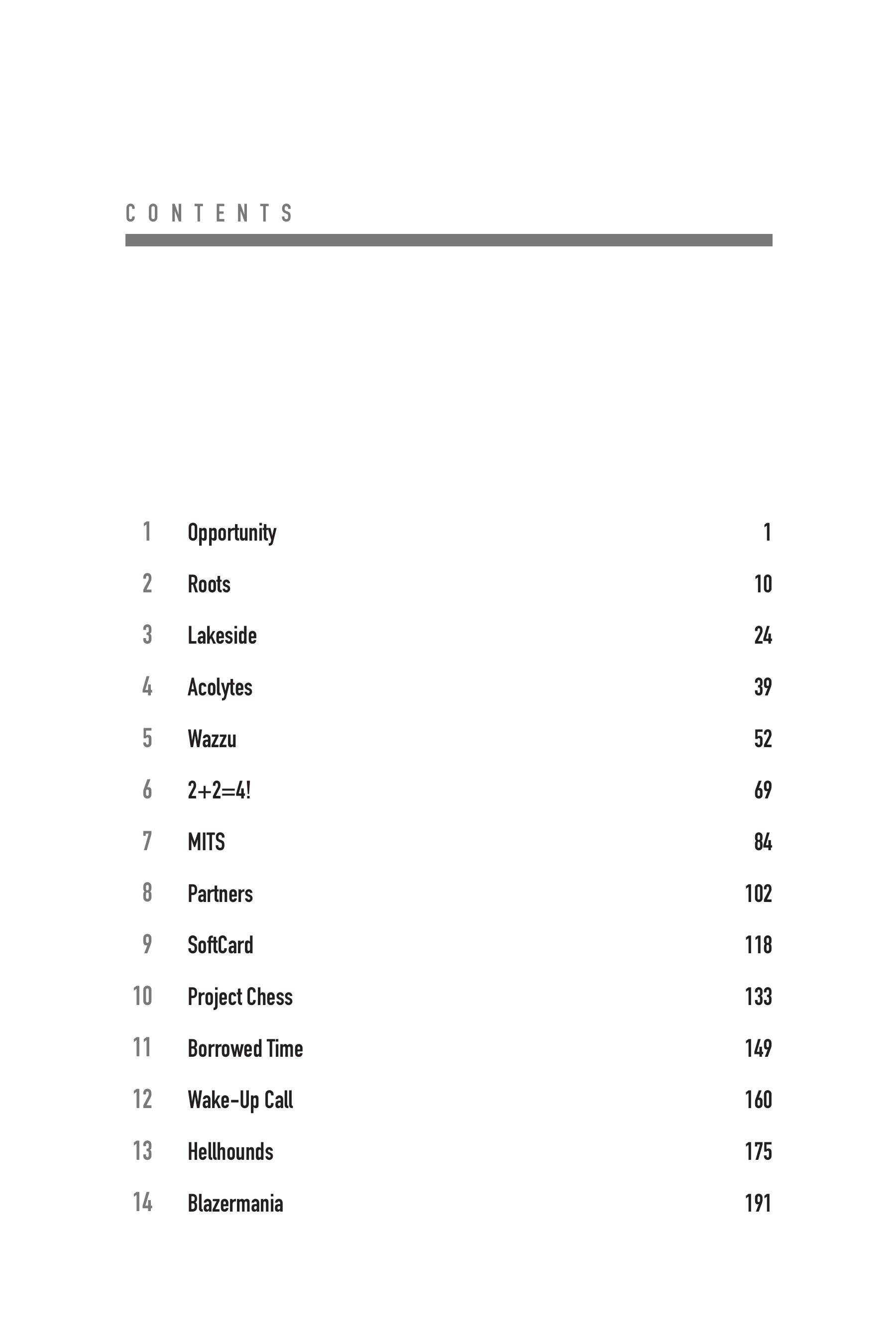
Opportunity
1
Roots
10
Lakeside
24
Acolytes
39
Wazzu
52
2+2=4!
69
MITS
84
Partners
102
SoftCard
118
Project Chess
133
Borrowed Time
149
Wake- Up Call
160
Hellhounds
175
Blazermania
191
VIII
|
CONTENTS
15
12th Man
208
16
Space
218
17
Jimi
246
18
Wired World
266
19
Fat Pipe
283
20
Searching
296
21
Mapping the Brain
304
22
Adventure
317
In Sum
331
Acknowledgments
335
Appendix
339
Index
347

IDEA MAN

C
H
A
P
T
E
R 1
OPPORTUNITY
A
s I walked toward Harvard Square on a December weekend af
ternoon in 1974, I had no inkling that my life was about to change.
The weather was snowy and cold, and I was twenty- one years old
and at loose ends. My girlfriend had left a few weeks earlier to re
turn to our hometown of Seattle three thousand miles away. I was
three semesters shy of graduation at Washington State University,
where I’d taken two breaks in the last two years. I had a dead- end
job at Honeywell, a crummy apartment, and a ’64 Chrysler New
Yorker that was burning oil. Unless something came along by sum
mer, I’d be going back myself to finish my degree.
The one constant in my life those days was a Harvard under
graduate named Bill Gates, my partner in crime since we’d met at
Lakeside School when he was in eighth grade and I was in tenth.
Bill and I learned how to dissect computer code together. We’d
started one failed business and worked side by side on professional
programming jobs while still in our teens. It was Bill who had
coaxed me to move to Massachusetts with a plan to quit school
and join him at a tech firm. Then he reversed field to return to col
lege. Like me, he seemed restless and ready to try something new.
Bill and I kept casting about for a commercial project. We fig
ured that we’d eventually write some software, where we knew we
had some talent. Over grinders or a pepperoni pie at the Harvard
|
1
2
|
IDEA MAN
House of Pizza, we fantasized about our entrepreneurial future.
One time I asked Bill, “If everything went right, how big do you
think our company could be?”
He said,“I think we could get it up to thirty- five programmers.”
That sounded really ambitious to me.
Since the dawn of integrated- circuit technology in the 1950s,
forward thinkers had envisioned ever more powerful and econom
ical computers. In 1965, in a journal called
Electronics,
a young
research physicist named Gordon Moore made that prediction
specific. He asserted that the maximum number of transistors in
an integrated circuit would double each year without raising the
chip’s cost. After cofounding Intel in 1968, Moore amended the
rate of doubling to once every two years— still dramatic. Similar
trends soon emerged in computer processing speed and disk stor
age capacity. It was a simple but profound observation that holds
true to this day. Because of continual advances in chip technology,
computers will keep getting markedly faster and cheaper.
The momentum of Moore’s law became more evident in 1969,
a few months after I’d met Bill. (I was sixteen then, just learning to
program on a mainframe computer.) A Japanese company called
Busicom asked Intel to design chips for a cheap handheld calcula
tor that could undercut the competition. Busicom assumed that the
new machine would require twelve integrated-circuit chips. But Ted
Hoff, one of Intel’s electrical engineers, had a bold idea: to shave
costs by consolidating the components of a fully functioning com
puter onto a single chip, what came to be called a microprocessor.
Before these new chips arrived on the scene, it took dozens or
hundreds of integrated circuits to perform one narrow function,
from traffic lights to gas pumps to printer terminals. Microwave-
oven- size minicomputers, the machines that bridged mainframes
and the microcomputers yet to come, followed the same formula:
one chip, one purpose. But Hoff’s invention was far more versatile.
As Gordon Moore noted,“Now we can make a single chip and sell
it for several thousand different applications.” In November 1971,
OPPORTUNITY
|
3
Moore and Robert Noyce, the co- inventor of the integrated circuit,
introduced the Intel 4004 microchip at a price of $200. The launch
advertisement in
Electronic News
proclaimed “a new era of inte
grated electronics.”
Few people took notice of the 4004 early on, but I was a college
freshman that year and had time to read every magazine and jour
nal around. It was a fertile period for computers, with new models
coming out almost monthly. When I first came across the 4004, I
reacted like an engineer: What cool things could you do with this
?
At first glance, Intel’s new chip looked like the core of a really
nice calculator. But as I read on, I could see that it had all the digi
tal circuitry of a true central processing unit, or CPU, the brains of
any computing machine. The 4004 was no toy. Unlike application-
specific integrated circuits, it could execute a program from exter
nal memory. Within the limits of its architecture, the world’s first
microprocessor was more or less a computer on a chip, just as
the ads said. It was the first harbinger of the day when computers
would be affordable for everyone.
Four months later, as I continued to “follow the chips,” I came
across the inevitable next step. In March 1972,
Electronics
an
nounced the Intel 8008. Its 8- bit architecture could handle far
more complex problems than the 4004, and it addressed up to six
teen thousand (16K) bytes of memory, enough for a fair- size pro-
gram. The business world saw the 8008 as a low- budget controller
for stoplights or conveyor belts. (In that vein, Bill and I would later
use it in our fledgling enterprise in traffic flow analysis.) But I knew
that this second- generation microchip could do much more, given
the chance.
My really big ideas have all begun with a stage- setting
development— in this case, the evolution of Intel’s early micropro
cessor chips. Then I ask a few basic questions: Where is the lead
ing edge of discovery headed? What
should
exist but doesn’t yet?
How can I create something to help meet the need, and who might
be enlisted to join the crusade?
4
|
IDEA MAN
Whenever I’ve had a moment of insight, it has come from com
bining two or more elements to galvanize a new technology and
bring breakthrough applications to a potentially vast audience. A
few months after the 8008 was announced, one of those brain
waves came to me.
What if a microprocessor could run a high- level
language, the essential tool for programming a general- purpose
computer?
It was plain to me from the outset that we’d use BASIC (Be
ginner’s All- Purpose Symbolic Instruction Code), the relatively
simple language that Bill and I learned back at Lakeside in our
first computer experience. The latest minicomputer from Digital
Equipment Corporation, the PDP-11, already ran the more com
plex FORTRAN on as little as 16K of memory. While an 8008 ma
chine would be quite a bit slower, I thought it should be able to
perform most of the same functions at a fraction of the PDP- 11’s
cost. Ordinary people would be able to buy computers for their
offices, even their homes, for the very first time. An 8008 BASIC
could swing open the gate to an array of applications for a limit
less clientele.
And so I asked Bill, “Why don’t we do a BASIC for the 8008?”
He looked at me quizzically and said,“Because it would be dog-
slow and pathetic. And BASIC by itself would take up almost all
the memory. There’s just not enough horsepower— it would be a
waste of time.” After a moment’s reflection, I knew he was prob
ably right. Then he said, “When they come out with a faster chip,
let me know.”
Bill and I had already found a groove together. I was the idea
man, the one who’d conceive of things out of whole cloth. Bill lis
tened and challenged me, and then homed in on my best ideas to
help make them a reality. Our collaboration had a natural tension,
but mostly it worked productively and well.
Long before coming to Massachusetts, I’d been speculating
about the next- generation chip, which had to be coming soon. I
was sure someone would build a computer around it— something
OPPORTUNITY
|
5
like a minicomputer, but so inexpensive that it would recast the
market. Writing to Intel to find a local 8008 vendor for our traf
fic machine, I asked about their future plans. On July 10, 1972, a
manager named Hank Smith responded:
We do not intend to introduce any chips in the future which
will obsolete the 8008. Our strategy will be to introduce a
new family of devices which will cover the upper end of the
market (the point where the 8008 leaves off, up through
mini computers). . . . The introduction for the new family of
devices is targeted for mid 1974.
I had no way of knowing that Federico Faggin, the great chip
designer, was already pushing Intel management to start work on
the Intel 8080, to be heralded by
Electronics
in the spring of 1974.
The newest microprocessor could address four times as much
memory as its predecessor. It was three times as powerful and
much easier to program. Hank Smith was wrong; the 8008 would
soon be obsolete. As Faggin would say, “The 8080 really created
the microprocessor market. The 4004 and 8008 suggested it, but
the 8080 made it real.”
One thing seemed certain: The 8080 met the criteria for a
BASIC- ready microprocessor. As soon as I read the news, I said
to Bill, “This is the chip we talked about.” I regaled him with the
8080’s virtues, not least its bargain price of $360. Bill agreed that
the 8080 was capable and the price was right. But writing a new
BASIC from scratch was a big job, something we’d never done,
and the fact remained that no computer existed to run it on. Which
meant there was no market. “You’re right, it’s a good idea,” he
said. “Come back and tell me when there’s a machine for it.”
I kept prodding Bill to reconsider, to help me develop an 8080
BASIC before someone beat us. “Let’s start a company,” I’d say.
“It’ll be too late if we wait—we’ll miss it!” In my journal entry
dated October 23, 1974, I wrote: “Saw Bill Monday night and we
6
|
IDEA MAN
may end up writing Basic Compiler/Operating System for 8080.”
But that was wishful thinking. Bill wasn’t ready, and I couldn’t
forge ahead without him. The whole point of my moving to Bos
ton had been for us to do something special as a team.
We both knew that big changes were coming. But we didn’t
know what shape they’d take until that chilly December day in
Harvard Square.
O U T O F T O W N N E W S
sat in the middle of the square. It was near the
Harvard Coop, where I occasionally nosed around for books, and
across the street from Brigham’s Ice Cream, where Bill and I went
for chocolate shakes. I’d stop by the stand each month to check
on periodicals like
Radio Electronics
and
Popular Science.
I’d pur
chase any that caught my eye, passing over the covers that hyped
build- your- own ham radio transmitters.
Like most magazines,
Popular Electronics
was postdated by
a week or two. I was hunting for its new January issue—which
stopped me in my tracks. The cover headline looked like this:
PROJECT BREAKTHROUGH!
World’s First Minicomputer Kit
to Rival Commercial Models . . .
“ALTAIR 8800” SAVE OVER $1000
Beneath the large- font type was a gray box with rows of lights
and binary switches on its front panel, just the sort of thing I’d been
imagining.* Given the magazine’s frugal, do- it- yourself readership,
I knew there had to be a single microprocessor inside; hordes of
conventional chips would have cost too much. One question re
mained: Was that microprocessor the limited Intel 8008 or the tur
bocharged 8080? I suspected— I hoped— for the 8080.
*Little did I know that the “machine” on the cover was in fact a hollow mock- up,
subbed in at the last minute after the genuine Altair prototype was delayed in
shipping by a Railway Express strike.
OPPORTUNITY
|
7
I plucked a copy from the rack and riffled through it, my antici
pation rising. I found the story on page 33, with another photo of
the Altair and a harder- sell headline:
ALTAIR 8800
The most powerful minicomputer
project ever presented— can be built
for under $400.
The first sentence of the text, by H. Edward Roberts and Wil
liam Yates of MITS, the machine’s manufacturer, was the stuff of
Allen- Gates dreams: “The era of the computer in every home— a
favorite topic among science- fiction writers— has arrived!” The
Altair represented “a full- blown computer that can hold its own
against sophisticated minicomputers now on the market,” but “in
a color TV receiver’s price class.”
The next paragraph clinched it: “In many ways, [the Altair]
represents a revolutionary development in electronic design and
thinking. . . . Its central processing unit is a new LSI [large-scale
integration] chip that is many times more powerful than previous
IC processors.” That CPU was the 8080.
Bill’s got his answer now!
I thought.
I slapped down seventy-five cents and trotted the half-dozen
slushy blocks to Bill’s room in Harvard’s Currier House. I burst
in on him cramming for finals; it was that time of year. “You re
member what you told me?” I said, feeling vindicated and a little
breathless.“To let you know when somebody came out with a ma
chine based on the 8080?”
“Yeah, I remember.”
“Well, here it is,” I said, holding out the magazine with a flour
ish. “Check it out!”
As Bill read the story, he began rocking back and forth in
his chair, a sign that he was deep in concentration. I could tell
he was impressed. “It’s expandable, just like a minicomputer,” he
8
|
IDEA MAN
murmured. Priced at $397 in kit form, scarcely more than a re
tail 8080 chip alone, the base Altair came with only 256 bytes of
memory, just enough to program its lights to blink. But more could
be added with plug- in memory cards. Throw in an input/output
board and an I/O audiocassette recorder* or a rented Teletype, and
you’d have a working machine for under two thousand dollars. Af
fordability would change everything—not just for hobbyists, but
for scientists and businesspeople. And it seemed likely that the Al
tair could run an interactive language like BASIC, the idea dancing
in my head for the past three years.
We were looking at the first commercial personal computer.
Bill set the magazine down, and we planned our next move. The
good news was that our train was leaving the station at last. The
bad: We had no idea if we’d be in time to board. Though the article
made vague references to BASIC and FORTRAN, it wasn’t clear
whether MITS already had 8080-based languages available or in
development. In either case, we’d be sunk.
Hoping for the best, we sent a letter to the company’s presi
dent on our old traffic- machine business stationery, implying that
we had a BASIC ready to roll out. When we didn’t hear back, we
followed up with a phone call. “You should talk to them. You’re
older,” Bill said.
“No, you should do it, you’re better at this kind of thing,” I
said. We compromised: Bill would make the call but would say
he was me. When it came time to meet with MITS face-to- face,
our thinking went, I’d be the one to make the trip. I had my beard
going and at least looked like an adult, while Bill—who’d rou
tinely get carded into his thirties— still could pass for a high school
sophomore.
“Ed Roberts.”
*Between the paper tape era and the popularization of floppy disks, audio
cassettes had a brief run in the midseventies as a leading storage device for
microcomputers.
OPPORTUNITY
|
9
“This is Paul Allen in Boston,” Bill said. “We’ve got a BASIC
for the Altair that’s just about finished, and we’d like to come out
and show it to you.” I admired Bill’s bravado but worried that he’d
gone too far, since we’d yet to write the first line of code.
Roberts was interested, but he was getting ten calls a day from
people with similar claims. He told Bill what he’d told everyone
else: The first person to walk through his door in Albuquerque
with a BASIC that worked would get a contract for the Altair.
(As Ed later retold the story in his inimitable style, he’d settled on
BASIC because you “could teach any idiot how to use [it] in no
time at all.”) There was nothing we could do for the moment, he
said. MITS was still debugging its in- house memory cards, which
they’d need to run a BASIC demo on the Altair. They’d be ready
for us in a month.
The whole conversation took five minutes. When it was over,
Bill and I looked at each other. It was one thing to talk about writ
ing a language for a microprocessor and another to get the job
done. Later I’d discover that MITS’s own engineers doubted that
an 8080 BASIC was possible.
If we’d been older or known better, Bill and I might have been
put off by the task in front of us. But we were young and green
enough to believe that we just might pull it off.
C
H
A
P
T
E
R 2
ROOTS
I
n the 1940
Darkonian,
two quarter- page portraits mark the top
student honors at Anadarko High School in central Oklahoma.
“All- Around Boy” Kenneth Allen, his blond hair slicked back,
meets the camera with a square jaw and a confident smile. Edna
Faye Gardner, “All- Around Girl,” has her hair curled above a
heart- shaped face. Even in black and white, her eyes shine.
I know that look well. My mother is eighty- eight now, and not
what she was, but you can still feel the positive energy in those
eyes.
My parents grew up in hard times and came of age as the world
went to war; they had smarts and ambition, but little was given
to them. In Anadarko (population 5,579), a small county seat sev
enty miles southwest of Oklahoma City, they moved in different
spheres. Bubbly and petite, a star student who sang in all the music
groups, my mother worked nights in the local library, a job tai
lored to her teenage goal: to read at least one novel from every
great author in the world. “Sam” Allen, the student- council pres
ident, played center on the varsity football team and excelled at
track. (His nickname came from a famous high hurdler of the day,
“Sailing Sam.”) He moved with the popular crowd, at least until
he began showing up at the library. My father liked adventure sto
ries and Westerns, but his interests weren’t strictly literary. One
10
|
ROOTS
|
11
day he came to my mother’s front door, aiming to ask her to the
senior prom.
He never got the chance. As he stood there, turning his hat in his
big hands, my mother chatted about the latest book she’d enjoyed.
She had grown up with four older brothers and wasn’t shy around
boys. It just never occurred to her to ask why my father might have
come to call. Flustered and red- faced, he left and stalked home. He
should have known better.
None the wiser, my mother went to the prom with her friends,
without a date. She had a wonderful time.
Three years later, my parents were engaged.
T H E F I R S T T I M E
I visited my relatives in Anadarko, I was startled
by their accents. My parents were in their late twenties before they
left Oklahoma for good, yet I’d never heard a trace of a twang or
drawl from either one of them. As my mother told me, “We just
decided we were going to speak good English, and that’s what we
did.” When they joined the postwar exodus and made their way to
California and then to Seattle, they were leaving their old lives be
hind. I think they wanted something more, something bigger for
themselves and their children to come.
After I was born, in 1953, my mother went back to teaching fourth
grade at Ravenna School in north Seattle. Curious and friendly, with
an easy laugh, Faye Allen was the kind of teacher whose former stu
dents stopped her in the street ten years later for a hug. She read aloud
with perfect diction, pausing dramatically at points of maximum sus
pense to leave the children panting for the next day’s installment. I’d
feel the same way at bedtime, when I’d beg for one more chapter of
The Swiss Family Robinson.
My mother stopped working after my
sister, Jody, was born, five years after me, and I think it was hard for
her.“I loved teaching,” she’d say.“It’s not like work. It’s like
living.
”
M Y F A T H E R B O U G H T
a house on a GI loan and we moved to
Wedgwood, a newly developed area north of the University of
12
|
IDEA MAN
Washington. It was a typical Seattle neighborhood: hilly and green,
with mature cherry trees and wood- frame homes on quarter- acre
lots. There wasn’t much traffic, and fathers and sons could toss a
football in the street after dinner. Our neighbors included a truck
driver and a French couple who owned a restaurant. Our two
story, three- bedroom house had dark gray shingles, a peaked roof,
a small front lawn, and a fair- size backyard.
We also had a basement that said a lot about us. On one side
sat the laundry machines; on another, when I got older, my chem
istry lab; along a third, my dad’s workshop, with tools hung on a
pegboard. My mother’s mountains of literature were stacked two
volumes deep on surplus university bookshelves and spilled onto
the floor alongside piles of the
New Yorker.
It got worse after she
volunteered to price books at the Wise Penny thrift shop and came
home each time with a share of the inventory.
My mother read everything, from the classics to the latest nov
els: Bellow and Balzac, Jane Austen and Chinua Achebe, Nadine
Gordimer and Lin Yü-t’ang. That basement jumble was the excep
tion to her otherwise thorough housekeeping. She kept promising
to straighten it up but couldn’t bear to throw away so much as a
National Geographic
. My father did win one concession, however.
After my mother woke him one night because she was too scared
to head to the bathroom by herself, he laid down the law: no more
ghost stories.
I was reading on my own well before kindergarten. I can re
member leafing through some illustrated primer when the page
clicked into focus and the words suddenly made sense. Not long
after that, for Christmas, I was given an oversize picture book with
everything a four- year- old could want to know about steam shov
els, tractors, backhoes, and fire engines. I read that book every day.
Seeing my interest, my mother had a friend give me a tutorial on
steam engines. It wasn’t very technical, but I got my first inkling
about the gears and belts and all the other hidden things that make
a machine come alive.
ROOTS
|
13
That book opened a new world to me. Soon I was pleading for
one on gasoline engines. Later I progressed to steam turbines and
eventually to atomic power plants and rocket engines. I’d pore
over each volume, not getting all the details but grasping enough
to satisfy me. On some elemental level, the magical became logical.
I began to understand how these things worked.
AT A G E T H R E E ,
I went to Mrs. Perkins’s musical preschool down
the hill and made her life miserable. I detested standing in line. If I
found a good picture book, I would not eat my soup when it was
time to eat soup. I moved on to Ravenna School as a self-taught
child who was stubbornly unregimented. In kindergarten, accord
ing to my progress report, I needed “greater effort” in observing
school rules and complying with the fire drills. In first grade, a few
other boys and I found a big metal ring in the cloakroom. We had
no idea what it was for, and we dared each other to turn it, a little
further each day. One morning I said,“What the heck,” and turned
it all the way.
That was a dark day for Ravenna School. The sinks wouldn’t
work; the toilets didn’t flush; drinking fountains ran dry. Dishes
piled up in the cafeteria, unwashed. I had shut off the building’s
main water valve, and no one could find the plan for the circa
1920 plumbing. They had to let school out early.
The next morning the assistant principal came to my classroom
and said, “Who turned off the valve in the coatroom?”
I slowly raised my hand and said, “I did it.” I think he was sur
prised that anyone would confess.
Sometimes I could get absentminded. One afternoon I set a
book down before a dodgeball match and then straggled home
without it. The principal summoned me the next day and asked,
“Paul, why did you set your math book on fire?” It wasn’t me, of
course; it was another kid who’d found the book and probably
hated long division. Despite my denials, the principal insisted on
calling my mother.
14
|
IDEA MAN
She came in with a stern look and declared, “In our family we
love books. My son would never burn one.” Case closed. I knew
that I could always count on my mother’s support. Each morning
she would send me into the world with a paraphrase of the Spar
tan mothers’ farewell to their sons marching off to war: “Go forth
bearing your shield!” I walked out the door a little straighter when
I heard that.
M Y FAT H E R W A S
like a John Wayne character: big and strong at six
foot three, a man of few words but with a huge heart and a strict
code of honor. He was serious, direct, and deliberate, with a reason
for everything he did.“A gentle bear of a man for all his gruffness,”
I’d write in a high- school- era journal. “He believes in a good solid
purpose in life.” He could surprise us, though. One Halloween, as
my sister and I came home from trick- or- treating, a menacing fig
ure in a white sheet and an African mask jumped out at us with
a terrible yell. We ran into the house shrieking, totally petrified. I
was stunned two days later when my mother told me who it was.
In a portrait in crayon, at age eight, I drew my father with a
wrench in one hand and a screwdriver in his shirt pocket: a doer,
not a talker. When you live with someone who doesn’t say much,
you come to rely on intuition and body language. I could always
tell when my father was displeased about something.
We had dinner together at six sharp. For a while, we brought
books to the table, but then they were banned because three of us
would read while my father sat silently with his steak. (After grow
ing up in the Depression, he loved having sirloin at least twice
a week.) Generally soft- spoken, he’d resolve any issue in what I
called his “command voice.” He wasn’t flexible or tolerant of easy
excuses; if you’d agreed to be home by a certain hour, there was no
grace period. He quietly held us to high standards, to treat people
honorably and stand by our word.
My father never spanked us. He motioned to take off his belt
once or twice, but I’d escape with a fervent promise to do better.
ROOTS
|
15
It could be different with my mother, a softhearted but more emo
tional soul. One evening I asked her to make popcorn, and she
agreed on the condition that I’d clean my messy room, an oft
broken promise of mine. The next morning, the room still in dis
array, she burst in with an open can of Jolly Time Pop Corn, flung
the raw kernels at me, and cried, “These are your broken words!”
Which made me feel terrible, though I didn’t much improve in the
cleaning department.
Another time, when I came home two hours after my curfew,
she was furious. I was small enough that she could yank me up
by the legs and dangle me upside down: “Don’t you ever stay out
without telling us where you are!” I can still see the nickels and
pennies falling from my pockets and past my head to the floor.
My mother was a naturally gregarious woman who could strike
up a ten- minute conversation with the grocery checkout lady. But
she had a husband who didn’t like to socialize, and I can count
on my fingers the number of times my parents had other couples
to our house. I remember one party, and a second one, and then
they tailed off. My mother made the best of it by inviting women
friends for afternoon tea and leading a book club, when she could
listen and talk to her heart’s content.
I N 1 9 6 0 ,
my father became associate director of the University of
Washington’s library complex, the number-two job in the largest
system in the Northwest. When it came time to name a new direc
tor, the UW search committee passed him over for someone from
the University of Texas with more degrees. When he got home at
5:30 and I’d ask about his day, his answer never varied: “Fine.”
Then he was off to his garden; he was a great relaxer. He seemed
happiest amid his bonsai pines and rhododendrons and the live
Christmas tree he’d transplanted, which today stands sixty feet
high. He’d begun gardening in the backyard and progressed to the
front, until there was hardly a patch of lawn left to mow— a happy
development for me, as I was allergic to grass pollen. Sunday
16
|
IDEA MAN
mornings he’d take me to the nursery, and we’d return with yet
another Japanese maple and a fresh- baked apple pie.
Our closest connection came when we fished together. On
one Pacific Coast trip, my father had to hold me on board after I
hooked a twenty- five- pound king salmon. Every summer the fam
ily went for a week to Twin Lakes Resort, where my job was to
clean the trout before it hit the pan on the wood-burning stove.
Then we’d all play pinochle into the night.
My father was selectively eclectic; he delved deeply into half a
dozen pastimes over the course of his life, but no more. He intro
duced me to Stan Getz and Andrés Segovia, and to Indian art at the
Burke Museum. He befriended a local modern artist, and his fa
vorite living room chair sat under a framed Rouault print of a king
holding a flower. In midlife he became a connoisseur of Japanese
prints and Chinese celadon pottery. You’d see him linger in a store,
turning some delicate vase over and over and murmuring, “That’s
really beautiful.” He’d give it back to the proprietor and return six
months later to buy it if it wasn’t too expensive.
While my mother zipped through five books at once from four
different continents, my father took months to digest
The Rise and
Fall of the Third Reich
or
The Guns of August.
He kept reading
about World War II as though trying to puzzle it out. He’d been in
the thick of it as a lieutenant with the 501st Quartermaster Rail
head Company in France and Germany, and it still tore at him.
He’d been a lot livelier and more talkative, my mother said, before
he came back from overseas with a Bronze Star and memories of
a dead friend.
I was still young when my father first asked me what I wanted
to do with my life. It was his way of imparting his laconic wisdom:
“When you grow up and have a job, do something you love. What
ever you do, you should love it.” He’d repeat this to me over the
years with conviction. Later I’d figure out what he meant: Do as I
say, not as I’ve done. Much later, my mother told me that my fa
ther had wrestled with his career choice. He suspected he might be
ROOTS
|
17
happier coaching football than managing libraries, but he finally
chose the safe and practical route, a nine- to- five life under fluores
cent lights. Lots of men from his generation did the same.
But he wanted me to choose better.
T H E O F F I C I A L G O A L
of the 1962 Seattle World’s Fair was to in
spire young people to pursue careers in science. The unofficial goal
was to show that the United States had caught up to the Soviet
Union in technology and the space race. But for me, a nine-year-
old who’d just discovered science fiction, the Century 21 Exposi
tion (as it was officially titled) revolved around my favorite thing:
the future. It was like waking up to find my most outlandish ideas
made real, just four miles from my house.
As I watched the fairgrounds take shape, the anticipation felt
like Christmas squared. I beheld the transportation of the future,
the gleaming white monorail gliding along its mile- long track. And
the architecture of the future, the Space Needle, then the highest
building west of the Mississippi, with a rotating restaurant on top
that looked just like a flying saucer. Soon after the fair opened, my
mother took Jody and me for our first visit. There’s a picture of me
that day in my beloved synthetic rubber hat with earflaps, the one
I wore for two years until it melted on a radiator. I look as though
I’m jumping out of my skin with excitement.
We were there from nine to nine, plenty of time for my mother
and sister to roam the sprawling grounds. But I wouldn’t budge from
the science pavilion. I ran around like a kid on a sugar high— what
to see next? After the Spacearium took me through the Milky Way,
I found NASA’s Project Mercury capsule, the one that had carried
Alan Shepard, the first American in space. I watched up close as a
Tesla coil threw off twenty- foot- long purple sparks. Before a crowd
of thousands, a jet-belted “astronaut” took off with a loud hissing
noise and flew forty feet high for what had to be a hundred yards,
like a character out of Robert Heinlein. The line between present and
future felt very permeable that day. It was only a matter of when.
18
|
IDEA MAN
My mother finally came back for me and took us to the World
of Tomorrow and the Bubbleator, a transparent, spherical eleva
tor. (I loved the Bubbleator, just the idea of the Bubbleator.) At the
Food Circus, I tried tempura prawns, basically shrimp on a stick
with a tangy sauce, plus my first Belgian waffle, which seemed like
the most exotic and delicious thing I’d ever eaten. You can catch
a close- up of that waffle in an Elvis Presley movie called
It Hap
pened at the World’s Fair:
an oversize, crispy square slathered with
whipped cream and topped with sliced strawberries and powdered
sugar. I’ve been to Belgium more than once since then, but I’ve
never again had one so good.
On our way out that night, with me wide-awake and starry-
eyed, we had more excitement in the parking lot. A Volkswagen
had parked behind our Buick, hemming us in. My mother was get
ting flustered when two hulking lumberjacks materialized to come
to her aid with some nineteenth-century manpower. They picked
up the little Bug and slid it aside, and we drove home.
L O O K I N G B A C K ,
I had remarkable exposure to science when I was
young. I could go to weekend open houses at the university’s labs,
where professors and students showed off their latest experiments.
On a family visit to UCLA, where my aunt worked, I learned how
they made synthetic diamonds and how seismometers recorded
earthquakes. Willard Libby, the inventor of carbon dating, poured
liquid nitrogen over my hand. I didn’t get frost- burned, Libby ex
plained, because a thin layer of vaporized gas cushioned each drop
on my skin.
For a time, around fourth grade, chemistry became my number-
one hobby. At St. Vincent de Paul, a thrift- shop gold mine, I picked
up secondhand sets for fifty cents apiece. Soon the shelves of my
basement lab were chockablock with beakers and test tubes and
containers of brightly colored chemicals. It was all good, educa
tional fun. Until, that is, I nearly killed the family pet.
Jett Black Allen was a frisky Manchester terrier, a prince of
ROOTS
|
19
dogs: intelligent, sensitive, eager to please. My father couldn’t re
sist sharing dinner from the table, carefully cutting steak into bite-
size pieces. Bred as rat catchers back in England, Manchesters are
highly athletic; once my father stopped feeding him, Jett would
leap into the air to beg for more. At first it was funny to see his
head bobbing up above the tabletop, but after a while it got tire
some, and Jett was exiled to the basement at mealtimes.
One day I’d been working on a chlorine gas generator, using
Clorox bleach, when I got called up to dinner. Midway through
the meal, we heard a strange noise, somewhere between a wheeze
and a choking rasp. What was that? Back to our food and talk, we
heard it again, louder this time, clearly coming from downstairs.
I trailed behind Dad, who pushed open the basement door. There
was Jett, quivering at the top of the stairs. At the bottom it looked
like a foggy morning on the Okefenokee, with two feet of yellow-
green chlorine gas blanketing the floor. Jett had made the smart
move to get as far as possible from the toxic fumes.
As my father raised the basement windows to clear out the gas,
he said, “You’ve got to be more careful with your experiments,
Paul.”
But I also heard what he didn’t say: He never told me to stop.
In the Allen household, children were treated like grown- ups. Our
parents encouraged us at whatever we tried, and exposed us to
Bach and jazz and flamenco, but it was more than that. They re
spected us as individuals who needed to find our own place in the
world.
S O O N I W A S
buying books on how to build small circuits: am
plifiers, radio receivers, blinkers. I’d cart around a shoebox with
batteries and lights and switches, the bits and pieces of my half-
completed projects. In fifth grade, I read every science book I could
find, along with bound issues of
Popular Mechanics
that were
hauled home from the university library, to be devoured ten or
twelve at a gulp. The magazines commonly had futuristic cars or
20
|
IDEA MAN
robots on the cover. The whole culture back then was charged with
schemes and speculation about technology, some of which wound
up coming true.
By sixth grade, I’d taken up electronics, which became even
more fun when I found my first real partner. Doug Fullmer was a
classmate who wore heavy horn- rimmed glasses and lived a block
and a half up the hill. We were the kind of boys who could talk for
hours about physics or astronomy. Living at the cusp between the
analog world around us and the digital age about to engulf it, we
couldn’t learn enough about either one.
Later an electrical engineer at Raytheon, Doug shared my excite-
ment when my dad bought me a Van de Graaff generator kit. It had
a belt- driven motor that built up static electricity on an aluminum
ball, enough for a two- inch spark. Or you could put your hand over
it to make your hair stand on end. I suffered through my share of
trial and error; once I nearly electrocuted myself when I grabbed
both leads of a transformer at the same time. My muscles clamped
up for ten interminable seconds before I could let go, my first near-
death experience. But I liked electronics because its applications
were open- ended, and you didn’t need an instruction book to cre
ate something new. Soon my jars of chemicals were collecting dust.
I was the top boy in my class, but I couldn’t keep up with Steph
anie Hazle because I got B’s in phys ed and spelling, and she got
straight A’s. I was third- chair violin and Stephanie was first chair,
and she was smug about it. She was smart and superconfident, but
I just thought she was mean.
One day I came to school with a jerry-rigged step- up trans
former. The whole class lined up to hold the bare wire contacts,
and kids giggled when they felt the tingle of electricity. But when
Stephanie’s turn came, I moved a wire that raised the voltage from
one battery to five. I knew it was harmless, because the current
would last only a split second. But it was strong enough to make
Stephanie scream and get reprimanded by the teacher. All the other
kids had liked it, after all. Why was she making such a fuss?
ROOTS
|
21
Almost instantly, my guilt overwhelmed my sense of satisfac
tion and lasted a lot longer. I still cringe when I think about it.
T H E F O R C E O F
nature always intrigued me. I was spellbound when
my mother told us about the time she and my father outran a clus
ter of tornados at the University of Oklahoma, where my father
got his undergraduate degree after the war. My mother wanted
him to park beside a ditch under a big tree, but my father gunned
the car and kept driving until he got to Anadarko. Later they went
back to the university, and that big tree was just
gone
.
One day in sixth grade, I was sitting in a temporary classroom
for orchestra practice when I noticed something odd. The nested
rings of light fixtures, hung by cables from the ceiling, were sway
ing like pendulums. Our teacher stayed focused on the score until
she finally looked up and shouted, “Everybody out of the porta
ble!” I ran onto the playground, my violin still in my hands, and
found the asphalt rippling like waves in the ocean.
That’s really
strange,
I thought. Later I heard that the earthquake measured
over 6.5 on the Richter scale. Rumor had it that the top of the
Space Needle swung more than fifteen feet side to side, far enough
for water to slosh out of the restaurant’s toilets.
I have a copy of the Sears Christmas catalog from 1960, when
I was about to turn eight. It’s filled with items to quicken a boy’s
pulse: a set of bongo drums; a student microscope to “reveal the
invisible world”; a seven- unit Lionel electric train, complete with
“guided missile” for blowing up the boxcar. For $17.98, you could
purchase a kit for the Brainiac K-30, a “mechanical brain” that
“computes, reasons, does arithmetical and logical problems . . .
solves puzzles . . . plays games . . . works out codes— and more.”
I knew from science fiction about big machines called comput
ers that did wondrous things. But it was all vague until I turned
eleven, when my mother took me for an after-the- dentist treat,
a trip to the university bookstore. Passing the adventure section,
where I’d already polished off the likes of
Tom Swift and His
22
|
IDEA MAN
Flying Lab
, I chose a beginner’s volume about computers. In the
simplest terms, it explained the fundamental bi- stable circuit, with
an illustration of a flip- flop toggling between two transistors. In
analog technology, boosting the input amplified output, much like
increasing the flow of water from a faucet. But as a true digital de-
vice, the flip- flop circuit’s state was either one or zero, on or off.
That book stripped the haze from computers and began to teach
me how they really worked.
Years later, I went with Doug to a science workshop at the Seat
tle Center, the former site of the world’s fair, and helped him build
a light- activated robot on wheels that we called the Electronic Par
amecium. Long before
Star Wars,
it resembled a scaled- down R2-
D2. Although the robot never quite came together, the
idea
that
we might do something so sophisticated was almost more exciting
than the work itself. It was one more exercise that expanded my
sense of the possible.
B A C K AT S T. V I N C E N T D E P A U L
, Doug and I trolled for perfectly
good televisions with blown vacuum tubes. We’d extract the tubes
one by one and plug in spares that we’d bought for a dollar. When
a set was beyond repair, I used a soldering iron to cannibalize the
parts. (The work could be hazardous. One time I heard a sizzling
sound, looked down, and found a glob of solder drilling a hole
into my knee.) We also got some toaster- size tube radio sets up and
running, and I’d tune into local stations for rock ’n’ roll or R & B.
Those late- forties radios became my gateway into popular music.
For Christmas in 1964, my parents gave me a three- transistor
Sony, my first solid- state device— impossibly small, no larger than
a pack of cigarettes. I was the kind of kid who liked to take things
apart to see how they worked. When I removed the radio’s back
panel to install the battery, I stared at those tiny resistors and ca
pacitors, and I thought,
Wow, I need to learn about this.
There was
mystery inside there; I felt as though I’d embarked on a quest. If I
could just get enough of the details, I was sure I could figure it out.
ROOTS
|
23
Sometime after that, Doug introduced me to integrated circuits,
where transistors were embedded in the chip. I’d read about the
new semiconductor industry, and how Jack Kilby of Texas Instru
ments had demonstrated the first working integrated circuit in
1958. Even so, it was something to hold one in your hand, all that
electronic capacity encased in one miniaturized container.
While I didn’t realize it at the time, I’d begun to follow the path
foretold by Moore’s law.
C
H
A
P
T
E
R 3
LAKESIDE
L
akeside was the most prestigious private school in Seattle, and
I wanted nothing to do with it. My Ravenna friends were mov
ing on to seventh grade at Eckstein Junior High, the nearby public
school, and I’d assumed I’d be with them. Worse yet, Lakeside was
all boys, a grim prospect for a twelve- year- old.
But when my parents heard that I’d spent most of sixth grade
reading on my own in the back of the room, they decided that I
needed more of a challenge. They would have to sacrifice to pay the
Lakeside tuition— $1,335, a lot for a middle- class family in those
days. But they wanted me to have opportunities they’d missed out
on in Oklahoma.
“
Why
do I have to go to private school?” I kept asking.
“Because you’ll learn more,” my mother replied.“And there will
be a lot of other smart kids there. It’ll be good for you.”
Lakeside’s entrance test was famously difficult. I decided to fail
on purpose, and that would be that. It was a foolproof plan until I
sat down with the exam: multiple choice, with lots of object rota
tions and pattern matching, a variation on a standard IQ test.
This
is kind of interesting,
I thought.
Let’s see how hard these questions
are.
I decided to solve the first set, just to see if I could, and then
compensate at the end with a bunch of wrong answers.
The next thing I knew, time was called: “Pencils down!” It was
24
|
LAKESIDE
|
25
one of those tests that no one finished completely, and I hadn’t got
ten around to filling in those mistakes. But I was sure I wouldn’t be
admitted, anyway, since the odds were so slim.
I got in. And my parents were right. It was really good for me.
M O D E L E D A F T E R A
New England prep school, Lakeside was a
collection of old brick buildings on thirty acres near the Jackson
Park Golf Course in north Seattle. I was thrown into a forty- eight-
member class of the city’s elite: the sons of bankers and business-
men, lawyers and UW professors. With scattered exceptions, they
were preppy kids who knew each other from private grammar
schools or the Seattle Tennis Club.
Just about everybody was smart at Lakeside, and they had
skills and study habits that I lacked. The teachers were dynamic
and demanding, prone to answering questions with questions.
(The anomaly was Mr. Dunn, my volatile French teacher, who re
sponded to careless conjugations with volleys of chalk and eras
ers.) For a while, I was tentative about raising my hand. I’d listen
to the discussion and think my own thoughts, and then I’d chime
in if nobody else did.
It took me most of seventh grade to get my bearings. Finally
I clicked with Mr. Spock, my English teacher and the brother of
Benjamin Spock, the world- famous pediatrician. “Paul has contin
ued to be the most perceptive and thoughtful boy in my class,” he
wrote in my spring report card. Gradually I got used to being chal
lenged. I’d grow more intellectually in my six years at Lakeside
than in any other phase of my life.
I N E I G H T H G R A D E ,
two events stood out. For a pregame football
rally, I rigged up an oil heater transformer under a chair that held
an effigy in the opposing team’s colors. When the moment was
right, the transformer set off a bunch of firecrackers stuffed in the
dummy’s arms. It looked like an electrocution, just as I’d planned.
My second big moment came when I was chosen to deliver the
26
|
IDEA MAN
graduation address for Lakeside’s lower school. It was my first
speech, and I slaved over it. As I rose before classmates, faculty,
parents, and honored guests, I felt a strange sensation in my legs.
My knees were knocking, just like a cartoon.
It was 1967, and artificial intelligence was the hot theme in sci
ence fiction. I’d read Isaac Asimov’s
I, Robot,
with its First Law of
Robotics (“A robot may not injure a human being or, through in
action, allow a human being to come to harm”), and
Colossus,
a
1966 British novel about a malevolent megacomputer that wound
up ruling the world. Newspapers of the day were filled with head
lines like “Computers Are Taking Over,” or “Automated Govern
ment Is Here.”
I began by hailing “the age of the computer” and a future that
“holds for us the bright prospect of even more remarkable things
to come.” After acknowledging the specter of computers someday
replacing human workers on assembly lines, I paid my respects
to the machines’ “amazing capabilities” in mathematics and their
uses in banking, medicine, and the military. I pointed out that U.S.
moon probes were in fact computer- run robots. But I was equally
interested in what computers
couldn’t
do: “They cannot have an
original idea. They are unable to go beyond the limitations of their
programming. . . .”
Were we on the threshold of a thinking robot? I closed with a
prediction: “In fifty years, a robot with a fairly large brain cell ca
pacity will be within reach.” Today it appears that I was highly op
timistic. With 2017 now around the corner, we’re still not close to
matching the abilities of the incalculably complex human brain.
When I recently reread that speech, it brought back the image
of a boy who was fascinated by computers but had little practical
knowledge beyond the flip- flop circuit. All I knew came second
hand from things I’d read. When I was growing up, few people
outside major universities or big corporations had ever seen a real
computer. It would have been hard to imagine that I’d ever lay my
hands on one.
LAKESIDE
|
27
*
*
*
W H I L E L A K E S I D E S E E M E D
conservative on the surface, it was edu
cationally progressive. We had few rules and lots of opportunities,
and all my schoolmates seemed passionate about something. But
the school was also cliquish. There were golfers and tennis players,
who carried their rackets wherever they went, and in the winter
most everyone went skiing. I’d never done any of these things, and
my friends were the boys who didn’t fit into the established groups.
Then, in the fall of my tenth- grade year, my passion found me.
My honors geometry teacher was Bill Dougall, the head of
Lakeside’s science and math departments. A navy pilot in World
War II, Mr. Dougall had an advanced degree in aeronautical engi
neering and another in French literature from the Sorbonne. In our
school’s best tradition, he believed that book study wasn’t enough
without real- world experience. He also realized that we’d need to
know something about computers when we got to college. A few
high schools were beginning to train students on traditional main
frames, but Mr. Dougall wanted something more engaging for us.
In 1968 he approached the Lakeside Mothers Club, which agreed
to use the proceeds from its annual rummage sale to lease a tele
printer terminal for computer time- sharing, a brand- new business
at the time.
On my way to math class in McAllister Hall, I stopped by
for a look. As I approached the small room, the faint clacking
got louder. I opened the door and found three boys squeezed in
side. There was a bookcase and a worktable with piles of man
uals, scraps from notebooks, and rolled- up fragments of yellow
paper tape. The students were clustered around an overgrown elec
tric typewriter, mounted on an aluminum- footed pedestal base: a
Teletype Model ASR- 33 (for Automatic Send and Receive). It was
linked to a GE- 635, a General Electric mainframe computer in a
distant, unknown office.
One senior hunched over the machine and its khaki- colored
keyboard, while another looked on and made an occasional cryptic
28
|
IDEA MAN
comment. To the keyboard’s right was an embedded rotary dial,
for the modem; to its left sat the punch, which spewed a contin
uous stream of inch- wide, eight- column paper tape. Each charac
ter was defined by the configuration of holes punched out among
the eight channels. (An inch length of tape held ten characters; a
small program might run two or three feet.) In front of the punch,
a paper-tape reader translated your programs and sent them to the
GE computer.
The Teletype made a terrific racket, a mix of low humming, the
Gatling gun of the paper- tape punch, and the
ka- chacko- whack
of
the printer keys. The room’s walls and ceiling had to be lined with
white corkboard for soundproofing. But though it was noisy and
slow, a dumb remote terminal with no display screen or lower-
case letters, the ASR- 33 was also state- of- the- art. I was transfixed.
I sensed that you could do things with this machine.
That year would be a watershed in matters digital. In March
1968, Hewlett- Packard introduced the first programmable desk
top calculator. In June, Robert Dennard won a patent for a one-
transistor cell of dynamic random- access memory, or DRAM, a
new and cheaper method of temporary data storage. In July, Rob
ert Noyce and Gordon Moore cofounded Intel Corporation. In
December, at the legendary “Mother of All Demos” in San Fran
cisco, the Stanford Research Institute’s Douglas Engelbart showed
off his original versions of a mouse, a word processor, e- mail, and
hypertext. Of all the epochal changes in store over the next two
decades, a remarkable number were seeded over those ten months:
cheap and reliable memory; a graphical user interface; a “killer”
application, and more. Had anyone connected the dots, they might
have foreseen the transformation of computers and how they
would soon be used.
T H E C L A S S I C M A I N F R A M E S
of my youth were the size of tractor-
trailers and wildly expensive. Those early IBMs and UNIVACs had
no more computing power than today’s pocket calculators, but
LAKESIDE
|
29
they took up entire rooms and threw off tremendous heat, even
after transistors replaced vacuum tubes. They were overseen by
trained operators who kept them running around the clock while
the customers stayed outside, looking in. To gain access to com
puting, programmers used a keypunch machine to convert hand
written code into a deck of punch cards, one card per line. They’d
snap a rubber band around the deck and bring it to an operator to
have the cards read in.
Then the programmers returned to their offices to wait, because
the work went on the operators’ schedule. Depending on their
job’s priority, they’d pick up a printout hours or sometimes days
later. If one card was bent or out of sequence, or a single comma
in the wrong place, they’d get an error message and not much else.
They’d have to deduce their mistake and start again.
“Batch processing,” as this system was called, worked fine for
large- scale information management tasks, like corporate payrolls.
But it became so frustrating for programmers that they mounted
a guerrilla movement for greater interactivity. In 1957, the vision
ary John McCarthy demonstrated a radical software prototype: a
“Compatible Time- sharing System,” as McCarthy called it, “that
permits each user of a computer to behave as though he were in
sole control.” Instead of passively waiting for punch cards to be
processed, users communicated with the computer through their
terminal keyboards. You could “talk” to a mainframe, receive a
prompt reply, then make your corrections. Programming became
more like a conversation.
Time- sharing made computer time affordable by spreading
costs among hundreds of users. Dozens of people could engage one
computer simultaneously, with the central processing unit shift
ing from one person’s work to the next in a fraction of a second.
The new back- and- forth rhythm wasn’t merely more efficient. It
was a leap that made card decks superfluous and computer users
far more productive. In 1965, General Electric packaged a refined
version of McCarthy’s system with the original Dartmouth BASIC
30
|
IDEA MAN
and launched a commercial service. Three years after that, Bill
Dougall and the Mothers Club brought it to Lakeside.
I was lucky to come of age in a time of fundamental change in
the computer industry. Computing power, once the sole province
of government and the wealthiest corporations and universities,
could now be parceled out at an hourly rate. New technology de
livered that power to scattered offices or schools. As usual, timing
was crucial. If I’d been born five years earlier, I might have lacked
the patience as a teenager to put up with batch-processing comput
ers. Had I come around five years later, after time- sharing became
institutionalized, I would have missed the opportunities that come
from trying something new.
R AT H E R T H A N M A K E
programming a formal part of the math cur
riculum, Lakeside offered it as an independent study option. We
were lightly supervised by Fred Wright, a young math teacher
who’d taken a summer course in punch card programming at Stan
ford. Mr. Wright gave us a BASIC manual and a few starter prob
lems to whet our appetites, and then he let us loose. Because we
didn’t know the “correct” way of doing things, we devised our
own techniques. We became resourceful of necessity.
Only the most cursory documentation was furnished to help us.
The BASIC manual was fifty- odd pages long, and I consumed it in
a day or two. I memorized the twenty or so main keywords and
how certain keys functioned on the Teletype. The language felt for
eign for the first hour or two, and then it was—
Oh yeah, I get it.
BASIC was a lot easier than French: consistently logical, no irreg
ular verbs, compact vocabulary. When I got stumped, I’d ask one
of the seniors for help: How do you make that work? How do you
print that? They were a month or so ahead of me and happy to
show off what they knew.
In one of my first programs, borrowed from a manual, I graphed
a sine wave. I watched the teleprinter’s carriage swing back and
forth to print a perfect pattern of asterisks, as though moved by
LAKESIDE
|
31
an unseen, mesmerizing hand. Within days Fred Wright had lit
tle left to teach us. Now and then he’d pop his head in, smile,
and say, “How are you guys doing?” Some of the stodgier teach
ers grumbled that we had too much freedom, but Mr. Wright loved
riding that fine line between control and chaos, unleashing our
enthusiasm.
It’s hard to convey my excitement when I sat down at the Tele
type. With my program written out on notebook paper, I’d type it
in on the keyboard with the paper tape punch turned on. Then I’d
dial into the GE computer, wait for a beep, log on with the school’s
password, and hit the start button to feed the paper tape through
the reader, which took several minutes.
At last came the big moment. I’d type “RUN,” and soon my re
sults printed out at ten characters per second— a glacial pace next
to today’s laser printers, but exhilarating at the time. It would soon
be apparent whether my program worked; if not, I’d get an error
message. In either case, I’d quickly log off to save money. Then I’d
fix any mistakes by advancing the paper tape to the error and cor
recting it on the keyboard while simultaneously punching a new
tape— a delicate maneuver nowadays handled by a simple click of
a mouse and a keystroke. When I achieved a working program, I’d
secure it with a rubber band and stow it on a shelf until the next
session.
For young people today, this process might seem hopelessly la
borious, like cracking a walnut with a Rube Goldberg machine.
But for high school students in the late 1960s, it was astound
ing to get “instant” feedback from a computer, even if you had
to wait several seconds for the machine’s next move in a game of
Yahtzee. In a sense, that time- sharing terminal marked my start
in personal computing years before personal computers. Program
ming resonated with my drive to figure out whether things worked
or not and then to fix them. I’d long marveled at the innards of
things, from transistors and integrated circuits back to that young-
reader’s book on road equipment. But crafting my own computer
32
|
IDEA MAN
code felt more creative than anything I’d tried before. I sensed that
there would always be more to learn, layer upon layer of knowl
edge and techniques.
Soon I was spending every lunchtime and free period around
the Teletype with my fellow aficionados. Others might have found
us eccentric, but I didn’t care. I had discovered my calling. I was a
programmer.
T W E N T Y O R S O
students dropped into the computer room from
time to time, but only half a dozen made it the hub of their uni-
verse. Although programming at its heart is a solitary venture, we
became a nascent brotherhood. With no teachers to guide us, we
traded commands and tricks of the trade. While a few of the aco
lytes were older students like Robert McCaw and Harvey Motul
sky, I was one of four younger ones who formed the core. Ric
Weiland, the son of a Boeing engineer, resembled Spock in
Star
Trek
without the pointy ears: quiet, kind, meticulous. Ric built
his own tic- tac- toe relay computer in the ninth grade, but never
sought attention; he was happier in the background. Kent Evans,
a minister’s son two years younger than Ric and I, had frizzy hair,
an intricate set of braces, and unflagging intensity. He was game
for anything.
One day early that fall, I saw a gangly, freckle-faced eighth
grader edging his way into the crowd around the Teletype, all arms
and legs and nervous energy. He had a scruffy- preppy look: pull
over sweater, tan slacks, enormous saddle shoes. His blond hair
went all over the place. You could tell three things about Bill Gates
pretty quickly. He was really smart. He was really competitive; he
wanted to
show
you how smart he was. And he was really, really
persistent. After that first time, he kept coming back. Many times
he and I would be the only ones there.
Bill came from a family that was prominent even by Lakeside
standards; his father later served as president of the state bar as
sociation. I remember the first time I went to Bill’s big house a
LAKESIDE
|
33
block or so above Lake Washington, feeling a little awed. His par
ents subscribed to
Fortune
and Bill read it religiously. One day
he showed me the magazine’s special annual issue and asked me,
“What do you think it’s like to run a Fortune 500 company?” I
said I had no idea. And Bill said, “Maybe we’ll have our own com
pany someday.” He was thirteen years old and already a budding
entrepreneur.
Where I was curious to study everything in sight, Bill would
focus on one task at a time with total discipline. You could see
it when he programmed— he’d sit with a marker clenched in his
mouth, tapping his feet and rocking, impervious to distraction. He
had a unique way of typing, sort of a six- finger, sideways scrabble.
There’s a famous photograph of Bill and me in the computer room
not long after we first met. I’m seated in a hardback chair at the
teleprinter in my dapper green corduroy jacket and turtleneck. Bill
is standing to my side in a plaid shirt, his head cocked attentively,
eyes trained on the printer as I typed. He looks even younger than
he actually was. I look like an older brother, which was something
Bill didn’t have.
L I K E A L L T E E N A G E
boys, we loved games. Harvey Motulsky cre
ated a text- based version of Monopoly, with the computer’s ran
dom number generator “rolling the dice.” Bob McCaw put together
a virtual casino program (including craps, blackjack, and roulette)
that involved three hundred lines of code. We proudly mounted the
printout up one wall, across the ceiling, and down the other.
Within a month, we’d run through the Mothers Club’s bud
get for computer time for the year, so they allocated a little bit
more. In early November, as computer blackjack began to pall, I
got news from Harvey. A time- sharing company had opened in Se
attle’s University District. It needed people for acceptance testing
of its new- model leased computer, a Digital Equipment Corpora
tion PDP- 10.
The next night I asked my father to take me to the Computer
34
|
IDEA MAN
Center Corporation, a ten-minute drive from our home. I peered
through the plate glass, into a room that never went dark, at the
mysterious puppy in the window: a black mainframe with cabi
net after cabinet and panels of blinking lights. The CPU alone was
about five feet wide. It was the first time that I’d seen an actual
computer in the flesh, and it seemed not quite real that such a thing
could exist just forty blocks from where I lived. All I wanted to do
at that moment was log on, connect, and have at it.
Today’s average laptop is thirty thousand times faster than the
machine I was lusting after, with ten thousand times more mem
ory. But in its day, the PDP- 10 was the most advanced species of
an evolutionary alternative to the batch- processing establishment.
Founded by Ken Olsen and Harlan Anderson, DEC made its first
splash in 1960 with the PDP- 1, the first truly interactive, “conver
sational” computer. Less than a decade later, the PDP- 10 became
the mainstay for the Defense Department’s ARPANET (the origi
nal Internet) and a time- sharing workhorse. It ran faster than GE’s
system at Lakeside and had a broader software repertoire, includ
ing FORTRAN and other languages, plus a rich array of online
utilities.
Fortunately for me and my fellow Lakesiders, this wonderful
hardware all relied on a new operating system, TOPS- 10, that was
apt to crash whenever it served too many users at a time. Com
puter Center Corporation (which we’d call C- Cubed) had taken
delivery of its leased PDP- 10 in October 1968, with a plan to
start selling time in the New Year. In the meantime, their TOPS- 10
needed to be debugged before the paying customers arrived. As an
added incentive for C- Cubed, its lease payments would be deferred
until the software functioned reliably. The company needed some
body to push the system to its limit, which was where we came in.
One C- Cubed partner was a Lakeside mother who’d heard
about our little tech fraternity. A few days after my sneak preview,
Fred Wright ushered us into the building to make introductions.
A resident guru laid out the deal: We could have unlimited free
LAKESIDE
|
35
time on their terminals, off-hours, as long as we abided by their
ground rules. “You can try to crash the computer,” he said, “but if
it crashes from something you do, you’ve got to tell us what you
did. And you can’t do it again until we tell you to try.”
The following Saturday, we met in the C- Cubed terminal room,
a space three times the size of our cubbyhole at Lakeside. We were
delighted to find a bank of a half- dozen ASR- 33s: no more waiting
to get on. Through another door lay the sanctum sanctorum, the
computer room. Manned seven days a week by three shifts of op
erators, it was big and square and fluorescent- bright, with a shiny
raised floor to keep the fat power and data cables out of harm’s
way. Whenever a bulky disk drive was installed, industrial-size suc
tion cups were used to lift the floor and run new cables. Between
the air conditioning and the hulking computer’s fans, the place was
so noisy that some operators wore hearing protectors, like work
ers on a factory floor.
For us, shifting from the GE- 635 to the PDP- 10 was like trad
ing in a Corolla for a Ferrari. Saturdays were not nearly enough.
We’d bus down to C- Cubed after school, cutting gym class to get
there earlier, our junior briefcases in hand. (I doted on mine, which
was brown leather and popped open at the lightest touch of my
thumbs.) We were on the road to becoming
hackers,
in the orig
inal, nonfelonious sense of the term: fanatical programmers who
stretched themselves to the limit. As author Steven Levy has noted,
hacker culture was a meritocracy. Your status didn’t hinge on your
age or what your father did for a living. All that counted was inge
nuity and your hunger to learn more about coding.
Every neophyte needs a master, and C- Cubed had three of
them. They were world- class programmers all, with a nerdish
élan and a tinge of the exotic. Unlike the business- side executives,
they didn’t treat us like nuisances; I suspect they may have seen
in us their younger selves. At times it felt as though I’d jumped
from high school into a postgraduate seminar in advanced systems
programming.
36
|
IDEA MAN
Steve “Slug” Russell, the company’s hardware chief, was short
and round, with a wry sense of humor. Then thirty- one, he’d fol
lowed John McCarthy from Dartmouth to MIT. There Russell had
created Spacewar, the first truly interactive computer game, on a
PDP- 1.
Bill Weiher, slim and bespectacled, never said much. Known for
developing SOS (an acronym for Son of STOPGAP, one of the first
great text editors), he looked like a scribe from the Middle Ages.
I’d see him crunching away tirelessly at his terminal, building elab
orate structures of intricate code.
Dick Gruen, an ex- DEC consultant who’d met Russell and Wei
her at Stanford, was the most gregarious of the lot, a junk- food ad
dict and Falstaffian jokester with a mop of curly hair. According to
Gruen, the operating system had yet to be born that he could not
crash, and he was clever enough that I believed him.
To them we were “the Lakeside kids” or “the testers.” On occa
sion they’d have us simultaneously run a bunch of copies of a chess
program to place an extra-heavy load on the system. Our assign
ment played to a teenager’s impulse to wreck things just for fun,
while channeling it into something positive. As I later told a Seat
tle journalist,“The most effective way to learn was going hands-on
with what was the top machine of the time, learning about how it
worked, what it took to ‘make it or break it.’ ”
Another approach was to stress- test a piece of software until
it failed, when we’d scribble down what happened on a piece of
paper and move on. The ultimate coup was to crash the whole
operating system, which would be apparent when the teleprinter
froze and buzzed as you tried to type. Later Russell and Gruen
would determine the source of the snag, happy as clams, knowing
that their lease payment to DEC had been once again forestalled.
We were happy, too. As long as we kept finding bugs, we’d extend
our Camelot of free time.
When one of our mentors came by, I was almost too intimi
dated to speak. We adopted their jargon; a
kludge
, for example,
LAKESIDE
|
37
was a baling- wire- and- gum sort of coding fix. They put up with
our pestering, and every now and then threw us a bone from some
thing they’d been working on. We were in awe of how efficiently
they coded, a critical skill in an era of limited computer memory.
Mostly we were free to bang away on our own small projects.
Bill worked on a war game; Ric grappled with FORTRAN. I wrote
code for a matchmaking program. In the evening, we usually had
the teleprinter room to ourselves. When we needed to pick up our
listings, we’d knock on the computer-room door, say hello to the
night operator, collect our printout, and return to our Teletypes. We
might steal a glance at the PDP- 10, but that was as close as we got.
T H E K E Y T O
commercial time- sharing was permanent, high- speed
data storage, a way to gain easy access to your work. C-Cubed
limped along for months with old- generation disk drives that lim
ited most customers to a couple dozen files of modest length. So
there was great anticipation when Russell took delivery of a box
about eight feet long by four feet high: a new moving-head disk
drive from Bryant Computer Products in Walled Lake, Michigan.
One of the company’s field service representatives, a thick-accented
Southerner, called it the Giant Bryant. The name stuck.
The drive was built to heroic dimensions. A massive electric
motor at the center ran a thick shaft that supported a dozen oxide-
coated steel disks, each more than three feet in diameter. They spun
in unison while a set of hydraulic arms with magnetic heads, float
ing on thin cushions of air, moved across their surfaces to read
the data. The drive could store around 100 million characters, an
order of magnitude beyond anything else available. (Today’s lap
top drives typically store six hundred times as much data in 0.002
percent of the volume.)
Unfortunately, the Giant Bryant was flaky to a fault. Every so
often, with as little provocation as a nearby footstep, a head would
touch a disk and strip off the oxide: the ominous head crash, with
data irretrievably lost and the disk damaged beyond repair.
38
|
IDEA MAN
For archival storage, C-Cubed used a less imposing device called
DECtape. It came in four- inch canisters— small enough to slip into
a pocket, large enough to hold a million characters. One 260- foot
roll had the capacity of 2,500 feet of paper tape, or slightly more
than the eight- inch floppy disks to be introduced by IBM five years
later. Even within the limits of its motorized, reel-to- reel drive,
DECtape was faster than paper tape and much sturdier, with dual
redundancy and two layers of Mylar protecting the oxide. In dem
onstrations, DEC salesmen would punch a quarter- inch hole in the
tape and then show that its data was intact.
Best of all, DECtape featured a directory structure, just like
the Giant Bryant or the floppy drives to come. Traditional mag
netic tapes were like sequential streams where stored information
couldn’t be safely updated; if you wrote something new in the mid
dle of a tape, subsequent data would be lost. But DECtape was
organized in discrete blocks of data, and one block could be re
written without affecting any other. Now we could store half a
dozen or more programs on a single tape, find all of them by name,
and edit them independently or write over them. Up until I bought
my own home terminal, my DECtapes were the first piece of com
puting technology that really belonged to me. We all wanted more
of them— they were status symbols. Those little canisters made my
work feel less ephemeral, more substantive, as though it had real
and lasting value.
C
H
A
P
T
E
R 4
ACOLYTES
A
s winter wore on, Bill and I exhibited the most stamina among
the Lakesiders at C-Cubed. Typically my father would drive by
to drag me home for dinner. I’d beg to stay— and won some and
lost some. My parents worried that I was falling behind in school.
Some of my grades were slipping, and my teachers seemed am
bivalent about my new passion. In computer programming, Mr.
Maestretti wrote, “Paul has been doing outstanding work on the
computer. He has become tremendously interested in its workings,
and has reached a sophistication far beyond . . . the average stu
dent.” But in physics, where he gave me a midterm C+ (though I’d
pull out an A in the spring), he bemoaned “the channeling of [my]
efforts into work with the computer at the expense of other aca
demic areas.”
My English teacher, Mr. Tyler, dismayed by my chronic diffi
dence to homework, turned philosophical: “Paul is an ‘enthusiast’
(in the old religious sense) and when in the grip of an enthusiasm
is almost totally irresponsible in other areas. How can one help
such a student to see the error of his ways? I don’t know. He could
even be more right than we, who knows?” In fact, I was thriving in
a professional environment, working hard at something I took joy
in. What better experience could there be for a sixteen- year- old?
Left to ourselves, Bill and I would program until we were
|
39
40
|
IDEA MAN
starving and then walk across the street to a hippie enterprise
called Morningtown Pizza. Next door was a convenience store
with police cars out front and cops playing cards in the back room.
We’d either wolf down our pizza at Morningtown or bring it back
to C- Cubed and try to keep it from dripping oil onto our Tele
types. We’d keep at it until everyone but the night operator had
left. Once I was on my own and lost track of time. The buses had
stopped running and it was way too late to call my dad for a ride,
leaving me an hour’s walk home. A stray dog followed me all the
way; my parents had to find it a home with friends of ours.
For me, the Holy Grail of software was the operating system,
the computer’s nervous system. It does the logistical work that al
lows the central processing unit to compute: shifting from pro-
gram to program; allocating storage to files; moving data to and
from modems and disk drives and printers. You don’t think about
it unless something goes wrong and it crashes.
At the time, operating systems weren’t locked boxes as they
are today. Manufacturers packaged their software with their hard
ware; any companies that bought DEC’s computers were free to
modify TOPS- 10 as they saw fit. Bill and I knew that our mentors
had access to TOPS- 10 source code and were working to debug
and enhance it. We also knew that it was off-limits to us, which
made it ten times more fascinating than whatever we were work
ing on. On weekends, after everyone had left, Bill and I would go
Dumpster diving in the building’s courtyard. We’d flip up the metal
cover and I’d interlace my fingers to give Bill a boost— he couldn’t
have weighed more than 110 pounds. He’d lean down into the
big container and scoop up anything that looked promising. After
several trips, he found a treasure: a stack of stained and crumpled
fanfold printouts. I can remember the smell wafting off the coffee
stains and thinking,
This is a little gross, but I don’t care.
We took that precious hoard back to the terminal room and
pored over it for hours. I had no Rosetta Stone to help me, and un
derstood maybe one or two lines out of ten, but I was blown away
ACOLYTES
|
41
by the source code’s tightly written elegance. To grasp the architec
ture of an operating system like TOPS- 10, I knew that I’d need to
become fluent in its assembly code, the lower- level language that
spoke directly to the machine. Seeing my interest, Steve Russell
took me aside, handed me an assembler manual bound in glossy
plastic, and told me,“You need to read this.” In line with the do- it-
yourself ethos of our world, nothing more had to be said.
Thrilled, I took the volume home and gobbled it up until I knew
it backward and forward. One week and 150 pages later, I’d hit
a wall; the manual described the mechanics for writing assembly
code, but neglected to explain what those statements made the
computer do. I went back to Russell and said,“I don’t understand.”
And he said, with a twinkle in his eye, “Oh, you better read
this,
” and gave me another 150 pages in a white plastic cover: the
system reference manual. It was a strain to get through it, and after
two weeks I realized that something was still missing. Though I
hated bothering Russell, I went to him again and said, “I still don’t
understand. How can I send characters to the Teletype?”
And he said, “Ah, there’s one more manual you need,” and he
came back with what looked like a phone book: the operating
system manual. To this day I’m not sure whether he was spoon-
feeding or hazing me, but I’d needed all three manuals all along. It
took several weeks more for me to take my first baby steps in as
sembler programming, and months before I felt confident. “This is
fascinating stuff,” I told Bill and the rest. But they were engrossed
in their high- level languages, where they could write programs
more quickly. So I continued alone.
In contrast to BASIC or FORTRAN, where each statement
combined many instructions, assembly language was a direct,
symbolic, one- to- one representation of binary machine code, con
verted into text and symbols that were easier to memorize than
patterns of 0’s and 1’s. For example, a line of BASIC might read:
A = B + C.
42
|
IDEA MAN
When written in assembly code, the same statement might look
like:
Load
B.
Add
C.
Store in
A.
Assembly language programming was both less expressive and
far more laborious than BASIC. And where programs written in
high- level languages could be ported to different CPUs with minor
variations, more or less like related dialects, assembly language
was unique to each hardware platform, as distinct as German is
from Portuguese. On the other hand, once inside the machine, as
sembly code could excecute up to hundreds of times faster. You
were writing right to the hardware, down to the bare metal. You
couldn’t get faster than that.
A Lakeside schoolmate once said that I could read assembly
code the way other people read novels, but I don’t think it came
more easily to me. It was simply the place I chose to focus, where
the rubber met the road. I was finally beginning to understand how
a computer worked at its most fundamental level. I’d made it into
the guts of the machine.
N O T H I N G L A S T S F O R E V E R ,
and there came the day when C-Cubed
finished testing the PDP- 10 and began to charge us for computer
time. With the Mothers Club money depleted, Lakeside shifted its
contract to C- Cubed. By that point, we had individual accounts.
(I can still remember our account numbers: mine was 366,2634,
while Bill drew 366,2635.) C- Cubed based its charges on a com
plex formula involving kilo– core ticks of CPU time and disk usage,
and we constantly worried that we’d spent too much. Before mail
ing the monthly bills to our parents, Fred Wright would post a list
above the Teletype in descending order of charges incurred, and
you’d pray that your name didn’t land in the top three. I cringed
ACOLYTES
|
43
when I set the record at $78, the equivalent of nearly $500 today—
how would I explain? To his credit, Dad took it in stride: “That’s
a lot, Paul. I know you’re learning, but can’t you cut back?” My
parents saw my programming as a hobby, like my vacuum-tube ra
dios or darkroom photography, only a lot more extravagant. Bill’s
parents felt the same way. We could sense their patience waning.
Late that spring, Bill and I got hold of a C- Cubed administrator
password and logged on at Lakeside. Soon we found what we were
looking for: the company’s internal accounting file, named “ACCT.
SYS.” It was encrypted, but we knew that it contained every pay
ing account and also the free ones. Our hope was to find a free ac
count to tap into; we knew it was wrong, but we were desperate
for untrammeled access. After a few futile attempts to find a spe
cialized program that could read and modify ACCT.SYS, we cop
ied the file to our directories, until we could try it again.
We never got the chance. A few days later, we were summoned
to Fred Wright’s office, where we were shocked to see Dick Gruen
and another C- Cubed representative, an unsmiling man in a dark
suit. We hoped we’d get off with a slap on the wrist, considering
that we hadn’t really done anything yet. But then the stern man
said it could be “criminal” to manipulate a commercial account.
Bill and I were almost quivering. Would we get suspended from
school?
It was worse than that.“You stole the accounting file, and we’re
throwing you out,” the man said. Our C- Cubed privileges were
withdrawn through the summer. We were devastated.
Just when all seemed lost, I ran into a friend who knew a UW
professor with a free C-Cubed account. Once Lakeside’s spring
term ended, I went almost daily to a terminal in the electrical en
gineering building. I picked up where I’d left off and read man
uals over hamburgers at the student union. Life was good, but I
kept mum about it all summer. I’d nearly reached my full height,
a shade under six feet, but Bill and Kent still looked like junior-
high- school students; I couldn’t risk them jumping in and blowing
44
|
IDEA MAN
my cover. Bill was furious when I finally told him, and I felt bad
about it. But such was the lure of programming that I knew I’d do
the same again.
I N T H E FA L L
of my junior year at Lakeside, my sins forgiven and
my sentence up, Steve Russell and I struck a bargain: In return for
free computer time, I’d try to improve their BASIC compiler. As
high- level languages had grown in popularity, compilers had be
come the indispensable middlemen. They were the translators that
turned high- level source code into “object code,” the binary bits
and bytes that computers could actually execute. Like all DEC
software, the PDP- 10’s BASIC compiler was open and extendable;
you could freely layer on new features, which was the assignment
I’d undertaken. It was a stiff challenge for someone who’d yet to
enroll in his first computer science course. Printed out, the compil
er’s listings were as thick as an abridged dictionary, and it took me
days to gain a sense of the whole and how it held together. What
ever assembly code I wrote needed to fit the program’s logical flow,
word by painstaking word.
For a while, I wondered if I’d bitten off too much. Too stubborn
to ask for assistance, I used the previous programmers’ comments
as guideposts. For every ah
- ha
moment, there were days when I
barely had a clue about the source code in front of me.
Fatigue is no factor when you’re seventeen and caught up in
something. I camped out at C-Cubed as long as my eyes stayed
open, and as days became weeks, I began to eke out some progress.
Since I’d found it painful to retype whole lines of BASIC programs
whenever I made a small mistake, I adapted ideas from Bill Wei
her’s line editor to quickly search and insert single characters. And
I religiously annotated every step, as per our mentors’ protocol, for
anyone who’d come along later to build on my work.
Again, I did all of this in the minutiae of assembly code, like
an apprentice watchmaker squinting at the tiny wheels to under
stand their interplay. By the end, I probably knew more about that
ACOLYTES
|
45
compiler than anyone at C- Cubed. Russell and Gruen seemed sur
prised that I’d gotten so far and were particularly pleased with
my line editor, a beneficial tool for their customers. I’d become
a true hacker. What I picked up over those two months formed
the basis for my assembler work with microprocessors, when the
stakes would be much higher.
Then as now, teenagers were often underestimated. Along with
Bill and Ric and Kent, I’d shown how much young people could
grow if given the chance. We were still years away from our men
tors’ level, but we weren’t bad. And we were getting better.
D E S P I T E I T S E N G I N E E R I N G
talent and first- rate time- share tech
nology, C- Cubed was hobbled by a shaky business model. Only a
handful of small- business people were willing and able to do their
own programming, and few commercial programs were available
to help them. The service became dangerously dependent on Boe
ing, Seattle’s largest employer, where middle managers could lay
off time- sharing fees on their expense sheets. In 1970, Boeing got
slammed by a double whammy: a recession in the airline industry
and a sharp cutback in NASA’s Apollo program. There were lay
offs and major cutbacks, including the company’s external com
puting budget. Worse yet, Boeing established its own contract
programming service. Over the span of a few months, it went from
client to competitor.
C- Cubed cratered early that spring and filed for Chapter 11.
As soon as Bill and I heard, we rushed to the terminal room to
plead for time to finish some programs and back everything up
on DECtape. Not long after we’d arrived, the moving men came
to repossess the leased furniture. As we worked madly away at
our Teletypes, we could see them going from room to room, piling
desks into their trucks. Finally they got to us and said, “OK, boys,
we’ve got to take the chairs.” We knelt on the floor by our termi
nals to finish saving our programs.
Minutes later, I saw Bill staring out the window with his mouth
46
|
IDEA MAN
open. One of the wheeled chairs had gotten loose and was rolling
down Roosevelt Way with a moving man giving chase. We burst
out laughing, but it was gallows humor, the end of a vital phase of
our lives. My prospects for a summer job were gone, and my father
was threatening to revoke my driving privileges if I didn’t make
up some missing chem labs. More seriously, the bankruptcy was a
lasting reminder of how a business can plummet in a flash. Bill, in
particular, never forgot that lesson.
I N R E T R O S P E C T,
the folding of C- Cubed was a blessing. By forc
ing the acolytes to scramble for computer access, it led us to
broaden our experience. At the time, IBM controlled two thirds of
the mainframe market. Its closest rivals were known as the Seven
Dwarfs: Burroughs, Control Data, General Electric, Honeywell,
NCR, RCA, and UNIVAC. Along with up- and- comers like DEC,
they were fighting to expand their meager market share by beating
the leader on price, power, innovation, or all three. The software
sector was even more fractured. Today, after the inevitable shake
out that occurs in any maturing industry, there are basically three
flavors of personal computer operating systems: Windows, Apple’s
Mac OS, and variants of Unix. Among 1970 mainframes, there
were literally dozens. Every computer line was a software world
unto itself.
One evening after school, early in my senior year at Lakeside, I
brazenly walked through a door and into UW’s graduate computer
science lab. I picked up a manual and took my seat at a Teletype
linked to a Xerox Data Systems Sigma- 5, which I soon had figured
out. Then a grad student approached to ask a question, and word
got around that I seemed to know what I was doing. I was rolling
along until an assistant professor called me into his office and said,
“You don’t look familiar. Are you in any of my classes?”
And I said, “No, sir, I’m not.”
“As matter of fact, you’re not even enrolled here, are you?”
I confessed that I wasn’t. The professor smiled and said, “All right,
ACOLYTES
|
47
I’ll tell you what. If you keep helping my students, you can stick
around.”
There was no turning back after that. I moved on to the Bur
roughs B5500 and a powerful language called ALGOL— my first
brush with batch processing, a step backward in time that only
deepened my appreciation of the PDP-10. I tried my hand at a
Control Data CDC- 6400 and an Imlac PDS- 1, the pioneering
graphical minicomputer, where I found a version of Steve Russell’s
Spacewar. I was a sponge, soaking up knowledge wherever I could.
All of us were sponges then.
That November, a Portland time- sharing company called Infor
mation Services Inc. invited me and my three “colleagues” to meet
to discuss a contract, a big step for us. Before driving to Oregon,
we reconstituted ourselves as the Lakeside Programming Group,
which sounded grown- up and official. ISI wanted a payroll pro-
gram that had to be written in COBOL, a high- level language used
in business applications. In return, they would credit us with free
time on their PDP- 10. We outlined our experience and submitted
our résumés; Bill, just turned sixteen, had written his in pencil on
lined notebook paper. We got the job.
As it turned out, our big break was unfulfilling. COBOL was a
cumbersome, wordy language, and the accounting program a slog.
We worked on it through the winter, using UW’s computer sci
ence lab until we overstayed our welcome. In a letter dated March
17, 1971, a professor named Hellmut Golde complained that our
work “tends to disrupt the intended use of the laboratory.” He ap
pended a list of violations, including our use of “the teletypes (at
times all of them simultaneously) for prolonged periods of time,
and occasionally unattended, to produce endless listings.” The re
sulting noise level was “detrimental to the normal activities and
also is not the intended mode of operation for a remote console.”
“In view of these and other occurrences,” Mr. Golde concluded,
“I must ask you to turn in your keys and terminate your activi
ties in the lab immediately.” We figured that the grad students had
48
|
IDEA MAN
complained to him, and moved to some Teletypes elsewhere to fin
ish the job.
While we never saw any revenue from the payroll program, it
felt like old times to be back on a PDP-10. And we began to see
ourselves less as hobbyists and more as people who just might
make a living by writing code.
H A V I N G H A U N T E D T H E
stacks of UW’s computer science library
for some time, I naturally became the research arm of the Lakeside
Programming Group. I spent countless hours buried in periodicals
like
Datamation
or
Computer Design
, keeping up with the latest
mainframe trends. I dived into esoteric technical reports from MIT
and Carnegie Mellon, dense theoretical stuff that ranged from arti
ficial intelligence to the latest algorithms. When I found something
interesting, I’d check it out and show it to the group.
As my senior yearbook shows, I was reading other things as
well. I’m pictured seated at a desk in my ubiquitous green cordu
roy jacket and what is most likely a blue oxford shirt. (You can’t
see my Beatles- style boots.) I have fashionably long hair, with thick
sideburns and a Fu Manchu moustache. My chin rests atop a stack
of eleven books, among them Joyce’s
Dubliners, Modern Univer
sity Physics, The Mexican War,
and the Holy Bible. I’m guessing
that the photo was posed to satirize how much work our teach
ers threw at us. Still, it was a good illustration of my breadth of
interests.
I was driven more by curiosity than by the compulsion to get
good grades. When it came to Civil War trivia or the conjugations
of
pouvoir,
I had trouble faking interest. “I am also very absent
minded (what a misnomer) and lazy (to put it mildly) towards
things from which I derive no active or contemplative pleasure,”
as I wrote at the time. But give me a dynamic teacher and engross
ing material, and I’d be insatiable. I can recall my Rimbaud phase,
when I steeped myself in poems of profound longing and angst. I
got enthralled by Assyrian history and my senior philosophy class.
ACOLYTES
|
49
It was there, in a discussion of Kant over a packed- lunch exchange
with Holy Names School, that I met my first real girlfriend: Rita, a
sharp and engaging redhead.
There were students hanging out in McAllister Hall who wore
pocket protectors, who cared about BASIC and not much else.
That wasn’t me. I joined after-school blues jams on my acoustic
guitar. I loved literature and movies and was fourth chair on the
chess team. I never stopped rooting for UW’s football and basket
ball squads, a loyalty inherited from my dad. And I moved in a
range of social circles, with Lakeside’s protohippies as well as the
computer guys. I wasn’t a nerd. I was just someone who happened
to love computers, among many other things.
T H R E E D E C A D E S A F T E R
teaching Bill and me at Lakeside, Fred
Wright was asked what he’d thought about our success with Mi
crosoft. His reply: “It was neat that they got along well enough
that the company didn’t explode in the first year or two.”
There was always a push- and- pull with us. It manifested itself
at Lakeside in the rivalry between Ric and me, on one side, and
Bill and Kent on the other; they were two years behind us and had
something to prove. At bottom, the Lakeside Programming Group
was a boys club, with lots of one- upmanship and testosterone in
the air. And while we were all bent on showing our stuff, Bill was
the most driven and competitive, hands down. We were friends
from the day we met, but there was an underlying tension, too.
Midway through twelfth grade, I was minding my own business
in the school’s computer room when Bill began taunting me: “Paul,
there’s something hidden here that you should know about, but I
bet you can’t guess what it is.”
I said, “Oh, really, Bill? What would that be?”
And he said, “I can’t tell you, but it’s something you wish you
had.” Bill being Bill, this went on for a while. Unbeknownst to him,
however, I knew his secret. Some weeks earlier, an auction had sold
off C- Cubed’s remaining assets, including dozens of DECtapes. Bill
50
|
IDEA MAN
and Kent snapped them up for a few pennies on the dollar and
never breathed a word of it. But Ric had spotted them hiding their
booty in the Teletype’s pedestal base, and passed the intelligence on
to me. Later that day, after the others left, I scooped up the tapes,
carried them home in a box, and hid them under my bed.
The next day, the worm turned. Bill was furious. “You knew
those DECtapes were there the whole time,” he said. “What did
you do with them?”
“Really, Bill?” I said.“You had some DECtapes? Where did you
get them?”
Bill was beside himself. Kent called me a thief and threatened
to sue. It got loud enough that Fred Wright came in and took me
aside, and I agreed to return the tapes.
That kind of conflict, though, was rare for Bill and me. In a se-
ries of senior- year essays about those near and dear to me, here is
what I wrote about him:
A short, bright, smart, humorous and generally likeable per
son. Thinks school is a snap. Just as smart as me in most
everything (but English) and very often superior even though
he is only a sophomore. I know quite a bit more about the
sciences and the world in general. Magically able to laugh at
himself in almost any circumstance. Loves computers and
gadgets as I do. Very suggestible and is ready to jump at any
chance to have fun in strange ways. We fit together very well.
AT M Y L A K E S I D E
commencement exercise, a classmate named Stu
Goldberg played the piano in virtuoso style. For a while I’d been
weighing two possible career paths: rock guitar or computer pro
gramming? Hearing Stu, who would land with John McLaughlin
and the Mahavishnu Orchestra the following year, reaffirmed my
choice of computers.
After the ceremony, as I walked off with my parents, Fred Wright
came chasing after us with a sheet of paper in his hand. It was my
ACOLYTES
|
51
last time- sharing bill, somewhat north of two hundred dollars. My
father grumbled a little as he made out the check. I was planning to
major in computer science at Washington State University, but my
parents were still dubious about the field’s profession. They saw it
as more of a sideline until I found my real future.
The Class of ’71 was Lakeside’s last as an all-boys’ school; it
merged with St. Nicholas to go coed that fall. As a parting gift, we
left a tombstone that still rests on the campus. In misspelled Latin,
it reads:
Vivat virgor virilis
, or, “Long live male virginity.”
C
H
A
P
T
E
R 5
WAZZU
I
was glad to be on my own at Washington State (or Wazzu, as we
called it), three hundred miles from home, but college life wasn’t
quite what I’d hoped. My intro courses were less than challeng
ing. I missed my family and my girlfriend and got distracted by the
social hubbub. Some people thrive when they first go out on their
own, but I was not one of them.
I also missed the PDP- 10. Early on, my nights were spent writ
ing programs on batches of cards for an IBM mainframe.“It
is
dif
ferent to be using IBM equipment but it really isn’t bad at all,” I
wrote to Ric Weiland in November, putting a good face on it. New
computers always intrigued me, even the baroque, slow, unwieldy
ones. I read up and tried to think up tools to improve the IBM pro
gramming experience. My progress was slow.
The more rewarding part of college was the broader world I
found there, especially at Phi Kappa Theta. A small underdog fra
ternity at the far end of the row, it perched on a slope so steep that
it took two people to mow the lawn: one to push the mower and
the other to hold the rope that kept it from rolling down the hill.
Just behind the house was a switching yard where they put trains
together at three in the morning. For the first two weeks I couldn’t
sleep, and after that I could sleep through anything.
But I loved that place. Thrown in with a lively mix of hippies,
52
|
WAZZU
|
53
eccentrics, and ROTC cadets, I got a kick out of nearly all of them.
There was Mike Flood, the frat president and wry ringleader
who assigned me dishwashing duties; Gary Johnson, who saved
on room fees by living with two dogs in his truck in the drive
way; Simon Karroum, aka the Big Syrian, a massive, kindly soul
whose English had been corrupted by a summer job on the Port
land docks. We had to edit his papers and cross out the four- letter
words, because he didn’t know any better.
I was the computer guy, the one who would happily help you
debug your homework; I could glance at a piece of FORTRAN
code and quickly pinpoint what was wrong. But I also played
hours of H-O-R-S-E in the driveway, where my notorious “mata
dor” shot was hard to beat, and I snapped center on our intramu
ral flag football team. Our quarterback, Jerry Morse, was a former
New York Yankee farmhand with a gun of an arm. I wasn’t blessed
with great speed, so Jerry would tell me in the huddle, “Ten yards
and turn around.” If Simon and Mike were covered, he’d rifle it
into my chest. I rarely dropped a pass.
Back from programming at one or two in the morning, I’d un
wind with my electric guitar, a habit that annoyed some of my frat
brothers. Mike Flood would ask me to stop, and I’d lay the gui
tar down after a final chord or two. But one night a muscular guy
named George Shea burst into my room in a fury and hoisted me
up against the wall. I looked at George and his clenched fist and
considered the beating I was about to get. For someone who’d
grown up in a family where no one ever got visibly angry, it was
an out- of- body experience.
“Put him down.” It was Mike Haspert, one of my guitar bud
dies, crouched in a karate stance. Word had it that he was a black
belt. George weighed his options, dropped me to the floor in dis
gust, and stormed off.
A typical day at Phi Kappa Theta was less eventful: marathon
hearts and chess games,
Star Trek
in the basement TV room, Pizza
Shack and Taco Time. There were drives over the Idaho state line,
54
|
IDEA MAN
where the legal drinking age was nineteen and beer was cheap.
On Saturdays I’d join the throng to watch the Cougars get slaugh
tered by the likes of USC. I was mostly carefree until I drew 99 in
the 1972 draft lottery, a number that could send me to Vietnam.
By then the war looked grim, hardly worth dying for. But I would
have served had they called me, as my father had in World War II.
As it turned out, they suspended the draft before my student de-
ferment expired.
O N M AY 2 8 , 1 9 7 2
, in a UW mountaineering class, my Lakeside
friend Kent Evans was crossing a snowfield on Mount Shuksan
when he slipped. Unroped and unable to check himself, he tumbled
more than six hundred feet down the slope, hitting several large
rocks. He was evacuated by a navy helicopter and died before he
got to a hospital. Kent was seventeen years old.
Bill was torn up by Kent’s death, just crushed. A few days after
the funeral, Kent’s parents asked us over to see if we’d want any
of his computer things— a few manuals, nothing of importance. It
was kind of them, but we felt strange sorting through Kent’s be
longings. We didn’t stay long.
Bill had contracted with Lakeside to write a scheduling pro-
gram in FORTRAN during summer vacation. “I was going to do
it with Kent,” he told me. “I need help. Do you want to work on
it with me?” Though I wouldn’t make much money, I was glad to
step in and get reacquainted with a PDP- 10. Bill stayed depressed
for weeks, but his spirits gradually lifted as we immersed ourselves
in the project, going at it full-bore in McAllister Hall like old times.
Often we’d work past midnight and sleep on cots we’d brought to
campus. The program was a challenge, with lots of moving parts:
required courses, staggered sections, electives, double- period labs.
I was impressed by how cleanly Bill broke the job into its compo
nent parts, and especially how he “preloaded” himself into an En
glish class with a dozen or more girls and no other boys.
Bill and I became closer that summer. Our age gap no longer
WAZZU
|
55
seemed to matter; we had what I call high-bandwidth communi
cation. Diving into a problem, we’d start “popping up the stack,”
computing jargon for the sequence for subtasks in the CPU: last
in, first out. In conversation, the phrase meant that we’d shift from
one topic to an earlier one without bothering to acknowledge the
new context. Someone overhearing us would have made no sense
of it:
“So then we can move this string . . .”
“You’re right, the other thing will never happen if that’s
true. . . .”
“Exactly! That’s the variable we used the last time.”
Another strong commonality was our shared sense of the ab
surd. One night, after going far too long without sleep, we were
grinding away for hours over some scheduling code—we just
couldn’t find the bug. Bill kept glaring at the problem page, and
suddenly he said,
“X!”
and collapsed into helpless giggles. I took
another look and saw what he meant: We’d left a meaningless
hanging variable stuck in the middle of a line.
“X!”
I shouted.
Then both of us were rolling on the ground, calling out
“X!”
in the
empty building, exhausted and hysterical.
For breaks we’d go to the movies; we must have seen more than
five hundred together over the years. My favorite theater was the
Kokusai in Seattle’s International District. It had double features
with English subtitles, and the second film was always samurai.
Bill didn’t go in much for foreign fare, but one night he agreed to
see “anything but one of those stupid movies with a little dog in
it.” No sooner had we settled into our seats for a contemporary
Japanese drama than a noisy terrier was running across the screen.
“
Not
the little dog,” Bill groaned out loud.
We had fun that summer, but we never stopped thinking about
our next business opportunity. Bill had taken on a data processing
job for a company that measured traffic flow patterns by count
ing the car wheels running over pressure- sensitive rubber tubes. At
fifteen- minute intervals, a machine would punch a pattern of holes
56
|
IDEA MAN
on special sixteen- channel paper tape, representing the number of
cars. The tape had to be read manually, with the results recorded
in longhand and then transferred to batch- loaded cards. The pro
cess was monotonous, inefficient, and murder on the eyes; Bill had
farmed it out to younger students at Lakeside whom he paid fifty
cents a tape to act as human paper- tape readers. One day he said,
“Those kids are going blind trying to read those things. We’ve got
to find a way to automate it.”
I wondered aloud about using one of the modern minicomput
ers. The latest Texas Instruments models were especially compact
and cost in the low four figures, but that was still too much money
for us. Then I had another idea: What about Intel’s new 8- bit mi
croprocessor, the 8008? Based on what I’d read, the chip could
run calculators, elevators, even smart terminals. Since its release
that spring, little had been done to use it for data analysis. But if it
worked as its specs suggested, the 8008 would be up to our task.
“We could make our own chip-based system, that’s the cheapest
way to do it,” I said. As Bill warmed to the proposal, I added a
salient point: “We have to find someone to build the machine.”
Hardware was not our strength, so we’d need a third partner.
A mutual acquaintance told us about Paul Gilbert, an electri
cal engineering student at UW, and we tracked him down later
that summer. After a few meetings, Paul had a workable sketch
for Traf- O- Data, the name we’d use for both the traffic machine
and our partnership. (Much later on, I asked Bill how he’d come
up with it, and he said, “I got it from jack- o’- lantern.” I thought
that was really strange.) In that first flush of entrepreneurship, we
had grandiose dreams about the money coming our way. Armed
with our easy- to- read data charts on hourly traffic flow, munici
palities would know just where to place their stoplights or to focus
their road repairs. Wouldn’t every public works department in the
world want a Traf- O- Data machine?
Paul Gilbert wangled a UW discount and we special- ordered an
8008 chip at a local electronics store. Bill and I scraped together
WAZZU
|
57
$360 and drove by to pick it up. The sales clerk handed us a small
cardboard box, which we opened then and there for our first look
at a microprocessor. Inside an aluminum foil wrapper, stuck into
a small slab of nonconductive black rubber, was a thin rectan
gle about an inch long. For two guys who’d spent their forma
tive years with massive mainframes, it was a moment of wonder.
“That’s a lot of money for such a little thing,” Bill said. But I knew
what he was thinking: That little box contained the brains of a
whole computer. We brought it to Paul Gilbert in the physics build
ing, and he set to work.
In developing the Traf- O- Data software, Bill and I faced a di
lemma. We knew that it would be painful, if not futile, to try to
create software on the 8008 itself. We needed to build a set of
development tools from the ground up, including a customized
assembler, a program that could translate assembly language in
structions into actual bytes. While the 8008 could address 16K
bytes of memory, Bill and I could afford only a quarter of that in
memory chips, not nearly enough for the tools.
So how would we program such a limited microprocessor on a
machine that didn’t yet exist? For me, the answer seemed clear: I’d
simulate
the 8008 environment on a mainframe. Simulators had
first cropped up in the literature in the midsixties, when an engi
neer named Larry Moss devised a way for an IBM 360 to “emu
late” earlier- model computers and run their software. Moss’s work
reflected a truism in technology circles that harkened back to the
theories of Alan Turing in the 1930s: Any computer could be pro
grammed to behave like any other computer. Software trumped
hardware. Although I hadn’t read about anyone simulating a mi
croprocessor, I figured it should be easy enough— I’d simply trick
a big computer into acting like a small one. In the meantime, we
could exploit the big computer’s abundant memory and advanced
development tools.
We had no idea how much adversity lay in store for us. Using
UW’s lab equipment and facilities, Paul Gilbert went about
58
|
IDEA MAN
constructing a fiendishly intricate prototype, with more than a
thousand copper wires wrapped around dozens of gold- plated
posts on two circuit boards. The box design and layout went
smoothly, but Paul spent a year trying to get the noise-sensitive
memory chips to work. Meanwhile, back at Wazzu, I struggled
to build the simulation package on the IBM 360. Debugging on a
batch- processing computer was downright Sisyphean, two steps
forward and a step and a half back.
When Bill came out to Pullman during a hellacious cold snap
that winter and we walked the two miles to the campus computer
center, we noticed that a bank’s reader-board thermometer was
stuck at 13 below zero. The air was so frigid that it almost hurt to
talk. By the time we reached our destination, my beard was stiff
with ice. And Bill said, shivering, “Does it always get this cold in
Pullman?”
I don’t remember him coming out in the winter after that.
O V E R C H R I S T M A S ,
Bill got a call from Bud Pembroke, the guy
who’d hired us to do the ISI payroll program. A massive software
project for the Bonneville Power Administration’s electrical grid
was behind schedule, and Bud was scouring the region for pro
grammers who knew their way around a PDP- 10. I was not quite
twenty and Bill was only seventeen, but age was not a criterion.
“And you’re going to be on salary,” Bud said.
Bill said, “How much?”
And Bud said, “One hundred sixty- five dollars a week.”
Four dollars an hour was a pittance for an experienced pro
grammer, even then, but Bill and I couldn’t believe our good for
tune. Here was a chance to work together again on a PDP- 10, and
for pay! I was glad to take a leave of absence from Washington
State. Bill had completed his required courses at Lakeside and got
approval to pursue an off-campus senior project for his final se
mester. We told Bud to count us in.
Bill and I piled into his orange 1967 Mustang convertible and
WAZZU
|
59
drove south to Vancouver, Washington, a land of strip malls, car
washes, and a vintage A&W Root Beer drive- in stand where we’d
become regulars. We found a cheap two- bedroom apartment and
showed up for work on a Monday in January 1973. Our employer
was TRW, a big aerospace company that had contracted with the
Department of the Interior to set up a real- time operating and dis
patch system, or RODS— the first system of its kind in the country,
we were told. The government already had software that con
trolled Bonneville’s generators along the Columbia River, distrib
uting power to eight Western states. The point of RODS was to
refresh that information each second and respond more efficiently
to shifting power needs.
TRW management had projected that a handful of software en
gineers would need two years to finish the job, a drastic underes
timate. Converting DEC’s TOPS- 10 into a real- time system was
like turning an apple into an orange— and a new variety of orange,
at that. More than a year into the project, with overrun penalties
soaring, TRW’s new software was still full of bugs. Wheeling into
crisis mode, management went out to recruit every able-minded
programmer they could find to get RODS up and running. By
the time we got there, more than forty people were working on it
around the clock.
Bonneville’s hardened control facility was across the river from
Portland, built mostly underground. They even had a shower room
for washing off nuclear waste in the event someone pushed the
button. Bill and I took the elevator down for what seemed like for
ever under the reinforced concrete. After passing several doors se
cured with combination locks, we were shown into a computer
room with a raised floor and chilly air conditioning, the place
where we’d test and run our code. I was excited to see that we’d
be sharing the space with dual PDP- 10’s; I’d never worked so close
to a computer.
Down the corridor was a control room as large as four bas
ketball courts. An immense backlit grid covered two walls like
60
|
IDEA MAN
something out of
Dr. Strangelove,
showing the status of every dam
in the Northwest. If anything went haywire, a corresponding light
would change from green to red. The Bonneville operators worked
at color- display consoles with gargantuan keyboards that could
call up any substation and paint it on their screens. There were
meters showing dam outputs in
megawatts,
which I thought was
pretty wild.
The programmers were a tight- knit if motley crew, from classic
corporate types in white short- sleeve shirts and bow ties to free
wheeling characters like Bob Barnett, a Vietnam vet who showed
us the ropes in a crazy- uncle kind of way. Bill was assigned a series
of small jobs, while I was given a fair- size one, a recovery module
to make the new automated system fail- safe. (When you’re dealing
with power for millions of people, going down is not an option.) If
the primary PDP- 10 failed, my system would tell the backup com
puter to take over.
Leaving nothing to chance, TRW performed all sorts of extreme
tests, like gauging how a massive ground short might affect the
computers below. After a quarter- inch steel cable was strung from
a 250- kilovolt line to a stanchion planted in the earth, we came
outside to watch someone throw a switch. A violent crack made us
jump. The cable became a line of vaporized steel, and then it van
ished. The computers, fortunately, were unfazed.
“Wow,” I exclaimed, “that was really something.”
And a TRW manager said,“No, what was
really
something was
when Joe forgot to put his bucket down and drove his repair truck
into that power line.”
“What happened to him?”
“There were incredible sparks and the tires melted into the
ground,” the manager said, “and Joe freaked out. But he was OK
because the truck became a Faraday cage.” (In the 1830s, British
physicist Michael Faraday demonstrated that an electrical current
running along the exterior of a conductive structure had no effect
on the interior.) The TRW guys burst out laughing as I thought,
WAZZU
|
61
Oh my gosh, that’s serious electricity.
With its bizarre personnel
and sunless facility, RODS could seem very strange at times.
Bill and I were the youngest workers there, and surely the low
est paid, but Bob and the other managers cut us no special slack.
At RODS we learned that we could hold our own with some of
the top programmers around. I had to write a thousand lines of as
sembler code— not too heavy a load, but a tricky one. Two other
programmers had taken a crack at it, but their code couldn’t han
dle the “corner cases,” like a simultaneous failure of two or more
devices. I opted for a ground- up rewrite in the cleanly structured
and annotated style that I’d learned at C- Cubed. I spent countless
hours checking my work, which needed to be fail- safe. For the first
time, I was writing directly on a running operating system. I found
it fascinating.
Freed of school obligations and family constraints, Bill and I
happily hunkered down for coding sessions and test cycles that ran
twelve hours and more. We were both natural night people who
would peak at ten or eleven p.m. and remain at optimal efficiency
for quite a while after that. No matter how long it took, we’d stay
to find that last bug. When Bill felt himself flagging, he’d grab a
jar of Tang, pour some powder on one hand, and lick it off for a
pure sugar high. (His palms had a chronic orange tinge that sum
mer.) Often we would work for two days straight and then crash
for eighteen or twenty hours, which Bill called “getting slept up.”
But sleep was an afterthought. We had our Lakeside job to fin
ish for the next term, and the graveyard shift at RODS seemed
ideal for the purpose. The class scheduling program was CPU-
intensive, and sometimes Bob Barnett came in late to find the PDP-
10 slowed to a crawl. He’d stalk down the corridor booming in
mock anger,“Gates and Allen, where are you? Shut your goddamn
scheduling program down!”
When I wasn’t writing code, I was playing acoustic guitar or
catching up on the latest Watergate news at the apartment. Late-
night diversions in Vancouver were pretty much limited to Denny’s
62
|
IDEA MAN
“classic breakfast,” our go-to meal at three a.m.: eggs, bacon, a
pancake, hash browns. For more excitement, Bill joined Bob at the
dog track in Gresham, where they bet the animals’ numbers based
on license plates in the parking lot. I went along on a few trips to
Portland Meadows, where Bob had inside information on a quar
ter horse named Red Robbie who’d been hopeless at a quarter
mile. One night they entered him at a longer distance, and Bob per
suaded us to risk our hard- earned money. Red Robbie jogged out
of the gate, last as usual, before finding his stride midway through
to win, going away at long odds.
Bill and I were regulars at the blaxploitation movies that played
at a theater in northeast Portland. We had a great time watching
Super Fly
and the like until someone came up to us one night dur
ing the closing credits: “What are you white boys doing here?”
That threw us, but we were back a week later. We just found those
films enthralling.
Living with Bill, I saw a new side of him. My mother had a
term for adrenaline junkies, people who would court risk for the
thrill of it. “That person,” she’d say, “is an edge walker.” Bill Gates
was an edge walker. He’d pride himself on making the 165 miles
from Seattle to Vancouver in under two hours, putting the hammer
down in his Mustang late at night. Where I was wary of physical
danger, Bill seemed to enjoy it. When he entered our apartment one
day in a full- leg cast, I asked him what had happened.
“Waterskiing with Barnett,” he said. They’d run out that af
ternoon to Lacamas Lake. As Barnett tells the story, he’d taken
his last run and wanted to get back to RODS, but Bill insisted on
going one more time on a single ski. In his rush, he didn’t bother
to adjust the equipment, which can be a problem if you like to
jump the wake of the boat. After Bill fell and snapped his leg, he
was told to take six weeks to heal back in Seattle. He resurfaced in
Vancouver, with a bluish leg and no cast, after three. “I’m going to
water- ski with Bob,” he told me. I couldn’t dissuade him, and his
leg somehow held up.
WAZZU
|
63
For the most part, the two of us got along well that spring and
summer. But at times Bill could get edgy, especially during our
chess games. I was a more methodical player, my openings more
structured; Bill was an aggressive improviser. When I beat him one
day, he got so angry that he swept the pieces to the floor.
“That was the stupidest move I ever made!” Bill shouted. After
a few games like that, we stopped playing.
O N C E I ’ D D E C I D E D
my approach, I was able to crank out the sys
tems control panel code pretty quickly. The weak link was a buggy
communications module that prevented my work from being
tested in real time until after I went back to Washington State that
fall. (RODS wouldn’t be officially “energized” until more than a
year later, in December 1974, after untold penalties against TRW.)
Before leaving, I got some validation from John Norton, a legend
ary systems programmer who’d been parachuted in for a review.
Norton could take an inch- thick listing, page through it in a day,
then snap it shut. If you went to him later with a question, he’d
close his eyes and say, “Go to page 57, you’ll find the subroutine
you’re looking for.” It was a proud day when my work survived
his scrutiny.
In my off- hours I made progress on my Traf-O- Data simula
tor. The PDP- 10’s central processing unit weighed nearly a ton,
but my program needed to get it to behave like a chip half the size
of a pack of gum. My first task was to define a set of thirty or so
“macros,” the symbolic instructions that would generate bytes for
the Intel 8008. Within a few days, I’d effectively performed a brain
transplant. The PDP- 10’s assembler didn’t know it, but it was now
an 8008 assembler.
My next step was to build the simulator itself, a program to
put this metamorphosis into action. Written in PDP-10 assembly
language, the simulator would mimic the microchip’s instructions.
The coding went smoothly; it was as though everything I’d learned
at C- Cubed and ISI had led me to this point. Fortunately, I was
64
|
IDEA MAN
able to finish my week’s work for Bob Barnett in about twenty
hours, then focus on Traf- O- Data. After going hard for a week, I
was done.
My third and final step was to modify the PDP-10’s debugger to
give Bill the ability to stop the program in midexecution and track
the cause of any problem. The debugger was an ugly, hairy piece
of code, full of trapdoors and cul-de- sacs, but three weeks after
I’d begun, we had an unrivaled development suite for the 8008
chip. (My techniques proved so effective that Microsoft used them
well into the 1980s, until microprocessors became fast and capa
ble enough to host their own development tools.) Shortly before
we returned to school, Bill finished the traffic analysis program. We
tested it on the PDP- 10 with hypothetical data, and the simulator
generated an impressive bar graph printout. All that remained to
be seen was whether Bill’s program would work on Paul Gilbert’s
Traf- O- Data hardware.
Our dreams expanded; Bill talked about starting a real com
pany. While I shared similar fantasies, mine centered more on the
technology. It was clear to me that inexpensive computers would
transform the future. But what could
we
do that was new and dif
ferent? Where was it all headed? On one of Rita’s visits to Vancou
ver, I took her up to TRW’s microwave tower and expounded on
its data transmission capability and what that might imply. Soon,
I said, there would be high- speed links among people all over the
world.
Another time, as Bill and I dined at a local pizza place, I had
a thought: “What if you could get the news by reading from a
computer terminal instead of buying a newspaper? You could even
program it to find articles on whatever you wanted. Wouldn’t that
be great?”
And Bill said, “Come on, Paul! It costs seventy-five dollars a
month to rent a Teletype and you can get a paper delivered for
fifteen cents. How do you compete with that?” He had me there.
But I couldn’t stop thinking about a time when everyone would
WAZZU
|
65
be digitally connected, with instant access to information and ser
vices. It would be a while before Bill and I defined our goal, in so
many words, as “a computer on every desk and in every home.”
But the seeds of that motto— and my notion of a global network
to join all those computers together— would be planted that sum
mer among the strip malls and fast- food joints in Vancouver,
Washington.
W E W E R E M I D W AY
through our work at RODS when Bill called
home and got the news that he’d been accepted at Harvard Uni
versity. He wasn’t surprised; he’d been riding high since scoring
near the top in the Putnam Competition, where he’d tested his
math skills against college undergraduates around the country. I
offered a word to the wise: “You know, Bill, when you get to Har
vard, there are going to be some people a lot better in math than
you are.”
“No way,” he said. “There’s no
way
!”
And I said, “Wait and see.”
I was decent in math and Bill was brilliant, but I spoke from ex
perience at Wazzu. One day I watched a professor cover the black
board with a maze of partial differential equations, and they might
as well have been hieroglyphics from the Second Dynasty. It was
one of those moments when you realize,
I just can’t see it.
I felt
a little sad, but I accepted my limitations. I was OK with being a
generalist.
For Bill it was different. When I saw him again over Christmas
break, he seemed subdued. I asked him about his first semester and
he said glumly, “I have a math professor who got his PhD at six
teen.” The course was purely theoretical, and the homework load
ranged up to thirty hours a week. Bill put everything into it and
got a B. When it came to higher mathematics, he might have been
one in a hundred thousand students or better. But there were peo
ple who were one in a million or one in ten million, and some of
them wound up at Harvard. Bill would never be the smartest guy
66
|
IDEA MAN
in that room, and I think that hurt his motivation. He eventually
switched his major to applied math.
By then we had ambitions beyond school. That December Bill
and I redid our résumés. Not quite twenty years old, I listed a
“working familiarity” with ten computers, ten high-level lan
guages, nine machine- level languages, and three operating systems.
I listed my objective as “systems programmer” and my desired sal
ary as “open,” though in parentheses I added “$15,000.” Location:
“Anywhere.” I noted that I’d be available as of June 1, 1974, a sign
that I was ready to leave school again for the right opportunity. I
thought I knew what I wanted to do; I just lacked a firm plan for
getting there.
In describing our work on Traf- O- Data, my résumé stated:
“Designed and put together a system for traffic engineers to study
traffic flow. The system is built around Intel’s MCS-8008 micro
computer. The software and hardware setup has been fully tested
using a prototype. Demonstrations to customers are planned for
May 1974.”
That summary was optimistic. True, Paul Gilbert had finally
stabilized the noisy memory chips. And the Traf- O- Data machine
certainly
looked
authentic, quite a feat on a $1,500 budget; Paul
had modeled it after the popular PDP-8 minicomputer, with a
similar layout for switches and LEDs. (The interior, with its rat’s
nest of posts and wires, was another story.) After hauling a Tele
type over Snoqualmie Pass in the back of a Phi Kappa brother’s
pickup truck, I hooked up the machine by our kitchen sink in
Pullman. Then I loaded in a small test program through the keys
on the front panel, and it ran successfully. But we still couldn’t
be sure if it would run Bill’s traffic analysis program, because
we couldn’t find an affordable reader for the oversize sixteen
channel tapes.
At wit’s end, we turned to a local inventor who designed a
contraption that read the tapes’ holes with a conductive rubber
pinch roller. It needed constant tightening and seldom fed the tapes
WAZZU
|
67
through in a straight line, but it was the best we could do. At
a demonstration that May for Seattle’s King County Engineering
Department, the tape reader malfunctioned— the whole thing was
a fiasco. Bill finally broke down and spent serious money on a
more reliable reader from Enviro-Labs. “Traffic Machine finally
works (!),” I wrote to Ric Weiland in August 1974.
Charging two dollars per day of data collection, we found three
clients: two smaller counties near Seattle and a district in British
Columbia. They mailed their traffic tapes to Paul Gilbert’s house,
where he produced the graphs of hourly car flow. But just as we
were getting under way, Washington joined a number of other
states in offering the same service to cities for free. We didn’t give
up easily, even attempting (with no luck) to sell our wares in South
America. According to six years of tax returns between 1974 and
1980, Traf- O- Data totaled gross receipts of $6,631 and net losses
of $3,494. In 1982, when we closed our checking account, I re
ceived a distribution of $794.31. By that time Bill and I were pre
occupied with running another company in Seattle.
In hindsight, Traf- O- Data was a good idea with a flawed busi
ness model. We had done no market research. We hadn’t foreseen
how hard it would be to get municipalities to make capital expen
ditures, or that officials would be reluctant to buy machines from
students. For Bill, Traf- O- Data’s failure would serve as another
cautionary tale. Above all, we learned that it was hard to compete
with “free.” (Bill took that lesson to heart. Years later he’d become
obsessed with Linux, the open- source operating system.)
But there were positives, too. Traf- O- Data bolstered my convic
tion that microprocessors would soon run the same programs as
larger computers at a far lower cost. Looking ahead, my develop
ment tools for the 8008 would give us an invaluable foundation
when that next- generation chip came along. In 2002, I purchased
the one and only Traf- O- Data machine from Paul Gilbert and in
stalled it in our STARTUP gallery at the Museum of Natural His
tory and Science in Albuquerque. I wanted to pay homage to an
68
|
IDEA MAN
obscure piece of hardware that played a critical role in the micro
processor software revolution.
In my experience, each failure contains the seeds of your next
success— if you are willing to learn from it. Bill and I had to con
cede that our future wasn’t in hardware or traffic tapes. We’d have
to find something else.
C
H
A
P
T
E
R 6
2+2=4!
T
hrough the spring semester of 1974, Bill kept urging me to move
to Boston. We could find work together as programmers, he said;
some local firms sounded interested. We’d come up with some ex
citing project— maybe an extension of Traf- O- Data, maybe some
thing new. In any case, we’d have fun. Why not give it a try?
Still drifting at Washington State, I was ready to take a flier. I
mailed my résumé to a dozen computer companies in the Boston
area and got a $12,500 job offer from Honeywell. Bill received an
offer there as well, and it seemed like an ideal arrangement; we
could make a decent living while doing our own things on the side.
Then, after I accepted the job and prepared to take another leave
from Wazzu, Bill changed his mind and decided to go back to Har
vard. I suspected heavy pressure from his parents, who had more
traditional ideas. In a letter to Ric, Bill wrote, “They are more in
favor of my taking up business or law—even though they don’t
say so.”
I was still committed to the move. If Boston didn’t work out, I
could always return to school. In the meantime, I’d sample a new
part of the country, and Rita had agreed to join me. We had grown
more serious and wanted to live together as a trial run for mar
riage. Plus, Bill would be there. At a minimum, we could put our
heads together on the weekends.
|
69
70
|
IDEA MAN
My dad was less than enthusiastic. “This software work seems
to be a distraction,” he said. “I don’t agree with your choice, but
you’re old enough to make your own decisions.” When the day
came that August for Rita and me to leave, he got the family Chrys
ler washed and filled it with gas. Regardless of what they thought,
my parents always did what they could to support me.
Driving cross- country with a girlfriend was an adventure. I re
member how long it took to cross Montana, and how we reached
New England in the thickest fog we’d ever seen, finally getting lost
on Boston’s roundabouts. We found an inexpensive apartment in
Tyngsborough, up near the New Hampshire state line. Rita got
work in a semiconductor plant nearby as I started at Honeywell,
the company that made the thermostats in my childhood home.
If DEC was the cutting- edge leader among IBM’s competition,
Honeywell was a big cocoon where people punched the clock as
though they were working for the phone company. The firm was
known for its low- stress, informal work culture: no neckties, lots
of bridge games at lunch. The managers had offices with windows,
along the perimeter, while the programmers worked out of a large
bullpen, two to a cubicle. My colleagues were nice guys in their
thirties. They were solid software engineers, but nothing like the
elite at C- Cubed or the crack hired guns at TRW. They had no
hacker ethic.
I was assigned to a communications protocol that would link
multiple Honeywell minicomputers, a small piece of a big project
within a turn- the- crank environment. I sat in my light brown cu
bicle and wrote anonymous assembly code for a niche- market ma
chine, and soon I got bored. I was happier in my spare time, when
I could use Bill’s password to hack around at Harvard and got my
first exposure to Unix, the multitasking operating system from Bell
Labs that had taken universities by storm. With short commands
and a root- and- branch file system, Unix provided an easier way
to organize files, and it could run on hardware costing as little as
ten thousand dollars. Here was a parallel computing universe that
2+2=4!
|
71
seemed full of fresh ideas, and it made my work at Honeywell feel
even staler.
Rita and I had come to New England knowing two people. One
was Bart Johnson, a brilliant, troubled Lakesider who would insin
uate that he was working for the Mafia. Bart had an unusual way
of dealing with parking tickets; he’d buy a junker and park wher
ever he pleased in Back Bay, until the tickets overflowed his glove
compartment. When the car got towed, as it inevitably did, he’d go
out and buy another one.
Then there was Bill. We had him out to Tyngsborough in Octo
ber for a birthday dinner for him and Rita, who always found Bill
entertaining. Back in Pullman, she’d roasted a chicken one night
for dinner and couldn’t take her eyes off him. “Did you see that?”
she said, after he’d left. “He ate his chicken with a
spoon.
I have
never in my life seen anyone eat chicken with a spoon.” When Bill
was thinking hard about something, he paid no heed to social con
vention. Once he offered Rita fashion advice— basically, to buy all
your clothes in the same style and colors and save time by not hav
ing to match them. For Bill, that meant any sweater that went with
tan slacks.
That November Rita and I moved into Rindge Houses, a subsi
dized development in Cambridge with linoleum floors, steel doors,
and legions of cockroaches. After my Chrysler began burning oil, I
bought a used yellow Mustang convertible for $290. One morning
I climbed in and turned the key. Nothing happened; someone had
stolen the battery. A few days later, I went to Sears and returned
with a new one. Again I opened the hood, and this time the engine
was gone. I gave up on my convertible, which was ill-suited for
that whistling Northeast wind anyway. Within weeks the car was
up on blocks and stripped clean.
By Thanksgiving Rita had left her job and returned to Seattle
to finish her degree at UW. Rita was my first love, my first slow
dance, and without her I was lonely. I spent more time with Bill
at Currier House before his nightly poker games with the local
72
|
IDEA MAN
cardsharps. He was getting some costly lessons in bluffing; he’d
win three hundred dollars one night and lose six hundred the
next. As Bill dropped thousands that fall, he kept telling me, “I’m
getting better.” I knew what he was thinking:
I’m smarter than
those guys.
In my off hours, my thoughts turned to microprocessors. A
few low- cost computers had been built around the Intel 8008,
but none had made much headway. The French Micral N, mar
keted as a “microcomputer” in 1973, could be programmed only
in binary and was used in highway tollbooths or for overseas ag
riculture projects. The Scelbi- 8H, with just a thousand bytes of
memory, was mostly ignored; the Mark 8 came in a kit for only the
most manic do- it- yourselfer. With the advent of Intel’s more capa
ble 8080 chip in April 1974, technology seemed ready for a leap.
But the springboard general- purpose machine had yet to be built.
I wondered if we might draw on the Traf- O- Data design to cre
ate an 8080- driven computer that would rival the PDP- 8, but Bill
found that unconvincing. Then I countered: What if we could string
a hundred chips together to make something cheaper
and
more
powerful than the minicomputers of the day? Or if we pooled a
bunch of 4- bit processor “slice” chips to emulate the IBM 360 at a
fraction of IBM’s inflated prices?
Each time I brought an idea to Bill, he would pop my balloon.
“That would take a bunch of people and a lot of money,” he’d
say. Or “That sounds really complicated.” Our Traf- O- Data ordeal
was still fresh in his mind. “We’re not hardware gurus, Paul,” he’d
remind me. “What we know is software.” And he was right. My
ideas were ahead of their time or beyond our scope or both. It was
ridiculous to think that two young guys in Boston could beat IBM
on its own turf. Bill’s reality checks stopped us from wasting time
in areas where we had scant chance of success.
So when the right opportunity surfaced, as it did that December,
it got my full attention.
*
*
*
2+2=4!
|
73
S O M E H A V E S U G G E S T E D
that our Altair BASIC was remarkable
because we created it without ever seeing an Altair or even a sam
ple Intel 8080, the microprocessor it would run on. What we did
was indeed unprecedented, but what is less well understood is that
we had no choice. The Altair was little more than a bare- bones box
with a CPU- on- a- chip inside. It had no hard drive, no floppy disk,
no place to edit or store programs. And even had the machine been
up to it, debugging on the memory- challenged 8080 would have
been slow and difficult at best.
Any other programmers vying to bring an 8080 BASIC to Al
buquerque would be facing an uphill climb. For starters, they’d
have to realize that they needed a simulator and then to create one
from scratch on a mainframe or minicomputer. Bill and I had a big
edge in speed and productivity with our Traf- O- Data development
tools. But could we actually write a BASIC interpreter?
Our game plan echoed our work on Traf- O- Data. I would gen
erate the tools, the macro assembler and simulator, while Bill took
the lead in creating the interpreter’s design. In contrast to a com
piler, a memory hog that converts whole files of source code into
assembly or machine language, an interpreter executes one snip
pet of code at a time, on the fly, which would minimize an Altair
customer’s outlay. At the time, 4K of memory was just under three
hundred dollars retail— a fair sum in 1975, but not a deal- breaker
for a crazed hobbyist. It would be tight, but we believed we could
squeeze a pared- down interpreter into that 4K, with enough room
left over for some small user- written programs.
One large piece of our BASIC was unaccounted for: the floating-
point math code that was essential for manipulating large num
bers and decimal points in scientific notation.* One night Bill and
I were at dinner at the Currier House cafeteria, where advanced
*Scientific notation is a simplified way to handle very small or very large num
bers using coefficients and exponents. For example: 83,700,000 = 8.37 × 10
7
;
0.0072 = 7.2 × 10
−3
.
74
|
IDEA MAN
math students would chat about hypercubes and five- dimensional
geometry. I was worrying aloud that I’d have to write our math
routines myself when a curly- haired freshman across from us
piped up: “I’ve done those for the PDP- 8.” We promptly brought
him to Bill’s room to discuss what we needed, and that was how
we found Monte Davidoff. (Monte negotiated a flat fee of $400
for his services, and several thousands more for follow- up work in
Albuquerque.)
Quandary solved, we moved into Harvard’s Aiken Computa
tion Lab on Oxford Street, a one- story concrete building with an
underutilized time- sharing system. The clock was ticking on us
from the start. Bill had told Ed Roberts that our BASIC was nearly
complete, and Ed said he’d like to see it in a month or so, when
in point of fact we didn’t even have an 8080 instruction manual.
After we bought one, I set to work. The 8080 had more than twice
as many instructions as the 8008, which meant that I’d need to cre
ate quite a few more macros. But the two chips shared a basic ar
chitecture, and my general approach was the same. Once again, I
would be morphing PDP- 10 software into an assembler for the mi
croprocessor chip. I finished the macros in a day or two.
My 8080 simulator was larger but conceptually similar to the
one for Traf- O- Data, and as before, I tweaked the PDP-10’s debug
ger to allow us to stop and peer inside our BASIC as it ran. There
are times in a programmer’s career when everything clicks, when
your brain is running full out; for me, this was one of them. I got
a boost from Aiken’s new video display monitor (or “glass tele
type,” in the jargon of the day), the DEC VT05. Access to a high-
speed printer helped, as did storage on the PDP-10’s hard disk
drive. Within a month, we had development tools for the new chip
that likely existed nowhere else. That 8080 package was quick and
powerful, done about as well as it could have been. I’m still proud
of that code today.
If my tools gave us our first big edge, Bill’s conceptual talent as a
programmer kept us quickly moving ahead. By the time I delivered
2+2=4!
|
75
my development suite, he’d already thought through the interpret
er’s structure. I can still see him alternately pacing and rocking
for long periods before jotting on a yellow legal pad, his fingers
stained from a rainbow of felt- tip pens. Once my simulator was in
place and he was able to use the PDP- 10, Bill moved to a terminal
and peered at his legal pad as he rocked. Then he’d type a flurry of
code with those strange hand positions of his, and repeat. He could
go like that for hours at a stretch.
In building our homegrown BASIC, we borrowed bits and
pieces of our design from previous versions, a long-standing soft
ware tradition. Languages evolve, ideas blend together; in com
puter technology, we all stand on others’ shoulders. As the weeks
passed, we got immersed in the mission. As far as we knew, we
were building the first native high-level programming language
for a microprocessor. Occasionally we wondered if some group
at MIT or Stanford might beat us, but we’d quickly regain focus.
Could we pull it off? Could we finish this thing and close the deal
in Albuquerque?
Yeah,
we could! We had the energy and the skill,
and we were hell- bent on seizing the opportunity.
We worked all hours, with double shifts on weekends. Bill ba
sically stopped going to class. Monte overslept his one o’clock
French section. I neglected my job at Honeywell, dragging into the
office at noon. I’d stay until 5:30, and then it was back to Aiken
until three or so in the morning. I’d save my files, crash for five or
six hours, and start over. We’d break for dinner at Harvard House
of Pizza or get the pupu platter at Aku Aku, a local version of
Trader Vic’s. I had a weakness for their egg rolls and butterflied
shrimp.
I’d occasionally catch Bill grabbing naps at his terminal during
our late- nighters. He’d be in the middle of a line of code when he’d
gradually tilt forward until his nose touched the keyboard. After
dozing an hour or two, he’d open his eyes, squint at the screen,
blink twice, and resume precisely where he’d left off— a prodigious
feat of concentration.
76
|
IDEA MAN
Working so closely together, the three of us developed a strong
camaraderie. Because our program ran on top of the multiuser
TOPS- 10 operating system, we could all work simultaneously. We
staged nightly competitions to squeeze a subroutine into the fewest
instructions, taking notepads to separate corners of the room and
scrawling away. Then someone would say, “I can do it in nine.”
And someone else would call out,“Well, I can do it in five!”At one
point, after Monte laid his floating-point math routine on the floor,
Bill sprawled next to the long tail of fan- folded paper to find a few
last trims. We knew that each byte saved would leave that much
more room for users to add to their applications. (Today we live in
a different world, where sixteen
gigabytes
of memory— four mil
lion times our BASIC budget for the Altair— are packed into the
base iPhone. Handcrafted code is by and large a lost art. People
still try to make programs efficient, but they no longer fight to save
that last byte, or even megabyte.)
A few years ago, when I reminisced with Monte about those
days, he compared programming to writing a novel— a good anal
ogy, I thought, for our approach to Altair BASIC. At the beginning
we outlined our plot, the conceptual phase of the coding. Then we
took the big problem and carved it into its component chapters,
from the hundreds of subroutines to their related data structures,
before putting all the parts back together. If a line didn’t work,
we’d re- edit our draft. The heart of the matter was to sustain the
big structural picture while hammering out the details of a small
subroutine, going back and forth between the two. It was the most
demanding and stimulating mental challenge I had ever faced.
As we pushed on, our confidence grew. One day we called MITS
to ask about the handshake subroutines on the Teletype for cod
ing the Altair’s input and output. We knew we were on the right
track when Bill Yates, Ed Roberts’s partner and lead engineer, told
us that no one else had even posed the question. At that point we
figured the job was ours to lose.
Returning to Aiken late one night after a fast- food run, we were
2+2=4!
|
77
stopped by the campus police and asked for our IDs. We’d con
sidered our use of the facility harmless, especially since the PDP-
10 was underutilized. But we didn’t know that Harvard split the
computer’s maintenance costs with the U.S. Defense Department,
based on usage. I’d relied on Bill’s password account for my work
on the simulator, which ate a lot of processor time. When the Jan
uary bills came due, Harvard’s share was up conspicuously, with
one student the prime culprit: William Henry Gates III. (When he
appeared before the university’s administrative board that summer,
Bill got off with a slap on the wrist.)
By late February, eight weeks after our first contact with MITS,
the interpreter was done. Shoehorned into about 3,200 bytes,
roughly two thousand lines of code, it was one tight little BASIC—
stripped down, for sure, but robust for its size. No one could have
beaten the functionality and speed crammed into that tiny foot
print of memory: “The best piece of work we ever did,” as Bill told
me recently. And it was a true collaboration. I’d estimate that 45
percent of the code was Bill’s, 30 percent Monte’s, and 25 percent
mine, excluding my development tools.*
All things considered, it was quite an achievement for three peo
ple our age. If you checked that software today, I believe it would
stack up against anything written by our old mentors at C- Cubed.
Bill and I had grown into crack programmers.
And we were just getting started.
A S I G O T
ready to go to Albuquerque, Bill began to worry. What if
I’d screwed up one of the numbers used to represent the 8080 in
structions in the macro assembler? Our BASIC had tested out fine
on my simulator on the PDP- 10, but we had no sure evidence that
the simulator itself was flawless. A single character out of place
*The opening credits embedded in our BASIC were as follows: “Paul Allen wrote
the non- runtime stuff. Bill Gates wrote the runtime stuff. Monte Davidoff wrote
the math package.”
78
|
IDEA MAN
might halt the program cold when it ran on the real chip. The
night before my departure, after I knocked off for a few hours of
sleep, Bill stayed up with the 8080 manual and triple- checked my
macros. He was bleary- eyed the next morning when I stopped by
en route to Logan Airport to pick up the fresh paper tape he’d
punched out. The byte codes were correct, Bill said. As far as he
could tell, my work was error free.
The flight was uneventful up until the plane’s final descent,
when it hit me that we’d forgotten something: a bootstrap loader,
the small sequence of instructions to tell the Altair how to read the
BASIC interpreter and then stick it into memory. A loader was a
necessity for microprocessors in the pre-ROM era. Without one,
that yellow tape in my briefcase would be worthless. I felt like an
idiot for not thinking of it at Aiken, where I could have coded it
without rushing and simulated and debugged it on the PDP- 10.
Now time was short. Minutes before landing, I grabbed a
steno pad and began scribbling the loader code in machine lan
guage— no labels, no symbols, just a series of three- digit numbers
in octal (base 8), the lingua franca for Intel’s chips. Each number
represented one byte, a single instruction for the 8080, and I knew
most of them by heart. “Hand assembly” is a famously laborious
process, even in small quantities. I finished the program in twenty-
one bytes— not my most concise work, but I was too rushed to
strive for elegance.
I came out of the terminal sweating and dressed in my profes
sional best, a tan Ultrasuede jacket and tie. Ed Roberts was sup
posed to pick me up, so I stood there for ten minutes looking for
someone in a business suit. Not far down the entryway to the air-
port, a pickup truck pulled up and a big, burly, jowly guy— six
foot four, maybe 280 pounds— climbed out. He had on jeans and
a short- sleeve shirt with a string tie, the first one I’d seen outside
of a Western. He came up to me and in a booming Southern ac
cent asked, “Are you Paul Allen?” His wavy black hair was reced
ing at the front.
2+2=4!
|
79
I said, “Yes, are you Ed?”
He said, “Come on, get in the truck.”
As we bounced over the city’s sun- baked streets, I wondered
how all this was going to turn out. I’d expected a high- powered ex
ecutive from some cutting- edge entrepreneurial firm, like the ones
clustered along Route 128, the high- tech beltway around Boston.
The reality had a whole different vibe. (On a later trip to Albu
querque, I came down from a plane and got hit in the head by tum
bleweed on the tarmac. I wasn’t in Massachusetts anymore.)
Ed said, “Let’s go over to MITS so you can see the Altair.” He
drove into a low-rent commercial area by the state fairgrounds
and stopped at a one- story strip mall. With its brick facade and
big plate- glass windows, the Cal- Linn Building might have looked
modern in 1955. A beauty salon occupied one storefront around
the corner. I followed Ed through a glass door and into a light in
dustrial space that housed MITS’s engineering and manufacturing
departments. As I passed an assembly line of a dozen or so weary-
looking workers, stuffing kit boxes with capacitors and Mylar
circuit boards, I understood why Ed was so focused on getting a
BASIC. He had little interest in software, which he referred to as
variable hardware, but he knew that the Altair’s sales wouldn’t
keep expanding unless it could do something useful.
When I arrived, there were only two or three assembled com
puters in the whole plant; everything else had gone out the door. Ed
led me to a messy workbench where I found a sky- blue metal box
with ALTAIR 8800 stenciled on a charcoal gray front panel. Mod
eled after a popular minicomputer, with rows of toggle switches
for input and flashing red LEDs for output, the Altair looked like a
slightly smaller version of our Traf- O- Data machine, about seven
inches high by eighteen inches wide. It seemed fantastic that such a
small box could contain a general- purpose computer with a legiti
mate CPU. But I had no doubt that the Altair was the real McCoy.
The only mystery was whether it would work with the paper tape
stowed in my briefcase.
80
|
IDEA MAN
Hovering over the computer was Bill Yates, a sallow, taciturn
string bean of a man with wire- rimmed glasses— Stan Laurel to
Ed’s Oliver Hardy. He was running a memory test to make sure
the machine would be ready for me, with the cover flipped up so I
could see inside. Plugged into slots on the Altair bus, an Ed Rob
erts innovation that was to become the industry standard, were
seven 1K static memory cards. It might have been the only micro
processor in the world with that much random-access memory,
more than enough for my demo. The machine was hooked up to a
Teletype with a paper-tape reader. All seemed in order.
It was getting late, and Ed suggested that we put off the BASIC
trial to the next morning. “How about dinner?” he said. He took
me to a three- dollar buffet at a Mexican place called Pancho’s,
where you got what you paid for. Afterward, back in the truck,
a yellowjacket flew in and stung me on the neck. And I thought,
This is all kind of surreal.
Ed said he’d drop me at the hotel that
he’d booked for me, which I’d thought would be along the lines
of a Motel 6. I’d only brought forty dollars; I was chronically low
on cash, and it would be years before I’d have a credit card. I
blanched when Ed pulled up to the Sheraton, the nicest hotel in
town, and escorted me to the reception desk.
“Checking in?” the clerk said. “That will be fifty dollars.”
It was one of the more embarrassing moments of my life. “Ed,
I’m sorry about this,” I stammered, “but I don’t have that kind of
cash.”
He just looked at me for a minute; I guess I wasn’t what he’d
been expecting, either. Then he said, “That’s OK, we’ll put it on
my card.”
Alone in my room, I called Bill and said, “They’ve got the com
puter working.” We were excited but also nervous, because the
next day would tell the tale.
The following morning, with Ed and Bill Yates hanging over my
shoulder, I sat at the Altair console and toggled in my bootstrap
loader on the front panel’s switches, byte by byte. Unlike the flat
2+2=4!
|
81
plastic keys on the PDP- 8, the Altair’s were thin metal switches,
tough on the fingers. It took about five minutes, and I hoped no
one noticed how nervous I was.
This isn’t going to work,
I kept
thinking.
I entered my twenty- first instruction, set the starting address,
and pressed the run switch. The machine’s lights took on a dif
fused red glow as the 8080 executed the loader’s multiple steps—at
least that much seemed to be working. I turned on the paper-tape
reader, and the Teletype chugged as it pulled our BASIC interpreter
through. At ten characters per second, reading the tape took seven
minutes. (People grabbed coffee breaks while computers loaded
paper tape in those days.) The MITS guys stood there silently. At
the end I pressed stop and reset the address to 0. My index finger
poised over the run switch once again. . . .
To that point, I couldn’t be sure of anything. Any one of a thou
sand things might have gone wrong in the simulator or the inter
preter, despite Bill’s double-checking. I pressed run.
There’s just no
way this is going to work.
The Teletype’s printer clattered to life. I gawked at the upper-
case characters; I couldn’t believe it.
But there it was:
MEMORY SIZE?
“Hey,” said Bill Yates, “it printed something!” It was the first
time he or Ed had seen the Altair do anything beyond a small
memory test. They were flabbergasted. I was dumbfounded. We
all gaped at the machine for a few seconds, and then I typed in the
total number of bytes in the seven memory cards:
7168
.
OK
, the Altair spit back. Getting this far told me that 5 percent
of our BASIC was definitely working, but we weren’t yet home
free. The acid test would be a standard command that we’d used
as a midterm exam for our software back in Cambridge. It relied
on Bill’s core coding and Monte’s floating- point math and even my
“crunch” code, which condensed certain words (like “PRINT”)
into a single character. If it worked, the lion’s share of our BASIC
was good to go. If it didn’t, we’d failed.
4
82
|
IDEA MAN
I typed in the command:
PRINT 2+2
The machine’s response was instantaneous:
That was a magical moment. Ed exclaimed, “Oh my god, it
printed ‘4’!” He’d gone into debt and bet everything on a full
functioning microcomputer, and now it looked as though his vi
sion would come true. He couldn’t get over the fact that Bill and I
had solved the puzzle without any of the hardware— that was as
tonishing to him. But Ed wasn’t as surprised as I was that our 8080
BASIC had run perfectly its first time out of the chute. The Altair’s
one- digit response, the classic kindergarten computation, proved
that my simulator was on target. I was quietly ecstatic and deeply,
deeply relieved.
“Let’s try a real program,” I said, trying to sound nonchalant.
Yates pulled out a book called
101 BASIC Computer Games,
a
slim volume that DEC brought out in 1973. The text- based Lunar
Lander program, created long before computers had graphics ca
pability, was just thirty- five lines long. Still, I thought it might build
Ed’s confidence. I typed in the program. Yates launched his lunar
module and, after a few tries, settled it safely on the moon’s sur
face. Everything in our BASIC had worked.
Ed said, “I want you to come back to my office.” Through a
flimsy- looking doorway, I took a seat in front of his desk and the
biggest orange glass ashtray I had ever seen. Ed was a chain smoker
who’d take two or three puffs, stub the cigarette out, and light the
next one. He’d go through half a pack in a single conversation.
“You’re the first guys who came in and showed us something,”
he said. “We want you to draw up a license so we can sell this
with the Altair. We can work out the terms later.” I couldn’t stop
2+2=4!
|
83
grinning. Once back at the hotel, I called Bill, who was thrilled with
the news. We were in business now, for real; in Harvard parlance,
we were
golden
. I hardly needed a plane to fly back to Boston.
From Honeywell I’d call Ed periodically with updates. One day
he interrupted me: “Stop, stop. How would you like to move down
here to New Mexico and run our software group?” Albuquerque
felt foreign to me, and I’d only just learned that it wasn’t in Ari
zona. But the salary was $16,000, a bump from what I was mak
ing at Honeywell, and it was hard to refuse an offer to work on the
code we’d created. Besides, Bill and I agreed that one of us proba
bly needed to be there to service our customer and ride herd over
software distribution. I was the freer agent, and the one who’d re
ceived the invitation, so it fell to me.
I called Ed back and said, “When do you want me to start?”
To a man, my coworkers declared that I was making a big mis
take. It was crazy, they said, to ditch an established firm for some
fly- by- night start-up selling hobbyist kits in the desert. “Your job’s
safe at Honeywell,” they kept telling me. “You can work here for
years.”
I knew that my move was a risk, but I was disappointed in my
colleagues. I wanted to hear something like:
Good luck, young fel
low, and more power to you.
I’m afraid that I was less than gra
cious in my going- away party speech: “I guess I don’t have anyone
to congratulate me for leaving except myself.”
C
H
A
P
T
E
R 7
MITS
E
d Roberts was my senior by twelve years, a fact that shaped his
first encounter with computers. When he was stationed at Kirt
land Air Force Base in Albuquerque in the 1960s, its weapons lab
had one of the world’s most powerful computer installations: two
Control Data Corporation 6600s, the fastest mainframes in cap
tivity. But Ed never got to touch them. He had to hand his batch
cards over for processing, “and I always thought it was a bad way
to go,” as he later explained. “I thought everybody ought to own
their own computer, and I thought that for years and years.”
In 1969, when I was at C- Cubed, Ed founded a new com
pany in his garage: MITS, for Micro Instrumentation and Telem
etry Systems. He began in the model rocket electronics business,
then shifted to handheld electronic calculator kits. When Texas
Instruments killed the market with cheap mass- produced models,
and MITS was about to go under, Ed turned to the idea that had
nagged at him since Kirtland: “a real, fully operational [personal]
computer that . . . could do anything that a general purpose mini
computer of the time could do.” His “ultimate gadget,” as he called
it, would be a sensation if he could pull it off. There was nothing
close to it on the market.
Like me, Ed was following the chips. When he got wind of the
8080 microprocessor, he wangled some handwritten data sheets
84
|
MITS
|
85
from an Intel rep before the release date. Looking at the specs, Ed
could see that the microprocessor was fast and powerful enough to
support the type of computer he’d been talking about, a machine
he could sell in kit form for under $400. He made a deal with Intel
for a thousand chips at $75 apiece, a steep discount. To get a loan,
he told his bank that he could sell eight hundred machines in the
first year, or four times as many as his private estimate.
Within weeks of the
Popular Electronics
bombshell, prepaid or
ders flooded into MITS from two thousand customers. Many sent
cash for what was basically a proof- of- concept prototype, a bare-
bones machine with no keyboard, no display, and just 256 bytes
of memory. Because Bill Yates had yet to design the interface cards
for a Teletype or audiocassette hookup, the only way to get data
into the Altair was through the front-panel switches. A tiny 50-
byte program required hundreds of settings in just the right order.
But some people didn’t care; they figured they’d buy the Altair now
and decide what to use it for later.
The mail in Ed’s office piled nearly to the ceiling. The balance
in his checking account swung a half- million dollars from red to
black in six weeks. His skeleton staff, cut from ninety to fewer
than twenty after the calculator meltdown, was swamped. Ed
found himself at the head of a movement to give people the tech
nology they’d wanted for a long, long time. In the words of David
Bunnell, MITS’s vice president of marketing, the Altair “liberated
that technology to make it available to anybody who had a brain.”
I R E T U R N E D T O
Albuquerque as MITS’s “director of software de
velopment” just after Easter, in April 1975. After asking for two
weeks’ salary in advance, I moved into the Sand and Sage Motel
on Central Avenue, the old Route 66, just across the street from
the Cal- Linn building— a strong selling point, because I had no car.
(I’d left the Chrysler with Bill, who lent it to an acquaintance. It
disappeared for good after that.)
The MITS software department was at the far end of the
86
|
IDEA MAN
building, next to a vacuum cleaner repair shop. Our space was
maybe a thousand square feet: a walk- in reception area with our
terminals along one wall, and then a row of doorless cubbyholes
that barely held a desk and two chairs apiece. I took the one at the
front— I had my pick, as I had no staff. A month later, I’d be joined
by Gary Runyan, whom Ed had hired to create an internal ac
counting system, and a month after that, I got a secretary. To keep
the office from getting too noisy, Gary would wheel the Teletype
into the bathroom whenever he printed out a listing.
I’d come at a frenetic time, with all hands on deck to answer
customer phone calls and sort through the growing order backlog.
A few days after I arrived, the company published the first issue
of
Computer Notes,
edited by David Bunnell, one of the first peri
odicals devoted to microcomputers. On his inaugural front page,
David hailed our software’s arrival: “Altair BASIC— Up and Run
ning.” Though we were still months from shipping, Ed Roberts
knew that our software gave the Altair a strategic edge over the
competition that was sure to follow. Our relationship was per
fectly symbiotic. Bill and I benefited from Ed’s distribution and
marketing networks, while MITS, a classic early innovator, got out
front with our programmer- friendly language and dedicated sup
port and upgrades.
While Bill cranked away at Harvard to build our BASIC’s more
powerful 8K and 12K versions, I spent my days consulting with
Bill Yates and helping with technical questions from our grow
ing client base. I put the machine through its paces for visiting
reps and took an unending stream of calls from frustrated buyers.
It wasn’t easy to assemble an Altair, which required more than a
thousand solder connections before you could power it on. Some
of our customers were engineers, but others were lawyers and den
tists and car mechanics with no background in computer technol
ogy. After taking months to finish the assembly, they’d labor to
toggle in a small demo routine. Then they’d call me.
MITS
|
87
CUSTOMER:
I don’t think my Altair works.
ME:
Are all the lights on in front?
CUSTOMER:
Yes, they’re all on, but it still doesn’t work.
ME:
OK, you’re going to have to buy some memory.
CUSTOMER:
Oh yeah, memory. What’s that?
Here was the problem: To boost its profit margin, MITS had
stopped shipping the minuscule 256-byte memory card that was
bundled with the first batch of $398 kit machines. When you
booted up a machine without a card, all the lights went on simulta
neously, a bad sign. I’d tell the poor customers that they’d need at
least 1K static memory ($176 in kit form) or a 4K dynamic mem
ory board ($264). Few seemed irritated or angry at the news. They
were just happy to have their own computer, and I knew how they
felt. I’d been thrilled when Ed gave me an Altair to use at home.
Some callers were a little odd. One began, “I’m having a prob
lem, listen to this.” The next thing I heard was the sound of a
dial- up modem, a horrendous screech that nearly ruptured my ear
drum. The caller said, “Does that sound like RS-232 to you?” I
told him that I couldn’t diagnose his problem by ear, then walked
him through the solution.
Eddie Currie, Ed Roberts’s general manager and milder alter
ego, got one customer who insisted that his Altair wouldn’t work
right because he and the computer had a personality conflict. Eddie
said, “Well, how do you think we can resolve this?”
And the customer said, “Maybe you could send me another Al
tair with a personality more like mine.”
A F T E R H A R V A R D L E T
out for the summer, Bill and Monte joined
me in Albuquerque. We rented a furnished two- bedroom apart
ment on the ground floor of the Portals, a five- minute drive from
MITS. It was a standard medium- rise apartment building, with
shag carpeting and a courtyard swimming pool that we never used.
88
|
IDEA MAN
Later we added Chris Larson, a younger Lakeside student who’d
originally been conscripted for Traf- O- Data. Bill and I each took a
bedroom, while Monte and Chris made do with the couch or floor.
In need of transportation, I bought my first new car, a metal
lic blue hatchback Chevy Monza. Bill came with me to pick it up,
and we had a hilarious time getting it home. I’d never used a stick
shift before, and I’d pop the clutch and stall every twenty feet. Bill
tried, with similar results. The Monza was a high- powered little
number with a V-8 engine and an undersize clutch that I’d burn
out once a year.
I did MITS business all day, then stayed on as Bill, Monte, and
Chris trickled in to work on our BASIC. I’d arranged a cheap time-
sharing deal with the local school district, which made its PDP- 10
available late in the afternoon. After editing our programs on the
trusty ASR- 33 Teletype, we’d have someone shoot down each day
to the schools’ office and pick up our listings from their fast line
printer. Later on we’d lease a DECwriter terminal and install it in
our living room.
Our day’s highlights were our meals: Furr’s Cafeteria for
chicken- fried steak; Mr. Powdrell’s Barbecue for beef sandwiches,
with old Mr. Powdrell still tending the smoker; Long John Silver’s
when we missed Seattle seafood. After hours, we’d often wind up
at Denny’s, where we’d be so revved up from our work that we’d
freak out the waitresses. I remember a night when one of them
looked from one pale face to the next and asked, “Are you guys
speeding?”
“No,” Monte replied, “we’re programmers.”
After dinner we often took in the latest action movie before
heading back to the office to code for hours. When I finally got
home, I’d unwind by plugging in my Stratocaster and trying to
play along with Aerosmith or Jimi Hendrix. (Monte preferred Em
erson, Lake & Palmer; Bill played R & B or sang at the top of his
lungs to Frank Sinatra’s “My Way.”) One night, as I lay in my bed
in the dark, someone pushed through my window and into my
MITS
|
89
room. I shouted and he fled. A few nights later, I found my prized
Stratocaster gone.
As the summer wore on, Bill and Monte fell into the habit of
working until sunup or whenever the school system said we had to
stop. I can picture Bill debugging BASIC on a Teletype in the cor
ner, flipping through the printout listing in his lap and typing with
fierce intensity. He lived in binary states: either bursting with ner
vous energy on his dozen Cokes a day, or dead to the world. He’d
work until drained and then curl up on the floor in his office and
be asleep within fifteen seconds. Sometimes I’d return to MITS in
the morning and see Bill’s feet sticking out of his office doorway in
a pair of scuffed loafers.
Working the equivalent of two jobs and programming on the
weekends, I logged crazy hours myself. One day blurred into the
next, as my journal attests:
7:30 AM— left work for home. Ate omelet. Sleep.
4:00 Work. Meet w/Eddie & Chamberlin. Want to know
royalty situation.
6:00 Dinner.
7:00 Work— organic stuff. Can’t find notebook, where is
it?!
9:45 Go home for a while. Sleep.
2:00 Wake up. Go to work. Put tables in BASIC.
That was life in Albuquerque: so much code, so little time.
B Y J U LY 1 9 7 5 ,
our 4K and 8K BASICs were ready to ship. Prep
ping the orders with a hand-powered winder, I’d thread in the
paper tape, hook my finger in one of the winder’s holes, and spin,
a big advance over rolling by hand. We were thrilled to see those
tapes boxed for shipping— our baby, going out into the world.
In Boston and the Bay Area, in labs and corporations like Hon
eywell, microcomputers were viewed as a passing fad. But the
90
|
IDEA MAN
doubters didn’t faze us. We were certain that the tech establish
ment was wrong and we were right, and the proof came each day
in the mail sacks bulging with orders for the Altair and our BASIC.
In that little ramshackle building in Albuquerque, it felt as though
anything was possible.
O U R O N E P R O D U C T
was 8080 BASIC, and MITS was our only cus
tomer; our interests were aligned. We’d been working on a hand
shake with Ed for months, but now we were ready to formalize the
relationship. After some back- and- forth on the numbers, Bill went
to a local attorney to have the papers drawn. In return for “the
exclusive right and license” to sell our BASIC worldwide for ten
years, MITS would give us $3,000 up front, plus per-copy royalties
of $30 to $60, depending on the version. We’d receive 50 percent
of gross receipts from BASIC licenses bought without hardware
sales. Sublicenses to third- party OEMs, the original equipment
manufacturers who made their own computers, would also be di
vided fifty- fifty. Since Bill and I retained ownership of our soft
ware, we were free to initiate these deals.
Our lawyer inserted one other clause to protect us. Paragraph
5, titled “Company Effort,” stated: “The company agrees to use
its best efforts to license, promote, and commercialize the PRO
GRAM. The company’s failure to use its best efforts as aforesaid
shall constitute sufficient grounds and reason for termination of
this agreement by Licensors. . . .”
One day that July, Ed came in waving the contract and saying,
“I trust you guys. I’m going to sign this right now. I don’t even
have to read it.”
Bill and I just looked at each other. Though we didn’t think we
were ripping Ed off, the contract was clearly crafted in our favor.
Bill said, “You don’t want another lawyer to review it?”
Ed said, “No, I’m sure it’s fine.”
In the life of any company, a few moments stand out. Signing
that original BASIC contract was a big one for Bill and me. Now
MITS
|
91
our partnership needed a name. We considered Allen & Gates, but
it sounded too much like a law firm. My next idea: Micro- Soft, for
micro
processors and
soft
ware. While the typography would be in
flux over the next year or so (including a brief transition as Micro
Soft), we both knew instantly that the name was right. Micro- Soft
was simple and straightforward. It conveyed just what we were
about.
From the time we’d started together in Massachusetts, I’d as
sumed that our partnership would be a fifty- fifty proposition. But
Bill had another idea. “It’s not right for you to get half,” he said.
“You had your salary at MITS while I did almost everything on
BASIC without one back in Boston. I should get more. I think it
should be sixty- forty.”
At first I was taken aback. But as I pondered it, Bill’s position
didn’t seem unreasonable. I’d been coding what I could in my
spare time, and feeling guilty that I couldn’t do more, but Bill had
been instrumental in packing our software with “more features per
byte of memory than any other BASIC we know,” as I’d written
for
Computer Notes.
All in all, I thought, a sixty- forty split might
be fair.
P A S S I N G B Y T H E
MITS loading dock one day, I saw boxes stacked
high with eight- inch floppy disk drives, the new storage devices re
cently introduced by IBM. Each one had a capacity of 243K (nearly
a quarter of a megabyte), which would “enable the Altair 8800 to
function as a really sophisticated computer system,” as
Computer
Notes
promised that July. Floppy disk drives were a giant step
toward a personal machine that rivaled minicomputers for func
tionality. An 8K program that took thirteen minutes to load using
paper tape, or five minutes with an audiocassette, needed only a
few seconds on a floppy.
But Altair owners wouldn’t be able to use the new drives until
Bill wrote our stand- alone Disk BASIC, so called because of its
primitive internal file system, and I was getting nervous. As summer
92
|
IDEA MAN
drew to a close, I kept prodding him to get started: “Bill, it’s almost
time for you to go back to school and you haven’t written a single
line of code.”
“It’s OK, I’m thinking about it,” he’d say. “I’ve got the design
in my head.”
Then it was: “Bill, you’re leaving in ten days. Can you really get
this done?”
“Yeah, I can do it. Don’t worry about it.”
Shortly before Labor Day, Bill checked into a hotel with three
legal pads and ten pencils. Five days later he came out with thou
sands of bytes of assembly language code. He typed it into a termi
nal, handed me the legal pads, and said, “OK, you’re gonna have
to finish debugging it. I’ve got to go.” Then he was off to Harvard.
Later on, as the company grew and his executive duties multi
plied, Bill would get fewer opportunities for such high-wire creativ
ity. In a way, that was too bad—he had a rare gift for programming.
I N S E P T E M B E R 1 9 7 5 ,
I flew east to observe Ed Roberts’s latest
marketing ploy in action. A college student named Mike Hunter
was on a six- month, sixty- city tour in a Dodge camper van known
as the MITS- Mobile, showing off the marvels of the Altair. I joined
him at a Holiday Inn in Huntsville, Alabama, where Mike set up
three computers on a folding table. By six o’clock, most of the
sixty chairs were filled at ten dollars a head, then five times the
cost of a movie. The crowd was heavy with dyed- in- the- wool hob
byists and engineers from central casting: pocket protectors, slide
rules, horn- rimmed glasses, crew cuts. It felt as though we’d trav
eled back in time to 1962.
Mike began with a three-hour seminar, using Ed’s homemade
slides: an hour on the history of computer hardware; an hour on
our software; an hour on the Altair. After a Q & A, the engineers
got to play with the computers. “Is that a dummy model?” some
one asked. In retort, Mike swiftly toggled in the bootstrap loader
and ran Lunar Lander with our 4K BASIC. Doubters would check
MITS
|
93
under the table, looking for cables to some minicomputer they
imagined had to be hidden behind the partition. They found it
hard to believe that such a little box could run a real program, or
that you could buy a bona fide computer for the cost of a high- end
scientific calculator. But once they saw it was real, the engineers be
came almost giddy with enthusiasm. Mike won over a lot of cus
tomers that night.
Back in Albuquerque, with Altair sales smashing the $1 million
mark in its first year on the market, MITS expanded back to nearly
a hundred employees. I continued to tune our BASIC, and took
pains in writing its user manuals. I loved getting responses like this
one, from a happy customer in Washington State:
I’ve seen and used other BASICs, but byte- for- byte, Altair is
the most powerful BASIC I’ve seen. . . . The level of your docu
mentation is, for me though, the high point. Sections for those
who know nothing and sections for those who know a lot,
plus sections that “normal” people can read and understand.
In a number of phone calls to Harvard, I pressed Bill to help
me take Micro- Soft to the next level. I projected that our royal
ties would soon support him in Albuquerque, and in November
Bill convinced his parents to allow him to take a leave of absence.
But when our 1975 royalty statement arrived, we were sorely dis
appointed. Our revenues totaled a mere $16,005. By Bill’s calcula
tion, fewer than one in ten Altair buyers were purchasing BASIC.
It was hard to fathom, because the machine was next to worthless
without it.
Finally we figured out why our sales were so low. People had a
good reason not to buy our software.
Many of them were getting it for free.
T H E P R O B L E M B E G A N
with Ed Roberts’s pricing policy. With the
base Altair kit costing around four hundred dollars, Ed barely
94
|
IDEA MAN
broke even on the machines themselves. The real money for MITS
was in peripherals, like the memory cards that plugged into the
Altair’s bus. When Intel and Texas Instruments ran short of mem
ory chips, Ed turned to an off- brand called Signetics, whose chips
were hopelessly flaky. I started getting calls, less friendly this time,
from people who’d invested in 4K of memory and still couldn’t
load BASIC. I’d see Bill Yates tearing his hair out in the engineering
department over defective Signetics cards. As David Bunnell and
Eddie Currie later acknowledged in
PC Magazine,
“. . . the prob
ability of getting a 4K memory board to work when assembled
from [an Altair] kit was remote. And the likelihood that it would
continue to work would easily have been rated zero.”
Meanwhile, a new wave of computer clubs had been ener
gized by the MITS- Mobile and
Computer Notes.
At the Home
brew Computer Club in Silicon Valley, a carpenter named Steve
Dompier programmed the Altair to “play” a song by generating
interference on an adjacent radio that was tuned between stations.
(Dompier’s opening number was the Beatles’ “Fool on the Hill.”)
But Altair buyers soon wanted more than tinny renditions of pop
tunes, and they needed our BASIC. But why purchase it for $75
when a facsimile could be churned out for no charge?
Hobbyists had a hard time accepting software as intellec
tual property, a concept with little precedent. It wasn’t until the
year of the Altair’s release that a national commission declared
that computer programs, “to the extent that they embody an au
thor’s original creation, are proper subject matter of copyright.”
The Homebrew Computer Club wasn’t far removed from the hip
pie ethos of Haight- Ashbury. Members freely shared software like
“Tiny” BASIC, a minimalist program out of Stanford, and why
should our program be any different? During a MITS- Mobile stop
in Palo Alto, one Homebrew associate reportedly helped himself
to our BASIC interpreter and punched out fifty duplicates to dis
tribute at the club’s next meeting. And that was only the beginning.
David Bunnell was a former antiwar activist who came from
MITS
|
95
a newspaper family in Nebraska and didn’t mind stirring up con
troversy. (He’d later become the preeminent publisher of personal
computer magazines, including
PC Magazine, PC World,
and
Mac
world.
) In September 1975, David used
Computer Notes
to admon
ish “a few of our customers for arrogantly, and I think foolishly . . .
ripping off MITS software.” The following month, Ed Roberts
wrote that anyone “who is using a stolen copy of MITS BASIC
should identify himself for what he is, a thief.” But nobody seemed
to be listening, and our royalties languished into the New Year.*
“This just isn’t right,” Bill said. “We’ve worked so hard on this
thing, and people are just ripping us off.” I felt the same way—
would all those eighteen- hour days be for naught? Fed up, Bill
penned “An Open Letter to Hobbyists” for the February 1976
issue of
Computer Notes.
Identifying himself as “General Part
ner, Micro- Soft” (likely the first published use of the name), he ex
plained how we’d developed our BASIC and how our royalties
thus far amounted to less than two dollars per hour of our time.
Why is this? As the majority of hobbyists must be aware,
most of you steal your software. Hardware must be paid for,
but software is something to share. Who cares if the people
who worked on it get paid?
Is this fair? . . . One thing you do [by stealing software] is
prevent good software from being written. Who can afford
to do professional work for nothing? . . . The fact is, no one
besides us has invested a lot of money in hobby software. . . .
Most directly, the thing you do is theft.
Although Bill had gone no further than David or Ed, he pro
voked a much angrier reaction. Maybe it was his stinging sarcasm,
*The theft of Altair BASIC foreshadowed the wholesale piracy of copyrighted
material that plagues the entertainment industry today. Once a song or movie or
piece of software was reduced to binary bits, it became easy to copy, even more
so with the ascendance of the Internet.
96
|
IDEA MAN
or the fact that David got Bill’s letter published in half a dozen
hobbyist periodicals. The Southern California Computer Society
threatened a class action suit for defamation. Jim Warren, editor of
Dr. Dobb’s Journal of Computer Calisthenics,
wrote:
There is a viable alternative to the problems raised by Bill
Gates in his irate letter to computer hobbyists concerning
“ripping off” software. When software is free, or so inex
pensive that it’s easier to pay for it than to duplicate it, then
it won’t be “stolen.”
Though we received no checks from repentant pirates, the de
bate became part of a gradual climate change. While theft re
mained common, both end users and commercial firms began to
accept that software, like hardware, had intrinsic value.
Ed Roberts was furious that Bill’s letter had gone out on MITS
letterhead without his authorization. He insisted on a follow- up in
Computer Notes
two months later, in which Bill stuck to his po
sition “about the stealing that was going on,” but made clear that
he was not a MITS employee. (Earlier, after Bill had lobbied for
compensation for his work on Altair software, Ed briefly put him
on the MITS payroll. According to a pay stub dated September 19,
1975, Bill received $90 for a forty- hour week, or $2.25 per hour.)
Ed’s friction with Bill had been simmering for some time.
Though still in his early thirties, Ed seemed like someone from our
parents’ generation. His five sons called him “sir,” and he could in
timidate you in a fatherly way. But nobody intimidated Bill, who
wouldn’t feign politeness if he thought someone was wrong. When
Bill pushed on licensing terms or bad- mouthed the flaky Signetics
cards, Ed thought he was insubordinate. You could hear them yell
ing throughout the plant, and it was quite a spectacle— the burly
ex- military officer standing toe to toe with the owlish prodigy
about half his weight, neither giving an inch.
Ed was troubled, too, by the countercultural ambience in his
MITS
|
97
growing software department, where we’d crank up Hendrix or
Blue Oyster Cult for energy. Apart from my beard, which I grew
long in Albuquerque, my own style was conventional: dark slacks,
blue shirts, and loafers. But a fair number of my staff considered
shoes optional, along with shaves, haircuts, and hygiene. “You can
bring the customers in to see Paul,” Ed would tell his people, “but
keep them away from the rest of that department.”
Beneath the surface, Ed and Bill had a lot in common. They
were equally driven and persistent, and both thought they were
smarter than just about everyone else. (Usually they were right.)
Ed respected people who were creative and productive, and he un
derstood our value to MITS. One day he brought an old friend to
our office and said,“I can’t control these guys. But they’re so smart
I’ve got to keep them. They’re just so good at what they do.”
A R O U N D T H E T I M E
of Bill’s letter, the Altair boom enabled MITS
to move into larger quarters near the airport. I received a promo
tion to “vice president of software,” though I don’t recall getting a
raise. A month later, MITS staged the World Altair Computer Con
vention at the Airport Marina Hotel. For three days, Albuquerque
was the undisputed capital of the personal computer subculture.
People came from nearly every state—and from Japan, Taiwan,
and Australia— to exchange ideas and share their excitement. The
star panelist was Ted Nelson, the wild- eyed author of the under
ground sensation
Computer Lib
. (Nelson also co- invented hyper
text, by which words in one article can link to a related page, a
pervasive aspect of today’s Web.) He summed up his wild philoso
phy in four maxims: “Most people are fools, most authority is ma
lignant, God does not exist, and everything is wrong.”
The convention was Ed Roberts’s finest hour, save for one
ominous development out of Silicon Valley. Processor Technol
ogy rented a suite at the hotel to promote their more reliable
static memory cards, which plugged neatly into the Altair’s open-
architecture bus. When David Bunnell ripped up their sign in the
98
|
IDEA MAN
hotel lobby, I realized that MITS had stronger competition than
it had banked on. Early innovators rarely stay way out in front
for long. Everybody sees what’s been done and starts to copy the
heck out of it, and sometimes the followers do a better job. One
year after the Altair’s breakout in
Popular Electronics,
IMS Asso
ciates started shipping the IMSAI 8080, an aluminum- cased Al
tair clone with commercial-grade plastic paddle switches, a snap-in
front panel, and a superior 20- amp power supply. The following
summer brought contenders like Processor Technology’s Sol, with
an integrated keyboard and handsome walnut frame. A dozen oth
ers waited in the wings.
Ed Roberts no longer had the microcomputer market virtually
all to himself. In February 1976, a MITS ad claimed that there were
“more Altair computers up and running than all the other general-
purpose microcomputers combined.” But by the time MITS came
out with the improved Altair 8800b that spring, it had lost pre
cious ground. By the end of the year, its market share would fall
to 25 percent, against 17 percent for IMSAI and 8 percent apiece
for Processor Technology and Southwest Technical Products. The
trend was not encouraging for Ed. But for two young men in the
software business, it was the sound of opportunity knocking.
I N A P R I L 1 9 7 6 ,
Micro- Soft hired its first salaried employee: Marc
McDonald, an old friend from Lakeside. He moved in with us
at the Portals, soon to be followed by Ric Weiland. By summer,
Bill was back from school. After borrowing my car one night, he
woke me from a sound sleep. “They put me in a holding cell and
you’re my phone call,” he said. “Can you get me out? It’s terrible
in here!” Picked up for speeding on Central Avenue, he’d given the
arresting officer a hard time and was thrown in with the drunks.
He wasn’t thrilled with his fellow inmates, in particular the inebri
ated one who was throwing up next to him. I was short on cash
for the bondsman, so I went to Bill’s room and grabbed a mound
of change on his dresser. It was just enough to spring him.
MITS
|
99
Sometimes I wondered why Bill drove so fast; I decided it was
his way of letting off steam. He’d get so wound up in our work
that he needed a way to stop thinking about the business and the
code for a while. His breakneck driving wasn’t so different from
table stakes poker or edge- of- the- envelope waterskiing. They were
all needed escapes.
“The weather here is exceptional,” I wrote home that spring.
“The sun is shining but there are always cool breezes— and all the
plants are just starting to bloom. I’m sure Dad would enjoy it!”
But had my parents seen my complexion, they’d have known I
wasn’t getting much sun. My work was so all- consuming that the
rest of my life went on hold, and Rita and I canceled our plans for
marriage. At age twenty- three, I just wasn’t ready.
The personal computer market was exploding, with new ma
chines emerging by the month. Later that year, we made our first
sales to third- party manufacturers: Data Technology Corporation,
National Cash Register, Citibank, General Electric. All were for
flat fees, which locked us in as the exclusive provider of BASIC
for their machines. Our strategy was to price our products so low
that it wouldn’t pay for hardware companies to develop their own
BASIC, especially since it would delay their entry into the market
to do so. But after a $50,000 sale to GE, Bill had seller’s remorse.
As he wrote to me:
I think we got bargained down to a very very low level in the
GE deal and unless we get the [royalty] protection we need
in that, I don’t think it is a good deal for MITS or us. . . . The
main idea is to get a good deal that doesn’t require much
work for as much money as possible without being too in-
consistent with other sales of BASIC. . . .
A short time later, we licensed BASIC to NCR for $175,000.
Even with half the proceeds going to Ed Roberts, that single fee
would pay five or six programmers for a year. Though we still
100
|
IDEA MAN
relied on MITS’s marketing team to help with OEM sales, our
business was growing fast. Over time, as Microsoft became
the
language development company for the personal computer indus
try, its partners divided the labor to play to their strengths. Bill fo
cused on legal and contract issues, drummed up new business, and
navigated our license sales. Whenever I pointed him to a new mi
crocomputer, he’d be all over it to try to sell our software.
It was my task to guide our programmers as we crafted BASIC
for a mushrooming OEM clientele, adding features and fixing
bugs. I did a good deal of the grunt work myself and made sure
that our products got delivered and properly implemented and up
graded. But my most vital charge was to chart our future. Where
Bill eyed tomorrow’s markets, I looked to a more distant horizon.
What would our customers want six months or a year from now,
and what did we need to do to get it to them before anyone else?
Our primary task was to adapt BASIC, our bread-and- butter
product, for a new group of microprocessors now competing with
the Intel 8080. This work had kicked off the previous fall, when
MITS announced an Altair for Motorola’s new 8- bit chip. It gath
ered steam with the release of the 6502 chip from MOS Technol
ogy at an unheard- of $25. For each new microprocessor, I created
a new set of development tools on the PDP- 10, while Ric helped
with the BASIC interpreter rewrites. Though the work was a grind,
I was glad to extend our company’s reach. Bill and I aimed to pro-
vide all language software for every microcomputer on the market.
Those BASIC adaptations would be the bedrock of our revenue for
years to come.
I also kept pushing to extend our work into other program
ming languages. In August we hired Steve Wood to develop an
8080 FORTRAN compiler to broaden our clientele among scien
tists and engineers. When our FORTRAN- 80 was released the fol
lowing April, we were no longer just “the BASIC company.” We
had a second product line.
*
*
*
MITS
|
101
B Y O C T O B E R 1 9 7 6 ,
Micro- Soft had outgrown our living room. We
ordered swivel chairs and desks from a discount house and moved
to our first real headquarters, a leased suite of four offices just off
Central Avenue. The decor was modest and the offices small, but
they had spectacular views of the thunderstorms scudding across
the desert valley.
As business pressures weighed on Ed Roberts, our interests
grew less complementary. To maximize Micro-Soft’s revenue, we
needed to distribute our software as widely as possible; in Ed’s per
fect world, we’d sell it to Altair owners exclusively. Our relation
ship became strained when he jammed me to release a version of
BASIC that had fallen behind schedule.
“But it’s got bugs in it,” I told him. “You can’t ship something
with so many problems. The customers are going to kill us.” We
might deliver late, but I always wanted our products to be top
quality before they were released. I’d seen what had happened to
MITS with its off-brand memory cards, and how a lemon could
permanently tarnish a company’s reputation. After a shouting
match, Ed gave in. In November I resigned from MITS and moved
full- time to Microsoft, the trade name we had registered with the
State of New Mexico around that time. With Bill about to quit col
lege for good and Chris Larson back on board, we leased another
four offices early in 1977. We were at full strength now, our forces
joined, ready to rock ’n’ roll.
C
H
A
P
T
E
R 8
PARTNERS
B
ill’s intensity was nonstop, and I couldn’t keep working with him
and living with him, too. It was time to leave the Portals. I rented a
rambling three- bedroom house in the suburbs with Ric and Marc,
while Bill and Chris Larson took an apartment near the air force
base. When Bill asked me for a walk and talk one day, I knew
something was up. We’d gone a block when he cut to the chase:
“I’ve done most of the work on BASIC, and I gave up a lot to leave
Harvard,” he said. “I deserve more than 60 percent.”
“How much more?”
“I was thinking 64– 36.”
Again, I had that moment of surprise. But I’m a stubbornly log
ical person, and I tried to consider Bill’s argument objectively. His
intellectual horsepower had been critical to BASIC, and he would
be central to our success moving forward. That much was obvi
ous. But how to calculate the value of my Big Idea— the mating of
a high- level language with a microprocessor— or my persistence in
bringing Bill to see it? What were my development tools worth to
the “property” of the partnership? Or my stewardship of our prod
uct line, or my day- to- day brainstorming with our programmers? I
might have haggled and offered Bill two points instead of four, but
my heart wasn’t in it
.
So I agreed.
At least now we can put this to
bed,
I thought.
102
|
PARTNERS
|
103
Our formal partnership agreement, signed on February 3, 1977,
had two other provisions of note. Paragraph 8 allowed an exemp
tion from business duties for “a partner who is a full-time stu
dent,” a clause geared to the possibility that Bill might go back for
his degree. And in the event of “irreconcilable differences,” para
graph 12 stated that Bill could demand that I withdraw from the
partnership.
Later, after our relationship changed, I wondered how Bill had
arrived at the numbers he’d proposed that day. I tried to put my
self in his shoes and reconstruct his thinking, and I concluded
that it was just this simple:
What’s the most I can get?
I think Bill
knew that I would balk at a two- to- one split, and that 64 percent
was as far as he could go. He might have argued that the num
bers reflected our contributions, but they also exposed the dif
ferences between the son of a librarian and the son of a lawyer.
I’d been taught that a deal was a deal and your word was your
bond. Bill was more flexible. In my experience, he believed that
agreements were open to renegotiation until they were signed and
sealed. There’s a degree of elasticity in any business dealing, a
range for what might seem fair, and Bill pushed within that range
as hard and as far as he could.
T H E M O M E N T U M I N
personal computers shifted for good in 1977,
away from self- made trailblazers like MITS and IMSAI and toward
big brand- name companies. Three second- generation machines,
the “1977 Trinity,” were released over a span of six months: the
Apple II, the Commodore PET, and Tandy’s TRS- 80. All were fully
assembled, out- of- the- box computers with built- in keyboards. The
Commodore and Tandy threw in integrated monochrome mon
itors and cassette recorders, and were bargain-priced at around
$600. The higher-end Apple II, at $1,298 and up, was easily ex
pandable and offered color graphics capability. (By contrast, an
assembled Altair 8800b— with no monitor, keyboard, memory, or
data- storage device— sold for $1,070.)
104
|
IDEA MAN
The newcomers were plastic builds with ersatz space-age styl
ings, and none of them bowled me over. The PET had a horri
ble “Chiclet” keyboard; the TRS- 80 was awkward to expand. The
Apple II had a better design, but it was pricey and came without a
monitor. None of the three were packaged at the start with floppy
disk drives. But despite their flaws, they offered more computer
for less money than anything before them, and they all sold well.
It wouldn’t be long, I thought, before turnkey machines—better
turnkey machines— were everywhere. And as computer hardware
kept getting smaller and faster and cheaper, better software would
be needed to create a compelling package.
Even as I tracked the computer flavor of the month, I never
stopped thinking about the advances to come and how people
would use them. Here’s an excerpt from my column in
Personal
Computing
, circa January 1977, four years before the Osborne I
became the first portable computer: “I expect the personal com
puter to become the kind of thing that people carry with them,
a companion that takes notes, does accounting, gives reminders,
handles a thousand personal tasks.”
A few months later, in an interview with Microcomputer Inter
face, I took my train of thought further. Fifteen years before the
World Wide Web, I imagined a computerized society that was far-
flung yet intimately linked:
For machines like the [Commodore] Pet that aren’t con
nected to any central network, I don’t see much of a future. I
don’t see the housewife really learning to program in BASIC.
What I do see is a home terminal that’s connected to a cen
tralized network by phone lines, fiber optics or some other
communication system. With that system you can perhaps
put your car up for sale or look for a house in a different city
or check out the price of asparagus at the nearest grocery
market or check the price of a stock. . . .
PARTNERS
|
105
The technology wasn’t nearly there yet, and I didn’t use the
phrase in so many words, but that was my first public intimation
of what I’d later call the Wired World.
T H E 1 9 7 7 T R I N I T Y
effectively doomed the Altair. Ed Roberts was a
man of huge vision but weak execution; he’d set off the revolution
but couldn’t keep his company in front. Most of all, Ed lacked the
relentless price- cutting mindset you needed in a company selling
to a mass market. But even had he done everything right, MITS’s
days were numbered from the start. As microcomputers became
more functional, hobbyists were finding ways to use them at their
jobs as stockbrokers, research scientists, and engineers. And as the
market became more lucrative, big companies swooped in, just as
Texas Instruments had with handheld calculators. There was no
way for MITS to match Apple’s innovation or Tandy’s economy
of scale and its RadioShack distribution network. Ed got over
whelmed and burned out.
For Bill and me and our compatriots at the young Microsoft,
on the other hand, this should have been the best of times. The
makers of the Trinity knew that they couldn’t develop their own
BASIC quickly enough, certainly not one as good as ours. Apple
tried to get by with a homegrown version, but customers com
plained that it lacked floating-point math. The company wound
up licensing our 12K BASIC interpreter, burned it into read- only
memory (ROM), and branded it Applesoft. (Whereas RAM is re
usable and can accommodate any number of programs, ROM is a
fixed- memory chip on a computer’s motherboard.) Just two years
out of the gate, Microsoft was establishing the industry standard
for microprocessor languages. In a news report that spring on Al
buquerque’s KOB- TV, a local expert marveled that it was “getting
to the point where software will cost as much as the machine.”
Our company seemed poised to prosper. Until, that is, we were
threatened with the loss of our keystone product.
106
|
IDEA MAN
As MITS’s market share eroded, and Ed Roberts became
desperate to retain a competitive edge, he began killing deals to
license our software to Altair rivals. He maintained that he was
under no blanket obligation to sublicense our source code to com
petitors. That was a big problem for Microsoft, because he per
ceived just about every microcomputer company as a competitor.
The issue became acute after Ed decided to sell MITS to Pertec, a
Southern California manufacturer that believed it was buying all
rights to BASIC. In April 1977, as the deal with Pertec was clos
ing, Ed canceled two of our third- party sales. After we threatened
to terminate the MITS contract, MITS/Pertec filed for arbitration.
They got a judge to bar any new BASIC sales while the decision
was pending. We were frozen out of our main source of revenue.
In June, with our cash flow drying up, Bill and I prepped for our
testimony with our attorney, Paull Mines. After each session, we’d
race down to the garage to see who could get back to our office
first without a traffic ticket. My Monza was quick but no match
for Bill’s Porsche. I had to be crafty to beat him, taking shortcuts
through alleyways and parking lots, and even then I’d be hard-
pressed to win one time out of four. One day I left a session to get
a document from Bill’s car. At the end of the afternoon, Bill and I
looked at each other and nodded, our signal that the race was on.
I tore out of the garage and won easily, though I thought it was
strange that I hadn’t seen the Porsche the whole time. Then I felt
in my pockets and found Bill’s car keys. After I returned to the law
office, Bill shook his head in disgust.“That’s the only way you beat
me,” he said.
The hearing was grueling. It was disquieting to see Pertec line
up their three lawyers against our one, and tough to watch Ed tes
tify against us. The arbitrator’s leanings seemed to shift from day
to day. It gradually dawned on us that he had little understanding
of software, a mostly untested arena for litigation. After ten days
of testimony, he took the case under advisement with no telling
when we’d get a final ruling.
PARTNERS
|
107
A lot rode on the outcome. If Pertec won the rights to our
source code, it would mean the end of Microsoft BASIC as we
knew it, along with the lion’s share of our business. We’d have to
write a new BASIC from scratch or move on to a different kind of
software. Our future would be imperiled.
Meanwhile, the restraining order was starving us. As summer
turned to fall, we struggled to make payroll and to cover our rent
and time- share expenses. It reached the point where we had to
borrow $7,000 from Bob Greenberg, a Harvard classmate of Bill’s
whom we’d hired to write a BASIC for a new Texas Instruments
chip. We owed our lawyer and could be liable for the costs of
the hearing if we lost. The other side figured they could use their
deeper pockets to outwait us, and I began to wonder if they might
be right. “Look, we’re just about out of money,” I told Bill over
dinner one night. “I think we should consider settling.”
And Bill said, “You’ve got to trust me on this one. I talked to
my dad, and he thinks we’ve got a good chance to win.” When
pressed, Paull Mines took the same position. So I swallowed hard
and hung in there, and it was the best advice Bill never took from
me. In November, seven long months after the process began, the
arbitrator handed down a twelve- page decision. The special clause
in our contract, those papers that Ed never checked, had made all
the difference.“The testimony was undisputed that MITS never re
ally embarked on what could be considered best efforts in market
ing the source code,” the decision read. By vetoing our sublicense
sales, MITS/Pertec “materially breached its best efforts obliga
tion. . . . I find this an act of corporate piracy not permitted by ei
ther the language or any rational interpretation of the Contract.”
The ruling was a total victory for Microsoft. Our contract with
MITS was terminated, with Pertec held accountable for all unpaid
royalties. Most crucially, Bill and I recovered all rights to our BASIC
interpreter and could now sell it to whomever we pleased— and
better yet, keep all the revenue. Our one big roadblock was gone.
Not long after that, Ed Roberts quit Pertec after the company
108
|
IDEA MAN
rejected his design for a laptop computer. “We’re not convinced
that people need personal computers on their desks,” an executive
told him, “but we’re sure as hell convinced that they don’t need
them in their laps.” (Like me, Ed could be too early with a prom
ising idea.) In 1978, the TRS- 80 shipped 100,000 units; the Com
modore PET, 25,000; the Apple II, 20,000; the IMSAI, 5,000; the
Altair, 3,000. Soon after, Pertec discontinued the Altair brand in
favor of its own label. It closed the Albuquerque plant in 1980 and
moved production to California.
As always, Ed found something else to do. He bought a vegeta
ble farm in Georgia, entered medical school in his midforties, and
became a country doctor. Though he lived a rich life after MITS, he
felt bitter to be left out of the history books.“We created an indus
try,” he said in
Triumph of the Nerds,
a 1996 documentary, “and
I think that goes completely unnoticed.” He was half right. Ed did
indeed create the first truly commercial personal computer, the first
widely affordable general- purpose machine. He spearheaded every
aspect of microcomputer marketing, from publications and con
ventions to a retail dealer network. His imagination was bound
less. The Altair even debuted a digital camera interface back in
1976.
And he gave two college dropouts the opportunity of their
young lives.
But Ed was wrong about being forgotten. When he passed away
in April 2010, his obituary made the front page of the
New York
Times.
(The photo showed him leaning over the Altair 8800 in his
doctor’s whites.) I’d made up with Ed a long time before, and he
and Bill had gotten past their differences. When Bill flew out to
see him a few days before he died, Ed was talking about the latest
nanotechnology and how he might work with it. He was looking
ahead all the way to the end.
A F T E R W I N N I N G I N
arbitration, we repaid Bob Greenberg with in
terest and closed our BASIC deals for the Commodore PET and
PARTNERS
|
109
the TRS- 80. The flat- fee price tags on those licenses were what
ever the market would bear, because no one knew for sure what
the personal computer would become. I flew to Fort Worth to meet
Bill for a demo at Tandy, which had taken a lot of heat for using
Tiny BASIC in an initial manufacturing run of the TRS-80. We
were ushered into the sprawling office of John Roach, a tall, plain
spoken Texan who was en route to becoming Tandy’s chairman
and CEO. He was not a man to be trifled with.
“Now,” Roach said in a thick drawl, “can you boys really de
liver a BASIC interpreter that works for our computer?”
“We believe we can,” Bill said, and then he rattled off some of
our software’s outstanding features.
Roach nodded and said, “And how much is this going to cost
me?”
And Bill said as coolly as he could, “Fifty thousand dollars.”
“That,” Roach said flatly, “is the biggest pile of horseshit I ever
heard.”
Bill and I looked at each other, wide- eyed. We’d heard a lot of
bargaining tacks, but this was something new. Afterward Bill said
to me, “Well, maybe I did ask for a lot, but
horseshit
?”
We didn’t back down, though, and eventually got our price. I al
ways marveled at Bill’s bravado; he’d come on superconfident, and
people like John Roach never knew how much we feared losing
the deal. Our near- disaster in arbitration was one more lesson for
us. Going forward, we would aim for maximum market share in
any sector we entered. You could never have too many customers.
In any event, Tandy did well by our arrangement. With our
BASIC inside, the TRS- 80 became the hottest- selling computer in
the world until Roach got outflanked by Apple. But we were used
to the shifting landscape of the hardware market by then. Ma
chines came and went; good software lived on.
F R E E D O F M Y
obligations to MITS, I fell into the programmer’s
natural cycle and coded long into the night, when distractions are
110
|
IDEA MAN
fewest and you can submerge into a problem. Then I’d crash for
six or seven hours and drag in close to noon. Our office culture
was much the same as at MITS, with loud rock and casual at
tire. We weren’t much for corporate trappings. When Texas Instru
ments came to confer one day, we had to send someone out to buy
two guest chairs for the reception area.
“Hope you are not working too hard,” my father wrote me.
“You need to take it a little easy and get away for a time, other
wise you will burn yourself out. Also hope you decided to buy
the nice leather coat.” The truth was that time and money were
both in short supply. I continued to make $16,000 in salary, plus
a low- five- figure distribution as a partner—as in most start-ups,
we plowed our profits back into the business. Three years after
Ed Roberts sprang for my hotel room, I still didn’t have a credit
card. In February 1978, the Albuquerque National Bank rejected
my application for a MasterCharge, citing “insufficient credit file.”
Offended, I appealed: “I am particularly interested to know how
much of a factor my religion is in your continued rejection of my
application.” (When asked to designate my denomination, I usu
ally checked “None.”)
In general, money wasn’t an issue because there wasn’t much to
spend it on. Albuquerque, as I used to say half- jokingly, was a re
peating pattern of a 7- Eleven, a gas station, a movie theater, and
a fast- food joint. Bill and I never missed a blockbuster opening; I
remember
Superman
and especially the first
Star Wars
and its epic
opening battle scene. There were occasional concerts, like Ted Nu-
gent or the Marshall Tucker Band, where I’d watch the guitarists
to see how I might copy their licks. That was about it.
After renting a house within walking distance of the office, I
splurged and bought an Advent front- projection television, one
of the first of its kind, with a twenty- four- square- foot screen. Bill
would come by to watch any Muhammad Ali fight, shadowbox
ing along with the champ. Others joined me for
Saturday Night
Live,
or I’d visit Marc, who’d invested in another avant-garde
PARTNERS
|
111
technology coinciding with the Altair: the Betamax videocassette
recorder. He built a library of fastidiously labeled movies and
SNL
episodes; we never tired of the “Czech Brothers” skits with Steve
Martin and Dan Aykroyd, who later became a close friend.
Marc was an outstanding programmer who talked a thousand
miles a minute and got cantankerous at times. He liked to be dif
ferent. He kept a pet iguana and swore by Saabs and their floor-
mounted ignition switches. He stuck by Betamax until the bitter
end and was almost apoplectic when it got supplanted by VHS, an
inferior technology.
We had close to a dozen people on staff, and most of us were
single and in our early twenties. Programmers tend to be loners,
but Steve and Marla Wood would gather everyone to hang out
from time to time. Marla volunteered as a docent at the local zoo
and became the foster parent of a bull snake and a baby reticulated
python. The python was only about five feet long, but it could star
tle people the first time they noticed it wrapped around her neck.
Once she sat down next to Ric, who was oblivious for a minute.
Then the snake moved and Ric levitated off the couch.
We had our share of characters. Bob Wallace was a wry jokester
who later helped originate shareware and funded research on psy
chedelic drugs. Jim Lane owned a broadsword and rarely missed
a medieval fair. But no one was more idiosyncratic than Gordon
Let win, a brilliant nerd’s nerd who would lock himself in his office
and generate reams of flawless code. Gordon trusted nobody. He
would use a different name on every magazine subscription—A.
Gordon Letwin, B. Gordon Letwin, and so on— just to track down
the source of any junk mail. He married a woman named Rose,
and they adopted a baby pig that they treated like a member of
the family. The pig grew to be seventy pounds or more, and would
blast through its pig door into their home like a fullback going off
tackle. Years later I heard that Gordon was taking it around with
him on his Learjet.
*
*
*
112
|
IDEA MAN
T O R E C R U I T TA L E N T,
we published a help- wanted ad with my
contact number in hobbyist magazines: “Microsoft is hiring sys
tems programmers to work on APL, BASIC, COBOL, and FOR
TRAN. . . . Microsoft is the leader in microcomputer systems
programming.” In June 1978, Intel introduced the 8086, one of
the first 16- bit microprocessors and the next evolutionary step in
personal computer technology. I was in regular contact with Intel
and had the 8086 data sheet and instruction set well ahead of the
official release. By then it was old hat for me to create development
tools for chips from their specs, sight unseen.
The 8080 handled up to 65,536 bytes in memory; the new chip
could address up to a megabyte. One million bytes— at the time, it
seemed unlimited. I saw the potential for powerful word process
ing, with plenty of headroom for improved video and graphics and
a full- featured operating system running underneath. To me, it was
inevitable that future microcomputers would become so useful and
usable that they’d be de rigueur in the corporate world.
Though there was no 16- bit hardware on the horizon, I was
determined not to wait as we had for the Altair. I set to work to
simulate the 8086 on the PDP- 10 and rewrote my macros for the
larger instruction set. When the next- generation boxes material
ized, we’d be ready.
Our 8- bit business was booming, and we ran late on our dead
lines as new work kept pouring in. With Bill always worried about
meeting expenses, we’d make commitments with little regard for
our capacity to fulfill them. People had no choice but to work lon
ger and harder— even Miriam Lubow, Bill’s secretary, who sneaked
in on weekends to do her filing without telling her husband. We
maxed out what we could do on the school district’s PDP- 10 and
switched to a faster one in Denver. My own job became a little eas
ier when CP/M, the operating system developed by Gary Kildall
at Digital Research, began to gain traction as a de facto standard.
Once I adapted BASIC to it, we no longer had to customize our
software for each new computer.
PARTNERS
|
113
Bill consciously aspired to be “hardcore,” a favorite adjective
dating back to this Harvard days. He’d gulp his Cokes and work
in his office deep into the night, and come in the next day cranky
and bloodshot. When he really wore down, he’d take a catnap.
Just after Miriam started, she was alarmed one Monday morning
to find her boss sprawled on the carpet. She ran to see Steve Wood,
who’d taken over from Ric as office manager, and cried,“Help me!
Bill’s on the floor, and it looks like he’s unconscious!”
Steve puffed calmly on his pipe and said, “Ah, he was probably
here all weekend, don’t worry about him. Just go back to work.”
“But what do I do if somebody calls for Mr. Gates? What do I
tell them?”
“Tell them he’s out,” Steve said, “and you won’t be lying.”
Microsoft was a high- stress environment because Bill drove oth
ers as hard as he drove himself. He was growing into the taskmas
ter who would prowl the parking lot on weekends to see who’d
made it in. People were already busting their tails, and it got under
their skin when Bill hectored them into doing more. Bob Green
berg once put in eighty- one hours in four days, Monday through
Thursday, to finish part of the Texas Instruments BASIC. When
Bill touched base toward the end of Bob’s marathon, he asked him,
“What are you working on tomorrow?”
Bob said, “I was planning to take the day off.”
And Bill said, “Why would you want to do that?” He genuinely
couldn’t understand it; he never seemed to need to recharge.
Our company was still small in 1978, and Bill and I worked
hand in glove as the decision-making team. My style was to absorb
all the data I could to make the best-informed decision possible,
sometimes to the point of overanalysis. Bill liked to hash things
out in intense, one- on- one discussions; he thrived on conflict and
wasn’t shy about instigating it. A few of us cringed at the way he’d
demean people and force them to defend their positions. If what
he heard displeased him, he’d shake his head and say sarcastically,
“Oh, I suppose that means we’ll lose the contract, and then what?”
114
|
IDEA MAN
When someone ran late on a job, he had a stock response: “I could
code that in a weekend!”
And if you hadn’t thought through your position or Bill was
just in a lousy mood, he’d resort to his classic put-down: “That’s
the stupidest fucking thing I’ve ever heard!”
Good programmers take positions and stick to them, and it was
common to see them square off in some heated disagreement over
coding architecture. But it was tough not to back off against Bill,
with his intellect and foot- tapping and body- rocking; he came on
like a force of nature. The irony was that Bill liked it when some
one pushed back and drilled down with him to get to the best so
lution. He wouldn’t pull rank to end an argument. He
wanted
you
to overcome his skepticism, and he respected those who did. Even
relatively passive people like Bob Wallace learned to stand their
ground and match their boss decibel for decibel. They’d get right
into his face: “What are you saying, Bill? I’ve got to write a com
piler for a language we’ve never done before, and it needs a whole
new set of runtime routines, and you think I can do it over the
weekend? Are you kidding me?”
I saw this happen again and again. If you made a strong case
and were fierce about it, and you had the data behind you, Bill
would react like a bluffer with a pair of threes. He’d look down
and mutter, “OK, I see what you mean,” then try to make up. Bill
never wanted to lose talented people. “If this guy leaves,” he’d say
to me, “we’ll lose all our momentum.”
Some disagreements came down to Bill and me, one-on-one,
late at night. According to one theory, we’d installed real doors in
all the offices to keep our arguments private. If that was the case,
it didn’t work; you could hear our voices up and down the eighth
floor. As longtime partners, our dynamic was unique. Bill couldn’t
intimidate me intellectually. He knew I was on top of technical
issues— often better informed than he, because research was my
bailiwick. And unlike the programmers, I could challenge Bill on
broader strategic points. I’d hear him out for ten minutes, look
PARTNERS
|
115
him straight in the eye, and say, “Bill, that doesn’t make sense. You
haven’t considered
x
and
y
and
z.
”
Bill craved closure, and he would hammer away until he got
there. On principle, I refused to yield if I didn’t agree. And so we’d
go at it for hours at a stretch, until I became nearly as loud and
wound up as Bill. I hated that feeling. While I wouldn’t give in un
less convinced on the merits, I sometimes had to stop from sheer
fatigue. I remember one heated debate lasting forever, until I said,
“Bill, this isn’t going anywhere. I’m going home.”
And Bill said, “You can’t stop now, we haven’t agreed on any
thing yet!”
“No, Bill, you don’t understand. I’m so upset that I can’t speak
anymore. I need to calm down. I’m leaving.”
Bill trailed me out of his office, into the corridor, out to the ele
vator bank. He was still getting in the last word— “But we haven’t
resolved anything!”— as the elevator door closed between us.
I was Mr. Slow Burn, like Walter Matthau to Bill’s Jack Lem-
mon. When I got mad, I stayed mad for weeks. I don’t know if Bill
noticed the strain on me, but others did. Some said Bill’s manage
ment style was a key ingredient in Microsoft’s early success, but
that made no sense to me. Why wouldn’t it be more effective to
have civil and rational discourse? Why did we need knock- down,
drag- out fights?
Why not just solve the problem logically and move on?
W I T H T H E C O M P A N Y
en route to its first million- dollar year and
having outgrown the bank building, Bill and I faced a decision:
stay or go? After three years in New Mexico, I was ready to move.
It was hard to recruit top- flight programmers to Albuquerque, not
exactly a hotbed of research or technology. After the sale of MITS
to Pertec, there was no real business reason to stay.
On a personal level, there were many things to love about Al
buquerque: the sunsets, the climate, the clean desert air. But if you
grew up around water and trees, a high desert city can never feel
116
|
IDEA MAN
completely like home. I missed the green of the Pacific Northwest,
and I missed my family, too.
Bill came to my house to discuss our options. He was dead set
against moving to the Bay Area. He’d seen how people in Silicon
Valley changed jobs every year or two, which couldn’t be good for
our long- term projects. That left Seattle, because Bill missed his
family, too. We could fly out to our Bay Area customers in ninety
minutes, and the rainy days were a plus; they’d keep programmers
from getting distracted. We agreed to finish out our lease and move
home at the end of the year.
Which is the story of how Seattle inherited what is now its
second- largest employer.
On Pearl Harbor Day, 1978, the Microsoft staff convened on
the second floor of a shopping center for a group portrait. Despite
a rare and raging snowstorm in Albuquerque that day, eleven of
thirteen made it to Royal Frontier Studios. Ric Weiland was house-
hunting in Seattle, and Miriam Lubow’s husband told her she’d be
crazy to drive the three miles into town. (Miriam was the only em
ployee who wouldn’t make the move with us, though she’d follow
later on.)
When I look at that iconic photograph today, I see a group of
young people excited about their future. Back in Boston, Bill and I
had been searching for the next big thing, little knowing that we’d
find it in this remote city in the Southwest. Now we had a real
team behind us, and a firm sense of direction. In four years, we had
come a long way.
If you look closely at that photo, you’ll see just about everyone
smiling. That captures our spirit back then. When I talk about the
early days at Microsoft, it’s hard to explain to people how much
fun
it was. Even with the absurd hours and arguments, we were
having the time of our lives.
I had to leave two weeks before the others to set up the main
frame we’d bought for our software development. I scanned the
map and saw that the shortest route went through Utah and Idaho,
PARTNERS
|
117
and then into Washington. I didn’t bother to check the forecast, and
it was snowing like the dickens by the time I reached the Four Cor
ners area in Utah. I was sliding all over the place in my rear- wheel-
drive Monza. At one point I was listening to Earth, Wind & Fire
when I spun clear off the road, which scared the heck out of me.
I tend to be obstinate in adversity. I put chains on my tires. By
the time I reached a mountainous stretch between Utah and Idaho
called Dead Man’s Pass, the highway was one solid sheet of ice. I
passed lines of semis that had either skidded off the pavement or
swerved onto an escape ramp. Most sensible people would have
turned back. But I white-knuckled it down that mountain, half-
sure that I was going to shoot through the guardrail.
When I finally reached Seattle (and it took close to a week), I
sent word back that people should take the California route in
stead. They all had smooth sailing, except for Bill. He reportedly
collected three speeding tickets, two of them from the same cop.
C
H
A
P
T
E
R 9
SOFTCARD
I
bought my first house in the Seattle suburb of Bellevue, a four-
bedroom, split- level contemporary that backed onto the woods
and came complete with field mice. It had big picture windows
and a spacious deck overlooking Lake Sammamish. I bolted my
couch together and set up the big- screen, then unpacked my Laser-
Discs and audiocassettes. My sister moved in with me for a while,
and it felt as though I was home again. I’d traded in my Chevy
Monza for a little black Mazda RX- 7, which was fast and nimble
and got me to home- cooked meals at my parents’ house in half an
hour. Life was good.
With our new downtown Bellevue office to myself for a few
days, I fired up our spanking new 2020, DEC’s smallest main
frame. For Microsoft, that purchase was both a rite of passage
and a key to boosting our productivity: no more sharing time with
junior high schools, no disruptions when some other operation
monopolized or crashed the machine. Our new location resem
bled our old one in Albuquerque, on the eighth floor of a ten- story
building owned by Old National Bank. We’d expanded from ten
offices to maybe fifteen, with a good- size foyer for a receptionist.
But we still had to walk single file in the corridors, sidling by boxes
stacked with incoming hardware. My office was next to Bill’s, and
we shared a secretary.
118
|
SOFTCARD
|
119
In April 1979, our BASIC interpreter became the first micro
processor software product to surpass a million dollars in sales.
With more than three hundred thousand users in the United States
and abroad, it was installed on more machines than any other sin
gle program. But we didn’t pause to celebrate. A jumble of 8- bit
computers, many of them prototypes, crowded a group of tables
near the programmers’ offices. I’d need to get BASIC ported onto
each of them to consolidate Microsoft’s dominance in high-level
languages.
If a hardware company used a BASIC that wasn’t ours, we’d
disassemble it to see if they’d reverse- engineered our copyrighted
code. If our suspicions were confirmed, a stern letter or two usu
ally sufficed. If the code came from another company, we’d press
the point that our BASIC was light years better. And it was, be
cause we’d never stopped striving to add features and improve it.
Convinced that our future lay in the 16- bit world, I began work
on a stand- alone 8086 BASIC with Bob O’Rear, an air force vet
eran who became my de facto deputy for development. We were
still working on faith, since the first 16- bit microcomputer had yet
to appear. That May I took a call from Tim Patterson, a young
designer at a local hardware shop called Seattle Computer Prod
ucts (SCP). He’d built a prototype computer with the 8086 chip
mounted on a processor board and was hunting for software to
test it. I told him, “Bring it on up. We’ve got something that might
work.” Tim was an engineer after my own heart, someone who’d
roll up his sleeves and dive into the knottiest problems. After a
week of tinkering, both hardware and software passed a run
through. It was a useful collaboration that would lead to a more
important alliance down the road.
That early 8086 initiative was just one example of our trying
to stay ahead of an ever- accelerating game. We constantly feared
that someone might be gaining on us. In those early years in Se
attle, I had a disturbing, recurrent dream: Bill and I on the flight
deck of a B- 17, struggling to get hold of the plane while turbulence
120
|
IDEA MAN
buffeted us all over the sky. We never crashed, but we never gained
complete control, either. And there was no bailing out. We were
strapped in for the duration.
T H E J A P A N E S E M A R K E T
was exploding, thanks in large part to Ka
zuhiko (Kay) Nishi, our flamboyant agent in East Asia. Kay pub
lished a chain of glossy computer magazines that worked hand
in glove with his nonstop salesmanship for Microsoft. In August
1979, after he snagged a big contract with NEC, Bill and I went
to Japan to help drum up more business. It was my first trip out
side North America and everything was new to me, from our futon
mats with wooden headrests to the multicolored plates of sushi
and boiling pots of shabu- shabu.
We traveled first to Kobe, where Kay’s parents owned a girls’
school with an outdoor swimming pool. There were two diving
platforms, one three meters high (plenty for me) and another at
ten meters. A bunch of the girls watched between classes as Bill
climbed to the top of the high dive. He jumped, feet first, and they
screamed. He must have hit the water at a slight angle— when he
pulled himself out, the whole front of his body was bright red. It
must have stung, but it didn’t stop him. Bill kept jumping, and the
girls screamed each time.
We took a bullet train to Tokyo, where we noted a development
that had yet to catch on in the United States: the computer “su
perstore.” After checking in at the Hotel Okura, I ordered a ham
burger with mustard from room service. I took a large bite, and
instantly my sinuses began to burn. As I gasped, I saw Bill laugh
ing at me. Even the mustard was different here.
As we headed out for our first meeting, the elevator stopped
and a couple squeezed in: a long- haired guy with Coke- bottle eye
glasses and a Japanese woman with curly black hair. Could it be
John Lennon and Yoko Ono? I leaned against the side of the ele
vator, trying to look casual, and inadvertently pressed an interme
diate floor button. We stopped, the door opened, and the guy with
SOFTCARD
|
121
the glasses said,“Nobody ’ome.” Now I
knew
it was John Lennon.
I desperately wanted to say something but my brain froze. After
we reached the lobby and the couple walked off, I said to Bill,“Did
you see that? That was John Lennon and Yoko Ono.”
“Really?”
“Yes, look, there they go!”
And Bill said,“Oh, yeah, you might be right.” He wasn’t a
Roll
ing Stone
reader like me. He knew bits and pieces of popular cul
ture, but he was thinking about the software business first, second,
and third.
Kay Nishi was an unusually Westernized and entrepreneur
ial Japanese, a high- octane maverick who flew his own helicopter
to business meetings. He was a big spender, piling up huge debt.
(On a later trip, Bill was not amused after Kay excitedly took him
by a Tokyo train station to show him “the dinosaur”: a $1 mil
lion, life- size, concrete brontosaurus built to promote a new joint
PC format, with Microsoft on the hook for part of the bill.) Kay
worked against the grain of Japan’s conservative business culture
but opened many doors for us, including Matsushita Electric, now
Panasonic. A junior technical person met us in reception to escort
us to the top floor, where the chief technology officer awaited. As
our elevator ascended, our guide looked more and more uncom
fortable. I said, “Have you ever been to the top floor before?”
“Oh, no, never,” he said.
“Have you ever met with Mr. — — before?”
“Oh, no, never.” The poor man was sweating bullets.
The meeting room contained two large tables facing each other
about six feet apart. There were a dozen people on Matsushita’s
side; the chief took the middle chair, while the others flanked him
in descending order of status. They smoked like chimneys and
drank rocket- fuel coffee. Bill and I sat at the other table with Kay,
who would fill us in later about any byplay among the Japanese.
“So, Mr. Gates,” the chief said,“how do we know that you’ll de
liver on time?” They grilled us for four hours, standard procedure
122
|
IDEA MAN
in Japan; they wanted to be sure that we could make good on our
promises. Bill was confident and assertive. He’d go into his rock
ing mode and say, “Well, we’ve done this with Apple and this with
Tandy. . . .” No one seemed to care that he was twenty- three years
old. The more technical or speculative questions came to me: “So
tell us, Mr. Allen, how do you see the future of the personal com
puter industry?” (After we got to know each other better, I’d be
come Allen- san.)
We toured the plant until five o’clock, at which point the air
conditioning shut down and the company song was piped in over a
sound system. Kay motioned for us to stand along with our hosts,
who sang together, full out. When it was over, I asked Kay if they
were going home now.“Oh, no,” he said.“They’ll work until eight
o’clock and then go out to eat with their buddies, and then they’ll
start again really early tomorrow.” I was thinking:
These guys are
working a lot harder than the average American. How in hell can
we keep up?
And for the most part, we couldn’t. The migration of
consumer electronics manufacturing out of the United States was
already well under way.
Each night we’d get taken out by Japanese executives on ex-
pense accounts. They chose European restaurants, a big treat for
them, until we finally pleaded for some Japanese food. Toward the
end of our stay, one executive said, “That was a great meeting. I’d
like to invite you to something special, a geisha house or a really
great dinner. You choose.” Bill looked at me and I knew without
asking that he’d vote for the geishas. “A nice dinner sounds great,”
I said. The man reserved a private room at one of the top spots for
the four of us. There were endless courses of spectacular sashimi
and cooked dishes, and the service was outstanding. As our host
took the check, Kay got really quiet and began shaking his head.
I sensed that something extraordinary had just taken place. As we
left the restaurant, I said, “Kay, how much did that dinner cost?”
He thought for a second and said, “Six thousand dollars.”
“Six thousand for four people? How is that possible?”
SOFTCARD
|
123
“Best fish,” Kay said. “Big room.” Someone had gone to the im
mense Tokyo fish market and selected the top specimens. Quality
and privacy came at a premium in Tokyo.
Before returning home, we took in
Alien
at a downtown movie
theater. I’d seen it in Seattle, where I gasped like everyone else
when the alien popped out of John Hurt’s chest. But in Tokyo, no
one made a sound except Bill and me. Afterward I asked Kay if the
audience had liked it. “Such a monster,” he said, shaking his head.
“Such a terrible monster.” Kay looked nauseated— he’d been im
mersed in the film like everyone else, but they did not react. They
held it all in.
In Japan we saw firsthand that our ambition to become
the
software language company had real potential. With China still
closed and Korea not yet a player, to dominate Japan was to rule
Asia. Back in Bellevue, the bullpen table grew cluttered with more
8- bit Japanese hardware. It was a preview of where personal com
puter design was headed— how a company like NEC, for example,
was implementing color graphics that went miles beyond the Com
modore PET’s.
The Japanese market was fiercely competitive. Late one night,
we surprised a bespectacled engineer who’d sneaked into our office
to snap Polaroid pictures of the competition. Another time, some
Ricoh reps came by to ask what we had available. We ran down
our list of every language on our shelf and one or two that weren’t
ready yet. The reps kept nodding, and at the end they said, “We’ll
take them all.” When their prototype machine malfunctioned and
we failed to meet our delivery date, the head rep was distraught.
“Mr. Allen, I
promised
to deliver,” he said, almost sobbing. He
camped out at our office for days to help me get the software run
ning. His honor was on the line.
Many of the Japanese machines were unconventional, with
strange key placements, and a thought began to gnaw at me
.
Com
ing off my experience at MITS, I believed that we could build
an 8- bit system superior to anyone else’s, including Apple’s, and
124
|
IDEA MAN
customize it to run our software. Kay was pushing us to join forces
with a Japanese company that would manufacture under the Mi
crosoft name. He wanted to approach Sony, which was known
for televisions and audio speakers but had no track record in
computers. As Kay saw it, a Microsoft/Sony computer would be
completely new and different, a true multimedia machine with
state- of- the- art audio and video, the sort of thing I’d been talk
ing about for years. Vern Raburn, the president of our consumer
products division, was in favor. But Bill was adamant about stay
ing out of hardware. “We’d be in conflict with our customers,”
he told Kay. More than fifty companies were licensing our 8080
BASIC alone by that point, and the last thing Bill wanted was to
turn those clients into competitors.
Our growing confidence made it easier to reject a mid-seven-
figure purchase offer that summer from H. Ross Perot, the Dal
las billionaire. It just felt way too soon for us to cash out. “Our
conclusion is that at present we wish to remain independent,” Bill
wrote to Mort Meyerson, Perot’s number two. “We see the poten
tial to double the size of our organization and earn over $2 million
per year before taxes.” Bill was on the mark: Microsoft’s year- end
revenues would total $2.4 million in 1979, and our staff would
more than double, to twenty- eight.
I N J U N E 1 9 7 9 ,
we made our first trip to New York City for the
National Computer Conference. We took a two- bedroom suite at
the top of the Plaza Hotel, the perfect spot for launching bottle
rockets over Central Park. Kay Nishi came up with a request: He
had friends in from Japan with no place to stay. Could they bunk
in with us? Sure, we said— we didn’t want to be rude. A few min
utes later, Kay showed up with half a dozen businessmen, all very
polite, from Fujitsu, Toshiba, and NEC. I called the front desk and
said, “How many rollaway beds do you have available?”
“I think we have six, sir.”
“OK, bring them all up.”
SOFTCARD
|
125
Soon there came a knock on the door. Six chuckling bellhops
lined the corridor with six rollaways, a less than typical request
for a high- priced suite. The beds filled the living room until you
could hardly inch past them. The next morning, I had to fight my
way through a forest of socks hanging in the bathroom, which the
Japanese had left out to dry. But our hospitality paid off. One of
our guests snapped open his briefcase, filled to the brim with U.S.
currency. He was so eager to buy our BASIC interpreter that he’d
brought cash for a down payment on the license, over ten thou
sand dollars. Bill wrote out a receipt on his business card.
The annual event was where suits from firms like IBM and
DEC pitched their latest mainframes and minicomputers. Micro
computer companies were the new kids on the block, shunted to
a small annex in a hotel by the main arena. Eddie Currie, Ed Rob
erts’s old number two at MITS, had moved to Lifeboat Associates,
a software distribution company in New York, and he invited us
to share his ten- foot- square exhibition space. We’d brought Tim
Patterson along to help us debut our BASIC- 86 on Tim’s proto
type machine. No one else had a 16-bit BASIC, and ours would
shortly be in the market. I was feeling pretty good until I stopped
by the booth of a Massachusetts outfit called Personal Software.
They had an Apple II running something I’d never seen before, on
any class of computer: an interactive accounting spreadsheet. They
called it VisiCalc.
Though the booth wasn’t drawing much of a crowd, it did grab
the attention of an electronics analyst who later became the ven
ture capitalist behind Compaq Computer. Ben Rosen understood
that he was looking at the first “killer app,” an application that
would dominate and redefine its category. As Rosen wrote the fol
lowing month in the
Morgan Stanley Electronics Letter:
Today, virtually the only user of personal computers who
is satisfied with the state of the software art is the hobby
ist. And he does all of his programming himself. But for the
126
|
IDEA MAN
professional, the home computer user, the small business-
man, and the educator, there is precious little software avail
able that is practical, useful, universal, and reliable.
Enter VisiCalc . . . a new concept in software. . . . Though
hard to describe in words, VisiCalc comes alive visually.
In minutes, people who have never used a computer are
writing and using programs. Although you are operating in
plain English, the program is being executed in machine lan
guage. But as far as you’re concerned, the entire procedure
is software transparent. You simply write on this so-called
electronic blackboard what you would like it to do— and it
does it.
Rosen described a dividend discount valuation model that had
taken him twenty hours to program in BASIC; he created a more
flexible version of the same thing with VisiCalc in fifteen minutes.
“Who knows?” he concluded. “VisiCalc could some day become
the software tail that wags (and sells) the personal computer dog.”
That was our philosophy, too; we believed that software was
more valuable than hardware. But we hadn’t counted on someone
outflanking us with a whole new approach. To that point, business
programs had been written almost exclusively for higher- end mi
crocomputers like Tandy’s TRS-80 Model II, machines marketed
to small businesses that did their own data processing
.
Apple com
puters were viewed as toys for educational programs and games.
But once VisiCalc enabled nonprogrammers to do financial mod
eling on the Apple II, all that was about to change.
At Microsoft we’d had good excuses for putting off a move
into applications software. The field was competitive and highly
fragmented, and Bill and I had decided that we wouldn’t enter a
market unless we knew we could be number one. And with our
programmers straining to fulfill our language contracts, it was
hard to see how we could plunge into a whole new sector. Still,
I’d had pangs as I watched WordMaster evolve into WordStar, the
SOFTCARD
|
127
first widely accepted application of its kind. I knew in my gut that
word processing would become a major revenue source. Were we
missing the boat?
VisiCalc was another wake-up call. We’d licensed Applesoft
BASIC on a fixed- fee basis, so we had nothing to gain from a spike
in Apple II sales. Worse yet, our other languages ran exclusively on
CP/M, which was incompatible with the microprocessor used by
the Apple II: the MOS Technology 6502, Intel’s cut- rate competi
tor. With VisiCalc boosting its sales geometrically, Apple would be
positioned to carve out a big slice of a growing market, one Mi
crosoft couldn’t penetrate. And we didn’t need to read Ben Rosen
to realize that people could use the new spreadsheet program with
out our software.
From the start, we’d built Microsoft around the premise that
our products would be universal. Wherever the general-purpose
microcomputer market went, we’d be there. But as personal com
puting matured from an enthusiast subculture into a mass me
dium, I came to see that languages would soon be outweighed by
applications. Our mission could be at risk unless we built our own
spreadsheet, and our own word processor and database, as well.
The Altair had taught us how quickly fortunes in the tech world
could rise and fall.
As Microsoft’s technical leader, I faced a more immediate bind:
How could we get our existing products onto the Apple II plat
form? In theory, we could develop new compilers for the Apple in
FORTRAN, COBOL, Pascal, and the rest. But the job would re
quire years of coding by several programmers. It would leave us
understaffed in our core business of porting BASIC to new 8080
machines, not to mention the 8086 computers just around the cor
ner. Morever, the Apple work would saddle us with a new catalog
of assembly code to debug and enhance, a costly, labor- intensive
proposition. All told, the expense and distraction of full- scale de
velopment could cripple our still- small company. It was a dilemma
that begged for an original solution.
128
|
IDEA MAN
A few months after seeing VisiCalc, heading to lunch in the
back of Steve Wood’s pickup truck, I got one of those ideas that
fortuitously flash into my head, a mix of inference and extrapola
tion. Instead of rewriting our entire software catalog, why not turn
the Apple II into a compatible system? If we designed an 8080 cir
cuit board to plug into the Apple, the machine could run CP/M
from a floppy disk and all our languages on top of it. By importing
a CP/M- friendly CPU, we’d avoid a massive recoding project and
get into the Apple II market at least six months sooner.
In effect, I’d turned a software problem into a hardware
problem— an elegant shortcut, a sort of Hail Mary pass. At first
Bill wondered if it might be a distraction. But he came to agree
that this was one Microsoft hardware effort that might be worth
the trouble.
There are two phases to any invention. The first is the moment
of inspiration. The second is the execution, which is less exciting
but more than challenging in its own right. I had no idea whether
my idea was actually doable. I called Tim Patterson and said,“Can
you design this thing?”
And Tim said, “I think it’s possible.” A few weeks later, he came
back with a circuit board containing a Z- 80 chip, a cheaper equiv
alent to Intel’s 8080. It was simple enough to undo the plastic
snaps and pop the lid off an Apple II, then slide the card into an
expansion slot wired to the CPU. The native MOS Technology
6502 still ran the Apple’s peripherals (display, keyboard, printer)
but otherwise went into a state of suspended animation. The Z- 80
SoftCard, as we called it, took over most of the actual processing.
We’d turned the Apple II into something that Steve Jobs wouldn’t
have imagined: a CP/M computer.
Tim understood the Z- 80 well, and the card’s general design
was more than adequate, but getting two processors to coexist was
a nightmare. The thing would work fine for a while, but then the
native CPU would crash and take our SoftCard with it. In March
1980, we rolled out the prototype at the West Coast Computer
SOFTCARD
|
129
Faire in San Francisco, fretting that it would go down at an inop
portune moment. I can recall Steve Jobs passing by with a scowl.
He had to be irritated that we’d barged into his Apple II walled
garden and thrown the gate open to the whole CP/M software
community.
To eradicate the SoftCard’s gremlins, I brought in an Apple
savvy engineer named Don Burtis and paid him $8,000 for a
ground- up redesign. He quickly found the defect in the hardware’s
architecture. On April 2, 1980, we issued a press release entitled
“Cornucopia for Apple Computer Owners”:
A product that will allow the more than 75,000 Apple com
puter owners to use a vast array of new software, including
business packages, was announced today by Microsoft Con
sumer Products. . . .
“Most of the existing 8080/Z80 programs require a five
thousand dollar or more computer,” says Paul Allen, Mi
crosoft Vice President and Z- 80 SoftCard creator. “After
hearing about the Z- 80 SoftCard, several business people
have told us they plan to bring home their word process
ing, accounting or statistical programs to run on their home
Apple computers at night. That makes Apple computers tax
deductible.”
We bundled the SoftCard with diskettes for CP/M and our
BASIC interpreter, and priced it at $349. It started shipping that
fall to strong demand. As we thought it might, VisiCalc helped to
drive Apple’s sales through the roof; Jobs had nearly a year’s head
start before the spreadsheet was developed for other microproces
sors, and he exploited his lead well. The Apple II went from 35,000
units in 1979 to 210,000 in 1981, lagging only the Atari 400/800
and the TRS- 80. It became a hit on college campuses and made a
notable dent in the small business market.
My invention allowed Microsoft to share in that success. We
130
|
IDEA MAN
sold approximately 25,000 SoftCards in 1981 alone, worth about
$8 million in sales, and continued our strong run into 1983 be
fore imitators cut into our margins. For Apple II owners who’d
been limited to a thin catalog of native applications, the SoftCard
gave them two computers in one. Suddenly they had access to tens
of thousands of CP/M- compatible programs written in BASIC,
FORTRAN, or COBOL. On the flip side, the SoftCard repre
sented a huge windfall for Peachtree Software, creator of the pop
ular Peachtree Accounting, which with no development costs had
a new market handed to it. And of course, our new product was a
boon to Gary Kildall and Digital Research. More copies of CP/M
would be sold for use in the Apple II, a hitherto incompatible ma
chine, than for any other computer.
For Microsoft, the SoftCard provided a point of entry into the
Apple environment. It gave us a new and substantial customer base
for our Disk BASIC and other languages. Moreover, the SoftCard
turned computer- pricing strategy on its head. In the old world, ev
eryone from IBM to MITS had bundled software as a throw- in
with the machine. Now we were bundling a cheaply made piece
of hardware to help us sell BASIC and our expensive suite of soft
ware. The SoftCard was the razor; our languages were the blades.
The SoftCard lent Microsoft a needed revenue boost in an
awful recession year. Perhaps most important, it gave us comfort
in abandoning the 8- bit development world and turning our ener
gies to software for the 8086 chip, a shift that would prove critical
in landing our big contract with IBM less than a year later. As Bill
noted in a 1993 interview for the
Smithsonian:
[The] question was, “Should we spread those products over
to other 8- bit chips, like the 6502 that runs in [the Apple
II]? Or, should we immediately move up and do 16- bit soft
ware?” And I said, “No, we are going to do 16-bit software.”
Everybody was a little bit disappointed because it meant
that we wouldn’t be able to sell onto these machines. That
SOFTCARD
|
131
is when Paul invented the idea of the SoftCard, so that we
could actually take our Intel software and run it on this ma
chine, and, at the same time, go ahead and devote our re
sources to being way ahead of everybody else in developing
software for the 8086.
I had already been instituting the move to 16- bit software, but
Bill wasn’t wrong about the SoftCard’s importance. Under the
circumstances, I felt that our 64–36 partnership split was out of
whack. Bill had set a precedent by claiming extra equity for his
work on Altair BASIC, another exceptional contribution. Now it
was time, I thought, to augment my share. A modest adjustment in
the ratio seemed only right.
But when I made my case, Bill would have none of it. “I don’t
ever want to talk about this again,” he said. “Do not bring it up.”
In that moment, something died for me. I’d thought that our
partnership was based on fairness, but now I saw that Bill’s self-
interest overrode all other considerations. My partner was out to
grab as much of the pie as possible and hold on to it, and that was
something I could not accept. I didn’t have it out with Bill at the
time. I sucked it up and thought,
OK . . . but one day I’m out of
here.
M I C R O S O F T N O W C O M M A N D E D
the CP/M 8- bit market in pro
gramming language software, and the SoftCard gave us a secure
beachhead with Apple. But as we grew, our need for more help be
came glaring. Neither Bill nor I had a lot of experience as manag
ers, and both of us had other areas of responsibility— Bill in sales,
I in software development. Steve Wood had filled in admirably as
general manager, but he, too, was a programmer by background.
Bill came to see that we needed someone to help him run the busi
ness side of things, just as I ran technology. He chose Steve Ballmer,
a Harvard classmate who’d worked in marketing at Procter &
Gamble and was now studying at Stanford’s business school. Bill
132
|
IDEA MAN
sold him hard to me: “Steve’s a supersmart guy, and he’s got loads
of energy. He’ll help us build the business, and I really trust him.”
I’d run into Steve a few times at Harvard, where he and Bill
were close. The first time we met face- to- face, I thought,
This guy
looks like an operative for the NKVD.
He had piercing blue eyes
and a genuine toughness. (Though as I got to know him better, I
found a gentler side as well.) Steve was someone who wouldn’t
back down easily, a necessity for working well with Bill. In April
1980, shortly before leaving town on a business trip, I agreed that
we should offer him up to 5 percent of the company, because Bill
felt certain that Steve wouldn’t leave Stanford unless he got equity.
A few days later, after returning from my trip, I got a copy of
Bill’s letter to Steve. (Someone apparently found it in the office’s
Datapoint word processing system, and it had made the rounds.)
Programmers like Gordon Letwin were furious that Bill was giving
a piece of the company to a person without a technical background.
I was angry for another reason: Bill had offered Steve 8.75 percent
of the company, considerably more than what I’d agreed to.
It was bad enough that Bill had chosen to disregard me on a
partnership issue we’d specifically discussed. It was worse that he
waited till I was away to send the letter. I wrote him to set out
what I had learned, and concluded: “As a result of discovering
these facts I am no longer interested in employing Mr. Ballmer, and
I consider the above points a major breach of faith on your part.”
Bill knew that he’d been caught and couldn’t bluster his way
out of it. Unable to meet my eyes, he said, “Look, we’ve got to
have Steve. I’ll make up the extra points from my share.” I said
OK, and that’s what he did.
C
H
A
P
T
E
R 1
0
PROJECT CHESS
B
y 1980, having sold more than half a million copies, our BASIC
drew the attention of the largest computer maker in the world.
After ignoring personal computers for years, IBM had awoken to
their emergence as a platform for business. Big Blue knew that its
four- year development cycle for mainframes wouldn’t fly in the
fast- changing world of microcomputers. In a sharp departure from
company tradition, it moved to outsource to companies that could
help get a new product to market faster.
Microsoft was about to make the big time.
That August, a three- piece- suited contingent led by Jack Sams
approached us about Project Chess, the code name for what would
become IBM’s PC. After we talked them out of an 8- bit machine
and won them over to the Intel 8086 (or as it turned out, the
cheaper but virtually identical 8088), they wanted everything in
our 16- bit cupboard, including FORTRAN, COBOL, and Pascal.
Aside from BASIC, none of these products were even close to being
ready for the 8086 platform. It would take a wild scramble to get
them all done on IBM’s tight timetable.
Then, in late September, Sams asked us if we could provide
a 16- bit operating system. We referred him to Digital Research,
which we’d heard was far along in building one. Bill called Gary
Kildall and said,“I’m sending some people over to you, and I want
|
133
134
|
IDEA MAN
you to be good to them, because you and I are both going to make
a lot of money on this deal.” He didn’t mention IBM by name be
cause the company insisted on maximum discretion and secrecy.
We’d had to sign a nondisclosure agreement before they’d even sit
down with us.
As Kildall himself later acknowledged, he was off flying on busi
ness when the Project Chess group arrived. His wife, who was also
his business partner, refused to sign the nondisclosure and offered
a Digital Research document instead. That was something you did
not do with IBM. Sams came back to us and said, “I don’t think
we can work with those guys— it would take our legal department
six months to clear the paperwork. Do you have any other ideas?
Could you handle this on your own?”
After the fact, there would be endless rumors about Microsoft’s
dealings with Digital Research. Kildall theorized that IBM chose to
work with us because we were willing to license an operating sys
tem for a flat fee, while Kildall insisted on a per- copy royalty. But
I had a front- row seat, and this is what happened: We tried to do
Digital Research a favor, and they blew it. They dropped the ball.
I vividly remember how furious Bill was at what had transpired.
He couldn’t believe that Kildall had blown this golden chance and
placed the whole project in jeopardy.
Bill called an emergency meeting with me and Kay Nishi. What
could we do to resuscitate the deal? There was silence for a mo
ment, and then I said, “There’s another operating system that
might work. I don’t know how good it is, but I think I can get it
for a reasonable price.” I told them the story of Tim Patterson and
Seattle Computer Products, which began shipping its 8086 ma
chine earlier that year but had found sparse commercial interest.
The missing link was an operating system. Kildall had promised a
CP/M- 86 by the first of the year, but he hadn’t delivered; his com
pany lacked the typical start-up’s urgency. No one knew when his
16-bit software would make it to market.
Tim Patterson had gotten frustrated waiting. Our BASIC-86
PROJECT CHESS
|
135
was fine for writing programs, but his customers couldn’t run a
word processor or other applications on top of it. So Tim had
cobbled together a provisional 16- bit operating system to help his
company sell a few computers until Kildall came through. (As Tim
later said, “We would have been perfectly happy having somebody
else do the operating system. If [Digital Research] had delivered
in December of ’79, there wouldn’t be anything but CP/M in this
world today.”) He called the program QDOS, for Quick and Dirty
Operating System, which he’d managed to cram into 6K of code.
Once it was mostly done, he changed the name to 86- DOS.
Tim had made strong strides with his software, and I felt confi
dent in telling Bill and Kay that it would probably work. Though
we’d still need to finish and adapt it for the IBM PC, 86-DOS
would give us a running start. At least we’d have a shot.
After I finished, Kay cut in. “We’ve got to do it!” he kept shout
ing. Selling our BASIC in Japan, he’d seen firsthand the enormous
interest in CP/M- 80 from computer hardware firms. If Microsoft
was to govern its future, we had to have our own operating system.
I agreed. Ever since Altair BASIC, our objective had been to
establish standards and then to license our programs through
out the industry. Now, thanks to a fluke, we’d been handed the
opportunity to create the pivotal product of the era. With IBM’s
unmatched power and reach, we might even be able to unify the
microcomputer software market. As a bonus, as Kay pointed out, a
16- bit Microsoft operating system would dovetail neatly with our
language development business.
Bill was less enthusiastic. He didn’t know Tim Patterson, and
we’d be betting our deal with IBM—the most critical one we’d
ever have— on an unknown quantity once called Quick and Dirty.
But Bill realized that we might lose the whole contract unless we
came up with something, and he went along.
I called Rod Brock, who owned Seattle Computer Products, to
work out a licensing agreement. We settled on $10,000, plus a roy
alty of $15,000 for every company that licensed the software—a
136
|
IDEA MAN
total of $25,000 for now, as we had only one customer. The next
day, a Microsoft delegation (Bill, Steve, and Bob O’Rear) met with
IBM in Boca Raton and proposed that Microsoft coordinate the
overall software development process for the PC. Five weeks later,
the contract was signed. IBM would pay us a total of $430,000:
$75,000 for “adaptations, testing, and consultation”; $45,000 for
the disk operating system (DOS); and $310,000 for an array of 16-
bit language interpreters and compilers.
Bill and I were willing to forgo per- copy royalties if we could
freely license the DOS software to other manufacturers, our old
strategy for Altair BASIC. Already enmeshed in antitrust litigation,
IBM readily bought this nonexclusive arrangement. They’d later
be slammed for giving away the store, but few people at the time
discerned how quickly the industry was changing. And no one, in
cluding us, foresaw that the IBM deal would ultimately make Mi
crosoft the largest tech company of its day, or that Bill and I would
become wealthy beyond our imagining.
A S I L O O K
back at my life, I’d propose that my successes were
the product of preparation and hard work. Yes, I was lucky to get
early programming opportunities in high school and at C-Cubed;
to have a father with the keys to a major library system; to find a
partner in Bill who could take my ideas and magnify them; to cross
paths with Ed Roberts, who needed to buy what we were able to
build, just at the right time.
But it was no accident that I was positioned to take advan
tage of those breaks. IBM came to Microsoft in the first place be
cause we had pushed the frontier for microcomputer languages
with more prescience and boldness than anyone else. I had ties to
Tim Patterson because I’d hustled to develop an 8086 BASIC and
later hired Tim to take a first pass at the SoftCard. I was drawn by
nature to people who, like me, were eager to see what might come
next and wanted to try to make it happen. From my youth, I’d
never stopped thinking in the future tense.
PROJECT CHESS
|
137
One part of my job description had not changed: I was still the
research arm of our organization. I kept up with
Electronic News
and
Computer Design
and their ilk, and regularly dropped by
UW’s computer science library to check on anything I might have
missed. I’d long been fascinated by the work of Douglas Engelbart,
who had invented the pointing device he called a mouse in 1963.
His work influenced technologists at the Xerox Palo Alto Research
Center, or Xerox PARC, the lab that would anticipate nearly every
major trend in personal computing by a decade or more. (PARC’s
breakthroughs were mostly ignored by its mother company, which
had no idea what to do with them and squandered an opportunity
to define the personal computer market.)
Xerox PARC was an ivory tower with a moat around it; you
knew amazing things were going on there, but it was hard to get a
handle on them. By the late 1970s, however, a few journal articles
divulged some of PARC’s innovations. Even before we moved back
to Seattle, I was putting a bug in Bill’s ear about the graphical user
interface (known as GUI, pronounced “gooey”), a computer expe
rience that went beyond conventional typing and character- based
displays to new modes of interactivity. Linked to a mouse, a GUI
would allow ordinary people to use computers intuitively; its po
tential impact on our market couldn’t be overestimated. Microsoft
was preoccupied with Project Chess, but I knew that we’d need a
GUI— and GUI applications— in our arsenal before long.
Whenever I showed Bill material like “Alto: A Personal Com
puter,” a technical report published by Xerox in 1979, he re
sponded as he had to my pre- Altair excitement over the 8080 chip.
“It looks intriguing,” he said, “but who’s going to build the hard
ware and sell it at a price that works?” The Alto was a research
prototype that addressed a bold question: What could you create
if you trusted Moore’s law and reimagined the state of the art with
no cost constraints? But the machine was far too pricey for the
home market. For a pragmatist like Bill, the whole idea must have
seemed premature.
138
|
IDEA MAN
His view began to change in September 1980, when Charles Si
monyi, one of PARC’s lead programmers, came in for a job inter
view. Bill was tied up when he arrived, and Steve Ballmer sent him
to me. A soft- spoken man with a mild Hungarian accent, Charles
had grown restless with pure research and wanted to move into
product development. He knew us as “the language company” and
brought some ideas in that area. But I was more interested in the
work he’d been doing at PARC. I paged through his portfolio, and
it blew me away.
Two months earlier, in a strategy memo for Microsoft R & D,
I’d pushed for development of “a word processor which stands
above the rest in terms of features, ease of use, and adaptability.”
Now I was holding that very thing, or at least a fair description of
it, in my hands. Charles had led the development team for Bravo,
the first WYSIWYG (what you see is what you get) word process
ing software to feature proportional fonts. Unlike predecessors like
WordStar, Bravo presented text on the screen exactly as it would
appear on the printed page. While I didn’t grasp all of the technical
details at first, it was plain that I was looking at the future of word
processing software, and at the person who could guide us there.
Charles came back a second time after meeting with top Xerox
executives who wanted very much to keep him. We must have said
something right, because he decided to throw in with us instead.
“The contrast couldn’t have been sharper,” he’d say later. Xerox
was “an old company in an old industry going downhill, walk
ing in the dark. It’s not that they didn’t know the answers. That’s
normal. But they didn’t know the questions.” Charles’s decision
shocked his PARC colleagues, who couldn’t believe he was mov
ing to such an obscure software operation. (Six years later, the two
companies’ market values would cross. As of late 2010, Xerox was
worth $15 billion, or about 7 percent as much as Microsoft.)
Later that fall, before his deal with us was finalized, Charles in
vited me to his lab in Palo Alto for a demonstration. As he sat be
fore an Alto and put it through its paces, I was amazed. It was one
PROJECT CHESS
|
139
thing to read about a true breakthrough, something else to see it
in action. Now I knew how people must have felt at Engelbart’s
Mother of All Demos in 1968: as though beamed by transporter
into the future.
The Alto wasn’t technically a microcomputer because it didn’t
use a microprocessor. But it was compact for its time, with the cab
inet holding the CPU and hard drive was the size of a dorm room
refrigerator. The desktop unit consisted of a keyboard and an inte
grated monitor proportioned like a sheet of standard copy paper,
taller than it was wide. Where commercial computers of the day
offered low- resolution displays of white or green or amber char
acters on a black screen, the Alto had been rethought from the
ground up. As Charles typed on the black-on- white, bitmapped
display, I saw for the first time everything we take for granted in
today’s word processors: bold and italic and underlined fonts of
different sizes, curved lines and justified text. I watched transfixed
as Charles “cut” and “pasted” sections of his document. Xerox
PARC had not oversold the Alto. It did indeed replicate the flexi
bility of pen and ink, but with digital ease and speed.
To the side of the keyboard, Charles rolled a rectangular box
with three buttons in a horizontal row: a mechanical mouse. When
he moved aside, I sat down for a turn. It took a few moments to
coordinate the movement of my hand with the position of a cursor
on a screen
.
But soon the mouse felt like an extension of my arm,
and it was then that I realized how a GUI interface could make
people so much more productive.
Charles took over again and dragged an icon representing a
document file to a printer icon. A laser printer known as the Dover
hummed into action. At the time, dot matrix and daisywheel print
ers were the bane of personal computer users: slow, loud, and
prone to jamming, with just one standard font. But in the magi
cal world of Xerox PARC, I had within seconds a perfect copy of
the memo that summarized our meeting with Charles in Seattle:
“
What is our business?
Produce and sell software for micro- mini
140
|
IDEA MAN
systems on the mass market. . . .” The printer was the one PARC
brainchild that Xerox, a copier company at heart, would success
fully bring to market. A single Dover cost about $200,000, Charles
said, but we both knew the price would soon plunge.
Charles drew my attention to a yellow cable running out the
back of the machine, an umbilical cord to a local area network
that connected several Altos using Ethernet, yet another patented
PARC technology. This nexus of personal computers had all the
benefits of old- style time- sharing (a common printer and a file
server for additional storage), but none of the drawbacks (slow
connections, crippling networkwide crashes).
Wow!
I thought.
This is going to change everything.
PARC’s
achievement seemed both startling and commonsensical. Surely
people would want what I’d seen and touched at Charles’s lab.
Of course
you should be able to interact with a computer with a
pointing device, or drag a file to a different folder, or push a but-
ton to print what looked like a page from a book. That afternoon
in Palo Alto was a thunderclap. Once GUIs went commercial, com
puters would become so natural and organic that anyone’s mother
would learn how to use them. At that point, it seemed to me, noth
ing could stop their universal adoption. They’d be like television
sets; they’d be irresistible.
P R O J E C T C H E S S W A S
so hush- hush that even industry insiders
had no clue what we were doing. When I mentioned it to Charles
after he started work for us around the New Year, he thought it
was one of Vern Raburn’s consumer game products and wasn’t
impressed. “We’ve got to
focus,
” he said. Then I told him about
IBM’s move into the personal computer market.
That was a different story, Charles agreed.
We were so tight- lipped that we wouldn’t even mention the fa-
mous corporate acronym by name. We referred to our customer
as HAL, after the computer in
2001: A Space Odyssey.
(As movie
buffs know, HAL is IBM moved one letter down the alphabet.)
PROJECT CHESS
|
141
New levels of security were needed. When the PC prototype ar
rived at our office around Thanksgiving, it was closeted in a small,
windowless backroom, under strict lock and key. Access was lim
ited to a handful of people.
A third of our staff worked on some aspect of Project Chess,
but the central developments unfolded in this airless ten-by- fifteen-
foot space. My direct responsibility was BASIC-86. To conserve
the PC’s limited memory, IBM had directed us to embed BASIC in
the machine’s ROM. Though we’d done this earlier with Applesoft
BASIC, I was nervous as hell about it. The only way to fix a faulty
ROM chip was by recalling the machine, and what if our new
BASIC had bugs? I knew that you didn’t release complex, first-
generation software and have it banged on by hundreds of thou
sands of users without something bad turning up.
I hit upon a novel solution: to insert a hundred or more cod
ing “hooks,” so that any part of the BASIC code could be patched
or updated from a floppy disk. (For an analogy, think of open en
velopes taped to key sections of a book, allowing new material or
corrections to be inserted without reprinting the entire volume.)
Those hooks turned out to be lifesavers.
To make sure that DOS would pass IBM’s tests, I chose the
steady Bob O’Rear. He would make sure that Tim Patterson’s DOS
was compatible with IBM’s BIOS (basic input/output system), the
built- in software that controlled the computer’s keyboard and dis-
play. In addition to IBM’s prototype, our high- security room con
tained a blue box called the ICE- 88 (for Intel circuit emulator), a
diagnostic device to expedite the debugging. The machines gener
ated tremendous heat, and Bob and I sweated like pigs in our Ber
muda shorts and T-shirts. In an unused space across the hall sat
Bill’s friend Andy Evans, a volatile securities trader in need of a
desk and business telephone. Whenever the markets took a turn
against him, Andy screamed and hurled his phone against the wall,
which could be disconcerting.
We were working on a crash schedule with a client who was
142
|
IDEA MAN
famously intolerant of slipped deadlines. We’d overnight floppy
disks with each day’s progress to IBM in Boca Raton, where the
software was tested. If some setback made a day unproductive, one
of our programmers (unbeknownst to me) would “accidentally”
reformat the disk before shipping. When IBM called to complain
that they’d gotten a blank disk, he’d apologize for the error and
correct it in the next shipment, buying time.
One big problem was the flaky IBM prototype. Bob kept re
soldering loose connections, but it could be hard to trace the
source of the defect: hardware or software? Precious days were
lost. More delays came from IBM’s fastidious testing protocol,
and Bob spent a discouraging amount of time filling out corpo
rate forms. (We joked that IBM’s slogan should have been “Better
products through better paperwork.”)
The original mid-January deadline to have DOS and BASIC
working came and went, and we began to worry that IBM might
pull the plug if they couldn’t make their scheduled August rollout.
Rumor had it that a parallel workgroup in Japan stood ready to
replace us if we faltered. On January 19, 1981, Bob expressed our
concerns in writing to an IBM manager named Pat Harrington:
Microsoft is continuing its efforts to bring up 86- DOS and
BASIC on the prototype hardware but, due to problems
with both hardware and software provided by IBM we have
yet to be successful. . . . These problems have left us several
weeks behind schedule.
Six nights later, Bob got the software up and running. He broke
the news to me the following morning, and I’d never felt so re
lieved. We still had bugs to address, and the IBM printer they sent
us didn’t work, but we knew that we were on our way. On May 1,
Tim Patterson left SCP to come to work for us. He was a critical
reinforcement because he knew 86- DOS inside and out.
PROJECT CHESS
|
143
Late that spring, Bill and Kay Nishi made another trip to Japan.
For a solid week they were besieged by Japanese computer makers
clamoring for a 16- bit operating system. Despite a leak in one of the
trade magazines, Project Chess remained top secret, and Bill couldn’t
say a word about the DOS we were developing in Seattle. Even so,
that trip was telling. Microsoft’s biggest plum, it became apparent,
wasn’t the version we’d made specifically for IBM PCs. The real
bonanza was the compatible system that we’d call MS-DOS— the
product that could be sold over and over again worldwide, under
our own name, to companies that would follow IBM’s flying wedge
into the 16- bit market. Between the interest in Japan and IBM’s do
mestic ripple effect, we began to realize that MS- DOS would be the
international centerpiece of personal computer technology.
So it was crucial for us to gain as much control over DOS as
we could. In June, I returned to Seattle Computer Products to try
to modify our deal for 86- DOS, offering a flat fee of $30,000 for
any future licensing. Rod Brock countered by asking for $150,000
for an exclusive license. I upped our offer to $50,000 for exclusive
rights and then proposed an outright purchase, throwing in favor
able terms on subsequent upgrades of our 16- bit languages. That
was the sales agreement that Brock and I signed on July 27, 1981,
a contract that laid the foundation for what Microsoft would be
come. I knew it was a coup, and that a free- and- clear DOS would
be a valuable asset. But I cannot say that we knew just how valu-
able it would be.
As I stated in a deposition sometime later:
Bill was very adamant that we should make the contract
an agreement of sale. . . . Bill thought we should have com
plete ownership and control of the product. . . . [He] felt it
was always better, if you wanted to control and benefit from
the evolution of a product, to own it as compared to license
it. . . . [He] said it would just make everything cleaner. . . .
144
|
IDEA MAN
If Brock had known about IBM, he undoubtedly would have
held out for more, and we certainly would have upped our offer.
But he was happy to sell. He’d been hit hard by the recession and
needed cash, and no one twisted his arm. Brock’s priority was to
increase his hardware sales by bundling a reliable operating system
with his new computers. SCP wasn’t equipped to partner with IBM
as the industry moved into the next era of personal computers—
that was never in the cards.* (Five years after the PC’s rollout,
Brock fell on hard times and sued Microsoft in an attempt to re
gain control over the operating system that he’d sold us. Given the
uncertainties of a jury trial, Microsoft settled.)
IBM’s personal computer was announced on August 12, 1981,
and shipped ahead of schedule in November. Everyone expected
the PC to do well, but no one had anticipated that it would rule the
PC market so quickly. Within four years, with Apple’s machines
the sole exceptions, any microcomputer that was incompatible
with the PC and MS- DOS standards would be irrelevant.
I was proud of our team, of course. MS-DOS quickly became
the cornerstone of the company’s success, and it was deeply sat
isfying to have played a central role in its delivery to market. But
I was equally proud of 86- BASIC, our old warhorse now running
on a new processor chip. While I’d tweaked and improved the vin
tage code that we’d originally handcrafted for the Altair, it sur
vived mostly intact in the PC. It still had some gas left in the tank,
after all.
A S M I C R O S O F T G R E W
to nearly a hundred employees, we knew
we had to follow the Silicon Valley model and share some eq
uity to keep our top people. We weren’t yet ready to take on the
*Earlier that summer, when we were still licensing 86- DOS under a nonexclusive
contract, Brock was approached by Eddie Currie on behalf of Lifeboat Associ
ates. As Currie tells the story, he offered Brock $250,000 for any rights to 86-
DOS that Microsoft didn’t control. Brock chose instead to stay with us. He didn’t
want to antagonize Bill or lose his long- term, cut- rate access to our software.
PROJECT CHESS
|
145
complications of a public offering, as Apple had in 1980, but it
was time to incorporate. We strengthened our board of directors
by bringing in David Marquardt, a young venture capitalist who
would ease our entrée into the financial markets. In June 1981, we
filed our papers with the State of Washington.
With the pie cut into more pieces, our stakes were slightly di
luted. Under the new ownership split, Bill kept 51 percent of the
equity and I retained 30 percent. The other stakeholders were
Steve Ballmer, 7.8 percent; Marquardt’s Technology Venture Inves
tors, 5.1 percent (for an investment of $1 million); Vern Raburn,
3.5 percent; Gordon Letwin, 1.3 percent; and Charles Simonyi,
1.3 percent. I kept my title as vice president, later amended to ex
ecutive vice president According to my formal employment agree
ment, I would receive a base salary of $100,000 as a corporate
officer on top of my $60,000 manager’s pay. Bill got $25,000 more
as president.
The incorporation didn’t immediately change anything, but it
made our business feel more serious
.
That fall we moved into a
larger space near Lake Washington and Burgermaster, a fast- food
favorite. Bill and I took adjacent offices with a shared secretary
and a short passageway between us. I could hear his every shout
ing match, including the battles royal with Steve Ballmer. Steve
complemented Bill as a sounding board on business strategy, as I
did on technical strategy. Bill remained the big- picture tactician,
but Steve made us more disciplined and systematic. The two of
them could get adversarial at times, with Steve’s arm- waving his
trionics feeding into Bill’s pitiless dissections of what he thought
everyone else was doing wrong. They were both ultracompetitive,
super- high- IQ, maniacally relentless people with a tendency to
ward melodrama.
Over time, their disagreements seemed to get more frequent
and intense, like face-offs between bull elephants—especially when
Steve tried to push Bill to ramp up hiring, the only way to keep our
customers and sustain Microsoft’s growth. Not long after coming
146
|
IDEA MAN
on board, he told Bill that Microsoft needed another thirty people
right away, doubling our staff. I was all for it, but Bill considered it
heretical. He liked to take on overhead slowly and incrementally,
which could miss the boat in the tech industry. He started yelling
at Steve: “Do you know what you’re doing when you ask for thirty
people? Are you trying to bankrupt this company?”
Steve bellowed back, “We don’t have a choice! We’ve got com
mitments and delivery dates! If we don’t make these hires, we’ll
blow the contracts!”
And Bill said, “What if the business slows down while we’re
paying all these people? We’ll be wiped out! Are you crazy? We
could destroy this company! Do you want to destroy us?”
I gave Steve credit for not backing down; he kept working Bill
over until he got what we needed. After an hour of back- and- forth,
he said, “That’s OK, Bill, it’s on me, damn it, but we’ve got to get
those people in here or we’re screwed.”
Steve was sincere and straightforward— theatrical, maybe, but
not manipulative. We didn’t always agree about the business, but
we generally stayed out of each other’s way. Sometimes we’d go on
recruitment trips and share a twin room in the frugal Microsoft
tradition. One morning I awoke to a series of grunts. I cracked my
eyes open to find Steve doing push- ups by the dozen at seven in the
morning. I thought,
This guy is really hardcore.
Typically we’d tour the top computer science schools at the best
universities: MIT, Cal Tech, Harvard, Yale, Stanford. (I can recall
a packed lounge at MIT where students were chanting the actors’
lines in unison during a
Star Trek
rerun.) Bill thought it was better
to get programmers when they were young and enthusiastic, be
fore they were ruined by working somewhere else. After my stint
at Honeywell, I couldn’t disagree. We wanted freshly minted bach
elor’s degrees, occasionally a master’s, rarely a PhD. Above all, we
were after the brightest lights. A great programmer can outpro
duce an average one by ten to one; with a genius, the ratio might
be fifty to one.
PROJECT CHESS
|
147
Fortunately, with its water and nearby mountains and urban
ized core, Seattle was an easier sell than Albuquerque. And once
IBM announced the PC, anyone could see that we were offering
unparalleled opportunities. We might pay slightly under the norm,
but our pitch was persuasive: Would you rather work on some
process- control project for Dow Chemical or a state-of- the- art
word processor for the IBM PC? An ambitious young software en
gineer wouldn’t think twice about joining us.
Steve’s efforts finally got Microsoft growing in line with its rev
enues, from 40 employees in 1980 to 128 in 1981 and 220 in
1982. When a company doubles or triples in size each year, it can’t
possibly stay tight- knit. But I still hung out with people from work,
going for dinner at Casa Lupita or downtime at a pub called the
Nowhere, where I built on my Wazzu skill set at foosball. When
our six- day workweeks allowed it, there were volleyball games and
barbecues at Bob O’Rear’s, with Marc McDonald serving batches
of his homemade daiquiris.
My life was more rounded than before. I bought a small sail
boat. I invited musicians to my house on Lake Sammamish, where
we’d make a single blues jam last an hour. And I hosted a memora
ble Halloween party, where I dressed as a wizard and Bill did chest
slides on the balustrade from my upper floor down toward the
kitchen. He’d run as fast as he could, throw himself on the banis
ter, and glide to the parquet below. He was still edge- walking. One
day he borrowed Andy Evans’s Porsche 928 and spun and bot
tomed the car out, nearly totaling it; the repairs took more than a
year. Bill got so many speeding tickets that he had to hire the best
traffic attorney in the state to defend him. He finally switched to a
sluggish Mercedes turbo diesel just to stay out of trouble.
In our farewell company photograph back in Albuquerque,
nine of the eleven people were programmers, a bunch of young
hackers having fun together. That changed in Seattle as we brought
in MBAs to support an increasingly lucrative set of product lines.
Many were hired for sales and advertising; others handled end-user
148
|
IDEA MAN
testing on new features. This was basic business practice, but it in
evitably funneled resources away from development. As a technol
ogy company grows, it must balance the need for innovation with
the imperative to bolster existing products and keep the profits
flowing. As Microsoft expanded far, far beyond the thirty- five pro
grammers that once seemed like a pipe dream, it would get more
and more difficult to keep that balance.
C
H
A
P
T
E
R 1
1
BORROWED TIME
A
week after we completed work on the PC, a form letter came
from IBM: “Dear Vendor, you’ve done a fine job. . . .” Gary Kildall
gave us a less favorable review. Some time before the August 1981
rollout, Bill and I met with him at Boeing Field, south of down
town Seattle. He’d heard rumors about our involvement with PC-
DOS and wanted to feel us out—and to make an appeal for the
old spheres of influence.“In a perfect world,” Gary said,“you guys
should do languages and we should do operating systems.”
Digital Research had recently acquired CBASIC, which ran
under CP/M- 80. As Gary talked, CBASIC sounded like a shot
across the bow; if Microsoft came up with a DOS, Kildall would
open fire on us in the language business. But we were past the
point where a competitor could knock us back on our heels, and
certainly not in languages, where we had supreme confidence. At
the time, CP/M- 80 was running on hundreds of computer models.
Its sales amounted to more than $5 million a year. But with 8- bit
technology soon to be eclipsed and IBM secured as our 16- bit plat
form, Digital Research was destined to be an also- ran.
Kildall did not go gently into the night. Shortly after the PC’s
announcement, he claimed that we’d ripped off his software. The
charge wouldn’t hold up, however. The commands that Tim Pat
terson had copied from CP/M-80 were both nonproprietary and
|
149
150
|
IDEA MAN
common knowledge— the keyword to open a file on a disk, for
example, or to send it to the printer. Tim had never seen CP/M’s
source code, and he’d built QDOS (and then 86- DOS) in 8086 as
sembly language, from scratch. His program was a different ani
mal, as anyone who’d used both the 8-bit CP/M- 80 and the 16-bit
86- DOS could attest. For starters, Tim’s system could read or write
files up to six times faster. MS- DOS had borrowed no more from
CP/M- 80 than Kildall had taken from DEC’s DOS- 11 operating
system when he created CP/M years before.
After Kildall made noise about suing for copyright infringe
ment, a move his lawyers apparently discouraged, IBM offered
his long- delayed CP/M- 86 as an alternative for the PC. But it was
obvious that IBM had no wish to support two sets of applica
tion software or to revisit the chaos of the 8- bit market. It priced
our DOS at $40 and CP/M- 86 at $240, a premium that reflected
Kildall’s insistence on per- copy royalties. Once it became clear to
users that IBM’s own software would run only on DOS, the inde
pendent software vendors ignored CP/M- 86 and kept flocking to
our operating system en masse. Our relationship with IBM made
MS- DOS’s supremacy a fait accompli.
T H E I B M P C
was imperfect. It was expensive and looked corpo
rate and soulless. But it was also the best personal computer of
its time, with the most powerful processor, a superior keyboard,
and reliable floppy disk drives. Executives didn’t wait for their IT
officers to take the plunge into microcomputing; they went out,
bought their PCs, and plugged them in. IBM had projected the sale
of 250,000 units within five years, and they were off by a factor
of ten.
The PC marked the official close of the hobbyist era in com
puting, as the consumer market that we’d seeded with the Altair
now came of age. Pretty much anyone who’d used an electric
typewriter felt that they could handle this new class of computer.
Within a few years of its release, in a development IBM had failed
BORROWED TIME
|
151
to anticipate, there would be dozens of PC “clones,” fully com
patible (and generally cheaper) computers that captured most
of the home market after licensing MS- DOS. Soon our operat
ing system was bringing in more revenue than all our languages
combined.
By 1984, the industry had converged around a single standard:
MS- DOS twinned to the IBM specification. Legions of applications
were developed to run on top of it. Hobbled by inferior hardware
and limited software, other platforms could not compete. The TRS-
80 was extinct by 1986; the Commodore 64 and Atari ST died a
few years later. Only Apple survived, carving out a premium niche
in the U.S. market that would hover around 10 percent.
Down the road, Microsoft would suffer from the distraction
of OS/2 until the company jettisoned the jointly created operat
ing system in 1990 and signaled the end of its development part
nership with IBM. Nevertheless, our original deal with Big Blue
was critical both for Microsoft and for the industry as a whole.
The PC phenomenon gave personal computers credibility in the
business world. It became the launchpad for Windows and GUI
applications like Word. Charles Simonyi, who has flown twice to
the International Space Station, likes to use a rocket analogy. IBM
gave Microsoft an essential boost before becoming a drag that we
needed to shed.
Or put another way: Before DOS, Microsoft was an important
software company. After DOS, it was the essential one.
For me, the poignant postscript to this story was the fall of Digi
tal Equipment Corporation, the company we idolized in our youth.
Early on, its top management had resisted the shift to personal
computers. As late as 1977, its president told the World Future As
sociation, “There is no reason anyone would want a computer in
their home.” Five years later, DEC swallowed its pride and released
a well- designed microcomputer called the Rainbow 100, but shot
itself in the foot by using the old 8- bit CP/M system. When DEC fi
nally got around to implementing MS- DOS, the company required
152
|
IDEA MAN
a customized version that was incompatible with thousands of PC
applications, and it flopped.
In the mainframe and minicomputer worlds, DEC had achieved
small miracles by marching to its own drummer. If, ten years ear
lier, you had told us that IBM would forge a new path for micro
computers and that the maker of the PDP- 10 would straggle in late
and be unable to adapt, we would never have believed you.*
As IBM PC sales exploded, the national media took notice of
Microsoft, and particularly of Bill as its president. He became the
face of our company and the logical source for any journalist,
which was fine with me. (I’ll do my share of publicity but I don’t
seek it out, my recently opened Twitter account notwithstanding.)
One thing didn’t change: Bill was as headstrong as ever. Once
I flew with him to San Francisco to visit a few customers. For effi
ciency’s sake, we conducted separate meetings before rendezvousing
back at the airport. I reached the gate several minutes before takeoff,
but Bill was late as usual. They issued the final boarding call—no
Bill. I was resigned to finding the next flight when he rushed up to
the gate, out of breath. It was too late; the plane was already inch
ing away from the jetway. But Bill never stopped running, through
the boarding gate and into the jetway itself, with me trailing. Upon
reaching the motor control panel, he did a quick scan and began
pushing buttons. Then I realized what was happening:
Bill was try
ing to move the jetway back up to the plane so we could board.
Aghast, I called out, “Don’t do that!” An airline agent rushed
over; I was sure that we would both be arrested or, at the very
least, escorted from the terminal. But the man said, “Sir, sir, hold
on. We’ll get the plane to come back.” To my astonishment, that
is exactly what happened. They returned the plane, allowed us to
board, and we got home on time.
*As minicomputers were undercut by ever more powerful microprocessors, and
by the PC in particular, DEC went into a fatal tailspin and was acquired by Com
paq in 1998.
BORROWED TIME
|
153
In general, I had less to do than ever with the business side of
Microsoft. With Steve Ballmer on board, I was free to anchor our
technical work. My management style was to wander the halls and
peek in on the programmers:
“What problems are slowing you down?”
“Have you thought about trying it this way?”
“What happens if I pull the disk out when you’re doing that?”
We’d talk for a few minutes as I probed, one of my strong suits.
Then I’d let them solve the rest of the problem themselves— unless
someone hit a roadblock and got stuck, when I’d drill down to
help get things moving again. The programmers liked having one
of their own in a decision- making position, and I’m sure it was a
relief to report to someone with a technical background. Often I’d
get valuable information about some unexpected problem; they’d
be loath to tell Bill for fear of getting yelled at, but they felt more
relaxed with me. I loved working with my guys, and I think they
knew it.
But though my role may have narrowed, Bill kept running big
decisions by me. Our dynamic was more intertwined than the part
nership at Apple, where Steve Jobs was the grand thinker and Steve
Wozniak the crack hardware designer. Bill and I were both gener
alists at heart. That was a big strength for Microsoft, but it also
meant that no subject escaped debate.
B A C K I N F E B R U A R Y
1980, after I’d grown convinced that we
needed a more powerful operating system, we licensed AT&T’s
Unix software, and renamed it Xenix to abide by trademark re
strictions. Our goal was to find a niche among midsize companies
that wanted a heavier- duty system than MS- DOS without pay
ing for a minicomputer or using a time- sharing service. But while
Xenix made some money for Microsoft, it fell short of expecta
tions. Even a scaled- down version of Unix was too demanding for
the 8086 chip, and there were financial issues, too. AT&T was
unwilling to lower its license fees for high-volume sales, so their
154
|
IDEA MAN
royalties cut deeply into our profit margin. Microsoft wound up
selling its interest in the software a few years later.
Xenix was still on my mind in the spring of 1982, when IBM
asked us for a next- generation DOS that could manage the upcom
ing PC- XT and its 10- megabyte hard disk drive, a vast amount of
storage at the time. (It’s about enough for three uncompressed dig
ital photos today.) By that point, DOS 1.1 was like a one-story,
one- bedroom house— it kept the rain out, but it sorely needed re
modeling. I assigned DOS 2.0 to three of my sharpest develop
ers: Mark Zbikowski (the group leader), Aaron Reynolds, and
Chris Peters. Our goal was to bring several best- of- breed Unix fea
tures into the PC and to widen our edge over Digital Research and
Apple, whose operating systems were less sophisticated. If we did
the job right, it would bolster MS- DOS as the industry standard.
After brainstorming for days on possible improvements, we set
tled on two major ones. The first was Mark’s idea for loadable
device drivers, which would allow PC users to add third-party
printers or external hard drives without soaking up too much
memory. The drivers would be loaded from the PC’s hard drive
only when the peripheral was actually added to the system, a first
step toward today’s plug- and- play.
Second, and more important, we were devising a new way to
organize files. For stand- alone BASIC, Bill and Marc McDonald
had designed a flat, one- level- deep directory called the File Alloca
tion Table, or FAT, which Tim Patterson later reworked for DOS.
It functioned well for limited-storage floppy disks but was too
limited for a hard disk system, which might contain hundreds of
documents. I was impressed by the Unix alternative when I’d first
encountered it at Harvard: a hierarchical file system with a root
directory and any number of subdirectories underneath it, or fold
ers within folders within folders. It allowed users to organize their
data any way they saw fit. What computer maker wouldn’t want
to provide this improvement if they could?
But it soon became clear that IBM was committed to keeping
BORROWED TIME
|
155
DOS 2.0 as close as possible to the eight thousand bytes used
by DOS 1.1, so as not to disrupt their existing user base. If our
new DOS was too memory hungry, IBM feared that smaller PC
systems would run out of room for some popular applications.
And they weren’t accustomed to contractors going beyond their
specs, even if it meant they were getting more for their money.
IBM’s developers loved our twenty extra features, but manage
ment thought we were cramming in arbitrary changes. They
weren’t pleased that DOS 2.0 was now triple the size of DOS
1.1 or that interim deadlines had slipped.
The day Mark got back from delivering a progress report in
Florida, Bill stalked into his office, loaded for bear. He slammed
his fist on Mark’s desk and started yelling: “I just talked to Boca
Raton, and the customer is not happy! You’ve got to do what the
customer wants!”When I overheard the ruckus and walked in, Bill
wheeled on me and shouted, “The customer says this is unaccept
able! We’ve got to give them what they asked for!”
It was late in the day, and I was tired and having none of it.
“What they asked for is stupid— it doesn’t do what we’re going to
need!” I yelled back.
“All we need is to make the customer happy!”
And I said, “But the customer is an idiot!”
“It doesn’t matter, they’re the customer!”
“But the next DOS has to push the industry forward!”
By that point we were standing six inches apart, chest to chest
and nose to nose. Mark was watching like a horrified teenager
whose parents sounded like they wanted to kill each other. (There
was no physical contact, but Mark told me later that he saw some
spittle fly.)
Bill wasn’t reluctant to do technically difficult things if they
gave us a competitive advantage. But he worried that I’d get dis
tracted by the chance to do something
cool,
to climb some technol
ogy mountain just because it was there. By then, our relationship
with IBM— and the PC compatibles— was Microsoft’s lifeblood.
156
|
IDEA MAN
Bill was determined to keep our biggest client satisfied, and he
probably thought I wasn’t giving that enough weight.
After ten minutes of mutual apoplexy and an epic stare- down,
Bill finally said, “OK, but your guy better hit the delivery date.”
Then he left, and I said to Mark, “Make sure you finish getting all
those features in.”
And Mark and his team somehow satisfied us both.
A P P L E W A S M O R E
than a brand; it aimed to become part of your
lifestyle. (
We’re cool, we’re sleek, we’re reliable and easy to use, we
think different.
) It wasn’t an accident that Steve Jobs had toured
Xerox PARC a year ahead of me. At that point, the high- end Apple
Lisa was still in development, and the Macintosh was a low-on-
the- totem- pole, one- man project. As Bill would say after Apple
unsuccessfully sued Microsoft for copyright infringement over
Windows’ GUI: “Hey, Steve, just because you broke into Xerox’s
house before I did and took the TV doesn’t mean I can’t go in later
and take the stereo.”
Early in 1982, Jobs invited Bill and me down to see a Macin
tosh trial run. As we sat down, he turned to a young developer
named Andy Hertzfeld and said, “OK, let’s show them what we’ve
got.”
Jobs was already pitching the Macintosh as a computer so sim
ple that even his mother could use it. Unfortunately, the Mac proto
type we saw that day was not yet “insanely great,” and the display
locked up a minute or so after booting. Jobs was disgusted— you
could see the contempt on his face. “What the fuck is going on?”
he snarled at Hertzfeld, who’d probably been up all night getting
things ready and was now trying to shrink under the table. “These
guys came all the way down here to see this thing, and this is the
best we can do?
This
is the best we can do? We get thirty seconds
and a frozen screen? What the fuck is
wrong
with you?” He railed
on as Bill and I traded glances and uncomfortably watched the
performance. It seemed to me like an exercise in humiliation for its
BORROWED TIME
|
157
own sake. We couldn’t believe that Jobs would attack a subordi
nate in front of outsiders.
I was reminded of that incident by a 1999 television movie
called
Pirates of Silicon Valley.
In reimagining Microsoft in the late
seventies and early eighties, the film depicts Bill as an übernerd
and Steve Ballmer as a crude cheerleader, while I’m the bearded
sidekick who loves gadgets and cracks wise now and then. Jobs,
played by Noah Wyle, comes off as a charismatic but ruthless and
mean- spirited jerk. The next time I ran into him, I asked him what
he thought. And Jobs said, “I thought the guy who played me did
a fantastic job.” He just didn’t care about what people thought of
his public persona.
Bill was different; he wanted to be viewed as tough but fair.
He could be callous and rude, but he had a warmer, human side,
too. And no one doubted that his excesses, for good or ill, were
spontaneous. When Bill blew his stack at a meeting, it was never
merely for effect. As the late Bob Wallace once said, “The only
stuff worth discussing was the stuff you didn’t agree about, so you
tended mostly to argue with Bill.” Microsoft veterans knew the
drill, but new employees could be traumatized. Bill would miss the
cues from those who reacted with stony silence or cold frustration.
He didn’t always notice when he pushed too hard.
When someone threatened to quit, Bill took it personally and
did all he could to change the person’s mind. What he never con
sidered, though, was that he might lose me. Whenever we locked
horns, I’d have to raise my intensity and my blood pressure to meet
Bill’s, and it was taking a toll. Some people can vent their anger,
take a breath, and let it go, but I wasn’t one of them. My sinking
morale sapped my enthusiasm for my work, which in turn could
precipitate Bill’s next attack.
Top executives like Steve Ballmer and Charles Simonyi had
their share of friction with Bill, too, but none shared our long
and complex history. I’d known the CEO long before there was
a Microsoft, and we’d started the company on an equal footing.
158
|
IDEA MAN
Now my role was diminishing. Bill stopped seeking me out on a
regular basis, and I went in to see him less and less. Too angry
and proud to make an emotional appeal, I never went in and told
Bill, point- blank, “Some days working with you is like being in
hell.” So my grievances hung in the air, unstated and unresolved.
By the time we fought over DOS 2.0, our partnership was living
on borrowed time.
On June 1, 1982, to get my point across without getting dis
tracted by counterarguments and rationales, I decided to write Bill
a letter. A few excerpts:
About two months ago I came to the painful conclusion
that the time had come for me to leave Microsoft. Steve con
vinced me that I should wait to discuss it with you when you
were not in the middle of a series of trips. . . .
As I’m sure you realize, there is one primary reason
that is the basis for my decision. I can no longer toler
ate the brow- beating or “tirades” . . . that characterize al
most every attempt I make to discuss any subject that is
controversial. . . .
The kind of personal verbal attacks that you use have
cost many hundreds of hours of lost productivity in my case
alone. . . . Over the years the result of these and other inci
dents has been the gradual destruction of both our friend
ship and our ability to work together. . . . The camaraderie
of the early days is long since gone.
Three weeks later, Bill hired Jim Towne as the company’s first
president and chief operating officer. Because they’d need to in
teract so closely, Bill thought it made sense for Towne to take my
office. I didn’t object, and moved down the hall. Towne inher
ited the hot seat, with Bill popping in at any moment to grill him
about some breaking development. It soon became apparent that
the new president lacked the horsepower that Bill demanded. I
BORROWED TIME
|
159
knew he wouldn’t last when Bill said, “I know what he’s going
to say before he opens his mouth.” Towne left the company less
than a year later.
As the summer wore on, my twenty- yard move down the corri
dor put me even further out of the flow. Though neither of us said
it, I think we both knew that it couldn’t go on this way for long.
C
H
A
P
T
E
R 1
2
WAKE- UP CALL
I
t began that summer with an itch behind my knees at the Oregon
Shakespeare Festival, where my parents would take us to see nine
plays in seven days when I was in junior high. Not like a rash you
got from the wrong soap— this was an agony that had me claw
ing at myself.
After the itching stopped, the night sweats began. Then, in
August, I became aware of a tiny, hard bump on the right side
of my neck, near my collarbone. Over the next several weeks, it
grew to the size of a pencil eraser tip. It didn’t hurt, and I didn’t
know that any lump near the lymph nodes was a warning sign. I
felt as bulletproof as most people under thirty; I took my health
for granted.
On September 12, 1982, I left with Bill on a European press
tour. We went from London to Munich, where I felt really odd
after drinking a beer. By September 20, when we moved on to
Paris, I was exhausted and off-kilter— as if I had the flu, except
there was no fever. I made it through one press conference, and
then I was done. I flew home to see my doctor, who felt my neck
and said, “You’re going in for a biopsy tomorrow morning.”
I checked into Swedish Medical Center in downtown Seattle,
my first hospital stay since having my tonsils out as a child. That
night I dreamed that a Gumby-like creature was stuck to me. It
160
|
WAKE- UP CALL
|
161
was made of black tar, and I just couldn’t get it off. I awoke in a
panic.
On September 25, they performed the biopsy. After I came out
of anesthesia, the surgeon entered my room looking grim. “Mr.
Allen,” he said, “I took out as much as I could, but our initial di
agnosis is lymphoma.”
I knew that was cancer, but not much else, and as I found out
more I got terrified. In those days, even early-stage lymphomas had
a fifty- fifty chance of killing you. I tried to make sense of the pos
sibility that I might soon die. I’d had twenty- nine good years, but
I couldn’t help feeling cheated. I had so much more to explore and
experience.
The next morning, the surgeon and oncology team returned,
all smiles. “We’ve got good news,” the surgeon said. “You’ve got
Hodgkin’s disease.” An in-depth look had modified their diagno
sis. “The cure rate’s in the midnineties, if it’s early- stage,” he went
on. “You’re going to be fine. You’re going to recover from this.”
I wanted to believe him. It sounded good, and everyone’s body
language seemed positive. But I was still in shock from the day
before.
The hospital needed to “stage” my illness to see how far it had
progressed, beginning with a more invasive biopsy that drew bone
marrow from my hips. I made the mistake of buying a book about
Hodgkin’s that showed how tumors could metastasize, with charts
on survival outcomes, and it scared the heck out of me. The worst
part was waiting for test results as the bump on my neck kept
growing to the size of a robin’s egg. My father, a testicular cancer
survivor, told me, “Son, none of this stuff is pleasant, but you have
to take it like a man.”That might sound cold in print, but knowing
that he’d gotten through it was comforting to me. I couldn’t give in
to panic or despair; I had to tough it out.
Then, good news: They’d caught my disease in Stage 1- A, be
fore it had spread. Early- stage Hodgkin’s lymphoma is one of the
most curable cancers. I’d drawn a scary card, but hardly the worst.
162
|
IDEA MAN
I began a six- week course of radiation, five days a week. The wait
ing area was filled with people in hospital gowns, some with con
ditions that gave them very little chance. The room was eerily quiet
as people waited to be called. One day a man wandered in and
asked for a cigarette machine. The nurse stood up and said sternly,
“Sir, there are no cigarette machines in cancer wards.” The man
fled.
I was grilled ninety seconds per side with high-energy X- rays.
Including setup, the procedure took less than fifteen minutes. The
technician said,“Mr. Allen, nobody has ever shown the energy you
have to jump on the table and jump off again.” I just wanted to get
out of there as fast as I could. A month in, after they started tar
geting my spleen, the nausea came in waves. I’d race home before
throwing up for hours. Over two months I lost twenty pounds.
At home I rested and listened to music. I spent time with my
parents and sister, but I needed more to distract me. So instead of
doing the sane thing and taking a leave, I went into the office a
few afternoons a week, just to keep my hand in. That was the no-
excuses Microsoft culture: relentless commitment to work. Striv
ing for normalcy, I even took a weekend beginner’s ski class when
I had barely enough energy to coast down a hill.
Halfway through therapy, my white- cell count dropped so low
that they had to stop for several weeks. But by then the tumor was
shrinking. There was no guarantee of a cure, and I still felt sick and
debilitated, but I began to be encouraged.
After resuming the radiation, I was in Bill’s office one day talk
ing about MS- DOS revenues. Our flat- fee strategy had helped es
tablish us in several markets, but I thought we’d held on to it for
too long. A case in point: We’d gotten a fee of $21,000 for the
license for Applesoft BASIC. After sales of more than a million
Apple II’s, that amounted to two cents per copy. “If we want to
maximize revenue,” I said, “we have to start charging royalties for
DOS.”
Bill replied as though he was speaking to a not- so- bright child:
WAKE- UP CALL
|
163
“How do you think we got the market share we have today?”
Then Steve came by to weigh in on Bill’s side with his usual inten
sity. It would have been two on one, except I was approximately
half a person at the time. (Microsoft later switched to per- copy li
censing, a move that would add billions of dollars in revenue.)
Not long after that incident, I told Steve that I might start my
own company. I told Bill that my days as a full- time executive at
Microsoft were probably numbered, and that I thought I’d be hap
pier on my own.
I was still undergoing therapy when Bill signed off on my pro
posal to start a Microsoft Hardware Group, which set about de
signing a plug- in mouse for Charles Simonyi’s GUI applications.
We contracted with a Japanese manufacturing firm called ALPS,
and soon a Microsoft Mouse prototype took shape: a metal- finish
tracking ball and a pair of shafts to read the ball’s movement and
decode direction and distance. Don Burtis created a card that could
interpret those signals for the PC. (It was thirteen years before the
advent of Universal Serial Bus connections.) The big question was:
How many buttons? I decided on two, a compromise between the
three- button mouse on the Alto and the one-button model Steve
Jobs was developing for the Lisa.
I visited Jobs in Palo Alto around that time to hear more about
his plans for the Macintosh, Apple’s cheaper GUI machine then
still in development. We had a vested interest in the Mac, which
would give our GUI applications— Microsoft Word and Excel— a
welcome foothold until the PC platform and our new Windows
operating system caught up to them. Jobs launched into a solilo
quy about the glories of the graphical user interface, not know
ing he was preaching to the choir. After I let it slip that we were
planning a mouse for Microsoft Word, Jobs put their one- button
mouse through its paces. When I asked him whether two buttons
might be better, he passionately lectured me: “You know, Paul, this
is all about simplicity versus complexity. And nobody needs more
than one button on a mouse.”
164
|
IDEA MAN
I said, “But Steve, people have more than one finger, and there’s
going to be things they might want to do with a right click, too.”
Jobs dismissed my point with a shake of his head. He believed in
making the entry- level experience as unintimidating as possible—
and that there was usually one and only one correct way to do
things. At Microsoft, we tried to balance simplicity with power.
I considered the trade-off worthwhile if an extra feature made a
program or device more functional.
When Word came out before the Mac in 1983, our first
generation mouse didn’t sell very well, despite a retail price less
than half of our competition’s. Jon Shirley, who succeeded Towne
as Microsoft’s president that year, would complain that we had
“mouse- infested warehouses.” The main problem was Word 1.0,
a dumbed- down, pre- Windows attempt to mimic a graphical user
interface. But I wasn’t discouraged. Our strategy was geared to
ward introducing people to a new experience that would pave the
way for better versions of our software.
In time, I’d be vindicated. Windows was introduced in 1985,
eventually becoming the dominant GUI personal computer plat
form. The Microsoft Mouse thrived through many incarnations—
optical, wireless, laser, Bluetooth—as one of the company’s
longest- lived products. And every one of those mice had more than
one button. People quickly adapted. Today that extra button helps
millions of Windows users gain access to context menus and a host
of other convenient features.
Postscript: In 2005, after twenty- two years of one- button wor
ship, Apple relented and released the multibutton Mighty Mouse.
O N E E V E N I N G I N
late December 1982, I heard Bill and Steve speak
ing heatedly in Bill’s office and paused outside to listen in. It was
easy to get the gist of the conversation. They were bemoaning my
recent lack of production and discussing how they might dilute
my Microsoft equity by issuing options to themselves and other
WAKE- UP CALL
|
165
shareholders. It was clear that they’d been thinking about this for
some time.
Unable to stand it any longer, I burst in on them and shouted,
“This is unbelievable! It shows your true character, once and for
all.” I was speaking to both of them, but staring straight at Bill.
Caught red- handed, they were struck dumb. Before they could re
spond, I turned on my heel and left.
I replayed their dialogue in my mind while driving home, and
it felt more and more heinous to me. I helped start the company
and was still an active member of management, though limited
by my illness, and now my partner and my colleague were schem
ing to rip me off. It was mercenary opportunism, plain and sim
ple. That evening, a chastened Steve Ballmer called my house and
asked Jody if he could come over. “Look, Paul,” he said, after we
sat down together, “I’m really sorry about what happened today.
We were just letting off steam. We’re trying to get so much stuff
done, and we just wish you could contribute even more. But that
stock thing isn’t fair. I wouldn’t have anything to do with it, and
I’m sure Bill wouldn’t, either.”
I told Steve that the incident had left a bad taste in my mouth.
A few days later, I received a six- page, handwritten letter from
Bill. Dated December 31, 1982, the last day of our last full year
together at Microsoft, it contained an apology for the conversa
tion I’d overheard. And it offered a revealing, Bill’s- eye view of our
partnership.
During the last 14 years we have had numerous disagree
ments. However, I doubt any two partners have ever agreed
on as much both in terms of specific decisions and their gen
eral idea of how to view things.
True, we were extraordinary partners. Despite our differences,
few cofounders had shared such a unified vision— maybe Hewlett
166
|
IDEA MAN
and Packard or Google’s Sergey Brin and Larry Page, but it was a
short list.
Sometimes I think that I have more confidence in your abil
ities than you do. Your strong association with SoftCard al
ways surprises me. . . . Frankly, breakthrough ideas like . . .
SoftCard are great, but they are not necessary.
Bill knew that SoftCard was still a sore point with me. He
walked a fine line here, trying to acknowledge my contribution
without giving it too much weight.
The company is really in great shape by some measures. . . .
However, the company is in BAD shape by one measure. We
are a lot less unique [than] we were before. . . . Our prod
uct spec’s and overall approach is [
sic
] not as unique as they
should be.
Early in the life of Microsoft, nobody else had what we had:
a robust yet compact BASIC for microcomputers, plus a proven
set of development tools. When we achieved a dominant position
with MS- DOS, no other product compared. But as the industry
matured, Microsoft’s rate of innovation had slowed. The com
pany needed all of the out- of- the- box ideas it could muster, and
Bill didn’t want mine to slip away.
Paul— sometimes I feel like you are telling me I’m a bad guy
or that the company is bad. Sometimes I feel like you don’t
understand all the effort that’s gone into the company.
In fact, I was well aware of the tremendous effort that Bill and
others had invested to make Microsoft great. After all, I’d been
part of it.
WAKE- UP CALL
|
167
I know you’ve thought about this more than I have, but do
you really want to be a solo performer? I understand want
ing to take time off but if you really wanted to work solo
why did you come back to Boston and convince me to drop
out of school? Your best work has been helping to plan and
design, not execute.
Bill was right. Our great string of successes had married my vi
sion to his unmatched aptitude for business. But that was beside
the point. Once I was diagnosed with Hodgkin’s, my decision be
came simpler. If I were to relapse, it would be pointless— if not
hazardous— to return to the stresses at Microsoft. If I continued
to recover, I now understood that life was too short to spend it
unhappily.
Bill’s letter was a last- ditch effort to get me to stay, and I knew
he believed he had logic on his side. But it didn’t change anything.
My mind was made up.
A S T H E N E W
Year began, there was much to be done at Microsoft.
The Multi- Tool product line was evolving into what would even
tually become Microsoft Office, with Mac versions already under
way. There was excitement over Windows— or “Interface Man
ager,” as it was called, until someone in marketing persuaded Bill
that “Windows” was sexier. The company had plenty of innovative
products in the pipeline. I felt like I was leaving it in good shape.
By the end, Bill and I had diverged in ways that went beyond
our yelling matches. His extreme competitiveness helped make him
a historically successful CEO, but it also destabilized our relation
ship. One small example came before I left the company, when Bill
was giving me a hard time about everything I hadn’t been doing. In
my defense, I said,“The TRS- 80 Model 100 math package was a big
job, and it turned out pretty well.” A year or so earlier, Tandy had
asked us for a decimal floating point math program for their early
168
|
IDEA MAN
notebook computer, a must for precise financial calculations. I’d
never done one before and sweated bullets for months to get it right.
And Bill said, “I wrote all that code.”
“Really?” I said. He’d say these things with such conviction
that it made me wonder for a moment:
Had
I written it? I went
back and found the source code and printed it out, and of course
it was mine. Bill hadn’t written a single line; in fact, he wasn’t even
writing code at that point. The next day I went back to his office. I
dropped the listing on his desk and said,“OK, Bill, here’s the math
package. Show me what you wrote.”
It was a strange moment. Bill froze in mid rock, glanced down
at the code, and muttered, “Yeah, you did write it.”
Sometimes it seemed that Bill so utterly identified with Micro
soft that he’d get confused about where the company left off and
he began. I didn’t feel quite the same way. The business was hugely
important, but it did not define me. I wasn’t sure what the future
held, or even how much of it I’d have to enjoy, but I looked for
ward to a new phase. I had never forgotten my father’s advice:
“Whatever you do, you should love it.” My dad was happy for me
when I’d returned to Seattle four years earlier, full of ideas and en
thusiasm. It seemed to him that I’d found my calling, and I thought
I had, too. But now it was time to go.
In January I met with Bill for one final time as a Microsoft ex
ecutive. As he sat down with me on the couch in his office, I knew
that he’d try to make me feel guilty and obliged to stay. (Months
after Vern Raburn had left to go to Lotus Development, Bill wrote
to me that he was still “confused and hurt” about what had gone
wrong.) But once he saw he couldn’t change my mind, Bill tried to
cut his losses. When Microsoft incorporated in 1981, our old part
nership agreement was nullified, and with it his power to force me
to accept a buyout based on “irreconcilable differences.” Now he
tried a different tack, one he’d hinted at in his letter. “It’s not fair
that you keep your stake in the company,” he said. He made a low
ball offer for my stock: five dollars a share.
WAKE- UP CALL
|
169
When Vern left, the Microsoft board voted to buy back his
stock at three dollars a share, which ultimately cost him billions of
dollars. I knew that Bill hoped to pressure me to sell mine the same
way. But I was in a different position than Vern, who’d jumped to
Lotus in apparent violation of his employment agreement. I was a
cofounder, and I wasn’t leaving to join a competitor. “I’m not sure
I’m willing to sell,” I countered, “but I wouldn’t even discuss less
than ten dollars a share.”
“No
way,
” Bill said, as I’d suspected he would. Our talk was
over. As it turned out, Bill’s conservatism worked to my advantage.
If he’d been willing to offer something close to my asking price, I
would have sold way too soon.
On February 18, 1983, my resignation became official. I re
tained my seat on the board and was subsequently voted vice
chairman— as a tribute to my contributions, and in the hope that
I would continue to add value to the company I’d helped create.
W I T H M Y H O D G K I N ’ S
in remission, I didn’t know what to do next;
I just knew that I wanted to enjoy life. I would literally stop in my
tracks to look at a flower or the sky, or consciously savor a mo
ment with family or friends. Though my Microsoft shares were not
yet liquid, I was in decent financial shape. I had a nice house and
enough money in the bank to pay my bills for a while and travel.
That spring I went to Hawaii with Marc McDonald and Ric
Weiland. As a boy, I’d thrilled to Sean Connery’s scuba adventures
in James Bond films like
Thunderball.
When I found out that our
hotel had a pool where you could try breathing with scuba gear, I
jumped at the chance. The next day I did a shore dive among the
brilliant fish that swam around the reef, and I was hooked. Diving
took me into a different physical realm— something like being an
astronaut, I supposed. (I became a certified diver two years later,
and have since dived throughout the world, from the Galápagos to
the Red Sea. It’s my great escape.)
I wasn’t home long before I took off again, this time on a road
170
|
IDEA MAN
trip to Anadarko, with my father joining me for the home stretch.
We saw my Uncle Louis, who took us to a classic barbecue spot
and then to his Western Wear store, where I disappointed him by
choosing a plain leather pair of boots over snakeskin or alligator.
My dad drove back to Seattle with me, and the road got him talk
ing about a subject he’d never broached before: his experience in
World War II, when he’d been part of the second wave that landed
at Normandy. “It got pretty hot a few times,” he said. He told me
about the German buzz bombs that rained on the troops as they
waited in England before crossing the Channel. At a given point, a
cut off valve sent those early cruise missiles into a dive. If the sol
diers heard the buzzing stop overhead, they’d lunge under their
card tables for whatever shelter they could find.
There was one last thing my father told me as we drove along,
before lapsing back into his typical silence: “If you take care of
your men, they’ll take care of you.”
T H O U G H I N R E M I S S I O N ,
I still waited for something bad to hap
pen. My doctors told me I’d be in the clear if I had no recurrence
within three years, and that the odds were on my side: a 96 percent
chance of a cure. But I couldn’t stop thinking about that other 4
percent. I was still recovering from the blow of the first diagnosis,
from hearing I might die. I took it harder than some might have.
Whenever I caught a bad cold or felt a strange sensation, I got a
sinking feeling.
I had a battery of tests every two months, followed by days of
anxiety before the results came in. One day in May, I woke up with
my chest throbbing. I had blood drawn to check my “sed rate,” a
measure of inflammation in the body. It came back at 29, about
double the norm, a number that might indicate cancer. I was sure
that my Hodgkin’s had come back. At best, I thought, I’d face the
ordeal of chemotherapy. At worst, the end could be near.
On Friday, May 13, I repeated the test, which would take several
days to process. Rather than wait at home, I flew to the National
WAKE- UP CALL
|
171
Computer Conference in Anaheim, California. I kept feeling worse
and more worried, unable to sleep, and left the convention early
for a late- night flight back to Seattle. In the air, at some point after
midnight, I was panicked enough to draft a handwritten will. (In
distributing my 3.2 million shares of Microsoft stock, I sensibly
advised the recipients to hold on to them for a while “to enjoy the
maximum return.”)
Hours later, my doctor called with the test results: all good. My
sed rate had dropped to 16. My chest pain was inconsequential.
That was a great day; everything seemed possible again. As I wrote
in my journal, “Tonight I walked around Green Lake at sunset. It
was a beautiful sight. I even saw a huge catfish swimming by the
shore. . . .”
Two weeks after my scare, I traveled with my dad to Twin
Lakes, our old family vacation spot. The two of us reverted to our
usual interaction style, lots of fishing and reading and not much
conversation. One day my father hooked a huge rainbow trout
and battled it for half an hour before he could angle it up to our
boat. I stood by, net in hand. When the fight was over and the fish
safely in the boat, my dad grinned like I’d never seen him grin be
fore. It was as though he’d reconnected with the best days of his
youth. He’d caught the biggest trout he would ever catch, and he
was content.
Near the end of our stay, out of the blue, my father looked at
me and said, “No matter what happens to me, always take care
of your mother and your sister.” It wasn’t like him to be explicit
about such things. But perhaps he’d had a premonition.
I ’ D R A R E LY B E E N
abroad except on business, but now I had all the
time in the world for a European tour. I began that July in Scot-
land and then Ireland, where I met up with my sister and Brian,
her fiancé. In Belfast I stayed at a hotel near blocks of rubble; it
was the time of the Troubles, and bombings were commonplace. I
was on my own the first night and went to the hotel bar. Once the
172
|
IDEA MAN
patrons established that I was an American, they bought me drinks
and toasted me, one after the next. The next day, Brian’s brother
picked me up and asked, “Paul, why did you choose this particu
lar hotel?”
My travel agent found it, I said.
“Oh, so you didn’t know it’s been blown up three times, then?”
Now I knew why the Irishmen toasted me. I was the only Ameri
can crazy enough to stay there.
I’d long wanted to take my father to France, but he had no in
terest. “I’ve already seen it,” he said. But I’d found another rea
son to go, a woman I’d met through a friend two years earlier.
Francoise was incredibly attractive: dark hair, olive skin, exotic
Mediterranean looks. She was a high- level accountant with a wild
streak: offbeat, full of energy, always up for adventure. I stayed
at her apartment in Villefranche- sur- Mer, and then we drove to
Nice and St. Tropez in her Renault Quatrelle with a stick shift in
the dashboard and a flip- back plastic roof, the perfect car for the
south of France. Francoise was resplendent in her orange or yellow
pantsuits and her long hair blowing in the wind. I stopped think
ing about past or future; every moment was full.
We spent warm days on the beach, where Francoise got me to
wear a Banane bathing suit about two inches high. I felt ridiculous
but went along, and gradually I came to see the meaning of the
saying that Americans live to work, while Europeans work to live.
“Paul,” Francoise said in her perfect English, “have you ever expe
rienced wine and cheese together?”
And I said, “I have no idea what you’re talking about.”
“That’s
horrible,
that you Americans don’t know these things.”
She and her friends bought six bottles of wine and six different
cheeses, and we spent the evening on the sand tasting the various
combinations, each one a distinct explosion of flavor in my mouth.
I was a middle- class guy from Seattle who’d been brought up on
steaks and potatoes, and suddenly I was eating Vietnamese spring
rolls and thin- crust pizza with a splash of spicy olive oil and an
WAKE- UP CALL
|
173
over- easy egg in the middle. I was living the good life on the French
Riviera, which is a very good life.
A F T E R M Y F AT H E R
retired from UW, his knee started acting up
from an old high school football injury. In the fall of 1983, when
it got to the point that he could hardly work in his beloved gar
den, he arranged to have the knee replaced. The surgery was rou
tine. Afterward, though, he couldn’t stop wincing, which was hard
for me to watch; he was such a tough man that the pain must have
been unbearable. He stayed in the hospital another few days to get
his legs back under him, and all went according to plan. When I
came to visit him on a Tuesday night, he was looking forward to
joining us for the Thanksgiving holiday.
The next day he was up and walking when a blood clot dis
lodged from his knee, traveled to his lungs, and formed a lethal
pulmonary embolism— cardiac arrest, just like that. He was still
connected to the EKG machine when we reached the hospital, and
it was traumatic to watch the line on that machine get smoother
and smoother until it went flat. My father was sixty- one years old.
He never got to build that little place on the river that he’d talked
about, where you could fish for steelhead whenever you wanted.
When my uncles came up to make the arrangements, I could barely
speak. I was in utter shock. I couldn’t believe that my dad was gone.
We’d left a lot of things unsaid, and now I hadn’t had a chance
to say good- bye.
Later I’d commemorate him by establishing a library endow
ment fund in his name at UW, where so many people loved him. In
1990, a new addition was completed that now holds more than a
million volumes. The Kenneth S. Allen Library includes the earth
and space science collections that absorbed me on many a week
end when I was young. My own memento is much smaller: an oval
of turquoise that my father had for years before finding a silver set
ting in Santa Fe a few months before he died. I have worn that ring
ever since, and I think of him each time the stone catches my eye.
174
|
IDEA MAN
*
*
*
L O S I N G T H E C A M A R A D E R I E
and creative work at Microsoft left a
hole in my life. I missed the good times with Bill, when we’d spur
each other on to bigger and better ideas, though the occasions had
grown fewer toward the end. But I never felt tempted to reconsider
my departure. It was like a failed romance. Parts of the relation
ship had been wonderful, but I remembered the negatives, too. I
could not go back.
Microsoft kept an office for me for quite a while. When I came
in now and then to brainstorm with my old development guys, I
was treated as an elder statesman. I’d get copied on some memos,
but I wasn’t really in the loop. My guys would tell me that upper
management seemed less balanced now that Bill had lost his tech
nical foil- in- chief. As the company kept growing and changing, it
wouldn’t be long before my legacy became less personal than the
stuff of company lore.
One day a big stack of boxes arrived at my home. They were
consolidating office space, and they’d packed up my things and
sent them to me. That felt like closure of a sort.
For a time I was happy traveling back and forth to France and
spending time with Francoise. I thought I’d retire at age thirty and
follow my inclinations; once Microsoft went public, I’d never have
to worry about money. But after a year and a half of vacationing, I
got restless. I saw what happened to my father after he’d traded his
librarian’s job for fishing and his garden. He seemed diminished,
somehow. I didn’t want that to happen to me.
Luckily, some new ideas lay in wait.
C
H
A
P
T
E
R 1
3
HELLHOUNDS
B
ill and I kept in touch after I left Microsoft, but it took me a
while to get past the bitterness of my last months there. When Bill
offered to invest in my new company, Asymetrix, I decided against
it. I wanted to see where I could take it on my own, without his
help.
Over time, though, the hard feelings faded. In 1990, when Mi
crosoft rolled out Windows 3.0, Bill was generous enough to share
the stage with me and ToolBook, an Asymetrix product. After a five
year hiatus, I rejoined the Microsoft board. And when Bill got mar
ried in 1995, he included me in his wedding party. After he became a
family man, we found a pattern not uncommon among old friends.
We saw each other a handful of times a year, took in a movie or
went to lunch. We’d fall into old rhythms, that high- bandwidth ex-
change of ideas— a reminder of our once- powerful bond.
By the late 1990s, Microsoft was the largest and most profitable
software company in history, growing at the same rate as the per
sonal computer industry—very rapid growth, indeed. Armaged
don seemed unlikely, yet Bill still saw the glass as seven-eighths
empty. While Microsoft stock options had created thousands of
millionaires, including some long-tenured secretaries, it also led
to a gradual exodus as people retired early or went off to try their
own start- ups.
|
175
176
|
IDEA MAN
Bill had done well too, of course; twenty years after we’d
founded the company, he was the richest person in the world. But
he felt beset by shareholder and Wall Street expectations for ever
increasing profitability and growth. As the company’s chairman
and CEO, Bill was never one to hype future earnings. He’d make
modest predictions to set the stage for the company to shine when
it exceeded projections. But as Microsoft’s stock price rose by a
multiple of nearly a hundred in the 1990s, he found those victories
harder to pull off.
To be fair, he had a tough, tough job. In the high-tech field,
there’s tremendous pressure even when you’re doing well; you
have to run incredibly hard just to hold your competitive posi
tion. As Bill told Tom Brokaw on an NBC special in 1995, tech
nology was “a very scary business. If you fall behind technically,
no matter how much your past success has been, it’s no guarantee
that you’ll keep doing well in the future.” Within months of that
appearance, in an internal memo that spread swiftly over the In
ternet, Bill pointed to Netscape Navigator as the main obstacle to
Microsoft’s ascendance on the Internet “tidal wave,” which he now
considered the key to the company’s future. And because Naviga
tor didn’t require a richly endowed operating system, it was also a
threat to Windows and Office, Microsoft’s core businesses.
Leaders tend to stick with the style that made them successful
.
In Bill’s case, the tried- and- true formula was hyperaggression and
supercompetitiveness. When your company becomes the industry
leader, though, the game changes, and you need to ease off to avoid
too much resentment from the rest of the ecosystem. But Bill couldn’t
back down; that wasn’t in his DNA. He sent the same public message,
over and over again: We take on all comers, and we clobber them.
Just days before the Brokaw special, when the
New York Times Mag
azine
portrayed Microsoft on its cover as an eight-hundred- pound
gorilla, it signaled something ominous. Bill’s hard- nosed approach,
on top of Microsoft’s run of success, had provoked a backlash from
competitors and their allies in the federal government.
HELLHOUNDS
|
177
The antitrust campaign against Microsoft came to a head in
1997, when the Justice Department demanded a stiff fine against
the company for alleged violations. A parallel case was advanc
ing in the European Union. Still on the company’s board, I advised
Bill to temper his stance: “Look, Microsoft is going to win anyway
from the momentum of the market and the position we’re in. You
don’t need to be so aggressive.” I questioned Bill’s assertion that In
ternet Explorer had to be embedded within Windows for the op
erating system to work right, a key point of dispute in the federal
lawsuit. There was no technical necessity for the bundling, since
Windows could be tied to any competent browser and work just
as well. (The company has since acknowledged as much in a set
tlement with the EU that allows users to choose any browser they
wish.)
But Bill insisted, as a matter of legal principle, that a company
had the right to add features to a product even when that product
monopolized the market. What he failed to grasp, despite warn
ings from many, was that the government’s case wouldn’t hinge on
its legal merits. The attack on Microsoft was at bottom political. A
target had been painted on the company’s back.
United States v. Microsoft
was filed on May 18, 1998. “Micro
soft is unlawfully taking advantage of its Windows monopoly . . .
to undermine consumer choice,” said Attorney General Janet Reno.
“The Department of Justice will not tolerate that kind of conduct.”
That November, in footage that will live forever on YouTube, por
tions of Bill’s three- day deposition were replayed in U.S. District
Court. The Justice Department’s hired legal gun, David Boies, had
pushed all of Bill’s buttons, and Bill took it from there. Rather than
simply respond to Boies’s questions, he belittled them: “What do
you mean by Internet software?”
Not only is that question ridicu
lous, but I’m going to explain just how ridiculous it is— and how
clueless you are about the software business
.
Bill was sarcastic, combative, defensive, and contemptuous. I
knew those traits well, but they were less than helpful on the stand.
178
|
IDEA MAN
He might as well have told the Department of Justice (and by ex
tension the judge) that the antitrust case was the stupidest thing
he had ever heard. Anti- Microsoft sentiment became widespread
and intense, and it cut Bill to the core. He’d been the darling of
the business press, the crafty entrepreneur and technology genius.
Now the media portrayed him as a bully who’d bent the rules and
probably broken them. After he called me late one weekend after
noon, I met him in the living room of the lakeside estate I’d helped
him choose years before. Bill looked drawn, as though he hadn’t
slept for days. Redlining from stress, he showed a side of himself
that many would have found surprising. He’d been trying to move
the company forward all these years, he said, but the strain of ex
pectations had grown too much for him.
“I’ve been trying to pump air in the balloon,” he said,“and now
the balloon’s popping. I can’t keep it going anymore.”
N O T E V E R Y O N E S A W
Microsoft in a bad light. I was dining alone
one night at Il Mulino, the Italian place in New York’s West Vil
lage, when I noticed a middle-aged man in a double- breasted
jacket at a corner table in the back. He had slicked- back hair and
a statuesque lady at his side, and he was sitting with his back to
the wall, where he could eye the entrance. Toward closing time
he sauntered over and said, “Are you Mr. Allen?” He had a thick
New Jersey accent, something out of
The Sopranos
. After I con
firmed my identity, he said, “Your company’s involved in that an
titrust trial.”
“Yes,” I said. I wasn’t quite sure where this was going.
“Your Mr.
Ball
- mer said some very critical things about the at
torney general.”
“Yes,” I said. In the events leading up to the antitrust suit, Steve
had gotten front- page press by declaring, “To heck with Janet
Reno!” Now I was getting a little nervous.
And the man said, “I would like to be able to say the same
things, but I’m not in a position to say them. Tell your Mr.
Ball
- mer
HELLHOUNDS
|
179
when you see him that there’s someone who appreciates what he’s
saying.”
Relieved, I said, “I’ll tell him!”
On April 3, 2000, Judge Thomas Penfield Jackson ruled that
Microsoft had violated the Sherman Antitrust Act. Two months
later, the other shoe dropped: Jackson ordered the company bro
ken into two, one for operating systems and the second for other
software.
I thought the judge had overreached. The remedy seemed dra
conian, way out of proportion to the violations found by the court.
“The judge is out of bounds— he just hates us,” Bill said. “This
will never stand up on appeal.” He was probably right, but what if
he wasn’t? How much synergy would Microsoft lose if Windows
were split off from Microsoft’s applications? Would our software
be marginalized? Which company would Bill go with, and what
would happen to the other?
A few months later, shortly after I ended my second stint on
the Microsoft board, a federal appeals court reversed the breakup
order. The final settlement imposed relatively mild penalties. But
the case’s impact on Microsoft was profound because it siphoned
so much time and energy, especially from Bill. In a company where
tech decisions were still ultracentralized, the repercussions of a dis
tracted CEO had to be damaging. We can only speculate as to how
much it affected Microsoft’s course in those critical years, and over
the difficult decade that followed.
E V E N T H O U G H H E ’ D
seemed frayed of late, I was stunned when
Bill announced that he was stepping aside to become “chief soft
ware architect” in January 2000, with Steve Ballmer succeeding
him as CEO. Steve had been best man at Bill’s wedding, yet they
had a tacit rivalry that went back to Harvard, where they’d vied
to see who’d get the better grades. While Steve had long served as
Bill’s top lieutenant, you got the sense through the nineties that he
wasn’t necessarily being groomed for Microsoft’s top spot. I’d say
180
|
IDEA MAN
that Bill viewed him as a very smart executive with less affinity
for technology than for the business side—that Steve just wasn’t
a “product guy.” It took a while for Bill to come around to what
seemed obvious to the rest of the board. Whatever his strengths
and weaknesses, Steve was the only viable successor.
Bill made it clear that he’d still be Microsoft’s technical leader.
He looked over the new CEO’s shoulder at every turn and openly
chafed at his own waning influence. Steve called me several times
to complain that Bill had challenged him during meetings: “What
am I supposed to do?”
“You’ve got to take him aside,” I’d say. “You have to tell him
that he can’t contradict you in front of your people anymore.
You’re the CEO now.” You had to be direct with Bill. It didn’t
work any other way.
In 2006, Bill announced that he’d be leaving his managerial role
with Microsoft two years later to focus on his health and educa
tion work at the Bill & Melinda Gates Foundation. I tried to tell
him that things would be different after he left: “Once you’re no
longer a decision maker, people don’t look at you the same way.” I
remembered what I’d gone through when I tried to keep my hand
in after leaving the company. It took me about a year to come to
the realization that my advice no longer counted for much.
For Bill, the ground had already begun shifting. At product re
view meetings, his scathing critiques became a perverse badge of
honor. One game was to count how many times Bill confronted
a given manager; whoever got tagged for the most “stupid-
est things” won the contest. “I give my feedback,” he grumbled
to me, “and it doesn’t go anywhere.” By the time he finally left
the company’s day- to- day operations in 2008, it seemed almost
anticlimactic.
I N J U LY 2 0 1 0 ,
Microsoft announced record fourth-quarter rev
enue of more than $16 billion. Quarterly earnings totaled $4.5
billion— a third again as much as Apple, more than twice as much
HELLHOUNDS
|
181
as Google. Yet the company’s stock price remained flat, as it has
for years. With a price-to- earnings ratio of around 12, it traded
at a lower valuation than General Mills or Procter & Gamble.
No matter how much money Microsoft mints, Wall Street has de
clined to price in any future growth beyond the Windows 7 up
grade cycle. Earlier in the year, the company saw its market cap
exceeded by Apple’s, a development that even recently would have
seemed far- fetched.
Microsoft arguably touches more lives on a daily basis than any
other corporation on earth. More than a billion copies of Win
dows are in use around the world. But the company is haunted by
a decade and more of missed opportunities in Internet search and
smartphones, social networking and digital media sales. Apple,
once a niche player in personal computers, is at present the domi
nant purveyor of the Cool Devices of the future. Google has blown
past Microsoft in search and in Internet- based computing, or “the
cloud.” Facebook is king in social networking, where Microsoft’s
lone modest success is Xbox LIVE.
Together, these high- tech hellhounds dominate the platforms
that people associate with the future. In a breathtaking fall from
grace, Microsoft is perceived as yesterday’s news. A recent year
long study by the Pew Research Center found that 15 percent of
tech articles were mainly about Apple, 11 percent about Google,
and only 3 percent about Microsoft. How did a company once at
the forefront of technology and change fall so far behind? It’s a
thorny question, with roots that go back decades, but I believe it
boils down to three broad factors: scale, culture, and leadership.
The obvious answer is that Microsoft got huge and failed to
deal with the consequences. When I left the company, it had fewer
than five hundred employees. By 1990, there were more than five
thousand; by 2000, nearly forty thousand; today, more than ninety
thousand. At that scale, cultural changes creep in unless you guard
zealously against them. To avoid mediocrity, you need to be rigor
ous about weeding out underperformers. Microsoft hasn’t proven
182
|
IDEA MAN
to be good at that. One executive recently told me, “I wish I could
shoot every fourth one.”
Most of all, an industry leader can never get complacent. It
wasn’t so long ago that Microsoft stood by the slogan that Bill and
I followed at the start: “We set the standards.” But there is no one
in Redmond, speaking privately and candidly, who would make
that claim today.
During 2009 and 2010, I had lunch with more than a dozen
people who had recently left the company. They all said the same
thing: too many semicompetent managers, too much in- house pol
itics among the fiefdoms and silos of principal product lines. Win
dows Vista was the dead canary in the coal mine. Released years
late in 2007, it became a punch line for pundits and a fat target for
a mocking Apple ad campaign. How could Microsoft allow this to
happen to its signature commodity?
Like any debacle of this magnitude, Vista was the result of mul
tiple blunders, beginning with its overly ambitious scope. It didn’t
help that the Windows code base had grown more complex to test
and upgrade even as the company lost much of its seasoned lead
ership. Still, a big part of the problem boiled down to basic over
sight. Top management failed to pay enough attention to Vista’s
development and then allowed it to be shipped when the software
was still deeply flawed.
Microsoft bounced back by finding a drill sergeant par excel
lence, Steven Sinofsky, to manage the development of Vista’s suc
cessor, Windows 7. But the company’s broader cultural issues may
be harder to fix. When we began, our mission was narrowly de
fined as the microprocessor language company. Bill and I were
programmers who developed software for other programmers and
sold licenses to computer hardware manufacturers. Our DOS deal
with IBM marked a departure from that safe home base. Once
you start shipping operating systems, and then GUIs and word
processors, your products go directly to end users. Microsoft has
never stopped hustling in the three decades since to compete in
HELLHOUNDS
|
183
that arena, and continues to make inroads today. But it could be
argued that it was never the company’s forte to design products
that made the consumer’s heart beat faster.
That history is currently reflected at Microsoft in the tension be
tween selling to the end user and selling to what’s known as “the en
terprise,” the server- based corporate market. Enterprise software is a
cash cow that accounts for a quarter of the company’s total revenues
and has helped lead it to record profits. (The business division gener
ates another 32 percent of revenues, primarily from corporate sales
of Office.) As a result, Microsoft inevitably tilts its energies toward
the big clients’ IT managers and away from consumers. The com
pany still has strong competitive juices, from its CEO on down. But
when you’re “the No. 1 wholesale seller of plumbing supplies,” as
the
New York Times
recently put it, innovation stops being organic.
You may
want
to innovate, but it can be like trying to fight gravity.
Today’s Microsoft has fingers in dozens of pies, from small
business accounting software to Webcams. But too many efforts
can distract from the unwavering focus you need for your core
products and strategic initiatives. In the early years, we overlooked
databases. Had the IBM opportunity not fallen into our lap, Mi
crosoft might have been a footnote in operating systems; had
Charles Simonyi not shown up at our door, we could easily have
missed out on word processors, because no one in-house knew
how to write one. In these markets and a number of others, Micro
soft thrived as a fast follower, the company’s MO from MS- DOS
through Windows to Word and Excel.
Steve Ballmer forcefully framed the company’s strategy in the
midnineties: “[The competition] can be taken. But the only way
we’re going to take them is to study them, know what they know,
do what they do, watch them, watch them, watch them. Look for
every angle, stay on their shoulders, clone them, take every one of
their good ideas and make it one of our good ideas.” For a com
pany with a leading market share and a bottomless war chest, it
was the ideal approach: minimal risk for maximum return.
184
|
IDEA MAN
Then the world changed (again). As content migrated to the
Web, the pace of innovation accelerated. Fast following became
more difficult than in the era of disk-based software. Today, for
the most part, the best opportunities now lie where your competi
tors have yet to establish themselves, not where they’re already en
trenched. Microsoft is struggling to adapt to that new reality. Over
time, its Enterprise- leaning culture has calcified; the fast follower
became a slower one. Zune came out five years after the origi
nal iPod, an established category leader with a potent consumer
lock- in called iTunes, and has captured only a sliver of the market.
Bing, Microsoft’s first credible challenge to Google Search, wasn’t
launched until 2009. Fourteen months later, the domestic search
engine market share for MSN/Windows Live/Bing Search stood at
a combined 14 percent, a distant second to Google’s 65 percent.
It’s going to be an uphill battle from here on.
Years before Google became the goliath it is today, I repeat
edly asked Bill how Microsoft was going to catch up in search, or
whether the company might consider buying Google instead. Bill
was unimpressed by his then much smaller rival. “In six months,
we’ll catch them,” he kept saying. Complacency has taken its toll,
most tellingly in the newest competitive arenas of smartphones
and tablets, like the iPad. Platforms
made
Microsoft. The micro
processors of the midseventies were the nucleus of our early suc
cess with BASIC. The PC software platform— created by DOS and
cemented by Windows and the PC’s symbiotic ties with external
software developers— led our young company to dominance
.
His
tory shows that you ignore emerging platforms at your peril, be
cause one of them might make you irrelevant.
Consider: First there were huge machines called mainframes,
and they ruled the world, like the dinosaurs. Then came smaller
creatures called minicomputers, offering cheaper access and lead
ing to whole new classes of useful applications. They were fol
lowed by the PCs, which elbowed their way into the business
world by giving individual users their own computers, with many
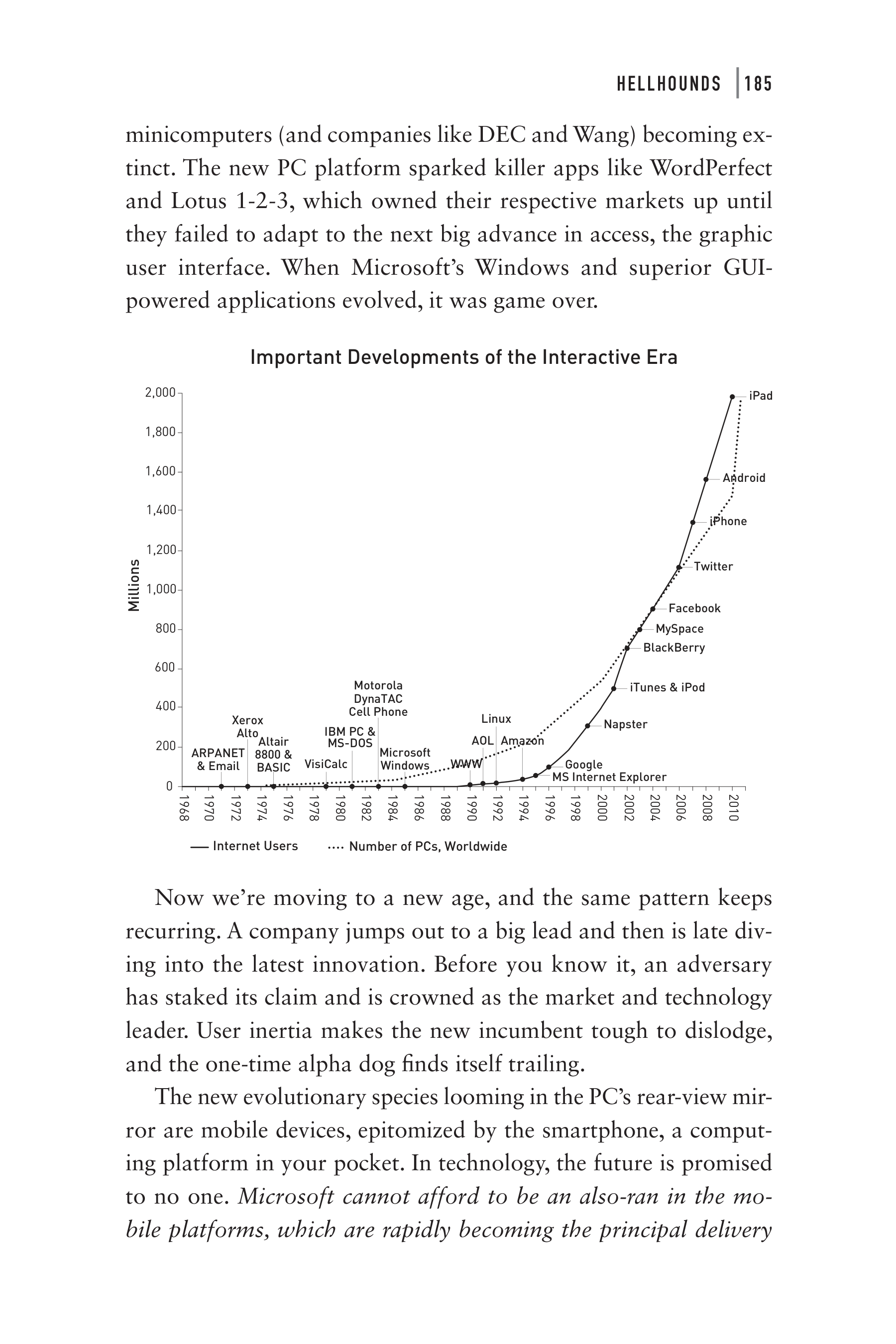
HELLHOUNDS
|
185
minicomputers (and companies like DEC and Wang) becoming ex
tinct. The new PC platform sparked killer apps like Word Perfect
and Lotus 1- 2- 3, which owned their respective markets up until
they failed to adapt to the next big advance in access, the graphic
user interface. When Microsoft’s Windows and superior GUI
powered applications evolved, it was game over.
Important Developments of the Interactive Era
Twitter
iPhone
Facebook
MySpace
BlackBerry
iTunes & iPod
Napster
Google
MS Internet Explorer
Amazon
Linux
AOL
WWW
Microsoft
Windows
Motorola
DynaTAC
Cell Phone
VisiCalc
IBM PC &
MS-DOS
ARPANET
& Email
Altair
8800 &
BASIC
1,600
1,400
1,200
1,000
800
600
400
200
0
Millions
1,800
2,000
Xerox
Alto
Android
iPad
2010
2008
2006
2004
2002
2000
1998
1996
1994
1992
1990
1988
1986
1984
1982
1980
1978
1976
1974
1972
1970
1968
Internet Users
Number of PCs, Worldwide
Now we’re moving to a new age, and the same pattern keeps
recurring. A company jumps out to a big lead and then is late div
ing into the latest innovation. Before you know it, an adversary
has staked its claim and is crowned as the market and technology
leader. User inertia makes the new incumbent tough to dislodge,
and the one- time alpha dog finds itself trailing.
The new evolutionary species looming in the PC’s rear-view mir
ror are mobile devices, epitomized by the smartphone, a comput
ing platform in your pocket. In technology, the future is promised
to no one.
Microsoft cannot afford to be an also-ran in the mo
bile platforms, which are rapidly becoming the principal delivery
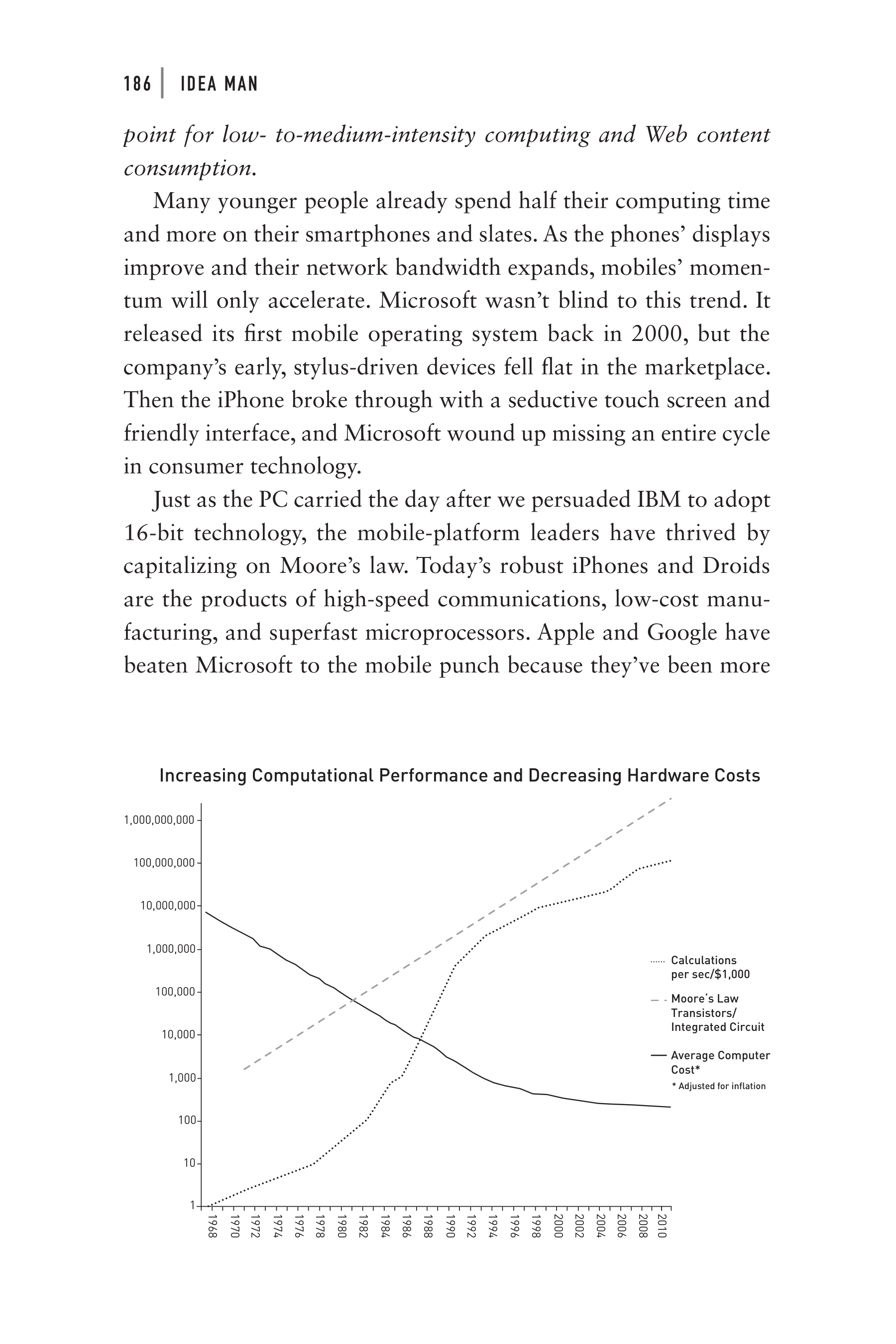
186
|
IDEA MAN
point for low- to- medium- intensity computing and Web content
consumption.
Many younger people already spend half their computing time
and more on their smartphones and slates. As the phones’ displays
improve and their network bandwidth expands, mobiles’ momen
tum will only accelerate. Microsoft wasn’t blind to this trend. It
released its first mobile operating system back in 2000, but the
company’s early, stylus- driven devices fell flat in the marketplace.
Then the iPhone broke through with a seductive touch screen and
friendly interface, and Microsoft wound up missing an entire cycle
in consumer technology.
Just as the PC carried the day after we persuaded IBM to adopt
16- bit technology, the mobile- platform leaders have thrived by
capitalizing on Moore’s law. Today’s robust iPhones and Droids
are the products of high-speed communications, low-cost manu
facturing, and superfast microprocessors. Apple and Google have
beaten Microsoft to the mobile punch because they’ve been more
Increasing Computational Performance and Decreasing Hardware Costs
1,000,000,000
100,000,000
10,000,000
1,000,000
100,000
10,000
1,000
100
10
1
Calculations
per sec/$1,000
Moore‘s Law
Transistors/
Integrated Circuit
Average Computer
Cost*
* Adjusted for inflation
2010
2008
2006
2004
2002
2000
1998
1996
1994
1992
1990
1988
1986
1984
1982
1980
1978
1976
1974
1972
1970
1968
HELLHOUNDS
|
187
alert in developing new and innovative platforms. They’ve done a
better job of following the chips.
As of mid- 2010, Microsoft had slipped to fourth in high
end smartphones behind RIM (BlackBerry), Apple, and a hard
charging Google. While advance word on Windows Phone 7 has
been positive, the competition is formidable. BlackBerry looks
vulnerable, but Apple is the ultimate auteur company with the
most fervent cult following in the business. The world of Jobs of-
fers limited options (there’s only one basic flavor of iPhone), but
everything plugs and plays together and is guaranteed to work.
That’s a formula that can trump consumers’ natural resistance to
walled gardens and their predilection for choice. It can even get
them to pay a premium price, at least as long as the products re
main compelling.
Then there’s the nimble, cloud- oriented Google, which takes a
different approach: start with limited functionality, copy the leader,
bring in apps from everywhere, iterate like mad. In essence, it has
mastered Microsoft’s old strategy of fast following for the mobile,
Web- based era. (As Google elbows and claws for preeminence in
the carnivorous tech sector, its new- age motto, “Don’t be evil,”
seems less credible by the day.) The Android mobile operating sys
tem is Bill’s old bête noire, the open- source version of Unix called
Linux. Google essentially gives it away free to manufacturers for
the same reason that Microsoft once sold MS- DOS on the cheap:
to dominate a market, in this case in smartphone search.
Akin to cameras or TVs, Android follows a product develop
ment cycle that runs six months or less or thereabouts, a pace that
plays to people’s love of the new. By contrast, a major Windows
release— slowed by corporate customer demands, backward com
patibility, and countless third- party device drivers— has historically
required two years or longer. (The last two, Vista and Windows
7, took five and three years, respectively.) The more streamlined
Windows Phone operating system could cycle much faster than
that, but only if it overcomes the company’s cultural drag. Can
188
|
IDEA MAN
Microsoft quicken its pace to compete in the new mobile plat
forms? I don’t think it has a choice.
T O U C H - B A S E D S M A R T P H O N E S
and tablets have obvious limita
tions, notably for multiuser gamers or typists like me who pre
fer physical keyboards. A tablet isn’t as capable or convenient as
a laptop for creating content. But the iPad is unsurpassed for ease
of consumption in watching Web videos or reading magazines
with a swipe of a finger. Because there are many more consum
ers than creators in our culture, the Swiss Army–knife strengths
of the iPad— and the coming horde of iPad clones— may outweigh
its limitations. It appears that tablets are poised to render physi
cal books, magazines, and newspapers obsolete within the next
twenty years. As an inveterate book lover, I find the prospect sad
but inevitable.
Against this swirl of change, we need to keep in mind that PCs
have averaged double-digit growth over the last decade—and as
long as there are PCs, there will be a Microsoft. They aren’t about
to be supplanted by smartphones for intensive office applications
like sales reports or spreadsheets. Everywhere else, however, peo
ple are shifting from desktops and laptops to more portable mo
bile devices. As technologies evolve, consumers (especially younger
consumers) get pulled along with them. I often hear people saying,
“I don’t like it personally, but my kids are perfectly happy typing
on their iPhone.”
New products resonate at first with early adopters, who want
the next hot item. But once those products are acknowledged to
be more useful than what came before, their consumer net quickly
widens, until your grandmother is signing up for her iPhone data
plan. Brand loyalties are forgotten as a new platform shoves aside
the old. Although the PC still has its place, it is no longer the prime
driver of innovation.
Here’s what the death knell for the personal computer will
sound like:
Mainly I use my phone/pad, but I still use my PC to
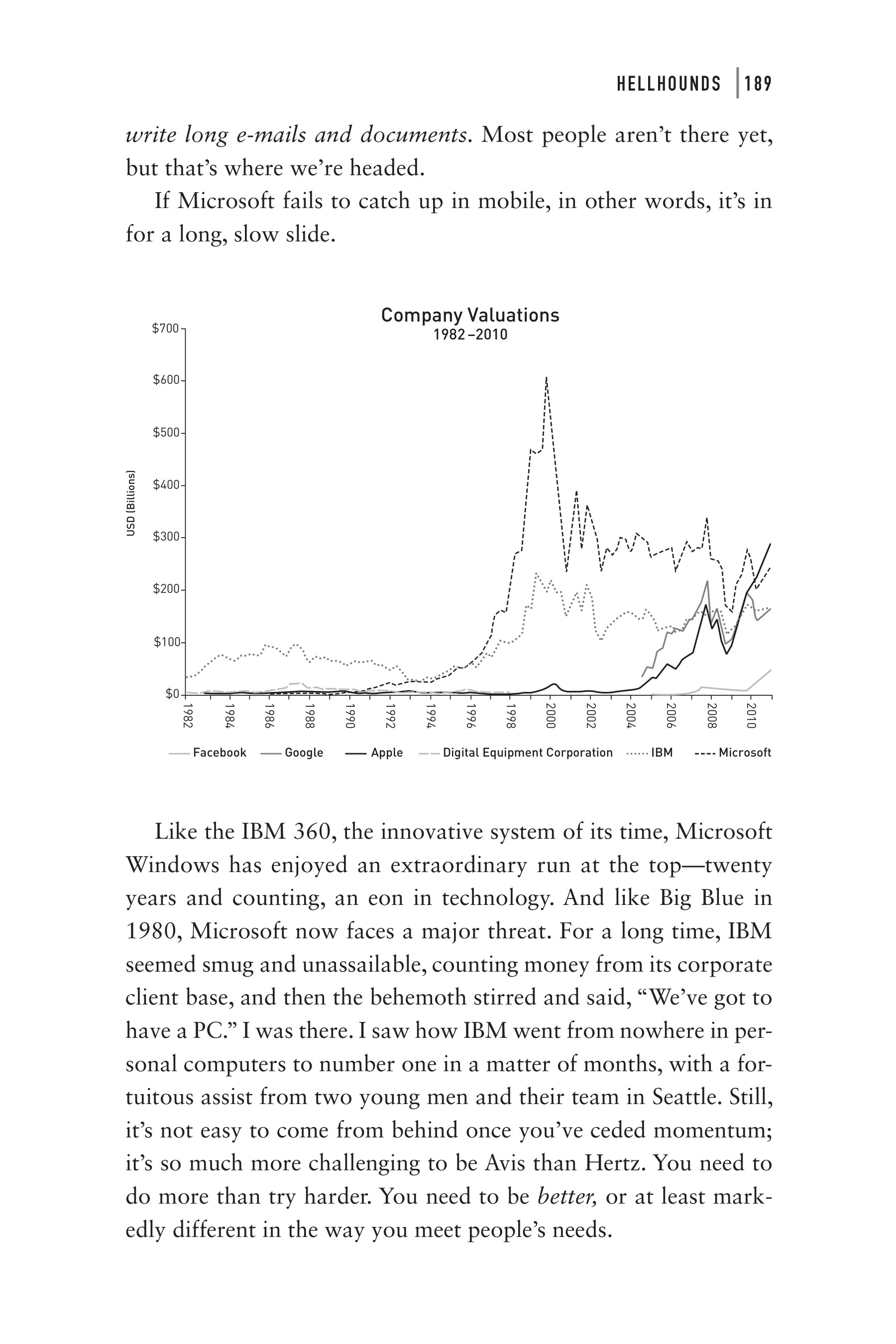
HELLHOUNDS
|
189
write long e- mails and documents.
Most people aren’t there yet,
but that’s where we’re headed.
If Microsoft fails to catch up in mobile, in other words, it’s in
for a long, slow slide.
Company Valuations
1982 −2010
USD (Billions)
$700
$600
$500
$400
$300
$200
$100
$0
2010
2008
2006
2004
2002
2000
1998
1996
1994
1992
1990
1988
1986
1984
1982
Facebook
Google
Apple
Digital Equipment Corporation
IBM
Microsoft
Like the IBM 360, the innovative system of its time, Microsoft
Windows has enjoyed an extraordinary run at the top— twenty
years and counting, an eon in technology. And like Big Blue in
1980, Microsoft now faces a major threat. For a long time, IBM
seemed smug and unassailable, counting money from its corporate
client base, and then the behemoth stirred and said, “We’ve got to
have a PC.” I was there. I saw how IBM went from nowhere in per
sonal computers to number one in a matter of months, with a for
tuitous assist from two young men and their team in Seattle. Still,
it’s not easy to come from behind once you’ve ceded momentum;
it’s so much more challenging to be Avis than Hertz. You need to
do more than try harder. You need to be
better,
or at least mark
edly different in the way you meet people’s needs.
190
|
IDEA MAN
If a Microsoft renaissance has grounds for hope, and I believe it
does, it’s that markets in technology are inherently dynamic— and
that my old company has woken up to the challenge. The smart
phone market will stay fragmented for the foreseeable future, and
it’s still relatively cheap and easy for people to switch to some
thing that catches their eye. Five years ago, before anyone had
heard of the iPhone, Apple analysts dripped with pessimism about
that company’s future. Given Microsoft’s deep cash reserves and
its willingness to use them, it could be in a much stronger position
five years from now.
But to take on Apple and Android, whose phones won’t stop
getting better, Microsoft needs a strategy to
win:
a quicker devel
opment cycle, a qualitatively better mobile operating system, and a
secret sauce or two to set Windows smartphones apart. Above all,
the company needs somehow to return to its cutting- edge roots. In
the early days, from the time we squeezed Altair BASIC into four
thousand bytes, no core product was released unless Bill and I be
lieved it could be best-of-breed. To win the mobile wars, the com
pany needs first and foremost to produce phones and slates that
consumers will love from the moment they use them.
I left Microsoft a quarter century before Bill did, and we’ve
both had our signal triumphs since then. But in certain respects,
neither of us has been quite as good alone as we were together.
I missed Bill’s laser focus on competition in the marketplace, his
ability to execute my ideas and keep me from getting too far ahead
of what was doable. And I’d like to think that Bill missed my abil
ity to divine where technology was headed and my knack for meet
ing its trajectory with something big and original.
In my post- Microsoft years, I discovered how challenging it
was to operate without a pragmatic partner and business maven.
Even so, I have no regrets about taking my own road. It has led me
to rich experiences in a great range of pursuits— to the life I’d al
ways dreamed of, even back in the early days, when I was happily
chained to my terminal and striving to perfect the next line of code.
C
H
A
P
T
E
R 1
4
BLAZERMANIA
O
n March 13, 1986, Microsoft issued its initial public offering. I
sold 200,000 shares and kept the rest, roughly 28 percent of the
company. Overnight I was $175 million richer. For some time, I re
sisted advice to sell stock and diversify. Given how fast comput
ers were improving, I figured that a dominant, well- run technology
company like Microsoft would outperform just about anything
else. I’d be proven right by the dizzying rise of the company’s mar
ket cap. By 1990, at age thirty- seven, I’d become a billionaire. By
1996, I’d be one ten times over.
As my attorney, Allen Israel, noted shortly after the IPO: “This
wealth should enable you to do whatever you want to do when
ever you want to do it. . . .” I made up my mind to exploit my new
freedom. Life is short, and there was so much out there to do. I
called Bert Kolde, my old Phi Kappa Theta roommate and by then
my right- hand man, and said, “I want to buy an NBA team.”
I W A S A
thin, gangly child with no conspicuous athletic talent.
When my peewee church basketball team won the city title, I sat
at the end of the bench and played the last few minutes of our
blowouts. I have a vague memory of trying to dribble and shoot;
the basket seemed way, way up there. I fared better on the play
ground at four square, where you hand-serve a large rubber ball
|
191
192
|
IDEA MAN
into quadrants of a court. I liked to compete, but my modest ath
letic talents didn’t flower until high school soccer.
I had little exposure to the NBA before Microsoft moved to Bel
levue in 1979, coinciding with the Seattle SuperSonics’ stretch run
to its first and last championship season. I got caught up in the ex
citement and became a big fan. In June, after the Sonics finished
off the Washington Bullets for the title, I was out among the peo
ple thronging the streets and honking their horns.
The next fall I bought my first season tickets. The SuperSonics
began trading away their talent, and each year the team got a little
worse and my seats got a little better, until I was stationed court
side across from the home bench. Sitting so close deepened my pas
sion for the game. I thought the NBA was the greatest spectacle in
sports— equal parts athleticism, ballet, teamwork, and individual
grit. The action was almost nonstop, full of vivid moments. Unlike
baseball or football, few games were decided with more than five
minutes left. And what could match the beauty of a pure jump shot
swishing through the net or a tough offensive rebound in traffic?
The Sonics of the early eighties weren’t a great team, but they
were competitive and entertaining. When I got sick, they became
my escape; I went to every game I could and caught the rest on
television. I studied box scores in the newspaper while waiting for
my radiation treatments, and devoured the
Official NBA Register.
If you asked about Sidney Moncrief’s foul- shooting percentage, I
could rattle it off within a few percentage points.
The Sonics were a godsend in getting me through that difficult
time. No matter how rotten I felt, there was always the next game
to look forward to.
I N T H E F A L L
of 1987, I heard that the Portland Trail Blazers
might be available. Winners of a championship a decade earlier
with Bill Walton, the team was owned by a Los Angeles developer
named Larry Weinberg, a gentleman from the old school. I made
an overture through Bob Barnett, my old TRW contact. Weinberg’s
BLAZERMANIA
|
193
attorney told him that the Blazers were “not for sale, but we might
entertain an offer.” They insisted that our meeting be private. If
word leaked out, our discussions would be over.
That October we met with Harley Frankel, Weinberg’s most
trusted associate. Going in, I told Bob I had one precondition: a
price. I didn’t want to bid against myself. Frankel went on about
the glories of the NBA, and how the Blazers were a rising franchise
with top local TV ratings and sellouts for ten consecutive years.
On our way out, I looked at Bob and said, “They didn’t give us a
price.”
I thought the deal was dead, but then in March they called. I
still had the itch to own a team, and this time I met with Larry
face- to- face. For two hours, he told us his story— how the Blazers
won the title the year after he’d become majority owner, but then
Walton broke his foot and they’d never recovered. He’d get up in
the middle of the night on some overseas business trip and listen
over a radio feed for two and a half hours, and the next day was
ruined if his team hadn’t won. “The losing starts to tear your guts
out,” he said.
As we wrapped up, Weinberg said he would take $65 million.
Ten minutes later, we had a handshake deal. I was thirty- five years
old and the youngest owner in major- league sports.
In May 1988, I attended a media conference at the Trail Blaz
ers’ office, my first time on the bright red, team- color carpeting.
Weinberg said,“I would like to introduce you to the new owner of
the team, Paul Allen.” Everyone was surprised; we’d been discreet,
as promised. This level of public exposure was new to me, and I
felt nervous about meeting the press, but Weinberg was extremely
gracious. He made it clear that he wouldn’t have sold unless he’d
found the right person for the team’s future success. I was “first of
all a fan,” Weinberg told the reporters. “Unless you’re a fan, noth
ing else counts in this ownership.”
Early on, I met Clyde Drexler, the team’s superstar, and we hit
it off. Clyde was sharp and candid, a free spirit on the surface but
194
|
IDEA MAN
with a calculating edge underneath; I’d heard that he and Kiki
Vandeweghe clashed with coach Mike Schuler, a brittle disciplinar
ian. Before the season started that fall, the two players asked to see
me. I had them to my house on Mercer Island, just outside Seattle,
and I should have known better. We’d barely sat down when the
coach- bashing began: Schuler was a control freak who killed the
players’ creativity, and so on.
Toward six o’clock, Clyde said, “Hey, Paul, we saw your basket
ball court on the way down. Do you ever use it?” In fact, I’d been
spending a fair amount of time polishing my jump shot— I even had
three- point range in those days. We shot around and then Kiki said,
“Let’s play H-O-R-S-E.” I agreed, assuming I’d get creamed. But the
players were polite enough to stick mostly to three-pointers, and
I hung in there. It began to drizzle, and we turned on the lights.
Whenever a stray shot bounced off the court, Clyde and Kiki raced
across the slick mesh surface to grab the ball. Maybe this wasn’t
such a good idea, I thought. What if somebody got hurt?
After I made the game- clinching three- pointer (they’d gone easy
on me), Clyde said, “Hey, I want to dunk.” Kiki tossed the ball
in the air, and Clyde took a flat- footed leap from under the bas
ket. He was twenty-six years old, in his prime, and he met the ball
maybe three feet over the ten- foot rim— caught it, dunked it. I’ve
sat courtside at more than a thousand NBA games, but I’ve never
seen anything quite like that soaring slam in the dark, in the rain,
on my own outdoor court.
On his way out, Clyde said casually, “Can I call you sometime
to talk about the team?”
“Of course,” I said. That was my second rookie mistake. It’s fine
to be friendly with your players and to care about them, but you
have to be careful about crossing the line. Get too close, and it may
come back to bite you when it’s time to renew a contract or weigh
a trade. In Clyde’s case, I got too close. For years afterward, I’d be
awakened by the phone in the middle of the night.
“Paul, it’s Clyde.”
BLAZERMANIA
|
195
I’d say, “Who else would be calling me at three a.m.? How’s it
going, Clyde?”
And he’d say, “We lost again.” He’d complain about a team
mate who kept forgetting the plays— like most of us, Clyde was
better at seeing others’ flaws than his own. We’d chat about the
game until he got to the point: “Paul, it’s just not fair what I’m
being paid.”
Shortly before I bought the team, Larry Weinberg had signed
Drexler to a six-year contract averaging $1.3 million a year. The
deal made him one of the best- paid players in the game, but then
salaries escalated sharply and Clyde’s had lagged behind. “Paul,”
he’d say, “I’m only the sixth- best- paid player on the team. You
know that isn’t right.”
And I’d say, “But Clyde, you signed a contract. Nobody forced
you to sign the contract.” We’d go back and forth, beating each
other up until I’d plead exhaustion and hang up the phone. There
was no simple resolution. On the one hand, Clyde
did
deserve
more money. He had that special extra gear— the turbo, he called
it— that you see only in the greatest players, and he’d won a lot of
big games for us. On the other hand, I thought a deal was a deal. It
seemed both illogical and a terrible precedent to tear up a contract
just because a player had my home number.
A year or so after I became owner, my ties to Clyde affected my
judgment and changed the course of two franchises. Bucky Buck
walter, an executive under general manager Geoff Petrie, brought
me a blockbuster trade. “I think we can get Olajuwon for Clyde,”
he said. Akeem (later Hakeem) Olajuwon was one of the top two
or three centers in the game. I subscribed to the axiom that you al
ways trade a smaller player for a bigger one of like talent, but this
time I told Bucky to pass. I had concerns about Olajuwon’s long-
term health after doctors had found a blood clot in his leg. (The
condition turned out to be treatable.) But the other reason I held
back was that Clyde was special—to the team and its tradition, but
also to me personally. I didn’t want to see him go.
196
|
IDEA MAN
*
*
*
T H E T R A I L B L A Z E R S
struggled that first year. After word filtered
out that the team’s black players felt alienated from the coaching
staff, we hired Maurice Lucas, a respected star from the Walton
years, as an assistant coach. But issues still festered, to the point
where
Sports Illustrated
depicted the Blazers as a team rife with
turmoil. I sent Bert on a midseason road trip, and he came back
with a sobering report. The team was split into “ten and two,”
with Clyde and Kiki the two. Everyone hated the coach, whom
Clyde was doing his level best to undermine. Schuler responded
with a bunker mentality. He’d schedule meetings with his staff and
“forget” to tell Maurice Lucas. He was freezing Lucas out.
I wasn’t keen about disrupting the team with a midseason
coaching change, but the divisions seemed irreparable. In February
1989, we fired Schuler and replaced him with Rick Adelman, then
a little- known assistant. Kiki asked to be traded, and we packed
him off to the Knicks, ending a controversy over playing time with
the younger, more dynamic Jerome Kersey. After getting swept out
of the first round of the playoffs by the Los Angeles Lakers, the
team’s needs were obvious. The Blazers were strong on the perim
eter with Clyde, Kersey, and point guard Terry Porter, but thin up
front. With the oft- injured Sam Bowie missing most of the season,
we had a short- armed center in Kevin Duckworth and a hole at
power forward. Teams scored on us inside at will.
I’ve tried to strike a balance as team owner, to be involved and
accountable while preserving my executives’ freedom to shape
the roster. My job is oversight, not execution. While I sign off on
trades or free agents, I’ve rarely overruled my basketball people’s
decisions. But I’m not shy about steering the discussion or pushing
deeper if something doesn’t make sense to me.
Shortly before the 1989 NBA draft, my first as a real partici
pant, I attended an all- star game for top college players. My eyes
were drawn to Cliff Robinson, a wiry six- ten center from the Uni
versity of Connecticut with a constant scowl on his face. On tape
BLAZERMANIA
|
197
he looked like a smooth and explosive athlete who could really
shoot, my favorite combination. But Cliff had a reputation as a
surly kid who didn’t play hard. On draft day, I sat in our war
room and scanned the board that ranked our top prospects. As
the second round began, Cliff was the only one left in the green
room, where projected lottery picks waited to take the stage as
their names were called. He was so hurt that he left and went back
to his hotel.
By then I was lobbying hard to choose him. Second- round picks
are low- risk propositions. Their contracts aren’t always guaran
teed, and they can be easily cut if they don’t pan out. Bucky Buck
walter, who leaned toward long, athletic players, gave his assent.
With little to lose, Geoff Petrie agreed to take a flier on Cliff.
That draft taught me how quickly a team’s fortunes can change
with one or two good decisions. Buck Williams, newly acquired
in a trade for Bowie, was the ideal addition to our starting lineup:
tough, focused, a pillar of strength against larger players like Utah’s
Karl Malone. Cliff was rangy, fast, and defense- minded, capable of
playing three positions— another perfect fit. (He’d be named the
league’s top sixth man in 1993 and an all- star the following year.)
Together they helped vault the Trail Blazers from a losing record
to 59– 23, second best in the league. That squad was unselfish and
relentless, and it was a privilege to watch them. After we beat the
Celtics by thirteen points in Boston Garden, Red Auerbach said,
“They just ran us right out of our gym.”
There’s a special bond in cities with a single major- league fran
chise. I’d heard about Blazermania coming in, but I didn’t know
just how rabid the Portland fans could be. Our run that season
unleashed a wave of pent-up fervor. We swept Dallas in the first
round of the playoffs, and then Cliff set the tone against San An
tonio by subbing for the injured Duckworth and holding the great
David Robinson to nine points. Then came the Western Confer
ence Finals against the high- scoring Phoenix Suns. Though I’m not
demonstrative by nature, I got caught up in the collective emotion
198
|
IDEA MAN
of that series, to the point where I was signaling three- point shots
and waving the crowd to stand and cheer down the stretch. I’d
punctuate a win by pointing to the fans and clapping, to thank
them for their support. After we pulled out the clincher on the
road, by three points, I got so carried away that I ran out to join
the scrum of players on the court. When Buck Williams embraced
me, it felt like getting hugged by a brick wall. Our magical ride fi
nally ended in the NBA Finals, when the “Bad Boy” Pistons used
their experience and toughness (and the timely shooting of Vinnie
“Microwave” Johnson) to defeat us in five games.
We returned to the Finals in 1992, the coming-out party for
Michael Jordan’s Chicago Bulls. Heading into the showdown, a
Sports Illustrated
cover story featured the players who’d finish
one- two in the balloting for Most Valuable Player that year: Jor
dan and Drexler, who was billed as Jordan’s “No. 1 Rival.” That
only stoked Jordan’s competitive fires, which never needed stoking
in the first place. Worse yet, Clyde had to guard the league’s top
scorer without his normal lateral movement. After arthroscopic
surgery the previous September, he’d had his right knee drained
half a dozen times.
Jordan was a streaky jump shooter at that stage of his career,
making only 27 percent of his three-point shots during the sea
son. But in game one in Chicago, he hit six of them in the first half
on his way to 39 points. (After the last deep shot, he turned to
ward the broadcast table and shrugged, as if he’d surprised even
himself.) We tried Cliff and Jerome on him, along with Clyde— all
solid defenders, but it made no difference. Jordan had his “turbo”
on. I’ve seen just one other person up close who compared to him,
who wanted not only to beat you but to crush you if he could.
Those two stood apart for raw competitiveness: Michael Jordan
and Bill Gates.
We had our moments against the Bulls. Midway through the
fourth quarter of a tight game four in Portland, Clyde tapped the
ball away from Jordan and converted it into a dunk, setting off a
BLAZERMANIA
|
199
surge that evened the series at two games apiece. Nearly giddy, I
went into the locker room afterward and found Clyde slumped
in front of his locker, completely exhausted, an ice bag on every
joint. And I said, “Clyde that was a brilliant steal. You read Jor
dan perfectly.”
He looked up at me, shook his head, and said, “Stop, stop, you
don’t understand. Most guys have two or three go- to moves; Jor
dan has nine. I guessed right, that’s all. I got lucky. Sometimes you
get the bear, but usually the bear gets you.” Clyde knew the score.
The Bulls, on the cusp of a dynasty, beat us in six games. Just
around that time, to compensate for those years when Clyde was
paid below the market, I gave him a $9.8 million, one- season ex
tension, then the biggest yearly paycheck in the history of team
sports. I thought he’d earned it.
Though we never won a title in the Drexler era, those were glo
rious years. I watched up to three hundred games a season, live
and on TV; in remote locales like Hawaii, I had a special live sat
ellite feed when the Blazers came on. When I was home in Seat
tle, I’d invite six or eight people to fly to Portland for each home
game. My mother became one of our biggest fans, and she’d bring
a friend and drink her tea and eat her cookies en route. Then she’d
sit with me on the baseline and scold the referees in her dignified
fashion. “You’ve got to call it the same way on both sides,” she’d
say, as the nearest official rolled his eyes. For my mom, bad whis
tles were injustices, and she wasn’t going to sit by and not say
anything.
One night we were playing the Sonics, and Sam Perkins— six
nine and 235 pounds— barreled after a ball that was sailing out of
bounds straight over my mother’s head. She threw up her hands as
Perkins crashed into her, and then I noticed her holding her wrist.
“It’s broken,” she said calmly. At halftime the team doctor iced and
taped it, and I asked if she wanted to head home. “No,” she said
firmly, “we’re going to watch the rest of the game.”
Over ensuing seasons, Adelman tied our younger players to
200
|
IDEA MAN
the bench and stuck with the tight rotation of veterans who had
gotten us to the Finals. But you can’t freeze time, and those guys
were now on the downside. In 1994, we hired a new coach, P. J.
Carlesimo, plus a new team president and general manager who
would define the team’s next decade.
A R T I C U L A T E , C O O L ,
and deceptively bland, Bob Whitsitt had
joined the Seattle SuperSonics in 1986. At age thirty, he was the
youngest top executive in the league, known as Trader Bob for his
nonstop personnel moves. He built a powerhouse team around
Gary Payton, a pugnacious point guard, and Shawn Kemp, a
wildly talented big man who’d never played in college. Those Son
ics teams were bold, volatile, swaggering, and athletically gifted.
In 1993– 1994 they posted a record of 63– 19, best in the league.
Whitsitt was named NBA Executive of the Year, but his owner,
Barry Ackerley, became disenchanted after the team got upset in
the playoffs. Ackerley disconnected Whitsitt’s office phone to en
courage him to resign. I jumped to hire him.
Clyde was promptly traded to the Houston Rockets, as he’d re
quested. I gave my favorite player the news and thanked him for
his contribution, and it was an emotional moment for us both.
That spring I rooted for him from afar as he helped Olajuwon win
a title. I’d always considered Clyde a champion, and now it was
official.
Whitsitt proceeded to overhaul our aging roster as he’d done in
Seattle, drafting young athletes with upside and adding big- name
veterans. A few of his moves were brilliant, like the six-for- one
deal that brought us Jordan’s all- star sidekick, Scottie Pippen, just
one year removed from the last of his six championships with the
Bulls. But there were too many times when Whitsitt operated like
a rotisserie-league GM, piling up players with gaudy numbers. He
openly professed that he cared only about talent, to the exclusion
of character and other intangibles. “I didn’t take chemistry in col
lege,” he told the media. With enough physical ability on the floor,
BLAZERMANIA
|
201
team cohesion would take care of itself. It was a risky assumption
for a sport in which five men share one ball.
With hindsight, Whitsitt temporarily staved off decline by using
my wallet to load up on pricey long- term contracts— players who
were available because they were overpaid or had off- court is
sues or both. Over a span of seven years, he would draft, sign, or
trade for Rasheed Wallace, Isaiah Rider, Damon Stoudamire, Bonzi
Wells, Shawn Kemp, Ruben Patterson, Qyntel Woods, and Zach
Randolph. Any one of them would have been a handful. Despite
the presence of some notable good guys, like Arvydas Sabonis and
Steve Smith, they became known as the Portland Jail Blazers.
How could I tolerate this stew of instability? The short answer
was that we kept winning. Over the last six years of Whitsitt’s tenure,
the Blazers won 63 percent of their games, fourth best in the league.
We made the playoffs each year and twice reached the conference fi
nals, enough success to give me pause about shaking up the organi
zation. I can be patient to a fault, and Whitsitt had his strengths. He
was plugged into the player agent network like nobody else, and I
counted on his connections to get deals done. He was also a great ra
tionalizer. When I’d ask why a draft pick fizzled or a trade backfired,
he’d respond,“Just watch. Next year he’s going to be so much better.”
When you come so close to winning a championship, as we had
in the early nineties, it makes you that much hungrier because you
know what the Finals taste like. It was the same for Whitsitt, who
was desperate to validate his approach with a title. We were per
petually one big- salaried veteran away from contention, and our
payroll ballooned. Deep down I knew that something was wrong.
In the playoffs, when the pressure peaks and higher-caliber op
ponents target your weaknesses, a player’s makeup is revealed in
performance. In the 2000 Western Conference Finals against the
Lakers, we fell behind three games to one and then fought back to
earn a deciding seventh game. Up fifteen points in the final quarter,
it looked as though we were headed to the NBA Finals against In
diana, whom I thought we could beat. When I watch my team in
202
|
IDEA MAN
the playoffs, I get superstitious; I try not to think about how much
I want to win.
Whatever happens, I’ll be fine with it. The players
tried their best.
But in that fourth quarter, I succumbed. I couldn’t
deny it. I really wanted to beat the Lakers.
Within minutes, the Blazers unraveled. We missed thirteen con
secutive shots. Our players suddenly looked as though they’d met
for the first time that morning. The coup de grâce came when Sha
quille O’Neal dunked an alley- oop from Kobe Bryant with forty
seconds left.
That seventh game exposed us as a team without leadership or
discipline. I’ll never forget the feeling I had when we boarded our
plane— still festooned with Beat LA stickers— and headed home,
our season done. It was a crushing defeat, and it took me a long,
long time to get over it.
I N 2 0 0 2 , E I G H T
years after Whitsitt’s arrival, we fell into the
abyss. We led the league in payroll at $106 million, $44 million
more than the championship Lakers. We were $65 million over
the salary cap and $50 million over the league’s new luxury tax
threshold, which had been designed to level the playing field for
small- market teams like ours. Our player salaries cost us an outra
geous $156 million, all for a medium- to- good fifty- win team that
would lose yet again in the first round of the playoffs.
Off the court, it was worse, as the Trail Blazers became exhibit
A for all that was wrong with professional sports. I found myself
reeling from one lowlight to the next.
November 9, 2002: Bonzi Wells is suspended for spitting on the
Spurs’ Danny Ferry.
November 22: Co- captains Damon Stoudamire and Rasheed
Wallace, on their way home from a game in Seattle, are pulled over
and cited for possession of marijuana. To settle the case, both agree
to attend drug counseling sessions.
November 25: Ruben Patterson is arrested for felony domestic
abuse. His wife later asks prosecutors not to pursue charges.
BLAZERMANIA
|
203
January 15, 2003: Rasheed is suspended for threatening a
referee.
April 3: Zach Randolph is suspended after sucker punching
Ruben in the face during practice and fracturing his eye socket.
The fans who felt so close to the Drexler- Kersey- Porter Blaz
ers were disenchanted. Our attendance suffered, and our TV rat
ings fell by half. The wayward players showed little remorse. Bonzi
Wells told
Sports Illustrated:
“We’re not really going to worry about
what the hell [the fans] think about us.” You could see why parents
weren’t rushing out to buy Bonzi or Rasheed jerseys for their kids.
One day I said to Whitsitt, “What’s it like in the locker room?
How is the team reacting to the latest incident?”
And he said, “Well, Paul, half our guys are normal and half our
guys are crazy. The good guys are all freaked out, but the crazy
guys are crazy, so they’re fine.”
I’d heard enough. A team might be able to absorb one erratic
personality, but who could win with a group that was half crazy?
Three days after our season ended, I fired Whitsitt and gave his
successor, Steve Patterson, a mandate to clean house. We traded
established starters like Rasheed and Bonzi for forty cents on the
dollar while letting bad contracts expire. The win- now regime had
stunted younger talents like Jermaine O’Neal (who blossomed into
a six- time all- star after being moved to Indiana), and our cupboard
was bare. In 2004, the Blazers missed the playoffs for the first time
in twenty- one years.
And then we sank even lower. An internal investigator came to
me with a report on Qyntel Woods: “We think there may be dog
fighting at Qyntel’s house.”
Dogfighting?
I couldn’t believe what I was hearing.
A few days later: “We think there may be some dogs buried in
his yard.”
Buried in his yard?
And a day or two after that: “There’s a room in his house where
we hear the walls are covered with blood.”
204
|
IDEA MAN
Blood on the walls?
I was shocked and mortified. Qyntel eventually pleaded guilty
to animal abuse and got eighty hours of community service. We
suspended and then released him three months later.
The next year we touched bottom. With a record of 21–61,
the Trail Blazers were indisputably the worst team in the league.
Though things were quieter off the court, I had a new challenge:
how to pay for my team’s home court.
The old Memorial Coliseum, with our fans seated nearly on the
floor, was famously intimidating for visiting teams. It was also the
smallest arena in the NBA, with no signage, luxury suites, or big-
screen replays. In 1993, at a cost of $262 million, we built the Rose
Garden. I put in $46 million to Portland’s $34 million, with most
of the balance covered by bonds from a group led by a teachers’
pension fund. The interest rate was a stiff 8.99 percent, with no
option for prepayment or refinancing.
As we discovered too late, the financial formula was fatally
flawed. Add a local downturn and an unpopular losing team, and
we had a perfect storm of red ink and disaffection. The Blazers
were getting booed at home, once unthinkable in Portland. Our
season ticket holders were canceling in waves amid calls for a boy
cott, despite our explicit efforts to rebuild and start over. All told,
I’d invested more than half a billion dollars in the franchise, at a
huge net loss. Something had to give.
In February 2004, my Oregon Arena Corporation filed for
bankruptcy to push our creditors to restructure the Rose Garden
loan. When we failed to reach a compromise, the bankruptcy court
conveyed the arena to the lenders, with its sagging revenues to con
tinue to be split among us. In 2006, as our deficit mounted, we an
nounced that we’d entertain bids on the team. I was banking on
the creditors’ reluctance to kill the golden goose or possibly shove
it out of town. No one wanted to see the Blazers leave Portland,
least of all their owner.
*
*
*
BLAZERMANIA
|
205
T H E N B A D R A F T
is one of my favorite days of the year. I begin pre
paring weeks ahead of time, poring over our five-hundred- page
draft book and watching hours of college game highlights. The day
before the big event, I convene with our personnel guys in Portland
to watch more film and hear from our international scout. Then
we head to a restaurant to hash out player rankings over dinner.
In the 2006 draft lottery, we started with some bad luck; de
spite our NBA- worst record, we were picking fourth. By then we’d
handed the operation’s reins to Kevin Pritchard, who had a good
gut for gauging young talent. Meanwhile, we got word about a
rangy UW guard named Brandon Roy who didn’t look all that
impressive on videotape. But in a private workout, he was bigger,
quicker, and more explosive than we’d expected. After some draft-
day maneuvers, we wound up with both Brandon and LaMar
cus Aldridge, the skilled big man out of Texas that I coveted: two
young men of unquestioned character. That was a banner night for
us, a turning point for the franchise.
Shortly after the draft, I pulled the Blazers off the market. The
next February, literally minutes before the case was set to be filed in
court, the bondholders agreed to a restructuring and I bought back
the Rose Garden. In June, a month after Brandon Roy was named
Rookie of the Year, we traded Zach Randolph to the Knicks, end
ing an era that none of us would miss. The following season, we
had the youngest team in the league and not a single arrest or sus
pension. The culture had changed, and it was my pleasure to invite
the Blazers to Mercer Island for practice on Easter Sunday, 2008.
After a light run- through, Coach Nate McMillan said he would
end practice early if I could make a foul shot. The pressure was on.
I walked to the line, took two dribbles, and banked the ball in. The
players cheered.
The next year, with strong play from Brandon and LaMarcus
and unselfish teamwork all around, the Trail Blazers shared a di
vision title and returned to the NBA playoffs for the first time
in six years. We lost a tough first-round series to Houston, but
206
|
IDEA MAN
you wouldn’t have known it from the thousands who jammed Pi
oneer Courthouse Square to celebrate. Like me, the fans had never
stopped loving their team. They’d been through rocky times with
us, but Blazermania was alive and well.
Today we’re building a contender the old-fashioned way, the
way it was done in the Walton- Lucas era or with the Drexler edi
tions. Before we add a new player, we ask ourselves: How would
he fit? Does he work hard? Will he balance his ego with the needs
of the team? If we can’t answer yes to all of the above, we don’t
do the deal.
A S O F T H I S
writing, at the start of the 2010– 2011 season, the Trail
Blazers are working on a new streak of sellouts, 124 and count
ing. After replacing Kevin Pritchard (who struggled in the mana
gerial parts of his job) with Rich Cho, we believe that we’ve found
a leadership team that can get us back to the Finals. Under team
president Larry Miller, our season ticket base has tripled since the
Whitsitt era, and local TV ratings are among the league’s highest.
That’s the good news. The bad is that we’re doing just about
everything right, but we’re still losing money. With Brandon and
LaMarcus now signed to contract extensions, we won’t be turning
a profit anytime soon, a fact that speaks volumes about the plight
of smaller- market franchises in the NBA. Team ownership can be
very satisfying, but nobody enjoys losing money. As in any busi
ness venture, the bottom line is the ultimate measure of success.
According to
Forbes,
twelve of thirty teams were in the red in
2008– 2009. A recent study showed that a team’s net income had
more than twice as strong a correlation with market size than with
winning percentage. Teams in larger markets have built- in advan
tages: higher ticket prices (based simply on supply and demand),
more lucrative local cable TV deals. Their deeper stables of For
tune 1000 companies generate sponsorship dollars and luxury
suite sales.
Whatever the outcome of our ongoing collective bargaining
BLAZERMANIA
|
207
agreement negotiations with the players’ union (the current deal
expires on June 30, 2011), the NBA has yet to address this big
market/small market discrepancy. Sports economist Andrew Zim
balist has noted that in the NBA less than 30 percent of revenue
comes from shared revenue. In the National Football League, he
has said, it’s as much as 75 percent.
Every owner
wants
to win, and the free- spending Whitsitt men
tality is alive and well in some quarters. But then it’s February,
you’re at .500, free agent X has misplaced his jump shot, and
you’re staring at another eight- figure loss. It can get demoralizing.
Before long, the league may become stratified into haves and have-
nots, with small- market teams shaving player payrolls just to stay
afloat and large- grossing teams having “huge economic disparities
to utilize to make them better,” as NBA Commissioner David Stern
said recently. At that point, only four or five franchises will have
a legitimate shot at a championship. You’ll see more half- empty
arenas as people weary of watching their lovable losers get ham
mered. Top free agents will focus on fewer cities, typically those
with the best media and promotional opportunities. National in
terest and TV ratings can’t help but suffer.
Or as Stern put it, the NBA “is viable as long as you have own
ers who want to continue funding losses. But it’s not on the long
term a sustainable business model. . . .”
During the throes of the Rose Garden’s bankruptcy, I met with
Stern in New York. When I asked him what alternatives he saw
for me, the commissioner told me, “Well, you can always sell your
team.” But I wasn’t looking to bail out; I wanted to fix things.
And even had I sold, the next owner would have faced the same
predicament.
In my perfect world, the most successful NBA teams wouldn’t
necessarily be those with the biggest local television markets or
corporate- suite bases. They’d be the ones with the best talent
judges, management, and coaching, big market or small.
C
H
A
P
T
E
R 1
5
12TH MAN
I
f I entered the NBA out of passion, I was called to the National
Football League out of civic duty. The Seattle Seahawks had been
mired in mediocrity even before Ken Behring bought the franchise
in 1988. By the midnineties, the team was losing more than $5 mil
lion a year. It had an absentee owner and a lackluster coach. The
Kingdome, which it shared with the Seattle Mariners, was falling
apart. The roof leaked, and four heavy ceiling tiles had dropped
into the stands just before a baseball game.
In February 1996, Behring declared that he was moving the
team to Southern California. The NFL refused to sanction the
move. King County sued Behring for trying to break his Kingdome
lease, and the owner countersued. With the Seahawks’ future so
precarious, I was approached by a contingent of local politicians
on the hunt for a buyer to keep the team in Seattle.
I liked football, but I didn’t plant myself in front of the TV all
day Sunday. And I wasn’t on a quest to take on a second major-
league team and all the responsibilities that came with it. Still, I
was sympathetic. I went to four or five Seahawks games a year.
I thought of Seattle as a three- sport city, and I knew how hard it
was to retrieve a major- league franchise once a community lost
one. In April, I agreed to a $20 million option to buy the team
within fifteen months for approximately $200 million. I had one
208
|
12TH MAN
|
209
stipulation: I would exercise my option only if we could get a new
stadium. Based on my experience with the Blazers, it made no
sense to get involved unless revenues could cover the costs of re
signing top players and pursuing the best free agents. You needed
a first- class facility to generate that kind of money, and the King
dome was grossly inadequate.
A new stadium would run $430 million, and I was willing to
chip in close to a third of it. But the rest had to come from public
funding*— not just to give me a fighting chance to make a modest
profit, but to forge a public- private partnership that would keep
the franchise in Seattle for the long haul, regardless of who owned
it. My hometown had asked for help, and I wanted to respond, but
I wasn’t about to go it alone.
The day after I negotiated my purchase option, the
Seattle
Times
ran a story headlined “Allen’s Rescue Makes Him City’s
Latest, Greatest Sports Superhero.” I guessed that it wouldn’t be
long before the media changed its tune.
I N A D E C E M B E R
1996
Seattle Times
poll, opponents of a new
Seahawks stadium outnumbered supporters by eight percentage
points. The one bright spot: Among ten local figures involved in
the issue, I was the only one rated favorably. Unlike the politicians,
I had no legacy of unpopular decisions. People knew me as a low-
profile guy who’d cofounded Microsoft and who now might save
the franchise.
As the six- week campaign over Referendum 48 unfolded, I was
surprised by how many people still liked the Kingdome. While cit
ies like New York constantly tear down and revitalize, Seattle
ites cherish their architectural icons, even the unsightly ones.
To expand our constituency beyond hardcore football fans, we
*The public contribution would come from the interests who stood to benefit
most, via an extended county hotel tax and increased parking and admission
taxes at the stadium, along with new lottery games and a state sales tax credit
that reflected the team’s economic value to Seattle.
210
|
IDEA MAN
emphasized the new stadium’s potential to lure a major-league soc
cer team. We were making headway in the polls and had pulled
almost even when opposing groups found traction with a superfi
cially convincing argument. There was no need to vote yes on the
stadium, they maintained, because I’d never walk away and let the
Seahawks leave town. Political cartoons struck the same theme:
Why doesn’t Paul just pay for all of it, since he can?
Our poll num
bers dropped. It looked like my wealth was working against me.
As a
Seattle Times
columnist wrote, “Mr. Allen is a splendid fel
low whose only drawback may be that he has too much money.”
I knew about voter resistance firsthand from the Seattle Com
mons project, where we’d pushed for a sixty- one- acre waterfront
park to anchor industrial and biotech development in the South
Lake Union neighborhood. Despite my pledge of $20 million, the
voters twice defeated our proposal. (We’ve continued to revital
ize South Lake Union, but without the park.) Now I put aside my
aversion to TV appearances and took my case for a new football
stadium directly to the voters. On June 2, two weeks before the
referendum, I sat in a staged living room backdrop and taped a
thirty- second spot:
When I said yes to help save the Seahawks, I meant that I’d
do my part in building something for the future— personally
and financially. . . . I stand by that commitment. But if you
say no, that means no for me, too, because I’m not going to
do this without you.
The ad seemed to work. By Election Day, polls showed us with
a narrow lead, but it was less than their margin of error and noth
ing was assured. When I arrived at our headquarters that night,
I could feel the worry. Early returns from eastern Washington,
where the case for a Seattle stadium was least persuasive, were
worse than we’d projected. We were down thirty thousand votes.
If the ballot failed, I knew there was a good chance the Seahawks
12TH MAN
|
211
would leave town. The Kingdome would become a white elephant
(actually a brownish gray elephant), hosting the occasional truck
or home show. It was a glum prospect all around.
We were banking on late returns from King County and the
suburbs to put us over. As Senator Warren Magnuson once said
about Washington’s statewide elections, “You can see every vote
that matters from the top of the Space Needle.” Every few minutes,
I checked in— we were still behind, but gaining. By ten o’clock, it
was clear that the suburban soccer moms had turned out in droves.
By eleven, we knew that the referendum would pass in a squeaker.
Months of tension drained away. I joined a local band in a celebra
tion jam, and Bert Kolde jumped up to sing “Wild Thing.” I could
see how people got addicted to electioneering.
And on top of it all, I was about to join the small and special
club of NFL owners.
T H E N E W S TA D I U M
would be built in the footprint of the old one
in Seattle’s International District, a transportation hub with restau
rants and hotels within walking distance. The Kingdome’s destruc
tion was slated for March 2000. As I watched from three hundred
yards away, fifty thousand tons of concrete would be demolished by
a rapid- fire series of 5,800 gelatin dynamite charges, the largest im
plosion in history. ESPN Classic covered the event live, and I was
asked if I wanted to push the button that would set the whole thing
off. I wasn’t sure about that, so they offered plan B. At the end of
the countdown, I would give the high sign to the demolition man,
and
he
would push the button.“OK,” I said.“That sounds like fun.”
I got my instructions. There would be an audible count over a
PA from ten down to six, then a silent count to zero. (The logic
was that if anybody happened to be inside the Kingdome and ran
out yelling, we needed to be able to hear them and abort the blast.)
I followed the audible count and continued it in my head. There
was an awkward pause. The demolition man looked at me expec
tantly, his hand over the button.
212
|
IDEA MAN
And I froze. I can’t explain why. Maybe I had a flash of nostal
gia for all the SuperSonics and NCAA Final Four games I’d seen at
the Kingdome. At that pregnant moment, my brain just locked up.
The poor demolition guy was raising his eyebrows at me:
Can we blow it up now?
I finally snapped out of it and gave my
thumbs- up. We heard what sounded like gigantic firecrackers going
off in a timed sequence, with streaks of light flashing across the
dome. Then the building imploded as people cheered from nearby
office towers. Within seconds, all that remained was a tight mound
of rubble and— moving toward us at highway speed— a billowing
cloud of dust. On cue, we jumped into a van until it passed.
M Y F O R M A T I V E E X P E R I E N C E
with big- time football was at the
University of Washington, where my father and I sat in the stands
and stomped on the risers as we cheered on the smashmouth teams
of the early sixties. Later we went to see Sonny Sixkiller, the dy
namic Cherokee quarterback who led the nation in passing in
1970. Win or lose, there was a special feeling to those games in the
open air. When I met with the stadium architects, I talked about
creating a twenty- first- century version of the experience I loved as
a boy. Instead of an insulated bowl in a parking lot, I wanted an
open- ended design and seats with a view. Husky Stadium looked
out on Union Bay; Seahawks Stadium would have expansive vistas
of downtown, Elliott Bay, and Mount Rainier. Because our win
ter weather is rainy, I asked for an overhang that would cantilever
over the lower deck to keep fans dry and bring them as close to the
action as possible.
Qwest Field would be the first NFL facility with field- level lux
ury suites. Behind our north end zone, we installed a “Hawks’
Nest” of budget- priced bleachers for some of our most fanatical
supporters. The stadium’s architects managed to recreate the King
dome’s acoustics and deafening crowd noise, so much so that the
Seahawks are perennially among the league leaders in false-start
penalties against the opposition.
12TH MAN
|
213
*
*
*
I N 1 9 9 9 ,
Bob Whitsitt signed a new head coach and general man
ager: Mike Holmgren, the charismatic “Walrus” who’d taken
Green Bay to two conference championships and a victory in Super
Bowl XXXI. In Holmgren’s first season, the Seahawks ended a ten-
year playoff drought and won a division title, but then we hit a
plateau. For reasons that seemed to make sense at the time, I kept
Whitsitt on as the football team’s president after forcing him out
of the Trail Blazers. I had a thin management bench in Seattle, with
no one else strong enough to counterbalance Holmgren.
The shakeup began in June 2003, when I brought in Tod Lei
weke as the Seahawks’ first CEO. A great communicator and savvy
marketer, he had a proven track record with the National Hockey
League’s Minnesota Wild. With Tod reporting to me directly, Whit
sitt was no longer my sole conduit to the organization.
The 2004 Seahawks blew a number of late leads and ended
with a frustrating wild-card loss at home to St. Louis. The fran
chise had gone twenty-one straight seasons without a playoff
win, eight of them on my watch, and was living down to its cyn
ical moniker: “Same Old Seahawks.” I kept asking why we were
underachieving—what needed to change? I wondered about Holm
gren’s conservative game plans. Wedded to the West Coast offense
that had won him a Super Bowl, Mike refused to try the shotgun
formation that had become the NFL’s standard third-down call.
Was the game passing him by?
Bob Whitsitt had played a big role in helping me acquire the
Seahawks and had brought in a successful coach. But the issues
that had tripped him up in Portland also became his undoing in
Seattle. He overpaid middle- of- the- road performers and failed to
re-sign our top talent in a timely fashion. After the 2004 season,
he inexplicably allowed sixteen players to enter unrestricted free
agency, including quarterback Matt Hasselbeck and star running
back Shaun Alexander, squandering our leverage in negotiations
and costing me tens of millions of dollars.
214
|
IDEA MAN
Tod Leiweke and others reported that the organization was dys
functional. Whitsitt and Holmgren weren’t speaking to each other,
and the coach was on the verge of walking away from his contract.
The only front- office solidarity came out of people’s shared dislike
of Whitsitt, who seemed too casual about building our revenue
base despite a first- class venue and ample on- field talent.
On January 14, 2005, six days after our season ended, I fired
Whitsitt. I’d previously relieved Holmgren of his duties as general
manager, where he was spread too thin, but kept him on as coach.
Whatever his shortcomings as a personnel man, the Walrus was a
strong and experienced on- field leader who commanded his play-
ers’ respect.
This time my patience would pay off.
H E A D I N G I N T O T H E
2005 season, we were underdogs rated eighth
most likely to represent the NFC in the Super Bowl. But our turn
around had already been set in motion at the NFL Draft that April.
Tim Ruskell, our new GM, moved us up nine spots in the sec
ond round to choose an undersize linebacker named Lofa Tatupu,
who would lead the team in tackles and make the Pro Bowl in his
rookie season. Hasselbeck was in top form, and Alexander was un
stoppable; he set an NFL record for rushing touchdowns and fin
ished as the league’s MVP.
Everything clicked. Holmgren called great games; the Hawks’
Nest was appropriately out of control; the ball bounced our way.
The team won eleven games in a row and finished at 13– 3, the
best record in franchise history. After beating Washington in a di
visional playoff, we prepared to host the NFC championship game
at Qwest Field against the Carolina Panthers.
In a tribute to our fans’ support of the eleven players on the
field, Tod had revived our Twelfth Man tradition. Minutes before
kickoff at each home game, we played the Verve’s “Bitter Sweet
Symphony” as the video board told a thirty-second story about
a former Seahawk great or a local like Huston Riley, the soldier
12TH MAN
|
215
who made the cover of
Life
magazine storming Omaha Beach on
D-Day. Then the camera trained on the upper deck, as the celebrity
raised a flag that bore the number 12. The ritual became the talk
of the town. Nobody outside the organization knew who Sunday’s
flag raiser would be.
A few days before the conference championship, Tod said to
me,“You’re raising the Twelfth Man flag on Sunday.” At first I was
unconvinced. I wasn’t sure how people would react, and I wanted
the crowd’s energy to stay high. But Tod insisted, and I made my
way to the flagpole that afternoon in time for the scoreboard nar
rative: “His dad took him to Husky games. A passion was born.
He saved our Seahawks, built the NFL’s most beautiful stadium.
Now the NFL’s loudest stadium. Welcome, Paul Allen.”
As I read those words on the mammoth screen, my eyes were
wet. I thought about my father, the man who’d taught me how
to throw a tight spiral, and I wished he could have been at my
side. As I pulled on the rope, the intensity of the crowd’s response
amazed me. I lost count of how many people around the flagpole
thanked me for keeping their team in town. I waved a white towel
in the air to help boost the frenzy, not my usual style. It was the
most passionate public celebration I’ve ever been part of.
Back up in my suite, I hopped on and off my chair, pacing
throughout the game. Holmgren had told me that he’d be call
ing one of his rare trick plays with backup quarterback Seneca
Wallace as wide receiver. The coach’s tricks often backfired, but
this time Seneca made an over-the- shoulder catch for twenty
eight yards midway through the first quarter, setting up our first
touchdown.
The Seahawks never looked back. Hasselbeck was near perfect,
and Alexander ran roughshod. Tatupu made an early interception
and knocked the Panthers’ running back out of the game. Steve
Smith, Carolina’s star receiver, was stopped cold with double and
triple teams. With the score mounting to a twenty- point blowout, I
could hardly contain myself as I descended to the field for the last
216
|
IDEA MAN
few minutes. At the postgame ceremony, Holmgren, Hasselbeck,
and I stood under the lights, raising the NFC championship tro
phy over our heads.
I appreciated what the coach told the press afterward: “I was
fortunate enough to have an owner who has been patient with me.
In this business, that’s not always the case. . . . If you believe in
something, and you stay the course, and you get people who be
lieve in you, it gives you a chance.”
W E C A M E I N T O
Super Bowl XL as four- point underdogs to the
Pittsburgh Steelers. We had a three- point lead early but were hurt
by some questionable officiating. (That isn’t sour grapes on my
part. More than four years after the fact, the game’s referee ac
knowledged that he blew two pivotal calls in the fourth quarter.)
We also had too many penalties and dropped passes and missed
field goals. In the end, Pittsburgh was tougher and more poised
that day. They outplayed us when it counted.
You’re always sorely disappointed to lose a Super Bowl, be
cause who knows when you’ll be back? It may not happen in my
lifetime, but we’re sure going to try—to me, that’s the point of
owning a major-league franchise. The Seahawks don’t play in the
largest market, but we spend what we need to spend to compete at
the highest level. In 2010, after two sad seasons, I hired Pete Car
roll away from USC to help get us back there, along with a new
front office team in Peter McLoughlin and John Schneider. (Tod
Leiweke returned to his first love, the National Hockey League.)
Football is much more than a civic chore for me now. I’ve got
ten hooked on the weeklong buildup to Sunday, to the point where
I can’t tell you which I enjoy more, the Seahawks or the Blazers.
Every football playoff game is like a game seven in basketball, sud-
den death. And the sport pulls a community together in amazing
ways. During our run to the Super Bowl in 2005, I’d look out my
office window and see Twelfth Man flags flying from buildings all
around the city. Those are moments you savor in life.
12TH MAN
|
217
Along with the Mariners’ Safeco Field, Qwest Field has estab
lished a vibrant stadium district in Seattle. Our team helped re
vive the adjacent Pioneer Square, the original downtown that dates
from the Klondike gold rush of the 1890s. We’ve also played a role
in the largest United Way campaign in the country, matching funds
for every game program sold and raising half a million dollars dur
ing a climb of Mount Rainier, where we planted the Twelfth Man
flag.
In 2009, with the debut of Major League Soccer’s Seattle
Sounders FC, we made good on the final piece of our promise to
Washington’s voters. After one year, the Sounders had a season
ticket base of thirty- two thousand and had sold out the team’s
eighteen- game season. The majority owner is Hollywood producer
Joe Roth; I’m a minority owner, along with Adrian Hanauer and
comedian Drew Carey. We’re proud that our team has helped to
raise the bar for community support for soccer in North America.
And it feels all the sweeter that it’s happening in my hometown.
C
H
A
P
T
E
R 1
6
SPACE
I
n the library, when I was young, I’d head straight to the science
and science fiction sections. I got hooked on sci- fi by Robert Hein
lein’s
Rocket Ship Galileo,
the story of teenage boys who build
a rocket in the desert and blast off to the moon. But I also loved
nonfiction like Willy Ley’s
Rockets, Missiles and Space Travel,
the
story of the birth of German rocketry.
Novels were hard- pressed to keep up with reality in those days.
On April 12, 1961, Yuri Gagarin became the first man in space— a
riveting event, even for a second- grader. That night I went out on
our front porch, where my mother had taught me the constella
tions. I looked up and wondered,
Can we see him up there?
I didn’t
know that Gagarin’s one- orbit trip had lasted less than two hours
and that he’d already parachuted safely to earth.
I knew by heart the names of the Mercury 7 astronauts, our
country’s original space heroes. Three weeks after Gagarin, I
watched a grainy TV picture of Alan Shepard, the first of them
to lift off. Nine months later, when John Glenn became the first
American to reach orbit, his name was on everyone’s lips. Space
science was a national crusade, with JFK pushing for an American
on the moon before the end of the decade. Like countless other
boys, I planned to become an astronaut when I grew up. For sheer
adventure, you couldn’t beat outer space.
218
|
SPACE
|
219
That was also the year of the Seattle World’s Fair, and my
cousin Tommy came up from Oklahoma to stay the whole sum
mer. I remember how we thrilled to the movie
Moon Pilot,
with
Dany Saval, an exotic French actress who played an alien. Our
headquarters— the closest thing I had to a tree house— was my
bedroom closet, under a sloping roofline. We’d take out my hang
ers of clothes and sit on cushions on the floor, and the fantasy
was on (with occasional intermissions for my mother’s tuna fish
sandwiches).
“It’s T minus five minutes to launch. Are you ready?”
“Yes, ready. All systems go.”
My drawings from that time were elaborate: a spaceman with
a full complement of tools and supplies, including a backpack that
converted carbon dioxide to water; a spherical spacecraft that
featured a space taxi landing pod and an “ion engine.” Beneath
a rocket ship being readied for takeoff, I scrawled a message to
my cousin, whose copiloting I’d missed: “Dear Tommy, this big
rocket is called the Eagle Thunderbolt. It was designed by me. It is
a rocket to be used to explore Mars. I wish you were here to help
me make the plans, because this job is too big for me to do alone.
So hurry back and we will get started. Love, Paul Allen.”
Then I got jerked back to earth. In fifth grade, I kept changing
seats to get closer to the blackboard, until my teacher noticed me
squinting from the front row. My parents got my eyes checked,
with tragic results for an aspiring space pioneer: 20/400. I’d never
make the cut at NASA or even a commercial airline.
Still, I kept reading. After exhausting the public library’s cata
log, I went with my father to the university stacks and browsed in
the rocket and aviation section, shelf upon shelf. What could be
more fun than that? I can still remember those musty pages and
illustrations. My favorites were the
Jane’s All the World’s Aircraft
books. I memorized the specs of World War II planes and their en
gines, like the German Junkers Ju-88. I began to sort out how a
rocket motor worked.
220
|
IDEA MAN
With its mix of technology and adventure, science fiction holds
a natural appeal for adolescent boys. In my early Lakeside years,
I’d spend my weekend mornings lying in bed, making my way
through the Ace Double genre novels. I moved on to more sophis
ticated writers: Arthur C. Clarke and Isaac Asimov, and that won
derful stylist and personal favorite, Jack Vance. I especially liked
Heinlein’s “hard” science fiction, which paired authentic scientific
theories with ray- gun battles. And I’d get irked by authors whose
characters traveled faster than the speed of light, which I knew was
theoretically impossible.
(A quarter- century after I’d left home, I went up to my old room
to hunt for a book and found them all missing. “I sold them,” my
mother explained. “And would you believe it, Paul, a man gave me
seventy- five dollars!” It was hard to forgive her for that, but an old
photograph saved the day. After enlarging the picture, I was able
to make out the titles on my old collection’s spines. I had copies
tracked down and retrieved almost all of them.)
Science fiction led me to wonder about parallel universes and
how the wildest ideas might be possible. Some of those notions
are now seen as scientifically unattainable (antigravity, warp drive)
or financially and logistically impractical (flying cars). But others,
from videoconferencing to communications satellites, turned out
to be sneak previews of the future. Either way, those paperbacks
got me thinking about where technology might be headed. I’ve
tried to repay my debt by opening the Science Fiction Museum and
Hall of Fame in Seattle, the only facility of its kind in the world.
My hands- on rocket experiments began with old-fashioned
kitchen matches wrapped in foil, perched on bent paperclip launch
pads. I played with Jetex glider kits powered by guanidine nitrate
pellets: minimal thrust, lots of hissing exhaust. For more excite-
ment, Doug Fullmer and I strung a string across the street and fixed
a bottle rocket to one end with a lit cherry bomb attached. If we
timed it just right, the cherry bomb would explode over a passing
car, startling the motorist and sending us diving into the bushes.
SPACE
|
221
I had less success when I tried to launch the arm of an alumi
num lawn chair by stuffing it with powdered zinc and sulfur and
setting it atop a coffee pot. With my cousin Chris in rapt atten
dance, I lit the fuel. My rocket sputtered and shuddered before
toppling over and melting. My ultimate Wernher von Braun mo
ment came in Doug’s basement, when we tried to make a rocket
fuel called Grandma’s Fiery Molasses. We heated potassium ni
trate and sugar into a slurry, using Doug’s father’s blowtorch in
stead of a Bunsen burner. That might have been too hot, because
the slurry ignited until the flames licked the ceiling. To our relief,
the fuel burned itself out without torching Doug’s house. We kept
it a secret and didn’t repeat the experiment.
Other enthusiasms came and went, but my obsession with rock
etry endured. At age sixteen, I sat with my mother and sister to
watch Apollo 11’s lunar module land in the Sea of Tranquility. Six
hours later, we saw Neil Armstrong walk on the moon. That night
I went outside as I had when Yuri Gagarin flew, my eyes fixed on
the pale disk above. In wonderment I mused,
There are people
from earth up there, walking around.
After Apollo, NASA shifted to unmanned probes. Space lost its
cachet, but it never lost my interest. In the spring of 1981, in the
middle of Microsoft’s frenetic work on Project Chess, Charles Si
monyi suggested that we fly to Florida for the maiden launch of
the space shuttle
Columbia.
Neither of us had seen a live liftoff;
Charles had missed Apollo 8 by half an hour after making a wrong
turn in Georgia. I was all for going until we realized that the launch
was set for Friday, April 10, the date for Microsoft’s first- ever com
panywide meeting. Instead of joining the throng at the Kennedy
Space Center, we’d be stuck in a Red Lion Inn in Bellevue.
Then some kismet: The launch was postponed to Sunday
be
cause of a software glitch.
We reached the NASA causeway before
dawn. At seven, there began a deep rumbling that became more
than sound, until the air was literally vibrating. We could see the
orange glow as the rocket fired, and then I could feel its heat on my
222
|
IDEA MAN
face. As the
Columbia
headed straight up, and the crowd chanted
“Go!” I got a lump in my throat. (Rocket takeoffs get me every
time, even on television.)
Bill wasn’t happy that we’d taken the weekend off with IBM’s
deadlines still pending. But I didn’t second- guess going. I had seen
a rare thing; I’d seen history.
I N S E P T E M B E R 1 9 9 6 ,
I flew to Mojave, California, to meet Burt
Rutan, president of Scaled Composites and the renegade genius
of modern aerospace engineering. Burt was tall and thick- chested,
dressed in denim. He had a mane of silvery hair, muttonchop side
burns, a desert tan, and a fanatic’s glint in his eye. He’d designed
more than thirty unorthodox experimental aircraft, mostly with
lightweight carbon composites, and had set a raft of world dis
tance and duration records. In 1986, his
Voyager
became the first
plane to be flown around the world without landing or refueling.
Burt had already begun thinking about a supersonic plane that
could fly above the atmosphere. Two years later, over lunch in Se
attle, he floated his plan for a manned rocket flight into suborbital
space. Burt wanted to demonstrate that you didn’t need NASA-
level resources to create a commercial space tourism industry and
bring ordinary people to the same black sky that once greeted Alan
Shepard.
I had a narrower goal. I wanted to do something in rocketry
that no one had done before. I wanted to do it with Burt because
none of his designs had crashed during testing. In government
funded spaceflight, there was a historical 4 percent fatality rate.
For space tourism to succeed, that risk needed to be cut to no more
than one in five thousand, comparable to the early airline industry.
Burt had a lot going for him: a crack engineering team and
a brilliant body of work, plus the aura of confidence that marks
great innovators. But the right design still eluded him, and so our
project was tabled.
*
*
*
SPACE
|
223
I N 1 9 6 5 ,
Burt was hired as a flight- test project engineer at Ed
wards Air Force Base just south of Mojave, the place where Chuck
Yeager first broke the sound barrier. Burt’s stay overlapped with
the government’s research program for the X- 15, the only winged
aircraft to fly into space. It was launched not from the ground, but
from a B- 52 mother ship, high in the atmosphere. The idea was
to avoid the most dangerous phase of a ground launch, the first
seconds, when there’s no way to abort after liftoff without creat
ing a fireball. (If a rocket starts instead at 50,000 feet, and then
something goes wrong, you can dump propellant and still have
time to glide down for a safe landing.) Beyond being safer, the
two- plane concept avoided the conventional one-and- done mis
siles that would have made the rocket’s price prohibitive. Yet an
other plus: In thinner atmosphere, you use less fuel, which allows
for a smaller rocket.
But if the going up seemed relatively straightforward, the com
ing down was something else again. In 1967, during Burt’s stint
at Edwards, an X- 15 test pilot named Mike Adams was killed
during reentry after a spin at Mach 5 (five times the speed of
sound) broke his plane into pieces. Burt was committed to finding
a more dependable design— something at least as safe as NASA’s
Mercury model, where the astronaut sat inside a capsule at the
tip of a missile and parachuted back to earth. His first big idea,
which he called a “carefree reentry,” was to “feather” the capsule
like a badminton shuttlecock. The resulting drag would deceler
ate the craft faster and minimize heat buildup as it returned to
the atmosphere.
But the capsule- shuttlecock approach had drawbacks. You
couldn’t land the spacecraft without a parachute. And you couldn’t
market flights for tourists if you needed search-and- rescue mis
sions to find errant capsules. Besides, parachute mishaps were all
too common; a Russian cosmonaut died in the first Soyuz flight
in 1967 after his chutes failed. Burt needed a craft that could reli
ably survive reentry and yet enable a pilot-controlled, horizontal
224
|
IDEA MAN
landing on a runway. Which brought him back to square one: a
winged airplane.
One morning in 1999, Burt had his eureka moment: The wings
themselves could act as the feather! SpaceShipOne was effectively
two planes in one. During the boost phase and ascent, the wings
would be configured normally. But for the supersonic phase of the
descent, their rear halves would fold upward along a hinge at a
65- degree angle, creating the high drag needed for a carefree re
entry. Back in the atmosphere, the plane would revert to its origi
nal configuration and become a pilot-controlled glider, along the
lines of the X- 15. From a safety perspective, this was the best of
both worlds.
Burt tested several feathered- wing designs by tossing Styrofoam
and balsa- wood models off the Mojave control tower. In the sum
mer of 2000, after he found one that passed his tests, we reached
an agreement. Under its terms, Burt would develop the design and
build the two planes in return for a minority equity stake. He’d
later call me the perfect customer because I deferred to him on all
mission- critical decisions. That’s a core element of my manage
ment philosophy: find the best people and give them room to oper
ate, as long as they can accept my periodic high- intensity kibitzing.
At the start, my goal was to get the first privately supported
astronauts to space and back, thereby kicking off a new era of
commercial spaceflight. Though the X Prize for this feat had been
announced four years earlier, its financing seemed shaky and we
weren’t counting on it. But in 2002, not long after Burt and I signed
our contract to form Mojave Aerospace Ventures (MAV), the An-
sari family purchased a “hole- in- one” insurance policy to guar
antee the $10 million prize. To meet its criteria, Burt modified his
design from a solo pilot craft to a pilot plus two passengers. The
cost estimate more than doubled, from $9 million to $19 million,
and I knew it was unlikely to stop there. Based on what I’d heard
about bleeding- edge aircraft, I expected SpaceShipOne to come in
overweight, underpowered, over budget, and behind schedule.
SPACE
|
225
The remarkable thing about MAV was that it built a manned
space program from scratch with a staff that averaged around
thirty people. And they didn’t just engineer a spacecraft; they also
built the launch airplane, flight simulator, avionics system, and
rocket motor test facility. I flew down periodically for project re
views as
White Knight
, the mother ship, was prepped for its first
go in August 2002. Looking like a catamaran with wings,
White
Knight
was both launch vehicle and pilot training platform. All of
its control systems, down to the pattern of porthole windows in
the cockpit, were identical to those on our rocket ship.
My anticipation grew as SpaceShipOne’s carbon-fiber design
took shape like something out an old sci- fi magazine. With a mere
twenty- seven- foot wingspan, it weighed less than a Honda Civic.
As X Prize Chairman Peter Diamandis would say, it was “a space
ship that could fit in a two-car garage.” Unlike the space shuttle
(but like the X-15), SpaceShipOne would fly through the sound
barrier without active computer assistance. Early on in his career,
Burt couldn’t afford wind- tunnel testing, and so he relied on care
fully designed flight test programs, computational analyses, and
supremely skilled pilots. Although SpaceShipOne’s avionics would
monitor trajectory and projected altitude and warn about poten
tial problems, the pilot commanded the controls: the manual stick
and rudder pedals, the gas jets that adjusted attitude in space, even
the rocket boost cutoff. “This,” Burt said, “is really out there.”
Scaled Composites’ first effort to build a rocket was a tricky
proposition. For safety and flexibility, Burt employed a hybrid
rocket engine, the first ever used in a manned spacecraft. At ig
nition, liquid nitrous oxide would flow from a tank into a motor
filled with synthetic rubber, causing a controlled burn. As the rub
ber was consumed, high- speed gases would spurt out of the mo
tor’s nozzle and propel the ship. If the pilot needed to shut down
the motor, he could simply cut off the nitrous flow and dump what
was left.
On February 1, 2003, five months before our first flight test,
226
|
IDEA MAN
the space shuttle
Columbia
broke up on reentry over Texas. All
seven people aboard were killed, a harsh reminder of the risks
we faced.
G R E AT L E A P S I N
aviation have long been spurred by cash incen
tives, going back to the $25,000 Orteig Prize won by Charles Lind
bergh in 1927. Competitions tend to invigorate people’s ambitions.
They’re also laced with cautionary tales like Admiral Byrd, the Or
teig favorite, who spent a then extravagant $100,000 on his entry.
He crashed during a practice takeoff, giving Lindbergh the open
ing he needed.
The X Prize rules were strict. We needed to reach 100 kilome
ters (or about 62 miles) above the earth, the edge of space—not
once but twice within a two- week period, and no later than De
cember 31, 2004. No more than 10 percent of the craft could be
replaced between the two flights, and it had to return from the sec
ond one intact. Finally, no government aid was permitted.
The contest attracted twenty- seven teams from seven countries,
though Burt took none of them seriously. The Canadian da Vinci
Project, which counted on a gigantic helium balloon to carry their
rocket plane, seemed especially far- fetched. We had some concern
about rumored covert efforts in Eastern Europe, but our main ad
versaries were the clock and the unpredictability of Mach 3 flight.
A S A R U L E ,
test pilots have a rare combination of intelligence, mo
tivation, and emotional stability. As I came to know the men cho
sen to fly SpaceShipOne, I was impressed by their fearlessness but
also their attention to detail. All three were in the Lindbergh tradi
tion, exceptional people.
Brian Binnie was a lanky military test pilot with degrees from
Brown and Princeton. A veteran of more than thirty combat mis
sions during Desert Storm, he left the navy after they tried to make
him a desk jockey. He was thoughtful and highly organized, a quiet
guy whose intensity burned beneath the surface.
SPACE
|
227
Pete Siebold was a young aeronautical engineer who’d designed
the avionics for the planes and the flight simulator, which he op
erated like a pinball wizard. He knew every line of the software’s
code and brought tremendous authority to the pre- and postmor
tems for each flight. Round- faced and curly- haired, he also had im
pressive cockpit skills. In his one powered flight, his trajectory was
absolutely on point.
Mike Melvill was the outlier, a high school dropout and balding
grandfather who wore baseball caps and wire- rim glasses. At sixty-
three, Mike was three years past the retirement age for commercial
pilots. But he was incredibly fit, a world- class kayaker who biked
a hundred miles a week. Since hiring on in 1978, he’d twice been
Burt’s best man. He believed in Burt’s planes without question and
would do anything not to let his friend down.
Mike could struggle in the simulator. But for seat- of- the- pants
improvisation and that mysterious quality called
feel,
there was no
one you’d rather have in a critical test flight. Burt would call him
“the best stick- and- rudder pilot I’ve ever seen.” In a project with
more than its share of calculated risks, Mike’s makeup would be a
key to our success.
A W E L L - D E S I G N E D F L I G H T
test program expands the envelope
cautiously, incrementally. Burt was a master at moving forward
in baby steps. First, SpaceShipOne would be tethered to the belly
of
White Knight
in captive- carry flights. If all went well, the ship
would progress to independent glides and finally to a series of six
rocket- powered boost flights. Each step presented tougher g- forces
or airspeeds or altitudes, or some mix of the three.
On December 17, 2003, the hundredth anniversary of the
Wright brothers’ first flight, SpaceShipOne was set for its first
powered outing— and the first privately funded flight to break the
sound barrier. After consulting with Burt, Doug Shane, the director
of flight operations, tapped the one pilot who had previously flown
at supersonic speeds, Brian Binnie. Having managed the project’s
228
|
IDEA MAN
rocket development program, Brian was also more familiar with
the rocket’s motor. He was the obvious choice.
I flew to Mojave early that morning to join the five a.m. pre
flight meeting in Burt’s hangar. After SpaceShipOne was wheeled
out on a dolly and secured beneath
White Knight
, I followed Burt
and Doug to the control room, where team members donned head
sets and sat before their networked desktop or laptop computers.
(I got a kick out of seeing how modern PCs were being put to use.)
As they scanned their screens, Doug ran them through a checkoff.
“Aerodynamics.”
“Go.”
“Propulsion.”
“Go.”
“Systems.”
“Go.”
This flight was new territory for Burt, with his first plane de
signed to go faster than Mach 0.7. The thrust of a rocket motor
is basically a controlled explosion. If a leak led to some structural
failure, it was a good bet that we’d lose our pilot. The other night
mare scenario was that the motor might not light at all, which
happened several times in early ground testing: a puff of smoke,
then nothing. With eight hundred pounds of rubber molded into
the rocket casing, a lot of it needed to burn away before the pilot
could land SpaceShipOne in anything close to its normal center-
of- gravity envelope. If too much rubber remained, he’d come in so
hard and fast that he might have to divert to a longer runway at
the air force base, and even then there was no telling whether the
spaceship’s small tires could handle the weight. As
White Knight
climbed into the sky, with the spaceship strapped beneath it, I had
plenty of time to wonder,
Is it really going to work?
Nearly an hour after departure, more than eight miles high,
SpaceShipOne was released. A moment or two later, Brian
lit the motor. It felt, he’d say later, “like a tsunami” coming
through the cabin. Unlike a jet, a rocket accelerates to full power
SPACE
|
229
instantaneously, like a slam in the back. Back at mission control,
I peered at the video monitor. To me, nothing can compete with a
rocket boost for pure exhilaration: the bright orange glow, the ver
tical contrail of ice crystals like an arrow reaching for space. I was
awed and grateful to be a part of it.
Then came something unforeseen, a wave of dread. I’d been
deeply affected when the Apollo 1 crew lost their lives in a pre
flight fire; I’d felt sick watching
Challenger
disintegrate a min
ute into its flight. I knew intellectually that someone might die in
SpaceShipOne, but that was Burt’s familiar territory, not mine. (In
the software business, after all, your worst outcome is an error
message.) Now I
knew
the person whose life hung in the balance,
and I found that hard to handle.
A fifteen- second burn got Brian twelve miles high at a maxi
mum speed of Mach 1.2, and we had made our first bit of history.
All systems were in order, so I went outside to watch the landing
with Dave Moore, my liaison to MAV, where he served as man
aging director. (Along with his deputy, Jeff Johnson, he was in
strumental in keeping the project on track.) Dave briefed me as I
followed Brian’s final descent. Then he stopped, because my face
had gone white.
Navy pilots are notorious for hard landings, a product of their
aircraft- carrier training. Their heavy-handed style is a running joke
among test pilots, but today it wasn’t funny. Brian hit the runway
so hard that one of his landing struts snapped, and his plane ca
reened off the pavement in a cloud of red desert dust. As we raced
to the site, my heart was in my throat. Was Brian hurt? When they
opened the cockpit, I was thankful to see that he was safe, visi
bly cursing himself out. My attention turned to SpaceShipOne—
how badly was it damaged, and how much time would we lose?
Our plan had been to complete the X Prize flights by the follow
ing summer. Any delay could push us up uncomfortably against
our deadline.
Burt was consoling Brian, stressing the positives. He’d flown
230
|
IDEA MAN
a good boost, gone supersonic, feathered and defeathered, had a
nice glide. As for the plane, Burt said, “All we’ve got there is real
minor stuff.” He came over to me: “I think we can get it back.”
Once the craft was towed back to the hangar, we had a clearer
picture. The ship’s hull was scraped but not damaged; the nitrous
oxide tank was intact; the landing gear was fine, just ripped out of
the ship. The accident would set us back about two months. There
was still time to get in the three remaining powered flights on our
test schedule.
The postmortem pointed to a newly installed vibration damper
with an unfortunate side effect. It had made the flight controls less
responsive when they got “cold- soaked” in the frigid temperatures
of high altitudes. As Brian approached the runway, he found him
self wrestling with his stick. Fearing a stall, he dropped his nose
and came in too fast. (For future flights, the damper would be
wrapped in electric blankets and cut to one- third power.)
Though it wasn’t all his fault, I could tell that Brian’s mishap
had shaken the team’s confidence in him, and he dropped a notch
on the depth chart. He’d have to redeem himself to get back in the
mix for another shot.
B U R T H A D F O L L O W E D
a cardinal rule since founding his business
in the mid- 1970s: no press or public at any test flight when the en
velope was expanding. On June 21, 2004, six months after Brian’s
misadventure, he broke his own protocol for SpaceShipOne’s trial
to become the first privately funded craft to pierce the boundary
of space. For Burt, this was more than a dress rehearsal for the X
Prize. It was a chance to make history, and he wanted the public
to be part of it. Spectators began arriving Saturday morning, two
days before the launch. By early Monday, while it was still dark,
tens of thousands of people had mobbed the grounds around the
newly renamed Mojave Air and Space Port. There were children,
dogs, bicycles, telescopes, lawn chairs, barbecues—a spaceflight
tailgate party.
SPACE
|
231
In the weeks leading to the launch, the pilots had worked as
a team in the simulator, taking turns and critiquing one another.
As it came time to decide who would fly, Doug Shane argued that
Pete Siebold would find the optimal trajectory and give us the best
chance to reach 100 kilometers. “Yeah,” Burt replied, “but Pete
might quit.” He was referring to an earlier flight, the first with a
full load of nitrous oxide, when Pete had considered aborting after
an early stall. They finally settled on Mike, a gutsy call. Despite
Mike’s 6,400 hours of flight time, this would be well beyond any
thing he had done.
When I watched the pilots in the minutes before takeoff, it
felt as though they were on their way to war. Brian Binnie’s wife
handed him a lucky ring. For Mike’s wife, Sally, it was a silver
horseshoe pin that Mike had given her when they were teenag
ers in South Africa, engraved with their names and the date they’d
met. Sally fixed it to the left side of her husband’s flight suit, and it
hit me that no one knew for sure if Mike would return. As I shook
his hand and wished him a safe flight, Sally was plainly terrified. A
pilot herself, she knew the hazards too well.
Mike squeezed into his five- foot- diameter cabin and waved a
thumbs- up. At 6:47 a.m., he was in the air. Inside mission control,
tension built as the time approached for the drop and separation,
and the violent boost phase that would follow within seconds.
Lacking a NASA- style centrifuge, our pilots couldn’t fully sim
ulate a rocket boost. Their aerobatic practice plane could roughly
simulate the four g’s (four times earth’s gravity) produced when
they pulled back on the spaceship’s stick to go vertical, or “eyeballs
down,” in pilots’ parlance. But it couldn’t begin to mimic the ini
tial three g’s of forward thrust, or “eyeballs back”; only a rocket
motor could do that. Together, those forces were so disorienting
that a pilot had to trust his instruments over his body.
Mike lit the rocket. Within ten seconds, he had nearly hit Mach
1, and that’s when his first problem arose. In designing Space-
ShipOne, Burt had set the wings high over the fuselage to optimize
232
|
IDEA MAN
the feather’s supersonic performance when it folded. The trade
off was poor lateral stability when the plane was “transonic,”
or moving from subsonic to supersonic speeds. While the pilots
were trained to compensate, there was no way to prepare for wind
shear, a sudden change in wind speed as a plane climbed through
the atmosphere— which is just what Mike encountered at 60,000
feet. SpaceShipOne rolled 90 degrees to the left. Mike stamped on
the rudder and overcorrected. The plane rolled to the right.
Watching on a monitor linked to a camera on the plane’s tail,
I jumped off my chair. I’m a pacer when I get wired up, a habit
from the days when Bill and I walked in circles while talking about
our software. Now I was wearing a path in Burt’s thin carpet as I
waited for Mike to abort the boost and live to fly another day. But
Mike hated to quit. In his previous powered flight, after his avi
onics screen blacked out, he’d amazingly kept his craft aligned by
sighting the horizon. I knew that Mike wouldn’t shut down a mis
sion unless his life seemed in danger, and even then he might think
twice.
With the atmosphere thinning and his stick and rudder useless,
Mike tried to correct the plane’s orientation by angling the hori
zontal stabilizers, the electronic control surfaces on the craft’s tails.
They promptly froze, a potential catastrophe for reentry, but came
back on seconds later. Mike got the plane straightened out and
quickly pulled up its nose, but the delay had squandered energy
and thrown him off trajectory.
Still pacing behind Burt and his team, I kept an eye on the dig
ital altimeter as the plane climbed straight up and the simulated
needle spun in a blur. I thought about Mike, that warm- hearted
guy inside a very small projectile at close to Mach 3. I can honestly
say that all thoughts of the X Prize vanished. I kept repeating to
myself:
I just want him safe on the ground again.
Then I heard Burt remark that Mike hadn’t cut the motor. He
didn’t shut it down until his “energy altitude”— his predicted apo
gee, reading out in thousands of feet— blinked once at 328, the
SPACE
|
233
official threshold for space. When he finally cut off the engine, the
plane was actually at 180,000 feet, barely halfway there; it coasted
up the rest of the way and then down again on a ballistic arc. Our
eyes stayed glued to the altimeter as it edged toward 100 kilome
ters. The needle slowed, then barely crossed the line before stop
ping and reversing. We were jubilant but a little uncertain. Had he
really made it? I shook hands with Burt, who was glowing.
On his way into work that morning, Mike had stopped at a
convenience store and on impulse bought a bag of M&M’s. As he
began his descent and entered three minutes of weightlessness, he
opened the bag and watched the colored candies float and spar
kle about his cabin. (I have a few of those M&M’s encased in
plastic, along with a pine tree growing outside my house that was
hauled in the ship as a seedling, my “space tree.”) Peering through
the portholes, he marveled at the view: the jet- black sky, the blue
curve of the earth, the white fog over Los Angeles, the red Mojave
Desert.
SpaceShipOne kept gaining speed on the way down, reaching
Mach 2.9, or 2,150 miles per hour. The feather did its work upon
reentry, quickly slowing the craft to subsonic speeds. At 57,000
feet, as Mike defeathered into the glide phase, I couldn’t help but
notice that he was nearly thirty miles off course. When I asked
if he’d have to land at another airport, Burt assured me that the
plane was well within its glide range.
Moving outside for Mike’s approach, I saw him land on the
runway (“like falling into a feather bed,” he’d tell us) to huge roars
from the crowd. SpaceShipOne’s entire flight, from drop to land
ing, lasted barely twenty-four minutes. I felt like I had aged sev
eral years.
As
White Knight
and the chase planes buzzed over our heads,
Sally Melvill ran to the little spacecraft and leaned into the cockpit
to embrace her husband. Mike emerged, hands raised. He hugged
Burt and then flung his arms out wide for me. There are moments
in life that deserve a hug, and that was one of them.
234
|
IDEA MAN
Mike was towed up and down the runway for twenty minutes,
standing atop his plane as he waved to his fans. Then Burt and I
brought him back to the hangar and to Sally. He completed their
ritual by unpinning the horseshoe and returning it to her. “Thanks
for coming home,” she told him. “We’ll get old together in rock
ing chairs.”
We still weren’t certain that SpaceShipOne had gotten to space.
Mike told Sally that he didn’t think he’d made it; Burt was more
confident but still had concerns. According to the low end of our
in- house calculations, we’d cleared it by an infinitesimal sixteen
feet. At last we received word from the Naval Air Weapons Station
at China Lake, which had tracked us on radar. SpaceShipOne’s
apogee was officially 328,491 feet, barely a tenth of a percent over
the threshold. After flying sixty-two miles straight up, Mike had
passed the magic line by the length of a 5- iron to the green. If the
plane had been eight ounces heavier, Burt said, we’d have come up
short.
We set lots of records that day. The 433rd person to make it
into space, Mike was the first commercial pilot to do so. He earned
his astronaut wings from the FAA, the first ever awarded for a
nongovernment space program. SpaceShipOne was the first pri
vately built plane to exceed Mach 2 and the
only
U.S. craft to
leave the atmosphere that year, NASA’s space shuttles having been
grounded in the wake of the
Columbia
disaster.
The world took notice. On June 21, 2004, a color photograph
of SpaceShipOne sat above the fold on page one of nearly every
newspaper around the globe.
A M O N T H B E F O R E
Mike’s historic flight, Richard Branson had
come to see me. When we met years before, I’d found him very
sharp and very restless, one of those people who can’t stop mov
ing. Now he said he wanted to license our patented technology
and take our program to the next level: full- fledged space tourism.
In September 2004, three months after Mike’s flight, we signed
SPACE
|
235
a contract with Branson’s Virgin Galactic that could net me up
to $25 million over the next fifteen years. A master of branding,
Branson was eager to close the deal to get his lipstick- red Virgin
logo painted on SpaceShipOne for the first X Prize flight, which
was scheduled three days later.
Burt’s early assessment of our competition was on target. On
a single day in August, unmanned test vehicles from both Space
Transport and Armadillo Aerospace crashed beyond repair. Rumor
had it that the da Vinci Project would launch their balloon in a
prize- eligible flight on October 2, but I didn’t believe it. They
hadn’t done a single test flight, and there was no historical exam
ple of going from zero to a launch of that magnitude in one shot.
No one else had given the required sixty-day notice for a prize-
qualifying flight. It was up to us.
Our biggest concern was that SpaceShipOne would be carrying
an additional four hundred pounds, in line with the X Prize rule
that stipulated a three- person vehicle. Fiberglass boxes filled with
wrenches and other ballast would be strapped into the plane’s two
rear seats. (We wouldn’t put three people in the plane, I was told,
“because if something goes wrong, you’d rather have one fatality
than three.”) The extra weight was a legitimate worry. Would our
rocket motor have enough juice to make it back into space?
In fact, SpaceShipOne hadn’t been pushed as close to its limit
in June as it had seemed. Mike’s shutdown time had been pre
set as a precaution; he could have run the motor at least another
five seconds. (Burt chose to limit the burn because too much alti
tude would make reentry more hazardous.) With a cleaner run,
the plane might have made it into space with ten thousand feet to
spare. Even so, we knew we couldn’t afford a flawed trajectory on
the X Prize flight.
To minimize the risk, Burt exploited the ship’s robust design.
NASA’s unmanned rockets are built to withstand 25 percent more
than the maximum aerodynamic loads, which translates to a safety
margin of 1.25. In the space shuttle, the margin is 1.4; on commercial
236
|
IDEA MAN
airliners, it’s 1.6. But in SpaceShipOne, the wings were built with
a margin of 2.1 and the cabin, 3.0. (Burt wanted higher margins
in the cabin because his pilots would be flying without pressurized
spacesuits.) Both the nitrous oxide tank and the rocket motor, the
components most vulnerable to catastrophe, were also overengi
neered by a factor of 3.0, which now gave Burt crucial leeway.
For Mike’s spaceflight in June, up to 15 percent of the rocket’s
nitrous oxide tank had been reserved for ullage, the empty space
that allows heated fuel to expand and prevents a tank from crack
ing. That was standard. But with
White Knight
scheduled for take
off just a half hour after sunrise, when it would quickly climb into
cold air, Burt realized that he could safely top off the tank for a
longer burn and extra boost. It was a typical MAV solution, simple
and clean. For insurance, Burt wrapped an insulating ring around
the tank, to be removed just before takeoff.
For more of a margin, the team reduced the craft’s weight; for
every pound removed, it would go 150 feet higher with the same
amount of thrust. Small holes were carved out of overbuilt parts.
And when the X Prize lawyers decided that optional safety items,
like parachutes, could be counted toward the required payload
weight, we saved thirty- six pounds.
One issue remained. Which pilot would get us halfway to the
$10 million prize? Mike having earned his wings, Doug and Burt
chose Pete Siebold for the first prize flight and held Brian in reserve
for the second. Believing his job was done, Mike cut back on his
simulator training to give more time to the other two. But less than
a week before the launch date, Pete pulled out. In the previous
month, he’d experienced a health scare and the birth of his second
child. The health issue was a false alarm, but Pete felt unprepared
to be the man in the cockpit.
We were left with one obvious choice. Doug went to Mike’s of
fice and said, “I hate to tell you this, but we need you to fly.” Mike
quickly said he’d do it. He went to see Sally, who took one look
at her husband and burst into tears. She’d been assured that Mike
SPACE
|
237
wouldn’t be asked to go again, and was beside herself that he’d
have to push his luck one more time.
Mike flew sixty simulator runs a day over the next several days,
with a focus on getting the plane’s nose up aggressively to convert
the rocket’s thrust into pure altitude. He made a series of runway
approaches in
White Knight
and in his own homebuilt Long- EZ,
another Rutan design. And he used the aerobatic plane to condi
tion himself for forces that would exceed 5 g’s. By September 29,
he was ready.
Peter Diamandis told the assembled crowd that morning, “La
dies and gentlemen, we are at the start of the personal spaceflight
revolution— right here, right now. What is happening here in Mo
jave today is not about technology. It is about a willingness to take
risk, to dream, and possibly to fail.”
Takeoff was on schedule at 7:12 a.m. Seated behind Burt in mis
sion control, I watched the video monitor as
White Knight
reached
the release point. Mike fired the rocket motor and abruptly “turned
the corner” from horizontal to vertical. His trajectory and contrail
looked perfect. I watched the altimeter whiz around: 100,000 feet,
110,000, 120,000 . . .
By that point, I’d learned to read the team’s body language.
Normally they sat relaxed in their chairs, checking their comput
ers and following the exchanges between Doug and Mike on their
headsets. But a minute into the burn, when Mike was at Mach
2.6, I saw them all lean forward and hunch over. I did a double
take at the monitor, which showed what the team had picked up
on their displays. The straight-line contrail was now an ominous
corkscrew. SpaceShipOne was spinning rightward like a top on
its longitudinal axis, in uncontrollable supersonic rolls. Erik Lind
bergh, Charles’s grandson and an X Prize Foundation trustee, said
he was convinced that “the craft was going to break up and [Mike]
was done.”
For a brief and awful time, I feared the same thing. Then I saw
Burt calmly polling the room without a hint of panic. He’d seen
238
|
IDEA MAN
similar rates of roll in the flight simulator, and had every confi
dence that the ship could handle the dynamic loads and make a
safe reentry. “We should be able to ride this thing out,” he said
after a bit. “We should be able to control it once we get out of the
atmosphere.”
Test pilots feel fear like the rest of us, but the best of them don’t
let it affect them. Inside SpaceShipOne, whirling at nearly one rev
olution per second, Mike’s left hand came off the trim control and
poised over two toggle switches beneath red plastic guards, the
motor shut- off. (In the flight video, you can actually see his hand
shaking.) He knew there was no easy way out of the jam. True,
SpaceShipOne had an emergency exit route. The pilot could crank
a handle, push out the nose plug, and parachute down. But a para
chute does you no good much above 50,000 feet, where the atmo
spheric pressure is so low that air in the lungs expands until the
organs rupture. Mike was at 220,000 feet. He withdrew his hand
from the toggle switches. He would see the flight through.
Battling vertigo, Mike kept his eyes fixed on his avionics display.
As the sun strobed in and out of the cabin’s portholes, he worked
his stick and rudder against the direction of the roll. After eight or
ten revolutions, he stopped feeling dizzy. By around 300,000 feet,
where the atmosphere was so thin that his manual controls no
longer functioned, the roll had slowed to a manageable half a rev
olution per second. With SpaceShipOne’s GPS disrupted, Mike’s
altitude predictor lagged behind Doug Shane’s at mission control.
After Doug called out, “Three-twenty- eight, shut down,” Mike
stayed with the burn another second or two, until his predictor
read 334,000 feet. He didn’t want another close call. The space
ship actually topped out at 338,000.
Mike feathered the wings just before apogee and activated his
gas jets to damp out what was left of the spin, which stopped after
twenty- nine full rotations. His trajectory was perfect; the rolls had
effectively stabilized the plane’s course, like a bullet’s spin out of
a rifle. He retracted the feather at 61,000 feet and began his glide
SPACE
|
239
back to earth. At 40,000 feet he added a signature to his perfor
mance, in the style of a World War II pilot returning from a com
bat raid. He did a victory roll, to make it an even thirty.
In the conference- room postmortem, we learned that Mike had
been hurt by his own success. He’d flown exactly as he’d been
trained, pointing SpaceShipOne dead vertical as he turned the cor
ner. No one had realized that a straight- up, 90- degree angle of at
tack would result in rotational instability. Once the rolls started,
there wasn’t enough air left to resist them with the rudder and
ailerons.
Burt was delighted. Mike’s flight had certified SpaceShipOne’s
structural integrity; the little craft was tougher than it looked.
What’s more, the plane would need no adjustments for its next try.
Pete Siebold and Jim Tighe, the team’s aerodynamicist, quickly de
termined that a more gradual pull-up, stopping a couple degrees
short of vertical, would avert the rolls the next time.
B U R T S E T T H E
second X Prize flight five days later, on October
4, 2004. Beyond commemorating the forty- seventh anniversary of
Sputnik 1
, the first man- made satellite to orbit the earth, the sched
ule would give us room for another try within the two- week limit
if something were to go wrong. The team was ready ahead of time.
On Sunday night, the eve of the flight, Burt invited everyone to
his home to watch the Discovery Channel premiere of
Black Sky,
our own Vulcan Productions film about SpaceShipOne. (The two-
part documentary later won the Peabody Award for distinguished
achievement and meritorious public service.)
A lot rode on Monday morning: the $10 million prize, plus a
critical jump start for Branson’s SpaceShipTwo. An unsuccessful
flight, let alone a disaster, would jeopardize all that we’d worked
for. I assumed that Mike would be in the cockpit again, but I didn’t
know that Doug had asked him to take Brian Binnie under his
wing. Starting in late August, Mike took Brian up in his Long- EZ
to simulate runway approaches at the optimal speed and sink rate
240
|
IDEA MAN
for SpaceShipOne. To replicate the spaceship’s portholes, an engi
neer lined the canopy of Mike’s plane with a black cardboard cut-
out mask. Two days before the flight, after the two pilots went up
one last time together, Mike told Doug and Burt, “Brian can do
this.”
I arrived early at Mojave on Monday, but not before the crowds
and camera crews. For the next several hours, the world’s atten
tion would be on this remote corner of the desert. Despite my con
fidence in the team, I couldn’t quite block out a little voice inside
my head. With each powered flight, something unexpected had oc
curred. The voice said,
What’s going to happen this time? Differ
ent pilot, different day, different angle of attack— will it all work?
There was one unscripted moment just after separation, when
Brian ignited the rocket motor especially quickly. Sound carries
poorly at 47,000 feet, and the people piloting
White Knight
, in
cluding flight engineer Matt Stinemetze, hadn’t heard the rocket’s
roar on the earlier runs. This time Matt picked it up loud and clear,
and he shouted, “Holy crap, that was close!” But he wasn’t really
worried. Given SpaceShipOne’s higher rate of acceleration, the two
ships couldn’t have collided if their pilots had tried.
Brian followed the flight plan to the letter. He pushed Space
ShipOne’s nose up to 88 degrees and ascended with minimal roll.
In the control room, all eyes were on the altimeter. As I watched
and paced, Richard Branson sat down near me and said, “Paul,
isn’t this better than the best sex you ever had?”
And I thought,
If I was this anxious during any kind of interper
sonal activity, I couldn’t enjoy it very much.
“Three hundred thousand,” Doug called out on the radio, based
on his altitude predictor. And just eight seconds later:
“Radar is three twenty- eight.”
“Copy that,” Brian replied. Edwards Air Force Base confirmed
that we’d made it to space. A cheer went up in the room.
Seven seconds after that: “Three fifty, suggest shutdown,” Doug
said.
SPACE
|
241
“Roger. Shutdown.” In fact, Brian let the motor burn another
few moments, eighty- four seconds in all.
The feather was up by 7:52 a.m., but Brian climbed higher
still. “X- 15 record!” Burt broke in. SpaceShipOne had surpassed
354,200 feet, the X-15’s forty- one- year- old mark. It had gone
higher than any airplane in history.
“X- 15,” Doug echoed.
And Brian said, “Outstanding!”
Getting that record meant a lot to Burt, and I was happy for
him. The flight’s official apogee would be 367,500 feet, nearly 70
miles straight up— 7 miles more than we needed.
On the way down, Brian reached Mach 3.25, another record
for a civilian craft. After he retracted the feather and began his
glide, I drove out with Burt to watch the landing. It’s hard to see
a ship as small as SpaceShipOne from a distance, especially with
out a contrail to guide the eye. Most of the crowd wouldn’t spot
the plane until it was almost overhead. But Burt picked it up early,
and he brought Richard Branson and me close to see where he was
pointing. There’s a great candid photograph of us standing side
by side with our left arms raised high and index fingers extended,
shading our eyes as we looked to the east to see that little white
speck coming home.
Twenty- four minutes after the drop from
White Knight
, Brian’s
plane touched down: a spotless landing. We finally had our perfect
flight, start to end.
After popping champagne on the tarmac, Burt and Richard and
I sat on the tailgate of a pickup truck that slowly towed the stubby,
homebuilt spaceship back to Burt’s hangar, or what I called the
world’s greatest garage. There was something wonderfully unpre
tentious and non- NASA about that scene. SpaceShipOne was a
small plane built by a modest operation, but it had been to space
and back with a person inside. And no one had been hurt; I felt a
huge burden lifted. As we made our way down the taxiway to the
roars of the crowd, it struck me that SpaceShipOne was more than
242
|
IDEA MAN
some momentary spectacle. It offered hope to everyone who as
pired to journeys beyond the earth.
There was a reception in the hangar and a call from President
Bush, who congratulated Burt and me for “opening up the space
frontier.” I stammered out a thank-you. Burt’s biggest thrill had
come in June, with the first private manned spaceflight. For me,
though, nothing could top the X Prize. When the pressure and
scrutiny were most intense, our team had come through.
One month later, I flew everyone out to the X Prize award cer
emony in St. Louis, where Burt and I held aloft a gigantic check
for $10 million. Based on an incentive clause I’d put in our con-
tract years earlier, half the money went to Scaled Composites. Burt
distributed bonuses to every person in his company, including the
guys who swept the floors.
I could have happily closed the book right there, content with
the X Prize and the 2004 Collier Trophy for “the greatest achieve
ment in aeronautics or astronautics in America.” But an even
greater honor was in store. Before Branson came on board, Burt’s
original plan was to launch SpaceShipOne once a week for five
months to lure investors and strengthen the public’s confidence in
commercial space flight. But after Mike made history in June, we
received a letter from the Smithsonian’s National Air and Space
Museum. They wanted to add SpaceShipOne to the Milestones of
Flight gallery, home to the 1903 Wright Flyer and the Apollo 11
command module. With nothing left to prove and a legacy to pre
serve, Burt and I canceled all further flights.
In July 2005, with SpaceShipOne strapped underneath, Mike
Melvill piloted
White Knight
to Dulles Airport in Washington. As
he dropped below the clouds, the pilot of a nearby airliner said,
“What’s that hanging under that airplane?” The air traffic control
ler, who hadn’t gotten the memo, ordered Mike to descend to 6,000
feet, make a 180- degree turn, and leave the area. At that point, a
supervisor intervened and directed Mike to go ahead and land.
Our craft was lifted onto a truck and hauled to the Smithsonian.
SPACE
|
243
That October, SpaceShipOne was hung between Charles Lind
bergh’s
Spirit of St. Louis
and Chuck Yeager’s Bell X- 1. To com
ply with the museum’s guidelines, our craft was repainted to look
exactly as it had for Mike’s first trip into space. There was the
name of the maker (Scaled Composites), the name and number of
the airplane, and in small black letters on the fuselage: “A Paul G.
Allen Project.”
I haven’t had any days prouder than that one.
A S P R E D I C T E D ,
SpaceShipOne wound up taking longer and cost
ing more than we’d planned. The final price tag was $28 mil
lion, money well spent. Adding up the X Prize, the tax credit from
our Smithsonian donation, and the Virgin licensing revenues, we
achieved a net positive return by 2006.
For a time I was tempted to stay involved in the effort to com
mercialize space tourism. Burt and I had worked together well, and
he asked me to continue. But I stepped back some months before
we won the X Prize and watched from afar as Branson began de
velopment for SpaceShipTwo, a craft designed to take two pilots
and six passengers beyond the atmosphere. While the plane’s feath
ered design is similar to our original, accommodations will be a lot
plusher: reclining seats to mitigate the g-forces, bigger windows
for a better view. By early 2006, Virgin Galactic had $13 million
in deposits for rides on the VSS
Enterprise
at $200,000 per head.
On July 26, 2007, during a routine nitrous oxide flow test for
SpaceShipTwo’s engine, an explosion killed three Scaled employ
ees and injured three others. It was the kind of accident that could
happen in any space program, at any time.
Burt has since semiretired from day-to- day operations at Scaled,
passing the baton to Doug Shane. In October 2010, the
Enterprise
completed its first glide flight. Its test program is slated to continue
through 2011, and I’m betting it will succeed. There’s a real chance
for large- scale orbital space tourism within a decade, though it’s
hard to predict the cost of a ticket. The Russians currently charge
244
|
IDEA MAN
as much for one ride to the Space Station as we spent altogether on
SpaceShipOne. (In the spirit of competition, Elon Musk’s SpaceX
operation is working to lower that price.)
More than forty years ago, Neil Armstrong changed the way
we looked at the moon, and voyages to other planets suddenly
seemed within our grasp. Since then our aspirations seem to have
contracted. I’m well aware of other urgent social priorities, from
health care to global warming. But I also believe that the drive to
ward new frontiers is integral to our humanity. A Mars program
would demand billions of dollars, decades of development, and a
willingness to accept failure and tragedy. If our government steps
back from the challenge of planetary exploration, private initia
tives will face a hard road.
I’m reminded of what Wernher von Braun replied when some
one asked him, “What’s the hardest thing about going to the
moon?”
And von Braun said, “The will to do it.”
I N M A R C H 2 0 0 9 ,
I traveled to Kazakhstan to wish Charles Si
monyi bon voyage on his two- week holiday: a Soyuz flight to the
International Space Station. (In characteristic style, Charles carried
takeout from Alain Ducasse and Martha Stewart into orbit with
him.) As the rocket took off from the very same pad that launched
Yuri Gagarin in 1961, I revisited the rush and trepidation that I’d
known at Mojave.
There was a time when I thought I’d be in Charles’s place. But
seeing up close what’s involved in spaceflight gave me pause. I’m
not an edge walker. I’ve never done a parachute jump, for exam
ple, because it just doesn’t seem worth the downside. Yet when
I peered into the sky that October day to track our spaceship’s
homeward glide, I recaptured my boyhood sense of wonder when
I’d looked up at the starry night. I never really lost that feeling,
but in the whirl of life, I’d almost forgotten it. It was good to get
it back.
SPACE
|
245
While I may never be an astronaut, a part of me is up there
nonetheless. A small piece of SpaceShipOne was placed inside the
New Horizons robotic probe to the outer reaches of our solar sys
tem. In 2007 it passed Jupiter en route to Pluto, the Kuiper belt of
asteroids, and beyond.
C
H
A
P
T
E
R 1
7
JIMI
I
grew up with music. Our family never missed the visiting Ro
manian dancers or Spanish flamenco troupes at the Seattle Opera
House. Our record collection was mostly classical, heavy on
Beethoven. By age seven, I was air conducting the Fifth Symphony
with bravura.
My parents rarely splurged on presents, but they never passed
up opportunities for us to learn. My sister was a great lesson
taker: ballet, piano, clarinet, flute. I started violin in the second
grade, with mixed results. A nice minuet was heaven, but my
teacher was big on scales. Major scales, minor scales— I hated
them all. I practiced sporadically, never got past first position,
and my tone was awful for some time. As I sawed away, our dog
Jett would start howling. “It’s good that you’re practicing,” my
mother would say, backing out of the room. “You have to keep
at it.”
I didn’t quite want to quit, but I understood the deal: My par
ents would pay for the lessons as long as I applied myself. At age
nine I wrote:
Dear Father,
I wish to continue the study of violin for one year for
the following reasons: It gives me pleasure sometimes, I can
246
|
JIMI
|
247
hardly wait to play a Mozart, etc. I will try my best to prac
tice every day.
Your son,
Paul Allen
In fact, my parents were disinclined to let me stop until I got
beyond grade school and was “old enough” to decide if I wanted
to continue. My swan song was a chamber music performance at
our sixth- grade graduation, which I might have enjoyed if I hadn’t
been so nervous that I lost my place in the score.
I N 1 9 6 4 ,
walking home from Ravenna School and fiddling with
my transistor radio, I came across the Beatles’ “I Want to Hold
Your Hand”: my earliest memory of popular music. I watched the
Supremes and other Motown groups on
The Ed Sullivan Show
and thought they were fabulous. When I first heard live rock at a
seventh- grade dance, loud enough to reverberate under my skin, it
made a lasting impression.
Every August my parents took a vacation and left Jody and me
with the Catania family up the block. In 1966, when I was going
into eighth grade, Terry Catania—one year older— knew the Top
40 cold. I’d listened to some of her prized 45s, like Neil Diamond’s
“Cherry, Cherry,” and now she had something new. “You know
the Monkees?” she asked.
I shook my head. I hadn’t heard about the prefab band whose
hit single had taken the charts by storm.“Listen to this,”Terry said,
and soon I was bopping to the beat of “Last Train to Clarksville.”
I bought the Monkees’ album and played the heck out of it. Then I
started watching their sitcom. I’d been too young for Beatlemania
when the Fab Four invaded North America two years earlier. (I was
with my family in Vancouver, Canada, just after the Beatles played
there, and was amazed to hear that someone had bought the hotel
sheets they’d slept on.) But my timing was right for the Monkees.
The following August, Terry was wild about a new album that
248
|
IDEA MAN
had broken out in Britain that spring but was still little known in
the United States. “Paul, you’ve got to hear this!” she exclaimed. I
stared at the cover as she slid out the vinyl. A swerve of psychedelic
purple letters ran together against a yellow background:
areyouexperienced
Was I experienced?
I wasn’t sure what that meant, but I guessed
the answer was no. Even the group’s name was strange: the Jimi
Hendrix Experience. A fish- eye photo showed a black musician in
an orange scarf flanked by two white sidemen, in itself unusual.
The back cover was equally arresting, a black-and- white backlit
photo of the group that showed off their big, glowing Afros. I
knew then and there that you could not get cooler than Jimi.
Once Terry dropped the needle on the first cut, “Purple Haze,” I
wouldn’t have cared if that record had come in a plain brown wrap
per. I was floored by the introduction, a back- and- forth “devil’s in
terval” between Hendrix and his bass player, Noel Redding, weird
and dissonant. This was Jimi with a sledgehammer:
Here’s what
I’m about, check it out.
Then he set up his vocal with a swooping
guitar riff. Jimi’s playing was funky and aggressive, but smoothly
inflected. No one else sounded anything like him. (As Carlos San
tana once said, “Most people play fast and shallow. But Coltrane
played fast and deep, and so did Charlie Parker, and so did Jimi.”)
The sound itself blew me away. “Purple Haze” was heavy with
deliberate distortion and feedback, a swirling stereo soundscape,
yet the guitar runs were like lace, clear and distinct even with so
much going on. And what to make of those lyrics, thrown out
there in that husky voice?
Purple haze all in my brain
Lately things just don’t seem the same
Actin’ funny, but I don’t know why
’Scuse me while I kiss the sky
JIMI
|
249
Whoa,
what was he talking about? What kind of poetry was
that? The singing was even stranger because the deep reverb on
Jimi’s voice made him sound as though he was in the next room.
There were African-inspired grunts and clicks, à la Miriam
Makeba, and a stop- and- start phrasing that kept you off balance.
At the end, he used his customized Octavia pedal to boost his notes
by an octave and fly off into the stratosphere with a shimmering
guitar solo.
I didn’t have the background to dissect “Purple Haze” back
then, but I knew it felt fresh and wonderful. While Eric Clapton
and Mick Jagger were also bending old blues forms, Hendrix took
those same root elements (along with R & B and jazz, a little fla
menco, and George Frideric Handel) to go faster, deeper, right out
of the solar system.
Are You Experienced
spoke to me in a new
language. (And with
Electric Ladyland,
his masterpiece released a
year later, he would go further still.)
I got off the last train to Clarksville; once I heard Hendrix, I
was hooked. He wasn’t for everyone, which made him even more
special. I remember another neighbor, Paulette Cotton, a protohip
pie at the time, who wore funky clothes and burned incense and
liked Hendrix almost as much as I did. I felt avant- garde, even if
I still looked like a conventional middle- class kid from Seattle. (I
wasn’t ready to emulate the flower children and hippies in the Uni
versity District, though I did have a buddy at Lakeside who wore
a paisley scarf.)
I bought
Are You Experienced
and played it nonstop on our liv
ing room stereo. My mother was dismayed: “How can you stand
that, Paul? It’s just noise!”
And like generations of teenagers before me, I’d respond, “But
mom,
listen
to it. Give it a chance.” But when I tried to explain
why I loved it, she shook her head and left the room.
My tastes were changing. I bought records by bluesmen like
Buddy Guy and B.B. King, and I switched to a progressive FM sta
tion that played Hendrix and the Velvet Underground and Cream.
250
|
IDEA MAN
Lakeside had a stereo reel-to- reel setup in the basement of what
used to be the school chapel. Whenever I had the chance, I’d use it
to record Hendrix songs off the radio: “Like a Rolling Stone” from
the Monterey Pop Festival or the feedback- laden national anthem
that had astonished people at Woodstock. I was playing the latter
back one day when the music department chairman rushed in and
said, “Turn that off— stop it! Those are the most awful sounds I
have ever heard from an instrument!”
I was embarrassed but defiant. I knew he was wrong. How
could anyone who loved music not
get
it? How could they miss
what I was hearing?
M Y D R E A M I N S T R U M E N T
was a Fender Stratocaster like Jimi’s. I’d
walk past the First Avenue pawnshops that Hendrix himself once
haunted and stare at the rows of guitars, so close yet so far. I was
sure they’d help me play five times better, but even a used Strat cost
several hundred dollars, way beyond my allowance. When I was
sixteen, my mother gave me my first electric guitar. She found it at
the Wise Penny thrift store and paid five dollars, knowing full well
what she’d be in for. The guitar was a bright red Japanese copy of
a hollow- body Gibson, with crummy tone and noisy pickups, and
I was thrilled to have it.
I tried to crib from Doug Fullmer, who took guitar lessons, but
mostly I taught myself. Though I could read a bit from my time
with the violin, there was no sheet music for what I wanted to
learn. Mostly I just listened to the same records over and over,
straining to absorb what I heard as I played along. Looking back,
I wish that I’d gotten a teacher, joined a band, laid a firmer foun
dation in fundamentals and music theory. There is something to
be said for the methodical. But Jimi was addictive and I forged on
alone with him, making slow but steady progress.
I started with “Hey Joe,” a relatively simple song. Then I moved
on to “Purple Haze,” which Hendrix wrote when first mak
ing his name in London. It has a rawness that’s missing from his
JIMI
|
251
later, studio- oriented compositions, but make no mistake: “Pur
ple Haze” is the work of a fully formed artist. It’s a steep chal
lenge for any disciple, and it became my white whale. It took me
countless hearings to fumble around and find the chords with Ji
mi’s extra notes hammered on. Hendrix played with otherworldly
speed when he soloed, and I was usually overmatched. I’d be ab
surdly happy when I captured even 25 percent of a riff. I felt like I
was slowly cracking the code.
Though I might never be technically polished, I strove to find
my own style and put emotion into each note, as Jimi did. Even
in songs like “Machine Gun,” full of fireworks and special effects,
Hendrix was all about expression. When I jammed on “Hey Joe”
after school with friends, I’d try to get inside the chord sequences
and add a little soulfulness to my solos. I loved the freedom of im
provisation, when you could make a song your own.
Now put yourself in my parents’ place. Your teenage son is
struggling to play along with some really loud music, over and
over again, and it’s so bad that your dog howls along. With my
mother’s tolerance nearing its limits, I hooked my instrument into
our stereo so I could mute the sound and listen to both record and
guitar through my headphones. But whenever I was home alone or
just with Jody, I’d crank it up and wail away. That led to my own
first brush with feedback, which I thought was pretty cool, though
I couldn’t even begin to control it the way Jimi did.
I N M AY 1 9 6 9 ,
when I was in tenth grade, a Lakeside classmate
named Jeff Wedgwood clued me in to a Jimi Hendrix Experience
show at Seattle Center Coliseum, my first rock concert. With blind
dates in tow, we sneaked down close and center for the first three
songs before getting kicked back to our real seats behind the stacks
of speakers, where you could barely see Jimi unless he was on the
apron of the stage. Even so, I was dazzled. Hendrix was a magnetic
virtuoso, in total control; I’d come with high expectations, and he
blew right past them. The four of us got so high on the music that
252
|
IDEA MAN
one of the girls invited us afterward to her house to listen to
Are
You Experienced.
Jeff and I buzzed for days.
By the summer of 1970, I was obsessed with all things Hendrix.
On weekends I sported button- fly purple bell- bottoms, a medal
lion around my neck, and a Mississippi River gambler’s hat— sort
of a poor man’s Hendrix hat. In my bedroom I put up a black- and-
white poster of Jimi playing with his eyes closed. He wore a dark
band jacket and a gold medallion on his bare chest, and his arm
shot off in one direction and his upside- down guitar— a leftie, he
used a right- handed instrument— in another.
A Seattle native, Hendrix returned that July to play at Sicks’
Stadium, a baseball park. This time the seating was open, and my
date and I got there early enough to score spots twenty feet from
the stage. The weather was dry when Jimi came out, but then it
began to drizzle, and soon we had a good Seattle rain. They had
prepared a plastic awning to shield him, but Hendrix ignored it.
He stood at the edge of the stage with his eyes closed as the rain
soaked through his orange velour jumpsuit and water streamed
off his Stratocaster. Up close he was a powerful presence, and so
mind- crushingly loud that you couldn’t always be sure what the
song was.
Hendrix looked wiped out that evening, and he didn’t play
as well as he had at the Coliseum. But Jimi at 60 percent was
still something special, especially if you could watch his hands up
close. Playing “Voodoo Child” and “Red House” and a few of his
newer songs, he’d sail into gorgeously fluid runs with lightning
moves along the neck of the guitar and never a wrong note. Hen
drix was on the slight side, but his hands were huge and his fingers
freakishly long. He could make his Stratocaster “talk” like human
speech, fluttering his wrist for a deep vibrato that made the notes
sing. There were stretches where he’d play the bass part with his
thumb and the lead chords with his fingers, or the rhythm against
the lead. It sounded like two guitars coming out of one.
Jimi improvised for much of the concert; his solos were different
JIMI
|
253
each night. When great artists play live, they take what’s inside
them and offer it to the audience. It’s both a gift and an invitation:
I’m going way out there, come with me. But after I do some crazy
stuff, I’ll bring it all the way home.
Sicks’ Stadium was Jimi’s last appearance in Seattle. One day
after school, two months later, I heard the shocking news: Hendrix
had choked to death in his sleep in London after mixing alcohol
and barbiturates. I went home that day and played
Electric Lady-
land
for hours. My parents took one look at my face and were
kind enough not to protest.
My sadness took a while to fade. Jimi had written and recorded
so many great songs in just three years, and I couldn’t stop think
ing about all the music he’d never get a chance to create. He was
buried in Renton, just southeast of Seattle, but I never could quite
bring myself to visit his grave.
O N E O F M Y
first major acquisitions as a Hendrix collector was the
white Woodstock Stratocaster whose feedback had so appalled the
Lakeside music director. I bought it in 1991 for $750,000, a record
price for a guitar but not too much, I thought, for a touchstone of
rock and guitar history. As I fingered its rusted strings or its head
stock, it struck me that it was a tool of Jimi’s trade, no more and
no less, one of dozens of guitars he went through in his career. The
Woodstock Strat wasn’t in playing condition, but I did plug an
other guitar into Jimi’s Uni- Vibe, the pedal that created his watery
reverb. It felt like I was touching his sound, just a little.
At a Sotheby’s auction, I bought a wide- brimmed black felt hat
that Hendrix had worn for his
Smash Hits
cover photo. When I
opened the box and pulled off the tissue paper, it felt strange to
hold that hat in my hands— there was something of Jimi in it. The
power of that moment helped spark the idea of creating a public
venue to honor his art. I figured that other people would get a kick
out of the artifacts, too.
At the time, Hendrix was officially remembered in Seattle by
254
|
IDEA MAN
a brass star on an artificial rock at Woodland Park Zoo, nothing
more. (Though after our project was under way, the city installed
a bronze statue in Capitol Hill of Jimi playing on his knees.) I
thought he deserved better. As Jody and I originally conceived it,
the Jimi Hendrix Museum would be a ten- thousand- square- foot
gallery at the Flag Pavilion, a building from the 1962 World’s Fair.
I met Al Hendrix, Jimi’s father, a gardener who owned the rights
to his son’s music and legacy. He was a sweet- tempered man and
seemed enthused about our idea.
A few months later, Al and Janie Hendrix, Jimi’s stepsister, came
to my office. “Look,” Janie said, “we found out that we’re get
ting ripped off.” As Al later claimed in litigation, he’d signed pa
pers on the advice of his then lawyer, Leo Branton, thinking they
were licensing deals. But gradually, he said, he came to believe that
he’d been deceived into transferring Jimi’s legacy to a complex
web of companies, all linked to his attorney. Al said he was getting
$50,000 a year for intellectual property worth tens of millions of
dollars. The family lacked the resources to pursue an all- out law
suit, so they came to me.
Wanting to help level the playing field, I agreed to cover the
family’s legal expenses in their effort to recover Jimi’s legacy. If the
action was successful, they’d repay me out of revenue from the re
covered catalog; if it failed, they’d owe me nothing. In April 1993,
Al Hendrix filed suit, charging Branton with fraud. Meanwhile, we
went ahead with our plans for a nonprofit Jimi Hendrix Museum.
We asked the family for the rights to use Jimi’s name, likeness, and
image, and to display some family memorabilia, making clear that
this wasn’t a quid pro quo for our support. A memorandum of un
derstanding was drawn.
By mid- 1994, I’d advanced $5.9 million for the litigation and
chose to stop there. The family had made good progress, and it
looked as though they could finish the job without more help.
Around that time, licensing negotiations stalled between the fam
ily and our museum. I was surprised, but I understood. Losing
JIMI
|
255
control of Jimi’s legacy had been traumatic for Al and Janie. They
were being extra cautious to prevent it from happening again.
In May 1995, a month before the case was to go to trial, the
parties agreed to a settlement that conveyed to Al Hendrix “all
rights, claims and interests in and to any and all parts of the prop
erties described generally as the Jimi Hendrix legacy. . . .” Though
the defendants admitted no wrongdoing, it was a big victory for
the Hendrix clan, and I felt good that justice had been done— for
the family and for Jimi’s music as well.
A F T E R A W E L L - AT T E N D E D
public hearing back in 1992, we real
ized that it “wasn’t enough to just lay out some clothes and guitars
and say this represents creativity,” as Jody told a local magazine
writer. “We had to have substantial programs to connect the mem
orabilia with the ideas we were trying to get across.” In short, our
museum had to tell a story
.
It needed to place Jimi in the context
of his musical heritage in Seattle and the Pacific Northwest. Along
the way, I hoped that we might investigate one of the great ques
tions: Where does creativity come from?
This more ambitious institution deserved a new name. I came up
with Experience Music Project to imply a place that would always
be dynamic, a work in progress. (“Experience,” of course, was a tip
of the hat to Jimi and his band.) In February 1995, Jody announced
that EMP would be sited on a parcel leased from the city near the
Space Needle. The museum would expand to 140,000 square feet
and end up costing $250 million. My sister is that rare manager
who can foster collaboration while injecting direction and urgency.
As president and CEO of Vulcan Inc., the holding company we co
founded in 1986 to manage my business affairs and investments,
she’d led a wide range of corporate and philanthropic operations
on my behalf, including the raising of the Rose Garden and Qwest
Field. EMP was a big challenge, but Jody was up to it.
We kept scouring the country for artifacts that fit the museum’s
mission, like the shard of the guitar that Hendrix had burned and
256
|
IDEA MAN
smashed to pieces as a “sacrifice” at the Monterey Pop Festival. Ji
mi’s journal from
Electric Ladyland,
his ultimate studio album,
contained song lyrics and girls’ phone numbers. His personal rec
ord collection, acquired at another Sotheby’s auction, leaned heavi
est toward Bob Dylan (nine albums), the Beatles (five), and blues
great Lightnin’ Hopkins (five). Disks showing the most wear in
cluded
The Immortal Otis Redding
,
Crying Time
(Ray Charles),
Bookends
(Simon & Garfunkel), and excerpts from Handel’s
Mes
siah.
The collection was all over the map, like Jimi’s imagination.
A B I G F R A N K
Gehry fan, Jody approached him in 1996, when his
Guggenheim Museum in Bilbao, Spain, was still a year from com
pletion. Gehry’s own tastes in music were strictly classical, but he
had a playful, maverick quality that seemed apt for EMP. Like
Jimi, he was fearless. He took on our project, he said, “because it’s
unique. It’s a mountain I haven’t climbed.” In a meeting at his of
fice in Santa Monica, the start of a multiyear design process, he
asked me point- blank: What kind of building did I want?
It was a tough question. I knew that I wanted colors, because
Jimi’s music— like his painted guitars and wild stage outfits— was
anything but monochromatic. Much of Gehry’s past work had been
rough- edged and angular, but I preferred something more flowing
and organic, like the Guggenheim Bilbao. What I wanted most of
all, a certain freeness of spirit, wasn’t easy to distill into words.
Gehry asked what I liked about Jimi’s music, and I reflected on
the hundreds of hours I’d spent listening to it. I thought about the
way it soared into the stratosphere and then swooped down again.
And I said, “I want something swoopy.”
The architect steered me to a table packed with models of his
work and asked me to choose the “swoopiest.” I picked an un
dulating silver shell, the “horse’s head” conference center at Geh
ry’s DG Bank in Berlin. It had powerful curves, even in miniature,
and a nonlinear form that reminded me of an improvised Hendrix
riff. And Gehry said, “That’s just where I wanted to go.” His first
JIMI
|
257
three- dimensional model for EMP was an asymmetrical group
ing of rounded shapes in bright metallic colors, with broken wires
connoting guitar strings along the top. (I fear that I might have
offended Gehry when I said they reminded me of linguine.) Two
tweaks later, with the broken wires morphing into colored glass
strips, I was happy.
With not a single straight line or right angle, EMP had to be
one of the most complicated buildings ever designed. It had a free-
form quality that evoked music, just what I’d been after. We could
have made it square and gray and monochromatic, but wouldn’t
that have been boring? EMP is rock-’n’- roll architecture: in your
face, rebellious, larger than life. It’s exuberant and fearless, like the
man who inspired it.
We set the tone for EMP’s grand opening in June 2000 with
a red- carpet charity fund- raiser the night before. I’ve hosted my
share of eclectic gatherings, but none more so than this one. Guests
included Grace Slick and Sheryl Crow, Annie Lennox and Gina
Gershon, Bill and Melinda Gates, Jeffrey Katzenberg and Steven
Spielberg. Inside EMP’s “On Stage,” they all became virtual rock
stars, complete with colored lights, a fog machine, and a digital
crowd screaming adoration.
The night capped eight years of planning and construction. I
celebrated by jamming with Herbie Hancock, Robbie Robertson,
and Dave Stewart in EMP’s Sky Church, an open space eighty- five
feet high with a 2,800- square- foot LED screen. It was named after
Jimi’s conception of a gathering spot where people of every color
and nationality could make music and set spirits soaring. As we
riffed together, Herbie used chords I didn’t know existed, but no
matter. My own spirit flew high that night.
The next morning, at the ribbon- cutting ceremony, I said:
To create a world- class institution— one which expresses the
dynamic, engaging, rebellious nature of something as pow
erful and ever- changing as popular music— was no small
258
|
IDEA MAN
undertaking. EMP is a unique combination of breathtaking
architecture, exhibit design, technology, and, not least, a love
for the music itself. . . .
As I finished, I was handed a Dale Chihuly glass replica of a
Fender Stratocaster. In homage to Hendrix, I held it above my head
and shouted, “Let the experience begin!” before hopping into the
air and smashing it at my feet. It worked almost too well; I hadn’t
realized that Chihuly’s “sugar glass” would shatter into a zillion
pieces.
Dale made several other guitar casts in various hues, and I
stowed them on one of my boats. Whenever I walk past them, I
can’t help but smile.
M U S I C M U S E U M S F A C E
a special challenge, which became clearer
to me when I used EMP for “Double Take: From Monet to Licht
enstein,” an exhibition of twenty- eight paintings from my collec
tion. Fine art museums celebrate direct experience with the art
itself, but you don’t need to go to EMP to hear “Purple Haze.”And
so we didn’t conceive our museum as a one-way gallery of wor
shipful viewers and static objects. Our Sound Lab allows visitors
to make their own music and even record their own CD when they
are ready. A real guitar is harder to play than
Guitar Hero
, but
they may also find that it’s more accessible than they suspected.
For younger visitors, Sound Lab can lead to one of our teen artist
workshops or summer camps, or into our mentoring and scholar
ship program for those aiming at a music career. Each year we host
a pop music conference and a battle of the bands for regional mu
sicians twenty- one and under.
I know how important these opportunities are. The computer
room at Lakeside gave me a creative outlet and changed my life. If
we can do something similar for other young people through EMP,
we’ll be honoring Jimi Hendrix in the best way possible: with life-
changing experiences for all who are open to them.
JIMI
|
259
*
*
*
I ’ V E R A R E LY G O N E
a week without picking up a guitar. It’s more
than a hobby; it gives me balance and keeps me in the moment,
which can be a challenge with all the projects I’m pursuing at any
one time.
I became more serious about playing after Microsoft moved to
Bellevue, when I formed my first real band with a group of pro
grammers. We jammed on blues and rock tunes, an ear-opening
experience. I’d played along mostly to records up till then, and I
had a lot to learn. My technique improved because you need to be
more precise when playing with others. We got some gigs at birth
days and wedding receptions at twenty- five dollars a head, which
technically made me a professional musician.
In 1996 I formed a band called Grown Men, with Terry Da-
vison, who plays almost every instrument known to humankind.
I play rhythm and lead, and write or cowrite most of our origi
nal songs. I’m still moved by the power of live music, and I seek
it out every chance I get. I’ve been fortunate to play with many
musicians I’ve admired— including one inspirational session at an
EMP Founders Award ceremony, with inductee Billy Cox, Jimi’s
last bass player and musical partner. Amateur actors could never
improvise onstage with a top Shakespearean thespian, but musi
cians are a welcoming brotherhood. They’ll invite you in if you can
play even a little bit.
Jams are special times for me. There is nothing like really listen
ing to other players as we feel our way forward together to cover a
standard tune or to create something out of thin air. Only a small
percentage of these musical ideas become fully realized songs, but
the joy is in the process. For someone like me, who tilts toward
the analytical, jamming taps into my creative, intuitive, more emo
tional side. (Dave Stewart put me on to a National Institutes of
Health study on how jazz improvisation shuts down the brain’s
“monitor,” encouraging the flow of new ideas.)
When I’m jamming, my shoulders drop and my mind slows. I’m
260
|
IDEA MAN
loose and relaxed. After a good session, I feel physically drained
yet wired with nervous energy. I’m refreshed.
R O B B I E R O B E R T S O N ,
the songwriter and guitarist who first made
history with the Band, is a superb storyteller and music historian.
Back in the midsixties, he knew Hendrix in Greenwich Village
when they both were young artists. During a visit to Jimi’s hotel,
Robbie discovered how Hendrix kept his guitars in tune despite
the abuse he dished out. When Jimi strung his instrument, Robbie
said, he would massage each string in his hands, pulling it tighter
and tighter until it was stretched to the point where it had no more
give and couldn’t possibly go out of tune. The process took a full
forty minutes. “Jimi Hendrix,” Robbie said, “just
oozed
music.”
Another time, after a jam in New York’s Meatpacking Dis
trict, the two of them didn’t emerge until morning. A construc
tion worker outside the club said,“You guys are pretty good. Keep
playing, you’re going to be famous one day.”
Y O U N E V E R K N O W
what you’ll talk about the first time you meet
someone. Mick Jagger is a history buff and a serious student of
different cultures. But when we first met, he asked me, “What do
you know about garden design?” He was landscaping his place in
France and wanted to do it right.
Jean Pigozzi, the Italian businessman and photographer, invited
me to Mick’s fifty- sixth birthday party at his waterfront estate
during the Cannes Film Festival. I brought some equipment from
my boat— guitars, amplifiers, drum set— and found plenty of co-
conspirators to jam with, including Jonny Lang (only eighteen at
the time) and Ronnie Wood, the Stones’ guitarist. That night gave
me a taste of what it’s like to make music with a world- class side
man. Whatever I played, Ronnie instantly added the perfect rhyth
mic counterpart. It was as though he knew what I would do before
my fingers touched the strings.
I kept nudging Mick to join us, but he was reluctant. Later in
JIMI
|
261
the evening, I asked Bono for help. And Bono said,“I know what’ll
work. I’ll get up and start singing his song really slowly. Then he’ll
have to sing.”
We went up together, and I dove into that famous, driving gui
tar riff as Bono launched into a soulful “Satisfaction” at about
half- speed. I saw Jagger looking surprised—
What the hell is going
on here?
By the end of the first verse, he could hold back no longer;
he grabbed the microphone and picked up the song in the same
slow groove. I was playing “Satisfaction” behind Mick Jagger, an
insane proposition for an amateur guitar player. And Bono looked
at me and nodded:
I told you so.
I take music with me wherever I go. My boats carry a full com
plement of instruments, and each has a recording studio. My mu
sician friends periodically make use of them— often for fun, on
occasion to work on their next albums. Last year, Dave Stewart
brought his new world- music supergroup on board: Mick Jagger;
A. R. Rahman, the Indian composer and instrumentalist; and Joss
Stone, the young English soul singer. (Reggae artist Damian Mar
ley stayed home for the imminent birth of his first child.)
I first met Dave more than fifteen years ago at a dinner in New
York, not long after he and Annie Lennox disbanded the Euryth
mics, and we hit it off. He’s full of energy and genuinely curious
about all sorts of things, including the latest trends in technology.
When he’s not on stage, you wouldn’t know he’s a rock star.
Dave visited me in Seattle a few years ago and had his hair
bleached blond. Then he came with me while I got a haircut at
a place on University Avenue, where he began running his video
camera— for Dave, life is a documentary. I was still in the chair
when two beefy bikers entered the shop to get their beards
trimmed. They had tattoos up and down their arms and across
their necks, and Dave asked if he could film them.
Oh no,
I thought. The bikers were bound to take offense at this
nosy guy with long yellow hair and a camera, and then all bets
would be off. But Dave has such a sweet way about him that the
262
|
IDEA MAN
bikers happily explained the origins of each tattoo: “I got this one
in Iraq. . . .”
I used to call Dave “Mr. Permission” because he’s like a pied
piper, spurring you to follow your muse. He encouraged me to
write the lyrics for
Grown Men,
the album I produced in 2000. It
was the sort of thing I’d dreamed of doing, as I like to say, before
getting sidetracked by technology. I dug down and put my deepest
feelings into those lyrics, and the results surprised even me. (When
I played the cuts for my mom, she said, “But all the songs are so
sad. I wanted you to write happy songs.”)
Another time Dave joined Grown Men at a battle of the bands
for charity in Las Vegas. After our sound check, I noticed a stack of
animal carriers and a bored- looking person standing next to them.
“What are they for?” I asked.
The guy said, “They’re for the armadillo race tonight.”
“The race? What time is that?”
“They’re going off at nine o’clock.”
My band was scheduled for 7:30. Dave took it all in and said
dryly, “Paul, this is what my career has come to. I’m opening for
an armadillo race.”
P E T E R G A B R I E L I S
the kind of person who always asks if you’d
like a cup of afternoon tea. He’s a Renaissance man who can speak
with equal authority about Senegalese drumbeats and modern art.
The tiny hotel he keeps in Sardinia is his oasis of relaxation.
In 2005, the hot news from the Live 8 benefit concerts was the
reunion of Pink Floyd, twenty- four years after their last show to
gether. At a lunch with Peter, I talked with the band’s drummer,
Nick Mason, and asked him about the experience. I said, “You
guys must have had a real lovefest backstage after the concert.”
Nick paused and said,“Actually, Paul, we shook hands. And for
Englishmen, that’s a lovefest.”
I first met Nick after Peter remarried and we celebrated on my
boat with a jam. We played some Beatles songs and then a Pink
JIMI
|
263
Floyd number, and everyone was loose and having a great time. I
was enthusing about it afterward with Terry Davison, who said,
“Yeah, that drummer played really well on the Pink Floyd tune.”
“You thought so?” I said.
“Yeah,” he said, “he really seemed to know it.”
And I said, “Terry, he
is
the drummer for Pink Floyd.”
D A V E W A S W R I T I N G
a song with Paul McCartney in the late nine
ties when he invited me to join him at McCartney’s studio outside
London. As I watched them record, it was surreal to hear the ex-
Beatle— that unmistakable voice I’d known since grade school—
over a studio monitor a few feet away.
When Dave called a break, Paul showed me around the studio,
which could have provided the core exhibit for a very good music
museum. Here was the Mellotron that the Beatles used for their
haunting string sound in “Strawberry Fields Forever” and “Lucy in
the Sky with Diamonds.” There was McCartney’s bass guitar from
Shea Stadium in 1966, one of the band’s last live performances.
When Paul flipped it over, I saw something taped to its back: a yel
lowing set list.
Paul said, “I’m supposed to look at some pictures for a Beatles
anthology. Would you like to come?” We crossed to a shed lined
with photographs of the Beatles from every period of their career.
As Paul considered which ones he liked best, he became pensive.
Then he said,“Everyone wants to talk about John, John, John. You
know, I wrote some songs, too.”
I was taken aback, but I had to say something: “You’ve written
some of the most amazing songs ever.” Which was true, but it felt
strange trying to cheer up a Beatle who was still trying to compete
with a fallen bandmate.
McCartney cast his own shadow, of course. As Bono once told
me, “Every day I wake up with the Beatles.” Bono’s longtime am
bition was to lead the biggest band in the world, which he’s pretty
much accomplished with U2. But he’s still striving to write songs
264
|
IDEA MAN
that stand up to the great Beatles tunes, and it ain’t easy, even for
the most talented musicians.
I met Paul again with Dave a few years later at the Abbey Road
Studios in London, where the Beatles had so many historic re
cording sessions. They were working on another song, this one
in connection with the “46664” project, which Dave named after
Nelson Mandela’s prison number. Paul’s band smoothly cranked
through the material. For really good studio musicians, playing
is like breathing; those guys polished off four- part harmonies in
three takes. I got so caught up in the process that I overcame my
reticence and said to Dave, “On that last chorus, where everything
builds, it would be great to have some piano.”
Dave said, “Let me ask Paul.” A minute or two later they rolled
out a little upright piano that they’d used on many Beatles songs.
Paul warmed up with some honky-tonk, and then he said, “OK,
let’s roll it.” Just like that, he recorded a piano overdub on the out
chorus, and that’s the way “Whole Life” was released.
I ’ V E L I S T E N E D T O
“Purple Haze” literally thousands of times.
I still find new things in it, particularly in the rhythms and the
guitars’ interplay. (One phenomenal aspect of Hendrix is that the
greatest lead guitarist of all time, as ranked by
Rolling Stone
, was
also peerless on rhythm guitar.) It wasn’t until the late 1980s that
I found the song’s charts in a French magazine, with Jimi’s solos
transcribed note- for- note, exactly what I needed to master the un
conventional fingering patterns. Twenty years after I’d started,
playing along with a cassette, I finally got through “Purple Haze”
at tempo. Though it had been all I could do to keep up, I was
euphoric.
Through Dan Aykroyd, my band has been invited to open
House of Blues franchises in Las Vegas, Dallas, and New Jersey.
As with many musicians, my self- consciousness recedes in perfor
mance. When it all clicks, and I can feel the audience with me on
my solo, I play that much better. Our band did well enough in
JIMI
|
265
Dallas to take an encore, and I damned the torpedoes and went
with “Purple Haze.” Over the next three minutes, all those years
of listening and absorbing and practicing came together. I’m still
not the most technically accomplished guitarist, but I always try to
go for a few “killer moments,” as Jimi called them, where I dig in
and reach for a note that has some real soul and power to it. With
Hendrix, just playing the notes isn’t nearly enough. You have to
feel them, too.
That night, I hit everything I went for. The solo built and built,
and then I caught my breath and took it in a different direction,
and it built again to a great finish. The audience was on their feet
and cheering, even singing along with the third chorus. It was
probably my best live performance, a more than decent version of
an incredibly challenging song.
I knew I’d never play it the way Jimi did, but I was satisfied.
C
H
A
P
T
E
R 1
8
WIRED WORLD
I
t all began for me in the late 1980s with a small company based
south of Seattle: SkyPix, the world’s first direct digital broadcast
satellite system. According to its business plan, a one- time cus
tomer fee of $699 would buy pay-per- view Hollywood releases
with none of the ghosting or snow that plagued analog cable TV
reception of the day. Less than two feet in diameter, the SkyPix dish
was much smaller and cheaper than the C- Band (known colloqui
ally as BUD, for “big ugly dish”) that I’d been using on Mercer Is
land. And I was impressed by satellite’s potential. With a signal
that could be beamed nationally from day one, SkyPix wouldn’t
be burdened by cable’s capital- intensive, dig- a- trench- to- the- home
infrastructure.
In 1991, three years before the launch of DirecTV, I took a flier
and invested $10 million. A year later, amid an SEC investigation
alleging securities fraud, SkyPix collapsed into bankruptcy without
selling a single dish. It was a bloodbath, but it opened my eyes to
the potential of new digital delivery technologies. If my experience
with computers had taught me anything, it was never to underes
timate how quickly a new platform could bring a wave of change.
How would a fire hose of digital bits, blasted into the home, af
fect our consumption of video, or data, or music? What were the
opportunities?
266
|
WIRED WORLD
|
267
By November 1992, months before the first graphical Web
browser, I was telling
BusinessWeek
that we were on the cusp of
a “Wired World” with vast ramifications. “At some point,” I said,
“everybody in the industrialized world will have access to com
puters, and they’ll all be wired together.” My vision dated back
to the earliest days of Microsoft, when I’d talk Bill’s ear off about
a connected future in which services and information would be
accessible— anytime, anywhere. In my 1977 interview with
Micro
computer Interface,
I predicted that the personal computer would
far outstrip the social impact of the pocket calculator.
. . . the computer— and I’m talking about the home informa
tion retrieval system— I think that’s a much more powerful
concept than a machine that just adds, subtracts, multiplies,
and divides. Definitely. If you take [the computer to] its limit,
perhaps you could have groceries delivered, take care of all
your bills and, if you’re a programmer, you could do your
work at home, never leaving the house. That’s a dramatic
change.
As of the early 1990s, social applications were just beginning
to take root. Our human drive for connectivity had spurred the
recent development of CompuServe and America Online, and it
wouldn’t stop there. Like the personal computer, the Wired World
fit my criterion for a big idea, the marriage of two powerful ele
ments. On March 31, 1992, I told the
New York Times
:
If you look down the road, what you see is the pervasiveness
of high- bandwidth data communications and completely
inexpensive computing power. If you combine those two
things, there are many interesting things you can do.
At the time, digital fiber- optic technology and new compression
techniques held the promise of lightning- fast, two- way multimedia
268
|
IDEA MAN
networks, a global platform for new families of products and ap
plications. High- speed data delivery— the so- called information
superhighway— would redefine how we talked and learned and ex
perienced entertainment. The computer would evolve from a tool
for work into a medium for content of all sorts.
These developments weren’t speculative, in my view. A high-
bandwidth network would be built, and people would use it—I
was sure of that. Less easy to foresee was who would do the con
necting. Satellite or cable? Telecom or wireless, or something yet
unimagined? But regardless of how the delivery system played out,
I was determined to be part of it. I invested in more than a hundred
Internet, media, and communications companies, expecting some
to pan out and some not. It seemed wise to spread out my bets as
the Wired World took shape.
I F I R S T N O T I C E D
America Online in the late eighties, when there
was no Internet consumer presence to speak of. Entrée to the em
bryonic online network required special software for access to a
rudimentary bulletin board system—or, for a friendlier graphical
user interface, one of the new network service providers. The ge
nius of America Online (in its pre- acronym days) was its accessible
online experience for computer novices. Simple to install, it was
the Internet with training wheels: one- stop shopping for proprie
tary content (news, weather, games, stock quotes), plus embedded
links to other companies’ “storefronts” before the dawn of modern
Web sites. As the engine for the public’s early embrace of e- mail,
America Online also helped introduce chat rooms and instant mes
saging. A budding powerhouse of interactivity, it was a natural
partner for my Wired World, and in 1992 I bought fifty thousand
shares. Convinced that the stock market had underestimated the
value of connecting tens of millions of users, I began building my
position in earnest that summer. Ten months later, I owned 15 per
cent of the company.
My hope was for America Online to move from a low-bandwidth,
WIRED WORLD
|
269
dial- up network to the inevitable high-speed future. In the spring of
1993, I traveled to Virginia to meet with CEO and chairman Steve
Case and his team. As I laid out my ideas for a broadband net
work, I could feel the chill in the air. Case and I were oil and water.
He was wedded to his dial-up walled garden, even if it meant lim
iting content to what an analog network could handle, and found
my ideas about broadband too far ahead of his game plan. It prob
ably didn’t help that I was still Microsoft’s second biggest stock
holder and a member of its board. Though Microsoft had yet to do
much of anything online, Case perceived it as his greatest threat.
Actually, he had it backward. I wanted to use my stake in Amer
ica Online as a hedge
against
my holdings in Microsoft and other
Wired World investments. As I kept snapping up shares, Case’s
board adopted a poison-pill threshold, first at 20 percent (which
I’d already passed) and then at 25 percent. Once triggered, the pro
vision would dilute my ownership percentage and make it next to
impossible to mount a hostile takeover. That was never my intent,
since takeovers rarely work in tech companies. But I took the hint
that my active collaboration wasn’t welcome.
I held on to my piece of the company until the summer of 1994,
when Bert Kolde attended an open house at Bill Gates’s home on
Lake Washington. Microsoft had recently targeted the network
services business with an initiative called Blackbird, a precursor
to the Microsoft Network. Bill approached Bert in a buffet line on
the lawn, and the conversation turned to my interest in America
Online. Bill said, “Why would Paul want to compete with us? I’m
just going to tell Russ Siegelman [the Microsoft Network leader]
to keep losing money every year until we have the number-one
market share in online. How does it make sense to compete with
that?”
When Bert relayed Bill’s remarks to me, they had the intended
effect. A year earlier, I’d attended a meeting at Microsoft where
Bill had told Case that he was thinking about buying all or part
of America Online— or, à la Khrushchev, that he might decide to
270
|
IDEA MAN
“bury” the smaller company. Now it sounded like Bill had settled
on a burial. I could see Steve Case trapped in a two- front war, be
sieged on one flank by Microsoft and on the other by the emerging
World Wide Web. Suddenly my stake seemed less attractive, espe
cially without any synergy between America Online and my other
ventures. I dumped my stock and took a $75 million profit.
Within a year, as online traffic exploded, Bill realized that the
threat wasn’t America Online, after all. It was Netscape Navigator,
the newly hatched Web browser that became the centerpiece of the
Internet. Blackbird was aborted. In May 1995, Bill issued his fa-
mous memo, “The Internet Tidal Wave,” and fast- tracked the re
lease of Internet Explorer. The browser wars were on.
Out of Bill’s crosshairs, AOL thrived through the go- go years of
the late nineties. The company had obvious points of vulnerability,
from its slow adoption of broadband to the growing migration of
content to the Web. But the tech boom masked AOL’s weaknesses,
and sometimes scale alone carries the day, at least until something
a lot better comes along. In January 2000, five years after I’d sold
my stock, AOL announced the acquisition of Time Warner. When
I first heard the rumors, I thought that AOL’s market cap (an out
landish $163 billion) was wildly overvalued. Just three years later,
the
New York Times
would call the merger “the greatest enduring
monument to the folly of the Internet boom.”
Still, one hard fact remains. Had I held on to my 24.9 per
cent of America Online, I would have been sitting on a $40 bil
lion bonanza, more than all the money I’d make from my stake in
Microsoft.
A S I L O O K E D
for more commercial opportunities in the Wired
World, the ticket business seemed like a natural fit. It had a mass
clientele, and I could add value with a range of interactive features:
search functions, preorders, seat location graphics. In November
1993, after Microsoft backed off from a last-minute bid, I paid
over $300 million for 80 percent of Ticketmaster. Thrown into the
WIRED WORLD
|
271
deal were the services of the company’s tough-talking president
and CEO, Fred Rosen. Since joining Ticketmaster in 1982, Fred
had built it from a group of straggling regional ticketing services
into a billion- dollar behemoth that dominated the industry. He cut
deals with venues and paid preemptive fees for exclusive rights.
Nobody dared cross him.
I thought that Fred and I should get to know each other, so I
flew to Los Angeles to join him for dinner and then Steely Dan’s
reunion tour at the Hollywood Bowl. We got great Ticketmaster
seats, tenth row center, and Fred slept through most of the concert.
He wasn’t much of a music fan.
Ticketmaster had built its dominance via two modes of cus
tomer service. Say you wanted to go to a U2 concert. You could:
(a) stand in line at one of Fred’s retail outlets at a record store or
(b) call a Ticketmaster phone bank and hope you wouldn’t be on
hold for too long. My solution was to move the operation on
line. We could create a Web site and link our service to sites in the
sports and entertainment fields, from the Super Bowl to the Rolling
Stones’ next U.S. tour. These were fresh ideas; Amazon.com was
two years away, and e- commerce still in its infancy. A few people
made airline and hotel reservations online with AOL or Prodigy,
but the Web had yet to catch on as a way of selling entertainment.
It definitely hadn’t caught on with Fred Rosen. Though his busi
ness had been computerized for years, he fought me tooth and nail
over taking it online. Every so often, I’d ask him how development
of the new ticketing system was going, and Fred would metamor
phose into a high- decibel, old- school promoter. “I’m not selling
tickets online,” he’d roar, “because the banks won’t take the credit
cards and the customers won’t trust the security! You have to go
with me on this, Paul!”
I’d hold the phone three feet from my ear as I tried to get a
word in: “But Fred . . .”
“You don’t understand this business, Paul! I’ve been doing
this forever, and people aren’t going to print out their tickets at
272
|
IDEA MAN
home— it ain’t gonna work, Paul! I’m not going to do it! And the
tickets can be forged or stolen, and then what do we do?”
“But Fred . . .”
“My customer isn’t the guy who buys the ticket. My customer is
the venue, and they’re not going to go for this! It’s just not gonna
fly!” Finally, after twenty minutes of bluster, he’d run down and
mutter, “It’s OK, we’re making progress. It’s coming along.”
Two years later, Fred grudgingly gave his blessing to our tick
eting Web site. It was a complex piece of software engineering
that tackled credit-card clearance, user authentication, and real-
time database updates. At last all was at the ready. When customer
number one had completed the first transaction, our Web people
called him and said, “Congratulations, you just bought the first
concert ticket in the history of the Internet! Can you tell us why
you decided to buy online?”
The man said, “Because I don’t like talking to people, and I
don’t like talking to you.” And he hung up.
Rosen fatigue took its toll. In 1997 I sold my stake in Ticket
master to Barry Diller’s Home Shopping Network, receiving equity
in return in Diller’s USA Networks, Inc. I sold that stock in 2002
and doubled my original investment. Barry parted company with
Fred, and before long Ticketmaster was conducting 90 percent of
its business online.
A R O U N D T H E T I M E
I bought Ticketmaster, I was addressing a cen
tral question for the Wired World: What kind of content would
people want most from a broadband network? To find an answer,
I founded a start- up called Starwave as a new- medium software
publishing company and hired an ambitious president, a former
Microsoft executive named Mike Slade. We brainstormed as a test
market of two. We were both obsessive sports fans, and our first
idea was probably our best: to develop the world’s most compre
hensive sports information source.
Sports is intrinsically data driven, the natural raw material for
WIRED WORLD
|
273
computer software. A fair portion of the population tracks it on
a daily basis. Mike and I wanted more in- depth coverage than we
could get in the
Seattle Times,
whose sports section could barely
hold all of the box scores. We wanted to keep up with games in
ning by inning, even pitch by pitch. Most of all, we wanted stats,
lots
of stats, that people could sort as they pleased.
Existing Internet services were simply dumping the Associated
Press sports wire online, which meant their products wouldn’t be
hard to beat. After flirting with a pair of AOL competitors, who
quickly went belly up, our new plan was to partner with a recog
nized sports brand and publish directly to the Internet. The Web
was sparsely populated, and page downloads slower than slow;
Mike’s staff was building a Web site for an infrastructure that
didn’t yet exist. But our strategy turned out to be correct. An inde
pendent site, with hyperlinks to many others, could deliver richer,
more imaginative content than any walled garden. And, as we’d
discover, it could make a lot more money.
Sports Illustrated
passed, but we found a warmer recep
tion at ESPN, the young TV network then owned by Cap Cities.
After making a splash with a half- hour national broadcast called
SportsCenter
, ESPN was eager to expand online. Under a five- year
licensing deal we signed in 1995, Starwave would generate origi
nal content and operate the Web site. ESPN would lend its on- air
muscle to promote the site with twice- hourly address crawls. Rev
enues would be divided.
We turned on the site that spring, and SportsZone reinvented
sports coverage on the fly. It combined the local focus of news
papers with the depth of magazines, the immediacy of TV, and
the real- time power of the Internet. The site debuted during the
NCAA’s Final Four weekend, which happened to be held in Seat
tle that year, and we seized the opportunity to post the first online
sports video clip: Bryant “Big Country” Reeves shattering a back
board at a Kingdome practice session. Though the clip was the
274
|
IDEA MAN
size of a postage stamp and wouldn’t work without a high- speed
connection, it caused a sensation.
SportsZone pioneered real- time game stats. (Our NBA scores
were updated three times a quarter, which was unheard of.) We
were the first to organize wire-service copy into interactive hier
archies (sports/baseball/clubhouse/Giants/Barry Bonds), the first
to offer an interactive database of statistics. We had the origi
nal sports fantasy games, online polling, and live sports chats.
By Labor Day, we were supplementing SportsZone’s free “front
porch” with a paid premium area, which demonstrated that strong
online content could sell ads and win subscribers.
We quickly built a massive content base of 60,000 text pages,
6,000 photos, 2,500 audio clips, 1,000 video clips. SportsZone be
came the world’s biggest sports section, hands down. But only 7
percent of American households were online in 1995, almost all of
them on dial- up modems. Low bandwidth rendered much of our
site too slow to be practical. We had the best product of its kind,
but how would it reach the public?
Fortunately, we hadn’t reckoned with the size of the “goof off at
work” market. People might not feel comfortable cracking open a
newspaper at their desk, but they could steal two minutes to check
on a fantasy team on their computer screen. SportsZone traffic
spiked highest on Monday mornings, when young men used Eth
ernet hookups at their offices to peruse the weekend scores and re
caps. We had another surge at noon, as people headed out to lunch
and the West Coast folks were sitting down, and another at five,
as people prepared to head home. By mid-1996, the site was re
cording 7.5 million hits a day, up to 12 million during the summer
Olympics in Atlanta. Our core demographic, affluent males under
thirty- five, would maximize dollars per click. SportsZone didn’t
merely change the pattern of sports news consumption. It set the
standard for commercial, content- based Web sites.
Encouraged, Starwave developed sponsored sites for the NBA,
the NFL, and NASCAR, and also branched into entertainment.
WIRED WORLD
|
275
Another Starwave site, Outside Online, broke the Mount Ever
est story by Jon Krakauer that later became the bestselling book
Into Thin Air.
The
New York Times
rewrote our posts and cred
ited Outside Online, one of the first uses of the Internet as a real-
time news medium.
In 1998, shortly before our licensing contract was set to expire,
I sold my interest in Starwave for $350 million to Disney, ESPN’s
new owner. SportsZone’s legacy survives today as ESPN.com, still
the leading sports content Web site.
I N E V E R F O R G O T
my sneak peek into the future at Xerox PARC,
one of a long line of seminal think tanks that dreamed up the elec
tric light, the phonograph, and the transistor. By the early 1990s, it
seemed to me that we needed a similar wellspring for digital tech
nology and media. Most R & D in the field was skewed to short-
term development, with an eye to that year’s profits. Who would
take a longer view and bring home the next wave of breakthroughs?
In 1992 I founded Interval Research in Palo Alto, California,
just a short walk from PARC. To direct it, I hired David Liddle,
a former PARC scientist who’d led the development team for the
Xerox Star, the commercialized version of the Alto. In announcing
Interval, I said:
There are a number of interesting technologies just over the
horizon, but they aren’t ready for a typical two-year prod
uct cycle. . . . David and I have a vision of future computing
that is far from anything we see today. We intend Interval to
pursue that vision.
Interval was designed as a for-profit venture with an explor
atory approach, what
Wired
would call “an unusual hybrid be
tween an industrial research lab and a venture capital fund.” Or as
Liddle put it, “a PARC without a Xerox.” Like PARC, Interval had
a mandate to incubate next- generation applications. Unlike PARC,
276
|
IDEA MAN
it aimed to turn those innovations into licensed products or spin
them off as new companies. The plan was for it to become self-
sustaining within ten years.
At full strength, Interval employed more than a hundred scien
tists and researchers, recruited from top institutions like Stanford,
MIT, and Bell Labs. We had stars like Lee Felsenstein, designer of
the Osborne 1, the first portable computer; Jim Boyden, a father
of the inkjet printer; and David Reed, inventor of the communi
cations protocols that made the Internet possible. The staff was
nothing if not eclectic. Liddle hired journalists and virtual- reality
artists, anthropologists and musicians, even a parapsychologist.
Artists were essential, as Liddle told
Fortune
, to push new tech
nology “to the edge of what’s possible. . . . You need unreasonable
people doing things for reasons they can’t verbalize.”
On paper, Interval had it all: talent, resources, and the time to
pursue the frontiers of technology. Its leader was ferociously smart,
articulate, and unafraid of risk. In the end, though, the lab was a
case study of good intentions gone wrong. My heart sank when
David told me that he relied on the researchers to decide when to
discontinue their own projects, a prescription for what I call the
running- man syndrome. Picture a man running uphill toward a
goal. He gets tired and thirsty, but he’ll keep running until manage
ment applies a fitness test and winnows out ideas without promise.
“When Interval began, we just did cool things,” one of our video
artists told
Wired.
“It was 100 percent research, 0 percent develop
ment.” Lacking focus on the marketplace, Interval got sidetracked
into paranormal phenomena, interactive robots, and alternative
art installations— or “sidelines and weirdness,” as one of the sci
entists put it. In our effort to buffer people from bottom- line pres
sures, we went too far the other way.
The Wired World was a wide- ranging vision, and Bill Savoy,
the point man for my private investment firm, Vulcan Capital,
was a compulsive dealmaker. I should have slowed him down. By
the midnineties, involved in 140 companies, I wasn’t able to give
WIRED WORLD
|
277
Interval sufficient direction or keep it focused on the Internet. Over
its eight- year life span, Interval spun off seven start-ups. They were
generally ill- conceived or premature, and all but one or two foun
dered in the marketplace. None made real money.
Among the lab’s more tantalizing, ahead-of-its- time ideas was
the Mouse of Life, a “magic wand” that could be waved at any
barcode for instant product information, from the supermarket
price of a can of corn to the ownership history of a used Buick.
(This concept is now reemerging as a cell-phone application.) Then
there was WebPad, an experimental touch-screen platform—an
amalgam of a Web browser, e- mail terminal, GPS mapping dis-
play, PDA, and home television remote control. With a 10.7- inch
display and a weight of less than two pounds, WebPad was a con
ceptual forerunner of the iPad. But it would have cost at least a
thousand dollars to retail, a major obstacle to consumer accep
tance back then.
In 1999, I made a last- ditch stab to redirect Interval toward in
teractive video and broadband cable television projects. After a
foray into three- dimensional cameras, a progenitor of 3-D TV and
movies, I conceded defeat. Though Interval developed several po
tentially groundbreaking ideas and registered about three hundred
patents (some of which may turn out to be quite valuable), the
lab and its spin- offs had proven ineffective in exploiting them. In
April 2000, after investing $300 million, I shut it down. Like oth
ers who have tried to walk the same path, I concluded that Xerox
PARC was probably unique to its time and place. It would not be
easily replicated.
These days, I’m disinclined to invest in completely open- ended
research. I’ve learned that creativity needs tangible goals and hard
choices to have a chance to flourish.
I N T H E E A R LY
nineties, the Ticketmaster business had me flying
to Los Angeles twice a month and into the Hollywood orbit. My
higher profile brought an invitation to the Sun Valley summer
278
|
IDEA MAN
retreat hosted by Herb Allen, the financier with deep ties to the en
tertainment industry. I met David Geffen there and found that we
had common passions, notably art and music. Geffen was smart,
charming, and full of advice on how to run your business and your
life.
He was a great persuader. One day he called me with the news
that he was starting a new film studio called DreamWorks SKG
with Steven Spielberg and Jeffrey Katzenberg. It was a masterful
soft sell. “I don’t know if you’re interested,” he told me, “but you
can have your financial guys contact my guys. We’d love to have
you be part of our team.”
I didn’t need much coaxing; I was flattered that he’d asked and
intrigued by the venture. I’d been a passionate movie buff since
growing up with genre triple- features at Seattle’s Colonial Theater.
(Sometime later, when Seattle’s classic movie palace, the Cinerama,
was about to be torn down, I stepped in to buy it and restored it to
its former glory.) I’d already been scouting movie studios as possi
ble investments before Geffen called.
DreamWorks represented something special, the first new major
Hollywood studio in decades. It was a chance to get involved with
some of the most creative minds in the business: Spielberg, the ge
nius auteur; Katzenberg, the razor- sharp perfectionist; Geffen, the
consummate dealmaker. Together they seemed ready to join me in
creating a new convergence of entertainment and digital technol
ogy. Maybe we’d use content from the studio to enrich the value
of the broadband pipe. Or we might form a strategic partnership
with Starwave. It was the beginning of the dot-com bubble, and
anything seemed possible.
In March 1995, I put up $500 million, the single biggest invest
ment I’d made to that point. In hindsight, it wasn’t such a great
deal. While my half- billion dollars bought an 18.5 percent stake,
the three principals put up a total of $100 million for two thirds;
I paid eighteen times more per point of equity. Worse, I was taking
the lion’s share of the risk without equivalent voting rights.
WIRED WORLD
|
279
The principals’ pitch was that they’d be putting in valuable
sweat equity. But as Tom King wrote in
The Operator,
the deal
was structured according to Geffen’s MO:
In his previous businesses, Geffen had proven to be a risk-
averse executive, masterful at limiting overhead. But with
such capital intensive plans as building an animation com
pany from the ground up, Geffen realized that staggering
overhead would be unavoidable for DreamWorks. Thus, he
brilliantly employed another tactic that had worked so well
for him in the past: Use other people’s money.
I didn’t plan to be a passive investor in DreamWorks. While I
wouldn’t have dreamed of intruding on the moviemaking, I was
given to believe that I’d have a say in the company’s broad di
rection. A press release described me as a member of the studio’s
board of directors who would “also have input on DreamWorks’
strategy, particularly in the areas of multimedia and interactive de
velopment.” The three principals went on to say:
We are excited about our partnership with Paul because his
vision and technology expertise complement our interests
in film, animation, music and television. Paul Allen was one
of the first people in the world to realize technology would
bring about a fundamental, positive change in the way peo
ple live and work— he’s the perfect partner for a company
that is committed to building the digital studio of the 21st
century.
I have no way of telling whether their professed enthusiasm was
authentic, but one thing is certain. My creative opportunity would
fall short of my expectation.
The studio took three years to release its first movie, and the
television and record departments lagged as well. In 1999, I took a
280
|
IDEA MAN
50 percent stake in a joint venture by DreamWorks and Ron How
ard’s Imagine Entertainment. It was called Pop.com, a short-film
production company for the Internet, what initially seemed like the
perfect Wired World application. The problem was that we over
estimated both the adoption curve for broadband and the appetite
for short- form videos. Millions were entering AOL chat rooms or
downloading songs from Napster, but less than one in ten house
holds had high- speed connections. Without one, a six- minute short
could take up to an hour to load. Pop.com closed a year after it
opened. Like SkyPix, it was hatched before its time.
I had great moments with DreamWorks. When
American
Beauty
won the Academy Award for best picture and I met Kevin
Spacey at an after- party, he was over the moon, clutching his Oscar
as though he’d never let it go. Then there was the time Spielberg in
vited me onto the set of
The Lost World,
the
Jurassic Park
sequel.
For hours I observed a laborious sequence of takes and retakes and
camera setups. For someone uninvolved in the process, it was like
watching beautiful paint dry.
Katzenberg periodically ushered board members to dog-and-
pony shows at the studio, but he seemed resistant when I suggested
that he shift completely from cel-based animation to the computer-
generated format used in
Shrek
. (He got there a few years later.
Today, all DreamWorks animated films are made in 3- D computer-
generated imagery, or CGI.) I did make one aesthetic contribution,
however. At a
Shrek
screening
,
I had the nagging sense that some
thing was wrong. Then it came to me that the title character’s foot
steps weren’t disturbing the ground. I pointed it out to Katzenberg,
who told me later that he’d gotten it fixed.
Its thoroughly modern image notwithstanding, DreamWorks
treated investors in the Old Hollywood tradition:
Give us your
money, and we’ll introduce you to some interesting people. But we
really don’t want your input.
The board’s input was minimal. Kat
zenberg would outline the company’s plans and tell us that every
thing was good, and tomorrow would be even better. DreamWorks
WIRED WORLD
|
281
was 180 degrees from the self- flagellating culture I’d known at
Microsoft.
By 2003, with record companies devalued by file sharing, the
studio’s music division had been sold. Plans for interactive com
puter games and other Internet ventures were shelved with the dot-
com crash, and the live- action division continued to falter. The
studio came back to me periodically for cash, more than $200
million in all, and my stake grew to 24 percent. After a series of
bombs, notably
Sinbad: Legend of the Seven Seas,
my investment
was under water. By the terms of our agreement, I could soon ex
ercise my option to start cashing out. It no longer seemed prudent
to wait.
In 2004, after hammer- and- tongs negotiations, DreamWorks
agreed to spin off its animation division— its one consistent source
of profit— in an initial public offering. I divested slowly to avoid
destabilizing the stock, and got another chunk of my investment
back when the live- action division was sold off to Viacom in 2006.
The following year I resigned from the board.
When the smoke cleared, I wound up more or less doubling my
money. After a dozen years in the glamorous, high- wire world of
film production, I would have done about as well with a certificate
of deposit. I just didn’t mesh well with Hollywood. I could never
tell how much of what people told me was real.
Even so, DreamWorks failed to sour me on the art of movie
making. I continued to work with Richard Hutton on my own
film company, Vulcan Productions. We followed a distinctly non-
Hollywood formula of bare- bones budgets (as little as $1 million
or less for live- action releases), creative freedom for directors, and
generous revenue- sharing deals. Our documentaries (notably
Evo
lution
and
Rx for Survival: A Global Health Challenge
) won three
Peabody awards, as well as an Emmy for Outstanding Informa
tional Programming. The U.S. Defense Department will be distrib
uting 200,000 tool kits with
This Emotional Life,
our series on
human psychology, for returning servicemen and their families.
282
|
IDEA MAN
Among our feature films,
Hard Candy
and
Where God Left His
Shoes
won outstanding reviews, while
Far from Heaven,
with Ju
lianne Moore and Dennis Quaid, earned four Oscar nominations.
Films like those reminded me of the magic of great acting and di
recting and screenwriting. And how much I enjoy sitting in a dark
room, watching a great story unfold.
C
H
A
P
T
E
R 1
9
FAT PIPE
P
rescience is a double-edged sword. If you’re a little early, you
might hit the jackpot with Altair BASIC or Starwave. But if you’re
too far ahead of technology or the market, you can wind up with
something like Metricom.
With the advent of digital cellular technology in the early 1990s,
it occurred to me that the Wired World “pipe” for the global net
work of the future might not be wired, after all. The appeal of
wireless technology, named untethered access, was obvious. Be-
cause most people move from home to work to shops and restau
rants in their daily lives, I thought the Internet should travel with
them. Who
wouldn’t
want to surf the Web when riding in a car, or
check e-mail in the shoe department at Nordstrom’s?
In 1993, I bought my first shares in Metricom, a broadband
mobile data provider with national aspirations. At the time, it was
the one reliable wireless avenue to the Web. A Metricom customer
could Velcro a modem to a laptop and get consistent digital service
throughout a wide area network, or WAN, from the corner cof
fee shop to the airport gate. It was a grand idea, and soon I’d built
a controlling interest. But Metricom’s business model was strate
gically flawed. The company tried to get too big too fast, in too
many markets at once. As installation lagged behind manufactur
ing, piles of very expensive equipment filled our warehouses and
|
283
284
|
IDEA MAN
drained our working capital. Given that Web browsing was still a
novelty (our national subscription base peaked at around 51,000),
a fast- tracked rollout was an act of hubris.
As Metricom’s losses mounted, financing dried up. Telecom in
vestors were among the first to hit bottom in the dot-com bust, and
they had little left to invest. Meanwhile, mobile phone companies
began to pour billions into their digital 2G wireless networks, with
cell- based systems and cheaper chipsets.
Metricom filed for bankruptcy in July 2001. Just one year later,
the BlackBerry smartphone would confirm my intuition that peo
ple were eager for mobile data. Five years after that, the iPhone
would help establish a mass market for it. But consumers weren’t
quite ready for our product, and inept management was the coup
de grâce. Metricom demonstrated the many pitfalls that lie be
tween an idea’s genesis and its execution.
O N A U G U S T 9 , 1 9 9 5 ,
Netscape doubled the opening share price
for its initial public offering to $28 then watched the price soar to
$75 by the end of the day. As the Internet continued to gain trac
tion, I could see that it would soon swamp walled gardens like
AOL. There could no longer be any doubt about the essential plat
form for the Wired World: It was going to be the Internet. By 1996,
36 million people were using the Web regularly, more than double
the total from one year before.
For me, just one question remained. What pipe was best suited
for bringing data streams into the home, to accommodate both
the Web sites of the day and the more demanding content of the
future? In 1995, twisted- pair phone lines ran analog networks at
28,800 bits per second (bps). DSL, which piggybacked on the cop
per lines, was rated at 128,000 bps. Satellite broadcast operators
offered a broadband signal at a more competitive 12 million bps,
but they were hamstrung by going predominantly one way, from
operator to consumer, which made Internet service impractical.
That left cable TV, the poor-relation delivery system best
FAT PIPE
|
285
known for mediocre video quality, terrible service, and a lethar
gic monopoly mentality. Even so, it held the most promise for the
long term— you could tell by the capacity of its pipes. Coaxial
cable carried 10 million bits per second; optical fiber cable, the
distribution backbone, 2.4
billion.
A hybrid fiber- coaxial system,
which some operators had begun to deploy, was hands down the
fattest pipe around.
My excitement over cable had less to do with television service
and more with the other things that could flow through it, from
home shopping to streaming video. It seemed like the best bet for
two- way, high- speed, affordable data, the most logical platform
for Starwave and Ticketmaster and a thousand other applications.
While not as ubiquitous as the telephone, cable was already in
people’s homes. By the end of the nineties, 65 million households
would be subscribers. Just as the personal computer revolution
had flowered with software applications like word processing and
spreadsheets, cable was primed to become the interactive founda
tion of the Wired World.
Early on, I invested in companies that would prosper as high-
speed data networks expanded, like Go2Net, a broadband Inter-
net portal, and ZDTV (later TechTV), a network that covered the
latest developments in technology. For greater impact, though, I
thought I needed a pipe of my own. Cable was a big gamble. I’d
have a smaller footprint than established powers like Time War
ner and Comcast, and the price of admission was exorbitant. But
I wanted to put my Wired World vision to a real- world test. And
I felt sure that I could add value with innovative technologies
and interactive content, key ingredients for the computing of the
future.
As I hunted for a point of entry, a sequence of developments
turned the industry upside down. The Telecommunications Act of
1996 opened cable- franchised areas to television service by sat
ellite and phone companies. To stave off competition, cable op
erators responded with massive outlays to upgrade from analog
286
|
IDEA MAN
to digital. They had a long and expensive way to go— by the end
of 1997, only one in ten cable customers had access to digital TV.
These pressures set off a furious wave of consolidations. Stronger
companies swallowed weaker ones and swapped systems to con
centrate their customer bases. The timing seemed perfect for some
one with new ideas and lots of capital. But as
Fortune
observed in
2000, after I’d joined the cable fray: “As with any new technology
wherein lots of players chase a limited pool of would- be subscrib
ers, someone’s bound to go down. Hard.”
I N A P R I L 1 9 9 8 ,
I paid $2.8 billion for Marcus Cable, a Texas-
based operator with more than a million customers. That trans
action, I told the press, culminated a long-standing dream: “Over
twenty years ago, even before I helped to co found Microsoft, I saw
a connected future. I called that future the Wired World. By invest
ing into Marcus Cable, I will finally have some wires for my Wired
World.”
My pivotal buying opportunity came three months later with
Charter Communications, based in St. Louis. The tenth-largest
MSO (multisystems operator) in the country, Charter had 1.2 mil
lion subscribers. It was the number- three cable provider in the bal
kanized Los Angeles market, which I saw as a potential anchor.
Factoring in $1.9 billion of debt, Charter would cost me $4.5 bil
lion, or fourteen times its projected operating cash flow. The
Los
Angeles Times
called it “a rich price even by the standards of the
merger- crazed cable industry.”
Responding to that perception in a July 1998 e- mail, Bill Savoy
optimistically advised:
It is also important to note that Charter has the best perform
ing cable properties in the industry, as measured by both growth
and by cash flow per subscriber. So a 14x multiple is not out
rageous, we paid almost 12x [actually 11.1x] for Marcus and
AT&T paid 16x for TCI.
FAT PIPE
|
287
What Savoy failed to note was that I was buying at the top
of the telecom boom in a notoriously cyclical industry. In three
months, I’d spent more than $7 billion.
Scale and density are make-or- break factors in the cable busi
ness. I set a goal of 5 million customers— music to the ears of Jerry
Kent, Charter’s CEO, who loved making deals as much as Savoy.
Over the next nineteen months, after merging Marcus with Char
ter, we acquired a dozen more cable businesses in a $23 billion
spree. In 1999, to subsidize our rapid expansion and help upgrade
our systems, Charter raised $3.7 billion in one of the largest IPOs
in U.S. history.
It was a dizzying ride. None of us sufficiently scrutinized how
well Charter’s new pieces fit together operationally or, more im
portant, whether the company could survive its mounds of debt
if its growth curve were to flatten. Cable is a capital- intensive in
dustry that borrows heavily to extend and upgrade infrastructure.
During the boom of the late nineties, when bankers lent freely to
operators, conservatively managed companies like Comcast and
Cox were leveraging at around four times their operating cash
flow (earnings before interest, taxes, depreciation, and amortiza
tion, or EBITDA). But within months of the Charter acquisition,
our debt multiple stood at more than nine times EBITDA. We were
wildly over-leveraged. (I can still hear Bill Savoy saying, “Jerry
thinks nine times is what we should go with.”) Our heavy debt
service created negative cash flow, making us vulnerable to inter-
est rate hikes, bumps in the economy, or corporate missteps. If all
went well, our leverage would boost our stock price, but if some
thing went wrong. . . .
That was my blind spot, and my first big mistake with Char
ter. My second: In deals to buy other systems with Charter stock,
I guaranteed that the former owners could sell their shares back
to me at a prenegotiated price. If cable values fell and the stock
slumped, that price would be grossly inflated. The sellers were pro
tecting their downside at my expense.
288
|
IDEA MAN
My third error was underestimating the importance of critical
masses of customers. While other MSOs had been building out sys
tems in major cities for years, Charter’s acquisitions were mainly
weighted in far- flung rural networks with relative handfuls of sub
scribers. Though we had substantial segments in St. Louis and in
Fort Worth, Texas, along with a good share of Los Angeles, we
never gained control of a top market. Our strategy to become the
dominant operator in L.A. foundered when we were outbid for
Adelphia and Century Communications.
What’s more, our largest acquisitions were second- and third-
rate assets. Most of Falcon’s systems were in remote areas of South
ern California and offered only thirty- five channels, barely a third
of the industry’s norm. It would take a huge capital investment for
Charter to catch up, and a lot more to upgrade the company’s in
frastructure. Even after doing so, our returns would pale next to
those of more urbanized operators.
In October 1999, hungering for a presence in New York and
other major cities, I invested $1.6 billion in RCN, a high-end,
fiber- optic “overbuilder” that tried to poach customers from en
trenched cable franchises. The problem was that RCN couldn’t get
enough customers to justify the expense of building out its net
work. Plagued by steady losses and crushing debt, the company
eventually filed under Chapter 11 in 2004. It emerged from bank
ruptcy with new management a few months later, but my invest
ment was essentially wiped out.
As I pursued my cable vision into the new century, all the in
gredients were in place for me to be in over my head: an over
leveraged company, stiff competition from satellite providers, a
wheeler- dealer CEO, and my own lack of experience with the in
dustry’s financial variables. Then, in 2000, the tech bubble burst.
Charter’s plan for a secondary public offering, a much-needed cap
ital infusion, had to be canceled. With Wall Street eyeing cable bal
ance sheets skeptically, the company’s valuation crumbled.
We were hanging by a string.
FAT PIPE
|
289
*
*
*
I N A C A B L E W O R L D
interview published in November 2000, Jerry
Kent was asked, “What’s it like to be the anchor of Paul Allen’s
Wired World?”
Kent replied,“When an individual entrusts a management team
with a $7 billion investment . . . it means we have an awesome re
sponsibility to execute and perform.”
But while he said the right things in public, Kent behaved er
ratically behind closed doors. In the fall of 2001 (just after 9/11),
in a decision that seemed impulsive and bizarre at the time, he an
nounced his resignation.
One year later, Charter’s subscription base peaked at 7 million
customers. But as the tech slump became a crash, cable opera-
tors were hit hard. Adelphia collapsed into bankruptcy, leading
Wall Street to downgrade its outlook on the whole industry. The
value associated with each subscriber shrank by a third or more.
Highly leveraged companies like Charter were valued at less than
ten times operational cash flow, considerably under what I’d paid.
The company’s share price, as high as $25 a year earlier, tumbled
by 80 percent.
That summer, I learned that Charter management was under
federal investigation for accounting fraud, which led to the indict
ment of four top executives. With our reputation in tatters, the
company’s share price fluctuated wildly, sometimes dipping below
a dollar. Charter’s debt climbed to $17 billion. Jerry Kent’s sudden
resignation began to make sense to me. One could speculate that
he saw serious problems heading Charter’s way.
When I told David Geffen what was going on and described
the guidance I’d been getting, he said, “You have been
so
poorly
served.” Then he wheeled into advice mode: “Here’s your best
chance to fix this. You’ve got to go to New York and find the
best attorneys, the best restructuring guys— the people who really
know their way around.” I hired the New York law firm Skadden,
Arps to guide Vulcan through our legal issues, and Miller Buckfire
290
|
IDEA MAN
for strategic advice. Separately, Charter brought in Lazard Frères,
a top advisory investment bank. In this dire situation, we finally
had the right people on our side.
An outside financial analysis was both sobering and hopeful.
Of Charter’s $20 billion value, 85 percent was debt, a load that
continued to gulp our cash flow and then some. But with most of
our capital upgrade complete, the analyst concluded, the debt lev
erage should recede to more acceptable multiples by 2010. Some
of my old optimism returned. Once we stabilized the financial op
eration, I felt confident that we could speed the innovations to lift
the business.
But there was a catch, the analyst noted: “The challenge fac
ing cable today is to learn how to effectively market its basic and
advanced services in an increasingly competitive marketplace.” As
things turned out, the competition was even more intense than an
ticipated. And we failed to rise to the challenge.
J E R R Y K E N T ’ S S U C C E S S O R ,
Carl Vogel, worked hard to renego
tiate our loan maturities and keep us afloat. The problem was that
Charter was equally vulnerable on the operational front. A cable
business must continually sweat all the details of customer service,
from pricing tiers to just how many technician visits (or “truck
rolls”) it takes to get someone’s service issues resolved. From where
I sat, Carl wasn’t up to that part of the job.
For years I’d been urging the cable industry to trump our sat
ellite and telecom competition with faster deployment of digital
video recorder set- top boxes and video on demand. I knew that
consumers would want these features. I had them for years in my
home- brewed multimedia system, and my visitors— several indus
try leaders among them— responded with enthusiasm. But as Cox
and Cablevision began to roll out DVRs more aggressively (along
with high- speed phone service, “triple-play” TV/phone/Internet
packages, and, later, high- definition TV), Charter lacked the fund
ing and focus to keep pace.
FAT PIPE
|
291
Smelling weakness, satellite providers targeted our areas with
promotions and extra advertising. We lost subscribers by the buck
etful, half a million during Vogel’s four years at the helm. By 2003,
Charter’s debt load reached $20 billion. Much of it traded at less
than half of face value, a dark forecast of the company’s solvency.
As the stock price plummeted, the people who’d sold us their cable
systems redeemed their shares. I was forced to pay out another $2
billion in cash.
That fall it came time to drink “some castor oil,” as I later told
BusinessWeek.
I fired Bill Savoy and pared my investments to forty
companies, with an eye to diversification and maximizing return—
basic principles that I’d almost lost sight of in my headlong pur-
suit of the Wired World. (One of those shed was Asymetrix, my
first solo business. After a subsequent merger, it is now called Sum-
Total Systems and continues to be a leader in e- learning software.)
The irony is that I was forced into retreat just as events affirmed
my vision. Broadband data penetration rose from 0.3 percent of
American households in 1998 to 7 percent in 2000 to 61 percent
in 2005. The digital platform I’d imagined was fast becoming a
reality.
In August 2005, Charter finally got the CEO it needed in Neil
Smit, a former Navy Seal and an outstanding executive from Time
Warner. Over the next three years, we fought our way back to sta
bility by extending maturities on our debt load, keeping our credi
tors at bay and our bondholders paid.
Neil ran Charter’s day-to- day operations with both expertise
and a needed grind- away mentality. As he trimmed bureaucracy
and got digital telephony running across our systems, fewer cus
tomers deserted us to satellite. Charter’s cash flow was growing
10 percent annually, and would soon catch up to our interest pay
ments. It looked like the company might have a future, after all.
But our progress could last only as long as the credit mar
kets gave us space to breathe. On September 15, 2008, Lehman
Brothers fell into bankruptcy. The credit markets seized up, and
292
|
IDEA MAN
commercial lending ground to a halt. Our refinancing options dis
appeared overnight. Charter’s debt load had swollen to $21 bil
lion, with nearly $2 billion coming due in 2009, and the company
lacked the cash flow to cover it.
In February 2009, after a decade of losses, we finally ran out of
runway. Under the reorganization plan proposed by Lazard, Char
ter stockholders’ equity— including my 52 percent share— would
be virtually wiped out, a bitter pill. But with the company casting
off $8 billion of debt, junior bondholders would invest $1.6 bil
lion in new capital. Charter would reemerge stronger than before.
The wild card was how the company would pay off $12 billion
of senior secured debt held by JPMorgan and other big banks. If
the obligations were reinstated at their original, low-percentage in
terest rates, the restructuring could move forward. But if they were
reissued at steeper current rates, the bump in annual debt service—
hundreds of millions of dollars— would sink the whole plan. With
out liquidity, the junior bondholders would lose all incentive to
convert their bonds into equity. The company might lurch into
“free- fall” bankruptcy, with uncertain implications for all con
cerned, including sixteen thousand employees.
To avoid a free fall and get the loans favorably reinstated, Char
ter had to show that the same interests would remain in control be
fore and after the reorganization. The junior bondholders needed
my cooperation (and my retention of a 35 percent voting stake)
for the agreement to work. I wanted to help ensure a smooth tran
sition. But it also seemed reasonable that I get some consideration
for my role in the plan, which would save the company billions in
interest payments. We arrived at a compromise, and Charter filed
under Chapter 11 in March.
JPMorgan led the court challenge. On November 17, the U.S.
Bankruptcy Court for the Southern District of New York ruled
in our favor and affirmed the reorganization plan. A month later,
Charter came out of bankruptcy. I resigned as board chairman, and
later Neil Smit moved on to become Comcast’s president of cable
FAT PIPE
|
293
operations. We left behind a company with positive cash flow and
a strong foundation, but the lessons I learned were among the most
expensive ever. My net loss in the cable business was $8 billion.
W I T H T H E C L A R I T Y
of hindsight, I could say that I took the wrong
people’s advice in plunging into Charter. I needed savvier, more ex
perienced executives to assess my risks and to run the company,
and I didn’t have them until it was too late. But the fact remains
that the investment was mine, and I made serious miscalculations.
Most of all, I failed to understand the downside of over-leveraging.
My dreams of a Wired World empire finally sank under the weight
of Charter’s mountain of debt.
In placing the biggest bets of my life on cable, I focused on its
potential to change the world, not the downside scenarios. After
embracing SkyPix early on, I underestimated the challenge from
satellite systems, with their reputation for superior service. I did
the same with the phone companies’ video and data offerings. And
I failed to discern that the cable pipe couldn’t galvanize change
by itself, or at least not as quickly as I’d thought. Operators have
reaped handsome profits from selling high- speed data, but they’ve
yet to capture much added value with new products and services
over the top of the data stream. Even today, the fat pipe remains
by and large a “dumb” pipe.
At the same time, recent trends suggest that I was more right
than wrong in my prediction of a broadband future. As TV chan
nels’ subscription fees squeeze profit margins, high-speed data is
more vital than ever to cable’s growth. People have a voracious ap
petite for faster information flow, and fiber-optic technology has
made cable far and away the top provider of digital data into their
homes. The fat pipe has helped bring Amazon, Google, Facebook,
and YouTube into near- universal acceptance. It has changed the
way we live.
As the industry embraced DVR boxes and other services I’d
been early in urging, operators found that customers were willing
294
|
IDEA MAN
to pay for them. Now they can plow the extra revenue into the
next round of innovation, in a virtual cycle.
The Consumer Electronics Show in Las Vegas each year con-
tains a cavalcade of ideas that once percolated within Interval Re
search and my vision for the Wired World, from wearable HD
camcorders and holographic displays to fully functioning multi
media set- top boxes and TVs, Web browsers included. In some
cases, I was just too early. In others, our execution failed for a slew
of reasons.
But even if I’d had more luck in my timing, the cable industry
was wrong for me. In consumer electronics, product cycles run as
short as six months; in computer software, about every two years.
But in cable, it takes five years or more to introduce something
new across the customer footprint. Cable is like a mule train. It’s
moving as fast as it can but still takes forever to get anywhere.
Case in point: When my company, Digeo, developed an Emmy-
winning set- top box, it could not gain traction with Comcast and
Time Warner, which were wedded to inferior boxes from their sub
servient legacy suppliers. Only recently have they begun to man
date Digeo- caliber boxes for future deployment.
Or consider that cable has yet to fully incorporate mobile
phone service, a platform that now supersedes landlines, in a triple
or quadruple play.
Consumers who came of age in the digital era are agnostic about
delivery systems. A bit is a bit, regardless of how it reaches them.
Though many of us have broken our picks in the pursuit of inter
active television (including the ill- fated WebTV), there’s no ques
tion that television and computer platforms are now converging.
People might not choose to read long e-mails on their fifty-five-
inch screens, but they’ll use a tablet as a TV remote while scanning
their Facebook page. Or they’ll use Xbox to manage their photos
and music.
An Internet port will soon be standard on higher- end television
sets. If the cable industry doesn’t move aggressively to integrate
FAT PIPE
|
295
Internet functionality with its TV offerings, providers like Apple
TV and Google TV will fill the void with “over-the- top” ser
vices. If you can stream Amazon.com or Netflix films and videos
to your television, with their tens of thousands of on-demand ti
tles, how appealing is pay- per- view? More threatening still, broad
band channels are moving to distribute “linear” network content
as well: CBS, TNT, Comedy Central. Multichannel television could
be gradually supplanted by streaming video, with only sports and
political events left as obligatory real- time viewing.
The technology already exists. The consumers are up for grabs.
The digital future will belong to those who seize it.
C
H
A
P
T
E
R 2
0
SEARCHING
I
n the early 1990s, Carl Sagan met with me to pitch a cause he held
dear. The federal government had been funding the SETI (Search
for Extra- Terrestrial Intelligence) Institute through NASA, in what
was supposed to be a ten- year plan to observe neighboring stars.
But Congress balked, with one senator from Nevada calling the
initiative “a great Martian chase,” and the appropriation was can
celed. The search for a signal from outside our solar system was
about to be shut down.
“SETI’s taking on one of the great scientific questions,” Sagan
said.“We need someone to step in and save it.” He was delightfully
sharp- witted and persuasive, and it didn’t hurt that I’d watched
every episode of
Cosmos,
his classic PBS documentary series on
the universe and man’s quest to understand it. Along with Gordon
Moore, Bill Hewlett, and David Packard, I agreed to give $1 mil
lion to keep the SETI Institute running. It was just enough for the
operation to pay for a bit of observation time on giant radio tele
scopes in Australia, West Virginia, and Puerto Rico. SETI was then
looking at a mere 750 stars, a paltry number against the 200 bil
lion in the Milky Way alone. To have even a ghost of a chance to
succeed, it seemed clear that a dedicated telescope was needed.
Several years later, researchers figured out how to process data
from “ganged” small- dish radio antennas, a big breakthrough for
296
|
SEARCHING
|
297
radio astronomy. The idea of creating the world’s best SETI tele
scope— at a fraction of the cost of a single large dish—was en
ticing. I underwrote the creation of an installation at Hat Creek
Observatory in the Lassen National Forest in northeastern Cali
fornia. Nathan Myhrvold, the former chief technology officer at
Microsoft, chipped in for an electronics laboratory at the site. In
2007, after years of research and development, the Allen Telescope
Array opened its “ears”: a set of forty- two six- meter dishes comb
ing the sky in a thorough, methodical hunt for a signal that might
change everything.
The telescope array works on the principle that objects in space
emit radio wave “signatures” that describe their size, shape, and
chemistry. Much longer than optical waves, radio waves are less
scattered by space dust and can get to us intact from the edges of
our galaxy and beyond. When SETI uses the array to search for a
signal, it can scan ten times more of the radio spectrum than any
previous installation. Its detection beams can focus on six stars at
once, or on three stars with two simultaneous beams apiece.
The array’s other big advantage is its wide-angle, high- resolution
view, which captures a field of sky as large as seven full moons
across. (The thousand- foot- diameter Arecibo Telescope in Puerto
Rico is far more sensitive, but it looks at a small area of space
through the equivalent of a soda straw.) SETI has compiled a list
of a quarter- million sunlike stars, the ones most likely to have liv-
able planets within six hundred light-years of earth. In five years
or so, after the galactic census satellite Gaia begins sending back
its survey data, that catalog will swell to several million stars, a de-
cent foundation for this type of search.
What’s more, the array is a Moore’s-law telescope; its digital
signal processing will keep improving exponentially. It’s already
100 trillion times more capable than the one that SETI founder
Frank Drake used when he started signal hunting in 1960. The In
stitute’s goal is to expand to 350 dishes, which would make the
array one of the more powerful radio telescopes in the world.
298
|
IDEA MAN
Though there are no guarantees that SETI will turn up an alien
communication, the history of astronomy suggests that its new-
generation technology may lead to unexpected discoveries. With a
portion of the array’s observing time, the University of California–
Berkeley’s Radio Astronomy Lab is conducting investigations in
more conventional astronomy: gamma ray bursts, black holes,
stellar explosions. By mapping our galaxy’s distribution of hydro
gen gas, an essential ingredient in star formation, the Berkeley data
should give us a clearer picture of the nature of dark matter, the ga
lactic life cycle, and the structure of the cosmos itself.
W H E N E V E R T H E A R R AY
finds a SETI “candidate signal” that stands
out from the background of garden- variety electromagnetic noise,
a gauntlet of tests winnows out false positives. Computers quickly
determine whether the candidate came from the scanned star or an
orbiting satellite— or a stray cell- phone crackle. Once a signal suc
cessfully passes those tests, other radio telescopes will be contacted
for independent confirmation. And if and when SETI actually veri
fies an engineered communication, a tweet across the cosmos, I’m
told that I’ll be the first person that director Jill Tarter calls outside
her professional community.
My phone hasn’t rung yet, and there’s no way of knowing if it
ever will. Frank Drake devised an equation that can theoretically
calculate the number of communicating civilizations in the Milky
Way. But because we can’t determine the Drake equation’s param
eters (such as the life spans of civilizations that develop broadcast-
capable technologies), it’s hard to know what the real probabilities
are. If those civilizations last only a few thousand years, the SETI
Institute may be out of luck. If they last a few million years, our
odds are far better.
When it comes to the existence of extraterrestrial life, there are
strong arguments on both sides. In
Rare Earth: Why Complex Life
Is Uncommon in the Universe
, Peter Ward and Donald Brown
lee suggest that the specific conditions that produced animal life
SEARCHING
|
299
on earth— our distance from the sun, the amount of water in our
atmosphere— add up to an unlikely accident. Yet recent research
has shown that cellular organisms can exist at more extreme tem
peratures than we ever thought. Nearly five hundred exoplanets,
those belonging to other stars, have already been discovered, and
the Gaia probe should find tens of thousands more. In theory, any
one of them could be the winning lottery ticket.
SETI is the longest of long shots, but I find its question grip
ping. Do we have company in the universe, even in our own gal
axy? A yes would have implications we can only guess at. Any
society with the ability to signal its existence would almost surely
be older and wiser than we are, with technology that might offer
huge benefits. But even if we never made contact (or followed Ste
phen Hawking’s recent warning and declined to return the call),
a confirmed signal by itself would permanently alter our percep
tion of the universe.
I F S E T I R E P R E S E N T S
our outward search for intelligence, a Vul
can initiative called Project Halo is helping to lead the inward
search: to design software that can simulate certain aspects of
human thinking. What we now refer to as artificial intelligence, or
“AI,” dates back at least to 1921, when a Czech science fiction play
called
R.U.R.
coined the term “robot.” When I was young, HAL-
9000 (in Kubrick’s
2001
) and Colossus (from the novel and movie
of the same name) embodied nightmare scenarios in which super-
intelligent computers turned on their human masters. Machines
that behaved like people, even people gone mad, were all the rage
back then.
But for me, even more compelling was the sci-fi theme of a dying
or threatened civilization that saves itself by finding a trove of
knowledge. Tagging along with my father to his library job, I spent
hours amid acres of shelves that held what seemed like an infinite
mass of information. The idea of gathering all the world’s knowl
edge in one accessible repository—like the Final Encyclopedia in
300
|
IDEA MAN
Gordon R. Dickson’s classic of that title— seemed both grandiose
and seductive, with untold benefits for humankind.
With the development of the World Wide Web in the nineties,
there were glimmers of hope that this repository might be under
construction online. In reality, though, the “knowledge explosion”
left us with mounds of sources but no direct way to get a quick and
concise answer. It became too easy to get lost in a tangle of text and
hyperlinks. And while modern search engines have proven to be in
valuable in presenting lists of pages with specified keywords, they
still fall far short of the ultimate goal of software that
understands
.
Aristotle, the Greek scientist and philosopher, was literally a
know- it- all. He mastered the knowledge of his day on every topic
that mattered, from history and political science to medicine and
physics. Even more impressively, he could explain what he knew to
his students. But in today’s world, where scientific knowledge may
be doubling by the year, it’s impossible for any one person to ab
sorb more than a small fraction of it.
Over the last decade, I began to think about a “Digital Aris
totle,” an easy- to- use, all- encompassing knowledge storehouse. I
wasn’t aiming to solve the mystery of human consciousness. I sim
ply wanted to advance the field of artificial intelligence so that
computers could do what they do best (organize and analyze infor
mation) to help people do what
they
do best, those inspired leaps
of intuition that fuel original ideas and breakthroughs.
That’s why we began Project Halo, a research program that is
trying to create a Digital Aristotle. One near-term goal is Halo-
book, an electronic textbook that can answer typed- in questions
with expert- level accuracy. Running on a laptop or tablet, Halo-
book could serve as a research aide for working scientists or as a
tutor for college and high school students, like a personal digital
teaching assistant.
In the inaugural Halobook, targeted for release in 2015, we’ll
have encoded most of the Advanced Placement biology syllabus,
SEARCHING
|
301
something no one else has yet attempted. After that, we may reach
into biochemistry or move to a whole new area, like civil engi
neering. We might even take on economics or U.S. government.
The humanities— philosophy, religion, history, classics—would
be much, much tougher. As subject matter shifts from how things
work to the values and language that define the human condition
(fairness, morality, love), software systems quickly move out of
their depth. I recognized this roadblock as early as 1977, in my in
terview with
Microcomputer Interface:
In order to be truly intelligent, computers must
understand
—
that is probably the critical word. It is one thing to feed
The
Tale of Two Cities
into a computer. It’s another to have the
computer understand what’s being said. You can’t ask it a
question about the theme of a book or why a character does
something and get a coherent answer. We haven’t yet reached
that level with intelligent computers.
And we still haven’t today, but we’re getting closer. (For a fur
ther explanation of Project Halo, see the appendix.)
Ultimately, a Digital Aristotle should make us more inventive
and creative. With its steady progress in attacking classic problems
like learning, language, and reasoning, I can foresee a time when
artificial intelligence could greatly speed our ability to ferret out
cures for diseases or help us preserve the environment. As Douglas
Engelbart wrote in 1962 in
Augmenting Human Intellect: A Con
ceptual Framework
:
Man’s population and gross product are increasing at a con
siderable rate, but the complexity of his problems grows still
faster, and the urgency with which solutions must be found
becomes steadily greater. . . . By “augmenting human intel
lect” we mean increasing the capability of a man to approach
302
|
IDEA MAN
a complex problem situation, to gain comprehension to suit
his particular needs, and to derive solutions to problems. . . .
One of the tools that shows the greatest immediate prom
ise is the computer, when it can be harnessed for direct on-
line assistance, integrated with new concepts and methods.
As computing grows increasingly cheaper and more powerful,
it is now conceivable that virtually all the world’s data will soon
be found online. Organizing it coherently and logically will take a
Herculean effort. Given the ever-accelerating expansion of human
knowledge, not to mention its breadth and complexity, a final en
cyclopedia is an elusive goal. But it just might be closer than you
think.
I N H I S E S S AY
“The Law of Accelerating Returns,” the futurist
Ray Kurzweil predicted that the increase in computer processing
power will soon lead to a “singularity” of technological change
“so rapid and profound it represents a rupture in the fabric of
human history.” Kurzweil foresees the imminent arrival of “strong
AI,” machines as smart as human beings, the first step in an ac
celerating progression of smarter and smarter machines— to the
point that we’ll be able to download our personalities and self-
awareness into computers and gain a sort of digital immortality.
Though I won’t say that a singularity is impossible, I believe
that it is centuries away at best. Although Kurzweil credits Moore’s
law as an inspiration, Gordon Moore agrees with me, noting that
human development “involves a lot more than just the intellec
tual capability,” and doubting that machines “could overcome that
overall gap. . . .” The sheer complexity of human brain function is
daunting in the extreme. It took forty years to develop a computer
chess program that could consistently beat the best human play-
ers, even though grandmaster- level chess can be achieved with sim
ple sequential logic and brute- force processing. To get a computer
to read and understand human language is incomparably harder.
SEARCHING
|
303
We can’t replicate the brain because we’ve barely begun to under
stand how it works.
There are two basic approaches to artificial intelligence, both of
them journeys of thousands of small steps. You can take the Halo
approach, in which we’re inventing software to emulate some of
the things the brain can do. Or you can try to reverse-engineer
the physical brain itself to see how it really functions, which is the
story of an institute I founded in Seattle.
C
H
A
P
T
E
R 2
1
MAPPING THE BRAIN
T
he brain is a never- ending source of fascination for me. It’s the
organ that unites us as a species and distinguishes us from one
another. It keeps us breathing and upright, makes us elated or
anxious, and, not least, harbors our creativity. Here is a truly as
tonishing piece of evolutionary engineering, one that does so many
things so much better than the most advanced computer, and yet
we’re just scratching its surface.
The 1990s saw an explosion of new theories in genomics, infor
matics (the conversion of data into usable information), and mo
lecular neurobiology. In February 2001, eleven years after it began,
the Human Genome Project released a first draft of the roughly 3
billion base pairs that comprise our genes. The HGP confirmed
that fewer than twenty- five thousand human genes were needed to
create the brain’s 100 billion multifaceted nerve cells, all linked in
intricate networks totaling a quadrillion neural connections. How
could such a small genome serve as the blueprint for such a com
plex organ? And how might the HGP’s achievement be used to ad
vance neuroscience?
I was meeting around that time with experts in early learning
and linguistics, and their research was engaging, but I felt a pull
to get inside the human brain, the ultimate machine. To think it
through, I met with Jim Watson, the director of the Cold Spring
304
|
MAPPING THE BRAIN
|
305
Harbor Laboratory and codiscoverer of the double- helix structure
of DNA. Then in his seventies, Watson was a confirmed iconoclast,
always ready to venture off the beaten path. He proposed that I
found a behavioral research center to focus on gene expression in
the brain, the phenomenon of different genes “switching on” in
different cells. The cell’s “expressed” genes direct the production of
particular mixes of proteins, which in turn differentiate heart cells
from skin cells (or tumor cells) and control how they function.
I also met with Steve Friend, the founder of a cutting- edge Se
attle genome- analysis company. He, too, thought the time was ripe
for a facility at the crossroads of human psychology, genomics, be
havioral genetics, and brain biology. Advances in data storage and
retrieval would enable us to compile and analyze the masses of
new information we gathered.
“The more I read about the brain the more fascinated and inter
ested I am,” I wrote in a December 2000 e- mail that included my
first mention of a brain institute.“I am especially interested in how
the genetic ‘blueprint’ for building the brain works.”
M O S T N E U R O S C I E N C E R E S E A R C H E R S
are highly specialized, pur
suing their questions in discrete areas of the brain as though they’re
drilling into an orange with a needle. I wanted to cover the entire
rind and help scientists locate the most promising spots to drill, to
get them probing faster and deeper that much sooner. In March
2002, I invited twenty-one scientists, including four Nobel laure
ates, to join me at a three- day brainstorming session, or
charrette
.
The scientists assembled at a dock in Nassau in the Bahamas and
ferried over to our conference center for the weekend, my yacht,
Tatoosh,
a serene setting for an intensive discussion.
In addition to Watson and Friend, the guests included Richard
Axel, the Nobel Prize– winning neuroscientist who’d advanced the
understanding of our sense of smell; Steven Pinker, the Harvard
psychologist and bestselling author of books on linguistics; Marc
Tessier- Lavigne, who did pioneering work on the assembly of the
306
|
IDEA MAN
embryonic and fetal brain; Lee Hartwell, who won his Nobel for
discovering the genes that control cell division; and David Ander
son, a Cal Tech neurobiologist who’d play an instrumental role in
defining our mission.
I came to the
charrette
with a rough vision of an institute on
the frontier of brain science. One expert suggested that I establish
a top- tier research facility, on par with the Rockefeller Institute, to
recruit the best and brightest researchers from around the world.
The price tag: $1 billion, half to start up and half to endow.
Money aside, I was wary of the traditional academic model for
research institutes. Scientists of stature pursue whatever they find
most interesting and are not easily steered. I had seen the downside
of a loosely defined organizational mission at Interval Research,
which Vulcan had closed two years earlier, and I wasn’t eager to
repeat it. The alternative was to concentrate on a single large- scale
endeavor that might transform the field, a neuroscience equivalent
to the Human Genome Project. We’d have concrete milestones en
route to tangible results within a few years. I wanted a facility run
on an industrial scale, with biotech urgency but without the profit
motive.
My guests debated what exactly our institute should address.
The discussions were lively, wide-ranging, and often competitive;
great scientists are adept at putting forward their proposals. (It’s
what they do to get their funding grants renewed.) All sorts of
ideas were floated. Was there an underlying genetic basis for hap
piness, or for love? How could we improve brain- imaging technol
ogy? What single disease might be most usefully explored?
By the second day, the conversation kept circling back to the
idea that had first surfaced in my talks with Watson and Friend.
What neuroscience needed more than anything else, I kept hearing,
was something very basic: a better map of the brain.
In existing maps relating to gene expression, the anatomic res
olution was too coarse to be of much help in deciphering how
the organ really worked. The National Institutes of Health had
MAPPING THE BRAIN
|
307
recently funded a Brain Molecular Anatomy Project, but the work
was too fragmented for consistent quality control, and there was
only enough funding to look at six hundred genes per year. At that
rate, a complete atlas might take half a century. Brain mapping
was stuck in a cottage- industry stage, like the one that hobbled ge
nome sequencing before the HGP and Craig Venter’s Celera Ge
nomics made the effort systematic.
By our closing session, the scientists were unanimous. A brain
atlas was “an appropriate inaugural project for the Allen Institute
because of the incalculable contribution the Atlas can make to
wards solving basic molecular and genetic questions about human
behavior.” The atlas would link genetics and anatomy, with maps
of switched- on genes overlying the brain’s three-dimensional struc
ture. It would open new avenues of research into neurological and
psychiatric disorders, as well as fundamental questions of brain
science. Our initial effort, the scientists agreed, should map the
adult mouse brain and focus on healthy specimens. (Most studies
were then looking at embryonic brains, and NIH research empha
sized diseases.)
A brain atlas of gene expression fit my main criterion, to go
where important work lay undone. It was “big science” with obvi
ous real- world utility. From Alzheimer’s and Parkinson’s to schizo
phrenia, brain disorders afflicted tens of millions of Americans.
Once we mapped a normal “reference” brain, we’d be able to iso
late the active genes that triggered these ailments. Scientists could
begin to find ways to target them therapeutically. The potential
was staggering.
And far down the path, I thought, our work might even help un
cover the essence of memory, desire, compassion— of what makes
us human.
I L O V E T O
travel with close friends and family. My mother liked
Tahiti and Japan, though she was less fond of Africa after a hip
popotamus broke into the compound she was staying in and had
308
|
IDEA MAN
to be rope- lifted out of the swimming pool. Her favorite trip was
a plantation tour on the Mississippi, where she paused on people’s
porches to share iced tea and listen to their stories, just as she’d
once lingered with her neighbors on her way home from school in
Anadarko. She was still the best listener I’d ever known.
Over the years, I had bought up land around my home on
Mercer Island, adding houses for my mother and sister. My mom
thrived there amid her fifteen thousand neatly shelved books, most
of them bought for a quarter or less at a thrift store. Nothing gave
her more pleasure than perusing her stacks, meticulously orga
nized by authors’ last names, and finding an old friend.
My mother used to lead a book club for faculty wives from
UW, choosing works by African authors one year, Eastern Euro
pean novels the next. She took almost as much joy in selecting as
in discussing. When she set out to compile a list of 100 favorites
for me, she wound up with 165— as she’d often say, “What’s bet
ter than a good book?” But her days as a reader were numbered.
In a late- night e- mail journal entry on January 21, 2003, I wrote,
“My mother is struggling right now with an Alzheimer’s- like con
dition. (She was diagnosed in the last two weeks.) I’m sick at heart
about this.”
Her dementia was subtle at first. One minute she’d finish a
crossword puzzle with ease, and the next she’d forget what she’d
told me minutes before. She was angry about her memory loss;
she’d reached that wrenching phase in which she knew she was
slipping but felt powerless to stop it. Then came a long, slow twi
light with gathering darkness. I saw the horrors of Alzheimer’s up
close, and I was devastated. If there was anything I could do to
spare others a similar fate, I was determined to try.
I turned fifty the day I wrote that entry, the point in life where
many of us begin to consider what we’ll be leaving behind. In Sep
tember 2003, I launched the Allen Institute for Brain Science with
a $100 million contribution. Its charter was ambitious: “We be
lieve this is a historic opportunity to unite the genome and the
MAPPING THE BRAIN
|
309
brain, and use the data and technology to tackle the challenges of
neurodevelopmental, neurodegenerative and psychiatric disease.”
We found a facility in Fremont, a peaceful Seattle neighborhood
perched above a ship canal. There was space for our whole staff
under one roof: process engineering, molecular biology, anatomy,
software development, database creation. As president and chair-
man of the board, my sister would once again oversee my brain
child. A blue- ribbon group of scientists, including several strong
voices from our
charrette,
would serve on an advisory board.
The highest hurdle for a brain atlas was the sheer amount of
data to be collected and organized. Where the HGP’s data con
sisted of sequences of letters, ours would be high-resolution images,
which needed far more storage space. The initial mouse brain atlas
would involve 85 million images on 250,000 slides— 600 terabytes
of data (600,000 gigabytes, or 600 trillion bytes), or more than half
as much as the total content of the Internet when we began.
Early on, we confronted a pivotal issue. Should we charge for
access to our database? Revenue from users and royalties from
commercial work could help expand our operation. On the other
hand, the institute’s success had to be measured by the discover
ies it sparked. The more widely the atlas was used, the greater the
chance of a breakthrough. Charging for access might limit use to
elite universities and the largest pharmaceutical firms, while shut
ing out some talented researcher in Johannesburg or Seoul who
couldn’t come up with the fee. We decided to place our data in
the public domain, with free Internet access and a powerful, user-
friendly interface. No registration would be required.
P O S T M O R T E M H U M A N B R A I N S
are all very different. The donors
vary in age, genetic backgrounds, and upbringing, all variables
that shape the organ’s form and function. And so, like countless
human- oriented studies before us, we opted to start with the ideal
laboratory mammal, the mouse. The mouse brain is no larger than
an almond, no heavier than a teaspoon of sugar. But it’s a terrific
310
|
IDEA MAN
template for mapping. It closely resembles our own brain in both
form and content, with 90 percent of a mouse’s genes having a
human counterpart. Inbreeding would give us close- to- identical
subjects at a uniform age of eight weeks, a near- perfect experimen
tal system.
We chose a state- of- the- art hybridization technique developed
at the Max Planck Institute in Germany and later implemented
at Baylor College of Medicine. The mouse brains would be sliced
north- to- south into hundreds of sections, then dunked into an
RNA solution to probe for a specific active gene—one gene per
slice, five or six genes per brain. All neurons expressing that gene
would be revealed.
The scope of an all- gene atlas demanded an intensively choreo
graphed, high- throughput approach to convert hundreds of thou
sands of slides into digital data. Modeling our work after Baylor’s,
we organized laboratory robots in assembly- line fashion, staining
slides around the clock (up to four thousand per week), photo
graphing the sections under microscopes, and channeling the im
ages to our database.
A year after we launched, I promoted Allan Jones, who had
overseen the collaboration with Baylor and recruited much of our
staff, to run the project. It was a big promotion, but Allan quickly
proved up to the task. In December 2004, we released the first in
stallment of the Allen Brain Atlas: visual data from nearly two
thousand genes. David Anderson, the advisory board member who
first proposed the atlas project, calculated that we’d accomplished
over fourteen months what might have taken a solitary scientist
seventy- seven years.
A database is only as good as its interactive search functions. If
people can’t find and download what they’re looking for, it’s like a
vast library with no call numbers. In structuring the mouse brain
atlas database, we created software that answers both the “where
is” and “what is” questions. Say, for example, you are looking at
a gene that increases sensitivity to painkillers like morphine, and
MAPPING THE BRAIN
|
311
want to know just where it is switched on. First you’ll be taken to
the high- resolution, two- dimensional data for that gene at the cel
lular level. Then a viewing application, the 3- D Brain Explorer, will
show how the gene is distributed across the “consensus” brain of
all mice used in the study. Or, if you prefer, you can type in
amyg
dala
(the region of the brain that governs fear and anticipation)
and see which color- coded genes are active in that area. Either way,
for the very first time, you will have access to gene- expression data
at the cellular level.
The neuroscience community initially greeted our tool with
some skepticism. The Allen Institute was the new kid on the block,
funded by a technologist with no track record in the field. Our
industrial- scale approach was unorthodox, and it took a while for
people to believe that the data was really free, no strings attached.
Less than two years after our launch, in September 2006, the
full set of data for the mouse brain atlas was released on schedule,
three years after we’d begun. With our first database complete, we
made public these findings:
The brain contains more genetic activity than we had thought.
Scientists had previously estimated that two thirds of the genome
was expressed somewhere in the brain. The Allen Brain Atlas
shows that the proportion is closer to 80 percent, which helps ex-
plain why drug therapies designed for other organs often have side
effects.
Genes are expressed in distinct areas.
Most of them are
switched on in very specific subsets of cells or particular regions
of the brain. This discovery has unveiled how biochemistry varies
in different parts of the brain and how it relates to their special
ized functions. By understanding these variations, scientists will be
better equipped to modulate biochemical activity in diseased brain
structures.
Previous brain maps were sometimes inaccurate or incomplete,
even on a gross anatomical level.
As they defined gene expression
patterns, our scientists came across previously unnoticed structural
312
|
IDEA MAN
subdivisions. These findings have refined the understanding of how
the brain is partitioned, a key to better diagnoses and therapies.
After announcing the completion of the mouse brain atlas in
Washington, D.C., I met Francis Collins, the former head of the
Human Genome Project and now director of the National Insti
tutes of Health. Early on, we’d felt a certain tension radiating from
his agency; some at the NIH may have viewed our institute as a
competitor. But Collins congratulated me wholeheartedly that day,
and our institutional relationship has grown ever since. (In 2009,
the Allen Institute won a GO Grant through the NIH as part of
President Obama’s stimulus package.)
Over time, any resistance to our work has dissolved. Susumu
Tonegawa, a Nobel laureate and director of MIT’s Picower Center
for Learning and Memory, called the mouse brain atlas “a break
through in neuroscience. It’s a new, extremely powerful approach
to try to understand the brain. I would say it’s revolutionary.”
Time
said it was “a go- to source for researchers studying every
thing from multiple sclerosis to brain tumors.” In 2007, after Allan
Jones coauthored a paper on the atlas in
Nature,
user hits on the
Web site rose to record levels and are now up to a thousand visi
tors a day.
W H E N I T R A V E L
to scientific institutions, I’m delighted to hear sto
ries of how our atlas has helped the field. “We use it every day,”
a Stanford neurology professor told the Associated Press after a
brief Web site glitch sent worried graduate students pouring into
his office. “We can’t imagine life without this tool anymore.” Like
the genome sequence, the brain atlas can save grad students and
postdocs years of grind- it- out preliminaries. Researchers can track
expression patterns for their gene of interest from our database,
and that becomes their starting point. It’s like handing prospec
tors a map of a region’s diamond reserves. They can concentrate
on the digging, knowing they’ve been directed toward something
of value.
MAPPING THE BRAIN
|
313
One of the livelier topics at our
charrette
was breadth versus
depth. Should we map the entire brain or focus on a single region?
The wisdom of a whole- brain atlas is now clear. A Harvard re
searcher found a receptor gene expressed in the hypothalamus, in
one of the few neurons in the brain linked to obesity; the atlas has
accelerated his quest for a safe and effective drug therapy for appe
tite control. At the Seattle Swedish Neuroscience Institute at Swed
ish Medical Center, another researcher uses our data to zero in on
genes with abnormal activity levels in glioblastomas, a lethal form
of cerebral tumor. We’ve heard similar stories from researchers on
Alzheimer’s, epilepsy, Down syndrome, and just about any other
process or disease associated with the brain.
I’m especially excited about the institute’s role in what may
be a landmark study on the origins of autism, the spectrum of
brain disorders that impairs a person’s ability to communicate,
express emotion, and form social bonds. The project began in
2008, when Autism Speaks funded an effort led by Eric Cour
chesne of the Autism Center of Excellence at the University of
California– San Diego. Courchesne had already established that
autism was characterized by excessive brain growth in infants
and toddlers, notably in the cerebellum and frontal lobes, but his
studies had been limited by low- resolution imaging. Meanwhile,
other studies had identified dozens of suspect genes but couldn’t
tell where they were located or what they might be doing. Cour
chesne wanted to pinpoint both the genes and their locations to
understand what might be setting off the disorder on a molecu
lar level. Fortunately, he had rare postmortem brain tissue from
both autistic and normal children. (Previous autism studies had
mostly used adult brains, a major drawback for work on a devel
opmental disorder.)
That was where we came in. Our high-resolution techniques en
abled us to look more deeply into cellular structure, and to focus
in particular on genes that are normally expressed in cells in spe
cific cortical layers. We could then tell if those cells were in the
314
|
IDEA MAN
right places in autistic children or not. In essence, we could trace
autism’s fingerprint.
We began by sectioning brain tissue from both the autistic and
control cases. In each, we explored a part of the frontal lobe tied
to attention, working memory, and “theory of mind”—the abil
ity to understand that other people have their own perspectives on
the surrounding environment. Our goal was to find out whether
this area of the brain was organized differently in autistic children.
Using our catalog from the mouse brain atlas and the narrower
Allen Human Cortex Study, alongside data from two normal con
trol brains, we identified about twenty genes that were strongly
and consistently expressed in the target area. Of those twenty,
five had already been implicated in autism. We then studied more
than two thousand slides to compare those genes’ expression in
the autistic and normal brains. We expected to find abnormalities
throughout the subregion, and we did. But we were surprised by
the form they took: small, self- contained areas that were unusually
dense with neurons yet showed a sharp
decrease
in the expression
of most of the target genes. These pathological patches, as our sci
entists called them, existed in all of the autistic subjects. The brain
tissue surrounding them appeared completely normal.
Here was powerful evidence that autism might be a
focal
dis
order in self- contained local areas in the brain. Most of the path
ological patches were measured in millimeters and were easy to
overlook in the tight mesh of neurons unless you examined one
layer of cortex at a time. Decades of experiments with lower
resolution MRIs had failed to detect them.
The UCSD– Allen Institute study represents a new and powerful
way of doing large- scale neuropathological research at the molec
ular level. Beyond confirming that vaccines cannot possibly cause
autism, it reveals clues that may clarify the disorder’s developmen
tal origins and help explain why children vary across its spectrum.
By understanding the cellular basis for autism, scientists may be
able to devise new interventions, from early diagnostic testing to
MAPPING THE BRAIN
|
315
drug and other therapies. It now even seems possible that we might
establish the root causes of autism, along with schizophrenia and
other diseases, within our lifetimes.
O U R A M B I T I O N S H A V E
continued to grow. The Allen Human Brain
Atlas, a four- year project scheduled for completion in 2012, rep
resents a leap in scale and complexity. (The human brain is two
thousand times as large as its mouse counterpart; flatten out the
human cortex, and it’s the size of a seventeen- inch pizza.) The
challenges begin with finding suitable tissue. We need brains from
“normal” adults between twenty and sixty-eight years old, with no
local injuries, drug addictions, or history of neurological or psy
chiatric disease. (Suicides are ruled out by definition.) And because
brain tissue deteriorates within twenty- four hours of death, it can
be challenging to get it in time. Thanks to the institute’s relation
ships with NIH- funded brain tissue repositories on both coasts, we
have received three brains so far and hope to get ten to complete
the initial atlas. That might seem like a small sample for building a
reference brain map, but only a small percentage of human genes
vary in their pattern of expression across individuals.
Given the amount of staining and scanning involved, it would
be impractical to submit the entire human brain to analysis. Fol
lowing the recommendation of our advisory council, we compro
mised. As a first step, we’re building a comprehensive 3- D atlas
that will cover all expressed genes in all areas and offer some
thing for every specialty. Because this first 3- D cut can’t get down
to the cellular level, we’ll also provide a finer- resolution database
for up to five hundred genes of especially high value to research
ers in each of the major brain structures. Together, these two ap
proaches will furnish unparalleled information about the normal
human brain.
Our second game- changing project is the Allen Mouse Brain
Connectivity Atlas. At our
charrette,
Richard Axel pointed out that
human behavior is primarily controlled not just by the expression
316
|
IDEA MAN
of individual genes, but even more so by the physical and bio
chemical pathways that excite or inhibit billions of interdependent
neurons. Most current research in this area is limited to efforts to
define cell- to- cell or region- to- region connections. Our goal is to
tackle the brain as a whole and to illustrate in detail how neurons
are wired throughout.
A comprehensive brain circuit map demands new techniques for
tracing connections, and the complete data set could run as large
as several quadrillions of bytes. But if we succeed, this kind of di
agram could dramatically expand our knowledge of how nerve
cell communications are altered by disease and how new therapies
might most effectively intervene.
D U R I N G M Y F I R S T
flush of excitement over the mouse brain atlas,
I met Eric Kandel, the Columbia University neuroscientist who
won the Nobel Prize in Physiology or Medicine for his work on
memory storage in neurons. I told him, “We’re going to know so
much more about the brain in the next ten years.”
Dr. Kandel gently applied the brakes. “I’ve been working in this
field for fifty years,” he said, “and not in my lifetime— and proba
bly not in yours— will we understand the brain.”
I was reminded of a question I’d put to the assembled lumi
naries at our
charrette:
“How many Nobel Prizes will need to be
won in neuroscience before we really know how the brain works?”
Their responses ranged between twenty- five and fifty.
That’s a long, long way from here. In the meantime, I’m con
fident that our atlases will help those future laureates and speed
them on their way.
C
H
A
P
T
E
R 2
2
ADVENTURE
I
wasn’t raised as an adventurer. As a child, I traveled through
books, the way my mother did. The piles of
National Geographic
in our basement depicted the larger world out there, but I didn’t
envision myself as a globetrotter. Then, as a young man at Micro
soft, I simply lacked the time to explore. All that changed when
I became ill at twenty- nine. I started scuba diving in Hawaii; I
came to love France and its culture and cuisine, so different from
what I’d known. Still, the last thing I thought I’d ever own was
a yacht. Here was my image of boating: a society of snobs who
drank Scotch and smoked cigars and wore double-breasted blaz
ers and captain’s hats. I wanted nothing to do with it.
But friends kept telling me about the great trips they’d had to
Alaska, and that the only way to do it was to charter a boat. In
1992, I rented an eighty- five- footer and took my family up the In
side Passage. We saw a whale swim underneath us, and many oth
ers spouting. We dined on fresh spot prawns bought from passing
fishermen. In Anan Bay, we watched bears gorge on salmon swim
ming upstream, so numerous that (as the Indian saying went) you
could have walked across the water on their backs.
I had the time of my life. A boat seemed like the best possible
way to share my budding passion for exploration, not to mention
a terrific platform for my newfound passion for scuba diving. The
|
317
318
|
IDEA MAN
following year, I was able to buy
Charade,
150 feet long and five
hundred tons, with a crew of ten. It had five staterooms and a Ja
cuzzi up top. I thought,
My gosh, I’m buying more boat than I’ll
need.
Fast forward to a few years later, when my captain said,“What’s
your ultimate boat, Paul?” I told him that I’d been absorbed by
the undersea world ever since my parents took me to see Jacques
Cousteau’s
The Silent World
, one of the first documentaries with
underwater color cinematography, including shots from a two
man submarine. I said that I’d love to have my own sub to take my
explorations literally down to the next level. While I wasn’t after
size for its own sake, a bigger boat could accommodate more of
my friends on our far- flung journeys. I also wanted to upgrade my
onboard recording studio with a full digital console. Dave Stew
art had an idea for a shipboard concert stage, with audience seat
ing on the aft deck.
That’s how
Octopus
was born, in the spirit of Cousteau’s un
derwater adventures. I went to Espen Øino, the naval architects
based in Monaco, and they created a two- foot model that looked
reasonable. Then the work started. It took a full year for more
than a hundred draftspeople to design
Octopus,
and three years
more for two companies to construct it. Midway through the pro
cess, the prime contractor invited me to their shipyard in Kiel, Ger
many, to show me how they built submarines for the German and
Turkish navies. One of them had a torpedo, which piqued my in
terest. At the end of the tour, I asked them, deadpan, “Could I add
a torpedo tube to my yacht?”
The two engineers looked at each other, and you could see the
deutsche mark signs going off in their heads. One of them said, “
Ja,
ja,
we can add the tube, it’s possible to add the tube,
ja.
”
I let the image hang in the air for a few moments before telling
them I was joking. And the guy nodded his head and said, “
Ja,
we
could have added the tube, but getting the license for the torpe
does, that would have been difficult.”
ADVENTURE
|
319
I’ve owned a couple of other yachts,
Meduse
and
Tatoosh
, but I
was stunned by the sheer size of
Octopus
when it was delivered in
2003. At 414 feet, it was a third longer than a football field, more
than twenty yards wide, seven stories high. At the time, it was
the fourth largest yacht in the world, with the top three built for
heads of state. (As the yacht industry continues to extend the realm
of the possible,
Octopus
has dropped in the rankings and is now
ninth largest overall.) It had a full- time crew of more than fifty and
the most advanced nautical technology. When I first stood on the
bridge, I felt as though I was on a spaceship.
It took me six months to get used to owning something of that
scale. But over the years since,
Octopus
has realized every mis
sion I had in mind for her. All my passions come together in one
moveable feast: a basketball court, a movie theater, a swimming
pool. The recording studio has ocean views in all directions and
is painstakingly soundproofed from engine noise and vibration;
it’s about as good musically as any in the world. Dave Stewart has
recorded there, and so has Mick Jagger. U2 once previewed their
latest album on board and played it so loud that they burned out
the speakers. We’ve had too many phenomenal jams in that space
to count. Each year we host a shipboard party during the Cannes
Film Festival, and the studio becomes a bandstand.
But while
Octopus
is ideal for get- togethers, musical and oth
erwise, my very favorite spot on the boat might be the most inti
mate one, a little aerie that seats a few people in total quiet at the
very top. I’ve looked out over the Venice rooftops from there, and
the factories and naval yards along the Huangpu River in Shang
hai. With a top speed of twenty knots,
Octopus
has the range for
long- haul explorations in the tradition of Cousteau’s
Calypso,
the
minesweeper that carried the oceanographer’s crew of scientists
and adventurers. It’s less a Bentley than a Range Rover.
There’s a glass- bottomed room where you can watch the sting
rays and jellyfish swim by when you’re at anchor, and a remote-
controlled robot vehicle with a high-definition camera that can
320
|
IDEA MAN
descend to three thousand meters. But no video can capture the im
mediacy of deep- sea exploring in a submarine twelve hundred feet
below the surface. The sub holds eight people and launches from
an internal lagoon, like a yellow underwater bus. For some reason,
Pink Floyd sets an ideal mood as the surface recedes and the dark
envelops us. For the next half hour, we’re going down.
Our most memorable dive was onto the hangar deck of the USS
Saratoga
, the aircraft carrier that was sunk in the Bikini Atoll nu
clear bomb tests in 1946. Another time we explored an ancient
Roman wreck in the Tyrrhenian Sea. The wooden hull had long
since rotted away, exposing its cargo of hundreds of graceful, long-
necked amphorae, ceramic vases two thousand years old. They
were just outside my porthole, close enough to touch.
Octopus
has a reinforced steel nose to push aside small pieces
of ice, and in February 2007 we traveled to the Antarctic. We had
a rough crossing; the big boat doesn’t roll, thanks to stabilizing
wings, but it can pitch in a head sea when the wind is on your
bow. As we went south from Ushuaia, Argentina, toward the Ant
arctic Circle, the iceberg traffic got heavier. Our captain ceded con
trol to a specialist in polar navigation, the ice master. He sat on the
bridge with binoculars, in a seeming Zen state, and calmly intoned,
“Bring the ship to 273, please. . . . Now bring the ship to 142.”
He knew how to estimate the size and shape of the ice masses be
neath the water, which were eight or nine times larger than what
we could see above it.
It was near the end of summer, with the days still tolerably
warm (often in the forties) and an endless twilight fading to a
night about four hours long. Antarctica is a monstrously beauti
ful landscape, dead quiet whenever the wind stops blowing. It’s a
vast white canvas on which nothing has been written, except for
chunks of ice a vivid blue where glacial pressure has squeezed out
the air bubbles. You can helicopter to a mountaintop, seven thou
sand feet above sea level, and see fifty miles in every direction—
with no sign of a living soul.
ADVENTURE
|
321
We had some unforgettable encounters there: a forty- foot
humpback whale circling our tender, with its apple- size eye gazing
at us in open curiosity; a bulbous gray leopard seal lazily basking
on an iceberg barely large enough to hold it; thousands of squeak
ing penguins, as tame as puppies. I tried scuba diving in water one
or two degrees above freezing, using a canister of argon gas to fill
the suit and help keep me warm. The exposed part of my face went
instantly numb, and my fingertips stayed blue for an hour after I
got out.
S U B - S A H A R A N A F R I C A
is the opposite of the alien Antarctic— hot,
rolling landscapes, deep green after the rains come, with the clean
smell of wild sage in the air. Strangely, it feels somehow familiar;
some think it’s our ancestral memory of this cradle of humanity.
From the first time I set foot there, it became one of the most spe
cial places in the world to me.
I love to venture into Africa’s sprawling animal preserves, most
of all to see my favorite animals, the elephants. They are smart and
curious, and even seem to have a sense of communal responsibil
ity. There’s an elephant orphanage in Nairobi for animals up to
four years old whose mothers were poached by hunters. The young
ones are fed with milk four times a day from the world’s largest
baby bottles. If a juvenile runs off into the bush before he’s ready,
wild elephants have been known to escort him back to his keepers.
We met a couple in Botswana who adopted three elephants
when they were two and three years old, and that was twenty years
ago. If you take a morning walk with one of them, you may find a
trunk lightly touching your shoulder, like a friend placing his arm
around you. (It’s called
beaking.
) In the wild, though, they are a
force to be reckoned with, as we discovered on our first trip to
that country, in 2006. It was winter there, when male elephants
are often in musth, a hormonal condition that’s equivalent to a fe
male going into heat. They secrete a pungent discharge from the
sides of their heads and are unusually aggressive. When our Land
322
|
IDEA MAN
Rover was a mile or so from camp, we spotted an enormous bull
elephant fifty yards away, chomping his way through the grass.
Our driver said, “I’m going to drive right past him.” And I’d never
done this before, but I said, “No, he looks upset, let’s stop and let
him eat.”There was something about the bull’s body language that
bothered me.
The elephant kept eating till it was almost past us, and then
our driver got restless and put the Land Rover in gear. The bull
promptly wheeled and charged at full speed from thirty yards. It
must have weighed twelve thousand pounds, twice as much as our
vehicle. In a collision, we would come out second best.
Everyone’s head swiveled toward me, as though I’d know what
to do next. But I was a rookie, too, and I had no idea. As the el
ephant closed to ten yards, a veteran guide named Sandor Carter
sprang into action. He jumped up, threw his arms over his head,
and shouted, “Knock it off!” The elephant pulled up and stopped
and went back to eating. He had charged to let us know we were
invading his space. By “getting big,” our guide had made it clear
that we would assert ourselves, leading the bull to doubt the wis
dom of doing battle.
The most memorable part of our trip came in Kenya’s enormous
Rift Valley, where we stayed by the Maasai Mara game reserve.
From a helicopter or hot air balloon, there are zebras and gazelles
and wildebeests as far as you can see. They move in concert like a
living lawn mower, up from the Serengeti and back down again in
a circular path. Prides of lions lie at rest, waiting for the dark and
a tasty wildebeest dinner.
The Maasai are a nomadic people who cling to tradition even as
they’ve begun to use cell phones. As part of an animal conservancy
that we’ve supported, they have agreed to let more wild animals
return to the tribe’s grazing lands in exchange for a share of gov
ernment tourist fees, which in turn help build schools and basic in
frastructure. One night, in a barren salt plain close to the Tanzania
border, we celebrated a new dam that we’d funded to bring water
ADVENTURE
|
323
to the Maasai and their livestock. (Cattle are their primary asset,
and also a source of protein in their milk- and- cow’s- blood tonics.)
We set up a stage on the reddish, cracked- earth moonscape, with
portable generators under an orange canopy. By late afternoon, we
had a crowd of more than a thousand Maasai who’d walked doz
ens of miles to get there.
I was with my band and our special featured singer, Dan Ayk
royd, a kindred spirit and true lover of the blues, whose absurdist
humor never fails to crack me up. That night he sang and played
harmonica, and danced as only Dan can. As we made our way
through our set, the Maasai men answered by jumping in their
red and orange and turquoise robes, spears in hand. Then a wom
an’s clear voice sailed over the top of their layered chants. We were
together in spirit but not always in tempo, and I felt the urge to
create a song that would mix our two cultures, like Paul Simon’s
“Diamonds on the Soles of Her Shoes.” But that’s not something
you can do on the spot, so we stuck with what we knew.
Halfway through Dan’s rendition of “Messin’ with the Kid,”
the Maasai suddenly switched from their regional chant to the
staccato rhythms of our song. They even changed their dance to
a stomp and a little stutter step, mimicking Dan. And they sang
along with the chorus:
What’s this I hear, well there’s a whole lot of talk,
People say they’re trying to mess with the kid— hey hey
hey. . . .
It was transcendent, sharing that Junior Wells song with the
Maasai on the salt flats. A few bars later, they returned to their orig
inal rhythms, but we all felt that we’d connected. The sun set. As
the stage lights came on, every six- legged flying thing within miles
converged on us, and we called it a night. The Maasai seemed de
lighted. For most it was their first live encounter with the low fre
quencies of a bass guitar. As a chief told us afterward,“I liked your
324
|
IDEA MAN
music because I could feel it in my stomach.” I knew just what he
meant. I’d felt the same way, the first time I heard rock live.
F O R V I S I T O R S W H O ’ D
known it mainly from stereotypical jun
gle movies, Africa is filled with an amazing variety of landscapes
and peoples. One of my favorite places is the Okavango Delta in
Botswana, where the river ends in an inland estuary and creates a
verdant swampland. In the rainy season, when the floodwaters are
high, the tops of hillocks become small islands. There are ebony
and fig trees and an amazing profusion of predators and prey: hip
pos, giraffes, impalas, lions, leopards, African wild dogs. A few
years ago, I leased Abu Camp. (It’s named after its famous late
resident, the bull elephant who costarred with Clint Eastwood in
White Hunter Black Heart.
) The camp stables train elephants who
have been separated from their herds, and guides will take you
through the lagoons in the golden light of the early morning or
late afternoon.
I also love the Skeleton Coast of Namibia, where storms from
the Kalahari Desert keep pushing the Atlantic coastline westward.
In the nineteenth century, untold numbers of New England whal
ing ships were wrecked there in the treacherous currents. From a
helicopter you can see miles of masts and splintered wood, like
weathered matchsticks by the brilliant cobalt blue water.
Namibia is a dry, stark, isolated place. It feels like the edge of
the earth, and you meet some intriguing people who thrive there.
One was a guide named Chris Bakkes, a wild- haired, red- bearded
South African who fought in the war in Angola and is also a fine
published author. During our first dinner together, there was talk
about the monstrous river crocodiles we’d seen that lie in wait for
the zebras crossing the water. Trying to make conversation, I asked
Chris how close he’d ever come to a crocodile.
The burly guide stared at me, raised the stump of his left arm, and
asked, “How close do you
think,
Mr. Allen?” He’d lost the rest of it
to a pair of crocs as a young game ranger in Kruger National Park.
ADVENTURE
|
325
Chris sometimes lends his services to Flip Stander, the
Cambridge- educated carnivore expert who founded the Desert
Lion Conservation Project. Flip lives out of a ramshackle truck
and goes everywhere barefoot. He darts lions to sedate and collar
them, then tracks their wanderings over hundreds of miles of the
Namib Desert. When a collared lion is flagged as it approaches civ
ilization to prey on cattle, Skip rallies Chris and others to set up a
Land Rover picket line. The light and noise deter the big cats from
coming in and getting killed by the farmers.
On one darting expedition, Skip invited me to check out a se
dated lion up close. The animal’s forelegs were massive, its paws a
foot across. It wasn’t so hard to imagine it breaking a zebra’s back
with one blow.
Skip said, “You need to smell the paw.” Ignoring every primal
instinct, I knelt down and stuck my nose a few inches from those
razor claws. The smell was surprisingly sweet, but I didn’t push my
luck and linger too long.
I N 2 0 0 8 I
returned to Africa to visit the Bwindi Impenetrable For
est in Uganda, the fertile habitat for half the world’s endangered
mountain gorilla population. With our guides using machetes to
hack a path through the dense vegetation, our party of five trooped
down into a sun- dappled ravine. Three hours in, we spotted a big
silverback, the alpha male: eight hundred pounds of primate mus
cle, knuckle- walking up the slope. Whenever we got within twenty
yards, he’d move on, not wanting to be bothered. Then I happened
to look up. Directly overhead, a juvenile gorilla was sliding down
a moss- covered tree. When he was eight feet off the ground, just a
few yards away, our eyes made contact in one of the stranger mo
ments of recognition I’ll ever have. Then the gorilla grabbed a vine,
swung into the brush, and was gone.
From there we had to climb farther down and then up the back
side of another ravine. Drenched with sweat in the misty humid
ity, I felt unusually tired and had to cling to a staff member’s pack
326
|
IDEA MAN
to get up the last series of hills. I took it as a sign that I was out of
shape. I didn’t know that I’d soon face the most challenging pe
riod of my life.
Two days later, after our tour boat skimmed past colonies of
crocodiles and stopped before a stunning waterfall, we cast our
lines for some Nile perch. The next thing I knew, I had collapsed in
the bottom of the boat. I immediately went back to Seattle, where I
had a similar episode on a walk around Green Lake. I felt odd and
sat down to have a drink, and then I couldn’t get up. An emergency
room EKG found an arrhythmia that called for an immediate heart
valve replacement. That weekend I was in surgery.
I woke up fitted with some internal technology, my pacemaker.
Then one problem led to another, as fluid built up in my left lung.
In March 2009, I had the Bill Clinton surgery, in which they deflate
the lung and peel off scar tissue. “It went great,” the surgeon told
me. “Everything’s going to be fine.” But during a trip to Jordan a
few months later, I became so short of breath that I could hardly
make it up a flight of stairs. After a buildup of fluid in my other
lung, a chest biopsy revealed non-Hodgkin’s lymphoma, the dis
ease that had so terrified me when I was misdiagnosed as a young
man. I had the most treatable variety, but the cancer was so ag
gressive that it had already reached stage IV, spreading beyond the
lymph nodes.
I was feeling far worse than I had with Hodgkin’s, and I thought
my number was up— that the deadly threat I’d dodged twenty
five years earlier had finally caught up with me. My internist was
optimistic, my oncologist more down the middle. The standard
chemotherapy was a cocktail called R-CHOP, which included a
monoclonal antibody to stimulate the body’s immune system. With
luck, it would eradicate the lymphoma, though the odds of a cure
were less than 50 percent.
In November 2009, I began treatment: six rounds of chemo,
with three weeks between each round. It takes about six hours to
pump a dose of R-CHOP into you, and I stayed overnight in the
ADVENTURE
|
327
hospital the first time to make sure I could tolerate the treatment.
Aside from a mild allergic reaction that turned the top of my head
bright red, everything else was normal. Chemotherapy makes your
body a battleground, and the first cycle kills so many tumor cells
that it stresses your kidneys. There wasn’t any nausea, but the fa
tigue was intense and lasted for days each time.
Early on, I thought I could hunker down and handle everything
myself, but it was a bad idea to be alone. Nights were the worst.
Jody was terrifically supportive and came over each evening to
watch movies. I appreciated the company, though her choice of
programming left something to be desired. She recommended a
BBC miniseries of a Dickens novel, and at least one or two charac
ters died of tuberculosis in each episode.
“Boy, this is really bleak,” I complained.
“What do you expect?” Jody said. “It’s
Bleak House.
”
Throughout this difficult period, one of my most regular visi
tors was Bill Gates. He was everything you’d want from a friend,
caring and concerned. I was reminded of the complexity of our re
lationship and how we always rooted for each other, even when
we were barely speaking. It seemed that we’d be stuck with one an
other for as long as we lasted.
I’d begun working in earnest on this book, and there were days
when I feared that I’d never see it in print. It was only after the
second round of chemo, when my scans came back nearly clean,
that I had any confidence that I might actually pull through. In late
April, after my sixth and final round, I nervously awaited the re
sults of another pair of scans. That phone call was euphoric. I was
officially in remission.
I wasn’t totally back to normal, however. The tips of my fingers
were slightly numb for a while from the treatments, which didn’t
improve my guitar playing. It takes months after the end of chemo
before you feel completely normal again.
My illness didn’t turn my head around the way Hodgkin’s had,
but it has left its mark. I want more than ever to cram as much as
328
|
IDEA MAN
I can into life. Shortly before my last treatment, I traveled to Ta
hiti for my first scuba dive in three years. It went fine, though my
pacemaker limited me to a 50- foot descent. (I might go back for
an upgrade to a model rated for 220 feet.) A week after my last re
port, I went white- water rafting in Utah’s Cataract Canyon. I love
the red- rock canyon lands, and the one- day outing sounded harm
less enough. Failing to check the fine print, I hadn’t realized that
I’d have to splash through twenty- nine separate rapids over a two-
hour span or that we’d get battered by the storm of the year, with
horizontal rain and forty- mile- an- hour winds. That trip wasn’t the
smartest thing I’d ever done, and it left me with a touch of pneu
monia. But it also affirmed that I was very much alive.
R E C E N T LY I R E T U R N E D
from my annual trip to the Oregon Shake
speare Festival in Ashland, a magical mountain town with some of
the best theater on the West Coast. I took in a play called
Ameri
can Night,
about a young Mexican immigrant who learns about
U.S. history in unexpected ways while preparing to take his citi
zenship test. It was highly satisfying theater, even more so because
our foundation’s funding helped make it a reality.
I find regional and local philanthropy truly gratifying because
you can see how one well- placed grant can make a difference. My
first major effort was to help preserve endangered old- growth for
estlands in the North Cascades, which circled back to my father’s
passion for green things and his love of the outdoors. (When you
grow up in the Northwest, the impulse to safeguard the environ-
ment seeps into your consciousness.) Partnering with the Trust for
Public Lands and other conservation groups, we purchased pri
vately owned tracts, reconnected wildlife corridors, and repaired
vital ecosystems that lend our region its health and natural beauty.
Of the billion dollars or so that I’ve given to date, the greater
part has supported the work of nonprofits in the five states of
the Pacific Northwest, my roots. Now in its twentieth year under
Jody’s leadership, the Paul G. Allen Family Foundation has five
ADVENTURE
|
329
areas of focus that reflect my long-held personal interests: med
icine and technology, community development, safety-net social
programs, education reform, and arts and culture. In response to
the Gates- Buffett challenge, I recently announced my long-held
plan to leave most of my estate to these efforts.
In particular, I haven’t forgotten my weekly childhood jaunts to
the Seattle Public Library and what they meant to my development
as a thinker. We’ve contributed $22.5 million to build an endow
ment for collection acquisitions and to help construct a children’s
center in the new downtown facility.
Outside the foundation, much of my giving is channeled into
scientific research. I like to inaugurate small investigative pro
grams with breakthrough potential or resuscitate worthy efforts
that have stalled for lack of funds. We’re also active in support of
learning institutions and museums that celebrate some aspect of
our common history, like the EMP— or the Flying Heritage Collec
tion in Everett, Washington. Inspired by my father’s service in the
European theater, I’ve assembled fourteen vintage warplanes from
the main combatants in World War II aviation: the United States,
Great Britain, the Soviet Union, Germany, and Japan. They’ve been
painstakingly restored inside and out with period materials, and
most of them take to the air on “fly days.” Some are the only mod
els of their kind in existence, and all are living relics of sacrifice
and bravery. Seeing them takes me back to my boyhood plastic kit
model warplanes, which I’d glue together and paint with just the
right camouflage markings.
Whenever I visit Flying Heritage, I feel uplifted by the beauty of
those machines and their watershed technology. Two days before
the museum’s formal opening in 2008, I arrived for an emotional
moment. Bud Tordoff, an eighty-five- year-old veteran, climbed into
the cockpit of the actual P-51D Mustang fighter that he’d flown
more than a dozen times over Germany. Bud recounted a 1944 mis
sion on which he’d shot down two enemy planes to protect some
B- 17s, an event we’ve been able to document with gun-camera
330
|
IDEA MAN
footage. (When the media asked him if he was tempted to fly the
plane again, Bud reminded us all of the passing of time. “My wife
won’t even let me drive,” he said.)
While I remain committed to our region, I also want to help Af
rica, where we’re making some small headway at the Abu Camp
and my other holdings in Kenya and Zambia. We’re supporting
vermiculture (worm composting) as part of a project to encour
age sustainable farming, along with community development ini
tiatives, micro- enterprise funding, and school subsidies. Recently
Jody and I donated $26 million to Washington State University,
the largest private grant ever given there, to finish construction of
the Paul G. Allen School for Global Animal Health. An important
part of the school’s mission is to build up Africa’s capabilities to
respond to animal- based diseases. Research will focus on improv
ing detection, blocking animal-to- human transmission, and discov
ering new vaccines to protect livestock and all the livelihoods that
depend on it.
In years to come, I hope to find new ways to supply electric
power and clean water in Africa, and to conserve threatened ani
mal populations in the wild. If we do these things right, we’ll cre
ate a better future while still guarding and respecting the past.
I
N S
U
M
W
hen
Saturday Night Live
celebrated its twenty- fifth anniversary
in 1999 in New York, Dan Aykroyd took me underneath the stage
and flashed back to how it all started for him. “I was mainly a
writer,” he said, “but then they asked me to do one of the first
skits,” playing a home security technician who breaks into a home
to show a terrified couple— John Belushi and Gilda Radner— that
they need his service. Dan admitted he was nervous, “but the skit
went great. When I came off the stage, I knew that I’d found what
I wanted to do.”
I know that feeling. I found my own path when I helped create
Altair BASIC in that two- month rush of creativity back in 1975.
Later, when the IBM PC shipped with our operating system at its
core, it struck me that the code I had helped to write would fun
damentally change the way people worked, played, and commu
nicated. Having that kind of impact forever changes your sense of
purpose in life. It’s a feeling you’ll always want to find again.
When I became gravely ill in my twenties, I found myself re
gretting that my life was so narrowly focused. But after I recov
ered and traveled the world, I soon became restless. I discovered
that what I missed most was
creating
things. And so I went back
to work.
If there’s any irony to my life, it’s that my time with Microsoft
|
331
332
|
IDEA MAN
was atypically one- dimensional. When I was younger, I immersed
myself in rockets, robots, music, and chemistry. An omnivorous
reader, I thrilled to the exploits of pilots and explorers. I was in
spired by Thomas Edison and Alexander Graham Bell. My curios
ity was boundless.
I went on to spend eight driven years with the single purpose of
making Microsoft the leader of the personal computer revolution.
And it happened, far beyond what I could have hoped or expected.
But my old passions still tugged at me, deferred but not forgot
ten. They were squeezed into playing along with Hendrix at three
in the morning or stealing a weekend from coding to watch a mo
mentous spaceflight.
After I left Microsoft, the wealth that I’d helped create there—
and then the company’s explosive growth—freed me to pick up
where I had left off. At times I cast my net too widely. But my
choice of ventures wasn’t arbitrary. Most of them were seeded long
ago, in my youth. Over the last twenty- seven years, I’ve been able
to do things I once only imagined.
I have now lived half my life post- Microsoft. What we achieved
there will always be a source of pride. But my second act, in all its
range and variety, is truer to my nature.
S O M E P E O P L E A R E
motivated by a need for recognition, some by
money, and some by a broad social goal. I start from a different
place, from the love of ideas and the urge to put them into motion
and see where they might lead. The creative path is rocky, with the
risk of failure ever present and no guarantees. But even with its de-
tours and blind alleys, it’s the only road that I find fulfilling.
From early on in the Microsoft era, I was looked at as the
source of seminal ideas. These days, my role is often to listen to
smart people and recognize when something special has emerged.
Then I try to place the thought into a new context or extend it into
something more powerful, as we did in our neuroscience
charrette
.
The idea of a genetic brain map had been batted about in many
IN SUM
|
333
private meetings, but it crystallized when a dozen top scientists
came together and engaged in a free flow of ideas. The Allen Brain
Atlas, a product of their consensus, emerged as the most persuasive
way to move the field forward.
Few things worth doing can be done alone. To get past the
conceptual stage, ideas need to become crusades; you’ve got to
convince people to join you. I was lucky right off the bat to find
Bill Gates, whose passion for business matched mine for tracking
technology. Later I’d be fortunate to meet Bert Rutan en route to
SpaceShipOne and to find Allan Jones to lead our brain work.
I’ve also seen what can happen when the right team isn’t in
place, how the best ideas can founder. I made more mistakes in
pursuing the Wired World than I can count, but the first and worst
was this: I often failed to find the right people to help me exe
cute my vision. My own history probably swayed me to take a
flier on some with slim track records and to entrust them with too
much too soon. Since then I have learned to be more careful. Tal
ent is indeed essential, but seasoning and maturity are not to be
underestimated.
Above all, I’ve learned the pitfalls of getting so locked in to
looking ahead that you miss the pothole that makes you stumble,
or the iceberg that sinks you. Still, any crusade requires optimism
and the ambition to aim high. For as long as I can remember, I’ve
wanted to find my own challenges, see them through to fruition,
and— if everything breaks right— change the world for the better.
P E O P L E A S K H O W
wealth has changed me. It’s a question I find dif
ficult to answer. There are times when I feel unaffected, and then
I wonder if I’m kidding myself. The manifestations of wealth—
homes, boats, planes— have clearly altered how I live and get
around. More important, though, are the doors of possibility
thrown open to me, the opportunities I’ve enjoyed.
Yet for all these evident changes, the people I’ve known longest
tell me that I’m much the same in the ways that matter. I still try to
334
|
IDEA MAN
take people as I meet them. And I’m still a dreamer more intrigued
by what might be doable than by what has already been done.
My recent illness made me more impatient and patient, simul
taneously. It was a harsh reminder that there is no time to waste,
and it’s made me more urgent and demanding of myself and those
who work with me. Still, it’s humbling to await the results of a
PET scan and know that you can’t make the clock wind faster. I’ve
come to realize that many things happen at their own pace, beyond
your control, from the development of a young point guard to the
trial of a potential Alzheimer’s therapy. I’m learning to be less har
ried in anticipation and more accepting of each necessary, incre
mental step.
I do my best to keep up with science, technology, and current
affairs, and most of my reading now takes place online. I want to
keep stretching the boundaries of the possible; I want my thinking
to stay forward- looking and unconstrained.
What is next?
That’s a
question that will never get old for me. I’ll always be on the hunt
for the next Big Idea.
And there’s one more thing that hasn’t changed. I’m still fasci
nated by the inner workings of machines of all sorts; I still love to
delve into their intricacies. At a minute level of detail, I’m doing it
with the Allen Institute’s journey to understand the human brain,
the most complex mechanism in the history of the planet. At the
other end of the spectrum, I’m just now considering a new initia
tive with that magical contraption I never wearied of sketching as
a boy: the rocket ship.
Someone, after all, is going to have to get behind SpaceShipThree.
A
C
K
N
O
W
L
E
D
G
M
E
N
T
S
T
he creation of this memoir has followed much the same path as
the ideas that compose its subject matter. Inspiration may begin
with an individual, but I learned long ago that it does not reach its
full fruition without collaborative development. The more ambi
tious and challenging the project, the more intensive and inclusive
that collaboration needs to be.
Idea Man
was highly challenging and, at least for me, extremely
ambitious; it was one of the hardest things I’ve ever done. And so
I have many people to thank. If anyone is omitted here, it reflects
the limits of my memory and not of my gratitude.
From start to end, I received vital guidance from what became
an in- house editorial board: Richard Hutton, Bert Kolde, Jonathan
Lazarus, and David Postman. They put in untold hours reviewing
countless drafts and were invaluable as honest critics. I am genu
inely in their debt.
For their detailed review and keen-eyed comments on all or
parts of the manuscript, I’d like to thank Rich Alderson, Dan
Aykroyd, Lea Carpenter, Paul Ghaffari, Allen Israel, Rob Glaser,
Mark Greaves, Allan Jones, Tod Leiweke, David Marquardt, Bill
McGrath, Larry Miller, Dave Moore, Rosalyn Nguyen, Christina
Orr- Cahall, Nancy Peretsman, Pat Peyser, Albert Rich, Alessandra
|
335
336
|
ACKNOWLEDGMENTS
Rubelli, Doug Shane, Mike Slade, Dave Stewart, William Turner,
Jann Wenner, and Mark Zbikowski.
I am grateful to all of those who contributed their recollections
of the eventful times we shared—and who helped me to retrieve
many memories that enrich this book. From my pre- Microsoft
years: Bob Barnett, John Black, Craig Buhl, Monte Davidoff, Mike
Flood, Bruce Flory, Doug Fullmer, Paul Gilbert, Tom Grubbs,
Guela Johnson, Chris Larson, Marc McDonald, Rita Schenck, Dee
Simpson- Snyder, and Jeff Wedgwood.
From the Microsoft period: Richard Brodie, David Bunnell,
Don Burtis, Eddie Currie, Pamela Duran, Bob Greenberg, Dottie
Hall, Mike Hunter, Gordon Letwin, Kazuhiko Nishi, Bob O’Rear,
Tim Patterson, Chris Peters, Vern Raburn, Gary Runyan, Charles
Simonyi, Tandy Trower, and Steve Wood.
And from my life after Microsoft: David Anderson, Jim Bill
maier, Jim Boyden, Bucky Buckwalter, Sue Coliton, Lance Conn,
Terry Davison, Ralph Derrickson, Glenn Edens, Marwan Fawaz,
Rob Glaser, Harry Glickman, Mike Holmgren, David Liddle, Mike
Melvill, Geoff Petrie, Tom Phillips, Kevin Pritchard, Geoff Reiss,
Robbie Robertson, Burt Rutan, Bill Savoy, Neil Smit, Jill Tarter,
Jennifer Todd, Nathan Troutman, Larry Wangberg, and Nick
Wechsler.
I am also thankful to those who provided more general or logis
tical assistance for this demanding project: Marilyn Valentine, Jane
Repass, Dave Dysart, Anson Fatland, Bill Gates, Steve Hall, Miles
Harris, Adrian Hunt, Elaine Jones, Ferina Keshavjee, Ian King,
Betty Mayfield, Keith Perez, Allen Range, Nick Saggese, Will Stew
art, Andrea Weatherhead, and Nathan Mumm, and the executive
support group. And I’d like particularly to thank Erik Davidson,
who helped with the jacket design and other graphics.
Jill Jackson, my archivist, helped me locate contemporaneous
documents that made this memoir more immediate. I also appreci
ate the help of Amy Stevenson, her counterpart at Microsoft.
I didn’t fully realize it at the time, but the genesis of this book
ACKNOWLEDGMENTS
|
337
was an oral history project that I initiated in 2000 to preserve first
hand accounts from my school days through the early Microsoft
years. My gratitude to Faye Gardner Allen, Chuck Bower, David
Dekker, Roger Fisher, Stu Goldberg, Dick Hamlet, Andrea Lewis,
Bob McCaw, Rudy Miller, Forrest Mims, Harvey Motulsky, Bud
Pembroke, Steve Russell, Paul van Baalen, Nelson Winkless, Bill
Weiher, Fred Wright, Marla Wood, Carl Young, and Robert Zaller.
And to those who participated in the oral history project but
are no longer with us: Miriam Lubow, Aaron Reynolds, Ed Rob
erts, Bob Wallace, and Ric Weiland.
I’d like to thank my editors at Portfolio, Adrian Zackheim and
David Moldawer, and their talented team: Emily Angell, Katherine
Griggs, Jaime Putorti, and Gary Stimeling. And my literary agent,
Esther Newberg at ICM, who brought me to them.
I must acknowledge Dr. Brad Harris and Dr. Hank Kaplan for
getting me through not one but two lifesaving recoveries, spaced
nearly thirty years apart. They made it physically possible for me
to finish this book.
I am especially grateful to Valentina Turri, for her extraordinary
support throughout this process. And to Jeff Coplon, who helped
me to realize the book I had envisioned.
My sister, Jody Allen, has played an indispensable role in my
life as my business partner, sounding board, and the adviser who
knows me best. As with so many of my initiatives, I couldn’t pos
sibly have taken on this project without her encouragement and
support.

A P P E N D I X : A R T
I
F I
C I
A L I
N
T
E L
L
I
G
E
N
C
E
, T
H
E
D I
G I T A L A R I
S
T O T
L E , A N
D P R
O J
E
C
T H
A
L
O
O
ver the past thirty years, researchers have made real progress
engineering artificial intelligence (AI) into commercial systems.
Automatic translation, speech understanding, reasoning with
constraints, logic, game playing, image recognition, and indus-
trial robotics are all well on their way to being mastered. But one
benchmark problem still exposes some of AI’s deepest remaining
challenges: reproducing the simple act of reading a textbook, un
derstanding the material inside, and answering questions about it.
Why is this so difficult for computers? After all, learning new
things, working though their implications, and answering ques
tions are all second nature to us— we do them so easily that we
rarely stop to consider the mechanisms involved. And computers
certainly have enough raw power to do the job; modern search en
gines can sift through the Web in less than a second and deliver
pages that match our search terms, ranked in order of usefulness.
Nevertheless, getting a computer to answer ordinary questions of
the sort commonly found on high school exams and answered by
millions of students is extremely challenging to replicate.
The problem has to do with the nature of human knowledge it
self. Knowledge is often thought of as a large collection of facts,
like multiplication tables or lists of chemical properties. Indeed,
existing artificial intelligence technologies can answer questions
|
339
340
|
APPENDIX
that depend only on simple facts. (“How many chromosomes does
a blue jay have?”). But the most important elements of human
knowledge involve much more sophisticated constructions. Even
cut- and- dried knowledge includes rough statements of causality
(“Too little sunlight can lead to stunted plants”), generality (“Most
birds can fly”), metaphor (“DNA is like a blueprint”), counter
factuals (“If Earth’s gravity were halved, trees could be twice as
tall”), rule knowledge (“If a cell dies, its cell membrane disinte
grates”), and prediction (“Mutations should increase in the pres
ence of radioactivity”).
The goal of the Digital Aristotle project is to find ways for
computers to grapple with all types of human knowledge, and
to manage and manipulate their full range and richness. In order
to succeed, it will need to acquire knowledge intelligently, reason
through it effectively, and find appropriate answers on a truly mas
sive scale.
Our Project Halo research program is designed to build the
systems that can ultimately lead to a functional Digital Aristotle.
We began Project Halo several years ago by targeting biology at
the level of a high school Advanced Placement course. This sub
ject area served our purpose because it has significant (but not
overwhelming) scale, features a set curriculum with accepted tests
for competence, and exhibits many of the more challenging types
of knowledge. Thus far, we have analyzed standard biology text
books line by line in order to categorize each type of knowledge
they contain. Now we are working on ways to encode these types
of knowledge into Project Halo’s computers, merge them with the
knowledge that is already there, and keep everything in a form that
will allow our various reasoning systems to respond with the cor
rect answer to a user’s questions.
The basic challenge in all this work is its pervasive brittleness.
Many tough problems in computer knowledge encoding and rea
soning have been successfully addressed at a small scale in a lab
oratory. But when these efforts scale up—even to the amount of
APPENDIX
|
341
knowledge in a single biology textbook—they break. Further
more, the individual approaches are often incompatible with one
another, and so current AI systems can’t match people’s fluid shifts
between different ways of using their knowledge.
The international Project Halo team has made considerable
progress in our research. We believe that by 2015 we’ll be able
to build a system that includes most of the knowledge required
to answer Advanced Placement– level biology questions. This sys
tem, in the form of a tabletlike Halobook, will constitute an im
portant step in our pursuit of the Digital Aristotle. Nevertheless,
difficult challenges remain; the ultimate solution will require many
more breakthroughs. Here are ten areas of knowledge representa
tion that are currently formidable for machines to handle and are
of interest to Project Halo, grouped into three tiers of difficulty:
I. DIFFICULTY TIER 1: PROMISING APPROACHES STILL HALFWAY AT MOST TO A
ROBUST SOLUTION
• Human language is powerful and complex.
There are many
ways of saying the same thing, and many different things
communicated in every sentence. For a machine to process
the full range of human language, it must “understand” and
react appropriately to a huge variety of potential expression.
Many promising techniques are being developed using both
manual and automated analysis of language, including sta
tistical studies of massive data sets drawn from the Web. The
intersection of language and knowledge is an area that we
have great interest in and are actively pursuing in Project
Halo, dealing with the full range of linguistic expression.
• Visual/spatial learning and reasoning.
Can seventeen suit-
cases fit inside the trunk of a typical car? What about an
open umbrella? Can a jetliner land on a sidewalk? What
information is represented in a diagram? How does DNA
342
|
APPENDIX
uncoil? Humans perform rough- and- ready spatial and visual
reasoning tasks and visual simulations with ease. While the
computational geometry that is needed for navigation, man
ufacturing, and architecture exists and is commercially avail
able, progress has been much slower in dealing with the kind
of intuitive geometry that we routinely use every day. Project
Halo does not currently focus in this area but welcomes new
ideas.
• Knowledge about actions, causality, and simulation.
If a cup
is on a table in a room, and a person enters the room, the
cup is unaffected; it will still be on the table. But other things
do change as a result of this action: the person will no lon
ger be outside the room; the person’s body and clothes will
be in the room; the room will no longer be empty, and so
on. Humans effortlessly perform mental simulations in their
heads, both in a “forward” direction to predict how events
might play out, and in a “backward” direction to identify
likely causes. Computationally, however, this is a difficult
and long- standing problem for AI. Reasoning about ac
tions, change, and causality is extremely complex, especially
when an action’s effects are uncertain and have indirect con
sequences. The best current solutions are found in business
processes, automatic planning, and robotics, but they tend
to be highly customized and difficult to apply to new areas.
Project Halo has made substantial progress in general rea
soning about processes and actions.
• Handling pervasive uncertainty and vagueness.
Much of
our knowledge is uncertain, vague, and approximate, yet
we have a remarkable ability to draw conclusions and act.
After listening to the weather forecast, a person who knows
that it
might
rain can make contingency plans. People can
read vague statements (“John is fairly tall”), approximations
APPENDIX
|
343
(“The human genome contains about 23,000 genes”), or
statements with exceptions (“All birds can fly”) and still
draw useful conclusions despite the imprecision. Classic
techniques of statistics can already address these issues in se
lected domains, and may yet work in general, but progress
has been slow. Project Halo has made some advances in this
area, which remains an important focus of our research.
II. DIFFICULTY TIER 2: RESEARCH THAT IS STILL PRELIMINARY AND EXPERIMENTAL
• Unstated and implicit knowledge in language.
Human lan
guage is full of ambiguity and gaps in knowledge that a
reader or listener must interpret correctly. Take, for exam
ple, the statement “A teaspoon of salt is dissolved in water.”
Is it the teaspoon or the salt that is dissolved? Is the tea
spoon made of salt? Humans use knowledge to instantly re
solve such ambiguities, while machines struggle. If we read
that “acids can cause some dyes to change color,” we imme
diately assume that the acid and dye must be in contact, al
though it’s not explicitly stated. To accurately understand
statements like these, our brains make use of a rich interplay
between textual and background knowledge. For a com
puter to have full language understanding, it needs to over
come this critical problem.
• Evolving knowledge.
Acquiring new knowledge is not sim
ply a matter of memorization. New knowledge always needs
to be “fitted in” with existing knowledge in a way that is co
herent. For example, if you learn a simple model of how
cells divide, and then come across a more complex descrip
tion, you recognize that you need to align the two, which
modifies your original understanding. Perhaps what you
originally thought of as a single process now needs to be re
vised and conceptualized as two linked ones. This process of
344
|
APPENDIX
maintaining, revising, and expanding existing knowledge is
critical for large- scale systems like the Digital Aristotle. Sim
ple, specialized techniques for doing this exist, but a fully au
tomated solution seems decades away.
• Contradictions, fragility, and handling messy knowledge.
While knowledge bases for small- and medium- scale artifi
cial intelligence systems can be fully debugged, knowledge
bases above a certain size inevitably become “messy” with
errors, inconsistencies, gaps, and contradictions. As the vol
ume of available data and knowledge grows, AI systems
need to both effectively debug artifacts and to continue to
reason in a robust, sensible way. This challenge becomes par
ticularly significant in Web- scale systems, where sources of
knowledge and data may be geographically, culturally, and
temporally diverse. A variety of new techniques exist here,
from fancy new logics to systems inspired by Web search
technology, but they are still experimental. Project Halo is
actively working on reasoning techniques that will handle
several specific kinds of conflict and contradiction, but gen
eral solutions have been elusive.
• Commonsense reasoning.
A vast amount of our understand
ing draws on general, commonsense knowledge and rules
of thumb. For example, if you are told that “carbon diox
ide is a raw material for photosynthesis,” you readily infer
that carbon dioxide is used in photosynthesis, that it is re
quired and also consumed. You can draw these inferences
because you understand these general notions (“raw mate-
rial,” “require,” “consume”) and the relationships between
them. Commonsense knowledge provides great flexibility in
human question- answering and reasoning, but correctly ap
plying it in machines is a major challenge. A range of systems
APPENDIX
|
345
now exist, from those that attempt to use the Web to sys
tems like Cyc (
www.cyc.com
), which are mostly human-
authored. But while computers can demonstrate examples of
commonsense reasoning, their ability to reliably acquire and
use this type of knowledge at the scale required for a Digital
Aristotle remains unproven. Project Halo is working to find
solutions.
III. DIFFICULTY TIER 3: SOME OF THE TOUGHEST REMAINING CHALLENGES IN AI
• Applying knowledge in new contexts.
Humans apply their
knowledge in new contexts, constructing innovative and
often novel ideas. For example, when a high school student
designs an experiment to validate a chemical principle, she
is capable of managing her existing knowledge about ac
tions and objects to assemble it into a suitable sequence.
We do the same thing when we imagine fictional situations,
using what we know in new ways and applying it to new
contexts. This ability to manipulate existing knowledge in
complex and original ways remains a major challenge for
computers. Very little exists in this area beyond preliminary
research.
• Metaphor and analogy.
When confronted with something
new, people frequently draw on and adapt what they already
know. For example, one biology text states, “Microtubules
in the cell are like miniature springs.” The analogy prompts
a reader to draw on existing knowledge to understand how
microtubules expand and contract, yet avoid the conclu
sion that microtubules are likely made of metal. This skill
requires identifying, mapping, and selectively adapting ex
isting mental models to new tasks for which the model was
never intended. Such a process remains almost impossible to
346
|
APPENDIX
automate. Very little exists in this area beyond preliminary
research.
For each of these types of knowledge representation (and sev
eral more), Project Halo is actively seeking solutions worldwide. If
you have serious technical ideas in these areas, please contact us at
ideas@projecthalo.com.
I
N
D
E
X
Abbey Road Studios, London, 264
Abu Camp, Botswana, 324, 330
Ackerley, Barry, 200
Adams, Mike, 223
Adelman, Rick, 196, 199
Adelphia, 288, 289
Africa, 321–26, 330
AI (artificial intelligence), 26, 299, 300,
301, 302–3, 339– 46
Aldridge, LaMarcus, 205, 206
Alexander, Shaun, 213, 215
ALGOL, 47
Allen, Edna Faye Gardner (mother),
10–12, 16, 21, 199
and author’s childhood, 13–14, 15
and dementia, 308
travels of, 307–8
Allen, Herb, 278
Allen, Jett Black (dog), 18–19
Allen, Jody (sister), 11, 118, 327
and Allen Family Foundation, 328–29
and Hendrix museum, 254, 255, 256
Allen, Kenneth S. (father), 10–12, 21,
171, 212, 215
and author’s childhood, 14, 15–17
death of, 173
Allen, Paul:
and Altair,
see
Altair
art collection of, 258
and BASIC,
see
BASIC
boats of, 317–21
and Bonneville project, 58–61
brain science as interest of,
see
brain
and C- Cubed, 33–38, 39–46
childhood of, 12–23, 191–92,
246–47
and DEC PDP- 10,
see
Digital
Equipment Corporation
and DreamWorks, 278– 82
employment agreement of, 145
and finances, 110, 136, 191, 332,
333–34
focus on the future, 4–5, 64–65, 66,
68, 72, 112, 136, 190, 267;
see
also
technology; Wired World
and Gates,
see
Gates, Bill
and guitar, 250– 51, 258, 259–60,
264–65
health problems of, 160–62, 167,
169, 170–71, 326–28, 331,
334
and Hendrix, 248– 58, 264– 65
at Honeywell, 70– 71, 75, 83
and IBM,
see
IBM
as idea man, 3–4, 102, 128, 129
at Lakeside, 24– 27, 30– 33, 48– 51
long hours of work, 109–10
and luck, 136
and Microsoft,
see
Micro- Soft;
Microsoft
and MITS, 84– 101
move to Boston, 69–70
rocket experiments of, 220–21
and RODS/TRW, 59– 61, 63
scuba diving, 169, 320–21, 328
and Seahawks, 208– 16
in Seattle, 118–20, 147– 48, 208– 17
and SpaceShipOne, 224– 44
teen years of, 24–49
and Trail Blazers, 192– 207, 216
and traffic flow analysis, 56– 58, 63–
64, 66– 68, 72, 73
|
347
348
|
INDEX
Allen, Paul
(cont.)
traveling, 169–70, 171–73, 317,
320–26
and violin lessons, 246– 47
at Washington State, 52– 54
Allen Brain Atlas, 310–13, 315–16, 333
Allen Human Cortex Study, 314
Allen Institute, 307, 308–9, 311, 334
Allen Telescope Array, 297
ALPS, 163
Altair:
8800 kit, 6–9, 79–83, 91, 98, 103,
108
assembly of, 86–87
and BASIC, 9, 73–79, 86, 88, 90–91,
93–96, 283, 331
and BASIC trial, 79–82
competition for, 97–98, 105–6
contract with, 82–83, 107
customer problems with, 86–87
disk BASIC, 91–92
interface for, 85
lessons learned from, 127, 150
marketing of, 92–93, 97
for Motorola 8- bit chip, 100
and piracy, 93–96
sales of, 93, 97, 98, 108
Alto, 137, 138–40, 163
Amazon, 293, 295
America Online (AOL), 267, 268–70,
280, 284
Anderson, David, 306, 310
Anderson, Harlan, 34
Android, 187, 190
Ansari family, 224
Antarctica, 320– 21
Apollo program, 45, 221, 229, 242
Apple:
competition with, 105, 109, 154,
180, 181, 186–87
growth and development of, 156–57,
181, 190
iPad, 188
iPhone, 186, 190, 284
iPod and iTunes, 184
Macintosh, 156, 163, 164
Mac OS, 46
and Microsoft, 126–30, 131, 156
public offering of, 145
Apple II, 103–4, 108
applications for, 127
as compatible system, 128, 130
sales of, 129, 144, 151
and SoftCard, 128–31
and VisiCalc, 125–28
Applesoft, 105, 127, 141
Apple TV, 295
Arecibo Telescope, Puerto Rico, 297
Aristotle, 300
Armstrong, Neil, 221, 244
ARPANET, 34
Asimov, Isaac, 26, 220
Asymetrix, 175, 291
AT&T, Unix, 153
Atari, 129, 151
Auerbach, Red, 197
autism, 313–15
Axel, Richard, 305, 315
Aykroyd, Dan, 111, 264, 323, 331
Bakkes, Chris, 324–25
Ballmer, Steve:
and antitrust trial, 178–79
friction with Bill Gates, 145–46, 157
and Microsoft management, 131–32,
145–47, 153, 163, 165, 179–80,
183
Barnett, Bob, 60, 61–62, 64, 192–93
BASIC (Beginner’s All- Purpose
Symbolic Instruction Code), 4, 41,
283, 331
4K version, 89
8K version, 86, 89
12K version, 86, 105
16- bit, 125
and Altair, 9, 73–79, 86, 88, 90–91,
93–96, 283, 331
BASIC- 86, 141, 144
CBASIC, 149
and CP/M, 130
Disk, 91–92, 130
licensing of, 99, 105, 108–9
and Micro- Soft/Microsoft, 99, 105,
107, 108–9, 119, 133, 184
pirating of, 93–96
and royalties, 99
upgrades and adaptations of, 100,
112
user manuals for, 93
batch processing, 29, 47
Beatles, 247, 256, 263–64
Behring, Ken, 208
Bell, Alexander Graham, 332
Bell Labs, 70
Bell X- 1, 243
Betamax, 111
Bill & Melinda Gates Foundation, 180
INDEX
|
349
Binnie, Brian, 226, 227–30, 231, 236,
239–41
BlackBerry, 187, 284
Bluetooth, 164
Boeing, 45
Boies, David, 177
Bonneville Power Administration,
58–61
Bono, 261, 263–64
Bowie, Sam, 196, 197
Boyden, Jim, 276
brain:
Allen Institute, 307, 308–9, 311, 334
and autism, 313–15
complex functions of, 302
disorders of, 307
gene expression in, 305
genetic activity in, 311
mapping, 304–16, 332– 33
mouse, 309–12, 315–16
postmortem, 309
Brain Molecular Anatomy Projct, 307
brainstorming (
charrette
), 305–6, 309,
313, 315, 316, 332
Branson, Richard, 234–35, 239, 240,
241, 243
Branton, Leo, 254
Bravo, 138
Brin, Sergey, 166
Brock, Rod, 135, 143–44
Brokaw, Tom, 176
Brownlee, Donald, 298–99
Bryant Computer Products, 37
Bryant, Kobe, 202
Buckwalter, Bucky, 195, 197
BUD (big, ugly dish), 266
Bunnell, David, 85, 86, 94–96, 97
Burroughs, 46, 47
Burtis, Don, 129, 163
Bush, George W., 242
Busicom, 2
Bwindi Impenetrable Forest, Uganda,
325
Byrd, Richard E., 226
cable industry, 294
cable TV, 284–90
calculators, programmable desktop, 28
Cannes Film Festival, 319
Cap Cities, 273
Carey, Drew, 217
Carlesimo, P. J., 200
Carroll, Pete, 216
Carter, Sandor, 322
Case, Steve, 269–70
Catania, Terry, 247
C- Band, 266
Celera Genomics, 307
Century Communications, 288
Challenger,
229
Charade
(boat), 318
Charles, Ray, 256
Charter Communications, 286–93
Chicago Bulls, 198–99
Chihuly, Dale, 258
chips:
integrated- circuit, 2, 3, 23
microprocessor, 2–3
next- generation, 4–5
Cho, Rich, 206
Citibank, 99
Clapton, Eric, 249
Clarke, Arthur C., 220
COBOL, 47, 127, 130, 133
Collier Trophy, 242
Collins, Francis, 312
Coltrane, John, 248
Columbia,
221, 226, 234
Comcast, 285, 287, 292, 294
Commodore, 103–4, 151
Compaq Computer, 125, 152n
compilers, 44
CompuServ, 267
Computer Center Corporation (C-
Cubed), 33–38
auction of assets, 49–50
bankruptcy of, 45–46
BASIC compiler of, 44–45
internal accounting file hacked, 43
Lakeside kids as testers for, 36–38,
39–43
masters of, 35–36
computer clubs, 94
Computer Notes,
86, 94, 95, 96
computers:
and AI, 299, 300, 301, 302–3
author’s early interest in, 22
CGI, 280
consumer applications of, 4, 65
consumer market for, 150–51, 294
evolution of, 268
hobbyist use of, 105
laptop, 108
mainframe, 28–30, 133, 184
market share, 46
microcomputers, 133
minicomputers, 184–85
mouse for, 28, 137, 139
350
|
INDEX
computers
(cont.)
network connections of, 104
operating systems, 40
personal, 8, 91, 99, 103–4, 108–9,
112, 150–51, 184–85, 188–89, 267
portable, 104, 276
programming languages of, 4
RAM/ROM for, 105
software trumps hardware, 57
superstores, 120
time- sharing, 29, 31, 37, 140
Control Data Corporation, 46, 47, 84
Cotton, Paulette, 249
Courchesne, Eric, 313
Cousteau, Jacques, 318, 319
Cox, Billy, 259
CP/M operating system, 112, 127,
128–30, 131, 149–50
Cream, 249
creativity, 277, 331, 332
Crow, Sheryl, 257
Currie, Eddie, 87, 94, 125, 144n
databases, 127
data storage, 28, 37–38
Data Technology Corporation, 99
Davidoff, Monte, 74, 75, 76, 77, 81,
87–89
da Vinci Project (Canada), 226
Davison, Terry, 259, 263
debugging, 141
Dennard, Robert, 28
Diamandis, Peter, 225, 237
Dickson, Gordon R., 300
Digeo, 294
Digital Aristotle, 300–301, 340, 341
Digital Equipment Corporation (DEC):
BASIC compiler of, 44–45
and CP/M, 130
DECtapes, 38, 49–50
DECwriter, 88
DOS- 11 operating system, 150
failure of, 151–52, 185
founding of, 34
at National Computer Conference,
125
PDP- 1, 36
PDP- 8 minicomputer, 66
PDP- 10, 33, 34, 35, 37, 42, 44, 47–
48, 54, 58, 59, 63, 64, 74, 88, 112
PDP- 11, 4
VT05 monitor, 74
Digital Research, 112, 133–35, 149–50,
154
Diller, Barry, 272
DirecTV, 266
Dompier, Steve, 94
DOS:
86- DOS, 135, 144n, 150
DOS- 11, 150
and IBM, 135–36, 141, 154–55, 182,
183
licensing agreement for, 135–36,
143–44
MS- DOS, 143, 150, 151, 154, 187
PC- DOS, 149
QDOS, 135, 150
dot- com bust, 284, 288
Dougall, Bill, 27, 30
Dover laser printer, 139–40
Drake, Frank, 297, 298
DreamWorks SKG, 278–82
Drexler, Clyde, 193–96, 198–99, 200
Ducasse, Alain, 244
Duckworth, Kevin, 196, 197
DVR boxes, 293
Dylan, Bob, 256
Eastwood, Clint, 324
EBITA, 287
Edison, Thomas A., 332
Engelbart, Douglas, 28, 137, 139
Augmenting Human Intellect,
301–2
Espen Øino, 318
ESPN, 211, 273, 275
Ethernet, 140
Evans, Andy, 141, 147
Evans, Kent, 32, 49, 50, 54
Experience Music Project (EMP),
255–58
“Double Take: From Monet to
Lichtenstein,” 258
ribbon- cutting ceremony, 257–58
Sound Lab, 258
Facebook, 293
Faggin, Federico, 5
Faraday, Michael, 60
Felsenstein, Lee, 276
Ferry, Danny, 202
File Allocation Table (FAT), 154
floating- point math code, 73–74,
167–68
Flood, Mike, 53
Flying Heritage Collection, Everett,
Washington, 329–30
FORTRAN, 4, 41, 54, 100, 127, 130,
133
INDEX
|
351
Francoise (friend), 172, 174
Frankel, Harley, 193
Friend, Steve, 305, 306
Fullmer, Doug, 20, 22–23, 220–21, 250
Gabriel, Peter, 262
Gagarin, Yuri, 218
Gaia (satellite), 297, 299
Gates, Bill, 257
as adrenaline junkie, 62, 98–99, 109,
147, 152
and Altair, 82–83, 86, 87, 89, 90–91
author’s collaboration with, 1–2, 4,
5–6, 54–55, 62–63, 74–76, 77,
167, 190, 333
author’s disagreements with, 113,
114–15, 157, 165
and Bonneville project, 58–61
competitiveness of, 176, 177, 198,
269
expanding dreams of, 64–65, 66
and federal lawsuit, 177–79
and friendship, 327
at Harvard, 65–66, 86
and Kent’s death, 54
and Lakeside, 32–33, 39, 49–50, 54
marriage of, 175
and MITS, 96–97
partnership of author and, 91, 131,
132, 153, 157–58, 165, 167
and partnership split, 91, 102–3,
131, 145, 164, 168
and piracy, 95
programming skills of, 74–75, 92
and Roberts, 96–97
stepping aside, 179–80
stressful confrontations with, 113–
15, 145–46, 155–56, 157–58, 167,
180
wealth of, 136, 176
Gates, Melinda, 257
Geffen, David, 278–79, 289
Gehry, Frank, 256–57
General Electric, 27, 29, 46, 99
Gershon, Gina, 257
Giant Bryant, 37
Gilbert, Paul, 56–57, 64, 66, 67
Glenn, John, 218
Go2Net, 285
Goldberg, Stu, 50–51
Golde, Hellmut, 47
Google, 181, 184, 186, 293, 295
Greenberg, Bob, 107, 108, 113
Grown Men (band), 259, 262
Gruen, Dick, 36, 45
GUI (graphical user interface), 137,
139, 140, 151, 156, 163, 164, 185
Guy, Buddy, 249
hackers, 35
Halobook, 300–301, 341
Hanauer, Adrian, 217
Hancock, Herbie, 257
Harrington, Pat, 142
Hartwell, Lee, 306
Harvard University:
Aiken Computation Lab, 74, 77
Gates accepted at, 65–66
Haspert, Mike, 53
Hasselbeck, Matt, 213, 214, 215–16
Hat Creek Observatory, California, 297
Havel, V., (
R.U.R.
), 299
Hawking, Stephen, 299
Hazle, Stephanie, 20
Heinlein, Robert, 218, 220
Hendrix, Al, 254–55
Hendrix, Janie, 254–55
Hendrix, Jimi, 248–58, 264–65, 332
collections of artifacts of, 253–54,
255–58
death of, 253
Electric Ladyland,
256
memories of, 260, 264
“Purple Haze,” 248–49, 250–51,
258, 264–65
and Sky Church, 257
Hertzfeld, Andy, 156
Hewlett, Bill, 296
Hewlett- Packard, 28, 166
Hoff, Ted, 2
Holmgren, Mike, 213–16
Home Shopping Network, 272
Honeywell, 46, 70–71, 75, 83
Hopkins, Ligntnin’, 256
House of Blues, 264
Howard, Ron, 280
Human Genome Project (HGP), 304,
309
Hunter, Mike, 92–93
Hutton, Richard, 281
hypertext, 28, 97
IBM:
antitrust litigation against, 136
BIOS (basic input/output system),
141
and CP/M- 86, 150
and Digital Research, 133–35
352
|
INDEX
IBM
(cont.)
and DOS, 135–36, 141, 150, 154–
55, 182, 183
and floppy disks, 38, 91
mainframes, 28, 46, 52, 133
and market share, 72
and Microsoft, 130, 133–36, 149,
151, 155, 182, 183, 186
at National Computer Conference,
125
PCs, 136, 140–44, 147, 150–51, 152,
154, 189, 331
and Project Chess, 133–36, 137,
140–44
software bundled by, 130
System 360, 57, 58, 189
Imagine Entertainment: Pop.com, 280
Imlac PDS- 1, 47
IMS Associates, 98, 108
industry standards, 144, 151, 154
Information Services Inc. (ISI), 47
information superhighway, 268
Intel Corporation:
4004 microchip, 3
8008 microchip, 3, 4, 5, 56–57, 63,
64, 66, 72
8080 microchip, 5, 6, 72, 73, 74,
84–85, 90, 100, 112, 124, 127,
128, 129
8086 microchip, 112, 119, 127, 130,
133
and competition, 127
founding of, 28
ICE- 88, 141
and microprocessors, 2–3
International Computer Society, 104
International Space Station, 244
Internet:
communications protocols for, 276
as essential platform, 284
and TV, 294–95
Internet Explorer, 177
Interval Research, 275–77, 294, 306
Israel, Allen, 191
Jackson, Thomas Penfield, 179
Jagger, Mick, 249, 260–61, 319
jams, 259–60
Japan, markets in, 120–25, 143
Jimi Hendrix Experience, 248, 251
Jobs, Steve, 128, 129, 153, 156–57,
163–64, 187
Johnson, Bart, 71
Johnson, Gary, 53
Johnson, Jeff, 229
Johnson, Vinnie “Microwave,” 198
Jones, Allan, 310, 312, 333
Jordan, Michael, 198–99
Kandel, Eric, 316
Karroum, Simon, 53
Katzenberg, Jeffrey, 257, 278, 280
Kemp, Shawn, 200, 201
Kennedy, John F., 218
Kenneth S. Allen Library, 173
Kent, Jerry, 287, 289, 290
Kersey, Jerome, 196, 198
Kilby, Jack, 23
Kildall, Gary, 112, 130, 133–35,
149–50
killer apps, 125, 185
King, B.B., 249
King, Tom,
The Operator,
279
knowledge explosion, 300
Kolde, Bert, 191, 196, 211, 269
Krakauer, Jon,
Into Thin Air,
275
Kubrick, Stanley, 299
Kurzweil, Ray, “The Law of
Accelerating Returns,” 302
Lakeside Mothers Club, 27, 30
Lakeside Programming Group, 47–48,
49–50, 54
Lakeside School, Seattle, 24–27
and C- Cubed, 36–38
programming courses in, 30–33
senior year at, 48–51
Lane, Jim, 111
Lang, Jonny, 260
languages:
assembly, 41–42, 44
industry standard for, 105
outweighed by applications, 127
and SoftCard, 130
Larson, Chris, 88, 101
laser printers, 139–40
Lehman Brothers, 291
Leiweke, Tod, 213–14, 215, 216
Lennon, John, 120, 263
Lennox, Annie, 257, 261
Letwin, Gordon, 111, 132, 145
Levy, Steven, 35
Ley, Willy,
Rockets, Missiles and Space
Travel,
218
Libby, Willard, 18
Liddle, David, 275–76
Lifeboat Associates, 125, 144n
Lindbergh, Charles, 226, 243
INDEX
|
353
Lindbergh, Erik, 237
Linux, 67, 187
Live 8 benefit concerts, 262–63
loadable device drivers, 154
Lotus 1- 2- 3, 185
Lubow, Miriam, 112, 113, 116
Lucas, Maurice, 196
Maasai Mara reserve, Kenya, 322–24
Magnuson, Warren, 211
Malone, Karl, 197
Mandela, Nelson, 264
Marcus Cable, 286, 287
Mark 8 kit, 72
Marley, Damian, 261
Marquardt, David, 145
Mason, Nick, 262
McCarthy, John, 29, 36
McCartney, Paul, 263–64
McCaw, Robert, 32, 33
McDonald, Marc, 98, 111, 147, 154,
169
McLaughlin, John, 50
McLoughlin, Peter, 216
McMillan, Nate, 205
Melvill, Mike, 227, 231–34, 235,
236–40, 242
Melvill, Sally, 231, 233–34, 236–37
Mercury space program, 223
Metricom, 283–84
Meyerson, Mort, 124
Micral N, 72
Micro- Soft:
and Altair, 101
and BASIC, 99, 105
employees of, 98
growth and development of, 93, 101
as Microsoft, 100, 101
name of, 91, 95
Microsoft:
antitrust suit against, 177–79
and Apple, 126–30, 131, 156
author’s departure from, 158, 164– 69
author’s employment agreement
with, 145
and BASIC, 105, 107, 108–9, 119,
133, 184
Bing, 184
and Blackbird, 269, 270
and browser wars, 270
cultural changes in, 181–82, 187
and Digital Research, 134, 149–50
and DOS, 135, 143, 150, 182, 183,
187
downward slide of, 183–88
Excel, 163
fun at, 116
group portrait, 116, 147
growth and development of, 144–45,
147–48, 174, 175–76, 181
high- stress environment of, 113
and IBM, 130, 133–36, 149, 151,
155, 182, 183, 186
impact of, 181
incorporation of, 145, 168
initial public offering of, 191
Internet Explorer, 270
and Japanese market, 120–24
long hours of work for, 109–10, 113
and MITS/Pertec hearing, 106–7
mouse, 164
move from Albuquerque to Seattle,
115–17
Network, 269
Office, 167, 183
OS/2, 151
ownership of, 132, 144–45, 164, 270
partnership agreement of, 103, 168
partnership roles in, 100, 137
and platforms, 184
recruiting by, 112, 146–47
sales to end users, 182–83
in Seattle, 118–20, 147–48
share price of, 168–69, 181, 191
staff of, 111, 112
stock options of, 175
succession issues, 180
success of, 100, 119, 176, 180–81,
183
Windows, 46, 151, 163, 164, 167,
175, 177, 179, 181, 182, 187, 189
Word, 151, 163, 164
Xbox Live, 181
Microsoft Hardware Group, 163
Miller, Larry, 206
Miller Buckfire, 289–90
Mines, Paull, 106, 107
MITS, 84–101
and Altair 8800 kit, 7–9, 79–83
and Altair contract, 77, 90–91, 107
author’s job with, 85, 88
author’s resignation from, 101
and BASIC 8080 kit, 90
competition for, 97–98, 106
expansion of, 93, 97
founding of, 84
handshake subroutines for, 76
memory for, 87
354
|
INDEX
MITS
(cont.)
peripherals of, 94
software department, 85–86, 97
sold to Pertec, 106–8
MITS- Mobile, 92–93
Mojave Aerospace Ventures (MAV),
224–25, 229, 236, 237
Mojave Air and Space Port, 230
Moncrief, Sidney, 192
Monkees, 247
Monterey Pop Festival, 256
Moore, Dave, 229
Moore, Gordon, 2–3, 28, 296, 302
Moore’s law, 2, 137, 186, 302
Morgan Stanley Electronics Letter,
125–26
Morse, Jerry, 53
Moss, Larry, 57
MOS Technology, 100, 127, 128
Motorola, 8- bit chip, 100
Motown, 247
Motulsky, Harvey, 32, 33
mouse, 28, 137, 139, 163–64
Mouse of Life, 277
Musk, Elon, 244
Myhrvold, Nathan, 297
Napster, 280
NASA, 221–22
and aerodynamic loads, 235–36
Apollo program, 45, 221, 229, 242
Columbia,
221, 226, 234
Mercury program, 223
and SETI Institute, 296–99
NASCAR, 274
National Cash Register (NCR), 46, 99
National Computer Conference (1979),
124–25
Naval Air Weapons Station, 234
NBA (National Basketball Association):
money- losing franchises in, 206–7
NBA draft, 205–6
Portland Trail Blazers, 192–207, 216
Web sites for, 274
NEC, 120, 123
Nelson, Ted, 97
Netflix, 295
Netscape, 284
Netscape Navigator, 176, 270
New Horizons robotic space probe,
245
New York Times,
267, 270, 275
NFL (National Football League):
Seattle Seahawks, 208–16
Web sites, 274
Nishi, Kazuhiko (Kay), 120–24, 134,
135, 143
Norton, John, 63
Noyce, Robert, 3, 28
object code, 44
Octopus
(boat), 318–21
Olajuwon, Akeem (Hakeem), 195, 200
Olsen, Ken, 34
O’Neal, Jermaine, 203
O’Neal, Shaquille, 202
Ono, Yoko, 120
O’Rear, Bob, 119, 136, 141–42, 147
Oregon Arena Corporation, 204
Oregon Shakespeare Festival, 328
Orteig Prize, 226
Osborne I, 104, 276
Outside Online, 275
Packard, David, 296
Page, Larry, 166
Parker, Charlie, 248
Pascal, 127, 133
Patterson, Ruben, 201, 202, 203
Patterson, Steve, 203
Patterson, Tim, 119, 125, 128, 134–35,
136, 142, 149–50, 154
Paul G. Allen Family Foundation,
328–29
Paul G. Allen School for Global Animal
Health, 330
Payton, Gary, 200
Peachtree Software, 130
Pembroke, Bud, 58
Perkins, Sam, 199
Perot, H. Ross, 124
Personal Software, 125
Pertec, 106–8
Peters, Chris, 154
Petrie, Geoff, 195, 197
Pigozzi, Jean, 260
Pinker, Steven, 305
Pink Floyd, 262–63, 320
Pippen, Scottie, 200
Popular Electronics,
6, 85, 98
Popular Mechanics,
19–20
Porter, Terry, 196
Portland Rose Garden, 204, 205, 207,
255
Portland Trail Blazers, 192–207, 216
Pritchard, Kevin, 205, 206
Processor Technology, 97, 98
Project Chess, 133–36, 137, 140–44
Project Halo, 299–301, 340, 341– 46
punch cards, 29, 52
QDOS (Quick and Dirty Operating
System), 135, 150
Raburn, Vern, 124, 140, 145, 168,
169
RadioShack, 105
Rahman, A. R., 261
RAM, dynamic, 28
Randolph, Zach, 201, 203, 205
Rare Earth
(Ward and Brownlee),
298–99
RCA, 46
RCN, 288
Redding, Noel, 248
Redding, Otis, 256
Reed, David, 276
Reeves, Bryant “Big Country,” 273
Reno, Janet, 177, 178
Reynolds, Aaron, 154
Rider, Isaiah, 201
Riley, Huston, 214–15
Rita (first love), 69–70, 71, 99
Roach, John, 109
Roberts, H. Edward “Ed,” 84–85
and Altair, 7, 8–9, 74, 78–83, 106
and BASIC licenses, 99
and competition, 98, 106
contract with, 82–83
as country doctor, 108
and Gates, 96–97
marketing efforts of, 92–93, 100,
107, 108
and Micro- Soft, 101
and Pertec, 106–8
and piracy, 95, 96
pricing policy of, 93–94
Robertson, Robbie, 257, 260
Robinson, Cliff, 196–97, 198
Robinson, David, 197
robot, coining of term, 299
RODS (real- time operating and
dispatch system), 59, 61, 63
Rolling Stones, 260
Rosen, Ben, 125–26, 127
Rosen, Fred, 271–72
Roth, Joe, 217
Roy, Brandon, 205, 206
Runyan, Gary, 86
Ruskell, Tim, 214
Russell, Steve “Slug,” 36, 37, 41, 44,
45, 47
INDEX
|
355
Rutan, Burt, 222–26, 227–30, 231–38,
239–41, 242, 243, 333
Sabonis, Arvydas, 201
Sagan, Carl, 296
Sams, Jack, 133–34
Santana, Carlos, 248
Saval, Dany, 219
Savoy, Bill, 276, 286–87, 291
Scaled Composites, 222, 225, 242,
243
Scelbi- 8H, 72
Schneider, John, 216
Schuler, Mike, 194, 196
science fiction, 220
AI, 26, 299, 300
robots, 299
SETI, 296–99
Seattle:
Jimi Hendrix Museum, 254, 255
Microsoft move to, 116–17, 147–48
Pioneer Square, 217
Qwest Field, 212, 214, 217, 255
Referendum 48, 209–11
Science Fiction Museum and Hall of
Fame, 220
Twelfth Man in, 214–15, 216, 217
United Way, 217
Woodland Park Zoo, 254
Seattle Commons, 209–11
Seattle Computer Products (SCP), 119,
134, 135–36, 144
Seattle Kingdome, 208, 209, 211–12
Seattle Public Library, 329
Seattle Seahawks, 208–16
Seattle Sounders, 217
Seattle SuperSonics, 192, 200
Seattle World’s Fair (1962), 17–18,
219, 254
SETI (Search for Extra- Terrestrial
Intelligence) Institute, 296–99
Shane, Doug, 227, 231, 237, 238,
239–41, 243
Shea, George, 53, 236
Shepard, Alan, 218, 222
Sherman Antitrust Act, 179
Shirley, Jon, 164
Shrek
(movie), 280
Siebold, Pete, 227, 231, 236, 239
Siegelman, Russ, 269
Signetics, 94, 96
Silent World, The
(documentary), 318
Simon, Paul, 323
Simon & Garfunkel, 256
356
|
INDEX
Simonyi, Charles, 138–40, 145, 157,
163, 183, 221, 244
simulators, 57, 63
Sinofsky, Steven, 182
Sixkiller, Sonny, 212
Skadden, Arps, 289
SkyPix, 266, 280, 293
Slade, Mike, 272–73
Slick, Grace, 257
smartphones, 185–87, 188, 190, 284
Smit, Neil, 291, 292
Smith, Hank, 5
Smith, Steve, 201, 215
Smithsonian Institute, National Air and
Space Museum, 242–43
social applications, 267
SoftCard, 128–31, 166
software:
applications, 125–27, 151
copyright of, 94, 119
enterprise, 183
floating- point math in, 105
free, 96
as intellectual property, 94
intrinsic value of, 96
licensing agreements, 135–36, 143,
163
more valuable than hardware, 109,
126, 130, 184
owning vs. licensing, 143–44
piracy of, 93–96
Sony, 124
SOS (Son of STOPGAP), 36
Southwest Technical Products, 98
Soyuz space flight, 223
space:
first private manned flight into, 242
New Horizons robotic probe, 245
see also
NASA
SpaceShipOne, 224–44, 245, 333
and Collier Trophy, 242
costs of, 243
film about, 239
planning and design of, 224–26,
231–32, 235–36
and publicity, 230–31, 240
records set by, 234, 241
rotational instability of, 237, 239
at Smithsonian, 242–43
test flights, 227–30, 231–34, 235,
238–41
test pilots, 226–27, 231, 236–38
and
White Knight,
225, 227, 228,
233, 236, 237, 240, 241, 242
and X Prize, 226, 229–30, 235, 236,
239–41, 242, 243
SpaceShipTwo, 239, 241, 243
space tourism, 222–26, 243–44
and Branson, 234–35, 240, 243
SpaceShipTwo, 243
and X Prize, 226, 236, 239–41
Spacewar, 36, 47
SpaceX program, 244
Spacey, Kevin, 280
Spielberg, Steven, 257, 278, 280
Spirit of St. Louis,
243
SportsCenter, 273
Sports Illustrated,
196, 273
SportsZone, 273–75
spreadsheets, 127, 129
Sputnik I, 239
Stander, Flip, 325
Starwave, 272–73, 274–75, 283,
285
Steely Dan, 271
Stern, David, 207
Stewart, Dave, 257, 259, 261–62, 263–
64, 318, 319
Stewart, Martha, 244
Stinemetze, Matt, 240
Stone, Joss, 261
Stoudamire, Damon, 201, 202
SumTotal Systems, 291
Super Bowl XL, 216
Supremes, 247
Tandy TRS- 80, 103–4, 105, 108, 109,
126, 129, 151, 167
Tarter, Jill, 298
Tatupu, Lofa, 214, 215
technology:
affordability of, 8
and AI, 26, 299, 300, 301, 302–3,
339– 46
author’s early interest in, 22–23
broadband, 293
browser wars, 270
CGI, 280
competition in, 123, 127, 176, 180–
83, 185–87, 293
consumer market for, 30, 294–95
debugging, 141
Digital Aristotle, 300–301, 340, 341
digital breakthroughs, 28
digital delivery, 266
digital fiber- optic, 267
dot- com bust, 284, 288
dynamic markets in, 190
ever- accelerating, 28, 119, 127, 136,
148, 184, 185, 190
“goof off at work” market in, 274
GUI, 137, 139, 140, 151
hand assembly, 78
high- speed connections, 280
industry standards, 144, 151, 154
information superhighway, 268
killer apps for, 125, 185
and Moore’s law, 2
platforms, 184
potential for, 112
sales to end users vs. corporate
market, 183
simulators, 57, 63
smartphones, 185–87, 188, 190, 284
social applications, 267
and think tanks, 275
WYSIWYG, 138
see also
computers
Telecommunications Act (1996), 285
Teletype Model ASR- 33, 27–28, 30–32,
35, 76, 88
Tessier- Lavigne, Marc, 305–6
Texas Instruments, 23, 56, 94, 105,
107, 110, 113
Ticketmaster, 270–72, 277, 285
Tighe, Jim, 239
time- sharing, 29, 31, 37, 140
Time Warner, 270, 285, 294
Tonegawa, Susumu, 312
ToolBook, 175
TOPS- 10 operating system, 34, 40–41,
59
Tordoff, Bud, 329–30
Towne, Jim, 158–59
traffic flow analysis, 3, 55–58
Traf- O- Data, 56–58, 63–64, 66–68, 72, 73
Trust for Public Lands, 328
TRW, 59, 60, 63
Turing, Alan, 57
TV:
cable, 284–90
digital, 286
high- definition, 290
interactive, 294
Internet port on, 294–95
triple- play packages, 290
Twelfth Man tradition, 214–15, 216, 217
U2, 263, 319
United States v. Microsoft,
177–79
United Way, 217
UNIVAC mainframes, 28, 46
INDEX
|
357
Universal Serial Bus connections, 163
Unix, 46, 70, 153, 154, 187
USA Networks, Inc., 272
U.S. Defense Department, 281
USS
Saratoga,
320
Vance, Jack, 220
Vandeweghe, Kiki, 194, 196
Velvet Underground, 249
Venter, Craig, 307
Viacom, 281
video, streaming, 295
Virgin Galactic, 235, 243
VisiCalc, 125–28
Vogel, Carl, 290–91
von Braun, Wernher, 244
VSS
Enterprise,
243
Vulcan Capital, 276
Vulcan Inc., 255, 289, 306
Vulcan Productions, 239, 281
Wallace, Bob, 111, 114, 157
Wallace, Rasheed, 201, 202–3
Wallace, Seneca, 215
Walton, Bill, 192, 193
Wang, 185
Ward, Peter, 298–99
Warren, Jim, 96
Washington State University (Wazzu),
52, 330
Phi Kappa Theta, 52–54
Watson, Jim, 304–5, 306
WebPad, 277
WebTV, 294
Wedgwood, Jeff, 251
Weiher, Bill, 36, 37, 44
Weiland, Ric, 111, 116, 169
and BASIC rewrites, 100
and Lakeside, 32, 37, 49, 50
as Micro- Soft employee, 98
Weinberg, Larry, 192–93, 195
Wells, Bonzi, 201, 202, 203
White Knight,
225, 227, 228, 233, 236,
237, 240, 241, 242
Whitsitt, Bob, 200–203, 213–14
“Whole Life,” 264
Williams, Buck, 197, 198
Wired World, 105, 267, 333
and AOL, 268–70
cable TV, 284–88
Charter Communications, 286–93
Internet, 284
Interval Research, 275–77, 294
Metricom, 283–84
358
|
INDEX
Wired World
(cont.)
SportsZone, 273–75
and Starwave, 272–73, 274–75, 285
and Ticketmaster, 270–72, 285
and untethered access, 283–84
Wood, Marla, 111
Wood, Ronnie, 260
Wood, Steve, 100, 111, 113, 128, 131,
136
Woods, Qyntel, 201, 203–4
WordMaster, 126
WordPerfect, 185
word processing, 127, 138
WordStar, 126, 138
World Wide Web, 270, 300
Wozniak, Steve, 153
Wright, Fred, 30, 31, 34, 42, 49, 50
Wright brothers, 227
Wright Flyer, 242
WYSIWYG, 138
X- 1 (Bell), 243
X- 15 aircraft, in space, 223–25, 241
Xenix, 153–54
Xerox PARC, 137–40, 156, 275, 277
X Prize:
financing for, 224
rules of, 226, 235, 236
and SpaceShipOne, 226, 229–30,
235, 236, 239–41, 242, 243
X Prize Foundation, 237
Yates, William, 7, 76, 80–82, 85, 86, 94
Yeager, Chuck, 223, 243
YouTube, 293
Z- 80 SoftCard, 128–31
Zbikowski, Mark, 154, 155
ZDTV (TechTV), 285
Zimbalist, Andrew, 207
Zune, 184