
Decimal to Binary & Binary to Decimal Converter
Convert decimal to binary or binary to decimal instantly. Our free converter includes step-by-step examples, a conversion table, and clear explanations.
| Decimal | Binary Numeral |
|---|---|
| — | — |
| Binary Numeral | Decimal |
|---|---|
| — | — |
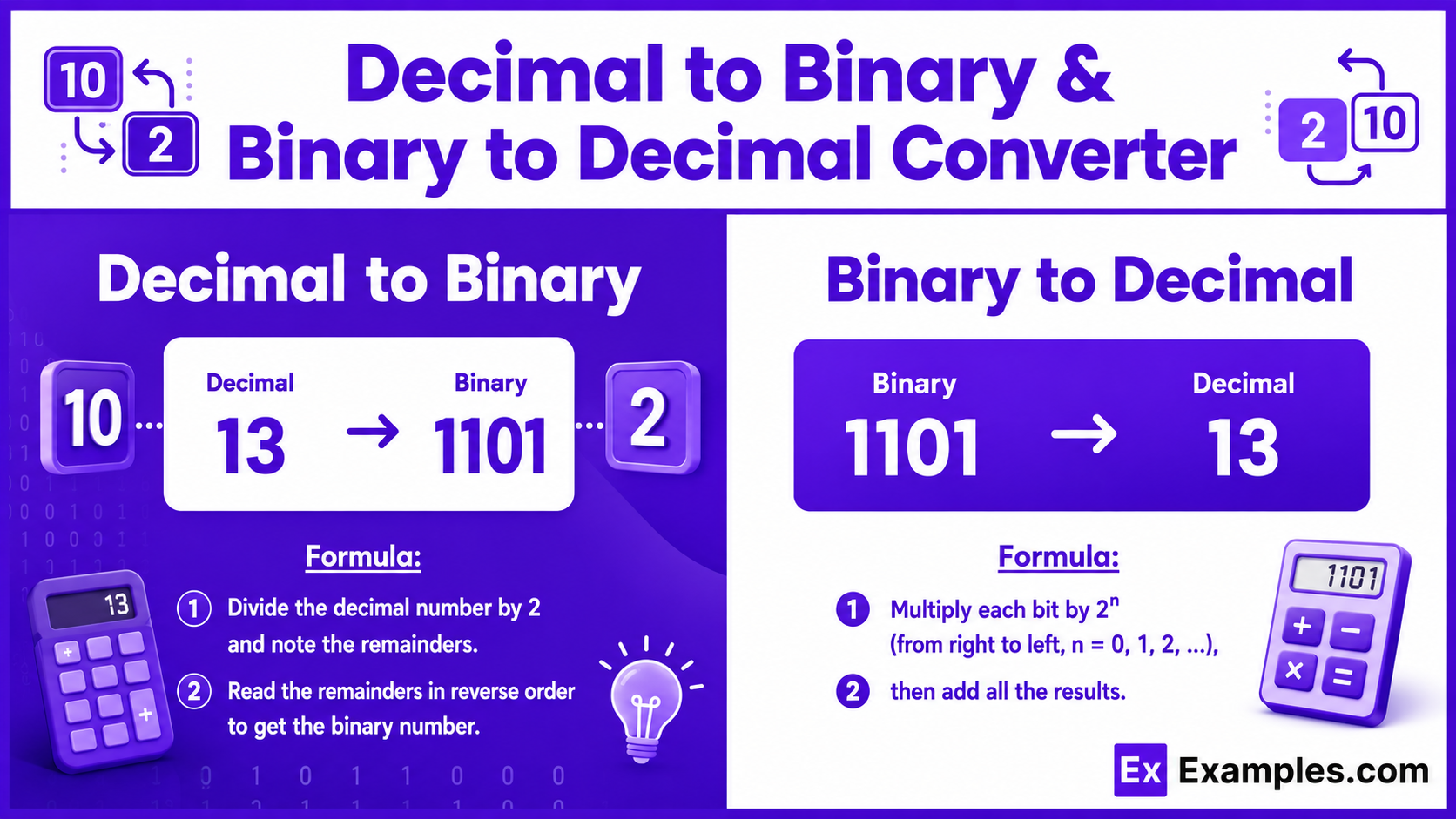
Number System Basics:
- Decimal System: Base 10, uses digits 0-9
- Binary System: Base 2, uses only digits 0 and 1
How to Convert Decimal to Binary:
Unlike unit conversions, converting a decimal number to binary does not use a single multiplication factor. Instead, it uses the repeated division method: divide the number by 2 repeatedly, record each remainder, and read the remainders from bottom to top.
Example: Convert 25 to binary.
25 ÷ 2 = 12 remainder 1
12 ÷ 2 = 6 remainder 0
6 ÷ 2 = 3 remainder 0
3 ÷ 2 = 1 remainder 1
1 ÷ 2 = 0 remainder 1
Reading the remainders from bottom to top gives 11001.
25 in decimal = 11001 in binary
How to Convert Binary to Decimal:
To convert a binary numeral to decimal, multiply each digit by 2 raised to the power of its position (counting from 0 on the right), then add all the results together.
Example: Convert 11001 to decimal.
11001 = (1×24) + (1×23) + (0×22) + (0×21) + (1×20)
11001 = 16 + 8 + 0 + 0 + 1
11001 in binary = 25 in decimal
Decimal to Binary Conversion Table
| Decimal | Binary |
|---|---|
| 0 | 0 |
| 1 | 1 |
| 2 | 10 |
| 3 | 11 |
| 4 | 100 |
| 5 | 101 |
| 6 | 110 |
| 7 | 111 |
| 8 | 1000 |
| 9 | 1001 |
| 10 | 1010 |
| 15 | 1111 |
| 20 | 10100 |
| 25 | 11001 |
| 50 | 110010 |
| 100 | 1100100 |
| 255 | 11111111 |
| 500 | 111110100 |
| 1,000 | 1111101000 |
Difference Between Decimal and Binary Number Systems
| Aspect | Decimal | Binary |
|---|---|---|
| Base | Base 10 | Base 2 |
| Digits Used | 0, 1, 2, 3, 4, 5, 6, 7, 8, 9 | 0, 1 |
| Place Values | Powers of 10 (1, 10, 100, 1,000…) | Powers of 2 (1, 2, 4, 8, 16…) |
| Typical Use | Everyday counting, money, measurements | Computing, digital logic, data storage |
| Digit Length | Shorter representation for the same value | Longer representation for the same value |
| Conversion Method | Divide by 2 repeatedly to get binary | Multiply digits by powers of 2 to get decimal |
1. Solved Examples on Converting Decimal to Binary
Example 1
Problem: Convert 1 into binary.
Solution:
1 ÷ 2 = 0 remainder 1
1 in decimal = 1 in binary
Example 2
Problem: Convert 5 into binary.
Solution:
5 ÷ 2 = 2 remainder 1
2 ÷ 2 = 1 remainder 0
1 ÷ 2 = 0 remainder 1
5 in decimal = 101 in binary
Example 3
Problem: Convert 10 into binary.
Solution:
10 ÷ 2 = 5 remainder 0
5 ÷ 2 = 2 remainder 1
2 ÷ 2 = 1 remainder 0
1 ÷ 2 = 0 remainder 1
10 in decimal = 1010 in binary
Example 4
Problem: Convert 25 into binary.
Solution:
25 ÷ 2 = 12 remainder 1
12 ÷ 2 = 6 remainder 0
6 ÷ 2 = 3 remainder 0
3 ÷ 2 = 1 remainder 1
1 ÷ 2 = 0 remainder 1
25 in decimal = 11001 in binary
Example 5
Problem: Convert 100 into binary.
Solution:
100 ÷ 2 = 50 remainder 0
50 ÷ 2 = 25 remainder 0
25 ÷ 2 = 12 remainder 1
12 ÷ 2 = 6 remainder 0
6 ÷ 2 = 3 remainder 0
3 ÷ 2 = 1 remainder 1
1 ÷ 2 = 0 remainder 1
100 in decimal = 1100100 in binary
Example 6
Problem: Convert 255 into binary.
Solution:
255 ÷ 2 = 127 remainder 1
127 ÷ 2 = 63 remainder 1
63 ÷ 2 = 31 remainder 1
31 ÷ 2 = 15 remainder 1
15 ÷ 2 = 7 remainder 1
7 ÷ 2 = 3 remainder 1
3 ÷ 2 = 1 remainder 1
1 ÷ 2 = 0 remainder 1
255 in decimal = 11111111 in binary
Example 7
Problem: Convert 1,000 into binary.
Solution:
Dividing 1,000 by 2 repeatedly and reading the remainders from bottom to top gives:
1,000 in decimal = 1111101000 in binary
2. Solved Examples on Converting Binary to Decimal
Example 1
Problem: Convert 1 into decimal.
Solution:
1 = 1×20
1 in binary = 1 in decimal
Example 2
Problem: Convert 101 into decimal.
Solution:
101 = (1×22) + (0×21) + (1×20)
101 = 4 + 0 + 1
101 in binary = 5 in decimal
Example 3
Problem: Convert 1010 into decimal.
Solution:
1010 = (1×23) + (0×22) + (1×21) + (0×20)
1010 = 8 + 0 + 2 + 0
1010 in binary = 10 in decimal
Example 4
Problem: Convert 11001 into decimal.
Solution:
11001 = (1×24) + (1×23) + (0×22) + (0×21) + (1×20)
11001 = 16 + 8 + 0 + 0 + 1
11001 in binary = 25 in decimal
Example 5
Problem: Convert 1100100 into decimal.
Solution:
1100100 = (1×26) + (1×25) + (0×24) + (0×23) + (1×22) + (0×21) + (0×20)
1100100 = 64 + 32 + 0 + 0 + 4 + 0 + 0
1100100 in binary = 100 in decimal
Example 6
Problem: Convert 11111111 into decimal.
Solution:
11111111 = 128 + 64 + 32 + 16 + 8 + 4 + 2 + 1
11111111 in binary = 255 in decimal
Example 7
Problem: Convert 1111101000 into decimal.
Solution:
Multiplying each digit by its place value and summing the results gives:
1111101000 in binary = 1,000 in decimal
How accurate is the conversion between decimal and binary?
The conversion is exact for whole numbers with no rounding involved. Every non-negative integer has one, and only one, correct binary representation, and the reverse is also true. Rounding only becomes a concern when converting fractional decimal values, which this calculator does not handle.
Are there any tools or calculators available for converting decimal to binary?
Yes, the calculator above converts between decimal and binary instantly in both directions. Enter a value in either field and the other field updates automatically, with the result also shown in the table below the calculator.
Can this calculator handle negative numbers or decimals like 3.5?
No, this calculator works only with non-negative whole numbers. Negative binary numbers require a separate representation method (such as two’s complement), and fractional binary conversion follows a different process than the whole-number division method used here.
Why do computers use binary instead of decimal?
Computers use binary because their electronic circuits are built from transistors that are easiest to design with two stable states: on and off. These two states map naturally to the digits 1 and 0, making binary the most reliable and efficient system for digital hardware, even though it results in longer number strings than decimal.
Is there a limit to how large a decimal number can be converted?
In principle, any non-negative integer can be converted to binary using the repeated division method. In practice, most online calculators and standard programming environments are limited by how large a number their underlying number type can safely represent before precision is lost.
What is 1,000 in binary?
1,000 in decimal is 1111101000 in binary. This is found by dividing 1,000 by 2 repeatedly and reading the remainders from the last division back to the first.