
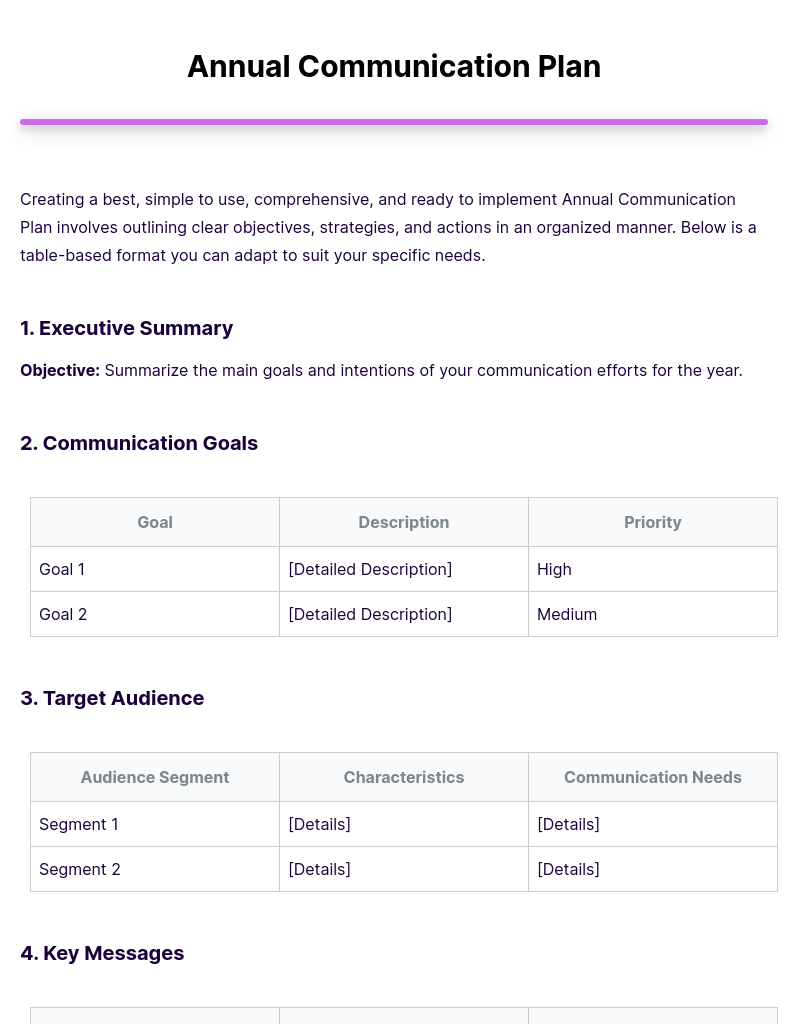

Creating a best, simple to use, comprehensive, and ready to implement Annual Communication Plan involves outlining clear objectives, strategies, and actions in an organized manner. Below is a table-based format you can adapt to suit your specific needs.
1. Executive Summary
Objective: Summarize the main goals and intentions of your communication efforts for the year.
2. Communication Goals
| Goal | Description | Priority |
|---|---|---|
| Goal 1 | [Detailed Description] | High |
| Goal 2 | [Detailed Description] | Medium |
3. Target Audience
| Audience Segment | Characteristics | Communication Needs |
|---|---|---|
| Segment 1 | [Details] | [Details] |
| Segment 2 | [Details] | [Details] |
4. Key Messages
| Audience | Key Message | Purpose |
|---|---|---|
| Audience 1 | [Message] | [Purpose] |
| Audience 2 | [Message] | [Purpose] |
5. Communication Channels
| Channel | Frequency | Content Type | Responsible |
|---|---|---|---|
| Channel 1 | Weekly | Updates, News | [Name/Team] |
| Channel 2 | Monthly | Reports, Analysis | [Name/Team] |
6. Implementation Timeline
Include a visual timeline (Gantt Chart) with key milestones, activities, and deadlines.
7. Budget
| Item | Cost | Purpose | Allocated Funds |
|---|---|---|---|
| Item 1 | $XXX | [Purpose] | $XXX |
| Item 2 | $XXX | [Purpose] | $XXX |
8. Monitoring and Evaluation
| Metric | Method | Frequency | Goal |
|---|---|---|---|
| Metric 1 | [Method] | Monthly | [Goal] |
| Metric 2 | [Method] | Quarterly | [Goal] |
9. Risks and Mitigation Strategies
| Risk | Probability | Impact | Mitigation Strategy |
|---|---|---|---|
| Risk 1 | High | Major | [Strategy] |
| Risk 2 | Medium | Moderate | [Strategy] |
10. Review and Adaptation Plan
Objective: Describe how and when the plan will be reviewed, and the process for making adjustments based on performance data and changing circumstances.
This structure provides a clear, comprehensive, and easy-to-implement framework for your Annual Communication Plan. You can further customize the tables, add graphs or images, and adjust the content according to your specific needs and objectives.