
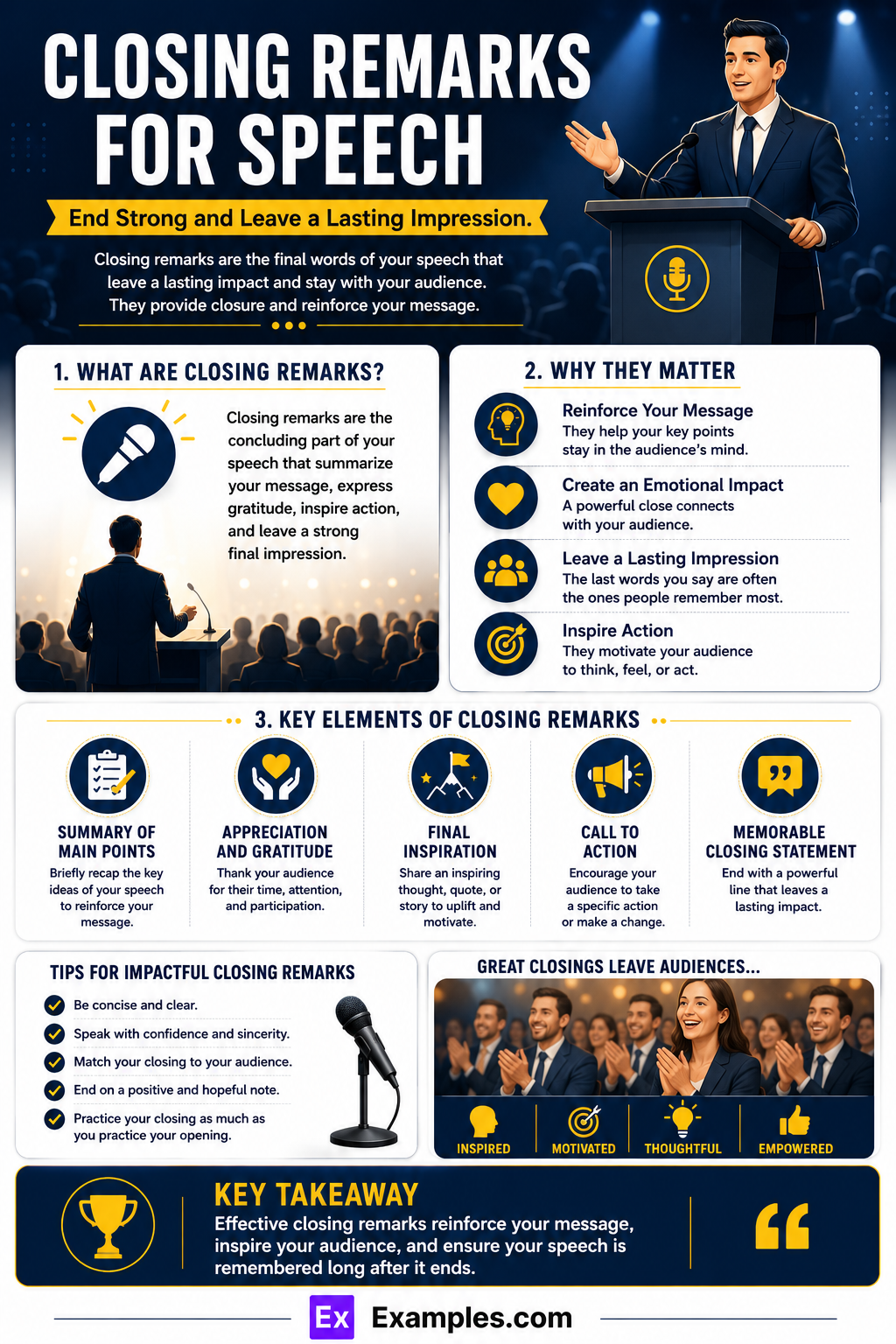
Closing remarks are the final words delivered at the end of a speech or event. They summarize key messages, express gratitude, and leave a lasting impression on the audience.
What is Closing Remarks for Speech?
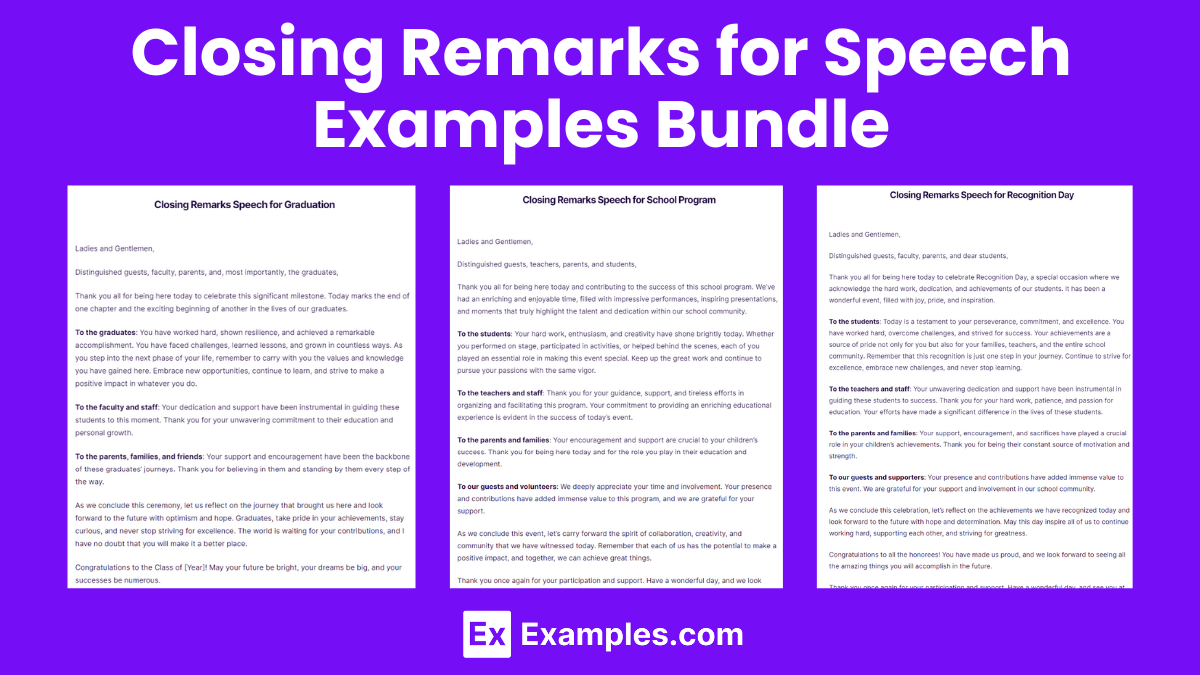
Closing Remarks for Speech Bundle Download
Closing Remarks for Speech Format
1. Summarize Key Points
Briefly recap the main ideas or arguments presented in your speech.
Example: “Today, we discussed the importance of time management, practical strategies to implement it, and the benefits it brings.”
2. Reinforce the Main Message
Emphasize the core message or takeaway you want the audience to remember.
Example: “Remember, effective time management is crucial for reducing stress, increasing productivity, and achieving your goals.”
3. Call to Action
Encourage the audience to take specific actions or steps based on your speech.
Example: “I encourage each of you to start using a planner, set specific goals, and tackle your most important tasks first.”
4. Thank the Audience
Express gratitude for their time and attention.
Example: “Thank you all for your attention and engagement today.”
5. End with a Memorable Closing
Finish with a powerful quote, a thought-provoking statement, or an inspiring note.
Example: “As the saying goes, ‘The bad news is time flies. The good news is you’re the pilot.’ Make the most of your time and steer your life towards success.”
If you’re unsure how to write an effective conclusion, an AI Speech Generator can help you draft professional closing remarks that match your audience and purpose.
Closing Remarks for Speech Example
After writing your speech, use an AI Proof Reader to check grammar, punctuation, and sentence clarity before presenting it to your audience.
Short Closing Remarks for Speech Example
If you want a shorter version without losing the main message, a Paragraph Summarizer can quickly condense your closing remarks into a concise conclusion.
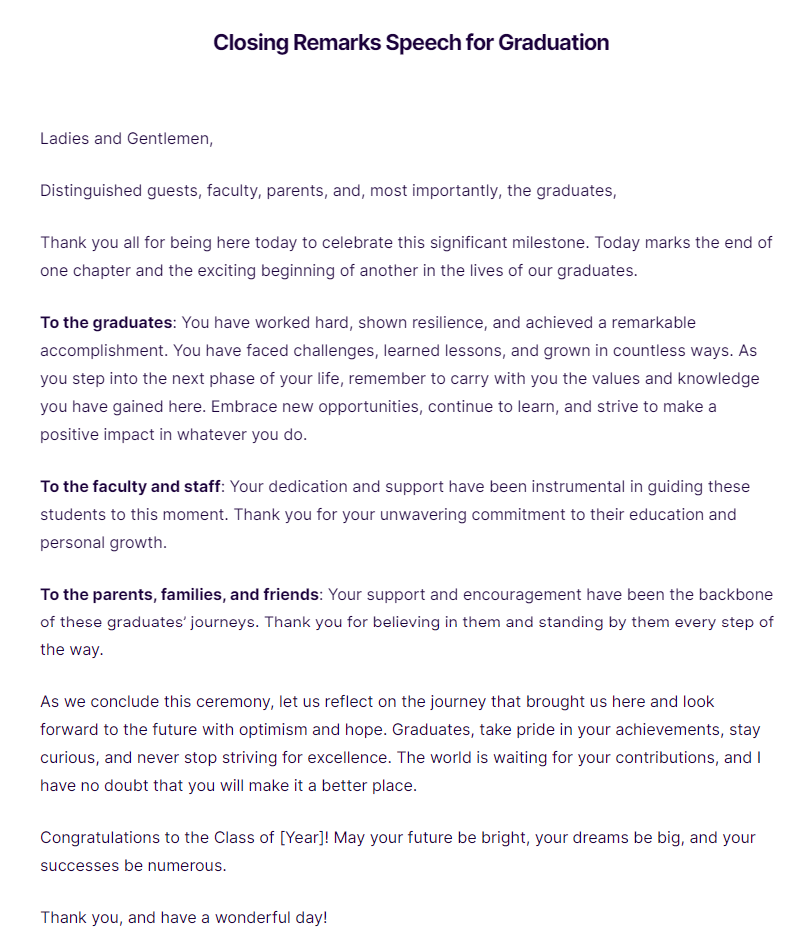
Closing Remarks for Speech for Graduation
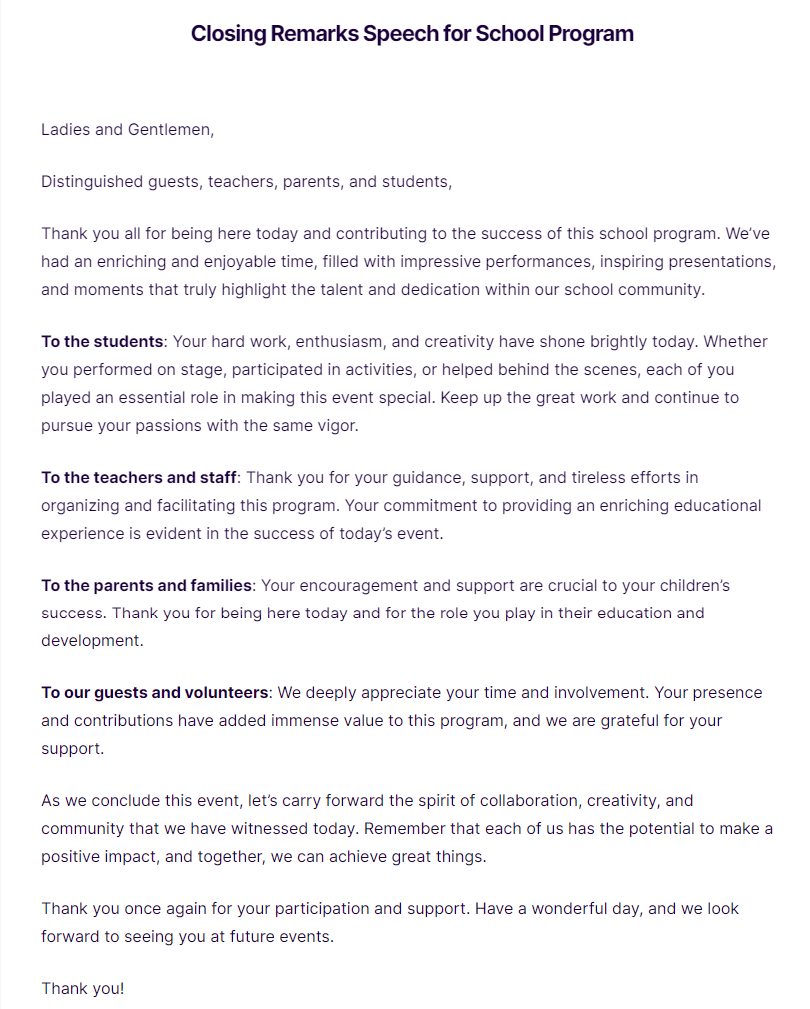
Closing Remarks for Speech for School Program
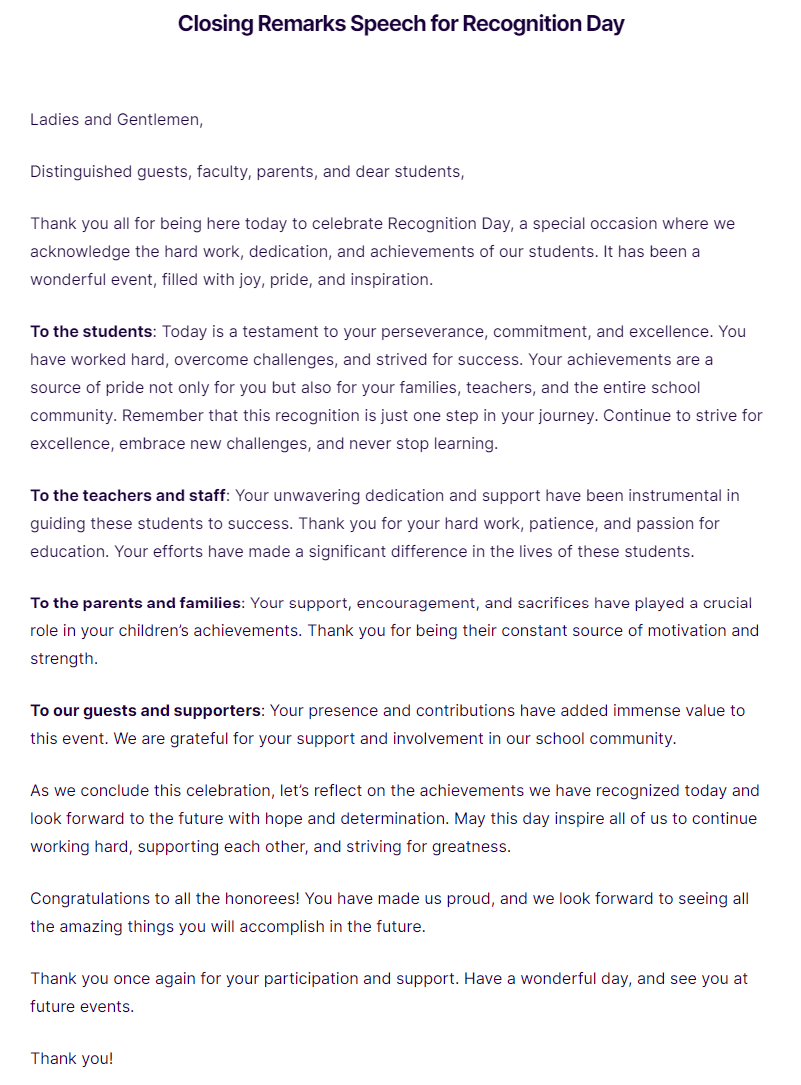
Closing Remarks for Speech for Recognition Day
More Closing Remarks for Speech Topics
- Closing Remarks Speech for an Event
- Closing Remarks Speech for Seminar
- Closing Remarks Speech for Teachers Day
- Closing Remarks Speech for Christmas Party
- Closing Remarks Speech for Valedictorian
- Closing Remarks for Speech Contest
- Closing Remarks Speech for Wedding
- Closing Remarks Speech for Conference
- Closing Remarks Speech for Award Ceremony
- Closing Remarks Speech for Farewell
- Closing Remarks Speech for Workshop
- Closing Remarks Speech for Business Meeting
- Closing Remarks Speech for Retirement
- Closing Remarks Speech for Fundraiser
- Closing Remarks Speech for Community Event
- Closing Remarks Speech for Gala
- Closing Remarks Speech for Annual General Meeting
- Closing Remarks Speech for Orientation
- Closing Remarks Speech for Leadership Summit
- Closing Remarks Speech for Charity Event
- Closing Remarks Speech for Memorial Service
- Closing Remarks Speech for Family Reunion
- Closing Remarks Speech for Corporate Event
- Closing Remarks Speech for Product Launch
- Closing Remarks Speech for Training Session
- Closing Remarks Speech for Cultural Festival
- Closing Remarks Speech for Political Rally
Preparing speeches for different occasions becomes easier when you use an AI Content Generator to create personalized ideas for formal, educational, or business events.
How to Write Closing Remarks for Speech
1. Summarize Key Points
Briefly recap the main ideas or arguments presented.
Example: “Today, we discussed the importance of time management, practical strategies to implement it, and the benefits it brings.”
2. Reinforce the Main Message
Emphasize the core message or takeaway you want the audience to remember.
Example: “Remember, effective time management is crucial for reducing stress and achieving your goals.”
3. Call to Action
Encourage the audience to take specific actions based on your speech.
Example: “I encourage you to start using a planner and prioritize your tasks.”
4. Thank the Audience
Express gratitude for their time and attention.
Example: “Thank you all for your attention.”
5. End with a Memorable Closing
Finish with a powerful quote, a thought-provoking statement, or an inspiring note.
Example: “As the saying goes, ‘The bad news is time flies. The good news is you’re the pilot.’ Make the most of your time.”
Once you’ve organized your ideas, an AI Paragraph Writer can help turn your key points into a polished and engaging conclusion.
Tips to Deliver Closing Remarks for Speech
1. Summarize Key Points: Briefly recap the main ideas discussed in your speech.
2. Reinforce the Main Message: Emphasize the core message you want the audience to remember.
3. Call to Action: Encourage the audience to take specific steps or actions based on your speech.
4. Express Gratitude: Thank the audience for their time and attention.
5. End with a Memorable Closing: Finish with a powerful quote, thought-provoking statement, or inspiring note.
Practicing your delivery is important, but improving readability also makes your speech easier to understand. An AI Readability Checker can help simplify complex sentences before you present.
If you need fresh inspiration for different speech topics, an AI Ideas Generator can provide creative themes and closing message suggestions in seconds.
If you’re preparing speeches regularly, an AI Script Generator can help you create complete speech drafts with strong openings, clear transitions, and memorable closing remarks.
They reinforce the message, ensure audience retention, and provide a clear, memorable conclusion.
Summarize key points, thank the audience, and end with a powerful, memorable statement or call to action.
Yes, a relevant and impactful quote can effectively reinforce your message and leave a lasting impression.
Avoid introducing new information, being too lengthy, or ending abruptly without a clear conclusion.
Use a strong, positive tone, include a personal touch or story, and connect emotionally with the audience.
Yes, appropriate humor can leave a positive impression and end your speech on a high note.
Closing remarks should be concise, typically lasting no more than a few minutes.
A call to action urges the audience to take specific steps or actions related to your speech’s message.
Yes, thanking the audience shows appreciation and fosters a positive connection.
Yes, a rhetorical question can provoke thought and leave the audience reflecting on your message.