
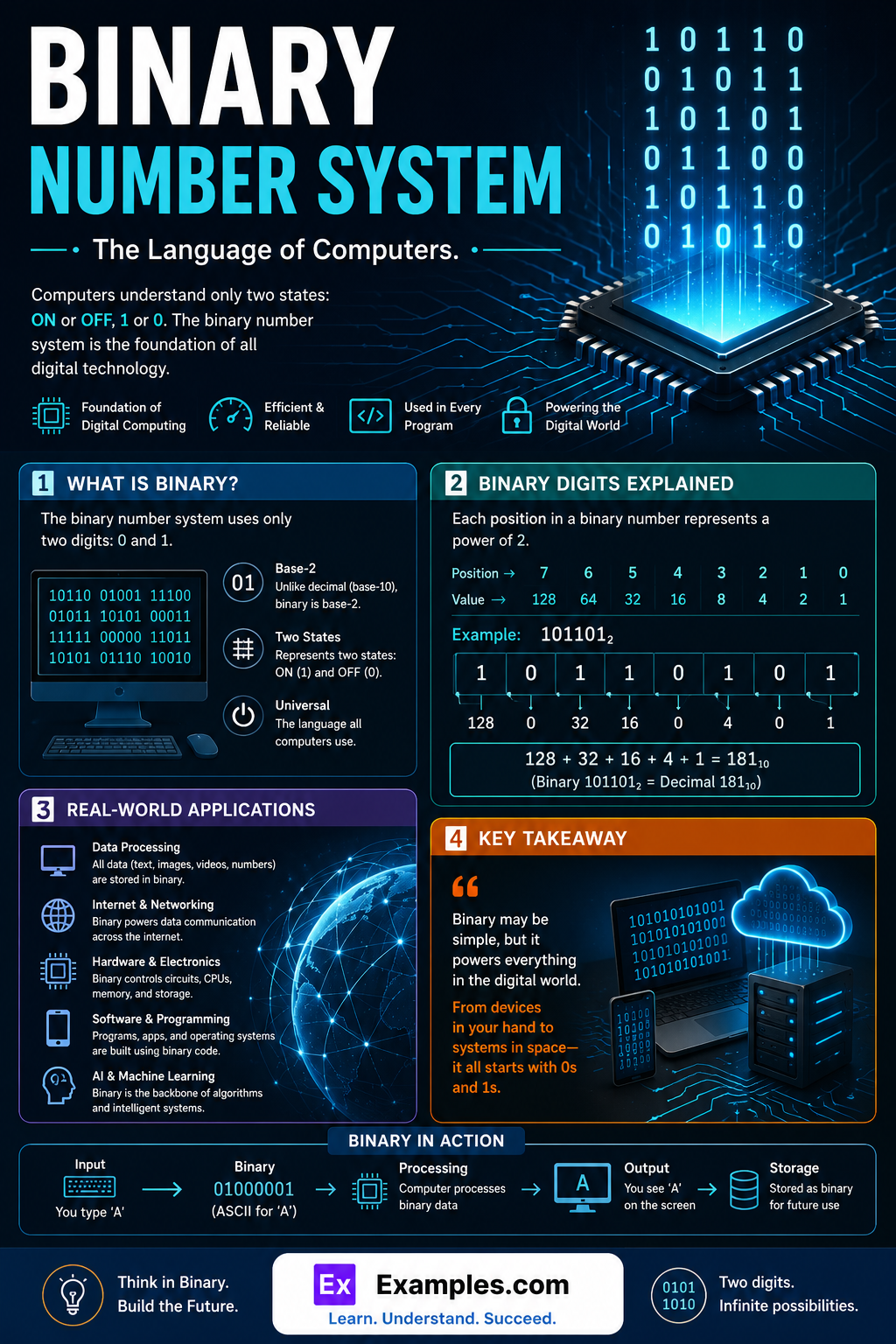
The binary number system uses only the digits 0 and 1 to represent data and calculations. It is the foundation of modern computing and digital technology.
What is Binary Number System?
The binary number system is a method of representing numbers that uses only two digits: 0 and 1. It is the foundation of all modern digital systems and computers. Unlike the decimal system, which is based on ten digits (0-9), the binary system operates on base-2. Each binary digit is known as a bit, which is short for binary digit. Binary numbers are part of a broader system of representing values in different formats. Understanding other number representations, such as decimal and hexadecimal, makes binary conversions much easier.
Binary Numbers Table
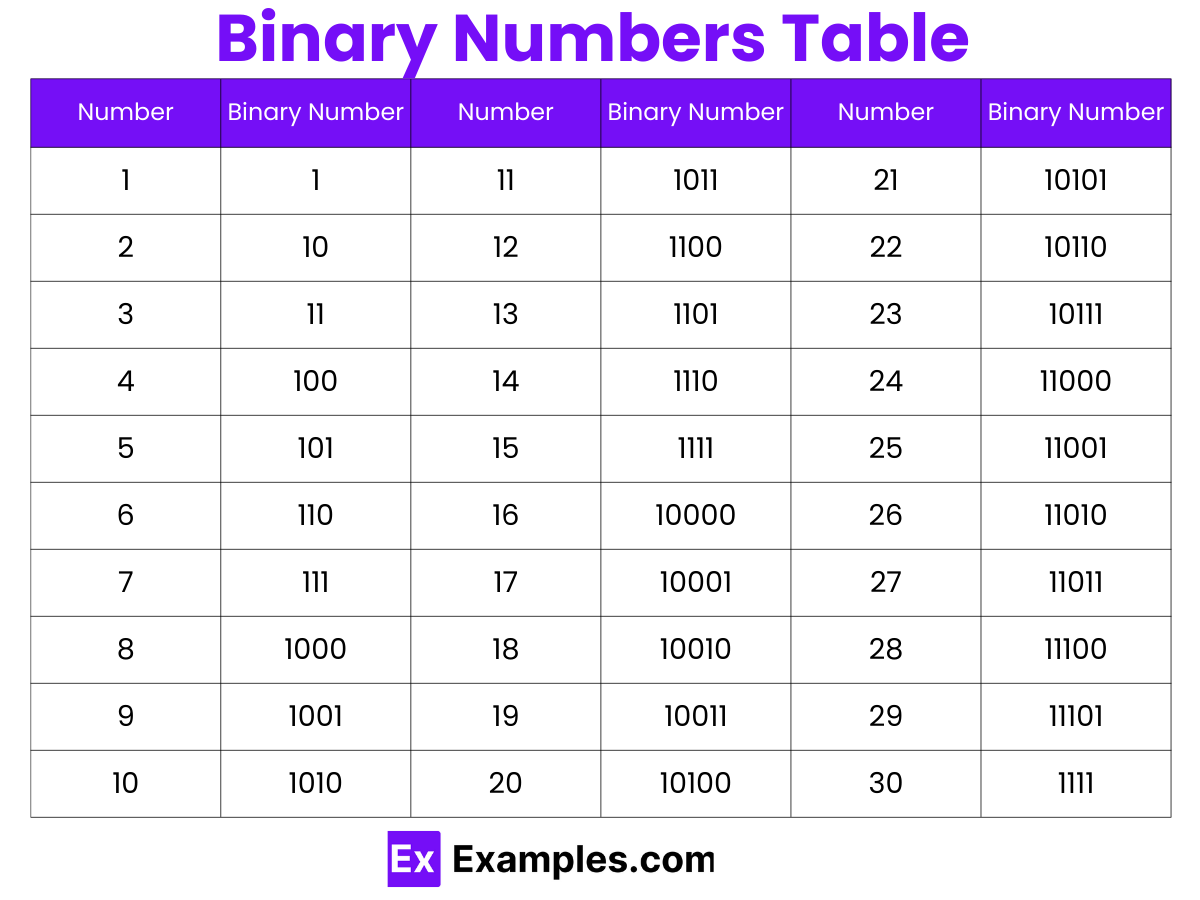
Binary values are commonly written using exponents of two. Learning scientific notation also helps in understanding how numbers are represented using powers and exponents.
How to Calculate Binary Numbers
| Thousands | Hundreds | Tens | Ones |
| 1 | 2 | 3 | 5 |
This beside indicates,
1235 = 1 × 1000 + 2 × 100 + 3 × 10 + 5 × 1
| 1000 | = 103 = 10 × 10 × 10 |
| 100 | = 102 = 10 × 10 |
| 10 | = 101 = 10 |
| 1 | = 100 (any value to the exponent zero is one) |
| Thousands | Hundreds | Tens | Ones |
| 103 | 102 | 101 | 100 |
| 1 | 2 | 3 | 5 |
Since binary calculations rely heavily on powers and exponents, using a math calculator can help verify calculations and improve accuracy while learning.
Binary Arithmetic Operations
Just as we perform arithmetic operations with decimal numbers, we can also perform addition, subtraction, multiplication, and division with binary numbers. Let’s explore each of these operations one by one.
Binary Addition
Adding two binary numbers results in another binary number. This process is straightforward. The addition of two single-digit binary numbers is shown in the table below:
For example: Add 11012 and 10012.
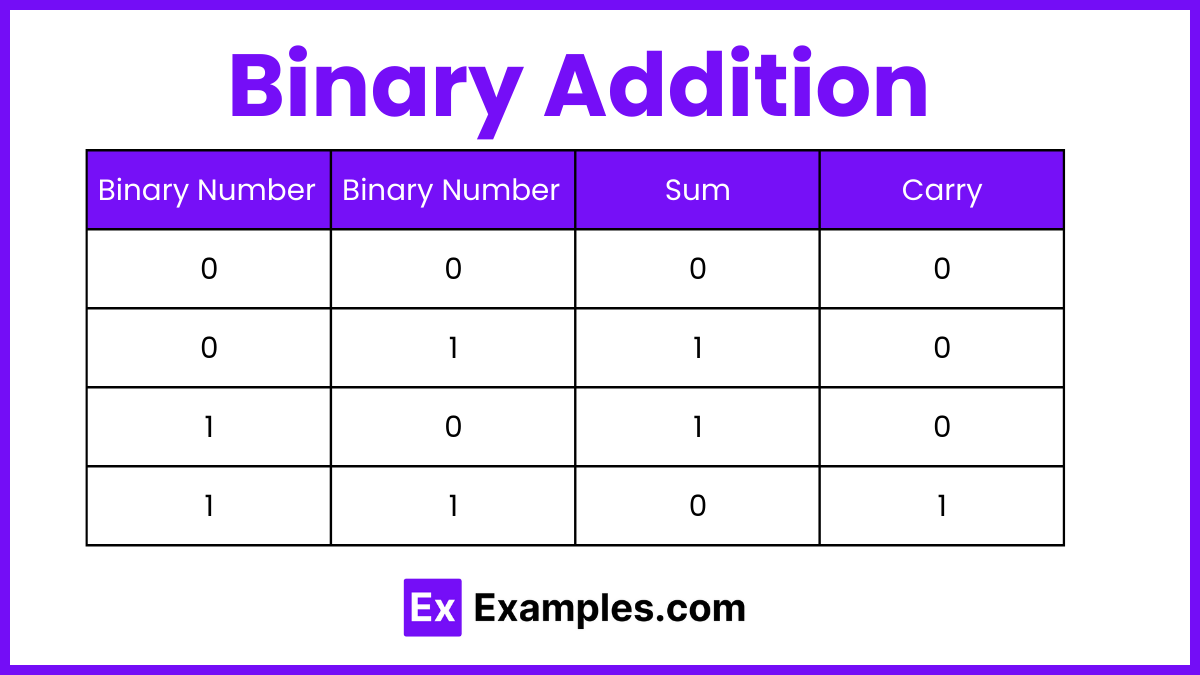
Binary addition follows the same logical principles as standard arithmetic. Practicing with a random number generator can help create different values for addition exercises.
Binary Subtraction
Subtracting two binary numbers results in another binary number. This method is also straightforward. The subtraction of two single-digit binary numbers is shown in the table below:
Example: Subtract 11012, and 10102.
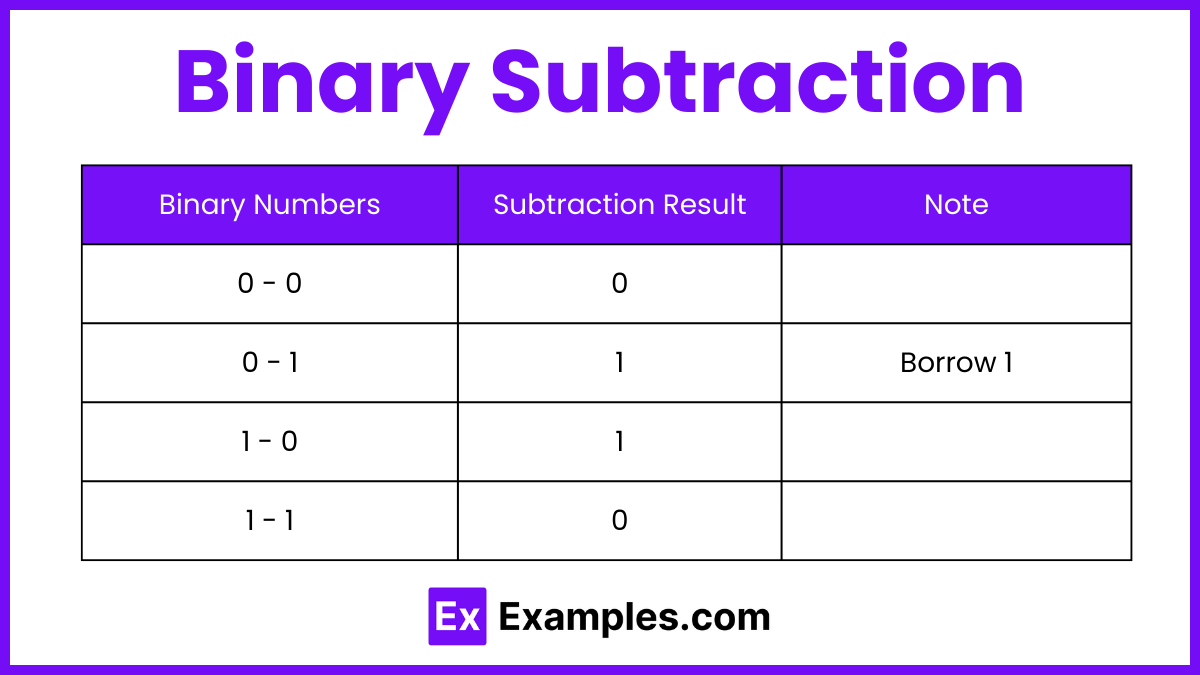
Solving subtraction problems strengthens logical thinking and arithmetic skills. Practicing with a percentage difference calculator is another way to build confidence in working with numerical values.
Binary Multiplication
The multiplication process for binary numbers is similar to that for decimal numbers. Let’s understand this with an example.
Example: Multiply 11012 and 10102.
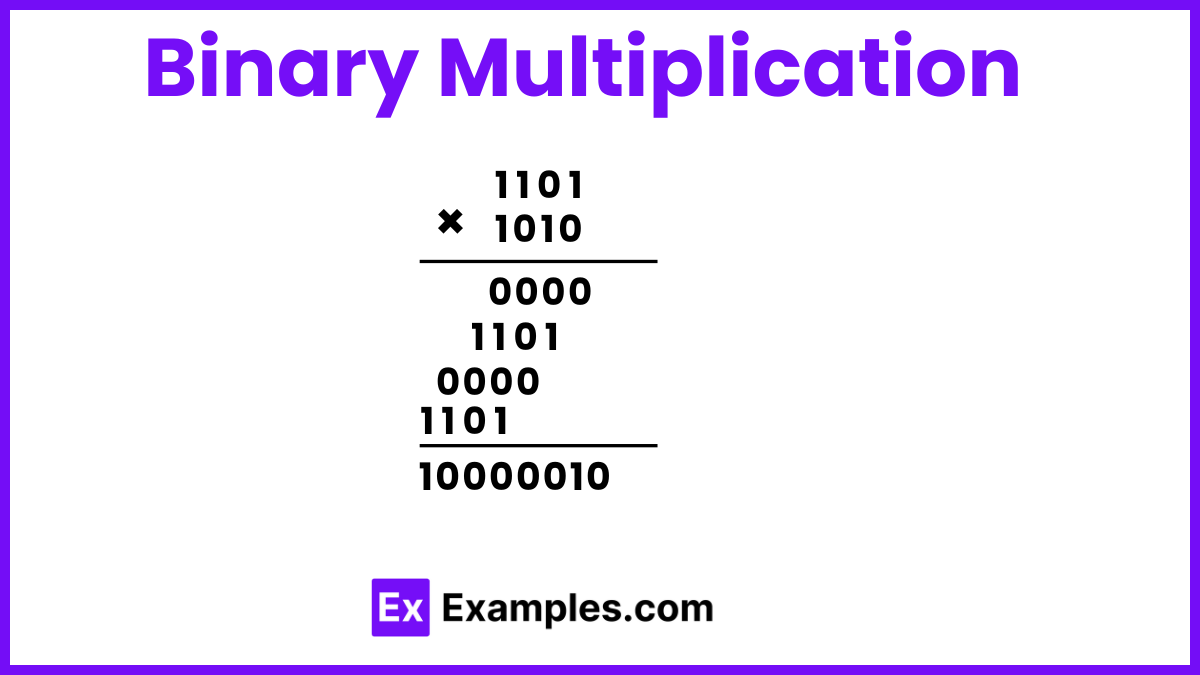
Multiplication relies on recognizing number patterns and repeated operations. A square root calculator is another useful mathematical tool for improving problem-solving skills.
Binary Division
Binary division follows the same principles as decimal division. Let’s learn this process through an example.
Example: Divide 10102 by 102
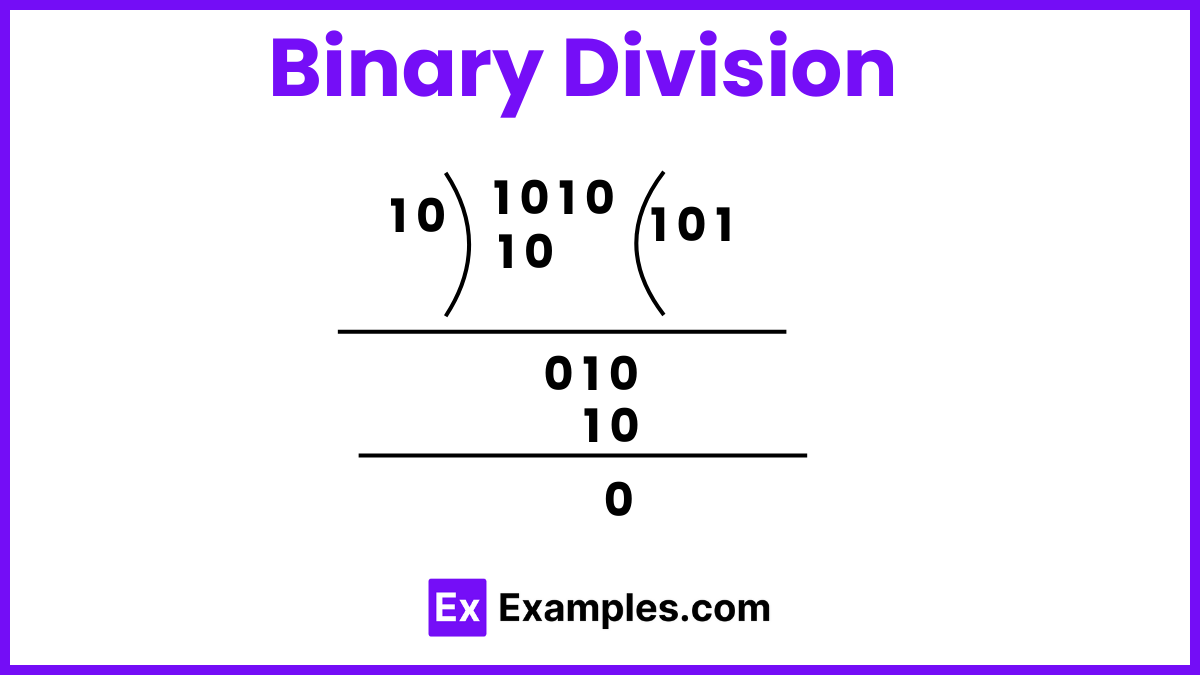
Division problems become easier with consistent practice and step-by-step calculations. You can strengthen your arithmetic skills using a prime number checker while exploring different number properties.
Problems and Solutions in Binary Division
Problem 1
Divide 1010 (binary) by 10 (binary).
Solution:
- Align the divisor (10) with the first part of the dividend (1010).
- Perform binary subtraction where possible.
- Bring down the next digit of the dividend and repeat the process.
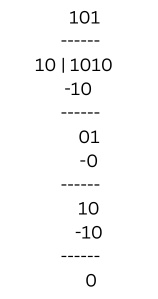
Understanding mathematical relationships is easier when concepts are organized visually. Creating a mind map can help connect binary arithmetic rules and conversion methods.
FAQs
To decode binary numbers, convert each bit to its decimal equivalent, starting from the rightmost bit. Multiply each bit by 2 raised to the power of its position index, then sum the results to get the decimal value. If you’re preparing study notes, creating a structured outline can help organize binary conversion steps and important formulas.
Understanding binary involves recognizing that it is a base-2 numeral system. Each digit (bit) is either a 0 or a 1. Binary represents values by summing powers of 2. Start with simple examples to see how binary translates to decimal.
To calculate in binary, use the same arithmetic rules as in decimal but with base-2 digits (0 and 1). Addition, subtraction, multiplication, and division follow similar principles, adjusting for carrying over when sums exceed 1.
Computers understand binary because they operate using electrical signals that have two states: on (1) and off (0). These binary states are used to perform calculations and store data, forming the foundation of computer processing and memory.
To say “hello how are you” in binary, convert each character to its ASCII binary equivalent. For example, “h” is 01101000, “e” is 01100101, and so on. The full binary sequence for “hello how are you” is a series of these binary codes.
Binary is a numerical system that uses only two digits, 0 and 1. It’s the language computers use to process data, with each binary digit representing an on or off state in the computer’s circuitry.
Binary code is the fundamental language of computers, consisting of sequences of 0s and 1s. Each sequence represents specific instructions or data, allowing computers to perform tasks and process information through simple on/off signals.