
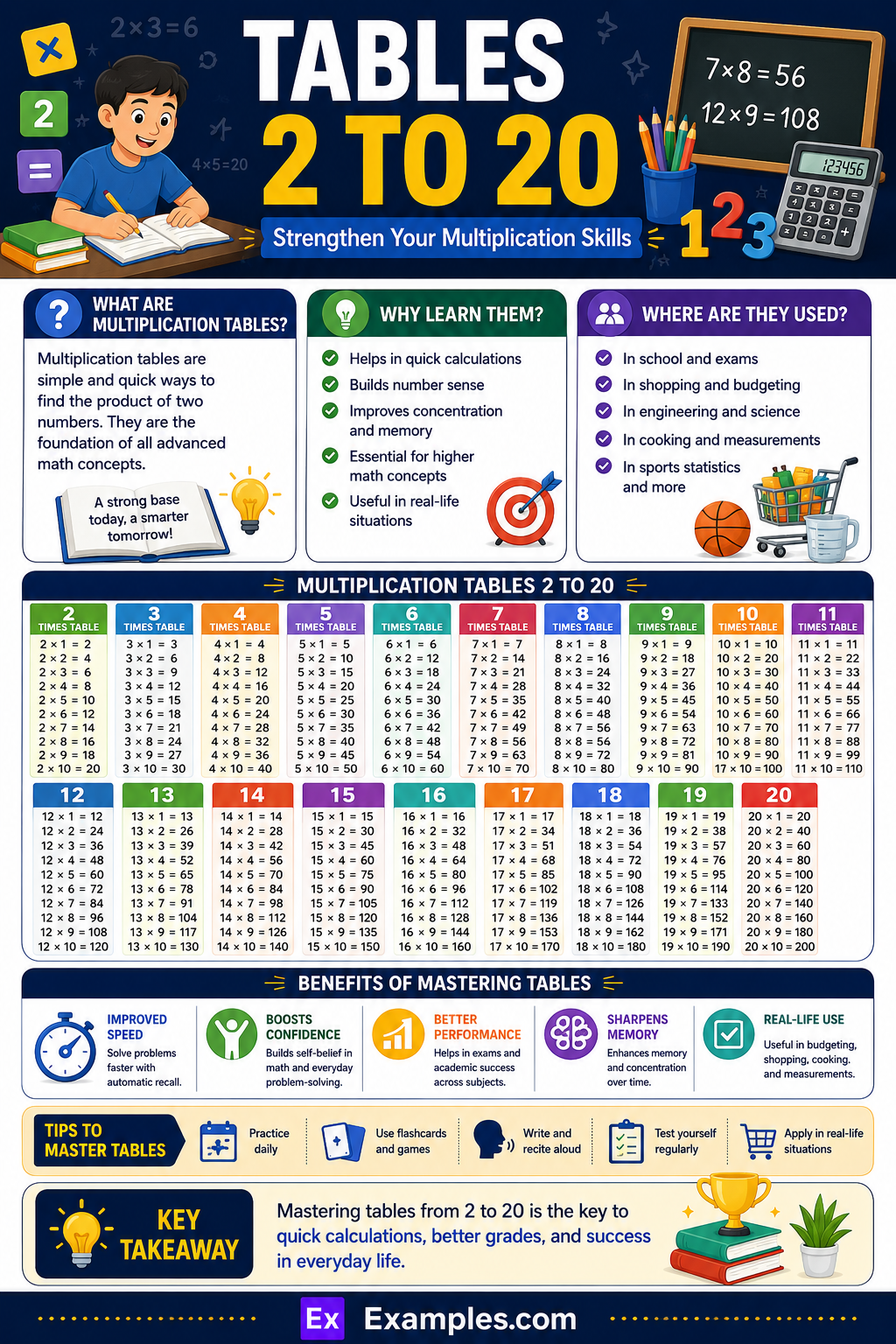
Tables 2 to 20 are multiplication sequences that improve calculation speed and number fluency. They help students solve mathematical problems more efficiently.
Tables 2 to 20
The multiplication tables from 2 to 20 are critical tools in the development of mathematical skills, serving as the foundation for understanding higher mathematical concepts such as division, algebra, and geometry. These tables encompass the products of numbers 2 through 20 multiplied by each number within that same range, providing a systematic grid that facilitates quick and efficient calculation. Mastery of these tables not only speeds up the arithmetic calculation process but also significantly enhances problem-solving abilities, as many mathematical problems in both academic and real-world scenarios rely heavily on quick recall of these multiplication facts.
Download Tables from 2 to 20 Pdf
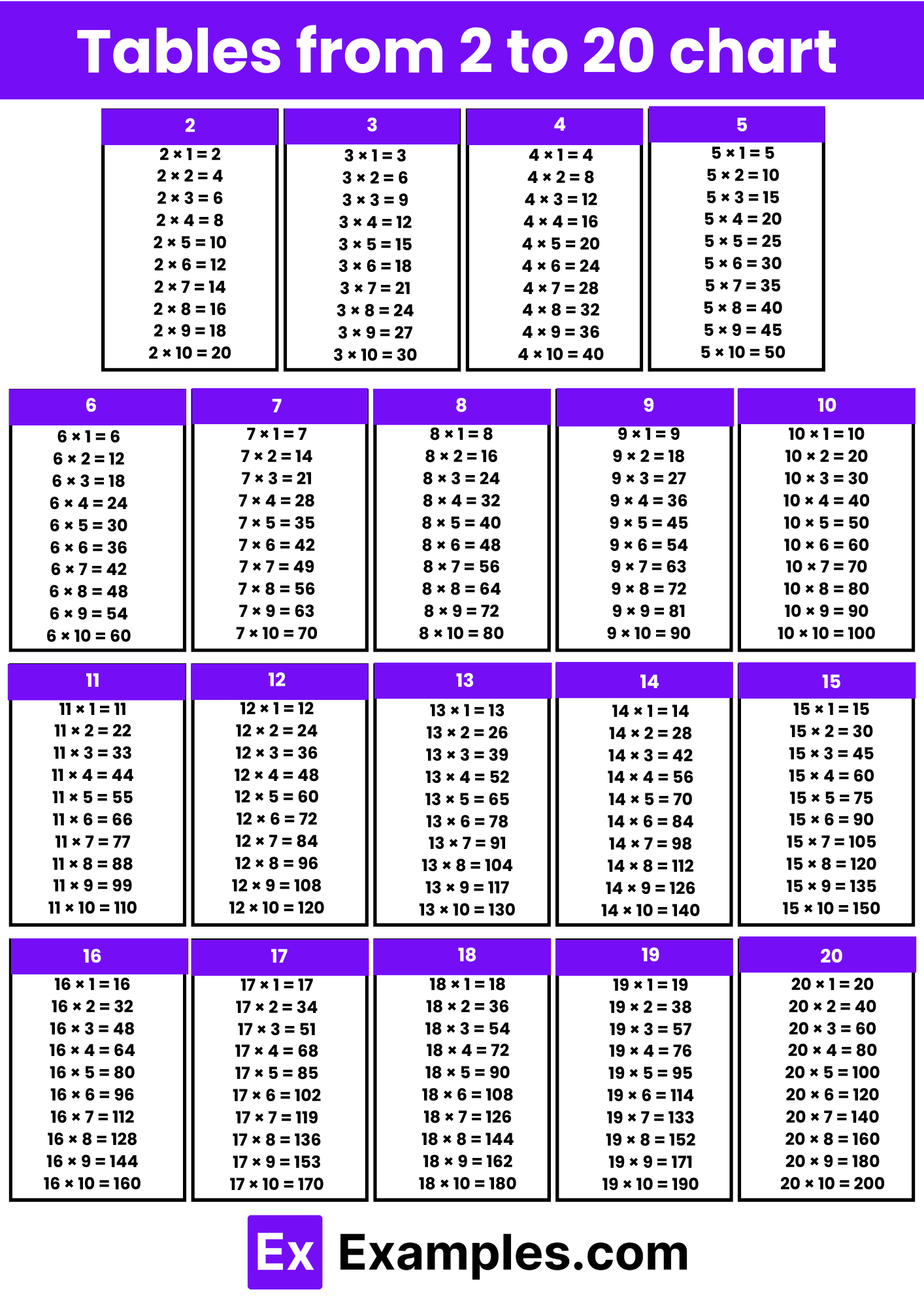
Tables from 2 to 20 chart
A multiplication chart for numbers 2 to 20 showcases the results of multiplying these numbers with each other, forming an inclusive 19×19 grid. The rows and columns are labeled with numbers from 2 to 20, and their intersections present the products, effectively visualizing the concept of arrays and matrix multiplication. This tool aids in quick calculations and understanding mathematical patterns and relationships.
A multiplication chart for tables 2 to 20 organizes the products of numbers from 2 up through 20 into a grid format. This chart typically consists of rows and columns labeled from 2 to 20, where the intersection of each row and column gives the product of the two numbers. For example, the intersection of the row labeled 2 and the column labeled 3 would contain the number 6, since 2 multiplied by 3 equals 6. Such a chart is an excellent tool for quickly referencing multiplication results and is essential for both classroom use and self-study, facilitating a faster and more intuitive understanding of multiplication for students advancing in their mathematical education.
Download Tables from 2 to 20 Pdf
2-20 Multiplication Tables List with Chart and pdf
Multiplication Tables 2 to 20
Tables 2 to 6
| 2 x 1 = 2 | 3 x 1 = 3 | 4 x 1 = 4 | 5 x 1 = 5 | 6 x 1 = 6 |
| 2 x 2 = 4 | 3 x 2 = 6 | 4 x 2 = 8 | 5 x 2 = 10 | 6 x 2 = 12 |
| 2 x 3 = 6 | 3 x 3 = 9 | 4 x 3 = 12 | 5 x 3 = 15 | 6 x 3 = 18 |
| 2 x 4 = 8 | 3 x 4 = 12 | 4 x 4 = 16 | 5 x 4 = 20 | 6 x 4 = 24 |
| 2 x 5 = 10 | 3 x 5 = 15 | 4 x 5 = 20 | 5 x 5 = 25 | 6 x 5 = 30 |
| 2 x 6 = 12 | 3 x 6 = 18 | 4 x 6 = 24 | 5 x 6 = 30 | 6 x 6 = 36 |
| 2 x 7 = 14 | 3 x 7 = 21 | 4 x 7 = 28 | 5 x 7 = 35 | 6 x 7 = 42 |
| 2 x 8 = 16 | 3 x 8 = 24 | 4 x 8 = 32 | 5 x 8 = 40 | 6 x 8 = 48 |
| 2 x 9 = 18 | 3 x 9 = 27 | 4 x 9 = 36 | 5 x 9 = 45 | 6 x 9 = 54 |
| 2 x 10 = 20 | 3 x 10 = 30 | 4 x 10 = 40 | 5 x 10 = 50 | 6 x 10 = 60 |
Tables 7 to 11
| 7 x 1 = 7 | 8 x 1 = 8 | 9 x 1 = 9 | 10 x 1 = 10 | 11 x 1 = 11 |
| 7 x 2 = 14 | 8 x 2 = 16 | 9 x 2 = 18 | 10 x 2 = 20 | 11 x 2 = 22 |
| 7 x 3 = 21 | 8 x 3 = 24 | 9 x 3 = 27 | 10 x 3 = 30 | 11 x 3 = 33 |
| 7 x 4 = 28 | 8 x 4 = 32 | 9 x 4 = 36 | 10 x 4 = 40 | 11 x 4 = 44 |
| 7 x 5 = 35 | 8 x 5 = 40 | 9 x 5 = 45 | 10 x 5 = 50 | 11 x 5 = 55 |
| 7 x 6 = 42 | 8 x 6 = 48 | 9 x 6 = 54 | 10 x 6 = 60 | 11 x 6 = 66 |
| 7 x 7 = 49 | 8 x 7 = 56 | 9 x 7 = 63 | 10 x 7 = 70 | 11 x 7 = 77 |
| 7 x 8 = 56 | 8 x 8 = 64 | 9 x 8 = 72 | 10 x 8 = 80 | 11 x 8 = 88 |
| 7 x 9 = 63 | 8 x 9 = 72 | 9 x 9 = 81 | 10 x 9 = 90 | 11 x 9 = 99 |
| 7 x 10 = 70 | 8 x 10 = 80 | 9 x 10 = 90 | 10 x 10 = 100 | 11 x 10 = 110 |
Tables 12 to 16
| 12 x 1 = 12 | 13 x 1 = 13 | 14 x 1 = 14 | 15 x 1 = 15 | 16 x 1 = 16 |
| 12 x 2 = 24 | 13 x 2 = 26 | 14 x 2 = 28 | 15 x 2 = 30 | 16 x 2 = 32 |
| 12 x 3 = 36 | 13 x 3 = 39 | 14 x 3 = 42 | 15 x 3 = 45 | 16 x 3 = 48 |
| 12 x 4 = 48 | 13 x 4 = 52 | 14 x 4 = 56 | 15 x 4 = 60 | 16 x 4 = 64 |
| 12 x 5 = 60 | 13 x 5 = 65 | 14 x 5 = 70 | 15 x 5 = 75 | 16 x 5 = 80 |
| 12 x 6 = 72 | 13 x 6 = 78 | 14 x 6 = 84 | 15 x 6 = 90 | 16 x 6 = 96 |
| 12 x 7 = 84 | 13 x 7 = 91 | 14 x 7 = 98 | 15 x 7 = 105 | 16 x 7 = 112 |
| 12 x 8 = 96 | 13 x 8 = 104 | 14 x 8 = 112 | 15 x 8 = 120 | 16 x 8 = 128 |
| 12 x 9 = 108 | 13 x 9 = 117 | 14 x 9 = 126 | 15 x 9 = 135 | 16 x 9 = 144 |
| 12 x 10 = 120 | 13 x 10 = 130 | 14 x 10 = 140 | 15 x 10 = 150 | 16 x 10 = 160 |
Tables17 to 20
| 17 x 1 = 17 | 18 x 1 = 18 | 19 x 1 = 19 | 20 x 1 = 20 |
| 17 x 2 = 34 | 18 x 2 = 36 | 19 x 2 = 38 | 20 x 2 = 40 |
| 17 x 3 = 51 | 18 x 3 = 54 | 19 x 3 = 57 | 20 x 3 = 60 |
| 17 x 4 = 68 | 18 x 4 = 72 | 19 x 4 = 76 | 20 x 4 = 80 |
| 17 x 5 = 85 | 18 x 5 = 90 | 19 x 5 = 95 | 20 x 5 = 100 |
| 17 x 6 = 102 | 18 x 6 = 108 | 19 x 6 = 114 | 20 x 6 = 120 |
| 17 x 7 = 119 | 18 x 7 = 126 | 19 x 7 = 133 | 20 x 7 = 140 |
| 17 x 8 = 136 | 18 x 8 = 144 | 19 x 8 = 152 | 20 x 8 = 160 |
| 17 x 9 = 153 | 18 x 9 = 162 | 19 x 9 = 171 | 20 x 9 = 180 |
| 17 x 10 = 170 | 18 x 10 = 180 | 19 x 10 = 190 | 20 x 10 = 200 |
Solved Examples of Tables 2 to 20
Example 1: Table of 2
Problem:
2 x 7 = ?
Solution:
2 x 7 = 14
(Multiplying 2 by 7 yields 14.)
Example 2: Table of 4
Problem:
4 x 9 = ?
Solution:
4 x 9 = 36
(Four times nine equals thirty-six.)
Example 3: Table of 6
Problem:
6 x 6 = ?
Solution:
6 x 6 = 36
(Six multiplied by six results in thirty-six.)
Example 4: Table of 8
Problem:
8 x 8 = ?
Solution:
8 x 8 = 64
(Eight times eight is sixty-four.)
Example 5: Table of 10
Problem:
10 x 5 = ?
Solution:
10 x 5 = 50
(Ten times five equals fifty.)
Example 6: Table of 12
Problem:
12 x 4 = ?
Solution:
12 x 4 = 48
(Twelve multiplied by four results in forty-eight.)
Example 7: Table of 14
Problem:
14 x 3 = ?
Solution:
14 x 3 = 42
(Fourteen times three yields forty-two.)
Example 8: Table of 16
Problem:
16 x 2 = ?
Solution:
16 x 2 = 32
(Sixteen times two equals thirty-two.)
Example 9: Table of 18
Problem:
18 x 7 = ?
Solution:
18 x 7 = 126
(Eighteen multiplied by seven results in one hundred twenty-six.)
Example 10: Table of 20
Problem:
20 x 9 = ?
Solution:
20 x 9 = 180
(Twenty times nine equals one hundred eighty.)
Tricks to easily Learn
- Master the Basics: Begin by mastering the easier tables from 2 to 5 before moving on to higher numbers.
- Identify Patterns: Notice patterns in the multiplication tables, such as repeated digits or sequences, to make memorization easier.
- Focus on Skip Counting: Practice skip counting by twos, threes, fours, etc., to reinforce the sequence of multiplication facts.
- Use Hands-On Methods: Use manipulatives like counters, blocks, or beads to visualize multiplication concepts and make learning more interactive.
- Utilize Mnemonics: Create mnemonic devices or rhymes to remember tricky multiplication facts, making them more memorable.
- Practice Regularly: Dedicate time each day to practice multiplication tables through drills, flashcards, or online games.
- Break it Down: Break down larger numbers into smaller factors to simplify multiplication, especially for numbers like 6, 7, 8, and 9.
- Make it Fun: Turn learning into a game by competing with friends or family members to see who can recall multiplication facts the fastest.
- Use Visual Aids: Use charts, diagrams, or number lines to visualize multiplication facts and reinforce learning.
- Teach Others: Teaching multiplication tables to someone else reinforces your own understanding and helps in memorization.
- Relate to Real-Life: Connect multiplication facts to real-life scenarios, such as sharing items among friends or calculating costs at the store, to make learning more relatable.
- Set Achievable Goals: Set realistic goals for mastering multiplication tables, such as learning a certain number of tables per week, to stay motivated.
- Review Regularly: Periodically review previously learned multiplication tables to maintain proficiency and prevent forgetting.
- Stay Positive: Maintain a positive attitude towards learning multiplication tables, and celebrate progress and achievements along the way.
- Use Online Resources: Explore online resources, apps, or educational websites that offer interactive games and exercises to make learning tables more engaging.
FAQs
What strategies can I use to memorize multiplication tables 2 to 20?
Some strategies include practicing regularly, using mnemonic devices, breaking down larger numbers into smaller factors, identifying patterns and relationships between numbers, and using visual aids like charts and diagrams.
Are there any tricks or patterns in multiplication tables 2 to 20 that can make memorization easier?
Yes, there are several tricks and patterns such as skip counting, recognizing multiples, identifying symmetry, and using known facts to derive unknown ones that can aid in memorization.
What are the benefits of mastering multiplication tables 2 to 20?
Mastering multiplication tables 2 to 20 leads to increased speed and accuracy in mathematical calculations, improves problem-solving skills, and lays a strong foundation for learning more advanced math concepts in the future.
How can adults improve their own multiplication skills beyond the basics?
Adults can improve their multiplication skills beyond the basics by revisiting basic multiplication concepts, practicing regularly, using mnemonic devices, and seeking out educational resources or courses designed for adult learners.
What are some practical applications of knowing multiplication tables 2 to 20 in everyday life?
- Knowing multiplication tables 2 to 20 is useful in various everyday situations such as calculating prices at the store, determining quantities for recipes or DIY projects, and managing finances. Additionally, it helps in making quick mental calculations and solving real-world problems efficiently.
Why do we need to learn multiplication tables beyond the basics?
Learning multiplication tables beyond the basics is important as it helps in solving more complex mathematical problems efficiently, aids in understanding mathematical concepts such as factors and multiples, and prepares students for higher-level mathematics.