
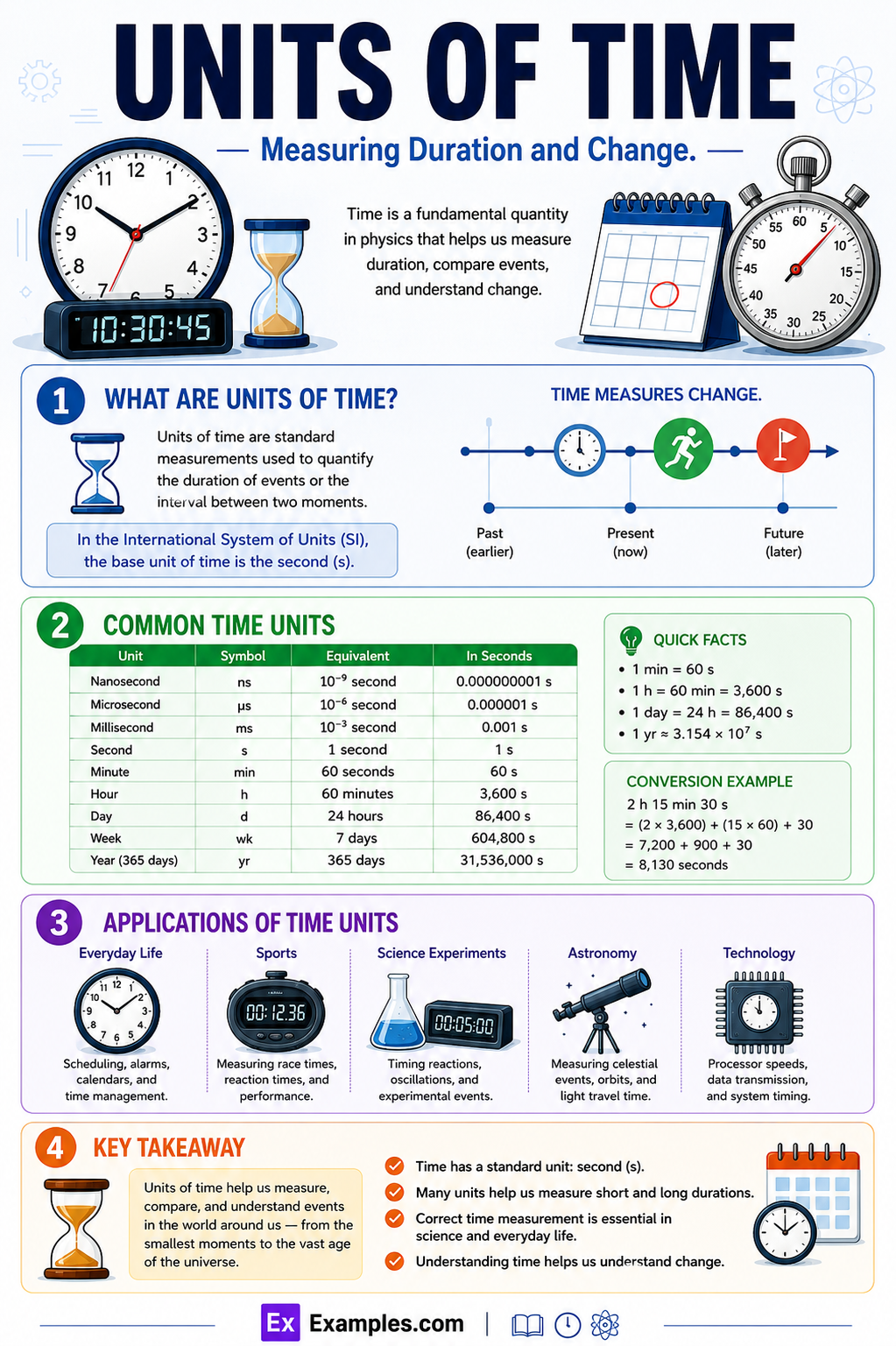
Units of time measure the duration and sequence of events. They help organize schedules, scientific observations, and daily activities.
What are Units of Time?
Transitioning to larger intervals, the minute (min) and hour (h) serve as critical measures in everyday life, organizing our schedules and activities into manageable segments. Understanding how different units relate to one another is easier when you use a Time Converter to quickly convert between seconds, minutes, hours, days, and other time units.
On a larger scale, the day, week, month, and year structure longer periods, vital for planning, agriculture, business, and cultural activities. These units, from seconds to years, are integral to coordinating human endeavors and scientific investigations, helping us synchronize and plan effectively across different scales of time.
SI Unit of Time
The second (s) is the SI unit of time, serving as the foundational measure for quantifying the duration of events. Defined by the oscillation of cesium atoms, the second ensures a high level of precision in timing. This precision is pivotal in various scientific fields such as physics and astronomy, where accurate time measurement is crucial for experiments and observations. If you need to measure durations or calculate elapsed time accurately, a Time Calculator can simplify both everyday and scientific time calculations.
CGS Unit of Time
In the CGS (centimeter-gram-second) system, the unit of heat is the calorie (cal). A calorie is defined as the amount of heat energy required to raise the temperature of one gram of water by one degree Celsius. This unit is especially prevalent in chemistry and nutrition, where it helps quantify the energy content of reactions and foods, respectively.
List of Time Units
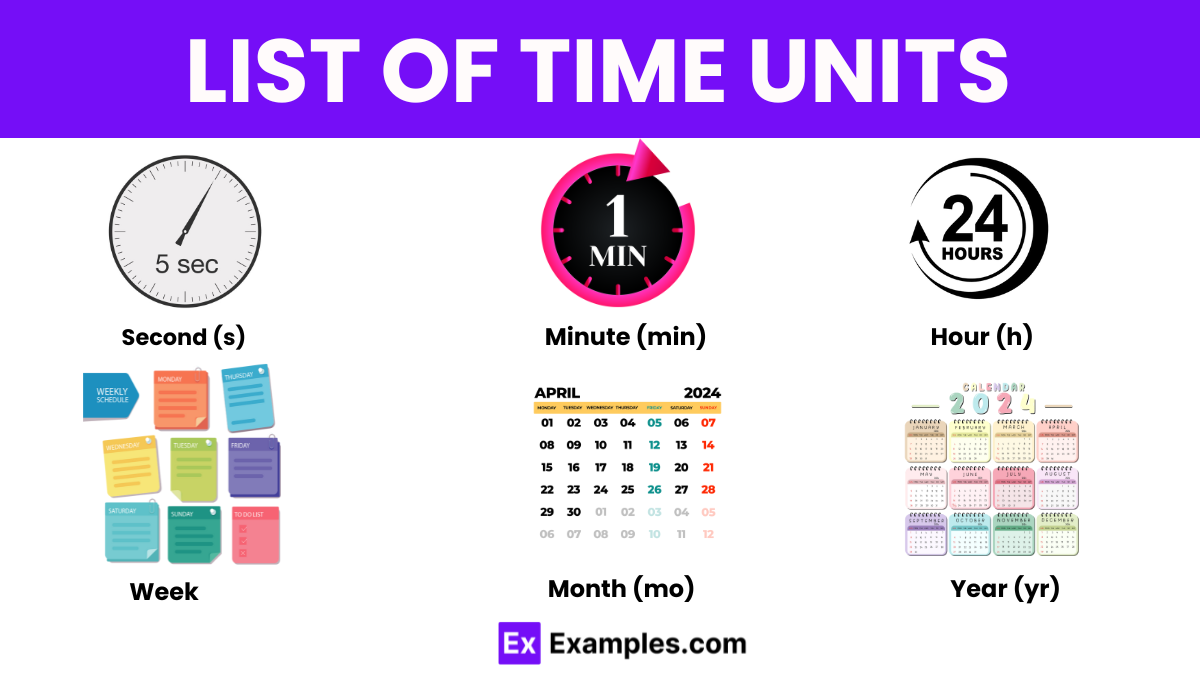
| Unit | Symbol |
|---|---|
| Second | s |
| Minute | min |
| Hour | h |
| Day | d |
| Week | wk |
| Month | mo |
| Year | yr |
| Decade | dec |
| Century | cent |
Second (s)
The second is the base unit of time in the International System of Units (SI), defined by the oscillation of cesium atoms. It is universally used in science and everyday life to measure durations and intervals.
Minute (min)
A minute is commonly used across the globe for personal scheduling, broadcasting, and in various forms of media. It serves as a fundamental unit for recording time in everyday contexts.
Hour (h)
The hour is a longer unit of time traditionally used for civil and scientific purposes. It is integral for planning daily activities and is a standard time measurement in business and social settings.
Day (d)
A day is based on the Earth’s rotation cycle and is widely recognized in calendars and for organizing daily human activities. It is crucial for agricultural, social, and economic activities.
Week (wk)
A week is a standard unit of time used universally for planning and is a common cycle in business and personal organization. When planning weekly or monthly schedules, the Weeks to Months Converter helps estimate longer time periods with ease.
Month (mo)
Months are used in the Gregorian calendar for civil purposes and cultural celebrations. They approximate the lunar cycle and vary in length.
Year (yr)
The year corresponds to the Earth’s orbit around the Sun, used for long-term planning, historical records, and legal documentation. If you’re working with historical timelines or long-term planning, the Years to Decades Converter makes it easy to convert between these larger units of time.
Decade (dec)
Decades are popular in historical and cultural discussions to denote significant periods of time.
Century (cent)
Century are used to delineate extended periods in history, helping to organize and contextualize large spans of time in human history.
To calculate the number of days between two specific dates, the Days Between Dates Calculator provides quick and accurate results for planning and scheduling.
Conversion of Time Units
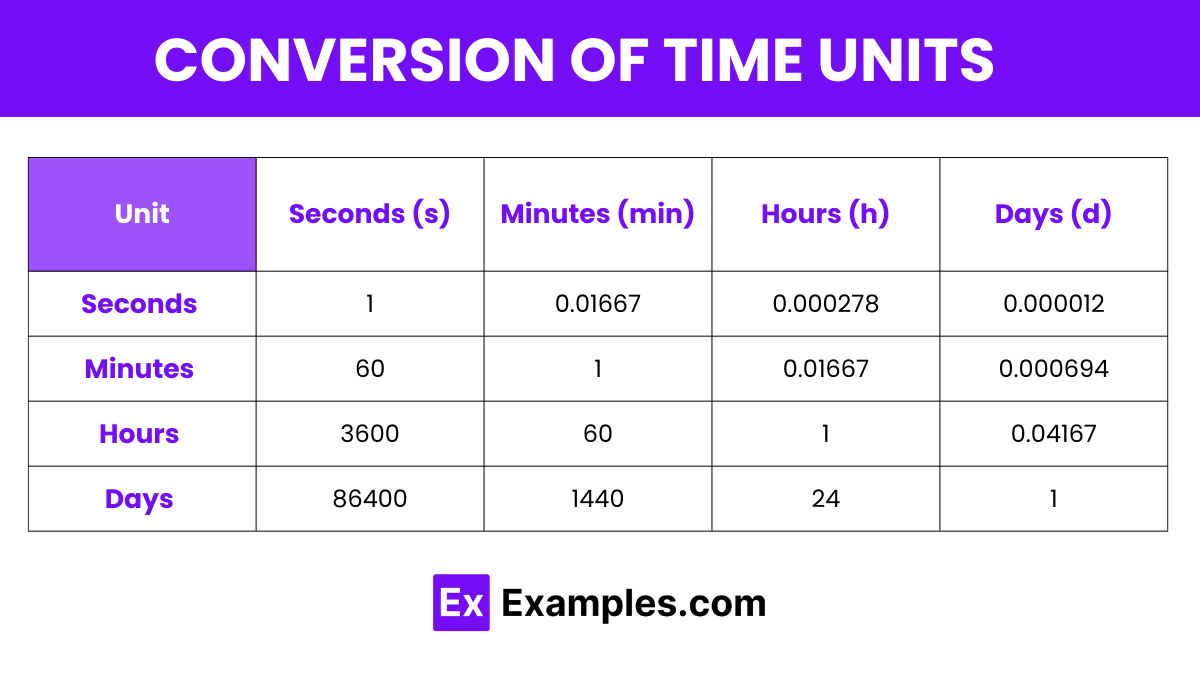
Here is a table format for the conversion factors between various units of time such as seconds, minutes, hours, and days. The values provided represent how many of one unit are contained in another:
| Unit | Seconds (s) | Minutes (min) | Hours (h) | Days (d) |
|---|---|---|---|---|
| Seconds (s) | 1 | 0.01667 | 0.000278 | 0.000012 |
| Minutes (min) | 60 | 1 | 0.01667 | 0.000694 |
| Hours (h) | 3600 | 60 | 1 | 0.04167 |
| Days (d) | 86400 | 1440 | 24 | 1 |
Second to Minute
- Conversion: 1 minute = 60 seconds.
- Example: To convert 120 seconds to minutes, divide by 60.
120 s / 60 = 2 min- Converting smaller time intervals becomes much easier with the Seconds to Minutes Converter, which provides instant and accurate results.
Second to Hour
- Conversion: 1 hour = 3600 seconds.
- Example: To convert 7200 seconds to hours, divide by 3600.
7200 s / 3600 = 2 h
Second to Day
- Conversion: 1 day = 86400 seconds.
- Example: To convert 172800 seconds to days, divide by 86400.
172800 s / 86400 = 2 d
Minute to Second
- Conversion: 1 second = 0.01667 minutes.
- Example: To convert 30 minutes to seconds, multiply by 60.
30 min × 60 = 1800 s
Minute to Hour
Conversion: 1 hour = 60 minutes.
Example: To convert 120 minutes to hours, divide by 60.
120 min / 60 = 2 h
If you’re converting minutes into hours or vice versa, the Minutes to Hours Converter offers a fast and reliable way to calculate time values.
Minute to Day
- Conversion: 1 day = 1440 minutes.
- Example: To convert 2880 minutes to days, divide by 1440.
2880 min / 1440 = 2 d
Hour to Second
- Conversion: 1 second = 0.00027778 hours.
- Example: To convert 2 hours to seconds, multiply by 3600.
2 h × 3600 = 7200 s
Hour to Minute
- Conversion: 1 minute = 0.01667 hours.
- Example: To convert 2 hours to minutes, multiply by 60.
2 h × 60 = 120 min
Hour to Day
- Conversion: 1 day = 24 hours.
- Example: To convert 48 hours to days, divide by 24.
48 h / 24 = 2 d- For work schedules, travel plans, and project timelines, the Hours to Days Converter makes it simple to convert longer durations accurately.
Day to Second
- Conversion: 1 second = 0.00001157 days.
- Example: To convert 2 days to seconds, multiply by 86400.
2 d × 86400 = 172800 s
Day to Minute
- Conversion: 1 minute = 0.00069444 days.
- Example: To convert 2 days to minutes, multiply by 1440.
2 d × 1440 = 2880 min
Day to Hour
- Conversion: 1 hour = 0.0416667 days.
- Example: To convert 2 days to hours, multiply by 24.
2 d × 24 = 48 h
When converting longer durations, the Hours to Days Converter helps you quickly switch between hours and days for work schedules, projects, and planning.
FAQ’S
What are the 10 units of time?
Seconds, minutes, hours, days, weeks, months, years, decades, centuries, and millennia organize time from the briefest moments to expansive historical periods.
Is there a smallest unit of time?
Yes, the Planck time is considered the smallest measurable unit of time in physics, representing the time it takes light to travel one Planck length.
What is the fastest unit of time?
The attosecond, which equals 10^-18 of a second, is currently one of the fastest units of time used to measure the speed of electron movements inside atoms.