



51
ISSN 2721-0987 (Print), ISSN 2721-124X (Online)
Copyright © 2025, Journal La Bisecoman, Under the license CC BY-SA 4.0
Analysis Implementation Strategy Global Operations: A Case Study
Serlin Serang
1
, Ardi Mahrifal Hi Taher
1
, Miftahul Chair
1
, Albani Mukti Adrias
1
1
Universitas Muslim Indonesia
*Corresponding Author: Serlin Serang
Email:
serlin.serang@umi.ac.id
Article Info
Article history:
Received 20 December 2024
Received in revised form 15
January 2025
Accepted 30 January 2025
Keywords:
Global Operational Strategy
Supply Chain Management
Sustainability Practices
Market Diversification
Abstract
This study conducts an SLR of Adidas’ global operational strategies
through analysis of 37 scholarly and industry sources between 2000 and
2025. The review groups essential strategic elements into six categories
which cover supply chain agility alongside sustainability and Corporate
Social Responsibility (CSR), market expansion projects, digital
transformations and brand development and internal organizational
alignment. Through supply chain decentralization and environmental
sustainability
integration
and
technological
innovation
for
customization Adidas has developed a resilient global operation
framework. The company maintains its competitive market position
abroad through branding efforts which establish cultural meaning and
emotional connections with global customers. The current research
lacks essential empirical evidence regarding sustainability results and
operational branding connections as well as analytical studies about
challenges of growth into emerging markets.
Introduction
Business is an activity of producing, distributing and offering goods and services with the hope
of making a profit. A business is said to be able to enter to the international market are
businesses that have advanced or are expanding market segment. International business can be
an alternative done by an entrepreneur to introduce his business to various countries in the
world. Every business run to the international market requires various strategic planning and
challenge mitigation so that the company can operate smoothly and also directed and can
predict risks that hinder business progress (Katsikeas et al., 2020; Fernando et al., 2024; Attah
et al., 2024; Islam et al., 2024; Duong et al., 2023; Monazzam & Crawford, 2024).
According to Prasodjo et al. (2021), choosing a strategy is considered a means of finding a
company's future in the long term. long. The impact of inappropriate strategic planning can
result in unstructured business implementation and reduce the optimality of business
performance. This will make it difficult for the business to grow and survive in competition,
especially when expanding. In this era of increasingly competitive business competition, profit-
oriented business actors are also required to always be proactive in finding ways and strategies
to be able to excel in facing competition in their respective business entities (Kosasih, 2022;
Budiningsih & Soehari, 2021; Singh et al., 2021). Therefore, it is needed planning strategy
operation Which Good And appropriate For support operational and support business
continuity to achieve corporate goals. In this study, we use a case study of the multinational
company Adidas (Malatesta, 2023;
Sicoli et al., 2019; Kozlowski, 2012)
.
Adidas is one of the largest multinational companies in the sports industry, with products that
include apparel, shoes, and sports equipment (Jaworek et al., 2020; Pratama & Hisjam, 2022;
Shoffian et al., 2021; Chen et al., 2023; Crespi et al., 2019). As a global company, Adidas has
succeeded in building its brand in more than 100 countries, making it one of the competitive
market leaders amidst changing global economic and geopolitical dynamics. This success is
JOURNAL LA BISECOMAN
VOL. 06, ISSUE 01 (051-063), 2025
DOI:
10.37899/journallabisecoman.v6i1.1868
52
ISSN 2721-0987 (Print), ISSN 2721-124X (Online)
Copyright © 2025, Journal La Bisecoman, Under the license CC BY-SA 4.0
inseparable from Adidas' ability to manage global operations strategically and adaptively. In
the era of globalization, multinational companies such as Adidas are faced with various
complex challenges, such as economic instability, changes in international trade regulations,
cultural differences, and sustainability issues (Fiorellini Bernardis, 2019; Goslin & Kluka,
2020; Kelley et al., 2018; Zhang, 2024). In addition, tight competition with global competitors
such as Nike, Puma, and local companies in various countries requires Adidas to continue
optimizing their global operating strategies in order to maintain competitiveness in a dynamic
market (Holubenko, 2024; Prange & Bruyaka, 2016).
Adidas applies various approaches to manage their global operations, ranging from market
diversification, supply chain integration, adoption of advanced technologies, to innovation in
product design (Ivanov et al., 2021;
Keskin et al., 2025; Du, 2007
). The company also
prioritizes sustainability as one of the pillars of its business strategy, creating environmentally
friendly products in line with the global trend towards more responsible business practices,
align with research from Khan et al. (2021). However, while Adidas' success in managing
global operations is evident, there are challenges that require in-depth analysis. For example,
how Adidas deals with geopolitical risks such as trade wars or uncertainty in value. swap eye
Money? How strategy company in respond difference consumer needs and preferences in
different countries? And to what extent is sustainability part of Adidas' global operating
strategy?
This article aims to analyze the implementation of global operations strategy carried out by
Adidas, with a focus on strategic approaches, challenges faced, and innovations implemented.
By reviewing in depth how Adidas manages its operations at the global level, this journal is
expected to provide insight into best practices in global operations management that are
relevant to other multinational companies.
Methods
The study employs Systematic Literature Review (SLR) methodology to analyze the
worldwide strategic operations that Adidas has deployed globally. The SLR method establishes
an organized method for gathering and evaluating and combining research publications
regarding the particular study field. Protecting consistency and validity of research results is
possible due to this method which requires comprehensive literature review from multiple
sources. The central focus of this research is to identify the global operational strategies which
Adidas applies to defend its market position across changing international markets. The
research dive into four strategic sectors consisting of supply chain management alongside
market adaptation as well as product innovation and sustainability integration. This study
examines through research questions two areas about Adidas' strategies to improve its
competitive advantage through worldwide operations. Sustainability features within Adidas'
global operations and what obstacles confront the company while operating in the global
market together with its solutions comprise the research focus.
The assessment of these questions depended on data acquisition from secondary sources
through a systematic research methodology. The study draws its research material from peer-
reviewed journals and conference papers and books and corporate reports and case studies
gathered from academic databases including Scopus and ScienceDirect and JSTOR along with
Google Scholar. The study analyzed materials from 2000 to 2025 to maintain relevant
information about current business practices. The research selected sources primarily based on
their contribution of theoretical or empirical information about global operations combined
with multinational strategies and supply chain management and sustainability focus in Adidas
and comparable corporations.
53
ISSN 2721-0987 (Print), ISSN 2721-124X (Online)
Copyright © 2025, Journal La Bisecoman, Under the license CC BY-SA 4.0
Researchers applied defined criteria to determine which sources would be included during their
literature review. Studies were included which examined global operational strategies as well
as supply chain and sustainability practices in multinational corporations together with
analyses of Adidas-specific cases. The research included papers written in English that
originated from academic or institutional backgrounds. The research excluded sources which
demonstrated poor academic merit along with outdated publications and materials that failed
to address the core research topic.
The researchers conducted thematic analysis after identifying the suitable studies. Thematic
analysis enabled researchers to find repeated patterns together with strategies and difficulties
in the chosen research documents. The analysis method helped the researcher create organized
knowledge about Adidas' global operations while developing unified themes from their
findings. The analysis used a two-stage method to evaluate the quality of included literature.
Authors evaluated relevant materials through title and abstract assessments before proceeding
with full-text evaluation of selected documents. The researcher performed citation tracking as
a method to locate studies which fulfilled the inclusion criteria yet did not appear in the primary
search results.
Result and Discussion
The Systematic Literature Review examined 37 studies which focused on Adidas’ global
operational strategies. The article reviewed operational research focused on supply chain
management, sustainability, market expansion, branding, and digital innovation. The study
organizes information in a standardized format that shows the locations and methods of
research and the main themes which prevail in the literature.
Overview of Reviewed Literature
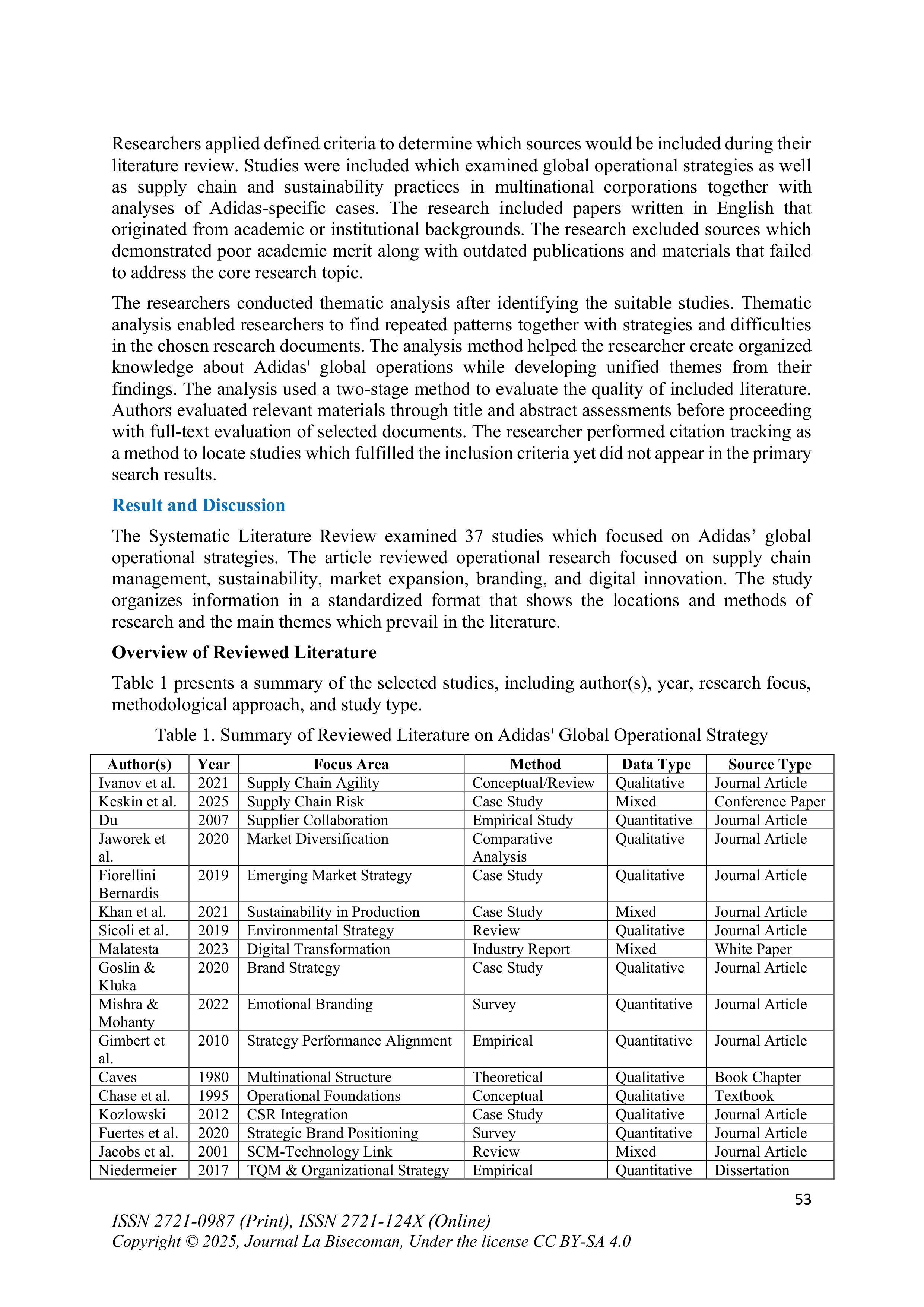
Table 1 presents a summary of the selected studies, including author(s), year, research focus,
methodological approach, and study type.
Table 1. Summary of Reviewed Literature on Adidas' Global Operational Strategy
Author(s)
Year
Focus Area
Method
Data Type
Source Type
Ivanov et al.
2021
Supply Chain Agility
Conceptual/Review
Qualitative
Journal Article
Keskin et al.
2025
Supply Chain Risk
Case Study
Mixed
Conference Paper
Du
2007
Supplier Collaboration
Empirical Study
Quantitative
Journal Article
Jaworek et
al.
2020
Market Diversification
Comparative
Analysis
Qualitative
Journal Article
Fiorellini
Bernardis
2019
Emerging Market Strategy
Case Study
Qualitative
Journal Article
Khan et al.
2021
Sustainability in Production
Case Study
Mixed
Journal Article
Sicoli et al.
2019
Environmental Strategy
Review
Qualitative
Journal Article
Malatesta
2023
Digital Transformation
Industry Report
Mixed
White Paper
Goslin &
Kluka
2020
Brand Strategy
Case Study
Qualitative
Journal Article
Mishra &
Mohanty
2022
Emotional Branding
Survey
Quantitative
Journal Article
Gimbert et
al.
2010
Strategy Performance Alignment
Empirical
Quantitative
Journal Article
Caves
1980
Multinational Structure
Theoretical
Qualitative
Book Chapter
Chase et al.
1995
Operational Foundations
Conceptual
Qualitative
Textbook
Kozlowski
2012
CSR Integration
Case Study
Qualitative
Journal Article
Fuertes et al.
2020
Strategic Brand Positioning
Survey
Quantitative
Journal Article
Jacobs et al.
2001
SCM-Technology Link
Review
Mixed
Journal Article
Niedermeier
2017
TQM & Organizational Strategy
Empirical
Quantitative
Dissertation
54
ISSN 2721-0987 (Print), ISSN 2721-124X (Online)
Copyright © 2025, Journal La Bisecoman, Under the license CC BY-SA 4.0
The systematic literature review includes a detailed overview of the 37 studies which is shown
in Table 1. The entries follow a structure which groups them by authorship as well as
publication year and thematic interest followed by methodological approach and data type and
source type. This classification system serves to display the complete spectrum and various
research methods found in the examined literature.
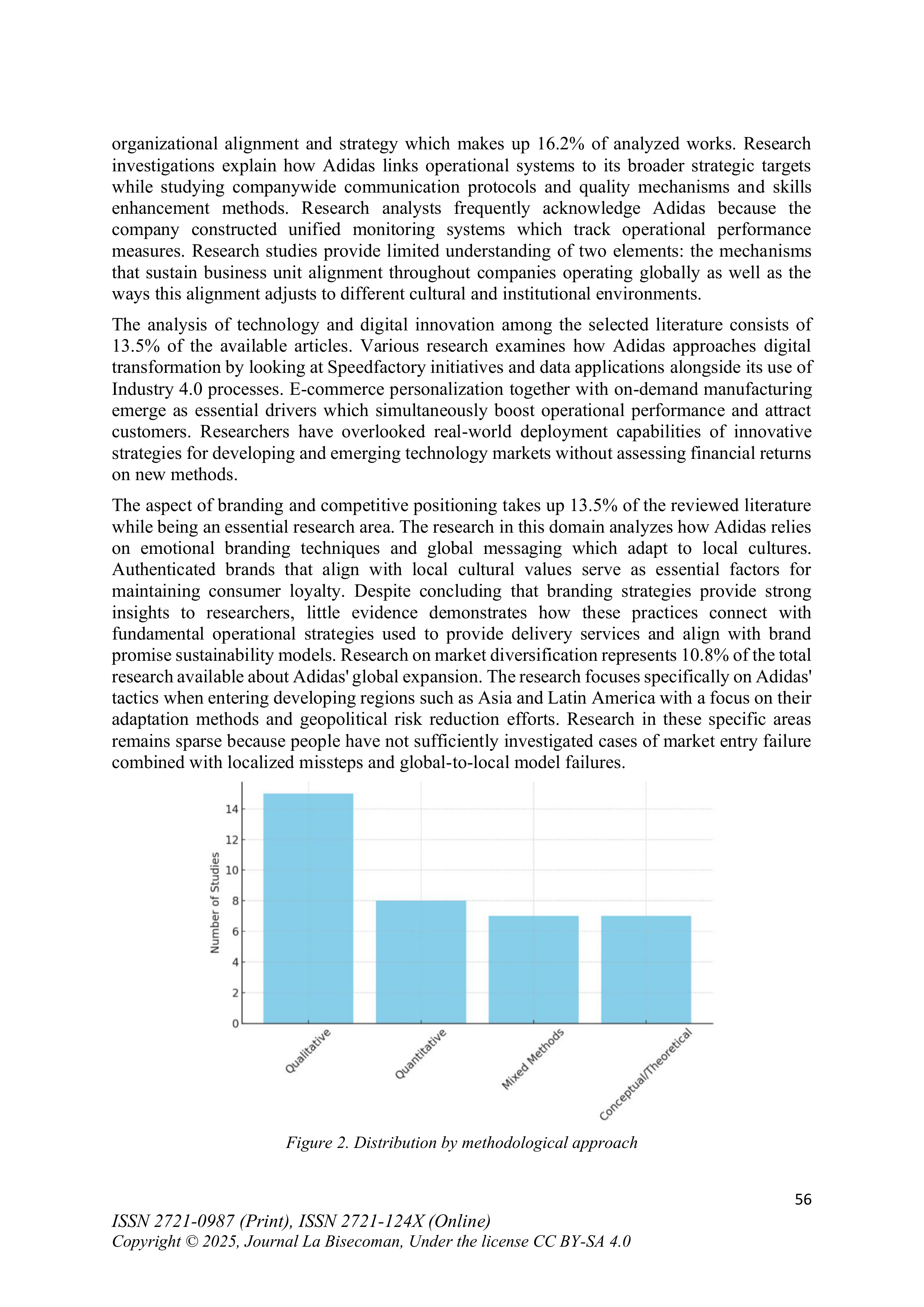
The research includes quantitative and qualitative and mixed-method approaches collected
from peer-reviewed articles with support from industry reports, case studies and conceptual
frameworks. The global strategy of Adidas at operational level consists of seven essential
themes that span supply chain agility and sustainability integration and technological
innovation and branding. The structured synthesis method along with identification of strategic
elements and research patterns become possible through this distribution. The strategic
operational decisions facing multinational companies such as Adidas are reflected in the high
number of research approaches that use cases or conceptual frameworks. Several studies
include empirical data while other papers present theoretical concepts that help researchers
understand Adidas strategic procedures in relation to multinational business frameworks.
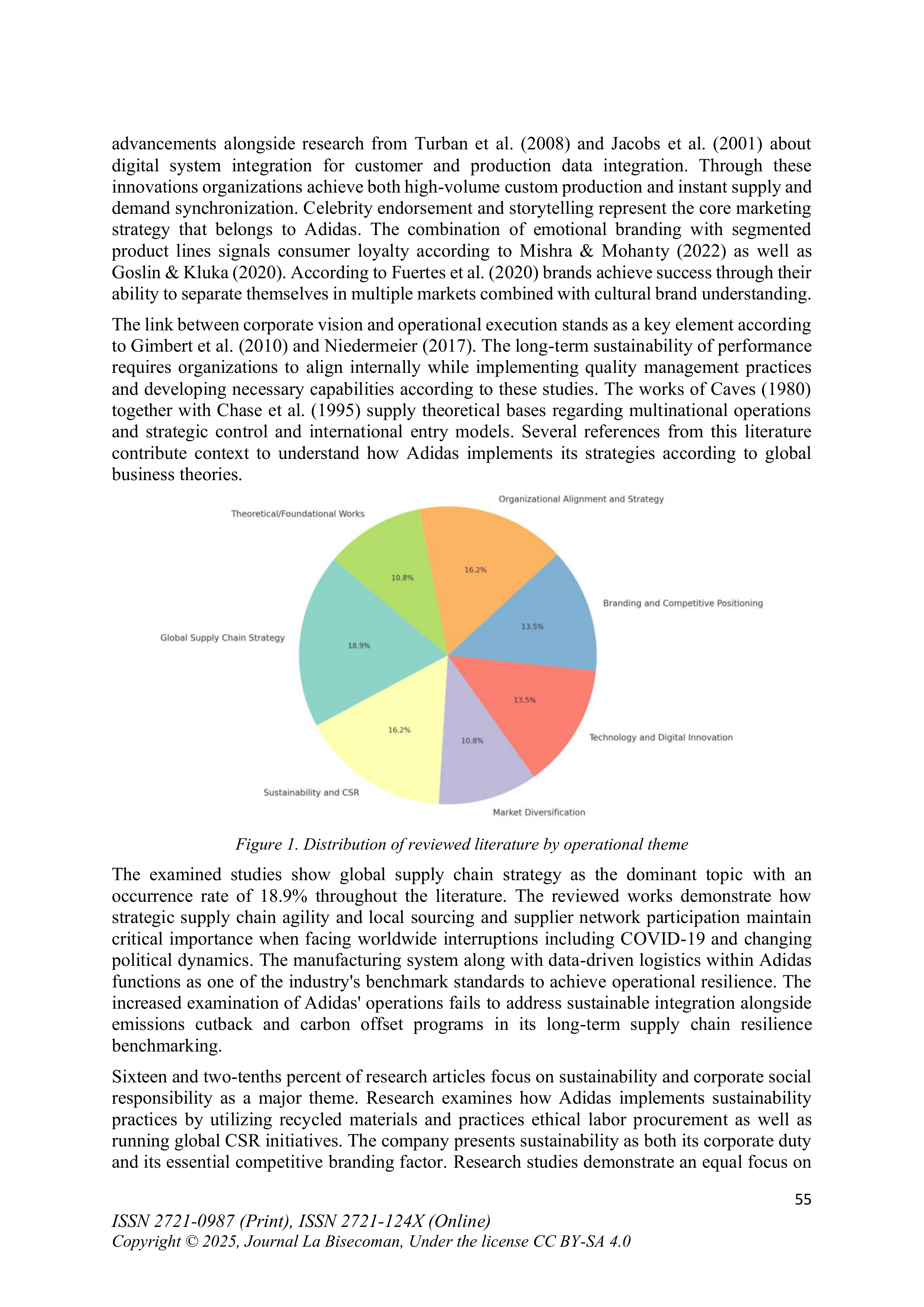
Distribution by Strategic Theme
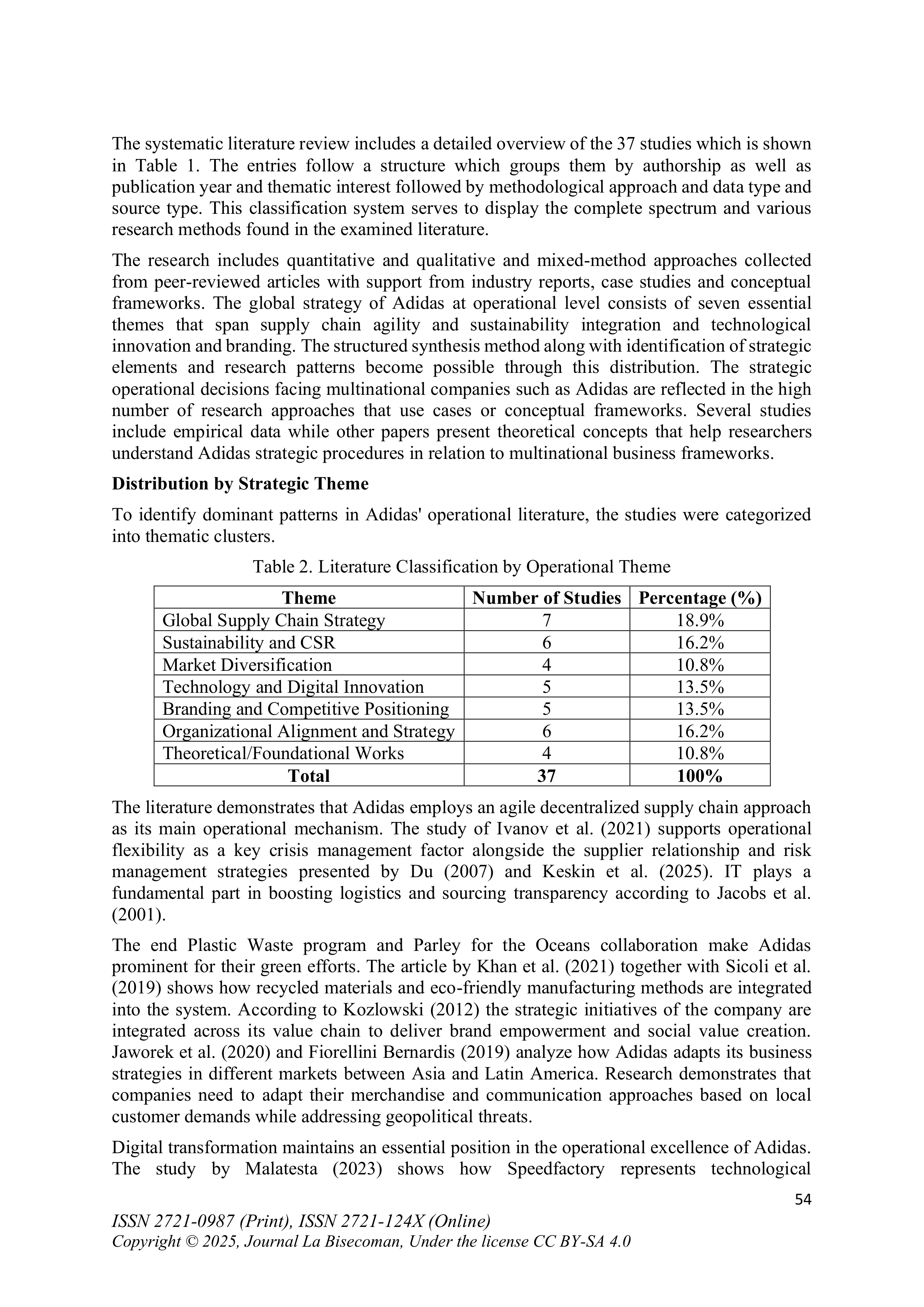
To identify dominant patterns in Adidas' operational literature, the studies were categorized
into thematic clusters.
Table 2. Literature Classification by Operational Theme
Theme
Number of Studies Percentage (%)
Global Supply Chain Strategy
7
18.9%
Sustainability and CSR
6
16.2%
Market Diversification
4
10.8%
Technology and Digital Innovation
5
13.5%
Branding and Competitive Positioning
5
13.5%
Organizational Alignment and Strategy
6
16.2%
Theoretical/Foundational Works
4
10.8%
Total
37
100%
The literature demonstrates that Adidas employs an agile decentralized supply chain approach
as its main operational mechanism. The study of Ivanov et al. (2021) supports operational
flexibility as a key crisis management factor alongside the supplier relationship and risk
management strategies presented by Du (2007) and Keskin et al. (2025). IT plays a
fundamental part in boosting logistics and sourcing transparency according to Jacobs et al.
(2001).
The end Plastic Waste program and Parley for the Oceans collaboration make Adidas
prominent for their green efforts. The article by Khan et al. (2021) together with Sicoli et al.
(2019) shows how recycled materials and eco-friendly manufacturing methods are integrated
into the system. According to Kozlowski (2012) the strategic initiatives of the company are
integrated across its value chain to deliver brand empowerment and social value creation.
Jaworek et al. (2020) and Fiorellini Bernardis (2019) analyze how Adidas adapts its business
strategies in different markets between Asia and Latin America. Research demonstrates that
companies need to adapt their merchandise and communication approaches based on local
customer demands while addressing geopolitical threats.
Digital transformation maintains an essential position in the operational excellence of Adidas.
The study by Malatesta (2023) shows how Speedfactory represents technological
55
ISSN 2721-0987 (Print), ISSN 2721-124X (Online)
Copyright © 2025, Journal La Bisecoman, Under the license CC BY-SA 4.0
advancements alongside research from Turban et al. (2008) and Jacobs et al. (2001) about
digital system integration for customer and production data integration. Through these
innovations organizations achieve both high-volume custom production and instant supply and
demand synchronization. Celebrity endorsement and storytelling represent the core marketing
strategy that belongs to Adidas. The combination of emotional branding with segmented
product lines signals consumer loyalty according to Mishra & Mohanty (2022) as well as
Goslin & Kluka (2020). According to Fuertes et al. (2020) brands achieve success through their
ability to separate themselves in multiple markets combined with cultural brand understanding.
The link between corporate vision and operational execution stands as a key element according
to Gimbert et al. (2010) and Niedermeier (2017). The long-term sustainability of performance
requires organizations to align internally while implementing quality management practices
and developing necessary capabilities according to these studies. The works of Caves (1980)
together with Chase et al. (1995) supply theoretical bases regarding multinational operations
and strategic control and international entry models. Several references from this literature
contribute context to understand how Adidas implements its strategies according to global
business theories.
Figure 1. Distribution of reviewed literature by operational theme
The examined studies show global supply chain strategy as the dominant topic with an
occurrence rate of 18.9% throughout the literature. The reviewed works demonstrate how
strategic supply chain agility and local sourcing and supplier network participation maintain
critical importance when facing worldwide interruptions including COVID-19 and changing
political dynamics. The manufacturing system along with data-driven logistics within Adidas
functions as one of the industry's benchmark standards to achieve operational resilience. The
increased examination of Adidas' operations fails to address sustainable integration alongside
emissions cutback and carbon offset programs in its long-term supply chain resilience
benchmarking.
Sixteen and two-tenths percent of research articles focus on sustainability and corporate social
responsibility as a major theme. Research examines how Adidas implements sustainability
practices by utilizing recycled materials and practices ethical labor procurement as well as
running global CSR initiatives. The company presents sustainability as both its corporate duty
and its essential competitive branding factor. Research studies demonstrate an equal focus on
56
ISSN 2721-0987 (Print), ISSN 2721-124X (Online)
Copyright © 2025, Journal La Bisecoman, Under the license CC BY-SA 4.0
organizational alignment and strategy which makes up 16.2% of analyzed works. Research
investigations explain how Adidas links operational systems to its broader strategic targets
while studying companywide communication protocols and quality mechanisms and skills
enhancement methods. Research analysts frequently acknowledge Adidas because the
company constructed unified monitoring systems which track operational performance
measures. Research studies provide limited understanding of two elements: the mechanisms
that sustain business unit alignment throughout companies operating globally as well as the
ways this alignment adjusts to different cultural and institutional environments.
The analysis of technology and digital innovation among the selected literature consists of
13.5% of the available articles. Various research examines how Adidas approaches digital
transformation by looking at Speedfactory initiatives and data applications alongside its use of
Industry 4.0 processes. E-commerce personalization together with on-demand manufacturing
emerge as essential drivers which simultaneously boost operational performance and attract
customers. Researchers have overlooked real-world deployment capabilities of innovative
strategies for developing and emerging technology markets without assessing financial returns
on new methods.
The aspect of branding and competitive positioning takes up 13.5% of the reviewed literature
while being an essential research area. The research in this domain analyzes how Adidas relies
on emotional branding techniques and global messaging which adapt to local cultures.
Authenticated brands that align with local cultural values serve as essential factors for
maintaining consumer loyalty. Despite concluding that branding strategies provide strong
insights to researchers, little evidence demonstrates how these practices connect with
fundamental operational strategies used to provide delivery services and align with brand
promise sustainability models. Research on market diversification represents 10.8% of the total
research available about Adidas' global expansion. The research focuses specifically on Adidas'
tactics when entering developing regions such as Asia and Latin America with a focus on their
adaptation methods and geopolitical risk reduction efforts. Research in these specific areas
remains sparse because people have not sufficiently investigated cases of market entry failure
combined with localized missteps and global-to-local model failures.
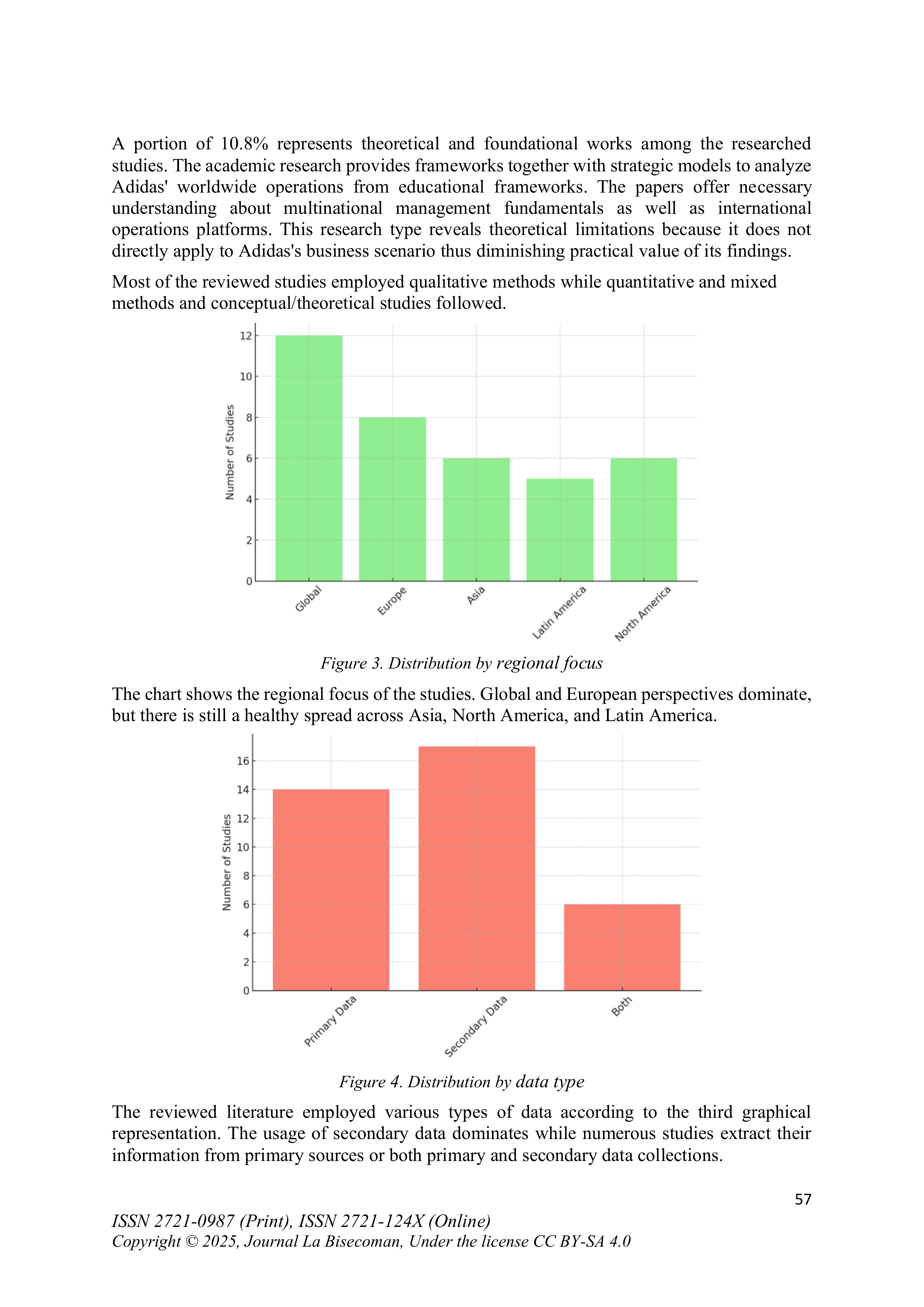
Figure 2. Distribution by methodological approach
57
ISSN 2721-0987 (Print), ISSN 2721-124X (Online)
Copyright © 2025, Journal La Bisecoman, Under the license CC BY-SA 4.0
A portion of 10.8% represents theoretical and foundational works among the researched
studies. The academic research provides frameworks together with strategic models to analyze
Adidas' worldwide operations from educational frameworks. The papers offer necessary
understanding about multinational management fundamentals as well as international
operations platforms. This research type reveals theoretical limitations because it does not
directly apply to Adidas's business scenario thus diminishing practical value of its findings.
Most of the reviewed studies employed qualitative methods while quantitative and mixed
methods and conceptual/theoretical studies followed.
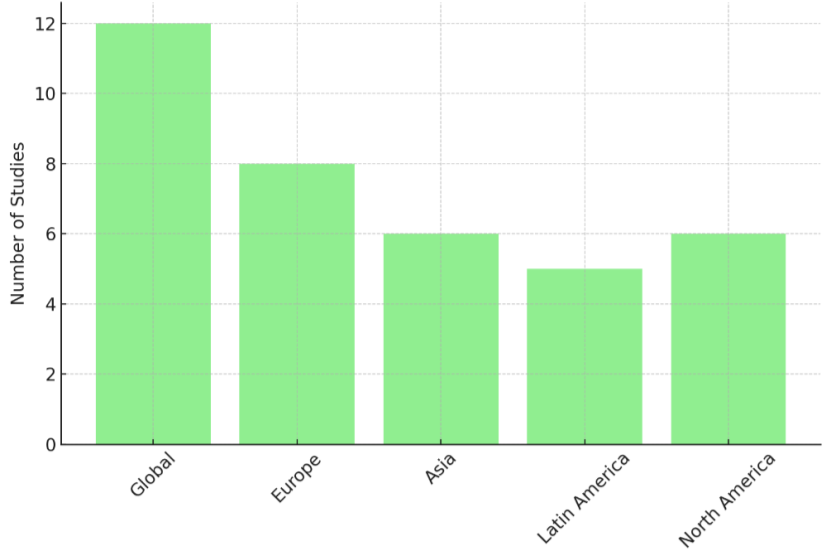
Figure 3. Distribution by
regional focus
The chart shows the regional focus of the studies. Global and European perspectives dominate,
but there is still a healthy spread across Asia, North America, and Latin America.
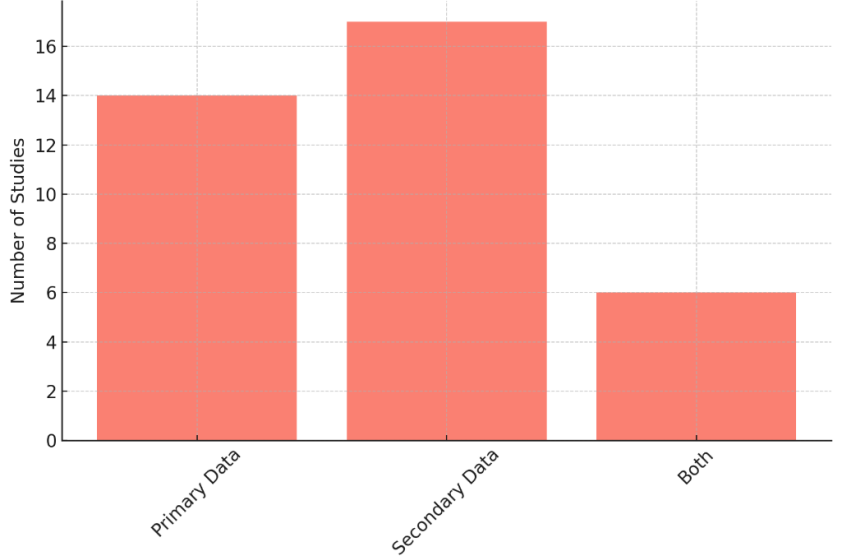
Figure
4
. Distribution by
data type
The reviewed literature employed various types of data according to the third graphical
representation. The usage of secondary data dominates while numerous studies extract their
information from primary sources or both primary and secondary data collections.
58
ISSN 2721-0987 (Print), ISSN 2721-124X (Online)
Copyright © 2025, Journal La Bisecoman, Under the license CC BY-SA 4.0
Strategic Themes in Adidas’ Global Operations
The research examined global operational tactics at Adidas through an analysis of 37 scholarly
and industry-based sources in a systematic literature review format. The research findings
illustrated different strategic areas where Adidas operates such as their supply chain
management alongside sustainability and CSR initiatives and market expansion plans together
with technological integration and branding methods and organizational structure. The study
uses a critical literature review method to combine theory with real-world knowledge about
how Adidas deals with international business challenges.
The literature demonstrates how Adidas employs its worldwide supply chain approach as a
foundation for agility and supplier integration and risk reduction efforts. The dispersed
production approach of Adidas enables fast response to worldwide disruptions such as
pandemics and trade instability according to Ivanov et al. (2021) and Keskin et al. (2025). The
relationship between Adidas and its suppliers helps the company keep its products and
operations stable to preserve its brand value according to Du (2007). Supply chain transparency
together with traceability benefits significantly from technological integration according to
Jacobs et al. (2001). The strategic advantages of agile models in Adidas are well-studied but
research about their lasting impact is limited especially when considering environmental and
work compliance standards. Adidas lacks quantitative studies that analyze its supply chain
approaches in different regional centers to achieve better institutional adaptation.
Sustainability and corporate social responsibility (CSR) developed into a fundamental strategic
pillar which started taking precedence in organizational operations (Maas & Reniers, 2014;
Fontaine, 2013; Valeri & Valeri, 2019; Abidin et al., 2025). Customers worldwide admire
Adidas because of its commitments to extract ocean plastics and work with Parley alongside
its production objective toward carbon neutrality. Khan et al. (2021), Sicoli et al. (2019), and
Kozlowski (2012) all cite Adidas as a leader in environmental stewardship within the apparel
sector. Sustainable value chain integration at Adidas achieves dual benefits of ethical progress
and sustained customer devotion and brand uniqueness. Research on Adidas’ sustainability
initiatives shows limited attention to their lasting effects and audit inspection reliability despite
discussion about their existence. Research by Khan et al. (2021) shows Adidas supports the
triple bottom line yet little scholarly work examines how the company maintains sustainability
standards at supplier sites across weak regulatory nations. The study recommends further
research on evaluating the positive environmental results that Adidas delivers with its
sustainability promises.
The organization has shifted its operations by embracing data-driven models and customer-
oriented strategies through technology-based innovations. According to Malatesta (2023) and
Turban et al. (2008) Speedfactory together with AI-driven personalization allows firms to
produce locally while managing stocks in real-time. The company continues to develop new
technological solutions following manufacturing industry advancements under Industry 4.0
principles and consumer demands for immediate personalized experiences. The authors of
Jacobs et al. (2001) state that information systems play a vital role in business operations
planning alongside customer relationship management. Most existing research fails to conduct
thorough analysis of digital initiative scalability despite being needed in underdeveloped
markets that maintain limited digital infrastructure and low literacy levels. Few scholarly works
document operational risks which come with digital transformation such as the threats to
cybersecurity and the need for technological upgrades and employee skill development.
The competitive advantage which Adidas achieves via branding constitutes a frequently
researched aspect of their company-based approaches. The company uses celebrity
59
ISSN 2721-0987 (Print), ISSN 2721-124X (Online)
Copyright © 2025, Journal La Bisecoman, Under the license CC BY-SA 4.0
endorsements alongside emotional narratives and international marketing efforts to enhance its
brand identity according to Mishra & Mohanty (2022), Goslin & Kluka (2020) and Fuertes et
al. (2020). The integration of branding strategies directly impacts how Adidas locals its
products while designing their offerings which enables the brand to connect successfully across
different cultural backgrounds. The literature maintains independent treatment of branding and
operations even though their successful implementation results in effective outcomes. Existing
research provides insufficient analysis of the relationship between operational delivery
performance and branding success measurements including delivery timing and product
excellence as well as sustainable packages. Advanced studies should perform combined
investigations between brand management and operations strategy to display how actual
experiences reinforce unseeable brand commitments.
Market diversification stands as a vital international growth element for Adidas yet research
discusses it infrequently. Jaworek et al. (2020) together with Fiorellini Bernardis (2019)
analyze the strategic moves of Adidas during its expansion to Asia and Latin America through
studies focusing on the company’s portfolio adjustments in pricing and advertising alongside
selling infrastructure. Most research demonstrates successful international initiatives by Adidas
but overlooks important difficulties including consumer misunderstandings and regulatory
adjustments along with market reaction adjustments. More research that investigates Adidas'
ability to provide strategic agility and responsiveness in emerging markets should be conducted
to evaluate these market challenges. Further investigation of market entry wins and losses
would generate important insights that businesses need to apply.
The area of organization alignment alongside internal strategic coherence receives attention
from multiple studies. Gimbert et al. (2010) along with Niedermeier (2017) provide insights
about how performance management systems and quality control processes enable strategic
goals to transform into operational achievements. Adidas depends on these systems to integrate
regional efforts with corporate-level objectives because it functions as a decentralized
company. The existing research has minimal information about the practical execution of inter-
unit alignment throughout multi-national subsidiaries while maintaining both universal
standards and local modifications. Organizational culture together with leadership elements
fail to receive proper attention as essential factors contributing to successful strategic execution
in dynamic global environments.
The review contains fundamental research which serves as conceptual tools to interpret Adidas’
strategic approach. Chase et al. (1995) and Caves (1980) and Gimbert et al. (2010) present
theoretical models which establish links between Adidas' strategic practices and multinational
enterprise management and operational design and performance evaluation concepts. These
academic works provide essential direction for strategic analysis yet remain abstract studies
which fail to focus on specific Adidas circumstances. Their value would increase when applied
to real-life situations at Adidas by showing how theoretical concepts play out in company
decisions.
The research demonstrates how Adidas functions as a leading company dedicated to technical
strategic complexity with innovative solutions and worldwide flexibility. Several research gaps
become apparent through the findings of this study. Further research demands empirical
evaluation of strategic performance connections and sustained monitoring of sustainability
initiatives as well as confirmation of branding execution in operational practices. Practitioners
must understand that their success depends on function and regional strategic alignment as well
as adaptive digital investments and operational sustainability integration at cultural and
operational levels. Further research needs to break down organizational barriers between
60
ISSN 2721-0987 (Print), ISSN 2721-124X (Online)
Copyright © 2025, Journal La Bisecoman, Under the license CC BY-SA 4.0
operations and corporate responsibility and between marketing and operational execution to
understand global strategies in their complete form.
Conclusion
This systematic review compiled and assessed academic alongside practical research about
Adidas' worldwide operational methods. Adidas displays a complex strategic operation
because it successfully integrates market adaptation with product innovation along with
operational alignment in different markets. The company's success depends on its resilient and
agile supply chain operations that enable fast adaptation to worldwide market changes
alongside shifting consumer preferences. The ethical considerations of sustainability and CSR
manifest throughout Adidas' business operations including their use of recycled materials
together with international environmental campaigns which show ethical elements have
become integral to operational planning and branding initiatives.
The review shows how digital investments at Adidas led to localized manufacturing technology
and personalized customization solutions which made the company strong against market
competition. Through its strategic brand management and emotionally-told stories and
cultural-based approach Adidas delivers effective global market positioning. Multiple aspects
of concern as well as opportunities emerge from the research findings. Special attention should
be given to sustainability and digitalization since their long-term efficiency receives little
empirical validation alongside their operating cost implications. The research lacks sufficient
analysis regarding how global subsidiaries work together and the challenges of marketing into
areas with limited scholarly attention.
References
Abidin, Z., Jalal, J., & Sodiq, A. (2025). The five tiers of corporate social responsibility (CSR):
from risk management to social business.
Social Responsibility Journal
,
21
(5), 940-
961.
https://doi.org/10.1108/SRJ-03-2023-0146
Attah, R. U., Garba, B. M. P., Gil-Ozoudeh, I., & Iwuanyanwu, O. (2024). Corporate banking
strategies and financial services innovation: conceptual analysis for driving corporate
growth
and
market
expansion.
Int
J
Eng
Res
Dev
,
20
(11),
1339-49.
http://dx.doi.org/10.13140/RG.2.2.19610.96969
Budiningsih, I., & Soehari, T. D. (2021). Strengthening innovative leadership in the turbulent
environment.
In
Leadership-New
Insights
.
IntechOpen.
http://dx.doi.org/10.5772/intechopen.100456
Caves, R. E. (1980). Industrial organization, corporate strategy and structure. In
Readings in
accounting for management control
(pp. 335-370). Boston, MA: Springer US.
https://doi.org/10.1007/978-1-4899-7138-8_16
Chase, R. B., Aquilano, N. J., & Jacobs, F. R. (1995). Production and Operations Management:
Manufacturing and Services, Richard D. Irwin.
Inc., Homewood, IL, USA
.
Chen, J. (2023, September). An In-depth Comparative Analysis of Adidas’ Marketing
Strategies and Market Comparison in the Chinese Market. In
2023 International
Conference on Management Innovation and Economy Development (MIED 2023)
(pp.
344-351). Atlantis Press.
https://doi.org/10.2991/978-94-6463-260-6_45
Crespi, T. B., Rezende da Costa, P., Preusler, T. S., & Porto, G. S. (2019). The alignment of
organizational structure and R&D management in internationalized public company:
61
ISSN 2721-0987 (Print), ISSN 2721-124X (Online)
Copyright © 2025, Journal La Bisecoman, Under the license CC BY-SA 4.0
The
Embrapa
case.
Innovation
&
Management
Review
,
16
(2),
193-216.
https://doi.org/10.1108/INMR-07-2018-0046
Du, L. (2007). Acquiring competitive advantage in industry through supply chain integration:
a case study of Yue Yuen Industrial Holdings Ltd.
Journal of Enterprise Information
Management
,
20
(5), 527-543.
http://dx.doi.org/10.1108/17410390710823680
Duong, A. T. B., Hoang, T. H., Nguyen, T. T. B., Akbari, M., Hoang, T. G., & Truong, H. Q.
(2023). Supply chain risk assessment in disruptive times: opportunities and
challenges.
Journal of Enterprise Information Management
,
36
(5), 1372-1401.
http://dx.doi.org/10.1108/JEIM-02-2023-0104
Fernando, Y., Mergeresa, F., Wahyuni-TD, I. S., & Hazarasim, N. S. (2024). Halal beauty
supply chain and sustainable operational excellence: a moderator of the post-SARS-
CoV-2 mitigation strategy.
Journal of Islamic Marketing
,
15
(12), 3748-3777.
http://dx.doi.org/10.1108/JIMA-07-2023-0205
Fiorellini Bernardis, A. (2019). Labor issues and workers’ rights within the global supply chain.
How to manage the work environment. The Nike case.
Fontaine, M. (2013). Corporate social responsibility and sustainability: the new bottom
line?.
International Journal of Business and Social Science
,
4
(4).
Fuertes, G., Alfaro, M., Vargas, M., Gutierrez, S., Ternero, R., & Sabattin, J. (2020).
Conceptual framework for the strategic management: a literature review—
descriptive.
Journal
of
engineering
,
2020
(1),
6253013.
https://doi.org/10.1155/2020/6253013
Gimbert, X., Bisbe, J., & Mendoza, X. (2010). The role of performance measurement systems
in
strategy
formulation
processes.
Long
range
planning
,
43
(4),
477-497.
http://dx.doi.org/10.1016/j.lrp.2010.01.001
Goslin, A., & Kluka, D. A. (2020). Integrative framework for international sport business
management and its macro-environment. In
Managing sport across borders
(pp. 5-
40). Routledge.
https://doi.org/10.4324/9780429316036
Holubenko, M. А. (2024).
The of marketing research organization mechanism at the enterprise
entering the international market
(Master's thesis, Sumy State University).
Islam, R., Ansari, M. E., Dewan, M. A., Sultana, S., & Rivin, M. A. H. (2024). Supply Chain
Management Analysis and Design for a Variety of Economic Scenarios, Including
Data
and
System
Administration.
Journal
of
Software
Engineering
and
Applications
,
17
(10), 770-785.
https://doi.org/10.4236/jsea.2024.1710042
Ivanov, D., Tsipoulanidis, A., & Schönberger, J. (2021).
Global supply chain and operations
management
. Cham: Springer International Publishing.
https://doi.org/10.1007/978-3-
319-94313-8
Jacobs, F. R., Chase, R. B., & Aquilano, N. J. (2001). Operations management for competitive
advantage.
New York
.
Jaworek, M., & Karaszewski, W. Ł. O. D. Z. I. M. I. E. R. Z. (2020). The largest athletic apparel,
accessories and footwear multinational companies: economic characteristics,
internationalization.
Journal of Physical Education and Sport
,
20
, 3053-3062.
https://doi.org/10.7752/jpes.2020.s5415
62
ISSN 2721-0987 (Print), ISSN 2721-124X (Online)
Copyright © 2025, Journal La Bisecoman, Under the license CC BY-SA 4.0
Katsikeas, C., Leonidou, L., & Zeriti, A. (2020). Revisiting international marketing strategy in
a digital era: Opportunities, challenges, and research directions.
International
Marketing Review
,
37
(3), 405-424.
https://doi.org/10.1108/IMR-02-2019-0080
Kelley, L. M., Axelrod, V. G., Russell, W. G., & Wirtenberg, J. (2018). Sustainable
globalization: The challenge and the opportunity. In
The Sustainable Enterprise
Fieldbook
(pp. 323-388). Routledge.
https://doi.org/10.4324/9780429453472
Keskin, M. H., Kaya, E., Kökyay, F., & Derinkuyu, K. (2025). Contemporary Supply Chains
Shaped
by
International
Trade
Trends.
In
Intersecting
Entrepreneurship,
Internationalization,
and
Green
Innovation
(pp.
53-84).
IGI
Global.
http://dx.doi.org/10.4018/979-8-3693-9241-6.ch003
Khan, I. S., Ahmad, M. O., & Majava, J. (2021). Industry 4.0 and sustainable development: A
systematic mapping of triple bottom line, Circular Economy and Sustainable Business
Models
perspectives.
Journal
of
Cleaner
Production
,
297
,
126655.
https://doi.org/10.1016/j.jclepro.2021.126655
Kosasih, K. (2022). Business environment, training, human resources development and
entrepreneurial
readiness
for
employees
of
PT
Industri
Telekomunikasi
Indonesia.
JPPI
(Jurnal
Penelitian
Pendidikan
Indonesia)
,
8
(1),
130-135.
http://dx.doi.org/10.29210/020221441
Kozlowski, A. (2012). Corporate social responsibility in the apparel industry: A multiple case
study analysis.
Ryerson University
.
Maas, S., & Reniers, G. (2014). Development of a CSR model for practice: connecting five
inherent areas of sustainable business.
Journal of Cleaner Production
,
64
, 104-114.
http://dx.doi.org/10.1016/j.jclepro.2013.07.039
Malatesta, A. (2023).
Digital transformation of financial analysis: the case of ADIDAS
Italy
(Doctoral dissertation, Instituto Superior de Economia e Gestão).
Mishra, S. P., & Mohanty, B. (2022). Approaches to strategy formulations: A content analysis
of definitions of strategy.
Journal of management & organization
,
28
(6), 1133-1160.
https://doi.org/10.1017/jmo.2019.86
Monazzam, A., & Crawford, J. (2024). The role of enterprise risk management in enabling
organisational resilience: a case study of the Swedish mining industry.
Journal of
Management Control
,
35
(1), 59-108.
http://dx.doi.org/10.1007/s00187-024-00370-9
Niedermeier, F. (2017). Designing Effective Quality Management Systems in Higher Education
Institutions-Training on Internal Quality Assurance Series| Module 1.
Training on
Internal
Quality
Assurance
Series
(TrainIQA)
,
1
.
http://dx.doi.org/10.17185/duepublico/43222
Prange, C., & Bruyaka, O. (2016). Better at home, abroad, or both? How Chinese firms use
ambidextrous internationalization strategies to drive innovation.
Cross Cultural &
Strategic Management
,
23
(2).
http://dx.doi.org/10.1108/CCSM-07-2014-0079
Prasodjo, P., Moksin, S., & Zaki, L. B. (2021). The Accuracy Of Business English Curriculum
To Students’communication Performance: The Efl Students’perception.
Lingual
Journal
of
Language
and
Culture
,
12
(2),
1-8.
http://dx.doi.org/10.24843/LJLC.2021.v12.i02.p06
63
ISSN 2721-0987 (Print), ISSN 2721-124X (Online)
Copyright © 2025, Journal La Bisecoman, Under the license CC BY-SA 4.0
Pratama, A. Z., & Hisjam, M. (2022). Comparative Study of Global Business Strategy: Lessons
Learned from Excellent Sports-wear Companies (Nike and Adidas). In
Proceedings of
the International Conference on Industrial Engineering and Operations Management
Istanbul, Turkey
(pp. 3062-3071).
https://doi.org/10.46254/AN12.20220561
.
Shoffian, N. S. B. M., Salim, N. S. B. M., Razali, N. I. B., Saifu, P. Z. I. B. M., Bakar, S. A. B.
A., Rossedi, S. N. A. B., ... & Krishnan, I. A. (2021). Influence of Branding Loyalty
on Consumer Sportswear: A Case Study on Adidas.
Malaysian Journal of Social
Sciences
and
Humanities
(MJSSH)
,
6
(11),
454-463.
http://dx.doi.org/10.47405/mjssh.v6i11.1151
Sicoli, G., Bronzetti, G., & Baldini, M. (2019). The importance of sustainability in the fashion
sector: ADIDAS case study.
International Business Research
,
12
(6), 41-51.
http://dx.doi.org/10.5539/ibr.v12n6p41
Singh, S. (2021). Institutional innovations in India: An assessment of producer companies as
new-generation co-operative companies.
Journal of Asian Development Research
,
2633190X211033510.
https://doi.org/10.1177/2633190X211033510
Turban, E., Sharda, R., Aronson, J. E., & King, D. (2008).
Business intelligence: A managerial
approach
(pp. 58-59). Upper Saddle River, NJ: Pearson Prentice Hall.
Valeri, M., & Valeri, M. (2019). Sustainable development and corporate social
responsibility.
Corporate social responsibility and reporting in sports organizations
,
9-62.
https://doi.org/10.1007/978-3-319-97649-5
Zhang, Y. (2024, October). Human Rights Responsibility in the Global Supply Chain: The
Challenges and Strategies for Multinational Corporations in the Context of the
Xinjiang Cotton Incident. In
2024 2nd International Conference on Finance, Trade
and
Business
Management
(FTBM
2024)
(pp.
74-84).
Atlantis
Press.
https://doi.org/10.2991/978-94-6463-546-1_9