



International Journal of Applied Engineering and Management
Letters (IJAEML), ISSN: 2581-7000, Vol. 5, No. 2, December 2021
SRINIVAS
PUBLICATION
Divya Kumari, et al, (2021); www.srinivaspublication.com
PAGE 205
Application of Artificial Intelligence
Technology in Tesla- A Case Study
Divya Kumari
1
& Subrahmanya Bhat
2
1
Research Scholar, College of Computer Science and Information Science, Srinivas
University, Mangalore, India
Orcid ID: 0000-0003-4367-0891; Email:
divyakumari.ccis@srinivasuniversity.edu.in
2
College of Computer Science and Information Science, Srinivas University, Mangalore,
India
Orcid ID: 0000-0003-2925-1834; Email:
sbhat.ccis@srinivasuniversity.edu.in
Subject Area:
Computer Science.
Type of the Paper:
Review based Research Agenda.
Type of Review:
Peer Reviewed as per
|C|O|P|E|
guidance.
Indexed In:
OpenAIRE.
DOI:
https://doi.org/10.5281/zenodo.5775457
Google Scholar Citation:
IJAEML
International Journal of Applied Engineering and Management Letters (IJAEML)
A Refereed International Journal of Srinivas University, India.
Crossref DOI :
https://doi.org/10.47992/IJAEML.2581.7000.0113
© With Authors.
This work is licensed under a
Creative Commons Attribution-Non-Commercial 4.0
International License
subject to proper citation to the publication source of the work.
Disclaimer:
The scholarly papers as reviewed and published by the Srinivas Publications
(S.P.), India are the views and opinions of their respective authors and are not the views or
opinions of the S.P. The S.P. disclaims of any harm or loss caused due to the published content
to any party.
How to Cite this Paper:
Divya Kumari & Subrahmanya Bhat, (2021).
Application of Artificial Intelligence
Technology in Tesla- A Case Study.
International Journal of Applied Engineering and
Management Letters (IJAEML)
,
5
(2), 205-218.
DOI:
https://doi.org/10.5281/zenodo.5775457


International Journal of Applied Engineering and Management
Letters (IJAEML), ISSN: 2581-7000, Vol. 5, No. 2, December 2021
SRINIVAS
PUBLICATION
Divya Kumari, et al, (2021); www.srinivaspublication.com
PAGE 206
Application of Artificial Intelligence Technology in Tesla-
A Case Study
Divya Kumari
1
& Subrahmanya Bhat
2
1
Research Scholar, College of Computer Science and Information Science, Srinivas
University, Mangalore, India
Orcid ID: 0000-0003-4367-0891; Email:
divyakumari.ccis@srinivasuniversity.edu.in
2
College of Computer Science and Information Science, Srinivas University, Mangalore,
India
Orcid ID: 0000-0003-2925-1834; Email:
sbhat.ccis@srinivasuniversity.edu.in
ABSTRACT
Background/Purpose:
Artificial intelligence algorithms are like humans, performing a task
repeatedly, each time changing it slightly to maximize the result. A neural network is made
up of several deep layers that allow for learning. Financial services, ICT, life science, oil and
gas, retail, automotive, industrial healthcare, and chemicals and manufacturing sectors are
among the industries that employ these algorithms. The electric motor is a new concept, and
the automobile industry is now undergoing intensive research to determine whether it is
practicable and financially viable. There are already some first movers, such as Tesla, who
have successfully established their model and are moving forward. Tesla is forcing the auto
industry to adapt quickly. Tesla introduced Autopilot driver capability for its Model S vehicle.
Tesla Autopilot is a suite of sophisticated driver-assist technologies that include traffic
adjustment, congested roads navigation system, autopilot car-parks, computer-controlled
road rules, semi-autonomous route planning on major roadways, and the ability to summon
the vehicle out of a designated car-park. This article provides a comprehensive analysis of
Tesla Company and Innovations of Autopilot Vehicles.
Objective:
This case study report addresses the growth of Tesla Company in the field of
Autonomous Vehicles.
Design/Methodology/Approach:
The knowledge for this case study of Tesla was gathered
from various academic articles, online articles, and the SWOT framework.
Findings/Result:
Based on the research, this paper discusses the technological histories,
Autopilot driving features, safety concerns, financial plans, market challenges, different
models, and how Tesla Inc. is accelerating the world's movement in multiple initiatives such
as the contribution of the global economic system, study in the Artificial Intelligence and
Machine Learning area.
Originality/Value:
This paper study provides a brief overview of Tesla Inc. given the various
data collected, and information about Tesla Autopilot vehicles using Artificial Intelligence
based Innovations in Entrepreneurial Oriented Cars.
Paper type:
A Research Case study paper - focuses on Application of Artificial Intelligence
in Tesla Autopilot Vehicles and growth & Journey of the Tesla Inc. Company
.
Keywords:
Artificial Intelligence, Neural Network, Machine Learning, Autopilot, Self-
driving, Deep Learning, Electronic Vehicles.
1.
INTRODUCTION :
Fossil fuel depletion and awareness of sustainability have led many countries to opt for cleaner fuels.
In this respect, we believe that the Indian government has set a 2030 goal to move to fully electric
vehicles. Tesla, Inc. is a California-based electric and renewable energy corporation [1]. Martin
Eberhard and Marc Tarpenning established the business in 2003. Tesla's current list contains, among
others, the Model S, Model 3, Model X, and Autopilot Suite Model Y. Other than automobiles,
energy storage is produced through household, sunroof tiles, solar panels and accessories and services.
Tesla Motors has been engulfed by electric vehicle and battery markets since 2003. Under Elon Musk's


International Journal of Applied Engineering and Management
Letters (IJAEML), ISSN: 2581-7000, Vol. 5, No. 2, December 2021
SRINIVAS
PUBLICATION
Divya Kumari, et al, (2021); www.srinivaspublication.com
PAGE 207
leadership she has followed her so called "Secret Master Plan" diligently and completed, which will
forever change the driven world. Initially known as Tesla Motors, renamed to Tesla, Inc. in 2017. The
company's name was inspired by Nikola Tesla, a 19th-century inventor renowned for discovering the
trend of spinning electric radiation. The case of Tesla was examined considering their approach to
technology such as electric cars, as well as the concept of Deep Neural Network to train the Autopilot
model [2].
2.
RELATED RESEARCH WORK :
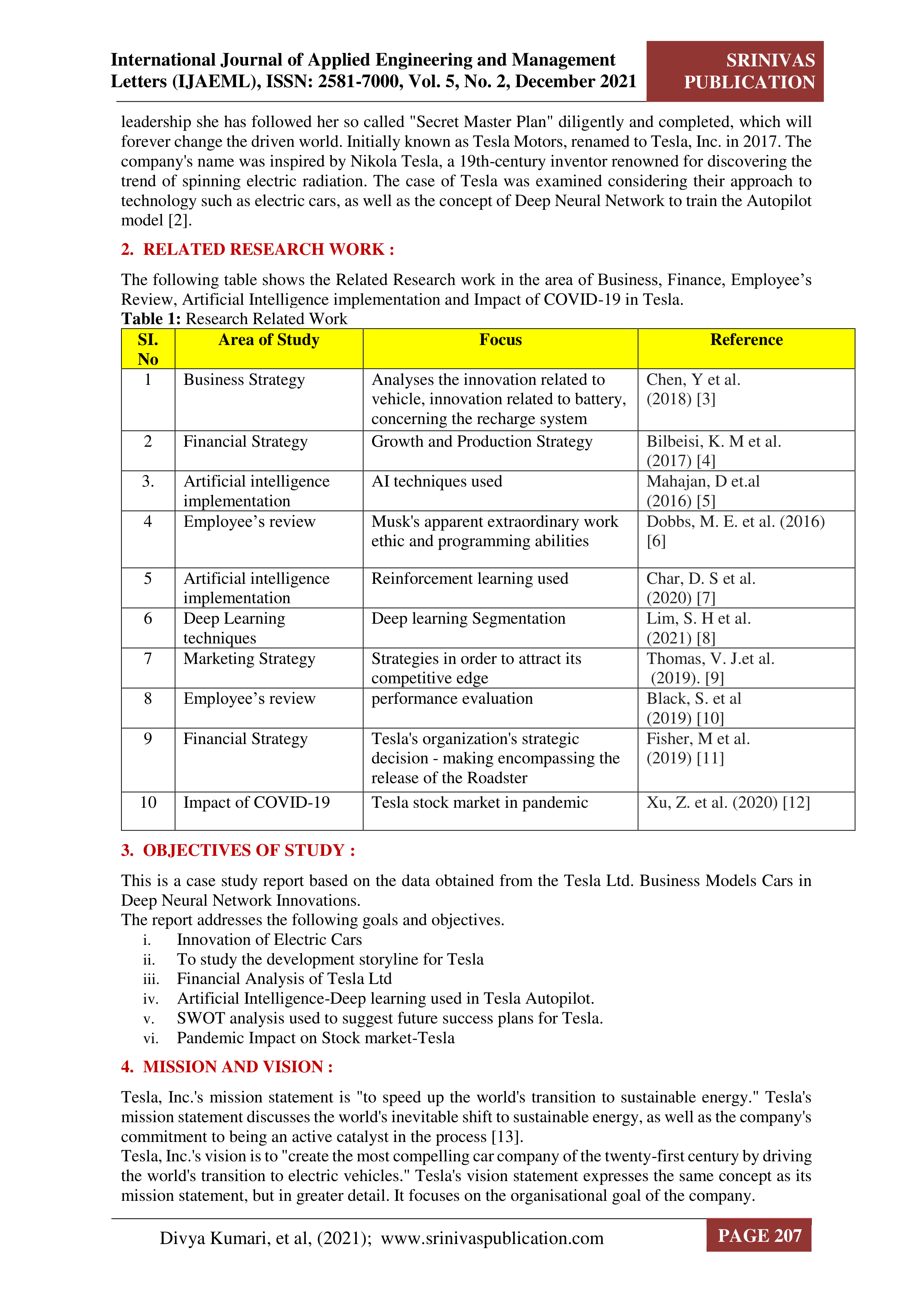
The following table shows the Related Research work in the area of Business, Finance, Employee’s
Review, Artificial Intelligence implementation and Impact of COVID-19 in Tesla.
Table 1:
Research Related Work
SI.
No
Area of Study
Focus
Reference
1
Business Strategy
Analyses the innovation related to
vehicle, innovation related to battery,
concerning the recharge system
Chen, Y et al.
(2018) [3]
2
Financial Strategy
Growth and Production Strategy
Bilbeisi, K. M et al.
(2017) [4]
3.
Artificial intelligence
implementation
AI techniques used
Mahajan, D et.al
(2016) [5]
4
Employee’s review
Musk's apparent extraordinary work
ethic and programming abilities
Dobbs, M. E. et al. (2016)
[6]
5
Artificial intelligence
implementation
Reinforcement learning used
Char, D. S et al.
(2020) [7]
6
Deep Learning
techniques
Deep learning Segmentation
Lim, S. H et al.
(2021) [8]
7
Marketing Strategy
Strategies in order to attract its
competitive edge
Thomas, V. J.et al.
(2019). [9]
8
Employee’s review
performance evaluation
Black, S. et al
(2019) [10]
9
Financial Strategy
Tesla's organization's strategic
decision - making encompassing the
release of the Roadster
Fisher, M et al.
(2019) [11]
10
Impact of COVID-19
Tesla stock market in pandemic
Xu, Z. et al. (2020) [12]
3.
OBJECTIVES
OF STUDY :
This is a case study report based on the data obtained from the Tesla Ltd. Business Models Cars in
Deep Neural Network Innovations.
The report addresses the following goals and objectives.
i.
Innovation of Electric Cars
ii.
To study the development storyline for Tesla
iii.
Financial Analysis of Tesla Ltd
iv.
Artificial Intelligence-Deep learning used in Tesla Autopilot.
v.
SWOT analysis used to suggest future success plans for Tesla.
vi.
Pandemic Impact on Stock market-Tesla
4.
MISSION AND VISION :
Tesla, Inc.'s mission statement is "to speed up the world's transition to sustainable energy." Tesla's
mission statement discusses the world's inevitable shift to sustainable energy, as well as the company's
commitment to being an active catalyst in the process [13].
Tesla, Inc.'s vision is to "create the most compelling car company of the twenty-first century by driving
the world's transition to electric vehicles." Tesla's vision statement expresses the same concept as its
mission statement, but in greater detail. It focuses on the organisational goal of the company.


International Journal of Applied Engineering and Management
Letters (IJAEML), ISSN: 2581-7000, Vol. 5, No. 2, December 2021
SRINIVAS
PUBLICATION
Divya Kumari, et al, (2021); www.srinivaspublication.com
PAGE 208
5.
METHODOLOGY :
The data for this study is gathered from the journal, published papers, archived newspaper articles,
official Tesla Inc. websites, and other ventures.
6.
MODERN ELECTRIC CARS :
Electric cars (EV) are frequently encouraged as low-noise, emission options to petrol cars. Participants
have struggled every time due to poor efficiency and overall expenses. Cars emit up to 70percent of
toxic gases into the atmosphere; each year, approximately 22 million tonnes of contaminants of various
origins are emitted globally [14]. A car absorbs oxygen and emits highly poisonous components into
the air, resulting in an estimated increase in environmental damage. A source of pollutants in the
atmosphere is a chemical mixture, the proportion of which depends on the type of engine, the kind of
fuel, and the work environment of the car. Many more toxic chemicals end up in the soil due to
chemical interactions with other toxic gases. A rechargeable car is powered by an electric engine rather
than an internal combustion engine (ICE) and does not have a gearbox because the shaft is attached to
the tyres [15]. It can be charged using both dedicated filling stations and a standard household
electrical access point. In terms of power and speed, modern electric motors are on par with
combustion engines. They are dependable, cost-effective, and safe to use. The maximum range of an
electric vehicle increases, while the time required to charge the battery decreases. To address the issue
of environmental conservation, most governments are attempting to persuade users to change to
electric vehicles by establishing determines the quantity, leasing, and tax breaks. As a result, the
adoption of an electric car in every large city worldwide is unavoidable. An electric car has
environmental advantages over a traditional vehicle because it does not use fuel combinations, causing
no toxic pollution to the atmosphere and significantly reducing the vehicle's explosiveness. Today, the
energy used in electric cars is undeniably less expensive than that used in gas - fuelled vehicles. The
batteries in such cars can be charged while moving downhill or by direct sunlight. Convenient
assembly and simple construction ensure an electric car's longevity and service life, extending delivery
duration fuel economy and resulting in substantial cost for the driver. The low level of noise [16]
ensures comfort. Electric vehicles are comfortably capturing the automotive product markets of the
United States, Europe, and Asia in the twenty-first century. Tesla Motors is rightfully recognised as
one of the leading electric vehicle manufacturers.
7.
JOURNEY OF SUCCESS :
Tesla’s company Journey from 2003 to 2020:
2003-2008
Tesla Motors has dominated the electric vehicle (EV) and rechargeable industries since its inception
in 2003. Under the leadership of Elon Musk, it has faithfully initiated and accomplished the so-called
"Secret Master Plan" to truly transform the world of automobile. Nikola Tesla was a major pioneer in
the field of electricity. Tesla was a technological titan during the time of Edison, Westinghouse,
Marconi, and J.P. Morgan due to his accomplishments in electricity, radio, and robotics. Martin
Eberhard, Tesla's co-founder, chose the name since it was perfectly tailored to his vision of the
company. Then, on 23 April 2003, Marc Tarpenning, co-founder of Eberhard, legally registered a
domain name: Teslamotors.com. Musk stated unequivocally in a 2006 blog titled "The Secret Tesla
Motors Master Plan" that Tesla's goal is to boost the number of a "solar electric economy"[17]. The
Tesla Roadster is a strong power sports car that was the company's first product. Their brief strategy
is to create a diverse range of models, such as reasonably priced sedans. Ze'ev Drori was appointed
CEO of the Company in 2008[18
]
. Drori's mission is to put the roadster into manufacturing on time
and on the budget in February 2008; Musk, who was then the president of the firm, had the first car
delivered. Drori described this as a "landmark for the organisation and a watershed moment for the
modern electric car era". Tesla postpones the Model S, and Musk takes over as CEO.
2009-2014
Tesla released its first electric vehicle, the Model S, in March 2009 at SpaceX's headquarters in
Hawthorne, California. Tesla initially planned to produce the Model S in 2011. However, Deliveries
did not begin until late mid-2012. Musk's decision to open-source Tesla's patents in 2014 proved his
aim is to promote the development of electric vehicles.



International Journal of Applied Engineering and Management
Letters (IJAEML), ISSN: 2581-7000, Vol. 5, No. 2, December 2021
SRINIVAS
PUBLICATION
Divya Kumari, et al, (2021); www.srinivaspublication.com
PAGE 209
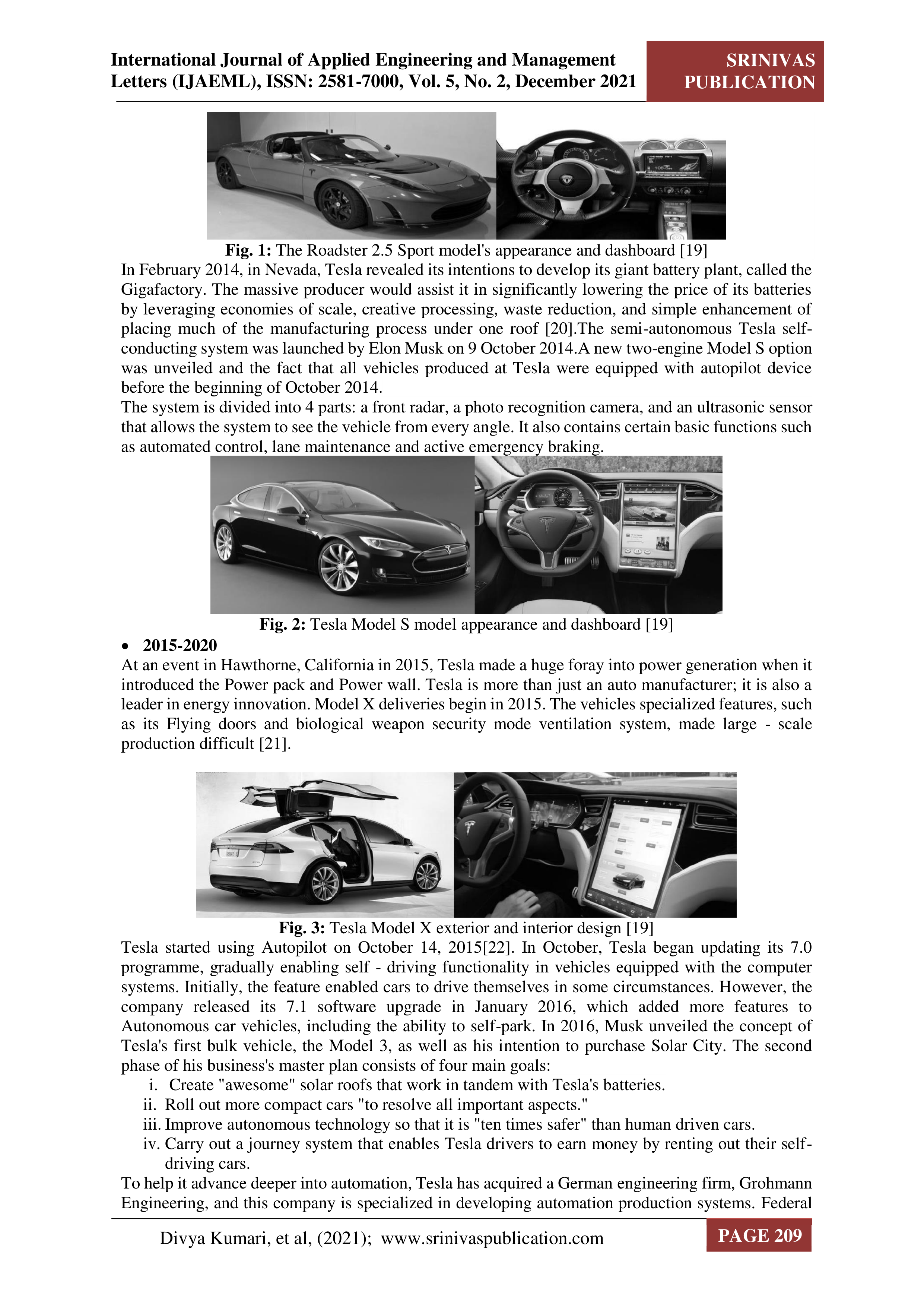
Fig. 1:
The Roadster 2.5 Sport model's appearance and dashboard [19]
In February 2014, in Nevada, Tesla revealed its intentions to develop its giant battery plant, called the
Gigafactory. The massive producer would assist it in significantly lowering the price of its batteries
by leveraging economies of scale, creative processing, waste reduction, and simple enhancement of
placing much of the manufacturing process under one roof [20].The semi-autonomous Tesla self-
conducting system was launched by Elon Musk on 9 October 2014.A new two-engine Model S option
was unveiled and the fact that all vehicles produced at Tesla were equipped with autopilot device
before the beginning of October 2014.
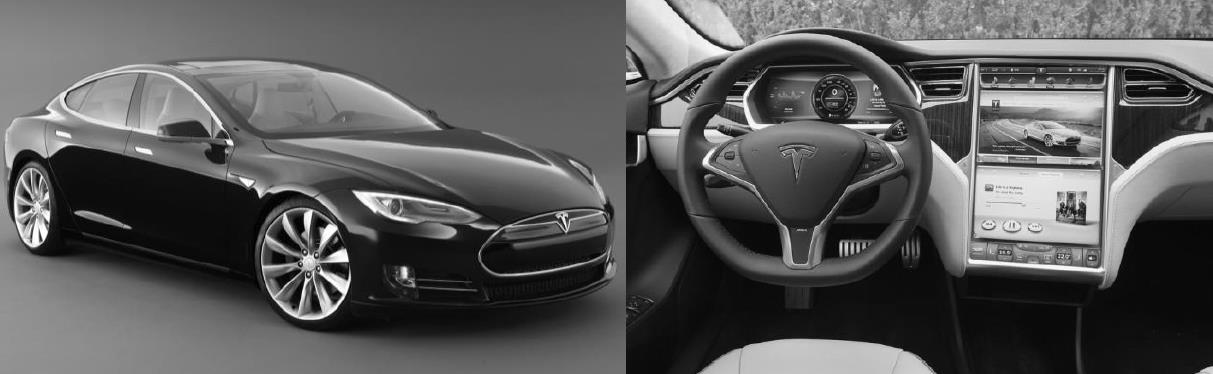
The system is divided into 4 parts: a front radar, a photo recognition camera, and an ultrasonic sensor
that allows the system to see the vehicle from every angle. It also contains certain basic functions such
as automated control, lane maintenance and active emergency braking.
Fig. 2:
Tesla Model S model appearance and dashboard [19]
2015-2020
At an event in Hawthorne, California in 2015, Tesla made a huge foray into power generation when it
introduced the Power pack and Power wall. Tesla is more than just an auto manufacturer; it is also a
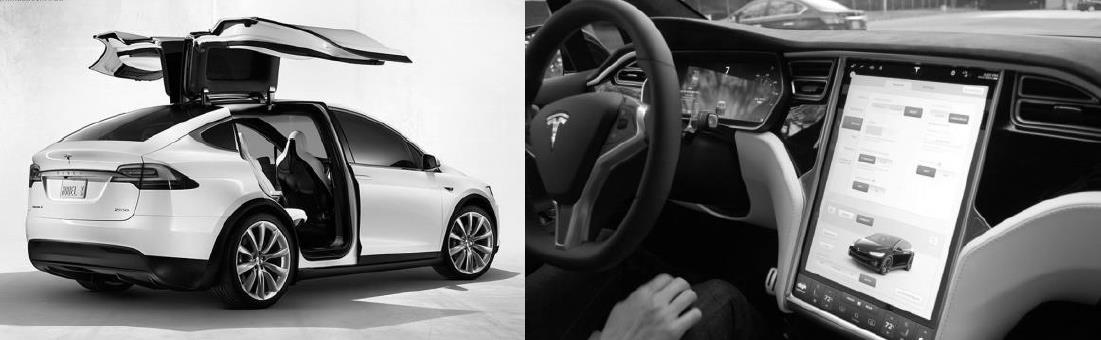
leader in energy innovation. Model X deliveries begin in 2015. The vehicles specialized features, such
as its Flying doors and biological weapon security mode ventilation system, made large - scale
production difficult [21].
Fig. 3:
Tesla Model X exterior and interior design [19]
Tesla started using Autopilot on October 14, 2015[22]. In October, Tesla began updating its 7.0
programme, gradually enabling self - driving functionality in vehicles equipped with the computer
systems. Initially, the feature enabled cars to drive themselves in some circumstances. However, the
company released its 7.1 software upgrade in January 2016, which added more features to
Autonomous car vehicles, including the ability to self-park. In 2016, Musk unveiled the concept of
Tesla's first bulk vehicle, the Model 3, as well as his intention to purchase Solar City. The second
phase of his business's master plan consists of four main goals:
i.
Create "awesome" solar roofs that work in tandem with Tesla's batteries.
ii.
Roll out more compact cars "to resolve all important aspects."
iii.
Improve autonomous technology so that it is "ten times safer" than human driven cars.
iv.
Carry out a journey system that enables Tesla drivers to earn money by renting out their self-
driving cars.
To help it advance deeper into automation, Tesla has acquired a German engineering firm, Grohmann
Engineering, and this company is specialized in developing automation production systems. Federal


International Journal of Applied Engineering and Management
Letters (IJAEML), ISSN: 2581-7000, Vol. 5, No. 2, December 2021
SRINIVAS
PUBLICATION
Divya Kumari, et al, (2021); www.srinivaspublication.com
PAGE 210
authorities concluded their research into the first Self - driving fatality in January 2017, concluding
that there were no flaws in the system. Tesla unveiled the Semi-truck prototype in 2017. The Semi
had a capacity of 500 miles and a range of 400 miles with a cab positioned at centre after 30 minutes
of charged. In 2018, SpaceX launched the Falcon Heavy Rocket into space alongside Musk's Tesla
Roadster. The Falcon Heavy Rocket was effectively put into space by SpaceX. In the driver's seat, a
dummy driver known as "Starman" is dressed in a SpaceX space suit [23]. In 2019, Tesla became the
first Western automotive manufacturer to own a factory in China without partnering. In 2019, Tesla
Model Y was unveiled. It is a new compact SUV set to hit the market in 2020. According to the Verge,
the Model Y has a claimed range of 300 miles, can seat seven people. The standard-range variant will
cost $39,000 and have a 230-mile range, but it will not be available until 2021.
8.
TESLA MAJOR SHARE HOLDERS :
Elon Musk, a Tesla CEO and active supporter, is the company's majority shareholder, owning 21.7
percent of the stock. Baillie Gifford & Co. (7.7 percent), FMR LLC (5.3 percent), Capital Ventures
International (5.2 percent), T. Rowe Price Associates (5.2 percent), and Capital World Investors are
also significant shareholders (5 percent). Another significant individual shareholder is Larry Ellison
(co-founder and CEO of Oracle), who owns 1.7 percent of the company [24].
9.
FINANCIAL STATEMENT :
Tesla Incorporation (Inc.) provide well cars with ample capacity and high greenhouse gases, that had
aided Tesla's brands truly make a signature for themselves in this expanding industry. Tesla Inc.'s
reach has been commendable, with the company establishing a presence in prominent markets such as
the United States, Europe, Asia, and Canada. This same progressive change in consumer choice for
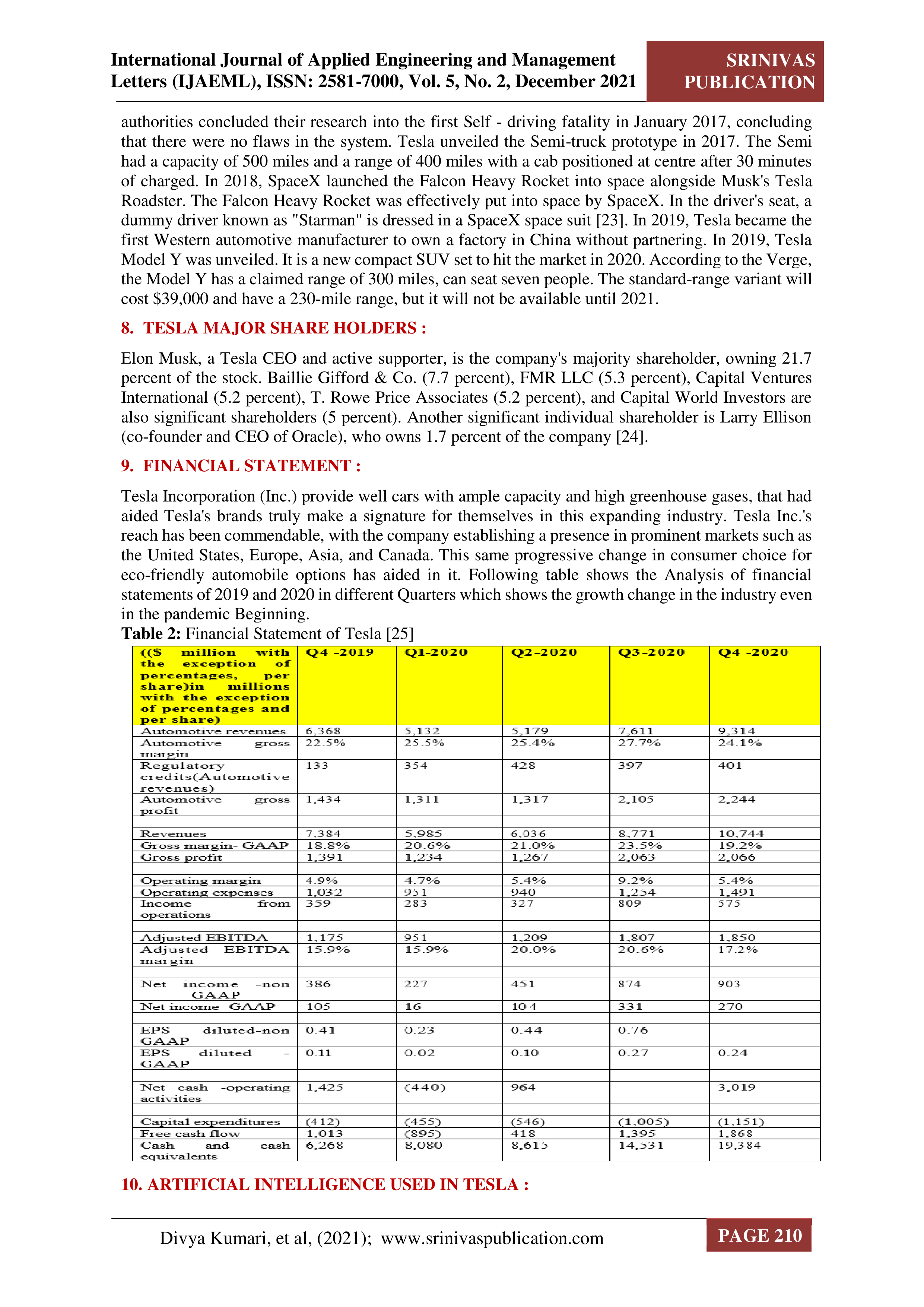
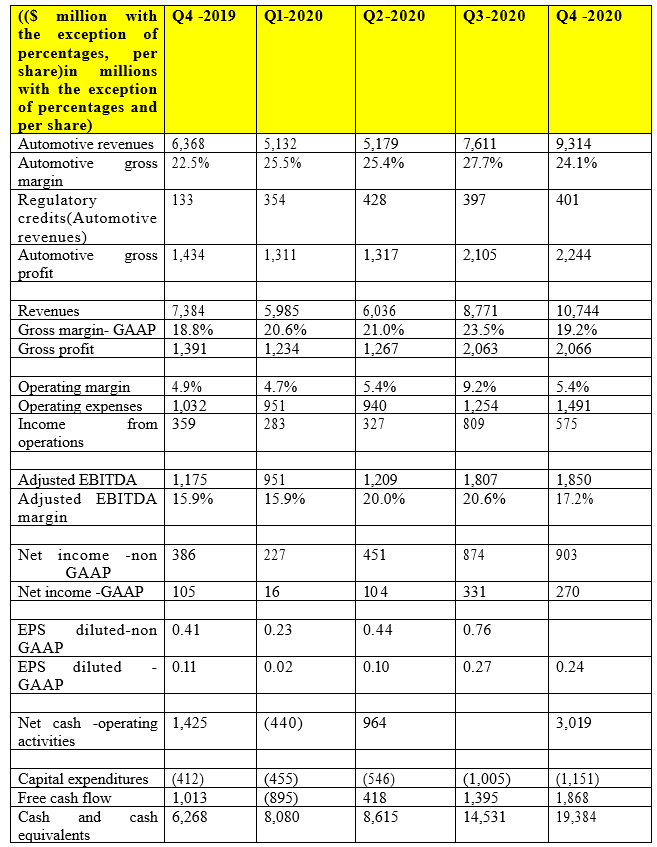
eco-friendly automobile options has aided in it. Following table shows the Analysis of financial
statements of 2019 and 2020 in different Quarters which shows the growth change in the industry even
in the pandemic Beginning.
Table 2:
Financial Statement of Tesla [25]
10.
ARTIFICIAL INTELLIGENCE USED IN TESLA :


International Journal of Applied Engineering and Management
Letters (IJAEML), ISSN: 2581-7000, Vol. 5, No. 2, December 2021
SRINIVAS
PUBLICATION
Divya Kumari, et al, (2021); www.srinivaspublication.com
PAGE 211
Tesla had already begun developing innovative versions of these electric cars, built in California, at a
time when they were not widely popular. Sixteen years have passed, and it is now one of the best
names in the automobile industry, and they have delivered on their promise in more ways than one.
Artificial intelligence and big data have been a consistent companion all along their path in the
automotive market. Tesla has used artificial intelligence and big data to grow its customer base. Since
the beginning, data from an established user base has aided Tesla data analytics. This data collection
enabled Tesla to identify requirements and adapt their systems accordingly, allowing them to become
one of the most competitive automotive corporations in the industry today. Any autonomous car,
including the ones at Tesla, has the key feature of remaining in the right lane, then shifting lanes to
meet the right trajectory. A significant portion of the stack is functions such as obstacle detection.
Finding the motorist on a driveway is also possible, as is the Smart Summon system. These new jobs
include, amongst other activities, the major lane and path functions to pursue the long-term aim:
maximum potential for self-driving using Sensors. Tesla operates with the help of eight cameras. As
a result, all areas around the car can be secured, ensuring that there are no weak points. The 8 scanners
are combined with external RADARs to detect and identify obstacles accurately. RADARs are
excellent supplemental detectors because they can precisely predict speeds [26].
Using neural networks, the camera processes images. It takes into account attributes such as cars,
traffic paths, street limits, pedestrian crossings, and other external conditions. In reality, they should
run at least 50 neural network models at the same period to produce it work. That is simply not true
on ordinary computers. Tesla uses a proprietary structure called HydraNets. It has infrastructures that
have been trained on all objects and heads that have been trained on specific tasks, which is analogous
to delivering training, in which it has a basic block and prepares specific blocks on various linked
tasks. As a result, both the rate of implication and the rate of readiness increase. PyTorch, a deep neural
system, is used to outfit the machine learning. This neural network processes each dimensional image.
The foundation is a modified ResNet- "Dilated Convolutions" is the only difference. The heads are
focused on the FPN/DeepLab/UNet semantic segmentation architecture. The effects of a deep net must
frequently be represented in three dimensions. It’s Birds - Eye Perspective will help in measuring
things and providing a much clearer and truer understanding of the world. Some tasks work on multiple
cameras. Stereo cameras are typically used for depth estimation. Using two cameras allows for more
accurate data points [27]. Tesla accomplishes this by utilising neural networks to perform depth
regression. Tesla also has routine work, like traffic system estimation. The basic idea is same: different
neural networks operate independently, and the connection is made by another neural net. This neural
network may be recurrent, necessitating the passage of time. The main issue with Tesla has been that
it uses eight sensors, sixteen-time cycles, and 32 batch sizes. This ensures each forward transfer
handles 4096 images. Tesla is betting big on HydraNet's infrastructure. A single neural network is
used to process each camera. The intermediate neural net then integrates it. The incredible thing is that
only a small portion of this vast network is used for any given mission. The front camera, the front
backbone, and a 2nd camera will be used for image classification. Not everything is processed in the
same way. PyTorch is used to finish learning algorithm. Numerous tasks are required, and training all
48 neural network heads will take a significant amount of time. In reality, training would take 70,000
hours of GPU time to finish. That's almost eight years. Tesla is transitioning from a "round robin" to
a "pool of workers" training mode. The long, improbable solution is on the left. They use the options
in the middle and on the right. Tesla's applications are updated on a regular basis. They collect and
use consumer data from thousands of cars travelling outside to enhance their designs. Similar to the
active learning strategy, each piece of data is accumulated, labelled, and is used for training. Tesla's
ambition is to be the first organisation to achieve complete autonomy. They are now the world's largest
automaker, and they are not going to stop there [28]. They face a slew of fascinating challenges that
we do not when they learn Machine learning, artificial intelligence, and machine learning from the
comfort and privacy.
11.
TESLA AUTOPILOT :
Tesla argues that Autopilot provides you greater trust behind the wheel, enhances road safety and
enhances road mobility. Although fully driverless vehicles are still a several years away, Tesla
Autopilot operates in a manner similar to that of airline pilots when the weather is clear. The operator
is also in charge of the vehicle and is responsible for it. Tesla provides easy access to the information
that it uses to control its actions to the driver [29]. Tesla Model S and Model X electric vehicles are


International Journal of Applied Engineering and Management
Letters (IJAEML), ISSN: 2581-7000, Vol. 5, No. 2, December 2021
SRINIVAS
PUBLICATION
Divya Kumari, et al, (2021); www.srinivaspublication.com
PAGE 212
powered to enable cars to independent steer, alter tracks, follow cars and curves, and park. In the
garage, in addition to the usual combination of accident prevention technology, including ADAS,
which drives and brakes emergency steering. The essence of these vehicles is markedly different from
that of the majority of other vehicles on the market. Tesla has released Model S software version 7.0,
a software update for Tesla's autopilot hardware in Model S and Model X production vehicles that
enables cars to use data from around its cameras, radars, and radars. In reaction to traffic
circumstances, ultrasound sensors are employed for steering the car, changing lanes and adapting
speed. The Model S or Model X scans the parking places as the driver arrives at the location. On the
driver's command, and parallel parks. The new driver-focused design of the instrument cluster in the
latest Autopilot reveals real data used by the car to smartly understand the parameters of a vehicle at
a certain time based on its environment. Along with the autopilot feature, each Tesla vehicle's driving
actions while driving in various traffic conditions are shared with the company's centralized computer.
Based on the advice of ML and Tesla concept engineers, a feature upgrade is being developed and
released for every other Tesla vehicle in the world [30]. The instrument panel displays a path defined
by the vehicle's sensors, informing drivers about features such as lane departure, rear view detection,
traffic assist, accident alerting, responsive cruise, and auto driving.
12.
DEEP LEARNING IN AUTOPILOT :
Among the most important factors influencing how deep neural nets perform is supervised learning.
So much training data works more effectively. That is why Tesla has the world's best potential
automated vehicle plan [31]. With 1.5 million vehicular traffic equipped in what Tesla considers
complete Auto-pilot innovation, Tesla's Car travels the same amount of distance daily – approximately
15 million – as Waymo has travelled in that lifetime.
The following technologies are used in Autopilot
Machine vision
Forecast
Driving Track planning
Machine vision:
Object detection is an important machine vision activity. On the street, some objects,
such as dogs, can be found. When a Tesla discovers what the neural net thinks is a dog, the cameras
take a screenshot, which is later recorded via Wi-Fi. It helps to have cars that drive vast distances per
year to get a lot of rare items. It is possible that Tesla will improve her ability to identify unusual objects
over time. Tesla is more likely to pay people to manually mark images containing common objects. It's
easy to take more photos than you'd pay for on a sticker. Tesla marks rare items and develops software
to trigger snapshots at the appropriate time [32].
Forecast:
Forecasting is the process of predicting the motions of vehicles, commuters, and cyclists just
several seconds advance [33]. The most common reason for the lack of driverless cars is incorrectly
estimating the actions of surrounding drivers and people. Tesla's cars of nearly half a million vehicles
represents an excellent opportunity. Whenever Tesla creates an erroneous estimation about a vehicle
and perhaps a crosswalk, it will store an information about the image for later folder and add it to Tesla's
learning collection [34]. Rather than uploading video, Tesla may be able to stream a conceptual scene
generated by its machine vision neural nets. It minimises the storage space requirements for submitting
this data. Unlike pictures often used train image classification, which require physical tagging, a neural
predictive system can just understand associations between the possible futures from time sequence of
events. Tesla can train its neural networks with as much usable data as it can obtain there is really no
need for humans to mark the data. As a result, the training dataset's length will be proportional to the
total distance [35].
Driving track planning:
Driving track planning and driving policy refers to the actions which a car
takes, such as remaining in its lane at the safe speed, changing direction, attempting to pass a slower
vehicle, turning left on a green signal, guiding there with a parked vehicle, stopping to overcome
obstacles, and so on. It appears challenging a guideline that will cover any move that a vehicle might
need to make even under circumstances [36]. Yet another method for feigning complexity is to use a
learning algorithm to mimic what humans do. It's referred to as reinforcement learning. By establishing
links between the history as well as the future, a neural network is trained to simulate the performance
of other drivers on the road during the training process. A learning algorithm to forecast what a human
suburbanite does by drawing interrelations between what it perceives) and human operator deportment
in reinforcement learning. In driving activities such as navigating the uphill bends of a highway traffic
circle and helping make a wide turn at a crossroads, Tesla employs imitation learning. Tesla appears


International Journal of Applied Engineering and Management
Letters (IJAEML), ISSN: 2581-7000, Vol. 5, No. 2, December 2021
SRINIVAS
PUBLICATION
Divya Kumari, et al, (2021); www.srinivaspublication.com
PAGE 213
to be planning to expand imitation education to other duties, such as how and when to change
roadways, over period. As with predicting, rather than posting footage, a conceptual description of the
picture encompassing the car may suffice. It could necessitate drastically reduced memory and disk
requirements. Once the data is recorded, no human classification is required, as it is with predictions.
Because the neural net predicts what the driver does in any given state, it only considers the current
situation and the driver's actions. Reinforcement learning, in fact, forecasts the actions of Tesla
vehicles rather than the activity of other road users observed by Tesla [37]. Tesla will activate a car to
avoid a replay if it is unable to accurately predict whether the car in front will be cut into Tesla's
driveway. Similarly, when the neural network involved in route planning or driving strategy fails to
correctly predict the Tesla driver's actions, Tesla can record retry data. The human driver will take
over when the Tesla is in Autopilot mode and also in the future urban semi-autonomous mode. It could
be a great source of references in which the computer makes a mistake and the motorist easily explains
how to rectify it. Other techniques for capturing fascinating recordings include: rapid acceleration or
weaving through traffic, airbags, accident or accident alerts, and more advanced ML algorithms like
anomaly detection and novelty detection. Only when Tesla recognizes what it needs to record, such as
lane changes at crossings, will it set up an alert to record a replay whenever the vision neural networks
detect a stoplight and the spin lane sensor is activated, or when the tyre moves to the left.
13.
SWOT ANALYSIS :
Among industry enthusiasts, Tesla has appeared among the most debated and researched industries.
The company's own SWOT analysis will provide all of the necessary observations into each aspect of
Tesla's sales model. Furthermore, the overall impact of this analysis includes strategic adjustments in
terms of all SWOT variables, i.e., control, vulnerability, opportunities, and threats [38].
Tesla’s Strengths:
i.
Tesla Inc.'s strengths include the company's positive attributes that have helped Tesla to
become one of the globe's greatest powerful corporate giants. The major aspects, which are thought
to be Tesla's greatest strengths, have ensured the company's long-term expansion, development,
and success [39].
ii.
The success of any business is proportional to how well it recruits. As in the case of Tesla
Inc., it is one of the major drivers of the industry's impressive growth. Because of its diverse and
creative workforce, Tesla has become the capital formation for employment. Youthful aspirants
with great talents and effort have recently been recognized as one of the best places to work.
Fortune magazine named the company one of "America's Best Employers 2019."
iii.
Top Car Enterprise: Amidst its difficulties, Tesla's revenues have increased. It has risen to
prominence of the automotive market, producing winning combination vehicles in 2019. Few
luxury automakers, such as Mercedes-Benz and BMW, have abandoned the Company.
iv.
Top electric automobiles: Tesla has surpassed all other manufacturers in the race to produce
quality EVs. It is one of the best places to work. Tesla's electric coaches have proven to be the
quickest to travel great distances in comparing to their range. According to the most recent
comparison, Tesla ranks first, second, and third. Along with words of measurements. The Tesla
Model S has the longest range, with a single battery lasting up to 600 miles.
v.
Tesla Regulates U.S. Electric Car Purchases: As per Internet world stats, the Model 3 was the
most popular electric vehicle in 2019, with 187,971 units sold. With 155,477 vehicles sold, the
Chevrolet Volt takes second place. The Model S is in 3rd position with 134,392 vehicle sales, but
it is a close call. Tesla will, in a nutshell, dominate the electric car revenue market.
vi.
Investments: Insure MyTesla is a complete and accurate auto insurance program designed by
Tesla in collaboration with Mutual Life Insurance Company.
vii.
Sector for Advancement: Tesla possesses a high level of inventiveness. As a result, believe in
the company and anticipate the firms to develop competitive and successful goods that will, of
course, result in massive economic gain.
Tesla’s Weaknesses:
Weaknesses are defined as any internal factors in a company that cause harm or limit performance
evaluation. As a result, these are some of Tesla's organisational flaws that limit its competitiveness
and business growth [40].


International Journal of Applied Engineering and Management
Letters (IJAEML), ISSN: 2581-7000, Vol. 5, No. 2, December 2021
SRINIVAS
PUBLICATION
Divya Kumari, et al, (2021); www.srinivaspublication.com
PAGE 214
i.
Complications in Manufacturing: The greater the intensity of innovation, the more
mechanical complications there are, and the higher the risk aspect for production. Tesla is
constantly facing release, manufacturing, and manufacturing issues in order to release expensive
vehicles and other items. As it prepared to launch the Model X, Tesla faced numerous
manufacturing challenges, resulting in constant distribution delays. Manufacturing the Model X
charger component assembly process at Gigafactory 1 has proven to be extremely difficult for the
company.
ii.
Failure to satisfy supply: It can influence the value of the brand. Offerings and requests from
Tesla may not, owing to highly test and sophisticated procedures, be able to satisfy manufacturing
needs.
iii.
Inadequate output quantity: Without a doubt, Tesla seems to be the dominant player in true
electric cars. However, it has battled to transport heavy numbers of vehicles with any of its designs.
And now, as the company plans to create significant Model 3 vehicles, Gigafactory 1 is undergoing
challenges in terms of production costs, leadership capital, and area growth.
iv.
Battery shortfall: At the yearly shareholders' conference, CEO Elon Musk revealed that one's
total production had lowered caused by a lack of rechargeable availability. The shortage has a
particular effect on demand of electric vehicles and power storage.
v.
Elon Musk is Tesla's sole leader: Tesla admits that the company is a "one-man show."
Unfortunately, Elon Musk has a bunch on his shoulders in order to give his all to the company.
Musk is actively involved in other ventures at the Space Technology Systems Organization and
The Dull Group, such as space launch vehicles [41].
Tesla’s Opportunities:
i.
The opportunity section highlights the industry's arising growth potential. It is an
environmental factor that, once established, will assist Tesla in improving its competitiveness,
organisational structure, success, and other elements [41].
ii.
Higher production in a previously unavailable market: The Asia - pacific region, which is
lack of employment in the automotive and sustainable energy industries, is the company's most
critical demand. Especially given Tesla's desire to expand its global market in order to improve its
economic security and market position.
iii.
Cheaper automobile: Tesla is cheap due to its unusual relying on technology, which requires
optimum investment resources to sustain new invention. Tesla recently introduced Model 3, a
lower-range, lower-power, and lower-featured version of the Model S. However, it is a great chance
for Tesla to increase consumption for its audiences.
iv.
Introducing internal charger computational methods throughout: Tesla intends to produce its
own car batteries. The switch can be a big thing because it allows the company to increase its sales
costs while decreasing its manufacturing costs.
v.
Introduction of the pick-up truck: According to the National Car Dealer Association's
profitability projections, picking up truck accounts for a tremendous opportunity for expansion in
electric vehicles.
vi.
Trust of industry in Tesla: The share market reaffirmed its belief in Tesla after two successive
profitable quarters. Tesla's share price has more than doubled since the start of this year.
Tesla’s Challenges :
Its Risk dimension deals with a bias which prevents the company from reaping benefits of its available
strengths. These are, however, the few threats that Tesla experiences in keeping the business running
in the face of volatile economic conditions [42].
Claims about Product Liability
The Rivalry Comprehensive
Defects of Goods
Trust in the long term
Adaptation of costumer
Self-driving cars for pedestrians are also a concern.
Production disruption caused by a material shortage
High-risk factor related to the use of lithium-ion


International Journal of Applied Engineering and Management
Letters (IJAEML), ISSN: 2581-7000, Vol. 5, No. 2, December 2021
SRINIVAS
PUBLICATION
Divya Kumari, et al, (2021); www.srinivaspublication.com
PAGE 215
Lack of self-driving regulations
Elon Musk's Erratic Conduct Affecting Tesla's Credibility
14.
PANDEMIC IMPACT ON STOCK MARKET –TESLA :
Tesla's progress has been demonstrated in the share market through consistent rises in share prices and
high profitability [43]. COVID-19 truly brought to a standstill in 2020, destroying world markets and
claiming countless lives worldwide. Including the destruction caused by COVID-19 to healthcare, the
share market suffered greatly. COVID-19 compelled the shutdown of several companies, leading to a
loss of employment. Everyone's working routines altered as more and more people began working
from home and no longer had to travel. Restrictions on travel as well made it difficult for individuals
to travel around and avoided commodities of being supplied. Its hard effects of COVID-19 on the
industry are still unknown as nations come back to a semblance of normalcy, with more persons
starting work. It was expected just at start of the global epidemic that Tesla would be the dominant
player in electric cars and would keep that position even after the global epidemic ended. Through
2021, the transport sector had grown dramatically, with Tesla, as projected, arising as the industry
leader, particularly in the U.S in which they continued to deliver vehicles despite production
challenges. In the first period of 2020, Tesla sold more than 1.7 million cars, outpacing rival company
selling. Tesla has abilities to perform share price tenacity and retains shareholders' focus. Investors
are closely monitoring Tesla's performance, new innovation projects, and any economic setbacks.
Major trends as we continue to deal with COVID-19, news releases surrounding Tesla and their
teamwork, and the adoption of innovative automobiles have all had an influence on how stockholders
view the economy.
15.
CONCLUSION :
Automotive electrical vehicles are using the most efficient technology for transporting people without
drivers or fossil fuel-fuelled internal combustion engines, including a new generation of batteries and
other fourth generation Industrial Revolution (4IR) technologies (ICEs). Given the benefits of cleaner
and faster transportation, A-EVs theoretically help to accelerate much-needed reductions in
greenhouse gas emissions. In three major areas, Tesla has an advantage over competitors (such as
Waymo): machine vision, predictability, and route planning/driving strategy. To fix the challenges,
researchers created powerful stimuli, used data without individual tagging, and used models rather
than actual footage. Other competitors have put little focus on training data, especially in the case of
uncommon artefacts and behaviour for which Waymo lacks adequate data to perform machine learning
well, if at all. Autopilot vehicles solve problems like driving, which require forecasting human
behaviour. Empirical evidence from the natural world is needed to predict human behaviour.
REFERENCES :
[1].
Dasoriya, R., Rajpopat, J., Jamar, R., & Maurya, M. (2018). The Uncertain future of artificial
intelligence. In
2018 8th International conference on cloud computing, data science &
engineering, 1
(1), 458-461. IEEE.
Google Scholar
[2].
Lu, H., Li, Y., Chen, M., Kim, H., & Serikawa, S. (2018). Brain intelligence: go beyond artificial
intelligence.
Mobile Networks and Applications
,
23
(2), 368-375.
Google Scholar
[3].
Chen, Y., & Perez, Y. (2018). Business model design: lessons learned from Tesla Motors.
In
Towards a Sustainable Economy
,
1
(1), 53-69.
Google Scholar
[4].
Bilbeisi, K. M., & Kesse, M. (2017). Tesla: A successful entrepreneurship strategy.
Morrow, GA:
Clayton State University, 1
(1), 1-18.
Google Scholar
[5].
Mahajan, D., Park, J., Amaro, E., Sharma, H., Yazdanbakhsh, A., Kim, J. K., & Esmaeilzadeh,
H. (2016). Tabla: A unified template-based framework for accelerating statistical machine
learning. In
2016 IEEE International Symposium on High Performance Computer Architecture,
1
(1)
,
14-26.


International Journal of Applied Engineering and Management
Letters (IJAEML), ISSN: 2581-7000, Vol. 5, No. 2, December 2021
SRINIVAS
PUBLICATION
Divya Kumari, et al, (2021); www.srinivaspublication.com
PAGE 216
Google Scholar
[6].
Dobbs, M. E. (2016). Tesla, SpaceX, and the Quest for a Fantastic Future.
Journal of Applied
Management and Entrepreneurship
,
21
(1), 61-83.
Google Scholar
[7].
Char, D. S., & Burgart, A. (2020). Machine Learning Implementation in Clinical Anesthesia:
Opportunities and Challenges.
Anesthesia and analgesia
,
130
(6), 1700-1709.
Google Scholar
[8].
Lim, S. H., Yoon, J., Kim, Y. J., Kang, C. K., Cho, S. E., Kim, K. G., & Kang, S. G. (2021).
Reproducibility of automated habenula segmentation via deep learning in major depressive
disorder and normal controls with 7 Tesla MRI.
Scientific Reports
,
11
(1), 1-11.
Google Scholar
[9].
Thomas, V. J., & Maine, E. (2019). Market entry strategies for electric vehicle start-ups in the
automotive industry–Lessons from Tesla Motors.
Journal of Cleaner Production
,
235
(1), 653-
663.
Google Scholar
[10].
Black, S., Gardner, D. G., Pierce, J. L., & Steers, R. (2019). Techniques of Performance
Appraisal.
Organizational Behavior, 1
(1), 1-21.
Google Scholar
[11].
Fisher, M., & McCabe, M. B. (2019). Tesla: Accelerating to Market.
Journal of Strategic
Management Education
,
15
(1), 1-21.
Google Scholar
[12].
Xu, Z., Elomri, A., Kerbache, L., & El Omri, A. (2020). Impacts of COVID-19 on global supply
chains: facts and perspectives.
IEEE Engineering Management Review
,
48
(3), 153-166.
Google Scholar
[13].
Mission and Vision retrieved from
https://visionarybusinessperson.com/tesla-mission-statement/
on 29/11/2021
[14].
Berdichevsky, G., Kelty, K., Straubel, J. B., & Toomre, E. (2006). The tesla roadster battery
system.
Tesla Motors
,
1
(5), 1-5.
Google Scholar
[15].
Prabhu,
S.
(2019).
Wireless
Technology
Leading
Innovator-A
Case
Study
of
Qualcomm.
International Journal of Case Studies in Business, IT, and Education (IJCSBE)
,
3
(2),
68-78.
Google Scholar
[16].
Perrig, A., Canetti, R., Tygar, J. D., & Song, D. (2002). The TESLA broadcast authentication
protocol.
Rsa Cryptobytes
,
5
(2), 2-13.
Google Scholar
[17].
Tsai, H. Y., & Tan, T. M. (2021). The impact of artificial intelligence on sustainable corporate
brand:
a netnography study of Tesla
,
1
(1),1-25.
Google Scholar
[18].
Jun. Young. KWAK, Varakantham, P., Maheswaran, R., Becerik-Gerber, B., & Tambe, M.
(2013).
TESLA: An energy-saving agent that leverages schedule flexibility, 1
(1), 1-18.
Google Scholar
[19].
Fig 1, 2, 3 are retrieved from
https://www.businessinsider.in/thelife/news/22-features-that-
make-tesla-cars-unlike-any-others/slidelist/84662979.cms on 11/10/2021
[20].
Journey of Success retrieved from
https://interestingengineering.com/the-short-but-fascinating-
history-of-tesla on 18/08/2021


International Journal of Applied Engineering and Management
Letters (IJAEML), ISSN: 2581-7000, Vol. 5, No. 2, December 2021
SRINIVAS
PUBLICATION
Divya Kumari, et al, (2021); www.srinivaspublication.com
PAGE 217
[21].
Puneeth, B. R., & Nethravathi, P. S. (2021). Bicycle Industry in India and its Challenges–A Case
Study.
International Journal of Case Studies in Business, IT and Education (IJCSBE)
,
5
(2), 62-
74.
Google Scholar
[22].
Raković, D. (2010). On nature and control of creativity–Tesla as a case study. In
Proc. 2nd Int.
Workshop on Knowledge Federation, Dubrovnik, Croatia, 1
(1), 1-36.
Google Scholar
[23].
Financial
Statement
retrieved
from
https://www.wsj.com/market-
data/quotes/TSLA/financials/annual/income-statement
on 04/09/2021
[24].
Ajitha, P. V., & Nagra, A. (2021). An Overview of Artificial Intelligence in Automobile
Industry–A Case Study on Tesla Cars.
Solid State Technology
,
64
(2), 503-512.
Google Scholar
[25].
Pulluparambil, S. J., & Bhat, S. (2021). Application of Machine Learning in Google Services-A
Case Study.
International Journal of Case Studies in Business, IT and Education (IJCSBE)
,
5
(2),
24-37.
Google Scholar
[26].
Artificial Intelligence used in Tesla retrieved from
https://towardsdatascience.com/teslas-deep-
learning-at-scale-7eed85b235d3 on 16/08/2021
[27].
Prabhu, S., & Bhat, S. (2020). Application of Artificial Intelligence in Samsung–A Case Study
.
International Journal of Case Studies in Business, IT, and Education (IJCSBE)
,
4
(2), 280-292.
Google Scholar
[28].
Dikmen, M., & Burns, C. M. (2016, October). Autonomous driving in the real world:
Experiences with tesla autopilot and summon. In
Proceedings of the 8th international conference
on automotive user interfaces and interactive vehicular applications
,
1
(1), 225-228.
Google Scholar
[29].
Tesla Autopilot retrieved from
https://hbr.org/2020/02/lessons-from-teslas-approach-to-
innovation/
on 25/08/2021
[30].
Etzioni, A., & Etzioni, O. (2017). Incorporating ethics into artificial intelligence.
The Journal of
Ethics
,
21
(4), 403-418.
Google Scholar
[31].
Deep Learning in Autopilot retrieved from
https://kloudlearn.us/4-ways-ai-will-enhance-
training-and-development/ on 25/08/2021
[32].
Ingle, S., & Phute, M. (2016). Tesla autopilot: semi autonomous driving, an uptick for future
autonomy.
International Research Journal of Engineering and Technology
,
3
(9), 369-372.
Google Scholar
[33].
Grigorescu, S., Trasnea, B., Cocias, T., & Macesanu, G. (2020). A survey of deep learning
techniques for autonomous driving.
Journal of Field Robotics
,
37
(3), 362-386.
Google Scholar
[34].
Karamitsios, A. (2013
). Open innovation in EVs: A case study of Tesla Motors, 1
(1), 1-32.
Google Scholar
[35].
Yokota, Y., Takeda, C., Kidoh, M., Oda, S., Aoki, R., Ito, K., ... & Utsunomiya, D. (2021).
Effects of deep learning reconstruction technique in high-resolution non-contrast magnetic
resonance coronary angiography at a 3-tesla machine.
Canadian Association of Radiologists
Journal
,
72
(1), 120-127.
Google Scholar
[36].
Niranjan, D. R., & Vinay Karthik, B. C. (2021, October). Deep Learning based Object Detection
Model for Autonomous Driving Research using CARLA Simulator. In
2021 2nd International
Conference on Smart Electronics and Communication (ICOSEC)
,
1
(1), 1251-1258.
Google Scholar


International Journal of Applied Engineering and Management
Letters (IJAEML), ISSN: 2581-7000, Vol. 5, No. 2, December 2021
SRINIVAS
PUBLICATION
Divya Kumari, et al, (2021); www.srinivaspublication.com
PAGE 218
[37].
Betz, J., Heilmeier, A., Wischnewski, A., Stahl, T., & Lienkamp, M. (2019). Autonomous
Driving—A Crash Explained in Detail.
Applied Sciences
,
9
(23), 5100-5126.
Google Scholar
[38]
Aithal, P. S., & Kumar, P. M. (2015). Applying SWOC analysis to an institution of higher
education.
International Journal of Management, IT and Engineering
,
5
(7), 231-247.
Google Scholar
[39] Tesla’s Opportunities retrieved from
https://www.greyb.com/autonomous-vehicle-companies/
on
20/08/2021
[40] Mangram, M. E. (2012). The globalization of Tesla Motors: a strategic marketing plan
analysis.
Journal of Strategic Marketing
,
20
(4), 289-312.
Google Scholar
[41] Alghalith, N. (2018). Tesla: innovation with information technology.
International Journal of
Business Research and Information Technology
,
5
(1), 37-51.
Google Scholar
[42] Tesla’s Risk retrieved from
https://www.investopedia.com/articles/markets/
on 04/09/2021
[43] Tallantyre, E. C., Brookes, M. J., Dixon, J. E., Morgan, P. S., Evangelou, N., & Morris, P. G.
(2008). Demonstrating the perivascular distribution of MS lesions in vivo with 7-Tesla
MRI.
Neurology
,
70
(22), 2076-2078.
Google Scholar
*********