536
Artificial Intelligence's Level of Development and Influence
on the Automotive Supply Chain in Europe: A Case Study on Audi
Gabriela CĂLINESCU
1
Elena-Simona IONEL
2
DOI: 10.24818/mer/2024.03-09
ABSTRACT
Over the last few years, many factors have transformed the automotive supply chain in Europe.
This paper addresses some of the issues that challenge this supply chain and discusses artificial
intelligence's implementation benefits, such as the elimination of bottlenecks, gaining an
advantage on the procure-to-pay system of the automotive supply chain, and the automatic read
of invoices. Qualitative methodology was used to analyse the information gathered within this
study, using in depth literature review and checking important releases on this subject in
scientific papers available, focusing also on the Audi case study that shows real application of
artificial intelligence technology into their manufacturing process and the opportunities to
further apply this in Europe. Major changes in European automotive supply chains are
underway as a result of the adoption of artificial intelligence, not only solves existing problems
but calls for advanced algorithms to be developed to meet new demands. The implementation
of artificial intelligence needs to follow ethics, and in some cases needs human supervision.
The use of artificial intelligence has both advantages and disadvantages. Some are analysed in
this article and the important role of Germany as a pioneer in using artificial intelligence
effectively in the automobile industry is emphasized by a case study on Audi.
KEYWORDS:
Artificial intelligence, supply chain management, structural shift, automotive
industry, Audi
JEL CLASSIFICATION:
O31, L62.
1. INTRODUCTION
Artificial intelligence (AI) has entered almost all spheres of life and is now coming to help
improve the perimeter of supply chain management operations. This issue is critical in view of
considering how AI will eventually influence the automotive industry, since AI can allow a
complete redesign and reformulation of the processes involved in vehicle production for end
consumers. AI allows for improving both performance and flexibility in automotive supply
chains by applying machine learning algorithms together with predictive analytics. Since this
paper focusses on the level of development, the consequences of AI in the European automotive
supply chain will be carried out using two qualitative research methods: the document analysis
method and the case study method. Some of the key inferences from the paper are that AI exists
as a key driver of change in the automotive supply chain throughout Europe. Moreover, the
case study on supports the fact that Germany is ahead in terms of using AI in the automobile
industry.
1
Faculty of International Business and Economics, Bucharest University of Economic Studies, Romania, gabrielacalinescu07
@gmail.com
2
Faculty of International Business and Economics, Bucharest University of Economic Studies, Romania, elenasimona
_ionel@yahoo.com (Corresponding author)
Management and Economics Review
Volume 9, Issue 3, 2024
537
2. LITERATURE REVIEW
In Europe alone, most corporations are investing a huge amount of money into the research and
development of AI technologies to just outdo their other competitors across the globe in such
technologies. These currents of digitalisation and interconnectivity are a trend that constitutes
rates much higher in comparison with most parts of the world because of technological
advancement driven by research into AI. Thus, AI finds an application in automobile
distribution, though with its challenges. It is to be noticed that some tasks performed by people,
by going automated or mechanized, may lead them to lose their job.
Crockett (2023) emphasises that AI can benefit supply chains by increasing their efficiency and
reducing the impact that could be generated by having only a small number of employees.
Applications for AI are present throughout supply chains, from manufacturing all the way
through consumer-facing retail (Tubaro & Casilli, 2019). Ahmed & Saideeep (2023) believe
that AI can automate manual supply chain tasks, which could drastically reduce time and costs.
Tags that use Internet of Things technology are used to track inventory and promptly notify the
supply chain companies about potential problems. The European Union (the EU) is trying to
cope with green policies using digital transformation and attempting to build resilience within
its member states to secure the current dependencies and the skilled workforce missing in the
automotive sector. The most common challenges EU automotive producers are facing are
linked to high dependencies on non-European suppliers, which lack both competencies in key
development areas, but also cost competitiveness.
McKinsey & Company (2018) points out that AI is amazing at cutting costs and improving
operations, while Landgrebe (2019) highlights the need for higher investments in smart
algorithms to be able to keep up with the changes in the automotive industry.
Das (2022) discusses that the COVID-19 pandemic worsened issues such as labour shortages
and increased demand for vehicles but managing supply chains with AI can help make
operations more predictable, transparent and quick.Rusnak (2022) believes that adopting AI
technology will improve key areas of the supply chain in the future, although he agrees with
Das (2022) that the COVID-19 pandemic highlighted the weak points of supply chains.
3. RESEARCH METHODOLOGY
This article uses as research methodology the qualitative method of document analysis and the
qualitative method of the case study. Most of the documents chosen to be analysed were
published between 2021 and 2023.
The analysis is centred on how AI affects the automotive industry, with a focus on the
automotive supply chain. The case study is about Audi, a German leading car manufacturer,
which improved its operations by implementing AI. Some benefits of AI in the automotive
supply chain include improved efficiency, reduced costs, and improved sustainability.
4. RESULTS AND DISCUSSIONS
4.1 The advantages and drawbacks of implementing artificial intelligence
in supply chain management
As Negrea & Cojanu (2015) discuss, the balance between wages and industrial productivity is
very important for competitiveness. If innovation and cooperation are not present, we might
Gabriela CĂLINESCU, Elena-Simona IONEL
538
witness some regions of the world that risk losing market portion and new business
opportunities. Considering long-term strategic planning, research, development, and innovation
become crucial, especially in high tech sectors like automotive. Since into the selling price
wages and production hourly rates have a significant impact, to secure competitiveness, each
region should maintain stable wage levels corelated with robust industry performance, inter-
business collaboration, and a strategic focus on research activities. If this is not achieved,
companies within the supply chain will look for cheaper options in low-cost countries to support
their long-term project financial figures, moving business to more advantageous production
locations.
Van der Smagt (2021) research brings following figures into study: automotive sector employs
14.6 million Europeans, thus proving to be a significant contributor to the EU job market.
Additionally, the automotive industry is responsible for 11.5% of all manufacturing jobs in the
EU, showing its importance and impact in the employment sector. Each year, 62 billion EUR
are estimated to be spent on research and development within the automotive industry, which
represents more than one third of the EU's total research and development spending.
Being an industry that carries significant amounts of technology, intellectual property, patents,
innovation, and strategic planning, the automotive industry is the core of implementation from
idea to product between the final customer, the personal or commercial vehicle, on- or off-road,
and the car manufacturer.
It involves a complex supply chain, as the final product itself is the result of the cooperation of
multiple industries for its assembly and delivery to market. Be it raw materials such as primary
metals for building engine parts or complex chemical finishes for the hood, a large proportion
is obtained through complex machining processes. All subcomponent producers need to
manage their companies very well and cooperate to ensure that each project is completed
qualitatively, on time.
Taking into consideration the many challenges that can appear in the automotive supply chain,
professionals search constantly for methods to improve performance. As travelling became
easier and markets were open to cooperation, a quality-to-cost orientation became noticeable,
where typically a car is made from components coming from all over the world and can be
assembled entirely or partially in completely different locations than the country of the car
manufacturer. Financial services development and tax incentives brought a few countries to the
attention of companies for headquarters settlement or research and development selection,
including setting up plants in greenfield investment areas sustained by local governments that
would enable the company to gain additional competitive advantages from price.
Jacobs (2023) enumerates the business advantages of artificial intelligence in the supply chain,
referring to accurate inventory management, warehouse efficiency, enhanced safety, reduced
operating costs, and on-time delivery.
By analysing daily challenges in the international automotive supply chain, we state and detail
below our own original ideas for potential uses of AI to support critical activities and improve
general output in automotive supply chain management in Europe.
Management and Economics Review
Volume 9, Issue 3, 2024
539
Table 1. AI implementation areas and risks
Department
Activity
Value added
AI Risk
Quality
Validation accelerated tests
simulation results
data cyber
security
Quality
Quality tracking Data matrix
improved traceability
data quality
Procurement Procure-to-pay
order to invoice to payment
data
confidentiality
Logistics
Warehousing and goods receipt
inventory management
data
confidentiality
Purchasing
Supplier selection
auction platforms
data
confidentiality
Finance
Pricing indexation
real time escalation/de-escalation data cyber
security
Logistics
Demand and stock management
on time stock
data cyber
security
Source:
Authors' creation (2024)
However, the list above has limitations: these areas of applicability can be considered, ensuring
that the benefits overcome the associated risks and that the necessary budget for implementation
is justified and can be made available by the company. Therefore, we detail in the following
our view on each of the proposed areas of AI implementation.
Safety regulations in the European Union and globally, together with the manufacturer’s
experience and field results, make validation one of the most complex and extensive activities
in the automotive industry. Certain categories of components that withstand high amounts of
stress, wear, temperature, and pressure need to be tested and validated in terms of material,
performance, and durability to ensure no field incidents or recall campaigns will occur due to
their potential failure.
Data matrix implementation is an initiative through which AI helps to include in a quick
response (QR) code all necessary agreed-upon information about the origin of the part, date of
processing, number of operations executed, and other relevant information set internally in the
company or agreed with the customer for it to be available for reading in their facility.
Many companies outsourced their functions of accounts payable and accounts receivable to
countries that have low costs in order to ensure a better financial impact of these services. This
can prove to be detrimental for the company, as any errors that could appear in this process
could block payments to suppliers or from customers. Invoices posted late, wrongly
categorised, accepted although they have missing information, or with major errors (that is, in
the term of payment, account number, quantity, etc.) not addressed in time could even stop
deliveries if the amounts are significant and if the parties’ collaboration is at the beginning.
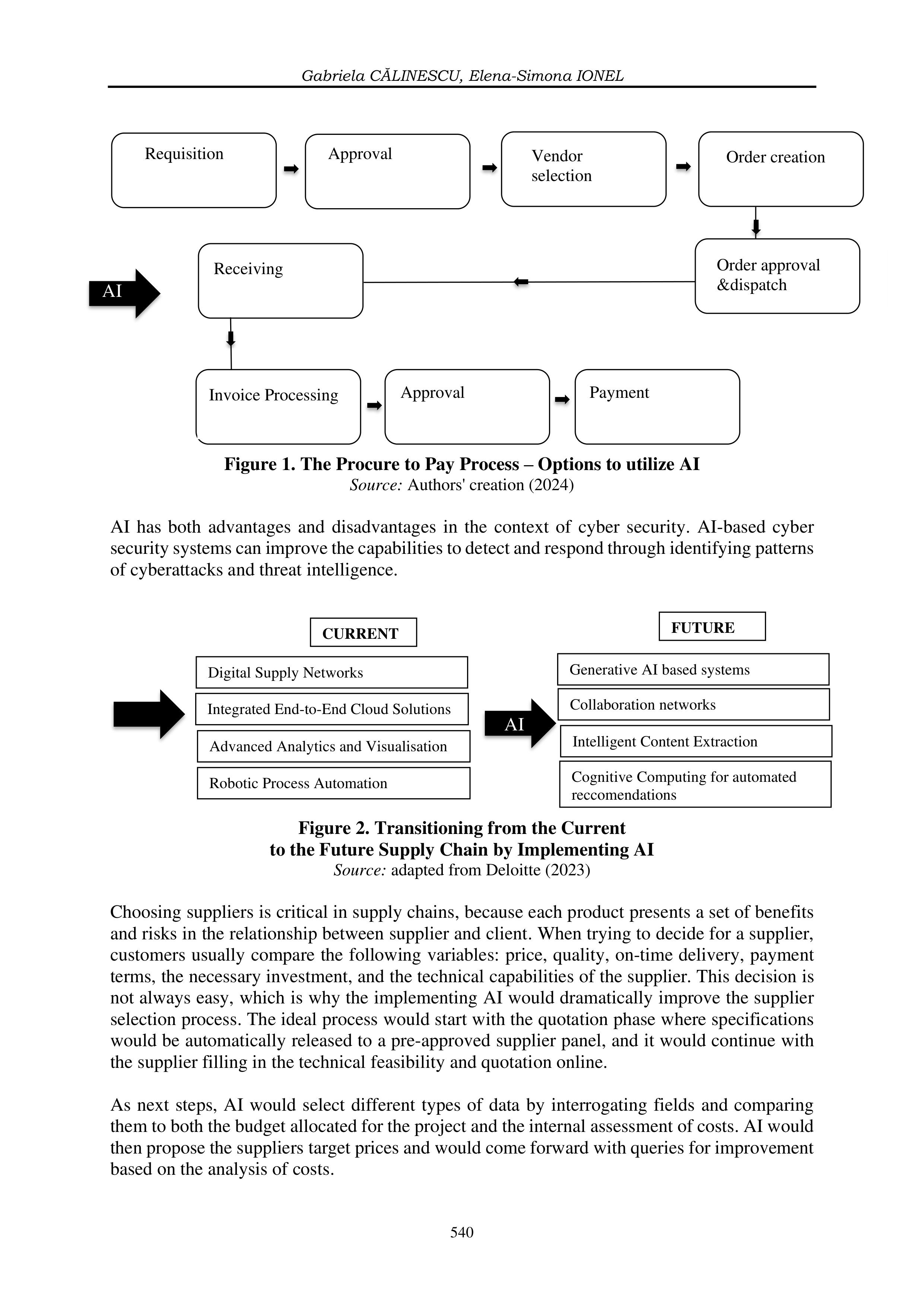
The implementation of AI could also eliminate or reduce human errors. For instance, AI could
automatically read invoices and post in an automated way, then send to payment. The risks
associated with AI in this area of the supply chain come from cyber security.











Gabriela CĂLINESCU, Elena-Simona IONEL
540
Figure 1. The Procure to Pay Process – Options to utilize AI
Source:
Authors' creation (2024)
AI has both advantages and disadvantages in the context of cyber security. AI-based cyber
security systems can improve the capabilities to detect and respond through identifying patterns
of cyberattacks and threat intelligence.
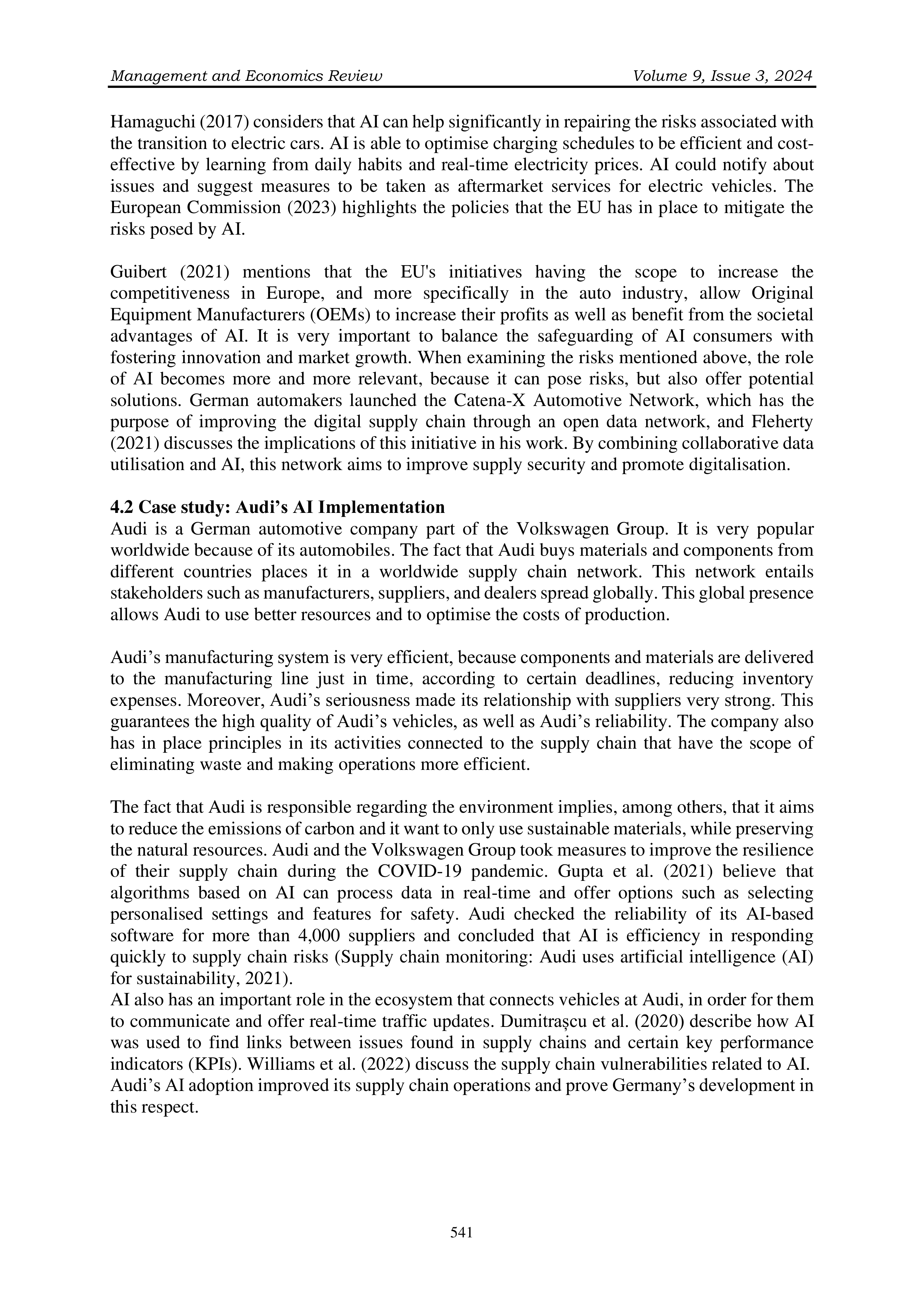
Figure 2. Transitioning from the Current
to the Future Supply Chain by Implementing AI
Source:
adapted from Deloitte (2023)
Choosing suppliers is critical in supply chains, because each product presents a set of benefits
and risks in the relationship between supplier and client. When trying to decide for a supplier,
customers usually compare the following variables: price, quality, on-time delivery, payment
terms, the necessary investment, and the technical capabilities of the supplier. This decision is
not always easy, which is why the implementing AI would dramatically improve the supplier
selection process. The ideal process would start with the quotation phase where specifications
would be automatically released to a pre-approved supplier panel, and it would continue with
the supplier filling in the technical feasibility and quotation online.
As next steps, AI would select different types of data by interrogating fields and comparing
them to both the budget allocated for the project and the internal assessment of costs. AI would
then propose the suppliers target prices and would come forward with queries for improvement
based on the analysis of costs.
Requisition
Approval
Receiving
Order creation
Vendor
selection
Order approval
&dispatch
AI
Invoice Processing
Approval
Payment
CURRENT
FUTURE
Digital Supply Networks
Generative AI based systems
Advanced Analytics and Visualisation
Intelligent Content Extraction
AI
AI
Integrated End-to-End Cloud Solutions
Collaboration networks
Robotic Process Automation
Cognitive Computing for automated
reccomendations
Management and Economics Review
Volume 9, Issue 3, 2024
541
Hamaguchi (2017) considers that AI can help significantly in repairing the risks associated with
the transition to electric cars. AI is able to optimise charging schedules to be efficient and cost-
effective by learning from daily habits and real-time electricity prices. AI could notify about
issues and suggest measures to be taken as aftermarket services for electric vehicles. The
European Commission (2023) highlights the policies that the EU has in place to mitigate the
risks posed by AI.
Guibert (2021) mentions that the EU's initiatives having the scope to increase the
competitiveness in Europe, and more specifically in the auto industry, allow Original
Equipment Manufacturers (OEMs) to increase their profits as well as benefit from the societal
advantages of AI. It is very important to balance the safeguarding of AI consumers with
fostering innovation and market growth. When examining the risks mentioned above, the role
of AI becomes more and more relevant, because it can pose risks, but also offer potential
solutions. German automakers launched the Catena-X Automotive Network, which has the
purpose of improving the digital supply chain through an open data network, and Fleherty
(2021) discusses the implications of this initiative in his work. By combining collaborative data
utilisation and AI, this network aims to improve supply security and promote digitalisation.
4.2 Case study: Audi’s AI Implementation
Audi is a German automotive company part of the Volkswagen Group. It is very popular
worldwide because of its automobiles. The fact that Audi buys materials and components from
different countries places it in a worldwide supply chain network. This network entails
stakeholders such as manufacturers, suppliers, and dealers spread globally. This global presence
allows Audi to use better resources and to optimise the costs of production.
Audi’s manufacturing system is very efficient, because components and materials are delivered
to the manufacturing line just in time, according to certain deadlines, reducing inventory
expenses. Moreover, Audi’s seriousness made its relationship with suppliers very strong. This
guarantees the high quality of Audi’s vehicles, as well as Audi’s reliability. The company also
has in place principles in its activities connected to the supply chain that have the scope of
eliminating waste and making operations more efficient.
The fact that Audi is responsible regarding the environment implies, among others, that it aims
to reduce the emissions of carbon and it want to only use sustainable materials, while preserving
the natural resources. Audi and the Volkswagen Group took measures to improve the resilience
of their supply chain during the COVID-19 pandemic. Gupta et al. (2021) believe that
algorithms based on AI can process data in real-time and offer options such as selecting
personalised settings and features for safety. Audi checked the reliability of its AI-based
software for more than 4,000 suppliers and concluded that AI is efficiency in responding
quickly to supply chain risks (Supply chain monitoring: Audi uses artificial intelligence (AI)
for sustainability, 2021).
AI also has an important role in the ecosystem that connects vehicles at Audi, in order for them
to communicate and offer real-time traffic updates. Dumitrașcu et al. (2020) describe how AI
was used to find links between issues found in supply chains and certain key performance
indicators (KPIs). Williams et al. (2022) discuss the supply chain vulnerabilities related to AI.
Audi’s AI adoption improved its supply chain operations and prove Germany’s development in
this respect.
Gabriela CĂLINESCU, Elena-Simona IONEL
542
5. CONCLUSIONS
Although AI can improve the efficiency, resilience and sustainability of automotive supply
chains, it must follow ethics and in some cases has to be accompanied by human supervision
due to the risks associated with this technology. Moreover, companies that wish to implement
AI successfully have to invest in both technological and human resources.
By using AI, Audi improved its operational efficiency and product quality and also set an
example for being sustainable, resilient, and innovative in the automotive industry. This paper
presents the opportunities to use AI in the automotive supply chain in Europe, bringing forward
a case study of the car manufacturer Audi that is a true pioneer in this respect. The literature
review shows how AI is able to mitigate high-impact supply chain risks while improving
productivity and even creating a competitive advantage. The authors of this study gathered the
hypotheses of recent and relevant studies available and compared them with the Audi case study
and their own automotive supply chain experience to check and propose areas that would
benefit most from AI implementation, while bringing the awareness that AI regulation is in its
infancy and there may be risks associated with AI usage, such as cyber security, data quality,
and privacy rights. Our study offers a broader perspective using the combined qualitative
research methods of literature review and case study. There are additional conclusions and
hypotheses that could be validated through quantitative research, a goal to be achieved by the
authors in future work.
REFERENCES
Ahmed, H. A., & Saideeep, G. (2023). From Sci-Fi to Reality: The Impact of AI on Automotive
Manufacturing and Design.
Tuijin Jishu/Journal of Propulsion Technology, 44
(2)
.
https://doi.org/10.52783/tjjpt.v44.i4.134
Crockett, E. (2023).
Artificial Intelligence (AI) in Supply Chains.
Retrieved January 11, 2024,
from https://www.datamation.com/artificial-intelligence/artificial-intelligence-in-supply-
chains/
Das, D. D. (2022).
Impacts of Artificial Intelligence on Auto Supply Chains
. Retrieved January
13, 2024, from https://www.dragonsourcing.com/impacts-of-artificial-intelligence-on-
auto-supply-chains/
Deloitte. (2023).
How Generative AI will transform Sourcing and Procurement Operations.
Retrieved January 13, 2024, from https://www2.deloitte.com/us/en/blog/business-
operations-room-blog/2023/generative-ai-in-procurement.html
Dumitrașcu, O., Dumitrașcu, M., & Dobrotă, D. (2020). Performance Evaluation for a
Sustainable Supply Chain Management System in the Automotive Industry Using
Artificial Intelligence.
Processes, 8
(11), 1384. http://dx.doi.org/10.3390/pr8111384
European Commission. (2023).
Impact of digital transformation on public governance: new
forms of policy-making and the provision of innovative, people-centric and inclusive public
services
. Retrieved January 13, 2024, from https://data.europa.eu/doi/10.2760/204686
European Parliament. (2021).
The Future of the EU Automotive Sector
. Retrieved January 13,
2024,
from
https://www.europarl.europa.eu/RegData/etudes/STUD/2021/695457/
IPOL_STU(2021)695457_EN.pdf
Fleherty, N. (2021, March 5). Germany to build digital platform for automotive industry.
eeNewsEurope
. Retrieved February 2, 2024, from https://www.eenewseurope.com/en/
germany-to-build-digital-platform-for-automotive-industry/
Guibert, I. (2021).
What the European approach to AI means for the car industry
. Retrieved
February 3, 2024, from https://logos-pa.com/insights/what-the-european-approach-to-ai-
means-for-the-car-industry/
Management and Economics Review
Volume 9, Issue 3, 2024
543
Gupta, S., Amaba, B., McMahon, M., & Gupta, K. (2021). The Evolution of Artificial
Intelligence in the Automotive Industry.
2021 Annual Reliability and Maintainability
Symposium (RAMS).
Orlando, FL, USA, 1-7. doi:10.1109/RAMS48097.2021.9605795
Hamaguchi, N. (2017).
Future of the Automotive Industry: Preparing for structural changes in
the supply chain networks
. Retrieved February 3, 2024, from https://www.rieti.go.jp/
en/papers/contribution/hamaguchi/04.html
Jacobs, T. (2023).
Unlocking the Value of Artificial Intelligence (AI) in Supply Chains and
Logistics
. Retrieved February 2, 2024, from https://throughput.world/blog/ai-in-supply-
chain-and-logistics/
Landgrebe, C. (2019).
Artificial Intelligence – a Structural Shift for the Automotive Industry
.
Retrieved
February
2,
2024,
from
https://www.bearingpoint.com/en/insights-
events/insights/artificial-intelligence-automotive/
McKinsey & Company. (2018).
Artificial Intelligence – Automotive’s New Value-Creating
Engine
. Retrieved February 5, 2024, from https://www.mckinsey.com/~/media/
mckinsey/industries/automotive and assembly/our insights/artificial intelligence as auto
companies new engine of value/artificial-intelligence-automotives-new-value-creating-
engine.pdf
Negrea, A. P., & Cojanu, V. (2015). Innovation in the European Value Chain: The Case of the
Romanian Automotive Industry.
Centre for European Studies (CES) Working Papers, 7(1)
,
126-146.
Retrieved
February
3,
2024,
from
https://ceswp.uaic.ro/articles/
CESWP2015_VII1_NEG.pdf
Pournader, M., Ghaderi, H., Hassanzadegan, A., & Fahimnia, B. (2021). Artificial intelligence
applications in supply chain management.
International Journal of Production Economics
,
241
, 108250. https://doi.org/10.1016/J.IJPE.2021.108250
Rusnak, R. (2022).
How AI Will Drive the Future of Auto Supply Chains
. Retrieved February
2, 2024, from https://www.supplychainbrain.com/blogs/1-think-tank/post/34419-ai-the-
future-of-automotive-manufacturing
Supply chain monitoring: Audi uses artificial intelligence (AI) for sustainability.
(2021).
Retrieved
January
11,
2024,
from
https://www.automotiveworld.com/news-
releases/supply-chain-monitoring-audi-uses-artificial-intelligence-ai-for-sustainability/
Tubaro, P., & Casilli, A. (2019). Micro-work, artificial intelligence and the automotive
industry.
Journal of Industrial and Business Economics
, 1-13. https://doi.org/10.1007/
s40812-019-00121-1
Van der Smagt, P. (2021).
Artificial Intelligence in the Automobile Industry
. Retrieved January
14, 2024, from https://www.europarl.europa.eu/cmsdata/240943/II.3._Patrick Van der
Smagt - 20211011 ACEA Final presentation_AIDA TRAN hearing_AI&Transport .pdf
Williams, D., Clark, C., McGahan, R., Potteiger, B., Cohen, D. & Musau, P. (2022). Discovery
of AI/ML Supply Chain Vulnerabilities within Automotive Cyber-Physical Systems.
2022
IEEE International Conference on Assured Autonomy (ICAA)
. Fajardo, PR, USA, 93-96.
doi:10.1109/ICAA52185.2022.00020