

Starbucks-CASE- Study
Marketing Principles (Royal Melbourne Institute of Technology Vietnam)
messages.pdf_cover_qr_code_label
messages.studocu_not_sponsored_or_endorsed_by_college
Starbucks-CASE- Study
Marketing Principles (Royal Melbourne Institute of Technology Vietnam)
messages.pdf_cover_qr_code_label
messages.studocu_not_sponsored_or_endorsed_by_college
messages.downloaded_by
lOMoARcPSD|69086902


M A N A G I N G A C R O S S C U L T U R E S
S T A R B U C K S C A S E S T U D Y
Lessons from Success and Failure for the Future
Your team is to act as a consulting organisation that
specializes in intercultural management; provide
expertise on how the organisation can better facilitate
communication, management and effective
interactions across borders with other organisations
(suppliers, collaborators, subsidiary) or customers.
Your team has been asked to improve the performance
of the case study organisation or provide a solution to a
problematic situation (such a situation may have been
reported on in the press). You will create a 4000 word
report outlining the background to the case, analyzing
the case (particularly from the perspective of
intercultural management) and finally highlighting 4-5
key recommendations that you argue will improve the
organisations performance in this area.
Your research will analyse factors that have led to any
issues or difficulties in the past, and provide a structured
argument leading to recommendations for changes to
practice in the future. Referencing of peer review
materials is required to provide evidence for your claims
and recommendations, and to inform your analysis and
discussion throughout.
TEAM
Truong Nguyen Thanh Vy s3462020
Kim Kyeong Beom s3653049
Yu Chun Chen s3635541
Sean Caricola s3690145
messages.downloaded_by
lOMoARcPSD|69086902
Table of Contents
STARBUCKS CASE STUDY ............................................................................................................................. 1
EXECUTIVE SUMMARY .................................................................................................................................. 2
INTRODUCTION ............................................................................................................................................ 3
Company Background ............................................................................................................................. 3
Competitive Advantage .......................................................................................................................... 3
SUCCESS IN VIETNAM .................................................................................................................................. 5
Winning Formula ........................................................................................................................................ 5
FAILURE IN AUSTRALIA ................................................................................................................................. 7
Australian Consumer Culture Overview ................................................................................................. 7
Marketing Failures ...................................................................................................................................... 8
Strategic Failures ........................................................................................................................................ 9
NEW MARKET: ITALY ..................................................................................................................................... 9
PEST Analysis ............................................................................................................................................. 11
Recommendations .................................................................................................................................. 12
REFERENCES ................................................................................................................................................ 12
E X E C U T I V E S U M M A R Y
Starbucks is one of the world’s leading global coffee brands and has been changing the way the world drinks
coffee outside of home and work. The global expansion of this brand has been increasing rapidly, and it has
opened stores in many countries such as Japan, Latin America, Russia, Australia and Vietnam. The brand’s
footprint has grown to reach more than 75 countries worldwide and is expected to continue to grow
significantly in 2018. The purpose of this report is to analyse how cultural differences have affected Starbucks’s
way of doing business in Vietnam and Australia.
By demonstrating how it achieved success in Vietnam’s nuanced coffee market, the report focuses on
statistical and empirical research to extrapolate how Starbucks adapted and localised itself to be aligned
with Vietnam’s cultural heritage and consumer preferences. Meanwhile, the report explores how brand
arrogance and lack of cultural awareness led to its dramatic retreat from Australia, another country with an
equally nuanced and famous coffee culture. The inherent lessons supplied by Starbucks’ Vietnamese and
Australian forays serve as a basis for analysis and caution when entering a new market, such as Italy. This
report will iterate why Starbucks and other global business must not neglect cultural differences when
attempting to enter foreign markets, and that international expansion is not a one-size-fits-all scenario. What
works in one place may not necessarily work in another. Large corporations must endure to
think global and
act local
- observation, cultural awareness and ethnography may save years and generate profit for
Starbucks in the future.
messages.downloaded_by
lOMoARcPSD|69086902

I N T R O D U C T I O N
Company Background
Starbucks is one of the world’s most recognisable brands – the American global coffee company from
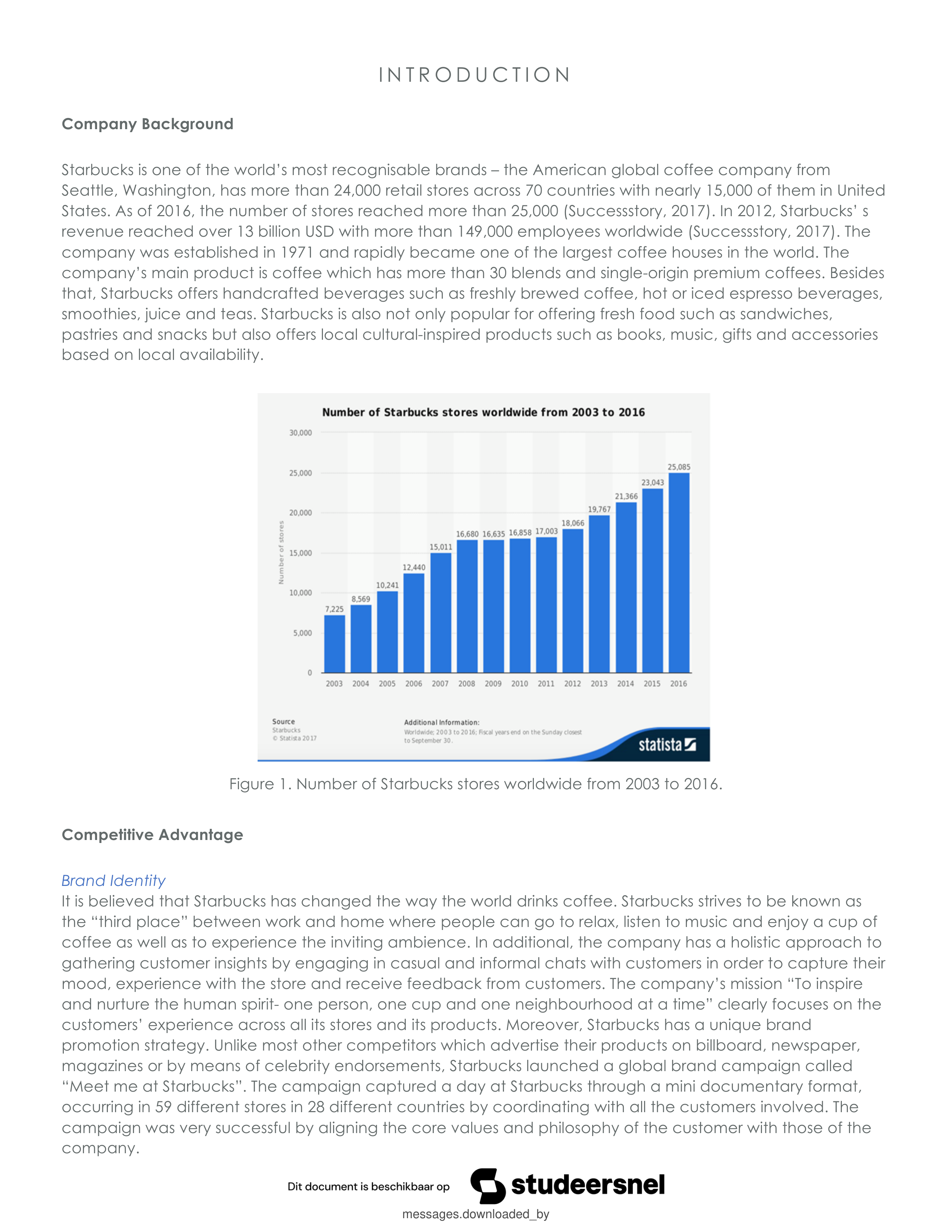
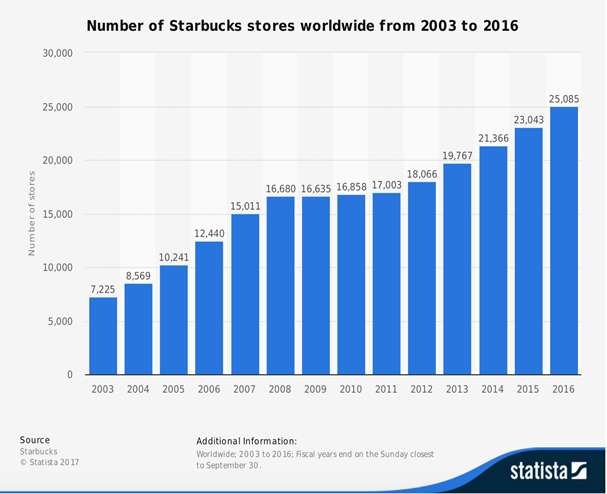
Seattle, Washington, has more than 24,000 retail stores across 70 countries with nearly 15,000 of them in United
States. As of 2016, the number of stores reached more than 25,000 (Successstory, 2017). In 2012, Starbucks’ s
revenue reached over 13 billion USD with more than 149,000 employees worldwide (Successstory, 2017). The
company was established in 1971 and rapidly became one of the largest coffee houses in the world. The
company’s main product is coffee which has more than 30 blends and single-origin premium coffees. Besides
that, Starbucks offers handcrafted beverages such as freshly brewed coffee, hot or iced espresso beverages,
smoothies, juice and teas. Starbucks is also not only popular for offering fresh food such as sandwiches,
pastries and snacks but also offers local cultural-inspired products such as books, music, gifts and accessories
based on local availability.
Figure 1. Number of Starbucks stores worldwide from 2003 to 2016.
Competitive Advantage
Brand Identity
It is believed that Starbucks has changed the way the world drinks coffee. Starbucks strives to be known as
the “third place” between work and home where people can go to relax, listen to music and enjoy a cup of
coffee as well as to experience the inviting ambience. In additional, the company has a holistic approach to
gathering customer insights by engaging in casual and informal chats with customers in order to capture their
mood, experience with the store and receive feedback from customers. The company’s mission “To inspire
and nurture the human spirit- one person, one cup and one neighbourhood at a time” clearly focuses on the
customers’ experience across all its stores and its products. Moreover, Starbucks has a unique brand
promotion strategy. Unlike most other competitors which advertise their products on billboard, newspaper,
magazines or by means of celebrity endorsements, Starbucks launched a global brand campaign called
“Meet me at Starbucks”. The campaign captured a day at Starbucks through a mini documentary format,
occurring in 59 different stores in 28 different countries by coordinating with all the customers involved. The
campaign was very successful by aligning the core values and philosophy of the customer with those of the
company.
messages.downloaded_by
lOMoARcPSD|69086902
Human Resource Management
Starbucks has an effective human resource policy for its employees as it considers them as partners.
According to Martinrol (2017), Starbucks has a training program for their baristas and employees. A barista is
required to be friendly and remember the name of the customer and their favourite drink for the next visit.
Furthermore, the employees are required not to wear perfume or cologne. As De Wit and Meyer (2010)
highlighted, Starbucks not only offers stock options for its employees, it also provide free healthcare insurance
for full time and part-time employees. Additionally, the company also offers opportunities for their US
employees to complete an online bachelor’s degree. This ensures their employees are empowered, satisfied
and reduces the level of employee turnover at Starbucks.
Differentiation strategy
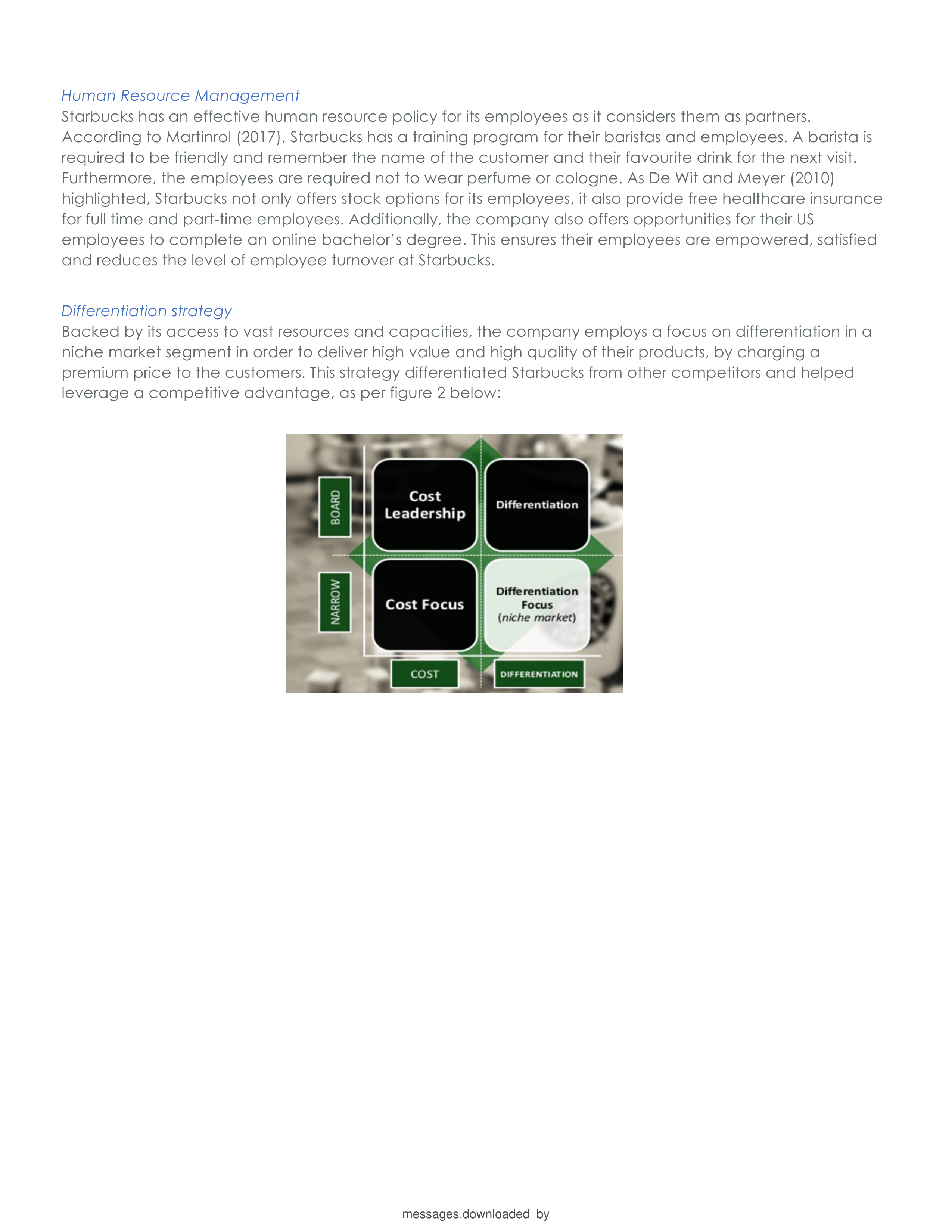
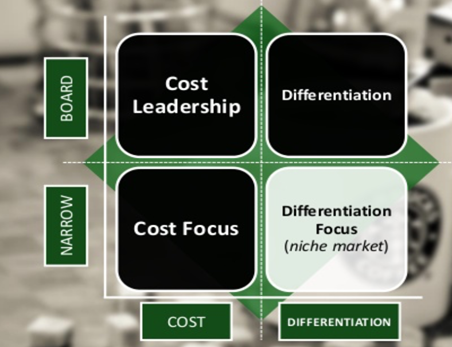
Backed by its access to vast resources and capacities, the company employs a focus on differentiation in a
niche market segment in order to deliver high value and high quality of their products, by charging a
premium price to the customers. This strategy differentiated Starbucks from other competitors and helped
leverage a competitive advantage, as per figure 2 below:
messages.downloaded_by
lOMoARcPSD|69086902

S U C C E S S I N V I E T N A M
Overview
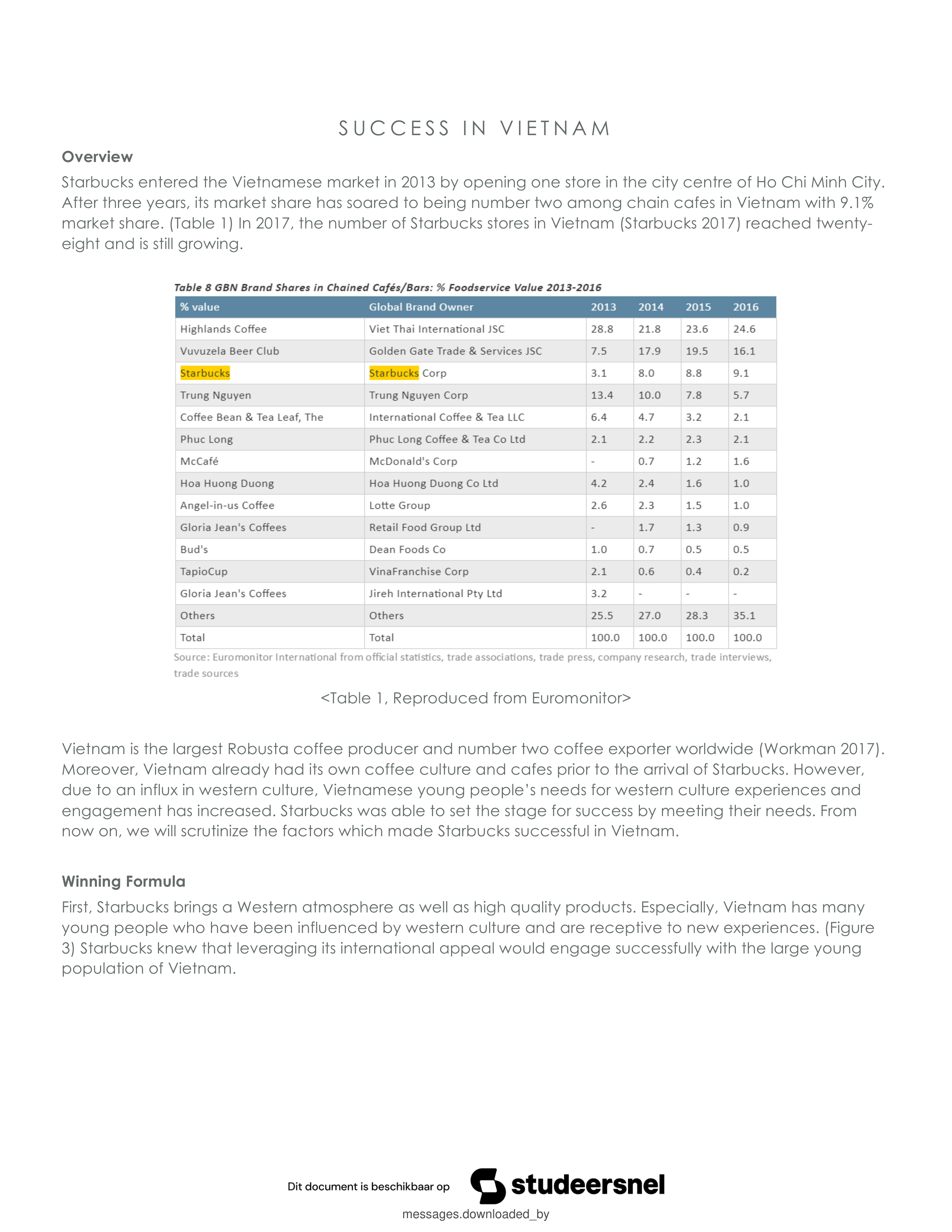
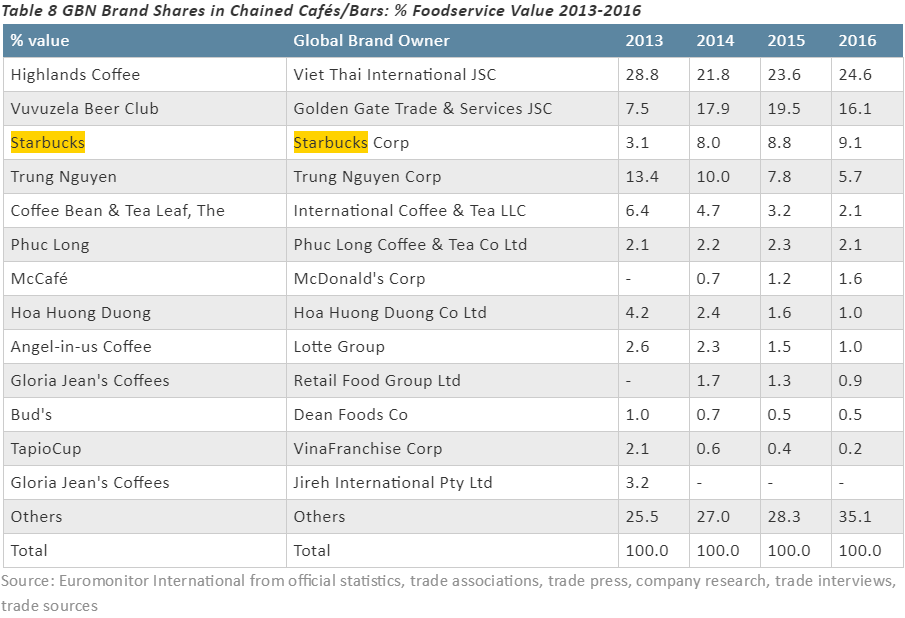
Starbucks entered the Vietnamese market in 2013 by opening one store in the city centre of Ho Chi Minh City.
After three years, its market share has soared to being number two among chain cafes in Vietnam with 9.1%
market share. (Table 1) In 2017, the number of Starbucks stores in Vietnam (Starbucks 2017) reached twenty-
eight and is still growing.