

Strategy for Growth and Market Leadership:
The Netflix Case
Kishwar Joonas
Ahmed Y. Mahfouz
Rolanda A. Hayes
Prairie View A&M University
(kajoonas@pvamu.edu)
(aymahfouz@pvamu.edu)
(rhayes19@pvamu.edu)
DOI:
10.26573/2023.17.2.2
Volume
17
, Number
2
May
2023
, pp.
87-102
This case study is from Netflix, which started in 1997 as a small online DVD
rental company in Scotts Valley, CA, U.S.A. In 2022 Netflix was available
Internet-connected with over 221 million
subscribers. In terms of strategy, some
of the case questions we addressed were: firstly, how did Netflix evolve from a
DVD retailer shop to a successful online streaming platform? And secondly,
how did Netflix cope with the growing competition in the U.S.A. and around the
world? With the growth of Information Technology, Netflix introduced an online
website with affordable packages, locking in their U.S.A. users, to achieve
remarkable growth, and become the market leader.
Keywords:
Management Information Systems, Online subscription, Web-
based Services, Marketing, Strategy, Marketing Mix, Consumer Behavior,
Netflix, Case Study, U.S.A.
1.
Introduction
1.1
Some Theoretical Considerations
Marketing strategy is defined as “an organization's promotional efforts to allocate its
resources across a wide range of platforms, channels to increase its sales and achieve
sustainable competitive advantage within its corresponding market” (Baker, 2008 p.
3). According to the Resource-based View of Competition (RBV), firms need to have
unique core competencies
suggests that organizations must develop and utilize in a
superior way, unique, firm-specific core competencies in order to compete
successfully in the market (Prahalad & Hamel, 1990).
The RBV posits that a firm’s
resources can potentially create sustainable competitive advantage if they are “rare,
valuable, and imperfectly imitable” (Barney, 1991). As an extension, other authors
classified competition based on price, quality, innovation, service, benefit, and tailored
positioning (e.g., Hooley et al., 2001). Another stream of research comprises some of
the earliest writings on the marketing mix paradigm in the pursuit of marketing
objectives, which can be traced to three researchers. To make a marketing plan
actionable, the idea of a marketing mix was proffered, often referred to as the 4Ps –
Product, price, place, and promotion (McCarthy, 1964). The term was used by another
researcher (Borden, 1965), who claimed to have derived it from Culliton (1948). In
response to changes in the marketing environment, new Ps were proposed, namely
people, processes, programs and performance (Kotler & Keller, 2016 p. 26). Another
researcher reviewed of the marketing mix in specific areas such as consumer
marketing, relationship marketing, services marketing, retail marketing, industrial
88
AIMS International Journal of Management
17(2)
marketing and eCommerce (Constantinides, 2006). Several authors criticized the
marketing mix paradigm (e.g., Lauterborn, 1990; Constantinides, 2006, and Popovic,
2006). Regardless, the 4Ps marketing mix paradigm continues to be in use among
researchers and practitioners, while little support was found for new Ps of marketing
(Kent & Brown, 2006). Our study will incorporate some of these theoretical concepts.
1.2
Case Study Approach
In this case study, we adopted the qualitative research method, which suggest that a
society is constructed through relationships created among individuals, and is not a
given. Also, we subscribed to the constructivist approach, viewing businesses as
complex and integrated social systems, which calls for comprehension of “how” things
occurred, before arriving at the “why”. Further, we adopted an ideographic research
strategy, which tries to understand phenomena in a given context, without attempting
to generate generalizable results (Gagnon, 2010). We conducted bibliographic
research primarily from trade journals. Given the context of Netflix, we examine
elements of market strategy in offerings of Netflix as well as selected firms in the
industry.
1.3
Industry and Company Background
The movie retail and marketing industry is service-based, and is built from a unique
business model. One of early entrants, Blockbuster initiated a rental market business
model that attracted consumers worldwide. The successful strategic approach gave
Blockbuster a competitive edge over its rivals in the movie retail industry. As a new
competitor in the industry, Netflix adopted the same strategy and built its organization
around the original mail-order business model. Netflix successfully outcompeted its
rival by introducing a no-fee policy, a large selection of movies, and fast delivery
processes. Netflix applied different marketing strategies from Blockbuster to control
the video industry.
In 1997, Marc Randolph and Reed Hastings started Netflix as an online DVD rental
company in Scotts Valley, CA, U.S.A. The word Netflix is an abbreviation of the
wherein “Net” represents the Internet, and “flix” is a variation of the word “flicks”
which means films (Dunn, 2017). The company started as a small business for the
video market without any relationship with studios. And, in two years, the company
adopted a subscription model that successfully reigned over competitors. The Netflix
model was website-based, and consumers rented DVDs via direct mail, which served
as a competitor for Blockbuster shops that hired videos. With the growth of
Information Technology, the company strived to bridge the gap between Hollywood
and its competitors; it was the digital disruptor for movies in the world. Competitors
and media companies such as Disney, HBO, Blockbuster, and Sony possess the
necessary reasons to lament Netflix's rise, following the spawned windfall of DVDs
(Barr, 2011). Netflix's strategic web-based plans spoiled the competitor's digital media
such as high-definition physical format and initiated the struggle for market share,
decline in consumer ratings, and audience fragmentation.
Online subscription via the web was becoming popular because of expanding
Internet coverage. The movie entertainment industry was starting to ignore the
traditional techniques of Netflix's IT-based strategy for competitive advantage.
Competitors such as Blockbuster tried to adjust to an e-commerce website for online
Joonas, Mahfouz, Hayes
89
retail but failed due to struggling models and inadequate resources, and finally shut
down in 2014 (Trendowski & Sherman, 2014).
In 2007, Netflix adopted online streaming services that enhanced instant enjoyment
via personal computers and television shows. It also partnered with other customer
electronic companies to increase its compatibility and user base worldwide. Netflix
entered the Australian market in 2015 through a great partnership with iiNet and Optus
internet service providers. Their growth resulted from success in the U.S.A. market
and a free month trial program to its services. As a roll-out plan of penetration to the
Asia market, Netflix registered as a limited liability partnership in India to commission
its content.
1.4
Description of Company's Business: Netflix
Netflix started as a subscription DVD business in 1997, when it rented DVDs to its
customers in the U.S.A. for a fee. Netflix has now grown, and streams movies in over
190 counties globally and has more than 221 million paid subscribers (Stoll, 2023).
The platform has a variety of films documentaries and features an assortment of TV
series from different languages and genres, including their own original productions.
They entered the “over-the top” format, and introduced streaming branded as “Watch
Now”. This new streaming enabled customers to view movies and television programs
on their computers in real time, after they realized that streaming was the future for
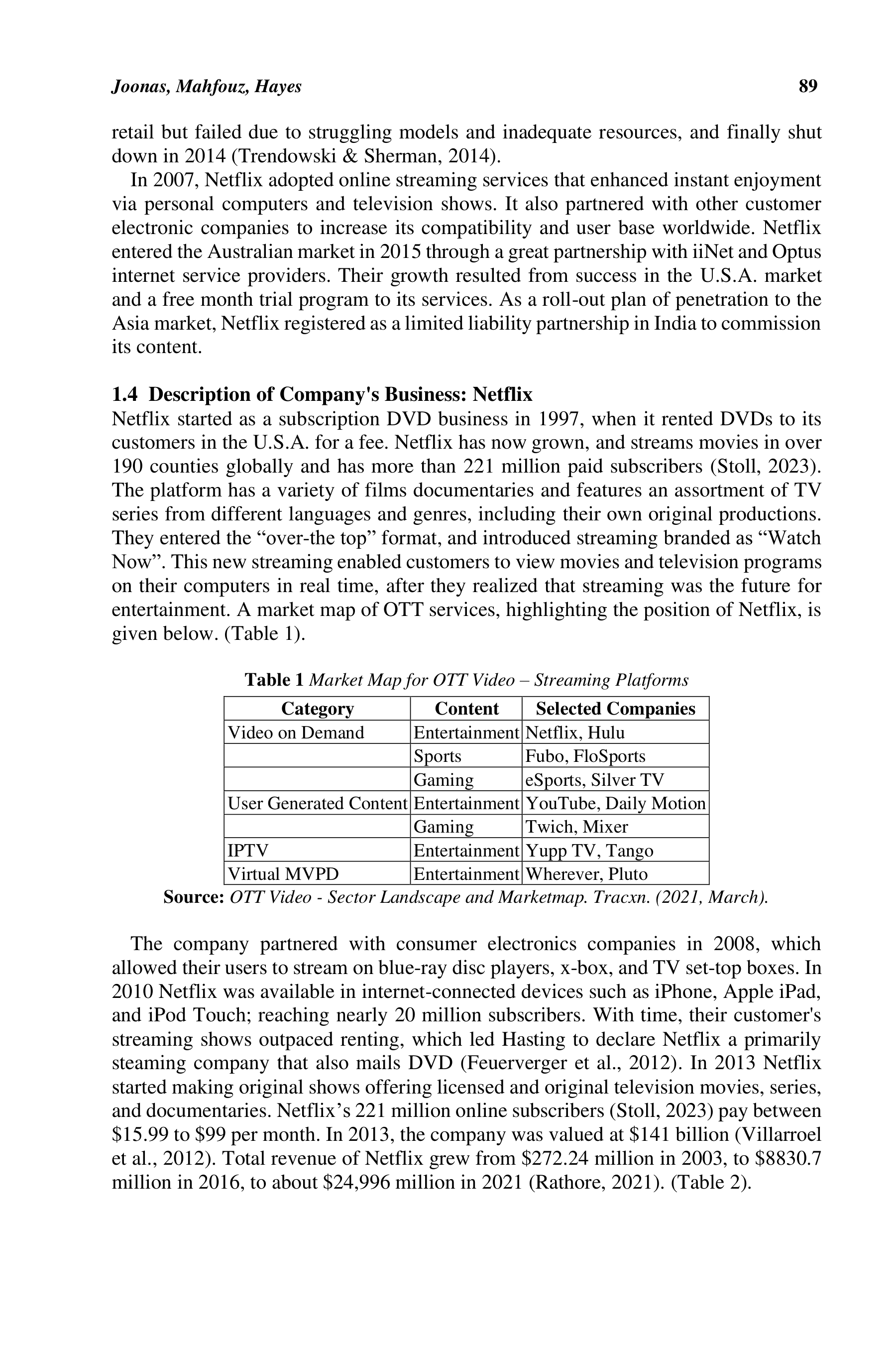
entertainment. A market map of OTT services, highlighting the position of Netflix, is
given below. (Table 1).
Table 1
Market Map for OTT Video – Streaming Platforms
Category
Content
Selected Companies
Video on Demand
Entertainment Netflix, Hulu
Sports
Fubo, FloSports
Gaming
eSports, Silver TV
User Generated Content Entertainment YouTube, Daily Motion
Gaming
Twich, Mixer
IPTV
Entertainment Yupp TV, Tango
Virtual MVPD
Entertainment Wherever, Pluto
Source:
OTT Video - Sector Landscape and Marketmap. Tracxn. (2021, March).
The company partnered with consumer electronics companies in 2008, which
allowed their users to stream on blue-ray disc players, x-box, and TV set-top boxes. In
2010 Netflix was available in internet-connected devices such as iPhone, Apple iPad,
and iPod Touch; reaching nearly 20 million subscribers. With time, their customer's
streaming shows outpaced renting, which led Hasting to declare Netflix a primarily
steaming company that also mails DVD (Feuerverger et al., 2012). In 2013 Netflix
started making original shows offering licensed and original television movies, series,
and documentaries. Netflix’s 221 million online subscribers (Stoll, 2023) pay between
$15.99 to $99 per month. In 2013, the company was valued at $141 billion (Villarroel
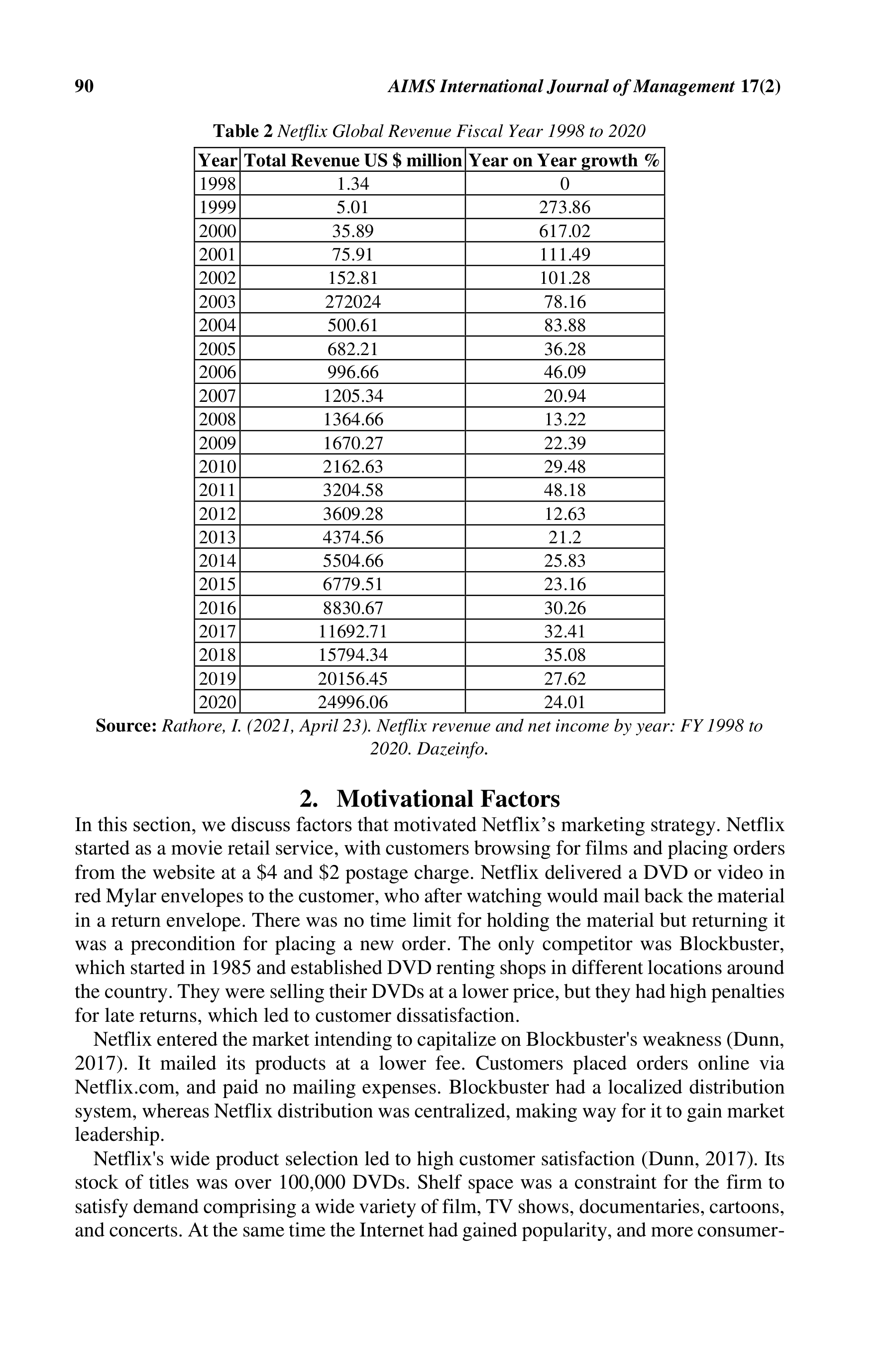
et al., 2012). Total revenue of Netflix grew from $272.24 million in 2003, to $8830.7
million in 2016, to about $24,996 million in 2021 (Rathore, 2021). (Table 2).
90
AIMS International Journal of Management
17(2)
Table 2
Netflix Global Revenue Fiscal Year 1998 to 2020
Year Total Revenue US $ million Year on Year growth %
1998
1.34
0
1999
5.01
273.86
2000
35.89
617.02
2001
75.91
111.49
2002
152.81
101.28
2003
272024
78.16
2004
500.61
83.88
2005
682.21
36.28
2006
996.66
46.09
2007
1205.34
20.94
2008
1364.66
13.22
2009
1670.27
22.39
2010
2162.63
29.48
2011
3204.58
48.18
2012
3609.28
12.63
2013
4374.56
21.2
2014
5504.66
25.83
2015
6779.51
23.16
2016
8830.67
30.26
2017
11692.71
32.41
2018
15794.34
35.08
2019
20156.45
27.62
2020
24996.06
24.01
Source:
Rathore, I. (2021, April 23). Netflix revenue and net income by year: FY 1998 to
2020. Dazeinfo
.
2.
Motivational Factors
In this section, we discuss factors that motivated Netflix’s marketing strategy. Netflix
started as a movie retail service, with customers browsing for films and placing orders
from the website at a $4 and $2 postage charge. Netflix delivered a DVD or video in
red Mylar envelopes to the customer, who after watching would mail back the material
in a return envelope. There was no time limit for holding the material but returning it
was a precondition for placing a new order. The only competitor was Blockbuster,
which started in 1985 and established DVD renting shops in different locations around
the country. They were selling their DVDs at a lower price, but they had high penalties
for late returns, which led to customer dissatisfaction.
Netflix entered the market intending to capitalize on Blockbuster's weakness (Dunn,
2017). It mailed its products at a lower fee. Customers placed orders online via
Netflix.com, and paid no mailing expenses. Blockbuster had a localized distribution
system, whereas Netflix distribution was centralized, making way for it to gain market
leadership.
Netflix's wide product selection led to high customer satisfaction (Dunn, 2017). Its
stock of titles was over 100,000 DVDs. Shelf space was a constraint for the firm to
satisfy demand comprising a wide variety of film, TV shows, documentaries, cartoons,
and concerts. At the same time the Internet had gained popularity, and more consumer-
Joonas, Mahfouz, Hayes
91
based companies were opting for it as an IT-based strategy. Blockbuster had online e-
Commerce and joined the retail market but lacked resources. Hence, they signed
contracts with other companies and invested heavily to sell DVDs online. However,
they could not successfully compete with Netflix (Malviya & Laghate, 2018).
On the one hand, Netflix faced challenges as transportation and logistics in the
distribution of DVDs. On the other, the use of the Internet was growing. Netflix
explored innovative ways of utilizing Information Technology to bridge the gap
between physical and virtual consumers worldwide. In terms of strategy, some of the
case questions that Netflix Corporation attempted to address regarding IT were:
•
How did Netflix will evolve from a DVD retailer shop to a successful online
streaming platform?
•
How does Netflix cope with the growing competition in the United States and
around the world?
•
How did Netflix sustain its growing market globally?
3.
Description of the Study
3.1
Relationship between Product, Pricing, and Distribution
Especially is a situation where the product line and product depth are large,
determining the optimal product and size can pose a challenge. Extensive stocks are
required to cater to a wide variety of tastes and preferences. This factor, along with
direct mail of DVDs, would increase costs and prices. On the other hand, cutting down
on inventory would result in limiting customer choice, reducing sales volume, and
increasing costs and prices. Also, the geographical constraint is a predominant factor
in costs and prices (Malviya & Laghate, 2018). Netflix overcame this dilemma with
the crucial switch to online distribution.
3.2
Strategy for Change
“Firms develop strategy by choosing their view of the future” (Kotler & Keller, 2016
p. 47). Below, we discuss the Netflix strategy for change.
Defining and Fulfilling Needs:
A need family is “the core need that underlies the
existence of a product family” (Kotler & Keller, 2016 p. 380). The importance that
customers place on movies and series is often discounted, but Netflix described
entertainment as a core need. The company was a pioneer in entertaining the world by
giving more empathy, joy, and laughter. Entertainment relieves stress, nurtures
culture, promotes creativity. In addition, it provides distraction from monotonous
routine, promotes productivity. In addition, it develops self-esteem and friendships
(Divine You Wellness, 2021).
Creating the Market Offerings:
“… a market offering is a distinct entity that (1) is
composed of a bundle of attributes, which (2) may be tangible or intangible, objective
or subjective, and which (3) may be viewed by some buyer(s) as a want satisfier.”
(Hunt, 2010 p. 54). The core need for Netflix was fulfilled through a product/service
mix of DVDs, streaming, and content production. This satisfies the definition of a
market offering (Hunt, 2010 p.54). Based on the service mix, Netflix falls under the
category “major service, with accompanied with minor goods and services” (Kotler &
Keller, 2016 p. 400). This entailed supporting goods such as DVDs (Borden, 1965;
92
AIMS International Journal of Management
17(2)
McCarthy, 1964), and a substantial investment in capital good (servers) and services
(systems) (Barney, 1991; Hooley et al., 2001; Prahalad & Hamel, 1990). Netflix
created and differentiated their unique market offerings based on attributes and their
level of tangibility (DVDs are tangible, while streaming is intangible). Some of these
attributes are objective, such as quality of DVDs, speed of delivery or streaming, while
others are subjective, depending on individual preferences. Finally, each market
offering is seen by a set of buyers as satisfying their needs and wants (Hunt, 2010 p.
54).
Marketing Innovation – Product, Pricing, and Distribution:
Market mega-trends
call for innovation in marketing strategy. A mega-trend is “a large social, economic,
or technological change which is slow to form, and once in place, influences us for
some time – between seven and ten years, or longer” (Kotler & Keller, 2016 p. 73).
Film studios faced a changed business environment, in which primary sales would no
longer be generated by physical theatre ticket sales. A major threat to movie ticket
sales came from DVD rentals by Blockbuster, Netflix and later Redbox, which charged
a dollar per day for renting movies through widely available kiosks. In the movie
industry, at least one company, Warner Brothers, adopted a strategy of simultaneous
release of DVD, Internet offering, and cable; as well as video games based on its film
characters though Warner Interactive. Disney achieves maximum market coverage,
and offers a range of prices for the same video, by using its theme parks, Disney TV,
as well as brick-and mortar Disney outlets to distribute family-friendly movies (Kotler
& Keller, 2016 p. 48). Disney is also a prime example of a multi-channel marketing
strategy, as it distributes its videos through not only these outlets, but also through
Redbox, Netflix, its own and other online stores, its own catalog, and other catalog-
based sellers (Kotler & Keller, 2016 p. 495). These actions also relate to Resource
Based View of competition (Barney, 1991; Hooley et al., 2001; Prahalad & Hamel,
1990), and the marketing mix (Borden, 1965; McCarthy, 1964).
Websites are critical in overcoming geographical limits and shelf space (Feuerverger
et al., 2012). Web services provide a wide range of selections which attract more
customers. With the growth of Information Technology, Netflix introduced a website
with an affordable package to compete with its stiff competitors such as Disney and
Apple, who offer packages worth $5 and $7 per month to help keep their U.S.A. users
locked (Lüsted, 2013). The website enabled the company to transit from a DVD
retailer to an online streaming shop successfully. New content is the core benefit from
Netflix's way of maintaining its leadership position, as other platforms put more effort
into their streaming services. Further, Netflix's web distribution was a critical strategic
component to counter the challenges posed by market aggression, competition, and
technology disrupters. Supported by internal logistics software, web-based
subscription was crucial in eliminating the costs of DVD's logistics (Barney, 1991;
Hooley et al., 2001; Prahalad & Hamel, 1990).
The use of self-service technology (Kotler & Keller, 2016 p. 421) enables speedy
delivery on the web-based program, depending on consumer internet bandwidth, thus
providing better service, and improved consumer satisfaction. In addition, the pricing
strategy is of utmost importance. The web-based subscription provided unlimited
movie selection at an affordable fee. The website had a much larger inventory of new
movies as opposed to traditional distribution. Web-based subscription was responsive
Joonas, Mahfouz, Hayes
93
to consumer preferences by eliminating late fee payments and penalties. Netflix
digitized its content from physical DVDs to online streamed content stored on its
servers. It acquired movies and offered viewing access on a variety of distribution
channels, including internet-accessible TV sets, and devices such as smartphones,
computers, and tablets, where downloads were also possible. Netflix evolved from
traditional marketing, characterized by mail-order distribution of DVDs, to online
distribution by adapting to technology (Berry et al., 2010). Social media and film
festivals were other channels used by Netflix for distribution). The above elements
lend credence to the Resource Based View of competitive advantage (e.g., Barney,
1991; Hooley et al., 2001; Prahalad & Hamel, 1990).
Personalized Marketing
refers to “making sure that the brand and its marketing are
as personally relevant as possible to as many customers as possible” (Kotler & Keller,
2016 p. 146), and competitive positioning (Hooley et al., 2001). Technology enabled
Netflix to personalize their offerings and forge positive long-term loyalty
relationships.
Evaluating and Selecting Market Segments and Targets:
Similar to its competitor
Amazon, Netflix undertakes full market coverage, serving all customers with all their
products. This is achieved through differentiated marketing, satisfying needs and
wants of different segments. Both Amazon and Netflix leveraged technology to change
consumer buying behavior. As a result, “hit” content comprises half of the firm’s
revenues, while the other half comes from lower-selling products or niches “down the
tail”, unlike what we observe in the Pareto principle (80-20 rule). Besides increasing
customers’ choice, it reduces search costs for products, since the Internet is replete
with information, user preference data from vendors, as well as e-word -of-mouth
(Anderson, 2006; Kotler & Keller, 2016 p. 267).
Brand Positioning and Equity:
DirecTV stands out basically as a digital satellite
service provider/distributor of multichannel video programming. On the other hand,
Netflix, Hulu and Amazon are associated with digital access through streaming and
downloads (Kotler & Keller, 2016 p. 275). Netflix, along with Amazon and DirecTV,
scores high on strength and stature, representing a leadership position based on the
brand’s status and overall performance. (Kotler & Keller, 2016 p. 305).
Market Challenger Strategy:
To increase market share, Netflix adopted the strategy
“attack the status quo”. The company stood out in the entertainment industry with
largely unmet customer needs, failing to adequately address the changing marketing
environment, especially customer behavior patterns (Kotler & Keller, 2016 p. 343).
Promotion:
Netflix used a strategy of a free month trial to enable new users to view
its catalog and decide whether to subscribe to the platform. The free service attracted
more subscribers, especially if a program they watched was unavailable on other media
(Rettie, 2001).
Global Markets:
Moreover, with the need to grow globally, companies adopted the
entry strategy of the “waterfall approach, gradually entering markets in sequence”
(Kotler & Keller, 2016 p. 220). Starting in 2010, Netflix made inroads into Canada,
94
AIMS International Journal of Management
17(2)
Ireland, Latin America, the Nordic countries, and U.K. (Kotler & Keller, 2016 p. 232).
More recently, Netflix management focused on the Indian market (Malviya & Laghate,
2018). Thus, Netflix has changed from being a mere distribution channel for movies,
into a content producer in its own right. With its website, the company rolled out cost-
friendly, mobile plans in Asia, growing from 4 from 4 million customers to a target of
100 million subscribers. Netflix focused on consistency and provision of its services
under one brand and website. The company also had to develop its own content to
cope with the gradual rise in copyright law for licensing over the years. (Berry et al.,
2010). On the other hand, its competitor Amazon made an early entry and found
success in Europe, including U.K. and Germany. However, it did not fare as well in
Asia-Pacific, particularly China. Another distribution strategy for DVD and streaming
business was through a European acquisition. In addition, Amazon picked London to
invest in a research and development unit, along with covering a couple of hundred
countries to distribute through Appstore (Kotler & Keller, 2016 p. 232).
3.3
Role of Technology on the Netflix Platform
In 2007 Netflix changed to an online subscriber-based model, providing their
customers with a digital streaming platform with a variety of films 24/7. The website
has grown into one of the world's most comprehensive entertainment platforms, and
in 2019 it had 2.7 million DVDs mails (Monahan & Griggs, 2019), and over 180
million total subscribers (McFadden, 2023). Further, in July 2020, Netflix had a
market cap of $209.74 billion and a $476.89 share price (McFadden, 2023).
As of 2007, Netflix started adopting Information Technology to stream its services.
Netflix developed and offered its services via the public application programming
interface (API) through its online website (Berry et al., 2010). The e-commerce
website allowed customers to access data to manage their movies queues and Netflix
catalogs and titles. The API was easy to access, free, had a forum for questions and
answers, and was allowed for commercial use. Some examples of the Netflix API
include Rotten Tomatoes, on which consumers could click and enter titles to their
Netflix “wish list”, and view the films from the system. Moreover, the API was critical
in allowing the Netflix developer to produce applications for mobile devices. For
example, in 2009 and 2010, Netflix made official Nokia and iPhone app that allowed
trailer streaming. As of 2012, Netflix restricted public API and started focusing on
private interfaces.
To find out the popularity of movies among its customers, Netflix used predictive
analysis (Fouladirad et al., 2018). The analysis was Artificial Intelligence powered,
and based on customer history, demographics, and preferences.
Technology has helped Netflix innovate and build a business that grew be to the top
streaming platform in the world. By utilizing digital technologies, Netflix was able to
break down barriers in the platform, interact with customers and ultimately grow to be
the market leader (Goldfayn, 2012). Technology proved to be a resource that Netflix
used in a superior manner to achieve competitive advantage (e.g., Barney, 1991;
Hooley et al., 2001; Prahalad & Hamel, 1990)
4.
Implementation
Netflix adapted and continues to adopt new technologies to better customer
experience. Technology is the leader of the streaming industry (Berry et al., 2010).
Joonas, Mahfouz, Hayes
95
Netflix streams its films at full HD resolution and plans to do Ultra HD format. For
Netflix to be successful, the film ensures there is reliable support for connected devices
globally.
The company utilizes Microsoft technologies and codecs such as Windows Media
Audio and VC-1 for audio and video. As a result, the company’s rapid diversification
enhanced the encoding of multiple formats for video as well as audio. Netflix encodes
the same title in 120 unique ways, and delivers them on all platforms because of the
vast number of available combinations.
Currently, the latest technology utilized by Netflix is DCT. The coding format for
video is based on Advance Video Coding HEVC (H.265) because it is globally
supported by consumers' devices such as television sets, web browsers, and mobile
devices. Select titles are streamed with AV1 codec, which is independent of any
royalty payments, and is between 20 and 40 per cent more efficient than H.265 (Green,
2022).
As of 2012, the company started to utilize Open Connects, which are run by unique
operating systems characterized by less power requirement, and enhanced storage. The
custom content delivery network offered Netflix settlement freely peers with internet
service providers directly at common internet exchange points. For over 100,0000
subscribers, the company provided Netflix Open Connect server appliances which cut
the cost of connectivity by placing content in a cache in the internet service providers’
data centers. By 2016, Netflix had closed all their physical data centers, and continues
to grow its Open Connect.
The company has a controlled software that runs a variety of plans such as bill
payment every month, a one-month free trial for new users, the wide selection of TV
shows and movies, taking reviews from its users, subscriber rating, and online trailers
(Delimitrou & Kozyrakis, 2013). This ensures that Netflix remains the most dominant
player in the streaming services in terms of subscriptions
(Goldfayn, 2012). It has an
ever-growing catalog of TV shows and films. Its cheapest package is $9 per month
and $14 for the most standard plan. Netflix spends about $900 million in research and
development, and its recommended engine makes it better as it goes (Lüsted, 2013).
Viewing quality has been improved, and uses the best technology is used. That is why
it was able to transform from a physical retailer to a worldwide digital content
platform. The above support the Resources Based View of competition, as explained
by researchers in the field of marketing strategy (e.g., Barney, 1991; Hooley et al.,
2001; Prahalad & Hamel, 1990).
5.
Outcomes
5.1
What went Right?
The strategies described above proved instrumental to Netflix’s success. In a span of
just over two decades, Netflix grew from a DVD rental company into a digital platform
that produces and streams its original licensed content (Villarroel et al., 2012). After
launching streaming services in 2007, which enabled viewing movies and TV show,
Netflix partnered with different electronics companies to expand its user base. A
U.S.A. study by Cowen Financial Services, in 2018 showed that Netflix enjoyed the
highest popularity, with 27.2% of all respondents, and 39.7% of respondents in the age
group 18-34 years preferring to watch video content on TV on the Netflix platform. In
comparison, the second highest popularity was for Basic Cable, which was selected by
20.4% or all respondents, and 12.6% in the age group 18-34 years as their platform of
96
AIMS International Journal of Management
17(2)
choice for TV content (Hayes, 2018; Toy, 2018). The Netflix strategy in relation to
product/service, price, distribution as well as promotion helped achieve these results.
(Table 3).
Table 3
Americans who Prefer to Watch Video Content on TV by Platform
Platform
All respondents % Age 18-34 %
Netflix
27.2
39.7
Basic Cable
20.4
12.6
Broadcast
18.1
7.1
YouTube
11.4
17
Hulu
5.3
7.6
Prime Video
4.7
3.4
Premium Cable
4.6
3.5
Other
8.3
8.7
Source:
Hayes, 2018. Netflix Ranks as Most Popular Viewing Option in Living Room, Survey
Says. Deadline
A big factor in Netflix’s success was entry into global markets through the
“waterfall” approach (Kotler & Keller, 2016 p. 220). Netflix grew internationally due
to its technology adaptation and its success in the United States. Netflix was available
only in the U.S.A. until 2010; it has been venturing into the global market region by
region. The first country outside the U.S.A. was Canada in 2010 due to geographical
factors and its close similarities with the home market. It was a strategic move. Rather
than entering all markets at once, it carefully selected markets according to how they
were perceived, which has seen it succeed in penetrating new markets worldwide. It
has ventured into more than 190 countries today – about 65% of subscriptions are
outside the US, and continue to grow (Moody, 2021).
5.2
What went wrong?
Netflix faced issues with its pricing strategy. The company has faced different
competitors such as Disney+ Apple TV+, HBO Max, and others that came up since
2020, which posed a major challenge. The U.S.A. comprises less than two-fifths of its
subscribers, and its stock crashed for weeks after the company announced U.S.A.
subscribers’ drop in July 2019; the pressure to retain subscribers is intense
(Feuerverger et al., 2012).
Some platforms that have been flocked by subscribers (Delimitrou & Kozyrakis,
2013) - these include Disney+ since it is a more affordable platform of $8 per month
and offers National Geographic, classic Disney films, Pixar, Marvel, and Star Wars,
and viewers are opting for the streamer. Peacock offers a free tier, has live news and
sports. In March 2020, WWE became a contender; even though it is free to get the
whole experience, there is a subscription fee of $5 per month. Discovery runs at $5 a
month and has a variety of networks such as Discovery Channel, TLC, Animal Planet,
Food Network, The History Channel, and HGTV. With its vast base, Netflix has more
to lose, and is vulnerable to some of the newer entrants that are just starting out
(Goldfayn, 2012). In-house content was a way of dealing with high licensed policy
fees, but the production cost is very high, and there is stiff competition with the likes
of Amazon. They still heavily depend on suppliers, and brand loyalty continues to be
Joonas, Mahfouz, Hayes
97
an issue (Villarroel et al., 2012). The company needs to continue monitoring industry
trends, and update its pricing methods in the U.S.A. markets, especially due to pricing
constraints in developing countries.
5.3
The Netflix Response
Netflix has partnered with different firms, including Disney, Paramount, and Warner
Bros, collaborating with movie and television content producers. This gave Netflix a
wide range of content for a bigger customer base (Goldfayn, 2012). Netflix also
navigated government policies due to the cost of production and content creation that
has grown tremendously. The Video Privacy Protection Act, which limited videotape
services providers and required consent, has now been amended. Netflix can now share
movies streamed together with “friends” on social platforms such as Facebook,
creating a wider marketing platform and helping the business grow (Goldfayn, 2012;
Zeng et al., 2013). It launched a mobile application on IOS and android mobile to
advent into smartphone technology. Users can subscribe and stream movies from their
mobile phones and increase the growth of their subscribers. Netflix started their own
production company, which helps them release episodes immediately after production
instead of waiting for it over some time; it also ensures they release their original films
(Lüsted, 2013).
Netflix has to maintain a virtuous cycle to remain the leading ecosystem by growing
its subscriber base for affordable content, and reviewing its access policy based on
subscriber's IP addresses. Netflix allowed family users' monthly subscriptions to be
accessible to individuals. Even after children moved out of their parent's house, they
could still access Netflix using their parent's account, which slowed the growth rate of
new subscribers for Netflix. This helped build demand, and more recently, the
company placed a control on password-sharing, and switched to enforcing individual
accounts for every customer.
6.
Managerial Implications
In preceding sections, we discussed specific aspects of Netflix’s marketing strategy.
In simple terms, the Netflix case study offers several lessons for the practicing
manager. Some of these are
•
Market Trends and innovation (Barney, 1991; Berry et al., 2010, Hooley et al.,
2001; Kotler & Keller, 2016 p. 47, p. 495): Hastings recognized the mega-trend
in the entertainment industry, resulting from technological change. He realized
that DVDs did not have a future new technology that would dominate the DVDs
industry and learn it; he experimented and introduced new technology to the film
industry.
•
Exercise the ability to transform (Hooley et al., 2001; Kotler & Keller, 2016 p.
47): Netflix's technology evolution changed the way people watch TV shows and
movies. Netflix is currently available in more than 190 countries with over 221
million subscribers in 2021; online transformation is an ongoing project, not just
a short-term project.
•
Address a need (Divine You Wellness, 2021; Kotler & Keller, 2016 p. 380): One
might underestimate movies and series importance, but Netflix recognized
entertainment as a core need, which saw it succeed.
98
AIMS International Journal of Management
17(2)
•
Pay attention to Market Segments and Targets (Anderson, 2006; Kotler & Keller,
2016 p. 267): Netflix undertook full market coverage, serving all customers with
all their products through differentiation. Netflix also impacted consumer buying
behavior through the use of technology. The revenue of a company’s
product/service offering do not always reflect the Pareto principle (80-20 rule).
Netflix recognized that 50% of its revenue is generated by lower-selling market
offerings “down the tail”, bringing multiple benefits to the customer as well as the
company.
•
Brand positioning and equity (e.g., Hooley et al, 2001; Kotler & Keller, 2016 p.
275; Kotler & Keller, 2016 p. 305): The Netflix focus on digital access through
streaming and downloads resulted in the company’s high score on strength and
stature, with the brand’s status and performance giving it market leadership.
•
Create your market offerings (Borden, 1965; Hunt, 2010 p. 54; Kotler & Keller,
2016; McCarthy, 1964): In the 1990s, Reed Hasting saw a problem and looked
for a solution by giving customers access to DVDs rentals. Blockbuster had hiked
their fee, and customers were not happy until they got a feel of Netflix. Netflix
created and differentiated their unique market offerings based on attributes and
their level of tangibility. Some of these attributes are objective, such as quality of
DVDs, speed of delivery or streaming, while others are subjective, depending on
individual preferences. Finally, each market offering is seen by buyers as
satisfying their needs and wants.
•
Be a Challenger (Kotler & Keller, 2016 p. 343): The Netflix strategy of “attack
the status quo” helped achieve rapid market share. Netflix focused on growth
(Lüsted, 2013), and it is still expanding due to Hasting's reaping scale
effectiveness, that helped him create a business that would grow over time.
•
Never give up: Netflix was to be sold at $50 million to Blockbusters, but they
rejected the offer, Hasting did not give up on his company, and now it’s worth
more than 100 times.
•
Keep on innovating (Barney, 1991; Hooley et al., 2001; Kotler & Keller, 2016 p.
495; Prahalad & Hamel, 1990): Blockbuster ignored the video streaming and
delayed venturing into the online digital market as Netflix embraced the Internet
and found new ways of delivering entertainment, thereby achieving success.
•
Incorporate personalization (Hooley et al., 2001; Kotler & Keller, 2016 p. 146):
Use technology to make the brand and its marketing relevant to customers, and
achieve long-term loyalty relationships. Every user gets a personalized Netflix
portal that suits their preferences.
•
Offer convenience (Feuerverger et al., 2012): Back when DVDs were the only
way of watching movies, there was a lot of commitment since if you ordered a
DVD, one had to watch it whether they liked it or not since if one returned it meant
a couple of days without watching. However, now Netflix has eased the process,
and watching is just a click away. If a viewer doesn't like the content, they can
stop streaming it, and select something different.
•
Consider the price factor (Borden, 1965; Keller p. 73, McCarthy, 1964):
Competition is often decided by price, and Netflix introduced a flat-rate model at
a fixed price a customer can watch unlimited movies and TV shows, and a package
starting at $9 per month which is less than a single visit to a movie theatre
Joonas, Mahfouz, Hayes
99
•
Provide speedy delivery (Borden, 1965; and McCarthy, 1964; Kotler & Keller,
2016 p. 421): Unlike when DVDs used to be delivered by mail, today watching a
video is just a click away due to self-service technologies.
•
Institute a good predictive analysis (Foularidad et al., 2018): Netflix employs user
Artificial Intelligence based data to track and generate customer experience; they
also give their customers control to search and select titles, and power to post
recommendations.
•
Provide high network quality and capacity (Barney, 1991; Berry et al., 2010;
Hooley et al., 2001; Prahalad & Hamel, 1990): Artificial Intelligence (AI) also
helps Netflix analyze network that has fast, reliable high-capacity network
•
Show determination (Barney, 1991; Goldfayn, 2012; Hooley et al., 2001; Prahalad
& Hamel, 1990): Netflix acquired online film distributors such as Paramount
pictures, and it was able to make in-house productions; today, cord-cutters bring
substantial growth.
7.
Conclusion
Netflix proved to have a strong marketing strategy, which helps it stay ahead of other
companies. The increase in Internet coverage, along with technological changes, had
a huge impact on the company. By using the Internet to market its products and
services, stream its content from the website, Netflix crossed 221 million in 2021, and
the number is still rising. Netflix also offered its services on mobile and other devices
to reach a wider range of customers. Netflix has been on a constant flow and makes its
product excellence a corporate philosophy. The planned expansion into global
markets, moving region by region, has proved to be a success. Using state-of-the-art
technology does not only mean making high profits; it also provides extraordinary
customer experience and satisfaction which contribute to market leadership.
However, Netflix needs to continue monitoring its performance, as well as industry
and environmental trends. The COVID-19 pandemic had a major role to play in the
growth of streaming. However, it is not easy to predict post-pandemic demand for
streaming. Another factor is the rising cost of living, and how it might affect industry
and firm demand. In addition, the control Netflix is placing on the sharing of
passwords is likely to be a factor in future subscriptions. Also, shorter attention spans
and media preferences of younger audiences, especially Gen Z, along with the
increasing popularity of YouTube and TikTok, which hosts content with duration of
10 minutes or less, may pose a threat to the streaming industry. Also, as stated earlier,
Netflix needs to address the high cost of in-house production, heavy reliance on
suppliers, issues with brand loyalty, and pricing in the U.S.A. markets.
The study lends support to the Research-Based View of competition (RBV), which
focuses on firms’ need to have unique core competencies, as well as to develop and
utilize in a superior way, unique, firm-specific core competencies in order to compete
successfully in the market (Barney, 1991; Hooley et al., 2001; Hunt, 2010; Prahalad
& Hamel, 1990). Further, the study supports the role of the 4Ps marketing mix
paradigm as explicated by various researchers (e.g., Borden, 1965; Kotler & Keller,
2016; McCarthy, 1964). Also, the study provides lessons for both, the student of
management, as well as the marketing practitioner.
100
AIMS International Journal of Management
17(2)
8.
References
1.
Anderson, C. (2006).
The Long Tail
. Hyperion.
2.
Baker, M. J. (2008).
The Strategic Marketing Plan Audit
. CSP.
3.
Barney, J. (1991). Firm Resources and Sustained Competitive Advantage.
Journal
of Management
,
17
(1), 99–120. https://doi.org/10.1177/014920639101700108.
4.
Barr, T. (2011). Television’s Newcomers: Netflix, Apple, Google and Facebook.
Telecommunications Journal of Australia
,
61
(4), 45.
https://doi.org/10.7790/tja.v61i4.262
5.
Berry, S., Fazzio, S., Zhou, Y., Scott, B., & Francisco-Revilla, L. (2010). Netflix
Recommendations for Groups.
Proceedings of the American Society for
Information Science and Technology
,
47
(1), 1–3.
https://doi.org/10.1002/meet.14504701402
6.
Borden, N. H. (1965). The Concept of the Marketing Mix. In G. Schwartz (Ed.),
Science in marketing
(pp. 386–397). Chapter, Wiley.
7.
Constantinides, E. (2006). The Marketing Mix Revisited: Towards the 21st
Century Marketing.
Journal of Marketing Management
,
22
(3–4), 407–438.
https://doi.org/10.1362/026725706776861190
8.
Culliton, J. W. (1948).
The Management of Marketing Costs
. Division of
Research, Graduate School of Business Administration, Harvard University
9.
Delimitrou, C., & Kozyrakis, C. (2013). The Netflix Challenge: Datacenter
Edition.
IEEE
Computer
Architecture
Letters
,
12
(1),
29–32.
https://doi.org/10.1109/l-ca.2012.10
10.
Divine You Wellness. (2023, April 28).
Importance of entertainment in life
.
Divine You. https://divineyouwellness.com/why-is-entertainment-important-in-
our-life/
11.
Dunn, M. (2017, June 20).
Netflix and Other Streaming Services Could be Forced
to
Carry
a
Certain
Quota
of
Australian
Content
.
news.com.au.
https://www.news.com.au/technology/home-entertainment/tv/netflix-and-other-
streaming-services-could-be-forced-to-carry-a-certain-quota-of-australian-
content/news-story/2a88e848011845fd9e697c3a320d94ab
12.
Feuerverger, A., He, Y., & Khatri, S. (2012). Statistical Significance of the Netflix
Challenge.
Statistical Science
,
27
(2), 202–231. https://doi.org/10.1214/11-sts368
13.
Fouladirad, M., Neal, J., Ituarte, J. V., Alexander, J., & Ghareeb, A. (2018).
Entertaining Data: Business Analytics and Netflix.
Computer Science and
Information Systems
, 13–22.
14.
Gagnon, Y.-C. (2010).
The Case Study as Research Method: A Practical
Handbook
. Presses de l’Université du Québec.
15.
Goldfayn, A. L. (2012).
Evangelist marketing: What Apple, Amazon, and Netflix
Understand About Their Customers (That Your Company Probably Doesn’t)
.
Benbella Books.
16.
Green, J. (2022, January 26).
Netflix is Now Streaming High-Quality AV1 Video
to Select Smart TVs and Game Consoles
. Audioholics.
https://www.audioholics.com/hdtv-formats/netflix-av1
17.
Hayes, D. (2018, July 3).
Netflix Ranks as Most Popular Viewing Option in Living
Room, Survey Says
. Deadline. https://deadline.com/2018/07/netflix-most-
popular-viewing-option-in-living-room-survey-1202421018/
Joonas, Mahfouz, Hayes
101
18.
Hooley, G., Greenley, G., Fahy, J., & Cadogan, J. (2001). Market-Focused
Resources, Competitive Positioning and Firm Performance.
Journal of Marketing
Management
,
17
(5–6), 503–520. https://doi.org/10.1362/026725701323366908
19.
Hunt, S. D. (2010).
Marketing Theory: Foundations, Controversy, Strategy,
Resource-Advantage Theory
. M.E. Sharpe Inc.
20.
Kent, T., & Brown, R.B. (2006). Erotic Retailing in the UK (1963-2003): The
View from the Marketing Mix.
Journal of Management History
,
12
(2), 199–211.
https://doi.org/10.1108/13552520610654087
21.
Kotler, P., & Keller, K. L. (2016).
Marketing Management
(15th ed.). Pearson
Education.
22.
Lauterborn, B. (1990). New Marketing Litany: Four Ps Passé: C-Words Take
Over.
Advertising Age
,
61
(41), 26.
23.
Lüsted, M. A. (2013).
Netflix: The Company and its founders
. ABDO Pub.
24.
Malviya, S., & Laghate, G. (2018, October 30).
Netflix India Profit: Netflix
India Makes Profit in its 1st Year
. The Economic Times.
https://economictimes.indiatimes.com/tech/internet/netflix-india-makes-profit-
in-its-1st-year/articleshow/66423533.cms
25.
McCarthy, E. J. (1964).
Basic marketing, A Managerial Approach
. R.D. Irwin.
26.
McFadden, C. (2020, March 1).
From DVDs to Streaming, Here’s the Incredible
History of Netflix
. Interesting Engineering.
https://interestingengineering.com/culture/the-fascinating-history-of-netflix
27.
Monahan, N., & Griggs, B. (2019, April 4).
Why 2.7 Million Americans Still Get
Netflix DVDs in the Mail
. CNN Business.
https://www.cnn.com/2019/04/04/media/netflix-dvd-subscription-mail-trnd
28.
Moody, R. (2021, September 10).
Netflix Subscribers and Revenue by Country
.
Comparitech. https://www.comparitech.com/tv-streaming/netflix-subscribers/
29.
OTT Video - Sector Landscape and Marketmap
. Tracxn. (2021, March).
https://tracxn.com/d/sectors/ott-
video/__Af0aaBhnZ44pZeWj45x_7cQ8tP5kgrvomJEaLysJMEI
30.
Prahalad, C. K., & Hamel, G. (1990). The Core Competence of the Corporation.
Harvard Business Review
,
68
(3), 79–91.
31.
Rathore, I. (2021, April 23).
Netflix revenue and net income by year: FY 1998 to
2020
. Dazeinfo. https://dazeinfo.com/2019/01/22/netflix-revenue-profit-by-year-
graphfarm/
32.
Rettie, R. (2001). An Exploration of Flow During Internet Use.
Internet Research
,
11
(2), 103–113. https://doi.org/10.1108/10662240110695070
33.
Stoll, J. (2023, July 20).
Netflix: Number of Subscribers Worldwide 2023 from
1st Quarter 2013 to 2nd Quarter 2023
. Statista.
https://www.statista.com/statistics/250934/quarterly-number-of-netflix-
streaming-subscribers-worldwide/
34.
Toy, S. (2018, July 8).
Netflix is Trouncing the Competition and It Should Stay
on Top-Younger Viewers Love It
. MarketWatch.
https://www.marketwatch.com/story/netflix-is-trouncing-the-competition-as-
younger-viewers-love-it-2018-07-03
35.
Trendowski, J., & Sherman, P. (2014). Textbook Rental: Netflix or Blockbuster?
Journal of the International Academy for Case Studies
,
20
(3), 17–23.
36.
Villarroel, J. A., Taylor, J. E., & Tucci, C. L. (2012). Innovation and learning
performance implications of free revealing and knowledge brokering in
102
AIMS International Journal of Management
17(2)
competing communities: Insights from the Netflix Prize Challenge.
Computational and Mathematical Organization Theory
,
19
(1), 42–77.
https://doi.org/10.1007/s10588-012-9137-7
37.
Zeng, A., Gualdi, S., Medo, M., & Zhang, Y.-C. (2013). Trend prediction in
temporal bipartite networks: The case of Movielens, Netflix, and Digg.
Advances in Complex Systems
,
16
(04n05), 1–15.
https://doi.org/10.1142/s0219525913500240
About Our Authors
Kishwar Joonas
is a tenured Associate Professor of Marketing at Prairie View A&M
University. She has a doctorate in Business from Louisiana Tech University, U.S.A.
Her research interests include consumer behavior, cross-cultural Marketing, flow
theory, marketing information systems, environmental and healthcare marketing,
statistical modeling, as well as marketing education. Dr. Joonas has presented
scholarly research in eminent conferences. Her research appeared in quality journals
such as
Asia-Pacific Journal of Management, Health Marketing Quarterly,
Technology in Society, AIMS International Journal of Management, Hospital Topics,
and
Journal of Higher Education Theory and Practice
. Dr. Joonas has been recognized
with several grants, as well as prestigious international awards in her experience of
over 25 years of in teaching, research, as well as university and professional service in
the USA.
Ahmed Y. Mahfouz
is an Associate Professor of Management Information Systems
at Prairie View A&M University, Prairie View, Texas, USA. He has a PhD in
Information and Operations Management (MIS) from Texas A&M University. He has
an MBA and BS in Management Science from Virginia Tech. His research interests
include information systems, flow theory, online consumer behavior, and
cybersecurity. His research appeared in
Computers in Human Behavior; Journal of
Internet Commerce; Technology in Society; International Journal of Technology,
Knowledge and Society; International Journal of Business Continuity and Risk
Management
; and
Journal of Higher Education Theory and Practice.
He is a Co-
PI/activity coordinator on a U.S. Department of Education’s Title III PVAMU grant,
DoED FY 2013-2019, $531,000; and a recipient of several COB Summer Research
Mini-Grants. He has won numerous research, teaching, and service awards.
Rolanda A. Hayes
is a Financial Analyst at L3Harris Technologies Inc., Melbourne,
Florida, USA. She is also the Founder and CEO of RH Ascensions Inc., in Miami,
Florida, USA. She has an MBA from Prairie View A&M University. She has a BBA
in business management from Jacksonville University. Rolanda is a dynamic
professional bridging sports, technology, real estate investment, and philanthropy. As
a former college athlete, she infuses her tech role with discipline and determination.
Beyond, she excels in real estate investment and development, rejuvenating properties
for community upliftment. Driven by philanthropy, Rolanda aims to amass wisdom
and wealth, empowering others to secure enduring family legacies. Her multifaceted
approach shapes a future where knowledge and prosperity intersect. Additionally,
Rolanda holds a keen interest in pursuing interdisciplinary practitioner research.