Journal of Education, Humanities and Social Sciences
ALSS 2022
Volume
1
(2022)
118
Brand Image and Consumers: A Case Study of Ray-Ban
Zecheng Huang
1, †
, Siqing Weng
2, *, †
1
University of shanghai for science and technology Shanghai China
2
Gezhi High School Shanghai China
* Corresponding author Email: guanghua.ren@gecacademy.cn
†
These authors contributed equally.
Abstract.
This paper examines consumerism, consumer psychology, using Ray-Ban as an example.
Keywords:
Ray-Ban, consumerism, consumer psychology, media.
1.
Introduction
Firstly, I believe that the history of a brand is inextricably linked to the creation and connotation
of its advertising, and as a brand with a rich history, all the advertising campaigns that have come
after it have been polished and refined over time. So here I would like to start with a brief history of
Ray-Ban eyewear.
Ray-Ban is the English word for glare, and Ban is the essence of sunglasses that block the glare.
In 1936, Dr. Bennett introduced these sunglasses to the market, renaming them "Ray-Ban" in 1937.
The Ray-Ban brand was then officially launched. During the Second World War, American aviators
in leather jackets wore the new Ray-Ban sunglasses all over the world, and their dashing and heroic
image greatly enhanced the popularity of Ray-Ban sunglasses around the world. At the time, even the
sunglasses often worn by five-star General MacArthur were Ray-Ban products. Like the ZIPPO
lighter, Ray-Ban sunglasses, which survived World War II, became one of the icons of the American
military and quickly became popular worldwide as a fashion product after the war ended. As time
went on, sunglasses became more and more popular and gradually transformed from a fashion
accessory to an everyday necessity. So not only was it a fashion brand, but its great functionality was
of considerable help to the military. By the mid-1980s, Tom Cruise's classic Ray-Ban aviator
sunglasses in Top Gun took the world by storm, sparking another wave of Ray-Ban sunglasses. Since
then, the Pop Society of America has awarded Ray-Ban a prestigious design award for its contribution
to fashion.
Ray-Ban's Background
Since its inception, Ray-Ban has been the world's best-selling sunglasses brand. This success is
backed up by Ray-Ban's consistent high quality and elegant design. The continuous innovation of
optical technology by Dr. Bohlen has made high quality lenses one of the biggest selling points of
Ray-Ban sunglasses.II. Ray-Ban's earliest advertising and marketing theme was 'Never Hide - Never
Hide', which emphasized the importance of young people speaking up, not hiding their individuality,
and being brave enough to try. In 2012, the 75th anniversary of Ray-Ban, a Never Hide campaign
was launched to celebrate the anniversary, using 'fake' imagery to illustrate the history of the brand.
The campaign features images of the World War II draft, the gay movement, the rock 'n' roll era, the
mini-skirt era and the rise of hip hop street culture, all signs of Ray-Ban's hip and permanent spirit.
The campaign also won both Gold in Print and Gold in Outdoor at the 2013 New York Advertising
Festival. Ray-Ban's biggest media campaign is "Never Hide". The campaign began in March 2007
and covers 20 countries. The target audience is the young, brave, non-conformist consumer. The
campaign has a complete and innovative media mix: from cinema to print, posters, outdoor, online,
consumer-produced viral elements and PR. Based around the concept of 'Never Hide', Ray-Ban calls
you to show your true self, your ideas and your personality, encouraging you to be true to your values
of authenticity and uniqueness. The campaign is aimed at 100 million people worldwide, with Times
Square in New York as the main battleground. An interactive way to give people the experience of
Journal of Education, Humanities and Social Sciences
ALSS 2022
Volume
1
(2022)
119
participating directly in the 'Never Hide' campaign. Consumers produce the content. They submit
their photos to rayban's official website. If the photo is chosen to be displayed on a billboard in Times
Square, then you can experience the thrill of 15 seconds of fame.
Of course, there's nothing new about displaying consumer photos in Times Square. But the most
striking thing about this campaign is the sheer scale of it. There are 12 screens in Times Square ready
to show your face to the world. Of course, the sine qua non was that you had to be wearing Ray-Bans.
"Never pretend, never be timid, never give up, never hide." That's the theme of the Ray-Ban ad
campaign. And according to Ray-Ban advertising executives, these traits have actually been written
into the brand's DNA since 1937, when it was born. And they are the personalities of true leaders,
which makes them particularly inspiring.
The creative director of the campaign says: "The brand aspires to be a global icon. It has an
authentic identity, and only this sunglass is best suited to proclaiming, 'never hide'. And the slogan is
particularly in tune with today's trends. It's a modern slogan with plenty of room for creativity,
exploration and experimentation.
Throughout all of Ray-Ban's advertising campaigns, whether it be "SLASH IN THE STUDIO" or
"PROUD TO BELONG" or any of the other styles, there is never much talk about the functionality
of Ray-Ban eyewear. The brand's most important message is "never hide". It's a move that connects
the brand with its audience and resonates strongly with them. This kind of advertising goes beyond
selling goods to selling ideas and emotions, allowing the brand to stay in the minds of consumers for
a long time.
Only a few companies have considered using their brand values as a selling point in their
advertising, but only the latter can truly shock consumers and make them match their values and have
an extremely loyal audience. Only the latter can truly touch the hearts and minds of consumers,
allowing them to match their values with a loyal audience.
What is a brand? Gillian Rose wrote in her book that “A brand is the name of a company and the
values and feelings attached to that name. From the1970s onwards, the commercial importance of
those values has increased dramatically.” [1]. We are now living in a customer-oriented era, which
means the ads and the visual material used by big corporations are now focusing on letting the
consumers agree with their company values. Or in Rose’s words: “Now the brand, or the ‘brand
image’, began to refer instead to the significance that commodities acquired in the minds of
consumers.”1 It is witnessed by us that ads simply circulating information of commodities are
gradually replaced by a hidden form of advertising in which the companies translate their values into
visual materials and show to the audience. This transformation makes the relationship between brand
images and consumers more complicated.
In this paper, I would like to discuss how do the corporations shape their brand images by
advertising, how do these brand images in the form of visual material attract consumers and how the
consumers make sense of these visual materials. Apart from that, I choose Ray-Ban, the world’s best-
selling sunglasses company as a sample, videos and images of Ray-Ban ads are selected to analyze
previous mentioned questions. In general, Ray-Ban is a well-known international corporation with a
mature brand image, it has a long history and is regarded as the symbol of American culture along
with Harley-Davidson motorcycles and ZIPPO lighters, so through analyzing said company’s visual
material of ads may give us a broader view and more systematic understanding on those questions.
In the book Visual methodologies an introduction to researching with visual materials, Gillian
Rose introduced a number of suggested steps to start a semiological analysis: “Decide what the signs
are. Decide what they signify ‘in themselves’. Think about how they relate to other signs ‘in
themselves’. Then explore their connections (and the connections of the connections) to wider
systems of meaning, from codes to ideologies. And finally return to the signs via their codes to explore
the precise articulation of ideology and mythology.”1 This paper will use the same pattern to analyze
selected ads, meanwhile, analysis of consumers’ psychology will also be used to demonstrate how
the consumers might make sense of those visual materials.


Journal of Education, Humanities and Social Sciences
ALSS 2022
Volume
1
(2022)
120
John Berger said that: “Publicity proposes to each of us in a consumer society that we change
ourselves or our lives by buying something more. This “more”, publicity persuades us, will make us
in some way richer, even though we will be poorer by spending our money … and publicity is the
process of manufacturing glamour.” So how does companies use said “glamour” to strengthen their
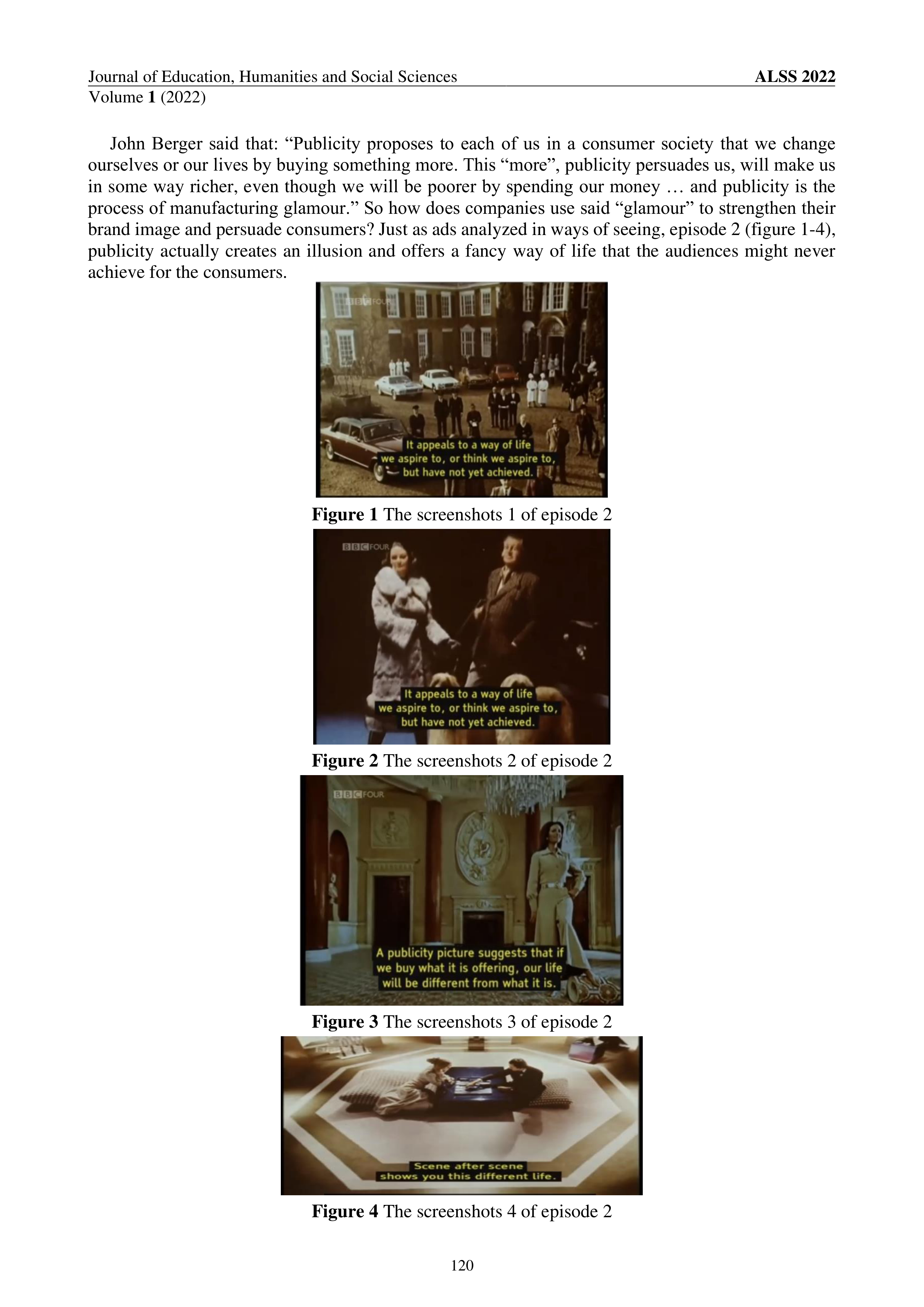
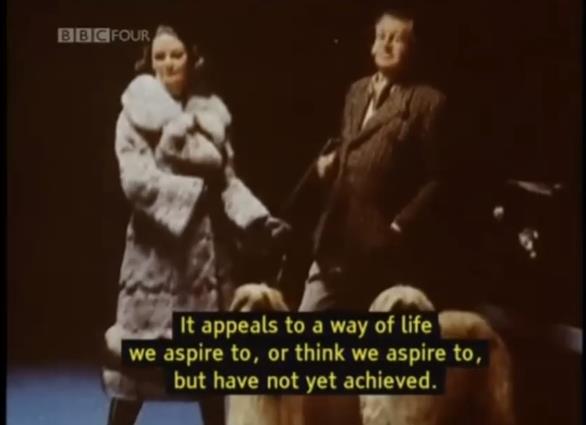
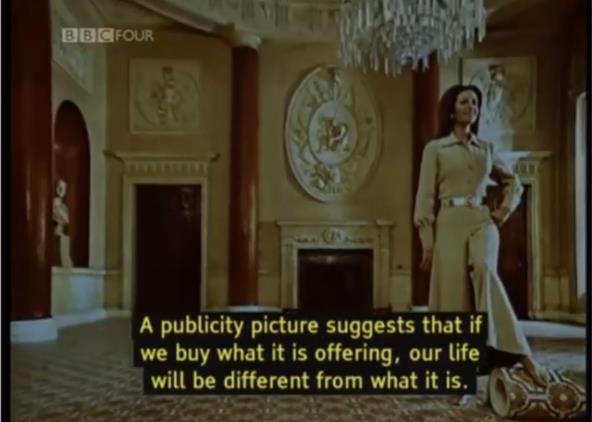
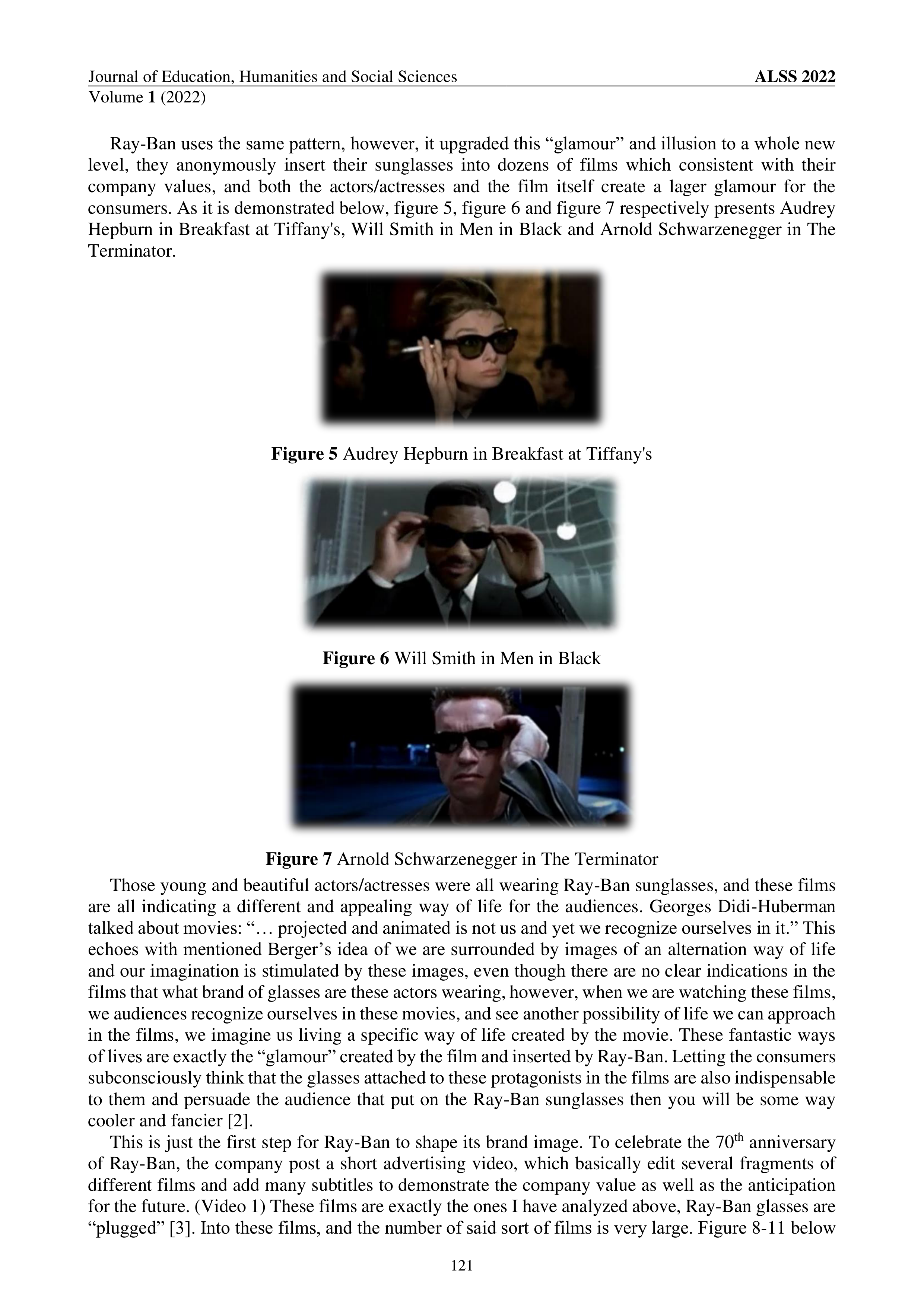
brand image and persuade consumers? Just as ads analyzed in ways of seeing, episode 2 (figure 1-4),
publicity actually creates an illusion and offers a fancy way of life that the audiences might never
achieve for the consumers.
Figure 1
The screenshots 1 of episode 2
Figure 2
The screenshots 2 of episode 2
Figure 3
The screenshots 3 of episode 2
Figure 4
The screenshots 4 of episode 2



Journal of Education, Humanities and Social Sciences
ALSS 2022
Volume
1
(2022)
121
Ray-Ban uses the same pattern, however, it upgraded this “glamour” and illusion to a whole new
level, they anonymously insert their sunglasses into dozens of films which consistent with their
company values, and both the actors/actresses and the film itself create a lager glamour for the
consumers. As it is demonstrated below, figure 5, figure 6 and figure 7 respectively presents Audrey
Hepburn in Breakfast at Tiffany's, Will Smith in Men in Black and Arnold Schwarzenegger in The
Terminator.
Figure 5
Audrey Hepburn in Breakfast at Tiffany's
Figure 6
Will Smith in Men in Black
Figure 7
Arnold Schwarzenegger in The Terminator
Those young and beautiful actors/actresses were all wearing Ray-Ban sunglasses, and these films
are all indicating a different and appealing way of life for the audiences. Georges Didi-Huberman
talked about movies: “… projected and animated is not us and yet we recognize ourselves in it.” This
echoes with mentioned Berger’s idea of we are surrounded by images of an alternation way of life
and our imagination is stimulated by these images, even though there are no clear indications in the
films that what brand of glasses are these actors wearing, however, when we are watching these films,
we audiences recognize ourselves in these movies, and see another possibility of life we can approach
in the films, we imagine us living a specific way of life created by the movie. These fantastic ways
of lives are exactly the “glamour” created by the film and inserted by Ray-Ban. Letting the consumers
subconsciously think that the glasses attached to these protagonists in the films are also indispensable
to them and persuade the audience that put on the Ray-Ban sunglasses then you will be some way
cooler and fancier [2].
This is just the first step for Ray-Ban to shape its brand image. To celebrate the 70
th
anniversary
of Ray-Ban, the company post a short advertising video, which basically edit several fragments of
different films and add many subtitles to demonstrate the company value as well as the anticipation
for the future. (Video 1) These films are exactly the ones I have analyzed above, Ray-Ban glasses are
“plugged” [3]. Into these films, and the number of said sort of films is very large. Figure 8-11 below




Journal of Education, Humanities and Social Sciences
ALSS 2022
Volume
1
(2022)
122
are the clips of subtitles from the short advertising video (video 1) and actually figure 5-7 are also
fragments I screenshotted from the same video.
Figure 8
Clip 1 of subtitles from the short advertising video
Figure 9
Clip 2 of subtitles from the short advertising video
Figure 10
Clip 3 of subtitles from the short advertising video
Figure 11
Clip 4 of subtitles from the short advertising video
In this short video, these separate films are no longer individuals, Ray-Ban has connected all of
them to demonstrate a value/desire and all these famous actors wearing Ray-Ban glasses have become
a symbol of mavericks or legends. Apart from that, Ray-Ban has made these invisible “plugs” visible
by telling the audience clearly that all these glasses worn on actors in all these classic films are the
brand of Ray-Ban. So why does Ray-Ban want to use the classic appearance of famous stars in classic
movies to strengthen its brand image? “… the celebrity is not an individual, but a social relation
characterized by the accumulation of attention…” [4]. That is to say, these stars accumulate attention
from audiences and in the same pattern, these classic movies actually accumulate a certain group of
audiences’ feelings. That is exactly what Ray-Ban wants, it wants the audience autonomously to
create an emotional link between the movie they saw and the brand. From the perspective of consumer
psychology, “Authoritative psychology: When consumers purchase products, they choose products
with authoritative certification or expert recommendations in more detail, and think that such products
are more comfortable to use. Many advertisements will display relevant slogans when planning to
gain the trust of consumers. In addition, some companies will invite celebrities to endorsements and
influence consumer psychology through celebrity effects; Seeking differences: With the development
and progress of society, consumers have become numb to traditional advertising, and they pay more
attention to individualization and novelty when making consumer choices. Especially for young
people, innovative things can attract their attention.” Ray-Ban combined all these elements to
Journal of Education, Humanities and Social Sciences
ALSS 2022
Volume
1
(2022)
123
interpellate its audiences, hailing to them that Ray-Ban is worn by legends and the people who are
true to themselves, it is both certified by legends and different from others. In this process, Ray-Ban
realized the diversity of its potential users, it wants both genders of audiences to be attracted by the
brand image. Just as Pang pointed out that: “While male consumers can fetishize the seductive woman,
the female consumer might also identify with the beautiful model.” [5]. Similarly in this situation,
male consumers can both identify with the handsome actors and fetishize the graceful actresses, as
for the female consumers, they can fetishize the muscular actors and identify with the beautiful
actresses.
Since this ad is a short video (video 1) instead of a pure image, the soundtrack of it also plays an
important role in analyzing how the consumers might make sense of said video and the brand image.
Brain Imaging and Neuroadvertising study found that: “The Picture-Only stimuli also presented the
loss of some of the effects found in the original ads, and the Sound-Only stimuli seemed to greatly
disperse the attention of the subjects. It seems that these two elements amplified each other, as the
combination of both did not just generate a superposition of their individual reactions, but also
generated more constant emotional reactions and more attention peaks which, due to their larger
average amplitudes, showed that these reactions occurred more consistently across subjects.” [5]. The
sound track in this short video gives the audiences a feeling of hope, strength and inspiration, and it
is coherent with the scenes and subtitles shown in the video. This consistency amplified the brand
image and letting the audience emotionally link to the company value. Or it can be seen as an
amplified interpellation,which empathize with the audience, consumers may decode the value that
Ray-Ban convey in the video easily because of all these factors analyzed above.
Laikwan Pang wrote that: “Readers enjoy visual representation not simply because they desire the
featured products or models. The key issue here is the potential of the representation to be a platform
of fantasy so that the subject is given a space where desires can be fantasized.” So how do
corporations use this “platform of fantasy” to create links between brand image and consumers?
Although Pang mainly focused on the visual display of women, we can actually expand this category
of visual representation. Ray-Ban created a set of commercials which build platforms of fantasy for
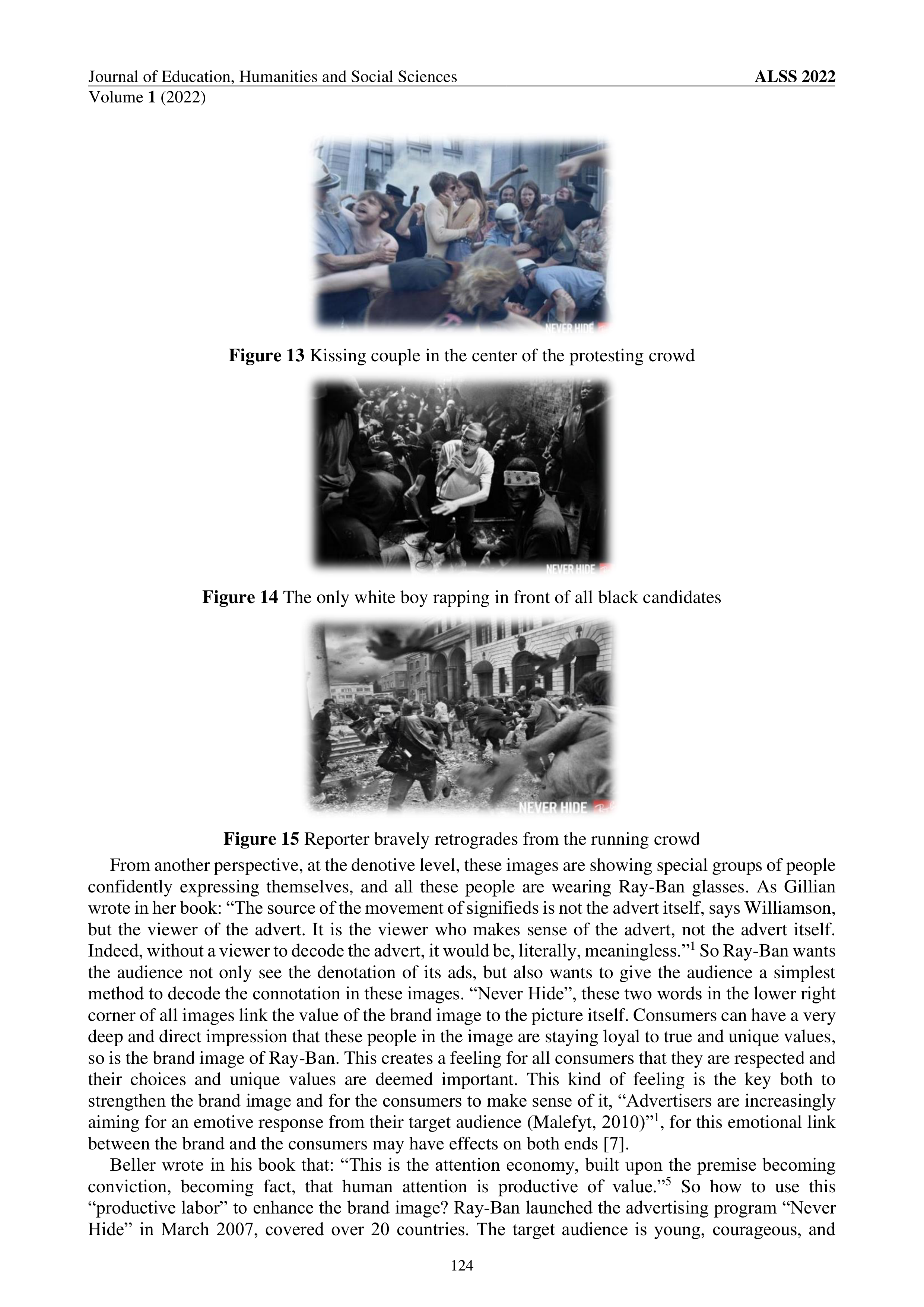
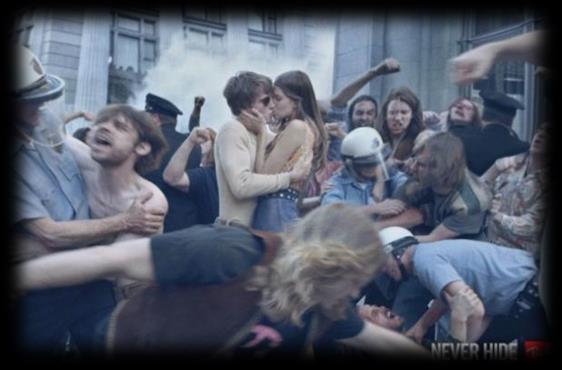
many different kind groups of people. Figure 12-15 respectively demonstrate the gay movement, a
kissing couple in the center of the protesting crowd, the only white boy rapping in front of all black
candidates and a reporter bravely retrogrades from the running crowd. These ads have a theme called
“Never Hide” and is created for Ray-Ban’s 75th anniversary, and these visual representations have
given the audiences a space to fantasize, letting those consumers who are not brave enough to expose
their true self have the platforms to fantasize that they can be the person inside the ad. According to
Pang, “An advertisement works best as a fantasy, allowing multiple points of entrance into the visual
narrative, and it can allow different viewers to stage their fantasy in different ways.” [6]. This is
exactly what Ray-Ban does, these different images in the commercial give the consumers opportunity
to fantasize in many different ways. It is the fantasy that links the brand image and consumers, for
the audience may get that wearing Ray-Ban glasses enable them to get closer to become the person
they fantasized themselves to be.
Figure 12
The gay movement


Journal of Education, Humanities and Social Sciences
ALSS 2022
Volume
1
(2022)
124
Figure 13
Kissing couple in the center of the protesting crowd
Figure 14
The only white boy rapping in front of all black candidates
Figure 15
Reporter bravely retrogrades from the running crowd
From another perspective, at the denotive level, these images are showing special groups of people
confidently expressing themselves, and all these people are wearing Ray-Ban glasses. As Gillian
wrote in her book: “The source of the movement of signifieds is not the advert itself, says Williamson,
but the viewer of the advert. It is the viewer who makes sense of the advert, not the advert itself.
Indeed, without a viewer to decode the advert, it would be, literally, meaningless.”
1
So Ray-Ban wants
the audience not only see the denotation of its ads, but also wants to give the audience a simplest
method to decode the connotation in these images. “Never Hide”, these two words in the lower right
corner of all images link the value of the brand image to the picture itself. Consumers can have a very
deep and direct impression that these people in the image are staying loyal to true and unique values,
so is the brand image of Ray-Ban. This creates a feeling for all consumers that they are respected and
their choices and unique values are deemed important. This kind of feeling is the key both to
strengthen the brand image and for the consumers to make sense of it, “Advertisers are increasingly
aiming for an emotive response from their target audience (Malefyt, 2010)”
1
, for this emotional link
between the brand and the consumers may have effects on both ends [7].
Beller wrote in his book that: “This is the attention economy, built upon the premise becoming
conviction, becoming fact, that human attention is productive of value.”
5
So how to use this
“productive labor” to enhance the brand image? Ray-Ban launched the advertising program “Never
Hide” in March 2007, covered over 20 countries. The target audience is young, courageous, and

Journal of Education, Humanities and Social Sciences
ALSS 2022
Volume
1
(2022)
125
unconventional consumers. Surrounding the concept of “Never Hide”, Ray-Ban calls on consumers
to show their true self, thoughts and personality, and encourages them to be loyal to the true and
unique value. This activity advocates the production of content by consumers, they can submit their
photos or videos wearing Ray-Ban glasses to Ray-Ban’s official website. If the photo or the video is
selected, it will be displayed on a billboard in Times Square, then the consumer can actually
experience the thrill of fame for 15 seconds. Basically Ray-Ban started this program and gave power
to its consumers to make advertisements by themselves, so the producer and the viewer become the
same group of people. This means that the consumers are having a very deep experience with the
brand. Just as Gillian pointed out that: “Back in 1999, Joseph Pine and James Gilmore wrote a book
discussing ‘the experience economy’, arguing that what created the character of a brand and what
helped potential customers to identify with it was, in part, the ‘feel’ of the brand’s shops. When you
shop at the store of a major brand now, the idea is that you are buying not just a product with a specific
functionality but also a whole experience that you like.”
1
However, with the progress of the times,
the category of mentioned experience had expended and advanced, brands are actually letting their
consumers to participate in the processes of shaping their brand image instead of just giving them
shopping experience in stores. This makes the relationship between the consumers and the brand even
stronger, for the “feelings” link to both ends are in a more intimate way [8].
In the whole event, it is particularly worth mentioning that the famous video "sunglass catch" with
nearly 5 million views on YouTube. (Video 2) Figure 5.1 is a screenshot from the video.
Figure 16
“Never Hide” is written by hand
The video shows two young men using all kinds of different difficult ways to catch the Ray-Ban
sunglasses, for instance, drop the sunglass off the roof and the man on the ground catches it, throw
the sunglass into the elevator when it is about to close and the other person inside the lift catches it,
the man on a driving car catches the sunglass thrown by a standing man. At the last scene of the video,
as the figure 16 has shown, on the back window of the car, “Never Hide” is written by hand. 5 million
views mean this video had drawn a lot of attention from the audience, and this activity attracted many
consumers to shape Ray-Ban’s brand image together with the company. Through this process,
consumers can easily make sense of the company value, and at the moment they agree with said value,
they have become part of the brand image. Beller wrote that: “The human has become the medium
for information; put another way, the medium is human, despite the fact that human potential is
foreclosed by its function.”
5
Ray-Ban uses this and let the consumers themselves to advertise the
brand image.
In this whole paper, I discussed the questions raised at the beginning of the article: how do the
corporations shape their brand images by advertising, how do these brand images in the form of visual
material attract consumers and how the consumers make sense of these visual materials? Through
analyzing, I found that the connection and relationship between brand images and consumers can be
Journal of Education, Humanities and Social Sciences
ALSS 2022
Volume
1
(2022)
126
mutual, and the visual materials are carefully designed to let the consumers make sense of the
company value.
However, there is no necessary connection between these ads containing interpellation,
neuroadvertising and whether the audience buys that product. The action of purchasing by consumers
need further study to be discussed. Leo Burnett said that: “Good advertising does not just circulate
information. It penetrates the public mind with desire and belief.” However, in this capital society,
only the increase in sales can prove the triumph of an advertisement. So, the ultimate question
becomes: will the brand image affect consumers’ actions on purchasing?
Consumer Psychology
The 21st century has entered the Internet age, where information is readily available to the general
public and we are no longer completely dependent on professional media and authority. It is very
likely that consumers will become very smart in the future, because the internet has taught them a lot
and they know a lot. It is not just the internet, but also the various social media platforms, where
consumers are already learning a lot about products without any advertising or salespeople.
Generally speaking, consumer psychological activity consists of two parts: cognition, which is the
initial impression and judgment of the consumer, and motivation, which is the direct factor motivating
the consumer to make a purchase. Moreover, consumers are social beings and have social attributes.
The complex cultural, social and customary environment is closely linked to the psychology of
consumers and has a decisive influence on their desire to buy and their purchasing behavior.
The massive influx of information has led to considerable changes in the social environment,
allowing for a highly subjective and personal evolution of the cognitive part of consumer psychology.
Today's consumers prefer advertising products that are quick to catch the eye and have real substance.
Only this type of advertising can deepen the consumer's perception of the product and create a quick
memory, leading to a conversion of the purchase behavior.
In China, for example, consumers have three main psychological characteristics: the psychology
of face, the psychology of the crowd and the psychology of seeking differences. Only by capturing
these psychological characteristics of consumers in the process of advertising planning can
advertisements be better disseminated.
Face psychology: Chinese consumers are more willing to choose beautifully packaged, high-end
goods for consumption, especially when choosing gifts, such goods will make consumers feel more
dignified.
Crowd mentality: Crowd mentality is a common characteristic of Chinese consumers, who are
more willing to observe other people's consumption choices before making a purchase and will
choose to follow them if they are cost-effective. For example, when shopping on the Internet, people
usually choose goods with high sales prices, believing that they are more guaranteed.
Differentiation: With the development and progress of society, consumers have become numb to
traditional advertising and are more interested in personal and novelty when making consumer
choices. Especially for young people, innovative things attract more attention.
It is therefore extremely important for advertising to be in line with the psychological trajectory of
consumers. It is necessary to make the consumer psychologically aware and interested, and to create
the desire to continue to learn more about the product.
Value Proposition
For any advertising campaign, it is facing a wide range of consumers. The consumer behavior
resulting from the psychological impact of advertising on consumers includes three dynamic
processes. In the cognitive process stage, consumers' initial impression of the advertisement generates
physiological activities, which include sensation, thinking, imagination, perception, etc. In the
effective process stage, consumers have psychological reactions to the content and stimuli of the
advertisements they watch, such as liking, disliking, satisfaction, disappointment, etc. In the stage of
consciousness decision process, it is also the process of consumers to produce consumption behavior,
and firm beliefs produce purchase behavior. Therefore, advertisers should consider that the consumer
psychological process has different degrees of influence on the advertising effect in their creation.
Journal of Education, Humanities and Social Sciences
ALSS 2022
Volume
1
(2022)
127
Therefore, the first thing that enterprises should do is to manage the word of mouth of their
products so that the fixed consumer base resonates with their product ideas. And for a company to
have a good reputation, the brand must be attractive and have feelings in it. There may be many
choices of products that consumers want to buy, and to get consumers to choose you, your brand must
be able to resonate with them. When a good word of mouth is established, the content contained in
your advertisement will be more accepted and recognized by the majority of consumers.
In fact, in layman's terms, a brand is usually a value proposition that expresses the value you create
for your customers, and the value proposition is what your positioning is and what your key features
are. Ray-Ban is constantly reinforcing its value proposition and defining its consumer base. "People
who wear Ray-Bans are adventurers who dare to show their true selves, and those who want to be
adventurers have the option to buy Ray-Bans." Almost all of the ads revolved around the core value
of "never hide", never introducing the technical features that made it so special. The most profound
value of the campaign, including the subsequent Aura series, is the need to be unique. It is this strong
value proposition that ignites the fire in consumers' hearts and the desire to break free from the
framework. The emotions it expresses resonate with the consumer base to a great extent. So no matter
what new concept or format Ray-Ban's subsequent ads take, this value of "true self" will always be
present.
To sum up, I believe that in this new information age, advertising agencies and companies should
pay attention to the connotation of the advertisements produced and whether there are independent
values added to them. I firmly believe that this will be the most important point for judging the
advertisement or attracting consumers, only if it resonates with enough consumers will people buy
your product, and only the increase of product sales will prove the success of an advertisement. Ray-
Ban's success has been slowly proving the importance of word-of-mouth and internalization of
product values, and he is moving forward, and other companies are following in his footsteps into
this new era, so that companies and their advertising will continue to surprise people and improve to
meet more consumer needs, thus producing better products and a better corporate culture.
References
[1]
Gillian Rose, Visual methodologies an introduction to researching with visual materials (4th edition)
[2]
John Berger, Ways of seeing, Episode 2
[3]
Georges Didi-Huberman, People exposed, people as extras
[4]
Jonathan Beller, Paying Attention
[5]
ShaoLiu Yeqian, Analysis and Enlightenment of Consumer Psychology in Advertising Market
[6]
Laikwan Pang, The Distorting Mirror Visual Modernity in China
[7]
João Vidigal Costa, Carlos Lucas de Freitas, Teresa Paiva, Brain Imaging and Neuroadvertising
[8]
Lecture recordings, lecture 7, presentation