AKSU Journal of Management Sciences
(AJOMAS)
Volume 1, No. 1, January – June 2016
TRANSNATIONAL CORPORATION AND THE DEVELOPMENT OF HOST
COMMUNITIES IN AKWA IBOM STATE: A CASE STUDY OF EXXONMOBIL
NIGERIA LIMITED
By
Sunday Effiong Ibanga Ph.D
Akwa Ibom State University
Department of Public Administration
Faculty of Management Sciences
08023541824, 07065647549
sunnibanga@yahoo.com
Abstract
ExxonMobil remains a prominent corporate citizen in Nigeria with key responsibility to the
communities in which it carries out business. Its corporate social responsibility is aim at
community assistance and development. This study therefore aims at examining how
responsible is ExxonMobil in assisting and developing its host communities in Akwa Ibom
State. The study adopted historical and descriptive research drawing data from secondary
sources. The study therefore revealed that ExxonMobil has made effective and desired
contributions to the social and economic lives of the people especially in the provision of pipe
born water, electricity, road projects and health services among others. The study further
revealed that ExxonMobil has not done well in the areas of employment, tourism, cultural
development and environmental degradation. Based on the findings, the study therefore
recommended among others that ExxonMobil should be committed to the provision of more
social services and social services need of the host communities to complement the negative
social and environmental effects caused by their operations.
Keywords: Transnational Corporation, Development, Host Communities, Akwa Ibom State,
ExxonMobil.
Introduction
Over the years, the contending issue is that if transnational corporations play any significant
role in the development of their host communities especially in the developing countries.
ExxonMobil is one of the oil transnational corporations that came into Nigeria on August 6,
1954 and was granted oil exploration license for an area of 721,895 square kilometres.
ExxonMobil has three major subsidiary companies in Nigeria namely Mobil Producing Nigeria
Unlimited (MPN), Esso Exploration and Production Nigeria Limited (EEPNL) and Mobil Oil
Nigeria Plc (ExxonMobil, 2000).
Mobil came into Nigeria as Soclony-vacuum oil exploration company (Nigeria), incorporated
on February 8, 1956. In December 1961, Mobil was granted offshore prospecting license by
the then South Eastern State of Nigeria, a part of which is now Akwa Ibom State and it made
its first oil discovery in 1964. Also, in 1964 the name Mobil Exploration Nigeria incorporated
was replaced with Mobil Producing Nigeria. The acquisition of 35 percent participating
interest by Mobil Producing Nigeria marked the complement of joint venture arrangement
between the company and Nigeria National Petroleum Corporation (NNPC) on June 16, 1969;
Mobil Producing Nigeria became an unlimited registered Nigerian company and started the
production of crude oil on February 16, 1970. Fourteen months after commissioning, Mobil
had produced a total of 1 billion barrels of crude oil from its 137 wells and then rated as the
third (programme) for commissioning of NNPC/Mobil Projects 17
th
November, 2000.
However, in 1992, after the commissioning of both Edop Platform and Oso Condensate
Platforms respectively, Mobil Producing Nigeria Unlimited became the second largest
producer of crude oil in Nigeria with a daily production of more than 1,500 barrels of crude oil.
In December 2001, a major merger was made between Mobil Producing Nigeria Unlimited and
Exxon Corporation resulting in the renaming of the company as Exxon-Mobil Producing
Nigeria Limited. With the merger, ExxonMobil remain one of the world leading petroleum and
petro chemical companies. The company is principally involved in the exploration and
production of crude oil and condensate. It also involved in the marketing of petroleum
products. The company's operations are one of the largest sources of revenue for both the
mother country and the Nigerian government and the economy. Even a careful look at the
financial records of the ExxonMobil reveals a phenomenal rise in revenue and profits. As of
July 1, 2010, ExxonMobil occupied 8 out of 10 slots for Largest Corporate Quarterly Earnings
at all time. Furthermore, it occupies 5 out of 10 slots of largest corporate annual
earnings/ExxonMobil Annual Report, 2011, Mbat, Ibok and Ekong, 2013).
This development can be termed quite healthy and praiseworthy. Based on its track record of
achievement, the arrival of ExxonMobil in Nigeria and Akwa Ibom State as its operational
base was received by the host communities with the high expectations that in collaboration
with government they would bring sustainable development to the host communities.
ExxonMobil asserts that it has contributed enormously to the development of her host
communities of Ibeno, Esit Eket, Eket, Onna etc. That is why sustainable development of their
host communities has emerged as a frontline social responsibility policy which this study
intends to ascertain.
Theoretical Discourse
One aspect of community development, which has only recently been identify, is that of
corporate citizen participation. According to the European framework for corporate social
responsibility, the issue should well be estimated and granted due regards. Pointing to the fact
was the assertion that: community development is profound and simple, difficult to define but
is clear and recognisable moral mandate and a social responsibility.
Bennet (2000) complements the above by positing that currently development is almost an all
comer affair and the latest new comer may well be the corporate citizen. In the light of the
above, the scope of community development has been broadened by the acknowledgement of
the potency of the corporate citizen. Until recent, it could be recalled that the aspect of
participation entertained was the individual citizenry, mass participation and citizenry
participation (Ekong, 1988). However, the aspect of corporate citizen participation was not
considered. The necessity to consider this cannot be overemphasised. This is buttressed in the
invocation of sustainability and corporate social responsibility by agencies of the United
Nations and other International Organisations as a global dream which has offered scope for
redefinition of the duties and responsibilities owed by corporate bodies to the societies in
which they operate, and has conferred "citizenship" of local communities upon corporate
bodies (Ekong, 1988).
Corporate Social Responsibility (CSR) is concerned with the relationship between companies
and society in particular, with constructing the adverse impact of corporate activity on
individuals and communities as a whole. While it has become an increasingly familiar term
within socio-political debate, consensus as to its meaning and the method by which to
implement it have remained elusive. A review of the relevant literature reveals a multitude of
different meanings ascribed to the consent ranging from the implementation by companies of
philanthropic ventures to an obligation to take proper legal, moral, ethical and philanthropic
action that will protect and improve the welfare of both society and business as a whole
(Friedman, 1983).
Galbraith (1978) presents eloquent voice to the concern raised by the increasing size and
power of some companies, the great corporation exercise public power, power that affects
health, wellbeing and general happiness of those who are subject to it. Donaldson (1984) notes
that large corporations are capable of influencing mainstream societal events, and these powers
are not only economic, but social and political. In response to these concern and in an attempt
to make companies accountable to those affected by their decision, make policy-makers to re-
invigorate the corporate social responsibility debate. Carol (1999) offered a four part definition
of corporate social responsibility which encompassed being profitable, obeying the law, being
ethical and giving back to the community.
While the developing countries recognized the need for stimulation of their economy through
free trade and private enterprise, and developed countries have agreed to reduce the term of
heavy debt. These circumstances raise the question of the TNCs relationship with, and
responsibility towards, the government of the developing nations and their people. While the
TNCs have a beneficial effect, particularly in improved standard of living, they could pose
considerable harmful effects on the host country economy and society particularly concerning
marketing and employment practices (Compbell, 2004).
Also, there exists a widening gap between the transnational character of corporate activities
and the transnational regulatory structure that may be effectively used to monitor, assess and
restrain corporations irrespective of the territory they operate. It is worth-mentioning that
individual countries are unable to tame the activities of TNCs because of their desperate need
to attract direct foreign investment, improve the economy and acquire from their technology.
TNCs share a disproportionately too small a burden in assuring the just distribution of social
goods and of assuming too small a share in remedying the unequal social distribution of harm
and risk.
Consequently, the TNCs have begun to experience the heat of popular protest, consumer
boycotts, legal suits, and a variety of public staining campaigns addressing their misconduct or
lack of 'adequate response to a variety of social wrongs. In tandem with the emergence of
transactional market forces have emerged a transnational network of grassroots movements,
loosely organized, `corporate bashing' and `corporate watch' groups and a host of NGOs that
shift their attention to TNCs.
The point is that TNCs should adopt a practice stance, be responsible to constituent and
societal needs and manifest these concerns in their interaction with their host government. The
TNC's social goals and collaborative role is supported by its business strategy. The TNC needs
too link it internal long-term planning with the host national planning objective with regards to
environment, technology or human resources. It then translate the strategic plan in operational
goals and activities. This implies a systemic change in the culture, structure and functioning of
the organization (Drabeb, 1998).
From the above, we deduce that TNCs or corporate citizens have social responsibility in
carrying out their businesses to behave ethically and contribute to economic development
while improving the quality of life of the workforce and their families as well as the local
community. It is one of the newest management strategies where companies try to create a
positive inpact on the society while doing business (corporate social responsibility http://www.
mallenbaker.net/csr/definition 8th August, 2016).
ExxonMobil and the Development of Host communities in Akwa Ibom State
ExxonMobil identified as a prominent corporate citizen in Nigeria, with key responsibilities to
the communities in which it carries out its business. In its key operating principles,
ExxonMobil states that it is part of its corporate social responsibility and commitment to:
i.
Enhance the long term value to stakeholders investment and reward them write superior
returns.
ii.
Meet customers' needs with innovative high quality and completively priced goods and
services.
iii.
Be a good corporate citizen, operating in a safe and environmentally responsive
manner.
iv.
Maintain secured work environment enriched by diversity and characterised by open
communication, trust and fair treatment.
v.
Hire and return the most qualified people available and maximize employee's
opportunities through training and development.
ExxonMobil believes in sustaining good relations with the host communities, which it sees as
an important stakeholder in the company's business (ExxonMobil, 2000).
ExxonMobil corporate social responsibility is aim at community assistance and development.
What it does is to identify critical areas of needs among communities and work with them to
meet the needs. ExxonMobil critical areas of development assistance often focused on by the
company includes sanitation, water supply, electricity and power generation, school
construction and maintenance, healthcare provision and maintenance, safety and security etc.
The company noted that in most rural societies, there were often the problem of lack of basic
essentials and amenities such as good roads, healthcare etc. To identify the needs of each
community, the company relies on its community/public relations department which is a
professional units that relates with communities and host.
Massey (1993) confirms that Mobil community development activities are derived from the
philosophy of its parents company, Mobil Oil Corporation on the conviction that it should be
socially responsible and responsive. As a result, the company has over the years position itself
as a proactive community neighbour and at all times shares in the developmental aspirations of
the host communities and strive to create and sustain a mutual beneficial relationship.
In Akwa Ibom State, where its field operations are based, ExxonMobil in partnership with
Nigeria National Petroleum Corporation are said to be making effective and desired
contributions to the social and economic lives of the people especially in the provision of pipe-
borne water, electrification, assistance in health-services, road projects, capacity building etc
(Akpabio, 1995, Mbat, Ibok and Ekong, 2015, MPN, 2006). Initially, ExxonMobil corporate
responsible citizen was limited to the oil producing communities namely: Ibeno, Mkpanak,
Eket, Esit Eket and Onna local governments. But later it extended to other parts of the state.
Below are some projects of ExxonMobil Community Development and areas of involvement
in Akwa Ibom State.
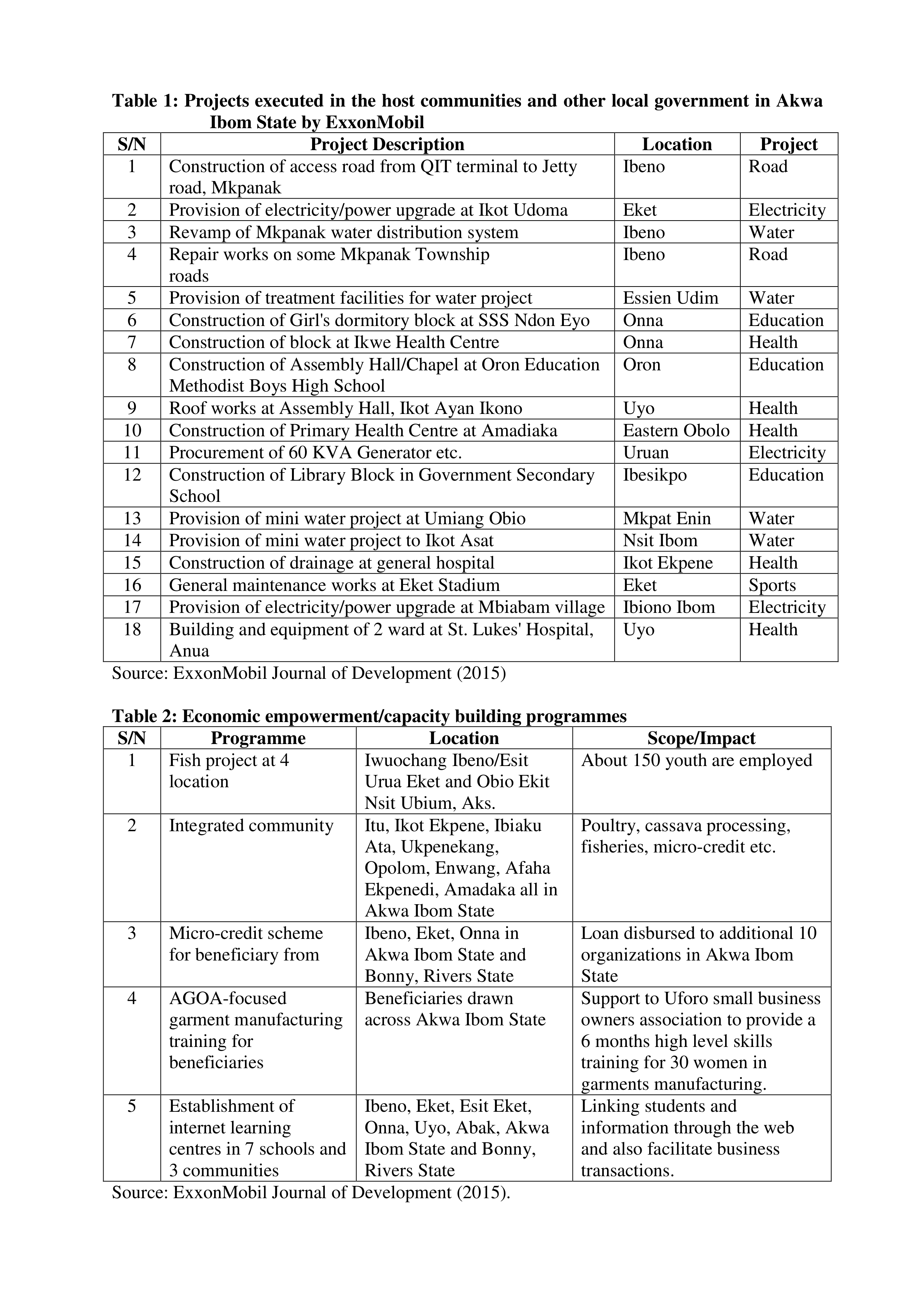
Table 1: Projects executed in the host communities and other local government in Akwa
Ibom State by ExxonMobil
S/N
Project Description
Location
Project
1
Construction of access road from QIT terminal to Jetty
road, Mkpanak
Ibeno
Road
2
Provision of electricity/power upgrade at Ikot Udoma
Eket
Electricity
3
Revamp of Mkpanak water distribution system
Ibeno
Water
4
Repair works on some Mkpanak Township
roads
Ibeno
Road
5
Provision of treatment facilities for water project
Essien Udim
Water
6
Construction of Girl's dormitory block at SSS Ndon Eyo
Onna
Education
7
Construction of block at Ikwe Health Centre
Onna
Health
8
Construction of Assembly Hall/Chapel at Oron Education
Methodist Boys High School
Oron
Education
9
Roof works at Assembly Hall, Ikot Ayan Ikono
Uyo
Health
10
Construction of Primary Health Centre at Amadiaka
Eastern Obolo Health
11
Procurement of 60 KVA Generator etc.
Uruan
Electricity
12
Construction of Library Block in Government Secondary
School
Ibesikpo
Education
13
Provision of mini water project at Umiang Obio
Mkpat Enin
Water
14
Provision of mini water project to Ikot Asat
Nsit Ibom
Water
15
Construction of drainage at general hospital
Ikot Ekpene
Health
16
General maintenance works at Eket Stadium
Eket
Sports
17
Provision of electricity/power upgrade at Mbiabam village Ibiono Ibom
Electricity
18
Building and equipment of 2 ward at St. Lukes' Hospital,
Anua
Uyo
Health
Source: ExxonMobil Journal of Development (2015)
Table 2: Economic empowerment/capacity building programmes
S/N
Programme
Location
Scope/Impact
1
Fish project at 4
location
Iwuochang Ibeno/Esit
Urua Eket and Obio Ekit
Nsit Ubium, Aks.
About 150 youth are employed
2
Integrated community
Itu, Ikot Ekpene, Ibiaku
Ata, Ukpenekang,
Opolom, Enwang, Afaha
Ekpenedi, Amadaka all in
Akwa Ibom State
Poultry, cassava processing,
fisheries, micro-credit etc.
3
Micro-credit scheme
for beneficiary from
Ibeno, Eket, Onna in
Akwa Ibom State and
Bonny, Rivers State
Loan disbursed to additional 10
organizations in Akwa Ibom
State
4
AGOA-focused
garment manufacturing
training for
beneficiaries
Beneficiaries drawn
across Akwa Ibom State
Support to Uforo small business
owners association to provide a
6 months high level skills
training for 30 women in
garments manufacturing.
5
Establishment of
internet learning
centres in 7 schools and
3 communities
Ibeno, Eket, Esit Eket,
Onna, Uyo, Abak, Akwa
Ibom State and Bonny,
Rivers State
Linking students and
information through the web
and also facilitate business
transactions.
Source: ExxonMobil Journal of Development (2015).
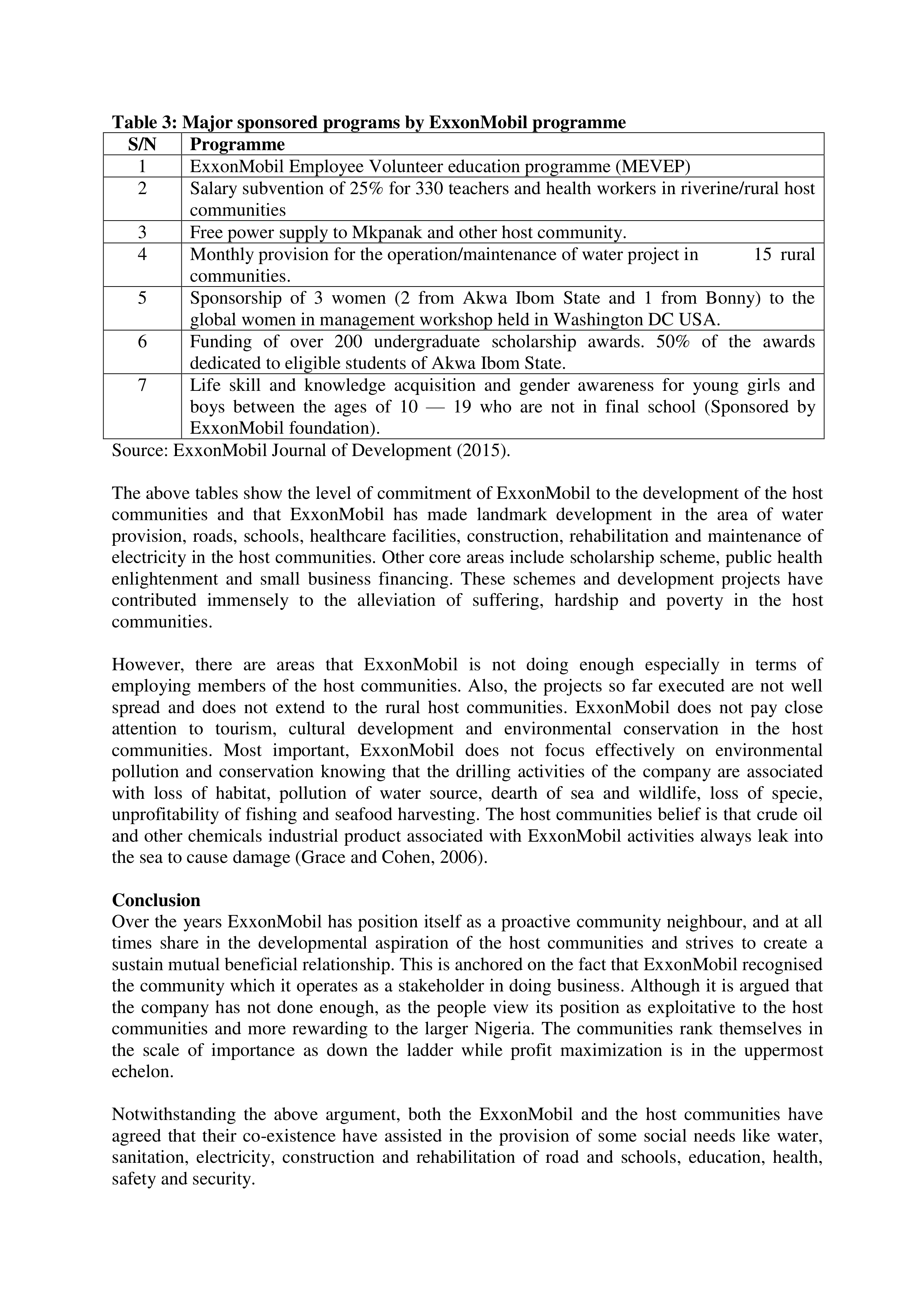
Table 3: Major sponsored programs by ExxonMobil programme
S/N
Programme
1
ExxonMobil Employee Volunteer education programme (MEVEP)
2
Salary subvention of 25% for 330 teachers and health workers in riverine/rural host
communities
3
Free power supply to Mkpanak and other host community.
4
Monthly provision for the operation/maintenance of water project in
15 rural
communities.
5
Sponsorship of 3 women (2 from Akwa Ibom State and 1 from Bonny) to the
global women in management workshop held in Washington DC USA.
6
Funding of over 200 undergraduate scholarship awards. 50% of the awards
dedicated to eligible students of Akwa Ibom State.
7
Life skill and knowledge acquisition and gender awareness for young girls and
boys between the ages of 10 — 19 who are not in final school (Sponsored by
ExxonMobil foundation).
Source: ExxonMobil Journal of Development (2015).
The above tables show the level of commitment of ExxonMobil to the development of the host
communities and that ExxonMobil has made landmark development in the area of water
provision, roads, schools, healthcare facilities, construction, rehabilitation and maintenance of
electricity in the host communities. Other core areas include scholarship scheme, public health
enlightenment and small business financing. These schemes and development projects have
contributed immensely to the alleviation of suffering, hardship and poverty in the host
communities.
However, there are areas that ExxonMobil is not doing enough especially in terms of
employing members of the host communities. Also, the projects so far executed are not well
spread and does not extend to the rural host communities. ExxonMobil does not pay close
attention to tourism, cultural development and environmental conservation in the host
communities. Most important, ExxonMobil does not focus effectively on environmental
pollution and conservation knowing that the drilling activities of the company are associated
with loss of habitat, pollution of water source, dearth of sea and wildlife, loss of specie,
unprofitability of fishing and seafood harvesting. The host communities belief is that crude oil
and other chemicals industrial product associated with ExxonMobil activities always leak into
the sea to cause damage (Grace and Cohen, 2006).
Conclusion
Over the years ExxonMobil has position itself as a proactive community neighbour, and at all
times share in the developmental aspiration of the host communities and strives to create a
sustain mutual beneficial relationship. This is anchored on the fact that ExxonMobil recognised
the community which it operates as a stakeholder in doing business. Although it is argued that
the company has not done enough, as the people view its position as exploitative to the host
communities and more rewarding to the larger Nigeria. The communities rank themselves in
the scale of importance as down the ladder while profit maximization is in the uppermost
echelon.
Notwithstanding the above argument, both the ExxonMobil and the host communities have
agreed that their co-existence have assisted in the provision of some social needs like water,
sanitation, electricity, construction and rehabilitation of road and schools, education, health,
safety and security.
Recommendations
i.
The government should strengthen her CRS policy to create a conducive environment
for ExxonMobil to develop the host communities.
ii.
ExxonMobil should offer employment to qualified members of the host communities
especially in the management cadre and other critical areas.
iii.
ExxonMobil should invest more in the development of the cultural heritage of the
people and thereby encouraged the tourism potentials of the area.
iv.
ExxonMobil should be committed to the provision of more social services and social
services need of the host communities to complement the negative social and
environmental effects caused by their operations.
v.
Government should also provide infrastructure to complement the social services
provided by ExxonMobil to the host communities.
vi.
Modalities should be put in place to secure the development projects embarked upon by
the corporation.
REFERENCES
Akpabio, I. (1995). "Community Assistant Project."Mobil Producing Nigeria Unlimited (24`x'
June) p. 3. Carol, A. B. (1999). A Three Dimensional Conceptual Model of Corporate
Social Performance. Academy of Management Review, 4, 497-505.
Compbell, J. (2004). Institutional Change and Globalization. Princeton: Princeton University
Press.
Donaldson, T. (1984). The Social Contract: Norms for a Corporate Morality. New York:
McGraw-Hill.
Drabeb, Z. (1998). A Multinational Agreement on Investment: Convincing the Skeptics. In: J.
Jeunissen (Ed.). "The Policy Challenges of Global Financial Integration." The Hague:
Fondad, 32-47.
Ekong, E. (1988). An Introduction to Rural Sociology. Nigeria: Dove Educational Publishers.
ExxonMobil (2000). Annual Report. Retrieved August 3, 2016 from www.exxonmobil.com.
ExxonMobil (2000). Annual Report. www.exxonmobil.com. Retrieved 8`h August, 2016.
Friedman, M. (1983).The Social Responsibility of Business. In: T. Beauchamp and N. Bowies
(ed.). Ethical Theory and Business. New Jersey: Prentice Hall, 81-83.
Galbraith, K. (1978). New Industrial State. United States: The New American Library, Inc.
Grace, S., Cohen, T. (2006).Climate Conducive to Corporate Action. Princeton: Princeton
University Press. Massey, J. (1993). Mobil Oil Corporation: Corporate Responsibilities.
Texas: Mobil Oil.
Mbat, D., Ibok, E. Daniel, E. (2013). "ExxonMobil and Corporate Social Responsibility in
Akwa Ibom State, Nigeria: Past and Present." Public Policy and Administration
Research Vol. 3, No. 3, 21-28.
Mobil Producing Nigeria Unlimited (2006).Mobil Community News. 4(2) 2 Quarters, p. 1.