II.
CASE STUDY
Dell Background - The Personal Computer
In 1976, Stephen Wozniak and Steve Jobs sold their worldly possessions (a
programmable calculator and a Volkswagen) so they could start Apple Computer, a
manufacturer of Personal Computers (PCs). The Apple PC became popular with the invention
of VisiCalc, a spreadsheet program that made inroads in corporations. By 1980, IBM realized
that the PC business was rapidly developing, and decided that it must ship its own PC within
a year. To meet this challenge, IBM opted for an open architecture, using off-the-shell
components and software that were purchased from outside vendors like Intel (the 8088
microprocessor), Microsoft (the DOS operating system) and Tandon (the disk drive).
Moreover, IBM went beyond its own sales organization and used computer retailers like
Computerland and Sears Business Centers to sell the IBM PC. The result was that the IBM PC
met its one-year, August, 1981 deadline¾a first for IBM. By 1983, IBM commanded a 42%
share of the PC market, with Apple’s share being driven down to 20%. The PC fundamentally
changed the structure of the computer industry from a collection of vertically-integrated
corporations to a collection of horizontal “slices,” each focused on a distinct segment of the
industry’s value chain. Intel’s Chairman, Andrew Grove, who based his company’s strategy
on this transformation, described it as follows:
This horizontal structure enabled IBM-PC “clones” like Compaq, a host of start-ups an
established computer firms like Hewlett Packard to enter the market and manufacture their
own, IBM-compatible PCs. The cutthroat competition among PC makers shifted the bulk of
the profits to two highly-concentrated industry “slices”: the operating system, where Microsoft
had a virtual monopoly, and the microprocessor, which was dominated by Intel. One of the
manufacturers of IBM-PC “clones” was Dell.
The Dell Indirect Model
PC manufacturers were using indirect sales channels since the inception of the IBM PC
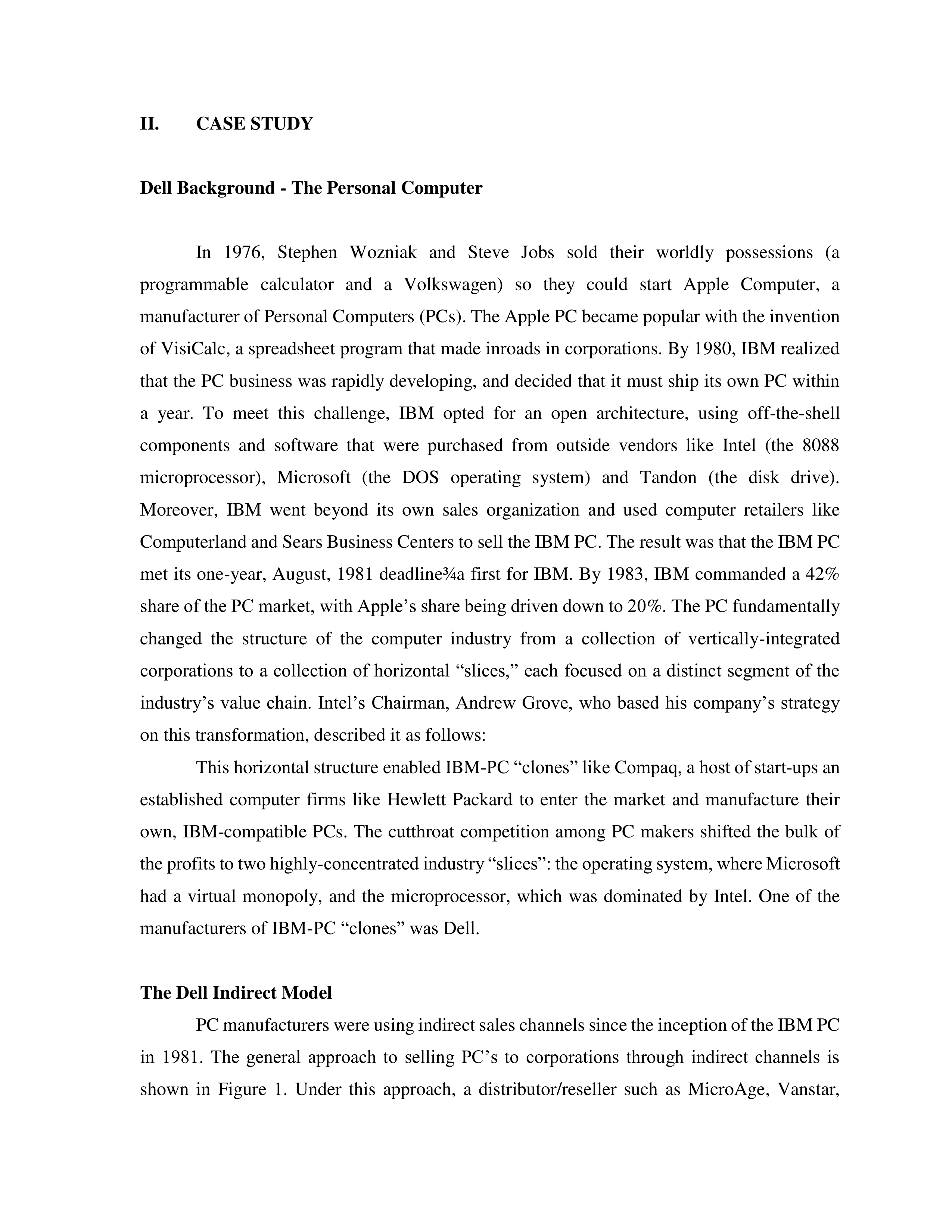
in 1981. The general approach to selling PC’s to corporations through indirect channels is
shown in Figure 1. Under this approach, a distributor/reseller such as MicroAge, Vanstar,