

Case Study
Crocs, Inc.: Managing Corporate Resources (Strategic
Perspectives)
Miranda Salo
a
, James Ondracek
b
, Mohammad Saeed
c*
, Andy Bertsch
d
a MS in Management Candidate, Colorado State University Global, USA
b Professor, Minot State University, North Dakota, USA
c Former Professor, Minot State University, North Dakota, USA
d Professor, Minot State University, North Dakota, USA
A R T I C L E I N F O
*Corresponding Author:
profsaeed@yahoo.com
Article history:
Received 14 April 2021
Revised 27 May 2021
13 June 2021
Accepted 20 July 2021
Keywords:
Internal Factor Evaluation (IFE) Matrix,
External Factor Evaluation (EFE) Matrix,
Competitive Profile Matrix (CPM),
SWOT,
SPACE,
QSPM
DOI:
10.51768/dbr.v22i2.222202113
A B S T R A C T
The role of the strategic management process in organizations is to produce the
best strategic plan that an organization can adopt based on its individual qualities
and market position to achieve a superior competitive position in the market. The
purpose of this study is to evaluate how the strategic management process can be
utilized by Crocs, Inc. (Crocs) to gain and maintain a long-run competitive position
in the footwear industry. This analysis considers and applies the three stages of
the strategic management process, strategy formulation, strategy implementation,
and strategy evaluation, to Crocs, utilizing Crocs’ current company data and
strategic position and applying strategic management process tools. Analysis
results feature a recommended vision and mission statement for Crocs, the best
strategies for Crocs to pursue, how Crocs can progress toward achieving such
strategies (through certain policies, risk considerations, and financial projections),
and how the company can successfully evaluate and adapt strategies if necessary.
This analysis implies how Crocs may best utilize the strategic management process
to achieve success as a company in the footwear industry.
Delhi Business Review Vol. 22, No. 2 (July - December 2021)
DELHI BUSINESS REVIEW
An International Journal of SHTR
Journal Homepage: https://www.delhibusinessreview.org/Index.htm
https://www.journalpressindia.com/delhi-business-review
Delhi Business Review * Vol. 22, No. 2 (July - December 2021)
106
Introduction
Crocs, Inc. (Crocs) is a company that focuses on
everyday footwear and accessories. Founded in
2002 in Boulder, CO, by Lyndon Hanson, Scott
Seamus, and George Boedecker, Crocs started
with the purpose of filling a market niche.
Originally, Crocs focused on catering to sailors
and gardeners with its clog-like shoes made
from a closed-cell resin, "Croslite,” that provides
grip, eliminates odor, and is easy to wash.
(Droege & Dong, 2009).
Crocs' founders' goal
was to provide a shoe that was both functional
and durable while still being comfortable
(Droege & Dong, 2009)
. Since Crocs' origination,
the company has morphed into a global brand
that manufactures and sells shoes, accessories,
and clothing to all people seeking a sustainable
and comfortable lifestyle
(Lim, 2018).
Today,
Crocs has over 350 retail locations, 13 company-
operated e-commerce sites, sells shoes in over 90
countries
(Crocs, 2021a).
An overall strategic
evaluation of Crocs will provide insight into how
the company currently participates in the
strategic management process regarding its
company
identity, market
positions,
and
company objectives. Considerations of Crocs'
current strategic management process will
allow for recommendations to improve Crocs'
overall strategy, allowing the company to gain
and maintain a long-run competitive advantage
in the footwear industry.
Vision, Mission, Objectives, and Strategies
Crocs' current vision and mission statement,
objectives, and strategies indicate its current
goals, direction, and purpose. According to
David and David (2017),
a company's vision
statement should denote what that company
strives to become, while its mission statement
denotes who the company is as an organization.
Crocs' vision statement, which can be found on
its website, is "Everyone comfortable in their
own shoes"
(Crocs, 2021b, para. 1).
The
company's current mission statement is, "At
Crocs, we take our fun as seriously as we take
our collective mission to make the world's most
delightfully comfortable shoes” (Comparably,
2021, para. 1). Both statements reveal that
Crocs is characterized by producing comfortable
shoes but are generally vague, suggesting that
they can be modified to better suit the company
and provide more direction.
Crocs has recently been focused on increasing
its brand awareness, engaging in product
development, and saving money by closing store
locations and transitioning to all third-party
distributors. Crocs' current objectives include
strengthening its brand globally, developing
innovative
and
relevant
products,
and
enhancing its digital marketing presence
(Crocs, 2021a).
One strategy that Crocs is
currently pursuing is market penetration. The
company is seeking to expand its market share
in China, increasing its brand awareness
through celebrity collaborations with the
famous Chinese actress Yang Mi (
Crocs, 2021c).
According to
Meyersohn (2018)
, Crocs has also
been pursuing a product development strategy,
as it has been focused on modifying its current
products to make them more relevant to today’s
consumers. As discussed by
Crocs (2021c),
its
product development strategy specifically has
involved: Increasing product prices, creating a
more favorable product mix, and establishing
fewer promotions and discounts. In the
following analysis, strategies that Crocs should
pursue in the future will be recommended.
Vision
and
Mission
Statement
Recommendations
A company's vision and mission statement are
critical for establishing a direction for a
company to create a foundation for the entire
strategic management process.
Sull, Sull, and
Yoder (2019)
support that a company's vision
statement
should
be
bold
and
vivid,
representing what the company strives to
become in the future. Although Crocs' current
vision statement is vivid, it is recommended
that the vision statement should be altered to
the following: "Everyone comfortable in their
own shoes, anywhere." By adding the word
"anywhere," the vision statement implies a
future for Crocs that still emphasizes comfort
but also and capitalizes on fulfilling the unique
needs of people wherever in the world they
might be, opening the doors for global and
product expansion.
Crocs' current mission statement is very brief
and should be modified to define more robustly
what the company does and who its serves.
David and David (2017)
note that an effective
mission statement should be written from a
customer perspective and address the following
nine
components:
Customers,
products,
markets,
technology,
survival/growth/profitability, philosophy, self-
concept, public image, and employees.
Below, a mission statement has been created for
Crocs based on
David and David’s (2017)
recommendations:
We are committed to providing all children,
women, men, and people with comfortable,
sustainable, and innovative shoes made from
our
patented
Croslite
technology.
Our
customizable and flexible products allow for
ample
personalization
and
exploration
anywhere in the world. We are determined to
Delhi Business Review * Vol. 22, No. 2 (July - December 2021)
107
continue
our
international
expansion,
benefiting our shareholders by saving on
production costs while maintaining a fun and
ethical company culture for employees. We
strive
to
benefit
our
community
and
environment by using no packaging and
recycling used shoes.
Crocs'
more
robust
mission
statement
recommendation establishes a clearer sense of
who the company is, giving more direction and
a
sense
of
purpose
to
its
employees,
shareholders,
and
customers.
Crocs
recommended vision and mission statement are
the basis for successful strategic management.
Strategy Formulation: Input, Matching,
and Decision Stage
Now that Crocs' current mission and vision
statement and current objectives/strategies
have been reviewed, the next steps in the
strategic management process evaluate Crocs'
internal and external position and develop and
choose a strategy to pursue.
David and David
(2017)
present a general strategy-formulation
framework that can be used for any company,
which involves three stages: the input, the
matching, and the decision stage. This three-
stage framework will be applied to Crocs to
ultimately reveal its best strategies to maintain
a sustained competitive advantage in the
footwear market given its current market
position.
The Input Stage
The first stage of Crocs’ strategy-formulation
analytical framework is the input stage. The
input stage identifies and evaluates important
information about Crocs’ current internal and
external market position and its position
relevant
to
its
major
competitors.
As
recommended
by David and David (2017),
this
stage of the strategy formulation process
involves creating an Internal Factor Evaluation
(IFE) Matrix, an External Factor Evaluation
(EFE) Matrix, and a Competitive Profile Matrix
(CPM) for Crocs. All three of these matrices
feature important information about Crocs’
current market position that can be used to
discover what strategies will be the best option
for Crocs to achieve a sustained competitive
advantage in the footwear market.
Crocs’ Internal Factor Evaluation (IFE)
Matrix
One tool used to examine a firm’s current
internal market position is the IFE Matrix.
According
to
Ibrahim,
Nurrochmat,
and
Maulana (2019)
, the IFE Matrix is used to
identify, classify, and rank a company's notable
internal strengths and weaknesses. The steps of
creating an IFE Matrix include listing a firm's
key internal factors (both weaknesses and
strengths), assigning a weight to each factor,
and assigning a rating to each factor
(David &
David, 2017)
. After each factor is assigned a
weight and rating, each factor's weight is
multiplied by its rating to determine a weighted
score
(David & David, 2017)
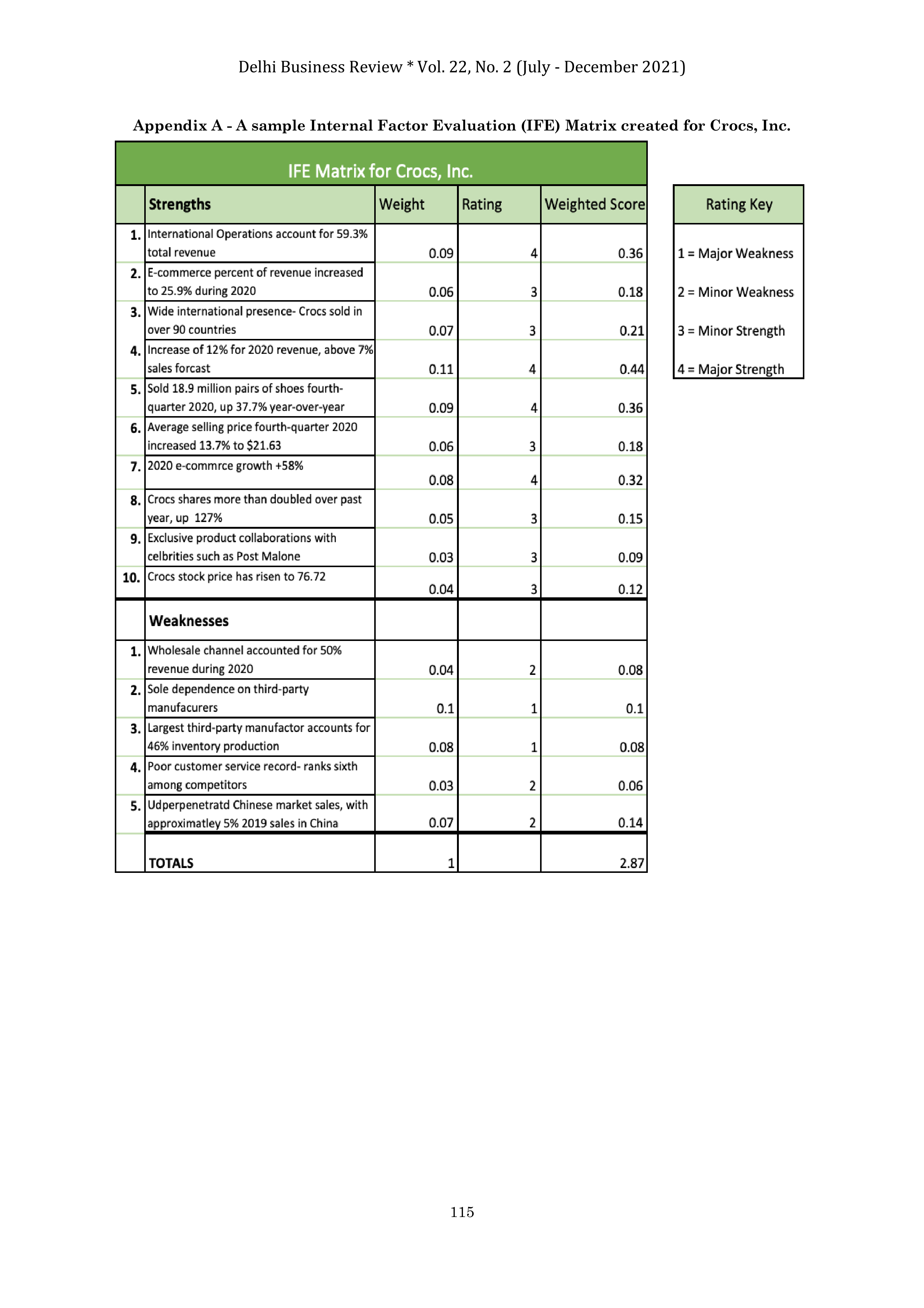
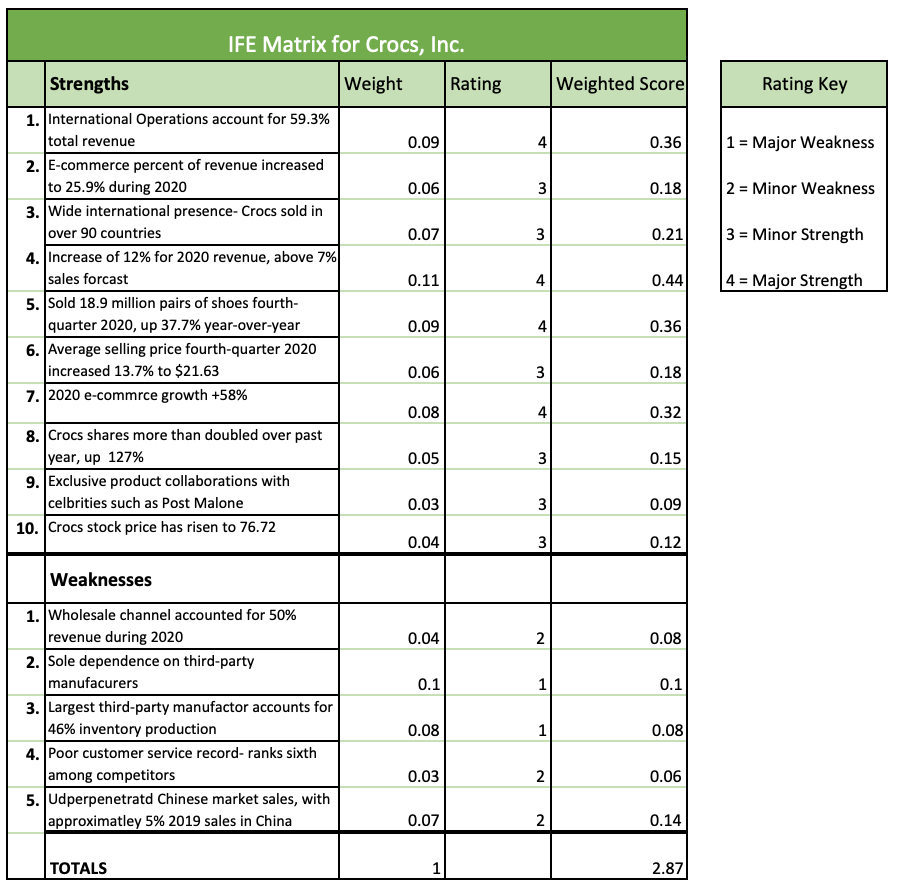
. An IFE Matrix has
been created for Crocs and is featured in
Appendix A.
Crocs’ IFE Matrix reveals that some of its most
relevant strengths are that the company saw a
revenue increase of 12% in 2020, an e-commerce
growth of over 58% in 2020, and the company's
International Operations account for 59.3% of
its total revenue
(Crocs, 2021b).
Crocs' most
relevant weaknesses include that it has
unpenetrated the Chinese market (the second
largest footwear market) and that its largest
third-party manufacturer accounts for 46% of
its inventory production
(Crocs, 2021a
,
Garcia,
2021)
. Such findings suggest that Crocs is
currently in a strong and growing financial
position and can increase its dominance in the
footwear industry by capitalizing on its
international presence and working toward
infiltrating the Chinese shoe market.
Crocs’ External Factor Evaluation (EFE)
Matrix
Like the IFE Matrix, the EFE Matrix is a tool
used to determine a firm’s current external
market position.
Ibrahim, Nurrochmat, and
Maulana (2019)
discuss that the EFE Matrix is
used to identify, classify, and rank notable
external threats and opportunities to a
company. The EFE Matrix has identical
construction steps to the IFE Matrix, differing
only in listing the company's external threats
and opportunities instead of its internal
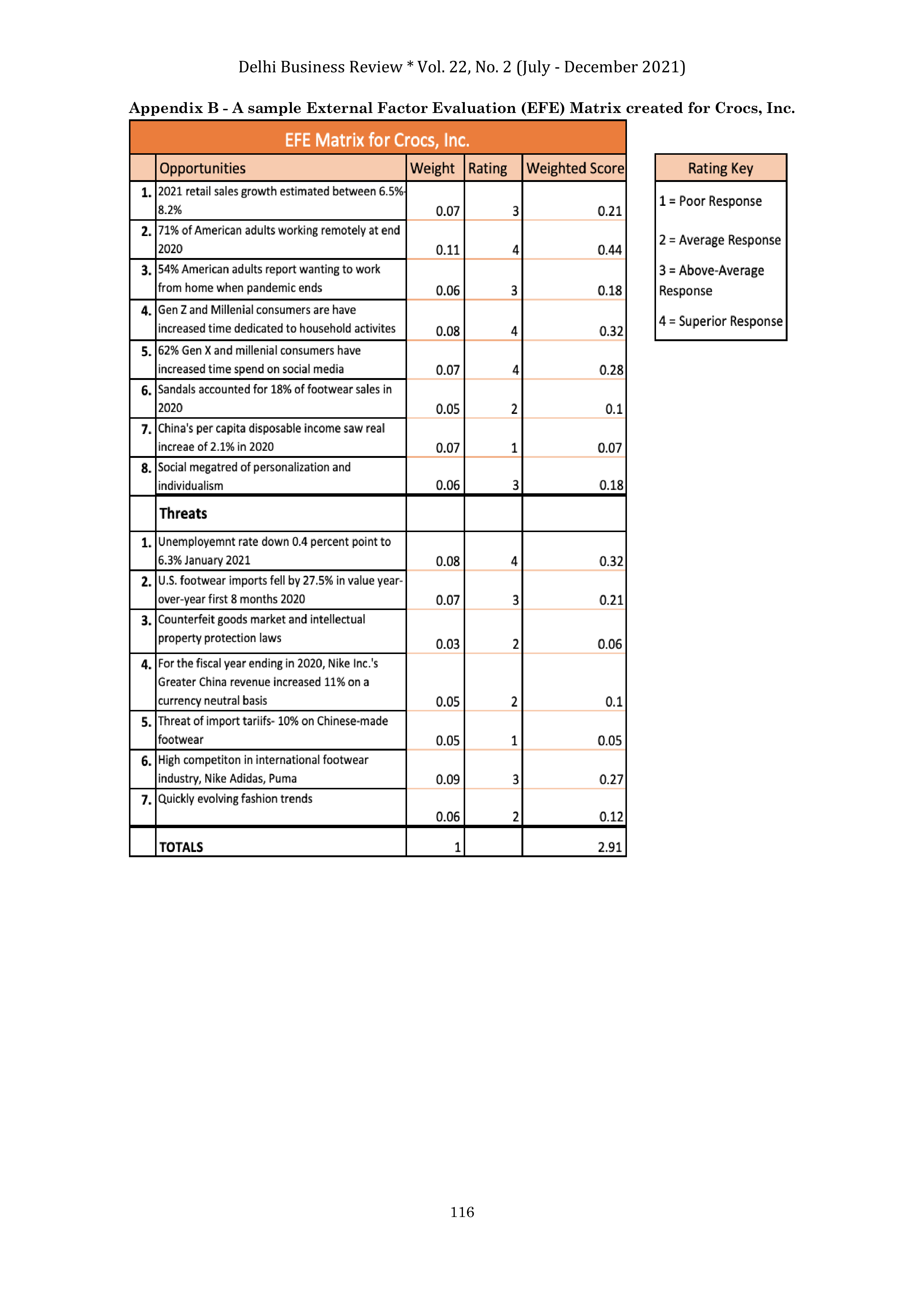
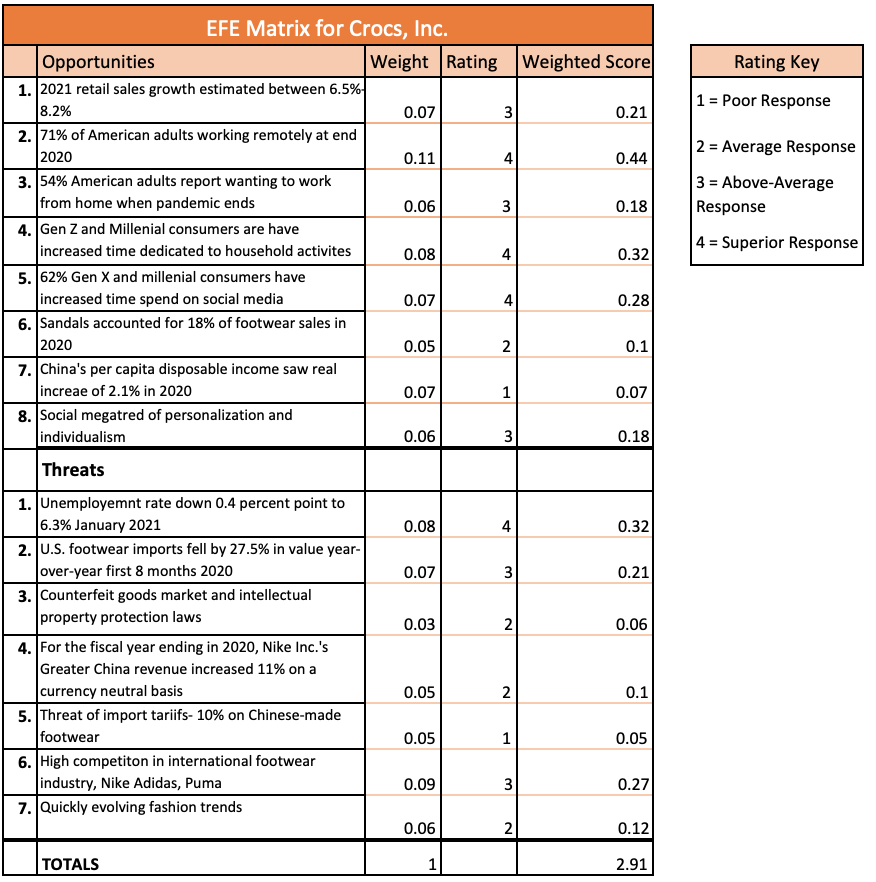
strengths and weaknesses. An EFE has been
created for Crocs and can be seen in Appendix
B.
Observing Crocs’ EFE matrix reveals that the
most relevant external opportunities for Crocs’
are that Gen Z (ages 7-22) and Millennial (ages
23-38) consumers have increased time dedicated
to household activities, and 62% have increased
time spent on social media
(Petro, 2020)
.
Further, 71% of American adults worked
remotely at the end of 2020. Prevalent threats
to
Crocs
include
the
currently
high
unemployment rate in the U.S. and that there is
high competition in the international footwear
industry, where brand giants such as Nike,
Adidas, and Puma all compete
(Bureau of Labor
Statistics, 2021, MarketLine, 2020)
. These
findings suggest that Crocs can capitalize on its
product appeal to those seeking comfortable
Delhi Business Review * Vol. 22, No. 2 (July - December 2021)
108
loungewear by targeting Millennial and Gen Z
consumers through relevant advertising. The
company should also focus on its international
presence, such as in China, finding a way to
differentiate itself from footwear giants such as
Nike.
Crocs’ Competitive Profile Matrix (CPM)
A CPM is one tool that can be used to determine
how well a company compares to its major
competitor(s). The first step in creating a CPM
is to list critical success factors (CSFs) that are
essential to businesses in the industry under
question, which are assigned a weight of
importance, with the constriction that all
critical success factors sum to one
(Jaksic,
Ivanjko, and Njavro, 2015)
. The company under
analysis and its competitor(s) are then rated on
a scale from one-four indicating how well each
company performs on each CSF
(Jaksic et al.,
2015)
. For each company, their respective CSF
ratings are multiplied by the CSF's weights to
generate a score, indicating how well each
company handles the relevant CSFs.
(Jaksic et
al., 2015).
Lastly,
Jaksic et al. (2015)
discuss
these scores are summed to determine a total
score for each company, representing how the
companies compare to each other overall.
One of Crocs' major competitors in the footwear
industry is Skechers U.S.A., Inc. (Skechers)
which has a similar market share and company
price profile to Crocs
(CSI Market, 2021).
To
determine
how
Crocs
compares
against
Skechers regarding relevant footwear industry
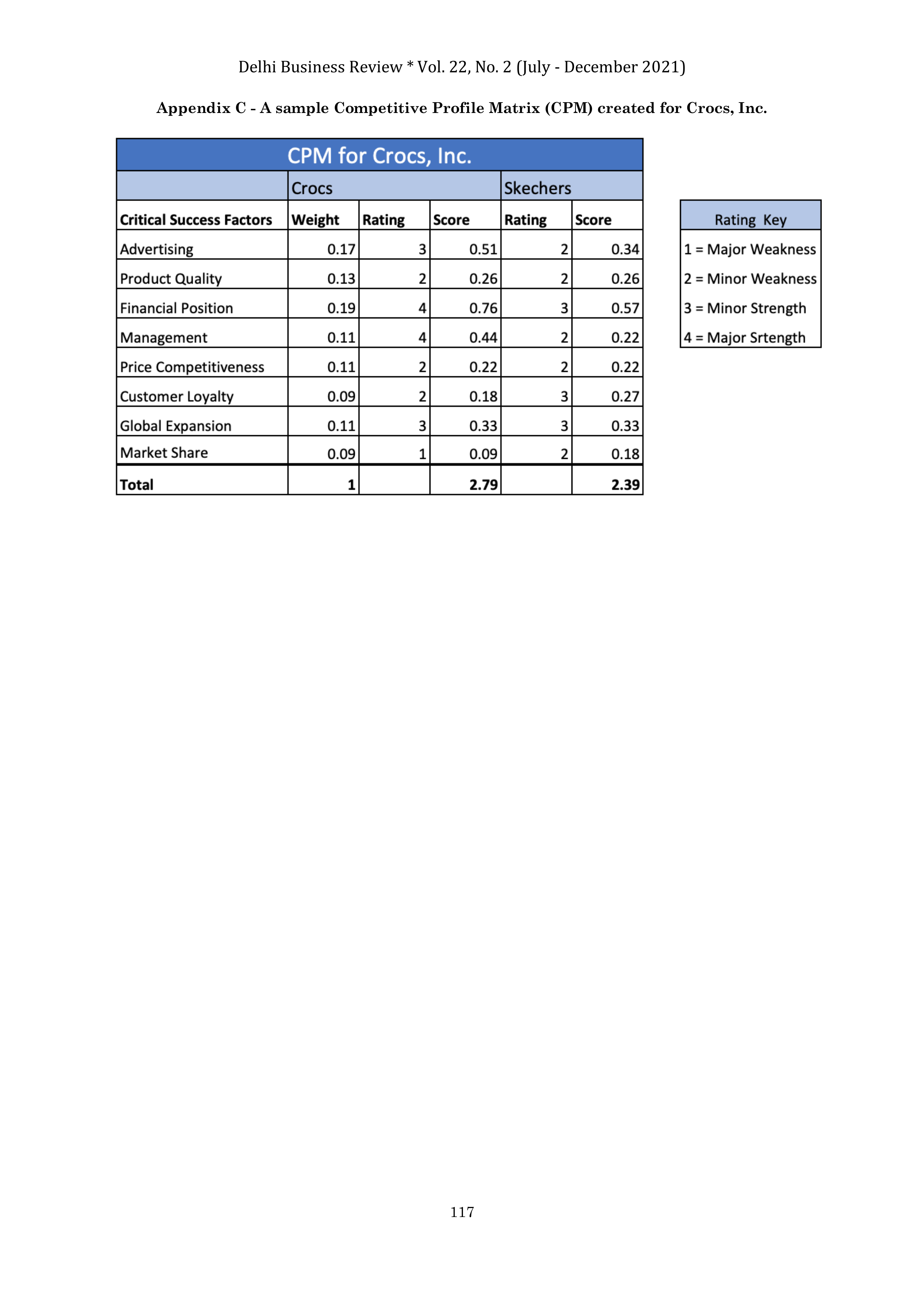
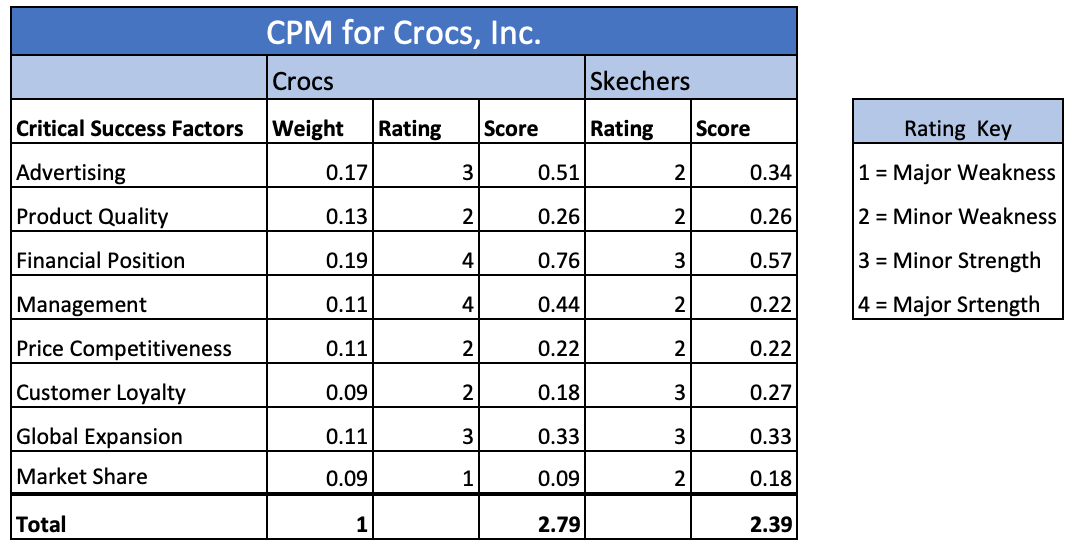
CSFs, a CPM has been created and can be seen
in Appendix C. The CPM reveals that Crocs has
a greater total score of 2.79 than Skechers' total
score of 2.39, indicating that Crocs currently has
a competitive edge over Skechers in the
footwear industry. On a more specific level, the
CPM indicates that Crocs has a better
management and financial position than
Skechers but has a lower market share.
The Matching Stage
Following the strategy formulation framework's
input stage, the matching stage involves
formulating potential strategies that Crocs can
pursue. According to David and David (2017),
possible company strategies are developed
during the matching stage by utilizing certain
matching tools that use its current market
position to provide viable strategic options. The
three tools of a Strategic Position and Action
Evaluation
(SPACE)
Matrix,
Strengths-
Weaknesses-Opportunities-Threats
(SWOT)
Matrix, and the Grand Strategy Matrix will be
used to complete the matching stage of strategy
formulation for Crocs by generating alternative
strategies that Crocs can pursue. These three
tools will help generate both specific strategies
and the best type of strategy for Crocs to pursue.
Crocs’
Strengths
-
Weaknesses-
Opportunities -Threats (SWOT) Matrix
The first matching stage tool used to generate
feasible strategies that Crocs can pursue is the
SWOT Matrix. According to
Verboncu and
Condurache
(2016)
,
the
SWOT
Matrix's
foundation is the internal strengths and
weaknesses and external opportunities that a
firm currently has. Once these four components
have been identified for a company, elements
from the components are matched to create four
types of strategies: WT (weakness-threat)
strategies,
WO
(weakness-opportunity)
strategies,
SO
(strength-opportunity)
strategies, and ST (strength-threat) strategies.
(David & David, 2017)
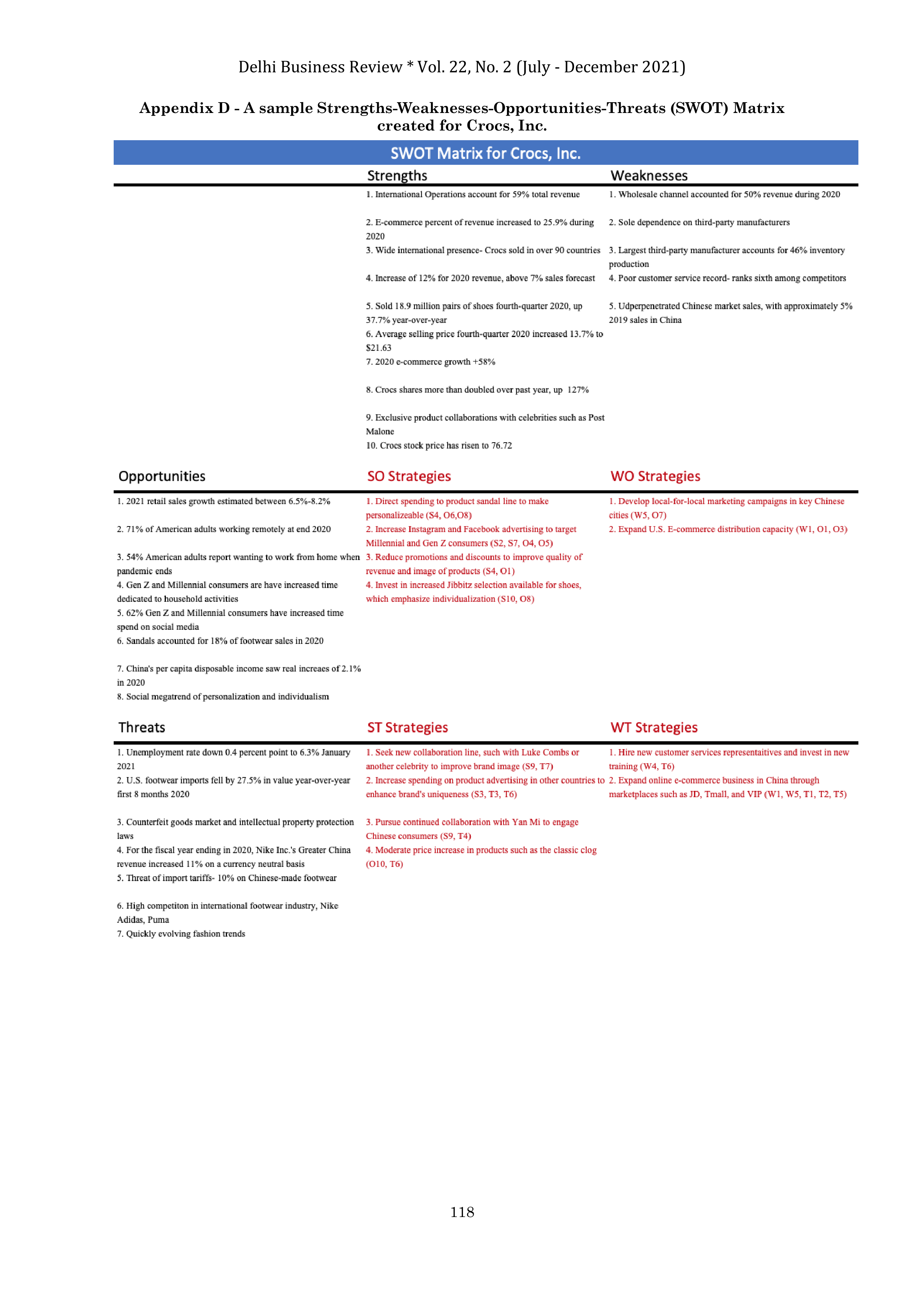
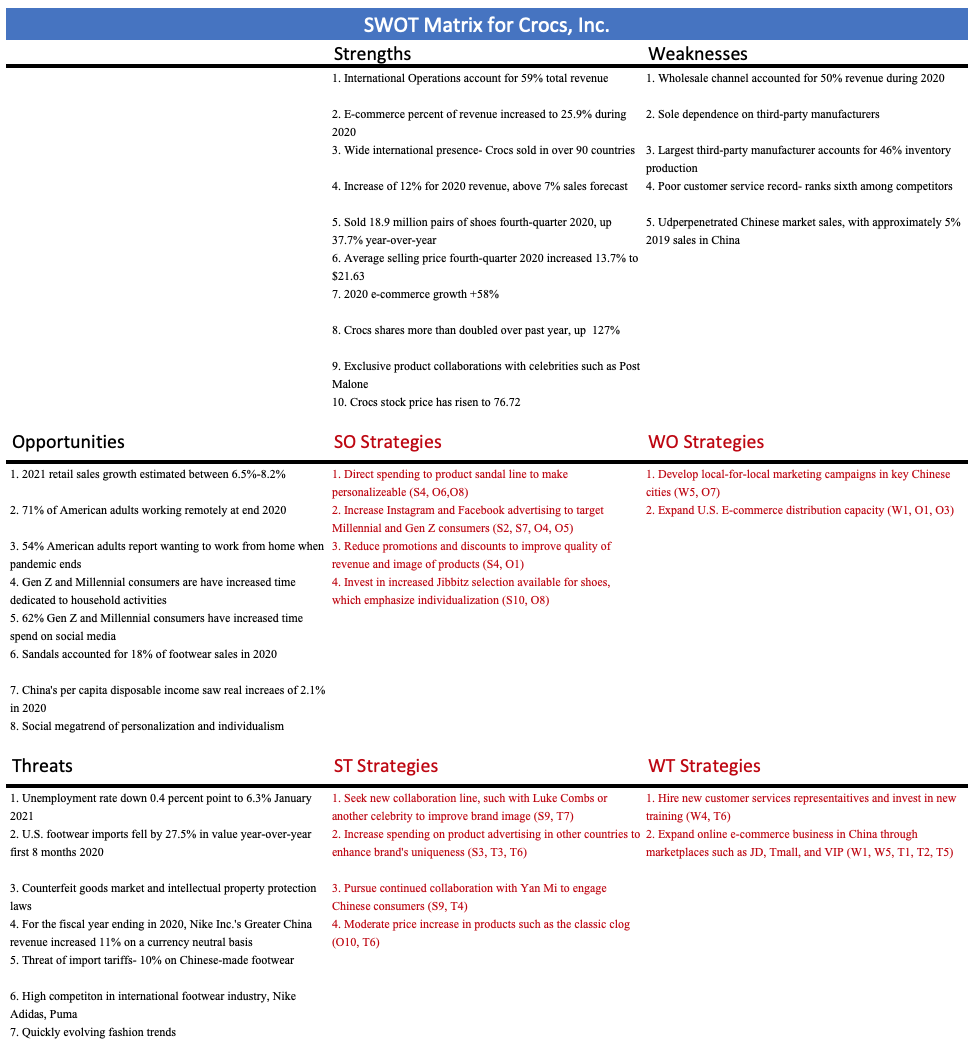
. A SWOT Matrix has
been created and can be found in Appendix D.
The matrix reveals a total of 12 specific SO, ST,
WT, and WO strategies that Crocs can pursue.
Crocs’
Strategic
Position
and
Action
Evaluation (SPACE) Matrix
The second matching stage tool used to generate
alternate strategies for Crocs is the SPACE
Matrix. According to
Gurbuz (2013),
the SPACE
Matrix is used to determine a company's current
strategic
position
within
a
market
and
accordingly provides the course of action a
company should pursue. Four dimensions are
used to create a SPACE Matrix, two internal
dimensions, Competitive Position (CP) and
Financial Position (FP), and two external
dimensions,
Stability
Position
(SP)
and
Industry Position (IP), to determine a company's
current strategic standing
(David & David,
2017)
. These four dimensions are ranked on a
scale of either 1 to 7 (FP and IP) or -1 to -7 (CP
and SP), representing how well the company
fares for each dimension (Gurbuz, 2013).
After being ranked,
Gurbuz (2013)
notes the
averages of each dimension are calculated, the
CP and IP averages are added together for an x-
coordinate, and the FP and SP values are added
for a y-coordinate. This coordinate is then
graphed to demonstrate the firm's position.
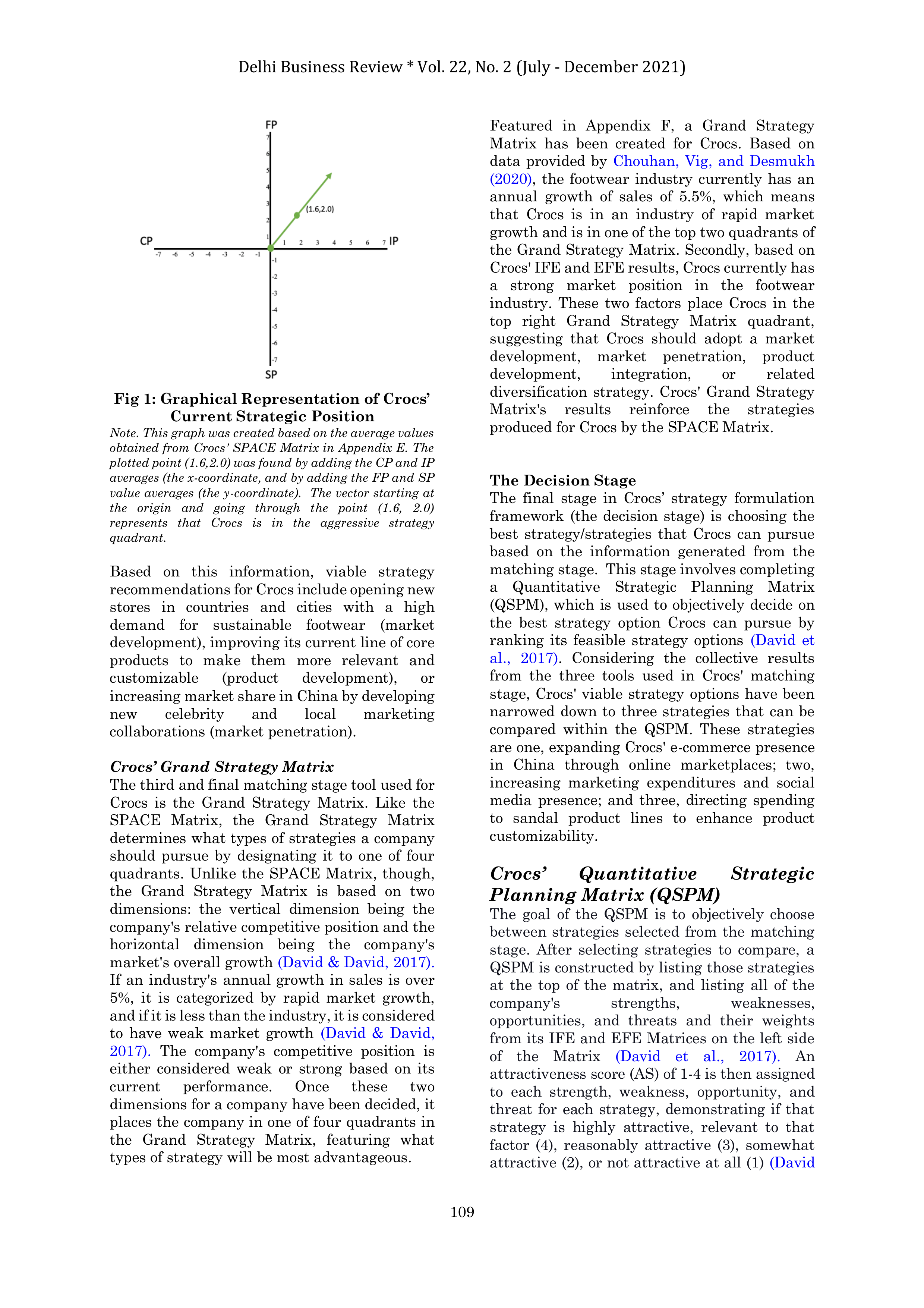
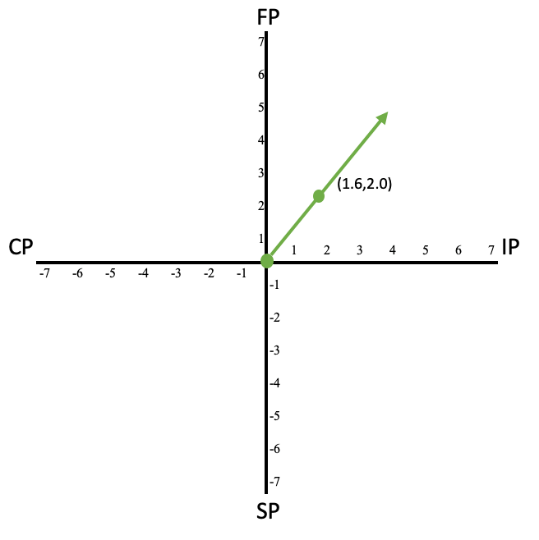
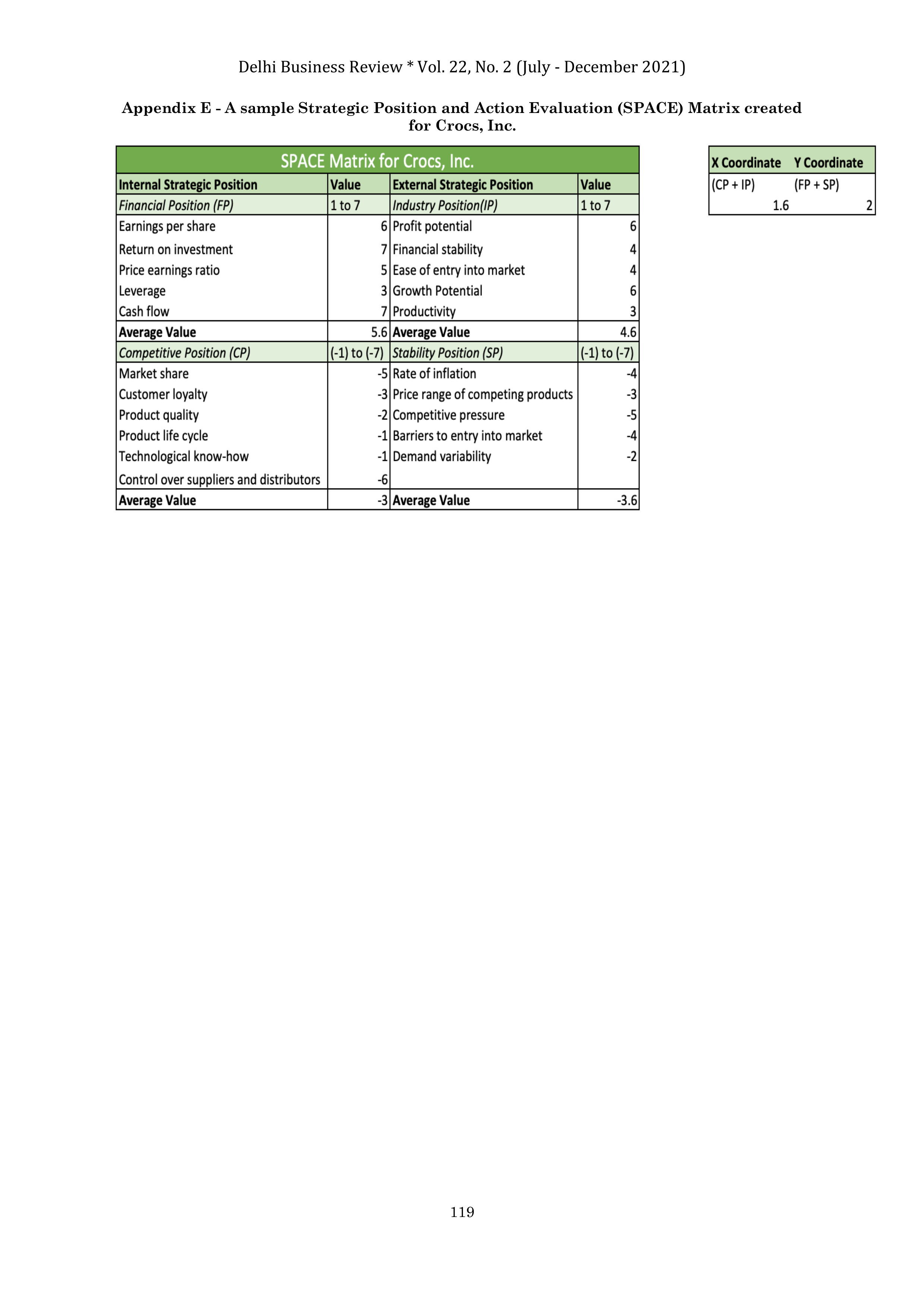
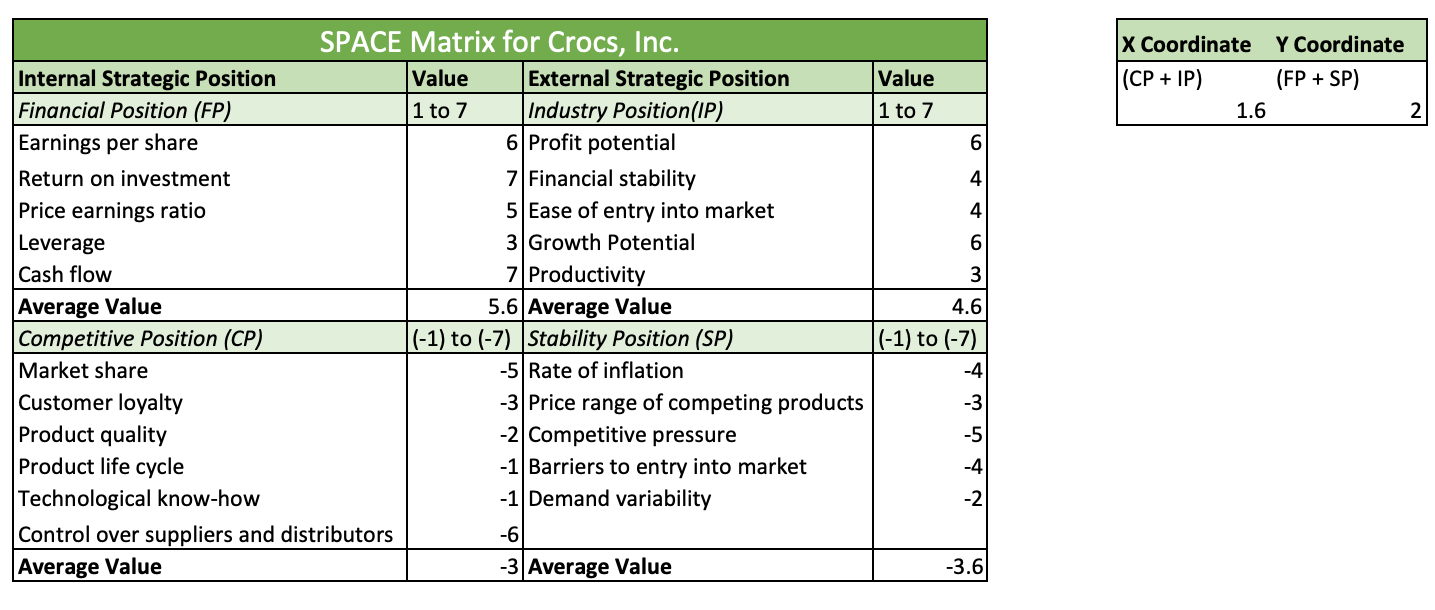
A SPACE Matrix has been created for Crocs and
is featured in Appendix E. The corresponding
graphical representation of Crocs’ current
strategic position can be seen in Figure 1.
Crocs’ current strategic position shows that
Crocs has an aggressive profile. Since the
company has managed to achieve a very strong
financial position over the past year, and the
shoe industry is stable, it should engage in
market penetration/development or product
development
(David & David, 2017).
Delhi Business Review * Vol. 22, No. 2 (July - December 2021)
109
Fig 1: Graphical Representation of Crocs’
Current Strategic Position
Note. This graph was created based on the average values
obtained from Crocs' SPACE Matrix in Appendix E. The
plotted point (1.6,2.0) was found by adding the CP and IP
averages (the x-coordinate, and by adding the FP and SP
value averages (the y-coordinate). The vector starting at
the origin and going through the point (1.6, 2.0)
represents that Crocs is in the aggressive strategy
quadrant.
Based on this information, viable strategy
recommendations for Crocs include opening new
stores in countries and cities with a high
demand for sustainable footwear (market
development), improving its current line of core
products to make them more relevant and
customizable
(product
development),
or
increasing market share in China by developing
new
celebrity
and
local
marketing
collaborations (market penetration).
Crocs’ Grand Strategy Matrix
The third and final matching stage tool used for
Crocs is the Grand Strategy Matrix. Like the
SPACE Matrix, the Grand Strategy Matrix
determines what types of strategies a company
should pursue by designating it to one of four
quadrants. Unlike the SPACE Matrix, though,
the Grand Strategy Matrix is based on two
dimensions: the vertical dimension being the
company's relative competitive position and the
horizontal dimension being the company's
market's overall growth
(David & David, 2017).
If an industry's annual growth in sales is over
5%, it is categorized by rapid market growth,
and if it is less than the industry, it is considered
to have weak market growth
(David & David,
2017).
The company's competitive position is
either considered weak or strong based on its
current
performance.
Once
these
two
dimensions for a company have been decided, it
places the company in one of four quadrants in
the Grand Strategy Matrix, featuring what
types of strategy will be most advantageous.
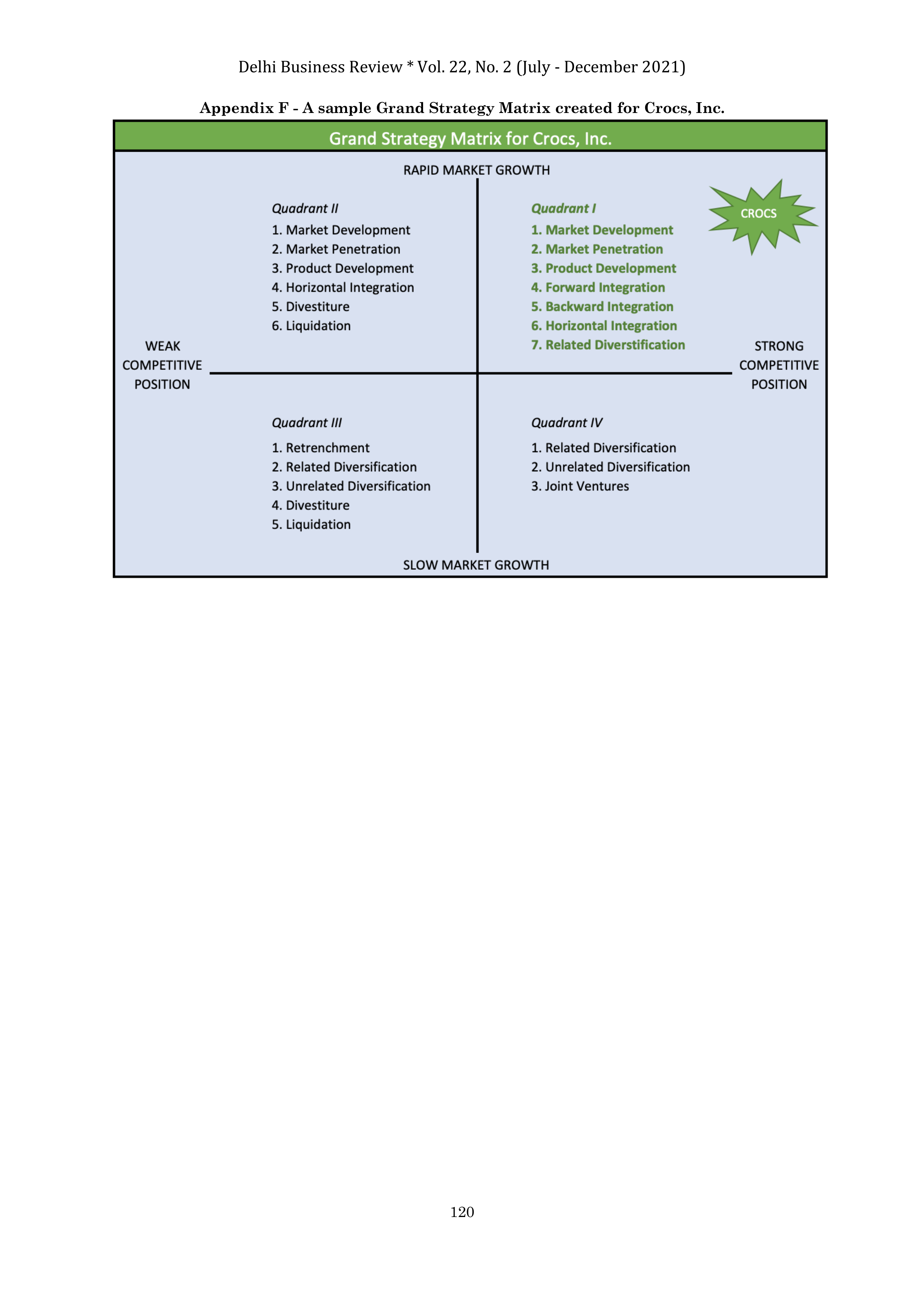
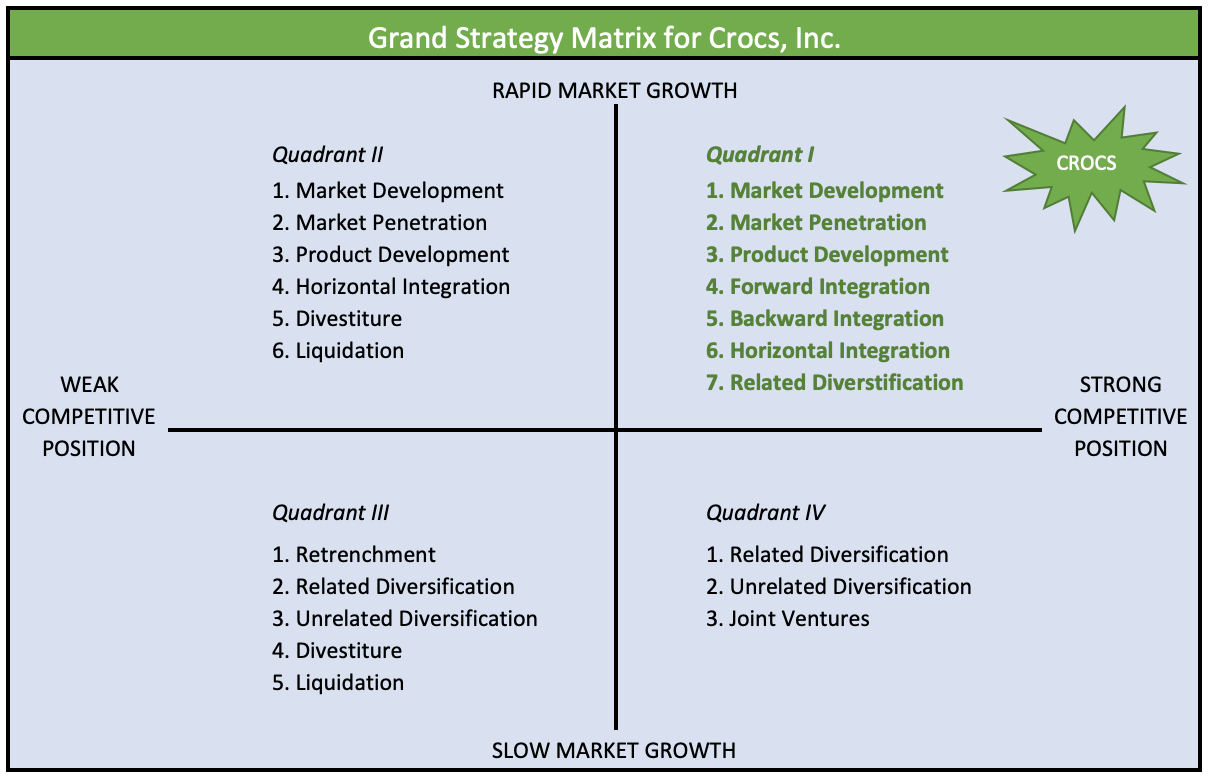
Featured in Appendix F, a Grand Strategy
Matrix has been created for Crocs. Based on
data provided by
Chouhan, Vig, and Desmukh
(2020)
, the footwear industry currently has an
annual growth of sales of 5.5%, which means
that Crocs is in an industry of rapid market
growth and is in one of the top two quadrants of
the Grand Strategy Matrix. Secondly, based on
Crocs' IFE and EFE results, Crocs currently has
a strong market position in the footwear
industry. These two factors place Crocs in the
top right Grand Strategy Matrix quadrant,
suggesting that Crocs should adopt a market
development, market penetration, product
development,
integration,
or
related
diversification strategy. Crocs' Grand Strategy
Matrix's
results
reinforce
the
strategies
produced for Crocs by the SPACE Matrix.
The Decision Stage
The final stage in Crocs’ strategy formulation
framework (the decision stage) is choosing the
best strategy/strategies that Crocs can pursue
based on the information generated from the
matching stage. This stage involves completing
a Quantitative Strategic Planning Matrix
(QSPM), which is used to objectively decide on
the best strategy option Crocs can pursue by
ranking its feasible strategy options
(David et
al., 2017)
. Considering the collective results
from the three tools used in Crocs' matching
stage, Crocs' viable strategy options have been
narrowed down to three strategies that can be
compared within the QSPM. These strategies
are one, expanding Crocs' e-commerce presence
in China through online marketplaces; two,
increasing marketing expenditures and social
media presence; and three, directing spending
to sandal product lines to enhance product
customizability.
Crocs’
Quantitative
Strategic
Planning Matrix (QSPM)
The goal of the QSPM is to objectively choose
between strategies selected from the matching
stage. After selecting strategies to compare, a
QSPM is constructed by listing those strategies
at the top of the matrix, and listing all of the
company's
strengths,
weaknesses,
opportunities, and threats and their weights
from its IFE and EFE Matrices on the left side
of the Matrix
(David et al., 2017).
An
attractiveness score (AS) of 1-4 is then assigned
to each strength, weakness, opportunity, and
threat for each strategy, demonstrating if that
strategy is highly attractive, relevant to that
factor (4), reasonably attractive (3), somewhat
attractive (2), or not attractive at all (1)
(David
Delhi Business Review * Vol. 22, No. 2 (July - December 2021)
110
et al., 2017)
. After each strategy has been
assigned an AS for each factor, each factor's
weight is multiplied by the AS to generate a
total attractiveness score (TAS)
(David et al.,
2017)
. Lastly, all TAS are added for each
strategy to reveal its overall attractiveness.
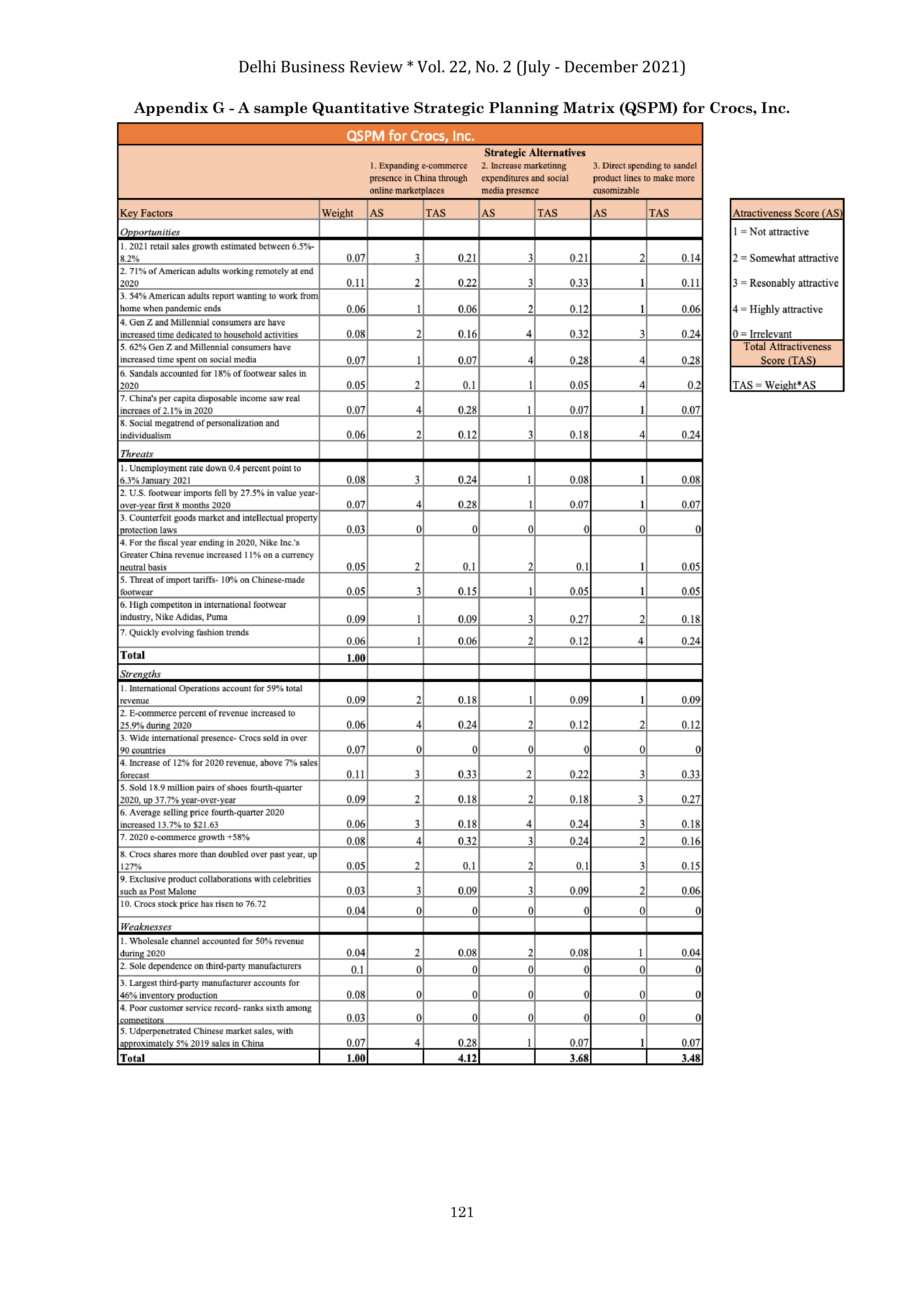
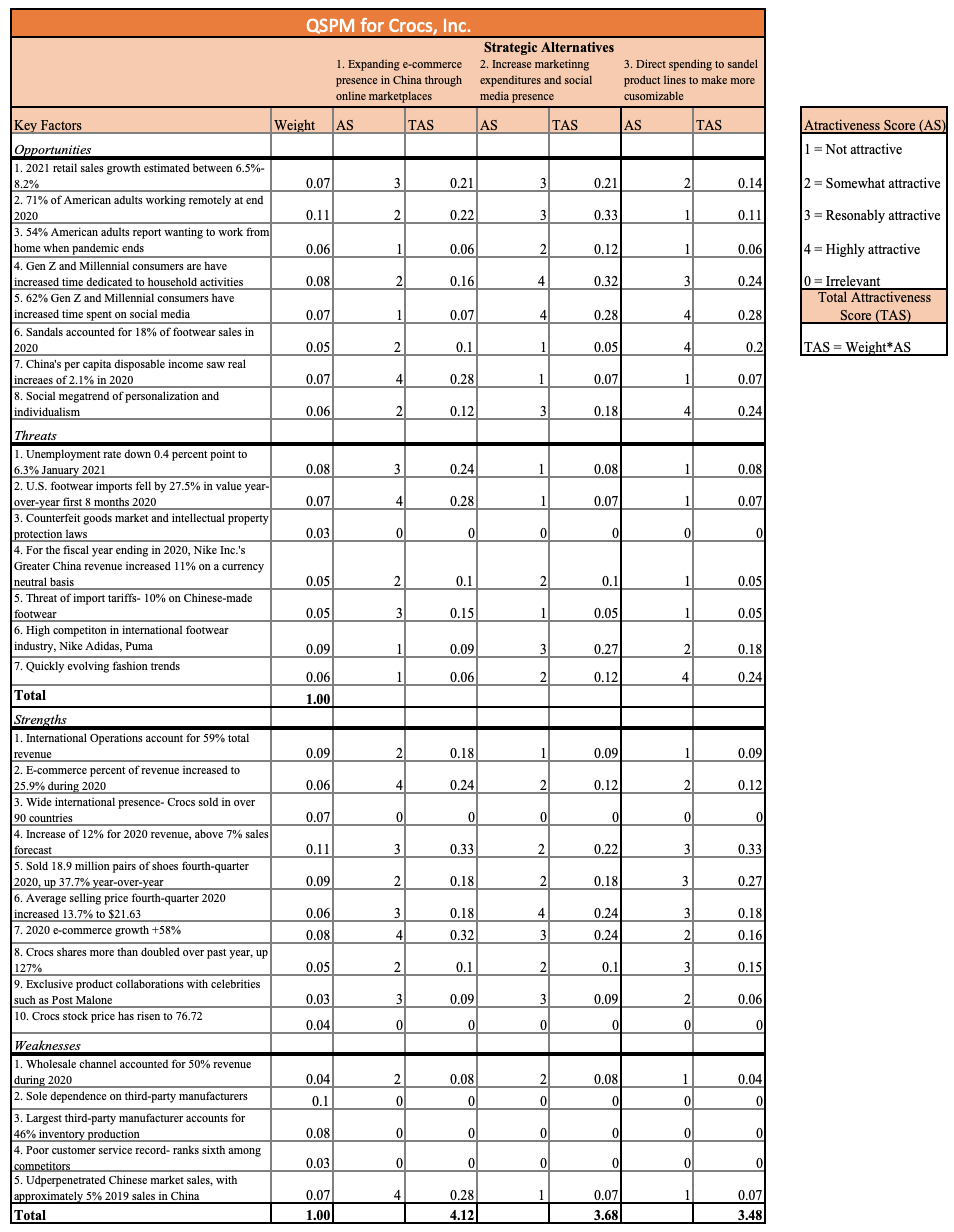
Using the three strategies for Crocs as discussed
prior and Crocs' IFE and EFE Matrices, a QSPM
has been generated for Crocs and can be seen in
Appendix G. Crocs' first recommended strategy,
expanding Crocs' e-commerce presence in China
through online marketplaces, has a total score
of 4.12. Recommended strategy two, increasing
marketing expenditures and social media
presence, has a total score of 3.68. Crocs' third
recommended strategy, directing spending to
sandal product lines to enhance product
customizability, scored a total of 3.48. These
results indicate that strategy one is the most
attractive option for Crocs to pursue, strategy
two the second most, and strategy three the
least most.
Strategy Implementation
Following the strategic management process's
strategic formulation phase, the second stage,
strategy
implementation,
is
undertaken.
Strategy implementation includes a plethora of
activities, ranging from devising employees and
establishing annual objectives to preparing
budgets and creating the company's strategy's
best organizational structure
(David & David,
2017)
. Essentially, strategy implementation is
the step in which means are taken to complete
the
strategy(s)
chosen
during
strategy
formulation. For Crocs, a consideration of its
recommended strategies will be used to create
fitting financial projections, annual goals, and
policy recommendations, highlighting how the
company may participate in the strategy
implementation phase and any associated risks
that it may face.
Strategy and Long-term Objectives
Recommendations
Given Crocs' impressive financial performance
in 2020 and the results from Crocs’ QSPM, it is
recommended that the company should pursue
two strategies. The first is expanding its e-
commerce presence in China through online
marketplaces to increase its market share in the
country. The second is that Crocs should
increase its marketing expenditures and social
media presence to target Millennial and Gen Z.
In 2019, Crocs had $83.2 million in marketing
expenses
(Sabanoglu, 2021).
Based on this
figure, Crocs should spend $108.2 million in
marketing expenses, which would be an
increased cost of $25.0 million. Additionally, it
is predicted that Crocs' expansion of its e-
commerce business in China through online
marketplaces will cost approximately $50
million. By engaging in these strategies, Crocs
should successfully increase its market share in
China and win over a greater population of
Millennial and Gen Z consumers, allowing for
the company to embrace global diversity and
more
innovative
marketing
techniques.
Projected financial statements for Crocs based
on these recommendations will provide a more
thorough view of how they can benefit the
company.
Projected
Financial
Statement
with Assumptions
One
critical
component
of
the
strategy
implementation phase is considering concepts
related to company finance and accounting.
Colorado State University Global (CSUG)
(2021)
states that "Evaluating the payoff of
investments and securing the capital to fund
investments are the core of finance in business"
(para. 3), emphasizing the need for accurate
financial projections based on reasonable
assumptions.
David
and
David's
(2017)
proposed
financial
projection
format
and
process will be used to generate financial
projections for Crocs. The first step to creating
Crocs' financial projections is using past and
current financial data from Crocs' (2020a) Form
10K to establish a baseline for future financial
projections. Given the unique circumstances
surrounding 2020, Crocs' financial data from
2019 and 2020 has been featured and considered
in Crocs' projected financial statements.
With a financial statement foundation for Crocs,
its financial projections for the next three years
(2021-2023) can be created under assumptions
aligning with recommended strategies. It is
assumed that Crocs will pursue two strategies:
one, expanding its e-commerce presence in
China through online marketplaces to increase
its market share in the country, and two,
increasing marketing expenditures and social
media presence to target Millennial and Gen Z.
As stated prior it is recommended that Crocs
spend an $108.2 million in marketing expenses
and $50 million in e-commerce expansion in
Chinese marketplaces to achieve its long-term
goals. Based on Crocs 2019 and 2020 financial
data and the above strategic assumptions,
Crocs' predicted financial statements for the
next three years have been calculated and are
shown in
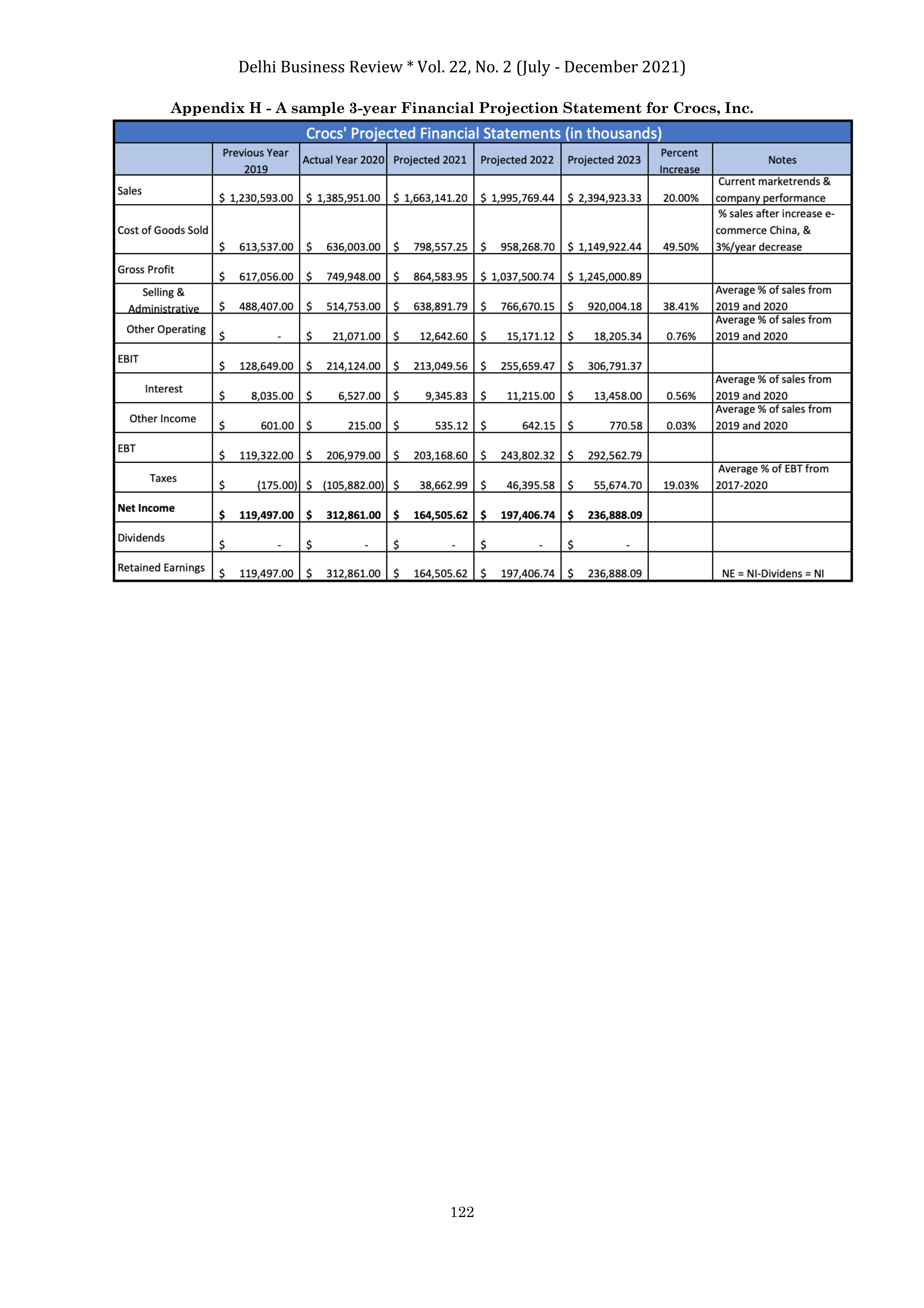
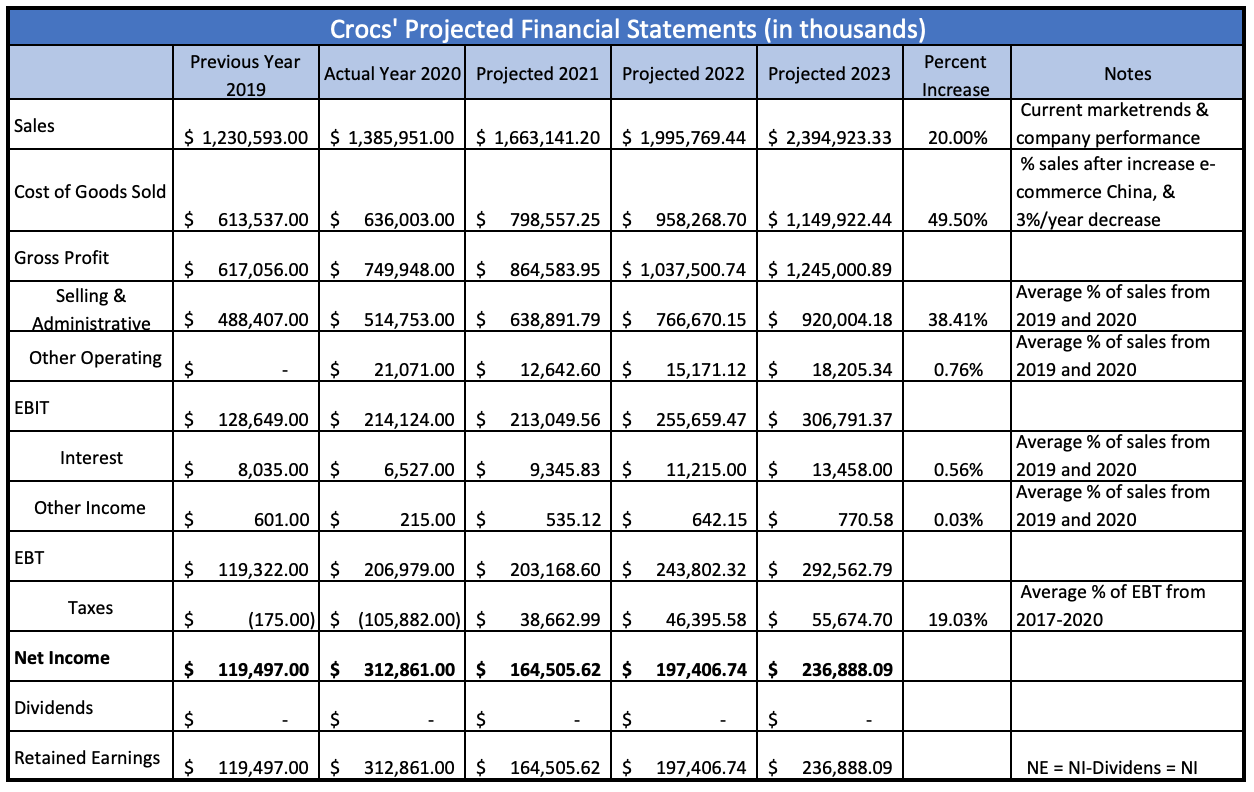
Appendix H.
Within Appendix H, financial data for Crocs
such as the company’s sales, cost of goods sold,
Delhi Business Review * Vol. 22, No. 2 (July - December 2021)
111
taxes, net income, earnings before interest and
taxes (EBIT), earnings before taxes (EBT), and
other relevant variables are featured for the
years 2019-2023. After evaluating Crocs'
previous financial variables and using the
assumptions presented prior, it is suggested
that Crocs' sales will increase by 20% yearly
from 2021-2023. Using data from 2019 and
2020, Crocs’ selling and administrative and
other operating costs, interest, and other income
are calculated for 2021-2023 using the percent
of sales method, which assumes future variables
will share the same ratio as Crocs’ current data
(David & David, 2017).
It is important to note
that while the percentage of sales method was
used to calculate a baseline for Crocs' future cost
of goods sold variable, this percentage is
assumed to decrease by an additional 3% yearly.
This additional decrease is designed to reflect a
decreasing trend in Crocs' cost of goods sold to
sales ratio spurred by
Crocs' (2021a)
transition
to only third-party manufacturers in 2018.
Crocs’ future taxes were similarly calculated as
a percent of EBT, as recommended
by David and
David (2017)
. Notably, however, Crocs’ tax data
from 2017-2020 was used to calculate this
percentage instead of just data from 2019 and
2020. The inclusion of extra data to form Crocs'
tax rate for future projections is because Crocs
has had a large fluctuation in recent tax figures
and realized tax benefits in 2019 and 2020. As
stated in the company's 2020 Form 10K, "Our
effective tax rate has varied dramatically in
recent years due to the intra-entity intellectual
property rights transfer, differences in our
profitability
level
and
relative
operating
earnings across multiple jurisdictions and by
changes in the valuation allowance"
(Crocs,
2021a, p. 31)
. Due to this fluctuation, Crocs’
average tax percent of EBT from 2017 to 2020
(19.03%) is used for future projections. After
completing
Crocs’
projected
financial
statements, it is predicted that the company will
reach
a
net
income
of
approximately
$236,900,000 in 2023 if the company adopts the
proposed strategies.
Annual
Goal
and
Policy
Recommendations
For Crocs’ proposed strategies to be successful,
they must be accompanied by clear policies and
realistic annual objectives.
David and David
(2017)
define annual objectives as “desired
milestones an organization needs to achieve to
ensure successful strategy implementation” (p.
208). Policies are the means an organization
uses to encourage and support work toward
annual goals, ranging from specific guidelines
and procedures to rules and administrative
practices
(David & David, 2017).
In addition to
the functional purpose of annual objectives and
policies, the company must appropriately
embody
crocs’
overall
commitment
to
sustainability,
ethics,
and
innovation
to
promote a positive company image and company
culture.
Dhanesh (2020)
emphasizes that it has
become more important than ever for companies
to address not just economic responsibilities but
ethical,
environmental,
and
social
responsibilities
as
well.
For
Crocs’
recommended
strategies,
a suggestion
of
possible annual objectives that will promote a
successful implementation of said strategies
and how certain policies can enhance the
process will be considered.
Crocs’ first recommended strategy is to expand
its markets share in China by increasing its e-
commerce presence and investing in local online
marketplaces. Some annual goals for Crocs to
achieve this goal may include hiring an
additional 30 software developers and hiring 15
additional systems analysts in its Asian division
(Crocs, 2021a).
Crocs should also aim to increase
its percentage of e-commerce sales from 18.5%
in 2019 to 22.1% in 2021 and expand its Asian
division revenues from 5% in 2019 to 12% by
2021
(Crocs, 2021a).
Some proposed examples of
policies that Crocs can use to promote these
annual goals are Human Resource (HR)
recruiting from technology-focused universities
and offering annual-goal-based bonuses. All
Crocs employees should also adhere to strict e-
commerce policies, such as specific shipping,
returns, privacy, and terms of service policies.
Crocs’ second recommended strategy is to
increase its marketing expenditures and social
media presence to target Millennial and Gen Z
consumers. An example of an annual objective
that Crocs can adopt to successfully implement
this strategy is growing its current Instagram
following from 1million to 2 million followers by
2022 by hiring one or more Instagram
consultants
(Instagram, 2021).
Crocs should
also require each of its business segments to
contribute 2% to fund marketing expenses, to
ensure the company has sufficient advertising
funding
(Crocs, 2021a).
Corresponding policies
Crocs can adopt may be increasing Crocs’
America's warehouse inventory by 10% (to
ensure increased demand is met promptly) and
promoting
company
employees
based
on
performance rather than seniority (to ensure all
and young voices especially are represented).
Additionally, regardless of any strategy Crocs
chooses to pursue, the company should have
strict rules and policies that prevent sexual
harassment, discrimination, insider trading,
complemented by an ethics training program
Delhi Business Review * Vol. 22, No. 2 (July - December 2021)
112
(David & David, 2017),
which will allow Crocs to
harvest a safe, and fun company culture.
Strategy Implementation Risks
During the strategy implementation phase,
there are many risks that Crocs may incur.
Cultural, operational, systems, and financial
risks
all
pose
potential
threats
and
uncertainties to the company that must be
considered and planned for
(David & David,
2017)
. As
Radomska (2014)
states, given that
“risk may constitute an unpredictable threat to
the survival of the organization, it is necessary
to take actions mitigating the impact of many
types of risk on the development of the
organization and to use the risk to generate
benefits” (p. 33). For Crocs, one area of risk is its
third-party manufacturing operations. Crocs
(2021a) reports in its Form 10K that failure for
its third-party manufacturers to comply with
labor, environmental, and trade laws and
regulations could harm the brand's reputation
and import privileges.
Given Crocs' strong international presence and
desire to increase market share globally (in
China particularly), Crocs faces additional risks
associated with international operation.
Ozkan
(2020)
discusses that when operating in
international markets, company’s may face
“adverse environmental conditions associated
with the political system, economic conditions
and cultural distance in a host country” (p. 8).
Much of Crocs’ financial success depends on its
ability to provide diverse customers with
appealing products and consumer’s ability to
pay for such products. Crocs also faces the
financial risk of adverse fluctuations in foreign
exchange rates
(Ozkan, 2020).
Crocs (2021a)
describes in its Form 10K that its financial and
business results are dependent upon the status
of a large variety of global currencies, such as
the Euro, Japanese Yen, Chinese Yuan, Russian
Ruple, and South Korean Won.
Strategy Evaluation
An overview of strategic formulation and
strategic implementation as it applies to Crocs
has led to the strategic management process's
final stage, strategy evaluation. Strategy
evaluation involves deciphering how well a
company's
implemented
strategies
have
performed and is an essential part of the
strategic management process A successful
strategic evaluation system will allow Crocs to
effectively
handle
risk
by
identifying
environmental factor changes and ensuring that
it makes satisfactory progress towards its goals
and objectives
(David & David 2017).
Effective
strategy evaluation also serves as an important
form of strategic control. It ensures that short-
term objectives are aligned with overall
strategic goals by communicating and updating
strategic expectations
(Panggabean & Jermias,
2020).
Given that this analysis focuses on
generating and endorsing strategies that Crocs
can theoretically pursue, a recommendation of a
strategy evaluation framework that Crocs can
potentially utilize will be provided.
Strategy Review, Evaluation, and
Improvement Process Suggestions
David and David (2017)
propose a strategy-
evaluation framework that consists of three
basic steps. These steps include examining the
variables that form a platform for a company's
current strategies, comparing how well the
company's actual performance meets planned
performance in achieving objectives, and taking
corrective actions when necessary
(David &
David, 2017)
. Following these steps and
tailoring them to the company's needs will allow
Crocs to examine any changes that may affect
current strategies, evaluate organizational
performance, and identify if the company needs
to make amendments to better achieve strategic
objectives.
The first step of the proposed strategy-
evaluation framework involves revaluating
Crocs’ fundamental internal and external
factors. This reevaluation process is done by
revising Crocs IFE and EFE Matrices to reflect
any changes in external/internal factors if
necessary and comparing any changes to the
original matrices (David & David, 2017).
Suppose there are no changes in Crocs' IFE and
EFE drastic enough that warrant corrective
action, then Crocs organizational performance
must be evaluated. The Balanced Scorecard
(BSC) tool is one option to evaluate Crocs'
organizational performance.
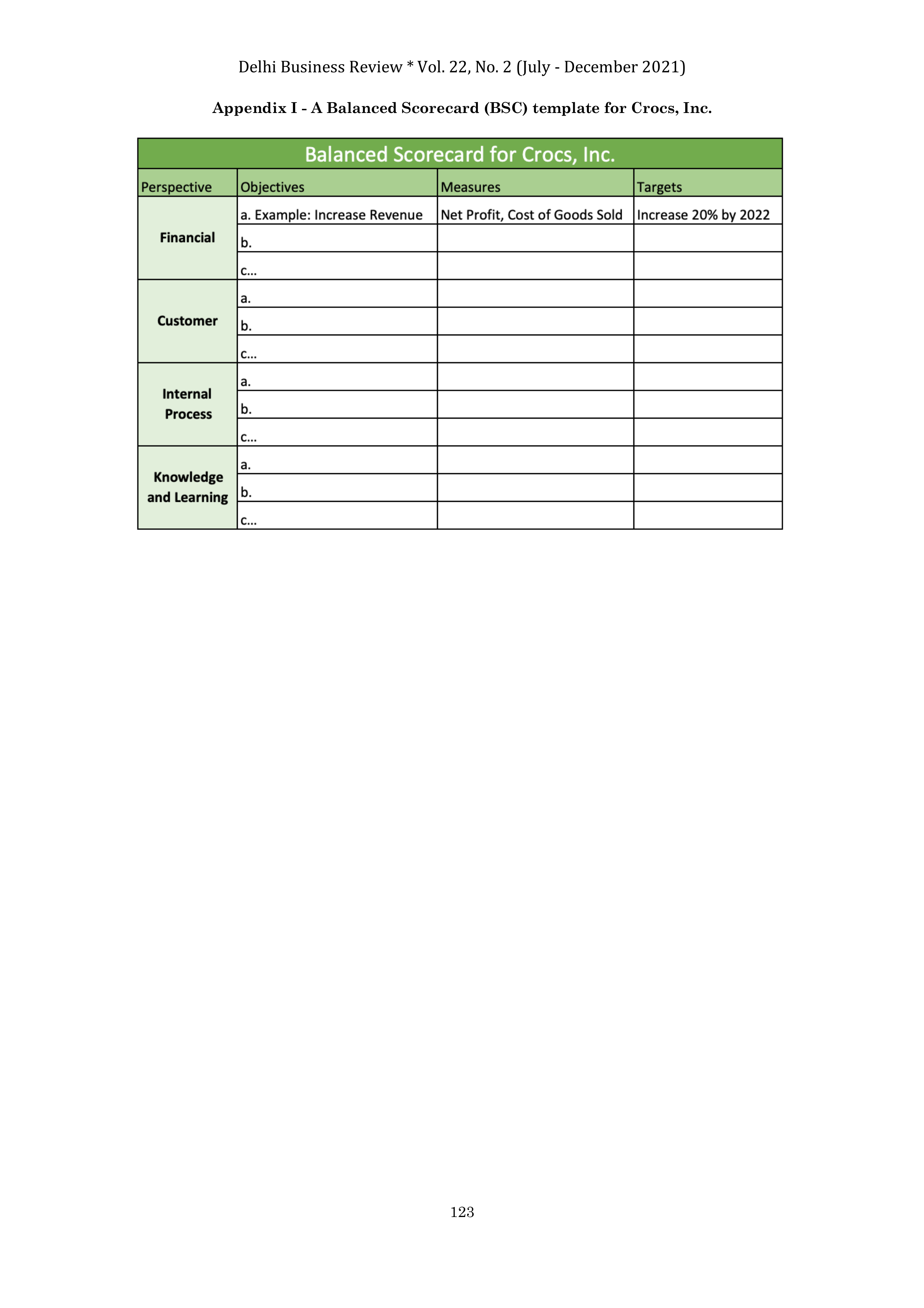
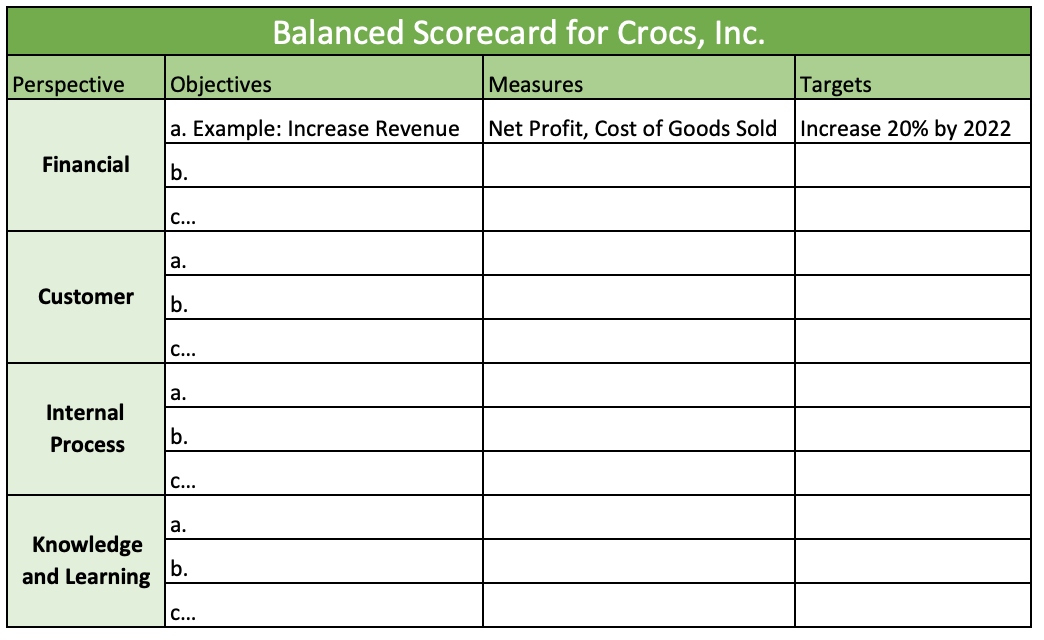
The BSC uses various performance perspectives
to evaluate if Crocs' has satisfactorily been
progressing towards its goals
(Nazari-Shirkouhi
et al., 2020)
. The four performance perspectives
in a BSC are financial, customer, Internal
Personal Process, and Knowledge/Learning
(Kassaneh & Workalemahu, 2018)
. For each of
these
performance
perspectives,
relevant
company objectives are listed (
Kassaneh &
Workalemahu, 2018)
. Once all of Crocs' four
perspective objectives have been listed out, the
BSC is completed by listing performance
measures and targets for each objective
(Segarra et al., 2016
). A sample BSC template
created for Crocs is featured in Appendix I.
Following Crocs' BSC's completion, if Crocs'
Delhi Business Review * Vol. 22, No. 2 (July - December 2021)
113
organizational performance (as detailed in its
BSC) demonstrates that it has successfully
reached its planned objectives' progress, no
corrective action is necessary. However, suppose
it is determined that Croc's actual progress
toward achieving its strategic objectives is
insufficient. In that case, corrective action must
be taken to Crocs on track for achieving its long-
term goals
(David & David, 2017)
. Some of the
corrective actions that Crocs can take include
altering the firm's structure, revising objectives,
altering strategies, and redistributing company
resources
(David & David, 2017).
Even though
company change may be daunting, Crocs must
address any concerns with its strategic plan and
promptly take corrective actions to maintain a
competitive advantage in the footwear industry.
Conclusion
As a company, Crocs currently has a mission to
expand worldwide and offer a variety of
consumers
its
unique,
innovative,
and
comfortable shoes. Engaging in Crocs' strategic
management process has provided useful
insights into how the company can gain and
maintain a long-run competitive advantage in
the footwear industry. An initial evaluation of
Crocs’ current company position produced a
recommended company mission and vision
statement to create a clearer sense of purpose
and directions for the company. Crocs strategy
formulation phase evaluated Crocs’ overall
market position and how it compared to its
major competition, generated feasible strategies
for the company to pursue, and narrowed down
the best strategic options for Crocs. Crocs'
strategy
implementation
phase
provided
strategic
recommendations,
financial
projections, risk considerations, and annual
objective/policy
recommendations
for
the
company.
Crocs'
strategy
evaluation
considerations supply how the company can
engage in strategy review, evaluation, and
improvement processes.
References
•
Bureau of Labor Statistics. (2021,
February 5).
News Release
. U.S.
Department of Labor.
https://www.bls.gov/news.release/pdf/
empsit.pdf
•
Chouhan, N., Vig, H., & Desmukh, R.
(2020).
Footwear Market Size, Share
& Growth: Research Report 2027
.
Allied
Market
Research.
https://www.alliedmarketresearch.co
m/footwear-market
.
•
Colorado State University Global.
(2021).
Module 6: Strategic planning
and
innovation:
Strategy
implementation.
[Interactive lecture].
Canvas.
https://portal.csuglobal.edu
•
Crocs,
Inc.
(2021a)
2020
annual
report
form 10k
.
https://s22.q4cdn.com/133460125/files
/doc_financials/2020/q4/10k-crocs.pdf
•
Crocs,
Inc.
(2021b)
Careers.
https://careers.crocs.com/careers/defa
ult.aspx#explore-jobs
•
Crocs, Inc. (2021c).
Crocs Investor
Presentation
.
https://s22.q4cdn.com/133460125/files
/doc_financials/2020/q4/2021-02-Q4-
2020-Earnings-Presentation_vF.pdf
•
Comparably. (2021).
Crocs Mission,
Vision & Values
.
https://www.comparably.com/compan
ies/crocs/mission
•
CSIMarket.
(2021).
CROX’s
competition by segment and its market
share
.
https://csimarket.com/stocks/competit
ionSEG2.php?code=CROX
•
Dhanesh, G. S. (2020). Who cares
about organizational purpose and
corporate social responsibility, and
how can organizations adapt? A
hypermodern
perspective.
Business
Horizons
,
63
(4), 585–594.
https://doi.org/10.1016/j.bushor.2020.
03.011
•
David, F. R., & David, F. R. (2017).
Strategic management: A competitive
advantage approach, concepts & cases
(16th ed.). Upper Saddle River, NJ:
Pearson.
•
David, M. E., David, F. R., & David, F.
R. (2017). The quantitative strategic
planning matrix: a new marketing
tool.
Journal
of
Strategic
Marketing
,
25
(4), 342–352.
https://doi.org/10.1080/0965254X.201
6.1148763
•
Droege, S., & Dong, L. C. (2009). The
Evolution of Crocs, Inc.: Will Crocs
Face
Extinction?
Journal
of
the
International
Academy
for
Case
Studies
,
15
(3), 9.
•
Garcia, T. (2021, February 24).
Crocs
sold 18.9 million pairs of shoes in the
most recent quarter, up 37.7% year-
over-year
. MarketWatch.
https://www.marketwatch.com/story/c
rocs-sold-18-9-million-pairs-of-shoes-
in-the-most-recent-quarter-up-37-7-
year-over-year-11614196058
•
Gurbuz,
T.
(2013).
A
Modified
Strategic
Position
and
Action
Evaluation (SPACE) Matrix Method.
Delhi Business Review * Vol. 22, No. 2 (July - December 2021)
114
Proceedings of the International Multi
Conference
of
Engineers
and
Computer Scientists
(Vol. 2).
•
Ibrahim, S., Nurrochmat, D. R., &
Maulana, A. (2019). Analysis of
footwear
business
development
strategy using QSPM and SWOT
analysis.
Leather
and
Footwear
Journal
,
19
(4), 167–176.
https://doi.org/10.24264/lfj.19.4.1
•
Instagram. (2021).
Crocs
. Instagram.
https://www.instagram.com/crocs/
•
Jaksic, L., Ivanjko, E., & Njavro, M.
(2015). Application of the correlated
competitive profile matrix for support
adjustment
to
SMEs
in
winemaking.
Journal
of
Wine
Research
,
26
(2), 136–152.
https://doi.org/10.1080/09571264.201
5.1012663
•
Kassaneh, T. C., & Workalemahu, R.
N. (2018). Performance Measurement
and Improvement Method for Leather
Footwear
Industries.
Journal
of
Engineering, Project, and Production
Management
,
8
(2),
97–104.
https://doi.org/10.32738/jeppm.20180
7.0005
•
Lim, C. C. (2018). Crocs, Inc Liquidity
Risk
under
Firm-Specific
and
Macroeconomic
Factors.
SSRN
Electronic Journal
.
https://doi.org/10.2139/ssrn.3300490
•
Meyersohn, N. (2018, August 9).
How
Crocs staged a comeback
. CNNMoney.
https://money.cnn.com/2018/08/09/ne
ws/companies/crocs-clogs-
sandals/index.html
•
Nazari-Shirkouhi, S., Mousakhani, S.,
Tavakoli,
M.,
Dalvand,
M.
R.,
Šaparauskas, J., & Antuchevičienė, J.
(2020).
IMPORTANCE-
PERFORMANCE ANALYSIS BASED
BALANCED
SCORECARD
FOR
PERFORMANCE EVALUATION IN
HIGHER
EDUCATION
INSTITUTIONS: AN INTEGRATED
FUZZY
APPROACH.
Journal
of
Business
Economics
and
Management
,
21
(3), 647–678.
https://doi.org/10.3846/jbem.2020.119
40
•
Ozkan, K. S. L. (2020). International
market exit by firms: Misalignment of
strategy with the foreign market risk
environment.
International Business
Review
,
29
(6).
https://doi.org/10.1016/j.ibusrev.2020.
101741
•
Panggabean, T., & Jermias, J. (2020).
Mitigating Agency Problems Using
the Balanced Scorecard.
Journal of
Theoretical
Accounting
Research
,
15
(2), 72–91.
•
Petro, G. (2020, October 30).
The
Zoom Effect: Revlon Vs. Crocs
. Forbes.
https://www.forbes.com/sites/gregpetr
o/2020/10/30/the-zoom-effect-revlon-
vs-crocs/?sh=5399bd9b6875
•
Radomska, J. (2014). Operational risk
associated
with
the
strategy
implementation.
Management (1429-
9321)
,
18
(2), 31–43.
https://doi.org/10.2478/manment-
2014-0040
•
Sabanoglu,
T.
(2021,
February
19).
Crocs: advertising expenditure
worldwide
2019
.
Statista.
https://www.statista.com/statistics/10
40320/marketing-expenses-of-crocs-
worldwide/
•
Segarra, L., Almalki, H., Elabd, J.,
Gonzalez,
J.,
Marczewski,
M.,
Alrasheed, M., & Rabelo, L. (2016). A
Framework for Boosting Revenue
Incorporating Big Data.
Journal of
Innovation Management
,
4
(1), 39–68.
https://doi.org/10.24840/2183-
0606_004.001_0005
•
Sull, D., Turconi S., Sull, C., & Yoder,
J. (2019). How to Develop Strategy for
Execution.
MIT Sloan Management
Review
, 1–6.
•
Verboncu, I., & Condurache, A.
(2016).
Diagnostics
vs.
SWOT
Analysis.
Review
of
International
Comparative Management / Revista
de
Management
Comparat
International
,
17
(2), 114–122.
Delhi Business Review * Vol. 22, No. 2 (July - December 2021)
115
Appendix A - A sample Internal Factor Evaluation (IFE) Matrix created for Crocs, Inc.
Delhi Business Review * Vol. 22, No. 2 (July - December 2021)
116
Appendix B - A sample External Factor Evaluation (EFE) Matrix created for Crocs, Inc.
Delhi Business Review * Vol. 22, No. 2 (July - December 2021)
117
Appendix C - A sample Competitive Profile Matrix (CPM) created for Crocs, Inc.
Delhi Business Review * Vol. 22, No. 2 (July - December 2021)
118
Appendix D - A sample Strengths-Weaknesses-Opportunities-Threats (SWOT) Matrix
created for Crocs, Inc.
Delhi Business Review * Vol. 22, No. 2 (July - December 2021)
119
Appendix E - A sample Strategic Position and Action Evaluation (SPACE) Matrix created
for Crocs, Inc.
Delhi Business Review * Vol. 22, No. 2 (July - December 2021)
120
Appendix F - A sample Grand Strategy Matrix created for Crocs, Inc.
Delhi Business Review * Vol. 22, No. 2 (July - December 2021)
121
Appendix G - A sample Quantitative Strategic Planning Matrix (QSPM) for Crocs, Inc.
Delhi Business Review * Vol. 22, No. 2 (July - December 2021)
122
Appendix H - A sample 3-year Financial Projection Statement for Crocs, Inc.
Delhi Business Review * Vol. 22, No. 2 (July - December 2021)
123
Appendix I - A Balanced Scorecard (BSC) template for Crocs, Inc.