Highlights in Business, Economics and Management
GEBM 2025
Volume
54
(2025)
82
Research on Innovation and Open Strategy in the Construction
of Google’s AI Ecology
Hexuan Qu
*
Department of Management, UWA University, Perth, Australia
* Corresponding Author Email: 24757775@student.uwa.edu.au
Abstract.
With the development of AI technology, how to maintain core competitiveness and
promote the openness of the ecosystem to facilitate collaborative innovation has become an
important issue for global technology companies. This study takes Google as a case study to analyze
its strategy and practice of achieving a balance between technology openness and protection in the
field of AI. This study explores the impact of Google's multi-level technology layered openness
strategy on its core competitiveness and eco-innovation through literature review, SWOT analysis,
Porter's Five Forces analysis model, and regression statistical model. The results show that Google
has not only expanded its AI ecological influence but also significantly increased the overall
innovation speed of the industry by opening up its tools setting industry standards and attracting the
participation of global developers. Meanwhile, patent protection, technology encryption and the
closed strategy of core algorithms effectively prevented the risk of technology leakage and ensured
its technological dominance. However, the study also found that Google faces challenges such as
core technology leakage, high maintenance costs of the open ecosystem and increased competition.
In response, Google has achieved a balance between openness and protection by optimizing the
depth of openness, strengthening partnerships, and expanding cross-industry applications. This
study provides an important practical reference for AI companies to realize strategic balance
between technology protection and ecological openness, and reveals the key role of technology
ecological openness in driving industry innovation and maintaining market leadership.
Keywords:
Open AI ecosystem; maintain technology core competitiveness; enhance ecosystem
stickiness; technology layered openness; cooperative innovation.
1.
Introduction
In recent years with the development of the times, the rapid development of Artificial Intelligence
(AI) technology has become one of the core driving forces for technological progress, business
innovation and social change. In this process, Google as a technology giant company plays an
important role and Google AI technology innovation in many areas have made outstanding
achievements, such as machine learning, natural language processing (NLP), computer vision and
other areas. Moreover, Google's core technologies (e.g., the Transformer model, the TensorFlow
framework) are highly competitive in the industry, which support its search engine, advertising
services, cloud computing, and autonomous driving businesses. However, in order to promote
innovation and cooperation, Google needs to maintain the competitiveness of its core technologies
while opening up its AI ecological platform scientifically and effectively, and at the same time
avoiding various types of risks. Therefore, the purpose of this paper is to analyze how Google
balances between the competitive strategy of maintaining its technological core and the strategy of
opening up the AI eco-platform.
2.
Literature Review
First, Google, as a global leader in the technology industry, continues to maintain its core
competitiveness through technological innovation, a multi-level open strategy, and a strong
ecological construction. Jeff Dean et al. point out that Google's core competitiveness focuses on
world-leading technologies, such as deep learning, powerful arithmetic and data integration
capabilities, and the support of the industry's top research team [1]. These advantages enable Google
Highlights in Business, Economics and Management
GEBM 2025
Volume
54
(2025)
83
to develop iconic technologies such as Transformer and apply them in the fields of search engine,
cloud service and advertising system, thus forming an irreplaceable industry position. At the same
time, Google consolidates technical barriers through patent protection and technical encryption
measures, and optimizes arithmetic performance and application efficiency through internal resources,
enabling its products and services to occupy a leading position in the market [2]. In order to drive
industry progress and promote collaborative innovation, Google views opening up the AI ecosystem
as a key strategy. Second, Google attracts global developers to participate in the practice by opening
up frameworks such as TensorFlow, which not only enhances the speed of innovation in the industry,
but also helps Google to become a standard-setter in the AI industry [3]. By opening up big model
APIs and providing developers with tool support, Google has enhanced the stickiness of the
ecosystem while maintaining technological leadership. However, this open strategy also faces
challenges, Google may face the risk of imitation of its core technology, high maintenance costs, and
competitors' use of open resources to develop competitive products while opening up the ecosystem.
In addition, data privacy, technical ethics and regulatory restrictions may also pose constraints on
Google. Therefore, Google optimizes its open strategy by distinguishing the depth of openness
between core and general-purpose technologies; at the same time, it strengthens its support for
partners, expands the application scenarios of AI technologies, and enhances the overall
competitiveness of the ecosystem. By finding a finer balance between openness and protection,
Google can not only consolidate its core competitiveness, but also continue to lead the development
of the AI industry.
3.
Research Methodology
This study adopts a mixed-method approach, using the SWOT model and the Porter's Five Forces
model to qualitatively analyze Google's strategic positioning as well as to explore its specific
measures for balancing core competitiveness and open ecology. This study employs a combination
of linear regression and diversified regression models for quantitative analysis to examine the direct
impact of Google's AI ecological openness risk on innovation outcomes. Additionally, it investigates
the combined effect of Google's AI ecological openness risk and the number of collaborations on
market competitiveness. The analysis encompasses Google's strategic dimensions, technological
dimensions, market dimensions, cooperation dimensions, innovation ecology dimensions, and the
impact of risks and constraints.
4.
Findings
The analysis of Google AI's strategy using SWOT and Porter's Five Forces shows that it focuses
on open ecology to maintain its technology leadership. Google AI promotes industry innovation
through technological differentiation and a wide range of cooperation ecosystems. It aims to
consolidate its core competitiveness by building a dual moat of technology and market. The core goal
of Google AI is to attract developers and partners to establish industry standards through an open
ecology while protecting its technological advantages to handle competition and risks. Google AI's
strategy involves creating a closed-loop with layered openness of technology, establishing trust with
partners, and dominating industry standards with cutting-edge technology.
4.1.
Interaction of SWOT Internal and External Factors
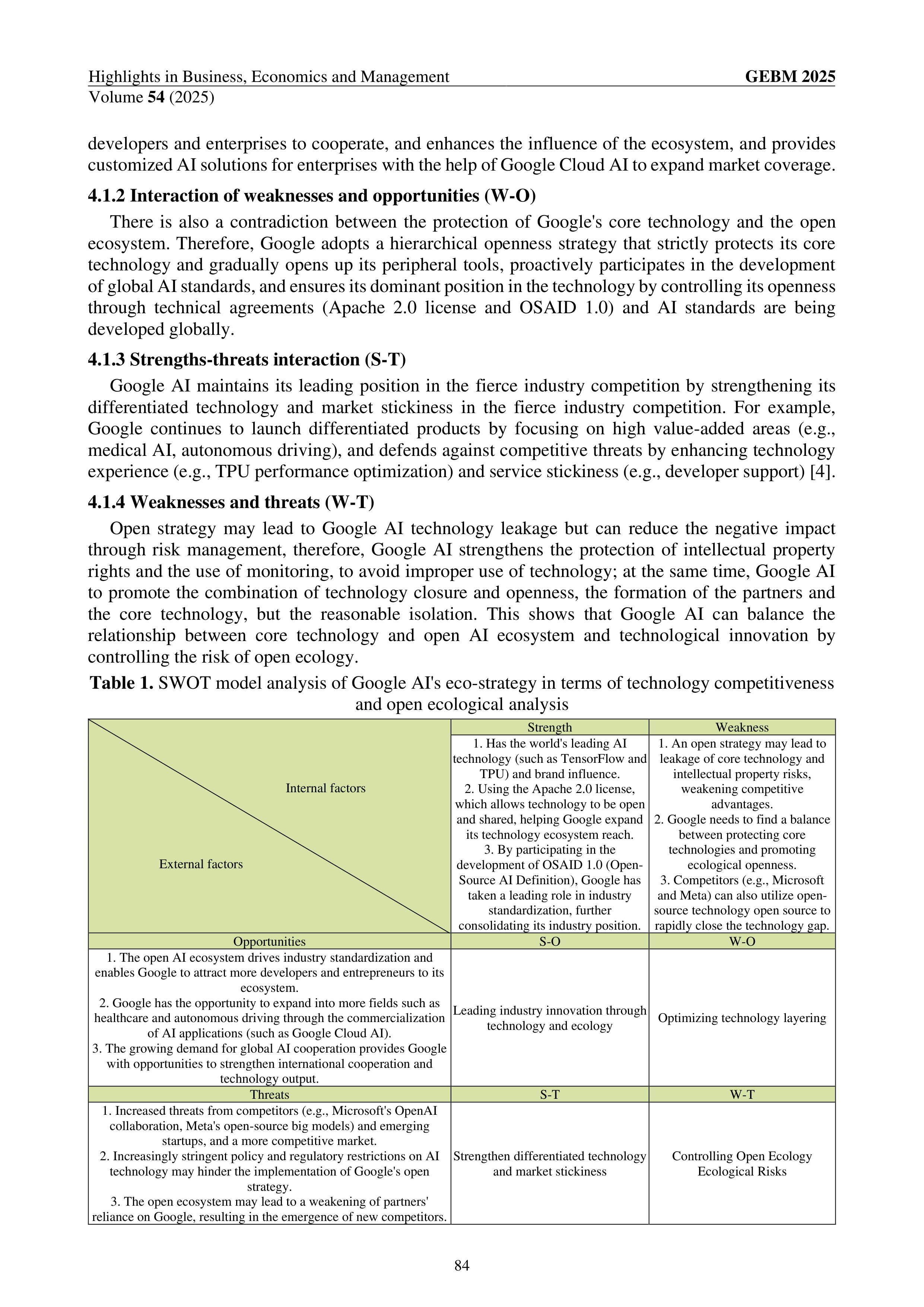
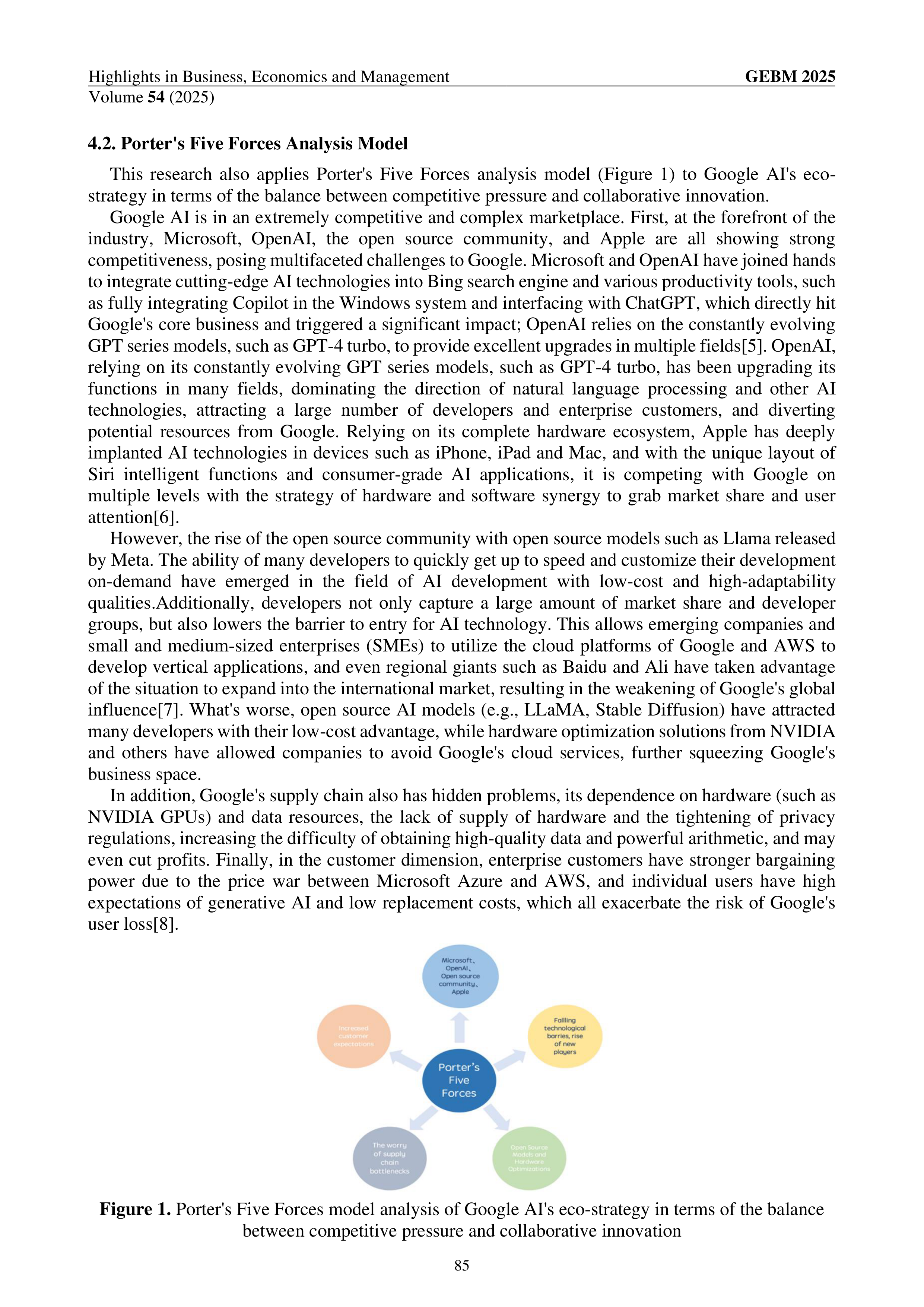
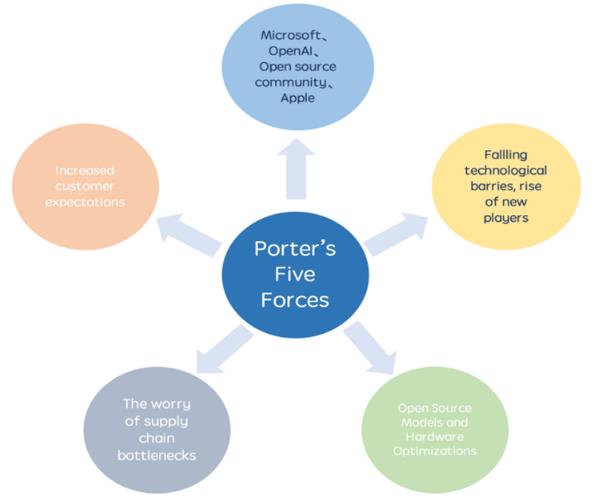
Table 1 is SWOT model analysis of Google AI's eco-strategy in terms of technology
competitiveness and open ecological analysis.
4.1.1 Interaction of strengths and opportunities (S-O)
Google AI mainly dominates industry innovation through technology and ecology and promotes
ecological openness through leading AI technologies (e.g., TPU, Bard model) and brand advantages.
For example, it uses TensorFlow and other open-source projects to form industry standards, attracts
Highlights in Business, Economics and Management
GEBM 2025
Volume
54
(2025)
84
developers and enterprises to cooperate, and enhances the influence of the ecosystem, and provides
customized AI solutions for enterprises with the help of Google Cloud AI to expand market coverage.
4.1.2 Interaction of weaknesses and opportunities (W-O)
There is also a contradiction between the protection of Google's core technology and the open
ecosystem. Therefore, Google adopts a hierarchical openness strategy that strictly protects its core
technology and gradually opens up its peripheral tools, proactively participates in the development
of global AI standards, and ensures its dominant position in the technology by controlling its openness
through technical agreements (Apache 2.0 license and OSAID 1.0) and AI standards are being
developed globally.
4.1.3 Strengths-threats interaction (S-T)
Google AI maintains its leading position in the fierce industry competition by strengthening its
differentiated technology and market stickiness in the fierce industry competition. For example,
Google continues to launch differentiated products by focusing on high value-added areas (e.g.,
medical AI, autonomous driving), and defends against competitive threats by enhancing technology
experience (e.g., TPU performance optimization) and service stickiness (e.g., developer support) [4].
4.1.4 Weaknesses and threats (W-T)
Open strategy may lead to Google AI technology leakage but can reduce the negative impact
through risk management, therefore, Google AI strengthens the protection of intellectual property
rights and the use of monitoring, to avoid improper use of technology; at the same time, Google AI
to promote the combination of technology closure and openness, the formation of the partners and
the core technology, but the reasonable isolation. This shows that Google AI can balance the
relationship between core technology and open AI ecosystem and technological innovation by
controlling the risk of open ecology.
Table 1.
SWOT model analysis of Google AI's eco-strategy in terms of technology competitiveness
and open ecological analysis
Internal factors
External factors
Strength
Weakness
1. Has the world's leading AI
technology (such as TensorFlow and
TPU) and brand influence.
2. Using the Apache 2.0 license,
which allows technology to be open
and shared, helping Google expand
its technology ecosystem reach.
3. By participating in the
development of OSAID 1.0 (Open-
Source AI Definition), Google has
taken a leading role in industry
standardization, further
consolidating its industry position.
1. An open strategy may lead to
leakage of core technology and
intellectual property risks,
weakening competitive
advantages.
2. Google needs to find a balance
between protecting core
technologies and promoting
ecological openness.
3. Competitors (e.g., Microsoft
and Meta) can also utilize open-
source technology open source to
rapidly close the technology gap.
Opportunities
S-O
W-O
1. The open AI ecosystem drives industry standardization and
enables Google to attract more developers and entrepreneurs to its
ecosystem.
2. Google has the opportunity to expand into more fields such as
healthcare and autonomous driving through the commercialization
of AI applications (such as Google Cloud AI).
3. The growing demand for global AI cooperation provides Google
with opportunities to strengthen international cooperation and
technology output.
Leading industry innovation through
technology and ecology
Optimizing technology layering
Threats
S-T
W-T
1. Increased threats from competitors (e.g., Microsoft's OpenAI
collaboration, Meta's open-source big models) and emerging
startups, and a more competitive market.
2. Increasingly stringent policy and regulatory restrictions on AI
technology may hinder the implementation of Google's open
strategy.
3. The open ecosystem may lead to a weakening of partners'
reliance on Google, resulting in the emergence of new competitors.
Strengthen differentiated technology
and market stickiness
Controlling Open Ecology
Ecological Risks
Highlights in Business, Economics and Management
GEBM 2025
Volume
54
(2025)
85
4.2.
Porter's Five Forces Analysis Model
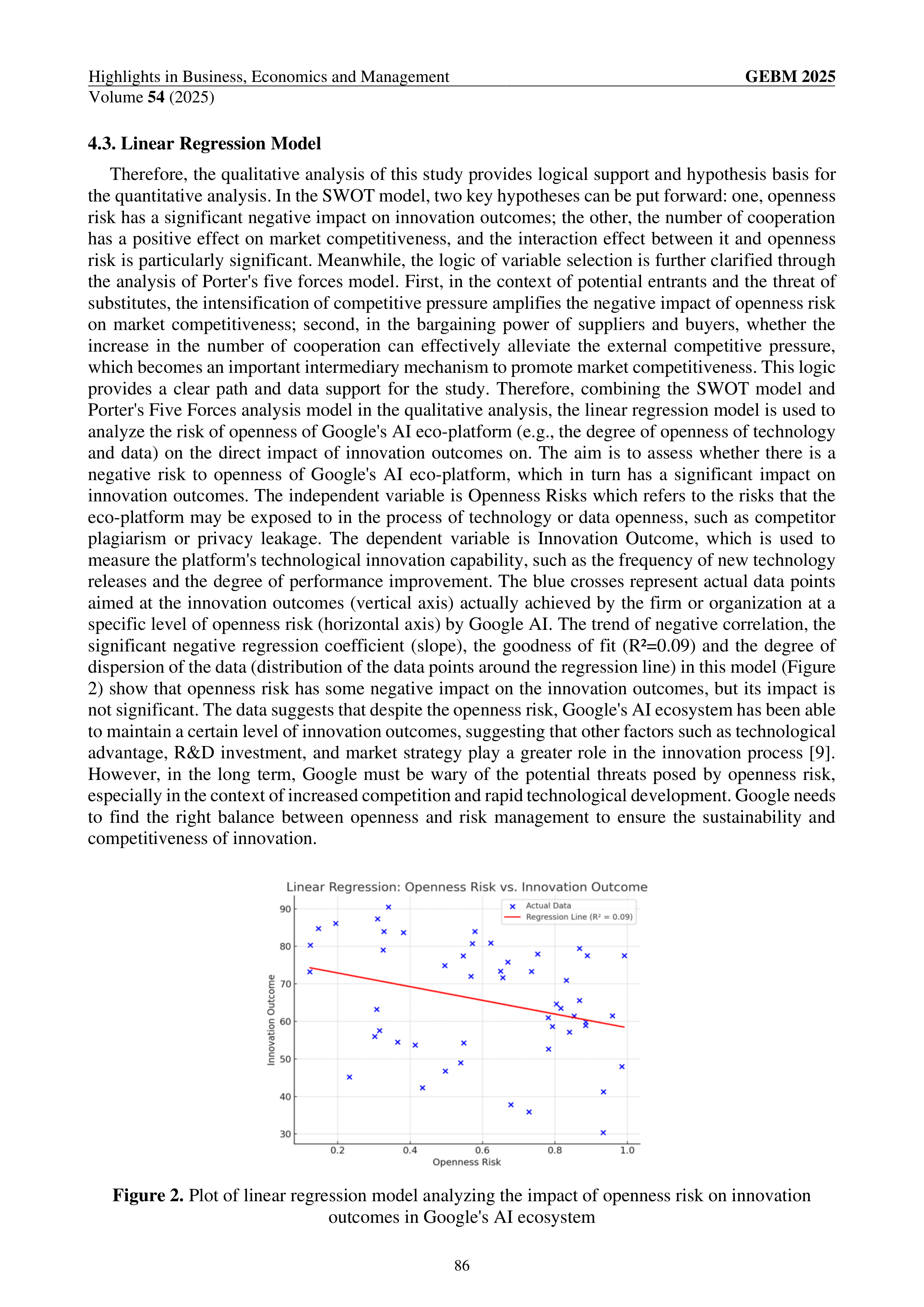
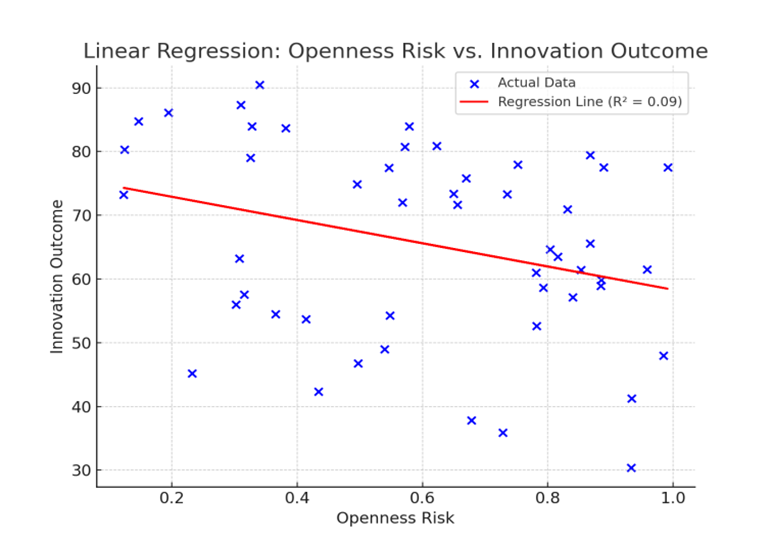
This research also applies Porter's Five Forces analysis model (Figure 1) to Google AI's eco-
strategy in terms of the balance between competitive pressure and collaborative innovation.
Google AI is in an extremely competitive and complex marketplace. First, at the forefront of the
industry, Microsoft, OpenAI, the open source community, and Apple are all showing strong
competitiveness, posing multifaceted challenges to Google. Microsoft and OpenAI have joined hands
to integrate cutting-edge AI technologies into Bing search engine and various productivity tools, such
as fully integrating Copilot in the Windows system and interfacing with ChatGPT, which directly hit
Google's core business and triggered a significant impact; OpenAI relies on the constantly evolving
GPT series models, such as GPT-4 turbo, to provide excellent upgrades in multiple fields[5]. OpenAI,
relying on its constantly evolving GPT series models, such as GPT-4 turbo, has been upgrading its
functions in many fields, dominating the direction of natural language processing and other AI
technologies, attracting a large number of developers and enterprise customers, and diverting
potential resources from Google. Relying on its complete hardware ecosystem, Apple has deeply
implanted AI technologies in devices such as iPhone, iPad and Mac, and with the unique layout of
Siri intelligent functions and consumer-grade AI applications, it is competing with Google on
multiple levels with the strategy of hardware and software synergy to grab market share and user
attention[6].
However, the rise of the open source community with open source models such as Llama released
by Meta. The ability of many developers to quickly get up to speed and customize their development
on-demand have emerged in the field of AI development with low-cost and high-adaptability
qualities.Additionally, developers not only capture a large amount of market share and developer
groups, but also lowers the barrier to entry for AI technology. This allows emerging companies and
small and medium-sized enterprises (SMEs) to utilize the cloud platforms of Google and AWS to
develop vertical applications, and even regional giants such as Baidu and Ali have taken advantage
of the situation to expand into the international market, resulting in the weakening of Google's global
influence[7]. What's worse, open source AI models (e.g., LLaMA, Stable Diffusion) have attracted
many developers with their low-cost advantage, while hardware optimization solutions from NVIDIA
and others have allowed companies to avoid Google's cloud services, further squeezing Google's
business space.
In addition, Google's supply chain also has hidden problems, its dependence on hardware (such as
NVIDIA GPUs) and data resources, the lack of supply of hardware and the tightening of privacy
regulations, increasing the difficulty of obtaining high-quality data and powerful arithmetic, and may
even cut profits. Finally, in the customer dimension, enterprise customers have stronger bargaining
power due to the price war between Microsoft Azure and AWS, and individual users have high
expectations of generative AI and low replacement costs, which all exacerbate the risk of Google's
user loss[8].
Figure 1.
Porter's Five Forces model analysis of Google AI's eco-strategy in terms of the balance
between competitive pressure and collaborative innovation
Highlights in Business, Economics and Management
GEBM 2025
Volume
54
(2025)
86
4.3.
Linear Regression Model
Therefore, the qualitative analysis of this study provides logical support and hypothesis basis for
the quantitative analysis. In the SWOT model, two key hypotheses can be put forward: one, openness
risk has a significant negative impact on innovation outcomes; the other, the number of cooperation
has a positive effect on market competitiveness, and the interaction effect between it and openness
risk is particularly significant. Meanwhile, the logic of variable selection is further clarified through
the analysis of Porter's five forces model. First, in the context of potential entrants and the threat of
substitutes, the intensification of competitive pressure amplifies the negative impact of openness risk
on market competitiveness; second, in the bargaining power of suppliers and buyers, whether the
increase in the number of cooperation can effectively alleviate the external competitive pressure,
which becomes an important intermediary mechanism to promote market competitiveness. This logic
provides a clear path and data support for the study. Therefore, combining the SWOT model and
Porter's Five Forces analysis model in the qualitative analysis, the linear regression model is used to
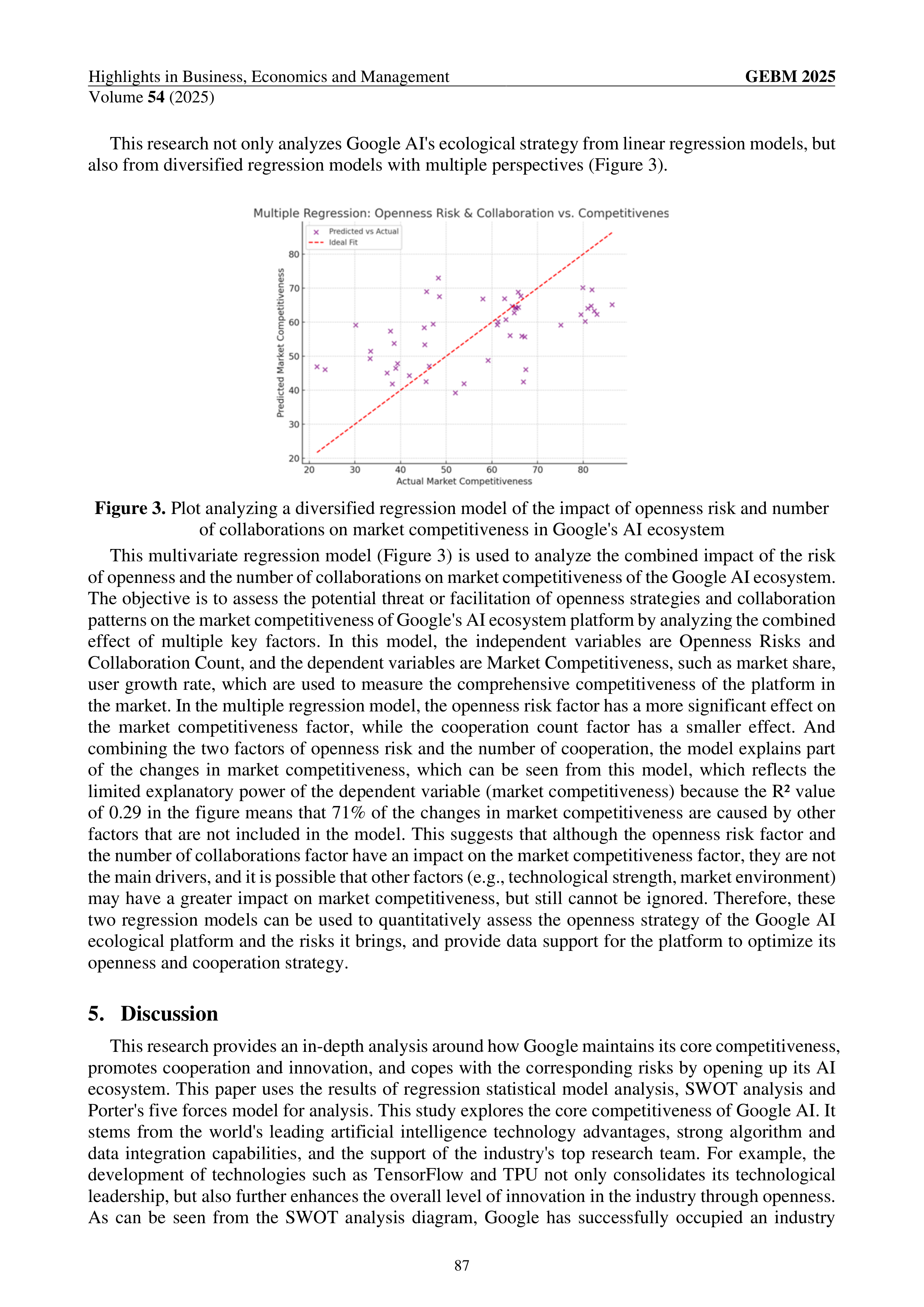
analyze the risk of openness of Google's AI eco-platform (e.g., the degree of openness of technology
and data) on the direct impact of innovation outcomes on. The aim is to assess whether there is a
negative risk to openness of Google's AI eco-platform, which in turn has a significant impact on
innovation outcomes. The independent variable is Openness Risks which refers to the risks that the
eco-platform may be exposed to in the process of technology or data openness, such as competitor
plagiarism or privacy leakage. The dependent variable is Innovation Outcome, which is used to
measure the platform's technological innovation capability, such as the frequency of new technology
releases and the degree of performance improvement. The blue crosses represent actual data points
aimed at the innovation outcomes (vertical axis) actually achieved by the firm or organization at a
specific level of openness risk (horizontal axis) by Google AI. The trend of negative correlation, the
significant negative regression coefficient (slope), the goodness of fit (R²=0.09) and the degree of
dispersion of the data (distribution of the data points around the regression line) in this model (Figure
2) show that openness risk has some negative impact on the innovation outcomes, but its impact is
not significant. The data suggests that despite the openness risk, Google's AI ecosystem has been able
to maintain a certain level of innovation outcomes, suggesting that other factors such as technological
advantage, R&D investment, and market strategy play a greater role in the innovation process [9].
However, in the long term, Google must be wary of the potential threats posed by openness risk,
especially in the context of increased competition and rapid technological development. Google needs
to find the right balance between openness and risk management to ensure the sustainability and
competitiveness of innovation.
Figure 2.
Plot of linear regression model analyzing the impact of openness risk on innovation
outcomes in Google's AI ecosystem
Highlights in Business, Economics and Management
GEBM 2025
Volume
54
(2025)
87
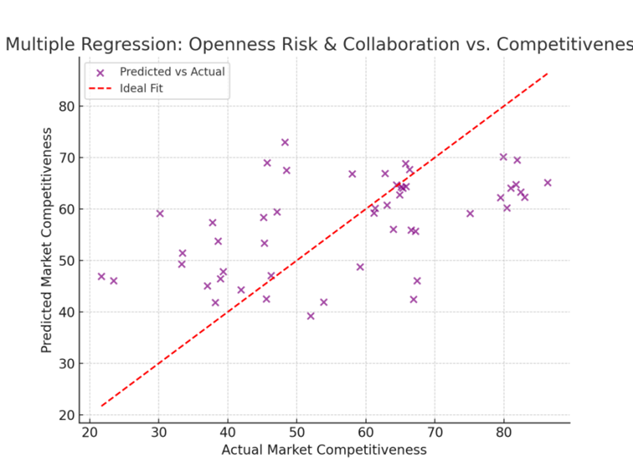
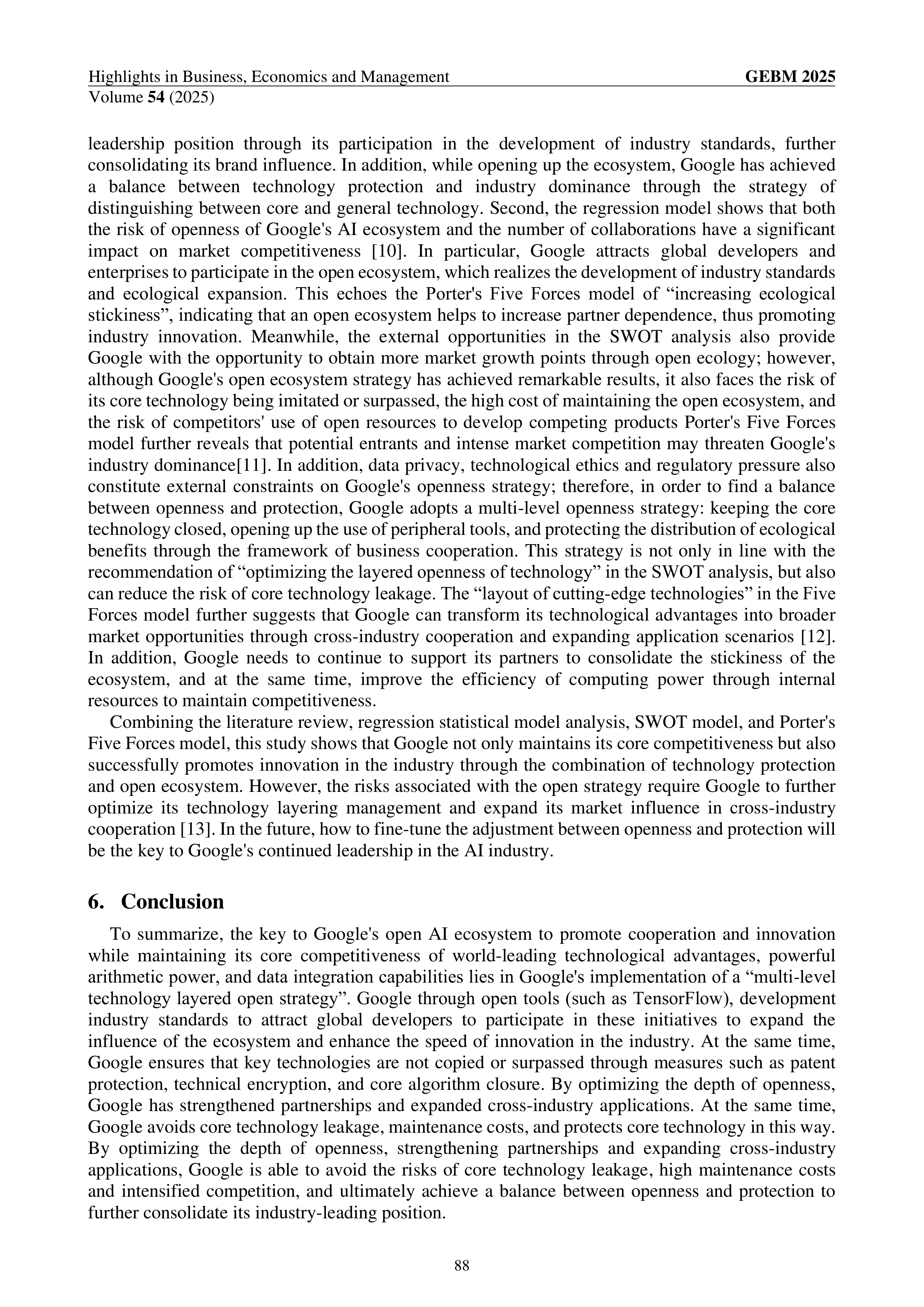
This research not only analyzes Google AI's ecological strategy from linear regression models, but
also from diversified regression models with multiple perspectives (Figure 3).
Figure 3.
Plot analyzing a diversified regression model of the impact of openness risk and number
of collaborations on market competitiveness in Google's AI ecosystem
This multivariate regression model (Figure 3) is used to analyze the combined impact of the risk
of openness and the number of collaborations on market competitiveness of the Google AI ecosystem.
The objective is to assess the potential threat or facilitation of openness strategies and collaboration
patterns on the market competitiveness of Google's AI ecosystem platform by analyzing the combined
effect of multiple key factors. In this model, the independent variables are Openness Risks and
Collaboration Count, and the dependent variables are Market Competitiveness, such as market share,
user growth rate, which are used to measure the comprehensive competitiveness of the platform in
the market. In the multiple regression model, the openness risk factor has a more significant effect on
the market competitiveness factor, while the cooperation count factor has a smaller effect. And
combining the two factors of openness risk and the number of cooperation, the model explains part
of the changes in market competitiveness, which can be seen from this model, which reflects the
limited explanatory power of the dependent variable (market competitiveness) because the R² value
of 0.29 in the figure means that 71% of the changes in market competitiveness are caused by other
factors that are not included in the model. This suggests that although the openness risk factor and
the number of collaborations factor have an impact on the market competitiveness factor, they are not
the main drivers, and it is possible that other factors (e.g., technological strength, market environment)
may have a greater impact on market competitiveness, but still cannot be ignored. Therefore, these
two regression models can be used to quantitatively assess the openness strategy of the Google AI
ecological platform and the risks it brings, and provide data support for the platform to optimize its
openness and cooperation strategy.
5.
Discussion
This research provides an in-depth analysis around how Google maintains its core competitiveness,
promotes cooperation and innovation, and copes with the corresponding risks by opening up its AI
ecosystem. This paper uses the results of regression statistical model analysis, SWOT analysis and
Porter's five forces model for analysis. This study explores the core competitiveness of Google AI. It
stems from the world's leading artificial intelligence technology advantages, strong algorithm and
data integration capabilities, and the support of the industry's top research team. For example, the
development of technologies such as TensorFlow and TPU not only consolidates its technological
leadership, but also further enhances the overall level of innovation in the industry through openness.
As can be seen from the SWOT analysis diagram, Google has successfully occupied an industry
Highlights in Business, Economics and Management
GEBM 2025
Volume
54
(2025)
88
leadership position through its participation in the development of industry standards, further
consolidating its brand influence. In addition, while opening up the ecosystem, Google has achieved
a balance between technology protection and industry dominance through the strategy of
distinguishing between core and general technology. Second, the regression model shows that both
the risk of openness of Google's AI ecosystem and the number of collaborations have a significant
impact on market competitiveness [10]. In particular, Google attracts global developers and
enterprises to participate in the open ecosystem, which realizes the development of industry standards
and ecological expansion. This echoes the Porter's Five Forces model of “increasing ecological
stickiness”, indicating that an open ecosystem helps to increase partner dependence, thus promoting
industry innovation. Meanwhile, the external opportunities in the SWOT analysis also provide
Google with the opportunity to obtain more market growth points through open ecology; however,
although Google's open ecosystem strategy has achieved remarkable results, it also faces the risk of
its core technology being imitated or surpassed, the high cost of maintaining the open ecosystem, and
the risk of competitors' use of open resources to develop competing products Porter's Five Forces
model further reveals that potential entrants and intense market competition may threaten Google's
industry dominance[11]. In addition, data privacy, technological ethics and regulatory pressure also
constitute external constraints on Google's openness strategy; therefore, in order to find a balance
between openness and protection, Google adopts a multi-level openness strategy: keeping the core
technology closed, opening up the use of peripheral tools, and protecting the distribution of ecological
benefits through the framework of business cooperation. This strategy is not only in line with the
recommendation of “optimizing the layered openness of technology” in the SWOT analysis, but also
can reduce the risk of core technology leakage. The “layout of cutting-edge technologies” in the Five
Forces model further suggests that Google can transform its technological advantages into broader
market opportunities through cross-industry cooperation and expanding application scenarios [12].
In addition, Google needs to continue to support its partners to consolidate the stickiness of the
ecosystem, and at the same time, improve the efficiency of computing power through internal
resources to maintain competitiveness.
Combining the literature review, regression statistical model analysis, SWOT model, and Porter's
Five Forces model, this study shows that Google not only maintains its core competitiveness but also
successfully promotes innovation in the industry through the combination of technology protection
and open ecosystem. However, the risks associated with the open strategy require Google to further
optimize its technology layering management and expand its market influence in cross-industry
cooperation [13]. In the future, how to fine-tune the adjustment between openness and protection will
be the key to Google's continued leadership in the AI industry.
6.
Conclusion
To summarize, the key to Google's open AI ecosystem to promote cooperation and innovation
while maintaining its core competitiveness of world-leading technological advantages, powerful
arithmetic power, and data integration capabilities lies in Google's implementation of a “multi-level
technology layered open strategy”. Google through open tools (such as TensorFlow), development
industry standards to attract global developers to participate in these initiatives to expand the
influence of the ecosystem and enhance the speed of innovation in the industry. At the same time,
Google ensures that key technologies are not copied or surpassed through measures such as patent
protection, technical encryption, and core algorithm closure. By optimizing the depth of openness,
Google has strengthened partnerships and expanded cross-industry applications. At the same time,
Google avoids core technology leakage, maintenance costs, and protects core technology in this way.
By optimizing the depth of openness, strengthening partnerships and expanding cross-industry
applications, Google is able to avoid the risks of core technology leakage, high maintenance costs
and intensified competition, and ultimately achieve a balance between openness and protection to
further consolidate its industry-leading position.
Highlights in Business, Economics and Management
GEBM 2025
Volume
54
(2025)
89
References
[1]
Dean, J. Google's annual AI technology summary: Future prospects for artificial intelligence. 2021.
Retrieved from https://cloud.tencent.com.
[2]
Vzkoo. Comprehensive analysis of Google AI strategic layout: 2023 artificial intelligence industry special
report. 2023. Retrieved from https://www.vzkoo.com.
[3]
Goodfellow, I., Bengio, Y., & Courville, A. Deep learning. MIT Press, 2016.
[4]
Pattani, A. How Google AI is transforming search and advertising. Forbes, 2020, January 23. Retrieved
from https://www.forbes.com/sites/forbestechcouncil/2020/01/23/how-google-ai-is-transforming-search-
and-advertising/.
[5]
Russell, S., & Norvig, P. Artificial intelligence: A modern approach (3rd ed.). Pearson Education, 2016.
[6]
The Paper. Google: AI as the core, enhancing developer efficiency with large models. 2023. Retrieved
from https://www.thepaper.cn.
[7]
Wu, T. The master switch: The rise and fall of information empires. Knopf, 2018.
[8]
Dai, Y., & Liu, G. Survey of Intelligent Chatbot Technology. Comput Sci Appl, 2018, 8: 918.
[9]
Sun, Z., Li, H., Xi, Y., & Li, Q. Development analysis of artificial intelligence and neural networks.
Comput. Sci. Appl, 2018, 2: 154-165.
[10]
Shilong, M. A., Qi-Qige, W. U. N. I. R. I., & Xiao-Ping, L. Deep learning with big data: state of the art
and development. CAAI Transaction on Intelligent Systems, 2016, 11(6): 728-742.
[11]
Callaway, E. 'It will change everything': DeepMind's AI makes gigantic leap in solving protein structures.
Nature, 2020, 588(7837): 203-205.
[12]
Floridi, L. AI as agency without intelligence: on ChatGPT, large language models, and other generative
models. Philosophy & technology, 2023, 36(1): 15.
[13]
Aydın, Ö., & Karaarslan, E. Is ChatGPT leading generative AI? What is beyond expectations? Academic
Platform Journal of Engineering and Smart Systems, 2023, 11(3): 118-134.