Ford Motor Company Reorganization and Case Study
Analysis
Shu Li
1,a,*
1
Tianjin yinghua experimental school, Tianjin, China
a. li.s5127@tjyh2003.com
*corresponding author
Abstract:
The automobile industry has a long and fascinating history. In the past ten years,
the automobile industry has been developing continuously to adapt to changing market
conditions and technological progress. With the growth of networked devices and Internet of
Things (IoT), the automotive industry pays more attention to data analysis. Companies are
using data to optimize operations, improve maintenance and improve security. In recent ten
years, there has been a trend of integration in the automobile industry, and a few large
companies have monopolized the market. This leads to the intensification of competition and
the pressure of innovation. Ford Motor Company is a global automobile company, which has
undergone major changes in recent years as part of the restructuring aimed at improving its
financial performance and preparing for the company's future growth. This paper will outline
the reorganization of Ford Motor Company, including the reasons, main measures involved
and financial results of the reorganization. Enterprise reorganization is an effective strategic
choice for Ford Motor Company, which can help enterprises adapt to changes in the external
environment and improve their competitiveness and profitability. The case analysis of two
reorganizations of Ford Motor Company in this paper can not only provide reference and
enlightenment for other enterprises to reorganize, but also provide reference and basis for the
in-depth study of enterprise reorganization in academic circles.
Keywords:
Enterprise reorganization, Ford; automobile industry, reorganization motivation
1.
Introduction
Ford Motor Company is one of the most iconic names in the automobile industry. Ford Motor
Company has faced many challenges in recent years, including the decline in sales of its traditional
cars, the intensified competition from foreign automakers and the rapid transition to electric and self-
driving cars [1-3].
In order to meet these challenges, the company announced a restructuring plan in 2018, aiming at
reducing costs and improving profitability, and refocusing the company on high-growth areas such
as electric vehicles and self-driving cars. The restructuring of Ford Motor Company produced mixed
financial results. On the one hand, the company reports that it has improved profitability and reduced
costs due to restructuring. In 2019, the company reported a net income of $47 million, up from a net
loss of $3.7 billion in 2018 [4, 5]. On the other hand, the company faces challenges in some
international markets, especially in Europe and China, where it has been striving to maintain its
market share and profitability. In addition, the COVID-19 pandemic has had a significant impact on
Proceedings of the 2nd International Conference on Financial Technology and Business Analysis
DOI: 10.54254/2754-1169/61/20231122
© 2023 The Authors. This is an open access article distributed under the terms of the Creative Commons Attribution License 4.0
(https://creativecommons.org/licenses/by/4.0/).
120
the company's financial performance, and the decline in sales and production disruption will lead to
significant losses in 2020.
The automobile industry has the characteristics of long industrial chain, strong correlation and
wide employment, and is one of the pillar industries of the national economy, and its development
status has a significant impact on the entire national economy [6-8].
For China's economy to develop, the automobile industry must not only not lag behind, but also
develop first and drive the development of other related industries. In order to overcome these
problems and seek development, automobile companies have explored in practice and found that
restructuring is a fast development path, which is also consistent with the development path of the
world automobile industry [9].
According to the relevant theories of enterprise restructuring, this paper focuses on the motives,
current situation and countermeasures of Ford Motor Company restructuring, and studies the relevant
cases and problems of Ford Motor Company restructuring.
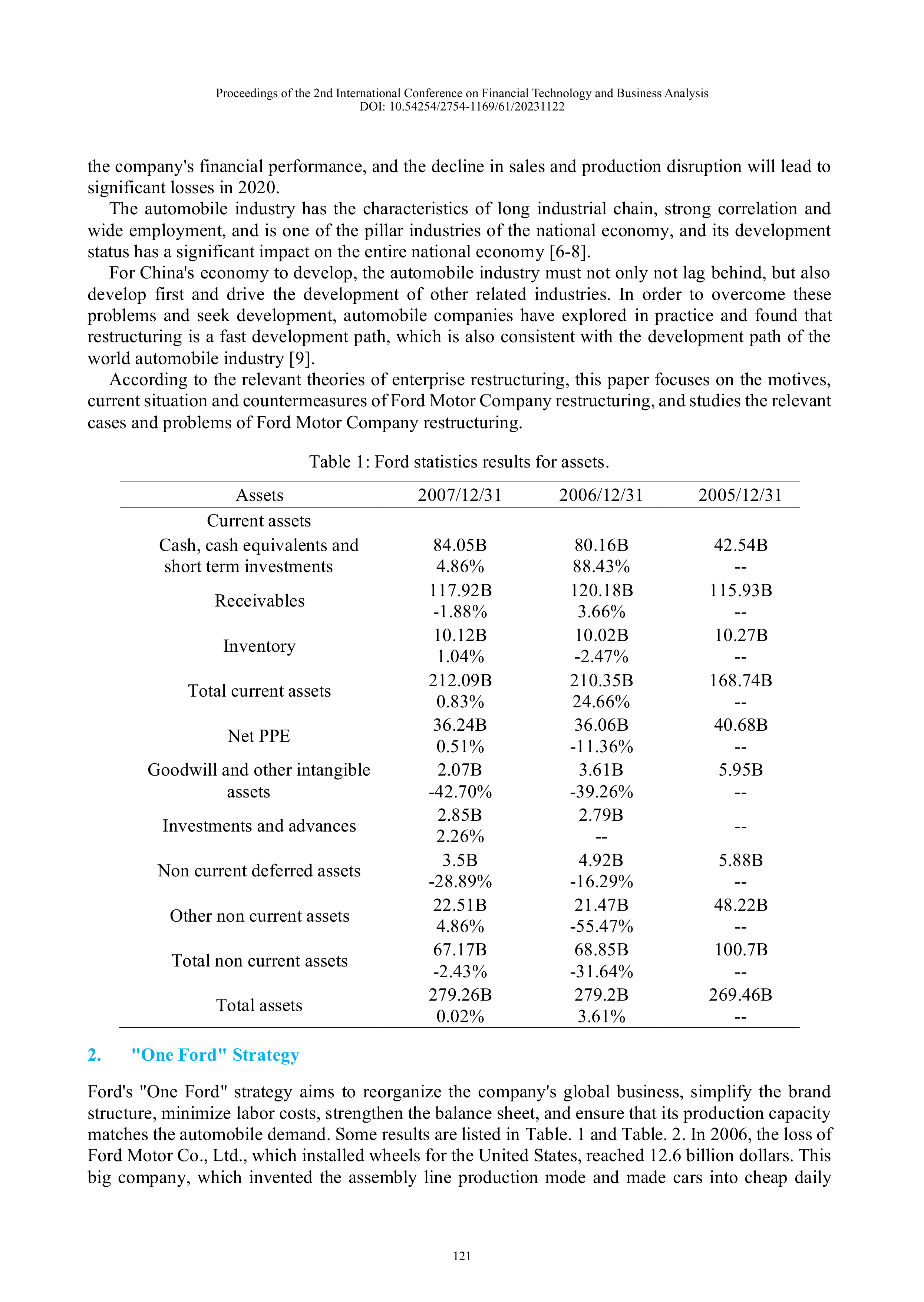
Table 1: Ford statistics results for assets.
Assets
2007/12/31
2006/12/31
2005/12/31
Current assets
Cash, cash equivalents and
short term investments
84.05B
4.86%
80.16B
88.43%
42.54B
--
Receivables
117.92B
-1.88%
120.18B
3.66%
115.93B
--
Inventory
10.12B
1.04%
10.02B
-2.47%
10.27B
--
Total current assets
212.09B
0.83%
210.35B
24.66%
168.74B
--
Net PPE
36.24B
0.51%
36.06B
-11.36%
40.68B
--
Goodwill and other intangible
assets
2.07B
-42.70%
3.61B
-39.26%
5.95B
--
Investments and advances
2.85B
2.26%
2.79B
--
--
Non current deferred assets
3.5B
-28.89%
4.92B
-16.29%
5.88B
--
Other non current assets
22.51B
4.86%
21.47B
-55.47%
48.22B
--
Total non current assets
67.17B
-2.43%
68.85B
-31.64%
100.7B
--
Total assets
279.26B
0.02%
279.2B
3.61%
269.46B
--
2.
"One Ford" Strategy
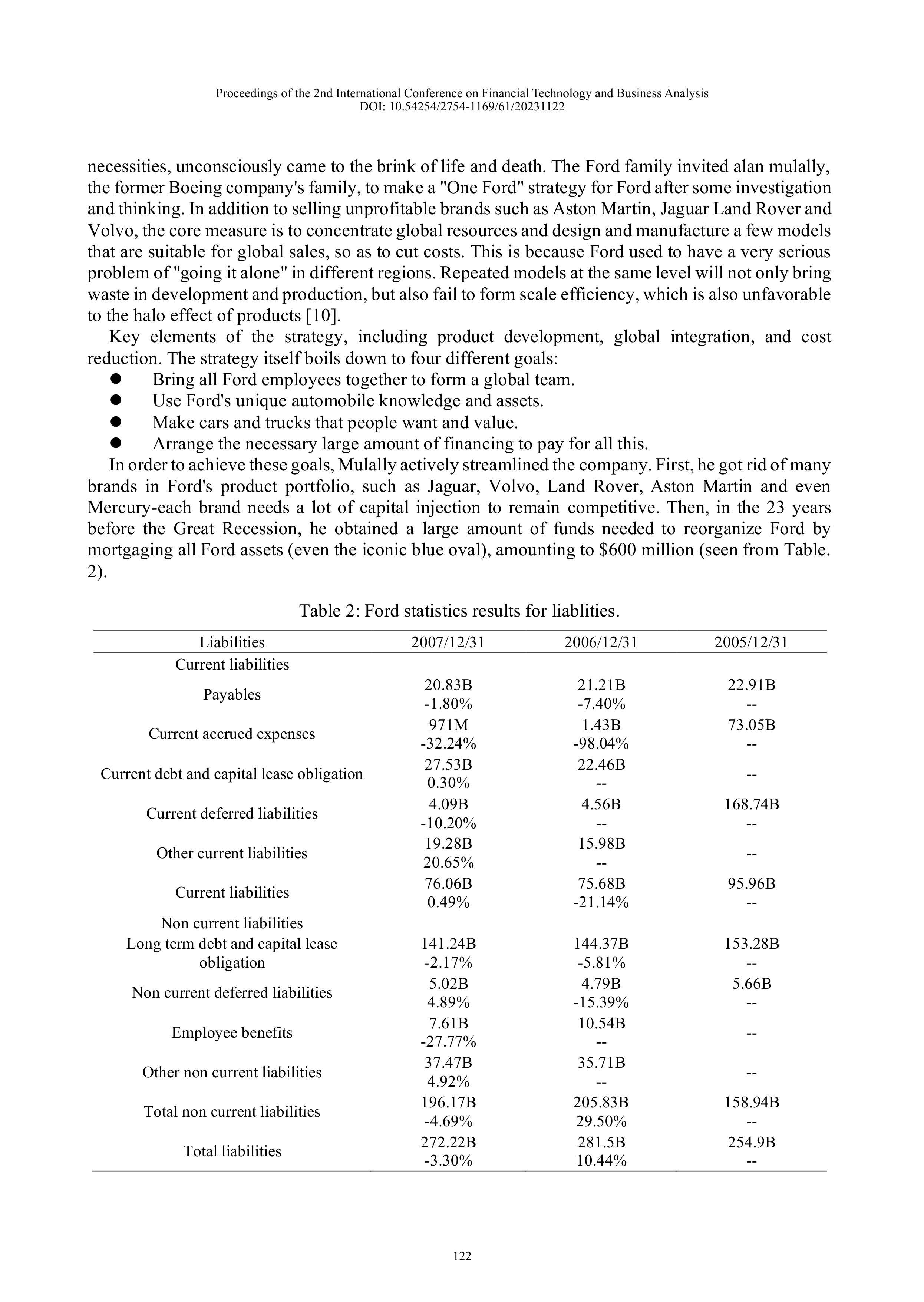
Ford's "One Ford" strategy aims to reorganize the company's global business, simplify the brand
structure, minimize labor costs, strengthen the balance sheet, and ensure that its production capacity
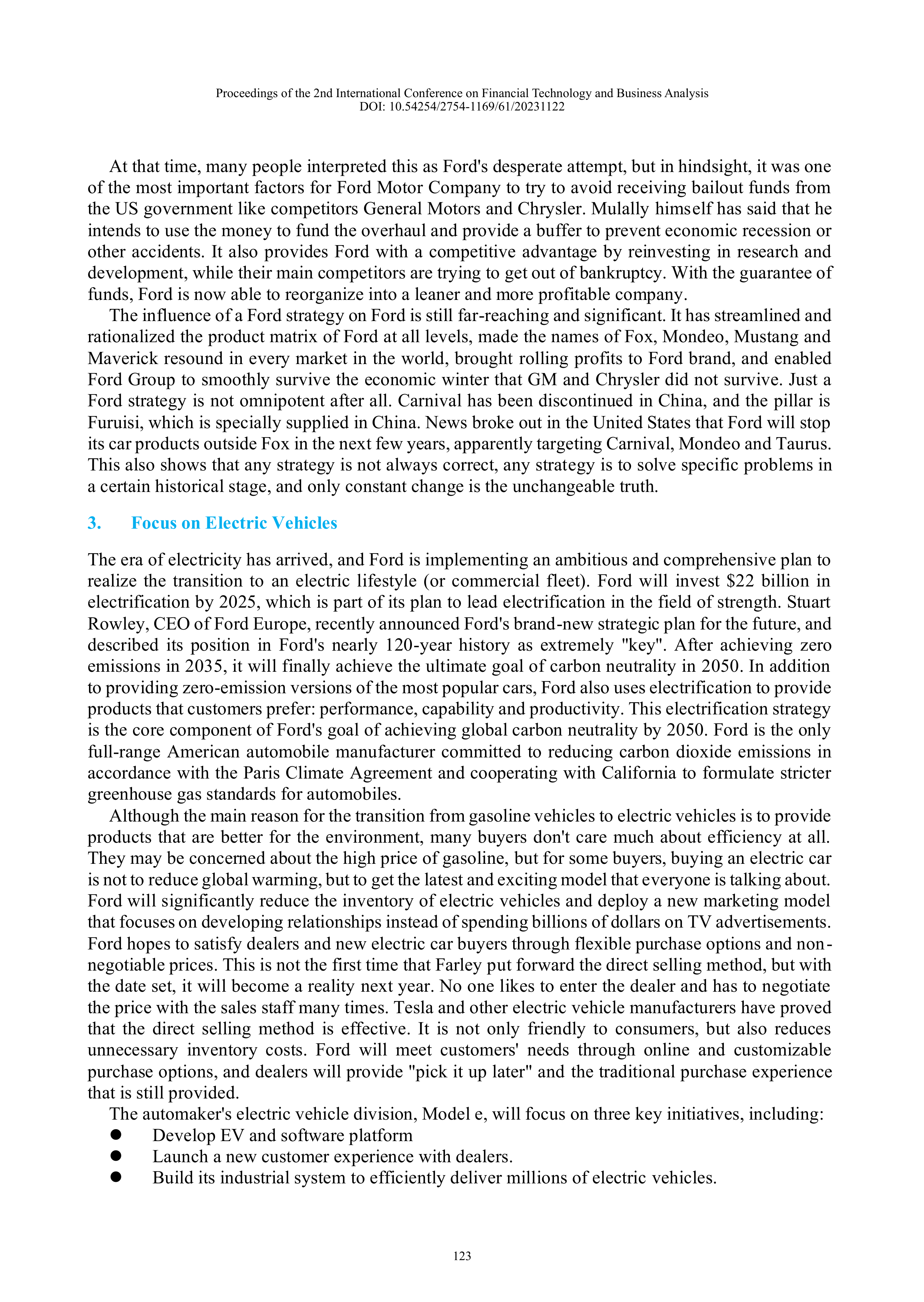
matches the automobile demand. Some results are listed in Table. 1 and Table. 2. In 2006, the loss of
Ford Motor Co., Ltd., which installed wheels for the United States, reached 12.6 billion dollars. This
big company, which invented the assembly line production mode and made cars into cheap daily
Proceedings of the 2nd International Conference on Financial Technology and Business Analysis
DOI: 10.54254/2754-1169/61/20231122
121
necessities, unconsciously came to the brink of life and death. The Ford family invited alan mulally,
the former Boeing company's family, to make a "One Ford" strategy for Ford after some investigation
and thinking. In addition to selling unprofitable brands such as Aston Martin, Jaguar Land Rover and
Volvo, the core measure is to concentrate global resources and design and manufacture a few models
that are suitable for global sales, so as to cut costs. This is because Ford used to have a very serious
problem of "going it alone" in different regions. Repeated models at the same level will not only bring
waste in development and production, but also fail to form scale efficiency, which is also unfavorable
to the halo effect of products [10].
Key elements of the strategy, including product development, global integration, and cost
reduction. The strategy itself boils down to four different goals:
⚫
Bring all Ford employees together to form a global team.
⚫
Use Ford's unique automobile knowledge and assets.
⚫
Make cars and trucks that people want and value.
⚫
Arrange the necessary large amount of financing to pay for all this.
In order to achieve these goals, Mulally actively streamlined the company. First, he got rid of many
brands in Ford's product portfolio, such as Jaguar, Volvo, Land Rover, Aston Martin and even
Mercury-each brand needs a lot of capital injection to remain competitive. Then, in the 23 years
before the Great Recession, he obtained a large amount of funds needed to reorganize Ford by
mortgaging all Ford assets (even the iconic blue oval), amounting to $600 million (seen from Table.
2).
Table 2: Ford statistics results for liablities.
Liabilities
2007/12/31
2006/12/31
2005/12/31
Current liabilities
Payables
20.83B
-1.80%
21.21B
-7.40%
22.91B
--
Current accrued expenses
971M
-32.24%
1.43B
-98.04%
73.05B
--
Current debt and capital lease obligation
27.53B
0.30%
22.46B
--
--
Current deferred liabilities
4.09B
-10.20%
4.56B
--
168.74B
--
Other current liabilities
19.28B
20.65%
15.98B
--
--
Current liabilities
76.06B
0.49%
75.68B
-21.14%
95.96B
--
Non current liabilities
Long term debt and capital lease
obligation
141.24B
-2.17%
144.37B
-5.81%
153.28B
--
Non current deferred liabilities
5.02B
4.89%
4.79B
-15.39%
5.66B
--
Employee benefits
7.61B
-27.77%
10.54B
--
--
Other non current liabilities
37.47B
4.92%
35.71B
--
--
Total non current liabilities
196.17B
-4.69%
205.83B
29.50%
158.94B
--
Total liabilities
272.22B
-3.30%
281.5B
10.44%
254.9B
--
Proceedings of the 2nd International Conference on Financial Technology and Business Analysis
DOI: 10.54254/2754-1169/61/20231122
122
At that time, many people interpreted this as Ford's desperate attempt, but in hindsight, it was one
of the most important factors for Ford Motor Company to try to avoid receiving bailout funds from
the US government like competitors General Motors and Chrysler. Mulally himself has said that he
intends to use the money to fund the overhaul and provide a buffer to prevent economic recession or
other accidents. It also provides Ford with a competitive advantage by reinvesting in research and
development, while their main competitors are trying to get out of bankruptcy. With the guarantee of
funds, Ford is now able to reorganize into a leaner and more profitable company.
The influence of a Ford strategy on Ford is still far-reaching and significant. It has streamlined and
rationalized the product matrix of Ford at all levels, made the names of Fox, Mondeo, Mustang and
Maverick resound in every market in the world, brought rolling profits to Ford brand, and enabled
Ford Group to smoothly survive the economic winter that GM and Chrysler did not survive. Just a
Ford strategy is not omnipotent after all. Carnival has been discontinued in China, and the pillar is
Furuisi, which is specially supplied in China. News broke out in the United States that Ford will stop
its car products outside Fox in the next few years, apparently targeting Carnival, Mondeo and Taurus.
This also shows that any strategy is not always correct, any strategy is to solve specific problems in
a certain historical stage, and only constant change is the unchangeable truth.
3.
Focus on Electric Vehicles
The era of electricity has arrived, and Ford is implementing an ambitious and comprehensive plan to
realize the transition to an electric lifestyle (or commercial fleet). Ford will invest $22 billion in
electrification by 2025, which is part of its plan to lead electrification in the field of strength. Stuart
Rowley, CEO of Ford Europe, recently announced Ford's brand-new strategic plan for the future, and
described its position in Ford's nearly 120-year history as extremely "key". After achieving zero
emissions in 2035, it will finally achieve the ultimate goal of carbon neutrality in 2050. In addition
to providing zero-emission versions of the most popular cars, Ford also uses electrification to provide
products that customers prefer: performance, capability and productivity. This electrification strategy
is the core component of Ford's goal of achieving global carbon neutrality by 2050. Ford is the only
full-range American automobile manufacturer committed to reducing carbon dioxide emissions in
accordance with the Paris Climate Agreement and cooperating with California to formulate stricter
greenhouse gas standards for automobiles.
Although the main reason for the transition from gasoline vehicles to electric vehicles is to provide
products that are better for the environment, many buyers don't care much about efficiency at all.
They may be concerned about the high price of gasoline, but for some buyers, buying an electric car
is not to reduce global warming, but to get the latest and exciting model that everyone is talking about.
Ford will significantly reduce the inventory of electric vehicles and deploy a new marketing model
that focuses on developing relationships instead of spending billions of dollars on TV advertisements.
Ford hopes to satisfy dealers and new electric car buyers through flexible purchase options and non-
negotiable prices. This is not the first time that Farley put forward the direct selling method, but with
the date set, it will become a reality next year. No one likes to enter the dealer and has to negotiate
the price with the sales staff many times. Tesla and other electric vehicle manufacturers have proved
that the direct selling method is effective. It is not only friendly to consumers, but also reduces
unnecessary inventory costs. Ford will meet customers' needs through online and customizable
purchase options, and dealers will provide "pick it up later" and the traditional purchase experience
that is still provided.
The automaker's electric vehicle division, Model e, will focus on three key initiatives, including:
⚫
Develop EV and software platform
⚫
Launch a new customer experience with dealers.
⚫
Build its industrial system to efficiently deliver millions of electric vehicles.
Proceedings of the 2nd International Conference on Financial Technology and Business Analysis
DOI: 10.54254/2754-1169/61/20231122
123
Ford's reorganization is one of the most thorough reorganizations taken by traditional automobile
manufacturers to transform into electric vehicles. Farley said that he and other Ford executives made
the plan after noticing the huge differences between the two business areas. In manufacturing natural
gas-powered vehicles, Ford must focus on reducing costs and creating profits to fund its E.V. plan.
Farley said that in the next four years, Ford plans to cut the cost of internal combustion vehicles by
$3 billion, and some of the cuts will be achieved through layoffs.
Ford believes that the best way to transform into an electric vehicle is to transform itself first. The
automaker said that it has reorganized its automobile business into two different businesses-one is to
produce gasoline-powered vehicles, focusing on maximizing profits, and the other is to develop and
increase the output of electric vehicles, aiming at rapid growth. Jim Farley, CEO of Ford, said in an
interview that the two businesses need different skills and ways of thinking. If they still belong to the
same organization, they will conflict with each other and hinder their respective development. "You
can't succeed and beat Tesla in this way," he said. Sales of electric vehicles are rising rapidly, which
Farley and other auto executives believe is the biggest subversion to the auto industry since Henry
Ford introduced mass production and Model T in 1908. Ford, GM, Toyota, Volkswagen and other
traditional manufacturers are all investing tens of billions of dollars in new models, building battery
factories and developing new technologies pioneered by Tesla, such as advanced driver assistance
systems and wireless software updates. Farley said that Ford will spend $50 billion on electric
vehicles between 2022 and 2026. It had planned to spend $30 billion in the five years ending in 2025.
It plans to spend $5 billion on electric vehicles this year, twice as much as in 2021.
The rise of electric vehicles: 1. Public Tesla: An electric car sharing program has brought low-cost
clean transportation to California's Central Valley. Other companies have followed suit. 2. Charging
network: General Motors plans to use Tesla technology to charge its electric vehicles, including
selling models with plugs pioneered by Tesla. 3. Key minerals: The United States is signing a series
of agreements with other countries to ensure the key minerals needed for electric vehicles-but it is
not clear which arrangement will succeed. 4. Battery manufacturing competition: China dominates
the supply chain of electric vehicle batteries. It may take decades for the world to catch up.
The company's move has been welcomed by Wall Street investors, who have paid a huge premium
to the shares of Tesla and other electric vehicle manufacturers in the past two years. Ford shares
closed up about 8% on Wednesday.
In March 2021, Volkswagen launched a brand-new ACCELERATE strategy. Volkswagen has set
the time to surpass Tesla in 2025. Here, what Volkswagen is talking about is the all-dimensional
transcendence in sales volume, technology, brand and user experience. Not just sales, after all,
according to Volkswagen's existing plan, the global sales of electric vehicles will reach 1 million
units in 2021, and Volkswagen will be able to surpass Tesla in sales in 2021.
When Volkswagen confidently pushed the ACCELERATE strategy beyond Tesla, on March 16th,
BMW's headquarters in Munich, Germany released its 2020 performance and future corporate
strategy online. BMW said: "In 2021, the sales of electric vehicles (xEV) will increase by more than
75% year-on-year. By 2023, 13 new pure electric vehicles will be launched, and BMW will deliver
more than 2 million pure electric vehicles to customers by 2025. And BMW has another plan that is
even more dazzling, that is, it will sell 10 million electric vehicles in the next 10 years.
4.
Comparative Analysis
The two reorganizations are to cope with the transformation of the automobile industry, especially
the development trend of electric vehicles. The first reorganization took place in 2018, when Ford
announced that it would reduce the number of employees worldwide, close some factories, reduce
traditional fuel vehicles, and focus on pickup trucks, SUVs and electric vehicles. The second
reorganization took place in 2022, when Ford divided its automobile business into two independent
Proceedings of the 2nd International Conference on Financial Technology and Business Analysis
DOI: 10.54254/2754-1169/61/20231122
124
departments: Ford Blue was responsible for fuel vehicles and E(Ford Model e was responsible for
electric vehicles 89. The similarity of the two restructurings is that they both aim to improve Ford's
competitiveness and profitability, while reducing costs and complexity. The difference between the
two reorganizations is that the first reorganization is more about the adjustment of product line and
market strategy, while the second reorganization is more about the change of organizational structure
and operation mode.
5.
Implications
Both reorganizations have achieved some success, but they also face some difficulties and risks. The
first restructuring enabled Ford to achieve a global profit of 7 in 2019, and in 2020, it launched the
much-watched electric Masta Mach-E.. However, the first reorganization was also opposed and
questioned by some employees, investors and consumers, and was influenced by external factors such
as COVID-19 epidemic and chip shortage. The second reorganization enabled Ford to significantly
increase the sales and market share of its electric vehicles by 89 in 2022, and plans to launch the
electric F-150 lightning pickup truck in 2023. However, there are also some challenges and
uncertainties in the second reorganization, such as how to balance the resource allocation and
cooperation between the two departments, how to deal with the pressure from competitors such as
Tesla, and how to ensure the construction of battery supply and charging facilities.
6.
Conclusion
Through the case analysis of two reorganizations of Ford Motor Company, this paper discusses the
motivation, process and effect of enterprise reorganization. This paper holds that enterprise
reorganization is an effective strategic choice, which can help enterprises adapt to the changes of
external environment and improve their competitiveness and profitability. This paper draws the
following conclusions. There are three main motivations for enterprise reorganization: market
competition, technological innovation and policies and regulations. The motivation of Ford Motor
Company's two reorganizations is related to these three aspects, which reflects the necessity and
urgency of enterprise reorganization. The process of enterprise reorganization needs to follow certain
principles and steps, including determining the reorganization goal, formulating the reorganization
plan, implementing the reorganization plan and evaluating the reorganization effect. The two
restructuring processes of Ford Motor Company are relatively smooth, which shows the feasibility
and effectiveness of enterprise restructuring. The effect of enterprise reorganization can be evaluated
from the aspects of finance, market, technology and organization. The effect of two reorganizations
of Ford Motor Company is remarkable, which reflects the value and significance of enterprise
reorganization. The case analysis of two reorganizations of Ford Motor Company in this paper can
not only provide reference and enlightenment for other enterprises to reorganize, but also provide
reference and basis for the in-depth study of enterprise reorganization in academic circles. Future
research can be expanded from the following aspects. One needs to compare different industries,
different countries and different types of enterprise restructuring cases, and analyze their similarities
and differences and laws. This paper discusses the influence of enterprise reorganization on relevant
stakeholders (such as employees, customers, suppliers) and the countermeasures. It is also necessary
to tudy the relationship and interaction between enterprise reorganization and other strategic choices
(such as merger, cooperation, innovation).
References
[1]
Yang Y. Employees management analysis at Ford motor company. International Journal of Business and Social
Science, 2014, 5(10).
Proceedings of the 2nd International Conference on Financial Technology and Business Analysis
DOI: 10.54254/2754-1169/61/20231122
125
[2]
Rychtyckyj N. Intelligent systems for manufacturing at Ford Motor company. IEEE intelligent systems, 2007, 22(1):
16-19.
[3]
Reuters, Ford sees $1.5 billion to $2 billion restructuring charges in 2023, 3 May 2023, 8 June 2023, Retrieved
from: https://www.reuters.com/business/autos-transportation/ford-sees-15-bln-2-bln-restructuring-charges-2023-
2023-05-03/
[4]
Ford Media Center, FORD ACCELERATING TRANSFORMATION: FORMING DISTINCT AUTO UNITS TO
SCALE EVS, STRENGTHEN OPERATIONS, UNLOCK VALUE, 2 Mar 2022, 8 June 2023, Retrieved from:
https://media.ford.com/content/fordmedia/fna/us/en/news/2022/03/02/ford-accelerating-transformation.html
[5]
Rae J B, Binder A K. Automotive industry. Encyclopedia Britannica, 2023, 5: 2.
[6]
Raff D M G. Productivity Growth at Ford in the Coming of Mass Production: A Preliminary Analysis. Business and
Economic History, 1996: 176-185.
[7]
Jacobson J. Getting" Arising out of" Right: Ford Motor Company and the Purpose of the" Arising out of" Prong in
the Minimum Contacts Analysis. NYUL Rev., 2022, 97: 315.
[8]
Wang S. Ford's Strategy Adjustment in China: Downsizing, Streamlining business, Expanding exports. Economic
Observer, 2023, 5(15): 14.
[9]
Ford
Splits
Into
Electric
and
Gas
Divisions
to
Speed
Up
Transition.
Retrieved
from:
https://www.nytimes.com/2022/03/02/business/economy/ford-model-e.html.
[10]
Ford
Reorganizes
to
Run
EV
and
Engine
Businesses
Separately.
Retrieved
from:
https://www.bloomberg.com/news/articles/2022-03-02/ford-reorganizes-to-run-ev-and-engine-businesses-
separately.
Proceedings of the 2nd International Conference on Financial Technology and Business Analysis
DOI: 10.54254/2754-1169/61/20231122
126