
International Journal of Economic Practices and Theories (IJEPT)
ISSN: 2247-7225
Volume 2026, Issue 1
https://ijapt.org
2650
Dine-In or Deliver? Pizza Hut’s Strategic Dilemma in a Delivery-Driven Market
Dr. Richa Bhalla
1
, Mr. Agastine A
2
, Dr. Nila A Chotai
3
1.
Associate Professor, ISBR Business School,
2.
Research Associate, ISBR Business School,
3.
Academic Director, ISBR Business School,
Abstract
Pizza Hut, a flagship brand of Yum! Brands, built its long-standing competitive position around a dine-in focused model
emphasizing in-store experience and physical presence. Structural shifts in consumer behavior toward convenience, digital
ordering, and delivery-based consumption began to reshape the quick-service restaurant industry. While competitors such
as Domino's Pizza aligned early with these changes, Pizza Hut’s continued reliance on large-format dine-in outlets limited
its responsiveness in an increasingly delivery-driven market.
By 2025, declining same-store sales and sustained performance pressures led to the announcement of approximately 250
store closures in the United States, alongside broader transformation efforts and a strategic review by Yum! Brands. These
developments raised a deeper question beyond operational performance: whether Pizza Hut’s core business model remained
aligned with evolving market dynamics.
The case explores the tension between preserving a legacy brand identity and adapting to structural industry change,
culminating in a strategic decision regarding the future direction of Pizza Hut.
Learning Outcomes
By the end of this case, students should be able to:
1.
Recognize how a company’s historical success can evolve into a strategic constraint when market conditions change.
2.
Understand the difference between operational underperformance and deeper business model misalignment in a
competitive industry.
3.
Interpret how shifts in consumer behavior particularly toward convenience and delivery can redefine industry structure
and competitive advantage.
4.
Examine the complexity of strategic decision-making when all available options involve significant trade-offs and
uncertainty.
5.
Develop a reasoned perspective on how legacy brands can adapt without eroding the core identity that originally drove
their success.
A Strategic Crossroads
In early 2026, Chris Turner faced a growing strategic dilemma as performance indicators at Pizza Hut continued to decline
in its core U.S. market. Same-store sales had fallen by 3% in the fourth quarter of 2025 and approximately 5% over the full
year, prompting the decision to close around 250 underperforming locations nearly 3–4% of its domestic footprint. What
initially appeared to be an issue of store performance increasingly pointed to a deeper question about the brand’s long-
standing business model.
Since its founding in 1958, Pizza Hut had built its identity around dine-in restaurants, emphasizing ambience, family dining,
and a social eating experience that differentiated it from competitors. This strategy supported rapid expansion and
positioned the company as one of the most recognized pizza brands globally, with a presence across more than 100
countries. The same physical infrastructure that once enabled growth now posed limitations in a market that was evolving
rapidly.
By the mid-2020s, consumer preferences had shifted toward convenience, digital ordering, and fast delivery. Competitors
such as Domino's Pizza had aligned early with this transition, investing in delivery logistics and technology-driven
platforms. In contrast, Pizza Hut’s continued emphasis on dine-in formats reduced its flexibility in adapting to these
changes. As Yum! Brands initiated a formal strategic review, including the possibility of divestment, the challenge facing
International Journal of Economic Practices and Theories (IJEPT)
ISSN: 2247-7225
Volume 2026, Issue 1
https://ijapt.org
2651
leadership became increasingly clear: could Pizza Hut reposition itself in a delivery-first market without abandoning the
identity that had defined its success for decades?
From Experience to Expansion
From its early years, Pizza Hut built its growth around a model that extended beyond simply selling food. The brand
positioned itself as a destination for shared experiences, where families and groups could gather in a comfortable, sit-down
setting. Its restaurants, often characterized by the distinctive red-roof design, were intended to draw customers in
transforming pizza consumption into a social occasion rather than a purely transactional purchase. This emphasis on
ambience and in-restaurant dining became central to the brand’s identity and differentiated it from smaller, takeout-oriented
competitors.
As demand for casual dining expanded, this strategy proved effective. Pizza Hut scaled rapidly across the United States
and international markets by replicating its dine-in format. It invested in larger outlets designed to accommodate families,
celebrations, and group occasions. By the early 2000s, the company had established a substantial global footprint, with
thousands of locations operating across diverse markets. The consistency of this model reinforced brand recognition and
created a predictable path for expansion.
This growth was closely tied to a specific set of operational choices. Pizza Hut’s expansion required sustained investment
in physical infrastructure larger store formats, higher real estate commitments, and in-store service operations that
supported the dine-in experience. Unlike smaller, delivery-oriented formats, this model assumed that customers would
continue to visit restaurants as a primary mode of consumption. For years, that assumption held true, supported by steady
footfall and the brand’s strong association with social dining.
Yet embedded within this success was a structural rigidity. The very investments that enabled scale also limited flexibility.
As consumer expectations began to shift, the reliance on large-format, dine-in locations started to expose constraints that
were not immediately visible during periods of growth. What had once been a competitive advantage began to reveal
underlying vulnerabilities, setting the stage for a strategic contrast that would become increasingly difficult to ignore.
A Different Playbook
While Pizza Hut expanded its presence through dine-in restaurants and large-format outlets, Domino's Pizza pursued a
markedly different path. Rather than positioning itself as a destination for in-restaurant dining, Domino’s built its model
around delivery, speed, and operational consistency. Its stores functioned less as customer-facing spaces and more as
production and dispatch centers, reflecting a fundamentally different view of how customers would access pizza.
This approach was supported by a distinct set of investments. Domino’s prioritized logistics capabilities, route efficiency,
and standardized store formats that could support high-volume delivery operations. Over time, it strengthened its digital
infrastructure, introducing online ordering platforms, mobile applications, and real-time tracking systems that simplified
the ordering process and reduced delivery uncertainty. These developments enabled the company to streamline operations
while improving customer convenience, reinforcing its positioning as a delivery-first brand.
As consumer preferences began to shift toward convenience and on-demand consumption, Domino’s operating model
aligned more closely with emerging expectations. This alignment became more visible during periods when dine-in activity
declined and delivery demand increased, allowing the company to sustain performance through its established delivery
network. Unlike dine-in oriented formats, the model did not depend on attracting customers into physical locations; instead,
it focused on minimizing the effort required to access the product.
By the mid-2020s, the contrast between the two approaches had become increasingly difficult to overlook. Pizza Hut’s
model remained closely tied to in-store experiences and physical infrastructure, while Domino’s had embedded delivery
and digital interaction at the core of its operations. What had once been two viable strategic paths within the same industry
were beginning to diverge under changing market conditions setting the stage for a broader shift that would reshape how
pizza was consumed.
International Journal of Economic Practices and Theories (IJEPT)
ISSN: 2247-7225
Volume 2026, Issue 1
https://ijapt.org
2652
When Convenience Took Over
By the late 2010s, the dynamics of the pizza industry were beginning to shift in ways that challenged long-standing
assumptions about how customers consumed food. Convenience, speed, and accessibility were becoming central to
purchasing decisions, supported by the rapid adoption of smartphones, digital payment systems, and app-based ordering
platforms. Ordering food was no longer tied to visiting a physical location. Instead, it became an on-demand activity
integrated into everyday routines.
This transition accelerated sharply during the COVID-19 pandemic, when restrictions on movement and in-restaurant
dining led to a significant decline in dine-in traffic across the industry. During this period, delivery and takeaway channels
became the primary modes of consumption. Delivery-focused players were able to sustain, and in some cases improve,
their performance as demand shifted toward home consumption. In contrast, businesses that relied heavily on in-store
dining faced greater disruption as their core operating model was temporarily constrained.
For Domino's Pizza, this shift reinforced an existing advantage. Its established delivery infrastructure and digital ordering
systems aligned closely with the changing environment, enabling it to continue serving customers with minimal reliance
on physical dining spaces. For Pizza Hut, the transition was more complex. A significant portion of its network had been
designed around dine-in experiences, making it less adaptable to a market where convenience had become the dominant
driver of demand.
As these changes took hold, the contrast between the two operating models became more pronounced. What had once been
a viable coexistence of dine-in and delivery strategies began to shift toward a clearer preference for speed and accessibility.
In this evolving landscape, Pizza Hut’s reliance on physical formats increasingly constrained its responsiveness, revealing
the growing gap between its traditional strengths and emerging market expectations.
Early Signs of Strain
By 2025, the effects of shifting consumer preferences and structural misalignment were no longer subtle they were clearly
reflected in the performance of Pizza Hut, particularly in its core U.S. market. Same-store sales declined by 3% in the
fourth quarter of 2025, contributing to an approximate 5% drop over the full year (Yum! Brands, 2025). These figures
pointed not to a short-term fluctuation, but to a sustained weakening of demand in a market that remained central to the
brand’s overall performance.
Efforts to stimulate demand through pricing and value-oriented strategies failed to reverse this trajectory. Initiatives such
as low-priced menu offerings, including entry-level promotional pricing, were introduced to attract price-sensitive
customers. These measures did not restore momentum, suggesting that the challenge extended beyond pricing and into the
underlying structure of the business model itself.
A comparison within the broader portfolio of Yum! Brands made this divergence more difficult to ignore. During the same
period, Taco Bell reported a 7% increase in same-store sales, indicating that growth remained achievable within the quick-
service restaurant industry (Yum! Brands, 2025). This contrast reinforced the view that Pizza Hut’s decline was not
primarily driven by external market conditions, but by brand-specific strategic limitations.
As these performance signals accumulated, the narrative surrounding Pizza Hut began to shift. What had initially appeared
as localized underperformance increasingly pointed toward a deeper structural issue. The gap between evolving consumer
expectations and Pizza Hut’s operating model was becoming increasingly difficult to ignore, raising fundamental questions
about the sustainability of its long-standing approach.
Restructuring Begins
As performance pressures intensified, Pizza Hut began to move beyond incremental adjustments toward more visible
structural action. In early 2026, the company announced plans to close approximately 250 underperforming locations across
the United States, representing roughly 3–4% of its domestic footprint. The closures were positioned as a step to improve
system efficiency. They also aimed to refocus resources on stronger-performing units. (Yum! Brands, 2025; The
Independent, 2026)
International Journal of Economic Practices and Theories (IJEPT)
ISSN: 2247-7225
Volume 2026, Issue 1
https://ijapt.org
2653
The decision reflected a shift in how the company evaluated its physical network. Many of the affected outlets were legacy
dine-in locations that no longer aligned with evolving consumer behavior or current demand patterns. While these stores
had once supported brand visibility and customer engagement, their performance had increasingly lagged behind
expectations, particularly in markets where delivery and off-premise consumption had become dominant.
Alongside these closures, Pizza Hut introduced elements of a broader transformation effort under its “Hut Forward”
initiative. The program focused on modernizing key aspects of the business, including technology upgrades, marketing
repositioning, and adjustments to franchise structures aimed at improving near-term sales while supporting longer-term
strategic alignment (Yum! Brands, 2025). Although these measures signaled a willingness to adapt, their impact remained
uncertain at a time when competitive pressures continued to intensify.
At the same time, Yum! Brands initiated a formal review of strategic options for Pizza Hut, expanding the scope of
consideration beyond operational restructuring. Among the possibilities under evaluation was the potential divestment of
the brand, reflecting growing recognition that unlocking Pizza Hut’s future value might require a more fundamental shift
in ownership or direction (Yum! Brands, 2025).
Taken together, these developments marked a turning point. The closure of underperforming stores addressed immediate
inefficiencies, but it did not fully resolve the underlying strategic tension. As the review progressed, it became increasingly
clear that the question facing Pizza Hut was not simply how many stores to operate, but how the brand itself should evolve
in a market that had moved decisively toward convenience and delivery.
An Identity Under Pressure
The actions undertaken by Pizza Hut store closures, operational adjustments, and strategic review highlighted more than a
need for short-term correction; they pointed toward a deeper question about the brand’s identity. For decades, Pizza Hut
had positioned itself as a dine-in experience, built around ambience, social interaction, and physical presence. The market
it operated in had increasingly shifted toward speed, convenience, and delivery-oriented consumption.
This divergence created a fundamental strategic tension. Maintaining its traditional dine-in identity risked further
misalignment with consumer preferences. This risk increased as demand for off-premise consumption continued to
dominate. At the same time, a complete transition toward a delivery-first model would place Pizza Hut in direct competition
with players such as Domino's Pizza, which had spent years refining logistics, digital ordering systems, and operational
efficiency. Such a shift would not only require substantial investment but could also dilute the brand’s long-established
positioning.
The pressure of this tension was reflected in recent performance trends. Declining same-store sales 3% in the fourth quarter
of 2025 and approximately 5% over the full year along with the closure of around 250 U.S. locations, suggested that
existing strategies were no longer sufficient to sustain growth (Yum! Brands, 2025; The Independent, 2026). While
initiatives such as “Hut Forward” aimed to modernize operations, they did not fully resolve the broader question of how
the brand should compete in a transformed market environment.
More broadly, Pizza Hut’s situation reflected a challenge faced by many legacy brands: how to adapt to structural shifts
without losing the attributes that once defined their success. In industries shaped by rapid technological change and
evolving consumer behavior, strategies built for earlier conditions can become constraints rather than advantages. For Pizza
Hut, the issue was not simply whether to change, but how far that change should extend and what the brand might become
in the process.
As the strategic review continued, the tension between preserving identity and pursuing adaptation became increasingly
difficult to resolve. The decisions ahead would not only determine operational direction but would also redefine what Pizza
Hut represented in a market that had moved decisively toward convenience and delivery.
The Decision Ahead
As the strategic review progressed in early 2026, Chris Turner faced a decision that extended beyond operational
adjustments at Pizza Hut. The closure of approximately 250 underperforming U.S. locations and the rollout of initiatives
such as “Hut Forward” had addressed immediate performance concerns, but they had not resolved the broader question of
the brand’s long-term direction (Yum! Brands, 2025; The Independent, 2026). What lay ahead was not simply a matter of
International Journal of Economic Practices and Theories (IJEPT)
ISSN: 2247-7225
Volume 2026, Issue 1
https://ijapt.org
2654
improving efficiency, but of redefining how Pizza Hut would compete in a market increasingly shaped by convenience and
delivery.
One path involved accelerating transformation efforts. This would require deeper investment in delivery capabilities, digital
infrastructure, and operational redesign to align more closely with evolving consumer expectations. While such a shift
could improve competitiveness in a delivery-driven environment, it would also place Pizza Hut in direct competition with
established delivery-focused players such as Domino's Pizza, requiring significant investment and a departure from its
traditional positioning.
A second path centered on continued restructuring. By further rationalizing its store network and focusing on higher-
performing locations, Pizza Hut could stabilize short-term performance and improve cost efficiency. This approach raised
questions about long-term growth, as reducing physical presence risked limiting brand visibility and customer reach in an
already competitive market. A third possibility, under consideration within the strategic review, was divestment. Selling
Pizza Hut could allow Yum! Brands to unlock value and refocus on stronger-performing brands within its portfolio. At the
same time, such a move would represent a significant shift for a brand that had long been central to the company’s identity,
introducing uncertainty about its future direction under new ownership.
Each of these paths carried distinct implications, yet none offered a straightforward resolution. Turner’s challenge was not
only to address declining performance. He also had to decide what Pizza Hut should become in a market that had moved
beyond the conditions that once supported its success. As the review approached its conclusion, the decision remained
unresolved leaving open the question of whether Pizza Hut could redefine its place in a delivery-first world or whether its
legacy would constrain its future.
Discussion Questions
1.
To what extent was Pizza Hut’s performance decline the result of external market shifts versus internal strategic
choices?
2.
Was Pizza Hut’s dine-in focused model a strategic strength that became outdated, or a strategic miscalculation from
the beginning?
3.
How should Pizza Hut respond to a market where convenience and delivery dominate without losing the core identity
that defined its brand?
4.
Are store closures and restructuring sufficient to address Pizza Hut’s challenges, or do they only address surface-level
symptoms of a deeper issue?
5.
Among the strategic options available transformation, continued restructuring, or divestment which path should be
prioritized, and what risks does each option carry?
Further Readings:
Christensen, C. M. (1997). The innovator’s dilemma: When new technologies cause great firms to fail. Harvard Business
School Press.
Porter, M. E. (1996). What is strategy? Harvard Business Review, 74(6), 61–78.
Teece, D. J. (2010). Business models, business strategy and innovation. Long Range Planning, 43(2–3), 172–194.
https://doi.org/10.1016/j.lrp.2009.07.003
Grewal, D., Roggeveen, A. L., & Nordfält, J. (2017). The future of retailing. Journal of Retailing, 93(1), 1–6.
https://doi.org/10.1016/j.jretai.2016.12.008
Yum! Brands, Inc. (2025). Annual report.
https://investors.yum.com/financial-information/annual-reports/
Domino’s Pizza, Inc. (2025). Annual report.
https://ir.dominos.com/financial-information/annual-reports
References:
1.
The Independent. (2026). Pizza Hut to close 250 U.S. locations as Yum! Brands reviews strategy.
https://www.independent.co.uk/us/money/pizza-hut-closing-stores-b2914803.html
International Journal of Economic Practices and Theories (IJEPT)
ISSN: 2247-7225
Volume 2026, Issue 1
https://ijapt.org
2655
2.
Yum! Brands, Inc. (2025). Q4 earnings release and investor call.
https://investors.yum.com/news-events/financial-
releases/news-details/2026/Yum-Brands-Announces-Q4-2025-Earnings-and-Conference-Call-
Details/default.aspx
3.
L. L, N. A. Chotai, A. Kanchanbaras, V. Shenoy, M. Kothari and M. G. K. J, "Evaluating Start-up Success Factors
in Modern versus Traditional Industries in India: Insights from Poisson and Machine learning Models," 2024
International Conference on Augmented Reality, Intelligent Systems, and Industrial Automation (ARIIA),
Manipal, India, 2024, pp. 1-6, doi: 10.1109/ARIIA63345.2024.11051718.
4.
Mahendher, S., & Leonard, L. (2025). The Impact of Big Data and Analytics Technology on Lufthansa’s Business.
SAGE Publications: SAGE Business Cases Originals.
DINE-IN OR DELIVER? PIZZA HUT’S STRATEGIC DILEMMA IN A DELIVERY-DRIVEN MARKET
Case Study Summary
This case centers on the strategic situation faced by Chris Turner in 2026 as he oversees the future of Pizza Hut within the
Yum! Brands portfolio. Declining performance in the U.S. market has prompted operational responses, including store
closures and restructuring. At the same time, it has raised deeper strategic concerns about the brand’s long-term positioning.
While these actions address immediate pressures, they do not fully resolve the underlying issue of misalignment between
Pizza Hut’s dine-in focused model and a market increasingly driven by convenience, delivery, and digital access. A key
element of the case is the contrast between Pizza Hut and Domino's Pizza, whose delivery-first and technology-enabled
model aligns more closely with evolving consumer expectations. This contrast highlights the extent to which strategic
positioning influences competitive outcomes. The case places Chris Turner in a decision context where he must evaluate
the future direction of Pizza Hut. Should Yum! Brands pursue transformation of the business model, continue restructuring
efforts, or consider divestment of the brand? Each option involves significant trade-offs, and none offers a clearly dominant
path. The case is designed to support discussion around strategic decision-making under uncertainty at both the business
and corporate levels.
Teaching Objectives
This case allows instructors to:
1.
Demonstrate how a business model that once drove competitive advantage can become a constraint when market
conditions shift.
2.
Help students distinguish between short-term performance issues and deeper strategic misalignment within an
organization.
3.
Use a real-world comparison to show how different strategic choices within the same industry can lead to divergent
outcomes.
4.
Lead structured discussion around competing strategic options, enabling students to examine the implications and risks
associated with each path.
5.
Encourage students to take and defend a position in a situation where no single option provides a complete solution.
Target Audience
This case is suitable for upper-level undergraduate (BBA) and postgraduate (MBA/PGDM) students enrolled in courses
such as Strategic Management and Marketing Strategy. It is most effective when used in the mid to advanced stages of a
course, where students have already been introduced to fundamental concepts of competitive strategy, business models,
and industry analysis. For undergraduate students, the case supports the development of foundational understanding of how
different strategic approaches influence firm performance. For postgraduate students, it enables deeper analysis of strategic
trade-offs, business model alignment, and decision-making under conditions of uncertainty. Students are expected to have
basic familiarity with concepts such as competitive positioning, value proposition, and market dynamics, although the case
can also be adapted with additional instructor guidance for less experienced groups.
International Journal of Economic Practices and Theories (IJEPT)
ISSN: 2247-7225
Volume 2026, Issue 1
https://ijapt.org
2656
Suggested Teaching Strategy & Session Flow
Teaching Strategy
The teaching strategy for this case should follow a structured, discussion-driven approach that progressively shifts students
from surface-level observations to deeper strategic reasoning. The session should begin by eliciting initial student responses
on Pizza Hut’s declining performance, allowing them to identify visible symptoms such as competition and sales decline.
This creates engagement and establishes a baseline for learning.
The instructor should then guide students toward comparing Pizza Hut’s dine-in model with Domino’s delivery-focused
approach, encouraging analysis of business model differences rather than isolated performance issues. This transition is
critical in helping students recognize how strategic positioning shapes outcomes. As discussion deepens, the focus should
move toward identifying the core issue strategic misalignment between Pizza Hut’s legacy model and evolving consumer
preferences for convenience and digital access.
In the latter part of the session, students should engage in structured debate by evaluating alternative strategies
transformation, restructuring, and divestment. Group-based argumentation enhances critical thinking, allowing students to
assess trade-offs, risks, and long-term implications. The instructor’s role is to challenge assumptions and ensure reasoning
is evidence-based.
The session should conclude with synthesis, reinforcing that strategic decisions involve uncertainty and no single optimal
solution. This approach ensures that students move from descriptive understanding to analytical and decision-oriented
thinking.
Session Flow
90-minute session using a discussion and debate-based approach. Suitable for UG and PG levels with depth adjusted by
instructor.
Pre-Class Preparation
Students should read the case carefully and identify the central issue facing Pizza Hut, focusing on changes in consumer
behavior and industry structure. They should come prepared with a short view on whether the problem is operational or
strategic. Instructors should review the case flow, key contrasts with Domino's Pizza, and the three strategic options
discussed. Preparing a few opening questions in advance will help initiate discussion effectively. The goal is to ensure
students arrive ready to engage actively rather than passively interpret the case.
Phase 1: Opening Engagement (0–15 minutes)
Objective
Surface initial interpretations
Instructor action
Ask: What is going wrong at Pizza Hut?
Capture responses on board without evaluation.
Expected student responses
Students typically mention:
•
declining sales
•
strong competition (especially Domino’s)
•
pricing or demand issues
Most responses will focus on symptoms, not causes
International Journal of Economic Practices and Theories (IJEPT)
ISSN: 2247-7225
Volume 2026, Issue 1
https://ijapt.org
2657
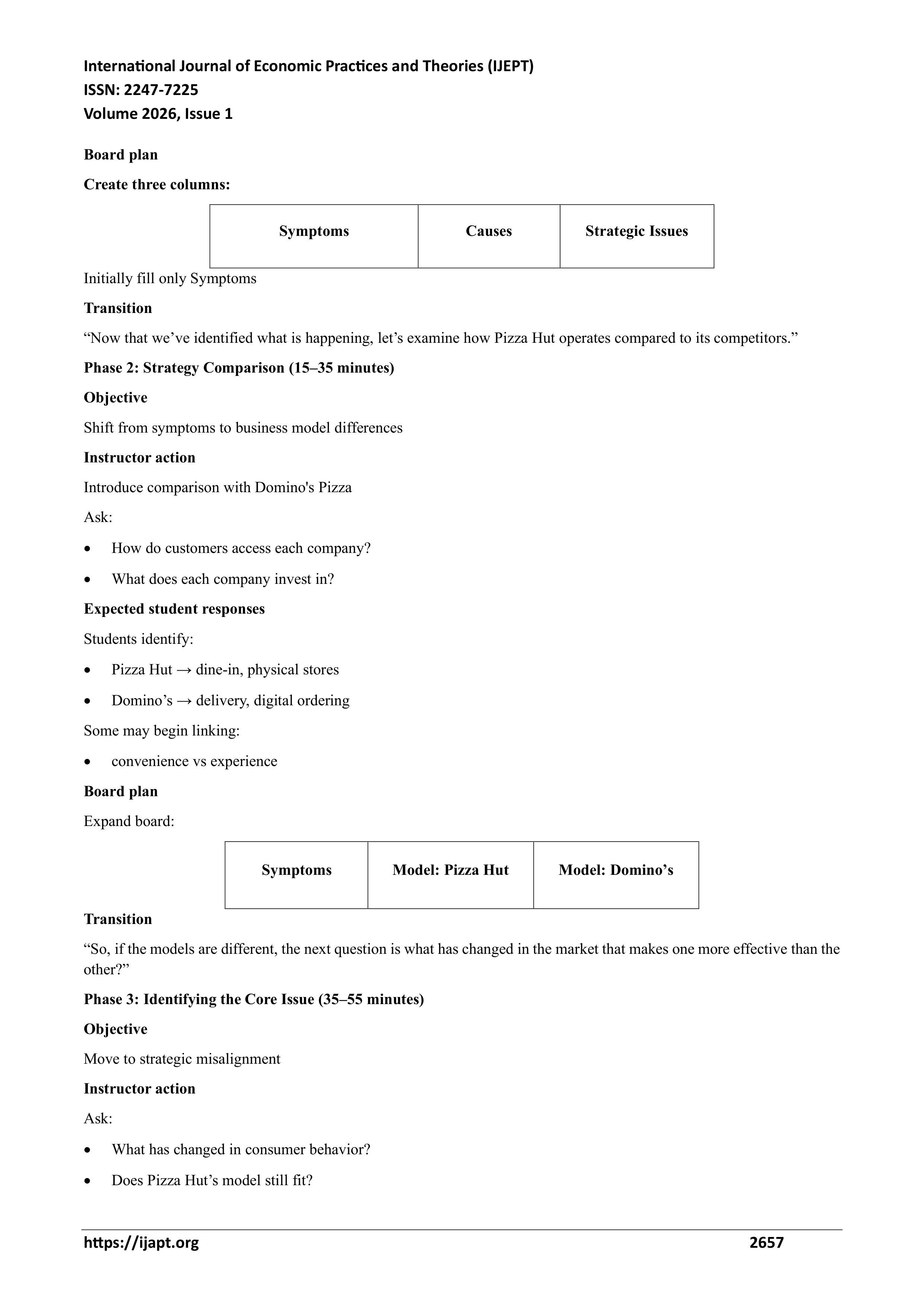
Board plan
Create three columns:
Symptoms
Causes
Strategic Issues
Initially fill only Symptoms
Transition
“Now that we’ve identified what is happening, let’s examine how Pizza Hut operates compared to its competitors.”
Phase 2: Strategy Comparison (15–35 minutes)
Objective
Shift from symptoms to business model differences
Instructor action
Introduce comparison with Domino's Pizza
Ask:
•
How do customers access each company?
•
What does each company invest in?
Expected student responses
Students identify:
•
Pizza Hut → dine-in, physical stores
•
Domino’s → delivery, digital ordering
Some may begin linking:
•
convenience vs experience
Board plan
Expand board:
Symptoms
Model: Pizza Hut
Model: Domino’s
Transition
“So, if the models are different, the next question is what has changed in the market that makes one more effective than the
other?”
Phase 3: Identifying the Core Issue (35–55 minutes)
Objective
Move to strategic misalignment
Instructor action
Ask:
•
What has changed in consumer behavior?
•
Does Pizza Hut’s model still fit?
International Journal of Economic Practices and Theories (IJEPT)
ISSN: 2247-7225
Volume 2026, Issue 1
https://ijapt.org
2658
Expected student responses
Students begin to recognize:
•
shift toward convenience
•
rise of delivery and digital
•
reduced relevance of dine-in
Some may still focus on execution → instructor should push deeper
Board plan
Complete third column:
Symptoms
Business Model
Core Issue
Decline
Dine-in focus
Misalignment with market
Key insight to reinforce
“This is not just a performance issue it is a structural misalignment.”
Transition
“If the issue is structural, then fixing it requires choices. Let’s explore what those choices look like.”
Phase 4: Decision Debate (55–80 minutes)
Objective
Engage students in strategic decision-making
Instructor action
Divide class into 3 groups:
1.
Transformation
2.
Restructuring
3.
Divestment
Each group must:
•
justify their strategy
•
identify risks
•
respond to critique
Expected student responses
•
Transformation group → focus on delivery + digital
•
Restructuring group → focus on cost and efficiency
•
Divestment group → focus on long-term value
Debate will reveal:
no perfect option
International Journal of Economic Practices and Theories (IJEPT)
ISSN: 2247-7225
Volume 2026, Issue 1
https://ijapt.org
2659
AI Integration (Specific & Practical)
Students may use AI tools (e.g., ChatGPT) to:
•
simulate outcomes of each strategy
(e.g., “What happens if Pizza Hut shifts 50% to delivery?”)
•
test assumptions
(e.g., cost vs scalability trade-offs)
Instructor must ensure:
•
AI outputs are questioned
•
reasoning is prioritized over answers
Board plan
Final board:
Strategy
Benefits
Risks
Transition
“We’ve explored all possible directions now let’s step back and reflect on what this means strategically.”
Phase 5: Synthesis and Wrap-Up (80–90 minutes)
Objective
Consolidate insights
Instructor action
Summarize key themes:
•
problem = strategic misalignment
•
environment changed faster than model
•
all options involve trade-offs
Expected student realization
Students understand:
•
no clear best solution
•
decisions involve uncertainty
Closing question
If you had to choose one path, what would you prioritize and why?
TN Table 1: Session Flow Summary
Time
(Minutes)
Instructor Actions & Flow
0–15
Begin by asking: What is going wrong at Pizza Hut? Collect responses without evaluation and list them
under “Symptoms.” Students will typically mention declining sales, competition, or pricing issues. Do
not correct them yet. The goal is to surface initial thinking and engage the class actively from the start.
International Journal of Economic Practices and Theories (IJEPT)
ISSN: 2247-7225
Volume 2026, Issue 1
https://ijapt.org
2660
15–35
Shift discussion to comparing Pizza Hut and Domino's Pizza. Ask how each reaches customers and
what they invest in. Organize responses into a comparison structure. Guide students to recognize
differences in business models rather than focusing only on competition or performance.
35–55
Lead students to identify the core issue by focusing on market changes such as convenience and
delivery demand. Ask whether Pizza Hut’s model fits current conditions. Push students beyond
execution issues toward recognizing strategic misalignment. Clearly establish that the problem is
structural rather than temporary or operational.
55–80
Divide the class into three groups: transformation, restructuring, and divestment. Each group develops
and defends its strategy, outlining benefits and risks. Encourage cross-questioning. Students may use
AI tools to test assumptions or simulate outcomes, but emphasize reasoning and critical evaluation over
relying on generated responses.
80–90
Conclude by synthesizing key insights: the issue is strategic misalignment, not just declining
performance. Highlight that all options involve trade-offs and uncertainty. Ask students if their
perspective has changed from the beginning. End with a final decision-focused question to reinforce
strategic thinking and reflection.
Suggested Theories and Frameworks
This case can be effectively analyzed using a combination of strategic and business model frameworks that explain the
interaction between market shifts and firm response.
First,
Michael Porter’s
concept of competitive positioning highlights the importance of trade-offs between different
strategic choices, such as Pizza Hut’s dine-in model versus Domino’s delivery-focused approach (Porter, 1996). The case
demonstrates how positioning that once created advantage can become a constraint when industry conditions evolve.
Second,
Clayton M. Christensen’s
disruptive innovation theory explains how new business models focused on
convenience and accessibility can displace established firms that are optimized for earlier market conditions (Christensen,
1997). Domino’s delivery-first model reflects this shift.
Third,
business model innovation frameworks
(Teece, 2010) help interpret Pizza Hut’s challenge as one of misalignment
between value creation and changing customer expectations.
Concepts related to
consumer behavior shifts and retail transformation
(Grewal et al., 2017) explain the growing
importance of digital access and convenience in shaping demand.
Together, these frameworks enable students to move beyond surface-level analysis and understand the structural nature of
Pizza Hut’s strategic dilemma.
Suggested Answers to Discussion Questions
1. To what extent was Pizza Hut’s performance decline the result of external market shifts versus internal strategic
choices?
Students should recognize that Pizza Hut’s decline reflects an interaction between external market shifts and internal
strategic choices rather than being driven by a single factor. Externally, the quick-service restaurant industry experienced
a clear transition toward convenience, delivery, and digital ordering. This shift accelerated with technological adoption and
changing consumer expectations, favoring business models that prioritized speed and accessibility. Competitors such as
Domino's Pizza were structurally aligned with these trends, enabling them to capture growing demand more effectively.
External changes alone do not fully explain Pizza Hut’s performance decline. Internal strategic decisions significantly
influenced how the company responded to these shifts. Pizza Hut’s continued reliance on dine-in formats, along with
investments in physical infrastructure, limited its flexibility and slowed its ability to adapt. This suggests that while market
dynamics created pressure, the firm’s strategic path dependence amplified its vulnerability.
International Journal of Economic Practices and Theories (IJEPT)
ISSN: 2247-7225
Volume 2026, Issue 1
https://ijapt.org
2661
Students may argue that Pizza Hut’s strategy was rational in its original context but became misaligned over time due to
delayed adaptation. Others may contend that the company underestimated the speed and scale of industry transformation.
A balanced perspective would emphasize that external forces set the stage for disruption, but internal choices determined
the degree of impact. The key insight is that strategic performance outcomes often emerge from the interaction between
environmental change and organizational response, rather than from either factor in isolation.
2. Was Pizza Hut’s dine-in focused model a strategic strength that became outdated, or a strategic miscalculation
from the beginning?
This question invites students to evaluate strategy across time rather than in isolation. One perspective is that Pizza Hut’s
dine-in focused model was a clear strategic strength during its growth phase. It differentiated the brand, enhanced customer
experience, and supported expansion through large-format outlets. In this view, the model was well-suited to the market
conditions in which it emerged and contributed directly to the company’s success.
An alternative perspective is that the model carried inherent limitations from the outset. High fixed costs, dependence on
physical locations, and reduced operational flexibility may have constrained the company’s ability to respond to future
changes. From this standpoint, the strategy could be interpreted as a miscalculation in anticipating long-term industry
evolution.
A more nuanced interpretation combines these views. Students may argue that the model was appropriate initially but
lacked adaptability as the environment changed. The issue was not necessarily the original strategic choice, but the absence
of timely evolution. This highlights a broader strategic principle: strengths can become weaknesses when external
conditions shift.
The discussion should emphasize that strategies must be evaluated within their temporal context. A model that delivers
competitive advantage in one period may lose relevance in another if it cannot evolve. The key takeaway is that strategic
effectiveness depends not only on initial positioning but also on the ability to adapt as market conditions change.
3. How should Pizza Hut respond to a market where convenience and delivery dominate without losing the core
identity that defined its brand?
Students should approach this question by exploring the trade-off between adaptation and identity preservation. One option
is full transformation, where Pizza Hut invests heavily in delivery infrastructure, digital platforms, and operational redesign.
This would align the company with current market expectations but risks eroding its identity as a dine-in experience brand.
A second approach is a hybrid strategy that combines elements of both models. Pizza Hut could maintain dine-in formats
in selected locations while expanding delivery capabilities elsewhere. This allows the company to preserve aspects of its
brand identity while adapting to changing consumer preferences. Such an approach may introduce operational complexity
and require careful coordination of resources.
A third perspective is repositioning. Rather than directly competing on delivery efficiency, Pizza Hut could redefine its
value proposition focusing on differentiated offerings, premium experiences, or niche segments. This approach reduces
direct competition but may limit scalability.
Students should recognize that none of these options fully resolves the tension. Preserving identity may reduce
competitiveness, while complete transformation may dilute brand equity. The challenge lies in determining the appropriate
balance between continuity and change. The key insight is that strategic responses must consider not only market alignment
but also the long-term implications for brand positioning and organizational capabilities.
4. Are store closures and restructuring sufficient to address Pizza Hut’s challenges, or do they only address surface-
level symptoms of a deeper issue?
Students should evaluate whether restructuring addresses the root cause of Pizza Hut’s challenges or merely improves
short-term performance. One perspective is that store closures and cost optimization are necessary steps to improve
efficiency and stabilize operations. By removing underperforming locations, the company can reduce costs and reallocate
resources, potentially creating a stronger foundation for future initiatives.
International Journal of Economic Practices and Theories (IJEPT)
ISSN: 2247-7225
Volume 2026, Issue 1
https://ijapt.org
2662
Another perspective is that these actions primarily address symptoms rather than underlying strategic issues. If the core
problem lies in business model misalignment with market trends, then restructuring alone will not restore long-term
competitiveness. Closing stores does not fundamentally change how the company delivers value to customers or competes
within the industry.
A more integrated view is that restructuring can serve as an enabler for broader strategic change. By improving operational
efficiency, the company may gain the flexibility needed to invest in new capabilities such as delivery and digital platforms.
In this sense, restructuring is not a solution in itself but part of a larger transformation process.
The discussion should emphasize the distinction between operational improvements and strategic repositioning. While
restructuring can address immediate performance pressures, it must be complemented by deeper strategic adjustments to
achieve sustained success. The key takeaway is that solving surface-level issues without addressing root causes may only
delay further decline.
5. Among the strategic option’s available transformation, continued restructuring, or divestment which path should
be prioritized, and what risks does each option carry?
Students should analyze each strategic option in terms of both potential benefits and associated risks, recognizing that no
single path offers a complete solution. Transformation involves investing in delivery capabilities, digital infrastructure, and
operational redesign to align with market trends. This approach offers the potential for long-term competitiveness but
requires significant resources and may place Pizza Hut in direct competition with established delivery-focused firms such
as Domino's Pizza.
Continued restructuring focuses on improving efficiency through cost reduction and store optimization. This may stabilize
short-term performance and improve financial metrics, but it does not necessarily address long-term growth challenges. If
market dynamics continue to favor delivery-based models, restructuring alone may prove insufficient.
Divestment represents a more radical option, allowing Yum! Brands to unlock value and focus on stronger-performing
brands. While this may benefit the parent company, it introduces uncertainty regarding Pizza Hut’s future direction and
strategic priorities under new ownership.
Students may prioritize different options depending on their assumptions about market evolution and risk tolerance. The
key insight is that strategic decisions involve trade-offs between short-term stability and long-term positioning. Rather than
identifying a single optimal choice, the discussion should focus on how different priorities lead to different strategic
conclusions.
Further Readings
Barnes, L. B., Christensen, C. R., & Hansen, A. J. (1994). Teaching and the case method: Text, cases, and readings. Harvard
Business School Press.
Christensen, C. M. (1997). The innovator’s dilemma: When new technologies cause great firms to fail. Harvard Business
School Press.
Grewal, D., Roggeveen, A. L., & Nordfält, J. (2017). The future of retailing. Journal of Retailing, 93(1), 1–6.
https://doi.org/10.1016/j.jretai.2016.12.008
Porter, M. E. (1996). What is strategy? Harvard Business Review, 74(6), 61–78.
Teece, D. J. (2010). Business models, business strategy and innovation. Long Range Planning, 43(2–3), 172–194.
https://doi.org/10.1016/j.lrp.2009.07.003
Bayona, J. A., & Durán, W. F. (2024). The influence of case method teaching on learning outcomes: A meta-analysis. The
International Journal of Management Education.
Columbia University Center for Teaching and Learning. (n.d.). Case method teaching and learning.
International Journal of Economic Practices and Theories (IJEPT)
ISSN: 2247-7225
Volume 2026, Issue 1
https://ijapt.org
2663
References
1.
Christensen, C. M. (1997). The innovator’s dilemma: When new technologies cause great firms to fail. Harvard
Business School Press.
2.
Grewal, D., Roggeveen, A. L., & Nordfält, J. (2017). The future of retailing. Journal of Retailing, 93(1), 1–6.
https://doi.org/10.1016/j.jretai.2016.12.008
3.
Porter, M. E. (1996). What is strategy? Harvard Business Review, 74(6), 61–78.
4.
Teece, D. J. (2010). Business models, business strategy and innovation. Long Range Planning, 43(2–3), 172–194.
https://doi.org/10.1016/j.lrp.2009.07.003