

February 5, 2026
Ronald O. Mueller
Gibson, Dunn & Crutcher LLP
Re:
Amazon.com, Inc. (the “Company”)
Incoming Letter dated January 19, 2026
Dear Ronald O. Mueller:
This letter is in response to your correspondence concerning the shareholder
proposal (the “Proposal”) submitted to the Company by IBVM Foundation of Canada
Inc. and co-filers for inclusion in the Company’s proxy materials for its upcoming annual
meeting of security holders.
The Company represents that it has a reasonable basis to exclude the Proposal.
Based solely on that representation, we will not object if the Company excludes the
Proposal from its proxy materials.
Copies of all of the correspondence on which this response is based will be made
available on our website.
Sincerely,
Division of Corporation Finance
Office of Chief Counsel
cc:
Sarah Couturier-Tanoh
Shareholder Association for Research & Education

Ronald O. Mueller
Partner
T: +1 202.955.8671
rmueller@gibsondunn.com
Gibson, Dunn & Crutcher LLP
1700 M Street, N.W. | Washington, D.C. 20036-4504 | T: 202.955.8500 | F: 202.467.0539 | gibsondunn.com
January 19, 2026
VIA ONLINE PORTAL SUBMISSION
Office of Chief Counsel
Division of Corporation Finance
Securities and Exchange Commission
100 F Street, N.E.
Washington, D.C. 20549
Re:
Amazon.com, Inc.
Shareholder Proposal of IBVM Foundation of Canada Inc. et al.
Securities Exchange Act of 1934—Rule 14a-8
Ladies and Gentlemen:
This letter notifies the staff of the Division of Corporation Finance (the “Staff”) that our client,
Amazon.com, Inc. (the “Company”), intends to omit from its proxy statement and form of proxy
for its 2026 Annual Meeting of Shareholders (collectively, the “2026 Proxy Materials”) a
shareholder proposal and statement in support thereof (collectively, the “Proposal”) submitted
by the Shareholder Association for Research & Education (the “Representative”) on behalf of
the IBVM Foundation of Canada Inc. and the Catherine Donnelly Foundation; Alecta
Tjänstepension, Ömsesidigt; Nordea Investment Management AB; Folksam Group; Bright
Directions College Savings Trust; and Vancity Investment Management (collectively,
the “Proponents”).
Pursuant to Rule 14a-8(j) and the Statement Regarding the Division of Corporation Finance’s
Role in the Exchange Act Rule 14a-8 Process for the Current Proxy Season issued by the Staff
on November 17, 2025, we hereby request that the Staff confirm that it will not object if the
Company omits the Proposal from the 2026 Proxy Materials. In this regard, the Company
represents that it has a reasonable basis to exclude the Proposal based on the provisions of
Rule 14a-8, prior published guidance, and/or judicial decisions.
As discussed in greater detail below, the Proposal may be excluded from the 2026 Proxy
Materials pursuant to Rule 14a-8(i)(10) because the Company has substantially implemented
the Proposal by providing narrative and quantitative data addressing the effectiveness of its
policies and practices that are designed to support internationally recognized human rights
standards in its direct operations and supply chain.
A copy of the Proposal is attached to this letter as Exhibit A and incorporated herein by
reference.
Pursuant to Rule 14a-8(j), we have:
filed this letter with the Securities and Exchange Commission (the “Commission”) no

Office of Chief Counsel
Division of Corporation Finance
January 19, 2026
Page 2
later than eighty (80) calendar days before the Company intends to file its definitive
2026 Proxy Materials with the Commission; and
concurrently sent copies of this correspondence to the Proponents.
Rule 14a-8(k) and Staff Legal Bulletin No. 14D (Nov. 7, 2008) (“SLB 14D”) provide that
shareholder proponents are required to send companies a copy of any correspondence that the
proponents elect to submit to the Commission or the Staff. Accordingly, we are taking this
opportunity to inform the Proponents that if the Proponents elect to submit additional
correspondence to the Commission or the Staff with respect to the Proposal, a copy of such
correspondence should be furnished concurrently to the undersigned on behalf of the Company
pursuant to Rule 14a-8(k) and SLB 14D.
THE PROPOSAL
The Proposal states:
Resolved:
Shareholders request that the Board of Directors issue a report,
prepared at reasonable cost and omitting proprietary and confidential information,
evaluating the effectiveness of the Company’s policies and practices to respect
internationally recognized human rights standards, including the International
Labour Organization (ILO) Core Conventions and Declaration on Fundamental
Principles and Rights at Work, covering the Company’s direct operations and its
supply chain, including contractors and subcontractors.
ANALYSIS
The Proposal May Be Excluded Under Rule 14a-8(i)(10) Because The Company Has
Substantially Implemented The Proposal.
The Proposal’s supporting statement (the “Supporting Statement”) concedes that the Company
“has committed ‘to respect internationally recognized human rights including the [International
Labour Organization (“ILO”)] Core Conventions and Declaration on Fundamental Principles and
Rights at Work.’”
1
The Supporting Statement then highlights that “[t]he ten Core Conventions of
the ILO establish five fundamental human rights: freedom of association and collective
bargaining, elimination of forced labor, abolition of child labor, elimination of discrimination in
employment, and occupational health and safety,” and asserts that “[a]n assessment of the
effectiveness of these commitments could help Amazon manage potential legal, operational,
regulatory, and reputational risks.” As discussed below, the Company provides narrative and
quantitative data addressing the effectiveness of its policies and practices with respect to each
of the five commitments highlighted by the Proponents (the “Workplace Commitments”).
1
See
Amazon Global Human Rights Principles,
available at
https://sustainability.aboutamazon.com/global-human-
rights-principles.pdf
.

Office of Chief Counsel
Division of Corporation Finance
January 19, 2026
Page 3
A.
Background On Substantial Implementation Under Rule 14a-8(i)(10).
Rule 14a-8(i)(10) permits a company to exclude a shareholder proposal from its proxy materials
if the company has “substantially implemented” the proposal. The Commission stated in 1976
that the predecessor to Rule 14a-8(i)(10) was “designed to avoid the possibility of shareholders
having to consider matters which already have been favorably acted upon by the management.”
Exchange Act Release No. 12598 (July 7, 1976). Originally, the Staff narrowly interpreted this
predecessor rule and concurred with the exclusion of a proposal only when proposals were
“‘fully’ effected” by the company.
See
Exchange Act Release No. 19135 (Oct. 14, 1982). By
1983, the Commission recognized that the “previous formalistic application of [the Rule]
defeated its purpose” because proponents were successfully avoiding exclusion by submitting
proposals that differed from existing company policy in minor respects. Exchange Act Release
No. 20091, at § II.E.6. (Aug. 16, 1983) (“1983 Release”). Therefore, in the 1983 Release, the
Commission adopted a revised interpretation of the rule to permit the omission of proposals that
had been “substantially implemented,” and the Commission codified this revised interpretation in
Exchange Act Release No. 40018, at n.30 (May 21, 1998).
Applying this standard, the Staff has noted that “a determination that the company has
substantially implemented the proposal depends upon whether [the company’s] particular
policies, practices and procedures compare favorably with the guidelines of the proposal.”
Walgreen Co.
(avail. Sept. 26, 2013);
Texaco, Inc. (Recon.)
(avail. Mar. 28, 1991).
At the same time, a company need not implement a proposal in exactly the same manner set
forth by the proponent. In
General Motors Corp.
(avail. Mar. 4, 1996), the company observed
that the Staff had not required that a company implement the action requested in a proposal
exactly in all details but had been willing to issue no-action letters under the predecessor of
Rule 14a-8(i)(10) in situations where the “essential objective” of the proposal had been satisfied.
The company further argued, “[i]f the mootness requirement [under the predecessor rule] were
applied too strictly, the intention of [the rule]—permitting exclusion of ‘substantially implemented’
proposals—could be evaded merely by including some element in the proposal that differs from
the registrant’s policy or practice.” Differences between a company’s actions and a shareholder
proposal are permitted as long as a company has substantially implemented actions to address
the proposal’s essential objectives, even if the company did not take the exact action requested
by the proponent, did not implement the proposal in every detail, or exercised discretion in
determining how to implement the proposal.
When a company has already acted favorably on an issue addressed in a shareholder proposal,
Rule 14a-8(i)(10) does not require the company and its shareholders to reconsider the issue.
The Staff has concurred that, when substantially implementing a shareholder proposal,
companies can address aspects of implementation in ways that may differ from the manner in
which the shareholder proponent would implement the proposal. In this regard, the Staff has on
numerous occasions taken the position that a shareholder proposal requesting a report
pertaining to human rights policies and commitments may be excluded when the company has
provided information about the same issues in other public disclosures. For example:

Office of Chief Counsel
Division of Corporation Finance
January 19, 2026
Page 4
In
The Boeing Co.
(avail. Feb. 17, 2011), the Staff concurred with exclusion under
Rule 14a-8(i)(10) of a proposal that requested that the company “review its policies
related to human rights” and report its findings, where the company had already adopted
human rights policies and provided an annual report on corporate citizenship.
More recently, in
PPG Industries Inc. (Congregation of the Sisters of St. Joseph of
Peace)
(avail. Jan. 16, 2020), the Staff concurred with the exclusion of a proposal
requesting a board report on the company’s process for implementing human rights
commitments where, although not set forth in a report prepared or affirmed by the board,
the company already provided information on the implementation of its human rights
commitments across several of its public disclosures.
In
The Wendy’s Co.
(avail. Apr. 10, 2019), the Staff concurred with the exclusion of a
proposal requesting a board report on the company’s process for identifying and
analyzing potential and actual human rights risks of operations and supply chain where,
although not set forth in a report prepared or affirmed by the board, the company already
had a code of conduct for suppliers, a code of business conduct and ethics, and other
policy statements and public disclosures concerning supply chain practices and other
human rights issues that achieved the proposal’s essential objective.
While relating to a different topic, most recently in
Bank of America Corp.
(avail. Feb. 24,
2025), the Staff concurred with the exclusion under Rule 14a-8(i)(10) of a proposal
requesting an annual report on the company’s net zero programs, where the company
demonstrated that its public disclosures in its most recent sustainability report and Task
Force on Climate-related Financial Disclosures Report addressed the essential objective
of the proposal.
B.
The Company’s Existing Disclosures Substantially Implement The Proposal.
The Proposal requests that the Company issue a report “evaluating the effectiveness of the
Company’s policies and practices to respect internationally recognized human rights
standards . . . covering the Company’s direct operations and its supply chain, including
contractors and subcontractors.” As in
Boeing
,
PPG Industries
, and
Wendy’s
, the Company
has substantially implemented the Proposal through its existing public disclosures reporting on
the effectiveness of its policies and practices in implementing the Workplace Commitments,
which disclosures are responsive to the specific requests set forth in the Proposal and fulfill the
Proposal’s essential objective.
As a threshold matter, it should be noted that the Representative submitted a proposal for the
Company’s 2025 Annual Meeting of Shareholders on behalf of many of the Proponents
(the “2025 Proposal”) that requested an assessment and report on implementing the
Company’s commitment to one of the Workplace Commitments—freedom of association and
collective bargaining—which the Staff concurred could be excluded from the Company’s proxy

Office of Chief Counsel
Division of Corporation Finance
January 19, 2026
Page 5
materials under Rule 14a-8(i)(7) as relating to the Company’s ordinary business operations.
2
Thus, it would be an abuse of the shareholder proposal process if the Proponents’ objective
were to obtain essentially the same information requested by the 2025 Proposal through the
expanded request set forth in the Proposal. However, as set forth below, the Company has
substantially implemented the Proposal through disclosures in its 2024 Amazon Sustainability
Report (the “Sustainability Report”),
3
Modern Slavery Statement 2024 (the “Modern Slavery
Statement”),
4
August 2024 Third-Party Audit Report (the “Third-Party Audit Report”),
5
most
recent workforce data update (the “Workforce Data Update”),
6
and most recent safety
performance update (the “Safety Update,” and collectively with the Sustainability Report, the
Modern Slavery Statement, the Third-Party Audit Report, and the Workforce Data Update, the
“Responsive Disclosures”).
7
As addressed in the Company’s Global Human Rights Principles,
the Company devotes
significant resources to identifying, assessing, prioritizing, and addressing potential adverse
human rights impacts connected to its business:
Within the Company’s own operations, it deploys a variety of mechanisms to conduct
due diligence, assessing and responding to risks across the Company. The Company
uses human rights saliency assessments to assess enterprise-wide risks and uses both
saliency assessments and human rights impact assessments to assess risks specific to
the Company’s businesses, including in the sectors and the countries where it operates.
The Company’s businesses work toward integrating the Workplace Commitments into
their operations and business relationships by conducting human rights risk
assessments, remedying identified issues, and integrating human rights risk
management systems.
Within the Company’s supply chain, it assesses and responds to risk by leveraging
internal and external data and guidance from stakeholders, including industry experts,
civil society groups, and nongovernmental organizations. The Company engages directly
with suppliers and their workers and conducts independent audits to verify compliance
2
See Amazon.com, Inc. (Catherine Donnelly Foundation)
(avail. Apr. 4, 2025),
available at
https://www.sec.gov/files/corpfin/no-action/14a-8/donnellyamazon4425-14a8.pdf.
3
Sustainability Report,
available at
https://sustainability.aboutamazon.com/2024-amazon-sustainability-report.pdf
.
4
Modern Slavery Statement,
available at
https://sustainability.aboutamazon.com/modern-slavery-statement.pdf
.
5
Third-Party Audit Report,
available at
https://assets.aboutamazon.com/ed/8e/1c328d464449a04defbf8b0987d3/83024-final-amazon-external-
report.pdf
.
6
Our Workforce Data,
available at
https://www.aboutamazon.com/news/workplace/our-workforce-data
.
7
Safety Update,
available at
https://www.aboutamazon.com/news/workplace/amazon-workplace-safety-
performance-2024
.

Office of Chief Counsel
Division of Corporation Finance
January 19, 2026
Page 6
with its Supply Chain Standards.
8
The Company works with suppliers on appropriate
remediation measures and offers partnerships and programs to help them address risks
and invest in worker well-being.
Notably, in 2022, the Company engaged a third-party law firm to conduct an extensive audit of
more than 750,000 U.S. hourly associates to assess the
effectiveness of certain of the
Company’s non-discrimination policies and practices.
9
Additionally, i
n 2024, the Company
broadened the scope of its supplier audit program, which had previously focused on Company-
branded product suppliers, to also include third-party labor, service, and not-for-resale goods
providers in the Company’s logistics, warehousing, and construction supply chain, thereby
expanding the scope of its assessments and reports to encompass an even broader cross-
section of the Company’s supply chain as requested by the Proposal, and amounting to a total
of 3,639 audits.
10
Satisfying the “essential objective” of the Proposal, the Company provides narrative and
quantitative data addressing the effectiveness of its policies and practices with respect to the
Workplace Commitments, as reflected in the side-by-side comparison below:
Workplace
Commitment
How The Company’s Existing Public Disclosures Already
Report On The Effectiveness Of Its Human Rights Policies
And Practices
“occupational health
and safety”
The Company publicly reports its year-over-year safety
performance for its worldwide operations.
11
Among other data points, including operations data reported to
the Occupational Safety and Health Administration, the
Company’s Safety Update discloses the following for 2024:
“Our Recordable Incident Rate (RIR)—which includes any
work-related injury that requires more than basic first-aid
treatment—has improved 34% over the past five years and
over 6% year over year (YoY).”
“Our Lost Time Incident Rate (LTIR)—which includes any
work-related injury that requires someone to take time away
from work (the most serious injuries)—has improved 65%
over the past five years and 13% YoY.”
“In the U.S. General Warehousing and Storage industry:
8
See
Amazon Supply Chain Standards,
available at
https://sustainability.aboutamazon.com/amazon-supply-
chain-standards-english.pdf. As stated in the Supply Chain Standards, they “apply to all suppliers of goods and
services for Amazon and Amazon’s subsidiaries, including providers, vendors, selling partners,
contractors, and
subcontractors
” (emphasis added).
9
See generally
Third-Party Audit Report
.
10
See
Sustainability Report at 31
.
11
See
Safety Update
.
See also
Sustainability Report at 40-41.

Office of Chief Counsel
Division of Corporation Finance
January 19, 2026
Page 7
Workplace
Commitment
How The Company’s Existing Public Disclosures Already
Report On The Effectiveness Of Its Human Rights Policies
And Practices
o
Our RIR improved 27% over the past five years and
5% YoY.
o
Our LTIR improved 79% over the past five years
and 9% YoY.”
“In the U.S. Courier and Express Delivery Services industry:
o
Our RIR improved 50% over the past five years and
16% YoY.
o
Our LTIR improved 74% over the past five years
and 25% YoY.”
The Company publicly reports on the percentage of
medium-level and high-level risk findings from its supplier
audits on occupational health and safety indicia.
12
Among other occupational health and safety indicia, with
respect to occupational safety considerations, the Company
discloses:
Supplier medium-level risk findings were present in 11.9%
of audited suppliers in 2022, 10.5% of audited suppliers in
2023, and 8.6% of audited suppliers in 2024.
Supplier high-level risk findings were present in only 0.1%
of audited suppliers for all three years.
“elimination of forced
labor”
In the Modern Slavery Statement, the Company reports on
the steps it takes to enhance the effectiveness of its risk
assessment and diligence processes.
13
The Modern Slavery Statement describes how the Company is
enhancing the effectiveness of its policies and practices,
stating:
“Our modern slavery training, available to employees in
seven languages and customized by region, builds
awareness on how to recognize modern slavery indicators
in the workplace and report concerns to appropriate
authorities. As a corporate sponsor of TAT (Truckers
Against Trafficking), we support their mission to educate,
equip, empower, and mobilize members of key industries
and agencies to combat human trafficking. We include TAT
12
See
Sustainability Report at 31.
13
See
Modern Slavery Statement at 10-11.

Office of Chief Counsel
Division of Corporation Finance
January 19, 2026
Page 8
Workplace
Commitment
How The Company’s Existing Public Disclosures Already
Report On The Effectiveness Of Its Human Rights Policies
And Practices
modules in our training for internal fleet drivers to help them
identify and respond to potential instances of human
trafficking.”
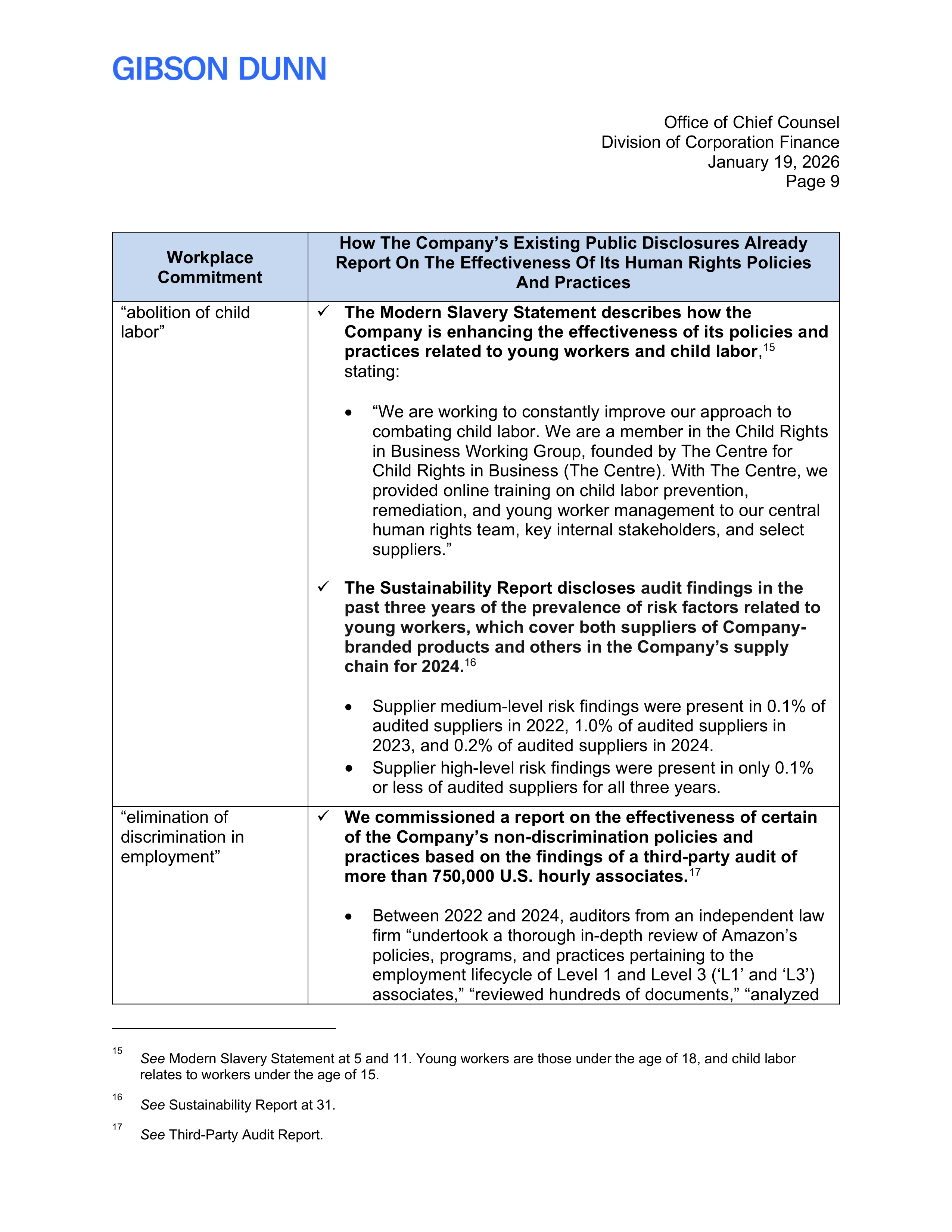
The
Modern Slavery Statement discloses audit findings in
the past three years of the prevalence of risk factors related
to forced labor, which cover both suppliers of Company-
branded products and, for 2024, the Company’s own
operations.
14
The Modern Slavery Statement discloses the Company’s
evaluation of the following risk factors of forced labor, providing
the percentage of audits where an issue was found as follows:
Incomplete employment information (“Employment
documentation did not include relevant information on the
nature of work, working hours, wages, leave, benefits, fees,
or deductions”): 3.7% in 2022, 3.4% in 2023, and 4.9% in
2024.
Ineffectively communicated employment information
(“Employment documentation was not communicated in the
worker’s native or best understood language or changes in
terms of employment were not declared or were not
negotiated”): 2.4% in 2022, 5.4% in 2023, and 8.4% in
2024.
Mandatory overtime (“Workers were not provided sufficient
notice of overtime in advance or were unable to refuse
overtime without penalty, against international standards”):
1.6% in 2022, 1.9% in 2023, and 2.2% in 2024.
Worker-paid recruitment fees (“Fees related to recruiting
and hiring were not disclosed in advance or not
reimbursed”): <1% in 2022, and 2.1% in 2023 and 2024.
Control of documents (“Employers maintain possession or
control over worker identity documents”): <1% for all three
years.
14
See
Modern Slavery Statement at 8
.

Office of Chief Counsel
Division of Corporation Finance
January 19, 2026
Page 9
Workplace
Commitment
How The Company’s Existing Public Disclosures Already
Report On The Effectiveness Of Its Human Rights Policies
And Practices
“abolition of child
labor”
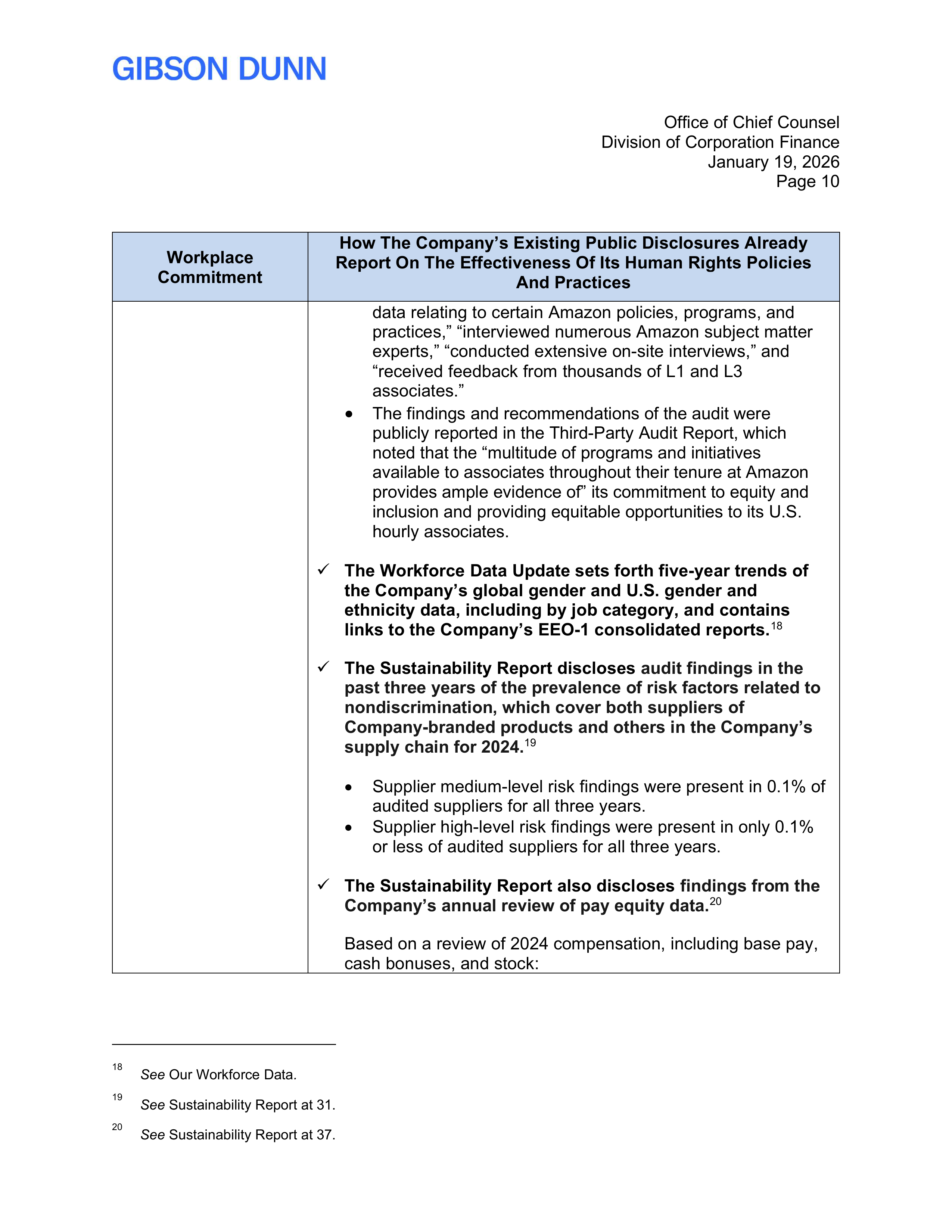
The Modern Slavery Statement describes how the
Company is enhancing the effectiveness of its policies and
practices related to young workers and child labor
,
15
stating:
“We are working to constantly improve our approach to
combating child labor. We are a member in the Child Rights
in Business Working Group, founded by The Centre for
Child Rights in Business (The Centre). With The Centre, we
provided online training on child labor prevention,
remediation, and young worker management to our central
human rights team, key internal stakeholders, and select
suppliers.”
The Sustainability Report discloses
audit findings in the
past three years of the prevalence of risk factors related to
young workers, which cover both suppliers of Company-
branded products and others in the Company’s supply
chain for 2024.
16
Supplier medium-level risk findings were present in 0.1% of
audited suppliers in 2022, 1.0% of audited suppliers in
2023, and 0.2% of audited suppliers in 2024.
Supplier high-level risk findings were present in only 0.1%
or less of audited suppliers for all three years.
“elimination of
discrimination in
employment”
We commissioned a report on the effectiveness of certain
of the Company’s non-discrimination policies and
practices based on the findings of a third-party audit of
more than 750,000 U.S. hourly associates.
17
Between 2022 and 2024, auditors from an independent law
firm “undertook a thorough in-depth review of Amazon’s
policies, programs, and practices pertaining to the
employment lifecycle of Level 1 and Level 3 (‘L1’ and ‘L3’)
associates,” “reviewed hundreds of documents,” “analyzed
15
See
Modern Slavery Statement at 5 and 11. Young workers are those under the age of 18, and child labor
relates to workers under the age of 15.
16
See
Sustainability Report at 31.
17
See
Third-Party Audit Report
.

Office of Chief Counsel
Division of Corporation Finance
January 19, 2026
Page 10
Workplace
Commitment
How The Company’s Existing Public Disclosures Already
Report On The Effectiveness Of Its Human Rights Policies
And Practices
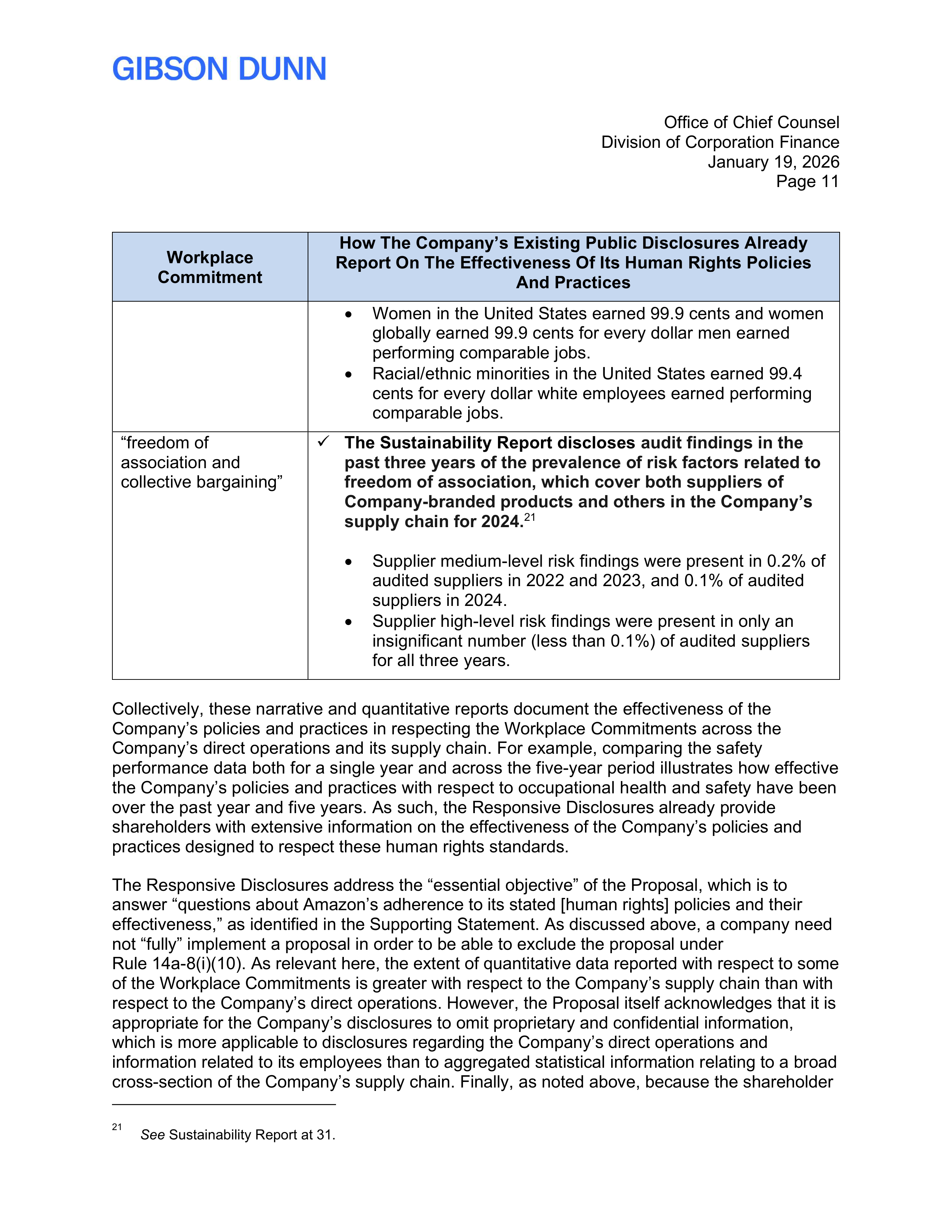
data relating to certain Amazon policies, programs, and
practices,” “interviewed numerous Amazon subject matter
experts,” “conducted extensive on-site interviews,” and
“received feedback from thousands of L1 and L3
associates.”
The findings and recommendations of the audit were
publicly reported in the Third-Party Audit Report, which
noted that the “multitude of programs and initiatives
available to associates throughout their tenure at Amazon
provides ample evidence of” its commitment to equity and
inclusion and providing equitable opportunities to its U.S.
hourly associates.
The Workforce Data Update sets forth five-year trends of
the Company’s global gender and U.S. gender and
ethnicity data, including by job category, and contains
links to the Company’s EEO-1 consolidated reports.
18
The Sustainability Report discloses
audit findings in the
past three years of the prevalence of risk factors related to
nondiscrimination, which cover both suppliers of
Company-branded products and others in the Company’s
supply chain for 2024.
19
Supplier medium-level risk findings were present in 0.1% of
audited suppliers for all three years.
Supplier high-level risk findings were present in only 0.1%
or less of audited suppliers for all three years.
The Sustainability Report also discloses
findings from the
Company’s annual review of pay equity data.
20
Based on a review of 2024 compensation, including base pay,
cash bonuses, and stock:
18
See
Our Workforce Data
.
19
See
Sustainability Report at 31.
20
See
Sustainability Report at 37.

Office of Chief Counsel
Division of Corporation Finance
January 19, 2026
Page 11
Workplace
Commitment
How The Company’s Existing Public Disclosures Already
Report On The Effectiveness Of Its Human Rights Policies
And Practices
Women in the United States earned 99.9 cents and women
globally earned 99.9 cents for every dollar men earned
performing comparable jobs.
Racial/ethnic minorities in the United States earned 99.4
cents for every dollar white employees earned performing
comparable jobs.
“freedom of
association and
collective bargaining”
The Sustainability Report discloses
audit findings in the
past three years of the prevalence of risk factors related to
freedom of association, which cover both suppliers of
Company-branded products and others in the Company’s
supply chain for 2024.
21
Supplier medium-level risk findings were present in 0.2% of
audited suppliers in 2022 and 2023, and 0.1% of audited
suppliers in 2024.
Supplier high-level risk findings were present in only an
insignificant number (less than 0.1%) of audited suppliers
for all three years.
Collectively, these narrative and quantitative reports document the effectiveness of the
Company’s policies and practices in respecting the Workplace Commitments across the
Company’s direct operations and its supply chain. For example, comparing the safety
performance data both for a single year and across the five-year period illustrates how effective
the Company’s policies and practices with respect to occupational health and safety have been
over the past year and five years. As such, the Responsive Disclosures already provide
shareholders with extensive information on the effectiveness of the Company’s policies and
practices designed to respect these human rights standards.
The Responsive Disclosures address the “essential objective” of the Proposal, which is to
answer “questions about Amazon’s adherence to its stated [human rights] policies and their
effectiveness,” as identified in the Supporting Statement. As discussed above, a company need
not “fully” implement a proposal in order to be able to exclude the proposal under
Rule 14a-8(i)(10). As relevant here, the extent of quantitative data reported with respect to some
of the Workplace Commitments is greater with respect to the Company’s supply chain than with
respect to the Company’s direct operations. However, the Proposal itself acknowledges that it is
appropriate for the Company’s disclosures to omit proprietary and confidential information,
which is more applicable to disclosures regarding the Company’s direct operations and
information related to its employees than to aggregated statistical information relating to a broad
cross-section of the Company’s supply chain. Finally, as noted above, because the shareholder
21
See
Sustainability Report at 31.


Office of Chief Counsel
Division of Corporation Finance
January 19, 2026
Page 12
proposal process is not intended to be used to address matters that relate to a company’s
ordinary business operations, the Proposal should not be seen as focused on reporting
regarding the Company’s policies and practices related to freedom of association, which was
the focus of the 2025 Proposal that the Staff concurred the Company could properly exclude
under Rule 14a-8(i)(7). The Company’s substantial implementation of the Proposal is analogous
to the precedents cited above, including
Boeing
,
PPG Industries
, and
Wendy’s
, and accordingly
the Proposal may be excluded under Rule 14a-8(i)(10) because the Responsive Disclosures
fulfill the Proposal’s “essential objective.”
CONCLUSION
We are available to provide you with any additional information and answer any questions that
you may have regarding this subject. Correspondence regarding this letter should be sent to
shareholderproposals@gibsondunn.com. If we can be of any further assistance in this matter,
please do not hesitate to call me at (202) 955-8671, or Susan Jong, the Company’s Vice
President, Associate General Counsel, and Corporate Secretary, at (206) 266-1000.
Sincerely,
Ronald O. Mueller
Enclosures
cc:
Susan Jong, Amazon.com, Inc.
Sarah Couturier-Tanoh, Shareholder Association for Research & Education
Carmen Diston, IBVM Foundation of Canada Inc.
Yousuf Najmee, Catherine Donnelly Foundation
Carina Silberg, Alecta Tjänstepension, Ömsesidigt
Katarina Hammar, Nordea Investment Management AB
Emilie Westholm, Folksam Group
Karen Kerschke, Illinois State Treasurer’s Office
Edmond Ho, Vancity Investment Management


EXHIBIT A
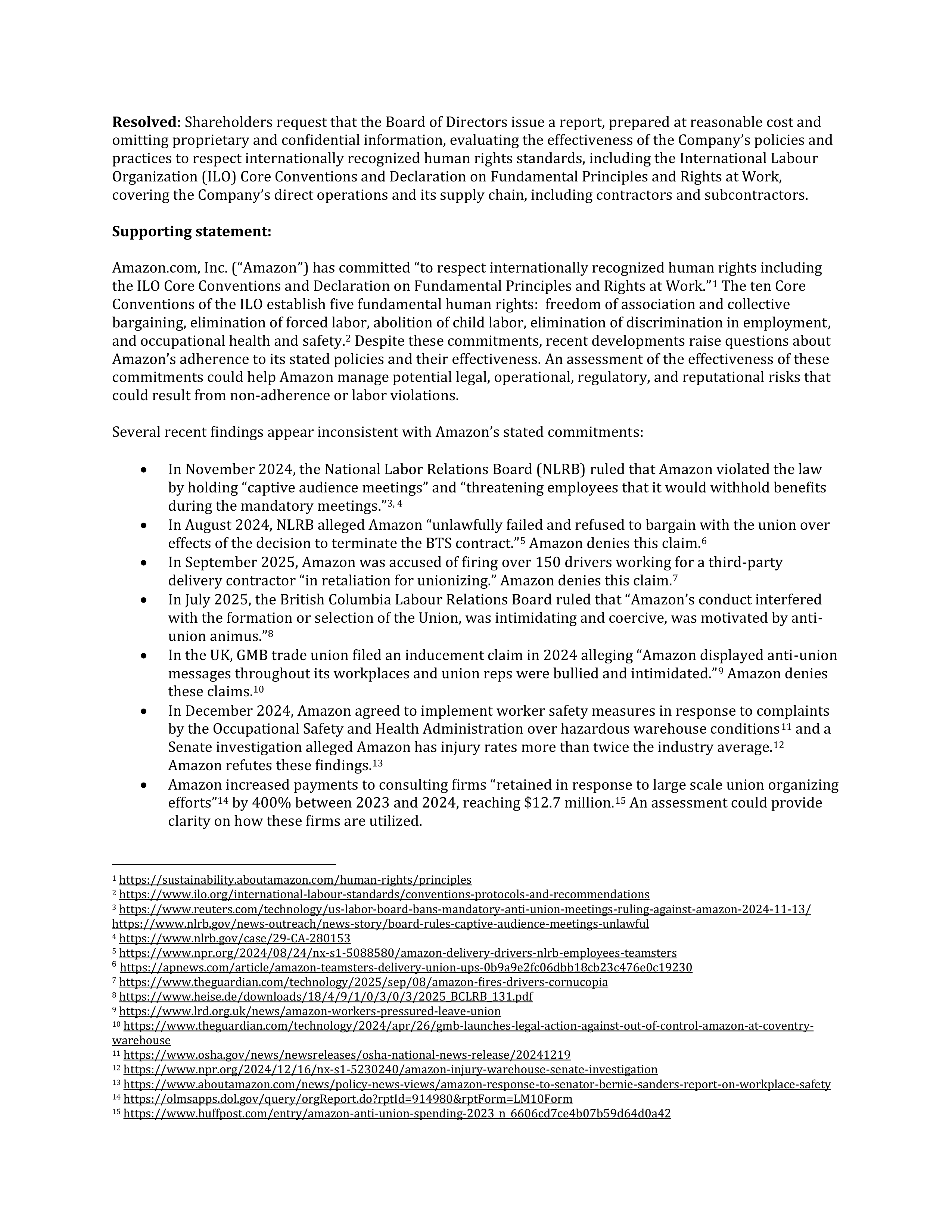
Resolved
: Shareholders request that the Board of Directors issue a report, prepared at reasonable cost and
omitting proprietary and confidential information, evaluating the effectiveness of the Company’s policies and
practices to respect internationally recognized human rights standards, including the International Labour
Organization (ILO) Core Conventions and Declaration on Fundamental Principles and Rights at Work,
covering the Company’s direct operations and its supply chain, including contractors and subcontractors.
Supporting statement:
Amazon.com, Inc. (“Amazon”) has committed “to respect internationally recognized human rights including
the ILO Core Conventions and Declaration on Fundamental Principles and Rights at Work.”
1
The ten Core
Conventions of the ILO establish five fundamental human rights: freedom of association and collective
bargaining, elimination of forced labor, abolition of child labor, elimination of discrimination in employment,
and occupational health and safety.
2
Despite these commitments, recent developments raise questions about
Amazon’s adherence to its stated policies and their effectiveness. An assessment of the effectiveness of these
commitments could help Amazon manage potential legal, operational, regulatory, and reputational risks that
could result from non-adherence or labor violations.
Several recent findings appear inconsistent with Amazon’s stated commitments:
•
In November 2024, the National Labor Relations Board (NLRB) ruled that Amazon violated the law
by holding “captive audience meetings” and “threatening employees that it would withhold benefits
during the mandatory meetings.”
3, 4
•
In August 2024, NLRB alleged Amazon “unlawfully failed and refused to bargain with the union over
effects of the decision to terminate the BTS contract.”
5
Amazon denies this claim.
6
•
In September 2025, Amazon was accused of firing over 150 drivers working for a third-party
delivery contractor “in retaliation for unionizing.” Amazon denies this claim.
7
•
In July 2025, the British Columbia Labour Relations Board ruled that “Amazon’s conduct interfered
with the formation or selection of the Union, was intimidating and coercive, was motivated by anti-
union animus.”
8
•
In the UK, GMB trade union filed an inducement claim in 2024 alleging “Amazon displayed anti-union
messages throughout its workplaces and union reps were bullied and intimidated.”
9
Amazon denies
these claims.
10
•
In December 2024, Amazon agreed to implement worker safety measures in response to complaints
by the Occupational Safety and Health Administration over hazardous warehouse conditions
11
and a
Senate investigation alleged Amazon has injury rates more than twice the industry average.
12
Amazon refutes these findings.
13
•
Amazon increased payments to consulting firms “retained in response to large scale union organizing
efforts”
14
by 400% between 2023 and 2024, reaching $12.7 million.
15
An assessment could provide
clarity on how these firms are utilized.
1
https://sustainability.aboutamazon.com/human-rights/principles
2
https://www.ilo.org/international-labour-standards/conventions-protocols-and-recommendations
3
https://www.reuters.com/technology/us-labor-board-bans-mandatory-anti-union-meetings-ruling-against-amazon-2024-11-13/
https://www.nlrb.gov/news-outreach/news-story/board-rules-captive-audience-meetings-unlawful
4
https://www.nlrb.gov/case/29-CA-280153
5
https://www.npr.org/2024/08/24/nx-s1-5088580/amazon-delivery-drivers-nlrb-employees-teamsters
6
https://apnews.com/article/amazon-teamsters-delivery-union-ups-0b9a9e2fc06dbb18cb23c476e0c19230
7
https://www.theguardian.com/technology/2025/sep/08/amazon-fires-drivers-cornucopia
8
https://www.heise.de/downloads/18/4/9/1/0/3/0/3/2025_BCLRB_131.pdf
9
https://www.lrd.org.uk/news/amazon-workers-pressured-leave-union
10
https://www.theguardian.com/technology/2024/apr/26/gmb-launches-legal-action-against-out-of-control-amazon-at-coventry-
warehouse
11
https://www.osha.gov/news/newsreleases/osha-national-news-release/20241219
12
https://www.npr.org/2024/12/16/nx-s1-5230240/amazon-injury-warehouse-senate-investigation
13
https://www.aboutamazon.com/news/policy-news-views/amazon-response-to-senator-bernie-sanders-report-on-workplace-safety
14
https://olmsapps.dol.gov/query/orgReport.do?rptId=914980&rptForm=LM10Form
15
https://www.huffpost.com/entry/amazon-anti-union-spending-2023_n_6606cd7ce4b07b59d64d0a42

These recurring controversies suggest Amazon’s current policies and practices may be ineffective and
misaligned with its stated commitments. The requested report is a reasonable step to enhance oversight and
disclosure of potential risks to Amazon’s operations, regulatory compliance, and reputation.