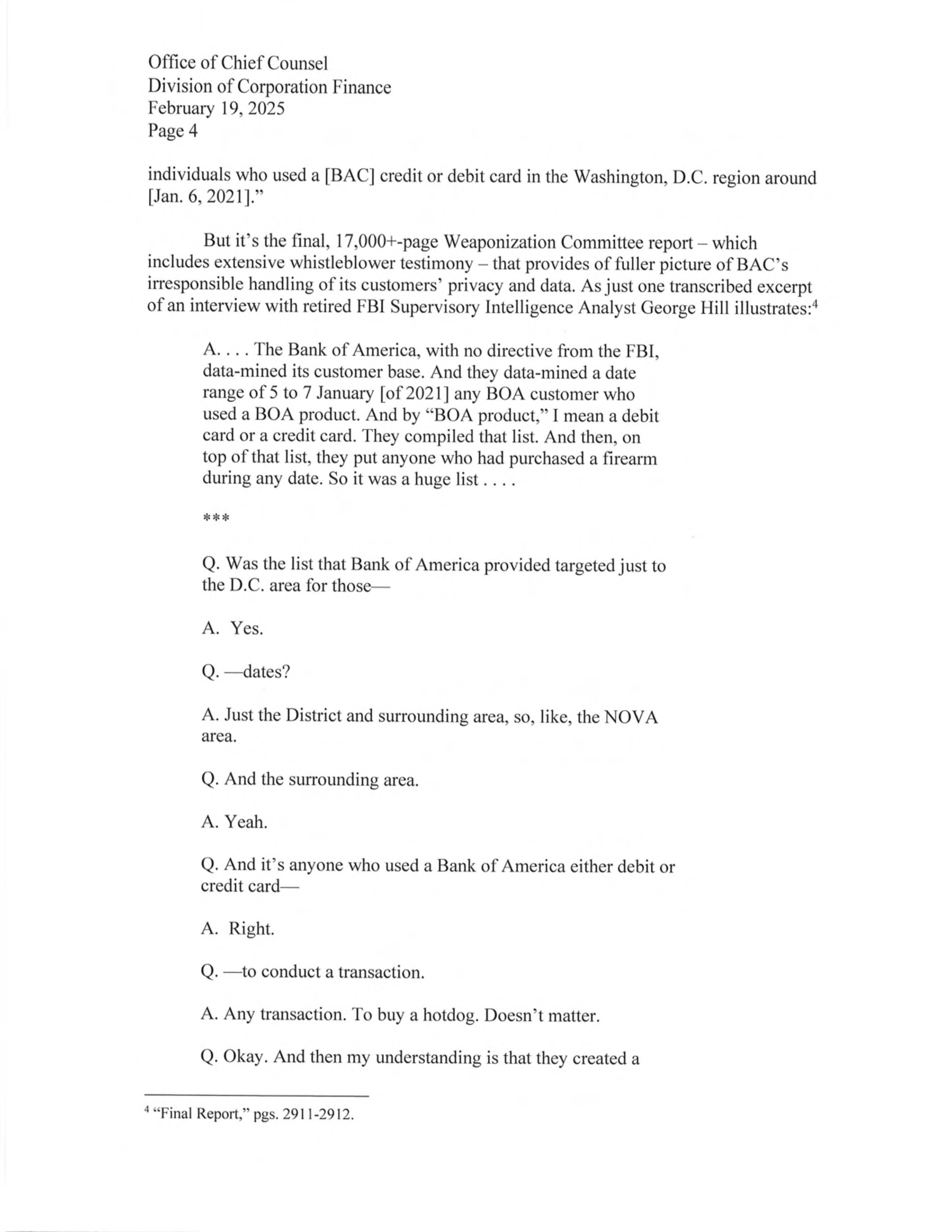
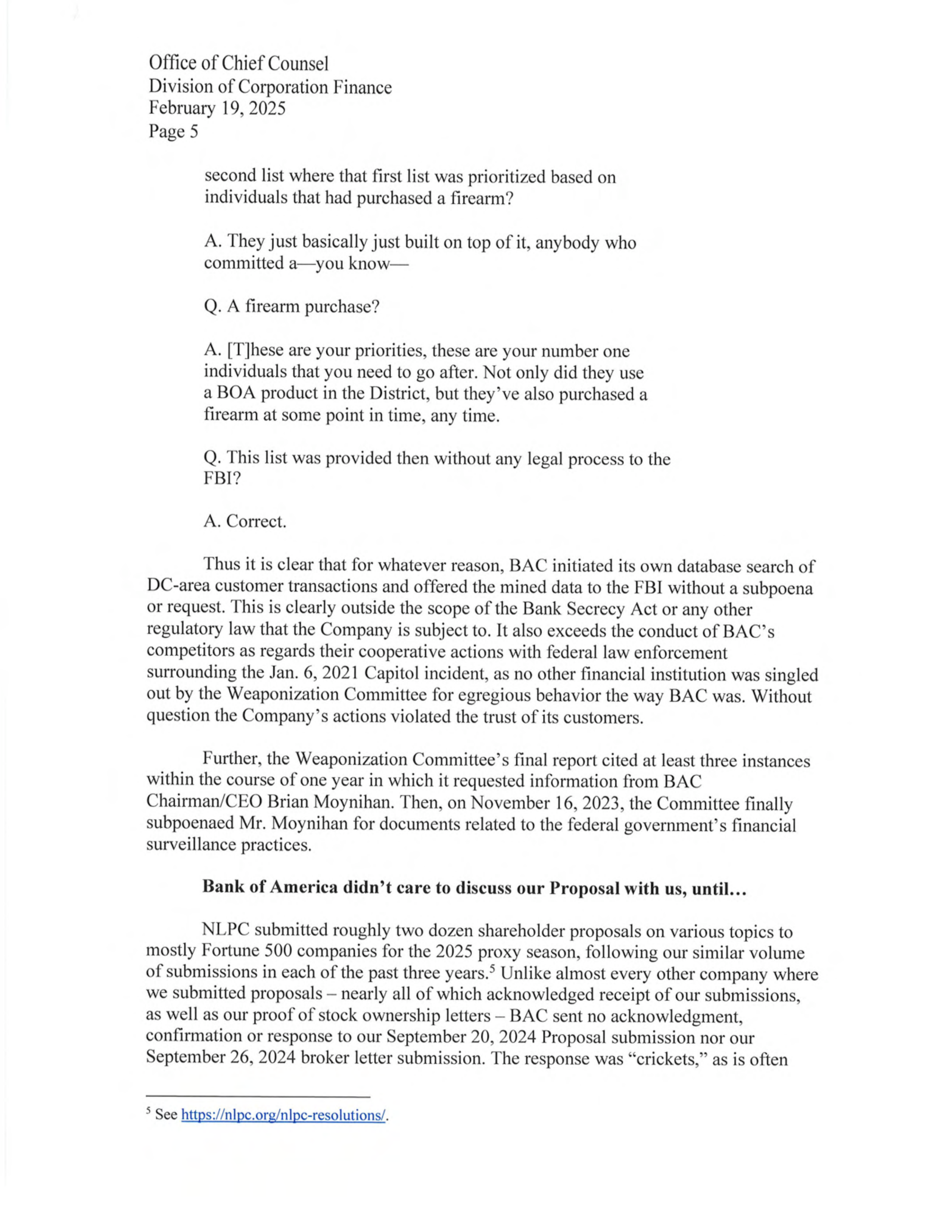
March 5, 2025
Ronald O. Mueller
Gibson, Dunn & Crutcher LLP
Re:
Bank of America Corporation (the “Company”)
Incoming letter dated December 20, 2024
Dear Ronald O. Mueller:
This letter is in response to your correspondence concerning the shareholder
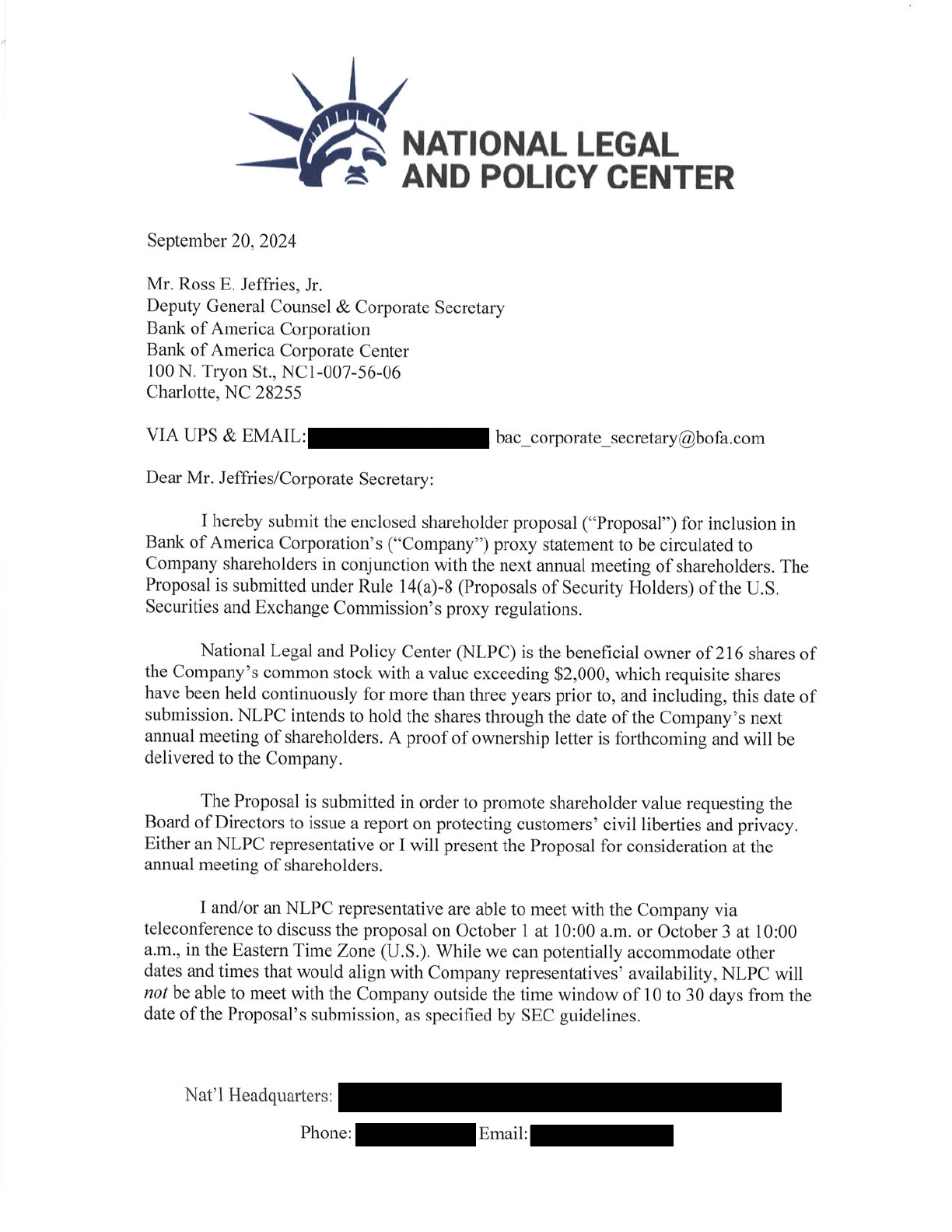
proposal (the “Proposal”) submitted to the Company by the National Legal and Policy
Center for inclusion in the Company’s proxy materials for its upcoming annual meeting
of security holders.
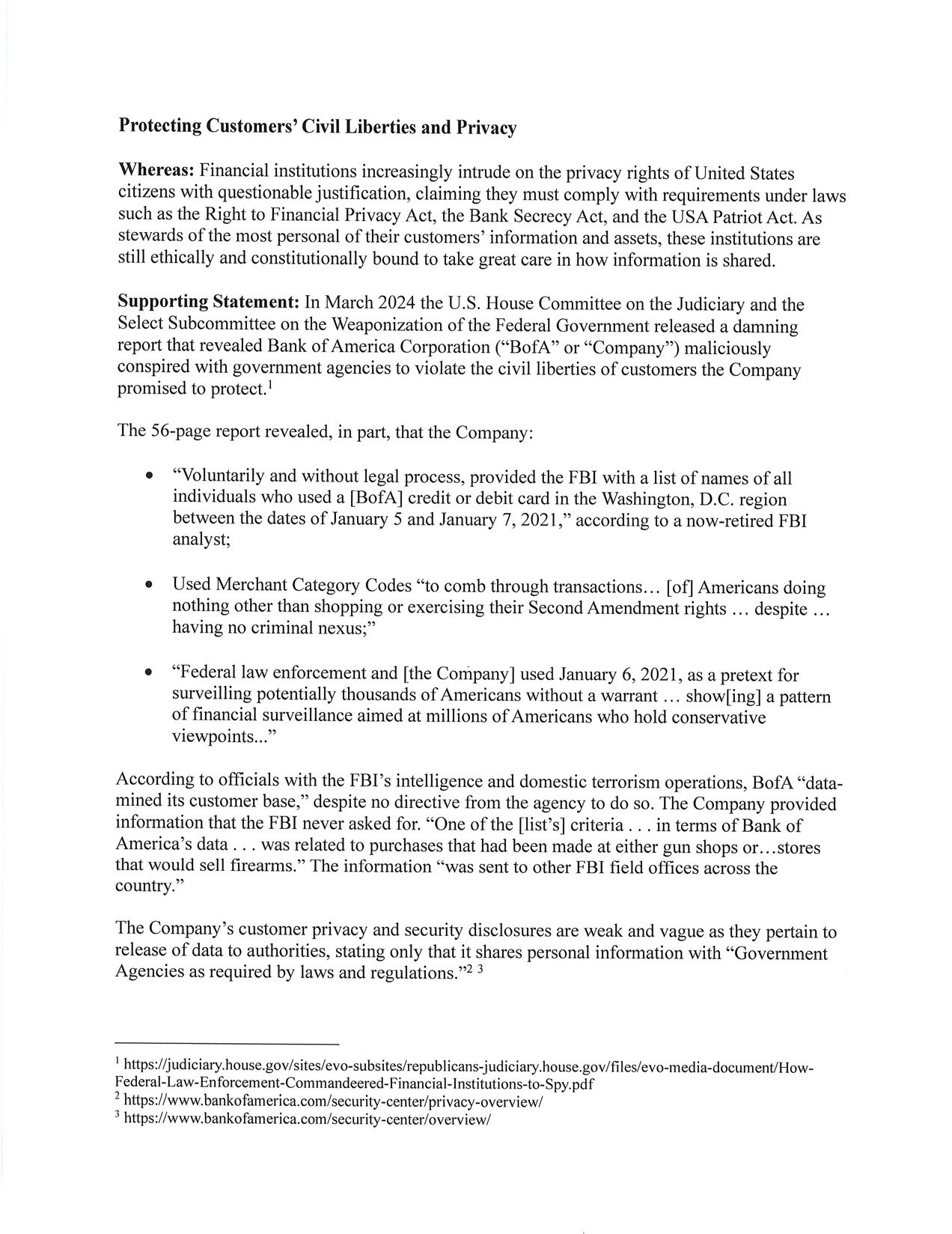
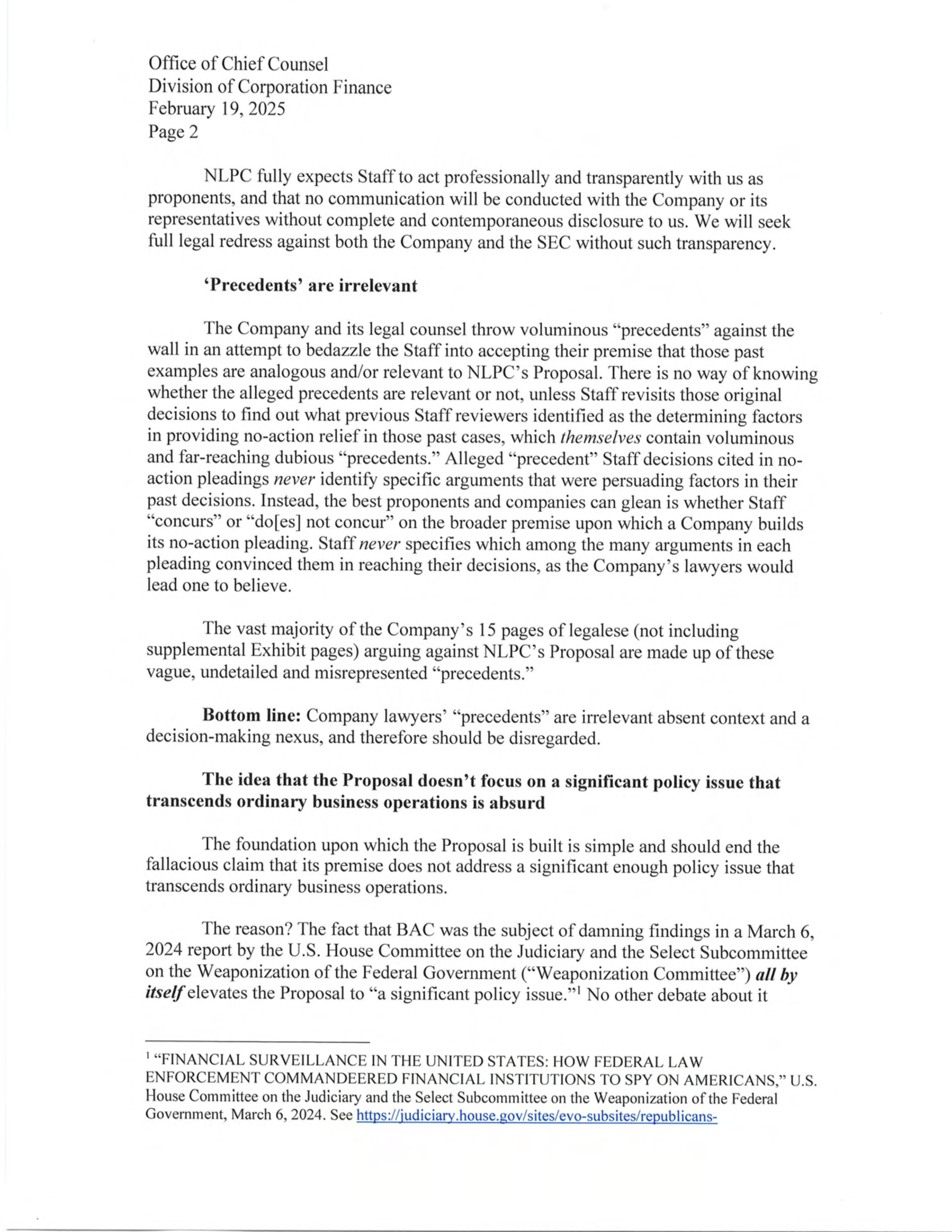
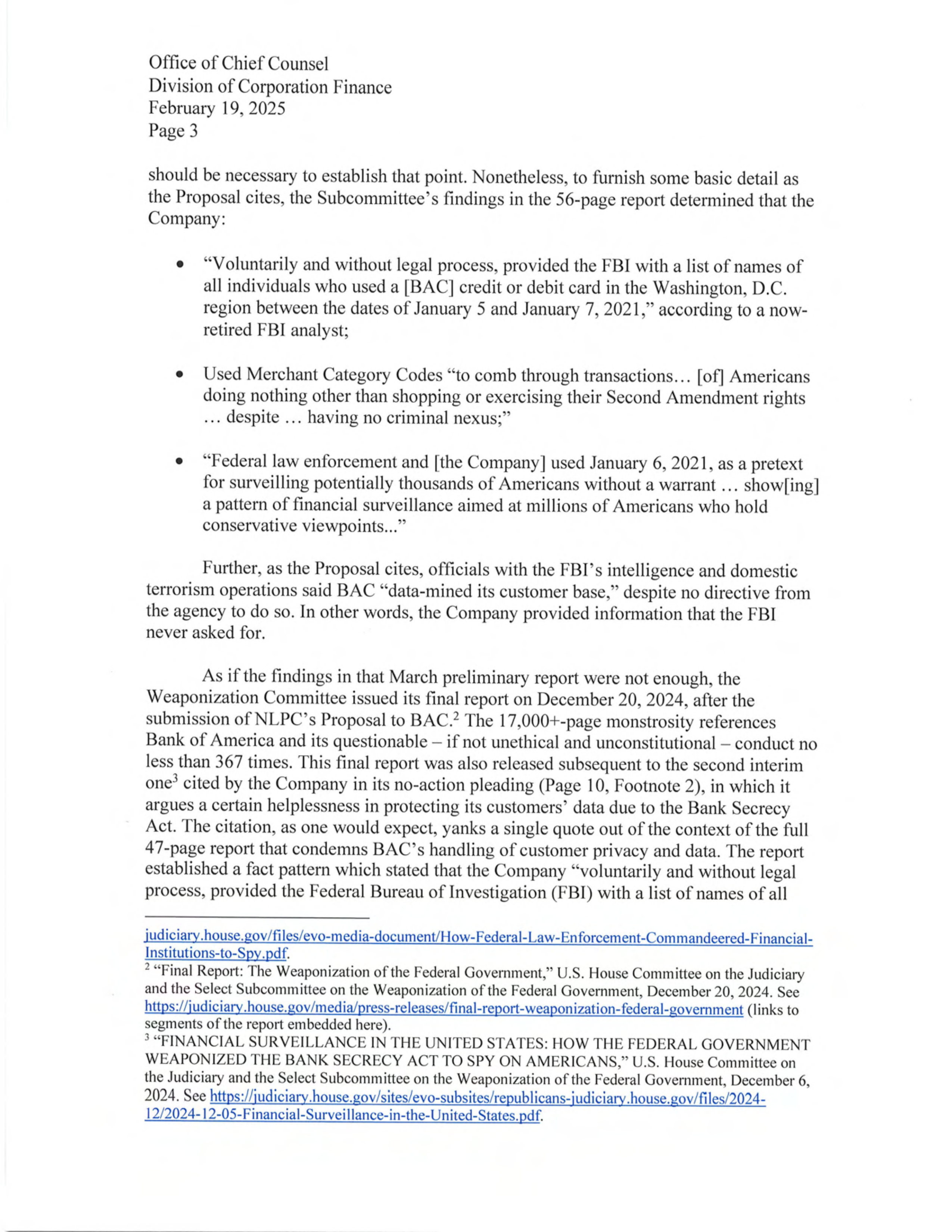
The Proposal requests the board of directors issue a report concerning the legality
and judgment of management’s decision-making, and insufficient disclosure specificity,
regarding the dissemination to government agencies of customers’ personal information.
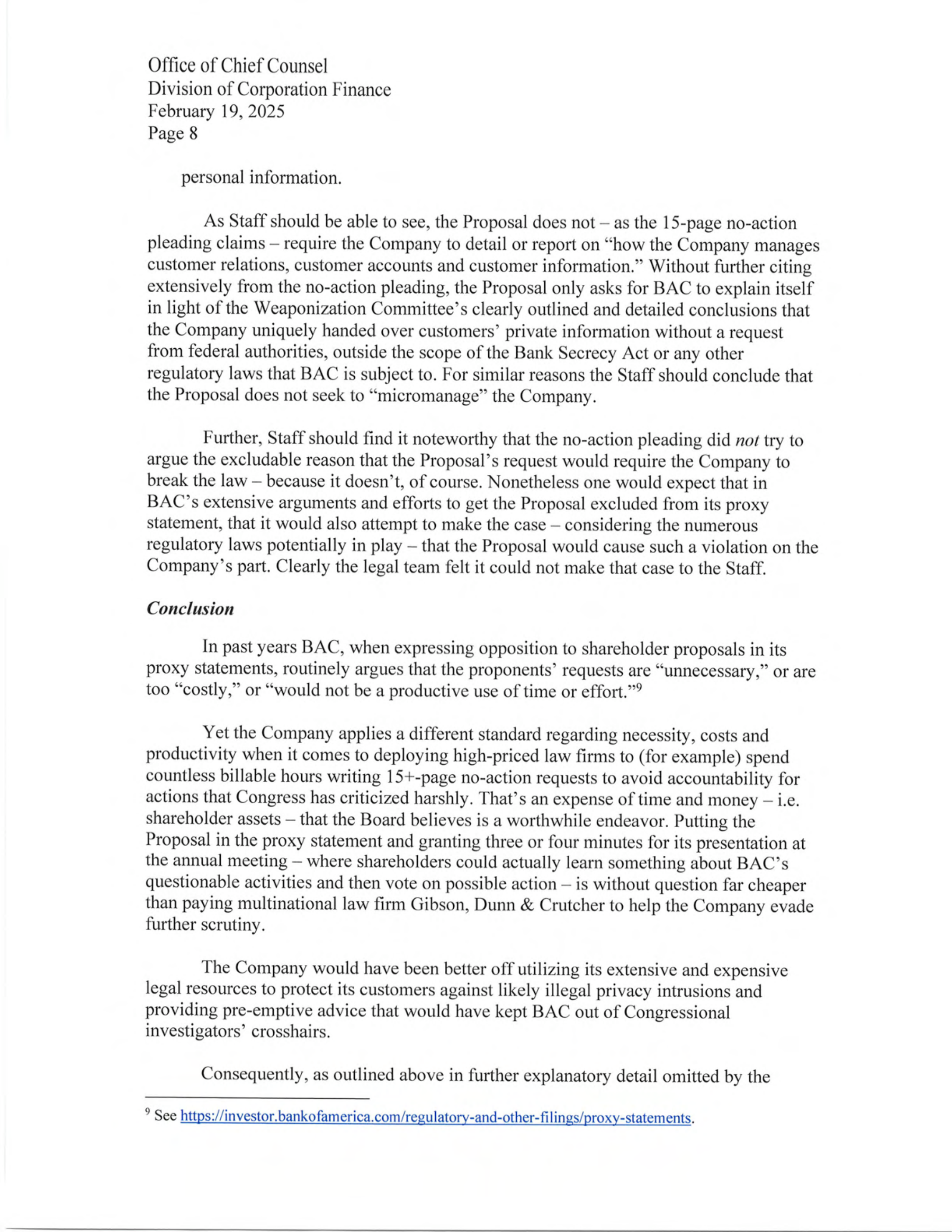
There appears to be some basis for your view that the Company may exclude the
Proposal under Rule 14a-8(i)(7). In our view, the Proposal relates to the Company’s
ordinary business operations. Accordingly, we will not recommend enforcement action to
the Commission if the Company omits the Proposal from its proxy materials in reliance
on Rule 14a-8(i)(7).
Copies of all of the correspondence on which this response is based will be made
available on our website at
https://www.sec.gov/corpfin/2024-2025-shareholder-
proposals-no-action
.
Sincerely,
Rule 14a-8 Review Team
cc:
Paul Chesser
National Legal and Policy Center

Ronald O. Mueller
Partner
T: +1 202.955.8671
rmueller@gibsondunn.com
Gibson, Dunn & Crutcher LLP
1700 M Street, N.W. | Washington, D.C. 20036-5306 | T: 202.955.8500 | F: 202.467.0539 | gibsondunn.com
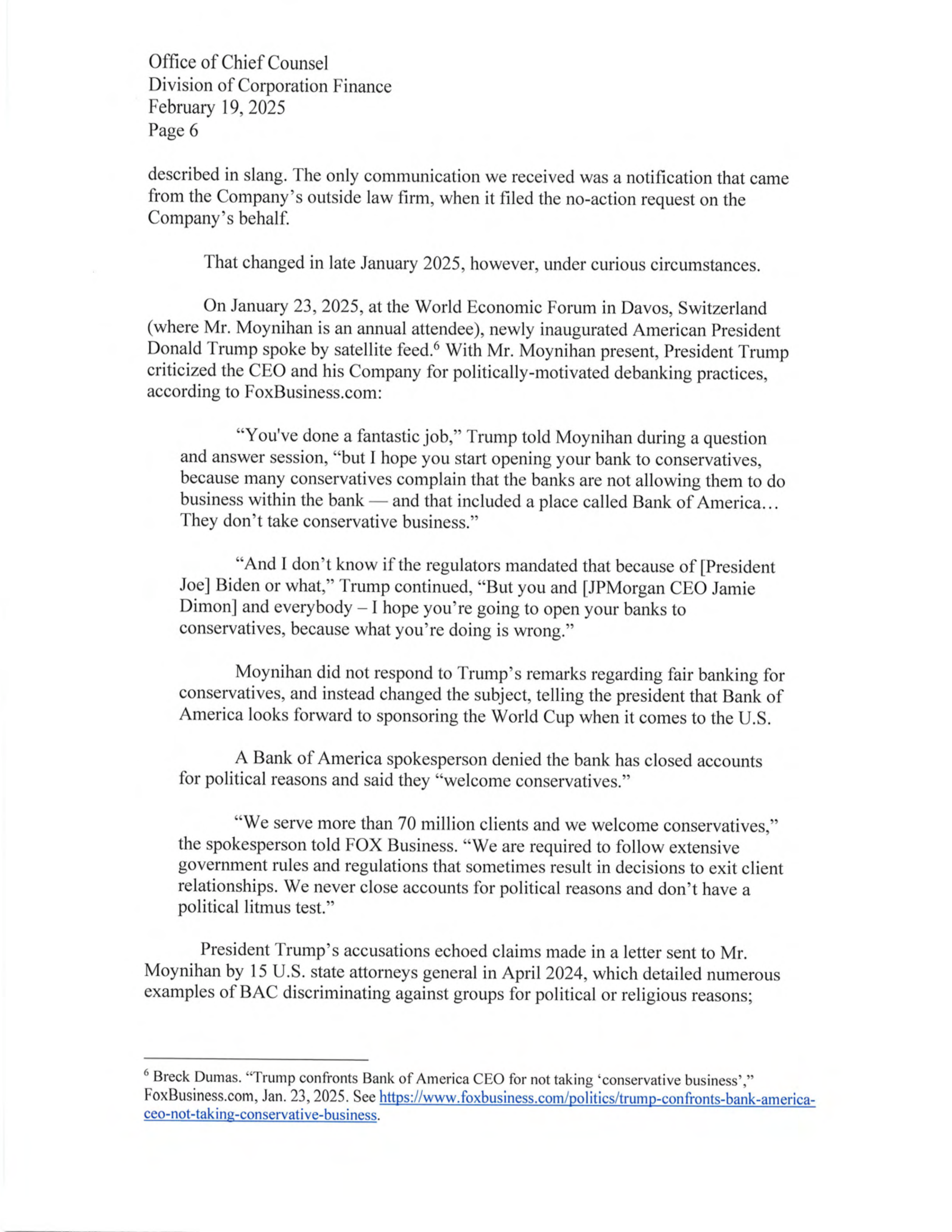
December 20, 2024
VIA ONLINE SUBMISSION
Office of Chief Counsel
Division of Corporation Finance
Securities and Exchange Commission
100 F Street, NE
Washington, D.C. 20549
Re:
Bank of America Corporation
Shareholder Proposal of the National Legal and Policy Center
Securities Exchange Act of 1934—Rule 14a-8
Ladies and Gentlemen:
This letter is to inform you that our client, Bank of America Corporation (the
“Company”), intends to omit from its proxy statement and form of proxy for its 2025 Annual
Meeting of Shareholders (collectively, the “2025 Proxy Materials”) a shareholder proposal
(the “Proposal”) and statement in support thereof (the “Supporting Statement”) received
from the National Legal and Policy Center (the “Proponent”).
Pursuant to Rule 14a-8(j), we have:
•
filed this letter with the Securities and Exchange Commission (the
“Commission”) no later than eighty (80) calendar days before the Company
intends to file its definitive 2025 Proxy Materials with the Commission; and
•
concurrently sent a copy of this correspondence to the Proponent.
Rule 14a-8(k) and Staff Legal Bulletin No. 14D (Nov. 7, 2008) (“SLB 14D”) provide
that shareholder proponents are required to send companies a copy of any correspondence
that the proponents elect to submit to the Commission or the staff of the Division of
Corporation Finance (the “Staff”). Accordingly, we are taking this opportunity to inform the
Proponent that if the Proponent elects to submit additional correspondence to the
Commission or the Staff with respect to this Proposal, a copy of that correspondence should
be furnished concurrently to the undersigned on behalf of the Company pursuant to
Rule 14a-8(k) and SLB 14D.

THE PROPOSAL
Office of Chief Counsel
Division of Corporation Finance
December 20, 2024
Page 2
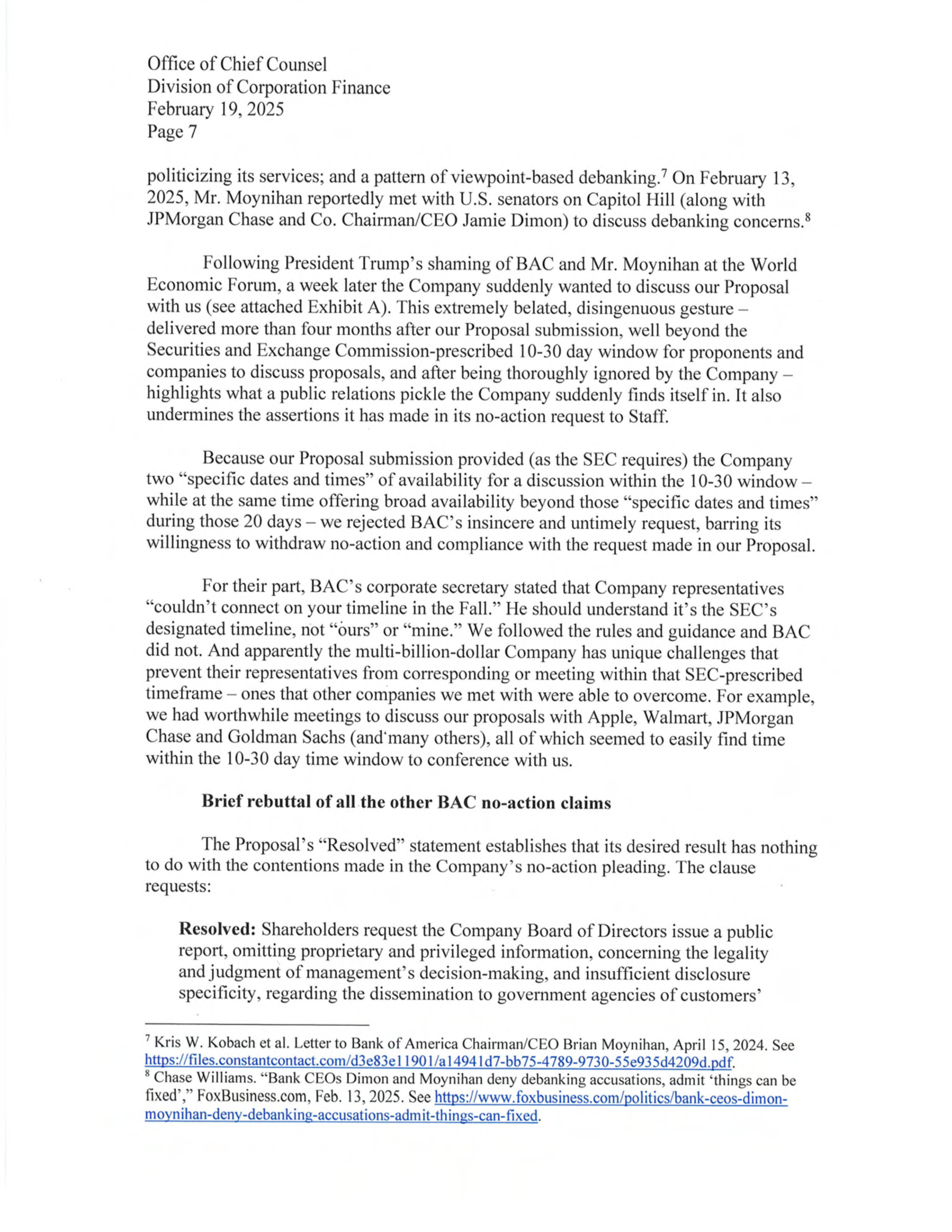
The Proposal states:
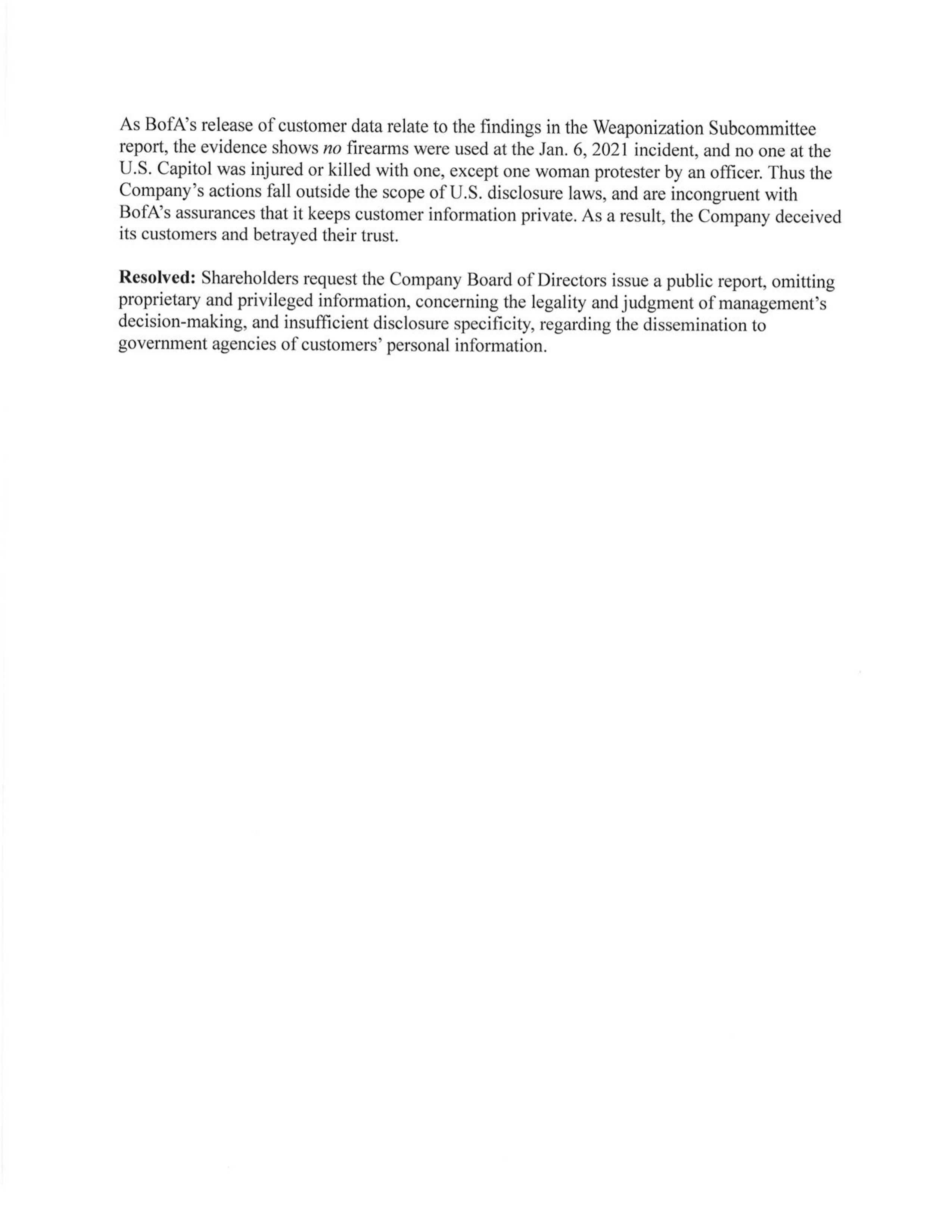
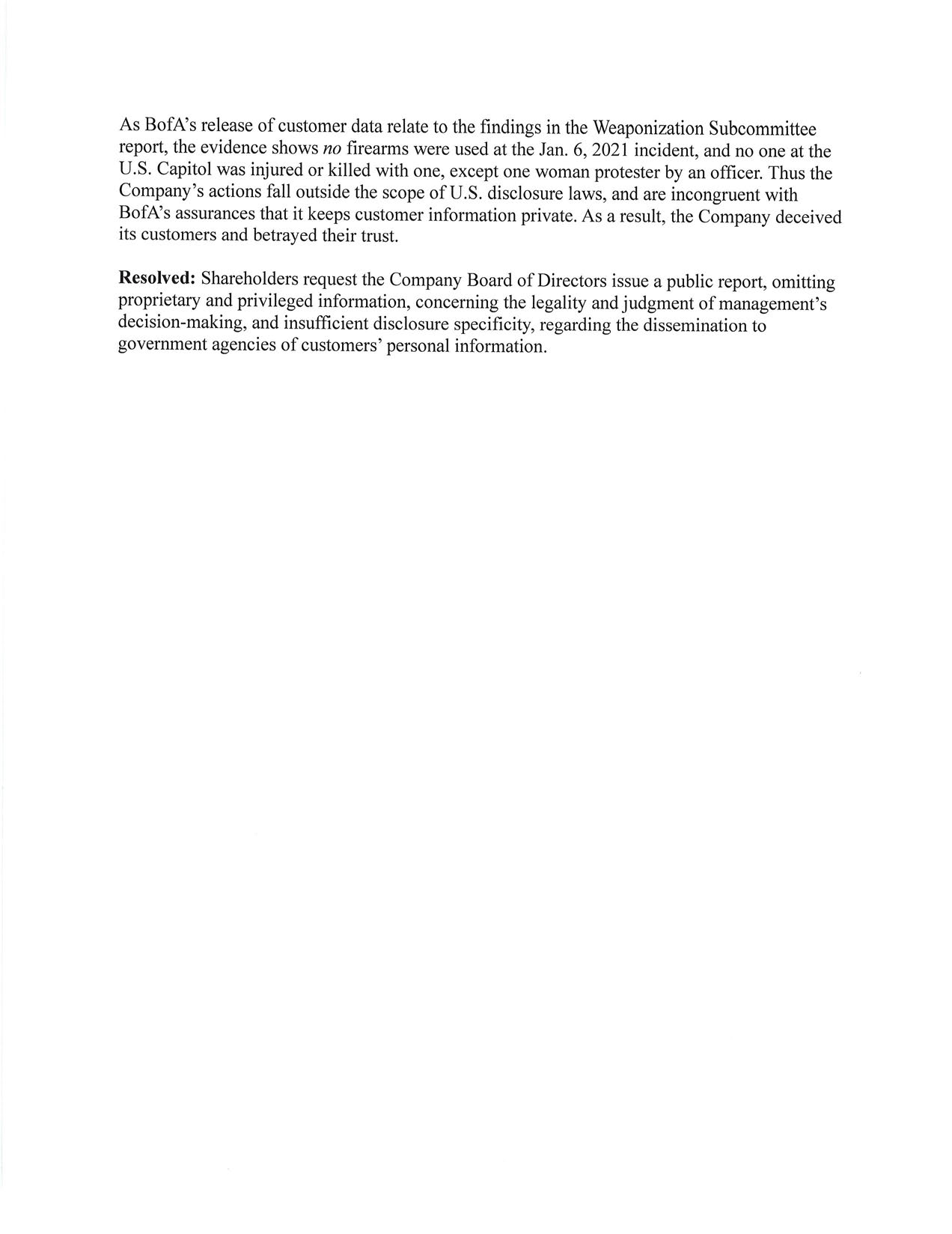
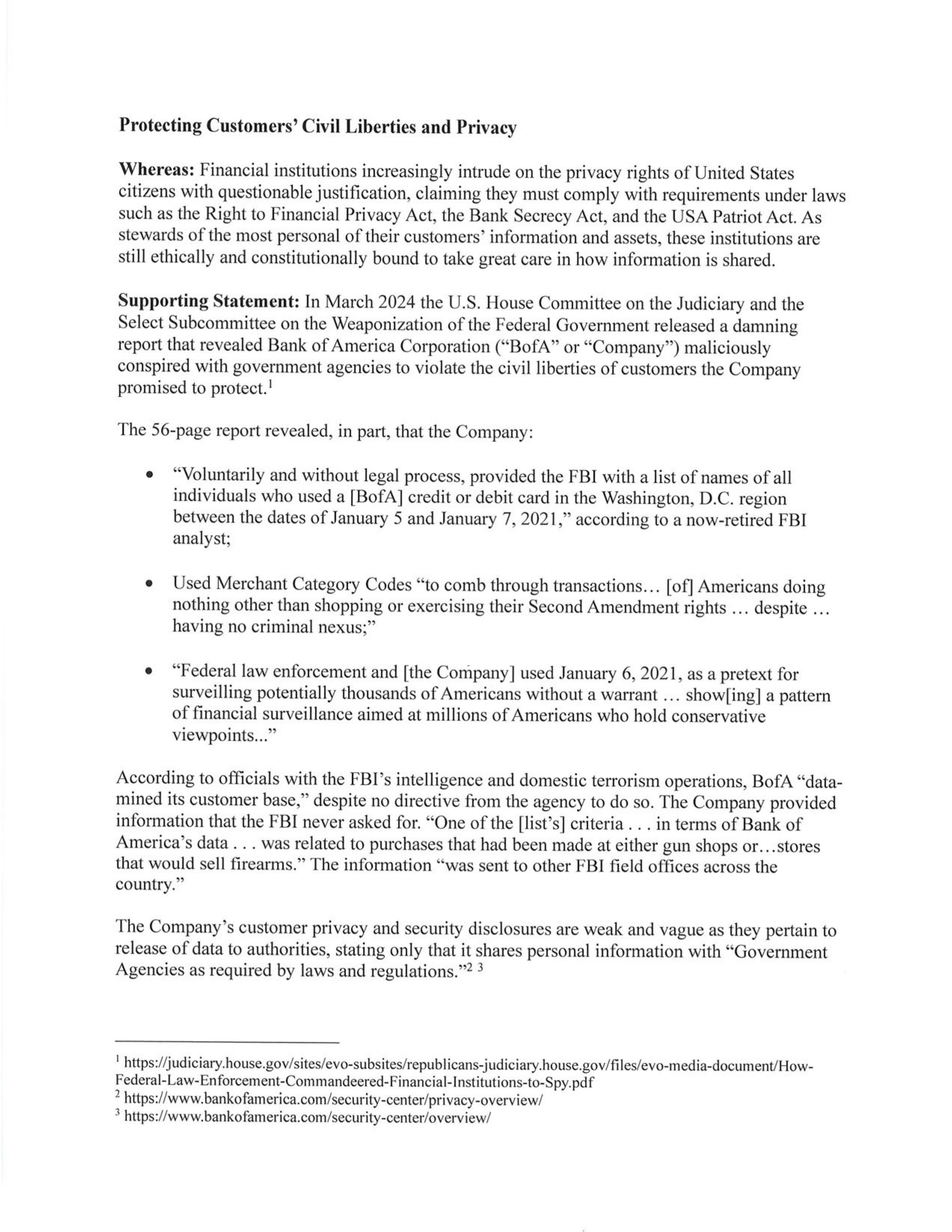
Resolved:
Shareholders request the Company Board of Directors issue a public
report, omitting proprietary and privileged information, concerning the legality and
judgment of management’s decision-making, and insufficient disclosure specificity,
regarding the dissemination to government agencies of customers’ personal
information.
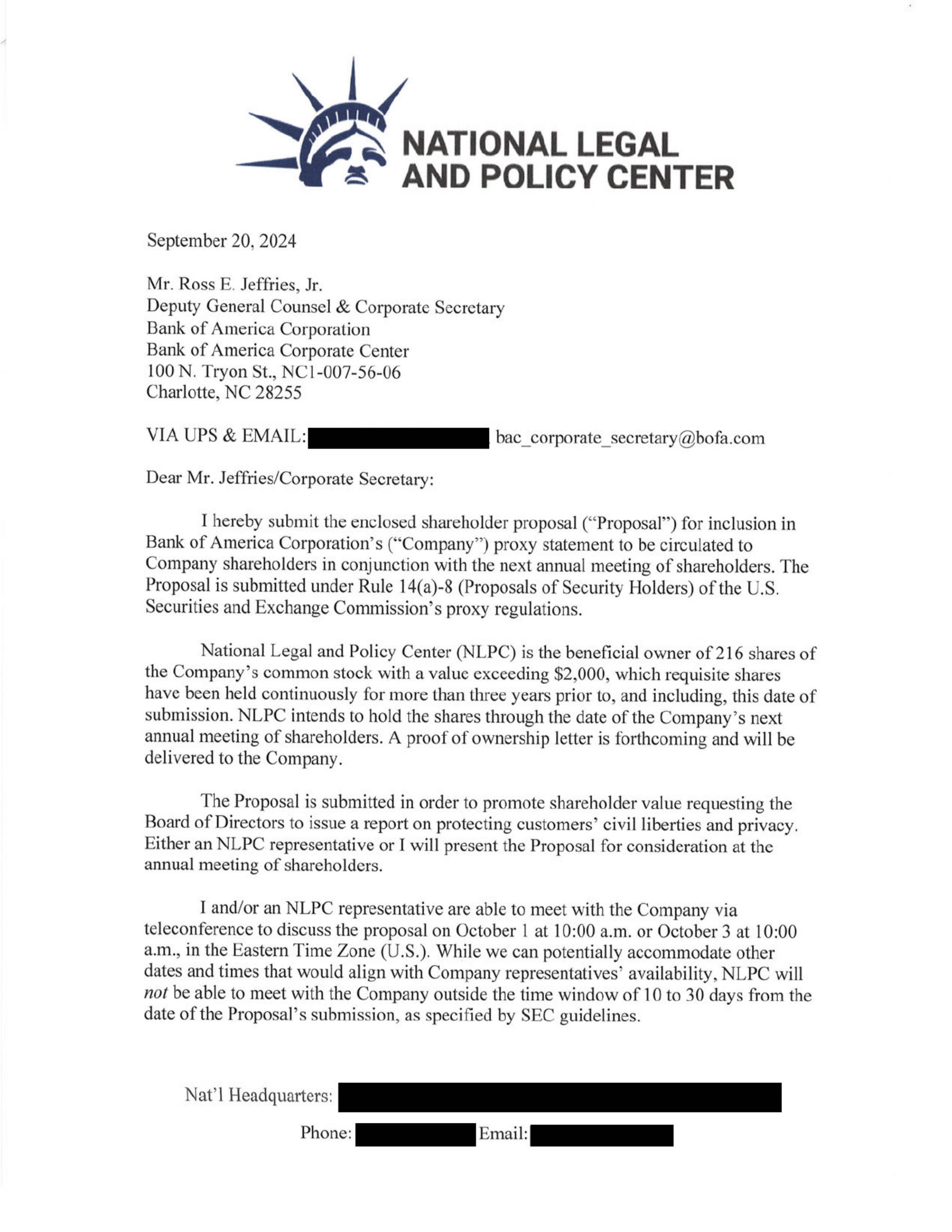
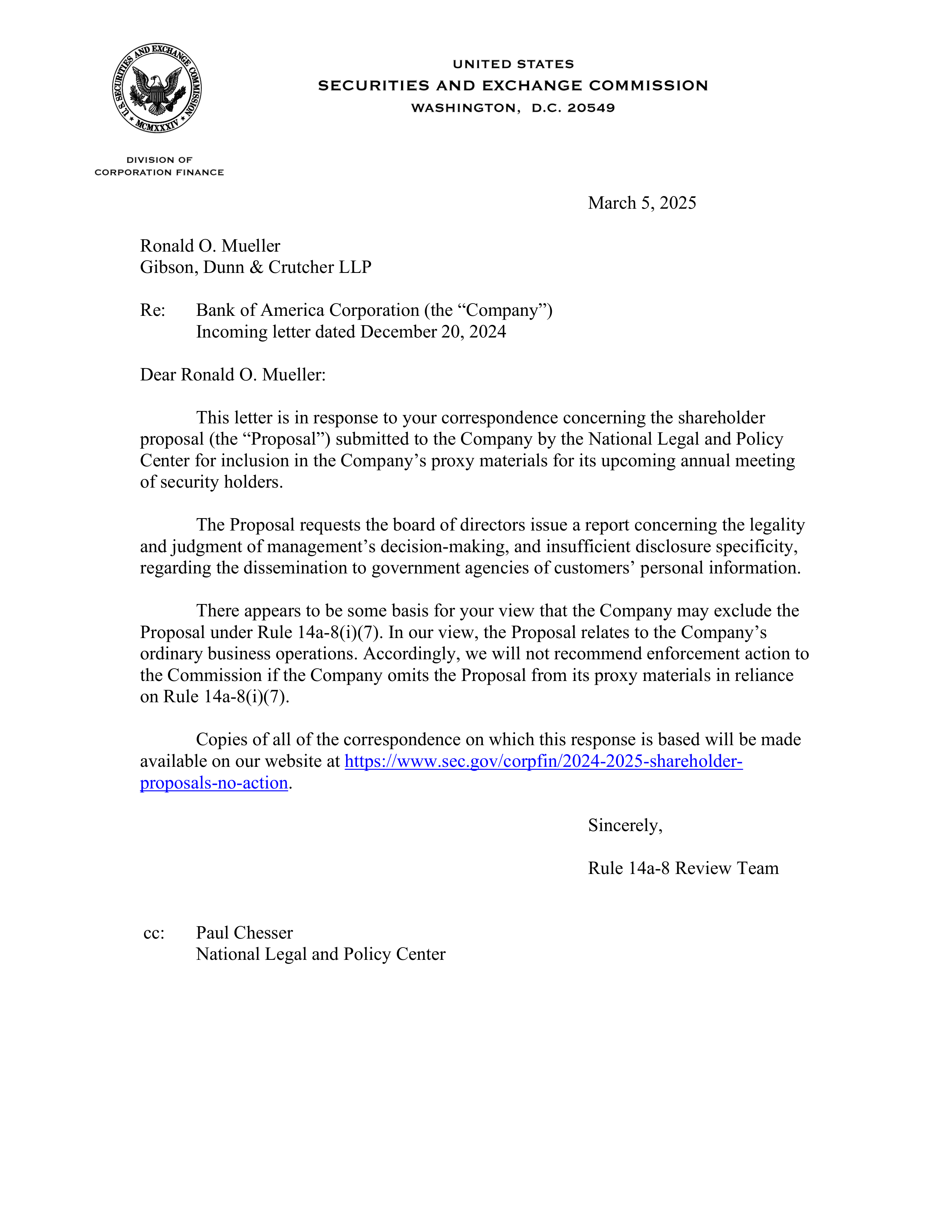
A copy of the Proposal and the Supporting Statement is attached to this letter as Exhibit A.
BASES FOR
EXCLUSION
We hereby respectfully request that the Staff concur in our view that the Proposal
may be excluded from the 2025 Proxy Materials pursuant to Rule 14a-8(i)(7) because the
Proposal relates to the Company’s ordinary business operations and seeks to micromanage
the Company.
ANALYSIS
The Proposal May Be Excluded Pursuant To Rule 14a-8(i)(7) Because It Involves
Matters Related To The Company’s Ordinary Business Operations.
The Company is a global financial institution serving individual consumers, small-
and middle-market businesses, institutional investors, large corporations and governments
with a full range of banking, investing, wealth management and other financial and risk
management products and services. Through its various bank and nonbank subsidiaries
throughout the U.S. and in international markets, the Company provides a diversified range
of banking and nonbank financial services and products through eight lines of business.
For financial reporting purposes, the Company’s eight lines of business align into the
following business segments: Consumer Banking, Global Wealth & Investment
Management, Global Banking and Global Markets.
The Company is subject to an extensive regulatory framework. Of particular
relevance here, U.S. federal regulation of banks, bank holding companies and financial
holding companies is intended primarily for the protection of depositors and the Federal
Deposit Insurance Fund. As a registered financial holding company and bank holding
company, the Company is subject to the supervision of, and regular inspection by, the
Board of Governors of the Federal Reserve System (“Federal Reserve”), while its U.S. bank
subsidiaries, organized as national banking associations, are subject to regulation,
supervision and examination by the Office of the Comptroller of the Currency (“OCC”), the
Federal Deposit Insurance Corporation (“FDIC”), the Consumer Financial Protection Bureau
(“CFPB”) and the Federal Reserve. Additionally, the Company and its bank and broker
dealer subsidiaries are subject to a significant number of laws, rules and regulations that

Office of Chief Counsel
Division of Corporation Finance
December 20, 2024
Page 3
govern their businesses in the U.S. and in the other jurisdictions in which they operate,
which set forth requirements on permissible activities, compliance risk management,
consumer products and sales practices, anti-money laundering and anti-corruption,
compliance with government sanctions, privacy and data protection, among others,
including those promulgated by the U.S. Department of the Treasury’s Financial Crimes
Enforcement Network (“FinCEN”).
The Proposal addresses the Company’s customer relations and its management and
handling of customer accounts and account information, particularly in the context of
authorized provision of information to government authorities. The Company’s relationship
with its clients and the handling of client accounts, including the terms upon which it does
business with clients across its operations and how it manages and protects customer
account information, are essential to the operation of the Company’s business as a financial
services institution. In managing customer accounts and customer account information, the
Company is required to comply with the vast array of laws, rules and regulations applicable
to the Company and its subsidiaries, including those promulgated by the Federal Reserve,
OCC, FDIC, FinCEN, and CFPB. Decisions regarding customer accounts, including the
handling of customer information,
1
involve legal, regulatory, operational, risk management
and financial considerations that implicate detailed and extensive policies and procedures
and are fundamental to the Company’s day-to-day operations. Because the Proposal
addresses the Company’s handling of customer relations, it is precisely the type of
shareholder proposal that companies are permitted to exclude under Rule 14a-8(i)(7).
A. Background On The Ordinary Business Standard.
Rule 14a-8(i)(7) permits a company to omit from its proxy materials a shareholder
proposal that relates to the company’s “ordinary business operations.” According to the
Commission’s release accompanying the 1998 amendments to Rule 14a-8, the term
“ordinary business” “refers to matters that are not necessarily ‘ordinary’ in the common
meaning of the word,” but instead the term “is rooted in the corporate law concept [of]
providing management with flexibility in directing certain core matters involving the
company’s business and operations.” Exchange Act Release No. 40018 (May 21, 1998)
(the “1998 Release”).
In the 1998 Release, the Commission stated that the underlying policy of the
ordinary business exclusion is “to confine the resolution of ordinary business problems to
management and the board of directors, since it is impracticable for shareholders to decide
how to solve such problems at an annual shareholders meeting,” and identified two central
1
In this regard, while the Supporting Statement raises a handful of alleged actions, we are not
addressing the Proponent’s characterization of the Company’s relationships with its clients because
such statements are not germane to the analysis under Rule 14a-8. However, it is important to
note that the Company strongly disagrees with the Proposal’s claims and characterization of the
alleged actions. Without addressing all the statements in the Proposal and Supporting Statement
with which the Company disagrees, there is no substance to or factual basis for the assertion that
the Company has taken action to “deceive[] its customers and betray[] their trust.”

Office of Chief Counsel
Division of Corporation Finance
December 20, 2024
Page 4
considerations that underlie this policy. The first was that “[c]ertain tasks are so
fundamental to management’s ability to run a company on a day-to-day basis that they
could not, as a practical matter, be subject to direct shareholder oversight.” Examples of the
tasks cited by the Commission include “management of the workforce, such as the hiring,
promotion, and termination of employees,
decisions on production quality and quantity
, and
the retention of suppliers” (emphasis added). 1998 Release. The second consideration is
related to “the degree to which the proposal seeks to ‘micro-manage’ the company by
probing too deeply into matters of a complex nature upon which shareholders, as a group,
would not be in a position to make an informed judgment.”
Id.
(citing Exchange Act Release
No. 12999 (Nov. 22, 1976)).
The Commission has stated that a proposal requesting the dissemination of a report
is excludable under Rule 14a-8(i)(7) if the substance of the proposal is within the ordinary
business of the company.
See
Exchange Act Release No. 34-20091 (Aug. 16, 1983) (“[T]he
staff will consider whether the subject matter of the special report or the committee involves
a matter of ordinary business; where it does, the proposal will be excludable under Rule
14a-8(c)(7).”). Moreover, in Staff Legal Bulletin 14E (Oct. 27, 2009) (“SLB 14E”), the Staff
noted that if a proposal relates to management of risks or liabilities that a company faces as
a result of its operations, the Staff will focus on the “subject matter to which the risk pertains
or that gives rise to the risk” in making a decision regarding whether a proposal can be
properly excluded pursuant to Rule 14a-8(i)(7). Pursuant to SLB 14E, the Staff has
consistently permitted exclusion of shareholder proposals under Rule 14a-8(i)(7) requesting
an assessment of risks when the underlying subject matter concerns the ordinary business
of the company.
See
,
e
.
g
.,
Netflix, Inc.
(Mar. 14, 2016) (permitting exclusion under Rule
14a-8(i)(7) of a proposal that requested a report “describing how company management
identifies, analyzes and oversees reputational risks related to offensive and inaccurate
portrayals of Native Americans, American Indians and other indigenous peoples, how it
mitigates these risks and how the company incorporates these risk assessment results into
company policies and decision-making,” noting that the proposal related to the ordinary
business matter of the “nature, presentation and content of programming and film
production”).
In the instant case, the Proposal relates to the Company’s relationships with
customers and its management and handling of customer accounts and account
information, particularly in the context of providing information to government authorities,
which is subject to the Company’s obligation to comply with laws, rules and regulations, and
involves other core business considerations that routinely arise in managing the Company’s
operations. The Proposal also would micromanage the Company by seeking to evaluate
the legality, judgment and disclosures around the Company’s policies and practices in
providing customer account information to government agencies, which would include all
federal, state, and local agencies, and thereby probing too deeply into matters of a complex
nature. As such, similar to the well-established precedents described in greater detail below
and consistent with the Commission guidance and Staff precedents, the Proposal involves
matters related to the Company’s ordinary business and may be excluded under Rule 14a-
8(i)(7).

Office of Chief Counsel
Division of Corporation Finance
December 20, 2024
Page 5
B. The Proposal May Be Excluded Because Its Subject Matter Relates To The
Products And Services That The Company Offers, Including How The Company
Manages Customer Relations, Customer Accounts And Customer Information.
The Proposal seeks to require that the Company issue a report evaluating
“management’s decision-making, and insufficient disclosure specificity, regarding the
dissemination to government agencies of customers’ personal information.” The Company’s
decision-making regarding the policies and procedures that govern the Company’s handling
of customer accounts, including handling of customer information, implicates routine
management decisions that encompass legal, regulatory, operational, risk management
and financial considerations, among others. For example, as a global financial institution
organized under the laws of the United States, the Company is subject to significant federal,
state and local laws and regulations, which, among other things, include requirements
relating to appropriate procedures for the protection of customer information. In addition,
laws and regulations require that the Company report unusual or suspicious activity to
agencies or government entities as part of its obligations to monitor for particular criminal
activity, such as money laundering. As a result, the Company has developed a detailed set
of policies and procedures encompassing the handling of customer accounts and
information, including policies and procedures, consistent with applicable federal, state and
local regulatory requirements, relating to protecting customer account information and
providing certain information to government agencies. The Proposal impermissibly seeks to
interject shareholders into this aspect of the Company’s ordinary business.
The Staff consistently has concurred with the exclusion of proposals relating to
financial institutions’ handling of customer accounts and customer information, even where
the proposal has implicated policies and procedures related to government inquiries. For
instance, in
American Express Co.
(avail. Mar. 9, 2023), the Staff concurred with the
exclusion under Rule 14a-8(i)(7) of a proposal requesting an evaluation and report
“describing if and how the [c]ompany intends to reduce the risk associated with tracking,
collecting, or sharing information regarding the processing of payments involving its cards
and/or electronic payment system services for the sale and purchase of firearms.” The
supporting statement, like the Supporting Statement, raised concerns regarding providing
information about customer purchases with “law enforcement or other governmental
entities,” including by raising “concerns over the privacy of gun ownership” and “the dangers
associated with sharing any information gathered with government representatives whose
use of the information can only be to surveil and harass those who exercise their lawful right
to keep and bear Arms.” Similarly, the Staff recently concurred with the exclusion under
Rule 14a-8(i)(7) of two proposals requesting each company’s “policy in responding to
requests to close, or in issuing warnings of imminent closure about, customer accounts by
any agency or entity operating under the authority of the executive branch of the United
States Government,” including “an itemized listing of such requests . . . and a reason or
rationale for the [c]ompany’s response, or lack thereof.” In each case, the supporting
statements, like the Supporting Statement, raised concerns about “unconstitutional law
enforcement activities and censorship” and each company’s “cooperat[ion] with the
government in the unconstitutional program.” Consistent with well-established precedents,
the Staff concurred with exclusion under Rule 14a-8(i)(7).
See JPMorgan Chase & Co.

Office of Chief Counsel
Division of Corporation Finance
December 20, 2024
Page 6
(National Legal and Policy Center)
(avail. Mar. 21, 2023);
Wells Fargo & Co.
(avail. Mar. 2,
2023).
Similarly, the Staff has consistently concurred with the exclusion of proposals
relating specifically to procedures for handling customer information, even when those
proposals touched upon concerns over the exercise of constitutionally protected rights. In
AT&T Inc.
(avail. Jan. 30, 2017) (“
AT&T 2017
”), the proposal requested that the board
“review and publicly report . . . on the consistency between AT&T’s policies on privacy and
civil rights and the [c]ompany’s actions with respect to U.S. law enforcement investigations.”
The supporting statements, like the Supporting Statement, raised concerns regarding “how
cooperation between U.S. law enforcement entities and telecommunications companies
affects Americans’ privacy and civil rights” and cited a company program that reportedly
provided law enforcement access to certain data. The Staff nonetheless concurred with the
proposal’s exclusion under Rule 14a-8(i)(7), noting it “relate[d] to procedures for protecting
customer information.” This was also the Staff’s conclusion in
AT&T Inc.
(avail. Feb. 5,
2016) (“
AT&T 2016
”), where the proposal requested that the company “issue a report . . .
clarifying the [c]ompany’s policies regarding providing information to law enforcement and
intelligence agencies, domestically and internationally, above and beyond what is legally
required . . . , whether and how the policies have changed since 2013, and assessing risks
to the [c]ompany’s finances and operations arising from current and past policies and
practices.” The Staff concurred that the proposal related to “procedures for protecting
customer information and [did] not focus on a significant policy issue.”
See also AT&T Inc.
(Feb. 7, 2008) (“
AT&T 2008
,” and together with
AT&T 2017
and
AT&T 2016
, the “
AT&T
Precedent
”)
(concurring with the exclusion under Rule 14a-8(i)(7) of a proposal requesting
that the company’s board of directors prepare a report discussing, from technical, legal and
ethical standpoints, the policy issues that pertain to disclosing customer records and the
content of customer communications to governmental agencies without a warrant, as well
as the effect of such disclosures on privacy rights of customers because it related to the
ordinary business matter of procedures for protecting customer information);
Verizon
Communications Inc.
(Feb. 22, 2007) (concurring with the exclusion under Rule 14a-8(i)(7)
of a proposal requesting that the company prepare a report describing “the overarching
technological, legal and ethical policy issues surrounding the disclosure of customer records
and communications content” to government and non-government agencies because the
proposal related to the company’s “ordinary business operations (i.e., procedures for
protecting customer information),” even where the proposal also emphasized the
importance of these issues in terms of customers’ freedom of expression).
The Staff also has consistently concurred with the exclusion of proposals relating to
how a company handles customer accounts and any associated procedures, even when
those proposals touched upon concerns over the exercise of constitutionally protected
rights. For instance, in
PayPal Holdings, Inc. (Laurent Ritter)
(avail. Apr. 10, 2023) (“
PayPal
(Ritter)
”), the proposal requested that the board of directors revise its reporting to “provide
clear explanations of the number and categories of account suspensions and closures that
may reasonably be expected to limit freedom of expression or access to information or
financial services” and the supporting statement requested that the report include the
“external legal or policy basis and internal company criteria for removals,” as well as “[a]ny

Office of Chief Counsel
Division of Corporation Finance
December 20, 2024
Page 7
efforts by the company to mitigate the harmful effects” of such account closures. The Staff
concurred with the proposal’s exclusion under Rule 14a-8(i)(7). More generally, in
Comcast
Corp. (Leonard J. Grossman)
(avail. Apr. 13, 2022), the proposal requested that the
company follow certain procedures and provide certain information “in advance of any
termination, suspension or cancellation of any service to the customer named on the
account” where the proponent raised concerns about the company’s decision to suspend
the proponent’s service and the procedures the company followed in doing so. The Staff
concurred with the proposal’s exclusion under Rule 14a-8(i)(7). This was also the Staff’s
conclusion in
PayPal Holdings, Inc. (James A. Heagy)
(avail. Apr. 2, 2021), where the
proposal requested that the company ensure “that [the company’s] users do not have
accounts frozen or the use of [company] services terminated without giving specific, good
and substantial reasons to the user for so doing.” The company argued that the proposal
“attempt[ed] to dictate the [c]ompany’s management of its customer accounts, including the
design and administration of [c]ompany policies and procedures” and related to
communications with customers and the company’s processes related to customer
accounts, which are both fundamental to day-to-day operations and matters of ordinary
business operations. The Staff concurred with the proposal’s exclusion under Rule 14a-
8(i)(7).
See also Zions Bancorporation
(avail. Feb. 11, 2008,
recon. denied
Feb. 29, 2008)
(concurring with the exclusion under Rule 14a-8(i)(7) of a proposal requesting that the
company implement a mandatory adjudication process prior to the termination of certain
customer accounts where the Staff concurred that the proposal related to “ordinary business
operations (i.e., procedures for handling customers’ accounts)”).
The foregoing precedents are all consistent with the Staff’s long-held position that
proposals relating to a company’s practices for handling customer accounts and customer
information can be excluded pursuant to Rule 14a-8(i)(7) as relating to the company’s
ordinary business operations, even when the practices are alleged to discriminate against
certain customers. For example, the Staff recently concurred with the exclusion under Rule
14a-8(i)(7) of two proposals requesting that the boards of financial services companies
complete a report evaluating each company’s overdraft policies and practices and the
impacts those have on customers. In each case, the proposal raised concerns that
overdraft fees allegedly impacted certain customers more than others and that the provision
of such services exposed the companies to increased litigation and reputational risks. The
Staff nonetheless concurred with exclusion under Rule 14a-8(i)(7) as the proposals related
to “ordinary business operations,” and specifically, “the products and services offered for
sale” by those companies.
See Bank of America Corp. (Worcester County Food Bank and
Plymouth Congregational Church of Seattle)
(avail. Feb. 21, 2019);
Bank of America Corp.
(avail. Jan. 6, 2010) (concurring with the exclusion of a proposal requiring the company to
stop accepting matricula consular cards as a form of identification, which effectively sought
“to limit the banking services the [company could] provide to individuals the [p]roponent
believe[d] [we]re illegal immigrants,” because the proposal sought to control the company’s
“customer relations or the sale of particular services”);
Banc One Corp.
(avail. Feb. 25,
1993) (concurring with the exclusion of a proposal requesting that the corporation publish “a
report reviewing the [c]ompany’s lending practices” as they pertained to specifically
identified groups of people, noting that the proposal involved “a description of special

Office of Chief Counsel
Division of Corporation Finance
December 20, 2024
Page 8
technical assistance and advertising programs[,] lending strategies and data collection
procedures”).
Here, like the policies, practices, and procedures at issue in the
AT&T Precedent
,
American Express
, and the other precedents cited above, the Proposal relates to the
Company’s day-to-day management and handling of customer accounts and account
information. The Proposal thus involves the Company’s policies and procedures relating to
the products and services the Company offers to its customers and the Company’s
procedures for handling customer accounts, customer relations and protecting customer
information. In particular, the Proposal asks that the Company provide a report evaluating
“management’s decision-making . . . regarding the dissemination to government agencies of
customers’ personal information.” As in the
AT&T Precedent
, where the proposal was
concerned with “how cooperation between U.S. law enforcement entities and
telecommunications companies affects Americans’ privacy and civil rights,” the Proposal
similarly focuses on the Company’s disclosure of customer information to law enforcement
agencies and alleges that the Company “conspired with government agencies to violate the
civil liberties of customers” and “intrude on the privacy rights of United States citizens.” In
this way, the Proposal is also similar to that in
American Express
, as both proposals
concern providing certain customer financial information to law enforcement agencies and
express privacy concerns.
Decisions regarding the Company’s policies and procedures related to handling
customer accounts and customer information are a fundamental responsibility of
management, requiring consideration of a number of factors. Such considerations involve
complex evaluations, including designing systems that allow the Company to comply with
laws, rules and regulations, about which shareholders are not in a position to make an
informed judgment. Balancing such considerations is a complex matter and is “so
fundamental to management’s ability to run a company on a day-to-day basis that [it] could
not, as a practical matter, be subject to direct shareholder oversight.” 1998 Release.
Specifically, customer accounts and customer information maintained by the Company, a
global financial institution, are subject to policies and procedures that are influenced by
various legal, regulatory, operational, risk management and financial considerations, among
others, across a variety of jurisdictions. As such, consistent with Staff precedents, the
Proposal, by attempting to subject the Company’s policies and procedures surrounding the
management and handling of the Company’s customer accounts and customer information
to shareholder oversight and a shareholder vote, addresses issues that are ordinary
business matters for the Company, and is therefore properly excludable under Rule 14a-
8(i)(7).
C. The Proposal Does Not Focus On Any Significant Policy Issue That Transcends
The Company’s Ordinary Business Operations.
The well-established precedents discussed above demonstrate that the Proposal
squarely addresses ordinary business matters and, therefore, is excludable under Rule 14a-
8(i)(7). The 1998 Release distinguishes proposals pertaining to ordinary business matters
from those involving “significant social policy issues.”
Id
. (citing Exchange Act Release No.

Office of Chief Counsel
Division of Corporation Finance
December 20, 2024
Page 9
12999 (Nov. 22, 1976)). While “proposals . . . focusing on sufficiently significant social
policy issues (
e.g.
, significant discrimination matters) generally would not be considered to
be excludable,” the Staff has indicated that proposals relating to both ordinary business
matters and significant social policy issues may be excludable in their entirety in reliance on
Rule 14a-8(i)(7) if they do not “transcend the day-to-day business matters” discussed in the
proposals. 1998 Release. In this regard, when assessing proposals under Rule 14a-8(i)(7),
the Staff considers “both the proposal and the supporting statement as a whole.” Staff
Legal Bulletin No. 14C, part D.2 (June 28, 2005). Moreover, as Staff precedents have
established, the fact that a proposal may touch upon topics that implicate significant policy
issues, or that take such issues as their starting point, does not transform an otherwise
ordinary business proposal into one that transcends ordinary business when the proposal
does not otherwise focus on those topics.
The Staff most recently discussed how it evaluates whether a proposal “transcends
the day-to-day business matters” of a company in Staff Legal Bulletin No. 14L (Nov. 3,
2021) (“SLB 14L”), noting that it is “realign[ing]” its approach to determining whether a
proposal relates to ordinary business with the standards the Commission initially articulated
in 1976 and reaffirmed in the 1998 Release. In addition, the Staff stated that it will “no
longer tak[e] a company-specific approach to evaluating the significance of a policy issue
under Rule 14a-8(i)(7)” but rather will consider only “whether the proposal raises issues with
a broad societal impact, such that they transcend the ordinary business of the company.”
The Staff consistently has concurred in the exclusion of proposals that reference or
arise in the context of a significant policy matter but that address or focus on ordinary
business matters. For example, the proposal in
PetSmart, Inc.
(avail. Mar. 24, 2011)
requested that the board require its suppliers to certify they had not violated “the Animal
Welfare Act, the Lacey Act, or any state law equivalents” which related to preventing animal
cruelty. The Staff granted no-action relief under Rule 14a-8(i)(7) because the proposal
addressed but did not focus on significant policy issues, stating “[a]lthough the humane
treatment of animals is a significant policy issue, we note your view that the scope of the
laws covered by the proposal is ‘fairly broad in nature from serious violations such as animal
abuse to violations of administrative matters such as record keeping.’” Recent precedent
where the Staff concurred with exclusion of a proposal that referenced or arose in the
context of a significant policy matter but that address or focus on ordinary business matters
include
Fox Corp.
(avail. Sept. 19, 2024). There, the company received a proposal
requesting a report on the social impact and risks to the company from inadequately
distinguishing between news content and opinion content and the viability and benefits of
such public differentiation, and the company argued that “potential social policy implications
in a proposal does not qualify as ‘focusing’ on such issues, even if the social policies
happen to be the subject of substantial public focus.” The Staff concurred with the exclusion
of the proposal under Rule 14a-8(i)(7).
The Proposal does not transcend the Company’s ordinary business operations.
Rather, as discussed above, the Proposal’s principal focus is on the policies and procedures
relating to the Company’s management of customer information. While the Proposal is
premised on the (incorrect) assertion that the Company “maliciously conspired with

Office of Chief Counsel
Division of Corporation Finance
December 20, 2024
Page 10
government agencies to violate the civil liberties of customers,”
2
the Proposal focuses on the
Company’s management and handling of customer accounts, and specifically the legality
and judgment of the Company’s decisions and the sufficiency of its disclosures regarding
transmitting customer information to government agencies. As such, the Proposal is
focused on customer relations and is comparable to the precedents discussed above in
which the Staff concurred with the exclusion of proposals that focused on a company’s
management of customer accounts, even when those proposals referenced company
responses to government inquiries.
See, e.g.
,
AT&T 2017
(concurring with the exclusion
under Rule 14a-8(i)(7) of a proposal requesting the board of directors review and publicly
report the consistency between the company’s policies on privacy and civil rights and the
company’s alleged actions with respect to law enforcement investigations where the
supporting statement raised concerns regarding “how cooperation between U.S. law
enforcement entities and telecommunications companies affects Americans’ privacy and
civil rights” and cited a company program that reportedly provided law enforcement access
to certain data);
PayPal (Ritter)
(concurring with the exclusion under Rule 14a-8(i)(7) of a
proposal requesting that the board of directors revise its reporting to “provide clear
explanations of the number and categories of account suspensions and closures that may
reasonably be expected to limit freedom of expression or access to information or financial
services” where the supporting statement alleged that the company “routinely targets users
for speech protected by the First Amendment” and raised concerns about “accountability on
human rights, civil liberties, and sound technology policy” including “the contradiction
between [the company’s] human rights policy and account suspensions and other potential
violations of freedom of speech”);
JPMorgan Chase & Co. (National Legal and Policy
Center)
(avail. Mar. 21, 2023) (concurring with the exclusion under Rule 14a-8(i)(7) of a
proposal requesting details on the company’s “policy in responding to requests to close, or
in issuing warnings of imminent closure about, customer accounts by any agency or entity
operating under the authority of the executive branch of the United States Government,”
where the supporting statement raised concerns about “unconstitutional law enforcement
activities and censorship” and the company’s “cooperat[ion] with the government in the
unconstitutional program”);
PayPal Holdings, Inc. (James A. Heagy)
(avail. Apr. 2, 2021)
(concurring with the exclusion under Rule 14a-8(i)(7) of a proposal requesting that the
company ensure “that [the company’s] users do not have accounts frozen or the use of
[company] services terminated without giving specific, good and substantial reasons to the
user for so doing” when the supporting statement briefly alleged that the company’s fraud
modeling system was “unethical and un-American” because it “put[] people out of business
to save the company money by not using proper human oversight”).
2
Notably, the interim staff report of the U.S. House of Representatives Committee on the Judiciary
and the Select Subcommittee on the Weaponization of the Federal Government cited in the
Supporting Statement does not state that the Company “conspired” with government agencies and
does not state that the Company acted “maliciously.” A more recent report by the same House
subcommittee, issued on December 6, 2024 (available at
https://judiciary.house.gov/sites/evo-
subsites/republicans-judiciary.house.gov/files/2024-12/2024-12-05-Financial-Surveillance-in-the-
United-States.pdf
) states, “The reporting requirements of the Bank Secrecy Act turn financial
institutions into confidential informants that are required to secretly report Americans’ financial
activities to the federal government.”
Id.
at 6.

Office of Chief Counsel
Division of Corporation Finance
December 20, 2024
Page 11
Nor does the fact that the Proposal concerns “the legality and judgment of
management’s decision-making, and [allegedly] insufficient disclosure specificity” cause the
Proposal to transcend the Company’s ordinary business. For example, in
Texas Pacific
Land Corp. (Special Opportunities Fund, Inc.)
(avail. Sept. 26, 2022), the proposal
requested that an independent investigation be conducted to assess possible improprieties
by certain company directors, and in
Eagle Bancorp, Inc.
(avail. Mar. 29, 2022), the
proposal sought an independent review of certain investigations performed by the company,
and in both instances the Staff concurred that the proposals did not raise an issue that
transcended the companies’ ordinary business. Similarly, in
Texas Pacific Land Corp.
(Jason Hubert)
(avail. Sept. 5, 2023), the proposal requested a board review of the
company's processes surrounding the preparation of its proxy statement disclosures, and
the Staff concurred that the proposal did not raise an issue that transcended the company’s
ordinary business.
Because the subject of the Proposal is a review of how the Company manages
customer information and focuses on the Company’s decision-making and disclosures to
customers, the Proposal is distinguishable from proposals that directly focused on
significant policy issues, such as identifying potential factors in a company’s operations that
may contribute to discrimination against individuals based on their race, color, religion
(including religious views), sex, national origin or political views (see, for example,
JPMorgan Chase & Co. (The Bahnsen Family Trust)
(avail. Mar. 21, 2023)); conducting
operations in countries that raise human rights concerns (
Alphabet Inc. (Mari Fennel-Bell et
al.)
(avail. Apr. 12, 2022)); providing support for military and militarized policing agency
activities (
Alphabet Inc. (Edward Feigen et al.)
(avail. Apr. 12, 2022)); assisting in the
enforcement of state laws criminalizing abortion access (
American Express Co.
(avail. Mar.
6, 2023)); or establishing a merchant category code for standalone gun and ammunition
stores (
Mastercard Inc.
(avail. Apr. 25, 2023)). In each of those no-action requests, the
Staff rejected the companies’ argument and did not concur with exclusion of the proposal
under Rule 14a-8(i)(7) because, in the Staff’s view, the companies had not met their burden
to demonstrate that the proposals focused on a topic that did not transcend ordinary
business matters. In contrast, the Proposal is more comparable to the proposals addressed
in part II.B. of this letter above, such as the proposal in
AT&T 2016
. As discussed above,
the Staff there concurred that a proposal focused on its customer account policies—
specifically, “a report . . . clarifying the [c]ompany’s policies regarding providing information
to law enforcement and intelligence agencies, domestically and internationally, above and
beyond what is legally required . . . , whether and how the policies have changed since
2013, and assessing risks to the [c]ompany’s finances and operations arising from current
and past policies and practices” “[did] not focus on a significant policy issue” and was
excludable under Rule 14a-8(i)(7) because it related to “procedures for protecting customer
information.” Accordingly, because the Proposal’s subject is the Company’s ordinary
business operations, the Proposal does not transcend the Company’s ordinary business
operations and does not focus on any significant policy issue and may be excluded under
Rule 14a-8(i)(7).

Office of Chief Counsel
Division of Corporation Finance
December 20, 2024
Page 12
D. The Proposal May Be Excluded Under Rule 14a-8(i)(7) Because It Seeks To
Micromanage The Company.
As explained above, the Commission stated in the 1998 Release that one of the
considerations underlying the ordinary business exclusion is “the degree to which the
proposal seeks to ‘micro-manage’ the company by probing too deeply into matters of a
complex nature upon which shareholders, as a group, would not be in a position to make an
informed judgment.” The 1998 Release further states that “[t]his consideration may come
into play in a number of circumstances, such as where the proposal involves intricate detail,
or seeks to impose specific time-frames or methods for implementing complex policies.” In
addition, SLB 14L stated that in considering arguments for exclusion based on
micromanagement, the Staff “will focus on the level of granularity sought in the proposal and
whether and to what extent it inappropriately limits discretion of the board or management.”
In assessing whether a proposal probes matters “too complex” for shareholders, as a group,
to make an informed judgment, the Staff “may consider the sophistication of investors
generally on the matter, the availability of data, and the robustness of public discussion and
analysis on the topic.” Furthermore, the Staff noted that the ordinary business exclusion “is
designed to preserve management’s discretion on ordinary business matters but not prevent
shareholders from providing high-level direction on large strategic corporate matters.” SLB
14L.
In assessing the “granularity” of a proposal and the extent to which a proposal seeks
to micromanage a company’s ordinary business operations, the precedents focus on not
just the wording of the proposal but also the action called for by the proposal and the
manner in which the action called for under a proposal would affect a company’s activities
and management discretion. As a result, in precedents where proposals seek a report but
would require granular and complex reviews of information drawn from companies’ ordinary
business operations, the Staff has concurred that the proposals are excludable under Rule
14a-8(i)(7) because they seek to micromanage the companies. For example, in
Delta Air
Lines, Inc.
(avail. Apr. 24, 2024), the Staff concurred that a proposal asking the company to
“issue a report on [the company’s] expenditures that are intended or could be viewed as
intended to dissuade employees from joining or supporting unions” could be excluded
because it sought to micromanage the company, where the company pointed out that the
proposal would require it to dig into granular detail to evaluate the costs of numerous routine
management actions related to management of its workforce. In
Delta Air Lines
, although
the proposal called for a report, the company argued that the information required by the
proposal would delve deeply into ordinary business operations, noting that workforce
management matters are “multi-faceted, complex and based on a range of considerations,
and they are the subject of laws of multiple states and foreign countries.” Similarly, in
Home
Depot, Inc. (Jessica Wrobel)
(avail. Mar. 21, 2024), the proposal requested that the
company prepare a living wage report. The company characterized the proposal as
requiring an unusual and highly prescriptive format for which there was no well-established
national or international framework, and that would require assembling granular detail to
calculate the requested information and provide specific calculations and statistics. The
company explained that each element of that process required the collection of data that
was not readily available and could be terribly complex. The Staff concurred that the

Office of Chief Counsel
Division of Corporation Finance
December 20, 2024
Page 13
proposal sought to micromanage the company and thereby was excludable under Rule 14a-
8(i)(7).
See also
,
Amazon.com, Inc.
(avail. Apr. 1, 2024) (same). In
Phillips 66
(avail. Mar.
20, 2023), the Staff concurred that a proposal requesting a report on the undiscounted
expected value to settle the company’s asset retirement obligations (“AROs”) with
indeterminate settlement dates could be excluded because the proposal micromanaged the
company, where the company argued that the proposal prescribed a specific approach for
assessing the value of AROs with indeterminate settlement dates.
Likewise, the Staff has concurred in exclusion of proposals that seek to
micromanage a company’s decisions regarding specific aspects of their ordinary business
operations. For example, in
Tesla, Inc. (Michael R. Stephen)
(avail. Mar. 27, 2024), the
Staff concurred with the exclusion under Rule 14a-8(i)(7) of a proposal requesting the
company redesign its vehicle tires “to avoid pollution from harmful chemicals such as 6PPD-
Q,” noting that “[i]n our view, the [p]roposal seeks to micromanage the [c]ompany.” There,
the company argued that proposals “concern[ing] the design, product development or
product offerings of a company” are excludable, “even when the design, development or
product touches on a social issue.” Similarly, in
The Home Depot, Inc. (Green Century
Capital Management, Inc.)
(avail. Mar. 21, 2024), the Staff concurred with the exclusion of a
proposal on the basis of micromanagement where the company argued that the proposal
focused on decisions to sell a particular product containing particular materials, even though
the proposal, as described by the company, attempted to implicate significant social policy
issues “[b]y referring to the climate, regulatory and legal and reputational risks.” In
Deere &
Co.
(avail. Jan. 3, 2022), the Staff concurred with the exclusion under the
micromanagement prong of Rule 14a-8(i)(7) of a proposal requesting that the company’s
board publish “the written and oral content of any employee-training materials offered to any
subset of the company’s employees” where the supporting statement focused on the
company’s diversity, equity, and inclusion efforts. In its no-action request, the company
argued that the proposal “intend[ed] for shareholders to step into the shoes of management
and oversee the ‘reputational, legal and financial’ risks to the [c]ompany” and thus did not
“afford[] management sufficient flexibility or discretion to address and implement its policy
regarding the complex matter of diversity, equality, and inclusion.”
As in
Delta Air Lines
and the other precedents cited above, the Proposal would
require a report on complex issues that would require extensive information involving
granular and “intricate detail” on the Company’s oversight of customer accounts and
management of customer account information, as addressed under SLB 14L. The Proposal
seeks disclosure “regarding dissemination to government agencies of customers’ personal
information.” If the Company were to publish the report requested by the Proposal, this
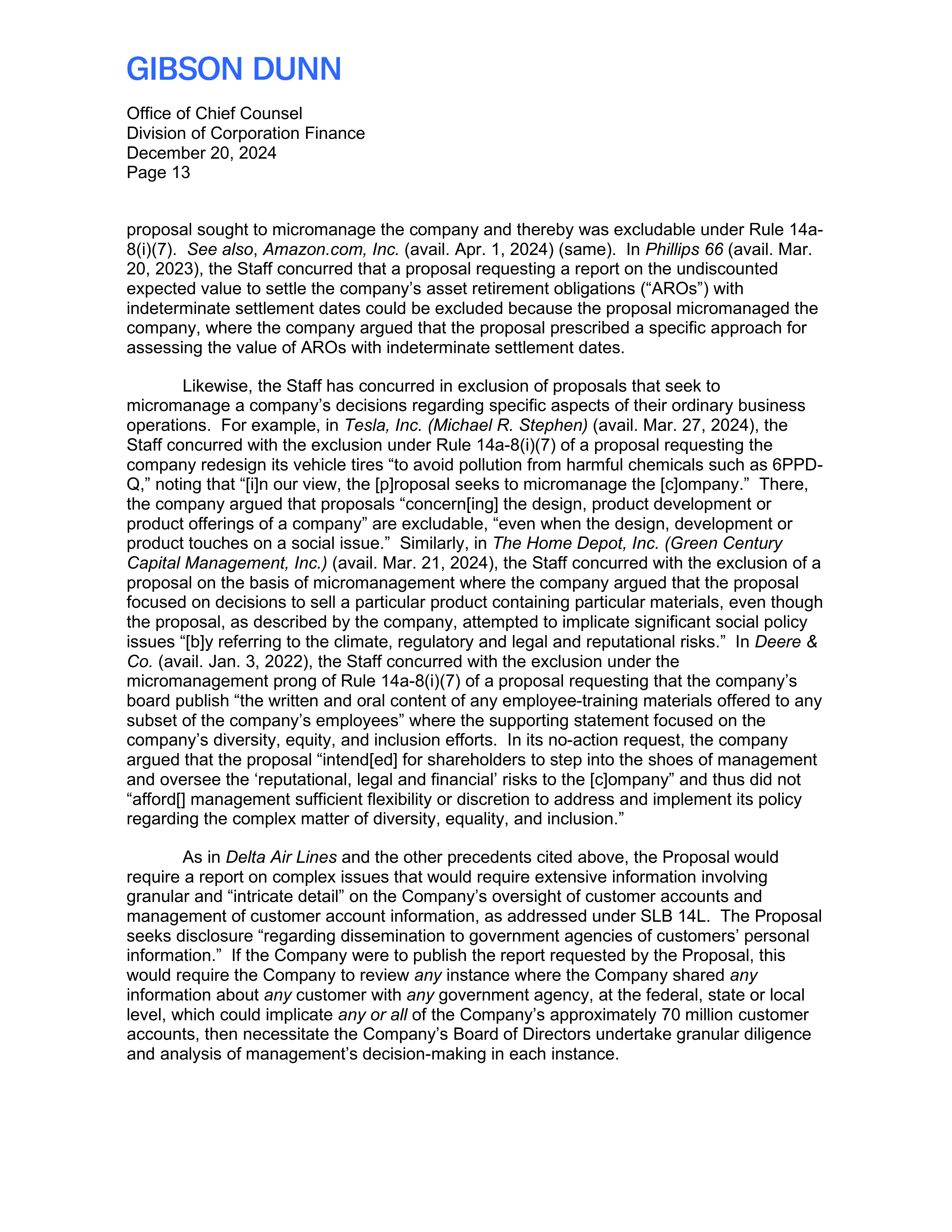
would require the Company to review
any
instance where the Company shared
any
information about
any
customer with
any
government agency, at the federal, state or local
level, which could implicate
any or all
of the Company’s approximately 70 million customer
accounts, then necessitate the Company’s Board of Directors undertake granular diligence
and analysis of management’s decision-making in each instance.

Office of Chief Counsel
Division of Corporation Finance
December 20, 2024
Page 14
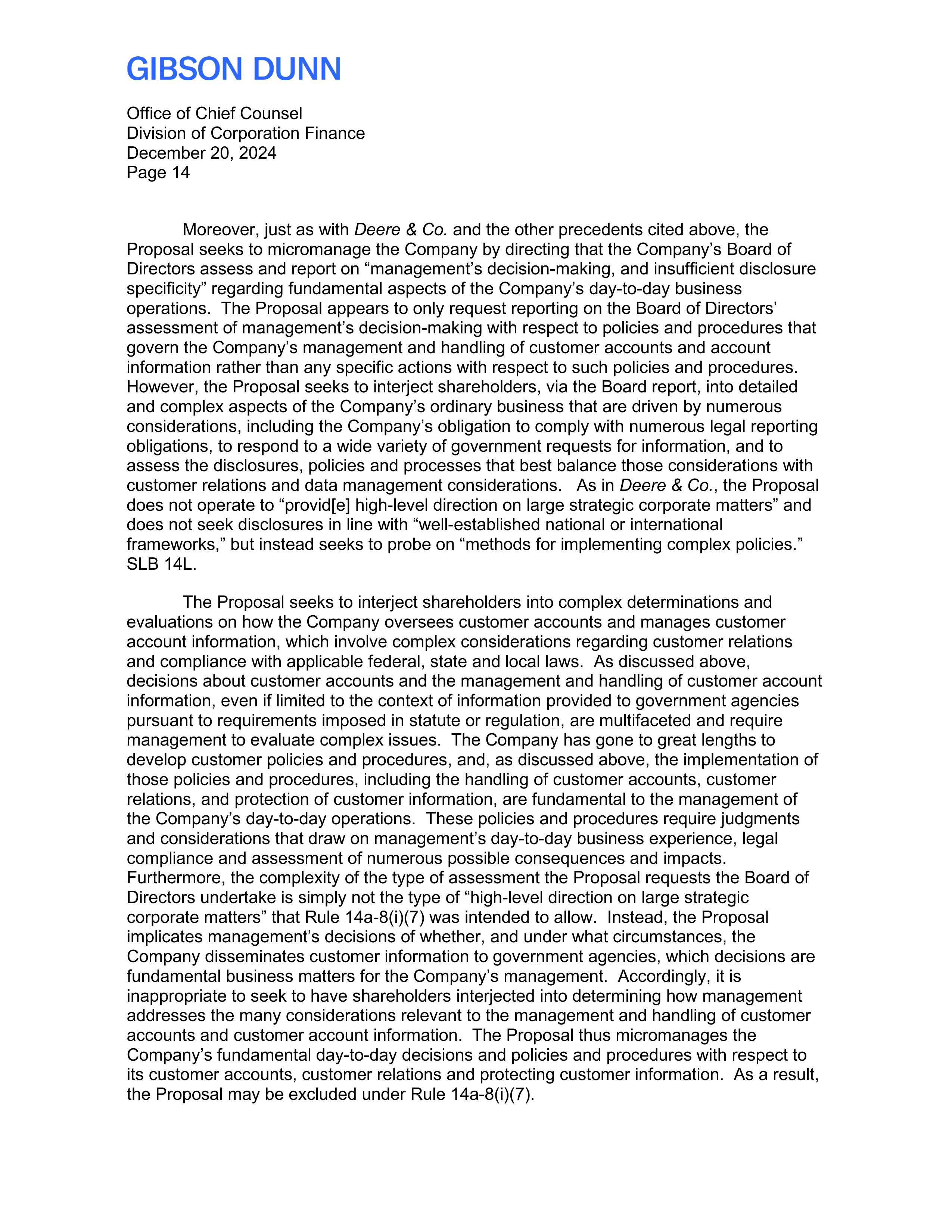
Moreover, just as with
Deere & Co.
and the other precedents cited above, the
Proposal seeks to micromanage the Company by directing that the Company’s Board of
Directors assess and report on “management’s decision-making, and insufficient disclosure
specificity” regarding fundamental aspects of the Company’s day-to-day business
operations. The Proposal appears to only request reporting on the Board of Directors’
assessment of management’s decision-making with respect to policies and procedures that
govern the Company’s management and handling of customer accounts and account
information rather than any specific actions with respect to such policies and procedures.
However, the Proposal seeks to interject shareholders, via the Board report, into detailed
and complex aspects of the Company’s ordinary business that are driven by numerous
considerations, including the Company’s obligation to comply with numerous legal reporting
obligations, to respond to a wide variety of government requests for information, and to
assess the disclosures, policies and processes that best balance those considerations with
customer relations and data management considerations. As in
Deere & Co.
, the Proposal
does not operate to “provid[e] high-level direction on large strategic corporate matters” and
does not seek disclosures in line with “well-established national or international
frameworks,” but instead seeks to probe on “methods for implementing complex policies.”
SLB 14L.
The Proposal seeks to interject shareholders into complex determinations and
evaluations on how the Company oversees customer accounts and manages customer
account information, which involve complex considerations regarding customer relations
and compliance with applicable federal, state and local laws. As discussed above,
decisions about customer accounts and the management and handling of customer account
information, even if limited to the context of information provided to government agencies
pursuant to requirements imposed in statute or regulation, are multifaceted and require
management to evaluate complex issues. The Company has gone to great lengths to
develop customer policies and procedures, and, as discussed above, the implementation of
those policies and procedures, including the handling of customer accounts, customer
relations, and protection of customer information, are fundamental to the management of
the Company’s day-to-day operations. These policies and procedures require judgments
and considerations that draw on management’s day-to-day business experience, legal
compliance and assessment of numerous possible consequences and impacts.
Furthermore, the complexity of the type of assessment the Proposal requests the Board of
Directors undertake is simply not the type of “high-level direction on large strategic
corporate matters” that Rule 14a-8(i)(7) was intended to allow. Instead, the Proposal
implicates management’s decisions of whether, and under what circumstances, the
Company disseminates customer information to government agencies, which decisions are
fundamental business matters for the Company’s management. Accordingly, it is
inappropriate to seek to have shareholders interjected into determining how management
addresses the many considerations relevant to the management and handling of customer
accounts and customer account information. The Proposal thus micromanages the
Company’s fundamental day-to-day decisions and policies and procedures with respect to
its customer accounts, customer relations and protecting customer information. As a result,
the Proposal may be excluded under Rule 14a-8(i)(7).


Office of Chief Counsel
Division of Corporation Finance
December 20, 2024
Page 15
CONCLUSION
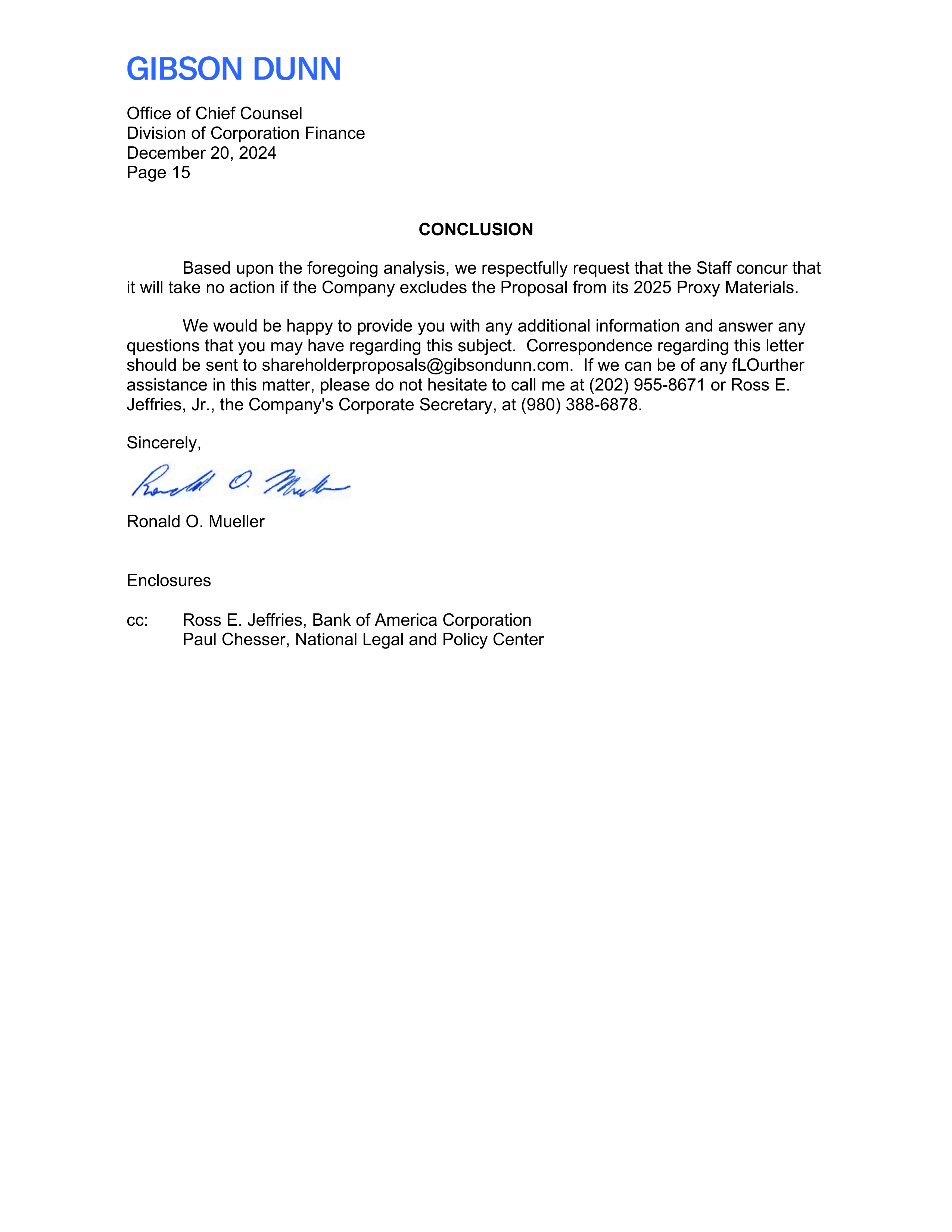
Based upon the foregoing analysis, we respectfully request that the Staff concur that
it will take no action if the Company excludes the Proposal from its 2025 Proxy Materials.
We would be happy to provide you with any additional information and answer any
questions that you may have regarding this subject. Correspondence regarding this letter
should be sent to shareholderproposals@gibsondunn.com. If we can be of any fLOurther
assistance in this matter, please do not hesitate to call me at (202) 955-8671 or Ross E.
Jeffries, Jr., the Company's Corporate Secretary, at (980) 388-6878.
Sincerely,
Ronald O. Mueller
Enclosures
cc:
Ross E. Jeffries, Bank of America Corporation
Paul Chesser, National Legal and Policy Center

EXHIBIT A