
April 16, 2024
Julia Lapitskaya
Gibson, Dunn & Crutcher LLP
Re:
Comcast Corporation (the “Company”)
Incoming letter dated January 31, 2024
Dear Julia Lapitskaya:
This letter is in response to your correspondence concerning the shareholder
proposal (the “Proposal”) submitted to the Company by John Chevedden for inclusion in
the Company’s proxy materials for its upcoming annual meeting of security holders.
The Proposal requests that the Company’s board of directors take the necessary
steps in the direction of transitioning so that all of the Company’s outstanding stock has
an equal one vote per share in each voting situation.
There appears to be some basis for your view that the Company may exclude the
Proposal under Rule 14a-8(i)(6). Based on the information you have provided, it appears
that the Company would lack the power or authority to implement the Proposal.
Accordingly, we will not recommend enforcement action to the Commission if the
Company omits the Proposal from its proxy materials in reliance on Rule 14a-8(i)(6).
Copies of all of the correspondence on which this response is based will be made
available on our website at
https://www.sec.gov/corpfin/2023-2024-shareholder-
proposals-no-action
.
Sincerely,
Rule 14a-8 Review Team
cc:
John Chevedden

Julia Lapitskaya
Direct: +1 212.351.2354
Fax: +1 212.351.5253
JLapitskaya@gibsondunn.com
Gibson, Dunn & Crutcher LLP
200 Park Avenue
New York, NY 10166-0193
Tel 212.351.4000
gibsondunn.com
Abu Dhabi
Beijing
Brussels
Century City
Dallas
Denver
Dubai
Frankfurt
Hong Kong
Houston
London
Los Angeles
Munich
New York
Orange County
Palo Alto
Paris
Riyadh
San Francisco
Singapore
Washington, D.C.
January 31, 2024
VIA ONLINE SUBMISSION
Office of Chief Counsel
Division of Corporation Finance
Securities and Exchange Commission
100 F Street, NE
Washington, DC 20549
Re:
Comcast Corporation
Shareholder Proposal of John Chevedden
Securities Exchange Act of 1934—Rule 14a-8
Ladies and Gentlemen:
This letter is to inform you that our client, Comcast Corporation (the “Company”), intends to
omit from its proxy statement and form of proxy for its 2024 Annual Meeting of
Shareholders (collectively, the “2024 Proxy Materials”) a shareholder proposal titled “Equal
Voting Rights for Each Shareholder” (the “Proposal”) and statements in support thereof (the
“Supporting Statement”) received from John Chevedden (the “Proponent”).
Pursuant to Rule 14a-8(j), we have:
•
filed this letter with the Securities and Exchange Commission (the
“Commission”) no later than eighty (80) calendar days before the Company
intends to file its definitive 2024 Proxy Materials with the Commission; and
•
concurrently sent copies of this correspondence to the Proponent.
Rule 14a-8(k) and Staff Legal Bulletin No. 14D (Nov. 7, 2008) (“SLB 14D”) provide that
shareholder proponents are required to send companies a copy of any correspondence that
the proponents elect to submit to the Commission or the staff of the Division of Corporation
Finance (the “Staff”). Accordingly, we are taking this opportunity to inform the Proponent
that if the Proponent elects to submit additional correspondence to the Commission or the
Staff with respect to the Proposal, a copy of that correspondence should be furnished
concurrently to the undersigned on behalf of the Company pursuant to Rule 14a-8(k) and
SLB 14D.

Office of Chief Counsel
Division of Corporation Finance
January 31, 2024
Page 2
THE
PROPOSAL
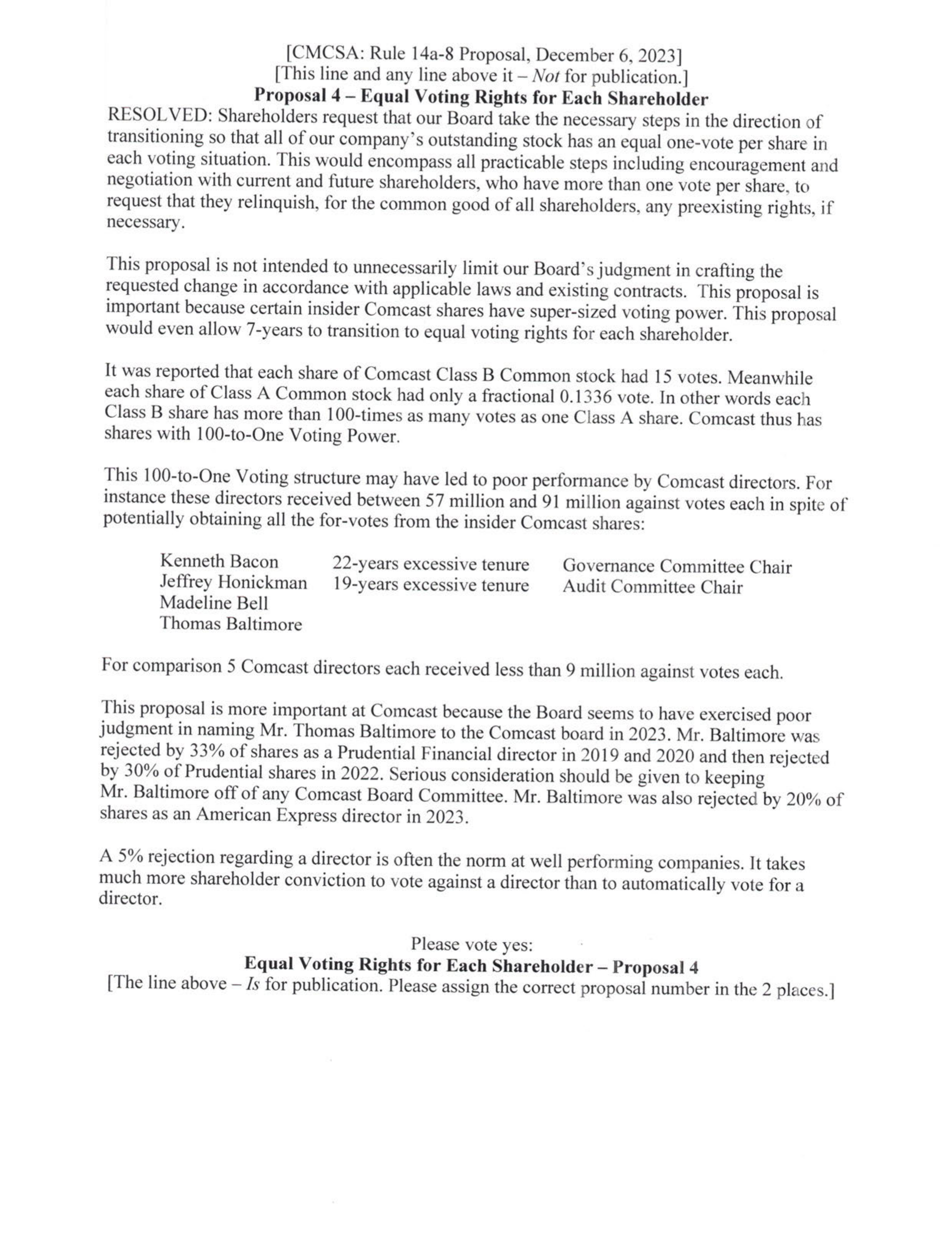
The Proposal states in relevant part:
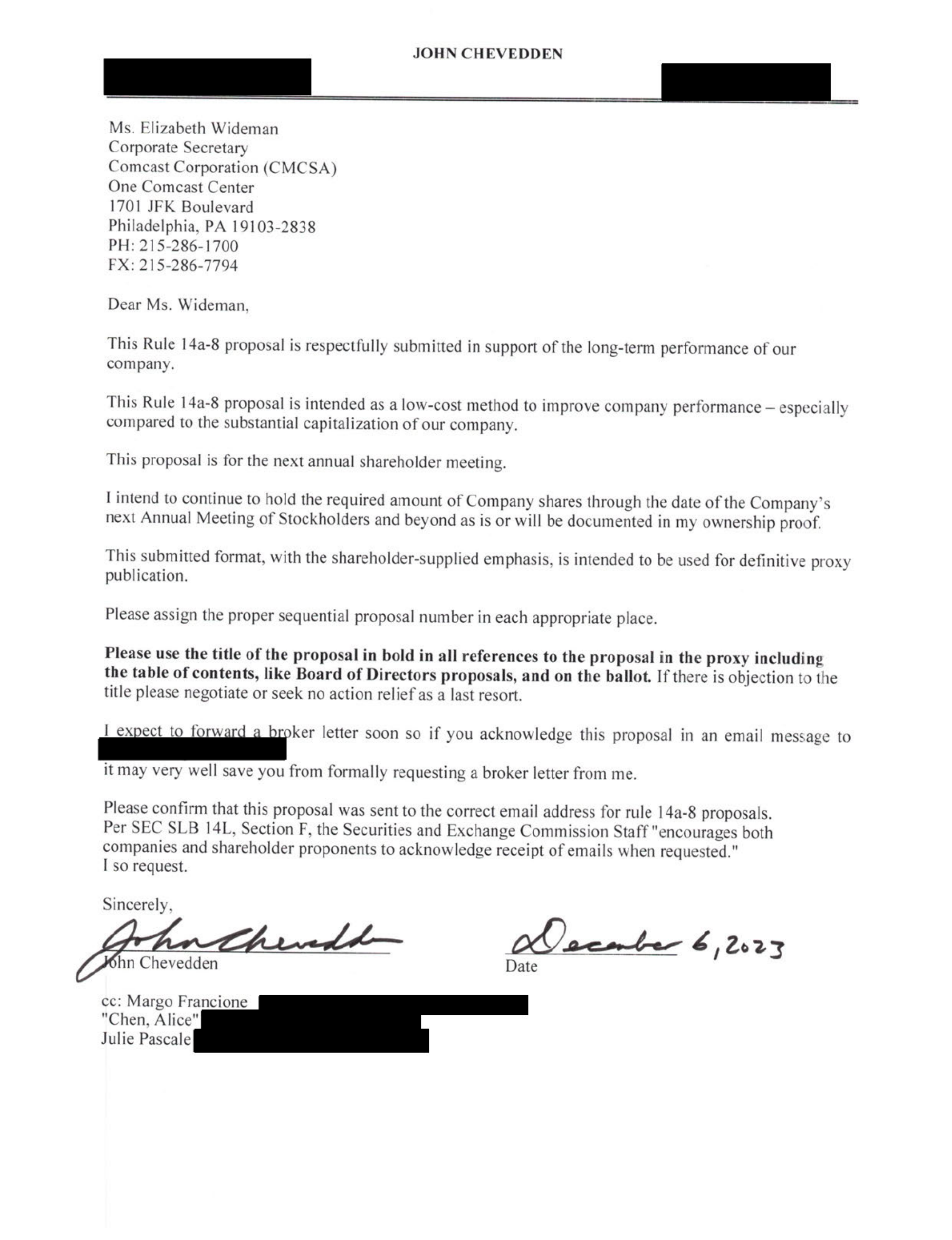
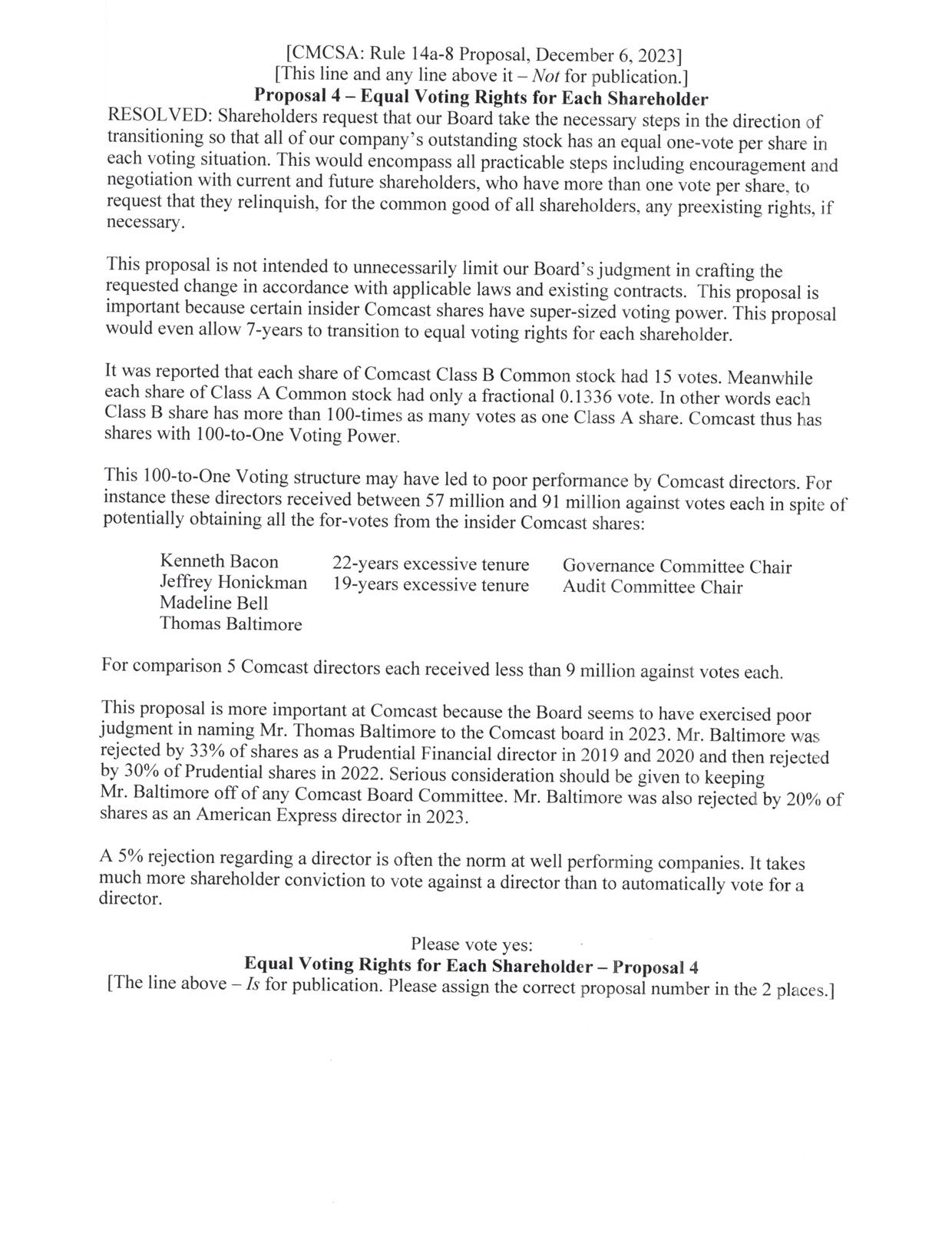
RESOLVED: Shareholders request that our Board take the necessary steps in the
direction of transitioning so that all of our company’s outstanding stock has an equal
one-vote per share in each voting situation. This would encompass all practicable
steps including encouragement and negotiation with current and future shareholders,
who have more than one vote per share, to request that they relinquish, for the
common good of all shareholders, any preexisting rights, if necessary.
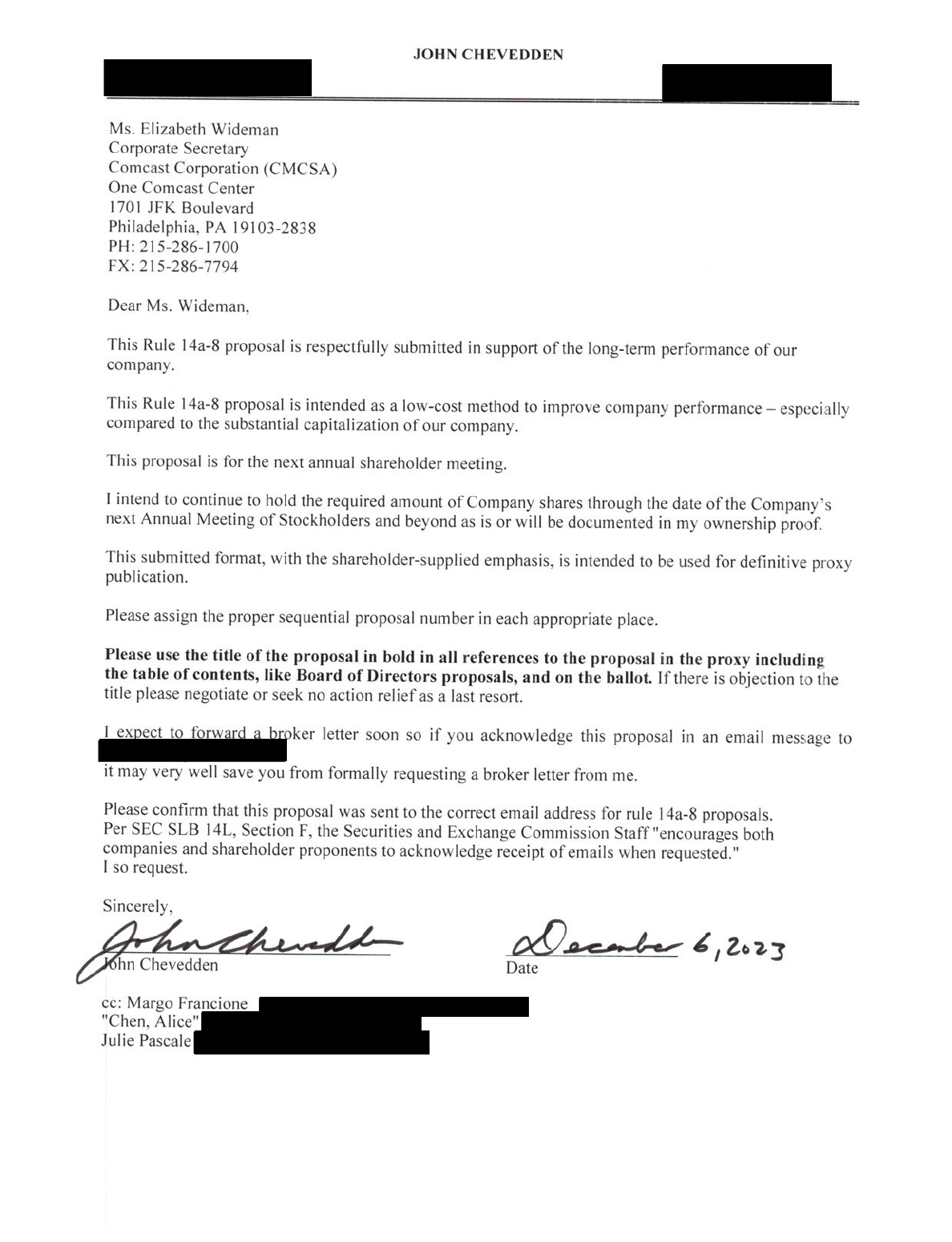
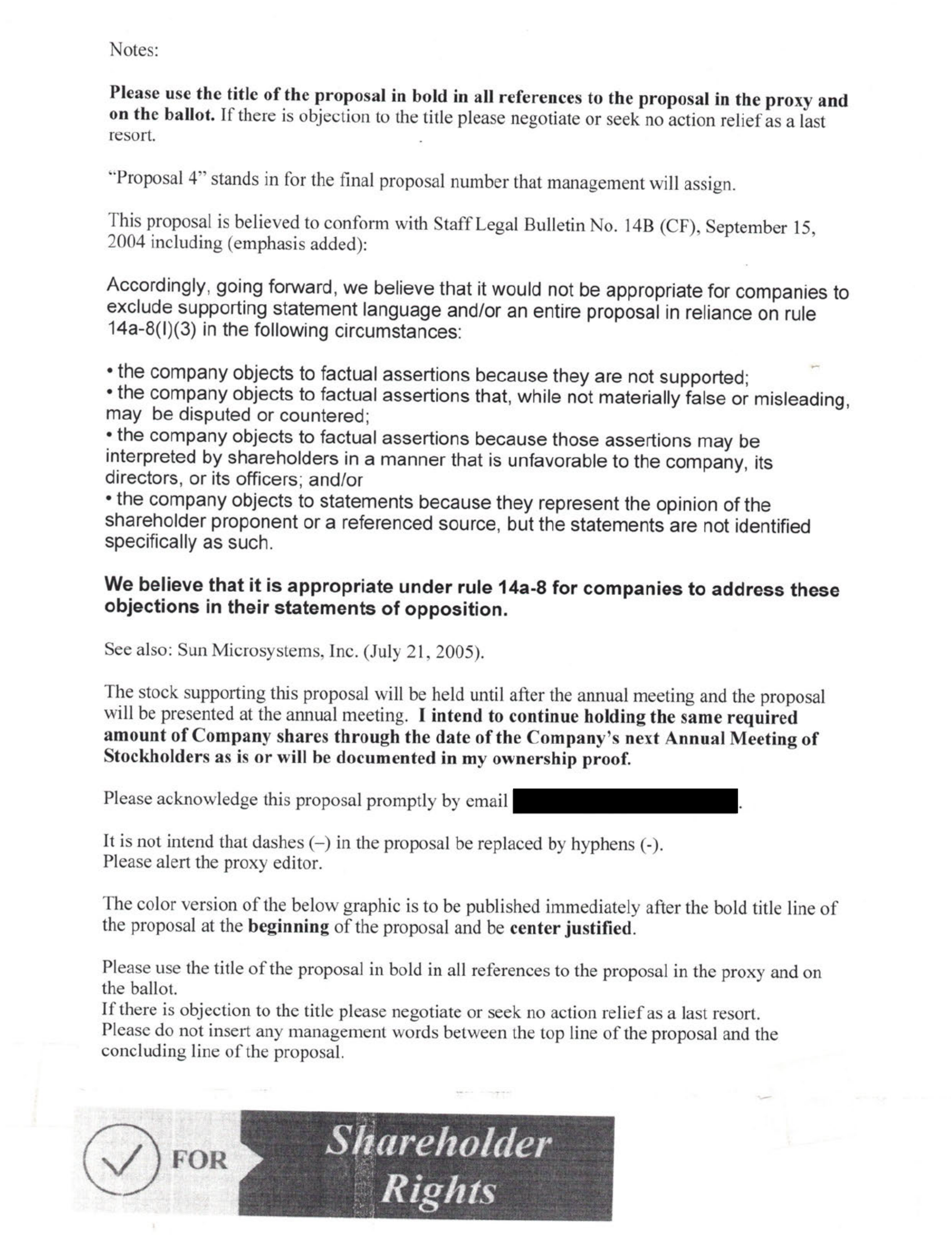
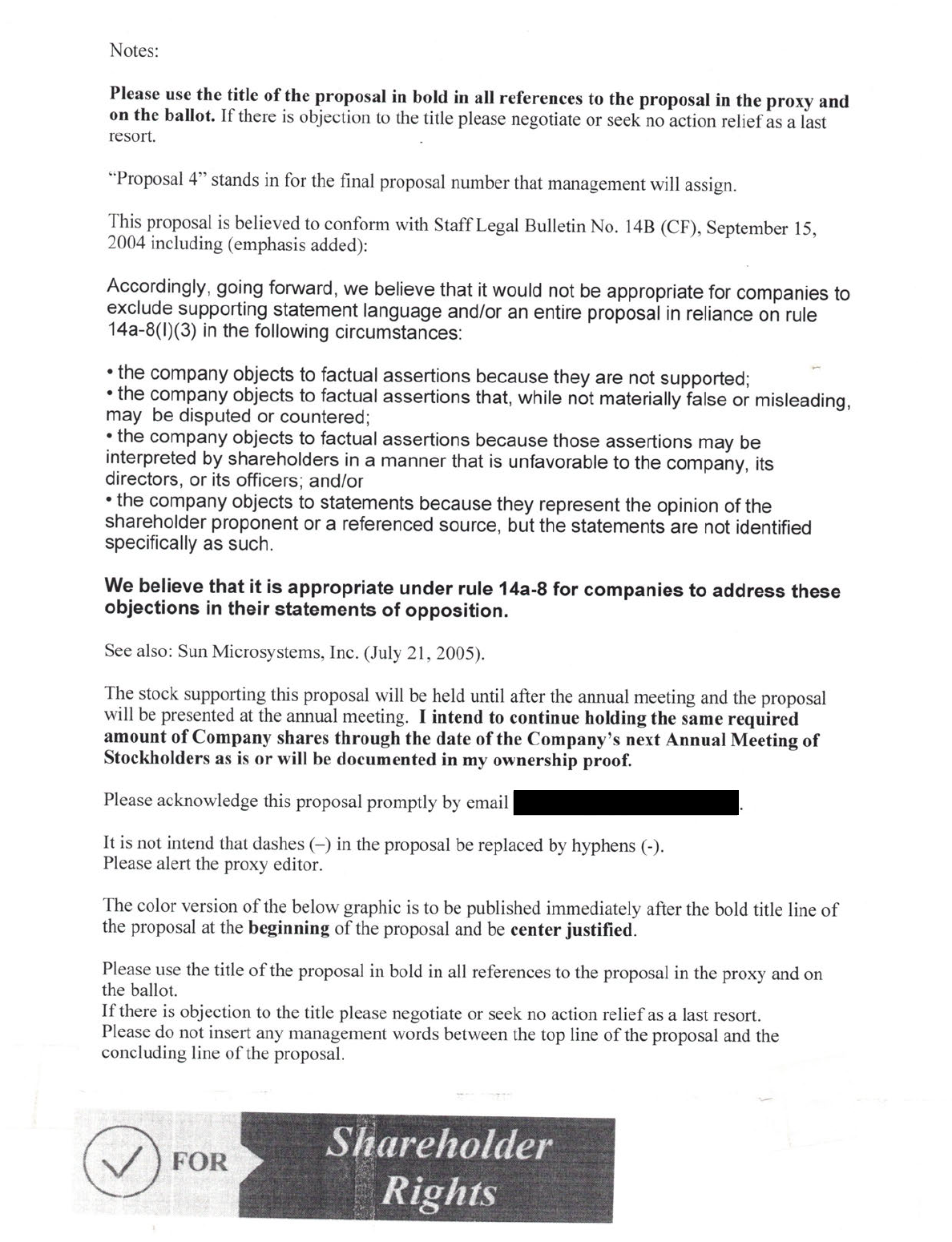
A copy of the Proposal, the Supporting Statement, and relevant correspondence with the
Proponent is attached to this letter as Exhibit A.
BASIS
FOR
EXCLUSION
We hereby respectfully request that the Staff concur in our view that the Proposal, together
with the Supporting Statement, may be excluded from the 2024 Proxy Materials pursuant to
Rule 14a-8(i)(6) because the Company lacks the power or authority to implement the
Proposal. In 2018, the Staff in
Comcast Corp.
(avail. Mar. 13, 2018) (“
Comcast 2018
”)
concurred with the Company’s view that the Company lacked the power or authority to
implement a nearly identical proposal on the same basis in virtually identical circumstances
(and nothing in applicable law, rules or facts has changed since then to impact the
precedential value of the
Comcast 2018
precedent).
ANALYSIS
The Proposal May Be Omitted From The 2024 Proxy Materials Under Rule 14a-8(i)(6)
Because The Company Lacks The Power Or Authority To Implement The Proposal.
Rule 14a-8(i)(6) permits a company to exclude a shareholder proposal “if the company
would lack the power or authority to implement the proposal.” As further detailed below, the
Proposal is—and the relevant circumstances are—indistinguishable from the proposal and
the circumstances considered by the Staff in
Comcast 2018
, where the Staff concurred with
the Company’s view that a virtually identical proposal could be excluded under Rule 14a-
8(i)(6) because the Company lacked the power and authority to implement the proposal.
The Proposal requests that the “Board take the necessary steps in the direction of
transitioning so that all of [the] [C]ompany’s outstanding stock has an equal one-vote per
share in each voting situation.” Therefore, the Proposal, despite minor wording differences

Office of Chief Counsel
Division of Corporation Finance
January 31, 2024
Page 3
as further explained below, seeks to achieve the same result as in
Comcast 2018
—i.e., “equal
one-vote per share.” Specifically, like in
Comcast 2018
, neither the Company’s Board of
Directors (the “Board”) nor the Company has the power or authority to implement the
Proposal without, as explained below, the consent of the beneficial owner of the Company’s
Class B Common Stock who has the sole power to control the vote of such stock. The Board
and the Company would have to require the beneficial owner of the Company Class B
Common Stock to both engage regarding the substance of the Proposal and vote in favor of
an amendment to the Company’s Articles of Incorporation (the “Articles”)—actions that
such beneficial owner has expressly stated it will not take (as further described below).
By way of background, the Company has two classes of stock: Class A Common Stock and
Class B Common Stock. Shares of Class A Common Stock are publicly traded, while all of
the outstanding shares of Class B Common Stock are beneficially owned by Mr. Brian L.
Roberts, the Company’s Chairman and Chief Executive Officer, through a limited liability
company of which Mr. Roberts is the managing member. Accordingly, the Class B Common
Stock is Mr. Roberts’s private property, and he alone controls the vote of the shares of Class
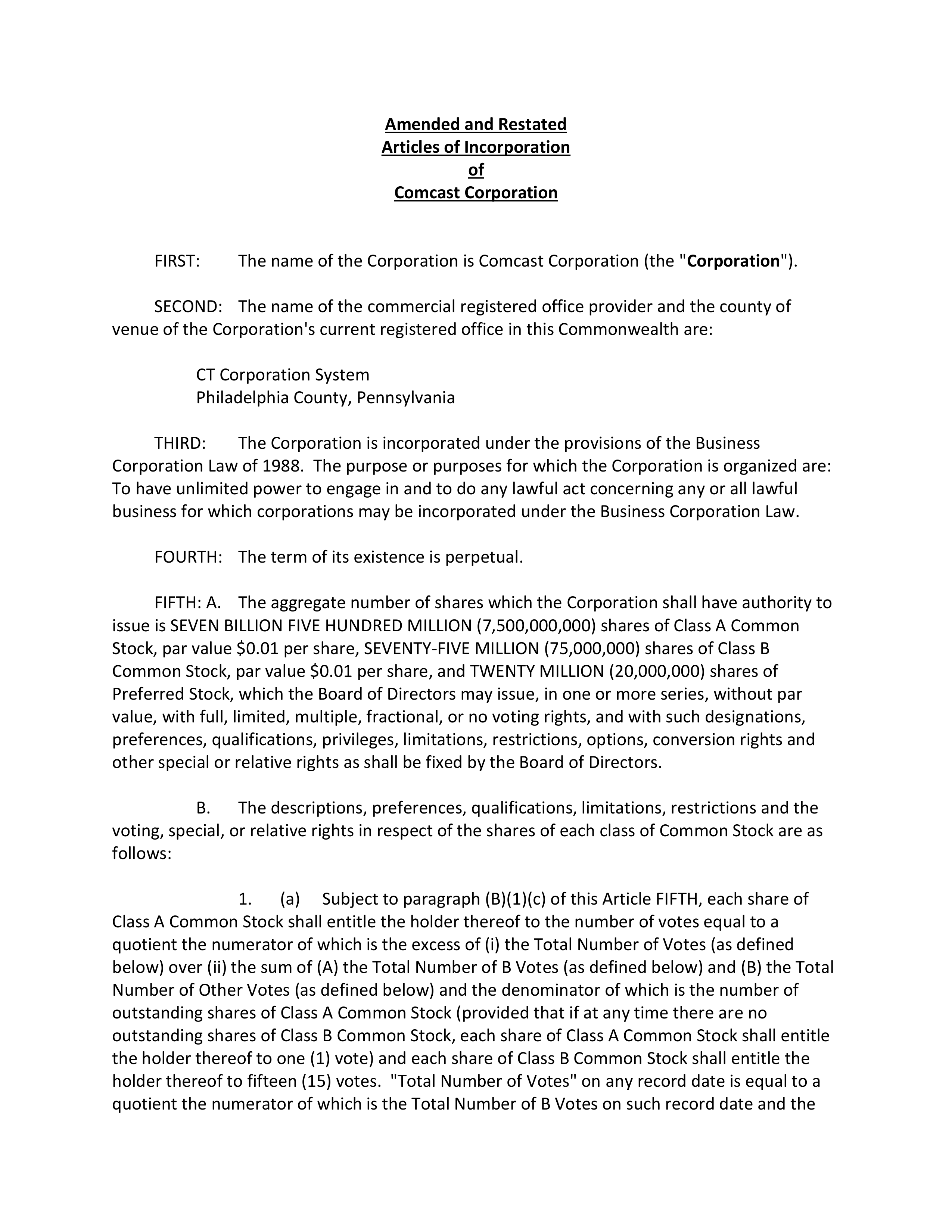
B Common Stock. The voting rights of the Company’s stock are set forth in Article V of the
Articles, a copy of which is attached hereto as Exhibit B.
Pursuant to the Articles, the voting rights of the different classes of stock are generally as
follows: Class A Common Stock entitles the holder to a number of votes per share based on a
formula, and Class B Common Stock entitles the holder to 15 votes per share or, with respect
to any matter on which all holders of the Company’s stock vote as a single class, the number
of votes necessary to give the holders of the Class B Common Stock in the aggregate 33.33%
of the total number of votes that could be cast by all holders of the Company’s stock. Under
Article VII of the Articles, the approval of the holders of Class B Common Stock, voting
separately as a class, is necessary to approve any amendment of the Articles that would
“limit the rights of the holders of Class B Common Stock” or that would “make any change
in the . . . rights of the shares of [Class B Common Stock] adverse to such class.” The
holders of Class A Common Stock therefore have contractually agreed with the holders of
Class B Common Stock pursuant to the Articles that, as a condition to their ownership of
Class A Common Stock, the rights of the holders of Class B Common Stock may not be
adversely altered or removed without the separate agreement of such Class B shareholders,
and altering the voting power of Class B Common Stock as detailed in the Proposal would,
in fact, adversely alter the rights of Class B Common Stock.
Based on the plain reading of the Proposal, it is clear that the Proposal’s ultimate goal
remains unchanged from the proposal the Staff considered in
Comcast 2018
—namely, “that
all of [the] [C]ompany’s outstanding stock has an equal one-vote per share.” For the

Office of Chief Counsel
Division of Corporation Finance
January 31, 2024
Page 4
Company to implement the Proposal and the Board to take the necessary steps towards the
Company’s outstanding voting stock having one vote per share in each voting situation, as
the Proposal requests, the Company would need Mr. Roberts, as the beneficial owner of the
Class B Common Stock with the sole power to control the vote of such stock, to be willing to
engage and negotiate and ultimately agree to amend the Articles in order to change the
voting rights of each class of stock set forth therein. More importantly, to achieve an “equal
one-vote per share” as requested by the Proposal, the Company would have to adopt an
amendment to the Articles, which would require the affirmative vote of the Class B Common
Stock, which Mr. Roberts solely controls. However, as described below, Mr. Roberts, acting
in his capacity as the beneficial owner of the Class B Common Stock with the sole power to
control the vote of such stock, has stated in writing, most recently on January 29, 2024, that
he will respond in the negative to any encouragement by the Board, or any attempt at
discussion or negotiation by the Board, to relinquish any of his preexisting rights in the Class
B Common Stock and will not engage in any discussions or negotiations regarding any
proposed amendment to the Articles that is responsive to the Proposal or any similar
proposal.
See
Exhibit C. Moreover, as discussed below, Mr. Roberts has affirmatively
stated in writing that he will vote against any amendment to the Articles that is submitted in
response to the Proposal to change or otherwise limit the voting rights of the Class B
Common Stock.
As such, the Proposal and all relevant circumstances are nearly identical to the proposal and
the circumstances considered by the Staff in
Comcast 2018
, where the Staff concurred with
the exclusion of a nearly identical proposal under Rule 14a-8(i)(6), because the Company
lacked the power and authority to implement the proposal. The only minor differences here
are that, as compared to the proposal at issue in
Comcast 2018
, the Proponent substituted the
reference to “take steps to ensure” in the “resolved” clause of the Proposal with the phrase
“take the necessary steps in the direction of transitioning” and provided for a possibility of a
longer transition period to an “equal one-vote per share” structure by replacing the reference
to a “2-year[]” transition period in the “resolved” clause of the Proposal with an allowance
for a “7-year[] transition” in the Supporting Statement instead. However, in the context of
the Proposal, these minor differences make absolutely no practical difference as to what the
Proposal is ultimately looking to achieve—i.e., “equal one-vote per share.” The key point, as
detailed in
Comcast 2018
, is that when a company is seeking exclusion on the basis of Rule
14a-8(i)(6) of a proposal requesting the company or the company’s board of directors “take
steps” to achieve a certain result, the relevant inquiry should be whether the ultimate goal
that the proposal is seeking to accomplish is within the power of the company or the
company’s board of directors. Therefore, as was the case in
Comcast 2018
, the relevant
analysis of the Proposal under Rule 14a-8(i)(6) should be whether the Company (including
via the Board) has the power to take steps that could potentially lead to amending the

Office of Chief Counsel
Division of Corporation Finance
January 31, 2024
Page 5
Articles to effect the change requested by the Proposal. The answer is a resounding no. In
Comcast 2018
, like here, the amendment contemplated by the proposal could not have been
effected without the support of Mr. Roberts, the beneficial owner of the Company’s Class B
Common Stock with sole power to control the vote of such stock, and, therefore, the Staff
agreed that the Company lacked the power or authority to implement the Proposal.
Similarly, here, Mr. Roberts, acting solely in his capacity as the beneficial owner of the Class
B Common Stock with the sole power to control the vote of such stock, has reconfirmed his
prior position and provided the Board with an updated written statement dated January 29,
2024 (the “2024 Statement”), which is identical in substance and scope to the statement
provided by Mr. Roberts in
Comcast
2018
, reaffirming that the Proposal, if implemented,
would adversely and materially impact his property and shareholder rights, and that he (i) has
responded and will respond in the negative to any encouragement by the Board, or any
attempt at discussion or negotiation by the Board, to relinquish any of his preexisting rights
in the Class B Common Stock, as contemplated by the Proposal, (ii) will not engage in any
discussions or negotiations regarding any proposed amendment to the Articles that is
responsive to the Proposal or any similar proposal, and (iii) will vote against any proposed
amendment to the Articles to change or otherwise limit the voting rights of the Class B
Common Stock that is put to a vote of the Company shareholders in response to the Proposal.
Mr. Roberts also confirmed that, as the beneficial owner with the sole power to control the
vote of the Class B Common Stock, he does not intend to relinquish such power in the
foreseeable future in response to the Proposal. The 2024 Statement provides that the
foregoing affirmation and confirmation also apply to any shareholder proposal submitted by
a shareholder proponent in the future that concerns a similar subject matter and objective,
such as those contained in the Proposal. Mr. Roberts has further agreed to inform the Board
should he ever determine to change his position on these issues.
See
Exhibit C. And while
the Company recognizes that the Proposal contemplates “all practicable steps . . . with
current
and future
shareholders, who have more than one vote per share,” whereas the
proposal in
Comcast 2018
simply referred to “shareholders,” because the 2024 Statement
indicates that Mr. Roberts, as the beneficial owner of Class B Common Stock with the sole
power to control the vote, does not intend to relinquish his rights, there are currently no
future shareholders to address (emphasis added). As such, the 2024 Statement, like in
Comcast 2018
, has foreclosed the Company’s ability to implement the Proposal.
The Staff has concurred with the exclusion of another proposal substantially similar to the
Proposal under Rule 14a-8(i)(6) based on the board’s lack of power or authority to effectuate
the ultimate goal of the proposal without the cooperation of Class B shareholders.
See AMC
Networks Inc.
(avail. Apr. 23, 2019) (“
AMC
”). In
AMC
, like in
Comcast 2018
, the proposal
requested that the board of directors “take steps to ensure that all of [the] company’s

Office of Chief Counsel
Division of Corporation Finance
January 31, 2024
Page 6
outstanding stock” has “one-vote per share in each voting situation” including by
“encouragement and negotiation” with “shareholders, who have more than one vote per
share, to request that they relinquish, for the common good of all shareholders, any
preexisting rights, if necessary.” As was the case in
Comcast 2018
and is the case here, the
company had multiple classes of common stock with unequal voting rights, and amendment
to the company’s governing documents to effectuate the purpose of the proposal (i.e., to
reduce the Class B common stock’s voting power from 10 votes to one vote per share)
required a separate class vote of Class B common shareholders. In
AMC
, like in
Comcast
2018
and here, the holders of the voting power of 100% of the AMC’s Class B common
stock stated in writing that they would (i) respond in the negative to any encouragement by
AMC’s board, or any attempt by the board to engage in any discussion or negotiation with
them, to relinquish any of the preexisting rights of the Class B common stock, (ii) not engage
in any discussions or negotiations regarding any proposed amendment to AMC’s certificate
of incorporation that gives effect to the proposal or any similar proposal and (iii) vote against
any such proposed amendment to AMC’s certificate of incorporation to limit the voting
rights of the Class B common stock that is put to a vote of AMC’s shareholders or the
holders of Class B common stock. Consistent with
Comcast 2018
, in
AMC
, the Staff
concluded that the company lacked the power or authority to implement the proposal.
As described above, the slight differences in wording between the Proposal and the proposal
at issue in
Comcast 2018
does not change the underlying request or analysis. As was the
case with the proposals at issue in
AMC
and
Comcast 2018
, the Proposal is directed at
replacing the Company’s current dual class stock with unequal voting rights with
“outstanding stock [that] has an equal one-vote per share in each voting situation,” as
evidenced further by the Proposal’s assertion that “[t]his proposal would even allow 7-years
to transition to equal voting rights for each shareholder.” Therefore, as was the case in
Comcast 2018
and
AMC
, the Proposal is similarly excludable under Rule 14a-8(i)(6) because
it would require Mr. Roberts, as the beneficial owner of the Class B Common Stock with the
sole power to control the vote of such stock, to be willing to engage with the Board and the
Company regarding the subject matter of the Proposal and ultimately to vote in favor of an
amendment to the Company’s Articles, and the 2024 Statement evidences Mr. Roberts’s
explicit refusal to do so. Therefore, because amending the Articles in the manner requested
by the Proposal requires a separate vote of the beneficial owner of Class B Common Stock
(here, Mr. Roberts), the Board does not have the power to amend the Articles by itself, even
if any proposed amendment were to receive the requisite number of Class A Common Stock
votes in favor of such amendment, and, as such, the Company and the Board have no power
to implement the Proposal.

Office of Chief Counsel
Division of Corporation Finance
January 31, 2024
Page 7
Importantly (and, while the Company does not believe this to be the case, in the interest of
completeness), even if one were to assume that the Proponent had intended to somehow
change the ultimate goal of the Proposal, as compared to the proposal considered in
Comcast
2018
, through the slight wording changes in the “resolved” clause (as mentioned above, the
Proponent substituted the reference to “take steps to ensure” with the phrase “take the
necessary steps in the direction of transitioning”), the Company and the Board still lack the
power and authority to implement the Proposal. Because Mr. Roberts has stated he will not
engage and negotiate with the Board regarding relinquishment of his preexisting rights in the
Class B Common Stock, as contemplated by the Proposal, he has effectively rendered moot
any “necessary” and “practicable” steps that the Board might have otherwise been able to
take in connection with the Proposal if he was willing to negotiate. In other words, even if
one were to read the Proposal as simply requiring that the Board “encourage[] and
negotiat[e] with current and future shareholders, who have more than one vote per share, to
request that they relinquish, for the common good of all shareholders, any preexisting
rights,” the 2024 Statement effectively precludes the Board from having any ability to take
these steps. In all respects, the Board lacks any power or authority to unilaterally compel
Mr. Roberts to take any of the actions contemplated by the Proposal, and the Board and the
Company simply have no “practicable steps”—to quote the Proponent—that they can take to
effectuate the Proposal.
For the avoidance of doubt, SLB 14D is not to the contrary. In SLB 14D, the Staff noted
that, where a shareholder proposal “recommends, requests, or requires that the board of
directors amend the company’s charter” and, under state law, such charter amendment would
require shareholder approval to implement, there may be “some basis for the company to
omit the proposal in reliance on rule 14a-8(i)(1), rule 14a-8(i)(2), or rule 14a-8(i)(6),” but a
proposal that the board “take the steps necessary” to effect such an amendment would not be
excludable under such provisions. However, the Proposal is completely different from the
examples given in SLB 14D, because shareholder approval under applicable state law is not
the only prerequisite to effecting the amendment sought by the Proposal. Rather, as noted
above, transitioning to equal per-share voting as requested by the Proposal requires as an
initial matter the engagement in a negotiation with the beneficial owner of Class B Common
Stock who has the sole power to vote such shares (i.e., Mr. Roberts), and Mr. Roberts has
proactively issued a statement to the Board expressly declining to do so, consistent with his
clear contractual and property rights. What is more, under the Articles, Mr. Roberts, as
beneficial owner of Class B Common Stock with sole power to control the vote of such
stock, is entitled to a separate class vote on any such amendment, and he explicitly advised
the Board that he will vote against any such amendment.
See
Exhibit C.

Office of Chief Counsel
Division of Corporation Finance
January 31, 2024
Page 8
Finally, the Staff has consistently concurred with the exclusion of proposals under Rule 14a-
8(i)(6) that required action by a third party over which—like here—the company to whom
the proposal was submitted has no control. For example, in
eBay Inc.
(avail. Mar. 26, 2008),
the Staff concurred that a proposal requesting that the company enact a policy prohibiting the
sale of dogs and cats on the website of a joint venture owned by a wholly owned subsidiary
of the company and TOM Online Inc. (an independent online portal and wireless internet
company headquartered in China), in which the company had no role in day-to-day
operations and over which it had no operating control, was excludable pursuant to Rule 14a-
8(i)(6). The company argued that because of the nature of its joint venture relationship, it
lacked the power or authority to take the action that would be required by the proposal, and
the Staff concurred that relief was merited.
See also Beckman Coulter, Inc.
(Dec. 23, 2008)
(concurring with the exclusion of a proposal requesting that the company implement a set of
executive compensation reforms at The Bank of New York Mellon, an unaffiliated bank
which served as a trustee for the company under an indenture agreement);
Catellus
Development Corp.
(avail. Mar. 3, 2005) (concurring with the exclusion of a proposal
requesting that the company take certain actions related to property it managed but no longer
owned);
AT&T Corp.
(Mar. 10, 2002) (concurring with the exclusion of a proposal
requesting a bylaw amendment concerning independent directors that would “apply to
successor companies,” where the Staff noted that it did “not appear to be within the board’s
power to ensure that all successor companies adopt a bylaw like that requested by the
proposal”);
The Southern Co.
(Feb. 23, 1995) (concurring with the exclusion of a proposal
requesting that the company’s board of directors take steps to ensure ethical behavior by
employees serving in the public sector);
Ford Motor Co.
(avail. Mar. 9, 1990) (concurring
with the exclusion of a proposal because the proposal “relate[d] to the activities of companies
other than the [c]ompany [to whom the proposal was submitted] and over whom the
[c]ompany ha[d] no control”);
Harsco Corp.
(avail. Feb. 16, 1988) (concurring with the
exclusion of a proposal requesting that the board of directors sign and implement a statement
of principles relating to employment in South Africa where the company’s only involvement
with employees in South Africa was its ownership of 50% of the stock of a South African
entity, and the owner of the remaining 50% interest had the right to appoint the entity’s
chairman, who was empowered to cast the deciding vote in the event of a tie). Here, similar
to
eBay
and the above-cited precedent, the Board does not have the power or authority to
unilaterally compel Mr. Roberts to agree to negotiate or relinquish his rights to his own
private property, let alone to actually achieve the intended result of equal voting rights
through an amendment to the Articles that must be approved by Mr. Roberts. Thus, the
Proposal is likewise excludable.
Regardless of how one looks at the Proposal, the ultimate facts are identical to the facts the
Staff considered in
Comcast 2018
and
AMC
as well as the foregoing precedent (and, as

Office of Chief Counsel
Division of Corporation Finance
January 31, 2024
Page 9
mentioned above, nothing in law has changed since then to impact the precedential value of
these precedents). Therefore, for the reasons described above, the Company lacks the power
and authority to implement the Proposal, and the Company believes that the Proposal,
together with the Supporting Statement, is properly excludable under Rule 14a-8(i)(6).
CONCLUSION
Based upon the foregoing analysis, we respectfully request that the Staff concur that it will
take no action if the Company excludes the Proposal, together with the Supporting
Statement, from its 2024 Proxy Materials.
We would be happy to provide you with any additional information and answer any
questions that you may have regarding this subject. Correspondence regarding this letter
should be sent to shareholderproposals@gibsondunn.com. If we can be of any further
assistance in this matter, please do not hesitate to call me at 212-351-2354 or email me at
JLapitskaya@gibsondunn.com.
Sincerely,
Julia Lapitskaya
Enclosures
cc:
Elizabeth Wideman, Comcast Corporation
John Chevedden


EXHIBIT
A


EXHIBIT
B
Amended and Restated
Articles of Incorporation
of
Comcast Corporation
FIRST:
The name of the Corporation is Comcast Corporation (the "
Corporation
").
SECOND: The name of the commercial registered office provider and the county of
venue of the Corporation's current registered office in this Commonwealth are:
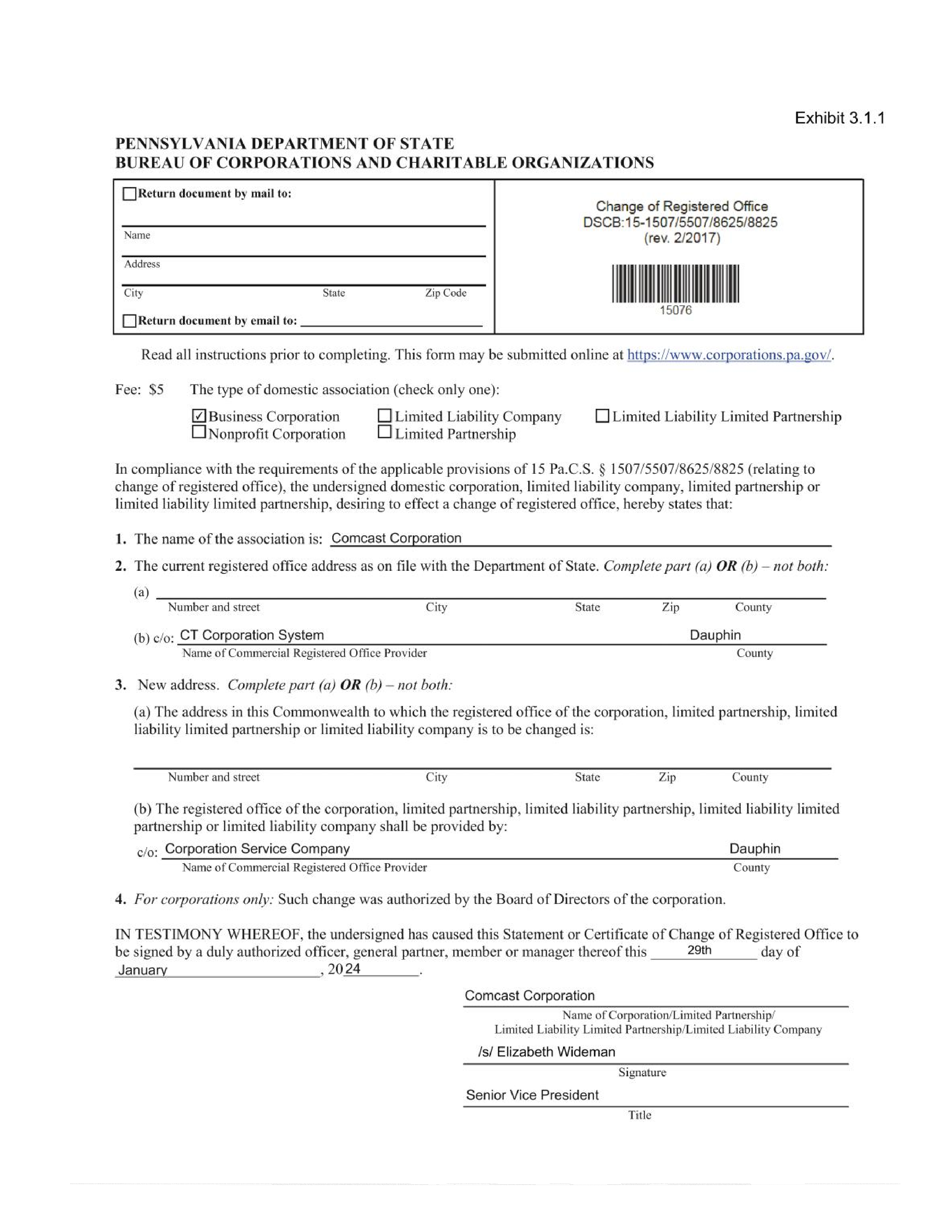
CT Corporation System
Philadelphia County, Pennsylvania
THIRD:
The Corporation is incorporated under the provisions of the Business
Corporation Law of 1988. The purpose or purposes for which the Corporation is organized are:
To have unlimited power to engage in and to do any lawful act concerning any or all lawful
business for which corporations may be incorporated under the Business Corporation Law.
FOURTH: The term of its existence is perpetual.
FIFTH: A. The aggregate number of shares which the Corporation shall have authority to
issue is SEVEN BILLION FIVE HUNDRED MILLION (7,500,000,000) shares of Class A Common
Stock, par value $0.01 per share, SEVENTY-FIVE MILLION (75,000,000) shares of Class B
Common Stock, par value $0.01 per share, and TWENTY MILLION (20,000,000) shares of
Preferred Stock, which the Board of Directors may issue, in one or more series, without par
value, with full, limited, multiple, fractional, or no voting rights, and with such designations,
preferences, qualifications, privileges, limitations, restrictions, options, conversion rights and
other special or relative rights as shall be fixed by the Board of Directors.
B.
The descriptions, preferences, qualifications, limitations, restrictions and the
voting, special, or relative rights in respect of the shares of each class of Common Stock are as
follows:
1.
(a)
Subject to paragraph (B)(1)(c) of this Article FIFTH, each share of
Class A Common Stock shall entitle the holder thereof to the number of votes equal to a
quotient the numerator of which is the excess of (i) the Total Number of Votes (as defined
below) over (ii) the sum of (A) the Total Number of B Votes (as defined below) and (B) the Total
Number of Other Votes (as defined below) and the denominator of which is the number of
outstanding shares of Class A Common Stock (provided that if at any time there are no
outstanding shares of Class B Common Stock, each share of Class A Common Stock shall entitle
the holder thereof to one (1) vote) and each share of Class B Common Stock shall entitle the
holder thereof to fifteen (15) votes. "Total Number of Votes" on any record date is equal to a
quotient the numerator of which is the Total Number of B Votes on such record date and the
denominator of which is the B Voting Percentage (as defined below) on such record date.
"Total Number of B Votes" on any record date is equal to the product of (i) 15 and (ii) the
number of outstanding shares of Class B Common Stock on such record date. "Total Number of
Other Votes" on any record date means the aggregate number of votes to which holders of all
classes of capital stock of the Corporation other than holders of Class A Common Stock and
Class B Common Stock are entitled to cast on such record date in an election of Directors. "B
Voting Percentage" on any record date means the portion (expressed as a percentage) of the
total number of votes entitled to be cast in an election of Directors by the holders of capital
stock of the Corporation to which all holders of Class B Common Stock are entitled to cast on
such record date in an election of Directors, as specified and determined pursuant to paragraph
(B)(1)(c) of this Article FIFTH.
(b)
Except as provided in Article SEVENTH or required by applicable
law, only the holders of Class A Common Stock, the holders of Class B Common Stock and the
holders of any other class or series of Common Stock, Preferred Stock or other class of capital
stock of the Corporation (if any) with voting rights shall be entitled to vote and shall vote as a
single class on all matters with respect to which a vote of the shareholders of the Corporation is
required or permitted under applicable law, these Amended and Restated Articles of
Incorporation, or the Bylaws of the Corporation. Whenever applicable law, these Amended and
Restated Articles of Incorporation or the Bylaws of the Corporation provide for a vote of the
shareholders of the Corporation on any matter, approval of such matter shall require the
affirmative vote of a majority of the votes cast by the holders entitled to vote thereon unless
otherwise expressly provided under applicable law, these Amended and Restated Articles of
Incorporation or the Bylaws of the Corporation.
(c)
Notwithstanding any other provision of these Amended and
Restated Articles of Incorporation, including paragraph (B)(1)(a) of this Article FIFTH, but
subject to Article SEVENTH, with respect to any matter on which the holders of Class B Common
Stock and the holders of one or more classes or series of Common Stock, Preferred Stock or any
other class of capital stock of the Corporation (if any) vote as a single class, each share of Class
B Common Stock shall entitle the holder thereof to the number of votes necessary so that, if all
holders of Class B Common Stock and all holders of each such other class or series of Common
Stock, Preferred Stock and other class of capital stock of the Corporation (if any) were to cast all
votes they are entitled to cast on such matter, the holders of the Class B Common Stock in the
aggregate would cast thirty-three and one-third (33 1/3) percent of the total votes cast by all
such holders, subject to reduction as set forth in the following sentence. If at any time after
November 18, 2002 for any reason whatsoever the number of shares of Class B Common Stock
outstanding at such time is reduced below the number of shares of Class B Common Stock
outstanding on November 18, 2002 (appropriately adjusted for any stock dividend paid in Class
B Common Stock, stock splits or reverse stock splits of the Class B Common Stock or
combinations, consolidations or reclassifications of the Class B Common Stock), the percentage
specified in the preceding sentence shall be reduced to a percentage equal to the product of (i)
thirty-three and one-third (33 1/3) and (ii) the fraction obtained by dividing the number of
shares of Class B Common Stock outstanding at such time by the number of shares of Class B
2
Common Stock outstanding on November 18, 2002 (appropriately adjusted for any stock
dividend paid in Class B Common Stock, stock splits or reverse stock splits of the Class B
Common Stock or combinations, consolidations or reclassifications of the Class B Common
Stock). No reduction in the percentage of the voting power of the Class B Common Stock
pursuant to the preceding sentence shall be reversed by any issuance of Class B Common Stock
that occurs after such reduction.
2.
The holders of Class A Common Stock and the holders of Class B Common
Stock shall be entitled to receive, from time to time, when and as declared, in the discretion of
the Board of Directors, such cash dividends as the Board of Directors may from time to time
determine, out of such funds as are legally available therefor, in proportion to the number of
shares held by them, respectively, without regard to class.
3.
The holders of Class A Common Stock and the holders of Class B Common
Stock shall be entitled to receive, from time to time, when and as declared by the Board of
Directors, such dividends of stock of the Corporation or other property as the Board of
Directors may determine, out of such funds as are legally available therefor. Stock dividends
on, or stock splits of, any class of Common Stock shall not be paid or issued unless paid or
issued on all classes of Common Stock, in which case they shall be paid or issued only in shares
of that class; provided, however, that stock dividends on, or stock splits of, Class B Common
Stock may be paid or issued in shares of Class A Common Stock. Any decrease in the number of
shares of Class A Common Stock or Class B Common Stock resulting from a combination or
consolidation of shares or other capital reclassification shall not be permitted unless parallel
action is taken with respect to the other class of Common Stock, so that the number of shares
of each class of Common Stock outstanding shall be decreased proportionately.
Notwithstanding anything to the contrary contained herein, in the event of a distribution of
property, plan of merger or consolidation, plan of asset transfer, plan of division, plan of
exchange, or recapitalization pursuant to which the holders of Class A Common Stock and the
holders of Class B Common Stock would be entitled to receive equity interests of one or more
corporations (including, without limitation, the Corporation) or other entities, or rights to
acquire such equity interests, then the Board of Directors may, by resolution duly adopted,
provide that the holders of Class A Common Stock and the holders of Class B Common Stock,
respectively and as separate classes, shall receive with respect to their Class A Common Stock
or Class B Common Stock (whether by distribution, exchange, redemption or otherwise), in
proportion to the number of shares held by them, equity interests (or rights to acquire such
equity interests) of separate classes or series having substantially equivalent relative
designations, preferences, qualifications, privileges, limitations, restrictions and rights as the
relative designations, preferences, qualifications, privileges, limitations, restrictions and rights
of the Class A Common Stock and Class B Common Stock. Except as provided above, if there
should be any distribution of property, merger, consolidation, purchase or acquisition of
property or stock, asset transfer, division, interest exchange under 15 Pa.C.S. Subch. 3D,
recapitalization or reorganization of the Corporation, the holders of Class A Common Stock and
the holders of Class B Common Stock shall receive the shares of stock, other securities or rights
or other assets as would be issuable or payable upon such distribution, merger, consolidation,
3
purchase or acquisition of such property or stock, asset transfer, division, interest exchange,
recapitalization or reorganization in proportion to the number of shares held by them,
respectively, without regard to class.
4.
Each share of Class B Common Stock shall be convertible at the option of
the holder thereof into one share of Class A Common Stock. Each share of Class B Common
Stock shall be cancelled after it has been converted as provided herein.
5.
Subject to Article SEVENTH and except as otherwise permitted by
applicable law, each and any provision of these Amended and Restated Articles of
Incorporation may from time to time, when and as desired, be amended by a resolution of the
Board of Directors and the affirmative vote of a majority of the votes cast by all shareholders
entitled to vote thereon, as determined in accordance with the provisions of this Article FIFTH.
There shall be no class voting on any such amendments or on any other matter except as shall
be required by Article SEVENTH or by applicable law, in which case there shall be required the
affirmative vote of a majority of the votes cast by the holders of the outstanding shares of each
class entitled to vote by Article SEVENTH or by applicable law, voting as a separate class.
6.
If there should be any merger, consolidation, purchase or acquisition of
property or stock, separation, reorganization, division or interest exchange under 15 Pa.C.S.
Subch. 3D, the Board of Directors shall take such action as may be necessary to enable the
holders of the Class B Common Stock to receive upon any subsequent conversion of their stock
into Class A Common Stock, in whole or in part, in lieu of any shares of Class A Common Stock
of the Corporation, the shares of stock, securities, or other assets as would be issuable or
payable upon such merger, consolidation, purchase, or acquisition of property or stock,
separation, reorganization, division or interest exchange in respect of or in exchange for such
share or shares of Class A Common Stock.
7.
In the event of any liquidation, dissolution or winding up (either
voluntary or involuntary) of the Corporation, the holders of Class A Common Stock and the
holders of Class B Common Stock shall be entitled to receive the assets and funds of the
Corporation in proportion to the number of shares held by them, respectively, without regard
to class.
8.
At all times the Board of Directors shall take such action to adjust the
conversion privileges of the Class B Common Stock and the number of shares of Class B
Common Stock to be outstanding after any particular transaction to prevent the dilution of the
conversion rights of the holders of Class B Common Stock.
9.
Except as expressly set forth in these Amended and Restated Articles of
Incorporation (including, without limitation, this Article FIFTH and Article SEVENTH), the rights
of the holders of Class A Common Stock and the rights of the holders of Class B Common Stock
shall be in all respects identical.
4
10. Neither the holders of the Class A Common Stock nor the holders of the
Class B Common Stock nor the holders of any other class or series of Common Stock, Preferred
Stock or other class of capital stock of the Corporation shall have cumulative voting rights.
C.
Pursuant to the authority granted to the Board of Directors in paragraph A of
this Article FIFTH, the Board of Directors has fixed and designated a Series A Participating
Cumulative Preferred Stock having the voting rights and designations, preferences,
qualifications, privileges, limitations, restrictions, and other special and relative rights as are
hereinafter set forth:
1.
The shares of such series shall be designated as "Series A Participating
Cumulative Preferred Stock" (the "Series A Preferred Stock"), and the number of shares
constituting such series shall be 2,500,000. Such number of shares of the Series A Preferred
Stock may be increased or decreased by resolution of the Board of Directors; provided that no
decrease shall reduce the number of shares of Series A Preferred Stock to a number less than
the number of shares then outstanding plus the number of shares issuable upon exercise or
conversion of outstanding rights, options or other securities issued by the Corporation.
2.
(a)
The holders of shares of Series A Preferred Stock shall be entitled to
receive, when, as and if declared by the Board of Directors out of funds legally available for the
purpose, quarterly dividends payable on March 31, June 30, September 30 and December 31 of
each year (each such date being referred to herein as a "Quarterly Dividend Payment Date"),
commencing on the first Quarterly Dividend Payment Date after the first issuance of any share
or fraction of a share of Series A Preferred Stock, in an amount per share (rounded to the
nearest cent) equal to the greater of (i) $10.00 and (ii) subject to the provision for adjustment
hereinafter set forth, 1000 times the aggregate per share amount of all cash dividends or other
distributions and 1000 times the aggregate per share amount of all non-cash dividends or other
distributions (other than (A) a dividend payable in shares of Common Stock, par value $0.01 per
share, of the Corporation (the "Common Stock") or (B) a subdivision of the outstanding shares
of Common Stock (by reclassification or otherwise)) declared on the Common Stock since the
immediately preceding Quarterly Dividend Payment Date, or, with respect to the first Quarterly
Dividend Payment Date, since the first issuance of any share or fraction of a share of Series A
Preferred Stock. If the Corporation, at any time after November 18, 2002 (the "Rights
Declaration Date"), pays any dividend on Common Stock payable in shares of Common Stock or
effects a subdivision or combination of the outstanding shares of Common Stock (by
reclassification or otherwise) into a greater or lesser number of shares of Common Stock, then
in each such case the amount to which holders of shares of Series A Preferred Stock were
entitled immediately prior to such event under clause (ii) of the preceding sentence shall be
adjusted by multiplying such amount by a fraction the numerator of which is the number of
shares of Common Stock outstanding immediately after such event and the denominator of
which is the number of shares of Common Stock that were outstanding immediately prior to
such event.
5
(b)
The Corporation shall declare a dividend or distribution on the
Series A Preferred Stock as provided in paragraph (C)(2)(a) of this Article FIFTH immediately
after it declares a dividend or distribution on the Common Stock (other than as described in
clauses (ii)(A) and (ii)(B) of the first sentence of paragraph (C)(2) (a) of this Article FIFTH);
provided that if no dividend or distribution shall have been declared on the Common Stock
during the period between any Quarterly Dividend Payment Date and the next subsequent
Quarterly Dividend Payment Date (or, with respect to the first Quarterly Dividend Payment
Date, the period between the first issuance of any share or fraction of a share of Series A
Preferred Stock and such first Quarterly Dividend Payment Date), a dividend of $10.00 per
share on the Series A Preferred Stock shall nevertheless be payable on such subsequent
Quarterly Dividend Payment Date.
(c)
Dividends shall begin to accrue and be cumulative on outstanding
shares of Series A Preferred Stock from the Quarterly Dividend Payment Date next preceding
the date of issuance of such shares of Series A Preferred Stock, unless the date of issuance of
such shares is on or before the record date for the first Quarterly Dividend Payment Date, in
which case dividends on such shares shall begin to accrue and be cumulative from the date of
issue of such shares, or unless the date of issue is a date after the record date for the
determination of holders of shares of Series A Preferred Stock entitled to receive a quarterly
dividend and on or before such Quarterly Dividend Payment Date, in which case dividends shall
begin to accrue and be cumulative from such Quarterly Dividend Payment Date. Accrued but
unpaid dividends shall not bear interest. Dividends paid on shares of Series A Preferred Stock in
an amount less than the total amount of such dividends at the time accrued and payable on
such shares shall be allocated pro rata on a share-by-share basis among all such shares at the
time outstanding. The Board of Directors may fix a record date for the determination of
holders of shares of Series A Preferred Stock entitled to receive payment of a dividend or
distribution declared thereon, which record date shall not be more than 60 days prior to the
date fixed for the payment thereof.
3.
In addition to any other voting rights required by law, the holders of
shares of Series A Preferred Stock shall have the following voting rights:
(a)
Each share of Series A Preferred Stock shall entitle the holder
thereof to a number of votes equal to 1000 (as adjusted as described below, the "Adjustable
Factor") times the number of votes a share of Class A Common Stock is entitled to cast on all
matters submitted to a vote of stockholders of the Corporation. For purposes of calculating the
number of votes a share of Class A Common Stock is entitled to cast on all matters submitted to
a vote of stockholders of the Corporation, as set forth in these Amended and Restated Articles
of Incorporation, votes represented by shares of Series A Preferred Stock shall be included in
the "Total Number of Other Votes" (as defined in paragraph (B)(1)(a) of this Article FIFTH). If
the Corporation shall at any time after the Rights Declaration Date pay any dividend on
Common Stock payable in shares of Common Stock or effect a subdivision or combination of
the outstanding shares of Common Stock (by reclassification or otherwise) into a greater or
lesser number of shares of Common Stock, then in each such case the number of votes per
6
share to which holders of shares of Series A Preferred Stock were entitled immediately prior to
such event shall be adjusted by multiplying the Adjustable Factor by a fraction the numerator of
which is the number of shares of Common Stock outstanding immediately after such event and
the denominator of which is the number of shares of Common Stock that were outstanding
immediately prior to such event.
(b)
Except as otherwise provided herein or by law, the holders of
shares of Series A Preferred Stock and the holders of shares of Common Stock shall vote
together as a single class on all matters submitted to a vote of stockholders of the Corporation.
(c)
(i)
If at any time dividends on any Series A Preferred Stock shall
be in arrears in an amount equal to six quarterly dividends thereon, the occurrence of such
contingency shall mark the beginning of a period (herein called a "default period") which shall
extend until such time when all accrued and unpaid dividends for all previous quarterly
dividend periods and for the current quarterly dividend period on all shares of Series A
Preferred Stock then outstanding shall have been declared and paid or set apart for payment.
During each default period, all holders of Preferred Stock and any other series of Preferred
Stock then entitled as a class to elect directors, voting together as a single class, irrespective of
series, shall have the right to elect two additional Directors to the Board of Directors.
(ii)
During any default period, such voting right of the holders of
Series A Preferred Stock may be exercised initially at a special meeting called pursuant to
paragraph (C)(3)(c)(iii) of this Article FIFTH or at any annual meeting of stockholders, and
thereafter at annual meetings of stockholders; provided that neither such voting right nor the
right of the holders of any other series of Preferred Stock, if any, to increase, in certain cases,
the authorized number of Directors shall be exercised unless the holders of 10 percent in
number of shares of Preferred Stock outstanding shall be present in person or by proxy. The
absence of a quorum of holders of Common Stock shall not affect the exercise by holders of
Preferred Stock of such voting right. If at any meeting at which holders of Preferred Stock shall
initially exercise such voting right the number of additional Directors which may be so elected
does not amount to the required number, the holders of the Preferred Stock shall have the
right to make such increase in the number of Directors as shall be necessary to permit the
election by them of the required number. After the holders of the Preferred Stock shall have
initially exercised their right to elect two additional Directors in any default period and during
the continuance of such period, the number of Directors shall not be increased or decreased
except by vote of the holders of Preferred Stock as herein provided or pursuant to the rights of
any equity securities ranking senior to or pari passu with the Series A Preferred Stock.
(iii) Unless the holders of Preferred Stock shall have previously
exercised their right to elect Directors during an existing default period, the Board of Directors
may order, or any stockholder or stockholders owning in the aggregate not less than 10 percent
of the total number of shares of Preferred Stock outstanding, irrespective of series, may
request, the calling of a special meeting of holders of Preferred Stock, which meeting shall
thereupon be called by the Chief Executive Officer, the President, a Vice President or the
7
Secretary of the Corporation. Notice of such meeting and of any annual meeting at which
holders of Preferred Stock are entitled to vote pursuant to this paragraph (C)(3)(c) (iii) of this
Article FIFTH shall be given to each holder of record of Preferred Stock by mailing a copy of such
notice to him at the address of such holder shown on the registry books of the Corporation.
Such meeting shall be called for a time not earlier than 20 days and not later than 60 days after
such order or request or in default of the calling of such meeting within 60 days after such
order or request, such meeting may be called on similar notice by any stockholder or
stockholders owning in the aggregate not less than 10 percent of the total number of shares of
Preferred Stock outstanding, irrespective of series. Notwithstanding the provisions of this
paragraph (C)(3)(c)(iii) of this Article FIFTH, no such special meeting shall be called during the
period within 60 days immediately preceding the date fixed for the next annual meeting of
stockholders.
(iv) In any default period, the holders of Common Stock, and other
classes of stock of the Corporation if applicable, shall continue to be entitled to elect the whole
number of Directors until the holders of Preferred Stock shall have exercised their right to elect
two Directors voting as a class, after the exercise of which right (x) the Directors so elected by
the holders of Preferred Stock shall continue in office until their successors shall have been
elected by such holders or until the expiration of the default period, and (y) any vacancy in the
Board of Directors may (except as provided in paragraph (C)(3)(c)(ii) of this Article FIFTH) be
filled by vote of a majority of the remaining Directors theretofore elected by the holders of the
class of stock which elected the Director whose office shall have become vacant. References in
this paragraph (C)(3)(c) of this Article FIFTH to Directors elected by the holders of a particular
class of stock shall include Directors elected by such Directors to fill vacancies as provided in
clause (y) of the foregoing sentence.
(v)
Immediately upon the expiration of a default period, (x) the
right of the holders of Preferred Stock as a class to elect Directors shall cease, (y) the term of
any Directors elected by the holders of Preferred Stock as a class shall terminate, and (z) the
number of Directors shall be such number as may be provided for in these Amended and
Restated Articles of Incorporation or bylaws irrespective of any increase made pursuant to the
provisions of Section (C)(3)(c)(ii) of this Article FIFTH (such number being subject, however, to
change thereafter in any manner provided by law or in these Amended and Restated Articles of
Incorporation or bylaws). Any vacancies in the Board of Directors effected by the provisions of
clauses (y) and (z) in the preceding sentence may be filled by a majority of the remaining
Directors.
(d)
These Amended and Restated Articles of Incorporation shall not be
amended in any manner (whether by merger or otherwise) so as to adversely affect the
powers, preferences or special rights of the Series A Preferred Stock without the affirmative
vote of the holders of a majority of the outstanding shares of Series A Preferred Stock, voting
separately as a class.
8
(e)
Except as otherwise provided herein, holders of Series A Preferred
Stock shall have no special voting rights, and their consent shall not be required for taking any
corporate action.
4.
(a)
Whenever quarterly dividends or other dividends or distributions
payable on the Series A Preferred Stock as provided in paragraph (C)(2) of this Article FIFTH are
in arrears, thereafter and until all accrued and unpaid dividends and distributions, whether or
not declared, on outstanding shares of Series A Preferred Stock shall have been paid in full, the
Corporation shall not:
(i)
declare or pay dividends on, or make any other distributions
on, any shares of stock ranking junior (either as to dividends or upon liquidation, dissolution or
winding up) to the Series A Preferred Stock;
(ii)
declare or pay dividends on, or make any other distributions
on, any shares of stock ranking on a parity (either as to dividends or upon liquidation,
dissolution or winding up) with the Series A Preferred Stock, except dividends paid ratably on
the Series A Preferred Stock and all such other parity stock on which dividends are payable or in
arrears in proportion to the total amounts to which the holders of all such shares are then
entitled;
(iii) redeem, purchase or otherwise acquire for value any shares of
stock ranking junior (either as to dividends or upon liquidation, dissolution or winding up) to
the Series A Preferred Stock; provided that the Corporation may at any time redeem, purchase
or otherwise acquire shares of any such junior stock in exchange for shares of stock of the
Corporation ranking junior (as to dividends and upon dissolution, liquidation or winding up) to
the Series A Preferred Stock; or
(iv) redeem, purchase or otherwise acquire for value any shares of
Series A Preferred Stock, or any shares of stock ranking on a parity (either as to dividends or
upon liquidation, dissolution or winding up) with the Series A Preferred Stock, except in
accordance with a purchase offer made in writing or by publication (as determined by the
Board of Directors) to all holders of Series A Preferred Stock and all such other parity stock
upon such terms as the Board of Directors, after consideration of the respective annual
dividend rates and other relative rights and preferences of the respective series and classes,
shall determine in good faith will result in fair and equitable treatment among the respective
series or classes.
(b)
The Corporation shall not permit any subsidiary of the Corporation
to purchase or otherwise acquire for value any shares of stock of the Corporation unless the
Corporation could, under paragraph 4(a), purchase or otherwise acquire such shares at such
time and in such manner.
9
5.
Any shares of Series A Preferred Stock redeemed, purchased or otherwise
acquired by the Corporation in any manner whatsoever shall be retired and canceled promptly
after the acquisition thereof. All such shares shall upon their cancellation become authorized
but unissued shares of Preferred Stock without designation as to series and may be reissued as
part of a new series of Preferred Stock to be created by resolution or resolutions of the Board
of Directors as permitted by these Amended and Restated Articles of Incorporation or as
otherwise permitted under Pennsylvania Law.
6.
Upon any liquidation, dissolution or winding up of the Corporation, no
distribution shall be made (a) to the holders of shares of stock ranking junior (either as to
dividends or upon liquidation, dissolution or winding up) to the Series A Preferred Stock unless,
prior thereto, the holders of shares of Series A Preferred Stock shall have received $10.00 per
share, plus an amount equal to accrued and unpaid dividends and distributions thereon,
whether or not declared, to the date of such payment; provided that the holders of shares of
Series A Preferred Stock shall be entitled to receive an aggregate amount per share, subject to
the provision for adjustment hereinafter set forth, equal to 1000 times the aggregate amount
to be distributed per share to holders of Common Stock, or (b) to the holders of stock ranking
on a parity (either as to dividends or upon liquidation, dissolution or winding up) with the Series
A Preferred Stock, except distributions made ratably on the Series A Preferred Stock and all
such other parity stock in proportion to the total amounts to which the holders of all such
shares are entitled upon such liquidation, dissolution or winding up. If the Corporation shall at
any time after the Rights Declaration Date pay any dividend on Common Stock payable in
shares of Common Stock or effect a subdivision or combination of the outstanding shares of
Common Stock (by reclassification or otherwise) into a greater or lesser number of shares of
Common Stock, then in each such case the aggregate amount to which holders of shares of
Series A Preferred Stock were entitled immediately prior to such event under the proviso in
clause (a) of the preceding sentence shall be adjusted by multiplying such amount by a fraction
the numerator of which is the number of shares of Common Stock outstanding immediately
after such event and the denominator of which is the number of shares of Common Stock that
were outstanding immediately prior to such event.
7.
If the Corporation shall enter into any consolidation, merger,
combination or other transaction in which the shares of Common Stock are exchanged for or
changed into other stock or securities, cash or any other property, then in any such case the
shares of Series A Preferred Stock shall at the same time be similarly exchanged for or changed
into an amount per share, subject to the provision for adjustment hereinafter set forth, equal
to 1000 times the aggregate amount of stock, securities, cash or any other property, as the case
may be, into which or for which each share of Common Stock is changed or exchanged. If the
Corporation shall at any time after the Rights Declaration Date pay any dividend on Common
Stock payable in shares of Common Stock or effect a subdivision or combination of the
outstanding shares of Common Stock (by reclassification or otherwise) into a greater or lesser
number of shares of Common Stock, then in each such case the amount set forth in the
preceding sentence with respect to the exchange or change of shares of Series A Preferred
Stock shall be adjusted by multiplying such amount by a fraction the numerator of which is the
10
number of shares of Common Stock outstanding immediately after such event and the
denominator of which is the number of shares of Common Stock that were outstanding
immediately prior to such event.
8.
The Series A Preferred Stock shall not be redeemable.
9.
The Series A Preferred Stock shall rank junior (as to dividends and upon
liquidation, dissolution and winding up) to all other series of the Corporation's Preferred Stock
except any series that specifically provides that such series shall rank junior to or on a parity
with the Series A Preferred Stock.
10. Series A Preferred Stock may be issued in fractions of a share which shall
entitle the holder, in proportion to such holder's fractional shares, to exercise voting rights,
receive dividends, participate in distributions and to have the benefit of all other rights of
holders of Series A Preferred Stock.
SIXTH: Governance
A.
Definitions
1.
"
Board of Directors
" means the Board of Directors of the Corporation.
2.
"
CEO
" means the Chief Executive Officer of the Corporation.
3.
"
Chairman
" means the Chairman of the Board of Directors.
4.
"
Director
" means a director of the Corporation.
5.
"
Independent Person
" means an independent person with respect to the
Corporation (determined in accordance with the rules of the principal stock exchange or
interdealer quotation system on which the class of Corporation's common stock with the
greatest aggregate market capitalization (as determined in good faith by the Board of Directors)
is traded), it being understood that none of the spouse, parents, siblings, lineal descendants,
aunts, uncles, cousins and other close relatives (or their respective spouses) of Mr. Brian L.
Roberts will be deemed Independent Persons at any time.
B.
Board of Directors. At all times, the Board of Directors shall include a majority
of Independent Persons. Following the occurrence of a vacancy on the Board of Directors that
results in the absence of a majority of Independent Persons on the Board of Directors, and
notwithstanding the occurrence of such vacancy, the Board of Directors shall take all actions
necessary to fill such vacancy with an Independent Person nominated by the governance and
directors nominating committee of the Board of Directors and approved by the Board of
Directors. In addition to the foregoing, for a ninety (90) day period following the occurrence of
a vacancy in the Board of Directors that results in less than a majority of Independent Persons
11
serving on the Board of Directors, the Directors then in office shall have and may exercise all of
the powers of the Board of Directors to the extent provided under these Amended and
Restated Articles of Incorporation, the Bylaws of the Corporation and applicable law.
C.
Chairman, Chief Executive Officer and President
1.
Chairman.
(a)
The Chairman shall be Mr. Brian L. Roberts if he is willing and
available to serve.
(b)
The Chairman shall preside at all meetings of the shareholders of
the Corporation and of the Board of Directors. In the absence of the Chairman, if the Chairman
and the CEO are not the same person, the CEO shall chair such meetings.
(c)
The Chairman shall have the authority to call special meetings of
the Board of Directors, in the manner provided by the Bylaws of the Corporation.
2.
Chief Executive Officer and President.
(a)
The CEO shall be Mr. Brian L. Roberts if he is willing and available to
serve. For so long as Mr. Brian L. Roberts shall be the CEO, he shall also be the President of the
Corporation.
(b)
The powers, rights, functions and responsibilities of the CEO shall
include, without limitation, the following, subject to the control and direction of the Board of
Directors:
(i)
the supervision, coordination and management of the
Corporation's business, operations, activities, operating expenses and capital allocation;
(ii)
matters relating to officers (other than the Chairman) and
employees, including, without limitation, hiring, terminating, changing positions and allocating
responsibilities of such officers and employees; provided that, if the Chairman and the CEO are
not the same person, the CEO shall consult with the Chairman in connection with the foregoing
as it relates to the senior executives of the Corporation;
(iii) all of the powers, rights, functions and responsibilities
typically exercised by a chief executive officer and president of a corporation; and
(iv) the authority to call special meetings of the Board of
Directors, in the manner provided by the Bylaws of the Corporation.
12
D.
Termination. If Mr. Brian L. Roberts is no longer serving as the Chairman or the
CEO, the provisions of this Article SIXTH (other than paragraphs (A) and (B)) shall terminate
automatically without any further action of the Board of Directors or the shareholders of the
Corporation.
SEVENTH: In addition to any other approval required by law or by these Amended and
Restated Articles of Incorporation, and notwithstanding any provision of Article FIFTH, the
approval of the holders of Class B Common Stock, voting separately as a class, shall be
necessary to approve (i) any merger or consolidation of the Corporation with another entity or
any other transaction, in each case that requires the approval of the shareholders of the
Corporation pursuant to the law of the Commonwealth of Pennsylvania or other applicable law,
or any other transaction that would result in any person or group (as such term is defined in
Section 13(d)(3) of the Securities Exchange Act of 1934, as amended) owning shares
representing in excess of 10 percent of the combined voting power of the resulting or surviving
corporation, or any issuance of securities (other than pursuant to director or officer stock
option or purchase plans) requiring shareholder approval under the applicable rules and
regulations of any stock exchange or quotation system, (ii) any issuance of shares of Class B
Common Stock or any securities exercisable or exchangeable for or convertible into shares of
Class B Common Stock or (iii) any amendment to these Amended and Restated Articles of
Incorporation (including, without limitation, any amendment to elect to have any of
Subchapters E, F, G, H, I and J or Section 2538 of Subchapter D, in each case of Chapter 25 of
the Business Corporation Law of 1988, be applicable to the Corporation or any amendment to
this Article SEVENTH) or the Bylaws of the Corporation or any other action (including, without
limitation, the adoption, amendment or redemption of a shareholder rights plan) that would, in
any such case, limit the rights of the holders of Class B Common Stock or any subsequent
transferee of Class B Common Stock to transfer, vote or otherwise exercise rights with respect
to capital stock of the Corporation. In addition to any other approval required by law or by
these Amended and Restated Articles of Incorporation, and notwithstanding any provision of
Article FIFTH, the approval of the holder of any class or series of shares of the Corporation shall
be necessary to approve any amendment to these Amended and Restated Articles of
Incorporation which would make any change in the preferences, limitations or rights of the
shares of such class or series adverse to such class or series.
EIGHTH:
Special meetings of shareholders may be called only by the Board of Directors
and may not be called by shareholders of the Corporation.
NINTH:
The shareholders of the Corporation shall not be permitted to act by written
consent in lieu of a meeting; provided that notwithstanding the foregoing, the holders of a
majority of the Class B Common Stock shall be permitted to act by written consent in lieu of a
meeting in the exercise of their approval rights under Article SEVENTH.
TENTH:
The Board of Directors shall have the power to amend the Bylaws to the extent
provided therein, subject only to applicable law. Any amendment to the Bylaws approved by
13
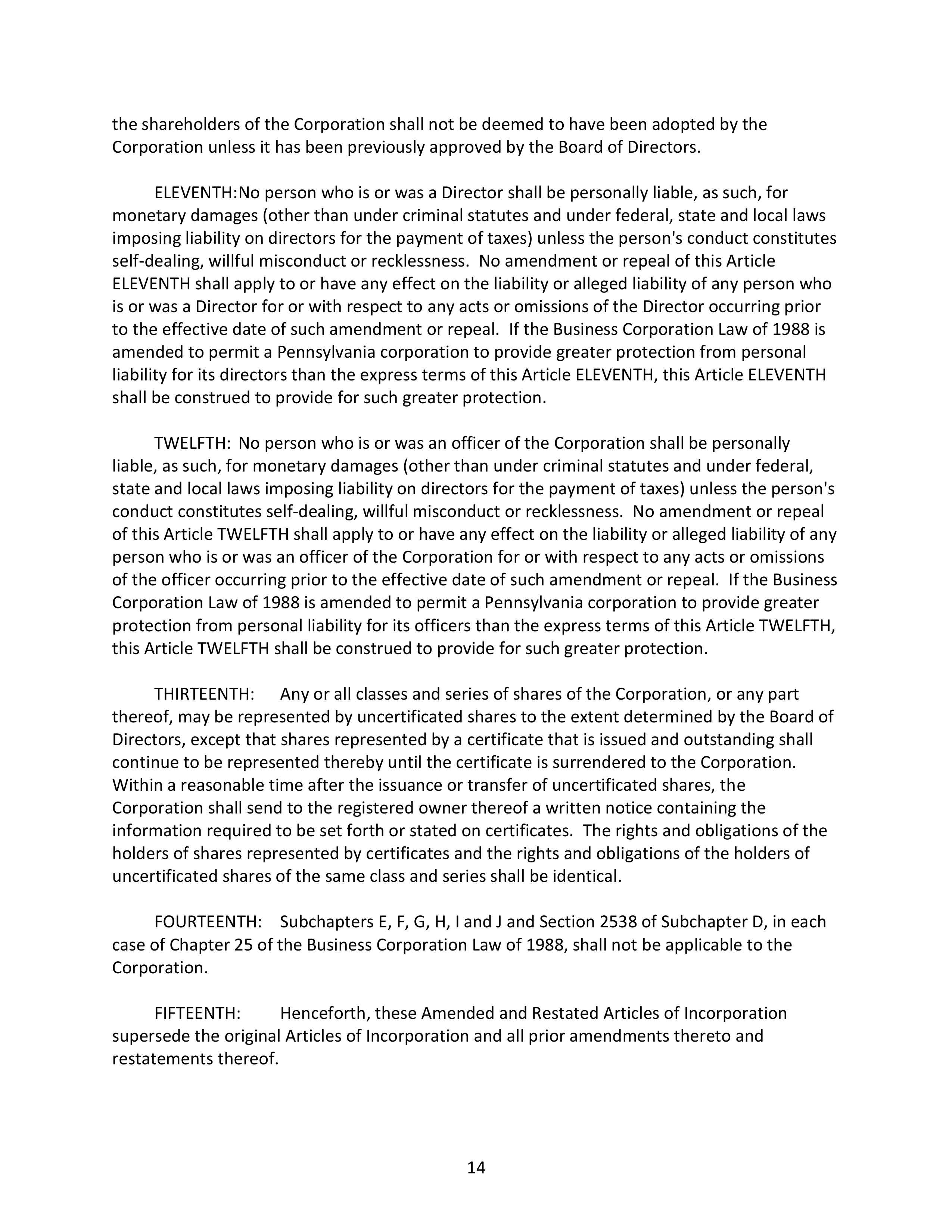
the shareholders of the Corporation shall not be deemed to have been adopted by the
Corporation unless it has been previously approved by the Board of Directors.
ELEVENTH:No person who is or was a Director shall be personally liable, as such, for
monetary damages (other than under criminal statutes and under federal, state and local laws
imposing liability on directors for the payment of taxes) unless the person's conduct constitutes
self-dealing, willful misconduct or recklessness. No amendment or repeal of this Article
ELEVENTH shall apply to or have any effect on the liability or alleged liability of any person who
is or was a Director for or with respect to any acts or omissions of the Director occurring prior
to the effective date of such amendment or repeal. If the Business Corporation Law of 1988 is
amended to permit a Pennsylvania corporation to provide greater protection from personal
liability for its directors than the express terms of this Article ELEVENTH, this Article ELEVENTH
shall be construed to provide for such greater protection.
TWELFTH: No person who is or was an officer of the Corporation shall be personally
liable, as such, for monetary damages (other than under criminal statutes and under federal,
state and local laws imposing liability on directors for the payment of taxes) unless the person's
conduct constitutes self-dealing, willful misconduct or recklessness. No amendment or repeal
of this Article TWELFTH shall apply to or have any effect on the liability or alleged liability of any
person who is or was an officer of the Corporation for or with respect to any acts or omissions
of the officer occurring prior to the effective date of such amendment or repeal. If the Business
Corporation Law of 1988 is amended to permit a Pennsylvania corporation to provide greater
protection from personal liability for its officers than the express terms of this Article TWELFTH,
this Article TWELFTH shall be construed to provide for such greater protection.
THIRTEENTH:
Any or all classes and series of shares of the Corporation, or any part
thereof, may be represented by uncertificated shares to the extent determined by the Board of
Directors, except that shares represented by a certificate that is issued and outstanding shall
continue to be represented thereby until the certificate is surrendered to the Corporation.
Within a reasonable time after the issuance or transfer of uncertificated shares, the
Corporation shall send to the registered owner thereof a written notice containing the
information required to be set forth or stated on certificates. The rights and obligations of the
holders of shares represented by certificates and the rights and obligations of the holders of
uncertificated shares of the same class and series shall be identical.
FOURTEENTH: Subchapters E, F, G, H, I and J and Section 2538 of Subchapter D, in each
case of Chapter 25 of the Business Corporation Law of 1988, shall not be applicable to the
Corporation.
FIFTEENTH:
Henceforth, these Amended and Restated Articles of Incorporation
supersede the original Articles of Incorporation and all prior amendments thereto and
restatements thereof.
14
PENNSYLVANIA DEPARTMENT OF STATE BUREAU OF CORPORATIONS AND CHARITABLE ORGANIZATIONS Read all instructions prior to completing. This form may be submitted online at https://www.corporations.pa.gov/. Fee: $5 The type of domestic association (check only one): Business Corporation Limited Liability Company Limited Liability Limited Partnership Nonprofit Corporation Limited Partnership In compliance with the requirements of the applicable provisions of 15 Pa.C.S. § 1507/5507/8625/8825 (relating to change of registered office), the undersigned domestic corporation, limited liability company, limited partnership or limited liability limited partnership, desiring to effect a change of registered office, hereby states that: 1. The name of the association is: __________________________________________________________________ 2. The current registered office address as on file with the Department of State. Complete part (a) OR (b) – not both: (a) _________________________________________________________________________________________________ Number and street City State Zip County (b) c/o: ______________________________________________________________________________________________ Name of Commercial Registered Office Provider County 3. New address. Complete part (a) OR (b) – not both: (a) The address in this Commonwealth to which the registered office of the corporation, limited partnership, limited liability limited partnership or limited liability company is to be changed is: _____________________________________________________________________________________________________ Number and street City State Zip County (b) The registered office of the corporation, limited partnership, limited liability partnership, limited liability limited partnership or limited liability company shall be provided by: c/o:
__________________________________________________________________________________________________ Name of Commercial Registered Office Provider County 4. For corporations only: Such change was authorized by the Board of Directors of the corporation. IN TESTIMONY WHEREOF, the undersigned has caused this Statement or Certificate of Change of Registered Office to be signed by a duly authorized officer, general partner, member or manager thereof this ______________ day of ___________________________, 20 . ______________________________________________________________ Name of Corporation/Limited Partnership/ Limited Liability Limited Partnership/Limited Liability Company ______________________________________________________________ Signature ______________________________________________________________ Title Return document by mail to: Name Address City State Zip Code Return document by email to: _________________________________
✔
Comcast Corporation CT Corporation System Dauphin DauphinCorporation Service Company January Comcast Corporation 24 Senior Vice President /s/ Elizabeth Wideman Exhibit 3.1.1 29th


EXHIBIT C
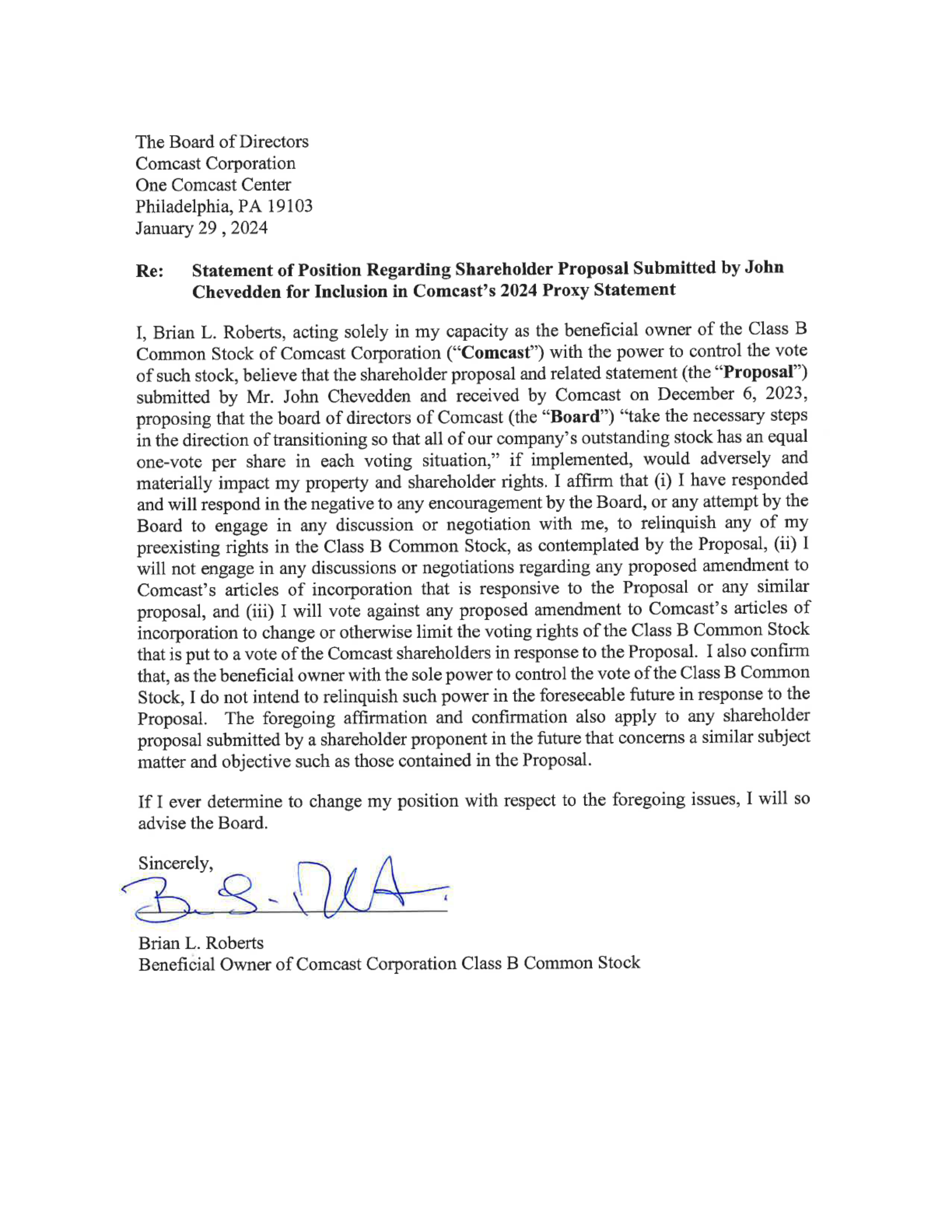
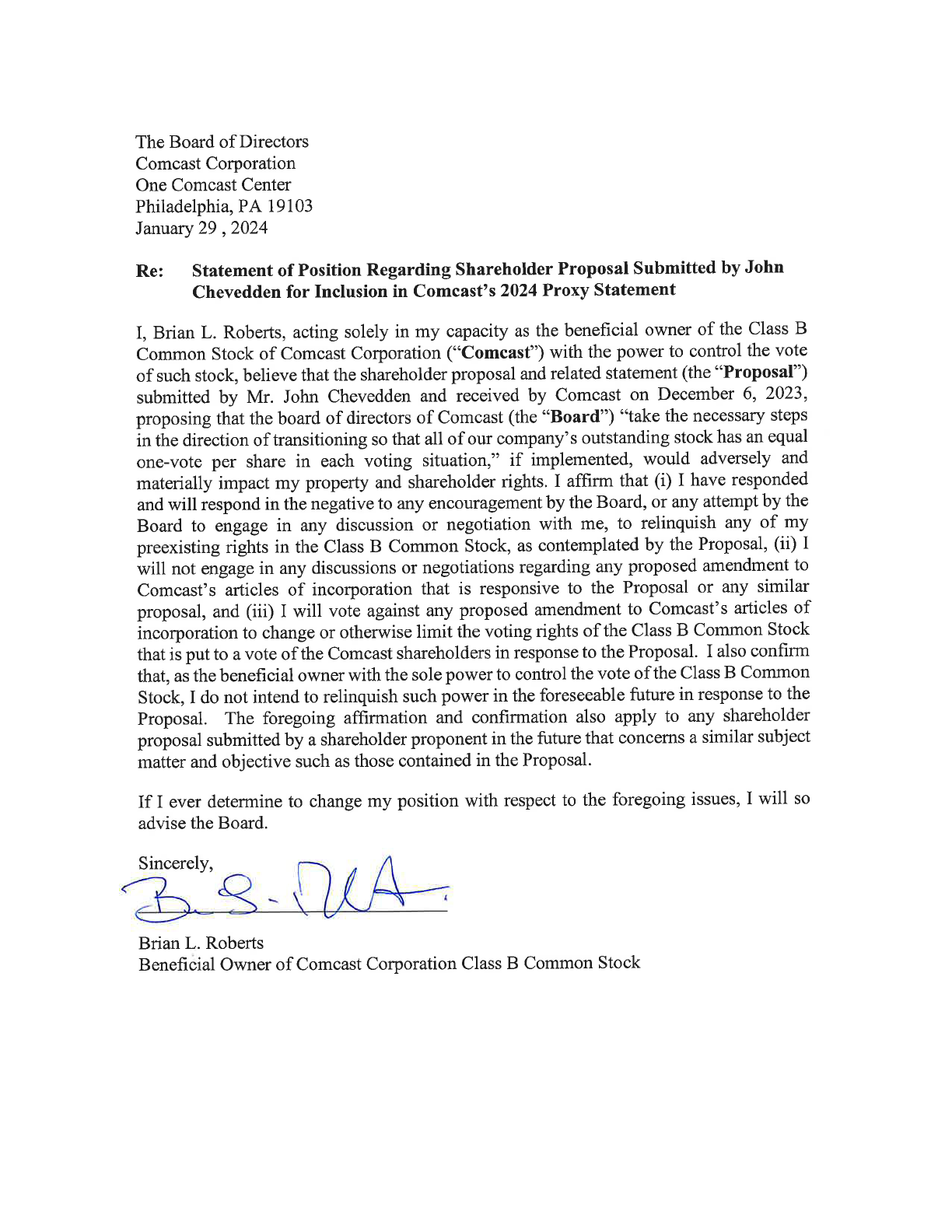
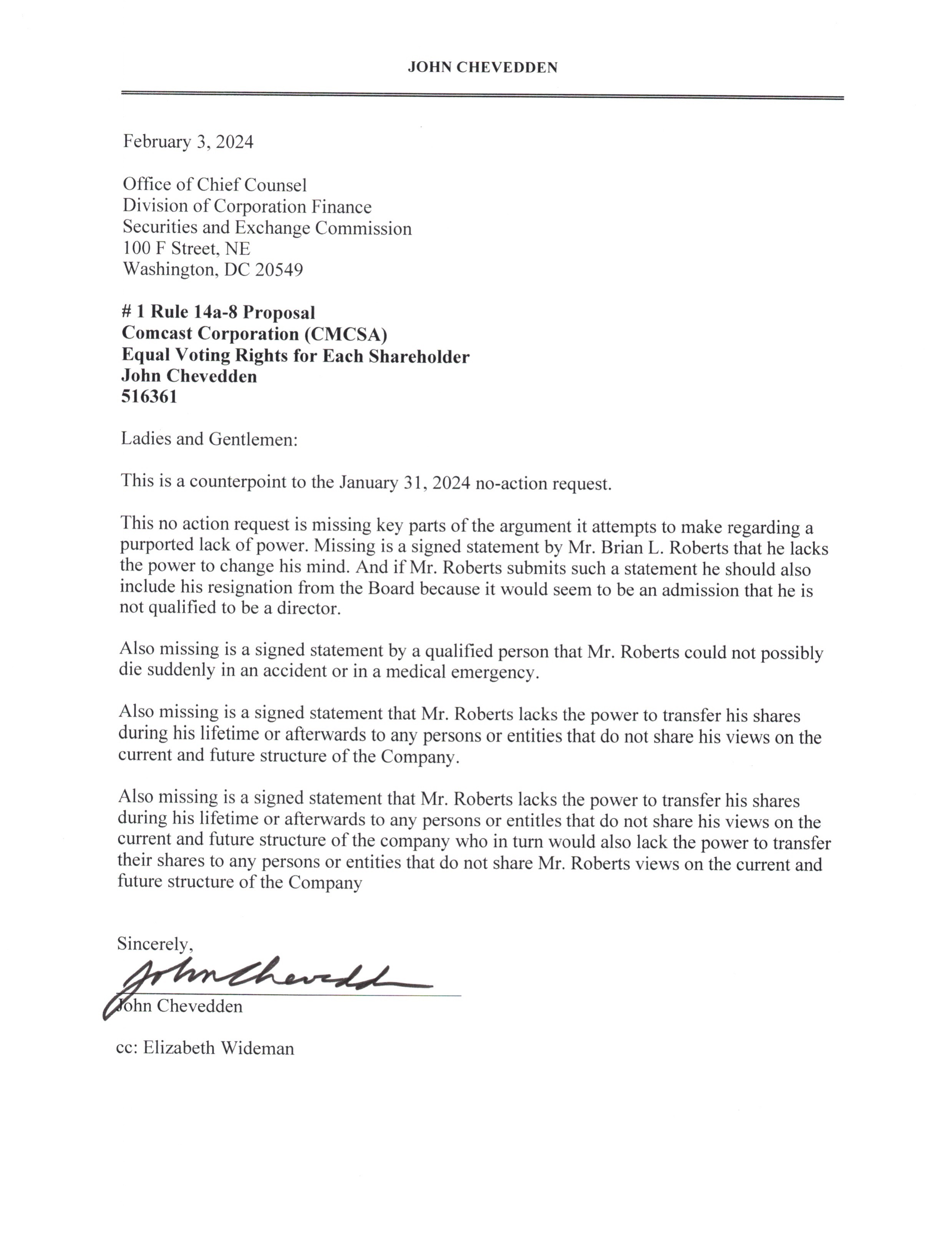
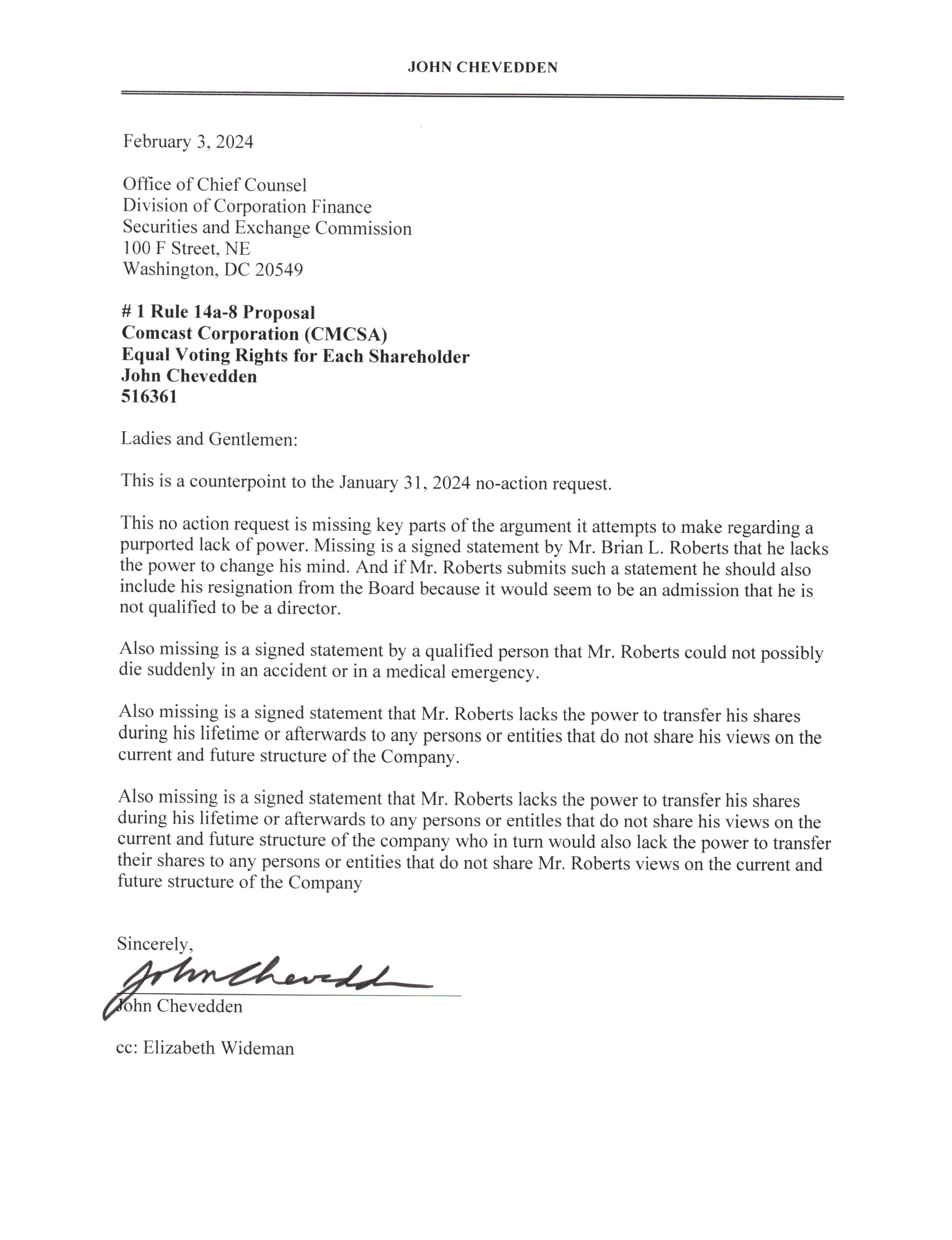
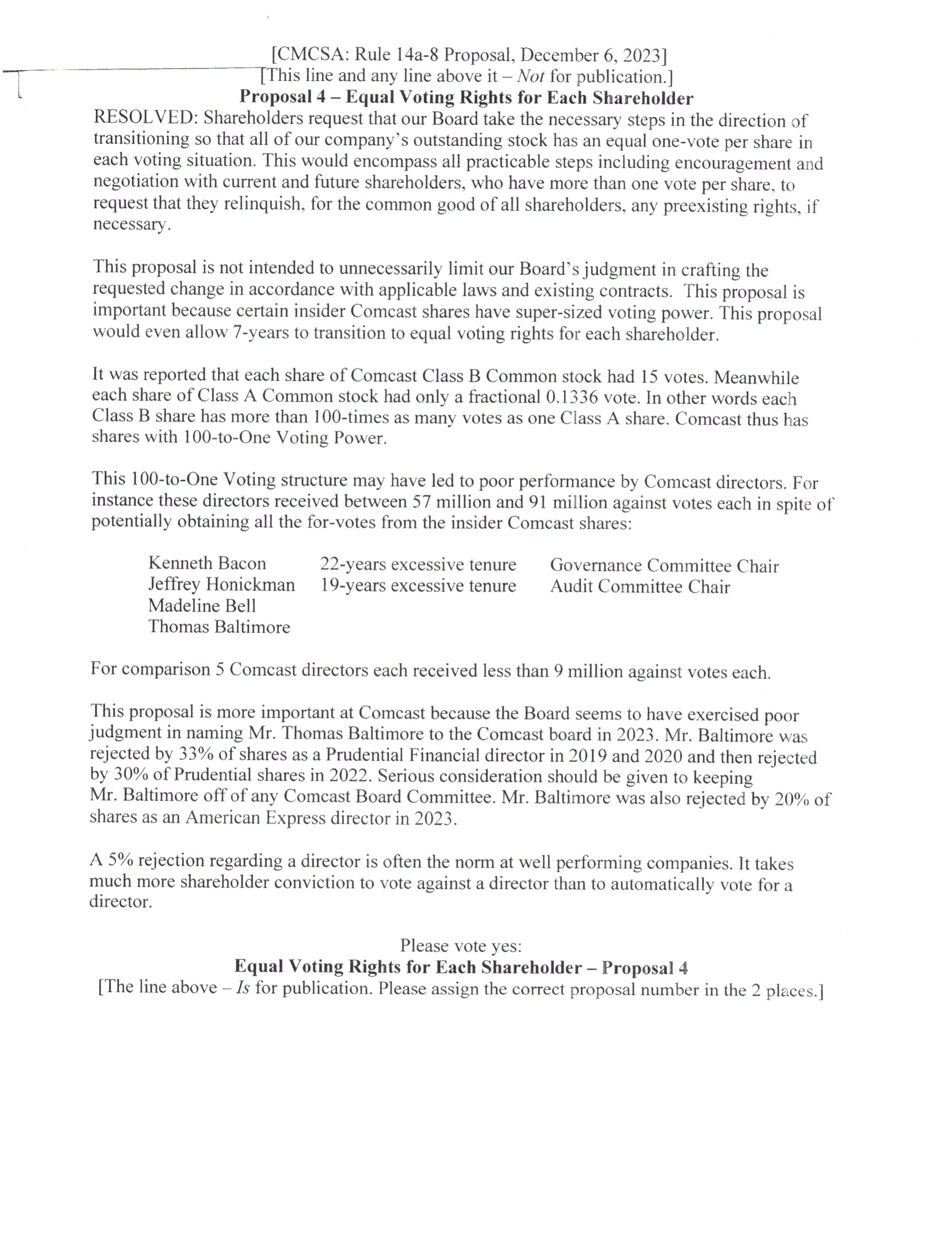
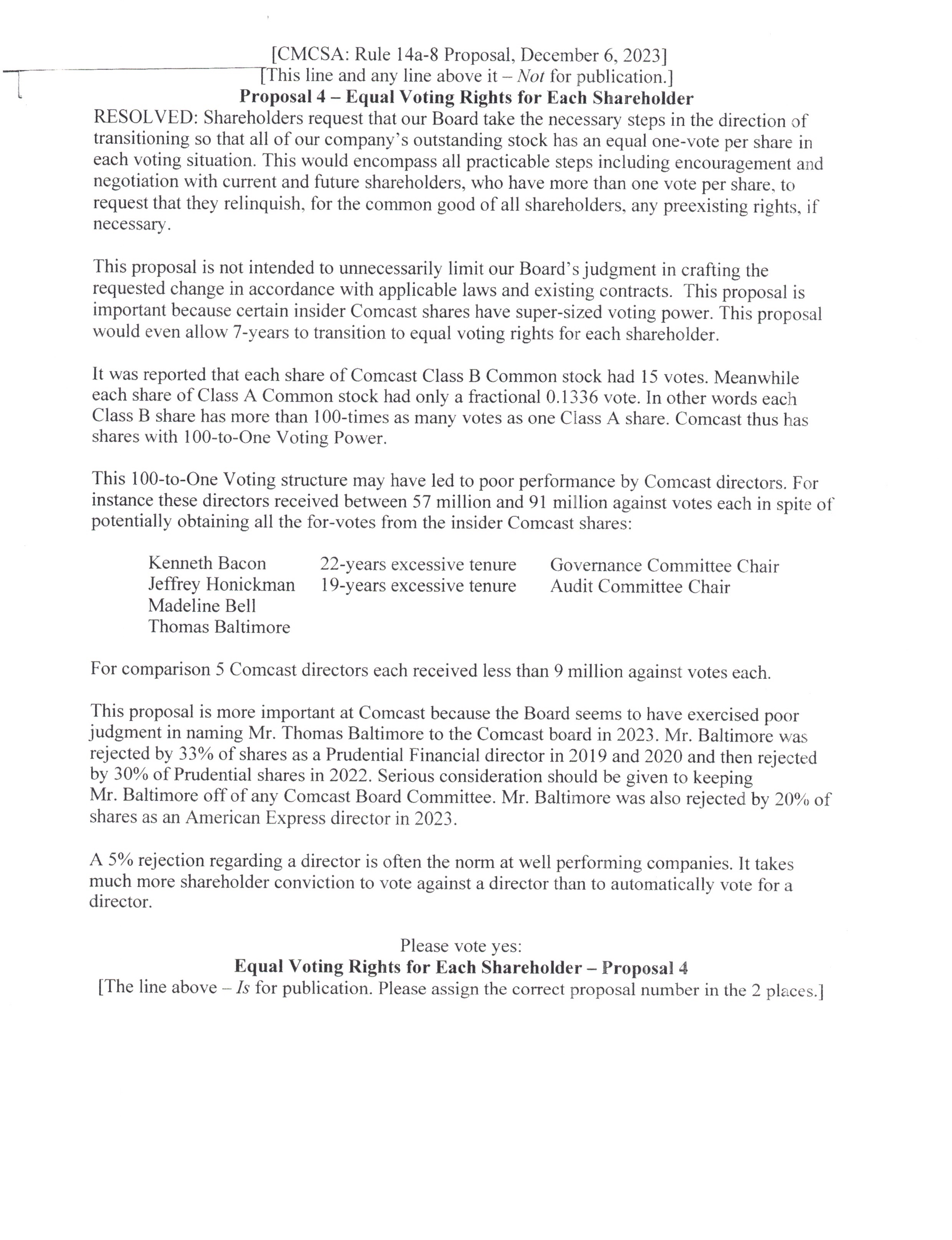

Julia Lapitskaya
Direct: +1 212.351.2354
Fax: +1 212.351.5253
JLapitskaya@gibsondunn.com
Gibson, Dunn & Crutcher LLP
200 Park Avenue
New York, NY 10166-0193
Tel 212.351.4000
gibsondunn.com
Abu Dhabi
Beijing
Brussels
Century City
Dallas
Denver
Dubai
Frankfurt
Hong Kong
Houston
London
Los Angeles
Munich
New York
Orange County
Palo Alto
Paris
Riyadh
San Francisco
Singapore
Washington, D.C.
February 5, 2024
VIA ONLINE SUBMISSION
Office of Chief Counsel
Division of Corporation Finance
Securities and Exchange Commission
100 F Street, NE
Washington, DC 20549
Re:
Comcast Corporation
Shareholder Proposal of John Chevedden
Securities Exchange Act of 1934—Rule 14a-8
Ladies and Gentlemen:
On January 31, 2024, we submitted a no-action request (the “No-Action Request”) to the staff of
the Division of Corporation Finance (the “Staff”) on behalf of our client, Comcast Corporation
(the “Company”), relating to the shareholder proposal (the “Proposal”) and statements in support
thereof (the “Supporting Statement”) received from John Chevedden (the “Proponent”) for
inclusion in the Company’s proxy statement and form of proxy for its 2024 Annual Meeting of
Shareholders (collectively, the “2024 Proxy Materials”). On February 4, 2024, the Proponent
submitted a letter, dated February 3, 2024, purportedly responding to the No-Action Request (the
“Response Letter”).
Specifically, the Proposal requests that the Company’s Board “take the necessary steps in the
direction of transitioning so that all of [the] [C]ompany’s outstanding stock has an equal one-
vote per share in each voting situation . . . including encouragement and negotiation with current
and future shareholders, who have more than one vote per share, to request that they relinquish,
for the common good of all shareholders, any preexisting rights.” The No-Action Request
submitted to the Staff details the Company’s reasons as to why the Company lacks the power or
authority to implement the Proposal, making it excludable from the 2024 Proxy Materials
pursuant to Rule 14a-8(i)(6).
Incredulously, in the Response Letter, the Proponent asserts that the No-Action Request “is
missing key parts of the argument,” including “a signed statement by Mr. Brian L. Roberts that[,
among other things,] he lacks the power to change his mind” and that he “lacks the power to
transfer his shares during his lifetime.” Contrary to the Proponent’s assertions, Mr. Roberts’s
written, signed statement (the “2024 Statement”) was attached as Exhibit C to the No-Action
Request and is quoted and discussed at length in the body of the No-Action Request. More
importantly, his 2024 Statement clearly addresses the requests included in the Proposal (e.g., that

Office of Chief Counsel
Division of Corporation Finance
February 5, 2024
Page 2
the “Board take the necessary steps in the direction of transitioning so that all of [the]
[C]ompany’s outstanding stock has an equal one-vote per share in each voting situation . . .
including encouragement and negotiation with current and future shareholders, who have more
than one vote per share, to request that they relinquish, for the common good of all shareholders,
any preexisting rights”), and the points raised in the Response Letter regarding the content of the
supposedly missing signed statement from Mr. Roberts are extraneous and irrelevant to the core
requests included in the Proposal. For example, it is irrelevant whether Mr. Roberts “lacks the
power to change his mind,” because, as stated in the 2024 Statement and discussed in the No-
Action Request, Mr. Roberts has agreed to inform the Company’s Board of Directors should he
ever determine to change his position on the relevant issues. Moreover, the Proponent’s
remaining asserted “missing” elements, including whether “Mr. Roberts lacks the power to
transfer his shares in his lifetime,” are each irrelevant, because, as stated in the No-Action
Request, Mr. Roberts, as the beneficial owner of Class B Common Stock with the sole power to
control the vote of such stock, does not intend to relinquish his rights. Moreover, the assertions
made by the Proponent in the Response Letter are not only irrelevant, but are also frivolous and
an abuse of the Rule 14a-8 no-action request process. Therefore, the Company continues to
reserve all of its rights with respect to the Proposal.
Based upon the foregoing analysis and the No-Action Request, we respectfully request that the
Staff concur that it will take no action if the Company excludes the Proposal from its 2024 Proxy
Materials. We would be happy to provide you with any additional information and answer any
questions that you may have regarding this subject. Correspondence regarding this letter should
be sent to
shareholderproposals@gibsondunn.com
. If we can be of any further assistance in this
matter, please do not hesitate to call me at 212-351-2354 or email me at
JLapitskaya@gibsondunn.com
.
Sincerely,
Julia Lapitskaya
Enclosures
cc:
Elizabeth Wideman, Comcast Corporation
John Chevedden

Julia Lapitskaya
Direct: +1 212.351.2354
Fax: +1 212.351.5253
JLapitskaya@gibsondunn.com
Gibson, Dunn & Crutcher LLP
200 Park Avenue
New York, NY 10166-0193
Tel 212.351.4000
gibsondunn.com
Abu Dhabi
Beijing
Brussels
Century City
Dallas
Denver
Dubai
Frankfurt
Hong Kong
Houston
London
Los Angeles
Munich
New York
Orange County
Palo Alto
Paris
Riyadh
San Francisco
Singapore
Washington, D.C.
February 13, 2024
VIA ONLINE SUBMISSION
Office of Chief Counsel
Division of Corporation Finance
Securities and Exchange Commission
100 F Street, NE
Washington, DC 20549
Re:
Comcast Corporation
Shareholder Proposal of John Chevedden
Securities Exchange Act of 1934—Rule 14a-8
Ladies and Gentlemen:
On January 31, 2024, we submitted a no-action request (the “No-Action Request”) to the staff of
the Division of Corporation Finance (the “Staff”) on behalf of our client, Comcast Corporation
(the “Company” or “Comcast”), relating to the shareholder proposal (the “Proposal”) and
statements in support thereof (the “Supporting Statement”) received from John Chevedden (the
“Proponent”) for inclusion in the Company’s proxy statement and form of proxy for its 2024
Annual Meeting of Shareholders (collectively, the “2024 Proxy Materials”). On February 4,
2024, the Proponent submitted a letter, dated February 3, 2024, purportedly responding to the
No-Action Request (the “Response Letter”), to which we responded on February 5, 2024 (the
“Additional Correspondence”).
The Proposal requests that the Company’s Board “take the necessary steps in the direction of
transitioning so that all of [the] [C]ompany’s outstanding stock has an equal one-vote per share
in each voting situation . . . including encouragement and negotiation with current and future
shareholders, who have more than one vote per share, to request that they relinquish, for the
common good of all shareholders, any preexisting rights.” The No-Action Request, as
supplemented by the Additional Correspondence, details the Company’s reasons as to why the
Company lacks the power or authority to implement the Proposal, making it excludable from the
2024 Proxy Materials pursuant to Rule 14a-8(i)(6).
We are submitting this letter to provide additional information to the Staff to aid in its
consideration of the No-Action Request in light of the Staff’s response in
TD SYNNEX Corp.
(avail. Jan. 29, 2024). Specifically, in
TD SYNNEX
, the company requested that the company’s
board “take each step necessary so that each voting requirement in [the] charter and bylaws . . .
that calls for a greater than simple majority vote be replaced by a requirement for a majority of
the votes cast for and against applicable proposals, or a simple majority in compliance with

Office of Chief Counsel
Division of Corporation Finance
February 13, 2024
Page 2
applicable laws.” The company argued that it lacked the power or authority to implement the
proposal, because it would not be able to give effect to the proposal without breaching its
existing contractual obligations under an investor rights agreement with certain stockholders (the
“Apollo Stockholders”) that provided that, without the approval of a majority of the directors
(which must include the approval of a majority of the directors designated to the board by the
Apollo Stockholders (the “Apollo Directors”)), the company could not “amend, modify, or
repeal any provision of the [c]harter, the [b]ylaws, or similar organizational documents” of the
company “in a manner that is intended to disproportionately adversely affect the Apollo
Stockholders or which is knowingly in material violation of the rights of the Apollo Stockholders
pursuant to the Investor Rights Agreement.”
1
The Staff did not concur with the exclusion of the
proposal pursuant to Rule 14a-8(i)(6), because the company “[had] not provided information
explaining how the potential revisions to the [c]ompany’s governing documents contemplated by
the [p]roposal would be undertaken in a manner that is intended to disproportionately adversely
affect those stockholders or would knowingly constitute a material violation of the rights of those
stockholders under the agreement,” noting that “the [c]ompany did not
provide an opinion of
counsel
addressing this or related matters or indicate that the arguments advanced in the letter
constituted the opinion of counsel” (emphasis added).
The issue and facts considered in
TD SYNNEX
are dramatically different from those presented in
the No-Action Request. The Company’s Articles of Incorporation (“Comcast’s Articles”) clearly
provide that to amend Comcast’s Articles to achieve an “equal one-vote per share” as requested
by the Proposal, among other things, would require the affirmative, separate class vote of the
Class B Common Stock, which Mr. Roberts solely controls, and Mr. Roberts has stated he would
vote against any such amendment. Additionally, an amendment to Comcast’s Articles to achieve
an “equal one-vote per share” as requested by the Proposal without an affirmative, separate class
vote of the Class B Common Stock would violate the Pennsylvania Business Corporation Law
(the “BCL”). To further support the No-Action Request, the Company has received an opinion
of counsel stating that, consistent with the No-Action Request, reducing the voting power of the
Class B Common Stock to “one-vote per share” would, in fact, “limit the rights of the holder[] of
Class B Common Stock and make a change adverse to such class” under Comcast’s Articles
such that an amendment to Comcast’s Articles to implement the Proposal without a separate
1
The
TD SYNNEX
no-action request explained that this provision only applies in the event that at least one
Apollo Director notifies the board or company promptly upon having notice of such action that, in such
director’s view, the prohibition in this provision applies. The no-action request further disclosed that two of the
four then-current Apollo Directors had notified the board that, in such directors’ view, this prohibition applied
to the proposal and that they would not approve a board action seeking to implement the proposal. The no-
action request did not explain how the rights of the Apollo Stockholders would have been “disproportionally
affected” or “materially” violated if the proposal was implemented.

Office of Chief Counsel
Division of Corporation Finance
February 13, 2024
Page 3
class vote of the Class B Common Stock (which is controlled by Mr. Roberts) would violate
Comcast’s Articles and the BCL. See Exhibit A. Specifically, the opinion states:
[A]n amendment to Comcast’s Articles to reduce the voting power of the shares
of Class B Common Stock would limit the rights of the holders of Class B
Common Stock to vote with respect to the capital stock of Comcast and would be
a change in the special rights of the shares of the Class B Common Stock adverse
to such class. Such an amendment would therefore require the approval of the
holders of the Class B Common Stock, voting separately as a class. An attempt to
adopt such an amendment to Comcast’s Articles without the required vote would
be ineffective and would violate Article VII of Comcast’s Articles and Section
1914 of the BCL.
Based upon the foregoing analysis (including the opinion of counsel) and the No-Action
Request, as supplemented by the Additional Correspondence, the Company continues to believe
that the Proposal (together with the Supporting Statement) may be excluded from the 2024 Proxy
Materials pursuant to Rule 14a-8(i)(6) because the Company lacks the power or authority to
implement the Proposal and respectfully requests that the Staff concur that it will take no action
if the Company excludes the Proposal from its 2024 Proxy Materials.
We would be happy to provide you with any additional information and answer any questions
that you may have regarding this subject. Correspondence regarding this letter should be sent to
shareholderproposals@gibsondunn.com
. If we can be of any further assistance in this matter,
please do not hesitate to call me at 212-351-2354 or email me at
JLapitskaya@gibsondunn.com
.
Sincerely,
Julia Lapitskaya
Enclosures
cc:
Elizabeth Wideman, Comcast Corporation
John Chevedden


EXHIBIT
A


Faegre Drinker Biddle & Reath
LLP
One Logan Square, Suite 2000
Philadelphia, Pennsylvania 19103
+1 215 988 2700 main
+1 215 988 2757 fax
February 13, 2024
Comcast Corporation
One Comcast Center
1701 JFK Boulevard
Philadelphia, PA 19103-2838
Re:
Shareholder Proposal of John Chevedden
Ladies and Gentlemen:
We have acted as Pennsylvania counsel to Comcast Corporation (the “Company”), a
Pennsylvania corporation with a class of equity securities registered pursuant to Section 12(b) of the
Securities Exchange Act of 1934, as amended (the “Exchange Act”), in connection with a
shareholder proposal (the “Proposal”) that has been submitted to the Company by John Chevedden
(the “Proponent”) for the 2024 Annual Meeting of Shareholders of the Company (the “Annual
Meeting”). The Company has requested our opinion as to whether reducing the voting power of the
Class B Common Stock to “one-vote per share” would limit the rights of the holders of Class B
Common Stock and make a change adverse to such class, and whether this would violate Comcast’s
Articles and the Pennsylvania Business Corporation Law (the “BCL”) unless it was done by means
of an amendment to the Company’s Articles of Incorporation that the holders of the Class B
Common Stock approve in a separate class vote.
For purposes of rendering our opinion expressed herein, we have examined copies, certified or
otherwise identified to our satisfaction, of:
(i)
the Amended and Restated Articles of Incorporation of Comcast Corporation (“Comcast’s
Articles”);
(ii)
the Amended and Restated Bylaws of Comcast Corporation, dated December 20, 2022;
(iii)
the Proposal; and
(iv)
the no-action request letter (including all exhibits thereto) submitted to the Securities and
Exchange Commission by the Company on January 31, 2024, as supplemented by
additional correspondence from the Company, dated February 5, 2024.
With respect to the foregoing documents, we have assumed (i) the conformity to the authentic
originals of all the documents submitted to us and (ii) that each of the foregoing documents, in the
form submitted to us for our review, is the full text of the currently effective version of the document.
We have not reviewed any documents other than the documents listed above for purposes of rendering
this opinion, and we assume that there exists no provision of any such other document that bears upon
-2-
February 13, 2024
or is inconsistent with our opinion expressed herein. In addition, we have conducted no independent
factual investigation of our own but rather have relied solely on the foregoing documents, the
statements and information set forth therein and the additional factual matters recited or assumed
herein, all of which we assume to be true, complete and accurate in all material respects.
THE PROPOSAL
The Proposal, in relevant part, states the following:
RESOLVED: Shareholders request that our Board take the necessary steps in the direction of
transitioning so that all of our company’s outstanding stock has an equal one-vote per share in
each voting situation. This would encompass all practicable steps including encouragement
and negotiation with current and future shareholders, who have more than one vote per share,
to request that they relinquish, for the common good of all shareholders, any preexisting rights,
if necessary.
We understand that the Company is considering excluding the Proposal from the Company
proxy statement for the Annual Meeting under Rule 14a-8(i)(6) promulgated under the Exchange
Act. Rule 14a-8(i)(6) provides that a registrant may omit a proposal from its proxy statement “if the
company would lack the power or authority to implement the proposal.” In connection with your
consideration of this, you have requested our opinion as to whether reducing the voting power of the
Class B Common Stock to “one-vote per share” would limit the rights of the holders of Class B
Common Stock and make a change adverse to such class, and whether this would violate Comcast’s
Articles and the BCL unless it was done by means of an amendment to Comcast’s Articles that the
holders of the Class B Common Stock approve in a separate class vote.
DISCUSSION
The Company has two classes of Common Stock – Class A Common Stock and Class B
Common Stock. Under Pennsylvania law, every shareholder is entitled to one vote for every share
outstanding in the shareholder’s name on the share register,
unless otherwise provided in the
company’s articles of incorporation
.
1
As provided under Comcast’s Articles, holders of Class B
Common Stock are entitled to 15 votes per share or, with respect to any matter on which the holders
of the Company’s Class A Common Stock and Class B Common Stock vote together as a single class,
each share of Class B Common Stock shall entitle the holder thereof to the number of votes necessary
to give the holders of the Class B Common Stock in the aggregate 33.33% of the total number of votes
that could be cast by all holders of the Company’s stock. Holders of Class A Common Stock are entitled
to a number of votes based on a formula, which depends, in part, on a total number of votes and the
number of outstanding shares.
Modifying the current voting rights of Comcast shareholders described above, so that holders
of the Company’s shares of common stock all have one-vote per share in every voting situation, would
violate the BCL unless done by means of an amendment to Comcast’s Articles adopted in accordance
with Comcast’s Articles and the relevant provisions of the BCL. Title 15 Pa.C.S. §1911 – 1916. Under
1
Title 15 Pa.C.S. §1758(a). (“The articles may restrict the number of votes that a single holder or beneficial owner,
or such a group of holders or owners as the bylaws may define, of shares of any class or series may directly or
indirectly cast in the aggregate for the election of directors or on any other matter coming before the shareholders on
the basis of any facts or circumstances that are not manifestly unreasonable, including without limitation: (1) the
number of shares of any class or series held by such single holder or beneficial owner or group of holders or owners;
or (2) the length of time shares of any class or series have been held by such single holder or beneficial owner or
group of holders or owners.”).
-3-
February 13, 2024
Pennsylvania law, the board of directors must direct that a proposed amendment to the articles be
submitted to a vote of the shareholders entitled to vote thereon, and such shareholders must approve
the amendment.
Id.
Article V of Comcast’s Articles provides in relevant part: “Subject to Article SEVENTH and
except as otherwise permitted by applicable law, each and any provision of these Amended and
Restated Articles of Incorporation may from time to time, when and as desired, be amended by a
resolution of the Board of Directors and the affirmative vote of a majority of the votes cast by all
shareholders entitled to vote thereon, as determined in accordance with the provisions of this Article
FIFTH. There shall be no class voting on any such amendments or on any other matter except as shall
be required by Article SEVENTH or by applicable law, in which case there shall be required the
affirmative vote of a majority of the votes cast by the holders of the outstanding shares of each class
entitled to vote by Article SEVENTH or by applicable law, voting as a separate class.”
Article VII of Comcast’s Articles, provides that, in addition to any other approvals required by
law, “the approval of the holders of Class B Common Stock, voting separately as a class, shall be
necessary to approve …any amendment to these Amended and Restated Articles of Incorporation
(including, without limitation, any amendment to elect to have any of Subchapters E, F, G, H, I and J
or Section 2538 of Subchapter D, in each case of Chapter 25 of the Business Corporation Law of 1988,
be applicable to the Corporation or any amendment to this Article SEVENTH) or the Bylaws of the
Corporation or any other action (including, without limitation, the adoption, amendment or redemption
of a shareholder rights plan) that
would, in any such case, limit the rights of the holders of Class B
Common Stock or any subsequent transferee of Class B Common Stock to transfer, vote or otherwise
exercise rights with respect to capital stock of the Corporati
on. In addition to any other approval
required by law or by these Amended and Restated Articles of Incorporation, and notwithstanding any
provision of Article FIFTH, the approval of the holder of any class or series of shares of the Corporation
shall be necessary to approve any amendment to these Amended and Restated Articles of Incorporation
which would make any change in the preferences, limitations or rights of the shares of such class or
series adverse to such class or series.” (emphasis added.)
In addition to the provisions set forth above from Article VII of Comcast’s Articles, Section
1914(b) of the BCL provides as follows: “Except as provided in this subpart, the holders of the
outstanding shares of a class or series of shares shall be entitled to vote as a class in respect of a
proposed amendment [to the articles of incorporation] regardless of any limitations stated in the
articles or bylaws on the voting rights of any class or series if the amendment would … (2) make
any change in the preferences, limitations or special rights (other than preemptive rights or the right
to vote cumulatively) of the shares of a class or series adverse to the class or series.” We observe that
this provision of the BCL is incorporated into Comcast’s Articles using almost the same wording in
Article SEVENTH as quoted above.
Based on the foregoing, in our opinion, an amendment to Comcast’s Articles to reduce the
voting power of the shares of Class B Common Stock would limit the rights of the holders of Class B
Common Stock to vote with respect to the capital stock of Comcast and would be a change in the
special rights of the shares of the Class B Common Stock adverse to such class. Such an amendment
would therefore require the approval of the holders of the Class B Common Stock, voting separately
as a class. An attempt to adopt such an amendment to Comcast’s Articles without the required vote
would be ineffective and would violate Article VII of Comcast’s Articles and Section 1914 of the BCL.
This opinion letter is limited to the BCL and we express no opinion as to the effect on the
matters covered by our opinion of any other law. Furthermore, in rendering the opinion expressed
herein, we have only considered the applicability of statutes, rules, regulations and judicial decisions