

March 8, 2019
Elizabeth A. Ising
Gibson, Dunn & Crutcher LLP
shareholderproposals@gibsondunn.com
Re:
PepsiCo, Inc.
Incoming letter dated December 27, 2018
Dear Ms. Ising:
This letter is in response to your correspondence dated December 27, 2018
concerning the shareholder proposal (the “Proposal”) submitted to PepsiCo, Inc.
(the “Company”) by The Janine Firpo Living Trust et al. (the “Proponents”) for inclusion
in the Company’s proxy materials for its upcoming annual meeting of security holders.
We also have received correspondence on the Proponents’ behalf dated February 4, 2019.
Copies of all of the correspondence on which this response is based will be made
available on our website at http://www.sec.gov/divisions/corpfin/cf-noaction/14a-8.shtml.
For your reference, a brief discussion of the Division’s informal procedures regarding
shareholder proposals is also available at the same website address.
Sincerely,
M. Hughes Bates
Special Counsel
Enclosure
cc:
Sanford J. Lewis
sanfordlewis@strategiccounsel.net
March 8, 2019
Response of the Office of Chief Counsel
Division of Corporation Finance
Re:
PepsiCo, Inc.
Incoming letter dated December 27, 2018
The Proposal requests that the Company disclose quantitative metrics
demonstrating measurable progress toward the reduction of synthetic chemical pesticide
use in the Company’s supply chain.
We are unable to concur in your view that the Company may exclude the Proposal
under rule 14a-8(i)(10). Based on the information you have presented, it does not appear
that the Company’s public disclosures compare favorably with the guidelines of the
Proposal. Accordingly, we do not believe that the Company may omit the Proposal from
its proxy materials in reliance on rule 14a-8(i)(10).
Sincerely,
Lisa Krestynick
Attorney-Adviser
DIVISION OF CORPORATION FINANCE
INFORMAL PROCEDURES REGARDING SHAREHOLDER PROPOSALS
The Division of Corporation Finance believes that its responsibility with respect
to matters arising under Rule 14a-8 [17 CFR 240.14a-8], as with other matters under the
proxy rules, is to aid those who must comply with the rule by offering informal advice
and suggestions and to determine, initially, whether or not it may be appropriate in a
particular matter to recommend enforcement action to the Commission. In connection
with a shareholder proposal under Rule 14a-8, the Division’s staff considers the
information furnished to it by the company in support of its intention to exclude the
proposal from the company’s proxy materials, as well as any information furnished by
the proponent or the proponent’s representative.
Although Rule 14a-8(k) does not require any communications from shareholders
to the Commission’s staff, the staff will always consider information concerning alleged
violations of the statutes and rules administered by the Commission, including arguments
as to whether or not activities proposed to be taken would violate the statute or rule
involved. The receipt by the staff of such information, however, should not be construed
as changing the staff’s informal procedures and proxy review into a formal or adversarial
procedure.
It is important to note that the staff’s no-action responses to Rule 14a-8(j)
submissions reflect only informal views. The determinations reached in these no-action
letters do not and cannot adjudicate the merits of a company’s position with respect to the
proposal. Only a court such as a U.S. District Court can decide whether a company is
obligated to include shareholder proposals in its proxy materials. Accordingly, a
discretionary determination not to recommend or take Commission enforcement action
does not preclude a proponent, or any shareholder of a company, from pursuing any
rights he or she may have against the company in court, should the company’s
management omit the proposal from the company’s proxy materials.
SANFORD J. LEWIS, ATTORNEY
______________________________________________________________________________
PO Box 231 Amherst, MA 01004-0231 • sanfordlewis@strategiccounsel.net • (413) 549-7333
February 4, 2019
Via electronic mail
Office of Chief Counsel
Division of Corporation Finance
U.S. Securities and Exchange Commission
100 F Street, N.E.
Washington, D.C. 20549
Re: Shareholder Proposal to PepsiCo, Inc. Regarding Synthetic Pesticides on behalf of
The Janine Firpo Living Trust and others
Ladies and Gentlemen:
The Janine Firpo Living Trust; Abigail Rome; Edwards Mother Earth Foundation; Lisa K.
Homes Revocable Trust; Michelle Swenson & Stan Drobac Revocable Trust; and Patricia Rose
Lurie Revocable Trust (the “Proponents”) are beneficial owners of common stock of PepsiCo,
Inc. (the “Company”) and
As You Sow
has submitted a shareholder proposal (the “Proposal”) to
the Company on their behalf. I have been asked by the Proponents to respond to the letter dated
December 27, 2018 ("Company Letter") sent to the Securities and Exchange Commission by
Elizabeth A. Ising of Gibson, Dunn & Crutcher LLP. In that letter, the Company contends that
the Proposal may be excluded from the Company’s 2019 proxy statement.
I have reviewed the Proposal, as well as the letter sent by the Company, and based upon the
foregoing, as well as the relevant rules, it is my opinion that the Proposal must be included in the
Company’s 2019 proxy materials and that it is not excludable under Rule 14a-8. A copy of this
letter is being emailed concurrently to Elizabeth A. Ising of Gibson, Dunn & Crutcher LLP.
SUMMARY
The Proposal requests that the Company disclose quantitative metrics demonstrating measurable
progress toward the reduction of synthetic pesticide use in the Company’s supply chain. The
Supporting Statement suggests information on the percentage of supply chain use of pesticides in
supply-chain crops, an assessment of the operational and reputational risks posed to the
Company by the current use of pesticides in its supply chain, as well as metrics demonstrating
success in increasing the portion of supply chain crops grown with integrated pest management
practices.
The Company incorrectly claims that the proposal is substantially implemented and excludable
under Rule 14a-8(i)(10). Although the Company has reported metrics on increased uptake of
integrated pest management, that information may or may not reflect a reduction in pesticide use
in the supply chain. The core request of the Proposal for quantitative indicators correlating with
reducing pesticide use are unfulfilled, and neither has the Company published an assessment of
the operational and reputational risks such as the impact of recent controversy regarding the
Office of Chief Counsel
February 4, 2019
Page 2
presence of a pesticide in its flagship product Quaker Oats. Accordingly, the Proposal is not
substantially implemented, and not excludable under Rule 14a-8(i)(10).
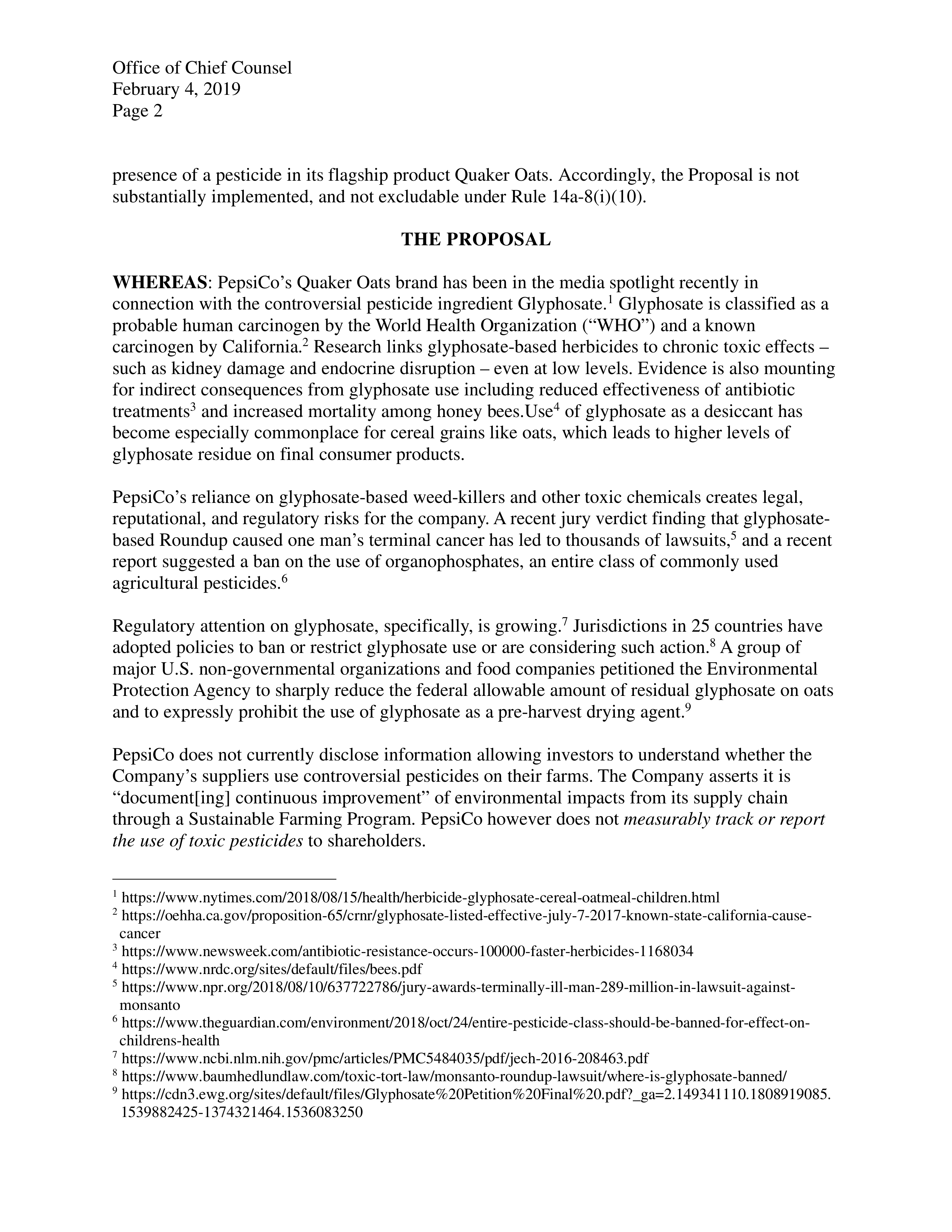
THE PROPOSAL
WHEREAS
: PepsiCo’s Quaker Oats brand has been in the media spotlight recently in
connection with the controversial pesticide ingredient Glyphosate.
1
Glyphosate is classified as a
probable human carcinogen by the World Health Organization (“WHO”) and a known
carcinogen by California.
2
Research links glyphosate-based herbicides to chronic toxic effects –
such as kidney damage and endocrine disruption – even at low levels. Evidence is also mounting
for indirect consequences from glyphosate use including reduced effectiveness of antibiotic
treatments
3
and increased mortality among honey bees.Use
4
of glyphosate as a desiccant has
become especially commonplace for cereal grains like oats, which leads to higher levels of
glyphosate residue on final consumer products.
PepsiCo’s reliance on glyphosate-based weed-killers and other toxic chemicals creates legal,
reputational, and regulatory risks for the company. A recent jury verdict finding that glyphosate-
based Roundup caused one man’s terminal cancer has led to thousands of lawsuits,
5
and a recent
report suggested a ban on the use of organophosphates, an entire class of commonly used
agricultural pesticides.
6
Regulatory attention on glyphosate, specifically, is growing.
7
Jurisdictions in 25 countries have
adopted policies to ban or restrict glyphosate use or are considering such action.
8
A group of
major U.S. non-governmental organizations and food companies petitioned the Environmental
Protection Agency to sharply reduce the federal allowable amount of residual glyphosate on oats
and to expressly prohibit the use of glyphosate as a pre-harvest drying agent.
9
PepsiCo does not currently disclose information allowing investors to understand whether the
Company’s suppliers use controversial pesticides on their farms. The Company asserts it is
“document[ing] continuous improvement” of environmental impacts from its supply chain
through a Sustainable Farming Program. PepsiCo however does not
measurably track or report
the use of toxic pesticides
to shareholders.
1
https://www.nytimes.com/2018/08/15/health/herbicide-glyphosate-cereal-oatmeal-children.html
2
https://oehha.ca.gov/proposition-65/crnr/glyphosate-listed-effective-july-7-2017-known-state-california-cause-
cancer
3
https://www.newsweek.com/antibiotic-resistance-occurs-100000-faster-herbicides-1168034
4
https://www.nrdc.org/sites/default/files/bees.pdf
5
https://www.npr.org/2018/08/10/637722786/jury-awards-terminally-ill-man-289-million-in-lawsuit-against-
monsanto
6
https://www.theguardian.com/environment/2018/oct/24/entire-pesticide-class-should-be-banned-for-effect-on-
childrens-health
7
https://www.ncbi.nlm.nih.gov/pmc/articles/PMC5484035/pdf/jech-2016-208463.pdf
8
https://www.baumhedlundlaw.com/toxic-tort-law/monsanto-roundup-lawsuit/where-is-glyphosate-banned/
9
https://cdn3.ewg.org/sites/default/files/Glyphosate%20Petition%20Final%20.pdf?_ga=2.149341110.1808919085.
1539882425-1374321464.1536083250
Office of Chief Counsel
February 4, 2019
Page 3
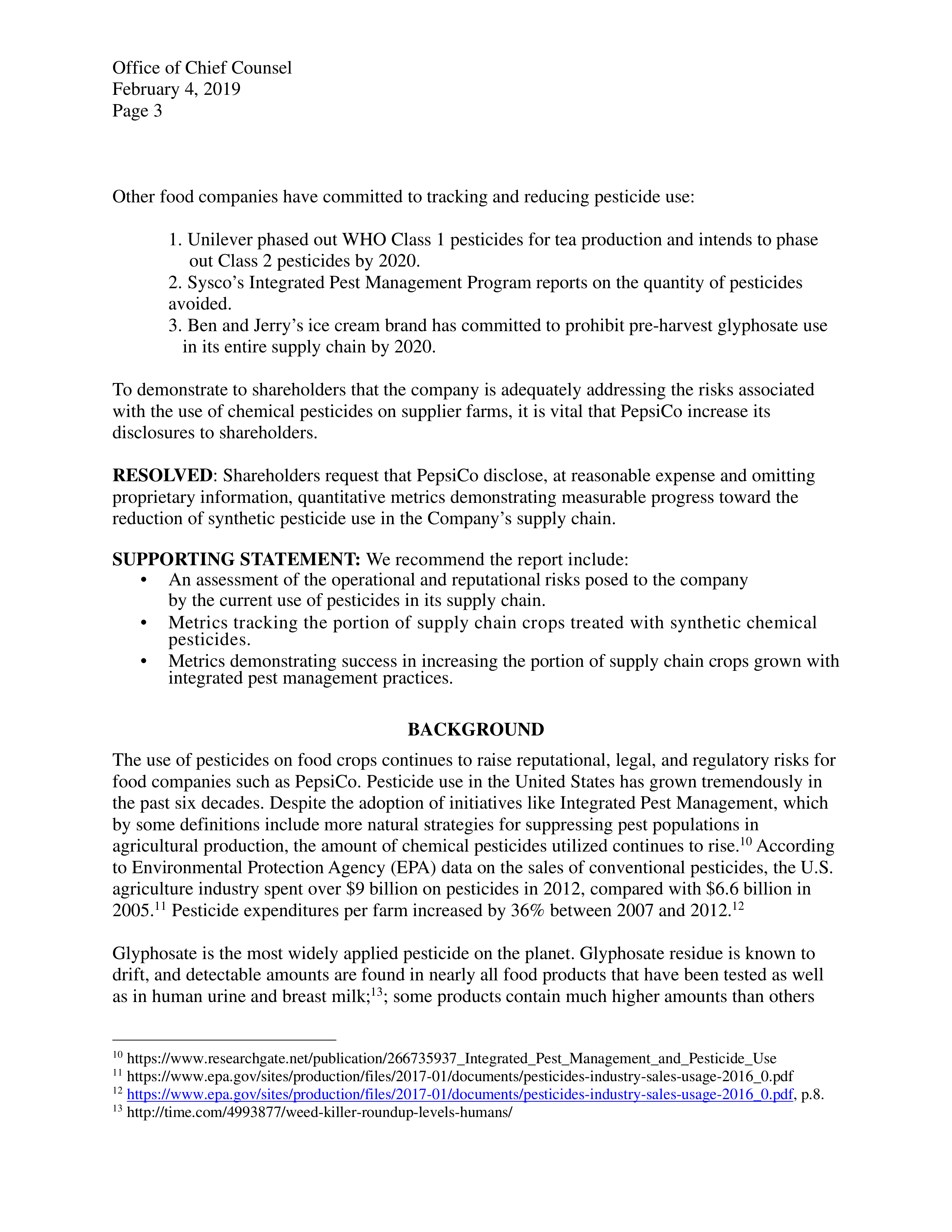
Other food companies have committed to tracking and reducing pesticide use:
1. Unilever phased out WHO Class 1 pesticides for tea production and intends to phase
out Class 2 pesticides by 2020.
2. Sysco’s Integrated Pest Management Program reports on the quantity of pesticides
avoided.
3. Ben and Jerry’s ice cream brand has committed to prohibit pre-harvest glyphosate use
in its entire supply chain by 2020.
To demonstrate to shareholders that the company is adequately addressing the risks associated
with the use of chemical pesticides on supplier farms, it is vital that PepsiCo increase its
disclosures to shareholders.
RESOLVED
: Shareholders request that PepsiCo disclose, at reasonable expense and omitting
proprietary information, quantitative metrics demonstrating measurable progress toward the
reduction of synthetic pesticide use in the Company’s supply chain.
SUPPORTING STATEMENT:
We recommend the report include:
•
An assessment of the operational and reputational risks posed to the company
by the current use of pesticides in its supply chain.
•
Metrics tracking the portion of supply chain crops treated with synthetic chemical
pesticides.
•
Metrics demonstrating success in increasing the portion of supply chain crops grown with
integrated pest management practices.
BACKGROUND
The use of pesticides on food crops continues to raise reputational, legal, and regulatory risks for
food companies such as PepsiCo. Pesticide use in the United States has grown tremendously in
the past six decades. Despite the adoption of initiatives like Integrated Pest Management, which
by some definitions include more natural strategies for suppressing pest populations in
agricultural production, the amount of chemical pesticides utilized continues to rise.
10
According
to Environmental Protection Agency (EPA) data on the sales of conventional pesticides, the U.S.
agriculture industry spent over $9 billion on pesticides in 2012, compared with $6.6 billion in
2005.
11
Pesticide expenditures per farm increased by 36% between 2007 and 2012.
12
Glyphosate is the most widely applied pesticide on the planet. Glyphosate residue is known to
drift, and detectable amounts are found in nearly all food products that have been tested as well
as in human urine and breast milk;
13
; some products contain much higher amounts than others
10
https://www.researchgate.net/publication/266735937_Integrated_Pest_Management_and_Pesticide_Use
11
https://www.epa.gov/sites/production/files/2017-01/documents/pesticides-industry-sales-usage-2016_0.pdf
12
https://www.epa.gov/sites/production/files/2017-01/documents/pesticides-industry-sales-usage-2016_0.pdf
, p.8.
13
http://time.com/4993877/weed-killer-roundup-levels-humans/
Office of Chief Counsel
February 4, 2019
Page 4
because glyphosate is directly applied to some or all of the product’s ingredients.
It is widely-known that oats, for example, are often desiccated with glyphosate pre-harvest.
14
PepsiCo’s Quaker brand has been highlighted in the media for glyphosate residues,
15
directly
called out by advocacy organizations,
16
and is the target of a lawsuit on the dissonant relationship
between the presence of this pesticide and the company’s marketing of Quaker Oats as
“Natural”.
17
In response to the publications highlighting the presence of trace amounts of
glyphosate in Quaker Oats, the women's health and lifestyle magazine
Health
noted:
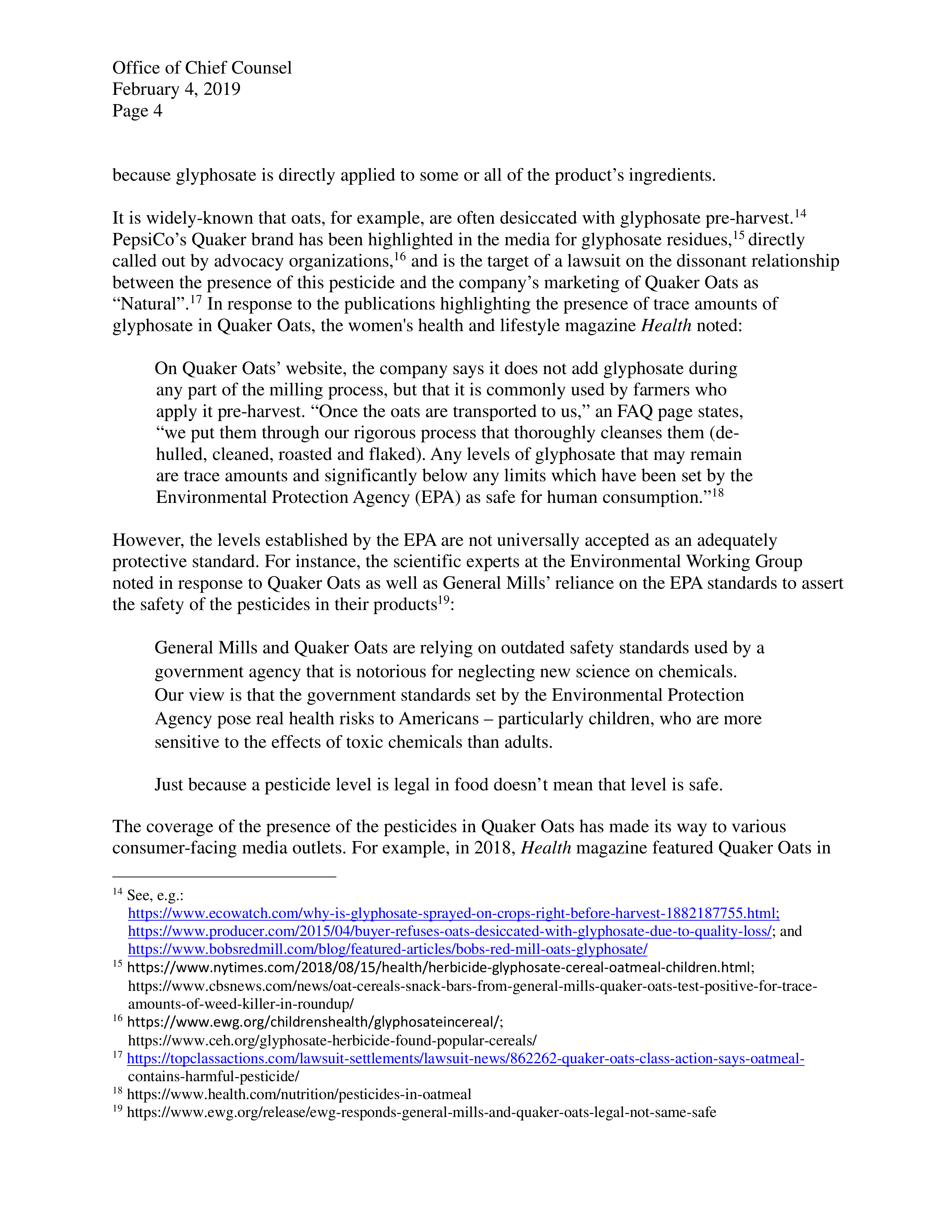
On Quaker Oats’ website, the company says it does not add glyphosate during
any part of the milling process, but that it is commonly used by farmers who
apply it pre-harvest. “Once the oats are transported to us,” an FAQ page states,
“we put them through our rigorous process that thoroughly cleanses them (de-
hulled, cleaned, roasted and flaked). Any levels of glyphosate that may remain
are trace amounts and significantly below any limits which have been set by the
Environmental Protection Agency (EPA) as safe for human consumption.”
18
However, the levels established by the EPA are not universally accepted as an adequately
protective standard. For instance, the scientific experts at the Environmental Working Group
noted in response to Quaker Oats as well as General Mills’ reliance on the EPA standards to assert
the safety of the pesticides in their products
19
:
General Mills and Quaker Oats are relying on outdated safety standards used by a
government agency that is notorious for neglecting new science on chemicals.
Our view is that the government standards set by the Environmental Protection
Agency pose real health risks to Americans – particularly children, who are more
sensitive to the effects of toxic chemicals than adults.
Just because a pesticide level is legal in food doesn’t mean that level is safe.
The coverage of the presence of the pesticides in Quaker Oats has made its way to various
consumer-facing media outlets. For example, in 2018,
Health
magazine featured Quaker Oats in
14
See, e.g.:
https://www.ecowatch.com/why-is-glyphosate-sprayed-on-crops-right-before-harvest-1882187755.html;
https://www.producer.com/2015/04/buyer-refuses-oats-desiccated-with-glyphosate-due-to-quality-loss/
; and
https://www.bobsredmill.com/blog/featured-articles/bobs-red-mill-oats-glyphosate/
15
https://www.nytimes.com/2018/08/15/health/herbicide-glyphosate-cereal-oatmeal-children.html
;
https://www.cbsnews.com/news/oat-cereals-snack-bars-from-general-mills-quaker-oats-test-positive-for-trace-
amounts-of-weed-killer-in-roundup/
16
https://www.ewg.org/childrenshealth/glyphosateincereal/
;
https://www.ceh.org/glyphosate-herbicide-found-popular-cereals/
17
https://topclassactions.com/lawsuit-settlements/lawsuit-news/862262-quaker-oats-class-action-says-oatmeal-
contains-harmful-pesticide/
18
https://www.health.com/nutrition/pesticides-in-oatmeal
19
https://www.ewg.org/release/ewg-responds-general-mills-and-quaker-oats-legal-not-same-safe
Office of Chief Counsel
February 4, 2019
Page 5
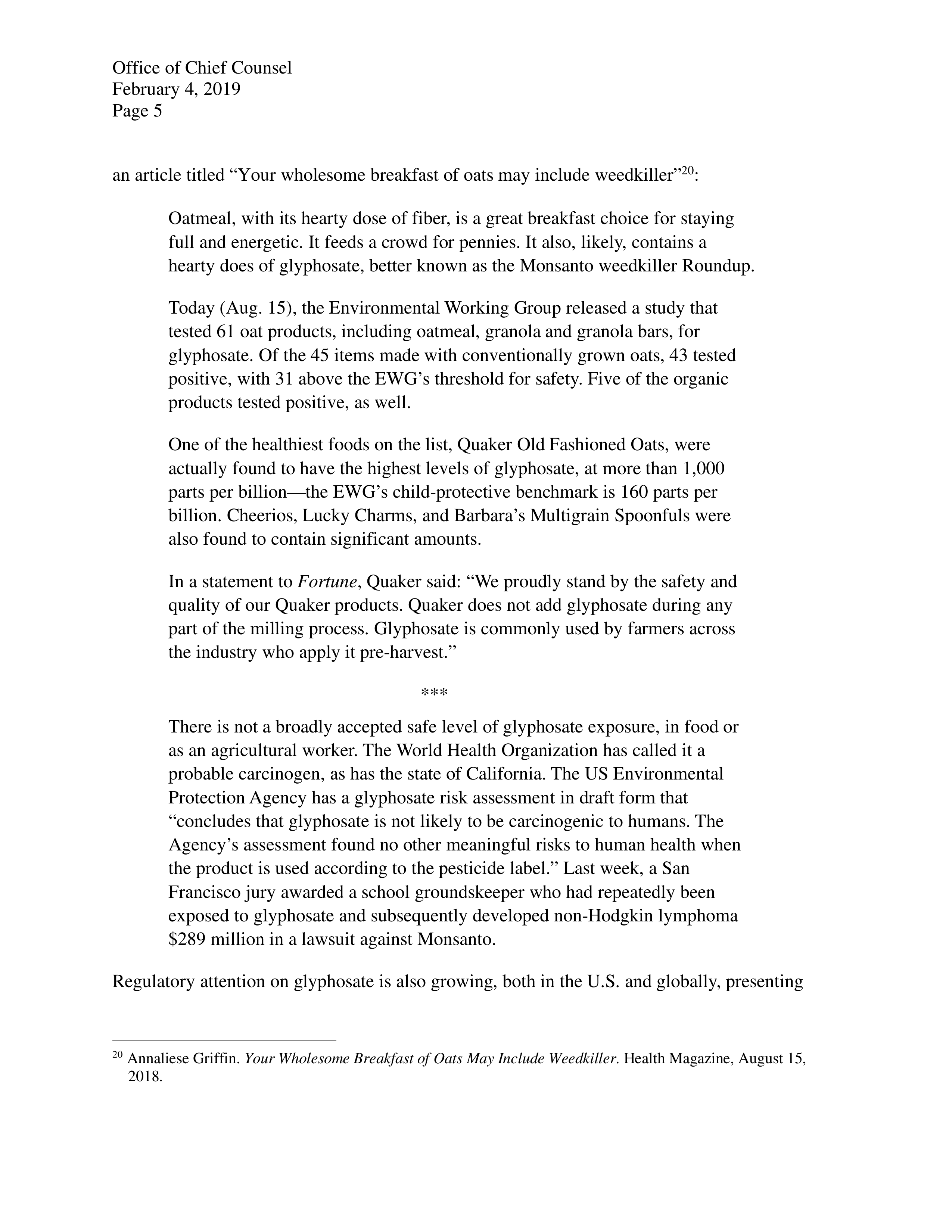
an article titled “Your wholesome breakfast of oats may include weedkiller”
20
:
Oatmeal, with its hearty dose of fiber, is a great breakfast choice for staying
full and energetic. It feeds a crowd for pennies. It also, likely, contains a
hearty does of glyphosate, better known as the Monsanto weedkiller Roundup.
Today (Aug. 15), the Environmental Working Group released a study that
tested 61 oat products, including oatmeal, granola and granola bars, for
glyphosate. Of the 45 items made with conventionally grown oats, 43 tested
positive, with 31 above the EWG’s threshold for safety. Five of the organic
products tested positive, as well.
One of the healthiest foods on the list, Quaker Old Fashioned Oats, were
actually found to have the highest levels of glyphosate, at more than 1,000
parts per billion—the EWG’s child-protective benchmark is 160 parts per
billion. Cheerios, Lucky Charms, and Barbara’s Multigrain Spoonfuls were
also found to contain significant amounts.
In a statement to
Fortune
, Quaker said: “We proudly stand by the safety and
quality of our Quaker products. Quaker does not add glyphosate during any
part of the milling process. Glyphosate is commonly used by farmers across
the industry who apply it pre-harvest.”
***
There is not a broadly accepted safe level of glyphosate exposure, in food or
as an agricultural worker. The World Health Organization has called it a
probable carcinogen, as has the state of California. The US Environmental
Protection Agency has a glyphosate risk assessment in draft form that
“concludes that glyphosate is not likely to be carcinogenic to humans. The
Agency’s assessment found no other meaningful risks to human health when
the product is used according to the pesticide label.” Last week, a San
Francisco jury awarded a school groundskeeper who had repeatedly been
exposed to glyphosate and subsequently developed non-Hodgkin lymphoma
$289 million in a lawsuit against Monsanto.
Regulatory attention on glyphosate is also growing, both in the U.S. and globally, presenting
20
Annaliese Griffin.
Your Wholesome Breakfast of Oats May Include Weedkiller
. Health Magazine, August 15,
2018.
Office of Chief Counsel
February 4, 2019
Page 6
added risks to the Company regarding its readiness for regulatory change.
21
Globally,
jurisdictions in 25 countries have adopted policies to ban or restrict glyphosate use or are
considering such action.
22
States and municipalities in the US have begun to consider imposing
regulations on glyphosate above current federal standards. The state of California added
glyphosate to its list of known carcinogens in July 2017.
23
While the Environmental Protection
Agency (EPA) has eased off of federal regulations of the chemical in recent years based on the
conclusion that it not a likely carcinogen, a recent report illuminated that the agency came to this
conclusion using primarily industry-sponsored, rather than independent peer-reviewed
research.
24
A group of major U.S. non-governmental organizations and food companies has
petitioned the EPA to sharply reduce the federal allowable amount of residual glyphosate on oats
and to expressly prohibit the use of glyphosate as a pre-harvest drying agent.
25
In addition to regulatory responses, the Company is exposed to potential legal liability associated
with its marketing strategies. A class action lawsuit filed on October 26, 2018 asserts that the
Company is misleading consumers in marketing Quaker Oats as a health food.
26
The lawsuit
lists
17 Quaker Oats products containing glyphosate:
•
Quaker Dinosaur Eggs – Brown Sugar Instant Oatmeal
•
Quaker Steel Cut Oats
•
Quaker Old Fashioned Oats
•
Quaker Simply Granola Oats, Honey, Raisins & Almonds
•
Quaker Instant Oatmeal, Cinnamon & Spice
•
Quaker Instant Oatmeal, Apples & Cinnamon
•
Quaker Real Medleys Super Grains Banana Walnut
•
Quaker Overnight Oats, Raisin, Walnut & Honey Heaven
•
Quaker Overnight Oats Unsweetened with Chia Seeds
•
Quaker Oatmeal Squares, Brown Sugar
•
Quaker Oatmeal Squares, Honey Nut
•
Quaker Simply Granola Oats, Honey & Almonds
•
Quaker Breakfast Flats Crispy Snack Bars, Cranberry Almond
•
Quaker Chewy Chocolate Chip
•
Quaker Chewy S’mores
•
Quaker Breakfast Squares Soft Baked Bars, Peanut Butter
•
Quaker Chewy Peanut Butter Chocolate Chip
21
https://www.ncbi.nlm.nih.gov/pmc/articles/PMC5484035/pdf/jech-2016-208463.pdf
22
https://www.baumhedlundlaw.com/toxic-tort-law/monsanto-roundup-lawsuit/where-is-glyphosate-banned/
23
https://oehha.ca.gov/proposition-65/crnr/glyphosate-listed-effective-july-7-2017-known-state-california-cause-
cancer
24
https://enveurope.springeropen.com/articles/10.1186/s12302-018-0184-7
25
https://cdn3.ewg.org/sites/default/files/Glyphosate%20Petition%20Final%20.pdf?_ga=2.149341110.1808919085.15
39882425-1374321464.1536083250
26
https://considertheconsumer.com/consumer-class-actions/quaker-oats-lawsuit
Office of Chief Counsel
February 4, 2019
Page 7
Despite the pesticide industry's denials of health effects associated with pesticides like
glyphosate, liability rulings have begun to roil the industry. For example, Monsanto has long
denied that glyphosate is a carcinogen, despite emerging scientific findings that it is a probable
carcinogen. Only two months after Monsanto was acquired by the German pharmaceutical
company Bayer in June 2018, a jury granted a $289 million award in a suit alleging public health
threats and cancer of a plaintiff caused by Roundup. This news sliced billions of dollars from
Bayer’s valuation. Bayer’s market capitalization descended steeply in the following months,
from $99.1 billion as of August 10, 2018 (the date of the jury verdict), to $64.8 billion as of
November 20, 2018.
27
The Proponents believe that the lack of an effective oversight and management strategy for
tracking and reducing synthetic pesticides in PepsiCo’s agricultural supply chain – for its
flagship Quaker Oats and for other parts of the company – creates substantial reputational, legal,
regulatory, and financial risks to the company.
The shareholder resolution was presented to PepsiCo to address the risks of pesticide use to
shareholder value by providing shareholders with sufficient information to understand whether
pesticide usage in the Company’s supply chain is decreasing.
ANALYSIS
The Company has not substantially implemented the Proposal, and therefore the Proposal is
not excludable under Rule 14a-8(i)(10).
In order for a Company to meet its burden of proving substantial implementation pursuant to Rule
14a-8(i)(10), the actions in question must compare favorably with the guidelines and essential
purpose of the Proposal. .
Texaco, Inc.
(Mar. 28, 1991). Substantial implementation under Rule
14a-8(i)(10) requires a company’s actions to have satisfactorily addressed
both
the proposal’s
guidelines and its essential objective. See, e.g.,
Exelon Corp.
(Feb. 26, 2010). Thus, when a
company can demonstrate that it has already taken actions that meet most of the guidelines of a
proposal and meet the proposal’s essential purpose, the Staff has concurred that the proposal has
been “substantially implemented.”
Partial fulfillment of a proposal does not substantially implement a proposal if the actions
do not compare favorably with the guidelines of the proposal
The requirement to fulfill the guidelines of the proposal is a rigorous evaluation. It does not
require the company to fulfill every item specified in a proposal exactly as requested, but it
necessitates a set of actions that are materially equivalent to the proposal’s request. Therefore, a
company can do extensive reporting on an issue and still not be considered to substantially
implement the proposal seeking a report, even on the same topic, if the actions of the company do
27
See,
The Prescience of 5% of Investors: A Monsanto Case Study,
Harvard Law School Forum on Corporate
Governance and Financial Regulation, December 17, 2018.
Office of Chief Counsel
February 4, 2019
Page 8
not effectively meet most of the guidelines of the proposal.
The Staff has previously found that companies who take some measures to reduce existing
adverse environmental impacts, have not met the guidelines of proposals where a proposal
includes a request to quantify those environmental impacts, or to step up the effort consistent with
peers or societal needs or expectations. In
First Energy Corp.
(March 4, 2015) the proposal
requested that the company establish quantitative targets for reducing carbon dioxide emissions.
Although the company had taken various actions to reduce carbon emissions, it had not
established quantitative goals regarding reducing those emissions, and therefore the proposal was
found by the Staff to not be substantially implemented. Similarly, at
Exxon Mobil
(March 13,
2015) a proposal seeking reporting, using quantitative indicators, on the results of the company’s
policies and practices to minimize the adverse environmental and community impacts from the
company’s hydraulic fracturing operations was not fulfilled by the company’s narrative reporting.
When there is a set of recommended requirements in a proposal, the analysis of substantial
implementation looks to the set of requirements and whether they have been fulfilled. Therefore
even where a company has provided some quantitative information consistent with the request of
the proposal, a failure to substantially fulfil the guidelines AND the purpose will bar exclusion.
In
Lowe’s Companies, Inc.
(March 10, 2017), a proposal requesting the company produce a report
assessing the climate benefits and feasibility of adopting quantitative targets for increasing its
renewable energy sourcing and/or production was not found by the Staff to be substantially
implemented where the company reported its quantified sustainability goals regarding improving
efficiency, reducing waste and carbon emissions, and increasing tons of waste per haul but actions
failed to fulfill the guidelines and essential purpose of the proposal. In
Chevron
Corporation
(March 4, 2008), a proposal asking the board to adopt quantitative goals for reducing
total greenhouse gas emissions from both its operations and its products was not fulfilled by
quantitative data in the company's Corporate Responsibility Reports regarding only its operations,
without any quantitative information regarding its products and otherwise failing to fulfill the
guidelines and essential purpose of the proposal. In
Dominion Resources, Inc.
(February 11,
2014), requesting the board adopt quantitative goals for reducing total greenhouse-gas emissions
from company’s products and operations was found by Staff to not be substantially implemented
by the company’s reports containing quantified renewable energy goals. In
CBS
Corporation
(March 1, 2016), requesting the company adopt quantitative goals for greenhouse
gas emissions taking into account the Intergovernmental Panel on Climate Change was found by
Staff to not be substantially implemented by existing company reports on environmental
initiatives, including a quantified decrease in emissions activities, and quantified savings in
electricity costs and kilowatt hours. Similarly, in
Abbott Laboratories
(February 8, 2012) and an
array of similar decisions, partial disclosure of policies and lobbying expenditure disclosures to
government agencies did not substantially implement the guidelines of lobbying disclosure
proposal.
In
Chesapeake Company
(April 13, 2010), Chesapeake asserted its extensive web publications on
hydraulic fracturing constituted “substantial implementation” of the proposal. Despite a volume
of writing by the company on hydraulic fracturing, the proposal was not substantially
implemented - there was some disclosure on the general topic of the proposal, but not enough to
Office of Chief Counsel
February 4, 2019
Page 9
meet the Proposal's guidelines.
Analysis of actions taken in relation to the current Proposal
In the current instance, the Company has substantially fulfilled
neither
the guidelines nor the
essential purpose of the Proposal, and therefore the Proposal cannot be excluded.
The Proposal requests that:
RESOLVED:
Shareholders request that PepsiCo disclose, at reasonable expense and
omitting proprietary information, quantitative metrics* demonstrating measurable progress
toward the reduction of synthetic chemical pesticide use in the Company’s supply chain.
SUPPORTING STATEMENT:
We recommend the report include:
•
An assessment of the operational and reputational risks posed to the company by
the current use of pesticides in its supply chain.
•
Metrics tracking the portion of supply chain crops treated with synthetic chemical
pesticides.*
•
Metrics demonstrating success in increasing the portion of supply chain crops
grown with integrated pest management practices
* Note the emphasis on quantitative metrics for the reduction of synthetic pesticides usage in the
resolved clause, further reinforced by the supporting statement that the recommended reporting
include “Metrics tracking the portion of supply chain crops treated with synthetic chemical
pesticides.”
The Company is not disclosing this core request of the Proposal: "quantitative
metrics demonstrating measurable progress toward the reduction of synthetic pesticide use
in the Company’s supply chain."
The Company Letter does not purport to have implemented this aspect of the Proposal. Instead, it
asserts that its fulfillment of reporting on the
increase
of Integrated Pest Management (“IPM”)
by its suppliers is sufficient evidence of pesticide use
reduction
:
Because use of IPM "helps reduce the amount of pesticides used," this increased IPM
compliance demonstrates that the Company has made measurable progress in
"minimizing agrochemical application" resulting in decreased use of pesticides. As
further disclosed in the Pesticides Statement, the Company intends to continue to rely on
measuring IPM "to ensure that growers are employing the right practices," which will
lead to further progress in the Company's efforts to reduce the use of pesticides by the
growers in the Company's supply chain.
Based on the Company’s disclosures, it is apparently not tracking actual pesticide use, nor has it
Office of Chief Counsel
February 4, 2019
Page 10
provided a policy defining what it means by IPM. Without this crucial data, it is impossible for
the Company or shareholders to know the net effect of the Company’s IPM policy and if it is
geared sufficiently toward reducing pesticide use – the crux of the Resolved clause. Thus, the
Company has, at best, fulfilled one of the recommendations in the supporting statement.
The Company has not answered the other two suggestions set forth in the supporting statement.
The Company Letter does not suggest that it has provided metrics tracking the portion of supply
chain crops treated with synthetic chemical pesticides. Nor that it has offered an “assessment of
operational and reputational risks” posed to the Company by use of pesticides (such as the public
exposure regarding pesticide in Quaker Oats and the impact this has had on this flagship brand).
Thus, the Proposal’s specific guidelines have also not been fulfilled.
Integrated pest management does not equate with reduced pesticide use
Proponents dispute the conclusory statement in the Company Letter that: “….disclosing that IPM
use has increased by 11%, demonstrated that the Company has made measurable progress toward
reducing pesticide use in its supply chain.”
This statement wrongly equates a
potential
pesticide reduction technique with
actual
pesticide
reduction levels. In fact, as discussed below, IPM use may or may not be indicative of a
reduction in pesticide use.
The Company outlines its general goals and practices for sustainable agriculture in its
Sustainable Farming Program
(“SFP”). However, neither the SFP nor its associated “Scheme
Rules” include requirements for the reduction of pesticide use in the Company’s supply chain or
reporting of pesticide use levels to the Company. Instead, among other requirements related to
chemical use, the rules require that suppliers “Develop and maintain an Integrated Pest
Management Plan.
28
Pepsi does not however provide any criteria for IPM that its suppliers must
follow or that would give shareholders clarity on its components.
IPM is a general term
29
used to describe programs which weigh the economic, social, and
28
The principles outlined in the SFP rules require:
a. “All agrochemicals applied are registered in the geography of use, in the country of production and
as required by any national and international treaties,”
b. “The management, selection, purchase, storage, security, handling, application and transport of
agrochemicals meets all relevant legal requirements including national and international treaties, and
occurs in a way that minimizes any negative effects on the environment,”
c. “Develop and maintain an Integrated Pest Management Plan,” and
d. “Maintain agrochemical inventory and application records.”
29
https://www2.ipm.ucanr.edu/What-is-IPM/
Office of Chief Counsel
February 4, 2019
Page 11
environmental impacts of a variety of pest management methods. These programs vary in detail
and practice. The following are six major components common to IPM programs:
i.
Pest identification
ii.
Monitoring and assessing pest numbers and damage
iii.
Guidelines for when pest management is needed
iv.
Preventing pest problems
v.
Using a combination of biological, cultural, physical/mechanical and
chemical
management tools
vi.
After action is taken, assessing the effect of pest management
The definitions of Integrated Pest Management are so diverse that one organization concerned
with chemical pesticides has warned:
30
IPM is a term that is used loosely with many different definitions and methods of
implementation. IPM can mean virtually anything the practitioner wants it to mean.
Beware of chemical dependent programs masquerading as IPM.
31
A case in point: Syngenta
32
whose business depends on the sale of agrochemicals has sought to
position itself by defining its chemicals as a major component of Integrated Pest Management.
Syngenta’s website information on Integrated Pest Management includes a statement that, “The
more than 75 different definitions for IPM demonstrate a wide diversity of viewpoints on IPM
and the evolution of IPM as a concept.
Some recent definitions state that pesticides are only
used as a last resort in IPM, but that is not true and would prevent the evaluation of all
effective tools in an integrated approach
.” (emphasis added)
33
Syngenta also quotes the Food and Agriculture Organization to support its position
34
:
Integrated pest management (IPM) means the careful consideration of all available pest
control techniques and subsequent integration of appropriate measures that discourage the
development of pest populations and
keep pesticides and other interventions to levels that
are economically justified and reduce or minimize the risks to human health and the
environment.
IPM emphasizes the growth of a healthy crop with the least possible
disruption to agro-ecosystems and encourages natural pest control mechanisms.
35
30
http://www.ipmnet.org/ipmdefinitions/defineIII.html
31
https://www.beyondpesticides.org/resources/safety-source-on-pesticide-providers/what-is-integrated-pest-
management
32
Founded on November 13, 2000, from the agricultural divisions of Novartis and AstraZeneca. In 2017, Syngenta
was bought by ChemChina.
33
https://www.syngenta.ca/stewardship/resistance-management
34
https://www.syngenta.ca/stewardship/resistance-management
35
Food and Agriculture Organization International Code of Conduct on the Distribution and Use of Pesticides.
Office of Chief Counsel
February 4, 2019
Page 12
(emphasis added)
Syngenta argues that “pesticides are an important component of most successful IPM programs.”
Sygenta also has a post titled “Neonicotinoids are Key to IPM Solutions”. (Neonicotinoids are a
class of pesticides that has been found to be particularly harmful to the environment and to
damage pollinator species to an extent which threatens the future of agricultural production).
To the extent that PepsiCo or its suppliers follow a Sygenta-type definition of IPM, for example,
or some of the 75 other diverse IPM definitions, it is not necessarily the case that pesticide use is
decreasing in its supply chain. The effectiveness of an IPM program at reducing the need for
chemical pesticide use depends largely on the details of the program itself.
36
To demonstrate this
point, research has found that in systems where IPM was used, aggregate sales of pesticides have
continued to increase, calling into question whether IPM
necessarily
results in a reduction of
pesticide use.
37
One comprehensive study argued that “it is clear that pesticides were and are the
primary pest management tools [in an IPM system], and the indicators to measure the impact of
IPM are not valid, reliable, and robust”.
38
Nor does implementation of IPM tell one anything
specific about what types of pesticides are being used, substituted, or reduced. Given that
PepsiCo does not currently have in place a mechanism through which to measure and disclose
pesticide use in its supply chain or to measure specific pesticide outcomes related to
implementation of IPM, shareholders cannot be assured that the program is in fact effective at
reducing the use of toxic synthetic pesticides.
In addition, we note that the Company’s most recent corporate sustainability report indicates that
only 79% of direct crop suppliers are engaged in its Sustainable Farming Program and are thus
under a mandate to adopt IPM. It is unclear what practices are used by the remaining 21% of
direct crop suppliers or the remaining suppliers who fall outside of the “direct crop” category.
Collectively, pesticide use by this group of suppliers may increase overall pesticide use such that
it could outweigh any potential pesticide use reduction achieved by suppliers under the IPM
program.
Accordingly, the Company’s existing measures do not substantially implement the Proposal, and
the Proposal is not excludable pursuant to Rule 14a-8(i)(10).
CONCLUSION
PepsiCo’s current, limited reporting does not fulfill the guidelines or essential purpose of the
Proposal. As a result, it does not allow investors to assess company performance or progress in
addressing the reputational, legal, or regulatory risks of synthetic pesticide use in the Company’s
agricultural supply chains. The process of quantifying the amount of synthetic chemicals used in
36
http://www.fao.org/agriculture/crops/thematic-sitemap/theme/spi/scpi-home/managing-ecosystems/integrated-
pest-management/ipm-how/en/
37
https://core.ac.uk/download/pdf/6550526.pdf
38
https://www.researchgate.net/publication/266735937_Integrated_Pest_Management_and_Pesticide_Use
Office of Chief Counsel
February 4, 2019
Page 13
the Company’s agricultural supply chains would be of material assistance to shareholders and
management alike. Collecting this data would improve the Company’s preparedness for likely
regulatory change, reduce the potential for legal action against it, assist it in reducing
reputational harm, and help cast PepsiCo as an industry leader on issues relevant to shareholder
and public concern. Transparent disclosure of the quantified data would reassure investors that
the company is employing responsible management and risk mitigation measures on this
important issue.
Based on the foregoing, we believe it is clear that the Company has provided no basis for the
conclusion that the Proposal is excludable from the 2018 proxy statement pursuant to Rule 14a-
8. As such, we respectfully request that the Staff inform the company that it is denying the no-
action letter request. If you have any questions, please contact me at (413) 549-7333 or
sanfordlewis@strategiccounsel.net.
Sincerely,
Sanford Lewis
Cc: Elizabeth A. Ising


Elizabeth A. Ising
Direct: +1 202.955.8287
Fax: +1 202.530.9631
Eising@gibsondunn.com
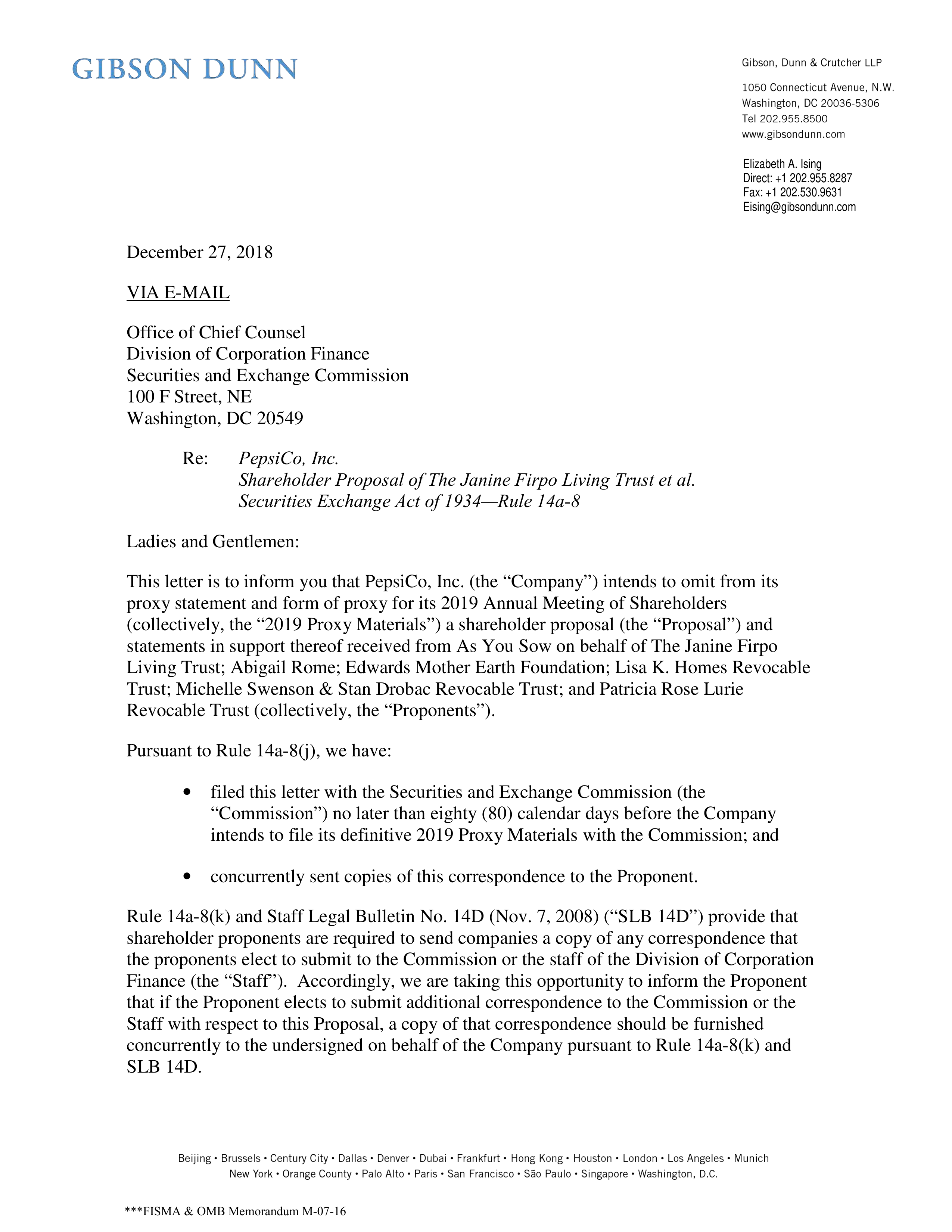
December 27, 2018
VIA E-MAIL
Office of Chief Counsel
Division of Corporation Finance
Securities and Exchange Commission
100 F Street, NE
Washington, DC 20549
Re:
PepsiCo, Inc.
Shareholder Proposal of The Janine Firpo Living Trust et al.
Securities Exchange Act of 1934—Rule 14a-8
Ladies and Gentlemen:
This letter is to inform you that PepsiCo, Inc. (the “Company”) intends to omit from its
proxy statement and form of proxy for its 2019 Annual Meeting of Shareholders
(collectively, the “2019 Proxy Materials”) a shareholder proposal (the “Proposal”) and
statements in support thereof received from As You Sow on behalf of The Janine Firpo
Living Trust; Abigail Rome; Edwards Mother Earth Foundation; Lisa K. Homes Revocable
Trust; Michelle Swenson & Stan Drobac Revocable Trust; and Patricia Rose Lurie
Revocable Trust (collectively, the “Proponents”).
Pursuant to Rule 14a-8(j), we have:
•
filed this letter with the Securities and Exchange Commission (the
“Commission”) no later than eighty (80) calendar days before the Company
intends to file its definitive 2019 Proxy Materials with the Commission; and
•
concurrently sent copies of this correspondence to the Proponent.
Rule 14a-8(k) and Staff Legal Bulletin No. 14D (Nov. 7, 2008) (“SLB 14D”) provide that
shareholder proponents are required to send companies a copy of any correspondence that
the proponents elect to submit to the Commission or the staff of the Division of Corporation
Finance (the “Staff”). Accordingly, we are taking this opportunity to inform the Proponent
that if the Proponent elects to submit additional correspondence to the Commission or the
Staff with respect to this Proposal, a copy of that correspondence should be furnished
concurrently to the undersigned on behalf of the Company pursuant to Rule 14a-8(k) and
SLB 14D.
GIBSON
DUNN
Gibson, Dunn
&
Crutcher
LLP
1050
Co
nn
ecticut Avenue,
N.W.
Wash
in
gton, DC 20036-5306
T
el
202.955.8500
www.gibsondunn.com
Beijing · Bru
sse
ls · Century
City·
Dall
as
·
Den
ve
r·
Dubai·
Fr
ank
furt·
Hong
Kong·
Housto
n·
London
· L
os
Angeles· Munich
Ne
w York· Orange
County·
Palo
Alto·
Pari
s ·
Sa
n
Fr
anci
sco
·
Sao
Paul
o · Singapore·
Was
hington,
D.C.
***FISMA & OMB Memorandum M-07-16

Office of Chief Counsel
Division of Corporation Finance
December 27, 2018
Page 2
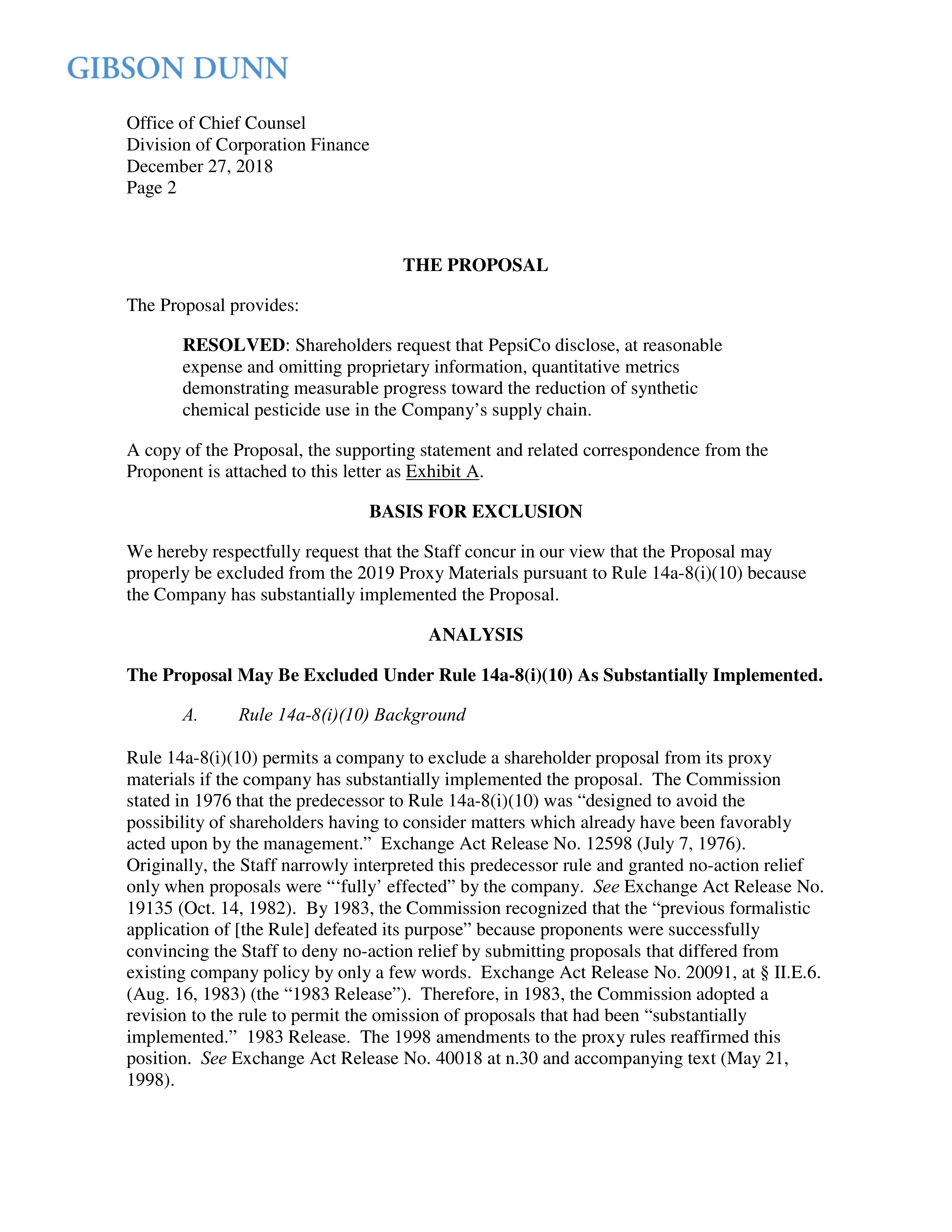
THE PROPOSAL
The Proposal provides:
RESOLVED
: Shareholders request that PepsiCo disclose, at reasonable
expense and omitting proprietary information, quantitative metrics
demonstrating measurable progress toward the reduction of synthetic
chemical pesticide use in the Company’s supply chain.
A copy of the Proposal, the supporting statement and related correspondence from the
Proponent is attached to this letter as Exhibit A.
BASIS FOR EXCLUSION
We hereby respectfully request that the Staff concur in our view that the Proposal may
properly be excluded from the 2019 Proxy Materials pursuant to Rule 14a-8(i)(10) because
the Company has substantially implemented the Proposal.
ANALYSIS
The Proposal May Be Excluded Under Rule 14a-8(i)(10) As Substantially Implemented.
A.
Rule 14a-8(i)(10) Background
Rule 14a-8(i)(10) permits a company to exclude a shareholder proposal from its proxy
materials if the company has substantially implemented the proposal. The Commission
stated in 1976 that the predecessor to Rule 14a-8(i)(10) was “designed to avoid the
possibility of shareholders having to consider matters which already have been favorably
acted upon by the management.” Exchange Act Release No. 12598 (July 7, 1976).
Originally, the Staff narrowly interpreted this predecessor rule and granted no-action relief
only when proposals were “‘fully’ effected” by the company.
See
Exchange Act Release No.
19135 (Oct. 14, 1982). By 1983, the Commission recognized that the “previous formalistic
application of [the Rule] defeated its purpose” because proponents were successfully
convincing the Staff to deny no-action relief by submitting proposals that differed from
existing company policy by only a few words. Exchange Act Release No. 20091, at § II.E.6.
(Aug. 16, 1983) (the “1983 Release”). Therefore, in 1983, the Commission adopted a
revision to the rule to permit the omission of proposals that had been “substantially
implemented.” 1983 Release. The 1998 amendments to the proxy rules reaffirmed this
position.
See
Exchange Act Release No. 40018 at n.30 and accompanying text (May 21,
1998).
GIBSON
DUNN

Office of Chief Counsel
Division of Corporation Finance
December 27, 2018
Page 3
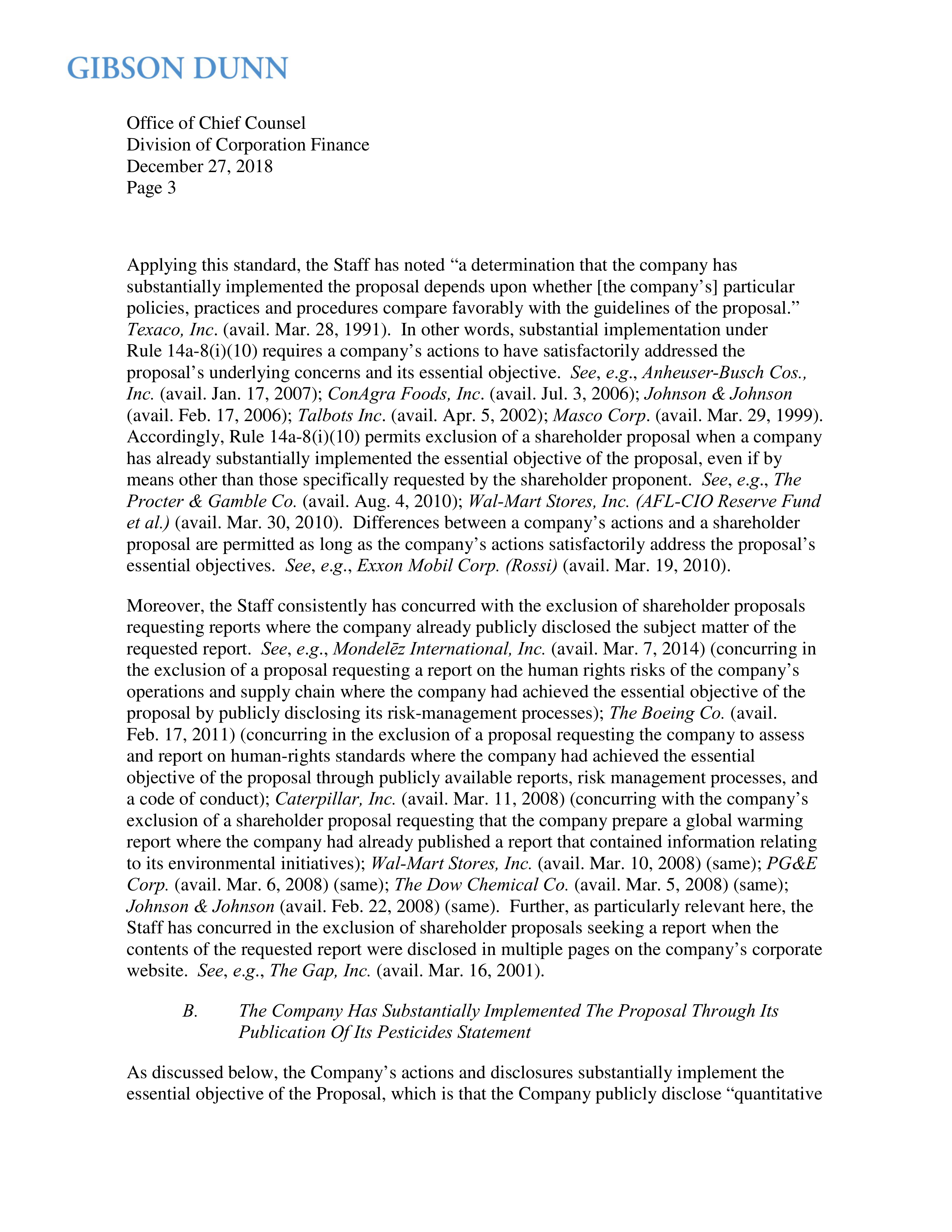
Applying this standard, the Staff has noted “a determination that the company has
substantially implemented the proposal depends upon whether [the company’s] particular
policies, practices and procedures compare favorably with the guidelines of the proposal.”
Texaco, Inc
. (avail. Mar. 28, 1991). In other words, substantial implementation under
Rule 14a-8(i)(10) requires a company’s actions to have satisfactorily addressed the
proposal’s underlying concerns and its essential objective.
See
,
e
.
g
.,
Anheuser-Busch Cos.,
Inc.
(avail. Jan. 17, 2007);
ConAgra Foods, Inc
. (avail. Jul. 3, 2006);
Johnson & Johnson
(avail. Feb. 17, 2006);
Talbots Inc
. (avail. Apr. 5, 2002);
Masco Corp
. (avail. Mar. 29, 1999).
Accordingly, Rule 14a-8(i)(10) permits exclusion of a shareholder proposal when a company
has already substantially implemented the essential objective of the proposal, even if by
means other than those specifically requested by the shareholder proponent.
See
,
e
.
g
.,
The
Procter & Gamble Co.
(avail. Aug. 4, 2010);
Wal-Mart Stores, Inc. (AFL-CIO Reserve Fund
et al.)
(avail. Mar. 30, 2010). Differences between a company’s actions and a shareholder
proposal are permitted as long as the company’s actions satisfactorily address the proposal’s
essential objectives.
See
,
e
.
g
.,
Exxon Mobil Corp. (Rossi)
(avail. Mar. 19, 2010).
Moreover, the Staff consistently has concurred with the exclusion of shareholder proposals
requesting reports where the company already publicly disclosed the subject matter of the
requested report.
See
,
e
.
g
.,
Mondelēz International, Inc.
(avail. Mar. 7, 2014) (concurring in
the exclusion of a proposal requesting a report on the human rights risks of the company’s
operations and supply chain where the company had achieved the essential objective of the
proposal by publicly disclosing its risk-management processes);
The Boeing Co.
(avail.
Feb. 17, 2011) (concurring in the exclusion of a proposal requesting the company to assess
and report on human-rights standards where the company had achieved the essential
objective of the proposal through publicly available reports, risk management processes, and
a code of conduct);
Caterpillar, Inc.
(avail. Mar. 11, 2008) (concurring with the company’s
exclusion of a shareholder proposal requesting that the company prepare a global warming
report where the company had already published a report that contained information relating
to its environmental initiatives);
Wal-Mart Stores, Inc.
(avail. Mar. 10, 2008) (same);
PG&E
Corp.
(avail. Mar. 6, 2008) (same);
The Dow Chemical Co.
(avail. Mar. 5, 2008) (same);
Johnson & Johnson
(avail. Feb. 22, 2008) (same). Further, as particularly relevant here, the
Staff has concurred in the exclusion of shareholder proposals seeking a report when the
contents of the requested report were disclosed in multiple pages on the company’s corporate
website.
See
,
e
.
g
.,
The Gap, Inc.
(avail. Mar. 16, 2001).
B.
The Company Has Substantially Implemented The Proposal Through Its
Publication Of Its Pesticides Statement
As discussed below, the Company’s actions and disclosures substantially implement the
essential objective of the Proposal, which is that the Company publicly disclose “quantitative
GIBSON
DUNN

Office of Chief Counsel
Division of Corporation Finance
December 27, 2018
Page 4
metrics demonstrating measurable progress toward the reduction of synthetic chemical
pesticide use in the Company’s supply chain.”
1.
The Company Has Publicly Described Its Efforts To Reduce The Use
Of Pesticides
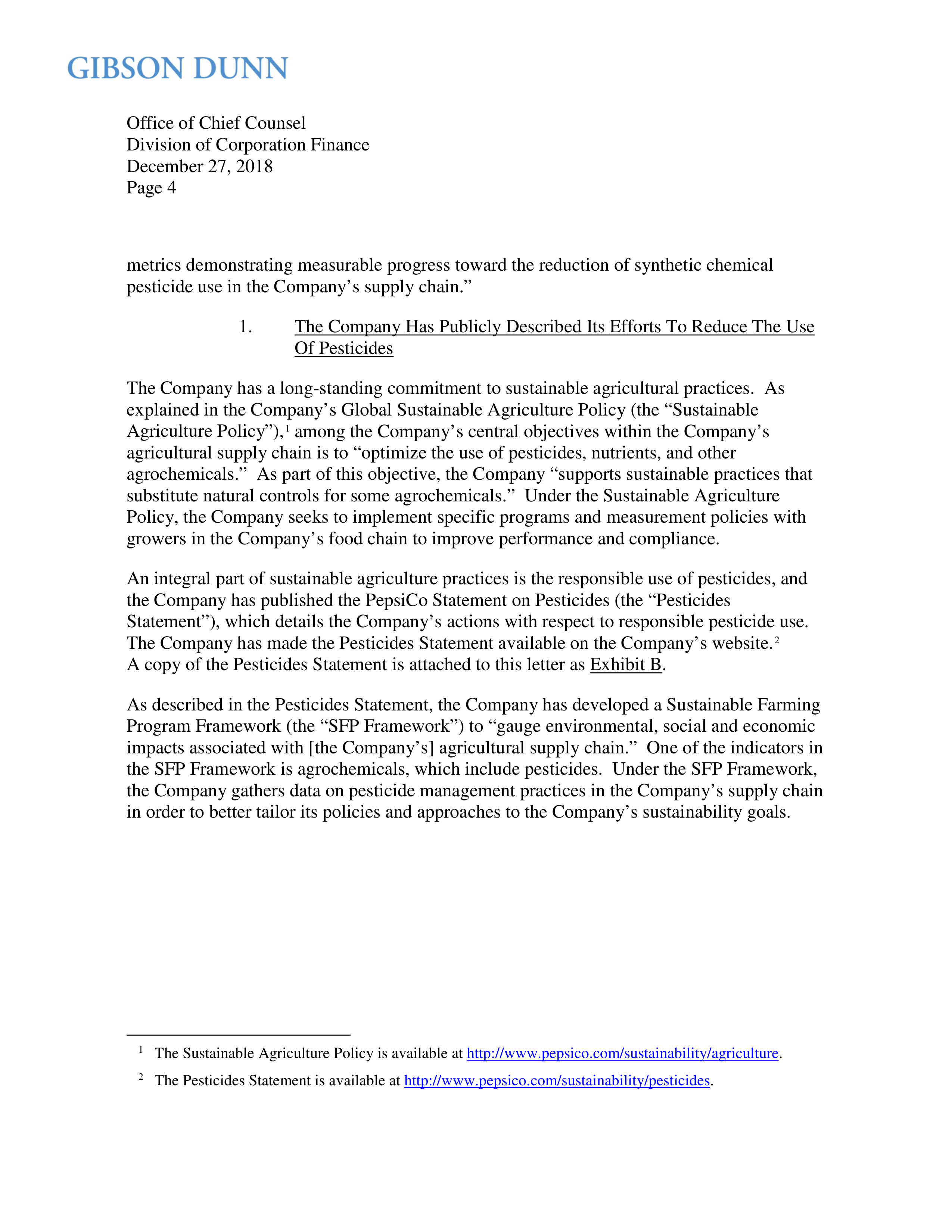
The Company has a long-standing commitment to sustainable agricultural practices. As
explained in the Company’s Global Sustainable Agriculture Policy (the “Sustainable
Agriculture Policy”),
1
among the Company’s central objectives within the Company’s
agricultural supply chain is to “optimize the use of pesticides, nutrients, and other
agrochemicals.” As part of this objective, the Company “supports sustainable practices that
substitute natural controls for some agrochemicals.” Under the Sustainable Agriculture
Policy, the Company seeks to implement specific programs and measurement policies with
growers in the Company’s food chain to improve performance and compliance.
An integral part of sustainable agriculture practices is the responsible use of pesticides, and
the Company has published the PepsiCo Statement on Pesticides (the “Pesticides
Statement”), which details the Company’s actions with respect to responsible pesticide use.
The Company has made the Pesticides Statement available on the Company’s website.
2
A copy of the Pesticides Statement is attached to this letter as Exhibit B.
As described in the Pesticides Statement, the Company has developed a Sustainable Farming
Program Framework (the “SFP Framework”) to “gauge environmental, social and economic
impacts associated with [the Company’s] agricultural supply chain.” One of the indicators in
the SFP Framework is agrochemicals, which include pesticides. Under the SFP Framework,
the Company gathers data on pesticide management practices in the Company’s supply chain
in order to better tailor its policies and approaches to the Company’s sustainability goals.
1
The Sustainable Agriculture Policy is available at
http://www.pepsico.com/sustainability/agriculture
.
2
The Pesticides Statement is available at
http://www.pepsico.com/sustainability/pesticides
.
GIBSON
DUNN

Office of Chief Counsel
Division of Corporation Finance
December 27, 2018
Page 5
2.
The Pesticides Statement Discloses A Quantitative Metric That
Demonstrates The Company Has Made Measurable Progress In Its
Efforts To Reduce The Use Of Pesticides In Its Supply Chain
As explained in the Pesticides Statement, under the SFP Framework, the Company gathers
information on pesticide management practices, “including measures to support safe, legal
and responsible use while minimizing agrochemical application through practices such as
Integrated Pest Management (IPM).” IPM is designed to “reduce or minimize risks to
human health and the environment” from the use of pesticides,
3
and the Company relies on
IPM as “an important tool for advancing” the sustainable protection of crops against pests.
As requested by the Proposal, the Pesticides Statement specifically discloses the quantitative
metric used by the Company to measure its progress in reducing the use of pesticides in its
supply chain. The Company uses IPM to “obtain data and improved visibility into [the
Company’s] agricultural supply chains” in furtherance of the goals under the SFP
Framework. As the Company explains in the Pesticides Statement, while the impact of IPM
varies according to a complex set of factors, “IPM helps reduce the amount of pesticides
used.” In light of its utility to affect pesticide use, the Company tracks compliance with the
Company’s IPM requirement in part to measure its progress in reducing the use of pesticides.
As further requested by the Proposal, the Pesticides Statement demonstrates the Company’s
progress in reducing pesticide use in the Company’s supply chain. Specifically, as noted in
the Pesticides Statement, in 2018, growers in the Company’s supply chain improved their
IPM compliance “from 55% to 66% globally, including nearly 100% compliance in the U.S.”
Because use of IPM “helps reduce the amount of pesticides used,” this increased IPM
compliance demonstrates that the Company has made measurable progress in “minimizing
agrochemical application” resulting in decreased use of pesticides. As further disclosed in
the Pesticides Statement, the Company intends to continue to rely on measuring IPM “to
ensure that growers are employing the right practices,” which will lead to further progress in
the Company’s efforts to reduce the use of pesticides by the growers in the Company’s
supply chain.
4
Thus, as in
Mondelēz
,
Boeing
,
Caterpillar
and the other precedent cited above, the Company
has already addressed the essential objectives of the Proposal. Through the Pesticides
3
Pesticides Statement quoting the U.N. Food and Agriculture Organization.
4
While the Supporting Statement mentions additional disclosures, we note that the Proposal only
“recommend[s]” that such information be disclosed. Thus, the Company need not address those
recommendations in order to substantially implement the Proposal under Rule 14a-8(i)(10).
GIBSON
DUNN

Office of Chief Counsel
Division of Corporation Finance
December 27, 2018
Page 6
Statement, the Company has, as requested by the Proposal, disclosed that it tracks a
quantitative metric—the use of IPM by the growers in the Company’s supply chain as part of
its SFP Framework—and, by disclosing that IPM use has increased by 11%, demonstrated
that the Company has made measurable progress toward reducing pesticide use in its supply
chain. Accordingly, the Company has substantially implemented the Proposal, and it may be
excluded from the 2019 Proxy Materials in reliance on Rule 14a-8(i)(10).
CONCLUSION
Based upon the foregoing analysis, we respectfully request that the Staff concur that it will
take no action if the Company excludes the Proposal from its 2019 Proxy Materials.
We would be happy to provide you with any additional information and answer any
questions that you may have regarding this subject. Correspondence regarding this letter
should be sent to shareholderproposals@gibsondunn.com. If we can be of any further
assistance in this matter, please do not hesitate to call me at (202) 955-8287 or Eunice Yang,
the Company’s Senior Counsel, Corporate Governance, at (914) 253-2135.
Sincerely,
Elizabeth A. Ising
Enclosures
cc:
Eunice Yang, Senior Counsel, Corporate Governance, PepsiCo, Inc.
Christy Spees, As You Sow
GIBSON
DUNN

EXHIBIT
A
GIBSON
DUNN
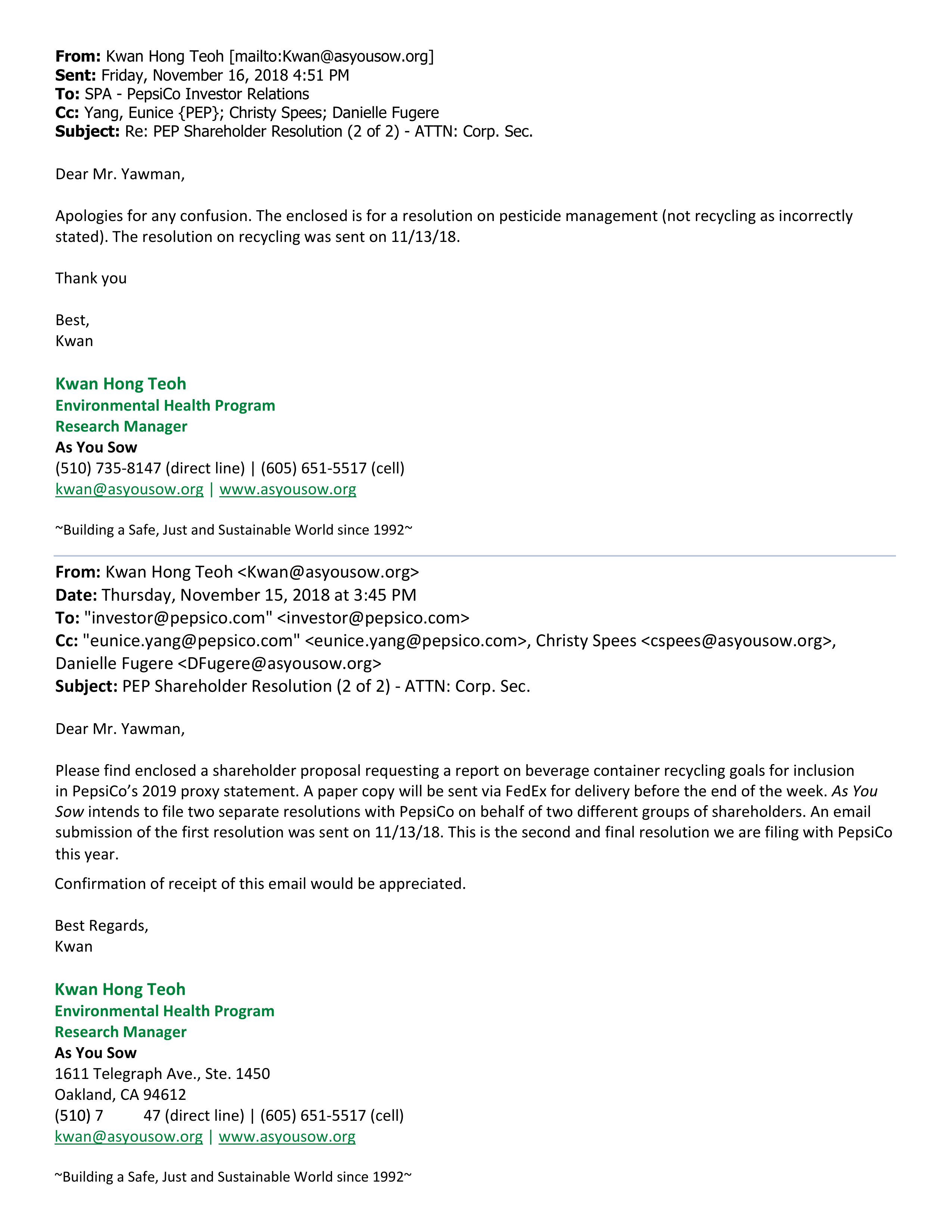
From:
Kwan Hong Teoh [mailto:Kwan@asyousow.org]
Sent:
Friday, November 16, 2018 4:51 PM
To:
SPA - PepsiCo Investor Relations
Cc:
Yang, Eunice {PEP}; Christy Spees; Danielle Fugere
Subject:
Re: PEP Shareholder Resolution (2 of 2) - ATTN: Corp. Sec.
Dear Mr. Yawman,
Apologies for any confusion. The enclosed is for a resolution on pesticide management (not recycling as incorrectly
stated). The resolution on recycling was sent on 11/13/18.
Thank you
Best,
Kwan
Kwan Hong Teoh
Environmental Health Program
Research Manager
As You Sow
(510) 735‐8147 (direct line) | (605) 651‐5517 (cell)
kwan@asyousow.org | www.asyousow.org
~Building a Safe, Just and Sustainable World since 1992~
From:
Kwan Hong Teoh
Date:
Thursday, November 15, 2018 at 3:45 PM
To:
"investor@pepsico.com"
Cc:
"eunice.yang@pepsico.com" , Christy Spees ,
Danielle Fugere
Subject:
PEP Shareholder Resolution (2 of 2) ‐ ATTN: Corp. Sec.
Dear Mr. Yawman,
Please find enclosed a shareholder proposal requesting a report on beverage container recycling goals for inclusion
in PepsiCo’s 2019 proxy statement. A paper copy will be sent via FedEx for delivery before the end of the week.
As You
Sow
intends to file two separate resolutions with PepsiCo on behalf of two different groups of shareholders. An email
submission of the first resolution was sent on 11/13/18. This is the second and final resolution we are filing with PepsiCo
this year.
Confirmation of receipt of this email would be appreciated.
Best Regards,
Kwan
Kwan Hong Teoh
Environmental Health Program
Research Manager
As You Sow
1611 Telegraph Ave., Ste. 1450
Oakland, CA 94612
(510)
510) 7
47 (direct line) | (605) 651‐5517 (cell)
kwan@asyousow.org | www.asyousow.org
~Building a Safe, Just and Sustainable World since 1992~

1611 Telegraph Ave, Suite 1450
www.asyousow.org
Oakland, CA 94612
BUILDING A SAFE, JUST, AND SUSTAINABLE WORLD SINCE 1992
VIA EMAIL and FEDEX
November 14, 2018
Dave Yawman
Vice President, Government Affairs,
General Counsel, and Corporate Secretary
PepsiCo, Inc.
700 Anderson Hill Road
Purchase, New York 10577
RE: Shareholder Proposal – Disclosure of Pesticide Management Data
Dear Mr. Yawman:
As You Sow
is filing a shareholder proposal on the Disclosure of Pesticide Management Data and on
behalf of The Janine Firpo Living Trust (“Proponent”), a shareholder of PepsiCo, Inc., for action at the
next annual meeting of PepsiCo. Proponent submits the enclosed shareholder proposal for inclusion in
PepsiCo’s 2019 proxy statement, for consideration by shareholders, in accordance with Rule 14a-8 of
the General Rules and Regulations of the Securities Exchange Act of 1934.
A letter from the Proponent authorizing
As You Sow
to act on its behalf is enclosed. A representative of
the Proponent will attend the stockholders’ meeting to move the resolution as required.
We are available to discuss this issue and are optimistic that such discussion could result in resolution of
the Proponent’s concerns. To schedule a dialogue, please contact Chrisy Spees, Environmental Health
Program Manager at cspees@asyousow.org.
Sincerely,
Christy Spees
Environmental Health Program Manager
Enclosures
•
Shareholder Proposal
•
Shareholder Authorization
•
AS
YOU
SOW
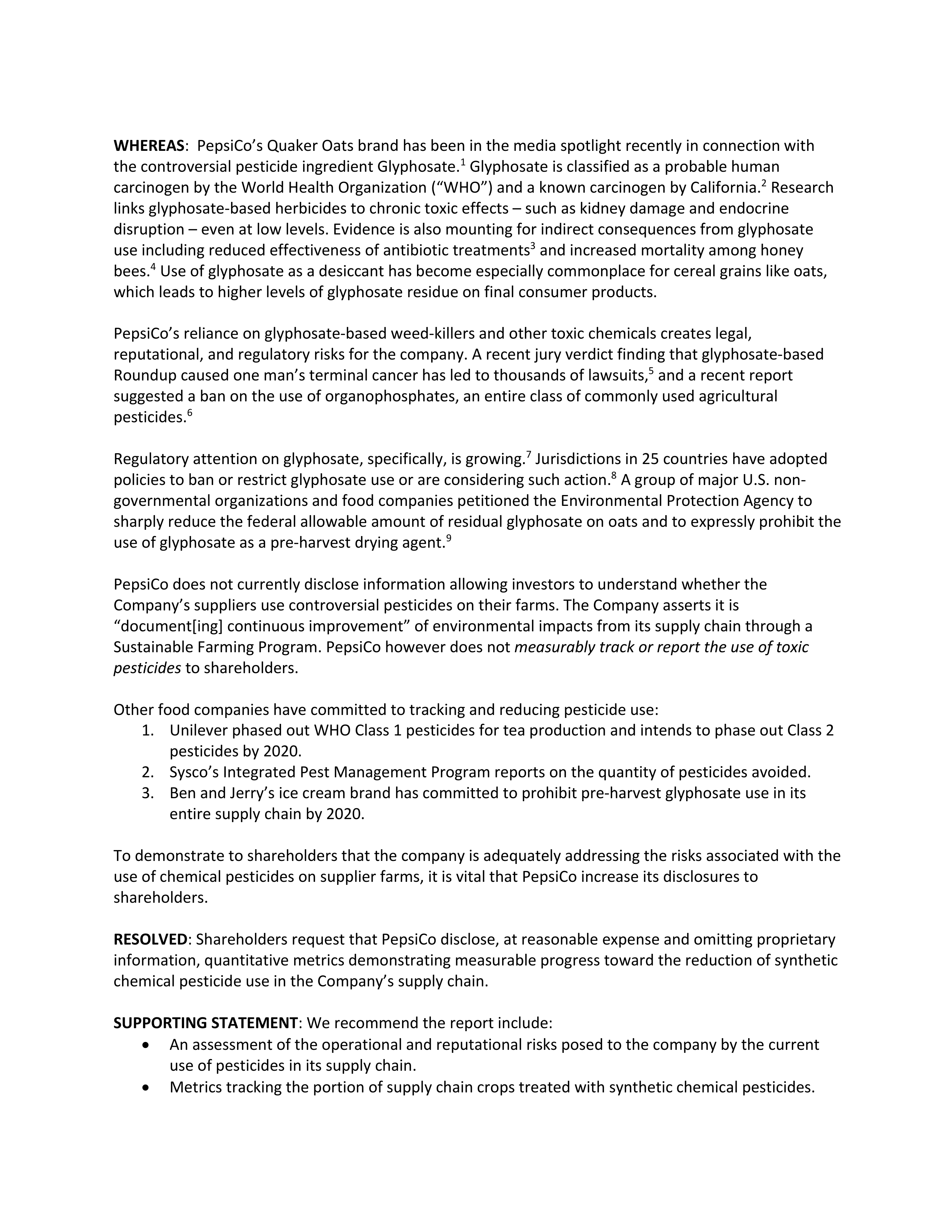
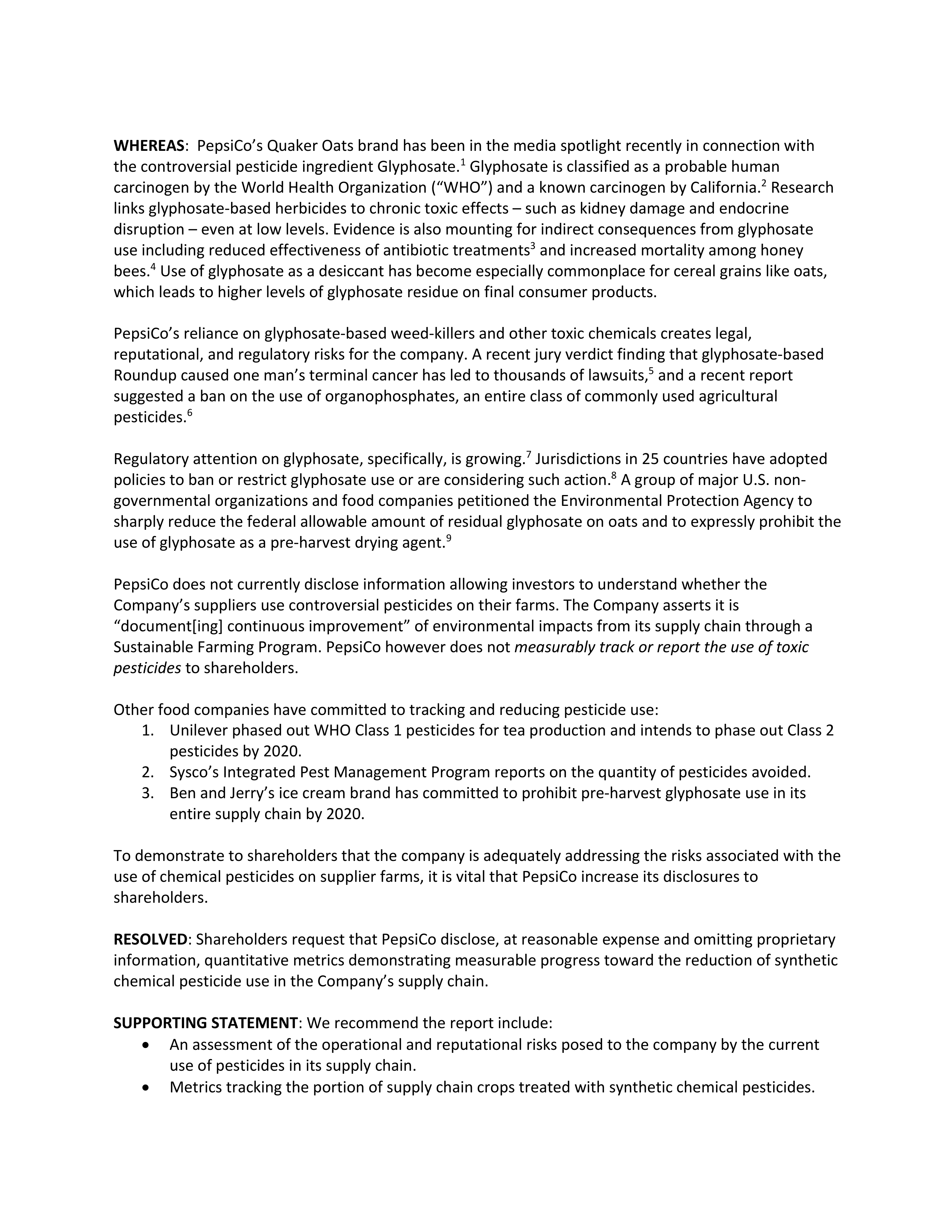
WHEREAS
: PepsiCo’s Quaker Oats brand has been in the media spotlight recently in connection with
the controversial pesticide ingredient Glyphosate.
1
Glyphosate is classified as a probable human
carcinogen by the World Health Organization (“WHO”) and a known carcinogen by California.
2
Research
links glyphosate-based herbicides to chronic toxic effects – such as kidney damage and endocrine
disruption – even at low levels. Evidence is also mounting for indirect consequences from glyphosate
use including reduced effectiveness of antibiotic treatments
3
and increased mortality among honey
bees.
4
Use of glyphosate as a desiccant has become especially commonplace for cereal grains like oats,
which leads to higher levels of glyphosate residue on final consumer products.
PepsiCo’s reliance on glyphosate-based weed-killers and other toxic chemicals creates legal,
reputational, and regulatory risks for the company. A recent jury verdict finding that glyphosate-based
Roundup caused one man’s terminal cancer has led to thousands of lawsuits,
5
and a recent report
suggested a ban on the use of organophosphates, an entire class of commonly used agricultural
pesticides.
6
Regulatory attention on glyphosate, specifically, is growing.
7
Jurisdictions in 25 countries have adopted
policies to ban or restrict glyphosate use or are considering such action.
8
A group of major U.S. non-
governmental organizations and food companies petitioned the Environmental Protection Agency to
sharply reduce the federal allowable amount of residual glyphosate on oats and to expressly prohibit the
use of glyphosate as a pre-harvest drying agent.
9
PepsiCo does not currently disclose information allowing investors to understand whether the
Company’s suppliers use controversial pesticides on their farms. The Company asserts it is
“document[ing] continuous improvement” of environmental impacts from its supply chain through a
Sustainable Farming Program. PepsiCo however does not
measurably track or report the use of toxic
pesticides
to shareholders.
Other food companies have committed to tracking and reducing pesticide use:
1.
Unilever phased out WHO Class 1 pesticides for tea production and intends to phase out Class 2
pesticides by 2020.
2.
Sysco’s Integrated Pest Management Program reports on the quantity of pesticides avoided.
3.
Ben and Jerry’s ice cream brand has committed to prohibit pre-harvest glyphosate use in its
entire supply chain by 2020.
To demonstrate to shareholders that the company is adequately addressing the risks associated with the
use of chemical pesticides on supplier farms, it is vital that PepsiCo increase its disclosures to
shareholders.
RESOLVED
: Shareholders request that PepsiCo disclose, at reasonable expense and omitting proprietary
information, quantitative metrics demonstrating measurable progress toward the reduction of synthetic
chemical pesticide use in the Company’s supply chain.
SUPPORTING STATEMENT
: We recommend the report include:
•
An assessment of the operational and reputational risks posed to the company by the current
use of pesticides in its supply chain.
•
Metrics tracking the portion of supply chain crops treated with synthetic chemical pesticides.
•
Metrics demonstrating success in increasing the portion of supply chain crops grown with
integrated pest management practices
1
https://www.nytimes.com/2018/08/15/health/herbicide-glyphosate-cereal-oatmeal-children.html
2
https://oehha.ca.gov/proposition-65/crnr/glyphosate-listed-effective-july-7-2017-known-state-california-cause-
cancer
3
https://www.newsweek.com/antibiotic-resistance-occurs-100000-faster-herbicides-1168034
4
https://www.nrdc.org/sites/default/files/bees.pdf
5
https://www.npr.org/2018/08/10/637722786/jury-awards-terminally-ill-man-289-million-in-lawsuit-against-
monsanto
6
https://www.theguardian.com/environment/2018/oct/24/entire-pesticide-class-should-be-banned-for-effect-on-
childrens-health
7
https://www.ncbi.nlm.nih.gov/pmc/articles/PMC5484035/pdf/jech-2016-208463.pdf
8
https://www.baumhedlundlaw.com/toxic-tort-law/monsanto-roundup-lawsuit/where-is-glyphosate-banned/
9
https://cdn3.ewg.org/sites/default/files/Glyphosate%20Petition%20Final%20.pdf?_ga=2.149341110.1808919085.
1539882425-1374321464.1536083250
Andrew Behar
CEO
As You Sow Foundation
1611 Telegraph Ave., Ste. 1450
Oakland, CA 94612
Re: Authorization to File Shareholder Resolution
Dear Andrew Behar,
As of the date of this letter, the undersigned authorizes As You Sow (AYS) file, cofile, or endorse the
shareholder resolution identified below on Stockholder’s behalf with the identified company, and that it
be included in the proxy statement as specified below, in accordance with Rule 14-a8 of the General
Rules and Regulations of the Securities and Exchange Act of 1934.
The Stockholder:
Company:
Annual Meeting/Proxy Statement Year:
Resolution:
Background information re: AYS Campaign:
The Stockholder has continuously owned over $2,000 worth of company stock, with voting rights, for
over a year. The Stockholder intends to hold the required amount of stock through the date of the
company’s annual meeting in .
The Stockholder gives As You Sow the authority to deal on the Stockholder’s behalf with any and al
l
aspects of the shareholder resolution, including designating another entity as lead filer and
representative of the shareholder. The Stockholder understands that the Stockholder’s name may
appear on the company’s proxy statement as the filer of the afore
mentioned resolution, and that the
media may mention the Stockholder’s name related to the resolution.
Sincerely,
_______________________
DocuSign Envelope ID: 6A027BAB-C006-447E-BB62-4818607F591E
!
$
%
)'(+
)'(+
""!!"#"#"#
('")+")'(*
Q
DocuSigned
by:
9-~e,,~
6F3787F5D5A64BB ...

1611 Telegraph Ave, Suite 1450
www.asyousow.org
Oakland, CA 94612
BUILDING A SAFE, JUST, AND SUSTAINABLE WORLD SINCE 1992
VIA EMAIL and FEDEX
November 14, 2018
Dave Yawman
Vice President, Government Affairs,
General Counsel, and Corporate Secretary
PepsiCo, Inc.
700 Anderson Hill Road
Purchase, New York 10577
RE: Shareholder Proposal – Disclosure of Pesticide Management Data
Dear Mr. Yawman:
As You Sow
is co-filing a shareholder proposal on behalf of the following PepsiCo, Inc. shareholders for
action at the next annual meeting of PepsiCo:
•
Abigail Rome
•
Edwards Mother Earth Foundation
•
Lisa K Holmes Revocable Trust
•
Michelle Swenson & Stan Drobac Revocable Trust
•
Patricia Rose Lurie Revocable Trust
The Proponent has submitted the enclosed shareholder proposal for inclusion in the 2019 proxy
statement, for consideration by shareholders, in accordance with Rule 14a-8 of the General Rules and
Regulations of the Securities Exchange Act of 1934.
Please note that
As You Sow
also represents the lead filer of this proposal, The Janine Firpo Living Trust.
Letters authorizing
As You Sow
to act on co-filers’ behalf are enclosed. A representative of the lead filer
will attend the stockholders’ meeting to move the resolution as required.
Sincerely,
Christy Spees
Environmental Health Program Manager
Enclosures
•
Shareholder Proposal
•
Shareholder Authorizations
•
AS
YOU
SOW
WHEREAS
: PepsiCo’s Quaker Oats brand has been in the media spotlight recently in connection with
the controversial pesticide ingredient Glyphosate.
1
Glyphosate is classified as a probable human
carcinogen by the World Health Organization (“WHO”) and a known carcinogen by California.
2
Research
links glyphosate-based herbicides to chronic toxic effects – such as kidney damage and endocrine
disruption – even at low levels. Evidence is also mounting for indirect consequences from glyphosate
use including reduced effectiveness of antibiotic treatments
3
and increased mortality among honey
bees.
4
Use of glyphosate as a desiccant has become especially commonplace for cereal grains like oats,
which leads to higher levels of glyphosate residue on final consumer products.
PepsiCo’s reliance on glyphosate-based weed-killers and other toxic chemicals creates legal,
reputational, and regulatory risks for the company. A recent jury verdict finding that glyphosate-based
Roundup caused one man’s terminal cancer has led to thousands of lawsuits,
5
and a recent report
suggested a ban on the use of organophosphates, an entire class of commonly used agricultural
pesticides.
6
Regulatory attention on glyphosate, specifically, is growing.
7
Jurisdictions in 25 countries have adopted
policies to ban or restrict glyphosate use or are considering such action.
8
A group of major U.S. non-
governmental organizations and food companies petitioned the Environmental Protection Agency to
sharply reduce the federal allowable amount of residual glyphosate on oats and to expressly prohibit the
use of glyphosate as a pre-harvest drying agent.
9
PepsiCo does not currently disclose information allowing investors to understand whether the
Company’s suppliers use controversial pesticides on their farms. The Company asserts it is
“document[ing] continuous improvement” of environmental impacts from its supply chain through a
Sustainable Farming Program. PepsiCo however does not
measurably track or report the use of toxic
pesticides
to shareholders.
Other food companies have committed to tracking and reducing pesticide use:
1.
Unilever phased out WHO Class 1 pesticides for tea production and intends to phase out Class 2
pesticides by 2020.
2.
Sysco’s Integrated Pest Management Program reports on the quantity of pesticides avoided.
3.
Ben and Jerry’s ice cream brand has committed to prohibit pre-harvest glyphosate use in its
entire supply chain by 2020.
To demonstrate to shareholders that the company is adequately addressing the risks associated with the
use of chemical pesticides on supplier farms, it is vital that PepsiCo increase its disclosures to
shareholders.
RESOLVED
: Shareholders request that PepsiCo disclose, at reasonable expense and omitting proprietary
information, quantitative metrics demonstrating measurable progress toward the reduction of synthetic
chemical pesticide use in the Company’s supply chain.
SUPPORTING STATEMENT
: We recommend the report include:
•
An assessment of the operational and reputational risks posed to the company by the current
use of pesticides in its supply chain.
•
Metrics tracking the portion of supply chain crops treated with synthetic chemical pesticides.
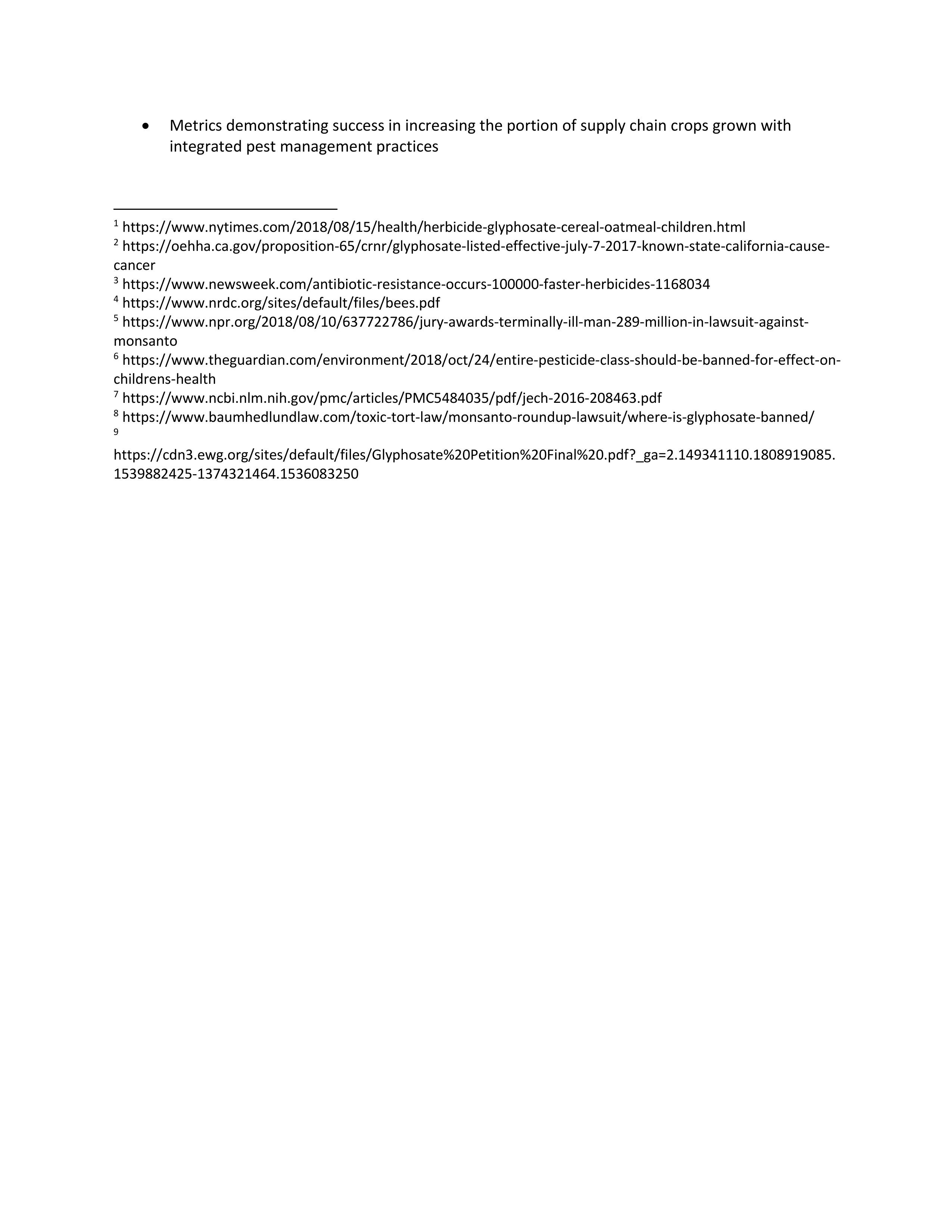
•
Metrics demonstrating success in increasing the portion of supply chain crops grown with
integrated pest management practices
1
https://www.nytimes.com/2018/08/15/health/herbicide-glyphosate-cereal-oatmeal-children.html
2
https://oehha.ca.gov/proposition-65/crnr/glyphosate-listed-effective-july-7-2017-known-state-california-cause-
cancer
3
https://www.newsweek.com/antibiotic-resistance-occurs-100000-faster-herbicides-1168034
4
https://www.nrdc.org/sites/default/files/bees.pdf
5
https://www.npr.org/2018/08/10/637722786/jury-awards-terminally-ill-man-289-million-in-lawsuit-against-
monsanto
6
https://www.theguardian.com/environment/2018/oct/24/entire-pesticide-class-should-be-banned-for-effect-on-
childrens-health
7
https://www.ncbi.nlm.nih.gov/pmc/articles/PMC5484035/pdf/jech-2016-208463.pdf
8
https://www.baumhedlundlaw.com/toxic-tort-law/monsanto-roundup-lawsuit/where-is-glyphosate-banned/
9
https://cdn3.ewg.org/sites/default/files/Glyphosate%20Petition%20Final%20.pdf?_ga=2.149341110.1808919085.
1539882425-1374321464.1536083250
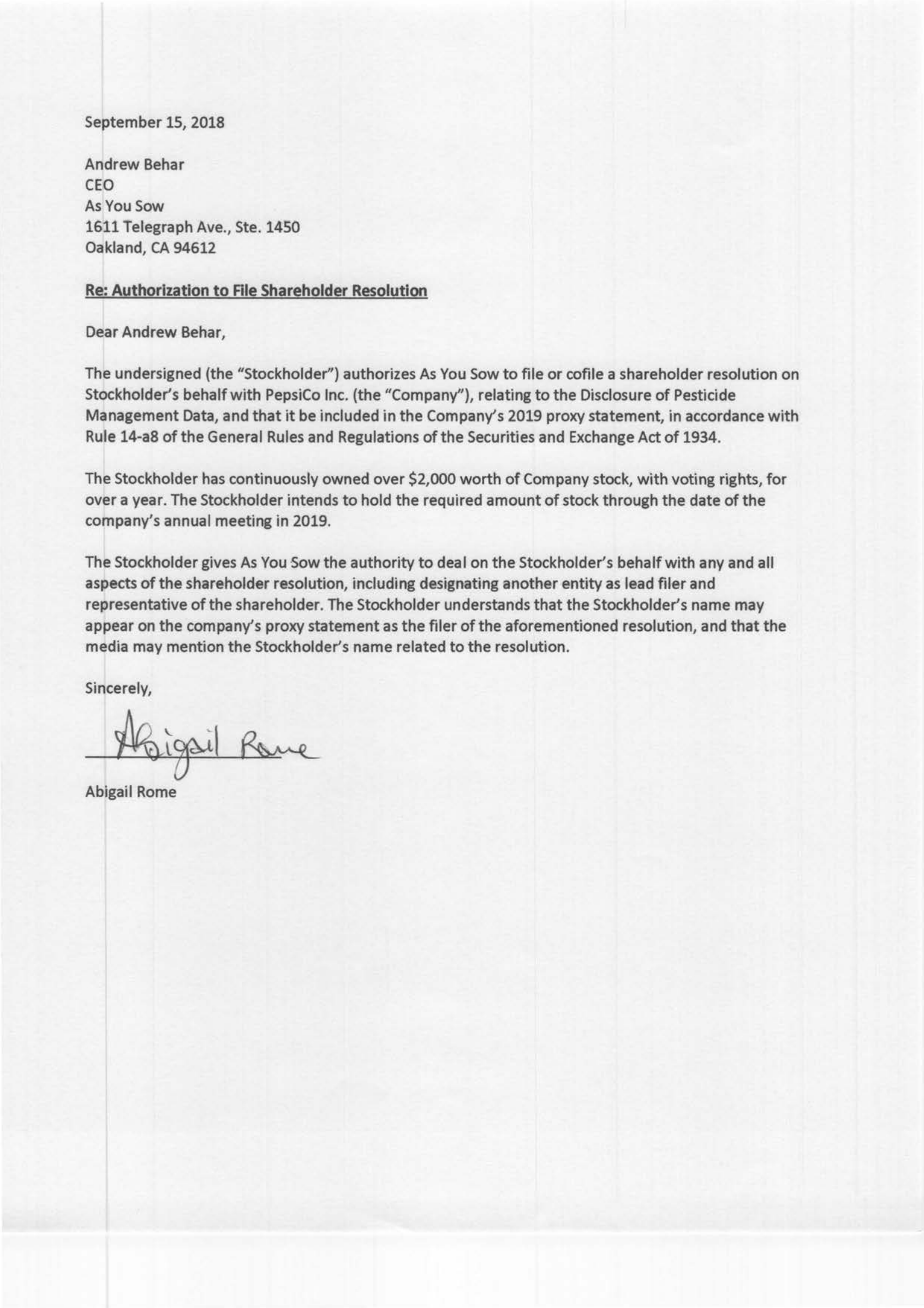
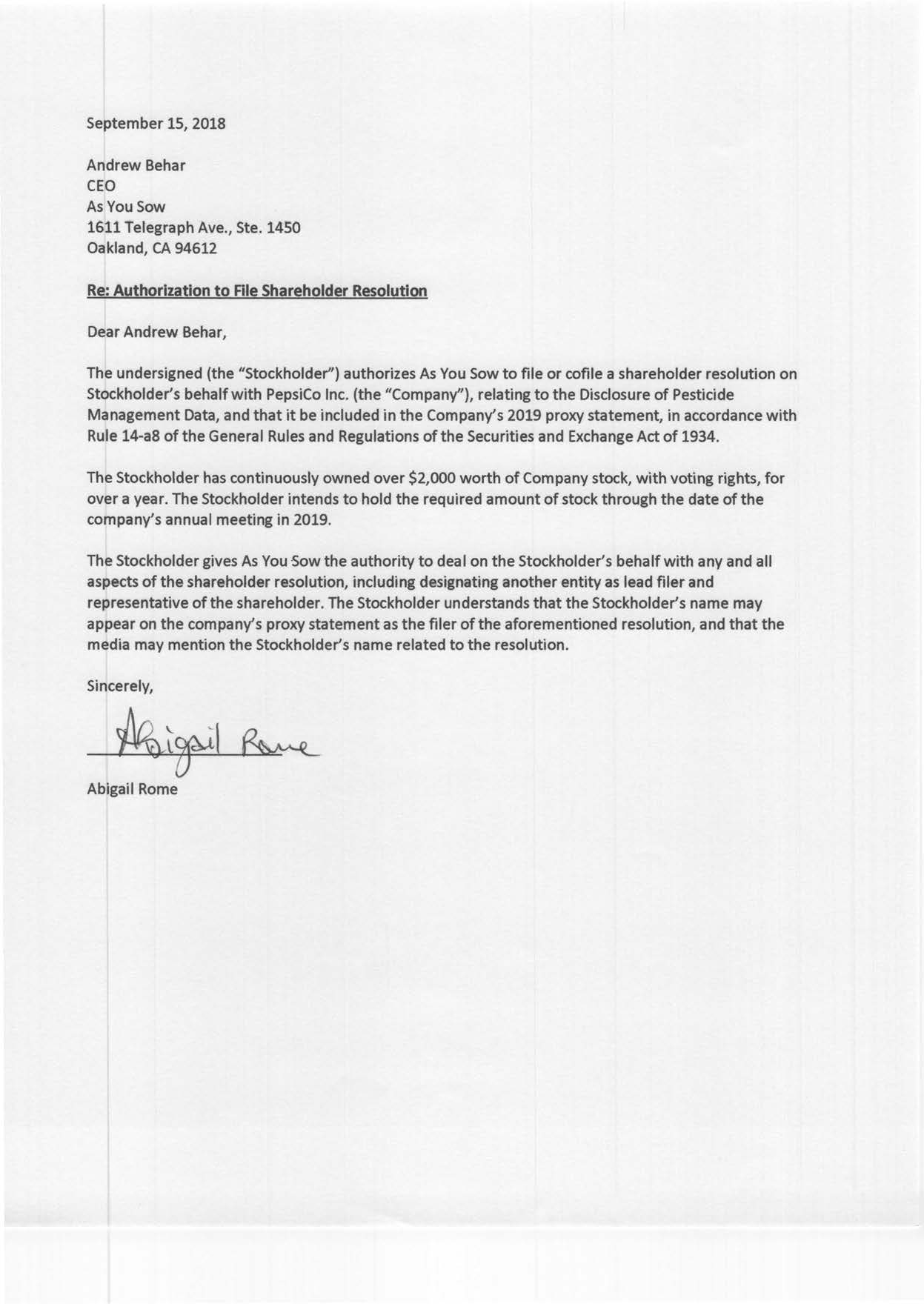
September 15, 2018
Andrew Behar
CEO
As
You
Sow
1611 Telegraph Ave.,
Ste.
1450
Oakland,
CA
94612
Re:
Authorization
to
Ale
Shareholder
Resolution
Dear Andrew Behar,
The undersigned (the "Stockholder'') authorizes
As
You
Sow
to
file
or
cofile a shareholder resolution on
Stockholder's behalf
with
PepsiCo
Inc.
(the "Company"), relating
to
the Disclosure
of
Pesticide
Management Data, and
that
it
be included in the Company's 2019 proxy statement, in accordance
with
Rule
14-aS
of
the
General
Rules
and Regulations
of
the Securities and Exchange Act
of
1934.
The Stockholder
has
continuously owned over $2,000
worth
of
Company stock,
with
voting rights,
for
over a year. The Stockholder intends
to
hold the required amount
of
stock through the date
of
the
company's annual meeting in 2019.
The Stockholder gives
As
You
Sow the authority
to
deal on
the
Stockholder's behalf
with
any and all
aspects
of
the
shareholder resolution, including designating another
entity
as
lead filer and
representative
of
the shareholder. The Stockholder understands
that
the Stockholder's name may
appear on the company's proxy statement
as
the
filer
of
the aforementioned resolution, and
that
the
media may mention
the
Stockholder's name related
to
the
resolution.
Sincerely,
Abigail
Rome
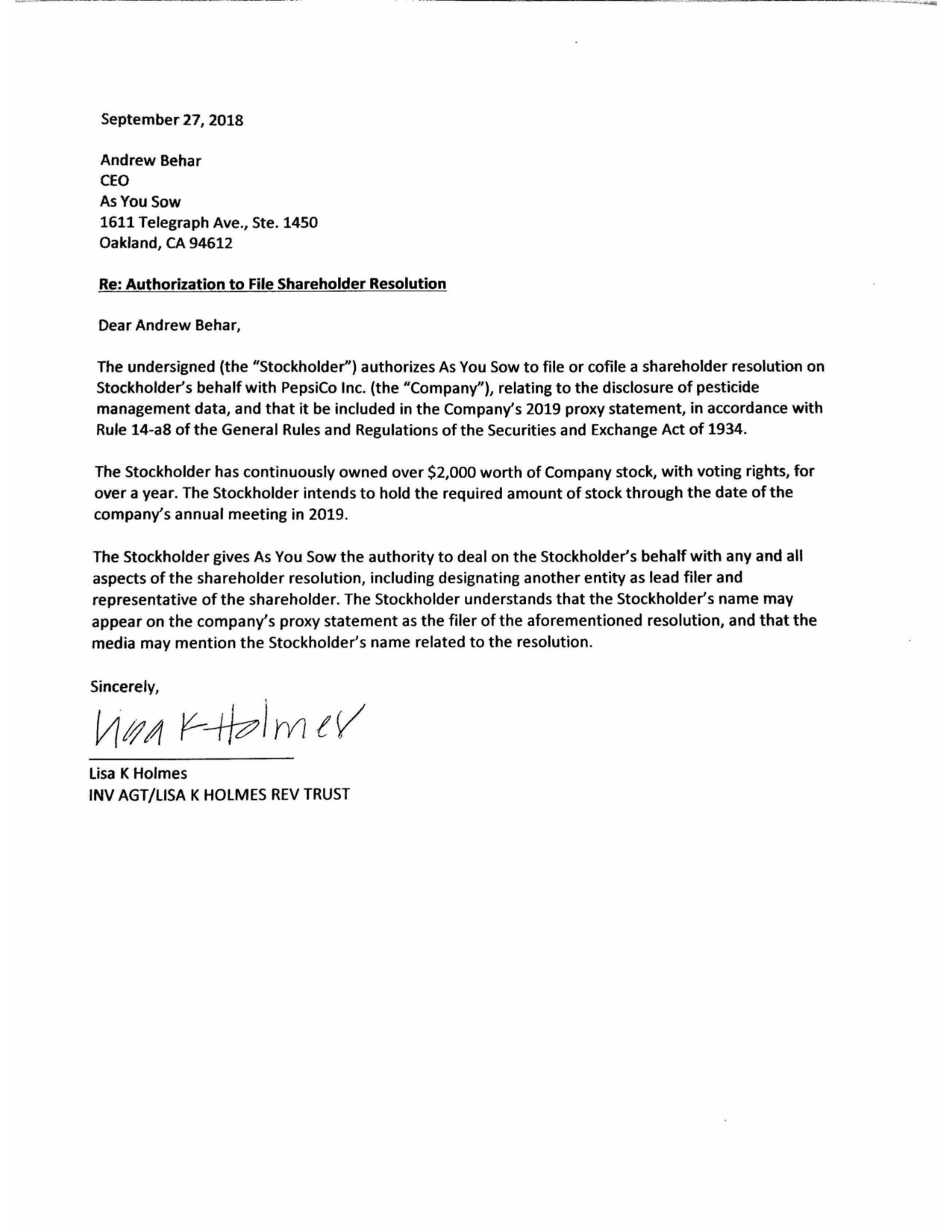
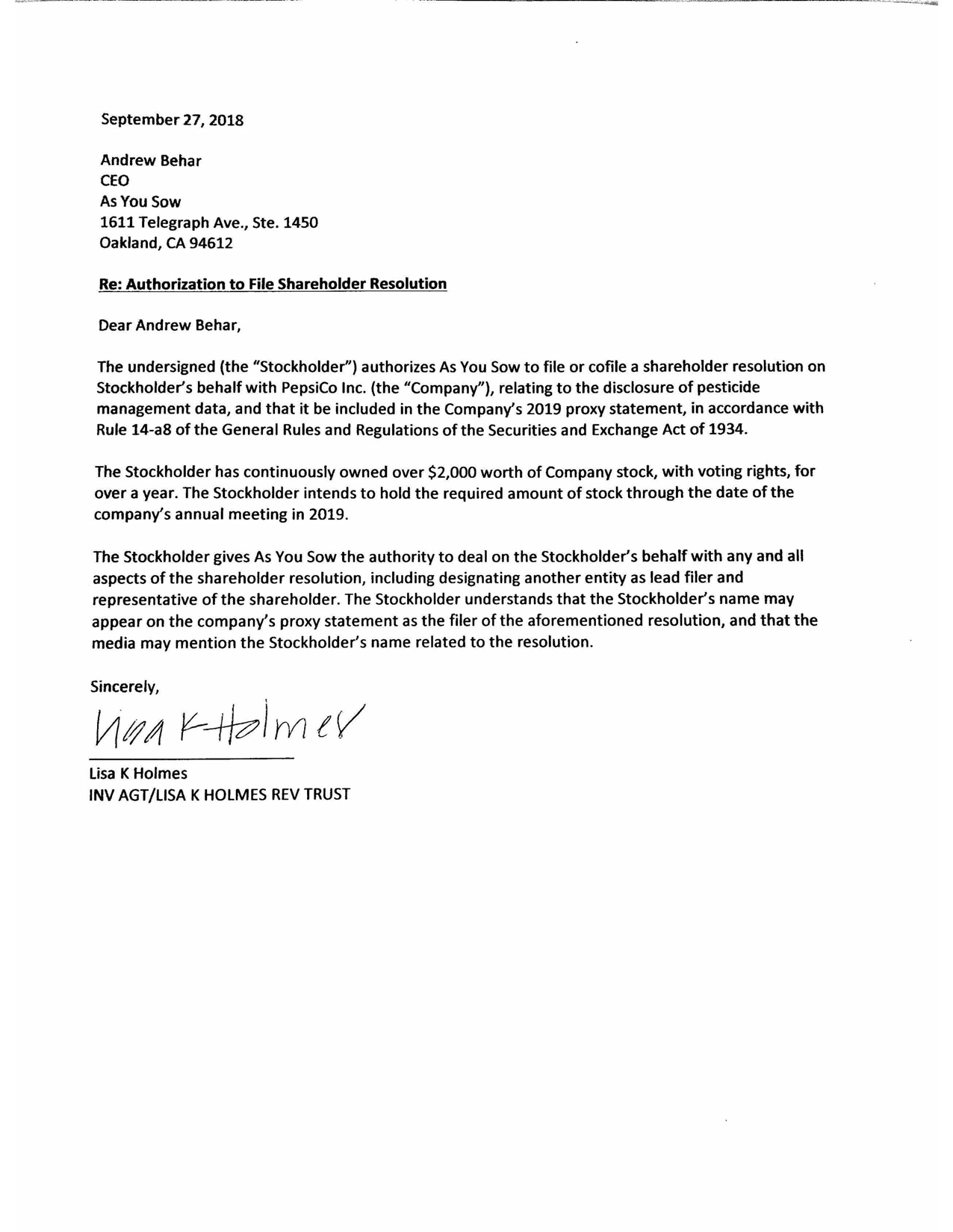
September 27, 2018
Andrew Behar
CEO
As
You Sow
1611 Telegraph Ave., Ste. 1450
Oakland,
CA
94612
Re:
Authorization
to
File Shareholder Resolution
Dear Andrew Behar,
The undersigned (the "Stockholder") authorizes
As
You
Sow
to
file
or
cofile a shareholder resolution on
Stockholder's behalf
with
PepsiCo Inc. (the "Company"), relating
to
the
disclosure
of
pesticide
management data, and
that
it
be included in
the
Company's 2019 proxy statement, in accordance
with
Rule
14-a8
of
the
General Rules and Regulations
of
the
Securities and Exchange Act
of
1934.
The Stockholder has continuously owned over $2,000
worth
of
Company stock,
with
voting rights,
for
over a year. The Stockholder intends
to
hold
the
required
amount
of
stock
through
the
date
of
the
company's annual meeting in 2019.
The Stockholder gives
As
You Sow
the
authority
to
deal on
the
Stockholder's
behalf
with
any and all
aspects
of
the
shareholder resolution, including designating another
entity
as
lead
filer
and
representative
of
the
shareholder. The Stockholder understands
that
the
Stockholder's name may
appear on
the
company's proxy
statement
as
the
filer
of
the
aforementioned resolution, and
that
the
media may
mention
the
Stockholder's name related
to
the
resolution.
Sincerely,
/;1f!1t
r---Hz?i
m
tV
Lisa
K Holmes
INV AGT/LISA K HOLMES
REV
TRUST
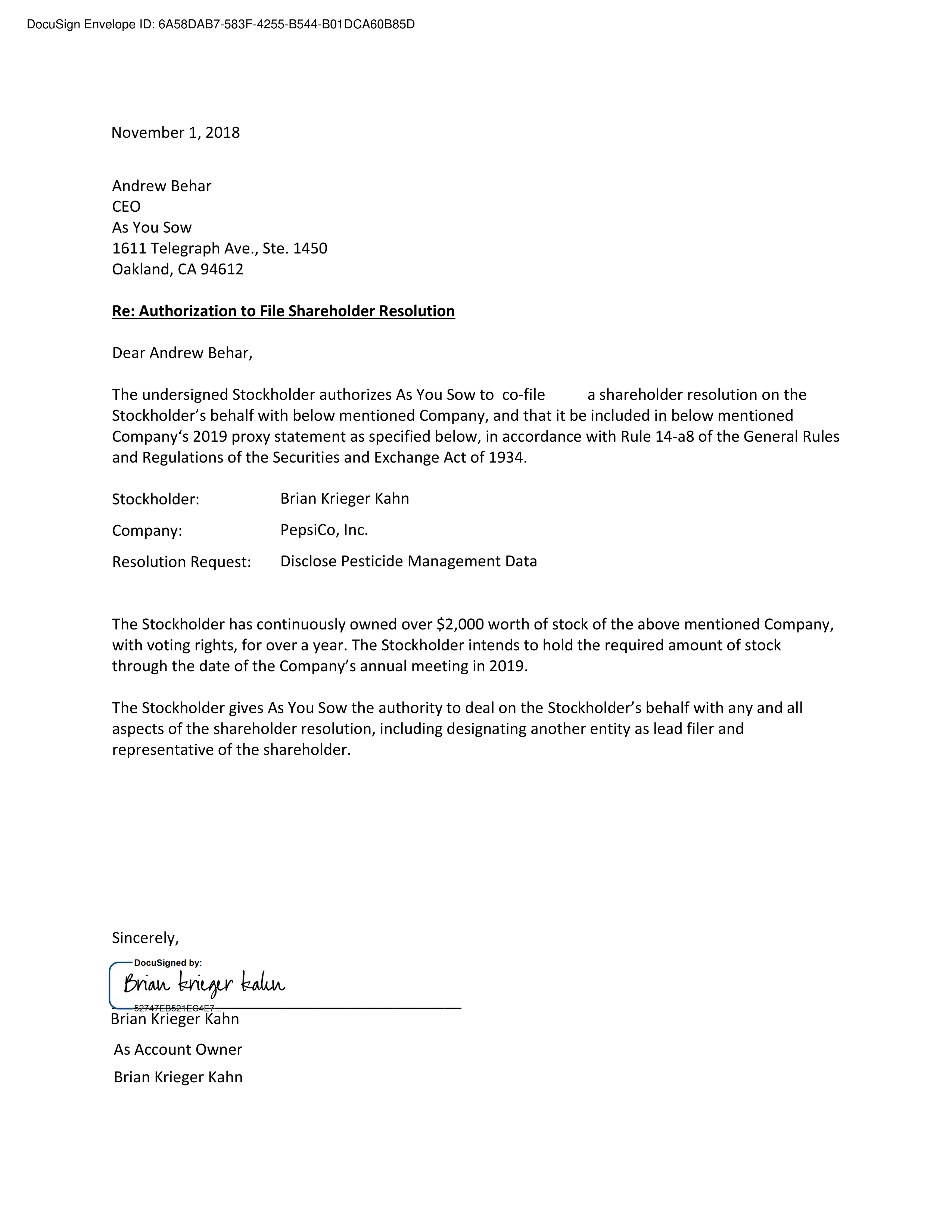
Andrew Behar
CEO
As You Sow
1611 Telegraph Ave., Ste. 1450
Oakland, CA 94612
Re: Authorization to File Shareholder Resolution
Dear Andrew Behar,
The undersigned Stockholder authorizes As You Sow to a shareholder resolution on the
Stockholder’s behalf with
below mentioned Company, and that it be included in below mentioned
Company
‘s 2019 proxy statement
as specified below, in accordance with Rule 14-a8 of the General Rules
and Regulations of the Securities and Exchange Act of 1934.
Stockholder:
Company:
Resolution Request:
The Stockholder has continuously owned over $2,000 worth of stock of the above mentioned Company,
with voting rights, for over a year. The Stockholder intends to hold the required amount of stock
through the date of the C
ompany’s annual meeting in 2019.
The Stockholder gives As You Sow the authority to deal on the
Stockholder’s behalf
with any and all
aspects of the shareholder resolution, including designating another entity as lead filer and
representative of the shareholder.
Sincerely,
_________________________________________
DocuSign Envelope ID: 6A58DAB7-583F-4255-B544-B01DCA60B85D
% &$%'
!
"

Andrew Behar
CEO
As You Sow
1611 Telegraph Ave., Ste. 1450
Oakland, CA 94612
Re: Authorization to File Shareholder Resolution
Dear Andrew Behar,
The undersigned Stockholder authorizes As You Sow to a shareholder resolution on the
Stockholder’s behalf with
below mentioned Company, and that it be included in below mentioned
Company
‘s 2019 proxy statement
as specified below, in accordance with Rule 14-a8 of the General Rules
and Regulations of the Securities and Exchange Act of 1934.
Stockholder:
Company:
Resolution Request:
The Stockholder has continuously owned over $2,000 worth of stock of the above mentioned Company,
with voting rights, for over a year. The Stockholder intends to hold the required amount of stock
through the date of the C
ompany’s annual meeting in 2019.
The Stockholder gives As You Sow the authority to deal on the
Stockholder’s behalf
with any and all
aspects of the shareholder resolution, including designating another entity as lead filer and
representative of the shareholder.
Sincerely,
_________________________________________
DocuSign Envelope ID: 9ADEF35D-A47B-4C0C-99CD-AB20F5B8BE2E
!
"
"
&('%&)
r-;
DocuSigned
by:
~
~=cF~~~Sb~
Andrew Behar
CEO
As You Sow
1611 Telegraph Ave., Ste. 1450
Oakland, CA 94612
Re: Authorization to File Shareholder Resolution
Dear Andrew Behar,
The undersigned Stockholder authorizes As You Sow to a shareholder resolution on the
Stockholder’s behalf with
below mentioned Company, and that it be included in below mentioned
Company
‘s 2019 proxy statement
as specified below, in accordance with Rule 14-a8 of the General Rules
and Regulations of the Securities and Exchange Act of 1934.
Stockholder:
Company:
Resolution Request:
The Stockholder has continuously owned over $2,000 worth of stock of the above mentioned Company,
with voting rights, for over a year. The Stockholder intends to hold the required amount of stock
through the date of the C
ompany’s annual meeting in 2019.
The Stockholder gives As You Sow the authority to deal on the
Stockholder’s behalf
with any and all
aspects of the shareholder resolution, including designating another entity as lead filer and
representative of the shareholder.
Sincerely,
_________________________________________
DocuSign Envelope ID: D84C33F0-9D95-47DE-94D4-77F3028497BA
"$#!"%
~
DocuSigned
by:
~ci11v
t,w,it-
0BB32874AF11461 ...
1
From:
Yang, Eunice {PEP}
Sent:
Wednesday, November 21, 2018 2:38 PM
To:
cspees@asyousow.org
Cc:
Nastanski, Cynthia {PEP}; Lee, Alicia {PEP}
Subject:
PepsiCo
Attachments:
PepsiCo (November 21, 2018).pdf
Dear Ms. Spees,
I am writing on behalf of PepsiCo, Inc., which received on November 15, 2018, the shareholder proposal you submitted
on behalf of The Janine Firpo Living Trust; Abigail Rome; Edwards Mother Earth Foundation; Lisa K. Holmes Revocable
Trust; Michelle Swenson & Stan Drobac Revocable Trust; and Patricia Rose Lurie Revocable Trust. Please see the
attached letter, which we also sent to you today by UPS overnight mail.
Best regards,
Eunice
Eunice Yang
Senior Counsel, Corporate Governance
PepsiCo, Inc.
700 Anderson Hill Road | Purchase | New York | 10577 | USA
Tel: 914‐253‐2135
eunice.yang@pepsico.com
~
PEPSICO
~
U®J
Tropicana
n&
.
'5
700 Anderson Hill Road
Purchase, N
ew
York 10577
ww
w.pepsico com
El
:\
I
CE
Y.
\:\G
SU
\10
1{
COlJNSIL CORl'OR,
'\
TI:
(i
OVl:RN1
\
N(T
Td
:
<J
1-1
-25
3-
:,
135
cunicc.yang@
•pcpsico.com
November 21, 2018
VIA OVERNIGHT
MA/LAND
EMAIL
Christy Spees
Environmental Health Program Manager
As You Sow
1611 Telegraph Ave, Suite 1450
Oakland,
CA
94612
cspees@asyousow.org
Dear Ms. Spees:
I am writing
on
behalf
of
PepsiCo, Inc. (the "Company"), which received
on
November 15, 2018, the shareholder proposal you submitted
on
behalf
of
The Janine Firpo
Living Trust;
Ab
igail Rome; Edwards Mother Earth Foundation; Lisa K. Holmes Revocable
Trust; Michelle Swenson & Stan Drobac Revocable Trust; and Patricia Rose Lurie Revocable
Trust (each a "Proponent" and, collectively, the "Proponents") pursuant to Securities and
Exchange Commission ("SEC") Rule 14a-8 for inclusion in the proxy statement for the
Company's 2019 Annual Meeting
of
Shareholders (the "Proposal").
The Proposal contains certain procedural deficiencies, which SEC regulations require us
to
bring to your attention. Your correspondence did not include sufficient documentation
demonstrating that you had the legal authority to submit the Proposal on behalf
of
the Edwards
Mo
ther Earth Foundation as
of
the date the Proposal was submitted (November 15,
20
18).
In
Staff
Legal Bulletin No. 1
41
(Nov. 1, 2017) ("SLB 141"), the
SEC's
Division
of
Corporation
Finance ("Division") noted that proposals submitted by proxy, such as
the
Proposal, may present
challenges and concerns, including "that shareholders may not know that proposals are being
submitted
on
their behalf." Accordingly, in evaluating whether there is a basis to exclude a
proposal under the eligibility requirements
of
Ru
le 14a-8(b), as addressed below, SLB
141
states
th
at
in
general the Division would expect any shareholder who submits a proposal by proxy
to
provide documentation to:
#4
18035
•
ident
if
y the shareholder-proponent and the person
or
entity selected as proxy;
•
ide
nt
if
y the company to which the proposal is directed;
•
identify the annual
or
special meeting for which the proposal is submitted;
•
identify the specific proposal to be submitted (e.g., proposal
to
lower the threshold for
calling a special meeting from 25% to 10%); and
•
be signed and dated by the shareholder.
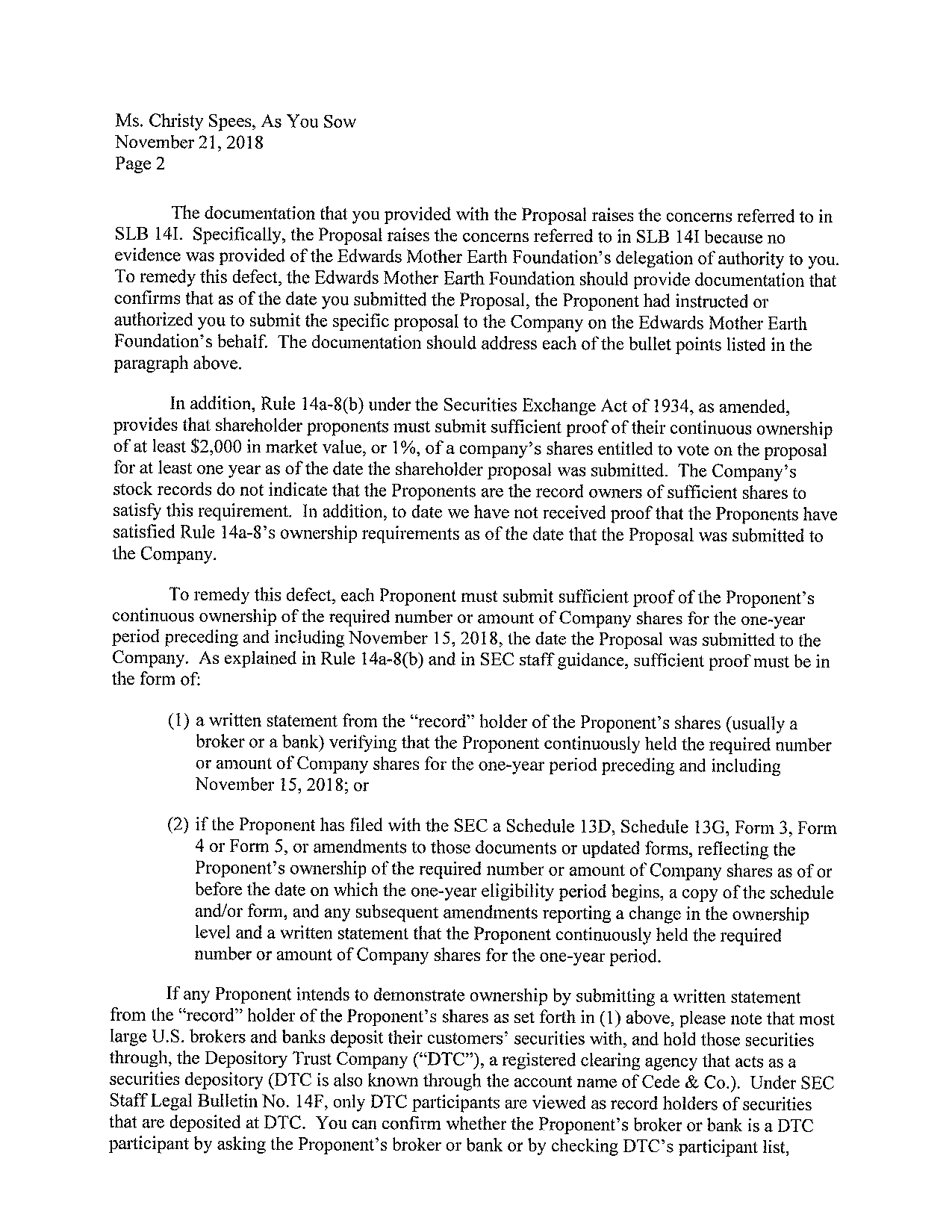
Ms. Christy Spees,
As
You Sow
November 21, 2018
Page 2
The documentation that you provided with the Proposal raises the concerns referred to in
SLB
141.
Specifically, the Proposal raises the concerns referred to in SLB
141
because no
evidence was provided
of
the Edwards Mother Earth Foundation's delegation
of
authority to you.
To remedy this defect,
the
Edwards Mother Earth Foundation should provide documentation that
confirms that as
ofihe
date you submitted
the
Proposal, the Proponent had instructed or
authorized you to submit the specific proposal to the Company on the Edwards Mother Eaith
Foundation's behalf.
The
documentation should address each
of
the bullet points listed in the
paragraph above.
In addition, Rule 14a-8(b) under the Securities Exchange Act
of
1934, as amended,
provides that shareholder proponents
must
submit sufficient
proof
of
their continuous ownership
of
at least $2,000 in market value,
or
1 %,
of
a
company's
shares entitled to vote on the proposal
for
at
least one year as
of
the date the shareholder proposal was submitted. The Company's
stock records do not indicate that the Proponents are the record owners
of
sufficient shares
to
satisfy this requirement.
In
addition, to date we have not received
proof
that the Proponents have
satisfied Rule 14a-8's ownership requirements as
of
the date that the Proposal was submitted to
ihe Company.
To remedy this defect, each Proponent must submit sufficient
proof
of
the Proponent's
continuous ownership
of
the required
number
or amount
of
Company shares for the one-year
period preceding and including November 15, 2018, the date the Proposal was submitted to the
Company. As explained in Rule 14a-8(b)
and
in SEC
staff
guidance, sufficient
proof
must be in
the form of:
(1) a written statement from the "record" holder
of
the Proponent's shares (usually a
broker or a bank) verifying that the Proponent continuously held the required number
or amount
of
Company shares for the one-year period preceding and including
November 15, 2018; or
(2)
if
the Proponent has filed with
the
SEC a Schedule 13D, Schedule 13G, Form 3, Form
4 or Form 5, or amendments to those documents or updated forms, reflecting the
Proponent's ownership
of
the required number
or
amount
of
Company shares as
of
or
before the date on which the one-year eligibility period begins, a copy
of
the schedule
and/or form, and any subsequent amendments reporting a change
in
the ownership
level and a written statement that the Proponent continuously held the required
number or amount
of
Compai1y shares for the one-year period.
If
any Proponent intends to demonstrate ownership by submitting a written statement
from the "record" holder
of
the Proponent's shares as set forth in (1) above, please note that most
large U.S. brokers and banks deposit their customers' securities with, and hold those securities
through, the Depository Trust Company ("DTC"), a registered cleai-ing agency that acts as a
securities depository (DTC is also known through the account name
of
Cede & Co.). Under SEC
Staff
Legal Bulletin No. 14F, only DTC participants are viewed as record holders
of
securities
that are deposited at DTC. You can confirm whether the Proponent's broker
or
bank is a DTC
paiticipant by asking the Proponent's broker or bank or by checking
DTC's
participai1t list,
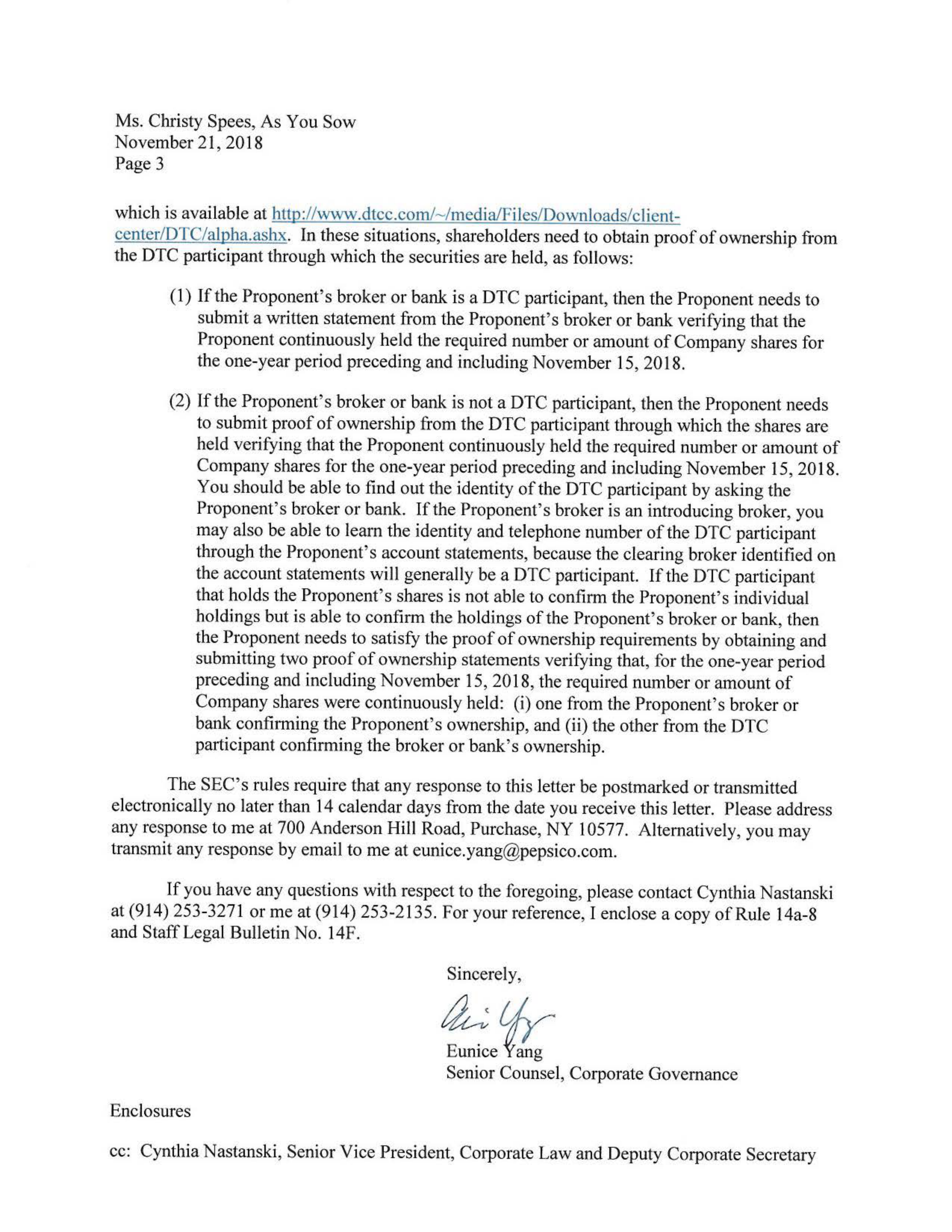
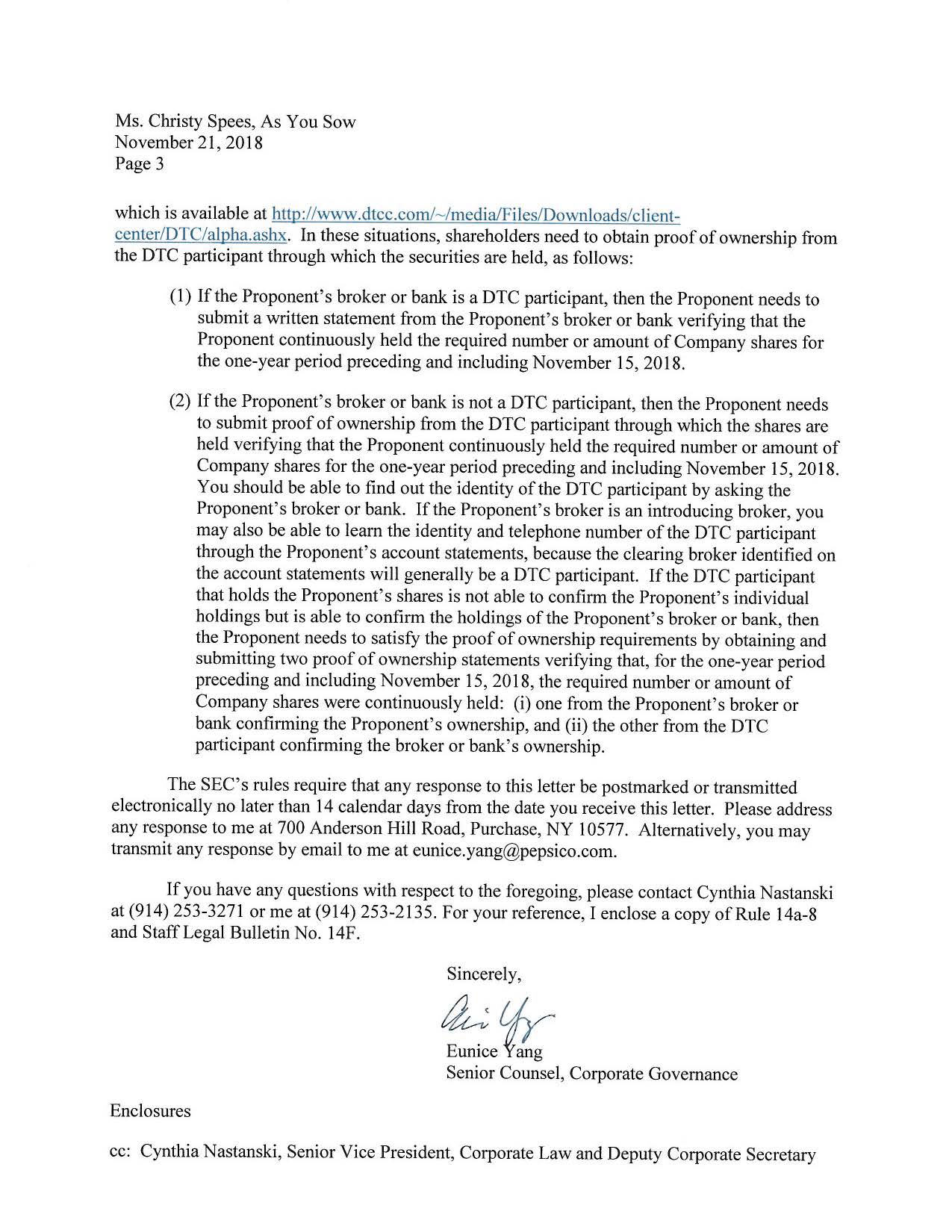
Ms. Christy Spees,
As
You
Sow
November 21, 2018
Page 3
which
is
available at http://www.dtcc.com/
~/
media/Files/Downloads/client-
center/DTC/alpha.ashx.
In
these situations, shareholders need to obtain
proof
of
ownership from
the DTC participant through which the securities are held, as follows:
(1)
If
th
e Proponent's broker
or
bank is a DTC participant, then the Proponent needs to
submit a written statement from the Proponent's broker
or
bank verifying that the
Proponent continuously held the required number
or
amount
of
Company shares for
the one-year period preceding and including November 15,
20
18.
(2)
If
the Proponent's broker
or
bank is not a DTC participant, then the Proponent needs
to submit proof
of
ownership from the DTC participant through which the shares are
held verifying that the Proponent continuously held the required number
or
amount
of
Company shares for the one-year period preceding and including November 15, 2018.
You should
be
able
to
find out the identity
of
the DTC participant by asking the
Proponent's broker
or
bank.
If
the Proponent's broker is
an
introducing broker, you
may also be able to learn
th
e identity and telephone number
of
the DTC participant
through the Proponent's account statements, because the clearing broker identified
on
the account statements will generally be a DTC participant.
If
the DTC participant
that holds the Proponent's shares
is
not able to confirm
th
e Propon
ent's
individual
holdings but is able
to
confirm the holdings
of
the Proponent
's
broker
or
bank, then
the Proponent needs
to
satisfy the
proof
of
ownership requirements by obtaining and
submitting two
proof
of
ownership statements verifying that, for the one-year period
preceding and including November 15, 2018,
the
required number
or
amount
of
Company shares were continuously held: (i) one from the Proponent's broker
or
bank confirming the Proponent's ownership, and (ii) the other from the DTC
participant confirming the brok
er
or
bank's ownership.
The
SEC's
rules require that any response to this letter be postmarked
or
transmitted
electronically no later than 14 calendar days from the date you receive this letter. Please address
any response to
me
at 700 Anderson Hill Road, Purchase,
NY
10577. Alternatively, you
may
tran
sm
it any response by email to
me
at
eunice.yang@pepsico.com.
If
you have any questions with respect to the foregoing, please contact Cynthia Nastanski
at
(914) 253-3271
or
me
at (914) 253-2135. For your reference, I enclose a copy
of
Rule 14a-8
and Staff Legal Bulletin No. 14F.
Sincerely,
~err:
Senior Counsel, Corporate Governance
Enclosures
cc: Cynthia Nastanski, Senior Vice President, Corporate Law and Deputy Corporate Secretary
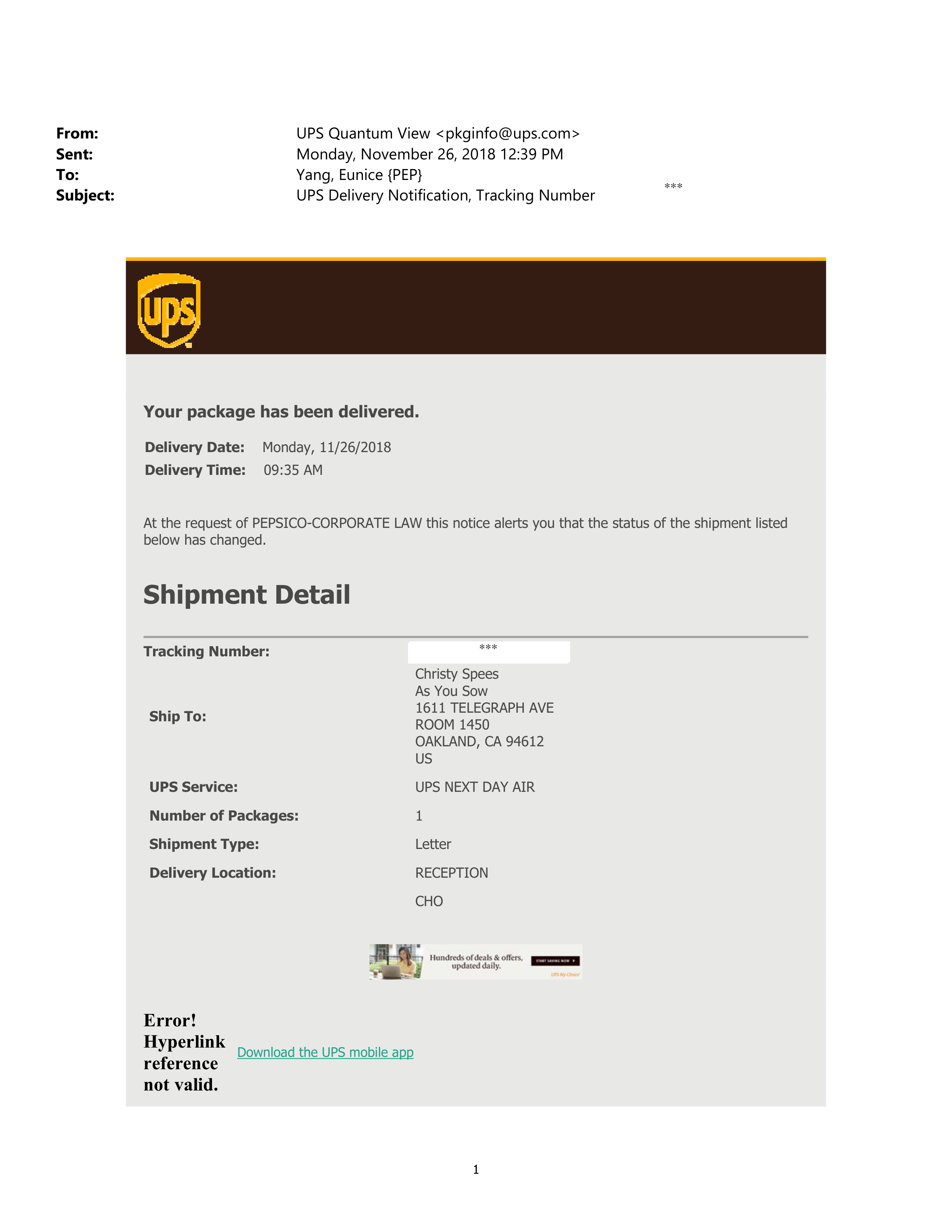


1
From:
UPS Quantum View
Sent:
Monday, November 26, 2018 12:39 PM
To:
Yang, Eunice {PEP}
Subject:
UPS Delivery Notification, Tracking Number
Your package has been delivered.
Delivery Date:
Monday, 11/26/2018
Delivery Time:
09:35 AM
At the request of PEPSICO-CORPORATE LAW this notice alerts you that the status of the shipment listed
below has changed.
Shipment Detail
Tracking Number:
Ship To:
Christy Spees
As You Sow
1611 TELEGRAPH AVE
ROOM 1450
OAKLAND, CA 94612
US
UPS Service:
UPS NEXT DAY AIR
Number of Packages:
1
Shipment Type:
Letter
Delivery Location:
RECEPTION
CHO
Error!
Hyperlink
reference
not valid.
Download the UPS mobile app
Hundr
eds
of
d
ea
ls
&
offer
s,
upd
ate
d daily.
***
***
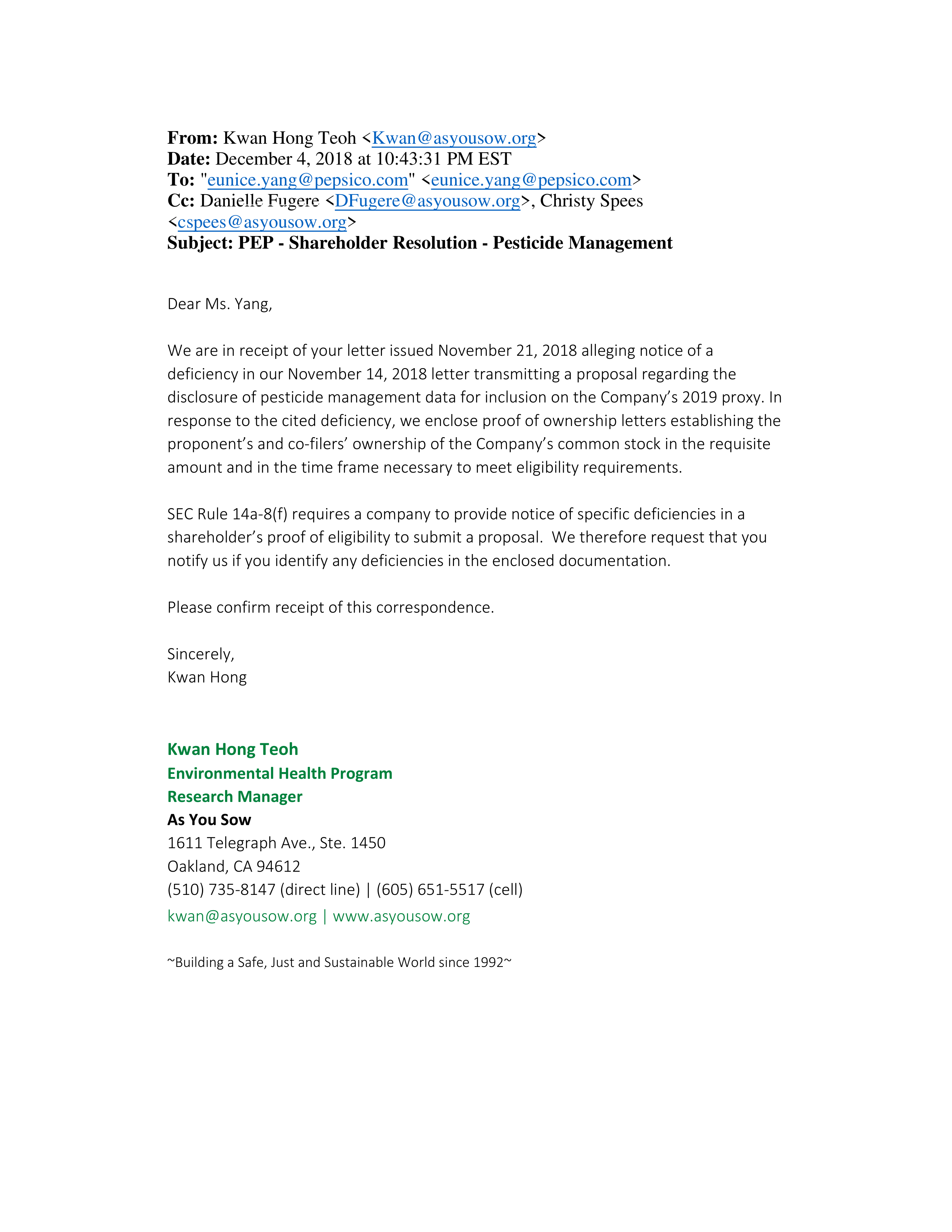
From:
Kwan Hong Teoh <
Kwan@asyousow.org
>
Date:
December 4, 2018 at 10:43:31 PM EST
To:
"
eunice.yang@pepsico.com
" <
eunice.yang@pepsico.com
>
Cc:
Danielle Fugere <
DFugere@asyousow.org
>, Christy Spees
<
cspees@asyousow.org
>
Subject:
PEP - Shareholder Resolution - Pesticide Management
Dear Ms. Yang,
We are in receipt of your letter issued November 21, 2018 alleging notice of a
deficiency in our November 14, 2018 letter transmitting a proposal regarding the
disclosure of pesticide management data for inclusion on the Company’s 2019 proxy. In
response to the cited deficiency, we enclose proof of ownership letters establishing the
proponent’s and co-filers’ ownership of the Company’s common stock in the requisite
amount and in the time frame necessary to meet eligibility requirements.
SEC Rule 14a-8(f) requires a company to provide notice of specific deficiencies in a
shareholder’s proof of eligibility to submit a proposal. We therefore request that you
notify us if you identify any deficiencies in the enclosed documentation.
Please confirm receipt of this correspondence.
Sincerely,
Kwan Hong
Kwan Hong Teoh
Environmental Health Program
Research Manager
As You Sow
1611 Telegraph Ave., Ste. 1450
Oakland, CA 94612
(510) 735-8147 (direct line) | (605) 651-5517 (cell)
kwan@asyousow.org | www.asyousow.org
~Building a Safe, Just and Sustainable World since 1992~
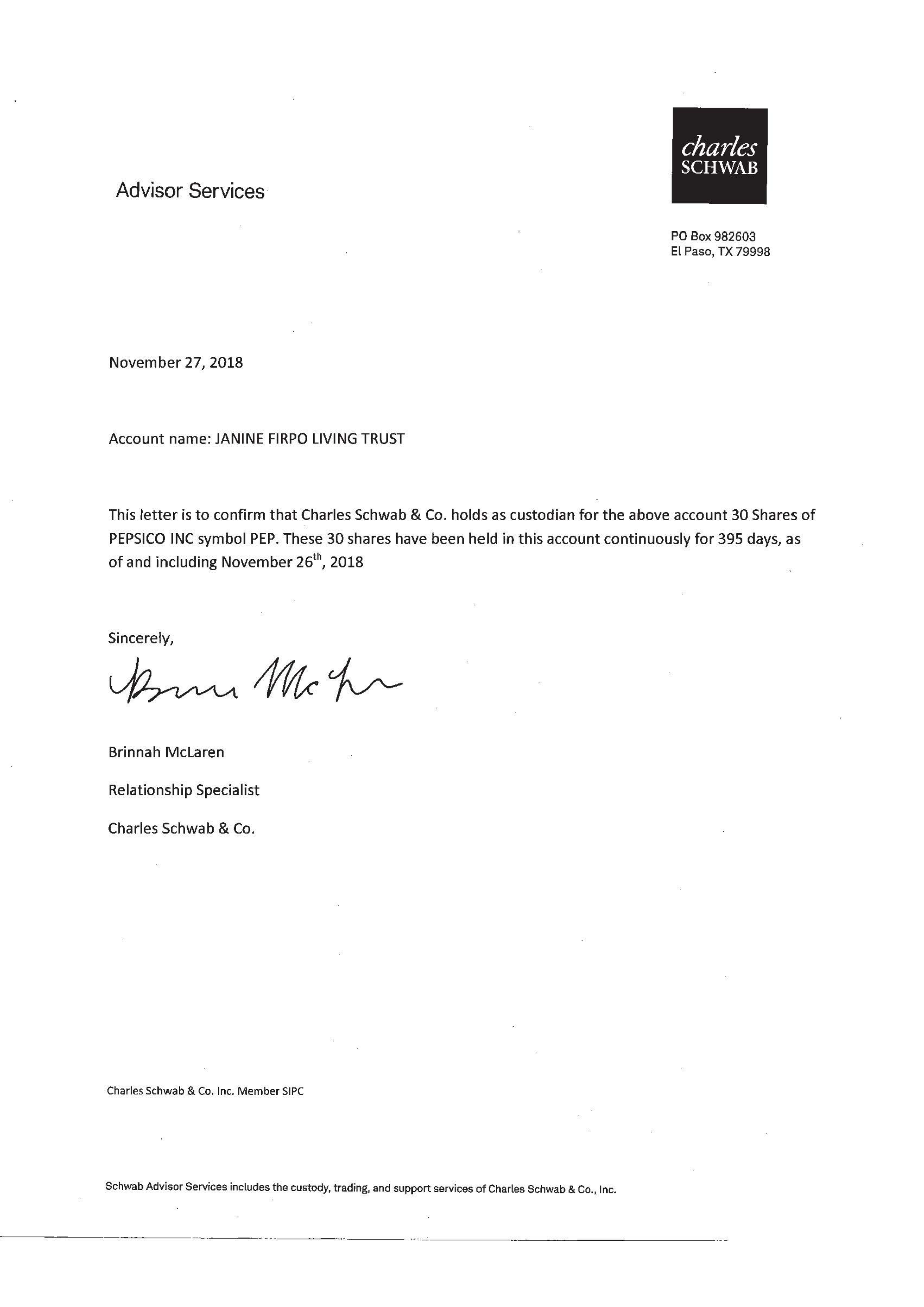
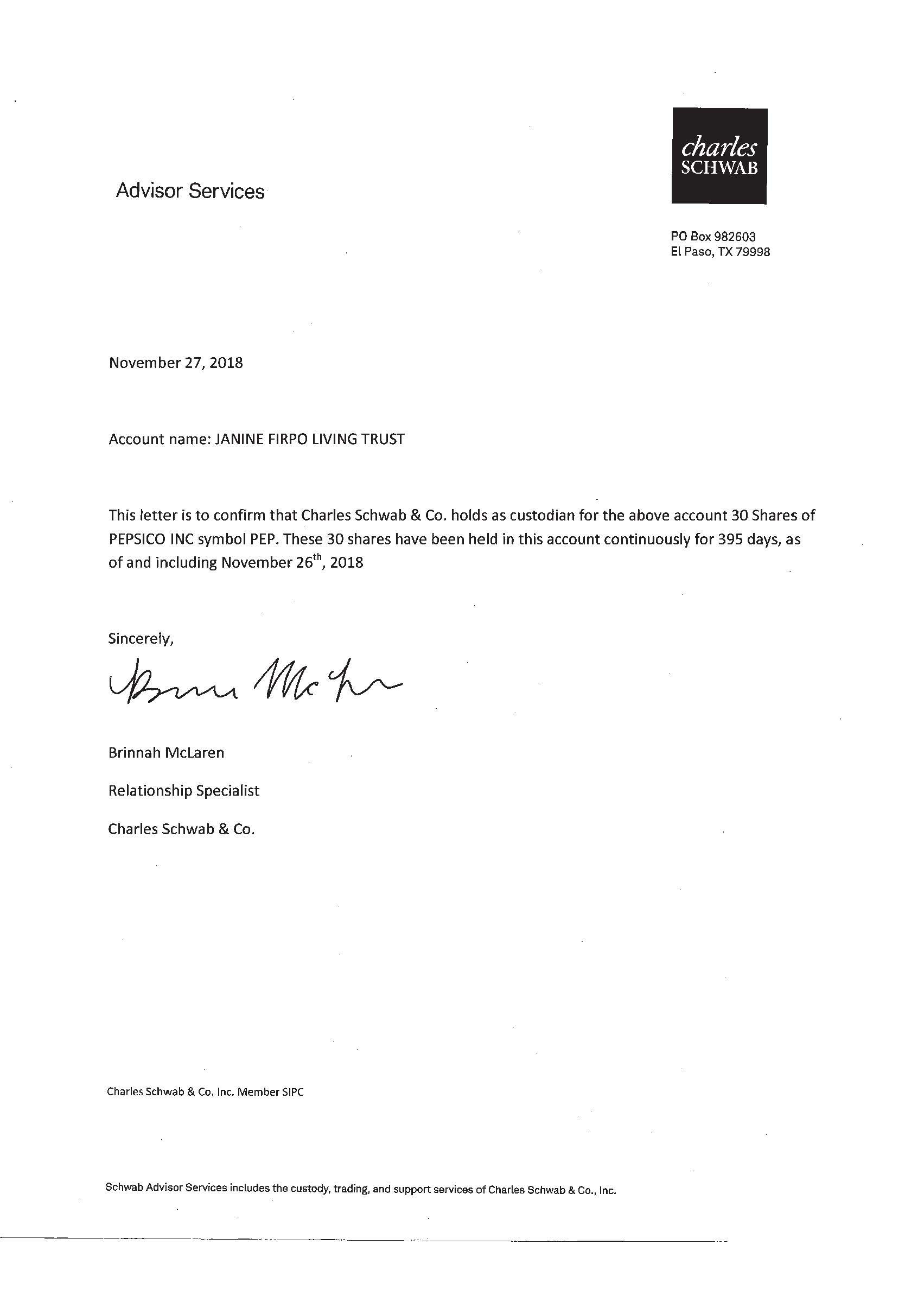
Advisor Services
November
27, 2018
Account name: JANINE
FIRPO
LIVING
TRUST
char/es
SCHWAB
PO
Box
982603
El
Paso,
TX
79998
This
letter
is
to
confirm
that
Charles Schwab
&
Co.
holds
as
custodian
for
the
above account
30
Shares
of
PEPSICO
INC
symbol
PEP.
These
30
shares have been held in
this
account continuously
for
395 days, as
of
and including
November
26
th
,
2018
Sincerely,
Brinnah McLaren
Relationship Specialist
Charles Schwab
&
Co.
Charles Schwab
&
Co. Inc.
Member
SI
PC
Schwab Advisor Services includes the custody, tradin
g,
and support services
of
Charles Sc
hw
ab
&
Co
.,
Inc.
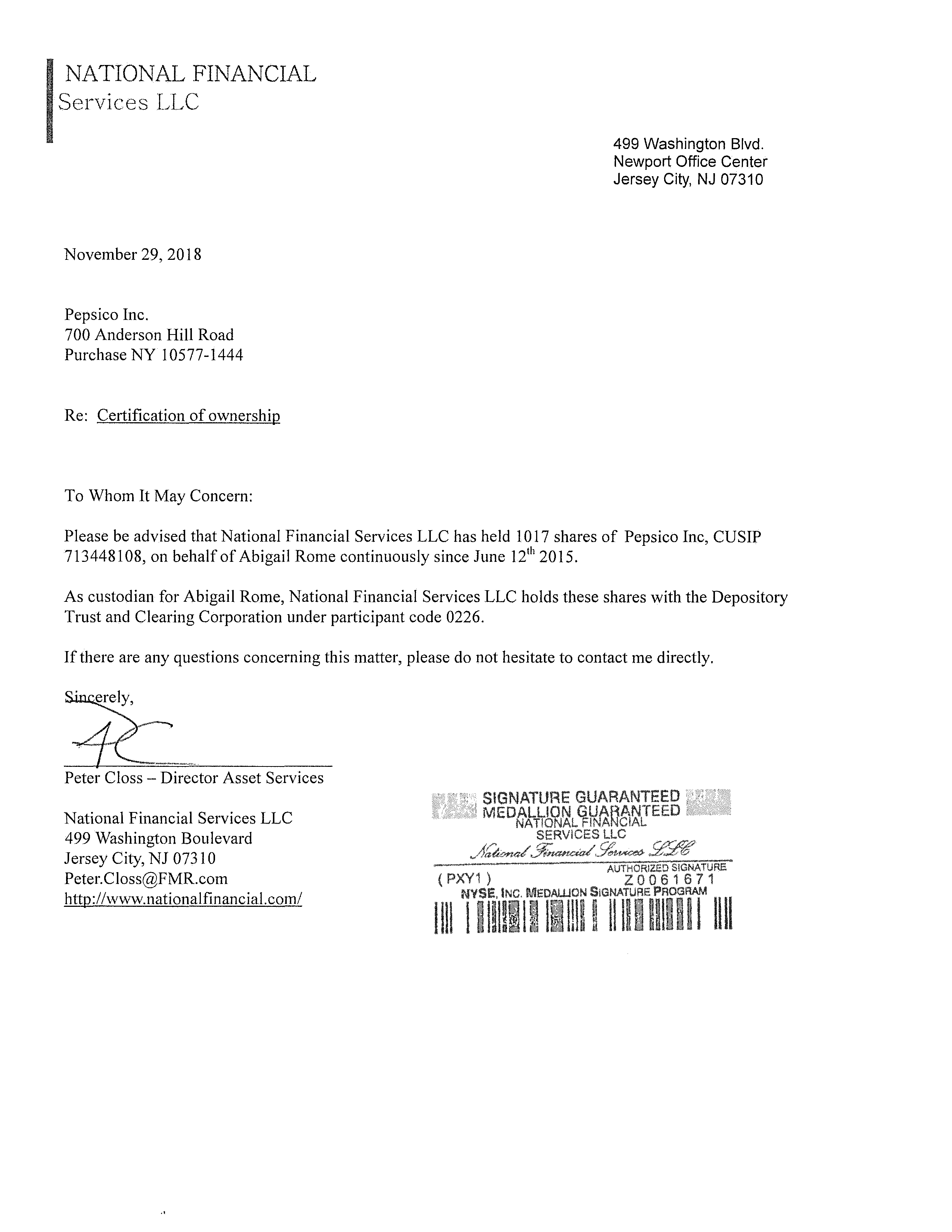
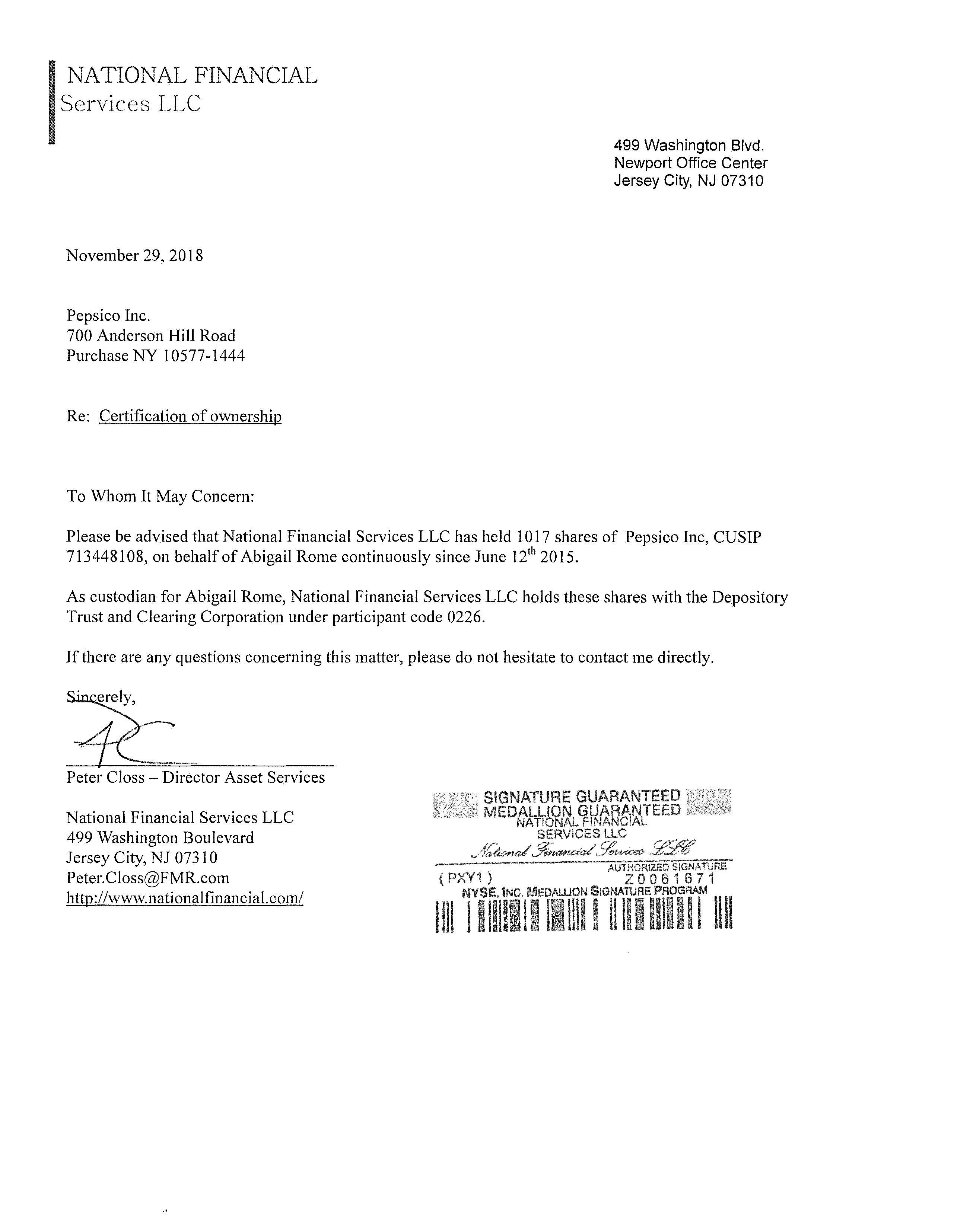
I
.
NA
~ION
AL
:INANCIAL
Services
LLC
November 29, 2018
Pepsico Inc.
700 Anderson
Hill
Road
Purchase NY
10
5 77-1444
Re: Certification
of
ownership
To Whom
It
May Concern:
499 Washington Blvd.
Newport Office Center
Jersey
City,
NJ
07310
Please be advised that National Financial Services LLC has held 1017 shares
of
Pepsico Inc, CUSIP
713448108, on behalf
of
Abigail Rome continuously since June
Ii"
2015.
As custodian for Abigail Rome, National Financial Services LLC holds these shares with the Depository
Trust and Clearing Corporation under participant code 0226.
If
there are any questions concerning this matter, please do not hesitate to contact me directly.
Peter Closs -
Director Asset Services
National Financial Services LLC
499 Washington Boulevard
Jersey City,
NJ
07310
Peter.Closs@FMR.com
http:/ /www. nati onalfinanc ial .com/
SIGNATURE
GUARANTEED
;
MEDALLION
GUARANTEED
NATIONAL
FINANCIAL
SERVICES
LLC
~,,f{'&.o,.,a,(
~~¼_,,,
-~
AUTi10RIZEO
SIGNATURE.
(
PXYi
)
Z
O O
6 1 6 7 1
NYSE,
INC.
MEDAWON
SiGNATUAE
PROGRAM
1111
l I
IIIII
I
I
II
IIII
I
II
ll
I
IIII
II
I
llll
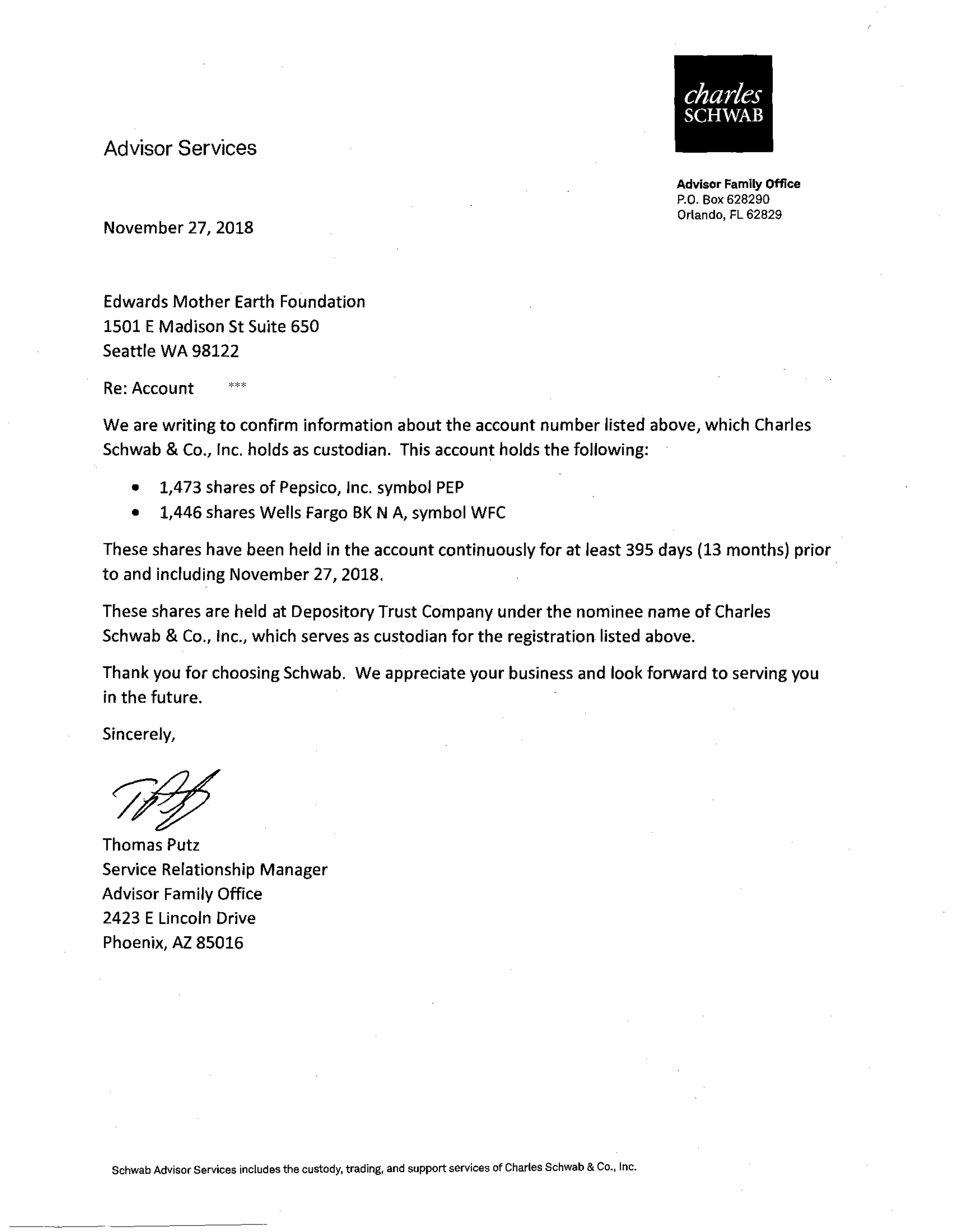
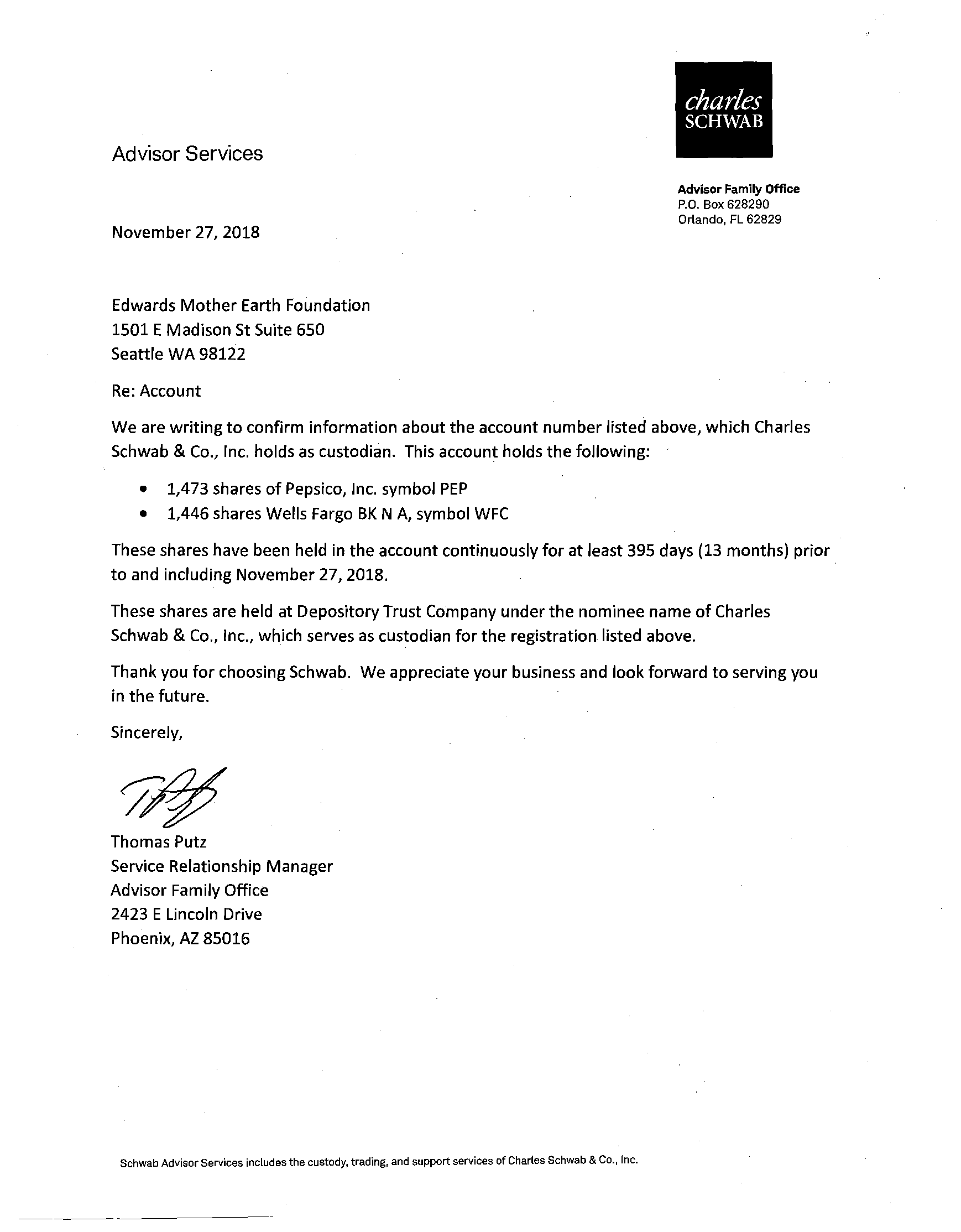
Advisor Services
November 27, 2018
Edwards
Mother
Earth Foundation
1501 E Madison
St
Suite 650
Seattle WA 98122
Re:
Account
char/es
SCHWAB
Advisor
Family
Office
P.O.
Box
628290
Orlando,
FL
62829
We are
writing
to
confirm information about the account
number
listed above, which Charles
Schwab
&
Co.,
Inc. holds
as
custodian. This account holds
the
following:
•
1,473 shares
of
Pepsico, Inc. symbol
PEP
•
1,446 shares Wells Fargo
BK
N
A,
symbol
WFC
These shares have been held in the account continuously
for
at least 395 days (13 months)
prior
to
and including November 27, 2018.
These shares are held at Depository Trust Company under
the
nominee name
of
Charles
Schwab
&
Co.,
Inc., which serves
as
custodian
for
the registration listed above.
Thank you
for
choosing Schwab. We appreciate your business and look forward
to
serving you
in
the
future.
Sincerely,
Thomas Putz
Service Relationship Manager
Advisor Family Office
2423 E Lincoln Drive
Phoenix,
AZ
85016
Schwab
Advisor
Services
includes
the
custody,
trading,
and
support
services
of
Charles
Schwab
&
Co.,
Inc.
***
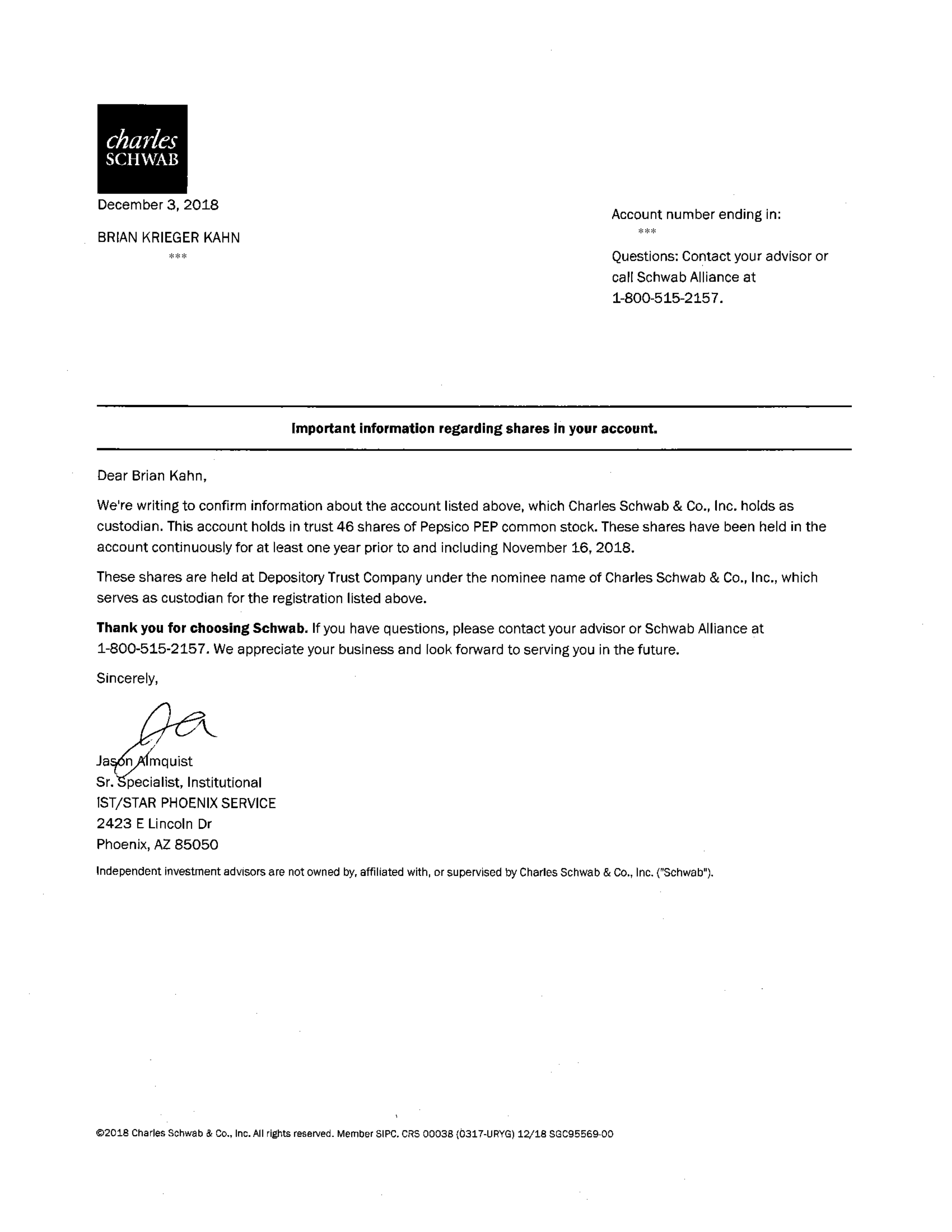
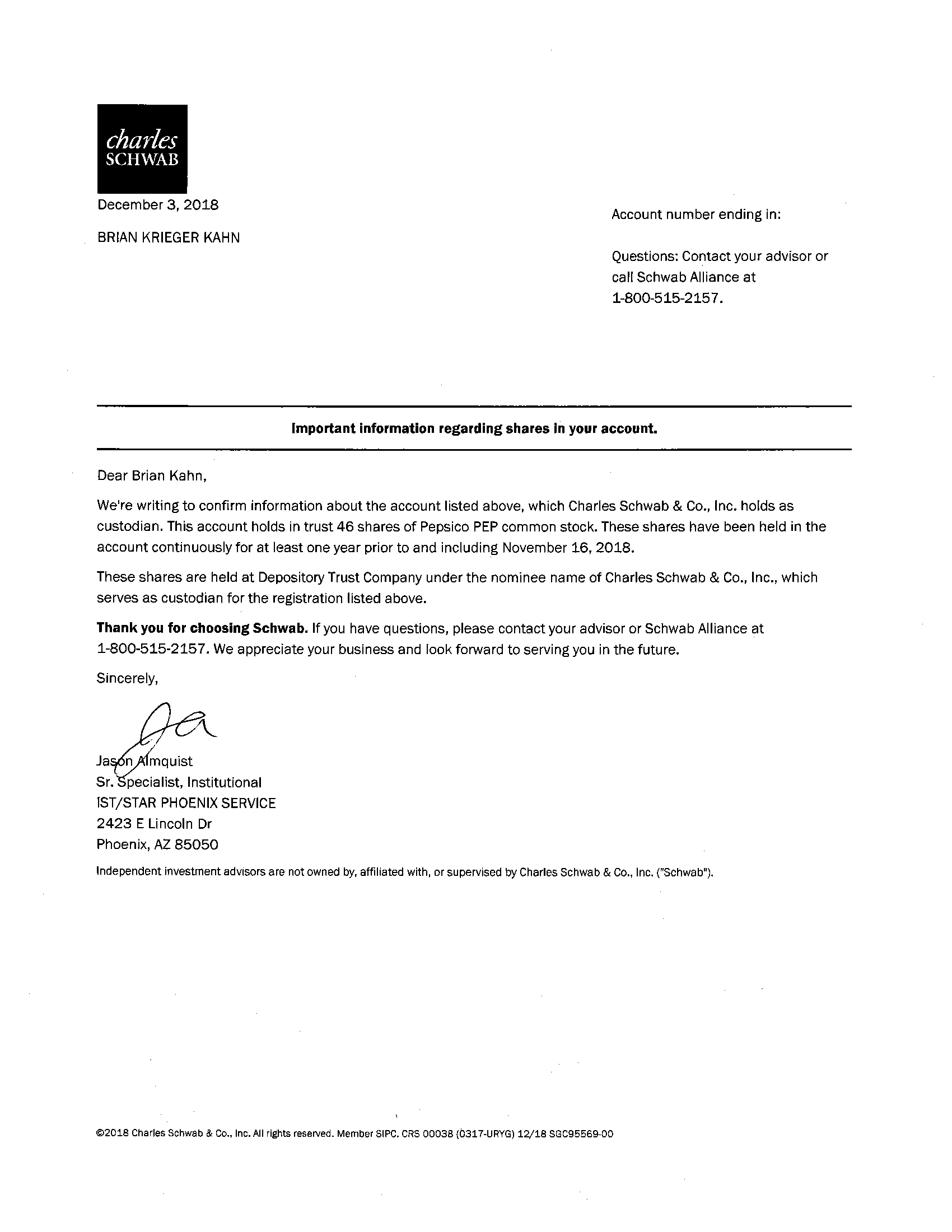
■
I
December 3,
2018
BRIAN
KRIEGER
KAHN
Dear Brian Kahn,
Account number ending
in:
Questions:
Contact
your
advisor
or
call Schwab Alliance at
1-800-515-2157.
Important information regarding shares
In
your account.
We're writing
to
confirm information about the account listed above, which Charles Schwab
&
Co.,
Inc. holds as
custodian. This account holds
in
trust
46
shares
of
Pepsico
PEP
common stock. These shares have been held
in
the
account continuously for at least one year prior to and including November 16,
2018.
These shares are held
at
Depository Trust Company under the nominee name of Charles Schwab
&
Co.,
Inc., which
serves
as
custodian
for
the
registration
listed
above.
Thank
you
for choosing Schwab.
If
you
have questions, please contact your advisor or Schwab Alliance at
1-800-515-2157.
We
appreciate your business and look forward to serving you
in
the future.
Sincerely,
Ja~
Sr.
~ecialist,
Institutional
IST/STAR
PHOENIX
SERVICE
2423
E Lincoln
Dr
Phoenix,
AZ
85050
Independent
investment
advisors
are
not
owned
by,
affiliated
with,
or
supervised
by
Charles
Schwab
&
Co.,
Inc.
("Schwab").
©2018
Charles Schwab
&
Co.,
Inc.
All
rights
reserved. Member
SIPC.
CRS
00038
(0317-URYG)
12/18
SGC95569-00
***
***
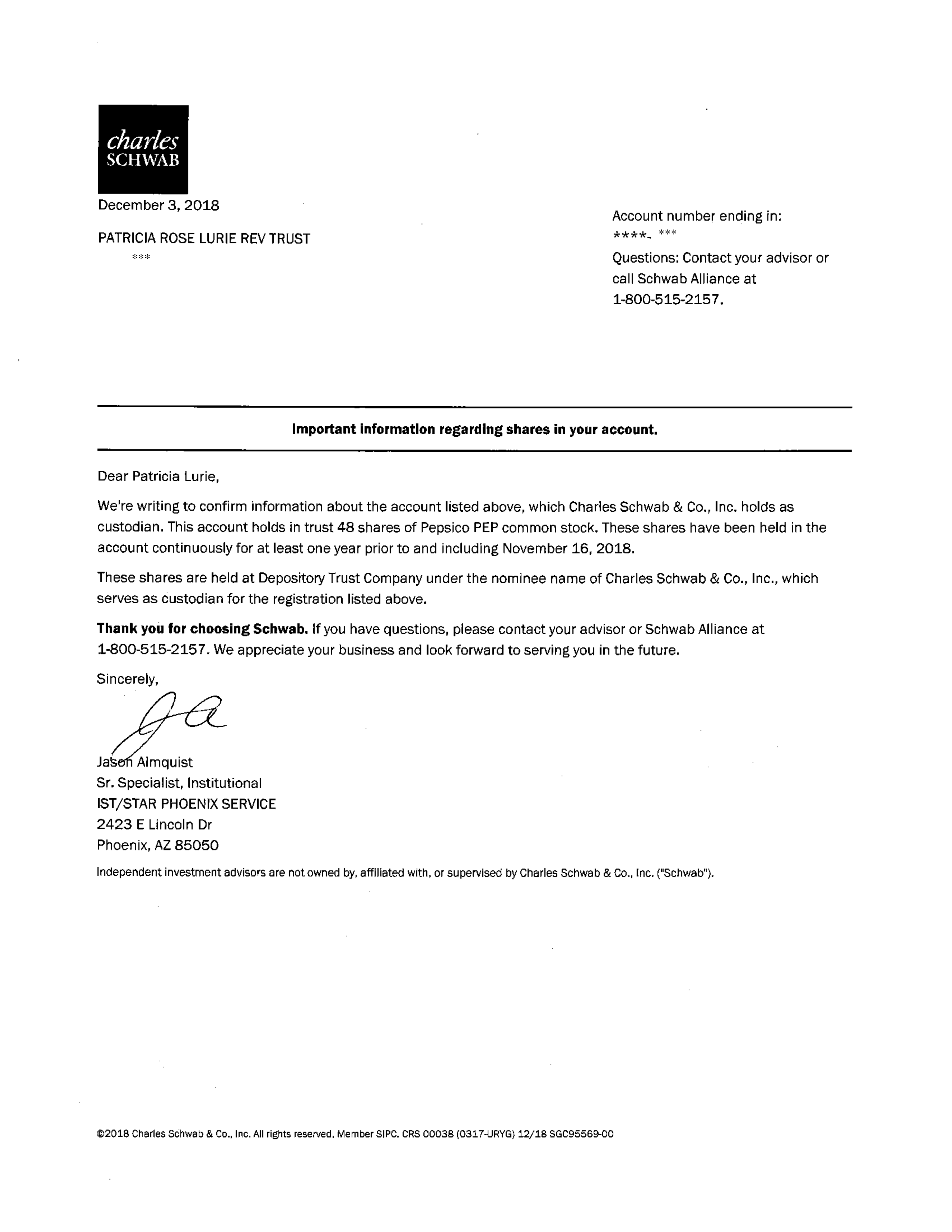
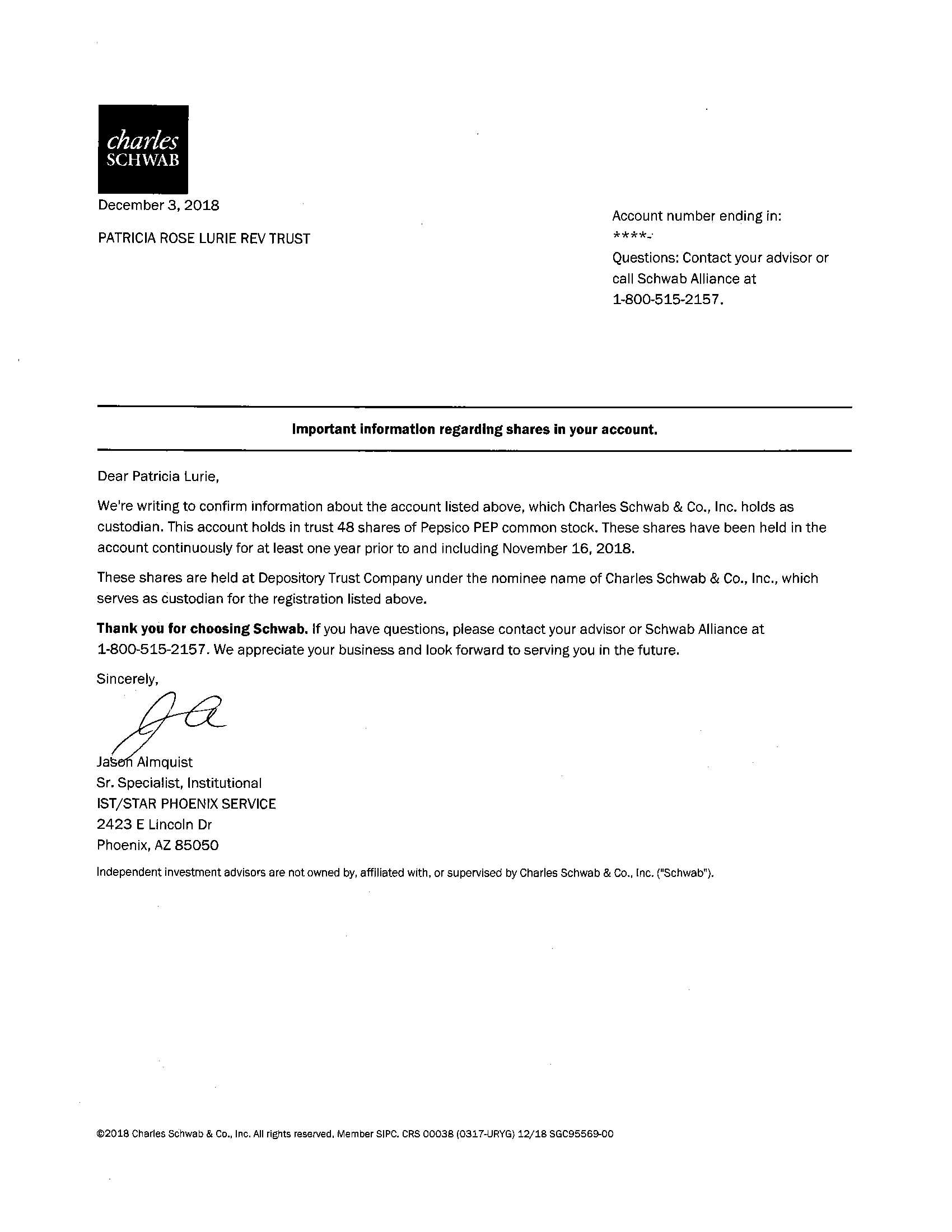
■
December
3,
2018
PATRICIA
ROSE
LURIE
REV
TRUST
Account
number
ending
in:
****-
Questions: Contact your advisor or
call Schwab Alliance
at
1-800-515-2157.
Important
information regarding
shares
in your account.
Dear
Patricia Lurie,
We're writing
to
confirm information about the account listed above, which Charles Schwab
&
Co.,
Inc. holds
as
custodian. This account holds in trust
48
shares
of
Pepsico
PEP
common stock. These shares have been held in
the
account continuously for
at
least one year prior to and including November
16,
2018.
These shares are held
at
Depository Trust Company under
the
nominee name
of
Charles Schwab
&
Co.,
Inc., which
serves
as
custodian for the registration listed above.
Thank
you for choosing Schwab.
If
you have questions, please contact your advisor or Schwab Alliance
at
1-800-515-2157.
We
appreciate your business and look forward
to
serving you in the future.
Sincerely,
,£:
Sr. Specialist, Institutional
IST/STAR
PHOENIX
SERVICE
2423
E Lincoln
Dr
Phoenix,
AZ
85050
Independent
investment
advisors
are
not
owned
by,
affiliated
with,
or
supervised
by
Charles
Schwab
&
Co.,
Inc.
("Schwab").
©2018
Charles Schwab
&
Co.,
Inc.
All
rights
reserved, Member
SIPC.
CRS
00038
(0317-URYG}
12/18
SGC95569-00
***
***
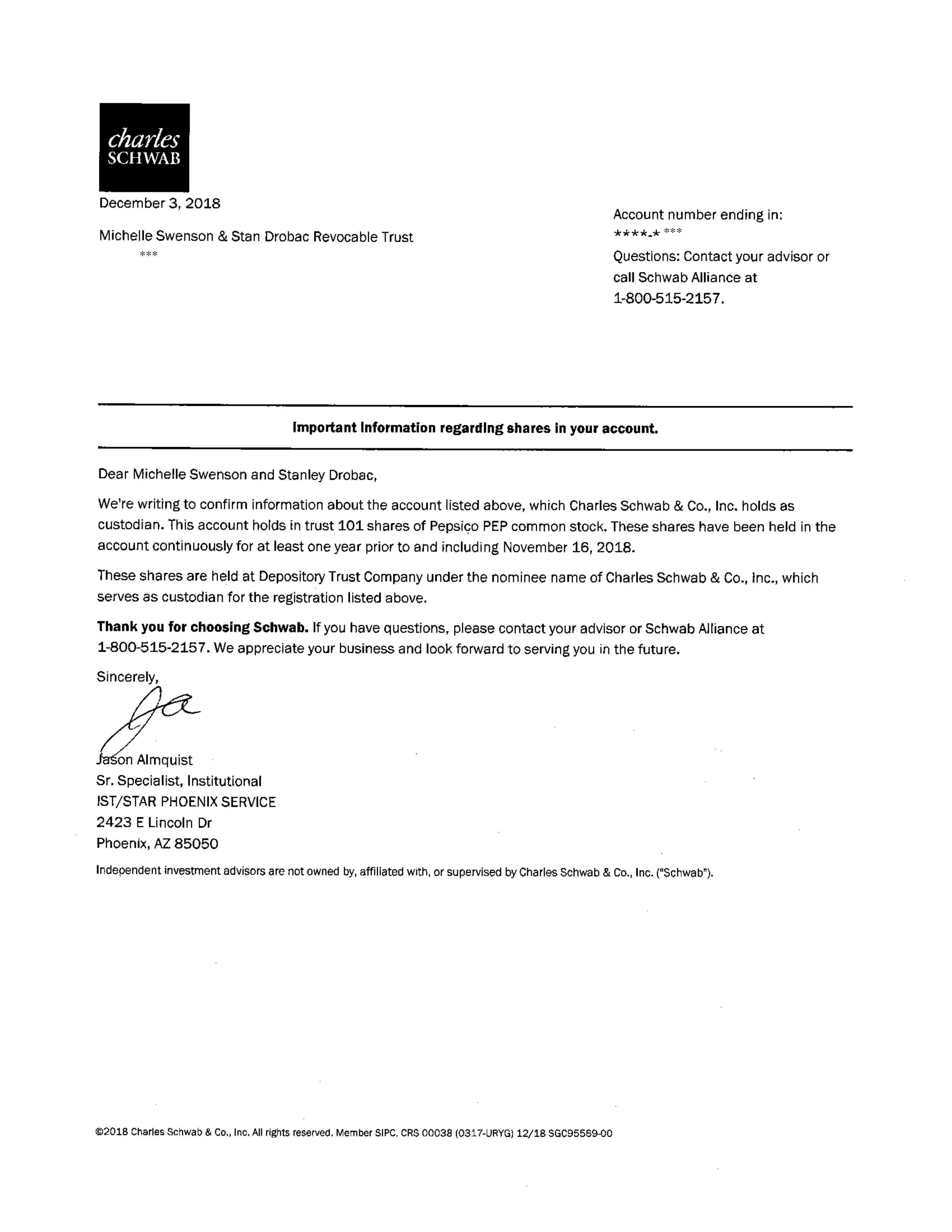
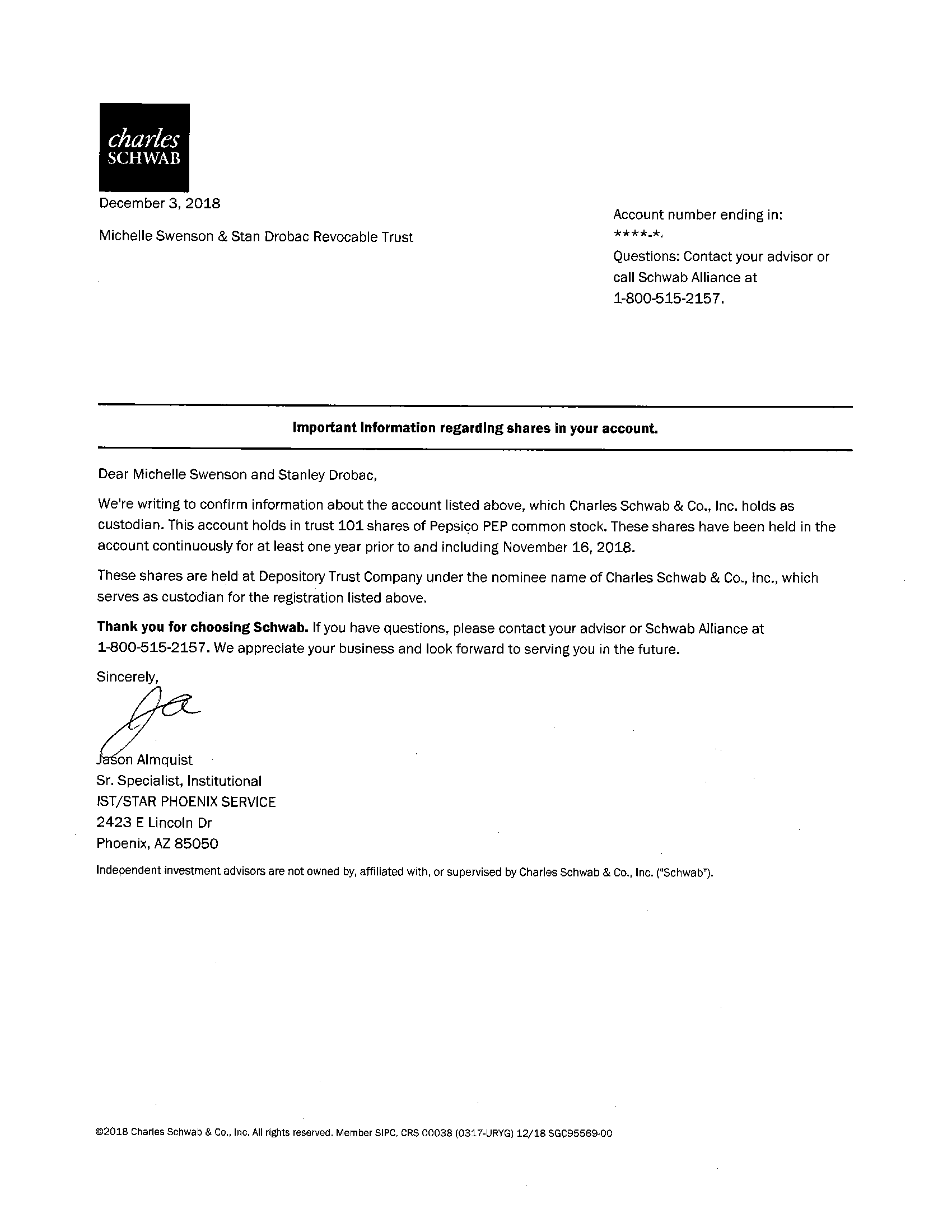
■
December 3,
2018
Michelle Swenson
&
Stan Drobac Revocable Trust
Account
number
ending
in:
****-*
Questions: Contact your advisor or
call Schwab Alliance at
1-800-515-215
7,
Important Information regarding shares
In
your account.
Dear Michelle Swenson and Stanley Drobac,
We're writing to confirm information about the account listed above, which Charles Schwab
&
Co.,
Inc. holds as
custodian. This account holds
in
trust
101
shares of Pepsico
PEP
common stock. These shares have been held
in
the
account continuously for
at
least one year prior to and including November 16,
2018.
These shares are held at Depository Trust Company under the nominee name
of
Charles Schwab
&
Co.,
Inc., which
serves
as
custodian
for
the
registration
listed
above.
Thank
you
for choosing Schwab.
If
you
have questions, please contact your advisor or Schwab Alliance
at
1-800-515-2157.
We
appreciate your business and look forward
to
serving
you
in
the future.
Sincerely,
d!:
Sr. Specialist, Institutional
IST/STAR
PHOENIX
SERVICE
2423
E Lincoln
Dr
Phoenix,
AZ
85050
Independent
investment
advisors
are
not
owned
by,
affiliated
with,
or
supervised
by
Charles
Schwab
&
Co.,
Inc.
("Schwabn).
©2018
Charles Schwab
&
Co.,
Inc,
All
rights
reserved. Member
SIPC.
CRS
00038
(0317-URYG)
12/18
SGC95569-00
***
***

EXHIBIT
B
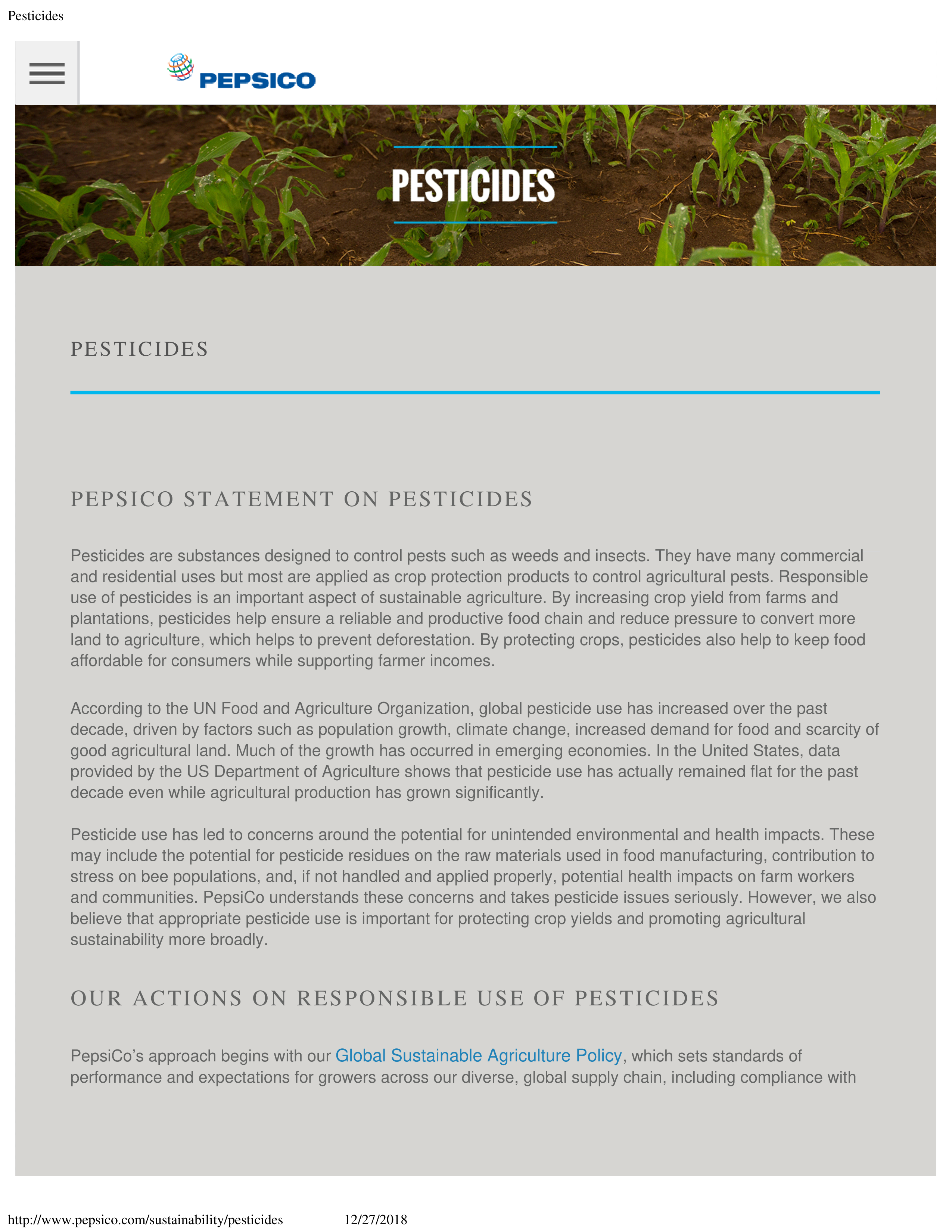



Pesticides
http://www.pepsico.com/sustainability/pesticides
12/27/2018
PESTICIDES
PEPSICO STATEMENT ON PESTICIDES
Pesticides are substances designed to control pests such as weeds and insects. They have many commercial
and residential uses but most are applied as crop protection products to control agricultural pests. Responsible
use of pesticides is an important aspect of sustainable agriculture. By increasing crop yield from farms and
plantations, pesticides help ensure a reliable and productive food chain and reduce pressure to convert more
land to agriculture, which helps to prevent deforestation. By protecting crops, pesticides also help to keep food
affordable for consumers while supporting farmer incomes.
According to the UN Food and Agriculture Organization, global pesticide use has increased over the past
decade, driven by factors such as population growth, climate change, increased demand for food and scarcity of
good agricultural land. Much of the growth has occurred in emerging economies. In the United States, data
provided by the US Department of Agriculture shows that pesticide use has actually remained flat for the past
decade even while agricultural production has grown significantly.
Pesticide use has led to concerns around the potential for unintended environmental and health impacts. These
may include the potential for pesticide residues on the raw materials used in food manufacturing, contribution to
stress on bee populations, and, if not handled and applied properly, potential health impacts on farm workers
and communities. PepsiCo understands these concerns and takes pesticide issues seriously. However, we also
believe that appropriate pesticide use is important for protecting crop yields and promoting agricultural
sustainability more broadly.
OUR ACTIONS ON RESPONSIBLE USE OF PESTICIDES
PepsiCo’s approach begins with our
Global Sustainable Agriculture Policy
, which sets standards of
performance and expectations for growers across our diverse, global supply chain, including compliance with
-
~
PEPSICO
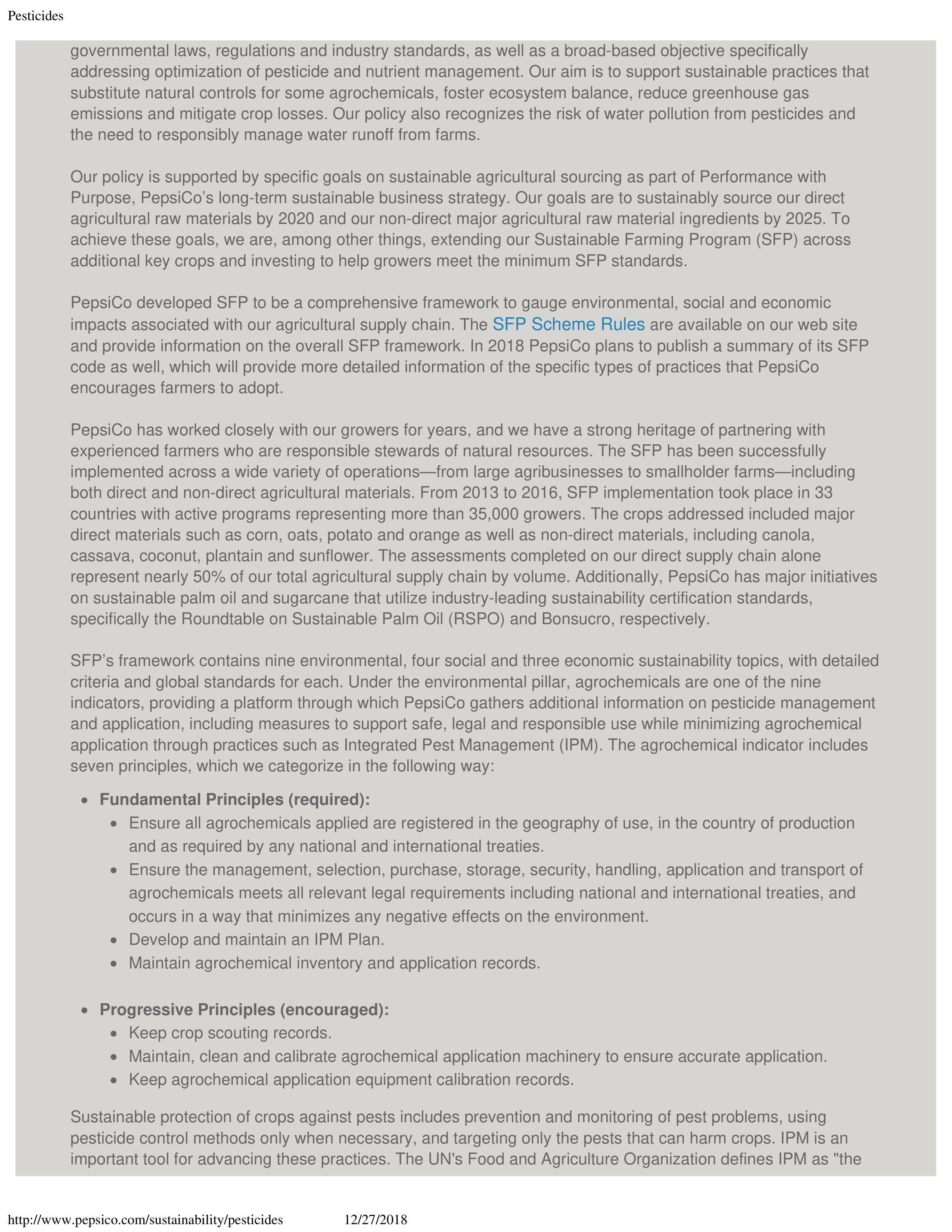
Pesticides
http://www.pepsico.com/sustainability/pesticides
12/27/2018
Fundamental Principles (required):
Ensure all agrochemicals applied are registered in the geography of use, in the country of production
and as required by any national and international treaties.
Ensure the management, selection, purchase, storage, security, handling, application and transport of
agrochemicals meets all relevant legal requirements including national and international treaties, and
occurs in a way that minimizes any negative effects on the environment.
Develop and maintain an IPM Plan.
Maintain agrochemical inventory and application records.
Progressive Principles (encouraged):
Keep crop scouting records.
Maintain, clean and calibrate agrochemical application machinery to ensure accurate application.
Keep agrochemical application equipment calibration records.
governmental laws, regulations and industry standards, as well as a broad-based objective specifically
addressing optimization of pesticide and nutrient management. Our aim is to support sustainable practices that
substitute natural controls for some agrochemicals, foster ecosystem balance, reduce greenhouse gas
emissions and mitigate crop losses. Our policy also recognizes the risk of water pollution from pesticides and
the need to responsibly manage water runoff from farms.
Our policy is supported by specific goals on sustainable agricultural sourcing as part of Performance with
Purpose, PepsiCo’s long-term sustainable business strategy. Our goals are to sustainably source our direct
agricultural raw materials by 2020 and our non-direct major agricultural raw material ingredients by 2025. To
achieve these goals, we are, among other things, extending our Sustainable Farming Program (SFP) across
additional key crops and investing to help growers meet the minimum SFP standards.
PepsiCo developed SFP to be a comprehensive framework to gauge environmental, social and economic
impacts associated with our agricultural supply chain. The
SFP Scheme Rules
are available on our web site
and provide information on the overall SFP framework. In 2018 PepsiCo plans to publish a summary of its SFP
code as well, which will provide more detailed information of the specific types of practices that PepsiCo
encourages farmers to adopt.
PepsiCo has worked closely with our growers for years, and we have a strong heritage of partnering with
experienced farmers who are responsible stewards of natural resources. The SFP has been successfully
implemented across a wide variety of operations—from large agribusinesses to smallholder farms—including
both direct and non-direct agricultural materials. From 2013 to 2016, SFP implementation took place in 33
countries with active programs representing more than 35,000 growers. The crops addressed included major
direct materials such as corn, oats, potato and orange as well as non-direct materials, including canola,
cassava, coconut, plantain and sunflower. The assessments completed on our direct supply chain alone
represent nearly 50% of our total agricultural supply chain by volume. Additionally, PepsiCo has major initiatives
on sustainable palm oil and sugarcane that utilize industry-leading sustainability certification standards,
specifically the Roundtable on Sustainable Palm Oil (RSPO) and Bonsucro, respectively.
SFP’s framework contains nine environmental, four social and three economic sustainability topics, with detailed
criteria and global standards for each. Under the environmental pillar, agrochemicals are one of the nine
indicators, providing a platform through which PepsiCo gathers additional information on pesticide management
and application, including measures to support safe, legal and responsible use while minimizing agrochemical
application through practices such as Integrated Pest Management (IPM). The agrochemical indicator includes
seven principles, which we categorize in the following way:
Sustainable protection of crops against pests includes prevention and monitoring of pest problems, using
pesticide control methods only when necessary, and targeting only the pests that can harm crops. IPM is an
important tool for advancing these practices. The UN's Food and Agriculture Organization defines IPM as "the
•
•
•
•
•
•
•
•
•
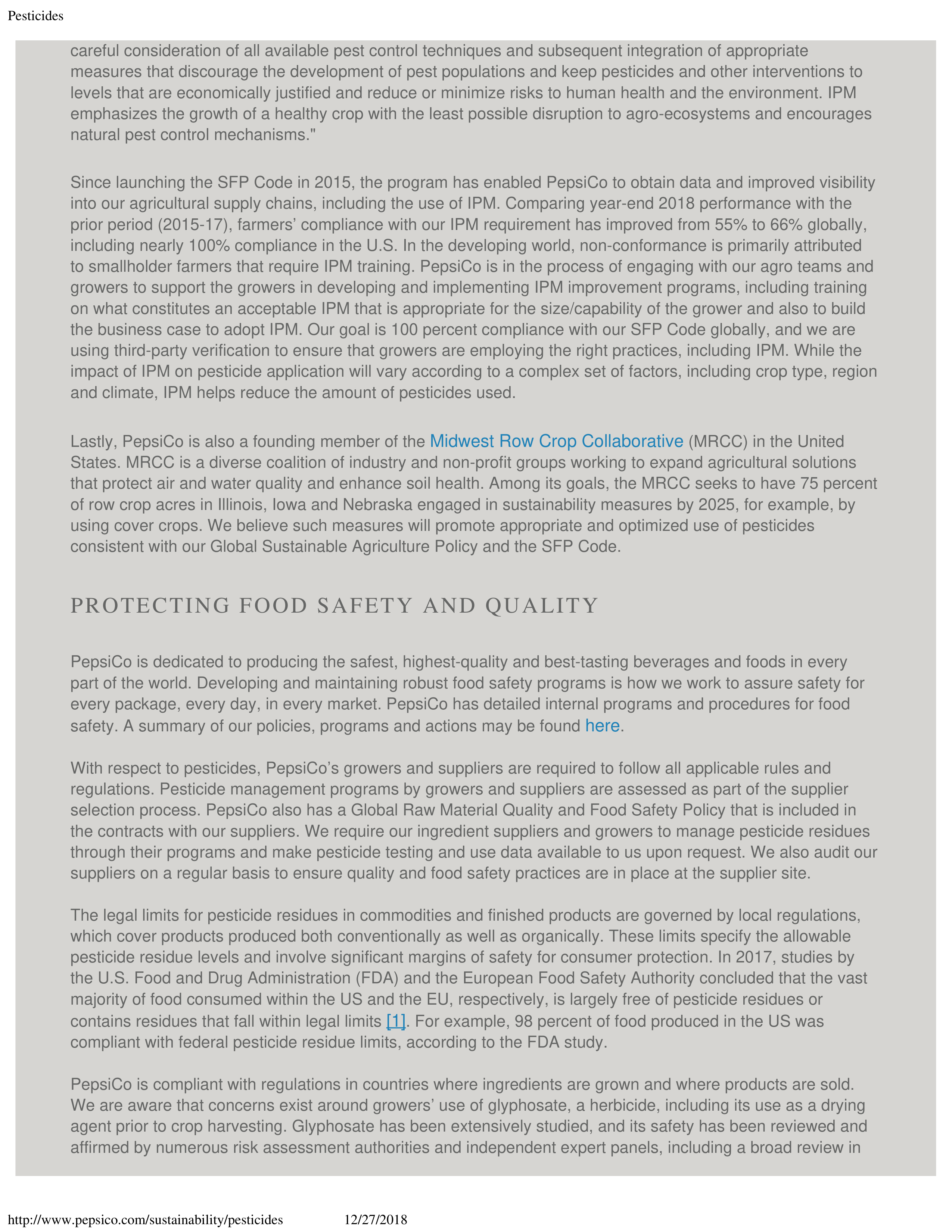
Pesticides
http://www.pepsico.com/sustainability/pesticides
12/27/2018
careful consideration of all available pest control techniques and subsequent integration of appropriate
measures that discourage the development of pest populations and keep pesticides and other interventions to
levels that are economically justified and reduce or minimize risks to human health and the environment. IPM
emphasizes the growth of a healthy crop with the least possible disruption to agro-ecosystems and encourages
natural pest control mechanisms."
Since launching the SFP Code in 2015, the program has enabled PepsiCo to obtain data and improved visibility
into our agricultural supply chains, including the use of IPM. Comparing year-end 2018 performance with the
prior period (2015-17), farmers’ compliance with our IPM requirement has improved from 55% to 66% globally,
including nearly 100% compliance in the U.S. In the developing world, non-conformance is primarily attributed
to smallholder farmers that require IPM training. PepsiCo is in the process of engaging with our agro teams and
growers to support the growers in developing and implementing IPM improvement programs, including training
on what constitutes an acceptable IPM that is appropriate for the size/capability of the grower and also to build
the business case to adopt IPM. Our goal is 100 percent compliance with our SFP Code globally, and we are
using third-party verification to ensure that growers are employing the right practices, including IPM. While the
impact of IPM on pesticide application will vary according to a complex set of factors, including crop type, region
and climate, IPM helps reduce the amount of pesticides used.
Lastly, PepsiCo is also a founding member of the
Midwest Row Crop Collaborative
(MRCC) in the United
States. MRCC is a diverse coalition of industry and non-profit groups working to expand agricultural solutions
that protect air and water quality and enhance soil health. Among its goals, the MRCC seeks to have 75 percent
of row crop acres in Illinois, Iowa and Nebraska engaged in sustainability measures by 2025, for example, by
using cover crops. We believe such measures will promote appropriate and optimized use of pesticides
consistent with our Global Sustainable Agriculture Policy and the SFP Code.
PROTECTING FOOD SAFETY AND QUALITY
PepsiCo is dedicated to producing the safest, highest-quality and best-tasting beverages and foods in every
part of the world. Developing and maintaining robust food safety programs is how we work to assure safety for
every package, every day, in every market. PepsiCo has detailed internal programs and procedures for food
safety. A summary of our policies, programs and actions may be found
here
.
With respect to pesticides, PepsiCo’s growers and suppliers are required to follow all applicable rules and
regulations. Pesticide management programs by growers and suppliers are assessed as part of the supplier
selection process. PepsiCo also has a Global Raw Material Quality and Food Safety Policy that is included in
the contracts with our suppliers. We require our ingredient suppliers and growers to manage pesticide residues
through their programs and make pesticide testing and use data available to us upon request. We also audit our
suppliers on a regular basis to ensure quality and food safety practices are in place at the supplier site.
The legal limits for pesticide residues in commodities and finished products are governed by local regulations,
which cover products produced both conventionally as well as organically. These limits specify the allowable
pesticide residue levels and involve significant margins of safety for consumer protection. In 2017, studies by
the U.S. Food and Drug Administration (FDA) and the European Food Safety Authority concluded that the vast
majority of food consumed within the US and the EU, respectively, is largely free of pesticide residues or
contains residues that fall within legal limits
[1]
. For example, 98 percent of food produced in the US was
compliant with federal pesticide residue limits, according to the FDA study.
PepsiCo is compliant with regulations in countries where ingredients are grown and where products are sold.
We are aware that concerns exist around growers’ use of glyphosate, a herbicide, including its use as a drying
agent prior to crop harvesting. Glyphosate has been extensively studied, and its safety has been reviewed and
affirmed by numerous risk assessment authorities and independent expert panels, including a broad review in
Pesticides
http://www.pepsico.com/sustainability/pesticides
12/27/2018
2016 that supported the safety of glyphosate use
[2]
. As safety remains a paramount concern, PepsiCo will
continue to monitor the evolving science in this area and engage with stakeholders to understand any potential
issues.
PROTECTING BEES AND POLLINATORS
We are aware of the potential impact of pesticides, among other environmental stressors, on beneficial
pollinators as an important issue within PepsiCo’s supply chain. With respect to the group of pesticides called
neonicotinoids (“neonics”), we understand that a significant amount of study is underway to evaluate their
impact on pollinators, though significant gaps in scientific knowledge remain.
PepsiCo’s growers and suppliers are required to follow all applicable rules and regulations. Additionally, we
implement policies and procedures, including the SFP discussed above, to address and optimize the use of
pesticides in our supply chain and minimize any unintended impacts.
PepsiCo commits to broaden our engagement with external stakeholders on the issue of pollinator health
specifically. Through this engagement and our ongoing review of available science, we will continue learning
about the issues as they evolve while evaluating the feasibility of actions we can take to protect pollinators.
---------------------------------------------------------------
US Food and Drug Administration, FY 2015 Pesticide Analysis Demonstrates Residue Levels Remain Low, November 6, 2017;
https://www.fda.gov/Food/NewsEvents/ConstituentUpdates/ucm583717.htm
European Food Safety Authority, Pesticide residues in food: risk to consumers remains low, April 11, 2017;
https://www.efsa.europa.eu/en/press/news/170411
1
Gary M. Williams, Marilyn Aardema, John Acquavella, Sir Colin Berry, David Brusick, Michele M. Burns, Joao Lauro Viana de Camargo, David Garabrant,
Helmut A. Greim, Larry D. Kier, David J. Kirkland, Gary Marsh, Keith R. Solomon, Tom Sorahan, Ashley Roberts & Douglas L. Weed (2016) A review of the
carcinogenic potential of glyphosate by four independent expert panels and comparison to the IARC assessment, Critical Reviews in Toxicology, 46:sup1, 3-
20, DOI: 10.1080/10408444.2016.1214677.
2