

March 10, 2025
Elizabeth A. Ising
Gibson, Dunn & Crutcher LLP
Re:
Citigroup Inc. (the “Company”)
Incoming letter dated December 27, 2024
Dear Elizabeth A. Ising:
This letter is in response to your correspondence concerning the shareholder
proposal (the “Proposal”) submitted to the Company by The Heritage Foundation for
inclusion in the Company’s proxy materials for its upcoming annual meeting of security
holders.
The Proposal requests the Company’s board of directors issue a report evaluating
how it oversees risks related to surveilling or monitoring customers based on their
political or religious status, views, or activities, and how such viewpoint discrimination
impacts individuals’ exercise of their constitutionally protected civil rights.
There appears to be some basis for your view that the Company may exclude the
Proposal under Rule 14a-8(i)(7). In our view, the Proposal relates to the Company’s
ordinary business operations. Accordingly, we will not recommend enforcement action to
the Commission if the Company omits the Proposal from its proxy materials in reliance
on Rule 14a-8(i)(7). In reaching this position, we have not found it necessary to address
the alternative basis for omission upon which the Company relies.
Copies of all of the correspondence on which this response is based will be made
available on our website at
https://www.sec.gov/corpfin/2024-2025-shareholder-
proposals-no-action
.
Sincerely,
Rule 14a-8 Review Team
cc:
Jerry Bowyer
Bowyer Research, Inc.

Elizabeth A. Ising
Partner
T: +1 202.955.8287
eising@gibsondunn.com
Gibson, Dunn & Crutcher LLP
1700 M Street, N.W. | Washington, D.C. 20036-4504 | T: 202.955.8500 | F: 202.467.0539 | gibsondunn.com
December 27, 2024
VIA ELECTRONIC SUBMISSION
Office of Chief Counsel
Division of Corporation Finance
Securities and Exchange Commission
100 F Street, NE
Washington, DC 20549
Re:
Citigroup Inc.
Stockholder Proposal of The Heritage Foundation
Securities Exchange Act of 1934—Rule 14a-8
Ladies and Gentlemen:
This letter is to inform you that our client, Citigroup Inc. (“Citigroup” or the “Company”),
intends to omit from its proxy statement and form of proxy for its 2025 Annual Meeting of
Stockholders (collectively, the “2025 Proxy Materials”) a stockholder proposal (the
“Proposal”) and statement in support thereof (the “Supporting Statement”) received from
Bowyer Research, Inc. on behalf of The Heritage Foundation (the “Proponent”).
Pursuant to Rule 14a-8(j), we have:
•
filed this letter with the Securities and Exchange Commission (the “Commission”) no
later than eighty (80) calendar days before the Company intends to file its definitive
2025 Proxy Materials with the Commission; and
•
concurrently sent a copy of this correspondence to the Proponent.
Rule 14a-8(k) and Staff Legal Bulletin No. 14D (Nov. 7, 2008) (“SLB 14D”) provide that
stockholder proponents are required to send companies a copy of any correspondence that
the proponents elect to submit to the Commission or the staff of the Division of Corporation
Finance (the “Staff”). Accordingly, we are taking this opportunity to inform the Proponent
that if the Proponent elects to submit additional correspondence to the Commission or the
Staff with respect to the Proposal, a copy of such correspondence should be furnished
concurrently to the undersigned on behalf of the Company pursuant to Rule 14a-8(k) and
SLB 14D.
THE PROPOSAL
The Proposal states:
Resolved:
Shareholders request the Board of Directors of Citigroup, [
sic
] Inc. issue
a report within the next year, at reasonable cost and excluding confidential
information, evaluating how it oversees risks related to surveilling or monitoring
customers based on their political or religious status, views, or activities, and how

Office of Chief Counsel
Division of Corporation Finance
December 27, 2024
Page 2
such viewpoint discrimination impacts individuals’ exercise of their constitutionally
protected civil rights.
A copy of the Proposal and the Supporting Statement is attached to this letter as Exhibit A.
BASES FOR
EXCLUSION
We hereby respectfully request that the Staff concur in our view that the Proposal may be
excluded from the 2025 Proxy Materials pursuant to:
•
Rule 14a-(8)(i)(12)(i) because the Proposal addresses substantially the same
subject matter as a previously submitted stockholder proposal that was included in
the Company’s proxy materials for the 2024 Annual Meeting of Stockholders (“2024
Annual Meeting”), and the previous proposal did not receive the support necessary
for resubmission; and
•
Rule 14a-8(i)(7) because the Proposal relates to the Company’s ordinary business
operations and seeks to micromanage the Company.
ANALYSIS
I.
The Proposal May Be Excluded Pursuant To Rule 14a-8(i)(12)(i) Because It
Addresses Substantially The Same Subject Matter As A Previously Submitted
Stockholder Proposal, And The Previously Submitted Proposal Did Not Receive
The Support Necessary For Resubmission.
Under Rule 14a-8(i)(12)(i), a stockholder proposal that “addresses substantially the same
subject matter as a proposal, or proposals, previously included in the company’s proxy
materials within the preceding five calendar years” may be excluded from the proxy
materials “if the most recent vote occurred within the preceding three calendar years and
the most recent vote was . . . [l]ess than 5 percent of the votes cast if previously voted on
once.”
A. Overview Of Rule 14a-8(i)(12).
The Commission has indicated that the condition in Rule 14a-8(i)(12) that the stockholder
proposals deal with or address “substantially the same subject matter” does not mean that
the previous proposal(s) and the current proposal must be exactly the same. Although the
predecessor to Rule 14a-8(i)(12) required a proposal to be “substantially the same proposal”
as prior proposals, the Commission amended this rule in 1983 to permit exclusion of a
proposal that “deals with substantially the same subject matter.” The Commission explained
that this revision to the standard applied under the rule responded to commenters who
viewed it as:
[A]n appropriate response to counter the abuse of the security holder proposal
process by certain proponents who make minor changes in proposals each

Office of Chief Counsel
Division of Corporation Finance
December 27, 2024
Page 3
year so that they can keep raising the same issue despite the fact that other
shareholders have indicated by their votes that they are not interested in that
issue.
Exchange Act Release No. 20091 (Aug. 16, 1983) (the “1983 Release”). In addition, in
Exchange Act Release No. 19135 (Oct. 14, 1982), the Commission stated that Rule 14a-8
“was not designed to burden the proxy solicitation process by requiring the inclusion of such
proposals.” In the release adopting this change, the Commission explained the application of
the standard, stating:
The Commission believes that this change is necessary to signal a clean break
from the strict interpretive position applied to the existing provision. The
Commission is aware that the interpretation of the new provision will continue
to involve difficult subjective judgments, but anticipates that those judgments
will be based upon a consideration of the substantive concerns raised by a
proposal rather than the specific language or actions proposed to deal with
those concerns.
In Exchange Act Release No. 89964 (Sept. 23, 2020), the Commission amended
Rule 14a-8(i)(12) to adjust the resubmission percentage thresholds, and it also altered the
provision’s lead-in language to state that a company may exclude from its proxy materials a
stockholder proposal that “
addresses
substantially the same subject matter” (emphasis
added), rather than one that “
deals with
substantially the same subject matter” (emphasis
added). In the release adopting this change, the Commission provided no indication that it
intended a different substantive interpretation to apply under Rule 14a-8(i)(12) as a result of
updating the language from “deals with” to “addresses.” On the contrary, the Commission
stated that it “did not propose changes to the ‘substantially the same subject matter’ test.”
See
Exchange Act Release No. 89964 (Sept. 23, 2020).
The Staff has confirmed numerous times that Rule 14a-8(i)(12) does not require that the
stockholder proposals or their requested actions be identical in order for a company to
exclude the later submitted proposal. Instead, pursuant to the Commission’s statement in
the 1983 Release, when considering whether proposals deal with or address substantially
the same subject matter, the Staff has focused on the “substantive concerns.” Consistent
with this approach, the Staff has concurred with the exclusion of a proposal under
Rule 14a-8(i)(12) when it shares the same substantive concerns even if the proposal differs
in scope from a prior proposal.
See, e.g.
,
The PNC Financial Services Group, Inc.
(avail.
Feb. 28, 2023) (concurring with the exclusion of a proposal requesting a “report on the
company’s due diligence process to identify and address environmental and social risks
related to financing companies producing controversial weapons and/or with business
activities in conflict-affected and high-risk areas” because it addressed substantially the
same subject matter as two earlier proposals requesting a report “assessing the
effectiveness of PNC’s Environmental and Social Risk Management (ESRM) systems at
managing risks associated with lending, investing, and financing activities within the nuclear
weapons industry”);
Apple Inc.
(avail. Nov. 20, 2018) (concurring with the exclusion of a
proposal requesting that the company review its policies related to human rights to assess

Office of Chief Counsel
Division of Corporation Finance
December 27, 2024
Page 4
whether it needed to adopt and implement additional policies because it dealt with
substantially the same subject matter as one prior proposal requesting that the company
establish a board committee on human rights and a second prior proposal requesting that
the board amend the company’s bylaws to require a board committee on human rights);
Apple Inc. (Eli Plenk)
(avail. Dec. 15, 2017) (concurring with the exclusion of a proposal
requesting that the company prepare a report assessing the feasibility of integrating
sustainability metrics, including metrics regarding diversity among senior executives, into
performance measures of the CEO because it dealt with substantially the same subject
matter as two earlier proposals requesting that the company adopt an accelerated
recruitment policy requiring the company to increase the diversity of senior management
and its board of directors);
Exxon Mobil Corp.
(avail. Mar. 7, 2013) (concurring with the
exclusion of a proposal requesting that the company review its facilities’ exposure to climate
risk and issue a report to stockholders because it dealt with substantially the same subject
matter as three prior proposals requesting that the company establish a committee or a task
force to address issues relating to global climate change);
Pfizer Inc. (AFSCME Employees
Pension Plan et al.)
(avail. Jan. 9, 2013) (concurring with the exclusion of a proposal
seeking disclosure of the company’s lobbying policies and expenditures because it dealt
with substantially the same subject matter as two prior proposals seeking disclosure of
contributions to political campaigns, political parties, and attempts to influence legislation);
Dow Jones & Co., Inc.
(avail. Dec. 17, 2004) (concurring that a proposal requesting that the
company publish information relating to its process for donations to a particular non-profit
organization was excludable as it dealt with substantially the same subject matter as a prior
proposal requesting an explanation of the procedures governing all charitable donations);
Saks Inc.
(avail. Mar. 1, 2004) (concurring with the exclusion of a proposal requesting that
the board of directors implement a code of conduct based on International Labor
Organization standards, establish an independent monitoring process, and annually report
on adherence to such code because it dealt with substantially the same subject matter as
one prior proposal that was nearly identical to the proposal at issue and a second prior
proposal requesting a report on the company’s vendor labor standards and compliance
mechanism).
B. The Proposal Addresses Substantially The Same Subject Matter As A Proposal
That Was Previously Included In The Company’s Proxy Materials Within The
Preceding Five Calendar Years.
The Company has, within the past five years, included in its proxy materials a stockholder
proposal requesting that the Board of Directors issue a report evaluating how it oversees
risks related to discrimination (notably, including “discrimination . . . based on [individuals’]
religion (including religious views) . . . or political views”) and how any such discrimination
would impact individuals’ constitutionally protected civil rights. The Company included such
proposal (the “2024 Proposal”) and statement in support thereof (the “2024 Supporting
Statement”) in its proxy materials for the 2024 Annual Meeting, filed with the Commission on
March 19, 2024, both of which are attached as Exhibit B.

Office of Chief Counsel
Division of Corporation Finance
December 27, 2024
Page 5
The Proposal deals with substantially the same substantive concern
1
—risks and effects of
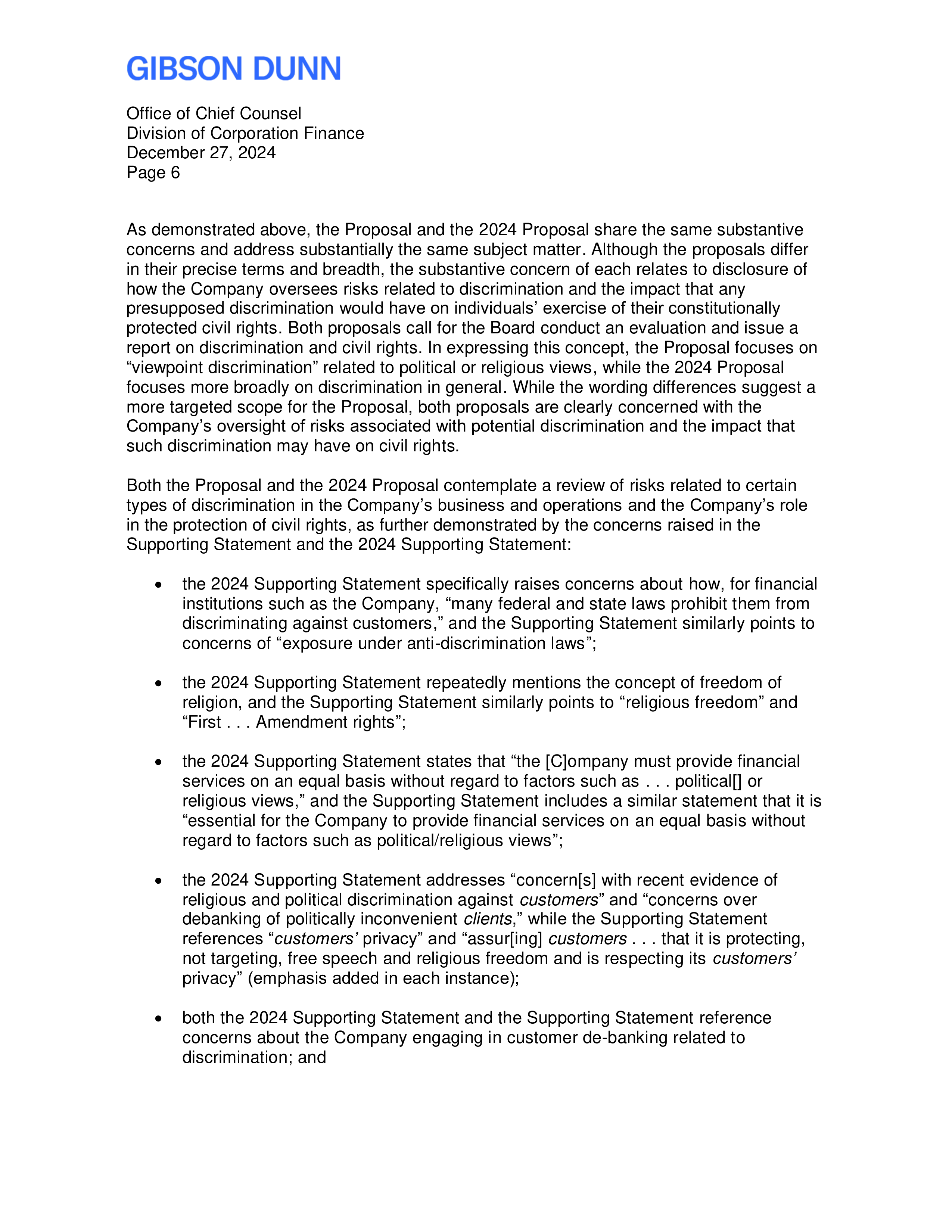
discrimination—as the 2024 Proposal. As demonstrated by the side-by-side comparison
below, the resolved clauses of the two proposals each address substantially the same
subject matter, demonstrated by the language used in each proposal (emphases added):
Proposal
2024 Proposal
Both proposals request the same action from the Board of Directors.
“
Shareholders request the Board of
Directors of Citigroup, Inc. issue a
report
within the next year
, at
reasonable cost and excluding
confidential information . . . .”
“
Shareholders request that Citigroup’s
Board of Directors
conduct an
evaluation
and
issue a report
within
the next year
, at reasonable cost and
excluding proprietary information and
disclosure of anything that would
constitute an admission of pending
litigation . . . .”
Both proposals request a report on risks and impacts related to potential
discrimination and civil rights.
“issue a report . . . evaluating how it
oversees
risks related to surveilling or
monitoring customers based on their
political or religious status, views, or
activities
, and how
such
viewpoint
discrimination impacts individuals’
exercise of their constitutionally
protected civil rights
.”
“issue a report . . . evaluating how it
oversees
risks related to discrimination
against individuals
based on their race,
color, religion (including religious views),
sex, national origin, or political views, and
whether
such discrimination may
impact individuals’ exercise of their
constitutionally protected civil rights
.”
Both proposals focus on the same type of potential discrimination.
“evaluating how it oversees risks related
to surveilling or monitoring customers
based on their political or religious
status, views, or activities
. . .”
“evaluating how it oversees risks related
to discrimination against individuals
based on their
race, color,
religion
(including religious views)
, sex,
national origin, or
political views
. . .”
1
We note that the Commission proposed amendments to Rule 14a-8(i)(12) to provide that a proposal
constitutes a resubmission if it “substantially duplicates” another proposal that was previously submitted for the
same company’s prior stockholder meetings and “that a proposal ‘substantially duplicates’ another proposal if
it ‘addresses the same subject matter and seeks the same objective by the same means.’” Exchange Act
Release No. 34-95267 (July 13, 2022). We believe that the Proposal satisfies this standard as well for the
reasons noted below, specifically that each of the Proposal and the 2024 Proposal seeks disclosure regarding
the risks of the Company’s allegedly discriminatory practices by the same means—publishing a report
evaluating how it oversees the risks related to such alleged practices.

Office of Chief Counsel
Division of Corporation Finance
December 27, 2024
Page 6
As demonstrated above, the Proposal and the 2024 Proposal share the same substantive
concerns and address substantially the same subject matter. Although the proposals differ
in their precise terms and breadth, the substantive concern of each relates to disclosure of
how the Company oversees risks related to discrimination and the impact that any
presupposed discrimination would have on individuals’ exercise of their constitutionally
protected civil rights. Both proposals call for the Board conduct an evaluation and issue a
report on discrimination and civil rights. In expressing this concept, the Proposal focuses on
“viewpoint discrimination” related to political or religious views, while the 2024 Proposal
focuses more broadly on discrimination in general. While the wording differences suggest a
more targeted scope for the Proposal, both proposals are clearly concerned with the
Company’s oversight of risks associated with potential discrimination and the impact that
such discrimination may have on civil rights.
Both the Proposal and the 2024 Proposal contemplate a review of risks related to certain
types of discrimination in the Company’s business and operations and the Company’s role
in the protection of civil rights, as further demonstrated by the concerns raised in the
Supporting Statement and the 2024 Supporting Statement:
•
the 2024 Supporting Statement specifically raises concerns about how, for financial
institutions such as the Company, “many federal and state laws prohibit them from
discriminating against customers,” and the Supporting Statement similarly points to
concerns of “exposure under anti-discrimination laws”;
•
the 2024 Supporting Statement repeatedly mentions the concept of freedom of
religion, and the Supporting Statement similarly points to “religious freedom” and
“First . . . Amendment rights”;
•
the 2024 Supporting Statement states that “the [C]ompany must provide financial
services on an equal basis without regard to factors such as . . . political[] or
religious views,” and the Supporting Statement includes a similar statement that it is
“essential for the Company to provide financial services on an equal basis without
regard to factors such as political/religious views”;
•
the 2024 Supporting Statement addresses “concern[s] with recent evidence of
religious and political discrimination against
customers
” and “concerns over
debanking of politically inconvenient
clients
,” while the Supporting Statement
references “
customers’
privacy” and “assur[ing]
customers
. . . that it is protecting,
not targeting, free speech and religious freedom and is respecting its
customers’
privacy” (emphasis added in each instance);
•
both the 2024 Supporting Statement and the Supporting Statement reference
concerns about the Company engaging in customer de-banking related to
discrimination; and

Office of Chief Counsel
Division of Corporation Finance
December 27, 2024
Page 7
•
the 2024 Supporting Statement mentions “the possibility of politicized [actions]” and
“concerns over . . . politically inconvenient clients,” while the Supporting Statement
includes reference to “political . . . views” and “conservative . . . organizations.”
Thus, the subject of both the Proposal and the 2024 Proposal is concerns over risks of
discrimination in the Company’s business and operations and related impacts on civil rights,
specifically including those of customers.
Despite the overwhelming similarity in the subject matter of the Proposal and the 2024
Proposal and in the concerns raised in the supporting statements to each proposal, we
recognize that the scope of the proposals is not identical. The scope of the 2024 Proposal is
broader, requesting a report “evaluating how [the Board of Directors] oversees risks related
to discrimination against individuals” based on various characteristics, including political or
religious views, “and whether such discrimination may impact individuals’ exercise of their
constitutionally protected civil rights.” In comparison, the Proposal requests a report
“evaluating how [the Board of Directors] oversees risks related to surveilling or monitoring
customers based on their political or religious status, views, or activities, and how such
viewpoint discrimination impacts individuals’ exercise of their constitutionally protected civil
rights.” The fact that the Proposal’s resolved clause focuses more narrowly on “viewpoint
discrimination” related to political or religious views in singling out certain individuals for
“surveilling or monitoring,” while the 2024 Proposal’s resolved clause focuses more broadly
on discrimination in general, does not preclude no-action relief. As with
PNC Financial
Services
,
Exxon Mobil
and the other precedents described above, the narrower scope of the
Proposal does not change the conclusion that both the Proposal and the 2024 Proposal
share the same substantive concerns and are requesting substantially the same action by
the Company: an evaluation and report on risks of discrimination and related impacts on
civil rights, including with respect to political or religious views. Moreover, the Proposal’s
requested evaluation of risks related to the discriminatory “surveilling or monitoring” of
individuals based on certain “political or religious status, views, or activities” addresses
substantially the same subject matter—and indeed is entirely subsumed by—the 2024
Proposal’s broader request for an evaluation of risks “related to
discrimination
against
individuals based on their race, color,
religion (including religious views)
, sex, national
origin, or
political views
” (emphasis added). Notwithstanding the differences in the
supporting statements, the actions the Company would need to take are similar, and the
broader analysis required by the 2024 Proposal encompasses the narrower analysis sought
by the Proposal.
Pursuant to Rule 14a-8(i)(12), the proposals at issue need not be identical in terms and
scope in order to merit relief. Although the specific language in the resolved clauses of the
Proposal and the 2024 Proposal differ, the two proposals call for the same action—that the

Office of Chief Counsel
Division of Corporation Finance
December 27, 2024
Page 8
Board of Directors evaluate and report on risks of discrimination and impacts on civil rights,
including with respect to political or religious views.
C. The Stockholder Proposal Included In The Company’s 2024 Proxy Materials Did
Not Receive The Stockholder Support Necessary To Permit Resubmission.
In addition to requiring that the proposals address the same substantive concern,
Rule 14a-8(i)(12) includes thresholds with respect to the percentage of stockholder votes
cast in favor of the last proposal submitted and included in the Company’s proxy materials.
As evidenced in the Company’s Form 8-K filed on May 2, 2024, which states the voting
results for the Company’s 2024 Annual Meeting and is attached to this letter as Exhibit C,
the 2024 Proposal received 1.74% of the votes cast at the Company’s 2024 Annual
Meeting.
2
Thus, the vote on the 2024 Proposal failed to achieve the 5% threshold specified
in Rule 14a-8(i)(12)(i) at the 2024 Annual Meeting.
For the foregoing reasons, the Proposal is excludable under Rule 14a-8(i)(12)(i) because it
addresses substantially the same subject matter as the 2024 Proposal, and the 2024 Proposal
did not receive the necessary stockholder support to permit resubmission.
II. The Proposal May Be Excluded Pursuant To Rule 14a-8(i)(7) Because It Involves
Matters Related To The Company’s Ordinary Business Operations.
The Company is a global financial services holding company whose businesses offer a wide
range of consumer banking products and services, among other products and services,
including credit cards, loans, mortgages and investment products. As a result, the Company
is subject to an extensive regulatory framework. Particularly relevant here, the federal
regulation of U.S. banks, bank holding companies and financial holding companies is
intended primarily for the protection of depositors and the Federal Deposit Insurance Fund.
As a registered financial holding company and bank holding company, the Company is
subject to supervision and inspection by the Board of Governors of the Federal Reserve
System (“Federal Reserve”), while its U.S. bank subsidiaries, organized as national banking
associations, are subject to regulation, supervision and examination by the Office of the
Comptroller of the Currency (“OCC”), the Federal Deposit Insurance Corporation (“FDIC”),
the Consumer Financial Protection Bureau (“CFPB”) and the Federal Reserve. Additionally,
the Company and its bank and broker dealer subsidiaries are subject to a significant number
of laws, rules and regulations that govern their businesses in the U.S. and in the other
jurisdictions in which they operate, which set forth requirements on permissible activities,
compliance risk management, consumer products and sales practices, anti-money
laundering and anti-corruption, compliance with government sanctions, privacy and data
2
The 2024 Proposal received 1,327,000,450 “against” votes and 23,535,829 “for” votes. Abstentions and broker
non-votes were not included for purposes of this calculation. The total stockholder votes cast is calculated
using a fraction for which the numerator is “for” votes and the denominator is “for + against” votes.
See
Staff
Legal Bulletin No. 14, part F.4 (July 13, 2001).

Office of Chief Counsel
Division of Corporation Finance
December 27, 2024
Page 9
protection, among others, including those promulgated by the U.S. Department of the
Treasury’s Financial Crimes Enforcement Network (“FinCEN”).
This regulatory framework is reviewed in an interim staff report of the U.S. House of
Representatives Committee on the Judiciary and the Select Subcommittee on the
Weaponization of the Federal Government (the “Interim Staff Report”),
3
which is cited in the
Supporting Statement, as well as in a more recent interim staff report by the same House
subcommittee (the “December Staff Report”).
4
However, the Proposal and the Supporting
Statement misrepresent or misconstrue statements in the Interim Staff Report and
improperly attribute to the Company various actions purportedly taken by federal law
enforcement agencies. For example, the Interim Staff Report and the December Staff
Report address alleged financial surveillance by
federal
government
agencies
, not by
financial institutions,
5
and the Company, as a financial institution, does not control whether a
customer is “placed on a government watchlist” or “wrongly prosecuted.”
Notwithstanding the misleading references in the Proposal and Supporting Statement to the
Company “surveilling or monitoring [its] customers,” the subject of the Proposal is the
Company’s management and handling of customer accounts and account information,
particularly in the context of account closures or the provision of information to government
authorities, which the Proposal alleges is based on political or religious status, viewpoint, or
activities.
The Company’s relationship with its clients and the handling of client accounts, including the
terms upon which it does business with clients and how it manages and protects customer
account information, are essential to the operation of the Company’s business as a financial
services institution. In managing customer accounts and customer account information, the
Company is required to comply with the vast array of laws, rules and regulations applicable
to the Company and its subsidiaries, including those promulgated by the Federal Reserve,
OCC, FDIC, CFPB, and FinCEN. Decisions regarding customer accounts, including the
handling of customer information, involve legal, regulatory, operational, risk management
and financial considerations that implicate detailed and extensive policies and procedures
3
See Financial Surveillance in the United States: How Federal Law Enforcement Commandeered Financial
Institutions to Spy on Americans, Interim Staff Report of the Committee on the Judiciary and the Select
Subcommittee on the Weaponization of the Federal Government
(Mar. 6, 2024), available at
https://judiciary.house.gov/sites/evo-subsites/republicans-judiciary.house.gov/files/evo-media-document/How-
Federal-Law-Enforcement-Commandeered-Financial-Institutions-to-Spy.pdf
.
4
See Financial Surveillance in the United States: How the Federal Government Weaponized the Bank Secrecy
Act to Spy on Americans, Interim Staff Report of the Committee on the Judiciary and the Select Subcommittee
on the Weaponization of the Federal Government
(Dec. 6, 2024), available at
https://judiciary.house.gov/sites/evo-subsites/republicans-judiciary.house.gov/files/2024-12/2024-12-05-
Financial-Surveillance-in-the-United-States.pdf
.
5
See, e.g.
, Interim Staff Report at 1 (“As a part of this mission, the Committee and Select Subcommittee have
uncovered startling evidence that the
federal government
was engaged in broad financial surveillance, prying
into the private transactions of American consumers” (
emphasis added
).); December Staff Report at 6 (“The
reporting requirements of the Bank Secrecy Act turn financial institutions into confidential informants that are
required to secretly report Americans’ financial activities to the federal government.”).

Office of Chief Counsel
Division of Corporation Finance
December 27, 2024
Page 10
and are fundamental to the Company’s day-to-day operations. Because the Proposal
addresses the Company’s handling of customer relations, it is precisely the type of
stockholder proposal that companies are permitted to exclude under Rule 14a-8(i)(7).
A. Background On The Ordinary Business Standard.
Rule 14a-8(i)(7) permits a company to omit from its proxy materials a stockholder proposal
that relates to the company’s “ordinary business operations.” According to the Commission’s
release accompanying the 1998 amendments to Rule 14a-8, the term “ordinary business”
“refers to matters that are not necessarily ‘ordinary’ in the common meaning of the word,”
but instead the term “is rooted in the corporate law concept [of] providing management with
flexibility in directing certain core matters involving the company’s business and operations.”
See
Exchange Act Release No. 40018 (May 21, 1998) (the “1998 Release”).
In the 1998 Release, the Commission stated that the underlying policy of the ordinary
business exclusion is “to confine the resolution of ordinary business problems to
management and the board of directors, since it is impracticable for shareholders to decide
how to solve such problems at an annual shareholders meeting,” and identified two central
considerations that underlie this policy. The first was that “[c]ertain tasks are so fundamental
to management’s ability to run a company on a day-to-day basis that they could not, as a
practical matter, be subject to direct shareholder oversight.” Examples of the tasks cited by
the Commission include “management of the workforce, such as the hiring, promotion, and
termination of employees,
decisions on production quality and quantity
, and the retention of
suppliers” (emphasis added). 1998 Release. The second consideration is related to “the
degree to which the proposal seeks to ‘micro-manage’ the company by probing too deeply
into matters of a complex nature upon which shareholders, as a group, would not be in a
position to make an informed judgment.”
Id.
(citing Exchange Act Release No. 12999
(Nov. 22, 1976)).
The Commission has stated that a proposal requesting the dissemination of a report is
excludable under Rule 14a-8(i)(7) if the substance of the proposal is within the ordinary
business of the company.
See
Exchange Act Release No. 34-20091 (Aug. 16, 1983) (“[T]he
staff will consider whether the subject matter of the special report or the committee involves
a matter of ordinary business; where it does, the proposal will be excludable under
Rule 14a-8(c)(7).”). Moreover, in Staff Legal Bulletin 14E (Oct. 27, 2009) (“SLB 14E”), the
Staff noted that if a proposal relates to management of risks or liabilities that a company
faces as a result of its operations, the Staff will focus on the “subject matter to which the risk
pertains or that gives rise to the risk” in making a decision regarding whether a proposal can
be properly excluded pursuant to Rule 14a-8(i)(7). Pursuant to SLB 14E, the Staff has
consistently permitted exclusion of stockholder proposals under Rule 14a-8(i)(7) requesting
an assessment of risks when the underlying subject matter concerns the ordinary business
of the company.
See, e.g.
,
Netflix, Inc.
(Mar. 14, 2016) (permitting exclusion under
Rule 14a-8(i)(7) of a proposal that requested a report “describing how company
management identifies, analyzes and oversees reputational risks related to offensive and
inaccurate portrayals of Native Americans, American Indians and other indigenous peoples,
how it mitigates these risks and how the company incorporates these risk assessment

Office of Chief Counsel
Division of Corporation Finance
December 27, 2024
Page 11
results into company policies and decision-making,” noting that the proposal related to the
ordinary business matter of the “nature, presentation and content of programming and film
production”).
As described in more detail below, the Proposal relates to the Company’s relationships with
customers and its management and handling of customer accounts and account
information, particularly in the context of account closures and the provision of information to
government authorities, all of which are subject to the Company’s obligation to comply with
laws, rules and regulations, and involve other core business operations. The Proposal also
seeks to micromanage the Company by requesting intricate detail regarding its policies and
procedures governing customer accounts and management of customer accounts and
account information, including those governing the dissemination of customers’ personal
information to government agencies, which would include all federal, state, and local
agencies. In order to evaluate how the Company’s management of customer accounts,
including providing certain customer account information to government agencies, could
“impact[] individuals’ exercise of their constitutionally protected civil rights,” the Proposal
would require the Company to collect information from customers that it does not currently
collect and obtain information from government agencies regarding how the agencies use
any information provided by the Company. For example, in order to comply with the
Proposal, the Company would have to ask its customers to provide the Company with
information about their “political or religious status, views, or activities”—an intrusive
process the Company does not currently undertake, and one that is not necessary for the
Company to continue to comply with its existing policies and the laws, rules and regulations
governing customer accounts and customer account information. As such, similar to the
well-established precedents described in greater detail below and consistent with the
Commission guidance and Staff precedents, the Proposal involves matters related to the
Company’s ordinary business and may be excluded under Rule 14a-8(i)(7).
B. The Proposal May Be Excluded Because Its Subject Matter Relates To The
Products And Services That The Company Offers, Including How The Company
Manages Customer Relations, Customer Accounts And Customer Account
Information.
The Proposal seeks to require the Company to issue a report “evaluating how it oversees
risks related to surveilling or monitoring customers based on their political or religious
status, views, or activities.” The Supporting Statement frames this issue primarily around
responses to government inquiries and, to a lesser degree, regarding account closures. The
Company’s decision-making regarding the policies and procedures that govern the
Company’s handling of customer accounts, including handling of customer information,
implicates routine management decisions that encompass legal, regulatory, operational, risk
management and financial considerations, among others. As a global financial institution
organized under the laws of the United States, the Company is subject to significant federal,
state, and local laws and regulations, which include requirements relating to appropriate
procedures for the protection of customer information. In addition, the Company is required
to report certain unusual or suspicious activities to federal agencies or other government
counterparties as part of the Company’s obligations to monitor for certain criminal activities,

Office of Chief Counsel
Division of Corporation Finance
December 27, 2024
Page 12
such as money laundering. As a result, the Company has developed a detailed set of
policies and procedures that govern the handling of customer accounts and information,
including policies and procedures, consistent with applicable federal, state, and local
regulatory requirements, relating to protecting customer account information and providing
certain information to government agencies. The Proposal impermissibly seeks to interject
stockholders into this aspect of the Company’s ordinary business.
The Staff consistently has concurred with the exclusion of proposals relating to financial
institutions’ handling of customer accounts and customer information, even where the
proposal has implicated policies and procedures related to government inquiries. For
instance, in
American Express Co.
(avail. Mar. 9, 2023), the Staff concurred with the
exclusion under Rule 14a-8(i)(7) of a proposal requesting an evaluation and report
“describing if and how the [c]ompany intends to reduce the risk associated with tracking,
collecting, or sharing information regarding the processing of payments involving its cards
and/or electronic payment system services for the sale and purchase of firearms.” The
supporting statement, like the Supporting Statement, raised concerns regarding providing
information about customer purchases with “law enforcement or other governmental
entities,” including by raising “concerns over the privacy of gun ownership” and “the dangers
associated with sharing any information gathered with government representatives whose
use of the information can only be to surveil and harass those who exercise their lawful right
to keep and bear Arms.” Similarly, the Staff recently concurred with the exclusion under
Rule 14a-8(i)(7) of two proposals requesting each company’s “policy in responding to
requests to close, or in issuing warnings of imminent closure about, customer accounts by
any agency or entity operating under the authority of the executive branch of the United
States Government,” including “an itemized listing of such requests . . . and a reason or
rationale for the [c]ompany’s response, or lack thereof.” In each case, the supporting
statements, like the Supporting Statement, raised concerns about “unconstitutional law
enforcement activities and censorship” and each company’s “cooperat[ion] with the
government in the unconstitutional program.”
See JPMorgan Chase & Co. (National Legal
and Policy Center)
(avail. Mar. 21, 2023);
Wells Fargo & Co.
(avail. Mar. 2, 2023).
Similarly, the Staff has consistently concurred with the exclusion of proposals relating to
procedures for handling customer information, even when those proposals touched upon
concerns over the exercise of constitutionally protected rights. In
AT&T Inc.
(avail. Jan. 30,
2017) (“
AT&T 2017
”), the proposal requested that the board “review and publicly report . . .
on the consistency between AT&T’s policies on privacy and civil rights and the [c]ompany’s
actions with respect to U.S. law enforcement investigations.” The supporting statements,
like the Supporting Statement, raised concerns regarding “how cooperation between U.S.
law enforcement entities and telecommunications companies affects Americans’ privacy and
civil rights” and cited a company program that reportedly provided law enforcement access
to certain data. The Staff nonetheless concurred with the proposal’s exclusion under
Rule 14a-8(i)(7), noting it “relate[d] to procedures for protecting customer information.” This
was also the Staff’s conclusion in
AT&T Inc.
(avail. Feb. 5, 2016) (“
AT&T 2016
”), where the
proposal requested that the company “issue a report . . . clarifying the [c]ompany’s policies
regarding providing information to law enforcement and intelligence agencies, domestically
and internationally, above and beyond what is legally required . . . , whether and how the

Office of Chief Counsel
Division of Corporation Finance
December 27, 2024
Page 13
policies have changed since 2013, and assessing risks to the [c]ompany’s finances and
operations arising from current and past policies and practices.” The Staff concurred that the
proposal related to “procedures for protecting customer information and [did] not focus on a
significant policy issue.”
See also AT&T Inc.
(avail. Feb. 7, 2008) (“
AT&T 2008
,” and
together with
AT&T 2017
and
AT&T 2016
, the “
AT&T Precedent
”)
(concurring with the
exclusion under Rule 14a-8(i)(7) of a proposal requesting that the company’s board of
directors prepare a report discussing, from technical, legal, and ethical standpoints, the
policy issues that pertain to disclosing customer records and the content of customer
communications to governmental agencies without a warrant, as well as the effect of such
disclosures on privacy rights of customers because it related to the ordinary business matter
of procedures for protecting customer information);
Verizon Communications Inc.
(avail.
Feb. 22, 2007) (concurring with the exclusion under Rule 14a-8(i)(7) of a proposal
requesting that the company prepare a report describing “the overarching technological,
legal and ethical policy issues surrounding the disclosure of customer records and
communications content” to government and non-government agencies because the
proposal related to the company’s “ordinary business operations (
i
.
e
., procedures for
protecting customer information),” even where the proposal also emphasized the
importance of these issues in terms of customers’ freedom of expression).
The Staff also has consistently concurred with the exclusion of proposals relating to how a
company handles closure of customer accounts and any associated procedures, even when
those proposals touched upon concerns over the exercise of constitutionally protected
rights. For instance, in
PayPal Holdings, Inc. (Laurent Ritter)
(avail. Apr. 10, 2023) (“
PayPal
(Ritter)
”), the proposal requested that the board of directors revise its reporting to “provide
clear explanations of the number and categories of account suspensions and closures that
may reasonably be expected to limit freedom of expression or access to information or
financial services” and the supporting statement requested that the report include the
“external legal or policy basis and internal company criteria for removals” as well as “[a]ny
efforts by the company to mitigate the harmful effects” of such account closures. The Staff
concurred with the proposal’s exclusion under Rule 14a-8(i)(7). More generally, in
Comcast
Corp. (Leonard J. Grossman)
(avail. Apr. 13, 2022), the proposal requested that the
company follow certain procedures and provide certain information “in advance of any
termination, suspension or cancellation of any service to the customer named on the
account” where the proponent raised concerns about the company’s decision to suspend
the proponent’s service and the procedures the company followed in doing so. The Staff
concurred with the proposal’s exclusion under Rule 14a-8(i)(7). This was also the Staff’s
conclusion in
PayPal Holdings, Inc. (James A. Heagy)
(avail. Apr. 2, 2021) (“
PayPal
(Heagy)
”), where the proposal requested that the company ensure “that [the company’s]
users do not have accounts frozen or the use of [company] services terminated without
giving specific, good and substantial reasons to the user for so doing.” The company argued
that the proposal “attempt[ed] to dictate the [c]ompany’s management of its customer
accounts, including the design and administration of [c]ompany policies and procedures”
and related to communications with customers and the company’s processes related to
customer accounts, which are both fundamental to day-to-day operations and matters of
ordinary business operations. The Staff concurred with the proposal’s exclusion under
Rule 14a-8(i)(7).
See also
Zions Bancorporation
(avail. Feb. 11, 2008,
recon. denied

Office of Chief Counsel
Division of Corporation Finance
December 27, 2024
Page 14
Feb. 29, 2008) (concurring with the exclusion under Rule 14a-8(i)(7) of a proposal
requesting that the company implement a mandatory adjudication process prior to the
termination of certain customer accounts where the Staff concurred that the proposal related
to “ordinary business operations (i.e., procedures for handling customers’ accounts)”).
The foregoing precedents are all consistent with the Staff’s long-held position that proposals
concerning a company’s practices for handling customer accounts and customer information
can be excluded pursuant to Rule 14a-8(i)(7) as relating to the company’s ordinary business
operations, even where the proposal alleges that such practices discriminate against certain
customers. For example, the Staff has concurred with the exclusion under Rule 14a-8(i)(7)
of proposals requesting that the boards of financial services companies complete a report
evaluating each company’s overdraft policies and practices and the impacts those have on
customers. In each case, the proposal raised concerns that overdraft fees allegedly
impacted certain customers more than others and that the provision of such services
exposed the companies to increased litigation and reputational risks. The Staff nonetheless
concurred with exclusion under Rule 14a-8(i)(7) as the proposals related to “ordinary
business operations,” and specifically, “the products and services offered for sale” by those
companies.
See Bank of America Corp. (Worcester County Food Bank and Plymouth
Congregational Church of Seattle)
(avail. Feb. 21, 2019);
Bank of America Corp.
(avail.
Jan. 6, 2010) (concurring with the exclusion of a proposal requiring the company to stop
accepting matricula consular cards as a form of identification, which effectively sought “to
limit the banking services the [company could] provide to individuals the [p]roponent
believe[d] [we]re illegal immigrants,” because the proposal sought to control the company’s
“customer relations or the sale of particular services”);
Banc One Corp
. (avail. Feb. 25,
1993) (concurring with the exclusion of a proposal requesting that the corporation publish “a
report reviewing the [c]ompany’s lending practices” as they pertained to specifically
identified groups of people, noting that the proposal involved “a description of special
technical assistance and advertising programs[,] lending strategies and data collection
procedures”).
Here, like the policies, practices, and procedures at issue in the
AT&T Precedent,
American
Express
, and the other precedents cited above, the Proposal relates to the Company’s day-
to-day management and handling of customer accounts and account information. The
Proposal therefore involves the Company’s policies and procedures relating to the products
and services offered to its customers and the Company’s procedures for handling customer
accounts, customer relations, and protecting customer information. In particular, the
Proposal asks that the Company provide a report “evaluating how it oversees risks related
to surveilling or monitoring customers based on their political or religious status, views, or
activities.” As in the
AT&T Precedent
, where the proposal was concerned with “how
cooperation between U.S. law enforcement entities and telecommunications companies
affects Americans’ privacy and civil rights,” the Proposal similarly focuses on the Company’s
disclosure of customer information to law enforcement and alleges that the Company
“colluded with the FBI and U.S. Treasury Department to surveil transactions of ordinary
citizens.” In this regard, the Proposal is also similar to that in
American Express
, as both
proposals concern the provision of certain customer financial information to law enforcement

Office of Chief Counsel
Division of Corporation Finance
December 27, 2024
Page 15
and also express privacy concerns, which the Proposal here characterizes as the
“surveilling or monitoring” of customers.
Decisions regarding the Company’s policies and procedures related to handling customer
accounts and customer information are a fundamental responsibility of management, which
require consideration of a number of factors. Such considerations involve complex
evaluations, including designing systems that allow the Company to comply with laws, rules
and regulations, about which stockholders are not in a position to make informed judgments.
Balancing such considerations is a complex matter and is “so fundamental to management’s
ability to run a company on a day-to-day basis that [it] could not, as a practical matter, be
subject to direct shareholder oversight.” 1998 Release. Specifically, customer accounts and
customer information maintained by the Company, a global financial institution, are subject
to policies and procedures that are influenced by various legal, regulatory, operational, risk
management and financial considerations, among others, across a variety of jurisdictions.
Consistent with Staff precedents, the Proposal, by attempting to subject the Company’s
policies and procedures surrounding the management of the Company’s customer accounts
and customer information to stockholder oversight and a stockholder vote, addresses issues
that are ordinary business matters for the Company, and is therefore properly excludable
under Rule 14a-8(i)(7).
C. The Proposal Does Not Focus On Any Significant Policy Issue That Transcends
The Company’s Ordinary Business Operations.
The well-established precedents discussed above demonstrate that the Proposal squarely
addresses ordinary business matters and, therefore, is excludable under Rule 14a-8(i)(7).
The 1998 Release distinguishes proposals pertaining to ordinary business matters from
those involving “significant social policy issues.”
Id
. (citing Exchange Act Release No. 12999
(Nov. 22, 1976)). While “proposals . . . focusing on sufficiently significant social policy issues
(
e.g.
, significant discrimination matters) generally would not be considered to be
excludable,” the Staff has indicated that proposals relating to both ordinary business matters
and significant social policy issues may be excludable in their entirety in reliance on
Rule 14a-8(i)(7) if they do not “transcend the day-to-day business matters” discussed in the
proposals. 1998 Release. In this regard, when assessing proposals under Rule 14a-8(i)(7),
the Staff considers “both the proposal and the supporting statement as a whole.” Staff Legal
Bulletin No. 14C, part D.2 (June 28, 2005). Moreover, as Staff precedents have established,
the fact that a proposal may touch upon topics that implicate significant policy issues, or that
take such issues as their starting point, does not transform an otherwise ordinary business
proposal into one that transcends ordinary business when the proposal does not otherwise
focus on those topics.
The Staff most recently discussed how it evaluates whether a proposal “transcends the day-
to-day business matters” of a company in Staff Legal Bulletin No. 14L (Nov. 3, 2021)
(“SLB 14L”), noting that it is “realign[ing]” its approach to determining whether a proposal
relates to ordinary business with the standards the Commission initially articulated in 1976
and reaffirmed in the 1998 Release. In addition, the Staff stated that it will “no longer tak[e] a
company-specific approach to evaluating the significance of a policy issue under

Office of Chief Counsel
Division of Corporation Finance
December 27, 2024
Page 16
Rule 14a-8(i)(7)” but rather will consider only “whether the proposal raises issues with a
broad societal impact, such that they transcend the ordinary business of the company.”
The Staff consistently has concurred in the exclusion of proposals that reference or arise in
the context of a significant policy matter but that address or focus on ordinary business
matters. For example, the proposal in
PetSmart, Inc.
(avail. Mar. 24, 2011) requested that
the board require its suppliers to certify they had not violated “the Animal Welfare Act, the
Lacey Act, or any state law equivalents” which related to preventing animal cruelty. The
Staff granted no-action relief under Rule 14a-8(i)(7) because the proposal addressed but did
not focus on significant policy issues, stating “[a]lthough the humane treatment of animals is
a significant policy issue, we note your view that the scope of the laws covered by the
proposal is ‘fairly broad in nature from serious violations such as animal abuse to violations
of administrative matters such as record keeping.’” Recent precedent where the Staff
concurred with the exclusion of a proposal that referenced or arose in the context of a
significant policy matter but that address or focus on ordinary business matters include
Fox
Corp.
(avail. Sept. 19, 2024). There, the company received a proposal requesting a report
on the social impact and risks to the company from inadequately distinguishing between
news content and opinion content and the viability and benefits of such public differentiation,
and the company argued that “potential social policy implications in a proposal does not
qualify as ‘focusing’ on such issues, even if the social policies happen to be the subject of
substantial public focus.” The Staff concurred with exclusion under Rule 14a-8(i)(7).
The Proposal does not transcend the Company’s ordinary business operations. Rather, as
discussed above, the Proposal’s principal focus is on the policies and procedures relating to
the Company’s management and handling of customer accounts and customer information,
including the Company’s policies and procedures that are designed to allow it to comply with
a wide range of laws, rules and regulations related thereto. Furthermore, while the Proposal
is premised on the (incorrect) assertion that the Company is “surveilling or monitoring
customers based on their political or religious status, views or activities”
6
and mentions
concerns about actions taken by government agencies that allegedly “put millions of
Americans at risk for having their accounts frozen, being de-banked, placed on a
government watchlist, or even wrongly prosecuted, all for exercising their First and Second
Amendment rights,” the central focus of the Proposal is on the Company’s management of
customer accounts in the context of responding to government inquiries and, to a lesser
degree, account closures. Thus, the Proposal does not implicate any significant policy issue.
See, e.g.
,
AT&T 2017
(concurring with the exclusion under Rule 14a-8(i)(7) of a proposal
requesting the board of directors review and publicly report the consistency between the
company’s policies on privacy and civil rights and the company’s alleged actions with
respect to law enforcement investigations where the supporting statement raised concerns
regarding “how cooperation between U.S. law enforcement entities and telecommunications
companies affects Americans’ privacy and civil rights” and cited a company program that
reportedly provided law enforcement access to certain data);
PayPal (Ritter)
(concurring
6
The Proposal also alleges that the Company engages in “viewpoint discrimination,” and the Supporting
Statement alleges that the Company is “targeting . . . free speech and religious freedom.” The Company
strongly disagrees with these unsubstantiated claims.

Office of Chief Counsel
Division of Corporation Finance
December 27, 2024
Page 17
with the exclusion under Rule 14a-8(i)(7) of a proposal requesting that the board of directors
revise its reporting to “provide clear explanations of the number and categories of account
suspensions and closures that may reasonably be expected to limit freedom of expression
or access to information or financial services” where the supporting statement alleged that
the company “routinely targets users for speech protected by the First Amendment” and
raised concerns about “accountability on human rights, civil liberties, and sound technology
policy” including “the contradiction between [the company’s] human rights policy and
account suspensions and other potential violations of freedom of speech”);
JPMorgan
Chase & Co. (National Legal and Policy Center)
(avail. Mar. 21, 2023) (concurring with the
exclusion under Rule 14a-8(i)(7) of a proposal requesting details on the company’s “policy in
responding to requests to close, or in issuing warnings of imminent closure about, customer
accounts by any agency or entity operating under the authority of the executive branch of
the United States Government,” where the supporting statement raised concerns about
“unconstitutional law enforcement activities and censorship” and the company’s
“cooperat[ion] with the government in the unconstitutional program”);
PayPal (Heagy)
(concurring with the exclusion under Rule 14a-8(i)(7) of a proposal requesting that the
company ensure “that [the company’s] users do not have accounts frozen or the use of
[company] services terminated without giving specific, good and substantial reasons to the
user for so doing” when the supporting statement briefly alleged that the company’s fraud
modeling system was “unethical and un-American” because it “put[] people out of business
to save the company money by not using proper human oversight”).
Here, the Proposal focuses on risks of the Company’s management and handling of
customer accounts (which the Proposal characterizes as “surveilling or monitoring
customers”). The Supporting Statement indicates that the goal of the Proposal is “to rebuild
trust by providing transparency around these policies and actions” and to “assure
customers, shareholders, and others.” As such, the Proposal is focused on customer
relations, and is distinguishable from proposals that directly focused on significant policy
issues, such as identifying potential factors in a company’s operations that may contribute to
discrimination against individuals based on their race, color, religion (including religious
views), sex, national origin, or political views (
JPMorgan Chase & Co.
(The Bahnsen Family
Trust)
(avail. Mar. 21, 2023)); conducting operations in countries that raise human rights
concerns (
Alphabet Inc. (Mari Fennel-Bell et al.)
(avail. Apr. 12, 2022)); providing support for
military and militarized policing agency activities (
Alphabet Inc. (Edward Feigen et al.)
(avail.
Apr. 12, 2022)); assisting in the enforcement of state laws criminalizing abortion access
(
American Express Co.
(avail. Mar. 6, 2023)); and establishing a merchant category code
for standalone gun and ammunition stores (
Mastercard Inc.
(avail. Apr. 25, 2023)). In each
of those no-action requests, the Staff rejected the companies’ argument and did not concur
with exclusion of the proposal under Rule 14a-8(i)(7) because, in the Staff’s view, the
proposals focused on a topic that did not transcend ordinary business matters.
Unlike the foregoing precedents, the Proposal is more comparable to the proposals
addressed in part II.B. of this letter above, such as the proposal in
AT&T 2016
. As
discussed above, the Staff there concurred that a proposal focused on its customer account
policies—specifically, “a report . . . clarifying the [c]ompany’s policies regarding providing
information to law enforcement and intelligence agencies, domestically and internationally,

Office of Chief Counsel
Division of Corporation Finance
December 27, 2024
Page 18
above and beyond what is legally required . . . , whether and how the policies have changed
since 2013, and assessing risks to the [c]ompany’s finances and operations arising from
current and past policies and practices” “[did] not focus on a significant policy issue” and
was excludable under Rule 14a-8(i)(7) because it related to “procedures for protecting
customer information.” Accordingly, because the text of the Proposal makes clear that it is
primarily focused on the Company’s ordinary business operations, the Proposal does not
transcend the Company’s ordinary business operations and does not focus on any
significant policy issue. As such, similar to the proposals in the precedents discussed in
part II.B. above, the Proposal may be excluded under Rule 14a-8(i)(7).
D. The Proposal May Be Excluded Under Rule 14a-8(i)(7) Because It Seeks To
Micromanage The Company.
As explained above, the Commission stated in the 1998 Release that one of the
considerations underlying the ordinary business exclusion is “the degree to which the
proposal seeks to ‘micro-manage’ the company by probing too deeply into matters of a
complex nature upon which shareholders, as a group, would not be in a position to make an
informed judgment.” The 1998 Release further states that “[t]his consideration may come
into play in a number of circumstances, such as where the proposal involves intricate detail,
or seeks to impose specific time-frames or methods for implementing complex policies.” In
addition, SLB 14L stated that in considering arguments for exclusion based on
micromanagement, the Staff “will focus on the level of granularity sought in the proposal and
whether and to what extent it inappropriately limits discretion of the board or management.”
In assessing whether a proposal probes matters “too complex” for stockholders, as a group,
to make an informed judgment, the Staff “may consider the sophistication of investors
generally on the matter, the availability of data, and the robustness of public discussion and
analysis on the topic.” Furthermore, the Staff noted that the ordinary business exclusion “is
designed to preserve management’s discretion on ordinary business matters but not prevent
shareholders from providing high-level direction on large strategic corporate matters.”
SLB 14L.
In assessing the “granularity” of a proposal and the extent to which a proposal seeks to
micromanage a company’s ordinary business operations, the precedents focus on not just
the wording of the proposal but also the action called for by the proposal and the manner in
which the action called for under a proposal would affect a company’s activities and
management discretion. As a result, in precedents where proposals seek a report but would
require granular and complex reviews of information drawn from companies’ ordinary
business operations, the Staff has concurred that the proposals are excludable under
Rule 14a-8(i)(7) because they seek to micromanage the companies. For example, in
Delta
Air Lines, Inc.
(avail. Apr. 24, 2024), the Staff concurred that a proposal asking the company
to “issue a report on [the company’s] expenditures that are intended or could be viewed as
intended to dissuade employees from joining or supporting unions” could be excluded
because it sought to micromanage the company, where the company pointed out that the
proposal would require it to dig into granular detail to evaluate the costs of numerous routine
management actions related to management of its workforce. In
Delta Air Lines,
although
the proposal called for a report, the company argued that the information required by the

Office of Chief Counsel
Division of Corporation Finance
December 27, 2024
Page 19
proposal would delve deeply into ordinary business operations, noting that workforce
management matters are “multi-faceted, complex and based on a range of considerations,
and they are the subject of laws of multiple states and foreign countries.”
See also Air
Products and Chemicals, Inc.
(avail. Nov. 29, 2024) (concurring with the exclusion of a
proposal seeking extensive information, including a description of management’s decision-
making process and the board’s oversight of actions taken in the course of managing the
company’s business);
Amazon.com, Inc.
(avail. Apr. 1, 2024) (permitting exclusion of
proposal calling for a highly detailed living wage report).
Likewise, the Staff has concurred in exclusion of proposals that seek to micromanage a
company’s decisions regarding specific aspects of their ordinary business operations. For
example, in
Tesla, Inc. (Michael R. Stephen)
(avail. Mar. 27, 2024), the Staff concurred with
the exclusion under Rule 14a-8(i)(7) of a proposal requesting the company redesign its
vehicle tires “to avoid pollution from harmful chemicals such as 6PPD-Q,” noting that “[i]n
our view, the [p]roposal seeks to micromanage the [c]ompany.” There, the company argued
that proposals “concern[ing] the design, product development or product offerings of a
company” are excludable, “even when the design, development or product touches on a
social issue.” Similarly, in
The Home Depot, Inc. (Green Century Capital Management, Inc.)
(avail. Mar. 21, 2024), the Staff concurred with exclusion of a proposal on the basis of
micromanagement where the company argued that the proposal focused on decisions to
sell a particular product containing particular materials, even though the proposal, as
described by the company, attempted to implicate significant social policy issues “[b]y
referring to the climate, regulatory and legal and reputational risks.” In
Deere & Co.
(avail.
Jan. 3, 2022), the Staff concurred with the exclusion under the micromanagement prong of
Rule 14a-8(i)(7) of a proposal requesting that the company’s board publish “the written and
oral content of any employee-training materials offered to any subset of the company’s
employees” where the supporting statement focused on the company’s diversity, equity, and
inclusion efforts. In its no-action request, the company argued that the proposal “intend[ed]
for shareholders to step into the shoes of management and oversee the ‘reputational, legal
and financial’ risks to the [c]ompany” and thus did not “afford[] management sufficient
flexibility or discretion to address and implement its policy regarding the complex matter of
diversity, equality, and inclusion.”
As in
Delta Air Lines
and the other precedents cited above, the Proposal would require a
report on complex issues that would require gathering and assessing extensive information
involving granular and “intricate detail” on the Company’s management of customer
accounts and account information. The Proposal seeks disclosure regarding risks related to
the alleged “surveilling or monitoring [of] customers based on their political or religious
status, views, or activities.” The Company does not currently request information from
customers regarding their political or religious status, views, or activities. Thus,
implementing the Proposal would require the Company to establish policies, procedures and
protocols for assessing all Company customer accounts and all Company policies and
procedures relating to customer accounts, and even to pursue external data sources, to
search for information that might indicate customers’ political or religious status, views, or
activities. The Proposal also requests that the report address how “such viewpoint
discrimination impacts individuals’ exercise of their constitutionally protected civil rights.”

Office of Chief Counsel
Division of Corporation Finance
December 27, 2024
Page 20
Implementing this aspect of the Proposal would require the Company to review any instance
where the Company shared any information about any customer with any government
agency, at the federal, state, or local level. It also would require the Company to assess how
each government agency, at the federal, state, or local level, uses any information provided
by the Company in carrying out its core public function, including whether the agency is
using such information in any manner that may “impact[] individuals’ exercise of their
constitutionally protected civil rights.” Even if the Company were indeed able to obtain such
information from these government agencies, the Company would then still have to carry
out the necessary analysis, diligence, and preparation of extensive disclosures required by
the Proposal. Such undertakings are exactly the type of excessive detail that SLB 14L
recognizes as indicative of proposals that seek to micromanage a company’s operations.
The Proposal seeks to interject stockholders into complex determinations and evaluations
regarding Company oversight of customer accounts and management of customer account
information, which involve complex considerations regarding customer relations and
compliance with applicable federal, state and local laws. As discussed above, decisions
about customer accounts and the management of customer account information, even if
limited to the context of information provided to government agencies, are multifaceted and
require evaluation of complex issues. The Company has gone to great lengths to develop
these policies and procedures, and the implementation of those policies and procedures
(including the handling of customer accounts, customer relations, and protection of
customer information) are fundamental to the management of the Company’s day-to-day
operations. These policies and procedures require judgments and considerations that draw
on management’s day-to-day business experience, legal compliance, and assessment of
numerous possible consequences and impacts. In addition, the Proposal would call for the
Company to gather information about customers that the Company does not currently
collect, both as to its customers and as to government agencies to which it provides
information. Accordingly, it is inappropriate to seek to have stockholders assess how
management addresses the many considerations relevant to the oversight of customer
accounts and management of customer account information. The Proposal thus
micromanages the Company’s fundamental day-to-day decisions and policies and
procedures with respect to its customer accounts, customer relations, and protecting
customer information. As a result, the Proposal may be excluded under Rule 14a-8(i)(7).
CONCLUSION
Based upon the foregoing analysis, we respectfully request that the Staff concur that it will
take no action if the Company excludes the Proposal from its 2025 Proxy Materials.
We would be happy to provide you with any additional information and answer any
questions that you may have regarding this subject. Correspondence regarding this letter
should be sent to shareholderproposals@gibsondunn.com. If we can be of any further
assistance in this matter, please do not hesitate to call me at (202) 955-8287, or Shelley

Office of Chief Counsel
Division of Corporation Finance
December 27, 2024
Page 21
Dropkin, the Company’s Deputy Corporate Secretary and General Counsel, Corporate
Governance, at (212) 793-7396.
Sincerely,
Elizabeth A. Ising
Enclosures
cc:
Shelley Dropkin, Citigroup Inc.
John Backiel, The Heritage Foundation
Jerry Bowyer, Bowyer Research, Inc.
Susan Bowyer, Bowyer Research, Inc.


EXHIBIT
A

P.O. Box 120
|
McKeesport, PA 15135
November 5, 2024
Corporate Secretary of Citi
388 Greenwich Street
New York, New York 10013
Re: Report on Risks of Financial Surveillance
Dear Secretary,
I hereby submit the enclosed shareholder proposal (“Proposal”) for inclusion in Citi’s (the “Company”) 2025
proxy statement to be circulated to Company shareholders in conjunction with the Company’s 2025 annual
meeting of shareholders. The Proposal is submitted under Rule 14a-8 (Proposals of Security Holders) of the
United States Securities and Exchange Commission’s proxy regulations. The resolution at issue relates to the
subject described below.
Proponent: The Heritage Foundation
Company: Citi
Subject: Report on Risks of Financial Surveillance
I submit the Proposal on behalf of, and with the permission of, The Heritage Foundation, which has continuously
owned more than 1,200 shares of Citi stock for more than 3 years and intends to continue holding the requisite
amount of Company shares through the date of the Company’s 2025 Annual Meeting of Shareholders. A letter
from The Heritage Foundation authorizing us to submit this proposal on their behalf is enclosed.
A Proof of Ownership letter attesting to the Shareholder’s ownership of the shares as of the date of this
proposal’s submission is forthcoming. Copies of correspondence or any request for a “no-action” letter may be
sent to Jerry Bowyer, Bowyer Research, P.O. Box 120, McKeesport, PA 15135 or emailed to me at
, copying
.
Sincerely,
Jerry Bowyer
Bowyer Research
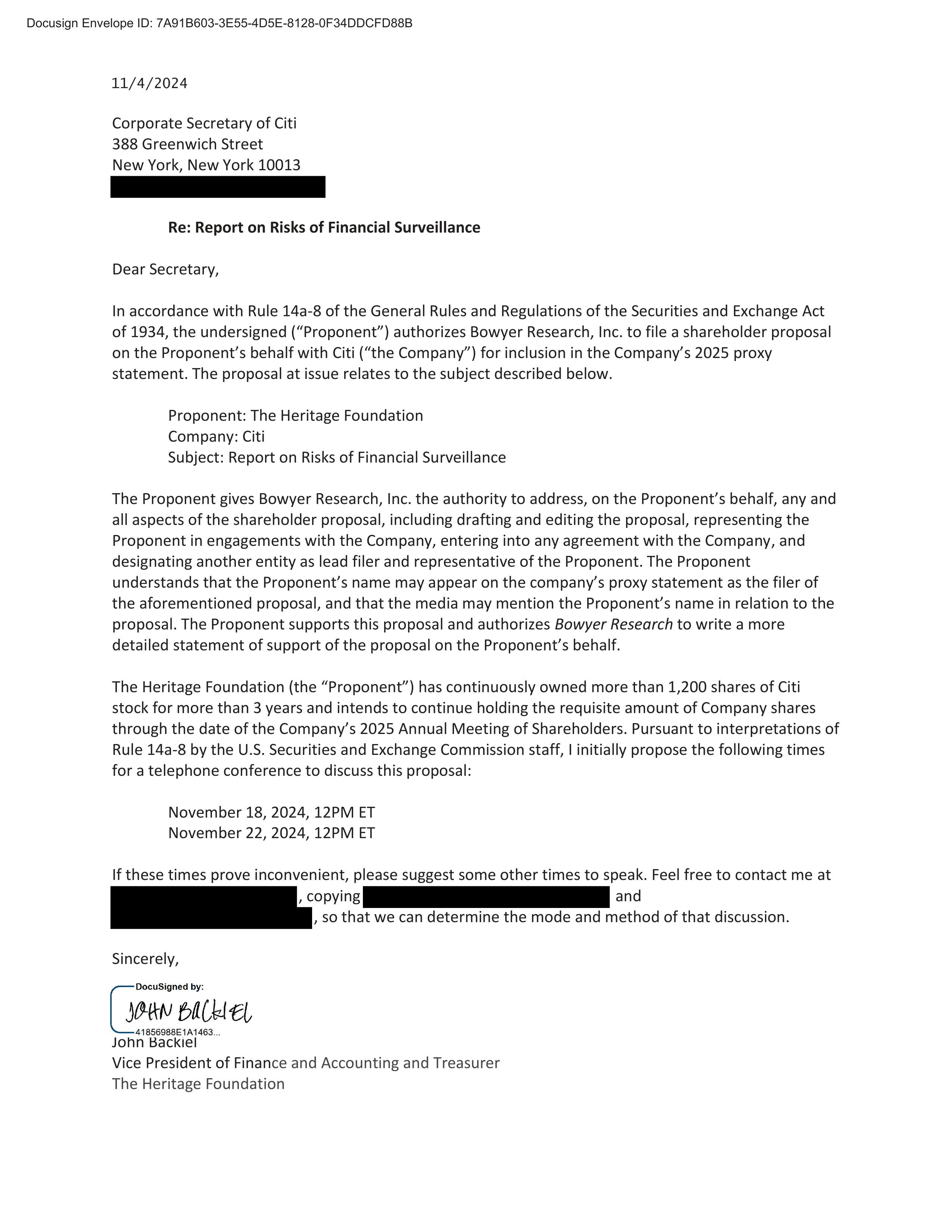
Corporate Secretary of Citi
388 Greenwich Street
New York, New York 10013
Re: Report on Risks of Financial Surveillance
Dear Secretary,
In accordance with Rule 14a-8 of the General Rules and Regulations of the Securities and Exchange Act
of 1934, the undersigned (“Proponent”) authorizes Bowyer Research, Inc. to file a shareholder proposal
on the Proponent’s behalf with Citi (“the Company”) for inclusion in the Company’s 2025 proxy
statement. The proposal at issue relates to the subject described below.
Proponent: The Heritage Foundation
Company: Citi
Subject: Report on Risks of Financial Surveillance
The Proponent gives Bowyer Research, Inc. the authority to address, on the Proponent’s behalf, any and
all aspects of the shareholder proposal, including drafting and editing the proposal, representing the
Proponent in engagements with the Company, entering into any agreement with the Company, and
designating another entity as lead filer and representative of the Proponent. The Proponent
understands that the Proponent’s name may appear on the company’s proxy statement as the filer of
the aforementioned proposal, and that the media may mention the Proponent’s name in relation to the
proposal. The Proponent supports this proposal and authorizes
Bowyer Research
to write a more
detailed statement of support of the proposal on the Proponent’s behalf.
The Heritage Foundation (the “Proponent”) has continuously owned more than 1,200 shares of Citi
stock for more than 3 years and intends to continue holding the requisite amount of Company shares
through the date of the Company’s 2025 Annual Meeting of Shareholders. Pursuant to interpretations of
Rule 14a-8 by the U.S. Securities and Exchange Commission staff, I initially propose the following times
for a telephone conference to discuss this proposal:
November 18, 2024, 12PM ET
November 22, 2024, 12PM ET
If these times prove inconvenient, please suggest some other times to speak. Feel free to contact me at
, copying
and
, so that we can determine the mode and method of that discussion.
Sincerely,
John Backiel
Vice President of Finan
ce and Accounting and Treasurer
The Heritage Foundation
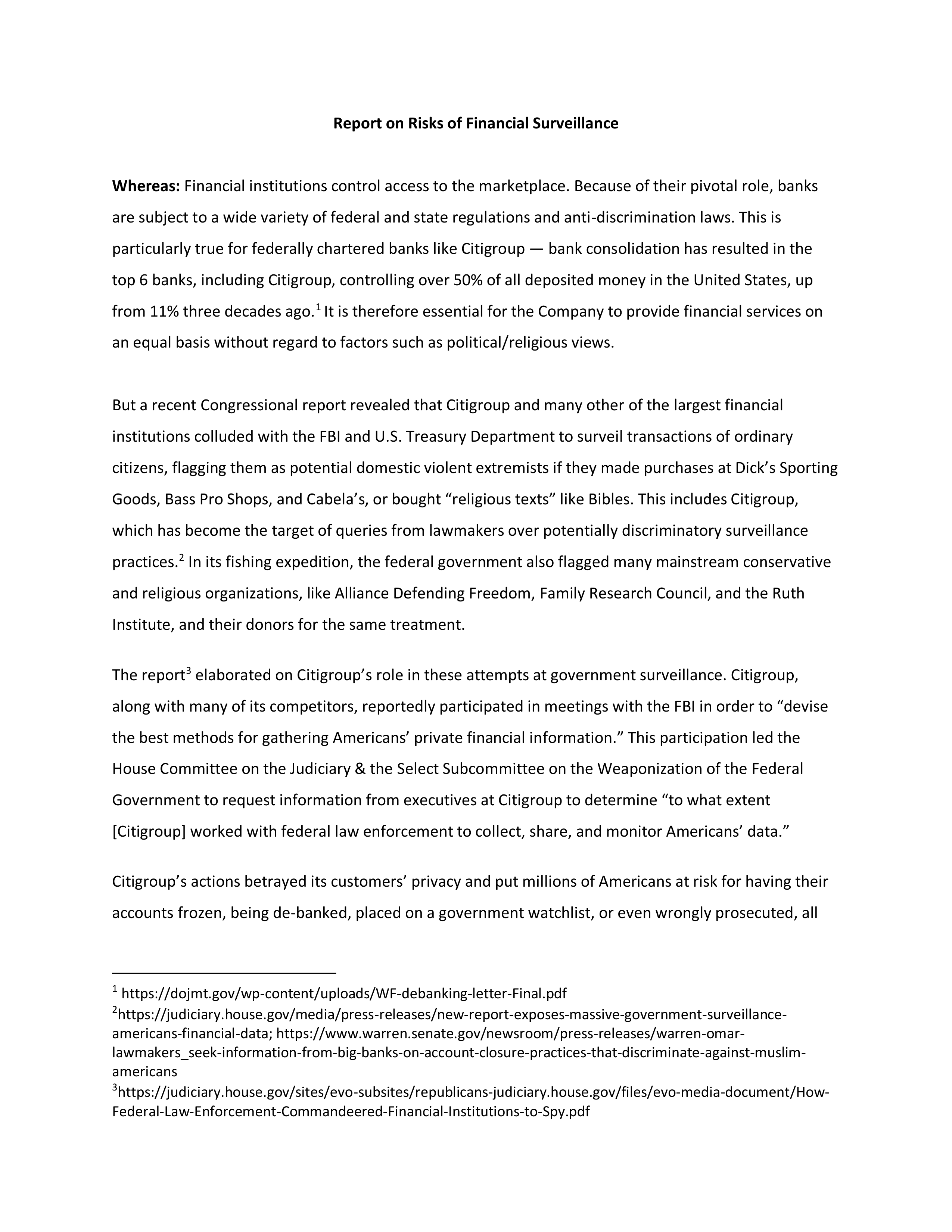
Report on Risks of Financial Surveillance
Whereas:
Financial institutions control access to the marketplace. Because of their pivotal role, banks
are subject to a wide variety of federal and state regulations and anti-discrimination laws. This is
particularly true for federally chartered banks like Citigroup — bank consolidation has resulted in the
top 6 banks, including Citigroup, controlling over 50% of all deposited money in the United States, up
from 11% three decades ago.
1
It is therefore essential for the Company to provide financial services on
an equal basis without regard to factors such as political/religious views.
But a recent Congressional report revealed that Citigroup and many other of the largest financial
institutions colluded with the FBI and U.S. Treasury Department to surveil transactions of ordinary
citizens, flagging them as potential domestic violent extremists if they made purchases at Dick’s Sporting
Goods, Bass Pro Shops, and Cabela’s, or bought “religious texts” like Bibles. This includes Citigroup,
which has become the target of queries from lawmakers over potentially discriminatory surveillance
practices.
2
In its fishing expedition, the federal government also flagged many mainstream conservative
and religious organizations, like Alliance Defending Freedom, Family Research Council, and the Ruth
Institute, and their donors for the same treatment.
The report
3
elaborated on Citigroup’s role in these attempts at government surveillance. Citigroup,
along with many of its competitors, reportedly participated in meetings with the FBI in order to “devise
the best methods for gathering Americans’ private financial information.” This participation led the
House Committee on the Judiciary & the Select Subcommittee on the Weaponization of the Federal
Government to request information from executives at Citigroup to determine “to what extent
[Citigroup] worked with federal law enforcement to collect, share, and monitor Americans’ data.”
Citigroup’s actions betrayed its customers’ privacy and put millions of Americans at risk for having their
accounts frozen, being de-banked, placed on a government watchlist, or even wrongly prosecuted, all
1
https://dojmt.gov/wp-content/uploads/WF-debanking-letter-Final.pdf
2
https://judiciary.house.gov/media/press-releases/new-report-exposes-massive-government-surveillance-
americans-financial-data; https://www.warren.senate.gov/newsroom/press-releases/warren-omar-
lawmakers_seek-information-from-big-banks-on-account-closure-practices-that-discriminate-against-muslim-
americans
3
https://judiciary.house.gov/sites/evo-subsites/republicans-judiciary.house.gov/files/evo-media-document/How-
Federal-Law-Enforcement-Commandeered-Financial-Institutions-to-Spy.pdf
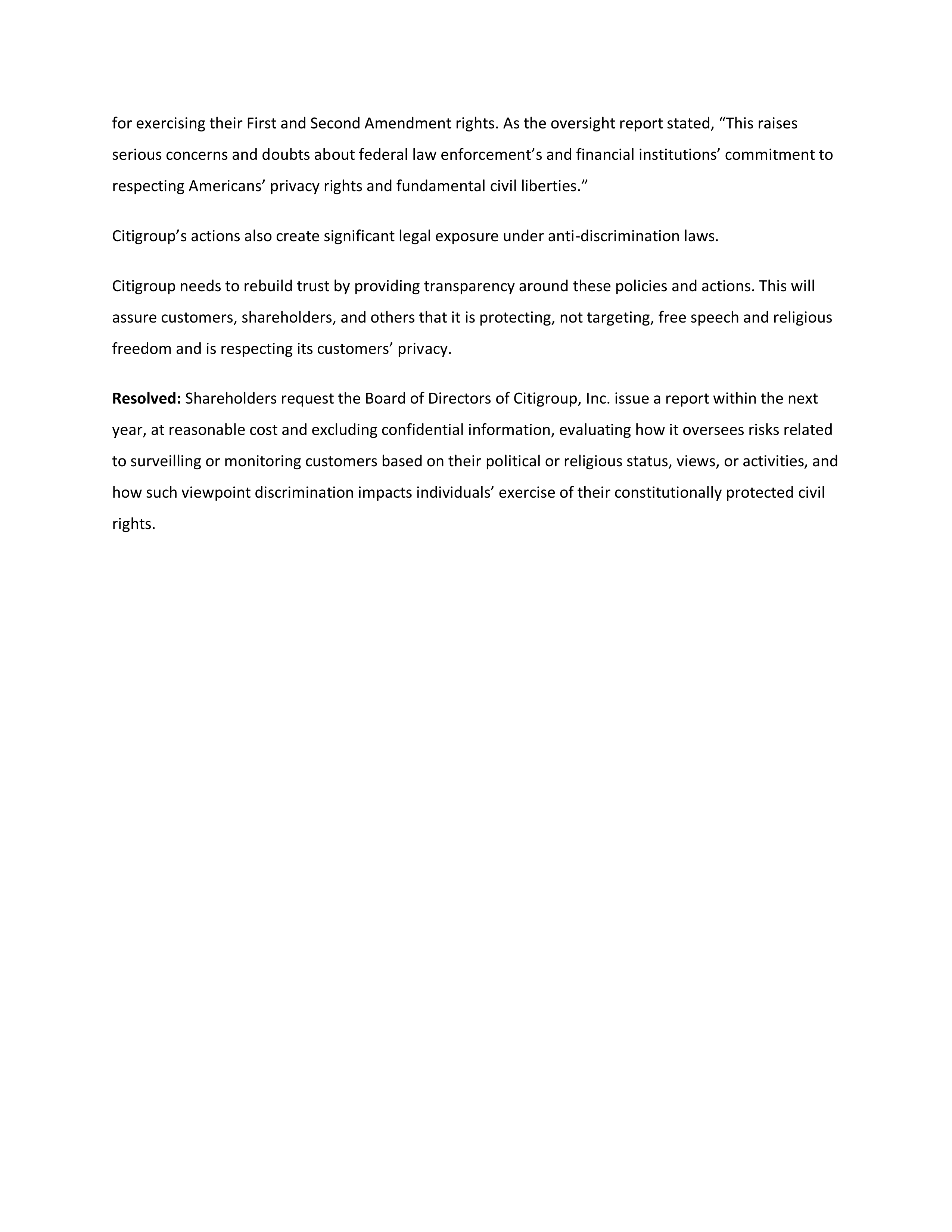
for exercising their First and Second Amendment rights. As the oversight report stated, “This raises
serious concerns and doubts about federal law enforcement’s and financial institutions’ commitment to
respecting Americans’ privacy rights and fundamental civil liberties.”
Citigroup’s actions also create significant legal exposure under anti-discrimination laws.
Citigroup needs to rebuild trust by providing transparency around these policies and actions. This will
assure customers, shareholders, and others that it is protecting, not targeting, free speech and religious
freedom and is respecting its customers’ privacy.
Resolved:
Shareholders request the Board of Directors of Citigroup, Inc. issue a report within the next
year, at reasonable cost and excluding confidential information, evaluating how it oversees risks related
to surveilling or monitoring customers based on their political or religious status, views, or activities, and
how such viewpoint discrimination impacts individuals’ exercise of their constitutionally protected civil
rights.


EXHIBIT B
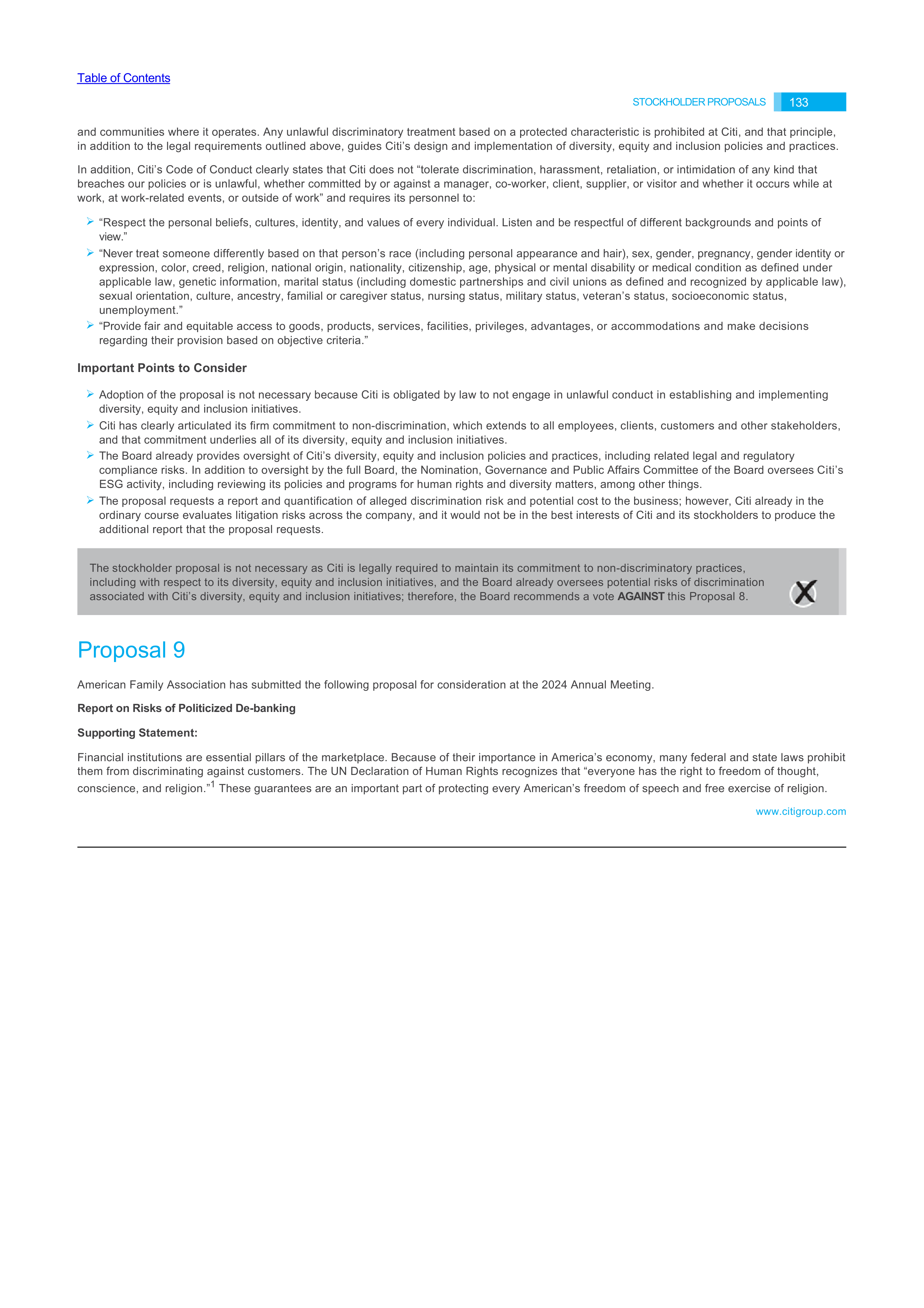

Table of Contents
STOCKHOLDER PROPOSALS
133
and communities where it operates. Any unlawful discriminatory treatment based on a protected characteristic is prohibited at Citi, and that principle,
in addition to the legal requirements outlined above, guides Citi’s design and implementation of diversity, equity and inclusion policies and practices.
In addition, Citi’s Code of Conduct clearly states that Citi does not “tolerate discrimination, harassment, retaliation, or intimidation of any kind that
breaches our policies or is unlawful, whether committed by or against a manager, co-worker, client, supplier, or visitor and whether it occurs while at
work, at work-related events, or outside of work” and requires its personnel to:
Ø
“Respect the personal beliefs, cultures, identity, and values of every individual. Listen and be respectful of different backgrounds and points of
view.”
Ø
“Never treat someone differently based on that person’s race (including personal appearance and hair), sex, gender, pregnancy, gender identity or
expression, color, creed, religion, national origin, nationality, citizenship, age, physical or mental disability or medical condition as defined under
applicable law, genetic information, marital status (including domestic partnerships and civil unions as defined and recognized by applicable law),
sexual orientation, culture, ancestry, familial or caregiver status, nursing status, military status, veteran’s status, socioeconomic status,
unemployment.”
Ø
“Provide fair and equitable access to goods, products, services, facilities, privileges, advantages, or accommodations and make decisions
regarding their provision based on objective criteria.”
Important Points to Consider
Ø
Adoption of the proposal is not necessary because Citi is obligated by law to not engage in unlawful conduct in establishing and implementing
diversity, equity and inclusion initiatives.
Ø
Citi has clearly articulated its firm commitment to non-discrimination, which extends to all employees, clients, customers and other stakeholders,
and that commitment underlies all of its diversity, equity and inclusion initiatives.
Ø
The Board already provides oversight of Citi’s diversity, equity and inclusion policies and practices, including related legal and regulatory
compliance risks. In addition to oversight by the full Board, the Nomination, Governance and Public Affairs Committee of the Board oversees Citi’s
ESG activity, including reviewing its policies and programs for human rights and diversity matters, among other things.
Ø
The proposal requests a report and quantification of alleged discrimination risk and potential cost to the business; however, Citi already in the
ordinary course evaluates litigation risks across the company, and it would not be in the best interests of Citi and its stockholders to produce the
additional report that the proposal requests.
The stockholder proposal is not necessary as Citi is legally required to maintain its commitment to non-discriminatory practices,
including with respect to its diversity, equity and inclusion initiatives, and the Board already oversees potential risks of discrimination
associated with Citi’s diversity, equity and inclusion initiatives; therefore, the Board recommends a vote
AGAINST
this Proposal 8.
Proposal 9
American Family Association has submitted the following proposal for consideration at the 2024 Annual Meeting.
Report on Risks of Politicized De-banking
Supporting Statement:
Financial institutions are essential pillars of the marketplace. Because of their importance in America’s economy, many federal and state laws prohibit
them from discriminating against customers. The UN Declaration of Human Rights recognizes that “everyone has the right to freedom of thought,
conscience, and religion.”
1
These guarantees are an important part of protecting every American’s freedom of speech and free exercise of religion.
www.citigroup.com
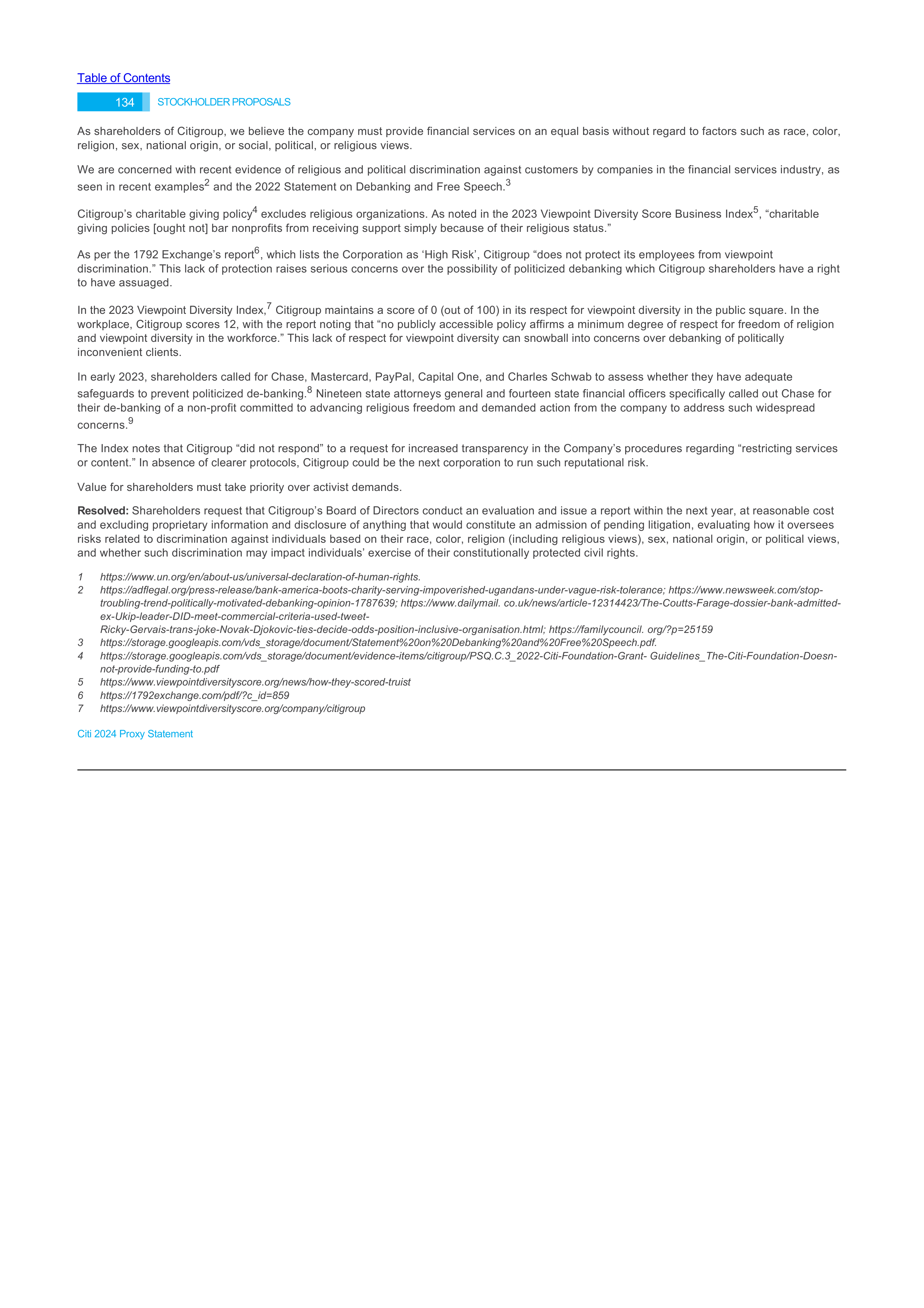
Table of Contents
134
STOCKHOLDER PROPOSALS
As shareholders of Citigroup, we believe the company must provide financial services on an equal basis without regard to factors such as race, color,
religion, sex, national origin, or social, political, or religious views.
We are concerned with recent evidence of religious and political discrimination against customers by companies in the financial services industry, as
seen in recent examples
2
and the 2022 Statement on Debanking and Free Speech.
3
Citigroup’s charitable giving policy
4
excludes religious organizations. As noted in the 2023 Viewpoint Diversity Score Business Index
5
, “charitable
giving policies [ought not] bar nonprofits from receiving support simply because of their religious status.”
As per the 1792 Exchange’s report
6
, which lists the Corporation as ‘High Risk’, Citigroup “does not protect its employees from viewpoint
discrimination.” This lack of protection raises serious concerns over the possibility of politicized debanking which Citigroup shareholders have a right
to have assuaged.
In the 2023 Viewpoint Diversity Index,
7
Citigroup maintains a score of 0 (out of 100) in its respect for viewpoint diversity in the public square. In the
workplace, Citigroup scores 12, with the report noting that “no publicly accessible policy affirms a minimum degree of respect for freedom of religion
and viewpoint diversity in the workforce.” This lack of respect for viewpoint diversity can snowball into concerns over debanking of politically
inconvenient clients.
In early 2023, shareholders called for Chase, Mastercard, PayPal, Capital One, and Charles Schwab to assess whether they have adequate
safeguards to prevent politicized de-banking.
8
Nineteen state attorneys general and fourteen state financial officers specifically called out Chase for
their de-banking of a non-profit committed to advancing religious freedom and demanded action from the company to address such widespread
concerns.
9
The Index notes that Citigroup “did not respond” to a request for increased transparency in the Company’s procedures regarding “restricting services
or content.” In absence of clearer protocols, Citigroup could be the next corporation to run such reputational risk.
Value for shareholders must take priority over activist demands.
Resolved:
Shareholders request that Citigroup’s Board of Directors conduct an evaluation and issue a report within the next year, at reasonable cost
and excluding proprietary information and disclosure of anything that would constitute an admission of pending litigation, evaluating how it oversees
risks related to discrimination against individuals based on their race, color, religion (including religious views), sex, national origin, or political views,
and whether such discrimination may impact individuals’ exercise of their constitutionally protected civil rights.
1
https://www.un.org/en/about-us/universal-declaration-of-human-rights.
2
https://adflegal.org/press-release/bank-america-boots-charity-serving-impoverished-ugandans-under-vague-risk-tolerance; https://www.newsweek.com/stop-
troubling-trend-politically-motivated-debanking-opinion-1787639; https://www.dailymail. co.uk/news/article-12314423/The-Coutts-Farage-dossier-bank-admitted-
ex-Ukip-leader-DID-meet-commercial-criteria-used-tweet-
Ricky-Gervais-trans-joke-Novak-Djokovic-ties-decide-odds-position-inclusive-organisation.html; https://familycouncil. org/?p=25159
3
https://storage.googleapis.com/vds_storage/document/Statement%20on%20Debanking%20and%20Free%20Speech.pdf.
4
https://storage.googleapis.com/vds_storage/document/evidence-items/citigroup/PSQ.C.3_2022-Citi-Foundation-Grant- Guidelines_The-Citi-Foundation-Doesn-
not-provide-funding-to.pdf
5
https://www.viewpointdiversityscore.org/news/how-they-scored-truist
6
https://1792exchange.com/pdf/?c_id=859
7
https://www.viewpointdiversityscore.org/company/citigroup
Citi 2024 Proxy Statement
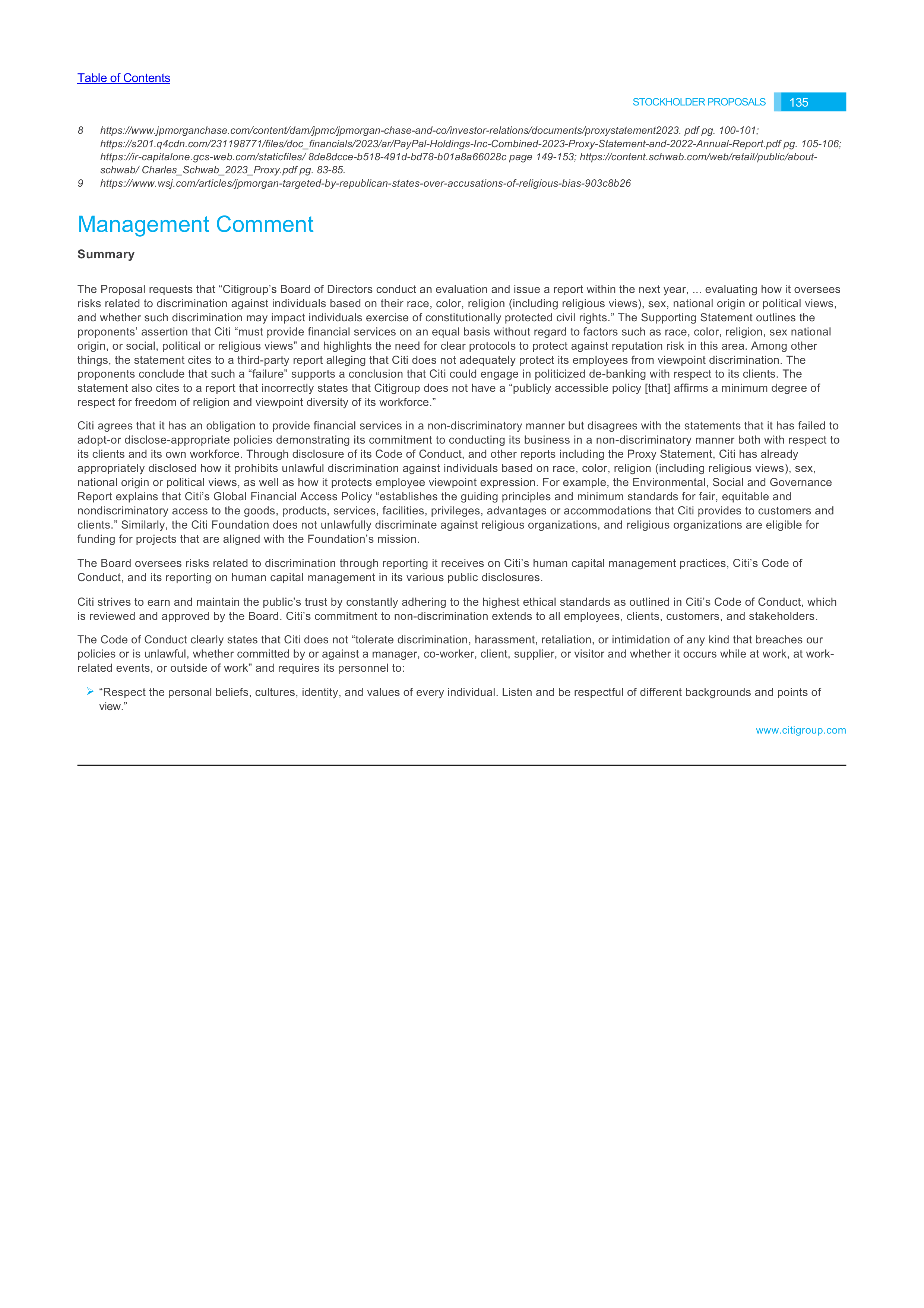
Table of Contents
STOCKHOLDER PROPOSALS
135
8
https://www.jpmorganchase.com/content/dam/jpmc/jpmorgan-chase-and-co/investor-relations/documents/proxystatement2023. pdf pg. 100-101;
https://s201.q4cdn.com/231198771/files/doc_financials/2023/ar/PayPal-Holdings-Inc-Combined-2023-Proxy-Statement-and-2022-Annual-Report.pdf pg. 105-106;
https://ir-capitalone.gcs-web.com/staticfiles/ 8de8dcce-b518-491d-bd78-b01a8a66028c page 149-153; https://content.schwab.com/web/retail/public/about-
schwab/ Charles_Schwab_2023_Proxy.pdf pg. 83-85.
9
https://www.wsj.com/articles/jpmorgan-targeted-by-republican-states-over-accusations-of-religious-bias-903c8b26
Management Comment
Summary
The Proposal requests that “Citigroup’s Board of Directors conduct an evaluation and issue a report within the next year, ... evaluating how it oversees
risks related to discrimination against individuals based on their race, color, religion (including religious views), sex, national origin or political views,
and whether such discrimination may impact individuals exercise of constitutionally protected civil rights.” The Supporting Statement outlines the
proponents’ assertion that Citi “must provide financial services on an equal basis without regard to factors such as race, color, religion, sex national
origin, or social, political or religious views” and highlights the need for clear protocols to protect against reputation risk in this area. Among other
things, the statement cites to a third-party report alleging that Citi does not adequately protect its employees from viewpoint discrimination. The
proponents conclude that such a “failure” supports a conclusion that Citi could engage in politicized de-banking with respect to its clients. The
statement also cites to a report that incorrectly states that Citigroup does not have a “publicly accessible policy [that] affirms a minimum degree of
respect for freedom of religion and viewpoint diversity of its workforce.”
Citi agrees that it has an obligation to provide financial services in a non-discriminatory manner but disagrees with the statements that it has failed to
adopt-or disclose-appropriate policies demonstrating its commitment to conducting its business in a non-discriminatory manner both with respect to
its clients and its own workforce. Through disclosure of its Code of Conduct, and other reports including the Proxy Statement, Citi has already
appropriately disclosed how it prohibits unlawful discrimination against individuals based on race, color, religion (including religious views), sex,
national origin or political views, as well as how it protects employee viewpoint expression. For example, the Environmental, Social and Governance
Report explains that Citi’s Global Financial Access Policy “establishes the guiding principles and minimum standards for fair, equitable and
nondiscriminatory access to the goods, products, services, facilities, privileges, advantages or accommodations that Citi provides to customers and
clients.” Similarly, the Citi Foundation does not unlawfully discriminate against religious organizations, and religious organizations are eligible for
funding for projects that are aligned with the Foundation’s mission.
The Board oversees risks related to discrimination through reporting it receives on Citi’s human capital management practices, Citi’s Code of
Conduct, and its reporting on human capital management in its various public disclosures.
Citi strives to earn and maintain the public’s trust by constantly adhering to the highest ethical standards as outlined in Citi’s Code of Conduct, which
is reviewed and approved by the Board. Citi’s commitment to non-discrimination extends to all employees, clients, customers, and stakeholders.
The Code of Conduct clearly states that Citi does not “tolerate discrimination, harassment, retaliation, or intimidation of any kind that breaches our
policies or is unlawful, whether committed by or against a manager, co-worker, client, supplier, or visitor and whether it occurs while at work, at work-
related events, or outside of work” and requires its personnel to:
Ø
“Respect the personal beliefs, cultures, identity, and values of every individual. Listen and be respectful of different backgrounds and points of
view.”
www.citigroup.com
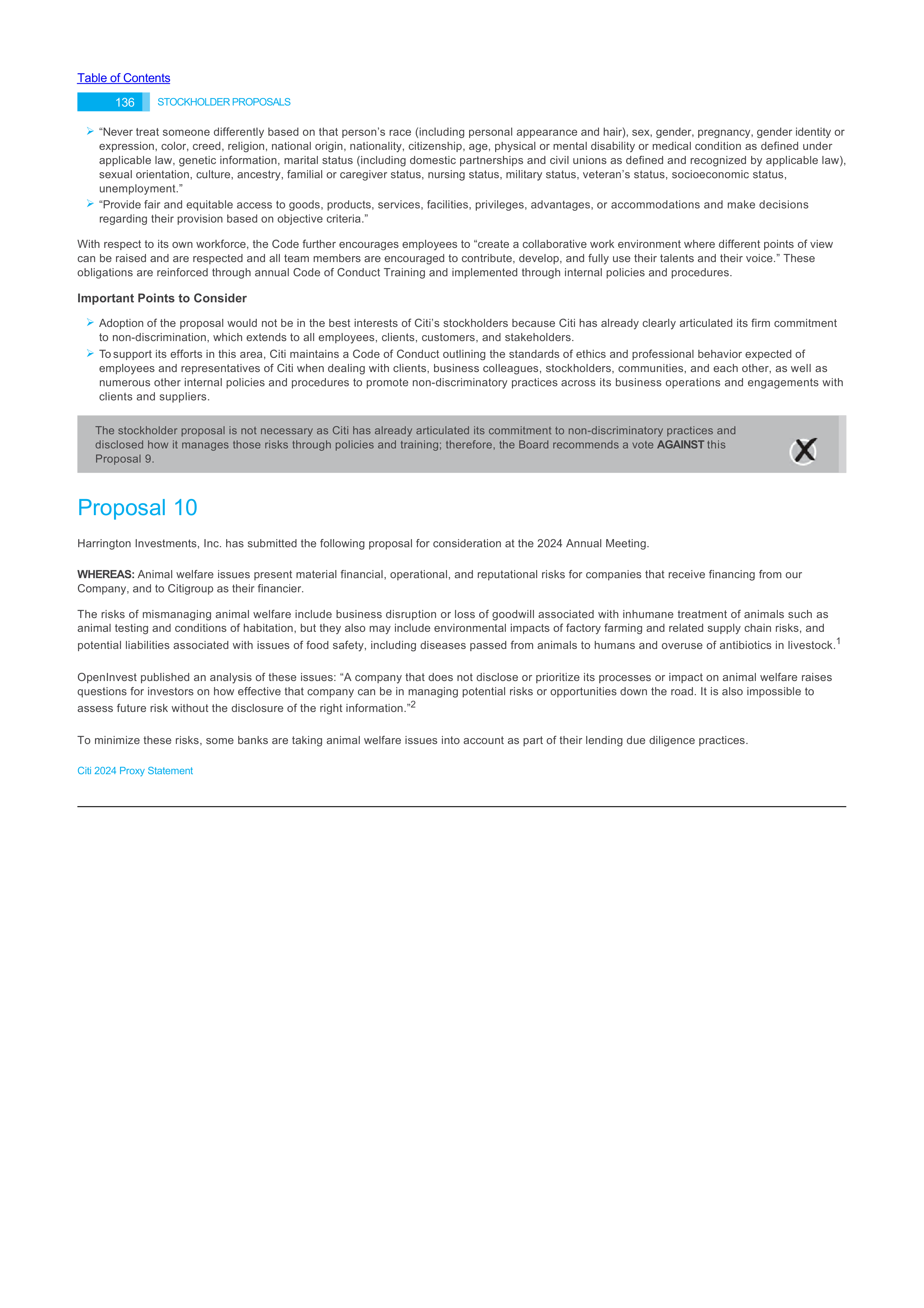

Table of Contents
136
STOCKHOLDER PROPOSALS
Ø
“Never treat someone differently based on that person’s race (including personal appearance and hair), sex, gender, pregnancy, gender identity or
expression, color, creed, religion, national origin, nationality, citizenship, age, physical or mental disability or medical condition as defined under
applicable law, genetic information, marital status (including domestic partnerships and civil unions as defined and recognized by applicable law),
sexual orientation, culture, ancestry, familial or caregiver status, nursing status, military status, veteran’s status, socioeconomic status,
unemployment.”
Ø
“Provide fair and equitable access to goods, products, services, facilities, privileges, advantages, or accommodations and make decisions
regarding their provision based on objective criteria.”
With respect to its own workforce, the Code further encourages employees to “create a collaborative work environment where different points of view
can be raised and are respected and all team members are encouraged to contribute, develop, and fully use their talents and their voice.” These
obligations are reinforced through annual Code of Conduct Training and implemented through internal policies and procedures.
Important Points to Consider
Ø
Adoption of the proposal would not be in the best interests of Citi’s stockholders because Citi has already clearly articulated its firm commitment
to non-discrimination, which extends to all employees, clients, customers, and stakeholders.
Ø
To support its efforts in this area, Citi maintains a Code of Conduct outlining the standards of ethics and professional behavior expected of
employees and representatives of Citi when dealing with clients, business colleagues, stockholders, communities, and each other, as well as
numerous other internal policies and procedures to promote non-discriminatory practices across its business operations and engagements with
clients and suppliers.
The stockholder proposal is not necessary as Citi has already articulated its commitment to non-discriminatory practices and
disclosed how it manages those risks through policies and training; therefore, the Board recommends a vote
AGAINST
this
Proposal 9.
Proposal 10
Harrington Investments, Inc. has submitted the following proposal for consideration at the 2024 Annual Meeting.
WHEREAS:
Animal welfare issues present material financial, operational, and reputational risks for companies that receive financing from our
Company, and to Citigroup as their financier.
The risks of mismanaging animal welfare include business disruption or loss of goodwill associated with inhumane treatment of animals such as
animal testing and conditions of habitation, but they also may include environmental impacts of factory farming and related supply chain risks, and
potential liabilities associated with issues of food safety, including diseases passed from animals to humans and overuse of antibiotics in livestock.
1
OpenInvest published an analysis of these issues: “A company that does not disclose or prioritize its processes or impact on animal welfare raises
questions for investors on how effective that company can be in managing potential risks or opportunities down the road. It is also impossible to
assess future risk without the disclosure of the right information.”
2
To minimize these risks, some banks are taking animal welfare issues into account as part of their lending due diligence practices.
Citi 2024 Proxy Statement


EXHIBIT C
UNITED STATES
SECURITIES AND EXCHANGE COMMISSION
WASHINGTON, D.C. 20549
FORM 8-K
CURRENT REPORT
Pursuant to Section 13 or 15(d) of the Securities Exchange Act of 1934
Date of Report (Date of earliest event reported)
April 30, 2024
Citigroup Inc.
(Exact name of registrant as specified in its charter)
Delaware
1-9924
52-1568099
(State or other jurisdiction
of incorporation)
(Commission
File Number)
(IRS Employer
Identification No.)
388 Greenwich Street, New York,
New York
(Address of principal executive offices)
10013
(Zip Code)
(212) 559-1000
(Registrant’s telephone number,
including area code)
Check the appropriate box below if the Form 8-K filing is intended to simultaneously satisfy the filing obligation of
the registrant under any of the following provisions:
☐
Written communications pursuant to Rule 425 under the Securities Act (17 CFR 230.425)
☐
Soliciting material pursuant to Rule 14a-12 under the Exchange Act (17 CFR 240.14a-12)
☐
Pre-commencement communications pursuant to Rule 14d-2(b) under the Exchange Act (17 CFR 240.14d-2(b))
☐
Pre-commencement communications pursuant to Rule 13e-4(c) under the Exchange Act (17 CFR 240.13e-4(c))
Securities registered pursuant to Section 12(b) of the Securities Exchange Act of 1934 formatted in Inline XBRL: See
Exhibit 99.1
Indicate by check mark whether the registrant is an emerging growth company as defined in Rule 405 of the
Securities Act of 1933 (17 CFR §230.405) or Rule 12b-2 of the Securities Exchange Act of 1934 (17 CFR §240.12b-2).
Emerging growth company
☐
If an emerging growth company, indicate by check mark if the registrant has elected not to use the extended
transition period for complying with any new or revised financial accounting standards provided pursuant to Section
13(a) of the Exchange Act.
☐
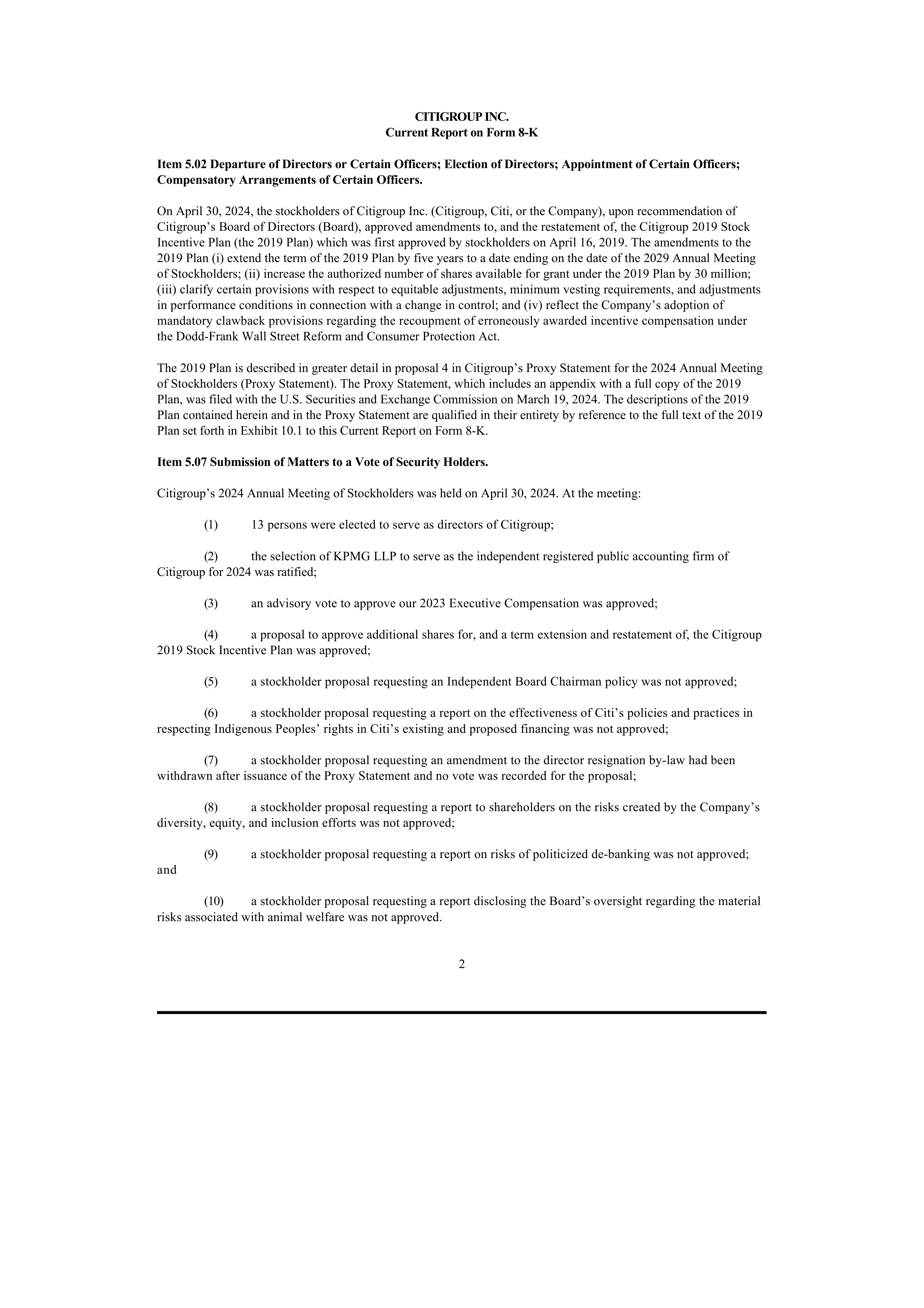
2
CITIGROUP INC.
Current Report on Form 8-K
Item 5.02 Departure of Directors or Certain Officers; Election of Directors; Appointment of Certain Officers;
Compensatory Arrangements of Certain Officers.
On April 30, 2024, the stockholders of Citigroup Inc. (Citigroup, Citi, or the Company), upon recommendation of
Citigroup’s Board of Directors (Board), approved amendments to, and the restatement of, the Citigroup 2019 Stock
Incentive Plan (the 2019 Plan) which was first approved by stockholders on April 16, 2019. The amendments to the
2019 Plan (i) extend the term of the 2019 Plan by five years to a date ending on the date of the 2029 Annual Meeting
of Stockholders; (ii) increase the authorized number of shares available for grant under the 2019 Plan by 30 million;
(iii) clarify certain provisions with respect to equitable adjustments, minimum vesting requirements, and adjustments
in performance conditions in connection with a change in control; and (iv) reflect the Company’s adoption of
mandatory clawback provisions regarding the recoupment of erroneously awarded incentive compensation under
the Dodd-Frank Wall Street Reform and Consumer Protection Act.
The 2019 Plan is described in greater detail in proposal 4 in Citigroup’s Proxy Statement for the 2024 Annual Meeting
of Stockholders (Proxy Statement). The Proxy Statement, which includes an appendix with a full copy of the 2019
Plan, was filed with the U.S. Securities and Exchange Commission on March 19, 2024. The descriptions of the 2019
Plan contained herein and in the Proxy Statement are qualified in their entirety by reference to the full text of the 2019
Plan set forth in Exhibit 10.1 to this Current Report on Form 8-K.
Item 5.07 Submission of Matters to a Vote of Security Holders.
Citigroup’s 2024 Annual Meeting of Stockholders was held on April 30, 2024. At the meeting:
(1)
13 persons were elected to serve as directors of Citigroup;
(2)
the selection of KPMG LLP to serve as the independent registered public accounting firm of
Citigroup for 2024 was ratified;
(3)
an advisory vote to approve our 2023 Executive Compensation was approved;
(4)
a proposal to approve additional shares for, and a term extension and restatement of, the Citigroup
2019 Stock Incentive Plan was approved;
(5)
a stockholder proposal requesting an Independent Board Chairman policy was not approved;
(6)
a stockholder proposal requesting a report on the effectiveness of Citi’s policies and practices in
respecting Indigenous Peoples’ rights in Citi’s existing and proposed financing was not approved;
(7)
a stockholder proposal requesting an amendment to the director resignation by-law had been
withdrawn after issuance of the Proxy Statement and no vote was recorded for the proposal;
(8)
a stockholder proposal requesting a report to shareholders on the risks created by the Company’s
diversity, equity, and inclusion efforts was not approved;
(9)
a stockholder proposal requesting a report on risks of politicized de-banking was not approved;
and
(10)
a stockholder proposal requesting a report disclosing the Board’s oversight regarding the material
risks associated with animal welfare was not approved.
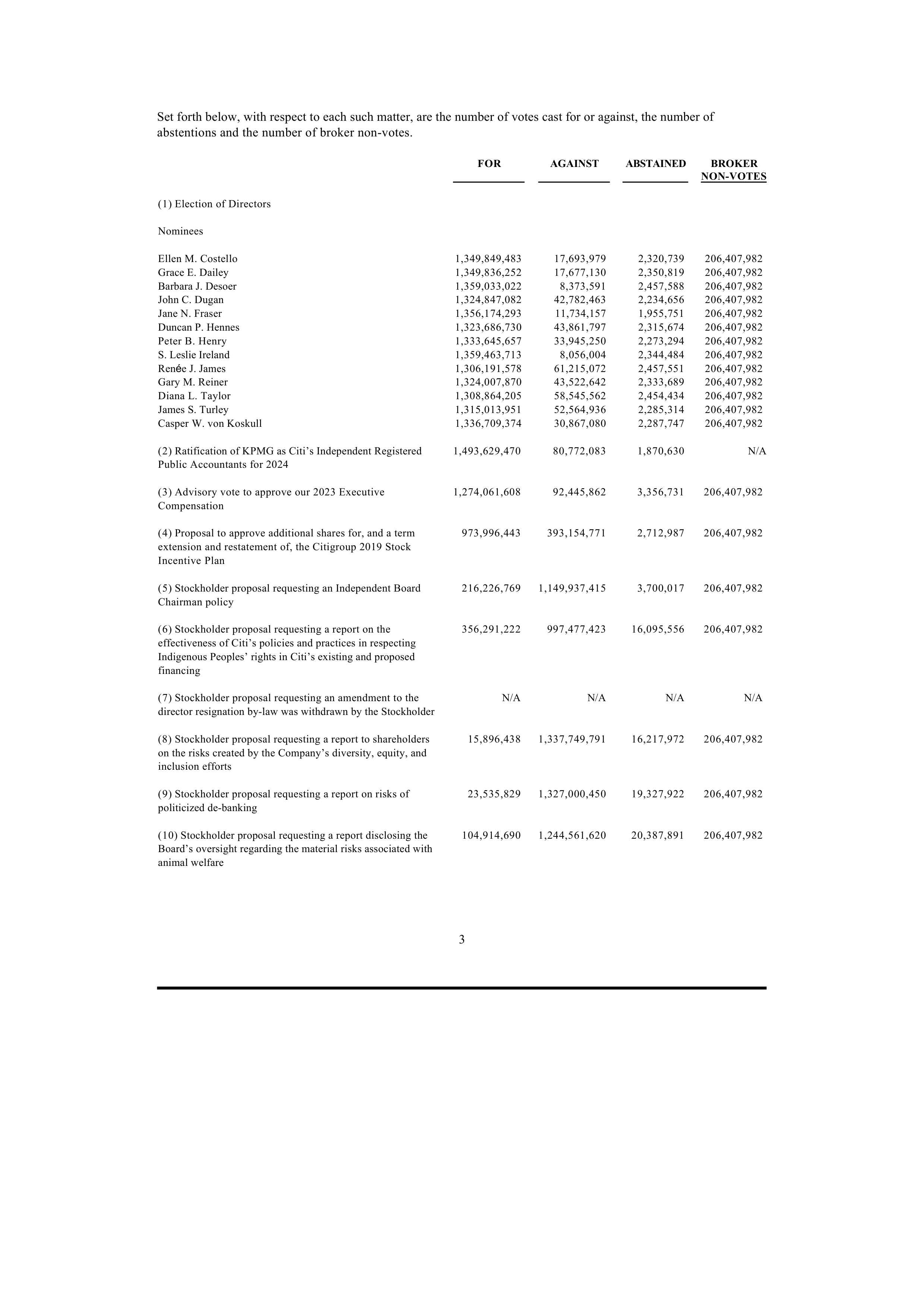
3
Set forth below, with respect to each such matter, are the number of votes cast for or against, the number of
abstentions and the number of broker non-votes.
FOR
AGAINST
ABSTAINED
BROKER
NON-VOTES
(1)
Election of Directors
Nominees
Ellen M. Costello
1,349,849,483
17,693,979
2,320,739
206,407,982
Grace E. Dailey
1,349,836,252
17,677,130
2,350,819
206,407,982
Barbara J. Desoer
1,359,033,022
8,373,591
2,457,588
206,407,982
John C. Dugan
1,324,847,082
42,782,463
2,234,656
206,407,982
Jane N. Fraser
1,356,174,293
11,734,157
1,955,751
206,407,982
Duncan P. Hennes
1,323,686,730
43,861,797
2,315,674
206,407,982
Peter B. Henry
1,333,645,657
33,945,250
2,273,294
206,407,982
S. Leslie Ireland
1,359,463,713
8,056,004
2,344,484
206,407,982
Ren
é
e J. James
1,306,191,578
61,215,072
2,457,551
206,407,982
Gary M. Reiner
1,324,007,870
43,522,642
2,333,689
206,407,982
Diana L. Taylor
1,308,864,205
58,545,562
2,454,434
206,407,982
James S. Turley
1,315,013,951
52,564,936
2,285,314
206,407,982
Casper W. von Koskull
1,336,709,374
30,867,080
2,287,747
206,407,982
(2)
Ratification of KPMG as Citi’s Independent Registered
Public Accountants for 2024
1,493,629,470
80,772,083
1,870,630
N/A
(3)
Advisory vote to approve our 2023 Executive
Compensation
1,274,061,608
92,445,862
3,356,731
206,407,982
(4)
Proposal to approve additional shares for, and a term
extension and restatement of, the Citigroup 2019 Stock
Incentive Plan
973,996,443
393,154,771
2,712,987
206,407,982
(5)
Stockholder proposal requesting an Independent Board
Chairman policy
216,226,769
1,149,937,415
3,700,017
206,407,982
(6)
Stockholder proposal requesting a report on the
effectiveness of Citi’s policies and practices in respecting
Indigenous Peoples’ rights in Citi’s existing and proposed
financing
356,291,222
997,477,423
16,095,556
206,407,982
(7)
Stockholder proposal requesting an amendment to the
director resignation by-law was withdrawn by the Stockholder
N/A
N/A
N/A
N/A
(8) Stockholder proposal requesting a report to shareholders
on the risks created by the Company’s diversity, equity, and
inclusion efforts
15,896,438
1,337,749,791
16,217,972
206,407,982
(9)
Stockholder proposal requesting a report on risks of
politicized de-banking
23,535,829
1,327,000,450
19,327,922
206,407,982
(10)
Stockholder proposal requesting a report disclosing the
Board’s oversight regarding the material risks associated with
animal welfare
104,914,690
1,244,561,620
20,387,891
206,407,982

4
Item 9.01 Financial Statements and Exhibits.
(d) Exhibits.
Exhibit
Number
10.1
Citigroup 2019 Stock Incentive Plan (as amended and restated as of April 30, 2024).
99.1
Citigroup Inc. securities registered pursuant to Section 12(b) of the Securities Exchange Act of 1934
as of the filing date.
104
See the cover page of this Current Report on Form 8-K, formatted in Inline XBRL.

5
SIGNATURE
Pursuant to the requirements of the Securities Exchange Act of 1934, the registrant has duly caused this
report to be signed on its behalf by the undersigned hereunto duly authorized.
CITIGROUP INC.
Dated: May 2, 2024
By:/s/ Brent J. McIntosh
Brent J. McIntosh
Chief Legal Officer and Corporate Secretary

January 29, 2025
Office of Chief Counsel
Division of Corporation Finance
U.S. Securities and Exchange Commission
100 F Street, N.E.
Washington, DC 20549
RE: Shareholder Proposal of The Heritage Foundation at Citigroup Inc.
under Securities Exchange Act of 1934—Rule 14a-8
Ladies and Gentlemen:
I am writing for The Heritage Foundation (“Proponent”) to defend its shareholder
proposal (“Proposal”) to Citigroup Inc. (“Citi” or the “Company”). Citi’s legal counsel
wrote to you on December 27th, 2024 and asked you to concur with its view that it
may exclude the Proposal under Rule 14a-8. Under Rule 14a-8(g), Citi has the burden
of showing it can exclude the Proposal. But it cannot bear this burden.
The Proposal asks Citi to report on the “risks related to surveilling or monitoring
customers based on their political or religious status, views, or activities” based on
recent disclosures that Citi and other large financial institutions were pressured by
federal law enforcement to do so in the wake of January 6, 2021. The revelations from
the U.S. House Judiciary Subcommittee on the Weaponization of the Federal
Government raise serious concerns about how easily and readily financial
institutions handed over sensitive customer information and either could or did
participate in profiling customers as domestic violent extremists based on their
religious exercise and political speech or activity.
Citi argues that it can exclude the Proposal under Rule 14a-8(i)(12) because it
addresses substantially the same subject matter as a de-banking proposal filed at Citi
last year. But it makes the same arguments that failed last year in
The Charles
Schwab Corp.
(Mar. 27, 2024). The de-banking proposal dealt with the denial of
services or closure of accounts, not disclosing sensitive information to law
enforcement and potentially criminally profiling them. And it focused on more types
of discrimination than political or religious, so it cannot be excluded. This comports
with Staff precedent that understands and respects these distinctions.
2
Citi also says that the proposal lacks a focus on a significant social policy issue.
But Staff consistently recognize discrimination as a perennial issue of social
significance, including when financial institutions discriminate against customers.
JPMorgan Chase & Co. (Bahnsen)
(Mar. 21, 2023). And Staff also readily understand
that a proposal asking how financial surveillance impacts a significant social policy
issue, like firearms rights,
American Express Co.
(Mar. 13, 2024), or abortion,
American Express Co.
(Mar. 6, 2023), still focuses on a significant social policy issue.
Further, financial institutions’ role as gatekeepers to the commercial marketplace
means that the use and abuse of financial institutions’ power for political gain is an
issue of perennial concern.
Finally, Citi contends that the Proposal’s request for a risk report micromanages
the Company. But risk reports are exceedingly deferential to companies, so Staff
regularly reject micromanagement challenges to these types of reports. And the
Proposal here is a typical risk report. It does not try to impose any specific policy,
impose voluminous disclosures, or prescribe certain methods or categories for a
report. Instead, it will rely on Citi’s business expertise and reasoned evaluation of the
issues surrounding financial surveillance to address this pressing issue.
The Proposal
The Proposal provides:
Resolved:
Shareholders request the Board of Directors of Citigroup, Inc. issue
a report within the next year, at reasonable cost and excluding confidential
information, evaluating how it oversees risks related to surveilling or
monitoring customers based on their political or religious status, views, or
activities, and how such viewpoint discrimination impacts’ individuals’
exercise of their constitutionally protected civil rights.
The Supporting Statement explains that “[f]inancial institutions control access to
the marketplace” and are accordingly subject to a wide variety of regulations and
laws. Unfortunately, a recent Congressional report “revealed that Citigroup and
many other of the largest financial institutions colluded with the FBI and U.S.
Treasury Department to surveil transactions of ordinary citizens, flagging them as
domestic violent extremists if they made purchases at” outdoor stores or “bought
‘religious texts’ like Bibles.” The Statement also notes that “the federal government
flagged many mainstream conservative and religious organizations . . . and their
donors for the same treatment.” These actions “betrayed its customers’ privacy and
put millions of Americans at risk for having their accounts frozen, being de-banked,
placed on a government watchlist, or even wrongly prosecuted, all for exercising their
First and Second Amendment rights.” As the oversight report stated and Supporting
Statement repeats: “This raises serious concerns and doubts about federal law
enforcement’s and financial institutions’ commitment to respecting Americans’
privacy rights and fundamental civil liberties.”
3
Discussion
A.
The Proposal may not be excluded under Rule 14a-8(i)(12) because
financial surveillance is not substantially the same subject matter as
broad discrimination against customers.
Citi is wrong that a de-banking proposal addresses substantially the same issue
as a financial surveillance proposal. The two issues are distinct and address different
substantive concerns. The first asks about the use and abuse of vague and subjective
policies to deny services to customers. The latter asks about potential collusion with
law enforcement, monitoring, and privacy concerns. That they both address religious
and political discrimination does not make them substantially similar, as Staff have
recognized regarding other types of discrimination. Further, the de-banking proposal
is concerned with broader types of discrimination, not just religious and political
discrimination.
Simply put, Staff precedent consistently recognizes that there are many legitimate
issues for shareholder inquiry when powerful companies use or potentially abuse
their powers in discriminatory ways.
1.
Proposals focusing on different operations of the company or
different harms do not address substantially the same subject
matter.
A shareholder may not submit a proposal that “addresses substantially the same
subject matter as a proposal, or proposals, previously included in the company’s proxy
materials within the preceding five calendar years” if the matter was voted on at least
once in the last three years and received support below specified voting thresholds on
the most recent vote. 17 C.F.R. § 240.14a-8(i)(12).
When adopting this standard, the Commission sought to counter gamesmanship
where a proponent could “make minor changes in proposals each year so that they
can keep raising the same issue despite the fact that other shareholders have
indicated by their votes that they are not interested in that issue.” Exchange Act
Release No. 34-20091, at *8 (Aug. 16, 1983).
To focus on shareholder interest, the SEC determines whether a proposal
“addresses substantially the same subject matter” “based upon a consideration of the
substantive concerns raised by a proposal rather than the specific language or actions
proposed to deal with those concerns.”
Id.
This also avoids “an improperly broad
interpretation of the[] rule.”
Id.
1
1
The 1983 Rule originally said “
deals with
substantially the same subject matter.” In 2020, the
Commission updated this to “
addresses
substantially the same subject matter” but stated that it was
only a stylistic change. Exchange Act Release No. 89964 (Sep. 23, 2020).
4
Determining the “subject matter” of a proposal sometimes involves “difficult
subjective judgments.”
Id.
But the Staff have consistently distinguished proposals
that target similar harms but focus on different parts, policies, or practices of the
company. A few recent examples show this.
In two decisions at Meta, the SEC rejected no-action requests focused on content
moderation. In the first one,
Meta Platforms, Inc.
(Mar. 31, 2022), the proposal asked
for a report on how Meta’s “Community Standards” had “proven ineffective at
controlling . . . hate speech, disinformation, or content that incites violence and/or
harm to public health or personal safety.” Meta said this addressed substantially the
same subject matter as three prior proposals on content governance that spanned
election disinformation, “content management controversies (including election
interference, fake news, hate speech, sexual harassment, and violence),” and a very
broad resolution “on content governance, including the extent to which they address
human rights abuses and threats to democracy and freedom of expression.”
Id.
at 4.
2
In the second decision,
Meta Platforms, Inc.
(Mar. 30, 2022), the proposal asked
for a report on “the actual and potential human rights impacts of Facebook’s targeted
advertising policies and practices” with a focus (in its supporting statement) on
“misinformation campaigns” and “propagating hate speech.”
Id.
at 6, 12. The Staff
stated that this was not a resubmission of a 2020 proposal focused on similar “civil
and human rights risks” broadly or a 2019 proposal focused on how content
moderation contributes to “human rights abuses and threats to democracy and
freedom of expression.”
Id.
at 6.
Similarly, the SEC last year rejected an (i)(12) argument in
The Charles Schwab
Corp.
(Mar. 27, 2024). There, the proposal asked for a report on the civil rights
impacts about discrimination against employees based on their religious and political
views, among other protected characteristics.
Id.
at 15. The company argued that this
addressed substantially the same subject matter as a 2023 proposal that was
materially identical to the 2023 proposal Citi raises here: it asked for a civil rights
impact report on the risks related to discriminating against individuals based on
religious and political views, among other protected characteristics.
Id.
at 19. And it
was concerned primarily with de-banking customers.
The SEC also distinguishes proposals that, while superficially similar, address
different underlying “substantive concerns.” In
Walmart, Inc.
(Apr. 10, 2023) and
AT&T, Inc.
(Mar. 15, 2023), the Staff rejected a pair of no-action requests on racial
equity audits even though proposals with almost identical resolved language were
submitted the year before. The racial equity audits requested impacts on “civil rights
and non-discrimination” vs. BIPOC but were otherwise materially identical. The
supporting statements, as both proponents noted, also expressed opposite views on
2
Page numbers refer to the pdf page number of the collected no-action documents available on the
SEC’s website at https://www.sec.gov/corpfin/shareholder-proposals-no-action?.
5
DE&I initiatives and other cultural workforce issues.
Walmart, Inc.
at 30–31;
AT&T,
Inc.
at 26–27.
The Staff has also distinguished proposals focused on similar parts of the company
but different harms. For example, in
Apple Inc.
(Dec. 6, 2019), the Staff rejected a no-
action request asking for a report on free speech and access to information, including
Apple’s commitment to speech as a human right, even though earlier proposals had
asked for reports on human rights impacts and Apple’s apparent censorship in China.
Id.
at 5–6.
By contrast, Citi relies on proposals that addressed materially identical concerns.
Company No-Action Request (“NAR”) at 3–4. For example, in
The PNC Financial
Services Grp., Inc.
(Feb. 28, 2023), both the 2021 and 2023 proposals asked for a
report on company efforts to “identify and address environmental and social risks
related to financing companies producing controversial weapons and/or with business
activities in conflict-affected and high-risk areas.”
Id.
at 11 & 21. And both focused
primarily on PNC’s lending activity to the nuclear weapons industry and the human
rights harms of nuclear weapons.
Id.
The intermediate 2022 proposal was worded
slightly differently to focus expressly on “nuclear weapons” in the resolved clause, but
all three evinced the same substantive concern: financing the creation or
implementation of nuclear weapons.
In
Pfizer, Inc. (AFSCME)
(Jan. 9, 2013), the proposals asked for essentially the
same thing, disclosures on lobbying and other political spending.
Id.
at 29, 71. The
proponent unsuccessfully tried to distinguish the proposals by providing different
legislative and regulatory provisions in each proposal and identifying different
audiences that cared about them.
See id.
at 5. But just shifting the proposal’s
audience and identifying different legal background does not change its substantive
concern.
Other citations just show that different approaches to the same corporate practice
or policy may be excludable.
Apple Inc.
(Nov. 20, 2018) (human rights policy);
Exxon
Mobil Corp.
(Mar. 7, 2013) (risks associated with relying on carbon-based energy
sources and addressing climate change);
Saks, Inc.
(Mar. 1, 2004) (fair labor
standards for employees).
2.
The Proposal focuses on the civil rights harms of financial
surveillance, which is distinct from de-banking and narrower than
financial discrimination writ large.
Here, the Proposal and the 2024 proposal address different types of discrimination
and different ways that financial institutions may discriminate against their
stakeholders. Because of this, the two proposals do not address substantially the
same subject matter. Citi argues otherwise. But it relies on superficial differences
between the two proposals and ignores the above Staff no-action decisions.
6
The 2024 proposal addressed the denial of services based on religious or political
discrimination, whereas the Proposal here looks at surveillance based on some of
these same criteria. As an initial matter, the scope of discrimination is narrower with
the instant Proposal; the 2024 proposal asked about discrimination based on “race,
color, religion (including religious views), sex, national origin, or political views,”
whereas the Proposal asks only about “political or religious status, views, or
activities.” This alone is sufficient to distinguish the proposals.
Further, the 2024 proposal’s substantive concern was de-banking—the denial of
customer accounts and other financial services based on discriminatory reasons. It
was titled “Report on Risks of Politicized De-banking” and focused, unsurprisingly,
on the discriminatory impacts of customers losing their accounts or being denied
financial services because of their religious or political views. Its supporting
statement notes that “the company must provide financial services on an equal basis”
and cites to multiple examples in footnote 2 of organizations having their accounts
closed under suspicious circumstances strongly indicating discrimination. Further,
the 2024 proposal notes that Citi had not provided transparency around “the
Company’s procedures regarding ‘restricting services or content.’” All of this indicates
a substantive concern much narrower than the broad civil rights audit Citi tries to
paint it as.
By contrast, the substantive concern of this Proposal is “federal law enforcement’s
and financial institutions’ commitment to respecting Americans’ privacy rights and
fundamental civil liberties.” The Proposal is titled “Report on Risks of Financial
Surveillance.” The primary example in the Proposal makes clear that this concerns
things like “surveil[ing] transactions of ordinary citizens” and “flagging them as
potential domestic violent extremists” because they are engaging in religious exercise
or political speech. The Proposal does
not
mention prominent de-banking victims, like
Indigenous Advance or Nigel Farage, that the 2023 proposal relied on to make its
point.
3
Of course, some of this surveillance may relate to or in some cases even lead
to de-banking. But the same could be said about many interrelated but distinct issues,
including those Staff have distinguished like the various types of content moderation
at Meta. And no doubt the financial surveillance at issue here could lead to much
different consequences than simply losing a bank account, like having sensitive
personal information disclosed, being placed on a government watchlist, or even being
prosecuted.
3
The 2023 proposal cited these two in footnotes with the following links: Press Release,
Bank of
America boots charity serving impoverished Ugandans under vague ‘risk tolerance’ policies
, Alliance
Defending Freedom (Aug. 22, 2023), https://adflegal.org/press-release/bank-america-boots-charity-
serving-impoverished-ugandans-under-vague-risk-tolerance/; James Tapsfield and Mark Duell,
Ministers back Farage after full Coutts dossier is revealed
, Daily Mail (July 19, 2023),
https://www.dailymail.co.uk/news/article-12314423/The-Coutts-Farage-dossier-bank-admitted-ex-
Ukip-leader-DID-meet-commercial-criteria-used-tweet-Ricky-Gervais-trans-joke-Novak-Djokovic-
ties-decide-odds-position-inclusive-organisation.html.
7
Citi sees it differently. It argues that the current Proposal “is entirely subsumed”
by the 2024 proposal’s request for an evaluation of risks related to discrimination.
NAR at 7. Of course, Charles Schwab made this same argument too and it was
rejected.
The Charles Schwab Corp.
at 10 (Mar. 27, 2024). It is wrong because that
does not accurately characterize the report, as explained below in this same section.
It is also wrong legally. Staff in the
Meta
proposals also dealt with prior proposals
that asked about much broader risk reports on content moderation and found that
they did not address the same harms. Similarly, Staff did not treat a proposal at Coca-
Cola asking for the “public health costs created by [a] Company’s food and beverage
businesses” as substantially similar to a proposal asking about “a report on Sugar
and Public Health.”
The Coca-Cola Company
at 17, 44 (Mar. 10, 2022).
Citi also argues that both proposals seek “substantially the same action by the
Company: an evaluation and report on risks of discrimination and related impacts on
civil rights, including with respect to political or religious views.” NAR at 7. This
paints with too broad a brush. Staff rejected this same argument in
The Charles
Schwab Corp.
(Mar. 27, 2024), when counsel there argued that the proposals “are
requesting substantially the same thing of the Company: an evaluation and report on
risks of discrimination and related impacts on civil rights.”
Id.
at 10. It should reject
it here too, because the two proposals at issue here, like those in
Charles Schwab
,
also have materially different concerns about the ways that discrimination is
occurring.
The two
Meta
decisions above also demonstrate that shareholders will view
different types of discrimination against customers, users, or similar stakeholders as
different substantive concerns. There are no doubt many user-issues of great interest
to shareholders for powerful companies like Meta that have billions of users.
Similarly, Citi has trillions of dollars in assets, serves millions of customers, and is
the third largest bank in the country by total assets.
4
It consequently exercises great
power over the entire marketplace and that can be used or, in some cases, misused,
to great effect, as explained more fully in Section B.4 below. It thus makes sense for
different customer-facing issues to be treated as discrete issues under SEC Rule 14a-
8(i)(12).
B.
The Proposal unambiguously focuses on a significant social policy issue
that transcends the Company’s ordinary business operations.
The Proposal here focuses on a significant social policy issue, religious and
political discrimination, in the context of financial surveillance. Staff routinely
recognize that the former are significant social policy issues and have recently held
that proposals may address such issues in the specific context of financial
surveillance. Citi disagrees. It says that the Proposal is actually focused on customer
4
Large Commercial Banks
, Federal Reserve Statistical Release (Sept. 30, 2024),
https://www.federalreserve.gov/releases/lbr/current/.
8
relations, account management, and legal compliance. But it relies on
misinterpreting Rule 14a-8. As Staff stated nearly 10 years ago, a proposal can both
relate to the company’s “nitty gritty” of ordinary business operations and still focus
on a significant social policy issue. SLB 14H. Further, the Proposal here focuses on
potentially illegal discrimination, not routine legal compliance or anything else that
may qualify as ordinary. Finally, the use and abuse of financial institutions for
political gain is itself its own significant social policy issue. This is another
independent and sufficient reason the Proposal may not be excluded.
1.
Proposals that focus on a significant social policy issue transcend a
company’s ordinary business operations.
Under Rule 14a-8(i)(7), a shareholder proposal may be excluded from a company’s
proxy materials if the proposal “deals with a matter relating to the company’s
ordinary business operations.” These include “management of the workforce . . .
decisions on production quality and quantity, and the retention of suppliers,” which
are “tasks so fundamental to management’s ability to run a company on a day-to-day
basis that they could not, as a practical matter, be subject to direct shareholder
oversight.” Exchange Act Release No. 40018, 63 Fed. Reg. 29106, 29108 (May 21,
1998) (the “1998 Release”). When assessing a proposal, the Commission looks at the
underlying “subject matter” of the proposal, not whether it prescribes a particular
policy, board action, or disclosures. Exchange Act Release No. 20091, 48 Fed. Reg.
38218-01, 38221 (Aug. 16, 1983).
Despite the above, proposals that “focus[] on sufficiently significant social policy
issues” are not excludable under Rule 14a-8(i)(7) even if they relate to ordinary
business operations. 1998 Release at 29108. This is because they “transcend the day-
to-day business matters and raise policy issues so significant that it would be
appropriate for a shareholder vote.”
Id.
When determining whether a proposal focuses
on a matter of significant social policy, Staff focus on the “presence of widespread
public debate,” Division of Corporation Finance, Staff Legal Bulletin No. 14A (July
12, 2002) (“SLB 14A), and “broad societal impact” of the issue raised by the proposal.
Division of Corporation Finance, Staff Legal Bulletin, No. 14L (Nov. 3, 2021) (“SLB
14L”).
Citi interprets the rule differently: “the Staff has indicated that proposals relating
to both ordinary business matters and significant social policy issues may be
excludable . . . if they do not ‘transcend the day-to-day business matters’ discussed in
the proposals.” NAR at 15 (quoting the 1998 Release). This muddies the waters and
treats the significant social policy and ordinary business operations rules as a binary.
But Staff and the Commission have expressly rejected this interpretation and
consistently explained that “significant social policy” operates as an exception to the
“ordinary business” ground for exclusion.
9
Over 10 years ago, Staff prepared Bulletin 14H to correct the misunderstanding
that a proposal must both focus on a “significant social policy” and “‘transcend’ the
company’s ordinary business.” Division of Corporate Finance, Staff Legal Bulletin No.
14H (Oct. 22, 2015) (“SLB 14H”). This is also how the Commission explained it in
1998:
[P]roposals relating to [ordinary business] matters but focusing on sufficiently
significant policy issues (e.g., significant discrimination matters) generally
would not be considered to be excludable,
because
the proposals would
transcend the day-to-day business matters and raise policy issues so
significant that it would be appropriate for a shareholder vote.
1998 Release at 29108 (emphasis added). Put another way, “a proposal may transcend
a company’s ordinary business operations even if the significant policy issue relates
to the ‘nitty-gritty of its core business.’” SLB 14H.
Then, in Bulletin 14L, Staff reiterated that the “significant social policy” rule is
not an additional requirement or a foil to “ordinary business,” but an “exception” to
it. It added that “[t]his exception is essential for preserving shareholders’ right to
bring important issues before other shareholders by means of the company’s proxy
statement.” SLB 14L.
Citi’s citations to the contrary deal with proposals that did not demonstrate a
sufficient focus on a policy issue. NAR at 16. The proposal in
Petsmart
, while
ostensibly raising issues of animal welfare, instead dealt with “administrative
matters such as record keeping.”
PetSmart, Inc.
(Mar. 24, 2011). Staff have since
recognized that proposals properly focusing on animal rights are not excludable under
i-7.
See, e.g.
,
The Wendy’s Co.
(Mar. 16, 2022) (eliminate crate confinement of
gestating pigs in supply chain);
Levi Strauss & Co.
(Feb. 8, 2022) (report on slaughter
methods used to procure leather and whether the methods comply with the company’s
animal welfare policy).
Similarly, the proposal in
Fox Corp.
(Sept. 19, 2024), dealt with distinguishing on-
air news from opinion content and was framed by proponents as typical business
decisions that only had secondary impacts on social issues. For example, the proposal
focused on the fact that Fox had settled for “$787.5 million because of statements
made on Fox News alleging illegitimacy of the 2020 election results.”
Id.
at 13
(emphasis in original). Compare this with
Warner Bros. Discovery, Inc.
(Apr. 8, 2024),
where the proposal focused directly on “the Company’s privileging of executive
political/social preferences.”
Id.
at 13.
By contrast, the Proposal here fits comfortably within the Commission’s and
Staff’s consistent recognition that discrimination in civil rights, in a wide variety of
contexts, is a significant social policy issue that transcends ordinary business
operations.
See, e.g.
,
JPMorgan Chase & Co. (Bahnsen)
(Mar. 21, 2023) (the “
Bahnsen
10
Proposal
”) (report on risks related to discrimination against individuals based on
their “race, color, religion (including religious views), sex, national origin, or political
views”);
PayPal Holdings, Inc.
(Apr. 10, 2023) (same);
CVS Health Corp.
(Mar. 17,
2022) (audit on “Company’s impacts on civil rights and non-discrimination” arising
from employment practices);
McDonald’s Corp.
(Apr. 5, 2022) (audit analyzing the
“adverse impact” of the company’s “policies and practices on the civil rights of
company stakeholders”);
General Electric Co.
(Feb. 10, 2015) (adopt “Holy Land”
principles of religious non-discrimination).
Were the rule otherwise, shareholders could never address virtually any discrete
parts of a company’s operations, from advertising to supply chain issues to workforce
management. But that is not the case, which is why Staff have consistently approved
of proposals focusing on different parts, policies, or practices of the company,
including monitoring customers.
2.
Staff regularly agree that discrimination and collusion with
government entities are significant social policy issues.
The Commission’s and Staff’s interpretations of the “significant social policy
exception” repeatedly cite discrimination in civil rights matters as the prototypical
examples of significant social policy issues that transcend ordinary business matters.
For example, the Commission’s 1998 Release explained that proposals “focusing on
sufficiently significant social policy issues (e.g.,
significant discrimination matters
)
generally would not be considered to be excludable.” 1998 Release at 29108 (emphasis
added). In Staff Legal Bulletin No. 14L, the Staff reiterated this position by citing
“[m]atters related to employment discrimination” as an example of an issue that “may
rise to the level of transcending the company’s ordinary business operations.” SLB
14L.
Staff have consistently approved proposals that relate to discrimination in civil
rights matters on a wide range of protected characteristics and in many contexts
across a company.
See, e.g.
,
Bahnsen Proposal
;
CVS Health Corp.
(Mar. 17, 2022)
(audit on “Company’s impacts on civil rights and non-discrimination” arising from
employment practices);
McDonald’s Corp.
(Apr. 5, 2022) (audit analyzing the “adverse
impact” of the company’s “policies and practices on the civil rights of company
stakeholders”);
General Electric Co.
(Feb. 10, 2015) (adopt “Holy Land” principles,
including religious non-discrimination).
This also includes discrimination in the specific context of customer privacy
regarding financial and governmental surveillance.
American Express Co.
(Mar. 6,
2023) (“
AmEx 2023
”) (report on “known and potential risks and costs to the Company
of fulfilling information requests regarding its customers for the enforcement of state
laws criminalizing abortion access.”);
American Express Co.
(Mar. 13, 2024) (“
AmEx
2024
”) (risks of creating merchant category codes to track standalone gun and
ammunition stores).
11
Citi argues against this and says that “Staff has consistently concurred with the
exclusion of proposals relating to financial institutions’ handling of customer
accounts and customer information, even where the proposal has implicated policies
and procedures related to government inquiries.” NAR at 12. Citi cites to
American
Express Co.
(Mar. 9, 2023), which asked “if and how the Company intends to reduce
the risk associated with” tracking customer information for the sale and purchase of
firearms. But three days earlier Staff rejected an ordinary business argument to a
similar proposal on abortion access in
AmEx 2023
. And the next year, Staff rejected
the same argument on merchant category codes to track standalone gun and
ammunition stores in
AmEx 2024
. The proponent there—the same as the proponent
in the March 9, 2023 proposal, also noted that these codes would undoubtedly be used
for law enforcement purposes.
AmEx 2024
at 13. This shows that Staff consider
financial surveillance relating to a significant social policy issue as a permissible area
of inquiry for shareholders. To the extent the March 9 decision is in tension with this,
it may suggest that Staff have unbridled discretion to determine what is a significant
social policy issue and raises potential First Amendment issues.
Further, the focus here is not on firearms, which Staff have given mixed
treatment, but with the violation of civil rights, which as explained above are a
perennially significant social policy issue. This is especially true for religious
discrimination.
Citi also cites to
JPMorgan Chase & Co. (NLPC)
(Mar. 21, 2023). NAR at 12. But
as explained below, that proposal was concerned with government coercion in closing
accounts for firearms and precious metal businesses, among other business types, not
with discrimination based on protected classes.
Wells Fargo & Co.
(Mar. 2, 2023), is
materially identical to the above and from the same proponent, so it is distinguishable
for the same reasons.
Next, Citi says that Staff have consistently excluded proposals “relating to
procedures for handling customer information, even when those proposals touched
upon concerns over the exercise of constitutionally protected civil rights.” NAR at 12.
But this is just form over substance. The AT&T proposals focus on privacy rights as
“civil rights.” And the 2008 proposal which is titled “Privacy Rights Protection
Report,” does not refer to “civil rights” at all.
AT&T Inc.
at 36 (Jan. 30, 2017);
AT&T
Inc.
at 39–40 (Feb. 5, 2016);
see also AT&T Inc.
at 39 (Feb. 7, 2008).
Verizon
Communications
(Feb. 22, 2007), evinces the same focus on “the overarching
technological, legal and ethical policy issues surrounding the disclosure of customer
records and communications content.”
By contrast, the Proposal here focuses on invidious discrimination
through
the
disclosure of sensitive information just like in
AmEx 2023
and
AmEx
2024
. The
privacy rights are secondary to discrimination issues which are quintessential
significant social policy issues. Thus, the “civil rights” proposals most like Proponent’s
are those dealing with invidious discrimination and which Staff agree address
12
significant policy issues.
See, e.g.
,
McDonald’s Corp.
(Apr. 5, 2022) (audit analyzing
the “adverse impact” of the company’s “policies and practices on the civil rights of
company stakeholders”);
Meta Platforms, Inc. (Cortese)
at 29 (Apr. 2, 2022) (third-
party report on “potential psychological and civil and human rights harms to users”
from “use and abuse” of metaverse project).
That is perhaps why Staff also approved of the
Bahnsen
proposal at Chase but not
a similar proposal that same year, also at Chase, and decided on the same day. The
proposal there asked about “the Company’s policy in responding to requests to close,
or in issuing warnings of imminent closure about, customer accounts” by government
regulators.
JPMorgan Chase & Co. (NLPC)
(Mar. 21, 2023). These included “firearms
retailers and precious metals dealers,” not persons or companies suffering from
religious or political discrimination.
Id.
at 17. While customer privacy rights and
government interference with customer accounts may in fact be significant policy
issues by themselves, Staff’s decision here is much easier because the Proposal at
hand focuses on invidious discrimination
vis-à-vis
surveillance.
Finally, Citi argues that Staff will exclude proposals “relating to how a company
handles closure of customer accounts and any associated procedures, even when those
proposals touched upon concerns over the exercise of constitutionally protected
rights.” NAR at 13. But this runs squarely into the
Bahnsen
proposal, which dealt
specifically with the risks related to a financial institution closing customers’
accounts based on their religious or political views, among other grounds.
For example, Citi cites to
PayPal Holdings, Inc. (Ritter)
(Apr. 10, 2023). There, the
proponent ostensibly asked about “free speech” but was focused on fringe topics like
“banning legal sex workers access to services” and “enabling anonymous
communication.”
Id.
at 13.
5
Contrast this with the concerns of this Proposal, which
notes that financial surveillance was based on purchasing “religious texts” or
“supporting mainstream conservative or religious organizations,” or with the House
Report’s observation that the FBI also wanted financial institutions to track
“Americans who expressed opposition to firearm regulations, open borders, COVID-
19 lockdowns, vaccine mandates, and the ‘deep state.’”
6
Reading religious texts is a
5
Citi’s other examples similarly show a lack of focus on any significant social policy. The proposal in
Comcast Corp. (Grossman)
at 20 (Apr. 13, 2022) provided absolutely no social policy justification or
reference, but was based on proponent’s personal experience of having his account cancelled. In
Zions Bancorporation
at 8 (Feb. 11, 2008), the proposal did not identify any policy other than a
bank’s obligation “to serve the community” for rural areas where a lack of alternatives were
available. And the “right” at issue in
PayPal Holdings, Inc. (Heagy)
at 8 (Apr. 2, 2021), was “full
participation in the global economy,” not discrimination.
6
Interim Staff of the Comm. on the Judiciary,
Financial Surveillance in the United States: How
Federal Law Enforcement Commandeered Financial Institutions to Spy on Americans,
118
th
Cong. at
3 (Mar. 6, 2024) https://judiciary.house.gov/sites/evo-subsites/republicans-
judiciary.house.gov/files/evo-media-document/How-Federal-Law-Enforcement-Commandeered-
Financial-Institutions-to-Spy.pdf.
13
core free exercise of religion issue and speaking out on political issues “has always
rested on the highest rung of the hierarchy of First Amendment values.”
NAACP v.
Claiborn Hardware Co.
, 458 U.S. 886, 913 (1982).
Further, this Proposal focuses on discrimination based on these views, which is
why Staff’s other decision at the same company on the same day is more relevant. In
PayPal Holdings, Inc.
(NCPPR)
(Apr. 10, 2023), Staff rejected an ordinary business
argument to a proposal asking for a report on how PayPal “oversees risks related to
discrimination against individuals based on their race, color, religion (including
religious views), sex, national origin, or political views, and whether such
discrimination may impact individuals’ exercise of their constitutionally protected
civil rights.”
3.
The Proposal shows a clear focus on discrimination in civil rights.
The Proposal here focuses on a significant social policy issue, religious and
political discrimination, in the context of financial surveillance. Staff routinely
recognize that the former are significant social policy issues, as shown by the de-
banking proposal in the
Bahnsen Proposal
. Staff also recognize that a proposal may
address a significant social policy issue like discrimination in varying discrete
contexts, including financial surveillance, as shown by
AmEx 2023
and
AmEx 2024
.
Citi disagrees. But it repeats the same arguments it makes above, which fail for the
same reasons.
As an initial matter, the Proposal here does not relate to ordinary business
operations. Citi certainly argues otherwise, claiming it relates to “the products and
services that the company offers, including how the company manages customer
relations, customer accounts and customer account information.” NAR at 11. But the
Proposal here is not concerned with the minutiae of these practices. It instead deals
with religious and political discrimination against customers in surveillance, in
whatever form it may take. And it focuses on activity that potentially violates its
customers’ and others’ First Amendment rights. Surely it would not argue that aiding
and abetting the government in illegal activity is part of its ordinary business
operations.
What’s more, Staff and the Commission consider civil rights discrimination, and
particularly religious discrimination, to be significant policy issues. By any measure,
they are issues with “broad societal impact,” SLB 14L, that generate “widespread
public debate,” SLB 14A. Political and religious discrimination are prohibited by the
U.S. Constitution and numerous laws.
7
7
See, e.g.
, U.S. Const. amend. I; 42 U.S.C. §§ 2000a, 2000e-2, 3604; 15 U.S.C. § 1691; Justia,
Public
Accommodations Laws: 50-State Survey
. Political discrimination is also an emerging field in
nondiscrimination law.
See, e.g.
, D.C. Code § 2-1402.11; N.Y. Lab. Law § 201-d; Wash. Rev. Code
Ann. § 42.17A.495(2).
14
They are becoming increasingly relevant in corporate America through issues like
de-platforming, which took center stage at the Supreme Court last summer,
8
and
again very recently in light of the new presidential administration.
9
DEI pushback
has brought civil rights discrimination front and center too. Major brands are running
away from their previous DEI promises and the new President has issued major
executive orders against it.
10
And over the summer, members of the U.S. House
revealed that the Global Alliance for Responsible Media was colluding with many of
the world’s biggest ad buyers to boycott X and pressure social media platforms to
more aggressively censor “hate” and “misinformation” speech. After the House report
and a lawsuit from X, GARM quickly disbanded.
11
The broader politicization of financial services is highly relevant too. In
NRA v.
Vullo
, 602 U.S. 175 (2024), the Supreme Court held 9-0 that the NRA was de-banked
and de-insured potentially in violation of its First Amendment rights because of
pressure from the State of New York on financial institutions. Numerous state
attorneys general and financial officers have called on the largest banks in the
country to account for apparent politicized de-banking, which has made numerous
national headlines.
12
Very recently, President Trump and Bank of America CEO
engaged publicly on the debanking allegations against Bank of America.
13
As
8
Abbie VanSickle, David McCabe, and Adam Liptak,
Supreme Court Declines to Rule on Tech
Platforms’ Free Speech Rights
, The New York Times (July 1, 2024),
https://www.nytimes.com/2024/07/01/us/supreme-court-free-speech-social-media.html.
9
Here’s the truth: Meta ending fact-checking is a win against censorship
, The Washington Post (Jan.
9, 2025), https://www.washingtonpost.com/opinions/2025/01/09/meta-facebook-fact-checking/.
10
See, e.g.
, Sarah Nassauer,
Target Drops DEI Goals and Ends Program to Boost Black Suppliers:
Once a stalwart supporter of Black and LGBTQ rights, retailer joins Corporate America’s retreat from
DEI initiatives
, The Wall Street Journal (Jan. 24, 2025), https://www.wsj.com/business/retail/target-
dei-program-ended-77cb4c75; Emma Goldberg,
Trump’s D.E.I. Order Creates ‘Fear and Confusion’
Among Corporate Leaders
, The New York Times (Jan. 23, 2025),
https://www.nytimes.com/2025/01/23/business/trump-dei-corporate-reaction.html.
11
Kate Conger and Tiffany Hsu,
Advertising Coalition Shuts Down After X, Owned by Elon Musk,
Sues
, The N. Y. Times (Aug. 8, 2024), https://www.nytimes.com/2024/08/08/technology/elon-musk-x-
advertisers-boycott.html.
12
See, e.g.
, Thomas Catenacci,
State financial officers put Bank of America on notice for allegedly 'de-
banking' conservatives
, Fox News (Apr. 18, 2024), https://www.foxnews.com/politics/state-financial-
officers-put-bank-of-america-on-notice-for-allegedly-de-banking-conservatives;
see also
Jathon
Sapsford,
JPMorgan Targeted by Republican States Over Accusations of Religious Bias
, The Wall
Street Journal (May 13, 2023), https://www.wsj.com/articles/jpmorgan-targeted-by-republican-states-
over-accusations-of-religious-bias-903c8b26.
13
Nupur Anand and Saeed Azhar,
BofA plans to engage with White House, Congress on debanking
allegations, spokesperson says
, Reuters (Jan. 24, 2025),
https://www.reuters.com/business/finance/bofa-plans-engage-with-white-house-congress-debanking-
spokesperson-2025-01-24/.
15
discussed more fully below, the misuse and abuse of financial institutions’ outsized
power over the marketplace for political ends is itself its own significant policy issue.
And as the Proposal observes, the specific issue of financial surveillance has itself
generated broad public debate. The U.S. House Subcommittee’s hearing and report
sparked national headlines and commentary from legal experts.
14
It has been
surrounded by policy discussions about the need for financial privacy policy reform.
15
And President Trump has already issued a series of executive orders stating that his
administration will end the weaponization of these services by government
regulators,
16
and that he will ensure regulators themselves do not use and abuse bank
secrecy act, anti-money laundering regulations, or support central bank digital
currencies.
17
These privacy and civil rights risks are an ongoing part of the national
debate happening right now on financial services and financial regulation.
The Proposal takes no position on the balance of these risks against others. But it
is undeniable that they are significant, particularly for discrimination, and are
growing in their significance in our society today.
The Proposal also reflects a clear and consistent focus on these issues from top to
bottom. It highlights the religious and political screens that federal law enforcement
used and worked with financial institutions to try and enforce. It notes that these
14
See, e.g.
, Brooke Singman,
Feds using banks to surveil Americans’ financial data without warrants,
House Judiciary says
, Fox News (Dec. 6, 2024) https://judiciary.house.gov/media/in-the-news/feds-
using-banks-surveil-americans-financial-data-without-warrants-house; Lauren Sforza,
Jordan seeks
answers from former Treasury official over flagged ‘MAGA’ transactions
, The Hill (Jan. 17, 2024),
https://thehill.com/homenews/house/4414581-jordan-seeks-answers-from-former-treasury-official-
over-flagged-maga-transactions/; J.D. Tuccille,
Did Banks Hand Private Financial Data to the FBI
Without Legal Process?
, Reason (Aug. 28, 2023), https://reason.com/2023/08/28/did-banks-hand-
private-financial-date-to-the-fbi-without-legal-process/
15
Press Release,
Rep. Rose Introduces the Bank Privacy Reform Act to Stop the Government from
Warrantless Surveillance of the American People
, Office of U.S. Rep. John Rose (Oct. 11, 2022),
https://johnrose.house.gov/media/press-releases/rep-rose-introduces-bank-privacy-reform-act-stop-
government-warrantless; Brian Knight,
Financial Privacy: Limits, Developments, and Ideas for
Reform
, Mercatus Center (Feb. 14, 2024) https://www.mercatus.org/research/federal-
testimonies/financial-privacy-limits-developments-and-ideas-reform; Yael Ossowski,
Reform the
Bank Secrecy Act to Better Protect Consumer Financial Privacy
, Consumer Choice Center (Oct. 4,
2024), https://consumerchoicecenter.org/reform-the-bank-secrecy-act-to-better-protect-consumer-
financial-privacy/.
16
Executive Order,
Ending the Weaponization of the Federal Government
(Jan. 20, 2025) (directing
“the Securities and Exchange Commission, and the Federal Trade Commission,” among others, to
review and recommend prior administration’s record on this issue),
https://www.whitehouse.gov/presidential-actions/2025/01/ending-the-weaponization-of-the-federal-
government/.
17
Executive Order,
Strengthening American Leadership in Digital Financial Technology
(Jan. 23,
2025), https://www.whitehouse.gov/presidential-actions/2025/01/strengthening-american-leadership-
in-digital-financial-technology/.
16
actions “put millions of Americans at risk for having their accounts frozen, being de-
banked, placed on a government watchlist, or even wrongly prosecuted, all for
exercising their First and Second Amendment rights.” And it observes that this
“raises serious concerns and doubts about federal law enforcement’s and financial
institutions’ commitment to respecting Americans’ privacy rights and fundamental
civil liberties.” That is why it asks for risks specifically related to financial
surveillance that occurred because of a customer’s “political or religious status, views,
or activities” and about the broader impacts that has on “individuals’ exercise of their
constitutionally protected civil rights.”
Citi disagrees. It reraises its earlier arguments about the proposal “focus[ing] on
the policies and procedures relating to the Company’s management and handling of
customer accounts and customer information,” including legal compliance. NAR at
16. But again, a proposal can both relate to the “nitty gritty” of these parts of Citi’s
business and still focus on a significant social policy issue, which the Proposal here
does.
Citi also states that the “Proposal is premised on the (incorrect) assertion that the
Company is ‘surveilling or monitoring customers based on their political or religious
status, views, or beliefs.’”
Id.
But the facts contained in the U.S. House Report show
that the FBI and Treasury were pressuring Citi to engage in
precisely
this kind of
surveillance. This raises not only specific concerns about the events surrounding
January 6th, but much broader concerns about why law enforcement is being allowed
to profile Americans as domestic terrorist threats based on core First Amendment
activity. It also raises concerns on why banks were pressured to help, why banks and
law enforcement are allowed to do so without any public accountability, and whether
banks like Citi are continuing to participate in this kind of activity.
Citi again likens this proposal to the AT&T precedent,
PayPal (Ritter)
, and
JPMorgan Chase & Co.
(Mar. 21, 2023), none of which dealt with discrimination
based on core political and religious expression. Rather, the
Bahnsen Proposal
is the
most on-point and shows that religious and political discrimination are significant
social policy issues. And
AmEx 2023
and
AmEx
2024
show that, when a proposal
addresses significant social policy issues in the context of financial surveillance, they
are still protected from exclusion under (i)(7).
4.
The effect of how banks and other powerful financial firms use their
power and privileged position on broader society is one of the
longest-running and most significant issues in the country’s history.
As discussed above, the Proposal is focused directly on religious and political
discrimination, which are each significant social policy issues. But the Proposal also
focuses squarely on another issue—the effect banks and other financial firms’ actions
have on broader society, especially if such actions are done to influence or control
public policy or civil rights.
17
Since the founding of this country, large financial firms, like Citi, have been
controversial. While supporters have argued they were necessary for economic
development, critics have worried that the power such firms wielded, especially since
the power was largely a product of government action through the granting of
charters and other benefits, would give them and their leadership too much power
over society.
18
Even now, those skeptical of such concentrated power on both right and left have
worried that financial institutions can become
de facto
regulators by cutting off
disfavored individuals and groups, while others see it as a means for “necessary”
social change without the limits of the democratic process.
19
Concerns about financial institutions abusing their privileged positions have also
resulted in multiple laws prohibiting discrimination, including on religious grounds.
For example, in the 1970s Congress amended the Equal Credit Opportunity Act to
prohibit discrimination on the basis of religion, among other protected characteristics
in the provision of credit services. In deciding whether to expand anti-discrimination
protection, some members of Congress explicitly pointed to the powers granted to
banks as a justification to prevent discrimination. Others, many today, pointed to the
risk that financial institutions could be coopted as a political tool as a reason to
prevent discrimination.
20
This concern is even more acute today because of the mass consolidation of the
country’s largest banks, including Citi. As 16 state attorneys general observed, “[t]he
consolidation issue is now so pronounced that the top six banks collectively hold more
funds than the next
ninety-four banks combined
in the top 100.”
21
This top six
includes Citi, and this consolidation is pronounced compared to 30 years ago, where
“the top 5 banks only held about 11% of domestic deposits, combined.”
22
18
See, e.g.
, Mehrsa Baradaran,
Banking and the Social Contract
, 89 Notre Dame L. Rev. 1283, 1287–
90, 1296-97 (2013) https://scholarship.law.nd.edu/ndlr/vol89/iss3/6/; Howard Bodenhorn,
State
Banking in Early America: A New Economic History
at 78 (Oxford 2003).
19
See, e.g.
, Sylvan Lane,
Bernie Sanders Introduces Bill to Break Up Big Banks
(The Hill, Oct. 3,
2018) https://thehill.com/policy/finance/409785-bernie-sanders-introduces-bill-to-break-up-big-
banks/; Andrew Ross Sorkin,
How Banks Could Control Gun Sales if Washington Won’t
(N.Y. Times,
Feb. 19, 2018) https://www.nytimes.com/2018/02/19/business/banks-gun-sales.html;
Governor Ron
Desantis Signs Legislation to Protect Floridians’ Financial Future & Economic Liberty
(Press Release
May 2, 2023).
20
Brian Knight and Trace Mitchell,
Private Policies and Public Power: When Banks Act as
Regulators Within a Regime of Privilege
, 13 N.Y.U. J. L. & Liberty 66, 133-136 (2020).
21
Austin Knudsen,
Attorneys General Letter to Wells Fargo
at 2 (Mar. 6, 2024), https://dojmt.gov/wp-
content/uploads/WF-debanking-letter-Final.pdf.
22
Id.
18
Recently, several states have also passed laws protecting individuals and
industries from politicized de-banking on the basis of both traditionally recognized
protected classes and new factors, such as political views or being engaged in the
firearms industry.
23
These laws are unsurprisingly controversial and have
accordingly generated intense public debate.
24
The Consumer Financial Protection
Bureau has also noted the disturbing trend of de-banking in recent litigation
25
and
just this January proposed a rule that would protect financial institutions from
denying service based on a customer’s speech.
26
To be sure, not every proposal involving a financial firm would qualify as a
significant social issue. However, when the proposal focuses on how the use of a
financial firm’s power affects society as a whole, especially if the question dovetails
with other significant social issues like discrimination, it is hard to see how it would
not qualify as a significant social issue and not be excludable. This Proposal is one
such case, and Staff should refuse to allow Citi to exclude it.
C.
The Proposal asks for a typical risk report, which is far afield from
micromanaging Citi.
Citi contends that the Proposal micromanages the Company because it asks Citi
to implement new policies, scrape external sources to search for data on customers’
religious and political views, and monitor every instance in which it has handed over
customer data to the government. The problem with this argument is that the
Proposal asks for none of those things. It simply asks for a risk report that details the
Company’s own evaluation of its existing policies and practices related to financial
surveillance of customers for their religious and political views, status, or activity,
and the impacts that has on civil liberties. This kind of risk report is one of the
least
micromanaging proposals possible. And Staff consistently agree, even in the very
particular context of financial institutions surveilling customers and sending
sensitive customer data to law enforcement.
23
See, e.g.
Tenn. Code Ann. § 45-1-128 (2024); Fla. Stat. § 655.0323 (2024).
24
See, e.g.
, John Tammy,
Ron DeSantis Goes to Perilous Lengths to Politicize Banking In Florida
,
Forbes (Jul. 15, 2024) https://www.forbes.com/sites/johntamny/2024/07/15/ron-desantis-goes-to-
perilous-lengths-to-politicize-banking-in-florida/.
25
Jon Hill,
CFPB Urges 5th Circ. To Revive Anti-Bias Exam Policy
, Law360 (Aug. 8, 2024),
https://www.law360.com/articles/1867585.
26
Press Release,
CFPB Proposes Rule to Ban Contract Clauses that Strip Away Fundamental
Freedoms
, Consumer Financial Protection Bureau (Jan. 13, 2025),
https://www.consumerfinance.gov/about-us/newsroom/cfpb-proposes-rule-to-ban-contract-clauses-
that-strip-away-fundamental-freedoms.
19
1.
Staff regularly agree that transparency reports do not micromanage
a company.
The Commission requires that shareholder proposals not “‘micro-manage’ the
company by probing too deeply into matters of a complex nature upon which
shareholders, as a group, would not be in a position to make an informed judgment.”
1998 Release at 29108. This can happen “where the proposal involves intricate detail,
or seeks to impose specific time-frames or methods for implementing complex
policies.”
Id.
But “specific methods, timelines, or detail do not necessarily amount to
micromanagement and are not dispositive of excludability.” SLB 14L. “[P]roposals
may seek a reasonable level of detail without running afoul of these considerations.”
1998 Release at 29108.
Staff clarified in Bulletin 14L that they expect proposals to seek a level of detail
that is “consistent with that needed to enable investors to assess an issuer’s impacts,
progress towards goals, risks or other strategic matters appropriate for shareholder
input.” SLB 14L. To that end, Staff also considers the “sophistication of investors
generally on the matter, the availability of data, and the robustness of public
discussion and analysis on the topic,” including “references to well-established
national or international frameworks when assessing proposals related to disclosure
. . . as indicative of topics that shareholders are well-equipped to evaluate.”
Id.
This reading of the rule, the Bulletin notes, appropriately accounts for each
company’s and proposal’s particular circumstances while ameliorating the “dilemma
many proponents face”: crafting a proposal specific enough that the company has not
substantially implemented it while being general enough to avoid micromanaging the
company.
Id.
For this reason, Staff regularly reject micromanagement challenges to proposals
asking for a transparency report on particular policies and aspects of a company’s
business. This includes “a report on the potential cost savings through adoption of a
smokefree policy for Company properties,”
Boyd Gaming Corp.
(Mar. 18, 2024),
Caesars Entertainment, Inc.
(Apr. 19, 2024) (same), a “third-party Human Rights
Impact Assessment” on “Facebook’s targeted advertising policies and practices,”
Meta
Platforms, Inc.
(Mar. 30, 2022), the same assessment on Alphabet’s “content
management policies to address misinformation and disinformation across its
platforms,”
Alphabet Inc.
(Apr. 12, 2022), the misuse of products in war-torn conflict-
affected areas,
Texas Instruments Inc.
(Mar. 4, 2024), and underwriting clients who
contribute to new fossil fuel supplies,
see, e.g.
,
Citigroup Inc.
(Mar. 7, 2022).
This makes sense. The above transparency reports do not prescribe voluminous
disclosures or micromanage the content of the report. Nor are they prescriptive
requests for policy changes, unlike many proposal requests. And even those “do not
per se constitute micromanagement.” SLB 14L.
20
Of course, some reports do seek such an intricate level of detail that they run
afoul of the rule. For example, Citi cites to
Delta Air Lines, Inc.
(Apr. 24, 2024), which
sought all “expenditures made to any outside entities, including disclosure of the for-
hire entities’ identities, fees, hours, remits, and work performed in relation to
employee unionization,” and all personnel, Board oversight, and company policies,
among other prescriptions. Citi cites also to
Deere and Co.
(Jan. 3, 2022), which
sought “annual publication of the written and oral content of any employee-training
materials offered to any subset of the Company’s employees . . . as well as any such
materials which the Company sponsored in the creation in whole or in part.” But
these proposals sought voluminous disclosures, mostly of raw data and content, that
evinced an intent to second-guess management instead of relying on its reasoned
business evaluations.
Similarly, the proposals in
Amazon.com, Inc.
(Apr. 1, 2024), and
Air Products and
Chemical, Inc.
(Nov. 29, 2024), both contained lengthy descriptions and details of
what they sought. The former sought “a living wage report, including the number of
workers paid less than a living wage broken down into specified categories, by how
much the aggregate compensation paid to workers in each category falls short of the
aggregate amount they would be paid if they received a living wage, and the living
wage benchmark or methodology used for such disclosures.” And the latter asked for
an annual report on lobbying policies, procedures, and payments, “in each case
including the recipient and the amount of the payment,” “the Company’s membership
in and payments to any tax-exempt organization that writes and endorses model
legislation,” and “a description of management’s decision-making process and the
board’s oversight for making the aforementioned payments.”
Citi also cites
The Home Depot, Inc. (Green Century)
(Mar. 21, 2024) and
Tesla,
Inc. (Stephen)
(Mar. 27, 2024) to say that a proposal may not focus on decisions to sell
a particular product containing particular materials. This paints with too broad a
brush. In
Tesla
, the proposal was a direct request to redesign one of the company’s
products and specified at least five goals the company should seek to achieve when
redesigning the tires.
And in
Home Depot
, the proposal asked about a permanent commitment not to
sell paint with titanium dioxide sourced from a particular geographic area. It was the
permanent commitment and specificity of the source that were problematic, not the
focus on a particular product feature. Otherwise, the Staff would not have in the same
week rejected a micromanagement challenge to the slightly less restrictive proposal
asking Tesla to adopt a “moratorium on sourcing minerals from deep sea mining.”
Tesla, Inc.
(As You Sow)
(Mar. 27, 2024).
The Proposal here does not request voluminous disclosures, seek a specific policy
to be added, or ask for many of the things Citi contends it asks for. Instead, it asks
that Citi evaluate high-level risks, such as reputational, operational, legal, and other
financial risks, on a particular issue. Citi evaluates these kinds of risks broadly every
21
year in its annual 10-K report. And as explained above, Staff have approved proposals
seeking these kinds of risk evaluations for many years, including recent instances
that also dealt with various types of financial surveillance and monitoring. Citi
ignores this because it cannot square its arguments with the rule prohibiting
micromanagement.
2.
The Proposal asks for a typical transparency report, which Staff
regularly agree do not micromanage companies.
The Proposal here seeks a reasonable level of detail for investors to evaluate Citi’s
“impacts, progress towards goals, risks or other strategic matters appropriate for
shareholder input” regarding the civil rights impacts of financial surveillance. SLB
14L. Citi protests that this would require it to implement new policies, examine every
potential instance where it shares information with a government agency, and
determine how the government would use that information. This is plainly
contradicted by the Proposal, which simply asks for a report on how Citi already
oversees these issues and leaves the relevant scope, contours, and categories of the
report to Citi’s discretion. This is as deferential as possible to management and is in
line with Staff decisions that have consistently rejected micromanagement proposals
to similar proposals.
First, Staff have decided that proposals largely similar to the Proposal here do not
micromanage a company. Recently, Staff considered proposals asking for a report on
“oversight of management’s decision-making regarding the potential use of a
merchant category code for standalone gun and ammunition stores,”
AmEx 2024
, and
a “report detailing any known and potential risks and costs to the Company of
fulfilling information requests regarding its customers for the enforcement of state
laws criminalizing abortion access,”
AmEx 2023
. In both instances, proposals asked
for a broad—and deferential—report on the risks associated with various types of
financial surveillance. But Staff found that neither micromanaged American
Express. So too here.
This comports with Staff’s broader recognition that shareholders are sophisticated
enough to provide input on a wide range of issues, including the ethical use of
artificial intelligence,
Apple, Inc. (AFL-CIO)
(Jan. 3, 2024), the misuse of products in
high-conflict countries,
Texas Instruments, Inc.
(Mar. 4, 2024), and lending and
underwriting that contributes to new fossil fuel supplies,
Citigroup Inc.
(Mar. 7,
2022).
Second, as explained above, there is “robust[] public discussion and analysis on
the topic” of customer privacy and civil rights issues. Given the above, the Proposal
does not “seek intricate detail” or “to impose specific time-frames or methods.” 1998
Release at 29108. Indeed, it does not prescribe any methods or guidelines for
reporting or require any specific disclosures. Nor does it ask Citi to implement, or not
implement, any policies. It only requests a general assessment of the “risks”
22
associated with financial surveillance and the relevant “impacts” those may have on
individuals’ free speech and religious liberty.
Citi protests that this would “require the Company to establish policies and
procedures relating to customer accounts” and even “pursue external data sources to
search for information that might indicate customers’ political or religious status,
views, or activities.” NAR at 19. But the Proposal asks for no new policies, only for
Citi to evaluate the risks to financial surveillance of its own customers.
Nor does it need to “search for information that might indicate customers’ political
or religious status.” The Proposal clearly asks for monitoring that is “based on” a
customer’s religious or political status, views, or activities, not monitoring that
happens to occur to any customer who expresses a religious or political view. Or
consider this: Citi already knows how to comply with laws prohibiting religious
discrimination. It should be readily apparent that those same screens can be applied
to the surveillance and monitoring context, especially for examples like those
mentioned in the Proposal where customers were screened based on the purchase of
“religious texts” or for associating with certain groups. The same is true for political
status, views, and activity; and Citi does not argue otherwise.
Citi also complains that the Proposal would require it to “review any instance
where the Company shared any information about any customer with any
government agency” and to “assess how each government agency” would use said
information. NAR at 20. The Proposal does not ask for Citi to monitor every single
instance that could pose any sort of risk, but to evaluate the risks posed by existing
policies and practices. Citi is free to choose what risks are material, what level of
granularity it should evaluate the risks, and how to evaluate those risks. This is just
as deferential as the proposals in
AmEx 2024
and
AmEx 2023
, which both requested
general reports on the “risks” of certain financial monitoring. It is also materially
similar to the dozens, perhaps hundreds, of other proposals seeking risk reports on
various topics and which Staff regularly approve.
Conclusion
For these reasons, we request that the Staff reject Citi’s request for relief from
Heritage’s Proposal. A copy of this correspondence has been timely provided to Citi.
If we can provide additional materials to address any queries the Commission may
have on this letter, please feel free to contact me.
23
Sincerely,
Michael Ross
Cc: Elizabeth A. Ising