



Silicon Valley
855 Main Street
Redwood City, CA 94063
Sarah K. Solum
T
+1 (650) 618-9250
T
+1 (650) 618-9243 (direct)
E
sarah.solum@freshfields.com
freshfields.us
Doc ID - US-LEGAL-12034535/15
Our Ref - 175033-0012 SKS / EKB
Freshfields Bruckhaus Deringer is an international legal practice operating through Freshfields Bruckhaus Deringer
US LLP
, Freshfields Bruckhaus Deringer
LLP
, Freshfields
Bruckhaus Deringer (a partnership registered in Hong Kong), Freshfields Bruckhaus Deringer Law office, Freshfields Bruckhaus Deringer Foreign Law Office, Studio Legale
associato a Freshfields Bruckhaus Deringer, Freshfields Bruckhaus Deringer Rechtsanwälte Steuerberater PartG mbB, Freshfields Bruckhaus Deringer Rechtsanwälte PartG
mbB and other associated entities and undertakings. For further regulatory information please refer to www.freshfields.com/support/legal-notice.
July 7, 2023
RE:
Oracle Corporation
Stockholder Proposal Submitted by Change Finance, P.B.C.
Ladies and Gentlemen:
On behalf of Oracle Corporation, a Delaware corporation (“
Oracle
” or the “
Company
”), and in
accordance with Rule 14a-8(j) under the Securities Exchange Act of 1934, as amended (the “
Exchange
Act
”), we are submitting this letter with respect to the stockholder proposal (the “
Proposal
”) submitted by
Change Finance, P.B.C. (the “
Proponent
”), by a letter dated May 25, 2023, for inclusion in the proxy
materials the Company intends to distribute in connection with its 2023 annual meeting of stockholders
(the “
2023 Proxy Materials
”). A copy of the Proposal and its supporting statement is attached hereto as
Exhibit A, and all relevant correspondence with the Proponent is attached hereto as Exhibit B.
The Company intends to exclude the Proposal from the 2023 Proxy Materials and hereby respectfully
requests confirmation that the Staff of the Division of Corporation Finance (the “
Staff
”) of the Securities
and Exchange Commission (the “
Commission
”) will not recommend any enforcement action if, in
reliance on Rule 14a-8, the Company omits the Proposal in its entirety from the 2023 Proxy Materials.
In accordance with Section C of Staff Legal Bulletin No. 14D (Nov. 7, 2008) (“
SLB 14D
”), we are
submitting this letter and its attachments via e-mail to the Staff at shareholderpoposals@sec.gov.
Pursuant to Rule 14a-8(j), this letter is being submitted to the Commission no later than 80 calendar days
before the Company intends to file its definitive 2023 Proxy Materials. This letter constitutes the
Company’s statement of the reasons it deems the omission of the Proposal from the 2023 Proxy
Materials to be proper.
In accordance with Rule 14a-8(j), we are simultaneously sending a copy of this letter and its attachments
to the Proponent. Rule 14a-8(k) and Section E of SLB 14D provide that shareholder proponents are
required to send companies a copy of any correspondence that the shareholder proponent elects to
submit to the Commission or the Staff. Accordingly, we are taking this opportunity to remind the
Via E-Mail to shareholderproposals@sec.gov
U.S. Securities and Exchange Commission
Division of Corporation Finance
Office of Chief Counsel
100 F Street, N.E.
Washington, D.C. 20549

U.S. Securities and Exchange Commission
Division of Corporation Finance
Office of Chief Counsel
July 7, 2023
2
14
Proponent that if the Proponent submits correspondence to the Commission or the Staff with respect to
the Proposal, a copy of that correspondence should concurrently be furnished to the Company.
THE PROPOSAL
The Proposal sets forth the following resolution:
RESOLVED: Shareholders request the Board commission a third-party independent report
assessing human rights and privacy concerns with the Company’s proposed national health
records database project. The report should be prepared within one year of the annual meeting,
at reasonable cost and excluding proprietary and privileged information.
BASES FOR EXCLUSION
The Company believes that the Proposal may be properly omitted from 2023 Proxy Materials pursuant to:
1. Rule 14a-8(i)(3), because it is so vague and indefinite as to be inherently misleading; and
2. Rule 14a-8(i)(7), because it deals with a matter relating to the Company’s ordinary business
operations.
ANALYSIS
I. The Proposal may be excluded pursuant to Rule 14a-8(i)(3) because it is so vague and
indefinite as to be inherently misleading.
A. A proposal may be excluded under Rule 14a-8(i)(3) if it is so vague and indefinite that
neither stockholders nor the company is able to determine with any reasonable certainty
exactly what actions or measures the proposal requires.
A shareholder proposal is excludable under Rule 14a-8(i)(3) if the proposal is “so vague and indefinite
that neither the stockholders voting on the proposal, nor the company in implementing the proposal (if
adopted), would be able to determine with any reasonable certainty exactly what actions or measures the
proposal requires.”
See
Staff Legal Bulletin No. 14B (Sep. 15, 2004) (“
SLB 14B
”). A proposal may be so
vague and indefinite as to be materially misleading when the “meaning and application of terms and
conditions . . . in the proposal would have to be made without guidance from the proposal and would be
subject to differing interpretations” such that “any action ultimately taken by the [c]ompany upon
implementation [of the proposal] could be significantly different from the actions envisioned by
shareholders voting on the proposal.”
See
Fuqua Industries, Inc.
(Mar. 12, 1991). The courts have also
ruled on cases involving similar proposals, finding that “shareholders are entitled to know precisely the
breadth of the proposal on which they are asked to vote” and that a proposal should be excluded when “it
[would be] impossible for either the board of directors or the stockholders at large to comprehend
precisely what the proposal would entail.”
New York City Employees’ Retirement System v. Brunswick

U.S. Securities and Exchange Commission
Division of Corporation Finance
Office of Chief Counsel
July 7, 2023
3
14
Corp.
, 789 F. Supp. 144, 146 (S.D.N.Y. 1992);
Dyer v. Securities and Exchange Comm’n
, 287 F.2d 773,
781 (8th Cir. 1961).
B. The Proposal is so vague and indefinite that it would be impossible for the Company’s
stockholders to know what they are voting on and for the Company to know how to
implement the Proposal.
The Proposal is impermissibly vague and indefinite for two reasons, which taken together compound the
vagueness. First, the Proposal refers to a development-stage Oracle project whose characteristics and
features, as well as the timing of a potential launch, are uncertain and may not be determined by the time
the report requested by the Proposal would be required. Second, the Proposal’s use of vague and
undefined terms would preclude the Company’s stockholders from understanding the request and, if the
Proposal is approved, would preclude the Company from knowing how to implement it.
It is also important to note that the Proposal is based on the flawed assumption that the Company owns
or asserts any rights to use individual patient health information. As discussed below, the Company’s
healthcare business services institutions such as hospital systems rather than individual customers, and
the Company does not own or assert the right to use individual patient health information other than as
instructed by its customers.
1. The Proposal requests a report assessing a Company product or service that is in preliminary
stages of development. As a consequence, it would be impossible for the Company’s
stockholders to know what they are voting on and for the Company to know how to
implement the Proposal.
The Proposal requests a report “assessing human rights and privacy concerns with the Company’s
proposed national health records database project.” Proposal at ¶ 6. In the accompanying supporting
statement, the Proponent references a video clip of Lawrence J. Ellison, the Company’s Chairman and
Chief Technology Officer, discussing the Company’s technological capacity to build a unified national
health records database that would aggregate healthcare records contained in the fragmented databases
currently used by individual hospital systems (the “
Healthcare Records Pipeline Project
”). Proposal at 
1;
see
also
Oracle Corporation,
Oracle Live in 5: The Future of Healthcare | HIGHLIGHTS
, YouTube
(June 15, 2022), https://youtu.be/8hCvvJz-yGs.
Although the Company is working toward the goal of making the vision discussed in this video clip a
reality, the Healthcare Records Pipeline Project is in the preliminary stages of the Company’s product
development pipeline. As with any other Company pipeline project, the details of the Healthcare Records
Pipeline Project are and will remain subject to change based on a wide variety of commercial, technical
and other considerations as the Company’s dynamic and iterative product development process
continues. Further, as with any other product development initiative, the timing, development and ultimate
characteristics of a fully realized commercial product from the Healthcare Records Pipeline Project are
subject to uncertainty and the possibility of significant changes in the development process.

U.S. Securities and Exchange Commission
Division of Corporation Finance
Office of Chief Counsel
July 7, 2023
4
14
The Proponent itself acknowledges that the details necessary for a clear understanding of the Healthcare
Records Pipeline Project, and consequently for an understanding of the subject matter of the requested
assessment of the “
proposed
national health records database
project
,” are currently unknown. Proposal
at ¶ 6 (emphasis added). The supporting statement accompanying the Proposal references the
Company’s “plans to develop” the Healthcare Records Pipeline Project and notes that details about
“timeline, price tag and outside access” have not been released. Proposal at ¶ 1. In a tacit admission that
the concrete details necessary to understand (and muster any specific objection to) the Healthcare
Records Pipeline Project are unavailable, the Proponent falls back on a wide variety of highly speculative
potential harms, including the possibility that the Healthcare Records Pipeline Project “
could
be used to
capture and store Americans’ private medical data;” concerns regarding “
potential
privacy and human
rights violations . . . that
may
be caused by the use and abuse of the database;” the possibility that the
project “
could
exacerbate geographic or demographic health inequities;” the possibility that “advertisers
could potentially
use the data to target vulnerable individuals;” the possibility that “information related to
maternal or reproductive healthcare
could
be obtained without judicial oversight from the database by
state agencies or third parties for law enforcement purposes;” and the possibility that “a nationwide
central database
could
become a backdoor into
other issues
.”
Id.
at ¶¶ 7, 4, 7 (emphasis added).
As these speculative assertions reflect, the actual impacts the Proposal would seek to assess would
depend entirely on the design and implementation of a product or service that remains in development
and about which limited information is available. Absent more detailed and concrete information about
what actual features and characteristics a product or service growing from the Healthcare Records
Pipeline Project might actually have—information that the Proponent acknowledges is unavailable—the
Company and its stockholders would be left wondering what exactly the Proposal would seek to assess.
As a result, any meaningful assessment of “human rights and privacy concerns” regarding the Healthcare
Records Pipeline Project would require an assessor to make assumptions about highly complex
commercial, technical and legal features and characteristics that remain in development and are subject
to change.
For example, the Proponent notes a concern about the process by which the Company might obtain
informed consent from patients to use their health information, referencing (without attribution) reports
that “Larry Ellison ‘said this new system will only have anonymous information until individual patients
give consent,’” and states that “the Company has not articulated a strategy for obtaining informed
consent.” Proposal at ¶ 3. These statements reflect the inherent vagueness of the Proposal’s request to
assess a pipeline project that continues to evolve and whose parameters have not been publicly
disclosed. First, the Proponent’s assertion that the Company would be required to obtain individual
patients’ consent in connection with the project may not be true. The Company’s healthcare business
services hospital systems and other institutions, not individual customers, and the Company does not
own or assert any rights to use individual patient health information other than as instructed by its
customers. Data privacy and other laws and regulations governing the healthcare industry and patient
information—including regulations governing electronic health data transmissions, the processing of
patient information, healthcare fraud and healthcare information sharing—are complex and evolving, and
it is not clear that individual consents would actually be required for certain uses of patient data. Second,
even if it were necessary to obtain individuals’ informed consent in connection with such use, the design

U.S. Securities and Exchange Commission
Division of Corporation Finance
Office of Chief Counsel
July 7, 2023
5
14
of any process to obtain such consent would implicate a broad range of highly detailed and complex
commercial, technical, regulatory and risk considerations that would depend in large part on the uses to
which such data would be put and would necessarily evolve over the product development process as
potential product features and characteristics were advanced, iterated on or abandoned and as technical
standards and regulatory requirements changed.
See
generally
Oracle Corp., Annual Report (Form 10-K)
(June 20, 2023) (the “
2023 Annual Report
”) at 24. And yet a third-party rapporteur performing the
assessment requested by the Proposal would be forced to ignore this dynamic and complex analysis and
assume into existence the types and uses to which health data would be put, the data processing
practices and policies the Company would implement to effect such use, the consents necessary to put
such data to such use, the processes by which such consents would be obtained and the extent and
character of Company oversight of such matters. In this way, the Proposal is simultaneously overly vague
and overly prescriptive—and inherently confusing to the Company and its stockholders. As the above
example demonstrates, the Proposal fails to resolve this ambiguity, and stockholders, like any such
rapporteur, are consequently left to speculate—likely to differing conclusions—about what hypothetical
features and characteristics any fully realized products or services growing from the Healthcare Records
Pipeline Project would entail.
Furthermore, while the supporting statement in the Proposal suggests a variety of areas for the report to
consider, it is not clear whether any of those areas would actually be implicated by the Healthcare
Records Pipeline Project because of its preliminary nature and the Company’s indirect role in the
processing of patient health information. As noted above, unlike other healthcare information technology
(“
IT
”) providers, the Company provides tools for healthcare providers to conduct their operations,
including for the management of patient health information, but does not itself own or assert any rights to
use individual patient health information other than as instructed by its customers—both because this role
does not lend itself to such ownership and because the complex healthcare and privacy regulations
governing the Company and its healthcare customers generally restrict the use or disclosure of patient
health information. As a result, the Company has limited insight into the uses to which its customers put
the data that they store and process with Oracle products and services, and it is not clear that an
assessment of the type contemplated by the Proposal would even be feasible in light of these limitations.
The Proposal fails to provide any guidance as to how the requested report could surmount these
limitations and implies that the Company has greater insight into its customers’ activities than its indirect
and circumscribed role actually provides. This misalignment and fundamental lack of understanding
underscores the Proposal’s vagueness and further demonstrates that it would be impossible for the
Company’s stockholders to determine precisely the breadth of the ordinary business matter on which they
would be asked to vote.
As a result of these significant and unresolved ambiguities, stockholders asked to vote on the Proposal
would be unable to determine with any reasonable certainty exactly the subject matter of the requested
report, and the Company would be unable to determine how to implement the Proposal to the satisfaction
of stockholders if the Proposal were approved. The Proposal is consequently so vague and indefinite as
to be inherently misleading, and it may be properly omitted from the 2023 Proxy Materials pursuant to
Rule 14a-8(i)(3).

U.S. Securities and Exchange Commission
Division of Corporation Finance
Office of Chief Counsel
July 7, 2023
6
14
2. The Proposal’s failure to define key terms renders it so vague and indefinite that it would be
impossible for the Company’s stockholders to know what they were voting on and for the
Company to know how to implement the Proposal.
In addition to focusing on a development-stage project whose features and characteristics are subject to
ongoing development and about which limited information is available, the Proposal fails to clarify what it
means by “human rights and privacy concerns.” A clear understanding of the meaning of each of these
terms is essential to an understanding of precisely what the report requested by the Proposal would
assess, and the Proposal’s failure to explain these terms renders the Proposal so vague and indefinite
that neither the stockholders voting on the Proposal, nor the Company in implementing the proposal (if
adopted), would be able to determine with any reasonable certainty exactly what actions or measures the
Proposal requires.
See
SLB 14B.
The Staff has consistently concurred that proposals may be excluded as vague and indefinite when they
fail to define key terms necessary for shareholders and companies to understand them. For example, in
Walt Disney Co.
(Jan. 19, 2022), the Staff concurred with the exclusion of a shareholder proposal that
requested a prohibition on communications with vague and undefined “politically charged biases” or
“political polemics.” Similarly, in
Apple Inc.
(Dec. 6, 2019), the Staff concurred in the exclusion of a
proposal seeking to “improve [the] guiding principles of executive compensation” because the proposal
“lack[ed] sufficient description about the changes, actions or ideas for the [c]ompany and its shareholders
to consider that would potentially improve the guiding principles,” and in
eBay Inc.
(Apr. 10, 2019), the
Staff concurred in the exclusion of a proposal requesting that the company “reform” its executive
compensation committee without clarifying what reforms it sought. Further, in
Alcoa, Inc.
(Dec. 24, 2002),
the Staff concurred with the exclusion of a proposal that sought to commit the company to implementation
of International Labor Organization human rights conventions but did not identify or summarize those
standards. Likewise, in
Moody’s Corp.
(Feb. 10, 2014), the Staff concurred in excluding a proposal when
the terms “ESG” and “ESG risk assessments” were not defined; in
Boeing Co.
(Mar. 2, 2011), the Staff
concurred in exclusion of a proposal because it failed to “sufficiently explain the meaning of ‘executive
pay rights’”; in
NSTAR
(Jan. 5, 2007), the Staff concurred in exclusion of a proposal requesting standards
of “record keeping of financial records” as inherently vague and indefinite because the terms “record
keeping” and “financial records” were undefined; and in
Johnson & Johnson
(Feb. 7, 2003), the Staff
concurred with the exclusion of a proposal requesting a report on progress concerning a “Glass Ceiling
Commission Report” and recommendations “flowing from it” as inherently vague and indefinite because
such terms were undefined.
Like these examples, the Proposal fails to clarify what “human rights and privacy concerns” should be
assessed, and the supporting statement accompanying the Proposal fails to define any specific standards
or criteria by which such concerns would be assessed. Human rights and privacy are broad, complex
topics that are open to multiple and sometimes conflicting interpretations, and absent the specificity (and
clarity regarding any actual features or characteristics of the Healthcare Records Pipeline Project)
necessary to clarify for stockholders and the Company what conceptions of human rights and privacy the
Proposal would ask to assess, the Proposal’s references to the concepts lose all meaning. Instead of
clarifying, the Proponent adopts a confusing and scattershot approach, referencing a wide variety of

U.S. Securities and Exchange Commission
Division of Corporation Finance
Office of Chief Counsel
July 7, 2023
7
14
highly theoretical harms from the Healthcare Records Pipeline Project that may or may not be intended to
be understood as “human rights and privacy concerns” for purposes of the Proposal. As discussed in
subsection I.B.1. above, these theoretical harms include the possibility that advertisers could use data to
target vulnerable individuals with certain medical conditions or predispositions; unspecified concerns
regarding patient consent to disclose personal health information; the possibility of reverse-engineering
anonymized data to re-identify individuals; the possibility that state agencies or law enforcement agencies
could obtain information related to material or reproductive healthcare for law enforcement purposes
without judicial oversight; concerns about potential data security incidents; concerns about impacts on
access to and quality of healthcare services, including children and geriatric healthcare, addiction
treatment, mental health and maternal and reproductive healthcare; and concerns about exacerbating
geographic or demographic health inequities.
See generally
Proposal. These vague references to a wide
range of hypothetical harms fail to coherently identify what interpretation of “human rights and privacy
concerns” a report would be required to assess and create a substantial risk that individual stockholders
and the Company will develop differing interpretations. For example, although the supporting statement
accompanying the Proposal makes reference to addiction treatment, it does not clarify whether such
treatment is intended to be viewed as a human right for purposes of the assessment. Absent a unifying
standard or principle to guide the requested assessment, the Company and stockholders are left to form
their own potentially divergent conclusions. The vague and undefined references to “human rights and
privacy concerns” in the Proposal would therefore leave stockholders unable to determine what ultimate
actions and information included in such a report were being voted on and undermine the Company’s
ability to implement the Proposal in a manner satisfactory to its stockholders.
The Proposal further compounds this confusion by failing to clarify the form and scope of the requested
“assessment,” and this interpretive challenge is magnified by the fact that the Proposal would seek to
assess an evolving project that is in preliminary stages of development. For example, the Proposal does
not clarify whether the assessment would be required to assume the presence or absence of any
particular potential features or characteristics in grading the theoretical impacts of such features on
whatever human rights and privacy concerns a third-party rapporteur deems valid; whether the
assessment would be required to address all of the speculative harms referenced in the supporting
statement accompanying the Proposal (or to assume the presence of features that could give rise to such
harms); or whether the assessment would be required to review the Healthcare Records Pipeline Project
against any objective standards, benchmarks or other criteria.
As these uncertainties and ambiguities demonstrate, the Proposal’s failure to clarify the form and scope
of the requested “assessment” or the “human rights and privacy concerns” to be assessed would
preclude the Company and its stockholders from developing a consistent understanding of the subject
matter or scope of the requested assessment, making it inevitable that the Company’s stockholders
would not know what they were voting on and that the Company would not know how to implement the
Proposal if it were approved. Because neither the Company nor its stockholders would be able to
determine with any reasonable certainty exactly what actions or measures the Proposal requires, the
Proposal is so vague and indefinite as to be inherently misleading. The Proposal may therefore be
properly omitted from the 2023 Proxy Materials pursuant to Rule 14a-8(i)(3).

U.S. Securities and Exchange Commission
Division of Corporation Finance
Office of Chief Counsel
July 7, 2023
8
14
II. The Proposal may be omitted under Rule 14a-8(i)(7) because it deals with a matter relating to
the Company’s ordinary business operations.
In addition to being vague and indefinite, the Proposal relates to the Company’s ordinary business
operations and seeks to micromanage the Company, and it may therefore be excluded pursuant to Rule
14a-8(i)(7).
A. A proposal may be excluded under Rule 14a-8(i)(7) if it addresses a company’s ordinary
business operations and does not raise a significant issue that transcends ordinary
business operations.
Under Rule 14a-8(i)(7), a registrant may omit from its proxy materials a shareholder proposal that relates
to the registrant’s “ordinary business” operations. In SEC Release No. 34-40018 (May 21, 1998) (the
“
1998 Release
”), the Commission noted that the principal policy for this exclusion is “to confine the
resolution of ordinary business problems to management and the board of directors, since it is
impracticable for shareholders to decide how to solve such problems at an annual shareholders meeting,”
and identified two central considerations that underlie this policy. The first was that “[c]ertain tasks are so
fundamental to management’s ability to run a company on a day-to-day basis that they could not, as a
practical matter, be subject to direct shareholder oversight,” and the second “relates to the degree to
which the proposal seeks to ‘micro-manage’ the company by probing too deeply into matters of a complex
nature upon which shareholders, as a group, would not be in a position to make an informed judgment.”
Id.
In evaluating whether a proposal seeks to micromanage a company, the Staff focuses on “the level of
granularity sought in the proposal and whether and to what extent it inappropriately limits discretion of the
board or management.” Section B, Staff Legal Bulletin No. 14L (Nov. 3, 2021) (“
SLB 14L
”) The Staff may
also consider “the sophistication of investors generally on the matter, the availability of data, and the
robustness of public discussion and analysis on the topic.”
Id
. Underlying this inquiry is the view that the
ordinary business exclusion is “designed to preserve management’s discretion on ordinary business
matters but not prevent shareholders from providing high-level direction on large strategic corporate
matters.”
Id.
As the Commission noted in the 1998 Release, proposals focusing on “sufficiently significant social policy
issues” are generally not excludable because they would “transcend the day-to-day business matters and
raise policy issues so significant that it would be appropriate for shareholder vote.” 1998 Release. In
evaluating whether a proposal raises a social policy issue that transcends the ordinary business of a
company, the Staff focuses on the social policy significance of the issue that is the subject of the
shareholder proposal and whether the proposal raises issues with a broad societal impact.
See
SLB 14L.

U.S. Securities and Exchange Commission
Division of Corporation Finance
Office of Chief Counsel
July 7, 2023
9
14
B. The Proposal may be excluded because it relates to a particular product or service that
may be offered by the Company.
The Proposal impermissibly seeks to interfere with the Company’s development and offering decisions
with respect to a particular product or service that may be offered by the Company—matters that the Staff
has consistently concurred are fundamental to a company’s ordinary business operations.
Although the Proposal requests a report “assessing human rights and privacy concerns” with respect to
the Healthcare Records Pipeline Project, its underlying subject matter is the Company’s ordinary
business operations, and its framing as a request for a report does not change the nature of the proposal.
The Commission has stated that a proposal requesting the dissemination of a report may be excludable
under Rule 14a-8(i)(7) if the subject matter of the report is within the ordinary business of the issuer.
See
SEC Release No. 34-20091 (Aug. 16, 1983). In addition, the Staff has indicated that “[where] the subject
matter of the additional disclosure sought in a particular proposal involves a matter of ordinary
business…it may be excluded under [R]ule 14a-8(i)(7).”
Johnson Controls, Inc.
(Oct. 26, 1999).
See also
Section C, Staff Legal Bulletin No. 14H (Oct. 22, 2015) (noting that “the analysis should focus on the
underlying subject matter of a proposal’s request for board or committee review regardless of how the
proposal is framed”). Here, the subject matter of the report requested by the Proposal is the Company’s
development of the Healthcare Records Pipeline Project—a granular and discrete component of the
Company’s ordinary course product development and product management operations.
The Staff has repeatedly concurred that product development and management decisions, like the
Healthcare Records Pipeline Project at issue here, are a core management function that fits squarely
within a company’s ordinary business operations. For example, in
Applied Digital Solutions, Inc.
(Apr. 25,
2006), the Staff concurred in the exclusion of a shareholder proposal requesting a report on the potential
harm to the public’s privacy, among other things, from the sale and use of chips containing radio
frequency identification technology. The Staff noted in its no-action letter that the proposal related to the
company’s “ordinary business operations (i.e., product development).”
Id.
Similarly, in
Mondelēz
International, Inc.
(Feb. 23, 2016), the Staff concurred in the exclusion of a shareholder proposal related
to the company’s use of titanium dioxide in the development of its products, noting in its no-action letter
that “the proposal relates to Mondelēz’s product development.” Likewise, in
Papa John’s International,
Inc.
(Feb. 13, 2015), the Staff concurred with the argument that a shareholder proposal requesting that
the company begin sales of particular kinds of food items (specifically, vegan pizzas) would subvert the
role of management in deciding what types of products to offer, and in
Seaboard Corp.
(Mar. 3, 2003), the
Staff concurred with the argument that a shareholder proposal requesting a report on antibiotic use in
animals used for meat production would interfere with the company’s discretion to determine the inputs to
its products in compliance with applicable regulations.
The Staff has also consistently agreed that proposals related to a company’s decision to sell or distribute
particular products or services may be excluded under Rule 14a-8(i)(7), even if such products or services
are deemed controversial. For example, in
Wal-Mart Stores, Inc.
(Mar. 20, 2014), aff’d and cited in
Trinity
Wall Street v. Wal-Mart Stores, Inc.
,
792 F.3d 323 (3d Cir. 2015), the Staff permitted the exclusion of a
proposal requesting board oversight to determine whether the company should sell certain products,

U.S. Securities and Exchange Commission
Division of Corporation Finance
Office of Chief Counsel
July 7, 2023
10
14
namely guns equipped with high-capacity magazines, noting that “[p]roposals concerning the sale of
particular products and services are generally excludable under [R]ule 14a-8(i)(7).” Similarly, in
American
Express Co.
(Mar. 9, 2023) (“
American Express
”), the Staff concurred with the exclusion of a proposal
requesting a report on risks associated with processing payments for the sale and purchase of firearms.
See also
The Home Depot, Inc.
(Mar. 21, 2018), in which the Staff concurred in the exclusion of a
proposal requesting that the company stop selling glue traps because of their harm to mice and danger to
other wildlife and human health;
Walgreens Boots Alliance, Inc.
(Nov. 7, 2016) (recon. denied Nov. 22,
2016), in which the Staff concurred in the omission of a proposal requesting that the company’s board
prepare a report assessing the financial risk of continued sales of tobacco products;
Amazon.com, Inc.
(Mar. 27, 2015), in which the Staff concurred in the omission of a proposal requesting the company
disclose reputational and financial risk arising from the sale of products that implicated mistreatment of
animals;
Rite Aid Corp.
(Mar. 24, 2015), in which the Staff concurred in the omission of a proposal
requesting board oversight to determine whether the company should sell certain products that may
endanger public safety; and
Dillard’s, Inc.
(Feb. 27, 2012), in which the Staff concurred in the omission of
a proposal requesting that the company’s board develop a plan to phase out the sale of fur from raccoon
dogs.
As the well-established precedents discussed above reflect, individual product management decisions of
the type contemplated by the Proposal are “so fundamental to management’s ability to run a company on
a day-to-day basis that they could not, as a practical matter, be subject to direct shareholder oversight.”
See
1998 Release. As a provider of products and services that address enterprise IT environments, the
Company develops, markets, sells and supports a broad portfolio of on-premise, cloud-based and hybrid
IT offerings, as well as hardware products and services, to thousands of customers across a wide range
of industries, and the Company’s management continuously considers a wide range of potential future
product or service offerings to meet the diverse needs of its customers. For example, in the fiscal year
ended May 31, 2023, the Company invested $8.6 billion in research and development to enhance its
existing portfolio of offerings and to develop new technologies and services.
See
2023 Annual Report.
The Company has hundreds of new products, product features and product performance improvements
in its research and development pipeline. In making product development and product management
decisions for these pipeline projects, including decisions with respect to the Healthcare Records Pipeline
Project, the Company’s management must consider myriad factors, including but not limited to market
opportunity and anticipated customer demand, other market dynamics and trends, costs and potential
profitability of nascent products and services, the opportunity cost of developing and pursuing alternative
products, competing products and services offered by the Company’s competitors, the Company’s
technological capabilities, wider technological developments and innovations, the laws and regulations
applicable to particular products or services (including regulatory barriers and compliance
considerations), intellectual property protection, stakeholder impacts, reputational and publicity
considerations, and various other risks and opportunities. Balancing the complex considerations that are
bound up in product management decisions—including decisions regarding the development, offering
and sale of new products and services like the Healthcare Records Pipeline Project—requires the
judgment of the Company’s management, which, unlike diversified stockholders, is positioned to develop
and utilize the skills, knowledge, information, context, experience and resources necessary to make
informed and thoughtful decisions on such operational matters. Such decisions are “so fundamental to

U.S. Securities and Exchange Commission
Division of Corporation Finance
Office of Chief Counsel
July 7, 2023
11
14
management’s ability to run [the C]ompany on a day-to-day basis that [they] could not, as a practical
matter, be subject to direct shareholder oversight.”
See
1998 Release. Allowing stockholder referendums
like the Proposal to interfere with the Company’s product management decisions, or overly focus
management time, attention and decision-making on one or a small subset of the factors described above
without regard to the careful balancing exercise necessary in managing day-to-day product development
decisions, would inappropriately delegate a fundamental management responsibility to stockholders.
C. The Proposal is overly granular and prescriptive and seeks to micromanage the Company.
By asking stockholders to weigh in one specific pipeline project without the benefit of the extensive
contextual knowledge, technical sophistication and day-to-day immersion that are core to such decision-
making, the Proposal seeks to micromanage the Company by directing its product development efforts—
a clear example of a proposal that “prob[es] too deeply into matters of a complex nature upon which
shareholders, as a group, would not be in a position to make an informed judgment.”
See
id.
Each of the
factors on which the Staff focuses in its micromanagement analysis—the level of granularity sought in the
Proposal; whether and to what extent the Proposal inappropriately limits discretion of the board or
management; the sophistication of investors generally on the matter; the availability of data; and the
robustness of public discussion and analysis on the topic—weighs in favor of the conclusion that the
Proposal seeks to micromanage the Company.
See
SLB 14L. It is difficult to imagine more granular
interference with a company’s ordinary business operations than subjecting specific components of an
early-stage pipeline project to a stockholder plebiscite—and yet that is precisely what the Proposal seeks
to do. Further, the Company’s day-to-day product management decisions require sophisticated
knowledge of and experience with the Company’s business, technologies and industry—knowledge and
experience that diversified individual stockholders are unlikely to possess. For example, as discussed
above, the Company does not own or assert any rights to use individual patient health information other
than as instructed by its customers, and the design and structuring of healthcare IT products that comply
with the web of healthcare and privacy regulations governing the Company’s and its healthcare
customers’ businesses requires a deep understanding of complex regulatory requirements and data
processing protocols. This type of expertise, as well as the detailed technical, market and other
information pertinent to an evaluation of the Healthcare Records Pipeline Project and the Company’s
other product management decisions (and, consequently, public discussion and analysis thereof), are
unavailable to the general public, both because such information tends to be highly technical, specialized
and complex and because it often implicates trade secret and other confidentiality considerations.
Consequently, diversified public stockholders are unlikely to have access to the information necessary to
provide informed and thoughtful input on such matters. Permitting this fundamental management
responsibility to be delegated to stockholders would not only usurp management’s role but also interfere
with the Company’s ability to appropriately seek returns for the benefit of all stockholders.
Moreover, the Proposal would have the Company engage an independent third-party rapporteur to
conduct the requested report, which would further impose on the Company’s day-to-day operations and
micromanage the Company’s ability to direct its own product development activities. The presence of a
third-party assessor in the development phase of a project not only would subject the Company to
additional risks in having third parties oversee and be exposed to sensitive and confidential Company

U.S. Securities and Exchange Commission
Division of Corporation Finance
Office of Chief Counsel
July 7, 2023
12
14
information, but also would interject that third party’s views into the process. In addition, the involvement
of outside observers in the Company’s development process could have a chilling effect on front-line
developers and other personnel in anticipation that their development processes and considerations
would become public in a report over which the Company would have limited control—considerations that
could undermine both the effectiveness and potential for innovation of the Company’s product
development processes and the Company’s ability to attract talented personnel to the Healthcare
Records Pipeline Project or other development efforts.
Each of these factors underscores the fundamental point that the underlying subject matter of the
Proposal and the processes it would seek to make the Company follow amount to an overly prescriptive
attempt to micromanage highly granular business decisions regarding a specific product development
pipeline project—a far cry from the type of “
high-level
direction on
large strategic
corporate matters” that
is the appropriate province of shareholder proposals.
See
SLB 14L (emphasis added). The Proposal
therefore may be properly excluded under Rule 14a-8(i)(7).
D. The Proposal does not raise significant social policy issues that transcend the Company’s
ordinary business.
The Proposal focuses primarily on the ordinary business matter of the Company’s particular products and
services and does not “transcend the day-to-day business matters and raise policy issues so significant
that it would be appropriate for a shareholder vote.”
See
1998 Release. Although the Proposal touches on
vaguely defined privacy and human rights concerns, these speculative concerns do not implicate
significant social policy issues or raise issues with a broad societal impact, and the Proposal
consequently fails to transcend the ordinary business of the Company.
See
SLB 14L.
As discussed above, decisions relating to the Company’s particular products or services are foundational
management tasks, and the Staff has consistently concurred that the mere mention of an issue with a
broad societal impact, or the mere fact that an ordinary business issue might tangentially impact society
more broadly, is insufficient to transform a proposal that is otherwise about ordinary business issues into
one that pertains to the type of “high-level direction on large strategic corporate matters” that the Staff
recently confirmed as deserving shareholder oversight.
See
SLB 14L. For example, in
American Express
,
a shareholder proposal requested a report describing if and how the company intended to reduce the risk
associated with tracking, collecting or sharing information regarding the processing of payments for the
sale and purchase of firearms. Although the proposal touched on issues related to firearms and mass
shootings, the Staff concurred with the company’s argument that the proposal’s “main request”
nevertheless “focuse[d] primarily on the ordinary business matter of the [c]ompany’s particular products
and services.”
Id.
Similarly, in
Dominion Resources, Inc.
(Feb. 3, 2011), a proposal requested that the
company promote “stewardship of the environment” by initiating a program to provide financing to home
and small business owners for installation of rooftop solar or renewable wind power generation. Even
though the proposal touched upon environmental matters, the Staff noted that the subject matter of the
proposal actually related to “the products and services offered for sale by the company” and therefore
agreed that the proposal could be excluded.
See also Wells Fargo & Co.
(Feb. 27, 2019), in which the
Staff concurred with the exclusion of a proposal that raised multiple issues that might arguably have been

U.S. Securities and Exchange Commission
Division of Corporation Finance
Office of Chief Counsel
July 7, 2023
13
14
of significance to the company but failed to focus on any of them, as the “Resolved” clause focused on
customer service;
Amazon.com, Inc.
(Mar. 28, 2019), in which the Staff concurred with the exclusion of a
proposal that touched on sustainability concerns but was so broadly worded that the proposal did not
focus on any single issue that transcended the company’s ordinary business;
Deere & Co.
(Nov. 14,
2014) (recon. denied
Jan. 5, 2015), in which the Staff concurred with the exclusion of a proposal
requesting the implementation and enforcement of a company-wide employee code of conduct that
included an anti-discrimination policy where the proposal also related to the company’s “policies
concerning its employees,” an ordinary business matter);
The TJX Companies, Inc.
(Mar. 29, 2011), in
which the Staff concurred with the exclusion of a proposal requesting an annual assessment of the risks
created by the actions the company takes to avoid or minimize U.S. federal, state and local taxes and a
report to shareholders on the assessment as “relating to TJX’s ordinary business operations” because
“the proposal relates to decisions concerning the company’s tax expenses and sources of financing;” and
Apache Corp.
(Mar. 5, 2008), in which the Staff concurred with the exclusion of a proposal requesting the
implementation of equal employment opportunity policies based on a list of various principles touching on
social policy issues and noted in its no-action letter that “some of the principles relate to Apache’s
ordinary business operations.”
Like the examples discussed above, the Proposal merely touches on matters of social policy and does
not raise a significant social policy issue that transcends the Company’s ordinary business operations. As
discussed in Section I.B. above, the Proponent mentions a wide variety of potential harms associated
with assumed permutations of the Health Records Pipeline Project, qualified with words like “potential,”
“may” and “could,” and fails to coherently identify what it means by “human rights and privacy concerns.”
These references to a slew of hypothetical harms that touch on cultural buzzwords similarly fail to identify
an issue of significant social policy with any particularity and demonstrate that the focus of the Proposal is
on directing the Company’s product development pipeline; any references to vaguely conceived “human
rights and privacy concerns” are at most incidental to this focus. Unlike other recent shareholder
proposals that have requested broad-based and company-wide assessments regarding specific privacy
or human rights concerns, the Proposal (to the extent its meaning can be understood) seeks a third-party
report on the hypothetical impact of a specific pipeline project on a wide range of vaguely conceived
potential harms. As the Staff reaffirmed by concurring with the exclusion of the proposal at issue in
American Express
, it is insufficient for an overly prescriptive proposal focused on decisions regarding
particular products to merely touch on a significant social issue; such references do not cause a proposal
to be “transformed from an otherwise ordinary business proposal into one that transcends ordinary
business.”
See American Express
. The fact that the Health Records Pipeline Project is under
development and evolving further underscores its remote and tangential implications for the wide range of
policy issues the Proposal purports to raise.
The Staff’s recent no-action determinations under Rule 14a-8(i)(7) and guidance in SLB 14L reconfirm the
key principles underlying the ordinary business exclusion. First, as demonstrated in
American Express
and the other well-established precedents discussed above, the Staff will not recast proposals that are
inherently operational as raising significant social policy issues. Second, as demonstrated in
American
Express
and in
Amazon.com, Inc.
(Apr. 8, 2022), citing potential social policy implications in a proposal
does not qualify as “focusing” on such issues, even if the social policies happen to be the subject of


U.S. Securities and Exchange Commission
Division of Corporation Finance
Office of Chief Counsel
July 7, 2023
14
14
substantial public focus. Finally, SLB 14L makes clear that a proposal can overcome the ordinary
business exclusion only if the proposal “focuses on a significant social policy issue.” As described above,
the Proposal’s scattershot references to hypothetical impacts on a broad range of policy issues are
secondary to the central objective of the Proposal regarding the Company’s product management
decisions, specifically the Company’s decisions with respect to the Healthcare Records Pipeline Project.
Such decisions are integral to management of the Company’s business of providing products and
services that address enterprise IT environments and are foundational matters for management—not
shareholders. The Proposal therefore fails to focus on any significant social policy issue that transcends
the ordinary business of the Company. For these reasons, the significant social policy issue exception
does not support inclusion of the Proposal in the 2023 Proxy Materials.
CONCLUSION
For the reasons set forth above, the Company respectfully requests the Staff’s concurrence that the
Proposal may be properly excluded from the 2023 Proxy Materials and further requests confirmation that
the Staff will not recommend any enforcement action if the Company so excludes the Proposal.
We would be happy to provide you with any additional information and answer any questions that you
may have regarding this subject. Should you disagree with the conclusions set forth herein, we
respectfully request the opportunity to confer with you prior to the determination of the Staff’s final
position. Please do not hesitate to call Sarah K. Solum at (650) 618-9243 or Elizabeth K. Bieber at (212)
508-8884.
Very truly yours,
Sarah K. Solum
Elizabeth K. Bieber
cc:
Brian Higgins, Oracle Corporation
Kimberly Woolley, Oracle Corporation
Lauren Ackermann, Oracle Corporation
Dorrit Lowsen, Change Finance, P.B.C.
Nicole Dodson, Change Finance, P.B.C.
Enclosures

EXHIBIT A
Shareholder proposal regarding Oracle’s plan for a national health database
WHEREAS:
In June 2022, Oracle unveiled new plans to develop a “unified national health
records database,” which it is initially effectuating through its $28.3 billion acquisition of
electronic health record company Cerner.
1
The Company did not release details about the
database’s timeline, price tag, and outside access.
2
Centralizing the nation’s patient records is a controversial topic. While the project could reshape
the nation’s healthcare interoperability landscape and improve health outcomes, there are
significant concerns about the privacy risks and human rights impact of having a national health
database. Some note this effort could be used to
capture and store Americans' private medical
data to then share it with third parties that are not directly involved in healthcare provision.
3
For
example, advertisers could potentially use the data to target vulnerable individuals with certain
medical conditions or predispositions.
Concerns exist on the issue of patient consent to disclose personal health information with the
Company. Reporting indicates that Oracle chairman and founder Larry Ellison “said this new
system will only have anonymous information until individual patients give consent.” Yet the
Company has not articulated a strategy for obtaining informed consent from patients, and
research shows that it can be possible to reverse engineer anonymized data to re-identify
individuals.
4
Critics also worry that a nationwide central database could become a backdoor into other issues,
especially if the database extends beyond patient medical records to include “all information
that’s applicable to [a person’s] health,” as
Oracle Health chairman David Feinberg has
suggested.
5
For example, information related to maternal or reproductive healthcare could be
obtained without judicial oversight from the database by state agencies or third parties for law
enforcement purposes.
These considerations coupled with recent data security incidents implicating Oracle
6
underscore
the need for independent analysis of the Company’s exposure to reputational, legal, regulatory,
and operational risks stemming from the implementation of the national health records database
project.
1
https://youtu.be/8hCvvJz-yGs
2
https://www.healthcaredive.com/news/oracle-create-national-health-record-database/625268/
3
https://www.informationweek.com/electronic-health-records/national-health-database-good-medicine-or-privacy-nightmare-
4
https://www.forbes.com/sites/emmawoollacott/2019/07/24/anonymized-data-can-be-anything-but/?sh=2c7620149d8e
5
https://www.healthcaredive.com/news/david-feinberg-cerner-oracle-health-records-database/648262/
6
https://www.theregister.com/2022/09/21/oracle_fixes_critical_cloud_vuln/
RESOLVED:
Shareholders request the Board commission a third-party independent report
assessing human rights and privacy concerns with the Company’s proposed national health
records database project. The report should be prepared within one year of the annual meeting, at
reasonable cost and excluding proprietary and privileged information.
SUPPORTING STATEMENT
: Shareholders recommend, at board and management
discretion, that the report contain an assessment of:
●
potential privacy and human rights violations to patients and consumers that may be
caused by the use and abuse of the database;
●
the impacts of the database on access to and quality of health and medical services,
including but not limited to children and geriatric healthcare, addiction treatment, mental
health, and maternal and reproductive healthcare;
●
whether the project could exacerbate geographic or demographic health inequities; and,
●
whether the harms can be mitigated or avoided, or are unavoidable risks inherent in the
project.

EXHIBIT B


May 25, 2023
Brian S. Higgins
Senior Vice President & Corporate Secretary
Oracle Corporation
2300 Oracle Way
Austin, Texas 78741
Via email:
Corporate_Secretary@oracle.com, with a confirmation copy sent by mail
Re:
Shareholder Proposal for 2023 Annual Shareholder Meeting
Dear Mr. Higgins,
On behalf of Change Finance, P.B.C. (“Change Finance”), I am submitting the attached proposal
(the “Proposal”) pursuant to the Securities and Exchange Commission’s Rule 14a-8 to be
included in the proxy statement of Oracle Corporation (the “Company”) for its 2023 annual
meeting of shareholders.
Change Finance has continuously beneficially owned the requisite shares of the Company’s
common stock required to file a shareholder proposal under Rule 14a-8. Verification of this
ownership will be sent under separate cover. Change Finance intends to continue to hold such
shares through the date of the Company’s 2023 annual meeting of shareholders.
I, as co-CEO of Change Finance, am available to meet with the Company via teleconference on
June 14, 2023 at 1:00 pm ET, June 15, 2023 at 3:00 pm ET, or June 16, 2023 11:00 am ET.
I can be contacted at
or by email at
to schedule a
meeting. Please feel free to contact me with any questions.
Sincerely,
Dorrit Lowsen
Co-CEO
Change Finance, P.B.C
.
Enclosed:
Shareholder proposal
Shareholder proposal regarding Oracle’s plan for a national health database
WHEREAS:
In June 2022, Oracle unveiled new plans to develop a “unified national health
records database,” which it is initially effectuating through its $28.3 billion acquisition of
electronic health record company Cerner.
1
The Company did not release details about the
database’s timeline, price tag, and outside access.
2
Centralizing the nation’s patient records is a controversial topic. While the project could reshape
the nation’s healthcare interoperability landscape and improve health outcomes, there are
significant concerns about the privacy risks and human rights impact of having a national health
database. Some note this effort could be used to
capture and store Americans' private medical
data to then share it with third parties that are not directly involved in healthcare provision.
3
For
example, advertisers could potentially use the data to target vulnerable individuals with certain
medical conditions or predispositions.
Concerns exist on the issue of patient consent to disclose personal health information with the
Company. Reporting indicates that Oracle chairman and founder Larry Ellison “said this new
system will only have anonymous information until individual patients give consent.” Yet the
Company has not articulated a strategy for obtaining informed consent from patients, and
research shows that it can be possible to reverse engineer anonymized data to re-identify
individuals.
4
Critics also worry that a nationwide central database could become a backdoor into other issues,
especially if the database extends beyond patient medical records to include “all information
that’s applicable to [a person’s] health,” as
Oracle Health chairman David Feinberg has
suggested.
5
For example, information related to maternal or reproductive healthcare could be
obtained without judicial oversight from the database by state agencies or third parties for law
enforcement purposes.
These considerations coupled with recent data security incidents implicating Oracle
6
underscore
the need for independent analysis of the Company’s exposure to reputational, legal, regulatory,
and operational risks stemming from the implementation of the national health records database
project.
1
https://youtu.be/8hCvvJz-yGs
2
https://www.healthcaredive.com/news/oracle-create-national-health-record-database/625268/
3
https://www.informationweek.com/electronic-health-records/national-health-database-good-medicine-or-privacy-nightmare-
4
https://www.forbes.com/sites/emmawoollacott/2019/07/24/anonymized-data-can-be-anything-but/?sh=2c7620149d8e
5
https://www.healthcaredive.com/news/david-feinberg-cerner-oracle-health-records-database/648262/
6
https://www.theregister.com/2022/09/21/oracle_fixes_critical_cloud_vuln/
RESOLVED:
Shareholders request the Board commission a third-party independent report
assessing human rights and privacy concerns with the Company’s proposed national health
records database project. The report should be prepared within one year of the annual meeting, at
reasonable cost and excluding proprietary and privileged information.
SUPPORTING STATEMENT
: Shareholders recommend, at board and management
discretion, that the report contain an assessment of:
●
potential privacy and human rights violations to patients and consumers that may be
caused by the use and abuse of the database;
●
the impacts of the database on access to and quality of health and medical services,
including but not limited to children and geriatric healthcare, addiction treatment, mental
health, and maternal and reproductive healthcare;
●
whether the project could exacerbate geographic or demographic health inequities; and,
●
whether the harms can be mitigated or avoided, or are unavoidable risks inherent in the
project.
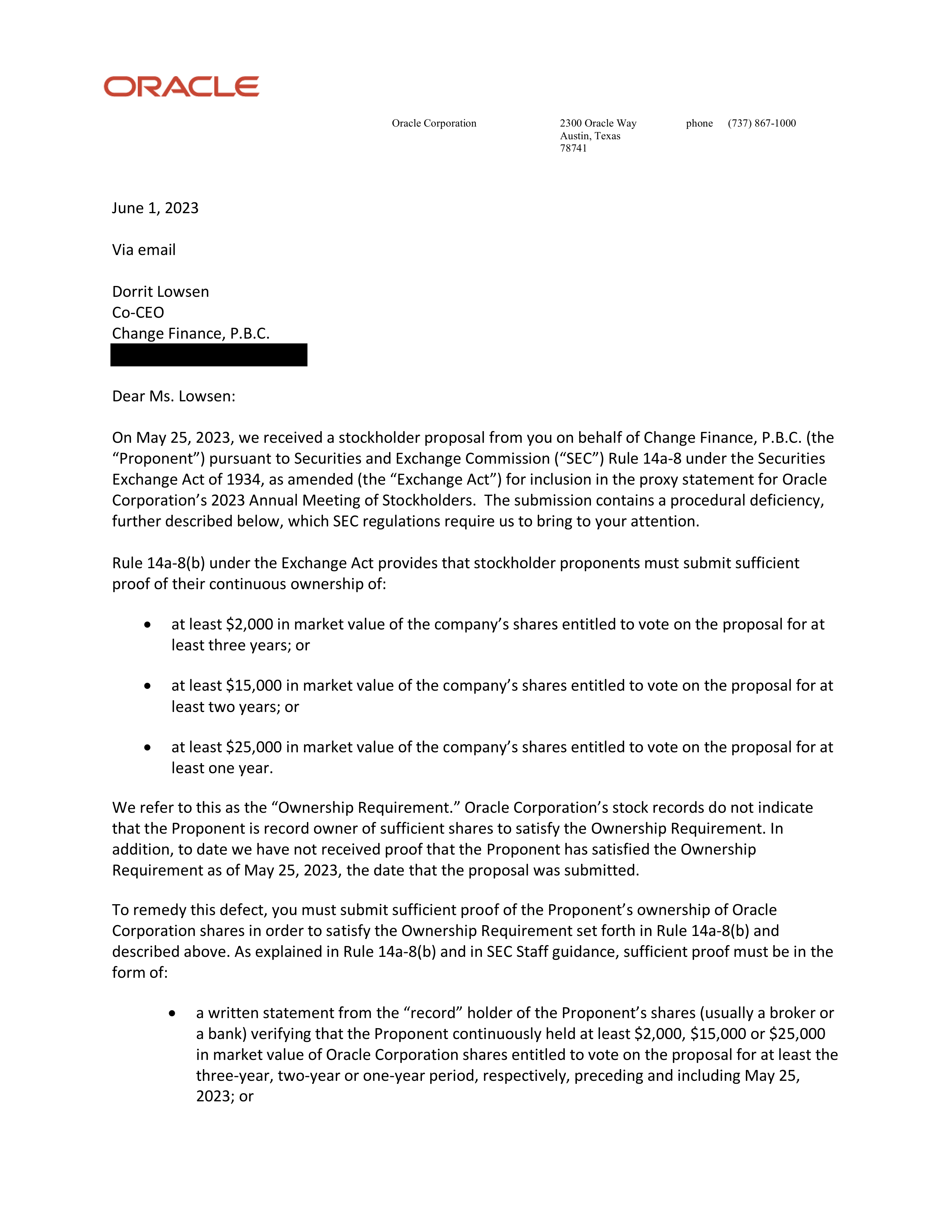

Oracle Corporation
2300 Oracle Way
phone
(737) 867-1000
Austin, Texas
78741
June 1, 2023
Via email
Dorrit Lowsen
Co-CEO
Change Finance, P.B.C.
Dear Ms. Lowsen:
On May 25, 2023, we received a stockholder proposal from you on behalf of Change Finance, P.B.C. (the
“Proponent”) pursuant to Securities and Exchange Commission (“SEC”) Rule 14a-8 under the Securities
Exchange Act of 1934, as amended (the “Exchange Act”) for inclusion in the proxy statement for Oracle
Corporation’s 2023 Annual Meeting of Stockholders. The submission contains a procedural deficiency,
further described below, which SEC regulations require us to bring to your attention.
Rule 14a-8(b) under the Exchange Act provides that stockholder proponents must submit sufficient
proof of their continuous ownership of:
•
at least $2,000 in market value of the company’s shares entitled to vote on the proposal for at
least three years; or
•
at least $15,000 in market value of the company’s shares entitled to vote on the proposal for at
least two years; or
•
at least $25,000 in market value of the company’s shares entitled to vote on the proposal for at
least one year.
We refer to this as the “Ownership Requirement.” Oracle Corporation’s stock records do not indicate
that the Proponent is record owner of sufficient shares to satisfy the Ownership Requirement. In
addition, to date we have not received proof that the Proponent has satisfied the Ownership
Requirement as of May 25, 2023, the date that the proposal was submitted.
To remedy this defect, you must submit sufficient proof of the Proponent’s ownership of Oracle
Corporation shares in order to satisfy the Ownership Requirement set forth in Rule 14a-8(b) and
described above. As explained in Rule 14a-8(b) and in SEC Staff guidance, sufficient proof must be in the
form of:
•
a written statement from the “record” holder of the Proponent’s shares (usually a broker or
a bank) verifying that the Proponent continuously held at least $2,000, $15,000 or $25,000
in market value of Oracle Corporation shares entitled to vote on the proposal for at least the
three-year, two-year or one-year period, respectively, preceding and including May 25,
2023; or

•
if the Proponent has filed with the SEC a Schedule 13D, Schedule 13G, Form 3, Form 4 or
Form 5, or amendments to those documents or updated forms, demonstrating that the
Proponent’s ownership of Oracle Corporation shares entitled to vote on the proposal meets
the Ownership Requirement, a copy of the schedule and/or form, and any subsequent
amendments reporting a change in the ownership level and a written statement that the
Proponent continuously held at least $2,000, $15,000 or $25,000 in market value of Oracle
Corporation shares entitled to vote on the proposal for the three-year, two-year or one-year
period, respectively, preceding and including May 25, 2023.
If the Proponent intends to demonstrate ownership by submitting a written statement from the
“record” holder of the Proponents’ shares as set forth in the first bullet above, please note that most
large U.S. brokers and banks deposit their customers’ securities with, and hold those securities through,
the Depository Trust Company (“DTC”), a registered clearing agency that acts as a securities depository
(DTC is also known through the account name of Cede & Co.). Under SEC Staff Legal Bulletin No. 14F,
only DTC participants are viewed as record holders of securities that are deposited at DTC. You can
confirm whether the Proponents’ broker or bank is a DTC participant by asking the Proponent’s broker
or bank or by checking DTC’s participant list, which is available at http://www.dtcc.com/client-
center/dtc-directories.aspx. In these situations, stockholders need to obtain proof of ownership from
the DTC participant through which the securities are held, as follows:
•
If the Proponent’s broker or bank is a DTC participant, then the Proponent needs to submit
a written statement from their broker or bank verifying that the Proponent continuously
held at least $2,000, $15,000 or $25,000 in market value of Oracle Corporation shares
entitled to vote on the proposal for at least the three-year, two-year or one-year period,
respectively, preceding and including May 25, 2023.
•
If the Proponent’s broker or bank is not a DTC participant, then the Proponent needs to
submit proof of ownership from the DTC participant through which the shares are held
verifying that the Proponent continuously held at least $2,000, $15,000 or $25,000 in
market value of Oracle Corporation shares entitled to vote on the proposal for at least the
three-year, two-year or one-year period, respectively, preceding and including May 25,
2023. You should be able to find out the identity of the DTC participant by asking the broker
or bank. If the Proponent’s broker is an introducing broker, you may also be able to learn
the identity and telephone number of the DTC participant through the Proponent’s account
statements, because the clearing broker identified on the account statements will generally
be a DTC participant. If the DTC participant that holds the Proponent’s shares is not able to
confirm the Proponent’s individual holdings but is able to confirm the holdings of the
Proponent’s broker or bank, then the Proponent needs to satisfy the proof of ownership
requirements by obtaining and submitting two proof of ownership statements verifying that
the Ownership Requirement has been satisfied: (i) one from the Proponent’s broker or bank
confirming the Proponent’s ownership, and (ii) the other from the DTC participant
confirming the broker or bank’s ownership.
The SEC’s rules require that any response to this letter must be postmarked or transmitted electronically
no later than 14 calendar days after receiving this letter. Your response should be transmitted via email
to Corporate_Secretary@oracle.com and a physical copy may also be sent to the Oracle Corporation
Corporate Secretary at the address listed at the top of this letter. Copies of Rule 14a-8 (reflecting the


current requirements, including the current ownership threshold) and Staff Legal Bulletin No. 14F are
enclosed for your reference.
Thank you for your interest in Oracle. If you have any questions, please feel free to contact me at
.
Sincerely,
Lauren Ackermann
Senior Corporate Counsel
Enclosures
cc:
Nicole Dodson (
)
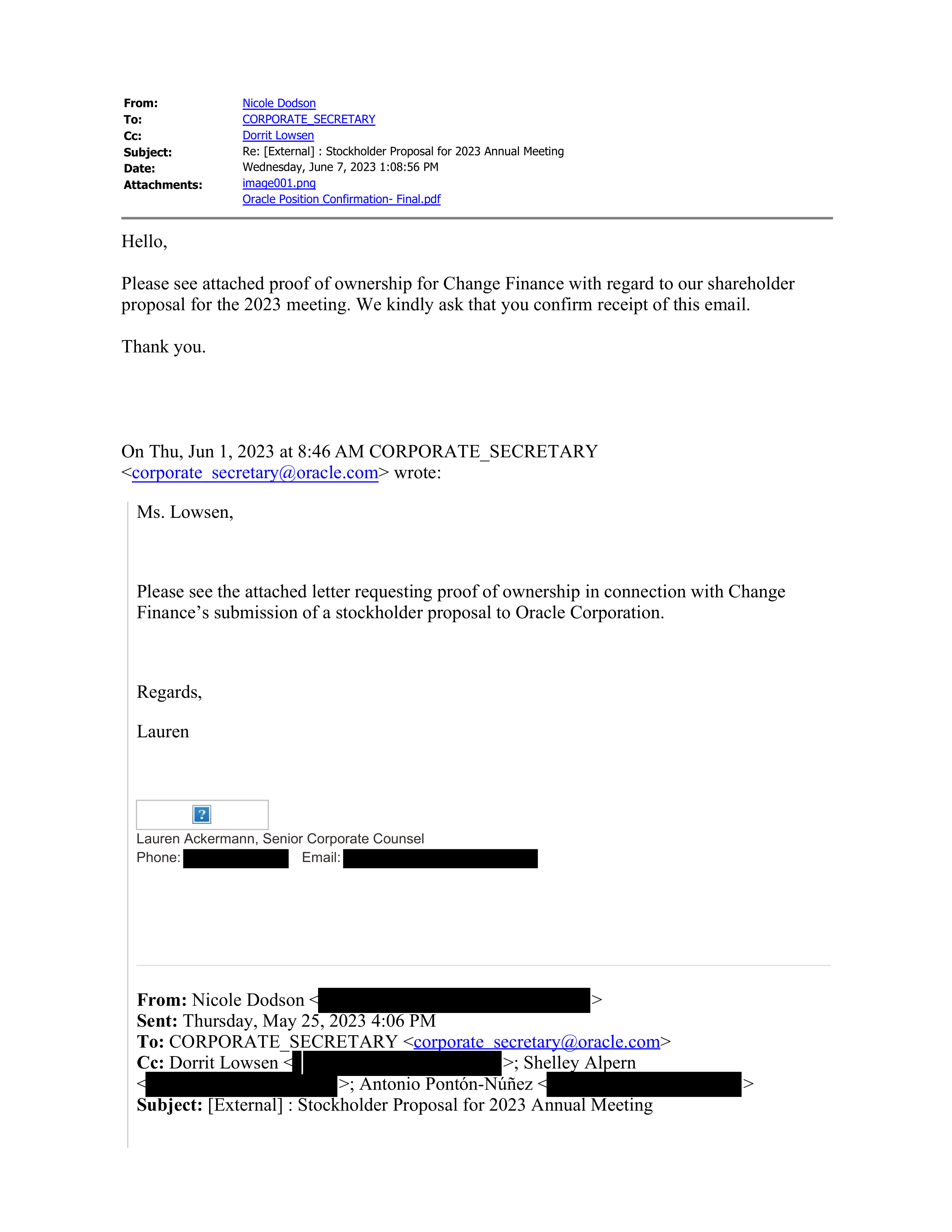

From:
To:
Cc:
Subject:
Date:
Attachments:
Nicole Dodson
CORPORATE_SECRETARY
Dorrit Lowsen
Re: [External] : Stockholder Proposal for 2023 Annual Meeting
Wednesday, June 7, 2023 1:08:56 PM
image001.png
Oracle Position Confirmation- Final.pdf
Hello,
Please see attached proof of ownership for Change Finance with regard to our shareholder
proposal for the 2023 meeting. We kindly ask that you confirm receipt of this email.
Thank you.
On Thu, Jun 1, 2023 at 8:46 AM CORPORATE_SECRETARY
<
corporate_secretary@oracle.com
> wrote:
Ms. Lowsen,
Please see the attached letter requesting proof of ownership in connection with Change
Finance’s submission of a stockholder proposal to Oracle Corporation.
Regards,
Lauren
Lauren Ackermann, Senior Corporate Counsel
Phone:
Email:
From:
Nicole Dodson <
>
Sent:
Thursday, May 25, 2023 4:06 PM
To:
CORPORATE_SECRETARY <
corporate_secretary@oracle.com
>
Cc:
Dorrit Lowsen <
>; Shelley Alpern
<
>; Antonio Pontón-Núñez <
>
Subject:
[External] : Stockholder Proposal for 2023 Annual Meeting
Mr. Higgins,
On behalf of Change Finance P.B.C. (“Change Finance”), I am submitting the
attached proposal (the “Proposal”) pursuant to the Securities and Exchange
Commission’s Rule 14a-8 to be included in the proxy statement of Oracle
Corporation (the “Company”) for its 2023 annual meeting of shareholders.
Please take a look at the attached letter and proposal for details. Please note this
proposal has been mailed as well.
--
Best,
Nicole
Nicole Dodson
Director of Operations and Shareholder Engagement
Change Finance
w
change-finance.com
e
p
Pronouns: she/her
This e-mail, and any attachments herein, is intended only for use by the addressee(s) and
qualified eligible persons named herein and may contain legally privileged and/or
confidential information. If you are not the intended recipient of this e-mail, you are hereby
notified that any dissemination, distribution or copying of this e-mail, and any attachments
herein, is strictly prohibited and request that you delete it and notify us. All emails sent to
or from this address will be received or otherwise recorded by our corporate email system
and is subject to archival and monitoring by, and/or disclosure to, authorized employees or
to any other party as required by law.
Investing involves risk. Principal loss is possible. Diversification does not eliminate the
risk of experiencing investment losses. Past performance is no guarantee of future
success.
An investor should consider the investment objectives, risks, charges, and expenses
of the ETF carefully before investing. The prospectus contains this and other information
about the ETF. A copy of the ETF’s prospectus is available
HERE
. The prospectus should
be read carefully before investing.
Distributor
: IMST Distributors, LLC. Change Finance, PBC and IMST Distributors, LLC
are not affiliated entities.
Change Finance, PBC is an investment advisor registered with the Securities and Exchange
Commission. Registration does not imply a certain level of skill or training. More
information about Change Finance’s investment advisory services can be found in its Form
ADV Part 2 or Form CRS, which is available upon request.
--
Best,
Nicole
Nicole Dodson
Director
of Operations and Shareholder Engagement
Change Finance
w
change-finance.com
e
p
Pronouns: she/her
This e-mail, and any attachments herein, is intended only for use by the addressee(s) and
qualified eligible persons named herein and may contain legally privileged and/or
confidential information. If you are not the intended recipient of this e-mail, you are hereby
notified that any dissemination, distribution or copying of this e-mail, and any attachments
herein, is strictly prohibited and request that you delete it and notify us. All emails sent to or
from this address will be received or otherwise recorded by our corporate email system and is
subject to archival and monitoring by, and/or disclosure to, authorized employees or to any
other party as required by law.
Investing involves risk. Principal loss is possible. Diversification does not eliminate the risk
of experiencing investment losses. Past performance is no guarantee of future success.
An
investor should consider the investment objectives, risks, charges, and expenses of the ETF
carefully before investing. The prospectus contains this and other information about the ETF.
A copy of the ETF’s prospectus is available
HERE
. The prospectus should be read carefully

before investing.
Distributor
: IMST Distributors, LLC. Change Finance, PBC and IMST Distributors, LLC are
not affiliated entities.
Change Finance, PBC is an investment advisor registered with the Securities and Exchange
Commission. Registration does not imply a certain level of skill or training. More information
about Change Finance’s investment advisory services can be found in
its Form ADV Part 2 or
Form CRS, which is available upon request.
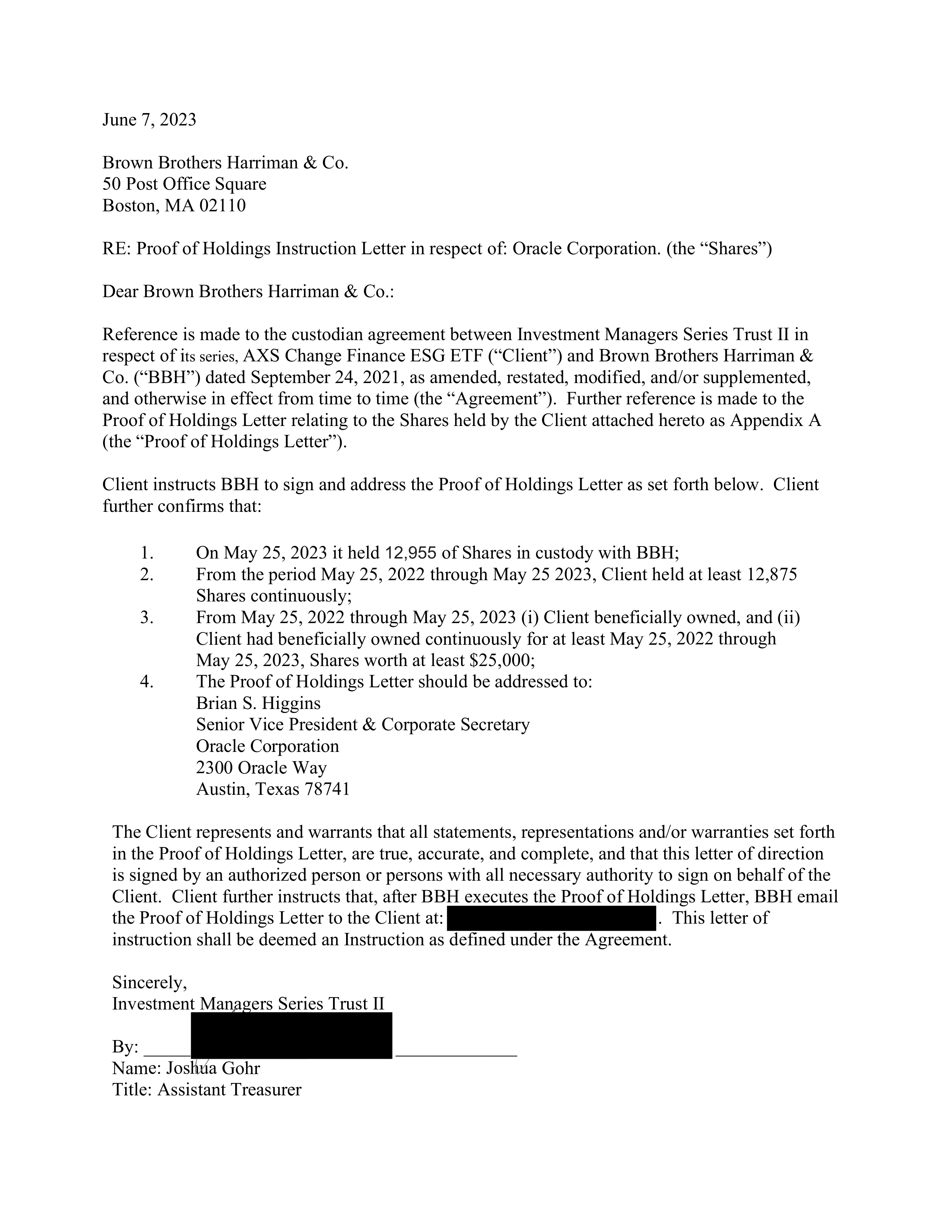

June
7
, 2023
Brown Brothers Harriman & Co.
50 Post Office Square
Boston, MA 02110
RE: Proof of Holdings Instruction Letter in respect of: Oracle Corporation. (the “Shares”)
Dear Brown Brothers Harriman & Co.:
Reference is made to the custodian agreement between Investment Managers Series Trust II in
respect of i
ts series,
AXS Change Finance ESG ETF (“Client”) and Brown Brothers Harriman &
Co. (“BBH”) dated September 24, 2021, as amended, restated, modified, and/or supplemented,
and otherwise in effect from time to time (the “Agreement”). Further reference is made to the
Proof of Holdings Letter relating to the Shares held by the Client attached hereto as Appendix A
(the “Proof of Holdings Letter”).
Client instructs BBH to sign and address the Proof of Holdings Letter as set forth below. Client
further confirms that:
1.
On May 25, 2023 it held
12,955
of Shares in custody with BBH;
2.
From the period May 25, 2022 through May 25 2023, Client held at least
12,875
Shares continuously;
3.
From May 25, 2022 through May 25, 2023 (i) Client beneficially owned, and (ii)
Client had beneficially owned continuously for at least Ma
y 25
, 2022 through
Ma
y 25
, 2023, Shares worth at least $25,000;
4.
The Proof of Holdings Letter should be addressed to:
Brian S. Higgins
Senior Vice President & Corporate Secretary
Oracle Corporation
2300 Oracle Way
Austin, Texas 78741
The Client represents and warrants that all statements, representations and/or warranties set forth
in the Proof of Holdings Letter, are true, accurate, and complete, and that this letter of direction
is signed by an authorized person or persons with all necessary authority to sign on behalf of the
Client. Client further instructs that, after BBH executes the Proof of Holdings Letter, BBH email
the Proof of Holdings Letter to the Client at:
. This letter of
instruction shall be deemed an Instruction as defined under the Agreement.
Sincerely,
Investment Managers Series Trust II
By: _____
_____________
Name: Joshua Gohr
Title: Assistant Treasurer
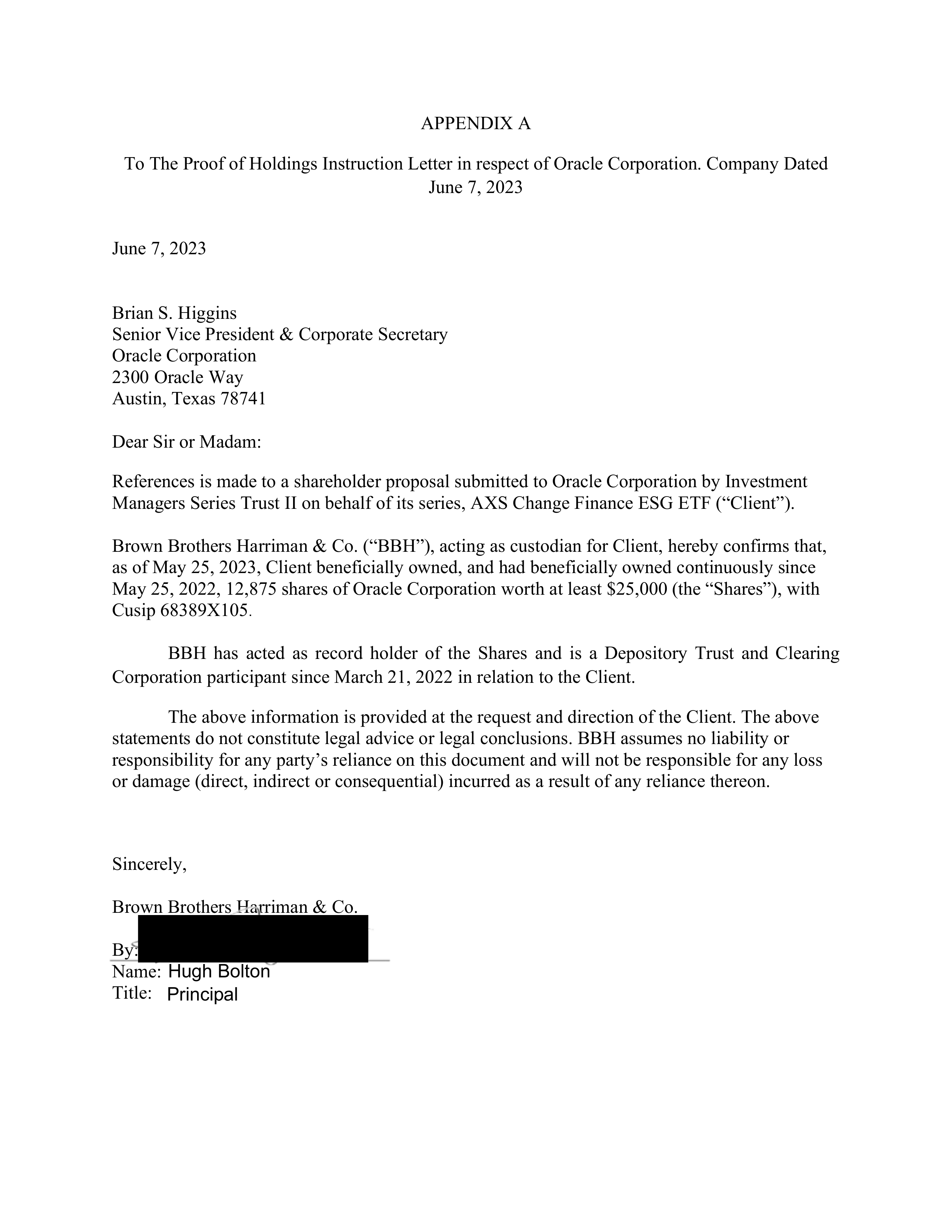

APPENDIX A
To The Proof of Holdings Instruction Letter in respect of Oracle Corporation. Company Dated
June
7
, 2023
June
7
, 2023
Brian S. Higgins
Senior Vice President & Corporate Secretary
Oracle Corporation
2300 Oracle Way
Austin, Texas 78741
Dear Sir or Madam:
References is made to a shareholder proposal submitted to Oracle Corporation by Investment
Managers Series Trust II on behalf of its series, AXS Change Finance ESG ETF (“Client”).
Brown Brothers Harriman & Co. (“BBH”), acting as custodian for Client, hereby confirms that,
as of May 25, 2023, Client beneficially owned, and had beneficially owned continuously since
May 25, 2022,
12,875
shares of Oracle Corporation worth at least $25,000 (the “Shares”), with
Cusip 68389X105
.
BBH has acted as record holder of the Shares and is a Depository Trust and Clearing
Corporation participant since March 21, 2022 in relation to the Client.
The above information is provided at the request and direction of the Client. The above
statements do not constitute legal advice or legal conclusions. BBH assumes no liability or
responsibility for any party’s reliance on this document and will not be responsible for any loss
or damage (direct, indirect or consequential) incurred as a result of any reliance thereon.
Sincerely,
Brown Brothers Harriman & Co.
By:
Name:
Title:
Hugh Bolton
Principal
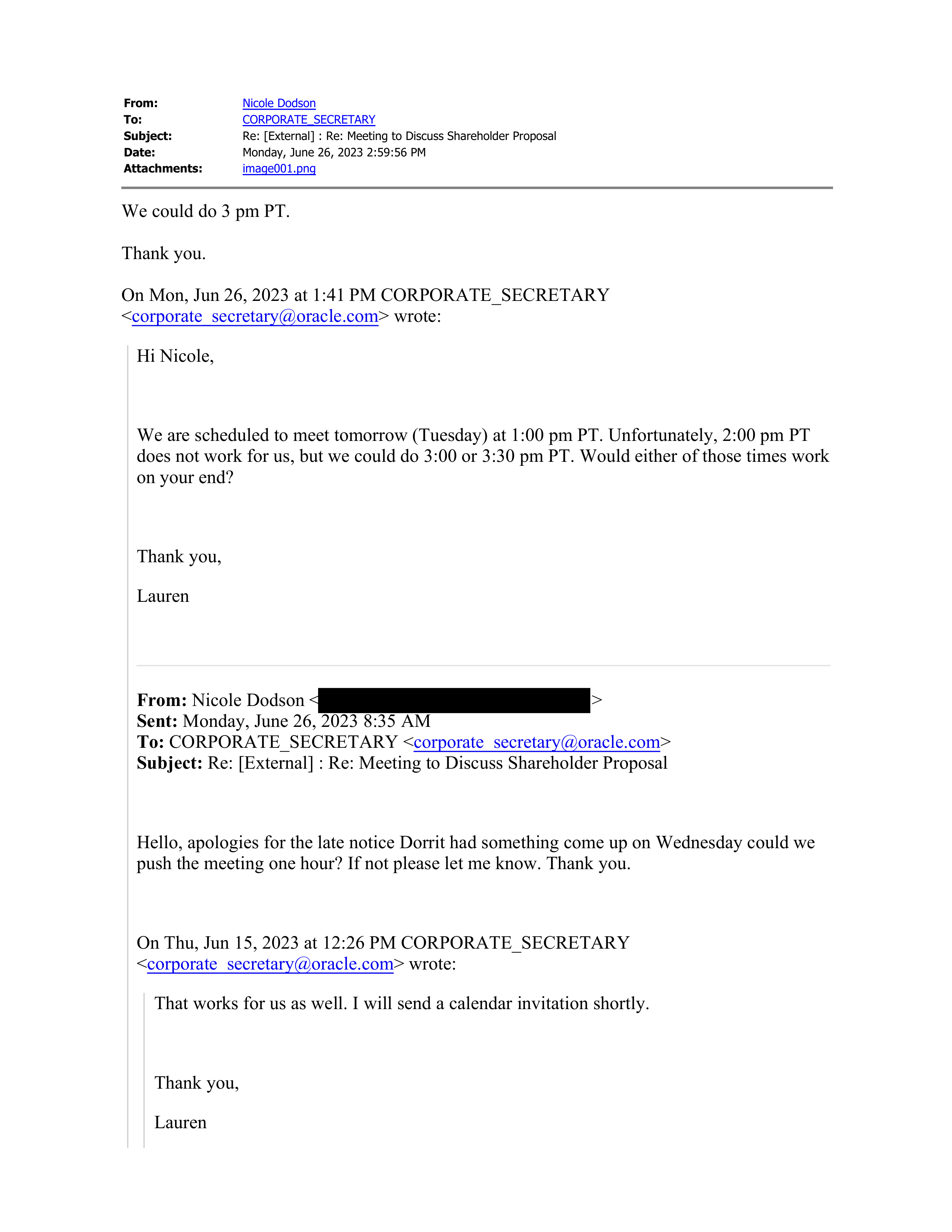
From:
To:
Subject:
Date:
Attachments:
Nicole Dodson
CORPORATE_SECRETARY
Re: [External] : Re: Meeting to Discuss Shareholder Proposal
Monday, June 26, 2023 2:59:56 PM
image001.png
We could do 3 pm PT.
Thank you.
On Mon, Jun 26, 2023 at 1:41 PM CORPORATE_SECRETARY
<
corporate_secretary@oracle.com
> wrote:
Hi Nicole,
We are scheduled to meet tomorrow (Tuesday) at 1:00 pm PT. Unfortunately, 2:00 pm PT
does not work for us, but we could do 3:00 or 3:30 pm PT. Would either of those times work
on your end?
Thank you,
Lauren
From:
Nicole Dodson <
>
Sent:
Monday, June 26, 2023 8:35 AM
To:
CORPORATE_SECRETARY <
corporate_secretary@oracle.com
>
Subject:
Re: [External] : Re: Meeting to Discuss Shareholder Proposal
Hello, apologies for the late notice Dorrit had something come up on Wednesday could we
push the meeting one hour? If not please let me know. Thank you.
On Thu, Jun 15, 2023 at 12:26 PM CORPORATE_SECRETARY
<
corporate_secretary@oracle.com
> wrote:
That works for us as well. I will send a calendar invitation shortly.
Thank you,
Lauren
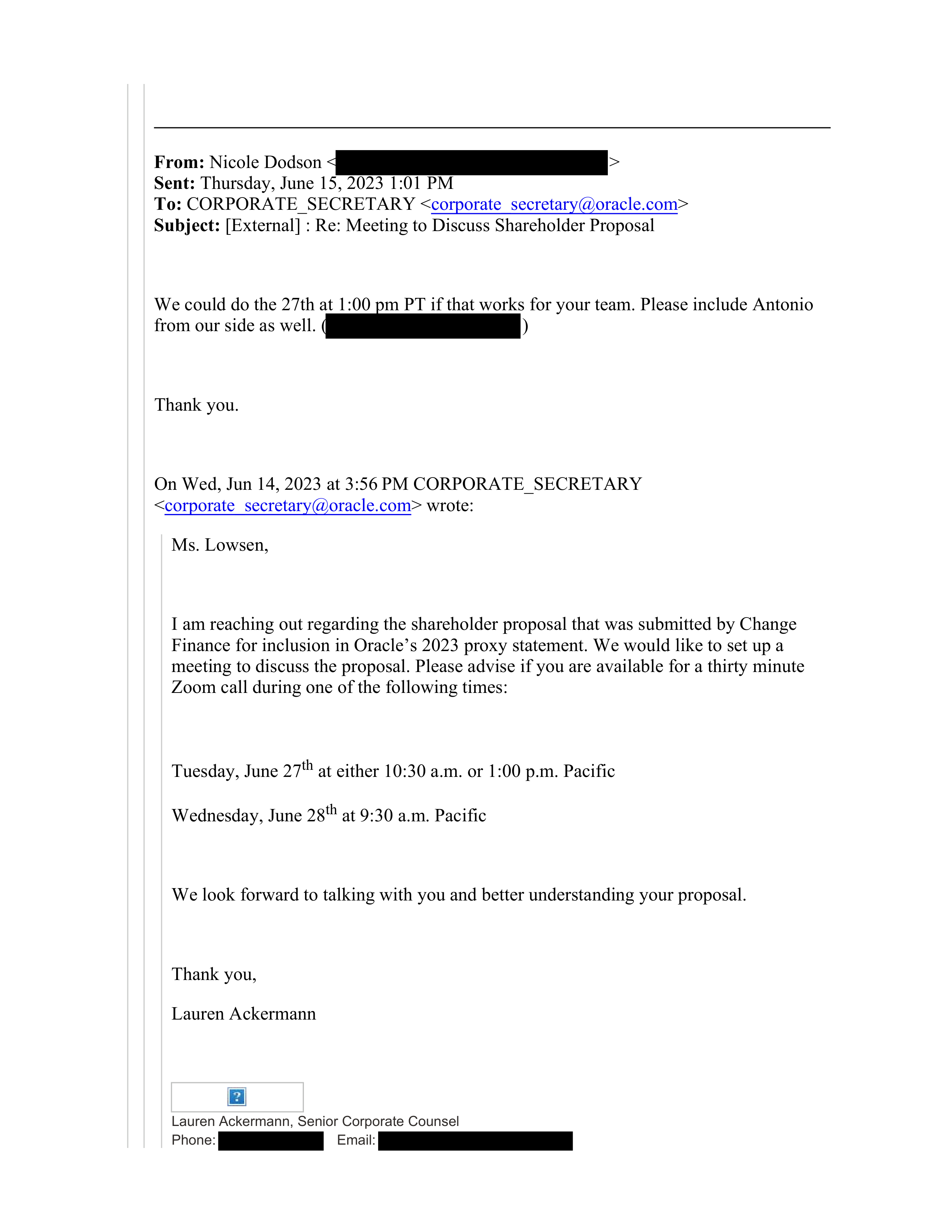

From:
Nicole Dodson <
>
Sent:
Thursday, June 15, 2023 1:01 PM
To:
CORPORATE_SECRETARY <
corporate_secretary@oracle.com
>
Subject:
[External] : Re: Meeting to Discuss Shareholder Proposal
We could do the 27th at 1:00 pm PT if that works for your team. Please include Antonio
from our side as well. (
)
Thank you.
On Wed, Jun 14, 2023 at 3:56 PM CORPORATE_SECRETARY
<
corporate_secretary@oracle.com
> wrote:
Ms. Lowsen,
I am reaching out regarding the shareholder proposal that was submitted by Change
Finance for inclusion in Oracle’s 2023 proxy statement. We would like to set up a
meeting to discuss the proposal. Please advise if you are available for
a thirty minute
Zoom call during one of the following times:
Tuesday, June 27
th
at either 10:30 a.m. or 1:00 p.m. Pacific
Wednesday, June 28
th
at 9:30 a.m. Pacific
We look forward to talking with you and better understanding your proposal.
Thank you,
Lauren Ackermann
Lauren Ackermann, Senior Corporate Counsel
Phone:
Email:
--
Best,
Nicole
Nicole Dodson
Director of Operations and Shareholder Engagement
Change Finance
w
change-finance.com
e
p
Pronouns: she/her
This e-mail, and any attachments herein, is intended only for use by the addressee(s) and
qualified eligible persons named herein and may contain legally privileged and/or
confidential information. If you are not the intended recipient of this e-mail, you are
hereby notified that any dissemination, distribution or copying of this e-mail, and any
attachments herein, is strictly prohibited and request that you delete it and notify us. All
emails sent to or from this address will be received or otherwise recorded by our
corporate email system and is subject to archival and monitoring by, and/or disclosure to,
authorized employees or to any other party as required by law.
Investing involves risk. Principal loss is possible. Diversification does not eliminate the
risk of experiencing investment losses. Past performance is no guarantee of future
success.
An investor should consider the investment objectives, risks, charges, and
expenses of the ETF carefully before investing. The prospectus contains this and other
information about the ETF. A copy of the ETF’s prospectus is available
HERE
. The
prospectus should be read carefully before investing.
Distributor
: IMST Distributors, LLC. Change Finance, PBC and IMST Distributors, LLC
are not affiliated entities.
Change Finance, PBC is an investment advisor registered with the Securities and
Exchange Commission. Registration does not imply a certain level of skill or training.
More information about Change Finance’s investment advisory services can be found in
its Form ADV Part 2 or Form CRS, which is available upon request.
--
Best,
Nicole
Nicole Dodson
Director of Operations and Shareholder Engagement
Change Finance
w
change-finance.com
e
p
Pronouns: she/her
This e-mail, and any attachments herein, is intended only for use by the addressee(s) and
qualified eligible persons named herein and may contain legally privileged and/or
confidential information. If you are not the intended recipient of this e-mail, you are hereby
notified that any dissemination, distribution or copying of this e-mail, and any attachments
herein, is strictly prohibited and request that you delete it and notify us. All emails sent to
or from this address will be received or otherwise recorded by our corporate email system
and is subject to archival and monitoring by, and/or disclosure to, authorized employees or
to any other party as required by law.
Investing involves risk. Principal loss is possible. Diversification does not eliminate the
risk of experiencing investment losses. Past performance is no guarantee of future
success.
An investor should consider the investment objectives, risks, charges, and expenses
of the ETF carefully before investing. The prospectus contains this and other information
about the ETF. A copy of the ETF’s prospectus is available
HERE
. The prospectus should
be read carefully before investing.
Distributor
: IMST Distributors, LLC. Change Finance, PBC and IMST Distributors, LLC
are not affiliated entities.
Change Finance, PBC is an investment advisor registered with the Securities and Exchange
Commission. Registration does not imply a certain level of skill or training. More
information about Change Finance’s investment advisory services can be found in
its Form
ADV Part 2 or Form CRS, which is available upon request.
--
Best,
Nicole
Nicole Dodson
Director
of Operations and Shareholder Engagement
Change Finance
w
change-finance.com
e
p
Pronouns: she/her
This e-mail, and any attachments herein, is intended only for use by the addressee(s) and
qualified eligible persons named herein and may contain legally privileged and/or
confidential information. If you are not the intended recipient of this e-mail, you are hereby
notified that any dissemination, distribution or copying of this e-mail, and any attachments
herein, is strictly prohibited and request that you delete it and notify us. All emails sent to or
from this address will be received or otherwise recorded by our corporate email system and is
subject to archival and monitoring by, and/or disclosure to, authorized employees or to any
other party as required by law.
Investing involves risk. Principal loss is possible. Diversification does not eliminate the risk
of experiencing investment losses. Past performance is no guarantee of future success.
An
investor should consider the investment objectives, risks, charges, and expenses of the ETF
carefully before investing. The prospectus contains this and other information about the ETF.
A copy of the ETF’s prospectus is available
HERE
. The prospectus should be read carefully
before investing.
Distributor
: IMST Distributors, LLC. Change Finance, PBC and IMST Distributors, LLC are
not affiliated entities.
Change Finance, PBC is an investment advisor registered with the Securities and Exchange
Commission. Registration does not imply a certain level of skill or training. More information
about Change Finance’s investment advisory services can be found in its Form ADV Part 2 or
Form CRS, which is available upon request.
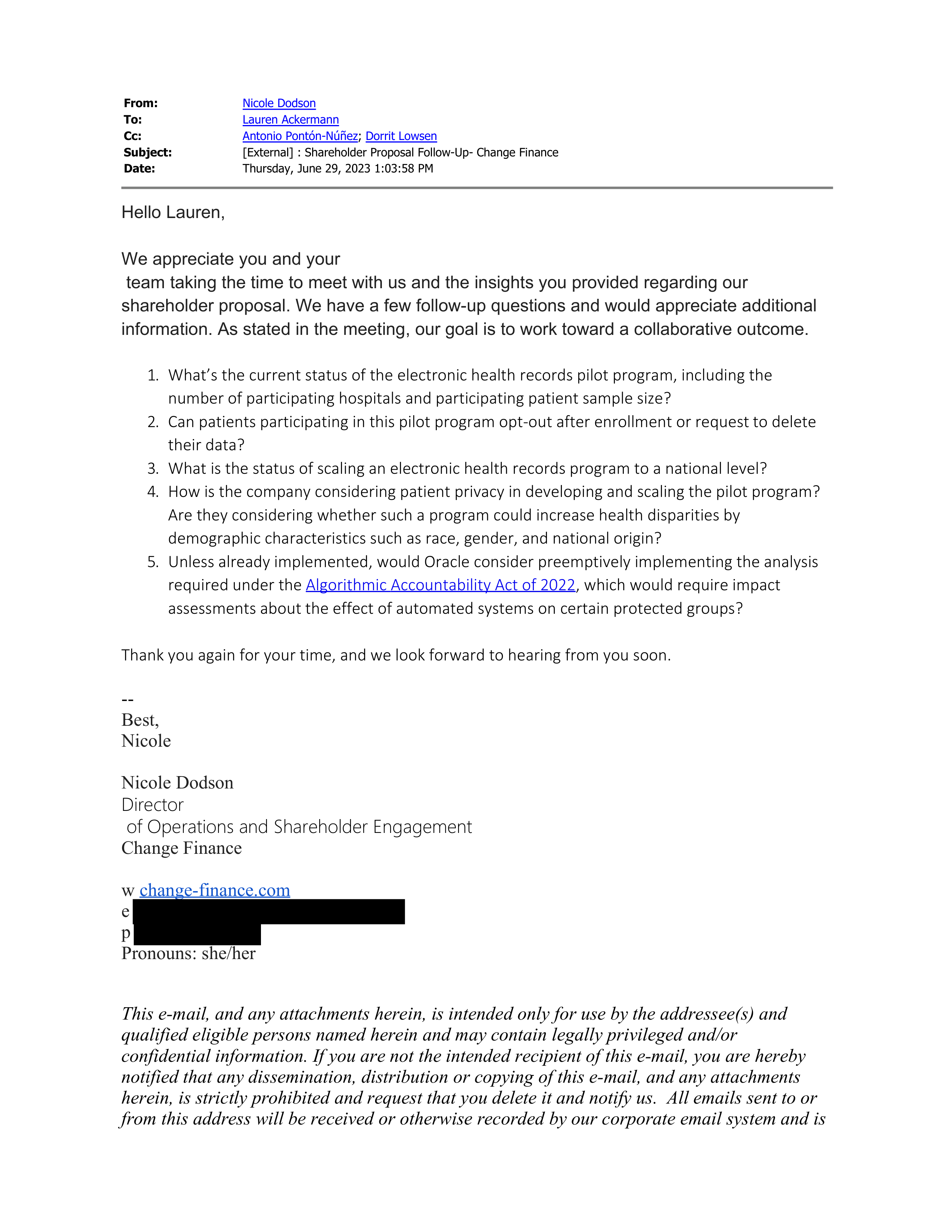
From:
To:
Cc:
Subject:
Date:
Hello Lauren,
We appreciate you and your
team taking the time to meet with us and the insights you provided regarding our
shareholder proposal. We have a few follow-up questions and would appreciate additional
information. As stated in the meeting, our goal is to work toward a collaborative outcome.
1.
2.
3.
4.
5.
What’s the current status of the electronic health records pilot program, including the
number of participating hospitals and participating patient sample size?
Can patients participating in this pilot program opt-out after enrollment or request to delete
their data?
What is the status of scaling an electronic health records program to a national level?
How is the company considering patient privacy in developing and scaling the pilot program?
Are they considering whether such a program could increase health disparities by
demographic characteristics such as race, gender, and national origin?
Unless already implemented, would Oracle consider preemptively implementing the analysis
required under the
Algorithmic Accountability Act of 2022
, which would require impact
assessments about the effect of automated systems on certain protected groups?
Thank you again for your time, and we look forward to hearing from you soon.
--
Best,
Nicole
Nicole Dodson
Director
of Operations and Shareholder Engagement
Change Finance
w
change-finance.com
e
p
Pronouns: she/her
This e-mail, and any attachments herein, is intended only for use by the addressee(s) and
qualified eligible persons named herein and may contain legally privileged and/or
confidential information. If you are not the intended recipient of this e-mail, you are hereby
notified that any dissemination, distribution or copying of this e-mail, and any attachments
herein, is strictly prohibited and request that you delete it and notify us. All emails sent to or
from this address will be received or otherwise recorded by our corporate email system and is
Nicole Dodson
Lauren Ackermann
Antonio Pontón-Núñez
;
Dorrit Lowsen
[External] : Shareholder Proposal Follow-Up- Change Finance
Thursday, June 29, 2023 1:03:58 PM
subject to archival and monitoring by, and/or disclosure to, authorized employees or to any
other party as required by law.
Investing involves risk. Principal loss is possible. Diversification does not eliminate the risk
of experiencing investment losses. Past performance is no guarantee of future success.
An
investor should consider the investment objectives, risks, charges, and expenses of the ETF
carefully before investing. The prospectus contains this and other information about the ETF.
A copy of the ETF’s prospectus is available
HERE
. The prospectus should be read carefully
before investing.
Distributor
: IMST Distributors, LLC. Change Finance, PBC and IMST Distributors, LLC are
not affiliated entities.
Change Finance, PBC is an investment advisor registered with the Securities and Exchange
Commission. Registration does not imply a certain level of skill or training. More information
about Change Finance’s investment advisory services can be found in its Form ADV Part 2 or
Form CRS, which is available upon request.
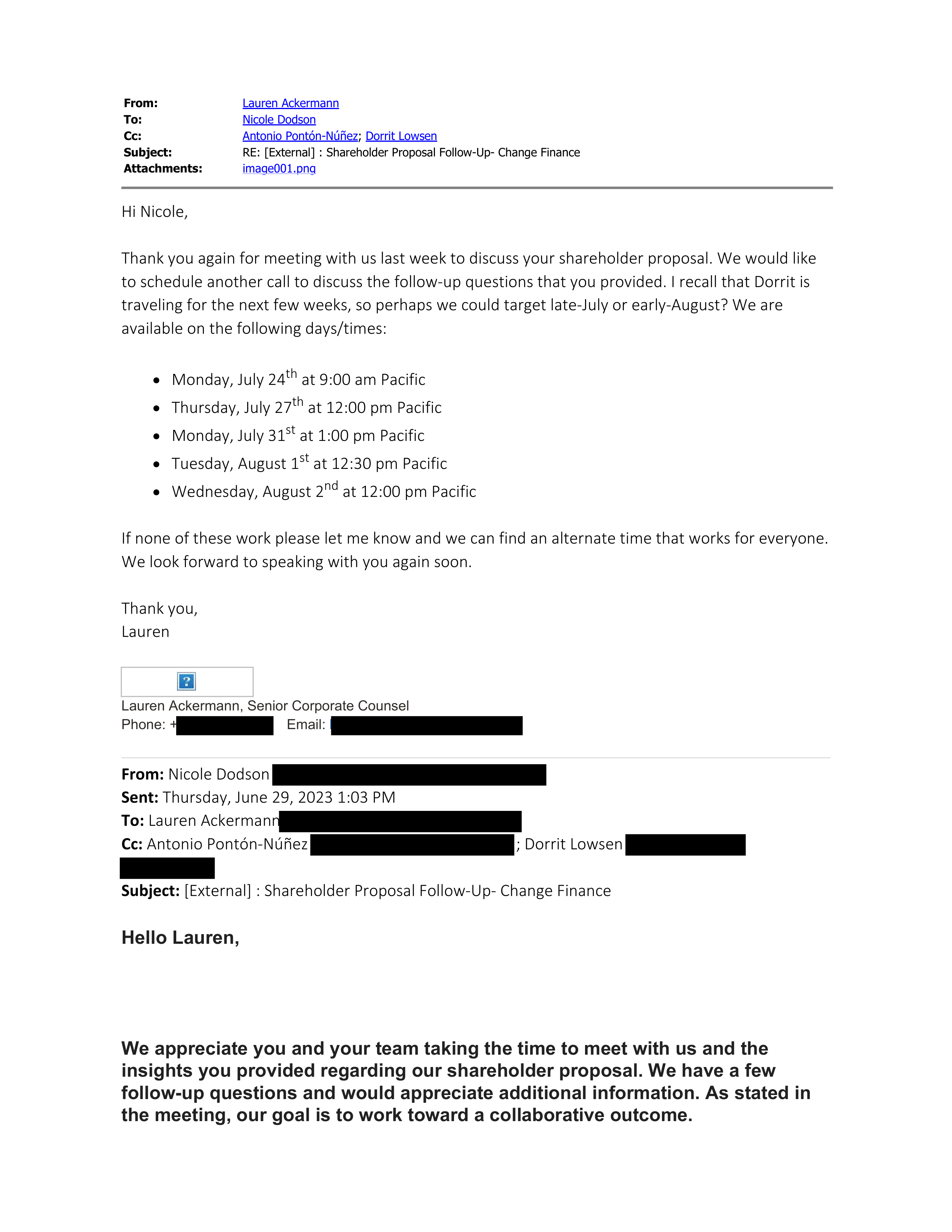

From:
Lauren Ackermann
To:
Nicole Dodson
Cc:
Antonio Pontón-Núñez
;
Dorrit Lowsen
Subject:
RE: [External] : Shareholder Proposal Follow-Up- Change Finance
Attachments:
image001.png
Hi Nicole,
Thank you again for meeting with us last week to discuss your shareholder proposal. We would like
to schedule another call to discuss the follow-up questions that you provided. I recall that Dorrit is
traveling for the next few weeks, so
perhaps we could target late-July or early-August? We are
available on the following days/times:
Monday, July 24
th
at 9:00 am Pacific
Thursday, July 27
th
at 12:00 pm Pacific
Monday, July 31
st
at 1:00 pm Pacific
Tuesday, August 1
st
at 12:30 pm Pacific
Wednesday, August 2
nd
at 12:00 pm Pacific
If none of these work please let me know and we can find an alternate time that works for everyone.
We look forward to speaking with you again soon.
Thank you,
Lauren
Lauren Ackermann, Senior Corporate Counsel
Phone: +
Email:
l
From:
Nicole Dodson
Sent:
Thursday, June 29, 2023 1:03 PM
To:
Lauren Ackermann
Cc:
Antonio Pontón-Núñez
; Dorrit Lowsen
Subject:
[External] : Shareholder Proposal Follow-Up- Change Finance
Hello Lauren,
We appreciate you and your team taking the time to meet with us and the
insights you provided regarding our shareholder proposal. We have a few
follow-up questions and would
appreciate additional information. As stated in
the meeting, our goal is to work toward a collaborative outcome.
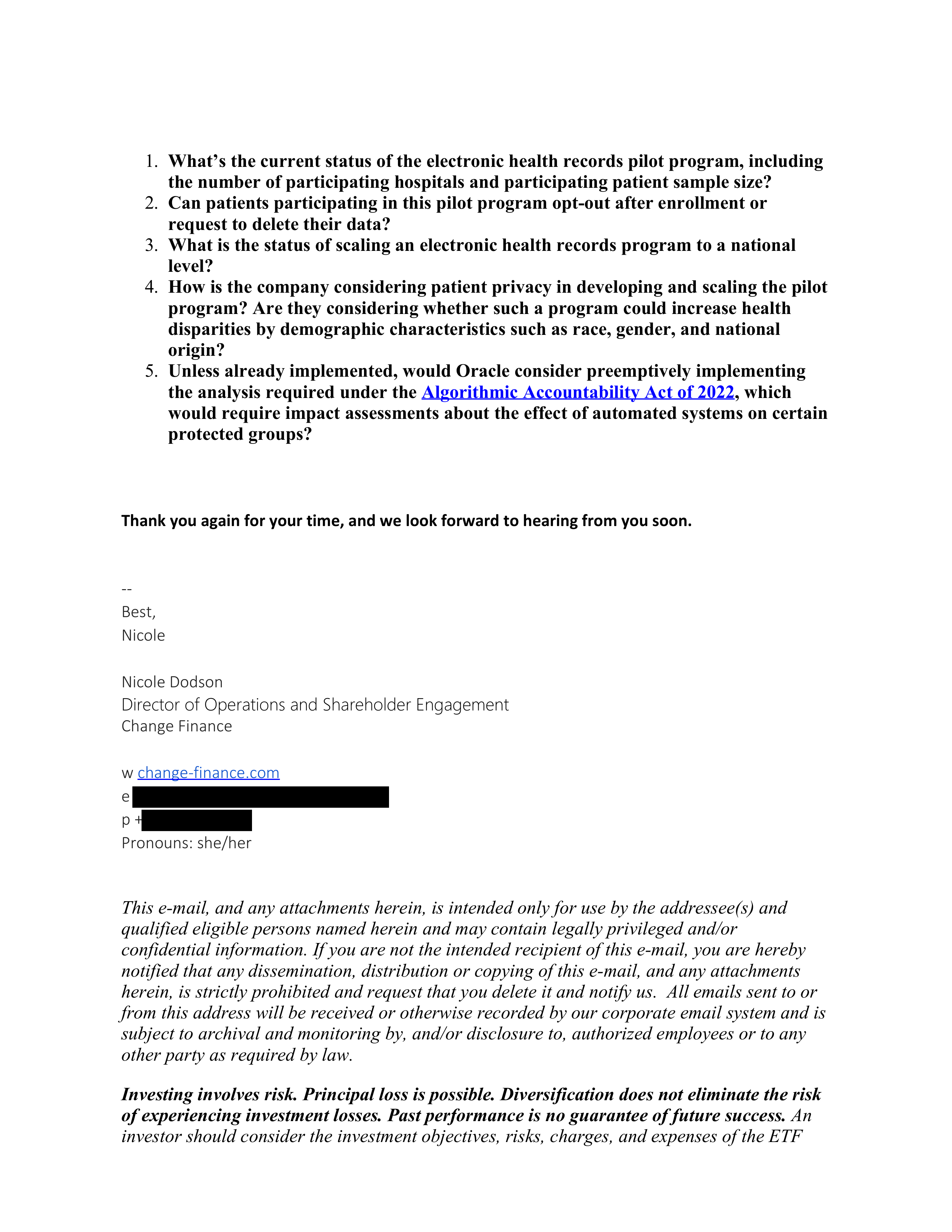
1.
What’s the current status of the electronic health records pilot program, including
the number of participating hospitals and participating patient sample size?
2.
Can patients participating in this pilot program opt-out after enrollment or
request to delete their data?
3.
What is the status of scaling an electronic health records program to a national
level?
4.
How is the company considering patient privacy in developing and scaling the pilot
program? Are they considering whether such a program could increase health
disparities by demographic characteristics such as race, gender, and national
origin?
5.
Unless already implemented, would Oracle consider preemptively implementing
the analysis required under the
Algorithmic Accountability Act of 2022
, which
would require impact assessments about the effect of automated systems on certain
protected groups?
Thank you again for your time, and we look forward to hearing from you soon.
--
Best,
Nicole
Nicole Dodson
Director of Operations and Shareholder Engagement
Change Finance
w
change-finance.com
e
p +
Pronouns: she/her
This e-mail, and any attachments herein, is intended only for use by the addressee(s) and
qualified eligible persons named herein and may contain legally privileged and/or
confidential information. If you are not the intended recipient of this e-mail,
you are hereby
notified that any dissemination, distribution or copying of this e-mail, and any attachments
herein, is strictly prohibited and request that you delete it and notify us. All emails sent to or
from this address will be received or otherwise
recorded by our corporate email system and is
subject to archival and monitoring by, and/or disclosure to, authorized employees or to any
other party as required by law.
Investing involves risk. Principal loss is possible. Diversification does not eliminate the risk
of experiencing investment losses. Past performance is no guarantee of future success.
An
investor should consider the investment objectives,
risks, charges, and expenses of the ETF
carefully before investing. The prospectus contains this and other information about the ETF.
A copy of the ETF’s prospectus is available
HERE
.
The prospectus should be read carefully
before investing.
Distributor
: IMST Distributors, LLC. Change Finance, PBC and IMST Distributors, LLC are
not affiliated entities.
Change Finance, PBC is an investment advisor registered with the Securities and Exchange
Commission. Registration does not imply a certain level of skill or training. More information
about Change Finance’s investment advisory services can be found in
its Form ADV Part 2 or
Form CRS, which is available upon request.