

January 27, 2025
Ning Chiu
Davis Polk & Wardwell LLP
Re:
Truist Financial Corporation (the “Company”)
Incoming letter dated January 22, 2025
Dear Ning Chiu:
This letter is in regard to your correspondence concerning the shareholder
proposal (the “Proposal”) submitted to the Company by Friends Fiduciary Corporation
(the “Proponent”) for inclusion in the Company’s proxy materials for its upcoming
annual meeting of security holders. Your letter indicates that the Proponent has
withdrawn the Proposal and that the Company therefore withdraws its December 6, 2024
request for a no-action letter from the Division. Because the matter is now moot, we will
have no further comment.
Copies of all of the correspondence related to this matter will be made available
on our website at
https://www.sec.gov/corpfin/2024-2025-shareholder-proposals-no-
action
.
Sincerely,
Rule 14a-8 Review Team
cc:
Amy Carr
Friends Fiduciary Corporation

Davis Polk & Wardwell
LLP
450 Lexington Avenue New
York, NY 10017
1
December 6, 2024
Office of Chief Counsel
Division of Corporation Finance
Securities and Exchange Commission
100 F Street, NE
Washington, DC 20549
Ladies and Gentlemen:
On behalf of Truist Financial Corporation, a North Carolina corporation (the “
Company
”), and in
accordance with Rule 14a-8(j) under the Securities Exchange Act of 1934, as amended (the “
Exchange
Act
”), we are filing this letter with respect to the shareholder proposal (the “
Proposal
”) submitted by
Friends Fiduciary Corporation and co-filers (together, the “
Proponent
”) for inclusion in the proxy materials
the Company intends to distribute in connection with its 2025 Annual Meeting of Shareholders (the “
2025
Proxy Materials
”). The Proposal is attached hereto as Exhibit A.
We hereby request confirmation that the Staff of the Division of Corporation Finance (the “
Staff
”) will not
recommend any enforcement action if, in reliance on Rule 14a-8, the Company omits the Proposal from the
2025 Proxy Materials.
In accordance with relevant Staff guidance, we are submitting this letter and its attachments to the Staff
through the Staff’s online Shareholder Proposal Form. In accordance with Rule 14a-8(j), we are
simultaneously sending a copy of this letter and its attachments to the Proponent as notice of the
Company’s intent to omit the Proposal from the 2025 Proxy Materials. This letter constitutes the Company’s
statement of the reasons it deems the omission of the Proposal to be proper. We have been advised by the
Company as to the factual matters set forth herein.
THE PROPOSAL
The Proposal states:
Resolved: Shareholders request that Truist set and disclose near-term GHG reduction
targets aligned with the Paris Agreement’s ambition to limit warming to 1.5 degrees
Celsius and summarize plans to achieve them. The targets should address the bank’s
most climate-critical financed emissions, including those associated with lending and
investment activities for businesses in the highest emitting sectors.
REASON FOR EXCLUSION OF THE PROPOSAL
The Company believes that the Proposal may be properly omitted from the 2025 Proxy Materials pursuant
to Rule 14a-8(i)(7) because the Proposal deals with matters related to the Company’s ordinary business
operations by seeking to micromanage the Company.
The Proposal May Be Excluded Under Rule 14a-8(i)(7) Because the Proposal Deals with Matters
Related to the Company’s Ordinary Business Operations.
Rule 14a-8(i)(7) allows a company to omit a shareholder proposal from its proxy materials if such proposal
deals with a matter relating to the company’s ordinary business operations. The policy underlying the
ordinary business exception is based on two central considerations: (i) that “[c]ertain tasks are so

2
fundamental to management’s ability to run a company on a day-to-day basis that they could not, as a
practical matter, be subject to direct shareholder oversight” and (ii) the “degree to which the proposal seeks
to ‘micromanage’ the company by probing too deeply into matters of a complex nature upon which
shareholders, as a group, would not be in a position to make an informed judgment.”
See
Exchange Act
Release No. 34-40018 (May 21, 1998) (the “
1998 Release
”); see also Staff Legal Bulletin No. 14L (Nov. 3,
2021) (“
SLB 14L
”).
The Proposal Seeks to Micromanage the Company by Imposing Specific Methods for Setting
and Disclosing Greenhouse Gas Reduction Targets.
Based on the second policy consideration underlying the ordinary business exclusion and as reiterated by
SLB 14L, the Company believes it may omit the Proposal pursuant to Rule 14a-8(i)(7) because it
impermissibly seeks to micromanage the Company by imposing specific methods on management for
setting and disclosing greenhouse gas (“
GHG
”) reduction targets.
Background.
In January 2022, the Company set a goal to achieve net zero GHG emissions by 2050. The goal was an
extension of the Company having set its first Scope 1 and 2 goals in 2021. Since then, the Company has
been working to build new capacity and integrate climate considerations into its risk management, strategy,
and lines of business. As detailed in its 2023 TCFD Report from April 2024, the Company has obtained
third-party verification of its 2023 Scope 1, Scope 2, and certain Scope 3 category GHG emissions.
1
In
addition, the Company has set nearer-term goals to reduce both Scope 1 and Scope 2 (location-based)
emissions by 35% by 2030 relative to a 2019 baseline.
Since joining the Partnership for Carbon Accounting Financials (“
PCAF
”) in October 2021, the Company
has been working to measure and prepare for Scope 3 financed emissions disclosure in anticipation of
publication in the Company’s 2025 TCFD report. The Company has prioritized the asset classes that are
relevant to the Company and for which the PCAF Standard provides methodological guidance. Using the
PCAF methodologies, the Company continues to work on improving its access to data, its ability to
calculate these values, and its understanding of the variability of GHG emissions based on key inputs.
1. The Level of Granularity Sought in the Proposal Inappropriately Limits the Company’s
Discretion.
According to SLB 14L, the determination of whether a proposal impermissibly micromanages the Company
“will focus on the level of granularity sought in the proposal and whether and to what extent it
inappropriately limits discretion of the board or management.” The Staff further clarified that this approach is
“consistent with the Commission’s views on the ordinary business exclusion, which is designed to preserve
management’s discretion on ordinary business matters but not prevent shareholders from providing high-
level direction on large strategic corporate matters.”
The Staff has consistently concurred with the exclusion of proposals that inappropriately limit
management’s discretion and micromanaged the companies, including proposals prescribing specific
actions related to companies’ management of climate change.
See, e.g.
JP Morgan Chase & Co
(Mar. 29,
2024) (concurring that a proposal sought to micromanage the company because it would have required the
company to adopt a specific methodology for sector-by-sector achievement of emissions targets within its
investment portfolios);
Morgan Stanley
(Mar. 29, 2024) (same);
Wells Fargo & Co.
(Mar. 6, 2024) (same);
The Goldman Sachs Group, Inc.
(Mar. 4, 2024) (same);
Bank of America Corp.
(Feb. 29, 2024) (same);
Chevron Corp.
(Mar. 29, 2024) (proposal requesting a report on divestitures of assets with material climate
1
Available at:
https://filecache.investorroom.com/mr5ir_truist/877/Truist2023TCFD.pdf
.

3
impact, including whether each asset purchaser discloses its GHG emissions and has GHG reduction
targets, was excludable as it micromanaged the company);
Tractor Supply Co.
(March 18, 2024)
(concurring that a proposal micromanaged the company by requesting disclosure of GHG emissions from
Use of Sold Products, including a breakdown of emissions by product category);
Tesla, Inc.
(Mar. 27, 2024)
(concurring that a proposal micromanaged the company by requesting the redesign of company vehicle tire
products to avoid pollution from chemicals);
The Home Depot, Inc.
(Mar. 21, 2024) (concurring that a
proposal micromanaged the company by requesting a report assessing the benefits and drawbacks of
permanently committing not to sell certain company paint products containing titanium dioxide);
The
Sherwin-Williams Co.
(Feb. 21, 2024) (same);
The Chemours Company
(Feb. 22, 2024) (concurring with
exclusion of a proposal seeking a report assessing the benefits and drawbacks of certain actions regarding
the company’s acquisition of titanium and the risks to the company associated with same); and
The Kroger
Co.
(Apr. 25, 2023) (concurring with exclusion of a proposal based on micromanagement requesting the
company’s pilot participation in the Fair Food Program for purchasing tomatoes).
The Staff has also previously concurred that proposals prescribing specific methodologies with respect to
the reduction of GHG emissions micromanaged companies and were excludable under Rule 14a-8(i)(7).
For example, in
Valero Energy Corporation
(Mar. 22, 2024), the Staff permitted exclusion of a proposal
requesting that the company adopt a 1.5° C-aligned, near-term emissions reduction target that did not
include the use of carbon offsets and avoided emissions. In
Amazon, Inc.
(Apr. 7, 2023), the Staff permitted
exclusion under Rule 14a-8(i)(7) of a proposal requesting that the company measure and disclose scope 3
GHG emissions from its full value chain inclusive of its physical stores and e-commerce operations and all
products that it sold directly as well those sold by third-party vendors, where the proposal imposed a
specific method for defining the activities excluded in the company’s scope 3 GHG emissions reporting. In
Chubb Ltd.
(Mar. 27, 2023), a proposal that requested the adoption and disclosure of a policy for the time-
bound phase out of the company’s underwriting risks associated with new fossil fuel exploration and
development projects, aligned with the IPCC’s recommendation to limit global temperature rise to 1.5°C,
that would have prohibited new types of specific projects, was excludable.
The Proposal micromanages the Company by prescribing a specific method for how the Company should
set near-term GHG reduction targets by dictating that such targets must address financed emissions.
Moreover, those financed emissions must include activities in both lending and investment for businesses in
“the highest emitting sectors.” Therefore, similar to the proposal in
Valero Energy Corporation
noted above,
the Proposal micromanages the Company by impermissibly limiting management’s discretion in addressing
the complex topic of reporting on and reducing Scope 3 emissions by prescribing a specific methodology:
that it must not only include specific types of the Company’s business activities, but also that within those
activities, the Company must explicitly include distinct and discrete industries.
In prescribing its own specific judgments with respect to how the Company should report on and set GHG
emissions reduction targets, the Proponent seeks to limit the discretion of the Company’s board of directors
and management with respect to the most effective strategy to achieve such reductions. The Company’s
GHG emissions reduction targets and the related reporting, in line with its business strategy, have been
carefully developed by the Company’s management, under the oversight of the board of directors, through
informed and extensive analysis that balances highly complex, technical, and competing considerations.
Further, requiring the Company to set targets for emissions associated with lending and investment
activities for businesses in “the highest emitting sectors” inappropriately interferes with the discretion of the
board and management to make complex business decisions on how to manage emissions reductions for
any industry in the Company’s portfolio balanced against considerations of financial performance,
operations, business strategy and client and community relationships.
Moreover, unlike in
ConocoPhillips Co.
(Mar. 19, 2021), the Proposal would require the Company to fix and
disclose targets with respect to its financed emissions in a way that specifically takes into account
businesses it underwrites and in “the highest emitting sectors.” The Proposal would therefore require the

4
Company to measure emissions, set emissions targets and disclose emissions reductions in activity-
specific and sector-specific ways. The Proposal also expressly recommends using target-setting
methodologies developed by groups such as the Science Based Targets Initiative, the Glasgow Financial
Alliance for Net Zero and the Transition Plan Taskforce to do so. These standards evolve, and forcing the
Company to abide by specific approaches for target setting interferes with management’s ability to
implement and adapt what in their business judgment would be best for the Company. The Proposal further
asks that the Company alter its accounting to reflect emissions facilitated by its underwriting activities when
methodologies for such accounting become available. The Proposal’s prescriptive approach conflicts with
the Company’s existing methodologies and therefore replaces management’s judgment on complex
matters.
In contrast to the prescriptive approach that would be required by the Proposal, the Company recognizes
that the path to achieving net-zero financed emissions from its lending activities is complex and evolving.
The Company supports an orderly transition and accepts that, in some cases, lending to companies that
are transitioning may result in its financed emissions increasing in the short term or over certain periods.
2. The Proposal Probes Matters “Too Complex” for Shareholders, as a Group, to Make an
Informed Judgment.
The micromanagement element of the ordinary business exception under Rule 14a-8(i)(7) is also based on
whether a proposal probes matters “too complex” for shareholders, as a group, to make an informed
judgement. SLB 14L, citing the 1998 Release. According to SLB 14L, in making this determination as to
whether a proposal probes matters “too complex” for shareholders, the Staff may consider “the
sophistication of investors generally on the matter, the availability of data, and the robustness of public
discussion and analysis on the topic,” as well as “references to well-established national or international
frameworks when assessing proposals related to disclosure, target setting, and timeframes as indicative of
topics that shareholders are well-equipped to evaluate.” The Staff has consistently granted no-action relief
for shareholder proposals that probe matters too complex for shareholders.
See, e.g. The Procter &
Gamble Company
(Aug. 14, 2024) (concurring that a proposal asking the company to adopt as policy, and
amend the governing documents as necessary, to require each year that director nominees furnish the
company information about their political and charitable giving sought to micromanage the company);
NetApp, Inc.
(Jul. 19, 2024) (concurring that a proposal requiring director compensation to be fixed at $1 for
any given fiscal year unless such compensation was disclosed to shareholders in advance of the fiscal
year, submitted to shareholders for an approval vote at an annual or special meeting of shareholders, and
approved by shareholder vote sought to micromanage the company);
Delta Air Lines, Inc.
(Apr. 24, 2024)
(permitting exclusion of a proposal requiring a report regarding “union suppression expenditures,” including
internal and external expenses, because it sought to micromanage the company);
Paramount Global
(Apr.
19, 2024) (concurring with the exclusion of a broadly phrased proposal for detail on charitable contributions
that would result in the disclosure of intricate details about the Company’s policies and practices);
Walmart
Inc.
(Apr. 18, 2024) (permitting exclusion of a proposal requiring a breakdown of GHG emissions for
different categories of products in a manner inconsistent with existing reporting frameworks);
Deere &
Company
(Dec. 29, 2023) (permitting exclusion of a proposal seeking a report assessing the benefits and
drawbacks of opposing “Right to Repair” regulation, as well as the financial and reputational risk associated
with such opposition);
GameStop Corp.
(Apr. 24, 2023) (concurring with exclusion of a proposal requesting
the company to create a service and provide a daily report on certain shareholding information, a service
that was not related to any existing business offering of the company);
Phillips 66
(Mar. 20, 2023)
(concurring with exclusion of a proposal requesting the company to disclose specific and detailed
information related to the undiscounted expected value to settle obligations for asset retirement obligations
with indeterminate settlement dates); and
Valero Energy Corporation
(Mar. 20, 2023) (same).
The role of financial institutions in decarbonization and in achieving net zero GHG emissions is highly
complex, rapidly changing, and greatly dependent on evolving policies and incentives. Shareholders would

5
not be able to make an informed assessment of what steps the Company can or should take to
meaningfully analyze its decisions with respect to Scope 3 Category 15 financed emissions. Setting targets
and calibrating high quality public disclosure in this area relies on technical methodologies and models that
are subject to constant adjustment. Industry-specific data varies widely. Accordingly, the Proposal would
improperly micromanage the Company by delegating to shareholders supervision over emissions-related
financing, an area where shareholders are not well positioned to make an informed judgment.
3.
The Proposal is Excludable Under Rule 14a-8(i)(7) Regardless of Whether It Touches Upon a
Significant Policy Issue.
A proposal that seeks to micromanage a company’s business operations is excludable under Rule 14a-
8(i)(7) regardless of whether or not the proposal raises issues with a broad societal impact.
See
Staff Legal
Bulletin No. 14E (Oct. 27, 2009), at note 8, citing the 1998 Release for the standard that “a proposal [that
raises a significant policy issue] could be excluded under Rule 14a-8(i)(7), however, if it seeks to
micromanage the company by probing too deeply into matters of a complex nature upon which
shareholders, as a group, would not be in a position to make an informed judgment.” Since the issuance of
SLB 14L, the Staff concurred with the exclusion of proposals addressing how companies interact with their
shareholders on significant social policy issues because the proposals sought to micromanage how the
companies addressed those policy issues.
See Amazon.com, Inc.
(Apr. 7, 2023) (concurring that a proposal
requesting the company report Scope 3 emissions from “its full value chain” was excludable for attempting
to micromanage the company). Thus, the fact that the Proposal references policy issues such as climate
change and climate risk does not preclude its exclusion under Rule 14a-8(i)(7).
CONCLUSION
The Proposal micromanages the Company by imposing precise, granular requirements for establishing and
publishing near-term GHG reduction targets and plans to achieve them, which improperly limits the board
and management’s discretion over ordinary business matters and probes matters too complex for
shareholders to make an informed judgment upon.
For the reasons set forth above, the Company believes that the Proposal may be excluded from its 2025
Proxy Materials pursuant to Rule 14a-8(i)(7).
Respectfully yours,
Ning Chiu
Attachment
cc w/ att:
Curt Phi
l
lips, Truist Financial Corporation
Amy Carr, Friends Fiduciary Corporation

Exhibit A
Proposal
Managing Climate Risk Through Greenhouse Gas (GHG) Targets and Transition Planning
WHEREAS: The Intergovernmental Panel on Climate Change says global GHG emissions must be cut in
half by 2030 to achieve net zero emissions by 2050, meet the Paris Agreement’s goal to limit warming to
1.5 degrees Celsius, and avoid the worst impacts of climate change. At current emissions trajectories, an
estimated 10 percent of global economic value could be lost by 2050.
1
Banks play a critical role in limiting global temperature rise, and may face serious business risks associated
with financing projects or companies lacking alignment with the Paris Agreement’s goals.
2
Financing high-
emitting activities poses systemic risks to the global economy, portfolio- wide risks to diversified investors,
and serious risks to banks’ own operations (e.g., stranded assets).
While Truist has set 2030 targets for operational emissions, those targets do not include financed
emissions. CDP has found that reported financed emissions are on average over 750 times larger than
reported operational emissions for financial institutions.
3
So any bank targets that do not include financed
emissions are not meaningful.
In its 10-K, Truist recognizes the physical and transition risks associated with climate change that may
negatively impact its business, operations, reputation, and clients.
4
The bank also views climate risk as a
transverse risk, “meaning it can be a driver of risk across all…primary risk types.”
5
Yet recent reporting has
shown the bank is continuing to increase its fossil fuel financing.
6
Truist currently ranks first out of the sixty biggest banks globally in terms of its fossil fuel financing as a
percentage of its assets. Truist’s financing of fossil fuels reached $14.2 billion in 2023, with a total of $105.3
billion between 2016-2023.
7
Conversely, competitors have taken risk mitigation steps. For example, Truist’s self-identified peers,
including JPMorgan Chase, Bank of America and Wells Fargo, have set 2030 targets to reduce their
financed emissions associated with high-emitting sectors like energy and power generation, adding
credibility to their 2050 net zero commitments.
8
RESOLVED: Shareholders request that Truist set and disclose near-term GHG reduction targets aligned
with the Paris Agreement’s ambition to limit warming to 1.5 degrees Celsius and summarize plans to
achieve them. The targets should address the bank’s most climate-critical financed emissions, including
those associated with lending and investment activities for businesses in the highest emitting sectors.
1
https://www.ipcc.ch/report/ar6/wg3/
.
2
https://www.ceres.org/resources/reports/measuring-and-addressing-climate-risk-banks
.
3
https://www.cdp.net/en/research/global-reports/financial-services-disclosure-report-2022
.
4
https://www.sec.gov/ix?doc=/Archives/edgar/data/92230/000009223024000010/tfc-20231231.htm
.
5
https://www.truist.com/content/dam/truist-bank/us/en/documents/disclosures/non-lob/truist-2023-corporate- responsibility.pdf
.
6
https://www.bloomberg.com/news/articles/2024-09-10/bankers-doing-oil-deals-others-won-t-are-redrawing-an- old-map
.
7
https://www.bankingonclimatechaos.org/wp-content/uploads/2024/07/BOCC_2024_vF3.pdf
.
8
https://www.jpmorganchase.com/content/dam/jpmc/jpmorgan-chase-and-co/documents/Climate-Report-2023.pdf
(p.27);
https://about.bankofamerica.com/content/dam/about/report- center/esg/2024/Sustainability_at_Bank_of_America_2024_Report.pdf
(p.19);
https://www08.wellsfargomedia.com/assets/pdf/about/corporate-responsibility/climate-disclosure.pdf
(p.50-52)
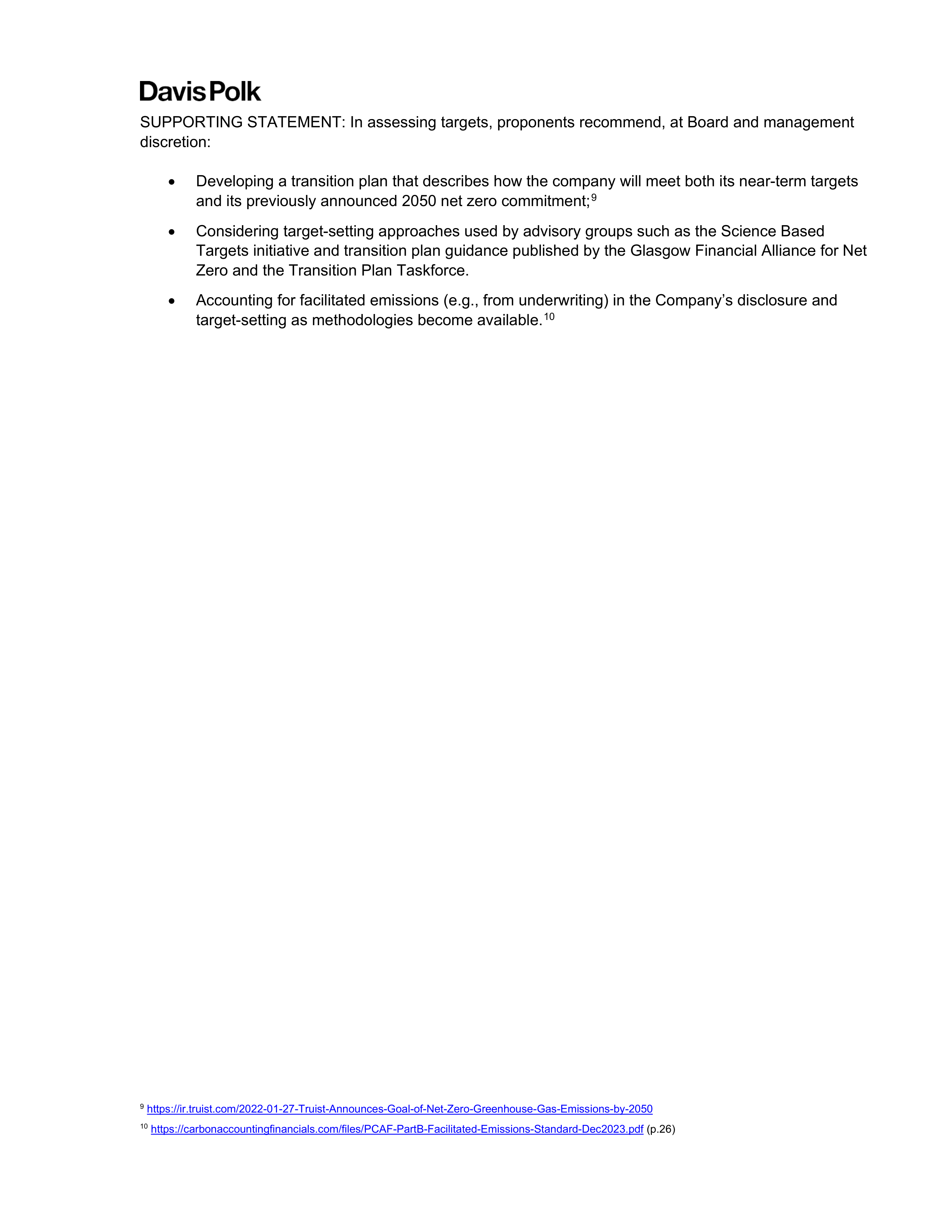

SUPPORTING STATEMENT: In assessing targets, proponents recommend, at Board and management
discretion:
•
Developing a transition plan that describes how the company will meet both its near-term targets
and its previously announced 2050 net zero commitment;
9
•
Considering target-setting approaches used by advisory groups such as the Science Based
Targets initiative and transition plan guidance published by the Glasgow Financial Alliance for Net
Zero and the Transition Plan Taskforce.
•
Accounting for facilitated emissions (e.g., from underwriting) in the Company’s disclosure and
target-setting as methodologies become available.
10
9
https://ir.truist.com/2022-01-27-Truist-Announces-Goal-of-Net-Zero-Greenhouse-Gas-Emissions-by-2050
10
https://carbonaccountingfinancials.com/files/PCAF-PartB-Facilitated-Emissions-Standard-Dec2023.pdf
(p.26)
DRAFT
Davis Polk & Wardwell
LLP
450 Lexington Avenue
New York, NY 10017
davispolk.com
January 22, 2025
Re: Truist Financial Corporation
Withdrawal of No-Action Request Dated December 6, 2024 Regarding Shareholder Proposal
Submitted by Friends Fiduciary Corporation and Co-filers
U.S. Securities and Exchange Commission
Division of Corporation Finance
Office of Chief Counsel
100 F Street, NE
Washington, DC 20549
Dear Sir or Madam:
On behalf of Truist Financial Corporation (the “
Company
”), and in reference to our letter, dated
December 6, 2024 (the “
No-Action Request
”), pursuant to which we requested that the Staff of the Office
of Chief Counsel of the Securities and Exchange Commission concur with our view that the Company
may exclude the shareholder proposal (the “
Proposal
”) submitted by Friends Fiduciary Corporation (the
“
Proponent
”) from the proxy materials it intends to distribute in connection with its 2025 Annual Meeting
of Shareholders, we submit this withdrawal request.
Attached as Exhibit A is a letter, dated January 22, 2025 (the “
Withdrawal Communication
”),
sent via electronic mail to the Company by the Proponent, in which the Proponent voluntarily agrees to
withdraw the Proposal. In reliance on the Withdrawal Communication, we hereby withdraw the No-Action
Request.
Please contact the undersigned at (212) 450-4908 or ning.chiu@davispolk.com if you should
have any questions or need additional information. Thank you for your attention to this matter.
Respectfully yours,
Ning Chiu
Attachment: Exhibit A
cc:
Curt Phillips, Trust Financial Corporation
Amy Carr, Friends Fiduciary Corporation

DRAFT
Exhibit A
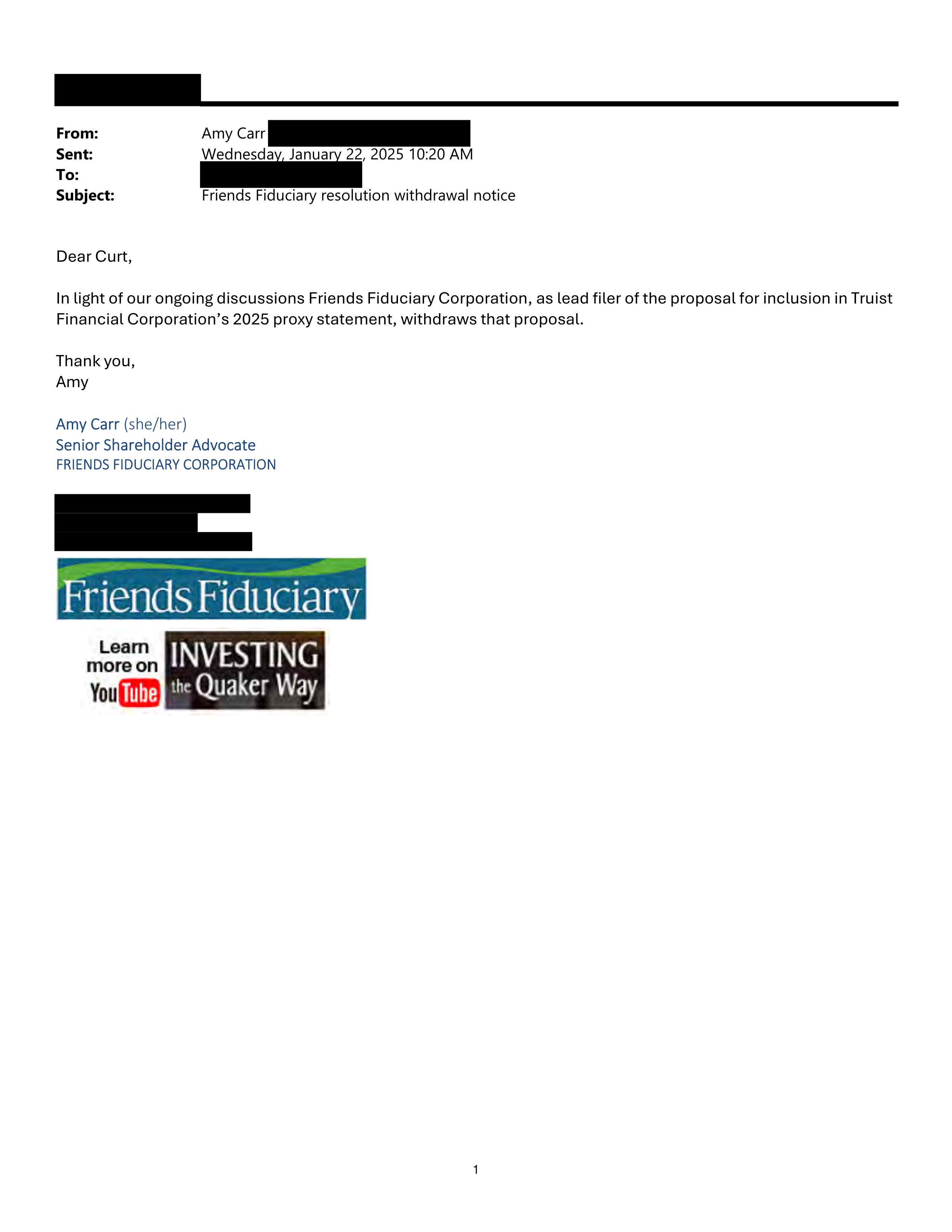
Withdrawal Communication


1
From:
Amy Carr
Sent:
Wednesday, January 22, 2025 10:20 AM
To:
Subject:
Friends Fiduciary resolution withdrawal notice
Dear Curt,
In light of our ongoing discussions Friends Fiduciary Corporation, as lead
fi
ler of the proposal for inclusion in Truist
Financial Corporation’s 2025 proxy statement, withdraws that proposal.
Thank you,
Amy
Amy Carr (she/her)
Senior Shareholder Advocate
FRIENDS FIDUCIARY CORPORATION