

March 19, 2025
Ning Chiu
Davis Polk & Wardwell LLP
Re:
Ford Motor Company (the “Company”)
Incoming letter dated January 3, 2025
Dear Ning Chiu:
This letter is in response to your correspondence concerning the shareholder
proposal (the “Proposal”) submitted to the Company by Sisters of St. Joseph of Peace for
inclusion in the Company’s proxy materials for its upcoming annual meeting of security
holders.
The Proposal requests the board of directors adopt and disclose a noninterference
policy committing to uphold the human rights to freedom of association and collective
bargaining in its operations, and to use its best efforts to uphold such rights in its joint
venture plants.
There appears to be some basis for your view that the Company may exclude the
Proposal under Rule 14a-8(i)(7). In our view, the Proposal seeks to micromanage the
Company. Accordingly, we will not recommend enforcement action to the Commission if
the Company omits the Proposal from its proxy materials in reliance on Rule 14a-8(i)(7).
In reaching this position, we have not found it necessary to address the alternative basis
for omission upon which the Company relies.
Copies of all of the correspondence on which this response is based will be made
available on our website at
https://www.sec.gov/corpfin/2024-2025-shareholder-
proposals-no-action
.
Sincerely,
Rule 14a-8 Review Team
cc:
Aaron Acosta
Investor Advocates for Social Justice
DRAFT
Davis Polk & Wardwell
LLP
450 Lexington Avenue
New York, NY 10017
davispolk.com
January 3, 2025
Office of Chief Counsel
Division of Corporation Finance
Securities and Exchange Commission
100 F Street, NE
Washington, DC 20549
Ladies and Gentlemen:
On behalf of Ford Motor Company, a Delaware corporation (the “
Company
”), and in accordance with
Rule 14a-8(j) under the Securities Exchange Act of 1934, as amended (the “
Exchange Act
”), we are
filing this letter with respect to the shareholder proposal (the “
Proposal
”) submitted by Sisters of St.
Joseph of Peace (the “
Proponent
”) for inclusion in the proxy materials the Company intends to distribute
in connection with its 2025 Annual Meeting of Shareholders (the “
2025 Proxy Materials
”). The Proposal
is attached hereto as Exhibit A.
We hereby request confirmation that the Staff of the Division of Corporation Finance (the “
Staff
”) will not
recommend any enforcement action if, in reliance on Rule 14a-8, the Company omits the Proposal from
the 2025 Proxy Materials.
In accordance with relevant Staff guidance, we are submitting this letter and its attachments to the Staff
through the Staff’s online Shareholder Proposal Form. Also, in accordance with Rule 14a-8(j), a copy of
this submission is being sent simultaneously to the Proponent as notification of the Company’s intention
to omit the Proposal from the 2025 Proxy Materials. This letter constitutes the Company’s statement of
the reasons it deems the omission of the Proposal to be proper. We have been advised by the Company
as to the factual matters set forth herein.
THE PROPOSAL
The Proposal states:
Resolved
: Shareholders request the Board of Directors of Ford Motor Company adopt and
disclose a Noninterference Policy committing to uphold the human rights to freedom of
association and collective bargaining in its operations, and to use its best efforts to uphold such
rights in its joint venture plants, as reflected in the International Labour Organization’s (“ILO”)
Declaration on Fundamental Principles and Rights at Work (“Fundamental Principles”). The
policy should commit to:
Noninterference when workers seek to form or join a trade union, and a prohibition
against acting to undermine this right or pressure workers not to form or join a trade
union;
Good faith and timely collective bargaining if workers form or join a trade union;
2
Uphold the highest standard where national or local law differs from international human
rights standards; and
Define processes to identify, prevent, and remedy practices that violate or are
inconsistent with the Policy.
REASONS FOR EXCLUSION OF THE PROPOSAL
The Company believes that the Proposal may be properly omitted from the 2025 Proxy Materials
pursuant to:
1.
Rule 14a-8(i)(7) because the Proposal deals with matters related to the Company’s ordinary
business operations by seeking to micromanage the Company; and
2.
Rule 14a-8(i)(3) because the Proposal is impermissibly vague and indefinite so as to be
inherently misleading.
The Proposal May Be Excluded Under Rule 14a-8(i)(7) Because the Proposal Relates to the
Company’s Ordinary Business Operations by Seeking to Micromanage the Company.
Overview of Rule 14a-8(i)(7).
Rule 14a-8(i)(7) permits a company to omit from its proxy materials a shareholder proposal that
relates to the company’s ordinary business operations. According to the Commission’s release
accompanying the 1998 amendments to Rule 14a-8, the term “ordinary business” does not “refer[] to
matters that are . . . necessarily ‘ordinary’ in the common meaning of the word,” but instead the term
“is rooted in the corporate law concept providing management with flexibility in directing certain core
matters involving the company’s business and operations.” Exchange Act Release No. 40018 (May
21, 1998) (the “
1998 Release
”). In the 1998 Release, the Commission stated that the underlying
policy of the ordinary business exclusion is “to confine the resolution of ordinary business problems
to management and the board of directors, since it is impracticable for shareholders to decide how to
solve such problems at an annual shareholders meeting.”
The 1998 Release identified two central considerations that underlie this policy.
Id.
The first of those
considerations is that “[c]ertain tasks are so fundamental to management’s ability to run a company
on a day-to-day basis that they could not, as a practical matter, be subject to direct shareholder
oversight.”
Id.
The second consideration relates to “the degree to which the proposal seeks to ‘micro-
manage’ the company by probing too deeply into matters of a complex nature upon which
shareholders, as a group, would not be in a position to make an informed judgment.”
Id.
,
citing
Exchange Act Release No. 12999 (Nov. 22, 1976). When assessing proposals under Rule 14a-
8(i)(7), the Staff considers the terms of the resolution and its supporting statement as a whole.
See
Staff Legal Bulletin No. 14C, part (June 28, 2005).
The Proposal May be Excluded Under Rule 14a-8(i)(7) Because It Seeks to Micromanage
the Company.
The Commission and Staff have long recognized that a proposal that seeks to micromanage a company
is excludable under Rule 14a-8(i)(7). According to Staff Legal Bulletin No. 14L (Nov. 3, 2021) (“
SLB
14L
”), the determination of whether a proposal impermissibly micromanages the Company “will focus on
the level of granularity sought in the proposal and whether and to what extent it inappropriately limits
discretion of the board or management.” The Commission has stated that the exclusion of a proposal
3
under Rule 14a-8(i)(7) on micromanagement grounds “may come into play in a number of circumstances,
such as where the proposal involves intricate detail, or seeks to impose specific time-frames or methods
for implementing complex policies.” 1998 Release. The Staff has determined that proposals that seek to
impermissibly micromanage the Company “by probing too deeply into matters of a complex nature upon
which shareholders, as a group, would not be in a position to make an informed judgment” are excludable
under Rule 14a-8(i)(7), even in circumstances where the proposal is found to address a significant social
policy.
Id.
According to SLB 14L, in making the determination as to whether a proposal probes matters “too
complex” for shareholders, the Staff may consider “the sophistication of investors generally on the matter,
the availability of data, and the robustness of public discussion and analysis on the topic,” as well as
“references to well-established national or international frameworks when assessing proposals related to
disclosure, target setting, and timeframes as indicative of topics that shareholders are well-equipped to
evaluate.” The Staff has consistently granted no-action relief on micromanagement grounds with respect
to numerous proposals requiring reporting of information that is similarly or less complex than the
information demanded by the Proposal.
See, e.g.
,
Delta Air Lines, Inc.
(avail. Apr. 24, 2024) (permitting
exclusion of a proposal requiring a report regarding “union suppression expenditures,” including internal
and external expenses);
Paramount Global
(avail. Apr. 19, 2024) (permitting exclusion of a proposal
requesting disclosure of the recipients of corporate charitable contributions of $5,000 or more);
Walmart
Inc.
(avail. Apr. 18, 2024) (permitting exclusion of a proposal requiring a breakdown of greenhouse gas
emissions for different categories of products in a manner inconsistent with existing reporting
frameworks);
Amazon.com, Inc.
(avail. Apr. 1, 2024) (permitting exclusion of a proposal calling for highly
detailed living wage report);
Amazon.com, Inc.
(avail. Apr. 7, 2023) (permitting exclusion of a proposal
requesting the company measure and disclose scope 3 greenhouse gas emissions from the company’s
full value chain by imposing a specific method for implementing a complex policy without affording
discretion to management);
Chubb Limited
(avail. Mar. 27, 2023) (permitting exclusion of a proposal
requesting the board adopt and disclose a policy related to risks associated with new fossil fuel
exploration and development projects);
Phillips 66
(avail. Mar. 20, 2023) (permitting exclusion of a
proposal requesting an audited report describing the undiscounted expected value to settle obligations for
the company’s asset retirement obligations with indeterminate settlement dates);
Verizon
Communications Inc.
(avail. Mar. 17. 2022) (permitting exclusion of a proposal requesting publication of
certain employee-training materials); and
Coca Cola Co.
(avail. Feb. 16, 2022) (permitting exclusion of a
proposal requiring the company to submit any proposed political statement to the next shareholder
meeting for approval prior to issuing the statement publicly).
The Staff has consistently concurred with the exclusion of proposals that inappropriately limit
management’s discretion and sought granular levels of specific and complex detail with respect to the
management of a company’s workforce.
See, e.g., Delta Air Lines, Inc.
(Apr. 24, 2024) (requesting a
report on expenditures that are intended or could be viewed as intended to dissuade employees from
joining or supporting unions with detailed requirements on the content of the report); and
The Home
Depot, Inc.
(Mar. 21, 2024) (requesting an annual living wage report on the company’s compliance with
international human rights standards and systemic risks stemming from growing income inequality with
detailed requirements on the content of the report). Similarly, the Staff recently concurred that a proposal
submitted to
Air Products and Chemicals, Inc.
(avail. Nov. 29, 2024) micromanaged the company where it
requested a highly prescriptive and detailed report that requires multiple distinct pieces of information.
The Proposal requests that the Board of Directors of the Company adopt and disclose a “Noninterference
Policy” (the “
Policy
”) that commits to uphold freedom of association and collective bargaining in all of the
Company’s operations, as well as apply that Policy to the Company’s joint ventures on a best-efforts
basis. The Policy must contain multiple parts, with additional sections, prescribing the way that the
Company must act:
4
The first section requires that the Policy commits to “noninterference” when workers seek to
either (a) form or (b) join a trade union. The Policy must “prohibit” against acting to (a) undermine
this right or (b) pressure workers not to either form or join a trade union.
Should workers either form or join a trade union, then the Company must act in “good faith and
timely collective bargaining.”
The Policy must include the “highest standard” if national or local law differs from “international
human rights standards.”
The Policy must “define processes” that would (a) identify, (b) prevent and (c) remedy practices
that either (a) violate or (b) are inconsistent with the Policy.
The Company has approximately 174,000 employees worldwide.
1
Substantially all of the hourly
employees in the Company’s Ford Blue, Ford Model e, and Ford Pro operations are represented by
unions and covered by collective bargaining agreements.
2
If adopted, the Proposal would be unduly
burdensome by requiring that the Company change its existing policies and practices, training and
education and re-allocate resources, which could affect the Company’s operations. The Company does
not have discretion on the content of the Policy that would take into account the Policy’s significance to
the Company’s operations and employee workforce relations. Workforce relations are highly complex and
based on a range of considerations related to the day-to-day operations of the business. Additionally, the
Proposal does not account for the need to consider adoption of the Policy against the multiple different
state and federal laws, as well as existing collective bargaining agreements, that the Company is already
subject to with respect to these types of activities.
In addition, the Supporting Statement makes clear, and in fact the primary focus appears to be, that the
Policy must be applied to all joint ventures. The only example used is in the Supporting Statement as to a
specific joint venture
3
, without regard to whether the joint venture may have contractual or other types of
obligations that would prevent the Company from imposing the Policy on the joint venture workforce and
suppliers. Importantly, the Policy is without any limiting principle – all of the Company’s operations,
including joint ventures with third parties, at all of its locations would be required to be covered, even if the
Company’s involvement is tangential in the joint venture, the impact to the workforce is de minimis or if
management determines that applying the Policy would be detrimental to the Company.
The highly prescriptive nature of the Proposal would significantly micromanage the manner in which the
Company could manage its business and employee relationships. The Proposal would also require the
Company to impose its mandate on third parties that have entered into joint ventures with the Company.
If adopted, the Proposal would place substantial restrictions on the Company’s ability to determine how
best to manage the issues related to the management of workers and collective bargaining, as well as
working with the Company’s joint venture partners.
Moreover, the Proposal goes further than in multiple precedents cited above in seeking not just a report,
but a policy that actually affects how the Company operates and conducts business. To the extent that
proposals seeking detailed disclosures have been excluded on the basis that they ask for too much
information with too many granular details, the Proposal is even more prescriptive in that it requires not
1
See the Company’s earnings release for the quarter ended September, 30, 2024:
https://s201.q4cdn.com/693218008/files/doc_financials/2024/q3/Press-Release-Ford-2024-Q3-Earnings.pdf.
2
See the Company’s Form 10-K for the year ended December 31, 2023:
https://www.sec.gov/Archives/edgar/data/37996/000003799624000009/f-20231231.htm.
3
https://www.energy.gov/lpo/articles/lpo-announces-conditional-commitment-loan-blueoval-sk-further-expand-us-ev-battery-0.
5
just disclosure but actions to implement the Policy.
See, e.g. The Procter & Gamble Company
(avail. Aug.
14, 2024) (concurring that a proposal asking the company to adopt as policy and amend governing
documents to require that director nominees annually furnish the company information about their political
and charitable giving sought to micromanage the company); and
Lowe’s Companies, Inc.
(Apr. 8, 2024)
(permitting exclusion on the basis of micromanagement of a proposal that requested the board adopt a
policy, and amend the company’s bylaws as necessary, to require directors to disclose their expected
allocation of hours among commitments).
Finally, the Policy must also comply with the International Labour Organization’s Declaration on
Fundamental Principles and Rights at Work
4
(the “
ILO Principles
”) and the UN Guiding Principles on
Business and Human Rights
5
(the “
UN Principles
”). In
McDonald’s Corporation
(Apr. 3, 2024), the Staff
concurred with the exclusion of a proposal that would require the board to institute a policy that the
company complies with the WHO Guidelines on Use of Medically Important Antimicrobials in Food-
Producing Animals throughout the company’s supply chains, thus dictating a particular method for the
company to manage its antimicrobials use. Similarly, the Proposal dictates specific methods – compliance
with the ILO Principles and UN Principles – that inappropriately interferes with the discretion of
management to implement the proper approach, including frameworks, in its judgment.
In short, the Proposal seeks to micromanage the Company by probing too deeply into matters of a
complex nature, without providing the Company with any discretion to choose the form, substance or
manner of decisions that fall squarely within the purview of the Company’s management and its board of
directors. It would neither be appropriate nor realistic for shareholders to direct such decisions at an
annual meeting.
The Proposal is Excludable Under Rule 14a-8(i)(7) Regardless of Whether It Touches Upon
a Significant Policy Issue.
A proposal that seeks to micromanage a company’s business operations is excludable under Rule 14a-
8(i)(7) regardless of whether or not the proposal raises issues with a broad societal impact.
See
Staff
Legal Bulletin No. 14E (Oct. 27, 2009), at note 8, citing the 1998 Release for the standard that “a
proposal [that raises a significant policy issue] could be excluded under Rule 14a-8(i)(7), however, if it
seeks to micromanage the company by probing too deeply into matters of a complex nature upon which
shareholders, as a group, would not be in a position to make an informed judgment.” The Staff concurred
with the exclusion of proposals addressing how companies interact with their shareholders on significant
social policy issues because the proposals sought to micromanage how the companies addressed those
policy issues.
See Amazon.com, Inc.
(Apr. 7, 2023) (concurring that a proposal requesting the company
report Scope 3 emissions from “its full value chain” was excludable for attempting to micromanage the
company).
The Proposal May Be Excluded Under Rule 14a-8(i)(3) Because the Proposal Is Impermissibly
Vague and Indefinite So as To Be Inherently Misleading.
Rule 14a-8(i)(3) permits the exclusion of a shareholder proposal if the proposal or supporting statement is
contrary to any of the Commission’s proxy rules. The Staff has consistently concurred that vague and
indefinite shareholder proposals are excludable because “neither the stockholders voting on the proposal,
nor the company in implementing the proposal (if adopted), would be able to determine with any
reasonable certainty exactly what actions or measures the proposal requires.” Staff Legal Bulletin No.
14B (Sept. 15, 2004). A proposal may be materially misleading as vague and indefinite when the
4
https://www.ilo.org/about-ilo/mission-and-impact-ilo/ilo-declaration-fundamental-principles-and-rights-work.
5
https://www.ohchr.org/sites/default/files/documents/publications/guidingprinciplesbusinesshr_en.pdf.
6
“meaning and application of terms and conditions . . . in the proposal would have to be made without
guidance from the proposal and would be subject to differing interpretations” such that “any action
ultimately taken by the [c]ompany upon implementation [of the proposal] could be significantly different
from the actions envisioned by shareholders voting on the proposal.”
See
Fuqua Industries, Inc.
(Mar. 12,
1991). Further, courts have held that shareholders are entitled to know “precisely the breadth of the
proposal on which they are asked to vote.”
New York City Employees’ Retirement System v. Brunswick
Corp.
, 789 F. Supp. 144, 146 (S.D.N.Y. 1992).
The Staff has consistently concurred in the exclusion of shareholder proposals that fail to define key
terms.
See
The Boeing Co.
(Feb. 23, 2021) (concurring with the exclusion of a proposal requiring that
60% of the company’s directors “must have an aerospace/aviation/engineering executive background”
where such phrase was undefined); and
The Home Depot, Inc.
(avail. Mar. 12, 2014, recon. denied Mar.
27, 2014) (concurring with the exclusion of a proposal requesting a sustainability report where the
company argued that the meaning of “benchmark objective footprint information” was unclear).
The Proposal requests that the Company adopt a “noninterference” policy and that the policy commits to
“noninterference” when workers seek to form or join a trade union. However, the Proposal does not define
the term or explain its meaning. The Staff has previously concurred with the exclusion of a proposal that
related to noninterference.
NYNEX Corporation
(Jan. 12, 1990). In NYNEX, the resolution asked that
NYNEX “does not interfere in government policies of foreign nations” where it has been invited, or will be
invited, to “set up facilities.” The Staff’s response in concurring with exclusion of the proposal, stated that
“[i]n arriving at our position, the staff has particularly noted that the proposal, if implemented, would
require the [c]ompany to make highly subjective determinations concerning what constitutes ‘interference’
and ‘government policies’ as well as when the proscriptions of the proposal would apply. In the Division’s
view, such determinations would have to be made without guidance from the proposal and would be
subject to differing interpretations by both shareholders voting on the proposal and the [c]ompany, if the
proposal was implemented.”
As in
NYNEX Corporation
, the Proposal would require an interpretation of what constitutes
“noninterference.” Accordingly, because the Proposal includes a term that is so inherently vague or
indefinite that neither the shareholders voting on it, nor the Company in implementing the Proposal (if
adopted), would be able to determine with any reasonable certainty exactly what actions or measures the
Proposal requires, the Proposal may properly be excluded from the 2025 Proxy Materials under Rule
14a-8(i)(3).
CONCLUSION
For the reasons set forth above, the Company believes that the Proposal may be excluded from its 2025
Proxy Materials pursuant to Rule 14a-8(i)(7) and Rule 14a-8(i)(3).
Respectfully yours,
Ning Chiu
Attachment

7
cc w/ att:
Blair Petrillo, Ford Motor Company
Melody Maravillas, Sisters of St. Joseph of Peace
Aaron Acosta, Investor Advocates for Social Justice
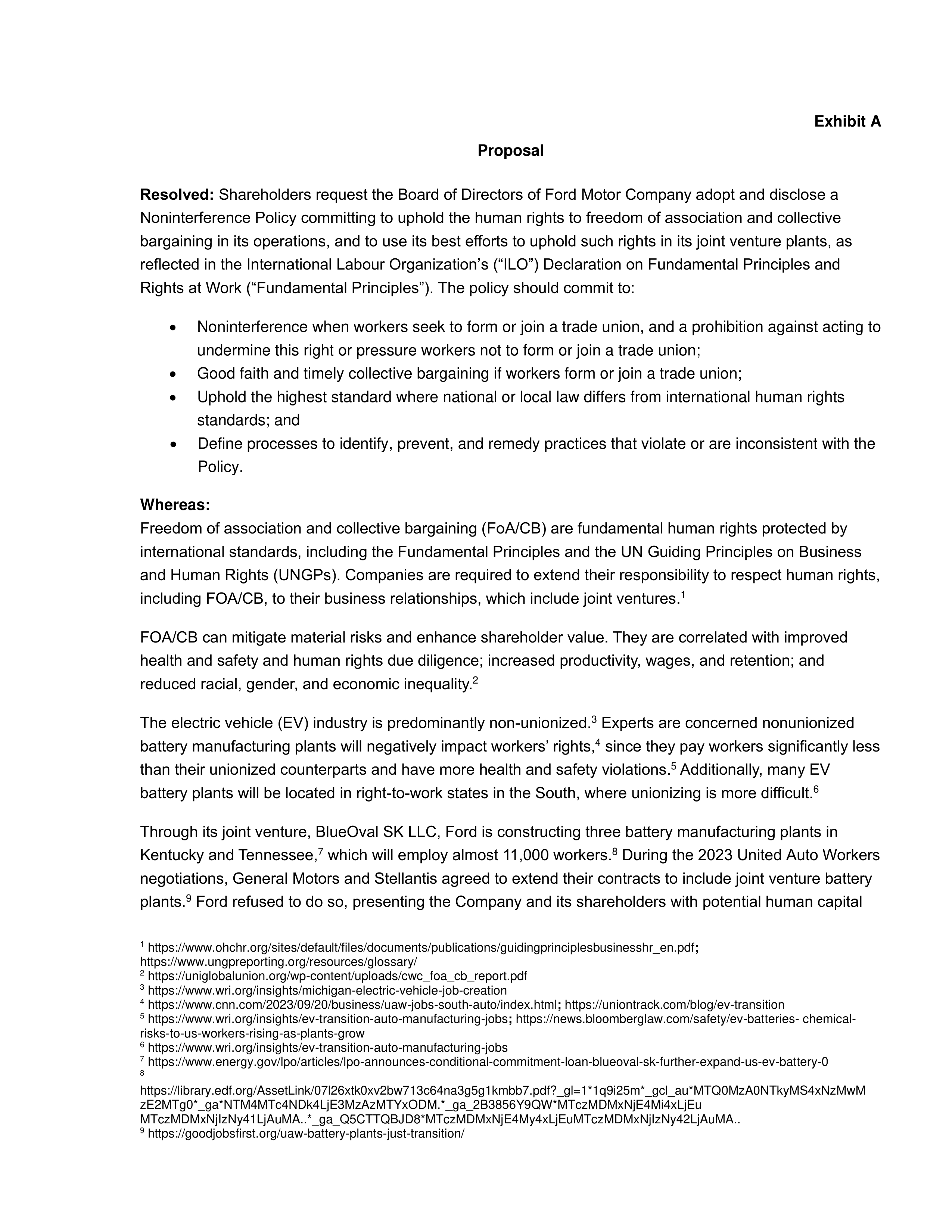
Exhibit A
Proposal
Resolved:
Shareholders request the Board of Directors of Ford Motor Company adopt and disclose a
Noninterference Policy committing to uphold the human rights to freedom of association and collective
bargaining in its operations, and to use its best efforts to uphold such rights in its joint venture plants, as
reflected in the International Labour Organization’s (“ILO”) Declaration on Fundamental Principles and
Rights at Work (“Fundamental Principles”). The policy should commit to:
Noninterference when workers seek to form or join a trade union, and a prohibition against acting to
undermine this right or pressure workers not to form or join a trade union;
Good faith and timely collective bargaining if workers form or join a trade union;
Uphold the highest standard where national or local law differs from international human
rights
standards; and
Define processes to identify, prevent, and remedy practices that violate or are inconsistent with the
Policy.
Whereas:
Freedom of association and collective bargaining (FoA/CB) are fundamental human rights protected by
international standards, including the Fundamental Principles and the UN Guiding Principles on Business
and Human Rights (UNGPs). Companies are required to extend their responsibility to respect human rights,
including FOA/CB, to their business relationships, which include joint ventures.
1
FOA/CB can mitigate material risks and enhance shareholder value. They are correlated with improved
health and safety and human rights due diligence; increased productivity, wages, and retention; and
reduced racial, gender, and economic inequality.
2
The electric vehicle (EV) industry is predominantly non-unionized.
3
Experts are concerned nonunionized
battery manufacturing plants will negatively impact workers’ rights,
4
since they pay workers significantly less
than their unionized counterparts and have more health and safety violations.
5
Additionally, many EV
battery plants will be located in right-to-work states in the South, where unionizing is more difficult.
6
Through its joint venture, BlueOval SK LLC, Ford is constructing three battery manufacturing plants in
Kentucky and Tennessee,
7
which will employ almost 11,000 workers.
8
During the 2023 United
Auto Workers
negotiations, General Motors and Stellantis agreed to extend their contracts to include joint venture battery
plants.
9
Ford refused to do so, presenting the Company and its shareholders with potential human capital
1
https://www.ohchr.org/sites/default/files/documents/publications/guidingprinciplesbusinesshr_en.pdf
;
https://www.ungpreporting.org/resources/glossary/
2
https://uniglobalunion.org/wp-content/uploads/cwc_foa_cb_report.pdf
3
https://www.wri.org/insights/michigan-electric-vehicle-job-creation
4
https://www.cnn.com/2023/09/20/business/uaw-jobs-south-auto/index.html
;
https://uniontrack.com/blog/ev-transition
5
https://www.wri.org/insights/ev-transition-auto-manufacturing-jobs
;
https://news.bloomberglaw.com/safety/ev-batteries- chemical-
risks-to-us-workers-rising-as-plants-grow
6
https://www.wri.org/insights/ev-transition-auto-manufacturing-jobs
7
https://www.energy.gov/lpo/articles/lpo-announces-conditional-commitment-loan-blueoval-sk-further-expand-us-ev-battery-0
8
https://library.edf.org/AssetLink/07l26xtk0xv2bw713c64na3g5g1kmbb7.pdf?_gl=1*1q9i25m*_gcl_au*MTQ0MzA0NTkyMS4xNzMwM
zE2MTg0*_ga*NTM4MTc4NDk4LjE3MzAzMTYxODM.*_ga_2B3856Y9QW*MTczMDMxNjE4Mi4xLjEu
MTczMDMxNjIzNy41LjAuMA..*_ga_Q5CTTQBJD8*MTczMDMxNjE4My4xLjEuMTczMDMxNjIzNy42LjAuMA..
9
https://goodjobsfirst.org/uaw-battery-plants-just-transition/
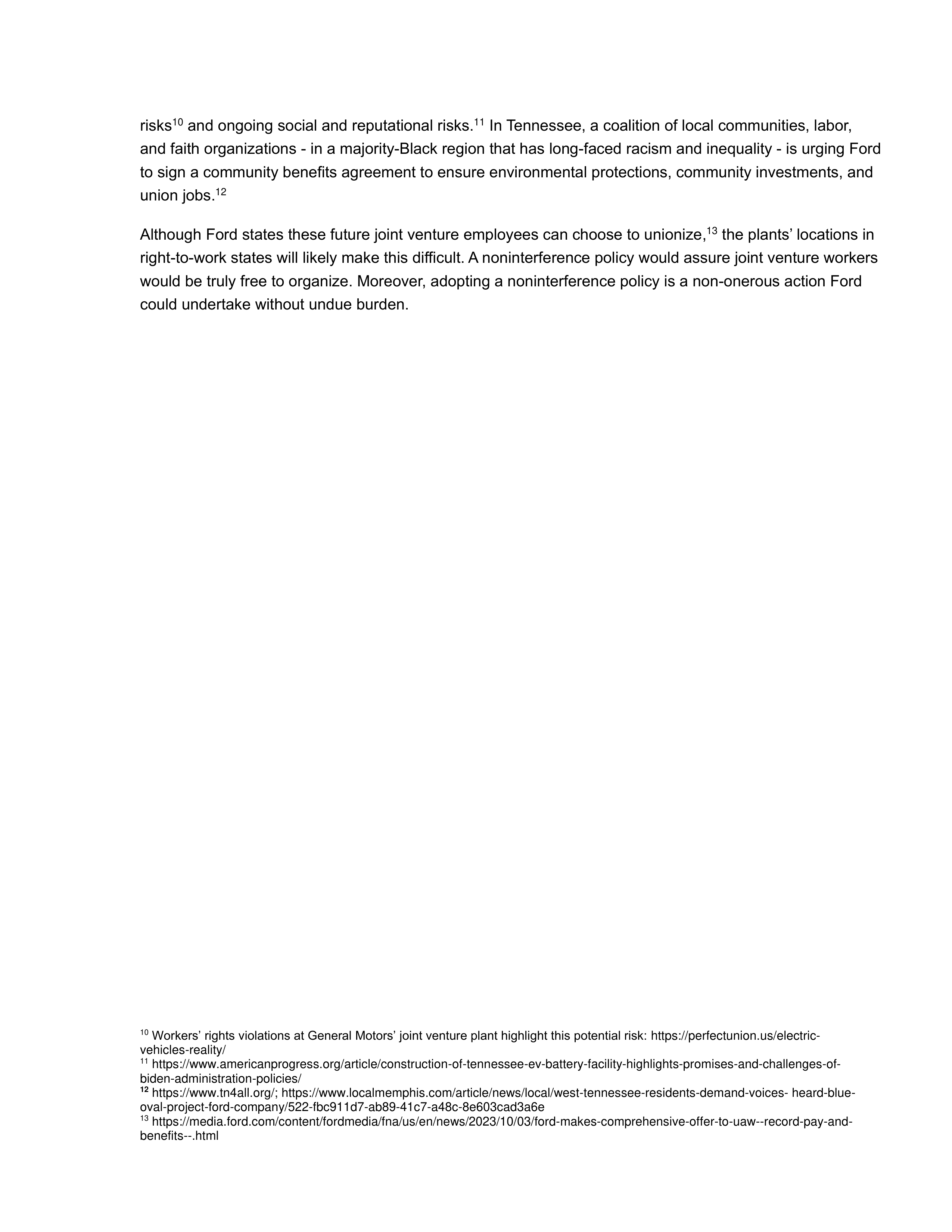
risks
10
and ongoing social and reputational risks.
11
In Tennessee, a coalition of local communities, labor,
and faith organizations - in a majority-Black region that has long-faced racism and inequality - is urging Ford
to sign a community benefits agreement to ensure environmental protections, community investments, and
union jobs.
12
Although Ford states these future joint venture employees can choose to unionize,
13
the plants’ locations in
right-to-work states will likely make this difficult. A noninterference policy would assure joint venture workers
would be truly free to organize. Moreover, adopting a noninterference policy is a non-onerous action Ford
could undertake without undue burden.
10
Workers’ rights violations at General Motors’ joint venture plant highlight this potential risk: https://perfectunion.us/electric-
vehicles-reality/
11
https://www.americanprogress.org/article/construction-of-tennessee-ev-battery-facility-highlights-promises-and-challenges-of-
biden-administration-policies/
12
https://www.tn4all.org/;
https://www.localmemphis.com/article/news/local/west-tennessee-residents-demand-voices- heard-blue-
oval-project-ford-company/522-fbc911d7-ab89-41c7-a48c-8e603cad3a6e
13
https://media.ford.com/content/fordmedia/fna/us/en/news/2023/10/03/ford-makes-comprehensive-offer-to-uaw--record-pay-and-
benefits--.html
1
January 21, 2025
By email:
shareholderproposals@sec.gov
cc:
BPETRIL2@ford.com
;
ning.chiu@davispolk.com
; and
aacosta@iasj.org
Securities and Exchange Commission
Division of Corporation Finance
Office of the Chief Counsel
100 F Street, N.E.
Washington, D.C. 20549
Re: Request by Ford Motor Company to omit shareholder proposal submitted by the Sisters of St. Joseph
of Peace
The Sisters of St. Joseph of Peace (the “Proponent”) beneficially owns common stock of the Ford Motor
Company (the “Company” or “Ford”) and have submitted a shareholder proposal (the “Proposal”) to the
Company for consideration at the Company’s 2025 annual meeting of shareholders. The Proponent is
responding to the letter dated January 3, 2025 (the “Company Letter” or “no-action request”) that Ning
Chiu (“Company Counsel”) sent to the Securities and Exchange Commission (the “SEC” or the
“Commission”) on behalf of the Company. In that letter, the Company contends the Proposal may be
excluded from the Company’s 2025 proxy statement under Rule 14a-8(i)(7) and Rule 14a-8(i)(3).
For the reasons discussed below, we respectfully submit that the Proposal is not excludable under Rules
14a-8(i)(7) and 14a-8(i)(3) and must therefore be included in the Company’s 2025 proxy materials. The
Proposal is attached as an Appendix to this letter. A copy of this letter is being emailed concurrently to
Company Counsel.
SUMMARY
The Proponent filed a shareholder proposal to be included in Ford’s 2025 proxy statement. The Proposal
states, in relevant part:
Resolved
: Shareholders request the Board of Directors of Ford Motor Company adopt and disclose
a Noninterference Policy committing to uphold the human rights to freedom of association and
collective bargaining in its operations, and to use its best efforts to uphold such rights in its joint
venture plants, as reflected in the International Labour Organization’s (“ILO”) Declaration on
Fundamental Principles and Rights at Work (“Fundamental Principles”). The policy should commit
to:
●
Noninterference when workers seek to form or join a trade union, and a prohibition against
acting to undermine this right or pressure workers not to form or join a trade union;
●
Good faith and timely collective bargaining if workers form or join a trade union;
2
●
Uphold the highest standard where national or local law differs from international human rights
standards; and
●
Define processes to identify, prevent, and remedy practices that violate or are inconsistent with
the Policy.
Ford argues the Proposal should be excluded on the ground that it micromanages the Company and is
impermissibly vague. Both arguments are without merit, and the Proposal should not be excluded. The
Proposal does not micromanage the Company because 1) it does not probe too deeply into matters too
complex for shareholders, 2) it does not inappropriately limit the discretion of Ford’s board and
management, and 3) it does not seek granular and detailed information. Contrary to the Company’s
assertion, that the Proposal would impose on the Company and its joint ventures a whole host of
obligations and would be highly prescriptive, the Proposal only requests the Company to memorialize,
as a policy, its publicly available commitments to respect the rights of freedom of association and
collective bargaining.
Similarly, the Company’s argument, that the Proposal is impermissibly vague because it does not define
“noninterference” is unpersuasive. In line with the SEC’s consistent and repeated analysis of the
“vagueness” exclusion, the Proposal provides sufficient guidance within its text and within its references
to widely-accepted international standards to determine the meaning of “noninterference” with
“reasonable certainty.”
The Company’s no-action letter reflects a nonsensical approach to analyzing whether a proposal should
be excluded under micromanagement or vagueness grounds. On the one hand, Ford asserts that the
noninterference policy details provided in the Proposal make it “highly prescriptive” and grounds for
exclusion under micromanagement. On the other hand, the Company argues that, despite the inclusion
of these details, there is not enough information to understand the meaning of “noninterference.” Apart
from this unconvincing logic, the Company also mischaracterizes the contents of the Proposal and, at
times, incorrectly references inapplicable Staff.
In sum, the Company’s arguments of micromanagement and vagueness are without merit. As such, the
Proponent respectfully requests the Staff to concur with its position, set out in the analysis below, that
the Proposal should not be excluded from Ford’s 2025 proxy statement.
ANALYSIS
I.
The Proposal Does Not Micromanage the Company
The Proposal should not be excluded because 1.) it does not probe too deeply into matters too complex
for shareholders, 2.) it does not inappropriately limit the discretion of Ford’s board and management,
and 3.) it does not seek granular and detailed information.
A.
Micromanagement Standard
3
Ford argues that the proposal should be excluded because it seeks to micromanage the Company.
However, consistent with the SEC’s guidance and interpretation of the “micromanagement” standard,
the Proposal does not impermissibly micromanage the Company and should, therefore, not be
excluded.
The Commission’s 1998 release reversing its
Cracker Barrel
policy on employment-related proposals
1
(the “1998 Release”) described the considerations in the Division’s application of the ordinary business
exclusion. In relevant part, the second consideration was the “degree to which the proposal seeks to
‘micro-manage’ the company by probing too deeply into matters of a complex nature upon which
shareholders, as a group, would not be in a position to make an informed judgment.” The 1998 Release
emphasized that not all proposals “seeking detail, or seeking to promote time-frames or methods,
necessarily amount to ‘ordinary business’”; rather, a proposal “may seek a reasonable level of detail”
without micromanaging the company.
The Division clarified its approach to micromanagement three years ago. In Staff Legal Bulletin 14L
(“SLB 14L”), the Division explained that recent Staff application of the micromanagement doctrine had
“expanded the concept of micromanagement beyond the Commission’s policy directives” and “may
have been taken to mean that any limit on company or board discretion constitutes micromanagement.”
Going forward, SLB 14L stated, the Staff would consider “the level of granularity sought in the proposal
and whether and to what extent it inappropriately limits discretion of the board or management.” In
particular, when evaluating a company’s micromanagement arguments, the Division states that it “will
take a measured approach to evaluating companies’ micromanagement arguments – recognizing that
proposals seeking detail or seeking to promote timeframes or methods do not per se constitute
micromanagement
” (emphasis added).
B.
The Proposal Does Not Probe Too Deeply Into Matters Too Complex for Shareholders
To determine whether a proposal probes matters “too complex” for shareholders to make an informed
judgment, the Staff may consider “the sophistication of investors generally on the matter, the availability
of data, and the robustness of public discussion and analysis on the topic. The staff may also consider
references to well-established national or international frameworks when assessing proposals related to
disclosure, target setting, and timeframes as indicative of topics that shareholders are well-equipped to
evaluate” (SLB 14L).
In its analysis, the Company states that the Staff has consistently granted no-action relief “with respect to
numerous proposals requiring reporting of information that is similarly or less complex than the
information demanded by the Proposal.” However, the Company fails to explain how or why a
noninterference policy related to the rights of freedom of association and collective bargaining (the
subject of the Proposal) is “similarly or less complex” to other proposals, let alone whether it is even a
matter too complex for shareholders. The list of previous determinations cited by the Company to
support its position shed no light on whether freedom of association and collective bargaining are “too
complex” for shareholders to make an informed decision.
1
Exch. Act Rel. No. 40018 (May 21, 1998)
4
Applying the SEC’s guidance on whether a proposal contains matters that are “too complex” for
shareholders, it is clear that shareholders are well-situated to make an informed decision on the
proposal for the following reasons:
1.
Shareholders are sophisticated when it comes to proposals related to freedom of association and
collective bargaining and are well-situated to make informed decisions on such matters.
During the last two years, shareholders voted at least 6 times on nearly-identical proposals asking
companies to adopt noninterference policies to uphold the human rights to freedom of association and
collective bargaining. Importantly, each one of the following noninterference proposals received
significant shareholder support:
●
Chipotle Mexican Grill, Inc. (2023) - 33.3%
●
Delta Air Lines (2023) - 32.6%
●
Chipotle Mexican Grill, Inc. (2024) - 10.1%
●
Tesla, Inc. (2024) - 20.6%
●
Delta Air Lines (2024) - 25.6%
●
SkyWest Airlines (2024) - 25.7%
Additionally, over the past 2 years, shareholders have increasingly voted on proposals related to the
rights of freedom of association and collective bargaining. In 2024, at least 10 shareholder proposals
related to freedom of association and collective bargaining went to a vote,
2
and in 2023, at least 9 went
to a vote.
3
As indicated by the number of noninterference proposals in recent years and the significant levels of
shareholder support for such proposals, shareholders are sophisticated on the subject matter of the
Proposal.
2.
There is ample data available on the freedom of expression and collective bargaining, its benefits,
and its prevalence in Ford’s operations and joint ventures
Investors have ample information available to analyze the benefits of freedom of association and
collective bargaining. Multiple organizations have published detailed reports outlining the business case
for respecting freedom of association and collective bargaining, which include:
2
Amazon.com, Inc., Chipotle Mexican Grill, Inc., CVS Health Corporation, Delta Air Lines, International Flavors &
Fragrances Inc., Maximus Inc., SkyWest Airlines, Tesla, Inc., Warrior Met Coal, Inc., and Wells Fargo & Company
3
Activision Publishing, Inc., Amazon.com, Inc., Chipotle Mexican Grill, Inc., CVS Health Corporation, Delta Air Lines,
Netflix Inc., Rivian Automotive, Inc., Starbucks Corporation, and Wells Fargo & Company
5
●
The Investor Case for Supporting Worker Organizing Rights
by Trillium Asset Management
(2022)
4
●
Shared Prosperity: The Investor Case for Freedom of Association and Collective Bargaining
by
Committee on Workers’ Capital (2022)
5
In addition, the exempt solicitations that were filed related to the aforementioned “noninterference
policy” proposals are publicly available and shed more light on the benefits of such policies:
●
Delta Air Lines (2023)
6
●
Delta Air Lines (2024)
7
●
Chipotle Mexican Grill, Inc. (2023)
8
●
Sky West Airlines (2024)
9
●
Tesla, Inc. (2024)
10
3.
There is robust public discussion and analysis on freedom of association and collective
bargaining
The rights of freedom of association and collective bargaining have increasingly been the subject of
robust public discussion and analysis.
A 2024 Gallup poll found that 70% of Americans approve of labor unions.
11
The American Federation
of Labor and Congress of Industrial Organization (AFL-CIO) also found that 71% of Americans support
unions, with that support increasing within the younger generation, with 88% of voters under 30
supporting unions.
12
Public discussion on labor unions was also a focal point in the lead-up to the 2024 US presidential
elections
13
and unions remain in the spotlight during the start of the Trump administration.
14
In 2023,
labor strikes “were among the more prominent forms of collective action,” and included the Big Three
4
https://www.trilliuminvest.com/whitepapers/the-investor-case-for-supporting-worker-organizing-rights
5
https://www.workerscapital.org/our-resources/shared-prosperity-the-investor-case-for-freedom-of-association-and-collective-
bargaining/
6
https://www.sec.gov/Archives/edgar/data/1086462/000121465923007804/z524230px14a6g.htm
7
https://www.sec.gov/Archives/edgar/data/1086462/000121465924008355/x53240px14a6g.htm
8
https://www.sec.gov/Archives/edgar/data/1517047/000121465923006619/e58231px14a6g.htm
9
https://www.sec.gov/Archives/edgar/data/1086462/000121465924006916/e416242px14a6g.htm
10
https://www.sec.gov/Archives/edgar/data/1782324/000121465924008870/e513246px14a6g.htm
11
https://news.gallup.com/poll/12751/labor-unions.aspx
12
https://www.usatoday.com/story/money/2023/08/29/majority-of-americans-support-labor-unions-poll-finds/70713278007/
13
https://www.npr.org/2024/11/01/nx-s1-5173819/2024-election-trump-harris-workers-overtime-wages
14
https://betterinaunion.org/project-2025
; https://www.epi.org/blog/three-ways-workers-rights-are-on-the-chopping-block-
under-president-trump-judging-by-the-first-trump-administration-workers-and-unions-are-set-to-face-new-attacks-and-a-
rollback-of-rights/
6
automakers strike and the Hollywood writers and actors strike.
15
The extensive coverage of and attention
placed on unions and labor strikes over the past few years highlight some of the ways in which freedom
of association and collective bargaining have been the subject of public discussion and analysis.
4.
The proposal includes references to well-established international frameworks
The Proposal asks the Company to adopt and disclose a noninterference policy that commits to
upholding the rights to freedom of association and collective bargaining as reflected in the International
Labour Organization’s (“ILO”) Declaration on Fundamental Principles and Rights at Work
(“Fundamental Principles”). Furthermore, the Proposal highlights that the rights of freedom of association
and collective bargaining are also protected by the UN Guiding Principles on Business and Human
Rights (UNGPs). The ILO’s Fundamental Principles and the UNGPs are well-established international
frameworks, and Ford explicitly commits to aligning with both frameworks in its human rights policy.
16
Therefore, the Proposal references well-established international frameworks on which shareholders are
well-situated to make an informed decision.
Based on the aforementioned factors, it is clear that the proposal does not “prob[e] too deeply into
matters of a complex nature upon which shareholders, as a group, would not be in a position to make
an informed judgment.”
C.
The Proposal Does Not Inappropriately Interfere with Management Discretion
While the Staff will look at whether the proposal “inappropriately limits discretion of the board or
management” while making a determination on a micromanagement challenge, it is important to
emphasize that not all suggestions or high-level direction in proposals are considered
micromanagement. In SLB 14L, the Division clarified that the micromanagement exclusion was
“designed to preserve management’s discretion on ordinary business matters but
not prevent
shareholders from providing high-level direction on large strategic corporate matters
” (emphasis
added). Indeed, the Division added that proposals seeking details or specific methods “do not per se
constitute micromanagement.”
Moreover, as the Company letter itself demonstrates, failure to be specific invites a company challenge
based on vagueness, that either the company or its shareholders will not understand the scope of the
Proposal or how it will be implemented - which is exactly what Ford is arguing. This “damned if you do,
damned if you don’t” logic when it comes to the level of specificity included in a proposal would make
the shareholder proposal rule unworkable in practice.
In contrast to the Company’s assertion that the proposal would inappropriately limit management's
discretion, the Proposal is simply asking Ford to commit to noninterference if its workers in its
operations, supply chains, or joint ventures desire to unionize – which would be an operationalization
of its general commitment to respecting freedom of association and collective bargaining.
15
https://www.epi.org/publication/major-strike-activity-in-2023/
16
https://corporate.ford.com/content/dam/corporate/us/en-us/documents/reports/we-are-committed-to-protecting-human-
rights-and-the-environment-policy.pdf
7
i. The Proposal Simply Requests the Company to Commit to Noninterference – An Operationalization
of Its
General Commitment to Respecting Freedom of Association and Collective Bargaining.
The Proposal is primarily concerned with ensuring Ford’s general commitments to respecting its
workers’ rights of freedom of association and collective bargaining are operationalized and
guaranteed.
17
In its human rights policy, called
We Are Committed to Protecting Human Rights and the
Environment
, Ford states that it “[r]ecognize[s] and respect[s] employees’ rights to freedom of
association and collective bargaining,” and that it “explicitly require[s] [its] suppliers and expect[s]
partners and joint ventures (referred to as ‘business partners’ in this policy) to adopt and enforce similar
policies and extend them to their own supply chain.”
18
Furthermore, in its human rights policy, Ford
explicitly commits to respecting The ILO’s Declaration on Fundamental Principles and Rights at Work
(which contains the rights of freedom of association and collective bargaining) and to align with the
UNGPs.
In addition, in an October 2023 press release, Ford stated that, although it did not include its joint
venture battery plants within the UAW contract, the “future employees at these operations can choose
to be union represented and enter into the collective bargaining process.” Guaranteeing the rights to
freedom of association and collective bargaining is particularly challenging in right-to-work states,
19
where Ford’s joint venture battery plants will be located (Kentucky and Tennessee). Additionally, there
are reports that the joint venture, BlueOval SK, has hired an anti-union firm to deter organizing in the
battery plants.
20
This may also be inferred, although not confirmed, from a recent UAW unfair labor
practices complaint filed against BlueOval SK related to a discharge in Elizabethtown, KY.
21
Notably,
the charged parties include Frost Brown and Todd, an anti-union law firm that states on its website
“[o]ur team helps our non-unionized clients stay union-free.”
22
Given the actual challenges to guaranteeing workers’ rights to freedom of association and collective
bargaining in its joint venture battery plants - rights that Ford has explicitly committed to respecting - the
requested noninterference policy would, as stated in the Proposal, “assure joint venture workers would
be truly free to organize. Moreover, to adopt and disclose a noninterference policy, Ford would not
need to make any significant changes, but simply, operationalize, as a policy, its commitments to
respecting freedom of association and collective bargaining.
ii. The Proposal leaves ample room for Ford to exercise its discretion
Ford’s Mischaracterization of the Proposal
17
https://media.ford.com/content/fordmedia/fna/us/en/news/2023/10/03/ford-makes-comprehensive-offer-to-uaw--record-
pay-and-benefits--.html
18
https://corporate.ford.com/content/dam/corporate/us/en-us/documents/reports/we-are-committed-to-protecting-human-
rights-and-the-environment-policy.pdf
19
https://www.wri.org/insights/ev-transition-auto-manufacturing-jobs
20
https://www.leoweekly.com/louisville/blueoval-sk-workers-file-to-vote-join-uaw-union-amid-safety-
concerns/Slideshow/17294810
21
https://www.nlrb.gov/case/09-CA-354419
22
https://frostbrowntodd.com/practices/labor-employment/union-avoidance-campaigns/
8
In its no-action letter, the Company grossly mischaracterizes the Proposal, repeatedly asserting that the
noninterference policy “requires” the Company to undertake certain actions and prescribes the way the
Company “must act.” This is a dishonest reading of the Proposal’s plain language. The Proposal
“requests” the Company adopt and disclose a noninterference policy and suggests that such policy
“should” include four best-practice components.
To state the obvious, a Rule 14a-8 shareholder proposal is an
advisory
proposal, and the board and
management’s discretion is seldom encroached by such a proposal. Even after a majority of support on
an advisory proposal, the board and management are expected to exercise discretion to act as
fiduciaries in the interests of the corporation. The request of the current Proposal is advisory - it is not a
directive.
This is clear from the plain meaning of the word “should” and its use in the Proposal. The word
“should” is used to convey a suggestion, as contrasted with the word “shall” which indicates a
requirement. The Proposal asks Ford to adopt and disclose a noninterference policy and suggests some
components that should be included in such a policy. The company’s repeated complaints about what it
“must” include in a noninterference policy are unfounded.
The Company also patently misstates the Proposal’s request as it relates to joint ventures. According to
Ford, under the requested noninterference policy, “all of the Company’s operations,
including joint
ventures with third parties
, at all of its locations would be required to be covered,” and that the Proposal
would “require the Company to
impose its mandate
” on its joint ventures (emphases added). This is
false. The Proposal clearly asks Ford “to use its best efforts” to uphold the rights of freedom of expression
and collective bargaining in its joint venture plants. There is no imposition or requirement placed on
Ford.
Company Discretion
Central to the argument that the Proposal would inappropriately limit Ford’s discretion is its assertion
that the Proposal is “highly prescriptive” and “would place substantial restrictions on the Company’s
ability to determine how best to manage the issues related to the management of workers and collective
bargaining, as well as working with the Company’s joint venture partners.” This argument has no merit.
On its face, the Proposal asks Ford to adopt and disclose a noninterference policy and includes a
suggested list of four components to include in such policy. As has already been mentioned, the Staff
has stated that proposals seeking details or specific methods “do not per se constitute
micromanagement.” In addition, as discussed below, these four suggested components help add more
detail to the understanding of a noninterference policy, so as not to be accused of being impermissibly
vague. The Proposal leaves wide discretion to Ford’s board and management in its implementation,
including the following:
9
●
The Proposal asks simply for an operationalization of Ford’s general commitments to respecting
the rights of freedom of association and collective bargaining, and leaves the Company with wide
latitude on the many of the specific contents.
●
The suggested list of four components is not exhaustive, but rather a list of best-practice elements
that constitute a robust noninterference policy.
●
The Proposal does not specify a timeline for when such a noninterference policy should be
adopted and disclosed, nor specify the manner in which the policy should be disclosed.
●
The Proposal does not specify the method that Ford must recognize as indicating that workers are
seeking to form a trade union (e.g., card check method, petition for election).
●
The Proposal would afford Ford latitude in the operationalization and interpretation of “good
faith and timely” collective bargaining.
●
The Proposal leaves wide discretion with Ford to “[d]efine processes to identify, prevent, and
remedy practices that violate or are inconsistent with the Policy.”
The Staff has repeatedly declined to concur with the exclusion on micromanagement grounds of
proposals that requested companies to adopt policies or commission reports that gave the companies
discretion in the specific details around implementation:
●
Amazon.com, Inc. (April 3, 2023) (Jing Zhao): Proposal requested the Company establish a
Public Policy Committee. The Company had wide discretion on how to implement such a
proposal.
●
Caesars Entertainment, Inc. (April 19, 2024) and Boyd Gaming Corporation (March 18, 2024):
Proposals asked the companies to commission and disclose a report on the potential cost savings
through the adoption of a smokefree policy for Caesars Entertainment properties. The companies
had discretion on the specific details around implementation of such a policy, including the
methodology for estimating the costs associated with allowing smoking.
●
Citigroup Inc. (March 7, 2022): Proposal requested that the company adopt a policy by the end
of 2022 committing to proactive measures to ensure the company’s lending and underwriting do
not contribute to new fossil fuel supplies inconsistent with global standards. The company was
free to identify the proactive activities and the types of inappropriate lending activities.
●
Chubb Limited (March 26, 2022) (Green Century Equity Fund): Proposal asked the company
adopt and disclose new policies to help ensure its underwriting practices do not support new
10
fossil fuel supplies, in alignment with the IEA’s Net Zero Emissions by 2050 Scenario. The
company had discretion to ascertain how to implement the proposal, for example, by imposing
conditions on underwriting.
●
CVS Health Corporation (March 18, 2022): Proposal sought a policy that all employees, part- and
full-time, accrue some amount of paid sick leave that can be used after working at CVS for a
reasonable probationary period. The company had discretion on the specifics of such a policy,
for example, the decision regarding how much paid sick leave an employee should accrue, as
well as the duration of the probationary period required before an employee can use the leave.
●
Tesla, Inc. (March 27, 2024) (As You Sow Foundation Fund): Proposal requested that the
company commit to a moratorium on sourcing minerals from deep sea mining, consistent with
the principles announced in the Business Statement Supporting a Moratorium on Deep Sea
Mining. The company had discretion on the specifics of the policy, such as how the company
might achieve that policy, should source materials for its products, and should interact with
suppliers, as well as what conditions the company might place on its commitment to a
moratorium.
Apart from the Company’s mischaracterization of the Proposal’s language (explained above, regarding
“requires” and “must”) and bald assertions of the Proposal’s “highly prescriptive” nature, the Company
provides little support for its claim that the Proposal inappropriately limits its discretion. Instead, Ford
dedicates significant space to arguing that the Proposal seeks a high level of granular and detailed
information - a claim addressed in the next section.
When attempting to support its claim that the Proposal inappropriately limits the Company’s discretion,
Ford utilizes a false equivalence. According to the Company “[t]o the extent that proposals seeking
detailed disclosures have been excluded on the basis that they ask for too much information with too
many granular details, the Proposal is even more prescriptive in that it requires not just disclosure but
actions to implement the Policy.” In line with common sense and as demonstrated by the
aforementioned cases, there is no inherent “prescriptiveness” related to proposals that seek disclosure or
those that seek the adoption of a policy. Rather, the Staff looks at the level to which the proposal
inappropriately interferes with the company’s discretion. This is a case-by-case determination, as
indicated by the fact that the Staff has found certain disclosure and policy proposals as being too
prescriptive and others as not.
In both determinations cited by the Company, The Procter & Gamble Company (August 14, 2024) and
Lowe’s Companies (April 8, 2024) (National Center for Public Policy), the proposals asked the
companies to adopt policies that were not an operationalization of already-existing general
commitments. These cases are inapposite. In contrast to these two examples, the Proposal asks Ford to
adopt a non interference policy that would operationalize a general commitment that Ford already has
to respecting the rights to freedom of expression and collective bargaining.
11
Ford also misrepresents the Staff’s previous determinations. In attacking the Proposal as too prescriptive
because of its reference to the ILO Fundamental Principles and the UNGPs, Ford cites to McDonald's
Corporation (April 3, 2024) (Legal and General Investment Management America, Inc.), which asked the
company to “institute a policy that the Company comply with World Health Organization Guidelines
on Use of Medically Important Antimicrobials in Food-Producing Animals throughout the Company’s
supply chains.” According to Ford, the proposal was excluded because it “inappropriately interferes
with the discretion of management to implement the proper approach, including frameworks, in its
judgment.” Ford’s characterization of the determination is inaccurate, since the McDonald’s proposal
was excluded under Rule 14a-8(i)(10) for being “substantially implemented.” Indeed, the determination
explicitly states that it would not address McDonald’s micromanagement argument.
D.
The Proposal Does Not Seek A High Level of Granularity
The Company seems to place the weight of its micromanagement argument on the assertion that there is
a high level of granularity sought in the proposal. It lists “numerous proposals requiring reporting of
information that is similarly or less complex than the information demanded by the Proposal.” The
references to past no-action determinations that dealt with proposals requesting detailed information
and reports are inapplicable in this case.
The Proposal does not request any reporting or detailed information. This is clear from the text of the
Proposal. Nor would the adoption of such noninterference policy be “unduly burdensome by requiring
that the Company change its existing policies and practices, training and education and re-allocate
resources, which could affect the Company’s operations,” as claimed by Ford. The Company would not
need to make any of these changes, since it already generally commits to respecting the rights of
freedom of association and collective bargaining. To adopt a noninterference policy, Ford would simply
be required to spell out the terms of such policy, which would not be onerous. The Company’s attempt
to paint the Proposal as seeking granular information and causing undue burden appears to be
subterfuge.
E.
Conclusion: The Proposal does not Micromanage the Company
Since the Proposal is not “too complex” for shareholders, does not impermissibly limit Ford’s discretion,
and does not seek granular or detailed information, the Company’s micromanagement assertion lacks
merit.
II. The Proposal is not Impermissibly Vague and Indefinite So as To Be Misleading
Under Rule 14a-8(i)(3), a proposal is impermissibly vague only when “neither the stockholders voting on
the proposal, nor the company in implementing the proposal (if adopted), would be able to determine
with any reasonable certainty exactly what actions or measures the proposal requires.” Staff Legal
Bulletin No. 14B (Sept. 15, 2004). The Staff, however, does not lightly assume that shareholders are
incapable of grasping the wide array of issues which affect their investments.
12
Thus, the emphasis must be on whether a proposal is “
so
inherently vague or indefinite” that it cannot
be determined with “
reasonable
certainty” what it requires (emphasis added). The standard is not
whether a lawyer could identify some tortured reading that renders the proposal minorly ambiguous.
Additionally, pursuant to Rule 14a-8(g), the Company bears the burden of proving the proposal is
excludable under Rule 14a-8(i)(3). Therefore, companies must meet a very high standard to prove that a
proposal is impermissibly vague.
Ford argues the Proposal may be excluded under Rule 14a-8(i)(3) because it does not “define the term
[“noninterference”] or explain its meaning.” Citing to the NYNEX Corporation (January 12, 1990)
determination, according to the Company, a determination of the meaning of “noninterference” would
have to be made “without guidance from the proposal and would be subject to differing interpretations
by both shareholders voting on the proposal and the [c]ompany, if the proposal was implemented.” This
argument is without merit.
The Company unpersuasively tries to use the NYNEX determination to argue the NYNEX proposals’
phrase “does not interfere with government policies of foreign nations” is analogous to the Proposal’s
use of the word “noninterference.” In relevant part, the Staff concurred with the exclusion of the NYNEX
proposal, stating “[i]n arriving at our position, the staff has particularly noted that the proposal, if
implemented, would require the [c]ompany to make highly subjective determinations concerning what
constitutes ‘interference’ and ‘government policies’ as well as when the proscriptions of the proposal
would apply” (NYNEX Corporation, January 12, 1990).
The difference between “interference” in the NYNEX determination and “noninterference” in the
Proposal is facially apparent. While the NYNEX use of the term is related to interference with
government policies of foreign nations, which does not have a clear meaning, the use of noninterference
in the Proposal is a well-established concept related to the rights of freedom of association and
collective bargaining.
In the Proposal’s resolved clause, it is immediately apparent that the term “noninterference” is used to
refer to the fact that the Company should agree to not interfere with workers’ trying to exercise their
human rights of freedom of association and collective bargaining. According to the Merriam-Webster
dictionary, “interfere” means: “to enter into or take a part in the concerns of others…
to interpose in a
way that hinders or impedes
:
come into collision or be in opposition.”
23
Under this understanding of
the word’s plain meaning, “noninterference” would mean that the Company would not enter into,
hinder, or impede workers’ rights to freedom of association and collective bargaining when they are
attempting to organize.
Additionally, as the Company admits through its use of the NYNEX determination, the term
“noninterference” would only be impermissibly vague if its meaning had to be ascertained “without
guidance from the proposal and would be subject to differing interpretations by both shareholders
voting on the proposal and the [c]ompany, if the proposal was implemented.” The Proposal’s supporting
statement provides ample guidance as to what the term “noninterference” means.
23
https://www.merriam-webster.com/dictionary/interferes
13
In the bullet-point list of suggestions for what should be included in a noninterference proposal, the
Proposal’s text sheds additional light onto the meaning of “noninterference.” For example,
noninterference means a “prohibition against acting to undermine [the rights to freedom of association
and collective bargaining] or pressure workers not to form or join a trade union,” “[g]ood faith and
timely collective bargaining if workers form or join a trade union,” and the design of processes “ to
identify, prevent, and remedy practices that violate” such rights. From a reading of the Proposal’s
resolved clause and supporting statement, “noninterference “ is not inherently vague or indefinite and
both shareholders and the Company can determine with reasonable certainty what it requires.
The Company’s attacks on the Proposal reflect an apparent “have your cake and eat it too” logic.
Regarding the bullet-point list that provides suggested, additional context for a noninterference policy,
the Company tries to attack such details as being “highly prescriptive” and grounds for exclusion under
micromanagement, but Ford simultaneously argues that, despite these details, there is not enough
information to understand the meaning of “noninterference.” The contrary logic is nonsensical.
CONCLUSION
Based on the foregoing, we believe that the Company has provided no basis for the conclusion
that the Proposal is excludable from the 2025 proxy statement pursuant to Rules 14a-8(i)(7) and 14a-
8(i)(3). We urge the Staff to deny the no action request.
We appreciate the opportunity to be of assistance in this matter. If you have any questions or need
additional information, please contact me at (973) 509-8800, ext. 3.
cc: Blair Petrillo
Ford Motor Company
bpetril2@ford.com
Ning Chiu
Davis Polk & Wardwell LLP
ning.chiu@davispolk.com
Sincerely,
Aaron Acosta – Investor Advocates for Social Justice
On behalf of the Sisters of St. Joseph of Peace