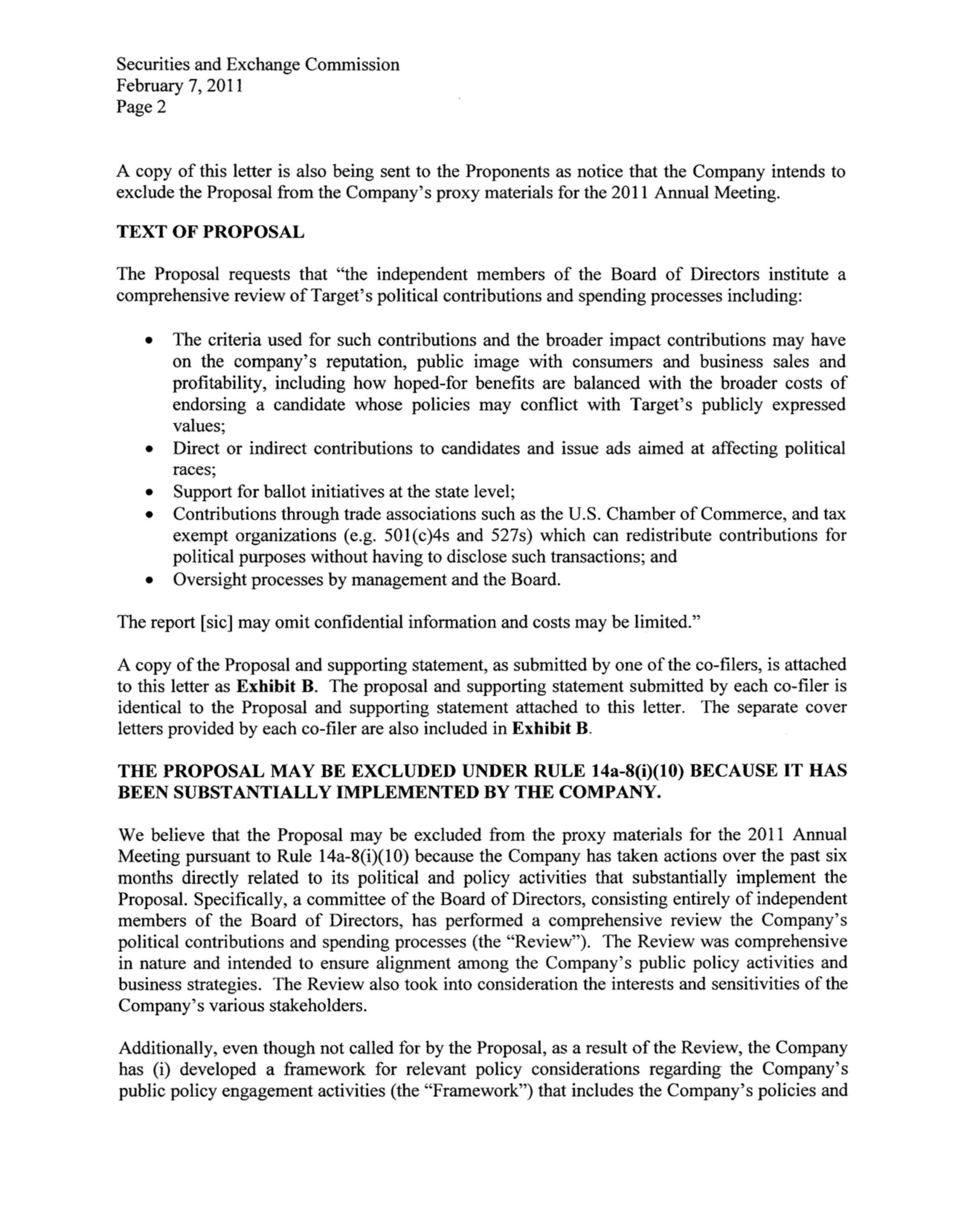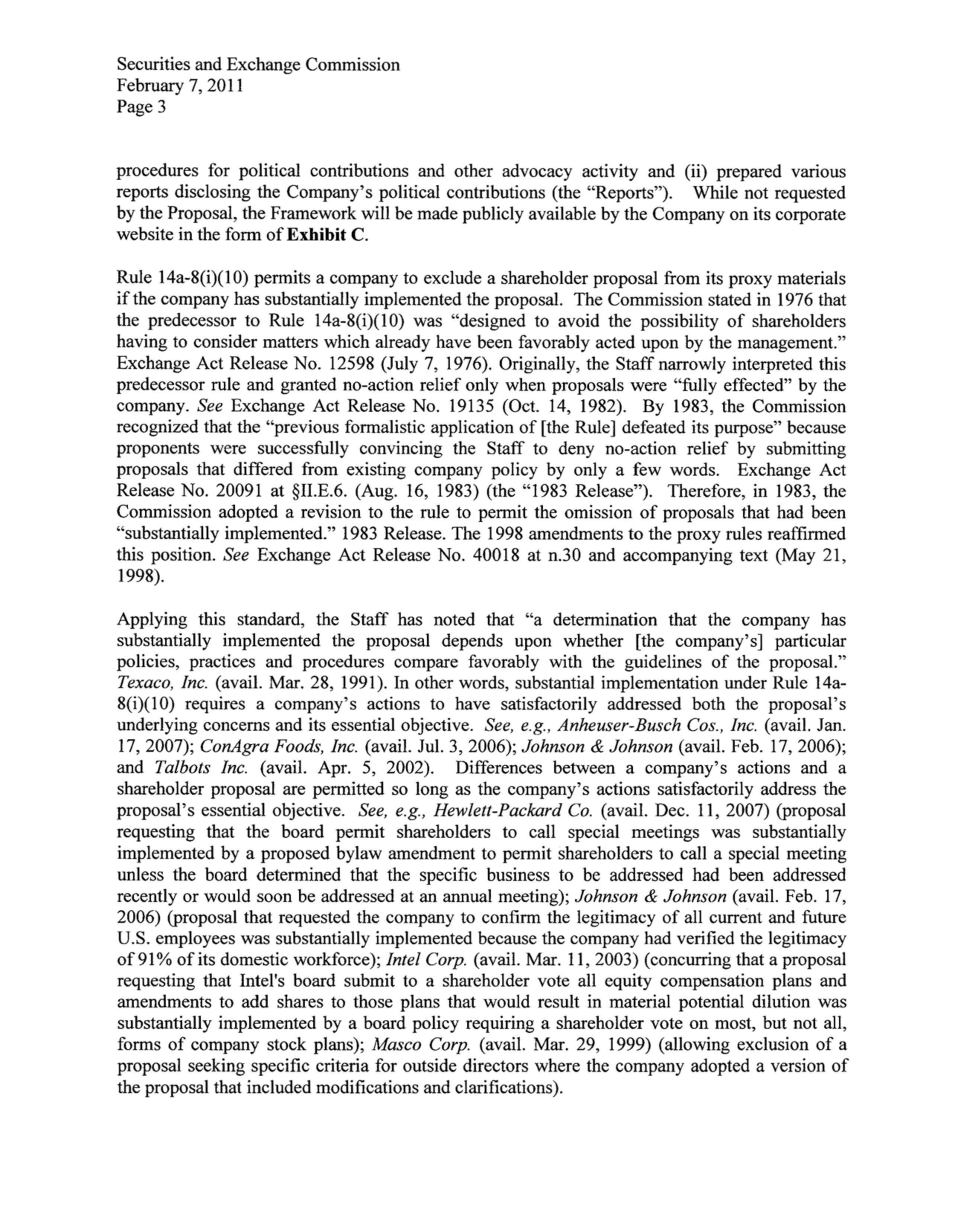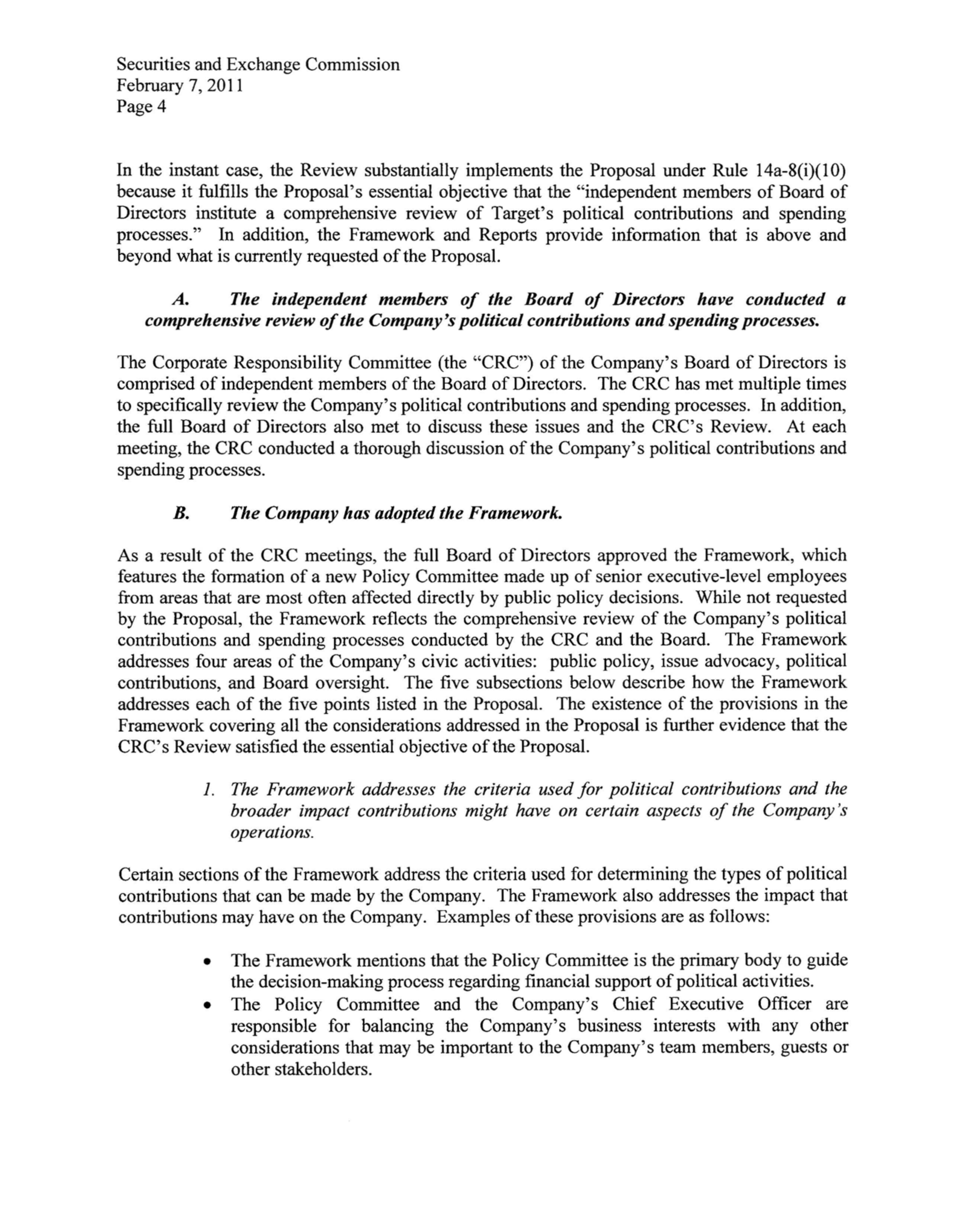
Securities and Exchange Commission
February 7, 2011
Page 3
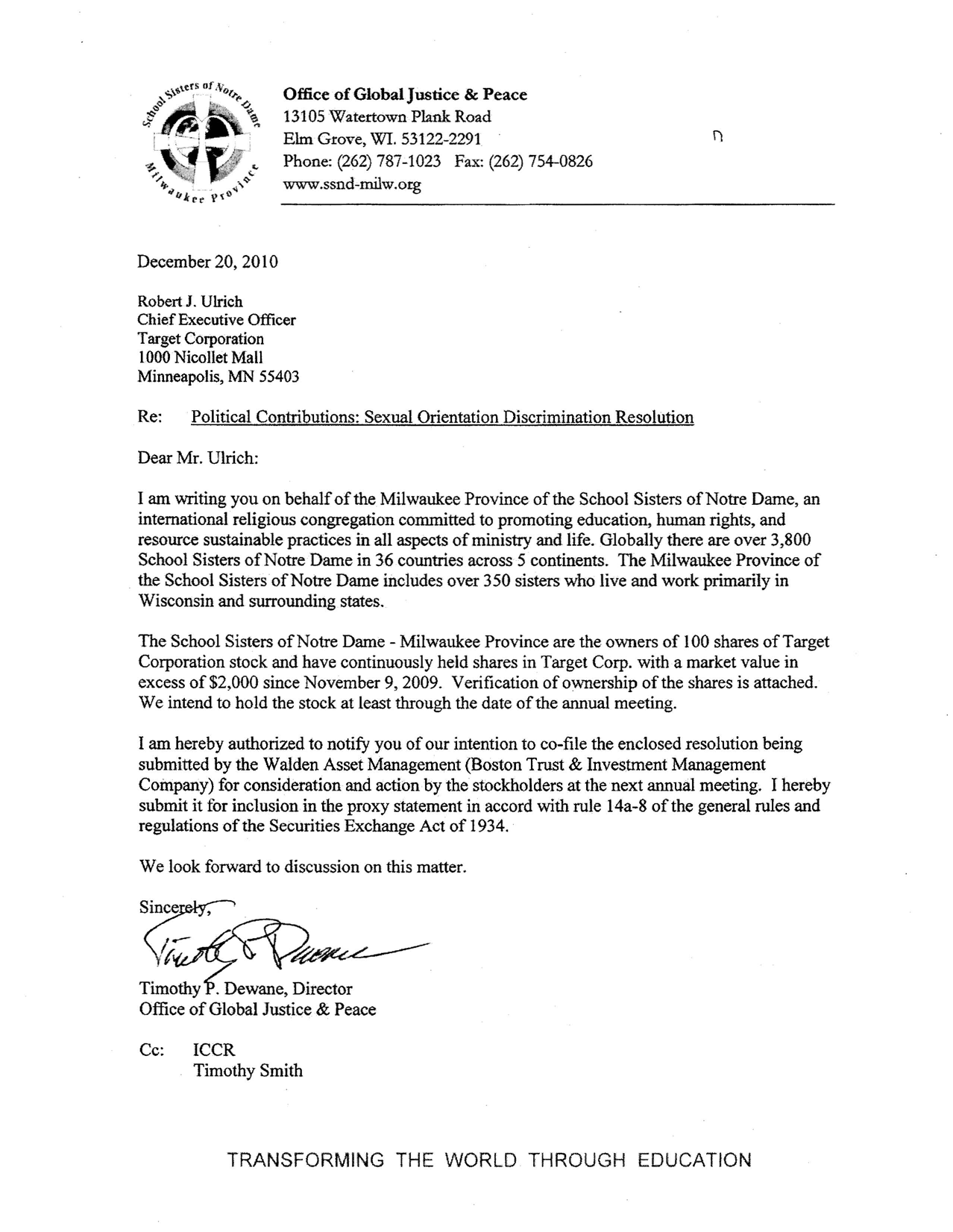
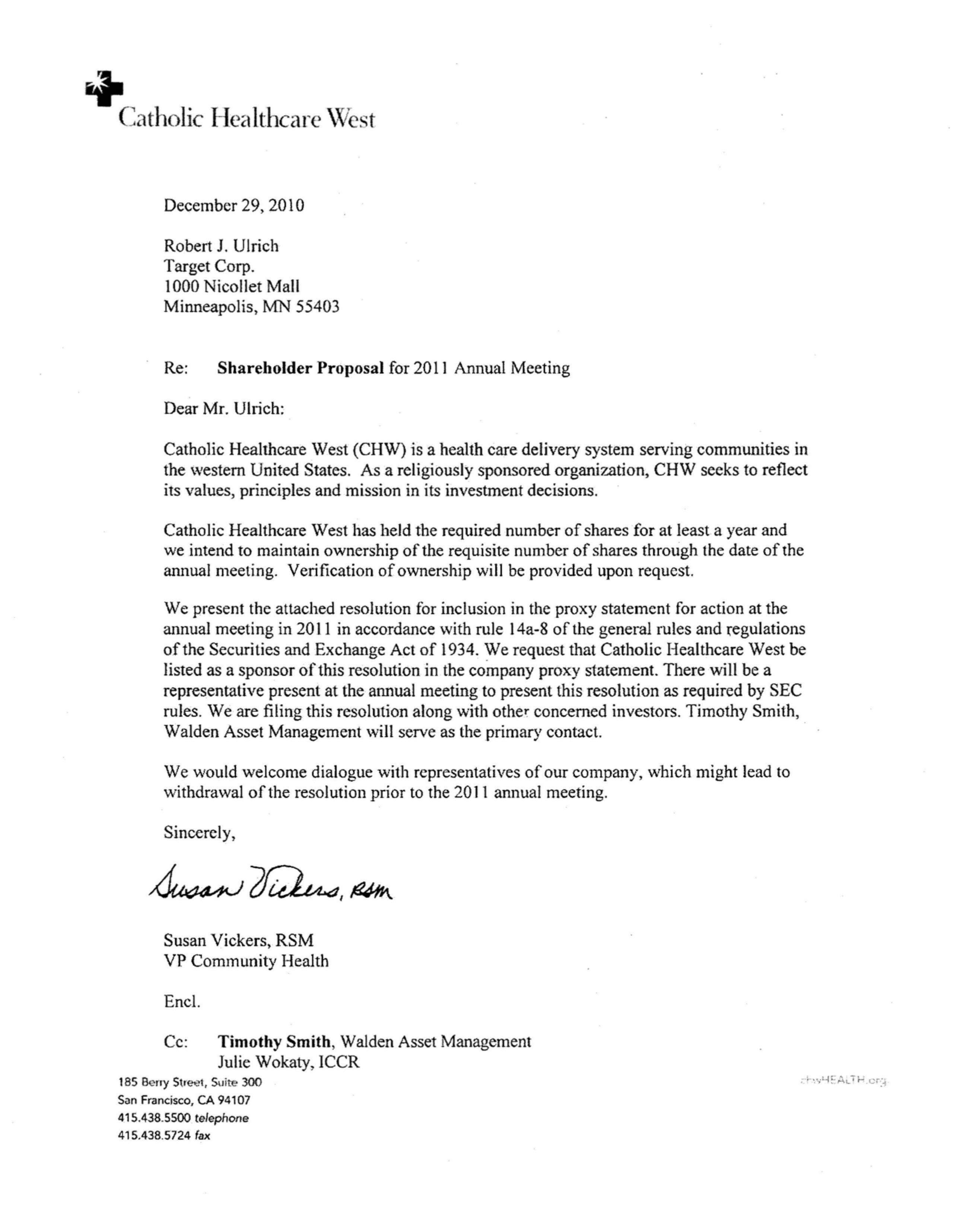
procedures for political contributions and other advocacy actIvIty and (ii) prepared various
reports disclosing the Company's political contributions (the "Reports").
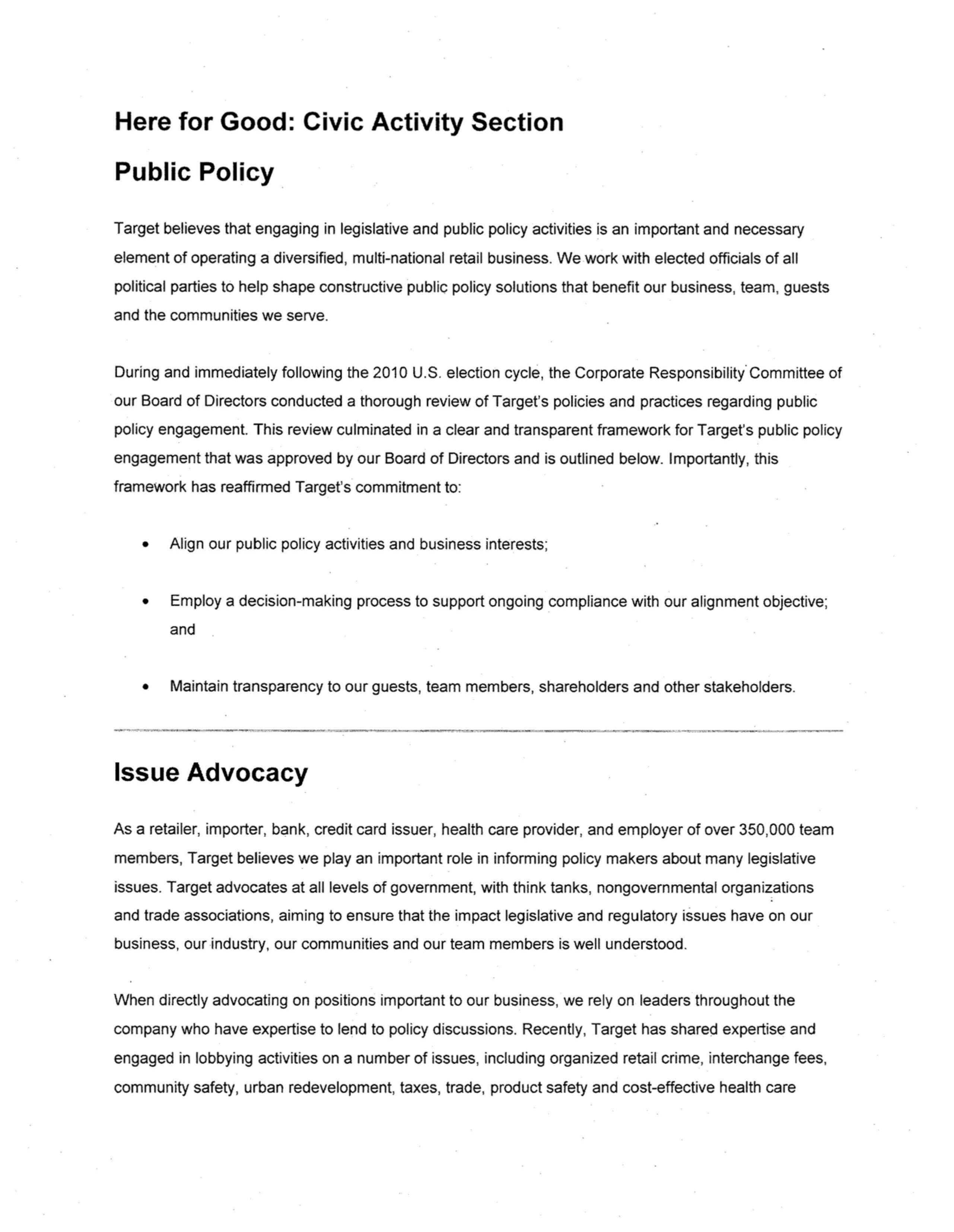
While not requested
by the Proposal, the Framework will be made publicly available by the Company on its corporate
website in the form
of
Exhibit
C.
Rule 14a-8(i)(1O) permits a company to exclude a shareholder proposal from its proxy materials
if
the company has substantially implemented the proposal. The Commission stated in 1976 that
the predecessor to Rule 14a-8(i)(l0) was "designed to avoid the possibility
of
shareholders
having to consider matters which already have been favorably acted upon by the management."
Exchange Act Release No. 12598 (July 7, 1976). Originally, the Staff narrowly interpreted this
predecessor rule and granted no-action relief only when proposals were "fully effected" by the
company.
See
Exchange Act Release No. 19135 (Oct. 14, 1982). By 1983, the Commission
recognized that the "previous formalistic application
of
[the Rule] defeated its purpose" because
proponents were successfully convincing the Staff to deny no-action relief by submitting
proposals that differed from existing company policy by only a few words. Exchange Act
Release No. 20091 at §II.E.6. (Aug. 16, 1983) (the "1983 Release"). Therefore, in 1983, the
Commission adopted a revision to the rule to permit the omission
of
proposals that had been
"substantially implemented." 1983 Release. The 1998 amendments to the proxy rules reaffirmed
this position.
See
Exchange Act Release No. 40018 at n.30 and accompanying text (May 21,
1998).
Applying this standard, the Staff has noted that
"a
determination that the company has
substantially implemented the proposal depends upon whether [the company's] particular
policies, practices and procedures compare favorably with the guidelines
of
the proposaL"
Texaco,
Inc.
(avail. Mar. 28, 1991).
In
other words, substantial implementation under Rule 14a
8(i)(l0) requires a company's actions to have satisfactorily addressed both the proposal's
underlying concerns and its essential objective.
See, e.g., Anheuser-Busch Cos.,
Inc.
(avail. Jan.
17,2007); ConAgra Foods,
Inc.
(avail. Jul. 3, 2006);
Johnson
&
Johnson
(avail. Feb. 17,2006);
and
Talbots
Inc.
(avail. Apr.
5,
2002).
Differences between a company's actions and a
shareholder proposal are permitted so long as the company's actions satisfactorily address the
proposal's essential objective.
See, e.g., Hewlett-Packard
Co.
(avail. Dec. 11, 2007) (proposal
requesting that the board permit shareholders to call special meetings was substantially
implemented by a proposed bylaw amendment to permit shareholders to call a special meeting
unless the board determined that the specific business to be addressed had been addressed
recently or would soon be addressed at an annual meeting);
Johnson
&
Johnson
(avail. Feb. 17,
2006) (proposal that requested the company to confirm the legitimacy
of
all current and future
U.S. employees was substantially implemented because the company had verified the legitimacy
of91%
of
its domestic workforce);
Intel Corp.
(avail. Mar. 11,2003) (concurring that a proposal
requesting that Intel's board submit to a shareholder vote all equity compensation plans and
amendments to add shares to those plans that would result in material potential dilution was
substantially implemented by a board policy requiring a shareholder vote on most, but not all,
forms
of
company stock plans);
Masco Corp.
(avail. Mar. 29, 1999) (allowing exclusion
of
a
proposal seeking specific criteria for outside directors where the company adopted a version
of
the proposal that included modifications and clarifications).