

April 15, 2025
Jessica L. Lennon
Latham & Watkins LLP
Re:
American Airlines Group Inc. (the “Company”)
Incoming letter dated January 21, 2025
Dear Jessica L. Lennon:
This letter is in response to your correspondence concerning the shareholder
proposal (the “Proposal”) submitted to the Company by the Physicians Committee for
Responsible Medicine for inclusion in the Company’s proxy materials for its upcoming
annual meeting of security holders.
The Proposal asks the board of directors to commission a report on the feasibility
of, and the benefits that will result from, ensuring that all in-flight special meals are
entirely plant-based.
There appears to be some basis for your view that the Company may exclude the
Proposal under Rule 14a-8(i)(7). In our view, the Proposal relates to the Company’s
ordinary business operations. Accordingly, we will not recommend enforcement action to
the Commission if the Company omits the Proposal from its proxy materials in reliance
on Rule 14a-8(i)(7).
Copies of all of the correspondence on which this response is based will be made
available on our website at
https://www.sec.gov/corpfin/2024-2025-shareholder-
proposals-no-action
.
Sincerely,
Rule 14a-8 Review Team
cc:
Mark Kennedy
Physicians Committee for Responsible Medicine

555 Eleventh Street, N.W., Suite 1000
Washington, D.C. 20004-1304
Tel: +1.202.637.2200 Fax: +1.202.637.2201
www.lw.com
FIRM / AFFILIATE OFFICES
Austin
Milan
Beijing
Munich
Boston
New York
Brussels
Orange County
Century City
Paris
Chicago
Riyadh
Dubai
San Diego
Düsseldorf
San Francisco
Frankfurt
Seoul
Hamburg
Silicon Valley
Hong Kong
Singapore
Houston
Tel Aviv
London
Tokyo
Los Angeles
Washington, D.C.
Madrid
January 21, 2025
VIA ONLINE SUBMISSION FORM
Office of the Chief Counsel
Division of Corporation Finance
U.S. Securities and Exchange Commission
100 F Street, N.E.
Washington, D.C. 20549
Re:
American Airlines Group Inc.
Stockholder Proposal of Physicians Committee for Responsible Medicine
Securities Exchange Act of 1934 – Rule 14a-8
To the addressee set forth above:
This letter is submitted pursuant to Rule 14a-8(j) under the Securities Exchange Act of
1934, as amended. American Airlines Group Inc. (the “Company”) has received a stockholder
proposal, attached hereto as Exhibit A (the “2025 Proposal”), from the Physicians Committee for
Responsible Medicine (the “Proponent”) for inclusion in the Company’s proxy statement for its
2025 annual meeting of stockholders. The Company hereby advises the staff (the “Staff”) of the
Division of Corporation Finance that it intends to exclude the 2025 Proposal from its proxy
statement for the 2025 annual meeting (the “2025 Proxy Materials”). The Company respectfully
requests confirmation that the Staff will not recommend enforcement action to the Securities and
Exchange Commission (the “Commission”) if the Company excludes the 2025 Proposal pursuant
to Rule 14a-8(i)(7), as the 2025 Proposal relates to the Company’s ordinary business matters.
By copy of this letter, we are advising the Proponent of the Company’s intention to
exclude the 2025 Proposal. In accordance with Rule 14a-8(j)(2) and Staff Legal Bulletin No.
14D (Nov. 7, 2008) (“SLB 14D”), we are submitting electronically to the Staff:
•
this letter, which sets forth our reasons for excluding the 2025 Proposal; and
•
the Proponent’s letter submitting the 2025 Proposal.
Pursuant to Rule 14a-8(j), we are submitting this letter not less than eighty (80) calendar
days before the Company intends to file its definitive 2025 Proxy Materials with the
Commission. Please note that the Company intends to file a preliminary proxy statement no later
than April 17, 2025. As such, the Company respectfully requests that the Staff provide a
response to this letter prior to that date if at all possible.
January 21, 2025
Page 2
The 2025 Proposal
The 2025 Proposal requests that the Company’s stockholders approve the following
resolution:
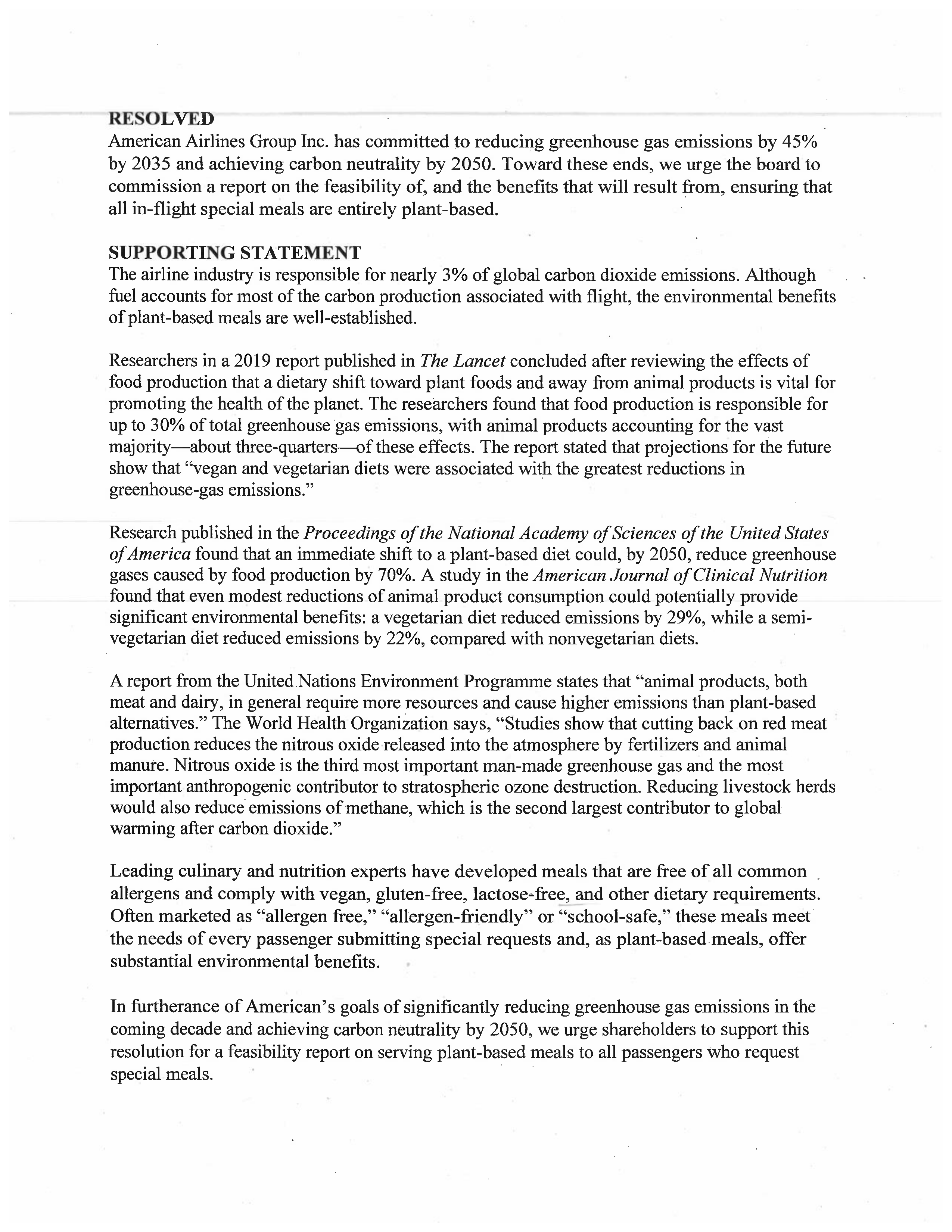
RESOLVED
American Airlines Group Inc. has committed to reducing
greenhouse gas emissions by 45% by 2035 and achieving carbon
neutrality by 2050. Towards these ends, we urge the board to
commission a report on the feasibility of, and the benefits that will
result from, ensuring that all in-flight special meals are entirely
plant-based.
A copy of the 2025 Proposal and supporting statement, which were received by the
Company on November 8, 2024, are attached to this letter as Exhibit A.
In December 2023, the Proponent submitted a substantively similar stockholder proposal
(the “2024 Proposal”) for inclusion in the Company’s proxy statement for its 2024 annual
meeting of stockholders (the “2024 Proxy Materials”). The Company subsequently informed the
Staff of its intention to exclude the 2024 Proposal from its 2024 Proxy Materials pursuant to
Rule 14a-8(i)(7), and the Staff granted the Company’s request for no-action relief, stating that
“the [2024] Proposal relates to ordinary business matters.”
American Airlines Group Inc.
(avail.
April 1, 2024) (the “2024 No-Action Letter”).
The 2024 Proposal requested that the Company ensure that “all in-flight special meals are
free of common allergens and meet the needs of people seeking gluten-free, vegan, lactose-free,
and other diet options.” In the 2025 Proposal, the Proponent attempts to reframe the 2024
Proposal as a request for a report on the feasibility and benefits of making specific changes to the
Company’s in-flight special meal offerings – namely, the feasibility and benefits of ensuring that
such special meals “are entirely plant-based” – as opposed to requiring the Company to provide
specific types of meals, as was requested in the 2024 Proposal.
The Proponent’s revisions are an obvious attempt to circumvent the Staff’s grant of no-
action relief with respect to the 2024 Proposal. However, regardless of these alterations, the
Proponent’s true objective remains the same, which is to influence the specific types of food
options that are available on the Company’s flights, a matter wholly within the ordinary course
of the Company’s business. The Staff concurred in the 2024 No-Action Letter with the
Company’s determination that such proposal was properly excluded from the 2024 Proxy
Materials pursuant to Rule 14a-8(i)(7). The Staff should grant similar no-action relief with
respect to the 2025 Proposal.
Grounds for Exclusion
The Company intends to exclude the 2025 Proposal from its 2025 Proxy Materials, and
respectfully requests that the Staff concur that the Company may exclude the 2025 Proposal
pursuant to Rule 14a-8(i)(7) because it relates to, and does not transcend, the ordinary business
operations of the Company.
January 21, 2025
Page 3
A.
Background of the Ordinary Business Exclusion
Under Rule 14a-8(i)(7), a company may exclude a stockholder proposal from its proxy
materials “[i]f the proposal deals with a matter relating to the company’s ordinary business
operations.” The Commission has stated that the “general underlying policy of this exclusion is
consistent with the policy of most state corporate laws: to confine the resolution of ordinary
business problems to management and the board of directors, since it is impracticable for
shareholders to decide how to solve such problems at an annual shareholders meeting.”
Exchange Act Release No. 34-40018 (May 21, 1998) (“1998 Release”). As explained by the
Commission, the term “ordinary business” in this context refers to “matters that are not
necessarily ‘ordinary’ in the common meaning of the word, and is rooted in the corporate law
concept providing management with flexibility in directing certain core matters involving the
company’s business and operations.”
Id
.
The Commission stated in the 1998 Release that the policy underlying the ordinary
business exclusion is based on two considerations:
•
first, whether a proposal relates to “tasks that are so fundamental to
management’s ability to run a company on a day-to-day basis that they could not,
as a practical matter, be subject to direct shareholder oversight;” and
•
second, whether a “proposal seeks to ‘micro-manage’ the company by probing
too deeply into matters of a complex nature upon which shareholders, as a group,
would not be in a position to make an informed judgment.”
Notwithstanding these considerations, the Commission has distinguished between
proposals involving “business matters that are mundane in nature,” which are properly excluded
under Rule 14a-8(i)(7), and those which have “significant policy, economic or other implications
inherent in them,” which are beyond the scope of the exclusion. Exchange Act Release No. 34-
12999 (Nov. 22, 1976). When determining such “significant social policy issues,” the Staff
reiterated in Staff Legal Bulletin No. 14L (Nov. 3, 2021) (“SLB 14L”) that the Commission will
look for “social policy significance” and “whether the proposal raises issues with a broad societal
impact.”
Importantly, the Commission has made it clear that framing a stockholder proposal in the
form of a request for a report does not change the nature of the proposal. The Commission has
stated that a proposal requesting the dissemination of a report may be excludable under Rule
14a-8(i)(7) if the subject matter of the report is within the ordinary business of the company.
See
Exchange Act Release No. 20091 (Aug. 16, 1983).
See also Delta Air Lines, Inc.
(avail. April
24, 2024) (involving the exclusion of a proposal that requested a report on company expenditures
that are intended or could be viewed as intended to dissuade employees from joining unions, in
which the Staff determined that the proposal related to the company’s ordinary business
operations);
Omnicom Group Inc.
(avail. March 17, 2021) (involving the exclusion of a proposal
that requested a report on whether the company’s advertising policies were contributing to
violations of civil or human rights, in which the Staff determined that the proposal related to the
company’s ordinary business operations); and a number of the other precedent letters cited
below.
January 21, 2025
Page 4
As explained below, the subject matter of the 2025 Proposal concerns an ordinary course
business matter – the preparation and offering of in-flight meals – and does not have any
significant policy implications. The 2025 Proposal implicates each of the central considerations
underlying the ordinary business exclusion: the subject matter of the 2025 Proposal deals with
issues that are “fundamental to management’s ability to run the company on a day-to-day basis”
and seeks to micromanage the Company by limiting its discretion with respect to its complex,
day-to-day operations.
See
1998 Release. Furthermore, the 2025 Proposal does not focus on
social policy issues of sufficient significance to transcend day-to-day business matters of the
Company. Accordingly, the 2025 Proposal relates to, and does not transcend, the Company’s
ordinary business operations and therefore may properly be excluded from the 2025 Proxy
Materials pursuant to Rule 14a-8(i)(7).
B.
The Subject Matter of the 2025 Proposal is Fundamental to Management’s
Ability to Run the Company’s Day-to-Day Business and the 2025 Proposal
Seeks to Micromanage the Company
The 2025 Proposal requests that the Company’s board of directors (the “Board”)
commission a report regarding the feasibility and benefits of ensuring that “all in-flight special
meals are entirely plant-based.” Stated simply, the 2025 Proposal attempts to influence the
particular products (i.e., entirely plant-based meals) that the Company provides to its customers
and therefore involves the Company’s “ordinary business.”
The Staff has previously concurred that such proposals relate to a company’s ordinary
business operations by allowing companies to exclude proposals seeking to influence
management’s decisions with respect to menu items and food options. Relevant prior
determinations in which the Staff permitted exclusion under Rule 14a-8(i)(7) include:
•
American Airlines Group Inc.
(avail. April 1, 2024), with respect to a proposal
requesting that all in-flight special meals are free of common allergens and meet
the needs of people seeking gluten-free, vegan, lactose-free, and other diet
options;
see also United Airlines Holdings, Inc.
(avail. April 1, 2024);
Delta Air
Lines, Inc.
(avail. April 22, 2024);
•
Select Medical Holdings Corp.
(avail. Feb. 20, 2024), with respect to a proposal
requesting that the company adopt the American Medical Association’s policy for
healthful foods for healthcare facilities and implement the program for healthful
hospital foods developed by NYC Health + Hospitals system;
see also
HCA
Healthcare, Inc.
(avail. Feb. 21, 2024);
Universal Health Services, Inc.
(avail.
Mar. 22, 2024);
Tenet Healthcare Corp.
(avail. Mar. 22, 2024);
•
HCA Healthcare, Inc.
(avail. Mar. 6, 2023), with respect to a proposal requesting
the board of directors to require the company’s hospitals “to provide plant-based
food options to patients at every meal, within vending machines, and in the
cafeterias used by outpatients, staff and visitors”; s
ee also
Elevance Health, Inc.
(avail. Mar. 6, 2023);
UnitedHealth Group Inc.
(avail. Mar. 16, 2023);
•
Ford Motor Co.
(avail. Jan. 2, 2018), with respect to a proposal recommending
that the company
prepare a report
“outlining the costs and benefits of feeding its
January 21, 2025
Page 5
employees, with the intention to promote health, productivity, and profitability”
(
emphasis added
);
•
Papa John’s International, Inc.
(avail. Feb. 13, 2015), with respect to a proposal
encouraging the board of directors “to expand [the company’s] menu offerings to
include vegan cheeses and vegan meats” in order to “advance animal welfare,
reduce its ecological footprint, expand its healthier options, and meet a growing
demand for plant-based foods;”
•
General Mills, Inc.
(avail. July 2, 2010), with respect to a proposal directing the
company to “limit its use of salt and other sodium compounds for the purpose of
flavor enhancement;”
•
McDonald’s Corp.
(avail. Mar. 24, 1992), with respect to a proposal requiring the
company to offer a “[low-fat] burger, switch to an all-vegetable cooking oil and
offer salads as part of the menu in our international outlets;” and
•
McDonald’s Corp.
(avail. Mar. 9, 1990), with respect to a proposal
recommending that the company introduce “a vegetarian entree whose means of
production neither degrades the environment nor exploits other species.”
In each case noted above, the company articulated the complex decision-making process
engaged in by the company in the ordinary, day-to-day operation of its business, relating to
selecting menu items and food options.
The Staff has also consistently agreed that proposals relating to a company’s sale and
marketing of its products or services, or seeking to dictate management’s day-to-day decisions
regarding the selection of products or services offered, implicate a company’s ordinary business
operations and may be excluded pursuant to Rule 14a-8(i)(7). Relevant prior determinations by
the Staff include:
•
The Kroger Co
. (avail. Apr. 25, 2023), involving a proposal requesting the board
of directors to take the necessary steps to pilot participation in a program that
would require the company to, among other things, give tomato purchase
preference within their supply chain to certain program participants. The Staff
agreed that the proposal sought to micromanage the company’s decision making
with respect to suppliers from which the company chooses to buy its products,
and as a result, could be excluded under Rule 14a-8(i)(7);
•
Bank of America Corp
. (avail. Feb. 21, 2019), involving a proposal requesting the
company’s board of directors to
complete a report
evaluating each company’s
overdraft policies and practices and the impacts they have on customers. The Staff
permitted exclusion of the proposal under Rule 14a-8(i)(7) specifically because
the proposal “relates to the products and services offered for sale by the
[c]ompany”;
see also, JPMorgan Chase & Co.
(avail. Feb. 21, 2019) (
emphasis
added
);
•
American Airlines Group Inc.
(avail. Mar. 23, 2018), involving a proposal
requesting the Company’s board of directors to
prepare a report
on the regulatory
risk and discriminatory effects of smaller cabin seat sizes on overweight, obese,
January 21, 2025
Page 6
and tall passengers. The Staff concurred that the Company could exclude the
proposal under Rule 14a-8(i)(7) because it related to the Company’s ordinary
business operations, which related to the products and services offered by the
Company;
see also, Delta Air Lines, Inc.
(avail. Mar. 28, 2018) (
emphasis
added
);
•
Walgreens Boots Alliance, Inc.
(avail. Nov. 7, 2016), involving a proposal
requesting that the company’s board of directors
issue a report
“assessing the
financial risk, including long-term legal and reputational risk, of [the company’s]
continued sales of tobacco products.” The Staff concurred that the company
could exclude the proposal under Rule 14a-8(i)(7) as relating to the company’s
ordinary business operations, as the proposal related to the company’s sale of a
particular product (
emphasis added
); and
•
Amazon.com, Inc
. (avail. Mar. 11, 2016), permitting exclusion under Rule
14a-8(i)(7) of a stockholder proposal requesting that the company “
issue a report
addressing animal cruelty in the supply chain” because “the proposal relates to the
products and services offered for sale by the company” and “[p]roposals
concerning the sale of particular products and services are generally excludable
under rule 14a-8(i)(7)” (
emphasis added
).
The 2025 Proposal is about nothing more than the selection of products the Company
offers to its customers – namely, the food options available on its flights. Allowing stockholders
to dictate which products the Company makes available for “all in-flight special meals” would
inappropriately delegate management functions to stockholders. The Company’s decisions
regarding its product offerings, including meal and snack options provided to customers,
sourcing of meal ingredients, and the amount of particular types of meals and snacks needed for
each flight, are ordinary business matters of a complex nature that should not be subject to
stockholder oversight. Furthermore, given the scope of the Company’s operations, which
encompass thousands of flights per day to nearly 350 destinations in more than 60 countries,
1
it
would not be practical to allow stockholders to oversee or otherwise attempt to influence such
decisions.
The meal choices offered on the Company’s flights inherently involve complex
operational, business and financial considerations requiring deep knowledge of ordinary business
and operational matters, such as sourcing of products, sourcing of special meal options, transport
of meals, the varying and transient needs and demands of respective customers, supply chain
logistics and purchase costs, among others. These decisions are made carefully and purposefully
by the Company’s management, and a significant amount of time, energy, and effort is expended
to determine the meal options and catering services of the Company’s flights, while also
generating an appropriate return to the Company’s stockholders.
Assessing the many factors that influence purchase decisions and product offerings on
flights, including meals, requires the real-time judgment and analysis of management, and the
1
https://americanairlines.gcs-web.com/
January 21, 2025
Page 7
product offering in turn affects the Company’s other business decisions, including pricing of
airline tickets, fuel needs, and network management. Further, these decisions are not made in a
vacuum, but rather are made in the face of a rapidly changing competitive environment of airline
offerings, products, and services. The ability of the Company to make these types of decisions
regarding the changing needs and demands of its customers and the constraints imposed by its
competitors, as well as how such needs may impact the Company’s profits and business
operations, is fundamental to the operation of its business. Unlike Company management, the
Company’s stockholders are not well-positioned, and do not have the necessary knowledge,
information, and resources, to make informed decisions or otherwise influence such business and
operational matters.
By attempting to impose upon the Company a specific decision with respect to the
products and services offered to passengers during a flight, the 2025 Proposal, like those
addressed in the letters cited above, seeks to probe too deeply into matters of a complex nature,
which are not appropriate for stockholder determination. Additionally, instead of “providing
high-level direction on large strategic corporate matters,” the 2025 Proposal would
“inappropriately limit discretion of the board or management” by usurping the day-to-day
decision-making process involved with purchase and menu decisions for the Company’s various
airlines and service routes.
See
SLB 14L. The ability of the Company to address constantly
changing information, to which the Company’s stockholders do not have access, related to
sourcing and transport of products or special meal options, airline regulations, supply chain
logistics, purchase costs and varying and transient needs and demands of the Company’s
customers, is fundamental to the Company’s business operations, and cannot properly be
submitted to stockholders to micromanage.
C.
The 2025 Proposal Does Not Raise a Significant Social Policy Issue that
Would Override its Ordinary Business Subject Matter
The Commission noted in the 1998 Release that stockholder proposals relating to
ordinary business operations but “focusing on sufficiently significant social policy issues . . .
generally would not be considered to be excludable, because the proposals would transcend the
day-to-day business matters and raise policy issues so significant that it would be appropriate for
a shareholder vote.” In determining whether a stockholder proposal raises significant policy
issues, the Staff has noted that it is not sufficient that the topic may have “recently attracted
increasing levels of public attention,” but instead it must have “emerged as a consistent topic of
widespread public debate.”
Comcast Corp.
(avail. Feb. 15, 2011).
Food options available on flights are not inherently a significant policy issue.
See, e.g.,
Ford Motor Co.
(avail. Jan. 2, 2018) (rejecting the argument that whether and how the company
chooses to feed its employees was a “significant policy issue” facing the company sufficient to
override the ordinary business subject matter of the proposal, which attempted to influence the
type of food the company provided to its employees);
General Mills, Inc.
(avail. July 2, 2010)
(refuting the proponent’s argument that the amount of salt and sodium use in the company’s
products relates to a significant social policy issue that transcends the company’s day-to-day
ordinary business operations).
Although the Supporting Statement of the 2025 Proposal references “the environmental
benefits of plant-based meals are well-established” and urges stockholders to support the 2025
January 21, 2025
Page 8
Proposal in furtherance of the Company’s goals of reducing greenhouse gas emissions and
achieving carbon neutrality, the Staff has long held that proposals with references touching upon
topics that might raise significant social policy issues, but which do not focus on or have only
tangential implications for such issues, are not transformed from an otherwise ordinary business
proposal into one that transcends ordinary business.
Prior Staff letters have clearly indicated that merely mentioning an issue with a broad
societal impact does not preclude the proposal’s exclusion under Rule 14a-8(i)(7). Relevant prior
determinations by the Staff include:
•
The Home Depot, Inc.
(avail. Mar. 21, 2024), involving exclusion of a proposal
requesting a report on the benefits and drawbacks of not selling paint containing
titanium dioxide sourced from the Okefenokee, despite references to
environmental considerations.
•
HCA Healthcare, Inc.
(avail. Mar. 6, 2023), involving exclusion of a proposal
requesting the company’s hospitals to provide plant-based food options to patients
at every meal, within vending machines and in the cafeteria used by outpatients,
staff and visitors, despite references to public health considerations. The Staff
specially noted that such proposal “relates to, and does not transcend, ordinary
business matters”; s
ee also
Elevance Health, Inc.
(avail. Mar. 6, 2023);
UnitedHealth Group Inc.
(avail. Mar. 16, 2023);
•
Dollar Tree, Inc
. (avail. May 2, 2022), involving exclusion of a proposal that
made passing references to safety, workforce, participation or pandemic-related
concerns, but was generally related to how the company manages, compensates,
recruits and retains its employees. The Staff specially noted that such proposal
“relates to, and does not transcend, ordinary business matters”;
•
The TJX Companies, Inc
. (avail. Apr. 9, 2021), involving exclusion of a proposal
urging the board of directors to produce a report evaluating whether the company
supports systemic racism through undetected supply chain prison labor. The Staff
explicitly stated that “although the [p]roposal refers to systemic racism through
undetected supply chain prison labor, the [p]roposal…does not otherwise explain
how [the company’s] compliance program raises a significant issue for the
[c]ompany” and, as a result, “the [p]roposal does not transcend the [c]ompany’s
ordinary business operations”;
•
Amazon.com, Inc.
(avail. Apr. 1, 2020), involving exclusion of a proposal
requesting the company to include on their sales website a department category
concerning sustainability products particularly to address climate change. The
company argued that “although the [p]roposal’s references to ‘climate change’
and ‘Global Warming’ could touch upon significant policy issues in some
contexts, the [p]roposal remains excludable under Rule 14a-(i)(7) because it is not
focused on those issues, but instead is focused on how the [c]ompany markets
products and how it communicates with its customers about those products, and
therefore the [p]roposal does not transcend the day-to-day business matters of the
[c]ompany”;
January 21, 2025
Page 9
•
Papa John’s International, Inc.
(avail. Feb. 13, 2015), involving exclusion of a
proposal requesting the company to include vegan options on its menu to, among
other things, advance animal welfare and reduce the company’s ecological
footprint. The Staff specifically noted that “the proposal relates to the products
offered for sale by the company and does not focus on a significant policy issue”;
and
•
Dominion Resources, Inc.
(avail. Feb. 3, 2011), involving a proposal requesting
the company to provide financing for installation of rooftop solar or wind power
renewable generation. The Staff concurred with exclusion of the proposal because
the subject matter focused on “the products and services offered for sale by the
company,” even though the proposal touched on environmental-related matters.
Notwithstanding the 2025 Proposal’s references to the potential environmental benefits of
plant-based foods, the 2025 Proposal is no different in substance from the Proponent’s 2024
Proposal: it is fundamentally concerned with the selection of products the Company offers to its
customers – namely, the food options available on its flights – which has been long established
as an ordinary business concern for management.
Although the Staff has denied no-action relief under Rule 14a-8(i)(7) in connection with
some proposals requesting a report on the feasibility or benefits of reducing greenhouse gas
emissions, those proposals directly related to environmental matters, whereas the 2025 Proposal
does not. For instance, in
J.B. Hunt Transport Services, Inc.
(avail. Feb. 7, 2020), the Staff
denied no-action relief under Rule 14a-8(i)(7) in connection with a proposal requesting a report
on the company’s plans to reduce its total contribution to climate change and align its operations
with the Paris Agreement. Similarly, in
Lowe’s Companies, Inc.
(avail. Mar. 10, 2017), the Staff
denied no-action relief under Rule 14a-8(i)(7) in connection with a proposal requesting a report
assessing the climate-change benefits and feasibility of adopting targets to increase the
company’s renewable energy sourcing.
Unlike the two proposals noted above, the 2025 Proposal is not asking the Company to
issue a report directly related to reducing emissions or otherwise improving its sustainability
initiatives. Instead, the 2025 Proposal is broadly requesting that the Company prepare a report
regarding the benefits that will result from ensuring that all in-fight special meals are entirely
plant-based, which directly relates to and does not transcend the Company’s day-to-day ordinary
business operations of making decisions relating to its product offerings, including meal options
available for order or purchase. As such, the 2025 Proposal is concerned solely with ordinary
business considerations related to in-flight meals, rather than matters of climate change or
sustainability.
Moreover, even assuming that the 2025 Proposal does raise a “significant policy issue”
(which it does not), such issue does not transcend the Company’s day-to-day ordinary business
operations of making decisions relating to its product offerings, including in-flight meals and
food services. If dietary preferences and accommodations were deemed to transcend the day-to-
day business decisions of airline companies and their operations, then any business that provides
goods or services would have “transcendent” food-related issues subject to stockholder review.
As noted above, stockholders lack the requisite expertise to determine or otherwise influence the
appropriate in-flight menu selection and food offerings on an aircraft in the face of the multitude

January 21, 2025
Page 10
of commercial, competitive, regulatory and operating issues involved. Stated simply, the
management of such day-to-day operations properly lies with the Company’s management and
employees, not with its stockholders.
Conclusion
For the foregoing reasons, the Company believes that it may properly exclude the 2025
Proposal from the 2025 Proxy Materials under Rule 14a-8(i)(7) because the 2025 Proposal
impermissibly relates to, and does not transcend, the Company’s ordinary business matters. We
respectfully request that the Staff not recommend any enforcement action if the Company
excludes the 2025 Proposal from its 2025 Proxy Materials. If the Staff does not concur with the
Company’s position, we would appreciate an opportunity to confer with the Staff concerning this
matter prior to the determination of the Staff’s final position. In addition, the Company requests
that the Proponent copy the undersigned on any response it may choose to make to the Staff,
pursuant to Rule 14a-8(k).
Please contact the undersigned at (202) 637-2113 to discuss any questions you may have
regarding this matter.
Very truly yours,
__
___
Jessica L. Lennon
of LATHAM & WATKINS LLP
Enclosures
cc:
Anna Herby, Physicians Committee for Responsible Medicine
Matt Dominy, American Airlines Group Inc.
Tony Richmond, Latham & Watkins LLP
Exhibit A
2025 Proposal from Physicians Committee for Responsible Medicine



January 30, 2025
VIA ONLINE SHAREHOLDER PROPOSAL FORM
Office of Chief Counsel
Division of Corporation Finance
Securities and Exchange Commission
100 F Street NE
Washington, DC 20549
Re:
Response to “American Airlines Group Inc., Stockholder Proposal of Physicians
Committee for Responsible Medicine”
Dear Staff:
I write on behalf of the Physicians Committee for Responsible Medicine (“Physicians
Committee”) pursuant to Rule 14a-8(k) in response to a request (“No-Action Request”) by
American Airlines Group Inc. (“Company”) that the Staff of the Division of Corporation Finance
concur with its view that it may exclude the Physicians Committee’s shareholder resolution and
supporting statement (collectively “Proposal”) from the proxy materials to be distributed in
connection with the Company’s 2025 annual meeting of shareholders. The Company seeks to
exclude the Proposal pursuant to Rule 14a-8(i)(7). For the reasons set forth below, the Physicians
Committee urges the Staff to deny the Company’s No-Action Request.
Pursuant to Rule 14a-8(k) and
Announcement: New Intake System for Rule 14a-8 Submissions
and Related Correspondence
(Nov. 7, 2023), the Physicians Committee submits this letter
electronically and concurrently submits a copy to the Company.
I.
The Proposal
The Proposal’s proposed resolution states,
RESOLVED
American Airlines Group Inc. has committed to reducing greenhouse gas emissions
by 45% by 2035 and achieving carbon neutrality by 2050. Toward these ends, we
urge the board to commission a report on the feasibility of, and the benefits that
will result from, ensuring that all in-flight special meals are entirely plant-based.
The Proposal’s supporting statement begins by noting that the “airline industry is responsible for
nearly 3% of global carbon dioxide emissions.” It thereafter summarizes reports and studies,
issued by leading authorities on environmental issues and public health, establishing that shifting
2
to a plant-based diet could significantly reduce greenhouse gases, consistent with the Company’s
environmental commitments.
II.
Because the Proposal Focuses on a Significant Social Policy Issue, the Company
May Not Exclude the Proposal Pursuant to Rule 14a-8(i)(7)
Rule 14a-8(i)(7) provides that a company may exclude a proposal “[i]f the proposal deals with a
matter relating to the company’s ordinary business operations.” Only “business matters that are
mundane in nature and do not involve any substantial policy or other considerations” may be
omitted under this provision. 41 Fed. Reg. 52,994, 52,998 (Dec. 3, 1976).
A proposal relating to a company’s ordinary business operations is not excludable if the proposal
focuses on “sufficiently significant social policy issues” that “transcend the day-to-day business
matters and raise policy issues so significant that it would be appropriate for a shareholder vote.”
Amendments to Rules on Shareholder Proposals, Exchange Act Release No. 40018 (May 21,
1998). “In determining whether the focus of these proposals is a significant social policy issue,
[Staff] consider both the proposal and the supporting statement as a whole.”
Staff Legal Bulletin
No. 14C, part D.2 (June 28, 2005). “In making this determination, the staff will consider whether
the proposal raises issues with a broad societal impact, such that they transcend the ordinary
business of the company.” Staff Legal Bulletin No. 14L, part B.2 (Nov. 3, 2021).
According to Release No. 40018,
The policy underlying the ordinary business exclusion rests on two central
considerations. The first relates to the subject matter of the proposal. Certain tasks
are so fundamental to management’s ability to run a company on a day-to-day basis
that they could not, as a practical matter, be subject to direct shareholder oversight.
Examples include the management of the workforce, such as the hiring, promotion,
and termination of employees, decisions on production quality and quantity, and
the retention of suppliers. However, proposals relating to such matters but focusing
on sufficiently significant social policy issues (e.g., significant discrimination
matters) generally would not be considered to be excludable, because the proposals
would transcend the day-to-day business matters and raise policy issues so
significant that it would be appropriate for a shareholder vote.
The second consideration relates to the degree to which the proposal seeks to
“micro-manage” the company by probing too deeply into matters of a complex
nature upon which shareholders, as a group, would not be in a position to make an
informed judgment. This consideration may come into play in a number of
circumstances, such as where the proposal involves intricate detail, or seeks to
impose specific time-frames or methods for implementing complex policies.
Exchange Act Release No. 40018 (May 21, 1998) (footnotes omitted).
3
A.
The Proposal Does Not Implicate the Ordinary Business Exception
The Proposal does not implicate Rule 14a-8(i)(7) because it does not pertain to a task that is
“fundamental to management’s ability to run a company on a day-to-day basis.” The Company
mischaracterizes the Proposal as seeking “to dictate which products the Company makes
available,” No-Action Request at 6, and “attempting to impose upon the Company a specific
decision with respect to the products and services offered,”
id.
at 7. But the plain language of the
Proposal speaks for itself. The Proposal requests a “report” and nothing more. As a result, the
Staff decisions regarding product and service proposals cited by the Company,
see
No-Action
Request at 4–6, are inapposite.
B.
The Proposal Raises a Significant Social Policy Issue That Transcends Day-
To-Day Business Matters
In Staff Legal Bulletin No. 14C, the Staff considered proposals related to the environment and
public health, which it had previously found to be significant policy considerations, and advised
that “[t]o the extent that a proposal and supporting statement focus on the company minimizing
or eliminating operations that may adversely affect the environment or the public’s health, we do
not concur with the company’s view that there is a basis for it to exclude the proposal under rule
14a-8(i)(7).” Staff Legal Bulletin No. 14C, part D.2 (June 28, 2005). Thus, there is no question
that reducing environmental harm involves a “br
oad societal impact.”
See
Staff Legal Bulletin
No. 14L, part B.2 (Nov. 3, 2021).
The Company mischaracterizes the Proposal as “merely mentioning an issue with a broad
societal impact.” No-Action Request at 8. But the supporting statement repeatedly cites the
established scientific consensus underlying the Proposal.
As noted in the supporting statement, a report published in
The Lancet
concluded that a dietary
shift toward plant foods and away from animal products is vital for promoting the planet’s health
in part because food production is responsible for up to 30% of total greenhouse gas emissions,
with animal products accounting for the vast majority of the effects.
1
Similarly, research
published in the
Proceedings of the National Academy of Sciences of the United States of
America
found that an immediate shift to a plant-based diet could, by 2050, reduce greenhouse
gases caused by food production by 70%.
2
A study in the
American Journal of Clinical Nutrition
found that even modest reductions of
animal product consumption could provide significant environmental benefits: a vegetarian diet
reduced emissions by 29%, while a semi-vegetarian diet reduced emissions by 22%, compared
with nonvegetarian diets.
3
The United Nations Environment Programme
and the World Health
Organization came to analogous conclusions, as noted in the supporting statement.
4,5
In light of the scientific consensus associating Company activities with environmental harm that
the Company could consider minimizing, the Proposal “focus[es] on sufficiently significant
social policy issues” and “generally would not be considered to be excludable, because the
proposals would transcend the day-to-day business matters and raise policy issues so significant
4
that it would be appropriate for a shareholder vote.” Exchange Act Release No. 40018 (May 21,
1998) (footnote omitted).
C.
The Proposal Does Not Seek to Micromanage the Company
The Company incorrectly asserts that the Proposal “seeks to probe too deeply into matters of a
complex nature.” No-Action Request at 7. According to the Staff, a proposal might probe too
deeply into matters of a complex nature if it “involves intricate detail, or seeks to impose specific
time-frames or methods for implementing complex policies.”
Exchange Act Release No. 40018
(May 21, 1998). At the same time, the Staff “
recogniz[es] that proposals seeking detail or
seeking to promote timeframes or methods do not per se constitute micromanagement. Instead,
we will focus on the level of granularity sought in the proposal and whether and to what extent it
inappropriately limits discretion of the board or management.”
Staff Legal Bulletin No. 14L, part
B.3 (Nov. 3, 2021).
The Proposal does not seek intricate details or to impose complex policies or any specific
timeframe. Rather it asks for a feasibility report.
The Company states that the commissioning of
this single report “would ‘inappropriately limit discretion of the board or management’ by
usurping the day-to-day decision-making process[.]” No-Action Request at 7. This overstatement
cannot be taken seriously.
III.
Conclusion
The Physicians Committee respectfully requests that the Staff decline to issue a no-action
response and inform the Company that it may not exclude the Proposal in reliance on Rule 14a-
8(i)(7). Should the Staff need any additional information in reaching a decision, please contact
me at your earliest convenience.
Sincerely,
Mark Kennedy
Senior Vice President of Legal Affairs
(202) 527-7315
mkennedy@pcrm.org
5
SCIENTIFIC REFERENCES
1. Willett W, Rockström J, Loken B, et al. Food in the Anthropocene: the EAT-Lancet
Commission on healthy diets from sustainable food systems.
Lancet
. 2019;393(10170):447-
492. doi:10.1016/S0140-6736(18)31788-4.
2. Springmann M, Godfray HCJ, Rayner M, Scarborough P. Analysis and valuation of the
health and climate change cobenefits of dietary change.
Proc Natl Acad Sci
U S A. Published
online March 21, 2016.
3. Soret S, Mejia A, Batech M, Jaceldo-Siegl K, Harwatt H, Sabaté J. Climate change
mitigation and health effects of varied dietary patterns in real-life settings throughout North
America.
Am J Clin Nutr
. 2014;100:490S–495S.
4. United Nations Environment Programme. Assessing the Environmental Impacts of
Consumption and Production Priority Products and Materials. 2010. Accessed January 30,
2025. https://www.resourcepanel.org/reports/assessing-environmental-impacts-consumption-
and-production.
5. World Health Organization. Reframing climate change as a health issue.
Bulletin of the
World Health Organization
. 2014;92:551-552. doi:http://dx.doi.org/10.2471/BLT.14.020814.