

December 21, 2017
Gene D. Levoff
Apple Inc.
glevoff@apple.com
Re:
Apple Inc.
Incoming letter dated October 9, 2017
Dear Mr. Levoff:
This letter is in response to your correspondence dated October 9, 2017 and
November 20, 2017 concerning the shareholder proposal (the “Proposal”) submitted to
Apple Inc. (the “Company”) by Christine Jantz (the “Proponent”) for inclusion in the
Company’s proxy materials for its upcoming annual meeting of security holders. We
also have received correspondence on the Proponent’s behalf dated October 31, 2017 and
December 4, 2017. Copies of all of the correspondence on which this response is based
will be made available on our website at http://www.sec.gov/divisions/corpfin/cf
noaction/14a-8.shtml. For your reference, a brief discussion of the Division’s informal
procedures regarding shareholder proposals is also available at the same website address.
Sincerely,
Matt S. McNair
Senior Special Counsel
Enclosure
cc:
Sanford Lewis
sanfordlewis@strategiccounsel.net
December 21, 2017
Response of the Office of Chief Counsel
Division of Corporation Finance
Re:
Apple Inc.
Incoming letter dated October 9, 2017
The Proposal requests that the board prepare a report that evaluates the potential
for the Company to achieve, by a fixed date, “net-zero” emissions of greenhouse gases
relative to operations directly owned by the Company and major suppliers.
Based on our review of your submission, including the description of how your
board of directors has analyzed this matter, there appears to be some basis for your view
that the Company may exclude the Proposal under rule 14a-8(i)(7), as relating to the
Company’s ordinary business operations. In our view, the Proposal seeks to
micromanage the company by probing too deeply into matters of a complex nature upon
which shareholders, as a group, would not be in a position to make an informed
judgment. Accordingly, we will not recommend enforcement action to the Commission
if the Company omits the Proposal from its proxy materials in reliance on
rule 14a-8(i)(7). In reaching this position, we have not found it necessary to address the
alternative basis for omission upon which the Company relies.
Sincerely,
Evan S. Jacobson
Special Counsel
DIVISION OF CORPORATION FINANCE
INFORMAL PROCEDURES REGARDING SHAREHOLDER PROPOSALS
The Division of Corporation Finance believes that its responsibility with respect
to matters arising under Rule 14a-8 [17 CFR 240.14a-8], as with other matters under the
proxy rules, is to aid those who must comply with the rule by offering informal advice
and suggestions and to determine, initially, whether or not it may be appropriate in a
particular matter to recommend enforcement action to the Commission. In connection
with a shareholder proposal under Rule 14a-8, the Division’s staff considers the
information furnished to it by the company in support of its intention to exclude the
proposal from the company’s proxy materials, as well as any information furnished by
the proponent or the proponent’s representative.
Although Rule 14a-8(k) does not require any communications from shareholders
to the Commission’s staff, the staff will always consider information concerning alleged
violations of the statutes and rules administered by the Commission, including arguments
as to whether or not activities proposed to be taken would violate the statute or rule
involved. The receipt by the staff of such information, however, should not be construed
as changing the staff’s informal procedures and proxy review into a formal or adversarial
procedure.
It is important to note that the staff’s no-action responses to Rule 14a-8(j)
submissions reflect only informal views. The determinations reached in these no-action
letters do not and cannot adjudicate the merits of a company’s position with respect to the
proposal. Only a court such as a U.S. District Court can decide whether a company is
obligated to include shareholder proposals in its proxy materials. Accordingly, a
discretionary determination not to recommend or take Commission enforcement action
does not preclude a proponent, or any shareholder of a company, from pursuing any
rights he or she may have against the company in court, should the company’s
management omit the proposal from the company’s proxy materials.
___________________________________________________
SANFORD J. LEWIS, ATTORNEY
December 4, 2017
Via electronic mail
Office of Chief Counsel
Division of Corporation Finance
U.S. Securities and Exchange Commission
100 F Street, N.E.
Washington, D.C. 20549
Re: Shareholder Proposal to Apple Inc. Regarding Net Zero Greenhouse Gas Goals on
Behalf of Christine Jantz
Supplemental Reply, including response to the Apple Board of Directors
Ladies and Gentlemen:
Christine Jantz (the “Proponent”) is beneficial owner of common stock of Apple Inc. (the
“Company”) and has submitted a shareholder proposal (the “Proposal”) to the Company. I
have been asked by the Proponent to respond to the supplemental letter dated November 20,
2017 ("Company’s Supplemental Letter") sent to the Securities and Exchange Commission by
Gene D. Levoff on behalf of the Company. The Company sent its original no action request
on October 9, and the Proponent responded on October 31.
The Company’s Supplemental Letter further discusses assertions that the Proposal may be
excluded from the Company’s 2018 proxy statement, including statements that the Board of
Directors has “concluded” that the Proposal’s subject matter is a matter of ordinary business
for the Company and not an appropriate topic for a shareholder proposal.
This correspondence represents one of the first opportunities for an investor to respond in a no
action reply to a Board of Directors opinion submitted pursuant to the new SEC Staff Legal
Bulletin 14I issued on November 1, 2017. Because this presents a matter of first impression
for the Staff and Commission, our letter will at times speak to fundamentals regarding the
shareholder proposal process and the functioning of Rule 14a-8. It will also include a
proponent’s perspective on the manner in which the SEC Staff can consider Board of
Directors “opinions” on ordinary business while still fulfilling the Commission’s investor
protection duties.
Our supplemental response today responds to the board’s “conclusion” and to additional
arguments from the Company’s Supplemental Letter. A copy of this response letter is being
emailed concurrently to Gene D. Levoff and the Apple Board of Directors.
PO Box 231 Amherst, MA 01004-0231 • sanfordlewis@strategiccounsel.net • (413) 549-7333
Proponent’s Supplemental Reply: Apple Inc. Net Zero GHG
Page 2
December 4, 2017
UPDATED BACKGROUND
The relevance of this Proposal to investor concern and interest, and its importance to the
global economy and environment, has grown since we submitted our initial reply on October
31. In early November, after our initial reply, the U.S. government issued the National Climate
Assessment.
1
The significance of that assessment has been summarized in a number of
articles.
2
The World Resources Institute summarized the relevance of the Assessment in “Extreme
Weather: What’s Climate Change Got to Do with It?” The article contextualizes recent
extreme weather events
3
:
An unrelenting heat wave in California, reaching 106 degrees F in San Francisco, that left six
dead, strained the state’s power grid and left thousands without electricity;
More than 40 million people affected by massive floods across India, Bangladesh and Nepal,
with 1,300 killed and at least 1.5 million homes destroyed or damaged;
Hurricane Irma decimating the northern Caribbean, with at least 27 dead, flattening buildings,
and leaving many without essential supplies, while in Florida, the hurricane killed at least
four, wiped out power for 64 percent of the state and produced record storm surges;
Hurricane Harvey causing catastrophic flooding across Texas, with at least 70 deaths; Harvey
and Irma combined caused an estimated $150-200 billion in damage in the United States, and
More than 80 wildfires burning across almost 1.5 million acres in nine western U.S. states;
this year, the U.S. Forest Service has already spent about $1.75 billion on fire suppression
and the Department of Interior has spent an additional $400 million.
In light of these events, we must ask: What’s climate change got to do with it?
***
Here is some of what we know:
Heat waves: It is no surprise that warming in the atmosphere leads to heat waves, or periods
of very hot weather lasting days to weeks. In recent years, the frequency of heat waves has
been increasing in many parts of the world, and the risk associated with extreme heat
increases with further warming.
Storms and flooding: We also know that warming leads to higher sea levels, which in turn
increases the risk of storm surge, contributing to the damage brought by hurricanes. Climate
change also warms oceans, adding energy that can fuel coastal storms. Compounding this, a
warmer atmosphere can hold more moisture, so there can be more moisture for storm
systems, resulting in heavier rainfall. The U.S. National Climate Assessment finds that there
has been a substantial increase – in intensity, frequency, and duration as well as the number
of strongest (Category 4 and 5) storms – in Atlantic Ocean hurricanes since the early 1980s,
linked in part to higher sea surface temperatures. By late this century, models on average
1
Fourth National Climate Assessment, Volume I
: US Government, November 2017
https://science2017.globalchange.gov
2
For instance see
“
Global Warming Really Did Make Hurricane Harvey More Likely,”
The Atlantic
,
November 13, 2017.
https://www.theatlantic.com/science/archive/2017/11/global-warming-really-did
make-hurricane-harvey-more-likely/545765/
and
3
“Extreme Weather: What’s Climate Change Got to Do with It?” World Resources Institute, September
18, 2017.
http://www.wri.org/blog/2017/09/extreme-weather-whats-climate-change-got-do-it
Proponent’s Supplemental Reply: Apple Inc. Net Zero GHG
Page 3
December 4, 2017
project a slight decrease in the number of tropical cyclones each year, but an increase in the
number of the strongest (Category 4 and 5) hurricanes and greater rainfall rates in hurricanes
(increases of about 20 percent averaged near the center of hurricanes).
Fires: We know that higher temperatures lead to increased rates of evaporation, leading to
rapid drying of soils. This can not only contribute to drought conditions but can stoke forest
fires. The U.S. National Climate Assessment finds that in the western forests, large and
intense fires are projected to occur more frequently, with large and longer wildfires given
higher temperatures and earlier spring snowmelt.
***
We need to face the realities of climate change today, not fall for the fantasy that we can just
ignore them and they will go away.
Even before this new information has come to light, the impact on the economy and investors
from climate change was already calculated to be quite costly. In 2016, Ernst & Young
published
Climate Change: The Investment Perspective
, which discusses the many different
ways that investments are effected by the changing climate
4
:
The potential financial consequences of climate risk are often debated in terms of “stranded
assets.” The value of global financial assets at risk from climate change has been estimated at
US$2.5t by the London School of Economics,
5
and US$4.2t by the Economist.
6
For
comparison, the annual Gross Domestic Product (GDP) of Japan, the world’s third largest
economy, is worth about US$4.8t.
The staggering scale of these potential losses has done a lot to raise awareness of climate
risks in investment circles. But “stranding” is only part of a complex range of climate risks —
each of which creates its own opportunities. Climate risks can be summarized as:
•
Physical: damage to land, buildings, stock or infrastructure owing to physical effects
of climate-related factors, such as heat waves, drought, sea levels, ocean
acidification, storms or flooding
•
Secondary: knock-on effects of physical risks, such as falling crop yields, resource
shortages, supply chain disruption, as well as migration, political instability or
conflict
•
Policy: financial impairment arising from local, national or international policy
responses to climate change, such as carbon pricing or levies, emission caps or
subsidy withdrawal
•
Liability: financial liabilities, including insurance claims and legal damages, arising
under the law of contract, tort or negligence because of other climate-related risks
•
Transition: financial losses arising from disorderly or volatile adjustments to the
value of listed and unlisted securities, assets and liabilities in response to other
climate-related risks
•
Reputational: risks affecting businesses engaging in, or connected with, activities that
4
Climate Change: An Investment Perspective:
Ernst & Young LLP, 2016, pg 2.
5
Dietz, Bowen, Dixon & Gradwell, Climate value at risk of global financial assets, Nature Climate
Change, April 2016
6
“The cost of inaction”, Economist Intelligence Unit, July 2015, (C) 2015 The Economist Intelligence Unit
Limited
Proponent’s Supplemental Reply: Apple Inc. Net Zero GHG
Page 4
December 4, 2017
some stakeholders consider to be inconsistent with addressing climate change
This simplified list is only a starting point for assessing climate-related risks.
***
As complex as climate risks may be, they only represent half the story. Global GDP is
expected to triple by 2060, driven largely by developing markets.
7
Yet, today, 1.3 billion
people in those markets still have no reliable access to electricity.
8
Delivering the power that
global development will require represents a vast investment opportunity.
Research suggests that the economic benefits of investment will outweigh the costs of
inaction. Studies by both the London School of Economics and Economist (referenced
earlier) expect total global output to be higher under a lower emissions scenario; Citigroup
expects investment in climate change mitigation to generate attractive and growing yields;
9
and Mercer believes a 2ºC scenario will not harm diversified returns to 2050, and would be
accretive thereafter.
10
Of course, the precise balance of investment risks and opportunities will depend on future
climate scenarios, and what investment decisions will be made — whether through
conventional means, e.g., coal-fired power stations, which add to global warming and climate
change, or through low carbon means to help mitigate the problem.
The Proponent believes, and the Proposal reflects the sense, that responding to the new clarity
of this now ongoing global catastrophe, with its dire economic, social and environmental
disruptions is a matter of
utmost urgency
. Many experts believe that attaining the 2° goal
needed to head off the most severe climate scenarios is near impossible, especially with
current levels of effort. Attaining the 2° goal is “
physically
possible” according to Michael
MacCracken, chief scientist for climate change programs at the Climate Institute, but “[i]t
would take a major change of society around the world to do it. It may not be likely in the
political sense, but engineering-wise, if we chose to do it and invest in it, we could.” Michael
Oppenheimer, a professor of geosciences and international affairs at Princeton University,
concurs, noting that “[attaining the 2° goal] is going to be hard, and if we don’t move firmly
on emissions reductions, it ain’t gonna happen.”
11
The approach of the proposal in context
The Company has announced that it intends to eliminate the carbon footprint of its
manufacturing processes, but has not set a target date for doing so. The thrust of the proposal
is requesting the company to set a target date for reaching a zero carbon footprint.
In its correspondence, the Company makes much of the “negative emissions” element of the
proposal, as if it requires a technical digression from the existing efforts. However, the
proposal is consistent with and encouraging of the Company’s current
technical
approaches to
7
“GDP long-term forecast (indicator). doi: 10.1787/d927bc18-en”, OECD, (Accessed on 19 July 2016)
8
“World Energy Investment Outlook”, International Energy Agency, June 2014, 2014 OECD/IEA
9
Channell, Curmi, Nguyen, Prior, Syme, Jansen, Rahbari, Morse, Kleinman, Kruger, “Energy Darwinism
II”, Citi, August 2015, 2015 Citigroup, “World Energy Investment Outlook”, International Energy
Agency, June 2014, 2014 OECD/IEA
10
“Investing in a time of climate change”, Mercer, April 2015 © 2015 Mercer LLC/International Finance
Corporation/UK Department for International Development
11
“Little Chance to Restrain Global Warming to 2 Degrees, Critic Argues”, Lisa Friedman, ClimateWire,
May 7, 2015.
Proponent’s Supplemental Reply: Apple Inc. Net Zero GHG
Page 5
December 4, 2017
eliminating its carbon footprint and to consider other options to the extent that existing
strategies are inadequate to the task. It principally asks the Company to explore the feasibility
of establishing a target date for attaining of a net zero carbon footprint, treating it as a true
“moonshot” – a time-limited stretch goal.
12
Setting deadlines to stretch to, in order to
demonstrate commitment and encourage innovation, is a frequently deployed strategy in the
tech sector. Publicizing such "moonshots" demonstrates determination and sends signals to the
market and to supply chains.
In contrast, in its declarations that it seeks to reduce and eliminate its carbon footprint, Apple
has not set a date, deadline or timeline other than "as soon as possible."
It could be
accomplished in five years or in 50, we have no way of knowing.
The Proposal also requests the Company to consider negative emissions strategies where
necessary to fully attain the goal of zero carbon footprint on its chosen timeline. This flexible
approach is consistent with scientific understanding regarding the scope and pace of reduction
activities that will be necessary to achieve the 2° goal. An important 2015 study, published in
Nature Communications
, further explains that all pathways consistent with 2° goal modeling
involve negative emissions to some extent. The authors warn that the amount of negative
emissions required to stay below 2 degrees may even be underestimated.
13
Because Apple is a pacesetter in the tech sector regarding responses to the global climate
change challenge, the Proponent believes that the company’s "as soon as possible"
policy is not yet congruent with the urgency of global demands to curtail carbon
emissions. That is why the Proposal encourages the Company to explore setting a
specific date for reaching net zero GHG goals by all appropriate measures.
12
More than 50 years ago, U.S. President John F. Kennedy captured the world’s imagination when he said,
“This nation should commit itself to achieving the goal, before the decade is out, of landing a man on the
moon and returning him safely to the Earth.”
13
T. Gasser, C. Guivarch, K. Tachiiri, C. D. Jones & P. Ciais, “Negative emissions physically needed to
keep global warming below 2°C,”
Nature Communications 6
, Article number: 7958 (2015). See also,
“Two degree climate target not possible without ‘negative emissions’, scientists warn”, Roz Pidcock,
Global Temperature
, 03.08.2015.
Proponent’s Supplemental Reply: Apple Inc. Net Zero GHG
Page 6
December 4, 2017
ANALYSIS
I. RESPONDING TO THE BOARD OF DIRECTORS OPINION REGARDING
ORDINARY BUSINESS
A. Proponent’s Analysis of the new Staff Legal Bulletin invitation for boards of directors
to submit findings regarding Rule 14a-8(i)(7)
The Company Supplemental Letter, and other no action requests filed by Apple regarding
proposals requesting a human rights committee, sustainability metrics, and report on freedom
of expression, appear to be the first purported applications of the new Staff Legal Bulletin 14I,
issued at the beginning of November 2017, which invited boards of directors to weigh in on
whether a proposal addresses a significant policy issue. The Board of Directors of Apple
submitted findings asserting that all four proposals address ordinary business and need not be
included on the Company’s proxy statement.
Since this is the first opportunity for investors to formally respond to issues raised by this
aspect of the Bulletin, we will briefly review the Bulletin and its relationship to existing
precedents and legal duties of the Commission and Staff.
The Bulletin states:
At issue in many Rule 14a-8(i)(7) no-action requests is whether a proposal that addresses
ordinary business matters nonetheless focuses on a policy issue that is sufficiently significant.
These determinations often raise difficult judgment calls that the Division believes are in the first
instance matters that the board of directors is generally in a better position to determine. A board
of directors, acting as steward with fiduciary duties to a company’s shareholders, generally has
significant duties of loyalty and care in overseeing management and the strategic direction of the
company. A board acting in this capacity and with the knowledge of the company’s business and
the implications for a particular proposal on that company’s business is well situated to analyze,
determine and explain whether a particular issue is sufficiently significant because the matter
transcends ordinary business and would be appropriate for a shareholder vote.
Accordingly, going forward, we would expect a company’s no-action request to include a
discussion that reflects the board’s analysis of the particular policy issue raised and its
significance. That explanation would be most helpful if it detailed the specific processes
employed by the board to ensure that its conclusions are well-informed and well-reasoned. We
believe that a well-developed discussion of the board’s analysis of these matters will greatly
assist the staff with its review of no-action requests under Rule 14a-8(i)(7).
The shareholder proposal process provides a legal right to investors to weigh in on issues of
significant social policy matters. It is in that context that we consider the invitation to boards
of directors to provide input on whether a proposal addresses a significant policy issue. The
Bulletin’s invitation to boards has the potential to make a board’s oversight more visible and
accountable — for boards of directors to consider the significance and relevance of proposals
earlier in the process after receiving a proposal, and to encourage investors to communicate
directly with the Board of Directors. In this response, we are copying the Board of Directors of
Apple and bringing attention to our belief that they have misinterpreted the proposal, the
Bulletin and the ordinary business rule.
However, if the Bulletin itself is misunderstood or abused by boards, it could undermine the
integrity of the shareholder proposal process. For instance, the approach taken by the Board of
Directors of Apple would effectively entitle nearly any company to exclude a shareholder
Proponent’s Supplemental Reply: Apple Inc. Net Zero GHG
Page 7
December 4, 2017
proposal, because they would merely need to assert that the board has already given its
attention to issues like those in the proposal and that the company dedicates resources to attend
to such issues. By their view, the fact that the company’s policies are out of alignment with
the proposal’s policy and transparency requests would be irrelevant.
As stated in
Medical Committee for Human Rights v. Securities and Exchange Commission
,
432 F.2d 659 (D.C. Cir. 1970):
[T]he clear import of the language, legislative history, and record of administration of
section 14(a) is that its overriding purpose is to assure to corporate shareholders the
ability to exercise their right — some would say their duty — to control the important
decisions which affect them in their capacity as stockholders and owners of the
corporation. Thus, the Third Circuit has cogently summarized the philosophy of section
14(a) in the statement that " [a] corporation is run for the benefit of its stockholders and
not for that of its managers." SEC v. Transamerica Corp., 163 F.2d 511, 517 (3d Cir.
1947), cert. denied, 332 U.S. 847, 68 S. Ct. 351, 92 L. Ed. 418 (1948).
* * *
What
is
of immediate concern…. is the question of whether the corporate proxy rules can
be employed as a shield to isolate such managerial decisions from shareholder
control.
32
After all, it must be remembered that " [t]he control of great corporations by a
very few persons was the abuse at which Congress struck in enacting Section 14(a)." SEC
v. Transamerica Corp.,
supra
, 163 F.2d at 518.
In most instances, when a proposal is presented to a company and will appear on the proxy, a
Board of Directors issues a statement in opposition. For example, Trillium Asset Management
filed a proposal in 2007 encouraging the Company to become a leader in eliminating
persistent and bioaccumulative toxic chemicals, and all types of brominated flame retardants
(BFRs) and polyvinyl chloride (PVC) plastics, in all Apple products, including an expeditious
timetable to end the use of all BFRs and PVC.
14
The company’s opposition statement
asserted that the Company’s existing processes of managing chemicals were adequate.
However, in the years since the proposal was filed, the Company has moved forward to
eliminate many of the chemicals targeted by the proposal.
15
Similarly, shareholders As You Sow, New York City Comptroller, and Calvert Asset
Management Inc. proposed that Apple issue a sustainability report in a 2010 proposal. Their
proposal focused on greenhouse gas reporting, despite some good reporting on GHGs by
Apple, because it was not providing information needed by investors:
Apple, however, lags behind global industry peers on sustainability reporting. It has released some
product specific information on greenhouse gas emissions but its usefulness is limited as nearly all
other companies use aggregate emission estimates. Apple has not made public greenhouse gas
reduction commitments.
The Board of Directors opposed the proposal, claiming that the work the company was
already doing on reporting sustainability in disparate locations and in its forms of GHG
reporting was ample. The Board opposition statement to that proposal is strikingly similar to
the current assertions of the Board regarding ordinary business:
14
Apple 2007 proxy statement.
http://investor.apple.com/secfiling.cfm?filingid=1104659-07
28382&cik=320193
15
https://qz.com/663763/six-of-the-worst-toxins-apple-says-it-has-phased-out-of-its-products/
Proponent’s Supplemental Reply: Apple Inc. Net Zero GHG
Page 8
December 4, 2017
The Company recognizes its responsibility as a global citizen and has been working proactively for
years to reduce the environmental impact of its corporate operations as well as the manufacturing
and use of its products, which accounts for 95% of the greenhouse gas emissions associated with
the Company. The Company also provides its customers and shareholders with an unmatched level
of detail on its environmental performance, both at the product level and for the Company as a
whole.
Yet, despite the Board’s opposition to the Proposal, the Company’s reporting has evolved
considerably and very much in the direction of the 2010 proposal’s requests, joining 2,700
other companies that were already issuing such reports.
From this history it is clear that whether and when a proposal appears on the proxy, the
process is at its core a contest of views between the Board and its shareholders, and integrates
an essential role for the owners of the company to help set direction on matters of significant
social import.
Whether an issue presents a significant public controversy that transcends ordinary business,
and therefore is appropriate for shareholders to vote on, is not the domain or expertise of the
Board of Directors of the company. We already know from decades of experience with the
shareholder proposal process that Boards oppose the proposals, and generally believe that the
strategies, transparency and accountability they are deploying are adequate to the subject
being addressed.
The shareholder proposal process is the opportunity for the owners to weigh in, especially
where the Board of Directors may appear to be shortsighted, lacking transparency, or missing
essential issues regarding the impact of corporate policies on society. The SEC is the protector
of these investors’ rights to participate, and must weigh the evidence and determine whether a
subject matter is of significant social importance. If the issue raised, and especially
transparency and accountability on the issue, is not substantially implemented, the Board of
Directors is probably the least qualified entity to make a determination finding the issue is
"ordinary" and therefore not subject to shareholder accountability.
Attending to “ordinary business" is the exclusive domain of the Board of Directors, but
attending to significant policy issues suitable for shareholder deliberation is not. This was
made clear in
Medical Committee for Human Rights v. SEC,
432 F.2d 659 (D.C. Cir. 1985) in
which the D.C. Circuit Court found that shareholder proposals are proper (not ordinary
business) when they raise issues of corporate social responsibility or question the "political
and moral predilections" of board or management.
The keystone of that decision, as noted
above, is that board and management have no monopoly on expertise over investors
when it comes to issues with broad and significant social consequence.
Investors are
entitled to weigh in through the shareholder proposal process.
In addition to the many other grounds for potential exclusion of proposals under Rule 14a-8,
the limitation on the ability of shareholders to weigh in on social and environmental issues is
defined in part by the ordinary business rule, which prevents shareholders from delving too
deeply into the everyday management of the company’s business. In effect, this means that
proposals must address widely debated policy issues that have a reasonable connection to the
company’s business.
Proponent’s Supplemental Reply: Apple Inc. Net Zero GHG
Page 9
December 4, 2017
The legal framework for Rule 14a-8(i)(7) developed by the Commission, Staff and the courts,
including under the Staff Legal Bulletin 14I, comprises a four-part test:
Question 1
. Ordinary Business.
Is the subject matter one of “ordinary business”? That is,
is it a topic that is integral to the day-to-day management and operations of the company?
16
Question 2.
Significant Policy Issue.
If the answer to Question 1 is yes, is the subject
matter nevertheless a significant policy issue – a subject of widespread public debate?
In those cases in which a proposal's underlying subject matter transcends the day
-
to
-
day business
matters of the company and raises policy issues so significant that it would be appropriate for a
shareholder vote, the proposal generally will not be excludable under Rule 14a-
8(i)(7) as long as a
sufficient nexus exists between the nature of the proposal and the company.
17
On what topics does a proposal address a significant policy issue that transcends ordinary
business? Staff decisions have made it clear that this inquiry concerns whether the proposal
addresses an issue of widespread public debate. Examples recognized by the Commission
and the Staff include such topics as environmental impact, human rights, climate change,
discrimination, as well as virtually all issues of corporate governance.
Question 3.
Nexus.
If the answer to Question 2 is yes, the next question is: Is there a nexus
of the subject matter to the Company
-
does the subject matter of widespread public debate
relate significantly to the company’s business or strategy? The invitation to the board of
directors under the Bulletin is to demonstrate that the issue is insignificant for the
company.
18
Unfortunately, it is predictable that some Boards of Directors may “find” a
subject matter insignificant merely because it is trying to find a grounds to exclude a
proposal. Therefore, it is also necessary for the proponent to provide any evidence that
contradicts the board’s finding of insignificance. Ultimately, the determination of
insignificance to a company is the obligation of the Staff, the Commission, or the courts. If
there is a reasonable basis for concluding that a significant policy issue has a connection to a
company, it transcends ordinary business at the company.
Question 4.
Micromanagement
.
Finally, if all of the above are true, does the approach of
the proposal micromanage? Even if the proposal’s subject matter transcends ordinary
business (number two) and has a connection to the company (number three), the proposal
still may be excludable if the approach of the proposal micromanages the company’s
business.
16
Staff Legal Bulletin 14H published in 2015 described ordinary business in terms of the “nitty gritty”
of corporate management: "a proposal may transcend a company's ordinary business operations even if
the significant policy issue relates to the "nitty
-
gritty of its core business." This makes the distinction
between and ordinary business determination and a significant policy determination clear.
17
Staff Legal Bulletin No.
14
E (October
27
,
2009
).
18
William Hinman, Director of the Corporation finance division, and Matt McNair, Senior Special
Counsel have made this point (based on their personal interpretations of the Bulletin) in publicly reported
comments. https://www.briefinggovernance.com/2017/11/what-we-know-so-far-about-the-new-slb-on-
shareholder-proposals/
https://www.thecorporatecounsel.net/Webcast/2017/11_14/transcript.htm
Proponent’s Supplemental Reply: Apple Inc. Net Zero GHG
Page 10
December 4, 2017
B. Applying the Analytical Framework to the Board’s
“
findings
”
regarding the
present Proposal
The Apple Board of Directors’
“findings” involve a fundamental misinterpretation of
the Staff Legal Bulletin. It appears that the Board of Directors focused its analysis
principally on Question 1
–
whether the Proposal’s subject matter is ordinary business
for the company. However, the Apple Board is unable to demonstrate that the subject
matter does not address a significant policy issue (Question 2) nor that it lacks a
connection to the Company’s business (Question 3). Further, the proposal does not
micromanage (Question 4).
In the present instance, the Proposal clearly addresses the significant policy issue of
climate change, and has a clear connection to the Company's business activities given
the magnitude of energy usage by the Company, greenhouse gases generated, the
Company’s expenditures and leadership on climate change. The Proposal does not
micromanage the Company in prodding the company to explore elimination of the
company’s carbon footprint on a fixed timeframe.
The Board of Directors is in error in its interpretation that because the proposal
addresses “ordinary business” it is excludable. It addresses a transcendent policy issue
with a connection to the company and does not micromanage.
It is not excludable.
i.
The
Apple Board finding is that the proposal addresses
ordinary business
The Apple Board essentially concluded that because it has significant programs in place, and
the board and management regularly discuss and address issues of environment and human
rights, these have become matters of ordinary business. The Company’s Supplemental Letter
states:
The Board recognized that it had already considered the issues raised by the Proposal when
setting the strategic direction of the Company and performing its duties as a Board. Moreover,
the Board determined that the Company’s ongoing practices and policies to minimize the
businesses environmental impact, as well as the Company’s ongoing disclosures related
thereto, make these matters an integral part of the ordinary business operations of the
Company, and the issues presented in the Proposal as a whole fit squarely within the
Company’s ordinary business mission to mitigate its environmental impacts with practices and
policies that address energy sources, energy efficiency, resource conservation, and materials
safety. The Board determined that the Company’s strategy of reducing greenhouse gas
emissions is a key component of the environmental strategy that is part of its ordina
ry business
operations.
The Board determined that the Company’s strategy of reducing greenhouse gas emissions is a
key component of the environmental strategy that is part of its ordinary business operations.
The Board also considered the Company’s existing policies, practices, and disclosures and
concluded that the Proposal, even if submitted to shareholders and approved, would not call for
the Company to consider facts, issues or policies that the Company does not regularly consider
in the course of its day
-
to
-
day operations, other than as described in the Initial Letter, and
Proponent’s Supplemental Reply: Apple Inc. Net Zero GHG
Page 11
December 4, 2017
therefore does not transcend the Company’s ordinary business.
The Board considered the fact
that it, along with management, is regularly and actively involved in the consideration,
oversight and re
-
assessment of the Company’s environmental policies and practices.
Based on the foregoing, the Board concluded that the Proposal does not transcend the
Company’s ordinary business or its day
-
to
-
day operations. Accordingly, while the Board is
pleased that the Proponent's general interest in the Company's environmental strategy is fully
aligned with that of the Company, the Board does not believe that the Proposal requires a vote
of shareholders at the 2018 Annual Meeting of Shareholders.
This approach taken by the Board of Directors is legally inconsistent with the role and
expertise of a board in the shareholder proposal process. If the Board has any role to play in
determinations under Rule 14a
-
8(i)(7) it would be limited to finding that an issue is
“insignificant” for the company. Moreover, we believe the Board has a fiduciary duty to
encourage shareholder engagement on social and environmental issues through the
shareholder proposal process, a duty contradicted by this reflexive attempt to find a means of
excluding environmental and human rights proposals.
ii. Conducting a firm’s ordinary business is not the same as
“more or less substantially implementing
”
Some of the Board’s assertions regarding its integral environmental and human rights
programs seems to convey something like a coarse version of substantial implementation
-
that the Board considers similar policy issues and its day to day activities:
The Board also considered the Company’s existing policies, practices, and
disclosures and concluded that the Proposal, even if submitted to
shareholders and approved, would not call for the Company to consider
facts, issues or policies that the Company does not regularly consider in the
course of its day
-
to
-
day operations, other than as described in the Initial
Letter, and therefore does not transcend the Company’s ordinary business.
The Board considered the fact that it, along with management, is regularly
and actively involved in the consideration, oversight and re
-
assessment of
the Company’s environmental policies and practices.
The Company’s actions do not qualify as having fulfilled the essential purpose and guidelines
of the Proposal to qualify for having substantially implemented the proposal pursuant to Rule
14a
-
8(i)(10), and thus the Board opinion here implies a much looser form of substantial
implementation consideration
–
one in which the fact the company Board considers similar
issues should suffice to allow exclusion of a shareholder proposal. This would effectively
negate Rule 14a
-
8(i)(10) as a functional rule, and it is logically and legally inconsistent to
require a rigorous approach to substantial implementation in one section of the rules, and to
allow an open ended exception to bar proposals for companies whose board has
contemplated similar facts and issues generally.
Proponent’s Supplemental Reply: Apple Inc. Net Zero GHG
Page 12
December 4, 2017
iii. The Board of Directors is unable to
find that the proposal
subject matter is
“insignificant” for the Company.
The Board of Directors did not, and could not, claim that the subject matter of the Proposal is
insignificant. It is very significant indeed for Apple, both because of the Company’s own
greenhouse gas footprint and because the Company seeks to be a leader in regard to this
issue.
For example, Apple has thrown its weight, together with other companies, behind the global
climate agreements in both word and action. This was evident in 2014, when Apple signed a
Climate Declaration with 140
-
plus leading California companies, reiterating calls for
legislators to deliver ambitious action on climate change, supporting policies that would cut
emissions and drive investment in clean tech, and highlighting its commitment to take action
to address climate change and be a leader in building a low
-
carbon economy.
19
Domestically,
Apple’s
2015 commitment to an $850 million agreement to buy continuous power from a
huge solar plant in California, under a 25
-
year contract
--
the “largest
-
ever” such renewable
energy investment at the time
--
was lauded as a “visible and symbolic example of what’s
possible today for private sector companies to drive clean energy investments.”
20
And
internationally, Apple has also taken major steps to “green” its supply chain, by working with
its major suppliers to switch their operations to clean power sources, including by investing
directly in renewable energy projects, installing 485 megawatts of solar and wind in six
Chinese provinces, and planning to borrow $1 billion to finance additional renewable energy
and energy efficiency efforts.
21
More recently, Apple joined the We Are Still In effort in 2017 that declares companies’ and
state and local governments’ commitment to persisting in pursuing the goals of the global
climate agreement.
22
Investors are being encouraged to invest in Apple as a safe bet on green energy. Articles urge,
“Apple can inspire you to do better yourself and also make you feel good about investing,”
because “They’re all about the green,” “They have a hand in charity,” and “help employees
have a hand in it, too.” “Is Apple More Responsible Than You? Why You Want to Invest.”
23
Apple is also starting to issue SRI bonds, or green bonds, a new occurrence for several major
U.S.
corporations (initially most green bond issuances came from government bodies), and
was the largest U.S.
corporate green bond issuer, with $1.5 billion issued.
24
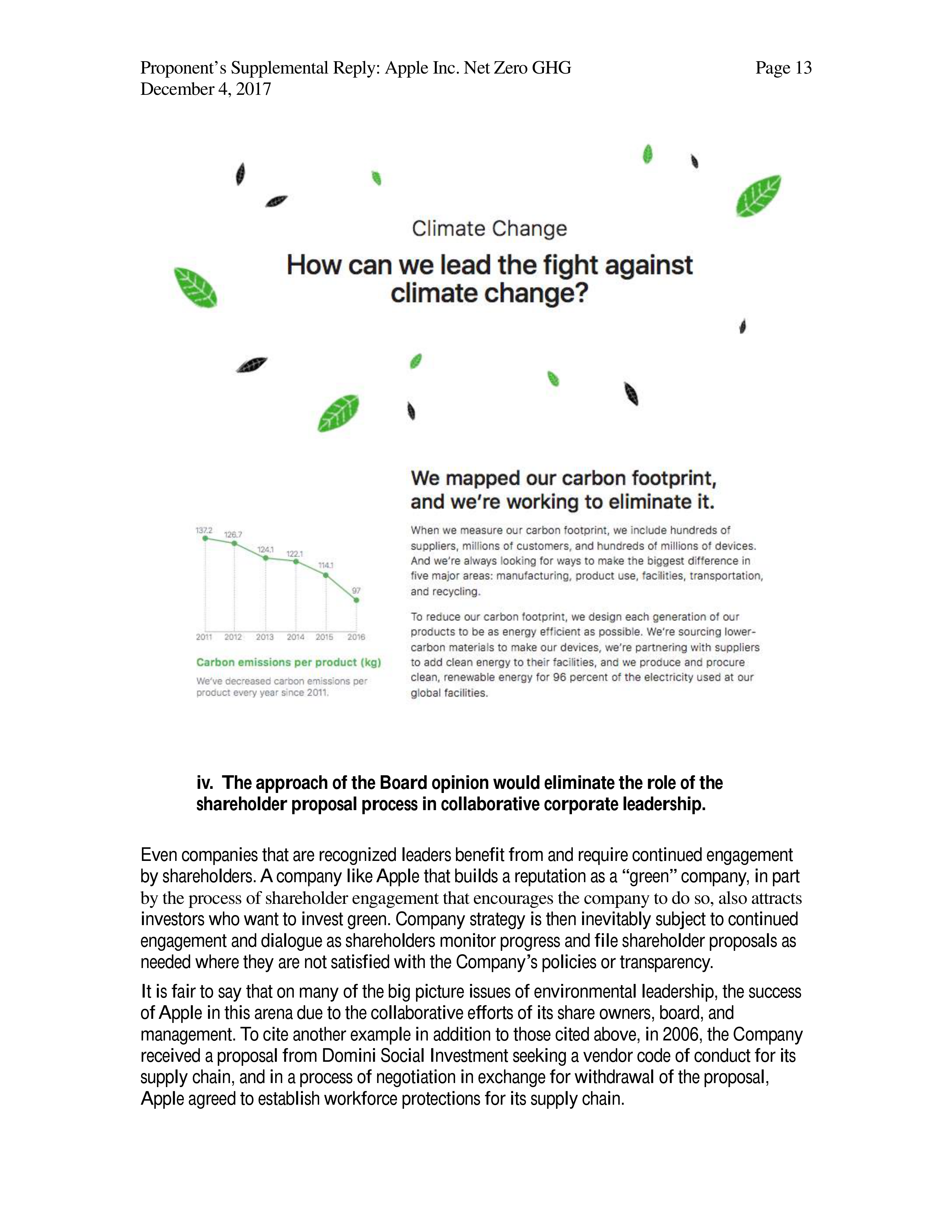
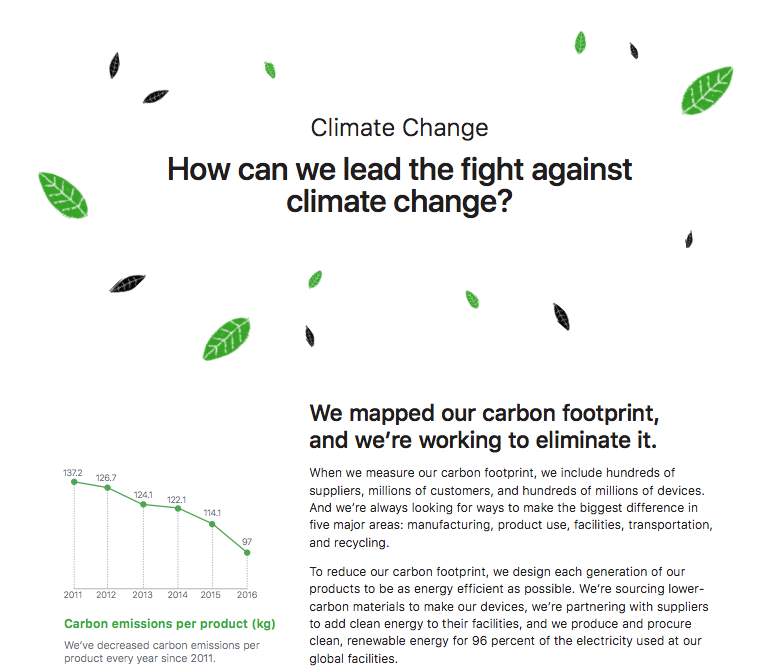
Visiting the Company website, we see that the company has gone out of its way to brand
itself as an environmental leader
–
including on the issue of climate change and eliminating
its carbon footprint:
19
Apple, eBay, GM, Intel Throw Weight Behind Climate Declaration,” BusinessGreen, Monday, March 3,
2014, greenbiz.com
20
“Apple to Wal-Mart, Big Biz is Betting on Green Energy (Op-Ed)”, Lynn Scarlett, The Nature
Conservancy, February 25, 2015.
21
“How Apple is moving its supply chain toward clean energy,” Heather Clancy, Thursday, June 29, 2017.
22
https://www.wearestillin.com/we-are-still-declaration.
23
“Is Apple More Responsible Than You?: Why You Want to Invest,” Stash, November 17, 2016.
http://learn.stashinvest.com/apple-do-the-right-thing-corporate-responsibility-charity
24
“Green Bonds: A Surging Market for Socially Responsible Investing,” ThinkAdvisor, June 13, 2016.
http://www.thinkadvisor.com/2016/06/13/green-bonds-a-surging-market-for-socially-responsi
Proponent’s Supplemental Reply: Apple Inc. Net Zero GHG
Page 13
December 4, 2017
iv. The approach of the Board opinion would eliminate the role of the
shareholder proposal process in collaborative corporate leadership.
Even companies that are recognized leaders benefit from and require continued engagement
by shareholders. A company like Apple that builds a reputation as a “green” company, in part
by the process of shareholder engagement that encourages the company to do so, also attracts
investors who want to invest green. Company strategy is then inevitably subject to continued
engagement and dialogue as shareholders monitor progress and file shareholder proposals as
needed where they are not satisfied with the Company’s policies or transparency.
It is fair to say that on many of the big picture issues of environmental leadership, the success
of Apple in this arena due to the collaborative efforts of its share owners, board, and
management. To cite another example in addition to those cited above, in 2006, the Company
received a proposal from Domini Social Investment seeking a vendor code of conduct for its
supply chain, and in a process of negotiation in
exchange for withdrawal of the proposal,
Apple agreed to establish workforce protections for its supply chain.
Proponent’s Supplemental Reply: Apple Inc. Net Zero GHG
Page 14
December 4, 2017
To conclude that these and many other collaborations between the management, board and
shareholders,
highly contingent on the availability of the shareholder proposal process
,
are no longer needed in advancing the best that Apple and other companies have to offer
would be a tragic mistake. It would undermine the rights of investors, relationships with
investors whose capital is backing the company and with whom the company has collaborated
for years, as well as undermining the prospects and reputation of the Company.
In some instances, companies engaging in “leading” disclosure sometimes fail to share
information that investors seek to form a complete picture of investment value and risk. This
was true, for instance, in the sustainability reporting proposal example cited above.
25
The Company Supplemental Letter concludes:
A wide range of environmental groups have praised Apple for its leadership in developing
and implementing innovative solutions to minimize waste and actually reduce greenhouse gas
emissions. Apple has set a goal to run 100% of its worldwide operations on renewable ene
rgy
and lead the way towards reducing carbon emissions from manufacturing
—
and it will do all
it can to reach that goal as quickly as possible.
While it is clear that the Company is a pacesetter on greenhouse gas reduction in the tech
sector, that does not mean that the pace the company is setting, and the signals it is sending to
its supply chain and its transparency on timelines for completion,
suffices to meet the global
urgency of greenhouse gas reduction. Continued leadership by the company may well prove
dependent on the shareholder proposal process, challenging the company to move beyond a
vague
commitment to eliminate its carbon footprint as soon as possible
and toward
transparency on a process of setting a specific timeframe reflective of the urgency and
feasibility of the task.
II. THE NEXUS OF THE SUBJECT MATTER OF THE PROPOSAL IS CLEAR
CUT.
A. Climate change and reducing greenhouse gases are a universal concern for
companies.
From an investor protection standpoint, climate change probably has a nexus to all companies
and every sector. As a global economic and environmental crisis, investors have a right and
need to ensure that all companies in their portfolio are doing their part to keep pace with the
demands for greenhouse gas reduction consistent with averting the worst possible global
25
To site a notorious example, Aetna, a major corporation in the health services industry, was considered a
leader in disclosing political contributions due to its adoption of disclosure policies advocated by
shareholders. Though the company disclosed thousands of dollars of contributions made to various
politicians, it had concealed much larger donations to PACs and Trade Associations; this lack of disclosure
of the “full picture” came out when Aetna accidentally revealed that the company had donated $4.05
million to the Chamber of Commerce - far more than the $100,000 in political contributions it had reported
- and $3 million to the conservative American Action Network in 2011. Aetna came under fire for its “dark
money” donations in national news (“dark money” groups are politically active nonprofits, “dark” in the
sense that they are able to shield the identity of their donors from public records), which may have had
reputational impacts. “Never Mind Super PACs: How Big Business Is Buying the Election”, Lee Fang,
Twitter, August 29, 2012. This led to a proposal at Aetna in 2013 seeking enhanced Board of Directors
oversight of the company's political contributions policy.
https://www.sec.gov/Archives/edgar/data/1122304/000130817913000167/laetna_def14a.htm
Proponent’s Supplemental Reply: Apple Inc. Net Zero GHG
Page 15
December 4, 2017
climate catastrophe. As documented in our prior letter, the Staff has never concluded, and
would be in error to conclude, that only “energy production and consumption” companies
have a nexus to proposals seeking reduction in greenhouse gases. In so doing, it seeks to
establish a very narrow approach to nexus in which only companies whose core business is in
energy, for instance, would be appropriate recipients of clean energy related proposals. This
would be a
radical
narrowing of prior Staff determinations. Quite to the contrary, and
consistent with investment community interest, proposals relating to greenhouse gas tracking
and reduction as well as regulatory and physical risks associated with climate change tend to
be among the key ESG performance indicators for most sectors. Many investment strategies
integrate obligations to monitor portfolio issues related to GHG’s
--
including the level of total
GHG emissions, risks to the company associated with GHG's including regulatory risk as well
as physical risks to property, and description of corporate strategies to reduce GHG’s.
The Company Supplemental Letter citations on nexus neglect numerous Staff decisions cited
in our first letter that have found climate change to be a significant policy issue with nexus to a
wide array of sectors. Moreover, the SEC's Climate Guidance (Release Nos. 339106; 34
61469; FR
-
82, 2010) made it clear that the costs associated with changing demands for
carbon reduction are widely relevant to many companies and sectors.
B. Apple has a particularly strong nexus to the issue due to its large greenhouse gas
footprint, as well as its commitment of brand and resources to finding solutions to
greenhouse gas emissions.
Apple, in particular, with emissions of 29.5 million metric tons of greenhouse gases, is a very
substantial contributor to the global climate crisis, and so eliminating those emissions on a
time limited basis has a clear nexus to the company. As noted above, this connection is even
stronger because the Company has placed itself out front on the issue with resources, brand,
and reputation.
According to the Company Supplemental Letter, the Proposal has merely an “incidental nexus
to the company” as a result of the Company’s “voluntary efforts” (commitments of strategy,
resources, brand,
and reputation) rather than as a result of its core business. The question
posed by the Proposal in relation to this leadership is not a trivial difference from company’s
current practice. It is precisely because the Company is a pacesetter, a self
-
described leader for
the tech sector on global greenhouse gas reduction, that the Proponent believes it is essential
for investors to consider the need for the carbon reduction efforts to include a target date.
The fact that the Company has positioned itself as a pacesetter for progress in this area does
not lessen investor interest in discussing important policy issues related to climate change, it
only heightens it. The Company’s substantial commitments of resources, leadership and
reputation cannot be ignored as demonstrating a strategic connection of the issue to the
26
company.
26
Yet, later in the Board opinion section, the Company Supplemental Letter seeks to establish that Apple's
environmental efforts are “integral.”
Proponent’s Supplemental Reply: Apple Inc. Net Zero GHG
Page 16
December 4, 2017
III. THE PROPOSAL DOES NOT ENGAGE IN MICROMANAGEMENT.
A. The Proposal’s request for a clearly scoped net zero GHG strategy and timeline is not
micromanagement.
The Company claims that carrying out the Proposal's requested action would divert limited
resources that are being deployed in existing efforts.
As we have explained previously, the Proposal’s proposed actions are intended to be additive
to the existing company efforts. It is not that the Company's existing actions are pointing in the
wrong direction, but rather that they have failed to set an estimated time of arrival, which the
proponent believes to be inconsistent with the tech sector's strategy for going something
within a fixed timeframe when it is viewed as a critical issue. So, the company's failure to
even attempt to set a timeline for getting to net zero is sending mixed signals to investors,
supply chain participants,
and policymakers
–
perhaps the Company views this as an
important issue but time is NOT of the essence?
As we noted in our prior letter, the courts have considered the question of broad differences
regarding the timing of a corporate response to a critical social issue, and concluded that when
investors seek a timeframe that is very different from the company’s, that is not
micromanagement. In
Roosevelt v. E.I. DuPont de Nemours & Company
, 958 F.2d 416 (D.C.
Cir. 1992), Judge Ruth Bader Ginsburg confirmed that :
“Timing questions no doubt reflect “significant policy” when large differences are at stake. That
would be the case, for example, if Du Pont projected a phase
-
out period extending into the new
century. On the other hand, were Roosevelt seeking to move up Du Pont’s target date by barely a
season, the matter would appear much more of an “ordinary” than an extraordinary business
judgment.”
B. Requesting a feasibility study is not micromanagement.
The Company Supplemental Letter also reasserts its idea that the work in preparing a report
assessing feasibility is virtually identical with preparing a detailed plan. To the contrary, a
feasibility study is a necessary first step in identifying whether a project is viable whatsoever,
and therefore whether the project can move forward to a stage in which the company would
then
develop a detailed plan. The initial expenditure of a feasibility study should be a
financially efficient review that will aid management in understanding the general scope of a
project and how it and the broader situational context may affect the company in the future,
thereby offering the company a first phase opportunity to identify whether a full
-
scale plan
would be possible and appropriate for the company.
According to Investopedia:
A feasibility study is an analysis of how successfully a project can be completed, accounting for
factors that affect it such as economic, technological, legal and scheduling factors. Project
managers use feasibility studies to determine potential positive and negative outcomes of a project
before investing a considerable amount of time and money into it.
Proponent’s Supplemental Reply: Apple Inc. Net Zero GHG
Page 17
December 4, 2017
A feasibility study tests the viability of an idea, a project or even a new business. The goal
of a feasibility study is to place emphasis on potential problems that could occur if a
project is pursued and determine if, after all significant factors are considered, the project
should be pursued. Feasibility studies also allow a business to address where and how it
will operate, potential obstacles, competition and the funding needed to get the business up
and running
.
27
In the present instance, there are various possible approaches to a feasibility assessment. The
Company might,
for instance, develop a set of categories of its suppliers and evaluate a set of
assumptions regarding energy consumption and GHG emissions associated with those
categories, and model or test assumptions regarding a small portion of suppliers within those
categories. In contrast to a “plan,” it does not entail studying or testing the approach for every
supplier.
Such a feasibility process would also provide the opportunity to identify whether it is likely,
given the range of operations in its supply chain,
that the company can eliminate its carbon
footprint with its existing strategies, or whether other strategies such as negative emissions
strategies would also need to be deployed.
Another approach could be for the Board of Directors to substantially implement the Proposal
itself
–
to provide transparency to investors on its own deliberations and assessments and to
issue a report that explains how and why the board has concluded it is not feasible or
appropriate to set a target date for eliminating the firm’s carbon footprint. Notably, the Board
of Directors has
not done so but instead merely stated that it has considered the facts and
circumstances related to such a question
.
28
C.
Focus on supply
-
chain is not micromanagement.
The Company asserts that its circumstances are different than those of companies receiving
other net zero GHG proposals where the Staff found nexus and no excludability
–
PayPal
and
TJX. In those instances, the proposals did not require a focus on suppliers. The present
Proposal requires addressing greenhouse gas emissions of Apple’s supply chain. Many
proposals addressing supply chain relations on significant policy issues have been found not
excludible under Rule 14a
-
8(i)(7). Apple is already effectively operating at this scale
including with regards to interacting with its suppliers on energy issues and the proposal does
not attempt to micromanage those relationships. Moreover, numerous proposals at Apple and
elsewhere focusing on a significant policy issue related to supply chain relations and
management have demonstrated that a focus on the supply chain does not constitute
micromanagement. See, for instance,
Fossil, Inc.
(March 5, 2012).
Asking the company to explore setting a timeframe for completion of its carbon footprint
elimination project
--
even in relation to its supply chain
--
is not micromanagement. It is in
fact the opposite
–
a question of policy or macro
-
management. Is the company is
27
https://www.investopedia.com/terms/f/feasibility-study.asp#ixzz506siPMTQ
28
See discussion above regarding the board and “substantial implementation.”
Proponent’s Supplemental Reply: Apple Inc. Net Zero GHG
Page 18
December 4, 2017
communicating and working with its supply chain in a manner that treats the urgency of
greenhouse gas reduction as a moonshot with a specific timeline for completion? As a policy
proposal that allows shareholders to debate a major point of contention between investors and
the board, this is not micromanagement. It is precisely the type of shareholder proposal that
transcends ordinary business because it seeks to bring investors into the debate regarding
corporate vision and strategy associated with a significant societal debate.
CONCLUSION
Based on the foregoing and our prior correspondence, we believe it is very clear that neither
Apple management nor its Board have provided any basis for the conclusion that the Proposal
is excludable from the 2018 proxy statement pursuant to Rule 14a
-
8. As such, we respectfully
request that the Staff inform the company that it is denying the no action letter request. If you
have any questions, please contact me at 413 549
-
7333 or sanfordlewis@strategiccounsel.net.
Sanford Lewis
cc:
Sincerely,
Christine Jantz
Gene D. Levoff
Apple Board of Directors
Arthur D. Levinson, Ph. D
James A. Bell
Tim Cook, CEO
Albert Gore Jr.
Robert A. Iger
Andrea Jung
Ronald D. Sugar, Ph. D
Susan L. Wagner

Rule 14a-8(i)(7)
Rule 14a-8(i)(10)
November 20, 2017
VIA E-MAIL (
shareholderproposals@sec.gov
)
Office of Chief Counsel
Division of Corporation Finance
U.S. Securities and Exchange Commission
100 F Street, NE
Washington, DC 20549
Re:
Apple Inc.
Shareholder Proposal of Jantz Management LLC on behalf of Christine Jantz
Dear Ladies and Gentlemen:
I am writing on behalf of Apple Inc. to respond to Sanford Lewis’s letter to the staff
dated October 31, 2017 (the “
Response Letter
”), objecting to the Company’s intention to omit
from its 2018 Proxy Materials the Proposal, which requests that the Company “prepare a report
to shareholders by December 31, 2018 that evaluates the potential for the Company to achieve,
by a fixed date, “net-zero” emissions of greenhouse gases relative to operations directly owned
by the Company and major suppliers.” The bases on which the Company intends to omit the
Proposal are set forth in my letter to the staff dated October 9, 2017 (the “
Initial Letter
”).
I am also supplementing the Initial Letter to provide the staff with additional information
based on the new guidance in Staff Legal Bulletin No. 14I (November 1, 2017) (“
SLB No. 14I
”).
For ease of reference, capitalized terms used in this letter have the same meaning ascribed to
them in the Initial Letter.
I. The Proposal
’s Incidental Nexus to the Company Arises from the Company’s Voluntary
Efforts
As noted in the Initial Letter, the Company designs, manufactures and markets mobile
communication and media devices, personal computers and portable digital music players, and
sells a variety of related software, services, accessories, networking solutions and third-party
digital content and applications. Accordingly, energy production and consumption are not the
core of the Company’s business, as they are at companies engaged primarily in the energy
business, and therefore staff letters concluding that climate change and greenhouse gas
related proposals raise a significant policy issue for such a company are inapposite to the
Company.
See DTE Energy Co.
(January 26, 2015);
Devon Energy Corp.
(March 19, 2014);
and
Apple
1 Infinite Loop
Cupertino, CA 95014
T 408 996-1010
F 408 996-0275
www.apple.com
Office of Chief Counsel
Division of Corporation Finance
U.S. Securities and Exchange Commission
November 20, 2017
Page 2
Exxon Mobil Corporation
(March 23, 2007)
.
Environmental considerations play an important
role in the Company’s ordinary business operations not because they are inherently related to
its business or because of applicable environmental or industry regulations, but because of the
Company’s independent goal of minimizing the environmental impact of its business.
The Response Letter argues that the Company itself created a nexus between the
Company and climate change by including on its website disclosure of the Company’s
voluntary efforts to reduce its carbon footprint and its aspirations to reduce the greenhouse gas
emissions of its suppliers. The Proponent appears to argue that, by undertaking to make a
significant commitment to the environment for the benefit of all people, reporting on the
progress of its efforts and expressing a desire to achieve specific goals for reducing its and its
suppliers
’
greenhouse gas emissions, the Company has created a nexus between its operations
and an international effort to achieve the U.N. Climate Change Conference’s goal of limiting
climate change to an average global warming of 2 degrees Celsius above pre-industrial
temperatures by 2050. A company’s voluntary efforts on a societal issue do not, however,
make the societal issue core to the company’s business or otherwise create a nexus between
the company and a proposal that seeks to address the same issue. Any other conclusion
ignores the meaning of a company’s “business” and would discourage companies from seeking
solutions to societal problems that affect the world at large.
II. The Proposal Seeks to Micromanage the Company by Imposing Quantitative Goals
The Proponent argues that the Proposal is substantively different from the proposal it
submitted last year, which the staff agreed was excludable under Rule 14a-8(i)(7), because the
Proposal does not request that the Company generate a feasible plan for the Company and its
major suppliers to achieve net-zero emissions by 2030, and instead asks the Company to
assess the feasibility of implementing a plan for the Company and its major suppliers to achieve
net-zero emissions by a date to be specified by the Company.
1
The Proponent acknowledges
that “there might be a logical basis for saying that a look at feasibility is a necessary
precondition for preparing a plan to achieve GHG reduction,” but contends that, in fact, “[t]here
is a significant difference between preparing a detailed plan, and making a preliminary
assessment as to whether such a course of action is feasible.” Aside from the fact that the
Proposal requests a report on feasibility, not a “preliminary assessment,” the fact remains that
the Company cannot accurately assess the feasibility of achieving the specific quantitative goal
of net zero greenhouse gas emissions without first developing a sufficiently detailed
technological plan to allow for such a determination. Whether the Company is directly called
upon to generate a feasible plan or “explor[e] a feasible strategy,” the Company must develop
a plan.
The Proposal does not any less micromanage the Company by having the Company,
rather than the Proponent, fix the deadline for achieving the net-zero goal. The dictated goal of
1
The proposal submitted to the Company by the Proponent last year read, “Resolved: Shareholders request that the Board of
Directors generate a feasible plan for the Company to reach a net-zero GHG [defined as greenhouse gas] emission status by the
year 2030 for all aspects of the business which are directly owned by the Company and major suppliers, including but not limited to
manufacturing and distribution, research facilities, corporate offices, and employee travel, and to report the plan to shareholders at
reasonable expense, excluding confidential information, by one year from the 2017 annual meeting.”
Office of Chief Counsel
Division of Corporation Finance
U.S. Securities and Exchange Commission
November 20, 2017
Page 3
net-zero with respect to the Company and its major suppliers is the crux of the Proposal.
Calling on the Company to develop the plan, but offering flexibility on the date by which the
goal must be achieved, does little to lessen the Proposal’s specific directive. The actions and
analysis required for the Company to develop that plan are substantially the same as those the
Company and its major suppliers would have had to undertake in response to last year’s
proposal.
The Proposal requires the Company to undertake far more expensive and complex
analyses than the net-zero greenhouse gas emissions proposals submitted to TJX, Inc. and
PayPal Holdings, Inc.
See TJX, Inc.
(March 13, 2017) (disagreeing with exclusion of proposal
seeking a report on the achievability of net-zero greenhouse emissions for company’s
operations); and
PayPal Holdings, Inc.
(March 13, 2017) (same). Unlike the Proposal, the
proposals submitted to TJX and PayPal did not require the company to analyze and reform the
greenhouse gas policies of its suppliers. The Company’s reliance on hundreds of suppliers and
manufacturing partners around the world significantly increases the complexity and level of
micromanagement that would be involved in developing the plan required by the Proposal,
which requires that emissions attributable to major suppliers also be considered in assessing
the feasibility of achieving net-zero emissions. TJX, an operator of retail stores and websites,
and PayPal, a payment processing company, are engaged in only a subset of the ongoing
operations of the Company’s varied businesses, which include, among others, operating retail
stores and websites and payment processing. As a result, developing a plan to achieve net-
zero greenhouse gas emissions for the Company, on a standalone basis, would be a much more
significant undertaking than developing a plan for either of those companies. The Proposal
goes far beyond what was proposed for TJX and PayPal, however, and asks for a plan that
covers all of the Company’s various businesses plus those of its major suppliers around the
world. The additional complexity and micro-management imposed by the Proposal, relative to
the proposals submitted to TJX and PayPal, Inc., is not lessened by directing the Company to
set the plan’s deadline.
The Proposal is again calling for the Company to “set[] a target date and explor[e] a
feasible strategy to make it happen.” While the Proponent characterizes the Proposal as “a
broad brush policy proposal,” in fact the Proposal seeks to micro-manage Apple by displacing
management’s choices regarding how best to mitigate the environmental impact of its
business. Apple’s environmental efforts seek to
reduce
its environmental impact. Rather than
focusing on efforts that yield improvements in efficiency and reductions in the Company’s
environmental impact, the Proponent urges that those efforts be redirected in favor of
purchasing carbon offsets and “tree planting,” neither of which would reduce Apple’s actual
level of greenhouse gas emissions. The Proposal does not disagree with Apple’s objective of
minimizing the environmental impact of its business; instead, the Proposal, but not the
Response Letter, disagrees with Apple’s choices in seeking to achieve that objective. The
Company’s approach to greenhouse gas emissions has been applauded by numerous
environmental groups, including Greenpeace, Ceres, Advanced Energy Economy, and the
Climate Group’s RE100 initiative
2
as representing concrete efforts to drive Apple’s
2
http://www.greenpeace.org/usa/news/greenpeace-welcomes-apples-renewable-energy-commitment-to-manufacturing-
partners-in-china/
Office of Chief Counsel
Division of Corporation Finance
U.S. Securities and Exchange Commission
November 20, 2017
Page 4
manufacturing base (including its suppliers) to a low-carbon future. The Company agrees with
the Response Letter that “Plan A must be to reduce GHG emissions aggressively now.”
Although the Company has significant resources, both its financial resources and
management’s time are necessarily limited. Company funds and management time spent
pursuing the Proponent’s preferred approach represent funds and management time that are
diverted from the Company’s pursuit of its chosen approach to greenhouse gas emissions.
Diverting limited resources to pursue an alternative plan would only make the likelihood of
success of “Plan A” more remote.
The specific and detailed choices a company makes to implement a significant policy,
such as reducing the environmental impact of its business, are exactly the types of day-to-day
operational decisions that the 1998 Release recognized as too impractical and complex to
subject to direct shareholder oversight.
III. The Proposal Relates to Matters of the Company
’s Ordinary Business
A. Background
As noted in the Initial Letter, Release No. 34-40018 (May 21, 1998) explains that a
proposal that raises matters that are “so fundamental to management’s ability to run a
company on a day-to-day basis that they could not, as a practical matter, be subject to direct
shareholder oversight” may be excluded unless the proposal raises policy issues that are
sufficiently significant to transcend day-to-day business matters. The applicability of the
significant policy exception “depends, in part, on the connection between the significant policy
issue and the company’s business operations.” On November 1, 2017, the Staff published SLB
No. 14I, which announced new staff policy regarding the application of Rule 14a-8(i)(7). The
staff stated in SLB No. 14I that whether a policy issue is of sufficient significance to a particular
company to warrant exclusion of a proposal that touches upon that issue may involve a
“difficult judgment call” which the company’s board of directors “is generally in a better
position to determine,” at least in the first instance. A well-informed board, the staff said,
exercising its fiduciary duty to oversee management and the strategic direction of the
company, “is well situated to analyze, determine and explain whether a particular issue is
sufficiently significant because the matter transcends ordinary business and would be
appropriate for a shareholder vote.”
Where the board concludes that the proposal does not transcend the company’s
ordinary business operations, the staff said, the company’s letter notifying the staff of the
company’s intention to exclude the proposal should set forth the board’s analysis of “the
particular policy issue raised and its significance” and describe the “processes employed by
the board to ensure that its conclusions are well-informed and well-reasoned.” Consistent with
the staff’s guidance, the discussion below reflects the analysis of the Company’s board of
https://www.ceres.org/annual-report/2016/progress/global-momentum-climate-change
http://www.computerworld.com/article/3122461/sustainable-it/apple-commits-to-run-off-100-renewable-energy.html
https://twitter.com/theRE100/status/777921949276246018
Office of Chief Counsel
Division of Corporation Finance
U.S. Securities and Exchange Commission
November 20, 2017
Page 5
directors (the “
Board
”) as well as management’s and includes a description of the Board’s
processes in conducting its analysis.
B. Application of the Exclusion
The Proposal requests that the Company develop a plan to and report on the
achievability of net-zero greenhouse gas emissions by the Company and its major suppliers by
a fixed deadline.
The Company is paving the way toward a more sustainable future. Environmental
stewardship is of paramount importance to the Company, which is committed to using the
same innovative approach to the environment as it does with its products. As detailed in the
Initial Letter and in the Company’s 2017 Environmental Responsibility Report, the Company has
committed to a variety of environmental efforts to, among other things, reduce its carbon
footprint, switch to greener materials to create safer products and manufacturing processes,
and protect natural resources.
Further, as detailed in the Company’s 2017 Supplier
Responsibility Progress Report, the Company works to drive improved standards throughout its
supply chain. As part of this effort, the Company engages suppliers to reduce the
environmental impact of their operations and is working with multiple major suppliers to help
them transition to renewable energy use. To date, 14 major suppliers have committed to power
their Apple production entirely with renewable energy by the end of 2019. Other partners
across its supply chain are also installing or investing in sizable solar projects, running their
factories on wind power, and purchasing clean energy from reputable utility programs.
The Company has a dedicated Vice President for Environment, Policy, and Social
Initiatives, who reports directly to the CEO. The Vice President drives the Company’s work to
reduce its impact on climate change by using renewable energy sources and driving energy
efficiency in its products and facilities. The Company focuses on conserving precious resources
and recently announced a goal to use only renewable or recycled materials in its products. The
Company is also committed to using safer materials in its products and processes. The Vice
President of Environment, Policy and Social Initiatives also drives the Company’s work to make
high-quality education more available to young people of diverse economic backgrounds, and
to make high-technology products more accessible to people with disabilities. The Vice
President also leads the Company’s advocacy for government policies that protect individual
privacy and civil rights. Appointing senior management to lead these initiatives and report
directly to the CEO demonstrates that the issues are key concerns of management and are
deeply embedded in the Company’s day-to-day operations.
The Board and management are committed to minimizing the environmental impact of
the Company’s business, as evidenced by the Company’s deep and longstanding commitment
to safeguarding the environment. The Company’s policies, practices and deliberations
regarding all aspects of the Company’s business incorporate an in-depth review of the
environmental impact of the Company’s policies, practices and operations. Therefore, the
Proposal’s request that the Company develop and report on the achievability of a plan for the
Company and its major suppliers to achieve net-zero greenhouse gas emissions is merely a
variant of what the Company’s management and the Board already do. Accordingly, the Board
Office of Chief Counsel
Division of Corporation Finance
U.S. Securities and Exchange Commission
November 20, 2017
Page 6
has analyzed the Proposal, considered its impact on the business and operations of the
Company, and determined that the issues presented by the Proposal do not transcend the
Company’s ordinary business operations and therefore do not warrant a shareholder vote at the
2018 Annual Meeting of Shareholders.
C. Board Process
The Board is regularly updated on the Company’s business operations, including the
Company’s efforts to make substantial progress on its environmental and sustainability goals.
In reviewing the Proposal, the Board participated in a discussion with the Company’s Vice
President of Environment, Policy and Social Initiatives and other members of senior
management. The discussion included information prepared by management about the
Proposal and its policy implications and a review of the Company’s efforts with respect to
climate change and greenhouse gas emissions reductions. The Board reviewed the Company’s
ongoing and planned environmental initiatives, including the Company’s strategy to transition
to powering its operations and those of its supply chain entirely with renewable energy. This
included a review of written materials, including the Company
’
s 2017 Environmental
Responsibility Progress Report. It also included a discussion of the specific issues raised by the
Proposal and whether it is advisable to develop a plan to and report on the achievability of net-
zero greenhouse gas emissions by the Company and its major suppliers by a fixed deadline in
light of the Company’s well-documented commitment to environmental stewardship.
After participating in these discussions and reviewing the written materials, the Board
came to a consensus that it had received sufficient information from management to make an
informed decision about whether the Proposal raises a significant policy issue that transcends
the Company’s ordinary business. The Board recognized that it had already considered the
issues raised by the Proposal when setting the strategic direction of the Company and
performing its duties as a Board. Moreover, the Board determined that the Company’s ongoing
practices and policies to minimize the businesses environmental impact, as well as the
Company’s ongoing disclosures related thereto, make these matters an integral part of the
ordinary business operations of the Company, and the issues presented in the Proposal as a
whole fit squarely within the Company’s ordinary business mission to mitigate its environmental
impacts with practices and policies that address energy sources, energy efficiency, resource
conservation, and materials safety. The Board determined that the Company’s strategy of
reducing greenhouse gas emissions is a key component of the environmental strategy that is
part of its ordinary business operations. The Board also considered the Company’s existing
policies, practices, and disclosures and concluded that the Proposal, even if submitted to
shareholders and approved, would not call for the Company to consider facts, issues or policies
that the Company does not regularly consider in the course of its day-to-day operations, other
than as described in the Initial Letter, and therefore does not transcend the Company’s ordinary
business. The Board considered the fact that it, along with management, is regularly and
actively involved in the consideration, oversight and re-assessment of the Company’s
environmental policies and practices.
Based on the foregoing, the Board concluded that the Proposal does not transcend the
Company’s ordinary business or its day-to-day operations. Accordingly, while the Board is
___________________________________________________
SANFORD J. LEWIS, ATTORNEY
October 31, 2017
Via electronic mail
Office of Chief Counsel
Division of Corporation Finance
U.S. Securities and Exchange Commission
100 F Street, N.E.
Washington, D.C. 20549
Re:
Shareholder Proposal to Apple Inc. Regarding Climate Change by Jantz
Management LLC on behalf of Christine Jantz
Ladies and Gentlemen:
Christine Jantz (the “Proponent”) is beneficial owner of common stock of Apple
Inc. (the “Company”) and has submitted a shareholder proposal (the “Proposal”) to the
Company. I have been asked by the Proponent to respond to the letter dated October 9,
2017 ("Company Letter") sent to the Securities and Exchange Commission by Gene D.
Levoff, Associate General Counsel. In that letter, the Company contends that the Proposal
may be excluded from the Company’s 2018
proxy statement by virtue of Rule 14a-8(i)(7)
and Rule 14a-8(i)(10).
I have reviewed the Proposal, as well as the Company Letter, and based upon the
foregoing, as well as the relevant rules, it is my opinion that the Proposal must be
included in the Company’s 2018 proxy materials and that it is not excludable by virtue of
those rules. A copy of this letter is being emailed concurrently to Gene D. Levoff.
SUMMARY
The Proposal asks the Board of Directors to prepare a report to shareholders to
evaluate the potential for the Company to achieve net zero emissions of greenhouse gases
by a fixed date. This request is grounded in the global scientific understanding that
greenhouse gas (GHG) reduction requires a dramatic scaling up from current efforts. The
Proposal requests that the Company evaluate a strategy to move beyond its current efforts
and goals to determine whether it is possible to establish a timeframe for effectively
eliminating GHG emissions all aspects of the business which are directly owned by the
Company and major suppliers.
Company efforts on energy efficiency and renewable energy are laudable, and the
Proposal asks the Company to take the next logical step, which the Proponent believes is
to set a goal and timeframe to eliminate the Company’s carbon footprint. This challenges
the Company to exercise leadership in alignment with the global COP21 challenge, on a
timeline consistent with global climate goals.
PO Box 231 Amherst, MA 01004-0231 • sanfordlewis@strategiccounsel.net • (413) 549-7333
Proponent Reply: Apple Inc. Net Zero GHG
Page 2
October 31, 2017
The Company asserts that the Proposal is excludable pursuant to Rule 14a-8(i)(7) as
relating to ordinary business, but the Proposal is focused exclusively on the significant
policy issue of climate change. The Company has made the issue of reducing climate
change impacts a high-profile focus, establishing clear nexus. While the proponent’s
proposal submitted to the Company last year sought a plan to attain net zero GHG by
2030, and was found by the Staff to be excludable as micromanagement under Rule 14a
8(i)(7), the Proposal was revised prior to resubmitting for consistency with other
proposals found by Staff to not micromanage: requesting a report assessing the feasibility
of achieving net zero GHG by a fixed date. Thus, the Proposal addresses a significant
policy issue with a nexus to the company and does not micromanage, and is therefore not
excludable pursuant to Rule 14a-8(i)(7).
In addition, the Company asserts that it has already substantially implemented the
Proposal, rendering it excludable under Rule 14a-8(i)(10). The essential purpose of the
Proposal, entirely unfulfilled, is for the Company to report on the potential to achieve net
zero emissions by a fixed date. While the Company's many activities and commitments
are commendable, the Company has issued no publication that assesses a GHG reduction
effort setting a fixed date for GHG reduction fully scaled to the entirety of Apple’s GHG
generation through its operations and those of its major suppliers. The Company's current
efforts involve an effort to reduce its current carbon footprint for activities covered by the
Proposal by approximately 20.8%.
THE PROPOSAL
The Proposal (included in its entirety as Appendix 1) states:
Resolved: Shareholders request that the Board of Directors to prepare a
report to shareholders by December 31, 2019 that evaluates the potential
for the Company to achieve, by a fixed date, "net-zero" emissions of
greenhouse gases relative to operations directly owned by the Company
and major suppliers. The report should be done at reasonable expense and
may exclude confidential information.
BACKGROUND
Greenhouse gas emissions from human activities are the most significant driver of
observed climate change since the mid-20th century. Not only is climate change
happening, but year-by-year the weather is becoming more extreme. The pace at which
climate change is happening is indicative of a global climate emergency. In 2015, 196
parties at the U.N. Climate Change Conference (COP21) agreed to limit climate change to
an average global warming of 2 degrees Celsius above pre-industrial temperatures by
2050, with a further goal of limiting it to 1.5 degrees Celsius. Both of these ambitious
goals are considered critical to heading off the most catastrophic effects of climate change
and are inconsistent with projected growth in GHGs in the absence of effective
intervention.
Proponent Reply: Apple Inc. Net Zero GHG
Page 3
October 31, 2017
So far, most governments are far from adopting the regulatory actions at the pace
needed to meet the 2050 goals. Following President Trump’s withdrawal from the Paris
Agreement on June 1st of this year, the Secretary-General of the United Nations, António
Guterres, expressed “confidence that cities, states and businesses within the United States
— along with other countries — will continue to demonstrate vision and leadership by
working for the low-carbon, resilient economic growth that will create quality jobs and
markets for 21st century prosperity.”
1
This leaves it incumbent upon individuals and
companies – investors, corporations, and civil society together – to do what they can to
advance these goals. Given the role of technology in addressing the climate crisis, the
Proponent believes that it may fall upon technology leaders like Apple to lead the way.
We appreciate Apple joining the “We Are Still In” initiative “pledg[ing] to support
the Paris accord and ‘pursue ambitious climate goals,’ according to an open letter the
campaign released.”
2
“We Are Still In is the broadest cross-section of the U.S. economy
ever assembled in pursuit of climate action. Over 2,300 leaders strong and growing, We
Are Still In shows the world that leaders from across America’s state houses, city halls,
board rooms, and college campuses stand by the Paris Agreement and are committed to
meeting its goals.”
3
The 2050 COP21 goals are ambitious and will require the unleashing of
extraordinary technological intelligence and leadership. To be a leader in helping the
world meet those stringent goals of 2050 means that scaled action must be put into effect
much earlier, creating models that can be replicated at needed scale worldwide.
Leadership
requires a focus on nearer term goals and timelines. For instance, Norway is
aiming for net zero by 2030: "Norway's parliament has agreed on a goal to cut the
country's net greenhouse gas emissions to zero by 2030, moving the target forward by 20
years, an official at the national assembly said on Tuesday."
4
And, Sweden has legally
committed to reaching net-zero emissions by 2045.”
5
Shareholders laud Apple for committing to “. . . power[ing] all its operations
worldwide on 100 percent renewable energy,” and for joining the American Business Act
on Climate Pledge. However, these goals do not include suppliers and manufacturing, nor
has the Company set a timeframe for this goal.
77% of the Company’s 29.5 million metric tons of GHG emissions come from
manufacturing including supply chain manufacturers
.
To secure the company's
leadership on climate issues, the Proposal calls for the Company to explore whether it can
set a target date for achieving net-zero GHG emissions
6
including from the major supply
chain manufacturers.
1
https://www.nytimes.com/2017/06/01/world/europe/climate-paris-agreement-trump-china.html
2
http://www.chicagotribune.com/news/nationworld/ct-paris-climate-agreement-tech-companies-20170605-story.html
3
https://www.wearestillin.com/us-action-climate-change-irreversible
4
(http://www.reuters.com/article/us-norway-climatechange-idUSKCN0YT1KM)
5
https://qz.com/1007833/swedens-climate-act-legally-commits-the-country-to-reach-net-zero-emissions-by-2045/
6
https://images.apple.com/environment/pdf/Apple_Environmental_Responsibility_Report_2017.pdf
Proponent Reply: Apple Inc. Net Zero GHG
Page 4
October 31, 2017
In sum, the approach taken by the Proposal is to encourage Apple to consider a
next big step on leadership in this area --
net zero GHGs for its production chain -
securing its global profile and reputation as a sustainability leader.
ANALYSIS
I.
The Proposal is not excludable under Rule 14a-8(i)(7) because it addresses a
significant policy issue with a nexus to the Company and does not micromanage.
As the Company letter notes:
The Commission has stated that “proposals relating to [ordinary business] matters
but focusing on sufficiently significant policy issues . . . generally would not be
considered to be excludable.”
7
Staff Legal Bulletin No. 14E (October 27, 2009)
noted that, “On those cases in which a proposal's underlying subject matter
transcends the day-to-day business matters of the company and raises policy
issues so significant that it would be appropriate for a shareholder vote, the
proposal generally will not be excludable under Rule 14-a8(i)(7) as long as a
sufficient nexus exists between the nature of the proposal and the company.”
Staff Legal Bulletin 14H published in 2015 added that “a proposal may transcend
a company’s ordinary business operations even if the significant policy issue relates to
the “nitty-gritty of its core business.” Therefore, proposals that focus on a significant
policy issue transcend a company’s ordinary business operations and are not excludable
under Rule 14a-8(i)(7).”
Once a significant policy issue is identified and nexus is found, the only further
ordinary business question is whether the Proposal micromanages the Company. In the
present instance, the Proposal clearly addresses the significant policy issue of climate
change, has a clear connection to the Company's business activities, and the Proposal
does not micromanage the Company in asking the company to explore scaling up its
GHG reduction to the full magnitude of the Company’s greenhouse gas generation.
A. The Proposal addresses a significant policy issue.
The Proposal is not excludable under Rule 14a-8(i)(7) because it directly focuses
on a significant policy issue facing the Company: rapidly escalating global needs to
eliminate greenhouse gas emissions in order to head off catastrophic climate change.
Prior Staff determinations have settled the question of whether matters pertaining
to climate change and greenhouse gas emissions transcend ordinary business. See, e.g.,
DTE Energy Company
(January 26, 2015),
J.B. Hunt Transport Services, Inc.
(January
12, 2015)
, FirstEnergy Corp.
(March 4, 2015) (proposals not excludable as ordinary
business because they focused on reducing greenhouse gas emissions GHG and did not
seek to micromanage the company);
Dominion Resources
(February 27, 2014),
Devon
Energy Corp.
(March 19, 2014),
PNC Financial Services Group, Inc.
(February 13,
7
1998 Release.
Proponent Reply: Apple Inc. Net Zero GHG
Page 5
October 31, 2017
2013),
Goldman Sachs Group, Inc.
(February 7, 2011) (proposals not excludable as
ordinary business because they focused on significant policy issue of climate change)
;
NRG Inc
. (March 12, 2009) (proposal seeking carbon principles report not excludable as
ordinary business);
Exxon Mobil Corp.
(March 23, 2007) (proposal asking board to adopt
quantitative goals to reduce GHG emissions from the company’s products and operations
not excludable as ordinary business);
Exxon Mobil Corp.
(March 12, 2007) (proposal
asking board to adopt policy significantly increasing renewable energy sourcing globally
not excludable as ordinary business);
General Electric Co.
(January 31, 2007) (proposal
asking board to prepare a global warming report not excludable as ordinary business).
B. The subject matter of the Proposal has a clear nexus to the Company.
The Company Letter asserts that there is a lack of nexus between the Company
and the subject matter of the Proposal:
While the Proposal does invoke a significant policy issue, as was the case in
Apple 2016,
there is only an incidental nexus between the Proposal and the
Company's business, which is not enough to overcome the significant level of
micro-management of the Company's business the Proposal would entail.
However, the Staff decision in
Apple Inc.
(October 29, 2014) has already
established that proposals focused on climate change and energy sources (renewable
energy) have a nexus to the Company. In that instance, the proposal focused on the
Company's increasing utilization of renewable energy sources and related risks.
As a leading technology company, the Proponent believes Apple should be a
global role model and leader in illustrating how carbon reduction consistent with the
demands posed by COP 21 can be accomplished. The Company is a large consumer of
energy and therefore a large generator of GHG emissions. Its own publications on its
website prominently document the magnitude of its GHG emissions and its challenges
and efforts to attempt to address the issue. The Company’s own website documents that
climate change is a large policy problem that it must confront.
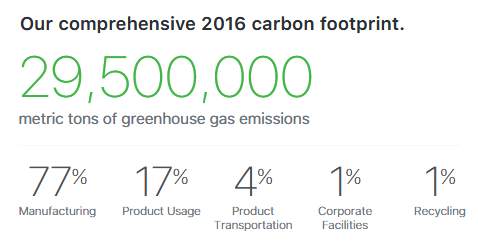

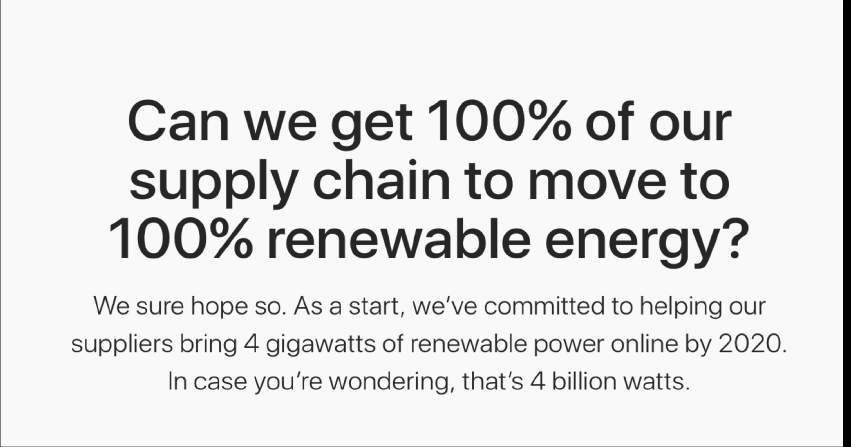
Proponent Reply: Apple Inc. Net Zero GHG
Page 6
October 31, 2017
FROM APPLE WEBSITE:
From Apple.com, accessed October 19, 2017.
https://www.apple.com/environment/
The Apple website also expresses wishful thinking about progress in renewable
energy in its supply chain. The site states " Can we get 100% of our supply chain to move
to 100% renewable energy? We sure hope so."
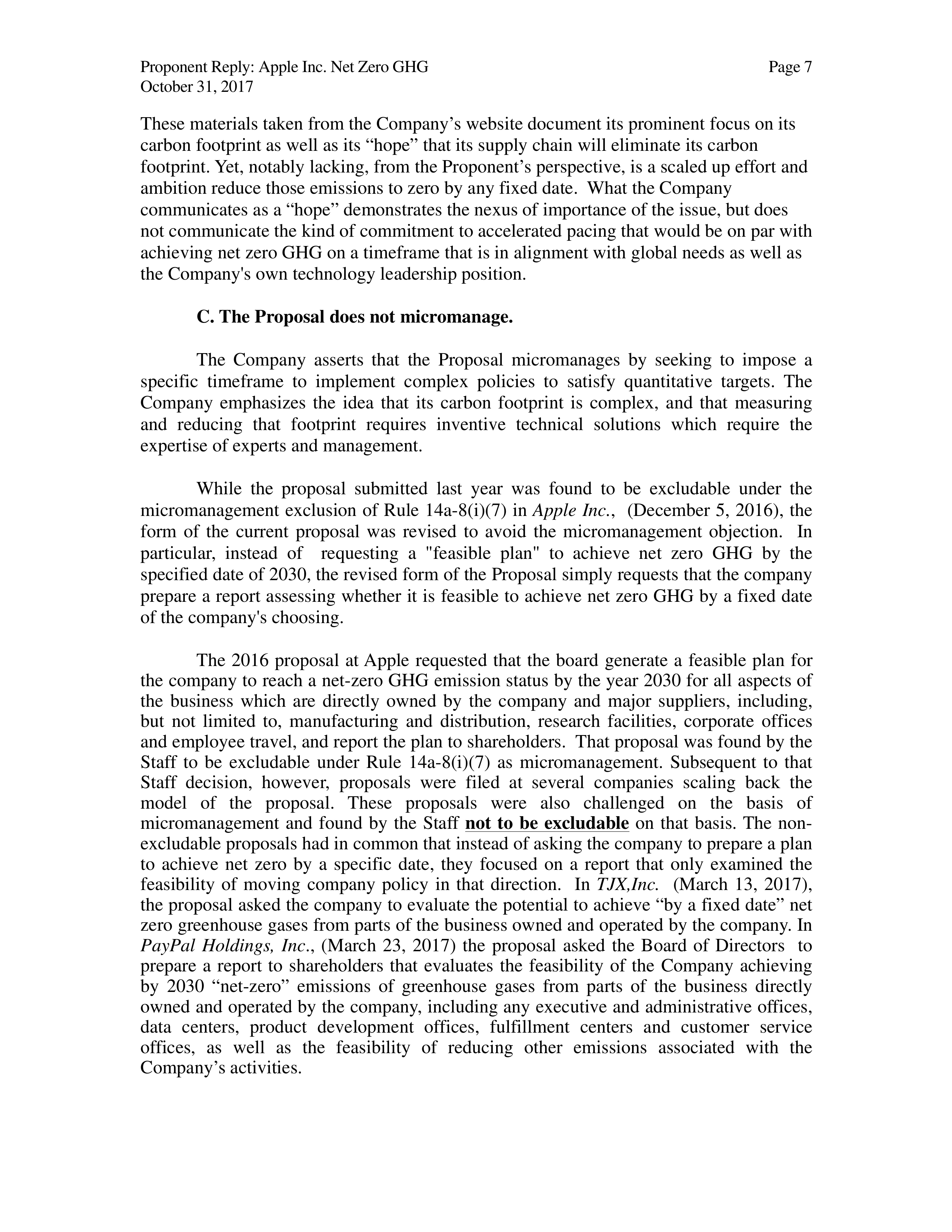
Proponent Reply: Apple Inc. Net Zero GHG
Page 7
October 31, 2017
These materials taken from the Company’s website document its prominent focus on its
carbon footprint as well as its “hope” that its supply chain will eliminate its carbon
footprint.
Yet, notably lacking, from the Proponent’s perspective, is a scaled up effort and
ambition reduce those emissions to zero by any fixed date. What the Company
communicates as a “hope” demonstrates the nexus of importance of the issue, but does
not communicate the kind of commitment to accelerated pacing that would be on par with
achieving net zero GHG on a timeframe that is in alignment with global needs as well as
the Company's own technology leadership position.
C. The Proposal does not micromanage.
The Company asserts that the Proposal micromanages by seeking to impose a
specific timeframe to implement complex policies to satisfy quantitative targets. The
Company emphasizes the idea that its carbon footprint is complex, and that measuring
and reducing that footprint requires inventive technical solutions which require the
expertise of experts and management.
While the proposal submitted last year was found to be excludable under the
micromanagement exclusion of Rule 14a-8(i)(7) in
Apple Inc.
, (December 5, 2016), the
form of the current proposal was revised to avoid the micromanagement objection. In
particular, instead of requesting a "feasible plan" to achieve net zero GHG by the
specified date of 2030, the revised form of the Proposal simply requests that the company
prepare a report assessing whether it is feasible to achieve net zero GHG by a fixed date
of the company's choosing.
The 2016 proposal at Apple requested that the board generate a feasible plan for
the company to reach a net-zero GHG emission status by the year 2030 for all aspects of
the business which are directly owned by the company and major suppliers, including,
but not limited to, manufacturing and distribution, research facilities, corporate offices
and employee travel, and report the plan to shareholders. That proposal was found by the
Staff to be excludable under Rule 14a-8(i)(7) as micromanagement. Subsequent to that
Staff decision, however, proposals were filed at several companies scaling back the
model of the proposal. These proposals were also challenged on the basis of
micromanagement and found by the Staff
not to be excludable
on that basis. The non-
excludable proposals had in common that instead of asking the company to prepare a plan
to achieve net zero by a specific date, they focused on a report that only examined the
feasibility of moving company policy in that direction. In
TJX,Inc.
(March 13, 2017),
the proposal asked the company to evaluate the potential to achieve “by a fixed date” net
zero greenhouse gases from parts of the business owned and operated by the company. In
PayPal Holdings, Inc
., (March 23, 2017) the proposal asked the Board of Directors to
prepare a report to shareholders that evaluates the feasibility of the Company achieving
by 2030 “net-zero” emissions of greenhouse gases from parts of the business directly
owned and operated by the company, including any executive and administrative offices,
data centers, product development offices, fulfillment centers and customer service
offices, as well as the feasibility of reducing other emissions associated with the
Company’s activities.
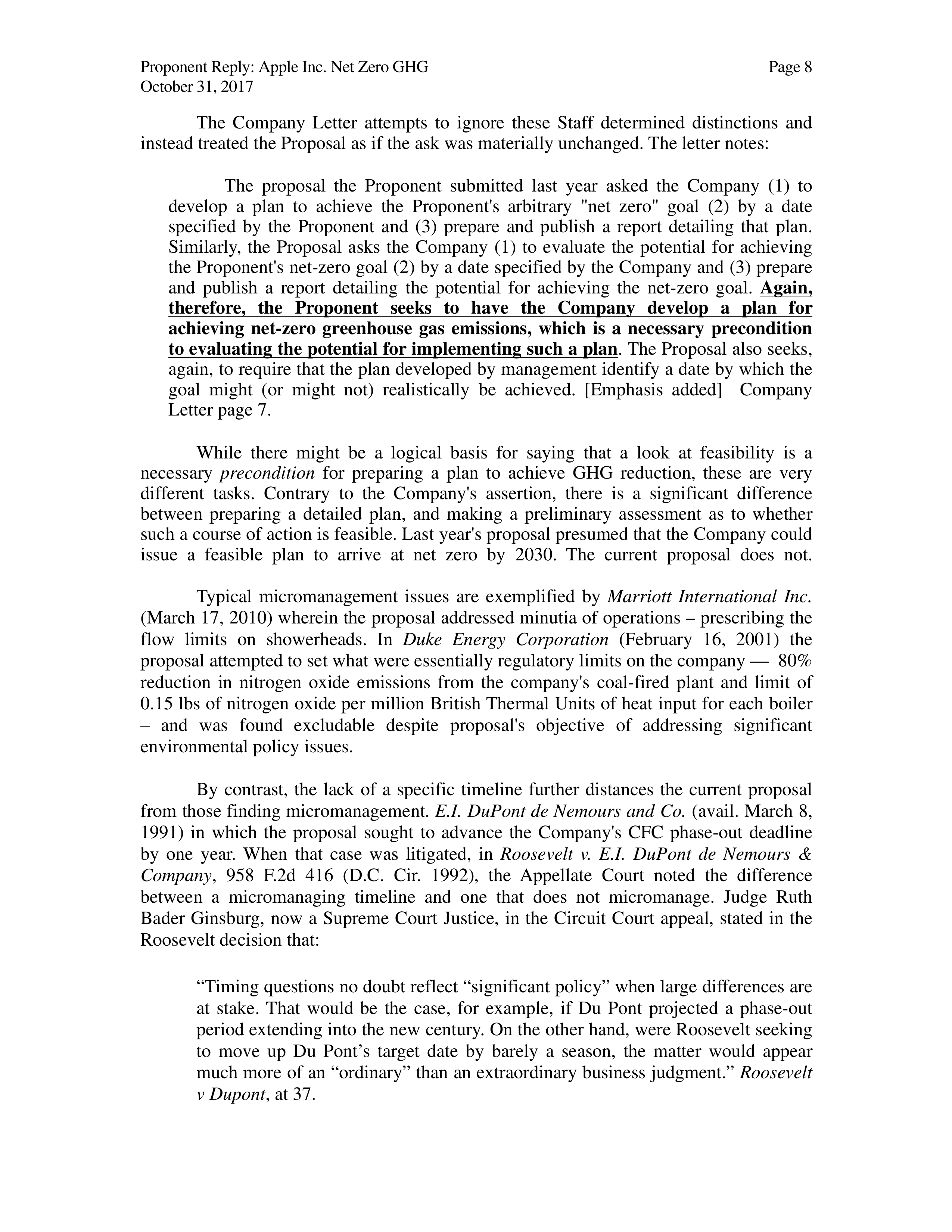
Proponent Reply: Apple Inc. Net Zero GHG
Page 8
October 31, 2017
The Company Letter attempts to ignore these Staff determined distinctions and
instead treated the Proposal as if the ask was materially unchanged. The letter notes:
The proposal the Proponent submitted last year asked the Company (1) to
develop a plan to achieve the Proponent's arbitrary "net zero" goal (2) by a date
specified by the Proponent and (3) prepare and publish a report detailing that plan.
Similarly, the Proposal asks the Company (1) to evaluate the potential for achieving
the Proponent's net-zero goal (2) by a date specified by the Company and (3) prepare
and publish a report detailing the potential for achieving the net-zero goal.
Again,
therefore, the Proponent seeks to have the Company develop a plan for
achieving net-zero greenhouse gas emissions, which is a necessary precondition
to evaluating the potential for implementing such a plan
. The Proposal also seeks,
again, to require that the plan developed by management identify a date by which the
goal might (or might not) realistically be achieved. [Emphasis added] Company
Letter page 7.
While there might be a logical basis for saying that a look at feasibility is a
necessary
precondition
for preparing a plan to achieve GHG reduction, these are very
different tasks. Contrary to the Company's assertion, there is a significant difference
between preparing a detailed plan, and making a preliminary assessment as to whether
such a course of action is feasible. Last year's proposal presumed that the Company could
issue a feasible plan to arrive at net zero by 2030. The current proposal does not.
Typical micromanagement issues are exemplified by
Marriott International Inc.
(March 17, 2010) wherein the proposal addressed minutia of operations – prescribing the
flow limits on showerheads. In
Duke Energy Corporation
(February 16, 2001) the
proposal attempted to set what were essentially regulatory limits on the company — 80%
reduction in nitrogen oxide emissions from the company's coal-fired plant and limit of
0.15 lbs of nitrogen oxide per million British Thermal Units of heat input for each boiler
– and was found excludable despite proposal's objective of addressing significant
environmental policy issues.
By contrast, the lack of a specific timeline further distances the current proposal
from those finding micromanagement.
E.I. DuPont de Nemours and Co.
(avail. March 8,
1991) in which the proposal sought to advance the Company's CFC phase-out deadline
by one year. When that case was litigated, in
Roosevelt v. E.I. DuPont de Nemours &
Company
, 958 F.2d 416 (D.C. Cir. 1992), the Appellate Court noted the difference
between a micromanaging timeline and one that does not micromanage. Judge Ruth
Bader Ginsburg, now a Supreme Court Justice, in the Circuit Court appeal, stated in the
Roosevelt decision that:
“Timing questions no doubt reflect “significant policy” when large differences are
at stake. That would be the case, for example, if Du Pont projected a phase-out
period extending into the new century. On the other hand, were Roosevelt seeking
to move up Du Pont’s target date by barely a season, the matter would appear
much more of an “ordinary” than an extraordinary business judgment.”
Roosevelt
v Dupont
,
at 37.
Proponent Reply: Apple Inc. Net Zero GHG
Page 9
October 31, 2017
In
Ford Motor Company
(March 2, 2004) the proposal outlined with
extraordinary specificity the precise details sought in a scientific report regarding the
existence of global warming or cooling. The proposal sought to prescribe the methods
used for measuring and calculating climate change, even the means of measuring
temperature increase, in a highly prescriptive way down to tiny increments and
cost/benefits of climate change. Especially for a report that went beyond the company's
core mission, asking for these tiny increments of detail rose to the level of
micromanagement.
In contrast, the Staff has long agreed that proposals can and should contain
reasonable levels of detail on relevant information that avoids micromanagement but also
avoids vagueness. As one example, in
Exxon Mobil
(March 19, 2014) the Staff made it
clear that it is not considered excludable micromanagement to request specifics in a
report from a company, and to make technical aspects of such a report clear. The proposal
in that instance sought a report to shareholders using quantitative indicators on the results
of company policies and practices, above and beyond regulatory requirements, to
minimize the adverse environmental and community impacts from the company’s
hydraulic fracturing operations associated with shale formations and that such report
address, at a minimum, and on a regional basis or by each play in which the company
operates:
• Percentage of wells using “green completions;”
•
Methane leakage as a percentage of total production;
• Percentage of drilling residuals managed in closed-loop systems;
• Goals to eliminate the use of open pits for storage of drilling fluid and flowback
water, with updates on progress;
• Goals and quantitative reporting on progress to reduce toxicity of drilling fluids;
• A system for managing naturally occurring radioactive materials;
• Numbers and categories of community complaints of alleged impacts, and their
resolution;
• A systematic approach for reporting community concern statistics upward within
the company.
In contrast, the present Proposal does not displace management decision-making, as it
allows the Company to determine when, where,
and how greenhouse gases will be
eliminated; the current Proposal only seeks from the Company to explore whether it can
set a goal that is consistent with the next frontier for the Company's carbon reduction
measures in a world of ever-accelerating demands for greenhouse gas reduction.
The present Proposal most closely resembles the numerous proposals on climate
change that have been found to
not be excludable
as related ordinary business or
micromanaging, because they addressed key issues regarding strategic responses and
goals on climate change. For instance, see
Chevron Inc.
(March 23, 2016), requesting that
the company publish an annual assessment of long-term portfolio impacts of possible
public climate change policies to the year 2035.
Dominion Resources Inc.
(February 11,
Proponent Reply: Apple Inc. Net Zero GHG
Page 10
October 31, 2017
2014) requested the company adopt quantitative goals, taking into account International
Panel on Climate Change guidance, for reducing total greenhouse gas emissions from the
company’s products and operations and report on its plans to achieve these goals.
Hess
Inc.
(Feb. 29, 2016) requested that Hess prepare and publish a report disclosing the
“financial risks to the Company of stranded assets related to climate change and
associated demand reductions. The report should evaluate a range of stranded asset
scenarios, such as scenarios in which 10, 20, 30, and 40 percent of the Company’s oil
reserves cannot be monetized” and “Provide a range of capital allocation strategies to
address the growing potential of low-demand scenarios, including diversifying capital
investment or returning capital to shareholders; Provide information on assumptions used
in each scenario, including carbon price and crude oil price.”
The Proposal does not necessitate intricate shareholder involvement in supplier
relationships, but rather addresses supply chain accountability at a level consistent
with prior non-excludable proposals.
The Company also argues that the Proposal micromanages because it directs
attention to limiting impacts of the supply chain. However, a long series of Staff
precedents have made it clear that a proposal addressing a significant policy issue
focused on supply chain impacts, codes,
or standards are not excludable as
micromanagement. For example, in
Fossil, Inc.
(March 5, 2012) the Staff rejected an
ordinary business exclusion on a proposal requesting that the company's board of
directors issue a report describing the manufacturer's supply chain standards related to
environmental impacts. In
Bob Evans Farms, Inc.
(June 6, 2011) the proposal encouraged
the company's board to phase-in the use of cage-free eggs for its restaurants, so that they
represent at least five percent of the company's total egg usage. The staff noted that the
proposal focused on the significant policy issue of the humane treatment of animals and
does not seek to micromanage the company to such a degree that exclusion of the
proposal would be appropriate. Same result in
Wendy's Int'l., Inc.
(February 19, 2008)
seeking report on the economic feasibility of purchasing, within 12 months, a certain
percentage of eggs from free range hens. In
Wal-Mart Stores, Inc.
(March 29, 2011) the
proposal requested that the company's board take the steps necessary to require that the
company's suppliers publish annually an independently verifiable sustainability report,
and the Staff rejected Rule 14a-8(i)(7) exclusion, noting the proposal focused on the
significant policy issues of sustainability and human rights. In
Abercrombie & Fitch Co.
(April 12, 2010) the proposal requested that the company's board adopt and disclose a
code of vendor conduct based on certain standards, establish an independent monitoring
process,
and prepare an annual report on adherence to the code. The Staff noted that the
proposal focuses primarily on the significant policy issue of human rights and does not
seek to micromanage the company to such a degree that exclusion of the proposal would
be appropriate.
In
McDonald's Corp.,
(March 22, 2007) the proposal urged the
company's board to adopt, implement,
and enforce a revised company-wide code of
conduct
inclusive of suppliers and sub-contractors based on the Int'l. Labor
Organization's conventions, including four specific principles, and report on
implementation and enforcement.
Proponent Reply: Apple Inc. Net Zero GHG
Page 11
October 31, 2017
The current proposal is in line with these precedents. The Company exaggerates
the level of shareholder
or company involvement with supplier energy choices and
sources that is necessitated by the Proposal to assess the feasibility of setting a zero GHG
goal by a fixed date. In reality, all that is required from the management's standpoint is to
know the level of emissions from the suppliers, projections by the suppliers of future
energy reduction, and from that to identify target levels of GHG reductions needed either
in the supply chain or via offsets elsewhere. Contrary to the Company Letter, in no way
does the Proposal require a detailed report or Company intervention on supplier-level
choices of processes, technologies, or materials.
Although it is possible that companies in its supply chain could accomplish GHG
reduction as well as offsets as part of their contracting relationship with Apple, a less
complex scenario would involve the Company creating or acquiring offsets elsewhere
through tree planting and additional renewable energy projects. While the Company
could choose to achieve GHG emissions reductions through detailed and complicated
interactions with its suppliers, that would be the Company's choice, but is not
contemplated or required by the Proposal.
The Proposal does not involve issues too complex for shareholders to understand
and be able to weigh in on with advisory opinions. If Company management views the
approach taken in the Proposal as inappropriate, the proper response under the
circumstances is for the Company to describe its rationale in a statement in opposition in
its proxy statement. Especially given the level of public and shareholder concern
regarding climate change, it is certainly not beyond the capacity of shareholders to
understand and weigh in reasonably on these issues.
Finally, it should be noted that the Proposal is unlike the proposal in
FirstEnergy
Corp.
(March 8, 2013) which focused on increasing renewable energy resources but
failed to focus on a significant policy issue.
The Proposal is consistent with and builds upon existing Company efforts. It is not
in conflict with them.
The
Company Letter
notes that the management has determined that its resources
will have the greatest effect on the environment by advancing projects that displace more
polluting forms of energy with renewable sources and participating in renewable energy
products that may not be developed without the Company's involvement. This translates
to a principal focus on the Company's own operations rather than those of its suppliers.
Yet, the Company letter acknowledges
that the
majority
of its carbon footprint
comes from its supply chain rather than its own operations, and that it engages in some
modest efforts to encourage suppliers to also address their carbon footprints:
“[W]hile also recognizing that the carbon footprint in the supply chain represents
the majority of its comprehensive carbon footprint (77%), the Company is helping
suppliers reduce their electricity consumption and switch to renewable energy.”
Proponent Reply: Apple Inc. Net Zero GHG
Page 12
October 31, 2017
The Proposal’s idea of setting a target date and a net zero goal literally picks up
where those current activities leave off. The present Proposal essentially asks the
company to assess the feasibility of doing more on a time-limited basis on the portion of
greenhouse gas emissions that cannot be eliminated by implementing those renewable
energy projects at its own facilities and considering the current trajectory of
responsiveness by suppliers. As such, the Company need not alter existing decision-
making, but the Proposal inquires as to whether the Company could scale up its efforts so
that its GHG accomplishments account for and, by actions or accounting, eliminate the
residual GHG emissions from manufacturing facilities that are not readily eliminated
through its existing strategies.
The
Company already generates the needed metrics. The Company has noted that
it has, since fiscal year 2011, reduced the emissions from its facilities worldwide by over
1 million metric tons. In contrast, its reports indicate that, excluding product usage, the
Company’s carbon footprint is 29.5
million metric tons. The Proponent commends the
Company for directly engaging with suppliers to assess their energy use with detailed
energy audits; however this also demonstrates that the Company is already gathering the
needed metrics that entail measurement of progress in the supply chain GHG reduction.
The Proposal neither asks nor requires the Company to probe further into supply chain
technologies or methodologies. Moreover, the data that the Company already gathers is
sufficient to show a lack of substantial implementation – it shows that at least two thirds
of the greenhouse gases currently generated by manufacturing of its products remain to
be eliminated after current efforts that it has described.
Finally, it should be noted that the
entirety
of the Proposal addresses the
significant policy issue of climate change and greenhouse gas reduction. Contrary to the
Company's assertion that the environmental goals of the Proposal are secondary to the
Proposal’s effort to micromanage, the Proposal simply addresses a scaling up of the
Company's responses to the level demanded by the current global climate emergency. The
whereas clauses of the Proposal make it clear that the focus of the Proposal is on
responsiveness to current climate related demands.
In sum, the Proposal does not micromanage and is not excludable as relating to
the Company's ordinary business.
II. The Proposal is not Substantially Implemented.
In addition, the Company claims that it has substantially implemented the
Proposal, that it has addressed each element of the Proposal as well as the essential
objectives.
The Company has already substantially implemented the proposal because the
Company’s existing policies, practices and procedures “compare favorably with
the guidelines” of the Proposal and achieve its essential objective.
Company
Letter.
Proponent Reply: Apple Inc. Net Zero GHG
Page 13
October 31, 2017
The Company distorts the "essential objective of the proposal” – making it seem
that the Proposal is simply about reducing and reporting on greenhouse gas emissions
generated by the Company's operations. Instead, the Proposal is about scaling up the
Company's efforts to where it would have a net zero GHG by a fixed date of the
company's choosing. The Company’s stated efforts and plans do not demonstrate that the
Company has assessed setting a net zero GHG goal by a fixed date.
The Company's letter significantly downgrades the essential objectives of the
proposal in order to find substantial implementation:
The essential objectives of the Proposal are the development and evaluation of
a plan to significantly reduce the effects of greenhouse gas emissions generated by the
Company's business and its major suppliers within a reasonably short time frame. The
Company has already substantially implemented the Proposal's essential objective,
and, as demonstrated in the 2017 Environmental Responsibility Report, has
committed to a variety of environmental efforts, including developing a closed-loop
supply chain and carefully studying materials to remove potentially harmful
substances from products, that go beyond reducing the effects of greenhouse gas
emissions.
Company
Letter, page 13.
The Company's reported actions neither meet the essential purpose nor compare
with the guidelines of the Proposal. In the simplest terms, the Company Letter could not
demonstrate substantial implementation because the plans outlined by the Company will
only reduce the Company’s GHG emissions by a modest percentage; a significant gap
from the Proposal’s requested goal of net zero GHG emissions. The Company seeks to
illustrate its point by referring to an energy savings program that avoided 150,000 metric
tons of CO
2
e. While admirable, avoiding 150,000 metric tons of CO
2
e is a “drop in the
bucket” of the Company’s 29.5
million
metric tons of CO
2
e in its comprehensive carbon
footprint for 2016. An approximate 0.5% savings of CO
2
e does not reach the level of
scale sought by this Proposal. The Company’s more ambitious commitment to “bring 4
gigawatts of renewable power online by 2020” is expected to result in an average of 6
million
8
metric tons carbon avoidance per year which equates to only a
20.3% reduction
in the Company’s carbon footprint
. Furthermore, the additional renewable energy
projects noted in the Company’s letter are admirable but are not quantified and will likely
not achieve the Proposal’s sought-after goal of net zero GHG emissions because there are
numerous other suppliers which will be continuing to emit GHGs.
In order to satisfy the Proposal’s request, the Company would simply need to
quantify the fourteen manufacturers committed to renewable energy by the end of 2018,
reduce the Company’s overall expected carbon footprint by that quantified amount, and
determine the feasibility of seeking net zero GHGs for the remaining emissions that will
be produced annually. While receiving renewable energy commitments from fourteen
manufacturers will aid in the Company’s overall GHG emissions reduction, the Company
has at least 200
suppliers.
9
Each major supplier or manufacturer that has not committed to
8
The Proponent is basing this estimation on the calculations provided by the Company in its November 15, 2016
letter to the SEC.
9
https://images.apple.com/supplier-responsibility/pdf/Apple-Supplier-List.pdf
Proponent Reply: Apple Inc. Net Zero GHG
Page 14
October 31, 2017
100% renewable energy will continue to emit substantial amounts of GHGs into the
atmosphere, keeping the Company from reaching net zero GHG emissions.
Despite the claim in the Company’s letter, it is not the Proposal’s aim to simply
“significantly reduce the effects of greenhouse gas emissions” by an indefinite amount or
with an undefined timeframe. The Proposal specifically seeks the feasibility of achieving
a set goal (net zero greenhouse gas emissions) by a set timeframe (determined by the
company). The Company’s letter states that the only “difference in approaches is only a
matter of implementation,” however the Company has set no goal or fixed timeframe that
can be identified as any version of net zero GHG or carbon neutral. The Company
would
be accurate if the Proponent were seeking a less specific goal such as a general GHG
reduction goal, however the level of specificity in the Proposal distinguishes the current
Proposal from other GHG-related proposals. The current Proposal specifies a requested
goal of net zero GHG emissions based upon current expert recommendations. Experts
increasingly believe that in order to avoid the most dangerous effects of global warming,
the world must achieve net zero greenhouse gas (GHG) emissions as quickly as
possible.
10
A 2015
Nature Climate Change
article emphasized that because the
deployment of negative-emissions technologies will likely be limited due to any
combination of the environmental, economic or energy constraints examined in the study,
"Plan A" must be to reduce GHG emissions aggressively now.
11
The Proposal illustrates
the dire need for the Company to set a time-bound goal of net zero greenhouse gas
emissions, and therefore the Proposal’s aim is far more specific than the Company
describes.
Given that 77% of the Company’s greenhouse gas emissions result from the
manufacturing
supply chain, it is clear that despite how commendable the Company’s
current reductions may be, the lion’s share of the Company’s GHG emissions have not
been ameliorated, nor has the Company set in place a clear time-limited and appropriately
scaled goal to reduce GHG emissions in its manufacturing chain. In fact, the Company
admits that “Greenhouse gas emissions from the Company's facilities are now only 1% of
its comprehensive carbon footprint.”
Existing efforts and disclosures do not compare favorably with the guidelines of the
proposal
The Company letter asserts that it its existing efforts and disclosures compare
favorably with the guidelines of the Proposal. However, review of those activities show
that they are not at all consistent with or comparable to the guidelines.
For example, the Company Letter page 13 and 14 notes that its “2017
Environmental Responsibility Report outlines some of the environmental efforts the
Company has undertaken, which ‘compare favorably with the guidelines’ of the Proposal.
Among these efforts is a goal to power all of Apple's facilities worldwide with 100%
renewable energy.” Similarly, the reporting notes that the Company encourages suppliers
10
https://phys.org/news/2015-12-aggressive-action-greenhouse-gas-emissions.html
11
https://phys.org/news/2015-12-aggressive-action-greenhouse-gas-emissions.html
Proponent Reply: Apple Inc. Net Zero GHG
Page 15
October 31, 2017
to take steps to reduce the environmental impact of their operations, and actively engages
with them to find ways they can reduce their energy use and purchase renewable energy,
while benefiting financially.
Saliently,
this reporting by the Company does not demonstrate that the Company
has assessed the feasibility of achieving net zero GHG for its operations and those of its
major suppliers by a fixed date. The Company has at best expressed a "hope" that its
supply chain will move to 100% renewable energy --
a far cry from setting a target date
and exploring a feasible strategy to make it happen.
In sum, the Proposal’s requests are specifically about identifying whether it is
feasible for the Company to scale up its GHG reduction plans to achieve a net zero GHG
goal by a certain date. The Company’s response indicates various projects aimed at a
general reduction of GHGs, however those projects (even taken in sum) do not achieve
the requested goal of net zero, nor is there a time-bound goal set in place. Therefore the
Proposal cannot be said to be substantially implemented for purposes of Rule 14a
8(i)(10).
CONCLUSION
The Company has not demonstrated that the Proposal is excludible pursuant to
Rule 14a-8(i)(7) Rule 14a-8(i)(10). Therefore, we request the Staff to advise the
Company that it denies the no action request and that the Proposal must appear on the
2018
proxy.
Sanford Lewis
Sincerely,
cc: Gene Levoff
Christine Jantz
Proponent Reply: Apple Inc. Net Zero GHG
Page 16
October 31, 2017
Net-Zero
Greenhouse Gas Emissions
Whereas:
It is widely reported that greenhouse gases (GHGs) from human activities are the most
significant driver of observed climate change since the mid-20th century;
In 2015, 196 parties at the U.N. Climate Change Conference agreed to limit climate
change to an average global warming of 2 degrees Celsius above pre-industrial
temperatures, with a goal of limiting it to 1.5 degrees Celsius;
Shareholders laud Apple for committing to “power[ing] all its operations worldwide on
100
percent renewable energy,” and for joining the American Business Act on Climate
Pledge. However, these goals do not include suppliers and manufacturing;
Our company’s total carbon footprint is reported as 29.52 million metric tons CO2e, with
manufacturing
accounting for 77% of those emissions. Apple publications imply that the
company might
eventually
eliminate its carbon footprint, but there is no apparent
timeframe or set of benchmarks for achieving such a goal;
Instead, the current focus is on the Company’s commitment to “bring 4 gigawatts of
renewable power online by 2020.” This is expected to result in an average of 6 million
metric tons carbon avoidance per year — 20% reduction in the manufacturing carbon
footprint;
Similarly, the company reports that “seven major suppliers have pledged to power their
Apple production entirely with renewable energy,” but the relative contribution of these
supplier efforts toward the net zero goal is unquantified.
Resolved:
Shareholders request that the Board of Directors to prepare a report to
shareholders by December 31, 2019 that evaluates the potential for the Company to
achieve, by a fixed date, “net-zero” emissions of greenhouse gases relative to operations
directly owned by the Company and major suppliers. The report should be done at
reasonable expense and may exclude confidential information.
Supporting Statement:
While the scope of coverage would be in the management’s
discretion, the proponent suggests that relevant operations could include executive and
administrative offices, data centers, product development offices, fulfillment centers and
customer service offices, suppliers, as well as transportation of goods and employees.
“Net-zero greenhouse gas emissions status” can be defined as reduction of GHG
Proponent Reply: Apple Inc. Net Zero GHG
Page 17
October 31, 2017
emissions attributed to company operations to a target annual level, and offsetting the
remaining GHG emissions by negative emissions strategies that result in a documented
reduction equal to or greater than the company’s remaining GHG emissions during the
same year. “Negative emissions solutions” are rigorously measured and tracked activities
to displace polluting forms of energy production. Examples include tree-planting and
technological solutions that draw carbon from the air. Such negative emissions solutions
can be developed by a company or purchased as offsets. We recommend that the report
consider the potential fixed dates of 2030, 2040, or 2050 for achieving net zero GHG.
ATTENTION FUND FIDUCIARIES:
Mutual funds and institutions hold about 60% of
Apple common stock. Leading investors include, among others, Vanguard, SPDR,
iShares, Powershares, Fidelity, and T. Rowe Price. Your YES vote will promote Apple’s
reputation and sales.




Rule 14a-8(i)(7)
Rule 14a-8(i)(10)
October 9, 2017
VIA E-MAIL
Cshareholderproposals@sec.gov)
Office of Chief Counsel
Division of Corporation Finance
U.S. Securities and Exchange Commission
100 F Street, NE
Washington, DC 20549
Re:
Apple Inc.
Shareholder Proposal of Jantz Management LLC on behalf of Christine Jantz
Dear Ladies and Gentlemen:
Apple Inc., a California corporation (the
"Company'),
hereby requests confirmation that
the staff of the Division of Corporation Finance of the U.S. Securities and Exchange
Commission (the
"Commissiori')
will not recommend enforcement action to the Commission if,
in reliance on Rule 14a-8 under the Securities Exchange Act of 1934, as amended (the
"Exchange
Acf'), the Company omits the enclosed shareholder proposal (the
"Proposal')
and
its accompanying supporting statement (the
"Supporting
Statement')
submitted by Jantz
Management LLC on behalf of Christine Jantz (the
"Proponent')
from the Company's proxy
materials for its 2018 Annual Meeting of Shareholders (the
"2018 Proxy Materials').
Copies of the Proposal and the Supporting Statement, together with other
correspondence relating to the Proposal, are attached hereto as Exhibit A.
In accordance with Staff Legal Bulletin No. 140 (November 7, 2008)
("SLB No. 140'),
this submission is being delivered by e-mail to shareholderproposals@sec.gov. Pursuant to
Rule 14a-8(j}, a copy of this submission also is being sent to the Proponent. Rule 14a-8(k) and
SLB No. 140 provide that a shareholder proponent is required to send the company a copy of
any correspondence which the proponent elects to submit to the Commission or the staff.
Accordingly, we hereby inform the Proponent that, if the Proponent elects to submit additional
correspondence to the Commission or the staff relating to the Proposal, the Proponent should
concurrently furnish a copy of that correspondence to the undersigned.
Pursuant to the guidance provided in Section F of Staff Legal Bulletin 14F (October 18,
2011), we ask that the staff provide its response to this request to the undersigned via e-mail at
the address noted in the last paragraph of this letter.
,\rf' ·
•
'l
r

Office of Chief Counsel
Division of Corporation Finance
U.S. Securities and Exchange Commission
October 9, 2017
Page 2
The Company intends to file its definitive 2018 Proxy Materials with the Commission
more than 80 days after the date of this letter.
THE PROPOSAL
On August 4, 2017, the Company received from the Proponent, as an attachment to an
e-mail, a letter submitting the Proposal for inclusion in the Company's 2018 Proxy Materials.
The Proposal reads as follows:
Resolved: Shareholders request that the Board of Directors to
[sic]
prepare a report to shareholders by December 31, 2019 that
evaluates the potential for the Company to achieve, by a fixed
date, "net-zero" emissions of greenhouse gases relative to
operations directly owned by the Company and major suppliers.
The report should be done at reasonable expense and may
exclude confidential information.
The Proposal is substantially the same as a proposal the Proponent submitted to the
Company last year, which the staff concurred could be excluded from the Company's proxy
materials for its 2017 Annual Meeting of Shareholders in reliance on Rule 14a-8(i)(7).
BASES FOR EXCLUSION OF THE PROPOSAL
As discussed more fully below, the Company believes that it may omit the Proposal and
the Supporting Statement from its 2018 Proxy Materials in reliance on (i) Rule 14a-8(i)(7)
because the Proposal relates to the Company's ordinary business operations by requiring the
Company to develop complex processes, policies, and technologies for the purpose of
assessing the extent to which they would allow the Company (together with its major suppliers)
to satisfy specific quantitative targets, and (ii) Rule 14a-8(i)(10) because the Company has
already substantially implemented the Proposal through its regular and detailed environmental
reports, a significant portion of which are dedicated to reporting on the progress of the
Company's efforts to reduce its carbon footprint, including engaging with manufacturing partners
to join the Company in reducing the carbon footprint of its supply chain.
I.
Rule 14a-8(i)(7) -
The Proposal Concerns the Company's Ordinary Business
Operations and the Staff Agreed in 2016
Rule 14a-8(i)(7) permits a company to omit from its proxy materials a shareholder
proposal that relates to the company's "ordinary business operations." According to the
Commission, the underlying policy of the ordinary business exclusion is "to confine the
resolution of ordinary business problems to management and the board of directors, since it is
impracticable for shareholders to decide how to solve such problems at an annual shareholder
meeting." Exchange Act Release No. 40018, Amendments to Rules on Shareholder Proposals,
Fed. Sec. L. Rep. (CCH) 11 86,018, at 80,539 (May 21, 1998) (the
"1998 Release').

Office of Chief Counsel
Division of Corporation Finance
U.S. Securities and Exchange Commission
October 9, 2017
Page3
In the 1998 Release, the Commission described two "central considerations
" for the
ordinary business exclusion. The first is that certain tasks are "so fundamental to management's
ability to run a company on a day-to-day basis that they could not, as a practical matter, be
subject to direct shareholder oversight.
" The second consideration relates to "the degree to
which the proposal seeks to 'micro-manage the company by probing too deeply into matters of a
complex nature upon which shareholders, as a group, would not be in a position to make an
informed judgment." Id. at 86,017-18 (footnote omitted).
The Commission stated in the 1998 Release that "proposals relating to [ordinary
business] matters but focusing on sufficiently significant policy issues . .. generally would not be
considered to be excludable." The staff elaborated on this "significant policy" exception in Staff
Legal Bulletin No. 14E (October 27, 2009), in which the staff noted that, "[i]n those cases in
which a proposal's underlying subject matter transcends the day-to-day business matters of the
company and raises policy issues so significant that it would be appropriate for a shareholder
vote, the proposal generally will not be excludable under Rule 14-a8(i)(7)
as long as a sufficient
nexus exists
between the nature of the proposal and the company." (emphasis added). The
staff went on to state that, "[c]onversely, in those cases in which a proposal's underlying subject
matter involves an ordinary business matter to the company, the proposal generally will be
excludable under Rule 14a-8(i)(7)."
The significant policy exception is further limited in that, even if a proposal involves a
significant policy issue, the proposal may nevertheless be excluded under Rule 14a-8(i)(7) if it
seeks to micro-manage the company by specifying in detail the manner in which the company
should address the policy issue. See
Marriott International Inc.
(March 17, 2010) (proposal
limiting showerhead flow to no more than 1.6 gallons per minute and requiring the installation of
mechanical switches to control the level of water flow excludable for micro-managing despite
recognition that global warming, which the proposal sought to address, is a significant policy
issue); and
Duke Energy Corporation
(February 16, 2001) (proposal requesting 80% reduction
in nitrogen oxide emissions from the company's coal-fired plants and limit of 0.15 lbs of nitrogen
oxide per million British Thermal Units of heat input for each boiler excludable despite
proposal's objective of addressing significant environmental policy issues). The staff has
recognized that a shareholder's casting of a proposal as a mere request for a report, rather than
a request for a specific action, does not mean that the proposal does not seek to micro-manage
the Company, even when the proposal addresses a significant policy issue. See
Ford Motor
Company
(March 2, 2004) (proposal requesting the preparation and publication of scientific
report regarding the existence of global warming or cooling excludable "as relating to ordinary
business operations" despite recognition that global warming is a significant policy issue).
The Proponent submitted a proposal to the Company last year which was substantially
similar to the Proposal, requesting that the Company "generate a feasible plan to reach net-zero
GHG emissions status by the year 2030 ... and to report the plan to shareholders." See
Apple
Inc.
(December 5, 2016)
("Apple 2016').
The staff agreed that the proposal sought to
"micromanage the company by probing too deeply into matters of a complex nature upon which
shareholders, as a group, would not be in a position to make an informed judgment." The staff

Office of Chief Counsel
Division of Corporation Finance
U.S. Securities and Exchange Commission
October 9, 2017
Page 4
reached the same conclusion, regarding the same proposal, in
Deere
& Co. (December 5,
2016)
("Deere").
The proposal the Proponent submitted last year asked the Company (1) to develop a
plan to achieve the Proponent's arbitrary "net zero" goal (2) by a date specified by the
Proponent and (3) prepare and publish a report detailing that plan. Similarly, the Proposal asks
the Company (1) to evaluate the potential for achieving the Proponent's net-zero goal (2) by a
date specified by the Company and (3) prepare and publish a report detailing the potential for
achieving the net-zero goal. Again, therefore, the Proponent seeks to have the Company
develop a plan for achieving net-zero greenhouse gas emissions, which is a necessary pre
condition to evaluating the potential for implementing such a plan. The Proposal also seeks,
again, to require that the plan developed by management identify a date by which the goal
might (or might not) realistically be achieved.
The Proposal therefore would require
management to take a number of specific actions and make a number of calculations, including
an evaluation and prioritization of competing business and strategic interests, in order to
develop and then evaluate a plan for achieving the Proponent's specific target of "net-zero"
greenhouse gas emissions. In short, the undertaking the Proposal would require is not
materially different from the undertaking the Proponent's prior proposal would have required.
And, again, implementation of the Proposal would involve replacing management's judgments
on complex operational and business decisions and strategies with those favored by the
Proponent and would fundamentally interfere with management's ability to operate the
Company's global business.
A.
The Proposal Seeks
to
Micro-Manage the Company by Imposing Specific
Time Frames
to
Implement Complex Policies
to
Satisfy Quantitative Targets
Apple has invested significant time and resources in determining the climate change
strategy that it believes is best for the Company, its shareholders, and the planet. As new
developments occur and new advances are discovered, the Company continues to evaluate
and refine its climate change strategy.
The Company has also gone to great lengths to provide its shareholders and the general
public with detailed information, available on the Company's Environment website,
1
about its
greenhouse gas emissions and energy use, including its approach towards climate change
2
and
its efforts to increase its use of renewable resources, make its use of finite resources more
efficient, and reduce toxins in its products. The Company also submits a shareholder-requested
industry-recognized reporting tool to CDP Worldwide
("CDP'),
the Carbon Disclosure Project
climate change questionnaire, which details the Company's greenhouse gas emissions. In each
of 2014, 2015 and 2016, the CDP awarded Apple a top score of "A" for climate performance,
and in 2014 and 2015, the CDP assigned Apple a score of 99% and 100%, respectively, for the
comprehensiveness and level of detail of its disclosure (no disclosure rating has been published
for 2016). The Company also publishes and makes available on its website a multitude of
1
Available as of the date hereof at apple.com/environment/.
2
Available on the Climate Change section of the Company's Environment website at
apple.com/environment/climate-change/.

Office of Chief Counsel
Division of Corporation Finance
U.S. Securities and Exchange Commission
October 9, 2017
Page 5
reports, including an annual Environmental Responsibility Report, in which the Company
provides detailed information on its renewable energy and sustainability efforts.
3
The
Company's 2017 Environmental Responsibility Report is prepared in accordance with the
Standard Disclosures specified in the Global Reporting Initiative G4 Sustainability Reporting
Guidelines, which are intended to produce reports that include reliable, relevant and
standardized information.
4
As the Company explains in the 2017 Environmental Responsibility Report, Apple's
carbon footprint is complex. Measuring and reducing its footprint requires inventive solutions.
The complexity of measuring just one aspect of Apple's carbon footprint, specifically the
estimated greenhouse gas emissions over the life of a single product, is illustrated by this
excerpt from the Company's Environment website:
1.
To model the manufacturing phase, we use part-by-part
measurements of the entire product along with data on part
production. The measurements help us accurately determine the
size and weight of the components and materials in the product,
while data on manufacturing processes and yield loss during
production allows us to account for the impact of manufacturing.
The production of external accessories, such as keyboards and
mice, and packaging is also included.
2.
To model customer use, we measure the power consumed by a
product while it is running in a simulated scenario. Daily usage
patterns are specific to each product and are a mixture of actual
and modeled customer use data. For the purposes of our
assessment, years of use, which are based on first owners, are
conservatively modeled to be four years for macOS and tvOS
devices and three years for iOS and watchOS devices. Most Apple
products last significantly longer, are kept current through regular
software updates, and are passed along, resold, or returned to
Apple by the first owner for others to use. More information on our
product energy use is provided in our Product Environmental
Reports.
3.
To model transportation, we use data collected on shipments of
single products and multipack units by land, sea, and air. We
account for transporting materials between manufacturing sites;
transporting products from manufacturing sites to regional
distribution hubs; transporting products from regional distribution
hubs to individual customers; and transporting products from final
customers to recycling facilities.
3
Available as of the date hereof at apple.com/environment/reports/.
4
Available as of the date hereof at
images.apple.com/environment/pdf/Apple_Environmental_Responsibility_Report_2017.pdf

Office of Chief Counsel
Division of Corporation Finance
U.S. Securities and Exchange Commission
October 9, 2017
Page6
4.
To model recycling, we use material composition data on our
products and cover the treatment steps carried out by the
recycler to obtain metal, plastic, and glass material streams.
Subsequent processing and remelting steps are not included, as
these are considered stages of production and not end-of-life
processing.
5.
After we collect data about production, use, transport, and
recycling, we combine it with detailed greenhouse gas emission
data. This emission data is based on a combination of Apple
specific and industry-average datasets for material production,
manufacturing
processes,
electricity
generation,
and
transportation. Combining product-specific data with emission
data in our life cycle assessment tool allows us to compile detailed
results for greenhouse gas emissions as they relate to the
product. The data and modeling approaches are checked for
quality and accuracy by the Fraunhofer Institute in Germany.
5
When the Company measures its comprehensive carbon footprint, it includes emissions
from hundreds of suppliers, millions of customers, and hundreds of millions of devices. The
effort involves a continuous search for ways to make the biggest difference in five major areas:
manufacturing, product use, facilities, transportation, and recycling. In fact, 77% of Apple's
carbon footprint falls in its supply chain, from emissions generated by manufacturing companies
that Apple does not own or otherwise control. The operational choices necessary to address
supply chain carbon emissions have huge impacts on the Company's business and products,
and require balancing many complex and competing factors.
The Company is committed to reducing its impact on the world's resources and has
already made significant progress in areas that it controls directly. The Company is currently
powering 100% of its operations in 24 countries, including the United States, the United
Kingdom, China, and Australia, with renewable energy, and 96% of the electricity used in the
Company's worldwide operations in 2016 came from renewable sources. The Company's
management has determined, with the benefit of careful analysis and insight from experts and
detailed information about its business, that its limited resources will have the greatest effect on
the environment by advancing projects that displace more polluting forms of energy with
renewable sources and participating in renewable energy projects that may not be developed
without the Company's involvement. To that end, while also recognizing that the carbon
footprint in the supply chain represents the majority of its comprehensive carbon footprint (77%),
the Company is helping suppliers reduce their electricity consumption and switch to renewable
energy. The Company is also investing in renewable energy projects to address upstream
emissions that are beyond its influence. These goals have been intentionally prioritized over the
5
Available as of the date hereof at https://www.apple.com/environment/answers/.

Off ice of Chief Counsel
Division of Corporation Finance
U.S. Securities and Exchange Commission
October 9, 2017
Page 7
adoption of other practices that would allow the Company to claim that it has achieved a "net
zero" level of greenhouse gas emissions.
The Proposal, however, seeks to "micro-manage" the Company by substituting for
management's business plan a Proposal upon which the Company's shareholders, as a group,
would not be in a position to make an informed judgment. See the 1998 Release. The Proposal
requires that the Company develop a plan that could achieve net-zero greenhouse gas
emissions by a fixed date, which the Proponent suggests be 2030, 2040 or 2050, and then
evaluate the potential for successfully implementing that plan. Shareholders would therefore
be asked to vote upon a Proposal that would displace the Company's judgments on business,
product and operations strategy, and replace it with a hypothetical plan which the Company
would then "evaluate" to determine whether it is achievable. Although the Proposal allows the
Company to select the timetable for implementation of the plan, unlike last year's proposal, this
does nothing to eliminate or even reduce the amount of effort and detailed analysis the
Proposal would require the Company to undertake and share in a public report.
"Evaluat[ing] the potential for the Company to achieve, by a fixed date, 'net-zero'
emissions" would therefore require the same analysis and judgments the staff previously found
"prob[ed] too deeply into matters of a complex nature upon which shareholders, as a group,
would not be in a position to make an informed judgment." Such an evaluation would
necessarily require the Company to first develop one or more plans that could theoretically
achieve the Proponent's goal and then to select the most feasible plan and assess its
achievability. Developing those plans and selecting the most feasible plan from among those
plans would require the Company to evaluate and prioritize particular courses of actions and
changes to its operations and business, and then to replace its own judgments about the best
course of action with a course of action directed solely at meeting the specific emissions level
selected by the Proponent by one of the arbitrary dates selected by the Proponent.
Moreover, the Proposal s
_
eeks to micro-manage not only the Company, but also the
Company's major suppliers, by requiring the Company to develop, evaluate and report on a plan
that would substitute the Proponent's judgment for the business judgments made by hundreds
of suppliers around the world. The Proposal does so by requiring that the proposed net-zero
plan also take into account the emissions of major suppliers and provide for net-zero emissions
on an aggregate basis (that is, the emissions of the Company and all of its major suppliers,
taken together, must net to zero). If a major supplier produces detailed information regarding its
choices of processes, technologies and materials, and information regarding its aggregate
greenhouse gas emissions, and is willing to provide such information to the Company, then, to
be in a position to develop a feasible plan that could be evaluated for achievability, the
Company would need to analyze (i) each major supplier's business to determine what changes
would need to be made to the supplier's choices of processes, technologies and materials so
that the supplier could contribute to aggregate net-zero emissions by one of the arbitrary dates
selected by the Proponent, (ii) the impact such changes would have on each major supplier's
business to determine the feasibility of those changes, (iii) the impact such changes would have
on the Company because additional costs borne by the supplier would likely be passed on to

Office of Chief Counsel
Division of Corporation Finance
U.S. Securities and Exchange Commission
October 9, 2017
Page 8
the Company, (iv) permitted levels of emissions for each major supplier and (v) required levels
of emission offsets for each major supplier.
For this reason, among others, the Proposal seeks to micro-manage the Company to a
far greater extent than a similar proposal submitted to The TJX Companies ("TJX'). In
TJX
Companies, Inc.
(February 6, 2017), the proposal called for the company to prepare a report
evaluating the potential for the company to achieve "net-zero" greenhouse gas emissions "from
parts of the business owned and operated by the Company." TJX operates retail stores, most of
which are leased, that offer apparel and home fashions manufactured by others. The proposal
submitted to TJX did not seek to compel the company to investigate or change the processes or
carbon footprint of its major suppliers. Moreover, TJX, unlike the Company, is not in the
business of manufacturing the goods it sells. While the Company is in the retail business, it is
also in the manufacturing business, which involves far more, and far more significant,
environmental issues, processes and related choices arising as part of the ordinary operation of
the Company's business.
Manufacturing processes are subject to complex environmental
regulation that vary country-by-country. The Company has no control over these regulations
that, in many cases, are still evolving and always changing.
In addition, the Company relies on hundreds of suppliers around the world.
The
Company launched its supplier clean energy program in October 2015 with the goal of reducing
the carbon footprint of its manufacturing by helping its partners become more energy efficient
and by transitioning its entire supply chain to 100% clean energy. To date, fourteen suppliers
have committed to 100% clean energy for Apple production and Apple has installed 485
megawatts of wind and solar projects across six provinces of China to address upstream
emissions that are beyond the influence of the Company's direct suppliers.
Evaluating, and making decisions relating to, the Company's choices regarding the
processes, technologies and materials used by the Company and its major suppliers, combined
with evaluating the impact of those choices on the pricing of the Company's products and the
terms of the Company's relationships with its major suppliers, are the types of day-to-day
business operation decisions that the 1998 Release indicated are too impractical and complex
to subject to direct shareholder oversight. The staff has previously concurred that a proposal
seeking a report relating to the company's choice of processes and technologies used in the
production of its products is excludable as relating to the company's ordinary business
operations. See
FirstEnergy Corp.
(March 8, 2013)
("FirstEnergy 2013')
(allowing exclusion of
a proposal calling for a report on the effect of increasing the company's use of renewable
energy resources because it concerned the company's "choice of technologies" for its
operations). Developing and evaluating the achievability of the plan requested by the Proposal
would touch upon every aspect of the Company's facilities and operations, as well as those of
its major suppliers, and therefore would necessarily impinge on management's ability to run the
Company and operate its business on a day-to-day basis.
The degree to which the Proposal seeks to micro-manage the Company's greenhouse
gas emissions program is demonstrated by the number of specific actions and calculations that
implementation of the Proposal would entail, requiring compilation and analysis of numerous

Office of Chief Counsel
Division of Corporation Finance
U.S. Securities and Exchange Commission
October 9, 2017
Page 9
data points and areas of operations. By setting a specific level of acceptable greenhouse gas
emissions (net-zero) by a certain date, the Proposal differs significantly from proposals that
seek to establish "goals" for achieving an environmental objective or a range of acceptable
levels of compliance. A proposal that seeks to establish goals for, or ranges of, compliance
allows the company flexibility to determine an achievable level of compliance and an acceptable
timetable for implementation and therefore, unlike the Proposal, does not micro-manage the
company for purposes of Rule 14a-8(i)(7). See, e.g.,
FirstEnergy Corp.
(March 4, 2015)
(declining to concur in exclusion of proposal that called for preparation of a plan to address
carbon dioxide emissions but did not "mandate what quantitative goals should be adopted, or
how the quantitative targets should be set");
Exxon Mobil Corporation
(March 12, 2007)
(declining to concur in exclusion of proposal requesting adoption of a policy (as opposed to a
plan) to significantly increase renewable energy sourcing, with a "recommended goal" in the
range of 15%-25% of all energy sourcing by 2015-2025). The Proposal, in contrast, sets a
specific goal of net-zero emissions, and requires the establishment of a specific deadline,
provides a specific and detailed framework for defining and measuring "net-zero greenhouse
gas emissions status,"
6
and requires the development and evaluation of a plan rather than a
policy.
The Proposal also fundamentally interferes with management's ability to run the
Company and operate its business on a day-to-day basis by subjecting to direct shareholder
oversight numerous aspects of the Company's business which are simply too complex for
shareholders to understand fully based on the limited information available to them. Setting
particular greenhouse gas emissions targets involves complex operational decisions and
involve the work of myriad professionals and experts across varied disciplines who carefully
study, among other things, scientific advancements, new technologies, product markets, the
Company's operations and capital structure, capital expenditures, and regulatory requirements
and compliance. Business judgments must then be made about the strategic allocation of
resources among these different strategies.
With the benefit of study and analysis, the Company's management has determined that
its resources will have the greatest effect on the environment by advancing projects that
displace more polluting forms of energy with renewable sources and participating in renewable
energy projects that may not be developed without the Company's involvement. The Company
believes that climate change is best addressed by directly avoiding or reducing greenhouse gas
emissions rather than attempting to offset increased emissions from one activity by reducing
emissions resulting from another activity. These goals have been intentionally prioritized over
the adoption of other practices that would allow the Company to claim that it has achieved a
"net-zero" level of greenhouse gas emission, as would be required by the Proposal. The
6
The Supporting Statement provides that "Net-zero greenhouse gas emissions status" can be defined
"as
[sic]
reduction of GHG emissions attributed to company operations to a target annual level, and
offsetting the remaining GHG emissions by negative emissions strategies that result in a documented
reduction equal to or greater than the company's remaining emissions during the same year." It defines
"Negative emissions solutions" as "rigorously measured and tracked activities to displace polluting forms
of energy production .... includ[ing] tree-planting and technological solutions that extract raw carbon
from the air."

Office of Chief Counsel
Division of Corporation Finance
U.S. Securities and Exchange Commission
October 9, 2017
Page 10
Company's environmental efforts, which seek to reduce the Company's carbon footprint, have
been applauded by numerous environmental groups, including Greenpeace, Ceres, Advanced
Energy Economy, and the Climate Group's RE100 initiative
7
as representing concrete efforts to
drive the Company's manufacturing base (including its suppliers) to a low-carbon future. The
Proponent does not disagree with the Company's objective, only with the choices the Company
has made to achieve the objective.
The breadth and depth of the analyses and decisions relating to each of the Company's
businesses and facilities (to say nothing of its major suppliers), and the decisions to prioritize
certain types of environmental efforts over others, require complex and detailed decision
making that is beyond the ability of shareholders to determine by means of a shareholder
proposal. The Proposal invokes the type of micro-management of complex issues involving the
ordinary course of a company's business that the 1998 Release was meant to address. The
Proposal supplants the Company's judgments on business and product strategy with an
arbitrary level of acceptable emissions and its insistence on a deadline for achieving it. By
subjecting to direct shareholder oversight the Company's (and its major suppliers') choices
regarding processes, technologies and materials and the terms of the Company's relationships
with its major suppliers, the Proposal fundamentally interferes with management's ability to run
the Company and operate its business on a day-to-day basis. For those reasons, the Proposal
is excludable pursuant to Rule 14a-8(i)(7).
B.
The Proposal Focuses on Ordinary Business Matters Regardless of
Whether it Touches Upon
a
Significant Policy Issue
While reduction of greenhouse gas emissions is a significant policy issue, the
environmental goals of the Proposal are secondary to the Proposal's effort to micro-manage the
Company's processes and operations to achieve specific objectives. The staff has consistently
concurred that a proposal may be excluded when it addresses ordinary business matters, even
if it touches upon a significant social policy issue. For instance, in
Apple 2016
and
Deere,
the
staff concurred in the exclusion of proposals addressing greenhouse gas emissions because
the proposals sought to interfere with the companies' ordinary business operations on a day-to
day basis. The staff's concurrence in those instances was consistent with prior staff decisions.
Prior to those decisions, in
FirstEnergy 2013,
the staff concurred in the exclusion of a proposal
that called for the company to generate a report explaining "actions the company is taking or
could take to reduce risk throughout its energy portfolio by diversifying the company's energy
resources to include increased energy efficiency and renewable energy resource." See also
Dominion Resources, Inc.
(February 3, 2011) (allowing exclusion of a proposal relating to use of
alternative energy because the proposal related, in part, to the company's choice of
technologies for use in its operations);
Papa John's International, Inc.
(February 13, 2015)
(concurring that the company could exclude a proposal that touched upon a significant policy
7
Available as of the date hereof at http://www.greenpeace.org/usa/news/greenpeace-welcomes-apples
renewable-energy-commitment-to-manufacturing-partners-in-china/, https://www.ceres.org/news
center/blog/major-companies-are-engines-climate-progress,
http://www.computerworld.com/article/3122461/sustainable-it/apple-commits-to-run-off-100
renewable-energy. html, and http://there100.org/companies, respectively.

Office of Chief Counsel
Division of Corporation Finance
U.S. Securities and Exchange Commission
October 9, 2017
Page 11
issue (animal welfare) because it related to an ordinary business matter (choice of products
offered for sale).
Moreover, the staff has indicated that, where a proposal relating to the company's
ordinary business operations also raises a significant policy issue, the proposal will be
excludable under Rule 14a-8(i)(7) unless "a sufficient nexus exists between the nature of the
proposal and the company." Staff Legal Bulletin No. 14E (October 27, 2009). Where a
company's primary business is the production of energy, the effect of energy on the
environment clearly has a nexus to the company's day-to-day business. For those companies, a
proposal relating to greenhouse gas emissions is likely to transcend the company's ordinary
business. See
DTE Energy
Co. (January 26, 2015);
Devon Energy Corp.
(March 19, 2014); and
Exxon Mobil Corporation
(March 23, 2007).
The Company, in contrast, designs, manufactures and markets mobile communication
and media devices, personal computers and portable digital music players, and sells a variety of
related software, services, accessories, networking solutions and third-party digital content and
applications. While these operations do incidentally consume energy and generate greenhouse
gases, the levels are on an entirely different scale from those attributable to energy producers.
As the foregoing discussion demonstrates, the staff has consistently allowed exclusion
of proposals that seek to regulate a company's day-to-day activities, regardless of the fact that
those activities may implicate larger social policy issues. While the Proposal does invoke a
significant policy issue, as was the case in
Apple 2016,
there is only an incidental nexus
between the Proposal and the Company's business, which is not enough to overcome the
significant level of micro-management of the Company's business the Proposal would entail.
Accordingly, the Proposal is excludable under Rule 14a-8(i)(7).
II.
Rule 14a-8(1)(10) -
The Company Has Already Substantially Implemented the
Proposal
A.
Background
Rule 14a-8(i)(10) permits a company to exclude a shareholder proposal from its proxy
materials if "the company has already substantially implemented the proposal." The
Commission stated in 1976 that the predecessor to Rule 14a-8(i)(10) was "designed to avoid
the possibility of shareholders having to consider matters which already have been favorably
acted upon by the management." SEC
Release No. 34-12598
(July 7, 1976). Originally, the
staff narrowly interpreted this predecessor rule and granted no-action relief only when
proposals were "'fully' effected" by the company. SEC
Release No. 34-19135
(October 14,
1982). By 1983, however, the Commission recognized that the "previous formalistic application
of [the rule] defeated its purpose" because proponents were successfully convincing the staff to
deny no-action relief by submitting proposals that differed from existing company policy by
only a few words. SEC
Release No. 34-20091
(August 16, 1983). Therefore, in 1983, the
Commission adopted a revised interpretation to the rule to permit the omission of proposals
that had been "substantially implemented" (id.) and subsequently codified this revised

Office of Chief Counsel
Division of Corporation Finance
U.S. Securities and Exchange Commission
October 9, 2017
Page 12
interpretation. SEC Re/ease
No. 34-40018
(May 21, 1998). The purpose of the exclusion under
Rule 14a-8(i)(10) has been described as follows:
"A company may exclude a proposal if the company is already
doing-or substantially doing-what the proposal seeks to
achieve. In that case, there is no reason to confuse shareholders
or waste corporate resources in having shareholders vote on a
matter that is moot. In the [Commission's] words, the exclusion 'is
designed to avoid the possibility of shareholders having to
consider matters which have already been favorably acted upon
by the management .... "'
William Morley, Editor, Shareholder Proposal Handbook; by Broe Romanek and Beth
Young (Aspen Law
& Business
2003 ed),
Sec.
23.01(8) at p. 23-4.
When a company can demonstrate that it has taken actions to address each element of
a shareholder proposal, the staff has concurred that the proposal has been "substantially
implemented." For example, in
The Dow Chemical
Co. (March 5, 2008), the staff concurred in
the exclusion of a proposal that requested a "global warming report" that discussed how the
company's efforts to ameliorate climate change may have affected the global climate when the
company had already made various statements about its efforts related to climate change,
which were scattered throughout various corporate documents and disclosures. See also
International
Business
Machines Corp.
(January 4, 2010) (concurring in the exclusion of a
proposal that requested periodic reports of the Company's "Smarter Planet" initiative where the
company had already reported on those initiatives using a variety of different media, including
the company's "Smarter Planet" web portal).
Additionally, a company need not implement a proposal in exactly the manner set forth
by the proponent in order to exclude the proposal under Rule 14a-8(i)(10). SEC Re/ease
No. 34
40018 and accompanying text
(May 21, 1998). Differences between a company's actions and a
shareholder proposal are permitted as long as the company's actions satisfactorily address the
proposal's essential objectives. Even if a company's actions do not go as far as those requested
by the shareholder proposal, they nevertheless may be deemed to "compare favorably" with the
requested actions. See, e.g.,
NextEra Energy, Inc.
(February 10, 2017) (concurring in the
exclusion of a proposal requesting a change to proxy access procedures where the company
demonstrated its existing proxy access procedures already achieved the proposal's essential
purpose);
Walgreen
Co. (September 26, 2013) (concurring in the exclusion of a proposal
requesting elimination of supermajority voting requirements in the company's governing
documents where the company had eliminated all but one of the supermajority voting
requirements);
Exelon Corp.
(February 26, 2010) (concurring in the exclusion of a proposal that
requested a report on different aspects of the company's political contributions when the
company had already adopted its own set of corporate political contribution guidelines and
issued a political contributions report that, together, provided "an up-to-date view of the
[c]ompany's policies and procedures with regard to political contributions").

Office of Chief Counsel
Division of Corporation Finance
U.S. Securities and Exchange Commission
October 9, 2017
Page 13
B.
The Company has already substantially implemented the Proposal because
the Company's existing policies, practices and procedures "compare favorably with the
guidelines" of the Proposal and achieve its essential objective
The Proposal would require the Company to develop, evaluate and present a report to
shareholders regarding a plan to achieve "net-zero" emissions of greenhouse gases, taking into
account the Company's operations and those of its major suppliers. The essential objectives of
the Proposal are the development and evaluation of a plan to significantly reduce the effects of
greenhouse gas emissions generated by the Company's business and its major suppliers within
a reasonably short time frame. The Company has already substantially implemented the
Proposal's essential objective, and, as demonstrated in the 2017 Environmental Responsibility
Report, has committed to a variety of environmental efforts, including developing a closed-loop
supply chain and carefully studying materials to remove potentially harmful substances from
products, that go beyond reducing the effects of greenhouse gas emissions.
Apple takes the same innovative approach to the environment that it does to the
development of its products. Apple is creating new renewable energy projects to reduce its
carbon footprint, switching to greener materials to create safer products and manufacturing
processes, and protecting natural resources such as working forests to ensure they are
managed sustainably. Apple is even creating a more mindful way to recycle devices using
robots.
As described above, the Company is committed to reducing its impact on the world's
resources, has already made significant progress in areas that it controls directly, and seeks to
influence its suppliers to do the same. For example, fourteen Apple suppliers have already
committed to using 100% clean energy in production of Apple products by 2018.
The
Company already provides voluminous information and reports to shareholders and the public
regarding its environmental efforts. These efforts are guided by the Company's decision to
reduce waste and to actually reduce greenhouse gas emissions, rather than perform actions
designed to achieve a level of net-zero greenhouse gas emissions. The essential objective of
the Proposal is the same as the essential objective of the Company's current environmental
program -
to ameliorate the environmental impact of the Company's operations as much as
possible as soon as possible. The difference in approaches is only a matter of implementation,
with the Proposal seeking a specific level of "net" emissions and a deadline for achieving it.
Apple's 2017 Environmental Responsibility Report outlines some of the environmental
efforts the Company has undertaken, which "compare favorably with the guidelines" of the
Proposal. Among these efforts is a goal to power all of Apple's facilities worldwide with 100%
renewable energy. Using energy produced from renewable sources greatly reduces the level of
greenhouse gas emissions generated by the Company's facilities. Apple has made significant
progress towards this goal: the Company produced and procured clean, renewable energy for
96% of the electricity used by its offices, retail stores, and data centers around the world in
2016 -
including 100% of its daJa centers and in all its facilities in 24 countries, including the
United States, the United Kingdom, China, and Australia. These efforts have lowered
greenhouse gas emissions from the Company's facilities by 60% since 2011 -
avoiding over

Off ice of Chief Counsel
Division of Corporation Finance
U.S. Securities and Exchange Commission
October 9, 2017
Page 14
1.6 million metric tons of greenhouse gas emissions from entering the atmosphere. Greenhouse
gas emissions from the Company's facilities are now only 1 % of its comprehensive carbon
footprint. The Company has also raised $2.5 billion by issuing green bonds, the proceeds of
which are dedicated to financing the Company's environmental projects and renewable energy
initiatives around the world, including a reduction in the effects of greenhouse gas emissions
generated by its business.
The 2017 Environmental Responsibility Report also describes how the Company has
reduced greenhouse gas emissions associated with manufacturing. For example, the Company
changed how it manufactures the aluminum enclosures of the iPhone by prioritizing aluminum
that was smelted using hydroelectricity rather than fossil fuels, and reengineering its
manufacturing process to reincorporate scrap aluminum. As a result, the greenhouse gas
emissions associated with manufacturing the enclosure of the iPhone 7 are 17 percent lower
than for the iPhone 6s, and 60 percent lower than for the iPhone 6. Applying the same
approach to the 13-inch MacBook Pro with Touch Bar resulted in 48 percent less greenhouse
gas emissions associated with the aluminum enclosure compared to that of the previous
generation MacBook Pro.
The Company also encourages suppliers to take steps to reduce the environmental
impact of their operations, and actively engages with them to find ways they can reduce their
energy use and purchase renewable energy, while benefiting financially. The electricity used by
suppliers in Apple's supply chain to process raw materials, make parts, and assemble Apple
products is the single biggest source emissions in the supply chain -
over 60% of
manufacturing emissions. As a result, in 2015, the Company created programs to help suppliers
around the world reduce their energy use, power their facilities with clean energy, and build
high-quality renewable energy projects. Since 2015, Apple has been engaging directly with
suppliers to assess their energy use with detailed energy audits. By the end of 2016, the
Company had conducted 34 energy audits at suppliers' facilities around the world, which
identified over $55 million in annual savings opportunities and led to efficiency improvements to
avoid more than 150,000 metric tons of CO2e. Apple continues to expand the program for even
greater impact.
The Company's efforts go beyond energy efficiency to spur the development and
procurement of renewable energy within the Company's supply chain. Apple is working with its
suppliers to install more than 4 gigawatts of new clean energy worldwide, including 2 gigawatts
in China by 2020, to reduce greenhouse gas emissions associated with manufacturing. These 4
gigawatts of clean energy projects will produce clean power equivalent to taking more than 1.5
million cars off the road every year for over 20 years. The Company has already installed 485
megawatts of wind and solar projects across six provinces in China that address upstream
greenhouse gas emissions and serve as models for suppliers. Such efforts are all part of the
clean energy program launched by the Company in 2015. As part of the clean energy program,
the Company has also secured commitments from fourteen important suppliers to use 100%
renewable energy for production of Apple products by 2018. The methods each of these
suppliers will use to reach that goal will depend on the particular nature of the supplier's

Office of Chief Counsel
Division of Corporation Finance
U.S. Securities and Exchange Commission
October 9, 2017
Page 15
business, but they all will contribute to reducing emissions associated with the Company's
manufacturing.
The Company's annual Environmental Responsibility Reports, ten of which have been
published, highlight the Company's environmental goals and the progress it has made toward
achieving them. As requested by the Proposal, the reports set out the Company's ambitious
environmental strategy and list specific goals, including powering all of the Company's facilities
with 100% renewable energy, and report on the Company's progress toward those goals. The
Company rigorously measures and tracks the performance of its environmental initiatives and
engages independent third parties to review its reports. The 2017 Environmental Responsibility
Report includes assurance statements from Bureau Veritas North America, Inc. and Fraunhofer
IZM, both of which are objective third-party experts who reviewed various aspects of the
underlying methodology and data.
The Company has already substantially implemented the Proposal's essential objec
.
tives
by continuing to (i) develop and implement a comprehensive environmental strategy that will
significantly reduce the effects of greenhouse gas emissions generated by the Company's
operations and its major suppliers and (ii) provide voluminous information to its shareholders
enabling them to measure the Company's progress. The Proponent does not disagree with the
Company's objective of minimizing the environmental impact of the Company's business as
much as possible as soon as possible. The only disagreement is how the Company can best
achieve that objective. Rather than focusing on efforts that yield improvements in efficiency and
reductions in the Company's environmental impact, which may in the future produce similar
benefits for other businesses with fewer resources dedicated to environmental efforts, the
Proposal urges that those efforts be redirected to address whether the Company may achieve a
"net-zero" level of greenhouse gas emissions and do so by a specified date. While purchasing
carbon offsets and planting trees would bring the Company closer to being able to claim it has
achieved "net-zero" greenhouse gas emissions, the Company has chosen to reduce its
environmental impact by actually reducing the level of greenhouse gas emissions related to its
business.
As the Company's existing policies and practices "compare favorably with the guidelines"
and have already substantially implemented the Proposal's "essential objective," the Proposal is
excludable under Rule 14a-8(i)(10).

Office of Chief Counsel
Division of Corporation Finance
U.S. Securities and Exchange Commission
October 9, 2017
Page 16
CONCLUSION
For the reasons discussed above, the Company believes that it may omit the Proposal
and Supporting Statement from its 2018 Proxy Materials in reliance on Rule 14a-8(i)(7) and Rule
14a-8(i)(10).
We respectfully request that the staff concur with the Company's view and confirm that
it will not recommend enforcement action to the Commission if the Company omits the Proposal
and Supporting Statement from its 2018 Proxy Materials.
If you have any questions or need additional information, please feel free to contact me
at (408) 974-6931 or by e-mail at glevoff@apple.com.
Sincerely,
Gene
f
Associate General Counsel, Corporate Law
Attachments
cc:
Jantz Management LLC
Alan L. Dye, Hogan Lovells US LLP


Exhibit A
Copy of the Proposal and Supporting Statement and Related Correspondence

August 4, 2017
Bruce Sewell
Senior Vice President, General Counsel and Secretary
Apple, Inc.
1 Infinite Loop
MS: 301-4GC
Cupertino, CA 95014
Re: Shareholder Proposal for 2018 Annual Meeting
Dear Mr. Sewell:
Jantz Management LLC is filing the enclosed shareholder proposal regarding Apple, Inc.’s
greenhouse gas emissions program on behalf of me, as an individual shareholder. Jantz
Management LLC is a Boston-based investment management firm providing discretionary
investment services to separately managed accounts, pensions and profit sharing plans, trusts
and estates, foundations and charities, and corporations and other business entities.
As an individual shareholder, I am a beneficial owner, as defined under Rule 13(d)-3 of the
General Rules and Regulations under the Securities Act of 1934, having held more than $2,000
worth of shares of Apple common stock held for more than one year. I will continue to hold the
requisite number of shares through the date of the next stockholders’ annual meeting. Proof of
ownership will be provided within the next 15 business days. I will send a representative to
introduce the proposal.
I believe that this proposal is in the best interest of our Company and its shareholders. I look
forward to discussing the matter in greater detail.
I would appreciate confirmation of receipt of this proposal by mail or email
(jantz@jantzmgmt.com).
Sincerely,
Christine Jantz, CFA
President
Jantz Management LLC
Enclosure: shareholder proposal
PO Box 301090, Boston, MA 02130 | 617.273.8018 | info@jantzmgmt.com | jantzmgmt.com
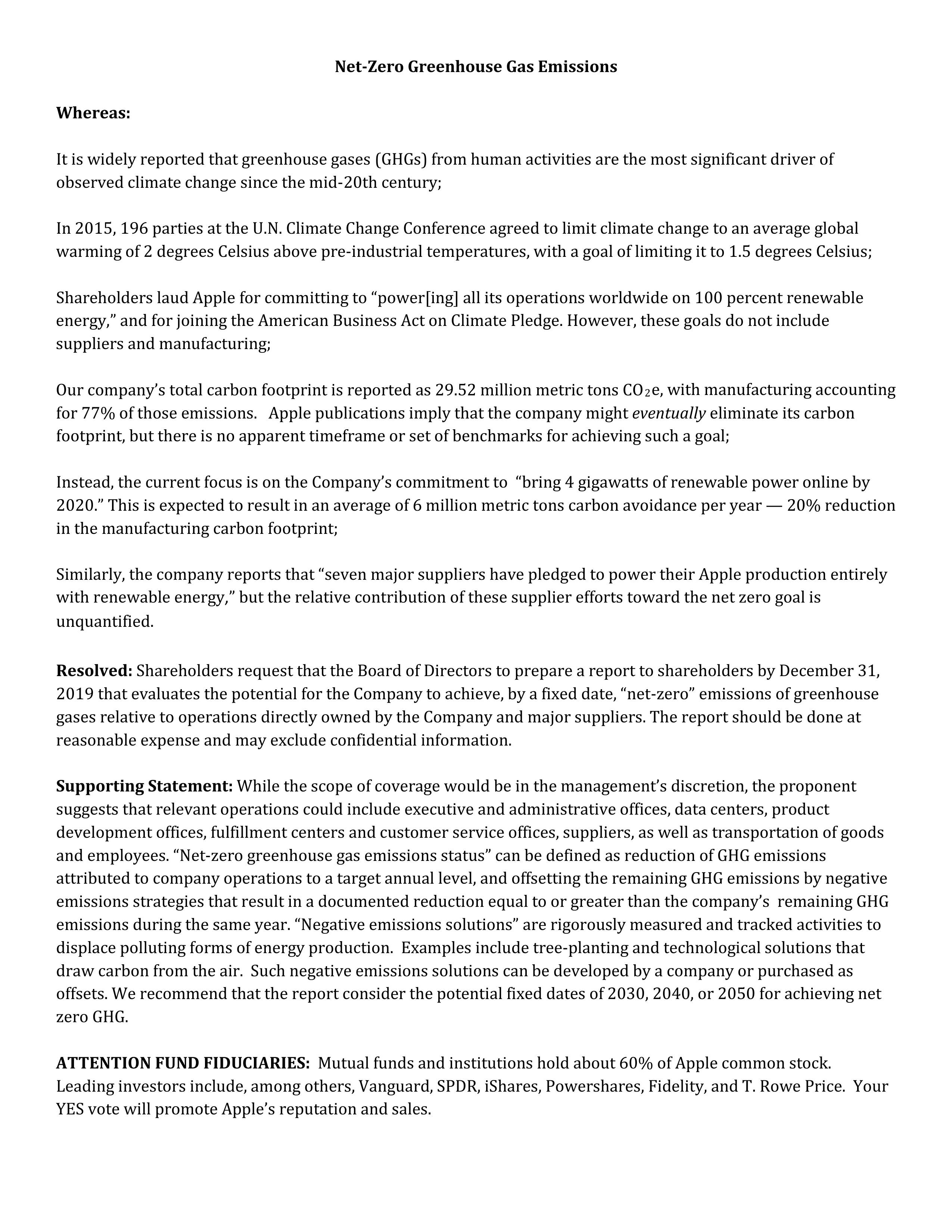
Net-Zero Greenhouse Gas Emissions
Whereas:
It is widely reported that greenhouse gases (GHGs) from human activities are the most significant driver of
observed climate change since the mid-20th century;
In 2015, 196 parties at the U.N. Climate Change Conference agreed to limit climate change to an average global
warming of 2 degrees Celsius above pre-industrial temperatures, with a goal of limiting it to 1.5 degrees Celsius;
Shareholders laud Apple for committing to “power[ing] all its operations worldwide on 100 percent renewable
energy,” and for joining the American Business Act on Climate Pledge. However, these goals do not include
suppliers and manufacturing;
Our company’s total carbon footprint is reported as 29.52 million metric tons CO
2
e, with manufacturing accounting
for 77% of those emissions. Apple publications imply that the company might
eventually
eliminate its carbon
footprint, but there is no apparent timeframe or set of benchmarks for achieving such a goal;
Instead, the current focus is on the Company’s commitment to “bring 4 gigawatts of renewable power online by
2020.” This is expected to result in an average of 6 million metric tons carbon avoidance per year — 20% reduction
in the manufacturing carbon footprint;
Similarly, the company reports that “seven major suppliers have pledged to power their Apple production entirely
with renewable energy
,
” but the relative contribution of these supplier efforts toward the net zero goal is
unquantified.
Resolved:
Shareholders request that the Board of Directors to prepare a report to shareholders by December 31,
2019 that evaluates the potential for the Company to achieve, by a fixed date, “net-zero” emissions of greenhouse
gases relative to operations directly owned by the Company and major suppliers. The report should be done at
reasonable expense and may exclude confidential information.
Supporting Statement:
While the scope of coverage would be in the management’s discretion, the proponent
suggests that relevant operations could include executive and administrative offices, data centers, product
development offices, fulfillment centers and customer service offices, suppliers, as well as transportation of goods
and employees. “Net-zero greenhouse gas emissions status” can be defined as reduction of GHG emissions
attributed to company operations to a target annual level, and offsetting the remaining GHG emissions by negative
emissions strategies that result in a documented reduction equal to or greater than the company’s remaining GHG
emissions during the same year. “Negative emissions solutions” are rigorously measured and tracked activities to
displace polluting forms of energy production. Examples include tree-planting and technological solutions that
draw carbon from the air. Such negative emissions solutions can be developed by a company or purchased as
offsets. We recommend that the report consider the potential fixed dates of 2030, 2040, or 2050 for achieving net
zero GHG.
ATTENTION FUND FIDUCIARIES:
Mutual funds and institutions hold about 60% of Apple common stock.
Leading investors include, among others, Vanguard, SPDR, iShares, Powershares, Fidelity, and T. Rowe Price. Your
YES vote will promote Apple’s reputation and sales.

August 15, 2017
Bruce Sewell
Senior Vice President, General Counsel and Secretary
Apple, Inc.
1 Infinite Loop
MS: 301-4GC
Cupertino, CA 95014
Re: Shareholder Proposal for 2018 Annual Meeting
Dear Mr. Sewell:
This letter is regarding a shareholder proposal that Jantz Management LLC filed on my behalf,
on August 4, 2017, regarding Apple’s greenhouse gas emissions program. Enclosed, please
find a letter from my brokerage, Folio
fn
(a DTC participant), verifying that I, Christine Jantz as
an individual shareholder of Jantz Management LLC, have held the requisite amount of stock in
Apple for more than one year prior to filing the shareholder proposal. As previously stated, I
intend to continue to hold these shares through the next shareholder meeting.
Please note that I am submitting this proof of ownership on a timely basis consistent with Rule
14a-8. In the event that you find any defect in this documentation, I request that you notify me
promptly of any concerns or deficiencies.
Should you need anything further, do not hesitate to contact me at
jantz@jantzmgmt.com
or at
my mailing address, below.
Thank you in advance for your attention to this matter.
Sincerely,
Christine Jantz, CFA
President
Jantz Management LLC
Enclosure: proof of ownership
PO Box 301090, Boston, MA 02130 | 617.273.8018 | info@jantzmgmt.com | jantzmgmt.com
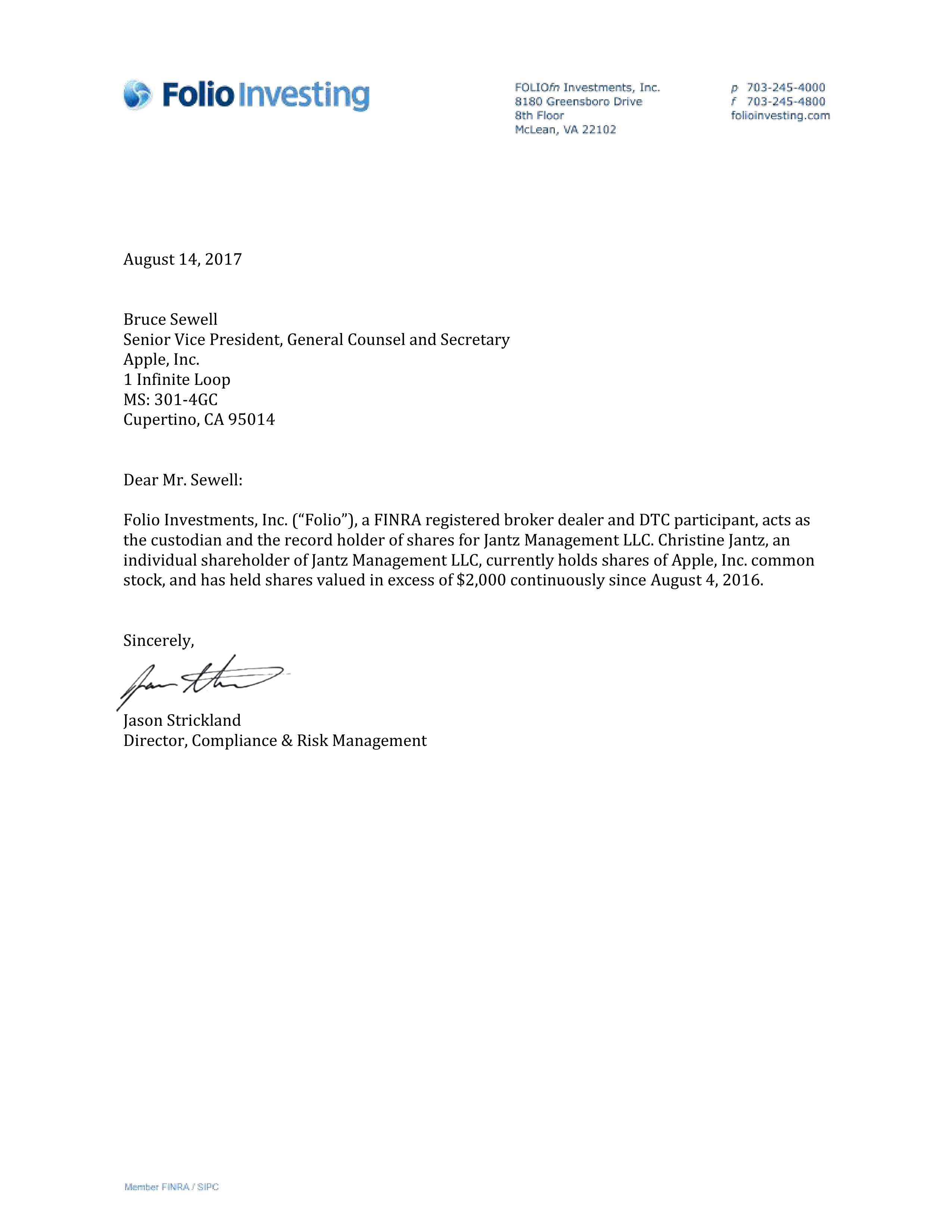


August 14, 2017
Bruce Sewell
Senior Vice President, General Counsel and Secretary
Apple, Inc.
1 Infinite Loop
MS: 301-4GC
Cupertino, CA 95014
Dear Mr. Sewell:
Folio Investments, Inc. (“Folio”), a FINRA registered broker dealer and DTC participant, acts as
the custodian and the record holder of shares for Jantz Management LLC. Christine Jantz, an
individual shareholder of Jantz Management LLC, currently holds shares of Apple, Inc. common
stock, and has held shares valued in excess of $2,000 continuously since August 4, 2016.
Sincerely,
Jason Strickland
Director, Compliance & Risk Management