

March 15, 2023
Thomas J. Kim
Gibson, Dunn & Crutcher LLP
Re:
AT&T Inc. (the “Company”)
Incoming letter dated January 3, 2023
Dear Thomas J. Kim:
This letter is in response to your correspondence concerning the shareholder
proposal (the “Proposal”) submitted to the Company by the Nathan Cummings
Foundation for inclusion in the Company’s proxy materials for its upcoming annual
meeting of security holders.
The Proposal asks the board to commission a third-party, independent racial
equity audit analyzing the Company’s impacts on Black, Indigenous and People of Color
communities.
We are unable to concur in your view that the Company may exclude the Proposal
under Rule 14a-8(i)(12)(i). In our view, the Proposal does not address substantially the
same subject matter as the proposal previously included in the Company’s 2022 proxy
materials.
Copies of all of the correspondence on which this response is based will be made
available on our website at
https://www.sec.gov/corpfin/2022-2023-shareholder-
proposals-no-action
.
Sincerely,
Rule 14a-8 Review Team
cc:
Rachel Fagiano
Nathan Cummings Foundation


Thomas J. Kim
Direct: +1 202.887.3550
Fax: +1 202.530.9605
tkim@gibsondunn.com
January 3, 2023
VIA E-MAIL
Office of Chief Counsel
Division of Corporation Finance
Securities and Exchange Commission
100 F Street, NE
Washington, DC 20549
Re:
AT&T Inc.
Stockholder Proposal of the Nathan Cummings Foundation
Securities Exchange Act of 1934—Rule 14a-8
Ladies and Gentlemen:
This letter is to inform you that our client, AT&T Inc.
(the “Company”), intends to
omit from its proxy statement and form of proxy for its 2023 Annual Meeting of
Stockholders (collectively, the “2023 Proxy Materials”) a stockholder proposal
(the “Proposal”) and statement in support thereof (the “Supporting Statement”) received from
the Nathan Cummings Foundation (the “Proponent”).
Pursuant to Rule 14a-8(j), we have:
filed this letter with the Securities and Exchange Commission (the
“Commission”) no later than eighty (80) calendar days before the Company
intends to file its definitive 2023 Proxy Materials with the Commission; and
concurrently sent a copy of this correspondence to the Proponent.
Rule 14a-8(k) and Staff Legal Bulletin No. 14D (Nov. 7, 2008) (“SLB 14D”) provide
that stockholder proponents are required to send companies a copy of any correspondence
that the proponents elect to submit to the Commission or the staff of the Division of
Corporation Finance (the “Staff”). Accordingly, we are taking this opportunity to inform the
Proponent that if the Proponent elects to submit additional correspondence to the
Commission or the Staff with respect to the Proposal, a copy of such correspondence should
be furnished concurrently to the undersigned on behalf of the Company pursuant to
Rule 14a-8(k) and SLB 14D.

Office of Chief Counsel
Division of Corporation
January 3, 2023
Page 2
THE PROPOSAL
The Proposal states:
RESOLVED: Shareholders urge the Board of Directors to commission a third-
party, independent racial equity audit analyzing AT&T Inc.’s impacts on Black,
Indigenous and People of Color (BIPOC) communities. Input from racial
justice and civil rights organizations and employees, temporary vendors, and
contractors should be considered in determining specific matters to be analyzed.
A report on the audit, prepared at reasonable cost and omitting confidential and
proprietary information, should be published on AT&T’s website.
A copy of the Proposal and the Supporting Statement, as well as related correspondence with
the Proponent, is attached to this letter as Exhibit A.
BASIS FOR EXCLUSION
We hereby respectfully request that the Staff concur in our view that the Proposal
may be excluded from the 2023 Proxy Materials pursuant to Rule 14a-8(i)(12)(i) because the
Proposal addresses substantially the same subject matter as a previously submitted
stockholder proposal that was included in the Company’s 2022 proxy materials, which did
not receive the level of stockholder support necessary to be eligible for resubmission.
ANALYSIS
The Proposal May Be Excluded Under Rule 14a-8(i)(12)(i) Because It Addresses
Substantially The Same Subject Matter As A Previously Submitted Proposal, And The
Previous Proposal Did Not Receive The Support Necessary For Resubmission.
Under Rule 14a-8(i)(12)(i), a stockholder proposal that “addresses substantially the
same subject matter as a proposal, or proposals, previously included in the company’s proxy
materials within the preceding five calendar years” may be excluded from the proxy
materials “if the most recent vote occurred within the preceding three calendar years and the
most recent vote was . . . [l]ess than 5 percent of the votes cast if previously voted on once.”
A.
Overview Of Rule 14a-8(i)(12).
The Commission has indicated that the requirement in Rule 14a-8(i)(12) that the
stockholder proposals deal with or address “substantially the same subject matter” does not

Office of Chief Counsel
Division of Corporation Finance
January 3, 2023
Page 3
mean that the previous proposal(s) and the current proposal must be the same. In fact, the
predecessor to Rule 14a-8(i)(12) required a proposal to be “substantially the same proposal”
as prior proposals. The Commission amended this rule in 1983 to permit exclusion of a
proposal that “deals with substantially the same subject matter.”
1
The Commission explained
how to apply the new language of Rule 14a-12, as follows:
The Commission is aware that the interpretation of the new provision will
continue to involve difficult subjective judgments, but anticipates that those
judgments will be based upon a consideration of the substantive concerns raised
by a proposal rather than the specific language or actions proposed to deal with
those concerns (emphasis added).
2
Consistent with the 1983 Release, the Staff has concurred with the exclusion of a
proposal under Rule 14a-8(i)(12) when it shares the same substantive concerns with prior
proposals even if the proposal differs in scope from a prior proposal. For example, in
Apple
Inc.
(Plenk)
(avail. Dec. 15, 2017), the Staff concurred with the exclusion of a proposal
requesting a report assessing the feasibility of integrating sustainability metrics, including
metrics regarding diversity among senior executives, into performance measures of the CEO
because it dealt with substantially the same subject matter as two earlier proposals requesting
that the company adopt an accelerated recruitment policy requiring the company to increase
the diversity of senior management and its board of directors. In
The Coca-Cola Co.
(avail.
Jan. 18, 2017), the Staff concurred with the exclusion of a proposal requesting a report
identifying the number of Israel/Palestine employees who were Arab and non-Arab because
it dealt with substantially the same subject matter as a prior proposal requesting that the
company implement a set of “Holy Land” equal employment principles.
1
Exchange Act Release No. 20091 (Aug. 16, 1983), [48 FR 38218 (Aug. 23, 1983)] (the “1983 Release”).
2
Id.
In 2020, when the Commission amended Rule 14a 8(i)(12) to adjust the resubmission percentage
thresholds, it also revised the rule’s lead-in language to state that a company may exclude from its proxy
materials a stockholder proposal that “addresses substantially the same subject matter,” rather than one that
“deals with substantially the same subject matter.” Exchange Act Release No. 89964 (Sept. 23, 2020) [85 FR
70240 (Nov. 4, 2020)] (the “2020 Release”). This change in verbs was not intended to change the manner in
which Rule 14a-8(i)12 is to be applied. The Commission expressly noted that “[w]e did not propose changes to
the ‘substantially the same subject matter’ test, which focuses on the substantive concerns addressed by a
proposal rather than the ‘specific language or actions proposed to deal with those concerns.’”
Id.
at 70257.

Office of Chief Counsel Division
of Corporation Finance
January 3, 2023
Page 4
B.
The Proposal Addresses Substantially The Same Subject Matter As A
Proposal That Was Previously Included In The Company’s Proxy Materials
Within The Preceding Five Calendar Years.
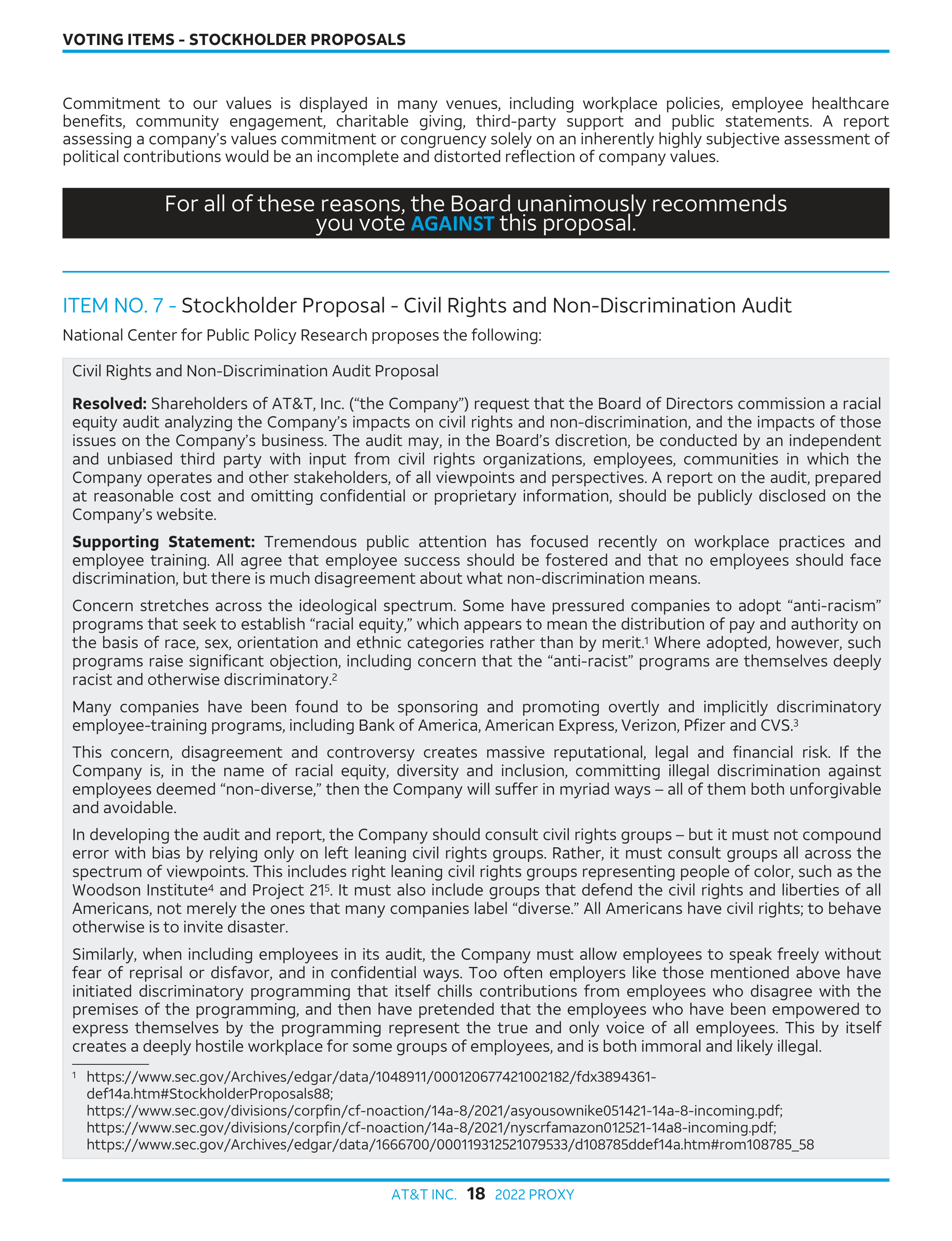
The Company has, within the past five years, included in its proxy materials a
stockholder proposal from the National Center for Public Policy Research requesting that the
Board commission a racial equity audit analyzing the Company’s impacts on civil rights and
non-discrimination (the “Previous Proposal”, collectively with the Proposal, the
“Proposals”). The Company included such proposal in its 2022 proxy materials; a copy of
the Previous Proposal is attached to this letter as Exhibit B.
Both the Proposal and the Previous Proposal share the same substantive concerns:
namely, that the Company’s business activities may be discriminating on the basis of race.
Specifically, in this regard, the Proposal references the Company’s political spending,
broadband availability and employee practices. Similarly, the Previous Proposal references
workplace practices and employee training. Both Proposals request an “audit” of the
Company’s business activities, and both ask that the audit focus on the Company’s impacts
on “racial equity,” which the Previous Proposal describes as “civil rights and non-
discrimination,” and which the Proposal in turn defines as “Black, Indigenous and People of
Color (BIPOC) communities.” The Proposal requests that this audit be conducted by an
“independent” “third-party,” whereas the Previous Proposal leaves it to the Board’s
discretion as to whether the audit should be conducted by an “independent and unbiased third
party”. In both cases, if conducted by a third party, the Proposals state that the audit should
be informed by “input from civil rights organizations” and “employees”.
The Proposals both contemplate a review of internal and external impacts of the
Company’s business and operations arising from the use of race and express concern over
reputational and legal risks to the Company. The Previous Proposal specifically states that
the racial equity audit should analyze “the Company’s impacts on civil rights and non-
discrimination, and the impacts of those issues on the Company’s
business
” and notes that
“concern, disagreement and controversy [arising from the use of anti-racism programs]
creates massive
reputational
,
legal
and financial
risk
” (emphasis added). The Proposal’s
supporting statement states that “some of AT&T’s
business practices
suggest a racial equity
audit could help mitigate
reputational
, regulatory,
legal
, and human capital
risk
” (emphasis
added). Thus, it is clear that the subject of both Proposals focuses on concerns over civil
rights and racial equity impacts of the Company’s business including reputational and legal
risks.

Office of Chief Counsel
Division of Corporation Finance
January 3, 2023
Page 5
Despite the overwhelming similarity in the subject matter of the Previous Proposal
and the Proposal, the supporting statements to the Proposals do reveal that the respective
proponents hold differing perspectives on how racial equity and civil rights concerns may be
implicated by the Company’s business and operations. However, those differing views do
not change the conclusion that both Proposals are requesting substantially the same thing of
the Company: to commission an independent, objective audit of the Company’s impacts on
civil rights and racial equity, and a public report thereof. Notwithstanding the differences in
the supporting statements and the proponents’ perspectives, if the requested racial equity
audits were performed by an unbiased, independent, objective party, the results of such
audits would be indistinguishable from each other, whether conducted under the Previous
Proposal or the Proposal, and regardless of the perspectives of the respective proponent.
Conversely, if the Staff were to not allow the Company to exclude proposals sharing the
same substantive concerns on the basis of the differing perspectives of the proponents, there
is no limit to the number of proposals addressing substantially the same subject matter
that
the Company would have to include in its proxy statement, as there are no limits to the
number of differing perspectives on any range of issues.
The Staff has previously concurred that proposals can share the same substantive
concerns and address substantially the same subject matter within the meaning of Rule 14a-
8(i)(12), notwithstanding differing perspectives of the proponents in the supporting
statements. For example, in
Pfizer Inc.
(avail. Jan. 19, 2016), the Staff concurred with the
exclusion under Rule 14a-8(i)(12) of a proposal requesting that the company review its
membership in, and support of, organizations that engaged in lobbying activities, as dealing
with substantially the same subject matter as two prior proposals the company had included
in its proxy materials within the previous five years, even though the supporting statements
of the two prior proposals were critical of the company’s support of a particular organization
associated “with contentious anti-immigration, voter identification and ‘Stand Your
Ground’” legislation, whereas the supporting statement of the proposal excluded under Rule
14a-8(i)(12) approved of the company’s support of the very same organization, which it
characterized as being aligned with the company’s “commitment to integrity” and promoting
“policies and ideals that advance free-market values that benefit the [c]ompany and its
shareholders.” Similarly, in
Johnson & Johnson
(avail. Feb. 5, 2016), the Staff also
concurred with the exclusion under Rule 14a-8(i)(12) of a proposal requesting a congruency
analysis between a company’s corporate values and its lobbying and political activities, as
dealing with substantially the same subject matter as two prior proposals the company had
included in its proxy materials within the previous five years, even though the supporting
statements of the two prior proposals were concerned with the company’s support of
organizations that did not align with the company’s stated policies to address its greenhouse

Office of Chief Counsel
Division of Corporation Finance
January 3, 2023
Page 6
gas emissions, equal employment opportunity policy and nondiscrimination policy, whereas
the supporting statement of the proposal excluded under Rule 14a-8(i)(12) noted that that the
company’s support of Planned Parenthood and organizations promoting the Affordable Care
Act were antithetical to the company’s belief in policies promoting “[f]ree-market economic
principles.”
We acknowledge that the Staff was recently unable to concur with the exclusion of a
proposal requesting that a company commission and report on a third-party racial equity
audit examining the company’s impacts on civil rights and racial equity concerns under Rule
14a-8(i)(11) as substantially duplicative of a proposal submitted to the company by the
National Center for Public Policy Research, which was substantially similar to the Previous
Proposal.
See
Johnson & Johnson
(avail. Feb. 11, 2022). However, as demonstrated by
well-established precedent since the 1983 Release and as acknowledged by the Commission
in its July 2022 release proposing amendments to Rule 14a-8,
3
the standard under Rule 14a-
8(i)(11) is separate and distinct from the standard applicable under Rule 14a-8(i)(12). While
Rule 14a-8(i)(12) provides that “a proposal which
addresses substantially the same subject
matter
as a proposal, or proposals, previously included in the company’s proxy materials
within the preceding five calendar years” (emphasis added) may be excluded from a
company’s proxy materials, Rule 14a-8(i)(11) provides that a stockholder proposal may be
excluded if it “
substantially duplicates
another proposal previously submitted to the company
by another proponent that will be included in the company’s proxy materials for the same
meeting.” (emphasis added).
Although the SEC has proposed to amend Rule 14a-8(i)(12) so that it uses the same
standard that applies under Rule 14a-8(i)(11) – with the additional gloss that “substantial
duplication” would mean “addresses the same subject matter and seeks the same objective by
the same means” – this rule proposal has not yet been adopted. Until the effective date of
any such rule amendment, the Staff must apply Rule 14a-8(i)(12) as the Commission adopted
it in 1983, when analyzing the Proposal.
The Staff has concurred with the exclusion of a proposal under Rule 14a-8(i)(12)
when it shares the same substantive concerns with prior proposals even if the proposal differs
in scope from a prior proposal. The focus is on the “substantive concerns addressed by a
proposal rather than the ‘specific language or actions proposed to deal with those
3
See
Exchange Act Release No. 95267 (July 13, 2022) (the “2022 Proposing Release”), available at
https://www.sec.gov/rules/proposed/2022/34-95267.pdf
.

Office of Chief Counsel
Division of Corporation Finance
January 3, 2023
Page 7
concerns.’”
4
Here, the Proposals share the same substantive concerns: namely, that the
Company’s business activities may be discriminating on the basis of race; hence, the need to
commission a “racial equity audit.” As such, the Proposal is excludable under Rule 14a-
8(i)(12)(i) because it “addresses substantially the same subject matter” as the Previous
Proposal, and, as documented below, the Previous Proposal did not receive the necessary
stockholder support to permit resubmission.
C.
The Stockholder Proposal Included In The Company’s 2022 Proxy Materials
Did Not Receive The Stockholder Support Necessary To Permit Resubmission.
In addition to requiring that the proposals address the same substantive concerns,
Rule 14a-8(i)(12) sets thresholds with respect to the percentage of stockholder votes cast in
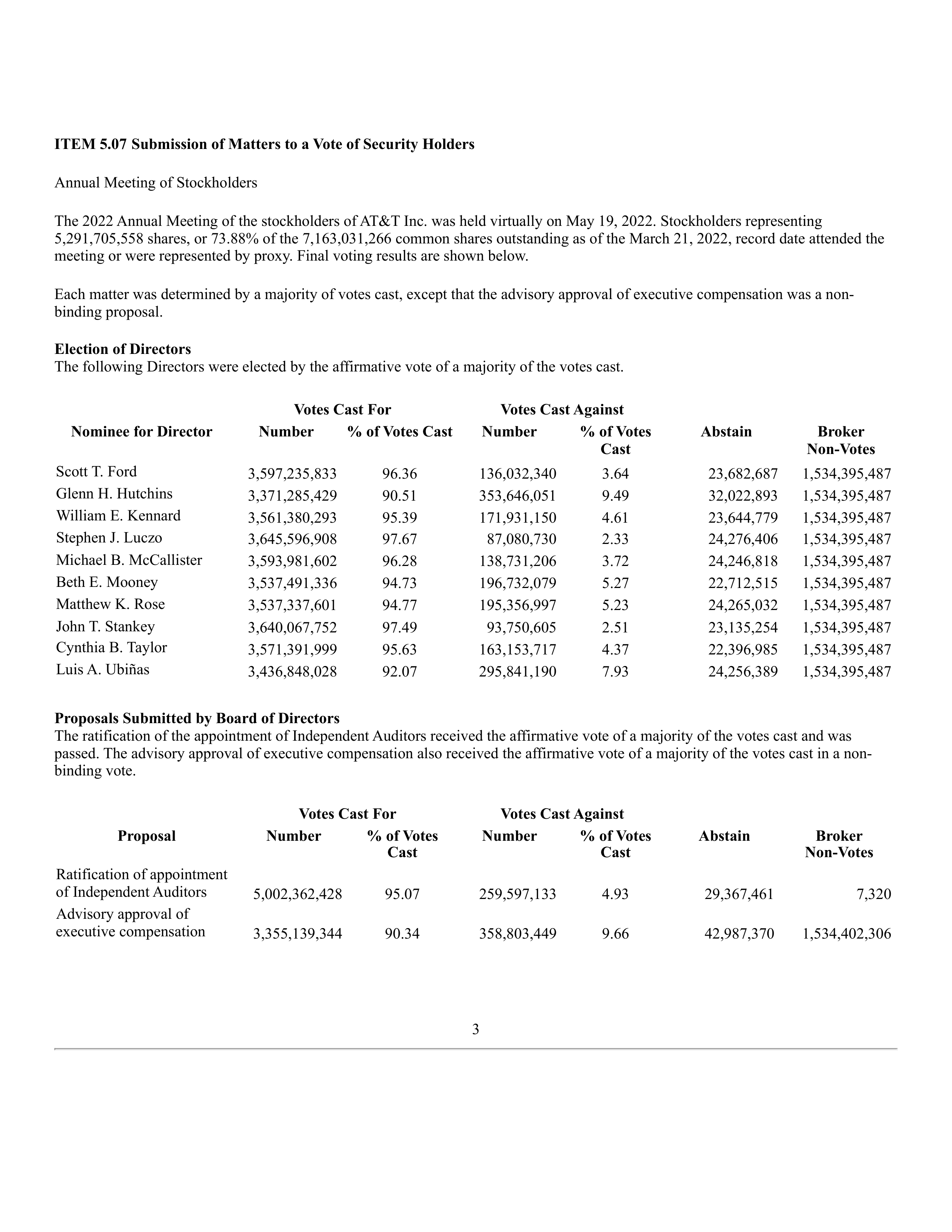
favor of the last proposal submitted and included in the Company’s proxy materials. As
reported in the Company’s Item 5.07 Form 8-K filed on May 24, 2022, which is attached to
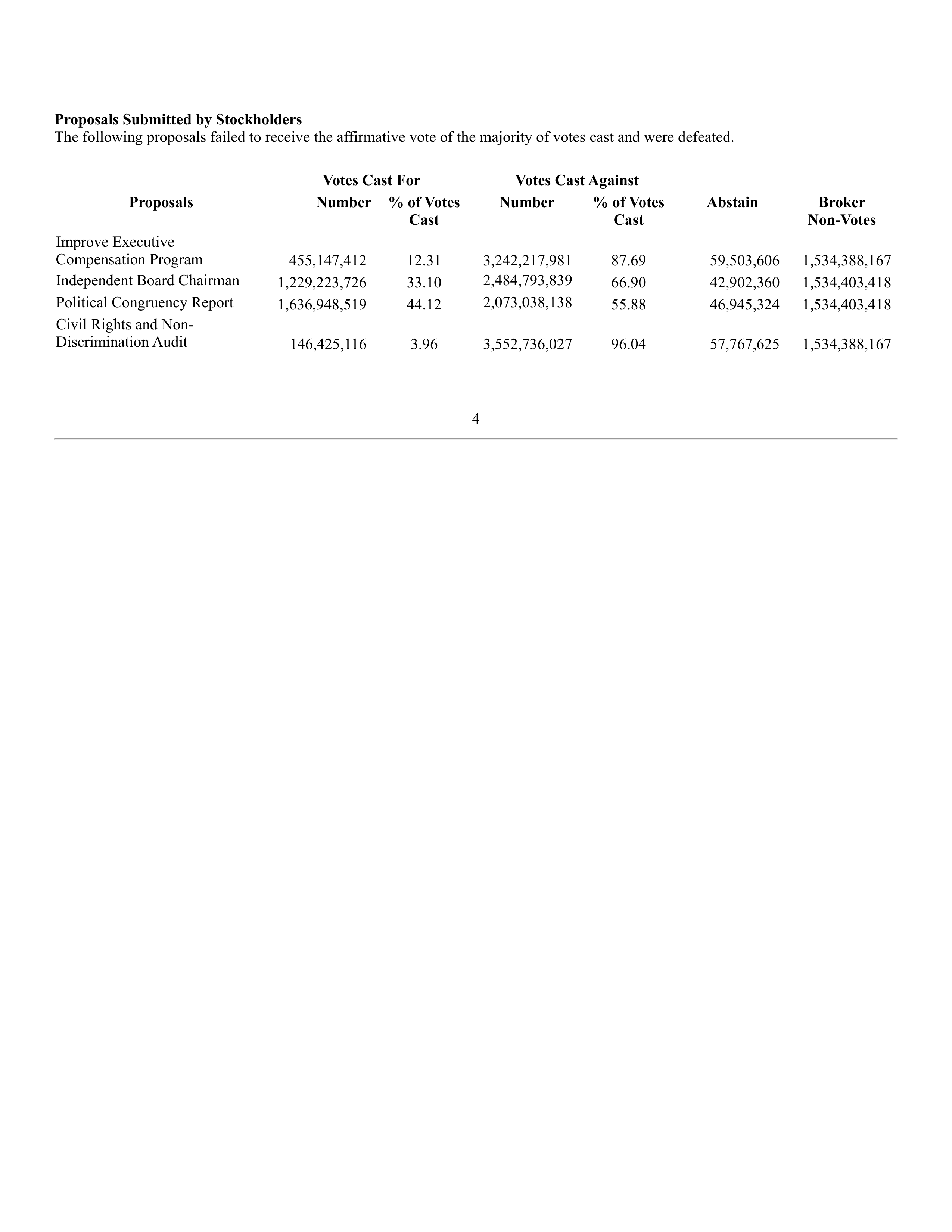
this letter as Exhibit C, the Previous Proposal received 3.96% of the votes cast at the
Company’s 2022 Annual Meeting of Stockholders.
5
Thus, the vote on the Previous Proposal
failed to achieve the 5% threshold specified in Rule 14a-8(i)(12)(i) at the Company’s 2022
Annual Meeting of Stockholders.
For the foregoing reasons, the Company may exclude the Proposal from its 2023
Proxy Materials under Rule 14a-8(i)(12)(i).
CONCLUSION
Based upon the foregoing analysis, the Company intends to exclude the Proposal
from its 2023 Proxy Materials, and we respectfully request that the Staff concur that the
Proposal may be excluded under Rule 14a-8.
We would be happy to provide you with any additional information and answer any
questions that you may have regarding this subject. Correspondence regarding this letter
4
2020 Release at 70257.
5
The 2022 Proposal received 3,552,736,027 “against” votes and 146,425,116 “for” votes. Abstentions and
broker non-votes were not included for purposes of this calculation. The total stockholder votes cast is
calculated using a fraction for which the numerator is “for” votes and the denominator is “for + against” votes.
See
Staff Legal Bulletin No. 14, part F.4 (July 13, 2001).

Office of Chief Counsel
Division of Corporation Finance
January 3, 2023
Page 8
should be sent to shareholderproposals@gibsondunn.com. If we can be of any further
assistance in this matter, please do not hesitate to call me at (202) 887-3550.
Sincerely,
/s/ Thomas J. Kim
Thomas J. Kim
Enclosures
cc:
Bryan Hough, AT&T Inc.
Moni DeWalt, AT&T Inc.
Rachel Fagiano, Nathan Cummings Foundation

EXHIBIT A
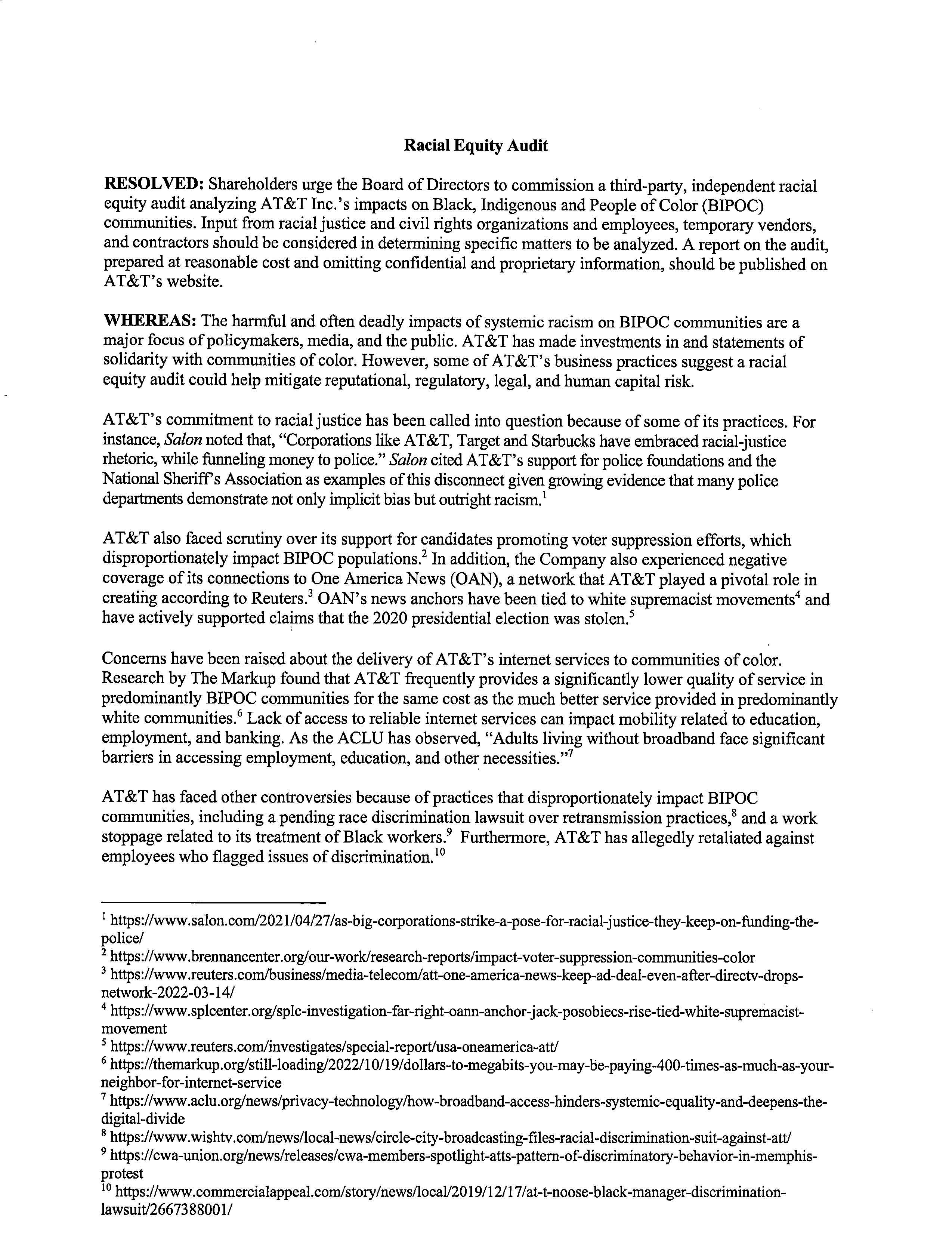
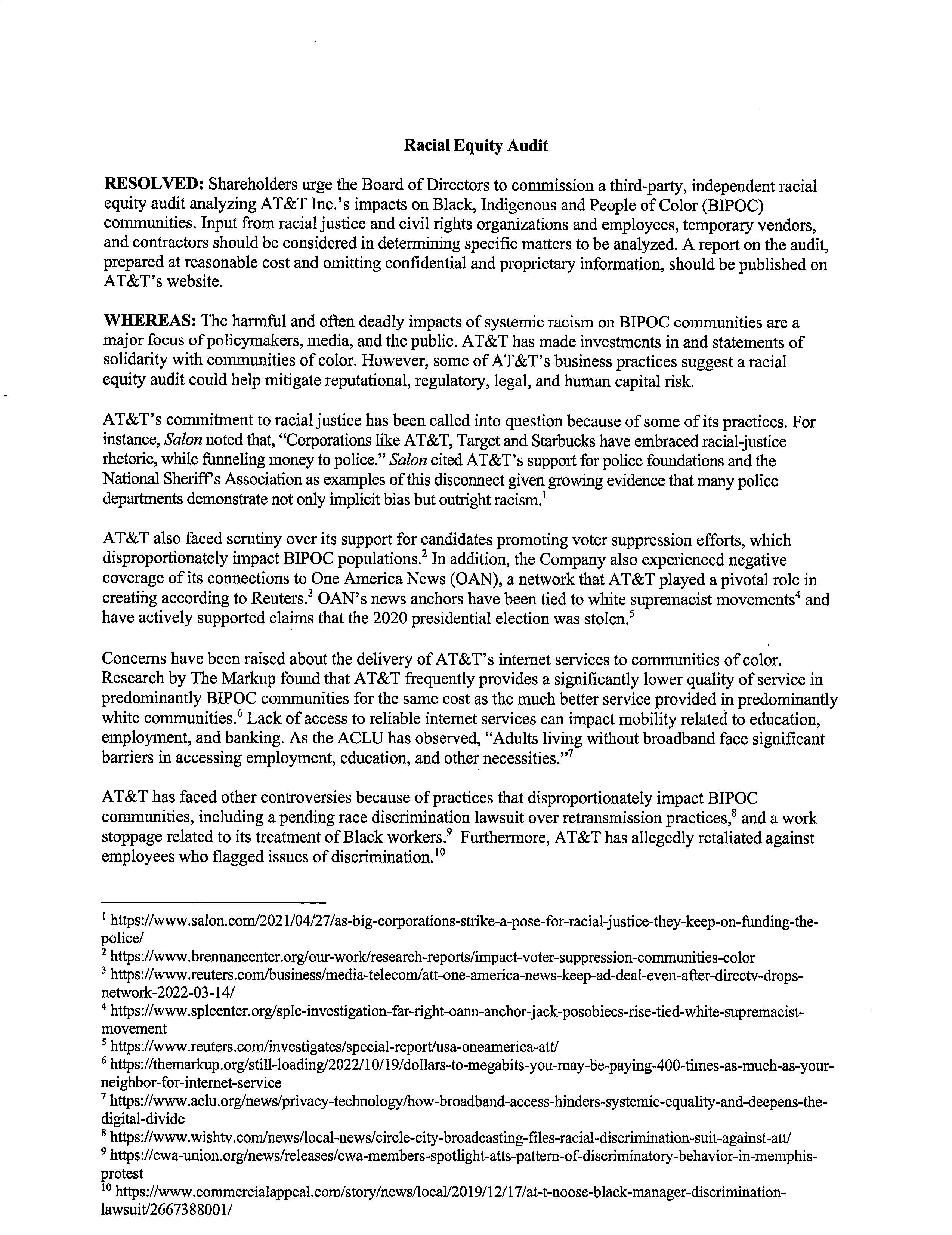



EXHIBIT B
VOTING ITEMS - STOCKHOLDER PROPOSALS
Commitment
to
our
values
is
displayed
in
many
venues,
including
workplace
policies,
employee
healthcare
benefits,
community
engagement,
charitable
giving,
third-party
support
and
public
statements.
A
report
assessing a company’s values commitment or congruency solely on an inherently highly subjective assessment of
political contributions would be an incomplete and distorted reflection of company values.
For all of these reasons, the Board unanimously recommends
you vote
AGAINST
this proposal.
ITEM NO. 7 -
Stockholder Proposal - Civil Rights and Non-Discrimination Audit
National Center for Public Policy Research proposes the following:
Civil Rights and Non-Discrimination Audit Proposal
Resolved:
Shareholders of AT&T, Inc. (“the Company”) request that the Board of Directors commission a racial
equity audit analyzing the Company’s impacts on civil rights and non-discrimination, and the impacts of those
issues
on
the
Company’s
business.
The
audit
may,
in
the
Board’s
discretion,
be
conducted
by
an
independent
and
unbiased
third
party
with
input
from
civil
rights
organizations,
employees,
communities
in
which
the
Company operates and other stakeholders, of all viewpoints and perspectives. A report on the audit, prepared
at
reasonable
cost
and
omitting
confidential
or
proprietary
information,
should
be
publicly
disclosed
on
the
Company’s website.
Supporting
Statement:
Tremendous
public
attention
has
focused
recently
on
workplace
practices
and
employee
training.
All
agree
that
employee
success
should
be
fostered
and
that
no
employees
should
face
discrimination, but there is much disagreement about what non-discrimination means.
Concern
stretches
across
the
ideological
spectrum.
Some
have
pressured
companies
to
adopt
“anti-racism”
programs that seek to establish “racial equity,” which appears to mean the distribution of pay and authority on
the
basis
of
race,
sex,
orientation
and
ethnic
categories
rather
than
by
merit.
1
Where
adopted,
however,
such
programs
raise
significant
objection,
including
concern
that
the
“anti-racist”
programs
are
themselves
deeply
racist and otherwise discriminatory.
2
Many
companies
have
been
found
to
be
sponsoring
and
promoting
overtly
and
implicitly
discriminatory
employee-training programs, including Bank of America, American Express, Verizon, Pfizer and CVS.
3
This
concern,
disagreement
and
controversy
creates
massive
reputational,
legal
and
financial
risk.
If
the
Company
is,
in
the
name
of
racial
equity,
diversity
and
inclusion,
committing
illegal
discrimination
against
employees deemed “non-diverse,” then the Company will suffer in myriad ways – all of them both unforgivable
and avoidable.
In developing the audit and report, the Company should consult civil rights groups – but it must not compound
error
with
bias
by
relying
only
on
left
leaning
civil
rights
groups.
Rather,
it
must
consult
groups
all
across
the
spectrum of viewpoints. This includes right leaning civil rights groups representing people of color, such as the
Woodson
Institute
4
and
Project
21
5
.
It
must
also
include
groups
that
defend
the
civil
rights
and
liberties
of
all
Americans, not merely the ones that many companies label “diverse.” All Americans have civil rights; to behave
otherwise is to invite disaster.
Similarly,
when
including
employees
in
its
audit,
the
Company
must
allow
employees
to
speak
freely
without
fear
of
reprisal
or
disfavor,
and
in
confidential
ways.
Too
often
employers
like
those
mentioned
above
have
initiated
discriminatory
programming
that
itself
chills
contributions
from
employees
who
disagree
with
the
premises
of
the
programming,
and
then
have
pretended
that
the
employees
who
have
been
empowered
to
express
themselves
by
the
programming
represent
the
true
and
only
voice
of
all
employees.
This
by
itself
creates a deeply hostile workplace for some groups of employees, and is both immoral and likely illegal.
1
https://www.sec.gov/Archives/edgar/data/1048911/000120677421002182/fdx3894361-
def14a.htm#StockholderProposals88;
https://www.sec.gov/divisions/corpfin/cf-noaction/14a-8/2021/asyousownike051421-14a-8-incoming.pdf;
https://www.sec.gov/divisions/corpfin/cf-noaction/14a-8/2021/nyscrfamazon012521-14a8-incoming.pdf;
https://www.sec.gov/Archives/edgar/data/1666700/000119312521079533/d108785ddef14a.htm#rom108785_58
AT&T INC.
18
2022 PROXY
VOTING ITEMS - STOCKHOLDER PROPOSALS
2
https:///www.americanexperiment.org/survey-says-americans-oppose-critical-race-theory/;
https://www.newsweek.com/majority-americans-hold-negative-view-critical-race-theory-amid-controversy-1601337;
https://www.newsweek.com/coca-cola-facing-backlash-says-less-white-learning-plan-was-about-workplace-inclusion-
1570875;
https://nypost.com/2021/08/11/american-express-tells-its-workers-capitalism-is-racist/;
https://www.city-journal.org/verizon-critical-race-theory-training;
3
https://www.city-journal.org/bank-of-america-racial-reeducation-program;
https://www.city-journal.org/verizon-critical-
race-theory-training;
https://nypost.com/2021/08/11/american-express-tells-its-workers-capitalism-is-racist/;
https://www.foxbusiness.com/politics/cvs-inclusion-training-critical-race-theory;
https://www.msn.com/en-us/money/other/pfizersets-race-based-hiring-goals-in-the-name-of-fighting-systemic-
racism-gender-equity-challenges/ar-AAOiSwJ
4
https://woodson.as.virginia.edu/
5
https://nationalcenter.org/project-21/
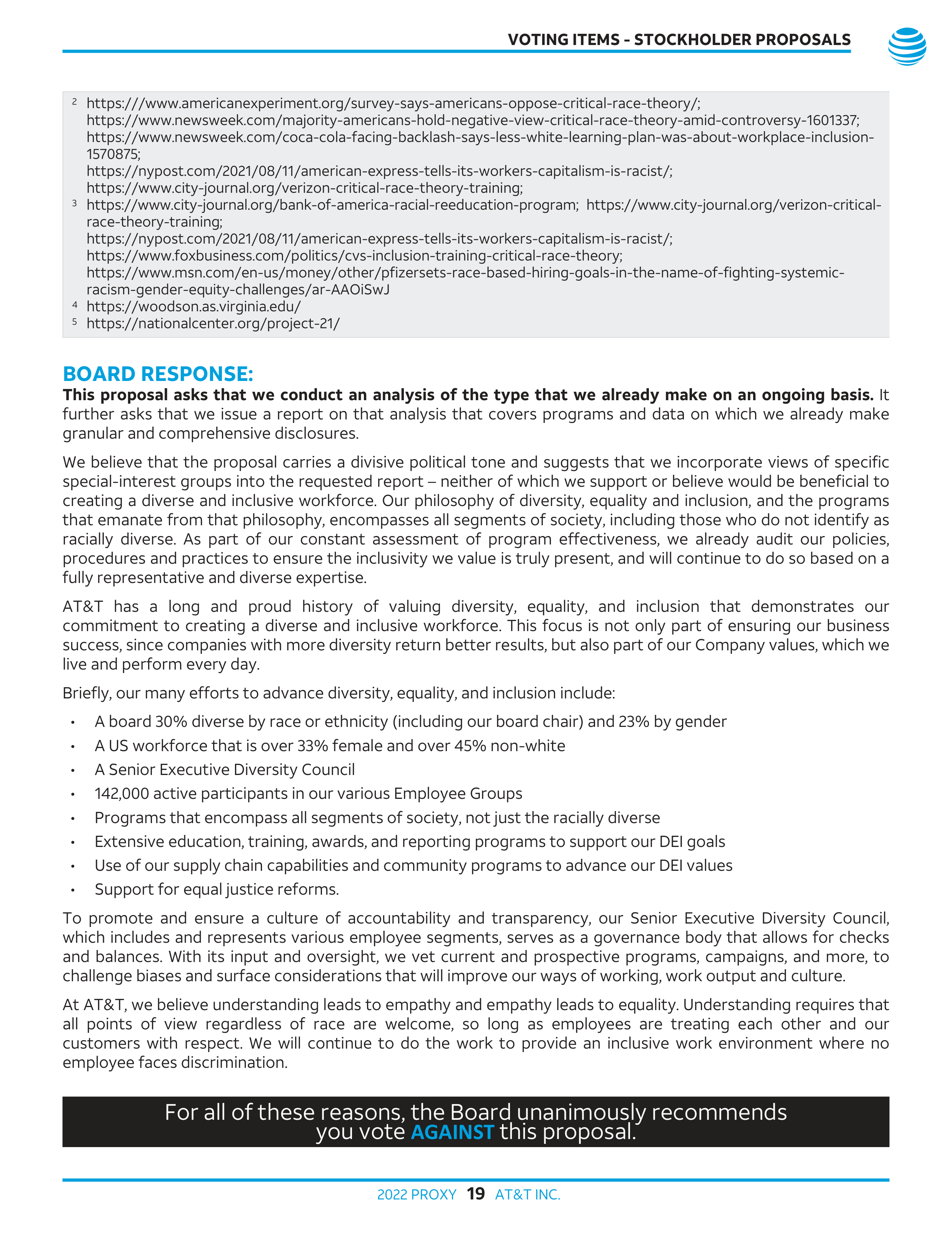
BOARD RESPONSE:
This
proposal
asks
that
we
conduct
an
analysis
of
the
type
that
we
already
make
on
an
ongoing
basis.
It
further
asks
that
we
issue
a
report
on
that
analysis
that
covers
programs
and
data
on
which
we
already
make
granular and comprehensive disclosures.
We
believe
that
the
proposal
carries
a
divisive
political
tone
and
suggests
that
we
incorporate
views
of
specific
special-interest groups into the requested report – neither of which we support or believe would be beneficial to
creating
a
diverse
and
inclusive
workforce.
Our
philosophy
of
diversity,
equality
and
inclusion,
and
the
programs
that emanate from that philosophy, encompasses all segments of society, including those who do not identify as
racially
diverse.
As
part
of
our
constant
assessment
of
program
effectiveness,
we
already
audit
our
policies,
procedures and practices to ensure the inclusivity we value is truly present, and will continue to do so based on a
fully representative and diverse expertise.
AT&T
has
a
long
and
proud
history
of
valuing
diversity,
equality,
and
inclusion
that
demonstrates
our
commitment
to
creating
a
diverse
and
inclusive
workforce.
This
focus
is
not
only
part
of
ensuring
our
business
success, since companies with more diversity return better results, but also part of our Company values, which we
live and perform every day.
Briefly, our many efforts to advance diversity, equality, and inclusion include:
•
A board 30% diverse by race or ethnicity (including our board chair) and 23% by gender
•
A US workforce that is over 33% female and over 45% non-white
•
A Senior Executive Diversity Council
•
142,000 active participants in our various Employee Groups
•
Programs that encompass all segments of society, not just the racially diverse
•
Extensive education, training, awards, and reporting programs to support our DEI goals
•
Use of our supply chain capabilities and community programs to advance our DEI values
•
Support for equal justice reforms.
To
promote
and
ensure
a
culture
of
accountability
and
transparency,
our
Senior
Executive
Diversity
Council,
which
includes
and
represents
various
employee
segments,
serves
as
a
governance
body
that
allows
for
checks
and
balances.
With
its
input
and
oversight,
we
vet
current
and
prospective
programs,
campaigns,
and
more,
to
challenge biases and surface considerations that will improve our ways of working, work output and culture.
At AT&T, we believe understanding leads to empathy and empathy leads to equality. Understanding requires that
all
points
of
view
regardless
of
race
are
welcome,
so
long
as
employees
are
treating
each
other
and
our
customers
with
respect.
We
will
continue
to
do
the
work
to
provide
an
inclusive
work
environment
where
no
employee faces discrimination.
For all of these reasons, the Board unanimously recommends
you vote
AGAINST
this proposal.
2022 PROXY
19
AT&T INC.

EXHIBIT C
!"##$%&#'$"()$(*+,
$-#.%%&'#'% /&.!"0%&#$-()
!#%
$-%1$#*!#%$-%!2'% #%3%"#%1$#%+,!4(
5
*/!&#
!6%$-
%0' #!"#! 1%&'-'%+'" .!#%,
%2!7!%
(8(
)()()
*#!#%
$#.%9' +'&#'$"
$-"&$1$!#'$",
* $66' '$"
'2%6:%,
*
612$4%
+%"#'-'&!#'$"$,
<!+#!22! %/!
*++%
$-'"&'1!2/%&#'3%--'&% ,
=
*>'1
$+%,
%0' #!"#?
#%2%1.$"%"6:%'"&2+'"0!%!&$+%*(,((
*$6%
!6%$$6%
++% '- .!"0%+'"&%@! #
%1$#,
ABCDE
FBCGHHIJ
HIKGFC
LJMLCNJOKPFBCQJIRSTUPKNKVWKXKVFCVYCYFJXKRZNFGVCJZXN[XGFKXP[FBCPKNKVWJLNKWGFKJVJPFBC
ICWKXFIGVF
ZVYCI
GV[JPFBCPJNNJOKVWHIJ\KXKJVX]XCC^CVCIGN_VXFIZDFKJV
`abaLCNJOcd
e
fIKFFCV
DJRRZVKDGFKJVX
HZIXZGVFFJgZNChbiZVYCIFBCjCDZIKFKCX
`DF]klAQgbmnahbic
e
jJNKDKFKVW
RGFCIKGNHZIXZGVFFJgZNCkhGTkbZVYCIFBCoMDBGVWC
`DF]klAQgbhnakhGTkbc
e
pICTDJRRCVDCRCVF
DJRRZVKDGFKJVXHZIXZGVFFJgZNCkhYTb]LcZVYCIFBCoMDBGVWC
`DF]klAQgbhnTkhYTb]Lc
c
e
pICTDJRRCVDCRCVF
DJRRZVKDGFKJVXHZIXZGVFFJgZNCkmCTh]DcZVYCIFBCoMDBGVWC
`DF]klAQgbhnakmCTh]Dcc
%&'#'%
%0' #%%+ !"##$%&#'$"(*:,$-#.%
&#
'#2%
$-%!&.&2!
!+'"0
46:$2* ,
!6%$-%!&.%/&.!"0%
$"
7.'&.%
0' #%%+
AJRRJV
jBGI
CX
]pGIqGNZCrkannpCIjBGICc
s
tCOuJIEjFJD
E
oMDBGVWC
vCHJXKFGI[jB
GICXw
CGDBICHICXCVFKVWGkxknnnFBKVFCICXFKVGXBGICJPiannnypCIHCFZGNpICPCIICYjFJDEwjCIKCX
`
spg`
tCOuJIEjFJD
E
oMDBGVWC
vCHJXKFGI[jB
GICXw
CGDBICHICXCVFKVWGkxknnnFBKVFCICXFKVGXBGICJPhalinypCIHCFZGNpICPCIICYjFJDEwjCIKCXA
spgA
tCOuJIEjFJD
E
oMDBGVWC
`szs_VDakah
iny
^NJLGNtJFCXYZC{ZVCkwbnbb
sbb|
tCOuJIEjFJD
E
oMDBGVWC
`szs_VDabai
nny
^NJLGNtJFCXYZC}GIDBkiwbnbm
sbm
tCOuJIEjFJD
E
oMDBGVWC
`szs_VDabal
iny
^NJLGNtJFCXYZC}G[k~wbnbm
sbmA
tCOuJIEjFJD
E
oMDBGVWC
!"#
$%&'
($%)*"#+$",#%)-./)0)1%)2+)3456768
689
,):;#3<0%#<
=>?$')
@ 7
47A
*"#+$",#%)-./)0)1%)2+)3456768
68=
,):;#3<0%#<
=>?$')
@ 8
77A
*"#+$",#%)-./)0)1%)2+)3456768
68
,):;#3<0%#<
=>?$')
@ B
47A
*"#+$",#%)-./)0)1%)2+)3@456768
68!
,):;#3<0%#<
=>?$')
6 C
77A
*"#+$",#%)-./)D$3?@45676C
6C
,):;#3<0%#<
=>?$')
8 4
77A
*"#+$",#%)-./)9))2+)3@E56764
64
,):;#3<0%#<
=>?$')
7 6
47A
*"#+$",#%)-./)D$3?C5676F
6F=
,):;#3<0%#<
=>?$')
@ G
77A
*"#+$",#%)-./)0)1%)2+)345676F
6F9
,):;#3<0%#<
=>?$')
6 B
77A
*"#+$",#%)-./)9))2+)3C5676F
6F
,):;#3<0%#<
=>?$')
@ F
77A
*"#+$",#%)-./)D$H@B5676G
6GI
,):;#3<0%#<
=>?$')
6 8
47A
*"#+$",#%)-./)0)1%)2+)345676B
6B9
,):;#3<0%#<
=>?$')
C 8
E4A
*"#+$",#%)-./)0)1%)2+)3@C5676B
6BJ
,):;#3<0%#<
=>?$')
6 F
77A
*"#+$",#%)-./)9))2+)3@E5676B
6B
,):;#3<0%#<
=>?$')
7 G
77A
*"#+$",#%)-./)D$3?C56787
87J
,):;#3<0%#<
=>?$')
6 7
47A
*"#+$",#%)-./)D$H@B56786
86
,):;#3<0%#<
=>?$')
8 4
47A
*"#+$",#%)-./)9))2+)3@E56786
86
,):;#3<0%#<
=>?$')
4 6
77A
*"#+$",#%)-./),#K)2+)3@G56788
88
,):;#3<0%#<
=>?$')
8 8
E4A
*"#+$",#%)-./)D$3?@45678C
8C
,):;#3<0%#<
=>?$')
6 C
47A
*"#+$",#%)-./)D$3?@456784
84
,):;#3<0%#<
=>?$')
8 @
47A
*"#+$",#%)-./)0)1%)2+)3C5678F
8F
,):;#3<0%#<
=>?$')
6 F
77A
*"#+$",#%)-./)D$H@B5678G
8GI
,):;#3<0%#<
=>?$')
@ G
77A
*"#+$",#%)-./)0)1%)2+)3@C5678B
8BJ
,):;#3<0%#<
=>?$')
E 7
77A
*"#+$",#%)-./)
13&"87567C7
C7
,):;#3<0%#<
=>?$')
C 6
47A
*"#+$",#%)-./)L/)@567C8
C8
,):;#3<0%#<
=>?$')
C G
E4A
*"#+$",#%)-./)L/)@567CC
CC
,):;#3<0%#<
=>?$')
C 7
77A
*"#+$",#%)-./)L/)@567CB
CB
,):;#3<0%#<
=>?$')
C 6
47A
*"#+$",#%)-./)D$3?@56747
47
,):;#3<0%#<
=>?$')
8 E
47A
*"#+$",#%)-./)0)1%)2+)3@56747
47
,):;#3<0%#<
=>?$')
4 8
47A
*"#+$",#%)-./),#K)2+)3@567FF
JJ
,):;#3<0%#<
=>?$')
4 F
64A
*"#+$",#%)-./)
/'/-%@567FE
JI
,):;#3<0%#<
=>?$')
.&$%)
+H?)
<
2$3<:?)%?)3%?)3)'&-%3$%&-$)2)3'&''3#:%?#21$H$-.)M&).&(/")C74#M%?)0)/3&%&)-
%
#M@B88
NO687 C74#M%?&-?$1%)3P#3(/")@6+Q6#M%?)0)/3&%&)-=>?$')
%#M@B8CNO6C7 @6+Q6#M%?&-?$1%)3P
=2)3'&'
'3#:%
?
#21$HR
M
$)2)3'&''
3#:%?
#21$H5&.&$%)+H?)<2$3%).).%3$-&%
)3&#.
M#3
#21"H&':&%?
$H
):#33)K&-).M&$&$"$#/%&'-%$.$3.-13#K&.).1/3-/$%%#0)%&#@8N$P#M%?)=>?$')
%
R
6
"##$%&'()$'*+,' -#./
0,#
1211
"##$%&'($,#/$'*+,' -#./'(
0304*56/,# -7%.$ 8'"89:;12115)$'*+,' -#./.#<.#/#
$%&
=;1:9;>2=;==?
/,
.#/;
'.>@5??A'($,#>;9B@;2@9;1BB*'CC'/,.#/'$/$-%&/'($,#".*,19;1211;.#*'.--$
#
$$#-#-$,#
C##$%&'.6#.#
.#<.#/#$#-
D8<.'E85F% 7'$%&.#/ $/.#/,'6D# '65
G*,
C$$#.6/-#$#.C%#-D8CH'.%$8'(7'$#/*/$;#E*#<$$,$$,#-7%/'.8<<.'7 '(#E#*$%7#*'C<#/$%'6
/
'I
D%-%&<.'<'/
5
J
0,#
(' '6%&K
%.#*$'./
6#.## #*$#-D8$,#((%.C$%7#7'$#'(CH'.%$8'($,#7'$#/*/$5
LM
L
NO
P
J
P
Q
L
P
Q
L
N
RS
PT
)*'$$
05F'.-
@;=:>;1@=;?@@
:B5@B
9@B;2@1;@U2
@5BU
1@;B?1;B?>
9;=@U;@:=;U?>
V #W5W$*,%
/
@;@>9;1?=;U1:
:25=9
@=@;BUB;2=9
:5U:
@1;211;?:@
9;=@U;@:=;U?>
X% %CG5Y#
.-
@;=B9;@?2;1:@
:=5@:
9>9;:@9;9=2
U5B9
1@;BUU;>>:
9;=@U;@:=;U?>
)$#<,#Z5[*\'
@;BU=;=:B;:2?
:>5B>
?>;2?2;>@2
15@@
1U;1>B;U2B
9;=@U;@:=;U?>
"%*,# ]5"*^
%/$#.
@;=:@;:?9;B21
:B51?
9@?;>@9;12B
@5>1
1U;1UB;?9?
9;=@U;@:=;U?>
]#$,G5"''#8
@;=@>;U:9;@@B
:U5>@
9:B;>@1;2>:
=51>
11;>91;=9=
9;=@U;@:=;U?>
"$$,#6Y5_'/
#
@;=@>;@@>;B29
:U5>>
9:=;@=B;::>
=51@
1U;1B=;2@1
9;=@U;@:=;U?>
Z',05)$+#8
@;BU2;2B>;>=1
:>5U:
:@;>=2;B2=
15=9
1@;9@=;1=U
9;=@U;@:=;U?>
^8$,%]508 '
.
@;=>9;@:9;:::
:=5B@
9B@;9=@;>9>
U5@>
11;@:B;:?=
9;=@U;@:=;U?>
[%/
5`D%a/
@;U@B;?U?;21?
:152>
1:=;?U9;9:2
>5:@
1U;1=B;@?:
9;=@U;@:=;U?>
bc
RJ
0,#
.$%(%*$%''
(
$,#<<'%$C#$'(4-#<#-#$
-%$'./.#*#%7#-$,#((%.C$%7#7'$#'(CH'.%$8'($,#7'$#/*/$-6/
<//#-50,#-7%
/'.8
<<.'7 '(#E#*$%7#*'C<#/$%' /'.#*#%7#-$,#((%.C$%7#7'$#'(CH'.%$8'($,#7'$#/*
/$
%'I
D%-%&7'$#5
LM
L
NO
bc
P
Q
L
P
Q
L
N
RS
PT
_$%(%*$%'
'(
<<'%$C#$
'(
4-#<#-#$
-%$'./
=;221;@B1;U1?
:=52>
1=:;=:>;9@@
U5:@
1:;@B>;UB9
>;@12
-7%/'.8<<.'7
'(
#E#*$%7#
*'C<#
/$%'
@;@==;9@:;@UU
:25@U
@=?;?2@;UU:
:5BB
U1;:?>;@>2
9;=@U;U21;@2B
@
!"!"#$ %&$" '"$&&$$'"( $)&$!%"!$"# #"$#*
+
,
-
+
,
./0
1
2
3+
,
1
23+
,
.
0
4
105+
6' &
78%9$
&
:'!"$
;
"'
?<?A
?A*B?
B>AA?@>CD?
D@*EC
=C>=FB>EFE
?>=BBDD>?E@
6##$G"
#
:" '"
?>AAC>AAB>@AE
BB*?F
A><D@CB>DBC
EE*CF
?>=B<?D
;$%": 9
%)
H $
?>EBE>C=?C
<<*?A
A>F@B>FBD>?BD
==*DD
CBA<
?>=B<?D
:&H$!"#IJ
K!% '"$
L
9#$
???E
B*CE
B>==A>@BE>FA@
CE*F<
=@>@E@>EA=
?>=BBDD>?E@
<
!"#
$
%&
$'(
$
(
%(&
$
$
$
%&
)$*
+,+
-./*
0
1
2
&3!"3
433
5&1
66
&2
&2
7 $80'
&9
%/
%
$
&
:

Nathan Cummings Foundation
nathancummings.org
January 24, 2023
Via e-mail at shareholderproposals@sec.gov
Securities and Exchange Commission
Office of the Chief Counsel
Division of Corporation Finance
100 F Street, NE
Washington, DC 20549
Re: Request by AT&T Inc. to omit proposal submitted by the Nathan Cummings Foundation
Ladies and Gentlemen,
Pursuant to Rule 14a-8 under the Securities Exchange Act of 1934, the Nathan Cummings
Foundation (the “Proponent”) submitted a shareholder proposal (the “Proposal”) to AT&T Inc.
(“AT&T” or the “Company”). The Proposal asks AT&T’s Board of Directors to commission a
third- party, independent racial equity audit, with input from racial justice and civil rights
organizations and employees, temporary vendors, and contractors, analyzing AT&T’s impacts on
Black, Indigenous and People of Color (BIPOC) communities.
In a letter to the Division dated January 3, 2023 (the “No-Action Request”), AT&T stated
that it intends to omit the Proposal from its proxy materials to be distributed to shareholders in
connection with the Company’s 2023 annual meeting of shareholders (“AGM”). AT&T argues that
it is entitled to exclude the Proposal in reliance on Rule 14a-8(i)(12)(i), on the ground that the
Proposal addresses substantially the same subject matter as a proposal that was voted on last year
and failed to achieve 5% or more shareholder support. As discussed more fully below, AT&T has
not met its burden of proving its entitlement to exclude the Proposal on that basis, and the
Proponent respectfully requests that the Company’s request for relief be denied.
The Proposal
The Proposal states:
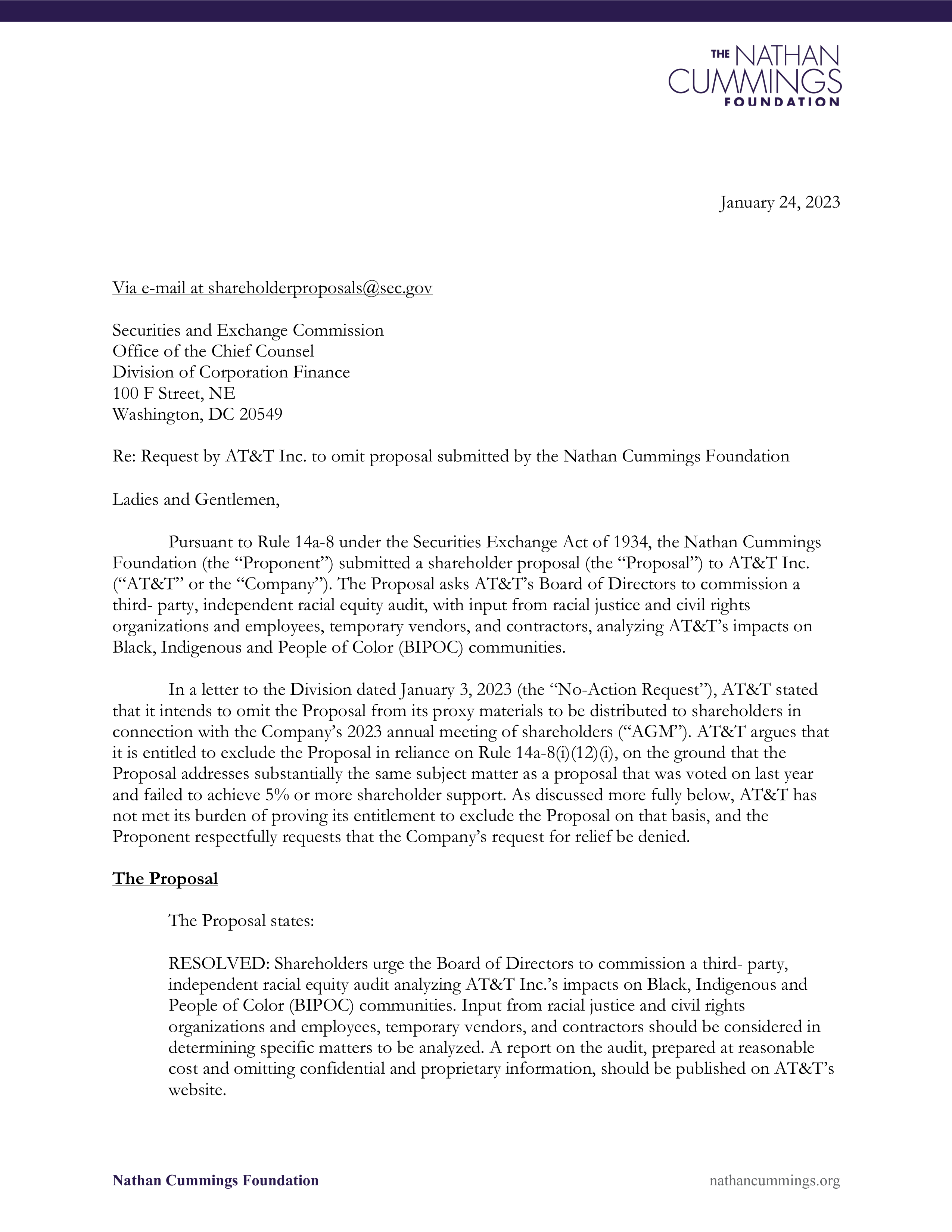
RESOLVED: Shareholders urge the Board of Directors to commission a third- party,
independent racial equity audit analyzing AT&T Inc.’s impacts on Black, Indigenous and
People of Color (BIPOC) communities. Input from racial justice and civil rights
organizations and employees, temporary vendors, and contractors should be considered in
determining specific matters to be analyzed. A report on the audit, prepared at reasonable
cost and omitting confidential and proprietary information, should be published on AT&T’s
website.

Nathan Cummings Foundation
nathancummings.org
Resubmission Threshold
AT&T claims that the Proposal can be omitted pursuant to Rule 14a-8(i)(12)(i) (the
“Resubmission Exclusion”) because it deals with substantially the same subject matter as a proposal
that was voted on once in the past three calendar years, at AT&T’s 2022 AGM, and did not receive
support from 5% or more of shares voted. The proposal voted on at the 2022 AGM (the “2022
Proposal”) was submitted by the National Center for Public Policy Research (“NCPPR”) and
provided:
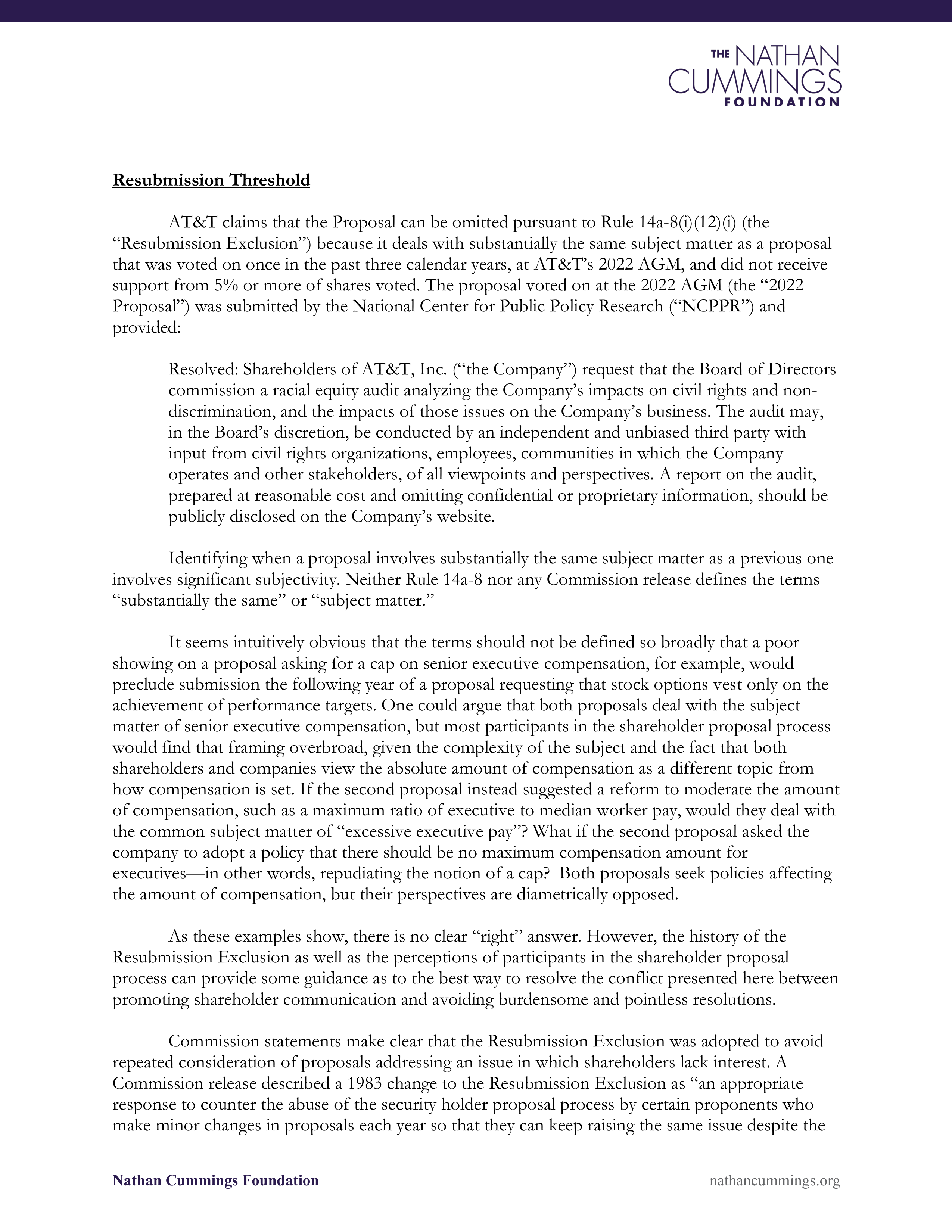
Resolved: Shareholders of AT&T, Inc. (“the Company”) request that the Board of Directors
commission a racial equity audit analyzing the Company’s impacts on civil rights and non-
discrimination, and the impacts of those issues on the Company’s business. The audit may,
in the Board’s discretion, be conducted by an independent and unbiased third party with
input from civil rights organizations, employees, communities in which the Company
operates and other stakeholders, of all viewpoints and perspectives. A report on the audit,
prepared at reasonable cost and omitting confidential or proprietary information, should be
publicly disclosed on the Company’s website.
Identifying when a proposal involves substantially the same subject matter as a previous one
involves significant subjectivity. Neither Rule 14a-8 nor any Commission release defines the terms
“substantially the same” or “subject matter.”
It seems intuitively obvious that the terms should not be defined so broadly that a poor
showing on a proposal asking for a cap on senior executive compensation, for example, would
preclude submission the following year of a proposal requesting that stock options vest only on the
achievement of performance targets. One could argue that both proposals deal with the subject
matter of senior executive compensation, but most participants in the shareholder proposal process
would find that framing overbroad, given the complexity of the subject and the fact that both
shareholders and companies view the absolute amount of compensation as a different topic from
how compensation is set. If the second proposal instead suggested a reform to moderate the amount
of compensation, such as a maximum ratio of executive to median worker pay, would they deal with
the common subject matter of “excessive executive pay”? What if the second proposal asked the
company to adopt a policy that there should be no maximum compensation amount for
executives—in other words, repudiating the notion of a cap? Both proposals seek policies affecting
the amount of compensation, but their perspectives are diametrically opposed.
As these examples show, there is no clear “right” answer. However, the history of the
Resubmission Exclusion as well as the perceptions of participants in the shareholder proposal
process can provide some guidance as to the best way to resolve the conflict presented here between
promoting shareholder communication and avoiding burdensome and pointless resolutions.
Commission statements make clear that the Resubmission Exclusion was adopted to avoid
repeated consideration of proposals addressing an issue in which shareholders lack interest. A
Commission release described a 1983 change to the Resubmission Exclusion as “an appropriate
response to counter the abuse of the security holder proposal process by certain proponents who
make minor changes in proposals each year so that they can keep raising the same issue despite the

Nathan Cummings Foundation
nathancummings.org
fact that other shareholders have indicated by their votes that they are not interested in that issue.”
1
Similar language regarding shareholder interest was used nearly three decades earlier when the
Resubmission Exclusion was adopted, with the release stating that the exclusion was intended “to
relieve the management of the necessity of including proposals which have been previously
submitted to security holders without evoking any substantial security holder interest therein.”
2
In
other words, the Resubmission Exclusion seeks to avoid wasting shareholders’ time on topics they
don’t care about.
The Commission has also indicated that interpretation of the Resubmission Exclusion
should focus on the “substantive concerns” raised by proposals rather than the actions requested or
specific language. The 1983 released adopting the “substantially the same subject matter”
formulation stated: “The Commission is aware that the interpretation of the new provision will
continue to involve difficult subjective judgements, but anticipates that those judgements will be
based upon a consideration of the substantive concerns raised by a proposal rather than the specific
language or actions proposed to deal with those concerns. The Commission believes that by
focusing on substantive concerns addressed in a series of proposals, an improperly broad
interpretation of the new rule will be avoided.”
Voting patterns make it clear that shareholders do not lack interest in the subject of racial
equity audits undertaken for the purpose of addressing companies’ contributions to systemic racism.
Proxy advisor Institutional Shareholder Services (“ISS”) describes proposals asking for such audits
as seeking to “test” the extent to which corporate statements in support of racial justice made in the
aftermath of the 2020 George Floyd murder “are reflected in company policy and governance.”
3
These proposals, which are referred to herein as “Justice-Focused REA Proposals,” share
several characteristics: They request an independent or third-party audit; their supporting
statements describe ways in which companies’ policies, products or practices are or may be
harming BIPOC stakeholders and communities of color; and they advocate for a racial equity
audit as a tool for companies to use in reducing such adverse impacts and their contributions to
systemic racism.
Justice-Focused REA Proposals that went to a vote last season received support from
holders of 45% of shares voted, on average, and eight of them garnered majority support.
4
Proxy
advisors ISS and Glass Lewis recommended that their clients vote in favor of the bulk of Justice-
Focused REA Proposals.
Although the resolved clauses of the Proposal—indeed of all Justice-Focused REA
Proposals—and the 2022 Proposal request facially similar actions, the supporting statements leave
no doubt that the substantive concerns behind the proposals vary dramatically. The Justice-Focused
REA Proposals proceed from the assumption that systemic racism, and its harmful and sometimes
deadly effects on people of color, is a critically important social problem. They do not mention
unfairness to or discrimination against white people.
1
Exchange Act Release No. 20091 (August 16, 1983).
2
Notice of Proposal to Amend Proxy Rules, Exchange Act Release No. 4114 (July 6, 1948)
3
https://insights.issgovernance.com/posts/shareholder-resolutions-in-review-civil-rights-audit/
4
https://www.publicchatter.com/2022/08/racial-equity-audit-shareholder-proposals-6-things/

Nathan Cummings Foundation
nathancummings.org
The substantive concern expressed in the 2022 Proposal, by contrast, is the potential harms
to white people from efforts to combat racism, such as diversity, equity, and inclusion (“DE&I”)
initiatives. The 2022 Proposal posits that there is “much disagreement about what non-
discrimination means” and claims that workplace anti-racism efforts are themselves “deeply racist
and otherwise discriminatory” against “non-diverse” employees. It uses scare quotes around terms
like “anti-racist,” “racial equity,” and “diverse” to convey skepticism about the need to counter
systemic racism. It is worth noting that the 2022 Proposal’s entire focus is on workplace DE&I
programs, while the Justice-Focused REA Proposals capture harms from companies’ products and
services as well as from actions like contributing to police foundations and funding politicians who
seek to restrict voting rights. The substantive concern, then, of the Justice-Focused REA Proposals
is eradicating systemic racism, while the 2022 Proposal’s substantive concern is countering
discrimination against white people. It’s hard to imagine more divergence than that.
AT&T argues that the outcome of implementing the Proposal and the 2022 Proposal would
be the same, but we disagree. The supporting statement of the 2022 Proposal implies that systemic
racism does not exist, implicitly defines “civil rights” to include the rights of “non-diverse”
Americans, and characterizes DE&I initiatives as discriminatory, racist (presumably against white
people), and the cause of a “deeply hostile” and “likely illegal” workplace “for some groups of
employees.” Justice-Focused REA Proposals like the Proposal reflect opposing views on all of those
matters. An audit undertaken with the degree of skepticism expressed in the 2022 Proposal is
unlikely to identify the same kinds of harms or propose the same types of solutions as the racial
equity audit described in the Proposal.
Participants in the shareholder proposal process have seen through the ostensible
similarities, and they treat Justice-Focused REA Proposals and proposals like the 2022 Proposal
differently. ISS characterizes the two groups of proposals as divergent: “In parallel with ‘racial and
civil rights’ shareholder resolutions, a different set of ‘civil rights and non-discrimination audit’
proposals have appeared on ballots this year. These proposals seek to counterbalance the
resolutions discussed above. Proponents of these resolutions argue that civil rights and racial
audits may disadvantage ‘non-diverse’ employees through an overt focus on increasing
opportunities for, for example, people of color. These resolutions are often filed at companies that
have already conducted civil rights audits.
5
A post on The Conference Board’s blog warned
readers “not to conflate” Justice-Focused REA Proposals and conservative proposals with
“different motives in the supporting statements.”
6
Proxy solicitor Georgeson commented on the
larger number of conservatively-oriented proposals filed in the 2022 season, as well as the much
poorer voting results obtained by proposals like the 2022 Proposal.
7
Media coverage also
differentiates between them.
8
5
https://insights.issgovernance.com/posts/shareholder-resolutions-in-review-civil-rights-audit/
6
https://www.conference-board.org/blog/environmental-social-governance/Spotlight-on-proxy-season-racial-equity-
audit-proposals
7
https://corpgov.law.harvard.edu/wp-content/uploads/2022/06/Georgeson_EPS_whitepaper_2022_v6.pdf
, at 7, 16.
8
https://news.bloomberglaw.com/securities-law/conservative-shareholder-proposals-rise-amid-anti-esg-rumbles
;
https://corpgov.law.harvard.edu/2022/10/07/dei-initiatives-under-attack-by-activists/
;
https://www.ft.com/content/827f1510-8494-4736-a0dc-e5cdcd0e9a64
;
https://www.bloomberg.com/news/newsletters/2022-06-02/racial-audits-are-changing-corporate-america-even-if-they-
don-t-pass
; https://www.wsj.com/articles/investors-balk-at-tough-climate-proposals-2022-proxy-voting-roundup-
11655892000

Nathan Cummings Foundation
nathancummings.org
Perhaps the most striking illustration that shareholders view Justice-Focused REA
Proposals and proposals like the 2022 Proposal in starkly different ways can be seen in the voting
results at Johnson & Johnson’s 2022 AGM. Shareholders were asked to vote on both a Justice-
Focused REA Proposal and a resolution similar to the 2022 Proposal, which, like the 2022
Proposal, was submitted by NCPPR.
9
NCPPR’s proposal was supported by 2.7% of shares voted,
while the Justice-Focused REA Proposal achieved 62.6% support.
10
If, as AT&T claims, there is
no meaningful difference between the two types of proposals, such a wide variance in voting
results would not have occurred.
Those disparate results extend beyond J&J’s AGM. In contrast to Justice-Focused REA
Proposals’ 45% average support level, according to ISS, proposals like the 2022 Proposal
“received very low levels of support. Among the 11 such proposals that went to a shareholder
vote in 2022, support levels (FOR votes) averaged 2 percent of votes cast FOR and AGAINST,
with no proposal exceeding support of more than 4 percent of votes cast.”
11
Shareholders might
refrain from supporting proposals like the 2022 Proposal, despite support for racial equity audits
generally, because their votes in favor could be read as communicating agreement with the views
expressed in the supporting statement.
The Proponent acknowledges that in the past, the Staff has found that proposals addressed
substantially the same subject matter despite differences in sensibility or orientation. For example,
in Pfizer,
12
cited by AT&T, the 2016 proposal and prior proposal both requested disclosure of the
company’s political expenditures, with the prior proposal criticizing Pfizer’s relationship with the
American Legislative Exchange Council in the supporting statement and the current proposal
lauding it. The Staff allowed exclusion of the 2016 proposal.
In considering Pfizer’s no-action request, however, the Staff did not have in front of it
evidence regarding the views of market participants on the differences between the proposals (if
any). In fact, NCPPR did not respond at all to Pfizer’s no-action request. Thus, the Staff also did
not have the benefit of NCPPR’s description of its substantive concern or any arguments about
ways in which implementation of the two proposals would differ.
Here, by contrast, there is abundant evidence that participants in the shareholder proposal
process do not view the Proposal and 2022 Proposal as interchangeable, despite similarities in the
resolved clauses. These kinds of proposals receive vastly differing amounts of support from
shareholders, even when they both appear on the same proxy card. The substantive concerns of
the Proposal and 2022 Proposal are contradictory, with the Proposal decrying systemic racism and
calling for its abolition while the 2022 Proposal accused companies with DE&I initiatives of
discriminating against white people. Although both proposals call for a racially focused audit, the
differences are plain. Finally, calling back to the Commission’s purpose in adopting and revising
the Resubmission Exclusion, the subject of the 2022 Proposal is not one on which shareholders
9
https://www.sec.gov/Archives/edgar/data/200406/000020040622000026/a2022jnjproxy.htm
, at 125
10
https://www.sec.gov/ix?doc=/Archives/edgar/data/0000200406/000020040622000047/jnj-20220428.htm
11
https://insights.issgovernance.com/posts/shareholder-resolutions-in-review-civil-rights-audit/
12
Pfizer Inc. (Jan. 19, 2016).

Nathan Cummings Foundation
nathancummings.org
lack interest; they just disfavor NCPPR’s perspective. All of these factors argue against allowing
AT&T to exclude the Proposal.
* * *
For the reasons set forth above, AT&T has not satisfied its burden of showing that it is
entitled to omit the Proposal in reliance on Rule 14a-8 (i)(12). The Proponent thus respectfully
requests that AT&T’s request for relief be denied.
We appreciate the opportunity to be of assistance in this matter. If you have any questions or
need additional information, please contact me at (212) 787-7300.
Sincerely,
Laura Campos
Director, Corporate & Political Accountability
cc:
Thomas J. Kim
tkim@gibsondunn.com