

February 27, 2025
J. Allen Overby
Bass, Berry & Sims PLC
Re:
HCA Healthcare, Inc. (the “Company”)
Incoming letter dated December 20, 2024
Dear J. Allen Overby:
This letter is in response to your correspondence concerning the shareholder
proposal (the “Proposal”) submitted to the Company by Dr. Allen W. Lalor (the
“Proponent”) for inclusion in the Company’s proxy materials for its upcoming annual
meeting of security holders.
The Proposal requests the board of directors amend the charter of its Patient
Safety and Quality of Care Committee to require the committee to review staffing levels
and their impact on patient safety, quality of patient care, and patient satisfaction ratings.
We are unable to concur in your view that the Company may exclude the Proposal
under Rule 14a-8(i)(4). We are unable to conclude that the Proposal relates to the redress
of a personal claim or grievance against the Company. We are also unable to conclude
that the Proposal is designed to result in a benefit to the Proponent, or to further a
personal interest, which is not shared by the other shareholders at large.
Copies of all of the correspondence on which this response is based will be made
available on our website at
https://www.sec.gov/corpfin/2024-2025-shareholder-
proposals-no-action
.
Sincerely,
Rule 14a-8 Review Team
cc:
Dr. Allen W. Lalor

21 Platform Way, Suite 3500
Nashville, TN 37203
bassberry.com
December 20, 2024
VIA ONLINE SHAREHOLDER PROPOSAL PORTAL
U.S. Securities and Exchange Commission
Division of Corporation Finance
Office of Chief Counsel
100 F Street, NE Washington, DC 20549
Re:
HCA Healthcare, Inc. – Exclusion of Shareholder Proposal Submitted by Dr. Allen W.
Lalor
Dear Sir or Madam:
On behalf of our client, HCA Healthcare, Inc. (the “Company”), we respectfully submit this letter
pursuant to Rule 14a-8(j) promulgated under the Securities Exchange Act of 1934, as amended
(the “Exchange Act”), to notify the Securities and Exchange Commission (the “Commission”) of the
Company’s intention to exclude from the Company’s proxy materials for its 2025 annual meeting of
shareholders (the “2025 Proxy Materials”) a shareholder proposal and statements in support thereof
submitted to the Company by Dr. Allen W. Lalor (the “Proponent”) in a letter dated November 12, 2024
and received by the Company on November 13, 2024 (the “Shareholder Proposal”). All references to
“Company,” “HCA” and “HCA Healthcare” as used throughout this document refer to HCA Healthcare,
Inc. and its affiliates. The Company’s 2025 annual meeting of shareholders will be held on or about April
24, 2025. In order to timely commence mailing, the Company intends to begin printing the 2025 Proxy
Materials no later than March 10, 2025 and intends to file its preliminary 2025 Proxy Materials with the
Commission on or about March 4, 2025 and its definitive 2025 Proxy Materials on or about March 14,
2025.
The Company requests confirmation that the Commission’s staff (the “Staff”) will not recommend to the
Commission that enforcement action be taken against the Company if the Company excludes the
Shareholder Proposal from its 2025 Proxy Materials pursuant to Exchange Act Rule 14a-8(i)(4), on the
basis that the Shareholder Proposal relates to the redress of a personal grievance and is designed to benefit
the Proponent in a manner that is not in the common interest of the Company’s shareholders.
Pursuant to Exchange Act Rule 14a-8(j) and Staff Legal Bulletin No. 14D (Nov. 7, 2008) (“SLB 14D”),
the Company is submitting electronically to the Commission this letter and the exhibit attached hereto,
and is concurrently sending a copy of this correspondence to the Proponent, no later than eighty (80)
calendar days before the Company intends to file its definitive 2025 Proxy Materials with the
Commission.
Exchange Act Rule 14a-8(k) and SLB 14D provide that shareholder proponents are required to send
companies a copy of any correspondence that the proponents elect to submit to the Commission or the
Staff. Accordingly, we are taking this opportunity to inform the Proponent that if the Proponent elects to
submit additional correspondence to the Commission or the Staff with respect to the Shareholder
Proposal, a copy of that correspondence should be furnished concurrently to the undersigned on behalf of
the Company pursuant to Rule 14a-8(k) and SLB 14D.
U.S. Securities and Exchange Commission
December 20, 2024
Page 2
The Shareholder Proposal
On November 13, 2024, the Company received the Shareholder Proposal from the Proponent for
inclusion in the 2025 Proxy Materials:
Shareholder Proposal
Resolved:
HCA Healthcare, Inc. (“HCA”) shareholders request the Board of Directors to amend the
charter of the Board’s Patient Safety and Quality of Care Committee (the “Committee”) to require the
Committee to review staffing levels and their impact on patient safety, quality of patient care, and patient
satisfaction ratings.
Supporting Statement
The Committee is responsible for “review[ing] matters concerning or relating to the quality of medical
care delivered to patients, efforts to advance the quality of healthcare provided and patient safety.”
1
Adequate staffing levels are critical to patient safety and high-quality care. Studies show nurse-to-patient
ratios significantly impact infections, morbidity, mortality, errors, and patient safety events, such as falls.
2
The number of staff per patient also impacts patient satisfaction ratings.
3
This is evident at HCA’s
Mission Hospital in Asheville, North Carolina, where staffing levels were reduced from 6 full time
equivalents per bed prior to HCA’s purchase in 2019, to 3.7 post-sale.
4
Over the same period, Mission’s
patient satisfaction ratings dropped two points.
5
Inadequate staffing levels can be caused by healthcare worker burnout, which contributes to high turnover
and “harmful consequences for patient care and safety.”
6
The Surgeon General recommends healthcare
organizations, “updat[e] policies for staffing standards that ensure patient safety and health worker well-
being.”
7
COVID-19 exacerbated healthcare worker burnout, and the resulting impacts on turnover and patient care
have been widely reported.
8
National and state policymakers responded. In January 2022, the Biden
Administration awarded $103 million “to improve the retention of healthcare workers and help respond to
the nation’s critical staffing needs by reducing burnout.”
9
Bipartisan federal legislation providing funds
1
https://s23.q4cdn.com/949900249/files/doc_downloads/governance_documents/2021/HCA_Healthcare_-
_Patient_Safety_and_Quality_of_Care_Charter_October_2021.pdf
2
https://psnet.ahrq.gov/primer/nursing-and-patient-safety
;
https://www.healthcarousel.com/resources/anurse-
staffing-ratios-and-patient-
outcomes#:~:text=Studies%20show%20that%20hospitals%20with,better%20care%20to%20fewer%20patients
3
https://pubmed.ncbi.nlm.nih.gov/30171648/
4
https://hlp.law.wfu.edu/wp-content/uploads/sites/11/2024/04/HCA-Mission-Financial-Performance-working-draft-
WFU.pdf
;
https://reclaimhealthcarewnc.org/in-the-news
, pp 9-11.
5
https://docs.google.com/spreadsheets/d/11PtNMq4-
lBkA9e7eipAktOqC7WJh6c1m/edit?gid=290786386#gid=290786386
6
https://www.hhs.gov/sites/default/files/health-worker-wellbeing-advisory.pdf
, at 7
7
https://www.hhs.gov/sites/default/files/health-worker-wellbeing-advisory.pdf
, at 22.
8
https://www.ama-assn.org/practice-management/physician-health/half-health-workers-report-burnout-amid-covid-
19
9
https://www.hhs.gov/about/news/2022/01/20/biden-harris-administration-awards-103-million-american-rescue-
plan-funds-reduce-burnout-promote-mental-health-wellness-among-health-care-workforce.html
U.S. Securities and Exchange Commission
December 20, 2024
Page 3
for healthcare providers’ mental health was adopted in 2022,
10
and 2024 legislation to reauthorize that law
passed out of committee.
11
Legislation imposing staffing standards or mandating a process to set
standards passed in several states, and was introduced recently at the federal level
12
and in Maine
13
and
Illinois.
14
HCA’s staffing levels are reportedly 30% below industry averages in recent years.
15
Eighty-nine percent
of respondents to a January 2022 survey of over 1500 healthcare workers at HCA hospitals agreed with
the statement, “I feel short staffing at my hospital is compromising patient care.”
16
Nursing shortages at
Mission Hospital coincided with an Immediate Jeopardy citation based on nine cases, including four
deaths, and an Emergency Medical Treatment and Labor Act violation in February 2024.
17
Despite staff levels’ importance, the Committee’s charter does not specifically identify them as a factor
the Committee should review in connection with its oversight of patient safety and quality of care. Robust
board oversight of this area is crucial for effective risk management and protection of long-term
shareholder value. For these reasons, I urge you to vote FOR this proposal.
***
A copy of the Shareholder Proposal is attached hereto as Exhibit A.
Basis for Exclusion
We respectfully request that the Staff concur in our view that the Shareholder Proposal may be excluded
from the 2025 Proxy Materials pursuant to Exchange Act Rule 14a-8(i)(4), on the basis that the
Shareholder Proposal relates to the redress of a personal grievance and is designed to benefit the
Proponent in a manner that is not in the common interest of the Company’s shareholders.
Analysis
I.
The Shareholder Proposal May Be Excluded Pursuant To Rule 14a-8(I)(4) Because The
Shareholder Proposal Relates To The Redress Of A Personal Grievance And Is Designed To
Benefit The Proponent In A Manner That Is Not In The Common Interest Of The
Company’s Shareholders.
A.
Background of the Personal Grievance Exclusion.
Rule 14a-8(i)(4) permits the exclusion of shareholder proposals that are either (i) related to the redress of
a personal claim or grievance against a company or any other person or (ii) designed to result in a benefit
to a proponent or to further a personal interest of a proponent, which other shareholders at large do not
share. The Commission has stated that Rule 14a-8(i)(4) is designed to “insure that the security holder
10
https://www.congress.gov/bill/117th-congress/house-bill/1667
11
https://www.asahq.org/advocacy-and-asapac/fda-and-washington-alerts/washington-alerts/2024/05/senate-help-
committee-advances-dr-lorna-breen-health-care-provider-protection-reauthorization-act
12
https://www.congress.gov/bill/118th-congress/senate-bill/1113
13
https://themainemonitor.org/nurse-patient-ratios-1639/
14
https://capitolnewsillinois.com/news/nurses-unions-push-for-mandatory-staff-to-patient-ratios/
15
https://bit.ly/3UtYJ6B
16
Id.
17
https://www.asheville.com/news/2024/05/asheville-watchdog-deadly-failures-in-care-at-hca-mission-coincided-
with-hundreds-of-vacant-nurse-positions/
U.S. Securities and Exchange Commission
December 20, 2024
Page 4
proposal process [is] not abused by proponents attempting to achieve personal ends that are not
necessarily in the common interest of the issuer’s shareholders generally.” Exchange Act Release No.
20091 (Aug. 16, 1983). In addition, the Commission has stated, in discussing the predecessor of Rule
14a-8(i)(4) (Rule 14a-8(c)(4)), that Rule 14a-8 “is not intended to provide a means for a person to air or
remedy some personal claim or grievance or to further some personal interest. Such use of the security
holder proposal procedures is an abuse of the security holder proposal process. . . .” Exchange Act
Release No. 19135 (Oct. 14, 1982) (the “1982 Release”). Moreover, the Commission has noted that “[t]he
cost and time involved in dealing with” a shareholder proposal involving a personal grievance or
furthering a personal interest not shared by other shareholders is “a disservice to the interests of the issuer
and its security holders at large.” 1982 Release. Thus, Rule 14a-8(i)(4) provides a means to exclude a
shareholder proposal the purpose of which is to “air or remedy” a personal grievance or advance some
personal interest. This interpretation is consistent with the Commission’s statement at the time the rule
was adopted that “the Commission does not believe that an issuer’s proxy materials are a proper forum
for airing personal claims or grievances.” Exchange Act Release No. 12999 (Nov. 22, 1976).
The Commission also has confirmed that this basis for exclusion applies even to proposals phrased in
terms that “might relate to matters which may be of general interest to all security holders,” and thus that
Rule 14a-8(i)(4) justifies the omission of neutrally worded proposals “if it is clear from the facts
presented by the issuer that the proponent is using the proposal as a tactic designed to redress a personal
grievance or further a personal interest.” 1982 Release. Consistent with this interpretation of Rule 14a-
8(i)(4), the Staff on numerous occasions has concurred with the exclusion of a proposal that included a
facially neutral resolution, but the facts demonstrated that the proposal’s true intent was to further a
personal interest or redress a personal claim or grievance.
See
General Electric Co.
(Mar. 4, 2024)
(concurring with the exclusion of a proposal requesting that senior executives of the company hold any
shares they receive in connection with exercises of stock options for the life of the executive, where the
facts surrounding the submission of the proposal indicated that the proponent was using the proposal to
redress a personal claim or grievance against the company and its former officers);
Sempra Energy
(Mar.
15, 2022) (concurring with the exclusion of a proposal to create a committee to oversee the company’s
response to developments in human rights, where both the proposal’s supporting statement and facts
surrounding the submission of the proposal indicated that the proponent was using the shareholder
proposal process to assert his personal grievances against both the company and an affiliate of the
company’s public accounting firm, based on the company’s affiliation with its public accounting firm);
General Electric Co.
(Feb. 14, 2020) (concurring with the exclusion of a proposal requesting that the
company hire an investment bank to explore the sale of the company when the supporting statement
included references to the proponent’s history of employment-related grievances with the company,
noting that “[t]he Staff’s determination was heavily influenced by the inclusion of a link in the supporting
statement to prior correspondence that discussed in detail the [p]roponent’s personal grievance against the
[c]ompany” and stating “[t]he Commission has explained that it ‘does not believe an issuer’s proxy
materials are a proper forum for airing personal claims or grievances’”);
American Express Co. (Lindner)
(Jan. 13, 2011) (concurring with the exclusion of a proposal to amend an employee code of conduct to
include mandatory penalties for non-compliance when brought by a former employee who previously
sued the company on several occasions for discrimination, defamation and breach of contract);
State
Street Corp.
(Jan. 5, 2007) (concurring with the exclusion of a proposal requesting that the company
separate the positions of chairman and CEO and provide for an independent chairman, brought by a
former employee after that employee was ejected from the company’s previous annual meeting for
disruptive conduct and engaged in a lengthy campaign of public harassment against the company and its
CEO);
International Business Machines Corp.
(Jan. 31, 1995) (concurring with the exclusion of a
proposal to institute an arbitration mechanism to settle customer complaints, brought by a customer who
had an ongoing complaint against the company in connection with the purchase of a software product).
U.S. Securities and Exchange Commission
December 20, 2024
Page 5
As addressed below, although the Shareholder Proposal is phrased in terms that “might relate to matters
which may be of general interest to all security holders,” it is clear from the supporting statement
accompanying the Shareholder Proposal (the “Supporting Statement”) and the facts surrounding the
submission of the Shareholder Proposal, including the Proponent formerly practicing medicine at Mission
Health, his involvement with a coalition formed against the Company relating to Mission Health, his
lawsuit against the Company relating to Mission Health, and other actions, that the Proponent is
attempting to use the shareholder proposal process as a tactic to assert his personal grievance against the
Company’s acquisition of one particular hospital system. Thus, the Shareholder Proposal is designed to
further a personal interest of the Proponent, which is not shared by other shareholders at large.
Accordingly, the Shareholder Proposal is properly excludable under Rule 14a-8(i)(4).
B.
Background on the Proponent’s Personal Grievance Against the Company
The Proponent’s personal grievance relates to the Company’s 2019 acquisition of Mission Health in
North Carolina, which the Proponent contends has led to negative healthcare consequences in the
communities where Mission Health is located.
The Proponent is a former Emergency Medicine Physician at Mission Health and has a longstanding
personal grievance regarding the Company’s acquisition of Mission Health. The Proponent is a member
of a volunteer-led coalition known as Reclaim Healthcare WNC (the “Coalition”) formed in response to
HCA’s acquisition of Mission Health. The Proponent practiced medicine at Mission Health prior to its
acquisition by the Company, and he ceased practicing there several years after the Company’s acquisition.
Following his departure, the Proponent filed suit against the Company and became a member of the
Coalition. The Coalition is “engaging in a campaign to: replace [the Company] with a with a non-profit
owner committed to meeting the healthcare needs of the people of [Western North Carolina], hold HCA
accountable for their harmful culture and practices, and restore best-in-class care throughout Mission
Health.”
18
The Proponent is listed in the “Who We Are” section of the Coalition’s website, where his
biographical information criticizes the staff’s working conditions at Mission Health, clearly emphasizing
the personal nature of the Proponent’s focus on Mission Health and the Company.
19
As noted in the
Supporting Statement, the Proponent asserts that “inadequate staffing levels” contribute to “harmful
consequences for patient care and safety” generally and tries to take these generalized allegations and
apply them to the Company’s Mission Health acquisition. The Supporting Statement also includes a link
to the Coalition’s website, which is a website dedicated to its campaign against the Company and argues
that the Company’s “corporate culture and decision-making have negatively affected patient safety and
the quality of care at Mission Hospital.”
20
As part of this Coalition, the Proponent, in addition to other members of the Coalition, has spoken
negatively about the Company to news media outlets. Multiple articles detail the Proponent’s personal
grievance relating to the Company and Mission Health. For instance, an article identifies the Proponent as
a signatory of a letter that is critical of the Company alleging it has “gutted the heart and soul of our
community healthcare system.”
21
The Proponent is noted as someone who helped compose this letter and
gather signatories. Notably, a group of Mission Health-affiliated doctors and health care workers spoke
out against this letter noting that it “does not tell the whole story.”
22
In response, the Proponent, while
18
See
https://reclaimhealthcarewnc.org/.
19
Id.
20
Id.
21
See
https://www.northcarolinahealthnews.org/2023/10/22/50-doctors-including-a-former-board-member-publicly-
decry-hcas-management-of-mission-hospital-system/.
22
See
https://avlwatchdog.org/mission-affiliated-doctors-rebut-physicians-public-condemnation/.
U.S. Securities and Exchange Commission
December 20, 2024
Page 6
acknowledging he respects those speaking out against his letter, stated, “But everyone I talked to has
negative things to say about the hospital, and I believe that’s related to HCA prioritization of money over
patient care.”
23
Further, an article describing the Coalition’s “push for HCA to relinquish Mission”
describes the Proponent as one of the group’s “leading members.”
24
The Proponent has expressed his
criticism of the Company openly on multiple occasions.
25
Additionally, based on publicly available information, the Proponent is in a personal relationship and
shares a residential address with a state senator who has “made it [her] mission to stand . . . against . . .
greedy hospitals.”
26
Notably, this state senator has also filed a shareholder proposal for inclusion in the
Company’s 2025 Proxy Materials relating to the Mission Health acquisition.
Moreover, the Proponent filed litigation against the Company regarding Mission Health. The lawsuit
accused the Company of violating the False Claims Act. Ultimately, the Proponent dismissed the suit
after both the state of North Carolina and the federal government investigated the allegations made and
declined to intervene.
The Shareholder Proposal is the latest effort to further the Proponent’s personal grievances against the
Company relating to Mission Health.
C.
The Shareholder Proposal Is Designed to Redress the Proponent’s Personal Grievance Against
the Company
As noted above, Rule 14a-8(i)(4) permits the exclusion of shareholder proposals that are (i) related to the
redress of a personal claim or grievance against a company or any other person, or (ii) designed to result
in a benefit to a proponent or to further a personal interest of a proponent, which other shareholders at
large do not share. While a shareholder proposal may be excluded if either prong (i) or prong (ii) is
satisfied, here, both prongs of Rule 14a8(i)(4) are satisfied in this case. In particular:
(i)
the Proponent has a personal grievance with the Company stemming from its 2019
acquisition of one hospital system, as evidenced by the Proponent formerly practicing
medicine at Mission Health and his departure following the Company’s acquisition, and his
subsequent lawsuit against the Company and his membership with the Coalition, which is
actively engaging in a campaign against the Company with respect to Mission Health, and by
his other actions referred to herein;
(ii)
the Proponent has a personal history and interest in Mission Health and is in a personal
relationship and shares a residential address with a state senator who is using her public
23
Id.
24
See
https://www.northcarolinahealthnews.org/2024/07/27/coalition-mission-hospital-hca-healthcare/.
25
See
below for a sample of related quotations by the Proponent:
-
In regard to the letter he helped draft against HCA, its intended purpose was “to try and get HCA to behave
differently, not as a corporate entity that seems primarily interested in making money, but to run as a
hospital system that takes into account the health care of the people in the region.”
See
https://avlwatchdog.org/50-doctors-including-a-former-board-member-publicly-decry-hcas-management-
of-mission-hospital-system/.
-
“We take a Hippocratic oath to protect the patient,” he said. “We do not take a Hippocratic oath to protect
HCA.”
See
https://www.citizen-times.com/story/news/local/2023/11/15/mission-hospital-pending-
governing-documents-may-silence-doctors/71359721007/.
26
See
https://mayfieldforncsenate.com/issues/.
U.S. Securities and Exchange Commission
December 20, 2024
Page 7
opposition of the Company and her Mission Health activism in an attempt to bolster her
political career, which are interests not shared by other shareholders at large; and
(iii)
while the Shareholder Proposal’s request is facially neutral, portions of the Supporting
Statement make unequivocal reference to the Proponent’s personal grievance, including the
Coalition’s website.
Here, the Shareholder Proposal’s express language demonstrates the Proponent’s personal grievance. The
Supporting Statement alleges that “adequate staffing levels are critical to patient safety and high-quality
care.” The Supporting Statement then alleges several statistics regarding staffing levels and patient
satisfaction following the Company’s acquisition of Mission Health to bolster its argument that an
amendment is needed to the charter of the Patient Safety and Quality of Care Committee. Notably, even
though the Company has many facilities, the Shareholder Proposal only focuses on one specific hospital
system and its acquisition – the one he formerly practiced medicine at and is now working in opposition
to through the Coalition. The Supporting Statement then cites to the Company’s staffing levels
“reportedly” being below industry averages and discusses potential legislation related to staffing
standards. As evidenced above, the Proponent has a personal grievance with the Company with respect to
Mission Health and is using the shareholder proposal process to further a personal interest. It is clear that
the Shareholder Proposal is just another chapter in a series of attempts to advance the Proponent’s
personal grievance and create a public forum for his claims concerning the Company’s Mission Health
acquisition.
The Staff has consistently concurred that proposals may be excluded pursuant to Rule 14a-8(i)(4) where
the proposals are neutrally worded, but reference to the proponent’s personal grievance is made either in
the supporting statement or in prior correspondence, or where the proponent simply has a history of
confrontation with the company. For example, in
MGM Mirage
(Mar. 19, 2001), the Staff concurred with
the exclusion of a proposal that would require the company to adopt a written policy regarding political
contributions and furnish a list of any of its political contributions submitted on behalf of a proponent
who had filed a number of lawsuits against the company based on the company’s decisions to deny the
proponent credit at the company’s casino and, subsequently, to bar the proponent from the company’s
casinos, amongst other things. The company argued that the proponent was using the proposal to further
his personal agenda, none of which was referenced in the proposal or supporting statement.
See also
General Electric Co.
(Feb. 2, 2005) (concurring with the exclusion of a proposal requesting that the CEO
“reconcile the dichotomy between the diametrically opposed positions represented by his acquiescence in
allegations of criminal conduct, and the personal certification requirements of Sarbanes Oxley,” submitted
by a former employee, where the proposal was neutrally worded but included links to websites containing
details of the personal grievance);
Pfizer, Inc.
(Jan. 31, 1995) (concurring with the exclusion of a proposal
related to CEO compensation saying, “the [S]taff has particularly noted that the proposal, while drafted to
address other considerations, appears to involve one in a series of steps relating to the longstanding
grievance against the [c]ompany by the proponent,” where the proposal was submitted by a former
employee who contested the circumstances of his retirement, claiming that he had been forced to retire as
a result of illegal age discrimination);
International Business Machines Corp.
(Ludington)
(Jan. 31, 1994)
(concurring with the exclusion of a proposal requesting a list of all groups and parties that receive
corporate donations in excess of a specified amount, including “details and names pertinent to the gift,”
where the company pointed to the proponent’s prior communications with the company over the past year
trying to stop corporate donations to charities that the proponent believed supported illegal immigration,
including a request that the company provide the names of individuals at the charities that the company
had communicated with, and argued that the proposal was thus an attempt to gain information on the
charities, harass them, and stop donations to them).
U.S. Securities and Exchange Commission
December 20, 2024
Page 8
As in the letters cited above, here the Proponent is employing the shareholder proposal process to advance
his personal agenda and pursue a personal grievance against the Company, which is not shared by the
other shareholders generally. The Supporting Statement contains references to the Proponent’s personal
grievance with the Company by specifically citing to the Coalition’s website. Rule 14a-8(i)(4)
contemplates looking beyond the four corners of a proposal for purposes of identifying the personal
grievance to which the submission of the proposal relates. Here, as evidenced by the Proponent’s
membership in and involvement with a Coalition specifically formed against the Company, and other
actions, this Shareholder Proposal is intended to assert the Proponent’s personal grievance with the
Company. This Shareholder Proposal, while ostensibly about amending the
charter of the Patient Safety
and Quality of Care Committee, is just a veiled attempt to air the Proponent’s personal grievance with
respect to Mission Health by giving the Proponent a public forum for his allegations. As such, the
Shareholder Proposal is part of the Proponent’s attempt to abuse the shareholder proposal process to
achieve personal ends “that are not necessarily in the common interest of the issuer’s shareholders
generally.”
Rule 14a-8(i)(4) was promulgated “because the Commission does not believe that an issuer’s proxy
materials are a proper forum for airing personal claims or grievances.” Thus, in keeping with the well-
established precedent cited above, we believe that the Shareholder Proposal properly is excludable under
Rule 14a-8(i)(4) because “it is clear from the facts presented by the issuer that the proponent is using the
proposal as a tactic designed to redress a personal grievance or further a personal interest.” Requiring the
Company to include this Shareholder Proposal would allow the Proponent to subvert and abuse the Rule
14a-8 process to advance his personal campaign that is not in the common interest of the Company’s
shareholders.
Conclusion
For the foregoing reasons, we respectfully request that the Staff not recommend any enforcement action
from the Commission if the Company excludes the Shareholder Proposal from its 2025 Proxy Materials.
Should you have any questions, or if the Staff is unable to concur in our view without additional
information or discussions, we respectfully request the opportunity to confer with members of the Staff
prior to the issuance of any written response to this letter. If the Staff has any questions regarding this
request or requires additional information, please contact the undersigned by phone at (615) 742-6211 or
by email at aoverby@bassberry.com.
Sincerely,
J. Allen Overby
cc:
John M. Franck II, HCA Healthcare, Inc.
Dr. Allen W. Lalor

Exhibit A
Shareholder Proposal
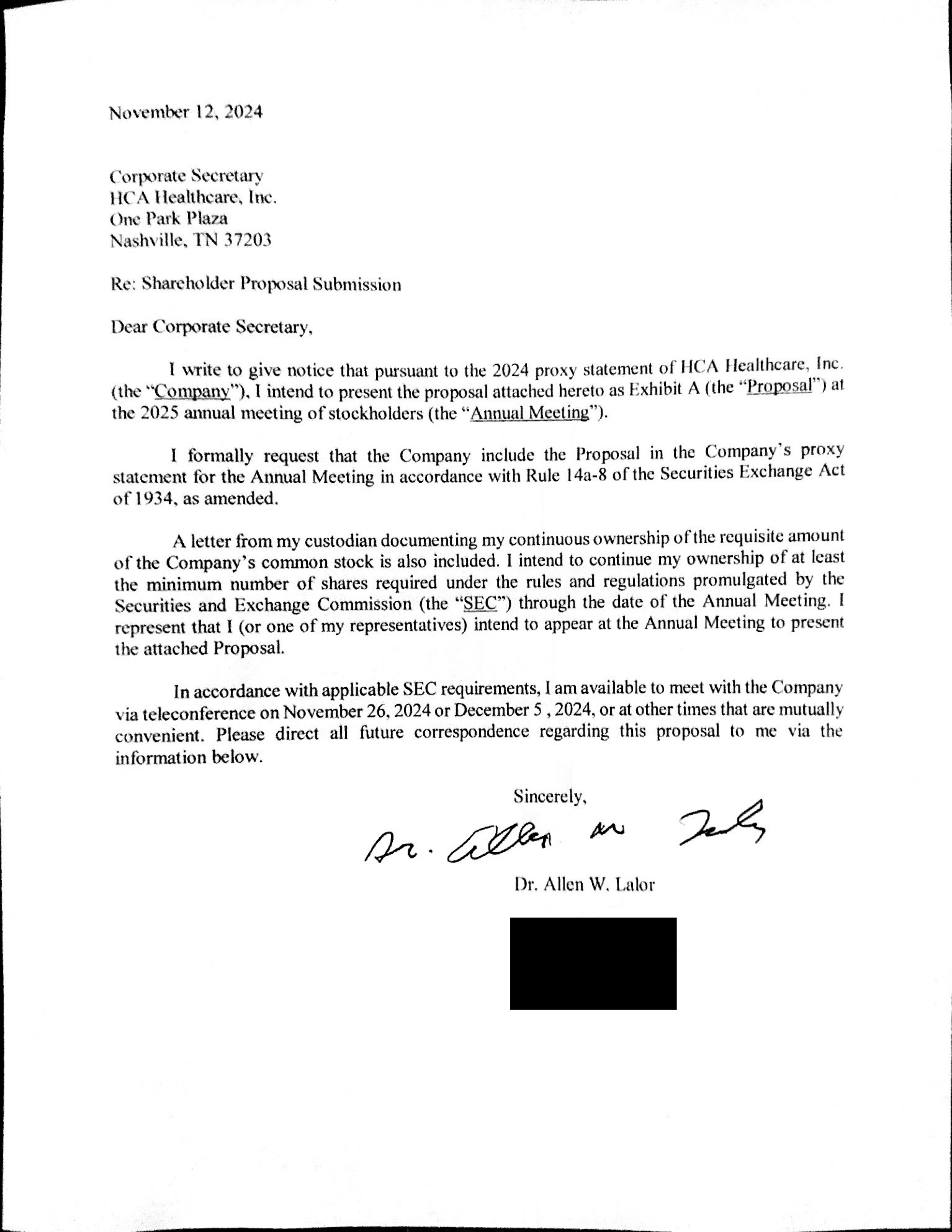
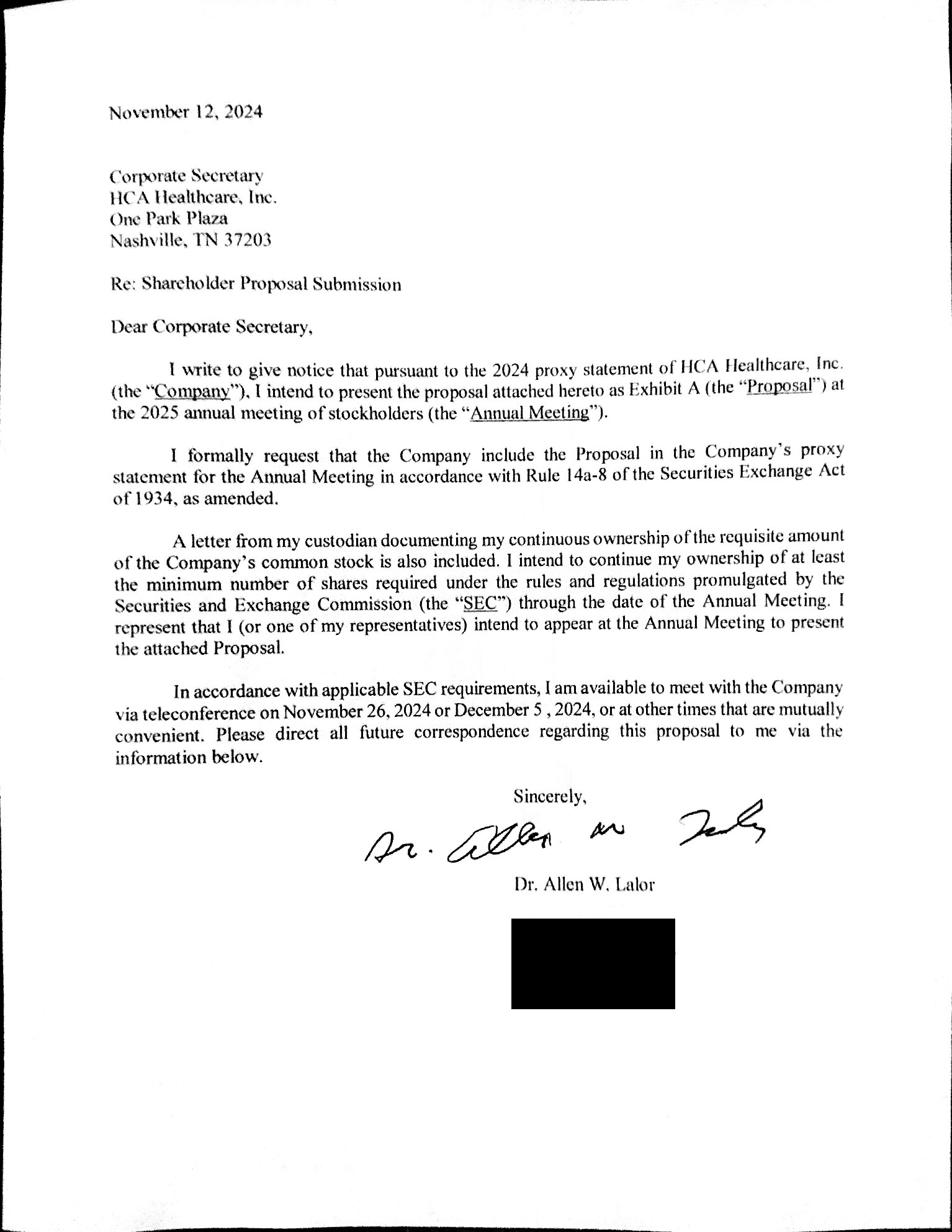
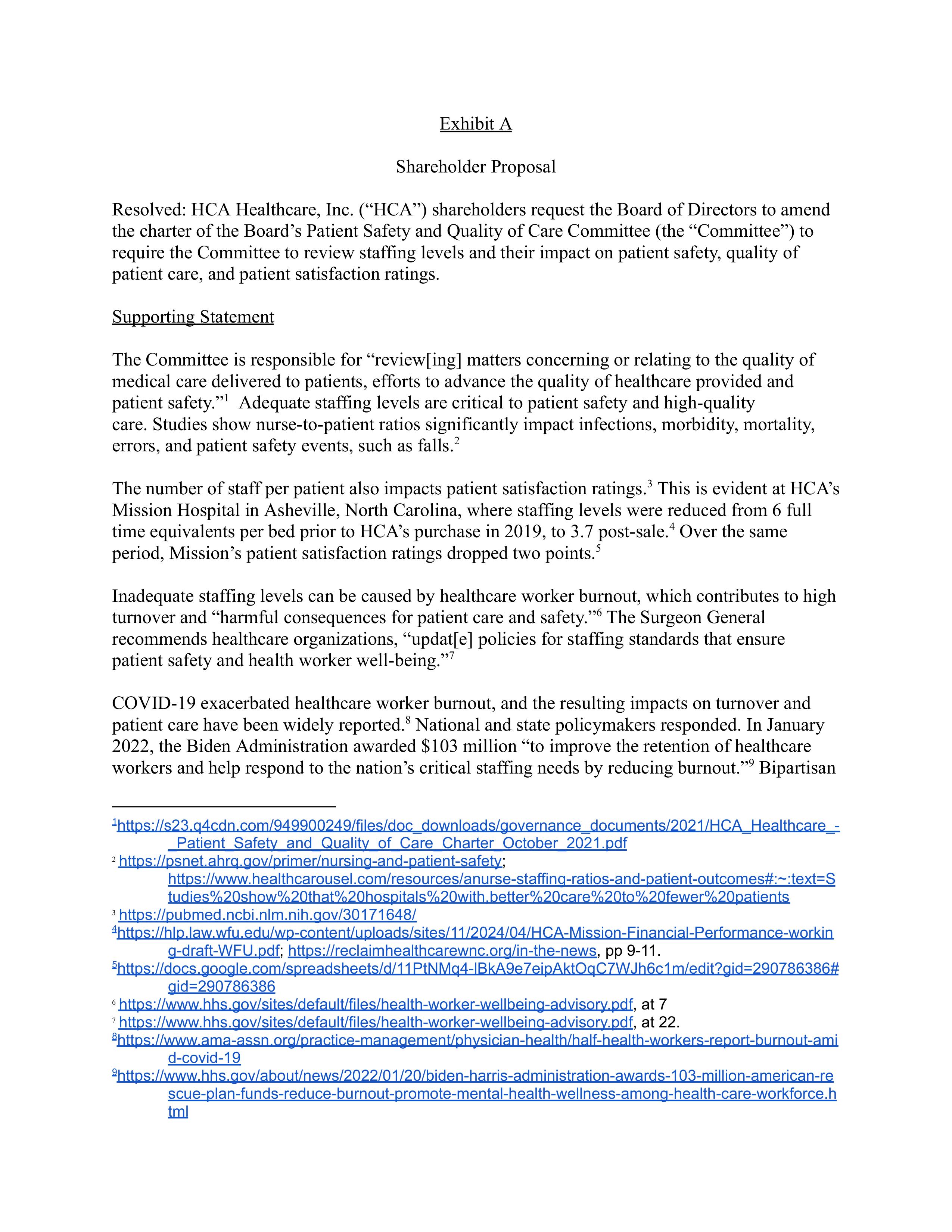
Exhibit A
Shareholder Proposal
Resolved: HCA Healthcare, Inc. (“HCA”) shareholders request the Board of Directors to amend
the charter of the Board’s Patient Safety and Quality of Care Committee (the “Committee”) to
require the Committee to review staffing levels and their impact on patient safety, quality of
patient care, and patient satisfaction ratings.
Supporting Statement
The Committee is responsible for “review[ing] matters concerning or relating to the quality of
medical care delivered to patients, efforts to advance the quality of healthcare provided and
patient safety.”
1
Adequate staffing levels are critical to patient safety and high-quality
care. Studies show nurse-to-patient ratios significantly impact infections, morbidity, mortality,
errors, and patient safety events, such as falls.
2
The number of staff per patient also impacts patient satisfaction ratings.
3
This is evident at HCA’s
Mission Hospital in Asheville, North Carolina, where staffing levels were reduced from 6 full
time equivalents per bed prior to HCA’s purchase in 2019, to 3.7 post-sale.
4
Over the same
period, Mission’s patient satisfaction ratings dropped two points.
5
Inadequate staffing levels can be caused by healthcare worker burnout, which contributes to high
turnover and “harmful consequences for patient care and safety.”
6
The Surgeon General
recommends healthcare organizations, “updat[e] policies for staffing standards that ensure
patient safety and health worker well-being.”
7
COVID-19 exacerbated healthcare worker burnout, and the resulting impacts on turnover and
patient care have been widely reported.
8
National and state policymakers responded. In January
2022, the Biden Administration awarded $103 million “to improve the retention of healthcare
workers and help respond to the nation’s critical staffing needs by reducing burnout.”
9
Bipartisan
9
https://www.hhs.gov/about/news/2022/01/20/biden-harris-administration-awards-103-million-american-re
scue-plan-funds-reduce-burnout-promote-mental-health-wellness-among-health-care-workforce.h
tml
8
https://www.ama-assn.org/practice-management/physician-health/half-health-workers-report-burnout-ami
d-covid-19
7
https://www.hhs.gov/sites/default/files/health-worker-wellbeing-advisory.pdf
, at 22.
6
https://www.hhs.gov/sites/default/files/health-worker-wellbeing-advisory.pdf
, at 7
5
https://docs.google.com/spreadsheets/d/11PtNMq4-lBkA9e7eipAktOqC7WJh6c1m/edit?gid=290786386#
gid=290786386
4
https://hlp.law.wfu.edu/wp-content/uploads/sites/11/2024/04/HCA-Mission-Financial-Performance-workin
g-draft-WFU.pdf
;
https://reclaimhealthcarewnc.org/in-the-news
, pp 9-11.
3
https://pubmed.ncbi.nlm.nih.gov/30171648/
2
https://psnet.ahrq.gov/primer/nursing-and-patient-safety
;
https://www.healthcarousel.com/resources/anurse-staffing-ratios-and-patient-outcomes#:~:text=S
tudies%20show%20that%20hospitals%20with,better%20care%20to%20fewer%20patients
1
https://s23.q4cdn.com/949900249/files/doc_downloads/governance_documents/2021/HCA_Healthcare_-
_Patient_Safety_and_Quality_of_Care_Charter_October_2021.pdf
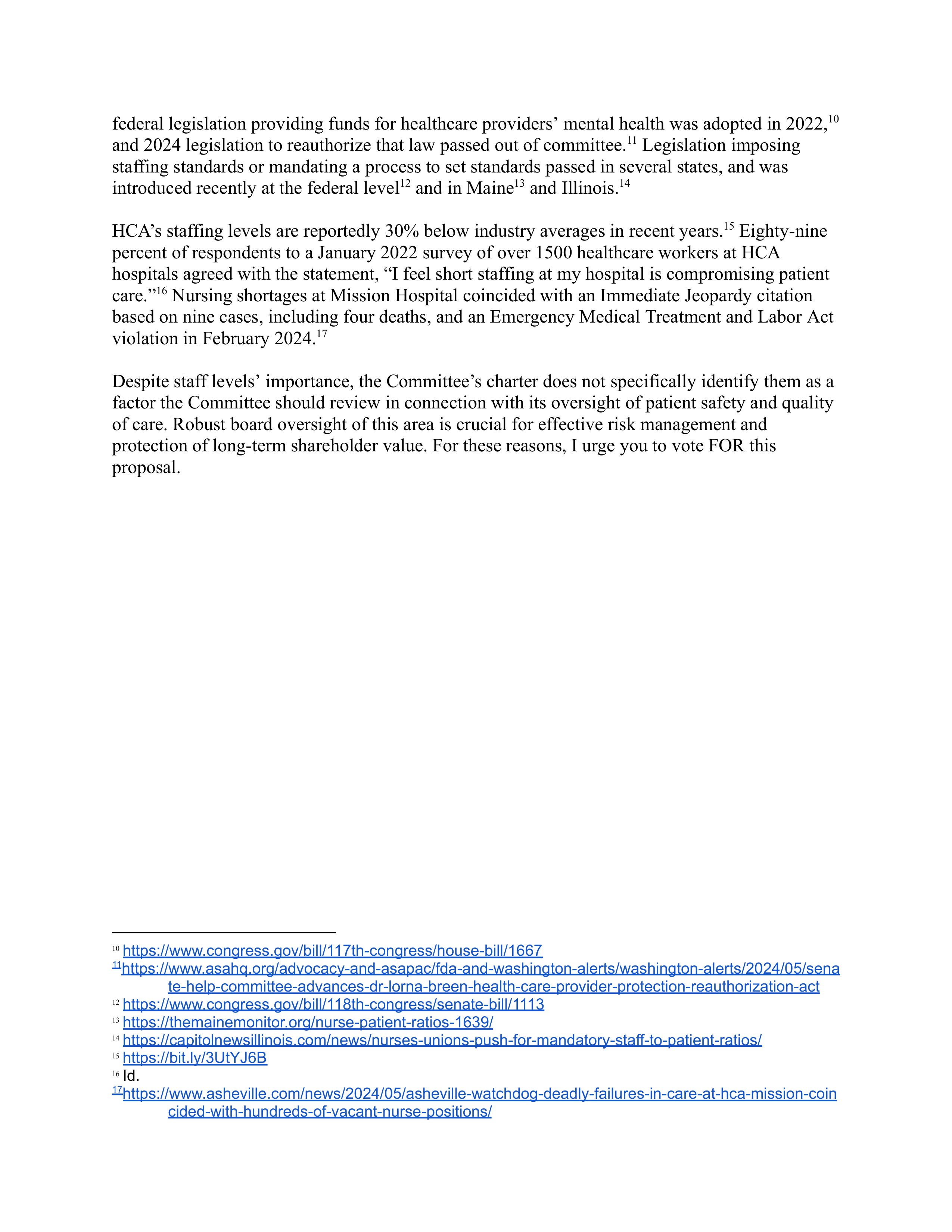
federal legislation providing funds for healthcare providers’ mental health was adopted in 2022,
10
and 2024 legislation to reauthorize that law passed out of committee.
11
Legislation imposing
staffing standards or mandating a process to set standards passed in several states, and was
introduced recently at the federal level
12
and in Maine
13
and Illinois.
14
HCA’s staffing levels are reportedly 30% below industry averages in recent years.
15
Eighty-nine
percent of respondents to a January 2022 survey of over 1500 healthcare workers at HCA
hospitals agreed with the statement, “I feel short staffing at my hospital is compromising patient
care.”
16
Nursing shortages at Mission Hospital coincided with an Immediate Jeopardy citation
based on nine cases, including four deaths, and an Emergency Medical Treatment and Labor Act
violation in February 2024.
17
Despite staff levels’ importance, the Committee’s charter does not specifically identify them as a
factor the Committee should review in connection with its oversight of patient safety and quality
of care. Robust board oversight of this area is crucial for effective risk management and
protection of long-term shareholder value. For these reasons, I urge you to vote FOR this
proposal.
17
https://www.asheville.com/news/2024/05/asheville-watchdog-deadly-failures-in-care-at-hca-mission-coin
cided-with-hundreds-of-vacant-nurse-positions/
16
Id.
15
https://bit.ly/3UtYJ6B
14
https://capitolnewsillinois.com/news/nurses-unions-push-for-mandatory-staff-to-patient-ratios/
13
https://themainemonitor.org/nurse-patient-ratios-1639/
12
https://www.congress.gov/bill/118th-congress/senate-bill/1113
11
https://www.asahq.org/advocacy-and-asapac/fda-and-washington-alerts/washington-alerts/2024/05/sena
te-help-committee-advances-dr-lorna-breen-health-care-provider-protection-reauthorization-act
10
https://www.congress.gov/bill/117th-congress/house-bill/1667
January 22, 2025
Via Online Shareholder Proposal Form
U.S. Securities and Exchange Commission
Division of Corporation Finance
Office of Chief Counsel
100 F Street, N.E.
Washington, D.C. 20549
Re: HCA Healthcare, Inc. December 20, 2024 Letter Seeking to Exclude Dr. Allen
Lalor’s Shareholder Proposal
To whom it may concern:
I am writing in response to the request by HCA Healthcare, Inc. (the “
Company
”) to the
Staff of the Division of Corporation Finance (the “
Staff
”) of the U.S. Securities and Exchange
Commission (the “
Commission
”) seeking Staff concurrence with the Company’s view that it
may properly exclude the shareholder proposal and supporting statement (the “
Proposal
”) that
I submitted for inclusion in the Company’s proxy materials to be distributed in connection with
its 2025 Annual Meeting of Shareholders (the “
Proxy Materials
”).
I respectfully request that the Staff not concur with the Company’s view that it may exclude
the Proposal from its Proxy Materials, as the Company has failed to meet its burden of
persuasion to demonstrate that it may properly omit the Proposal. A copy of this letter has also
been sent to the Company.
By letter dated December 20, 2024 (the “
No-Action Request
”), the Company requested
that the Staff concur in its view that it may exclude the Proposal from its Proxy Materials
pursuant to Rule 14a-8(i)(4) because the Proposal “relates to the redress of a personal claim or
grievance and is designed to benefit the Proponent in a manner that is not in the common
interest of the Company’s shareholders.”
For the reasons set forth below, I submit that the Company has failed to meet its burden of
persuasion under Rule 14a-8(i)(4), and thus should not be permitted to exclude the Proposal
from its Proxy Materials.
I.
The Proposal and Supporting Statement
As background, the Proposal that I submitted reads as follows:
Resolved: HCA Healthcare, Inc. (“HCA”) shareholders request the Board
of Directors to amend the charter of the Board’s Patient Safety and Quality
of Care Committee (the “Committee”) to require the Committee to review
staffing levels and their impact on patient safety, quality of patient care, and
patient satisfaction ratings.
The supporting statement (the “
Supporting Statement
”) notes studies, statements, and
articles in support of the connection between staffing levels and patient safety, the quality of
patient care, and patient satisfaction ratings. These issues are of concern nationally and impact
everyone in this country. Interest in these issues is also shared by other Company shareholders,
as evidenced by previous resolutions submitted by shareholders and included in the Company’s
previous Proxy Materials.
II.
HCA Alleges a Personal Grievance That Does Not Exist in Order to Convince
the Staff the Proposal is Excludable.
The No-Action Request attempts to manufacture a personal grievance that does not exist
in order to argue that the Proposal is excludable. As an initial matter, I will note that my
proposal is almost a verbatim resubmission of a proposal submitted by Michael Frerichs that
was included in the Company’s proxy statement for its 2023 annual meeting. The Company
failed to convince the Staff that Mr. Frerichs’ proposal was excludable in 2023, so the
Company is now attempting to manufacture a personal grievance to convince the Staff to allow
it to be excluded this year. The similar proposal that was included in the Company’s 2023
proxy statement garnered a sufficient level of support to permit resubmission under Rule 14a-
8, and it is just as relevant today as it was then. As such, I encourage the Staff not to be swayed
by the Company’s unfounded allegations of a personal grievance.
The Company first alleges that I have a “longstanding personal grievance” with the
Company becuase I practiced emergency medicine at Mission Health and that I retired a few
years after the Company acquired Mission Health in 2019. Contrary to the Company’s
allegation, I retired because I had been practicing emergency medicine for 30 years, 27 of them
at Mission Health, and I was ready to retire. Emergency medicine is a stress-filled job unlike
any other in the medical field, and after practicing far longer than the average, I was simply
ready to retire.
The Company next cites to a lawsuit I filed against the Company after I retired. Along with
another physician, I did file a whistleblower suit against the Company and Team Health
Holdings, the company contracted to provide emergency services to Mission Health and for
whom I worked as a contractor from 2020 until my retirement in late 2022. This was a
qui tam
suit relating to concerns about possible fraudulent billing. When the federal government
declined to carry the case forward, we chose not to pursue it ourselves. Unlike the numerous,
factually distinguishable no-action letters that the Company cites in support of its position, the
case was not, as the Company might want the Staff to believe, a case to redress an employment
dispute, a contract dispute, discrimination, or any other kind of personal grievance against the
Company. Indeed, I was never directly employed by or contracted with Mission Health or
HCA. Rather, the lawsuit was filed out of a broad concern for the Company’s practices that
were increasing healthcare costs for patients. Increasing healthcare costs is an issue of concern
nationally, not just locally, further invalidating the Company’s effort to turn the lawsuit into a
personal grievance.
The Company also cites to statements I have made that are critical of the Company and to
my role in a coalition focused on Mission Health. I admit that I have made statements that are
critical of the Company, but simply being critical does not justify exclusion of the Proposal on
the basis that it reflects a personal grievance. If that were the case, as the Company asserts, the
Rule 14a-8(i)(4) basis of exclusion would become vastly more expansive than it is currently
and would turn the Staff into fact finders in every instance a company sought to exclude a
proposal on the basis of criticism. That would turn Rule 14a-8(i)(4) on its head.
The Company also states that because the Supporting Statement only discusses one specific
acquisition, that is evidence of a personal grievance. It should not be surprising that I cite to
Mission Health examples in the Supporting Statement because that is where I practiced
medicine for 27 years, and it is the hospital system with which I am most familiar. I have had
a front row seat regarding how the Company’s management of Mission Health, and particularly
its decisions related to staffing, has impacted the quality of healthcare in my community and
how patients regard Mission Health. As the Staff knows, a shareholder proposal is limited in
the number of words that it can contain. If the Proposal included more than 500 words, the
Company would have been able to exclude it under Rule 14a-8(d). I included the example of
Mission Health not out of a personal grievance, but because it provides a relevant example
with which I am familiar and that complies with SEC rules and regulations to illustrate to
shareholders the connection between staffing levels and quality of care and patient satisfaction
ratings. In addition, although Mission Health is referenced in the Supporting Statement, the
change requested in the Proposal does not focus exclusively on Mission Health. Indeed, if the
Company responded with changes that only focused on Mission Health, it would not be
responsive to the Proposal. The requested change would enable shareholders to better
understand how the Company’s staffing levels impact patient safety, quality of patient care,
and patient satisfaction ratings at all hospitals owned by the Company, not just Mission Health.
Finally, the Company raises the irrelevant fact that my partner is a state senator who has
also submitted a shareholder resolution. This is another effort at misdirection, as both of us are
dedicated to healthcare issues and meet the qualifications to file shareholder proposals. I will
not address the baseless accusations about her motivations here, as she addresses those in her
response to the No-Action Request related to her shareholder proposal.
The Commission has stated that the purpose of Rule 14a-8(i)(4) is not to “exclude a
proposal relating to an issue in which a proponent was personally committed or intellectually
and emotionally interested.” (Exchange Act Release No. 20091 (Aug. 16, 1983)). My 30-year
career as a practicing emergency medicine physician, and my ongoing work to ensure people
have access to quality, affordable, healthcare, more than demonstrate my longstanding,
personal commitment to quality healthcare, which should overcome any allegation that my
Proposal stems from a personal grievance. Furthermore, the fact that an almost identical
proposal was included in the Company’s 2023 proxy materials shows that staffing levels are
of concern to shareholders other than myself.
III.
Conclusion
For the foregoing reasons, and without addressing or waiving any other possible
arguments, I respectfully submit that the Company has failed to meet its burden of persuasion
under Rule 14a-8(i)(4), and thus should not be permitted to exclude the Proposal from the
Company’s proxy materials.
If additional information is necessary or helpful in support of my position, I would
welcome the opportunity to submit it.
Very truly yours,
Dr. Allen Lalor