
January 13, 2026
Kevin J. O’Connor
Lockheed Martin Corporation
Re:
Lockheed Martin Corporation (the “Company”)
Incoming Letter dated January 5, 2026
Dear Kevin J. O’Connor:
This letter is in response to your correspondence concerning the shareholder
proposal (the “Proposal”) submitted to the Company by The Bahnsen Family Trust for
inclusion in the Company’s proxy materials for its upcoming annual meeting of security
holders.
The Company represents that it has a reasonable basis to exclude the Proposal.
Based solely on that representation, we will not object if the Company excludes the
Proposal from its proxy materials.
Copies of all of the correspondence on which this response is based will be made
available on our website.
Sincerely,
Division of Corporation Finance
Office of Chief Counsel
cc:
Jerry Bowyer
Bowyer Research, Inc.

Lockheed Martin Corporation
6801 Rockledge Drive Bethesda, MD 20817
Telephone 301
.
897
.
9856
Kevin J. O’Connor
Senior Vice President, General Counsel & Corporate Secretary
January 5, 2026
VIA STAFF ONLINE FORM
Office of the Chief Counsel
Division of Corporation Finance
U.S. Securities and Exchange Commission
100 F. Street, N.E.
Washington, D.C. 20549
Re: Lockheed Martin Corporation – 2026 Annual Meeting – Notice of Intent to Exclude from
Proxy Materials Shareholder Proposal Submitted by Bowyer Research on behalf of The
Bahnsen Family Trust
Ladies and Gentlemen:
Pursuant to Exchange Act Rule 14a-8(j) under the Securities Exchange Act of 1934, Lockheed
Martin Corporation, a Maryland corporation (the “Company”), hereby notifies the Division of
Corporation Finance of the Securities and Exchange Commission (the “Commission”) that the
Company will exclude from its proxy materials for its 2026 Annual Meeting of Shareholders
scheduled for May 12, 2026 (the “2026 Proxy Materials”), a shareholder proposal and related
supporting statement (collectively, the “Proposal”) submitted by Bowyer Research on behalf of
The Bahnsen Family Trust (the “Proponent”). The Company believes it may properly exclude
the Proposal from its 2026 Proxy Materials for the reasons discussed below.
The Company values the perspectives of its stockholders and seeks to respond to stockholders’
questions and concerns promptly and substantively. Since receiving the Proposal from the
Proponent on November 24, 2025, the Company has engaged with the Proponent via video
conference and has researched and responded via email to specific questions and concerns the
Proponent raised during the engagement. The Company intends to continue corresponding
with the Proponent to address their concerns.
Pursuant to Rule 14a-8(j), we are:
electronically submitting this letter and its attachments to the Commission via the online
Shareholder Proposal Form located on the Commission's website no later than 80
calendar days before the Company intends to file its 2026 Proxy Materials with the
Commission; and
concurrently sending copies of this correspondence to the Proponent as notification of
the Company's intention to exclude the Proposal from its 2026 Proxy Materials.
Rule 14a-8(k) and the Commission's Staff Legal Bulletin No. 14D (Nov. 7, 2008) (“SLB 14D”)
provide that shareholder proponents are required to send companies a copy of any
correspondence that the proponent elects to submit to the Commission or the Staff. Accordingly,
the Company is taking this opportunity to inform the Proponent that if the Proponent elects to
submit additional correspondence to the Commission or the Staff with respect to the Proposal, a
copy of that correspondence should be furnished concurrently to the undersigned on behalf of
the Company pursuant to Rule 14a-8(k) and SLB 14D.
The Company currently intends to file its definitive 2026 Proxy Materials with the Commission
on or about March 26, 2026.
I.
The Proposal
“Resolved: Shareholders request that Lockheed Martin conduct an evaluation and issue
a report within the next year, at reasonable expense and excluding proprietary or
confidential information, analyzing the benefits, costs, and legal, reputational,
competitive, and other relevant risks of the company’s charitable support.”
II.
Basis for Exclusion
As discussed more fully below, the Company has a reasonable basis to conclude that
the Proposal may be excluded from the Company's 2026 Proxy Materials pursuant to
Rule 14a-8(i)(7) because the Proposal deals with a matter relating to the Company’s
ordinary business operations and does not focus on a significant policy issue that
transcends ordinary business operations.
A.
Background on Rule 14a-8(i)(7)
Rule 14a-8(i)(7) permits a company to exclude a shareholder proposal from its proxy
materials if it “deals with a matter relating to the company's ordinary business
operations.” The Commission has explained that the term “ordinary business” is rooted
in the principle that management must have flexibility to direct certain core business
matters without shareholder interference. See Exchange Act Release No. 34-40018
(May 21, 1998) (“Release”). The Release further states that the policy underlying the
exclusion is “to confine the resolution of ordinary business problems to management and
the board of directors, since it is impracticable for shareholders to decide how to solve
such problems at an annual shareholders meeting.” The Commission has identified two
key considerations as to whether a proposal deals with a matter relating to a company’s
ordinary business. First, the Commission recognizes that “[c]ertain tasks are so
fundamental to management's ability to run a company on a day-to-day basis that they
could not, as a practical matter, be subject to direct shareholder oversight.” Second, the
Commission considers the degree to which a proposal seeks to “micro-manage” the
company by probing too deeply into matters of a complex nature upon which
shareholders, as a group, would not be in a position to make an informed judgment. Id.
This Proposal implicates the first consideration.
The Commission has reaffirmed this principle in its latest guidance. Staff Legal Bulletin
No. 14M (Nov. 17, 2025) (“SLB 14M”) clarifies that a proposal is excludable under Rule
14a-8(i)(7) when it addresses matters that are so central to management's ability to run
the company unless the proposal raises a significant policy issue that transcends such
company's ordinary business operations.
This principle applies regardless of whether a proposal is framed as a request for a
report. The Commission has consistently held that proposals requesting reports are
excludable under Rule 14a-8(i)(7) if the subject matter of the report relates to the
company's ordinary business. See Exchange Act Release No. 34-20091 (Aug. 16,
1983). Further, in Staff Legal Bulletin No. 14E (Oct. 27, 2009) (“SLB 14E”), the
Commission emphasized that a proposal seeking a risk assessment does not avoid
exclusion if the underlying subject matter concerns ordinary business operations. See,
e.g.,
The TJX Companies, Inc.
(avail. Mar. 29, 2011);
Amazon.com, Inc.
(avail. Mar. 21,
2011);
Wal-Mart Stores, Inc.
(avail. Mar. 21, 2011).
Finally, when assessing proposals under Rule 14a-8(i)(7), the Staff considers the terms
of the resolution and its supporting statement as a whole. See Staff Legal Bulletin No.
14C (June 28, 2005) (“In determining whether the focus of these proposals is a
significant social policy issue, we consider both the proposal and the supporting
statement as a whole”).
B.
The Proposal Deals with Matters Relating to the Company's Ordinary Business
Operations
In seeking to dictate to the Company a particular organization that they consider
undeserving of the Company's charitable contributions, the Proponent implicates the
above-described policy considerations of the ordinary business exclusion. Decisions as
to the appropriate recipients of the Company's charitable contributions are ordinary
business decisions made by management as part of its day-to-day operation of the
Company. The ability to make such decisions is fundamental to management's ability to
control the operations of the Company and, as such, is not appropriately delegated to
shareholders. Shareholders, as a group, are simply not well-positioned to oversee,
through the proxy process, the decisions the Company regularly makes with respect to
charitable contributions in the dynamic circumstances in which it operates.
The Staff has consistently taken the position that proposals that relate to
contributions to specific types of organizations are part of a company's ordinary
business operations and thus may be excluded under Rule 14a-8(i)(7). See,
e.g.,
AT&T Inc.
(avail. Jan. 15, 2021) (facially neutral proposal requesting a report on
charitable contributions where the supporting statement made clear the focus was on
organizations supporting the Black Lives Matter movement);
The Walt Disney Co.
(avail.
Nov. 20, 2014) (proposal requesting the company continue to classify the Boy Scouts of
America as a charitable organization so it may continue to receive matching
contributions);
The Home Depot, Inc.
(avail. Mar. 18, 2011) (facially neutral proposal
requesting the company to disclose the recipients of corporate charitable contributions
on the company website related to the company's ordinary business operations – and
could therefore be excluded under Rule 14a-8(i)(7) – because the supporting statement
focused on LGBT issues);
Target Corp.
(avail. March 31, 2010) (proposal requesting a
feasibility study of concrete policy changes, including minimizing donations to
charities that fund animal experiments);
PepsiCo, Inc.
(avail. Feb. 24, 2010)
(proposal to prohibit the support of any organization that rejects or supports
homosexuality);
Starbucks Corporation
(avail. Dec. 16, 2009) (proposal requesting a
feasibility study of concrete policy changes, including minimizing donations to
charities that fund animal experiments);
Pfizer Inc.
(avail. Feb. 12, 2007) (proposal
requesting a report on the justification for the company's charitable contributions to
certain scientific research programs that promote medical research and training
using animals);
Wachovia Corp.
(avail. Jan. 24, 2005) (proposal recommending that
the board disallow contributions to Planned Parenthood and other similar
organizations) and other letters discussed below.
The Staff has historically looked at all of the facts, circumstances and evidence
surrounding a shareholder proposal, including supporting statements, to determine
whether a proposal is actually directed towards contributions to specific types of
charitable organizations, as evidenced by the no-action letters cited below. As a
result, even where a resolution itself is facially neutral, the Staff has consistently
permitted the exclusion of proposals under Rule 14-8(i)(7) where the statements
surrounding a facially neutral proposed resolution indicate that the proposal would
serve as a shareholder referendum on donations to a particular type of charitable
organization or group. See,
e.g., JPMorgan Chase & Co.
(avail. Feb. 28, 2018)
(facially neutral resolution where the supporting statement focused on the
company’s contributions to Planned Parenthood and the Southern Poverty Law
Center);
Starbucks Corporation
(avail. Jan. 4, 2018) (facially neutral resolution
where the supporting statement criticized the company’s contributions to Planned
Parenthood);
Johnson & Johnson
(avail. Feb. 12, 2007) (facially neutral resolution
but a majority of the proposal's preamble and supporting statement referred to
abortion and same-sex marriage);
Wells Fargo & Company
(avail. Feb. 12, 2007)
(facially neutral resolution but preamble contained numerous references to
homosexuality and Planned Parenthood) and
Schering-Plough Corporation
(avail.
March 4, 2002) (facially neutral resolution but preamble and supporting statement
contained numerous references to Planned Parenthood and references to boycotts
of corporations that give money to Planned Parenthood).
The proposals in
The Home Depot
,
JPMorgan Chase & Co., Starbucks, Johnson &
Johnson
and
Wells Fargo & Company,
using the same tactic employed by the
Proponent, were attempts to disguise proposals aimed at a specific type of charitable
contribution with a facially neutral resolution requesting disclosures related to
charitable contributions. Similarly, the Proposal is aimed at the Company’s support
of a specific organization.
Additionally, while the Proposal requests a report analyzing “the benefits, costs, and
legal, reputational, competitive, and other relevant risks of the company’s charitable
support,” the Staff clarified in SLB 14E that “rather than focusing on whether a proposal
and supporting statement relate to the company engaging in an evaluation of risk, we
will instead focus on the subject matter to which the risk pertains or that gives rise to the
risk… we will consider whether the underlying subject matter of the risk evaluation
involves a matter of ordinary business to the company.” The Staff has consistently
concurred with the exclusion under Rule 14a-8(i)(7) of shareholder proposals seeking
risk assessments when the subject matter concerns ordinary business operations. See,
e.g.,
McDonald's Corp.
(avail. Mar. 22, 2019) (concurring with the exclusion of a
proposal asking the company to “disclose the economic risks” it faced from “campaigns
targeting the [c]ompany over concerns about cruelty to chickens” because it “focuse[d]
primarily on matters relating to the [c]ompany's ordinary business operations”);
The TJX
Companies, Inc.
(concurring with the exclusion of a proposal requesting an annual
assessment of the risks created by the actions the company takes to avoid or minimize
U.S. federal, state, and local taxes and provide a report to shareholders on the
assessment).
The Company believes that the well-established precedents set forth above support
its conclusion that the Proposal addresses ordinary business matters and therefore
is excludable under Rule 14a-8(i)(7). The Company is aware that the Staff has
previously denied no-action requests for shareholder proposals containing facially
neutral resolutions relating to charitable donations in which the companies argued
that such proposals were actually directed to specific types of organizations. See,
e.g., PepsiCo Inc.
(avail. March 2, 2009) (denying exclusion of a proposal requesting
a report on the company's charitable contributions and related information);
General
Electric Company
(avail. Jan. 11, 2008) (same) and
Ford Motor Co.
(avail. Feb. 25,
2008) (denying exclusion of a proposal requesting the company to list the recipients
of charitable contributions on its website).
The Company believes that the Proposal is clearly distinguishable from the proposals
in the no-action requests cited in the immediately preceding paragraph in that the
supporting statements to those facially neutral resolutions contained only minimal or
isolated references to specific charitable causes (which in fact illustrated the neutral
purpose of the proposal) and otherwise employed neutral language through the
preambles and supporting statements. In contrast, the Proposal's supporting
statement is predominantly comprised of statements and assertions related to a
particular organization that have the collective effect of overshadowing the facially
neutral request in the Proponent's underlying resolution.
Even if the Proposal may touch on broader policy issues, it remains excludable
because any policy issue the Proposal may raise do not transcend the Company's
ordinary business operations. The Staff recently updated its approach to how it
evaluates significant social policy issues, providing that a “case-by-case” approach
to evaluating significance is appropriate, “rather than focusing solely on whether a
proposal raises a broad societal impact or whether particular issues or categories of
issues are universally ‘significant’.” See SLB 14M. Under SLB 14M, a proposal must
do more than reference a significant policy issue: it must raise a policy issue that
transcends the company's ordinary business operations. SLB 14M explicitly rejects
prior Staff interpretations that automatically allowed proposals to proceed if they
implicated a significant policy issue, reinstating the approach taken in the Release.
Here, the Proposal is overwhelmingly concerned with the Company’s relationship
with a specific organization, and such focus underscores the Proposal’s focus on the
Company’s ordinary business. For these reasons, the Proposal simply represents
the Proponent's activism masquerading as a facially neutral proposal on corporate
transparency. As the Proposal's true intent is to target the Company's contributions
to a specific organization without raising a broader policy issue that transcends the
Company’s business, it is clear that the Proposal deals with a matter relating to the
Company's ordinary business operations and thus is excludable under Rule 14a-
8(i)(7).
III.
The Company’s Social Impact Strategy
As disclosed on our website, the Company and its employees strive to be valued
partners to our neighbors, nation and allies.
1
Our social impact centers on military and
veteran support, STEM education, community resilience, and volunteerism. The
Supporting Statement mischaracterizes our social impact strategy and misleads through
conjecture.
IV.
Representation
The Company has a reasonable basis to conclude that the Proposal concerns its
ordinary business operations, specifically, the management of its charitable contributions
1
hftps://www.lockheedmarfin.com/en-us/who-we-are/communifies.html
and any associated risk assessment. Accordingly, the proposal is subject to exclusion
under Rule 14a-8(i)(7). This representation is made without qualification.
Very truly yours,
Kevin J. O’Connor
Senior Vice President, General Counsel and Corporate Secretary
Enclosure: Exhibit A – Proposal and Supporting Statement

Exhibit A
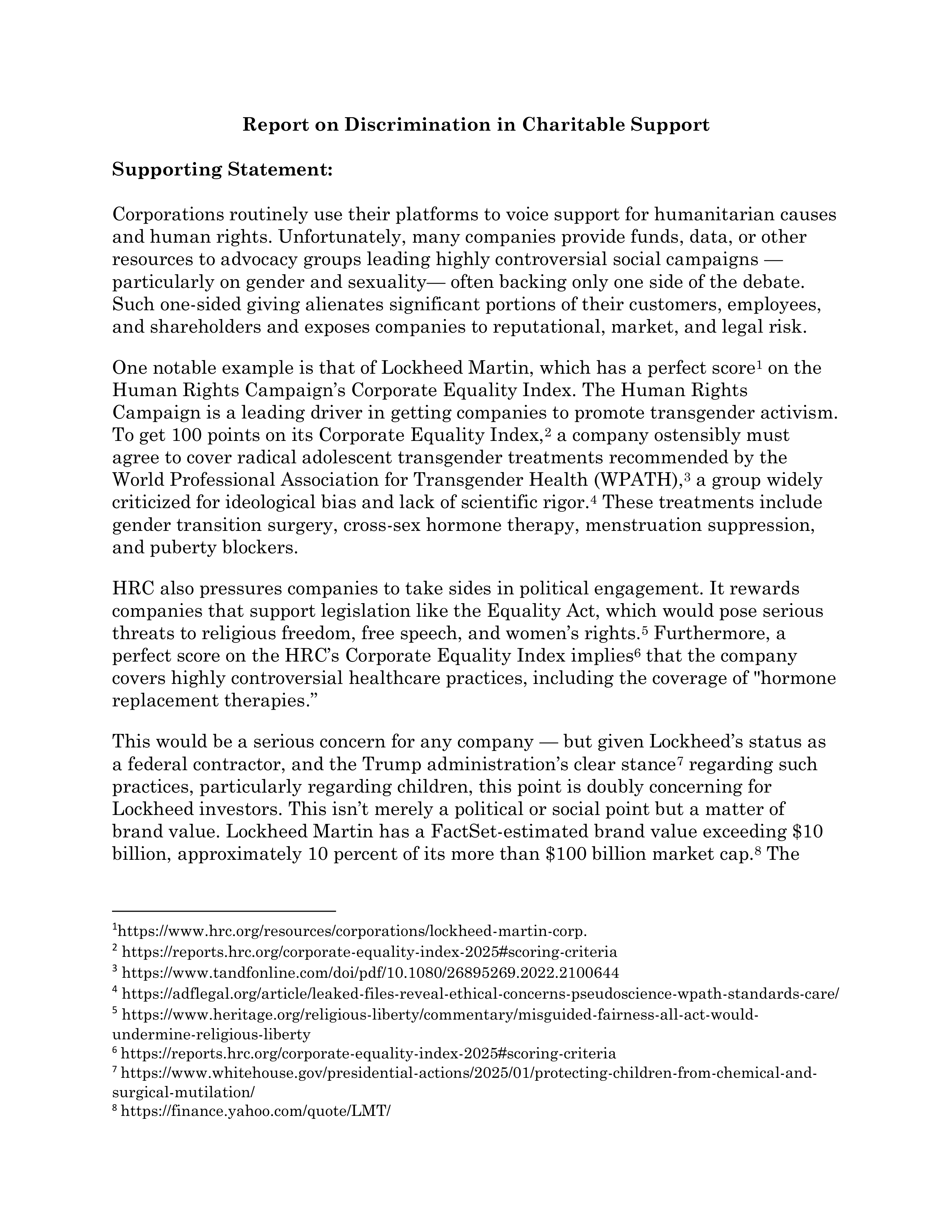
Report on Discrimination in Charitable Support
Supporting Statement:
Corporations routinely use their platforms to voice support for humanitarian causes
and human rights. Unfortunately, many companies provide funds, data, or other
resources to advocacy groups leading highly controversial social campaigns —
particularly on gender and sexuality— often backing only one side of the debate.
Such one-sided giving alienates significant portions of their customers, employees,
and shareholders and exposes companies to reputational, market, and legal risk.
One notable example is that of Lockheed Martin, which has a perfect score
1
on the
Human Rights Campaign’s Corporate Equality Index. The Human Rights
Campaign is a leading driver in getting companies to promote transgender activism.
To get 100 points on its Corporate Equality Index,
2
a company ostensibly must
agree to cover radical adolescent transgender treatments recommended by the
World Professional Association for Transgender Health (WPATH),
3
a group widely
criticized for ideological bias and lack of scientific rigor.
4
These treatments include
gender transition surgery, cross-sex hormone therapy, menstruation suppression,
and puberty blockers.
HRC also pressures companies to take sides in political engagement. It rewards
companies that support legislation like the Equality Act, which would pose serious
threats to religious freedom, free speech, and women’s rights.
5
Furthermore, a
perfect score on the HRC’s Corporate Equality Index implies
6
that the company
covers highly controversial healthcare practices, including the coverage of "hormone
replacement therapies.”
This would be a serious concern for any company — but given Lockheed’s status as
a federal contractor, and the Trump administration’s clear stance
7
regarding such
practices, particularly regarding children, this point is doubly concerning for
Lockheed investors. This isn’t merely a political or social point but a matter of
brand value. Lockheed Martin has a FactSet-estimated brand value exceeding $10
billion, approximately 10 percent of its more than $100 billion market cap.
8
The
1
https://www.hrc.org/resources/corporations/lockheed-martin-corp.
2
https://reports.hrc.org/corporate-equality-index-2025#scoring-criteria
3
https://www.tandfonline.com/doi/pdf/10.1080/26895269.2022.2100644
4
https://adflegal.org/article/leaked-files-reveal-ethical-concerns-pseudoscience-wpath-standards-care/
5
https://www.heritage.org/religious-liberty/commentary/misguided-fairness-all-act-would-
undermine-religious-liberty
6
https://reports.hrc.org/corporate-equality-index-2025#scoring-criteria
7
https://www.whitehouse.gov/presidential-actions/2025/01/protecting-children-from-chemical-and-
surgical-mutilation/
8
https://finance.yahoo.com/quote/LMT/
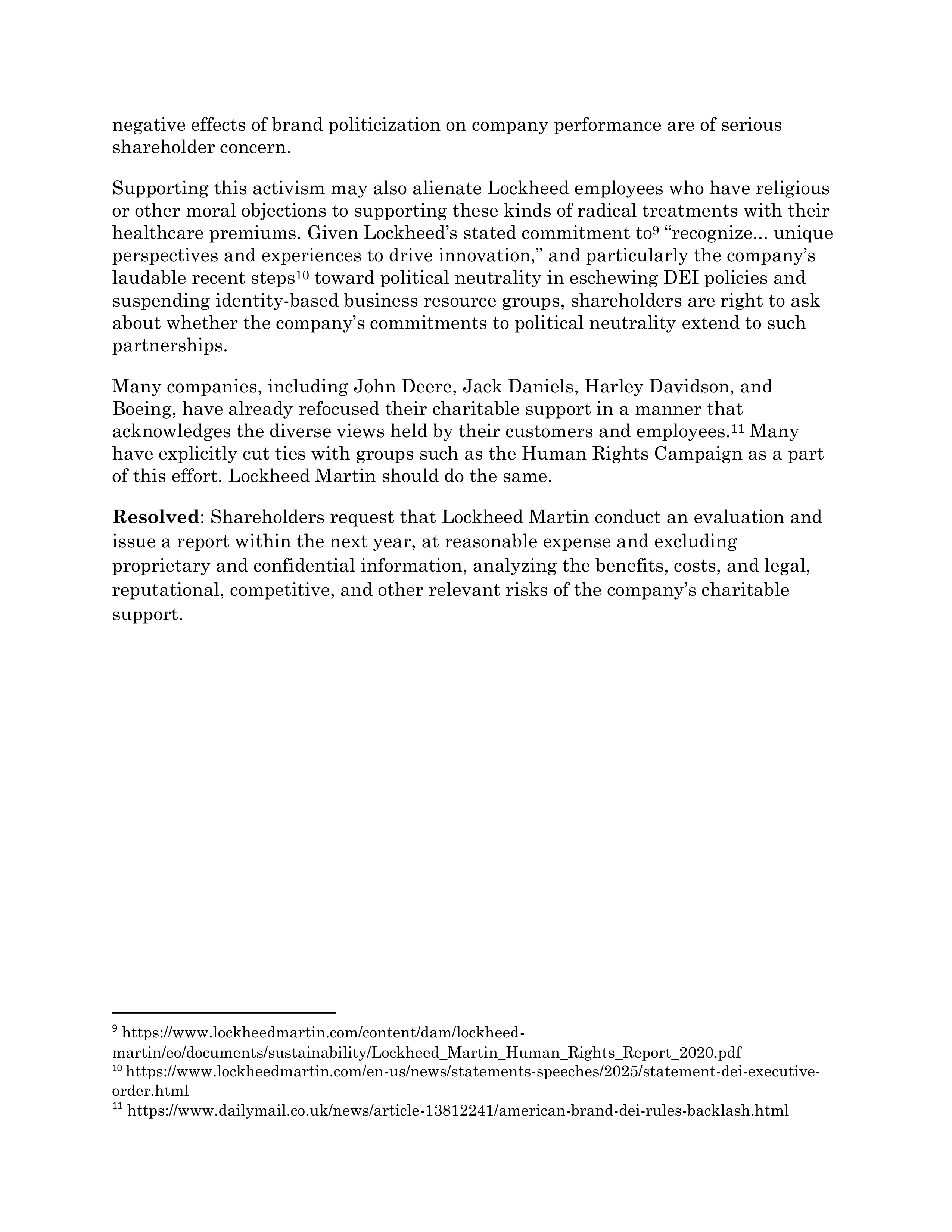
negative effects of brand politicization on company performance are of serious
shareholder concern.
Supporting this activism may also alienate Lockheed employees who have religious
or other moral objections to supporting these kinds of radical treatments with their
healthcare premiums. Given Lockheed’s stated commitment to
9
“recognize... unique
perspectives and experiences to drive innovation,” and particularly the company’s
laudable recent steps
10
toward political neutrality in eschewing DEI policies and
suspending identity-based business resource groups, shareholders are right to ask
about whether the company’s commitments to political neutrality extend to such
partnerships.
Many companies, including John Deere, Jack Daniels, Harley Davidson, and
Boeing, have already refocused their charitable support in a manner that
acknowledges the diverse views held by their customers and employees.
11
Many
have explicitly cut ties with groups such as the Human Rights Campaign as a part
of this effort. Lockheed Martin should do the same.
Resolved
: Shareholders request that Lockheed Martin conduct an evaluation and
issue a report within the next year, at reasonable expense and excluding
proprietary and confidential information, analyzing the benefits, costs, and legal,
reputational, competitive, and other relevant risks of the company’s charitable
support.
9
https://www.lockheedmartin.com/content/dam/lockheed-
martin/eo/documents/sustainability/Lockheed_Martin_Human_Rights_Report_2020.pdf
10
https://www.lockheedmartin.com/en-us/news/statements-speeches/2025/statement-dei-executive-
order.html
11
https://www.dailymail.co.uk/news/article-13812241/american-brand-dei-rules-backlash.html