

September 27, 2023
David A. Bell
Fenwick & West, LLP
Re:
Cisco Systems, Inc. (the “Company”)
Incoming letter dated July 21, 2023
Dear David A. Bell,
This letter is in response to your correspondence concerning the shareholder
proposal (the “Proposal”) submitted to the Company by Kenneth Steiner for inclusion in
the Company’s proxy materials for its upcoming annual meeting of security holders.
The Proposal requests that the board of directors initiate the appropriate process to
amend the Company’s governing documents to provide that director nominees shall be
elected by the affirmative vote of the majority of votes cast at an annual meeting of
shareholders, with a plurality vote standard retained for contested director elections, and
that a director who does not receive a majority vote shall only serve for 180 days or less
after failure to receive a majority vote.
There appears to be some basis for your view that the Company may exclude the
Proposal under Rule 14a-8(i)(10). Based on the information you have presented, it
appears that the Company’s governing documents substantially implement the Proposal.
Accordingly, we will not recommend enforcement action to the Commission if the
Company omits the Proposal from its proxy materials in reliance on Rule 14a-(i)(10).
Copies of all of the correspondence on which this response is based will be made
available on our website at
https://www.sec.gov/corpfin/2022-2023-shareholder-
proposals-no-action
.
Sincerely,
Rule 14a-8 Review Team
cc:
John Chevedden
DIVISION
OF
CORPORATION
FINANCE
UNITED
STATES
SECURITIES
AND
EXCHANGE
COMMISSION
WASHINGTON
,
D.C.
20549

David A. Bell
dbell@fenwick.com | 650.335.7130
1
July 21, 2023
Via E-mail
U.S. Securities and Exchange Commission
Division of Corporation Finance
Office of Chief Counsel
100 F Street, N.E.
Washington, DC 20549
Re:
Exclusion of Shareholder Proposal Submitted by Kenneth Steiner
Securities Exchange Act of 1934, as amended – Rule 14a-8
Ladies and Gentlemen:
We are writing on behalf of our client, Cisco Systems, Inc., a Delaware corporation
(“
Cisco
”), to inform you that Cisco intends to exclude from its proxy statement and other
proxy materials (the “
2023 Proxy Materials
”) for Cisco’s 2023 Annual Meeting of
Stockholders (the “
Annual Meeting
”), the shareholder proposal and supporting statement
(the “
Proposal
”) submitted to Cisco by Kenneth Steiner (the “
Proponent
”) described
below.
On behalf of Cisco, pursuant to Rule 14a-8(j), we request confirmation that the
staff (the “
Staff
”) of the Securities and Exchange Commission (the “
Commission
”) will
not recommend enforcement action if Cisco excludes the Proposal from its 2023 Proxy
Materials for the reasons discussed below. Pursuant to Rule 14a-8(j), this letter is being
submitted not less than 80 days before Cisco files its definitive copies of the 2023 Proxy
Materials with the Commission and we are simultaneously providing the Proponent with a
copy of this submission.
Pursuant to Rule 14a-8(j) and
Staff Legal Bulletin No. 14D
(Nov. 7, 2008) (“
SLB
14D
”), we have submitted this letter, together with a copy of the Proposal, to the Staff via
e-mail at shareholderproposals@sec.gov in lieu of mailing paper copies. Rule 14a-8(k) and
SLB 14D provide that shareholder proponents are required to send companies a copy of
any correspondence that the proponents elect to submit to the Commission or the Staff.
Accordingly, we are taking this opportunity to inform the Proponent that if the Proponent
elects to submit additional correspondence to the Commission or the Staff with respect to
the Proposal, a copy of that correspondence should be furnished concurrently via e-mail to
CorporateSecretary@cisco.com pursuant to Rule 14a-8(k) and SLB 14D.
Office of the Chief Counsel
Division of Corporation Finance
July 21, 2023
Page 2
THE PROPOSAL
The Proposal, which is captioned “Adopt Majority Vote Standard for Director
Elections,” states in part:
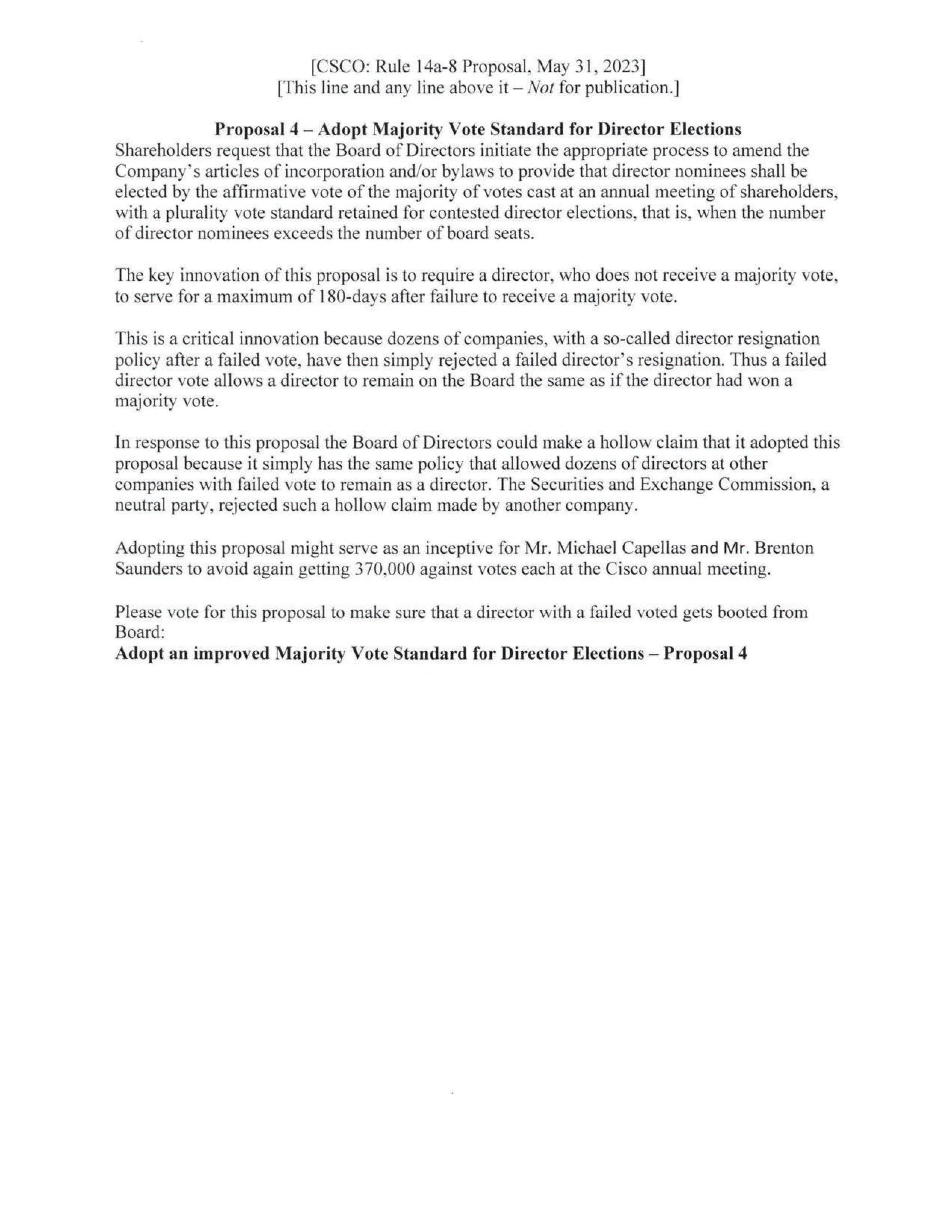
Shareholders request that the Board of Directors initiate the appropriate process to
amend the Company’s articles of incorporation and/or bylaws to provide that
director nominees shall be elected by the affirmative vote of the majority of votes
cast at an annual meeting of shareholders, with a plurality vote standard retained for
contested director elections, that is, when the number of director nominees exceeds
the number of board seats.
The key innovation of this proposal is to require a director, who does not receive a
majority vote, to serve for a maximum of 180-days after failure to receive a
majority vote.
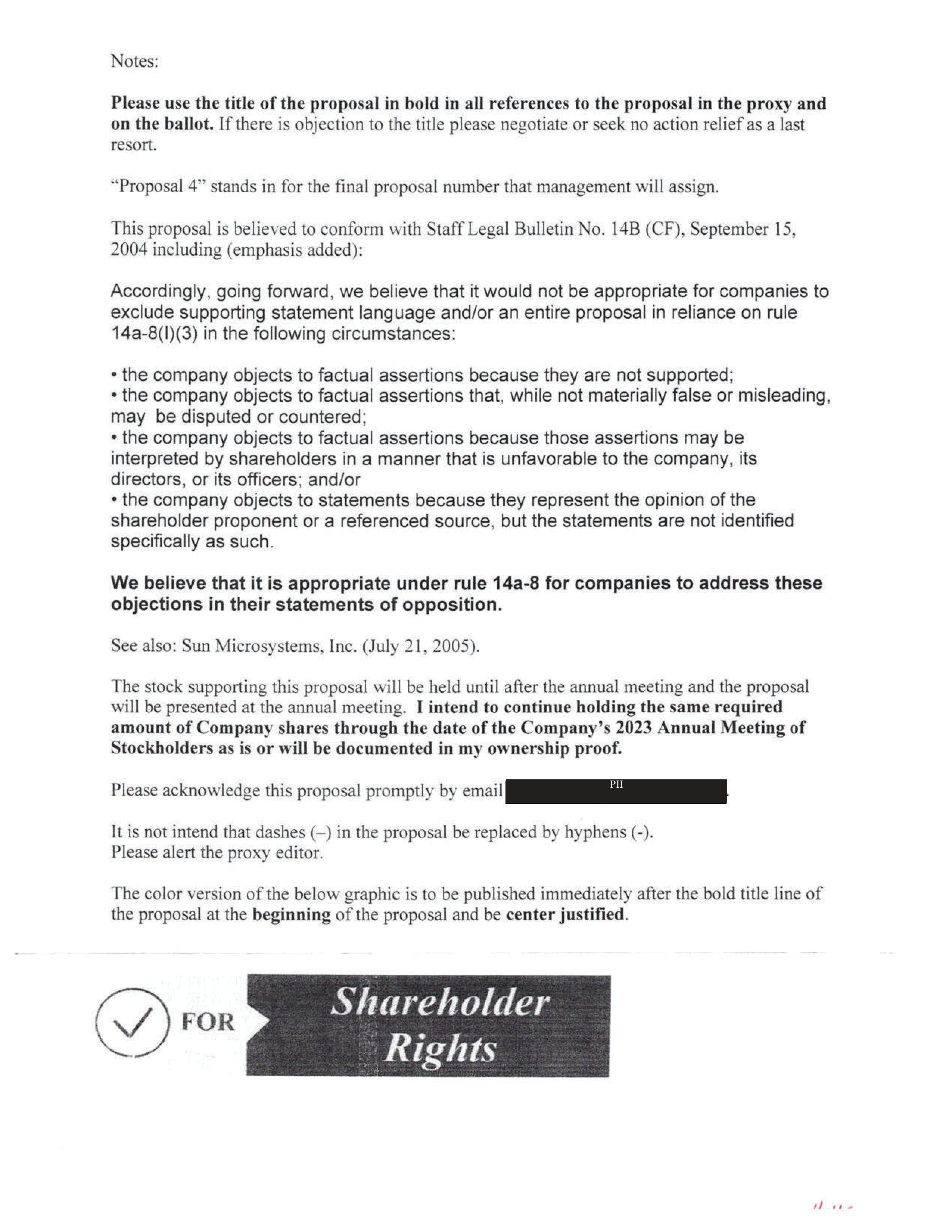
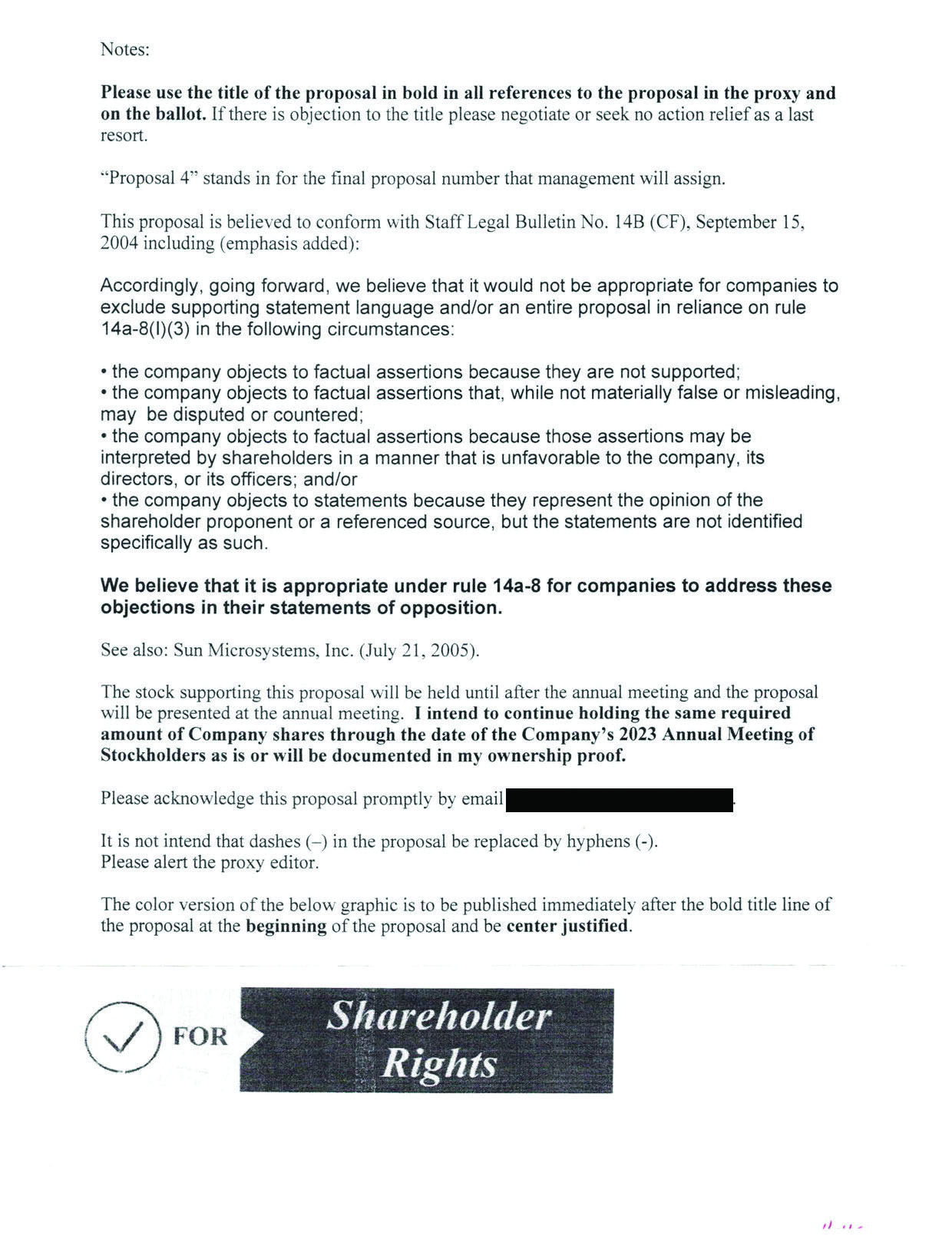
A copy of the full Proposal and related correspondence are attached hereto as Exhibit A.
REASON FOR EXCLUDING THE PROPOSAL
We believe that the Proposal may be excluded from the 2023 Proxy Materials
pursuant to Rule 14a-8(i)(10) because Cisco has already substantially implemented the
Proposal.
A.
Background
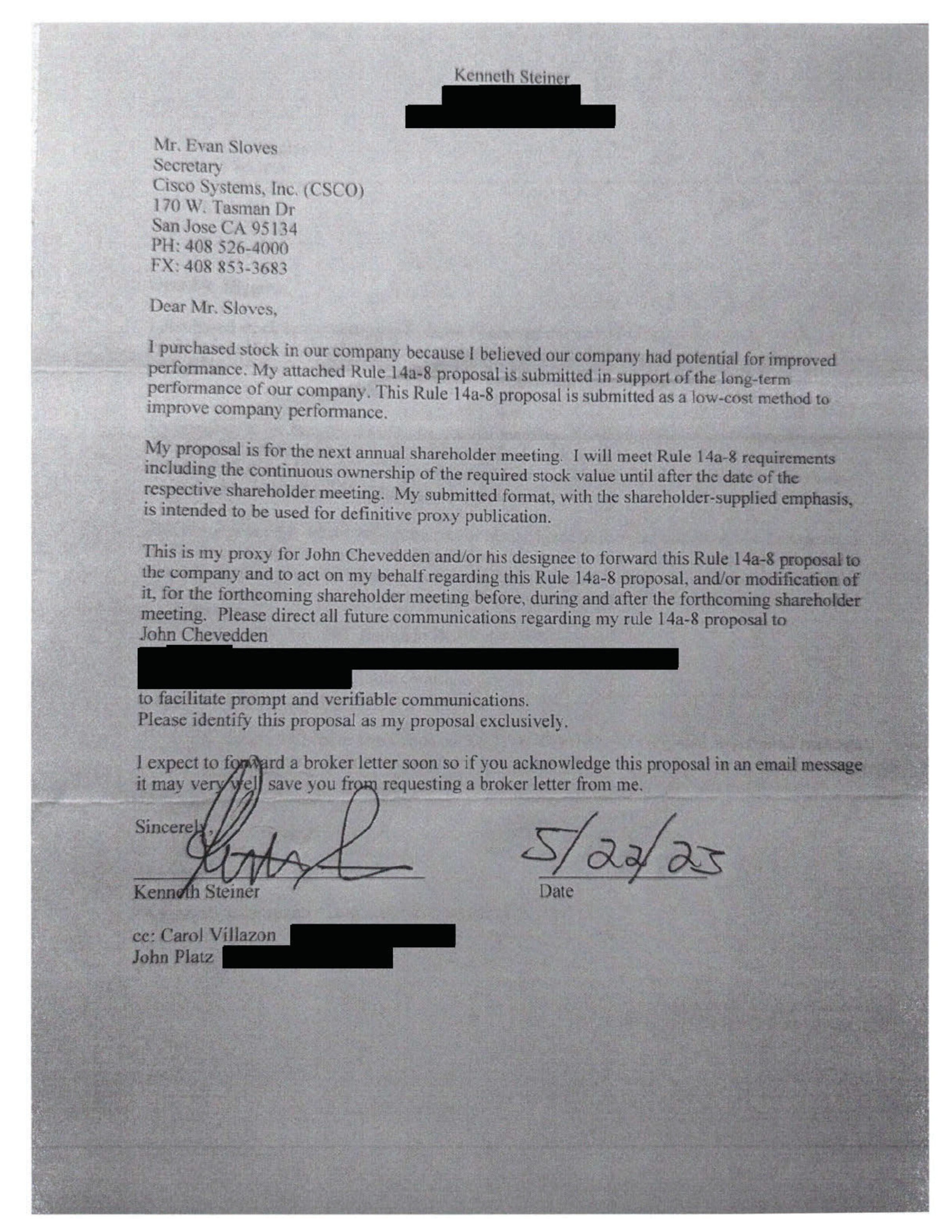
On May 31, 2023, Cisco received the Proposal via email from John Chevedden.
The email was accompanied by a cover letter from the Proponent, which indicated that Mr.
Chevedden is authorized to act on the Proponent’s behalf with regards to the Proposal and
any modifications thereto, and a letter from TD Ameritrade (the “
Broker Letter
”), dated
May 31, 2023, verifying the Proponent’s stock ownership. On May 31, 2023, Cisco
acknowledged receipt of the Proposal via email to Mr. Chevedden.
The Proposal May Be Excluded Under Rule 14a-8(i)(10) Because Cisco Has
Already Substantially Implemented the Proposal.
(a)
Rule 14a-8(i)(10) Background
Rule 14a-8(i)(10) permits a company to exclude a shareholder proposal if the
company has already “substantially implemented” the proposal. The Commission adopted
the “substantially implemented” standard after determining that the “previous formalistic
application” of the rule defeated its purpose, which is “to avoid the possibility of
shareholders having to consider matters which already have been favorably acted upon by
the management.”
See Exchange Act Release No. 34-20091
(Aug. 16, 1983) (the “
1983
Office of the Chief Counsel
Division of Corporation Finance
July 21, 2023
Page 3
Release
”);
Exchange Act Release No. 34-12598
(July 7, 1976). Accordingly, the actions
requested by a proposal need not be “fully effected” if they have been “substantially
implemented” by the company.
0F
1
See
1983 Release.
Applying this standard, the Staff has consistently permitted the exclusion of a
proposal under Rule 14a-8(i)(10) when it has determined that the company’s policies,
practices and procedures compare favorably with the guidelines of the proposal.
See, e.g.,
Exxon Mobil Corp.
(Mar. 23, 2018) (permitting exclusion of a proposal requesting that the
company issue a report “describing how the company could adapt its business model to
align with a decarbonizing economy by altering its energy mix to substantially reduce
dependence on fossil fuels” where the company had previously issued a report providing
examples of how the company was adapting its business model to reduce societal
greenhouse gas emissions);
Lowe’s Companies, Inc.
(
granted on recon.
, Mar. 24, 2017)
(permitting exclusion of a proposal requesting that the board of directors take the steps
necessary to allow up to 50 shareholders to aggregate their shares to satisfy the proxy
access threshold where the company amended its bylaws to provide a procedure enabling
up to 20 shareholders to nominate and include in the company’s annual proxy materials
director nominees constituting the greater of (i) two or (ii) 20% of the board of directors);
Exxon Mobil Corp.
(Mar. 17, 2015) (permitting exclusion of a proposal requesting that the
company commit to increasing the dollar amount authorized for capital distributions to
shareholders through dividends or share buybacks where the company’s long-standing
capital allocation strategy and related “policies practices and procedures compare[d]
favorably with the guidelines of the proposal and…therefore, substantially implemented
the proposal”).
See also, e.g.
,
IDACORP, Inc.
(Apr. 1, 2022);
Edison Int’l
(Feb. 23, 2022);
JPMorgan Chase & Co.
(Feb. 5, 2020);
The Allstate Corp.
(Mar. 15, 2019);
Johnson &
Johnson
(Feb. 6, 2019);
United Cont’l Holdings, Inc.
(Apr. 13, 2018);
eBay Inc.
(Mar. 29,
2018);
Kewaunee Scientific Corp.
(May 31, 2017);
Wal-Mart Stores, Inc.
(Mar. 16, 2017);
Dominion Res., Inc.
(Feb. 9, 2016);
Ryder Sys., Inc.
(Feb. 11, 2015).
In addition, the Staff has permitted exclusion under Rule 14a-8(i)(10) where a
company already addressed the underlying concerns and satisfied the essential objective of
the proposal.
See, e.g.
,
The Wendy’s Co.
(Apr. 10, 2019) (permitting exclusion under Rule
14a-8(i)(10) of a proposal requesting a report assessing human rights risks of the
company’s operations, including the principles and methodology used to make the
assessment, the frequency of assessment and how the company would use the assessment’s
results, where the company had a code of ethics and a code of conduct for suppliers and
disclosed on its website the frequency and methodology of its human rights risk
assessments);
AGL Res. Inc.
(
granted on recon.,
Mar. 5, 2015) (permitting exclusion of a
1
While there is currently a proposed amendment to Rule 14a-8(i)(10) that would modify this
standard, such proposal has not been adopted. Accordingly, the standard discussed above remains
the current Commission-adopted standard. However, as discussed below, even applying the
standard as proposed in the amendment, we believe Cisco’s existing Bylaws (as defined below) and
Governance Guidelines (as defined below) have already implemented all of the “essential
elements” of the Proposal.
Office of the Chief Counsel
Division of Corporation Finance
July 21, 2023
Page 4
proposal seeking to grant holders of 25% of the company’s outstanding shares the power to
call a special meeting where the board approved, and undertook to submit for shareholder
approval, an amendment to the articles of incorporation to grant shareholders holding for at
least one year 25% of the outstanding shares the power to call a special meeting);
MGM
Resorts Int’l
(Feb. 28, 2012) (permitting exclusion under Rule 14a-8(i)(10) of a proposal
requesting a report on the company’s sustainability policies and performance, including
multiple objective statistical indicators, where the company published an annual
sustainability report);
Textron, Inc.
(Jan. 21, 2010) (permitting exclusion of a proposal
requesting immediate board declassification where the board submitted a phased-in
declassification proposal for shareholder approval);
See also, e.g., Eli Lilly and Co.
(Jan. 8,
2018);
Korn/Ferry Int’l
(July 6, 2017);
NETGEAR, Inc.
(Mar. 31, 2015);
Pfizer, Inc.
(
granted on recon.,
Mar. 1, 2013).
The Staff has also repeatedly permitted exclusion under Rule 14a-8(i)(10) of
proposals requesting implementation of a majority voting standard for uncontested director
elections where the company had already amended or agreed to amend its bylaws to
implement such standards.
See
,
e.g.
,
Alphabet Inc.
(Apr. 16, 2021);
AECOM
(Dec. 21,
2018);
Kellogg Co.
(Dec. 27, 2017);
Genomic Health, Inc.
(Mar. 13, 2015);
3D Sys. Corp.
(Jan. 21,
2015);
Edison Int’l
(Dec. 23, 2010);
Symantec Corp.
(June 3, 2010);
The Dow
Chemical Co.
(Mar. 3, 2008);
American Ins. Grp., Inc.
(Mar. 12, 2008);
Citigroup Inc.
(Mar. 8, 2007);
AT&T Inc.
(Jan. 18, 2007) (each permitting exclusion of a proposal under
Rule 14a-8(i)(10) where the company had already amended or agreed to amend its bylaws
to provide for a majority voting standard in uncontested director elections).
Additionally, the Staff has consistently permitted exclusion under Rule 14a-8(i)(10)
where a company has implemented a majority voting standard for uncontested director
elections in its bylaws and has adopted a majority voting or director resignation policy to
address the treatment of a “holdover director,” including where the resignation process
does not align precisely with the process contained in the proposal. For example, in
AECOM (Dec. 21, 2018), the company adopted a majority voting bylaw amendment and
amended its corporate governance guidelines to implement a resignation policy providing
that when any director fails to be re-elected by the majority of votes cast they would be
expected to tender a resignation and that the board would act on the resignation within 90
days following the election. Although the proposal requested that “holdover directors”
resign immediately, the Staff nonetheless permitted exclusion under Rule 14a-8(i)(10) and
noted that “the [c]ompany’s bylaws compare favorably with the guidelines of the
[p]roposal and that the [c]ompany has, therefore, substantially implemented the
[p]roposal.”
See also, e.g., Kellogg Co.
(Dec. 27, 2017);
Genomic Health, Inc.
(Mar. 13,
2015);
American Ins. Grp., Inc.
(Mar. 12, 2008).
(b)
Cisco’s Bylaws Satisfy the Proposal’s Essential Objectives and Compare
Favorably to the Proposal
Office of the Chief Counsel
Division of Corporation Finance
July 21, 2023
Page 5
The Proposal requests that Cisco’s board of directors initiate the appropriate
process to amend Cisco’s articles of incorporation and/or bylaws to provide that (i) director
nominees shall be elected by the affirmative vote of the majority of votes cast, with a
plurality vote standard retained for contested director elections, and (ii) when a director
does not receive a majority vote, he or she shall not serve for more than 180 days after
failure to receive a majority vote.
A copy of Cisco’s Amended and Restated Bylaws, effective as of March 9, 2023
(the “
Bylaws
”), was most recently included as an exhibit to Cisco’s Current Report on
Form 8-K filed with the Commission on March 10, 2023 and is attached hereto as Exhibit
B. As described further below, Cisco’s Bylaws have already implemented the essential
elements of each of the Proposal’s two objectives.
First, Section 2.13 of Article 2 of the Bylaws already provides that the election of
directors shall be determined by the affirmative vote of a majority of the votes properly
cast for or against such matter at a duly held meeting of stockholders, except in a contested
election, in which case director nominees receiving a plurality of the votes cast shall be
elected (the “
Majority Voting Standard
”). As such, the Bylaws explicitly satisfy the first
objective of the Proposal by already providing for the voting standards requested in the
Proposal.
Similarly, Cisco’s Bylaws, as well as Cisco’s Corporate Governance Guidelines
(the “
Governance Guidelines,
” attached hereto as Exhibit C), already fulfill the second
objective of the Proposal by providing for the
automatic
resignation of a director after a
failed vote—in
half
the time than the Proposal requests. The Proponent states that the “key
innovation” of the Proposal is the fact that it would require a director to “serve for a
maximum of 180-days” after failure to receive a majority vote in an uncontested election.
Section 3.02 of Article 3 of the Bylaws and Section I.G of the Governance Guidelines
provide that, if in an uncontested election, an incumbent director fails to receive the
required votes under the Majority Voting Standard, the incumbent director shall tender his
or her resignation,
to be effective the earlier of
(i) ninety (90) days following certification
of the election results or (ii) the date on which Cisco’s board of directors selects a person
to fill the office held by that director in accordance with the procedures set forth in the
Bylaws and, except to the extent otherwise provided in the Bylaws, Section 223 of the
Delaware General Corporation Law. As such, the Bylaws and Governance Guidelines not
only clearly and explicitly implement the Proposal’s objective by establishing a maximum
time limit for a director to serve following a failed vote, but, notably, they entail a more
restrictive time limit than the Proposal itself requests. Pursuant to Cisco’s Bylaws and
Governance Guidelines, a director’s resignation will occur automatically within 90 days
after a failed election rather than the much longer 180 days contemplated in the Proposal.
Therefore, Cisco’s current policies compare more than favorably with the Proposal.
The Proposal generally demonstrates concern that companies can “simply reject[] a
failed director’s resignation” thus “allow[ing] a director to remain on the Board the same
Office of the Chief Counsel
Division of Corporation Finance
July 21, 2023
Page 6
as if the director had won a majority vote.” As discussed above, Section 3.02 of Article 3
of the Bylaws and Section I.G of the Governance Guidelines already dispense with this
concern because removal of the director is
automatic
upon the earlier of “certification of
the election results” or “select[ion] [of] a person to fill the office held by that director.”
Such removal is not subject to or dependent upon acceptance by Cisco’s board of directors.
Therefore, the facts here are clearly distinguishable from instances where the Staff was
unable to concur with exclusion under Rule 14a-8(i)(10) given the specific procedures
provided for in the bylaws of those companies;
See, e.g.
Texas Pacific Land Corp.
(Sept.
26, 2022) (where the company’s bylaws stated that the offer of a tendered resignation of a
director who failed to receive a majority of the votes cast was “subject to acceptance by the
Board” and that the “Nominating and Corporate Governance Committee of the
Board…shall make a recommendation to the Board as to whether to accept or reject the
tendered resignation.”);
PayPal Holdings, Inc.
(Apr. 4, 2023) (where a committee of the
board would “make a determination as to whether to accept or reject any previously
tendered Resignations…”). Because the Bylaws and Governance Guidelines do not afford
discretion to Cisco’s board of directors, or a committee thereof, to accept or reject the
director’s tendered resignation but instead require the tendered resignation to be
automatically
effective, Cisco has substantially implemented the Proposal’s second
objective as a director’s resignation will be automatically effective no later than 90 days
after a failed vote.
As set forth above, the Bylaws and Governance Guidelines compare more than
favorably to the guidelines of the Proposal and resolutely satisfy the Proposal’s essential
objectives. Accordingly, Cisco has already substantially implemented the Proposal and,
consistent with precedent, Cisco believes that the Proposal is properly excludable from its
2023 Proxy Materials pursuant to Rule 14a-8(i)(10).
CONCLUSION
For the foregoing reasons, we request your confirmation that the Staff will not
recommend any enforcement action to the Commission if Cisco excludes the Proposal
from the 2023 Proxy Materials. Should the Staff disagree with our conclusions regarding
the omission of the Proposal, or should the Staff have questions or desire any additional
information in support of our position, we would appreciate an opportunity to confer with
the Staff concerning these matters prior to the issuance of its Rule 14a-8(j) response. In
this case, please contact me by telephone at (650) 335-7130 or Evan Sloves of Cisco at
(408) 525-2061. Please direct any correspondence regarding this letter via e-mail to
CorporateSecretary@cisco.com.
Office of the Chief Counsel
Division of Corporation Finance
July 21, 2023
Page 7
Sincerely,
FENWICK & WEST LLP
David A. Bell
Enclosures
cc:
Evan Sloves, Cisco Systems, Inc.
Jay Higdon, Cisco Systems, Inc.
Kenneth Steiner
John Chevedden
Julia Forbess, Fenwick & West LLP

EXHIBIT A
Proposal




2
Please arrange in advance in a separate email message regarding a
meeting.
John Chevedden
PII
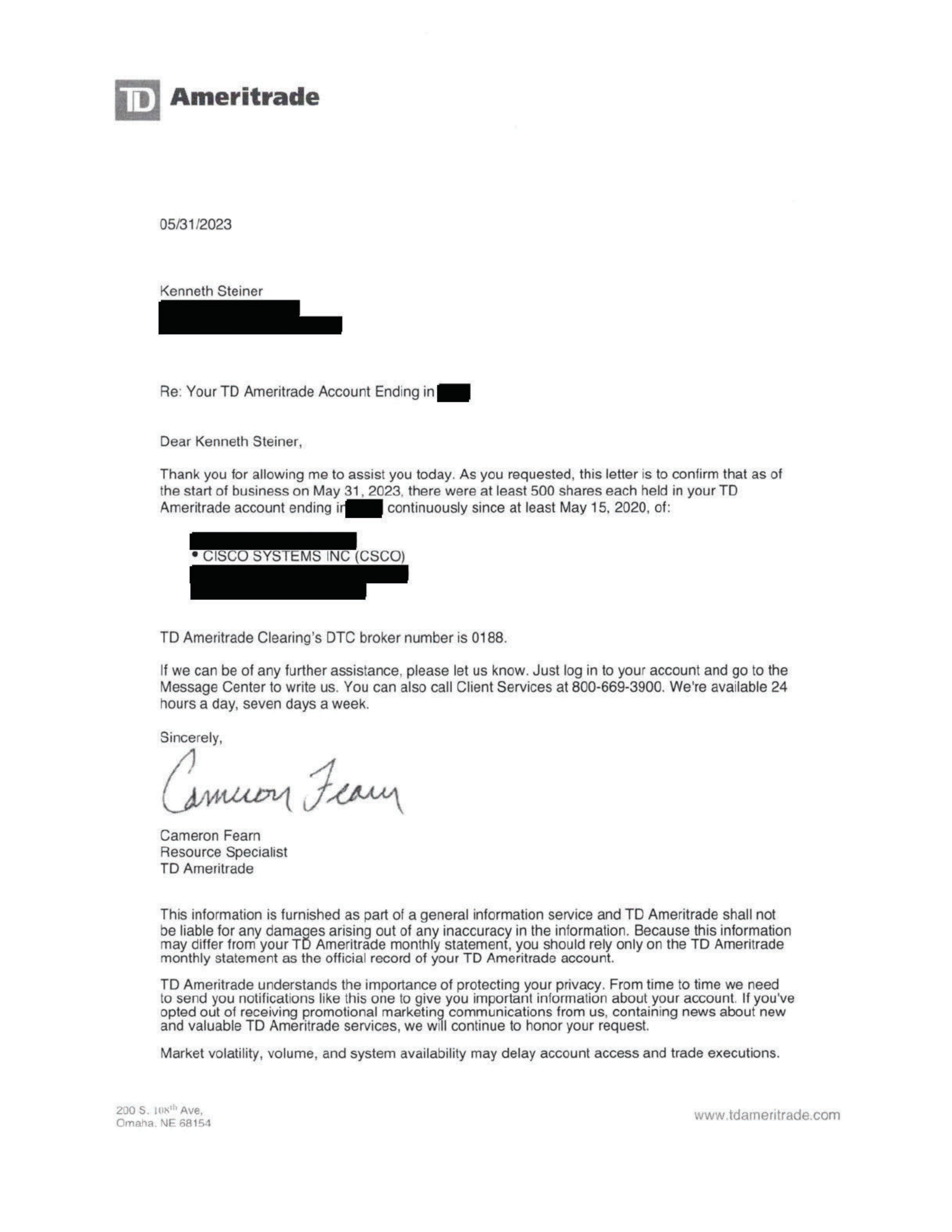
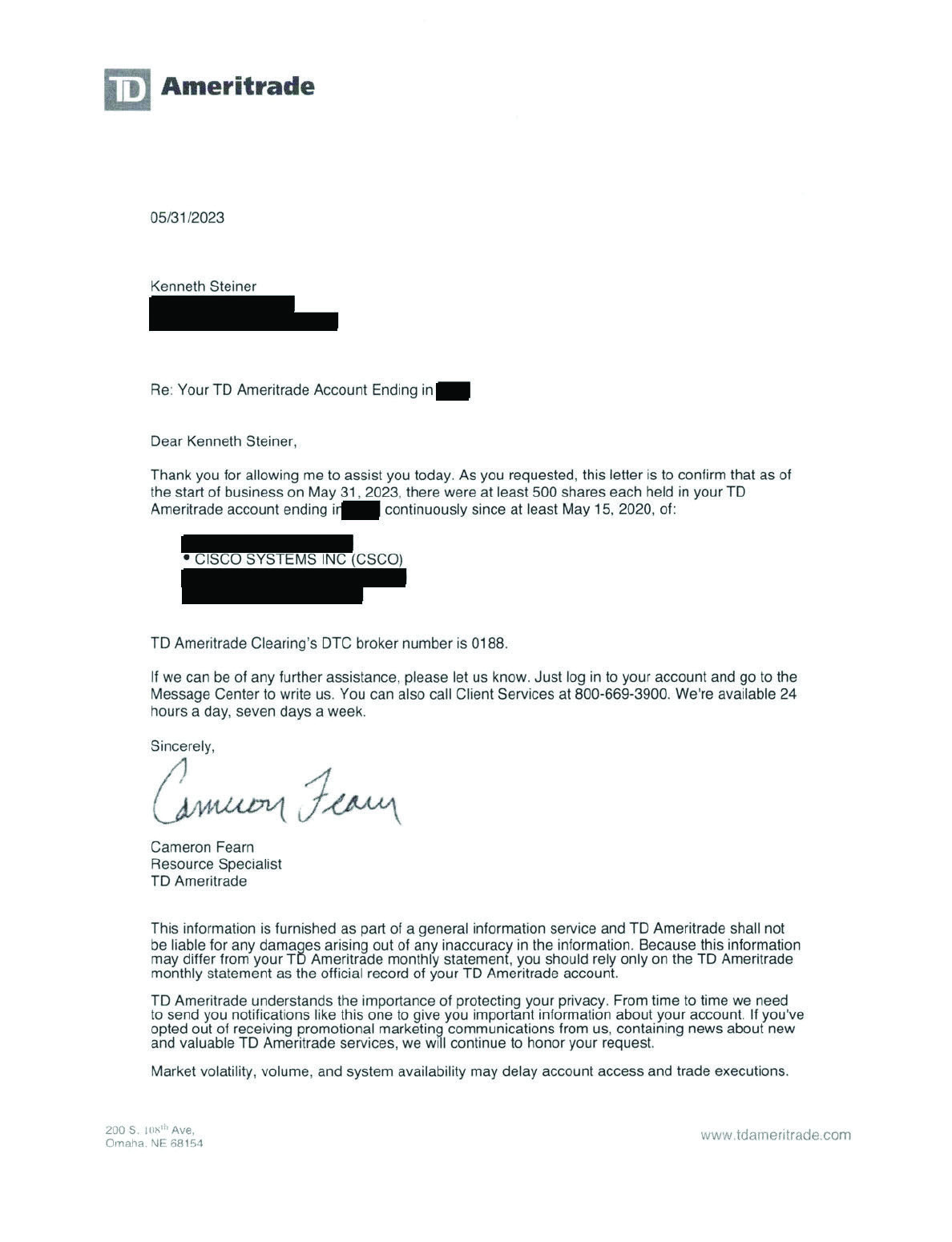

EXHIBIT B
Bylaws
1
AMENDED AND RESTATED
BYLAWS
OF
CISCO SYSTEMS, INC.
(a Delaware corporation)
Effective as of March 9, 2023
ARTICLE 1
OFFICES
Section 1.01
The principal executive offices of Cisco Systems, Inc. (the “
Corporation
”) shall be at such place inside
or outside the State of Delaware as the Board of Directors may determine from time to time.
Section 1.02
The Corporation may also have offices at such other places as the Board of Directors may from time to
time designate, or as the business of the Corporation may require.
ARTICLE 2
STOCKHOLDERS’ MEETINGS
Section 2.01 Annual Meetings
. The annual meeting of the stockholders of the Corporation for the election of directors
to succeed those whose terms expire and for the transaction of such other business as may properly come before the
meeting shall be held at such time, date and place as may be determined by the Board of Directors.
Section 2.02 Special Meetings
. Special meetings of the stockholders may be called at any time by the Chair of the
Board of Directors, by the Chief Executive Officer, by the Board of Directors, or by one or more stockholders holding
not less than ten percent (10%) of the voting power of the Corporation on the record date established pursuant to
Article 2, Section 2.10 of these Amended and Restated Bylaws of the Corporation (the “
Bylaws
”) and who otherwise
comply the requirement of this Article 2, Section 2.02. The person or persons calling any such meeting or requesting
such meeting be called shall concurrently specify the purpose of such meeting and the business proposed to be
transacted at such meeting. In connection with any request for a special meeting by the stockholders in accordance
with the provisions of this Article 2, Section 2.02, such request shall be in writing sent by registered mail to the Chair
of the Board of Directors, the Chief Executive Officer of the Corporation (the “
Chief Executive Officer
”), or the
Secretary of the Corporation (the “
Secretary
”), or delivered to any such officer in person, and shall include the
information required by Article 2, Section 2.12 of these Bylaws. Subject to the immediately succeeding sentence, the
Board of Directors shall cause notice of a meeting requested by the stockholders in accordance with this Section 2.02
to be given in accordance with Article 2, Section 2.04 of these Bylaws as promptly as reasonably practicable and, in
connection therewith, establish the time, date and place of such meeting which shall be held not more than one hundred
twenty (120) nor less than thirty five (35) days after the Board of Directors has determined the stockholder or
stockholders shall have satisfied the requirements in Section 2.12. Within five (5) business days after receiving all of
the information specified in Section 2.12 from a stockholder or stockholders of the Corporation, the Board of Directors
shall determine whether such stockholder or stockholders have satisfied the requirements for calling a special meeting
of the stockholders and notify the requesting party or parties of its finding.
Section 2.03 Place
. All meetings of the stockholders shall be at any place within or without the State of Delaware
designated by the Board of Directors or the Chief Executive Officer, or by means of remote communication as the
Board of Directors in its sole discretion may determine. In the absence of any such designation, stockholders’ meetings
shall be held at the principal executive office of the Corporation.
2
Section 2.04 Notice
. Notice of meetings of the stockholders of the Corporation shall be given in accordance with
applicable law (including, without limitation, as set forth in Section 7.01 of these Bylaws). Unless otherwise provided
by law, the Amended and Restated Certificate of Incorporation of the Corporation (the “
Certificate of Incorporation
”)
or these Bylaws, notice of any such meeting of stockholders shall be sent to each stockholder entitled thereto not less
than ten (10) days nor more than sixty (60) days before the meeting. Said notice shall state the time, date and place, if
any, of the meeting and, (1) in the case of special meetings, the purpose of the meeting and the business proposed to
be transacted, or (2) in the case of annual meetings, those matters which the Board of Directors, at the time of the
mailing of the notice, intends to present for action by the stockholders, including any actions brought by a stockholder,
and (3) in the case of any meeting at which directors are to be elected, the names of the nominees intended at the time
of the mailing of the notice to be presented by the Board of Directors for election and the names of the nominees to
be included in the Corporation’s proxy statement for such annual meeting in accordance with Article 2, Section 2.14.
Section 2.05 Adjourned Meetings
. Any stockholders’ meeting may be adjourned from time to time (including an
adjournment taken to address a technical failure to convene or continue a meeting using remote communication) by
(1) the vote of the holders of a majority of the voting shares present at the meeting either in person or by proxy or (2)
the presiding officer of the meeting. Notice of the time, date and place of any adjourned meeting need not be given if
such time, date and place are announced at the meeting at which stockholders and proxy holders may be deemed to
be present in person and voting at such adjourned meeting are (i) announced at the meeting at which the adjournment
is taken, (ii) displayed, during the time scheduled for the meeting, on the same electronic network used to enable
stockholders and proxy holders to participate in the meeting by means of remote communication or (iii) set forth in
the notice of meeting given in accordance with Section 222(a) of the General Corporation Law of the State of Delaware
(the “
DGCL
”);
provided
,
however
, that if the adjournment is for more than thirty (30) days or, if after the adjournment,
a new record date is fixed for the adjourned meeting, notice of the time, date and place of the adjourned meeting must
be given in conformity with Article 2, Section 2.04 of these Bylaws. At any adjourned meeting, any business may be
transacted which properly could have been transacted at the original meeting.
Section 2.06 Quorum
. The presence in person or by proxy of the holders of a majority of the voting power of the
shares issued, outstanding and entitled to vote at the meeting constitutes a quorum for the transaction of business;
provided
,
however
, that where a separate vote by a class or classes or series of stock is required by applicable law or
the Certificate of Incorporation, the holders of a majority of the voting power of the shares of such class or classes or
series of the stock issued and outstanding and entitled to vote on such matter, present in person or represented by
proxy at the meeting, shall constitute a quorum entitled to take action with respect to the vote on such matter. The
stockholders present at a duly called or held meeting at which a quorum is present may continue to do business,
including at any adjournment thereof (unless a new record date is fixed for the adjourned meeting), notwithstanding
the withdrawal of enough stockholders to leave less than a quorum, if any action taken (other than adjournment) is
approved by the requisite vote of the stockholders.
In the absence of a quorum, any meeting of stockholders may be adjourned from time to time by the presiding officer
of the meeting or the vote of a majority of the shares, the holders of which are either present in person or represented
by proxy thereat, but no other business may be transacted, except as provided above. Votes shall be counted in
accordance with Article 2, Section 2.09 of these Bylaws.
Section 2.07 Action By Consent
. Any action which may be taken at any meeting of stockholders may be taken
without a meeting and without prior notice, if a consent, setting forth the action so taken, shall be signed by the holders
of outstanding shares on the record date established pursuant to Article 2, Section 2.10 of these Bylaws having not
less than the minimum number of votes that would be necessary to authorize or take such action at a meeting at which
all shares entitled to vote thereon were present and voted;
provided
,
however
, that, notice of any stockholder approval
without a meeting by less than unanimous stockholder consent shall be given as required by the DGCL.
Any consent may be revoked by a writing received by the Secretary prior to the time that consents of the holders of
the number of shares required to authorize the proposed action have been delivered to the Corporation.
Section 2.08 Waiver of Notice
. The transactions of any meeting of stockholders, however called and noticed, and
whenever held, shall be as valid as though had at a meeting duly held after regular call and notice, if a quorum be
present either in person or by proxy, and if, either before or after the meeting, each of the persons entitled to vote not
present in person or by proxy gives a waiver of notice, or a consent to the holding of the meeting, or an approval of
3
the minutes thereof. All such waivers, consents, or approvals shall be filed with the corporate records or made a part
of the minutes of the meeting.
Section 2.09 Voting; Stockholder List
.
(a) At any meeting of the stockholders, every stockholder having the right to vote shall be entitled to vote in person,
or by proxy, but no such proxy shall be voted or acted upon after three (3) years from its date, unless the proxy provides
for a longer period. Any stockholder directly or indirectly soliciting proxies from other stockholders must use a proxy
card color other than white, which shall be reserved for exclusive use by the Board of Directors. A proxy shall be
irrevocable if it satisfies the requirements of Sections 212(e) of the DGCL. The voting at meetings of stockholders
need not be by ballot, but any stockholder before the voting begins may demand that voting be by ballot, each of
which shall state the name of the stockholder or proxy voting and the number of shares voted by such stockholder or
proxy.
(b) Except as otherwise provided by law, the Certificate of Incorporation, these Bylaws, the rules or regulations of
any stock exchange applicable to the Corporation, or any law or regulation applicable to the Corporation or its
securities, all matters presented to the stockholders at a meeting at which a quorum is present shall be decided by a
majority of the votes properly cast for or against such matter, and, for the avoidance of doubt, neither abstentions nor
broker non-votes shall be counted as votes cast for or against such matter.
(c) The Corporation shall prepare, no later than the tenth (10th) day before each meeting of stockholders, a complete
list of stockholders entitled to vote at the meeting (
provided, however
, if the record date for determining the
stockholders entitled to vote is less than ten (10) days before the date of the meeting, the list shall reflect the
stockholders entitled to vote as of the tenth (10th) day before the meeting date), arranged in alphabetical order and
showing the address of each stockholder and the number of shares registered in the name of each stockholder. Nothing
in this Section 2.09(c) shall require the Corporation to include electronic mail addresses or other electronic contact
information on such list. Such list shall be open to the examination of any stockholder, for any purpose germane to
the meeting, for a period of ten (10) days ending on the day before the meeting date, either (a) on a reasonably
accessible electronic network as permitted by applicable law (
provided
that the information required to gain access to
the list is provided with the notice of the meeting), or (b) during ordinary business hours, at the principal place of
business of the Corporation. In the event that the Corporation determines to make the list available on an electronic
network, the Corporation may take reasonable steps to ensure that such information is available only to stockholders
of the Corporation. Except as otherwise provided by law, the stock ledger shall be the only evidence as to who are the
stockholders entitled to examine the list of stockholders required by this Section 2.09(c) or to vote in person or by
proxy at any meeting of stockholders. Notwithstanding the foregoing, the Corporation may maintain and authorize
examination of the list of stockholders in any manner expressly permitted by the DGCL at the time.
Section 2.10 Record Dates
. In the event the Board of Directors fixes a day for the determination of stockholders of
record entitled to vote as provided in this Section 2.10, then, subject to the provisions of the DGCL, only persons in
whose name shares entitled to vote stand on the stock records of the Corporation at the close of business on such day
shall be entitled to vote.
(a) Meetings. In order that the Corporation may determine the stockholders entitled to notice of or to vote at any
meeting of stockholders or any adjournment thereof, the Board of Directors may fix a record date, which record date
shall not precede the date upon which the resolution fixing the record date is adopted by the Board of Directors, and
which record date shall, unless otherwise required by law, not be more than sixty (60) nor less than ten (10) days
before the date of such meeting. If no record date is fixed by the Board of Directors, the record date for determining
stockholders entitled to notice of or to vote at a meeting of stockholders shall be at the close of business on the business
day next preceding the day on which notice is given, or, if notice is waived, at the close of business on the business
day next preceding the day on which the meeting is held. A determination of stockholders of record entitled to notice
of or to vote at a meeting of stockholders shall apply to any adjournment of the meeting;
provided
,
however
, that the
Board of Directors may fix a new record date for determination of stockholders entitled to vote at the adjourned
meeting, and in such case shall also fix as the record date for stockholders entitled to notice of such adjourned meeting
the same or an earlier date as that fixed for determination of stockholders entitled to vote in accordance with the
foregoing provisions of this subsection (a) at the adjourned meeting.
4
(b) Action by Consent. In order that the Corporation may determine the stockholders entitled to consent to corporate
action without a meeting, the Board of Directors shall fix a record date to determine the stockholders entitled to act
by consent, which record date shall not precede the date upon which the resolution fixing such record date is adopted
by the Board of Directors, and which date shall not be more than ten (10) days after the date upon which the resolution
fixing the record date is adopted by the Board of Directors. To the extent stockholders may take action by consent in
accordance with the Certificate of Incorporation and these Bylaws, any stockholder of record seeking to have the
stockholders authorize or take corporate action by consent shall, by written notice to the Secretary, request the Board
of Directors to fix a record date. The Board of Directors shall promptly, but in no event later than twenty-eight (28)
days after the date on which such request is received, adopt a resolution fixing the record date to determine the
stockholders entitled to act by consent. If no record date has been fixed by the Board of Directors, such record date
shall be determined in accordance with the DGCL.
(c) Dividends, Distributions and other Rights. In order that the Corporation may determine the stockholders entitled
to receive payment of any dividend or other distribution or allotment of any rights, or entitled to exercise any rights
in respect of any change, conversion or exchange of stock or for the purpose of any other lawful action, the Board of
Directors may fix, in advance, a record date, which shall not precede the date upon which the resolution fixing the
record date is adopted by the Board of Directors and which shall not be more than sixty (60) days nor less than the
number of days required by the primary stock exchange on which the Corporation’s shares of common stock are traded
prior to such action. If no such record date is fixed by the Board of Directors, then the record date for determining
stockholders for any such purpose shall be at the close of business on the day on which the Board of Directors adopts
the resolution relating thereto.
Section 2.11 Order of Business
. The Chief Executive Officer, or such other officer or director of the Corporation
designated by a majority of the Board of Directors, will call meetings of the stockholders to order and will act as
presiding officer thereof. Unless otherwise determined by the Board of Directors prior to the meeting, the presiding
officer of the meeting of the stockholders will also determine the order of business and have the authority in his or her
sole discretion to regulate the conduct of any such meeting, including without limitation by (i) imposing restrictions
on the persons (other than stockholders of the Corporation or their duly appointed proxies) who may attend any such
stockholders’ meeting, (ii) ascertaining whether any stockholder or his, her or its proxy may be excluded or removed
from any meeting of the stockholders based upon any determination by the presiding officer, in his or her sole
discretion, that any such person has unduly disrupted or is likely to disrupt the proceedings thereat, (iii) determining
the circumstances in which any person may make a statement or ask questions at any meeting of the stockholders, (iv)
restrict use of audio or video recording devices at the meeting, and (v) taking such other action as, in the discretion of
the presiding officer, is deemed necessary, appropriate or convenient for the proper conduct of the meeting.
At an annual meeting of the stockholders, only such business will be conducted or considered as is properly brought
before the meeting. To be properly brought before an annual meeting, business must be (i) specified in the notice of
meeting (or any supplement thereto) given by or at the direction of the Board of Directors, (ii) otherwise properly
brought before the meeting by the presiding officer or by or at the direction of a majority of the Board of Directors,
or (iii) otherwise properly requested to be brought before the meeting by a stockholder of the Corporation in
accordance with the immediately succeeding sentence. For business to be properly requested by a stockholder to be
brought before an annual meeting, the stockholder must (i) be a stockholder of record at the time of the giving of the
notice of such annual meeting by or at the direction of the Board of Directors, (ii) at the time of the meeting, is a
stockholder of record who is entitled to vote at such meeting, and attends such meeting to present such nomination or
proposal, and (iii) have given timely written notice thereof to the Secretary in accordance with Article 2, Section 2.12
or Article 2, Section 2.14, as the case may be, of these Bylaws.
Nominations of persons for election as directors of the Corporation may be made at an annual meeting of stockholders
only (i) by or at the direction of the Board of Directors, (ii) by any stockholder who is a stockholder of record at the
time of the giving of the notice of such annual meeting by or at the direction of the Board of Directors, who, at the
time of the meeting, is a stockholder of record who is entitled to vote at such meeting, who attends such meeting to
present such nomination or proposal and who has given timely written notice thereof to the Secretary in accordance
with, and otherwise satisfied the requirements of, Article 2, Section 2.12 of these Bylaws, or (iii) by any Eligible
Holder (as defined in Article 2, Section 2.14) who has satisfied the requirements of Article 2, Section 2.14. Only
persons who are nominated in accordance with this Article 2, Section 2.11 will be eligible for election at a meeting of
stockholders as directors of the Corporation. The number of nominees a stockholder may nominate for election at a
5
meeting of stockholders (or in the case of a stockholder of record giving the notice on behalf of the beneficial owner,
the number of nominees a stockholder of record may nominate for election at the meeting on behalf of such
stockholder) shall not exceed the number of directors to be
elected at such meeting.
At a special meeting of stockholders, only such business may be conducted or considered as is properly brought before
the meeting in accordance with Section 2.02.
The determination of whether any business sought to be brought before any annual or special meeting of the
stockholders is properly brought before such meeting in accordance with Article 2, Sections 2.02 and 2.11 and whether
any nomination of a person for election as a director of the Corporation at any annual meeting of the stockholders was
properly made in accordance with this Article 2, Section 2.11, will be made by the presiding officer of such meeting.
If the presiding officer determines that any business is not properly brought before such meeting, or any nomination
was not properly made (including satisfying the information requirements set forth herein with accurate and complete
information), he or she will so declare to the meeting and any such business will not be conducted or considered and
any such nomination will be disregarded (and any such nominee shall be disqualified), including that if a stockholder
provides notice pursuant to Rule 14a-19(b) promulgated under the Securities Exchange Act of 1934, as amended (the
“
Exchange Act
”) and subsequently fails to comply with the requirements of Rule 14a-19(a)(2) and Rule 14a-19(a)(3)
promulgated under the Exchange Act, including the provision to the Corporation of notices required thereunder in a
timely manner, then the Corporation shall disregard any proxies or votes solicited for such stockholder’s director
nominees (and any such nominee shall be disqualified). Notwithstanding the foregoing provisions of this Section 2.11,
unless otherwise required by law, no stockholder shall solicit proxies in support of director nominees other than the
Corporation’s nominees unless such stockholder has complied with Rule 14a-19 promulgated under the Exchange Act
in connection with the solicitation of such proxies, including the provision to the Corporation of notices required
thereunder in a timely manner.
Notwithstanding the provisions of Sections 2.11, 2.12 and 2.14 of this Article 2, a stockholder must also comply with
all applicable requirements of the Exchange Act, and the rules and regulations promulgated thereunder with respect
to the matters set forth in Sections 2.11, 2.12 and 2.14 of this Article 2, for the avoidance of doubt including, but not
limited to, Rule 14a-19 of the Exchange Act with respect to nominations. Nothing in Sections 2.11, 2.12 and 2.14 of
this Article 2 will be deemed to affect any rights of stockholders to request inclusion of proposals in the Corporation’s
proxy statement in accordance with the provisions of Rule 14a-8 promulgated under the Exchange Act.
For purposes of these Bylaws, “public announcement” means disclosure in a press release reported by the Dow Jones
Newswires, Associated Press, or comparable national news service or in a document publicly filed by the Corporation
with the Securities and Exchange Commission (the “
SEC
”) pursuant to Sections 13, 14 or 15(d) of the Exchange Act
or furnished to stockholders.
Section 2.12 Advance Notice of Stockholder Proposals and Director Nominations
.
(a) To be timely for purposes of Article 2, Section 2.11 of these Bylaws, (i) a stockholder’s notice (other than a notice
by an Eligible Holder (as defined in Article 2, Section 2.14) who seeks to include a Nominee (as defined in Article 2,
Section 2.14) in the Corporation’s proxy statement for an annual meeting of stockholders pursuant to Article 2, Section
2.14) must be addressed to the Secretary and delivered or mailed to and received at the principal executive offices of
the Corporation not less than sixty (60) nor more than ninety (90) calendar days prior to the anniversary date of the
date (as specified in the Corporation’s proxy materials for its immediately preceding annual meeting of stockholders)
on which the Corporation first sent its proxy materials to the Corporation’s stockholders for its immediately preceding
annual meeting of stockholders;
provided
,
however
, that in the event the annual meeting is called for a date that is not
within sixty (60) calendar days of the anniversary date of the date on which the immediately preceding annual meeting
of stockholders was held to be timely, notice by the stockholder must be so received not later than the close of business
on the tenth (10th) calendar day following the day on which public announcement of the date of the annual meeting
is first made, (ii) in the case of a proposal for the nomination of persons for election to the Board of Directors, the
stockholder of record shall have complied in all respects with the requirements of Section 14 of the Exchange Act,
including, without limitation, if applicable, the requirements of Rule 14a-19 (as such rule and regulations may be
amended from time to time by the SEC, including any SEC Staff interpretations relating thereto), and the stockholder
shall deliver, no later than five (5) business days prior to the annual meeting or any adjournment, rescheduling,
postponement or other delay thereof, reasonable evidence that it has complied with such requirements and (iii) in the
6
case of a proposal for the nomination of persons for election to the Board of Directors, the Board of Directors or an
executive officer designated thereby shall have determined that the stockholder of record has satisfied the requirements
of this Section 2.12. In no event will the public announcement of an adjournment, postponement or rescheduling of
an annual meeting of stockholders commence a new time period for the giving of a stockholder’s notice as provided
above. Notwithstanding anything in this Section 2.12 or any other provision of these Bylaws to the contrary, in the
event that the number of directors to be elected to the Board of Directors at the annual meeting is increased effective
after the time period for which nominations would otherwise be due under this Section 2.12 and there is no public
announcement by the Corporation naming all of the Nominees for director or specifying the size of the increased
Board of Directors at least seventy five (75) days prior to the first anniversary of the preceding year’s annual meeting
(or, if the annual meeting is held more than thirty (30) days before or sixty (60) days after such anniversary date, if
there is no public announcement at least seventy five (75) days prior to the date of the annual meeting), a stockholder’s
notice required by this Section 2.12 shall also be considered timely, but only with respect to nominees for any new
positions created by such increase, if it shall be delivered to the Secretary at the principal executive office of the
Corporation not later than 5:00 p m. local time on the tenth (10th) day following the day on which such public
announcement is first made by the Corporation.
(b) In the case of a request by a stockholder for business to be brought before any annual meeting of stockholders, a
stockholder’s notice to the Secretary must set forth as to each matter the stockholder proposes to bring before the
annual meeting (i) a description in reasonable detail of the business desired to brought before the annual meeting and
the reasons for conducting such business at the annual meeting, (ii) the name and address, as they appear on the
Corporation’s books, of the stockholder proposing such business and the beneficial owner, if any, on whose behalf
the proposal is made, (iii) a representation that the stockholder proposing such business is a holder of record of stock
of the Corporation entitled to vote at such meeting and intends to appear in person (including virtually in the case of
a meeting conducted solely by means of remote communication) or by proxy at the meeting to propose such business
or nomination, (iv) the class and number of shares of the Corporation that are owned beneficially and of record by the
stockholder proposing such business and by the beneficial owner, if any, on whose behalf the proposal is made, (v)(A)
a reasonably detailed description of any agreement, arrangement or understanding (including any derivative
instruments, swaps, warrants, short positions, profit interests, options, hedging transactions, borrowed or loaned shares
or other transactions, such as those involving direct or indirect opportunities to profit or share in any profit derived
from any increase or decrease in the value of shares of the Corporation, or partnership interests in a partnership that
directly or indirectly hold any of the foregoing) that has been entered into as of the date of such notice by such
stockholder and beneficial owner, if any, the effect or intent of which is to mitigate loss to, manage risk or benefit of
share price changes for, or increase or decrease the voting power of each such person or any of its affiliates or
associates with respect to shares of stock of the Corporation, and any performance-related fees to which each such
party is directly or indirectly entitled based on any increase or decrease in the value of shares of the Corporation, and
(B) a representation that the stockholder will notify the Corporation in writing of any of the information required to
be disclosed in clause (v)(A) that is in effect as of the record date for the meeting not later than five (5) business days
following the later of the record date or the date notice of the record date is first publicly disclosed, (vi) any material
interest of such stockholder proposing such business and the beneficial owner, if any, on whose behalf the proposal is
made in such business, and (vii) in the case of a proposal other than the nomination of persons for election to the
Board of Directors, a representation whether such proposing stockholder intends (or is part of a group that intends) to
deliver a proxy statement or form of proxy to holders of at least the percentage of the Corporation’s voting shares
required under applicable law to carry the proposal.
(c) In the case of a nomination by a stockholder of a person for election as a director of the Corporation at any annual
meeting of stockholders pursuant to this Article 2, Section 2.12, a stockholder notice to the Secretary must set forth
(i) the stockholder’s intent to nominate one or more persons for election as a director of the Corporation, the name of
each such nominee proposed by the stockholder giving the notice, and the reason for making such nomination at the
annual meeting, (ii) the name and address, as they appear on the Corporation’s books, of the stockholder proposing
such nomination and the beneficial owner, if any, on whose behalf the nomination is proposed, (iii) a representation
that the stockholder proposing such business is a holder of record of stock of the Corporation entitled to vote at such
meeting and intends to appear in person (including virtually in the case of a meeting conducted solely by means of
remote communication) or by proxy at the meeting to propose such business or nomination, (iv) the class and number
of shares of the Corporation that are owned beneficially and of record by the stockholder proposing such nomination
and by the beneficial owner, if any, on whose behalf the nomination is proposed, (v) the information and representation
described in clause (v) of the immediately preceding paragraph, (vi) any material interest of such stockholder
7
proposing such nomination and the beneficial owner, if any, on whose behalf the proposal is made, (vii) a description
of all arrangements or understandings between or among any of (A) the stockholder giving the notice, (B) each
nominee, and (C) any other person or persons (naming such person or persons) pursuant to which the nomination or
nominations are to be made by the stockholder giving the notice, (viii) a representation that such stockholder giving
the notice intends to solicit the holders of shares representing at least 67% of the voting power of the shares entitled
to vote on the election of directors in support of director nominees other than the Corporation’s nominees in
accordance with Rule 14a-19, and the name of each participant (as defined in Item 4 of the Exchange Act Schedule
14A) in such solicitation, (ix) such other information regarding each nominee proposed by the stockholder giving the
notice as would be required to be included in a proxy statement filed in accordance with the proxy rules of the SEC
had the nominee been nominated, or intended to be nominated, by the Board of Directors, (x) the signed consent of
each nominee proposed by the stockholder giving the notice to be included as a nominee in any materials relating to
the Corporation’s next meeting and to serve as a director of the Corporation if so elected, (xi) any material pending or
threatened legal proceeding in which such stockholder is a party or material participant involving the Corporation or
any of its officers or directors, or any affiliate of the Corporation, (xii) the information set forth in Article 2, Sections
2.14(d)(ii)(D), (E) and (H), (xiii) statement whether such person, if elected, intends to tender, promptly following such
person’s election or reelection, an irrevocable resignation effective upon such person’s failure to receive the required
vote for reelection at any future meeting at which such person would face reelection and acceptance of such resignation
by the Board of Directors, in accordance with the Corporation’s policies, (xiv) description of any business or personal
interests that could place such person in a potential conflict of interest with the Corporation or any of its subsidiaries,
and (xv) such stockholder’s unconditional consent to the public disclosure of any or all of the information provided to
the Corporation pursuant to this Section 2.12 and such stockholder’s agreement to the matters set forth in Article 2,
Section 2.14(d)(iv).
(d) Any stockholder or stockholders seeking to call a special meeting pursuant to Article 2, Section 2.02 of these
Bylaws shall provide information comparable to that required by the preceding paragraphs, to the extent applicable,
in any request made pursuant to such Article and Section. From the date of delivery of the stockholder notice, such
stockholder must give written notice to the Secretary at the principal executive offices of the Corporation of any
change in the information provided pursuant to this Section 2.12 within two (2) business days after the occurrence of
such change (each an “
Update
”), so that the information is current through the date of the meeting or any adjournment,
postponement, or rescheduling thereof,
provided
that any such Update shall be delivered by such stockholder at least
two (2) business days prior to the closing of the polls at the meeting. If a stockholder providing written notice required
by this Section 2.12 fails to provide any written Update in accordance with this Section 2.12, the information as to
which such written Update relates may be deemed not to have been provided in accordance with these Bylaws. If any
information submitted pursuant to this Section 2.12 is inaccurate or incomplete in any material respect (as determined
by the Board of Directors or a committee thereof), such information shall be deemed not to have been provided in
accordance with these Bylaws. A stockholder shall notify the Secretary in writing at the principal executive offices of
the Corporation of any inaccuracy or change in any information submitted within two (2) business days after becoming
aware of such inaccuracy or change, and any such notification shall clearly identify the inaccuracy or change, it being
understood that no such notification will cure any deficiencies or inaccuracies with respect to any prior submission by
such stockholder. Upon written request of the Secretary on behalf of the Board of Directors (or a duly authorized
committee thereof), such stockholder shall provide, within seven (7) business days after delivery of
such request (or
such longer period as may be specified in such request), (1) written verification, reasonably satisfactory to the Board
of Directors, any committee thereof, or any authorized officer of the Corporation, to demonstrate the accuracy of any
information submitted and (2) a written affirmation of any information submitted as of an earlier date. If such
stockholder fails to provide such written verification or affirmation within such period, the information as to which
written verification or affirmation was requested may be deemed not to have been provided in accordance with these
Bylaws. Notwithstanding the foregoing, if a stockholder of record no longer plans to solicit proxies in accordance
with its representation pursuant to Section 2.12(b), the stockholder of record shall inform the Corporation of this
change by delivering a writing to the Secretary at the principal executive offices of the Corporation no later than two
(2) business days after the occurrence of such change.
(e) Nominations of persons for election to the Board of Directors may be made at a special meeting of stockholders at
which directors are to be elected pursuant to the Corporation’s notice of meeting (1) by or at the direction of the Board
of Directors (including upon the request of stockholders pursuant to Section 2.02 hereof) or (2) provided that the
Board of Directors has determined that directors shall be elected at such meeting (including upon the request of
stockholders pursuant to Section 2.02 hereof), by any stockholder of the Corporation who is a stockholder of record
8
at the time the notice provided for in this Section 2.12 is delivered to the Secretary, who is entitled to vote at the
meeting and upon such election and who complies with the notice procedures set forth in this Section 2.12. The
proposal by stockholders of other business to be conducted at a special meeting of stockholders may be made only in
accordance with Section 2.02 hereof. In the event the Corporation calls a special meeting of stockholders for the
purpose of electing one or more directors to the Board of Directors, any such stockholder entitled to vote in such
election of directors may nominate a person or persons (as the case may be) for election to such position(s) as specified
in the Corporation’s notice of meeting, if (A) the stockholder’s notice required by Section 2.12(c) shall be delivered
or mailed to and received by the Secretary at the principal executive offices of the Corporation not earlier than the
close of business on the ninetieth (90th) day prior to such special meeting and not later than the close of business on
the later of the sixtieth (60th) day prior to such special meeting or the tenth (10th) calendar day following the day on
which public announcement of the date of the special meeting at which directors are to be elected is first made by the
Corporation, (B) the stockholder has complied in all respects with the requirements of Section 14 of the Exchange
Act, including, without limitation, if applicable, the requirements of Rule 14a-19 (as such rule and regulations may be
amended from time to time by the SEC, including any SEC Staff interpretations relating thereto) and (C) the Board of
Directors or an executive officer designated thereby has determined that the stockholder has satisfied the requirements
of this Section 2.12. In no event shall the adjournment, postponement or rescheduling (or the public announcement
thereof) of a special meeting commence a new time period for the giving of a stockholder’s notice as described above.
Section 2.13 Election of Directors
. In any uncontested election, candidates for election to the Board of Directors
receiving the affirmative vote of a majority of the votes properly cast for or against such matter (and for the avoidance
of doubt neither abstentions nor broker non-votes shall be counted as votes cast for or against such matter) at a duly
held meeting at which a quorum is present shall be elected. In any election that is not an uncontested election, the
candidates receiving the highest number of affirmative votes of the shares entitled to be voted for them up to the
number of directors to be elected by those shares shall be elected; votes against a director and votes withheld shall
have no legal effect.
For purposes of these Bylaws, “uncontested election” means an election of directors of the Corporation in which, at
the expiration of the later of (i) the time fixed under Section 2.12 of this Article 2 requiring advance notification of
director candidates, and (ii) the time fixed under Section 2.14 of this Article 2 for the inclusion of a Nominee (as
defined in Article 2, Section 2.14) in the Corporation’s proxy statement, the number of candidates for election does
not exceed the number of directors to be elected by the stockholders at that election.
Section 2.14 Stockholder Nominations Included in the Corporation’s Proxy Materials
.
(a) Inclusion of Nominees in Proxy Statement. Subject to the provisions of this Article 2, Section 2.14, if expressly
requested in the relevant Nomination Notice (as defined below), the Corporation shall include in its proxy statement
for any annual meeting of stockholders: (i) the name or names of any person or persons nominated for election (each,
a “
Nominee
”), which shall also be included on the Corporation’s form of proxy and ballot, by any Eligible Holder (as
defined below) or group of up to twenty (20) Eligible Holders that has (individually and collectively, in the case of a
group) satisfied, as determined by the Board of Directors, all applicable conditions and complied with all applicable
procedures set forth in this Article 2, Section 2.14 (such Eligible Holder or group of Eligible Holders being a
“
Nominating Stockholder
”), (ii) disclosure about each Nominee and the Nominating Stockholder required under the
rules of the SEC or other applicable law to be included in the proxy statement, (iii) any statement included by the
Nominating Stockholder in the Nomination Notice for inclusion in the proxy statement in support of each Nominee’s
election to the Board of Directors (subject, without limitation, to Article 2, Section 2.14(e)(ii)), if such statement does
not exceed five hundred (500) words and fully complies with Section 14 of the Exchange Act, and the rules and
regulations promulgated thereunder, including Rule 14a-9 (the “
Supporting Statement
”), and (iv) any other
information that the Corporation or the Board of Directors determines, in their discretion, to include in the proxy
statement relating to the nomination of each Nominee, including, without limitation, any statement in opposition to
the nomination, any of the information provided pursuant to this Article 2, Section 2.14 and any solicitation materials
or related information with respect to a Nominee.
For purposes of this Article 2, Section 2.14, any determination to be made by the Board of Directors may be made by
the Board of Directors, a committee of the Board of Directors or any officer of the Corporation designated by the
Board of Directors or a committee of the Board of Directors, and any such determination shall be final and binding
on the Corporation, any Eligible Holder, any Nominating Stockholder, any Nominee and any other person so long as
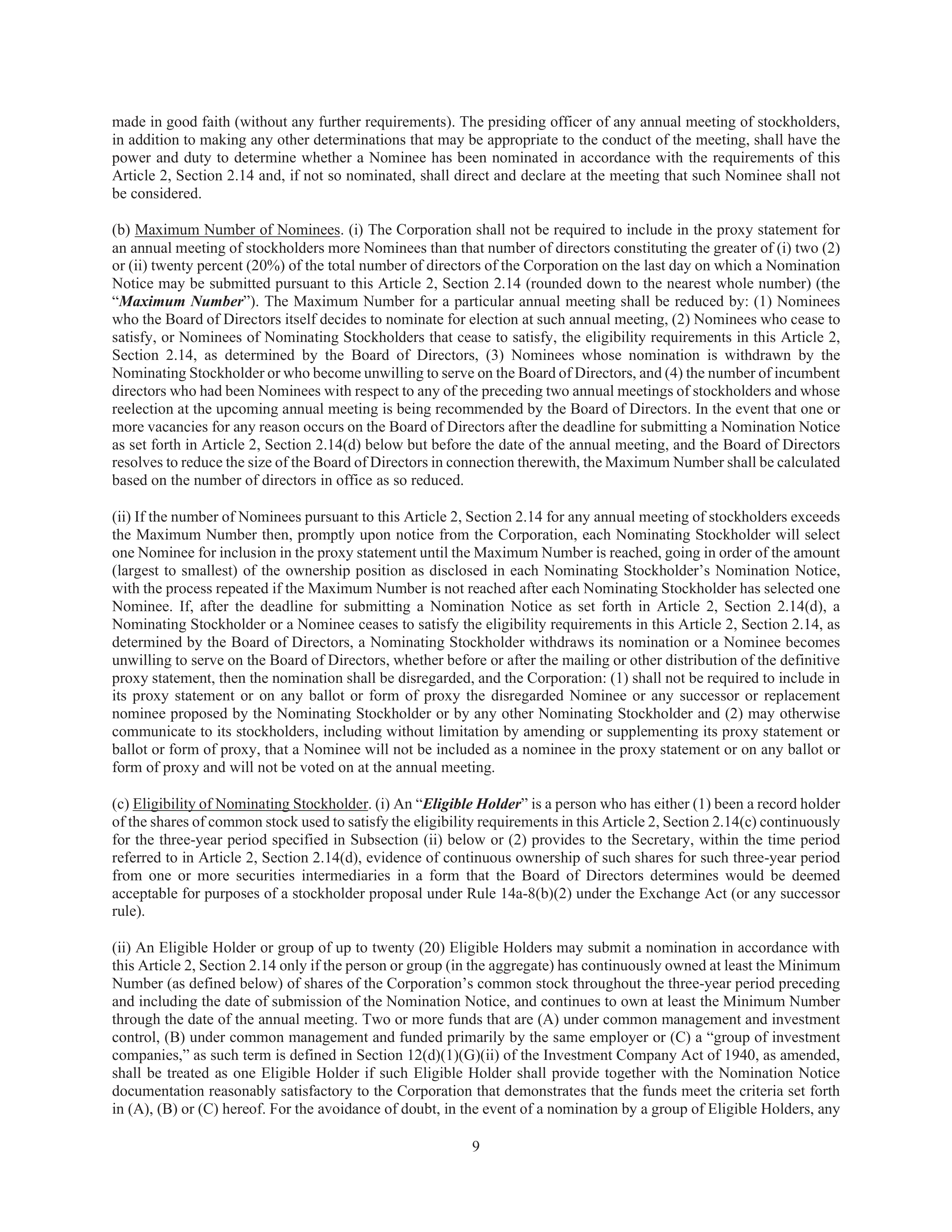
9
made in good faith (without any further requirements). The presiding officer of any annual meeting of stockholders,
in addition to making any other determinations that may be appropriate to the conduct of the meeting, shall have the
power and duty to determine whether a Nominee has been nominated in accordance with the requirements of this
Article 2, Section 2.14 and, if not so nominated, shall direct and declare at the meeting that such Nominee shall not
be considered.
(b) Maximum Number of Nominees. (i) The Corporation shall not be required to include in the proxy statement for
an annual meeting of stockholders more Nominees than that number of directors constituting the greater of (i) two (2)
or (ii) twenty percent (20%) of the total number of directors of the Corporation on the last day on which a Nomination
Notice may be submitted pursuant to this Article 2, Section 2.14 (rounded down to the nearest whole number) (the
“
Maximum Number
”). The Maximum Number for a particular annual meeting shall be reduced by: (1) Nominees
who the Board of Directors itself decides to nominate for election at such annual meeting, (2) Nominees who cease to
satisfy, or Nominees of Nominating Stockholders that cease to satisfy, the eligibility requirements in this Article 2,
Section 2.14, as determined by the Board of Directors, (3) Nominees whose nomination is withdrawn by the
Nominating Stockholder or who become unwilling to serve on the Board of Directors, and (4) the number of incumbent
directors who had been Nominees with respect to any of the preceding two annual meetings of stockholders and whose
reelection at the upcoming annual meeting is being recommended by the Board of Directors. In the event that one or
more vacancies for any reason occurs on the Board of Directors after the deadline for submitting a Nomination Notice
as set forth in Article 2, Section 2.14(d) below but before the date of the annual meeting, and the Board of Directors
resolves to reduce the size of the Board of Directors in connection therewith, the Maximum Number shall be calculated
based on the number of directors in office as so reduced.
(ii) If the number of Nominees pursuant to this Article 2, Section 2.14 for any annual meeting of stockholders exceeds
the Maximum Number then, promptly upon notice from the Corporation, each Nominating Stockholder will select
one Nominee for inclusion in the proxy statement until the Maximum Number is reached, going in order of the amount
(largest to smallest) of the ownership position as disclosed in each Nominating Stockholder’s Nomination Notice,
with the process repeated if the Maximum Number is not reached after each Nominating Stockholder has selected one
Nominee. If, after the deadline for submitting a Nomination Notice as set forth in Article 2, Section 2.14(d), a
Nominating Stockholder or a Nominee ceases to satisfy the eligibility requirements in this Article 2, Section 2.14, as
determined by the Board of Directors, a Nominating Stockholder withdraws its nomination or a Nominee becomes
unwilling to serve on the Board of Directors, whether before or after the mailing or other distribution of the definitive
proxy statement, then the nomination shall be disregarded, and the Corporation: (1) shall not be required to include in
its proxy statement or on any ballot or form of proxy the disregarded Nominee or any successor or replacement
nominee proposed by the Nominating Stockholder or by any other Nominating Stockholder and (2) may otherwise
communicate to its stockholders, including without limitation by amending or supplementing its proxy statement or
ballot or form of proxy, that a Nominee will not be included as a nominee in the proxy statement or on any ballot or
form of proxy and will not be voted on at the annual meeting.
(c) Eligibility of Nominating Stockholder. (i) An “
Eligible Holder
” is a person who has either (1) been a record holder
of the shares of common stock used to satisfy the eligibility requirements in this Article 2, Section 2.14(c) continuously
for the three-year period specified in Subsection (ii) below or (2) provides to the Secretary, within the time period
referred to in Article 2, Section 2.14(d), evidence of continuous ownership of such shares for such three-year period
from one or more securities intermediaries in a form that the Board of Directors determines would be deemed
acceptable for purposes of a stockholder proposal under Rule 14a-8(b)(2) under the Exchange Act (or any successor
rule).
(ii) An Eligible Holder or group of up to twenty (20) Eligible Holders may submit a nomination in accordance with
this Article 2, Section 2.14 only if the person or group (in the aggregate) has continuously owned at least the Minimum
Number (as defined below) of shares of the Corporation’s common stock throughout the three-year period preceding
and including the date of submission of the Nomination Notice, and continues to own at least the Minimum Number
through the date of the annual meeting. Two or more funds that are (A) under common management and investment
control, (B) under common management and funded primarily by the same employer or (C) a “group of investment
companies,” as such term is defined in Section 12(d)(1)(G)(ii) of the Investment Company Act of 1940, as amended,
shall be treated as one Eligible Holder if such Eligible Holder shall provide together with the Nomination Notice
documentation reasonably satisfactory to the Corporation that demonstrates that the funds meet the criteria set forth
in (A), (B) or (C) hereof. For the avoidance of doubt, in the event of a nomination by a group of Eligible Holders, any
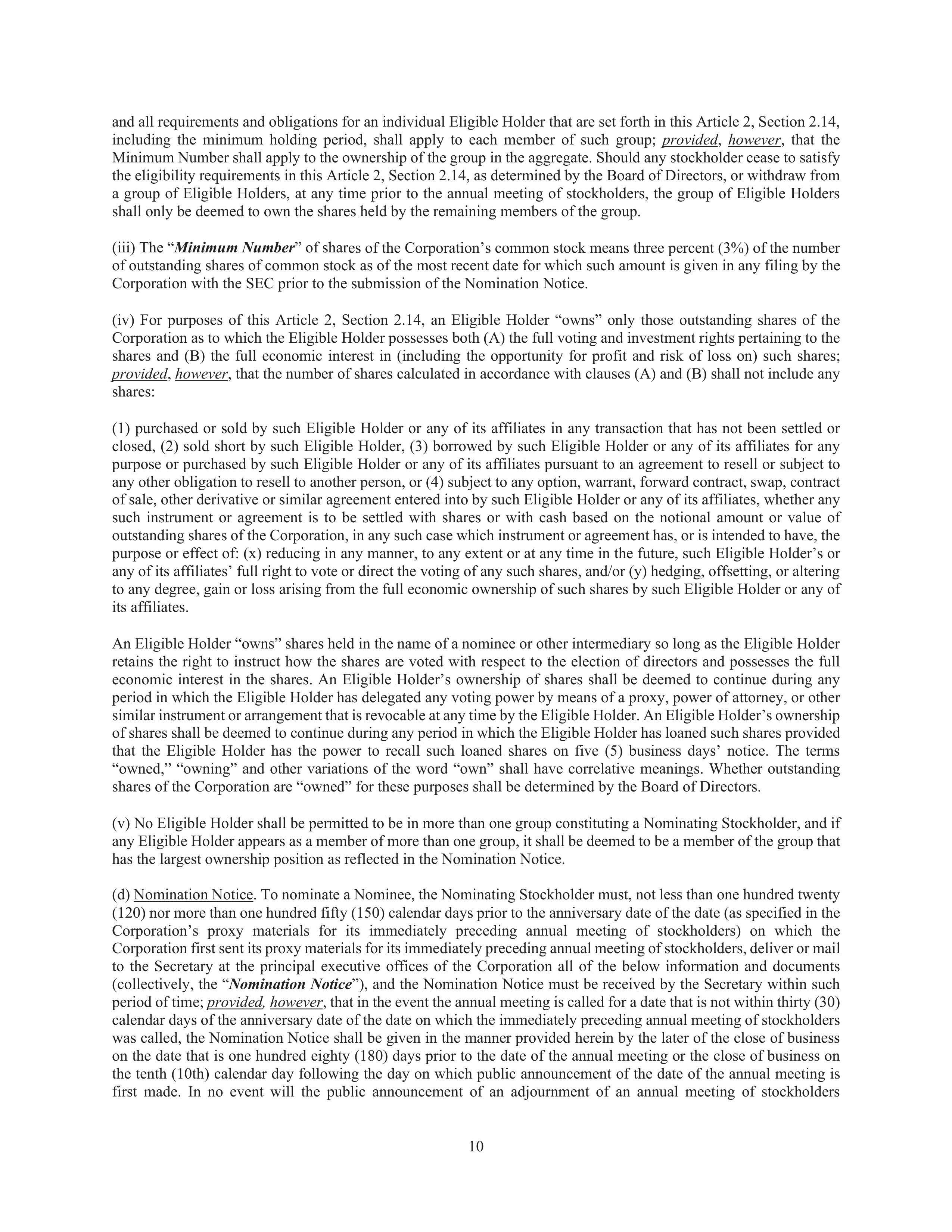
10
and all requirements and obligations for an individual Eligible Holder that are set forth in this Article 2, Section 2.14,
including the minimum holding period, shall apply to each member of such group;
provided
,
however
, that the
Minimum Number shall apply to the ownership of the group in the aggregate. Should any stockholder cease to satisfy
the eligibility requirements in this Article 2, Section 2.14, as determined by the Board of Directors, or withdraw from
a group of Eligible Holders, at any time prior to the annual meeting of stockholders, the group of Eligible Holders
shall only be deemed to own the shares held by the remaining members of the group.
(iii) The “
Minimum Number
” of shares of the Corporation’s common stock means three percent (3%) of the number
of outstanding shares of common stock as of the most recent date for which such amount is given in any filing by the
Corporation with the SEC prior to the submission of the Nomination Notice.
(iv) For purposes of this Article 2, Section 2.14, an Eligible Holder “owns” only those outstanding shares of the
Corporation as to which the Eligible Holder possesses both (A) the full voting and investment rights pertaining to the
shares and (B) the full economic interest in (including the opportunity for profit and risk of loss on) such shares;
provided
,
however
, that the number of shares calculated in accordance with clauses (A) and (B) shall not include any
shares:
(1) purchased or sold by such Eligible Holder or any of its affiliates in any transaction that has not been settled or
closed, (2) sold short by such Eligible Holder, (3) borrowed by such Eligible Holder or any of its affiliates for any
purpose or purchased by such Eligible Holder or any of its affiliates pursuant to an agreement to resell or subject to
any other obligation to resell to another person, or (4) subject to any option, warrant, forward contract, swap, contract
of sale, other derivative or similar agreement entered into by such Eligible Holder or any of its affiliates, whether any
such instrument or agreement is to be settled with shares or with cash based on the notional amount or value of
outstanding shares of the Corporation, in any such case which instrument or agreement has, or is intended to have, the
purpose or effect of: (x) reducing in any manner, to any extent or at any time in the future, such Eligible Holder’s or
any of its affiliates’ full right to vote or direct the voting of any such shares, and/or (y) hedging, offsetting, or altering
to any degree, gain or loss arising from the full economic ownership of such shares by such Eligible Holder or any of
its affiliates.
An Eligible Holder “owns” shares held in the name of a nominee or other intermediary so long as the Eligible Holder
retains the right to instruct how the shares are voted with respect to the election of directors and possesses the full
economic interest in the shares. An Eligible Holder’s ownership of shares shall be deemed to continue during any
period in which the Eligible Holder has delegated any voting power by means of a proxy, power of attorney, or other
similar instrument or arrangement that is revocable at any time by the Eligible Holder. An Eligible Holder’s ownership
of shares shall be deemed to continue during any period in which the Eligible Holder has loaned such shares provided
that the Eligible Holder has the power to recall such loaned shares on five (5) business days’ notice. The terms
“owned,” “owning” and other variations of the word “own” shall have correlative meanings. Whether outstanding
shares of the Corporation are “owned” for these purposes shall be determined by the Board of Directors.
(v) No Eligible Holder shall be permitted to be in more than one group constituting a Nominating Stockholder, and if
any Eligible Holder appears as a member of more than one group, it shall be deemed to be a member of the group that
has the largest ownership position as reflected in the Nomination Notice.
(d) Nomination Notice. To nominate a Nominee, the Nominating Stockholder must, not less than one hundred twenty
(120) nor more than one hundred fifty (150) calendar days prior to the anniversary date of the date (as specified in the
Corporation’s proxy materials for its immediately preceding annual meeting of stockholders) on which the
Corporation first sent its proxy materials for its immediately preceding annual meeting of stockholders, deliver or mail
to the Secretary at the principal executive offices of the Corporation all of the below information and documents
(collectively, the “
Nomination Notice
”), and the Nomination Notice must be received by the Secretary within such
period of time;
provided, however
, that in the event the annual meeting is called for a date that is not within thirty (30)
calendar days of the anniversary date of the date on which the immediately preceding annual meeting of stockholders
was called, the Nomination Notice shall be given in the manner provided herein by the later of the close of business
on the date that is one hundred eighty (180) days prior to the date of the annual meeting or the close of business on
the tenth (10th) calendar day following the day on which public announcement of the date of the annual meeting is
first made. In no event will the public announcement of an adjournment of an annual meeting of stockholders
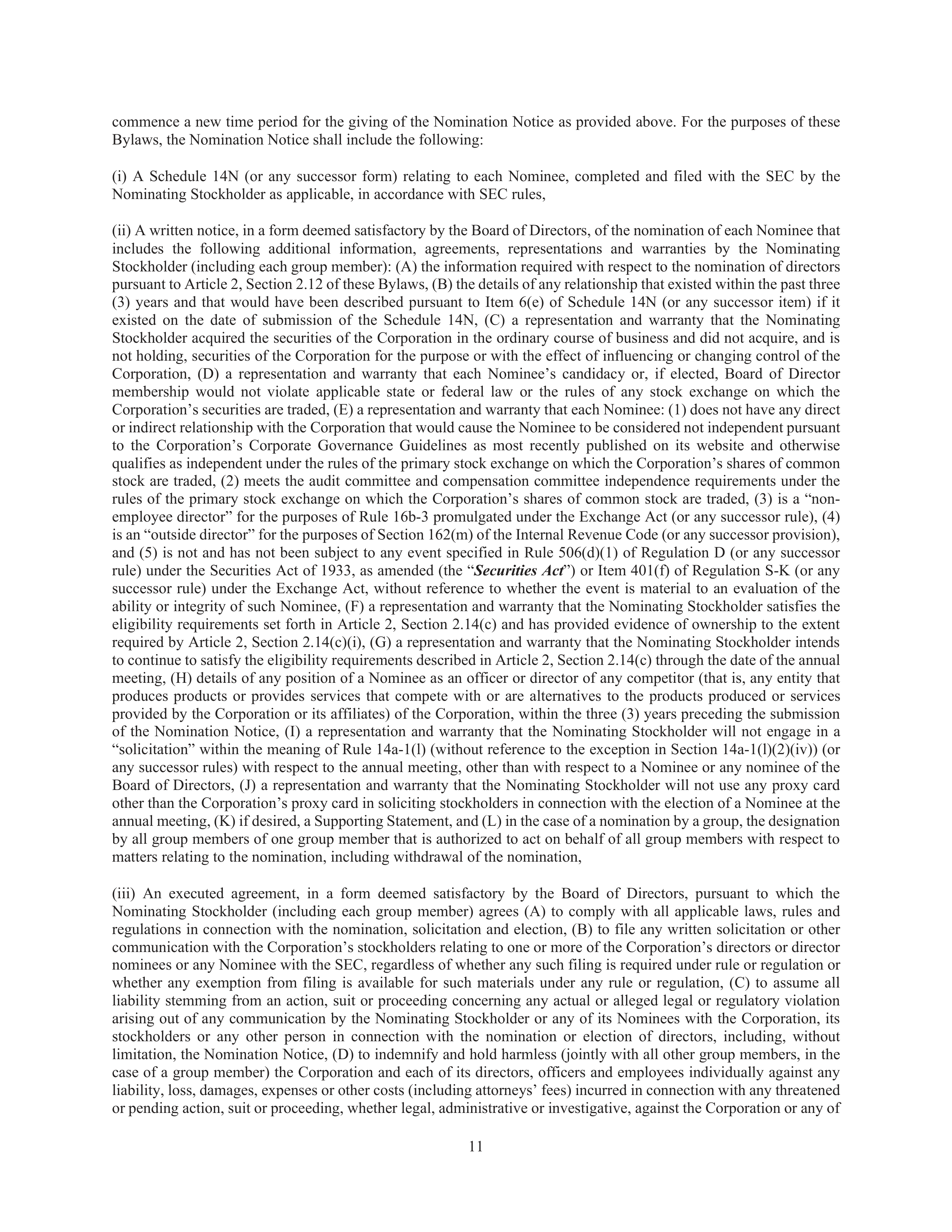
11
commence a new time period for the giving of the Nomination Notice as provided above. For the purposes of these
Bylaws, the Nomination Notice shall include the following:
(i) A Schedule 14N (or any successor form) relating to each Nominee, completed and filed with the SEC by the
Nominating Stockholder as applicable, in accordance with SEC rules,
(ii) A written notice, in a form deemed satisfactory by the Board of Directors, of the nomination of each Nominee that
includes the following additional information, agreements, representations and warranties by the Nominating
Stockholder (including each group member): (A) the information required with respect to the nomination of directors
pursuant to Article 2, Section 2.12 of these Bylaws, (B) the details of any relationship that existed within the past three
(3) years and that would have been described pursuant to Item 6(e) of Schedule 14N (or any successor item) if it
existed on the date of submission of the Schedule 14N, (C) a representation and warranty that the Nominating
Stockholder acquired the securities of the Corporation in the ordinary course of business and did not acquire, and is
not holding, securities of the Corporation for the purpose or with the effect of influencing or changing control of the
Corporation, (D) a representation and warranty that each Nominee’s candidacy or, if elected, Board of Director
membership would not violate applicable state or federal law or the rules of any stock exchange on which the
Corporation’s securities are traded, (E) a representation and warranty that each Nominee: (1) does not have any direct
or indirect relationship with the Corporation that would cause the Nominee to be considered not independent pursuant
to the Corporation’s Corporate Governance Guidelines as most recently published on its website and otherwise
qualifies as independent under the rules of the primary stock exchange on which the Corporation’s shares of common
stock are traded, (2) meets the audit committee and compensation committee independence requirements under the
rules of the primary stock exchange on which the Corporation’s shares of common stock are traded, (3) is a “non-
employee director” for the purposes of Rule 16b-3 promulgated under the Exchange Act (or any successor rule), (4)
is an “outside director” for the purposes of Section 162(m) of the Internal Revenue Code (or any successor provision),
and (5) is not and has not been subject to any event specified in Rule 506(d)(1) of Regulation D (or any successor
rule) under the Securities Act of 1933, as amended (the “
Securities Act
”) or Item 401(f) of Regulation S-K (or any
successor rule) under the Exchange Act, without reference to whether the event is material to an evaluation of the
ability or integrity of such Nominee, (F) a representation and warranty that the Nominating Stockholder satisfies the
eligibility requirements set forth in Article 2, Section 2.14(c) and has provided evidence of ownership to the extent
required by Article 2, Section 2.14(c)(i), (G) a representation and warranty that the Nominating Stockholder intends
to continue to satisfy the eligibility requirements described in Article 2, Section 2.14(c) through the date of the annual
meeting, (H) details of any position of a Nominee as an officer or director of any competitor (that is, any entity that
produces products or provides services that compete with or are alternatives to the products produced or services
provided by the Corporation or its affiliates) of the Corporation, within the three (3) years preceding the submission
of the Nomination Notice, (I) a representation and warranty that the Nominating Stockholder will not engage in a
“solicitation” within the meaning of Rule 14a-1(l) (without reference to the exception in Section 14a-1(l)(2)(iv)) (or
any successor rules) with respect to the annual meeting, other than with respect to a Nominee or any nominee of the
Board of Directors, (J) a representation and warranty that the Nominating Stockholder will not use any proxy card
other than the Corporation’s proxy card in soliciting stockholders in connection with the election of a Nominee at the
annual meeting, (K) if desired, a Supporting Statement, and (L) in the case of a nomination by a group, the designation
by all group members of one group member that is authorized to act on behalf of all group members with respect to
matters relating to the nomination, including withdrawal of the nomination,
(iii) An executed agreement, in a form deemed satisfactory by the Board of Directors, pursuant to which the
Nominating Stockholder (including each group member) agrees (A) to comply with all applicable laws, rules and
regulations in connection with the nomination, solicitation and election, (B) to file any written solicitation or other
communication with the Corporation’s stockholders relating to one or more of the Corporation’s directors or director
nominees or any Nominee with the SEC, regardless of whether any such filing is required under rule or regulation or
whether any exemption from filing is available for such materials under any rule or regulation, (C) to assume all
liability stemming from an action, suit or proceeding concerning any actual or alleged legal or regulatory violation
arising out of any communication by the Nominating Stockholder or any of its Nominees with the Corporation, its
stockholders or any other person in connection with the nomination or election of directors, including, without
limitation, the Nomination Notice, (D) to indemnify and hold harmless (jointly with all other group members, in the
case of a group member) the Corporation and each of its directors, officers and employees individually against any
liability, loss, damages, expenses or other costs (including attorneys’ fees) incurred in connection with any threatened
or pending action, suit or proceeding, whether legal, administrative or investigative, against the Corporation or any of
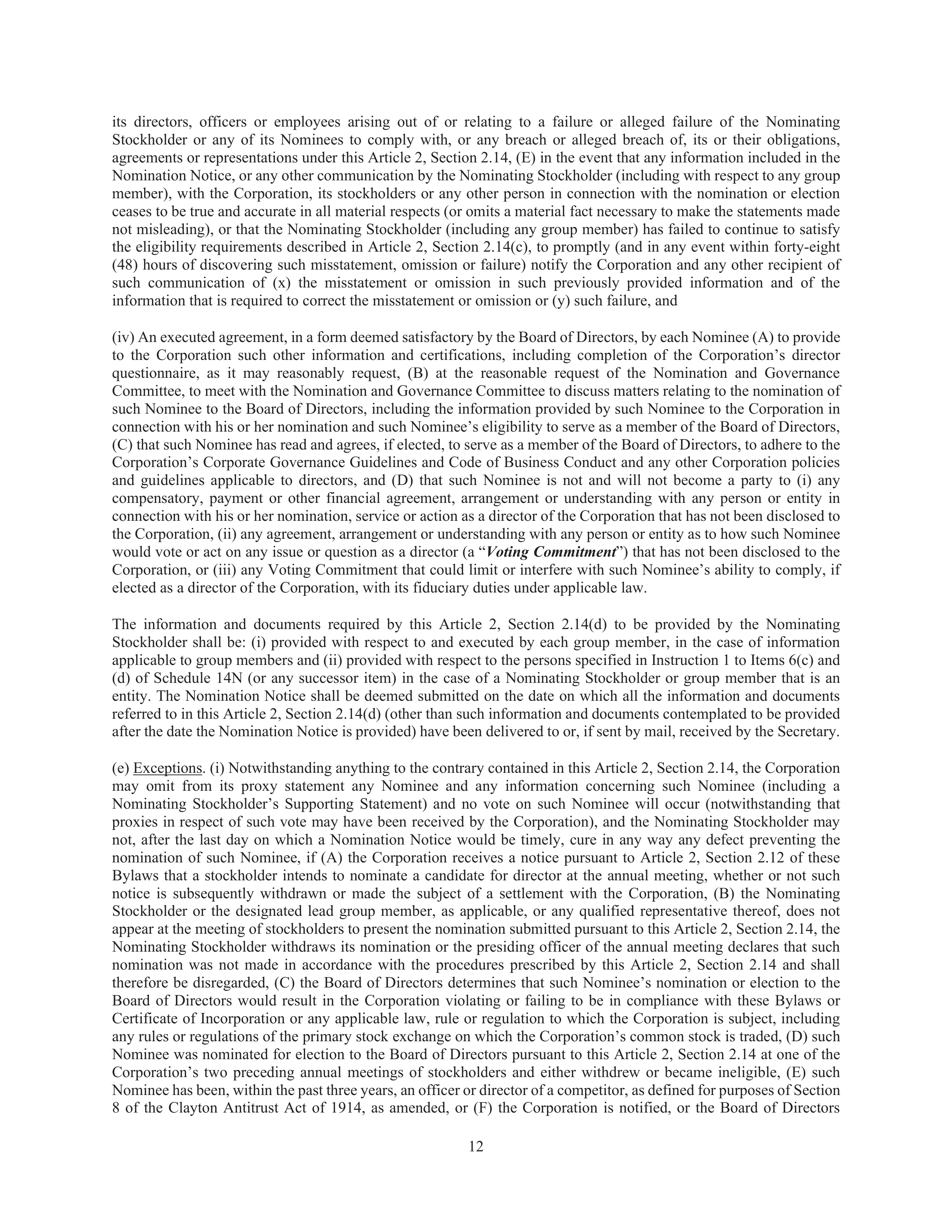
12
its directors, officers or employees arising out of or relating to a failure or alleged failure of the Nominating
Stockholder or any of its Nominees to comply with, or any breach or alleged breach of, its or their obligations,
agreements or representations under this Article 2, Section 2.14, (E) in the event that any information included in the
Nomination Notice, or any other communication by the Nominating Stockholder (including with respect to any group
member), with the Corporation, its stockholders or any other person in connection with the nomination or election
ceases to be true and accurate in all material respects (or omits a material fact necessary to make the statements made
not misleading), or that the Nominating Stockholder (including any group member) has failed to continue to satisfy
the eligibility requirements described in Article 2, Section 2.14(c), to promptly (and in any event within forty-eight
(48) hours of discovering such misstatement, omission or failure) notify the Corporation and any other recipient of
such communication of (x) the misstatement or omission in such previously provided information and of the
information that is required to correct the misstatement or omission or (y) such failure, and
(iv) An executed agreement, in a form deemed satisfactory by the Board of Directors, by each Nominee (A) to provide
to the Corporation such other information and certifications, including completion of the Corporation’s director
questionnaire, as it may reasonably request, (B) at the reasonable request of the Nomination and Governance
Committee, to meet with the Nomination and Governance Committee to discuss matters relating to the nomination of
such Nominee to the Board of Directors, including the information provided by such Nominee to the Corporation in
connection with his or her nomination and such Nominee’s eligibility to serve as a member of the Board of Directors,
(C) that such Nominee has read and agrees, if elected, to serve as a member of the Board of Directors, to adhere to the
Corporation’s Corporate Governance Guidelines and Code of Business Conduct and any other Corporation policies
and guidelines applicable to directors, and (D) that such Nominee is not and will not become a party to (i) any
compensatory, payment or other financial agreement, arrangement or understanding with any person or entity in
connection with his or her nomination, service or action as a director of the Corporation that has not been disclosed to
the Corporation, (ii) any agreement, arrangement or understanding with any person or entity as to how such Nominee
would vote or act on any issue or question as a director (a “
Voting Commitment
”) that has not been disclosed to the
Corporation, or (iii) any Voting Commitment that could limit or interfere with such Nominee’s ability to comply, if
elected as a director of the Corporation, with its fiduciary duties under applicable law.
The information and documents required by this Article 2, Section 2.14(d) to be provided by the Nominating
Stockholder shall be: (i) provided with respect to and executed by each group member, in the case of information
applicable to group members and (ii) provided with respect to the persons specified in Instruction 1 to Items 6(c) and
(d) of Schedule 14N (or any successor item) in the case of a Nominating Stockholder or group member that is an
entity. The Nomination Notice shall be deemed submitted on the date on which all the information and documents
referred to in this Article 2, Section 2.14(d) (other than such information and documents contemplated to be provided
after the date the Nomination Notice is provided) have been delivered to or, if sent by mail, received by the Secretary.
(e) Exceptions. (i) Notwithstanding anything to the contrary contained in this Article 2, Section 2.14, the Corporation
may omit from its proxy statement any Nominee and any information concerning such Nominee (including a
Nominating Stockholder’s Supporting Statement) and no vote on such Nominee will occur (notwithstanding that
proxies in respect of such vote may have been received by the Corporation), and the Nominating Stockholder may
not, after the last day on which a Nomination Notice would be timely, cure in any way any defect preventing the
nomination of such Nominee, if (A) the Corporation receives a notice pursuant to Article 2, Section 2.12 of these
Bylaws that a stockholder intends to nominate a candidate for director at the annual meeting, whether or not such
notice is subsequently withdrawn or made the subject of a settlement with the Corporation, (B) the Nominating
Stockholder or the designated lead group member, as applicable, or any qualified representative thereof, does not
appear at the meeting of stockholders to present the nomination submitted pursuant to this Article 2, Section 2.14, the
Nominating Stockholder withdraws its nomination or the presiding officer of the annual meeting declares that such
nomination was not made in accordance with the procedures prescribed by this Article 2, Section 2.14 and shall
therefore be disregarded, (C) the Board of Directors determines that such Nominee’s nomination or election to the
Board of Directors would result in the Corporation violating or failing to be in compliance with these Bylaws or
Certificate of Incorporation or any applicable law, rule or regulation to which the Corporation is subject, including
any rules or regulations of the primary stock exchange on which the Corporation’s common stock is traded, (D) such
Nominee was nominated for election to the Board of Directors pursuant to this Article 2, Section 2.14 at one of the
Corporation’s two preceding annual meetings of stockholders and either withdrew or became ineligible, (E) such
Nominee has been, within the past three years, an officer or director of a competitor, as defined for purposes of Section
8 of the Clayton Antitrust Act of 1914, as amended, or (F) the Corporation is notified, or the Board of Directors
13
determines, that the Nominating Stockholder or the Nominee has failed to continue to satisfy the eligibility
requirements described in Article 2, Section 2.14(c), any of the representations and warranties made in the Nomination
Notice ceases to be true and accurate in all material respects (or omits a material fact necessary to make the statements
made not misleading), such Nominee becomes unwilling or unable to serve on the Board of Directors or any material
violation or breach occurs of the obligations, agreements, representations or warranties of the Nominating Stockholder
or such Nominee under this Article 2, Section 2.14.
(ii) Notwithstanding anything to the contrary contained in this Article 2, Section 2.14, the Corporation may omit from
its proxy statement, or may supplement or correct, any information, including all or any portion of the Supporting
Statement or any other statement in support of a Nominee included in the Nomination Notice, if the Board of Directors
determines that (A) such information is not true in all material respects or omits a material statement necessary to
make the statements made not misleading, (B) such information directly or indirectly impugns the character, integrity
or personal reputation of, or directly or indirectly makes charges concerning improper, illegal or immoral conduct or
associations, without factual foundation, with respect to, any person, or (C) the inclusion of such information in the
proxy statement would otherwise violate the SEC proxy rules or any other applicable law, rule or regulation. The
Corporation may solicit against, and include in the proxy statement its own statement relating to, any Nominee.
Section 2.15 Inspector of Elections
. The Corporation shall, in advance of any meeting of stockholders, appoint one
or more inspectors of election to act as such with regards to the meeting, and make a written report thereof. The
Corporation may designate one or more persons as alternate inspectors to replace any inspector who fails to act. If no
inspector or alternate is able to act at a meeting of stockholders, the person presiding at the meeting shall appoint one
or more inspectors to act at the meeting. Each inspector of election, before entering upon the discharge of his or her
duties, shall take and sign an oath faithfully to execute the duties of inspector with strict impartiality and according to
the best of such inspector’s ability. At a meeting of stockholders, the inspectors of election shall (a) ascertain the
number of shares outstanding and the voting power of each share, (b) determine the shares represented at a meeting
and the validity of proxies and ballots, (c) count all votes and ballots, (d) determine and retain for a reasonable period
of time a record of the disposition of any challenges made to any determination by the inspectors, and (e) certify their
determination of the number of shares represented at the meeting, and their count of all votes and ballots. The
inspectors may appoint or retain other persons or entities to assist the inspectors in the performance of the duties of
the inspectors. In determining the validity and counting of proxies and ballots, the inspectors shall be limited to an
examination of the proxies, any envelopes submitted with those proxies, any information provided in connection with
proxies pursuant to Section 211(a)(2)b.(i) or (iii) of the DGCL, or in accordance with Sections 211(e) or 212(c)(2) of
the DGCL, ballots and the regular books and records of the Corporation, except that the inspectors may consider other
reliable information for the limited purpose of reconciling proxies and ballots submitted by or on behalf of banks,
brokers, their nominees or similar persons which represent more votes than the holder of a proxy is authorized by the
record owner to cast or more votes than the stockholder holds of record. If the inspectors consider other reliable
information for the limited purpose permitted herein, the inspectors at the time they make their certification of their
determinations pursuant to this Section 2.15 shall specify the precise information considered by them, including the
person or persons from whom they obtained the information, when the information was obtained, the means by which
the information was obtained and the basis for the inspectors’ belief that such information is accurate and reliable. No
ballot, proxies or votes, nor any revocations thereof or changes thereto, shall be accepted by the inspectors after the
closing of the polls, unless the Court of Chancery of the State of Delaware upon application by a stockholder shall
determine otherwise.
ARTICLE 3
BOARD OF DIRECTORS
Section 3.01 Powers
. Subject to any limitations in the Certificate of Incorporation or any provision of the DGCL
requiring stockholder authorization or approval for a particular action, the business and affairs of the Corporation shall
be managed by or under the direction of the Board of Directors, which may exercise all such powers and manage and
direct all such acts and things as may be exercised or done by the Corporation.
Section 3.02 Number and Qualification of Directors
. The number of authorized directors of the Corporation shall
be not less than eight (8) nor more than fifteen (15), the exact number of directors to be fixed from time to time within
14
such range by a duly adopted resolution of the Board of Directors or stockholders. No decrease in the authorized
number of directors shall shorten the term of any incumbent director.
Directors shall hold office until the next annual meeting of stockholders and until their respective successors are
elected and qualified subject to their earlier death, resignation or removal. If any such annual meeting is not held, or
the directors are not elected thereat, the directors may be elected at any special meeting of stockholders held for that
purpose. Directors need not be stockholders. If an incumbent director fails, in an uncontested election, to receive the
vote required to be elected in accordance with Section 2.13 of Article 2, then, such director shall tender his or her
resignation, to be effective the earlier of ninety (90) days following certification of the election results or the date on
which the Board of Directors selects a person to fill the office held by that director in accordance with the procedures
set forth in these Bylaws and, except to the extent otherwise provided in these Bylaws, Section 223 of the DGCL.
Section 3.03 Regular Meetings
. The Board of Directors may provide for regular meetings to be held at such places,
within or without of the State of Delaware, and at such times as the Board of Directors may from time to time
determine.
Section 3.04 Special Meetings
. Special meetings of the Board of Directors may be called at any time by the Chair of
the Board of Directors, the Chief Executive Officer, the Lead Independent Director (as defined below) or any two (2)
directors. Notice of the date, time and place of all special meetings of the Board of Directors shall be delivered
personally or by telephone, including a voice messaging system, or electronic transmission by the Corporation to each
director at least twenty-four (24) hours before the meeting, or sent to each director by first-class mail, postage prepaid,
at least four (4) days before the meeting. Such notice need not specify the purpose of the meeting. Notice of any
meeting of the Board of Directors need not be given to any director who signs a waiver of notice, whether before or
after the meeting, or who attends the meeting without protesting, prior thereto or at its commencement, the lack of
notice to such director.
Section 3.05 Place of Meetings
. Meetings of the Board of Directors may be held at any place within or without the
State of Delaware, which has been designated in the notice, or if not stated in the notice or there is no notice, the
principal executive office of the Corporation or as designated by the resolution duly adopted by the Board of Directors.
Section 3.06 Remote Meetings Permitted
. Members of the Board of Directors, or any committee thereof, may
participate in a meeting through use of conference telephone or other communications equipment, so long as all
members participating in such meeting can hear one another.
Section 3.07 Quorum
. A quorum at all meetings of the Board of Directors shall be a majority of the authorized
directors. In the absence of a quorum, a majority of the directors present may adjourn any meeting to another time and
place. If a meeting is adjourned for more than twenty-four (24) hours, notice in accordance with Section 3.04 of any
adjournment to another time or place shall be given prior to the time of the reconvened meeting to the directors who
were not present at the time of adjournment. Interested directors may be counted in determining the presence of a
quorum at a meeting of the Board of Directors or of a committee which authorizes a contract or transaction.
Section 3.08 Action at Meeting
. Every act or decision done or made by a majority of the directors present at a meeting
duly held at which a quorum is present is the act of the Board of Directors.
Section 3.09 Waiver of Notice
. The transactions of any meeting of the Board of Directors or any committee thereof,
however called and noticed or wherever held, are as valid as though had at a meeting duly held after regular call and
notice if a quorum is present and if, either before or after the meeting, each of the directors not present gives a waiver
of notice, a consent to holding the meeting, or an approval of the minutes thereof. All such waivers, consents and
approvals shall be filed with the corporate records or made a part of the minutes of the meeting.
Section 3.10 Action Without Meeting
. Any action required or permitted to be taken by the Board of Directors, or a
committee thereof, may be taken without a meeting, if all members of the Board of Directors or such committee taking
action individually or collectively consent in writing or by electronic transmission to such action. After an action is
taken, the writing or writings or electronic transmission or transmissions shall be filed with the minutes of the
15
proceedings of the Board of Directors or committee as applicable. Such action by consent shall have the same force
and effect as a unanimous vote of such directors.
Section 3.11 Removal
. The entire Board of Directors or any individual director may be removed from office, with or
without cause, by a vote of stockholders holding a majority of the outstanding shares entitled to vote at an election of
directors.
Section 3.12 Resignations
. Any director may resign effective upon giving notice to the Chair of the Board of
Directors, the Chief Executive Officer, the Secretary or the Board of Directors of the Corporation, unless the notice
specifies a later time for the effectiveness of such resignation. If the resignation is effective at a future time, a successor
may be elected to take office when the resignation becomes effective.
Section 3.13 Vacancies
. Except for a vacancy created by the removal of a director pursuant to Article 3, Section 3.11,
all vacancies in the Board of Directors, whether caused by resignation, death or otherwise, may be filled by a majority
of the remaining directors, though less than a quorum, or by a sole remaining director, and each director so elected
shall hold office until his or her successor is elected at an annual or special meeting of the stockholders. Vacancies
created by the removal of a director may be filled only by approval of the stockholders. Notwithstanding the foregoing,
if a director is an incumbent director in an uncontested election who failed to receive the vote required to be elected
in accordance with Section 2.13 of Article 2, such director shall tender his or her resignation in accordance with
Section 3.02 of these Bylaws.
Section 3.14 Compensation
. Directors and members of committees may receive such compensation, if any, for their
services as may be fixed or determined by resolution of the Board of Directors. Nothing herein contained shall be
construed to preclude any director from serving the Corporation in any other capacity and receiving compensation
therefor.
Section 3.15 Committees
. The Board of Directors may, by resolution adopted by a majority of the authorized number
of directors, designate one or more committees, each consisting of one (1) or more directors, to serve at the pleasure
of the Board of Directors. The Board of Directors may designate one or more directors as alternate members of any
committee, who may replace any absent member at any meeting of the committee. The appointment of members or
alternate members of a committee requires the vote of a majority of the authorized number of directors. Any such
committee, to the extent provided in the resolution of the Board of Directors, shall have all the authority of the Board
of Directors in the management of the business and affairs of the Corporation, and may authorize the seal of the
Corporation to be affixed to all papers that may require it; but no such committee shall have the power or authority in
reference to the following matters: (a) approving, adopting, or recommending to the stockholders any action or matter
(other than the election or removal of members of the Board of Directors) expressly required by the DGCL to be
submitted to stockholders for approval or (b) adopting, amending or repealing any bylaw of the Corporation. A quorum
at all meetings of any committee of the Board of Directors shall be a majority of the authorized directors serving on
such committee.
ARTICLE 4
OFFICERS; CHAIR; LEAD INDEPENDENT DIRECTOR
Section 4.01 Number and Term
. The officers of the Corporation shall include a Chief Executive Officer and/or a
President, a Secretary and a Treasurer and may consist of such other officers, including a Chair of the Board of
Directors (if such person is to also function as an officer), Chief Financial Officer, one or more other Chief Officers
(of such designation(s) as the Board of Directors may determine), one or more Vice Presidents, one or more Assistant
Secretaries or Assistant Treasurers, as may from time to time be appointed by the Board of Directors. All officers shall
be elected by the Board of Directors;
provided
,
however
, that the Board of Directors may empower the Chief Executive
Officer to appoint any officer of the Corporation other than the Chair of the Board of Directors, the Chief Executive
Officer, a President, the Chief Financial Officer, Secretary or the Treasurer. Such officers shall be chosen in such
manner and hold their offices for such terms as the Board of Directors may prescribe and shall serve at the pleasure
of the Board of Directors.
16
Section 4.02 Inability to Act
. In the case of absence or inability to act of any officer of the Corporation and of any
person herein authorized to act in his or her place, the Board of Directors may from time to time delegate the powers
or duties of such officer to any other officer, or any director or other person whom it may select.
Section 4.03 Removal and Resignation
. Any officer may be removed at any time, with or without cause, by the
affirmative vote of a majority of all the members of the Board of Directors.
Any officer may resign at any time by giving notice of said resignation to the Corporation. Unless a different time is
specified therein, such resignation shall be effective upon its receipt by the Chair of the Board of Directors, the Chief
Executive Officer, the Secretary or the Board of Directors.
Section 4.04 Vacancies
. A vacancy in any office because of any cause may be filled by the Board of Directors and
the Board of Directors may, in its discretion, leave unfilled, for such period as it may determine, any offices. Each
such successor shall hold office for the unexpired term of such officer’s predecessor (if applicable) and until a
successor is duly elected and qualified or until such officer’s earlier resignation, death, disqualification or removal.
Section 4.05 Chair of the Board
. The Chair of the Board of Directors shall have the power to preside at all meetings
of the Board of Directors and shall have such other powers and duties as provided in these Bylaws and as the Board
of Directors may from time to time prescribe. Unless provided otherwise by the Board of Directors, the Chair of the
Board of Directors shall not be deemed to be an officer of the Corporation by virtue of such appointment.
Section 4.06 Chief Executive Officer
. The Chief Executive Officer shall be the general manager and chief executive
officer of the Corporation, subject to the control of the Board of Directors, and as such shall have general supervision
of the affairs of the Corporation, shall sign or countersign or authorize one or more other officers to sign all certificates,
contracts, and other instruments of the Corporation as authorized by the Board of Directors, shall make reports to the
Board of Directors and stockholders, and shall have all such other authority and perform all such other duties as are
incident to such office or as may be delegated or assigned from time to time by the Board of Directors.
Section 4.07 Lead Independent Director
. The Board of Directors may, in its discretion, elect a lead independent
director (who shall not be deemed, by virtue thereof, to be an officer of the Corporation) by and from among its
members that are Independent Directors (such director, the “
Lead Independent Director
”). He or she shall preside at
all meetings at which the Chair of the Board of Directors is not present and shall exercise such other powers and duties
as may from time to time be assigned to him or her by the Board of Directors or as prescribed by these Bylaws. For
purposes of these Bylaws, “Independent Director” has the meaning ascribed to such term under the rules of the primary
stock exchange on which the Corporation’s shares of common stock are traded.
Section 4.08 President
. Each President shall have all such authority and perform all such duties as are incident to
such office or as may be delegated or assigned from time to time by the Chief Executive Officer or by the Board of
Directors. A President (or the Presidents in the order designated by the Board of Directors) may be designated by the
Board of Directors to perform the duties of the Chief Executive Officer, and to have all the powers and be subject to
all restrictions upon the Chief Executive Officer, in the absence of the Chief Executive Officer, or in the event of his
or her death, disability or refusal to act. The person holding the office of Chief Executive Officer shall be a President
of the Corporation, unless the Board of Directors shall have designated at least one individual as the President and a
different individual as the Chief Executive Officer.
Section 4.09 Chief Officer; Vice President
. Each Chief Officer (however designated) and Vice President (however
designated) shall have all such authority and perform all such duties as are incident to such office or as may be
delegated or assigned from time to time by the Chief Executive Officer, a President or by the Board of Directors. A
Chief Officer or Vice President (or the Vice Presidents in the order designated by the Board of Directors) may be
designated by the Board of Directors to perform the duties of the Chief Executive Officer, and to have all the powers
and be subject to all restrictions upon the Chief Executive Officer, in the absence of the Chief Executive Officer, or
in the event of his or her death, disability or refusal to act.
Section 4.10 Secretary
. The Secretary shall see that notices for all meetings are given in accordance with the
provisions of these Bylaws and as required by law, shall keep minutes of all meetings, shall have charge of the seal
17
and the corporate books, and shall have all such other authority and perform all such other duties as are incident to
such office or as may be delegated or assigned from time to time by the Chief Executive Officer or by the Board of
Directors.
The Assistant Secretary or the Assistant Secretaries, in the order of their seniority, shall, in the absence or disability
of the Secretary, or in the event of such officer’s refusal to act, perform the duties of Secretary and, when so acting,
shall have all the powers of and be subject to all the restrictions upon the Secretary. Each Assistant Secretary shall
have all such other authority and perform all such other duties as are incident to such office or as may be assigned or
delegated from time to time by the Chief Executive Officer or by the Board of Directors.
Section 4.11 Chief Financial Officer
. The person holding the office of Chief Financial Officer shall be the Treasurer
of the Corporation unless the Board of Directors shall have designated another officer as the Treasurer of the
Corporation. The Chief Financial Officer shall have all such authority and perform all such duties as are incident to
such office or as may be delegated or assigned from time to time by the Chief Executive Officer or by the Board of
Directors.
Section 4.12 Treasurer
. The Treasurer shall have custody of all moneys and securities of the Corporation and shall
keep regular books of account. Such officer shall disburse the funds of the Corporation in payment of the just demands
against the Corporation, or as may be ordered by the Board of Directors, taking proper vouchers for such
disbursements, and shall render to the Board of Directors from time to time as may be required of such officer, an
account of all transactions as Treasurer and of the financial condition of the Corporation. Such officer shall have all
such other authority and perform all such other duties as are incident to such office or as may be delegated or assigned
by the Chief Executive Officer or by the Board of Directors.
The Assistant Treasurer or the Assistant Treasurers, in the order of their seniority, shall, in the absence or disability
of the Treasurer, or in the event of such officer’s refusal to act, perform the duties and exercise the powers of the
Treasurer, and shall have all such other authority and perform all such other duties as are incident to such office or as
may be delegated or assigned from time to time by the Chief Executive Officer or by the Board of Directors.
Section 4.13 Salaries
. The salaries of the officers shall be fixed from time to time by the Board of Directors and no
officer shall be prevented from receiving such salary by reason of the fact that such officer is also a director of the
Corporation.
Section 4.14 Officers Holding More than One Office
. Any two or more offices may be held by the same person.
ARTICLE 5
MISCELLANEOUS
Section 5.01 Severability.
If any provision of these Bylaws shall be held to be invalid, illegal, unenforceable or in
conflict with the provisions of the Certificate of Incorporation, then such provision shall nonetheless be enforced to
the maximum extent possible consistent with such holding and the remaining provisions of these Bylaws (including
without limitation, all portions of any section of these Bylaws containing any such provision held to be invalid, illegal,
unenforceable or in conflict with the Certificate of Incorporation, that are not themselves invalid, illegal, unenforceable
or in conflict with the Certificate of Incorporation) shall remain in full force and effect.
Section 5.02 Certificates
.
(a) Certificates; Uncertificated Shares. The shares of capital stock of the Corporation shall be certificated shares.
Notwithstanding the foregoing, the Board of Directors may provide by resolution or resolutions that some or all of
any or all classes or series of its stock shall be uncertificated shares (it being understood that, following any such
determination of the Board of Directors that a class or series of stock shall be uncertificated, the Board of Directors
may thereafter determine that such stock shall be certificated). Any determination that outstanding shares of capital
stock of the Corporation shall be uncertificated shall not apply to shares represented by a certificate until such
certificate is surrendered to the Corporation (or the transfer agent or registrar, as the case may be). Every holder of
stock represented by certificates shall be entitled to have a certificate signed by, or in the name of two authorized
18
officers of the Corporation (it being understood that each of the Chair of the Board of Directors, the Chief Executive
Officer, a President, a Vice President, the Treasurer, an Assistant Treasurer, the Secretary or an Assistant Secretary of
the Corporation shall be an authorized officer for such purpose), representing the number of shares registered in
certificate form. Any or all of the signatures on the certificate may be a facsimile. In case any officer, transfer agent
or registrar who has signed or whose facsimile signature has been placed upon a certificate shall have ceased to be
such officer, transfer agent or registrar before such certificate is issued, it may be issued by the Corporation with the
same effect as if such person were an officer, transfer agent or registrar at the date of issue.
(b) Lost, Stolen or Destroyed Stock Certificates; Issuance of New Certificates or Uncertificated Shares. In the event
that any certificate of stock previously issued by the Corporation is alleged to have been lost, stolen or destroyed, upon
the making of an affidavit of that fact by the person claiming the certificate of stock to be lost, stolen or destroyed, the
Corporation may issue a new certificate of stock (or new uncertificated shares in the place of any certificate) and the
Corporation may require the owner of the lost, stolen or destroyed certificate, or such owner’s legal representative, to
agree to indemnify the Corporation and/or to give the Corporation a bond sufficient to indemnify it, against any claim
that may be made against it on account of the alleged loss, theft or destruction of any such certificate or the issuance
of such new certificate (or new uncertificated shares).
(c) Other Regulations. Subject to applicable law, the Certificate of Incorporation and these Bylaws, the issue, transfer,
conversion and registration of shares represented by certificates and of uncertificated shares shall be governed by such
other regulations and procedures as the Board of Directors may establish.
Section 5.03 Fiscal Year
. The fiscal year of the Corporation shall end on the last Saturday of July unless otherwise
determined by resolution of the Board of Directors.
Section 5.04 Time Periods
. In applying any provision of these Bylaws which requires that an act be done or not be
done a specified number of days prior to an event or that an act be done during a period of a specified number of days
prior to an event, calendar days shall be used, the day of the doing of the act shall be excluded, and the day of the
event shall be included.
Section 5.05 Amendments
. These Bylaws may be adopted, amended, or repealed by the vote or the consent of
stockholders entitled to exercise a majority of the voting power of the Corporation. In addition to the right of
stockholders to adopt, amend, or repeal these Bylaws, these Bylaws may be adopted, amended, or repealed by the
Board of Directors.
ARTICLE 6
INDEMNIFICATION AND ADVANCEMENT OF EXPENSES
Section 6.01 Indemnification of Officers and Directors
. Each person who was or is made a party to, or is threatened
to be made a party to, or is involved in any threatened, pending or completed action, suit or proceeding, whether civil,
criminal, administrative, legislative, investigative or any other type whatsoever, preliminary, informal or formal,
including any arbitration or other alternative dispute resolution (including but not limited to giving testimony or
responding to a subpoena) and including any appeal of any of the foregoing (a “
Proceeding
”), by reason of the fact
that such person (or a person of whom such person is the legal representative), is or was a director or officer of the
Corporation or a Reincorporated Predecessor (as defined below) or is or was serving at the request of the Corporation
as a director, officer, authorized signatory or trustee of another corporation, or of a partnership, joint venture, trust or
other enterprise or non-profit entity, including service with respect to employee benefit plans (for purposes of this
Article 6, an “
Indemnitee
”), shall be indemnified and held harmless by the Corporation to the fullest extent permitted
by the DGCL as the same exists or may hereafter be amended (but, in the case of any such amendment, only to the
extent that such amendment permits the Corporation to provide broader indemnification rights than such law permitted
the Corporation to provide prior to such amendment), against all expenses, costs, liability and loss (including
attorneys’ fees, judgments, fines, excise taxes and penalties due pursuant to the Employee Retirement Income Security
Act of 1974 and amounts paid or to be paid in settlement) reasonably incurred or suffered by such Indemnitee in
connection therewith. Such indemnification shall continue as to an Indemnitee who has ceased to be a director or
officer of the Corporation or a Reincorporated Predecessor (as defined below) or ceased to serve at the request of the
Corporation as a director, officer, authorized signatory or trustee of another corporation, or of a partnership, joint
19
venture, trust or other enterprise or non-profit entity, including service with respect to employee benefit plans and
shall inure to the benefit of such Indemnitees’ heirs, executors and administrators. Notwithstanding the foregoing,
subject to Section 6.05 of this Article 6, the Corporation shall indemnify any such Indemnitee seeking indemnity in
connection with a Proceeding (or part thereof) initiated by such Indemnitee only if such Proceeding (or part thereof)
was authorized by the Board of Directors or such indemnification is authorized by an agreement approved by the
Board of Directors. As used herein, the term the “
Reincorporated Predecessor
” means a corporation that is merged
with and into the Corporation in a statutory merger where (a) the Corporation is the surviving corporation of such
merger and (b) the primary purpose of such merger is to change the corporate domicile of the Reincorporated
Predecessor to Delaware.
Section 6.02 Advancement of Expenses
. Notwithstanding any other provision of these Bylaws, the Corporation (i)
shall pay all reasonable expenses (including attorneys’ fees) incurred by an Indemnitee that is or was a director or
officer of the Corporation or a Reincorporated Predecessor in defending any Proceeding in advance of its final
disposition and (ii) may pay all reasonable expenses (including attorneys’ fees) incurred by any other Indemnitee in
defending any Proceeding in advance of its final disposition;
provided
, in each case,
however
, that if the DGCL then
so requires, the advancement of such expenses (i.e., payment of such expenses as incurred or otherwise in advance of
the final disposition of the Proceeding) shall be made only upon delivery to the Corporation of an undertaking, by or
on behalf of such Indemnitee, to repay such amounts if it shall ultimately be determined by a court of competent
jurisdiction in a final judgment not subject to appeal that such Indemnitee is not entitled to be indemnified under this
Article 6 or otherwise. Any advances of expenses or undertakings to repay pursuant to this Section 6.02 shall be
unsecured, interest free and without regard to Indemnitee’s ability to pay.
Section 6.03 Non Exclusivity of Rights
. The rights conferred on any person in this Article 6 shall not be exclusive
of any other right that such person may have or hereafter acquire under any statute, provision of the Certificate of
Incorporation, these Bylaws, agreement, vote or consent of stockholders or disinterested directors, or otherwise.
Additionally, nothing in this Article 6 shall limit the ability of the Corporation, in its discretion, to indemnify or
advance expenses to persons whom the Corporation is not obligated to indemnify or advance expenses pursuant to
this Article 6.
Section 6.04 Indemnification Contracts
. The Board of Directors is authorized to cause the Corporation to enter into
indemnification contracts with any director, officer, employee or agent of the Corporation, or any person serving at
the request of the Corporation as a director, officer, employee, agent or trustee of another corporation, partnership,
joint venture, trust or other enterprise or non-profit entity, including employee benefit plans, providing indemnification
or advancement rights to such person. Such rights may be greater than those provided in this Article 6.
Section 6.05 Right of Indemnitee to Bring Suit
.
(a) Right to Bring Suit. If a claim under Section 6.01 or 6.02 of this Article 6 is not paid in full by the Corporation
within sixty (60) days after a written claim has been received by the Corporation, except in the case of a claim for an
advancement of expenses, in which case the applicable period shall be twenty (20) days, the Indemnitee may at any
time thereafter bring suit against the Corporation to recover the unpaid amount of the claim. If the Indemnitee is
successful in whole or in part in any such suit, or in a suit brought by the Corporation to recover an advancement of
expenses pursuant to the terms of an undertaking, the Indemnitee also shall be entitled to be paid, to the fullest extent
permitted by law, the expense of prosecuting or defending such suit.
(b) Effect of Determination. Neither the absence of a determination prior to the commencement of such suit that
indemnification of or the providing of advancement to the Indemnitee is proper in the circumstances because the
Indemnitee has met the applicable standard of conduct set forth in applicable law, nor an actual determination that the
Indemnitee has not met such applicable standard of conduct, shall create a presumption that the Indemnitee has not
met the applicable standard of conduct or, in the case of such a suit brought by the Indemnitee, be a defense to such
suit.
(c) Burden of Proof. In any suit brought by the Indemnitee to enforce a right to indemnification or to an advancement
of expenses hereunder, or brought by the Corporation to recover an advancement of expenses pursuant to the terms of
an undertaking, the burden of proving that the Indemnitee is not entitled to be indemnified, or to such advancement
of expenses, under this Article 6, or otherwise, shall be on the Corporation.
20
Section 6.06 Nature of Rights
. The rights conferred upon Indemnitees in this Article 6 shall be contract rights and
such rights shall continue as to an Indemnitee who has ceased to be a director or officer and shall inure to the benefit
of the Indemnitee’s heirs, executors and administrators.
Section 6.07 Amendment or Repeal
. Any amendment, repeal or modification of any provision of this Article 6 that
adversely affects any right of an Indemnitee or an Indemnitee’s successors shall be prospective only, and shall not
adversely affect any right or protection conferred on a person pursuant to this Article 6 and existing at the time of such
amendment, repeal or modification.
Section 6.08 Insurance
. The Corporation may purchase and maintain insurance, at its expense, to protect itself and
any director, officer, employee or agent of the Corporation or another corporation, partnership, joint venture, trust or
other enterprise or non-profit entity against any expense, liability or loss, whether or not the Corporation would have
the power to indemnify such person against such expense, liability or loss under the DGCL.
ARTICLE 7
NOTICES
Section 7.01 Notice
.
(a) Notice to Stockholders. Without limiting the manner by which notice otherwise may be given effectively to
stockholders, any notice to stockholders given by the Corporation under any provision of the DGCL, the Certificate
of Incorporation or these Bylaws may be given in writing directed to the stockholder’s mailing address (or by
electronic transmission directed to the stockholder’s electronic mail address, as applicable) as it appears on the records
of the Corporation. Notice shall be given (i) if mailed, when deposited in the United States mail, postage prepaid, (ii)
if delivered by courier service, the earlier of when the notice is received or left at the stockholder’s address, or (iii) if
given by electronic mail, when directed to such stockholder’s electronic mail address (unless the stockholder has
notified the Corporation in writing or by electronic transmission of an objection to receiving notice by electronic mail
or such notice is prohibited by the DGCL to be given by electronic transmission). A notice by electronic mail must
include a prominent legend that the communication is an important notice regarding the Corporation. A notice by
electronic mail will include any files attached thereto and any information hyperlinked to a website if such electronic
mail includes the contact information of an officer or agent of the Corporation who is available to assist with accessing
such files or information. Any notice to stockholders given by the Corporation under any provision of the DGCL, the
Certificate of Incorporation or these Bylaws provided by means of electronic transmission (other than any such notice
given by electronic mail) may only be given in a form consented to by such stockholder, and any such notice by such
means of electronic transmission shall be deemed to be given as provided by the DGCL. The terms “electronic mail,”
“electronic mail address,” “electronic signature” and “electronic transmission” as used herein shall have the meanings
ascribed thereto in the DGCL.
(b) Affidavit of Giving Notice. An affidavit of the Secretary or an Assistant Secretary or of the transfer agent or other
agent of the Corporation that the notice has been given shall, in the absence of fraud, be prima facie evidence of the
facts stated therein.
Section 7.02 Waiver of Notice
. Whenever notice is required to be given under any provision of the DGCL, the
Certificate of Incorporation or these Bylaws, a written waiver of notice, signed by the person entitled to notice, or
waiver by electronic transmission by such person, whether before or after the time stated therein, shall be deemed
equivalent to notice. Attendance of a person at a meeting shall constitute a waiver of notice of such meeting, except
when the person attends a meeting for the express purpose of objecting at the beginning of the meeting to the
transaction of any business because the meeting is not lawfully called or convened. Neither the business to be
transacted at, nor the purpose of, any regular or special meeting of the stockholders, directors or members of a
committee of directors need be specified in any waiver of notice.
21
ARTICLE 8
EXCLUSIVE FORUM
Section 8.01 Delaware Forum
. Unless the Corporation consents in writing to the selection of an alternative forum,
the Court of Chancery of the State of Delaware, to the fullest extent permitted by law, shall be the sole and exclusive
forum for: (a) any derivative action or proceeding brought on behalf of the Corporation; (b) any action asserting a
claim of breach of a fiduciary duty owed by, or other wrongdoing by, any director, officer, stockholder, employee or
agent of the Corporation to the Corporation or the Corporation’s stockholders; (c) any action asserting a claim against
the Corporation arising pursuant to any provision of the DGCL, the Certificate of Incorporation or these Bylaws or as
to which the DGCL confers jurisdiction on the Court of Chancery of the State of Delaware; (d) any action to interpret,
apply, enforce or determine the validity of the Certificate of Incorporation or these Bylaws; or (e) any action asserting
a claim against the Corporation governed by the internal affairs doctrine.
Section 8.02 Federal Forum
. Unless the Corporation consents in writing to the selection of an alternative forum, to
the fullest extent permitted by law, the federal district courts of the United States shall be the exclusive forum for the
resolution of any complaint asserting a cause of action arising under the Securities Act.
Nothing in this Article 8 affects suits brought to enforce a duty or liability created by the Exchange Act or any other
claim for which the federal courts have exclusive jurisdiction. Any person or entity purchasing or otherwise acquiring
or holding any interest in any security of the Corporation shall be deemed to have notice of and consented to the
provisions of this Article 8.

EXHIBIT C
Governance Guidelines

1
CISCO SYSTEMS, INC.
CORPORATE GOVERNANCE GUIDELINES
Effective December 8, 2022
The Board of Directors (the “Board”) of Cisco Systems, Inc. (“the Company”) has
developed the following corporate governance guidelines to help it fulfill its
responsibilities to its stockholders. The Board may refine or change these guidelines, as
necessary or advisable, to achieve this objective.
I. BOARD COMPOSITION
A. Size of the Board.
The Company’s Amended and Restated Bylaws
(the “Bylaws”)
provide that the Board will be not less than 8 nor more than 15 directors. The Board will
periodically review the appropriate size of the Board.
B. Majority of Independent Directors.
It is the policy of the Board that a majority of the
directors will not be current employees of the Company and will otherwise meet
appropriate standards of independence. In determining independence, the Board will
consider the definition of “independent director” in the listing standards of The Nasdaq
Stock Market (“Nasdaq”) as well as other factors that will contribute to effective oversight
and decision-making by the Board.
C. Management Directors.
The Board anticipates that the Company’s Chief Executive
Officer (“CEO”) will be nominated annually to serve on the Board. The Board may also
appoint or nominate other members of the Company’s management whose experience and
role at the Company are expected to help the Board fulfill its responsibilities.
D. Chair; Lead Independent Director.
The Board will periodically appoint a Chair. Both
independent and management directors, including the CEO, are eligible for appointment
as the Chair. The Chair, or if the Chair is not an independent director, one of the
independent directors, may be designated by the independent directors to be the “Lead
Independent Director.” The Lead Independent Director will be elected by and from the
independent directors.
Each term of service in the Lead Independent Director
position is
one year. The Lead Independent Director shall have the following roles and
responsibilities: authority to call meetings of the independent directors;
presiding at all
meetings of the Board at which the Chair is not present, including executive sessions of the
independent directors (during which the Company’s strategy is reviewed and other topics
are discussed); serving as principal liaison between the independent directors and the Chair
and CEO; communicating, from time-to-time, with the Chair and CEO and disseminating
information to the rest of the Board as appropriate;
providing leadership to the Board if
2
circumstances arise in which the role of the Chair may be, or may be perceived to be, in
conflict; reviewing and approving agendas, meeting schedules to assure that there is
sufficient time for discussion of all agenda items, and information provided to the Board
(including the quality, quantity and timeliness of such information); being available, as
appropriate, for consultation and direct communication with major stockholders and other
stakeholders; presiding over the annual self-evaluation of the Board, including the
performance evaluation of each Board committee and individual Board members;
facilitating the Board’s performance evaluation of the CEO in conjunction with the
Compensation and Management Development Committee; and performing various other
duties.
E. Selection of Board Nominees.
The Board will be responsible for the selection of
nominees for election or appointment to the Board. The Nomination and Governance
Committee shall recommend candidates for election to the Board. The Nomination and
Governance Committee considers nominees recommended by directors, officers,
employees, stockholders and others using the same criteria to evaluate all candidates. The
Nomination and Governance Committee reviews each candidate’s qualifications, including
whether a candidate possesses any of the specific qualities and skills desirable in certain
members of the Board. Evaluations of candidates generally involve a review of background
materials, internal discussions and interviews with selected candidates as appropriate.
Upon selection of a qualified candidate, the Nomination and Governance Committee would
recommend the candidate for consideration by the Board. The Nomination and Governance
Committee may engage consultants or third-party search firms to assist in identifying and
evaluating potential nominees. To recommend a prospective nominee for the Nomination
and Governance Committee’s consideration, submit the candidate’s name and
qualifications to Cisco’s Corporate Secretary in writing to the following address: Cisco
Systems, Inc., Attn: Secretary, 170 West Tasman Drive, San Jose, California 95134, with
a copy to Cisco Systems, Inc., Attn: Chief Legal Officer at the same address. When
submitting candidates for nomination to be elected at the Company’s annual meeting of
stockholders, stockholders must follow the notice procedures and provide the information
required by the Bylaws.
F. Board Membership Criteria.
Nominees for the Board should be committed to
enhancing long-term stockholder value and must possess a high level of personal and
professional ethics, sound business judgment and integrity. The Board’s policy is to
encourage selection of directors who will contribute to the Company’s overall corporate
goals. The Nomination and Governance Committee from time-to-time reviews, including
when considering potential candidates, the appropriate skills and characteristics required
of Board members such as diversity of business experience, viewpoints and personal
background, and diversity of skills in technology, finance, marketing, international
business, financial reporting and other areas that are expected to contribute to an effective
Board. In evaluating potential candidates for the Board, the Nomination and Governance
Committee considers these factors in the light of the specific needs of the Board at that
time. Additionally, due to the global and complex nature of the Company’s business, the
Board believes it is important to include individuals with diversity of race, ethnicity,
gender, sexual orientation, age, education, cultural background, and professional
3
experiences, and those factors are considered in evaluating board candidates in order to
provide practical insights and diverse perspectives. Board members are expected to prepare
for, attend and participate in meetings of the Board and committees on which they serve,
and are strongly encouraged to attend the Company’s annual meetings of stockholders.
G. Majority Voting in Board Elections.
If, in an uncontested election, an incumbent
director fails to receive the affirmative vote of a majority of the votes properly cast for or
against him or her at a duly held meeting at which a quorum is present, the Bylaws provide
that such incumbent director shall not be elected, and such director shall tender his or her
resignation, to be effective the earlier of ninety (90) days following certification of the
election results or the date on which the Board selects a person to fill the office held by that
director in accordance with the procedures set forth in the Bylaws and, except to the extent
otherwise provided in the Bylaws, Section 223 of the Delaware General Corporation Law.
H. Board Compensation.
The Board, through the Nomination and Governance
Committee, will review, with the assistance of management or outside consultants if
desired, appropriate compensation policies for the directors serving on the Board and its
committees. This review may consider board compensation practices of other large public
companies, contributions to Board functions, service as committee chairs, and other
appropriate factors.
I. Directors Who Change Job Responsibility; Term Limits; Age.
The Board does not
believe directors who retire or change their principal occupation or business association
should necessarily leave the Board. However, promptly following any such event, the
director shall offer to tender his/her resignation to the Nomination and Governance
Committee, so that there is an opportunity for the Board, through the Nomination and
Governance Committee, to review the continued appropriateness of Board membership
under the new circumstances. Although the Board does not believe that term limits for
directors are appropriate, the Board will periodically review this position. The Board will
take into consideration the age of any current or prospective Board member whose age
would be 72 or older when elected, re-elected or appointed to the Board and, before
nominating or appointing such Board member, the Board will make an affirmative
determination that it is in the best interests of the Company and its stockholders for that
individual to serve on the Board.
J. Other Board Memberships.
Without specific approval from the Board, no director may
serve on more than four public company boards (including the Board). Without specific
approval from the Board, the CEO may serve on no more than three public company boards
(including the Board). Directors shall notify the Nomination and Governance Committee
and permit a reasonable time for review before accepting an invitation to serve on the board
of any for-profit entity, with the understanding that service on a board of directors of
another entity which the Committee finds in conflict with service on the Board is not
permitted.
K. Board Performance Evaluations.
The Board maintains a process, overseen by the
Nomination and Governance Committee, whereby the Board, each of its committees, and
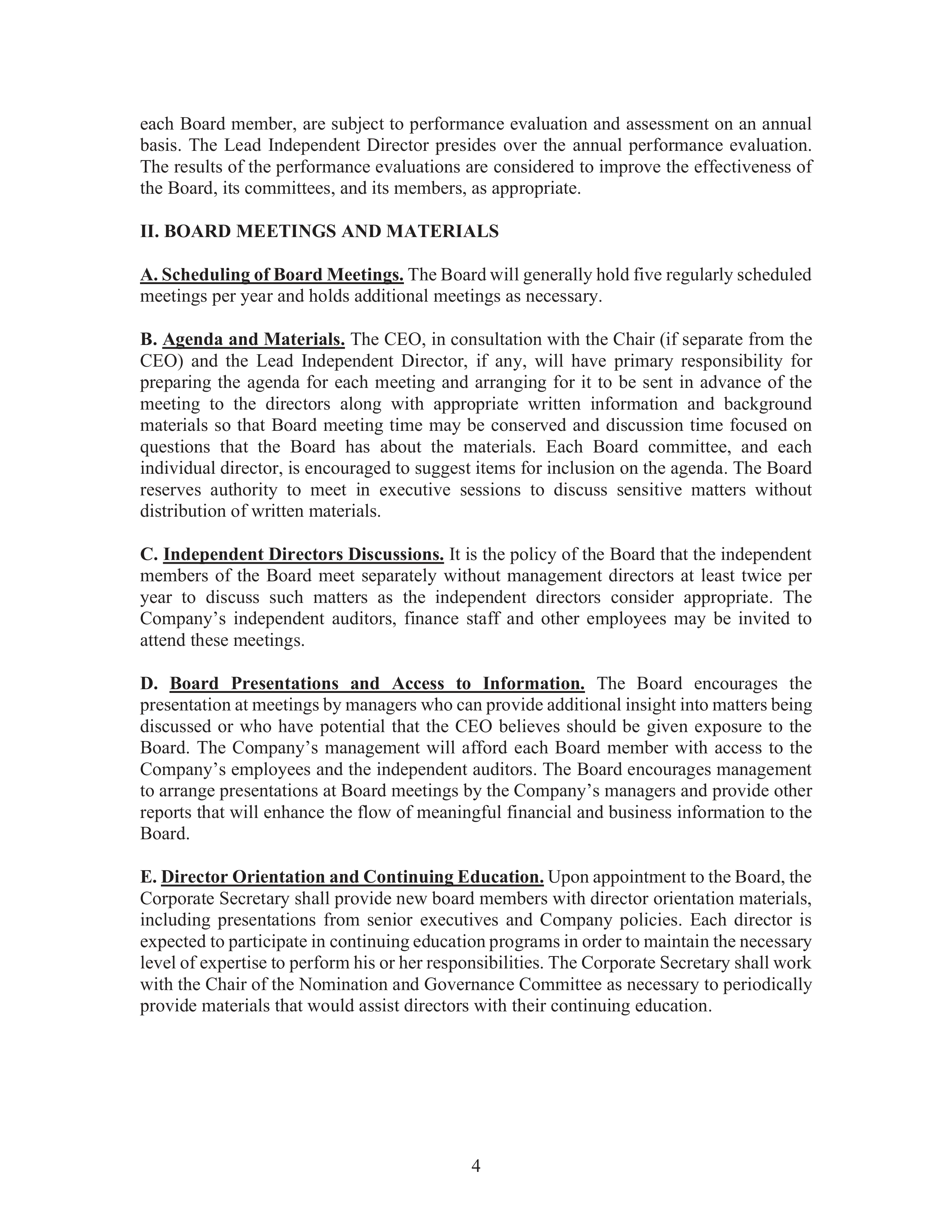
4
each Board member, are subject to performance evaluation and assessment on an annual
basis. The Lead Independent Director presides over the annual performance evaluation.
The results of the performance evaluations are considered to improve the effectiveness of
the Board, its committees, and its members, as appropriate.
II. BOARD MEETINGS AND MATERIALS
A. Scheduling of Board Meetings.
The Board will generally hold five regularly scheduled
meetings per year and holds additional meetings as necessary.
B. Agenda and Materials.
The CEO, in consultation with the Chair (if separate from the
CEO) and the Lead Independent Director, if any, will have primary responsibility for
preparing the agenda for each meeting and arranging for it to be sent in advance of the
meeting to the directors along with appropriate written information and background
materials so that Board meeting time may be conserved and discussion time focused on
questions that the Board has about the materials. Each Board committee, and each
individual director, is encouraged to suggest items for inclusion on the agenda. The Board
reserves authority to meet in executive sessions to discuss sensitive matters without
distribution of written materials.
C. Independent Directors Discussions.
It is the policy of the Board that the independent
members of the Board meet separately without management directors at least twice per
year to discuss such matters as the independent directors consider appropriate. The
Company’s independent auditors, finance staff and other employees may be invited to
attend these meetings.
D. Board Presentations and Access to Information.
The Board encourages the
presentation at meetings by managers who can provide additional insight into matters being
discussed or who have potential that the CEO believes should be given exposure to the
Board. The Company’s management will afford each Board member with access to the
Company’s employees and the independent auditors. The Board encourages management
to arrange presentations at Board meetings by the Company’s managers and provide other
reports that will enhance the flow of meaningful financial and business information to the
Board.
E. Director Orientation and Continuing Education.
Upon appointment to the Board, the
Corporate Secretary shall provide new board members with director orientation materials,
including presentations from senior executives and Company policies. Each director is
expected to participate in continuing education programs in order to maintain the necessary
level of expertise to perform his or her responsibilities. The Corporate Secretary shall work
with the Chair of the Nomination and Governance Committee as necessary to periodically
provide materials that would assist directors with their continuing education.
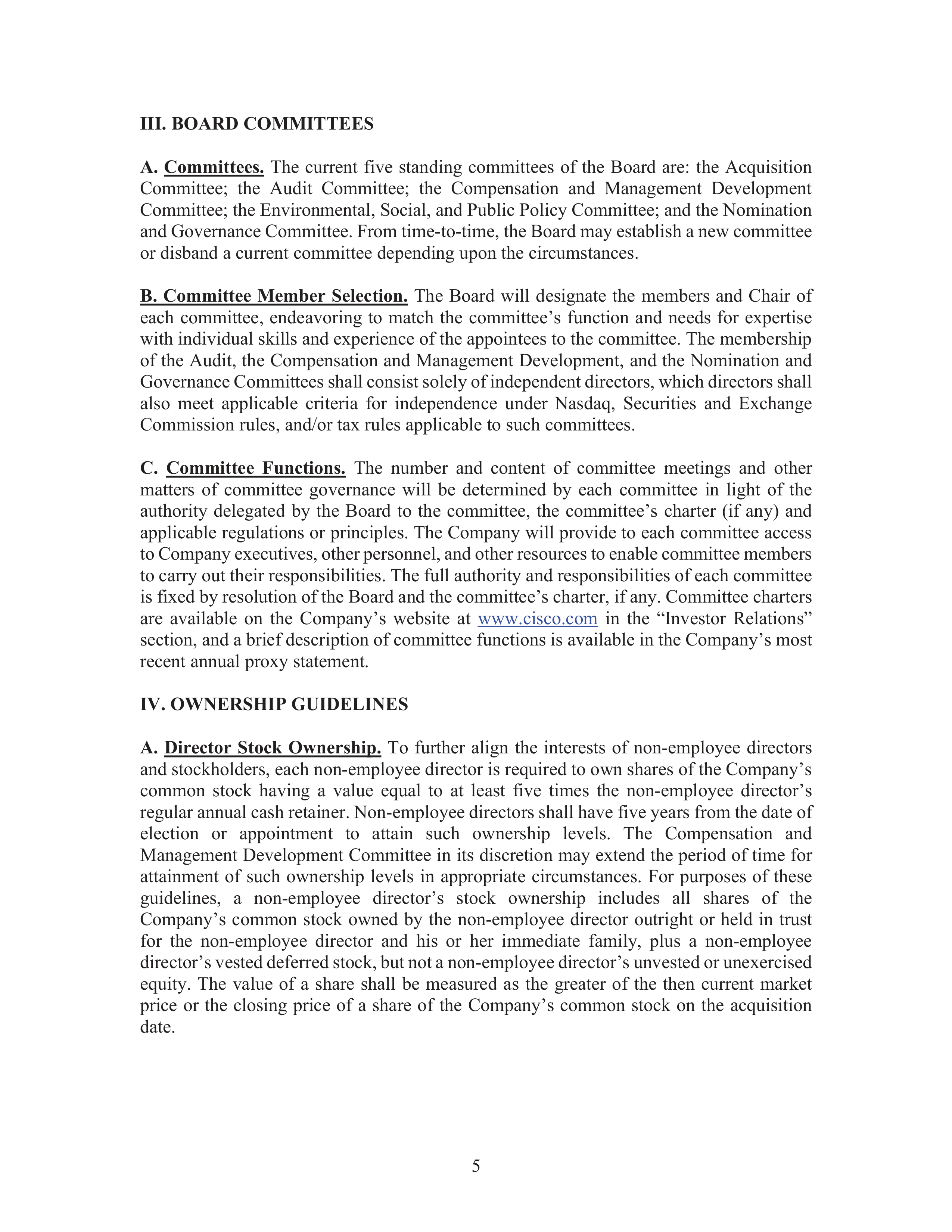
5
III. BOARD COMMITTEES
A. Committees.
The current five standing committees of the Board are: the Acquisition
Committee; the Audit Committee; the Compensation and Management Development
Committee; the Environmental, Social, and Public Policy Committee; and the Nomination
and Governance Committee. From time-to-time, the Board may establish a new committee
or disband a current committee depending upon the circumstances.
B. Committee Member Selection.
The Board will designate the members and Chair of
each committee, endeavoring to match the committee’s function and needs for expertise
with individual skills and experience of the appointees to the committee. The membership
of the Audit, the Compensation and Management Development, and the Nomination and
Governance Committees shall consist solely of independent directors, which directors shall
also meet applicable criteria for independence under Nasdaq, Securities and Exchange
Commission rules, and/or tax rules applicable to such committees.
C. Committee Functions.
The number and content of committee meetings and other
matters of committee governance will be determined by each committee in light of the
authority delegated by the Board to the committee, the committee’s charter (if any) and
applicable regulations or principles. The Company will provide to each committee access
to Company executives, other personnel, and other resources to enable committee members
to carry out their responsibilities. The full authority and responsibilities of each committee
is fixed by resolution of the Board and the committee’s charter, if any. Committee charters
are available on the Company’s website at
www.cisco.com
in the “Investor Relations”
section, and a brief description of committee functions is available in the Company’s most
recent annual proxy statement.
IV. OWNERSHIP GUIDELINES
A. Director Stock Ownership.
To further align the interests of non-employee directors
and stockholders, each non-employee director is required to own shares of the Company’s
common stock having a value equal to at least five times the non-employee director’s
regular annual cash retainer. Non-employee directors shall have five years from the date of
election or appointment to attain such ownership levels. The Compensation and
Management Development Committee in its discretion may extend the period of time for
attainment of such ownership levels in appropriate circumstances. For purposes of these
guidelines, a non-employee director’s stock ownership includes all shares of the
Company’s common stock owned by the non-employee director outright or held in trust
for the non-employee director and his or her immediate family, plus a non-employee
director’s vested deferred stock, but not a non-employee director’s unvested or unexercised
equity. The value of a share shall be measured as the greater of the then current market
price or the closing price of a share of the Company’s common stock on the acquisition
date.

6
B. Executive Stock Ownership.
To further align the interests of the Company’s
“executive officers” (within the meaning of Rule 3b-7 under the Securities and Exchange
Act of 1934, as amended, the “Executive Officers”), and stockholders, the CEO is required
to own shares of the Company’s common stock having a value equal to at least six times
the CEO’s base salary, and each other Executive Officer is required to own shares of the
Company’s common stock having a value equal to at least four times the Executive
Officer’s base salary. The CEO and each other Executive Officer shall have five years from
the date of their respective appointment (or the later of six years from the date of their
respective appointment or August 1, 2020 for Executive Officers in those positions as of
August 1, 2019) to attain such ownership levels. The Compensation and Management
Development Committee in its discretion may extend the period of time for attainment of
such ownership levels in appropriate circumstances. For purposes of these guidelines, an
Executive Officer’s stock ownership includes all shares of the Company’s common stock
owned by the Executive Officer outright or held in trust for the Executive Officer and his
or her immediate family, plus the Executive Officer’s vested deferred stock and allocated
shares of the Company’s common stock in employee plans, but not the Executive Officer’s
unvested or unexercised equity. The value of a share shall be measured as the greater of
the then current market price or the closing price of a share of the Company’s common
stock on the acquisition date.
V. MANAGEMENT RESPONSIBILITIES
A. Management Succession and Development Planning.
The CEO will review with the
Board succession and development plans for senior executive officers. The Board may,
from time-to-time, request the Compensation and Management Development Committee
to undertake specific reviews concerning management succession planning.
B. Financial Reporting, Legal Compliance and Ethical Conduct.
The Board’s
governance and oversight functions do not relieve the Company’s management of the
primary responsibility for preparing financial statements which accurately and fairly
present the Company’s financial results and condition. The Company’s management shall
maintain systems, procedures and a corporate culture that promote compliance with legal
and regulatory requirements and the ethical conduct of the Company’s business.
C. Corporate Communications.
The Board believes that the Company’s management has
the primary responsibility to communicate with investors, the press, employees and other
constituencies that are involved with the Company, and to set policies for those
communications.
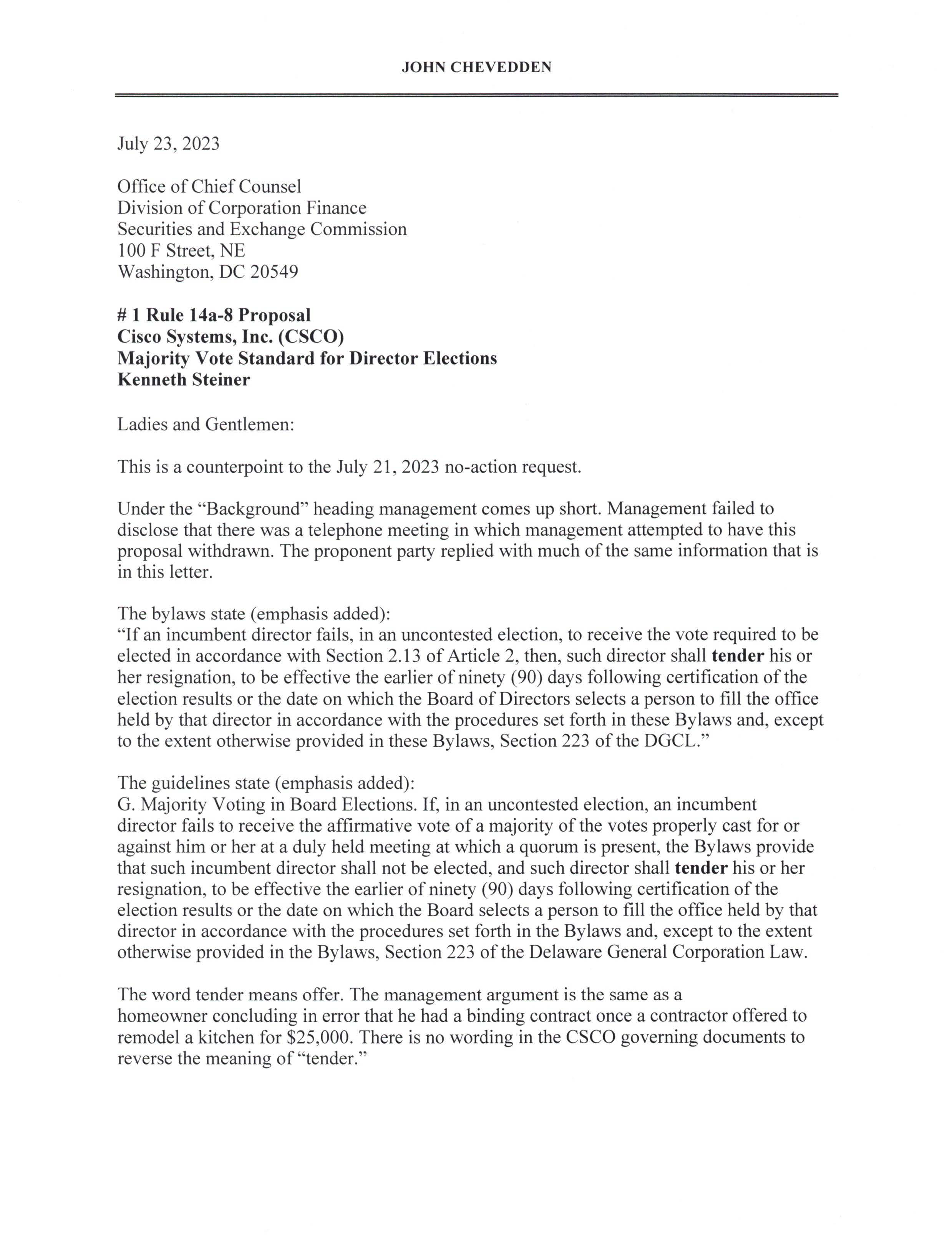
JOHN
CHEVEDDEN
July 23, 2023
Office
of
Chief Counsel
Division
of
Corporation Finance
Securities and Exchange Commission
I 00 F Street, NE
Washington, DC 20549
#
1 Rule 14a-8 Proposal
Cisco Systems, Inc. (CSCO)
Majority Vote Standard for Director Elections
Kenneth Steiner
Ladies and Gentlemen:
This is a counterpoint to the July 21, 2023 no-action request.
Under the "Background" heading management comes up short. Management failed to
disclose that there was a telephone meeting in which management attempted to have this
proposal withdrawn. The proponent party replied with much
of
the same information that
is
in
this letter.
The bylaws state (emphasis added):
"If
an incumbent director fails, in an uncontested election, to receive the vote required to be
elected
in
accordance with Section 2.13
of
Article 2, then, such director shall
tender
his or
her resignation, to be effective the earlier
of
ninety (90) days following certification
of
the
election results or the date on which the Board
of
Directors selects a person
to
fill the office
held
by
that director in accordance with the procedures set forth in these Bylaws and, except
to
the extent otherwise provided in these Bylaws, Section
223
of
the DGCL."
The guidelines state (emphasis added):
G.
Majority Voting
in
Board Elections. If, in an uncontested election, an incumbent
director fails
to
receive the affirmative vote
of
a majority
of
the votes properly cast for or
against him or her at a duly held meeting at which a quorum is present, the Bylaws provide
that such incumbent director shall not be elected, and such director shall
tender
his or her
resignation, to be effective the earlier
of
ninety (90) days following certification
of
the
election results or the date on which the Board selects a person to fill the office held by that
director
in
accordance with the procedures set forth in the Bylaws and, except
to
the extent
otherwise provided in the Bylaws, Section 223
of
the Delaware General Corporation Law.
The word tender means offer. The management argument is the same as a
homeowner concluding in error that he had a binding contract once a contractor offered to
remodel a kitchen for $25,000. There is no wording in the CSCO governing documents to
reverse the meaning
of
"tender."
A director who offers to resign can indicate his preference to remain on the Board. The other
members
of
the Board can prefer that such a director remain on the Board and can also resent
the shareholders who voted against the director and can claim that the shareholders have poor
judgment. This proposal ensures that such a director will be gone in 180-days.
Sincerely,
~
cc: Kenneth Steiner
Evan Sloves
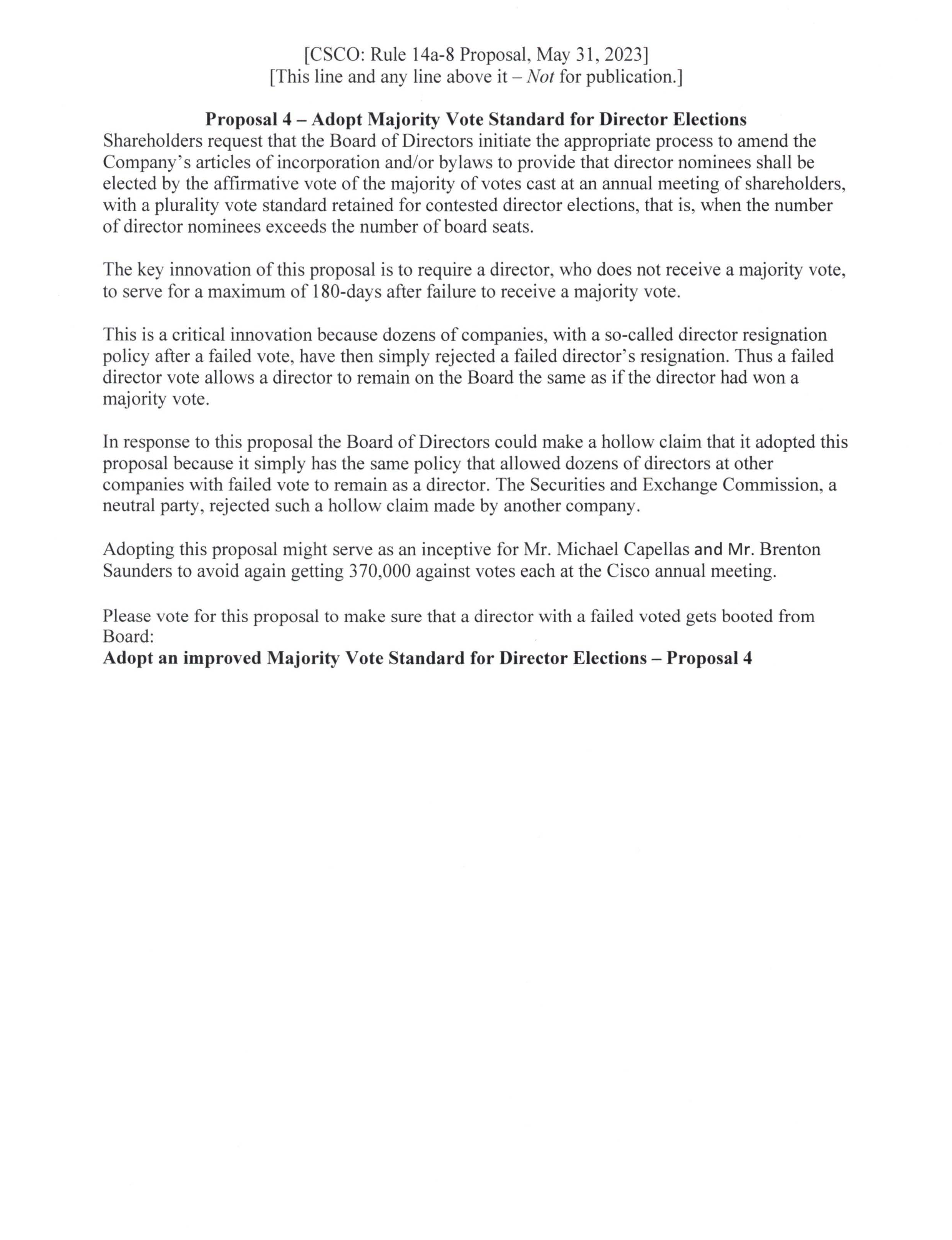
[CSCO: Rule l 4a-8 Proposal, May
31
, 2023]
[This line and any line above it -
Not
for publication.]
Proposal 4 -
Adopt Majority Vote Standard for Director Elections
Shareholders request that the Board
of
Directors initiate the appropriate process
to
amend the
Compan
y'
s articles
of
incorporation and/or bylaws
to
provide that director nominees shall
be
elected
by
the affirmative vote
of
the majority
of
votes cast at an annual meeting
of
shareholders,
with a plurality vote standard retained for contested director elections, that is, when the number
of
director nominees exceeds the number
of
board seats.
The
ke
y innovation
of
this proposal
is
to require a director, who does not receive a majority vote,
to serve for a maximum
of
180-days after failure to receive a majority vote.
This is a critical innovation because dozens
of
companies, with a so-called director resignation
policy after a failed vote, have then simply rejected a failed director's resignation. Thus a failed
director vote allows a director to remain on the Board the same as
if
the director had won a
majority vote.
In response to this proposal the Board
of
Directors could make a hollow claim that it adopted this
proposal because it simply has the same policy that allowed dozens
of
directors at other
companies with failed vote to remain as a director. The Securities and Exchange Commission, a
neutral party, rejected such a hollow claim made by another compan
y.
Adopting this proposal might serve as an inceptive for Mr. Michael Capellas and
Mr.
Brenton
Saunders to avoid again getting 370,000 against votes each at the Cisco annual meeting.
Please vote for this proposal to make sure that a director with a failed voted gets booted from
Board:
Adopt an improved Majority Vote Standard for Director Elections -
Proposal 4
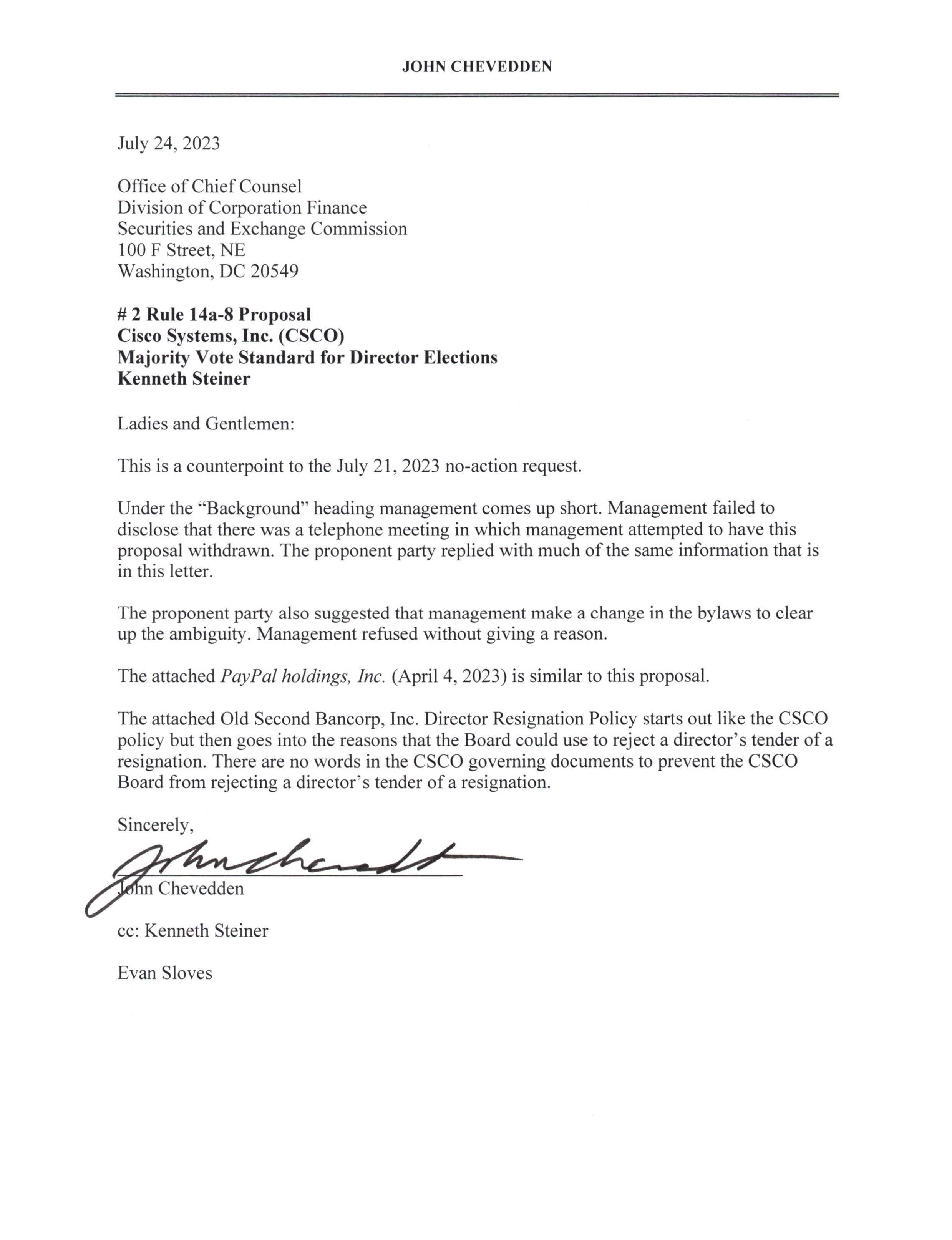
JOHN CHEVEDDEN
July 24, 2023
Office
of
Chief Counsel
Division
of
Corporation Finance
Securities and Exchange Commission
100 F Street, NE
Washington, DC 20549
#
2 Rule 14a-8 Proposal
Cisco Systems, Inc. (CSCO)
Majority Vote Standard for Director Elections
Kenneth Steiner
Ladies and Gentlemen:
This
is
a counterpoint to the July
21
, 2023 no-action request.
Under the "Background" heading management comes up short. Management failed
to
disclose that there was a telephone meeting in which management attempted to have this
proposal withdrawn. The proponent party replied with much
of
the same information that
is
in
this letter.
The proponent party also suggested that management make a change
in
the bylaws to clear
up
the ambiguity. Management refused without giving a reason.
The attached
PayPal holding
s,
Inc.
(April 4, 2023) is similar to this proposal.
The attached Old Second Bancorp, Inc. Director Resignation Policy starts out like the CSCO
policy but then goes into the reasons that the Board could use to reject a director's tender
of
a
resignation. There are no words
in
the CSCO governing documents to prevent the CSCO
Board from rejecting a director's tender
of
a resignation.
Sincerel
y,
~-
cc: Kenneth Steiner
Evan Sloves
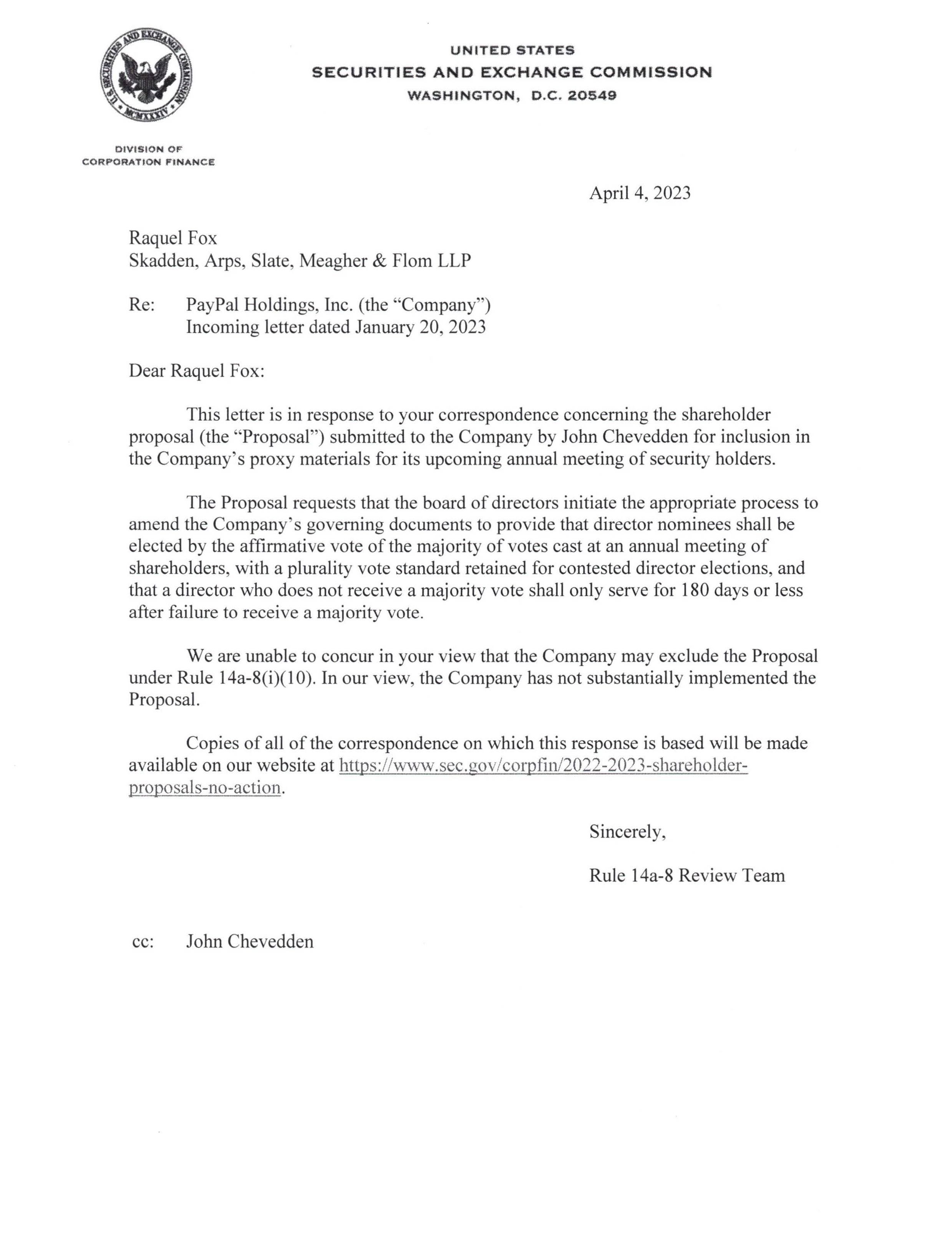
UNITED
STATES
SECURITIES
AND
EXCHANGE
COMMISSION
WASHINGTON
, D .C .
20549
OI
V
ISIO
N
OF
CORPORATI
ON
FI
NAN
CE
April 4, 2023
Raquel Fox
Skadden, Arps, Slate, Meagher & Flom LLP
Re:
PayPal Holdings, Inc. (the "Company")
Incoming letter dated January 20, 2023
Dear Raquel Fox:
This letter is in response to your correspondence concerning the shareholder
proposal (the "Proposal") submitted to the Company by John Chevedden for inclusion in
the Company's proxy materials for its upcoming annual meeting
of
security holders.
The Proposal requests that the board
of
directors initiate the appropriate process to
amend the Company's governing documents to provide that director nominees shall be
elected by the affirmative vote
of
the majority
of
votes cast at an annual meeting
of
shareholders, with a plurality vote standard retained for contested director elections, and
that a director who does not receive a majority vote shall only serve for 180 days or less
after failure to receive a majority vote.
We are unable to concur in your view that the Company may exclude the Proposal
under Rule 14a-8(i)(l 0). In our view, the Company has not substantially implemented the
Proposal.
Copies
of
all
of
the correspondence on which this response
is
based will be made
available on our website at https://www.sec.gov/corpfin/2022-2023-shareholder-
proposals-no-action.
Sincerel
y,
Rule 14a-8 Review Team
cc:
John Chevedden
~
Old
Second
~
Bancorp, Inc.
Director Resignation Policy
Directors Receiving Majority Votes Against
in
Uncontested Elections
Under Article II, Section 2.10
of
the Bylaws
of
Old Second Bancorp, Inc. (the
"Company"),
a nominee for director to the Company's Board
of
Directors (the
"Board")
is
elected in an uncontested election by the vote
of
the holders
of
a majority
of
the shares having
voting power present
in
person or represented by proxy at the meeting.
The following
procedures address the situation
in
which a nominee for the Company's Board
of
Directors
receives more votes "against" his or her election than votes "for" his or her election (a
"Majority
Against Vote"
).
By accepting a nomination
to
stand for election or re-election
as
a director
of
the
Company or
an
appointment
as
director to fill a vacancy or new directorship, each candidate,
nominee or appointee agrees that
if
, in an uncontested election
of
directors, he or she receives a
Majority Against Vote, the director shall promptly tender a written offer
of
resignation
(substantially
in
the form
of
Exhibit A) to the Chairman
of
the Board following certification
of
the stockholder vote from the meeting at which the election occurred. For purposes
of
this
policy,
an
"uncontested election
of
directors"
is
any election
of
directors in which the number
of
nominees for election does not exceed the number
of
directors to be elected.
The Corporate Governance and Nominating Committee
of
the Board (the
"Committee")
will promptly consider the director's offer
of
resignation and recommend
to
the Board whether to
accept the resignation or reject
it.
The Board will act on the Committee's recommendation
no
later than
120
days following certification
of
the stockholder vote.
In evaluating the director's resignation, each
of
the Committee and the Board shall
consider
ac
or
a t
ey
eem re evan ,
me
uding (i) the perceived reasons for the Majority
Against Vote, (ii) the qualifications and tenure
of
the director, (iii) the director's past and
expected future contributions
to
the Company, (iv) the overall composition
of
the Board and
whether accepting the resignation would cause the Company
to
violate any applicable rule or
regulation (including Nasdaq listing standards and federal securities laws) or any
of
its material
agreements, and (v) whether the resignation would be
in
the best interests
of
the Company and
its
stockholders.
In
determining what action to recommend or take regarding the director's resignation,
each
of
the Committee and the Board may consider a range
of
alternatives
as
they deem
appropriate, including (i) accepting the resignation, (ii) rejecting the resignation, (iii) rejecting
the resignation to allow the director
to
remain on the Board but agreeing that the director will not
be nominated for re-election to the Board at the next election
of
directors, (iv) deferring
acceptance
of
the resignation until the Board can find a replacement director with the necessary
qualifications
to
fill the vacancy that accepting the resignation would create, or (v) deferring
acceptance
of
the resignation
if
the director can cure the underlying cause
of
the Majority
Against Vote within a specified period
of
time (for example,
if
the Majority Against Vote were
due
to
overboarding, by resigning from other company boards).
After the Board makes a formal decision on the Committee's recommendation, the
Company shall publicly disclose this action
in
a Form 8-K filed with the Securities and
Exchange Commission within four business days
of
the decision.
If
the Board has determined to
take any action other than acceptance
of
the resignation, the Form 8-K shall also include the
Board's rationale supporting its decision.
Any director who tenders his or her offer
of
resignation pursuant
to
this policy shall not
participate
in
any deliberations or actions by the Committee or the Board regarding his or her
resignation but shall otherwise continue to serve
as
a director during this period.
If
other directors who are members
of
the Committee receive a Majority Against Vote
in
the same uncontested election
of
directors, so that a quorum
of
the Committee cannot be
achieved, then the other independent directors on the Board who received more votes "for" than
"against" in that election will consider and decide what action to take regarding the resignation
of
each director who received a Majority Against Vote.
If
three
or
fewer independent directors
on the Board did not receive a Majority Against Vote
in
the same election, then all independent
directors on the Board shall participate
in
deliberations and actions regarding director
resignations except that
no
director can participate
in
the vote
on
his or her own resignation.
Directors Attaining Age Seventy-Three (73)
No person shall
be
elected
to
serve, or continue
to
serve,
as
a director
of
the Company
after attaining the age
of
seventy-three (73) years. By accepting a nomination to stand for
election or re-election
as
a director
of
the Company or an appointment
as
director to fill a
vacancy or new directorship, each candidate or nominee agrees that upon attaining age seventy-
three (73) during his or her tenure
as
director, the director shall
be
deemed, effective at such
time, to have resigned his or her directorship thereby creating a vacancy. Such individual shall
promptly deliver a written letter
of
resignation (substantially
in
the form
of
Exhibit A) to the
Chairman
of
the Board, with such resignation occurring effective
as
of
the attainment
of
the age
of
seventy-three (73) years.

David A. Bell
dbell@fenwick.com | 650.335.7130
July 28, 2023
Via E-mail
U.S. Securities and Exchange Commission
Division of Corporation Finance
Office of Chief Counsel
100 F Street, N.E.
Washington, DC 20549
Re:
Cisco Systems, Inc. – 2023 Annual Meeting; Supplement to Letter dated
July 21, 2023 Relating to Shareholder Proposal submitted by Kenneth
Steiner
Ladies and Gentlemen:
We refer to our letter dated July 21, 2023 (the “
No-Action Request
”) submitted on
behalf of our client, Cisco Systems, Inc., a Delaware corporation (“
Cisco
”), pursuant to
which we requested confirmation that the staff (the “
Staff
”) of the Securities and Exchange
Commission (the “
Commission
”) will not recommend enforcement action if Cisco
excludes the shareholder proposal and supporting statement (the “
Proposal
”) submitted to
Cisco by Kenneth Steiner (the “
Proponent
”) from its proxy statement and other proxy
materials (the “
2023 Proxy Materials
”) for Cisco’s 2023 Annual Meeting of Stockholders
(the “
Annual Meeting
”).
This letter supplements the No-Action Request and is in response to the letter to the
Staff, dated July 23, 2023, and the letter to the Staff, dated July 24, 2023, each submitted
by John Chevedden (the “
Representative
”) on behalf of the Proponent (the “
Proponent
Letters
”). In accordance with Rule 14a-8(j), a copy of this letter is also being
simultaneously provided to the Proponent.
First, the Proponent Letters misconstrue Cisco’s proactive outreach to the
Representative by stating “there was a telephone meeting in which management attempted
to have this proposal withdrawn.” Rather, on July 17, 2023, Cisco organized a telephone
meeting with the Representative in order to better understand the concerns underlying the
Proposal and to discuss with the Representative the fact that Cisco’s Amended and
Restated Bylaws, effective as of March 9, 2023 (the “
Bylaws
,” attached hereto as Exhibit
A), and Cisco’s Corporate Governance Guidelines (the “
Governance Guidelines
,”
attached hereto as Exhibit B), have already substantially implemented the Proposal. Cisco
arranged the telephone meeting to engage in discussions with the Representative and to
FENWICK
801
California Street
Mountain View, CA 94041
650.988.8500
Fenwick.com
Office of the Chief Counsel
July 28, 2023
Page 2
provide the Representative with a courtesy notice of the position Cisco would take in the
No-Action Request.
Second, the Proponent Letters attempt to claim that Cisco has not implemented the
essential elements of the Proposal by emphasizing immaterial or irrelevant distinctions in
the wording of Cisco’s Bylaws and by citing precedent that is distinguishable. Therefore,
Cisco reiterates its position that the Proposal is excludable pursuant to Rule 14a-8(i)(10)
because the Bylaws and Governance Guidelines compare more than favorably to the
guidelines of the Proposal and resolutely satisfy the Proposal’s essential objective.
A.
The Comparison Proponent Draws is Irrelevant to the Satisfaction of the
Proposal’s Essential Objective.
The Proponent focuses on the use of the term “tender” in the director resignation
provision of Cisco’s Bylaws and Governance Guidelines in attempting to claim that the
Proposal has not been substantially implemented. In particular, Section 3.02 of Article 3 of
the Bylaws and Section I.G of the Governance Guidelines require an incumbent director
who fails to receive the required votes for election to
tender
his or her resignation, to be
effective on the earlier of (i) ninety (90) days following certification of the election results
or (ii) the date on which Cisco’s board of directors (“
Board
”) selects a person to fill the
office held by that director in accordance with the procedures set forth in the Bylaws. The
Proponent takes issue with the wording of Cisco’s Bylaws and Governance Guidelines and
their use of the word tender, because according to the Proponent, “[t]he word tender means
to offer.”
The word “tender,” according to the Cambridge Dictionary and the Britannica
Dictionary, as a verb means “to
give
or offer,” (emphasis added) not solely “offer” as the
Proponent Letters imply. Given the maximum time limit for a director to serve following a
failed vote already provided for in the Bylaws and Governance Guidelines, the use of the
word “tender” has not been understood or applied by Cisco to solely mean “offer” as the
Proponent Letters claim. This is further underscored by the fact that Cisco is intentional in
its use of both the words “offer” and “tender.” When Cisco wants a director to
offer
to
tender
a resignation, with such resignation to be further considered by Cisco’s Board, it
states exactly that. For example, in relation to a director changing his/her principal
occupation or business occupation, Cisco’s Governance Guidelines clearly states, the
director “[…]
shall offer to tender
his/her resignation to the Nomination and Governance
Committee, so that there is an opportunity for the Board, through the Nomination and
Governance Committee, to review the continued appropriateness of Board membership
under the new circumstances” (emphasis added). Finally, Cisco’s Bylaws and Governance
Guidelines do not have the particular discretionary language commonly used when the
intent is for a director’s resignation upon a failed vote to be made solely contingent on the
board’s acceptance (as is discussed in more detail below).
Office of the Chief Counsel
July 28, 2023
Page 3
The Bylaws and the Governance Guidelines do not afford discretion to Cisco’s
Board, or a committee thereof, to accept or reject the director’s tendered resignation but
instead require the tendered resignation to be
automatically
effective. Thus, in the context
of the resignation provision overall, the use of the word “tender” cannot reasonably be read
to mean that the resignation will only be effective if accepted by the Board, even were it to
be read as meaning “offer.” For all of these reasons, as well as those set forth in the No-
Action Request, Cisco has already substantially implemented the Proposal and it may
therefore be excluded in reliance on Rule 14a-8(i)(10).
B.
The Precedent Cited in the Proponent Letters is Distinguishable.
The Proponent Letters claim that the Proposal is similar to the proposal set forth in
PayPal Holdings, Inc.
(Apr. 4, 2023) and thus may not be excluded, consistent with the
result in PayPal. While the proposals themselves may arguably be similar, the facts here
are clearly distinguishable given the differences between the bylaws at issue in
PayPal
Holdings
and Cisco’s Bylaws and Governance Guidelines. In
PayPal Holdings
if a director
failed to receive the required votes for election a committee of the board would “make a
determination
as to whether to accept or reject
any previously tendered Resignations”
(emphasis added). Conversely, Cisco’s Bylaws and Governance Guidelines provide that
removal of a director is
automatic
upon the earlier of “certification of the election results”
or “select[ion] [of] a person to fill the office held by that director.” In Cisco’s case,
removal is not subject to or dependent upon acceptance by Cisco’s Board and the
resignation is automatically effective no later than 90 days after a failed vote. Therefore,
the facts here are clearly distinguishable from instances where the Staff was unable to
concur with exclusion under Rule 14a-8(i)(10) given the specific procedures provided for
in the bylaws of those companies.
0F
1
The Proponent attempts to read into Cisco’s Bylaws a
provision that does not exist — one that would be included if the intent was for the Board
to have the latitude to accept or reject the resignation. But Cisco’s Bylaws and Governance
Guidelines do not include such a provision, and this is purposeful. Accordingly, Cisco has
substantially implemented the Proposal and it may therefore be excluded in reliance on
Rule 14a-8(i)(10).
CONCLUSION
For the reasons discussed above, and in the No-Action Request, we respectfully
request that the Staff concur that it will take no action if Cisco excludes the Proposal from
its 2023 Proxy Materials pursuant to Rule 14a-8(i)(10) because Cisco’s Bylaws and
Governance Guidelines compare more than favorably to the guidelines of the Proposal and
resolutely satisfy the Proposal’s essential objective. Should the Staff disagree with our
1
See also, Texas Pacific Land Corp.
(Sept. 26, 2022) (where the company’s bylaws stated that the
offer of a tendered resignation of a director who failed to receive a majority of the votes cast was
“subject to acceptance by the Board” and that the “Nominating and Corporate Governance
Committee of the Board…shall make a recommendation to the Board as to whether to accept or
reject the tendered resignation.”).

Office of the Chief Counsel
July 28, 2023
Page 4
conclusions regarding the omission of the Proposal, or should the Staff have questions or
desire any additional information in support of our position, we would appreciate an
opportunity to confer with the Staff concerning these matters prior to the issuance of its
Rule 14a-8(j) response. In this case, please contact me by telephone at (650) 335-7130 or
Evan Sloves of Cisco at (408) 525-2061. Please direct any correspondence regarding this
letter via e-mail to CorporateSecretary@cisco.com.
Sincerely,
FENWICK & WEST LLP
David A. Bell
Enclosures
cc:
Evan Sloves, Cisco Systems, Inc.
Jay Higdon, Cisco Systems, Inc.
Kenneth Steiner
John Chevedden
Julia Forbess, Fenwick & West LLP

EXHIBIT A
Bylaws
1
AMENDED AND RESTATED
BYLAWS
OF
CISCO SYSTEMS, INC.
(a Delaware corporation)
Effective as of March 9, 2023
ARTICLE 1
OFFICES
Section 1.01
The principal executive offices of Cisco Systems, Inc. (the “
Corporation
”) shall be at such place inside
or outside the State of Delaware as the Board of Directors may determine from time to time.
Section 1.02
The Corporation may also have offices at such other places as the Board of Directors may from time to
time designate, or as the business of the Corporation may require.
ARTICLE 2
STOCKHOLDERS’ MEETINGS
Section 2.01 Annual Meetings
. The annual meeting of the stockholders of the Corporation for the election of directors
to succeed those whose terms expire and for the transaction of such other business as may properly come before the
meeting shall be held at such time, date and place as may be determined by the Board of Directors.
Section 2.02 Special Meetings
. Special meetings of the stockholders may be called at any time by the Chair of the
Board of Directors, by the Chief Executive Officer, by the Board of Directors, or by one or more stockholders holding
not less than ten percent (10%) of the voting power of the Corporation on the record date established pursuant to
Article 2, Section 2.10 of these Amended and Restated Bylaws of the Corporation (the “
Bylaws
”) and who otherwise
comply the requirement of this Article 2, Section 2.02. The person or persons calling any such meeting or requesting
such meeting be called shall concurrently specify the purpose of such meeting and the business proposed to be
transacted at such meeting. In connection with any request for a special meeting by the stockholders in accordance
with the provisions of this Article 2, Section 2.02, such request shall be in writing sent by registered mail to the Chair
of the Board of Directors, the Chief Executive Officer of the Corporation (the “
Chief Executive Officer
”), or the
Secretary of the Corporation (the “
Secretary
”), or delivered to any such officer in person, and shall include the
information required by Article 2, Section 2.12 of these Bylaws. Subject to the immediately succeeding sentence, the
Board of Directors shall cause notice of a meeting requested by the stockholders in accordance with this Section 2.02
to be given in accordance with Article 2, Section 2.04 of these Bylaws as promptly as reasonably practicable and, in
connection therewith, establish the time, date and place of such meeting which shall be held not more than one hundred
twenty (120) nor less than thirty five (35) days after the Board of Directors has determined the stockholder or
stockholders shall have satisfied the requirements in Section 2.12. Within five (5) business days after receiving all of
the information specified in Section 2.12 from a stockholder or stockholders of the Corporation, the Board of Directors
shall determine whether such stockholder or stockholders have satisfied the requirements for calling a special meeting
of the stockholders and notify the requesting party or parties of its finding.
Section 2.03 Place
. All meetings of the stockholders shall be at any place within or without the State of Delaware
designated by the Board of Directors or the Chief Executive Officer, or by means of remote communication as the
Board of Directors in its sole discretion may determine. In the absence of any such designation, stockholders’ meetings
shall be held at the principal executive office of the Corporation.
2
Section 2.04 Notice
. Notice of meetings of the stockholders of the Corporation shall be given in accordance with
applicable law (including, without limitation, as set forth in Section 7.01 of these Bylaws). Unless otherwise provided
by law, the Amended and Restated Certificate of Incorporation of the Corporation (the “
Certificate of Incorporation
”)
or these Bylaws, notice of any such meeting of stockholders shall be sent to each stockholder entitled thereto not less
than ten (10) days nor more than sixty (60) days before the meeting. Said notice shall state the time, date and place, if
any, of the meeting and, (1) in the case of special meetings, the purpose of the meeting and the business proposed to
be transacted, or (2) in the case of annual meetings, those matters which the Board of Directors, at the time of the
mailing of the notice, intends to present for action by the stockholders, including any actions brought by a stockholder,
and (3) in the case of any meeting at which directors are to be elected, the names of the nominees intended at the time
of the mailing of the notice to be presented by the Board of Directors for election and the names of the nominees to
be included in the Corporation’s proxy statement for such annual meeting in accordance with Article 2, Section 2.14.
Section 2.05 Adjourned Meetings
. Any stockholders’ meeting may be adjourned from time to time (including an
adjournment taken to address a technical failure to convene or continue a meeting using remote communication) by
(1) the vote of the holders of a majority of the voting shares present at the meeting either in person or by proxy or (2)
the presiding officer of the meeting. Notice of the time, date and place of any adjourned meeting need not be given if
such time, date and place are announced at the meeting at which stockholders and proxy holders may be deemed to
be present in person and voting at such adjourned meeting are (i) announced at the meeting at which the adjournment
is taken, (ii) displayed, during the time scheduled for the meeting, on the same electronic network used to enable
stockholders and proxy holders to participate in the meeting by means of remote communication or (iii) set forth in
the notice of meeting given in accordance with Section 222(a) of the General Corporation Law of the State of Delaware
(the “
DGCL
”);
provided
,
however
, that if the adjournment is for more than thirty (30) days or, if after the adjournment,
a new record date is fixed for the adjourned meeting, notice of the time, date and place of the adjourned meeting must
be given in conformity with Article 2, Section 2.04 of these Bylaws. At any adjourned meeting, any business may be
transacted which properly could have been transacted at the original meeting.
Section 2.06 Quorum
. The presence in person or by proxy of the holders of a majority of the voting power of the
shares issued, outstanding and entitled to vote at the meeting constitutes a quorum for the transaction of business;
provided
,
however
, that where a separate vote by a class or classes or series of stock is required by applicable law or
the Certificate of Incorporation, the holders of a majority of the voting power of the shares of such class or classes or
series of the stock issued and outstanding and entitled to vote on such matter, present in person or represented by
proxy at the meeting, shall constitute a quorum entitled to take action with respect to the vote on such matter. The
stockholders present at a duly called or held meeting at which a quorum is present may continue to do business,
including at any adjournment thereof (unless a new record date is fixed for the adjourned meeting), notwithstanding
the withdrawal of enough stockholders to leave less than a quorum, if any action taken (other than adjournment) is
approved by the requisite vote of the stockholders.
In the absence of a quorum, any meeting of stockholders may be adjourned from time to time by the presiding officer
of the meeting or the vote of a majority of the shares, the holders of which are either present in person or represented
by proxy thereat, but no other business may be transacted, except as provided above. Votes shall be counted in
accordance with Article 2, Section 2.09 of these Bylaws.
Section 2.07 Action By Consent
. Any action which may be taken at any meeting of stockholders may be taken
without a meeting and without prior notice, if a consent, setting forth the action so taken, shall be signed by the holders
of outstanding shares on the record date established pursuant to Article 2, Section 2.10 of these Bylaws having not
less than the minimum number of votes that would be necessary to authorize or take such action at a meeting at which
all shares entitled to vote thereon were present and voted;
provided
,
however
, that, notice of any stockholder approval
without a meeting by less than unanimous stockholder consent shall be given as required by the DGCL.
Any consent may be revoked by a writing received by the Secretary prior to the time that consents of the holders of
the number of shares required to authorize the proposed action have been delivered to the Corporation.
Section 2.08 Waiver of Notice
. The transactions of any meeting of stockholders, however called and noticed, and
whenever held, shall be as valid as though had at a meeting duly held after regular call and notice, if a quorum be
present either in person or by proxy, and if, either before or after the meeting, each of the persons entitled to vote not
present in person or by proxy gives a waiver of notice, or a consent to the holding of the meeting, or an approval of
3
the minutes thereof. All such waivers, consents, or approvals shall be filed with the corporate records or made a part
of the minutes of the meeting.
Section 2.09 Voting; Stockholder List
.
(a) At any meeting of the stockholders, every stockholder having the right to vote shall be entitled to vote in person,
or by proxy, but no such proxy shall be voted or acted upon after three (3) years from its date, unless the proxy provides
for a longer period. Any stockholder directly or indirectly soliciting proxies from other stockholders must use a proxy
card color other than white, which shall be reserved for exclusive use by the Board of Directors. A proxy shall be
irrevocable if it satisfies the requirements of Sections 212(e) of the DGCL. The voting at meetings of stockholders
need not be by ballot, but any stockholder before the voting begins may demand that voting be by ballot, each of
which shall state the name of the stockholder or proxy voting and the number of shares voted by such stockholder or
proxy.
(b) Except as otherwise provided by law, the Certificate of Incorporation, these Bylaws, the rules or regulations of
any stock exchange applicable to the Corporation, or any law or regulation applicable to the Corporation or its
securities, all matters presented to the stockholders at a meeting at which a quorum is present shall be decided by a
majority of the votes properly cast for or against such matter, and, for the avoidance of doubt, neither abstentions nor
broker non-votes shall be counted as votes cast for or against such matter.
(c) The Corporation shall prepare, no later than the tenth (10th) day before each meeting of stockholders, a complete
list of stockholders entitled to vote at the meeting (
provided, however
, if the record date for determining the
stockholders entitled to vote is less than ten (10) days before the date of the meeting, the list shall reflect the
stockholders entitled to vote as of the tenth (10th) day before the meeting date), arranged in alphabetical order and
showing the address of each stockholder and the number of shares registered in the name of each stockholder. Nothing
in this Section 2.09(c) shall require the Corporation to include electronic mail addresses or other electronic contact
information on such list. Such list shall be open to the examination of any stockholder, for any purpose germane to
the meeting, for a period of ten (10) days ending on the day before the meeting date, either (a) on a reasonably
accessible electronic network as permitted by applicable law (
provided
that the information required to gain access to
the list is provided with the notice of the meeting), or (b) during ordinary business hours, at the principal place of
business of the Corporation. In the event that the Corporation determines to make the list available on an electronic
network, the Corporation may take reasonable steps to ensure that such information is available only to stockholders
of the Corporation. Except as otherwise provided by law, the stock ledger shall be the only evidence as to who are the
stockholders entitled to examine the list of stockholders required by this Section 2.09(c) or to vote in person or by
proxy at any meeting of stockholders. Notwithstanding the foregoing, the Corporation may maintain and authorize
examination of the list of stockholders in any manner expressly permitted by the DGCL at the time.
Section 2.10 Record Dates
. In the event the Board of Directors fixes a day for the determination of stockholders of
record entitled to vote as provided in this Section 2.10, then, subject to the provisions of the DGCL, only persons in
whose name shares entitled to vote stand on the stock records of the Corporation at the close of business on such day
shall be entitled to vote.
(a) Meetings. In order that the Corporation may determine the stockholders entitled to notice of or to vote at any
meeting of stockholders or any adjournment thereof, the Board of Directors may fix a record date, which record date
shall not precede the date upon which the resolution fixing the record date is adopted by the Board of Directors, and
which record date shall, unless otherwise required by law, not be more than sixty (60) nor less than ten (10) days
before the date of such meeting. If no record date is fixed by the Board of Directors, the record date for determining
stockholders entitled to notice of or to vote at a meeting of stockholders shall be at the close of business on the business
day next preceding the day on which notice is given, or, if notice is waived, at the close of business on the business
day next preceding the day on which the meeting is held. A determination of stockholders of record entitled to notice
of or to vote at a meeting of stockholders shall apply to any adjournment of the meeting;
provided
,
however
, that the
Board of Directors may fix a new record date for determination of stockholders entitled to vote at the adjourned
meeting, and in such case shall also fix as the record date for stockholders entitled to notice of such adjourned meeting
the same or an earlier date as that fixed for determination of stockholders entitled to vote in accordance with the
foregoing provisions of this subsection (a) at the adjourned meeting.
4
(b) Action by Consent. In order that the Corporation may determine the stockholders entitled to consent to corporate
action without a meeting, the Board of Directors shall fix a record date to determine the stockholders entitled to act
by consent, which record date shall not precede the date upon which the resolution fixing such record date is adopted
by the Board of Directors, and which date shall not be more than ten (10) days after the date upon which the resolution
fixing the record date is adopted by the Board of Directors. To the extent stockholders may take action by consent in
accordance with the Certificate of Incorporation and these Bylaws, any stockholder of record seeking to have the
stockholders authorize or take corporate action by consent shall, by written notice to the Secretary, request the Board
of Directors to fix a record date. The Board of Directors shall promptly, but in no event later than twenty-eight (28)
days after the date on which such request is received, adopt a resolution fixing the record date to determine the
stockholders entitled to act by consent. If no record date has been fixed by the Board of Directors, such record date
shall be determined in accordance with the DGCL.
(c) Dividends, Distributions and other Rights. In order that the Corporation may determine the stockholders entitled
to receive payment of any dividend or other distribution or allotment of any rights, or entitled to exercise any rights
in respect of any change, conversion or exchange of stock or for the purpose of any other lawful action, the Board of
Directors may fix, in advance, a record date, which shall not precede the date upon which the resolution fixing the
record date is adopted by the Board of Directors and which shall not be more than sixty (60) days nor less than the
number of days required by the primary stock exchange on which the Corporation’s shares of common stock are traded
prior to such action. If no such record date is fixed by the Board of Directors, then the record date for determining
stockholders for any such purpose shall be at the close of business on the day on which the Board of Directors adopts
the resolution relating thereto.
Section 2.11 Order of Business
. The Chief Executive Officer, or such other officer or director of the Corporation
designated by a majority of the Board of Directors, will call meetings of the stockholders to order and will act as
presiding officer thereof. Unless otherwise determined by the Board of Directors prior to the meeting, the presiding
officer of the meeting of the stockholders will also determine the order of business and have the authority in his or her
sole discretion to regulate the conduct of any such meeting, including without limitation by (i) imposing restrictions
on the persons (other than stockholders of the Corporation or their duly appointed proxies) who may attend any such
stockholders’ meeting, (ii) ascertaining whether any stockholder or his, her or its proxy may be excluded or removed
from any meeting of the stockholders based upon any determination by the presiding officer, in his or her sole
discretion, that any such person has unduly disrupted or is likely to disrupt the proceedings thereat, (iii) determining
the circumstances in which any person may make a statement or ask questions at any meeting of the stockholders, (iv)
restrict use of audio or video recording devices at the meeting, and (v) taking such other action as, in the discretion of
the presiding officer, is deemed necessary, appropriate or convenient for the proper conduct of the meeting.
At an annual meeting of the stockholders, only such business will be conducted or considered as is properly brought
before the meeting. To be properly brought before an annual meeting, business must be (i) specified in the notice of
meeting (or any supplement thereto) given by or at the direction of the Board of Directors, (ii) otherwise properly
brought before the meeting by the presiding officer or by or at the direction of a majority of the Board of Directors,
or (iii) otherwise properly requested to be brought before the meeting by a stockholder of the Corporation in
accordance with the immediately succeeding sentence. For business to be properly requested by a stockholder to be
brought before an annual meeting, the stockholder must (i) be a stockholder of record at the time of the giving of the
notice of such annual meeting by or at the direction of the Board of Directors, (ii) at the time of the meeting, is a
stockholder of record who is entitled to vote at such meeting, and attends such meeting to present such nomination or
proposal, and (iii) have given timely written notice thereof to the Secretary in accordance with Article 2, Section 2.12
or Article 2, Section 2.14, as the case may be, of these Bylaws.
Nominations of persons for election as directors of the Corporation may be made at an annual meeting of stockholders
only (i) by or at the direction of the Board of Directors, (ii) by any stockholder who is a stockholder of record at the
time of the giving of the notice of such annual meeting by or at the direction of the Board of Directors, who, at the
time of the meeting, is a stockholder of record who is entitled to vote at such meeting, who attends such meeting to
present such nomination or proposal and who has given timely written notice thereof to the Secretary in accordance
with, and otherwise satisfied the requirements of, Article 2, Section 2.12 of these Bylaws, or (iii) by any Eligible
Holder (as defined in Article 2, Section 2.14) who has satisfied the requirements of Article 2, Section 2.14. Only
persons who are nominated in accordance with this Article 2, Section 2.11 will be eligible for election at a meeting of
stockholders as directors of the Corporation. The number of nominees a stockholder may nominate for election at a
5
meeting of stockholders (or in the case of a stockholder of record giving the notice on behalf of the beneficial owner,
the number of nominees a stockholder of record may nominate for election at the meeting on behalf of such
stockholder) shall not exceed the number of directors to be
elected at such meeting.
At a special meeting of stockholders, only such business may be conducted or considered as is properly brought before
the meeting in accordance with Section 2.02.
The determination of whether any business sought to be brought before any annual or special meeting of the
stockholders is properly brought before such meeting in accordance with Article 2, Sections 2.02 and 2.11 and whether
any nomination of a person for election as a director of the Corporation at any annual meeting of the stockholders was
properly made in accordance with this Article 2, Section 2.11, will be made by the presiding officer of such meeting.
If the presiding officer determines that any business is not properly brought before such meeting, or any nomination
was not properly made (including satisfying the information requirements set forth herein with accurate and complete
information), he or she will so declare to the meeting and any such business will not be conducted or considered and
any such nomination will be disregarded (and any such nominee shall be disqualified), including that if a stockholder
provides notice pursuant to Rule 14a-19(b) promulgated under the Securities Exchange Act of 1934, as amended (the
“
Exchange Act
”) and subsequently fails to comply with the requirements of Rule 14a-19(a)(2) and Rule 14a-19(a)(3)
promulgated under the Exchange Act, including the provision to the Corporation of notices required thereunder in a
timely manner, then the Corporation shall disregard any proxies or votes solicited for such stockholder’s director
nominees (and any such nominee shall be disqualified). Notwithstanding the foregoing provisions of this Section 2.11,
unless otherwise required by law, no stockholder shall solicit proxies in support of director nominees other than the
Corporation’s nominees unless such stockholder has complied with Rule 14a-19 promulgated under the Exchange Act
in connection with the solicitation of such proxies, including the provision to the Corporation of notices required
thereunder in a timely manner.
Notwithstanding the provisions of Sections 2.11, 2.12 and 2.14 of this Article 2, a stockholder must also comply with
all applicable requirements of the Exchange Act, and the rules and regulations promulgated thereunder with respect
to the matters set forth in Sections 2.11, 2.12 and 2.14 of this Article 2, for the avoidance of doubt including, but not
limited to, Rule 14a-19 of the Exchange Act with respect to nominations. Nothing in Sections 2.11, 2.12 and 2.14 of
this Article 2 will be deemed to affect any rights of stockholders to request inclusion of proposals in the Corporation’s
proxy statement in accordance with the provisions of Rule 14a-8 promulgated under the Exchange Act.
For purposes of these Bylaws, “public announcement” means disclosure in a press release reported by the Dow Jones
Newswires, Associated Press, or comparable national news service or in a document publicly filed by the Corporation
with the Securities and Exchange Commission (the “
SEC
”) pursuant to Sections 13, 14 or 15(d) of the Exchange Act
or furnished to stockholders.
Section 2.12 Advance Notice of Stockholder Proposals and Director Nominations
.
(a) To be timely for purposes of Article 2, Section 2.11 of these Bylaws, (i) a stockholder’s notice (other than a notice
by an Eligible Holder (as defined in Article 2, Section 2.14) who seeks to include a Nominee (as defined in Article 2,
Section 2.14) in the Corporation’s proxy statement for an annual meeting of stockholders pursuant to Article 2, Section
2.14) must be addressed to the Secretary and delivered or mailed to and received at the principal executive offices of
the Corporation not less than sixty (60) nor more than ninety (90) calendar days prior to the anniversary date of the
date (as specified in the Corporation’s proxy materials for its immediately preceding annual meeting of stockholders)
on which the Corporation first sent its proxy materials to the Corporation’s stockholders for its immediately preceding
annual meeting of stockholders;
provided
,
however
, that in the event the annual meeting is called for a date that is not
within sixty (60) calendar days of the anniversary date of the date on which the immediately preceding annual meeting
of stockholders was held to be timely, notice by the stockholder must be so received not later than the close of business
on the tenth (10th) calendar day following the day on which public announcement of the date of the annual meeting
is first made, (ii) in the case of a proposal for the nomination of persons for election to the Board of Directors, the
stockholder of record shall have complied in all respects with the requirements of Section 14 of the Exchange Act,
including, without limitation, if applicable, the requirements of Rule 14a-19 (as such rule and regulations may be
amended from time to time by the SEC, including any SEC Staff interpretations relating thereto), and the stockholder
shall deliver, no later than five (5) business days prior to the annual meeting or any adjournment, rescheduling,
postponement or other delay thereof, reasonable evidence that it has complied with such requirements and (iii) in the
6
case of a proposal for the nomination of persons for election to the Board of Directors, the Board of Directors or an
executive officer designated thereby shall have determined that the stockholder of record has satisfied the requirements
of this Section 2.12. In no event will the public announcement of an adjournment, postponement or rescheduling of
an annual meeting of stockholders commence a new time period for the giving of a stockholder’s notice as provided
above. Notwithstanding anything in this Section 2.12 or any other provision of these Bylaws to the contrary, in the
event that the number of directors to be elected to the Board of Directors at the annual meeting is increased effective
after the time period for which nominations would otherwise be due under this Section 2.12 and there is no public
announcement by the Corporation naming all of the Nominees for director or specifying the size of the increased
Board of Directors at least seventy five (75) days prior to the first anniversary of the preceding year’s annual meeting
(or, if the annual meeting is held more than thirty (30) days before or sixty (60) days after such anniversary date, if
there is no public announcement at least seventy five (75) days prior to the date of the annual meeting), a stockholder’s
notice required by this Section 2.12 shall also be considered timely, but only with respect to nominees for any new
positions created by such increase, if it shall be delivered to the Secretary at the principal executive office of the
Corporation not later than 5:00 p m. local time on the tenth (10th) day following the day on which such public
announcement is first made by the Corporation.
(b) In the case of a request by a stockholder for business to be brought before any annual meeting of stockholders, a
stockholder’s notice to the Secretary must set forth as to each matter the stockholder proposes to bring before the
annual meeting (i) a description in reasonable detail of the business desired to brought before the annual meeting and
the reasons for conducting such business at the annual meeting, (ii) the name and address, as they appear on the
Corporation’s books, of the stockholder proposing such business and the beneficial owner, if any, on whose behalf
the proposal is made, (iii) a representation that the stockholder proposing such business is a holder of record of stock
of the Corporation entitled to vote at such meeting and intends to appear in person (including virtually in the case of
a meeting conducted solely by means of remote communication) or by proxy at the meeting to propose such business
or nomination, (iv) the class and number of shares of the Corporation that are owned beneficially and of record by the
stockholder proposing such business and by the beneficial owner, if any, on whose behalf the proposal is made, (v)(A)
a reasonably detailed description of any agreement, arrangement or understanding (including any derivative
instruments, swaps, warrants, short positions, profit interests, options, hedging transactions, borrowed or loaned shares
or other transactions, such as those involving direct or indirect opportunities to profit or share in any profit derived
from any increase or decrease in the value of shares of the Corporation, or partnership interests in a partnership that
directly or indirectly hold any of the foregoing) that has been entered into as of the date of such notice by such
stockholder and beneficial owner, if any, the effect or intent of which is to mitigate loss to, manage risk or benefit of
share price changes for, or increase or decrease the voting power of each such person or any of its affiliates or
associates with respect to shares of stock of the Corporation, and any performance-related fees to which each such
party is directly or indirectly entitled based on any increase or decrease in the value of shares of the Corporation, and
(B) a representation that the stockholder will notify the Corporation in writing of any of the information required to
be disclosed in clause (v)(A) that is in effect as of the record date for the meeting not later than five (5) business days
following the later of the record date or the date notice of the record date is first publicly disclosed, (vi) any material
interest of such stockholder proposing such business and the beneficial owner, if any, on whose behalf the proposal is
made in such business, and (vii) in the case of a proposal other than the nomination of persons for election to the
Board of Directors, a representation whether such proposing stockholder intends (or is part of a group that intends) to
deliver a proxy statement or form of proxy to holders of at least the percentage of the Corporation’s voting shares
required under applicable law to carry the proposal.
(c) In the case of a nomination by a stockholder of a person for election as a director of the Corporation at any annual
meeting of stockholders pursuant to this Article 2, Section 2.12, a stockholder notice to the Secretary must set forth
(i) the stockholder’s intent to nominate one or more persons for election as a director of the Corporation, the name of
each such nominee proposed by the stockholder giving the notice, and the reason for making such nomination at the
annual meeting, (ii) the name and address, as they appear on the Corporation’s books, of the stockholder proposing
such nomination and the beneficial owner, if any, on whose behalf the nomination is proposed, (iii) a representation
that the stockholder proposing such business is a holder of record of stock of the Corporation entitled to vote at such
meeting and intends to appear in person (including virtually in the case of a meeting conducted solely by means of
remote communication) or by proxy at the meeting to propose such business or nomination, (iv) the class and number
of shares of the Corporation that are owned beneficially and of record by the stockholder proposing such nomination
and by the beneficial owner, if any, on whose behalf the nomination is proposed, (v) the information and representation
described in clause (v) of the immediately preceding paragraph, (vi) any material interest of such stockholder
7
proposing such nomination and the beneficial owner, if any, on whose behalf the proposal is made, (vii) a description
of all arrangements or understandings between or among any of (A) the stockholder giving the notice, (B) each
nominee, and (C) any other person or persons (naming such person or persons) pursuant to which the nomination or
nominations are to be made by the stockholder giving the notice, (viii) a representation that such stockholder giving
the notice intends to solicit the holders of shares representing at least 67% of the voting power of the shares entitled
to vote on the election of directors in support of director nominees other than the Corporation’s nominees in
accordance with Rule 14a-19, and the name of each participant (as defined in Item 4 of the Exchange Act Schedule
14A) in such solicitation, (ix) such other information regarding each nominee proposed by the stockholder giving the
notice as would be required to be included in a proxy statement filed in accordance with the proxy rules of the SEC
had the nominee been nominated, or intended to be nominated, by the Board of Directors, (x) the signed consent of
each nominee proposed by the stockholder giving the notice to be included as a nominee in any materials relating to
the Corporation’s next meeting and to serve as a director of the Corporation if so elected, (xi) any material pending or
threatened legal proceeding in which such stockholder is a party or material participant involving the Corporation or
any of its officers or directors, or any affiliate of the Corporation, (xii) the information set forth in Article 2, Sections
2.14(d)(ii)(D), (E) and (H), (xiii) statement whether such person, if elected, intends to tender, promptly following such
person’s election or reelection, an irrevocable resignation effective upon such person’s failure to receive the required
vote for reelection at any future meeting at which such person would face reelection and acceptance of such resignation
by the Board of Directors, in accordance with the Corporation’s policies, (xiv) description of any business or personal
interests that could place such person in a potential conflict of interest with the Corporation or any of its subsidiaries,
and (xv) such stockholder’s unconditional consent to the public disclosure of any or all of the information provided to
the Corporation pursuant to this Section 2.12 and such stockholder’s agreement to the matters set forth in Article 2,
Section 2.14(d)(iv).
(d) Any stockholder or stockholders seeking to call a special meeting pursuant to Article 2, Section 2.02 of these
Bylaws shall provide information comparable to that required by the preceding paragraphs, to the extent applicable,
in any request made pursuant to such Article and Section. From the date of delivery of the stockholder notice, such
stockholder must give written notice to the Secretary at the principal executive offices of the Corporation of any
change in the information provided pursuant to this Section 2.12 within two (2) business days after the occurrence of
such change (each an “
Update
”), so that the information is current through the date of the meeting or any adjournment,
postponement, or rescheduling thereof,
provided
that any such Update shall be delivered by such stockholder at least
two (2) business days prior to the closing of the polls at the meeting. If a stockholder providing written notice required
by this Section 2.12 fails to provide any written Update in accordance with this Section 2.12, the information as to
which such written Update relates may be deemed not to have been provided in accordance with these Bylaws. If any
information submitted pursuant to this Section 2.12 is inaccurate or incomplete in any material respect (as determined
by the Board of Directors or a committee thereof), such information shall be deemed not to have been provided in
accordance with these Bylaws. A stockholder shall notify the Secretary in writing at the principal executive offices of
the Corporation of any inaccuracy or change in any information submitted within two (2) business days after becoming
aware of such inaccuracy or change, and any such notification shall clearly identify the inaccuracy or change, it being
understood that no such notification will cure any deficiencies or inaccuracies with respect to any prior submission by
such stockholder. Upon written request of the Secretary on behalf of the Board of Directors (or a duly authorized
committee thereof), such stockholder shall provide, within seven (7) business days after delivery of
such request (or
such longer period as may be specified in such request), (1) written verification, reasonably satisfactory to the Board
of Directors, any committee thereof, or any authorized officer of the Corporation, to demonstrate the accuracy of any
information submitted and (2) a written affirmation of any information submitted as of an earlier date. If such
stockholder fails to provide such written verification or affirmation within such period, the information as to which
written verification or affirmation was requested may be deemed not to have been provided in accordance with these
Bylaws. Notwithstanding the foregoing, if a stockholder of record no longer plans to solicit proxies in accordance
with its representation pursuant to Section 2.12(b), the stockholder of record shall inform the Corporation of this
change by delivering a writing to the Secretary at the principal executive offices of the Corporation no later than two
(2) business days after the occurrence of such change.
(e) Nominations of persons for election to the Board of Directors may be made at a special meeting of stockholders at
which directors are to be elected pursuant to the Corporation’s notice of meeting (1) by or at the direction of the Board
of Directors (including upon the request of stockholders pursuant to Section 2.02 hereof) or (2) provided that the
Board of Directors has determined that directors shall be elected at such meeting (including upon the request of
stockholders pursuant to Section 2.02 hereof), by any stockholder of the Corporation who is a stockholder of record
8
at the time the notice provided for in this Section 2.12 is delivered to the Secretary, who is entitled to vote at the
meeting and upon such election and who complies with the notice procedures set forth in this Section 2.12. The
proposal by stockholders of other business to be conducted at a special meeting of stockholders may be made only in
accordance with Section 2.02 hereof. In the event the Corporation calls a special meeting of stockholders for the
purpose of electing one or more directors to the Board of Directors, any such stockholder entitled to vote in such
election of directors may nominate a person or persons (as the case may be) for election to such position(s) as specified
in the Corporation’s notice of meeting, if (A) the stockholder’s notice required by Section 2.12(c) shall be delivered
or mailed to and received by the Secretary at the principal executive offices of the Corporation not earlier than the
close of business on the ninetieth (90th) day prior to such special meeting and not later than the close of business on
the later of the sixtieth (60th) day prior to such special meeting or the tenth (10th) calendar day following the day on
which public announcement of the date of the special meeting at which directors are to be elected is first made by the
Corporation, (B) the stockholder has complied in all respects with the requirements of Section 14 of the Exchange
Act, including, without limitation, if applicable, the requirements of Rule 14a-19 (as such rule and regulations may be
amended from time to time by the SEC, including any SEC Staff interpretations relating thereto) and (C) the Board of
Directors or an executive officer designated thereby has determined that the stockholder has satisfied the requirements
of this Section 2.12. In no event shall the adjournment, postponement or rescheduling (or the public announcement
thereof) of a special meeting commence a new time period for the giving of a stockholder’s notice as described above.
Section 2.13 Election of Directors
. In any uncontested election, candidates for election to the Board of Directors
receiving the affirmative vote of a majority of the votes properly cast for or against such matter (and for the avoidance
of doubt neither abstentions nor broker non-votes shall be counted as votes cast for or against such matter) at a duly
held meeting at which a quorum is present shall be elected. In any election that is not an uncontested election, the
candidates receiving the highest number of affirmative votes of the shares entitled to be voted for them up to the
number of directors to be elected by those shares shall be elected; votes against a director and votes withheld shall
have no legal effect.
For purposes of these Bylaws, “uncontested election” means an election of directors of the Corporation in which, at
the expiration of the later of (i) the time fixed under Section 2.12 of this Article 2 requiring advance notification of
director candidates, and (ii) the time fixed under Section 2.14 of this Article 2 for the inclusion of a Nominee (as
defined in Article 2, Section 2.14) in the Corporation’s proxy statement, the number of candidates for election does
not exceed the number of directors to be elected by the stockholders at that election.
Section 2.14 Stockholder Nominations Included in the Corporation’s Proxy Materials
.
(a) Inclusion of Nominees in Proxy Statement. Subject to the provisions of this Article 2, Section 2.14, if expressly
requested in the relevant Nomination Notice (as defined below), the Corporation shall include in its proxy statement
for any annual meeting of stockholders: (i) the name or names of any person or persons nominated for election (each,
a “
Nominee
”), which shall also be included on the Corporation’s form of proxy and ballot, by any Eligible Holder (as
defined below) or group of up to twenty (20) Eligible Holders that has (individually and collectively, in the case of a
group) satisfied, as determined by the Board of Directors, all applicable conditions and complied with all applicable
procedures set forth in this Article 2, Section 2.14 (such Eligible Holder or group of Eligible Holders being a
“
Nominating Stockholder
”), (ii) disclosure about each Nominee and the Nominating Stockholder required under the
rules of the SEC or other applicable law to be included in the proxy statement, (iii) any statement included by the
Nominating Stockholder in the Nomination Notice for inclusion in the proxy statement in support of each Nominee’s
election to the Board of Directors (subject, without limitation, to Article 2, Section 2.14(e)(ii)), if such statement does
not exceed five hundred (500) words and fully complies with Section 14 of the Exchange Act, and the rules and
regulations promulgated thereunder, including Rule 14a-9 (the “
Supporting Statement
”), and (iv) any other
information that the Corporation or the Board of Directors determines, in their discretion, to include in the proxy
statement relating to the nomination of each Nominee, including, without limitation, any statement in opposition to
the nomination, any of the information provided pursuant to this Article 2, Section 2.14 and any solicitation materials
or related information with respect to a Nominee.
For purposes of this Article 2, Section 2.14, any determination to be made by the Board of Directors may be made by
the Board of Directors, a committee of the Board of Directors or any officer of the Corporation designated by the
Board of Directors or a committee of the Board of Directors, and any such determination shall be final and binding
on the Corporation, any Eligible Holder, any Nominating Stockholder, any Nominee and any other person so long as
9
made in good faith (without any further requirements). The presiding officer of any annual meeting of stockholders,
in addition to making any other determinations that may be appropriate to the conduct of the meeting, shall have the
power and duty to determine whether a Nominee has been nominated in accordance with the requirements of this
Article 2, Section 2.14 and, if not so nominated, shall direct and declare at the meeting that such Nominee shall not
be considered.
(b) Maximum Number of Nominees. (i) The Corporation shall not be required to include in the proxy statement for
an annual meeting of stockholders more Nominees than that number of directors constituting the greater of (i) two (2)
or (ii) twenty percent (20%) of the total number of directors of the Corporation on the last day on which a Nomination
Notice may be submitted pursuant to this Article 2, Section 2.14 (rounded down to the nearest whole number) (the
“
Maximum Number
”). The Maximum Number for a particular annual meeting shall be reduced by: (1) Nominees
who the Board of Directors itself decides to nominate for election at such annual meeting, (2) Nominees who cease to
satisfy, or Nominees of Nominating Stockholders that cease to satisfy, the eligibility requirements in this Article 2,
Section 2.14, as determined by the Board of Directors, (3) Nominees whose nomination is withdrawn by the
Nominating Stockholder or who become unwilling to serve on the Board of Directors, and (4) the number of incumbent
directors who had been Nominees with respect to any of the preceding two annual meetings of stockholders and whose
reelection at the upcoming annual meeting is being recommended by the Board of Directors. In the event that one or
more vacancies for any reason occurs on the Board of Directors after the deadline for submitting a Nomination Notice
as set forth in Article 2, Section 2.14(d) below but before the date of the annual meeting, and the Board of Directors
resolves to reduce the size of the Board of Directors in connection therewith, the Maximum Number shall be calculated
based on the number of directors in office as so reduced.
(ii) If the number of Nominees pursuant to this Article 2, Section 2.14 for any annual meeting of stockholders exceeds
the Maximum Number then, promptly upon notice from the Corporation, each Nominating Stockholder will select
one Nominee for inclusion in the proxy statement until the Maximum Number is reached, going in order of the amount
(largest to smallest) of the ownership position as disclosed in each Nominating Stockholder’s Nomination Notice,
with the process repeated if the Maximum Number is not reached after each Nominating Stockholder has selected one
Nominee. If, after the deadline for submitting a Nomination Notice as set forth in Article 2, Section 2.14(d), a
Nominating Stockholder or a Nominee ceases to satisfy the eligibility requirements in this Article 2, Section 2.14, as
determined by the Board of Directors, a Nominating Stockholder withdraws its nomination or a Nominee becomes
unwilling to serve on the Board of Directors, whether before or after the mailing or other distribution of the definitive
proxy statement, then the nomination shall be disregarded, and the Corporation: (1) shall not be required to include in
its proxy statement or on any ballot or form of proxy the disregarded Nominee or any successor or replacement
nominee proposed by the Nominating Stockholder or by any other Nominating Stockholder and (2) may otherwise
communicate to its stockholders, including without limitation by amending or supplementing its proxy statement or
ballot or form of proxy, that a Nominee will not be included as a nominee in the proxy statement or on any ballot or
form of proxy and will not be voted on at the annual meeting.
(c) Eligibility of Nominating Stockholder. (i) An “
Eligible Holder
” is a person who has either (1) been a record holder
of the shares of common stock used to satisfy the eligibility requirements in this Article 2, Section 2.14(c) continuously
for the three-year period specified in Subsection (ii) below or (2) provides to the Secretary, within the time period
referred to in Article 2, Section 2.14(d), evidence of continuous ownership of such shares for such three-year period
from one or more securities intermediaries in a form that the Board of Directors determines would be deemed
acceptable for purposes of a stockholder proposal under Rule 14a-8(b)(2) under the Exchange Act (or any successor
rule).
(ii) An Eligible Holder or group of up to twenty (20) Eligible Holders may submit a nomination in accordance with
this Article 2, Section 2.14 only if the person or group (in the aggregate) has continuously owned at least the Minimum
Number (as defined below) of shares of the Corporation’s common stock throughout the three-year period preceding
and including the date of submission of the Nomination Notice, and continues to own at least the Minimum Number
through the date of the annual meeting. Two or more funds that are (A) under common management and investment
control, (B) under common management and funded primarily by the same employer or (C) a “group of investment
companies,” as such term is defined in Section 12(d)(1)(G)(ii) of the Investment Company Act of 1940, as amended,
shall be treated as one Eligible Holder if such Eligible Holder shall provide together with the Nomination Notice
documentation reasonably satisfactory to the Corporation that demonstrates that the funds meet the criteria set forth
in (A), (B) or (C) hereof. For the avoidance of doubt, in the event of a nomination by a group of Eligible Holders, any
10
and all requirements and obligations for an individual Eligible Holder that are set forth in this Article 2, Section 2.14,
including the minimum holding period, shall apply to each member of such group;
provided
,
however
, that the
Minimum Number shall apply to the ownership of the group in the aggregate. Should any stockholder cease to satisfy
the eligibility requirements in this Article 2, Section 2.14, as determined by the Board of Directors, or withdraw from
a group of Eligible Holders, at any time prior to the annual meeting of stockholders, the group of Eligible Holders
shall only be deemed to own the shares held by the remaining members of the group.
(iii) The “
Minimum Number
” of shares of the Corporation’s common stock means three percent (3%) of the number
of outstanding shares of common stock as of the most recent date for which such amount is given in any filing by the
Corporation with the SEC prior to the submission of the Nomination Notice.
(iv) For purposes of this Article 2, Section 2.14, an Eligible Holder “owns” only those outstanding shares of the
Corporation as to which the Eligible Holder possesses both (A) the full voting and investment rights pertaining to the
shares and (B) the full economic interest in (including the opportunity for profit and risk of loss on) such shares;
provided
,
however
, that the number of shares calculated in accordance with clauses (A) and (B) shall not include any
shares:
(1) purchased or sold by such Eligible Holder or any of its affiliates in any transaction that has not been settled or
closed, (2) sold short by such Eligible Holder, (3) borrowed by such Eligible Holder or any of its affiliates for any
purpose or purchased by such Eligible Holder or any of its affiliates pursuant to an agreement to resell or subject to
any other obligation to resell to another person, or (4) subject to any option, warrant, forward contract, swap, contract
of sale, other derivative or similar agreement entered into by such Eligible Holder or any of its affiliates, whether any
such instrument or agreement is to be settled with shares or with cash based on the notional amount or value of
outstanding shares of the Corporation, in any such case which instrument or agreement has, or is intended to have, the
purpose or effect of: (x) reducing in any manner, to any extent or at any time in the future, such Eligible Holder’s or
any of its affiliates’ full right to vote or direct the voting of any such shares, and/or (y) hedging, offsetting, or altering
to any degree, gain or loss arising from the full economic ownership of such shares by such Eligible Holder or any of
its affiliates.
An Eligible Holder “owns” shares held in the name of a nominee or other intermediary so long as the Eligible Holder
retains the right to instruct how the shares are voted with respect to the election of directors and possesses the full
economic interest in the shares. An Eligible Holder’s ownership of shares shall be deemed to continue during any
period in which the Eligible Holder has delegated any voting power by means of a proxy, power of attorney, or other
similar instrument or arrangement that is revocable at any time by the Eligible Holder. An Eligible Holder’s ownership
of shares shall be deemed to continue during any period in which the Eligible Holder has loaned such shares provided
that the Eligible Holder has the power to recall such loaned shares on five (5) business days’ notice. The terms
“owned,” “owning” and other variations of the word “own” shall have correlative meanings. Whether outstanding
shares of the Corporation are “owned” for these purposes shall be determined by the Board of Directors.
(v) No Eligible Holder shall be permitted to be in more than one group constituting a Nominating Stockholder, and if
any Eligible Holder appears as a member of more than one group, it shall be deemed to be a member of the group that
has the largest ownership position as reflected in the Nomination Notice.
(d) Nomination Notice. To nominate a Nominee, the Nominating Stockholder must, not less than one hundred twenty
(120) nor more than one hundred fifty (150) calendar days prior to the anniversary date of the date (as specified in the
Corporation’s proxy materials for its immediately preceding annual meeting of stockholders) on which the
Corporation first sent its proxy materials for its immediately preceding annual meeting of stockholders, deliver or mail
to the Secretary at the principal executive offices of the Corporation all of the below information and documents
(collectively, the “
Nomination Notice
”), and the Nomination Notice must be received by the Secretary within such
period of time;
provided, however
, that in the event the annual meeting is called for a date that is not within thirty (30)
calendar days of the anniversary date of the date on which the immediately preceding annual meeting of stockholders
was called, the Nomination Notice shall be given in the manner provided herein by the later of the close of business
on the date that is one hundred eighty (180) days prior to the date of the annual meeting or the close of business on
the tenth (10th) calendar day following the day on which public announcement of the date of the annual meeting is
first made. In no event will the public announcement of an adjournment of an annual meeting of stockholders
11
commence a new time period for the giving of the Nomination Notice as provided above. For the purposes of these
Bylaws, the Nomination Notice shall include the following:
(i) A Schedule 14N (or any successor form) relating to each Nominee, completed and filed with the SEC by the
Nominating Stockholder as applicable, in accordance with SEC rules,
(ii) A written notice, in a form deemed satisfactory by the Board of Directors, of the nomination of each Nominee that
includes the following additional information, agreements, representations and warranties by the Nominating
Stockholder (including each group member): (A) the information required with respect to the nomination of directors
pursuant to Article 2, Section 2.12 of these Bylaws, (B) the details of any relationship that existed within the past three
(3) years and that would have been described pursuant to Item 6(e) of Schedule 14N (or any successor item) if it
existed on the date of submission of the Schedule 14N, (C) a representation and warranty that the Nominating
Stockholder acquired the securities of the Corporation in the ordinary course of business and did not acquire, and is
not holding, securities of the Corporation for the purpose or with the effect of influencing or changing control of the
Corporation, (D) a representation and warranty that each Nominee’s candidacy or, if elected, Board of Director
membership would not violate applicable state or federal law or the rules of any stock exchange on which the
Corporation’s securities are traded, (E) a representation and warranty that each Nominee: (1) does not have any direct
or indirect relationship with the Corporation that would cause the Nominee to be considered not independent pursuant
to the Corporation’s Corporate Governance Guidelines as most recently published on its website and otherwise
qualifies as independent under the rules of the primary stock exchange on which the Corporation’s shares of common
stock are traded, (2) meets the audit committee and compensation committee independence requirements under the
rules of the primary stock exchange on which the Corporation’s shares of common stock are traded, (3) is a “non-
employee director” for the purposes of Rule 16b-3 promulgated under the Exchange Act (or any successor rule), (4)
is an “outside director” for the purposes of Section 162(m) of the Internal Revenue Code (or any successor provision),
and (5) is not and has not been subject to any event specified in Rule 506(d)(1) of Regulation D (or any successor
rule) under the Securities Act of 1933, as amended (the “
Securities Act
”) or Item 401(f) of Regulation S-K (or any
successor rule) under the Exchange Act, without reference to whether the event is material to an evaluation of the
ability or integrity of such Nominee, (F) a representation and warranty that the Nominating Stockholder satisfies the
eligibility requirements set forth in Article 2, Section 2.14(c) and has provided evidence of ownership to the extent
required by Article 2, Section 2.14(c)(i), (G) a representation and warranty that the Nominating Stockholder intends
to continue to satisfy the eligibility requirements described in Article 2, Section 2.14(c) through the date of the annual
meeting, (H) details of any position of a Nominee as an officer or director of any competitor (that is, any entity that
produces products or provides services that compete with or are alternatives to the products produced or services
provided by the Corporation or its affiliates) of the Corporation, within the three (3) years preceding the submission
of the Nomination Notice, (I) a representation and warranty that the Nominating Stockholder will not engage in a
“solicitation” within the meaning of Rule 14a-1(l) (without reference to the exception in Section 14a-1(l)(2)(iv)) (or
any successor rules) with respect to the annual meeting, other than with respect to a Nominee or any nominee of the
Board of Directors, (J) a representation and warranty that the Nominating Stockholder will not use any proxy card
other than the Corporation’s proxy card in soliciting stockholders in connection with the election of a Nominee at the
annual meeting, (K) if desired, a Supporting Statement, and (L) in the case of a nomination by a group, the designation
by all group members of one group member that is authorized to act on behalf of all group members with respect to
matters relating to the nomination, including withdrawal of the nomination,
(iii) An executed agreement, in a form deemed satisfactory by the Board of Directors, pursuant to which the
Nominating Stockholder (including each group member) agrees (A) to comply with all applicable laws, rules and
regulations in connection with the nomination, solicitation and election, (B) to file any written solicitation or other
communication with the Corporation’s stockholders relating to one or more of the Corporation’s directors or director
nominees or any Nominee with the SEC, regardless of whether any such filing is required under rule or regulation or
whether any exemption from filing is available for such materials under any rule or regulation, (C) to assume all
liability stemming from an action, suit or proceeding concerning any actual or alleged legal or regulatory violation
arising out of any communication by the Nominating Stockholder or any of its Nominees with the Corporation, its
stockholders or any other person in connection with the nomination or election of directors, including, without
limitation, the Nomination Notice, (D) to indemnify and hold harmless (jointly with all other group members, in the
case of a group member) the Corporation and each of its directors, officers and employees individually against any
liability, loss, damages, expenses or other costs (including attorneys’ fees) incurred in connection with any threatened
or pending action, suit or proceeding, whether legal, administrative or investigative, against the Corporation or any of
12
its directors, officers or employees arising out of or relating to a failure or alleged failure of the Nominating
Stockholder or any of its Nominees to comply with, or any breach or alleged breach of, its or their obligations,
agreements or representations under this Article 2, Section 2.14, (E) in the event that any information included in the
Nomination Notice, or any other communication by the Nominating Stockholder (including with respect to any group
member), with the Corporation, its stockholders or any other person in connection with the nomination or election
ceases to be true and accurate in all material respects (or omits a material fact necessary to make the statements made
not misleading), or that the Nominating Stockholder (including any group member) has failed to continue to satisfy
the eligibility requirements described in Article 2, Section 2.14(c), to promptly (and in any event within forty-eight
(48) hours of discovering such misstatement, omission or failure) notify the Corporation and any other recipient of
such communication of (x) the misstatement or omission in such previously provided information and of the
information that is required to correct the misstatement or omission or (y) such failure, and
(iv) An executed agreement, in a form deemed satisfactory by the Board of Directors, by each Nominee (A) to provide
to the Corporation such other information and certifications, including completion of the Corporation’s director
questionnaire, as it may reasonably request, (B) at the reasonable request of the Nomination and Governance
Committee, to meet with the Nomination and Governance Committee to discuss matters relating to the nomination of
such Nominee to the Board of Directors, including the information provided by such Nominee to the Corporation in
connection with his or her nomination and such Nominee’s eligibility to serve as a member of the Board of Directors,
(C) that such Nominee has read and agrees, if elected, to serve as a member of the Board of Directors, to adhere to the
Corporation’s Corporate Governance Guidelines and Code of Business Conduct and any other Corporation policies
and guidelines applicable to directors, and (D) that such Nominee is not and will not become a party to (i) any
compensatory, payment or other financial agreement, arrangement or understanding with any person or entity in
connection with his or her nomination, service or action as a director of the Corporation that has not been disclosed to
the Corporation, (ii) any agreement, arrangement or understanding with any person or entity as to how such Nominee
would vote or act on any issue or question as a director (a “
Voting Commitment
”) that has not been disclosed to the
Corporation, or (iii) any Voting Commitment that could limit or interfere with such Nominee’s ability to comply, if
elected as a director of the Corporation, with its fiduciary duties under applicable law.
The information and documents required by this Article 2, Section 2.14(d) to be provided by the Nominating
Stockholder shall be: (i) provided with respect to and executed by each group member, in the case of information
applicable to group members and (ii) provided with respect to the persons specified in Instruction 1 to Items 6(c) and
(d) of Schedule 14N (or any successor item) in the case of a Nominating Stockholder or group member that is an
entity. The Nomination Notice shall be deemed submitted on the date on which all the information and documents
referred to in this Article 2, Section 2.14(d) (other than such information and documents contemplated to be provided
after the date the Nomination Notice is provided) have been delivered to or, if sent by mail, received by the Secretary.
(e) Exceptions. (i) Notwithstanding anything to the contrary contained in this Article 2, Section 2.14, the Corporation
may omit from its proxy statement any Nominee and any information concerning such Nominee (including a
Nominating Stockholder’s Supporting Statement) and no vote on such Nominee will occur (notwithstanding that
proxies in respect of such vote may have been received by the Corporation), and the Nominating Stockholder may
not, after the last day on which a Nomination Notice would be timely, cure in any way any defect preventing the
nomination of such Nominee, if (A) the Corporation receives a notice pursuant to Article 2, Section 2.12 of these
Bylaws that a stockholder intends to nominate a candidate for director at the annual meeting, whether or not such
notice is subsequently withdrawn or made the subject of a settlement with the Corporation, (B) the Nominating
Stockholder or the designated lead group member, as applicable, or any qualified representative thereof, does not
appear at the meeting of stockholders to present the nomination submitted pursuant to this Article 2, Section 2.14, the
Nominating Stockholder withdraws its nomination or the presiding officer of the annual meeting declares that such
nomination was not made in accordance with the procedures prescribed by this Article 2, Section 2.14 and shall
therefore be disregarded, (C) the Board of Directors determines that such Nominee’s nomination or election to the
Board of Directors would result in the Corporation violating or failing to be in compliance with these Bylaws or
Certificate of Incorporation or any applicable law, rule or regulation to which the Corporation is subject, including
any rules or regulations of the primary stock exchange on which the Corporation’s common stock is traded, (D) such
Nominee was nominated for election to the Board of Directors pursuant to this Article 2, Section 2.14 at one of the
Corporation’s two preceding annual meetings of stockholders and either withdrew or became ineligible, (E) such
Nominee has been, within the past three years, an officer or director of a competitor, as defined for purposes of Section
8 of the Clayton Antitrust Act of 1914, as amended, or (F) the Corporation is notified, or the Board of Directors
13
determines, that the Nominating Stockholder or the Nominee has failed to continue to satisfy the eligibility
requirements described in Article 2, Section 2.14(c), any of the representations and warranties made in the Nomination
Notice ceases to be true and accurate in all material respects (or omits a material fact necessary to make the statements
made not misleading), such Nominee becomes unwilling or unable to serve on the Board of Directors or any material
violation or breach occurs of the obligations, agreements, representations or warranties of the Nominating Stockholder
or such Nominee under this Article 2, Section 2.14.
(ii) Notwithstanding anything to the contrary contained in this Article 2, Section 2.14, the Corporation may omit from
its proxy statement, or may supplement or correct, any information, including all or any portion of the Supporting
Statement or any other statement in support of a Nominee included in the Nomination Notice, if the Board of Directors
determines that (A) such information is not true in all material respects or omits a material statement necessary to
make the statements made not misleading, (B) such information directly or indirectly impugns the character, integrity
or personal reputation of, or directly or indirectly makes charges concerning improper, illegal or immoral conduct or
associations, without factual foundation, with respect to, any person, or (C) the inclusion of such information in the
proxy statement would otherwise violate the SEC proxy rules or any other applicable law, rule or regulation. The
Corporation may solicit against, and include in the proxy statement its own statement relating to, any Nominee.
Section 2.15 Inspector of Elections
. The Corporation shall, in advance of any meeting of stockholders, appoint one
or more inspectors of election to act as such with regards to the meeting, and make a written report thereof. The
Corporation may designate one or more persons as alternate inspectors to replace any inspector who fails to act. If no
inspector or alternate is able to act at a meeting of stockholders, the person presiding at the meeting shall appoint one
or more inspectors to act at the meeting. Each inspector of election, before entering upon the discharge of his or her
duties, shall take and sign an oath faithfully to execute the duties of inspector with strict impartiality and according to
the best of such inspector’s ability. At a meeting of stockholders, the inspectors of election shall (a) ascertain the
number of shares outstanding and the voting power of each share, (b) determine the shares represented at a meeting
and the validity of proxies and ballots, (c) count all votes and ballots, (d) determine and retain for a reasonable period
of time a record of the disposition of any challenges made to any determination by the inspectors, and (e) certify their
determination of the number of shares represented at the meeting, and their count of all votes and ballots. The
inspectors may appoint or retain other persons or entities to assist the inspectors in the performance of the duties of
the inspectors. In determining the validity and counting of proxies and ballots, the inspectors shall be limited to an
examination of the proxies, any envelopes submitted with those proxies, any information provided in connection with
proxies pursuant to Section 211(a)(2)b.(i) or (iii) of the DGCL, or in accordance with Sections 211(e) or 212(c)(2) of
the DGCL, ballots and the regular books and records of the Corporation, except that the inspectors may consider other
reliable information for the limited purpose of reconciling proxies and ballots submitted by or on behalf of banks,
brokers, their nominees or similar persons which represent more votes than the holder of a proxy is authorized by the
record owner to cast or more votes than the stockholder holds of record. If the inspectors consider other reliable
information for the limited purpose permitted herein, the inspectors at the time they make their certification of their
determinations pursuant to this Section 2.15 shall specify the precise information considered by them, including the
person or persons from whom they obtained the information, when the information was obtained, the means by which
the information was obtained and the basis for the inspectors’ belief that such information is accurate and reliable. No
ballot, proxies or votes, nor any revocations thereof or changes thereto, shall be accepted by the inspectors after the
closing of the polls, unless the Court of Chancery of the State of Delaware upon application by a stockholder shall
determine otherwise.
ARTICLE 3
BOARD OF DIRECTORS
Section 3.01 Powers
. Subject to any limitations in the Certificate of Incorporation or any provision of the DGCL
requiring stockholder authorization or approval for a particular action, the business and affairs of the Corporation shall
be managed by or under the direction of the Board of Directors, which may exercise all such powers and manage and
direct all such acts and things as may be exercised or done by the Corporation.
Section 3.02 Number and Qualification of Directors
. The number of authorized directors of the Corporation shall
be not less than eight (8) nor more than fifteen (15), the exact number of directors to be fixed from time to time within
14
such range by a duly adopted resolution of the Board of Directors or stockholders. No decrease in the authorized
number of directors shall shorten the term of any incumbent director.
Directors shall hold office until the next annual meeting of stockholders and until their respective successors are
elected and qualified subject to their earlier death, resignation or removal. If any such annual meeting is not held, or
the directors are not elected thereat, the directors may be elected at any special meeting of stockholders held for that
purpose. Directors need not be stockholders. If an incumbent director fails, in an uncontested election, to receive the
vote required to be elected in accordance with Section 2.13 of Article 2, then, such director shall tender his or her
resignation, to be effective the earlier of ninety (90) days following certification of the election results or the date on
which the Board of Directors selects a person to fill the office held by that director in accordance with the procedures
set forth in these Bylaws and, except to the extent otherwise provided in these Bylaws, Section 223 of the DGCL.
Section 3.03 Regular Meetings
. The Board of Directors may provide for regular meetings to be held at such places,
within or without of the State of Delaware, and at such times as the Board of Directors may from time to time
determine.
Section 3.04 Special Meetings
. Special meetings of the Board of Directors may be called at any time by the Chair of
the Board of Directors, the Chief Executive Officer, the Lead Independent Director (as defined below) or any two (2)
directors. Notice of the date, time and place of all special meetings of the Board of Directors shall be delivered
personally or by telephone, including a voice messaging system, or electronic transmission by the Corporation to each
director at least twenty-four (24) hours before the meeting, or sent to each director by first-class mail, postage prepaid,
at least four (4) days before the meeting. Such notice need not specify the purpose of the meeting. Notice of any
meeting of the Board of Directors need not be given to any director who signs a waiver of notice, whether before or
after the meeting, or who attends the meeting without protesting, prior thereto or at its commencement, the lack of
notice to such director.
Section 3.05 Place of Meetings
. Meetings of the Board of Directors may be held at any place within or without the
State of Delaware, which has been designated in the notice, or if not stated in the notice or there is no notice, the
principal executive office of the Corporation or as designated by the resolution duly adopted by the Board of Directors.
Section 3.06 Remote Meetings Permitted
. Members of the Board of Directors, or any committee thereof, may
participate in a meeting through use of conference telephone or other communications equipment, so long as all
members participating in such meeting can hear one another.
Section 3.07 Quorum
. A quorum at all meetings of the Board of Directors shall be a majority of the authorized
directors. In the absence of a quorum, a majority of the directors present may adjourn any meeting to another time and
place. If a meeting is adjourned for more than twenty-four (24) hours, notice in accordance with Section 3.04 of any
adjournment to another time or place shall be given prior to the time of the reconvened meeting to the directors who
were not present at the time of adjournment. Interested directors may be counted in determining the presence of a
quorum at a meeting of the Board of Directors or of a committee which authorizes a contract or transaction.
Section 3.08 Action at Meeting
. Every act or decision done or made by a majority of the directors present at a meeting
duly held at which a quorum is present is the act of the Board of Directors.
Section 3.09 Waiver of Notice
. The transactions of any meeting of the Board of Directors or any committee thereof,
however called and noticed or wherever held, are as valid as though had at a meeting duly held after regular call and
notice if a quorum is present and if, either before or after the meeting, each of the directors not present gives a waiver
of notice, a consent to holding the meeting, or an approval of the minutes thereof. All such waivers, consents and
approvals shall be filed with the corporate records or made a part of the minutes of the meeting.
Section 3.10 Action Without Meeting
. Any action required or permitted to be taken by the Board of Directors, or a
committee thereof, may be taken without a meeting, if all members of the Board of Directors or such committee taking
action individually or collectively consent in writing or by electronic transmission to such action. After an action is
taken, the writing or writings or electronic transmission or transmissions shall be filed with the minutes of the
15
proceedings of the Board of Directors or committee as applicable. Such action by consent shall have the same force
and effect as a unanimous vote of such directors.
Section 3.11 Removal
. The entire Board of Directors or any individual director may be removed from office, with or
without cause, by a vote of stockholders holding a majority of the outstanding shares entitled to vote at an election of
directors.
Section 3.12 Resignations
. Any director may resign effective upon giving notice to the Chair of the Board of
Directors, the Chief Executive Officer, the Secretary or the Board of Directors of the Corporation, unless the notice
specifies a later time for the effectiveness of such resignation. If the resignation is effective at a future time, a successor
may be elected to take office when the resignation becomes effective.
Section 3.13 Vacancies
. Except for a vacancy created by the removal of a director pursuant to Article 3, Section 3.11,
all vacancies in the Board of Directors, whether caused by resignation, death or otherwise, may be filled by a majority
of the remaining directors, though less than a quorum, or by a sole remaining director, and each director so elected
shall hold office until his or her successor is elected at an annual or special meeting of the stockholders. Vacancies
created by the removal of a director may be filled only by approval of the stockholders. Notwithstanding the foregoing,
if a director is an incumbent director in an uncontested election who failed to receive the vote required to be elected
in accordance with Section 2.13 of Article 2, such director shall tender his or her resignation in accordance with
Section 3.02 of these Bylaws.
Section 3.14 Compensation
. Directors and members of committees may receive such compensation, if any, for their
services as may be fixed or determined by resolution of the Board of Directors. Nothing herein contained shall be
construed to preclude any director from serving the Corporation in any other capacity and receiving compensation
therefor.
Section 3.15 Committees
. The Board of Directors may, by resolution adopted by a majority of the authorized number
of directors, designate one or more committees, each consisting of one (1) or more directors, to serve at the pleasure
of the Board of Directors. The Board of Directors may designate one or more directors as alternate members of any
committee, who may replace any absent member at any meeting of the committee. The appointment of members or
alternate members of a committee requires the vote of a majority of the authorized number of directors. Any such
committee, to the extent provided in the resolution of the Board of Directors, shall have all the authority of the Board
of Directors in the management of the business and affairs of the Corporation, and may authorize the seal of the
Corporation to be affixed to all papers that may require it; but no such committee shall have the power or authority in
reference to the following matters: (a) approving, adopting, or recommending to the stockholders any action or matter
(other than the election or removal of members of the Board of Directors) expressly required by the DGCL to be
submitted to stockholders for approval or (b) adopting, amending or repealing any bylaw of the Corporation. A quorum
at all meetings of any committee of the Board of Directors shall be a majority of the authorized directors serving on
such committee.
ARTICLE 4
OFFICERS; CHAIR; LEAD INDEPENDENT DIRECTOR
Section 4.01 Number and Term
. The officers of the Corporation shall include a Chief Executive Officer and/or a
President, a Secretary and a Treasurer and may consist of such other officers, including a Chair of the Board of
Directors (if such person is to also function as an officer), Chief Financial Officer, one or more other Chief Officers
(of such designation(s) as the Board of Directors may determine), one or more Vice Presidents, one or more Assistant
Secretaries or Assistant Treasurers, as may from time to time be appointed by the Board of Directors. All officers shall
be elected by the Board of Directors;
provided
,
however
, that the Board of Directors may empower the Chief Executive
Officer to appoint any officer of the Corporation other than the Chair of the Board of Directors, the Chief Executive
Officer, a President, the Chief Financial Officer, Secretary or the Treasurer. Such officers shall be chosen in such
manner and hold their offices for such terms as the Board of Directors may prescribe and shall serve at the pleasure
of the Board of Directors.
16
Section 4.02 Inability to Act
. In the case of absence or inability to act of any officer of the Corporation and of any
person herein authorized to act in his or her place, the Board of Directors may from time to time delegate the powers
or duties of such officer to any other officer, or any director or other person whom it may select.
Section 4.03 Removal and Resignation
. Any officer may be removed at any time, with or without cause, by the
affirmative vote of a majority of all the members of the Board of Directors.
Any officer may resign at any time by giving notice of said resignation to the Corporation. Unless a different time is
specified therein, such resignation shall be effective upon its receipt by the Chair of the Board of Directors, the Chief
Executive Officer, the Secretary or the Board of Directors.
Section 4.04 Vacancies
. A vacancy in any office because of any cause may be filled by the Board of Directors and
the Board of Directors may, in its discretion, leave unfilled, for such period as it may determine, any offices. Each
such successor shall hold office for the unexpired term of such officer’s predecessor (if applicable) and until a
successor is duly elected and qualified or until such officer’s earlier resignation, death, disqualification or removal.
Section 4.05 Chair of the Board
. The Chair of the Board of Directors shall have the power to preside at all meetings
of the Board of Directors and shall have such other powers and duties as provided in these Bylaws and as the Board
of Directors may from time to time prescribe. Unless provided otherwise by the Board of Directors, the Chair of the
Board of Directors shall not be deemed to be an officer of the Corporation by virtue of such appointment.
Section 4.06 Chief Executive Officer
. The Chief Executive Officer shall be the general manager and chief executive
officer of the Corporation, subject to the control of the Board of Directors, and as such shall have general supervision
of the affairs of the Corporation, shall sign or countersign or authorize one or more other officers to sign all certificates,
contracts, and other instruments of the Corporation as authorized by the Board of Directors, shall make reports to the
Board of Directors and stockholders, and shall have all such other authority and perform all such other duties as are
incident to such office or as may be delegated or assigned from time to time by the Board of Directors.
Section 4.07 Lead Independent Director
. The Board of Directors may, in its discretion, elect a lead independent
director (who shall not be deemed, by virtue thereof, to be an officer of the Corporation) by and from among its
members that are Independent Directors (such director, the “
Lead Independent Director
”). He or she shall preside at
all meetings at which the Chair of the Board of Directors is not present and shall exercise such other powers and duties
as may from time to time be assigned to him or her by the Board of Directors or as prescribed by these Bylaws. For
purposes of these Bylaws, “Independent Director” has the meaning ascribed to such term under the rules of the primary
stock exchange on which the Corporation’s shares of common stock are traded.
Section 4.08 President
. Each President shall have all such authority and perform all such duties as are incident to
such office or as may be delegated or assigned from time to time by the Chief Executive Officer or by the Board of
Directors. A President (or the Presidents in the order designated by the Board of Directors) may be designated by the
Board of Directors to perform the duties of the Chief Executive Officer, and to have all the powers and be subject to
all restrictions upon the Chief Executive Officer, in the absence of the Chief Executive Officer, or in the event of his
or her death, disability or refusal to act. The person holding the office of Chief Executive Officer shall be a President
of the Corporation, unless the Board of Directors shall have designated at least one individual as the President and a
different individual as the Chief Executive Officer.
Section 4.09 Chief Officer; Vice President
. Each Chief Officer (however designated) and Vice President (however
designated) shall have all such authority and perform all such duties as are incident to such office or as may be
delegated or assigned from time to time by the Chief Executive Officer, a President or by the Board of Directors. A
Chief Officer or Vice President (or the Vice Presidents in the order designated by the Board of Directors) may be
designated by the Board of Directors to perform the duties of the Chief Executive Officer, and to have all the powers
and be subject to all restrictions upon the Chief Executive Officer, in the absence of the Chief Executive Officer, or
in the event of his or her death, disability or refusal to act.
Section 4.10 Secretary
. The Secretary shall see that notices for all meetings are given in accordance with the
provisions of these Bylaws and as required by law, shall keep minutes of all meetings, shall have charge of the seal
17
and the corporate books, and shall have all such other authority and perform all such other duties as are incident to
such office or as may be delegated or assigned from time to time by the Chief Executive Officer or by the Board of
Directors.
The Assistant Secretary or the Assistant Secretaries, in the order of their seniority, shall, in the absence or disability
of the Secretary, or in the event of such officer’s refusal to act, perform the duties of Secretary and, when so acting,
shall have all the powers of and be subject to all the restrictions upon the Secretary. Each Assistant Secretary shall
have all such other authority and perform all such other duties as are incident to such office or as may be assigned or
delegated from time to time by the Chief Executive Officer or by the Board of Directors.
Section 4.11 Chief Financial Officer
. The person holding the office of Chief Financial Officer shall be the Treasurer
of the Corporation unless the Board of Directors shall have designated another officer as the Treasurer of the
Corporation. The Chief Financial Officer shall have all such authority and perform all such duties as are incident to
such office or as may be delegated or assigned from time to time by the Chief Executive Officer or by the Board of
Directors.
Section 4.12 Treasurer
. The Treasurer shall have custody of all moneys and securities of the Corporation and shall
keep regular books of account. Such officer shall disburse the funds of the Corporation in payment of the just demands
against the Corporation, or as may be ordered by the Board of Directors, taking proper vouchers for such
disbursements, and shall render to the Board of Directors from time to time as may be required of such officer, an
account of all transactions as Treasurer and of the financial condition of the Corporation. Such officer shall have all
such other authority and perform all such other duties as are incident to such office or as may be delegated or assigned
by the Chief Executive Officer or by the Board of Directors.
The Assistant Treasurer or the Assistant Treasurers, in the order of their seniority, shall, in the absence or disability
of the Treasurer, or in the event of such officer’s refusal to act, perform the duties and exercise the powers of the
Treasurer, and shall have all such other authority and perform all such other duties as are incident to such office or as
may be delegated or assigned from time to time by the Chief Executive Officer or by the Board of Directors.
Section 4.13 Salaries
. The salaries of the officers shall be fixed from time to time by the Board of Directors and no
officer shall be prevented from receiving such salary by reason of the fact that such officer is also a director of the
Corporation.
Section 4.14 Officers Holding More than One Office
. Any two or more offices may be held by the same person.
ARTICLE 5
MISCELLANEOUS
Section 5.01 Severability.
If any provision of these Bylaws shall be held to be invalid, illegal, unenforceable or in
conflict with the provisions of the Certificate of Incorporation, then such provision shall nonetheless be enforced to
the maximum extent possible consistent with such holding and the remaining provisions of these Bylaws (including
without limitation, all portions of any section of these Bylaws containing any such provision held to be invalid, illegal,
unenforceable or in conflict with the Certificate of Incorporation, that are not themselves invalid, illegal, unenforceable
or in conflict with the Certificate of Incorporation) shall remain in full force and effect.
Section 5.02 Certificates
.
(a) Certificates; Uncertificated Shares. The shares of capital stock of the Corporation shall be certificated shares.
Notwithstanding the foregoing, the Board of Directors may provide by resolution or resolutions that some or all of
any or all classes or series of its stock shall be uncertificated shares (it being understood that, following any such
determination of the Board of Directors that a class or series of stock shall be uncertificated, the Board of Directors
may thereafter determine that such stock shall be certificated). Any determination that outstanding shares of capital
stock of the Corporation shall be uncertificated shall not apply to shares represented by a certificate until such
certificate is surrendered to the Corporation (or the transfer agent or registrar, as the case may be). Every holder of
stock represented by certificates shall be entitled to have a certificate signed by, or in the name of two authorized
18
officers of the Corporation (it being understood that each of the Chair of the Board of Directors, the Chief Executive
Officer, a President, a Vice President, the Treasurer, an Assistant Treasurer, the Secretary or an Assistant Secretary of
the Corporation shall be an authorized officer for such purpose), representing the number of shares registered in
certificate form. Any or all of the signatures on the certificate may be a facsimile. In case any officer, transfer agent
or registrar who has signed or whose facsimile signature has been placed upon a certificate shall have ceased to be
such officer, transfer agent or registrar before such certificate is issued, it may be issued by the Corporation with the
same effect as if such person were an officer, transfer agent or registrar at the date of issue.
(b) Lost, Stolen or Destroyed Stock Certificates; Issuance of New Certificates or Uncertificated Shares. In the event
that any certificate of stock previously issued by the Corporation is alleged to have been lost, stolen or destroyed, upon
the making of an affidavit of that fact by the person claiming the certificate of stock to be lost, stolen or destroyed, the
Corporation may issue a new certificate of stock (or new uncertificated shares in the place of any certificate) and the
Corporation may require the owner of the lost, stolen or destroyed certificate, or such owner’s legal representative, to
agree to indemnify the Corporation and/or to give the Corporation a bond sufficient to indemnify it, against any claim
that may be made against it on account of the alleged loss, theft or destruction of any such certificate or the issuance
of such new certificate (or new uncertificated shares).
(c) Other Regulations. Subject to applicable law, the Certificate of Incorporation and these Bylaws, the issue, transfer,
conversion and registration of shares represented by certificates and of uncertificated shares shall be governed by such
other regulations and procedures as the Board of Directors may establish.
Section 5.03 Fiscal Year
. The fiscal year of the Corporation shall end on the last Saturday of July unless otherwise
determined by resolution of the Board of Directors.
Section 5.04 Time Periods
. In applying any provision of these Bylaws which requires that an act be done or not be
done a specified number of days prior to an event or that an act be done during a period of a specified number of days
prior to an event, calendar days shall be used, the day of the doing of the act shall be excluded, and the day of the
event shall be included.
Section 5.05 Amendments
. These Bylaws may be adopted, amended, or repealed by the vote or the consent of
stockholders entitled to exercise a majority of the voting power of the Corporation. In addition to the right of
stockholders to adopt, amend, or repeal these Bylaws, these Bylaws may be adopted, amended, or repealed by the
Board of Directors.
ARTICLE 6
INDEMNIFICATION AND ADVANCEMENT OF EXPENSES
Section 6.01 Indemnification of Officers and Directors
. Each person who was or is made a party to, or is threatened
to be made a party to, or is involved in any threatened, pending or completed action, suit or proceeding, whether civil,
criminal, administrative, legislative, investigative or any other type whatsoever, preliminary, informal or formal,
including any arbitration or other alternative dispute resolution (including but not limited to giving testimony or
responding to a subpoena) and including any appeal of any of the foregoing (a “
Proceeding
”), by reason of the fact
that such person (or a person of whom such person is the legal representative), is or was a director or officer of the
Corporation or a Reincorporated Predecessor (as defined below) or is or was serving at the request of the Corporation
as a director, officer, authorized signatory or trustee of another corporation, or of a partnership, joint venture, trust or
other enterprise or non-profit entity, including service with respect to employee benefit plans (for purposes of this
Article 6, an “
Indemnitee
”), shall be indemnified and held harmless by the Corporation to the fullest extent permitted
by the DGCL as the same exists or may hereafter be amended (but, in the case of any such amendment, only to the
extent that such amendment permits the Corporation to provide broader indemnification rights than such law permitted
the Corporation to provide prior to such amendment), against all expenses, costs, liability and loss (including
attorneys’ fees, judgments, fines, excise taxes and penalties due pursuant to the Employee Retirement Income Security
Act of 1974 and amounts paid or to be paid in settlement) reasonably incurred or suffered by such Indemnitee in
connection therewith. Such indemnification shall continue as to an Indemnitee who has ceased to be a director or
officer of the Corporation or a Reincorporated Predecessor (as defined below) or ceased to serve at the request of the
Corporation as a director, officer, authorized signatory or trustee of another corporation, or of a partnership, joint
19
venture, trust or other enterprise or non-profit entity, including service with respect to employee benefit plans and
shall inure to the benefit of such Indemnitees’ heirs, executors and administrators. Notwithstanding the foregoing,
subject to Section 6.05 of this Article 6, the Corporation shall indemnify any such Indemnitee seeking indemnity in
connection with a Proceeding (or part thereof) initiated by such Indemnitee only if such Proceeding (or part thereof)
was authorized by the Board of Directors or such indemnification is authorized by an agreement approved by the
Board of Directors. As used herein, the term the “
Reincorporated Predecessor
” means a corporation that is merged
with and into the Corporation in a statutory merger where (a) the Corporation is the surviving corporation of such
merger and (b) the primary purpose of such merger is to change the corporate domicile of the Reincorporated
Predecessor to Delaware.
Section 6.02 Advancement of Expenses
. Notwithstanding any other provision of these Bylaws, the Corporation (i)
shall pay all reasonable expenses (including attorneys’ fees) incurred by an Indemnitee that is or was a director or
officer of the Corporation or a Reincorporated Predecessor in defending any Proceeding in advance of its final
disposition and (ii) may pay all reasonable expenses (including attorneys’ fees) incurred by any other Indemnitee in
defending any Proceeding in advance of its final disposition;
provided
, in each case,
however
, that if the DGCL then
so requires, the advancement of such expenses (i.e., payment of such expenses as incurred or otherwise in advance of
the final disposition of the Proceeding) shall be made only upon delivery to the Corporation of an undertaking, by or
on behalf of such Indemnitee, to repay such amounts if it shall ultimately be determined by a court of competent
jurisdiction in a final judgment not subject to appeal that such Indemnitee is not entitled to be indemnified under this
Article 6 or otherwise. Any advances of expenses or undertakings to repay pursuant to this Section 6.02 shall be
unsecured, interest free and without regard to Indemnitee’s ability to pay.
Section 6.03 Non Exclusivity of Rights
. The rights conferred on any person in this Article 6 shall not be exclusive
of any other right that such person may have or hereafter acquire under any statute, provision of the Certificate of
Incorporation, these Bylaws, agreement, vote or consent of stockholders or disinterested directors, or otherwise.
Additionally, nothing in this Article 6 shall limit the ability of the Corporation, in its discretion, to indemnify or
advance expenses to persons whom the Corporation is not obligated to indemnify or advance expenses pursuant to
this Article 6.
Section 6.04 Indemnification Contracts
. The Board of Directors is authorized to cause the Corporation to enter into
indemnification contracts with any director, officer, employee or agent of the Corporation, or any person serving at
the request of the Corporation as a director, officer, employee, agent or trustee of another corporation, partnership,
joint venture, trust or other enterprise or non-profit entity, including employee benefit plans, providing indemnification
or advancement rights to such person. Such rights may be greater than those provided in this Article 6.
Section 6.05 Right of Indemnitee to Bring Suit
.
(a) Right to Bring Suit. If a claim under Section 6.01 or 6.02 of this Article 6 is not paid in full by the Corporation
within sixty (60) days after a written claim has been received by the Corporation, except in the case of a claim for an
advancement of expenses, in which case the applicable period shall be twenty (20) days, the Indemnitee may at any
time thereafter bring suit against the Corporation to recover the unpaid amount of the claim. If the Indemnitee is
successful in whole or in part in any such suit, or in a suit brought by the Corporation to recover an advancement of
expenses pursuant to the terms of an undertaking, the Indemnitee also shall be entitled to be paid, to the fullest extent
permitted by law, the expense of prosecuting or defending such suit.
(b) Effect of Determination. Neither the absence of a determination prior to the commencement of such suit that
indemnification of or the providing of advancement to the Indemnitee is proper in the circumstances because the
Indemnitee has met the applicable standard of conduct set forth in applicable law, nor an actual determination that the
Indemnitee has not met such applicable standard of conduct, shall create a presumption that the Indemnitee has not
met the applicable standard of conduct or, in the case of such a suit brought by the Indemnitee, be a defense to such
suit.
(c) Burden of Proof. In any suit brought by the Indemnitee to enforce a right to indemnification or to an advancement
of expenses hereunder, or brought by the Corporation to recover an advancement of expenses pursuant to the terms of
an undertaking, the burden of proving that the Indemnitee is not entitled to be indemnified, or to such advancement
of expenses, under this Article 6, or otherwise, shall be on the Corporation.
20
Section 6.06 Nature of Rights
. The rights conferred upon Indemnitees in this Article 6 shall be contract rights and
such rights shall continue as to an Indemnitee who has ceased to be a director or officer and shall inure to the benefit
of the Indemnitee’s heirs, executors and administrators.
Section 6.07 Amendment or Repeal
. Any amendment, repeal or modification of any provision of this Article 6 that
adversely affects any right of an Indemnitee or an Indemnitee’s successors shall be prospective only, and shall not
adversely affect any right or protection conferred on a person pursuant to this Article 6 and existing at the time of such
amendment, repeal or modification.
Section 6.08 Insurance
. The Corporation may purchase and maintain insurance, at its expense, to protect itself and
any director, officer, employee or agent of the Corporation or another corporation, partnership, joint venture, trust or
other enterprise or non-profit entity against any expense, liability or loss, whether or not the Corporation would have
the power to indemnify such person against such expense, liability or loss under the DGCL.
ARTICLE 7
NOTICES
Section 7.01 Notice
.
(a) Notice to Stockholders. Without limiting the manner by which notice otherwise may be given effectively to
stockholders, any notice to stockholders given by the Corporation under any provision of the DGCL, the Certificate
of Incorporation or these Bylaws may be given in writing directed to the stockholder’s mailing address (or by
electronic transmission directed to the stockholder’s electronic mail address, as applicable) as it appears on the records
of the Corporation. Notice shall be given (i) if mailed, when deposited in the United States mail, postage prepaid, (ii)
if delivered by courier service, the earlier of when the notice is received or left at the stockholder’s address, or (iii) if
given by electronic mail, when directed to such stockholder’s electronic mail address (unless the stockholder has
notified the Corporation in writing or by electronic transmission of an objection to receiving notice by electronic mail
or such notice is prohibited by the DGCL to be given by electronic transmission). A notice by electronic mail must
include a prominent legend that the communication is an important notice regarding the Corporation. A notice by
electronic mail will include any files attached thereto and any information hyperlinked to a website if such electronic
mail includes the contact information of an officer or agent of the Corporation who is available to assist with accessing
such files or information. Any notice to stockholders given by the Corporation under any provision of the DGCL, the
Certificate of Incorporation or these Bylaws provided by means of electronic transmission (other than any such notice
given by electronic mail) may only be given in a form consented to by such stockholder, and any such notice by such
means of electronic transmission shall be deemed to be given as provided by the DGCL. The terms “electronic mail,”
“electronic mail address,” “electronic signature” and “electronic transmission” as used herein shall have the meanings
ascribed thereto in the DGCL.
(b) Affidavit of Giving Notice. An affidavit of the Secretary or an Assistant Secretary or of the transfer agent or other
agent of the Corporation that the notice has been given shall, in the absence of fraud, be prima facie evidence of the
facts stated therein.
Section 7.02 Waiver of Notice
. Whenever notice is required to be given under any provision of the DGCL, the
Certificate of Incorporation or these Bylaws, a written waiver of notice, signed by the person entitled to notice, or
waiver by electronic transmission by such person, whether before or after the time stated therein, shall be deemed
equivalent to notice. Attendance of a person at a meeting shall constitute a waiver of notice of such meeting, except
when the person attends a meeting for the express purpose of objecting at the beginning of the meeting to the
transaction of any business because the meeting is not lawfully called or convened. Neither the business to be
transacted at, nor the purpose of, any regular or special meeting of the stockholders, directors or members of a
committee of directors need be specified in any waiver of notice.
21
ARTICLE 8
EXCLUSIVE FORUM
Section 8.01 Delaware Forum
. Unless the Corporation consents in writing to the selection of an alternative forum,
the Court of Chancery of the State of Delaware, to the fullest extent permitted by law, shall be the sole and exclusive
forum for: (a) any derivative action or proceeding brought on behalf of the Corporation; (b) any action asserting a
claim of breach of a fiduciary duty owed by, or other wrongdoing by, any director, officer, stockholder, employee or
agent of the Corporation to the Corporation or the Corporation’s stockholders; (c) any action asserting a claim against
the Corporation arising pursuant to any provision of the DGCL, the Certificate of Incorporation or these Bylaws or as
to which the DGCL confers jurisdiction on the Court of Chancery of the State of Delaware; (d) any action to interpret,
apply, enforce or determine the validity of the Certificate of Incorporation or these Bylaws; or (e) any action asserting
a claim against the Corporation governed by the internal affairs doctrine.
Section 8.02 Federal Forum
. Unless the Corporation consents in writing to the selection of an alternative forum, to
the fullest extent permitted by law, the federal district courts of the United States shall be the exclusive forum for the
resolution of any complaint asserting a cause of action arising under the Securities Act.
Nothing in this Article 8 affects suits brought to enforce a duty or liability created by the Exchange Act or any other
claim for which the federal courts have exclusive jurisdiction. Any person or entity purchasing or otherwise acquiring
or holding any interest in any security of the Corporation shall be deemed to have notice of and consented to the
provisions of this Article 8.

EXHIBIT B
Governance Guidelines

1
CISCO SYSTEMS, INC.
CORPORATE GOVERNANCE GUIDELINES
Effective December 8, 2022
The Board of Directors (the “Board”) of Cisco Systems, Inc. (“the Company”) has
developed the following corporate governance guidelines to help it fulfill its
responsibilities to its stockholders. The Board may refine or change these guidelines, as
necessary or advisable, to achieve this objective.
I. BOARD COMPOSITION
A. Size of the Board.
The Company’s Amended and Restated Bylaws (the “Bylaws”)
provide that the Board will be not less than 8 nor more than 15 directors. The Board will
periodically review the appropriate size of the Board.
B. Majority of Independent Directors.
It is the policy of the Board that a majority of the
directors will not be current employees of the Company and will otherwise meet
appropriate standards of independence. In determining independence, the Board will
consider the definition of “independent director” in the listing standards of The Nasdaq
Stock Market (“Nasdaq”) as well as other factors that will contribute to effective oversight
and decision-making by the Board.
C. Management Directors.
The Board anticipates that the Company’s Chief Executive
Officer (“CEO”) will be nominated annually to serve on the Board. The Board may also
appoint or nominate other members of the Company’s management whose experience and
role at the Company are expected to help the Board fulfill its responsibilities.
D. Chair; Lead Independent Director.
The Board will periodically appoint a Chair. Both
independent and management directors, including the CEO, are eligible for appointment
as the Chair. The Chair, or if the Chair is not an independent director, one of the
independent directors, may be designated by the independent directors to be the “Lead
Independent Director.” The Lead Independent Director will be elected by and from the
independent directors. Each term of service in the Lead Independent Director position is
one year. The Lead Independent Director shall have the following roles and
responsibilities: authority to call meetings of the independent directors; presiding at all
meetings of the Board at which the Chair is not present, including executive sessions of the
independent directors (during which the Company’s strategy is reviewed and other topics
are discussed); serving as principal liaison between the independent directors and the Chair
and CEO; communicating, from time-to-time, with the Chair and CEO and disseminating
information to the rest of the Board as appropriate; providing leadership to the Board if
I
I
I
I
I
I
I
I
I
CISCO
2
circumstances arise in which the role of the Chair may be, or may be perceived to be, in
conflict; reviewing and approving agendas, meeting schedules to assure that there is
sufficient time for discussion of all agenda items, and information provided to the Board
(including the quality, quantity and timeliness of such information); being available, as
appropriate, for consultation and direct communication with major stockholders and other
stakeholders; presiding over the annual self-evaluation of the Board, including the
performance evaluation of each Board committee and individual Board members;
facilitating the Board’s performance evaluation of the CEO in conjunction with the
Compensation and Management Development Committee; and performing various other
duties.
E. Selection of Board Nominees.
The Board will be responsible for the selection of
nominees for election or appointment to the Board. The Nomination and Governance
Committee shall recommend candidates for election to the Board. The Nomination and
Governance Committee considers nominees recommended by directors, officers,
employees, stockholders and others using the same criteria to evaluate all candidates. The
Nomination and Governance Committee reviews each candidate’s qualifications, including
whether a candidate possesses any of the specific qualities and skills desirable in certain
members of the Board. Evaluations of candidates generally involve a review of background
materials, internal discussions and interviews with selected candidates as appropriate.
Upon selection of a qualified candidate, the Nomination and Governance Committee would
recommend the candidate for consideration by the Board. The Nomination and Governance
Committee may engage consultants or third-party search firms to assist in identifying and
evaluating potential nominees. To recommend a prospective nominee for the Nomination
and Governance Committee’s consideration, submit the candidate’s name and
qualifications to Cisco’s Corporate Secretary in writing to the following address: Cisco
Systems, Inc., Attn: Secretary, 170 West Tasman Drive, San Jose, California 95134, with
a copy to Cisco Systems, Inc., Attn: Chief Legal Officer at the same address. When
submitting candidates for nomination to be elected at the Company’s annual meeting of
stockholders, stockholders must follow the notice procedures and provide the information
required by the Bylaws.
F. Board Membership Criteria.
Nominees for the Board should be committed to
enhancing long-term stockholder value and must possess a high level of personal and
professional ethics, sound business judgment and integrity. The Board’s policy is to
encourage selection of directors who will contribute to the Company’s overall corporate
goals. The Nomination and Governance Committee from time-to-time reviews, including
when considering potential candidates, the appropriate skills and characteristics required
of Board members such as diversity of business experience, viewpoints and personal
background, and diversity of skills in technology, finance, marketing, international
business, financial reporting and other areas that are expected to contribute to an effective
Board. In evaluating potential candidates for the Board, the Nomination and Governance
Committee considers these factors in the light of the specific needs of the Board at that
time. Additionally, due to the global and complex nature of the Company’s business, the
Board believes it is important to include individuals with diversity of race, ethnicity,
gender, sexual orientation, age, education, cultural background, and professional
3
experiences, and those factors are considered in evaluating board candidates in order to
provide practical insights and diverse perspectives. Board members are expected to prepare
for, attend and participate in meetings of the Board and committees on which they serve,
and are strongly encouraged to attend the Company’s annual meetings of stockholders.
G. Majority Voting in Board Elections.
If, in an uncontested election, an incumbent
director fails to receive the affirmative vote of a majority of the votes properly cast for or
against him or her at a duly held meeting at which a quorum is present, the Bylaws provide
that such incumbent director shall not be elected, and such director shall tender his or her
resignation, to be effective the earlier of ninety (90) days following certification of the
election results or the date on which the Board selects a person to fill the office held by that
director in accordance with the procedures set forth in the Bylaws and, except to the extent
otherwise provided in the Bylaws, Section 223 of the Delaware General Corporation Law.
H. Board Compensation.
The Board, through the Nomination and Governance
Committee, will review, with the assistance of management or outside consultants if
desired, appropriate compensation policies for the directors serving on the Board and its
committees. This review may consider board compensation practices of other large public
companies, contributions to Board functions, service as committee chairs, and other
appropriate factors.
I. Directors Who Change Job Responsibility; Term Limits; Age.
The Board does not
believe directors who retire or change their principal occupation or business association
should necessarily leave the Board. However, promptly following any such event, the
director shall offer to tender his/her resignation to the Nomination and Governance
Committee, so that there is an opportunity for the Board, through the Nomination and
Governance Committee, to review the continued appropriateness of Board membership
under the new circumstances. Although the Board does not believe that term limits for
directors are appropriate, the Board will periodically review this position. The Board will
take into consideration the age of any current or prospective Board member whose age
would be 72 or older when elected, re-elected or appointed to the Board and, before
nominating or appointing such Board member, the Board will make an affirmative
determination that it is in the best interests of the Company and its stockholders for that
individual to serve on the Board.
J. Other Board Memberships.
Without specific approval from the Board, no director may
serve on more than four public company boards (including the Board). Without specific
approval from the Board, the CEO may serve on no more than three public company boards
(including the Board). Directors shall notify the Nomination and Governance Committee
and permit a reasonable time for review before accepting an invitation to serve on the board
of any for-profit entity, with the understanding that service on a board of directors of
another entity which the Committee finds in conflict with service on the Board is not
permitted.
K. Board Performance Evaluations.
The Board maintains a process, overseen by the
Nomination and Governance Committee, whereby the Board, each of its committees, and
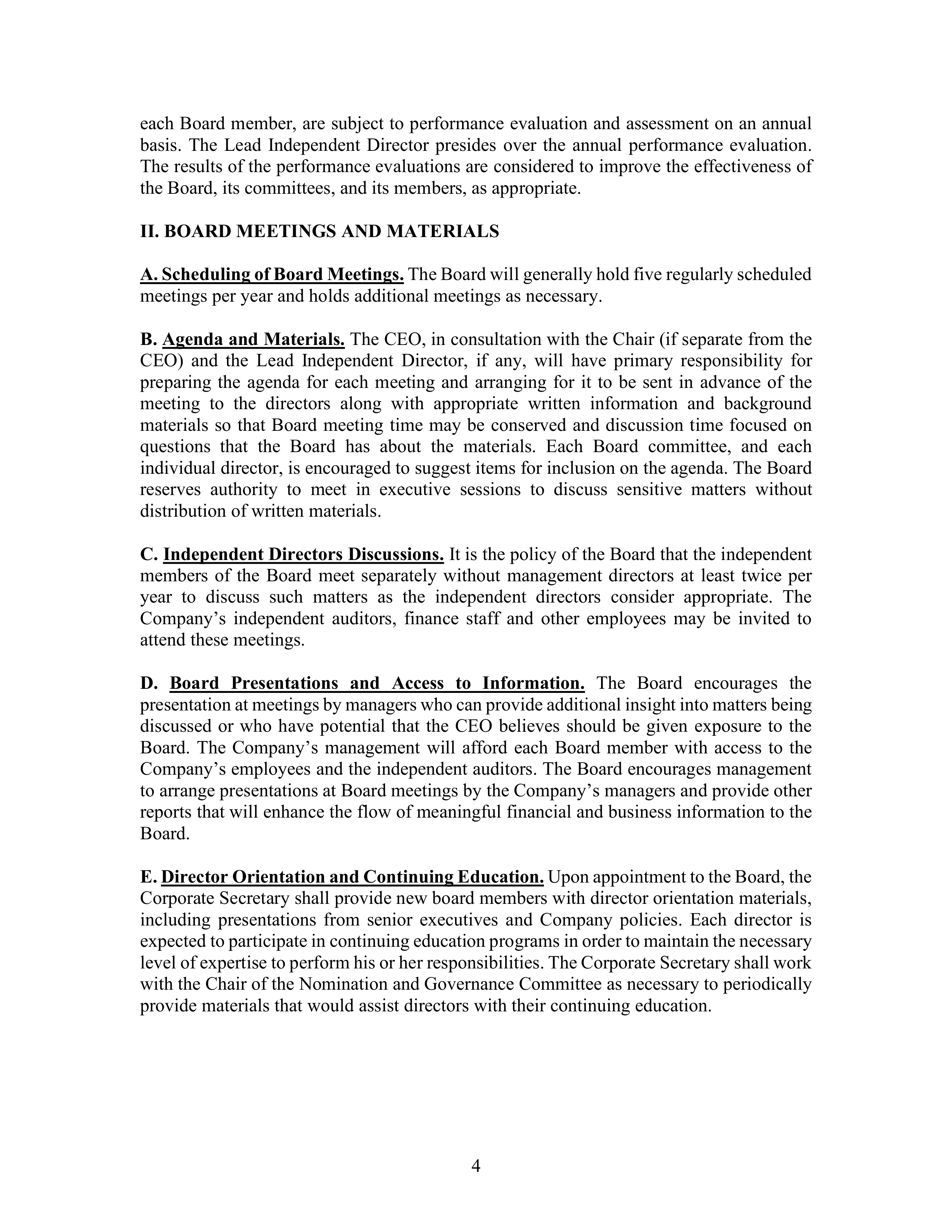
4
each Board member, are subject to performance evaluation and assessment on an annual
basis. The Lead Independent Director presides over the annual performance evaluation.
The results of the performance evaluations are considered to improve the effectiveness of
the Board, its committees, and its members, as appropriate.
II. BOARD MEETINGS AND MATERIALS
A. Scheduling of Board Meetings.
The Board will generally hold five regularly scheduled
meetings per year and holds additional meetings as necessary.
B. Agenda and Materials.
The CEO, in consultation with the Chair (if separate from the
CEO) and the Lead Independent Director, if any, will have primary responsibility for
preparing the agenda for each meeting and arranging for it to be sent in advance of the
meeting to the directors along with appropriate written information and background
materials so that Board meeting time may be conserved and discussion time focused on
questions that the Board has about the materials. Each Board committee, and each
individual director, is encouraged to suggest items for inclusion on the agenda. The Board
reserves authority to meet in executive sessions to discuss sensitive matters without
distribution of written materials.
C. Independent Directors Discussions.
It is the policy of the Board that the independent
members of the Board meet separately without management directors at least twice per
year to discuss such matters as the independent directors consider appropriate. The
Company’s independent auditors, finance staff and other employees may be invited to
attend these meetings.
D. Board Presentations and Access to Information.
The Board encourages the
presentation at meetings by managers who can provide additional insight into matters being
discussed or who have potential that the CEO believes should be given exposure to the
Board. The Company’s management will afford each Board member with access to the
Company’s employees and the independent auditors. The Board encourages management
to arrange presentations at Board meetings by the Company’s managers and provide other
reports that will enhance the flow of meaningful financial and business information to the
Board.
E. Director Orientation and Continuing Education.
Upon appointment to the Board, the
Corporate Secretary shall provide new board members with director orientation materials,
including presentations from senior executives and Company policies. Each director is
expected to participate in continuing education programs in order to maintain the necessary
level of expertise to perform his or her responsibilities. The Corporate Secretary shall work
with the Chair of the Nomination and Governance Committee as necessary to periodically
provide materials that would assist directors with their continuing education.
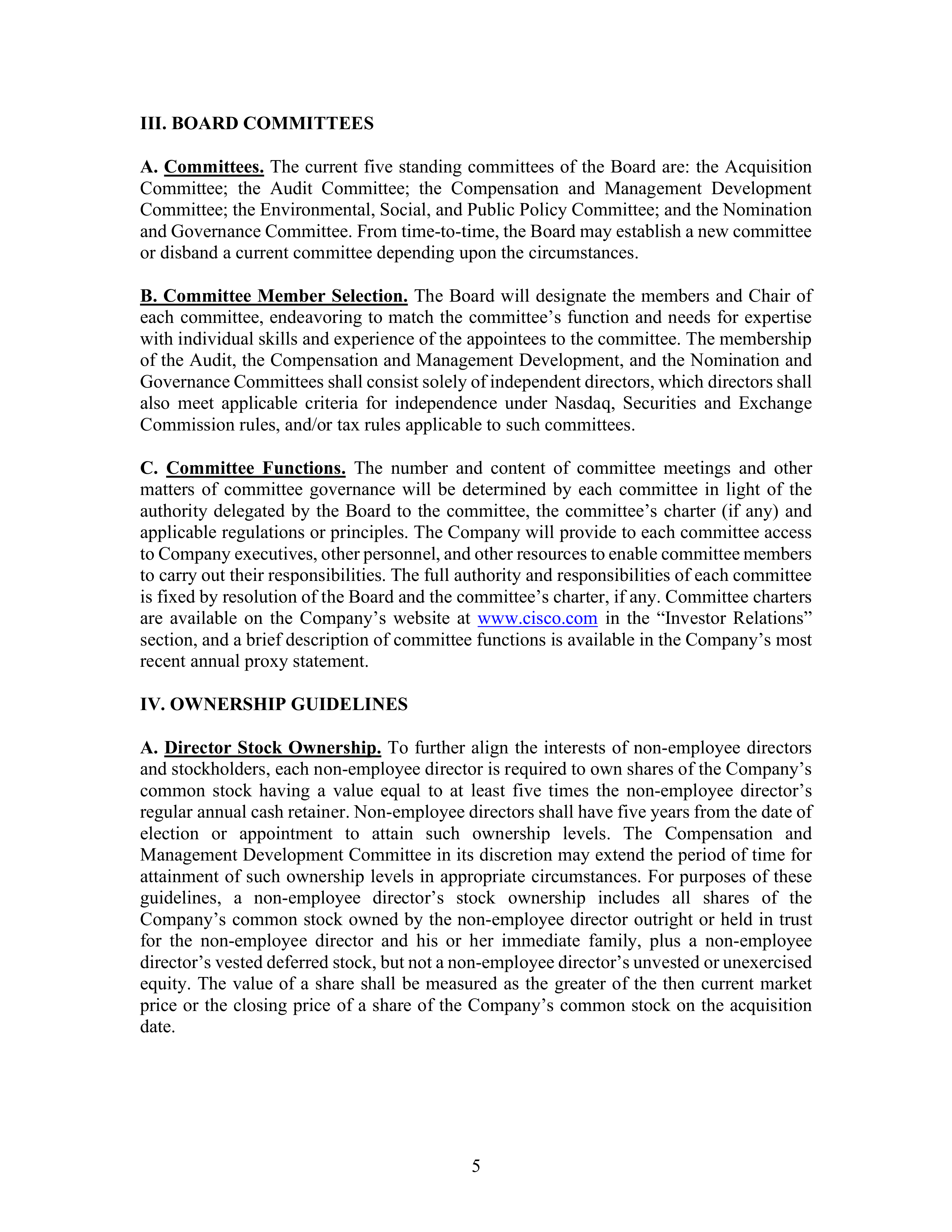
5
III. BOARD COMMITTEES
A. Committees.
The current five standing committees of the Board are: the Acquisition
Committee; the Audit Committee; the Compensation and Management Development
Committee; the Environmental, Social, and Public Policy Committee; and the Nomination
and Governance Committee. From time-to-time, the Board may establish a new committee
or disband a current committee depending upon the circumstances.
B. Committee Member Selection.
The Board will designate the members and Chair of
each committee, endeavoring to match the committee’s function and needs for expertise
with individual skills and experience of the appointees to the committee. The membership
of the Audit, the Compensation and Management Development, and the Nomination and
Governance Committees shall consist solely of independent directors, which directors shall
also meet applicable criteria for independence under Nasdaq, Securities and Exchange
Commission rules, and/or tax rules applicable to such committees.
C. Committee Functions.
The number and content of committee meetings and other
matters of committee governance will be determined by each committee in light of the
authority delegated by the Board to the committee, the committee’s charter (if any) and
applicable regulations or principles. The Company will provide to each committee access
to Company executives, other personnel, and other resources to enable committee members
to carry out their responsibilities. The full authority and responsibilities of each committee
is fixed by resolution of the Board and the committee’s charter, if any. Committee charters
are available on the Company’s website at
www.cisco.com
in the “Investor Relations”
section, and a brief description of committee functions is available in the Company’s most
recent annual proxy statement.
IV. OWNERSHIP GUIDELINES
A. Director Stock Ownership.
To further align the interests of non-employee directors
and stockholders, each non-employee director is required to own shares of the Company’s
common stock having a value equal to at least five times the non-employee director’s
regular annual cash retainer. Non-employee directors shall have five years from the date of
election or appointment to attain such ownership levels. The Compensation and
Management Development Committee in its discretion may extend the period of time for
attainment of such ownership levels in appropriate circumstances. For purposes of these
guidelines, a non-employee director’s stock ownership includes all shares of the
Company’s common stock owned by the non-employee director outright or held in trust
for the non-employee director and his or her immediate family, plus a non-employee
director’s vested deferred stock, but not a non-employee director’s unvested or unexercised
equity. The value of a share shall be measured as the greater of the then current market
price or the closing price of a share of the Company’s common stock on the acquisition
date.

6
B. Executive Stock Ownership.
To further align the interests of the Company’s
“executive officers” (within the meaning of Rule 3b-7 under the Securities and Exchange
Act of 1934, as amended, the “Executive Officers”), and stockholders, the CEO is required
to own shares of the Company’s common stock having a value equal to at least six times
the CEO’s base salary, and each other Executive Officer is required to own shares of the
Company’s common stock having a value equal to at least four times the Executive
Officer’s base salary. The CEO and each other Executive Officer shall have five years from
the date of their respective appointment (or the later of six years from the date of their
respective appointment or August 1, 2020 for Executive Officers in those positions as of
August 1, 2019) to attain such ownership levels. The Compensation and Management
Development Committee in its discretion may extend the period of time for attainment of
such ownership levels in appropriate circumstances. For purposes of these guidelines, an
Executive Officer’s stock ownership includes all shares of the Company’s common stock
owned by the Executive Officer outright or held in trust for the Executive Officer and his
or her immediate family, plus the Executive Officer’s vested deferred stock and allocated
shares of the Company’s common stock in employee plans, but not the Executive Officer’s
unvested or unexercised equity. The value of a share shall be measured as the greater of
the then current market price or the closing price of a share of the Company’s common
stock on the acquisition date.
V. MANAGEMENT RESPONSIBILITIES
A. Management Succession and Development Planning.
The CEO will review with the
Board succession and development plans for senior executive officers. The Board may,
from time-to-time, request the Compensation and Management Development Committee
to undertake specific reviews concerning management succession planning.
B. Financial Reporting, Legal Compliance and Ethical Conduct.
The Board’s
governance and oversight functions do not relieve the Company’s management of the
primary responsibility for preparing financial statements which accurately and fairly
present the Company’s financial results and condition. The Company’s management shall
maintain systems, procedures and a corporate culture that promote compliance with legal
and regulatory requirements and the ethical conduct of the Company’s business.
C. Corporate Communications.
The Board believes that the Company’s management has
the primary responsibility to communicate with investors, the press, employees and other
constituencies that are involved with the Company, and to set policies for those
communications.
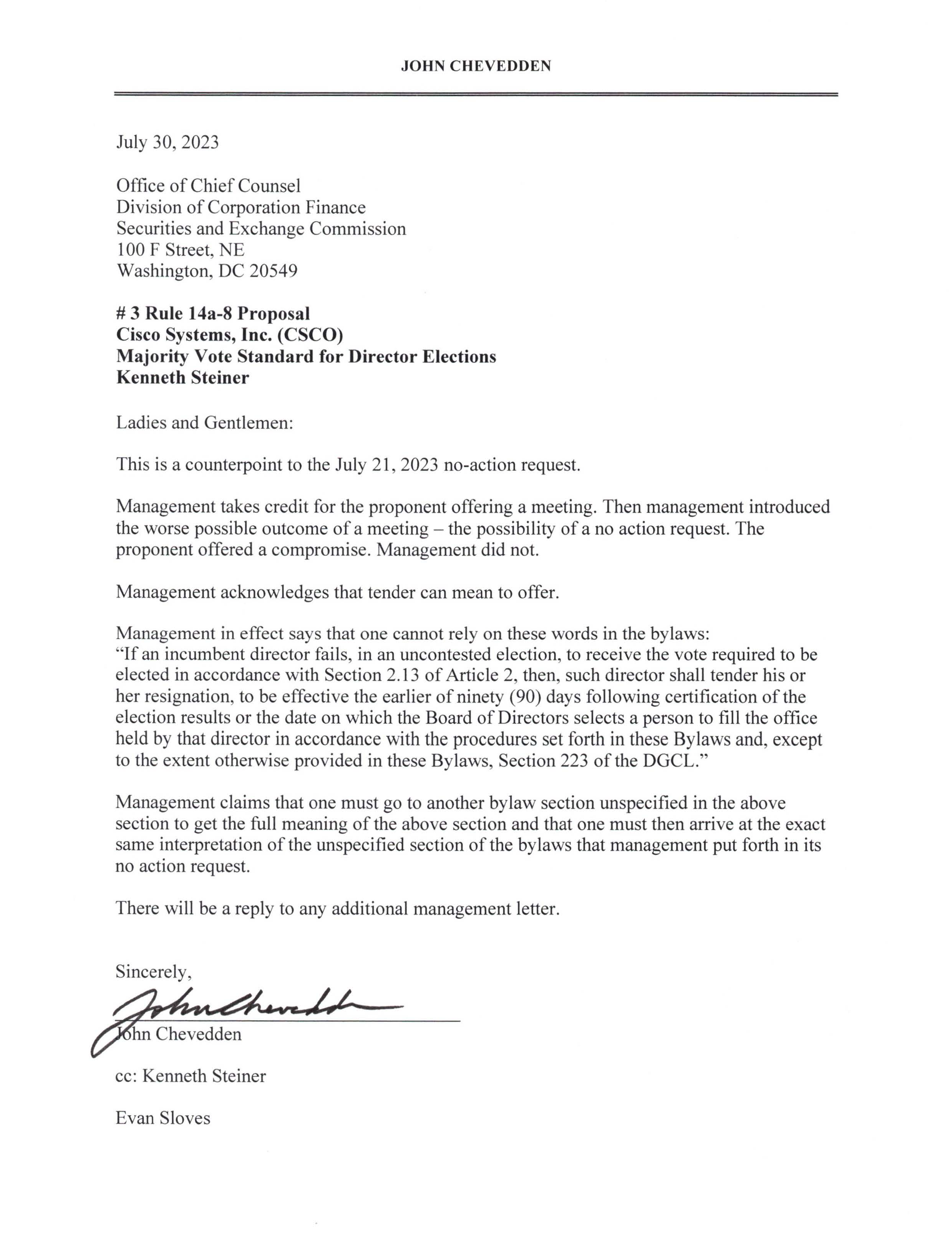
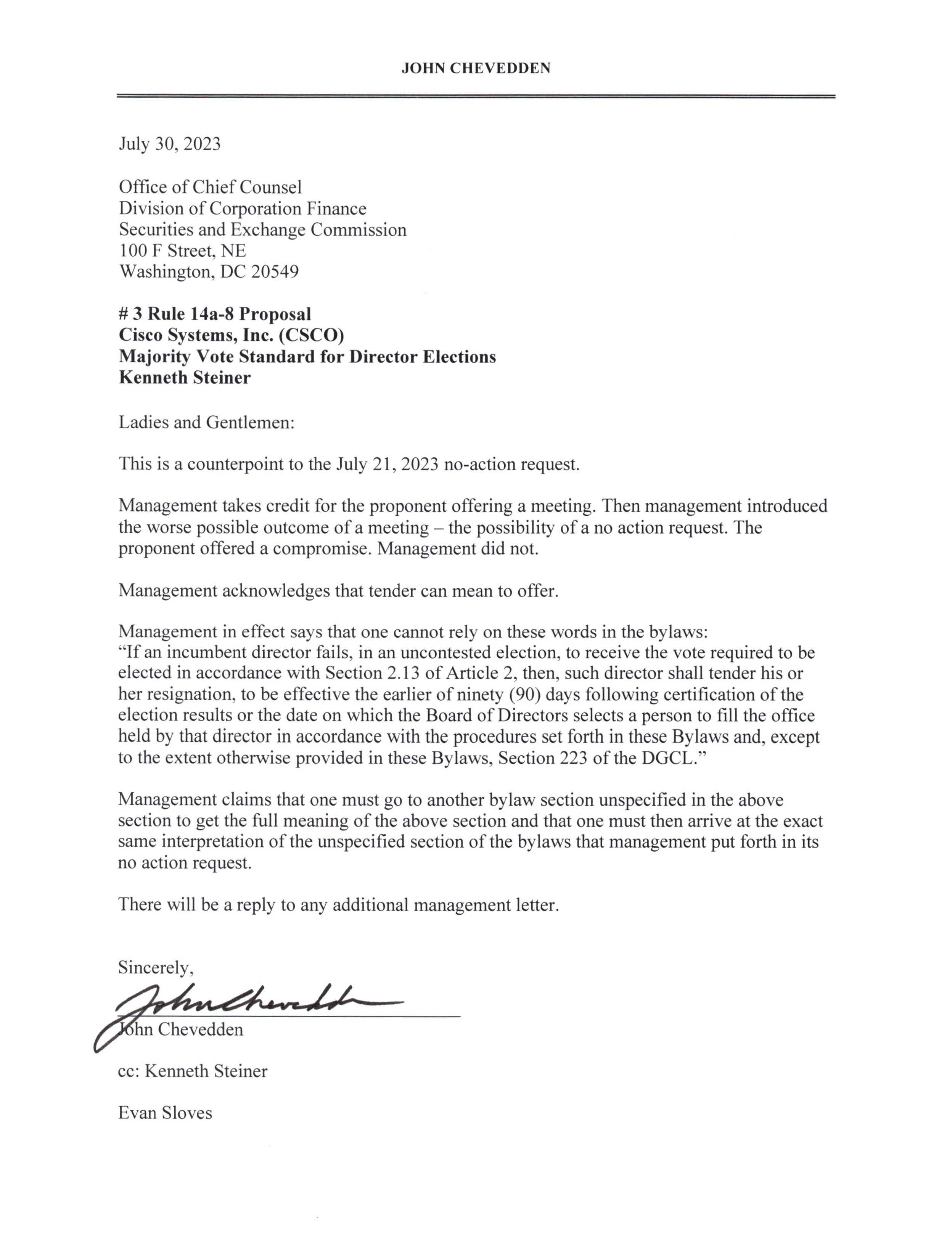
JOHN
CHEVEDDEN
July 30, 2023
Office
of
Chief Counsel
Division
of
Corporation Finance
Securities and Exchange Commission
100 F Street, NE
Washington, DC 20549
#
3 Rule 14a-8 Proposal
Cisco Systems, Inc. (CSCO)
Majority Vote Standard for Director Elections
Kenneth Steiner
Ladies and Gentlemen:
This is a counterpoint to the July 21, 2023 no-action request.
Management takes credit for the proponent offering a meeting. Then management introduced
the worse possible outcome
of
a meeting -
the possibility
of
a no action request. The
proponent offered a compromise. Management did not.
Management acknowledges that tender can mean to offer.
Management
in
effect says that one cannot rely on these words
in
the bylaws:
"If
an incumbent director fails, in an uncontested election, to receive the vote required to
be
elected in accordance with Section 2.13
of
Article 2, then, such director shall tender his or
her resignation, to be effective the earlier
of
ninety (90) days following certification
of
the
election results or the date on which the Board
of
Directors selects a person to fill the office
held
by
that director in accordance with the procedures set forth in these Bylaws and, except
to the extent otherwise provided in these Bylaws, Section 223
of
the DGCL."
Management claims that one must go to another bylaw section unspecified in the above
section to get the full meaning
of
the above section and that one must then arrive at the exact
same interpretation
of
the unspecified section
of
the
by
laws that management put forth in its
no action request.
There will be a reply to any additional management letter.
Sincerely,
~~
hnChevedden
cc: Kenneth Steiner
Evan Sloves