May 12, 2026
Mary Hunter
NIKE, Inc.
Re:
NIKE, Inc. (the “Company”)
Incoming Letter dated April 22, 2026
Dear Mary Hunter:
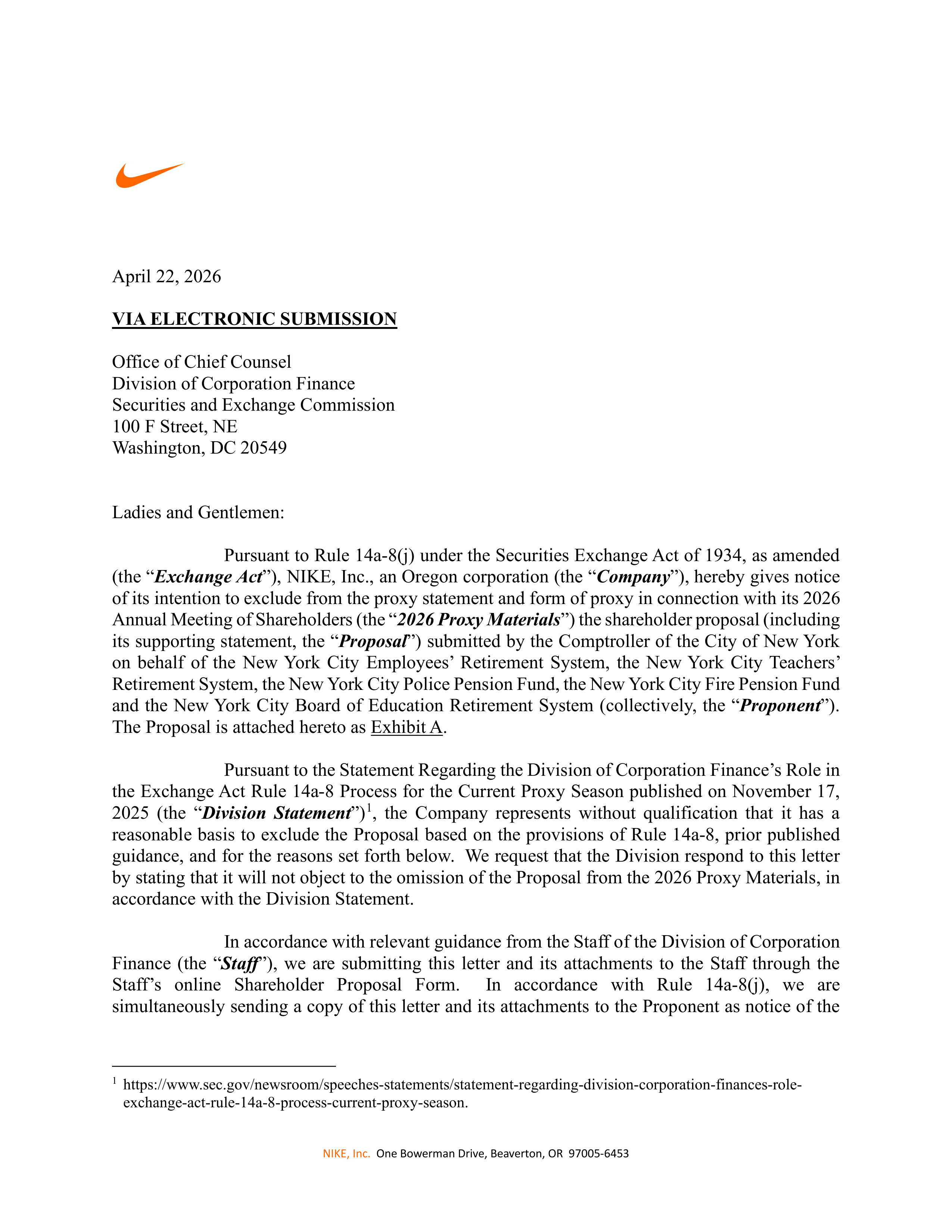
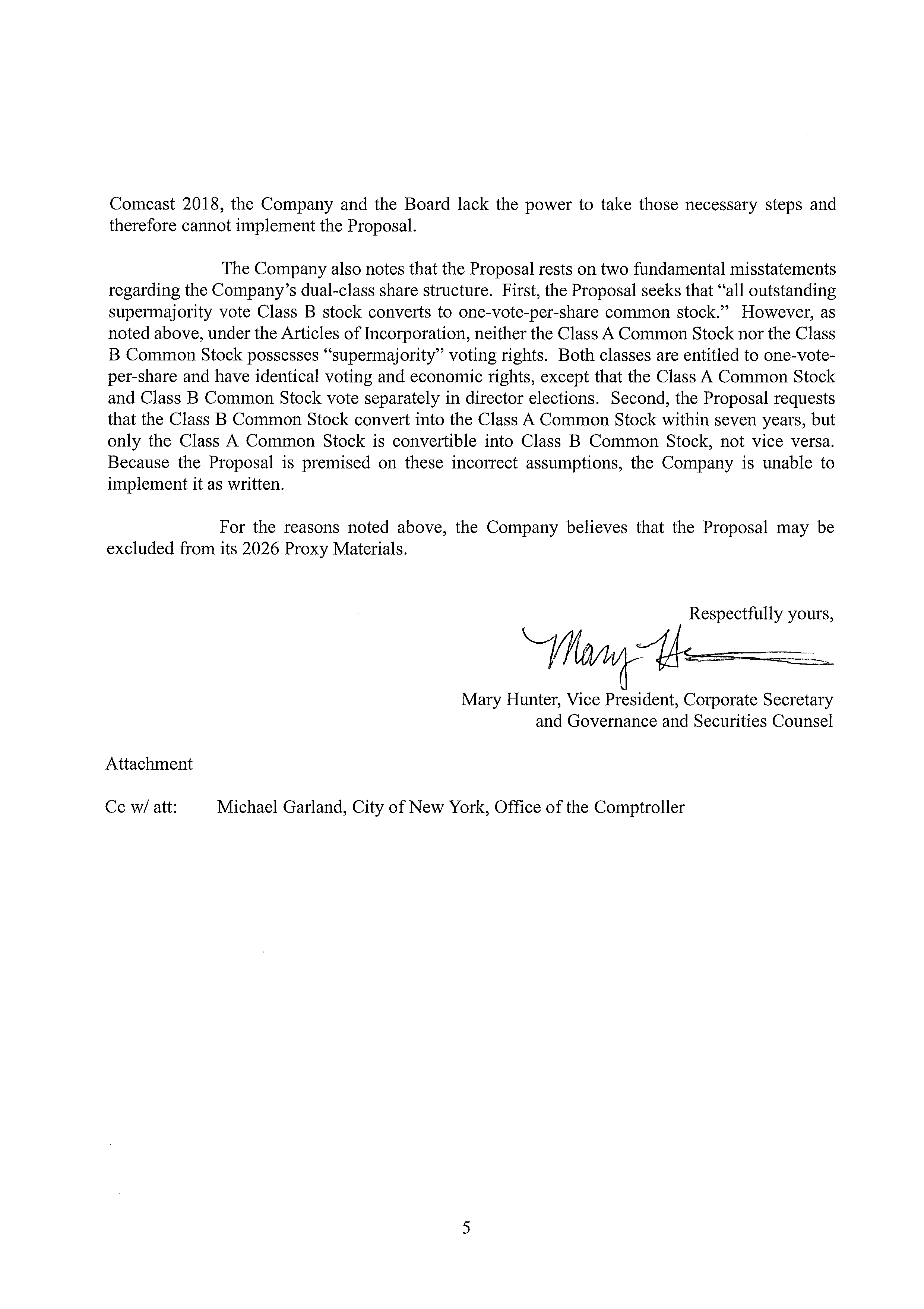
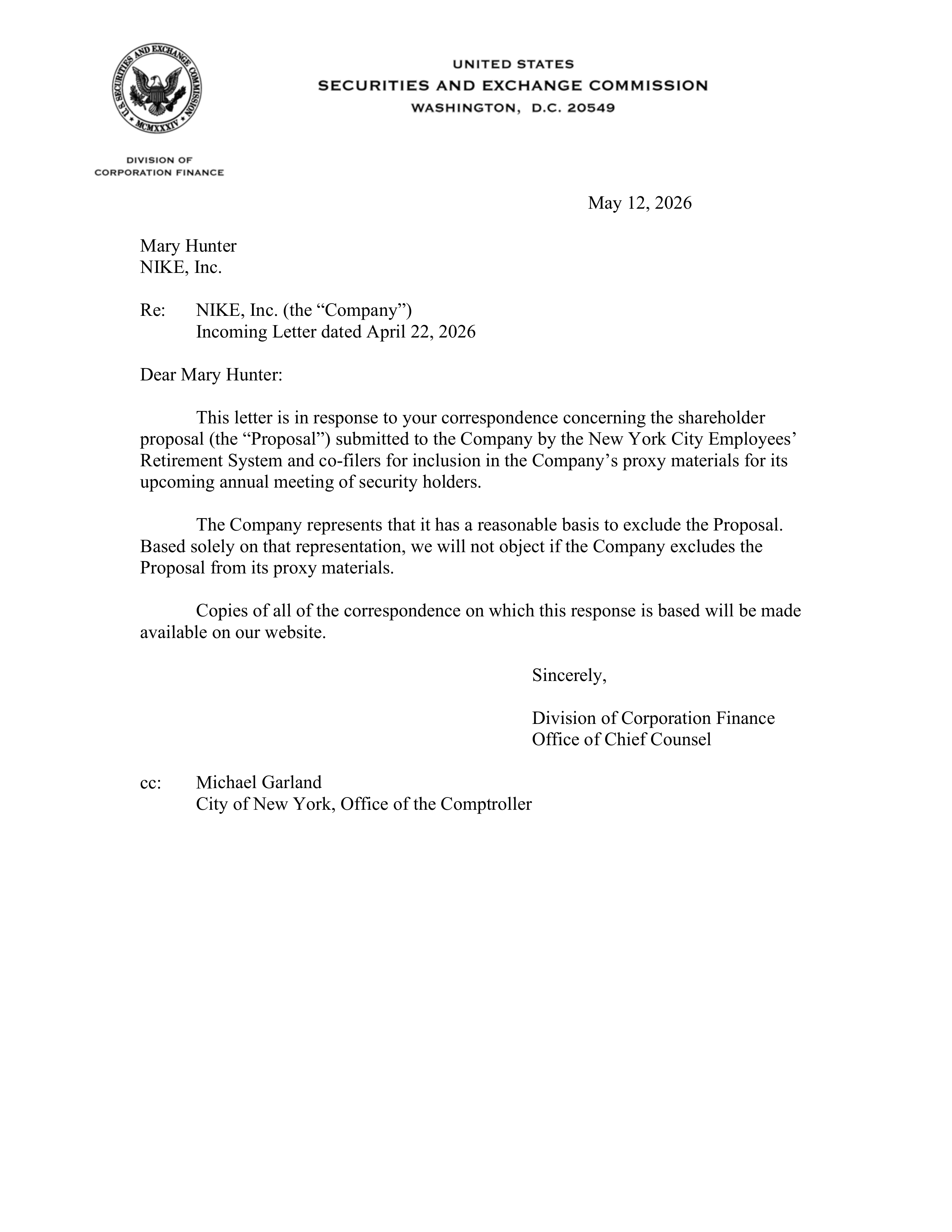
This letter is in response to your correspondence concerning the shareholder
proposal (the “Proposal”) submitted to the Company by the New York City Employees’
Retirement System and co-filers for inclusion in the Company’s proxy materials for its
upcoming annual meeting of security holders.
The Company represents that it has a reasonable basis to exclude the Proposal.
Based solely on that representation, we will not object if the Company excludes the
Proposal from its proxy materials.
Copies of all of the correspondence on which this response is based will be made
available on our website.
Sincerely,
Division of Corporation Finance
Office of Chief Counsel
cc:
Michael Garland
City of New York, Office of the Comptroller
NIKE, Inc.
One Bowerman Drive, Beaverton, OR 97005-6453
~
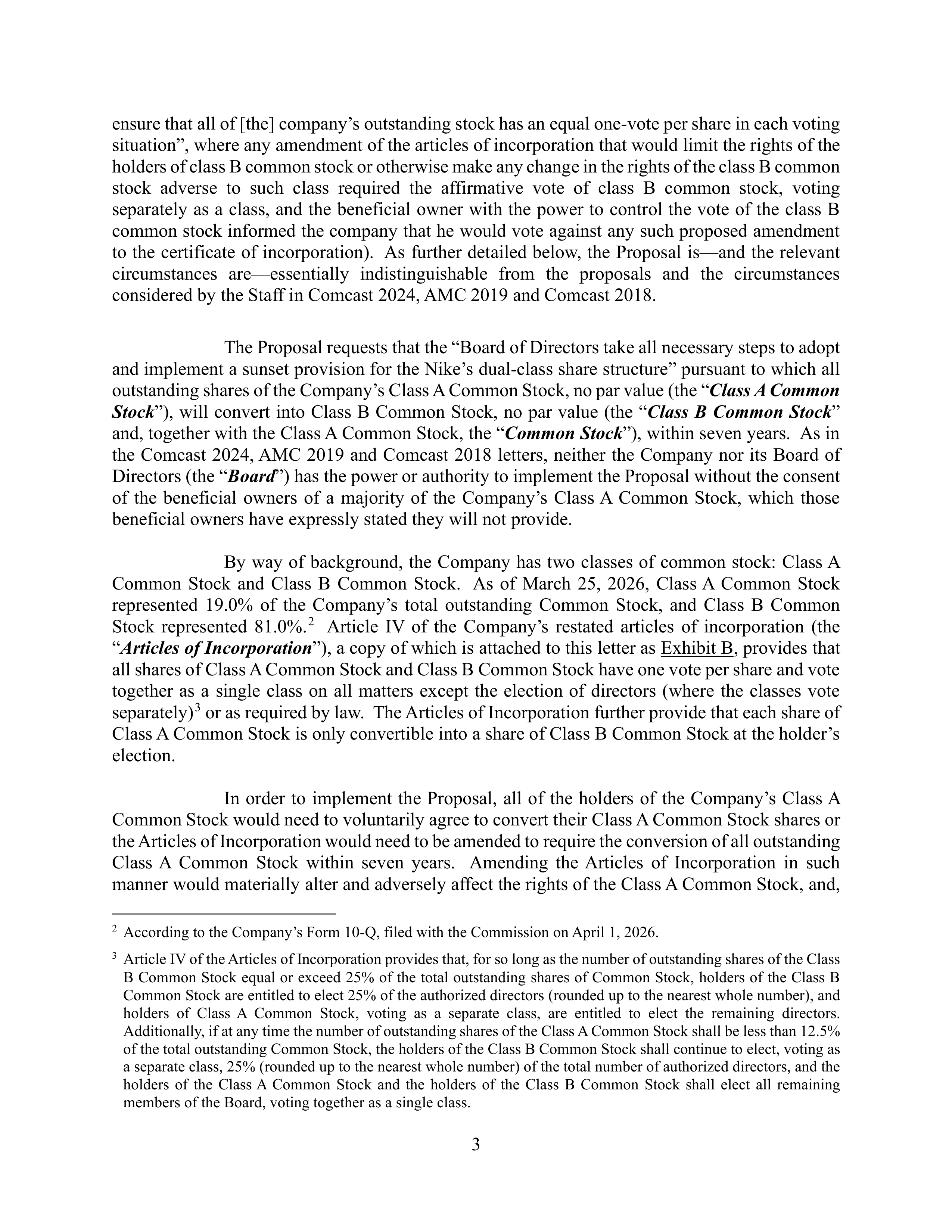
April 22, 2026
VIA ELECTRONIC SUBMISSION
Office of Chief Counsel
Division of Corporation Finance
Securities and Exchange Commission
100 F Street, NE
Washington, DC 20549
Ladies and Gentlemen:
Pursuant to Rule 14a-8(j) under the Securities Exchange Act of 1934, as amended
(the “
Exchange Act
”), NIKE, Inc., an Oregon corporation (the “
Company
”), hereby gives notice
of its intention to exclude from the proxy statement and form of proxy in connection with its 2026
Annual Meeting of Shareholders (the “
2026 Proxy Materials
”) the shareholder proposal (including
its supporting statement, the “
Proposal
”) submitted by the Comptroller of the City of New York
on behalf of the New York City Employees’ Retirement System, the New York City Teachers’
Retirement System, the New York City Police Pension Fund, the New York City Fire Pension Fund
and the New York City Board of Education Retirement System (collectively, the “
Proponent
”).
The Proposal is attached hereto as Exhibit A.
Pursuant to the Statement Regarding the Division of Corporation Finance’s Role in
the Exchange Act Rule 14a-8 Process for the Current Proxy Season published on November 17,
2025 (the “
Division Statement
”)
1
, the Company represents without qualification that it has a
reasonable basis to exclude the Proposal based on the provisions of Rule 14a-8, prior published
guidance, and for the reasons set forth below. We request that the Division respond to this letter
by stating that it will not object to the omission of the Proposal from the 2026 Proxy Materials, in
accordance with the Division Statement.
In accordance with relevant guidance from the Staff of the Division of Corporation
Finance (the “
Staff
”), we are submitting this letter and its attachments to the Staff through the
Staff’s online Shareholder Proposal Form. In accordance with Rule 14a-8(j), we are
simultaneously sending a copy of this letter and its attachments to the Proponent as notice of the
1
https://www.sec.gov/newsroom/speeches-statements/statement-regarding-division-corporation-finances-role-
exchange-act-rule-14a-8-process-current-proxy-season.
2
Company’s intent to omit the Proposal from the 2026 Proxy Materials. This letter constitutes the
Company’s statement of the reasons it deems the omission of the Proposal to be proper.
THE PROPOSAL
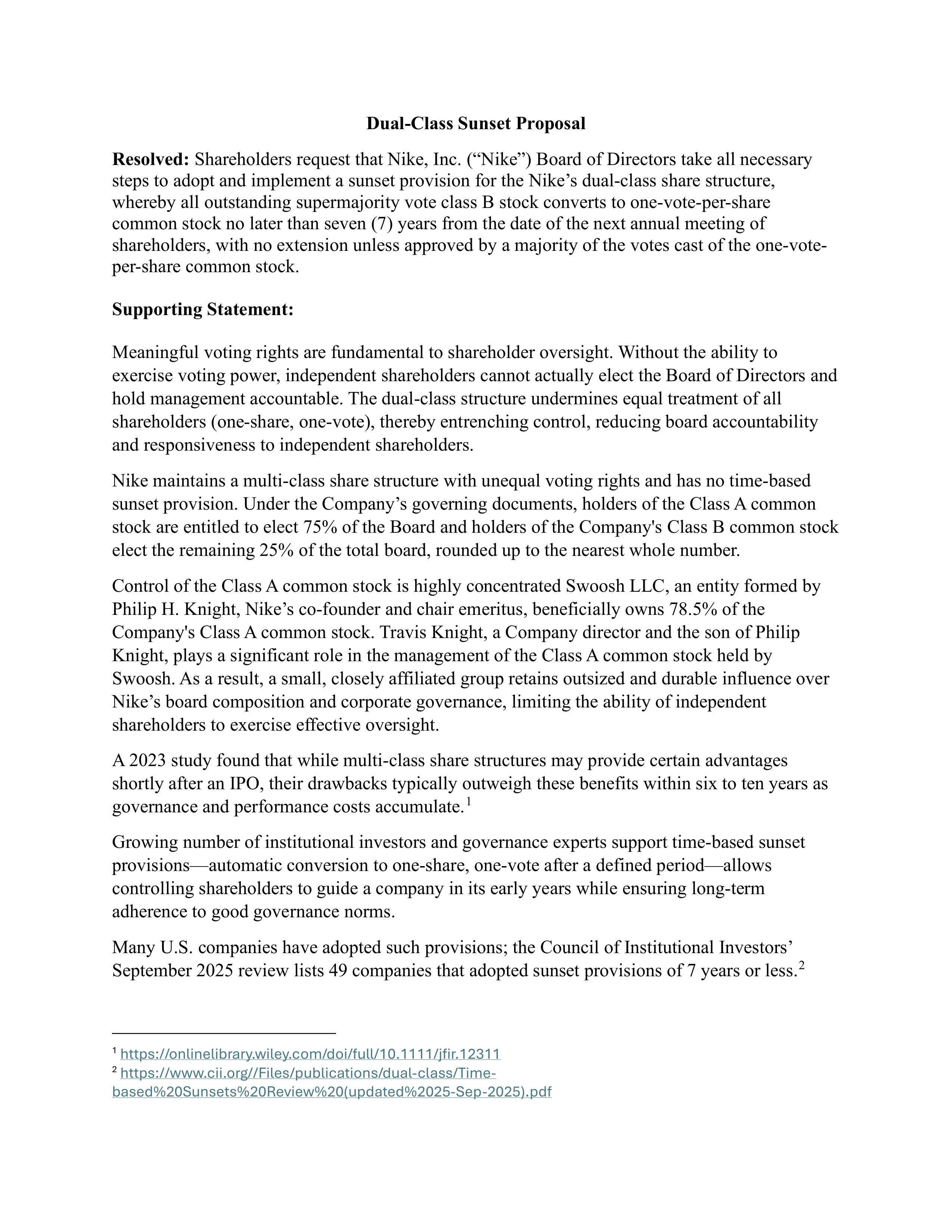
The Proposal states:
RESOLVED:
Shareholders request that Nike, Inc. (“Nike”) Board
of Directors take all necessary steps to adopt and implement a sunset provision for
the Nike’s dual-class share structure, whereby all outstanding supermajority vote
class B stock converts to one-vote-per-share common stock no later than seven (7)
years from the date of the next annual meeting of shareholders, with no extension
unless approved by a majority of the votes cast of the one-vote-per-share common
stock.
BASIS FOR EXCLUSION
The Proposal May Be Excluded Under Rule 14a-8(i)(6) Because the Company
Lacks the Power or Authority to Implement the Proposal
The Company believes it may omit the Proposal pursuant to Rule 14a-8(i)(6)
because the Company lacks the power or authority to implement the Proposal.
Rule 14a-8(i)(6) permits a company to exclude a stockholder proposal “if the
company would lack the power or authority to implement the proposal.” The Staff has consistently
permitted exclusion under Rule 14a-8(i)(6) of proposals that are substantially similar to the
Proposal in cases where the proposal’s implementation would require the approval of a beneficial
owner who has the power to control the vote on such proposal, but has indicated they will not do
so. For example, in
Comcast Corp.
(Apr. 16, 2024) (“
Comcast 2024
”), the Staff permitted
exclusion of a proposal requesting that the board of directors “take the necessary steps in the
direction of transitioning so that all of [the] company’s outstanding stock has an equal one vote-
per-share in each voting situation” pursuant to Rule 14a-8(i)(6) because any amendment to the
company’s articles of incorporation that would limit or otherwise adversely affect the rights of the
holders of the company’s class B common stock required the approval of the holders of class B
common stock, voting separately as a class, and the company’s chairman and chief executive
officer, who controlled the vote of the class B common stock, had informed the company that he
would vote against any amendment to the articles submitted in response to the proposal.
See
also
,
AMC Networks Inc
. (April 23, 2019) (“
AMC 2019
”) (permitting exclusion under Rule14a-8(i)(6)
of a proposal that requested the board “take steps to ensure that all of [the] company’s outstanding
stock has an equal one-vote per share in each voting situation” where any amendment of the
company’s certificate of incorporation that would adversely affect the powers, preferences or rights
of the class B common stock required the affirmative vote of the outstanding class B common
stock, voting separately as a class, and beneficial owners with the power to control the vote of the
class B common stock informed the company that they would vote against any such proposed
amendment to the certificate of incorporation);
Comcast Corp
. (Mar. 13, 2018) (“
Comcast 2018
”)
(permitting exclusion under Rule 14a-8(i)(6) of a proposal that requested the board “take steps to
3
ensure that all of [the] company’s outstanding stock has an equal one-vote per share in each voting
situation”, where any amendment of the articles of incorporation that would limit the rights of the
holders of class B common stock or otherwise make any change in the rights of the class B common
stock adverse to such class required the affirmative vote of class B common stock, voting
separately as a class, and the beneficial owner with the power to control the vote of the class B
common stock informed the company that he would vote against any such proposed amendment
to the certificate of incorporation). As further detailed below, the Proposal is—and the relevant
circumstances are—essentially indistinguishable from the proposals and the circumstances
considered by the Staff in Comcast 2024, AMC 2019 and Comcast 2018.
The Proposal requests that the “Board of Directors take all necessary steps to adopt
and implement a sunset provision for the Nike’s dual-class share structure” pursuant to which all
outstanding shares of the Company’s Class A Common Stock, no par value (the “
Class A Common
Stock
”), will convert into Class B Common Stock, no par value (the “
Class B Common Stock
”
and, together with the Class A Common Stock, the “
Common Stock
”), within seven years. As in
the Comcast 2024, AMC 2019 and Comcast 2018 letters, neither the Company nor its Board of
Directors (the “
Board
”) has the power or authority to implement the Proposal without the consent
of the beneficial owners of a majority of the Company’s Class A Common Stock, which those
beneficial owners have expressly stated they will not provide.
By way of background, the Company has two classes of common stock: Class A
Common Stock and Class B Common Stock. As of March 25, 2026, Class A Common Stock
represented 19.0% of the Company’s total outstanding Common Stock, and Class B Common
Stock represented 81.0%.
2
Article IV of the Company’s restated articles of incorporation (the
“
Articles of Incorporation
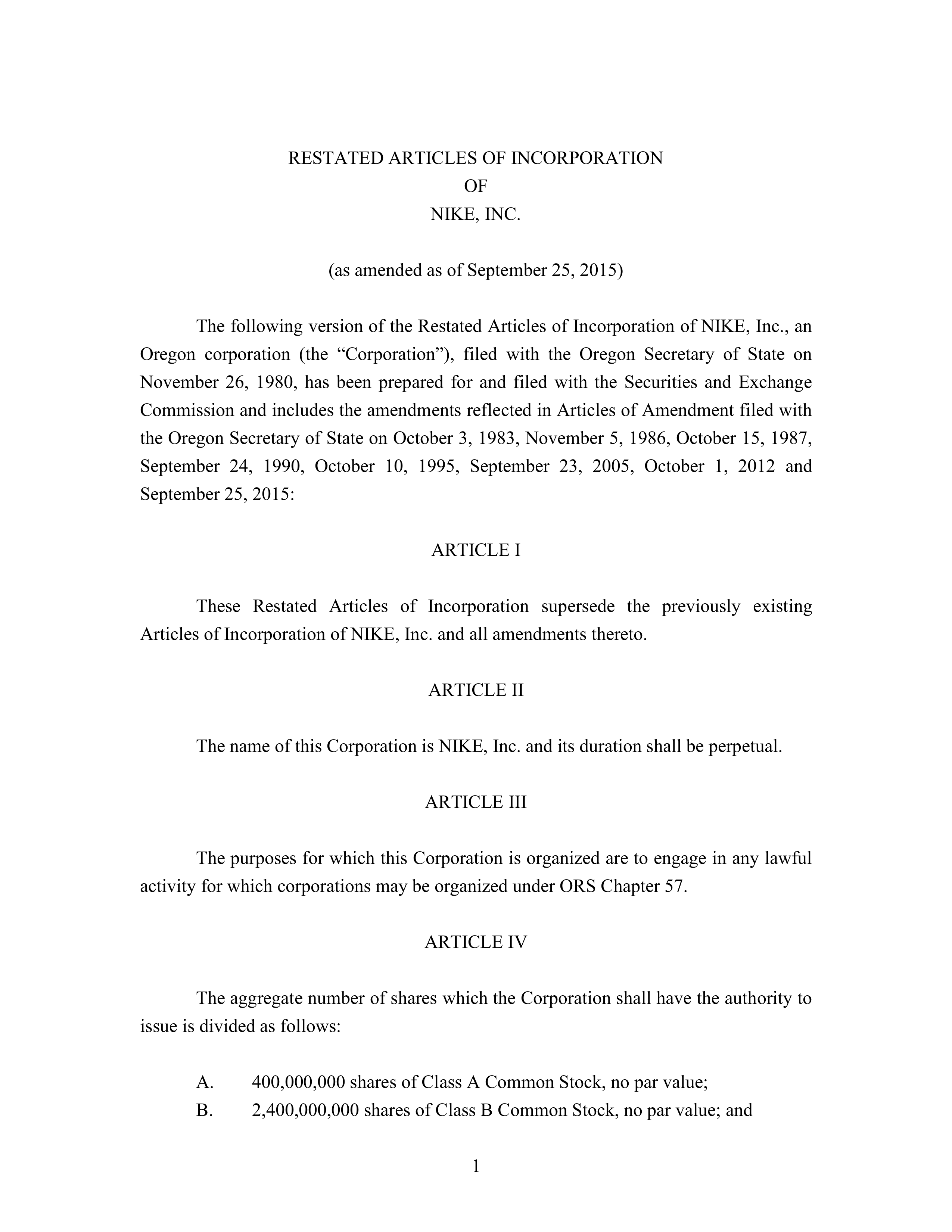
”), a copy of which is attached to this letter as Exhibit B, provides that
all shares of Class A Common Stock and Class B Common Stock have one vote per share and vote
together as a single class on all matters except the election of directors (where the classes vote
separately)
3
or as required by law. The Articles of Incorporation further provide that each share of
Class A Common Stock is only convertible into a share of Class B Common Stock at the holder’s
election.
In order to implement the Proposal, all of the holders of the Company’s Class A
Common Stock would need to voluntarily agree to convert their Class A Common Stock shares or
the Articles of Incorporation would need to be amended to require the conversion of all outstanding
Class A Common Stock within seven years. Amending the Articles of Incorporation in such
manner would materially alter and adversely affect the rights of the Class A Common Stock, and,
2
According to the Company’s Form 10-Q, filed with the Commission on April 1, 2026.
3
Article IV of the Articles of Incorporation provides that, for so long as the number of outstanding shares of the Class
B Common Stock equal or exceed 25% of the total outstanding shares of Common Stock, holders of the Class B
Common Stock are entitled to elect 25% of the authorized directors (rounded up to the nearest whole number), and
holders of Class A Common Stock, voting as a separate class, are entitled to elect the remaining directors.
Additionally, if at any time the number of outstanding shares of the Class A Common Stock shall be less than 12.5%
of the total outstanding Common Stock, the holders of the Class B Common Stock shall continue to elect, voting as
a separate class, 25% (rounded up to the nearest whole number) of the total number of authorized directors, and the
holders of the Class A Common Stock and the holders of the Class B Common Stock shall elect all remaining
members of the Board, voting together as a single class.
4
accordingly, would require approval of a majority of the Class A Common Stock, voting as a
separate class, pursuant to Sections 60.437 and 60.441 of the Oregon Revised Statutes.
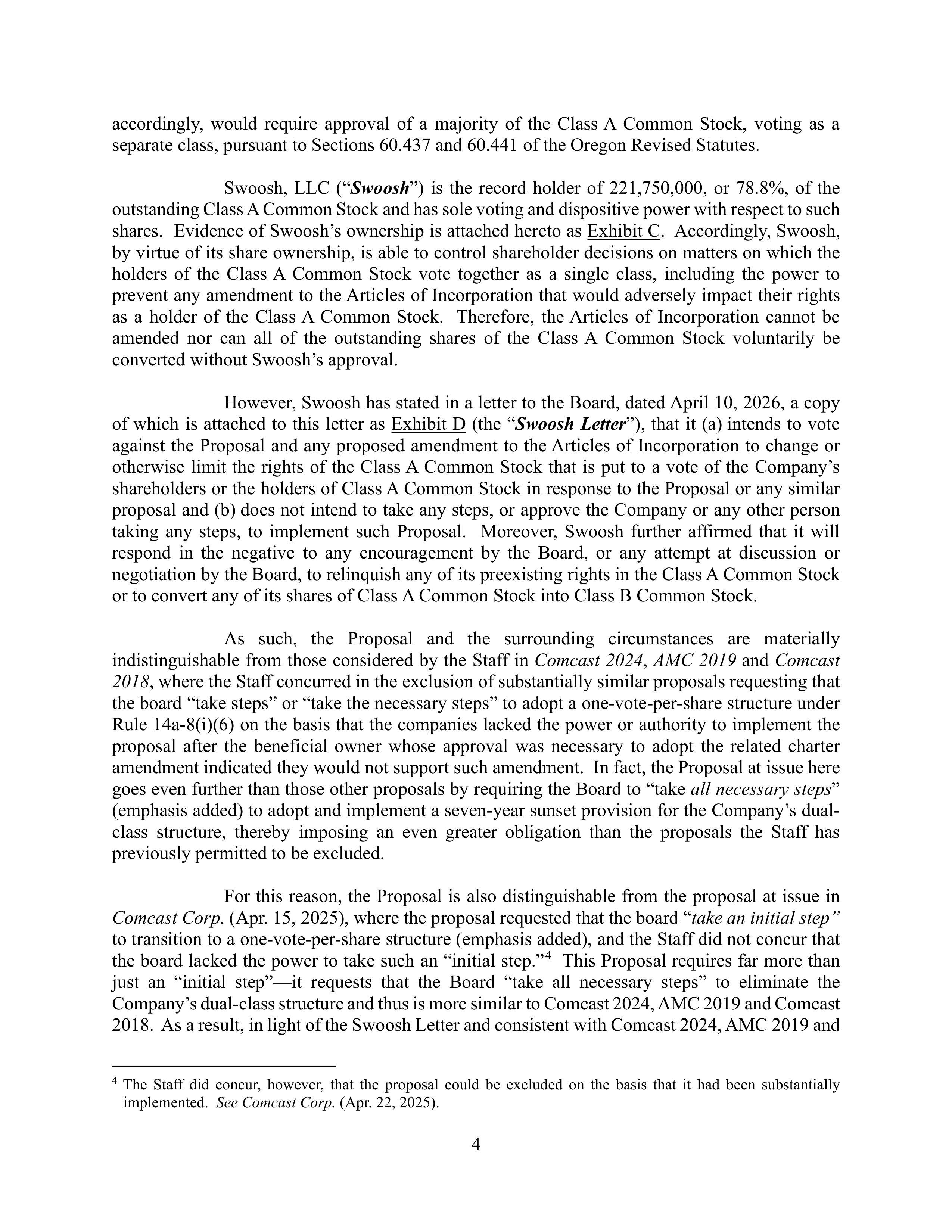
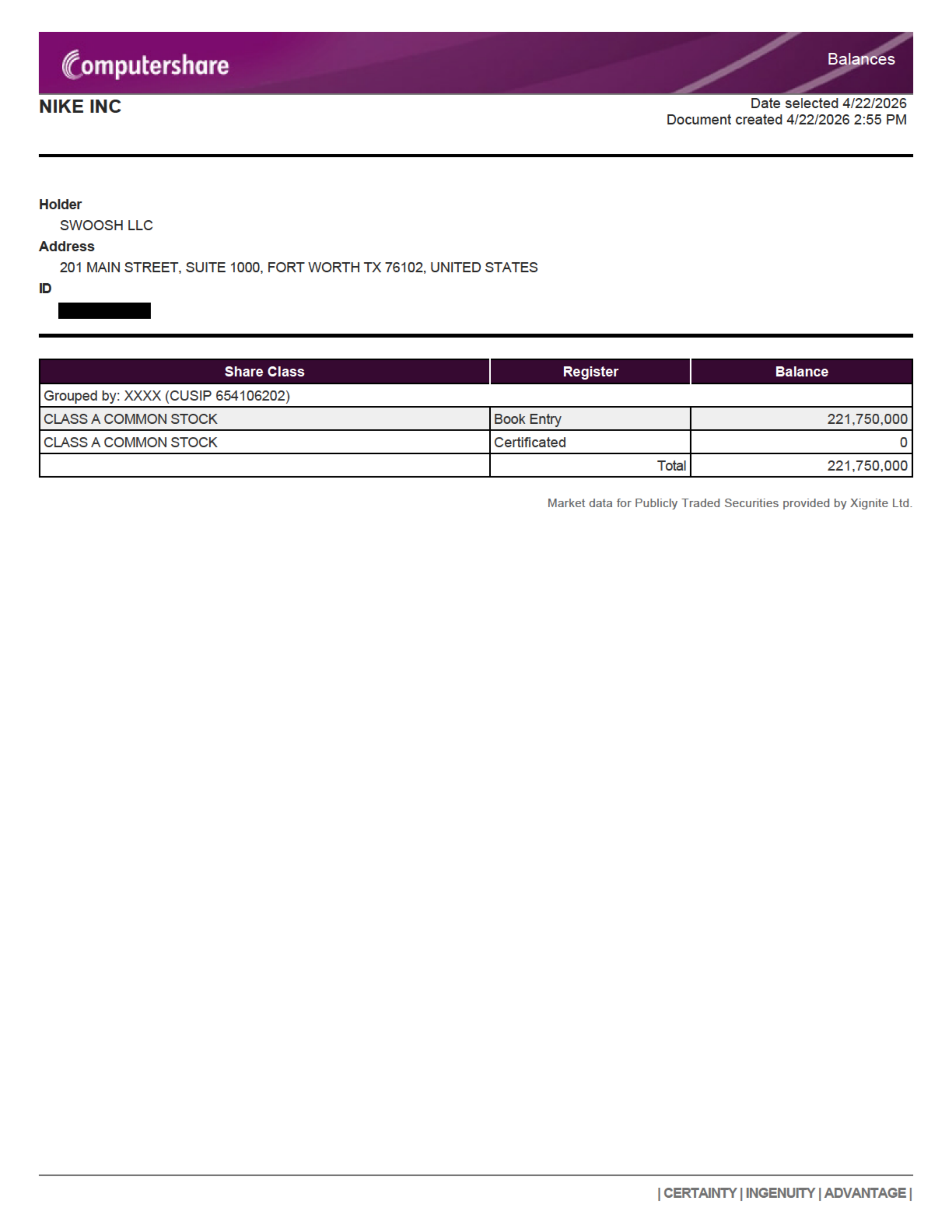
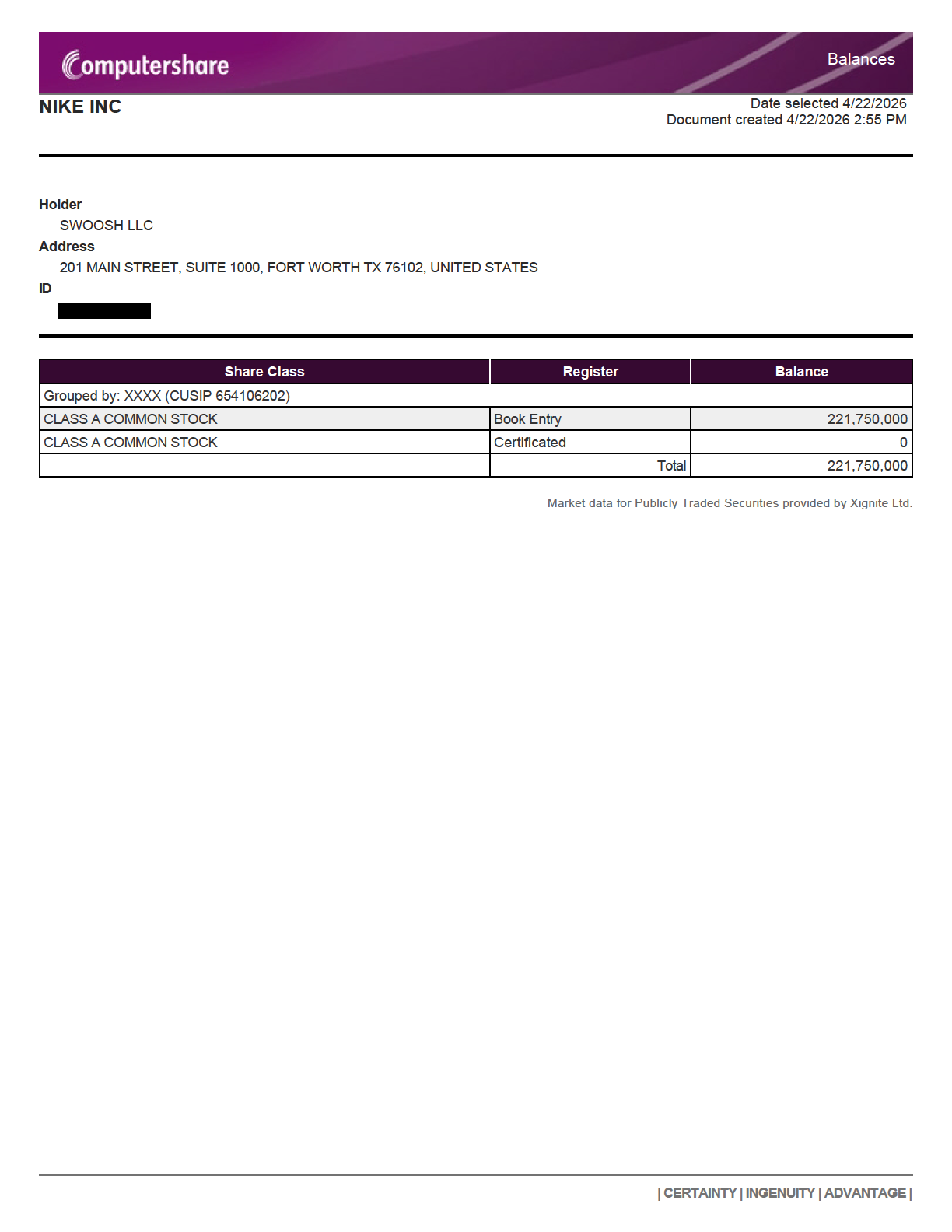
Swoosh, LLC (“
Swoosh
”) is the record holder of 221,750,000, or 78.8%, of the
outstanding Class A Common Stock and has sole voting and dispositive power with respect to such
shares. Evidence of Swoosh’s ownership is attached hereto as Exhibit C. Accordingly, Swoosh,
by virtue of its share ownership, is able to control shareholder decisions on matters on which the
holders of the Class A Common Stock vote together as a single class, including the power to
prevent any amendment to the Articles of Incorporation that would adversely impact their rights
as a holder of the Class A Common Stock. Therefore, the Articles of Incorporation cannot be
amended nor can all of the outstanding shares of the Class A Common Stock voluntarily be
converted without Swoosh’s approval.
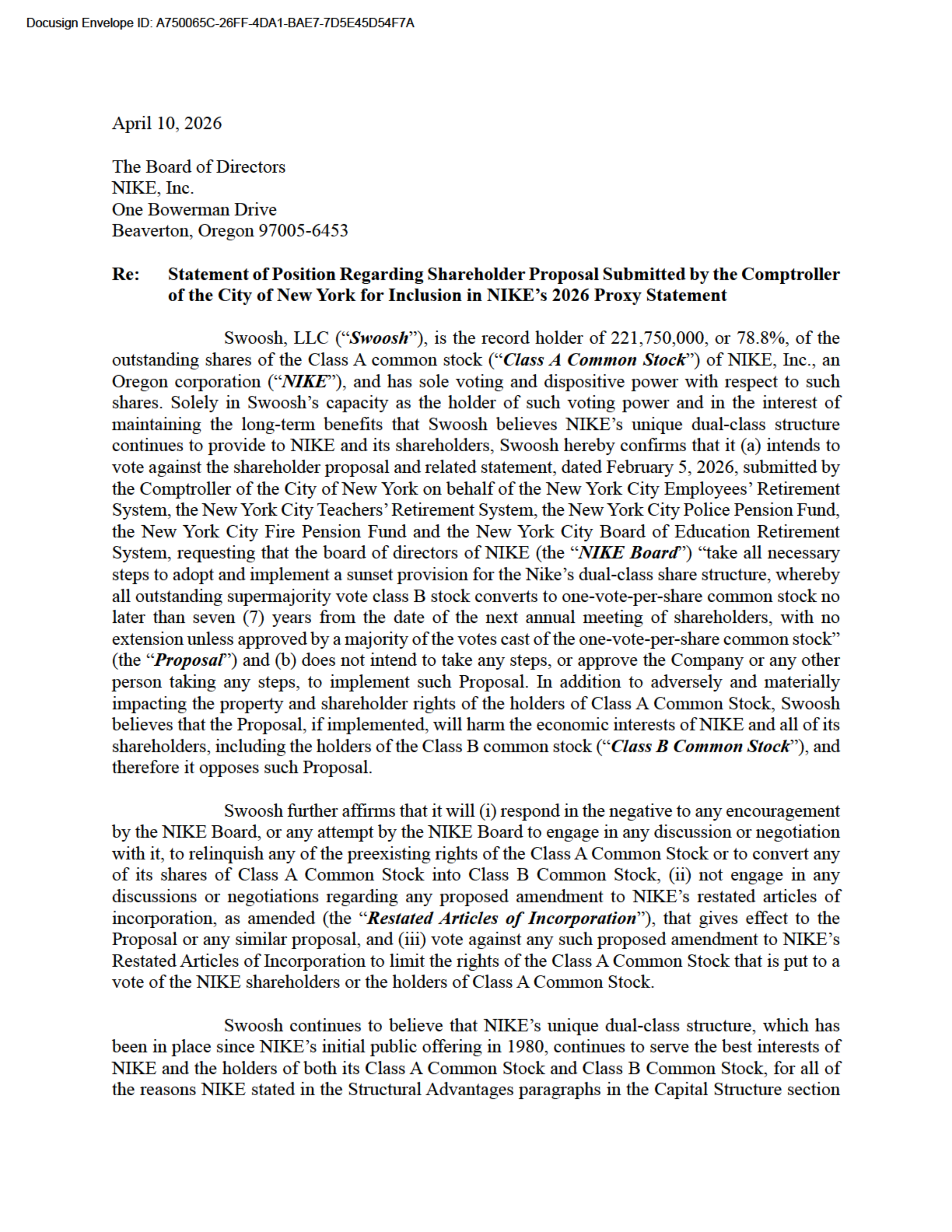
However, Swoosh has stated in a letter to the Board, dated April 10, 2026, a copy
of which is attached to this letter as Exhibit D (the “
Swoosh Letter
”), that it (a) intends to vote
against the Proposal and any proposed amendment to the Articles of Incorporation to change or
otherwise limit the rights of the Class A Common Stock that is put to a vote of the Company’s
shareholders or the holders of Class A Common Stock in response to the Proposal or any similar
proposal and (b) does not intend to take any steps, or approve the Company or any other person
taking any steps, to implement such Proposal. Moreover, Swoosh further affirmed that it will
respond in the negative to any encouragement by the Board, or any attempt at discussion or
negotiation by the Board, to relinquish any of its preexisting rights in the Class A Common Stock
or to convert any of its shares of Class A Common Stock into Class B Common Stock.
As such, the Proposal and the surrounding circumstances are materially
indistinguishable from those considered by the Staff in
Comcast 2024
,
AMC 2019
and
Comcast
2018
, where the Staff concurred in the exclusion of substantially similar proposals requesting that
the board “take steps” or “take the necessary steps” to adopt a one-vote-per-share structure under
Rule 14a-8(i)(6) on the basis that the companies lacked the power or authority to implement the
proposal after the beneficial owner whose approval was necessary to adopt the related charter
amendment indicated they would not support such amendment. In fact, the Proposal at issue here
goes even further than those other proposals by requiring the Board to “take
all necessary steps
”
(emphasis added) to adopt and implement a seven-year sunset provision for the Company’s dual-
class structure, thereby imposing an even greater obligation than the proposals the Staff has
previously permitted to be excluded.
For this reason, the Proposal is also distinguishable from the proposal at issue in
Comcast Corp.
(Apr. 15, 2025), where the proposal requested that the board “
take an initial step”
to transition to a one-vote-per-share structure (emphasis added), and the Staff did not concur that
the board lacked the power to take such an “initial step.”
4
This Proposal requires far more than
just an “initial step”—it requests that the Board “take all necessary steps” to eliminate the
Company’s dual-class structure and thus is more similar to Comcast 2024, AMC 2019 and Comcast
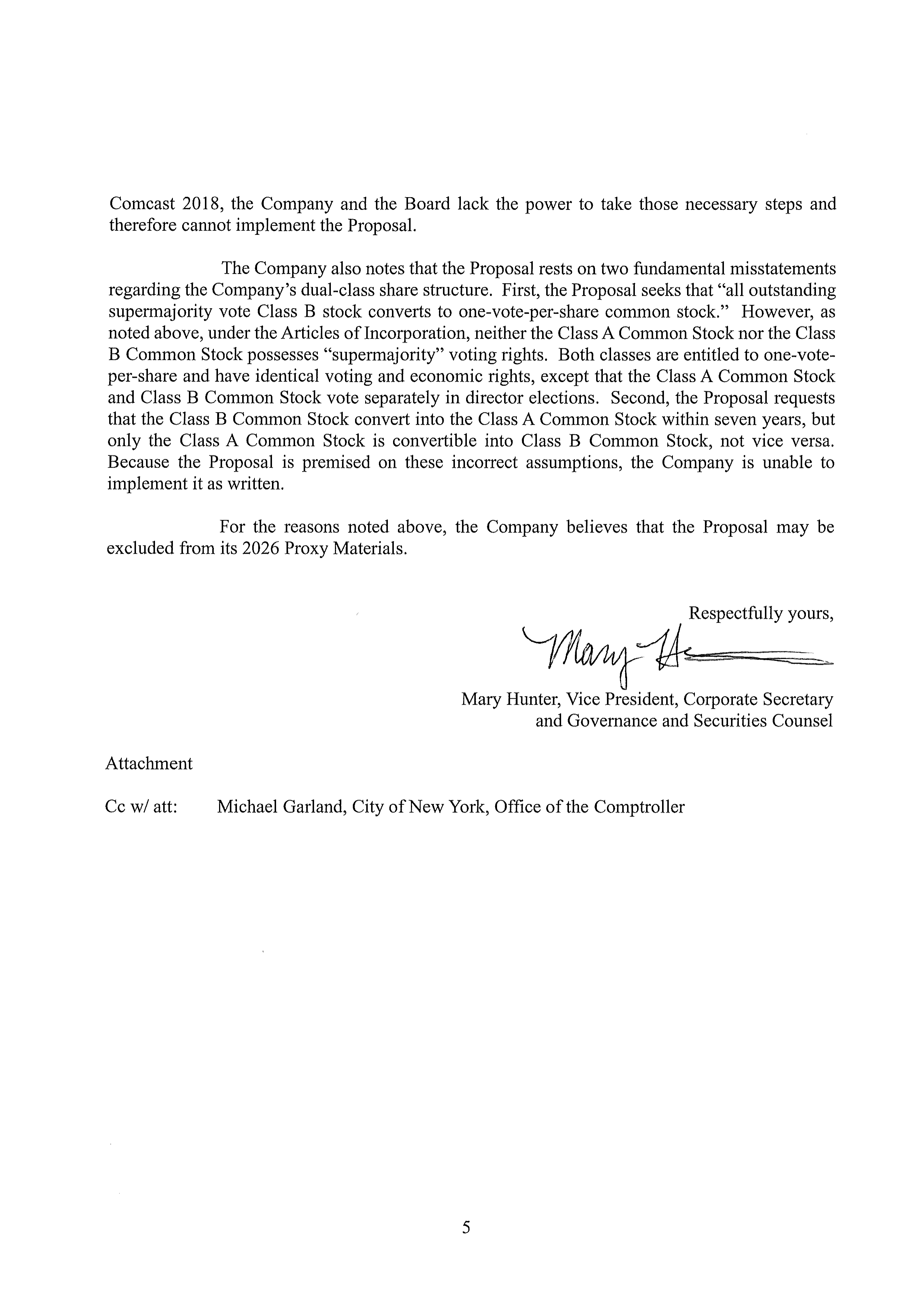
2018. As a result, in light of the Swoosh Letter and consistent with Comcast 2024, AMC 2019 and
4
The Staff did concur, however, that the proposal could be excluded on the basis that it had been substantially
implemented.
See Comcast Corp.
(Apr. 22, 2025).

EXHIBIT A
THE PROPOSAL
Dual-Class Sunset Proposal
Resolved:
Shareholders request that Nike, Inc. (“Nike”)
Board of Directors take all necessary
steps to adopt and implement a sunset provision for the Nike’s dual-class share structure,
whereby all outstanding supermajority vote class B stock converts to one-vote-per-share
common stock no later than seven (7) years from the date of the next annual meeting of
shareholders, with no extension unless approved by a majority of the votes cast of the one-vote-
per-share common stock.
Supporting Statement:
Meaningful voting rights are fundamental to shareholder oversight. Without the ability to
exercise voting power, independent shareholders cannot actually elect the Board of Directors and
hold management accountable. The dual-class structure undermines equal treatment of all
shareholders (one-share, one-vote), thereby entrenching control, reducing board accountability
and responsiveness to independent shareholders.
Nike maintains a multi-class share structure with unequal voting rights and has no time-based
sunset provision. Under the Company’s governing documents, holders of the Class A common
stock are entitled to elect 75% of the Board and holders of the Company's Class B common stock
elect the remaining 25% of the total board, rounded up to the nearest whole number.
Control of the Class A common stock is highly concentrated Swoosh LLC, an entity formed by
Philip H. Knight, Nike’s co-founder and chair emeritus, beneficially owns 78.5% of the
Company's Class A common stock. Travis Knight, a Company director and the son of Philip
Knight, plays a significant role in the management of the Class A common stock held by
Swoosh. As a result, a small, closely affiliated group retains outsized and durable influence over
Nike’s board composition and corporate governance, limiting the ability of independent
shareholders to exercise effective oversight.
A 2023 study found that while multi-class share structures may provide certain advantages
shortly after an IPO, their drawbacks typically outweigh these benefits within six to ten years as
governance and performance costs accumulate.
1
Growing number of institutional investors and governance experts support time-based sunset
provisions—automatic conversion to one-share, one-vote after a defined period—allows
controlling shareholders to guide a company in its early years while ensuring long-term
adherence to good governance norms.
Many U.S. companies have adopted such provisions; the Council of Institutional Investors’
September 2025 review lists 49 companies that adopted sunset provisions of 7 years or less.
2
1
https://onlinelibrary.wiley.com/doi/full/10.1111/jfir.12311
2
https://www.cii.org//Files/publications/dual-class/Time-
based%20Sunsets%20Review%20(updated%2025-Sep-2025).pdf
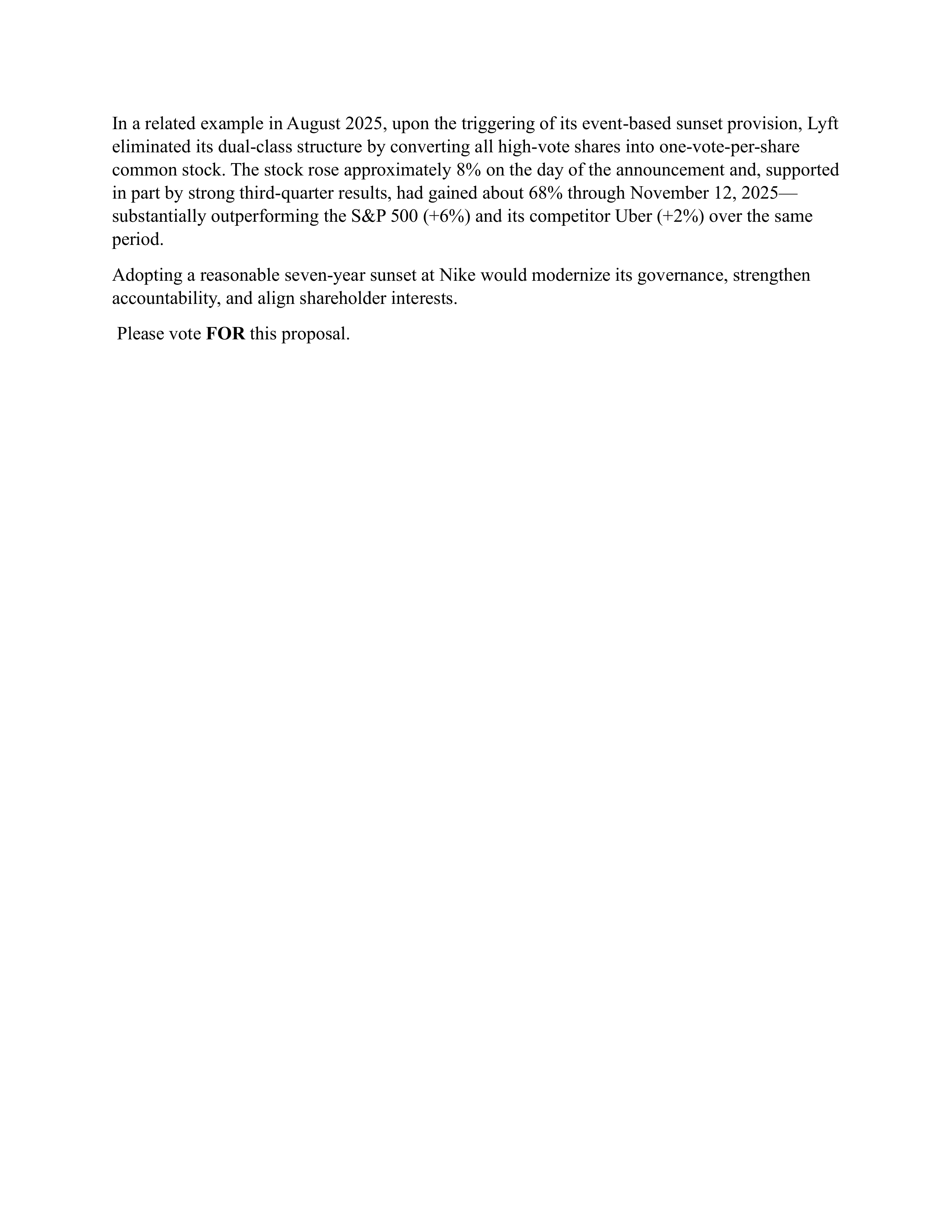
In a related example in August 2025, upon the triggering of its event-based sunset provision, Lyft
eliminated its dual-class structure by converting all high-vote shares into one-vote-per-share
common stock. The stock rose approximately 8% on the day of the announcement and, supported
in part by strong third-quarter results, had gained about 68% through November 12, 2025—
substantially outperforming the S&P 500 (+6%) and its competitor Uber (+2%) over the same
period.
Adopting a reasonable seven-year sunset at
Nike would modernize its governance, strengthen
accountability, and align shareholder interests.
Please vote
FOR
this proposal.
EXHIBIT B
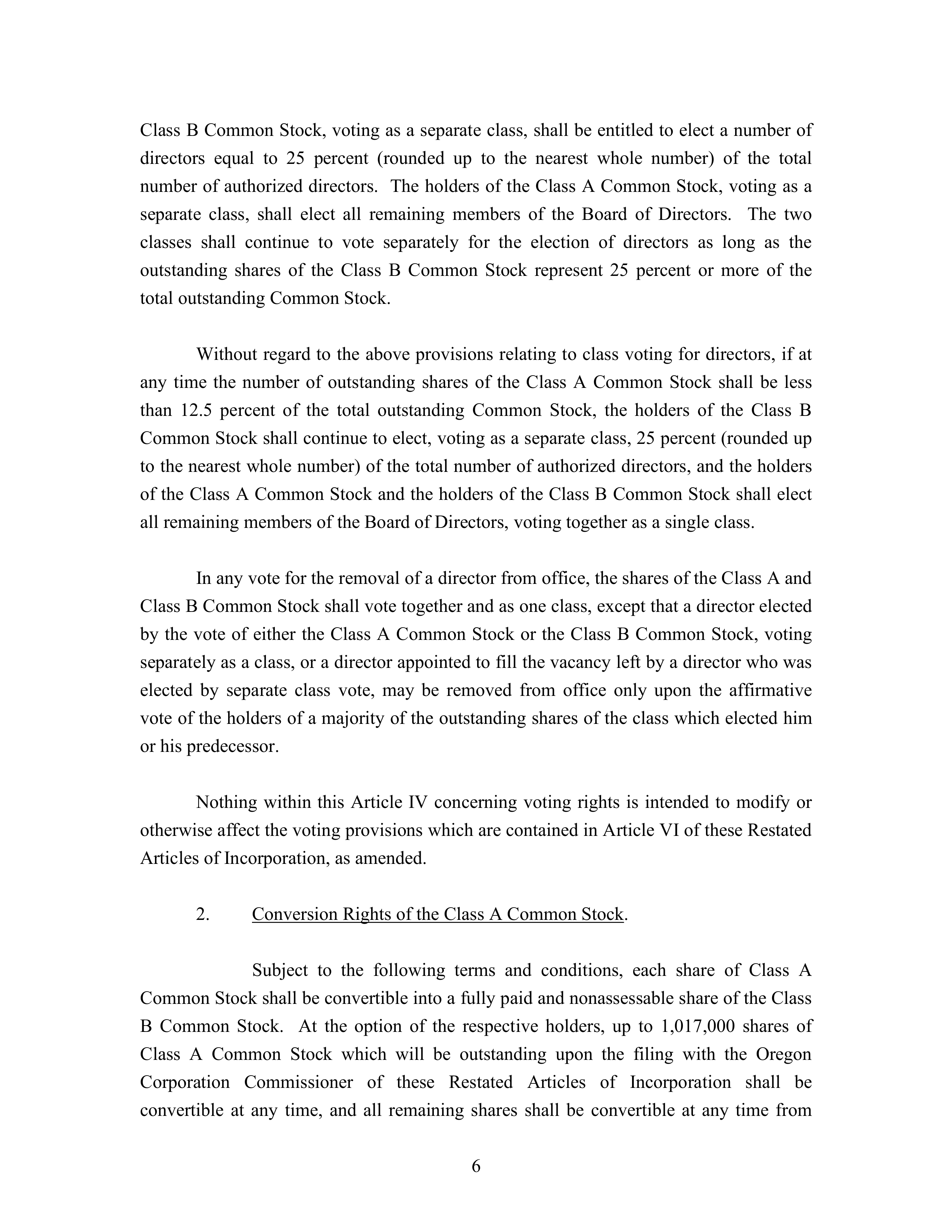
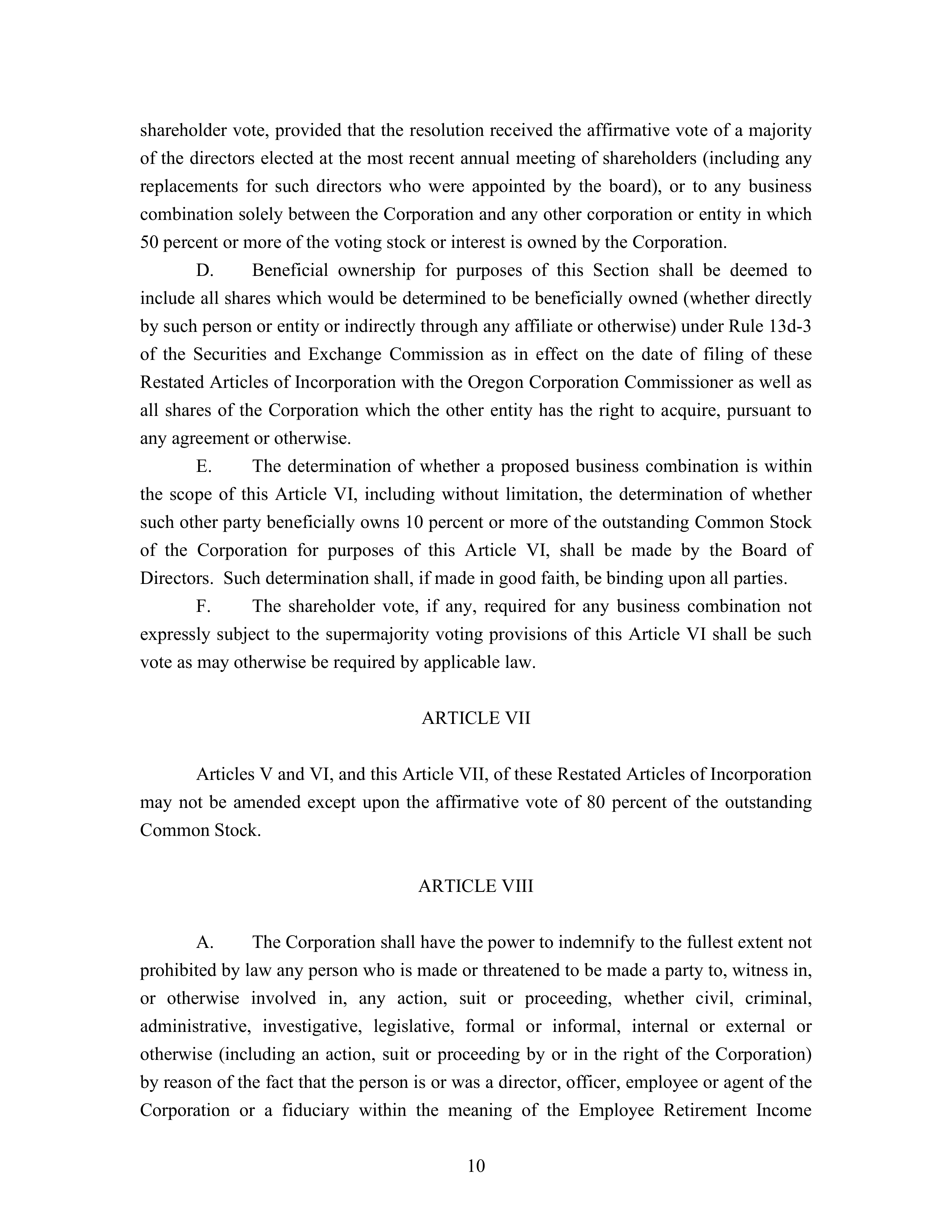
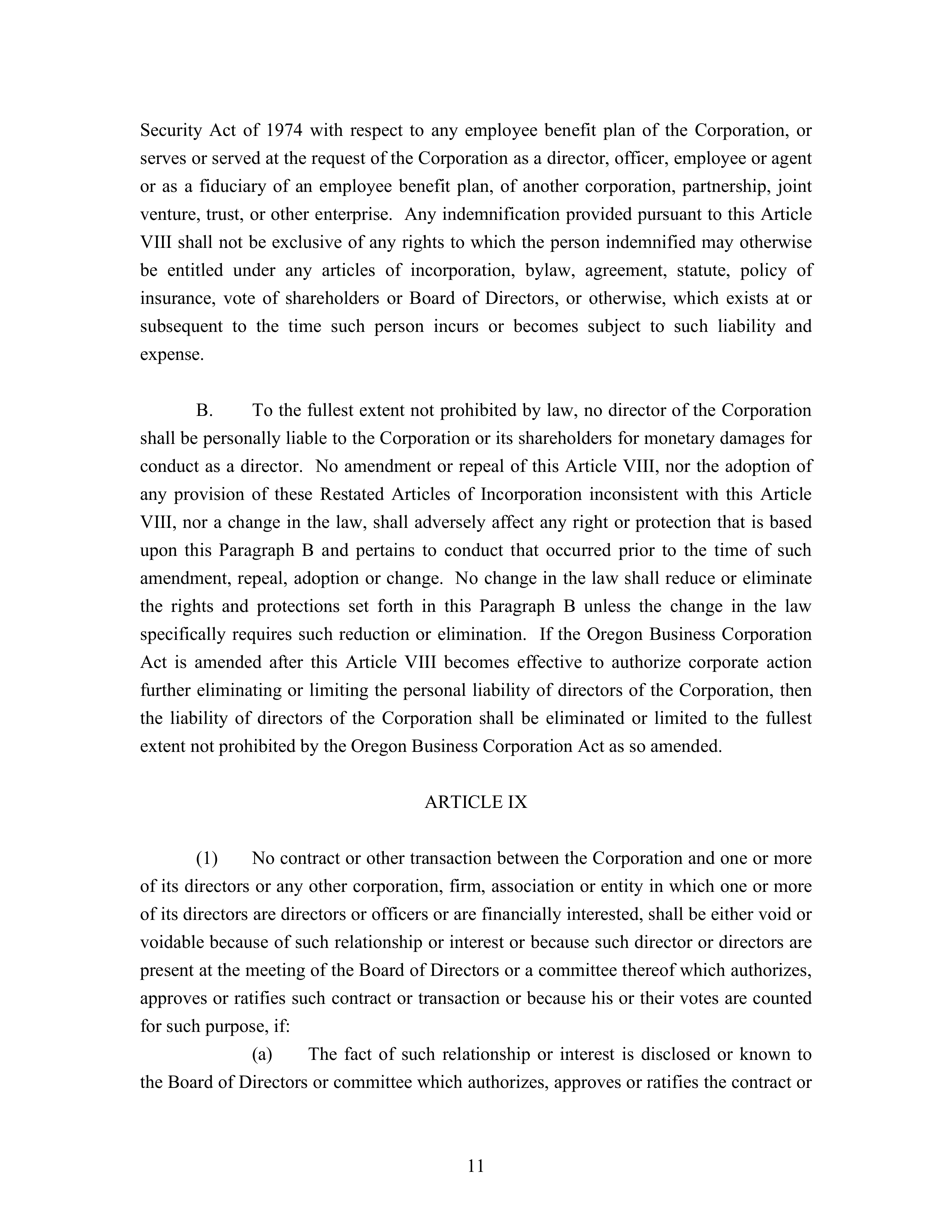
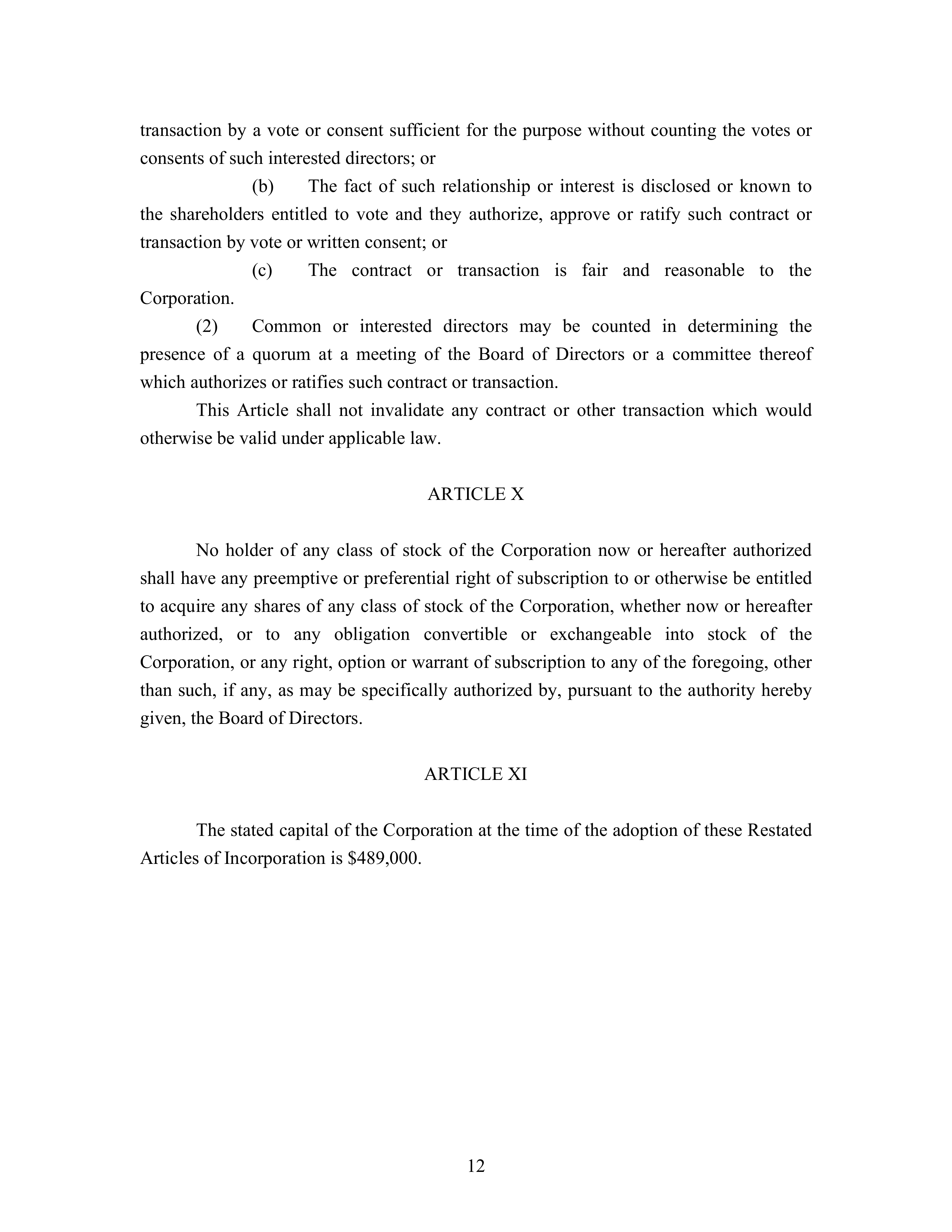
ARTICLES OF INCORPORATION
1
RESTATED ARTICLES OF INCORPORATION
OF
NIKE, INC.
(as amended as of September 25, 2015)
The following version of the Restated Articles of Incorporation of NIKE, Inc., an
Oregon corporation (the “Corporation”), filed with the Oregon Secretary of State on
November 26, 1980, has been prepared for and filed with the Securities and Exchange
Commission and includes the amendments reflected in Articles of Amendment filed with
the Oregon Secretary of State on October 3, 1983, November 5, 1986, October 15, 1987,
September 24, 1990, October 10, 1995, September 23, 2005, October 1, 2012 and
September 25, 2015:
ARTICLE I
These Restated Articles of Incorporation supersede the previously existing
Articles of Incorporation of NIKE, Inc. and all amendments thereto.
ARTICLE II
The name of this Corporation is NIKE, Inc. and its duration shall be perpetual.
ARTICLE III
The purposes for which this Corporation is organized are to engage in any lawful
activity for which corporations may be organized under ORS Chapter 57.
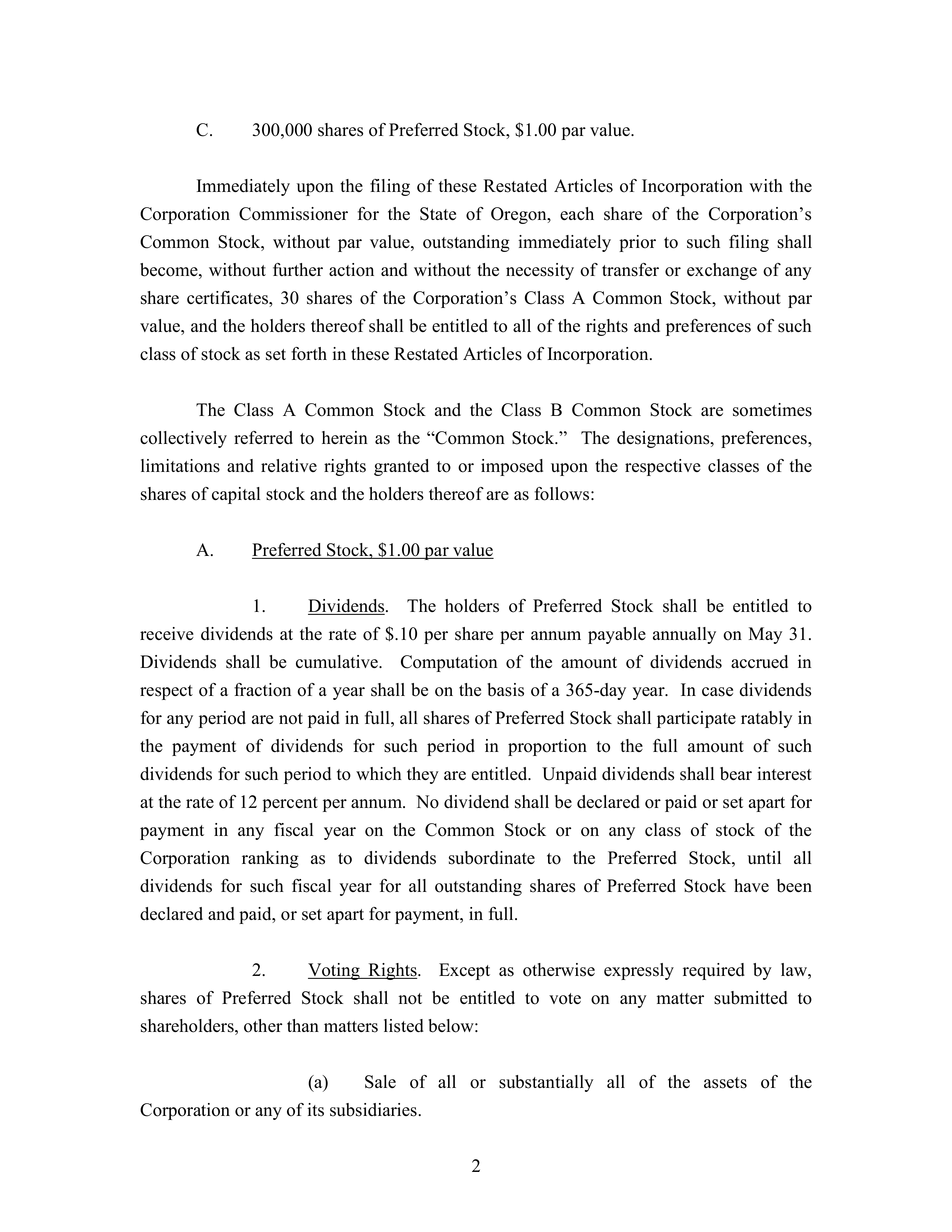
ARTICLE IV
The aggregate number of shares which the Corporation shall have the authority to
issue is divided as follows:
A.
400,000,000 shares of Class A Common Stock, no par value;
B.
2,400,000,000 shares of Class B Common Stock, no par value; and
2
C.
300,000 shares of Preferred Stock, $1.00 par value.
Immediately upon the filing of these Restated Articles of Incorporation with the
Corporation Commissioner for the State of Oregon, each share of the Corporation’s
Common Stock, without par value, outstanding immediately prior to such filing shall
become, without further action and without the necessity of transfer or exchange of any
share certificates, 30 shares of the Corporation’s Class A Common Stock, without par
value, and the holders thereof shall be entitled to all of the rights and preferences of such
class of stock as set forth in these Restated Articles of Incorporation.
The Class A Common Stock and the Class B Common Stock are sometimes
collectively referred to herein as the “Common Stock.” The designations, preferences,
limitations and relative rights granted to or imposed upon the respective classes of the
shares of capital stock and the holders thereof are as follows:
A.
Preferred Stock, $1.00 par value
1.
Dividends. The holders of Preferred Stock shall be entitled to
receive dividends at the rate of $.10 per share per annum payable annually on May 31.
Dividends shall be cumulative. Computation of the amount of dividends accrued in
respect of a fraction of a year shall be on the basis of a 365-day year. In case dividends
for any period are not paid in full, all shares of Preferred Stock shall participate ratably in
the payment of dividends for such period in proportion to the full amount of such
dividends for such period to which they are entitled. Unpaid dividends shall bear interest
at the rate of 12 percent per annum. No dividend shall be declared or paid or set apart for
payment in any fiscal year on the Common Stock or on any class of stock of the
Corporation ranking as to dividends subordinate to the Preferred Stock, until all
dividends for such fiscal year for all outstanding shares of Preferred Stock have been
declared and paid, or set apart for payment, in full.
2.
Voting Rights. Except as otherwise expressly required by law,
shares of Preferred Stock shall not be entitled to vote on any matter submitted to
shareholders, other than matters listed below:
(a)
Sale of all or substantially all of the assets of the
Corporation or any of its subsidiaries.
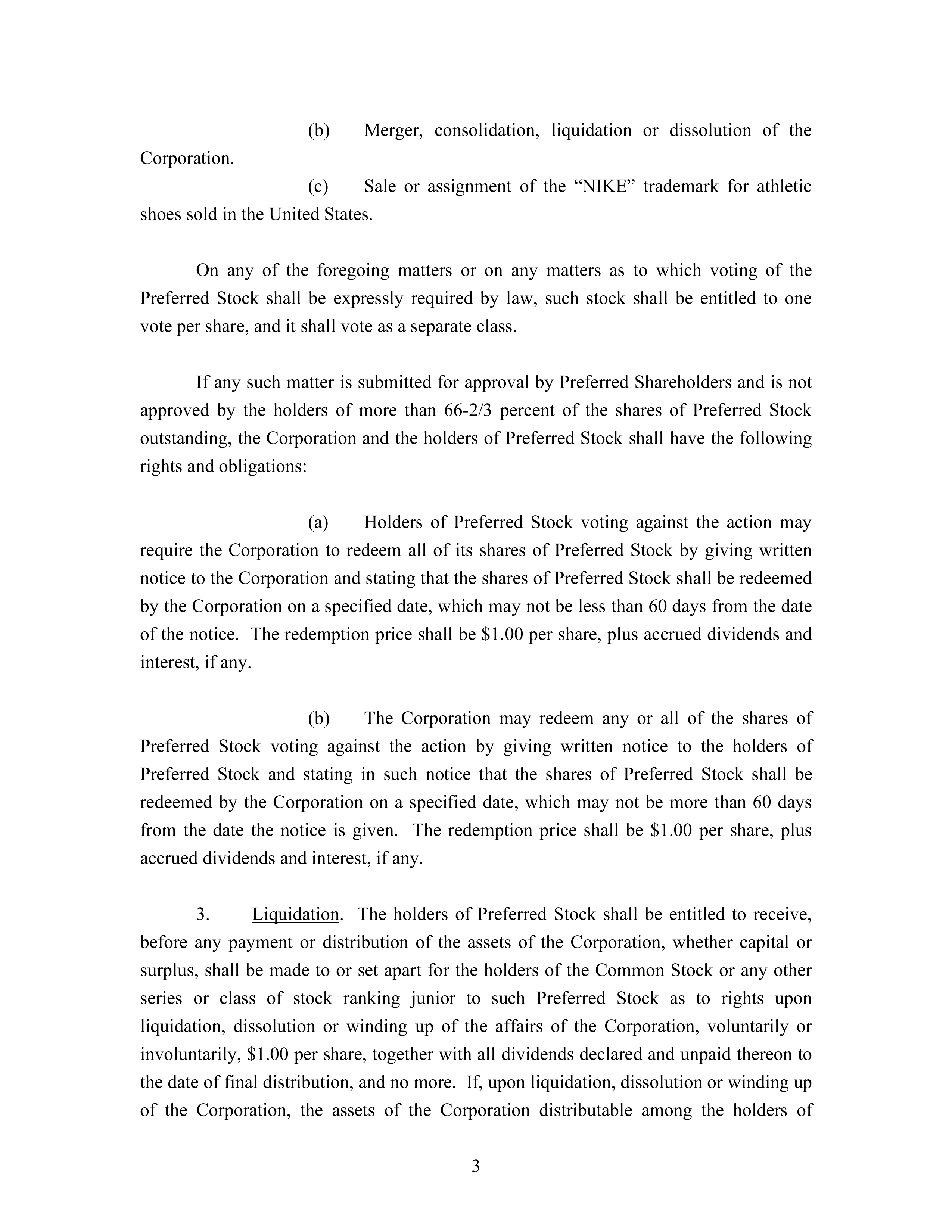
3
(b)
Merger, consolidation, liquidation or dissolution of the
Corporation.
(c)
Sale or assignment of the “NIKE” trademark for athletic
shoes sold in the United States.
On any of the foregoing matters or on any matters as to which voting of the
Preferred Stock shall be expressly required by law, such stock shall be entitled to one
vote per share, and it shall vote as a separate class.
If any such matter is submitted for approval by Preferred Shareholders and is not
approved by the holders of more than 66-2/3 percent of the shares of Preferred Stock
outstanding, the Corporation and the holders of Preferred Stock shall have the following
rights and obligations:
(a)
Holders of Preferred Stock voting against the action may
require the Corporation to redeem all of its shares of Preferred Stock by giving written
notice to the Corporation and stating that the shares of Preferred Stock shall be redeemed
by the Corporation on a specified date, which may not be less than 60 days from the date
of the notice. The redemption price shall be $1.00 per share, plus accrued dividends and
interest, if any.
(b)
The Corporation may redeem any or all of the shares of
Preferred Stock voting against the action by giving written notice to the holders of
Preferred Stock and stating in such notice that the shares of Preferred Stock shall be
redeemed by the Corporation on a specified date, which may not be more than 60 days
from the date the notice is given. The redemption price shall be $1.00 per share, plus
accrued dividends and interest, if any.
3.
Liquidation. The holders of Preferred Stock shall be entitled to receive,
before any payment or distribution of the assets of the Corporation, whether capital or
surplus, shall be made to or set apart for the holders of the Common Stock or any other
series or class of stock ranking junior to such Preferred Stock as to rights upon
liquidation, dissolution or winding up of the affairs of the Corporation, voluntarily or
involuntarily, $1.00 per share, together with all dividends declared and unpaid thereon to
the date of final distribution, and no more. If, upon liquidation, dissolution or winding up
of the Corporation, the assets of the Corporation distributable among the holders of
4
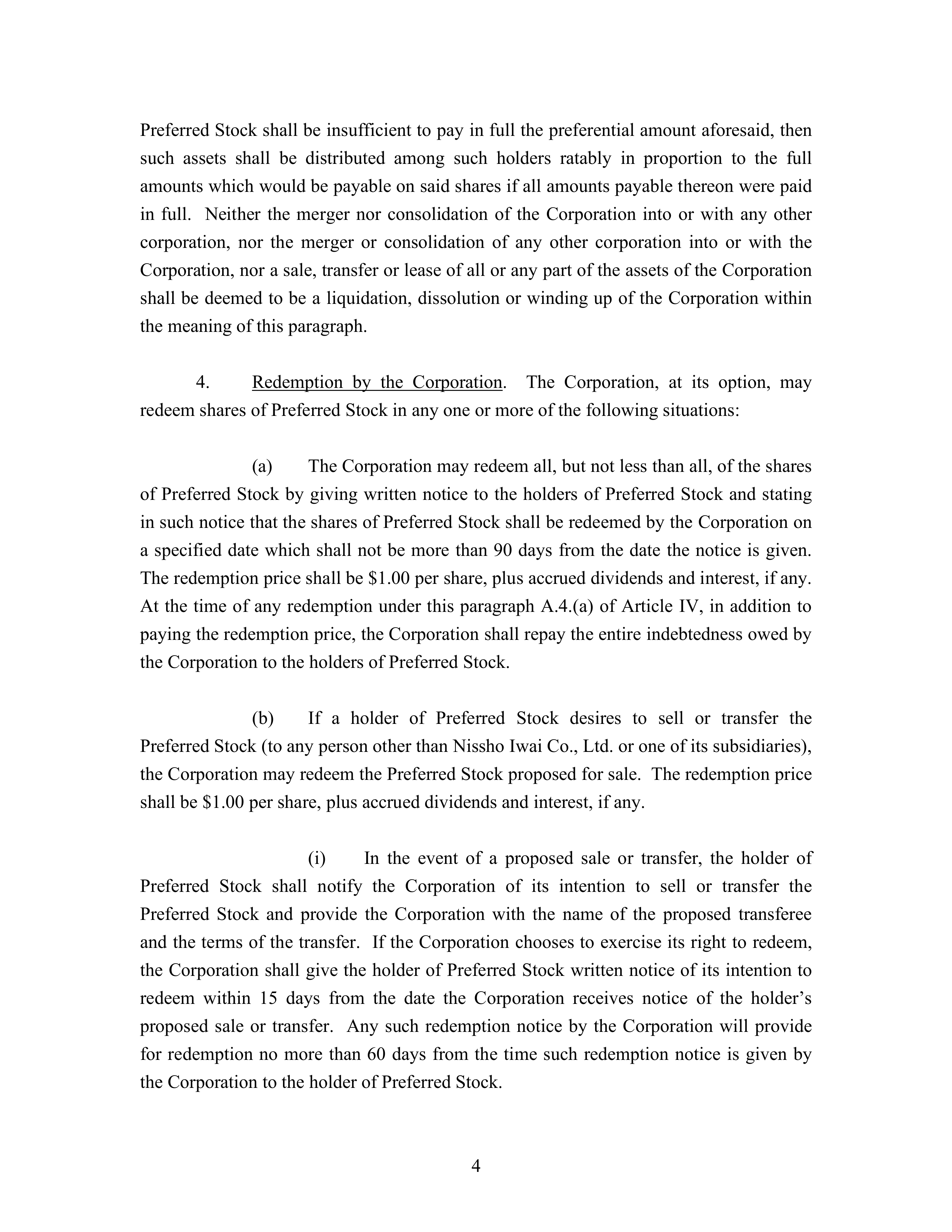
Preferred Stock shall be insufficient to pay in full the preferential amount aforesaid, then
such assets shall be distributed among such holders ratably in proportion to the full
amounts which would be payable on said shares if all amounts payable thereon were paid
in full. Neither the merger nor consolidation of the Corporation into or with any other
corporation, nor the merger or consolidation of any other corporation into or with the
Corporation, nor a sale, transfer or lease of all or any part of the assets of the Corporation
shall be deemed to be a liquidation, dissolution or winding up of the Corporation within
the meaning of this paragraph.
4.
Redemption by the Corporation. The Corporation, at its option, may
redeem shares of Preferred Stock in any one or more of the following situations:
(a)
The Corporation may redeem all, but not less than all, of the shares
of Preferred Stock by giving written notice to the holders of Preferred Stock and stating
in such notice that the shares of Preferred Stock shall be redeemed by the Corporation on
a specified date which shall not be more than 90 days from the date the notice is given.
The redemption price shall be $1.00 per share, plus accrued dividends and interest, if any.
At the time of any redemption under this paragraph A.4.(a) of Article IV, in addition to
paying the redemption price, the Corporation shall repay the entire indebtedness owed by
the Corporation to the holders of Preferred Stock.
(b)
If a holder of Preferred Stock desires to sell or transfer the
Preferred Stock (to any person other than Nissho Iwai Co., Ltd. or one of its subsidiaries),
the Corporation may redeem the Preferred Stock proposed for sale. The redemption price
shall be $1.00 per share, plus accrued dividends and interest, if any.
(i)
In the event of a proposed sale or transfer, the holder of
Preferred Stock shall notify the Corporation of its intention to sell or transfer the
Preferred Stock and provide the Corporation with the name of the proposed transferee
and the terms of the transfer. If the Corporation chooses to exercise its right to redeem,
the Corporation shall give the holder of Preferred Stock written notice of its intention to
redeem within 15 days from the date the Corporation receives notice of the holder’s
proposed sale or transfer. Any such redemption notice by the Corporation will provide
for redemption no more than 60 days from the time such redemption notice is given by
the Corporation to the holder of Preferred Stock.
5
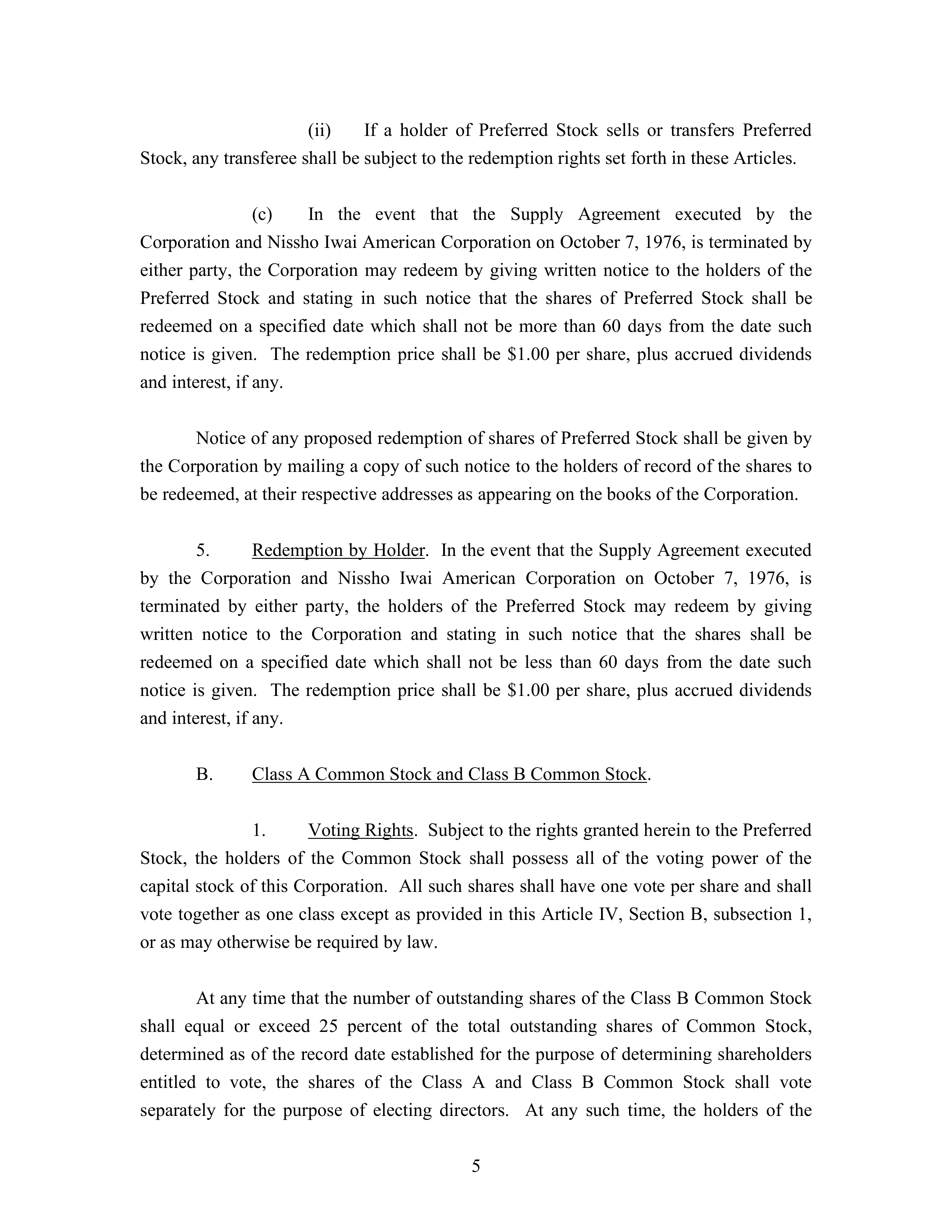
(ii)
If a holder of Preferred Stock sells or transfers Preferred
Stock, any transferee shall be subject to the redemption rights set forth in these Articles.
(c)
In the event that the Supply Agreement executed by the
Corporation and Nissho Iwai American Corporation on October 7, 1976, is terminated by
either party, the Corporation may redeem by giving written notice to the holders of the
Preferred Stock and stating in such notice that the shares of Preferred Stock shall be
redeemed on a specified date which shall not be more than 60 days from the date such
notice is given. The redemption price shall be $1.00 per share, plus accrued dividends
and interest, if any.
Notice of any proposed redemption of shares of Preferred Stock shall be given by
the Corporation by mailing a copy of such notice to the holders of record of the shares to
be redeemed, at their respective addresses as appearing on the books of the Corporation.
5.
Redemption by Holder. In the event that the Supply Agreement executed
by the Corporation and Nissho Iwai American Corporation on October 7, 1976, is
terminated by either party, the holders of the Preferred Stock may redeem by giving
written notice to the Corporation and stating in such notice that the shares shall be
redeemed on a specified date which shall not be less than 60 days from the date such
notice is given. The redemption price shall be $1.00 per share, plus accrued dividends
and interest, if any.
B.
Class A Common Stock and Class B Common Stock.
1.
Voting Rights. Subject to the rights granted herein to the Preferred
Stock, the holders of the Common Stock shall possess all of the voting power of the
capital stock of this Corporation. All such shares shall have one vote per share and shall
vote together as one class except as provided in this Article IV, Section B, subsection 1,
or as may otherwise be required by law.
At any time that the number of outstanding shares of the Class B Common Stock
shall equal or exceed 25 percent of the total outstanding shares of Common Stock,
determined as of the record date established for the purpose of determining shareholders
entitled to vote, the shares of the Class A and Class B Common Stock shall vote
separately for the purpose of electing directors. At any such time, the holders of the
6
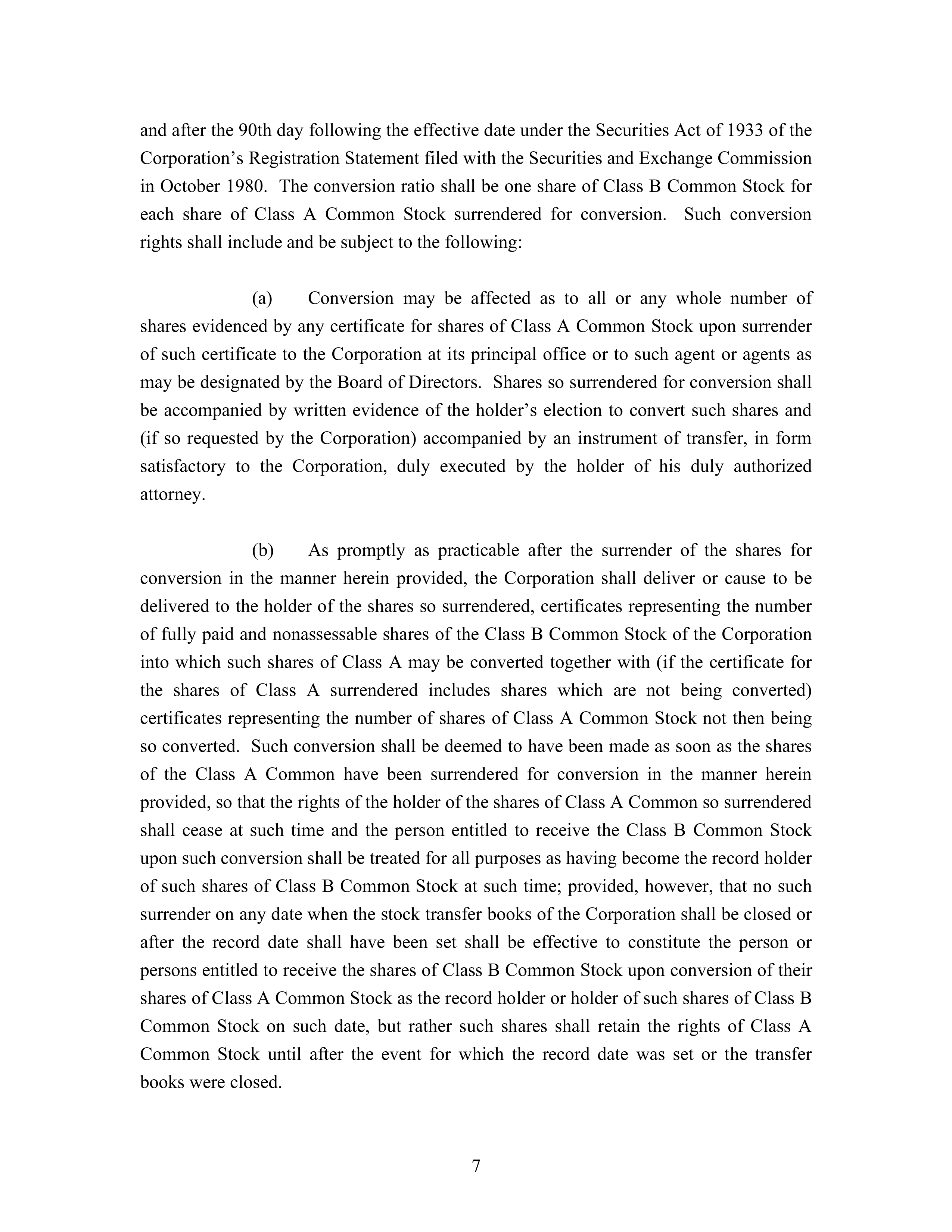
Class B Common Stock, voting as a separate class, shall be entitled to elect a number of
directors equal to 25 percent (rounded up to the nearest whole number) of the total
number of authorized directors. The holders of the Class A Common Stock, voting as a
separate class, shall elect all remaining members of the Board of Directors. The two
classes shall continue to vote separately for the election of directors as long as the
outstanding shares of the Class B Common Stock represent 25 percent or more of the
total outstanding Common Stock.
Without regard to the above provisions relating to class voting for directors, if at
any time the number of outstanding shares of the Class A Common Stock shall be less
than 12.5 percent of the total outstanding Common Stock, the holders of the Class B
Common Stock shall continue to elect, voting as a separate class, 25 percent (rounded up
to the nearest whole number) of the total number of authorized directors, and the holders
of the Class A Common Stock and the holders of the Class B Common Stock shall elect
all remaining members of the Board of Directors, voting together as a single class.
In any vote for the removal of a director from office, the shares of the Class A and
Class B Common Stock shall vote together and as one class, except that a director elected
by the vote of either the Class A Common Stock or the Class B Common Stock, voting
separately as a class, or a director appointed to fill the vacancy left by a director who was
elected by separate class vote, may be removed from office only upon the affirmative
vote of the holders of a majority of the outstanding shares of the class which elected him
or his predecessor.
Nothing within this Article IV concerning voting rights is intended to modify or
otherwise affect the voting provisions which are contained in Article VI of these Restated
Articles of Incorporation, as amended.
2.
Conversion Rights of the Class A Common Stock.
Subject to the following terms and conditions, each share of Class A
Common Stock shall be convertible into a fully paid and nonassessable share of the Class
B Common Stock. At the option of the respective holders, up to 1,017,000 shares of
Class A Common Stock which will be outstanding upon the filing with the Oregon
Corporation Commissioner of these Restated Articles of Incorporation shall be
convertible at any time, and all remaining shares shall be convertible at any time from
7
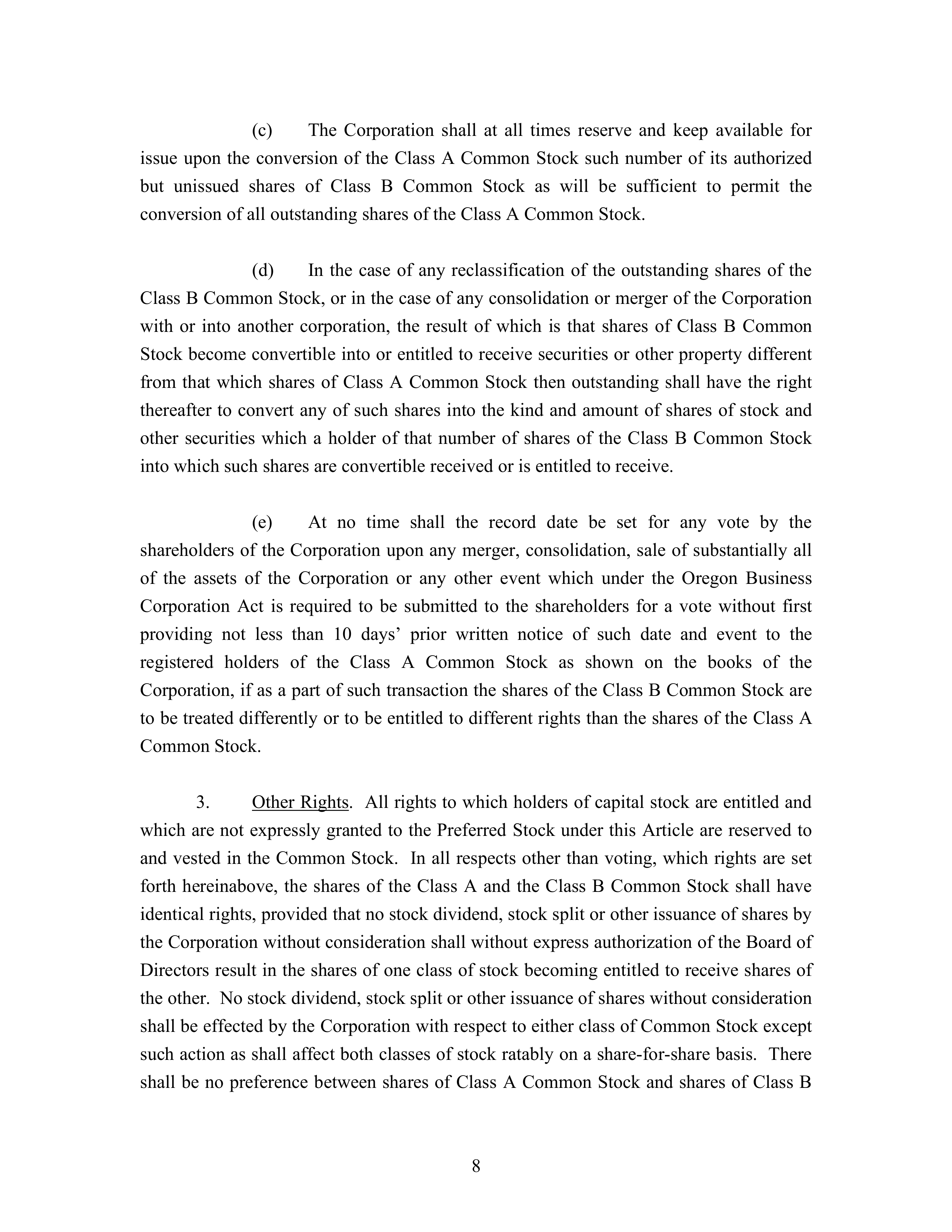
and after the 90th day following the effective date under the Securities Act of 1933 of the
Corporation’s Registration Statement filed with the Securities and Exchange Commission
in October 1980. The conversion ratio shall be one share of Class B Common Stock for
each share of Class A Common Stock surrendered for conversion. Such conversion
rights shall include and be subject to the following:
(a)
Conversion may be affected as to all or any whole number of
shares evidenced by any certificate for shares of Class A Common Stock upon surrender
of such certificate to the Corporation at its principal office or to such agent or agents as
may be designated by the Board of Directors. Shares so surrendered for conversion shall
be accompanied by written evidence of the holder’s election to convert such shares and
(if so requested by the Corporation) accompanied by an instrument of transfer, in form
satisfactory to the Corporation, duly executed by the holder of his duly authorized
attorney.
(b)
As promptly as practicable after the surrender of the shares for
conversion in the manner herein provided, the Corporation shall deliver or cause to be
delivered to the holder of the shares so surrendered, certificates representing the number
of fully paid and nonassessable shares of the Class B Common Stock of the Corporation
into which such shares of Class A may be converted together with (if the certificate for
the shares of Class A surrendered includes shares which are not being converted)
certificates representing the number of shares of Class A Common Stock not then being
so converted. Such conversion shall be deemed to have been made as soon as the shares
of the Class A Common have been surrendered for conversion in the manner herein
provided, so that the rights of the holder of the shares of Class A Common so surrendered
shall cease at such time and the person entitled to receive the Class B Common Stock
upon such conversion shall be treated for all purposes as having become the record holder
of such shares of Class B Common Stock at such time; provided, however, that no such
surrender on any date when the stock transfer books of the Corporation shall be closed or
after the record date shall have been set shall be effective to constitute the person or
persons entitled to receive the shares of Class B Common Stock upon conversion of their
shares of Class A Common Stock as the record holder or holder of such shares of Class B
Common Stock on such date, but rather such shares shall retain the rights of Class A
Common Stock until after the event for which the record date was set or the transfer
books were closed.
8
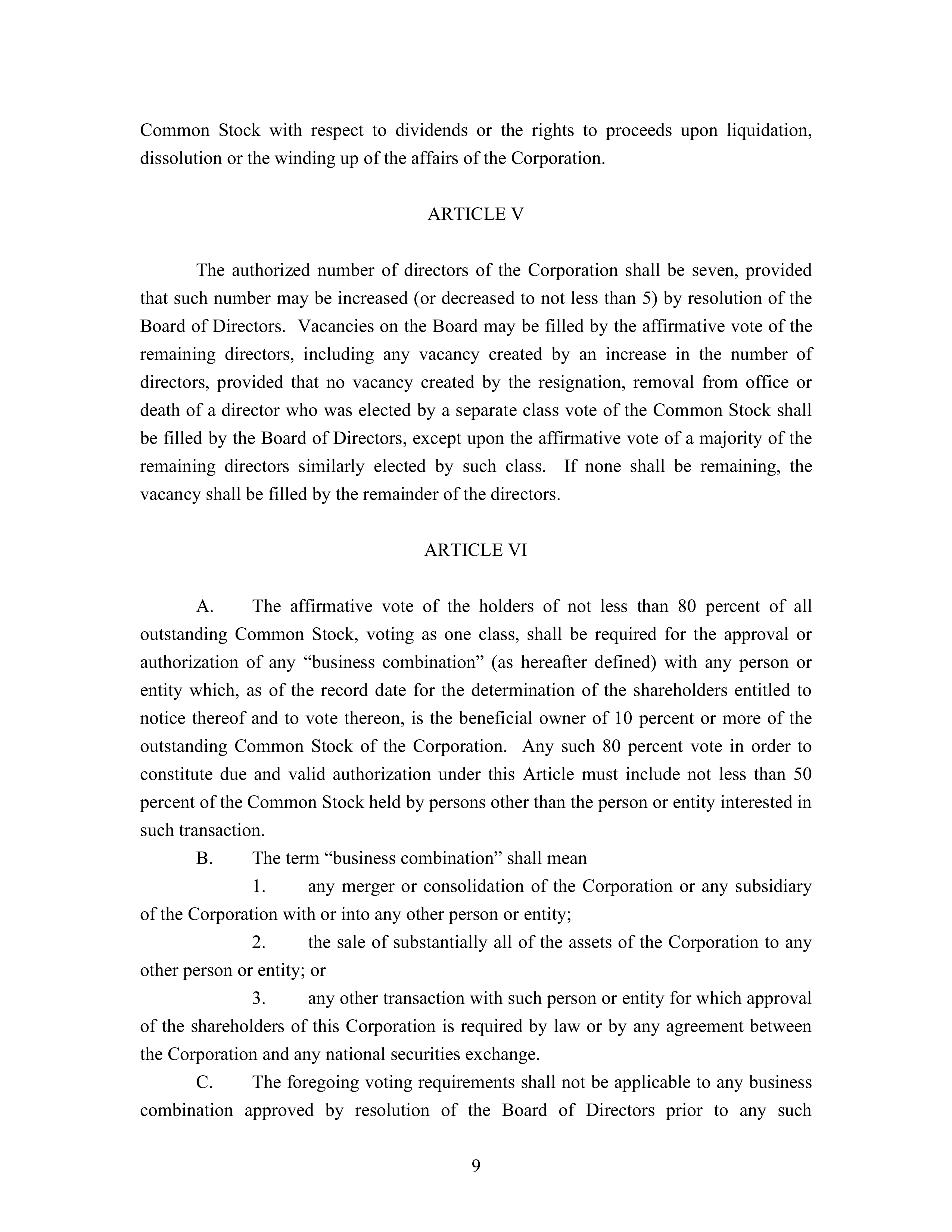
(c)
The Corporation shall at all times reserve and keep available for
issue upon the conversion of the Class A Common Stock such number of its authorized
but unissued shares of Class B Common Stock as will be sufficient to permit the
conversion of all outstanding shares of the Class A Common Stock.
(d)
In the case of any reclassification of the outstanding shares of the
Class B Common Stock, or in the case of any consolidation or merger of the Corporation
with or into another corporation, the result of which is that shares of Class B Common
Stock become convertible into or entitled to receive securities or other property different
from that which shares of Class A Common Stock then outstanding shall have the right
thereafter to convert any of such shares into the kind and amount of shares of stock and
other securities which a holder of that number of shares of the Class B Common Stock
into which such shares are convertible received or is entitled to receive.
(e)
At no time shall the record date be set for any vote by the
shareholders of the Corporation upon any merger, consolidation, sale of substantially all
of the assets of the Corporation or any other event which under the Oregon Business
Corporation Act is required to be submitted to the shareholders for a vote without first
providing not less than 10 days’ prior written notice of such date and event to the
registered holders of the Class A Common Stock as shown on the books of the
Corporation, if as a part of such transaction the shares of the Class B Common Stock are
to be treated differently or to be entitled to different rights than the shares of the Class A
Common Stock.
3.
Other Rights. All rights to which holders of capital stock are entitled and
which are not expressly granted to the Preferred Stock under this Article are reserved to
and vested in the Common Stock. In all respects other than voting, which rights are set
forth hereinabove, the shares of the Class A and the Class B Common Stock shall have
identical rights, provided that no stock dividend, stock split or other issuance of shares by
the Corporation without consideration shall without express authorization of the Board of
Directors result in the shares of one class of stock becoming entitled to receive shares of
the other. No stock dividend, stock split or other issuance of shares without consideration
shall be effected by the Corporation with respect to either class of Common Stock except
such action as shall affect both classes of stock ratably on a share-for-share basis. There
shall be no preference between shares of Class A Common Stock and shares of Class B
9
Common Stock with respect to dividends or the rights to proceeds upon liquidation,
dissolution or the winding up of the affairs of the Corporation.
ARTICLE V
The authorized number of directors of the Corporation shall be seven, provided
that such number may be increased (or decreased to not less than 5) by resolution of the
Board of Directors. Vacancies on the Board may be filled by the affirmative vote of the
remaining directors, including any vacancy created by an increase in the number of
directors, provided that no vacancy created by the resignation, removal from office or
death of a director who was elected by a separate class vote of the Common Stock shall
be filled by the Board of Directors, except upon the affirmative vote of a majority of the
remaining directors similarly elected by such class. If none shall be remaining, the
vacancy shall be filled by the remainder of the directors.
ARTICLE VI
A.
The affirmative vote of the holders of not less than 80 percent of all
outstanding Common Stock, voting as one class, shall be required for the approval or
authorization of any “business combination” (as hereafter defined) with any person or
entity which, as of the record date for the determination of the shareholders entitled to
notice thereof and to vote thereon, is the beneficial owner of 10 percent or more of the
outstanding Common Stock of the Corporation. Any such 80 percent vote in order to
constitute due and valid authorization under this Article must include not less than 50
percent of the Common Stock held by persons other than the person or entity interested in
such transaction.
B.
The term “business combination” shall mean
1.
any merger or consolidation of the Corporation or any subsidiary
of the Corporation with or into any other person or entity;
2.
the sale of substantially all of the assets of the Corporation to any
other person or entity; or
3.
any other transaction with such person or entity for which approval
of the shareholders of this Corporation is required by law or by any agreement between
the Corporation and any national securities exchange.
C.
The foregoing voting requirements shall not be applicable to any business
combination approved by resolution of the Board of Directors prior to any such
10
shareholder vote, provided that the resolution received the affirmative vote of a majority
of the directors elected at the most recent annual meeting of shareholders (including any
replacements for such directors who were appointed by the board), or to any business
combination solely between the Corporation and any other corporation or entity in which
50 percent or more of the voting stock or interest is owned by the Corporation.
D.
Beneficial ownership for purposes of this Section shall be deemed to
include all shares which would be determined to be beneficially owned (whether directly
by such person or entity or indirectly through any affiliate or otherwise) under Rule 13d-3
of the Securities and Exchange Commission as in effect on the date of filing of these
Restated Articles of Incorporation with the Oregon Corporation Commissioner as well as
all shares of the Corporation which the other entity has the right to acquire, pursuant to
any agreement or otherwise.
E.
The determination of whether a proposed business combination is within
the scope of this Article VI, including without limitation, the determination of whether
such other party beneficially owns 10 percent or more of the outstanding Common Stock
of the Corporation for purposes of this Article VI, shall be made by the Board of
Directors. Such determination shall, if made in good faith, be binding upon all parties.
F.
The shareholder vote, if any, required for any business combination not
expressly subject to the supermajority voting provisions of this Article VI shall be such
vote as may otherwise be required by applicable law.
ARTICLE VII
Articles V and VI, and this Article VII, of these Restated Articles of Incorporation
may not be amended except upon the affirmative vote of 80 percent of the outstanding
Common Stock.
ARTICLE VIII
A.
The Corporation shall have the power to indemnify to the fullest extent not
prohibited by law any person who is made or threatened to be made a party to, witness in,
or otherwise involved in, any action, suit or proceeding, whether civil, criminal,
administrative, investigative, legislative, formal or informal, internal or external or
otherwise (including an action, suit or proceeding by or in the right of the Corporation)
by reason of the fact that the person is or was a director, officer, employee or agent of the
Corporation or a fiduciary within the meaning of the Employee Retirement Income
11
Security Act of 1974 with respect to any employee benefit plan of the Corporation, or
serves or served at the request of the Corporation as a director, officer, employee or agent
or as a fiduciary of an employee benefit plan, of another corporation, partnership, joint
venture, trust, or other enterprise. Any indemnification provided pursuant to this Article
VIII shall not be exclusive of any rights to which the person indemnified may otherwise
be entitled under any articles of incorporation, bylaw, agreement, statute, policy of
insurance, vote of shareholders or Board of Directors, or otherwise, which exists at or
subsequent to the time such person incurs or becomes subject to such liability and
expense.
B.
To the fullest extent not prohibited by law, no director of the Corporation
shall be personally liable to the Corporation or its shareholders for monetary damages for
conduct as a director. No amendment or repeal of this Article VIII, nor the adoption of
any provision of these Restated Articles of Incorporation inconsistent with this Article
VIII, nor a change in the law, shall adversely affect any right or protection that is based
upon this Paragraph B and pertains to conduct that occurred prior to the time of such
amendment, repeal, adoption or change. No change in the law shall reduce or eliminate
the rights and protections set forth in this Paragraph B unless the change in the law
specifically requires such reduction or elimination. If the Oregon Business Corporation
Act is amended after this Article VIII becomes effective to authorize corporate action
further eliminating or limiting the personal liability of directors of the Corporation, then
the liability of directors of the Corporation shall be eliminated or limited to the fullest
extent not prohibited by the Oregon Business Corporation Act as so amended.
ARTICLE IX
(1)
No contract or other transaction between the Corporation and one or more
of its directors or any other corporation, firm, association or entity in which one or more
of its directors are directors or officers or are financially interested, shall be either void or
voidable because of such relationship or interest or because such director or directors are
present at the meeting of the Board of Directors or a committee thereof which authorizes,
approves or ratifies such contract or transaction or because his or their votes are counted
for such purpose, if:
(a)
The fact of such relationship or interest is disclosed or known to
the Board of Directors or committee which authorizes, approves or ratifies the contract or
12
transaction by a vote or consent sufficient for the purpose without counting the votes or
consents of such interested directors; or
(b)
The fact of such relationship or interest is disclosed or known to
the shareholders entitled to vote and they authorize, approve or ratify such contract or
transaction by vote or written consent; or
(c)
The contract or transaction is fair and reasonable to the
Corporation.
(2)
Common or interested directors may be counted in determining the
presence of a quorum at a meeting of the Board of Directors or a committee thereof
which authorizes or ratifies such contract or transaction.
This Article shall not invalidate any contract or other transaction which would
otherwise be valid under applicable law.
ARTICLE X
No holder of any class of stock of the Corporation now or hereafter authorized
shall have any preemptive or preferential right of subscription to or otherwise be entitled
to acquire any shares of any class of stock of the Corporation, whether now or hereafter
authorized, or to any obligation convertible or exchangeable into stock of the
Corporation, or any right, option or warrant of subscription to any of the foregoing, other
than such, if any, as may be specifically authorized by, pursuant to the authority hereby
given, the Board of Directors.
ARTICLE XI
The stated capital of the Corporation at the time of the adoption of these Restated
Articles of Incorporation is $489,000.
EXHIBIT C
EVIDENCE OF OWNERSHIP

EXHIBIT D
SWOOSH LETTER

2
of its proxy statement for its 2025 annual meeting of shareholders. As a result, Swoosh does not
support the Proposal or any similar proposal that seeks to eliminate or limit this beneficial
structure.
If Swoosh determines to change its position with respect to the foregoing issues, it
will so advise the NIKE Board.
Sincerely,
Alan B. Graf, Jr.
Docusign Envelope ID: A750065C-26FF-4DA1-BAE7-7D5E45D54F7A