
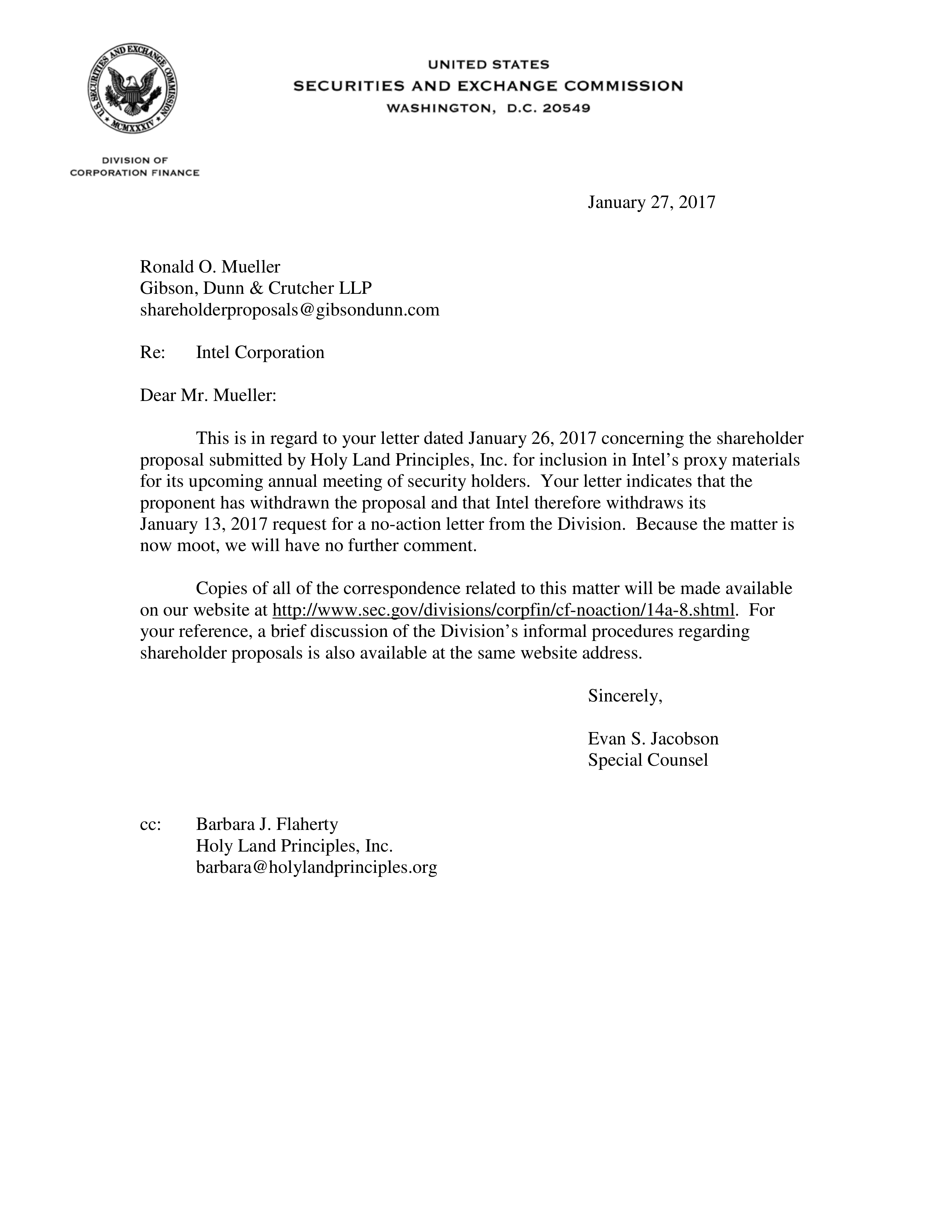

January 27, 2017
Ronald O. Mueller
Gibson, Dunn & Crutcher LLP
shareholderproposals@gibsondunn.com
Re:
Intel Corporation
Dear Mr. Mueller:
This is in regard to your letter dated January 26, 2017 concerning the shareholder
proposal submitted by Holy Land Principles, Inc. for inclusion in Intel’s proxy materials
for its upcoming annual meeting of security holders. Your letter indicates that the
proponent has withdrawn the proposal and that Intel therefore withdraws its
January 13, 2017 request for a no-action letter from the Division. Because the matter is
now moot, we will have no further comment.
Copies of all of the correspondence related to this matter will be made available
on our website at http://www.sec.gov/divisions/corpfin/cf-noaction/14a-8.shtml. For
your reference, a brief discussion of the Division’s informal procedures regarding
shareholder proposals is also available at the same website address.
Sincerely,
Evan S. Jacobson
Special Counsel
cc:
Barbara J. Flaherty
Holy Land Principles, Inc.
barbara@holylandprinciples.org



Ronald O. Mueller
Direct: 202.955.8671
Fax: 202.530.9569
RMueller@gibsondunn.com
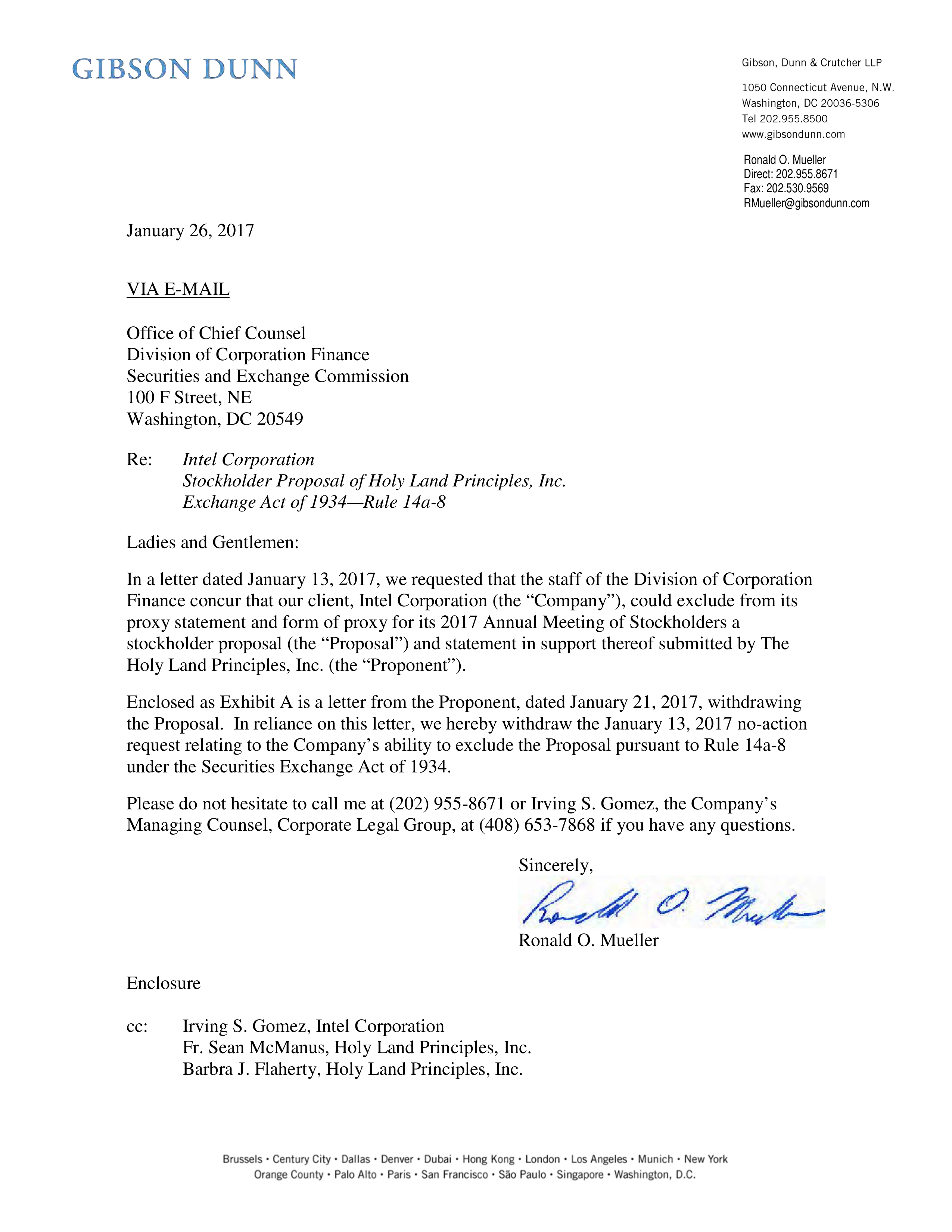
January 26, 2017
VIA E-MAIL
Office of Chief Counsel
Division of Corporation Finance
Securities and Exchange Commission
100 F Street, NE
Washington, DC 20549
Re:
Intel Corporation
Stockholder Proposal of Holy Land Principles, Inc.
Exchange Act of 1934—Rule 14a-8
Ladies and Gentlemen:
In a letter dated January 13, 2017, we requested that the staff of the Division of Corporation
Finance concur that our client, Intel Corporation (the “Company”), could exclude from its
proxy statement and form of proxy for its 2017 Annual Meeting of Stockholders a
stockholder proposal (the “Proposal”) and statement in support thereof submitted by The
Holy Land Principles, Inc. (the “Proponent”).
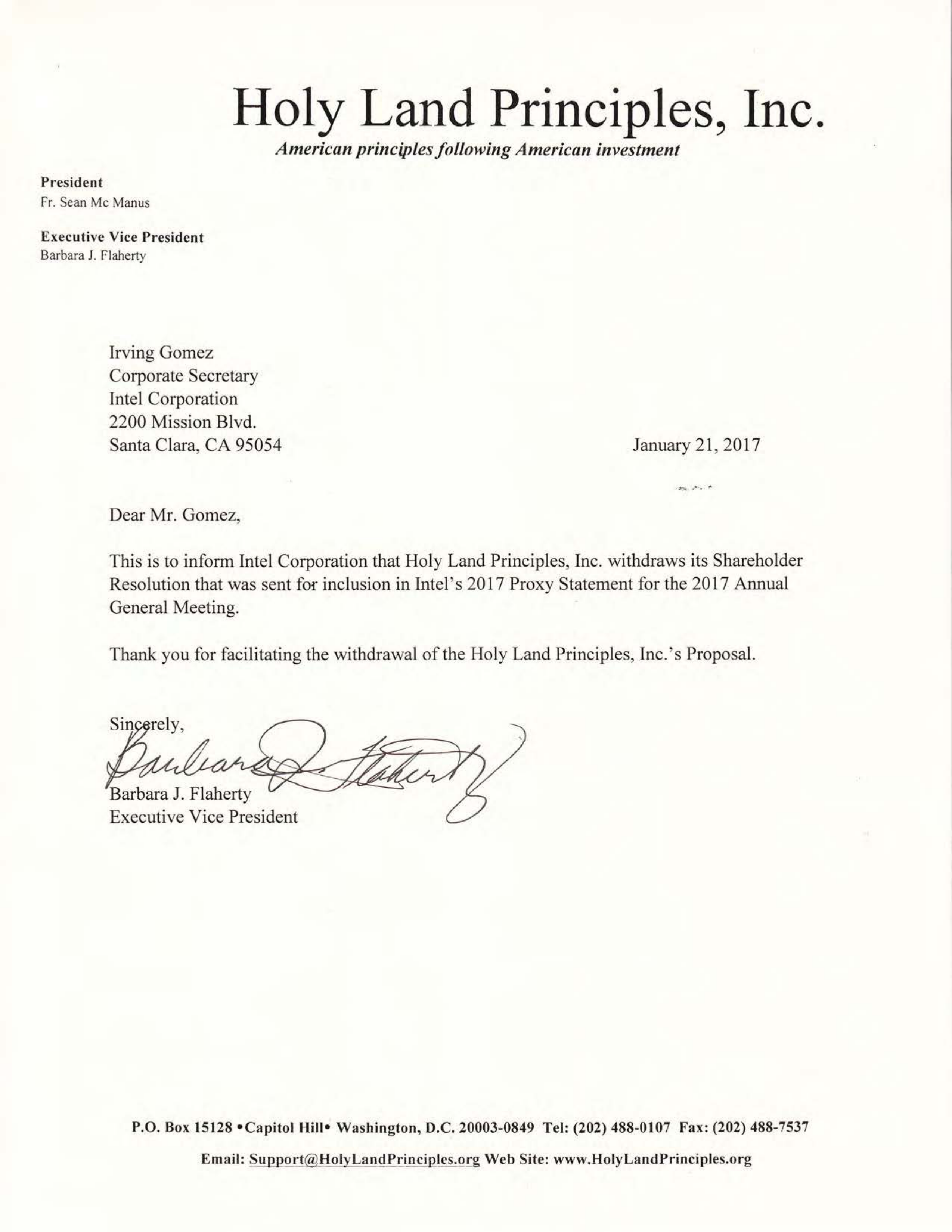
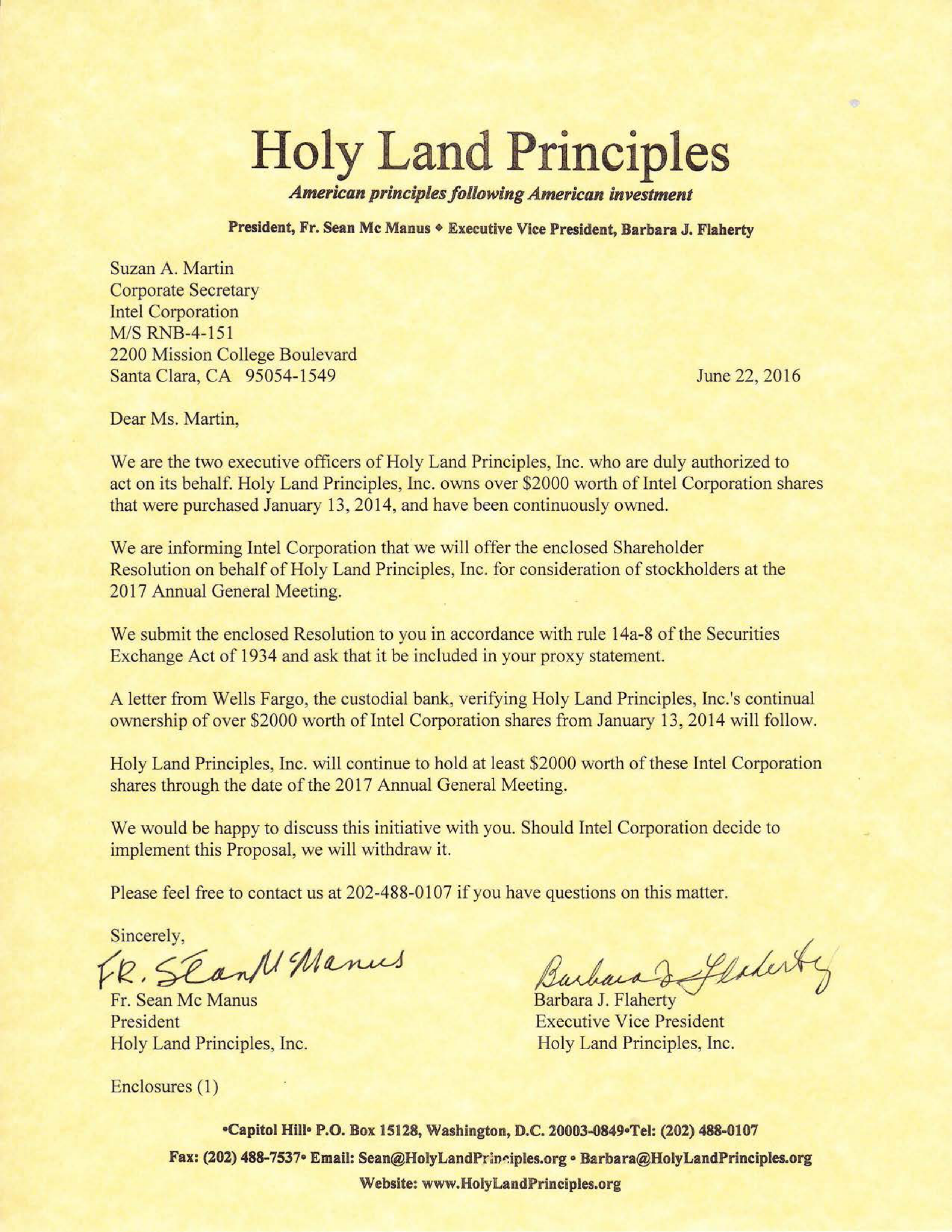
Enclosed as Exhibit A is a letter from the Proponent, dated January 21, 2017, withdrawing
the Proposal. In reliance on this letter, we hereby withdraw the January 13, 2017 no-action
request relating to the Company’s ability to exclude the Proposal pursuant to Rule 14a-8
under the Securities Exchange Act of 1934.
Please do not hesitate to call me at (202) 955-8671 or Irving S. Gomez, the Company’s
Managing Counsel, Corporate Legal Group, at (408) 653-7868 if you have any questions.
Sincerely,
Ronald O. Mueller
Enclosure
cc:
Irving S. Gomez, Intel Corporation
Fr. Sean McManus, Holy Land Principles, Inc.
Barbra J. Flaherty, Holy Land Principles, Inc.


EXHIBIT A
President
Fr.
Sean
Mc
Manus
Executive Vice President
Barbara J. Flaherty
Holy
Land Principles,
Inc.
Ame
r
ic
an
p
r
in
c
ip I
e s
fo
I I
ow in
g
A me
r
ic
an
inv
e
s
tme
nt
Irving
Gomez
Corporate
Secretary
Intel Corporation
2200
Mission
Blvd.
Santa
Clara,
CA
95054
January
2I,2017
Dear
Mr.
Gomez,
This
is
to
inform
Intel
Corporation that
Holy
Land
Principles,
Inc.
withdraws its
Shareholder
Resolution that was
sent
for inclusion
in Intel's
2017
Proxy
Statement
for the 2017
Arrual
General Meeting.
Thank
you
for
facilitating
the
withdrawal of
the
Holy
Land Principles,
Inc.'s
Proposal.
P.O. Box
15128
'Capitol
Hill.
Washington,
D.C. 20003-0849
Tel:
(202)
488-0107 Fax: (202)
488-7531
Email : $-gpport@_ES!y!Ad!fi_!S!pl_e_s.q4g
Web
Site:
www.HolyLandPrinciples.org
Barbara
J.
Flaherty
Executive
Vice
President


Ronald O. Mueller
Direct: +1 202.955.8671
Fax: +1 202.530.9569
RMueller@gibsondunn.com
January 13, 2017
VIA E-MAIL
Office of Chief Counsel
Division of Corporation Finance
Securities and Exchange Commission
100 F Street, NE
Washington, DC 20549
Re:
Intel Corporation
Stockholder Proposal of Holy Land Principles, Inc.
Securities Exchange Act of 1934—Rule 14a-8
Ladies and Gentlemen:
This letter is to inform you that Intel Corporation (the “Company”) intends to omit
from its proxy statement and form of proxy for its 2017 Annual Stockholders’ Meeting
(collectively, the “2017 Proxy Materials”) a stockholder proposal (the “Proposal”) and
statement in support thereof received from Holy Land Principles, Inc. (the “Proponent”).
Pursuant to Rule 14a-8(j), we:
•
have filed this letter with the Securities and Exchange Commission (the
“Commission”) no later than eighty (80) calendar days before the date the
Company expects to file its definitive 2017 Proxy Materials with the
Commission; and
•
are sending copies of this correspondence to the Proponent.
Rule 14a-8(k) and Staff Legal Bulletin No. 14D (Nov. 7, 2008) (“SLB 14D”) provide
that stockholder proponents are required to send companies a copy of any correspondence
that the proponents elect to submit to the Commission or the staff of the Division of
Corporation Finance (the “Staff”). Accordingly, we are taking this opportunity to inform the
Proponent that if the Proponent elects to submit additional correspondence to the
Commission or the Staff with respect to the Proposal, a copy of that correspondence should
be furnished concurrently to the undersigned on behalf of the Company pursuant to
Rule 14a-8(k) and SLB 14D.

Office of Chief Counsel
Division of Corporation Finance
January 13, 2017
Page 2
THE PROPOSAL
The Proposal states:
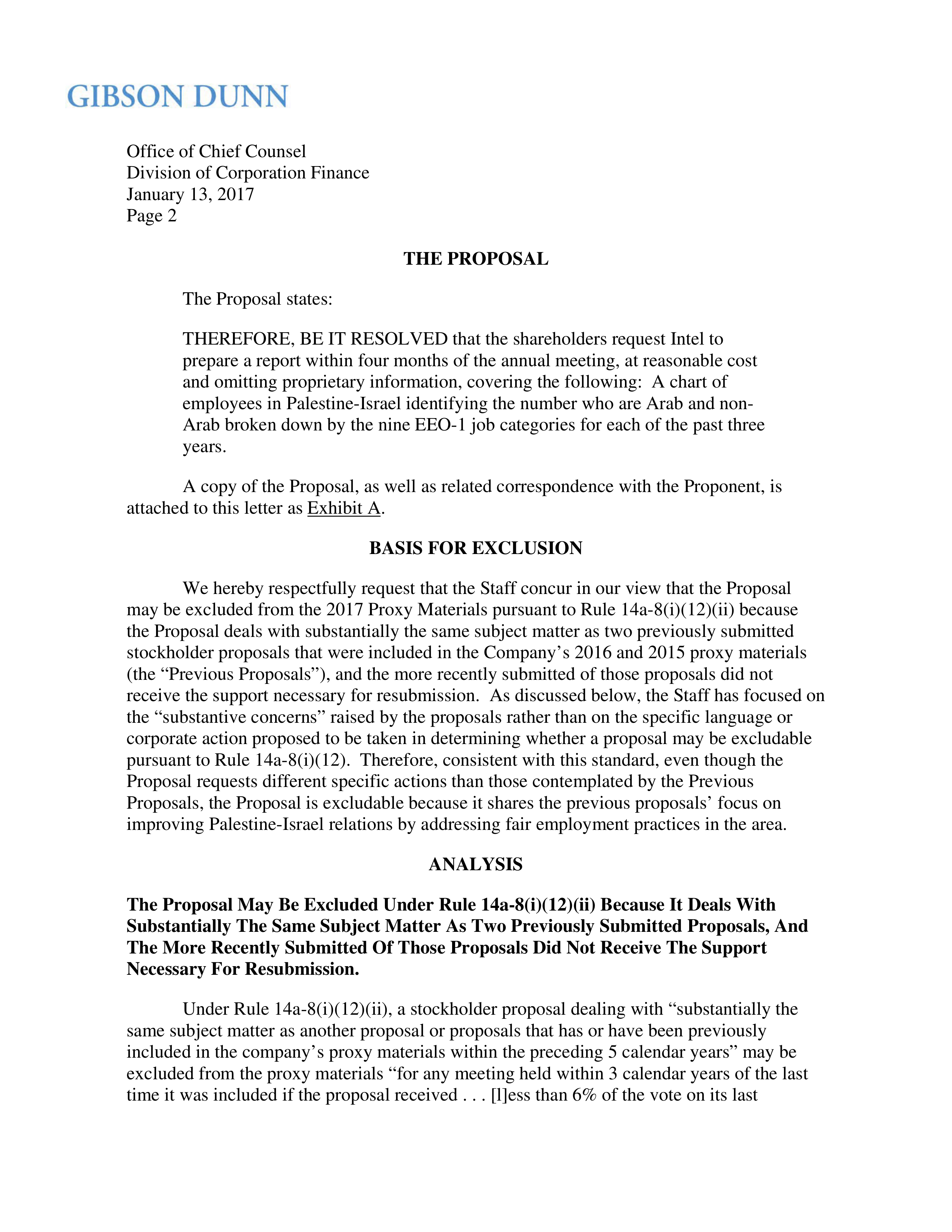
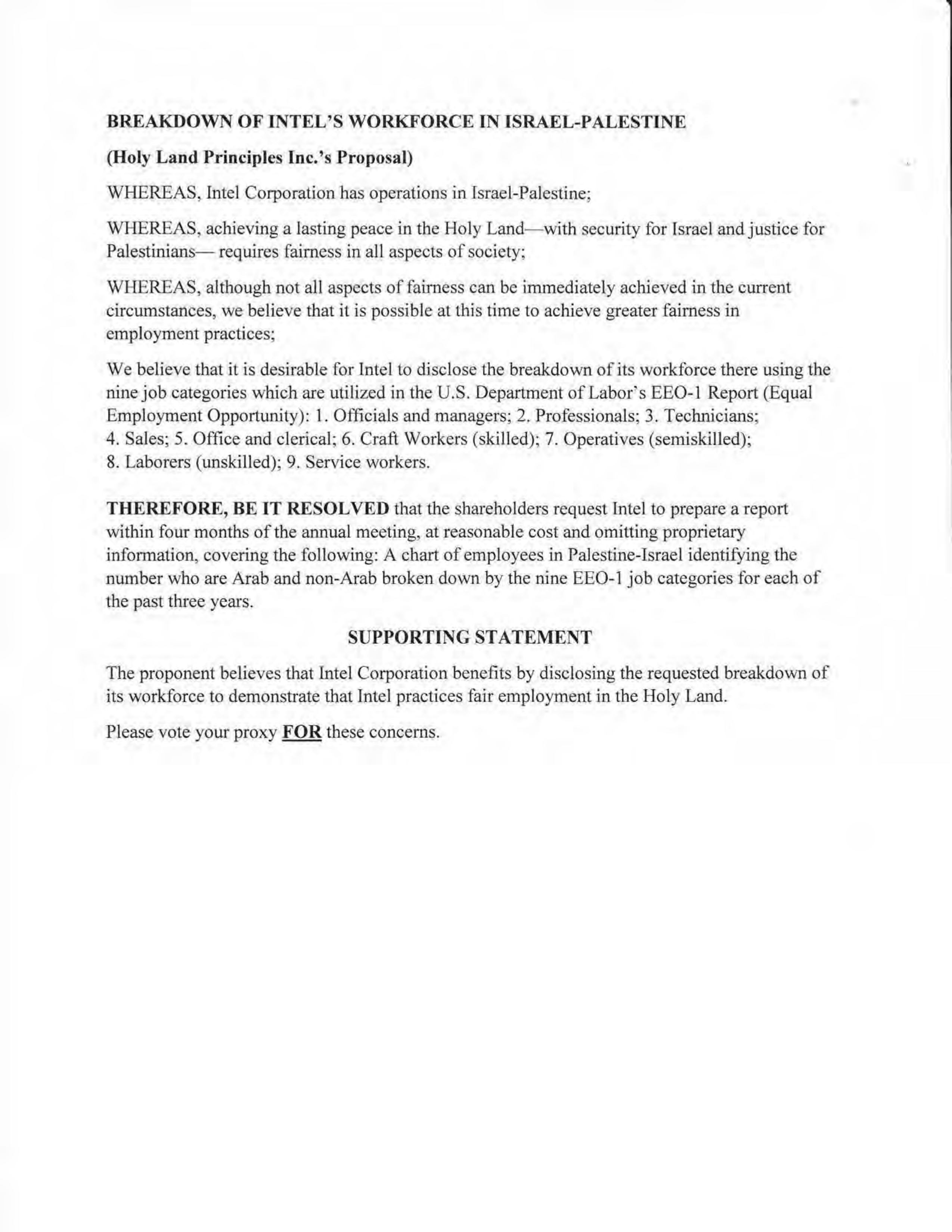
THEREFORE, BE IT RESOLVED that the shareholders request Intel to
prepare a report within four months of the annual meeting, at reasonable cost
and omitting proprietary information, covering the following: A chart of
employees in Palestine-Israel identifying the number who are Arab and non-
Arab broken down by the nine EEO-1 job categories for each of the past three
years.
A copy of the Proposal, as well as related correspondence with the Proponent, is
attached to this letter as Exhibit A.
BASIS FOR EXCLUSION
We hereby respectfully request that the Staff concur in our view that the Proposal
may be excluded from the 2017 Proxy Materials pursuant to Rule 14a-8(i)(12)(ii) because
the Proposal deals with substantially the same subject matter as two previously submitted
stockholder proposals that were included in the Company’s 2016 and 2015 proxy materials
(the “Previous Proposals”), and the more recently submitted of those proposals did not
receive the support necessary for resubmission. As discussed below, the Staff has focused on
the “substantive concerns” raised by the proposals rather than on the specific language or
corporate action proposed to be taken in determining whether a proposal may be excludable
pursuant to Rule 14a-8(i)(12). Therefore, consistent with this standard, even though the
Proposal requests different specific actions than those contemplated by the Previous
Proposals, the Proposal is excludable because it shares the previous proposals’ focus on
improving Palestine-Israel relations by addressing fair employment practices in the area.
ANALYSIS
The Proposal May Be Excluded Under Rule 14a-8(i)(12)(ii) Because It Deals With
Substantially The Same Subject Matter As Two Previously Submitted Proposals, And
The More Recently Submitted Of Those Proposals Did Not Receive The Support
Necessary For Resubmission.
Under Rule 14a-8(i)(12)(ii), a stockholder proposal dealing with “substantially the
same subject matter as another proposal or proposals that has or have been previously
included in the company’s proxy materials within the preceding 5 calendar years” may be
excluded from the proxy materials “for any meeting held within 3 calendar years of the last
time it was included if the proposal received . . . [l]ess than 6% of the vote on its last

Office of Chief Counsel
Division of Corporation Finance
January 13, 2017
Page 3
submission to shareholders if proposed twice previously within the preceding 5 calendar
years.”
A.
Overview Of Rule 14a-8(i)(12).
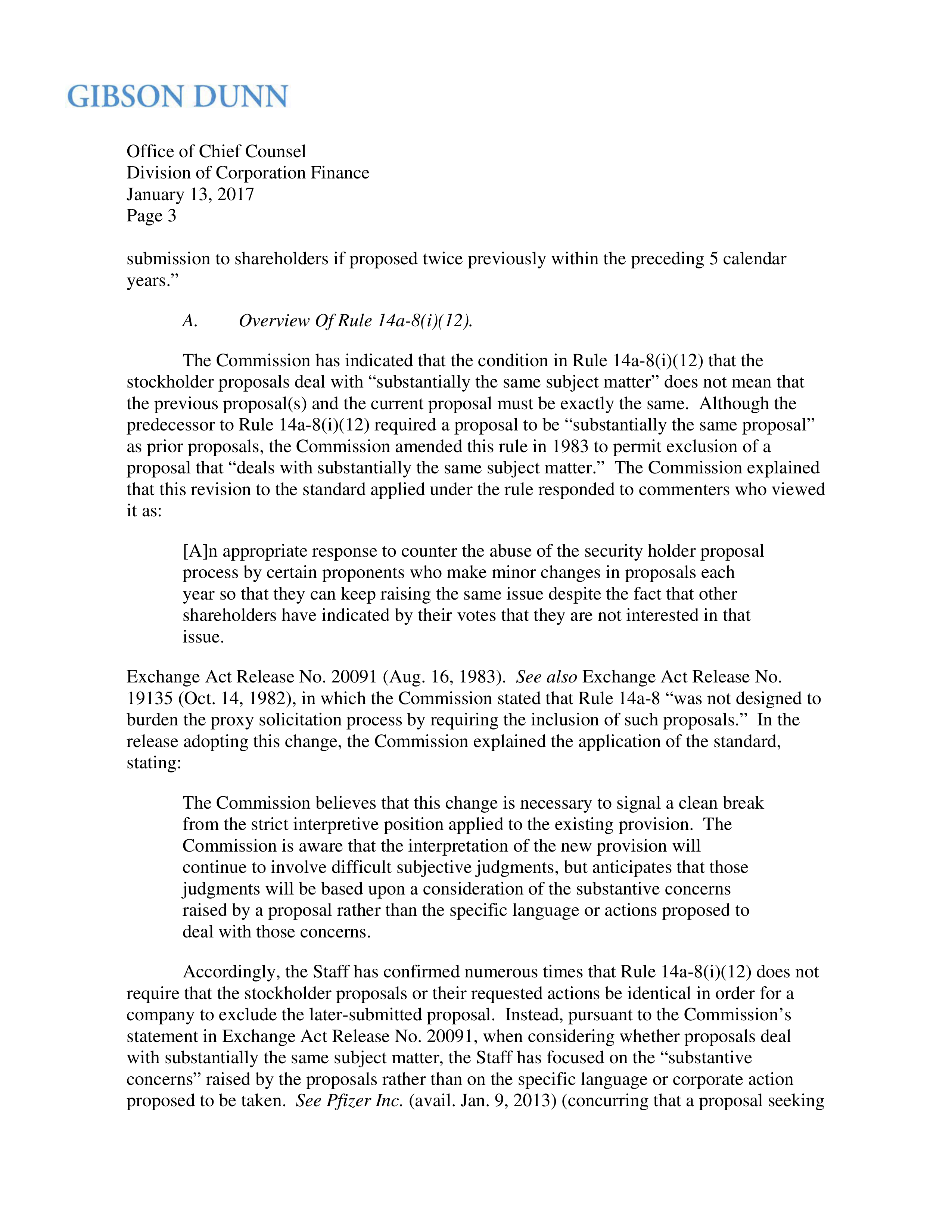
The Commission has indicated that the condition in Rule 14a-8(i)(12) that the
stockholder proposals deal with “substantially the same subject matter” does not mean that
the previous proposal(s) and the current proposal must be exactly the same. Although the
predecessor to Rule 14a-8(i)(12) required a proposal to be “substantially the same proposal”
as prior proposals, the Commission amended this rule in 1983 to permit exclusion of a
proposal that “deals with substantially the same subject matter.” The Commission explained
that this revision to the standard applied under the rule responded to commenters who viewed
it as:
[A]n appropriate response to counter the abuse of the security holder proposal
process by certain proponents who make minor changes in proposals each
year so that they can keep raising the same issue despite the fact that other
shareholders have indicated by their votes that they are not interested in that
issue.
Exchange Act Release No. 20091 (Aug. 16, 1983).
See also
Exchange Act Release No.
19135 (Oct. 14, 1982), in which the Commission stated that Rule 14a-8 “was not designed to
burden the proxy solicitation process by requiring the inclusion of such proposals.” In the
release adopting this change, the Commission explained the application of the standard,
stating:
The Commission believes that this change is necessary to signal a clean break
from the strict interpretive position applied to the existing provision. The
Commission is aware that the interpretation of the new provision will
continue to involve difficult subjective judgments, but anticipates that those
judgments will be based upon a consideration of the substantive concerns
raised by a proposal rather than the specific language or actions proposed to
deal with those concerns.
Accordingly, the Staff has confirmed numerous times that Rule 14a-8(i)(12) does not
require that the stockholder proposals or their requested actions be identical in order for a
company to exclude the later-submitted proposal. Instead, pursuant to the Commission’s
statement in Exchange Act Release No. 20091, when considering whether proposals deal
with substantially the same subject matter, the Staff has focused on the “substantive
concerns” raised by the proposals rather than on the specific language or corporate action
proposed to be taken.
See Pfizer Inc.
(avail. Jan. 9, 2013) (concurring that a proposal seeking

Office of Chief Counsel
Division of Corporation Finance
January 13, 2017
Page 4
disclosure of the company’s lobbying policies and expenditures was excludable under Rule
14a-8(i)(12) because it dealt with substantially the same subject matter as prior proposals
seeking disclosure of contributions to political campaigns, political parties and attempts to
influence legislation);
Ford Motor Co.
(avail. Feb. 10, 2012) (concurring that a proposal
requesting a semi-annual report on the company’s political contributions and the policies,
procedures and participants involved in making such contribution was excludable under Rule
14a-8(i)(12) because it dealt with substantially the same subject matter as four prior
proposals requiring reports providing details on political spending).
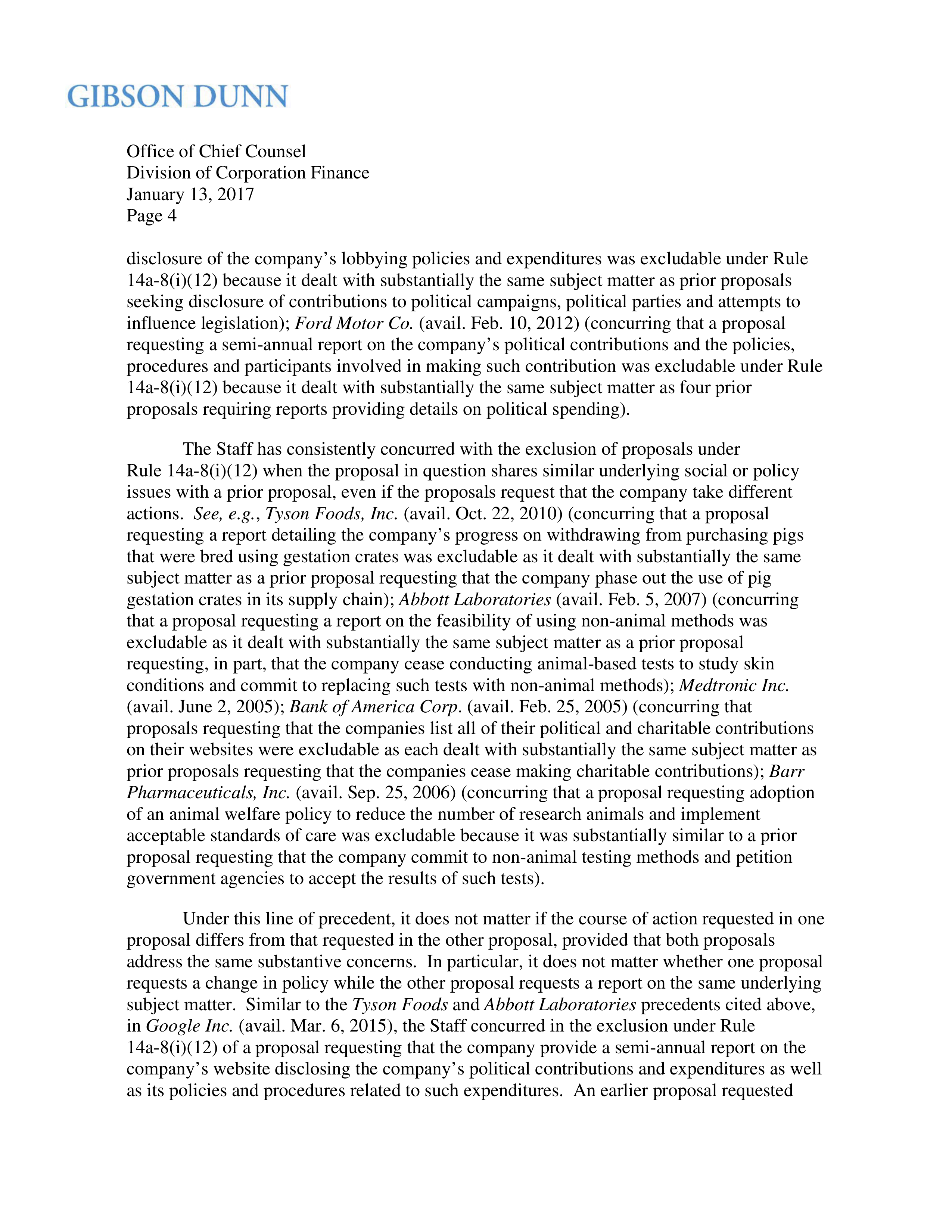
The Staff has consistently concurred with the exclusion of proposals under
Rule 14a-8(i)(12) when the proposal in question shares similar underlying social or policy
issues with a prior proposal, even if the proposals request that the company take different
actions.
See, e.g.
,
Tyson Foods, Inc.
(avail. Oct. 22, 2010) (concurring that a proposal
requesting a report detailing the company’s progress on withdrawing from purchasing pigs
that were bred using gestation crates was excludable as it dealt with substantially the same
subject matter as a prior proposal requesting that the company phase out the use of pig
gestation crates in its supply chain);
Abbott Laboratories
(avail. Feb. 5, 2007) (concurring
that a proposal requesting a report on the feasibility of using non-animal methods was
excludable as it dealt with substantially the same subject matter as a prior proposal
requesting, in part, that the company cease conducting animal-based tests to study skin
conditions and commit to replacing such tests with non-animal methods);
Medtronic Inc.
(avail. June 2, 2005);
Bank of America Corp
. (avail. Feb. 25, 2005) (concurring that
proposals requesting that the companies list all of their political and charitable contributions
on their websites were excludable as each dealt with substantially the same subject matter as
prior proposals requesting that the companies cease making charitable contributions);
Barr
Pharmaceuticals, Inc.
(avail. Sep. 25, 2006) (concurring that a proposal requesting adoption
of an animal welfare policy to reduce the number of research animals and implement
acceptable standards of care was excludable because it was substantially similar to a prior
proposal requesting that the company commit to non-animal testing methods and petition
government agencies to accept the results of such tests).
Under this line of precedent, it does not matter if the course of action requested in one
proposal differs from that requested in the other proposal, provided that both proposals
address the same substantive concerns.
In particular, it does not matter whether one proposal
requests a change in policy while the other proposal requests a report on the same underlying
subject matter. Similar to the
Tyson Foods
and
Abbott Laboratories
precedents cited above,
in
Google Inc.
(avail. Mar. 6, 2015), the Staff concurred in the exclusion under Rule
14a-8(i)(12) of a proposal requesting that the company provide a semi-annual report on the
company’s website disclosing the company’s political contributions and expenditures as well
as its policies and procedures related to such expenditures. An earlier proposal requested

Office of Chief Counsel
Division of Corporation Finance
January 13, 2017
Page 5
that the company hold an annual advisory stockholder vote on political contributions with
each such proposal disclosing the company’s political contributions along with an analysis of
the congruency of these political expenditures and policies with company values. Despite
the difference in requested course of action, the Staff concurred that both proposals dealt
with substantially the same subject matter—political contributions by the company—and that
the subsequent proposal was therefore excludable under Rule 14a-8(i)(12).
See also Saks
Inc
. (avail. Mar. 1, 2004) (concurring that a proposal requesting that the board of directors
implement a code of conduct based on International Labor Organization standards, establish
an independent monitoring process and annually report on adherence to such code was
excludable as it dealt with substantially the same subject matter as a prior proposal
requesting a report on the company’s vendor labor standards and compliance mechanism);
Bristol-Myers Squibb Co.
(avail. Feb. 11, 2004) (concurring that a proposal requesting that
the board review pricing and marketing policies and prepare a report on how the company
will respond to pressure to increase access to prescription drugs was excludable as involving
substantially the same subject matter as prior proposals requesting the creation and
implementation of a policy of price restraint on pharmaceutical products).
In addition, the Staff has concurred in the exclusion of proposals under
Rule 14a-8(i)(12) when they share the same underlying issue even if the proposals differ in
scope from the prior proposals to which they have been compared. In
Exxon Mobil Corp.
(avail. Mar. 7, 2013), for example, the Staff permitted the exclusion pursuant to
Rule 14a-8(i)(12)(iii) of a stockholder proposal requesting that the board of directors review
the exposure of the company’s facilities to climate risk and issue a report to stockholders
because the proposal dealt with substantially the same subject matter as three prior proposals
requesting that the company establish a committee or a task force to address issues relating to
global climate change.
See also Exxon Mobil Corp.
(avail. Mar. 23, 2012) (concurring that a
proposal requesting a comprehensive policy on water addressed substantially the same
subject matter as three other proposals, one of which requested that the board issue a report
on issues relating to land, water and soil);
Dow Jones & Co., Inc
. (avail. Dec. 17, 2004)
(concurring that a proposal requesting that the company publish information relating to its
process for donations to a particular non-profit organization was excludable as it dealt with
substantially the same subject matter as a prior proposal requesting an explanation of the
procedures governing all charitable donations);
General Motors Corp.
(avail. Mar. 18, 1999)
(concurring that a proposal regarding goods or services that utilize slave or forced labor in
China was excludable because it dealt with the same subject matter as previous proposals
that would have applied to the Soviet Union as well as China).

Office of Chief Counsel
Division of Corporation Finance
January 13, 2017
Page 6
B.
The Proposal Deals With Substantially The Same Subject Matter As Two
Proposals That Were Previously Included In The Company’s Proxy Materials
Within The Preceding Five Calendar Years.
The Company included the Previous Proposals in its proxy materials within the past
five years.
•
In its 2016 proxy materials, filed with the SEC on April 4, 2016 (the “2016
Proposal,” attached as Exhibit B), the Company included a stockholder proposal
from the Proponent describing in its resolved clauses a series of principles
relating to equal opportunity employment for corporations doing business in
Palestine-Israel (the “Holy Land Principles”) and requesting that the Company’s
Board of Directors “[m]ake all possible lawful efforts to implement and/or
increase activity on each of the eight Holy Land Principles.”
•
In its 2015 proxy materials, filed with the SEC on April 2, 2015 (the “2015
Proposal,” attached as Exhibit C), the Company included a stockholder proposal
from John Harrington that was identical to the 2016 Proposal.
The Proposal, in raising concern over the Company’s employment practices in the
Palestine-Israel region, deals with substantially the same subject matter as the Previous
Proposals. Although the Proposal is phrased differently from the Previous Proposals, the
express language of the Proposal and the Previous Proposals as well as their supporting
statements demonstrate that they address the same substantive concern. For example:
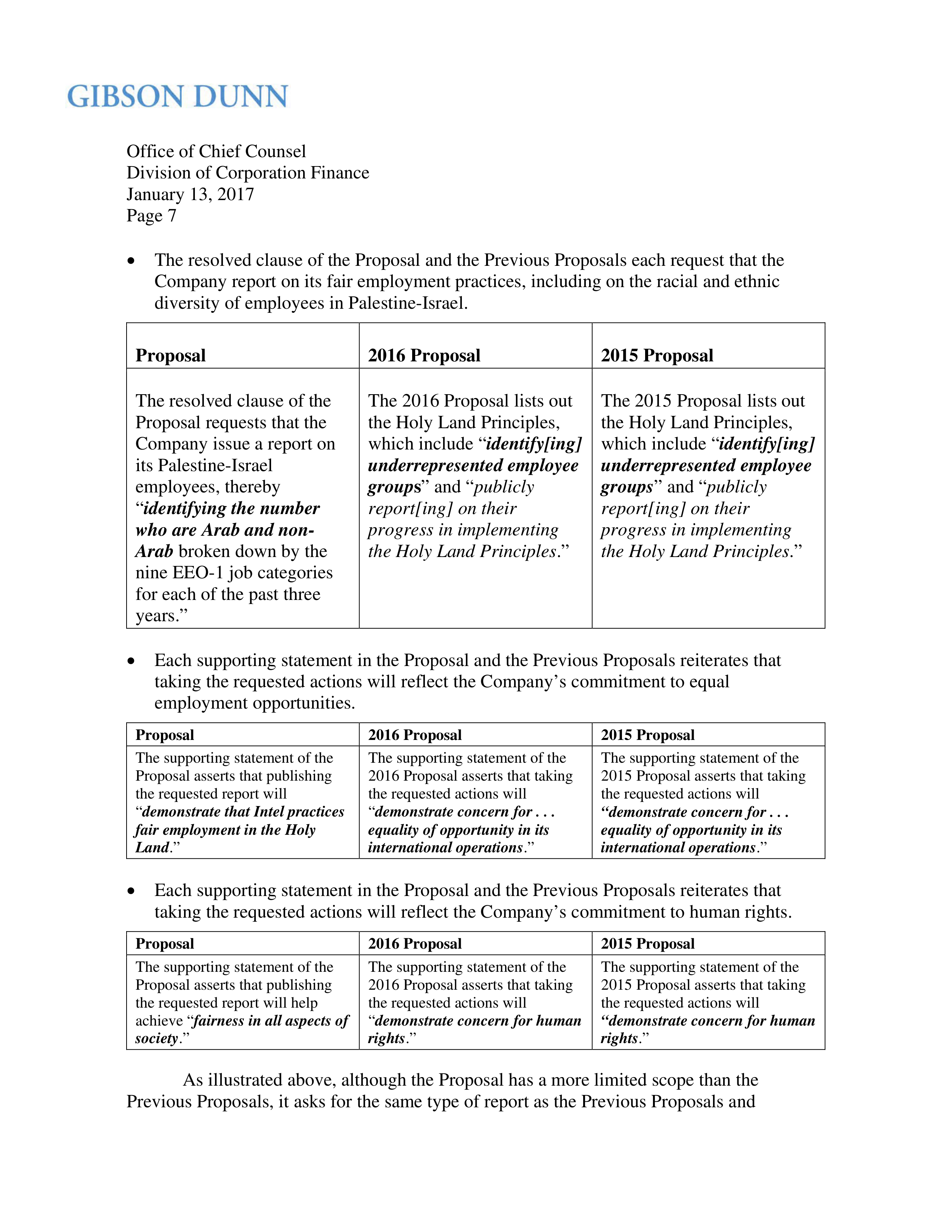
•
The recitals in the Proposal and the Previous Proposals each identify the same
substantive concern of focusing on fair employment practices as a means to address the
Proponent’s concerns over Israeli-Palestinian relations.
Proposal
2016 Proposal
2015 Proposal
The Proposal’s supporting
statement notes that “
achieving a
lasting peace in the Holy Land—
with security for Israel and
justice for Palestinians
—requires
fairness in all aspects of society,”
adding, “we believe it is possible
at this time to achieve greater
fairness in employment
practices
.”
The 2016 Proposal’s supporting
statement notes that “
achieving a
lasting peace in the Holy Land—
with security for Israel and
justice for Palestinians
—
encourages us to a promote a
means for establishing justice and
equality,” and immediately
follows that statement by adding
that “
fair employment
should be
the hallmark of any American
company at home or abroad and is
a requisite for any just society.”
The 2015 Proposal’s supporting
statement notes that “
achieving a
lasting peace in the Holy Land—
with security for Israel and
justice for Palestinians
—
encourages us to a promote a
means for establishing justice and
equality,” and immediately
follows that statement by adding
that “
fair employment
should be
the hallmark of any American
company at home or abroad and is
a requisite for any just society.”

Office of Chief Counsel
Division of Corporation Finance
January 13, 2017
Page 7
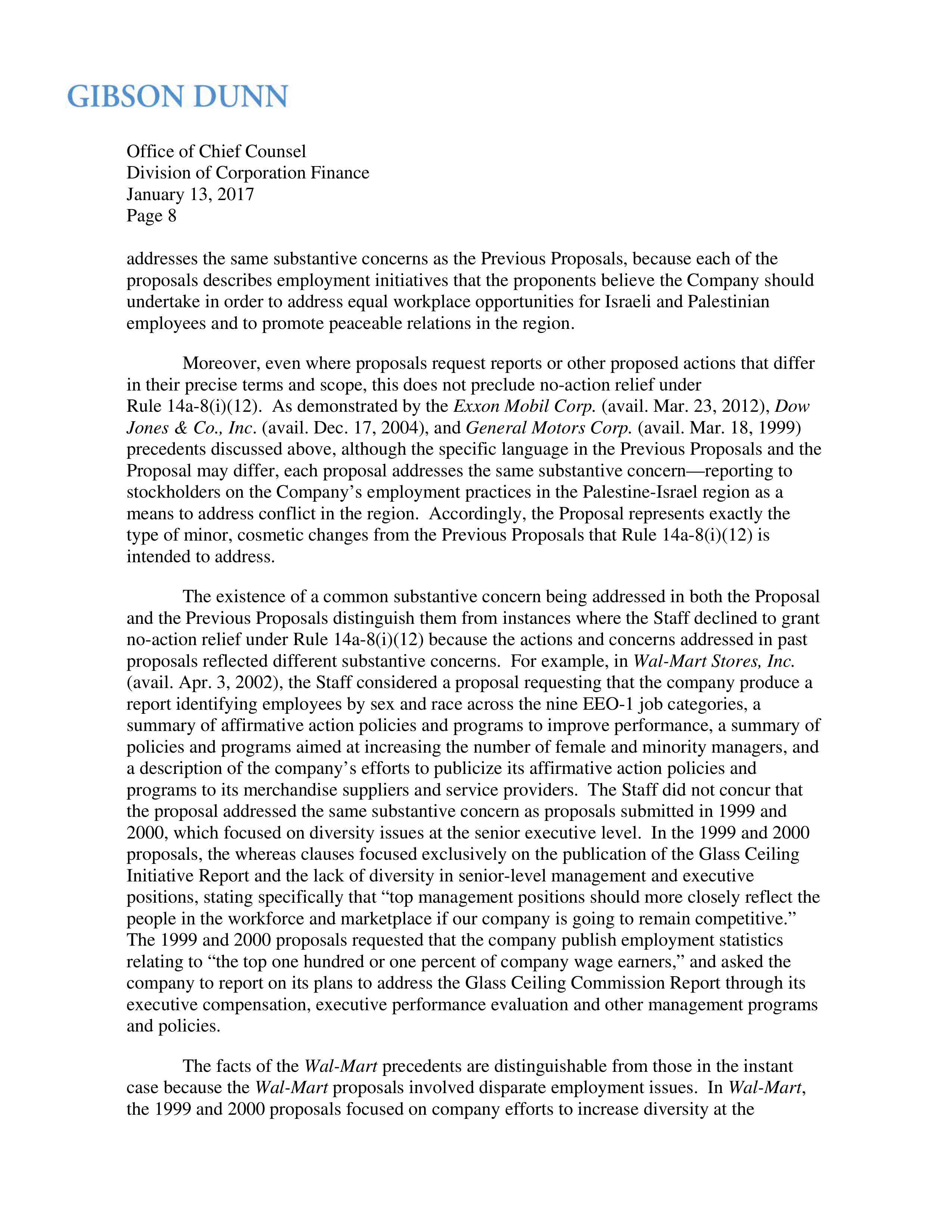
•
The resolved clause of the Proposal and the Previous Proposals each request that the
Company report on its fair employment practices, including on the racial and ethnic
diversity of employees in Palestine-Israel.
Proposal
2016 Proposal
2015 Proposal
The resolved clause of the
Proposal requests that the
Company issue a report on
its Palestine-Israel
employees, thereby
“
identifying the number
who are Arab and non-
Arab
broken down by the
nine EEO-1 job categories
for each of the past three
years.”
The 2016 Proposal lists out
the Holy Land Principles,
which include “
identify[ing]
underrepresented employee
group
s
” and “
publicly
report[ing] on their
progress in implementing
the Holy Land Principles
.”
The 2015 Proposal lists out
the Holy Land Principles,
which include “
identify[ing]
underrepresented employee
groups
” and “
publicly
report[ing] on their
progress in implementing
the Holy Land Principles
.”
•
Each supporting statement in the Proposal and the Previous Proposals reiterates that
taking the requested actions will reflect the Company’s commitment to equal
employment opportunities.
Proposal
2016 Proposal
2015 Proposal
The supporting statement of the
Proposal asserts that publishing
the requested report will
“
demonstrate that Intel practices
fair employment in the Holy
Land
.”
The supporting statement of the
2016 Proposal asserts that taking
the requested actions will
“
demonstrate concern for . . .
equality of opportunity in its
international operations
.”
The supporting statement of the
2015 Proposal asserts that taking
the requested actions will
“demonstrate concern for . . .
equality of opportunity in its
international operations
.”
•
Each supporting statement in the Proposal and the Previous Proposals reiterates that
taking the requested actions will reflect the Company’s commitment to human rights.
Proposal
2016 Proposal
2015 Proposal
The supporting statement of the
Proposal asserts that publishing
the requested report will help
achieve “
fairness in all aspects of
society
.”
The supporting statement of the
2016 Proposal asserts that taking
the requested actions will
“
demonstrate concern for human
rights
.”
The supporting statement of the
2015 Proposal asserts that taking
the requested actions will
“demonstrate concern for human
rights
.”
As illustrated above, although the Proposal has a more limited scope than the
Previous Proposals, it asks for the same type of report as the Previous Proposals and

Office of Chief Counsel
Division of Corporation Finance
January 13, 2017
Page 8
addresses the same substantive concerns as the Previous Proposals, because each of the
proposals describes employment initiatives that the proponents believe the Company should
undertake in order to address equal workplace opportunities for Israeli and Palestinian
employees and to promote peaceable relations in the region.
Moreover, even where proposals request reports or other proposed actions that differ
in their precise terms and scope, this does not preclude no-action relief under
Rule 14a-8(i)(12). As demonstrated by the
Exxon Mobil Corp.
(avail. Mar. 23, 2012),
Dow
Jones & Co., Inc
. (avail. Dec. 17, 2004), and
General Motors Corp.
(avail. Mar. 18, 1999)
precedents discussed above, although the specific language in the Previous Proposals and the
Proposal may differ, each proposal addresses the same substantive concern—reporting to
stockholders on the Company’s employment practices in the Palestine-Israel region as a
means to address conflict in the region. Accordingly, the Proposal represents exactly the
type of minor, cosmetic changes from the Previous Proposals that Rule 14a-8(i)(12) is
intended to address.
The existence of a common substantive concern being addressed in both the Proposal
and the Previous Proposals distinguish them from instances where the Staff declined to grant
no-action relief under Rule 14a-8(i)(12) because the actions and concerns addressed in past
proposals reflected different substantive concerns. For example, in
Wal-Mart Stores, Inc.
(avail. Apr. 3, 2002), the Staff considered a proposal requesting that the company produce a
report identifying employees by sex and race across the nine EEO-1 job categories, a
summary of affirmative action policies and programs to improve performance, a summary of
policies and programs aimed at increasing the number of female and minority managers, and
a description of the company’s efforts to publicize its affirmative action policies and
programs to its merchandise suppliers and service providers. The Staff did not concur that
the proposal addressed the same substantive concern as proposals submitted in 1999 and
2000, which focused on diversity issues at the senior executive level. In the 1999 and 2000
proposals, the whereas clauses focused exclusively on the publication of the Glass Ceiling
Initiative Report and the lack of diversity in senior-level management and executive
positions, stating specifically that “top management positions should more closely reflect the
people in the workforce and marketplace if our company is going to remain competitive.”
The 1999 and 2000 proposals requested that the company publish employment statistics
relating to “the top one hundred or one percent of company wage earners,” and asked the
company to report on its plans to address the Glass Ceiling Commission Report through its
executive compensation, executive performance evaluation and other management programs
and policies.
The facts of the
Wal-Mart
precedents are distinguishable from those in the instant
case because the
Wal-Mart
proposals involved disparate employment issues. In
Wal-Mart
,
the 1999 and 2000 proposals focused on company efforts to increase diversity at the

Office of Chief Counsel
Division of Corporation Finance
January 13, 2017
Page 9
executive level, requesting reports on employment statistics at such level and discussion of
the company’s efforts to increase diversity through initiatives mainly focused on executive
compensation, executive performance evaluations, mentorship and other opportunities for
advancement up the corporate ladder. However, the proposal the company sought to exclude
focused on the company’s efforts to increase diversity at all employment levels, thus
requesting a broader set of employment statistics, a more general discussion of policies
aimed at improving job performance and increasing diversity among managers, as well as a
discussion of how the company publicizes such efforts to third-party suppliers.
1
In contrast,
the Proposal and the Previous Proposals all address the same substantive concern, requesting
that the Company issue a report addressing its employment practices in Israel as a means to
address Palestinian and Israeli relations. Therefore, we believe that the Proposal may be
excluded pursuant to Rule 14a-8(i)(12)(ii).
1
Likewise, in other situations where proposals addressed similar issues but reflected
different substantive concerns, the Staff has declined to concur that proposals dealt with
substantially the same subject matter for purposes of Rule 14a-8(i)(12).
See, Chevron
Corp.
(avail. Feb. 29, 2000) (declining to concur in the exclusion of a proposal in light of
the fact that “while the prior two proposals concerned substantially the same subject
matter, the company’s oil and gas drilling operations in the Arctic National Wildlife
Refuge, the present proposal requests an environmental impact study on the results of
such operations rather than their immediate cessation”);
Loews Corp. (Christian Brothers
Investment Services, Inc.)
(avail. Feb. 22, 1999) (declining to concur in the exclusion of a
proposal requesting that the company tie executive compensation to success in reducing
teen consumption of company tobacco products, because a prior proposal requested the
company to implement Food and Drug Administration regulations to reduce teen
smoking without linking such efforts to executive compensation);
Chevron Corp.
(avail.
Feb. 11, 1998) (declining to concur in the exclusion of a proposal requesting that the
company implement a policy for disclosing amounts of toxic chemical compounds
released from the company’s refineries, the sources of such compounds, and methods for
reducing their release, given that two prior proposals requested public access to facility
information that would allow assessment of such facilities’ environmental and safety
hazards and related company policies, and that would also permit inspection of such
facilities);
American Brands, Inc.
(avail. Jan. 6, 1995) (declining to concur in the
exclusion of a proposal requesting that the company spin-off its tobacco business, as two
prior proposals relating to tobacco use requested the Company to stop producing and
marketing tobacco products altogether).


Office of Chief Counsel
Division of Corporation Finance
January 13, 2017
Page 10
C.
The Stockholder Proposal Included In The Company’s 2016 Proxy Materials
Did Not Receive The Stockholder Support Necessary To Permit Resubmission.
In addition to requiring that the proposals address the same substantive concern,
Rule 14a-8(i)(12) sets thresholds with respect to the percentage of stockholder votes cast in
favor of the last proposal submitted and included in the Company’s proxy materials. As
evidenced in the Company’s Form 8-K filed on May 24, 2016, which states the voting results
for the Company’s 2016 Annual Stockholders’ Meeting and is attached as Exhibit D, the
2016 Proposal received 3.89% of the votes cast at the Company’s 2016 Annual
Stockholders’ Meeting.
2
Thus, the vote on the 2016 Proposal failed to achieve the 6%
threshold specified in Rule 14a-8(i)(12)(ii) at the 2016 Annual Meeting.
For the foregoing reasons, the Company may exclude the Proposal from its 2017
Proxy Materials under Rule 14a-8(i)(12)(ii).
CONCLUSION
Based upon the foregoing analysis, we respectfully request that the Staff concur that
it will take no action if the Company excludes the Proposal from its 2017 Proxy Materials.
We would be happy to provide you with any additional information and answer any
questions that you may have regarding this subject. Correspondence regarding this letter
should be sent to shareholderproposals@gibsondunn.com. If we can be of any further
assistance in this matter, please do not hesitate to call me at (202) 955-8671 or Irving S.
Gomez, the Company’s Senior Counsel, Corporate Legal Group, at (408) 653-7868.
Sincerely,
Ronald O. Mueller
Enclosures
2
The 2016 Proposal received 2,551,699,762 “against” votes and 103,321,479 “for” votes.
Abstentions and broker non-votes were not included for purposes of this calculation.
See
Staff Legal Bulletin No. 14, Question F.4 (July 13, 2001).

Office of Chief Counsel
Division of Corporation Finance
January 13, 2017
Page 11
cc:
Irving S. Gomez, Intel Corporation
Fr. Sean McManus, Holy Land Principles, Inc.
Barbara J. Flaherty, Holy Land Principles, Inc.


EXHIBIT A
.
.
'
....
.....
~.,
...
.....
I
<
.....
•I
1:...
-*-
..
·-~~
~
·~
.
"
-
.
·
.
:
.
~·
'
I
i,.
~"
...
1
~
• +
.
..
"
'
"'I
._
,,
I
...
'
11
•f
..
'¥···
'+•
..
'
•'
,.
'.'
~.:
.
.
~''f"·
fl ..
.
.
'
.
,
.
.
·"·
.
'
...
"
1
....
:,,
...
.,
Holy
Land
Principles
'
t"
,,
~.
..
~
..
~
.
..;
....
r
·I'
I •
American principles following American investment
.
President, Fr. Sean Mc Manus • Executive Vice President, Barbara
J.
Flaherty
•
'-~'j
Suzan
A.
Martin
Corporate Secretary
Intel Corporation
MIS
RNB-4-
151
',
I
'
2200 Mission College Boulevard
Santa Clara, CA 95054-1549
Dear Ms. Martin,
I
~
~·
"
i
.
....
,,.
O!
•
...
"
..
.
'
·":\
I
..
I
.
-·
-
.
r
.....
,
1.
June 22, 2016
We are the two executive officers
of
Holy Land Principles, Inc. who are duly authorized to
....
i
•'
~
" .
act on its behalf. Holy Land Principles, Inc. owns over $2000 worth
of
Intel Corporation shares
that were purchased January 13, 2014, and have been continuously owned.
We are informing Intel Corporation that we will offer the enclosed Shareholder
Resolution on behalf
of
Holy Land Principles, Inc. for consideration
of
stockholders at the
201
7 Annual General Meeting.
. .
,
...
""'"
....
-
...
,
.,f
·'
•
· .
.
._
.
.
..
·~""
1,
"
.
Ill
•
1
a
••
,..
"
~
T
We submit the enclosed Resolution to you in accordance with rule 14a-8
of
the Securities
.i'
....
.-~
..
Exchange Act
of
1934 and ask that it be included in your proxy statement.
..
,
.I
"·.'
..
A letter from Wells Fargo, the custodial bank, verifying Holy Land Principles, Inc.'s continual
.,.
,
. ,
ownership
of
over $2000 worth
of
Intel Corporation shares from January 13, 2014 will follow.
Holy Land Principles, Inc. will continue to hold at least $2000 worth
of
these Intel Corporation
shares through the date
of
the 2017 Annual General Meeting.
...
We would be happy to discuss this initiative with you. Should Intel Corporation decide to
implement this Proposal, we will withdraw it.
Please feel free to contact us at 202-488-0107
if
you have questions on this matter.
rz.
';.
....
._
........
Sincerely,
'
..
~
{tz,~WI~
.
.
..
Fr. Sean Mc Manus
""
I •
Barbara J. Flaherty
Executive Vice President
..
''
Holy Land Principles, Inc.
-1f
..
.
I
President
Holy Land Principles, Inc.
I~
,..
1
,
..
.
~
r
.•.
,
.
'
.
.
•
•
•
•
..
..
..
~,
'I>·
...
.,.
..
.
,
'
'
1.
'
..
.
-·
'
~·
.,,
Enclosures (1)
,.
.
r~.
,.,....
~.:
~·~.
;\
•I
..
•Capitol Hill• P.O. Box 15128, Washington, D.C. 20003-0849•Tel: (202) 488-0107
Fax: (202) 488-7537° Email:
Sean@HolyLandPrin~iples.org
..
Barbara@HolyLandPrinciples.org
Website: www.HolyLandPrinciples.org
'If'
""'"'
•1
"•
I•
..
..
.
~
..
• I •
..
,
...,._
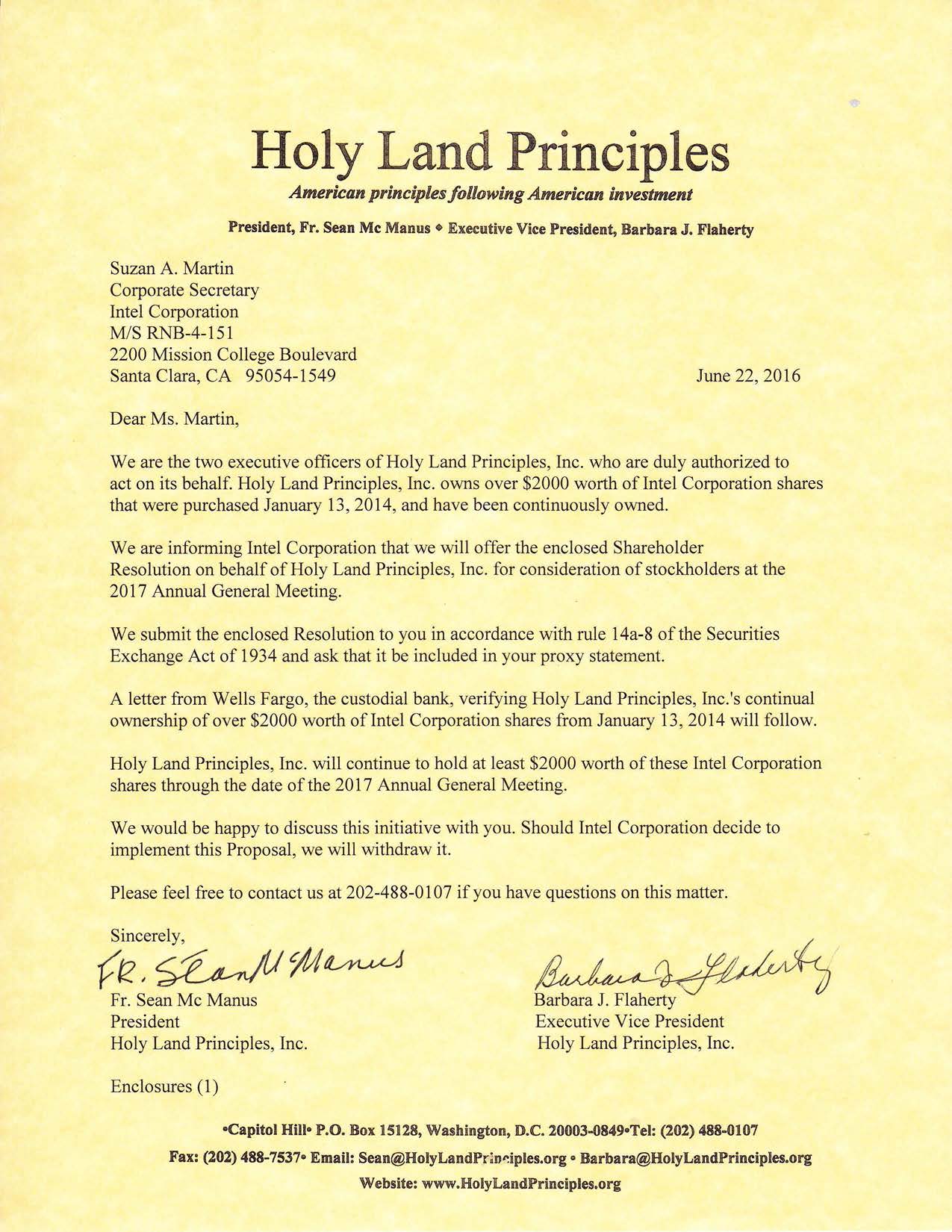
BREAKDOWN OF INTEL'S WORKFORCE IN ISRAEL-PALESTINE
(Holy Land Principles Inc.'s Proposal)
WHEREAS, Intel Corporation has operations in Israel-Palestine;
WHEREAS, achieving a lasting peace in the Holy Land-
with security for Israel and justice for
Palestinians-
requires fairness in all aspects
of
society;
WHEREAS, although not all aspects
of
fairness can be immediately achieved in the current
circumstances, we believe that it is possible at this time to achieve greater fairness in
employment practices;
We believe that it is desirable for Intel to disclose the breakdown
of
its workforce there using the
nine
job
categories which are utilized in the U.S. Department
of
Labor's EE0-1 Report (Equal
Employment Opportunity):
1.
Officials and managers;
2.
Professionals;
3.
Technicians;
4.
Sales;
5.
Office and clerical;
6.
Craft Workers (skilled);
7.
Operatives (semiskilled);
8.
Laborers (unskilled);
9.
Service workers.
THEREFORE, BE IT RESOLVED
that the shareholders request Intel to prepare a report
within four months
of
the annual meeting, at reasonable cost and omitting proprietary
information, covering the following: A chart
of
employees in Palestine-Israel identifying the
number who are Arab and non-Arab broken down by the nine EE0-1
job
categories for each
of
the past three years.
SUPPORTING STATEMENT
The proponent believes that Intel Corporation benefits by disclosing the requested breakdown
of
its workforce to demonstrate that Intel practices fair employment in the Holy Land.
Please vote your proxy
FOR
these concerns.
HOLY
LAND
PRINCIPLES,
INC.
American Principles
Following
American Companies
President
Fr. Sean
Mc
Manus
Executive Vice
President
Barbara
J.
Flaherty
Ms. Suzan
A.
Miller
Corporate Secretary
Intel Corporation
MIS
RNB-4-151
2200 Mission College Blvd.
Santa Clara, CA 95054-1549
July
1,
2016
Dear Ms. Miller,
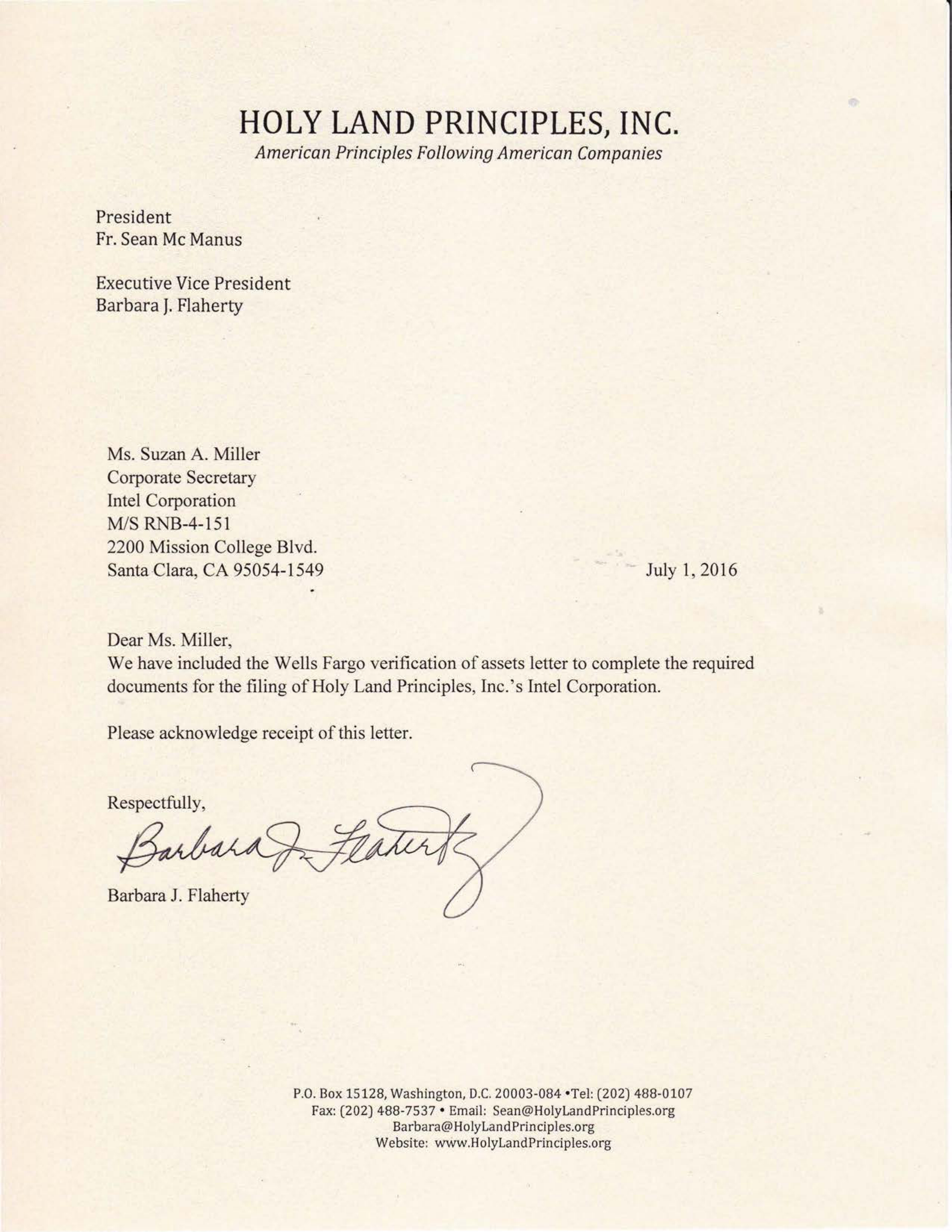
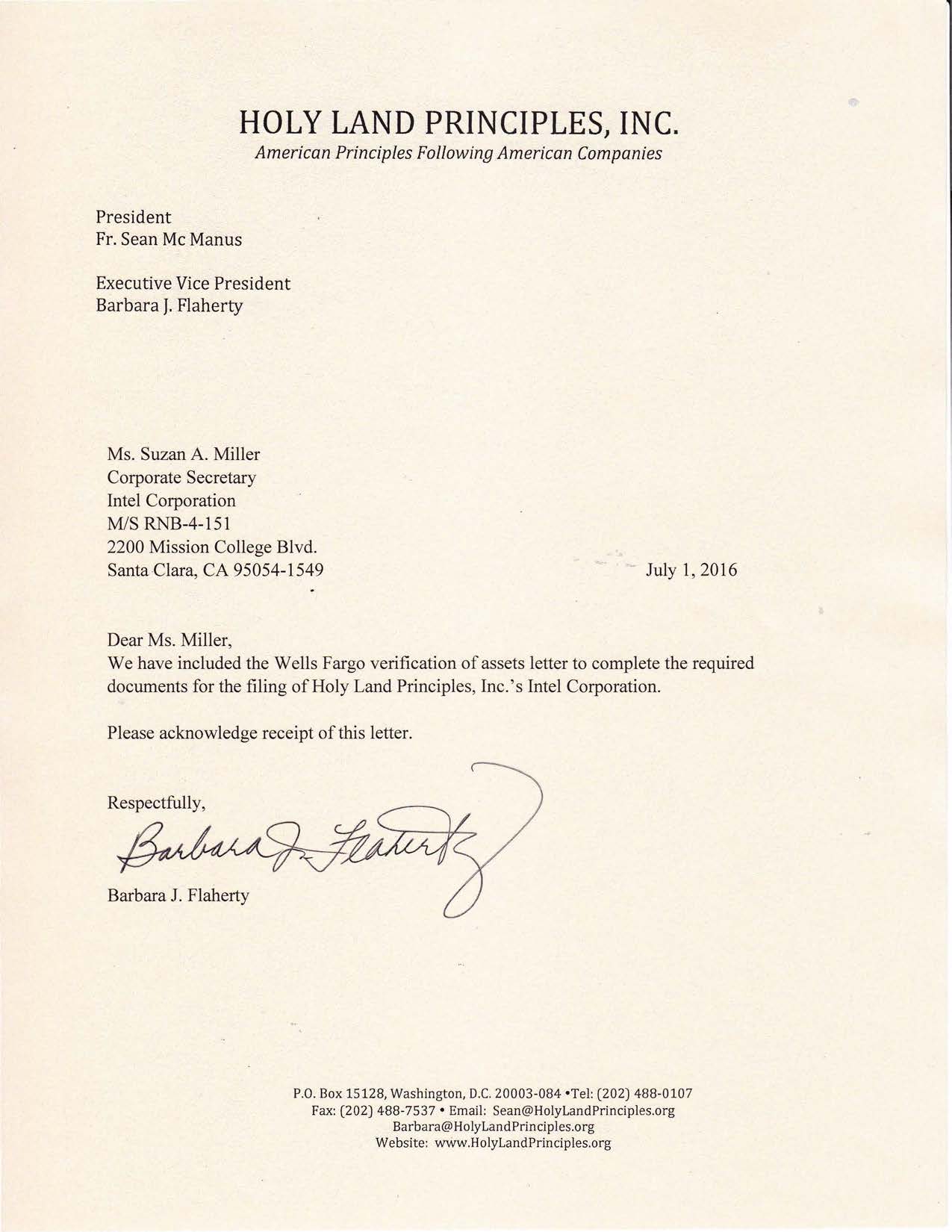
We have included the Wells Fargo verification
of
assets letter to complete the required
documents for the filing
of
Holy Land Principles, Inc.' s Intel Corporation.
Please acknowledge receipt
of
this letter.
Respectfully,
Barbara J. Flaherty
P.O.
Bo
x 15128, Washington, D.
C.
20003-084
•Tel: (202) 488-0107
Fax:
(202) 488-7537 • Email: Sean@HolyLandPrinciples.org
Barbara@HolyLandPrinciples.org
Website: wW-w.HolyLandPrinciples.org
June 29, 2016
Holy Land Principles, Incorporated
Attn: Sean McManus
608
3'
" Street Southwest
Washington,
DC
20024-3102
Dear Mr. McManus:
Wealth Brokerage Services
MAC
HO
OOS-035
One
N
ort
h Jefferson Avenue
Saint Louis, MO
63
10
3
I
am
writing
in
response to your request regarding y
our
investment
account,
number
ending
in
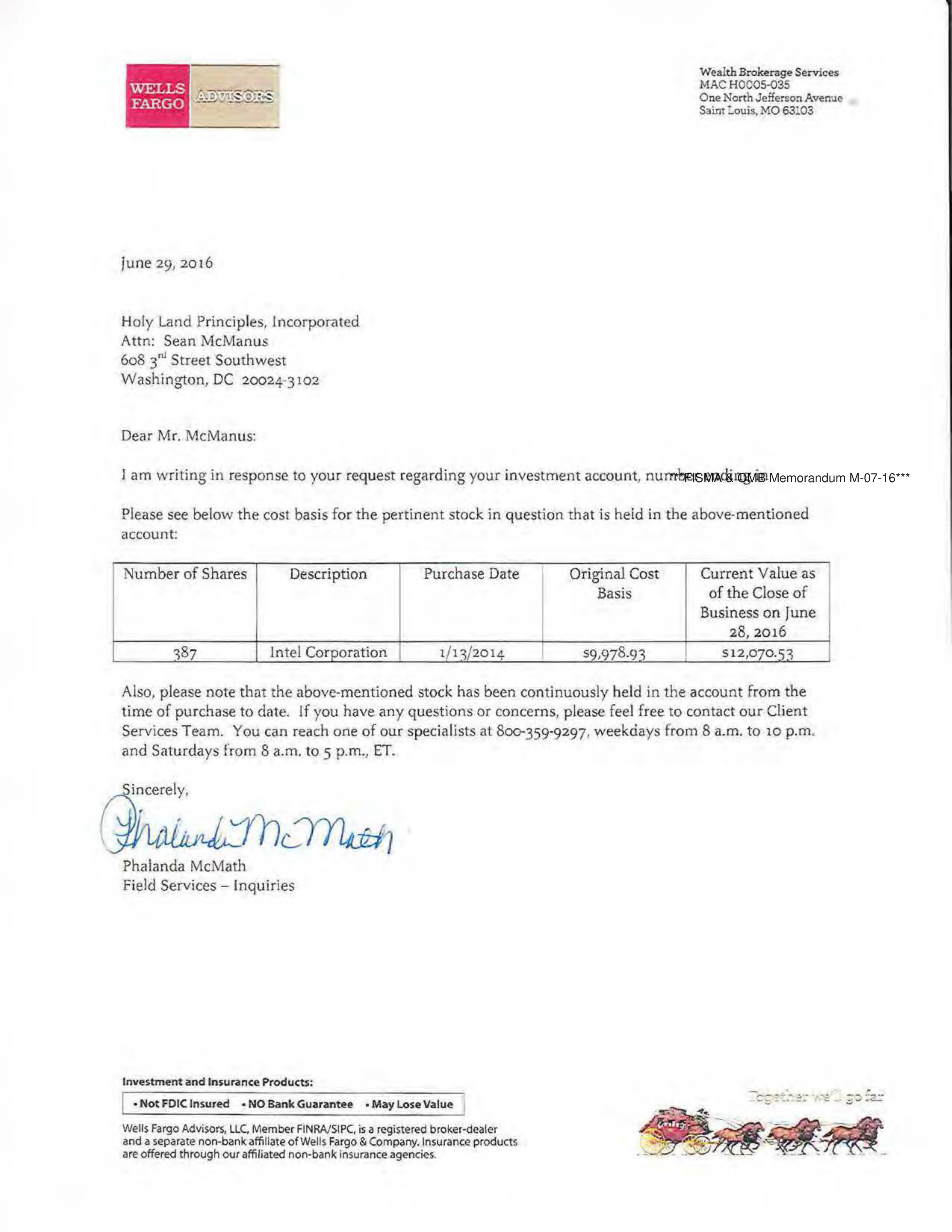
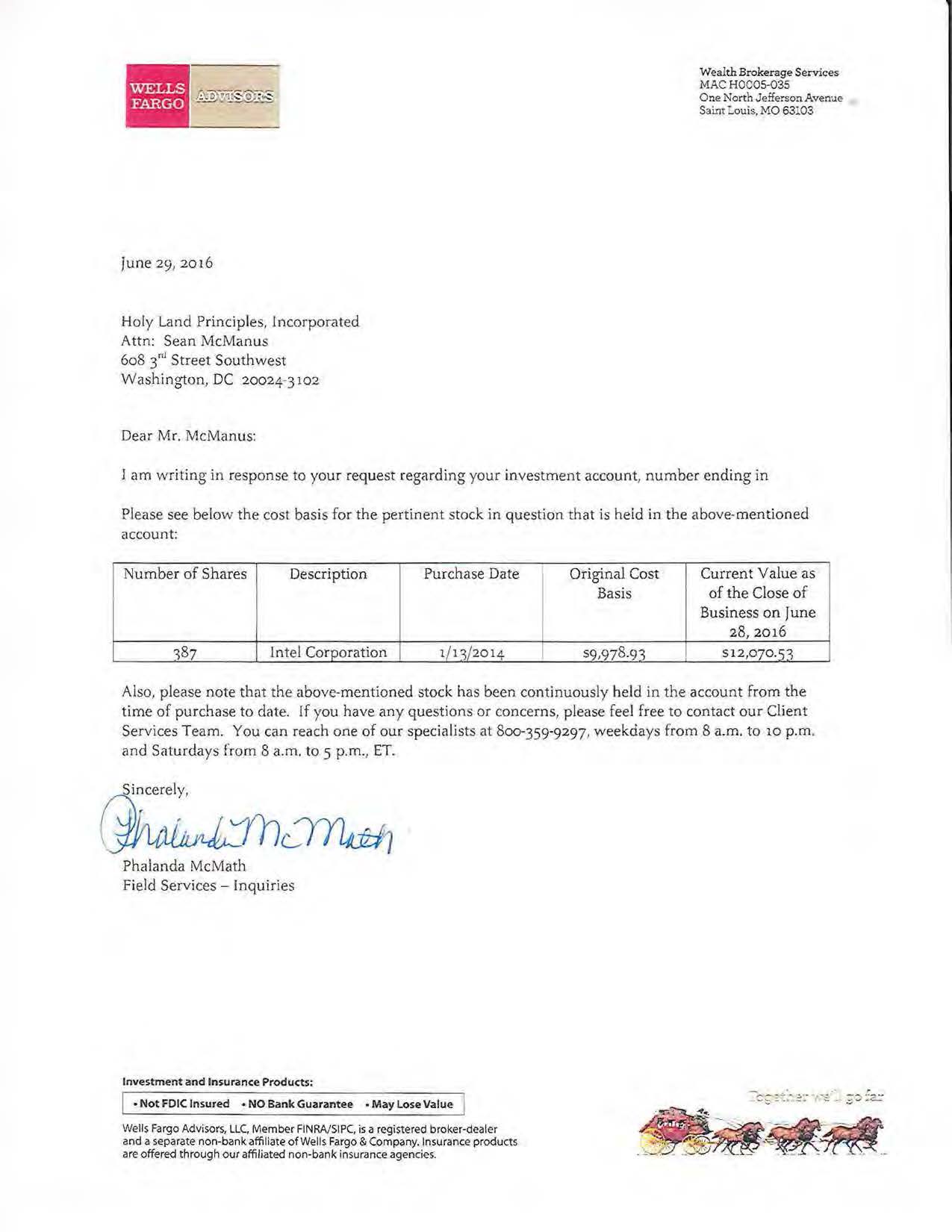
Please see below
the
cost basis for
the
pertinent
stock in question that is heid in the above-mentioned
account:
Number
of
Shares
Description
Purchase Date
Original Cost
Current Value as
Basis
of
the
Close
of
Business
on
June
28, 2016
387
Intel Corporation
1/
13
/
201
4
s9,978.91
s12,070.51
Also, please note
that
the
above-mentioned stock has been continuously
held
in
the
account from
the
time
of
purchase to date. If you have
any
questions or concerns, please feel free to contact
our
Client
Services Team. You can reach one
of
our
specialists
at
800-359-9297, weekdays from 8 a.m. to
10
p.m.
and
Saturdays from 8 a.
m.
to 5 p.
m.,
ET.
Phalanda McMath
Field Services -
inquiries
Investment and Insurance Products:
•Not
FDIC Insured
•NO
Bank Guarantee
•
May
Lose
Value
Wells Fargo Advisors,
LLC,
Member
FINRA/SIPC,
is
a registered broker-dealer
and a separate
non-bank
affiliate
of
Wells Fargo
&
Company. Insurance
products
are offered
through
our
affiliated
non-bank
insurance agencies.
***FISMA & OMB Memorandum M-07-16***


EXHIBIT B
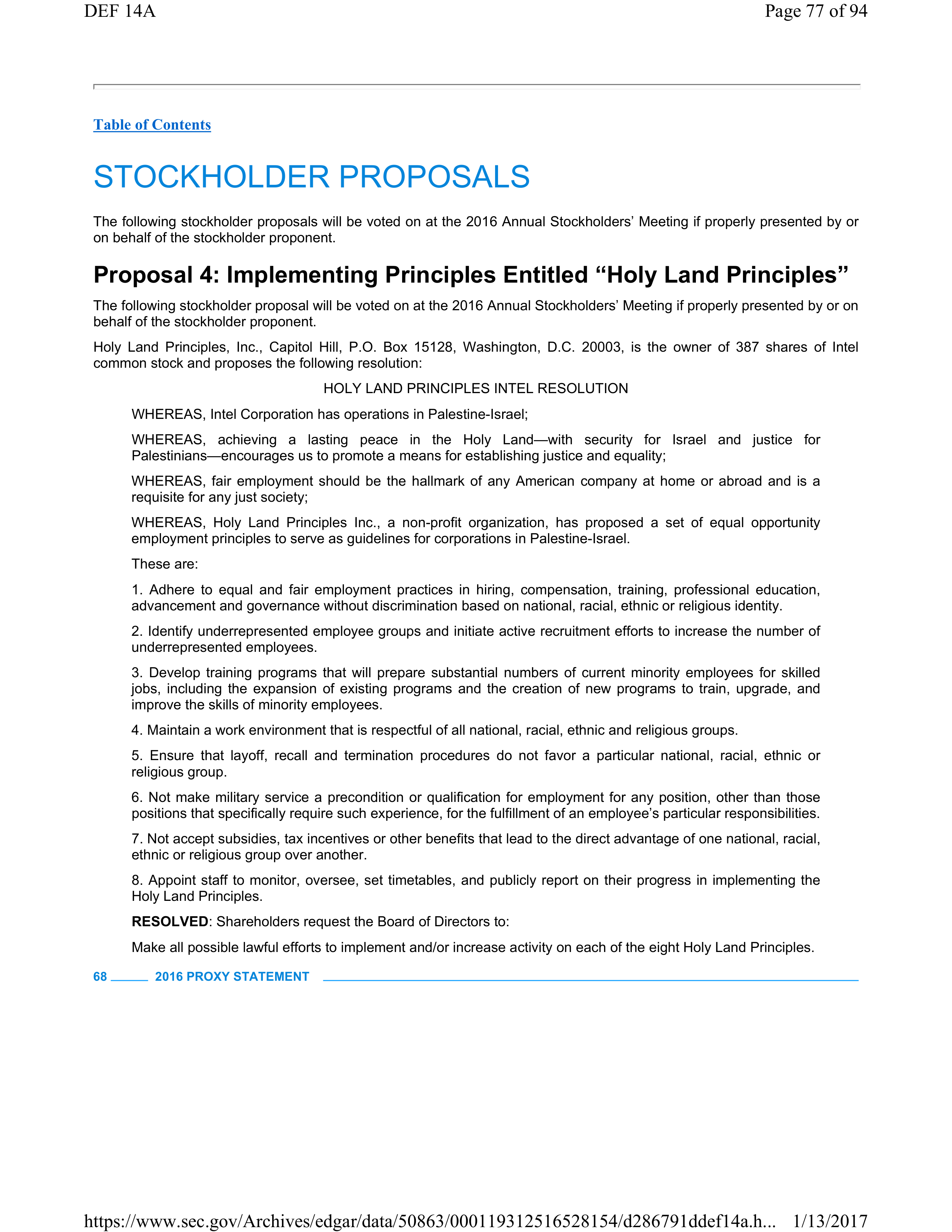
Table of Contents
STOCKHOLDER PROPOSALS
The following stockholder proposals will be voted on at the 2016 Annual Stockholders’ Meeting if properly presented by or
on behalf of the stockholder proponent.
Proposal 4: Implementing Principles Entitled “Holy Land Principles”
The following stockholder proposal will be voted on at the 2016 Annual Stockholders’ Meeting if properly presented by or on
behalf of the stockholder proponent.
Holy Land Principles, Inc., Capitol Hill, P.O. Box 15128, Washington, D.C. 20003, is the owner of 387 shares of Intel
common stock and proposes the following resolution:
HOLY LAND PRINCIPLES INTEL RESOLUTION
WHEREAS, Intel Corporation has operations in Palestine-Israel;
WHEREAS, achieving a lasting peace in the Holy Land—with security for Israel and justice for
Palestinians—encourages us to promote a means for establishing justice and equality;
WHEREAS, fair employment should be the hallmark of any American company at home or abroad and is a
requisite for any just society;
WHEREAS, Holy Land Principles Inc., a non-profit organization, has proposed a set of equal opportunity
employment principles to serve as guidelines for corporations in Palestine-Israel.
These are:
1. Adhere to equal and fair employment practices in hiring, compensation, training, professional education,
advancement and governance without discrimination based on national, racial, ethnic or religious identity.
2. Identify underrepresented employee groups and initiate active recruitment efforts to increase the number of
underrepresented employees.
3. Develop training programs that will prepare substantial numbers of current minority employees for skilled
jobs, including the expansion of existing programs and the creation of new programs to train, upgrade, and
improve the skills of minority employees.
4. Maintain a work environment that is respectful of all national, racial, ethnic and religious groups.
5. Ensure that layoff, recall and termination procedures do not favor a particular national, racial, ethnic or
religious group.
6. Not make military service a precondition or qualification for employment for any position, other than those
positions that specifically require such experience, for the fulfillment of an employee’s particular responsibilities.
7. Not accept subsidies, tax incentives or other benefits that lead to the direct advantage of one national, racial,
ethnic or religious group over another.
8. Appoint staff to monitor, oversee, set timetables, and publicly report on their progress in implementing the
Holy Land Principles.
RESOLVED
: Shareholders request the Board of Directors to:
Make all possible lawful efforts to implement and/or increase activity on each of the eight Holy Land Principles.
68
2016 PROXY STATEMENT
Page 77 of 94
DEF 14A
1/13/2017
https://www.sec.gov/Archives/edgar/data/50863/000119312516528154/d286791ddef14a.h...
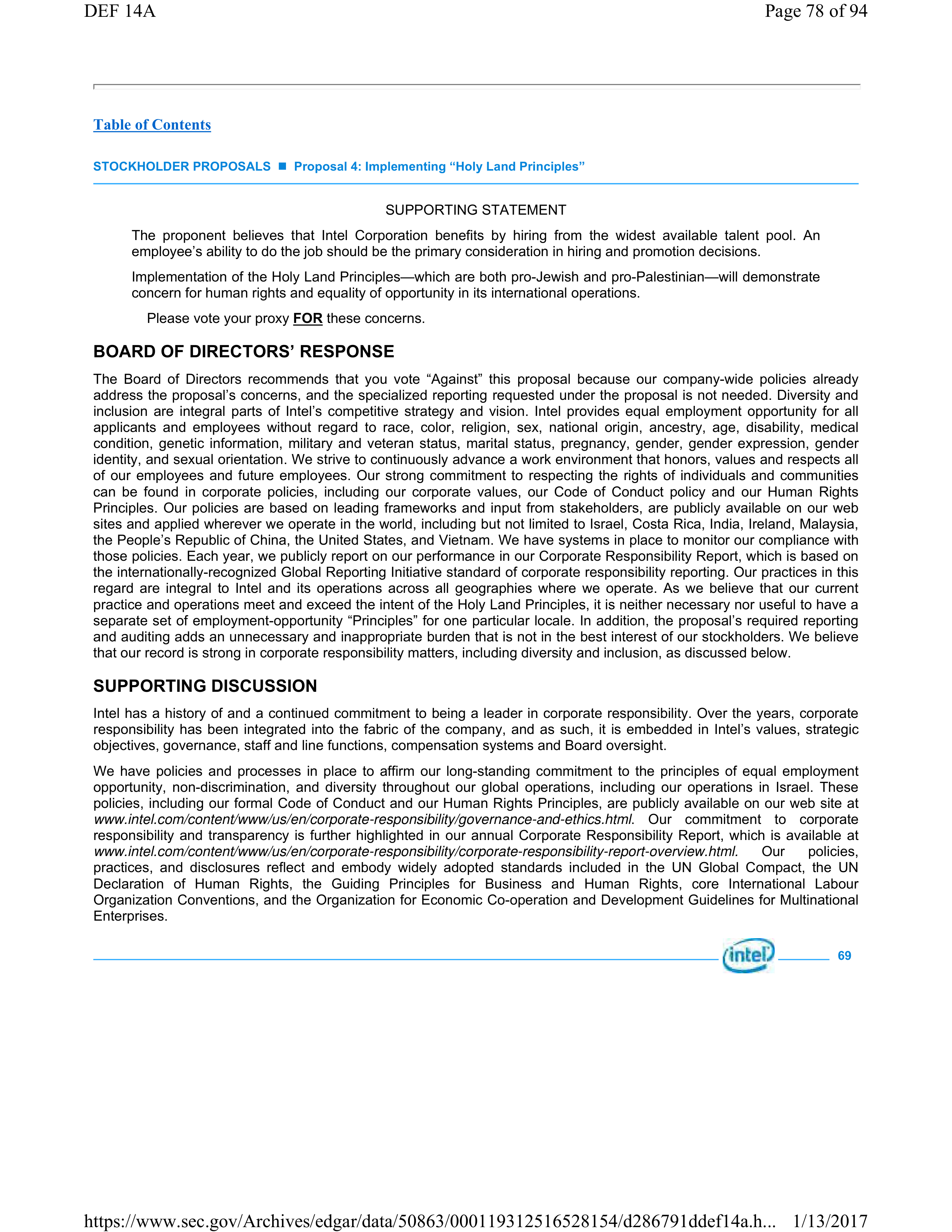

Table of Contents
STOCKHOLDER PROPOSALS
Proposal 4: Implementing “Holy Land Principles”
SUPPORTING STATEMENT
The proponent believes that Intel Corporation benefits by hiring from the widest available talent pool. An
employee’s ability to do the job should be the primary consideration in hiring and promotion decisions.
Implementation of the Holy Land Principles—which are both pro-Jewish and pro-Palestinian—will demonstrate
concern for human rights and equality of opportunity in its international operations.
Please vote your proxy
FOR
these concerns.
BOARD OF DIRECTORS’ RESPONSE
The Board of Directors recommends that you vote “Against” this proposal because our company-wide policies already
address the proposal’s concerns, and the specialized reporting requested under the proposal is not needed. Diversity and
inclusion are integral parts of Intel’s competitive strategy and vision. Intel provides equal employment opportunity for all
applicants and employees without regard to race, color, religion, sex, national origin, ancestry, age, disability, medical
condition, genetic information, military and veteran status, marital status, pregnancy, gender, gender expression, gender
identity, and sexual orientation. We strive to continuously advance a work environment that honors, values and respects all
of our employees and future employees. Our strong commitment to respecting the rights of individuals and communities
can be found in corporate policies, including our corporate values, our Code of Conduct policy and our Human Rights
Principles. Our policies are based on leading frameworks and input from stakeholders, are publicly available on our web
sites and applied wherever we operate in the world, including but not limited to Israel, Costa Rica, India, Ireland, Malaysia,
the People’s Republic of China, the United States, and Vietnam. We have systems in place to monitor our compliance with
those policies. Each year, we publicly report on our performance in our Corporate Responsibility Report, which is based on
the internationally-recognized Global Reporting Initiative standard of corporate responsibility reporting. Our practices in this
regard are integral to Intel and its operations across all geographies where we operate. As we believe that our current
practice and operations meet and exceed the intent of the Holy Land Principles, it is neither necessary nor useful to have a
separate set of employment-opportunity “Principles” for one particular locale. In addition, the proposal’s required reporting
and auditing adds an unnecessary and inappropriate burden that is not in the best interest of our stockholders. We believe
that our record is strong in corporate responsibility matters, including diversity and inclusion, as discussed below.
SUPPORTING DISCUSSION
Intel has a history of and a continued commitment to being a leader in corporate responsibility. Over the years, corporate
responsibility has been integrated into the fabric of the company, and as such, it is embedded in Intel’s values, strategic
objectives, governance, staff and line functions, compensation systems and Board oversight.
We have policies and processes in place to affirm our long-standing commitment to the principles of equal employment
opportunity, non-discrimination, and diversity throughout our global operations, including our operations in Israel. These
policies, including our formal Code of Conduct and our Human Rights Principles, are publicly available on our web site at
www.intel.com/content/www/us/en/corporate-responsibility/governance-and-ethics.html
. Our commitment to corporate
responsibility and transparency is further highlighted in our annual Corporate Responsibility Report, which is available at
www.intel.com/content/www/us/en/corporate-responsibility/corporate-responsibility-report-overview.html.
Our
policies,
practices, and disclosures reflect and embody widely adopted standards included in the UN Global Compact, the UN
Declaration of Human Rights, the Guiding Principles for Business and Human Rights, core International Labour
Organization Conventions, and the Organization for Economic Co-operation and Development Guidelines for Multinational
Enterprises.
69
Page 78 of 94
DEF 14A
1/13/2017
https://www.sec.gov/Archives/edgar/data/50863/000119312516528154/d286791ddef14a.h...
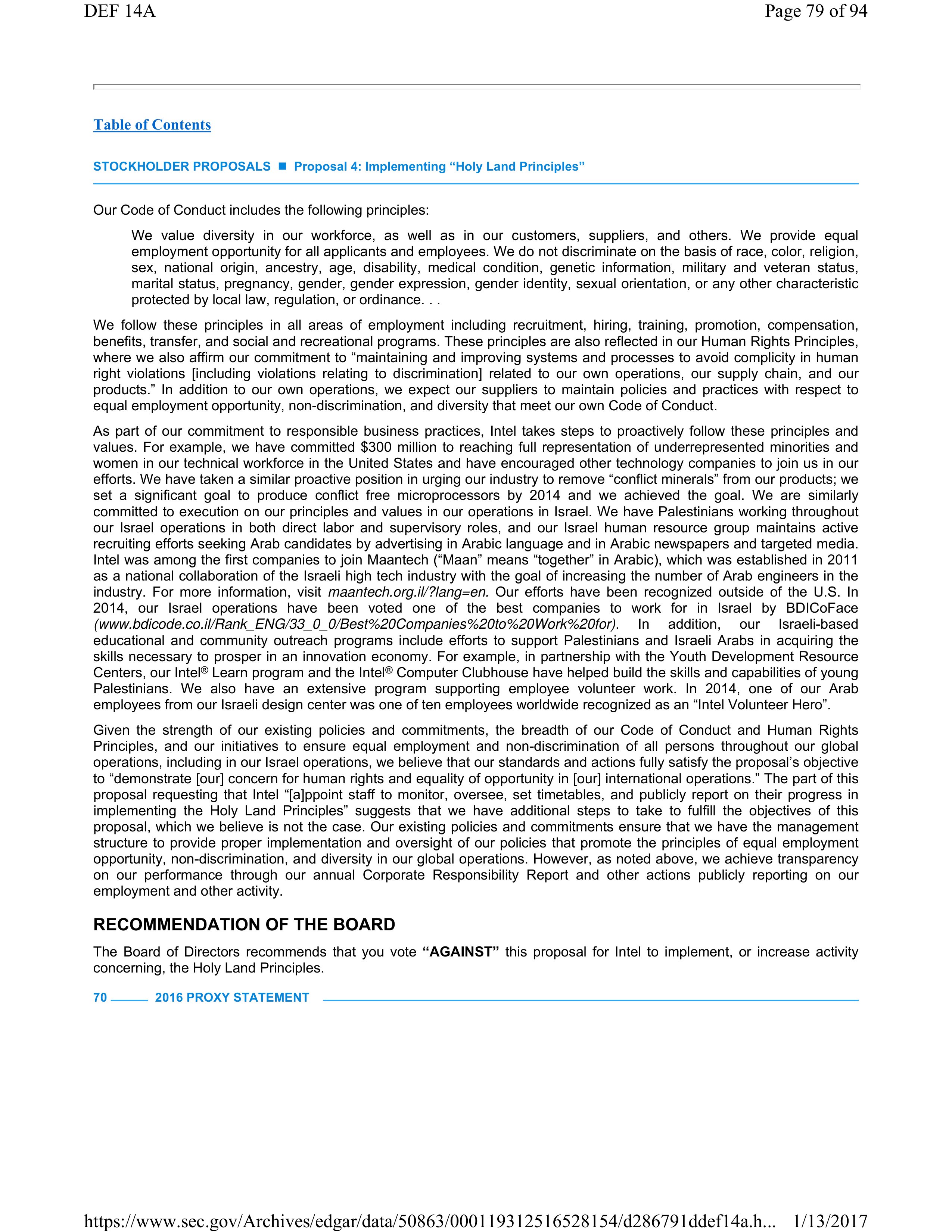
Table of Contents
STOCKHOLDER PROPOSALS
Proposal 4: Implementing “Holy Land Principles”
Our Code of Conduct includes the following principles:
We value diversity in our workforce, as well as in our customers, suppliers, and others. We provide equal
employment opportunity for all applicants and employees. We do not discriminate on the basis of race, color, religion,
sex, national origin, ancestry, age, disability, medical condition, genetic information, military and veteran status,
marital status, pregnancy, gender, gender expression, gender identity, sexual orientation, or any other characteristic
protected by local law, regulation, or ordinance.
.
.
We follow these principles in all areas of employment including recruitment, hiring, training, promotion, compensation,
benefits, transfer, and social and recreational programs. These principles are also reflected in our Human Rights Principles,
where we also affirm our commitment to “maintaining and improving systems and processes to avoid complicity in human
right violations [including violations relating to discrimination] related to our own operations, our supply chain, and our
products.” In addition to our own operations, we expect our suppliers to maintain policies and practices with respect to
equal employment opportunity, non-discrimination, and diversity that meet our own Code of Conduct.
As part of our commitment to responsible business practices, Intel takes steps to proactively follow these principles and
values. For example, we have committed $300 million to reaching full representation of underrepresented minorities and
women in our technical workforce in the United States and have encouraged other technology companies to join us in our
efforts. We have taken a similar proactive position in urging our industry to remove “conflict minerals” from our products; we
set a significant goal to produce conflict free microprocessors by 2014 and we achieved the goal. We are similarly
committed to execution on our principles and values in our operations in Israel. We have Palestinians working throughout
our Israel operations in both direct labor and supervisory roles, and our Israel human resource group maintains active
recruiting efforts seeking Arab candidates by advertising in Arabic language and in Arabic newspapers and targeted media.
Intel was among the first companies to join Maantech (“Maan” means “together” in Arabic), which was established in 2011
as a national collaboration of the Israeli high tech industry with the goal of increasing the number of Arab engineers in the
industry. For more information, visit
maantech.org.il/?lang=en.
Our efforts have been recognized outside of the U.S. In
2014, our Israel operations have been voted one of the best companies to work for in Israel by BDICoFace
(www.bdicode.co.il/Rank_ENG/33_0_0/Best%20Companies%20to%20Work%20for)
.
In
addition,
our
Israeli-based
educational and community outreach programs include efforts to support Palestinians and Israeli Arabs in acquiring the
skills necessary to prosper in an innovation economy. For example, in partnership with the Youth Development Resource
Centers, our Intel
®
Learn program and the Intel
®
Computer Clubhouse have helped build the skills and capabilities of young
Palestinians. We also have an extensive program supporting employee volunteer work. In 2014, one of our Arab
employees from our Israeli design center was one of ten employees worldwide recognized as an “Intel Volunteer Hero”.
Given the strength of our existing policies and commitments, the breadth of our Code of Conduct and Human Rights
Principles, and our initiatives to ensure equal employment and non-discrimination of all persons throughout our global
operations, including in our Israel operations, we believe that our standards and actions fully satisfy the proposal’s objective
to “demonstrate [our] concern for human rights and equality of opportunity in [our] international operations.” The part of this
proposal requesting that Intel “[a]ppoint staff to monitor, oversee, set timetables, and publicly report on their progress in
implementing the Holy Land Principles” suggests that we have additional steps to take to fulfill the objectives of this
proposal, which we believe is not the case. Our existing policies and commitments ensure that we have the management
structure to provide proper implementation and oversight of our policies that promote the principles of equal employment
opportunity, non-discrimination, and diversity in our global operations. However, as noted above, we achieve transparency
on our performance through our annual Corporate Responsibility Report and other actions publicly reporting on our
employment and other activity.
RECOMMENDATION OF THE BOARD
The Board of Directors recommends that you vote
“AGAINST”
this proposal for Intel to implement, or increase activity
concerning, the Holy Land Principles.
70
2016 PROXY STATEMENT
Page 79 of 94
DEF 14A
1/13/2017
https://www.sec.gov/Archives/edgar/data/50863/000119312516528154/d286791ddef14a.h...


EXHIBIT C
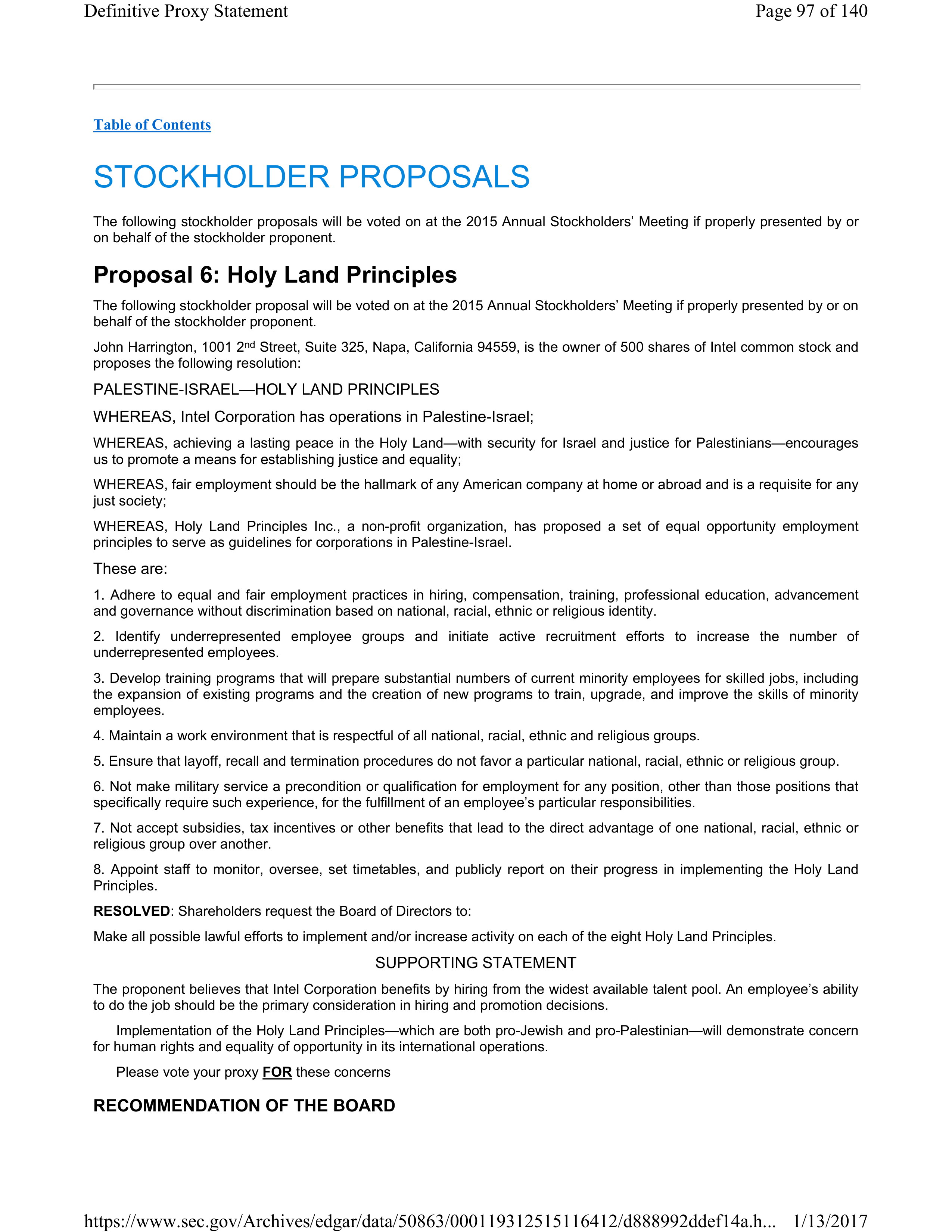
Table of Contents
STOCKHOLDER PROPOSALS
The following stockholder proposals will be voted on at the 2015 Annual Stockholders’ Meeting if properly presented by or
on behalf of the stockholder proponent.
Proposal 6: Holy Land Principles
The following stockholder proposal will be voted on at the 2015 Annual Stockholders’ Meeting if properly presented by or on
behalf of the stockholder proponent.
John Harrington, 1001 2
nd
Street, Suite 325, Napa, California 94559, is the owner of 500 shares of Intel common stock and
proposes the following resolution:
PALESTINE-ISRAEL—HOLY LAND PRINCIPLES
WHEREAS, Intel Corporation has operations in Palestine-Israel;
WHEREAS, achieving a lasting peace in the Holy Land—with security for Israel and justice for Palestinians—encourages
us to promote a means for establishing justice and equality;
WHEREAS, fair employment should be the hallmark of any American company at home or abroad and is a requisite for any
just society;
WHEREAS, Holy Land Principles Inc., a non-profit organization, has proposed a set of equal opportunity employment
principles to serve as guidelines for corporations in Palestine-Israel.
These are:
1. Adhere to equal and fair employment practices in hiring, compensation, training, professional education, advancement
and governance without discrimination based on national, racial, ethnic or religious identity.
2. Identify underrepresented employee groups and initiate active recruitment efforts to increase the number of
underrepresented employees.
3. Develop training programs that will prepare substantial numbers of current minority employees for skilled jobs, including
the expansion of existing programs and the creation of new programs to train, upgrade, and improve the skills of minority
employees.
4. Maintain a work environment that is respectful of all national, racial, ethnic and religious groups.
5. Ensure that layoff, recall and termination procedures do not favor a particular national, racial, ethnic or religious group.
6. Not make military service a precondition or qualification for employment for any position, other than those positions that
specifically require such experience, for the fulfillment of an employee’s particular responsibilities.
7. Not accept subsidies, tax incentives or other benefits that lead to the direct advantage of one national, racial, ethnic or
religious group over another.
8. Appoint staff to monitor, oversee, set timetables, and publicly report on their progress in implementing the Holy Land
Principles.
RESOLVED
: Shareholders request the Board of Directors to:
Make all possible lawful efforts to implement and/or increase activity on each of the eight Holy Land Principles.
SUPPORTING STATEMENT
The proponent believes that Intel Corporation benefits by hiring from the widest available talent pool. An employee’s ability
to do the job should be the primary consideration in hiring and promotion decisions.
Implementation of the Holy Land Principles—which are both pro-Jewish and pro-Palestinian—will demonstrate concern
for human rights and equality of opportunity in its international operations.
Please vote your proxy
FOR
these concerns
RECOMMENDATION OF THE BOARD
Page 97 of 140
Definitive Proxy Statement
1/13/2017
https://www.sec.gov/Archives/edgar/data/50863/000119312515116412/d888992ddef14a.h...

The Board of Directors recommends that you vote
“AGAINST”
this proposal for Intel to implement or increase activity
concerning the Holy Land Principles.
80
2015 PROXY STATEMENT
Page 98 of 140
Definitive Proxy Statement
1/13/2017
https://www.sec.gov/Archives/edgar/data/50863/000119312515116412/d888992ddef14a.h...
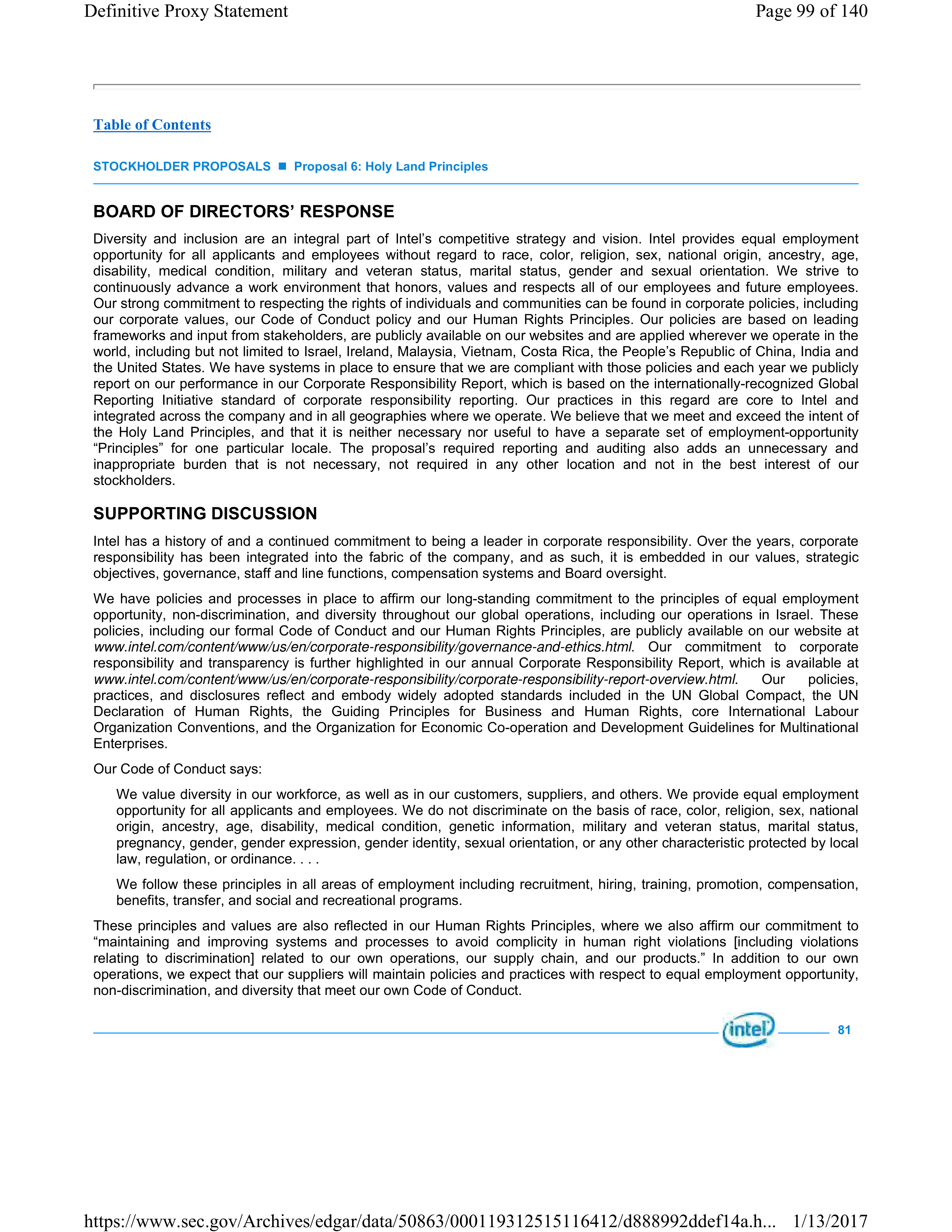

Table of Contents
STOCKHOLDER PROPOSALS
Proposal 6: Holy Land Principles
BOARD OF DIRECTORS’ RESPONSE
Diversity and inclusion are an integral part of Intel’s competitive strategy and vision. Intel provides equal employment
opportunity for all applicants and employees without regard to race, color, religion, sex, national origin, ancestry, age,
disability, medical condition, military and veteran status, marital status, gender and sexual orientation. We strive to
continuously advance a work environment that honors, values and respects all of our employees and future employees.
Our strong commitment to respecting the rights of individuals and communities can be found in corporate policies, including
our corporate values, our Code of Conduct policy and our Human Rights Principles. Our policies are based on leading
frameworks and input from stakeholders, are publicly available on our websites and are applied wherever we operate in the
world, including but not limited to Israel, Ireland, Malaysia, Vietnam, Costa Rica, the People’s Republic of China, India and
the United States. We have systems in place to ensure that we are compliant with those policies and each year we publicly
report on our performance in our Corporate Responsibility Report, which is based on the internationally-recognized Global
Reporting Initiative standard of corporate responsibility reporting. Our practices in this regard are core to Intel and
integrated across the company and in all geographies where we operate. We believe that we meet and exceed the intent of
the Holy Land Principles, and that it is neither necessary nor useful to have a separate set of employment-opportunity
“Principles” for one particular locale. The proposal’s required reporting and auditing also adds an unnecessary and
inappropriate burden that is not necessary, not required in any other location and not in the best interest of our
stockholders.
SUPPORTING DISCUSSION
Intel has a history of and a continued commitment to being a leader in corporate responsibility. Over the years, corporate
responsibility has been integrated into the fabric of the company, and as such, it is embedded in our values, strategic
objectives, governance, staff and line functions, compensation systems and Board oversight.
We have policies and processes in place to affirm our long-standing commitment to the principles of equal employment
opportunity, non-discrimination, and diversity throughout our global operations, including our operations in Israel. These
policies, including our formal Code of Conduct and our Human Rights Principles, are publicly available on our website at
www.intel.com/content/www/us/en/corporate-responsibility/governance-and-ethics.html
. Our commitment to corporate
responsibility and transparency is further highlighted in our annual Corporate Responsibility Report, which is available at
www.intel.com/content/www/us/en/corporate-responsibility/corporate-responsibility-report-overview.html.
Our
policies,
practices, and disclosures reflect and embody widely adopted standards included in the UN Global Compact, the UN
Declaration of Human Rights, the Guiding Principles for Business and Human Rights, core International Labour
Organization Conventions, and the Organization for Economic Co-operation and Development Guidelines for Multinational
Enterprises.
Our Code of Conduct says:
We value diversity in our workforce, as well as in our customers, suppliers, and others. We provide equal employment
opportunity for all applicants and employees. We do not discriminate on the basis of race, color, religion, sex, national
origin, ancestry, age, disability, medical condition, genetic information, military and veteran status, marital status,
pregnancy, gender, gender expression, gender identity, sexual orientation, or any other characteristic protected by local
law, regulation, or ordinance. . . .
We follow these principles in all areas of employment including recruitment, hiring, training, promotion, compensation,
benefits, transfer, and social and recreational programs.
These principles and values are also reflected in our Human Rights Principles, where we also affirm our commitment to
“maintaining and improving systems and processes to avoid complicity in human right violations [including violations
relating to discrimination] related to our own operations, our supply chain, and our products.” In addition to our own
operations, we expect that our suppliers will maintain policies and practices with respect to equal employment opportunity,
non-discrimination, and diversity that meet our own Code of Conduct.
81
Page 99 of 140
Definitive Proxy Statement
1/13/2017
https://www.sec.gov/Archives/edgar/data/50863/000119312515116412/d888992ddef14a.h...
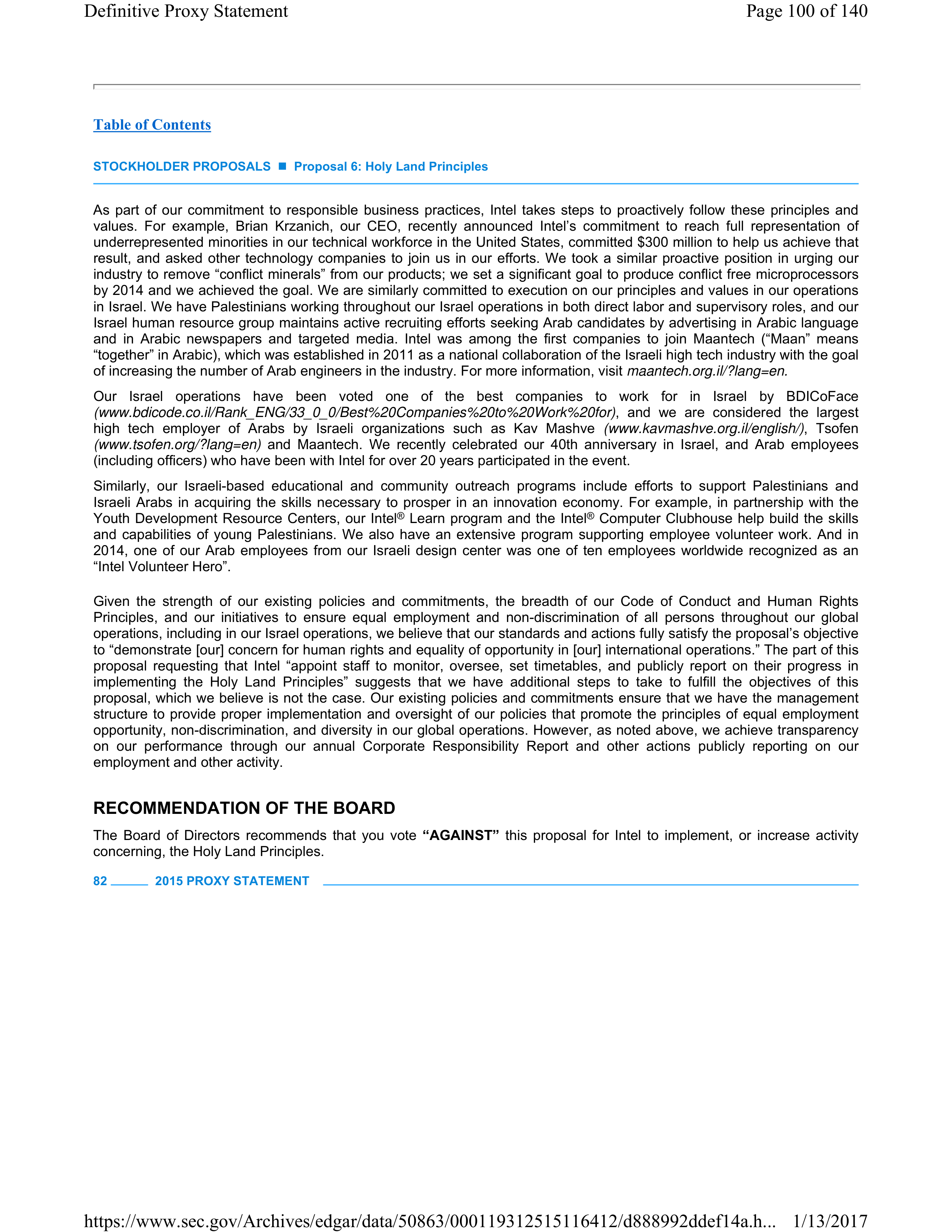
Table of Contents
STOCKHOLDER PROPOSALS
Proposal 6: Holy Land Principles
As part of our commitment to responsible business practices, Intel takes steps to proactively follow these principles and
values. For example, Brian Krzanich, our CEO, recently announced Intel’s commitment to reach full representation of
underrepresented minorities in our technical workforce in the United States, committed $300 million to help us achieve that
result, and asked other technology companies to join us in our efforts. We took a similar proactive position in urging our
industry to remove “conflict minerals” from our products; we set a significant goal to produce conflict free microprocessors
by 2014 and we achieved the goal. We are similarly committed to execution on our principles and values in our operations
in Israel. We have Palestinians working throughout our Israel operations in both direct labor and supervisory roles, and our
Israel human resource group maintains active recruiting efforts seeking Arab candidates by advertising in Arabic language
and in Arabic newspapers and targeted media. Intel was among the first companies to join Maantech (“Maan” means
“together” in Arabic), which was established in 2011 as a national collaboration of the Israeli high tech industry with the goal
of increasing the number of Arab engineers in the industry. For more information, visit
maantech.org.il/?lang=en.
Our Israel operations have been voted one of the best companies to work for in Israel by BDICoFace
(www.bdicode.co.il/Rank_ENG/33_0_0/Best%20Companies%20to%20Work%20for)
, and we are considered the largest
high tech employer of Arabs by Israeli organizations such as Kav Mashve
(www.kavmashve.org.il/english/)
, Tsofen
(www.tsofen.org/?lang=en)
and Maantech. We recently celebrated our 40th anniversary in Israel, and Arab employees
(including officers) who have been with Intel for over 20 years participated in the event.
Similarly, our Israeli-based educational and community outreach programs include efforts to support Palestinians and
Israeli Arabs in acquiring the skills necessary to prosper in an innovation economy. For example, in partnership with the
Youth Development Resource Centers, our Intel
®
Learn program and the Intel
®
Computer Clubhouse help build the skills
and capabilities of young Palestinians. We also have an extensive program supporting employee volunteer work. And in
2014, one of our Arab employees from our Israeli design center was one of ten employees worldwide recognized as an
“Intel Volunteer Hero”.
Given the strength of our existing policies and commitments, the breadth of our Code of Conduct and Human Rights
Principles, and our initiatives to ensure equal employment and non-discrimination of all persons throughout our global
operations, including in our Israel operations, we believe that our standards and actions fully satisfy the proposal’s objective
to “demonstrate [our] concern for human rights and equality of opportunity in [our] international operations.” The part of this
proposal requesting that Intel “appoint staff to monitor, oversee, set timetables, and publicly report on their progress in
implementing the Holy Land Principles” suggests that we have additional steps to take to fulfill the objectives of this
proposal, which we believe is not the case. Our existing policies and commitments ensure that we have the management
structure to provide proper implementation and oversight of our policies that promote the principles of equal employment
opportunity, non-discrimination, and diversity in our global operations. However, as noted above, we achieve transparency
on our performance through our annual Corporate Responsibility Report and other actions publicly reporting on our
employment and other activity.
RECOMMENDATION OF THE BOARD
The Board of Directors recommends that you vote
“AGAINST”
this proposal for Intel to implement, or increase activity
concerning, the Holy Land Principles.
82
2015 PROXY STATEMENT
Page 100 of 140
Definitive Proxy Statement
1/13/2017
https://www.sec.gov/Archives/edgar/data/50863/000119312515116412/d888992ddef14a.h...


EXHIBIT D
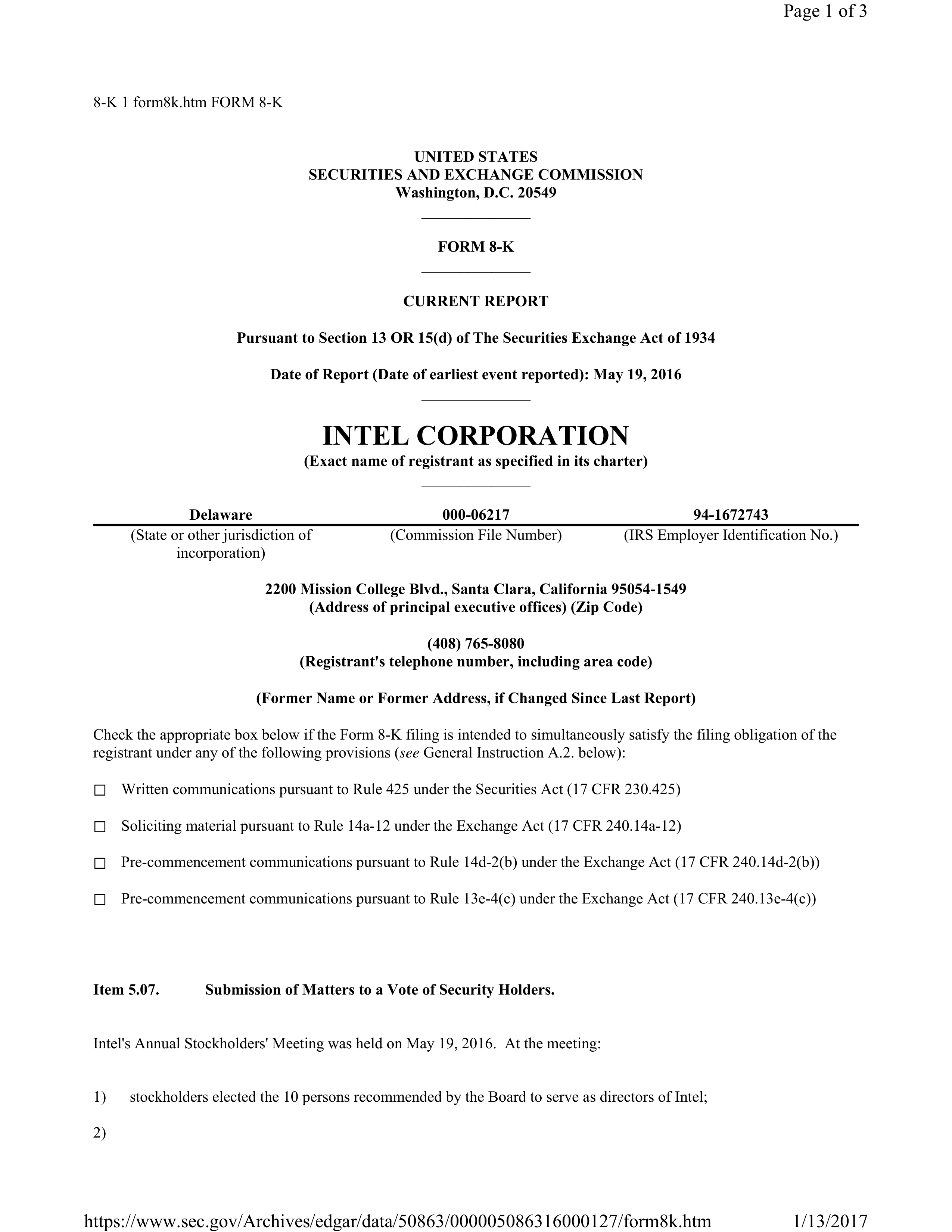
8-K 1 form8k.htm FORM 8-K
UNITED STATES
SECURITIES AND EXCHANGE COMMISSION
Washington, D.C. 20549
______________
FORM 8-K
______________
CURRENT REPORT
Pursuant to Section 13 OR 15(d) of The Securities Exchange Act of 1934
Date of Report (Date of earliest event reported): May 19, 2016
______________
INTEL CORPORATION
(Exact name of registrant as specified in its charter)
______________
Delaware
000-06217
94-1672743
(State or other jurisdiction of
incorporation)
(Commission File Number)
(IRS Employer Identification No.)
2200 Mission College Blvd., Santa Clara, California 95054-1549
(Address of principal executive offices) (Zip Code)
(408) 765-8080
(Registrant's telephone number, including area code)
(Former Name or Former Address, if Changed Since Last Report)
Check the appropriate box below if the Form 8-K filing is intended to simultaneously satisfy the filing obligation of the
registrant under any of the following provisions (
see
General Instruction A.2. below):
☐
Written communications pursuant to Rule 425 under the Securities Act (17 CFR 230.425)
☐
Soliciting material pursuant to Rule 14a-12 under the Exchange Act (17 CFR 240.14a-12)
☐
Pre-commencement communications pursuant to Rule 14d-2(b) under the Exchange Act (17 CFR 240.14d-2(b))
☐
Pre-commencement communications pursuant to Rule 13e-4(c) under the Exchange Act (17 CFR 240.13e-4(c))
Item 5.07.
Submission of Matters to a Vote of Security Holders.
Intel's Annual Stockholders' Meeting was held on May 19, 2016. At the meeting:
1)
stockholders elected the 10 persons recommended by the Board to serve as directors of Intel;
2)
Page 1 of 3
1/13/2017
https://www.sec.gov/Archives/edgar/data/50863/000005086316000127/form8k.htm
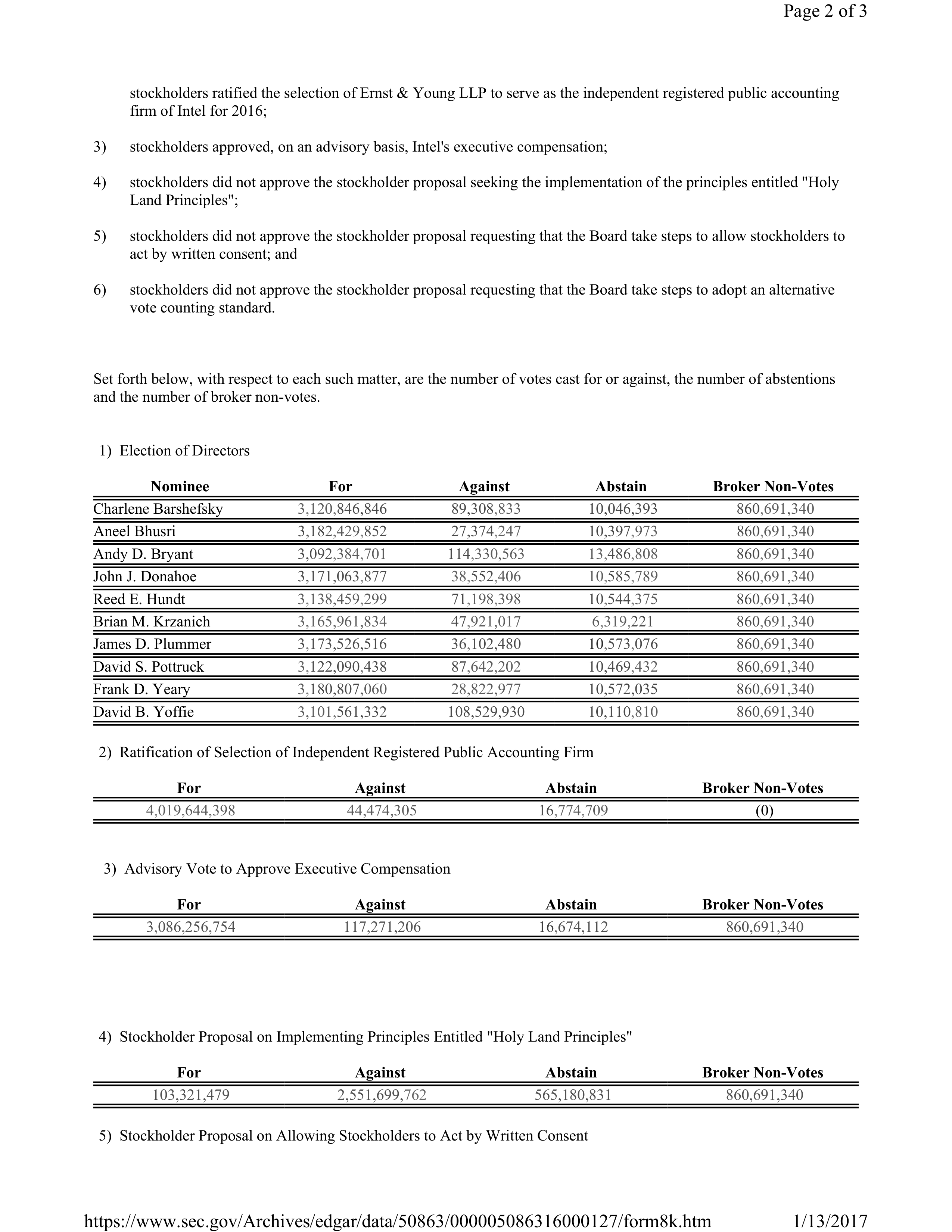
stockholders ratified the selection of Ernst & Young LLP to serve as the independent registered public accounting
firm of Intel for 2016;
3)
stockholders approved, on an advisory basis, Intel's executive compensation;
4)
stockholders did not approve the stockholder proposal seeking the implementation of the principles entitled "Holy
Land Principles";
5)
stockholders did not approve the stockholder proposal requesting that the Board take steps to allow stockholders to
act by written consent; and
6)
stockholders did not approve the stockholder proposal requesting that the Board take steps to adopt an alternative
vote counting standard.
Set forth below, with respect to each such matter, are the number of votes cast for or against, the number of abstentions
and the number of broker non-votes.
1) Election of Directors
Nominee
For
Against
Abstain
Broker Non-Votes
Charlene Barshefsky
3
,
120
,
846,846
89,308
,
833
10,046,393
860
,
691,340
Aneel Bhusri
3,182
,
429
,
852
27,374
,
247
10,397
,
973
860
,
691,340
Andy D. Bryant
3,092
,
384
,
701
114
,
330,563
13
,
486
,
808
860
,
691,340
John J. Donahoe
3,171,063
,
877
38
,
552
,
406
10
,
585
,
789
860
,
691,340
Reed E. Hundt
3
,
138,459
,
299
71
,
198
,
398
10
,
544
,
375
860
,
691,340
Brian M. Krzanich
3,165,961,834
47
,
921,017
6
,
319
,
221
860
,
691,340
James D. Plummer
3
,
173,526,516
36
,
102,480
10
,
573
,
076
860
,
691,340
David S. Pottruck
3
,
122,090
,
438
87
,
642
,
202
10,469
,
432
860
,
691,340
Frank D. Yeary
3
,
180,807
,060
28,822,977
10,572,035
860
,
691,340
David B. Yoffie
3,101
,
561,332
108,529,930
10,110
,
810
860
,
691,340
2) Ratification of Selection of Independent Registered Public Accounting Firm
For
Against
Abstain
Broker Non-Votes
4
,
019
,
644,398
44,474,305
16
,
774
,
709
(0)
3) Advisory Vote to Approve Executive Compensation
For
Against
Abstain
Broker Non-Votes
3
,
086
,
256
,
754
117
,
271,206
16
,
674,112
860,691
,
340
4) Stockholder Proposal on Implementing Principles Entitled "Holy Land Principles"
For
Against
Abstain
Broker Non-Votes
103,321,479
2,551,699,
762
565,180,831
860,691,340
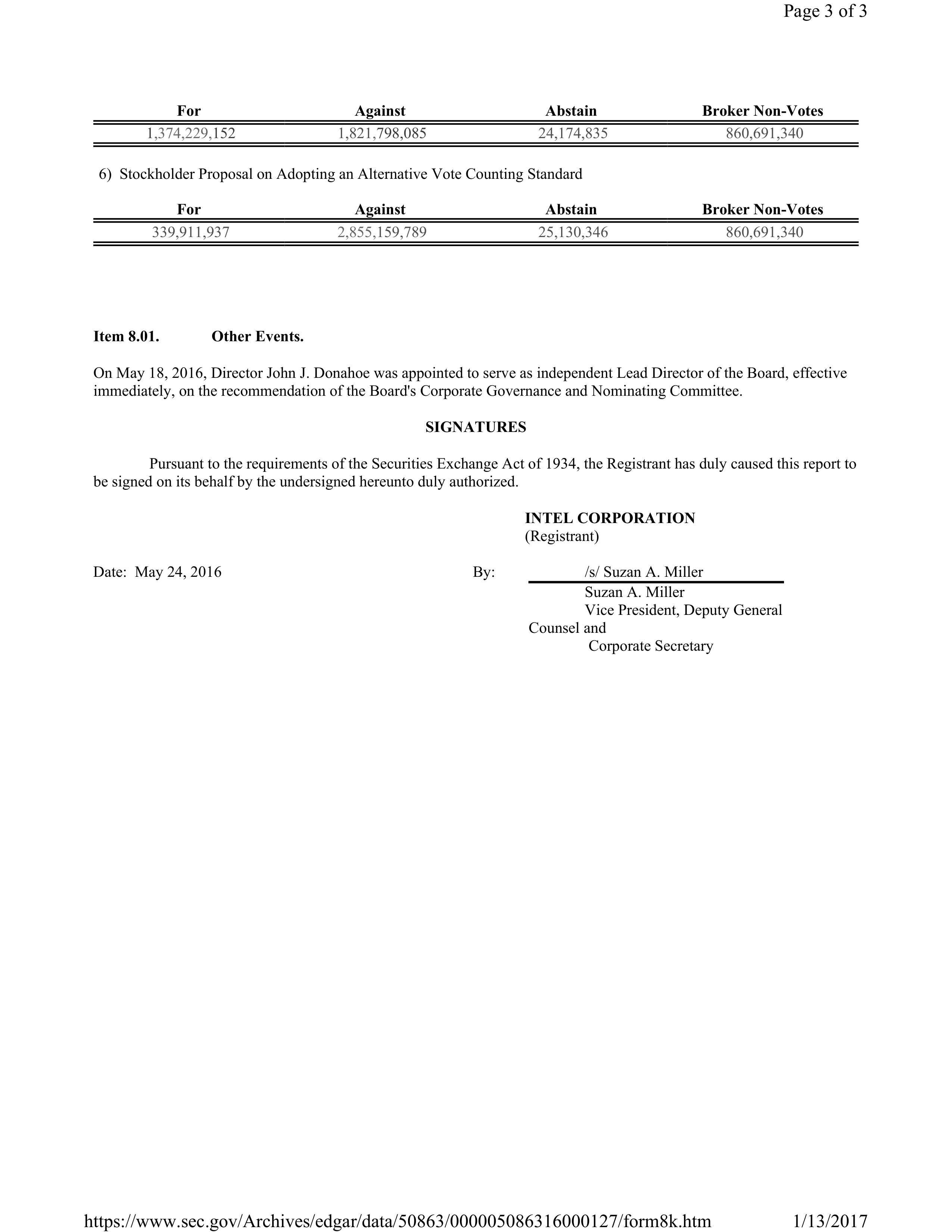
5) Stockholder Proposal on Allowing Stockholders to Act by Written Consent
Page 2 of 3
1/13/2017
https://www.sec.gov/Archives/edgar/data/50863/000005086316000127/form8k.htm
For
Against
Abstain
Broker Non-Votes
1
,374,229
,
152
1,821
,
798,085
24,174,835
860,691,340
6) Stockholder Proposal on Adopting an Alternative Vote Counting Standard
For
Against
Abstain
Broker Non-Votes
339,911,937
2,855
,
159,789
25,130,346
860,691,340
Item 8.01.
Other Events.
On May 18, 2016, Director John J. Donahoe was appointed to serve as independent Lead Director of the Board, effective
immediately, on the recommendation of the Board's Corporate Governance and Nominating Committee.
SIGNATURES
Pursuant to the requirements of the Securities Exchange Act of 1934, the Registrant has duly caused this report to
be signed on its behalf by the undersigned hereunto duly authorized.
INTEL CORPORATION
(Registrant)
Date: May 24, 2016
By:
/s/ Suzan A. Miller
Suzan A. Miller
Vice President, Deputy General
Counsel and
Corporate Secretary
Page 3 of 3
1/13/2017
https://www.sec.gov/Archives/edgar/data/50863/000005086316000127/form8k.htm