

2000 PENNSYLVANIA AVE., NW
WASHINGTON, D.C.
20006-1888
TELEPHONE: 202.887.1500
FACSIMILE: 202.887.0763
WWW.MOFO.COM
M O R R I S O N
&
F O E R S T E R L L P
B E I J I N G
,
B E R L I N
,
B R U S S E L S
,
D E N V E R
,
H O N G K O N G
,
L O N D O N
,
L O S A N G E L E S
,
N E W Y O R K
,
N O R T H E R N V I R G I N I A
,
P A L O A L T O
,
S A N D I E G O
,
S A N F R A N C I S C O
,
S H A N G H A I
,
S I N G A P O R E
,
T O K Y O
,
W A S H I N G T O N
,
D
.
C
.
Writer’s Direct Contact
+1 (202) 778.1611
MDunn@mofo.com
1934 Act/Rule 14a-8
September 14, 2016
VIA E-MAIL (
shareholderproposals@sec.gov)
Office of Chief Counsel
Division of Corporation Finance
U.S. Securities and Exchange Commission
100 F Street, NE
Washington, DC 20549
Re:
Walgreens Boots Alliance, Inc.
Stockholder Proposal of Lutra Living Trust (Submitted by As You Sow)
Dear Ladies and Gentlemen:
We submit this letter on behalf of our client Walgreens Boots Alliance, Inc., a Delaware
corporation (the “
Company
”), which requests confirmation that the staff (the “
Staff
”) of the
Division of Corporation Finance of the U.S. Securities and Exchange Commission (the
“
Commission
”) will not recommend enforcement action to the Commission if, in reliance on
Rule 14a-8 under the Securities Exchange Act of 1934 (the “
Exchange Act
”), the Company
omits the enclosed stockholder proposal (the “
Proposal
”) and statements in support thereof (the
“
Supporting Statement
”) submitted by As You Sow (the “
Proponent’s Representative
”) on
behalf of Lutra Living Trust (the “
Proponent
”) from the Company’s proxy materials for its 2017
Annual Meeting of Stockholders (the “
2017 Proxy Materials
”).
Pursuant to Rule 14a-8(j) under the Exchange Act, we have:
filed this letter with the Commission no later than eighty (80) calendar days before the
Company intends to file its definitive 2017 Proxy Materials with the Commission; and
concurrently sent copies of this correspondence to the Proponent’s Representative.

Office of Chief Counsel
Division of Corporation Finance
U.S. Securities and Exchange Commission
September 14, 2016
Page 2
A copy of the Proposal and the Supporting Statement, the Proponent’s Representative’s
cover letter submitting the Proposal, and other correspondence relating to the Proposal are
attached hereto as Exhibit A.
Pursuant to the guidance provided in Section F of Staff Legal Bulletin 14F (Oct. 18,
2011), we ask that the Staff provide its response to this request to Martin Dunn, on behalf of the
Company, via email at mdunn@mofo.com or via facsimile at (202) 887-0763, and to the
Proponent’s Representative via email at awilson@asyousow.org.
I.
SUMMARY OF THE PROPOSAL
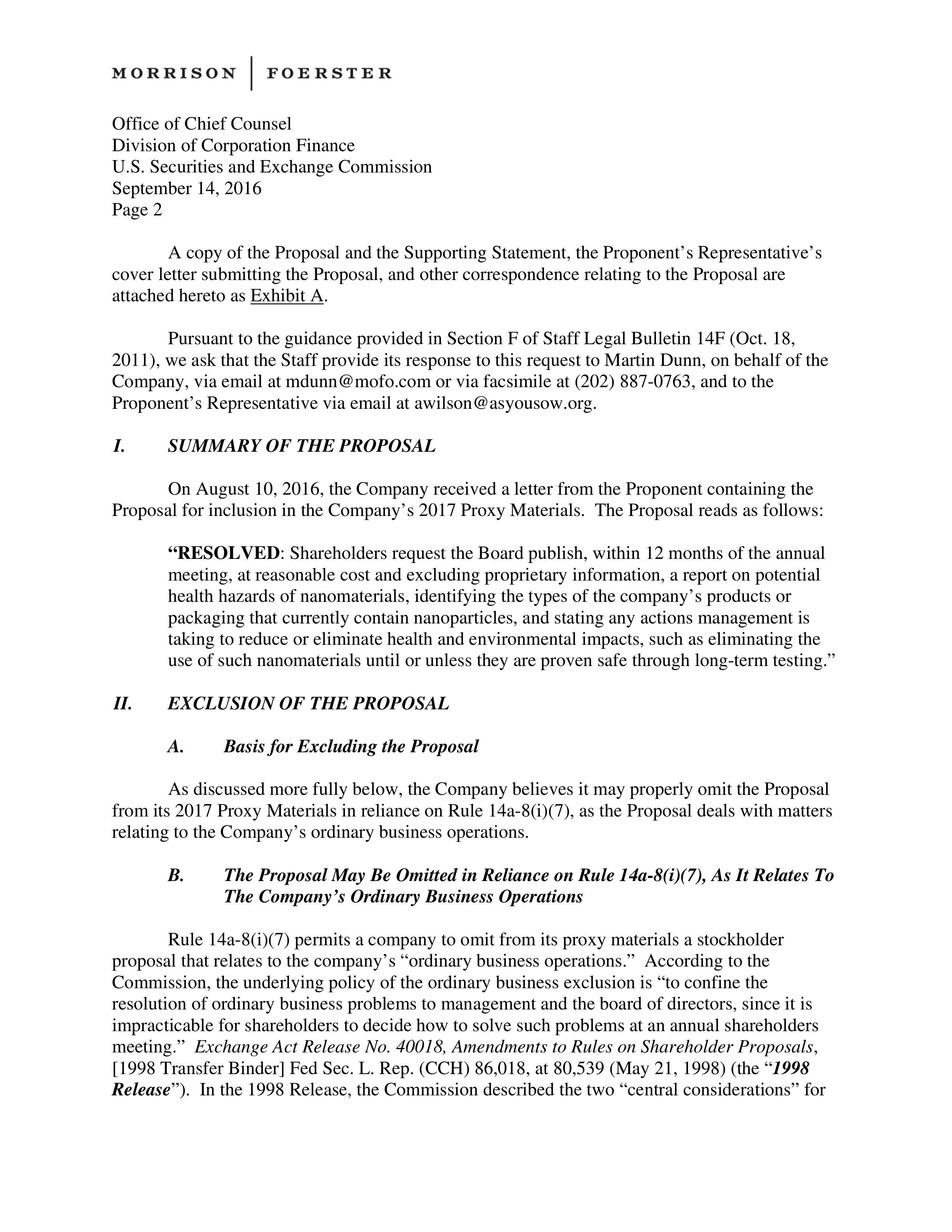
On August 10, 2016, the Company received a letter from the Proponent containing the
Proposal for inclusion in the Company’s 2017 Proxy Materials. The Proposal reads as follows:
“RESOLVED
: Shareholders request the Board publish, within 12 months of the annual
meeting, at reasonable cost and excluding proprietary information, a report on potential
health hazards of nanomaterials, identifying the types of the company’s products or
packaging that currently contain nanoparticles, and stating any actions management is
taking to reduce or eliminate health and environmental impacts, such as eliminating the
use of such nanomaterials until or unless they are proven safe through long-term testing.”
II.
EXCLUSION OF THE PROPOSAL
A.
Basis for Excluding the Proposal
As discussed more fully below, the Company believes it may properly omit the Proposal
from its 2017 Proxy Materials in reliance on Rule 14a-8(i)(7), as the Proposal deals with matters
relating to the Company’s ordinary business operations.
B.
The Proposal May Be Omitted in Reliance on Rule 14a-8(i)(7), As It Relates To
The Company’s Ordinary Business Operations
Rule 14a-8(i)(7) permits a company to omit from its proxy materials a stockholder
proposal that relates to the company’s “ordinary business operations.” According to the
Commission, the underlying policy of the ordinary business exclusion is “to confine the
resolution of ordinary business problems to management and the board of directors, since it is
impracticable for shareholders to decide how to solve such problems at an annual shareholders
meeting.”
Exchange Act Release No. 40018, Amendments to Rules on Shareholder Proposals
,
[1998 Transfer Binder] Fed Sec. L. Rep. (CCH) 86,018, at 80,539 (May 21, 1998) (the “
1998
Release
”). In the 1998 Release, the Commission described the two “central considerations” for

Office of Chief Counsel
Division of Corporation Finance
U.S. Securities and Exchange Commission
September 14, 2016
Page 3
the ordinary business exclusion. The first is that certain tasks are “so fundamental to
management’s ability to run a company on a day-to-day basis that they could not, as a practical
matter, be subject to direct shareholder oversight.” The second consideration relates to “the
degree to which the proposal seeks to ‘micro-manage’ the company by probing too deeply into
matters of a complex nature upon which shareholders, as a group, would not be in a position to
make an informed judgment.”
Id
. at 86,017-18 (footnote omitted).
The Staff has further stated that a proposal requesting the publication of a report may be
excluded under Rule 14a-8(i)(7) if the subject matter of the report involves a matter of ordinary
business.
See Exchange Act Release No. 20091
(Aug. 16, 1983) [48 FR 38218]. In addition, the
Staff has stated that “[where] the subject matter of the additional disclosure sought in a particular
proposal involves a matter of ordinary business ... it may be excluded under [R]ule 14a-8(i)(7).”
Johnson Controls, Inc.
(Oct. 26, 1999).
1.
The Proposal’s Underlying Subject Matter Concerns the Development of
Products
The Proposal may be properly omitted in reliance on Rule 14a-8(i)(7) because the Staff
has repeatedly recognized that a proposal relating to the development of products is excludable
under Rule 14a-8(i)(7) as a component of a company’s “ordinary business.”
The Company is a global leader in pharmacy-led health and wellbeing retail, offering
customers goods and services, including prescription drugs and pharmacy-related services, as
well as healthcare and retail products including non-prescription drugs, beauty, toiletries and
general merchandise. The development and selection of thousands of different products sold in
the Company’s 13,100 retail stores in 11 countries is an integral part of the Company’s business.
In addition to purchasing products for resale, the Company contracts with various manufacturers
to produce its branded products and manufactures certain of its own products for sale in its retail
stores. As discussed below, decisions regarding product development and selection inherently
involve complex operational and business issues requiring detailed knowledge and judgment of
the Company’s management, which, unlike individual stockholders, is well-positioned to and has
the necessary skills, knowledge and resources to make informed decisions on such day-to-day
business and operational matters. Particularly for a retailer such as the Company, decisions as to
which products the Company develops or sells are fundamental to management’s ability to run
the Company on a daily basis and are matters that are properly in the purview of management.
The Staff has a long history of concurring with the exclusion of proposals that concern
the development of products and product lines as relating to a company’s ordinary business
operations, including the choices of processes and supplies used in the preparation and packaging
of a company’s products. In
General Mills, Inc
. (July 2, 2010), the Staff concurred with the

Office of Chief Counsel
Division of Corporation Finance
U.S. Securities and Exchange Commission
September 14, 2016
Page 4
exclusion of a proposal requesting limits on the use of salt and other sodium compounds in the
company’s food products, noting in particular that the proposal “relate[d] to the selection of
ingredients in [the company’s] products” and that “[p]roposals concerning the selection of
ingredients in a company’s products are generally excludable under rule 14a-8(i)(7).”
See also
Applied Digital Solutions, Inc.
(Apr. 25, 2006) (concurring with the omission of a proposal
requesting a report on the “harm the continued sale and use of [radio frequency identification]
chips could have to the public’s privacy, personal safety, and financial security”). The Staff on
several occasions also has concurred with a company’s view that the selection of ingredients or
materials for inclusion in its products, within the parameters established by the U.S. Food and
Drug Administration (the “
FDA
”) regulations and state and federal legislation, are matters
relating to the company’s ordinary business within the meaning of Rule 14a-8(i)(7) (and its
predecessor, Rule 14a-8(c)(7)).
See, e.g., The Coca-Cola Co.
(Jan. 22, 2007) (concurring with
the omission of a proposal that the company stop caffeinating its root beer and other beverages,
as well as adopt specific requirements relating to labeling caffeinated beverages);
The Kroger
Co.
(Mar. 23, 1992) (concurring with the omission of a proposal relating to the use of food
irradiation processes as relating to products and product lines retailed by the company, including
the choice of processes and supplies used in the preparation of its products); and
Borden, Inc.
(Jan. 16, 1990) (concurring with the omission of a proposal relating to the use of food irradiation
processes as relating to the choice of processes and supplies used in the preparation of the
company’s products).
As in the cited precedent
,
the Proposal addresses the Company’s day-to-day decisions
regarding the ingredients or materials contained in the Company’s products and/or packaging.
The Company considers many factors in determining the ingredients or materials to be included
in any particular product that will be sold in its retail stores and the packaging thereof, whether
the product is purchased for resale or manufactured by the Company or a contract manufacturer.
Those factors include the Company’s array of product offerings, product development costs and
manufacturing processes, the availability and prices charged by the Company’s suppliers, the
shelf space available in the Company’s stores, the preferences of the Company’s customers,
government rules and regulations, and the product offerings of the Company’s competitors.
Management’s evaluation of such factors and decisions with respect thereto are fundamental to
its ability to run the Company on a day-to-day basis, and stockholders are not in a position to
make an informed judgment on those matters. In addition, the Supporting Statement’s emphasis
on one of the Company’s products in particular—its Well Beginnings™ Advantage® infant
formula—indicates the Proposal’s focus on specific, ordinary business decisions relating to the
day-to-day management of the Company.
Importantly, the Staff has permitted the omission of similar proposals relating to the use
of nanomaterials. In
Mondelēz International, Inc.
(Feb. 23, 2016), the Staff considered the
company’s request to omit a proposal very similar to the Proposal at issue, and also submitted by

Office of Chief Counsel
Division of Corporation Finance
U.S. Securities and Exchange Commission
September 14, 2016
Page 5
the same Proponent’s Representative, that sought a report on Mondelēz’s use of nanomaterials in
its products or packaging. Mondelēz noted that “whether a food product, packaging or
otherwise, the Company takes into account a number of factors … [which] decisions are
fundamental to management’s ability to run the Company on a day-to-day basis, and
shareholders are not in a position to make an informed judgment on such matters.” The Staff
concurred that that proposal in Mondelēz could be excluded under Rule 14a-8(i)(7) as relating to
the company’s ordinary business operations, citing in particular that the proposal related to
Mondelēz’s product development. Similarly, in
Wal-Mart Stores, Inc.
(Mar. 11, 2008), the Staff
permitted Wal-Mart to omit a proposal that sought a report on Wal-Mart’s product safety policies
with respect to nanomaterials. Wal-Mart argued to the Staff that the proposal was an attempt to
“micromanage” its retail business practices: “by having the [c]ompany summarize any new
initiatives or actions management is taking regarding products that may include nanomaterials,
the [p]roponent seeks to have the shareholders involved in managing how the [c]ompany selects
and assesses the safety of the products it sells,” which are matters that are part of the company’s
day-to-day, ordinary business operations. The Staff concurred that Wal-Mart could omit the
proposal under Rule 14a-8(i)(7) because the proposal related to the company’s ordinary business,
specifically the sale of particular products. As was the case in
Mondelēz International
and
Wal-
Mart Stores
, the Proposal relates to the Company’s ordinary business,
i.e.
, the determination of
whether to use nanomaterials in product development or sell products that contain nanomaterials.
The Company is, therefore, of the view that it may properly omit the Proposal and the
Supporting Statement from the 2017 Proxy Materials pursuant to Rule 14a-8(i)(7).
2.
The Proposal Does Not Focus on a Significant Social Policy Issue
The Commission has stated that “proposals relating to such [ordinary business] matters
but focusing on sufficiently significant social policy issues (
e.g.
, significant discrimination
matters) generally would not be considered to be excludable because the proposals would
transcend the day-to-day business matter and raise policy matters so significant that it would be
appropriate for a shareholder vote.”
See
the 1998 Release;
see also
Staff Legal Bulletin 14H
(Oct. 22, 2015) (emphasizing that the Staff “intends to continue to apply Rule 14a-8(i)(7) as
articulated by the Commission and consistent with the Division’s prior application of the
exclusion”).
The Staff has determined that decisions relating to products involve significant social
policy issues in certain circumstances. Those circumstances, however, generally have involved
the use of ingredients or materials that clearly presented, or were widely viewed in the scientific
community as presenting, a demonstrated negative effect on human health or the environment.
For example, on reconsideration in
Tyson Foods, Inc.
(Dec. 15, 2009), the Staff did not concur
with the company’s view that it could omit a proposal relating to the use of antibiotics in raising

Office of Chief Counsel
Division of Corporation Finance
U.S. Securities and Exchange Commission
September 14, 2016
Page 6
livestock under Rule 14a-8(i)(7), reversing a prior decision (and two additional precedents). In
rendering its view, the Staff provided the following justification:
“[I]n view of the widespread public debate concerning antimicrobial resistance and the
increasing recognition that the use of antibiotics in raising livestock raises significant
policy issues, it is our view that proposals relating to the use of antibiotics in raising
livestock cannot be considered matters relating to a meat producer’s ordinary business
operations. In arriving at this position, we note that since 2006, the European Union has
banned the use of most antibiotics as feed additives and that legislation to prohibit the
non-therapeutic use of antibiotics in animals absent certain safety findings relating to
antimicrobial resistance has recently been introduced in Congress.”
The circumstances that led the Staff to find a significant social policy issue in
Tyson
Foods
do not exist with respect to nanomaterials. Unlike
Tyson Foods
, the Company is unaware
of any significant legislation pending before Congress or elsewhere in the United States seeking
to ban the use of nanomaterials. In addition, unlike
Tyson Foods
, the Company does not seek to
engage in the activity that the Proposal addresses,
i.e.
, the Company does not seek to engineer,
contract for manufacture, or purchase for resale products or packaging with engineered
nanotechnology or engineered nanomaterials. Notably, the Company’s Well Beginnings™
Advantage® infant formula, which is the product specifically referenced in the Proposal, does
not contain engineered nanomaterials. Further, although the Supporting Statement cites several
studies on the potential impact of nanoparticles, there appears to be an absence of widespread
public debate regarding nanoparticles of the kind that the Staff recognized with respect to the use
of antibiotics in meat production in
Tyson Foods
. Lastly, the proponent in
Tyson Foods
claimed
that the proposal could not be excluded under Rule 14a-8(i)(7) in part because the FDA and the
Centers for Disease Control were already advocating for reform of animal husbandry practices
related to the use of antibiotics in livestock production. The Proponent cites certain statements by
the FDA as indicative of the alleged health risks associated with nanomaterials; however, the
Proponent acknowledges that the FDA has not adopted regulations regarding the use on
nanomaterials. In fact, the FDA has publicly stated that it “does not categorically judge all
products containing nanomaterials or otherwise involving the application of nanotechnology as
intrinsically benign or harmful.”
1
We further note that as recently as February 2016, in
connection with the Staff’s consideration of the
Mondelēz International
proposal, the Staff had
not found that the use of nanomaterials constitutes a significant social policy issue.
Similarly, the Staff has permitted exclusion of proposals based on Rule 14a-8(i)(7) in
other situations where the proposals involved materials subject to FDA regulation. For example,
1
See
U.S. Food and Drug Administration,
FDA’s Approach to Regulation of Nanotechnology Products
(Aug. 5,
2015),
available at
http://www.fda.gov/ScienceResearch/Specia1Topics/Nanotechnology/ucm301114.htm
.

Office of Chief Counsel
Division of Corporation Finance
U.S. Securities and Exchange Commission
September 14, 2016
Page 7
in
Walgreen Co.
(Oct. 13, 2006), the Staff allowed Walgreens to omit a proposal that requested a
report related to suspected carcinogens, mutagens, reproductive toxicants, and certain other
chemicals in the company’s private label cosmetics and personal care products pursuant to Rule
14a-8(i)(7), concurring with the company’s view that the proposal did not involve a significant
social policy issue and related to the company’s ordinary business operations. As was the case in
Walgreen Co.
, the ingredients and materials used by the Company in the production of its
products and packaging are in compliance with the regulations set forth by the FDA. As such,
management’s determination as to whether the Company’s policies should be more stringent
than relevant statutory and regulatory requirements, as the Proposal and the Supporting
Statement suggest, is a matter related to the Company’s ordinary business operations.
See
Applied Digital Solutions
and
Walgreen Co.
As described above, the FDA has stated that it
“does not categorically judge all products containing nanomaterials or otherwise involving the
application of nanotechnology as intrinsically benign or harmful.”
2
The Proposal and the
Supporting Statement, on the other hand, make a categorical judgment about nanomaterials and
seek to micromanage the Company’s choice regarding the use of such materials in its products
and packaging.
In summary, the use of nanomaterials in products or packaging pertains to the Company’s
ordinary business operations and does not involve a significant social policy issue, as confirmed
in the Staff’s response in
Mondelēz International
. Unlike the issue of use of antibiotics in meat
production that existed in
Tyson Foods
, there is no widespread debate concerning the use of
nanomaterials and the Company is not aware of any significant pending FDA or legislative
action seeking to ban the use of nanomaterials in products or packaging. Although the Proposal
and the Supporting Statement reference certain studies of alleged health risks associated with
nanomaterials, the subject of the Proposal (
i.e.
, the use of nanomaterials in products or
packaging) does not rise to the level of a significant social policy issue.
As the Proposal relates to the Company’s ordinary business operations and does not
involve a significant social policy issue, the Company is of the view, consistent with the
foregoing precedent, that it may properly omit the Proposal and the Supporting Statement from
the 2017 Proxy Materials pursuant to Rule 14a-8(i)(7).
2
Id.
MORRISON
I
FOERSTER
Office
of
Chief Counsel
Division
of
Corporation Finance
U.S. Securities and Exchange Commission
September 14, 2016
Page 8
IIL
CONCLUSION
For the reasons discussed above, the Company believes that it may properly omit the
Proposal and the Supporting Statement from its 2017 Proxy Materials
in
reliance
on
Rule 14a-8.
As such, we respectfully request that the Staff concur with the Company's view and not
recommend enforcement action to the Commission
ifthe
Company omits the Proposal and the
Supporting Statement from its 2017 Proxy Materials.
If
we can
be
of
further assistance in this
matter, please do not hesitate to contact me at (202) 778-1611.
Sincerely,
Martin P. Dunn
of
Morrison
&
Foerster LLP
Attachments
cc:
Austin Wilson, Environmental Health Program Manager,
As
You Sow
Collin
G.
Smyser, Vice President, Corporate Secretary, Walgreens Boots Alliance, Inc.
Mark L. Dosier, Director, Securities Law, Walgreens Boots Alliance, Inc.

Exhibit A
AS
YOU
SOW
August
10,.
2016
Jan
Stern
Reed
Corporate Secretary
Walgreens Boots Alliance, Inc.
1611 Telegraph Ave, Suite 1450
Oakland,
CA
94612
108
Wilmot
Road,
Mail Stop #1858
Deerfield, Illinois 60015
Dear Ms. Reed:
www.asyousow.org
BUILDING A
SAFE,
JUST,
AND
SUSTAINABLE
WORLD
SINCE
1992
As
You
Sow
is
a non-profit shareholder advocacy organization
that
conducts research and promotes
corporate responsibility practices
to
increase shareholder value. We sent a
letter
to
Walgreens on May
25, 2016, requesting
the
opportunity
to
discuss the company's policies related
to
nanomaterials in ·
infant formula.
As
You
Sow
is
filing a shareholder proposal on behalf
of
Lutra Living Trust ("Proponent"), a shareholder
of
Walgreens Boots Alliance stock, in order
to
protect
the
shareholder's right
to
raise this issue in the
proxy statement. The Proponent
is
submitting
the
enclosed shareholder proposal
for
inclusion in
the
2017 proxy statement, in accordance
with
Rule 14a-8
of
the
General
Rules
and Regulations
of
the
Securities Exchange Act
of
1934.
A
letter
from
Lutra Living Trust authorizing
As
You Sow
to
act on
their
behalf
is
enclosed. A
representative
of
the
Proponent will attend
the
stockholders' meeting
to
move
the
resolution
as
required.
We are optimistic
that
a dialogue
with
the
company can result in resolution
of
the
Proponent's
concerns. Please contact Austin Wilson (awilson@asyousow.org)
to
schedule a call. We look forward
to
hearing
from
you.
Sincerely,
Austin Wilson
Environmental Health Program Manager
Enclosures
•
Shareholder Proposal
•
Lutra Living Trust Authorization
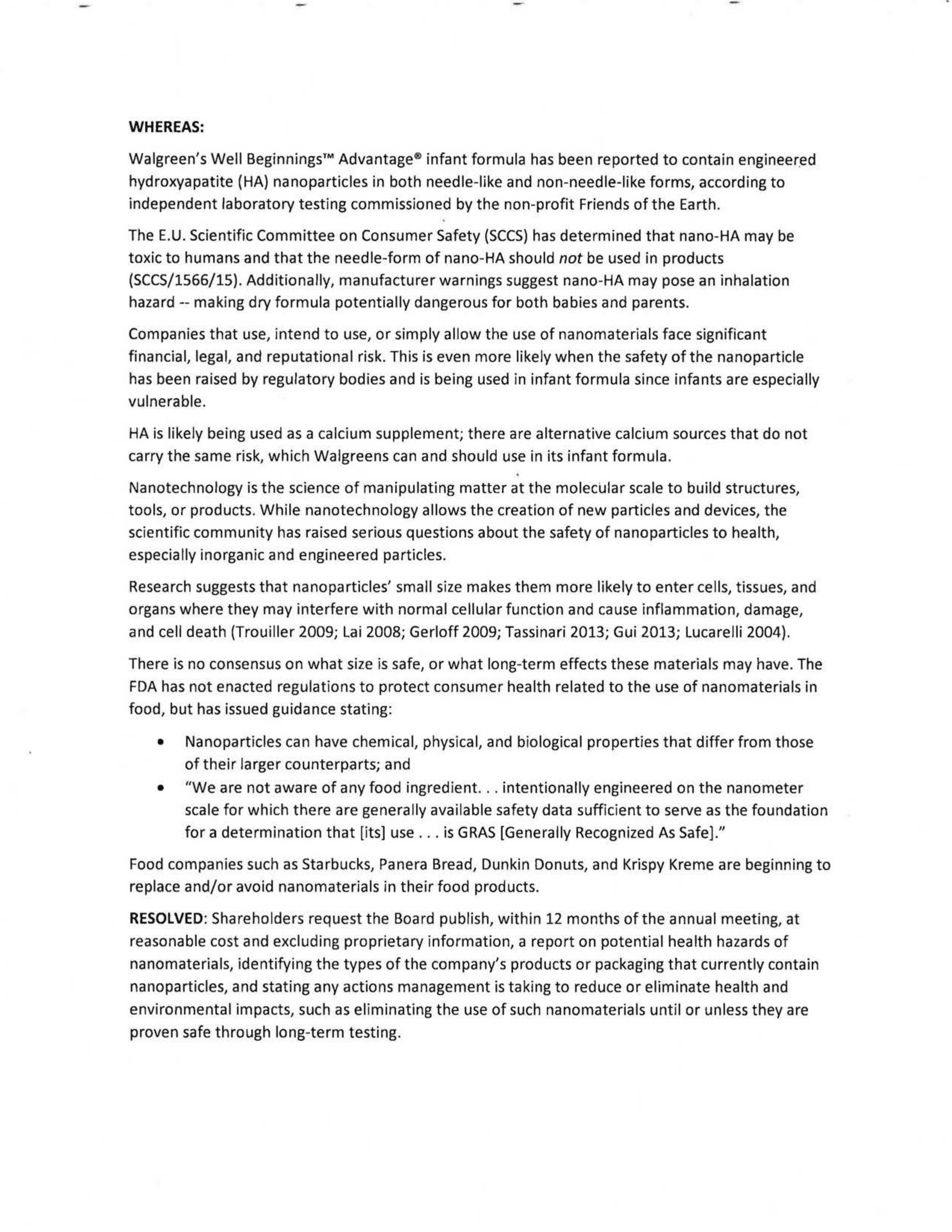
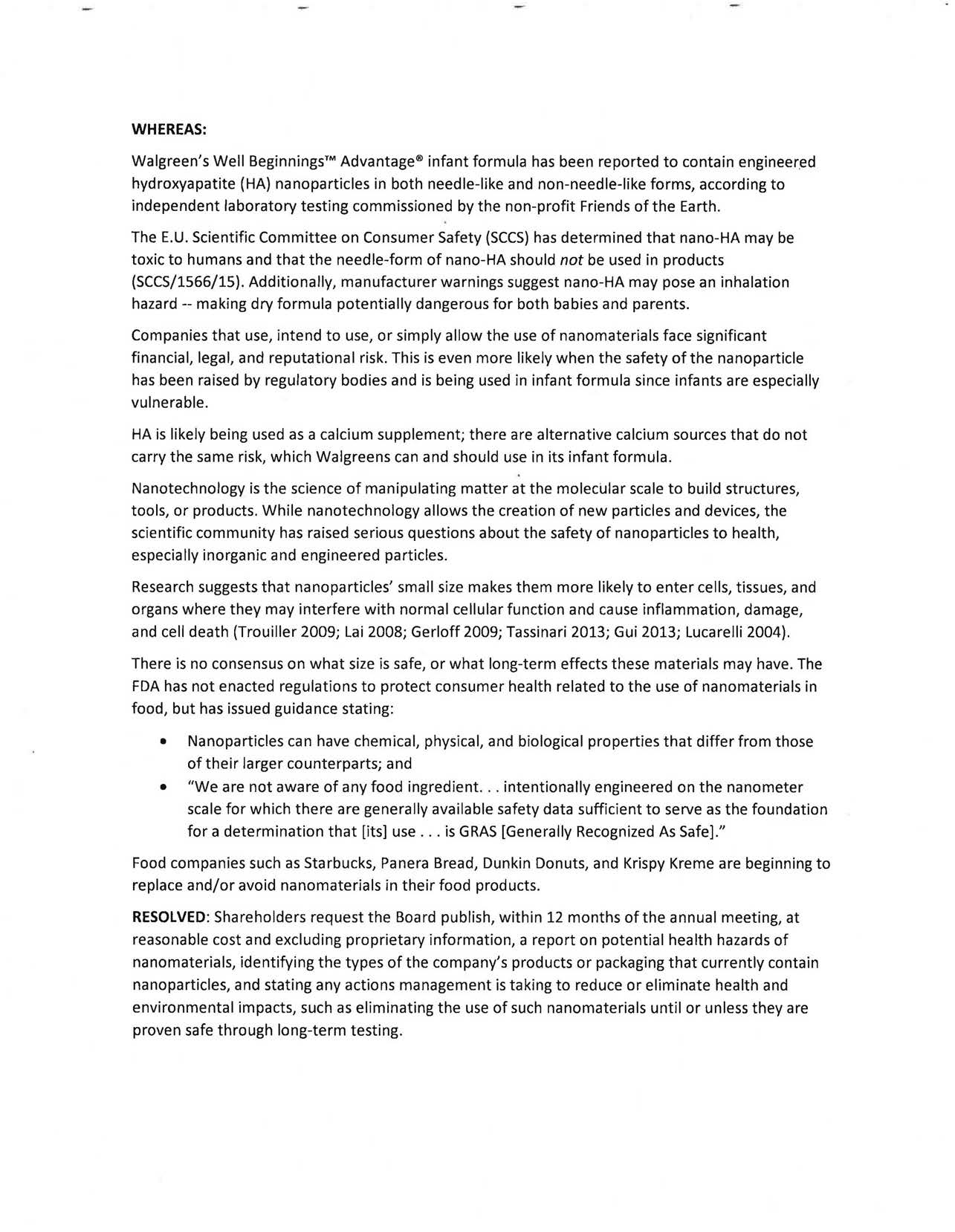
WHEREAS:
Walgreen's Well Beginnings™ Advantage® infant formula
has
been reported
to
contain engineered
hydroxyapatite
(HA)
nanoparticles
in
both needle-like
and
non-needle-like forms, according
to
independent laboratory testing commissioned by the non-profit Friends
of
the Earth.
The
E.U.
Scientific Committee on Consumer Safety
(SCCS)
has
determined
that
nano-HA may
be
toxic to humans and
that
the needle-form
of
nano-HA should
not
be
used
in
products
(SCCS/1566/15). Additionally, manufacturer warnings suggest nano-HA may pose
an
inhalation
hazard
--
making dry formula potentially dangerous for both babies and parents.
Companies
that
use,
intend
to
use,
or
simply allow the
use
of
nanomaterials face significant
financial, legal, and reputation a I risk. This
is
even more likely when the safety
of
the nano particle
has
been raised by regulatory bodies and
is
being
used
in
infant formula since infants are especially
vulnerable.
HA
is
likely being
used
as
a calcium supplement; there
are
alternative calcium sources
that
do not
carry the same risk, which Walgreens
can
and should
use
in
its infant formula.
Nanotechnology
is
the science
of
manipulating
matter
at the molecular
scale
to
build structures,
tools,
or
products. While nanotechnology allows the creation
of
new particles
and
devices, the
scientific community
has
raised serious questions about the safety
of
nanoparticles
to
health,
especially inorganic and engineered particles.
Research
suggests
that
nano particles' small
size
makes them more likely
to
enter cells, tissues,
and
organs where they may interfere
with
normal cellular function
and
cause
inflammation, damage,
and
cell death (Trouiller 2009;
Lai
2008; Gerloff 2009; Tassinari 2013;
Gui
2013; Lucarelli 2004).
There
is
no
consensus on what
size
is
safe,
or
what long-term effects these materials may have.
The
FDA
has
not enacted regulations
to
protect consumer health related
to
the
use
of
nanomaterials
in
food, but
has
issued guidance stating:
•
Nanoparticles
can
have chemical, physical,
and
biological properties
that
differ from those
of
their larger counterparts; and
•
"We are not aware
of
any food ingredient
...
intentionally engineered on the nanometer
scale for which there are generally available safety data sufficient
to
serve
as
the foundation
for
a determination
that
[its]
use
...
is
GRAS
[Generally Recognized
As
Safe]."
Food
companies such
as
Starbucks, Panera Bread, Dunkin Donuts,
and
Krispy Kreme are beginning
to
replace
and/or
avoid nanomaterials in their food products.
RESOLVED:
Shareholders request the Board publish, within
12
months
of
the annual meeting, at
reasonable cost and excluding proprietary information, a report
on
potential health hazards
of
nanomaterials, identifying the types
of
the company's products
or
packaging
that
currently contain
nanoparticles, and stating any actions management
is
taking
to
reduce
or
eliminate health
and
environmental impacts,
such
as
eliminating the
use
of
such
nanomaterials until or unless they
are
proven
safe
through long-term testing.
August
8,
2016
Andrew Behar
CEO
As
You
Sow Foundation
1611 Telegraph
Ave.,
Ste. 1450
Oakland,
CA
94612
BAKER
STREET
ADVISORS
Re;
Autborization to File Shareholder Resolution
Dear Andrew Behar,
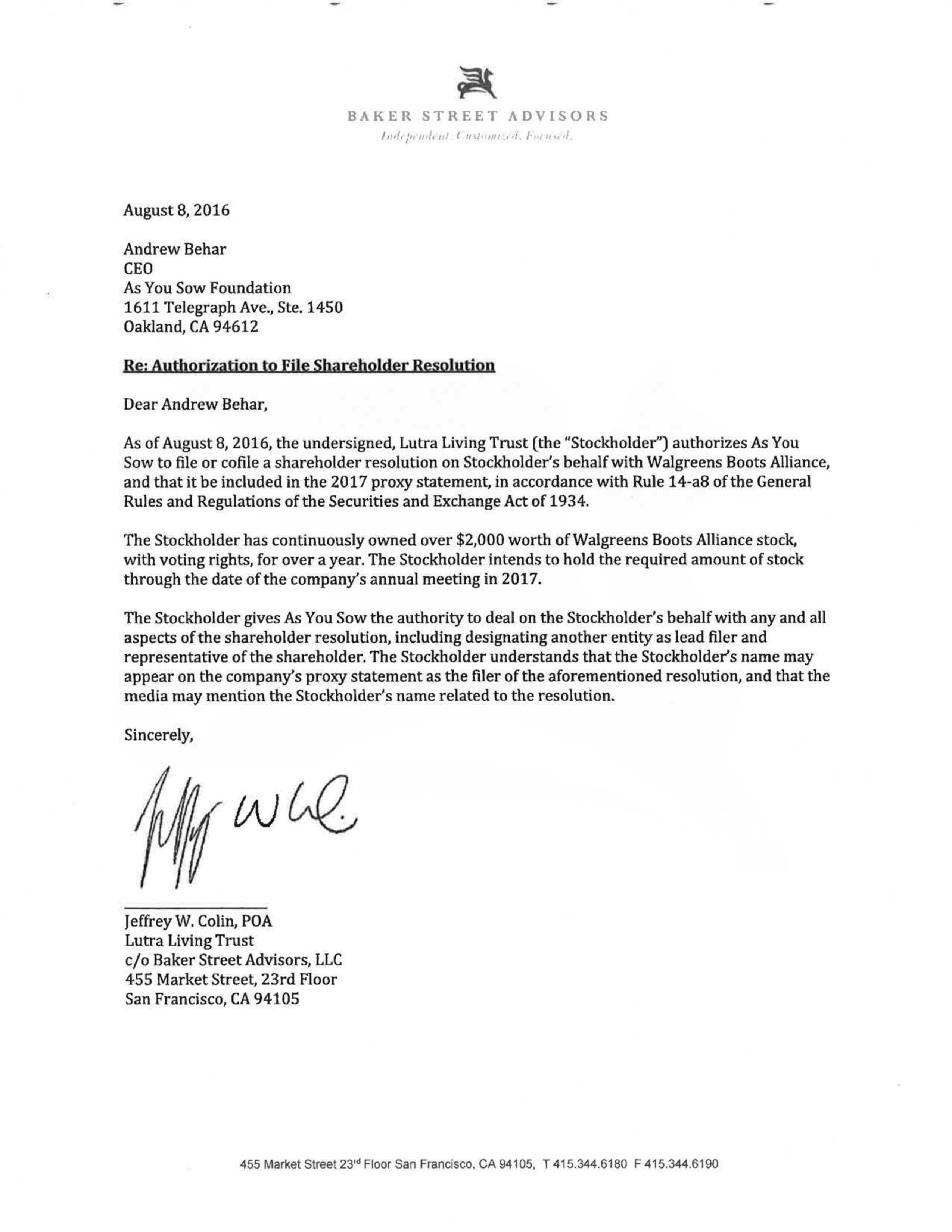
As
of August
8,
2016, the undersigned, Lutra Living Trust (the "Stockholder") authorizes
As
You
Sow to file
or
cofile a shareholder resolution on Stockholder's behalf with Walgreens Boots Alliance,
and
that
it
be included in
the
2017
proxy statement, in accordance with Rule 14-a8 of
the
General
Rules
and
Regulations of
the
Securities
and
Exchange Act of 1934.
The Stockholder has continuously owned over $2,000
worth
of
Walgreens Boots Alliance stock,
with voting rights, for over a year. The Stockholder intends to hold the required amount of stock
through
the
date of
the
company's annual meeting in 2017.
The Stockholder gives
As
You
Sow
the
authority to deal on
the
Stockholder's behalf with any and all
aspects of
the
shareholder resolution, including designating
another
entity as lead filer and
representative
of
the
shareholder. The Stockholder understands
thatthe
Stockholder's name may
appear
on the company's proxy
statement
as
the
filer of
the
aforementioned resolution, and
that
the
media may mention
the
Stockholder's name related to
the
resolution.
Sincerely,
Jeffrey
W.
Colin,
POA
Lutra Living Trust
c/o
Baker Street Advisors,
LLC
455 Market Street,
23rd
Floor
San Francisco,
CA
94105
455 Market Street
23'd
Floor San Francisco, CA 94105, T 415.344.6180 F 415.344.6190

Page 13 redacted for the following reason:
- - - - - - - - - - - - - - - - - - - - -
***FISMA & OMB MEMORANDUN M-07-16***
August
11
, 2016
Jan Stem Reed
Corporate Secretary
100
Crosby
Parkway
KC1
J,
Covington,
KY
41015
Walgreens Boots Alliance, Inc.
108 Wilmot Road, Mail Stop #1858
Deerfield, Illinois 60015
Dear Ms. Reed:
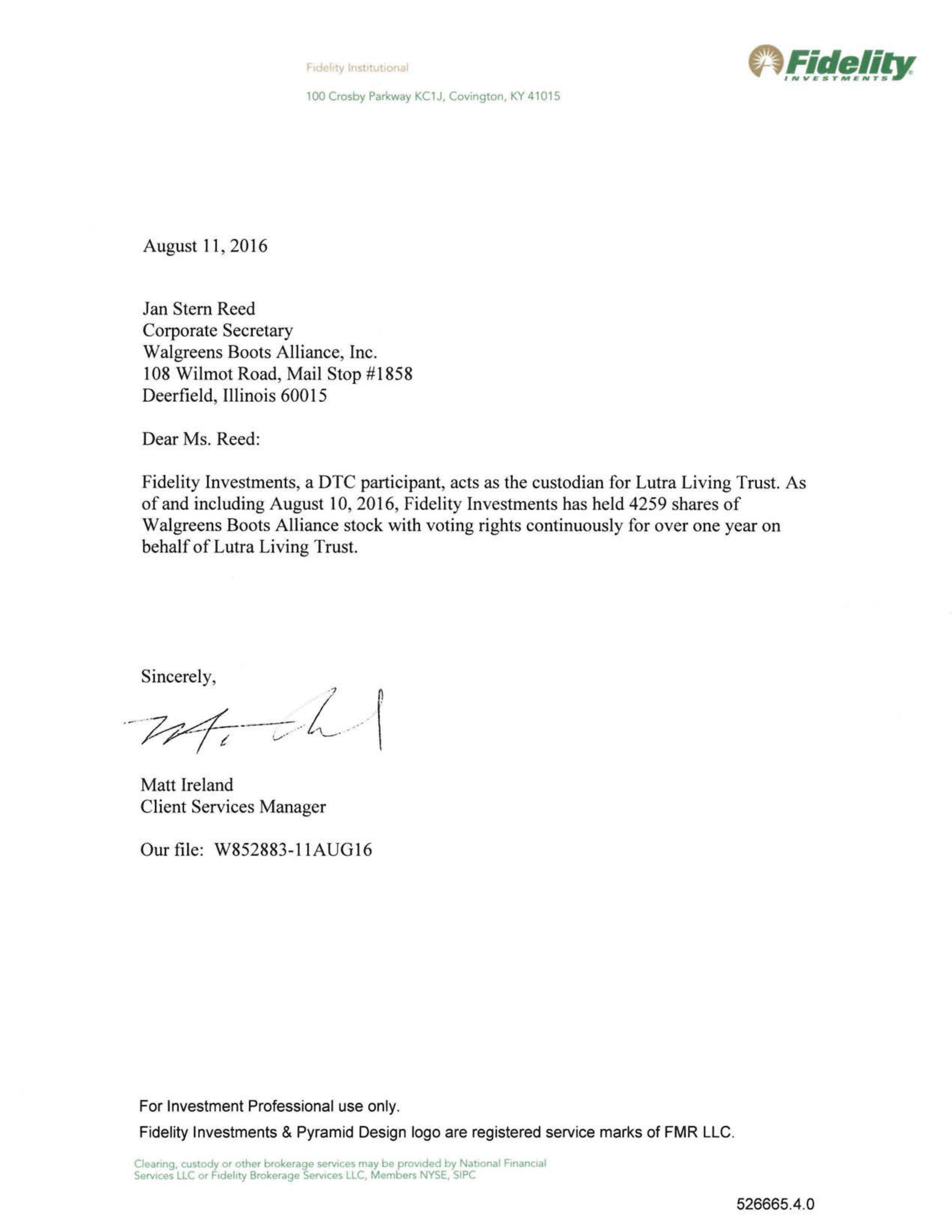
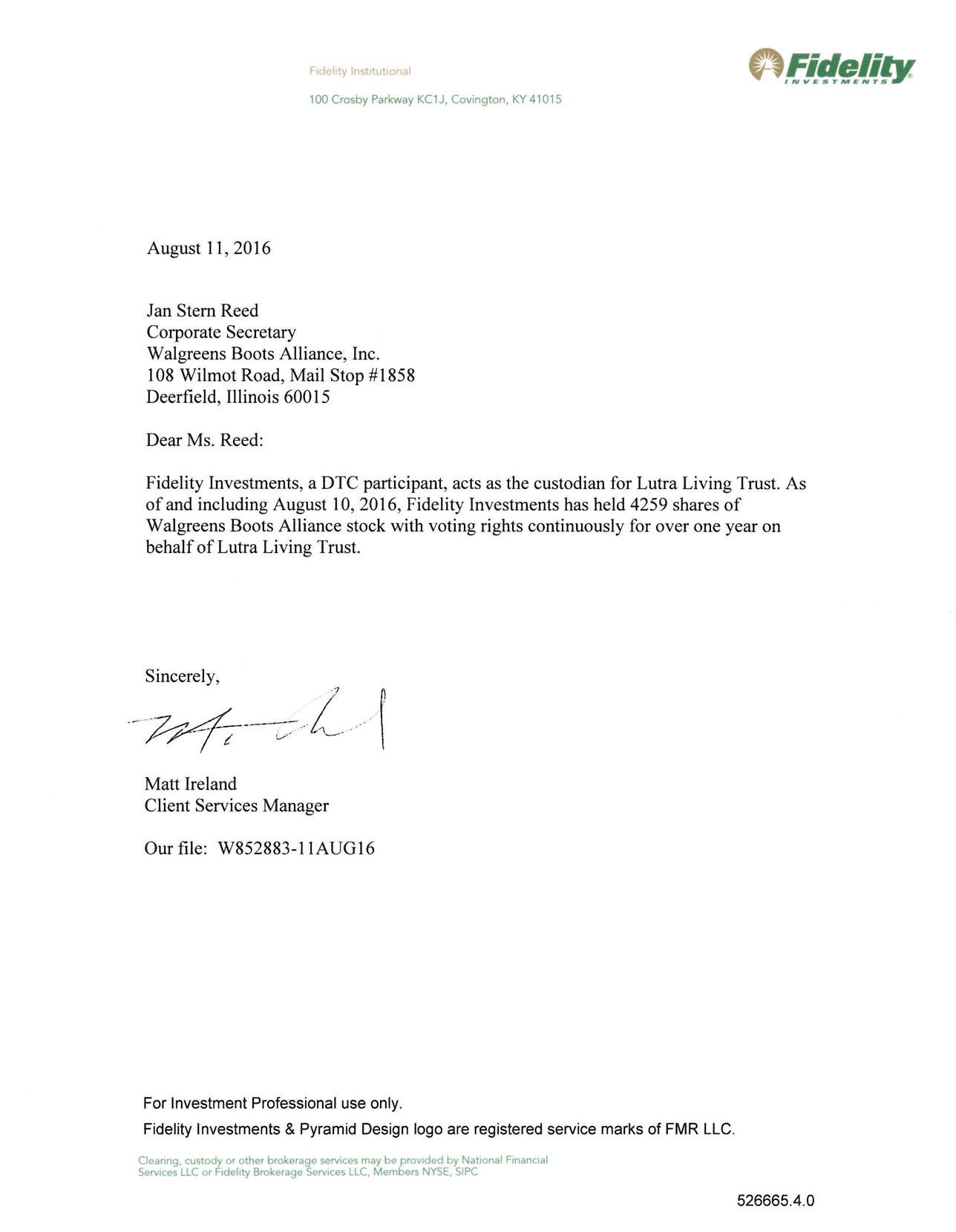
Fidelity Investments, a DTC participant, acts as the custodian for Lutra Living Trust. As
of
and including August
10,
2016, Fidelity Investments has held 4259 shares
of
Walgreens Boots Alliance stock with voting rights continuously for over one year on
behalf
of
Lutra Living Trust.
Sincerely,
,
I
-
hf;--
-v
l
I
Matt Ireland
Client Services Manager
Our file: W852883-l 1AUG16
For Investment Professional use only.
Fidelity Investments & Pyramid Design logo are registered service marks of
FMR
LLC.
Clearing, custody or other brokerage services may be provided
by
National Financial
Services
LLC
or
F1del1ty
Brokerage Services
LLC,
Members
NYSE,
SIPC
526665.4.0