

March 6, 2024
Alex Bahn
Wilmer Cutler Pickering Hale and Dorr LLP
Re:
The Coca-Cola Company (the “Company”)
Incoming letter dated December 22, 2023
Dear Alex Bahn:
This letter is in response to your correspondence concerning the shareholder
proposal (the “Proposal”) submitted to the Company by Achmea Investment
Management for inclusion in the Company’s proxy materials for its upcoming annual
meeting of security holders.
The Proposal requests that the Company adopt an enterprise-wide policy to move
toward more healthy products, to be defined in the discretion of the Company and beyond
sugar reduction, including an assessment of the current healthiness of its portfolio.
There appears to be some basis for your view that the Company may exclude the
Proposal under Rule 14a-8(i)(7). In our view, the Proposal relates to ordinary business
matters. Accordingly, we will not recommend enforcement action to the Commission if
the Company omits the Proposal from its proxy materials in reliance on Rule 14a-8(i)(7).
In reaching this position, we have not found it necessary to address the alternative basis
for omission upon which the Company relies.
Copies of all of the correspondence on which this response is based will be made
available on our website at
https://www.sec.gov/corpfin/2023-2024-shareholder-
proposals-no-action
.
Sincerely,
Rule 14a-8 Review Team
cc:
Frank Wagemans
Achmea Investment Management


Alex Bahn
+1 202 663 6198 (t)
+1 202 663 6363 (f)
alex.bahn@wilmerhale.com
December 22, 2023
Via e-mail to shareholderproposals@sec.gov
U.S. Securities and Exchange Commission
Division of Corporation Finance
Office of Chief Counsel
100 F Street, NE
Washington, DC 20549
Re:
The Coca-Cola Company
Exclusion of Shareowner Proposal by Achmea Investment Management
Ladies and Gentlemen:
We are writing on behalf of our client, The Coca-Cola Company (the “Company”), to inform
you of the Company’s intention to exclude from its proxy statement and proxy to be filed and
distributed in connection with its 2024 annual meeting of shareowners (the “Proxy Materials”),
the enclosed shareowner proposal and supporting statement (collectively, the “Proposal”)
submitted by Achmea Investment Management (the “Proponent”).
The Company respectfully requests that the staff of the Division of Corporation Finance (the
“Staff”) of the U.S. Securities and Exchange Commission (the “Commission”) advise the
Company that it will not recommend any enforcement action to the Commission if the Company
excludes the Proposal from its Proxy Materials pursuant to Rule 14a-8(i)(3) of the Securities
Exchange Act of 1934, as amended (the “Exchange Act”), on the basis that the Proposal is
inherently vague and indefinite, and subject to multiple interpretations, or, alternatively, Rule
14a-8(i)(7), on the basis that the Proposal relates to the Company’s ordinary business operations.
Pursuant to Exchange Act Rule 14a-8(j) and Staff Legal Bulletin No. 14D (November 7, 2008)
(“SLB 14D”), the Company is submitting electronically to the Commission this letter, and the
Proposal and related correspondence (attached as Exhibit A to this letter), and is concurrently
sending a copy to the Proponent.
Background
The Proposal submitted by the Proponent states as follows:
Resolved:

December 22, 2023
Page 2
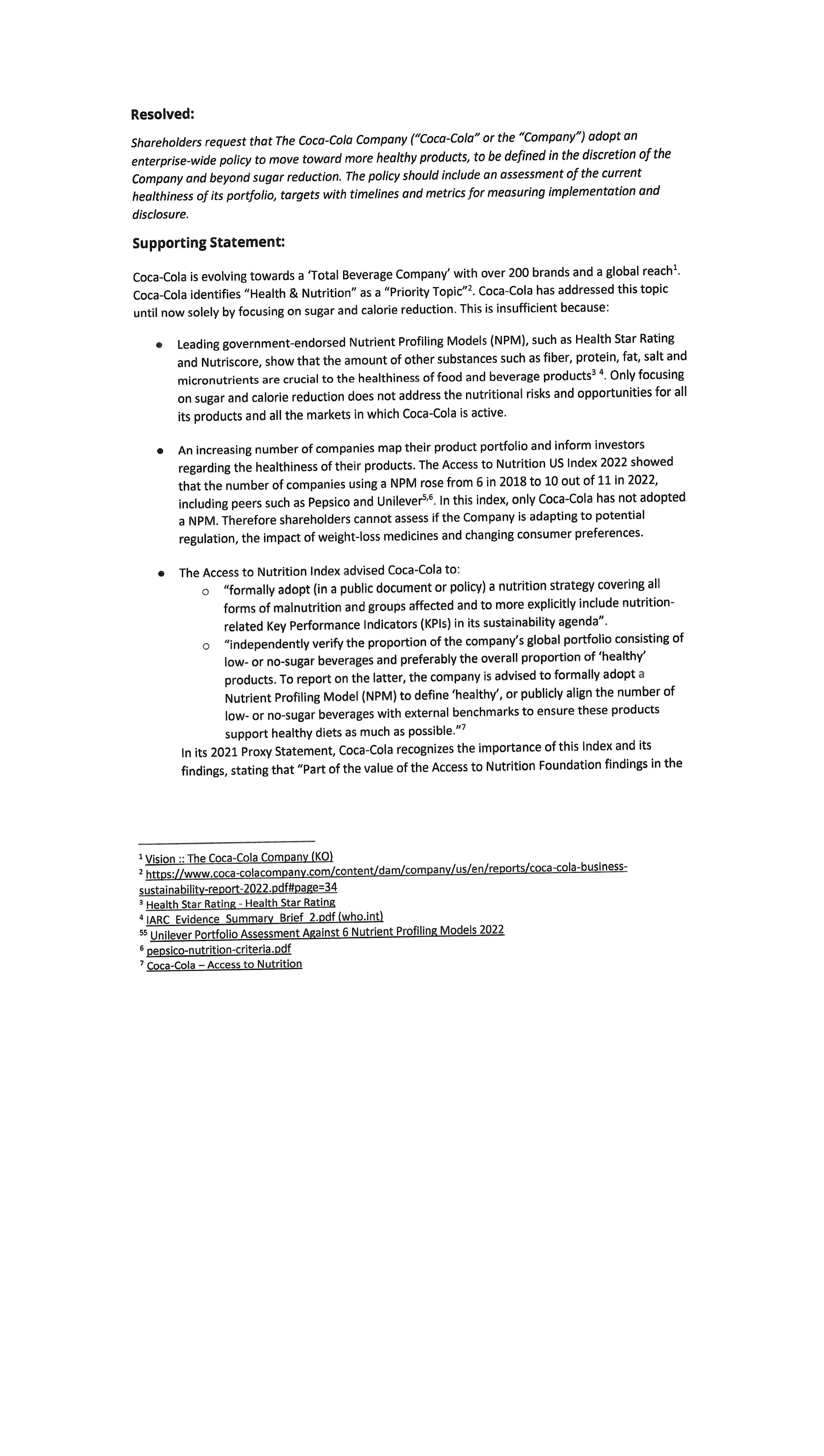
Shareholders request that The Coca-Cola Company (“Coca-Cola” or the
“Company”) adopt an enterprise-wide policy to move toward more healthy
products, to be defined in the discretion of the Company and beyond sugar
reduction. The policy should include an assessment of the current healthiness of
its portfolio, targets with timelines and metrics for measuring implementation and
disclosure.
A copy of the Proposal and the supporting statement is attached hereto as Exhibit A.
Bases for Exclusion
The Proposal may be excluded pursuant to Rule 14a-8(i)(3) because the Proposal is inherently
vague
and indefinite, and subject to multiple interpretations.
Rule 14a-8(i)(3) permits a company to exclude a shareowner proposal “if the proposal or
supporting statement is contrary to any of the Commission’s proxy rules, including Rule 14a-9,
which prohibits false or misleading statements in proxy soliciting materials.” The Staff has
determined that shareowner proposals may be excluded pursuant to Rule 14a-8(i)(3) where “the
resolution contained in the proposal is so inherently vague or indefinite that neither the
stockholders voting on the proposal, nor the company in implementing the proposal (if adopted),
would be able to determine with any reasonable certainty exactly what actions or measures the
proposal requires.”
See
Staff Legal Bulletin No. 14B (September 15, 2004) (“SLB No. 14B”).
The Staff has noted that a proposal may be excludable when the “meaning and application of
terms and conditions in the proposal would have to be made without guidance from the proposal
and would be subject to differing interpretations” such that “any action ultimately taken by the
company upon implementation [of the proposal] could be significantly different from the actions
envisioned by the shareholders voting on the proposal.”
See Fuqua Industries, Inc.
(March 12,
1991). The Staff has also noted that a proposal may be excludable under Rule 14a-8(i)(3) to the
extent that the proposal fails to define key terms.
See, e.g., The Boeing Company
(February 23,
2021) (permitting exclusion of a proposal requiring that 60% of the company’s directors “must
have an aerospace/aviation/engineering executive background” where such phrase was
undefined);
Apple Inc.
(December 6, 2019) (permitting exclusion of a proposal seeking to
“improve guiding principles of executive compensation” that did not provide an explanation or
definition of the key term “executive compensation”); and
AT&T Inc.
(February 21, 2014)
(concurring in the exclusion of a proposal requesting a review of policies and procedures related
to the “directors’ moral, ethical and legal fiduciary duties and opportunities,” where such phrase
was undefined).
The Staff has also consistently permitted exclusion of shareowner proposals under Rule 14a-
8(i)(3) as impermissibly vague and indefinite where the proposal contained an essential term or

December 22, 2023
Page 3
phrase that, in applying the particular proposal to the company, was unclear such that neither the
company nor shareowners would be able to determine with any reasonable certainty what actions
or measures the proposal requires.
See, e.g., Ebay Inc.
(April 10, 2019) (concurring in exclusion
of a proposal requesting that the company “reform the company’s executive compensation
committee” because “neither shareholders nor the Company would be able to determine with any
reasonable certainty the nature of the ‘reform’ the [p]roposal is requesting,” and that, therefore,
“the proposal, taken as a whole, is so vague and indefinite that it is rendered materially
misleading”); and
Cisco Systems, Inc.
(October 7, 2016) (permitting exclusion under Rule 14a-
8(i)(3) of a proposal requesting that the board “not take any action whose primary purpose is to
prevent the effectiveness of shareholder vote without a compelling justification for such action,”
where it was unclear what board actions would “prevent the effectiveness of [a] shareholder
vote” and how the essential terms “primary purpose” and “compelling justification” would apply
to board actions).
The Proposal requests that the Company “adopt an enterprise-wide policy to move toward more
healthy products (emphasis added), to be defined in the discretion of the Company.” The phrase
“move toward more healthy products” is central to the Proposal’s request, yet is inherently vague
and subject to an unknown number of interpretations as to what constitutes “move toward”
and/or “more healthy products” for this purpose.
In addition, the conclusion as to what actions would be required by the Proposal, if adopted,
could vary significantly between the Company and its shareowners, and neither the Company nor
its shareowners would be able to determine with any reasonably certainty what constitutes a
“move toward more healthy products.”
Notably, it is unclear whether the Proposal is focusing on “products” within or outside of the
ready-to-drink beverage industry, because, as noted below, beyond its sugar and calorie
reduction efforts, the Company’s portfolio already produces teas, juices, waters and dairy and
plant-based beverages, some that are enhanced with vitamins and minerals. The Proposal’s
supporting statement references peers “such as Pepsico and Unilever” as companies that use
nutrition models as a comparison to the Company. These peers, however, have significant food
products in their portfolios, making the comparison apples-to-oranges and potentially misleading
shareowners into thinking that the Company has similar product portfolios as those companies or
that the Proposal is asking the Company to branch into different and new product offerings. The
Proposal’s supporting statement also references nutrition profiling models that include fiber,
protein, fat, salt and micronutrients as substances that are crucial to the healthiness of “food and
beverage products,” which also supports the Proponent’s failure to recognize the fact that the
Company is a total beverage company and does not have food products in its portfolio unlike the
peer companies referenced by the Proponent. As a result, shareowners may be misled into
believing that any movement toward “more healthy products” will involve food products where

December 22, 2023
Page 4
substances such as fiber, protein, fat and salt are more pronounced. The Company’s portfolio of
products is already low in fat and salt, and the Company focuses on added sugar because this is
the area where the Company has the most opportunity to make progress.
Further, whether within or outside of the ready-to-drink beverage industry, the phrase “more
healthy products” could implicate an analysis of a number of general health, weight loss,
nutrient-specific, malnutrition, social, economic or other considerations just to name a few. What
“more healthy” could mean in any particular context could differ significantly from product to
product and from person to person, rendering the Proposal entirely vague and indefinite.
Ultimately, given the vagueness of the Proposal and the supporting statement, there is no way for
the Company or shareowners to determine with any reasonable certainty what the Proposal
actually requests.
In addition, we note the Proposal’s supporting statement acknowledges that the Company has
identified health and nutrition as a “Priority Topic,” but argues that the Company has addressed
this topic “solely by focusing on sugar and calorie reduction” (emphasis added). This argument
is objectively false, as the Company’s portfolio includes several widely marketed teas, juices,
waters and dairy and plant-based beverages, some that are enhanced with vitamins and minerals,
as part of the Company’s approach to health and nutrition.
For these reasons, consistent with the precedent described above, the Proposal may be excluded
from the Proxy Materials pursuant to Rule 14a-8(i)(3) on the basis that the Proposal is inherently
vague and indefinite, in violation of Rule 14a-9.
The Proposal may be excluded pursuant to Rule 14a-8(i)(7) because the subject matter of the
Proposal directly concerns the Company’s ordinary business operations.
Rule 14a-8(i)(7) permits a company to exclude a shareowner proposal if the proposal “deals with
a matter relating to the company’s ordinary business operations.” The underlying policy of the
ordinary business exclusion is “to confine the resolution of ordinary business problems to
management and the board of directors, since it is impracticable for shareholders to decide how
to solve such problems at an annual shareholders meeting.”
See Amendments to Rules on
Shareholder Proposals
, Release No. 34-40018 (May 21, 1998) (the “1998 Release”).
Further, framing a proposal in the form of a request for an assessment does not change the nature
of the proposal. The Commission has stated that a proposal requesting the dissemination of a
report may be excludable under Rule 14a-8(i)(7) if the subject matter of the report is within the
ordinary business of the issuer.
See Exchange Act Release No. 20091
(August 16, 1983);
Johnson Controls, Inc.
(October 26, 1999) (“[Where] the subject matter of the additional
disclosure sought in a particular proposal involves a matter of ordinary business . . . it may be
excluded under [R]ule 14a-8(i)(7)”);
see also Ford Motor Co.
(March 2, 2004) (concurring with

December 22, 2023
Page 5
the exclusion of a proposal requesting that the company publish a report about global
warming/cooling, where the report was required to include details of indirect environmental
consequences of its primary automobile manufacturing business).
As set out in the 1998 Release, there are two “central considerations” underlying the ordinary
business exclusion. One consideration is that “[c]ertain tasks are so fundamental to
management’s ability to run a company on a day-to-day basis that they could not, as a practical
matter, be subject to direct shareholder oversight.” The other consideration is that a proposal
should not “seek[] to ‘micro-manage’ the company by probing too deeply into matters of a
complex nature upon which shareholders, as a group, would not be in a position to make an
informed judgment.” We believe the Proposal implicates both of these considerations.
A.
The Proposal may be excluded because it relates to the Company’s sale of
particular products and related policies.
The Proposal may be excluded in reliance on Rule 14a-8(i)(7) because the Proposal relates to
general business. While the Proposal is inherently vague and indefinite, it is clear the Proposal
seeks to address policy about the Company’s product strategy, the thrust and focus of which is
the Company’s policies related to the sale of particular products by the Company. In this regard,
the Proposal is comparable to many proposals that the Staff has concurred may be excluded
under Rule 14a-8(i)(7), where the proposal is a referendum on products or services. For example,
in
Mondelēz International, Inc.
(February 23, 2016), a proposal sought a report on the company’s
use of nanomaterials. The company argued that the proposal related to its ordinary business
decisions, specifically “decisions regarding the ingredients or materials contained in the
[c]ompany’s products and/or packaging.” The Staff concurred with the proposal’s exclusion as
the proposal “relate[d] to [the company’s] product development.” Similarly, in
The TJX
Companies, Inc.
(April 16, 2018), the proposal requested that the board “develop and disclose a
new universal and comprehensive animal welfare policy applying to all of [the company’s]
stores, merchandise and suppliers.” The Staff concurred with the exclusion of the proposal under
Rule 14a-8(i)(7), noting that “the [p]roposal relates to the products and services offered for sale
by the [c]ompany.”
See also
Wal-Mart Stores, Inc. (Green Century)
(Mar. 24, 2006) (permitting
exclusion of a proposal that requested that the board of directors issue “a report evaluating
[c]ompany policies and procedures for systematically minimizing customers’ exposure to toxic
substances in products” the company sells under Rule 14a-8(i)(7), noting that the proposal
related to the “sale of particular products”);
Amazon.com, Inc.
(March 11, 2016) (permitting
exclusion of a proposal requesting that the company “issue a report addressing animal cruelty in
the supply chain,” where the supporting statement requested that the report address a number of
concerns relating to the company’s policies and guidelines regarding animal cruelty associated
with products sold on its website, and the Staff noted that “[p]roposals concerning the sale of
particular products and services are generally excludable under [R]ule 14a-8(i)(7)”);
Amazon.com, Inc.
(March 27, 2015) (concurring with the exclusion of a proposal requesting that

December 22, 2023
Page 6
the company disclose the “reputational and financial risks it may face . . . pertaining to the
treatment of animals used to produce products it sells” as relating to “the products and services
offered for sale by the company”);
Papa John’s International Inc.
(February 13, 2015)
(concurring with the exclusion of a proposal requesting that the company include more vegan
offerings in its restaurants, despite asserting the proposal would promote animal welfare, as
related to “the products offered for sale by the company”); and
Wal-Mart Stores, Inc.
(March 20,
2014) (concurring with the exclusion of a proposal requesting board oversight of determinations
as to whether selling certain products that endanger public safety and well-being could impair the
reputation of the company and/or would be offensive to family and community values, on the
basis that the proposal related to “the products and services offered for sale by the company”).
Here, the Proposal seeks to steer the direction of the Company’s product portfolio toward a
vague concept of healthiness.
The Company is committed to providing a wide portfolio of beverage choices, as reflected in the
Company’s 2022 Business and Sustainability Report referenced in the supporting statement,
which report addresses the Company’s commitment to reducing added sugar and increasing low-
and no-calories offerings, as well as producing teas, juices, waters and dairy and plant-based
beverages, some that are enhanced with vitamins and minerals. However, specific decisions
regarding the products the Company sells implicate a myriad of factors that are appropriately
considered by the Company’s Board of Directors and management. Decisions regarding product
safety, the taste and preferences of customers, maintaining product diversity, the products
offered by the Company’s competitors, legal and regulatory requirements where products are
sold, the availability of sufficient quantity and quality of products to meet demand, and the costs
and revenue associated with those sales, are far too complex for consideration by shareowners at
an annual meeting and far exceed the scope of shareowner expertise.
As a result, the Proposal is excludable under Rule 14a-8(i)(7) as its thrust and focus concerns
specific products the Company offers for sale and would require decisions and judgement on
matters that are not appropriate subjects for shareowner action.
B.
The Proposal does not focus on a significant social policy issue that transcends
the Company’s ordinary business operations.
The established precedent set forth above demonstrate that the Proposal squarely addresses
ordinary business matters. An exception to this principle may be made where a proposal focuses
on significant social policy issues that transcend the day-to-day business matters of the company.
See
1998 Release
. The Staff most recently discussed its interpretation of how it will consider
whether a proposal “transcends the day-to-day business matters” of a company in Staff Legal
Bulletin 14L (November 3, 2021) (“SLB 14L”), noting that it is “realign[ing]” its approach to
determining whether a proposal relates to ordinary business with the standards the Commission

December 22, 2023
Page 7
initially articulated in 1976 and reaffirmed in the 1998 Release. Under this realignment, the Staff
will “no longer take a company-specific approach to evaluating the significance of a policy issue
under Rule 14a-8(i)(7)” but rather will consider only “whether the proposal raises issues with a
broad societal impact, such that they transcend the ordinary business of the company.” Staff
precedent has established that proposals that refer to topics that might raise significant social
policy issues, but which do not focus on or have only tangential implications for such issues, are
not transformed from an otherwise ordinary business proposal into one that transcends ordinary
business.
The Proponent seeks to cast the Proposal as relating to a significant policy issue simply by using
the terms “healthy” and “healthiness” and noting in the supporting statement that the Company
“has addressed this topic until now solely by focusing on sugar and calorie reduction,” which the
supporting statement states is “insufficient.” However, the mere reference to a generic term
describing a broad range of health-focused issues does not alter the fundamentally ordinary
business focus of the Proposal. Moreover, the vagueness of the Proposal’s request, as noted
above, further removes the Proposal’s request from any clearly identifiable significant social
policy issue.
The Staff has consistently concurred in exclusion of shareowner proposals under Rule 14a-
8(i)(7) relating to the company’s product offerings, even when they touch upon a policy issue
including health concerns, finding that such proposals did not implicate a significant social
policy matter. For example, in
The Home Depot, Inc.
(March 4, 2009), a proposal recommended
that the company issue a report “on policy options to reduce consumer exposure and increase
consumer awareness regarding mercury and any other toxins contained in its private label . . .
products.” In its no-action request, the company argued that the proposal did not focus on a
significant policy issue and that the proposal’s intent was “to have the Company’s Board of
Directors evaluate the business policies and practices related to product selection and labeling,
notwithstanding that the [p]roposal refers to environmental concerns.” Further, as the “world’s
largest home improvement retailer,” the company argued, “[d]ecisions concerning product
selection and the packaging and marketing of products” were “ordinary business concerns.” The
Staff concurred with the exclusion of the proposal, noting the proposal “relat[ed] to Home
Depot’s ordinary business operations (i.e., the sale of particular products).” Additionally, in
Amazon.com, Inc.
(March 17, 2016), the Staff concurred with exclusion of a proposal requesting
a report “on the company’s policy options to reduce potential pollution and public health
problems from electronic waste generated as a result of its sales to consumers, and to increase
the safe recycling of such wastes,” noting that the proposal “relates to the company’s products
and services and does not focus on a significant policy issue.”
Here, the Proposal focuses on the ordinary business issue of the Company’s product portfolio
and attempts to cloak the request in a vague concept of “healthy products.” Furthermore, given
that the Company's portfolio of beverages is already low in salt and fat, the focus on offering
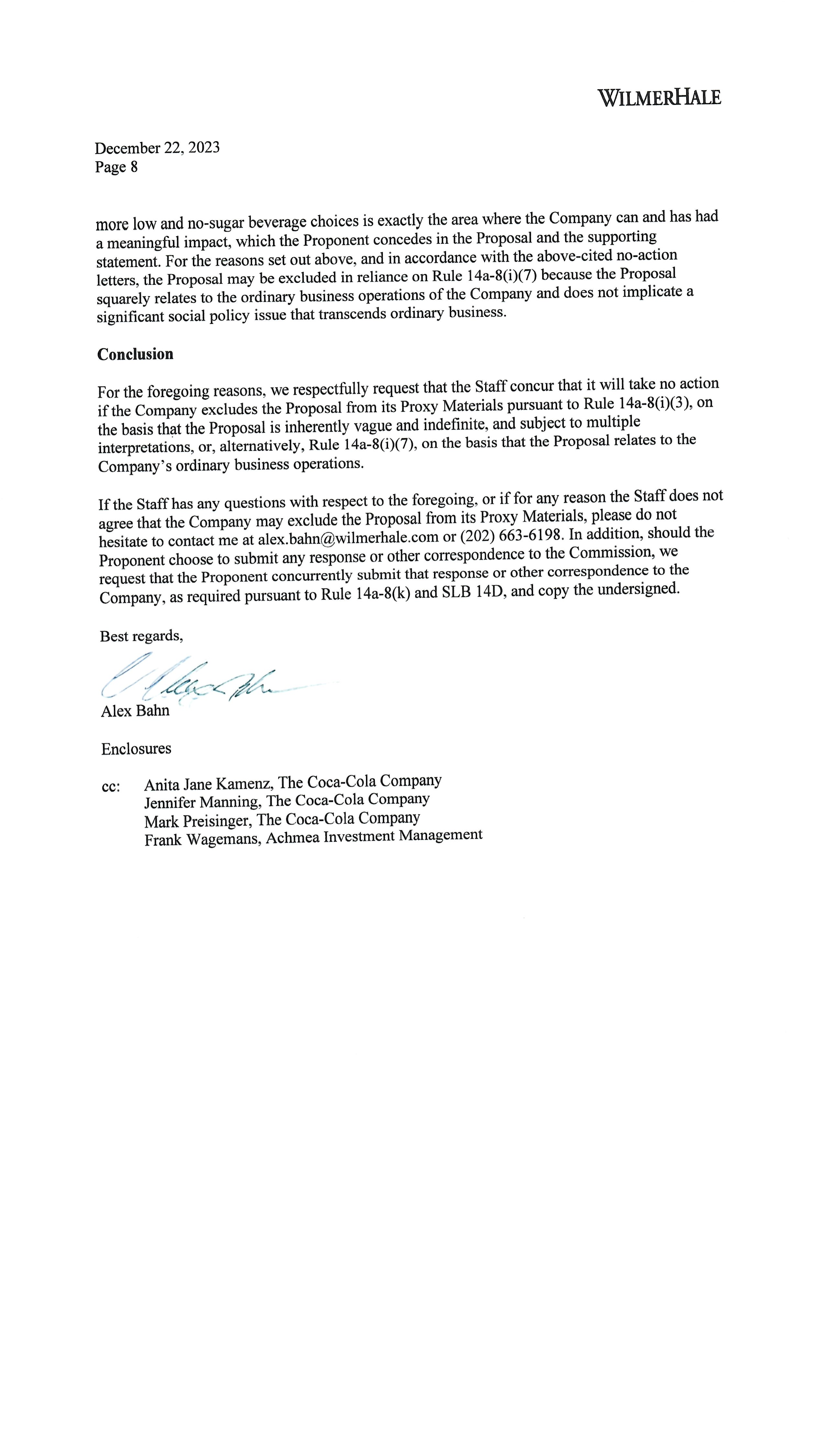


January 17, 2024
Via
Shareholder Proposal Portal
Securities and
Exchange
Commission
Office
of the
Chief Counsel
Division
of
Corporation Finance
100 F
Street,
NE
Washington, DC
20549
Re: Request by The Coca-Cola Company to omit proposal submitted by Stichting Bewaarder
Achmea Beleggingspools (Achmea Investment Management).
Ladies and Gentlemen,
Pursuant
to
Rule
14a-8
under
the Securities
Exchange
Act of
1934, Achmea Investment
Management
(the “Proponent”) submitted a shareholder
proposal
(the “Proposal”)
to
The Coca-
Cola Company (“Coca-Cola”
or the
“Company”).
The Proposal
asks Coca-Cola to
adopt an
enterprise-wide policy to move toward more healthy products, to be defined in the discretion of the
Company and beyond sugar reduction. The policy should include an assessment of the current
healthiness of its portfolio, targets with timelines and metrics for measuring implementation and
disclosure
.
In a letter to the Division dated December 22, 2023
(the “No-Action
Request”),
Coca-Cola
stated
that it intends
to
omit
the
Proposal from its proxy materials
to
be distributed
to shareholders
in connection
with the Company's 2024
annual
meeting of
shareholders. Coca-Cola argues that
it is
entitled to exclude
the Proposal in reliance on Rule 14a-8(i)(3), as excessively vague and indefinite;
and Rule 14a-8(i)(7), on the ground that the Proposal deals with Coca-Cola’s ordinary business
operations. As discussed more fully below, both shareholders and the Company can tell from the
Proposal’s language what it asks Coca-Cola to do, and the Proposal addresses the significant policy
issue of the public health impacts of Coca-Cola’s products. Accordingly, Coca-Cola
has not met its
burden of proving its
entitlement to
exclude the Proposal on either basis, and the Proponent
respectfully requests that Coca-Cola’s request for relief be denied.
The Proposal
The Proposal states:
Shareholders request that The Coca-Cola Company (“Coca-Cola” or the “Company”) adopt
an enterprise-wide policy to move toward more healthy products, to be defined in the
discretion of the Company and beyond sugar reduction. The policy should include an
DocuSign Envelope ID: 8456BF61-9276-4206-8766-59C378DD690F
2
assessment of the current healthiness of its portfolio, targets with timelines and metrics for
measuring implementation and disclosure.
Vagueness
Coca-Cola urges that the Proposal is excludable pursuant to Rule 14a-8(i)(3) because it is “
is
so inherently vague or indefinite that neither the stockholders voting on the proposal, nor the
company in implementing the proposal (if adopted), would be able to determine with any reasonable
certainty exactly what actions or measures the proposal requires.”
1
Specifically, Coca-Cola argues
that the Proposal’s request
is impermissibly vague because neither the Company nor shareholders
would be able to tell what it means to “move toward” something or what “more healthy products”
are. That claim is meritless.
The Proposal aims to give shareholders an avenue to communicate a directional sentiment to
the Company, that it should shift its portfolio toward healthier products. To avoid being overly
prescriptive, the Proposal gives Coca-Cola discretion to decide the magnitude, rate and nature of any
change, should it decide to implement the Proposal. To capture those decisions and ensure
accountability, the Proposal does request that Coca-Cola set targets with timelines as well as metrics
for assessing progress. It also asks that the Company look beyond just sugar reduction in evaluating
how healthy its product portfolio is and in setting goals. Coca-Cola would be free to consider
“general health, weight loss, nutrient-specific, malnutrition, social, economic or other
considerations,” the aspects of health it references in the No-Action Request,
2
in doing so.
Shareholders determining how to vote will easily be able to discern that the Proposal gives Coca-
Cola significant latitude.
The Proposal refrains from specifying the kinds of healthy products Coca-Cola should
introduce or emphasize because the Proponent is not a food chemist or product marketer and thus
lacks knowledge of the range of products Coca-Cola could innovate, as well as the potential markets
for those products. Coca-Cola’s own disclosures suggest possible directions for a more healthy
product portfolio. In a recent presentation on marketing and innovation, Chief Technical and
Innovation Officer Nancy Quan reported that they took advantage of “a lot of noise around
‘immunity,’” during the pandemic, which then shifted toward “hydration, well-being, even mood,”
3
to launch hydration products. Ms. Quan also touted using technology to produce a non-chalky taste
for high-protein beverage Core Power.
4
Ultimately, Coca-Cola would choose which products to
innovate, reformulate, or expand to more markets based on its expertise and knowledge.
Coca-Cola appears to understand the meaning of health and healthy products. In its 2022
ESG report, the Company describes an ESG priority mapping exercise it undertook in 2022 in
1
No-Action Request, at 2 (quoting Staff Legal Bulletin 14B (Sept. 15, 2004))
2
No-Action Request, at 4.
3
See
https://d1io3yog0oux5.cloudfront.net/_21d6149dbf6e72c8eefd99c8877fb644/cocacolacompany/files/pages/cocacolac
ompany/db/761/description/The_Coca-Cola_Company_-_Raising_the_Bar_-_Marketing_Innovation_transcript.pdf,
at 6.
4
https://d1io3yog0oux5.cloudfront.net/_21d6149dbf6e72c8eefd99c8877fb644/cocacolacompany/files/pages/cocacolac
ompany/db/761/description/The_Coca-Cola_Company_-_Raising_the_Bar_-_Marketing_Innovation_transcript.pdf,
at 9.
DocuSign Envelope ID: 8456BF61-9276-4206-8766-59C378DD690F
3
which the topic of “Health & Nutrition,” scored as relatively high in both importance to external
stakeholders and impact to the Company.
5
In that same report, Coca-Cola touts that it is “[o]ffering
more drinks with
nutrition and wellness benefits
” (emphasis in original).
6
Coca-Cola argues that shareholders would be confused by the Proposal’s reference to
nutrient profile models that measure fiber, salt, protein and micronutrients into thinking that the
Company sells food products, where those substances “are more pronounced.”
7
That argument is
puzzling, given that Coca-Cola itself touts its own beverages’ nutritional benefits as including dietary
fiber, immunity support and “protein to help build muscle and replenish, repair and rebuild.”
8
Coca-
Cola’s product portfolio could also implicate other nutritional measures: For example, fat content
might be relevant to dairy products and plant-based milks, caffeine levels to coffee products, and
alcohol content to alcohol-containing products, all of which Coca-Cola sells. Rather than causing
confusion, listing non-sugar nutritional measures in the supporting statement gives shareholders
information about some dimensions of health Coca-Cola might emphasize should it choose to
implement the Proposal.
Ordinary Business
Rule 14a-8(i)(7) allows exclusion of proposals related to a company’s ordinary business
operations.
Coca-Cola argues that the Proposal relates to the Company’s ordinary business
operations because its subject involves the sale of the Company’s products.
It is true that the Division’s Staff has allowed exclusion of proposals dealing with a
company’s products, as illustrated by the determinations Coca-Cola cites on pages 5-6 of the No-
Action Request. The proposals at issue in those determinations, however, were deemed not to
address a significant social policy issue:
9
•
The Staff rejected the argument made by the proponent of the Mondelez
10
proposal, which
sought disclosure on the company’s use of nanomaterials, that it addressed the significant
policy issue of “potential health harms raised by using nano-sized particles in foods.”
•
In each of several determinations Coca-Cola cites--Wal-Mart (2006),
11
Amazon (2016),
12
Amazon (2015),
13
and Wal-Mart (2014)
14
--the Staff was not persuaded by the proponent’s
argument that the proposal’s topic, which involved the sale of particular products not
manufactured by the company, was a significant social policy issue. The companies’ status as
5
https://www.coca-colacompany.com/content/dam/company/us/en/reports/coca-cola-business-sustainability-
report-2022.pdf, at 21
6
https://www.coca-colacompany.com/content/dam/company/us/en/reports/coca-cola-business-sustainability-
report-2022.pdf, executive summary.
7
No-Action Request, at 3-4.
8
https://www.coca-colacompany.com/content/dam/company/us/en/reports/coca-cola-business-sustainability-
report-2022.pdf, at 34
9
In Exchange Act Rel. No. 40018 (May 21, 1998), the Commission stated that a proposal whose subject matter focuses
on “sufficiently significant social policy issues” is not excludable on ordinary business grounds.
10
Mondelez International (Feb. 23, 2016)
11
Wal-Mart Stores, Inc. (Green Century) (Mar. 24, 2006)
12
Amazon.com, Inc. (Mar. 11, 2016)
13
Amazon.com, Inc. (Mar. 27, 2015)
14
Wal-Mart Stores, Inc. (Mar. 20, 2014).
DocuSign Envelope ID: 8456BF61-9276-4206-8766-59C378DD690F
4
retailers
likely factored into the analysis, given that the Staff has often allowed exclusion on
ordinary business grounds of proposals on retailers’ sale of particular products, even when
the products are sufficiently controversial or harmful that a proposal submitted to the
manufacturer would qualify as a significant policy issue.
15
•
In Papa John’s,
16
the significant policy issues identified by the proponent—“the
environment, animal welfare and human health”—were likely viewed as both too general
and too remote from the proposal’s request that Papa John’s “expand its menu offerings to
include vegan cheeses and vegan meats,” though the Staff did not explain its reasoning in
allowing exclusion.
•
The proponent of the TJX
17
proposal was unsuccessful in persuading the Staff that an
animal welfare policy applicable to both the company and its suppliers was a significant
social policy issue.
There are many examples of the Staff rejecting arguments like Coca-Cola’s and declining to
allow exclusion of proposals aimed at the sale of particular products when those products implicated
a significant social policy issue. For example, in AmerisourceBergen,
18
the company unsuccessfully
argued that a proposal on its distribution of opioids was excludable as addressing the sale of
particular products, while the proponent urged that the opioid epidemic was a significant social
policy issue. Proposals submitted to AbbVie,
19
Eli Lilly,
20
and Johnson & Johnson
21
asked the
company to adopt a process requiring consideration of patient access when deciding whether to
apply for secondary patents. The companies claimed that the proposals involved the ordinary
business matter of the sale of products, but the proponents successfully countered that they
addressed the impact of intellectual property protections on drug prices, a significant social policy
issue.
Likewise, in Denny’s,
22
the Staff did not concur with the company’s claim that a proposal
asking it to sell at least 10% cage-free eggs by volume was excludable as implicating the sale of
particular products, siding with the proponent’s characterization of the proposal’s subject as the
significant policy issue of “[r]educing cruel confinement conditions for egg-laying hens” (i.e., animal
cruelty). And the Staff did not find persuasive Johnson & Johnson’s
23
claim that a proposal asking
the company to establish and implement standards of response to the HIV/AIDS pandemic in
developing countries could be excluded in reliance on the ordinary business exclusion because it
addressed product development, research and testing. The proponent had urged that the proposal’s
subject was the significant policy issue of the HIV/AIDS pandemic.
15
See Rite Aid Corp. (Mar. 26, 2009) (allowing exclusion of a proposal requesting a report on how the company is
responding to rising regulatory, competitive and public pressures to stop selling tobacco products, reasoning that the
proposal concerned the “sale of a particular product”); Cabela’s Inc. (Apr. 7, 2016) (concurring that the company could
exclude a proposal requesting that the company adopt a policy not to sell certain kinds of weapons on same reasoning
that); but see Walgreens Boots Alliance Inc. (Nov. 20, 2018) (declining to concur that the “sale of products” basis
allowed the company to a proposal on the sale of opioid medications).
16
Papa John’s International (Feb. 13, 2015).
17
The TJX Companies, Inc. (Apr. 16, 2018)
18
AmerisourceBergen Corporation (Sisters of St. Francis of Philadelphia) (Jan. 11, 2018)
19
AbbVie Inc. (Mar. 7, 2023)
20
Eli Lilly and Company (Mar. 10, 2023)
21
Johnson & Johnson (Mar. 2, 2023)
22
Denny’s Inc. (Mar. 17, 2009)
23
Johnson & Johnson (Feb. 7, 2003)
DocuSign Envelope ID: 8456BF61-9276-4206-8766-59C378DD690F
5
The Staff found that a proposal to Coca-Cola with a subject matter much like the Proposal’s
addressed a significant social policy issue, transcending ordinary business. In Coca-Cola,
24
the
proposal asked the company to issue a report on the impact of sugar on public health. In response
to Coca-Cola’s contention that the proposal was excludable on ordinary business grounds, the
proponent described the health impact of sugar as an “emerging risk” for Coca-Cola, though it
characterized the significant social policy issue only as the general “public health risks.” The Staff did
not grant relief.
The outcome of a challenge to a proposal about CVS’s food business is distinguishable
based on the proponent’s framing of the significant social policy issue. There, the proposal asked
CVS
25
to commission and disclose a report on the external public health costs of the company’s
food business and the way in which such costs affect the vast majority of the company’s
shareholders who really on overall market returns. In response to the company’s ordinary business
argument, the proponent did not argue that the public health impacts of unhealthy foods sold by
CVS were a significant policy issue, but instead framed the significant social policy issue as “the
urgent need to address the business practices that provide corporate financial returns to
shareholders but harm other stakeholders.” The Staff disagreed and granted relief. The CVS
determination is thus inapplicable here, where the public health impacts of Coca-Cola’s products are
the significant policy issue.
A focus on societal impact like that shown by the Proposal’s request to shift Coca-Cola’s
product portfolio in a healthier direction is consistent with the Staff’s most recent articulation of the
standard for analyzing claims that a proposal addresses a significant social policy issue. SLB 14L,
26
issued in November 2021, emphasized that the analytical focus should be whether an otherwise
excludable proposal “raises issues with a broad societal impact” even if the proponent does not
demonstrate the issue’s significance to the specific company. The public health impacts of Coca-
Cola’s product portfolio, and the Proposal’s request to shift that portfolio in a healthier direction,
clearly qualifies as an issue with broad societal impact, especially given Coca-Cola’s size and reach:
Its most recent 10-K discloses that the Company sells “
five of the world’s top six nonalcoholic
sparkling soft drink brands.”
27
Coca-Cola’s claim that the Proposal merely “touch[es] on” a significant policy issue
involving public health—as opposed that issue being the central focus of the Proposal—finds no
support in the Proposal’s language. The core request of the Proposal seeks a shift toward a healthier
product portfolio, and the entire supporting statement discusses health and nutrition. Indeed, no
other subject is discussed.
The determinations Coca-Cola cites in support of this argument are inapposite. Home
Depot
28
involved a proposal asking the company to “reduce consumer exposure and increase
consumer awareness regarding mercury and any other toxins” contained in a certain brand of
24
The Coca-Cola Company (Feb. 21, 2019)
25
CVS Health Corporation (Mar. 22, 2021) (no determination issued; outcome available in chart:
https://www.sec.gov/divisions/corpfin/cf-noaction/14a-8/shareholder-proposal-no-action-responses-2020-2021.htm)
26
Staff Legal Bulletin 14L (Nov. 3, 2021).
27
The Coca-Cola Company, Report on Form 10-K filed Feb. 21, 2023, at 2.
28
The Home Depot, Inc. (Mar. 4, 2009).
DocuSign Envelope ID: 8456BF61-9276-4206-8766-59C378DD690F

6
product it sold. The proponent was not successful in convincing the Staff that the proposal’s focus
on reducing toxic exposures was a significant policy issue, perhaps due in some measure to the
Staff’s demonstrated reluctance (discussed above) to treat retailers of potentially harmful products
on par with their manufacturers. Similarly, the Staff was not persuaded by the proponent’s
characterization of the Amazon
29
proposal’s topic as addressing the significant social policy issue of
“preventing pollution.” Like the Home Depot proposal, the proposal to Amazon, which asked for a
report with “policy options to reduce potential pollution and public health problems from electronic
waste generated as a result of its sales to consumers,” may have foundered on Amazon’s status as a
retailer rather than a manufacturer of polluting products. This aspect of the Home Depot and
Amazon determinations is not present here, as Coca-Cola makes the products in its portfolio.
In sum, Coca-Cola has failed to meet its burden of establishing that it is entitled to exclude
the Proposal in reliance on either Rule 14a-8(i)(3) or 14a-8(i)(7). The Proposal clearly communicates
its request that Coca-Cola shift its product portfolio in a healthier direction—with the magnitude,
pace and nature of that shift to be determined in the Company’s discretion. Its references to
nutritional measures such as fiber, salt, protein, and micronutrients would not confuse consumers,
given that these are dimensions of health Coca-Cola touts in its own reporting. Finally, the Proposal
focuses on the significant policy issue of health impacts of Coca-Cola’s products. a subject that
transcends ordinary business.
* * *
The Proponent
appreciates the
opportunity to be
of
assistance in this matter. If you have
any
questions
or need additional information, please contact Frank Wagemans at
Frank.Wagemans@achmea.nl
or 0031-622087929.
Sincerely,
cc:
Alex Bahn
alex.bahn@wilmerhale.com
29
Amazon.com, Inc. (Mar. 17, 2016)
DocuSign Envelope ID: 8456BF61-9276-4206-8766-59C378DD690F
17/1/2024 | 20:03 CET
17/1/2024 | 14:35 CET


Alex Bahn
+1 202 663 6198 (t)
+1 202 663 6363 (f)
alex.bahn@wilmerhale.com
January 24, 2024
Via Online Shareholder Proposal Form
U.S. Securities and Exchange Commission
Division of Corporation Finance
Office of Chief Counsel
100 F Street, NE
Washington, DC 20549
Re:
The Coca-Cola Company
Exclusion of Shareowner Proposal by Achmea Investment Management
Ladies and Gentlemen:
We are writing on behalf of our client, The Coca-Cola Company (the “Company”), to respond to
correspondence from Achmea Investment Management (the “Proponent”) dated January 17,
2024 (the “Reply Letter”), in response to no-action request (the “No-Action Request”) submitted
by the Company on December 22, 2023. The Company continues to believe, both for the reasons
below and the reasons provided in the No-Action Request, that the Proposal may be excluded
from the Company’s Proxy Materials. Capitalized terms used but not defined in this letter shall
have the meanings provided in the No-Action Request. In accordance with Rule 14a-8(j), a copy
of this supplemental letter is being sent to the Proponent.
The Proposal may be excluded pursuant to Rule 14a-8(i)(3) because the Proposal is inherently
vague
and indefinite, and subject to multiple interpretations.
The Proposal requests that the Company “adopt an enterprise-wide policy to move toward more
healthy products (emphasis added), to be defined in the discretion of the Company.”
The Reply Letter argues that rather than being “overly prescriptive”, it is designed “to
communicate a directional sentiment.” A “directional sentiment” is an extremely broad guide
that cannot save the Proposal from the inherent vagueness in what it means to “move toward
more healthy products.” Moreover, the Reply Letter acknowledges that the Company has
launched hydration products, improved high-protein beverage offerings and touted that it is
offering more beverages with nutrition and wellness benefits, which highlights the tension
between the Proposal’s aim to provide the Company “discretion to decide the magnitude, rate
and nature of any change,” and the implication that none of the Company’s efforts to date to
“move toward more healthy products” are sufficient. This inconsistency only further highlights
how the Proposal could be subject to multiple interpretations, and thus inherently vague and
indefinite, in violation of Rule 14a-9.

January 24, 2024
Page 2
The Proposal may be excluded pursuant to Rule 14a-8(i)(7) because the subject matter of the
perations.
The Staff has consistently concurred in exclusion under Rule 14a-8(i)(7) of shareholder
ordinary business operations.
shareholder proposals at issue in
Mondelez, Wal-Mart (2006), Wal-Mart (2014), Amazon (2015),
Amazon (2016), Papa Johns and TJX
is irrelevant and unpersuasive. As in these and the other
no-action letter precedent cited in the No-Action Request, the Proposal seeks to steer the general
direction of t
particular significant social policy issue that transcends the day-to-day business matters of the
company.
posals that have been
determined to implicate or not a significant social policy issue. However, as noted in the No-
Action Letter, the Proposal relies on a
, which is not a
clearly identifiable significant social policy issue. As a result, it is not a matter that transcends
Conclusion
For the foregoing reasons and the reasons set out in the No-Action Request, and consistent with
-action letters, we respectfully request that the Staff concur that it will take no
action if the Company excludes the Proposal from its Proxy Materials.
If the Staff has any questions with respect to the foregoing, or if for any reason the Staff does not
agree that the Company may exclude the Proposal from its Proxy Materials, please do not
hesitate to contact me at alex.bahn@wilmerhale.com or (202) 663-6198. In addition, should the
Proponent choose to submit any response or other correspondence to the Commission, we
request that the Proponent concurrently submit that response or other correspondence to the
Company, as required pursuant to Rule 14a-8(k) and SLB 14D, and copy the undersigned.

January 24, 2024
Page 3
Best regards,
Alex Bahn
cc:
Anita Jane Kamenz, The Coca-Cola Company
Jennifer Manning, The Coca-Cola Company
Mark Preisinger, The Coca-Cola Company
Frank Wagemans, Achmea Investment Management
January 30, 2024
Via Shareholder Proposal Portal
United States Securities and Exchange Commission
Division of Corporation Finance
Office of Chief Counsel
100 F Street, NE
Washington, DC 20549
Re: Request by The Coca-Cola Company to omit proposal submitted by Stichting Bewaarder
Achmea Beleggingspools (Achmea Investment Management). Response to the letter from The
Coca-Cola Company/WilmerHale, dated January 24.
Dear Ladies and Gentlemen:
Pursuant to Rule 14a-8 under the Securities Exchange Act of 1934, Achmea Investment
Management (the “Proponent”) submitted a shareholder proposal (the “Proposal”) to The Coca-
Cola Company (“Coca-Cola” or the “Company”). The Proposal asks Coca-Cola to adopt an
enterprise-wide policy to move toward more healthy products, to be defined in the discretion of
the Company and beyond sugar reduction. The policy should include an assessment of the
current healthiness of its portfolio, targets with timelines and metrics for measuring
implementation and disclosure.
In a letter to the Division dated December 22, 2023 (the “No-Action Request”), Coca-Cola
stated that it intends to omit the Proposal from its proxy materials to be distributed to
shareholders in connection with the Company's 2024 annual meeting of shareholders. Achmea
Investment Management responded with a letter on the 17
th
of January,
On January 24, 2024, WilmerHale, on behalf of the company, filed an additional response to the
SEC. We respectfully submit this letter as a response to that letter, in addition to our letter
submitted on January 17, to articulate our stance on why the resolution should be included in the
Company's Proxy Materials.
1. Clarity and Scope of Proposal:
Contrary to the arguments presented by the Company, represented by WilmerHale, in their letter
from January 24
th
, our proposal is not inherently vague or indefinite. The central issue to this
proposal is that the Company’s peers have defined, clearly and concisely, what healthy nutrition
means to them
1,2,3.
. In addition, the Access to Nutrition Initiative found that 10 out of 11
companies from the US index have adopted a nutrient profiling model to define and determine
how healthy their product profile is. The Coca Cola Company was the only one that has not done
so
4
. That means investors cannot assess how The Coca Cola Company defines its own priority
theme “Health & Nutrition”, that came out third in its materiality assessment
5
. The Coca-Cola
Company states that it launched hydration products, but to shareholders it is not clear which
percentage of these products are healthy and how the company has defined healthy for a) these
products, b) its overall portfolio and c) what it aims to achieve with regard to health & nutrition.
The Proposal is not prescriptive as it allows the Company to define the specifics within a broader
framework. This will create transparency and accountability to its shareholders on how the
Company addresses its “Priority Theme Health & Nutrition”.
2. Significance of Social Policy Issue:
The Reply Letter contends that our Proposal does not address a clearly identifiable significant
social policy issue. We respectfully disagree. Avoiding adverse public health impacts of unhealthy
foods and beverages is undeniably a significant social policy issue in the US and other countries
in which the company is active and it is also clear that consumer preferences as well as regulation
is evolving
6,7,8,910,11,12,13.14,15.
Companies that proactively respond to these changes stand to benefit
in terms of both protecting reputation and avoiding additional governmental regulation.
In light of the above, we respectfully request the Staff's consideration to include our Proposal in
The Coca-Cola Company's Proxy Materials. Should you have any questions or require additional
information, please do not hesitate to contact me at Frank.Wagemans@achmea.nl or 0031-
6622087929. We appreciate your attention to this matter.
Sincerely.
R.M Krens
CIO
cc:
Alex Bahn
alex.bahn@wilmerhale.com
1
pepsico-nutrition-criteria.pdf
2
Kraft-Heinz-Global-Nutrition-Guidelines.pdf (kraftheinzcompany.com)
3
https://www.keurigdrpepper.com/content/dam/keurig-brand-sites/kdp/files/KDP-CR-Report-2022.pdf.html
(page 30)
4
221012-ATNI-_-US-Index-Executive-Summary-FINAL.pdf (accesstonutrition.org)
5
The Coca-Cola Company 2022 Business & Sustainability Report
6
FACT SHEET: The Biden-Harris Administration Announces More Than $8 Billion in New Commitments as Part of Call to
Action for White House Conference on Hunger, Nutrition, and Health | The White House
7
Dietary Guidelines for Americans, 2020-2025
8
The time is ripe for ESG + Nutrition: evidence-based nutrition metrics for Environmental, Social, and Governance (ESG)
investing | European Journal of Clinical Nutrition (nature.com)
9
GAO-21-593, CHRONIC HEALTH CONDITIONS: Federal Strategy Needed to Coordinate Diet-Related Efforts
10
Role of government policy in nutrition—barriers to and opportunities for healthier eating | The BMJ
11
About Nutrition | Nutrition | CDC
12
Front-of-pack nutrition labelling to promote healthier diets: current practice and opportunities to strengthen regulation
worldwide | BMJ Global Health
13
Nutri-Score | RIVM
14
Consumer willingness to pay for healthier food products: A systematic review - Alsubhi - 2023 - Obesity Reviews - Wiley
Online Library
15
Restricting promotions of products high in fat, sugar or salt by location and by volume price: implementation guidance -
GOV.UK (www.gov.uk)