

March 29, 2024
Ning Chiu
Davis Polk & Wardwell LLP
Re:
Morgan Stanley (the “Company”)
Incoming letter dated January 12, 2024
Dear Ning Chiu:
This letter is in response to your correspondence concerning the shareholder
proposal (the “Proposal”) submitted to the Company by Michael Monteiro 2016 Rev Tr
for inclusion in the Company’s proxy materials for its upcoming annual meeting of
security holders.
The Proposal requests that, for each of its sectors with a Net Zero-aligned 2030
target, the Company annually disclose the proportion of sector emissions attributable to
clients that are not aligned with a credible Net Zero pathway, whether this proportion of
unaligned clients will prevent the Company from meeting its 2030 targets, and actions it
proposes to address any such emissions reduction shortfalls.
There appears to be some basis for your view that the Company may exclude the
Proposal under Rule 14a-8(i)(7). In our view, the Proposal seeks to micromanage the
Company. Accordingly, we will not recommend enforcement action to the Commission if
the Company omits the Proposal from its proxy materials in reliance on Rule 14a-8(i)(7).
In reaching this position, we have not found it necessary to address the alternative basis
for omission upon which the Company relies.
Copies of all of the correspondence on which this response is based will be made
available on our website at
https://www.sec.gov/corpfin/2023-2024-shareholder-
proposals-no-action
.
Sincerely,
Rule 14a-8 Review Team
cc:
Luke Morgan
As You Sow
Davis Polk & Wardwell
LLP
450 Lexington Avenue
New York, NY 10017
davispolk.com
January 12, 2024
Office of Chief Counsel
Division of Corporation Finance
Securities and Exchange Commission
100 F Street, NE
Washington, DC 20549
Ladies and Gentlemen:
On behalf of Morgan Stanley, a Delaware corporation (the “
Company
”), in accordance with Rule 14a-8(j)
under the Securities Exchange Act of 1934, as amended (the “
Exchange Act
”), we are filing this letter with
respect to the shareholder proposal (the “
Proposal
”) submitted by As You Sow (on behalf of Michael
Monteiro 2016 Rev Tr) (the “
Proponent
”) for inclusion in the proxy materials the Company intends to
distribute in connection with its 2024 Annual Meeting of Shareholders (the “
2024 Proxy Materials
”). The
Proposal is attached hereto as Exhibit A.
We hereby request confirmation that the Staff of the Division of Corporation Finance (the “
Staff
”) will not
recommend any enforcement action if, in reliance on Rule 14a-8, the Company omits the Proposal from the
2024 Proxy Materials.
In accordance with relevant Staff guidance, we are submitting this letter and its attachments to the Staff
through the Staff’s online Shareholder Proposal Form. In accordance with Rule 14a-8(j), we are
simultaneously sending a copy of this letter and its attachments to the Proponent as notice of the
Company’s intent to omit the Proposal from the 2024 Proxy Materials. This letter constitutes the Company’s
statement of the reasons it deems the omission of the Proposal to be proper. We have been advised by the
Company as to the factual matters set forth herein.
THE PROPOSAL
The Proposal states:
Resolved: Shareholders request that, for each of its sectors with a Net Zero-aligned
2030 target, Morgan Stanley annually disclose the proportion of sector emissions
attributable to clients that are not aligned with a credible Net Zero pathway, whether
this proportion of unaligned clients will prevent Morgan Stanley from meeting its 2030
targets, and actions it proposes to address any such emissions reduction shortfalls.
BACKGROUND
The Company takes seriously its responsibility to help reduce greenhouse gas emissions and the Company
is committed to considering climate change throughout its business, operational and risk management
activities.
2
In 2020, the Company was the first major U.S. headquartered global financial services firm to commit to
achieve net-zero
1
financed emissions
2
by 2050, which it continues to support and work towards. In 2021,
the Company announced its 2030 interim financed emissions targets for the auto manufacturing, energy
and power sectors within its corporate lending portfolio, which it identified as the most emissions-intensive
sectors in such portfolio. The Company is a member of the Partnership for Carbon Accounting Financials
(“
PCAF
”) Board of Directors, and is a member of the Steering Committee of the Net-Zero Banking Alliance
(“
NZBA
”). The Company considers the frameworks and methodologies of these two organizations to help
inform its thinking regarding climate-related targets and measurement of progress. In 2021 and 2022 the
Company published 2019 baseline greenhouse gas (“
GHG
”) emissions data for these sectors and has
continued to publish this data for subsequent years, also explaining changes from year to year. In addition,
the Company has made a commitment to mobilize $750 billion to support low-carbon and green solutions
by 2030.
The Company uses a “measure, manage and report” framework in its approach to net-zero and related
interim targets. The Company uses PCAF’s carbon accounting methodology to measure its financed
emissions related to corporate lending (as discussed in more detail below), and considers suggested best
practices from the NZBA in order to manage its climate target-setting. Further, the Company uses the
industry-leading Task Force on Climate-Related Financial Disclosures (“
TCFD
”) framework as guidance for
making its climate-related financial disclosures, and includes a TCFD index in its 2022 ESG Report
published in 2023 (the “
ESG Report
”).
3
In addition, in November 2021 the Company published the
methodology used for its 2030 interim financed emissions targets (the “
Methodology Report
”).
4
The
Company’s interim financed emissions targets were informed by the International Energy Agency’s (“
IEA
”)
Net-Zero Emissions by 2050 Scenario (“
NZE
”), which describes a possible pathway for the energy sector
and related industries to achieve global net-zero emissions by 2050, in line with the Paris Agreement’s goal
to limit long-term temperature increase to 1.5⁰C.
5
The Company’s climate strategy is driven by the overall goal of achieving net-zero financed emissions. The
Company manages climate risk by integrating climate change considerations across risk management
processes and governance structures. The Company has a commitment to transparency and to
communicate progress through public disclosures and intends to increase focus on how portfolio lending
decisions affect the progress toward its net-zero interim targets. The Company will continue to work with its
clients on their transition strategies and consider their approaches to climate as it makes portfolio lending
decisions to meet its 2030 interim net-zero targets.
At the same time, the Company recognizes the need to balance the urgency for action on climate with the
realities of the current social, economic and geopolitical landscape. The Company manages its business for
the long term while providing value for its clients and shareholders by incorporating climate considerations
into its business activities. The ESG Report acknowledges that “clients are at different stages of setting
their own targets, developing plans to diversify and, in some cases, transform[ing] their business models.”
The Company stresses that there can be “unintended consequences of withdrawing capital from
1
Net zero is achieved when emissions in the atmosphere are balanced by removals over a specified period.
See
https://carbonaccountingfinancials.com/files/downloads/PCAF-Global-GHG-Standard.pdf at 31.
2
Financed emissions means emissions, attributed to a financial institution’s lending and investing activity, that banks and investors finance through their
loans and investments.
See
https://carbonaccountingfinancials.com/files/downloads/PCAF-Global-GHG-Standard.pdf at 131 and 132.
3
Page 104 of the ESG Report, available at
https://www.morganstanley.com/content/dam/msdotcom/en/assets/pdfs/Morgan_Stanley_2022_ESG_Report.pdf.
4
Available at https://www.morganstanley.com/content/dam/msdotcom/about-us/netzero/Morgan-Stanley-Net-Zero-Target-Methodology.pdf.
5
Page 39 of the ESG Report.
3
transitioning sectors” and that “in some cases, lending to companies that are transitioning may result in our
financed emissions increasing in the short term or over certain periods.”
6
Notwithstanding the detailed methodologies and disclosures that the Company has already published, as
described further below, the Proposal seeks to significantly alter the Company’s strategy for aligning its
business and financing with the goal of limiting warming to 1.5⁰C. The Proposal requests that the Company
“annually disclose the proportion of sector emissions attributable to clients that are not aligned with a
credible Net Zero pathway” and further expects that the Company should be “require[d to] asses[s] its
clients’ likelihood of meeting Net Zero-aligned 2030 goals and creat[e] clear plans to address likely
misalignment.” The Proposal seeks to replace the Company’s emissions-focused targets and climate
strategy for aligning its business with net zero with an approach focused on assessing client alignment with
net zero, for which no standard methodologies exist.
The Proposal departs from established GHG accounting protocols by implicitly requiring the Company to
assess the totality of clients’ emissions, rather than the proportion of client emissions attributable to the
Company’s financing activities. Instead of operating within a “well-established national or international
framework” as suggested by Staff Legal Bulletin No. 14L (Nov. 3, 2021) (“
SLB 14L
”) the Proposal’s
prescriptive approach is inconsistent with the frameworks established by the GHG Protocol
7
and PCAF.
The Proposal would require the Company to undertake additional activities that are outside the scope of its
interim financed emissions targets, in effect rejecting both the Company’s targets and standards and those
of established industry reporting standards and dictating its own approach. The Company already works
with clients to understand and assess their low-carbon transition plans, the resourcing of their plans and
how these plans align with the Company’s climate-related commitments. However, the Proposal would
require the Company to alter the way the Company works with its clients by needing to gather significant
amounts of new data and requiring it to make a value judgment as to whether its clients’ emissions
reduction pathways are “credible.” However, unlike approaches to carbon accounting and reporting where
there is clear, globally harmonized guidance (e.g., PCAF and TCFD), there is no standard or agreed upon
way to assess whether client targets are “credible.” In addition, the Proposal would require additional
actions from the Company such as annually determining whether “unaligned clients will prevent Morgan
Stanley from meeting its 2030 targets” and requiring the Company to annually disclose “actions it proposes
to address any such emissions reduction shortfalls.” As such, the Proposal interferes with the Company’s
ordinary business operations and micromanages the Company by limiting management’s discretion in
developing and managing its strategy to align its business with net zero by 2050.
REASON FOR EXCLUSION OF THE PROPOSAL
The Company believes that the Proposal may be properly omitted from the 2024 Proxy Materials pursuant
to (i) Rule 14a-8(i)(7) because the Proposal deals with matters related to the Company’s ordinary business
operations by seeking to micromanage the Company and (ii) Rule 14a-8(i)(3) because the Proposal is
impermissibly vague and indefinite so as to be inherently misleading.
The Proposal May Be Excluded under Rule 14a-8(i)(7) Because the Proposal Deals with Matters
Related to the Company’s Ordinary Business Operations.
Rule 14a-8(i)(7) allows a company to omit a shareholder proposal from its proxy materials if such proposal
deals with a matter relating to the company’s ordinary business operations. The policy underlying the
ordinary business exception is based on two central considerations: (i) that “[c]ertain tasks are so
6
Id
.
7
The GHG Protocol is a multi-stakeholder partnership of businesses, nongovernmental organizations, governments, and others convened by the World
Resources Institute and the World Business Council for Sustainable Development.
4
fundamental to management’s ability to run a company on a day-to-day basis that they could not, as a
practical matter, be subject to direct shareholder oversight” and (ii) the “degree to which the proposal seeks
to ‘micromanage’ the company by probing too deeply into matters of a complex nature upon which
shareholders, as a group, would not be in a position to make an informed judgment.” Exchange Act
Release No. 34-40018 (May 21, 1998) (the “
1998 Release
”); see also SLB 14L.
The Proposal Seeks to Micromanage the Company by Imposing Specific Methods for
Assessing Emissions.
Based on the second policy consideration underlying the ordinary business exclusion and reiterated by SLB
14L, the Company believes it may omit the Proposal pursuant to Rule 14a-8(i)(7) because it impermissibly
seeks to micromanage the Company.
1. The Level of Granularity Sought in the Proposal Inappropriately Limits the Company’s
Discretion.
According to SLB 14L, the determination of whether a proposal impermissibly micromanages the Company
“will focus on the level of granularity sought in the proposal and whether and to what extent it
inappropriately limits discretion of the board or management.” The Staff further clarified that this approach is
“consistent with the Commission’s views on the ordinary business exclusion, which is designed to preserve
management’s discretion on ordinary business matters but not prevent shareholders from providing high-
level direction on large strategic corporate matters.” The Staff has consistently concurred with the exclusion
of proposals that inappropriately limit management’s discretion.
See, e.g. The Kroger Co.
(Apr. 25, 2023)
(concurring with exclusion of a proposal requesting the company pilot participation in the Fair Food
Program for tomato purchases in order to mitigate severe risks of forced labor and other human rights
violations in the company’s produce supply chain);
Amazon.com, Inc.
(Apr. 7, 2023) (concurring that a
proposal requiring the company to measure and disclose scope 3 greenhouse gas emissions from its full
value chain and all products that it sells directly and by third party vendors micromanaged the company);
Chubb Limited
(Mar. 27, 2023) (concurring with exclusion of a proposal that would require the board to
adopt and disclose a policy for the timebound phase out of underwriting risks associated with new fossil fuel
exploration and development projects);
and
AT&T Inc.
(Mar. 15, 2023) (concurring with exclusion of a
proposal requesting the board adopt a policy of obtaining shareholder approval for any future “golden coffin”
arrangements).
a. The Proposal does not follow national or international frameworks.
The multi-stakeholder partnership that has authored the GHG Protocol has published the GHG Protocol
Corporate Value Chain (Scope 3) Accounting and Reporting Standard (also referred to as the “
Scope 3
Standard
”)
8
which supplements the GHG Protocol Corporate Accounting and Reporting Standard (the
“
Corporate Standard
”)
9
. Notably, the Scope 3 Standard provides the basis for categorizing certain types of
investments as scope 3 emissions (i.e., all other indirect emissions that occur in a company’s value
chain)
10
. The GHG Protocol has been widely adopted and endorsed, and the Proponent itself has
suggested that climate reporting be done in line with the GHG Protocol (e.g., in comments to the SEC’s
proposed climate change disclosure rule, where the Proponent suggested that “in order to assist in quickly
ensuring standardized reporting, the SEC mandate that reporting be conducted in line with the GHG
8
https://ghgprotocol.org/sites/default/files/standards/Corporate-Value-Chain-Accounting-Reporing-Standard_041613_2.pdf
9
https://ghgprotocol.org/sites/default/files/standards/ghg-protocol-revised.pdf
10
See
https://ghgprotocol.org/sites/default/files/standards/Corporate-Value-Chain-Accounting-Reporing-Standard_041613_2.pdf at 7.
5
Protocol, at least initially… Alternatively, [they] urge the agency to require that companies provide a
rationale for how and why they depart from the GHG Protocol.”)
11
PCAF is a global partnership of financial institutions that work together to develop and implement a
harmonized accounting methodology to measure and disclose the greenhouse gas emissions associated
with their loans and investments. Accordingly, they have published the Global GHG Accounting and
Reporting Standard Part A: Financed Emissions (as revised, the “
Financing Standard
” and together with
the Scope 3 Standard and Reporting Standard, the “
Standards
”)
12
which was reviewed and approved by
the GHG Protocol and is in conformance with the requirements for Scope 3 emissions as set forth by the
GHG Protocol. In addition, the SEC’s proposed climate change disclosure rule suggests that the Financing
Standard is an appropriate methodology for reporting Scope 3 emissions.
13
The Proposal fails to reference “well-established national or international frameworks” when it requests
disclosure of “sector emissions attributable to clients that are not aligned with a credible Net Zero pathway.”
Notably, the Scope 3 Standard specifies that emissions from investments “should be allocated to the
reporting company based on the reporting company’s proportional share of investment in the investee.”
14
The Financing Standard further elaborates that financed emissions should be “calculated by multiplying an
attribution factor (specific to that asset class) by the emissions of the borrower or investee” where an
attribution factor is defined as “the share of total annual GHG emissions of the borrower or investee that is
allocated to the loan(s) or investment(s).”
15
The Proposal, in contrast, refers to “emissions attributable to
clients that are not aligned with a credible Net Zero pathway,” which may purport to be limited to emissions
attributable to the Company, but in reality, would require the Company to determine the totality of its clients’
emissions, regardless of whether such emissions come from the Company’s financing activities with
respect to that client.
In fact, the Financing Standard directly rejects this sort of attribution, noting that “[d]ouble counting, which
occurs when GHG emissions are counted more than once in the financed emissions calculation of one or
more institutions, should be minimized as much as possible.”
16
b. The Proposal limits management’s discretion by requiring specific methods for
implementing client emissions reporting that are inconsistent with how the Company
manages its financed emissions targets.
The Proposal’s request for specific disclosure seeks to prescribe a specific method for how the Company
aligns its business with net zero, which is focused on financed emissions targets, which would
impermissibly limit management’s discretion in addressing the complex topic of managing and reporting on
Scope 3 emissions. As discussed further below, the Proposal would, among other things, force the
Company to shift from a sector-wide approach to one that focuses on individual clients as well as shift
financing away from companies that are not aligned with net-zero targets, both of which significantly
interfere with management’s discretion. The Proposal’s approach conflicts with the Company’s existing
methodologies and replaces management’s judgment on complex matters. For example:
11
Comment letter submitted on June 21, 2022 by As You Sow, File Number S7-10-22, The Enhancement and Standardization of Climate-Related
Disclosures for Investors, available at https://www.sec.gov/comments/s7-10-22/s71022-20132601-303123.pdf.
12
https://carbonaccountingfinancials.com/files/downloads/PCAF-Global-GHG-Standard.pdf
13
Pages 196-197 of the proposed Enhancement and Standardization of Climate-Related Disclosures rule, available at
https://www.sec.gov/files/rules/proposed/2022/33-11042.pdf.
14
See
https://ghgprotocol.org/sites/default/files/standards/Corporate-Value-Chain-Accounting-Reporing-Standard_041613_2.pdf at 53.
15
See
https://carbonaccountingfinancials.com/files/downloads/PCAF-Global-GHG-Standard.pdf at 40.
16
Id
at 40-41.
6
The Proposal’s supporting statement requests that the Company’s “assessment should take into
account all material financing mechanisms and asset classes that contribute to Morgan Stanley’s
emissions, including direct lending, underwriting and investments.” In contrast, as discussed in the
Methodology Report, the Company’s initial financed emissions targets cover “the most emissions-
intensive sectors in our corporate lending profile.”
17
However, as noted in the ESG Report, with the
finalization of PCAF’s guidance and related methodology, the Company intends to “set new targets
that increase the scope of financed emissions covered, including with respect to capital markets
facilitation activities.
18
As such, by requesting the targets cover “direct lending, underwriting and
investments,” the Proposal seeks to bypass management’s discretion by deciding that the
Company should significantly expand the scope of its existing targets, despite the Company’s view
that it would be in its best interest to wait to undertake such expansions until PCAF has published
relevant guidance and methodologies that it can continue to follow.
The Proposal’s request for additional disclosure will require the Company to alter the way it works
with clients by requiring the Company to potentially take an adversarial, rather than collaborative,
approach to engaging with clients. The Proposal would require the Company to assess the
credibility of clients’ net zero pathways, which will be highly burdensome on management in
requiring it decide which clients “are not aligned with a
credible
Net Zero pathway” (emphasis
added). The Proposal ignores that there is not a harmonized or widely recognized methodology for
the kind of assessment sought in the Proposal, which would require basing the Company’s strategy
and business decision-making on a number of assumptions regarding client plans. This requires
the Company to evaluate all the emissions of its clients and determine whether such client is in line
with certain net zero goals, including taking complex and extensive steps to identify, assess,
categorize, and estimate emissions of clients. Further, the Proposal would substitute the
Company’s sector-wide approach with one that shifts the focus instead to individual clients by
requiring an assessment of each client’s net zero pathway, impermissibly interfering with
management’s decision to support its clients’ own goals and pathways.
The Proposal suggests that the Company “increase the share of [its] financing, facilitation, and
revenue derived from 1.5°C aligned companies,” demanding that the Company decrease financing
to companies that are not aligned with net zero targets. The Proponent’s own statistics state, “no
public companies in the oil and gas energy sector have 2030 targets aligned with a 1.5°C-scenario,
and no public auto manufacturers, besides dedicated electric vehicle manufacturers, are on a 2030
Net Zero-aligned pathway.” The Proposal would require the Company to disengage with financing
specific industries or businesses operating in certain areas.
In contrast to the prescriptive approach that would be required by the Proposal, the Company recognizes
that the path to achieving net-zero financed emissions from its lending activities, including its interim 2030
targets for the auto manufacturing, energy and power sectors, will not always be linear. The Company’s
clients are at different stages of setting their own targets, developing plans to diversify and, in some cases,
transforming their business models. The Company supports an orderly transition and accepts that, in some
cases, lending to companies that are transitioning may result in its financed emissions increasing in the
short term or over certain periods. The Company needs to maintain discretion to avoid withdrawing
financing from entire sectors if management believes that is the most productive pathway to a net-zero
future.
The Company’s position is consistent with the Transition Pathway Initiative report cited in the Proposal
which indicates “[w]hile the long term trajectory for absolute emissions must be to net zero, investors
17
Page 3 of the Methodology Report.
18
Page 46 of the ESG Report.
7
acknowledge the need for transition linked activities in ‘hard-to-abate’ sectors, which can lead to short term
increases in absolute financed / facilitated emissions but can be important in delivering real economy
decarbonisation.”
19
Rather than changing its lending practices towards new clients that are already aligned
with a 1.5°C pathway as the Proposal suggests, the report cited in the Proposal concurs with the
Company’s decision that “the underlying expectation is that banks should support their clients to align their
strategies with a 1.5°C pathway.”
20
The Proposal is further supplemented by a supporting statement which requires that the “assessment
should take into account all material financing mechanisms and asset classes that contribute to [the
Company’s] emissions, including direct lending, underwriting, and investments.” In this regard, the Proposal
does not provide the Company “high-level direction on large strategic corporate matters.”
See SLB 14L
.
Instead, the Proposal eliminates the management-level discretion the Staff sought to preserve with the
ordinary business exclusion by “impos[ing] a specific method” and “granularity” for defining the activities
included in the Company’s emissions reporting.
The Corporate Standard recognizes the complexity of scope 3 emissions reporting and provides
management discretion in its reporting, stating that “Scope 3 is optional, but it provides an opportunity to be
innovative in GHG management. Companies may want to focus on accounting for and reporting those
activities that are relevant to their business and goals, and for which they have reliable information. Since
companies have discretion over which categories they choose to report, scope 3 may not lend itself well to
comparisons across companies.”
21
As noted in the Scope 3 Standard, the Corporate Standard “gives
companies flexibility in whether and how to account for scope 3 emissions.”
22
The Proposal would remove
such flexibility from management by prescribing how they should report emissions and also directly
contradicts the Scope 3 Standard which recognizes that scope 3 emissions reporting is inherently tied to
day-to-day management and “is intended to be tailored to business realities and to serve multiple business
objectives.”
23
The Proposal addresses a nuanced issue and imposes a prescriptive standard that differs from both the
approach that the Company believes is best suited to the nature of the Company’s operations when
measuring its financing emissions, as well as the various standards set forth in the Standards. The
Proposal thus clearly falls within the scope of the 1998 Release and SLB 14L by addressing granular
details and prescribing a specific method for implementing complex policies which inappropriately limits the
discretion of management.
c. The Proposal is excludable under 14a-8(i)(7) regardless of whether it touches upon a
significant policy issue.
A proposal may be excluded under Rule 14a-8(i)(7) if it seeks to micromanage a company by specifying in
detail the manner in which the company should address an issue, regardless of whether the proposal
touches upon a significant policy issue.
A proposal that seeks to micromanage a company’s business operations is excludable under Rule 14a-
8(i)(7) regardless of whether or not the proposal raises issues with a broad societal impact. See Staff Legal
Bulletin No. 14E (Oct. 27, 2009), at note 8, citing the 1998 Release for the standard that “a proposal [that
raises a significant policy issue] could be excluded under Rule 14a-8(i)(7), however, if it seeks to micro-
19
See
https://139838633.fs1.hubspotusercontent-eu1.net/hubfs/139838633/Past%20resource%20uploads/IIGCC-Net-Zero-Standard-for-Banks-June-
2023.pdf at 7.
20
Id
at 9.
21
See
https://ghgprotocol.org/sites/default/files/standards/ghg-protocol-revised.pdf at 31.
22
Id
at 7.
23
See
https://ghgprotocol.org/sites/default/files/standards/Corporate-Value-Chain-Accounting-Reporing-Standard_041613_2.pdf at 6.
8
manage the company by probing too deeply into matters of a complex nature upon which shareholders, as
a group, would not be in a position to make an informed judgment.” Since the issuance of SLB 14L, the
Staff concurred with the exclusion of proposals addressing how companies interact with their shareholders
on significant social policy issues because the proposals sought to micromanage how the companies
addressed those policy issues. See
Amazon.com, Inc.
(Apr. 7, 2023) (concurring that a proposal requesting
the company report Scope 3 emissions from “its full value chain” was excludable for attempting to micro-
manage the company). Thus, the fact that the Proposal references climate change and climate risk does
not preclude its exclusion under Rule 14a-8(i)(7).
The Proposal Probes Matters “Too Complex” for Shareholders, as a Group, to Make an Informed
Judgment.
The micromanagement element of the ordinary business exception under Rule 14a-8(i)(7) is also based on
whether a proposal probes matters “too complex” for shareholders, as a group, to make an informed
judgement. SLB 14L, citing the 1998 Release. According to SLB 14L, in making this determination as to
whether a proposal probes matters “too complex” for shareholders, the Staff may consider “the
sophistication of investors generally on the matter, the availability of data, and the robustness of public
discussion and analysis on the topic,” as well as “references to well-established national or international
frameworks when assessing proposals related to disclosure, target setting, and timeframes as indicative of
topics that shareholders are well-equipped to evaluate.” The Staff has consistently granted no-action relief
for shareholder proposals that probe matters too complex for shareholders.
See, e.g. GameStop Corp.
(Apr. 24, 2023) (concurring with exclusion of a proposal requesting the company to create a service and
provide a daily report on certain shareholding information, a service that was not related to any existing
business offering of the company);
Phillips 66
(Mar. 20, 2023) (concurring with exclusion of a proposal
requesting the company to disclose specific and detailed information related to the undiscounted expected
value to settle obligations for asset retirement obligations with indeterminate settlement dates); and
Valero
Energy Corporation
(Mar. 20, 2023) (same).
The Proposal quotes the Institutional Investors Group on Climate Change, noting that, to deliver on their
targets, banks should disclose protocols and strategies specific to each business activity, including “phasing
out financing of inconsistent activities which present particular risks… while pivoting financing towards
climate solutions.” The Proposal further suggest phasing out financing any client whose overall activities
are not in line with such climate goals. Shareholders would not be able to make an informed assessment of
what steps the Company can or should take to meaningfully analyze its financing decisions with respect to
emissions. The Proposal would improperly micromanage the Company by delegating to shareholders
supervision over emissions-related financing, an area where shareholders are not well positioned to make
an informed judgment.
The Proposal May Be Excluded under Rule 14a-8(i)(3) Because the Proposal is Impermissibly Vague
and Indefinite so as to be Inherently Misleading.
Rule 14a-8(i)(3) permits the exclusion of a shareholder proposal if the proposal or supporting statement is
contrary to any of the Commission’s proxy rules, including Rule 14a-9, which prohibits materially false or
misleading statements in proxy soliciting materials. The Staff has consistently taken the position that vague
and indefinite shareholder proposals are inherently misleading and therefore excludable under Rule 14a-
8(i)(3) because “neither the stockholders voting on the proposal, nor the company in implementing the
proposal (if adopted), would be able to determine with any reasonable certainty exactly what actions or
measures the proposal requires.” Staff Legal Bulletin No. 14B (Sept. 15, 2004) (“
SLB 14B
”).
The Staff has routinely concurred with the exclusion of proposals that fail to define key terms or otherwise
fail to provide sufficient clarity or guidance to enable either shareholders or the company to understand how
the proposal would be implemented. For example, in
Apple Inc.
(Zhao) (Dec. 6, 2019), the Staff concurred
9
that a company could exclude, as vague and indefinite, a proposal that recommended that the company
“improve guiding principles of executive compensation,” but failed to define or explain what improvements
the proponent sought to the “guiding principles.” The Staff noted that the proposal “lack[ed] sufficient
description about the changes, actions or ideas for the [c]ompany and its shareholders to consider that
would potentially improve the guiding principles” and concurred with exclusion of the proposal as “vague
and indefinite.” See also
The Walt Disney Co.
(Grau) (Jan. 19, 2022) (concurring with the exclusion under
Rule 14a-8(i)(3) of a proposal that requests a prohibition on communications by or to cast members,
contractors, management or other supervisory groups within the company of “politically charged biases
regardless of content or purpose,” where the Staff stated that “in applying this proposal to the [c]ompany,
neither shareholders nor the [c]ompany would be able to determine with reasonable certainty exactly what
actions or measures the [p]roposal requests”);
The Boeing Co.
(Feb. 23, 2021) (concurring with the
exclusion under Rule 14a-8(i)(3) of a proposal requiring that 60% of the company’s directors “must have an
aerospace/aviation/engineering executive background” where such phrase was undefined);
The Home
Depot, Inc.
(avail. Mar. 12, 2014, recon. denied Mar. 27, 2014) (concurring with the exclusion under Rule
14a-8(i)(3) of a proposal requesting a sustainability report where the company argued that the meaning of
“benchmark objective footprint information” was unclear);
AT&T Inc.
(Feb. 21, 2014) (concurring with the
exclusion under Rule 14a8(i)(3) of a proposal requesting a review of policies and procedures related to the
“directors’ moral, ethical and legal fiduciary duties and opportunities,” where such phrase was undefined);
Berkshire Hathaway Inc.
(Jan. 31, 2012) (concurring with the exclusion under Rule 14a-8(i)(3) of a proposal
that specified company personnel “sign off [by] means of an electronic key . . . that they . . . approve or
disapprove of [certain] figures and policies” because it did not “sufficiently explain the meaning of ‘electronic
key’ or ‘figures and policies’”);
International Paper Co.
(Feb. 3, 2011) (concurring with the exclusion under
Rule 14a-8(i)(3) of a proposal that requested the adoption of a particular executive stock ownership policy
because it did not sufficiently define “executive pay rights”); and
Puget Energy, Inc.
(Mar. 7, 2002)
(concurring with the exclusion under Rule 14a-8(i)(3) of a proposal requesting that the company’s board of
directors implement “a policy of improved corporate governance” where it also included a broad array of
unrelated topics that could be covered by such a policy).
The Proposal requests “that, for each of its sectors with a Net Zero-aligned 2030 target, [the Company]
annually disclose the proportion of sector emissions attributable to clients that are not aligned with a
credible Net Zero pathway.” Understanding the meaning of the term “a credible Net Zero pathway” is
essential to the Company’s efforts to implement the Proposal if adopted, and essential to shareholders’
understanding of the Proposal as they consider how to vote on the Proposal. “A credible Net Zero pathway”
is a crucial component of the Proposal since it defines the standard against which the Company would be
required to assess its broad and diverse set of clients before it could identify and calculate the impacts of
the requested emissions and understanding the meaning of the term is necessary for being able to report
on “whether this proportion of unaligned clients will prevent [the Company] from meeting its 2030 targets.”
However, this key term does not have an ordinary, commonly understood meaning, and the Proposal does
not define the term or explain its meaning. There is significant debate regarding what constitutes a
“credible” pathway to net zero,
24
and such pathway can vary based on the net zero timeline (e.g., by 2030,
2040, or 2050) or industry selected. Further, a credible Net Zero pathway likely depends on parallel and
immediate action from a variety of other actors, including policymakers, as anticipated in the Company’s
own targets. Given that the Company has employed varied standards in its target-setting, and the Proposal
fails to specify any definition for a “credible Net Zero pathway,” the Proposal’s vague and indefinite use of
this key term makes it impossible for shareholders and the Company to know with any clarity the scope of
the requested disclosure, including the potential gaps (if any) to be assessed.
24
See, e.g., For a Livable Climate: Net-Zero Commitments Must Be Backed by Credible Action, United Nations (last visited Dec. 18, 2023), available at
https://www.un.org/en/climatechange/net-zero-coalition (noting that “[t]he growth in net-zero pledges has been accompanied by a proliferation of criteria
with varying levels of robustness”).
10
Moreover, neither the preamble to the Proposal nor the supporting statement clarify what “credible Net Zero
pathway” the Company is expected to use when assessing its clients for the requested disclosure. The
preamble to the Proposal generally asserts that “[i]ndependent assessments show that many companies in
[certain] sectors are failing to align with
a
Net Zero-aligned 2030 pathway” (emphasis added). The
subsequent sentences cite purported failures in different industries to “have 2030 targets aligned with a 1.5°
C scenario,” being “on
a
2030 Net Zero pathway,” and being “on track with the Net Zero Emissions by 2050
Scenario” (emphasis added). The preamble also asserts that for the Company to “have a fully informed,
realistic transition plan,” it must “assess[] its clients’ likelihood of meeting Net Zero-aligned 2030 goals.” The
preamble does not discuss the targets that the Company has developed as part of the Methodology Report
and thus provides no guidance on whether the Company’s current targets would be deemed “credible” by
the Proponent. No clarification is provided in the supporting statement. Further ambiguity is caused in light
of the fact that even clients who may not be deemed to align with a Net Zero pathway can contribute to the
achievement of the overall portfolio goals by reducing their emissions. As a result, the language across the
full body of the Proposal does nothing to allay the inherent ambiguity and creates confusion over the
meaning of the term “credible Net Zero pathway,” which could refer to, among other things: (i) the
Company’s particular target for each sector (which, as described, are not all aligned to a 1.5° C scenario),
(ii) net zero pathways aligned to 2050, 2030, or any other year, (iii) the scenario for each sector to the
extent cited by the Proponent, (iv) any net zero pathway deemed “credible,” or (v) some other net-zero
pathway.
As a result of the Proposal’s lack of guidance or clarity in its use of the term “credible Net Zero pathway,”
shareholders would be unable to determine the scope and nature of the credibility assessment they are
being asked to support and the type of new disclosures to be made, and the Company would be unable to
determine how to implement the Proposal. In order to implement the Proposal, including to undertake an
assessment of the credibility of the client alignment, the Company must have a clear understanding about
which of the numerous potential standards each of its 2030 target sectors are to be assessed against, and
yet the Proposal provides no guidance on that point.
Without knowing what standard constitutes “a credible Net Zero pathway,” it is impossible for the Company
or stockholders to determine the scope of the “proportion of unaligned client[]” emissions and the
“emissions reduction shortfalls” it is supposed to address under the Proposal. See
Bank of America Corp.
(Feb. 25, 2008) (concurring with the exclusion of a proposal requesting that the company’s board of
directors revise its policies on GHG emissions to cease operations including “further involvement in
activities that support MTR coal mining,” as such term invited too much speculation as to what actions the
proposal would proscribe if implemented). Accordingly, the Proposal’s failure to define the meaning of the
term “a credible Net Zero pathway” causes the Proposal to be impermissibly vague and indefinite and
renders it excludable under Rule 14a-8(i)(3).
CONCLUSION
The Proposal micromanages the Company by imposing precise, granular requirements for assessing and
publishing specific information on the Company’s due diligence function, which improperly limits the board
and management’s discretion over ordinary business matters and probes matters too complex for
shareholders to make an informed judgment upon. In addition, the Proposal’s inability to define “a credible
Net Zero pathway,” and lack of acknowledgement that no standard frameworks exist that would allow a
company to determine whether a client’s pathway is “credible,” renders the Proposal to be impermissibly
vague and indefinite.
For the reasons set forth above, the Company believes that the Proposal may be excluded from its 2024
Proxy Materials pursuant to Rule 14a-8(i)(7) and Rule 14a-8(i)(3).
11
Respectfully yours,
Ning Chiu
Attachment
cc w/ att:
Martin Cohen, Morgan Stanley
Danielle Fugere, As You Sow
Michael Monteiro, Michael Monteiro 2016 Rev Tr
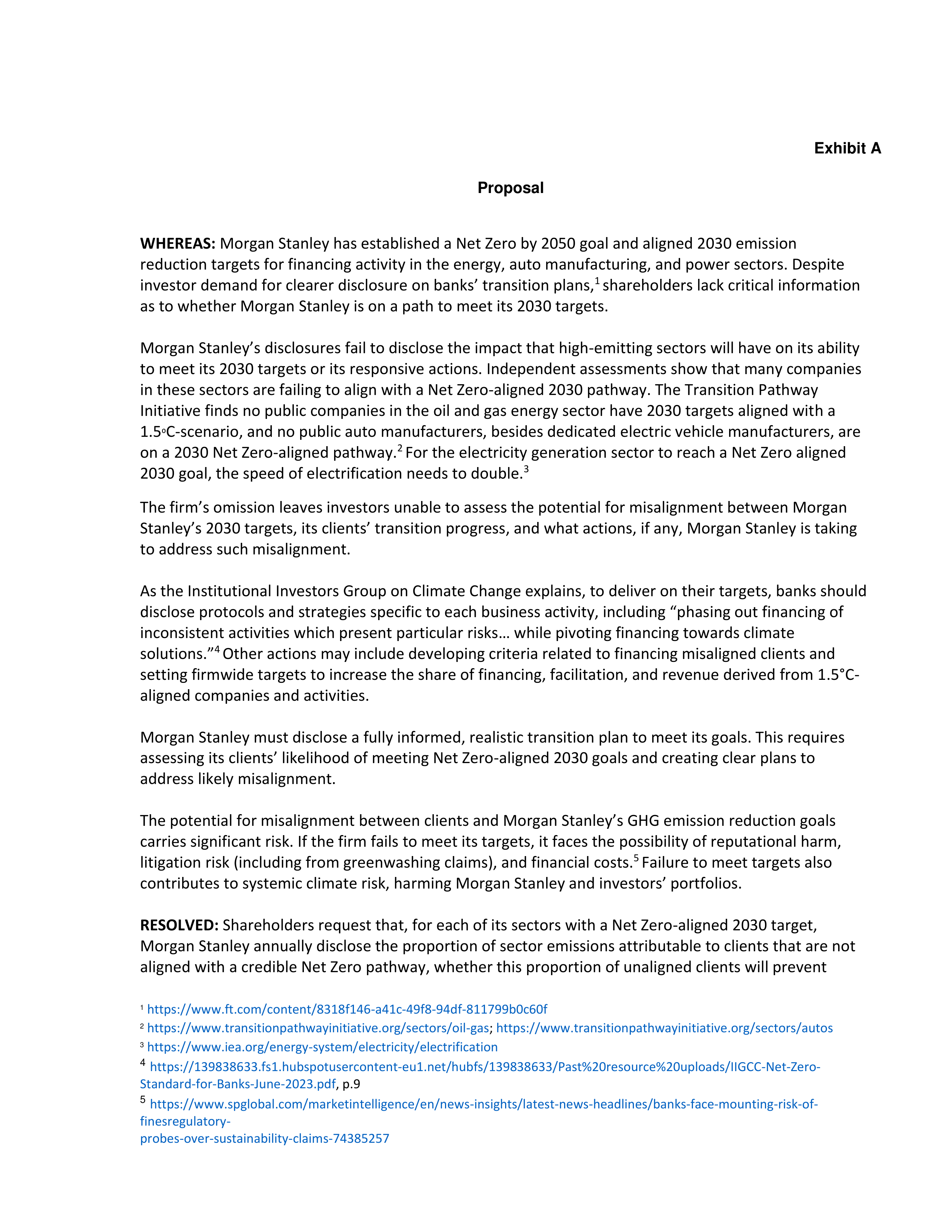
Exhibit A
Proposal
WHEREAS:
Morgan Stanley has established a Net Zero by 2050 goal and aligned 2030 emission
reduction targets for financing activity in the energy, auto manufacturing, and power sectors. Despite
investor demand for clearer disclosure on banks’ transition plans,
1
shareholders lack critical information
as to whether Morgan Stanley is on a path to meet its 2030 targets.
Morgan Stanley’s disclosures fail to disclose the impact that high-emitting sectors will have on its ability
to meet its 2030 targets or its responsive actions. Independent assessments show that many companies
in these sectors are failing to align with a Net Zero-aligned 2030 pathway. The Transition Pathway
Initiative finds no public companies in the oil and gas energy sector have 2030 targets aligned with a
1.5
⁰
C-scenario, and no public auto manufacturers, besides dedicated electric vehicle manufacturers, are
on a 2030 Net Zero-aligned pathway.
2
For the electricity generation sector to reach a Net Zero aligned
2030 goal, the speed of electrification needs to double.
3
The firm’s omission leaves investors unable to assess the potential for misalignment between Morgan
Stanley’s 2030 targets, its clients’ transition progress, and what actions, if any, Morgan Stanley is taking
to address such misalignment.
As the Institutional Investors Group on Climate Change explains, to deliver on their targets, banks should
disclose protocols and strategies specific to each business activity, including “phasing out financing of
inconsistent activities which present particular risks… while pivoting financing towards climate
solutions.”
4
Other actions may include developing criteria related to financing misaligned clients and
setting firmwide targets to increase the share of financing, facilitation, and revenue derived from 1.5°C-
aligned companies and activities.
Morgan Stanley must disclose a fully informed, realistic transition plan to meet its goals. This requires
assessing its clients’ likelihood of meeting Net Zero-aligned 2030 goals and creating clear plans to
address likely misalignment.
The potential for misalignment between clients and Morgan Stanley’s GHG emission reduction goals
carries significant risk. If the firm fails to meet its targets, it faces the possibility of reputational harm,
litigation risk (including from greenwashing claims), and financial costs.
5
Failure to meet targets also
contributes to systemic climate risk, harming Morgan Stanley and investors’ portfolios.
RESOLVED:
Shareholders request that, for each of its sectors with a Net Zero-aligned 2030 target,
Morgan Stanley annually disclose the proportion of sector emissions attributable to clients that are not
aligned with a credible Net Zero pathway, whether this proportion of unaligned clients will prevent
1
https://www.ft.com/content/8318f146-a41c-49f8-94df-811799b0c60f
2
https://www.transitionpathwayinitiative.org/sectors/oil-gas
;
https://www.transitionpathwayinitiative.org/sectors/autos
3
https://www.iea.org/energy-system/electricity/electrification
4
https://139838633.fs1.hubspotusercontent-eu1.net/hubfs/139838633/Past%20resource%20uploads/IIGCC-Net-Zero-
Standard-for-Banks-June-2023.pdf
, p.9
5
https://www.spglobal.com/marketintelligence/en/news-insights/latest-news-headlines/banks-face-mounting-risk-of-
finesregulatory-
probes-over-sustainability-claims-74385257
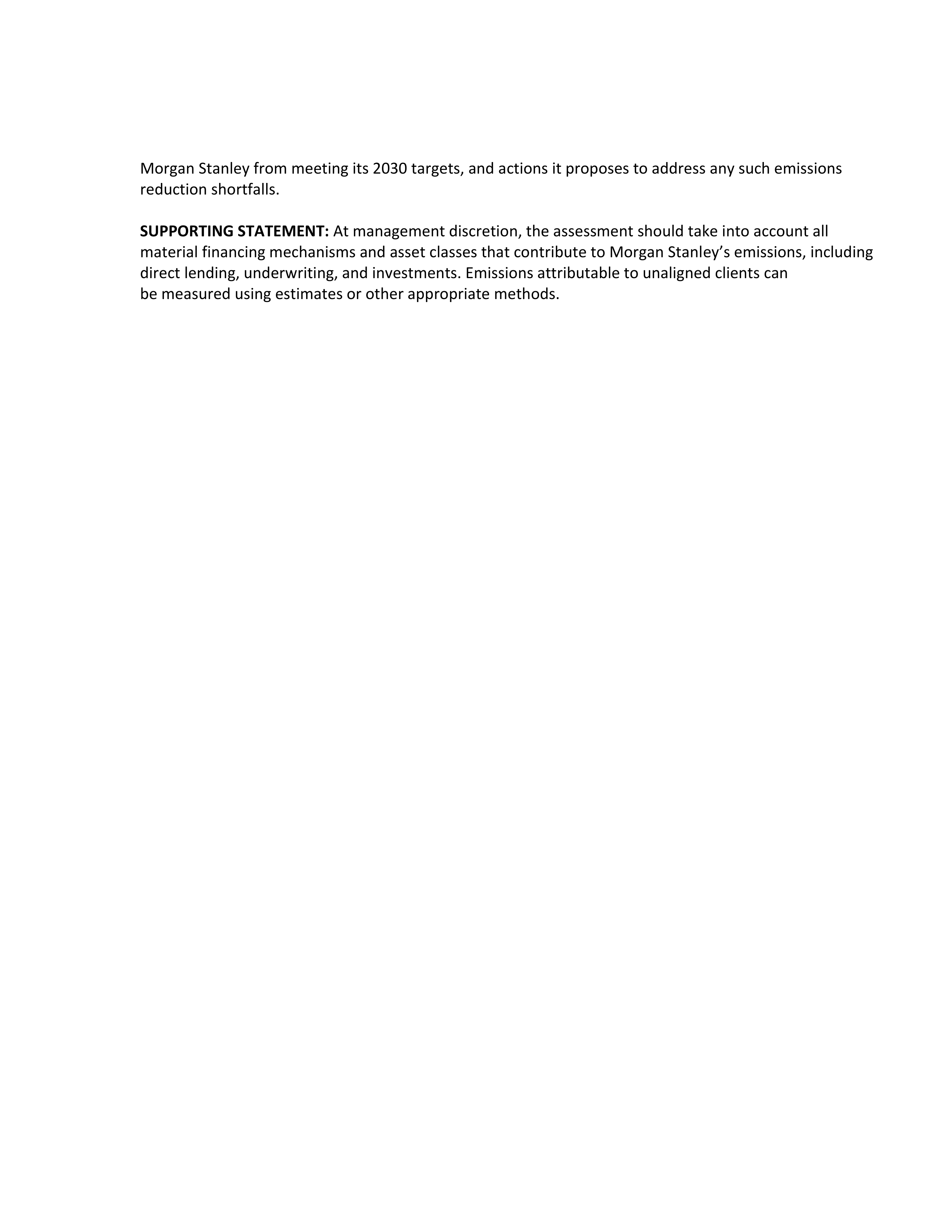
Morgan Stanley from meeting its 2030 targets, and actions it proposes to address any such emissions
reduction shortfalls.
SUPPORTING STATEMENT:
At management discretion, the assessment should take into account all
material financing mechanisms and asset classes that contribute to Morgan Stanley’s emissions, including
direct lending, underwriting, and investments. Emissions attributable to unaligned clients can
be measured using estimates or other appropriate methods.
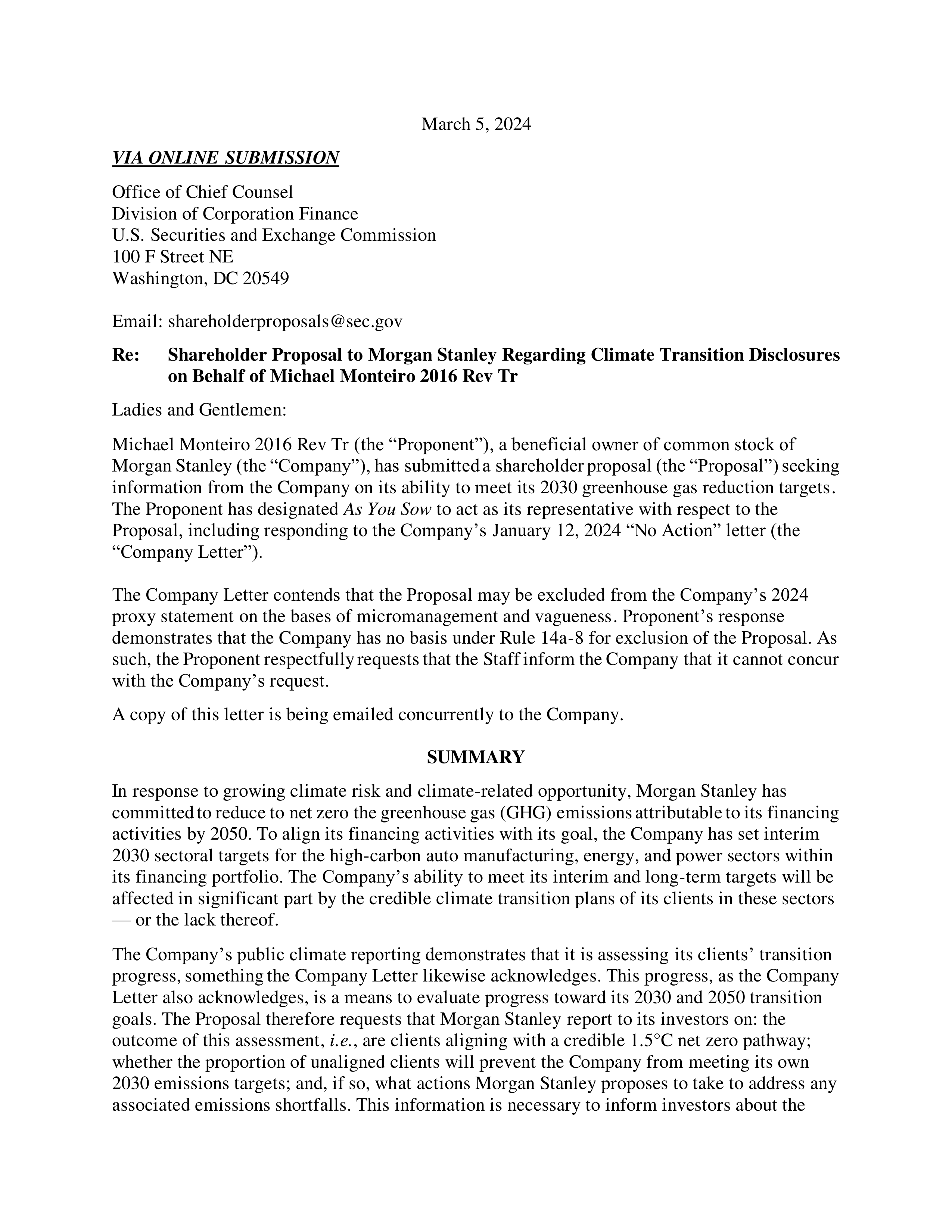
March 5, 2024
VIA ONLINE SUBMISSION
Office of Chief Counsel
Division of Corporation Finance
U.S. Securities and Exchange Commission
100 F Street NE
Washington, DC 20549
Email: shareholderproposals@sec.gov
Re:
Shareholder Proposal to Morgan Stanley Regarding Climate Transition Disclosures
on Behalf of Michael Monteiro 2016 Rev Tr
Ladies and Gentlemen:
Michael Monteiro 2016 Rev Tr (the “Proponent”), a beneficial owner of common stock of
Morgan Stanley (the “Company”), has submitted a shareholder proposal (the “Proposal”) seeking
information from the Company on its ability to meet its 2030 greenhouse gas reduction targets.
The Proponent has designated
As You Sow
to act as its representative with respect to the
Proposal, including responding to the Company’s January 12, 2024 “No Action” letter (the
“Company Letter”).
The Company Letter contends that the Proposal may be excluded from the Company’s 2024
proxy statement on the bases of micromanagement and vagueness. Proponent’s response
demonstrates that the Company has no basis under Rule 14a-8 for exclusion of the Proposal. As
such, the Proponent respectfully requests that the Staff inform the Company that it cannot concur
with the Company’s request.
A copy of this letter is being emailed concurrently to the Company.
SUMMARY
In response to growing climate risk and climate-related opportunity, Morgan Stanley has
committed to reduce to net zero the greenhouse gas (GHG) emissions attributable to its financing
activities by 2050. To align its financing activities with its goal, the Company has set interim
2030 sectoral targets for the high-carbon auto manufacturing, energy, and power sectors within
its financing portfolio. The Company’s ability to meet its interim and long-term targets will be
affected in significant part by the credible climate transition plans of its clients in these sectors
— or the lack thereof.
The Company’s public climate reporting demonstrates that it is assessing its clients’ transition
progress, something the Company Letter likewise acknowledges. This progress, as the Company
Letter also acknowledges, is a means to evaluate progress toward its 2030 and 2050 transition
goals. The Proposal therefore requests that Morgan Stanley report to its investors on: the
outcome of this assessment,
i.e.
, are clients aligning with a credible 1.5°C net zero pathway;
whether the proportion of unaligned clients will prevent the Company from meeting its own
2030 emissions targets; and, if so, what actions Morgan Stanley proposes to take to address any
associated emissions shortfalls. This information is necessary to inform investors about the
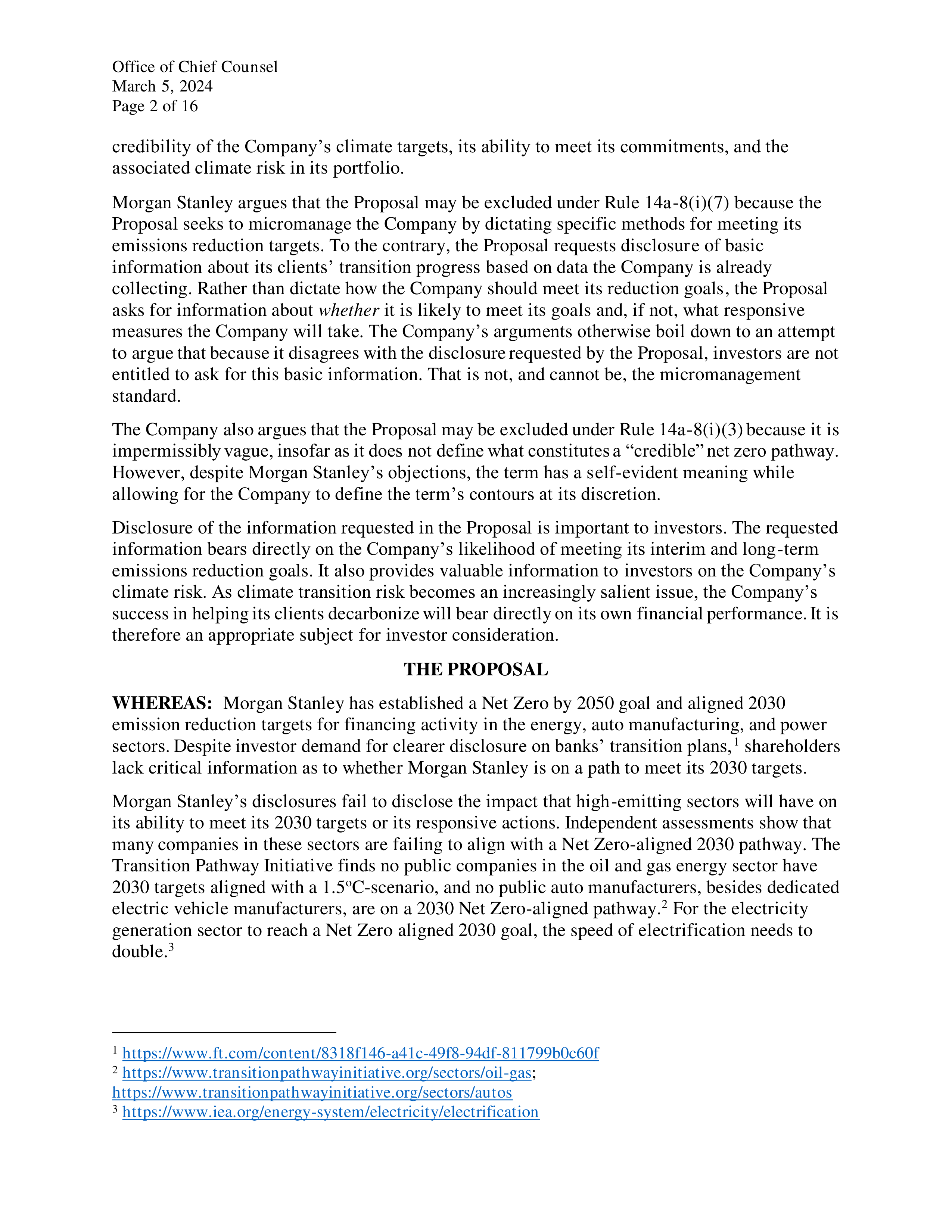
Office of Chief Counsel
March 5, 2024
Page 2 of 16
credibility of the Company’s climate targets, its ability to meet its commitments, and the
associated climate risk in its portfolio.
Morgan Stanley argues that the Proposal may be excluded under Rule 14a-8(i)(7) because the
Proposal seeks to micromanage the Company by dictating specific methods for meeting its
emissions reduction targets. To the contrary, the Proposal requests disclosure of basic
information about its clients’ transition progress based on data the Company is already
collecting. Rather than dictate how the Company should meet its reduction goals, the Proposal
asks for information about
whether
it is likely to meet its goals and, if not, what responsive
measures the Company will take. The Company’s arguments otherwise boil down to an attempt
to argue that because it disagrees with the disclosure requested by the Proposal, investors are not
entitled to ask for this basic information. That is not, and cannot be, the micromanagement
standard.
The Company also argues that the Proposal may be excluded under Rule 14a-8(i)(3) because it is
impermissibly vague, insofar as it does not define what constitutes a “credible” net zero pathway.
However, despite Morgan Stanley’s objections, the term has a self-evident meaning while
allowing for the Company to define the term’s contours at its discretion.
Disclosure of the information requested in the Proposal is important to investors. The requested
information bears directly on the Company’s likelihood of meeting its interim and long-term
emissions reduction goals. It also provides valuable information to investors on the Company’s
climate risk. As climate transition risk becomes an increasingly salient issue, the Company’s
success in helping its clients decarbonize will bear directly on its own financial performance. It is
therefore an appropriate subject for investor consideration.
THE PROPOSAL
WHEREAS:
Morgan Stanley has established a Net Zero by 2050 goal and aligned 2030
emission reduction targets for financing activity in the energy, auto manufacturing, and power
sectors. Despite investor demand for clearer disclosure on banks’ transition plans,
1
shareholders
lack critical information as to whether Morgan Stanley is on a path to meet its 2030 targets.
Morgan Stanley’s disclosures fail to disclose the impact that high-emitting sectors will have on
its ability to meet its 2030 targets or its responsive actions. Independent assessments show that
many companies in these sectors are failing to align with a Net Zero-aligned 2030 pathway. The
Transition Pathway Initiative finds no public companies in the oil and gas energy sector have
2030 targets aligned with a 1.5
o
C-scenario, and no public auto manufacturers, besides dedicated
electric vehicle manufacturers, are on a 2030 Net Zero-aligned pathway.
2
For the electricity
generation sector to reach a Net Zero aligned 2030 goal, the speed of electrification needs to
double.
3
1
https://www.ft.com/content/8318f146-a41c-49f8-94df-811799b0c60f
2
https://www.transitionpathwayinitiative.org/sectors/oil-gas
;
https://www.transitionpathwayinitiative.org/sectors/autos
3
https://www.iea.org/energy-system/electricity/electrification
Office of Chief Counsel
March 5, 2024
Page 3 of 16
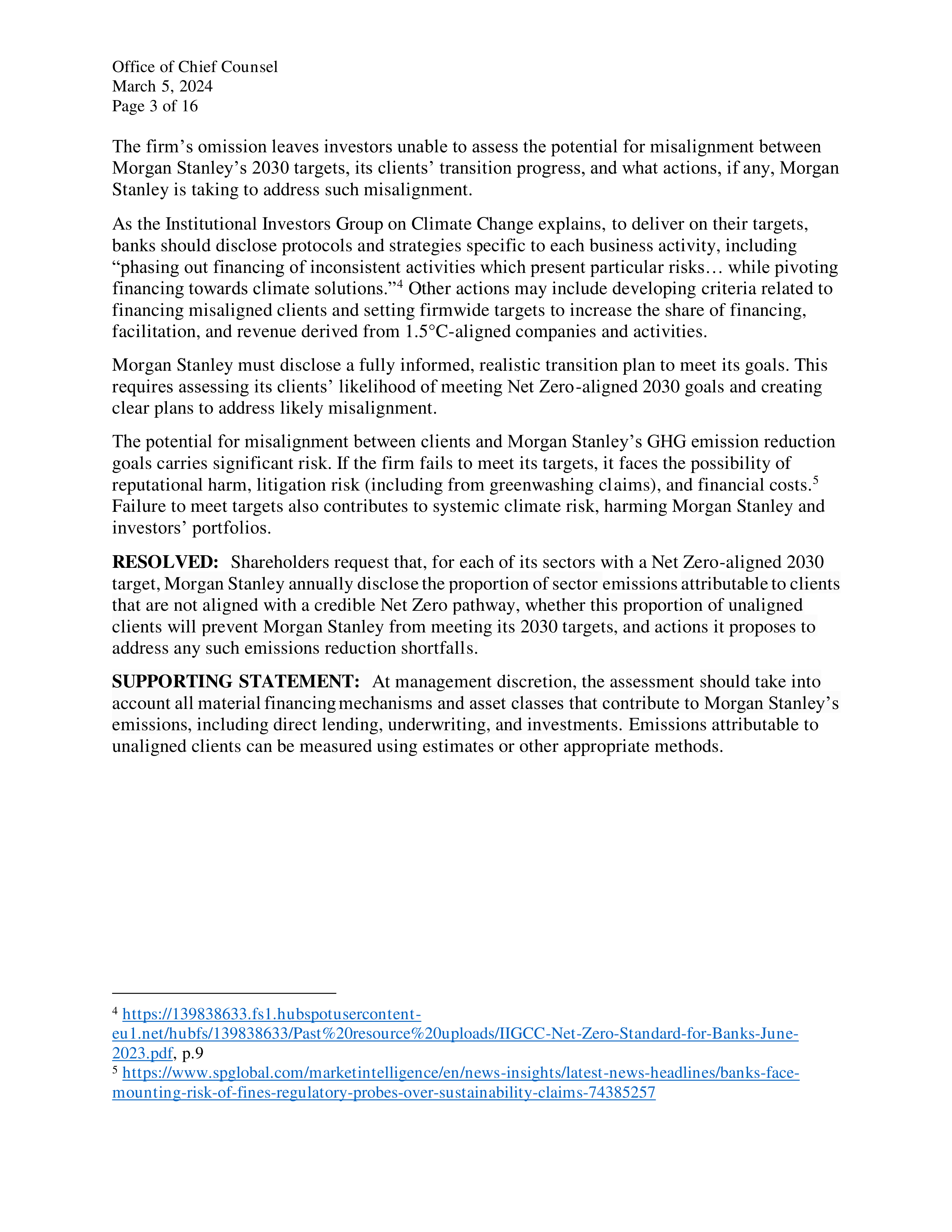
The firm’s omission leaves investors unable to assess the potential for misalignment between
Morgan Stanley’s 2030 targets, its clients’ transition progress, and what actions, if any, Morgan
Stanley is taking to address such misalignment.
As the Institutional Investors Group on Climate Change explains, to deliver on their targets,
banks should disclose protocols and strategies specific to each business activity, including
“phasing out financing of inconsistent activities which present particular risks… while pivoting
financing towards climate solutions.”
4
Other actions may include developing criteria related to
financing misaligned clients and setting firmwide targets to increase the share of financing,
facilitation, and revenue derived from 1.5°C-aligned companies and activities.
Morgan Stanley must disclose a fully informed, realistic transition plan to meet its goals. This
requires assessing its clients’ likelihood of meeting Net Zero-aligned 2030 goals and creating
clear plans to address likely misalignment.
The potential for misalignment between clients and Morgan Stanley’s GHG emission reduction
goals carries significant risk. If the firm fails to meet its targets, it faces the possibility of
reputational harm, litigation risk (including from greenwashing claims), and financial costs.
5
Failure to meet targets also contributes to systemic climate risk, harming Morgan Stanley and
investors’ portfolios.
RESOLVED:
Shareholders request that, for each of its sectors with a Net Zero-aligned 2030
target, Morgan Stanley annually disclose the proportion of sector emissions attributable to clients
that are not aligned with a credible Net Zero pathway, whether this proportion of unaligned
clients will prevent Morgan Stanley from meeting its 2030 targets, and actions it proposes to
address any such emissions reduction shortfalls.
SUPPORTING STATEMENT:
At management discretion, the assessment should take into
account all material financing mechanisms and asset classes that contribute to Morgan Stanley’s
emissions, including direct lending, underwriting, and investments. Emissions attributable to
unaligned clients can be measured using estimates or other appropriate methods.
4
https://139838633.fs1.hubspotusercontent-
eu1.net/hubfs/139838633/Past%20resource%20uploads/IIGCC-Net-Zero-Standard-for-Banks-June-
2023.pdf
, p.9
5
https://www.spglobal.com/marketintelligence/en/news-insights/latest-news-headlines/banks-face-
mounting-risk-of-fines-regulatory-probes-over-sustainability-claims-74385257
Office of Chief Counsel
March 5, 2024
Page 4 of 16
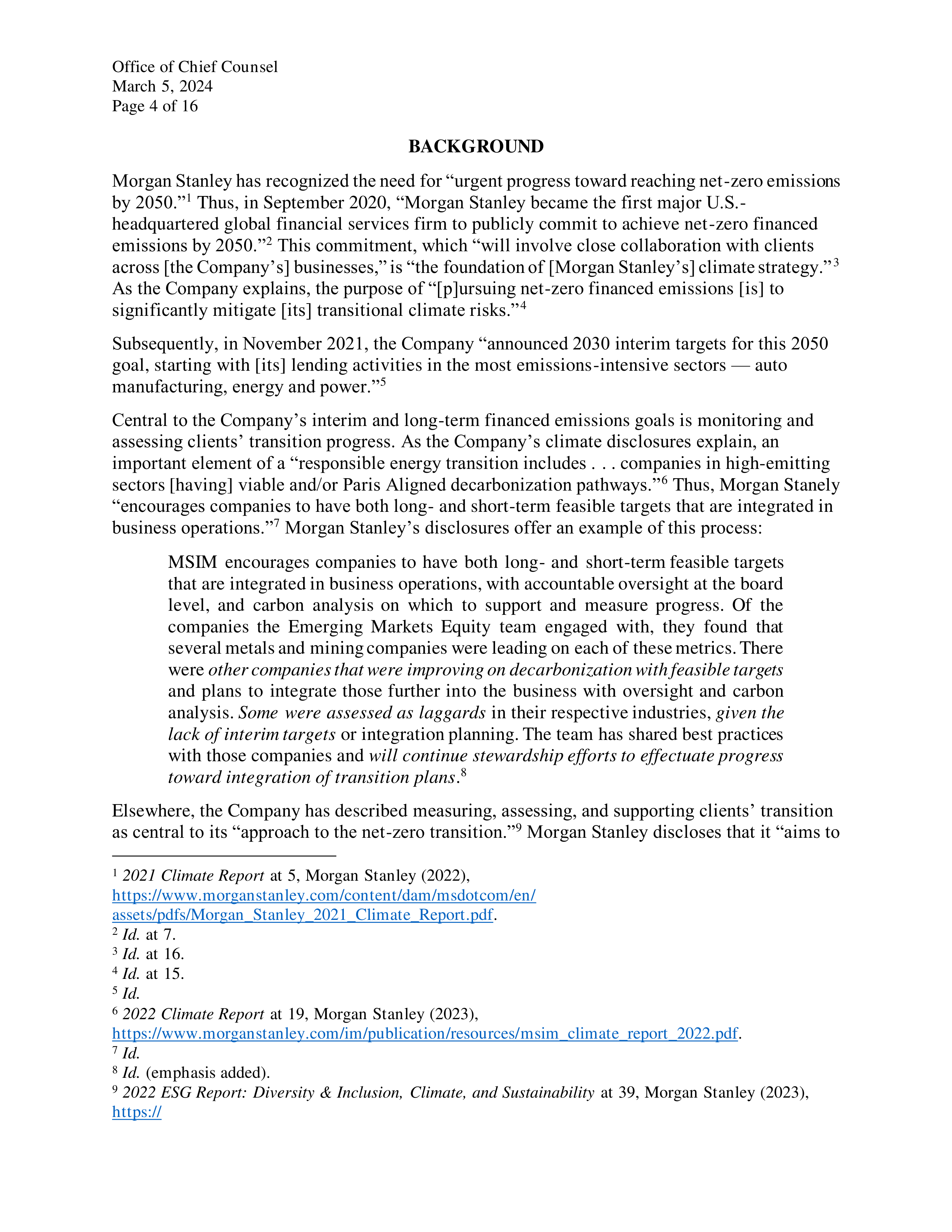
BACKGROUND
Morgan Stanley has recognized the need for “urgent progress toward reaching net-zero emissions
by 2050.”
1
Thus, in September 2020, “Morgan Stanley became the first major U.S.-
headquartered global financial services firm to publicly commit to achieve net-zero financed
emissions by 2050.”
2
This commitment, which “will involve close collaboration with clients
across [the Company’s] businesses,” is “the foundation of [Morgan Stanley’s] climate strategy.”
3
As the Company explains, the purpose of “[p]ursuing net-zero financed emissions [is] to
significantly mitigate [its] transitional climate risks.”
4
Subsequently, in November 2021, the Company “announced 2030 interim targets for this 2050
goal, starting with [its] lending activities in the most emissions-intensive sectors — auto
manufacturing, energy and power.”
5
Central to the Company’s interim and long-term financed emissions goals is monitoring and
assessing clients’ transition progress. As the Company’s climate disclosures explain, an
important element of a “responsible energy transition includes . . . companies in high-emitting
sectors [having] viable and/or Paris Aligned decarbonization pathways.”
6
Thus, Morgan Stanely
“encourages companies to have both long- and short-term feasible targets that are integrated in
business operations.”
7
Morgan Stanley’s disclosures offer an example of this process:
MSIM encourages companies to have both long- and short-term feasible targets
that are integrated in business operations, with accountable oversight at the board
level, and carbon analysis on which to support and measure progress. Of the
companies the Emerging Markets Equity team engaged with, they found that
several metals and mining companies were leading on each of these metrics. There
were
other companies that were improving on decarbonization with feasible targets
and plans to integrate those further into the business with oversight and carbon
analysis.
Some were assessed as laggards
in their respective industries,
given the
lack of interim targets
or integration planning. The team has shared best practices
with those companies and
will continue stewardship efforts to effectuate progress
toward integration of transition plans
.
8
Elsewhere, the Company has described measuring, assessing, and supporting clients’ transition
as central to its “approach to the net-zero transition.”
9
Morgan Stanley discloses that it “aims to
1
2021 Climate Report
at 5, Morgan Stanley (2022),
https://www.morganstanley.com/content/dam/msdotcom/en/
assets/pdfs/Morgan_Stanley_2021_Climate_Report.pdf
.
2
Id.
at 7.
3
Id.
at 16.
4
Id.
at 15.
5
Id.
6
2022 Climate Report
at 19, Morgan Stanley (2023),
https://www.morganstanley.com/im/publication/resources/msim_climate_report_2022.pdf
.
7
Id.
8
Id.
(emphasis added).
9
2022 ESG Report: Diversity & Inclusion, Climate, and Sustainability
at 39, Morgan Stanley (2023),
https://
Office of Chief Counsel
March 5, 2024
Page 5 of 16
meet [its] climate commitments . . . by supporting our clients in achieving their own climate-
related commitments.”
10
To do so, it “work[s] closely with [its] clients to understand and assess
their low-carbon transition plans, the resourcing of their plans and how those plans align with
[its] own climate-related commitments.”
11
The Company further describes its client engagement
effort as focused on “deepen[ing its] understanding of clients’ climate plans and help[ing it]
assess the robustness of [its] clients’ commitments.”
12
Finally, the Company affirms that it
“evaluate[s] new lending opportunities through the lens of the impact on progress toward [its]
targets, taking into account annual client emissions.”
13
Finally, to meet its interim and long-term goals, the Company has taken steps to “support[] and
inform[] the development of methodologies, tools and frameworks to measure, manage and
report . . . financed emissions.”
14
Externally, this involves “[h]olding leadership positions in
PCAF and NZBA, the expert organizations guiding [its] path and disclosures on net-zero
financed emissions.”
15
Internally, the Company “support[s] and collaborate[s] with clients to
achieve their low-carbon goals.”
16
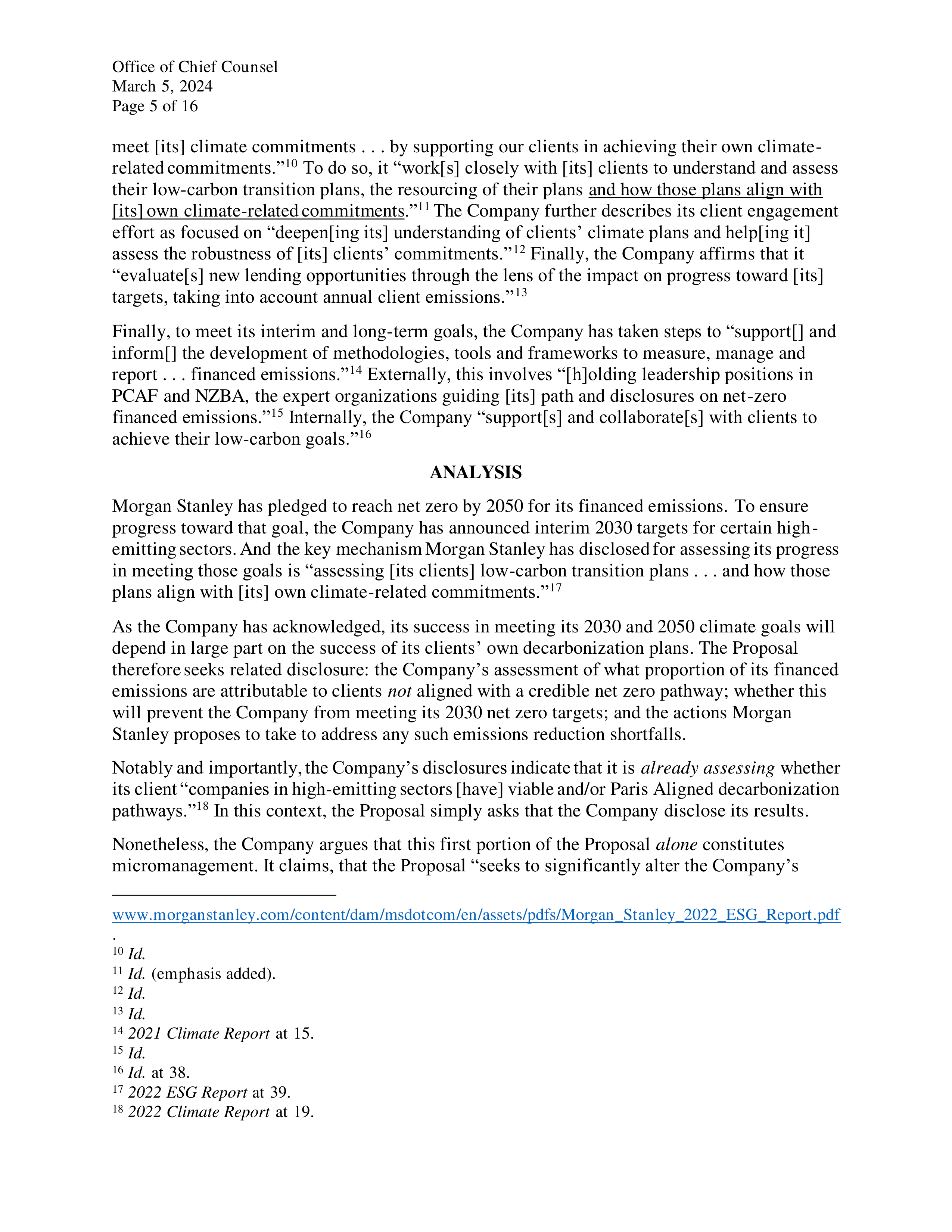
ANALYSIS
Morgan Stanley has pledged to reach net zero by 2050 for its financed emissions. To ensure
progress toward that goal, the Company has announced interim 2030 targets for certain high-
emitting sectors. And the key mechanism Morgan Stanley has disclosed for assessing its progress
in meeting those goals is “assessing [its clients] low-carbon transition plans . . . and how those
plans align with [its] own climate-related commitments.”
17
As the Company has acknowledged, its success in meeting its 2030 and 2050 climate goals will
depend in large part on the success of its clients’ own decarbonization plans. The Proposal
therefore seeks related disclosure: the Company’s assessment of what proportion of its financed
emissions are attributable to clients
not
aligned with a credible net zero pathway; whether this
will prevent the Company from meeting its 2030 net zero targets; and the actions Morgan
Stanley proposes to take to address any such emissions reduction shortfalls.
Notably and importantly, the Company’s disclosures indicate that it is
already assessing
whether
its client “companies in high-emitting sectors [have] viable and/or Paris Aligned decarbonization
pathways.”
18
In this context, the Proposal simply asks that the Company disclose its results.
Nonetheless, the Company argues that this first portion of the Proposal
alone
constitutes
micromanagement. It claims, that the Proposal “seeks to significantly alter the Company’s
www.morganstanley.com/content/dam/msdotcom/en/assets/pdfs/Morgan_Stanley_2022_ESG_Report.pdf
.
10
Id.
11
Id.
(emphasis added).
12
Id.
13
Id.
14
2021 Climate Report
at 15.
15
Id.
16
Id.
at 38.
17
2022 ESG Report
at 39.
18
2022 Climate Report
at 19.
Office of Chief Counsel
March 5, 2024
Page 6 of 16
strategy for aligning its business and financing with the goal of limiting warming to 1.5°C.”
Company Letter at 3. The Proposal does not alter the Company’s strategy in any way. It simply
requests disclosure relating to
actions Morgan Stanley is already taking
— its assessment of
client emissions and transition progress in the auto manufacturing, energy, and power sectors. It
asks, broadly, what proportion of the Company’s total financed emissions in these sectors are
attributable to clients who do not have credible net zero transition plans? This assessment, which
the Company’s disclosures indicate it is already undertaking, is critical to understanding whether
the Company can rely on client emissions reductions to meet its net zero goals, or whether it
must plan additional actions. This disclosure does not eliminate management discretion in what
calculations or methodologies it uses to measure and assess client progress toward the
Company’s goals, what determination it makes about clients’ alignment, or what responsive
action it plans, if any.
The argument that such a basic disclosure request constitutes micromanagement amounts to a
request that the Staff adopt a new standard wholly at odds with Rule 14a-8 and Staff precedent.
The Company’s proposed rule would require that shareholders be satisfied with whatever
disclosure a company elects to make, no matter if those disclosures fail to provide consistent,
comparable, and decision-useful information to shareholders. Such a position is at odds with the
SEC’s longstanding position that investors should be provided with reliable information to make
informed investment decisions about material risk, consistent with the SEC’s core mandate to
protect investors and support well-informed capital allocation decisions.
The Company Letter additionally argues that the Proposal is inherently vague and misleading
because it does not define what constitutes a “credible” transition pathway. This argument, too,
is unpersuasive. The term “credible” is both commonly used with regard to net zero pathways
and self-explanatory, with its exact details intentionally left to management discretion. As
described below, the Company itself has repeatedly used the term without further definition. The
Company has set 2030 and 2050 financed emission goals and has disclosed that it is monitoring
whether its clients’ transition pathways are consistent with those goals. If Morgan Stanley is
incapable of determining whether its clients’ transition plans are credibly aligned with net zero,
because it does not know the meaning of the word “credible” despite its repeated use of the word
in this exact context, investors have cause to be alarmed.
I.
THE PROPOSAL DOES NOT MICROMANAGE THE COMPANY
A.
Micromanagement Standard
Rule 14a-8(i)(7) permits the exclusion of proposals that “deal[] with a matter relating to the
company’s ordinary business operations.” As the Commission has recognized, however,
proposals focused on a
significant social policy issue
generally are not excludable even if they
relate to the company’s day-to-day business.
See
SEC, Exchange Act Release No. 34-40018
(May 21, 1998) (“1998 Release”). This is true even when the proposal “relates to the ‘nitty-gritty
of [a company’s] core business.” Staff Legal Bulletin No. 14H (Oct. 22, 2015).
At the same time, even where a significant social policy issue is at stake, the Commission has
recognized an exclusion under Rule 14a-8(i)(7) for proposals seeking to “micromanage”
companies by “probing too deeply into matters of a complex nature upon which shareholders, as
a group, would not be in a position to make an informed judgment.” 1998 Release. In Staff
Office of Chief Counsel
March 5, 2024
Page 7 of 16
Legal Bulletin No. 14L, the Staff provided additional guidance about the scope of the
micromanagement exclusion. There, the Staff noted that “proposals
seeking detail
or
seeking to
promote
timeframes or
methods
do not per se constitute micromanagement.” (emphasis added).
Rather, the Staff looks at:
[T]he level of granularity sought in the proposal and whether and to what extent it
inappropriately limits discretion of the board or management. We would expect the
level of detail included in a shareholder proposal to be consistent with that needed
to enable investors to assess an issuer’s impacts, progress towards goals, risks or
other strategic matters appropriate for shareholder input.
Staff Legal Bulletin No. 14L.
Finally, the Staff has also provided guidance on the standards it uses to judge the appropriate
level of granularity in a proposal, noting that the Staff “may consider the sophistication of
investors generally on the matter, the availability of data, and the robustness of public discussion
and analysis on the topic” as well as “references to well-established national or international
frameworks when assessing proposals related to disclosure . . . as indicative of topics that
shareholders are well-equipped to evaluate.”
Id.
B.
The Proposal Does Not Inappropriately Interfere with Management Discretion
The Company Letter first argues that the Proposal “seeks to prescribe a specific method for how
the Company aligns its business with net zero.” Company Letter at 5. This is inaccurate; the
Proposal requires no methodology or actions as to how the Company will align its actions with
net zero. Instead, it simply requests disclosure on the Company’s progress — what proportion of
its sectoral emissions are associated with clients not aligned with net zero.
As explained below, despite the Company Letter’s protestations, the Company’s disclosures
make clear that assessing its clients’ transition pathways is part of its current activities. As the
Staff has explained, Proposals may seek “the level of detail consistent with that needed . . . to
assess an issuer’s impacts, progress towards goals, risks or other strategic matters appropriate for
shareholder input.” Staff Legal Bulletin No. 14L.
The Proposal is consistent with these standards. Morgan Stanley itself has described at length
why it is concerned about whether its clients in high-carbon sectors have credible transition
plans, noting that its “largest exposure to climate risk is indirect and arises from the physical and
transition risks affecting the companies and securities in which we invest.”
19
As a result, it is
“critical” that the Company “[p]roactively work[] to mitigate emissions as quickly as is
feasible.”
20
This is in part because “limiting exposure to high-emitting companies” can serve “to
mitigate future downside risk.”
21
The Proposal therefore squarely relates to shareholders’
legitimate interest in judging risk in their portfolios.
See
Staff Legal Bulletin No. 14L.
19
2022 Climate Report
, at 11.
20
2021 Climate Report
, at 14.
21
Climate Transition in a Portfolio Context: What Matters and What to Measure
, Morgan Stanley Inst.
For Sustainable Investing (July 2020),
https://www.morganstanley.com/assets/pdfs/Climate_Transition_in_a_Portfolio_Context_070120.pdf
.
Office of Chief Counsel
March 5, 2024
Page 8 of 16
The Company Letter’s arguments that the Proposal falls outside of these bounds are
unpersuasive. Although the Company’s arguments that the Proposal would require a radical shift
in how it does business are facially wrong, they also betray a deeper error — reliance on an
increasingly common fallacy on the part of issuers that would hold that any shareholder proposal
that suggests any change in a company’s status quo constitutes micromanagement. That is:
because management has decided to do X, it is micromanagement for shareholders to suggest Y.
But that is
not
the standard. Every shareholder proposal, in some way, requests that a company
change some aspect of how it does business or gathers and reports data. If “seeking a change
from the status quo” is a legitimate basis for exclusion, no proposals would be left standing.
There is no basis in the Rule or in Staff precedent to apply the micromanagement rule so broadly.
The question under Rule 14a-8(i)(7) is whether the Proposal’s request is appropriately made by
shareholders based on the request’s level of granularity and the discretion it leaves to the
company’s management.
See
Staff Legal Bulletin No. 14L. Even proposals that actually do seek
significant “alter[ations in] the way [a company] works with clients” routinely survive
micromanagement challenges. In
Morgan Stanley
(Mar. 25, 2022), for instance, the proposal
requested that the bank “adopt a policy . . . committing to proactive measures to ensure that the
Company’s lending and underwriting do not contribute to new fossil fuel development.”
Implementation of that proposal could alter the bank’s relationship with its clients, and the
company argued as much. Nonetheless, the Staff correctly concluded that the proposal “d[id] not
seek to micromanage the Company.”
22
This is because the proposal’s request that the company
adopt a policy was not: (a) too granular for investors to consider and understand, or (b) too
restrictive of management’s discretion to implement the request. So too is the case here.
The Company Letter’s specific arguments are addressed in turn:
C.
The Proposal does not micromanage the Company by altering its methodology
for measuring emissions.
The Company Letter takes issue with the Supporting Statement’s request that the Company, “[a]t
management discretion, . . . take into account all material financing mechanisms and asset
classes that contribute to Morgan Stanley’s emissions.” The Company argues that this request is
somehow inconsistent with its “inten[t] to ‘set new targets . . . including with respect to capital
markets and facilitation activities.’” Company Letter at 6. Patently, there is no conflict between
these two requests. The Company Letter argues that the Proposal conflicts with “the Company’s
view that it would be in its best interest to wait to undertake such expansions until PCAF has
published relevant guidance and methodologies that it can continue to follow,” Company Letter
at 6. Nothing in the Proposal — which explicitly preserves management discretion as to the
22
The
Morgan Stanley
decision is consistent with numerous other Staff precedents before and since, all of
which involve much more significant shareholder oversight of company-client relationships than this
Proposal and many of which involve banks’ or insurance companies’ fossil fuel financing, investment, or
underwriting.
See, e.g.
,
Chubb Ltd.
(Mar. 27, 2023) (no exclusion where proposal requested company
disclose medium- and long-term Scope 3 emissions reduction targets);
J.P. Morgan Chase & Co.
(Mar.
25, 2022) and
Citigroup Inc.
(Mar. 7, 2022) (same proposal as
Morgan Stanley
);
J.P. Morgan & Chase
Co.
(Feb. 28, 2020) (proposal requested company issue report describing how it intended to reduce Scope
3 emissions).
Office of Chief Counsel
March 5, 2024
Page 9 of 16
scope of covered emissions — prevents the Company from implementing the Proposal’s request
in this manner. The Proposal’s general request that the Company, at management discretion,
attempt to include all relevant emissions in its assessment does not micromanage how the
Company might implement the request, if it chooses to do so at all. The Statement does,
however, underscore that the full panoply of the Company’s financing mechanisms and asset
classes are important considerations for shareholders.
D.
The Proposal does not require the Company to alter how it works with clients.
The Company Letter next complains that the Proposal will “require the Company to alter the
way it works with clients.” Company Letter at 6. In particular, the Company suggests that the
requirement that it assess the credibility of its clients’ net zero pathways “will be highly
burdensome on management” and may even require it to “potentially take an adversarial, rather
than collaborative, approach to engaging with clients.” Company Letter at 6. These claims are
wholly belied by the Company’s climate disclosures, which, as detailed above, describe the
Company as already undertaking assessments of the consistency of its clients’ net zero pathways
with its own interim and long-term targets. In particular, the Company states that it takes steps
“to understand and assess [its clients’] low-carbon transition plans, the resourcing of their plans
and how those plans align with [its] own climate-related commitments.”
23
It also “assess[es] the
robustness of [its] clients’ commitments.”
24
The Company Letter also argues that the Proposal “would substitute the Company’s sector-wide
approach with one that shifts the focus instead to individual clients by requiring an assessment of
each client’s net zero pathway.” Company Letter at 6. Once more, the Proposal does not require
the Company to alter its approach. The Company is free to measure and disclose the proportion
of non-transitioning clients by sector. The Proposal leaves to the Company
how
it calculates and
discloses the proportion of unaligned clients. Moreover, this objection is contradicted by the
Company’s own disclosures. As noted above, the Company’s disclosures state that it is already
assessing each client’s net zero pathway. It states that it is focused “on providing tailored
strategic advice, impactful transition financing and risk mitigation solutions
to [its] corporate
clients in GHG-intensive sectors
as they seek to reduce their own emissions footprint.”
25
In other
words, the purpose of the Company’s sectoral approach is to “shift[] the focus to individual
clients.” Nothing in the Proposal requires the Company to change how it works with clients.
E.
The Proposal does not require the Company to “disengage with financing
specific industries or businesses operating in certain areas.”
The Company Letter also argues that the Proposal micromanages because the Proposal’s
preamble suggests that, “to deliver on [its announced net zero financed emissions] target[],” the
Company “may” have to “set[] firmwide targets to increase the share of financing, facilitation,
and revenue derived from 1.5°C-aligned companies and activities.” Because some of its high-
23
2022 ESG Report
at 39 (emphasis added).
24
Id.
25
Methodology for Morgan Stanley’s 2030 Interim Financed Emissions Targets on the Path to Net-Zero
(“Methodology Report”) at 5, Morgan Stanley (Nov. 2021),
https://www.morganstanley.com/content/dam/msdotcom/about-us/netzero/Morgan-Stanley-Net-Zero-
Target-Methodology.pdf
.
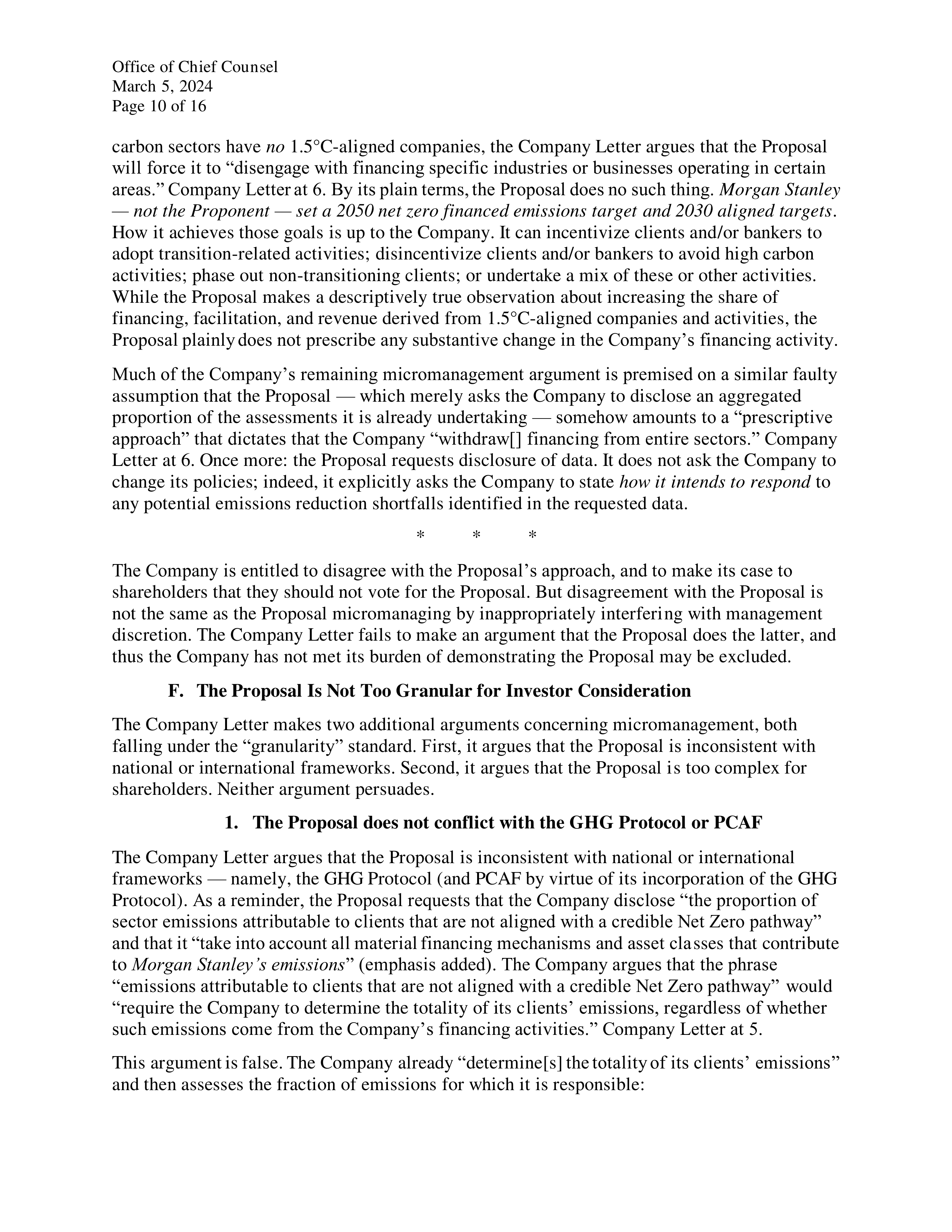
Office of Chief Counsel
March 5, 2024
Page 10 of 16
carbon sectors have
no
1.5°C-aligned companies, the Company Letter argues that the Proposal
will force it to “disengage with financing specific industries or businesses operating in certain
areas.” Company Letter at 6. By its plain terms, the Proposal does no such thing.
Morgan Stanley
— not the Proponent — set a 2050 net zero financed emissions target and 2030 aligned targets
.
How it achieves those goals is up to the Company. It can incentivize clients and/or bankers to
adopt transition-related activities; disincentivize clients and/or bankers to avoid high carbon
activities; phase out non-transitioning clients; or undertake a mix of these or other activities.
While the Proposal makes a descriptively true observation about increasing the share of
financing, facilitation, and revenue derived from 1.5°C-aligned companies and activities, the
Proposal plainly does not prescribe any substantive change in the Company’s financing activity.
Much of the Company’s remaining micromanagement argument is premised on a similar faulty
assumption that the Proposal — which merely asks the Company to disclose an aggregated
proportion of the assessments it is already undertaking — somehow amounts to a “prescriptive
approach” that dictates that the Company “withdraw[] financing from entire sectors.” Company
Letter at 6. Once more: the Proposal requests disclosure of data. It does not ask the Company to
change its policies; indeed, it explicitly asks the Company to state
how it intends to respond
to
any potential emissions reduction shortfalls identified in the requested data.
*
*
*
The Company is entitled to disagree with the Proposal’s approach, and to make its case to
shareholders that they should not vote for the Proposal. But disagreement with the Proposal is
not the same as the Proposal micromanaging by inappropriately interfering with management
discretion. The Company Letter fails to make an argument that the Proposal does the latter, and
thus the Company has not met its burden of demonstrating the Proposal may be excluded.
F.
The Proposal Is Not Too Granular for Investor Consideration
The Company Letter makes two additional arguments concerning micromanagement, both
falling under the “granularity” standard. First, it argues that the Proposal is inconsistent with
national or international frameworks. Second, it argues that the Proposal is too complex for
shareholders. Neither argument persuades.
1.
The Proposal does not conflict with the GHG Protocol or PCAF
The Company Letter argues that the Proposal is inconsistent with national or international
frameworks — namely, the GHG Protocol (and PCAF by virtue of its incorporation of the GHG
Protocol). As a reminder, the Proposal requests that the Company disclose “the proportion of
sector emissions attributable to clients that are not aligned with a credible Net Zero pathway”
and that it “take into account all material financing mechanisms and asset classes that contribute
to
Morgan Stanley’s emissions
” (emphasis added). The Company argues that the phrase
“emissions attributable to clients that are not aligned with a credible Net Zero pathway” would
“require the Company to determine the totality of its clients’ emissions, regardless of whether
such emissions come from the Company’s financing activities.” Company Letter at 5.
This argument is false. The Company already “determine[s] the totality of its clients’ emissions”
and then assesses the fraction of emissions for which it is responsible:
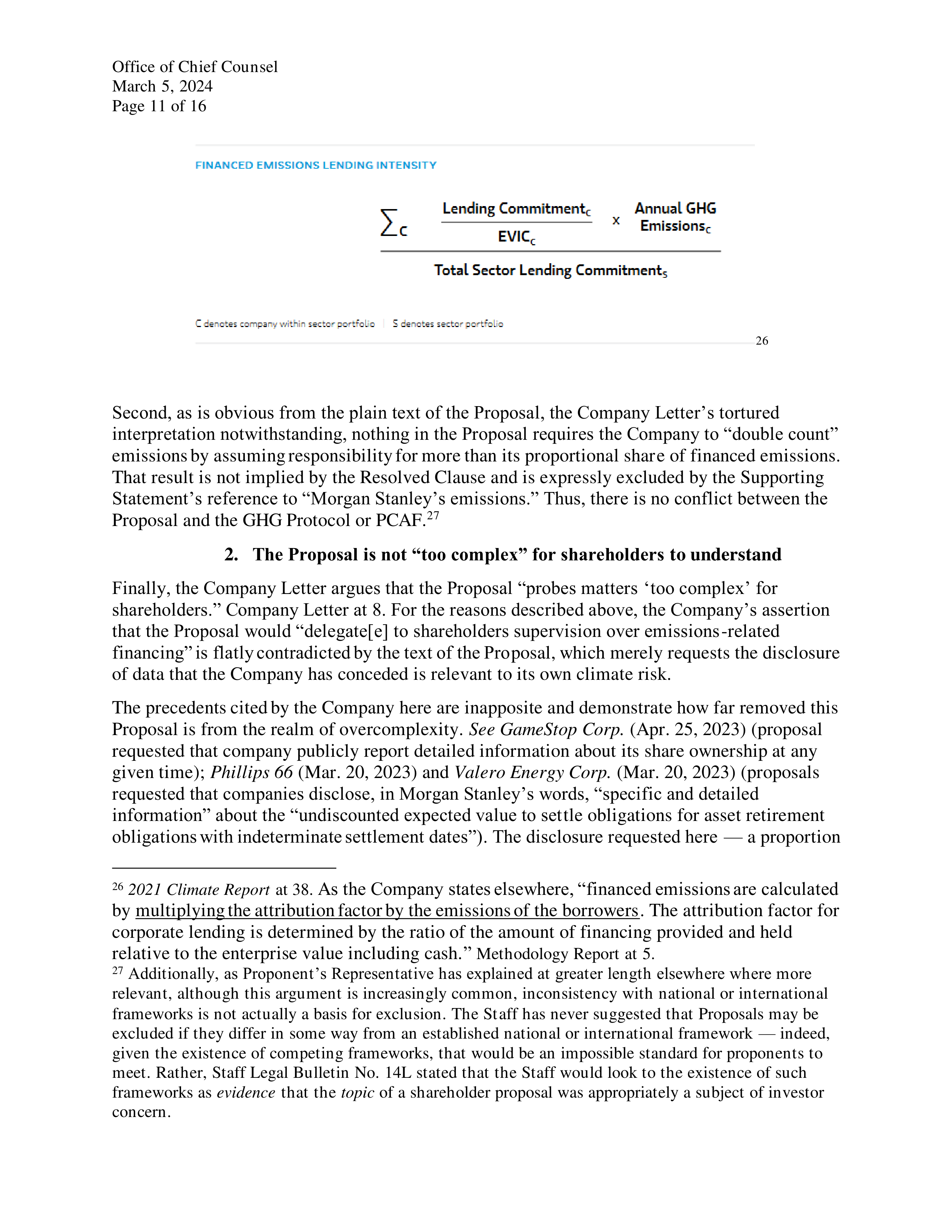
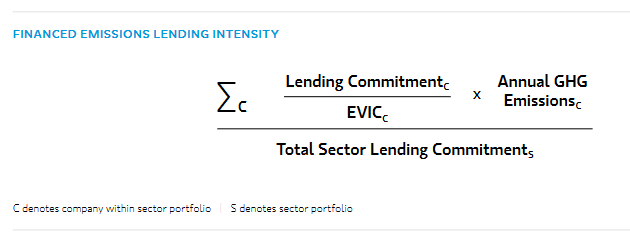
Office of Chief Counsel
March 5, 2024
Page 11 of 16
26
Second, as is obvious from the plain text of the Proposal, the Company Letter’s tortured
interpretation notwithstanding, nothing in the Proposal requires the Company to “double count”
emissions by assuming responsibility for more than its proportional share of financed emissions.
That result is not implied by the Resolved Clause and is expressly excluded by the Supporting
Statement’s reference to “Morgan Stanley’s emissions.” Thus, there is no conflict between the
Proposal and the GHG Protocol or PCAF.
27
2.
The Proposal is not “too complex” for shareholders to understand
Finally, the Company Letter argues that the Proposal “probes matters ‘too complex’ for
shareholders.” Company Letter at 8. For the reasons described above, the Company’s assertion
that the Proposal would “delegate[e] to shareholders supervision over emissions-related
financing” is flatly contradicted by the text of the Proposal, which merely requests the disclosure
of data that the Company has conceded is relevant to its own climate risk.
The precedents cited by the Company here are inapposite and demonstrate how far removed this
Proposal is from the realm of overcomplexity.
See
GameStop Corp.
(Apr. 25, 2023) (proposal
requested that company publicly report detailed information about its share ownership at any
given time);
Phillips 66
(Mar. 20, 2023) and
Valero Energy Corp.
(Mar. 20, 2023) (proposals
requested that companies disclose, in Morgan Stanley’s words, “specific and detailed
information” about the “undiscounted expected value to settle obligations for asset retirement
obligations with indeterminate settlement dates”). The disclosure requested here — a proportion
26
2021 Climate Report
at 38.
As the Company states elsewhere, “financed emissions are calculated
by multiplying the attribution factor by the emissions of the borrowers. The attribution factor for
corporate lending is determined by the ratio of the amount of financing provided and held
relative to the enterprise value including cash.”
Methodology Report at 5.
27
Additionally, as Proponent’s Representative has explained at greater length elsewhere where more
relevant, although this argument is increasingly common, inconsistency with national or international
frameworks is not actually a basis for exclusion. The Staff has never suggested that Proposals may be
excluded if they differ in some way from an established national or international framework — indeed,
given the existence of competing frameworks, that would be an impossible standard for proponents to
meet. Rather, Staff Legal Bulletin No. 14L stated that the Staff would look to the existence of such
frameworks as
evidence
that the
topic
of a shareholder proposal was appropriately a subject of investor
concern.
Office of Chief Counsel
March 5, 2024
Page 12 of 16
of unaligned clients in the 3 sectors relevant to the Company’s net zero targets — bears little
resemblance to these proposals. Nor is it particularly complex, in the ordinary meaning of that
term. The Staff has recognized that shareholders are capable of making decisions about financial
institutions’ financed emissions.
See, e.g.
,
Morgan Stanley
,
supra
(proposal requested Company
adopt policy to ensure its lending and underwriting activities did not contribute to new fossil fuel
development, micromanagement exclusion denied);
Chubb Ltd.
(Mar. 26, 2022) (proposal
requested Company disclose whether and how it intended to measure and reduce Scope 3
emissions associated with underwriting, insuring, and investment activities).
II.
THE PROPOSAL IS NOT IMPERMISSIBLY VAGUE AND INDEFINITE SO
AS TO BE INHERENTLY MISLEADING
The Company Letter also argues that the Proposal is excludable under Rule 14a-8(i)(3) because
it is “impermissibly vague and indefinite so as to be inherently misleading.” Company Letter at
8-10. The gravamen of this argument is that the Proposal does not define the term “credible Net
Zero pathway,” with particular emphasis on the word “credible.”
See id.
This argument itself is
not credible.
The Company correctly identifies the standard for Rule 14a-8(i)(3): a Proposal must not be so
vague that “neither the stockholders voting on the proposal, nor the company in implementing
the proposal (if adopted), would be able to determine with any reasonable certainty exactly what
actions or measures the proposal requires.” Staff Legal Bulletin No. 14B (Sept. 15, 2004). The
Staff does not lightly assume that shareholders are incapable of grasping the complex issues
which affect their investments, however. Staff Legal Bulletin No. 14B itself is dedicated in large
part to the “unintended and unwarranted extension of rule 14a-8(i)(3)” by companies. Thus, the
emphasis must be on whether a proposal is “
so
inherently vague or indefinite” that it cannot be
determined with “
reasonable
certainty” what it requires. The standard is not whether a lawyer
could identify some tortured reading that renders the proposal minorly ambiguous.
Rule 14a-8(i)(3)’s anti-vagueness rule is also generally applied to proposals that require
substantive action, not disclosure, and virtually all of the precedents cited by the Company fall
into this category.
See, e.g.
,
Apple Inc.
(Dec. 6, 2019) (proposal demanded company “improve”
its executive compensation principles without defining what constituted improvement);
Walt
Disney Co.
(Jan. 19, 2022) (proposal demanded prohibition on any communication with
“politically charged biases” without defining what constituted a politically charged bias);
The
Boeing Co.
(Feb. 23, 2021) (proposal demanded that 60% of company’s directors have an
“aerospace/aviation/engineering executive background” without defining what would qualify);
AT&T Inc.
(Feb. 21, 2014) (proposal demanded review of “directors’ moral, ethical and legal
fiduciary duties and opportunities,” without defining, for example, what a “moral opportunity”
might be);
Berkshire Hathaway Inc.
(Jan. 31, 2012) (proposal demanded that company personnel
“be required to sign-off be [sic] means of an electronic key, daily or weekly, that they have
observed and approve or disapprove of figures and policies that show a high risk condition for
the company, caused by those policies,” without explaining what any of that meant).
By contrast, the Staff routinely rejects attempts by issuers to manufacture ambiguity where none
exists. For example, in
United Natural Foods, Inc.
(Oct. 2, 2014), the proposal requested that the
company determine and report “the CEO-to-employee pay ratio.” The company argued that the
proposal “fail[ed] to define the key term, ‘CEO to employee pay ratio,’ and the Company and its
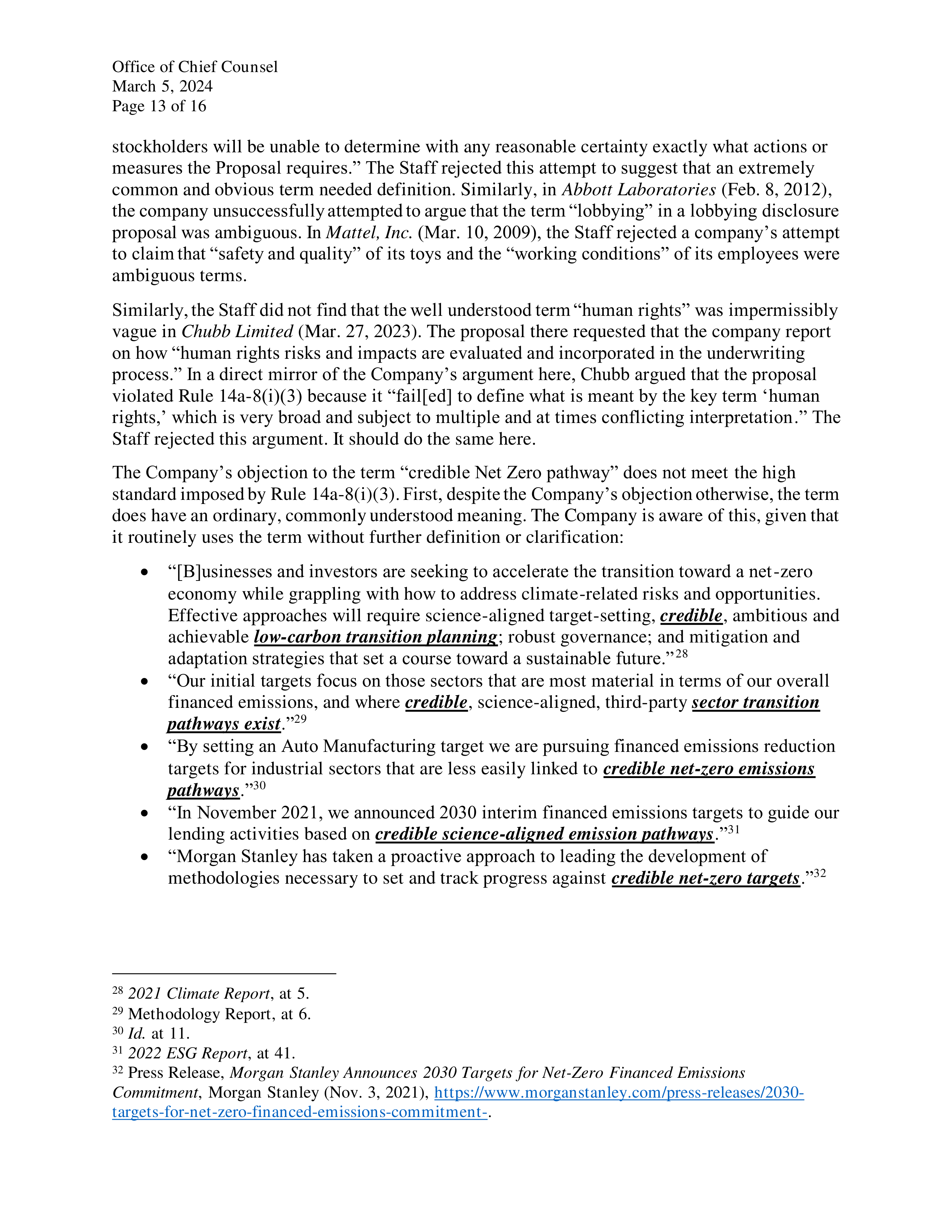
Office of Chief Counsel
March 5, 2024
Page 13 of 16
stockholders will be unable to determine with any reasonable certainty exactly what actions or
measures the Proposal requires.” The Staff rejected this attempt to suggest that an extremely
common and obvious term needed definition. Similarly, in
Abbott Laboratories
(Feb. 8, 2012),
the company unsuccessfully attempted to argue that the term “lobbying” in a lobbying disclosure
proposal was ambiguous. In
Mattel, Inc.
(Mar. 10, 2009), the Staff rejected a company’s attempt
to claim that “safety and quality” of its toys and the “working conditions” of its employees were
ambiguous terms.
Similarly, the Staff did not find that the well understood term “human rights” was impermissibly
vague in
Chubb Limited
(Mar. 27, 2023). The proposal there requested that the company report
on how “human rights risks and impacts are evaluated and incorporated in the underwriting
process.” In a direct mirror of the Company’s argument here, Chubb argued that the proposal
violated Rule 14a-8(i)(3) because it “fail[ed] to define what is meant by the key term ‘human
rights,’ which is very broad and subject to multiple and at times conflicting interpretation.” The
Staff rejected this argument. It should do the same here.
The Company’s objection to the term “credible Net Zero pathway” does not meet the high
standard imposed by Rule 14a-8(i)(3). First, despite the Company’s objection otherwise, the term
does have an ordinary, commonly understood meaning. The Company is aware of this, given that
it routinely uses the term without further definition or clarification:
•
“[B]usinesses and investors are seeking to accelerate the transition toward a net-zero
economy while grappling with how to address climate-related risks and opportunities.
Effective approaches will require science-aligned target-setting,
credible
, ambitious and
achievable
low-carbon transition planning
; robust governance; and mitigation and
adaptation strategies that set a course toward a sustainable future.”
28
•
“Our initial targets focus on those sectors that are most material in terms of our overall
financed emissions, and where
credible
, science-aligned, third-party
sector transition
pathways exist
.”
29
•
“By setting an Auto Manufacturing target we are pursuing financed emissions reduction
targets for industrial sectors that are less easily linked to
credible net-zero emissions
pathways
.”
30
•
“In November 2021, we announced 2030 interim financed emissions targets to guide our
lending activities based on
credible science-aligned emission pathways
.”
31
•
“Morgan Stanley has taken a proactive approach to leading the development of
methodologies necessary to set and track progress against
credible net-zero targets
.”
32
28
2021 Climate Report
, at 5.
29
Methodology Report, at 6.
30
Id.
at 11.
31
2022 ESG Report
, at 41.
32
Press Release,
Morgan Stanley Announces 2030 Targets for Net-Zero Financed Emissions
Commitment
, Morgan Stanley (Nov. 3, 2021),
https://www.morganstanley.com/press-releases/2030-
targets-for-net-zero-financed-emissions-commitment-
.
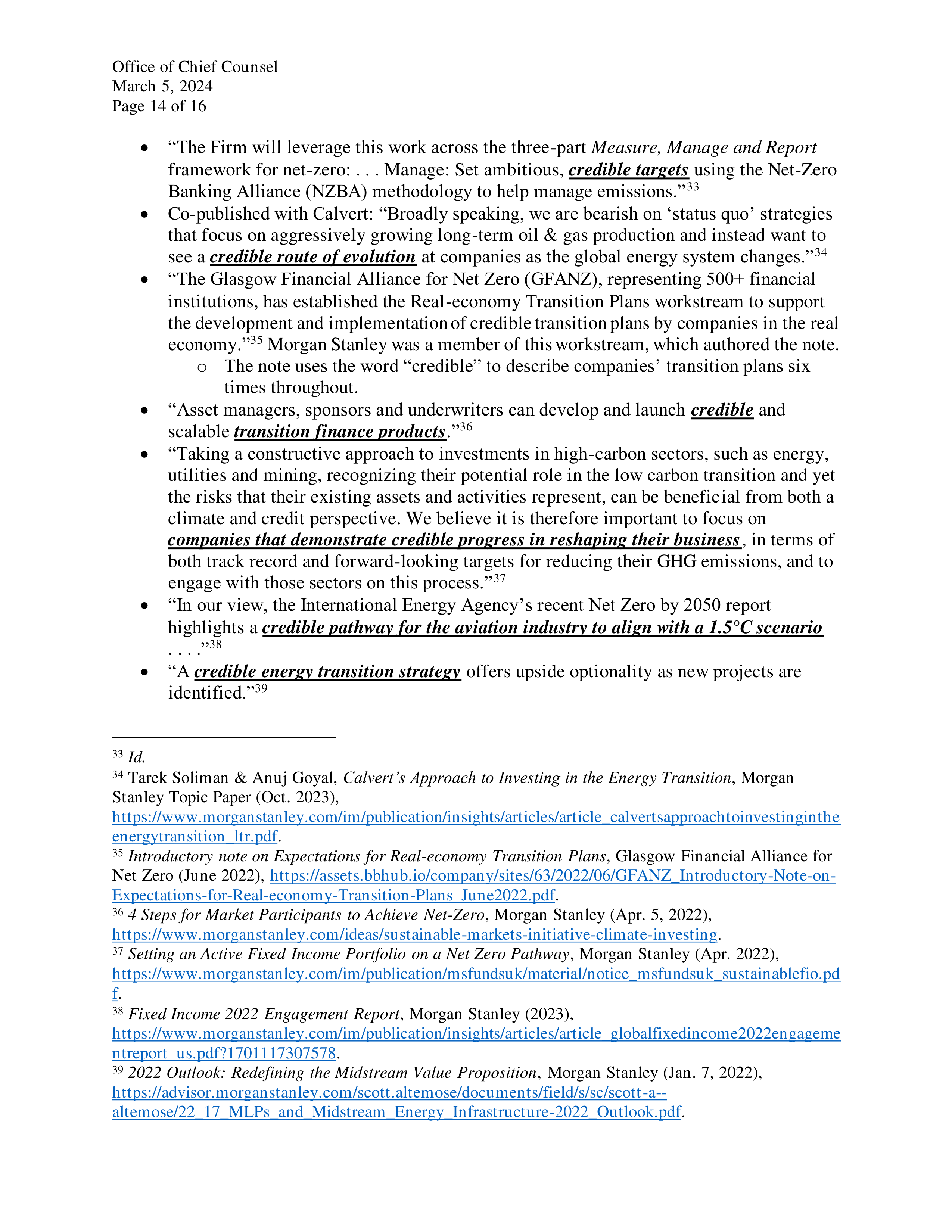
Office of Chief Counsel
March 5, 2024
Page 14 of 16
•
“The Firm will leverage this work across the three-part
Measure, Manage and Report
framework for net-zero: . . . Manage: Set ambitious,
credible targets
using the Net-Zero
Banking Alliance (NZBA) methodology to help manage emissions.”
33
•
Co-published with Calvert: “Broadly speaking, we are bearish on ‘status quo’ strategies
that focus on aggressively growing long-term oil & gas production and instead want to
see a
credible route of evolution
at companies as the global energy system changes.”
34
•
“The Glasgow Financial Alliance for Net Zero (GFANZ), representing 500+ financial
institutions, has established the Real-economy Transition Plans workstream to support
the development and implementation of credible transition plans by companies in the real
economy.”
35
Morgan Stanley was a member of this workstream, which authored the note.
o
The note uses the word “credible” to describe companies’ transition plans six
times throughout.
•
“Asset managers, sponsors and underwriters can develop and launch
credible
and
scalable
transition finance products
.”
36
•
“Taking a constructive approach to investments in high-carbon sectors, such as energy,
utilities and mining, recognizing their potential role in the low carbon transition and yet
the risks that their existing assets and activities represent, can be beneficial from both a
climate and credit perspective. We believe it is therefore important to focus on
companies that demonstrate credible progress in reshaping their business
, in terms of
both track record and forward-looking targets for reducing their GHG emissions, and to
engage with those sectors on this process.”
37
•
“In our view, the International Energy Agency’s recent Net Zero by 2050 report
highlights a
credible pathway for the aviation industry to align with a 1.5°C scenario
. . . .”
38
•
“A
credible energy transition strategy
offers upside optionality as new projects are
identified.”
39
33
Id.
34
Tarek Soliman & Anuj Goyal,
Calvert’s Approach to Investing in the Energy Transition
, Morgan
Stanley Topic Paper (Oct. 2023),
https://www.morganstanley.com/im/publication/insights/articles/article_calvertsapproachtoinvestinginthe
energytransition_ltr.pdf
.
35
Introductory note on Expectations for Real-economy Transition Plans
, Glasgow Financial Alliance for
Net Zero (June 2022),
https://assets.bbhub.io/company/sites/63/2022/06/GFANZ_Introductory-Note-on-
Expectations-for-Real-economy-Transition-Plans_June2022.pdf
.
36
4 Steps for Market Participants to Achieve Net-Zero
, Morgan Stanley (Apr. 5, 2022),
https://www.morganstanley.com/ideas/sustainable-markets-initiative-climate-investing
.
37
Setting an Active Fixed Income Portfolio on a Net Zero Pathway
, Morgan Stanley (Apr. 2022),
https://www.morganstanley.com/im/publication/msfundsuk/material/notice_msfundsuk_sustainablefio.pd
f
.
38
Fixed Income 2022 Engagement Report
, Morgan Stanley (2023),
https://www.morganstanley.com/im/publication/insights/articles/article_globalfixedincome2022engageme
ntreport_us.pdf?1701117307578
.
39
2022 Outlook: Redefining the Midstream Value Proposition
, Morgan Stanley (Jan. 7, 2022),
https://advisor.morganstanley.com/scott.altemose/documents/field/s/sc/scott-a--
altemose/22_17_MLPs_and_Midstream_Energy_Infrastructure-2022_Outlook.pdf
.
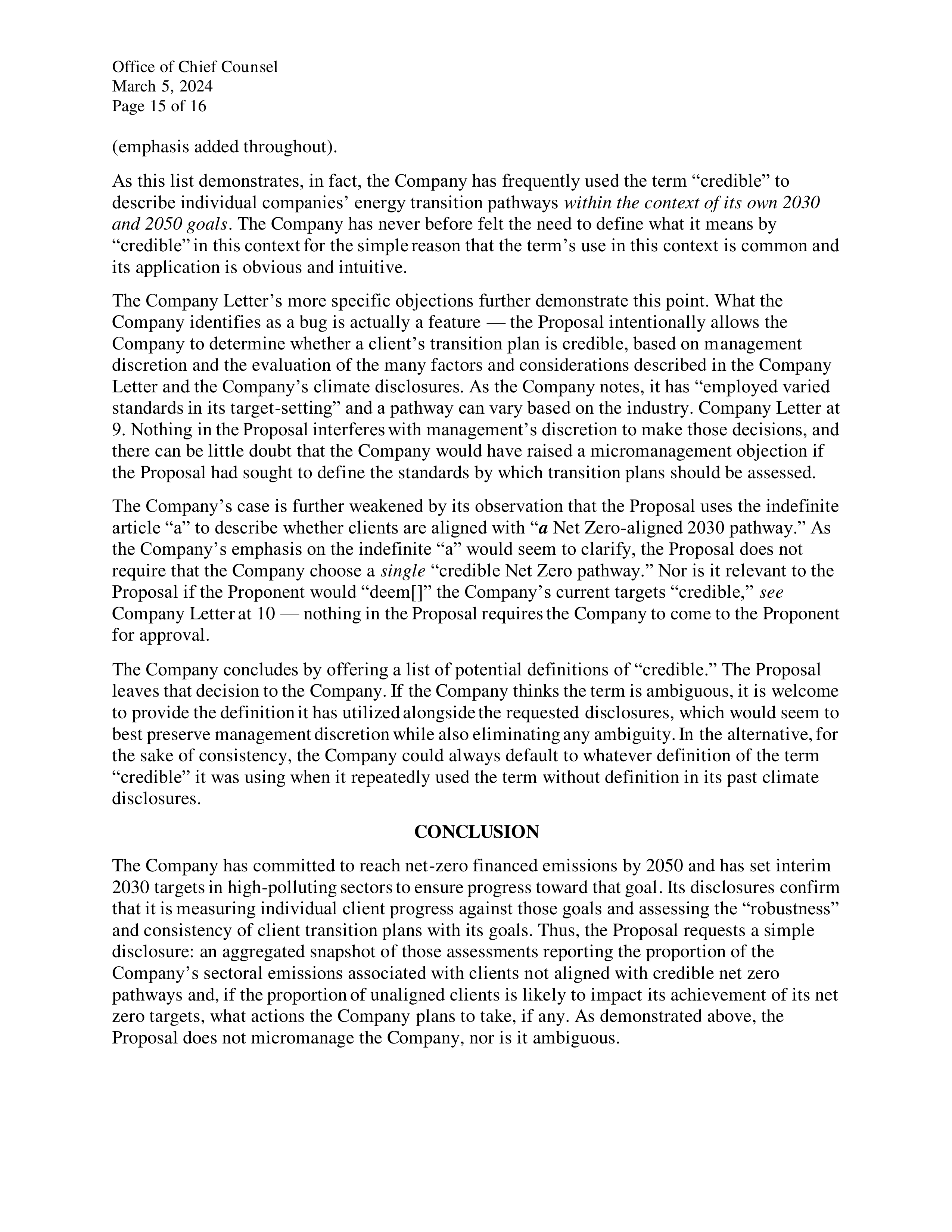
Office of Chief Counsel
March 5, 2024
Page 15 of 16
(emphasis added throughout).
As this list demonstrates, in fact, the Company has frequently used the term “credible” to
describe individual companies’ energy transition pathways
within the context of its own 2030
and 2050 goals
. The Company has never before felt the need to define what it means by
“credible” in this context for the simple reason that the term’s use in this context is common and
its application is obvious and intuitive.
The Company Letter’s more specific objections further demonstrate this point. What the
Company identifies as a bug is actually a feature — the Proposal intentionally allows the
Company to determine whether a client’s transition plan is credible, based on management
discretion and the evaluation of the many factors and considerations described in the Company
Letter and the Company’s climate disclosures. As the Company notes, it has “employed varied
standards in its target-setting” and a pathway can vary based on the industry. Company Letter at
9. Nothing in the Proposal interferes with management’s discretion to make those decisions, and
there can be little doubt that the Company would have raised a micromanagement objection if
the Proposal had sought to define the standards by which transition plans should be assessed.
The Company’s case is further weakened by its observation that the Proposal uses the indefinite
article “a” to describe whether clients are aligned with “
a
Net Zero-aligned 2030 pathway.” As
the Company’s emphasis on the indefinite “a” would seem to clarify, the Proposal does not
require that the Company choose a
single
“credible Net Zero pathway.” Nor is it relevant to the
Proposal if the Proponent would “deem[]” the Company’s current targets “credible,”
see
Company Letter at 10 — nothing in the Proposal requires the Company to come to the Proponent
for approval.
The Company concludes by offering a list of potential definitions of “credible.” The Proposal
leaves that decision to the Company. If the Company thinks the term is ambiguous, it is welcome
to provide the definition it has utilized alongside the requested disclosures, which would seem to
best preserve management discretion while also eliminating any ambiguity. In the alternative, for
the sake of consistency, the Company could always default to whatever definition of the term
“credible” it was using when it repeatedly used the term without definition in its past climate
disclosures.
CONCLUSION
The Company has committed to reach net-zero financed emissions by 2050 and has set interim
2030 targets in high-polluting sectors to ensure progress toward that goal. Its disclosures confirm
that it is measuring individual client progress against those goals and assessing the “robustness”
and consistency of client transition plans with its goals. Thus, the Proposal requests a simple
disclosure: an aggregated snapshot of those assessments reporting the proportion of the
Company’s sectoral emissions associated with clients not aligned with credible net zero
pathways and, if the proportion of unaligned clients is likely to impact its achievement of its net
zero targets, what actions the Company plans to take, if any. As demonstrated above, the
Proposal does not micromanage the Company, nor is it ambiguous.

Office of Chief Counsel
March 5, 2024
Page 16 of 16
Based on the foregoing, we believe that the Company has provided no basis for the conclusion
that the Proposal is excludable from the 2023 proxy statement pursuant to Rule 14a-8. We urge
the Staff to deny the no action request.
Sincerely,
Luke Morgan
Staff Attorney,
As You Sow
cc:
Ning Chiu, Davis Polk & Wardwell LLP
Martin Cohen, Morgan Stanley
March 15, 2024
VIA ONLINE SUBMISSION
Office of Chief Counsel
Division of Corporation Finance
U.S. Securities and Exchange Commission
100 F Street NE
Washington, DC 20549
Email: shareholderproposals@sec.gov
Re:
Supplemental Submission Concerning Shareholder Proposal to Morgan Stanley
Regarding Climate Transition Disclosures on Behalf of Michael Monteiro 2016 Rev
Tr
Ladies and Gentlemen:
Michael Monteiro 2016 Rev Tr (the “Proponent”) has submitted a shareholder proposal (the
“Proposal”) to Morgan Stanley (the “Company”) requesting information concerning its climate
transition planning. The Company has asked the Staff to concur in its exclusion of the proposal
from its proxy materials. The Proponent and Company have each submitted letters to the Staff
concerning the Company’s no-action request. While the Company’s no-action request has been
pending, the Staff has granted the no-action requests of other companies this season who have,
like the Company, argued for the exclusion of substantially similar proposals on
micromanagement grounds.
1
However, in light of the Commission’s subsequently released Final Rule for “The Enhancement
and Standardization of Climate-Related Disclosures for Investors,”
2
the Staff should revisit its
decision to concur in companies’ exclusion of this proposal and reject Morgan Stanley’s no-
action request.
As explained in the Proposal and in Proponent’s no-action response letter, Morgan Stanley has
adopted certain climate goals and commitments, including a commitment to achieve net zero
financed greenhouse gas emissions by 2050. To meet that commitment, the Company has
implemented a transition plan involving sectoral 2030 interim targets. The Proposal requests
basic information concerning the Company’s likelihood of meeting those targets, based on the
Company’s own disclosures that it gathers such data. The requested information seeks a basic
statement of the proportion of financed emissions associated with clients aligned with a 1.5
o
pathway,
i.e.
, based on client transition readiness, is it likely that Morgan Stanley can meet its
2030 goals? The Company has argued that this simple disclosure request constitutes
micromanagement, and the Staff has elsewhere agreed with this argument.
1
See
,
e.g.
,
Bank of America Corp.
(Feb. 29, 2024).
2
See
Final Rule,
The Enhancement and Standardization of Climate-Related Disclosures for Investors
, Securities and
Exchange Commission (Mar. 6, 2024),
https://www.sec.gov/files/rules/final/2024/33-11275.pdf
(hereinafter the
“Climate Disclosure Rule”).
Office of Chief Counsel
March 15, 2024
Page 2 of 4
However, on March 6, 2024, the Commission adopted the Climate Disclosure Rule. That Rule
recognized the necessity of full and complete disclosure by issuers concerning any climate
transition plans they adopt:
As noted in the Proposing Release, registrants may adopt transition plans to
mitigate or adapt to climate-related risks as an important part of their climate-
related risk management strategy, particularly if the registrant has made
commitments, or operates in a jurisdiction that has made commitments, to reduce
its GHG emissions. We recognize that not every registrant has a transition plan and,
as noted above, this rulemaking does not seek to prescribe any particular tools,
strategies, or practices with respect to climate-related risks. If, however, a registrant
has adopted such a plan, information regarding the plan is important to help
investors evaluate a registrant’s management of its identified climate-related risks
and assess the potential impacts of a registrant’s strategy to achieve its short- or
long-term climate-related targets or goals on its business, results of operations,
and/or its financial condition. Moreover, a registrant’s transition plan may have a
significant impact on its overall business strategy, for example, where companies
operate in jurisdictions with laws or regulations in place designed to move them
away from high emissions products and services. Because the steps a registrant
plans to take pursuant to its transition plan may have a material impact on its
business, results of operations, or financial condition, investors have sought more
detailed disclosure about transition plans.
3
As such, the Commission adopted a rule requiring the disclosure of information about issuers’
climate transition plans, specifically noting that “many registrants are not providing decision-
useful information about their transition plans.”
4
Compare with
Proponent’s No-Action
Response Letter at p. 6 (noting necessity of requested information for investors’ decision-
making).
The final rule defines a “transition plan” as “a registrant’s strategy and implementation plan to
reduce climate-related risks, which may include a plan to reduce its GHG emissions in line with
its own commitments.”
5
It then makes, as relevant here, two essential disclosure requirements:
•
First, “[i]f a registrant has adopted a transition plan to manage a material transition risk,
describe the plan.” The registrant must further “update its annual report disclosure about
the transition plan each fiscal year by describing any actions taken during the year under
the plan, including how such actions have impacted the registrant’s business, results of
operations, or financial condition.” And the registrant must include “quantitative and
qualitative disclosure of material expenditures incurred and material impacts on financial
estimates and assumptions as a direct result of the transition plan disclosed.”
6
3
Climate Disclosure Rule at 132 (emphasis added).
4
Id.
at 133 (emphasis added).
5
Id.
at 852.
6
Id.
at 855.
Office of Chief Counsel
March 15, 2024
Page 3 of 4
•
Second, registrants “must disclose any climate-related target or goal if such target or goal
has materially affected or is reasonably likely to materially affect the registrant’s
business, results of operations, or financial condition.” Moreover, critically, the
“registrant
must provide any additional information or explanation necessary to an
understanding of the material impact or reasonably likely material impact of the
target or goal
,” including “but not limited to” (a) “qualitative description of how the
registrant intends to meet its climate-related targets or goals,” (b)
“any progress made
toward meeting the target or goal and how any such progress has been achieved,” to
be updated annually,
including a qualitative discussion of impacts to the registrant’s
business.
7
For the reasons described in Proponent’s No-Action Response Letter, the disclosures sought by
the Proposal fall directly within the scope of the Climate Disclosure Rule. Thus, it is impossible
to argue that the Proposal “micromanages” the Company, either by seeking information that is
“too granular” or, as the Company argued, by limiting the Company’s discretion not to disclose
the requested information. The Climate Disclosure Rule firmly establishes that the information
sought in the Proposal is properly of interest to investors, the information is
less granular
than
much of the information required to be disclosed by the Climate Disclosure Rule, and the
Climate Disclosure Rule puts to rest any argument that the Company has unfettered discretion to
decide the nature of its climate disclosures.
The Company is collecting this data, the data is critical to investor understanding of the
likelihood of success of the Company’s data, and the Company is refusing to disclose this
dispositive information, even in a broad and undifferentiated manner. As the Proponent’s No-
Action Response Letter explained, the information sought in the Proposal is
necessary
for
investors to understand the progress the Company is making towards its overall 2050 Net Zero
financed emissions goal, as well as in the implementation of its 2030 interim target transition
plan. The Company’s current disclosures concede as much by acknowledging that the company
intends to “meet [its] climate commitments . . . by supporting [its] clients in achieving their own
climate-related commitments.”
8
In light of acknowledgment from the Company measuring and assessing client progress is the
core component of its climate strategy, that the purpose of this strategy is “to significantly
mitigate [its] transitional climate risks,”
9
and that it evaluates the potential effects on its 2030 and
2050 targets when considering new business opportunities,
10
there can be no question that its
clients’ transition progress is a material component of the Company’s climate transition planning
and its climate-related goals — and that its transition planning and its climate-related goals are
material to the Company’s business. The Proposal simply asks the Company to disclose
aggregate information about its clients’ transition progress. The information requested by the
7
Id.
at 858 (emphasis added).
8
2022 ESG Report: Diversity & Inclusion, Climate, and Sustainability
at 39, Morgan Stanley (2023),
https://www.morganstanley.com/content/dam/msdotcom/en/assets/pdfs/Morgan_Stanley_2022_ESG_Report.pdf
.
9
2021 Climate Report
at 15, Morgan Stanley (2022),
https://www.morganstanley.com/content/dam/msdotcom/en/assets/pdfs/Morgan_Stanley_2021_Climate_Report.pdf
.
10
2022 ESG Report
at 39 (stating that company “evaluate[s] new lending opportunities through the lens of impact
on progress toward [its] targets, taking into account annual client emissions”).

Office of Chief Counsel
March 15, 2024
Page 4 of 4
Proposal is therefore arguably
required
by the Climate Disclosure Rule, as that Rule is intended,
as the Commission states, to help investors “evaluate a registrant’s management of its identified
climate-related risks and assess the potential impacts of a registrant’s strategy to achieve its
short- or long-term climate-related targets or goals on its business, results of operations, and/or
its financial condition.”
11
Finally, as Proponent noted in its initial response, the information requested by the Proposal,
when compared to the Company’s existing disclosures, is necessary to evaluate the potential
“significant impact” that the Company’s “transition plan may have . . . on its overall business
strategy.”
12
This is true in part because if the Company’s clients’ transition progress is not in-line
with its goals, the Company may need to adopt additional measures to meet its emission
reduction goals. For example, if Morgan Stanley’s clients in a certain sector are not transitioning
at the pace required for the Company to meet its 2030 or 2050 goals, it follows logically that the
Company will have to consider additional actions. The information provided by the Proposal —
which the Company is already collecting — can provide investors with full disclosure as to this
fact.
As such, if there was any question whether the Proposal fell into either the “granularity” or
“company discretion” prongs of the micromanagement standard, the Climate Disclosure Rule
puts it firmly to rest and arguably compels the disclosure of the information requested in the
Proposal.
13
Sincerely,
Luke Morgan
Staff Attorney,
As You Sow
cc:
Ning Chiu, Davis Polk & Wardwell LLP
Martin Cohen, Morgan Stanley
11
See
Climate Disclosure Rule at 132.
12
See id.
13
It goes without saying that agencies are required, first and foremost, to follow their own rules. To contravene the
Commission’s Climate Disclosure Rule therefore would constitute arbitrary and capricious agency action.
See
Achernar Broadcasting Co. v. FCC
, 62 F.3d 1441 (D.C. Cir. 1995) (acknowledging “rudimentary principle that
agencies are bound to adhere to their own rules and procedures”).