

1
October 30, 2020
Via Electronic Mail:
shareholderproposals@sec.gov
U.S. Securities and Exchange Commission
Division of Corporation Finance
Office of Chief Counsel
100 F Street NE
Washington, DC 20549
Re: Tyson Foods Inc. – Shareholder Proposal submitted by The Humane Society of the United
States
Ladies and Gentlemen:
On October 15, 2020, the Humane Society of the United States (the “Proponent”), who is the
beneficial owner of common stock of Tyson Foods, Inc. (“Tyson” or “the Company”), submitted
correspondence in response to Tyson’s letter dated October 1, 2020 ("No-Action Request”), which
expressed the Company’s intent to omit a shareholder proposal (the “Proposal”) on the basis of
Rule 14a-8(i)(4) and Rule 14a-8(i)(7). Proponent is now in receipt of Tyson’s letter dated October
23, 2020 (“Additional Response”) sent to the Securities and Exchange Commission (“SEC”) and
signed by Adam Deckinger. In that letter, the Company reaffirms its position that the Proposal
may be excluded from the Company’s 2021 proxy statement. A copy of this additional reply is
being emailed concurrently to Adam Deckinger.
SUMMARY
Tyson attempts in both its No-Action Request and Additional Response to isolate some personal
interest of Proponent, while ignoring entirely its shareholders’ interests in full and accurate
reporting on material financial matters, particularly where, as here, the Company is claiming
serious financial concerns in one forum while telling shareholders the opposite in another. Tyson’s
conspicuously brief gloss on the Company’s animal welfare policies raised by the Proposal’s
express text and subject matter is equally lacking in substance. Tyson cannot exclude a proposal
by wholesale avoidance of its subject matter that raises specific financial and policy interests that
are shared by shareholders generally.
'tirl~~t
~:12.lt'"'
THE
HUMANE
SOCIETY
""c
"'"'
•
OF
THE
UNITED
STATES
2
PROPONENT’S REPLY TO TYSON’S ADDITIONAL RESPONSE
A.
Rule 14a-8(i)(4)
Tyson’s Additional Response is most notable for what it does not say: that the specific, severe
risks facing the Company, as outlined for a federal court in 2019, would be immaterial to
shareholders. But this is the fundamental question and the Company’s failure to even address it,
now for a second time, highlights that Tyson simply does not have any reasonable answer. The
Company has avoided, rather than carried its burden to show, that the issues raised in the Proposal
are not shared by its shareholders at large. Shareholders at large share an interest in the
severe
harms
Tyson claims to face as well as in truthful and complete disclosures of such harms. In
State
Street Corp
. (Jan. 5, 2007), which the Company cites in its Additional Response, the company’s
no-action letter explains:
In Exchange Act Release 34-20091 (August 16, 1983), the Commission indicated
that the purpose of the Rule was to prevent abuse of the proposal process by
proponents attempting to achieve personal ends
that are not necessarily in the
common interest of the shareholders generally
. (emphasis added).
Similarly, in
International Business Machines Corp.
(Jan. 31, 1995), the only other determination
Tyson cited, explained that:
The Commission long ago established that the purpose of a stockholder proposal
process is “to place stockholders in a position to bring before their fellow
stockholders matters of concern to them as stockholders in such corporation…”
Release 34–3638 (January 3, 1945).
The purpose of Rule 14a–8(c)(4) is to allow
registrants to exclude proposals that involve disputes that are not of interest to
stockholders in general
. (emphasis added).
Accordingly the only way these two determinations could be of any help to Tyson would be for
the Company to establish that the severe harms at issue here—including the possible loss of access
to the single largest market-state in the U.S.—are somehow not of interest to shareholders “in
general.”
Id
. But as noted above, this is a hurdle the Company does not even attempt to clear.
Instead, Tyson simply ignores that the Proposal involves matters of documented and irreconcilably
conflicting sworn statements regarding material financial risks to the Company, as well as risks
resulting from the strength or weakness of the Company’s animal welfare policies. And Tyson’s
silence is hardly surprising given the impossibility of disputing that such matters are “of interest
to all shareholders” and don’t simply benefit or further the interest of Proponent “uniquely.”
See
Consolidated Freightways, Inc
. (February 1, 1996);
Panhandle Eastern Corporation
(January 3,
1996).
Rather than carry its burden of proving the Proposal does not raise matters of interest to all
shareholders, Tyson attempts to evade staff precedent by isolating some perceived, incidental
interest of Proponent in the hope that speaking only to that “unique” interest will override the

3
express subject matter of the Proposal. Tyson’s interpretation of this exclusion is thus incredibly
dangerous and broad-sweeping as it would kill any shareholder proposal no matter how relevant
to shareholders at large solely on the grounds that it relates to some other interest of a proponent.
Additionally, the Proposal does not simply “appear to include a facially neutral resolution,” as
Tyson claims. There is nothing neutral about shareholders’ interest in the Company’s documented,
inconsistent disclosures about the possible loss of all sales of one of the Company’s key products
in the most populous state in the U.S., which is a major market for Tyson and has the world’s fifth-
largest economy.
B.
Rule 14a-8(i)(7)
Tyson again fails to meet its burden of demonstrating that the Proposal does not involve substantial
policy or other considerations. Tyson’s claim that “[t]he Proposal and its supporting statement
say
nothing about
the significant policy issue of the humane treatment of animals,” is patently false.
(emphasis added). Indeed, the Proposal, which Tyson quotes in its entirety in its Additional
Response, begins by explaining that “In 2018, California passed a law (“Proposition 12”) requiring
specific animal welfare standards
for some pork produced or sold statewide.” (emphasis added).
The Proposal is inherently tied to the humane treatment of animals because it requests clarification
on whether the Company will comply or not comply with this
animal welfare
law (i.e., whether
Tyson adopts a strong animal welfare policy or instead abandons a major regional market) and
whether Tyson is going to face material losses related to its decisions and actions with respect to
that
animal welfare
law.
CONCLUSION
The Company has again failed to demonstrate that the Proposal is excludable based on Rule 14a-
8(i)(4) or Rule 14a-8(i)(7). Accordingly, we request that the Staff not concur with the Company’s
No-Action Request. Thank you for your careful consideration of this important Proposal.
Respectfully Submitted,
Mathew Prescott
Senior Director, Food & Agriculture
The Humane Society of the United States
cc:
Adam.Deckinger@tyson.com
Read.Hudson@tyson.com
Phogan@sidley.com
Tyson Foods, Inc.
2200 W. Don Tyson Parkway
Springdale, Arkansas 72762
October 23, 2020
Via Electronic Mail
U.S. Securities and Exchange Commission
Division of Corporation Finance
Office of Chief Counsel
100 F Street NE
Washington, DC 20549
Re:
Tyson Foods, Inc. – Shareholder Proposal submitted by The Humane Society of
the United States
Ladies and Gentlemen:
On October 1, 2020, Tyson Foods, Inc., a Delaware corporation (the “Company”),
submitted a letter (the “Original Company Letter”) to the Securities and Exchange Commission
(the “Commission”) notifying the Commission that the Company intends to omit from its proxy
materials for its 2021 Annual Meeting of Shareholders (the “2021 Annual Meeting”) a
shareholder proposal (the “Proposal”) submitted by The Humane Society of the United States
(the “Proponent”).
On October 15, 2020, the Proponent submitted a response to the Commission regarding
the Original Company Letter (“Proponent Letter”). The Company is submitting this letter to
respond to the Proponent Letter and reaffirm its request for confirmation that the staff of the
Division of Corporation Finance (the “Staff”) will not recommend that enforcement action be
taken by the Commission if the Company excludes the Proposal from its 2021 Annual Meeting
proxy materials for the reasons set forth below, in addition to the reasons set forth in the Original
Company Letter.
Pursuant to Staff Legal Bulletin No. 14D (November 7, 2008), this letter and its exhibits
are being submitted via email to
shareholderproposals@sec.gov
. A copy of this letter and its
exhibits will also be sent to the Proponent.
SUMMARY
The Proposal is clear on its face that the Proponent is seeking to gain advantage in
litigation rather than to address a significant policy issue at the Company. The Proposal devotes
nearly the entirety of its text to an affidavit filed by the Company in litigation in which
Proponent is a party. That affidavit undercuts the Proponent’s legal position in that litigation,
®.
Tyson
2
Tyson Foods, Inc.
2200 W. Don Tyson Parkway
Springdale, Arkansas 72762
and so the Proponent seeks to use the shareholder proposal process as a collateral attack on that
affidavit in an attempt to gain advantage in the litigation. This falls squarely into Rule 14a-
8(i)(4). Further, the Proposal does not raise a significant policy issue and addresses a matter that
involves ordinary course of business decision-making and thus, falls squarely into Rule 14a-
8(i)(7). For these reasons, and as further explained in the Original Company Letter and herein,
the Company may properly exclude the Proposal from the Company’s proxy materials for the
2021 Annual Meeting.
THE PROPOSAL
Risk Disclosure Proposal
In 2018, California passed a law (“Proposition 12”) requiring specific animal
welfare standards for some pork produced or sold statewide.
In 2019, a Tyson Senior Vice President filed a declaration with the United States
District Court for the Central District of California (“the declaration”) testifying
under penalty of perjury that Proposition 12 will “cause severe harm to Tyson” and
“will increase Tyson’s distribution costs,” “add additional cost and complexity, at
every step” and “make Tyson’s processing and distribution operations significantly
more complicated and costly.” Tyson will have to “incur significant costs,”
“implement expensive changes” and “pay higher prices,” the declaration claims,
and Tyson’s ability to recover some of “those increased costs will be highly
constrained.”
The declaration concludes: “Proposition 12 could force Tyson to exit, in whole or
in part, from the California market for whole pork products. In doing so, Tyson
would be harmed by losing millions of dollars in annual sales it makes into
California. The forced exit from a major market such as California further would
harm Tyson’s relationships with its customers for whole pork products. Tyson
depends on brand recognition and consumer goodwill to win and retain customers.
The disappearance of Tyson’s pork products from store shelves in California would
harm Tyson’s relationships with its customers . . . [and] Tyson will be forced to
expend many millions of dollars and substantial time and effort ensuring
compliance with Proposition 12 or suffer the harm of being forced out of the
California market.”
However, none of Tyson’s 10-K or 10-Q reports mention Proposition 12, let alone
disclose it as a risk to the company or its shareholders. Similarly, in those reports
and on earnings calls, Tyson states that it has no supply-side issues with supplying
pork to the markets in which it operates. These omissions and affirmative
statements necessarily mean that, in fact, the company does not—despite the
aforementioned declaration—face any material losses attributable to compliance or
noncompliance with Proposition 12. After all, if the company did face the “severe
harm” and losses described in the declaration, shareholders would have been
entitled, under federal securities law, to a full risk disclosure from management.
3
Tyson Foods, Inc.
2200 W. Don Tyson Parkway
Springdale, Arkansas 72762
RESOLVED
: shareholders request that Tyson Foods confirm that the company
faces no material losses from compliance or noncompliance with Proposition 12. If
the company cannot so confirm, then shareholders request a risk analysis of any
decision to comply or not to comply with Proposition 12, including the risks
inherent in the company’s failure to disclose such risks in its 10-K and 10-Q reports.
These disclosures should be made within three months of the 2021 annual meeting,
at reasonable cost, and omit proprietary information.
RESPONSE TO THE PROPONENT LETTER
I.
The Proposal arises from active litigation in which the Proponent is a party. It
may be omitted pursuant to Rule 14a-8(i)(4) because it “is designed to further a
personal interest, which is not shared by the other shareholders at large.”
As explained in the Original Company Letter and as indicated in its supporting statement,
the Proposal stems from a litigation matter pending in the District Court for the Central District
of California. In October 2019, the North American Meat Institute, a trade organization of which
the Company is a member, filed a complaint in the District Court for the Central District of
California against certain California state government officials questioning the constitutionality
of Proposition 12, a California initiative that imposes unprecedented regulations dictating the
conditions of confinement for breeding sows and veal calves (the “Proposition 12 Litigation”).
The Proponent filed a motion to intervene in the Proposition 12 Litigation. The motion was
granted and the Proponent is now a defendant in the Proposition 12 Litigation.
It is plain from the Proposal’s supporting statement that the Proposal is motivated by a
desire to undermine a declaration filed by a Tyson representative in support of the Proposition 12
Litigation plaintiff’s motion for a preliminary injunction (“Tyson Declaration”). The Proponent
Letter reinforces this point. It refers repeatedly to the Tyson Declaration. On p. 5 of the
Proponent Letter, the Proponent writes that “Tyson attempts to deflect attention from the real
issues presented in the Proposal – the ‘severe harm’ Tyson swore to a federal court that it faces
and full and complete risk disclosures.” On p. 6 the Proponent refers to the “problems with the
Company’s own message. See generally, Ex. 2, the Declaration.” Pages 5 and 6 both quote
extensively from the Tyson Declaration.
The Proponent Letter contends that the Proposal’s roots in the Proposition 12 Litigation are
irrelevant because the Proposal relates to a matter—disclosure of risks—in which all
shareholders have an interest. As noted in the Original Company Letter, however, the Staff has
on multiple occasions concurred in the exclusion of proposals that appear to include a facially
neutral resolution, but where the facts demonstrate that the proposal’s true intent was to further a
personal interest or redress a personal claim or grievance. Some examples include: a proposal
that would require the registrant to separate the position of chairman and CEO (
State Street
Corp.
(Jan. 5, 2007) and a proposal that would require the registrant to adopt a written policy
regarding political contributions and furnish a list of any of its political contributions
(
International Business Machines Corp.
(Jan. 31, 1995). Even if Proponent’s premise that the
Proposal is of interest to shareholders at large is accepted, a premise with which the Company
does not agree, that is not enough to overcome Proponent’s personal grievance in connection

4
Tyson Foods, Inc.
2200 W. Don Tyson Parkway
Springdale, Arkansas 72762
with the Proposition 12 Litigation and the Tyson Declaration that it is attempting to address
through the Proposal. The shareholders at large simply do not share Proponent’s personal
interest in the Proposition 12 Litigation.
II.
The Proposal Letter does not raise a significant social policy issue.
In its response to the Company’s argument under Rule 14a-8(i)(7), the Proponent argues
that the Proposal addresses a significant social policy issue and thus may not be excluded as
pertaining to “ordinary business operations.” In making this point, however, the Proponent
morphs the Proposal into something it is not. The Proposal and its supporting statement say
nothing about the significant policy issue of the humane treatment of animals. They are focused
entirely on the Tyson Declaration, compliance with draft regulations, and disclosures in the
Company’s annual and quarterly filings. Nowhere in the Proposal or supporting statement is the
issue of animal welfare discussed. The Proponent Letter cites no-action letters in which the
proposal at issue dealt directly with animal welfare issues (e.g., the use of “cage-free” eggs;
development of humane farming techniques). Those proposals are clearly distinguishable from a
proposal focused on matters of compliance and disclosure decision-making—core
responsibilities of management and fundamental to management’s ability to run the Company on
a day-to-day basis that should not be made subject to stockholder oversight.
CONCLUSION
Based upon the foregoing analysis and the arguments set forth in the Original Company
Letter, we again respectfully request that the Staff concur that it will take no action if the
Company excludes the Proposal from its 2021 Annual Meeting proxy materials.
We would be happy to provide you with any additional information and answer any
questions that you might have regarding this subject. If we can be of any further assistance on
this matter, please do not hesitate to call me at 479-200-4067 or email me at
Adam.Deckinger@tyson.com.
Sincerely,
Adam Deckinger
Vice President and
Associate General Counsel
cc:
Matthew Prescott, The Humane Society of the United States
(mprescott@humanesociety.org)
John P. Kelsh, Partner, Sidley Austin LLP
(jkelsh@sidley.com)

1
October 15, 2020
Via Electronic Mail:
shareholderproposals@sec.gov
U.S. Securities and Exchange Commission
Division of Corporation Finance
Office of Chief Counsel
100 F Street NE
Washington, DC 20549
Re: Tyson Foods Inc. – Shareholder Proposal submitted by The Humane Society of the United
States
Ladies and Gentlemen:
I am writing on behalf of the Humane Society of the United States (the “Proponent”), who is the
beneficial owner of common stock of Tyson Foods, Inc. (“Tyson” or “the Company”) and who
has submitted a shareholder proposal (the “Proposal”) to the Company. I am in receipt of Tyson’s
letter dated October 1, 2020 ("No-Action Request”) sent to the Securities and Exchange
Commission (“SEC”) and signed by Adam Deckinger. In that letter, the Company contends that
the Proposal may be excluded from the Company’s 2021 proxy statement. A copy of this reply is
being emailed concurrently to Adam Deckinger.
SUMMARY
The Proponent submitted the Proposal to Tyson requesting the following:
“
RESOLVED
: shareholders request that Tyson Foods confirm that the company faces
no material losses from compliance or noncompliance with Proposition 12. If the
company cannot so confirm, then shareholders request a risk analysis of any decision
to comply or not to comply with Proposition 12, including the risks inherent in the
company’s failure to disclose such risks in its 10-K and 10-Q reports. These disclosures
should be made within three months of the 2021 annual meeting, at reasonable cost,
and omit proprietary information.”
The full Proposal is attached as Exhibit 1.
Tyson’s No-Action Request asserts that the Proposal is excludable pursuant to Rule 14a-8(i)(4)
“because the Proposal relates to the redress of a personal claim or grievance against the Company
and is meant to further a personal interest which is not shared by other shareholders at large” and
Rule 14a-8(i)(7) “because the Proposal deals with a matter relating to the Company’s ordinary
'tirl~~t
~:12.lt'"'
THE
HUMANE
SOCIETY
""c
"'"'
•
OF
THE
UNITED
STATES
2
business operations.” Tyson argues in support of its Rule 14a-8(i)(4) position that the Proponent
is trying to further a personal interest related to a lawsuit both Tyson and the Proponent are
involved in, but Tyson is
not
a party to, (the “Proposition 12 Litigation”)
1
regarding an animal
welfare law (“Proposition 12”).
2
Tyson further argues that the Proposal is excludable under Rule
14a-8(i)(7) because it seeks to micromanage the Company’s legal compliance and seeks to have
the Company disclose its decision-making process regarding such matters. Below, we demonstrate
that none of these arguments comport with U.S. securities regulations allowing companies to
exclude shareholder proposals from their proxies, and that Tyson’s arguments grossly
mischaracterize the Proposal and its intent.
First, for context: In 2018, Proposition 12 passed in California requiring certain animal welfare
standards for some pork products sold in the state. Then in 2019, in sworn testimony (the
“Declaration”)
3
a Senior Vice President at Tyson’s wholly owned subsidiary, Tyson Fresh Meats,
Inc., attested to “severe harm” and specific risks faced by Tyson as a result of that law, including
the possibility of Tyson having to exit the California pork market in the near future. But Tyson
never alerted shareholders to those risks and, in fact, made affirmative statements to shareholders
that contradicted the content of the Declaration. Thus, there is an inconsistency in Tyson’s
statements regarding Proposition 12 and the risks that it may or may not present to the Company
and its shareholders; it is that inconsistency which the Proposal seeks to clarify.
Against that backdrop, and contrary to Tyson’s mischaracterizations, the Proposal gives Tyson
two distinct options: to either 1) disclose to shareholders the
risks
it claimed to face in the
Declaration, or 2) as an
alternative
to making such a disclosure, confirm that the Company faces
no material losses from compliance or noncompliance with Proposition 12. As explained below,
these risks—those outlined in the Declaration and those inherent in the Company’s failure to
disclose such risks—concern shareholders at large and Tyson’s claims alleging some kind of abuse
of the proxy process to address a personal grievance or further a personal interest are completely
without merit.
For Tyson’s position on Rule 14a-8(i)(4) to prevail, it must take the untenable position that its
shareholders do not share a common interest in the possible loss of all sales of one of its key
products in California (which is the most populous U.S. state, a major market for Tyson, and the
world’s fifth-largest economy), an inability to meet the public policy values expressed by voters
in passing Proposition 12, and in the Company's compliance with financial reporting laws by
making clear and nonconflicting statements about its supply chain. There is no plausible argument
that this can be true, which is why Tyson's No-Action Request ignores these fundamental matters
altogether. Instead, Tyson attempts to attack the messenger to avoid scrutiny of its irreconcilably
conflicting messages about its financial future and operational capabilities.
1
N. Am. Meat Inst. v. Becerra, 420 F. Supp. 3d 1014 (C.D. Cal. 2019) (No. 2:19-cv-08569-CAS
(FFMx)) (affirmed N. Am. Meat Inst. v. Becerra, No. 19-56408 (9th Cir. 2020)) (affirming
district court ruling that plaintiff is not likely to succeed on the merits).
2
Cal. Health & Safety Code §§ 25990, 25991(e).
3
Decl. of Todd Neff (“Declaration”), N. Am. Meat Inst. v. Becerra, 420 F. Supp. 3d 1014 (C.D.
Cal. 2019) (No. 2:19-cv-08569-CAS (FFMx)) (affirmed N. Am. Meat Inst. v. Becerra, No. 19-
56408 (9th Cir. 2020)) (attached as Exhibit 2).
3
Moreover, because the Proposal addresses potentially massive financial harms and the significant
policy issue of animal welfare, it is not excludable under Rule 14a-8(i)(7). The Proposal seeks
information about whether the Company faces risks associated with complying with Proposition
12, a farm animal welfare law, but does not dictate that the Company comply or how it chooses to
disclose such risks. The Proposal avoids dictating outcomes and leaves any decision-making to the
board and management. It is a proposal that does not dictate methods or outcomes, that does not
usurp board or management authority, and that does not micromanage; thus, it is not excludable
on any of the asserted grounds under Rule 14a-8(i)(7). The Proposal also does not relate to ordinary
business matters that are “so fundamental to management’s ability to run a company on a day-to-
day basis that they would not, as a practical matter, be subject to direct shareholder oversight.”
Release No. 34-40018 (May 21, 1998), 63 Fed. Reg. 29107 (1998).
While in this correspondence the Proponent addresses each issue Tyson raises, importantly, Staff
need not review each argument should it concur with Proponent that: (1) the Proposal cannot be
excluded on the basis of Rule 14a-8(i)(4) because it relates to issues and interests commonly shared
by the Company’s shareholders at large, and (2) the Proposal is not excludable under Rule 14a-
8(i)(7) because it concerns an issue of significant public interest that is central to the Company’s
business. The Company does not at all argue that the interests addressed by the Proposal—
significantly likely risks associated with the loss of a substantial market—are not shared commonly
among shareholders. The Company also does not mention the significant public policy issue and
fails to provide an analysis of the issue’s purported lack of significance to the Company even
though the Company bears the burden of demonstrating the Proposal does not involve substantial
policy or other considerations. The Proposal is simply not excludable based on these clear
exceptions to the exclusion rules and the Company’s failures to meet its burdens under these rules
in its No-Action Request.
ANALYSIS
I.
Rule 14a-8(i)(4)
The No-Action Request asserts that the Proposal is excludable on the basis of Rule 14a-8(i)(4) as
relating to a personal grievance and furthering a personal interest that is not commonly shared by
the Company’s shareholders generally.
Notably, Tyson places great emphasis on its assumptive arguments of Proponent’s personal
interest in the Proposal, but is entirely silent on why the Company’s security holders at large would
not be interested in matters addressing the humane treatment of animals or truthfully disclosing
material financial crises relating to its supply chain in a major market. Tyson’s position is doubly
unpersuasive in that, first, the Staff has already determined that the humane treatment of animals—
in this case, as defined by California voters—is a significant
public
policy issue. Second, it hardly
needs explaining that complete and truthful reporting on imminent and material major financial
concerns impacting the Company are both required by law, and of the highest financial stakes to
shareholders making buy/sell decisions based on them.
4
A.
Tyson misrepresents the Proposal’s request and Proponent’s intent.
The Company mischaracterizes the purpose of the Proposal as asking Tyson to redress a personal
grievance that is currently being litigated. First, this argument confuses the issue here, and the
purpose of Rule 14a-8(i)(4), by conflating the concepts of proponent motivation and redress of
personal (i.e., unique) grievances. Proponent motivation that is tied to a personal interest but
nevertheless supports the interests of shareholders at large cannot be a basis for exclusion under
Rule 14a-8(i)(4). Indeed, every shareholder proposal is motivated by a personal interest of the
proponent as any proposal that is germane and possibly beneficial to shareholders at large will, by
extension, also be so for the proponent.
The purpose of the Rule 14a-8(i)(4) exclusion is to protect the shareholder proposal process from
being used to redress personal gripes. See, e.g., Exchange Act Release No. 19135 (Oct. 14, 1982);
Exchange Act Release No. 20091 (Aug. 16, 1983). This is why the emphasis has been placed on
the words "uniquely benefit" when determining applicability of Rule 14a-8(i)(4). See
Rayonier
Inc. (Mar. 11, 2014).
Tyson’s view of Rule 14a-8(i)(4) in its No-Action Request swallows the rule and makes it so that
no public interest group would be able to make a request related to the group’s interests, even if
those are shared by many shareholders. The Company offers no stated limiting principle, and none
is apparent in its rationale. Tyson’s reasoning would virtually eviscerate Rule 14a-8 and ban any
investor who publicly expresses opposition against a harmful company practice from bringing a
shareholder resolution to address that issue and attempt to improve corporate stewardship, whether
it be with regard to the environment, discrimination, human rights, animal welfare or any other
such issue. Here, for instance, the Proponent is a tax-exempt 501(c)(3) nonprofit organization with
a mission to “prevent animal cruelty, exploitation and neglect.”
4
If Tyson’s interpretation of Rule
14a-8(i)(4) is correct, then any proposal aimed at addressing animal cruelty in a company’s
business would be excludable if brought by the Proponent. But this is not the rule, nor has it ever
been. See, e.g., Revlon, Inc
.
(Mar. 18, 2014); Amendments to R. 14a-8 Under the Securities Exch.
Act of 1934 Relating to Proposals by Sec. Holders, Release No. 20091 (S.E.C. Release No. Aug.
16, 1983).
The Proposal addresses a legitimate major risk concerning the Company’s supply chain and market
complexity—a risk outlined by the Company itself in its own Declaration. The Proposal is not
merely phrased in neutral terms that “
might
relate to matters which may be of general interest to
all security holders,” but instead addresses specific risks that
are
of concern to all shareholders.
Exchange Act Release No. 19135 (Oct. 14, 1982) (emphasis added). Tyson’s implied position in
its No-Action Request is that its shareholders at large generally have no interest in disclosure of
the potential loss of the California market for one of its key products, or in Tyson’s irreconcilably
conflicting statements about the stability of its supply chain.
4
Our Mission, HSUS,
https://www.humanesociety.org/our-policies#statement-2
(last visited Oct.
15, 2020).
5
Second, Tyson attempts to deflect attention from the real issues presented in the Proposal—the
“severe harm” Tyson swore to a federal court that it faces and full and complete risk disclosures—
by irrelevantly pointing to Proponent’s defense in a lawsuit. There are situations where the SEC
allows exclusion when the specific issue raised in a proposal is going to be resolved in a lawsuit
and the company is a party to that litigation. See, e.g., Johnson & Johnson (Feb. 14, 2012)
(concurring that there appears to be some basis for excluding the proposal under Rule 14a-8(i)(7)
that “would affect the conduct of ongoing litigation to which the company is a party”) (emphasis
added). This is not the situation here, and Tyson attempts to stretch this litigation rule beyond its
bounds.
The disputes in the Proposition 12 Litigation, and its outcome, simply have nothing to do with the
significant and imminent financial consequences addressed in the shareholder Proposal. This is
readily apparent by considering the substance of what Tyson’s Declaration said in the fall of 2019:
1.
That the Company faces severe and imminent financial harm; and
2.
That Tyson has two potential courses of conduct available to it and both of them lead
directly to severe financial harm.
If the Company made such statements without any connection to litigation, those statements would
obviously be highly material to shareholders and thus the Company would be obligated to fully
and accurately disclose their substance. The fact that the statements were made in a declaration
does not make any difference, and Tyson notably points to zero authority to the contrary. Indeed,
if anything, it makes the substance even more material to shareholders as presumably the Company
takes care not to mislead or lie when its executives face criminal perjury penalties.
As a shareholder that has a stake in the Company along with other shareholders, the Proponent is
concerned there is a purportedly major and unavoidable risk to the share price and that the
Company is withholding material information about it from shareholders. These issues relate to
Tyson’s SEC filings and other investor communications, none of which are part of the Proposition
12 Litigation. Indeed, the Proposition 12 Litigation involves a challenge, not by Tyson but of an
industry trade group, to the constitutionality of Proposition 12—an issue that cannot be redressed
through this proxy process. Similarly, the Proposition 12 Litigation cannot resolve the matter at
issue in this proxy process—whether the statements of risk made in the Declaration should have
been separately disclosed to shareholders in securities filings, and if those statements of risk are
inconsistent with any disclosures that were made to shareholders whether the Company should
address the inconsistencies with shareholders. Tyson is free to reserve for the court its position on
the constitutional issues but may not conceal from shareholders its position on material financial
contingencies that must be disclosed by law. As such, the Proposal cannot be construed as trying
to redress personal grievances not shared by other shareholders.
Another important distinction of this Proposal from those in the determinations Tyson cites, is that
the Proposal does not ask for affirmative policies that would benefit the Proponent. Instead, all
the Proposal asks is for disclosure of a risk analysis or confirmation that there is no risk. Tyson
should not be able to avoid scrutiny or its obligation to disclose risks because the Company has
6
filed a statement in support of third-party plaintiffs in a lawsuit to which it is not a party. Tyson
cites nothing to the contrary.
In its No-Action Request, Tyson is simply trying to attack the messenger for problems with the
Company’s own message. See generally, Ex. 2, the Declaration. But all shareholders deserve full
and complete information related to the material risks outlined in the Declaration, which raises
legitimate and identifiable concerns shared by shareholders at large.
B.
The Proposal relates to interests shared by shareholders at large.
The statements made in the Declaration assert “severe harm” to the Company caused by
Proposition 12. As noted as background in the Proposal, the Company’s representative testified
that Proposition 12 will “cause severe harm to Tyson” and “will increase Tyson’s distribution
costs,” “add additional cost and complexity, at every step of the processing and distribution
process,” and “make Tyson’s processing and distribution operations significantly more
complicated and costly.”
5
The Declaration further claims that “Proposition 12 could force Tyson
to exit, in whole or in part, from the California market for whole pork products. In doing so, Tyson
would be harmed by losing millions of dollars in annual sales it makes into California.”
6
Tyson’s
exit of the California market is significantly likely because, as stated in the Declaration, “[e]fforts
to come into compliance must begin immediately, and it is not clear that Tyson will be able to
meet all of Proposition 12’s requirements in time [before January 1, 2022].”
7
These statements conflict with statements made by Tyson elsewhere and do not comport with the
lack of reference to these harms in the Company’s SEC filings and other communications with
investors. Shareholders have a right to be informed of the risks alleged in the Declaration, if there
are indeed such risks, including the risks inherent in the Company’s failure to disclose such risks
in its 10-K and 10-Q reports. See SEC v. Savoy Indus., Inc., 587 F.2d 1149, 1165 (D.C. Cir. 1978)
(“The reporting provisions of the Exchange Act are clear and unequivocal, and they are satisfied
only by the filing of complete, accurate, and timely reports.”).
Whether Tyson's animal welfare policies meet the expectations of California consumers or whether
the Company will have to pull out of the market altogether is a concern shared by all the Company's
stakeholders. Indeed, Green Century Capital Management, Inc. (“Green Century”), a leader in the
environmentally and socially responsible investing field for more than 25 years and with over $800
million assets under management, recently submitted a complaint to the SEC raising concerns
about Tyson’s apparent violations of securities laws (the “Complaint” attached as Exhibit 3)
alleging Tyson has mispresented risks to its supply chain and materially omitted the disclosure of
risks related to Proposition 12—risks the Proposal requests the Company disclose. As evidenced
by the Complaint, issues of the purported risks associated with compliance or noncompliance of
Proposition 12 are material to other investors—not just the Proponent.
5
Declaration ¶¶ 4, 9, 10.
6
Id. ¶¶ 12, 13.
7
Id. ¶ 8.
7
Likewise, a near identical shareholder resolution was submitted to a Tyson competitor, Hormel
Foods, Corp. (“Hormel”). Hormel also submitted a declaration outlining harms it faces due to
Proposition 12. Hormel significantly implemented the resolution, and the proposal was
subsequently withdrawn. In implementing the resolution, Hormel published a statement noting it
“is preparing to fully comply when [Proposition 12] goes into effect” and “has confirmed that it
faces no risk of material losses from compliance with Proposition 12.”
8
In its release, Hormel also
acknowledges “that California voters feel strongly about this issue.” This communication from
Tyson’s competitor clearly exemplifies that company compliance with Proposition 12 is of
concern to many shareholders.
Similarly, the state of Tyson’s supply chain is of material concern to shareholders. See Ret. Bd. of
Policemen’s Annuity & Benefit Fund of Chicago on Behalf of Policemen’s Annuity & Benefit
Fund of Chicago v. FXCM Inc., 333 F. Supp. 3d 338, 347 (S.D.N.Y. 2018) (defining materiality
as “a substantial likelihood that a reasonable shareholder would consider it important”) (citation
and internal quotation marks omitted). Indeed, Tyson repeatedly makes statements to investors
assuring them of a favorable supply chain yet makes no mention that it faces an imminent and
serious supply problem in the California market. See Complaint, Ex. 3 at 3-4. The loss of the
California pork market, which is roughly 13% of the U.S. market, is a likely possibility according
to the Declaration. Indeed, the Company claimed that even if it wanted to comply and endeavored
to do so it may fail and thus lose access to the entire California market. See Declaration ¶ 8. The
knowledge that the Company may inevitably lose such a sizable market share for one of its key
products in a state that has the fifth largest economy in the world would quite obviously be highly
material to Tyson’s shareholders.
The Company cites four determinations, General Electric Company
(Feb. 28, 2020), State Street
Corp.
(Jan. 5, 2007), MGM Mirage
(Mar. 19, 2001), and International Business Machines Corp
.
(Jan. 31, 1995), none of which is germane to this consideration.
For instance, in General Electric Company, which also cites to these other determinations for
support, a terminated employee had a history of submitting tainted proposals that demonstrated a
clear pattern of abusing the shareholder proposal process to redress his personal grievance, which
involved a personal employment dispute against the company and his former supervisor. Here,
there is no such employment history with the Company, no pattern of submitting tainted proposals,
nor any similar personal interest. The Proposal is further distinguishable from the ones addressed
in these determinations, in that the Proposal is not one that simply “
might
relate to matters which
may be of general interest to all security holders.” Exchange Act Release No. 19135 (Oct. 14,
1982) (emphasis added). On the contrary, the fact that the Company believes it may imminently
no longer be able to sell one of its primary products in the single largest U.S. marketplace for that
product rises above the level of a concern that
might
or
may be
of general interest to security
holders; any reasonable security holder clearly has an interest in this matter.
8
Hormel Foods Company Information about California Proposition 12, Hormel,
https://www.hormelfoods.com/newsroom/company-news/hormel-foods-company-information-
about-california-proposition-12/
(last visited Oct. 15, 2020) (attached as Exhibit 4).
8
Tellingly, in its 2019 10-K, Tyson addressed potential threats related to Brexit and potential
disruption in the UK market, even when the Company’s UK sales were only 3% of its total
(including products other than pork) international sales, which were only 3% of Tyson’s total
sales.
9
When discussing what “[n]ew or more stringent domestic and international government
regulations could impose material costs on [Tyson] and could adversely affect [its] business,”
Tyson broke from its usual boilerplate language and specifically mentions how the UK’s “potential
exit” from the EU might affect its business.
10
Since this language was not included in prior reports,
including Tyson’s 2018 10-K, it is clear the Company is aware of its duty to update disclosures
when specific changes in law have a substantial likelihood to materially impact it. See Complaint,
Ex. 3 at 4-5. In contrast, Tyson’s representative submitted sworn testimony in federal court
asserting that Proposition 12
will
“cause severe harm to Tyson” (so much so that the harm
described in the Declaration was submitted “in support of the preliminary injunction motion,”
which requires a showing of
immediate injury
and
irreparable harm
such that extraordinary relief
is necessary),
11
yet the Company has never once mentioned these impacts of Proposition 12 in any
of its SEC filings, earnings calls, or shareholder meetings.
Until Tyson confirms that it actually faces no material risks or discloses all material risks to its
supply chain, this discrepancy is a liability for the Company. See Complaint, Ex. 3. Aside from
the policy issue of humane animal treatment here, incomplete or conflicting information about
supply issues in a major domestic market carries high financial stakes for Tyson’s shareholders.
This is also a concern commonly shared by shareholders generally. As such, the Proposal may not
be excluded on the basis of Rule 14a-8(i)(4).
II.
Rule 14a-8(i)(7)
The Proposal cannot be excluded under Rule 14a-8(i)(7) because it addresses a significant policy
issue that Tyson fails even to address in its No-Action Request, let alone carry its burden of proof
on, and it does not relate to “ordinary business practices.”
A.
The Proposal addresses the significant policy issue of humane treatment of animals,
which is fundamental to the Company’s business.
The Proposal raises the significant social policy issue of humane treatment of animals, which
relates to the central business of the Company, and therefore the Proposal may not be excluded
9
Tyson Food Facts, Tyson,
https://ir.tyson.com/about-tyson/facts/default.aspx
(last visited Oct.
15, 2020)
.
10
Tyson, Annual Report (Form 10-K) 13 (Nov. 12, 2019) (“Changes in laws or regulations that
impose additional regulatory requirements on us (including the United Kingdom's potential exit
from the European Union) could increase our cost of doing business or restrict our actions,
causing our results of operations to be adversely affected. For example, increased governmental
interest in advertising practices may result in regulations that could require us to change or
restrict our advertising practices.”),
https://s22.q4cdn.com/104708849/files/doc_financials/2019/ar/dcdf2f5b-689d-4520-afd6-
69691cf580de.pdf.
11
Declaration ¶ 1; Winter v. Natural Res. Def. Council, Inc., 555 U.S. 7, 20, 24 (2008).
9
under Rule 14a-8(i)(7) as relating to ordinary day-to-day business that shareholders could not
feasibly vote on. By approving Proposition 12 the California public emphatically expressed its
collective interest in animal welfare policies, as well as food safety and consumer protection issues.
All of these issues are central to Tyson’s particular business model and thus affect the Company’s
financial condition. Tyson acknowledges the significance of animal welfare issues on its website
and admits in its SEC filings that there are significant risks associated with changing laws or
regulations,
12
yet despite advising shareholders that it understood the material importance of these
issues generally, it concealed altogether its purported specific concerns about Proposition 12
compliance. For Tyson, issues of animal welfare transcend ordinary business matters and speak
directly and fundamentally to a public interest that is material to the Company’s business. As Staff
Legal Bulletin 14E makes clear, this is a textbook example of an issue that the Staff would exempt
from Rule 14a-8(i)(7) as a policy issue that transcends day-to-day business matters.
Staff Legal Bulletin 14E confirmed that the Staff, in evaluating whether a proposal is excludable
under Rule 14a-8(i)(7), would consider whether the subject matter giving rise to the Proposal is a
transcendent social policy issue. If so, the Proposal would not be excludable. Staff Legal Bulletin
14H (CH) makes clear that a proposal’s underlying subject matter focus – in this instance, animal
welfare – can supersede the ordinary business exclusion even when a proposal touches upon core
“nitty gritty” business practices—a clarification that is notable even though the Proposal does not
implicate these kind of practices, as explained below in section B:
“[T]he Commission has stated that proposals focusing on a significant policy issue
are not excludable under the ordinary business exception
because
the proposals
would transcend the day-to-day business matters and raise policy issues so
significant that it would be appropriate for a shareholder vote. Thus, a proposal may
transcend a company’s ordinary business operations even if the significant policy
issue relates to the nitty-gritty of its core business. Therefore, proposals that focus
on a significant policy issue transcend a company’s ordinary business operations
and are not excludable under Rule 14a-8(i)(7).”
Staff Legal Bulletin 14H (Oct. 22, 2015) (internal quotations omitted).
Significantly, despite knowing of the heightened expectation to include policy discussions in no-
action requests,
13
Tyson’s No-Action Request does not include a discussion of the Company’s
12
See, e.g., Animal Welfare, Tyson,
https://www.tysonfoods.com/sustainability/animal-welfare
(last visited Oct. 15, 2020); Tyson, Annual Report (Form 10-K) 13 (Nov. 12, 2019),
https://s22.q4cdn.com/104708849/files/doc_financials/2019/ar/dcdf2f5b-689d-4520-afd6-
69691cf580de.pdf
.
13
The omission of any evidence or argument needed to meet its burden of proof is all the more
glaring in light of Tyson’s own counsel’s analysis of the Staff’s guidance encouraging inclusion
of a policy discussion, which they have not done here. See SEC Staff Issues New Guidance on
Excluding Shareholder Proposals Under Exchange Act Rules 14a-8(i)(7) and 14a-8(b), Sidley
(Oct. 18, 2019),
https://www.sidley.com/en/insights/newsupdates/2019/10/sec-staff-issues-new-
guidance-on-excluding-shareholder-proposals
(analysis of Staff Bulletins 14J, 14K, and 14I by
the law firm representing the Company on its No-Action Request) (last visited Oct. 15, 2020).
10
analysis of the policy issue and its purported lack of significance, which according to Staff Legal
Bulletin No. 14I would facilitate the Staff’s review of the request to exclude the Proposal. Staff
Legal Bulletin No. 14I (Nov 1, 2017); see also Staff Legal Bulletin No. 14J (Oct. 23, 2018); Staff
Legal Bulletin No. 14K (Oct. 16, 2019). Since the Proposal raises a policy issue that the Staff in
the past has found to be significant for other companies, under SLB 14I the Staff will look for an
explanation of why the policy issue is not significant for the Company. Thus, Tyson has not met
its burden of demonstrating that it is entitled to exclude the Proposal. See The TJX Companies,
Inc. (Apr. 9, 2020) (noting “[t]he [c]ompany has not provided a board analysis or other analysis
addressing the significance of the [p]roposal to the [c]ompany's business operations. Accordingly,
[Staff] do not believe that the [c]ompany may omit the [p]roposal from its proxy materials in
reliance on rule 14a-8(i)(7)”).
The Staff has long recognized that matters related to policies on animal welfare address a
significant policy issue and, therefore, generally are not excludable under Rule 14a-8(i)(7). See,
e.g., The TJX Companies, Inc. (Apr. 9, 2020) (unable to concur that the proposal is excusable
under rule 14a-8(i)(7) “given that the [p]roposal indicates that the policy issue of the humane
treatment of animals is significant to the [c]ompany”); Revlon, Inc
.
(Mar. 18, 2014) (unable
to concur that the proposal is excusable under rule 14a-8(i)(7) because “the proposal focuses on
the significant policy issue of the humane treatment of animals”); Coach, Inc. (Aug. 19, 2010)
(noting “that although the proposal relates to the acquisition and sale of fur products, it focuses on
the significant policy issue of the humane treatment of animals, and it does not seek to
micromanage the company to such a degree that we believe exclusion of the proposal would be
appropriate”); Bob Evans Farms, Inc. (June 6, 2011) (finding that a proposal to encourage the
board to phase-in the use of “cage-free” eggs so that they represent at least five percent of the
company’s total egg usage “focuses on the significant policy issue of the humane treatment of
animals and does not seek to micromanage the company to such a degree that exclusion of the
proposal would be appropriate”); Denny’s (Mar. 17, 2009) (finding that a proposal requesting the
board to commit to selling at least ten percent cage-free eggs by volume could not be excluded in
reliance on Rule 14a-8(i)(7)); Hormel Foods Corp
.
(Nov. 10, 2005) (unable to concur that a
proposal encouraging the development of more humane farming techniques is excludable under
rule 14a-8(i)(7)).
Proposition 12 involves specific animal welfare issues of significant public concern as shown by
the widespread public debate it received, getting both legislative and press attention. The following
are just a few examples of the public discourse regarding Proposition 12:
•
Proposition
12,
Legislative
Analyst’s
Office
(Nov.
6,
2018),
https://lao.ca.gov/BallotAnalysis/Proposition?number=12&year=2018
(last visited Oct.
15, 2020).
•
2018 VOTER GUIDE:
A look at California's Prop 12: Farm animal confinement initiative,
ABC News (Nov. 7, 2018),
https://abc7news.com/what-props-won-in-california-
proposition-results-2018/4330896/
(last visited Oct. 15, 2020).
•
Tara Duggan, New ballot initiative could increase California farm animal welfare
standards, SF Chronicle (Aug. 29, 2017),
https://www.sfchronicle.com/food/article/New-
ballot-initiative-could-increase-California-12159349.php
(last visited Oct. 15, 2020).
11
•
Charlotte Simmonds, History in the making: California aims for world's highest farm
animal
welfare
law,
The
Guardian
(Jul.
10,
2018),
https://www.theguardian.com/environment/2018/mar/07/history-in-the-making-
california-aims-for-worlds-highest-farm-animal-welfare-law
(last visited Oct. 15, 2020).
•
The Times Editorial Board, Endorsement: Yes on Proposition 12. Let’s get rid of cages for
hens for real, LA Times (Sept. 28, 2018),
https://www.latimes.com/opinion/editorials/la-
ed-proposition12-20180928-story.html
(last visited Oct. 15, 2020).
•
Hilary Hanson, California Votes To Ban Cages For Hens, Give Farm Animals More Room,
Huff Post (Nov. 7, 2018),
https://www.huffpost.com/entry/california-prop-12-farm-
animals-cage-free_n_5be31a73e4b0dbe871a5f5b3
(last visited Oct. 15, 2020).
Staff Legal Bulletin 14E states that a proposal raising a significant policy issue will not be
excludable as long as a sufficient nexus exists between the nature of the proposal and the Company.
See Exchange Act Release No. 40018 (May 21, 1998). In this instance, there is a clear nexus
because Tyson does significant business in California—the state that enacted Proposition 12. The
nexus of the Proposal to the Company is also demonstrated in the Company’s published statements
and policies. The Company says it has built its reputation on being a leader in animal welfare.
Tyson’s Sustainability webpage professes significant commitment to “advance transparency in
animal welfare practices, be a leader in animal experience research and innovation, and ensure the
safety of animals and the people who care for them.”
14
Tyson sees the humane treatment of animals
as an integral part of the mission of the Company.
15
Indeed, Tyson dedicates significant space to
animal welfare in its sustainability reports in which the Company discusses how its mother pigs
are housed—a practice directly regulated by Proposition 12.
16
Tyson writes: “Across the pork
supply chain, good animal welfare is heavily dependent upon the environments in which the
animals are raised. . . As part of the supply chain from which we procure market hogs, 100 percent
are raised in open pen systems, and growers are expected in incorporate best management
practices.”
17
Thus, there is a clear nexus between the Proposal and the Company, and as such the
Proposal is not excludable.
Moreover, a proposal requesting the disclosure of the business risk related to developments in the
political, legislative, regulatory and scientific landscape regarding an issue of significant public
interest is not excludable as relating to “ordinary business practices.” See The Goldman Sachs
Group, Inc. (Feb. 7, 2011). As explained by Staff Legal Bulletin No. 14E (Oct. 27, 2009), a
proposal that requires a risk assessment will not be excludable under Rule 14a-8(i)(7) where its
subject matter transcends the day-to-day business matters of the company or raises policy issues
so significant that it would be appropriate for a shareholder vote. This is the case here—the
Proposal requests the disclosure of a risk analysis, which could simply be a confirmation that the
Company faces no material risks, related to the “severe harms” Tyson has raised, under penalty of
perjury, in its Declaration before a federal court. Other proposals requesting a report detailing the
14
Sustainability, Tyson,
https://www.tysonfoods.com/sustainability
(last visited Oct. 15, 2020).
15
Animal Welfare, Tyson,
https://www.tysonfoods.com/sustainability/animal-welfare
(last
visited Oct. 15, 2020).
16
See 2019 Sustainability Report, Tyson,
https://www.tysonsustainability.com/animal-
welfare/dedicated-network
(click “Swine”) (last visited Oct. 15, 2020).
17
Id.
12
known and potential risks and costs to the company caused by any enacted or proposed state laws
or policies have not been excluded under this rule. See, e.g., Procter & Gamble (Aug. 16, 2016)
(unable to concur that company could exclude proposal requesting a risk analysis of a state policy
supporting discrimination against LGBT people). Similarly, this Proposal requesting risk
disclosure relating to a state law on an issue of public significance should not be excludable under
Rule 14a-8(i)(7).
Furthermore, where a proposal focuses on the differences between a company’s statements and its
practices regarding an issue of significant public concern, the proposal ought not be excluded. See
T. Rowe Price Group, Inc. (March 13, 2020) (Staff was unable to concur that the company may
exclude a proposal under Rule 14a-8(i)(7) as the proposal “is focused on possible differences
between T. Rowe Price Group’s public statements and pledges regarding climate change and the
voting policies and practices of its subsidiaries . . . regarding climate change”). That is again what
we have here—the Proposal requesting a risk analysis, if applicable, arises out of the differences
between the Company’s sworn statements and its animal welfare practices. Again, this means the
Proposal is not excludable on the basis of Rule 14a-8(i)(7).
B.
The Proposal does not seek to micromanage the Company or otherwise relate to
“ordinary business practices.”
The Company again misconstrues the plain language of the Proposal. The No-Action Request
asserts that “[t]he Proposal seeks oversight of judgment of the Company’s compliance with laws
as well as disclosure of the Company’s decision-making process regarding matters of legal
compliance.” But, instead, the Proposal seeks information about whether the Company faces risks
associated with complying with Proposition 12. It does not dictate that the Company comply, nor
does it seek disclosure of the Company’s decision-making process regarding compliance. The
Proposal avoids dictating outcomes and leaves any decision making to the board and management.
A proposal that does not dictate methods or outcomes, that does not usurp board or management
authority, and that does not micromanage is not excludable on any of the asserted grounds under
Rule 14a-8(i)(7).
As recently restated in Johnson & Johnson (Jan. 29, 2020), “[t]he Commission has explained that
“ordinary business matters” for purposes of rule 14a-8(i)(7) are those tasks that are “‘so
fundamental to management’s ability to run a company on a day-to-day basis that they could not,
as a practical matter, be subject to direct shareholder oversight.’” (quoting Release No. 34-40018
(May 21, 1998)). The Proposal simply does not relate to practices that are “so fundamental to
management’s ability to run a company on a day-to-day basis that they would not, as a practical
matter, be subject to direct shareholder oversight.” Id. The Company cites three determinations to
support its argument that a company’s legal compliance program is excludable on the grounds that
compliance with laws and regulations is a matter of ordinary business operations—Corrections
Corporation of America
(Mar. 18, 2013); Halliburton Company
(Mar. 10, 2006); Refac
(Mar. 27,
2002)—but these determinations are distinguishable and this argument is irrelevant. In contrast to
these precedents, the current Proposal does not attempt to prescribe specific actions, but only seeks
reporting and analysis on relevant, highly material issues related to the fact that the company
recently claimed it may very soon forfeit its right to sell pork in the most populous U.S. state. The
Proposal does not request disclosure of the Company’s legal compliance program or to explain
13
how or why it is or is not complying with a law, but instead, simply requests that the Company
either disclose the risks associated with such compliance or noncompliance, or confirm that no
such risks exist.
Tyson advances the untenable proposition that any proposal touching on disclosure obligations is
excludable as involving ordinary business matters, but that is not borne out by the authorities it
cites. In Eli Lily and Co. (Jan. 13, 2017), for example, the request sought 10-K and 10-Q
disclosures that were “additional” (information on all lawsuits) to those already legally required
(information on material litigation). Eli Lilly and Co., No-Action Request (Dec. 16, 2016) at 3
(“The reference to ‘all lawsuits,’ regardless of materiality, underscores the fact that the proposal
relates to ordinary business matters, providing a basis for exclusion.”). But here, the Proponent
only seeks what is already legally required: disclosure of material risks. As such, the Proposal
seeks nothing “additional” beyond what the Company already owes. Accordingly, Eli Lilly and
Co. and similar determinations are of no help to Tyson. Likewise, all of these (post-1999)
determinations apply the standard enunciated in Johnson Controls, Inc. (Oct. 26, 1999), that is,
that shareholder resolutions relating to disclosures, are not automatically excludable, especially
where, as here, an important social issue is implicated. “In Johnson Controls, Inc., the Staff stated
that it will now ‘consider whether the subject matter of the additional disclosure sought in a
particular proposal involves a matter of ordinary business.’” Idacorp, Inc, No-Action Request at 7
(Dec. 12, 2003). In Idacorp. Inc. the Staff were unable to concur in the exclusion of a proposal
under rule 14a-8(i)(7) where the proposal sought disclosures regarding charitable donations. Id.;
see also Bank of Am. Corp. (Feb. 22, 2008) (unable to concur in exclusion of resolution relating
to assessing and managing social and environmental risk in project financing).
Tyson also argues that the Proposal “probe[s] too deeply into matters of a complex nature upon
which shareholders, as a group, are not in a position to make an informed judgment.” Yet, Tyson
has made disclosures of risks related to other regulatory challenges and supply chain issues. As
noted above, in recent SEC reports, Tyson disclosed the risks it faces related to regulatory
uncertainty in the UK because of Brexit. The Company reported these risks to shareholders and
the SEC but has failed to mention far more financially significant risks related to losing the
California market, which according to the Declaration could happen even if the Company makes
efforts to stay in that market. This shows an internal inconsistency, especially since the stakes of
regulatory uncertainty in the UK are purportedly far lower. For instance, the Company never
claims it may not be able to operate in the UK but Tyson does claim it may need to leave
California’s pork market entirely by January 1, 2022. Tyson cannot reasonably claim that these
risks can be hidden from its shareholders because they supposedly are of a more “complex nature”
given that it has disclosed similar risks regarding Brexit where the stakes are purportedly far lower.
In the language of Staff Legal Bulletin 14 K, the present Proposal neither seeks “intricate detail”
nor imposes “a specific strategy, method, action, outcome or timeline for addressing an issue.” It
does not supplant the judgment of management and the board. It does not prescribe “specific
timeframes or methods for implementing complex policies.” It merely seeks disclosure on
significant policy issues that the Company itself has identified as important. As such, the Proposal
should not be excluded as relating to the Company’s “ordinary business operations.”

14
CONCLUSION
The Company has failed to demonstrate that the Proposal is excludable on the basis of Rule 14a-
8(i)(4) or Rule 14a-8(i)(7). Accordingly, we request that the Staff not concur with the Company’s
No-Action Request. Thank you for your careful consideration of this important Proposal.
Respectfully Submitted,
Mathew Prescott
Senior Director, Food & Agriculture
The Humane Society of the United States
cc:
Adam.Deckinger@tyson.com
Read.Hudson@tyson.com
Phogan@sidley.com

EXHIBIT 1


August 14, 2020
Tyson Foods Inc.
ATTN: Corporate Secretary
2200 Don Tyson Parkway
Springdale, AR 72762-6999
Via USPS and email:
amy tu@tyson com
and
kate powell@tyson com
RE: Shareholder proposal for inclusion in the 2021 proxy materials
Dear Ms. Tu,
Enclosed with this letter is a shareholder proposal submitted for inclusion in the proxy statement
for the 2021 annual meeting and a letter from The Humane Society of the United States’ (HSUS)
brokerage firm, BNY Mellon, confirming ownership of Tyson Foods Inc. common stock. The
HSUS has continuously held at least $2,000 in market value of Tyson Foods Inc. common stock
for the one-year period preceding and including the date of this letter and will hold at least this
amount through and including the date of the 2021 shareholder meeting.
Please e-mail me to confirm receipt of this proposal.
And if Tyson will attempt to exclude any portion of this proposal under Rule 14a-8, please
advise me within 14 days. Thank you for your assistance.
Sincerely,
Matthew Prescott
Senior Director of Food and Agriculture
The Humane Society of the United States
240-620-4432
mprescott@humanesociety org
"rl~~f
~~~'t
THE
HUMANE
SOCIETY
~
"'""
•
OF THE
UNITED
STATES

Stacy Stout
BNY Mellon Wealth Management
T 412.236.1775
Vice President
Family Office
stacy.stout@bnymellon.com
Client Service Manager
500 Grant Street, Floor 38
Pittsburgh, PA 15258
August 14, 2020
Amy Tu
EVP & General Counsel
Tyson Foods Inc.
2200 Don Tyson Parkway
Springdale, AR 72762-6999
Dear Ms. Tu,
BNY Mellon National Association, custodian for The Humane Society of the United States,
verifies that The HSUS has continuously held at least $2,000.00 in market value of Tyson Foods
Inc. common stock for the one-year period preceding and including the date of this letter. Thank
you.
Sincerely,
Stacy Stout
Stacy Stout
Vice President, Client Service Manager
BNY Mellon Wealth Management
Family Office Group
500 Grant Street, 38th Floor/Suite 3840/151-3840
Pittsburgh, PA 15258
T (412) 236-1775 | F (866) 230-4247
bnymellonwealth.com
~
..
~
BNY
MELLON
WEALTH MANAGEMENT
Risk Disclosure Proposal
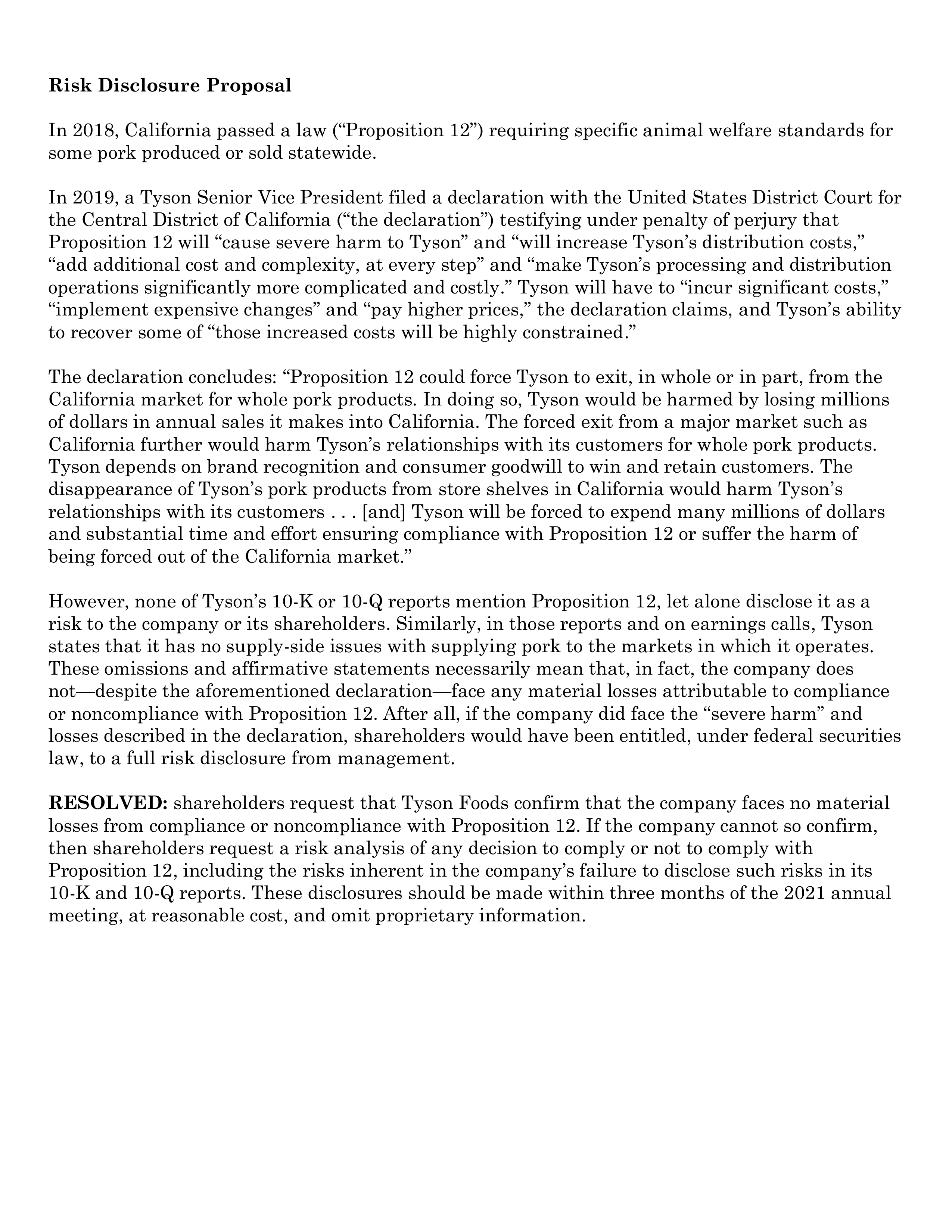
In 2018, California passed a law (“Proposition 12”) requiring specific animal welfare standards for
some pork produced or sold statewide.
In 2019, a Tyson Senior Vice President filed a declaration with the United States District Court for
the Central District of California (“the declaration”) testifying under penalty of perjury that
Proposition 12 will “cause severe harm to Tyson” and “will increase Tyson’s distribution costs,”
“add additional cost and complexity, at every step” and “make Tyson’s processing and distribution
operations significantly more complicated and costly.” Tyson will have to “incur significant costs,”
“implement expensive changes” and “pay higher prices,” the declaration claims, and Tyson’s ability
to recover some of “those increased costs will be highly constrained.”
The declaration concludes: “Proposition 12 could force Tyson to exit, in whole or in part, from the
California market for whole pork products. In doing so, Tyson would be harmed by losing millions
of dollars in annual sales it makes into California. The forced exit from a major market such as
California further would harm Tyson’s relationships with its customers for whole pork products.
Tyson depends on brand recognition and consumer goodwill to win and retain customers. The
disappearance of Tyson’s pork products from store shelves in California would harm Tyson’s
relationships with its customers . . . [and] Tyson will be forced to expend many millions of dollars
and substantial time and effort ensuring compliance with Proposition 12 or suffer the harm of
being forced out of the California market.”
However, none of Tyson’s 10-K or 10-Q reports mention Proposition 12, let alone disclose it as a
risk to the company or its shareholders. Similarly, in those reports and on earnings calls, Tyson
states that it has no supply-side issues with supplying pork to the markets in which it operates.
These omissions and affirmative statements necessarily mean that, in fact, the company does
not—despite the aforementioned declaration—face any material losses attributable to compliance
or noncompliance with Proposition 12. After all, if the company did face the “severe harm” and
losses described in the declaration, shareholders would have been entitled, under federal securities
law, to a full risk disclosure from management.
RESOLVED:
shareholders request that Tyson Foods confirm that the company faces no material
losses from compliance or noncompliance with Proposition 12. If the company cannot so confirm,
then shareholders request a risk analysis of any decision to comply or not to comply with
Proposition 12, including the risks inherent in the company’s failure to disclose such risks in its
10-K and 10-Q reports. These disclosures should be made within three months of the 2021 annual
meeting, at reasonable cost, and omit proprietary information.

EXHIBIT 2
D
ECLARATION OF
T
ODD
N
EFF
1
2
3
4
5
6
7
8
9
10
11
12
13
14
15
16
17
18
19
20
21
22
23
24
25
26
27
28
Paul J. Zidlicky (
pro hac vice
pending)
pzidlicky@sidley.com
Eric D. McArthur (
pro hac vice
pending)
emcarthur@sidley.com
SIDLEY AUSTIN LLP
1501 K Street NW
Washington, DC 20005
Tel: (202) 736-8000
Fax: (202) 736-8711
Sean A. Commons, SBN 217603
scommons@sidley.com
SIDLEY AUSTIN LLP
555 West Fifth Street, Suite 4000
Los Angeles, CA 90013
Tel: (213) 896-6000
Fax: (213) 896-6600
Attorneys for Plaintiff
UNITED STATES DISTRICT COURT
FOR THE CENTRAL DISTRICT OF CALIFORNIA
NORTH AMERICAN MEAT INSTITUTE,
Plaintiff,
v.
XAVIER BECERRA, in his official
capacity as Attorney General of California,
KAREN ROSS, in her official capacity as
Secretary of the California Department of
Food and Agriculture, and SUSAN
FANELLI, in her official capacity as Acting
Director of the California Department of
Public Health,
Defendants.
Case No. 2:19-cv-08569-CAS (FFMx)
DECLARATION OF TODD NEFF
The Honorable Christina A. Snyder
Date:
November 18, 2019
Time:
10:00 a.m.
Location:
Courtroom 8D
Complaint filed: October 4, 2019
[Filed concurrently with Plaintiff’s
Notice of Motion and Motion for
Preliminary Injunction]
Case 2:19-cv-08569-CAS-FFM Document 15-8 Filed 10/04/19 Page 1 of 5 Page ID #:177
2
D
ECLARATION OF
T
ODD
N
EFF
1
2
3
4
5
6
7
8
9
10
11
12
13
14
15
16
17
18
19
20
21
22
23
24
25
26
27
28
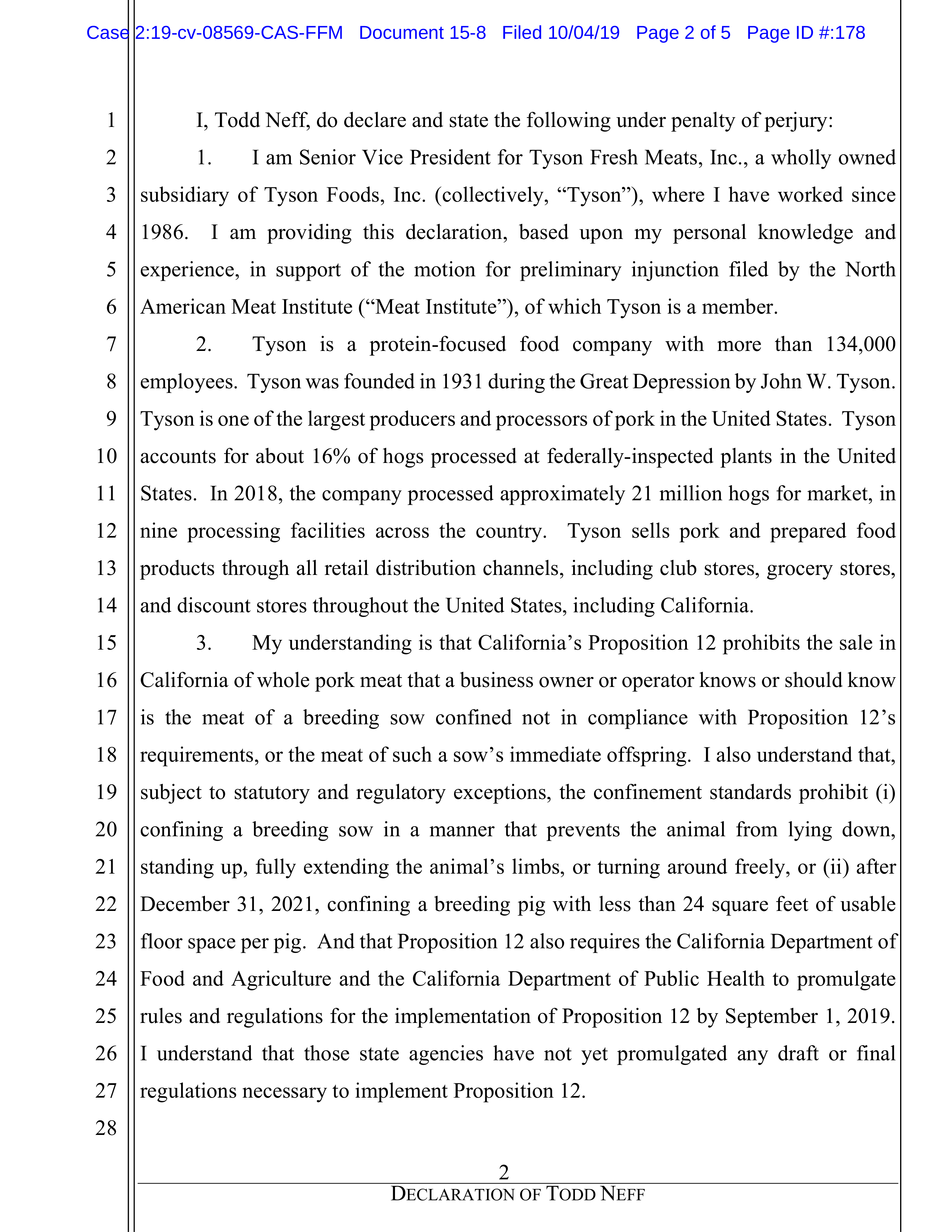
I, Todd Neff, do declare and state the following under penalty of perjury:
1.
I am Senior Vice President for Tyson Fresh Meats, Inc., a wholly owned
subsidiary of Tyson Foods, Inc. (collectively, “Tyson”), where I have worked since
1986. I am providing this declaration, based upon my personal knowledge and
experience, in support of the motion for preliminary injunction filed by the North
American Meat Institute (“Meat Institute”), of which Tyson is a member.
2.
Tyson is a protein-focused food company with more than 134,000
employees. Tyson was founded in 1931 during the Great Depression by John W. Tyson.
Tyson is one of the largest producers and processors of pork in the United States. Tyson
accounts for about 16% of hogs processed at federally-inspected plants in the United
States. In 2018, the company processed approximately 21 million hogs for market, in
nine processing facilities across the country. Tyson sells pork and prepared food
products through all retail distribution channels, including club stores, grocery stores,
and discount stores throughout the United States, including California.
3.
My understanding is that California’s Proposition 12 prohibits the sale in
California of whole pork meat that a business owner or operator knows or should know
is the meat of a breeding sow confined not in compliance with Proposition 12’s
requirements, or the meat of such a sow’s immediate offspring. I also understand that,
subject to statutory and regulatory exceptions, the confinement standards prohibit (i)
confining a breeding sow in a manner that prevents the animal from lying down,
standing up, fully extending the animal’s limbs, or turning around freely, or (ii) after
December 31, 2021, confining a breeding pig with less than 24 square feet of usable
floor space per pig. And that Proposition 12 also requires the California Department of
Food and Agriculture and the California Department of Public Health to promulgate
rules and regulations for the implementation of Proposition 12 by September 1, 2019.
I understand that those state agencies have not yet promulgated any draft or final
regulations necessary to implement Proposition 12.
Case 2:19-cv-08569-CAS-FFM Document 15-8 Filed 10/04/19 Page 2 of 5 Page ID #:178
3
D
ECLARATION OF
T
ODD
N
EFF
1
2
3
4
5
6
7
8
9
10
11
12
13
14
15
16
17
18
19
20
21
22
23
24
25
26
27
28
4.
Proposition 12 will cause severe harm to Tyson. Although 100 percent of
the market hogs that Tyson procures are raised in open pens, not all of the independent
farmers who contract with Tyson house breeding sows in compliance with Proposition
12’s 24-square-feet-per-sow requirement. To come into compliance with Proposition
12, Tyson will have to (i) incur significant costs to ensure an adequate supply of hogs
that are compliant with Proposition 12, and (ii) implement expensive changes to its
distribution system to ensure that only compliant meat is sold in California.
5.
Tyson relies heavily on independent farmers, who raise the hogs that
Tyson processes at its pork plants and provide hogs to meet customer demand for
Tyson’s pork products. The vast majority of these independent farmers do not confine
breeding sows in compliance with Proposition 12’s confinement standards. Under
current practices, after breeding sows are inseminated, they are housed in individual
stalls until pregnancy has been confirmed. Thereafter, some pregnant sows are housed
as part of a group in open pens (“group sow housing”) but a majority remain in
individual gestation crates throughout their pregnancy. The group sow housing systems
provide approximately 16–20 square feet of floor space per sow.
6.
Compliance with Proposition 12 will be extremely burdensome for the
independent farmers who sell their hogs to Tyson. To come into compliance, Tyson’s
contract farmers will have to invest significant capital to reconfigure existing barns or
construct new ones to meet Proposition 12’s confinement standards. Independent
farmers will need to obtain financing to implement these changes. In addition to
refitting costs and ongoing operating expenses, Proposition 12’s square-footage
requirements will lower farm productivity by decreasing the number of sows that can
be kept on a farm. Proposition 12 may also prohibit a settling period for early bred sows
which may result in increased embryonic death loss.
7.
To persuade partner farmers to change their operations, Tyson will have to
pay higher prices for hogs bred in compliance with Proposition 12. Tyson’s ability to
recover those increased costs will be highly constrained by the basic economics of pork
Case 2:19-cv-08569-CAS-FFM Document 15-8 Filed 10/04/19 Page 3 of 5 Page ID #:179
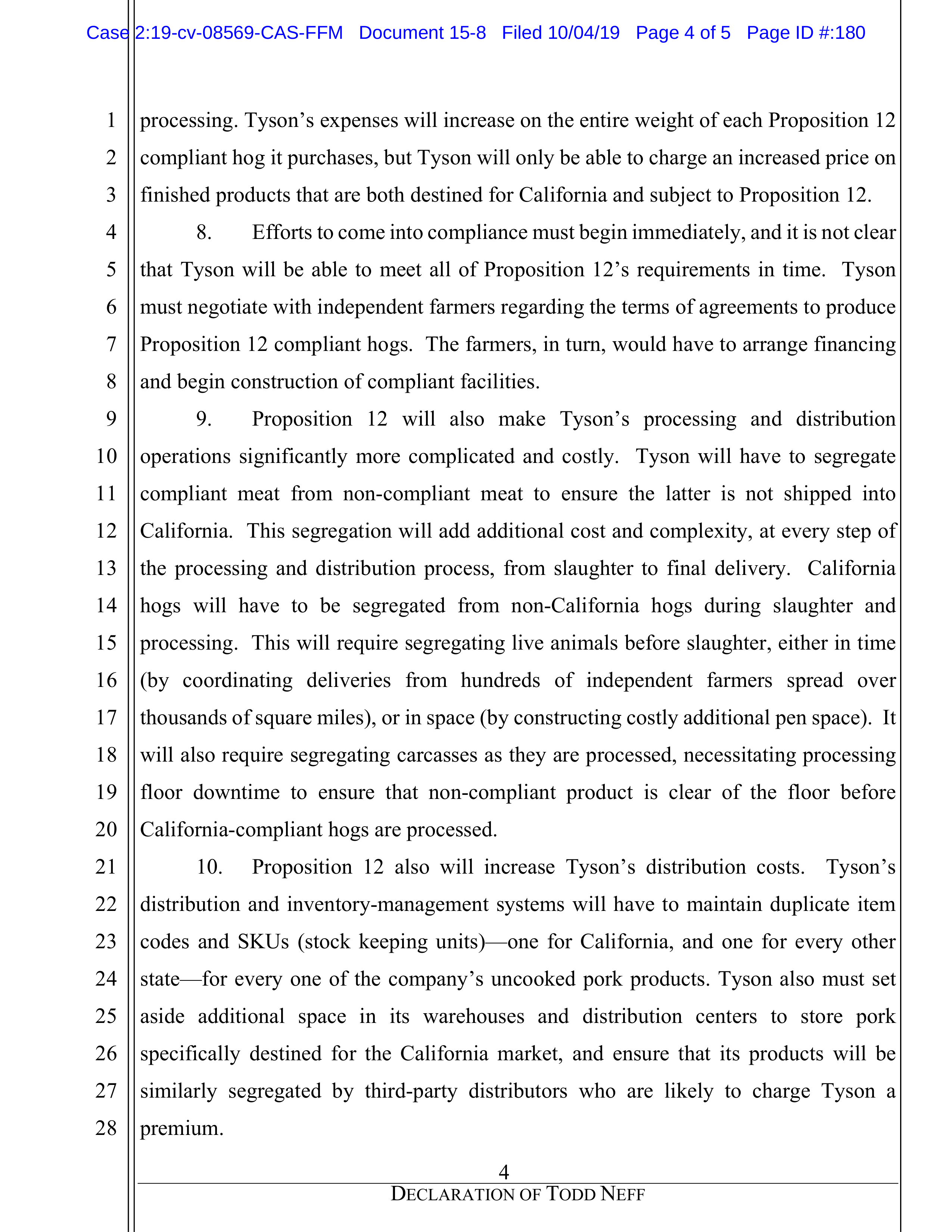
4
D
ECLARATION OF
T
ODD
N
EFF
1
2
3
4
5
6
7
8
9
10
11
12
13
14
15
16
17
18
19
20
21
22
23
24
25
26
27
28
processing. Tyson’s expenses will increase on the entire weight of each Proposition 12
compliant hog it purchases, but Tyson will only be able to charge an increased price on
finished products that are both destined for California and subject to Proposition 12.
8.
Efforts to come into compliance must begin immediately, and it is not clear
that Tyson will be able to meet all of Proposition 12’s requirements in time. Tyson
must negotiate with independent farmers regarding the terms of agreements to produce
Proposition 12 compliant hogs. The farmers, in turn, would have to arrange financing
and begin construction of compliant facilities.
9.
Proposition 12 will also make Tyson’s processing and distribution
operations significantly more complicated and costly. Tyson will have to segregate
compliant meat from non-compliant meat to ensure the latter is not shipped into
California. This segregation will add additional cost and complexity, at every step of
the processing and distribution process, from slaughter to final delivery. California
hogs will have to be segregated from non-California hogs during slaughter and
processing. This will require segregating live animals before slaughter, either in time
(by coordinating deliveries from hundreds of independent farmers spread over
thousands of square miles), or in space (by constructing costly additional pen space). It
will also require segregating carcasses as they are processed, necessitating processing
floor downtime to ensure that non-compliant product is clear of the floor before
California-compliant hogs are processed.
10.
Proposition 12 also will increase Tyson’s distribution costs. Tyson’s
distribution and inventory-management systems will have to maintain duplicate item
codes and SKUs (stock keeping units)—one for California, and one for every other
state—for every one of the company’s uncooked pork products. Tyson also must set
aside additional space in its warehouses and distribution centers to store pork
specifically destined for the California market, and ensure that its products will be
similarly segregated by third-party distributors who are likely to charge Tyson a
premium.
Case 2:19-cv-08569-CAS-FFM Document 15-8 Filed 10/04/19 Page 4 of 5 Page ID #:180
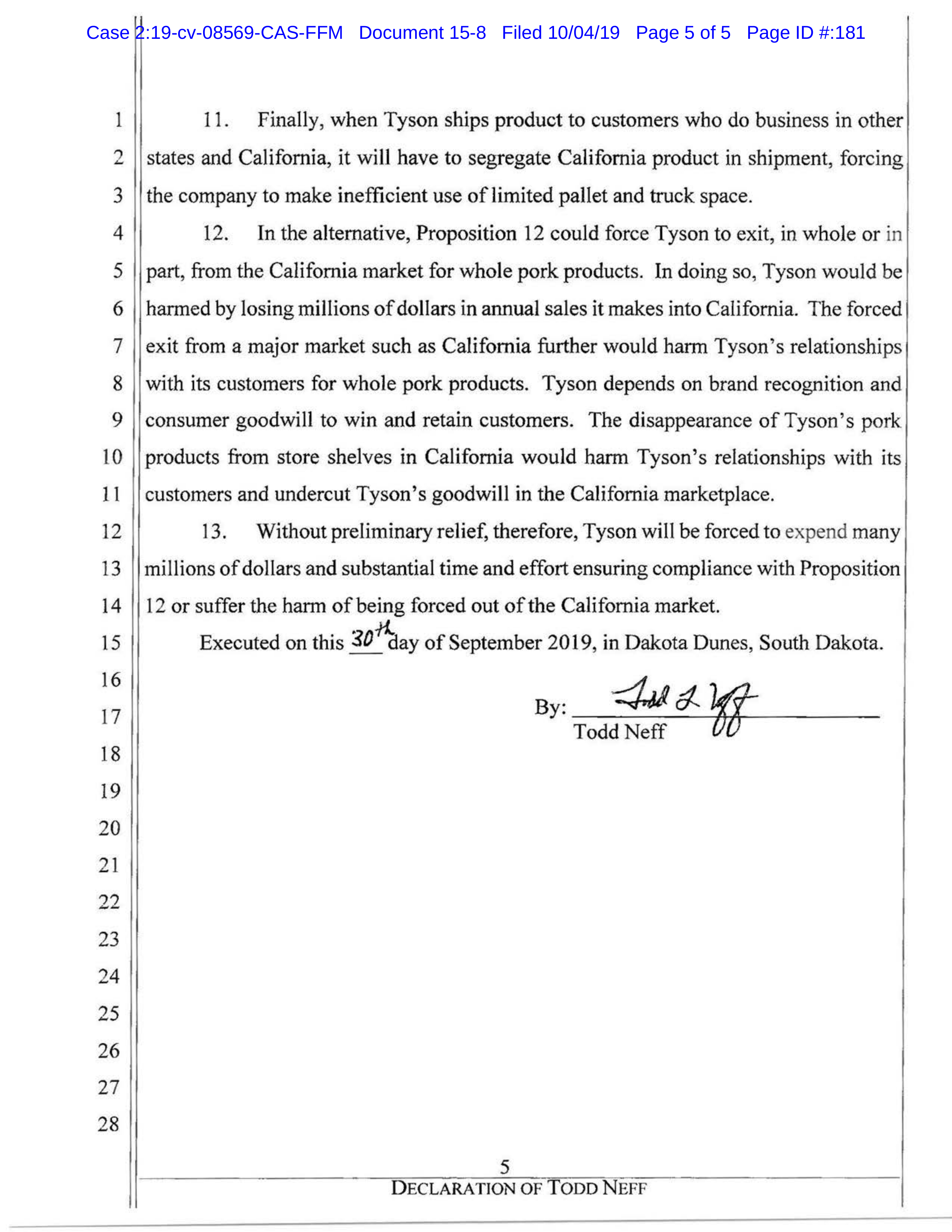
Case 2:19-cv-08569-CAS-FFM Document 15-8 Filed 10/04/19 Page 5 of 5 Page ID #:181
1
11.
Finally, when Tyson ships product to customers who do business in other
2
states and California, it will have to segregate California product in shipment, forcing
3
the company to make inefficient use
of
limited pallet and truck space.
4
12.
In the alternative, Proposition 12 could force Tyson to exit, in whole or in
5
part, from the California market for whole
pork
products. In doing so, Tyson would be
6
harmed by losing millions
of
dollars in annual sales it makes into California. The forced
7
exit from a major market such as California further would harm
Tyson's
relationships
8
with its customers for whole pork products. Tyson depends on brand recognition and
9
consumer goodwill to win and retain customers. The disappearance
of
Tyson's pork
10
products from store shelves in California would harm
Tyson's
relationships with its
11
customers and undercut
Tyson's
goodwill in the California marketplace.
12
13
14
15
16
17
18
19
20
21
22
23
24
25
26
27
28
13.
Without preliminary relief, therefore, Tyson will be forced to expend many
millions
of
dollars and substantial time and effort ensuring compliance with Proposition
12
or
suffer the harm
of
being forced out
of
the California market.
Executed on this
30~ay
of
September 2019, in Dakota Dunes, South Dakota.
By:
4.JliJ-1(/--
Todd
Neff
5
DECLARATION OF
TODD
NEFF

EXHIBIT 3
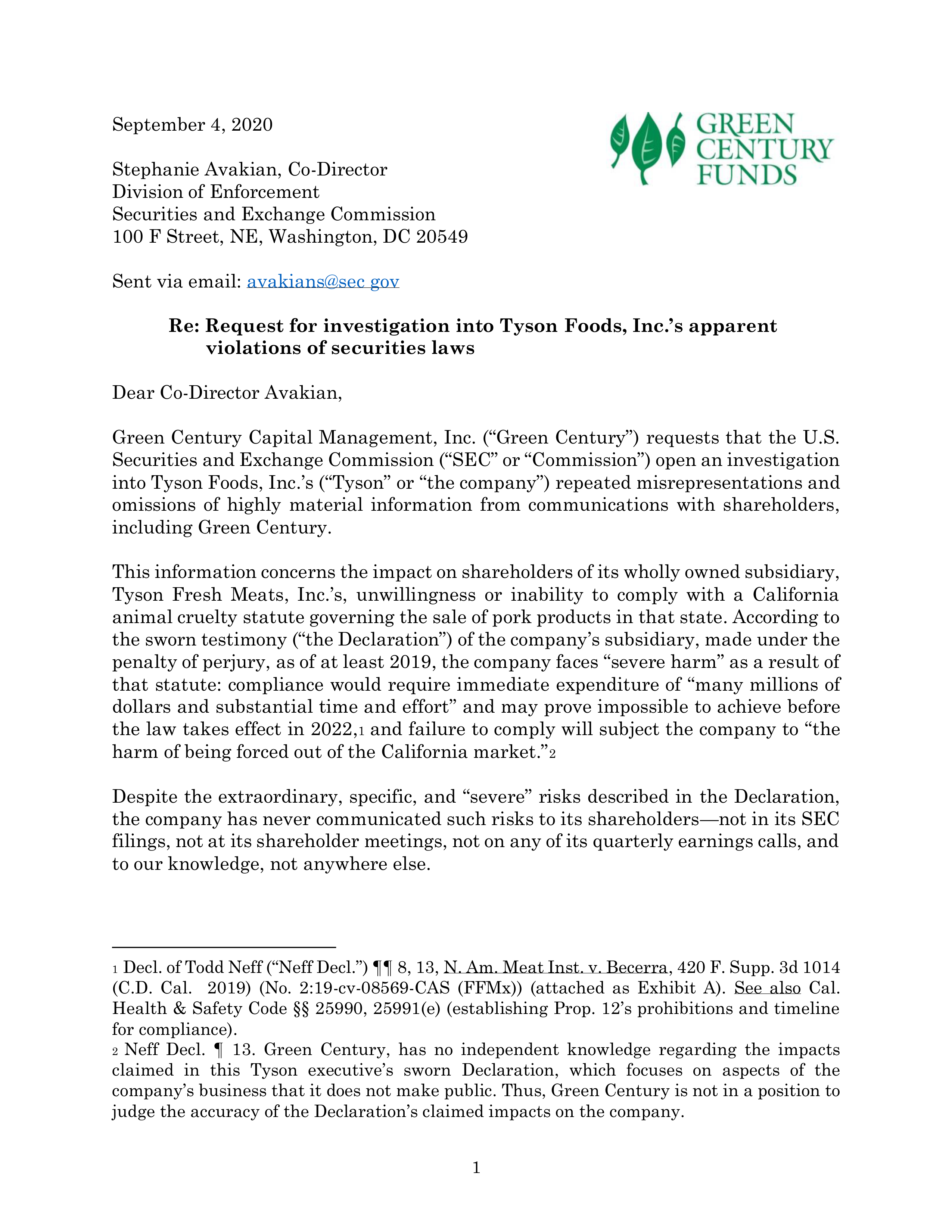

1
September 4, 2020
Stephanie Avakian, Co-Director
Division of Enforcement
Securities and Exchange Commission
100 F Street, NE, Washington, DC 20549
Sent via email:
avakians@sec gov
Re: Request for investigation into Tyson Foods, Inc.’s apparent
violations of securities laws
Dear Co-Director Avakian,
Green Century Capital Management, Inc. (“Green Century”) requests that the U.S.
Securities and Exchange Commission (“SEC” or “Commission”) open an investigation
into Tyson Foods, Inc.’s (“Tyson” or “the company”) repeated misrepresentations and
omissions of highly material information from communications with shareholders,
including Green Century.
This information concerns the impact on shareholders of its wholly owned subsidiary,
Tyson Fresh Meats, Inc.’s, unwillingness or inability to comply with a California
animal cruelty statute governing the sale of pork products in that state. According to
the sworn testimony (“the Declaration”) of the company’s subsidiary, made under the
penalty of perjury, as of at least 2019, the company faces “severe harm” as a result of
that statute: compliance would require immediate expenditure of “many millions of
dollars and substantial time and effort” and may prove impossible to achieve before
the law takes effect in 2022,
1
and failure to comply will subject the company to “the
harm of being forced out of the California market.”
2
Despite the extraordinary, specific, and “severe” risks described in the Declaration,
the company has never communicated such risks to its shareholders—not in its SEC
filings, not at its shareholder meetings, not on any of its quarterly earnings calls, and
to our knowledge, not anywhere else.
1
Decl. of Todd Neff (“Neff Decl.”) ¶¶ 8, 13, N. Am. Meat Inst. v. Becerra, 420 F. Supp. 3d 1014
(C.D. Cal. 2019) (No. 2:19-cv-08569-CAS (FFMx)) (attached as Exhibit A). See also Cal.
Health & Safety Code §§ 25990, 25991(e) (establishing Prop. 12’s prohibitions and timeline
for compliance).
2
Neff Decl.
¶ 13. Green Century, has no independent knowledge regarding the impacts
claimed in this Tyson executive’s sworn Declaration, which focuses on aspects of the
company’s business that it does not make public. Thus, Green Century is not in a position to
judge the accuracy of the Declaration’s claimed impacts on the company.
•♦
A
GREEN
'f
'1
CENTURY
FUNDS
2
With over $800 million assets under management, Green Century has been a leader
in the environmentally and socially responsible investing field for more than 25
years.
In November of 2018, California voters passed Proposition 12 (“Prop 12”). In October
of 2019, nearly a year after Prop 12’s enactment, Tyson offered sworn testimony to a
federal district court in California in which the company described the law’s impact
on the company.
3
According to that Declaration, signed by a Tyson Fresh Meats
Senior Vice President, Prop 12 will “cause severe harm to Tyson” and “will increase
Tyson’s distribution costs,” “add additional cost and complexity, at every step of the
processing and distribution process,” and “make Tyson’s processing and distribution
operations significantly more complicated and costly.”
4
Tyson will have to “incur
significant costs,” “implement expensive changes to its distribution system,” and “pay
higher prices,” the Declaration claims. It goes on to claim that, “Tyson’s ability to
recover those increased costs [higher prices paid for pigs] will be highly constrained.”
5
The Declaration concludes:
Proposition 12 could force Tyson to exit, in whole or in part, from the
California market for whole pork products. In doing so, Tyson would be
harmed by losing millions of dollars in annual sales it makes into
California. The forced exit from a major market such as California
further would harm Tyson’s relationships with its customers for whole
pork products. Tyson depends on brand recognition and consumer
goodwill to win and retain customers. The disappearance of Tyson’s pork
products from store shelves in California would harm Tyson’s
relationships with its customers . . . . Tyson will be forced to expend
many millions of dollars and substantial time and effort ensuring
compliance with Proposition 12 or suffer the harm of being forced out of
the California market.
6
The Declaration explicitly states that this is not just an issue on the horizon. Indeed
the Declaration was submitted “in support of the preliminary injunction motion filed
by the North American Meat Institute (“NAMI”), of which Tyson is a member.”
7
Prevailing on a motion for preliminary injunction requires, among other things, a
showing of immediate injury and irreparable harm such that extraordinary relief is
necessary.
8
As such, the company must have believed it would suffer irreparable
harms in the immediate future at the time the declaration was filed.
3
See generally id
4
Id. ¶¶ 4, 9, 10.
5
Id. ¶¶ 4, 7.
6
Id. ¶¶ 12, 13.
7
Id ¶ 1.
8
Winter v Natural Res Def Council, Inc., 555 U.S. 7, 20, 24 (2008).
3
According to the Declaration, Tyson must now make decisions as to whether it is
going to meet Prop 12’s new animal welfare standards or eliminate sales to California.
The company has sworn that each option will have significant negative financial
impacts. And, the company claims that this creates a significant problem for it as of
October 2019. According to the Declaration, “[e]fforts to come into compliance must
begin immediately, and it is not clear that Tyson will be able to meet all of Proposition
12’s requirements in time [before January 1, 2022].”
9
Thus, more than a year after
Prop 12 passed, the company had apparently not even begun preparations to comply
and was not sure it would even be able to comply by Prop 12’s deadlines. The lack of
preparation to meet new regulatory requirements and the possible choice not to adopt
those requirements—which would result in the loss of the ability to sell one of the
company’s primary products in the most populous state in the country—involve
serious risks that, again, the company has apparently never communicated to
investors.
In both its required SEC filings and in other statements the company made in
connection with the sale of securities, Tyson has misrepresented and omitted the
highly material facts set out in the October 2019 Declaration, including that the
company will soon suffer “severe harm” which may include having to completely
withdraw from doing business in California.
10
As described below, this violates
securities law anti-fraud provisions including specific provisions outlawing
misrepresentation and omission of material facts from reports the company is
obligated to file by the Securities Exchange Act.
I.
Tyson’s apparent violations of Section 10(b) of the Securities
Exchange Act and Rule 10b-5
SEC Rule 10b-5 implements Section 10(b) of the Securities Exchange Act of 1934 and
the scope of liability under the rule is coextensive with the statutory provision it
implements. 17 C.F.R. § 240.10b–5(b); see also 15 U.S.C. § 78j(b). To prove a violation
of Rule 10b-5, the SEC must show that a person has:
(1) made a material misrepresentation or a material omission as to
which he had a duty to speak, or used a fraudulent device;
(2) with scienter;
(3) in connection with the purchase or sale of securities.
11
9
Id ¶ 8.
10
Id. ¶¶ 4, 12.
11
SEC v. Frohling, 851 F.3d 132, 136 (2d Cir. 2016) (citation and internal quotation marks
omitted); see also SEC v. Wolfson, 539 F.3d 1249, 1256 (10th Cir. 2008) (explaining that
4
Tyson’s repeated misrepresentation and omission of the facts set out in its
Declaration satisfies each element of Rule 10b-5 liability. These misrepresentations
and omissions all relate to subjects that are material to reasonable investors. These
material subjects include animal cruelty, noncompliance with California state law,
and the implications of these matters on the company’s financial well-being.
12
Likewise, the statements and omissions described below were made “in connection
with,” the sale of securities.
13
They occurred in many contexts: in website statements,
in discussions at annual shareholder meetings, on quarterly earnings conference
calls, and in statements in SEC filings. These misrepresentations and omissions were
made with the fraudulent intent (scienter) required to constitute a violation of Rule
10b-5.
As discussed below, Tyson’s repeated misstatements of, and failures to mention, the
serious risks described in the Declaration in its SEC filings and public/shareholder
statements are material misrepresentations and omissions that the company had a
duty to speak to accurately and completely.
14
Where a public company like Tyson
knows of specific material risks, it cannot speak of them only in half-truths,
generalities, or boilerplate language.
15
Even though a high-level Tyson executive
unlike private litigants in a § 10(b) enforcement action “[t]he SEC is not required to prove
reliance or injury” (alteration in original) (citation and internal quotation marks omitted)).
“Sale” is statutorily defined to include “every contract of sale or disposition of a security or
interest in a security, for value”; and “offer” is defined as including “every attempt or offer
to dispose of . . . a security or interest in a security, for value.” SEC v. Aly, No. 16 Civ. 3853
(PGG), 2018 WL 1581986, at *24 (S.D.N.Y. Mar. 27, 2018) (alteration in original) (quoting
15 U.S.C. § 77b(a)(3)) (internal quotation marks omitted).
12
The materiality analysis is an “objective” one, focused on “the significance of an omitted
or misrepresented fact to a reasonable investor.” SEC v Morgan Keegan & Co , Inc , 678
F.3d 1233, 1245 (11th Cir. 2012) (citation and internal quotation marks omitted). It does
not matter “whether isolated statements . . . were true,” if “defendants’ representations or
omissions, considered together and in context, would affect the total mix of information and
thereby mislead a reasonable investor regarding the nature of the securities offered.”
Halperin v. eBanker USA.com, Inc., 295 F.3d 352, 357 (2d Cir. 2002) (citation omitted).
13
A statement or omission is “in connection with” the purchase or sale of a security for the
purpose of § 10(b) if it “somehow touches upon or has some nexus with any securities
transaction.” SEC v Rana Research, Inc
, 8 F.3d 1358, 1362 (9th Cir. 1993) (citation and
internal quotation marks omitted).
14
See Frohling, 851 F.3d at 136 (outlining requirements for § 10(b) violation).
15
FindWhat Investor Grp. v. FindWhat.com, 658 F.3d 1282, 1305 (11th Cir. 2011) (“By
voluntarily revealing one fact about its operations, a duty arises for the corporation to
disclose such other facts, if any, as are necessary to ensure that what was revealed is not so
incomplete as to mislead.” (citations and internal quotation marks omitted)); In re K-tel
Int’l, Inc. Sec. Litig., 300 F.3d 881, 898 (8th Cir. 2002) (“[E]ven absent a duty to speak, a
party who discloses material facts in connection with securities transactions assume[s] a
duty to speak fully and truthfully on those subjects.” (second alteration in original) (citation
ichand internal quotation marks omitted)).
5
detailed the financial costs and risks entailed by the company’s choice to comply or
not comply with Prop 12 in sworn testimony in federal court, Tyson provides
incomplete and inaccurate descriptions of these costs and risks in its SEC filings and
public statements, falling short of federal law’s required full and truthful disclosures.
A.
Tyson’s affirmative material misrepresentations in apparent
violation of Section 10(b) of the Securities Exchange Act and
Rule 10b-5
In its 2019 10-K report, the company explained: “We believe the supply of live hogs is
adequate for our present needs. . . . [A]lthough we generally expect adequate supply
of live hogs in the regions we operate, there may be periods of imbalance in supply
and demand.”
16
In the 10-K reports for prior years, back to 2016, the company said
essentially (and at times exactly) the same thing.
17
The problem with Tyson’s
sanguine description of an adequate supply of pigs is that it is irreconcilable with the
Declaration’s dire description of the company’s California-market supply dilemma.
As the Declaration explains:
To come into compliance with Proposition 12, Tyson will have to (i) incur
significant costs to ensure an adequate supply of hogs that are compliant
with Proposition 12, and (ii) implement expensive changes to its
distribution system to ensure that only compliant meat is sold in
California. . . . Efforts to come into compliance must begin immediately,
and it is not clear that Tyson will be able to meet all of Proposition 12’s
requirements in time.
18
In the above language and elsewhere, the Declaration explains that: Tyson is not at
all sure it can or will secure an adequate supply of pigs to supply the California
marketplace; as of late 2019, the company needed to immediately begin lining up that
supply and altering its distribution processes and doing so would be extremely costly;
16
Tyson, Annual Report (Form 10-K) 4 (Nov. 12, 2019),
https://s22.q4cdn.com/104708849/files/doc_financials/2019/ar/dcdf2f5b-689d-4520-afd6-
69691cf580de.pdf (last visited Aug. 6, 2020).
17
Tyson, Annual Report (Form 10-K) 3 (Nov. 21, 2016) (“We believe the supply of live hogs
is adequate for our present needs.”),
https://s22.q4cdn.com/104708849/files/doc_financials/annual/TSN-FY16-Form-10-K.pdf (last
visited Aug. 6, 2020); Tyson, Annual Report (Form 10-K) 3 (Nov. 13, 2017) (same as 2016
report), https://s22.q4cdn.com/104708849/files/doc_financials/annual/Tyson-2017-10K.pdf
(last visited Aug. 6, 2020); Tyson, Annual Report (Form 10-K) 4 (Nov. 13, 2018) (“We
believe the supply of live hogs is adequate for our present needs. . . . Although we generally
expect adequate supply of live hogs in the regions we operate, there may be periods of
imbalance in supply and demand.”)
https://s22.q4cdn.com/104708849/files/doc_financials/quartely/2018/q4/TSN-FY18-10-K.pdf
(last visited Aug. 6, 2020).
18
Neff Decl.
¶¶ 4, 8 (emphasis added).
6
and even if efforts had begun immediately, they might not have been sufficient.
19
The
Declaration also states that if the company ends up unable or unwilling to secure an
adequate supply of Prop 12-compliant pork products to sell in California, that also
poses a severe financial threat to the company:
The disappearance of Tyson’s pork products from store shelves in
California would harm Tyson’s relationships with its customers. . . .
Tyson will be forced to expend many millions of dollars and substantial
time and effort ensuring compliance with Proposition 12 or suffer the
harm of being forced out of the California market.
20
In short, the company knows it faces an imminent and serious supply problem in the
California market and that cannot be reconciled with its SEC filings’ claims that “the
supply of live hogs is adequate for our present needs.”
21
Indeed, in its most recent
earnings call on August 3, 2020, the company never mentioned Prop 12, or its problem
with supplying the California market, but instead stated: “Tyson is well-positioned
to respond to future market conditions. Our strong balance sheet, unique business
model, diverse portfolio, and scale will allow us to meet the needs of the
marketplace.”
22
Again, this across-the-board affirmative claim that Tyson is able to
supply its products cannot be reconciled with the sworn claims of the Declaration.
Tyson’s misrepresentation (that it has an adequate supply of pigs to supply all the
markets in which it operates) is unquestionably material in that there is more than
“a substantial likelihood that a reasonable shareholder would consider it important.”
Ret. Bd. of Policemen’s Annuity & Benefit Fund of Chicago on Behalf of Policemen’s
Annuity & Benefit Fund of Chicago v FXCM Inc , 333 F. Supp. 3d 338, 347 (S.D.N.Y.
2018) (citation and internal quotation marks omitted).
23
The dramatically
contrasting depictions of supply conditions in Tyson’s annual 10-K reports and in the
Declaration cannot coexist without one or the other, violating the Commission’s
prohibition against misrepresentation or failure to fully disclose information
necessary to prevent deception.
B.
Tyson’s material omissions in its public descriptions of Prop 12
and animal confinement issues
19
Id.
20
Id. ¶¶ 12, 13.
21
See supra notes 15-17 and accompanying text.
22
See Tyson, 2020 Quarter 3 Earnings Call 10 (August 3, 2020),
https://s22.q4cdn.com/104708849/files/doc_financials/2020/q3/Final-Transcript.pdf (last
visited Aug. 10, 2020).
23
Additionally, by “voluntarily touting the subject to investors” Tyson assumed the “duty to
disclose all material information relating to” the adequacy of its pig supply. See FindWhat
Investor Group, 658 F.3d at 1299 (quoting SEC v Merch Capital, LLC, 483 F.3d 747, 770
(11th Cir. 2007)).
7
Having chosen to discuss Prop 12 on its website, Tyson has a duty to provide the
whole truth about the law’s impact on the company, and it failed to discharge that
duty. Tyson’s lone public discussion of Prop 12 appears to be a brief mention on its
“Top Issues” webpage.
24
In a few sentences, Tyson described the law as misguided
and noted that two meat trade groups had filed lawsuits challenging it. The company
said there was an “urgent” need to challenge the law because its veal-focused rules
would take effect in January 2020. Tyson sells no retail veal products and appears to
only offer veal products through its food service division, so a reasonable investor
would have no reason to see the veal discussion as a matter of serious concern for the
company or its shareholders.
25
On the other hand, according to the Declaration:
“Tyson is one of the largest producers and processors of pork in the United States
Tyson accounts for about 16% of hogs processed at federally-inspected plants in the
United States. In 2018, the company processed approximately 21 million hogs . . . .”
26
Despite its massive investment in the pork market, all the company says about the
timing of Prop 12’s pig-regulating provisions is that they take effect on January 1,
2022.
27
In stark contrast to the Declaration, Tyson’s website says nothing about the
present and future impact of the law and Tyson’s choice to comply or not on the
company’s bottom line.
28
A comparison of the “Top Issues” website’s scant Prop 12 mention with the
Declaration’s detailed description of the law’s significant impacts on Tyson’s bottom
line reveals that the company did not tell stakeholders the whole truth on its website.
The website says Prop 12 “create[es] new space requirements” and “[s]adly, science-
based animal welfare standards were not used in the development of these space
requirements.”
29
Whether or not this description is literally true is irrelevant because
it is certainly not the whole truth about Prop 12’s impact on the company. A fuller
description is set out in the Declaration and is based on non-public information about
Tyson’s supply and distribution of pigs and pork products and how the law will “cause
severe harm to Tyson.”
30
Even assuming that Prop 12’s requirements are widely publicly known, the impact of
those requirements on Tyson is certainly not widely publicly known. As noted above,
and in Tyson’s October 2019 Declaration, the company has a choice to comply with
24
See Top Issues, Tyson, https://tyson.mmp2.org/top-issues (last visited Aug. 6, 2020)
(screen capture attached as Exhibit B).
25
Veal, Tyson Food Service, https://www.tysonfoodservice.com/search (last visited Aug. 6,
2020).
26
Neff Decl. ¶ 2.
27
See Top Issues, Tyson, https://tyson.mmp2.org/top-issues (last visited Aug. 6, 2020)
(screen capture attached as Exhibit B).
28
See id.
29
Id
30
See generally Neff Decl.
8
the law and incur certain costs associated with conversion or to not comply with the
law and lose access to the California market. The company chose not to reveal that
impact in its public description of Prop 12. This it cannot do. See In re WorldCom,
Inc. Sec. Litig., 346 F. Supp. 2d 628, 688 (S.D.N.Y. 2004) (finding omission of non-
public aspects of a widely known DOJ decision recommending disapproval of a
proposed merger may be an actionable material omission where it’s “impact on
[company]” was not widely known and addressed only in “boilerplate language.”).
Unlike the October 2019 Declaration, the company’s website does not disclose that
Prop 12 severely and presently (as stated in 2019) impacts Tyson by, among other
things, forcing it to spend millions or face complete or partial withdrawal from the
California market. These facts certainly would be of keen interest to a reasonable
investor, and the company was thus obligated to supply them to ensure the website
discussion was not misleading.
On another webpage, which discusses Tyson’s animal confinement practices, the
company does not mention Prop 12, but it does describe the housing of the pigs that
become Tyson products.
31
Tyson speaks of the importance of humane housing and
“[r]aising animals in comfort,” and describes the company’s commitment to the same;
yet the company never mentions any of the substance of its Declaration.
32
In other
words, the company never explains that the confinement of the pigs it depends on
falls short of California’s animal welfare law, and as such, Tyson needs to presently
spend millions of dollars or soon abandon selling pork in that state, in part or in full.
Likewise, the company says nothing about the law’s impact related to its veal
products. Even if its statements here about pig and calf housing may be literally true,
which is beside the point, they are legally deficient because they omit highly
significant facts that would be material to a reasonable investor.
Finally, in its quarterly earnings calls and at its annual meetings of shareholders
between 2018 and the present, the company has never specifically mentioned Prop
12 or the substance of the Declaration which describes the law’s impact on the
company.
33
During its earnings calls, supply issues are routinely inquired about and
in response, the company has never sounded any kind of warning about its apparent
(i.e. as described in the Declaration) supply problem in the California market and the
possibility that it might have to abandon that market altogether.
34
Notably, Tyson
31
See Animal Housing, Tyson, https://www.tysonfoods.com/sustainability/animal-well-
being/animal-housing (last visited Aug. 6, 2020) (screen capture attached as Exhibit C).
32
Id.
33
See generally Presentations, Tyson Foods (2018-2020)
https://ir.tyson.com/presentations/default.aspx (last visited Aug. 10, 2020).
34
See, e.g., Tyson, 2019 Quarter 4 Earnings Call 15-16 (November 12, 2019),
https://s22.q4cdn.com/104708849/files/doc_financials/2019/q4/TSN-Q4'19-Earnings-Call-
Transcript.pdf (last visited August 7, 2020); Tyson, 2019 Quarter 3 Earnings Call 7-8
9
said nothing about these matters even on the call held less than two weeks after it
filed its sworn Declaration describing an immediate and costly California supply
issue.
35
Tyson’s public statements described above were made with the required connection
to the purchase or sale of securities. In an SEC enforcement action the “in connection
with” requirement is met where the SEC shows that “the misrepresentations in
question were disseminated to the public in a medium upon which a reasonable
investor would rely, and that they were material when disseminated.” Semerenko v.
Cendent Corp , 223 F.3d 165,175–76 (3d Cir. 2000); see also Rana Research, Inc., 8
F.3d at 1362 (in an SEC enforcement action “[w]here the fraud alleged involves public
dissemination in a document such as a press release, annual report, investment
prospectus or other such document on which an investor would presumably rely, the
‘in connection with’ requirement is generally met by proof of the means of
dissemination and the materiality of the misrepresentation or omission.”); SEC v
Texas Gulf Sulphur Co., 401 F.2d 833, 860–62 (2d Cir. 1968) (finding
misrepresentations are made “in connection with” the purchase or sale of securities
when the statements are made “in a manner reasonably calculated to influence the
investing public”). The “severe harm[s]” the Declaration describes, including
potential inability to sell pork products in the largest single U.S. market for those
products, is material, and was material when each of the communications discussed
herein occurred.
36
The material omission of this information occurred in media
“reasonably calculated to influence the investing public.” Texas Gulf Sulphur Co., 401
F.2d at 860–62. Quarterly earnings calls and annual shareholder meetings and
Tyson’s “Animal Housing” and “Top Issues” webpages are all sources investors would
rely on when making investment decisions.
37
C.
Material omissions in Tyson’s 10-K and 10-Q filings
Throughout its SEC 10-K and 10-Q filings, Tyson omits material information about
Prop 12’s impact on the company and speaks only in vague boilerplate language about
(August 5, 2019),
https://s22.q4cdn.com/104708849/files/doc_financials/quartely/2019/q3/TSN-Q3-19-
Transcript.pdf (last visited August 7, 2020).
35
Tyson, 2019 Quarter 4 Earnings Call 15-16 (November 12, 2019),
https://s22.q4cdn.com/104708849/files/doc_financials/2019/q4/TSN-Q4'19-Earnings-Call-
Transcript.pdf (last visited August 7, 2020).
36
Neff Decl.
¶ 4.
37
Commission Guidance on the Use of Company Websites, Exchange Act Release No. 34-
58288, 73 Fed. Reg. 45,862, 45,869 (Aug. 7, 2008) (“The antifraud provisions of the federal
securities laws apply to company statements made on the Internet in the same way they
would apply to any other statement . . . .”). Courts routinely consider statements in press
releases, websites, and earnings calls as statements made “in connection with purchase or
sale of securities.” See, e g , Mulligan v Impax Laboratories, Inc
, 36 F. Supp. 3d 942, 957
(N.D. Cal. 2014) (considering earnings calls and press releases).
10
unidentified potential state law implications for the company. Thus, nowhere in the
respective 10-K reports’
Management Discussion and Analysis
,
Legal Proceedings
or
Risk Factors
sections did the company discuss—let alone mention—the serious
financial costs the Declaration states Tyson faces in the wake of Prop 12. For example,
the only boilerplate language in the
Risk Factors
section that could be viewed as even
vaguely speaking to Prop 12 has remained essentially unchanged between 2016
(before the Prop 12 campaign in 2017 and the law’s November 2018 passage) and
2019. For example, in its 2016 10-K annual filing Tyson says:
New or more stringent domestic and international government
regulations could impose material costs on us and could
adversely affect our business
. Our operations are subject to
extensive federal, state and foreign laws and regulations by authorities
that oversee food safety standards and processing, packaging, storage,
distribution, advertising, labeling and export of our products. See
“Environmental Regulation and Food Safety” in Item 1 of this Annual
Report on Form 10-K. Changes in laws or regulations that impose
additional regulatory requirements on us could increase our cost of
doing business or restrict our actions, causing our results of operations
to be adversely affected. For example, increased governmental interest
in advertising practices may result in regulations that could require us
to change or restrict our advertising practices.
Legal
claims,
class
action
lawsuits,
other
regulatory
enforcement actions, or failure to comply with applicable legal
standards or requirements could affect our product sales,
reputation and profitability
. We operate in a highly regulated
environment with constantly evolving legal and regulatory frameworks.
Consequently, we are subject to heightened risk of legal claims or other
regulatory enforcement actions. Although we have implemented policies
and procedures designed to ensure compliance with existing laws and
regulations, there can be no assurance that our employees, contractors,
or agents will not violate our policies and procedures. Moreover, a failure
to maintain effective control processes could lead to violations,
unintentional or otherwise, of laws and regulations. Legal claims or
regulatory enforcement actions arising out of our failure or alleged
failure to comply with applicable laws and regulations, including those
contained in Item 3, Legal Proceedings and Part II, Item 8, and Notes to
Consolidated Financial Statements, Note 19: Commitments and
Contingencies in this Annual Report on Form 10-K, could subject us to
civil and criminal penalties, including debarment from governmental
contracts that could materially and adversely affect our product sales,
reputation, financial condition and results of operations. Loss of or
11
failure to obtain necessary permits and registrations could delay or
prevent us from meeting current product demand, introducing new
products, building new facilities or acquiring new businesses and could
adversely affect operating results.
38
In each subsequent year’s 10-K filing the company uses substantially the same
(verbatim or close thereto) boilerplate language, and never mentions Prop 12 or the
impacts of Prop 12, as described in the Declaration.
39
Likewise, the company’s
quarterly reports between December 2017 and the present refer back to this
boilerplate language (in the 10-K report of the most recent prior year) and add
nothing about Prop 12 or its impacts.
40
Thus, during the 2017 to 2018 California political campaign leading up to the vote on
Prop 12—which would impose requirements for the sale of pork products in
California—Tyson said nothing specific in its quarterly and annual reports about
Prop 12 or the major risks it would pose for the company if it became law. Nor did the
company say anything in its SEC filings after the law passed in November 2018. In
fact, to date, Tyson has never specifically mentioned the law’s impacts on the
company in SEC filings. Prop 12’s impacts were not unknown to the company as
evidenced by the Declaration it filed in October 2019, which laid out the company’s
belief that the law imposed present and imminent severe financial and reputational
impacts on Tyson. As noted above, where a public company knows of a specific
material risk it cannot escape liability by obfuscating that risk using boilerplate
language rather than a description of the specific risk.
41
38
Tyson, Annual Report (Form 10-K) 10-11 (Nov. 21, 2016),
https://s22.q4cdn.com/104708849/files/doc_financials/annual/TSN-FY16-Form-10-K.pdf (last
visited Aug. 6, 2020).
39
Tyson, Annual Report (Form 10-K) 13 (Nov. 12, 2019),
https://s22.q4cdn.com/104708849/files/doc_financials/2019/ar/dcdf2f5b-689d-4520-afd6-
69691cf580de.pdf (last visited Aug. 6, 2020); Tyson, Annual Report (Form 10-K) 12-13
(Nov. 13, 2018),https://s22.q4cdn.com/104708849/files/doc_financials/quartely/2018/q4/TSN-
FY18-10-K.pdf (last visited Aug. 6, 2020); Tyson, Annual Report (Form 10-K) 11 (Nov. 13,
2017), https://s22.q4cdn.com/104708849/files/doc_financials/annual/Tyson-2017-10K.pdf
(last visited Aug. 6, 2020).
40
See, e g , Tyson, Quarterly Report (Form 10-Q) 43 (Dec. 30, 2017),
https://s22.q4cdn.com/104708849/files/doc_financials/quartely/2018/q1/TSN-Q1'18-10-Q.pdf
(last visited Aug. 11, 2020).
41
FindWhat Investor Group, 658 F.3d at 1305; see also Panther Partners, Inc v Ikanos
Commc’ns, Inc
,
538 F. Supp. 2d 662, 669 (S.D.N.Y. 2008) (explaining that forward-looking
“risk disclosures must accurately characterize the scope and specificity of the risk, as
understood at the time the statements are made”); see
also In re Prudential Sec. Ltd.
Pshps. Litig
.
, 930 F. Supp. 68, 72 (S.D.N.Y. 1996) (explaining that securities fraud claim
12
The material omissions in Tyson’s public SEC filings “were available to investors and
potential investors in” Tyson’s stock, which was, and remains, actively traded on the
New York Stock Exchange. SEC v. Aly, No. 16 Civ. 3853 (PGG), 2018 WL 1581986,
at *24 (S.D.N.Y. Mar. 27, 2018). Thus, the omissions described above occurred “in
connection with the purchase or sale or offer off sale of a security under Rule 10b-5.”
Id ; see also SEC v Softpoint, Inc , 958 F. Supp. 846, 862 (S.D.N.Y. 1997) (explaining
§ 10(b) and Rule 10b–5 liability can flow from “misstatements and omissions in press
releases, news articles, and quarterly and annual public filings” (quoting In re Ames
Dep’t Stores, Inc Stock Litig , 991 F.2d 953, 962 (2d Cir. 1993))).
D.
Tyson’s misrepresentations and omission of material facts were
made with the required scienter
All of the misrepresentations and omissions discussed above were made with the
requisite scienter. To establish a violation of Rule 10b-5, the SEC must show that a
material omission was made with “a mental state embracing intent to deceive,
manipulate, or defraud.” Tellabs, Inc v Makor Issues & Rights, Ltd , 551 U.S. 308,
319 (2007). This “may be established through a showing of reckless disregard for the
truth, that is, conduct which is highly unreasonable and which represents an extreme
departure from the standards of ordinary care.” SEC v. McNulty, 137 F.3d 732, 741
(2d Cir. 1998) (citations and internal quotation marks omitted). Scienter can be
shown using circumstantial evidence. Thus, scienter is established where
circumstantial evidence shows defendants “knew facts or had access to information
suggesting that their public statements were not accurate” or “failed to check
information they had a duty to monitor” SEC v. Fiore, 416 F. Supp. 3d 306, 324
(S.D.N.Y. 2019) (citation and internal quotation marks omitted).
Here, the Declaration makes clear that the company knew of highly material risks
that render its online statements, its investor conference calls, and its annual and
quarterly SEC-filed reports misleading, inaccurate and incomplete. Moreover, the
company certainly had a duty to monitor the information comprising the substance
of the Declaration (e.g., its ability to continue selling pork in California) and had a
duty to report this potentially massive liability accurately and fully to investors in its
online statements, annual earnings calls, annual shareholder meetings, and reports
to the SEC.
42
Given the magnitude and immediacy of the risks described in the
regarding forward-looking statements cannot be defeated at the pleadings stage by reliance
on “[g]eneral risk disclosures in the face of specific known risks which border on certainties
. . . even apparently specific risk disclosures . . . are misleading if the risks are
professionally stamped in internal undisclosed analyses . . . as significantly greater or more
certain than those portrayed.”) (emphasis added) (citations and internal quotation marks
omitted)).
42
15 U.S.C. § 7241(a)(2); see Tyson, Annual Report (Form 10-K) (Nov. 12, 2019), Exhibit
13
Declaration, the failure to accurately and fully disclose these severe threats is highly
unreasonable conduct that shows a reckless disregard for the truth. See McNulty,
137 F.3d at 741. Thus, “a reasonable person would deem the inference of scienter
cogent and at least as compelling as any opposing inference one could draw from the
facts” available. See Fiore, 416 F. Supp. 3d at 323.
II.
Tyson’s misrepresentations and omissions of material facts in
apparent violation of section 13(a) of the Securities Exchange Act
and Rule 12b-20
The Securities Exchange Act of 1934 requires securities issuers to file certain
documents with the SEC, including the annual and quarterly reports discussed above.
17 U.S.C. § 78m(a). SEC Rule 12b–20 implements Section 13(a) and requires that
“[i]n addition to the information expressly required to be included in a statement or
report, there shall be added such further material information, if any, as may be
necessary to make the required statements, in the light of the circumstances under
which they are made not misleading.” 17 C.F.R. § 240.12b–20.
To state a claim under Section 13(a) of the Exchange Act, and Rule 12b–20, the SEC
must show that a person made “materially false” statements in her filings, or omitted
material information needed to make other statements not misleading. SEC v
Premier Holding Corporation, No. CV 18-00813-CJC(KESx), 2019 WL 8167920, at *5
(C.D. Cal. Dec. 10, 2019); see also SEC v Savoy Indus , Inc , 587 F.2d 1149, 1165 (D.C.
Cir. 1978) (“The reporting provisions of the Exchange Act are clear and unequivocal,
and they are satisfied only by the filing of complete, accurate, and timely reports.”).
The SEC need not establish that misrepresentations or omissions were made with
any scienter. McNulty, 137 F.3d at 740–41 (scienter is not an element SEC must
establish to prove violations arising under Section 13 of the Securities Exchange Act).
In sum, the facts set forth above describing material misrepresentations and
omissions in apparent violation of Rule 10b-5 also establish apparent violations of
Rule 12b-20, as the essential elements of each rule overlap entirely except that no
mental state showing is required to establish a violation of Rule 12b–20.
III.
Conclusion
31.1 (certifying that “this report does not contain any untrue statement of a material fact or
omit to state a material fact necessary to make the statements made, in light of the
circumstances under which such statements were made, not misleading with respect to the
period covered by this report” (emphasis added)), Exhibit 32.2 (certifying, pursuant to 18
U.S.C. § 1350, compliance with SEC Act section 13a and that “the information contained in
the Report fairly presents, in all material respects, the financial condition and result of
operations of the Company”),
https://s22.q4cdn.com/104708849/files/doc_financials/2019/ar/dcdf2f5b-689d-4520-afd6-
69691cf580de.pdf (last visited Aug. 6, 2020).

14
Under penalty of perjury, Tyson’s Senior Vice President of Pork painted a very bleak
picture of the company's ability to continue supplying pork to the most populous state
in the United States unless it chooses to make substantial and costly changes to its
practices. This is patently material information that is not widely known. Tyson was
obligated to fully inform investors of the Declaration’s substance, yet it apparently
opted to never do so in any of its online postings, quarterly earnings calls, annual
meetings of shareholders, and SEC-filed reports. Worse, just two weeks after the
Declaration was filed, Tyson expressly stated in its annual report that it had no
supply concerns in any of its operating regions. To proclaim a dire supply crisis in
court testimony—while simultaneously assuring shareholders of no looming supply
issues—implicates the core concerns the SEC’s anti-deception laws aim to prevent.
Accordingly, we respectfully ask that the Commission investigate these apparent
repeated violations of federal laws aimed at protecting investors and the integrity of
the market.
Sincerely,
Leslie Samuelrich, President
Green Century Capital Management
114 State Street, Suite 200
Boston, MA 02109
(617) 482-0800
lsamuelrich@greencentury com
(oAit
~velud-
D
ECLARATION OF
T
ODD
N
EFF
1
2
3
4
5
6
7
8
9
10
11
12
13
14
15
16
17
18
19
20
21
22
23
24
25
26
27
28
Paul J. Zidlicky (
pro hac vice
pending)
pzidlicky@sidley.com
Eric D. McArthur (
pro hac vice
pending)
emcarthur@sidley.com
SIDLEY AUSTIN LLP
1501 K Street NW
Washington, DC 20005
Tel: (202) 736-8000
Fax: (202) 736-8711
Sean A. Commons, SBN 217603
scommons@sidley.com
SIDLEY AUSTIN LLP
555 West Fifth Street, Suite 4000
Los Angeles, CA 90013
Tel: (213) 896-6000
Fax: (213) 896-6600
Attorneys for Plaintiff
UNITED STATES DISTRICT COURT
FOR THE CENTRAL DISTRICT OF CALIFORNIA
NORTH AMERICAN MEAT INSTITUTE,
Plaintiff,
v.
XAVIER BECERRA, in his official
capacity as Attorney General of California,
KAREN ROSS, in her official capacity as
Secretary of the California Department of
Food and Agriculture, and SUSAN
FANELLI, in her official capacity as Acting
Director of the California Department of
Public Health,
Defendants.
Case No. 2:19-cv-08569-CAS (FFMx)
DECLARATION OF TODD NEFF
The Honorable Christina A. Snyder
Date:
November 18, 2019
Time:
10:00 a.m.
Location:
Courtroom 8D
Complaint filed: October 4, 2019
[Filed concurrently with Plaintiff’s
Notice of Motion and Motion for
Preliminary Injunction]
Case 2:19-cv-08569-CAS-FFM Document 15-8 Filed 10/04/19 Page 1 of 5 Page ID #:177
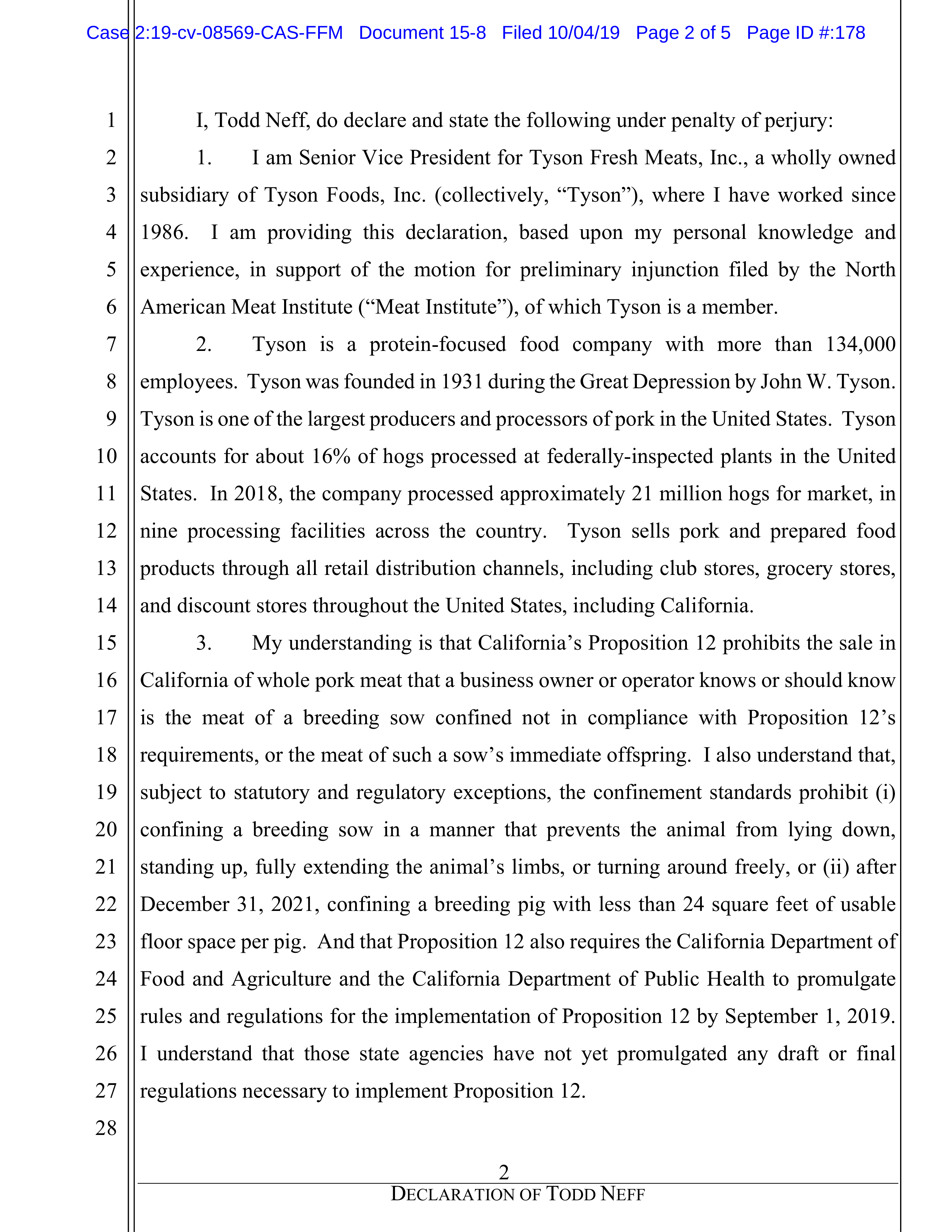
2
D
ECLARATION OF
T
ODD
N
EFF
1
2
3
4
5
6
7
8
9
10
11
12
13
14
15
16
17
18
19
20
21
22
23
24
25
26
27
28
I, Todd Neff, do declare and state the following under penalty of perjury:
1.
I am Senior Vice President for Tyson Fresh Meats, Inc., a wholly owned
subsidiary of Tyson Foods, Inc. (collectively, “Tyson”), where I have worked since
1986. I am providing this declaration, based upon my personal knowledge and
experience, in support of the motion for preliminary injunction filed by the North
American Meat Institute (“Meat Institute”), of which Tyson is a member.
2.
Tyson is a protein-focused food company with more than 134,000
employees. Tyson was founded in 1931 during the Great Depression by John W. Tyson.
Tyson is one of the largest producers and processors of pork in the United States. Tyson
accounts for about 16% of hogs processed at federally-inspected plants in the United
States. In 2018, the company processed approximately 21 million hogs for market, in
nine processing facilities across the country. Tyson sells pork and prepared food
products through all retail distribution channels, including club stores, grocery stores,
and discount stores throughout the United States, including California.
3.
My understanding is that California’s Proposition 12 prohibits the sale in
California of whole pork meat that a business owner or operator knows or should know
is the meat of a breeding sow confined not in compliance with Proposition 12’s
requirements, or the meat of such a sow’s immediate offspring. I also understand that,
subject to statutory and regulatory exceptions, the confinement standards prohibit (i)
confining a breeding sow in a manner that prevents the animal from lying down,
standing up, fully extending the animal’s limbs, or turning around freely, or (ii) after
December 31, 2021, confining a breeding pig with less than 24 square feet of usable
floor space per pig. And that Proposition 12 also requires the California Department of
Food and Agriculture and the California Department of Public Health to promulgate
rules and regulations for the implementation of Proposition 12 by September 1, 2019.
I understand that those state agencies have not yet promulgated any draft or final
regulations necessary to implement Proposition 12.
Case 2:19-cv-08569-CAS-FFM Document 15-8 Filed 10/04/19 Page 2 of 5 Page ID #:178
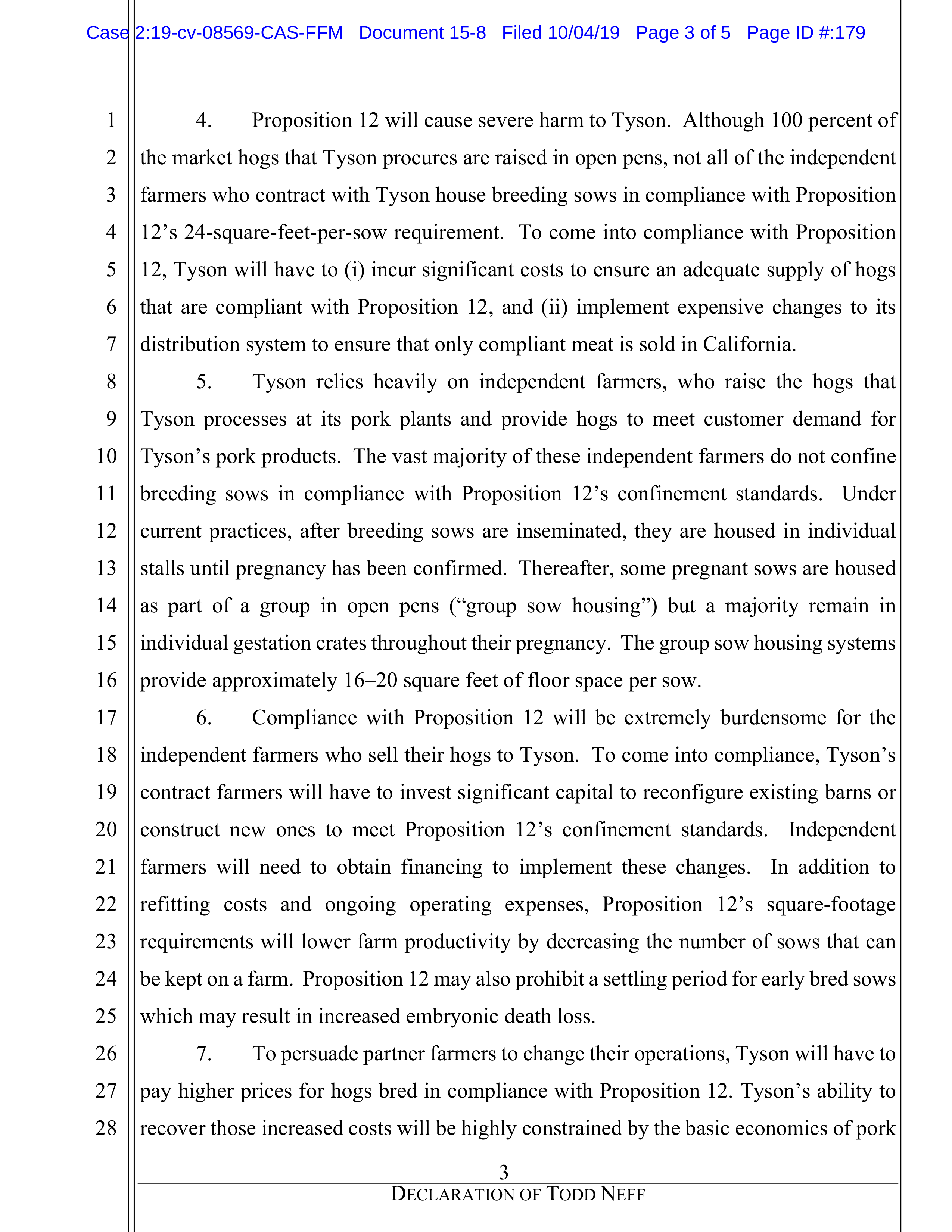
3
D
ECLARATION OF
T
ODD
N
EFF
1
2
3
4
5
6
7
8
9
10
11
12
13
14
15
16
17
18
19
20
21
22
23
24
25
26
27
28
4.
Proposition 12 will cause severe harm to Tyson. Although 100 percent of
the market hogs that Tyson procures are raised in open pens, not all of the independent
farmers who contract with Tyson house breeding sows in compliance with Proposition
12’s 24-square-feet-per-sow requirement. To come into compliance with Proposition
12, Tyson will have to (i) incur significant costs to ensure an adequate supply of hogs
that are compliant with Proposition 12, and (ii) implement expensive changes to its
distribution system to ensure that only compliant meat is sold in California.
5.
Tyson relies heavily on independent farmers, who raise the hogs that
Tyson processes at its pork plants and provide hogs to meet customer demand for
Tyson’s pork products. The vast majority of these independent farmers do not confine
breeding sows in compliance with Proposition 12’s confinement standards. Under
current practices, after breeding sows are inseminated, they are housed in individual
stalls until pregnancy has been confirmed. Thereafter, some pregnant sows are housed
as part of a group in open pens (“group sow housing”) but a majority remain in
individual gestation crates throughout their pregnancy. The group sow housing systems
provide approximately 16–20 square feet of floor space per sow.
6.
Compliance with Proposition 12 will be extremely burdensome for the
independent farmers who sell their hogs to Tyson. To come into compliance, Tyson’s
contract farmers will have to invest significant capital to reconfigure existing barns or
construct new ones to meet Proposition 12’s confinement standards. Independent
farmers will need to obtain financing to implement these changes. In addition to
refitting costs and ongoing operating expenses, Proposition 12’s square-footage
requirements will lower farm productivity by decreasing the number of sows that can
be kept on a farm. Proposition 12 may also prohibit a settling period for early bred sows
which may result in increased embryonic death loss.
7.
To persuade partner farmers to change their operations, Tyson will have to
pay higher prices for hogs bred in compliance with Proposition 12. Tyson’s ability to
recover those increased costs will be highly constrained by the basic economics of pork
Case 2:19-cv-08569-CAS-FFM Document 15-8 Filed 10/04/19 Page 3 of 5 Page ID #:179
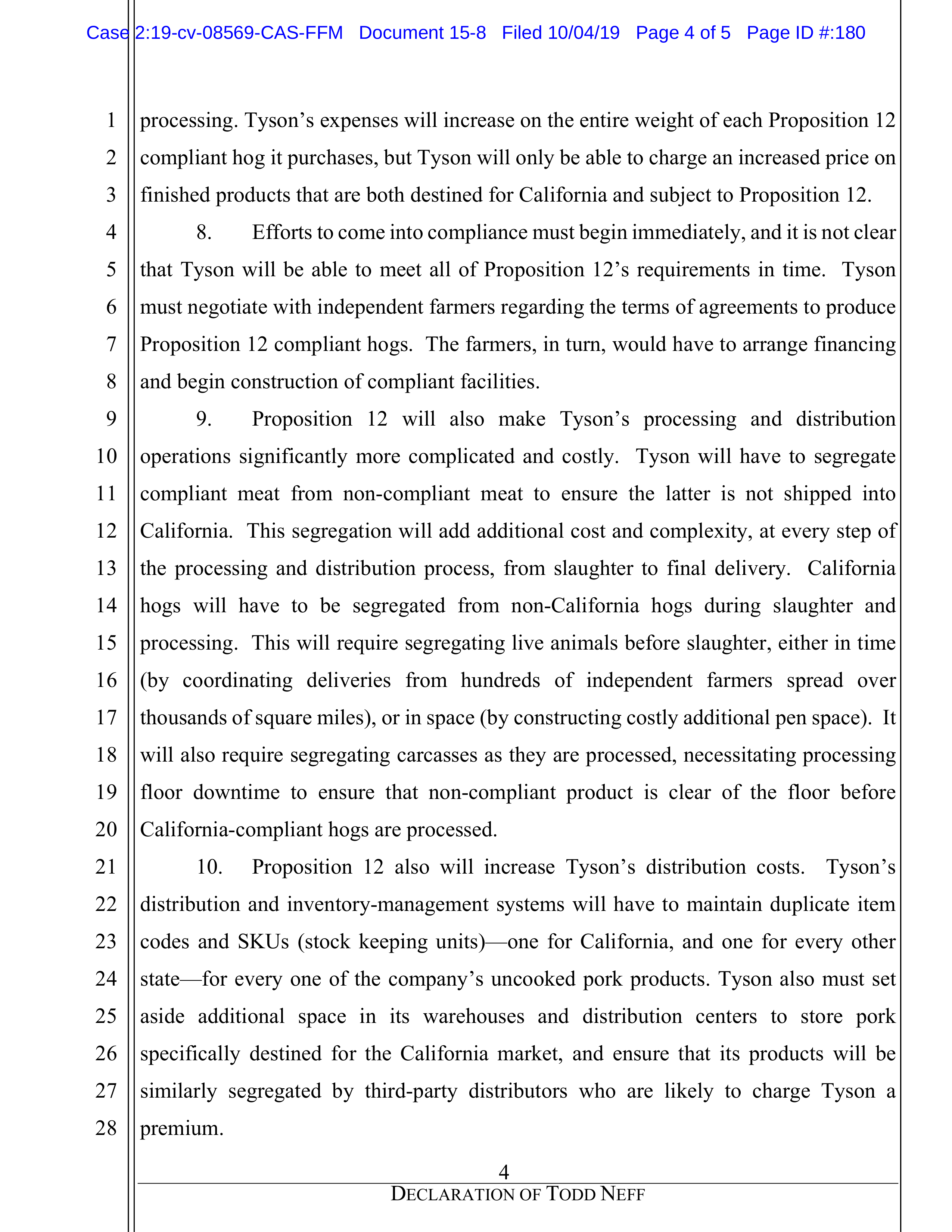
4
D
ECLARATION OF
T
ODD
N
EFF
1
2
3
4
5
6
7
8
9
10
11
12
13
14
15
16
17
18
19
20
21
22
23
24
25
26
27
28
processing. Tyson’s expenses will increase on the entire weight of each Proposition 12
compliant hog it purchases, but Tyson will only be able to charge an increased price on
finished products that are both destined for California and subject to Proposition 12.
8.
Efforts to come into compliance must begin immediately, and it is not clear
that Tyson will be able to meet all of Proposition 12’s requirements in time. Tyson
must negotiate with independent farmers regarding the terms of agreements to produce
Proposition 12 compliant hogs. The farmers, in turn, would have to arrange financing
and begin construction of compliant facilities.
9.
Proposition 12 will also make Tyson’s processing and distribution
operations significantly more complicated and costly. Tyson will have to segregate
compliant meat from non-compliant meat to ensure the latter is not shipped into
California. This segregation will add additional cost and complexity, at every step of
the processing and distribution process, from slaughter to final delivery. California
hogs will have to be segregated from non-California hogs during slaughter and
processing. This will require segregating live animals before slaughter, either in time
(by coordinating deliveries from hundreds of independent farmers spread over
thousands of square miles), or in space (by constructing costly additional pen space). It
will also require segregating carcasses as they are processed, necessitating processing
floor downtime to ensure that non-compliant product is clear of the floor before
California-compliant hogs are processed.
10.
Proposition 12 also will increase Tyson’s distribution costs. Tyson’s
distribution and inventory-management systems will have to maintain duplicate item
codes and SKUs (stock keeping units)—one for California, and one for every other
state—for every one of the company’s uncooked pork products. Tyson also must set
aside additional space in its warehouses and distribution centers to store pork
specifically destined for the California market, and ensure that its products will be
similarly segregated by third-party distributors who are likely to charge Tyson a
premium.
Case 2:19-cv-08569-CAS-FFM Document 15-8 Filed 10/04/19 Page 4 of 5 Page ID #:180
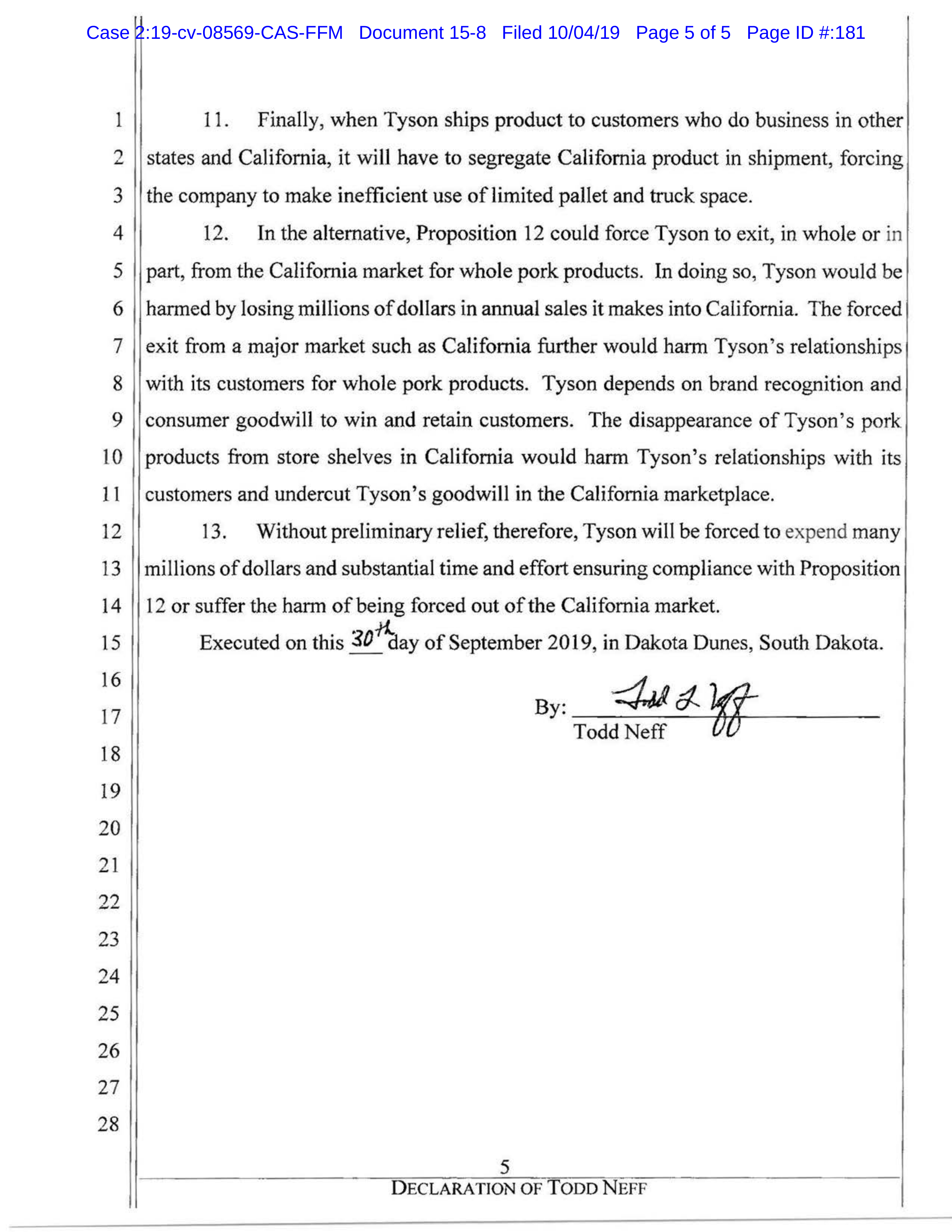
Case 2:19-cv-08569-CAS-FFM Document 15-8 Filed 10/04/19 Page 5 of 5 Page ID #:181
1
11.
Finally, when Tyson ships product to customers who do business in other
2
states and California, it will have to segregate California product in shipment, forcing
3
the company to make inefficient use
of
limited pallet and truck space.
4
12.
In the alternative, Proposition 12 could force Tyson to exit, in whole or in
5
part, from the California market for whole
pork
products. In doing so, Tyson would be
6
harmed by losing millions
of
dollars in annual sales it makes into California. The forced
7
exit from a major market such as California further would harm
Tyson's
relationships
8
with its customers for whole pork products. Tyson depends on brand recognition and
9
consumer goodwill to win and retain customers. The disappearance
of
Tyson's pork
10
products from store shelves in California would harm
Tyson's
relationships with its
11
customers and undercut
Tyson's
goodwill in the California marketplace.
12
13
14
15
16
17
18
19
20
21
22
23
24
25
26
27
28
13.
Without preliminary relief, therefore, Tyson will be forced to expend many
millions
of
dollars and substantial time and effort ensuring compliance with Proposition
12
or
suffer the harm
of
being forced out
of
the California market.
Executed on this
30~ay
of
September 2019, in Dakota Dunes, South Dakota.
By:
4.JliJ-1(/--
Todd
Neff
5
DECLARATION OF
TODD
NEFF

EXHIBIT 4
10/6/2020
Ho
rme
l
Foo
ds
Co
mpany Info
rm
ation About California P
rop
osition 12
I
Ho
rme
l
Fo
ods
ACTIONS AN D SU
PP
O RT
Hor
me
l F
oo
ds
COV
ID-19
Response
➔
ri,;;;
/f,
e/
~
.£
ads
<
COMPANY N
EWS
Responsibility
Hormel Foods Company Information About California
Proposition
12
OCTOBER
6,
2020
Hormel Foods h
as
assessed Proposition
12
and, while it is still await
in
g
fi
nal
cla
ri
ty
on specific details and rul
es.
t he company is preparing
to
fu
lly comply
http
s:
//
www.h
ormelfoods.c
om
/newsroom
/c
omp
any-news/h
orm
el-foods-company
-i
nform
ati
on-about
-c
alifo
rn
ia-pro
pos
ition-12/
1/3
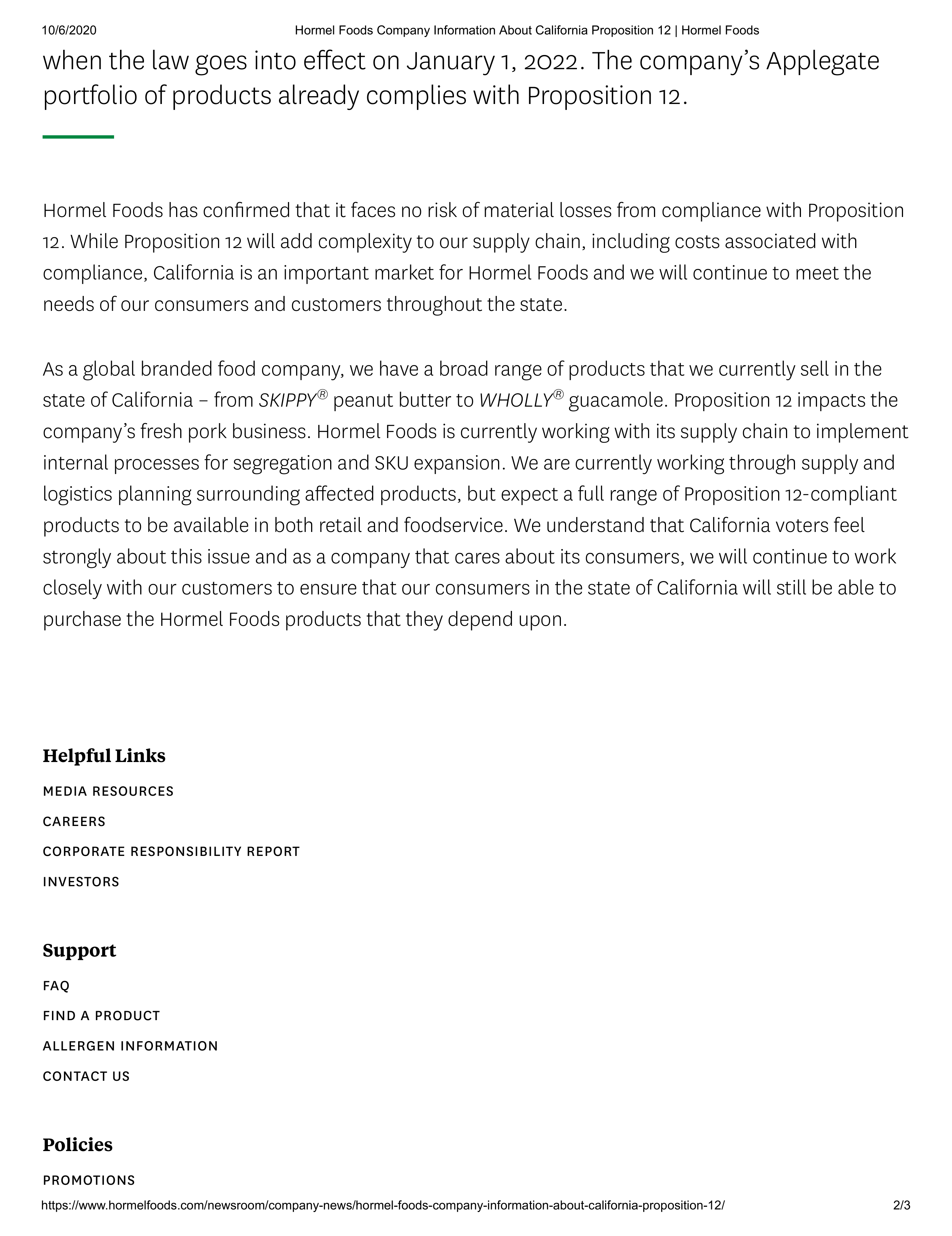
10/6/2020
Hormel Foods Company Information About California Proposition 12 | Hormel Foods
https://www.hormelfoods.com/newsroom/company-news/hormel-foods-company-information-about-california-proposition-12/
2/3
when the law goes into eect on January 1, 2022. The company’s Applegate
portfolio of products already complies with Proposition 12.
Hormel Foods has conrmed that it faces no risk of material losses from compliance with Proposition
12. While Proposition 12 will add complexity to our supply chain, including costs associated with
compliance, California is an important market for Hormel Foods and we will continue to meet the
needs of our consumers and customers throughout the state.
As a global branded food company, we have a broad range of products that we currently sell in the
state of California – from
SKIPPY
peanut butter to
WHOLLY
guacamole. Proposition 12 impacts the
company’s fresh pork business. Hormel Foods is currently working with its supply chain to implement
internal processes for segregation and SKU expansion. We are currently working through supply and
logistics planning surrounding aected products, but expect a full range of Proposition 12-compliant
products to be available in both retail and foodservice. We understand that California voters feel
strongly about this issue and as a company that cares about its consumers, we will continue to work
closely with our customers to ensure that our consumers in the state of California will still be able to
purchase the Hormel Foods products that they depend upon.
®
®
Helpful Links
MEDIA RESOURCES
CAREERS
CORPORATE RESPONSIBILITY REPORT
INVESTORS
Support
FAQ
FIND A PRODUCT
ALLERGEN INFORMATION
CONTACT US
Policies
PROMOTIONS
10/6/2020
TERMS
&
COND
ITI
ONS
PR
IVACY POLICY
CAL
IFORN IA
PR
IVACY POLICY
CAL
IFORN IA
COLL
E
CTIONS
NOTICE
*
DO
NOT
SE
LL
MY I
NFO*
Hormel Foods
Co
mpany Information About
Ca
lifornia Proposition 12
I
Hormel Foods
HORM
EL FOODS
45-DAY
SAT
ISFACTION
GUARANT
EE
VIS
ITOR POLICY
Con1munities
ALUMN
I
SUPPLIE
RS
,ii;;;,8,
e/
~
.2i
ods
©
2020
Hor
me
l Foods Corpor
at
ion. A
ll
Righ
ts
Reserved.
https://www.hormelfoods.
com/n
ew
sroom/compa
ny
-news/hormel-foods-company
-i
nf
ormation-about-california-proposition-12/
3/3
Tyson Foods
2200 W. Don Tyson Parkway
Springdale, Arkansas 72762
October 1, 2020
Via Electronic Mail
U.S. Securities and Exchange Commission
Division of Corporation Finance
Office of Chief Counsel
100 F Street NE
Washington, DC 20549
Re:
Tyson Foods Inc. – Shareholder Proposal submitted by The Humane Society of
the United States
Ladies and Gentlemen:
This letter is submitted by Tyson Foods, Inc., a Delaware corporation (the “Company”),
pursuant to Rule 14a-8(j) of the Securities Exchange Act of 1934, as amended (the “Exchange
Act”), to notify the Securities and Exchange Commission (the “Commission”) of the Company’s
intention to exclude from its proxy materials for its 2021 Annual Meeting of Shareholders (the
“2021 Annual Meeting”) a shareholder proposal (the “Proposal”) and statement in support
thereof submitted by The Humane Society of the United States (the “Proponent”) on August 14,
2020. This letter is being submitted to the Commission within the time period required under
Rule 14a-8(j).
Pursuant to Staff Legal Bulletin No. 14D (November 7, 2008), this letter and its exhibits
are being submitted via email to
shareholderproposals@sec.gov
. A copy of this letter and its
exhibits will also be sent to the Proponent.
The Company hereby respectfully requests that the staff of the Division of Corporation
Finance (the “Staff”) confirm that it will not recommend to the Commission that enforcement
action be taken if the Company excludes the Proposal from its 2021 Annual Meeting proxy
materials for the reasons set forth below.
®.
Tyson
Tyson Foods
2200 W. Don Tyson Parkway
Springdale, Arkansas 72762
THE PROPOSAL
The Proposal and the statement in support thereof read as follows:
Risk Disclosure Proposal
In 2018, California passed a law (“Proposition 12”) requiring specific animal
welfare standards for some pork produced or sold statewide.
In 2019, a Tyson Senior Vice President filed a declaration with the United States
District Court for the Central District of California (“the declaration”) testifying
under penalty of perjury that Proposition 12 will “cause severe harm to Tyson” and
“will increase Tyson’s distribution costs,” “add additional cost and complexity, at
every step” and “make Tyson’s processing and distribution operations significantly
more complicated and costly.” Tyson will have to “incur significant costs,”
“implement expensive changes” and “pay higher prices,” the declaration claims,
and Tyson’s ability to recover some of “those increased costs will be highly
constrained.”
The declaration concludes: “Proposition 12 could force Tyson to exit, in whole or
in part, from the California market for whole pork products. In doing so, Tyson
would be harmed by losing millions of dollars in annual sales it makes into
California. The forced exit from a major market such as California further would
harm Tyson’s relationships with its customers for whole pork products. Tyson
depends on brand recognition and consumer goodwill to win and retain customers.
The disappearance of Tyson’s pork products from store shelves in California would
harm Tyson’s relationships with its customers . . . [and] Tyson will be forced to
expend many millions of dollars and substantial time and effort ensuring
compliance with Proposition 12 or suffer the harm of being forced out of the
California market.”
However, none of Tyson’s 10-K or 10-Q reports mention Proposition 12, let alone
disclose it as a risk to the company or its shareholders. Similarly, in those reports
and on earnings calls, Tyson states that it has no supply-side issues with supplying
pork to the markets in which it operates. These omissions and affirmative
statements necessarily mean that, in fact, the company does not—despite the
aforementioned declaration—face any material losses attributable to compliance or
noncompliance with Proposition 12. After all, if the company did face the “severe
harm” and losses described in the declaration, shareholders would have been
entitled, under federal securities law, to a full risk disclosure from management.
®.
Tyson
Tyson Foods
2200 W. Don Tyson Parkway
Springdale, Arkansas 72762
RESOLVED
: shareholders request that Tyson Foods confirm that the company
faces no material losses from compliance or noncompliance with Proposition 12. If
the company cannot so confirm, then shareholders request a risk analysis of any
decision to comply or not to comply with Proposition 12, including the risks
inherent in the company’s failure to disclose such risks in its 10-K and 10-Q reports.
These disclosures should be made within three months of the 2021 annual meeting,
at reasonable cost, and omit proprietary information.
BASIS FOR EXCLUSION OF THE PROPOSAL
The Company believes that it may omit the Proposal from its proxy materials for the
2021 Annual Meeting under (i) Rule 14a-8(i)(4) because the Proposal relates to the redress of a
personal claim or grievance against the Company and is meant to further a personal interest
which is not shared by other shareholders at large and (ii) Rule 14a-8(i)(7) because the Proposal
deals with a matter relating to the Company’s ordinary business operations.
ANALYSIS
I.
The Company may omit the Proposal pursuant to Rule 14a-8(i)(4) because it
relates to the redress of a personal claim or grievance against the Company.
Under Rule 14a-8(i)(4), a proposal may be excluded if it (i) relates to the redress of a
personal claim or grievance against the registrant or any other person or (ii) is designed to result
in a benefit to the proponent or to further a personal interest, which other shareholders at large do
not share. The Commission has stated that Rule 14a-8(i)(4) is designed to “insure that the
security holder proposal process [is] not abused by proponents attempting to achieve personal
ends that are not necessarily in the common interest of the issuer’s shareholders generally.”
Exchange Act Release No 20091 (Aug. 16, 1983). Moreover, the Commission has noted that
“[t]he cost and time involved in dealing with” a shareholder proposal involving a personal
grievance or furthering a personal interest not shared by other shareholders is “a disservice to the
interests of the issuer and its security holders at large.” Exchange Act Release No. 19135 (Oct.
14, 1982).
As indicated in its supporting statement, the Proposal stems from a litigation matter
pending in the District Court for the Central District of California. In October 2019, the North
American Meat Institute, a trade organization of which the Company is a member, filed a
complaint in the District Court for the Central District of California against certain California
state government officials questioning the constitutionality of Proposition 12, a California
initiative that imposes unprecedent regulations dictating the conditions of confinement for
breeding sows and veal calves (the “Proposition 12 Litigation”). The Proponent filed a motion to
intervene in the Proposition 12 Litigation. The motion was granted and the Proponent is now a
®.
Tyson
Tyson Foods
2200 W. Don Tyson Parkway
Springdale, Arkansas 72762
defendant in the Proposition 12 Litigation. A copy of the complaint is attached as
Exhibit A
hereto and a copy of the Proponent’s motion to intervene and the order approving the motion are
attached as
Exhibit B
hereto.
The Proponent is much more than simply an interested party in the Proposition 12
Litigation. Proponent injected itself as a defendant and is actively litigating the matter, including
answering the complaint and asking the court for judgment in its favor on the pleadings (copies
of both filings are attached as
Exhibits C
and
D
). Here, the Proponent impermissibly seeks to
use the shareholder proposal process to gain advantage and further its personal litigation goals.
To that end, the Proposal’s supporting statement focuses almost entirely on a declaration filed by
a Tyson representative in support of the Proposition 12 plaintiff’s motion for a preliminary
injunction (“Tyson Declaration”). The resolution portion of the Proposal requests that the
Company address statements made in that Tyson Declaration. Statements made in litigation,
however, should be addressed in the litigation rather than through the shareholder proposal
process. The shareholder proposal process is intended to provide a method to voice issues
common to shareholders generally, and not meant to be used as a mechanism to gain a strategic
advantage in litigation. Specifically, the Proposal requests a confirmation from the Company
that seeks to either undermine the Tyson Declaration or provide the Proponent with fodder that
the Proponent will try to use to its advantage in the Proposition 12 Litigation. This is exactly the
type of proposal that Rule 14a-8(i)(4) is meant to prevent. Company shareholders at large do not
share the same interest as the Proponent in the Proposition 12 Litigation that underscores the
Proposal. Any grievance the Proponent has concerning the Proposition 12 Litigation should be
addressed with the court within the litigation itself.
The Proponent’s Proposal is similar to other proposals for which the Staff concurred in
exclusion under Rule 14a-8(i)(4) where “the facts presented by the issuer” demonstrate that “the
proponent is using the proposal as a tactic designed to redress a personal grievance or further a
personal interest.” Exchange Act Release No. 19135 (Oct. 14, 1982). The Staff has repeatedly
concurred in the exclusion of proposals that appeared to include a facially neutral resolution, but
where the facts demonstrated that the proposal’s true intent was to further a personal interest or
redress a personal claim or grievance.
See, e.g., General Electric Company
(Feb. 28, 2020)
(concurring in the exclusion of a proposal to hire an investment bank to explore the sale of the
company submitted by a former employee who had a history of complaints against the company
after the employment relationship was terminated);
State Street Corp.
(Jan. 5, 2007) (concurring
in the exclusion of a proposal that the company separate the positions of chairman and CEO
submitted by a former employee after that employee was ejected from the company’s pervious
annual meeting for disruptive conduct and engaged in a lengthy campaign of public harassment
against the company and its CEO);
MGM Mirage
(Mar. 19, 2001) (concurring in the exclusion of
a proposal that would require the company to adopt a written policy regarding political
contributions and furnish a list of any of its political contributions submitted on behalf of a
proponent who had filed a number of lawsuits against the company based on the company’s
®.
Tyson
Tyson Foods
2200 W. Don Tyson Parkway
Springdale, Arkansas 72762
decisions to deny the proponent credit at the company’s casino and, subsequently, to bar the
proponent from the company’s casino);
International Business Machines Corp.
(Jan. 31, 1995)
(concurring in the exclusion of a proposal to institute an arbitration mechanism to settle customer
complaints brought by a customer who had an ongoing complaint against the company in
connection with the purchase of a software product).
By submitting this Proposal, the Proponent is using the shareholder process to both (i)
redress a personal grievance that is being litigated in the District Court for the Central District of
California and (ii) further a personal interest (gaining a strategic advantage in the Proposition 12
Litigation), which other shareholders at large do not share.
II.
The Company may omit the Proposal pursuant to Rule 14a-8(i)(7) because it
deals with matters related to the Company’s ordinary business operations.
Rule 14a-8(i)(7) provides that a company may omit a shareholder proposal from its proxy
materials if the proposal “deals with a matter relating to the company’s ordinary business
operations.” According to the Commission, the term “ordinary business” in this context “refers
to matters that are not necessarily ‘ordinary’ in the common meaning of the word,” but instead
“is rooted in the corporate law concept providing management with flexibility in directing
certain core matters involving the company’s business and operations.” Exchange Act Release
No. 40018 (May 21, 1998). The Commission applies two central considerations for determining
whether the ordinary business exclusion applies: (1) whether the subject matter of the proposal
relates to a task so fundamental to management’s ability to run a company on a day-to-day basis
that it could not, as a practical matter, be subject to direct shareholder oversight; and (2) the
degree to which the proposal seeks to micro-manage the company by probing too deeply into
matters of a complex nature upon which shareholders, as a group, would not be in a position to
make an informed judgment. In seeking to (i) affect the Company’s disclosures in its reporting
and (ii) probe into the Company’s legal compliance, both of which are squarely within
management’s exercise of business judgment, the Proposal implicates the two central
considerations listed above.
A.
Decisions Regarding Disclosures in a Company’s SEC Filings are Ordinary Business
Matters.
The Staff has consistently found that proposals seeking additional detailed disclosures or
information around a company’s disclosure strategy are excludable under Rule 14a-8(i)(7).
See,
e.g., Eli Lilly & Co.
(Jan. 13, 2017) (concurring in the exclusion of a proposal to report all
lawsuits the company has been involved in worldwide in the company’s Form 10-K);
Union
Pacific Corp.
(Jan. 28, 2005) (concurring in the exclusion of a proposal recommending that the
board include revenue and on-time performance data from passenger operations in the annual
report as relating to ordinary business matters (i.e., presentation of financial information));
®.
Tyson
Tyson Foods
2200 W. Don Tyson Parkway
Springdale, Arkansas 72762
Amerinst Insurance Group, Ltd.
(Apr. 14, 2005) (concurring in the exclusion of a proposal
requiring company to provide a full, complete and adequate disclosure of the accounting, each
calendar quarter, of its line items and amounts of operating and management expenses as
relating to ordinary business matters);
Otter Tail Corp.
(Jan. 13, 2004) (concurring in the
exclusion of a proposal asking that the company prominently publish all statements referring to
goodwill impairments in its annual financial reports);
Johnson Controls, Inc.
(Oct. 26, 1999)
(concurring in the exclusion of a proposal recommending disclosure of “goodwill-net” in future
consolidated statements of financial position as relating to ordinary business matters);
Baxter
International, Inc.
(Feb. 20, 1992) (concurring in the exclusion of a proposal seeking disclosure
regarding ongoing litigation as relating to ordinary business matters).
Here, as in the examples above, the Proposal relates to the Company’s disclosure
practices and strategies in its quarterly and annual reporting obligations to the Commission. The
Proposal’s supporting statement notes that “none of Tyson’s 10-K or 10-Q reports mention
Proposition 12” and then the Proposal goes on to request that the Company disclose the “risks
inherent in the company’s failure to disclose” risks related to compliance or non-compliance
with Proposition 12 “in its 10-K and 10-Q reports.” Taken as a whole, the Proposal is attempting
to both (i) request that the Company disclose decisions and risks regarding Proposition 12 and
(ii) seek an explanation from management as to its decision to not include certain disclosures in
its quarterly and annual reports; neither of these matters is appropriate for a shareholder proposal
as they both relate to ordinary business matters.
B.
Decisions Regarding Compliance Matters are Ordinary Business Matters.
The Staff has repeatedly concurred in the exclusion of proposals relating to a company’s
legal compliance program on the grounds that a company’s compliance with laws and
regulations is a matter of ordinary business operations.
See, e.g., Corrections Corporation of
America
(Mar. 18, 2013) (concurring in the exclusion of a proposal requesting that the board
make disclosures concerning the company’s potential conversion into a REIT and related
compliance with IRS rules regarding REITs because the proposal relates to the company’s legal
compliance program);
Haliburton Company
(Mar. 10, 2006) (concurring in the exclusion of a
proposal requesting a report addressing the potential impact of certain violations and
investigations on the company’s reputation and stock value and how the company intended to
prevent further violations because the proposal dealt with the ordinary business of conducting a
legal compliance program);
Refac
(Mar. 27, 2002) (concurring in the exclusion of a proposal
requesting improved corporate disclosure practices, including disclosure of the number of
shareholders of record of the company and the result of voting at the annual meeting because it
dealt with ordinary business matters).
The Proposal requests that the Company “confirm” that it “faces no material losses from
compliance or noncompliance with Proposition 12” and that it provide a risk analysis regarding
®.
Tyson
Tyson Foods
2200 W. Don Tyson Parkway
Springdale, Arkansas 72762
its decision on compliance or non-compliance with Proposition 12. The Proposal seeks oversight
of judgment of the Company’s compliance with laws as well as disclosure of the Company’s
decision-making process regarding matters of legal compliance. These are the very types of
subject matters that cannot be made subject to direct shareholder oversight as they probe too
deeply into matters of a complex nature upon which shareholders, as a group, are not in a
position to make an informed judgment. The manner in which the Company decides to comply
with various laws and regulations is, at its core, fundamental to management’s ability to run the
Company on a day-to-day basis and should not, as a practicable matter, be subject to stockholder
oversight.
CONCLUSION
Based upon the foregoing analysis, we respectfully request that the Staff concur that it
will take no action if the Company excludes the Proposal from its 2021 Annual Meeting proxy
materials.
We would be happy to provide you with any additional information and answer any
questions that you might have regarding this subject. If we can be of any further assistance on
this matter, please do not hesitate to call me at 479-200-4067 or email me at
Adam.Deckinger@tyson.com.
Sincerely,
Adam Deckinger
Vice President and
Associate General Counsel
cc:
Matthew Prescott, The Humane Society of the United States
(mprescott@humanesociety.org)
John P. Kelsh, Partner, Sidley Austin LLP
(jkelsh@sidley.com)
®.
Tyson

Exhibit A
1
2
3
4
5
6
7
8
9
10
11
12
13
14
15
16
17
18
19
20
21
22
23
24
25
26
27
28
P
LAINTIFF
’
S
C
OMPLAINT
F
OR
D
ECLARATORY
A
ND
P
RELIMINARY
A
ND
P
ERMANENT
I
NJUNCTIVE
R
ELIEF
Paul J. Zidlicky (
pro hac vice
pending)
pzidlicky@sidley.com
Eric D. McArthur (
pro hac vice
pending)
emcarthur@sidley.com
SIDLEY AUSTIN LLP
1501 K Street NW
Washington, DC 20005
Tel: (202) 736-8000
Fax: (202) 736-8711
Sean A. Commons, SBN 217603
scommons@sidley.com
SIDLEY AUSTIN LLP
555 West Fifth Street, Suite 4000
Los Angeles, CA 90013
Tel: (213) 896-6000
Fax: (213) 896-6600
Attorneys for Plaintiff
UNITED STATES DISTRICT COURT
FOR THE CENTRAL DISTRICT OF CALIFORNIA
NORTH AMERICAN MEAT INSTITUTE,
Plaintiff,
v.
XAVIER BECERRA, in his official
capacity as Attorney General of California,
KAREN ROSS, in her official capacity as
Secretary of the California Department of
Food and Agriculture, and SUSAN
FANELLI, in her official capacity as Acting
Director of the California Department of
Public Health,
Defendants.
Case No. 2:19-cv-8569
COMPLAINT FOR DECLARATORY
AND PRELIMINARY AND
PERMANENT INJUNCTIVE RELIEF
Case 2:19-cv-08569 Document 1 Filed 10/04/19 Page 1 of 16 Page ID #:1
1
2
3
4
5
6
7
8
9
10
11
12
13
14
15
16
17
18
19
20
21
22
23
24
25
26
27
28
1
P
LAINTIFF
’
S
C
OMPLAINT
F
OR
D
ECLARATORY
A
ND
P
RELIMINARY
A
ND
P
ERMANENT
I
NJUNCTIVE
R
ELIEF
Comes now Plaintiff North American Meat Institute (“Plaintiff” or the “Meat Insti-
tute”), by and through its attorneys, and states as follows:
INTRODUCTION AND SUMMARY
1.
This is an action for declaratory, injunctive and other relief brought by Plaintiff
against California’s Attorney General, Xavier Becerra, the Secretary of the California De-
partment of Food and Agriculture, Karen Ross, and the Acting Director of the California
Department of Public Health, Susan Fanelli, in their official capacities. This case is about
whether California can insulate its farmers from out-of-state competition and project its
agricultural regulations beyond its borders in an effort to transform the interstate and inter-
national market for pork and veal by banning the sale of wholesome meats imported from
other States and countries unless farmers in those States and countries comply with burden-
some animal-confinement requirements that California voters adopted in Proposition 12.
Under longstanding Supreme Court precedent, the answer to that question is no.
2.
Plaintiff challenges Proposition 12’s sales ban, California Health & Safety
Code § 25990(b), as applied to pork and veal imported into California from other States and
countries. Plaintiff seeks preliminary and permanent injunctive enjoining the implementa-
tion and enforcement of the sales ban, and a declaration that the sales ban is unlawful under
federal law. Absent preliminary and permanent injunctive relief, Plaintiff’s members will
suffer irreparable harm.
3.
Proposition 12 is a ballot initiative adopted by California voters in late 2018
that imposes unprecedented regulations dictating the conditions of confinement for breed-
ing sows and veal calves produced throughout the country.
4.
Proposition 12’s sales ban violates the United States Constitution.
5.
First, Proposition 12’s sales ban violates the Commerce Clause by erecting a
protectionist trade barrier whose purpose and effect are to shield California producers from
out-of-state competition. The purpose of the sales ban is to “level the playing field” between
California producers and out-of-state producers, and it does so by stripping away the com-
petitive advantage out-of-state producers would have if they could sell their products in
Case 2:19-cv-08569 Document 1 Filed 10/04/19 Page 2 of 16 Page ID #:2
1
2
3
4
5
6
7
8
9
10
11
12
13
14
15
16
17
18
19
20
21
22
23
24
25
26
27
28
2
P
LAINTIFF
’
S
C
OMPLAINT
F
OR
D
ECLARATORY
A
ND
P
RELIMINARY
A
ND
P
ERMANENT
I
NJUNCTIVE
R
ELIEF
California without complying with costly confinement requirements that apply directly to
California producers. Moreover, as described below, Proposition 12 tilts the playing field
markedly in favor of in-state producers and against out-of-state competitors.
6.
Second, Proposition 12’s sales ban violates the Commerce Clause and the fed-
eral structure of the United States Constitution by directly regulating interstate and foreign
commerce and extraterritorial conduct, including the confinement conditions of animals lo-
cated on farms outside of California. California lacks authority to regulate farming practices
outside California, and it cannot condition access to its market as a means to control how
farm animals are confined in other States and countries. That is precisely what Proposition
12’s sales ban does—it projects California law worldwide by banning the in-state sale of
wholesome veal and pork imported from other States and countries unless out-of-state pro-
ducers comply with California’s farm animal-confinement requirements outside of Califor-
nia.
7.
Third, Proposition 12’s sales ban violates the Commerce Clause by imposing
substantial burdens on interstate commerce that are clearly excessive in relation to any le-
gitimate local benefits. Because Proposition 12’s confinement requirements for veal calves
and breeding sows go well beyond current industry standards, the sales ban requires pro-
ducers to spend millions of dollars building California-compliant facilities and/or slash out-
put, or to abandon the California market. The resulting harms, which will be borne primarily
by out-of-state businesses, are not justified by any legitimate local interest.
THE PARTIES
PLAINTIFF
8.
The North American Meat Institute is the nation’s oldest and largest trade as-
sociation representing packers and processors of beef, pork, lamb, veal, turkey, and pro-
cessed meat products. Meat Institute member companies account for more than 95% of the
United States output of these products. The Meat Institute’s purposes include,
inter alia
,
advocacy on behalf of its members in connection with legislation and regulation affecting
the meat industry. The Meat Institute’s members sell pork and veal throughout California
Case 2:19-cv-08569 Document 1 Filed 10/04/19 Page 3 of 16 Page ID #:3
1
2
3
4
5
6
7
8
9
10
11
12
13
14
15
16
17
18
19
20
21
22
23
24
25
26
27
28
3
P
LAINTIFF
’
S
C
OMPLAINT
F
OR
D
ECLARATORY
A
ND
P
RELIMINARY
A
ND
P
ERMANENT
I
NJUNCTIVE
R
ELIEF
and one or members has operations in Los Angeles, California.
9.
The Meat Institute brings this suit on behalf of itself and its members. One or
more of its members possesses standing to sue in its own right. Many of the Meat Institute’s
members own and raise hogs and veal calves in various States across the country and sell
pork and veal to customers in California. Meat Institute members are regulated and harmed
by Proposition 12’s sales ban with respect to sales of pork and veal in California.
10.
Proposition 12’s regulation of the confinement of animals outside of California
is of vital concern to the Meat Institute’s members.
11.
Neither the claims asserted nor the relief sought in the Complaint requires the
participation of any individual member of the Meat Institute.
DEFENDANTS
12.
Defendant Xavier Becerra is the Attorney General of the State of California.
Defendant Becerra is responsible for the enforcement of Proposition 12 and is sued in his
official capacity only.
13.
Defendant Karen Ross is the Secretary of the California Department of Food
and Agriculture, which is responsible for implementation of Proposition 12. Defendant Ross
is sued in her official capacity only.
14.
Defendant Susan Fanelli is the Acting Director of the California Department
of Public Health, which is responsible for implementation of Proposition 12. Defendant
Fanelli is sued in her official capacity only.
JURISDICTION AND VENUE
15.
Subject matter jurisdiction is founded on 28 U.S.C. §§ 1331 and 1343 because
this case arises under the Constitution and laws of the United States.
16.
The Court has authority to enjoin enforcement of Proposition 12’s sales ban
under 42 U.S.C. § 1983, and to grant preliminary and permanent injunctive relief and de-
claratory relief pursuant to 28 U.S.C. §§ 2201 and 2202.
17.
Venue is proper in this Court under 28 U.S.C. § 1391(b). A substantial part of
the events giving rise to the claims herein occurred within this judicial district because the
Case 2:19-cv-08569 Document 1 Filed 10/04/19 Page 4 of 16 Page ID #:4
1
2
3
4
5
6
7
8
9
10
11
12
13
14
15
16
17
18
19
20
21
22
23
24
25
26
27
28
4
P
LAINTIFF
’
S
C
OMPLAINT
F
OR
D
ECLARATORY
A
ND
P
RELIMINARY
A
ND
P
ERMANENT
I
NJUNCTIVE
R
ELIEF
Meat Institute’s members import pork and veal subject to Proposition 12 into this judicial
district. Further, Defendants maintain their offices within this judicial district.
LEGAL AND FACTUAL BACKGROUND
A.
Proposition 2 and Assembly Bill 1437
18.
In November 2008, California voters enacted Proposition 2, a ballot initiative
entitled the Prevention of Farm Animal Cruelty Act, to “prohibit the cruel confinement of
farm animals.”
19.
Effective January 1, 2015, Proposition 2 prohibited California farmers from
confining pregnant pigs, calves raised for veal, and egg-laying hens in a manner that pre-
vented them from lying down, standing up, and fully extending their limbs, or from turning
around freely.
See
Cal. Health & Safety Code § 25990
et seq
.
20.
California farmers were given six years to restructure their farming practices
to come into compliance with the confinement standards of Proposition 2.
See
Prop. 2, Of-
ficial Voter’s Information Guide (reproducing proponents’ argument that farmers would
have “ample time” to comply).
21.
In 2010, the California legislature enacted Assembly Bill 1437 (“AB 1437”),
which extended Proposition 2’s confinement requirements for egg-laying hens to out-of-
state farmers by prohibiting the sale in California of a shelled egg for human consumption
if it was the product of an egg-laying hen confined on a farm or place that was not in com-
pliance with Proposition 2’s confinement requirements. Cal. Health & Safety Code § 25996.
22.
AB 1437’s legislative history explained that “the intent of this legislation [was]
to level the playing field so that in-state producers [we]re not disadvantaged” by competi-
tion from out-of-state farmers not subject to the same costly confinement requirements.
See
Cal. Assembly Comm. on Agriculture, Bill Analysis of AB 1437, at 1 (May 13, 2009).
B.
Proposition 12
23.
In November 2018, California voters enacted Proposition 12, a ballot initiative
promoted by animal welfare groups.
24.
Proposition 12’s stated purpose is “to prevent animal cruelty by phasing out
Case 2:19-cv-08569 Document 1 Filed 10/04/19 Page 5 of 16 Page ID #:5
1
2
3
4
5
6
7
8
9
10
11
12
13
14
15
16
17
18
19
20
21
22
23
24
25
26
27
28
5
P
LAINTIFF
’
S
C
OMPLAINT
F
OR
D
ECLARATORY
A
ND
P
RELIMINARY
A
ND
P
ERMANENT
I
NJUNCTIVE
R
ELIEF
extreme methods of farm animal confinement, which also threaten the health and safety of
California consumers, and increase the risk of foodborne illness and associated negative
fiscal impacts on the State of California.” Proposition 12, § 2.
25.
Proposition 12 was not accompanied by any legislative findings and does not
cite any evidence that meat from veal calves or breeding sows—or meat from the offspring
of such sows—housed in a way that does not comply with Proposition 12 poses any in-
creased risk of foodborne illness or other harms to California consumers.
26.
Proposition 12’s central prohibition applies only to California farmers. It pro-
vides that “[a] farm owner or operator within the state shall not knowingly cause any cov-
ered animal to be confined in a cruel manner.” Health & Safety Code § 25990(a).
27.
“Covered animal” means “any calf raised for veal, breeding pig, or egg-laying
hen who is kept on a farm.”
Id.
§ 25991(f).
28.
“Farm” means “the land, building, support facilities, and other equipment that
are wholly or partially used for the commercial production of animals or animal products
used for food or fiber.”
Id.
§ 25991(i).
29.
The definition of “farm” excludes “live animal markets” and “establishments
at which mandatory inspection is provided under the Federal Meat Inspection Act (21
U.S.C. Sec. 601
et seq
.).”
Id.
30.
Under Proposition 12, “Confined in a cruel manner” means:
(1) Confining a covered animal in a manner that prevents the animal from lying
down, standing up, fully extending the animal’s limbs, or turning around
freely.
(2) After December 31, 2019, confining a calf raised for veal with less than 43
square feet of usable floorspace per calf.
(3) After December 31, 2021, confining a breeding pig with less than 24 square
feet of usable floorspace per pig.
Id.
§ 25991(e)(1)–(3).
31.
These confinement requirements are subject to a number of exceptions. They
Case 2:19-cv-08569 Document 1 Filed 10/04/19 Page 6 of 16 Page ID #:6
1
2
3
4
5
6
7
8
9
10
11
12
13
14
15
16
17
18
19
20
21
22
23
24
25
26
27
28
6
P
LAINTIFF
’
S
C
OMPLAINT
F
OR
D
ECLARATORY
A
ND
P
RELIMINARY
A
ND
P
ERMANENT
I
NJUNCTIVE
R
ELIEF
do not apply during medical research, veterinary care, transportation, exhibitions, slaughter,
or during temporary periods for animal husbandry.
Id.
§ 25992(a)–(e), (g). And they do not
apply to a breeding pig during the five-day period prior to its expected date of giving birth
and during any day that it is nursing piglets.
Id.
§ 25992(f).
32.
Proposition 12 also includes a sales ban designed to extend the statute’s hous-
ing requirements to out-of-state producers who sell products in California. As relevant here,
the sales ban provides that “[a] business owner or operator shall not knowingly engage in
the sale within the state” of any “(1) Whole veal meat that the business owner or operator
knows or should know is the meat of a covered animal who was confined in a cruel manner,”
or (2) “Whole pork meat that the business owner or operator knows or should know is the
meat of a covered animal who was confined in a cruel manner, or is the meat of immediate
offspring of a covered animal who was confined in a cruel manner.”
Id.
§ 25990(b)(1)–(2).
33.
The term “sale” means “a commercial sale by a business that sells any item
covered by this chapter, but does not include any sale undertaken at an establishment at
which mandatory inspection is provided under the Federal Meat Inspection Act.”
Id.
§ 25991(o).
34.
A “sale” is “deemed to occur at the location where the buyer takes physical
possession of [a covered] item.”
Id.
The sales ban applies to most uncooked pork and veal,
but does not apply to “combination food products, including soups, sandwiches, pizzas,
hotdogs, or similar processed or prepared food products.”
Id.
§ 25991(u)–(v).
35.
Violation of the sales ban is a misdemeanor punishable by a fine of up to $1000
and up to 180 days’ imprisonment in the county jail.
Id.
§ 25993(b).
36.
An action to enforce the sales ban is subject to a good-faith defense if the
“business owner or operator relied in good faith upon a written certification by the supplier
that the whole veal meat [or] whole pork meat … at issue was not derived from a covered
animal who was confined in a cruel manner, or from the immediate offspring of a breeding
pig who was confined in a cruel manner.”
Id.
§ 25993.1.
Case 2:19-cv-08569 Document 1 Filed 10/04/19 Page 7 of 16 Page ID #:7
1
2
3
4
5
6
7
8
9
10
11
12
13
14
15
16
17
18
19
20
21
22
23
24
25
26
27
28
7
P
LAINTIFF
’
S
C
OMPLAINT
F
OR
D
ECLARATORY
A
ND
P
RELIMINARY
A
ND
P
ERMANENT
I
NJUNCTIVE
R
ELIEF
C.
Legislative Analyst’s Office Report For Proposition 12.
37.
The Legislative Analyst’s Office (“LAO”) prepared a report on Proposition 12.
See
https://lao.ca.gov/BallotAnalysis/Proposition?number=12&year=2018.
38.
The LAO observed that “agriculture is a major industry in California,” (em-
phasis and capitalization omitted),” with “California farms produc[ing] more food—such
as fruit, vegetables, nuts, meat, and eggs—than in any other state.”
39.
The LAO further observed that “Californians also buy food produced in other
states, including most of the eggs and pork they eat.” The LAO noted that the “sales ban
applies to products from animals raised in California or out-of-state.”
40.
With regard to Proposition 12’s fiscal impacts, the LAO concluded that “[t]his
measure would likely result in an increase in prices for eggs, pork, and veal for two reasons.”
First, it “would result in many farmers having to remodel or build new housing for ani-
mals—such as by installing cage-free housing for hens. In some cases, this housing also
could be more expensive to run on an ongoing basis. Much of these increased costs are
likely to be passed through to consumers who purchase the products.”
41.
“Second, it could take several years for enough farmers in California and other
states to change their housing systems to meet the measure’s requirements. If in the future
farmers cannot produce enough eggs, pork, and veal to meet the demand in California, these
shortfalls would lead to an increase in prices until farmers can meet demand.”
D.
Implementing Regulations
42.
Proposition 12 requires the California Department of Food and Agriculture
(“CDFA”) and the State Department of Public Health to promulgate implementing rules
and regulations by September 1, 2019. Health & Safety Code § 25993. The Meat Institute
submitted comments explaining, among other things, the sales ban’s constitutional infirmity
and the many harms it will cause to pork and veal producers and consumers.
43.
On September 23, 2019, CDFA informed the Meat Institute that it planned to
issue a Notice of Proposed Action by the end of 2019, and that regulations implementing
Proposition 12 would be finalized between 6 to 12 months thereafter.
Case 2:19-cv-08569 Document 1 Filed 10/04/19 Page 8 of 16 Page ID #:8
1
2
3
4
5
6
7
8
9
10
11
12
13
14
15
16
17
18
19
20
21
22
23
24
25
26
27
28
8
P
LAINTIFF
’
S
C
OMPLAINT
F
OR
D
ECLARATORY
A
ND
P
RELIMINARY
A
ND
P
ERMANENT
I
NJUNCTIVE
R
ELIEF
CLAIMS FOR RELIEF
FIRST CLAIM
(Discrimination in Violation of the Commerce Clause)
44.
The prior paragraphs of the Complaint are incorporated by reference.
45.
Proposition 12’s sales ban violates the Commerce Clause of the United States
Constitution by discriminating against out-of-state producers, distributers and sellers of
pork and veal.
46.
Proposition 12’s sales ban violates the Commerce Clause because its purpose
and effect are to protect in-state California producers from out-of-state competitors.
47.
Proposition 12’s sales ban confers a benefit on in-state producers by seeking
to level the playing field. It imposes regulatory burdens on out-of-state producers so that in-
state producers are not disadvantaged by competition from out-of-state producers who are
not subject to Proposition 2’s confinement requirements. Cal. Assembly Comm. on Agri-
culture, Bill Analysis of AB 1437, at 1 (May 13, 2009).
48.
The intended and inevitable effect of Proposition 12’s sales ban is to protect
in-state California producers from bearing costs not borne by out-of-state competitors. It
does so by subjecting those out-of-state competitors to Proposition 12’s confinement stand-
ards as a condition of selling pork and veal in California.
49.
Proposition 12’s sales ban operates as an impermissible protectionist trade bar-
rier, blocking the flow of goods in interstate commerce unless out-of-state producers com-
ply with California’s regulations. The sales ban neutralizes the cost advantage out-of-state
producers would have if they could sell their products in California without complying with
the confinement requirements that California imposes on its own producers.
50.
Proposition 12’s sales ban imposes significant burdens on the Meat Institute’s
members in connection with their conduct of interstate commerce.
51.
Proposition 12’s sales ban is discriminatory in two other respects because it
tilts the playing field markedly in favor of in-state producers.
52.
First, if Proposition 12’s prohibition on confinement that prevents an animal
Case 2:19-cv-08569 Document 1 Filed 10/04/19 Page 9 of 16 Page ID #:9
1
2
3
4
5
6
7
8
9
10
11
12
13
14
15
16
17
18
19
20
21
22
23
24
25
26
27
28
9
P
LAINTIFF
’
S
C
OMPLAINT
F
OR
D
ECLARATORY
A
ND
P
RELIMINARY
A
ND
P
ERMANENT
I
NJUNCTIVE
R
ELIEF
from “turning around freely” (the “turnaround” standard) is construed to take immediate
effect, then the sales ban would disadvantage out-of-state producers, who were given no
lead time to change their operations to come into compliance. In contrast, in-state producers
were given more than six years’ lead time to come into compliance with the “turnaround”
standard when it was first imposed on California farmers by Proposition 2. Specifically,
Proposition 2 was adopted in November 2008 but did not become effective until January
2015.
See
Prop. 2, Official Voter’s Information Guide (reproducing proponents’ argument
that farmers would have “ample time” to comply).
53.
Second, if Proposition 12’s confinement restrictions do not apply to calves that
are “culled” from California dairy farms for slaughter and marketed as “bob” veal (on the
ground that such calves are not “raised for veal” by California dairy farmers), then the sales
ban would give California bob veal producers a competitive advantage over out-of-state
milk-fed veal producers.
54.
Proposition 12’s sales ban violates the Commerce Clause because California
cannot carry its burden of demonstrating, under rigorous scrutiny, that it has no other means
to advance a legitimate local interest.
55.
California cannot justify the sales ban as a means of ensuring regulatory parity
for in-state and out-of-state producers whose products are sold in California.
56.
Nor does California have a valid interest in protecting its producers from the
competitive disadvantage its confinement requirements create by subjecting out-of-state
competitors to those same standards.
57.
Further, California has no legitimate local interest in how farm animals are
housed in other States and countries. California has no authority to regulate the conditions
under which farm animals are housed outside its borders.
58.
California also cannot justify the sales ban as a consumer health and safety
measure. No scientific evidence establishes a causal link between Proposition 12’s confine-
ment requirements and a diminished risk of foodborne illness from pork or veal. This is
Case 2:19-cv-08569 Document 1 Filed 10/04/19 Page 10 of 16 Page ID #:10
1
2
3
4
5
6
7
8
9
10
11
12
13
14
15
16
17
18
19
20
21
22
23
24
25
26
27
28
10
P
LAINTIFF
’
S
C
OMPLAINT
F
OR
D
ECLARATORY
A
ND
P
RELIMINARY
A
ND
P
ERMANENT
I
NJUNCTIVE
R
ELIEF
especially true regarding Proposition 12’s ban on the sale of “the meat of immediate off-
spring of a covered animal who was confined in a cruel manner.” Health & Safety Code §
25990(b)(2). There is no connection between a sow’s confinement conditions and any risk
of foodborne illness from the meat of her offspring. Piglets spend only a few weeks with
the sow while nursing, during which time Proposition 12’s confinement requirements do
not apply.
Id
§ 25992(f) (providing that Proposition 12’s requirements do not apply “[t]o a
breeding pig during the five-day period prior to the breeding pig’s expected date of giving
birth, and any day that the breeding pig is nursing piglets”).
59.
Moreover, there is already an extensive scheme of federal regulation in place
to ensure meat safety. The Federal Meat Inspection Act (“FMIA”), 21 U.S.C. § 601
et seq
.,
requires the Department of Agriculture to inspect all cattle and swine slaughtered and pro-
cessed for human consumption, and “establishes an elaborate system of inspecting live an-
imals and carcasses in order to prevent the shipment of impure, unwholesome, and unfit
meat and meat-food products.”
Nat’l Meat Ass’n v. Harris
, 565 U.S. 452, 455–56 (2012)
(internal quotation marks and alterations omitted).
60.
Attempts to justify Proposition 12’s sales ban as a health and safety measure
are further undermined by the exceptions to the ban. The sales ban applies to “whole pork
meat” and “whole veal meat,” Health & Safety Code § 25990(b)(1)–(2), which are defined
to exclude “combination food products, including soups, sandwiches, pizzas, hotdogs, or
similar processed or prepared food products,” id. § 25991(u)–(v). In addition, the sales ban
exempts “any sale undertaken at an establishment at which mandatory inspection is pro-
vided under the Federal Meat Inspection Act.”
Id
. § 25991(o);
see also id
. § 25991(i) (de-
fining “farm” to exclude such establishments). The confinement requirements also do not
apply to live animal markets,
id
. § 25991(i); during medical research, veterinary care, trans-
portation, exhibition, or slaughter,
id
. § 25992(a)–(e); during temporary periods for animal
husbandry purposes, subject to specified caps,
id
. § 25992(g); or to a breeding pig during
the five-day period prior to its expected date of giving birth and any day it is nursing piglets,
id
. § 25992(f). These numerous exceptions belie any notion that the prohibited sales pose a
Case 2:19-cv-08569 Document 1 Filed 10/04/19 Page 11 of 16 Page ID #:11
1
2
3
4
5
6
7
8
9
10
11
12
13
14
15
16
17
18
19
20
21
22
23
24
25
26
27
28
11
P
LAINTIFF
’
S
C
OMPLAINT
F
OR
D
ECLARATORY
A
ND
P
RELIMINARY
A
ND
P
ERMANENT
I
NJUNCTIVE
R
ELIEF
genuine danger to public health or safety.
61.
California also has nondiscriminatory alternatives to Proposition 12’s sales
ban. If it is concerned that the prohibited sales pose a health and safety risk not already
adequately addressed by the federal inspection scheme, it can subject whole pork and veal
meat imported into the State to additional inspection at the point of sale to consumers.
See,
e.g.
, Health & Safety Code § 114035. And it can promote consumer education to help ensure
the safe handling and cooking of raw meats. What it cannot do is ban interstate trade in pork
and veal based on unfounded assertions that farming practices in other States and countries
pose speculative risks to California consumers’ health and safety.
62.
Defendants are purporting to act within the scope of their authority under State
law in enforcing and implementing Proposition 12.
63.
Defendants are liable to the Meat Institute for proper redress under 42 U.S.C.
§ 1983 because Proposition 12’s sales ban deprives the Meat Institute’s members of the
rights, privileges, and immunities secured by the United States Constitution.
64.
The Meat Institute has no adequate remedy at law.
SECOND CLAIM
(Impermissible Extraterritorial Regulation)
65.
The prior paragraphs of the Complaint are incorporated by reference.
66.
Proposition 12’s sales ban violates the constitutional prohibition on extraterri-
torial state regulation.
67.
The prohibition on extraterritorial regulation stems from both the Commerce
Clause and the federal structure of the Constitution. Under the Commerce Clause and the
federal structure of the Constitution, States and localities may not attach restrictions to im-
ports in order to control commerce in other States and countries because doing so would
extend their police power beyond their jurisdictional bounds.
68.
Proposition 12 violates that restriction because it bans the sale of imported
products based on the conditions under which those products were produced in other states
and countries. Proposition 12 dictates farming practices in other States by conditioning the
Case 2:19-cv-08569 Document 1 Filed 10/04/19 Page 12 of 16 Page ID #:12
1
2
3
4
5
6
7
8
9
10
11
12
13
14
15
16
17
18
19
20
21
22
23
24
25
26
27
28
12
P
LAINTIFF
’
S
C
OMPLAINT
F
OR
D
ECLARATORY
A
ND
P
RELIMINARY
A
ND
P
ERMANENT
I
NJUNCTIVE
R
ELIEF
sale of imported pork and veal in California on adherence to California’s confinement re-
quirements upon pain of criminal or civil penalty.
69.
California may not regulate out-of-state farming practices by banning the sale
in California of wholesome meats imported from other States unless the producer complied
with California’s confinement regulations.
70.
California cannot use the in-state sale of a product as a jurisdictional “hook”
to regulate upstream commercial practices that occur in other States simply because Cali-
fornia finds those practices objectionable.
71.
The unconstitutionality of Proposition 12’s sales ban is further confirmed be-
cause if every State enacted a similar sales ban, producers would be forced to choose be-
tween complying with the most restrictive confinement regulation, segregating their opera-
tions to serve different States, or abandoning certain markets altogether.
72.
Proposition 12’s sales ban, on its face and in its practical effect, regulates the
channels of interstate and foreign commerce and the use of these channels of interstate and
foreign commerce.
73.
By regulating interstate and foreign commerce that occurs wholly outside of
California, Proposition 12’s sales ban violates the Commerce Clause of the United States
Constitution and the principles of interstate federalism embodied in the federal structure of
the United States Constitution.
74.
Defendants are purporting to act within the scope of their authority under State
law in enforcing and implementing Proposition 12.
75.
Defendants are liable to the Meat Institute for proper redress under 42 U.S.C.
§ 1983 because Proposition 12’s sales ban deprives the Meat Institute’s members of the
rights, privileges, and immunities secured by the United States Constitution.
76.
The Meat Institute has no adequate remedy at law.
Case 2:19-cv-08569 Document 1 Filed 10/04/19 Page 13 of 16 Page ID #:13
1
2
3
4
5
6
7
8
9
10
11
12
13
14
15
16
17
18
19
20
21
22
23
24
25
26
27
28
13
P
LAINTIFF
’
S
C
OMPLAINT
F
OR
D
ECLARATORY
A
ND
P
RELIMINARY
A
ND
P
ERMANENT
I
NJUNCTIVE
R
ELIEF
THIRD CLAIM
(Excessive Burden in Violation of the Commerce Clause)
77.
The prior paragraphs of the Complaint are incorporated by reference.
78.
Proposition 12’s sales ban violates the Commerce Clause by imposing unrea-
sonable burdens on interstate and foreign commerce that are clearly excessive when meas-
ured against any legitimate local benefits.
79.
Proposition 12’s sales ban substantially burdens the interstate and international
market for veal and pork. Compliance with Proposition 12’s confinement requirements
would require extensive and costly changes to current industry practices regarding the pro-
duction, processing and distribution of veal and pork.
80.
Plaintiff’s members will be required to restructure their facilities to comply
with Proposition 12’s confinement standards at great cost. Further, Plaintiff’s members will
be required to modify their own farms and to ensure that the facilities of the farmers upon
whom they rely for pork and veal comply with Proposition 12’s confinement standards.
81.
The sales ban will cost the veal and pork industries hundreds of millions of
dollars, and compliance would require independent farmers, packers, and distributors to
restructure operations from coast to coast.
82.
To compensate producers for their increased costs, processers and distributors
will have to pay a premium for Proposition 12-compliant animals, and those that do not
wish to follow Proposition 12 on a nationwide basis will have to reorganize slaughter, pack-
ing, and distribution operations to segregate animals and products that comply with the law
from those that do not.
83.
Proposition 12’s sales ban imposes a substantial barrier to interstate commerce
and may close off the California market to a large swath of integrated producers and the
independent farmers upon which they rely to provide whole pork to their customers in Cal-
ifornia.
84.
Proposition 12’s sales ban presents out-of-state veal and pork producers with
Case 2:19-cv-08569 Document 1 Filed 10/04/19 Page 14 of 16 Page ID #:14
1
2
3
4
5
6
7
8
9
10
11
12
13
14
15
16
17
18
19
20
21
22
23
24
25
26
27
28
14
P
LAINTIFF
’
S
C
OMPLAINT
F
OR
D
ECLARATORY
A
ND
P
RELIMINARY
A
ND
P
ERMANENT
I
NJUNCTIVE
R
ELIEF
a Hobson’s choice: either comply with Proposition 12’s confinement requirements by mak-
ing costly alterations to their facilities or slashing output, or be forced from the California
market. Either way, the result will be less veal and pork, produced, processed, and distrib-
uted less efficiently, to fewer customers, at higher prices.
85.
The burdens impose by Proposition 12’s sales ban clearly exceed any legiti-
mate local benefit as the sales ban is not justified by any valid public welfare, consumer
protection or pro-competitive purpose.
86.
First, California has no legitimate local interest in regulating farming condi-
tions in other States and countries, or in preventing California consumers from buying im-
ported products that are produced under conditions California disfavors.
87.
Second, the sales ban’s purported role in preventing foodborne illness is illu-
sory as there is no scientific causal link between Proposition 12’s confinement requirements
and the risk of foodborne illness from whole pork or veal meat imported into California
88.
Defendants are purporting to act within the scope of their authority under State
law in enforcing and implementing Proposition 12’s sales ban.
89.
Defendants are liable to the Meat Institute for proper redress under 42 U.S.C.
§ 1983 because Proposition 12’s sales ban deprives Plaintiff’s members of the rights, priv-
ileges, and immunities secured by the United States Constitution.
90.
The Meat Institute has no adequate remedy at law.
RELIEF REQUESTED
WHEREFORE, Plaintiff respectfully requests the following relief:
A.
A declaratory judgment, pursuant to 28 U.S.C. § 2201, that Proposition 12’s
sales ban, as applied to veal and pork from outside California, violates the
United States Constitution and is unenforceable;
B.
A preliminary and permanent injunction enjoining the Defendants from imple-
menting or enforcing the sales ban as applied to veal or pork from outside of
California;
C.
An order awarding Plaintiff its costs and attorneys’ fees pursuant to 42 U.S.C.
Case 2:19-cv-08569 Document 1 Filed 10/04/19 Page 15 of 16 Page ID #:15
1
2
3
4
5
6
7
8
9
10
11
12
13
14
15
16
17
18
19
20
21
22
23
24
25
26
27
28
15
P
LAINTIFF
’
S
C
OMPLAINT
F
OR
D
ECLARATORY
A
ND
P
RELIMINARY
A
ND
P
ERMANENT
I
NJUNCTIVE
R
ELIEF
§ 1988; and
D.
Such other and further relief as the Court deems just and proper.
Respectfully submitted,
DATED: October 4, 2019
SIDLEY AUSTIN LLP
/s/ Sean A. Commons
Paul J. Zidlicky (
pro hac vice
pending)
Eric D. McArthur (
pro hac vice
pending)
SIDLEY AUSTIN LLP
1501 K Street NW
Washington, DC 20005
Tel: (202) 736-8000
Fax: (202) 736-8711
Sean A. Commons, SBN 217603
SIDLEY AUSTIN LLP
555 West Fifth Street, Suite 4000
Los Angeles, CA 90013
Tel: (213) 896-6000
Fax: (213) 896-6600
Attorneys for Plaintiff
Case 2:19-cv-08569 Document 1 Filed 10/04/19 Page 16 of 16 Page ID #:16

Exhibit B
1
2
3
4
5
6
7
8
9
10
11
12
13
14
15
16
17
18
19
20
21
22
23
24
25
26
27
28
Case No. 2:19-cv-08569-CAS (FFMx)
MEMORANDUM OF LAW IN SUPPORT OF MOTION TO INTERVENE
BRUCE A. WAGMAN (CSB No. 159987)
BWagman@rshc-law.com
Riley Safer Holmes & Cancila LLP
456 Montgomery Street, 16
th
Floor
San Francisco, CA 94104
Telephone: (415) 275-8540
Facsimile: (415) 275-8551
PETER A. BRANDT (CSB No. 241287)
pbrandt@humanesociety.org
REBECCA CARY (CSB No. 268519)
rcary@humanesociety.org
The Humane Society of the United States
1255 23rd Street, NW, Suite 450
Washington, D.C. 20037
Telephone: (202) 452-1100
Facsimile: (202) 676-2357
Attorneys for Proposed Defendant-Intervenors
The Humane Society of the United States,
Animal Legal Defense Fund, Animal Equality,
The Humane League, Farm Sanctuary,
Compassion in World Farming USA,
Compassion Over Killing
UNITED STATES DISTRICT COURT
FOR THE CENTRAL DISTRICT OF CALIFORNIA
NORTH AMERICAN MEAT
INSTITUTE,
Plaintiff,
v.
XAVIER BECERRA, in his official
capacity as Attorney General of
California, KAREN ROSS, in her
official capacity as Secretary of the
California Department of Food and
Agriculture, and SONIA ANGELL, in
her official capacity as Acting
Director of the California Department
of Public Health,
Defendants.
Case No. 2:19-cv-08569-CAS (FFMx)
PROPOSED DEFENDANT-
INTERVENORS’ MEMORANDUM
OF POINTS & AUTHORITIES IN
SUPPORT OF MOTION TO
INTERVENE
The Honorable Christina A. Snyder
Date: November 18, 2019
Time: 10:00 a.m.
Location: Courtroom 8D
Case 2:19-cv-08569-CAS-FFM Document 25-1 Filed 10/29/19 Page 1 of 19 Page ID #:287
1
2
3
4
5
6
7
8
9
10
11
12
13
14
15
16
17
18
19
20
21
22
23
24
25
26
27
28
- i -
Case No. 2:19-cv-08569-CAS (FFMx)
MEMORANDUM OF LAW IN SUPPORT OF MOTION TO INTERVENE
TABLE OF CONTENTS
I.
INTRODUCTION .............................................................................................. 1
II.
BACKGROUND ................................................................................................ 1
A.
Passage of Proposition 12. ............................................................................. 1
B.
The Interests of the Proposed Defendant-Intervenors. .................................. 2
III.
ARGUMENT .................................................................................................... 7
A.
Proposed Defendant-Intervenors Are Entitled to Intervene
As a Matter of Right ...................................................................................... 7
1.
The Motion to Intervene is Timely. ............................................................ 8
2.
Proposed Defendant-Intervenors Have a Significantly Protectable
Interest in Defending Proposition 12. ......................................................... 9
3.
Proposed Defendant-Intervenors’ Interests Will Be Impaired If
Plaintiff Succeeds in Invalidating Section 25990(b). ............................... 10
4.
Proposed Defendant-Intervenors Interests Are Not Adequately
Represented by Any of the Parties. ........................................................... 12
B.
In the Alternative, Proposed Defendant-Intervenors Should Be
Granted Permissive Intervention ................................................................. 14
IV.
CONCLUSION ............................................................................................... 15
Case 2:19-cv-08569-CAS-FFM Document 25-1 Filed 10/29/19 Page 2 of 19 Page ID #:288
1
2
3
4
5
6
7
8
9
10
11
12
13
14
15
16
17
18
19
20
21
22
23
24
25
26
27
28
- ii -
Case No. 2:19-cv-08569-CAS (FFMx)
MEMORANDUM OF LAW IN SUPPORT OF MOTION TO INTERVENE
TABLE OF AUTHORITIES
CASES
Asian Am. Rights Comm. v. Brown
.......................................................................... 2
California ex rel. Lockyer v. United States,
450 F.3d 436 (9th Cir. 2006) .............................................................................. 8
California Trucking Ass'n v. Becerra
.............................................................. 12, 15
Californians for Safe and Competitive Dump Truck Trans. v. Mendonca,
152 F.3d 1184 (9th Cir. 1998) .......................................................................... 13
County of Orange v. Air California,
799 F.2d 535 (9th Cir. 1986) .............................................................................. 9
Cramer v. Brown
..................................................................................................... 2
Forest Conservation Council v. U.S. Forest Serv.,
66 F.3d 1489 (9th Cir. 1995) ...................................................................... 13, 14
Freedom from Religion Foundation, Inc. v. Geithner,
644 F.3d 836 (9th Cir. 2011) ............................................................................ 16
Idaho Farm Bureau Fed’n v. Babbitt,
58 F.3d 1392 (9th Cir. 1995) ............................................................................ 12
JS West Milling Co., Inc. v. California
............................................................ 10, 14
League of United Latin American Citizens v. Wilson,
131 F.3d 1297 (9th Cir. 1997) ............................................................................ 9
National Meat Ass’n v. Harris
................................................................................. 2
Prete v. Bradbury,
438 F.3d 949 (9th Cir. 2006) ...................................................................... 10, 11
S. Cal. Edison Co. v. Lynch,
307 F.3d 794 (9th Cir. 2002) ............................................................................ 10
Sagebrush Rebellion, Inc. v. Watt,
713 F.2d 525 (9th Cir. 1983) ................................................................ 10, 12, 13
Sierra Club v. EPA,
995 F.2d 1478 (9th Cir. 1993) ............................................................................ 9
Southwest Ctr. For Biological Diversity v. Berg,
268 F.3d 810 (9th Cir. 2011) ...................................................................... 11, 14
Trbovich v. United Mine Workers of Am.,
404 U.S. 528 n.10 (1972) ........................................................................... 13, 15
United States v. City of Los Angeles,
288 F.3d 391 (9th Cir. 2002) ...................................................................... 10, 15
United States v. Washington,
86 F.3d 1499 (9th Cir. 1996) .............................................................................. 9
Vivid Entertainment, LLC v. Fielding,
2013 WL 1628704, at *4 (C.D.Cal. 2013) ....................................................... 11
Wash. State Bldg. & Const. Trades Council, AFL-CIO v. Spellman,
684 F.3d 627 (9th Cir. 1982) ............................................................................ 11
Case 2:19-cv-08569-CAS-FFM Document 25-1 Filed 10/29/19 Page 3 of 19 Page ID #:289
1
2
3
4
5
6
7
8
9
10
11
12
13
14
15
16
17
18
19
20
21
22
23
24
25
26
27
28
- iii -
Case No. 2:19-cv-08569-CAS (FFMx)
MEMORANDUM OF LAW IN SUPPORT OF MOTION TO INTERVENE
Wilderness Soc’y v. U.S. Forest Serv.,
630 F.3d 1173 (9th Cir. 2011) ...................................................................... 9, 13
STATUTES
28 U.S.C. § 1331 .................................................................................................... 15
Animals Act .................................................................................................... passim
Cal. Health & Safety Code § 25991 ........................................................................ 8
District of Columbia ............................................................................................ 6, 7
Case 2:19-cv-08569-CAS-FFM Document 25-1 Filed 10/29/19 Page 4 of 19 Page ID #:290
1
2
3
4
5
6
7
8
9
10
11
12
13
14
15
16
17
18
19
20
21
22
23
24
25
26
27
28
- 1 -
Case No. 2:19-cv-08569-CAS (FFMx)
MEMORANDUM OF LAW IN SUPPORT OF MOTION TO INTERVENE
I.
INTRODUCTION
Pursuant to Federal Rule of Civil Procedure 24, The Humane Society of the
United States (“HSUS”), the Animal Legal Defense Fund (“ALDF”), Animal
Equality, The Humane League, Farm Sanctuary, Compassion in World Farming
USA, and Compassion Over Killing (“COK”) (collectively “Proposed Defendant-
Intervenors”) respectfully request leave to intervene in the above-captioned matter,
a constitutional challenge to a California animal cruelty law which Proposed
Defendant-Intervenors were instrumental in passing and which, if overturned, will
cause them and their members immediate and certain harm to their particular
organizational interests in preventing animal cruelty.
Proposed Defendant-Intervenors will be directly affected by the outcome of
this case. They can also provide critical and unique legal and factual perspectives
on the matter, as many have done in prior similar matters.
1
Accordingly, as
described more fully below, Proposed Defendant-Intervenors satisfy the standards
for both intervention as a matter of right and permissive intervention, and request
that their intervention be granted.
II.
BACKGROUND
A.
Passage of Proposition 12.
On November 6, 2018, California Proposition 12, codified as the Prevention
of Cruelty to Farm Animals Act (“Proposition 12” or “the Act”), was on the ballot
in California as an initiated state statute and was overwhelmingly approved. Cal.
1
For example, Proposed Defendant-Intervenor HSUS has previously participated in
many other federal and state cases that challenged animal protection laws in
California on Constitutional grounds, in cooperation with and without duplicating
the State defendants’ efforts.
See, e.g.
,
National Meat Ass’n v. Harris, et al.,
No.
1:08-cv-01963 (E.D. Cal.);
JS West Milling Co., Inc. v. California
, No. 10-04225
(Cal. Sup. Ct. Fresno County);
Cramer v. Brown, et al.
, No. 2:12-cv-03130 (C.D.
Cal.);
Asian Am. Rights Comm. v. Brown et al.
, No. 12-517723 (Cal. Sup. Ct., San
Francisco County);
Nat’l Audubon Soc’y, et al. v. Gray Davis, et al.
, No. 3:98-cv-
04610 (N.D. Cal.);
Mary Mendibourne, et al. v. John McCamman, et al.
, No. 46349
(Cal. Sup. Ct. Lassen County);
Chinatown Neighborhood Assoc. et al., v. Edmund
Brown, et al
., No. 4:12-cv-03759 (N.D. Cal.);
State of Missouri, et al. v. Kamala D.
Harris, et al
., No. 2:14-cv-00341 (E.D. Cal.).
Case 2:19-cv-08569-CAS-FFM Document 25-1 Filed 10/29/19 Page 5 of 19 Page ID #:291
1
2
3
4
5
6
7
8
9
10
11
12
13
14
15
16
17
18
19
20
21
22
23
24
25
26
27
28
- 2 -
Case No. 2:19-cv-08569-CAS (FFMx)
MEMORANDUM OF LAW IN SUPPORT OF MOTION TO INTERVENE
Health & Safety Code §§ 25990-25994. The Act bans the confinement of pregnant
pigs, calves raised for veal, and egg-laying hens in a manner that does not allow
them to turn around freely, lie down, stand up, or fully extend their limbs, and
prohibits the sale of products from animals raised in this manner.
Id
. The Act
enhances the welfare of animals otherwise subjected to extreme confinement for
their entire lives by prohibiting the production and sale of food products from
animals confined in a cruel manner, as defined by the Act.
Id.
§ 25991. The Act’s
effective dates are staggered, with prohibitions on the confinement of veal calves
and egg-laying hens beginning in 2020 and restrictions on the confinement of
breeding pigs and additional standards for egg-laying hens beginning in 2022.
Id.
§
25991.
The express purpose of Proposition 12 is to prevent cruelty associated with
extreme confinement practices. The Act states:
The purpose of this Act is to prevent animal cruelty by
phasing out extreme methods of farm animal
confinement, which also threaten the health and safety of
California consumers, and increase the risk of foodborne
illness and associated negative fiscal impacts on the State
of California.
2018 Cal. Legis. Serv. Prop. 12 SEC. 2
.
B.
The Interests of the Proposed Defendant-Intervenors.
Proposed Defendant-Intervenor HSUS is a national nonprofit animal
protection organization headquartered in Washington, D.C., with millions of
members and constituents, including over one million members and constituents in
California. Declaration of Josh Balk (“Balk Decl.”) ¶ 3. The HSUS actively
advocates against inhumane practices that harm farm animals, including veal
calves, breeding pigs, and egg-laying hens,
id.
¶ 4, and HSUS’ Farm Animal
Protection campaign works to inform its members and the public about the threats
caused by such practices.
Id
. To advance these goals, HSUS was the primary
author and a chief proponent of Proposition 12.
Id
. ¶ 6.
Case 2:19-cv-08569-CAS-FFM Document 25-1 Filed 10/29/19 Page 6 of 19 Page ID #:292
1
2
3
4
5
6
7
8
9
10
11
12
13
14
15
16
17
18
19
20
21
22
23
24
25
26
27
28
- 3 -
Case No. 2:19-cv-08569-CAS (FFMx)
MEMORANDUM OF LAW IN SUPPORT OF MOTION TO INTERVENE
Proposed Defendant-Intervenor ALDF was a registered supporter and active
proponent of Proposition 12. Declaration of Stephen Wells (“Wells Decl.”) ¶¶ 7-8.
ALDF is a national nonprofit animal protection organization founded in 1979 that
uses education, public outreach, investigations, legislation, and litigation to protect
the lives and advance the interests of animals, including those raised for food.
Id
. ¶
2. Headquartered in Cotati, California, ALDF is supported by hundreds of
dedicated volunteer attorneys and more than 200,000 members and supporters
nationwide, including approximately 35,000 in California.
Id
. ALDF files high-
impact lawsuits to protect animals from harm, provides free legal assistance and
training to prosecutors in their fight against animal cruelty, supports animal
protection legislation, and provides resources and opportunities to law students and
professionals to advance the field of animal law.
Id
. For decades, ALDF has been
actively involved in matters pertaining to the protection and humane treatment of
animals used for meat, eggs, and dairy products in California.
Id
. ¶¶ 3-6. ALDF
has directed substantial time and organizational resources towards this goal, up to
and including its significant devotion of resources and staff time to supporting
Proposition 12.
Id
. ¶¶ 7-8.
Proposed Defendant-Intervenor Animal Equality is an international nonprofit
animal protection organization with its U.S. headquarters in Los Angeles,
California. Declaration of Sarah Hanneken (“Hanneken Decl.”) ¶ 2. The
organization has over 1,700 members and supporters nationwide, roughly one-third
of whom reside in California.
Id
. Animal Equality's mission is to end cruelty to
farmed animals.
Id
. ¶ 3. To that end, Animal Equality expends significant
resources to educate consumers about the inhumane treatment of animals inside
industrial agriculture operations and to urge governments and corporations to
implement meaningful protections for these animals—particularly in regard to the
conditions in which they are confined.
Id
. ¶ 4. Recognizing that cruel conditions of
confinement are especially widespread in the egg, pork, and veal industries, Animal
Case 2:19-cv-08569-CAS-FFM Document 25-1 Filed 10/29/19 Page 7 of 19 Page ID #:293
1
2
3
4
5
6
7
8
9
10
11
12
13
14
15
16
17
18
19
20
21
22
23
24
25
26
27
28
- 4 -
Case No. 2:19-cv-08569-CAS (FFMx)
MEMORANDUM OF LAW IN SUPPORT OF MOTION TO INTERVENE
Equality has dedicated special attention to legal and political reform in these
sectors.
Id
. ¶ 5. Through petitions, social media, films, newsletters, undercover
investigations, email alerts, and legal advocacy, Animal Equality mobilizes its
supporters to manifest a world in which all animals are respected and protected.
Id
.
¶ 3.
Proposed Defendant-Intervenor The Humane League is a nonprofit animal
protection organization organized under the laws of Pennsylvania, with over
275,000 supporters across the United States, including over 30,000 supporters in
California. Declaration of Wendy Watts (“Watts Decl.”) ¶ 2. The Humane League
exists to end the abuse of animals raised for food through institutional and
individual change.
See id
. ¶ 3. Institutionally, The Humane League works to
influence the world’s largest food companies to create and implement animal
welfare policies that abolish the worst forms of abuse and reduce the suffering of
billions of animals.
Id
. ¶ 3. The Humane League also works to enact laws that ban
the confinement and inhumane treatment of farm animals.
Id.
Individually, The
Humane League educates its supporters, consumers, and the general public about
the impact of farming practices on animal welfare, individual and public health, and
the environment.
Id
.
Proposed Defendant-Intervenor Farm Sanctuary is a national non-profit
corporation organized pursuant to the laws of the state of Delaware, with its
principal place of business in Watkins Glen, New York. Declaration of Gene Baur
(“Baur Decl.”) ¶ 3. Farm Sanctuary is a farm animal rescue and protection
organization dedicated to ending the suffering of animals raised for food.
Id
. ¶ 4.
The organization has over 800,000 nationwide members and supporters, including
over 38,000 California residents.
Id
. ¶ 3. It also operates a farm animal sanctuary
in southern California. Farm Sanctuary invests considerable resources advocating
for farm animal health and welfare, educating its members, visitors, and the public
about farm animal issues, and rescuing farm animals from cruelty.
Id
. ¶ 5. Farm
Case 2:19-cv-08569-CAS-FFM Document 25-1 Filed 10/29/19 Page 8 of 19 Page ID #:294
1
2
3
4
5
6
7
8
9
10
11
12
13
14
15
16
17
18
19
20
21
22
23
24
25
26
27
28
- 5 -
Case No. 2:19-cv-08569-CAS (FFMx)
MEMORANDUM OF LAW IN SUPPORT OF MOTION TO INTERVENE
Sanctuary has committed resources to farm animal protection ballot initiatives,
including California’s Proposition 12.
Id
. In addition to gathering signatures to
qualify Proposition 12 for the ballot and urging its supporters to help gather
signatures, Farm Sanctuary committed human and financial resources to producing
videos encouraging voters to support Proposition 12, which were promoted across
Farm Sanctuary’s social media platforms.
Id
. Farm Sanctuary also committed
resources to educating its constituents and members of the public about Proposition
12 through e-mail communications and social media posts encouraging support of
Proposition 12.
Id
.
Proposed Defendant-Intervenor Compassion in World Farming USA is a
national non-profit corporation organized pursuant to the laws of Georgia with its
principal place of business in Decatur, Georgia. Declaration of Cynthia von
Schlichten (“von Schlichten Decl.”) ¶ 2. Compassion in World Farming USA is an
animal protection organization dedicated to ending factory farming and the most
inhumane farming practices.
Id
. ¶ 3. The organization has over 200,000 members
and supporters, including over 10,000 California residents.
Id
. ¶ 2. Compassion in
World Farming USA works to instill and promote more humane farming practices
through corporate engagement and by providing public awareness on legislative,
regulatory, and industry issues relevant to its mission.
Id
. ¶ 3.
Proposed Defendant-Intervenor Compassion Over Killing (“COK”) is a
nonprofit organization incorporated in Delaware with its principal place of business
in the District of Columbia and an office in Los Angeles, California. Declaration of
Will Lowrey (“Lowrey Decl.”) ¶ 3. Founded in 1995, COK’s organizational
mission is to end cruelty to farmed animals and promote vegan eating as a way to
build a kinder world for all creatures, human and nonhuman.
Id
. ¶ 5. In
furtherance of that goal, COK advocates against government policies that
encourage or allow cruelty to farmed animals; conducts public education on the
realities of industrialized animal agriculture; and coordinates public campaigns to
Case 2:19-cv-08569-CAS-FFM Document 25-1 Filed 10/29/19 Page 9 of 19 Page ID #:295
1
2
3
4
5
6
7
8
9
10
11
12
13
14
15
16
17
18
19
20
21
22
23
24
25
26
27
28
- 6 -
Case No. 2:19-cv-08569-CAS (FFMx)
MEMORANDUM OF LAW IN SUPPORT OF MOTION TO INTERVENE
encourage the adoption of vegan diets.
Id
. ¶ 6. COK has more than 55,000
members and supporters across the United States, including in California.
Id
. ¶ 4.
In furtherance of these organizations’ interests, Proposed Defendant-
Intervenors expended time and resources toward the passage of Proposition 12, a
measure of which Proposed Defendant-Intervenor HSUS was the primary author.
Balk Decl. at ¶ 6. Proposed Defendant-Intervenors invested substantial
organizational resources into drafting the Act, collecting ballot initiative signatures,
and mobilizing support for its passages.
See, e.g
., Balk Decl. ¶ 6; Wells Decl. ¶¶ 7-
8; Hanneken Decl. ¶¶ 6-7; Watts Decl. ¶ 4; Baur Decl. ¶ 5; von Schlichten Decl. ¶¶
4-5; Lowrey Decl. ¶¶ 7-9. Invalidation of Proposition 12 would impede these
organizations’ efforts to support state laws banning the sale of other cruelly
produced goods, including shark fins, foie gras, fur, and horse meat—all of which
HSUS and many of the other Proposed Defendant-Intervenors have repeatedly
defended in public campaigns and court. Balk Decl. ¶ 6; Wells Decl. ¶¶ 3-5;
Hanneken Decl. ¶¶ 3-5; Watts Decl. ¶ 3. A loss here for California would require
Proposed Defendant-Intervenors to expend considerable financial and human
resources promoting substitute legislation or administrative action at the federal
level to address these concerns. Balk Decl. ¶ 8; Wells Decl. ¶ 10; Hanneken Decl. ¶
8; Watts Decl. ¶ 6; Baur Decl. ¶ 6; von Schlichten Decl. ¶ 6; Lowrey Decl. ¶ 10.
Proposed Defendant-Intervenors thus have direct and substantial interests in the
outcome of this litigation.
Further, Proposed Defendant-Intervenors’ interests in the subject matter of
this litigation may not be adequately represented by California, which represents all
stakeholders, including the agriculture industry. That is, while Proposed
Defendant-Intervenors’ entry into the case will not in any way enlarge the issues
before the Court, Proposed Defendant-Intervenors will likely make arguments that
California will not make. California must balance competing political and
economic constraints in defending the law. For example, California may not want
Case 2:19-cv-08569-CAS-FFM Document 25-1 Filed 10/29/19 Page 10 of 19 Page ID
#:296
1
2
3
4
5
6
7
8
9
10
11
12
13
14
15
16
17
18
19
20
21
22
23
24
25
26
27
28
- 7 -
Case No. 2:19-cv-08569-CAS (FFMx)
MEMORANDUM OF LAW IN SUPPORT OF MOTION TO INTERVENE
to argue that selling veal from calves raised in veal crates with less than 43 square
feet of floor space is inherently cruel, since the State is allowing the sale of those
products until the end of this year.
See
Cal. Health & Safety Code § 25991. By
contrast, Proposed Defendant-Intervenors have supported laws like Proposition 12
and can bring a perspective on those laws that the State may not have. Proposed
Defendant-Intervenors also can assist the Court in its analysis because they have
extensive experience, not shared by California, regarding the right of states to
restrict the sale of cruelly produced goods and in preventing cruelty to pregnant
pigs, calves raised for veal, and egg-laying hens. As advocates for farm animals for
several decades, Proposed Defendant-Intervenors will also bring a wealth of
expertise with respect to animal cruelty legislation like Prop 12, and also have a
wealth of knowledge on animal welfare and pig, calf, and hen welfare issues that
the State may not possess.
See, e.g
., Balk Decl. ¶¶ 4-5; Wells Decl. ¶¶ 2, 11;
Hanneken Decl. ¶¶ 3-5; Watts Decl. ¶ 3; Baur Decl. ¶ 4; von Schlichten Decl. ¶ 3;
Lowrey Decl. ¶¶ 5-6. Thus, Proposed Defendant-Intervenors will bring important
facts and unique legal arguments to the Court in this litigation.
III.
ARGUMENT
A.
Proposed Defendant-Intervenors Are Entitled to Intervene As a
Matter of Right.
Proposed Defendant-Intervenors easily meet the standard for intervention as
of right. In the Ninth Circuit, an application for intervention under Rule 24(a)(2) is
governed by a four-part test:
(1) [T]he motion must be timely; (2) the applicant must
claim a “significantly protectable” interest relating to the
property or transaction which is the subject of the action;
(3) the applicant must be so situated that the disposition of
the action may as a practical matter impair or impede its
ability to protect that interest; and (4) the applicant’s
interest must be inadequately represented by the parties to
the action.
California ex rel. Lockyer v. United States
, 450 F.3d 436, 440-41 (9th Cir. 2006)
Case 2:19-cv-08569-CAS-FFM Document 25-1 Filed 10/29/19 Page 11 of 19 Page ID
#:297
1
2
3
4
5
6
7
8
9
10
11
12
13
14
15
16
17
18
19
20
21
22
23
24
25
26
27
28
- 8 -
Case No. 2:19-cv-08569-CAS (FFMx)
MEMORANDUM OF LAW IN SUPPORT OF MOTION TO INTERVENE
(quoting
Sierra Club v. EPA
, 995 F.2d 1478, 1481 (9th Cir. 1993),
abrogated on
other grounds
by Wilderness Soc’y v. U.S. Forest Serv.
, 630 F.3d 1173 (9th Cir.
2011)). The requirements of Rule 24 are to be “construed broadly in favor of
intervention.”
United States v. Washington
, 86 F.3d 1499, 1503 (9th Cir. 1996).
1.
The Motion to Intervene is Timely.
“In determining whether a motion for intervention is timely, we consider
three factors: ‘(1) the stage of the proceeding at which an applicant seeks to
intervene; (2) the prejudice to other parties; and (3) the reason for and length of the
delay.’”
County of Orange v. Air California
, 799 F.2d 535, 537 (9th Cir. 1986)
(quoting
League of United Latin American Citizens v. Wilson
, 131 F.3d 1297, 1302
(9
th
Cir. 1997)). Proposed Defendant-Intervenors easily satisfy the “timeliness”
factor, as the motion to intervene was filed within one month after Plaintiff
commenced this action and before the State Defendants have filed a responsive
pleading, and before any substantive decisions have been rendered. Upon learning
of the lawsuit, Proposed Defendant-Intervenors acted as quickly as possible to seek
party status so that they might protect their substantial interests in this matter. In
order to conserve the Court’s and the parties’ resources, Proposed Defendant-
Intervenor HSUS then assembled a coalition of six other groups to file together and
avoid multiple intervention motions. Moreover, there is clearly no prejudice to any
party by granting Proposed Defendant-Intervenors’ motion to intervene at this early
stage in the proceedings. Plaintiff filed this lawsuit and request for injunction on
October 4, 2019. No hearing has been held on the injunctive relief, and the State
Defendants’ response to the request was filed just one day ago on October 28,
2019.
2
2
A hearing on Plaintiff’s motion for preliminary injunction has been set for
November 18, 2019 at 10:00 AM before this Court.
See
Dkt. No. 15. The State
Defendants’ responsive pleading is due November 27, 2019 pursuant to an order
granting a stipulated extension.
See
Dkt. No. 22.
Case 2:19-cv-08569-CAS-FFM Document 25-1 Filed 10/29/19 Page 12 of 19 Page ID
#:298
1
2
3
4
5
6
7
8
9
10
11
12
13
14
15
16
17
18
19
20
21
22
23
24
25
26
27
28
- 9 -
Case No. 2:19-cv-08569-CAS (FFMx)
MEMORANDUM OF LAW IN SUPPORT OF MOTION TO INTERVENE
2.
Proposed Defendant-Intervenors Have a Significantly
Protectable Interest in Defending Proposition 12.
Proposed Defendant-Intervenors also have a “significantly protectable
interest relating to the . . . transaction which is the subject of the action.”
California
ex rel. Lockyer
, 450 F.3d 440-41,
abrogated on other grounds by Wilderness Soc’y
,
630 F.3d 1173. The interest requirement “is primarily a practical guide to
disposing of lawsuits by involving as many apparently concerned persons as is
compatible with efficiency and due process,”
S. Cal. Edison Co. v. Lynch
, 307 F.3d
794, 803 (9th Cir. 2002) (quotation omitted), and applicants need not demonstrate a
“specific legal or equitable interest” in the suit.
United States v. City of Los
Angeles
, 288 F.3d 391, 398 (9th Cir. 2002). Instead, a proposed intervenor need
only show: “(1) it asserts an interest that is protected under some law, and (2) there
is a ‘relationship’ between its legally protected interest and the plaintiff’s claims,”
i.e
., that the “resolution of the plaintiff’s claims actually will affect the applicant.”
Id.
(quotation omitted).
Here, Proposed Defendant-Intervenors undeniably have a “significant
protectable interest” in upholding Proposition 12 because Proposed Defendant-
Intervenors were architects, supporters, and chief proponents of the initiative.
See
Balk Decl. ¶¶ 7-8; Wells Decl. ¶¶ 7-9; Hanneken Decl. ¶¶ 6-8; Watts Decl. ¶¶ 4-6;
Baur Decl. ¶¶ 5-6; von Schlichten Decl. ¶¶ 4-6; Lowrey Decl. ¶¶ 7-10. As the
Ninth Circuit and other federal courts have repeatedly held, proponents and active
supporters of legislative measures, like Proposed Defendant-Intervenors here, have
a sufficient “protectable interest” to intervene to defend those measures.
Specifically, a “public interest group [i]s entitled as a matter of right to intervene in
an action challenging the legality of a measure which it has supported.”
Sagebrush
Rebellion, Inc. v. Watt
, 713 F.2d 525, 527 (9th Cir. 1983);
see also Prete v.
Bradbury
, 438 F.3d 949, 955 (9th Cir. 2006) (same; “main supporter” of
legislation);
Wash. State Bldg. & Const. Trades Council, AFL-CIO v. Spellman
,
Case 2:19-cv-08569-CAS-FFM Document 25-1 Filed 10/29/19 Page 13 of 19 Page ID
#:299
1
2
3
4
5
6
7
8
9
10
11
12
13
14
15
16
17
18
19
20
21
22
23
24
25
26
27
28
- 10 -
Case No. 2:19-cv-08569-CAS (FFMx)
MEMORANDUM OF LAW IN SUPPORT OF MOTION TO INTERVENE
684 F.3d 627, 630 (9th Cir. 1982) (“public interest group that sponsored the
initiative, was entitled to intervention as a matter of right under Rule 24(a)”);
Vivid
Entertainment, LLC v. Fielding
, 2013 WL 1628704, at *4 (C.D.Cal. 2013). There
is no reason to depart from this Circuit’s precedent here.
Proposed Defendant-Intervenors were undoubtedly the “main supporter[s]
and chief proponents of the law.”
Prete
, 438 F.3d at 955. They directly assisted in
both drafting the language and promoting passage of the initiative, and expended
substantial resources to assist in its passage.
See
Balk Decl. ¶ 6; Wells Decl. ¶¶ 7-
9; Hanneken Decl. ¶¶ 6-8; Watts Decl. ¶¶ 4-5; Baur Decl. ¶ 5; von Schlichten Decl.
¶¶ 4-5; Lowrey Decl. ¶¶ 7-9. Proposed Defendant-Intervenors were all active
supporters of Proposition 12 in the months leading up to and well after the passage
of the Act.
Id
.
3.
Proposed Defendant-Intervenors’ Interests Will Be
Impaired If Plaintiff Succeeds in Invalidating Section
25990(b).
Proposed Defendant-Intervenors also satisfy the intervention requirements
because the “disposition of the action may as a practical matter impair or impede”
Proposed Defendant-Intervenors’ “ability to protect [their] interest.”
Wetlands
Action Network
, 222 F.3d at 1113; Fed. R. Civ. P. 24(a). Rule 24(a) does not
require that the applicant’s interest be actually or legally impaired, only that the
applicant “be substantially affected in a practical sense.”
Southwest Ctr. For
Biological Diversity v. Berg
, 268 F.3d 810, 822 (9th Cir. 2011) (quotation omitted).
Here, Plaintiff’s lawsuit threatens to undo the results of Proposed Defendant-
Intervenors’ extensive and costly advocacy efforts with respect to the passage of
Proposition 12.
Section 25990(b) is a critical component of the Proposed Defendant-
Intervenors’ broader campaign to eradicate extreme confinement practices.
Protecting farm animals is central to each of their missions, and in furtherance of
these missions the Proposed Defendant-Intervenors spent significant time and
Case 2:19-cv-08569-CAS-FFM Document 25-1 Filed 10/29/19 Page 14 of 19 Page ID
#:300
1
2
3
4
5
6
7
8
9
10
11
12
13
14
15
16
17
18
19
20
21
22
23
24
25
26
27
28
- 11 -
Case No. 2:19-cv-08569-CAS (FFMx)
MEMORANDUM OF LAW IN SUPPORT OF MOTION TO INTERVENE
resources to secure passage of Proposition 12.
See, e.g
., Balk Decl. ¶¶ 4-6; Wells
Decl. ¶¶ 7-9; Hanneken Decl. ¶¶ 3-7; Watts Decl. ¶¶ 3-5; Baur Decl. ¶¶ 4-5; von
Schlichten Decl. ¶ ¶3-5; Lowrey Decl. ¶¶ 5-9. If the Court enjoins section
25990(b), extensive advocacy, legal, staffing, and monetary commitments to the
passage and preservation of Proposition 12 would be nullified.
See, e.g.
, Balk Decl.
¶¶ 7-8; Wells Decl., ¶¶ 7-10; Hanneken Decl. ¶ 8; Watts Decl. ¶ 6; Baur Decl. ¶ 6;
von Schlichten Decl. ¶ 6; Lowrey Decl. ¶ 10;
see also Sagebrush Rebellion
, 713
F.2d at 528 (finding there was “no serious dispute” that applicant’s interest might
be impaired if proponents of measure were not allowed to intervene in challenge to
that measure);
see also Idaho Farm Bureau Fed’n v. Babbitt
, 58 F.3d 1392, 1398
(9th Cir. 1995) (finding impairment where action could lead to reversal of
administrative decision actively supported by applicants for intervention).
If the Court entered the requested injunction, Proposed Defendant-
Intervenors would need to expend additional resources to secure alternative farm
animal protections.
See, e.g
., Balk Decl. ¶¶ 7-8; Wells Decl., ¶¶ 8-10; Hanneken
Decl. ¶ 8; Watts Decl. ¶ 6; Baur Decl. ¶ 6; von Schlichten Decl. ¶ 6; Lowrey Decl. ¶
10. These efforts could include drafting and advocating for new legislation,
reactivating grassroots engagement of members and supporters, and conducting
investigations into farm animal practices to expose cruel confinement practices and
generate support for protective measures.
Id.
The loss of section 25990(b) could also harm the Proposed Defendant-
Intervenors’ efforts to pass and preserve sales bans in other states, which would
undercut Proposed Defendant-Intervenors’ institutional campaigns and could lead
to additional cruel treatment of farm animals who are raised in extreme
confinement.
See California Trucking Ass'n v. Becerra
, No. 318-CV-02458-
BENBLM, 2019 WL 202313, at *2 (S.D. Cal. Jan. 14, 2019) (citing
Allied
Concrete,
904 F.3d 1053, 1068 (S.D. Cal. 2018);
Californians for Safe and
Competitive Dump Truck Trans. v. Mendonca,
152 F.3d 1184, 1190 (9th Cir. 1998)
Case 2:19-cv-08569-CAS-FFM Document 25-1 Filed 10/29/19 Page 15 of 19 Page ID
#:301
1
2
3
4
5
6
7
8
9
10
11
12
13
14
15
16
17
18
19
20
21
22
23
24
25
26
27
28
- 12 -
Case No. 2:19-cv-08569-CAS (FFMx)
MEMORANDUM OF LAW IN SUPPORT OF MOTION TO INTERVENE
(“invalidation of the . . . law being challenged would impair [intervenor] and its
members' interests.”).
For example, a negative outcome here could impact the implementation and
enforcement of similar laws in other states, such as Question 3 in Massachusetts, a
ballot initiative passed in 2016 that, like Proposition 12, prohibits the sale of pork,
veal, or eggs from animals held in extreme confinement.
See
Mass. Gen. Laws
Ann. ch. 129 App. §§ 1
et seq
.
4.
Proposed Defendant-Intervenors Interests Are Not
Adequately Represented by Any of the Parties.
Proposed Defendant-Intervenors’ interests diverge in important respects from
those of State Defendants, and are not “adequately represented by existing parties.”
Fed. R. Civ. P. 24(a). Specifically, while the State Defendants’ interest is in the
administration of their legal obligations on behalf of the general public, including
the meat industry, Proposed Defendant-Intervenors have a narrower interest in
advocating for prevention of cruelty to animals and the interests of their members.
This test is a low bar to intervention: an applicant need only demonstrate that
representation of its interest by existing parties “may be” inadequate.
Trbovich v.
United Mine Workers of Am
., 404 U.S. 528, 528 n.10 (1972). “The burden of
making this showing is minimal.”
Sagebrush Rebellion
, 713 F.2d at 528. In
determining whether a proposed intervenor is adequately represented, the Court
should
consider whether the interest of a present party is such
that it will undoubtedly make all the intervenor’s
arguments; whether the present party is capable and
willing to make such arguments; and whether the
intervenor would offer any necessary elements to the
proceeding that the other parties would neglect.
Forest Conservation Council v. U.S. Forest Serv.,
66 F.3d 1489, 1498-99 (9th Cir.
1995),
abrogated on other grounds
by
Wilderness Soc’y
, 630 F.3d 1173.
The Ninth Circuit has granted intervention in many instances where, as here,
Case 2:19-cv-08569-CAS-FFM Document 25-1 Filed 10/29/19 Page 16 of 19 Page ID
#:302
1
2
3
4
5
6
7
8
9
10
11
12
13
14
15
16
17
18
19
20
21
22
23
24
25
26
27
28
- 13 -
Case No. 2:19-cv-08569-CAS (FFMx)
MEMORANDUM OF LAW IN SUPPORT OF MOTION TO INTERVENE
the proposed intervenors have an interest that is different than that of the
government, the result of which is that the government may not make all the
proposed intervenor’s arguments.
California ex rel. Lockyer
, 450 F.3d at 440-41,
abrogated on other grounds
by Wilderness Soc’y
, 630 F.3d 1173 (granting
intervention where government defendant could offer limiting construction in
defense of state);
Southwest Ctr. For Biological Diversity v. Berg
, 268 F.3d 810,
822 (9th Cir. 2011) (government did not adequately represent interests of building
trade association because of government’s broader range of considerations);
Forest
Conservation Council
, 66 F.3d at 1499,
abrogated on other grounds
by Wilderness
Soc’y
, 630 F.3d 1173 (noting that the federal government represents a “broader
view” than the interest of a state and county).
Proposed Defendant-Intervenors’ interests are not coextensive with those of
State Defendants in this litigation. State Defendants’ interests are in the
administration of their legal obligations, as they are charged with enforcing the laws
enacted by the California legislature on behalf of the public at large, which includes
the meat industry. But they have no specific mandate to advocate for the humane
treatment of animals, nor do they represent humane interests above others. State
Defendants’ interests may also be motivated by unrelated factors, including
financial, political, or other pressures. On the other hand, defense of Proposition 12
is central to the basic missions of Proposed Defendant-Intervenors to ensure that
egregious animal cruelty is prevented and prohibited.
While both the Defendants and the Proposed Defendant-Intervenors have an
interest in preserving Proposition 12, the Proposed Defendant-Intervenors’ interests
are broader. As described above, the outcome of this litigation has implications for
the Proposed Defendant-Intervenors’ efforts to preserve and support existing state
farm animal protections and sales bans and to continue to advocate for other
similar bans – interests that Defendants do not possess. Thus, beyond mere defense
of the law, the Proposed Defendant-Intervenors are intervening because of the
Case 2:19-cv-08569-CAS-FFM Document 25-1 Filed 10/29/19 Page 17 of 19 Page ID
#:303
1
2
3
4
5
6
7
8
9
10
11
12
13
14
15
16
17
18
19
20
21
22
23
24
25
26
27
28
- 14 -
Case No. 2:19-cv-08569-CAS (FFMx)
MEMORANDUM OF LAW IN SUPPORT OF MOTION TO INTERVENE
potentially precedential nature of this case and the impact it could have on their
work elsewhere. While Defendants would understandably advocate for any ruling
that preserves Proposition 12, the Proposed Defendant-Intervenors may advocate
for specific rulings that would help preserve other (similar but not necessarily
identical) laws.
See California Trucking Ass'n v. Becerra
, No. 318-CV-02458-
BENBLM, 2019 WL 202313, at *3 (S.D. Cal. Jan. 14, 2019) (“courts recognize
that the interests of . . . intervenors in protecting their members are more “narrow”
and “parochial” than California State officials’ broad and more abstract interest in
defending the laws of the State”).
Additionally, due to decades of experience both litigating and advocating for
the humane treatment of farm animals, and working to enforce anti-cruelty laws,
Proposed Defendant-Intervenors bring to bear extensive factual and legal
knowledge that may not be shared in full by State Defendants. Since Proposed
Defendant-Intervenors meet the “minimal” showing necessary on this factor,
Trbovich
, 404 U.S. at 538 n.10, and also satisfy all other requirements under Rule
24(a), this Court should grant their motion to intervene as of right.
B.
In the Alternative, Proposed Defendant-Intervenors Should Be
Granted Permissive Intervention.
Although Proposed Defendant-Intervenors satisfy the criteria for intervention
of right under Rule 24(a), in the alternative, this Court should exercise its discretion
and allow the applicants to intervene permissively under Rule 24(b). A court may
grant permissive intervention “where the applicant for intervention shows (1)
independent grounds for jurisdiction; (2) the motion is timely; and (3) the
applicant’s claim or defense, and the main action, have a question of law or a
question of fact in common.”
United States v. City of Los Angeles
, 288 F.3d at 403
(citations omitted). This Court has an independent ground for jurisdiction based on
the federal questions raised in the complaint,
see
28 U.S.C. § 1331, and as
discussed above, Proposed Defendant-Intervenors’ application is timely and will
Case 2:19-cv-08569-CAS-FFM Document 25-1 Filed 10/29/19 Page 18 of 19 Page ID
#:304
1
2
3
4
5
6
7
8
9
10
11
12
13
14
15
16
17
18
19
20
21
22
23
24
25
26
27
28
- 15 -
Case No. 2:19-cv-08569-CAS (FFMx)
MEMORANDUM OF LAW IN SUPPORT OF MOTION TO INTERVENE
not prejudice the parties or cause any undue delay.
See
Freedom from Religion
Foundation, Inc. v. Geithner,
644 F.3d 836, 844 (9th Cir. 2011) (“the independent
jurisdictional grounds requirement does not apply to proposed intervenors in
federal-question cases when the proposed intervenor is not raising new claims.”).
Most importantly, Proposed Defendant-Intervenors’ defenses and the main
action have more than a “question of law or a question of fact in common.”
Id
.
Indeed, Proposed Defendant-Intervenors’ defenses are based solely on legal
arguments as to the insufficiency of the claims raised by the Plaintiff. Thus,
Proposed Defendant-Intervenors should be allowed to intervene permissively under
Rule 24(b) even if intervention as of right is not granted.
IV.
CONCLUSION
For the foregoing reasons, Proposed Defendant-Intervenors’ motion to
intervene should be granted.
Dated: October 29, 2019
RILEY SAFER LLP
/s/ Bruce A. Wagman
Bruce A. Wagman (CSB No. 159987)
BWagman@rshc-law.com
RILEY SAFER HOLMES &
CANCILA LLP
Counsel for Proposed Defendant-
Intervenors
Case 2:19-cv-08569-CAS-FFM Document 25-1 Filed 10/29/19 Page 19 of 19 Page ID
#:305
Case 2:19-cv-08569-CAS-FFM Document 43 Filed 11/22/19 Page 7 of 26 Page ID #:520
Case No.
Title
A.
UNITED STATES DISTRICT COURT
CENTRAL DISTRICT OF CALIFORNIA
CIVIL MINUTES
-
GENERAL
'0'
2:19-CV-08569-CAS (FFMx)
Date
November 22, 2019
N. AMERICAN MEAT INSTITUTE
V.
BECERRA,
ET
AL.
Proposed Intervenors' Motion To Intervene
lntervenors propose to intervene
in
this action as
of
right, and permissively. See
MTI. NAMI does not oppose the motion to intervene, subject to certain conditions
regarding case management to which the intervenors have agreed. See ECF No. 38.
The Court finds and concludes that intervenors
ha
ve
established the three elements
necessary to intervene with the Court's permission pursuant to Rule 24(b
):
(1) intervenors'
application-filed
25 days after the action
commenced-is
timely, and
NAMI's
consent
indicates that intervenors' participation in the case will not cause prejudice to any opposing
party; (2) there are independent grounds for jurisdiction because this is a federal question
case and intervenors do not propose to raise any new claims, see Freedom from Religion
Foundation, Inc.
v.
Geithner, 644 F.3d 836, 844 (9th Cir. 2011); and (3) the intervenors'
represent that their defenses are based
on
the same legal arguments that the state
ha
s raised,
such that there are questions
oflaw
and fact in common between their defense and the main
action. See San Jose Mercury News, Inc., 187 F.3d at 1100.
The intervenor
s'
motion is accordingly
GRANTED.
The intervenors shall
be
permitted to intervene
in
this action pursuant to parties' stipulated conditions: (1) the
intervenors will abide
by
the
sa
me deadlines applicable to the original defendants; (2) the
intervenors will make joint filings (rather than separate, individual filings); and (3) the
proposed intervenors will not seek discovery from NAMI or its members, and NAMI will
not seek discovery from the proposed intervenors or their members, except that both NAMI
and the intervenors
ma
y ask questions at depositions,
if
any.
B.
NAMl's Motion For A Preliminary Injunction
NAMI moves for a preliminary injunction on all three
of
its asserted claims for relief
pursuant to the Commerce Clause. See PI at 7-23. According to NAMI, unless the Court
enjoins Proposition
12
, its members will suffer irreparable harm
in
the form
of
constitutional injury, and noncompensable money damages.
Id
. at 24-25. California
opposes
on
grounds that NAMI is unlikely to succeed
on
its claims because it lacks
associational standing, see PI Opp. at 5-6, because the Ninth Circuit and the Supreme Court
has rejected each
of
its substantive theories
of
relief, id. at 6-18, and because
NAMI'
s
members injuries would not, in any event,
be
irreparable, id. at 18-20.
CV
-549 (
01
/18)
CIVIL
MINUTES
-
GENERAL
Page 7
of26

Exhibit C
12-10-2019
PG
Case 2:19-cv-08569-CAS-FFM Document 55 Filed 12/10/19 Page 1 of 14 Page ID #:641
I
2
3
4
5
6
7
8
9
10
11
12
13
14
15
16
17
18
19
20
21
22
23
24
25
26
27
28
BRU
CE A.
WAG
MAN
(CSB No. 159987)
BWagman~
shc-law .c
om
Ril
ey
Sa
fer
ol
me
s
&
C
an
cila LLP
4
56
Mont
g
om
ery
Street, 16
th
Floor
S
an
Fran
ci
sc
o, CA 94104
Telephone: (415) 275-8540
Fa
csimile:
(415) 275-8551
PETER A.
BRANDT
(CSB
No
. 2
41
287)
p~andt
@,
humanesociety.org
REBECCA
C
ARY:
(CSB
No
. 268519)
rcary@,humanesociety.o
rg
The
Hum
ane Soc
ie
ty
of
tlie United States
1255 23
rd
Street, NW, Suite 450
Washington, D.C. 20037
Telephone:
(202)
452-1100
Fa
csimile:
(2.
02) 676-2357
Attorneys
for
Proposed Defendant
-I
ntervenors
The Humane
SoczetJ!
of
the
Un
i
ted
States Animal
Legal Defense F
una
, Animal Equality, The Humane
League, Farm Sanctuary,Compassion in World
F
armin[?
USA, Compassion
Ov
er
K
illin[?
UNITED S
TATE
S
DI
S
TRI
CT COURT
FOR
THE
C
ENTRAL
DI
S
TRI
CT OF CALIFORNIA
NORTH AMERI
CAN
MEAT
INSTITUTE,
Pl
aintiff,
V.
XA
V
IER
BE
C
ERRA
, in his official
ca
pa
city as Attorn
ey
General
of
California,
KARE
N
RO
SS, in her
official ca
pa
city as Secretary of the
California Departme
nt
of
Food
a
nd
Ag
riculture, a
nd
SON
IA
ANG
E
LL
, in
her official cap
ac
ity as Acting
Director of
th
e
Ca
lifornia Department
of Public
He
alth,
Defenda
nt
s,
a
nd
Case
No
. 2
:1
9-
cv
-08569-
CA
S (
FFM
x)
ANSWER AND AFFIRMATIVE
DEFENSES
TO
PLAINTIFF'S
COMPLAINT
Case
No
. 2:19-cv-08569-
CAS
(FFMx
[PROPOSED]
ANSWER
AND
AFFIRMATIVE DEFENSES
TO
PLAINTIFF'S COMPLAINT
Case 2:19-cv-08569-CAS-FFM Document 55 Filed 12/10/19 Page 2 of 14 Page ID #:642
1
2
3
4
5
6
7
8
9
10
11
12
13
14
15
16
17
18
19
20
21
22
23
24
25
26
27
28
THE
HUMANE
SOCIETY
OF
THE
UNITED
STATES
,
ANIMAL
LEGAL
DEFENSE
FUND
,
ANIMAL
EQUALITY
,
FARM
SANCTUARY,
COMPASSION
IN
WORLD
FARMING
USA
,
THE
HUMANE
LEAGUE,
and
COMPASSION
OVER
KILLING
,
Defendant-Intervenors.
ANSWER AND AFFIRMATIVE DEFENSES
OF
DEFENDANT-INTERVENORS
Pursuant to Federal
Rule
of
Procedure 24(c),
the
Humane
Society
of
the
United
States,
the
Animal
Legal Defense
Fund
, Animal Equality,
Farm
Sanctuary,
Compassion
in
World
Farming
USA
,
The
Humane
League
,
and
Compassion
Over
Killing (collectively, "Defendant-Intervenors")
submit
this
Answer
and
Affirmative
Defenses to
Plaintiffs
Complaint to
accompany
Defendant-Intervenors'
Motion
for
Leave
to Intervene.
INTRODUCTION AND SUMMARY
1. This paragraph sets forth
Plaintiffs
characterization
of
the
nature
and
basis
of
Plaintiffs
action to
which
no
response is required.
In
addition, to
the
extent that
the
second
sentence contains
Plaintiffs
characterization
of
Section 25990
of
Title
13.8
of
the
California Health & Safety
Code
("Proposition 12") no response is
required
and
the
Court is referred to that act for a full
and
accurate statement
of
its
provisions. Cal.
Health
& Safety
Code§
25990.
To
the
extent
an
answer is required
for these allegations, Intervenor-Defendants
deny
them.
2. This paragraph sets forth
Plaintiffs
characterization
of
the
nature
and
basis
- 2 -
Case
No
. 2:19-cv-8569-CAS
(FFMx
AN
S
WER
AND
AFFIRMATIVE DEFENSES
TO
PLAINTIFF
'S
COMPLAINT
Case 2:19-cv-08569-CAS-FFM Document 55 Filed 12/10/19 Page 3 of 14 Page ID #:643
I
of
Plaintiffs
action to which
no
response is required.
To
the extent that the second
2
sentence contains
Plaintiffs
characterization
of
Section 25990(b ), no response is
3
required
and
the Court is referred to this act for a full and accurate statement
of
4
their provisions. Cal. Health & Safety
Code§
25990. To the extent an answer is
5
required for these allegations, Intervenor-Defendants deny them.
6
3. This paragraph contains
Plaintiffs
characterization
of
Proposition 12, to
7
which no response is required. Defendant-lntervenors refer the Court to that act for
8
a full and accurate statement
of
its provisions.
See
Cal. Health & Safety Code §
9
25990. To the extent an answer is required for these allegations, Intervenor-
IO
Defendants deny them.
11
4. This paragraph contains
Plaintiffs
characterization
of
Proposition 12 and
12
legal conclusions, to which
no
response is required. Defendant-lntervenors refer the
13
Court to that act for a full and accurate statement
of
its provisions.
See
Cal. Health
14
& Safety
Code§
25990. To the extent an answer is required for these allegations,
15
Intervenor-Defendants deny that Proposition 12 violates the United States
16
Constitution.
17
5.
This paragraph contains
Plaintiffs
characterization
of
Proposition 12 and
18
legal conclusions and
ba
seless conclusions
of
fact, to which no response is required.
19
Defendant-lntervenors refer the Court to that act for a full and accurate statement
of
20
its provisions.
See
Cal. Health & Safety
Code§
25990. To the extent an answer is
21
required for these allegations, Intervenor-Defendants deny each allegation in this
22
paragraph.
23
6. This paragraph contains
Plaintiffs
characterization
of
Proposition 12,
and
24
legal conclusions to which
no
response is required. Defendant-lntervenors refer the
25
Court to that section for a full and accurate statement
of
its provisions.
See
Cal.
26
Health & Safety
Code§
25990. To the extent an answer is required for these
27
allegations, Intervenor-Defendants deny each allegation
in
this paragraph.
28
7. This paragraph contains
Plaintiffs
characterization
of
Proposition 12,
and
-
3 -
Cas
e
No
. 2:19-
cv
-8569-CAS
(FFMx
AN
S
WER
AND
AFFIRMATIVE DEFENSES
TO
PLAINTIFF
'S
COMPLAINT
Case 2:19-cv-08569-CAS-FFM Document 55 Filed 12/10/19 Page 4 of 14 Page ID #:644
1
legal conclusions to
wh
ich
no
response is required. Defendant-Intervenors refer the
2
Court to that section for a full and accurate statement
of
its provision
s.
See
Cal.
3
Health & Safety
Code§
25990. To the extent an answer is required for these
4
allegations, Defendant-Intervenors deny each allegation in this paragraph.
5
Ill
6
Ill
7
THE PARTIES
8
PLAINTIFF
9
8.
Defendant-Intervenors are without sufficient knowledge
or
information to
10
confirm
or
deny this allegation.
11
9. The seco
nd
se
ntence
of
this paragraph contains a legal conclusion to which
12
no
response is required. In addition, Defendant-Intervenors are without knowledge
13
or
information sufficient to confirm
or
deny the allegations in the first, third and
14
fourth
se
ntences
of
this paragraph, and to the extent an answer is required for these
15
allegations, Intervenor-Defendants deny each.
16
10. Defendant-Intervenors are without sufficient knowledge
or
information to
17
confirm
or
deny this allegation. This allegation contains a legal conclusion to which
18
no
response is required. To the extent an answer is required for these allegations,
19
Defendant-Intervenors deny each.
20
11. This paragraph contains legal conclusions to which
no
re
sponse is required.
21
22
23
24
25
26
27
28
DEFENDANTS
12. Admit.
13. Admit.
14. Admit.
JURISDICTION AND VENUE
15. This paragraph contains a legal conclusion to which no response is
required.
16. This paragraph contains legal conclusions to
wh
ich
no
re
sponse is
-
4 -
Case
No
. 2:19-
cv
-8569-CAS
(FFMx
ANSWER
AND AFFIRMATIVE DEFENSES
TO
PLAINTIFFS
COMPLAINT
Case 2:19-cv-08569-CAS-FFM Document 55 Filed 12/10/19 Page 5 of 14 Page ID #:645
1
required.
2
17. The first sentence
of
this paragraph contains a legal conclusion to which no
3
response is required. In addition, Defendant-Intervenors are without knowledge or
4
information sufficient to confirm or deny the allegations in the second sentence
of
5
this paragraph.
6
Ill
7
LEGAL
AND FACTUAL BACKGROUND
8
A. Proposition 2 and Assembly Bill 1437
9
18. Admit.
10
19. Admit.
11
20. This paragraph contains Plaintiffs characterization
of
Proposition 2, to
12
which no response is required, and the Court is referred to that section for a full and
13
accurate statement
of
its provisions.
See
Cal. Health & Safety
Code§
25996. To the
14
extent an answer is required for these allegations, Defendant-lntervenors deny each.
15
21. This paragraph contains Plaintiffs characterization
of
AB 1437, to which no
16
response is required, and the Court is referred to that section for a full and accurate
17
statement
of
its provisions.
See
Cal. Health & Safety
Code§
25996. To the extent
18
an answer is required for these allegations, Defendant-lntervenors deny each.
19
22. This paragraph contains Plaintiffs characterization
of
AB 1437, to which no
20
response is required, and the Court is referred to that section for a full and accurate
21
statement
of
its provisions.
See
Cal. Health & Safety
Code§
25996. To the extent
22
an answer is required for these allegations, Defendant-lntervenors deny each.
23
B. Proposition 12
24
23. Admit.
25
24. Admit.
26
25. Deny.
27
26. This paragraph contains Plaintiffs characterization
of
Proposition
12
, to
28
which no response is required, and the Court is referred to that act for a full and
- 5 -
Case
No
. 2:19-
cv
-8569-CAS
(FFMx
ANSWER
AND
AFFIRMATIVE DEFENSES
TO
PLAINTIFF'S COMPLAINT
Case 2:19-cv-08569-CAS-FFM Document 55 Filed 12/10/19 Page 6 of 14 Page ID #:646
1
accurate statement
of
its provisions.
See
Cal. Health & Safety
Code§
25990. To the
2
extent an answer is required for these allegations, Defendant-Intervenors deny each.
3
27. This paragraph contains Plaintiffs characterization
of
Proposition
12
, to
4
which no response is required, and the Court is referred to that act for a full and
5
accurate statement
of
its provisions.
See
Cal. Health & Safety Code § 25991.
6
28. This paragraph contains Plaintiffs characterization
of
Proposition
12
, to
7
which no response is required, and the Court is referred to that act for a full and
8
accurate statement
of
its provisions.
See
Cal. Health & Safety Code § 25991.
9
29. This paragraph contains Plaintiffs characterization
of
Proposition
12
, to
10
which no response is required, and the Court is referred to that act for a full and
11
accurate statement
of
its provisions.
See
Cal. Health & Safety Code § 25991.
12
30. This paragraph contains Plaintiffs characterization
of
Proposition
12
, to
13
which no response is required, and the Court is referred to that act for a full and
14
accurate statement
of
its provisions.
See
Cal. Health & Safety Code § 25991.
15
31. This paragraph contains Plaintiffs characterization
of
Proposition
12
, to
16
which no response is required, and the Court is referred to that section for a full and
17
accurate statement
of
its provisions.
See
Cal. Health & Safety Code § 25992.
18
32. The first sentence contains a legal conclusion to which no response is
19
required, to the extent a response is required, this allegation is denied. The second
20
sentence
of
this paragraph contains Plaintiffs characterization
of
Proposition
12
, to
21
which no response is required, and the Court is referred to that section for a full and
22
accurate statement
of
its provisions.
See
Cal. Health & Safety
Code§
25990.
23
33. This paragraph contains Plaintiffs characterization
of
Proposition
12
, to
24
which no response is required, and the Court is referred to that section for a full and
25
accurate statement
of
its provisions.
See
Cal. Health & Safety Code § 25991.
26
34. The first and seco
nd
sentences
of
this paragraph contain legal conclusions
27
and Plaintiffs characterization
of
Proposition
12
, to which no response is required,
28
and the Court is referred to that section for a full and accurate statement
of
its
-
6 -
Case
No
. 2:19-
cv
-8569-CAS
(FFMx
ANSWER
AND
AFFIRMATIVE DEFENSES
TO
PLAINTIFF'S COMPLAINT
Case 2:19-cv-08569-CAS-FFM Document 55 Filed 12/10/19 Page 7 of 14 Page ID #:647
1
provisions.
See
Cal. Health & Safety
Code§
25991. To the extent a response to
2
these allegations is required, Defendant-lntervenors deny each.
3
35. This paragraph contains Plaintiffs characterization
of
Proposition
12
, to
4
which no response is required, and the Court is referred to that section
for
a full and
5
accurate statement
of
its provisions.
See
Cal. Health & Safety Code § 25993.
6
36. This paragraph contains Plaintiffs characterization
of
Proposition
12
, to
7
which no response is required, and the Court is referred to that section
for
a full and
8
accurate statement
of
its provisions.
See
Cal. Health & Safety Code § 25993.
9
C. Legislative Analyst's Office Report For Proposition 12.
10
37. Admit.
11
38. Admit.
12
39. Admit.
13
40. This paragraph contains Plaintiffs characterization
of
a Legislative
14
Analyst
's
Office report,
to
which no response is required, and the Court is referred
15
to that section for a full and accurate statement
of
its provision
s.
See
16
https ://lao. ca. gov /BallotAnalysis/Proposition ?number=
l
2&year=2018.
17
41. This paragraph contains Plaintiffs characterization
of
a Legislative
18
Analyst
's
Office report,
to
which no response is required, and the Court is referred
19
to that section for a full and accurate statement
of
its provision
s.
See
20
https ://lao. ca. gov /BallotAnalysis/Proposition ?number=
l
2&year=2018.
21
D. Implementing Regulations
22
42. The first sentence
of
this paragraph contains Plaintiffs characterization
of
23
Proposition 12, to which no response is required, and the Court
is
referred to that
24
section for a full and accurate statement
of
its provisions.
See
Cal. Health & Safety
25
Code§
25993. In addition, Defendant-lntervenors are without knowledge or
26
information sufficient to confirm or deny the allegations in the second sentence
of
27
this paragraph, to the extent a response is required Defendant-lntervenors deny this
28
allegation.
- 7 -
Case
No
. 2:19-
cv
-8569-CAS
(FFMx
ANSWER
AND
AFFIRMATIVE DEFENSES
TO
PLAINTIFF'S COMPLAINT
Case 2:19-cv-08569-CAS-FFM Document 55 Filed 12/10/19 Page 8 of 14 Page ID #:648
1
43. Defendant-lntervenors are without sufficient knowledge or information to
2
confirm or deny this allegation.
3
CLAIMS FOR RELIEF
4
FIRST CLAIM
5
(Discrimination in Violation
of
the Commerce Clause)
6
44. To the extent Plaintiff realleges and incorporates all preceding paragraphs,
7
Defendant-Intervenors refer the Court to their responses to the specific preceding
8
paragraphs.
9
45. This paragraph contains a legal conclusion to which no response is required.
10
To the extent a response is required, Defendant-Intervenors deny the allegations.
11
46. his paragraph contains a legal conclusion to which no response is required.
12
To the extent a response is required, Defendant-Intervenors deny the allegations.
13
4 7. Defendant-lntervenors deny the allegations in the first sentence. This
14
paragraph includes Plaintiffs characterization
of
Proposition
12
, to which no
15
response is required and the Court is referred to that act for a full and accurate
16
statement
of
its provisions.
See
Cal. Health & Safety
Code§
25990,
et seq.
This
17
paragraph also includes Plaintiffs characterization
of
legislati
ve
documents
18
pertaining to a law (AB 1437) not challenged by Plaintiff to which no response is
19
required and the Court is referred to those documents for a full and accurate
20
statement
of
their provisions.
See
Cal. Assembly Comm. On Agriculture, Bill
21
Analysis
of
AB 1437, at 1 (May
13
, 2009).
22
48. This paragraph includes Plaintiffs characterization
of
Proposition
12
, to
23
which no response is required and the Court is referred to that act for a full and
24
accurate statement
of
its provisions.
See
Cal. Health & Safety
Code§
25990,
et
seq.
25
49. The first sentence includes legal conclusions
to
which no response is
26
required, to the extent a response is required, Defendant-Intervenors deny these
27
allegations. Defendant-lntervenors deny the allegations in the second sentence
of
28
this paragraph. This paragraph includes Plaintiffs characterization
of
Proposition
-
8 -
Case
No
. 2:19-
cv
-8569-CAS
(FFMx
ANSWER
AND
AFFIRMATIVE DEFENSES
TO
PLAINTIFF'S COMPLAINT
Case 2:19-cv-08569-CAS-FFM Document 55 Filed 12/10/19 Page 9 of 14 Page ID #:649
1
12, to which no response is required, and the Court is referred
to
that act for a full
2
and accurate statement
of
its provisions.
See
Cal. Health & Safety Code § 25990,
et
3
seq.
4
50. Defendant-lntervenors are without sufficient knowledge or information to
5
confirm or deny this allegation. To the extent a response is required to these
6
allegations, Defendant-lntervenors deny each.
7
51. This paragraph includes legal conclusions to which no response is required,
8
to the extent a response is required, Defendant-lntervenors deny these allegations.
9
This paragraph includes Plaintiffs characterization
of
Proposition
12
, to which no
10
response is required and the Court is referred to that act for a full and accurate
11
statement
of
its provisions.
See
Cal. Health & Safety
Code§
25990,
et seq.
12
52. This paragraph includes Plaintiffs characterization
of
Proposition
12
, to
13
which no response is required and the Court is referred to that act for a full and
14
accurate statement
of
its provisions.
See
Cal. Health & Safety
Code§
25990,
et
seq.
15
53. This paragraph includes Plaintiffs characterization
of
Proposition
12
, to
16
which no response is required and the Court is referred to that act for a full and
17
accurate statement
of
its provisions.
See
Cal. Health & Safety
Code§
25990,
et
seq.
18
54. This paragraph contains a legal conclusion to which no response is required.
19
To the extent a response is required, Defendant-Intervenors deny the allegations.
20
55. Deny.
21
56. Deny.
22
57. Deny.
23
58. Deny.
24
59. The first sentence
of
this paragraph is denied. The second sentence
of
this
25
paragraph includes Plaintiffs characterization
of
the FMIA, to which no response is
26
required, and the Court is referred
to
that act for a full and accurate statement
of
its
27
provisions.
See
21
U.S.C. §
601
et
seq.
28
60. This paragraph includes Plaintiffs characterization
of
Proposition
12
, to
-
9 -
Case
No
. 2:19-
cv
-8569-CAS
(FFMx
AN
S
WER
AND
AFFIRMATIVE DEFENSES
TO
PLAINTIFF
'S
COMPLAINT
Case 2:19-cv-08569-CAS-FFM Document 55 Filed 12/10/19 Page 10 of 14 Page ID #:650
#:341
1
which no response is required, and the Court is referred to that act for a full and
2
accurate statement
of
its provisions.
See
Cal. Health & Safety
Code§
25990,
et
seq.
3
Defendant-lntervenors deny the last sentence
of
this paragraph.
4
61. This paragraph contains legal conclusions to which no response is required.
5
To the extent a response is required, Defendant-Intervenors deny the allegations.
6
62. Defendant-lntervenors are without sufficient knowledge or information to
7
confirm or deny this allegation.
8
63. This paragraph contains legal conclusions to which no response is required.
9
To the extent a response is required, Defendant-Intervenors deny the allegations.
10
64. This paragraph contains a legal conclusion to which no response is required.
11
To the extent a response is required, Defendant-Intervenors deny the allegations.
12
SECOND CLAIM
13
(Impermissible Extraterritorial Regulation)
14
65. To the extent Plaintiff realleges and incorporates all preceding paragraphs,
15
Defendant-Intervenors refer the Court to their responses to the specific preceding
16
paragraphs.
17
66. This paragraph contains a legal conclusion to which no response is required.
18
To the extent a response is required, Defendant-Intervenors deny the allegations.
19
67. This paragraph contains legal conclusions to which no response is required.
20
To the extent a response is required, Defendant-lntervenors deny each allegation.
21
68. This paragraph contains legal conclusions to which no response is required.
22
To the extent a response is required, Defendant-lntervenors deny the allegations.
23
69. This paragraph contains a legal conclusion to which no response is required.
24
To the extent a response is required, Defendant-lntervenors deny the allegations.
25
70. This paragraph contains a legal conclusion to which no response is required.
26
To the extent a response is required, Defendant-lntervenors deny the allegations.
27
71. This paragraph contains a legal conclusion to which no response is required.
28
To the extent a response is required, Defendant-lntervenors deny the allegations.
-
10
-
Case
No
. 2:19-cv-8569-CAS
(FFMx
[PROPOSED] ANSWER
AND
AFFIRMATIVE
DEFEN
SES
TO
PLAINTIFF
S COMPLAINT
Case 2:19-cv-08569-CAS-FFM Document 55 Filed 12/10/19 Page 11 of 14 Page ID #:651
1
72. This paragraph contains a legal conclusion to which no response is required.
2
To the extent a response is required, Defendant-lntervenors deny the allegations.
3
73. This paragraph contains a legal conclusion to which no response is required.
4
To the extent a response is required, Defendant-lntervenors deny the allegations.
5
74. Defendant-lntervenors are without sufficient knowledge or information to
6
confirm or deny this allegation.
7
75. This paragraph contains a legal conclusion to which no response is required.
8
To the extent a response is required, Defendant-Intervenors deny the allegations.
9
76. This paragraph contains a legal conclusion to which no response is required.
10
To the extent a response is required, Defendant-Intervenors deny the allegations.
11
THIRD CLAIM
12
(Excessive Burden in Violation
of
the Commerce Clause)
13
77. To the extent Plaintiff realleges and incorporates all preceding paragraphs,
14
Defendant-lntervenors refer the Court to its responses to the specific preceding
15
paragraphs.
16
78. This paragraph contains a legal conclusion to which no response is required.
17
To the extent a response is required, Defendant-Intervenors deny the allegations.
18
79. This paragraph contains Plaintiffs characterization
of
Proposition
12
, to
19
which no response is required, and the Court is referred to that regulation for a full
20
and accurate statement
of
its provisions.
See
Cal. Health & Safety Code
§
25990,
et
21
seq.
To the extent a response is required, Defendant-lntervenors deny the
22
allegations. Defendant-lntervenors deny the allegations in the second sentence.
23
80. Defendant-lntervenors are without sufficient knowledge or information to
24
confirm or deny these allegations.
25
81. Defendant-lntervenors are without sufficient knowledge or information to
26
confirm or deny these allegations.
27
82. Defendant-lntervenors are without sufficient knowledge or information to
28
confirm or deny these allegations.
-
11
-
Case
No
. 2:19-
cv
-8569-CAS
(FFMx
[PROPOSED] ANSWER
AND
AFFIRMATIVE DEFENSES
TO
PLAI
NTIFFS
COMPLAINT
Case 2:19-cv-08569-CAS-FFM Document 55 Filed 12/10/19 Page 12 of 14 Page ID #:652
1
83. This paragraph contains Plaintiffs characterization
of
Proposition
12
, to
2
which no response is required, and the Court is referred to that act for a full and
3
accurate statement
of
its provisions.
See
Cal. Health & Safety
Code§
25990,
et
seq.
4
84. This paragraph contains Plaintiffs characterization
of
Proposition
12
, to
5
which no response is required, and the Court is referred to that act for a full and
6
accurate statement
of
its provisions.
See
Cal. Health & Safety
Code§
25990,
et
seq.
7
Defendant-lntervenors deny the allegations in the second sentence.
8
85. This paragraph contains legal conclusions to which no response is required.
9
To the extent a response is required, Defendant-Intervenors deny the allegations.
10
86. This paragraph contains a legal conclusion to which no response is required.
11
To the extent a response is required, Defendant-Intervenors deny the allegations.
12
87. Deny.
13
88. Defendant-lntervenors are without sufficient knowledge or information to
14
confirm or deny this allegation.
15
89. This paragraph contains a legal conclusion to which no response is required.
16
To the extent a response is required, Defendant-Intervenors deny the allegations.
17
90. This paragraph contains a legal conclusion to which no response is required.
18
To the extent a response is required, Defendant-Intervenors deny the allegations.
19
RELIEF REQUESTED
20
The balance
of
the Complaint constitutes a prayer for relief to which no
21
answer is required. Defendant-lntervenors deny that Plaintiff is entitled to the relief
22
requested, or to any relief whatsoever.
23
Defendant-lntervenors hereby deny all allegations not expressly admitted or
24
denied.
25
26
27
28
FIRST AFFIRMATIVE DEFENSE
The Complaint fails
to
state a claim on which relief can
be
granted.
SECOND AFFIRMATIVE DEFENSE
Plaintiffs action and request for injunctive relief are barred because Plaintiff
-
12
-
Case
No
2: l 9-cv-8569-CAS
(FFMx
[PROPOSED] ANSWER
AND
AFFIRMATIVE DEFENSES
TO
PLAI
NTIFFS
COMPLAINT
Case 2:19-cv-08569-CAS-FFM Document 55 Filed 12/10/19 Page 13 of 14 Page ID #:653
1
has an adequate remedy at law.
2
THIRD AFFIRMATIVE DEFENSE
3
Plaintiffs action and request for injunctive relief are barred by the doctrine
4
ofwaiver.
5
FOURTH AFFIRMATIVE DEFENSE
6
Plaintiffs action and request for injunctive relief are barred by the doctrine
7
of
estoppel.
8
FIFTH AFFIRMATIVE DEFENSE
9
Plaintiffs Complaint is barred because plaintiff has not suffered any injury
10
or damage.
11
SIXTH AFFIRMATIVE DEFENSE
12
Plaintiffs Complaint is barred because its action is not ripe for adjudication.
13
SEVENTH AFFIRMATIVE DEFENSE
14
Plaintiff knowingly, voluntarily and unreasonably undertook to encounter
15
each
of
the risks and hazard
s,
if
any, referred
to
in the Complaint and each alleged
16
cause
of
action, and this undertaking proximately caused and contributed to any
17
loss, injury or damages incurred by Plaintiff.
18
THEREFORE, having fully answered, Defendant-Intervenors assert that
19
Plaintiff is not entitled to the relief requested, or
to
any relief whatsoever,
20
and requests that this action be
di
smissed with prejudice and that Defendant-
21
Intervenor be given such other relief
as
the Court deems just and proper.
22
23
24
25
26
27
28
-
13
-
Case
No
2:19-
cv
-8569-CAS
(FFMx
[PROPOSED] ANSWER
AND
AFFIRMATIVE DEFENSES
TO
PLAI
NTIFFS
COMPLAINT
Case 2:19-cv-08569-CAS-FFM Document 55 Filed 12/10/19 Page 14 of 14 Page ID #:654
1
2
3
4
5
6
7
8
9
10
11
12
13
14
15
16
17
18
19
20
21
22
23
24
25
26
27
28
Dated: October 29, 2019
RILEY
SAFER
HOLMES &
CANCILALLP
Isl Bruce A. Wagman
Bruce A. Wagman (CSB No. 159987)
BW~an
c@
rshc-law.com
RILEY
SAFER
HOLMES &
CANCILALLP
Counsel
for
Proposed Defendant-
lntervenors
-
14
-
Case
No
2:
l
9-cv-8569-CAS
(FFMx
[PROPOSED] ANSWER
AND
AFFIRMATIVE DEFENSES
TO
PLAINTIFFS
COMPLAINT

Exhibit D
1
2
3
4
5
6
7
8
9
10
11
12
13
14
15
16
17
18
19
20
21
22
23
24
25
26
27
28
- 1 -
Case No. 2:19-cv-08569-CAS (FFMx)
NOTICE OF MOTION AND MOTION FOR JUDGMENT ON THE PLEADINGS; MEMORANDUM OF POINTS
AND AUTHORITIES
BRUCE A. WAGMAN (CSB No. 159987)
BWagman@rshc-law.com
Riley Safer Holmes & Cancila LLP
456 Montgomery Street, 16
th
Floor
San Francisco, CA 94104
Telephone: (415) 275-8540
Facsimile: (415) 275-8551
PETER A. BRANDT (CSB No. 241287)
pbrandt@humanesociety.org
REBECCA CARY (CSB No. 268519)
rcary@humanesociety.org
The Humane Society of the United States
1255 23rd Street, NW, Suite 450
Washington, D.C. 20037
Telephone: (202) 452-1100
Facsimile: (202) 676-2357
Attorneys for Defendant-Intervenors
The Humane Society of the United States,
Animal Legal Defense Fund, Animal Equality,
The Humane League, Farm Sanctuary,
Compassion in World Farming USA,
Compassion Over Killing
UNITED STATES DISTRICT COURT
FOR THE CENTRAL DISTRICT OF CALIFORNIA
NORTH AMERICAN MEAT
INSTITUTE,
Plaintiff,
v.
XAVIER BECERRA, in his official
capacity as Attorney General of
California, KAREN ROSS, in her
official capacity as Secretary of the
California Department of Food and
Agriculture, and SONIA ANGELL, in
her official capacity as Acting
Director of the California Department
of Public Health,
Defendants,
Case No. 2:19-cv-08569-CAS (FFMx)
NOTICE OF MOTION AND
MOTION FOR JUDGMENT ON
THE PLEADINGS;
MEMORANDUM OF POINTS AND
AUTHORITIES
The Honorable Christina A. Snyder
Date: February 24, 2020
Time: 10:00 a.m.
Location: Courtroom 8D
Case 2:19-cv-08569-CAS-FFM Document 45 Filed 11/27/19 Page 1 of 12 Page ID #:570
1
2
3
4
5
6
7
8
9
10
11
12
13
14
15
16
17
18
19
20
21
22
23
24
25
26
27
28
- 2 -
Case No. 2:19-cv-08569-CAS (FFMx)
NOTICE OF MOTION AND MOTION FOR JUDGMENT ON THE PLEADINGS; MEMORANDUM OF POINTS
AND AUTHORITIES
The Humane Society of the United
States, Animval Legal Defendant
Fund, Animval Equlaity, The Human
League, Farm Sanctuary, Compassion
in World Farming USA, Compassion
Over Killing,
Defendant-
Intervenors.
TO ALL PARTIES AND THEIR ATTORNEYS OF RECORD:
PLEASE TAKE NOTICE
that on February 24, 2020, at 10 a.m., or as soon
thereafter as the matter may be heard before the Honorable Christina A. Snyder in
courtroom 8D of the United States District Court for the Central District of
California located at First Street Court House, 350 W. First Street, 8th Floor, Los
Angeles, CA 90012, The Humane Society of the United States, the Animal Legal
Defense Fund, Animal Equality, The Humane League, Farm Sanctuary,
Compassion in World Farming USA, and Compassion Over Killing (collectively
“Defendant-Intervenors”) will move this Court pursuant to Rule 12(c) of the
Federal Rules of Civil Procedure for an order dismissing Plaintiff’s complaint with
prejudice. The grounds for this motion are that Plaintiff fails to state a claim upon
which relief can be granted.
This Motion is based on this Notice of Motion and Motion, the supporting
Memorandum of Points and Authorities, records and papers filed in this action,
such matters as the Court may judicially notice, and such further evidence or
argument as may be presented at or before the hearing of this motion.
Dated:
November 27, 2019
RILEY SAFER HOLMES &
CANCILA LLP
By:
/s/ Bruce A. Wagman
BRUCE A. WAGMAN (CSB
#159987)
bwagman@rshc-law.com
Attorneys for Defendant-Intervenors
Case 2:19-cv-08569-CAS-FFM Document 45 Filed 11/27/19 Page 2 of 12 Page ID #:571
1
2
3
4
5
6
7
8
9
10
11
12
13
14
15
16
17
18
19
20
21
22
23
24
25
26
27
28
- 1 -
Case No. 2:19-cv-08569-CAS (FFMx)
NOTICE OF MOTION AND MOTION FOR JUDGMENT ON THE PLEADINGS; MEMORANDUM OF POINTS
AND AUTHORITIES
MEMORANDUM OF POINTS AND AUTHORITIES
I.
INTRODUCTION
In light of the Court’s November 22, 2019 ruling on Plaintiff’s motion for a
preliminary injunction, this case is ripe for judgment on the pleadings pursuant to
Rule 12(c) of the Federal Rules of Civil Procedure, as a matter of law. In order to
ease the paperwork burden on the Court, this memorandum will not repeat
arguments from the preliminary injunction briefing, and will instead focus on the
key facts and legal issues relevant to dismissal under the standard of review
applicable to motions for judgment on the pleadings.
As discussed in this Court’s ruling, Proposition 12 “is intended to prevent
animal cruelty by phasing out extreme methods of farm animal confinement.” Dkt.
# 66 at 4 (internal citation omitted). Proposition 12 “does not have a discriminatory
purpose that would invalidate it per se” and “does not, in its contemplated
application, impose ‘differential treatment of in-state and out-of-state economic
interests that benefits the former and burdens the latter.’” Dkt. # 66 at 13. Thus, it
does not discriminate against out-of-state commerce. Proposition 12 simply
evenhandedly “applies to in-state conduct—sales of meat products in California—
not conduct that takes place wholly outside of California,” and therefore does not
regulate extraterritorially.
Id.
at 21-22. And there simply “is no serious argument
that Proposition 12 imposes any substantial burden on interstate commerce.”
Id.
at
25. Indeed, Proposition 12 is “directed to
how
meat products are produced, not
where
, and compliance with Proposition 12 does not require a farmer, packer, or
processor to move its operations to California.”
Id.
Therefore, even taking all of
the allegations in the complaint as true, Plaintiff’s claim fails as a matter of law.
II.
STATEMENT OF FACTS
A more complete background of the facts of this matter is provided in
Intervenors’ Memorandum of Points & Authorities In Opposition to Plaintiff’s
Motion for A Preliminary Injunction (Dkt. #25), and, therefore, only a few key facts
Case 2:19-cv-08569-CAS-FFM Document 45 Filed 11/27/19 Page 3 of 12 Page ID #:572
1
2
3
4
5
6
7
8
9
10
11
12
13
14
15
16
17
18
19
20
21
22
23
24
25
26
27
28
- 2 -
Case No. 2:19-cv-08569-CAS (FFMx)
NOTICE OF MOTION AND MOTION FOR JUDGMENT ON THE PLEADINGS; MEMORANDUM OF POINTS
AND AUTHORITIES
relevant to this motion are provided here.
A.
California’s Prior Animal Welfare Legislation
In 2008 and 2010 California took the first steps toward excluding cruel
products from its marketplace through the enactment of two laws—Proposition 2
and AB 1437, respectively. Proposition 2 had the primary purpose of “prevent[ing]
animal cruelty by phasing our extreme methods of farm animal confinement.” Cal.
Health & Safety Code § 25990. Proposition 2 also generally required covered
animals (including egg-laying hens, calves raised for veal, and pigs during
pregnancy) in California to be able to lie down, stand up, fully extend their limbs
and turn around freely. Cal. Health & Safety Code § 25991.
Proposition 2 did not include any numeric space requirement for covered
animals, nor did it include any sales restrictions; the 2008 ballot initiative
prohibited producers in the state from tethering or confining covered animals in a
way that prevented the animals from being able to engage in those behaviors
described in Section 25991.
In 2010, California’s Legislature passed AB 1437 to require that all eggs sold
in the state come from Proposition 2-compliant conditions—wherever the eggs
were produced. Cal. Health & Safety Code § 25996. As the Act’s official findings
explain, the Legislature passed AB 1437 “to protect California consumers from the
deleterious health, safety, and welfare effects of the sale and consumption of eggs
derived from egg-laying hens that are exposed to significant stress and may result in
increased exposure to disease and pathogens including salmonella.”
Id.
at §
25995(e).
Thus, prior to the 2018 passage of Proposition 12 and via combination of the
2008 ballot initiative and the 2010 legislative action, California required behavioral
(not numeric minimum space requirement) standards for animals raised by in-state
producers, and required that all eggs sold in the state—regardless of where they
were produced—were sourced from hens raised in Proposition 2-compliant
Case 2:19-cv-08569-CAS-FFM Document 45 Filed 11/27/19 Page 4 of 12 Page ID #:573
1
2
3
4
5
6
7
8
9
10
11
12
13
14
15
16
17
18
19
20
21
22
23
24
25
26
27
28
- 3 -
Case No. 2:19-cv-08569-CAS (FFMx)
NOTICE OF MOTION AND MOTION FOR JUDGMENT ON THE PLEADINGS; MEMORANDUM OF POINTS
AND AUTHORITIES
conditions.
B.
Voters Upgrade California’s Humane Legislative Framework
In November of 2018, California voters again took humane legislation into
their own hands and enacted Proposition 12, which for the first time sets a higher
bar than Proposition 2 for animal welfare for both in-state and out-of-state
producers. Proposition 12 provides that “farm owner[s] or operator[s]
within the
State of California”
not knowingly confine covered animals “in a cruel manner.”
Cal. Health & Safety Code§ 25990(a) (emphasis added). “Confined in a cruel
manner” is defined to mean not only the same behavioral standards of Proposition 2
(
i.e
., lying down, standing up, fully extending limbs, turning around freely), but
also requires explicit amounts of usable floor space per animal: confinement with at
least 43 square feet of usable floor space for calves raised for veal and at least 24
square feet of usable floorspace per pig after December 31, 2019 and December 31,
2021, respectively.
Id.
§ 25991(e)(1)-(3).
Thus, prior to Proposition 12’s enactment, California imposed no numeric
space allotment per animal, and Proposition 12 added those standards to the
existing behavior-based standards. After Proposition 12 goes into effect, in-state
and out-of-state producers that wish to sell their products in California will have the
same amount of time to make any changes necessary to production practices in
order to comply with Proposition 12’s new requirements. Proposition 12’s sales
provision—as relevant here—requires business owners and operators to not
knowingly engage in the sale
within the state
of any “(1) Whole veal meat that the
business owner or operator knows or should know is the meat of a covered animal
who was confined in a cruel manner,” or “(2) Whole pork meat that the business
owner or operator knows or should know is the meat of a covered animal who was
confined in a cruel manner, or is the meat of immediate offspring of a covered
animal who was confined in a cruel manner.”
Id.
§ 25990(b)(1)-(2). Like the
production provision, “confined in a cruel manner” includes both the behavioral
Case 2:19-cv-08569-CAS-FFM Document 45 Filed 11/27/19 Page 5 of 12 Page ID #:574
1
2
3
4
5
6
7
8
9
10
11
12
13
14
15
16
17
18
19
20
21
22
23
24
25
26
27
28
- 4 -
Case No. 2:19-cv-08569-CAS (FFMx)
NOTICE OF MOTION AND MOTION FOR JUDGMENT ON THE PLEADINGS; MEMORANDUM OF POINTS
AND AUTHORITIES
standards established by Proposition 2 (which did not formerly apply to sales of
pork or veal products) and numeric usable space requirements for covered animals
described above.
The dates for implementation of Proposition 12’s production and sales
requirements apply to all covered products sold in California, regardless of where
those products originate. Moreover, in-state and out-of-state businesses all have the
same interval of time (from Proposition 12’s passage to the effective dates for each
type of covered product) to implement the Proposition 12
requirements if they wish
to sell their products in the California market.
Proposition 12 directs the California Department of Food and Agriculture
and the California Department of Public Health to “jointly promulgate rules and
regulations for the implementation of [Proposition 12] by September 1, 2019”
Id.
§
25993. These regulations have not yet been promulgated. While the provision
does not specify what these regulations must ultimately contain, it does not give the
agencies the authority to change the even-handed effective dates of Proposition 12
that are explicitly stated in Section 25991(e)(1)-(3).
III.
LEGAL STANDARD
“Because a Rule 12(c) motion is functionally identical to a Rule 12(b)(6)
motion, the same standard of review applies to motions brought under either rule.”
Gregg v. Hawaii, Dep 't of Pub. Safety
, 870 F .3d 883, 887 (9th Cir. 2017) (internal
citations and quotations omitted). “A judgment on the pleadings is properly
granted when, taking all the allegations in the pleadings as true, the moving party is
entitled to judgment as a matter of law.”
Id
.
IV.
ARGUMENT
As described in the Court’s ruling on Plaintiff’s motion for a preliminary
injunction, Plaintiff has not raised a valid dormant Commerce Clause claim because
Plaintiff “fail[ed] to raise any questions on the merits of its three commerce
claims.” Dkt. # 66 at 25.
See Pacific Northwest Venison Producers v. Smitch
, 20
Case 2:19-cv-08569-CAS-FFM Document 45 Filed 11/27/19 Page 6 of 12 Page ID #:575
1
2
3
4
5
6
7
8
9
10
11
12
13
14
15
16
17
18
19
20
21
22
23
24
25
26
27
28
- 5 -
Case No. 2:19-cv-08569-CAS (FFMx)
NOTICE OF MOTION AND MOTION FOR JUDGMENT ON THE PLEADINGS; MEMORANDUM OF POINTS
AND AUTHORITIES
F.3d 1008, 1012 (9th Cir. 1994). The test for whether a law runs afoul of the
dormant Commerce Clause has two parts. First, the court must determine if the law
at issue “directly regulates or discriminates against interstate commerce” or if “its
effect is to favor in-state economic interests over out-of-state interests.”
Brown-
Forman Distillers Corp. v. New York State Liquor Auth.,
476 U.S. 573, 579 (1986);
Oregon Waste Systems, Inc. v. Department of Environmental Quality of Oregon
,
511 U.S. 93, 99 (1994) (discrimination “means differential treatment of in-state and
out-of-state economic interests that benefits the former and burdens the latter”).
If the law regulates in-state and out-of-state activities equally, and only
indirectly affects interstate commerce, the Court must then examine whether the
State’s interest is legitimate and whether the burden on interstate commerce clearly
exceeds the putative local benefits.”
Pike v. Bruce Church, Inc.
, 397 U.S. 137, 142
(1970). Proposition 12 is entirely permissible under this standard. Indeed, this
Court has already found that Plaintiff failed to raise any serious questions on the
merits of its dormant Commerce Clause claims. Dkt. # 66.
Plaintiff has split its dormant Commerce Clause argument into three separate
claims, all of which rely on a misreading of controlling law. Whether Plaintiff has
one Commerce Clause claim or three, though, it has not alleged what it must in
order to move this case forward, nor could it, and thus its claims are ripe for
dismissal.
A.
Proposition 12 Does Not Have a Discriminatory Purpose
There are no facts in existence with which Plaintiff could show a
discriminatory purpose of Proposition 12. As the Court noted in its ruling, there is
no evidence “to justify an inference that the alleged ‘bad intent’ behind AB1437,” a
California law not at issue here upon which Plaintiff relies, “is the same ‘bad intent’
that motivated Proposition 12.” Dkt. # 66 at 11. Rather, the Court concluded that
“Proposition 12 does not have a discriminatory purpose that would invalidate it
per
se
.”
Id.
at 13. Indeed, as the Court noted, it is obligated to “assume that the
Case 2:19-cv-08569-CAS-FFM Document 45 Filed 11/27/19 Page 7 of 12 Page ID #:576
1
2
3
4
5
6
7
8
9
10
11
12
13
14
15
16
17
18
19
20
21
22
23
24
25
26
27
28
- 6 -
Case No. 2:19-cv-08569-CAS (FFMx)
NOTICE OF MOTION AND MOTION FOR JUDGMENT ON THE PLEADINGS; MEMORANDUM OF POINTS
AND AUTHORITIES
objectives articulated by the legislature are actual purposes of the statute, unless an
examination of the circumstances forces us to conclude that they could not have
been a goal of the legislation.”
Id.
, citing
Minnesota v. Clover Leaf Creamery Co.
,
449 U.S. 456, 463 n.7 (1981) (internal citation and marks omitted). Because
Plaintiff could not produce anything to show California voters did not have animal
welfare goals in enacting Proposition 12, Plaintiff has not and could not show a
discriminatory purpose.
B.
Proposition 12 Does Not Have a Discriminatory Effect
Plaintiff’s claim as to differential treatment, which is really improperly
focused on the irremediable cost to its individual members, fails as a matter of law.
The Court already found that there is no impermissible discriminatory effect
because “Proposition 12 does not, in its contemplated application, impose
‘differential treatment of in-state and out-of-state economic interests that benefits
the former and burdens the latter.’” Dkt. # 66 at 13, citing
Oregon Waste Systems,
Inc. v. Department of Environmental Quality of Oregon
, 511 U.S. 93, 99 (1994).
The Court noted that “Proposition 12 is nearly analogous to the in-state sales
prohibition on food products derived from force-fed birds that the Ninth Circuit
refused to enjoin” in
Ass’n des Eleveurs de Canards et d’Oies du Quebec v. Harris
,
729 F. 3d 937, 948-49 (9th Cir. 2013),
cert. denied
, 135 S. Ct 398
.
(2014). Dkt. #
66 at 13-14 (citing that court’s determination that “the sales prohibition’s economic
impact does not depend on
where
the items were produced, but rather
how
they
were produced” and noting that
“Eleveurs
is, in every material respect, on all fours
with the instant challenge, and its holding directs the Court to the conclusion that
Proposition 12 does not have a discriminatory effect that requires
per se
invalidation”). The Court also found that “what NAMI characterizes as a
competitive advantage is ultimately just a preferred method of production,” which
is not a constitutional right and is not guaranteed by the Commerce Clause. Dkt. #
66, citing
Nat’l Ass’n of Optometrists & Opticians v. Harris
, 682 F.3d 1144, 1151
Case 2:19-cv-08569-CAS-FFM Document 45 Filed 11/27/19 Page 8 of 12 Page ID #:577
1
2
3
4
5
6
7
8
9
10
11
12
13
14
15
16
17
18
19
20
21
22
23
24
25
26
27
28
- 7 -
Case No. 2:19-cv-08569-CAS (FFMx)
NOTICE OF MOTION AND MOTION FOR JUDGMENT ON THE PLEADINGS; MEMORANDUM OF POINTS
AND AUTHORITIES
(9th Cir. 2012;
Exxon Corp. v. Governor of Maryland
, 437 U.S. 117, 123-27
(1978). Because costs of complying with Proposition 12 do not amount to a
violation of the Commerce Clause, Plaintiff’s discriminatory effect claim fails as a
matter of law and the Court need go no further.
Although Plaintiff alleges that Proposition 12 somehow provided problematic
“lead time” to in-state producers, this issue can also be decided as a matter of law,
because it is simply does not amount to a violation of the Commerce Clause for the
state’s health, safety, and moral laws to evolve over time. As this Court noted,
Plaintiff “cites no case law for the proposition that a statute can have a
discriminatory effect if a prior statute, imposing the same regulatory obligations,
gives in-state entities more time to comply.” Dkt. # 66 at 19 n.9. In enacting
Proposition 12, California built upon its long history of animal protection, most
recently reflected in laws like Proposition 2, and the new law(the only law at issue
in this case) requires a wholly new set of standards that are in addition to those
established in 2008 by Proposition 2. The numeric/space standards of Proposition
12 create a new baseline—they guarantee a new minimum space standard never
suggested or addressed by Proposition 2. So even if California producers are now
fully compliant with Proposition 2, they will need to ensure that their confinement
practices are compliant with the new Proposition 12 standards, and have the same
amount of time to do it as out-of-state producers. Simply put, Proposition 12 is the
first time that veal and pork producers—whether in-state or out-of-state—must
refrain from cruelly confining animals in spaces smaller than the standards set forth
in Proposition 12 in order to sell their products in the state. Plaintiff’s claim that
this creates a constitutional problem proves too much, because were Plaintiff
correct, it would be a constitutional problem every time a state builds upon
protections for its citizens it had previously enacted. For example, the state’s 1971
law requiring adequate exercise area could be said to have given in-state producers
lead-time when it comes to Proposition 12. Cal. Penal Code § 597t. And any
Case 2:19-cv-08569-CAS-FFM Document 45 Filed 11/27/19 Page 9 of 12 Page ID #:578
1
2
3
4
5
6
7
8
9
10
11
12
13
14
15
16
17
18
19
20
21
22
23
24
25
26
27
28
- 8 -
Case No. 2:19-cv-08569-CAS (FFMx)
NOTICE OF MOTION AND MOTION FOR JUDGMENT ON THE PLEADINGS; MEMORANDUM OF POINTS
AND AUTHORITIES
health and safety laws involving toxic chemicals or other harmful substances could
constitute “lead time” over states with lesser standards. Thus, to cry
unconstitutional foul any time certain compliance obligations fall on in-state
entities before additional obligations fall on out-of-state entities leads to absurd
results.
Because the undisputed facts show that all producers who wish to sell in the
state have to comply with the new standards of Proposition 12 at the same time,
Plaintiff’s allegation that there is a constitutional problem with some fabricated
“lead time” injury fails as a matter of law.
C.
Proposition 12 Does Not Directly Regulate Extraterritorial Conduct
Plaintiff’s extraterritoriality theory fails as a matter of law, because
Proposition 12 simply does not regulate out-of-state activity. As the Court noted in
its prior ruling, “NAMI has not raised any serious questions on the merits of its
extraterritoriality claim.” Dkt. # 66 at 23. Plaintiff “does not contend that
Proposition 12 attempts to control the price of veal or pork, or link prices paid for
veal or pork in California to those paid out of state.”
Id.
at 20. And the Supreme
Court has “indicated that the extraterritoriality doctrine’s application is essentially
limited to cases involving the sorts of price-setting statutes that those cases
addressed.”
Id.
at 19, citing
Pharm. Research & Mfrs. Of Am. v. Walsh
, 538 U.S.
644, 669 (2003);
Chinatown Neighborhood Ass’n v. Harris
, 794 F. 3d 1136, 1146
(9th Cir. 2015) (noting that the extraterritoriality doctrine is “not applicable to a
statute that does not dictate the price of a product and does not tie the price of its in-
state products to out-of-state prices”). The Court further noted that even if the
extraterritoriality doctrine were applied to non-price regulations such as Proposition
12, its “in-state sales prohibition only applies to ‘in-state conduct’—sales of meat
products in California— not conduct that takes place ‘wholly outside of
California’” and that Proposition 12 is “accordingly a perfectly lawful exercise of
California’s ‘state sovereignty protected by the Constitution.’” Dkt. # 66 at 21-22,
Case 2:19-cv-08569-CAS-FFM Document 45 Filed 11/27/19 Page 10 of 12 Page ID #:579
1
2
3
4
5
6
7
8
9
10
11
12
13
14
15
16
17
18
19
20
21
22
23
24
25
26
27
28
- 9 -
Case No. 2:19-cv-08569-CAS (FFMx)
NOTICE OF MOTION AND MOTION FOR JUDGMENT ON THE PLEADINGS; MEMORANDUM OF POINTS
AND AUTHORITIES
citing
Rocky Mountain Farmers Union v. Corey
, 913 F.3d 940, 952 (9th Cir. 2019)
(internal citations omitted).
As with its other efforts to squeeze a Commerce Clause claim out of the fair
application of a law to in-state conduct, Plaintiff fails to establish that the law
regulates in an impermissible extraterritorial manner.
D.
Proposition 12 Does Not Levy a Substantial Burden on Interstate
Commerce
Plaintiff’s claim that there is a substantial burden on interstate commerce
fails as a matter of law, because the impacts they are claiming are only on
individual companies, and not on the market as a whole, as the Ninth Circuit
requires. Under
Pike v. Bruce Church, Inc.
, 397 U.S. 137 (1970), a plaintiff “must
first show that the statute imposes a substantial burden before the court will
determine whether the benefits of the challenge laws are illusory,” or otherwise
inadequate to justify the burden.
Eleveurs
, 729 F.3d at 951-52 (internal quotation
omitted). As the Court noted in its ruling, however, “there is no serious argument
that Proposition 12 imposes any substantial burden on interstate commerce, as that
term is understood.” Dkt. # 66 at 25. The Court very clearly found that
“Proposition 12 does not present the potential for inconsistent regulation of
activities that require a uniform system of regulation” and that the alleged burdens
pled by Plaintiff “do not demonstrate that Proposition 12 will interfere with the
flow of veal or pork products into California inasmuch as they demonstrate
NAMI’s disappointment that Proposition 12 ‘precludes a preferred, more profitable
method of operating in a retail market.’”
Id.,
citing
Optometrists
, 682 F.3d at 1155.
The Court further found that Proposition 12 does not impose barriers to conducting
commerce across state lines similar to those in
Pike
because “it is directed to
how
meat products are produced, not
where
, and compliance with Proposition 12 does
not require a farmer, packer, or processor to move its operations to California.”
Rather, Proposition 12 “applies evenly no matter where production takes place” and
Case 2:19-cv-08569-CAS-FFM Document 45 Filed 11/27/19 Page 11 of 12 Page ID #:580
1
2
3
4
5
6
7
8
9
10
11
12
13
14
15
16
17
18
19
20
21
22
23
24
25
26
27
28
- 10 -
Case No. 2:19-cv-08569-CAS (FFMx)
NOTICE OF MOTION AND MOTION FOR JUDGMENT ON THE PLEADINGS; MEMORANDUM OF POINTS
AND AUTHORITIES
Plaintiff’s allegations as to a “substantial burden” are “ultimately a complaint about
the cost of complying with Proposition 12’s requirements.” Dkt. # 66 at 25. This is
insufficient under
Pike
, as the Court noted.
Id
., citing
S. Pac. Transp. Co. v. Pub.
Utilities Comm’n of State of Cal.,
647 F. Supp. 1220, 1227 (N.D. Cal. 1986),
aff’d
,
820 F. 2d 1111 (9th Cir. 1987).
Because Plaintiff can only at most point to impacts on individual producers,
rather than the market as a whole, its claim that there is a substantial burden on
interstate commerce fails as a matter of law.
V.
CONCLUSION
For the foregoing reasons, Plaintiff’s claim is ripe for dismissal as a matter of
law and the Court should dismiss Plaintiff’s complaint with prejudice.
Dated:
November 27, 2019
RILEY SAFER HOLMES &
CANCILA LLP
By:
/s/ Bruce A. Wagman
BRUCE A. WAGMAN (CSB
#159987)
bwagman@rshc-law.com
Attorneys for Defendant-Intervenors
Case 2:19-cv-08569-CAS-FFM Document 45 Filed 11/27/19 Page 12 of 12 Page ID #:581