
Visionary
entrepreneurial
leadership in the aircraft industry
The Boeing Company legacy
Robert
S.
D’Intino
Rowan University, Glassboro,
New Jersey,
USA
Trish
Boyles
and Christopher
P.
Neck
Department of
Management, Virginia Tech, Blacksburg, Virginia, USA, and
John
R.
Hall
University of
Tennessee, Knoxville,
Tennessee, USA
Abstract
Purpose
–
In
the
early
twenty-first
century
organization
scholars
and
managers
face
an
economic
outlook
full
of
daunting
challenges.
With
investors,
workers,
and
other
stakeholders
distressed
and
hostile toward corporate executives and boards due to recent corporate scandals, the future for many
industries
and firms appears
grim. In what
ways can business history help corporate
managers and
new
venture
entrepreneurs
overcome
these
leadership
challenges?
This
paper
seeks
to
uncover
practices
throughout
the
Boeing
Company’s
management
history
that
offer
today’s
executives
and
board
members
numerous
examples
of
industry
vision
and
leadership.
Design/methodology/approach
–
Visionary leadership theory is used to help understand Boeing’s
actions. A theory of visionary entrepreneurial leadership is proposed based on Boeing’s history. Four
specific cases of aircraft design and development decisions and actions are presented as examples of
executive
and board
directors’
vision
and leadership.
Findings
–
Boeing has served as the aircraft industry’s innovator and leader for over nine decades by
designing
and building
path-breaking
airplanes
when
no
other
aircraft
manufacturer
would
venture
similar risks to their reputation and capital. Furthermore, Boeing executives and board directors have
repeatedly
made
risky
decisions
that
–
if
the
prototype
literately
crashed
and
burned
–
would
probably bankrupt the company. Management’s vision was always on the next great airplane, never
on
individual
image
or personal
wealth.
Research limitations/implications
–
Future research directions are presented suggesting a focus
on firm executives and boards of directors’ decisions and how these decisions influence industry wide
innovation
and development.
Originality/value
–
The paper analyses the leadership attributes of Boeing executives over the last
nine
decades.
Keywords
Leadership, Entrepreneurialism, Decision making, Aircraft industry
Paper
type
Case
study
Perspective
In
what
ways
can
business
history
contribute
to
contemporary
decision-making
and
business practices for corporate managers and new venture entrepreneurs? In the early
twenty-first
century
scholars
of
organization
management
and
leadership
face
an
economic outlook full of daunting concerns and challenges. These include investor and
worker
distress
and
hostility
to
corporate
executive
management,
and
widespread
worries
about
future
prospects.
Recent
business
press
coverage
has
been
full
of
The
current
issue
and
full
text archive
of this
journal
is
available
at
www.emeraldinsight.com/1751-1348.htm
Visionary
entrepreneurial
leadership
39
Journal
of
Management History
Vol. 14
No. 1,
2008
pp. 39-54
q
Emerald Group Publishing Limited
1751-1348
DOI 10.1108/17511340810845471
revelations
about
dishonest,
selfish,
and
greedy
corporate
executives
and
boards
of
directors.
A
key
element
in
these
stories
of
once
famous
and
now
infamous
corporations
is
that
all
the
major
leadership
participants
–
CEO’s
and
other
senior
executives, boards of directors, and an associated cast of less than ethical professional
accountants, attorneys, bankers, and consultants
–
put their own private and personal
interests
above
the
corporations
they
worked
for
and
basically
ignored
all
other
relevant stakeholders, including investors, employees, customers, suppliers, and their
respective
local
and
national
communities.
A
partial
listing
of
recent
corporate
failures
includes
Adelphia
Communications,
Andersen
Worldwide,
Enron,
Global
Crossing,
ImClone
Systems,
Quest
Communications,
Tyco
International,
Worldcom,
Halliburton,
and
numerous
other
firms.
These
companies
do
not
just
represent
business
financial
failures,
but
public
ethical
failures
of business men and women who engaged in management negligence
and
theft
that
has
greatly
damaged
public
perceptions
of
business
executives
and
board
of
director
members
(Byrne,
2002),
as
well
as
their
hired
gun
accountants,
consultants,
and
attorneys.
A
2003
New
York
Times
headline
summed
up
this
observation:
“WorldCom
to
write
down
$79.8
billion
of
Good
Will”.
This
decision
acknowledged
that
many
areas
of
that
company’s
vast
telecommunications
network
were
essentially
worthless,
and
closely
followed
AOL
Time
Warner’s
financial
write
down
of
approximately
$100
billion
in
goodwill
and
assets.
In
such
an
environment,
executive
and
board
of
director
competence
and
honesty
are
questionable.
Henry
M.
Paulsen,
Jr,
CEO
of
Goldman
Sachs
said:
“In
my
lifetime,
American
business
has
never
been
under
such
scrutiny.
To
be
blunt,
much
of
it
is
deserved”
(Byrne, 2002,
p.
31).
Business
scholars
working
at
a
theoretical
level
are
attempting
to
make
sense
of
apparent
widespread
failures
among
business
executives,
managers,
and
board
members to pay attention
to the functions and purpose
of their organizations (Arnett
and
Hunt,
2002;
Badaracco,
2001;
Sorauren,
2000;
Toenjes,
2002).
Bartunek
(2002)
discusses
how
unethical
actions
have
multiple
negative
effects
on
society
and
asks
what
business
professors
and
scholars
can
contribute
to
addressing
these
problems.
Perhaps,
the
way
forward
includes
looking
back
on
relevant
historical
cases.
Specifically, this paper asks: what can the history of the Boeing Company in terms of
executive
and
board
of
director
decision-making
and
Boeing
Company’s
visionary
entrepreneurial
leadership
of
the
aircraft
industry
contribute
to
the
education
of
contemporary
business
executives
and
board
directors?
Essentially,
can
the
Boeing
Company’s history of visionary entrepreneurial leadership offer a relevant and useful
model
for
contemporary
executive
and board
of
director
actions?
The
presentation
of
decisions
and
leadership
actions
by
the
Boeing
Company
demonstrates quite opposite qualities and behaviors from the stories published about
some of today’s businessmen and women. Executives and engineers and assembly line
workers
at
Boeing
were
focused
on
the
possibilities
and
challenges
of
designing
and
building
Boeing
airplanes
that
advanced
the
flight
performance
envelope.
Boeing
acted
with
entrepreneurial
leadership
in
that
the
company’s
executives
and
board
moved forward with innovative aircraft designs and manufacturing without regard for
any
current
absence
of
technical
or
financial resources.
Case study approaches offer researchers an opportunity to evaluate and understand
events and dynamics on the part of individual companies (Eisenhardt, 1989), which can
JMH
14,1
40
advance
knowledge
and
contribute
to
theory
development
by
bringing
to
light
ideas
and
concepts
yet
to
be
empirically
tested
in
social
science
fields
(Gummesson,
1991;
Nagel, 1961; Yin, 1989). In this study, we employ a case-based approach to our analysis
of Boeing and the decisions made by its leaders, to explore the question of what today’s
business
leaders
can
learn
from
the
decision-making
and
values
demonstrated
by
business leaders of the past. Specifically, we look at four instances of Boeing’s aircraft
development
to
illuminate
how
the
executives
and
directors
of
the
Boeing
Company
demonstrated
visionary
industry
leadership,
focusing
on
innovation
and
product
development,
at
the
risk
of
financial
and
technical
failure.
In
doing
so,
the
Boeing Company
continually
transformed
their
industry.
History
and
legacy of
the
Boeing
Company
The
history
and
legacy
of
the
Boeing
Company
is
one
of
technological
vision,
innovation,
courageous
decision-making,
and
rational
bet-the-company
risk
taking.
Boeing
combined
all
of
these
qualities
into
a
position
of
enduring
aircraft
industry
leadership,
as
reflected
in
the
statement:
“Boeing
. . .
[is]
an
American
corporation
whose name has become synonymous with technical excellence and integrity” (Serling,
1992, p. xiii). Nevertheless, Boeing never possessed a reputation for what contemporary
business
commentators’
value
most-reported
corporate
profits
consistently
growing
every quarter and every year. In fact, for the 90 years of its corporate existence, Boeing
has
been
only
marginally
financial
successful
and
on
the
edge
of
bankruptcy
many
times.
Two
major
questions
ask:
what
makes
the
Boeing
Company
distinctive?
How
did Boeing emerge and remain the dominant aircraft innovator and industry leader up
to the current time
–
90 years
after its founding? Boeing’s executives, engineers, and
board
of
director
members
focused
on
the
goal
of
improving
flight
technology
and
becoming
and
remaining
their
industry
leader.
More
importantly
perhaps,
they
measured
their
success
by
Boeing
aircraft
flight
performance
rather
than
Boeing
Company’s
income
statements
and
balance
sheet,
and
more
than
their
own
personal
reputation or net worth. Nine decades of aircraft design and production demonstrate a
firm
that
is
“both
conservative
and
daring”
(Serling,
1992,
p.
xiv).
On
the
one
hand,
Boeing
has
risked
the
entire
firm
at
least
four
times
on
the
development
of
an
innovative new aircraft design (Collins, 2001; Collins and Porras, 1995, 1997; Mansfield,
1966; Redding and Yenne, 1983). On the other hand the firm’s executives and engineers
have
also
acted
conservatively,
waiting
at
technology
transition
moments
until
Boeing’s technical expertise and experience was mature enough to create a new aircraft
market
(Serling,
1992).
This
paper
briefly
examines
visionary
leadership
theory,
an
overview
of
the
American
Aircraft
Industry
and
the
Boeing
Company,
and
four
critical
aircraft
development
case
studies:
two
military
heavy
bombers,
the
Boeing
Models
B-17
and
B-47,
and
two
civil passenger and
cargo
jets, the Boeing
Models
707 and the
747, are
presented
as
representatives
of
executive
and
board
directors’
vision
and
decision-making.
In
conclusion,
visionary
entrepreneurial
leadership
theory
as
exemplified
by
the
Boeing
Company’s
history
is
discussed
and
future
scholarly
research
directions are
proposed.
Visionary
entrepreneurial
leadership
41
Leadership
theory
and
entrepreneurship
Leadership theory encompasses a vast literature (Burns, 1978; Hunt and Dodge, 2001;
Stogdill, 1974; Yukl, 2002) representing numerous theories and thousands of empirical
studies.
The
Boeing
Company’s
aircraft
development
can
help
describe
and
understand
leadership
at
both
the
firm
and
the
industry
level,
emphasizing
Boeing’s
focus on flight technology advances over financial success. Boeing executive, engineer,
and board member actions are discussed using the lens of visionary leadership theory
(Collins
and
Porras,
1997;
Groves,
2006;
Maccoby,
2003;
Morden,
1997;
Nanus,
1992;
Rafferty
and
Griffin,
2004;
Westley
and
Mintzberg,
1989).
Nanus
(1992)
said
that
visionary leadership provides clear and compelling directions for an organization, in a
sense providing both strategy and culture to communicate to everyone what to do and
why.
Collins
and
Porras
(1995,
1997)
provide
perhaps
the
clearest
and
most
comprehensive
theory
and
presentation
of
visionary
companies,
with
their
focus
on
building
the
organization
itself
rather
than
a
focus
on
a
particular
product
or
on
individuals.
They
present
a
leadership
theory
that
truly
focuses
on
the
firm
and
the
team
rather
than
individual
star
presidents
or
CEO’s,
fitting
precisely
the
nine
decades
of
Boeing
Company
history
and
leadership.
Extending
the
scope
from
visionary leadership of a firm to the leadership of an industry results in what we call
industry
visionary
entrepreneurial
leadership,
a
theory
based
on
the
Boeing
Company’s
history
of
industry
innovation
and
leadership.
Industry
visionary
entrepreneurial
leadership
theory
incorporates
a
combination
of
visionary
focus
on
product
(or
service)
design
and
development,
with
the
courage
to
recognize
a
firm’s
resource
limitations
and
a
willingness
to
risk
financial
ruin
to
achieve
innovative
performance
and
production
goals.
This
visionary
leadership
requires
a
focus
on
creation over personal reward, a rather refreshing change from the recent reporting of
executive and board director criminal and unethical behavior. Visionary leadership is
style and strategy coupled together (Mintzberg
et al.
, 1998), and requires more than just
vision. Moving from vision to visionary leadership entails working to create the future
envisioned,
incorporating
the
strategic
direction
and
planning
necessary
to
do
so
(Kakabadse
et
al.
,
2005).
Tellis and Golder (2001) suggested that it requires more than technological change,
visionary
leadership
and
the
commitment
to
create
a
future
envisioned.
It
also
takes
strategic direction by company leaders to achieve long-term firm survival and success.
Enduring market leaders focus relentlessly on innovation and creating the best product
possible
for
potential
emerging
markets,
and
are
willing
to
“cannibalize
their
current
assets to realize that future” (Tellis, 2006, p. 4). We suggest that leadership at Boeing
possessed not only the vision, but also the commitment to carry out that vision at the
risk
of
“cannibalizing”
firm
assets
to
a
point
of
no
return.
We
will
attempt
to
demonstrate
this
through
a
description
and
analysis
of
four
specific
cases
of
aircraft
innovation
performed by
the
Boeing Company.
Overview
of
the
American
aircraft
industry
Orville and Wilber Wright flew the first powered aircraft on December 17, 1903 at Kitty
Hawk,
NC.
At
that
time
the
world
took
little
notice
or
interest
in
their
technical
achievements
or
aircraft’s
powered
flight
potential.
In
1908
the
Wright
Brothers
modified their original design to carry two people (May 14), the US Army purchased the
first
airplane
for
military
use
(September),
and
the
Wrights’
demonstrated
their
new
JMH
14,1
42
Wright Flyer in France from August 1908 to May 1909 (Blake, 1974). At the beginning of
the
World
War
I
in
August
1914,
the
US
Army
had
approximately
20
aircraft
and
perhaps 12 trained pilots. Only 49 aircraft were produced in the USA in 1914 (Simsonson,
1968). Though completely unprepared for wartime production, US aircraft production
reached 14,020 in 1918. At war’s end demand ceased and the aircraft market was glutted
with
unwanted
planes.
See
Tables
I-V
for
an
overall
American
aircraft
industry
perspective.
Boeing
Company’s
formative years
In
1914,
William
Boeing
and
his
friend
Conrad
Westervelt
paid
for
several
airplane
rides.
They
enjoyed
flying
and
after
several
flights
Boeing
told
his
friend
and
future
Year
Total
1914
49
1918
14,020
Note:
Boeing
Aircraft
Company
sales
in
relation
to
the
US
aircraft
industry:
total
US
aircraft
production,
1914:
and 1918
–
combined
military
and civil
Source:
William
Boeing
built
his
first
airplane
in
1915,
and founded
Boeing
Company
in 1916
Table
I.
Year
Total
Military
Civil
Approximate
value
($)
1920
328
256
72
1921
437
389
48
1922
263
226
37
1923
747
687
56
1924
377
317
60
1925
784
447
342
1926
1,186
532
654
1927
1,995
621
1,474
21
million
1928
4,346
1,219
3,127
(The
year
after
Lindberg’s
NY-Paris
flight)
1929
6,193
677
5,516
71
million
1930
3,437
747
2,690
1931
2,800
812
1,988
1932
1,396
593
803
1933
1,324
466
858
Source:
Rae
(1968,
pp. 18,
49)
Table
II.
Boeing Aircraft Company
sales in relation to the US
aircraft industry: total US
aircraft
production,
1920-1933
Purchaser
Amount
($)
Boeing
ranking
1.
US
Army and
Navy,
1919-1925
3,945,547
No.
1 of
23
2.
US
Navy Aircraft
contracts,
1926-1933
8,421,095
No.
2 of
13
3.
All
Military
sales, 1927-1933
10,320,000
No.
4 of
11
4.
Commercial
sales, 1927-1933
7,030,000
No.
3 of
11
Sources:
(1) and (2) Simsonson (1968); (3) Bilstein (1996),
Rodgers (1996) and Vander
Meulen (1991)
Table
III.
Boeing Aircraft Company
sales in relation to the US
aircraft
industry:
Boeing’s
sales
ranking
with
its
competition
Visionary
entrepreneurial
leadership
43
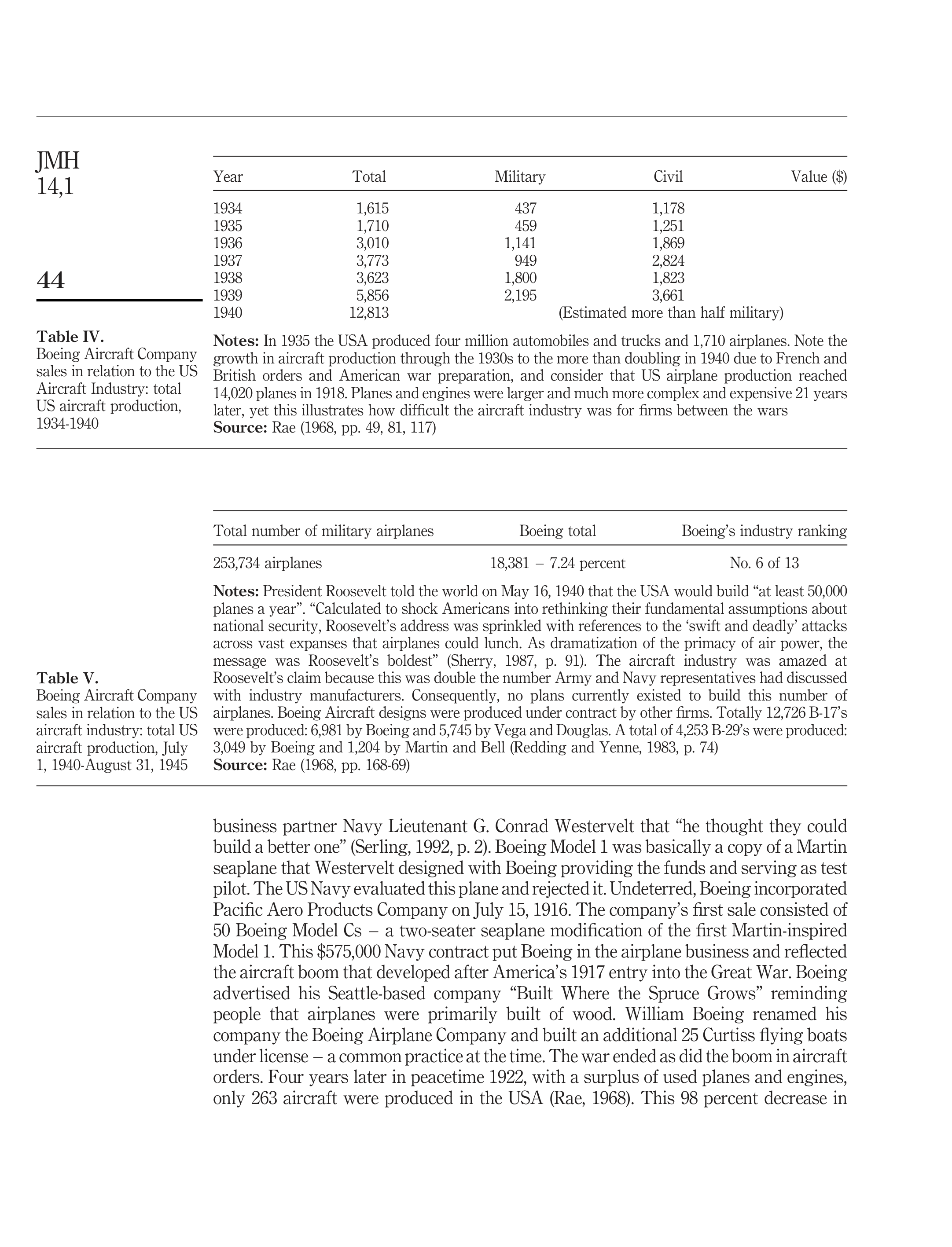
business
partner
Navy
Lieutenant
G.
Conrad
Westervelt
that
“he
thought
they
could
build a better one” (Serling, 1992, p. 2). Boeing Model 1 was basically a copy of a Martin
seaplane that Westervelt designed with Boeing providing the funds and serving as test
pilot. The US Navy evaluated this plane and rejected it. Undeterred, Boeing incorporated
Pacific Aero Products Company on July 15, 1916. The company’s first sale consisted of
50 Boeing
Model
Cs
–
a two-seater seaplane
modification of the first Martin-inspired
Model 1. This $575,000 Navy contract put Boeing in the airplane business and reflected
the aircraft boom that developed after America’s 1917 entry into the Great War. Boeing
advertised
his
Seattle-based
company
“Built
Where
the
Spruce
Grows”
reminding
people
that
airplanes
were
primarily
built
of
wood.
William
Boeing
renamed
his
company the Boeing Airplane Company and built an additional 25 Curtiss flying boats
under license – a common practice at the time. The war ended as did the boom in aircraft
orders. Four years later in peacetime 1922, with a surplus of used planes and engines,
only
263
aircraft
were
produced
in
the
USA
(Rae,
1968).
This
98
percent
decrease
in
Year
Total
Military
Civil
Value
($)
1934
1,615
437
1,178
1935
1,710
459
1,251
1936
3,010
1,141
1,869
1937
3,773
949
2,824
1938
3,623
1,800
1,823
1939
5,856
2,195
3,661
1940
12,813
(Estimated
more
than
half
military)
Notes:
In 1935 the USA produced four million automobiles and trucks and 1,710 airplanes. Note the
growth in aircraft production through the 1930s to the more than doubling in 1940 due to French and
British
orders
and
American
war
preparation,
and
consider
that
US
airplane
production
reached
14,020 planes in 1918. Planes and engines were larger and much more complex and expensive 21 years
later,
yet
this illustrates
how
difficult
the
aircraft
industry
was
for
firms between
the
wars
Source:
Rae
(1968,
pp. 49,
81,
117)
Table IV.
Boeing Aircraft Company
sales in relation to the US
Aircraft
Industry:
total
US
aircraft
production,
1934-1940
Total
number of
military
airplanes
Boeing
total
Boeing’s
industry
ranking
253,734
airplanes
18,381
–
7.24
percent
No.
6
of 13
Notes:
President Roosevelt told the world on May 16, 1940 that the USA would build “at least 50,000
planes a year”. “Calculated to shock Americans into rethinking their fundamental assumptions about
national security, Roosevelt’s address was sprinkled with references to the ‘swift and deadly’ attacks
across
vast
expanses
that
airplanes
could
lunch.
As
dramatization
of
the
primacy
of
air
power,
the
message
was
Roosevelt’s
boldest”
(Sherry,
1987,
p.
91).
The
aircraft
industry
was
amazed
at
Roosevelt’s claim because this was double the number Army and Navy representatives had discussed
with
industry
manufacturers.
Consequently,
no
plans
currently
existed
to
build
this
number
of
airplanes. Boeing Aircraft designs were produced under contract by other firms. Totally 12,726 B-17’s
were produced: 6,981 by Boeing and 5,745 by Vega and Douglas. A total of 4,253 B-29’s were produced:
3,049
by Boeing
and
1,204
by Martin
and Bell
(Redding
and Yenne,
1983,
p. 74)
Source:
Rae
(1968,
pp. 168-69)
Table V.
Boeing Aircraft Company
sales in relation to the US
aircraft industry: total US
aircraft
production,
July
1,
1940-August
31,
1945
JMH
14,1
44
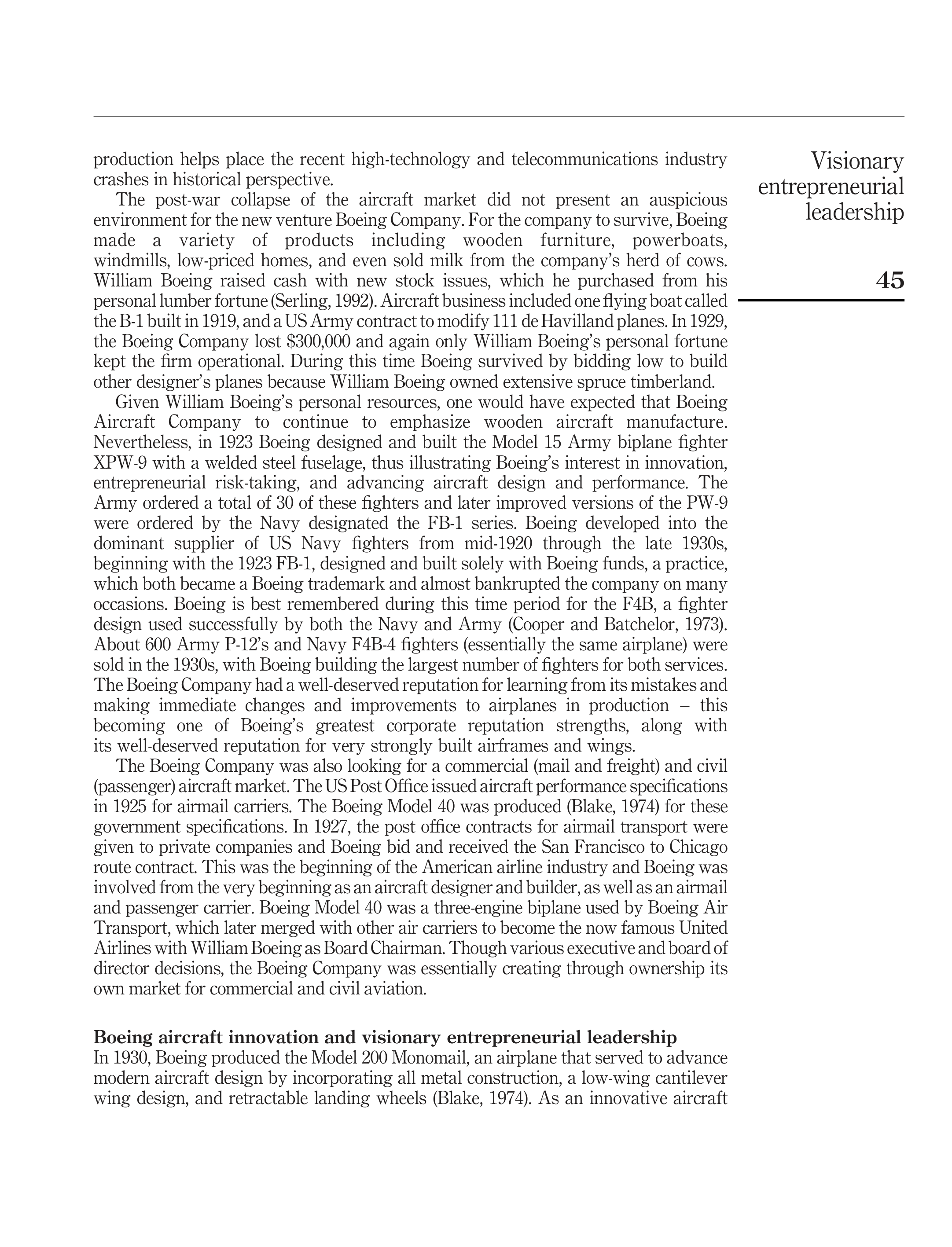
production
helps
place
the
recent
high-technology
and
telecommunications
industry
crashes in historical perspective.
The
post-war
collapse
of
the
aircraft
market
did
not
present
an
auspicious
environment for the new venture Boeing Company. For the company to survive, Boeing
made
a
variety
of
products
including
wooden
furniture,
powerboats,
windmills,
low-priced
homes,
and
even
sold
milk
from
the
company’s
herd
of
cows.
William
Boeing
raised
cash
with
new
stock
issues,
which
he
purchased
from
his
personal lumber fortune (Serling, 1992). Aircraft business included one flying boat called
the B-1 built in 1919, and a US Army contract to modify 111 de Havilland planes. In 1929,
the Boeing
Company lost
$300,000 and again
only
William
Boeing’s personal fortune
kept
the
firm
operational.
During
this
time
Boeing
survived
by
bidding
low
to
build
other designer’s planes because William Boeing owned extensive spruce timberland.
Given
William
Boeing’s
personal
resources,
one
would
have
expected
that
Boeing
Aircraft
Company
to
continue
to
emphasize
wooden
aircraft
manufacture.
Nevertheless,
in
1923
Boeing
designed
and
built
the
Model
15
Army
biplane
fighter
XPW-9
with a welded steel fuselage, thus illustrating Boeing’s interest in innovation,
entrepreneurial
risk-taking,
and
advancing
aircraft
design
and
performance.
The
Army ordered
a total of 30 of these fighters and later improved versions of the PW-9
were
ordered
by
the
Navy
designated
the
FB-1
series.
Boeing
developed
into
the
dominant
supplier
of
US
Navy
fighters
from
mid-1920
through
the
late
1930s,
beginning with the 1923 FB-1, designed and built solely with Boeing funds, a practice,
which both became a Boeing trademark and almost bankrupted the company on many
occasions.
Boeing
is
best
remembered
during
this
time
period
for
the
F4B,
a
fighter
design
used
successfully
by
both
the
Navy
and
Army
(Cooper
and
Batchelor,
1973).
About 600 Army P-12’s and Navy F4B-4 fighters (essentially the same airplane) were
sold in the 1930s, with Boeing building the largest number of fighters for both services.
The Boeing Company had a well-deserved reputation for learning from its mistakes and
making
immediate
changes
and
improvements
to
airplanes
in
production
–
this
becoming
one
of
Boeing’s
greatest
corporate
reputation
strengths,
along
with
its
well-deserved
reputation for
very
strongly
built
airframes
and
wings.
The Boeing Company was also looking for a commercial (mail and freight) and civil
(passenger) aircraft market. The US Post Office issued aircraft performance specifications
in 1925 for airmail carriers. The Boeing Model 40 was produced (Blake, 1974) for these
government
specifications. In 1927, the
post
office
contracts for airmail transport
were
given to private
companies and Boeing
bid and
received the
San
Francisco to Chicago
route contract. This was the beginning of the American airline industry and Boeing was
involved from the very beginning as an aircraft designer and builder, as well as an airmail
and passenger carrier. Boeing Model 40 was a three-engine biplane used by Boeing Air
Transport, which later merged with other air carriers to become the now famous United
Airlines with William Boeing as Board Chairman. Though various executive and board of
director decisions, the Boeing Company was essentially creating through ownership its
own market for commercial and civil aviation.
Boeing
aircraft
innovation
and
visionary
entrepreneurial
leadership
In 1930, Boeing produced the Model 200 Monomail, an airplane that served to advance
modern aircraft design by incorporating all metal construction, a low-wing cantilever
wing
design,
and
retractable
landing
wheels
(Blake,
1974).
As
an
innovative
aircraft
Visionary
entrepreneurial
leadership
45
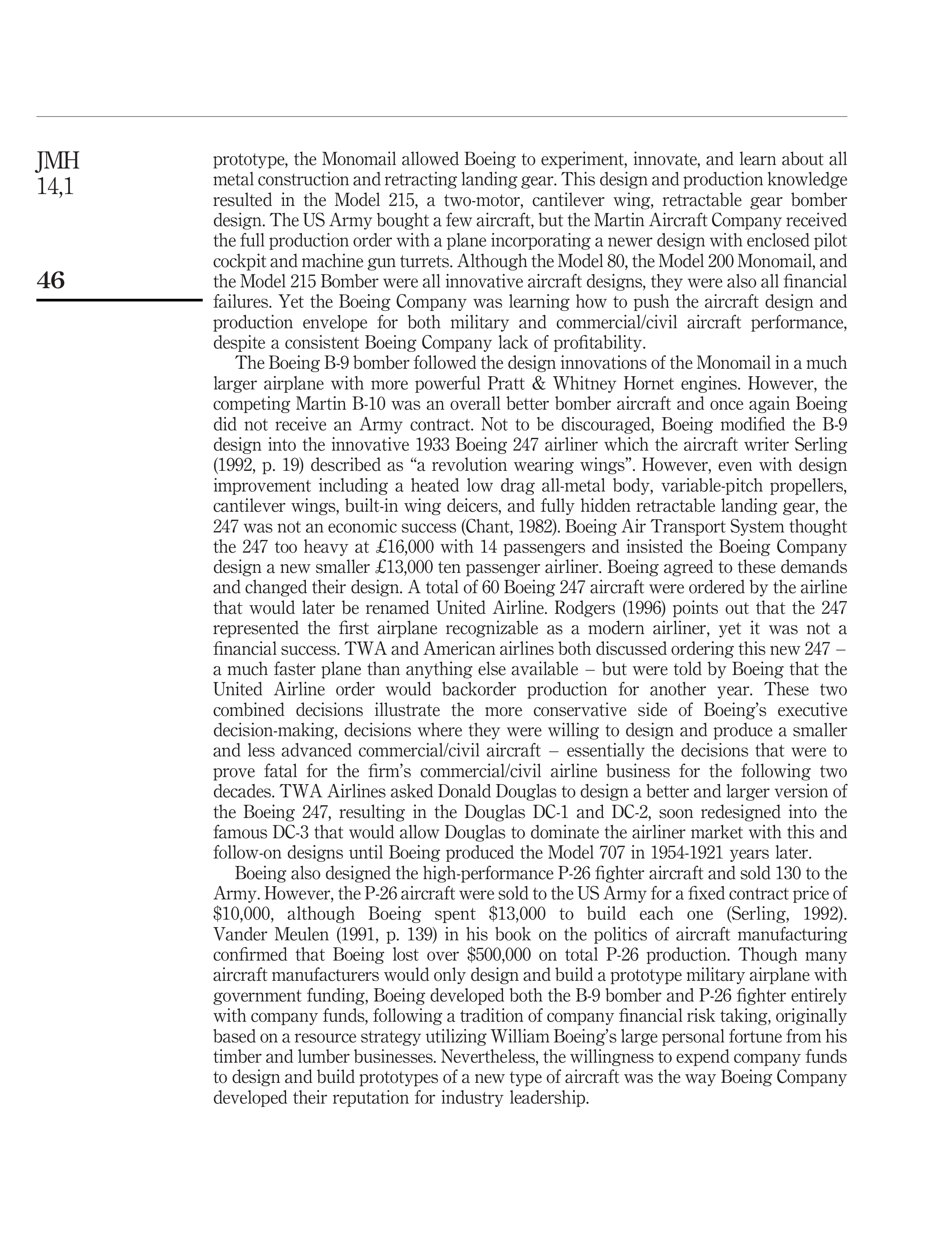
prototype, the Monomail allowed Boeing to experiment, innovate, and
learn about all
metal construction and retracting landing gear. This design and production knowledge
resulted
in
the
Model
215,
a
two-motor,
cantilever
wing,
retractable
gear
bomber
design. The US Army bought a few aircraft, but the Martin Aircraft Company received
the full production order with a plane incorporating a newer design with enclosed pilot
cockpit and machine gun turrets. Although the Model 80, the Model 200 Monomail, and
the Model 215 Bomber were all innovative aircraft designs, they were also all financial
failures.
Yet
the
Boeing
Company
was
learning
how
to
push
the
aircraft
design
and
production
envelope
for
both
military
and
commercial/civil
aircraft
performance,
despite
a
consistent
Boeing Company
lack
of
profitability.
The Boeing B-9 bomber followed the design innovations of the Monomail in a much
larger
airplane
with
more
powerful
Pratt
&
Whitney
Hornet
engines.
However,
the
competing
Martin
B-10
was
an
overall
better
bomber
aircraft
and
once
again
Boeing
did
not
receive
an
Army
contract.
Not
to
be
discouraged,
Boeing
modified
the
B-9
design
into
the
innovative
1933
Boeing
247
airliner
which
the
aircraft
writer
Serling
(1992,
p.
19)
described
as
“a
revolution
wearing
wings”.
However,
even
with
design
improvement
including
a
heated
low
drag
all-metal
body,
variable-pitch
propellers,
cantilever
wings,
built-in
wing
deicers,
and
fully
hidden
retractable
landing
gear,
the
247 was not an economic success (Chant, 1982). Boeing Air Transport System thought
the
247
too
heavy
at
£16,000
with
14
passengers
and
insisted
the
Boeing
Company
design a new smaller £13,000 ten passenger airliner. Boeing agreed to these demands
and changed their design. A total of 60 Boeing 247 aircraft were ordered by the airline
that
would
later
be
renamed
United
Airline.
Rodgers
(1996)
points
out
that
the
247
represented
the
first
airplane
recognizable
as
a
modern
airliner,
yet
it
was
not
a
financial success. TWA and American airlines both discussed ordering this new 247
–
a
much
faster
plane
than
anything
else
available
–
but
were
told
by
Boeing
that
the
United
Airline
order
would
backorder
production
for
another
year.
These
two
combined
decisions
illustrate
the
more
conservative
side
of
Boeing’s
executive
decision-making,
decisions
where
they
were
willing
to
design
and
produce
a
smaller
and
less
advanced
commercial/civil
aircraft
–
essentially
the
decisions
that
were
to
prove
fatal
for
the
firm’s
commercial/civil
airline
business
for
the
following
two
decades. TWA Airlines asked Donald Douglas to design a better and larger version of
the
Boeing
247,
resulting
in
the
Douglas
DC-1
and
DC-2,
soon
redesigned
into
the
famous DC-3 that would allow Douglas to dominate the airliner market with this and
follow-on designs
until
Boeing
produced
the Model
707
in
1954-1921
years
later.
Boeing also designed the high-performance P-26 fighter aircraft and sold 130 to the
Army. However, the P-26 aircraft were sold to the US Army for a fixed contract price of
$10,000,
although
Boeing
spent
$13,000
to
build
each
one
(Serling,
1992).
Vander
Meulen
(1991,
p.
139)
in
his
book
on
the
politics
of
aircraft
manufacturing
confirmed
that
Boeing
lost
over
$500,000
on
total
P-26
production.
Though
many
aircraft manufacturers would only design and build a prototype military airplane with
government funding, Boeing developed both the B-9 bomber and P-26 fighter entirely
with company funds, following a tradition of company financial risk taking, originally
based on a resource strategy utilizing William Boeing’s large personal fortune from his
timber and lumber businesses. Nevertheless, the willingness to expend company funds
to design and build prototypes of a new type of aircraft was the way Boeing Company
developed
their
reputation for
industry
leadership.
JMH
14,1
46
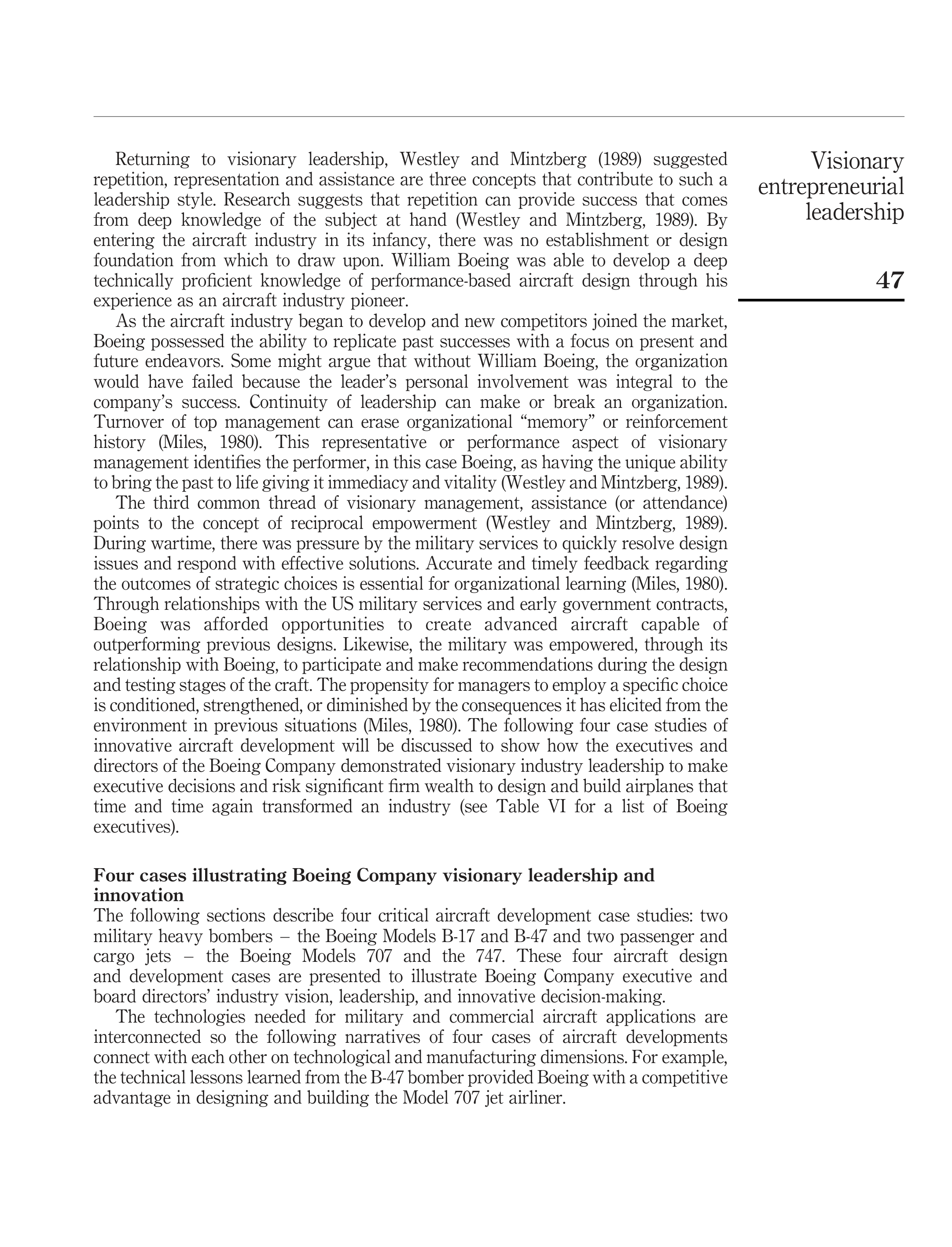
Returning
to
visionary
leadership,
Westley
and
Mintzberg
(1989)
suggested
repetition,
representation
and
assistance
are
three
concepts
that
contribute
to
such
a
leadership
style.
Research
suggests
that
repetition
can
provide
success
that
comes
from
deep
knowledge
of
the
subject
at
hand
(Westley
and
Mintzberg,
1989).
By
entering
the
aircraft
industry
in
its
infancy,
there
was
no
establishment
or
design
foundation
from
which
to
draw
upon.
William
Boeing
was
able
to
develop
a
deep
technically
proficient
knowledge
of
performance-based
aircraft
design
through
his
experience
as an
aircraft
industry
pioneer.
As
the aircraft
industry began
to
develop
and
new
competitors
joined
the
market,
Boeing
possessed
the
ability
to
replicate
past
successes
with
a
focus
on
present
and
future
endeavors.
Some
might
argue
that
without
William
Boeing,
the
organization
would
have
failed
because
the
leader’s
personal
involvement
was
integral
to
the
company’s
success.
Continuity
of
leadership
can
make
or
break
an
organization.
Turnover
of
top
management
can
erase
organizational
“memory”
or
reinforcement
history
(Miles,
1980).
This
representative
or
performance
aspect
of
visionary
management identifies the performer, in this case Boeing, as having the unique ability
to bring the past to life giving it immediacy and vitality (Westley and Mintzberg, 1989).
The
third
common
thread
of
visionary
management,
assistance
(or
attendance)
points
to
the
concept
of
reciprocal
empowerment
(Westley
and
Mintzberg,
1989).
During wartime, there was pressure by the military services to quickly resolve design
issues
and
respond
with
effective
solutions.
Accurate
and
timely
feedback
regarding
the outcomes of strategic choices is essential for organizational learning (Miles, 1980).
Through relationships with the US military services and early government contracts,
Boeing
was
afforded
opportunities
to
create
advanced
aircraft
capable
of
outperforming
previous
designs.
Likewise,
the
military
was
empowered,
through
its
relationship with Boeing, to participate and make recommendations during the design
and testing stages of the craft. The propensity for managers to employ a specific choice
is conditioned, strengthened, or diminished by the consequences it has elicited from the
environment
in
previous
situations
(Miles,
1980).
The
following
four
case
studies
of
innovative
aircraft
development
will
be
discussed
to
show
how
the
executives
and
directors of the Boeing Company demonstrated visionary industry leadership to make
executive decisions and risk significant firm wealth to design and build airplanes that
time
and
time
again
transformed
an
industry
(see
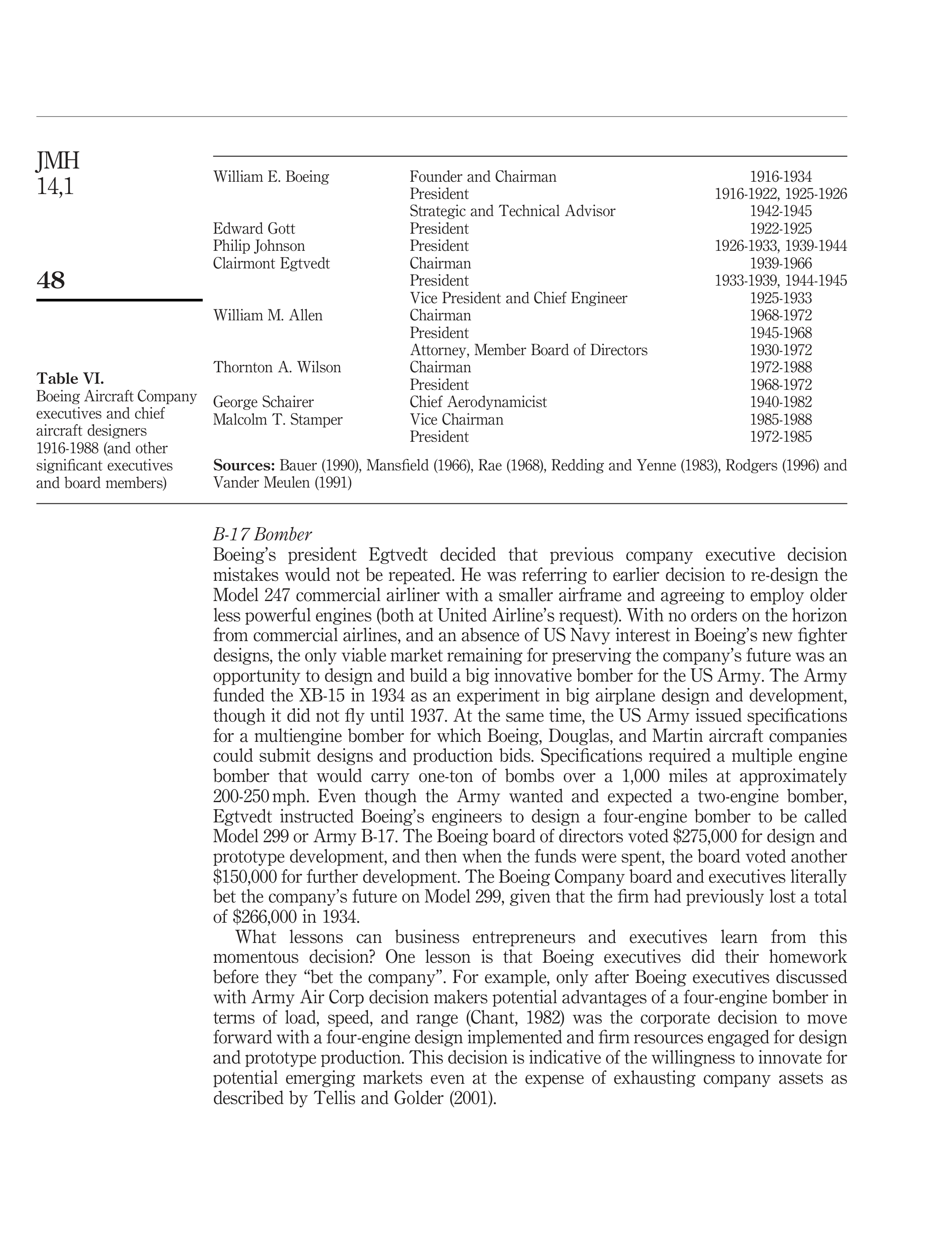
Table
VI
for
a
list
of
Boeing
executives).
Four
cases
illustrating
Boeing
Company
visionary
leadership
and
innovation
The
following
sections
describe
four
critical
aircraft
development
case
studies:
two
military
heavy
bombers
–
the
Boeing
Models
B-17
and
B-47
and
two
passenger
and
cargo
jets
–
the
Boeing
Models
707
and
the
747.
These
four
aircraft
design
and
development
cases
are
presented
to
illustrate
Boeing
Company
executive
and
board
directors’
industry
vision,
leadership,
and
innovative
decision-making.
The
technologies
needed
for
military
and
commercial
aircraft
applications
are
interconnected
so
the
following
narratives
of
four
cases
of
aircraft
developments
connect with each other on technological and manufacturing dimensions. For example,
the technical lessons learned from the B-47 bomber provided Boeing with a competitive
advantage
in
designing
and building
the
Model
707
jet
airliner.
Visionary
entrepreneurial
leadership
47
B-17
Bomber
Boeing’s
president
Egtvedt
decided
that
previous
company
executive
decision
mistakes
would
not
be
repeated.
He
was
referring
to
earlier
decision
to
re-design
the
Model
247
commercial
airliner
with
a
smaller
airframe
and
agreeing
to
employ
older
less powerful engines (both at United Airline’s request). With no orders on the horizon
from commercial airlines, and an absence of US Navy interest in Boeing’s new fighter
designs, the only viable market remaining for preserving the company’s future was an
opportunity to design and build a big innovative bomber for the US Army. The Army
funded
the
XB-15
in
1934
as
an
experiment
in
big
airplane
design
and
development,
though it did not fly until 1937. At the same time, the US Army issued specifications
for
a
multiengine
bomber
for
which
Boeing,
Douglas,
and
Martin
aircraft
companies
could
submit
designs
and
production
bids.
Specifications
required
a
multiple
engine
bomber
that
would
carry
one-ton
of
bombs
over
a
1,000
miles
at
approximately
200-250 mph.
Even
though
the
Army
wanted
and
expected
a
two-engine
bomber,
Egtvedt
instructed
Boeing’s
engineers
to
design
a
four-engine
bomber
to
be
called
Model 299 or Army B-17. The Boeing board of directors voted $275,000 for design and
prototype development, and then when the funds were spent, the board voted another
$150,000 for further development. The Boeing Company board and executives literally
bet the company’s future on Model 299, given that the firm had previously lost a total
of
$266,000 in
1934.
What
lessons
can
business
entrepreneurs
and
executives
learn
from
this
momentous
decision?
One
lesson
is
that
Boeing
executives
did
their
homework
before
they
“bet
the
company”.
For
example,
only
after
Boeing
executives
discussed
with Army Air Corp decision makers potential advantages of a four-engine bomber in
terms
of
load,
speed,
and
range
(Chant,
1982)
was
the
corporate
decision
to
move
forward with a four-engine design implemented and firm resources engaged for design
and prototype production. This decision is indicative of the willingness to innovate for
potential
emerging
markets
even
at
the
expense
of
exhausting
company
assets
as
described by
Tellis
and
Golder
(2001).
William
E.
Boeing
Founder
and Chairman
1916-1934
President
1916-1922,
1925-1926
Strategic
and
Technical
Advisor
1942-1945
Edward
Gott
President
1922-1925
Philip
Johnson
President
1926-1933,
1939-1944
Clairmont
Egtvedt
Chairman
1939-1966
President
1933-1939,
1944-1945
Vice
President
and Chief
Engineer
1925-1933
William
M.
Allen
Chairman
1968-1972
President
1945-1968
Attorney,
Member
Board of
Directors
1930-1972
Thornton
A. Wilson
Chairman
1972-1988
President
1968-1972
George
Schairer
Chief
Aerodynamicist
1940-1982
Malcolm
T. Stamper
Vice
Chairman
1985-1988
President
1972-1985
Sources:
Bauer (1990), Mansfield (1966), Rae (1968), Redding
and Yenne (1983), Rodgers (1996) and
Vander
Meulen
(1991)
Table VI.
Boeing Aircraft Company
executives
and
chief
aircraft
designers
1916-1988
(and
other
significant
executives
and board
members)
JMH
14,1
48
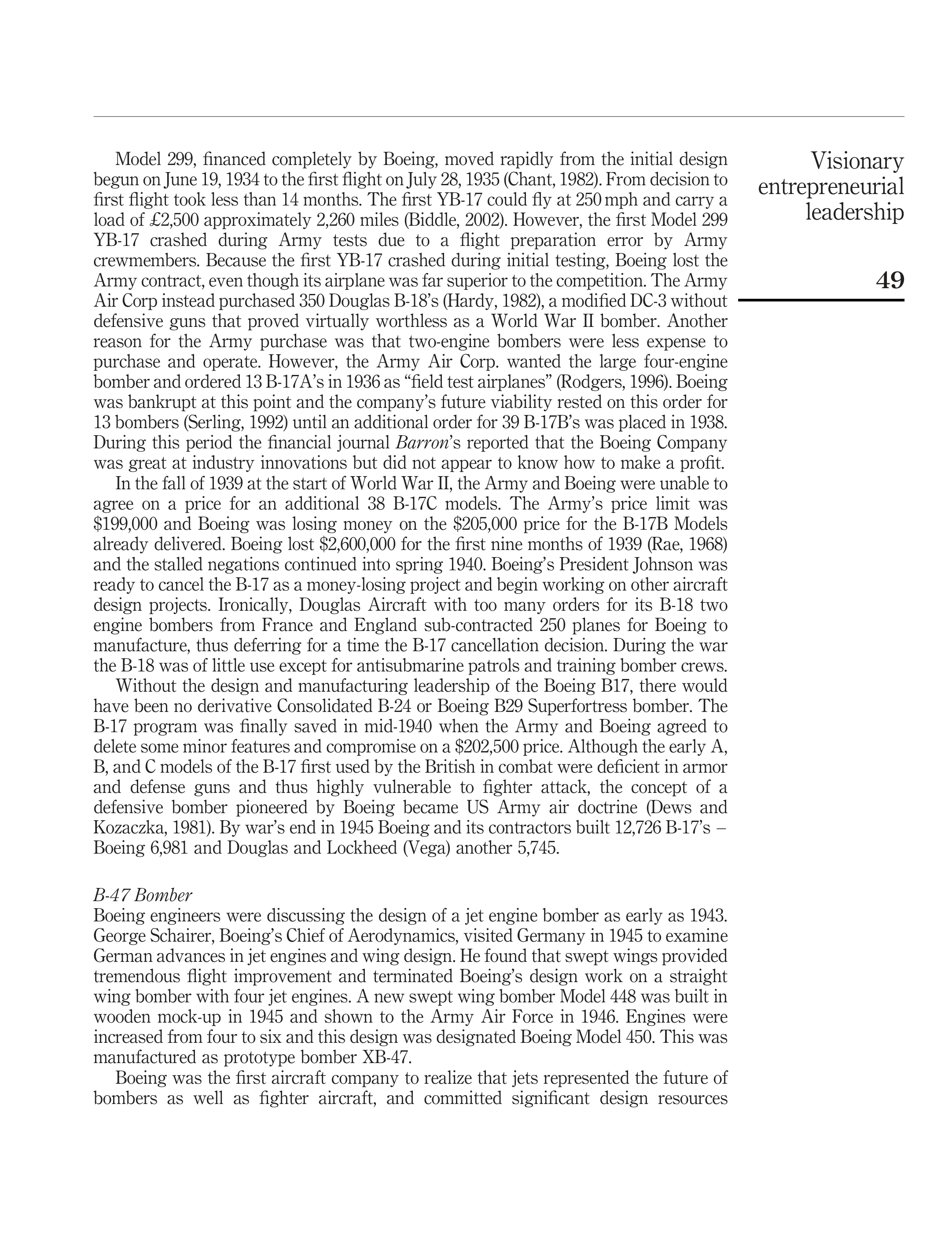
Model
299,
financed
completely
by
Boeing,
moved
rapidly
from
the
initial
design
begun on June 19, 1934 to the first flight on July 28, 1935 (Chant, 1982). From decision to
first flight took less than 14 months. The first YB-17 could fly at 250 mph and carry a
load of £2,500 approximately 2,260 miles (Biddle, 2002). However, the first Model 299
YB-17
crashed
during
Army
tests
due
to
a
flight
preparation
error
by
Army
crewmembers.
Because
the
first
YB-17
crashed
during
initial
testing,
Boeing
lost
the
Army contract, even though its airplane was far superior to the competition. The Army
Air Corp instead purchased 350 Douglas B-18’s (Hardy, 1982), a modified DC-3 without
defensive
guns
that
proved
virtually
worthless
as
a
World
War
II
bomber.
Another
reason
for
the
Army
purchase
was
that
two-engine
bombers
were
less
expense
to
purchase
and
operate.
However,
the
Army
Air
Corp.
wanted
the
large
four-engine
bomber and ordered 13 B-17A’s in 1936 as “field test airplanes” (Rodgers, 1996). Boeing
was bankrupt at this point and the company’s future viability rested on this order for
13 bombers (Serling, 1992) until an additional order for 39 B-17B’s was placed in 1938.
During
this
period
the
financial
journal
Barron
’s
reported
that
the
Boeing
Company
was
great
at
industry
innovations
but
did
not
appear
to
know
how
to
make
a
profit.
In the fall of 1939 at the start of World War II, the Army and Boeing were unable to
agree
on
a
price
for
an
additional
38
B-17C
models.
The
Army’s
price
limit
was
$199,000
and
Boeing
was
losing
money
on
the
$205,000
price
for
the
B-17B
Models
already delivered. Boeing lost $2,600,000 for the first nine months of 1939 (Rae, 1968)
and the stalled negations continued into spring 1940. Boeing’s President Johnson was
ready to cancel the B-17 as a money-losing project and begin working on other aircraft
design
projects.
Ironically,
Douglas
Aircraft
with
too
many
orders
for
its
B-18
two
engine
bombers
from
France
and
England
sub-contracted
250
planes
for
Boeing
to
manufacture, thus deferring for a time the B-17 cancellation decision. During the war
the B-18 was of little use except for antisubmarine patrols and training bomber crews.
Without
the
design
and
manufacturing
leadership
of
the
Boeing
B17,
there
would
have
been no derivative Consolidated B-24 or
Boeing
B29 Superfortress bomber. The
B-17
program
was
finally
saved
in
mid-1940
when
the
Army
and
Boeing
agreed
to
delete some minor features and compromise on a $202,500 price. Although the early A,
B, and C models of the B-17 first used by the British in combat were deficient in armor
and
defense
guns
and
thus
highly
vulnerable
to
fighter
attack,
the
concept
of
a
defensive
bomber
pioneered
by
Boeing
became
US
Army
air
doctrine
(Dews
and
Kozaczka, 1981). By war’s end in 1945 Boeing and its contractors built 12,726 B-17’s
–
Boeing 6,981
and Douglas
and
Lockheed
(Vega)
another
5,745.
B-47
Bomber
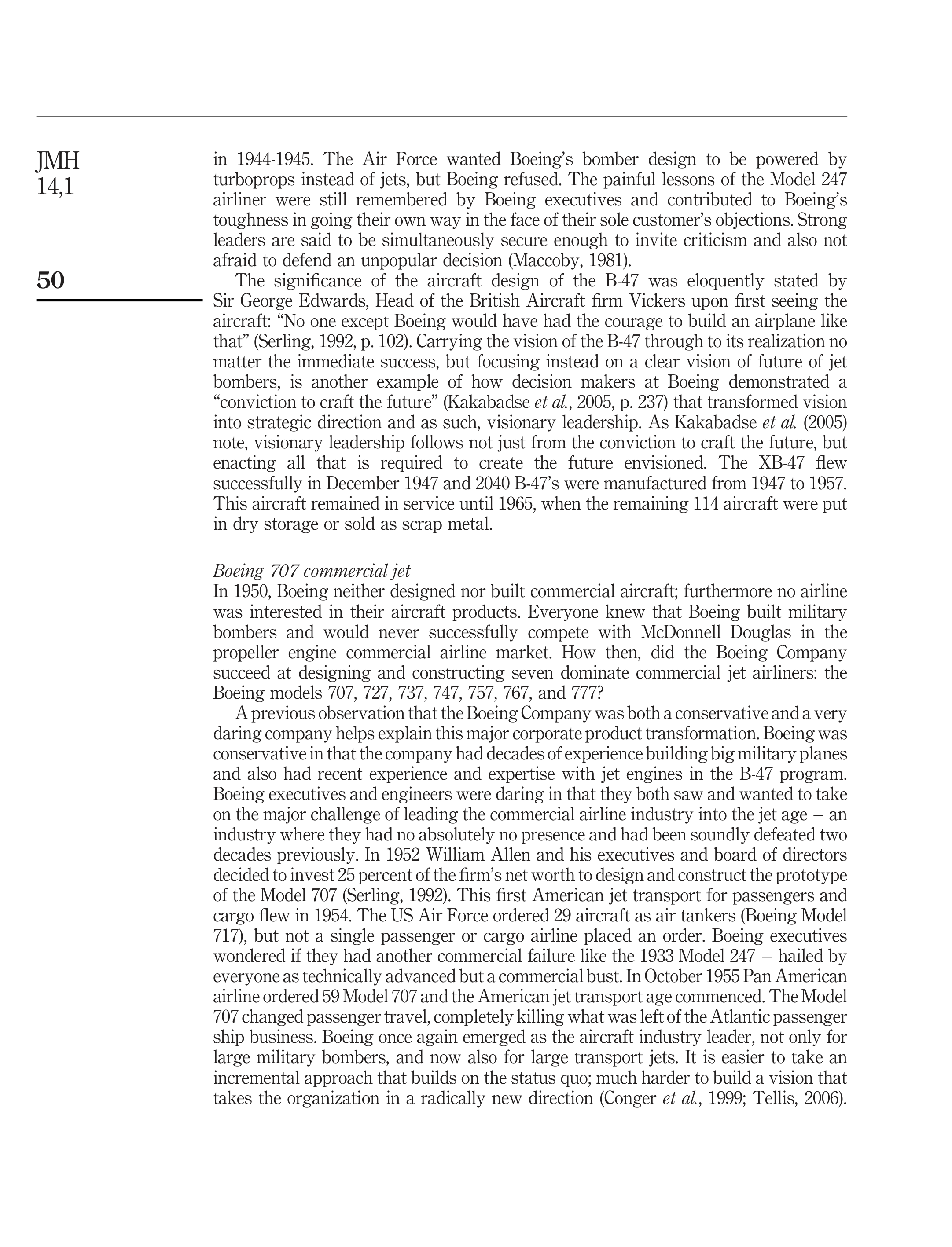
Boeing engineers
were discussing the design of a jet engine bomber as early as 1943.
George Schairer, Boeing’s Chief of Aerodynamics, visited Germany in 1945 to examine
German advances in jet engines and wing design. He found that swept wings provided
tremendous
flight
improvement
and
terminated
Boeing’s
design
work
on
a
straight
wing bomber with four jet engines. A new swept wing bomber Model 448 was built in
wooden
mock-up
in
1945
and
shown
to
the
Army
Air
Force
in
1946.
Engines
were
increased from four to six and this design was designated Boeing Model 450. This was
manufactured
as
prototype
bomber
XB-47.
Boeing
was
the first aircraft company
to
realize
that jets
represented
the future of
bombers
as
well
as
fighter
aircraft,
and
committed
significant
design
resources
Visionary
entrepreneurial
leadership
49
in
1944-1945.
The
Air
Force
wanted
Boeing’s
bomber
design
to
be
powered
by
turboprops
instead
of
jets,
but
Boeing
refused.
The
painful
lessons
of
the
Model
247
airliner
were
still
remembered
by
Boeing
executives
and
contributed
to
Boeing’s
toughness in going their own way in the face of their sole customer’s objections. Strong
leaders
are
said
to
be
simultaneously
secure
enough
to
invite
criticism
and
also
not
afraid
to
defend
an
unpopular
decision
(Maccoby,
1981).
The
significance
of
the
aircraft
design
of
the
B-47
was
eloquently
stated
by
Sir
George
Edwards,
Head
of
the
British
Aircraft
firm
Vickers
upon
first
seeing
the
aircraft:
“No
one except Boeing would
have
had
the courage to
build
an airplane like
that” (Serling, 1992, p. 102). Carrying the vision of the B-47 through to its realization no
matter
the
immediate
success,
but
focusing
instead
on
a
clear
vision
of
future
of
jet
bombers,
is
another
example
of
how
decision
makers
at
Boeing
demonstrated
a
“conviction to craft the future” (Kakabadse
et al.
, 2005, p. 237) that transformed vision
into
strategic
direction
and
as
such,
visionary
leadership.
As
Kakabadse
et
al.
(2005)
note, visionary leadership follows
not just from the conviction to craft the future, but
enacting
all
that
is
required
to
create
the
future
envisioned.
The
XB-47
flew
successfully in December 1947 and 2040 B-47’s were manufactured from 1947 to 1957.
This aircraft remained in service until 1965, when the remaining 114 aircraft were put
in
dry
storage
or
sold
as scrap metal.
Boeing
707
commercial
jet
In 1950, Boeing neither designed nor built commercial aircraft; furthermore no airline
was
interested
in
their
aircraft
products.
Everyone
knew
that
Boeing
built
military
bombers
and
would
never
successfully
compete
with
McDonnell
Douglas
in
the
propeller
engine
commercial
airline
market.
How
then,
did
the
Boeing
Company
succeed
at
designing
and
constructing
seven
dominate
commercial
jet
airliners:
the
Boeing models
707,
727,
737,
747,
757,
767,
and
777?
A previous observation that the Boeing Company was both a conservative and a very
daring company helps explain this major corporate product transformation. Boeing was
conservative in that the company had decades of experience building big military planes
and
also
had
recent
experience
and
expertise
with
jet
engines
in
the
B-47
program.
Boeing executives and engineers were daring in that they both saw and wanted to take
on the major challenge of leading the commercial airline industry into the jet age
–
an
industry where they had no absolutely no presence and had been soundly defeated two
decades
previously.
In
1952
William
Allen
and
his
executives
and
board
of
directors
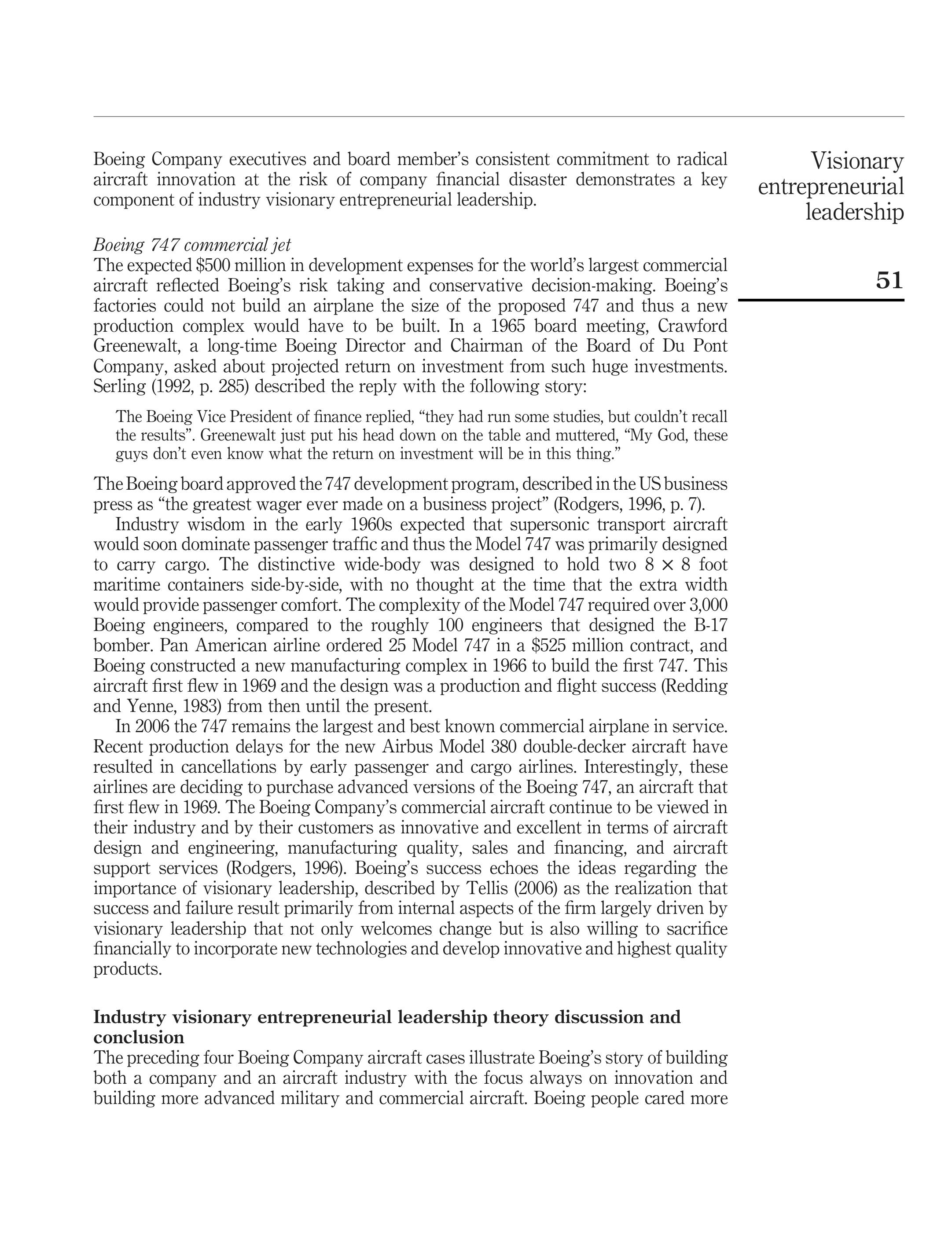
decided to invest 25 percent of the firm’s net worth to design and construct the prototype
of the Model 707 (Serling, 1992). This first American jet transport for passengers and
cargo flew in 1954. The US Air Force ordered 29 aircraft as air tankers (Boeing Model
717),
but
not
a
single
passenger
or
cargo
airline
placed
an
order.
Boeing
executives
wondered if they had another commercial failure like the 1933 Model 247
–
hailed by
everyone as technically advanced but a commercial bust. In October 1955 Pan American
airline ordered 59 Model 707 and the American jet transport age commenced. The Model
707 changed passenger travel, completely killing what was left of the Atlantic passenger
ship business. Boeing once again emerged as the aircraft industry leader, not only for
large
military
bombers,
and
now
also
for
large
transport
jets.
It
is
easier
to
take
an
incremental approach that builds on the status quo; much harder to build a vision that
takes
the
organization
in
a
radically
new
direction
(Conger
et
al.
,
1999;
Tellis,
2006).
JMH
14,1
50
Boeing
Company
executives
and
board
member’s
consistent
commitment
to
radical
aircraft
innovation
at
the
risk
of
company
financial
disaster
demonstrates
a
key
component of industry visionary entrepreneurial leadership.
Boeing
747
commercial
jet
The expected $500 million in development expenses for the world’s largest commercial
aircraft
reflected
Boeing’s
risk
taking
and
conservative
decision-making.
Boeing’s
factories
could
not
build
an
airplane
the
size
of
the
proposed
747
and
thus
a
new
production
complex
would
have
to
be
built.
In
a
1965
board
meeting,
Crawford
Greenewalt,
a
long-time
Boeing
Director
and
Chairman
of
the
Board
of
Du
Pont
Company,
asked
about
projected
return
on
investment
from
such
huge
investments.
Serling (1992, p.
285)
described the
reply
with
the
following story:
The Boeing Vice President of finance replied, “they had run some studies, but couldn’t recall
the
results”.
Greenewalt
just
put
his
head
down
on
the
table
and
muttered,
“My
God,
these
guys
don’t
even
know what
the
return
on
investment
will be in
this
thing.”
The Boeing board approved the 747 development program, described in the US business
press as “the greatest wager ever made on a business project” (Rodgers, 1996, p. 7).
Industry
wisdom
in
the
early
1960s
expected
that
supersonic
transport
aircraft
would soon dominate passenger traffic and thus the Model 747 was primarily designed
to
carry
cargo.
The
distinctive
wide-body
was
designed
to
hold
two
8
£
8
foot
maritime
containers
side-by-side,
with
no
thought
at
the
time
that
the
extra
width
would provide passenger comfort. The complexity of the Model 747 required over 3,000
Boeing
engineers,
compared
to
the
roughly
100
engineers
that
designed
the
B-17
bomber.
Pan
American
airline
ordered
25
Model
747
in
a
$525
million
contract,
and
Boeing constructed a new manufacturing complex in 1966 to build the first 747. This
aircraft first flew in 1969 and the design was a production and flight success (Redding
and
Yenne,
1983) from
then
until
the present.
In 2006 the 747 remains the largest and best known commercial airplane in service.
Recent
production
delays
for
the
new
Airbus
Model
380
double-decker
aircraft
have
resulted
in
cancellations
by
early
passenger
and
cargo
airlines.
Interestingly,
these
airlines are deciding to purchase advanced versions of the Boeing 747, an aircraft that
first flew in 1969. The Boeing Company’s commercial aircraft continue to be viewed in
their industry and by their customers as innovative and excellent in terms of aircraft
design
and
engineering,
manufacturing
quality,
sales
and
financing,
and
aircraft
support
services
(Rodgers,
1996).
Boeing’s
success
echoes
the
ideas
regarding
the
importance
of
visionary
leadership,
described
by
Tellis
(2006)
as
the
realization
that
success and failure result primarily from internal aspects of the firm largely driven by
visionary
leadership
that
not
only
welcomes
change
but
is
also
willing
to
sacrifice
financially to incorporate new technologies and develop innovative and highest quality
products.
Industry
visionary
entrepreneurial
leadership
theory
discussion
and
conclusion
The preceding four Boeing Company aircraft cases illustrate Boeing’s story of building
both
a
company
and
an
aircraft
industry
with
the
focus
always
on
innovation
and
building
more
advanced
military
and
commercial
aircraft.
Boeing
people
cared
more
Visionary
entrepreneurial
leadership
51
about
their
product
than
themselves.
Boeing’s
history
helps
explain
the
extension
of
entrepreneurial
leadership
theory
to
a
more
expansive
theory
of
visionary
industry
leadership.
The
relentless
focus
of
leaders
at
Boeing
on
developing
the
future
of
aircraft, at the risk of immediate financial success, captures both the ability of leaders
to envision the future and the willingness to develop that vision and create the future.
This is the basis for our notion of industry visionary entrepreneurial leadership, which
as Boeing has exhibited, includes understanding and anticipating the future, combined
with
an
ability
to
effectively
guide
the
company
strategically
towards
that
future.
Further
case
study
research
could
be
conducted
on
other
companies
in
the
same
and
other
industries
to
see
if
industry
visionary
entrepreneurial
leadership
is
specific
to
Boeing
and
the
aircraft
industry,
or
can
be
generalized
to
other
industries
and
companies.
What
a
study
of
the
Boeing
Company
offers
executives
and
board
of
director
members
in
the
early
twenty-first
century
is
a
vision
of
people
with
intense
pride
in
their
company
and
their
product.
In
response
to
the
ethical
crises
that
often
characterizes
today’s
business
environment,
which typically
involves
a
myopic
focus
on
creating
executive
wealth
through
profit
maximization
at
any
moral
cost,
the
Boeing Company history presents an alternative approach that emphasizes a relentless
focus on innovation and product quality resulting in long-term firm success. This pride
in a company’s product can perhaps once again become integral to the integrity fabric
of American business. The consistency in Boeing’s style of decision making still exists
today, some 90 years later, as reflected in the words of the present day head of Boeing
Company’s
commercial
plane
division,
Scott
E.
Carter:
“Every
time
we
do
a
new
airplane we essentially bet the company to some extent” (Wilber, 2006). About 90 years
after it is founding the Boeing Company continues to demonstrate innovative aircraft
design and production to ensure their position as a visionary entrepreneurial leader in
the
aircraft
industry.
References
Arnett, D.B. and Hunt, S.D. (2002), “Competitive irrationality”,
Business Ethics Quarterly
, Vol. 12
No.
3, pp.
279-303.
Badaracco, J.C. Jr (2001), “We don’t need another hero”,
Harvard Business Review
, Vol. 79 No. 8,
pp.
120-6.
Bartunek, J. (2002), “The proper place of organizational scholarship: a comment on Hinings and
Greenwood”,
Administrative
Science
Quarterly
, Vol.
47
No. 3,
pp.
422-7.
Bauer,
E.E.
(1990),
Boeing
in
Peace
and
War
,
TABA Publishing,
Enumclaw,
WA.
Biddle,
T.D.
(2002),
Rhetoric
and
Reality
in
Air
Warfare
,
Princeton
University
Press,
Princeton,
NJ.
Bilstein,
R.E.
(1996),
The American
Aerospace
Industry
, Twayne
Publishers,
New
York,
NY.
Blake,
J.
(1974),
Early
Airplanes
,
Golden
Press,
New
York,
NY.
Burns, J.M.
(1978),
Leadership
, Harper
&
Row,
New
York, NY.
Byrne, J.A. (2002), “Special report: restoring trust in corporate America”,
Business Week
, June 24,
pp.
30-5.
Chant, C. (1982),
Boeing: The World’s Greatest Planemakers
, Chartwell Books Inc., Secaucus, NJ.
Collins,
J.C. (2001),
Good
to Great
, Harper-Collins
Publishers,
New
York, NY.
JMH
14,1
52
Collins,
J.C.
and
Porras,
J.I.
(1995),
“Building
a
visionary
company”,
California
Management
Review
, Vol.
37
No. 2,
pp.
80-98.
Collins,
J.C. and
Porras,
J.I.
(1997),
Built
to Last
,
Harper-Collins
Publishers,
New
York, NY.
Conger,
J.,
Spreitzer,
G.M.
and
Lawler,
E.E.
III
(1999),
The
Leaders
Change
Handbook:
An Essential Guide to Setting Direction and Taking Action
, Jossey-Bass, San Francisco, CA.
Cooper, B. and Batchelor, J. (1973),
Fighter: A History of Fighter Aircraft
, Charles Scriber’s Sons,
New
York, NY.
Dews,
E.
and
Kozaczka,
F.
(1981),
Air
Interdiction:
Lessons
From
Past
Campaigns,
N-1743-PA&E
,
Rand
Corporation,
Santa
Monica,
CA.
Eisenhardt, K.M. (1989), “Building theories from case study research”,
Academy of Management
Review
, Vol.
14
No. 4,
pp.
532-50.
Groves,
K.
(2006),
“Leader
emotional
expressivity,
visionary
leadership,
and
organizational
change”,
Leadership
and
Organization
Development
Journal
, Vol.
27
No. 7,
pp.
566-83.
Gummesson, E. (1991),
Qualitative Methods in Management Research
, Sage, Newbury Park, CA.
Hardy,
M.J. (1982),
Boeing
,
Patrick Stephens
Limited,
Cambridge.
Hunt,
J.G.
and
Dodge,
D.G.
(2001),
“Leadership
de´ja`
vu
all
over
again”,
Leadership
Quarterly
,
Vol.
11 No.
4,
pp.
435-58.
Kakabadse,
N.,
Kakabadse,
A.
and
Lee-Davies,
L.
(2005),
“Visioning
the
pathway:
a
leadership
process
model”,
European Management
Journal
, Vol.
23 No.
2,
p. 237.
Maccoby, M. (1981),
The Leader: A New Face for American Management
, Simon and Schuster,
New
York, NY.
Maccoby, M. (2003),
The Productive Narcissist: The Promise and Perils of Visionary Leadership
,
Broadway
Books,
New
York, NY.
Mansfield,
H.
(1966),
Vision:
The
Story
of
Boeing:
A
Saga
of
the
Sky
and
the
New
Horizons
of
Space
, Popular
Library,
New York,
NY.
Miles,
R.H.
(1980),
Organization
Behavior
, Scott
Foresman
and
Company,
Glenview, IL.
Mintzberg, H., Ahlstrand, B. and Lampel, J. (1998),
Strategy Safari: A Guided Tour Through the
Wilds
of Strategic
Management
, The
Free Press,
New York,
NY.
Morden,
T. (1997),
“Leadership
as vision”,
Management
Decision
,
Vol. 35
No.
9, pp.
668-82.
Nagel,
E.
(1961),
The
Structure
of
Science:
Problems
in
the
Logic
of
Scientific
Exploration
,
Harcourt,
Brace and
World,
New York,
NY.
Nanus,
B.
(1992),
Visionary
Leadership:
Creating
a
Compelling
Sense
of
Direction
for
your
Organization
, Jossey-Bass,
San
Francisco,
CA.
Rae,
J.B.
(1968),
Climb
to
Greatness:
The
American
Aircraft
Industry,
1920-1960
,
MIT
Press,
Cambridge,
MA.
Rafferty, A.E. and Griffin, M.A. (2004), “Dimensions of transformational leadership: conceptual
and
empirical
extensions”,
Leadership
Quarterly
,
Vol.
15, pp.
329-54.
Redding,
R.
and
Yenne,
B.
(1983),
Boeing:
Planemaker
to
the
World
,
Crescent
Books
–
a
bison
Book,
Greenwich,
CT.
Rodgers,
E.
(1996),
Flying
High:
The
Story
of
Boeing
and
the
Rise
of
the
Jetliner
Industry
,
The
Atlantic
Monthly
Press,
New
York,
NY.
Serling,
R.J.
(1992),
Legend
and
Legacy:
The
Story
of
Boeing
and
its
People
,
St
Martin’s
Press,
New
York, NY.
Sherry,
M.S.
(1987),
The
Rise
of
American
Air
Power:
The
Creation
of
Armageddon
,
Yale
University
Press,
New Haven,
CT.
Visionary
entrepreneurial
leadership
53
Simsonson,
G.R.
(Ed.)
(1968),
The
History
of
the
American
Aircraft
Industry
,
MIT
Press,
Cambridge,
MA.
Sorauren,
I.F.
(2000),
“Non-monetary
incentives:
do
people
work
only
for
money?”,
Business
Ethics
Quarterly
, Vol.
10
No. 4,
pp.
925-44.
Stogdill,
R.M. (1974),
Handbook
of Leadership
, The
Free Press,
New York,
NY.
Tellis, G. (2006), “Disruptive technology or visionary leadership?”,
Journal of Product Innovation
Management
,
Vol.
23, pp.
34-8.
Tellis, G.J. and Golder, P.N. (2001),
Will and Vision: How Latecomers Grow to Dominate Markets
,
McGraw-Hill,
New
York, NY.
Toenjes (2002), “Why be moral in business?”,
Business Ethics Quarterly
, Vol. 12 No. 1, pp. 57-72.
Vander
Meulen,
J.A.
(1991),
The
Politics
of
Aircraft:
Building
an
American
Military
Industry
,
University
of
Kansas
Press,
Lawrence,
KS.
Westley,
F.
and
Mintzberg,
H.
(1989),
“Visionary
leadership
and
strategic
management”,
Strategic
Management
Journal
,
Vol.
10, pp.
17-33.
Wilber,
D.Q.
(2006),
“Orders
in
hand
Boeing
prepares
to
build
dreamliner”,
Washington
Post
,
December
1, 2006,
D01.
Yin,
R. (1989),
Case
Study
Research:
Design
and
Methods
, 2nd
ed.,
Sage,
Newbury
Park,
CA.
Yukl, G.
(2002),
Leadership
in
Organizations
, 5th ed.,
Prentice-Hall,
Englewood
Cliffs,
NJ.
Further
reading
Day,
D.V.
and
Lord,
R.G.
(1988),
“Executive
leadership
and
organizational
performance:
suggestions
for
a
new
theory
and
methodology”,
Journal
of
Management
,
Vol.
14,
pp.
111-22.
Del Quetin, W. (2006), “Orders in hand. Boeing prepares to build dreamliner”,
Washington Post
,
December
1, Section
D, p.
1.
Mintzberg,
H.
(1983),
Power
In
and Around
Organizations
, Prentice-Hall,
Englewood
Cliffs,
NJ.
Perrow,
C.
(1970),
Organizational
Analysis:
A Sociological
View
,
Wadsworth, Belmont,
CA.
Smilor,
R.W.
and
Sexton,
D.L.
(1996),
Leadership
and
Entrepreneurship:
Personal
and
Organizational
Development
in
Entrepreneurial
Ventures
,
Greenwood
Publishing
Group,
New
York, NY.
Staw, B.M. and Ross, J. (1978), “Commitment to a policy decision: a multi-theoretical perspective”,
Administrative
Science
Quarterly
, Vol.
23, pp.
40-64.
Sterling,
R.J.
(1991),
Legend
and
Legacy:
The
Story
of
Boeing
and
its
People
,
St
Martin’s
Press,
New
York, NY.
Corresponding
author
Robert
S. D’Intino
can
be contacted
at:
dintino@rowan.edu
JMH
14,1
54
To
purchase
reprints of
this
article please
e-mail:
reprints@emeraldinsight.com
Or visit
our web
site
for
further
details:
www.emeraldinsight.com/reprints

Reproduced with permission of the copyright owner. Further reproduction prohibited without permission.