1
Chapter 5 Collective Management based on Holistic Leadership: A Case Study of
Cisco Systems
Mitsuru Kodama
Professor of Innovation and Technology Management in the College of Commerce and
Graduate School of Business Administration at Nihon University
Chapter Abstract
Through collective management at Cisco Systems in the United States, practitioners at
all levels of management, rather than just a select few, overcame various contradictions
through “strategic collaborations” across divisions within the company to respond to the
challenge of new business innovation. Moreover, through skillful management of
leadership at the formal organization layer, informal organization layer, and
psychological boundary layer (the boundary layer between the two aforementioned
layers), all practitioners of the company demonstrated holistic leadership, which
enabled creative dialogue, cooperation and understanding as well as rapid
decision-making and action. Strategic collaboration based on holistic leadership enables
outstanding ideas to be readily incorporated into the organization and to be examined
and acted on by a single team. This chapter discusses processes whereby collective
management based on Cisco System’s holistic leadership changed staff behavior and the
corporate culture to achieve business innovation.
Key words: Cisco Systems, collaboration, congruence, networked collaborative
organization, boundary management, strategic management
5.1 Cisco Systems as a leader in the IT industry
Founded in 1984 by Stanford University computer scientists Len Bosack and Sandy
Lerner, Cisco Systems today has grown into a world leader in the field of
internet-related devices. A company representative of IT firms, Cisco Systems became
the world’s most valuable company in 2000 when its aggregate market value of listed
stock surpassed that of Microsoft. Although the company ran into financial difficulties
on a number of occasions, after current Chairman and CEO John Chambers took office
as CEO in 1995, he led the company to a 20-fold growth in sales in a matter of 10 years.
In addition to development through its own initiatives, Cisco grew as a company
through M&A and partnerships. From the market of its mainstay router products, it
successively entered various markets with an expanded product lineup of numerous
network devices. In 2003, it acquired Linksys, the U.S. leading manufacturer in
production and sales of wireless LAN devices for consumer use. In 2006, it acquired
Scientific-Atlanta, a supplier of set top boxes, end-to-end image delivery networks, and
image system integration. This was followed by the acquisition of WebEx
Communications, a major producer of video conferencing software, boasting a 52%
2
share of the world’s Web conference service market, and in 2009 the acquisition of
Norway’s Tandberg, boasting a 41% share of the world market for video conferencing
terminals. In 2010, Cisco Systems proceeded to enter the server area with its release of a
virtual platform called the Cisco Unified Computing System (UCS).
In this way, Cisco, which had started as a manufacture of routers and switches, rose to
the position of a top global company in sales of products in its existing mainstay
business areas. With technological know-how it has accumulated to date as a leader in
its mainstay products of routers and switchers as well as in network technology, Cisco
continues to evolve as a provider of a wide range of solutions to adjacent businesses
through M&A and alliances as mentioned above. Utilizing all kinds of network-related
devices and technologies in areas such as data centers, security, wireless services, voice
and video functions, the optimal platforms Cisco is capable of building for its diverse
corporate customers are also unique new business solutions with rich know-how that
only Cisco can offer from a comprehensive and specialist perspective. For example, its
unified communications (UC), which achieves integration of various communications
methods in business and outstanding efficiency in business processes, significantly
enhances improvement in work productivity through the active utilization of IT.
As a result, Cisco today has evolved into a comprehensive ICT (information
communication technology) company that encompasses all types of network products,
ISP infrastructure, collaboration tools, data centers and virtualization. This evolution
was made possible through Cisco’s successful M&A of approximately 140 companies
carried out step by step over the past 20 some odd years. Therefore, the Cisco of today
is no longer simply a network vendor but an integrated ICT company that covers all
areas of internet and communications technology through strategic collaboration with
diverse partners. Through the use of ICT, Cisco aims to realize human networks that
promote smooth human-to-human communications and “collaborative management”
particularly in corporate business.
5.2 Cisco’s collaborative management
By 2001 Cisco, which was developing its IT network business on a world scale, had
grown to an enormous organization as a result of its tenacious pursuit of an acquisition
strategy. During this change, however, its management style remained unchanged.
Approximately 10 senior executives continued to make the majority of decisions, and
the business divisions and functional organizations of the respective offices operated
through top-down management. Keenly aware of this inefficiency, CEO Chambers
executed bold internal reforms and significantly changed the company’s management
style by steering it in the direction of management by collaborative strategies. Moreover,
as changes and competition in the current market grew intense, he strongly felt that
there was a need to transform the company to an agile organization with ample
flexibility capable of responding to change. Chambers saw “collaboration” as a driver of
change within the company.
Collaboration is a strategy where teams within the company sometimes cooperate with
other teams internally and at times cooperate with teams outside the company.
Collaboration is essential for the company to succeed in today’s world. The question,
however, is how to put this collaboration into practice. Through trial and error, Cisco
first developed a culture where collaboration could be practiced and established
collaboration processes. There was a deep understanding within the company that unless
3
such a culture and appropriate processes were established, Cisco would not be able to
engage in collaboration successfully irrespective of the technology used. The actual
implementation of technology is the easiest aspect of collaboration; the most difficult
aspects are changing the culture and changing the processes. These are difficult because
they involve people. However, only when the culture and processes change
simultaneously with changes in the management environment can the value of
collaboration be realized.
The organization must change from an organization centered on top-down
management governed through orders and control to an organization based on
cooperation and partnership. Using ICT, staff must participate in virtual teams beyond
the framework of conventional departments and engage in activities that adequately
utilize the capabilities of every individual as the occasion demands. To do this, all
employees must have an understanding of the company’s goals, strategies, and priorities,
and must be capable of responding to rapid changes. For its part, the management team
must encourage autonomous employee activities by ensuring that the company strategy
is known and understood throughout the entire organization. Cisco at that time had a
culture of competition among individual departments and groups. Making the transition
to a culture where everyone worked together toward a common goal was also the
greatest challenge for Cisco.
Moreover, it was also necessary to simultaneously promote IT and processes together
with this change in culture to link collaboration with differentiating Cisco from its rivals.
For example, in addition to achieving short-term reductions in expenses through
full-scale internal development of a video conferencing system, collaborative
technologies for video conferencing and unified communications made organizational
innovation possible by combining them with improvement in processes and the internal
culture. The introduction of video conferencing made it possible to reduce operating
costs as well as business travel costs and office overheads by centralizing the company’s
networks. Using these tools to delegate authority, the company was able to reduce the
time span required from product development to product provision and to increase
dialogue with customers. As a result, it was able to effectively realize new products and
services through close collaboration with customers.
As a knowledge strategy (Kodama, 2006a) of the company, it was also essential for
Cisco to aggressively utilize external knowledge of outstanding business partners to
promote knowledge integration of superior know-how within and outside the company
(Kodama, 2009b, 2011b). Furthermore, to adapt to rapidly occurring changes in the
environment and to create new environments, Cisco actively constructed an
organization with solid organizational capability. To achieve this, it aimed to create a
new business ecosystem that included not only external partners and suppliers using
diverse, talented human resources as circumstances dictated, but also a new business
ecosystem that included customers and competitors (Kodama, 2009a). Therefore, for
Cisco, strategic collaboration became its most important business challenge.
5.3 Model, culture, process and technology as the four elements for achieving
collaborative management and the congruence and integration of these
Collaboration does not simply refer to technical architecture and solutions or to product
development. Collaboration can be considered the congruence and integration of the
four management elements of model, culture, process and technology, and is the new
4
experiences of all employees including top management. Collaboration enables people
to fulfill major achievements through mutual cooperation. Furthermore, no matter how
challenging the task, the deep sharing of the strategic goals enables the demonstration of
individual capabilities, and creating an organization that is a collective of such
individuals is also the role of the top leaders. Nevertheless, it is not easy to unify
individual goals and organizational goals in an organization that is a global corporation
which brings together staff born and raised in environments and cultures with various
different values.
Irrespective of the size or business contents of a company, the sharing and resonance
(Kodama, 2001) of values as an organization are the most important considerations for
achieving collaboration. Values include various elements such as customer value,
shareholder value and corporate citizenship but for individuals and an organization to be
able to share values, there must be a mutual understanding of the self and others at a
heartfelt level arrived at through repeated thorough creative dialogue and dialectical
dialogue (Kodama, 2007c). The development of individual and organizational
capabilities that enable the sharing of such values among all staff is crucial, and it is
also the role of leadership at all management layers to enable staff to demonstrate these.
Viewed from this perspective, the work of organizational leaders is, in short, developing
human resources.
Therefore, at Cisco, collaboration among teams across the organization is an essential
function. The organization chart of a formal organization generally illustrates the
hierarchical structure of that organization. However, it is not possible for a third party to
comprehend the system of collaboration from such a structured formal organization in
terms of actual business practices in the informal organizations and how staff actually
interact with each other within and outside this organization and in the organization as a
whole. Improving connections among employees and discovering methods for
enhancing the quality of information to be shared among employees are essential
elements for improving business.
What, then, is meant by the congruence of the four business elements of model,
culture, process and technology? Ron Ricci and Carl Wiese, senior executives of Cisco,
argue that cultivation and coordination of the three components of collaboration -
culture, process and technology - are necessary to achieve collaboration and promote
collaborative organizational capabilities (Ricci and Wiese, 2011). At the same time,
precedent research (e.g., Kodama, 2007b) indicates that a high-quality corporate ethical
perspective enhances value creation for customers, and many years of approaches to
ethics and sincerity at Cisco reinforce this finding.
1
Cisco endeavors to establish
business and occupational models of high standards, has principles of open
communication, empowerment, sincerity and respect, and has adopted into its daily
customary practices high-quality models as company values. These serve to instill in
staff a mental attitude of conducting business with honesty, ethics, and mutual respect
and also promote collaboration among staff.
Cisco is a unique company that has both the vitality intrinsic of a typical start-up in
Silicon Valley and outstanding management methods characteristic of a traditional large
corporation. Underlying these qualities are also common values known as “the Cisco
culture,” which is also a model for all employees. The content concentrated in
Chambers’ eight phrases (stating that all staff, while showing respect for one another,
will cooperate and work well together, have a challenging spirit, act with a sense of
5
speed, and endeavor to enjoy processes while producing results) are printed on a card
that staff carry with them at all times.
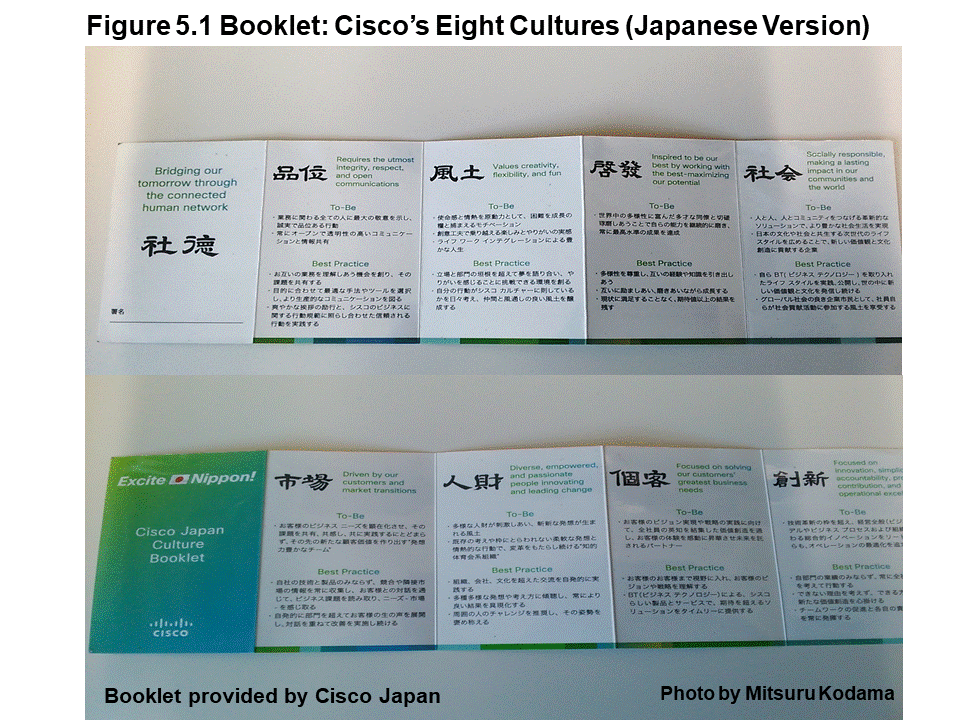
For example, when the eight phrases mentioned above were translated into Japanese,
Cisco Japan incorporated the word “company integrity,” and the individual phrases such
as integrity, human resources, and innovation were each translated into compounds
containing two Chinese characters. The meaning of “company integrity” suggests that
realizing new management reform and innovation through innovation in the company’s
organizational capability while focusing on customer-oriented, employees, and harmony
with society is also the source of “Cisco culture” and a model for all employees. Cisco
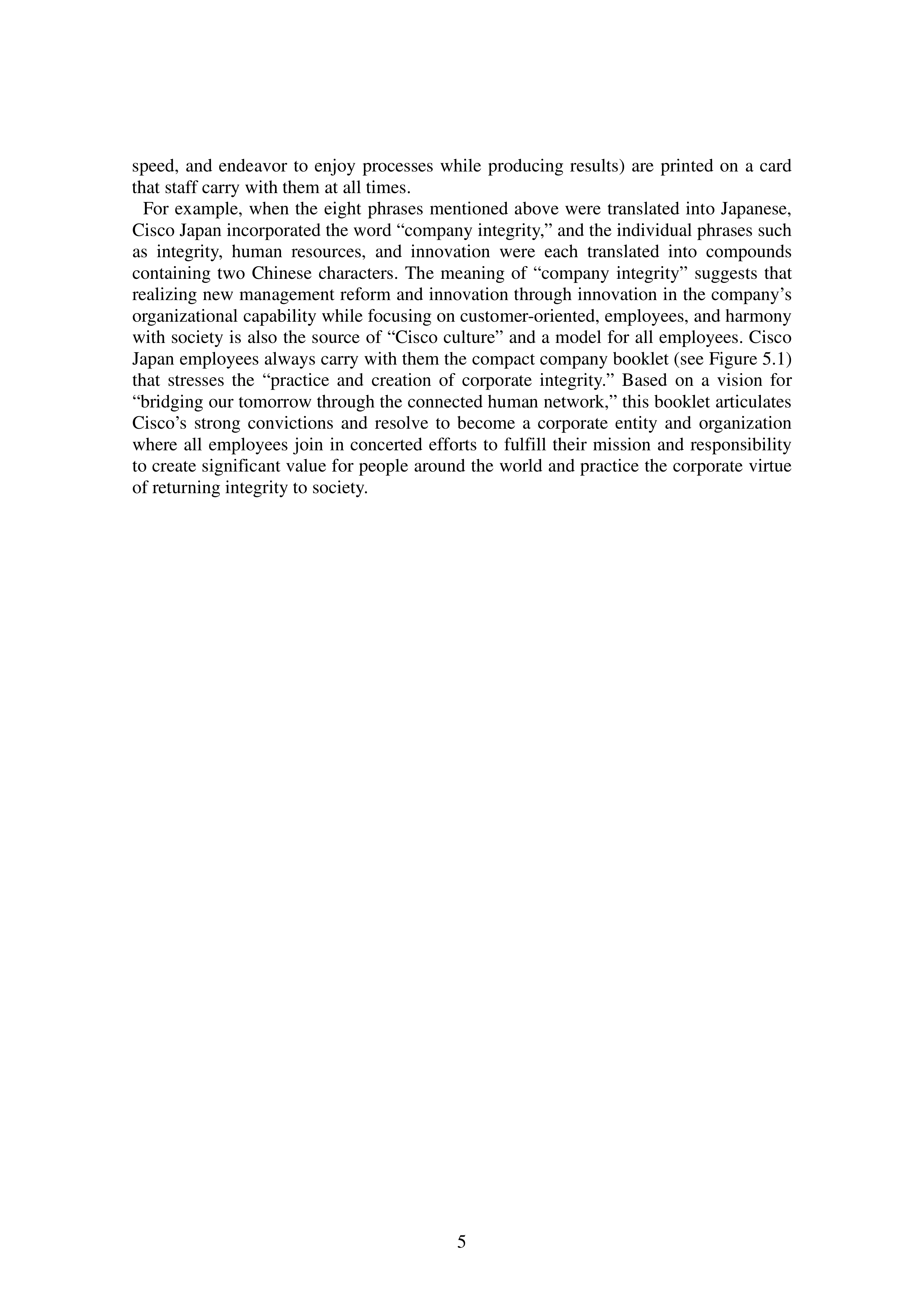
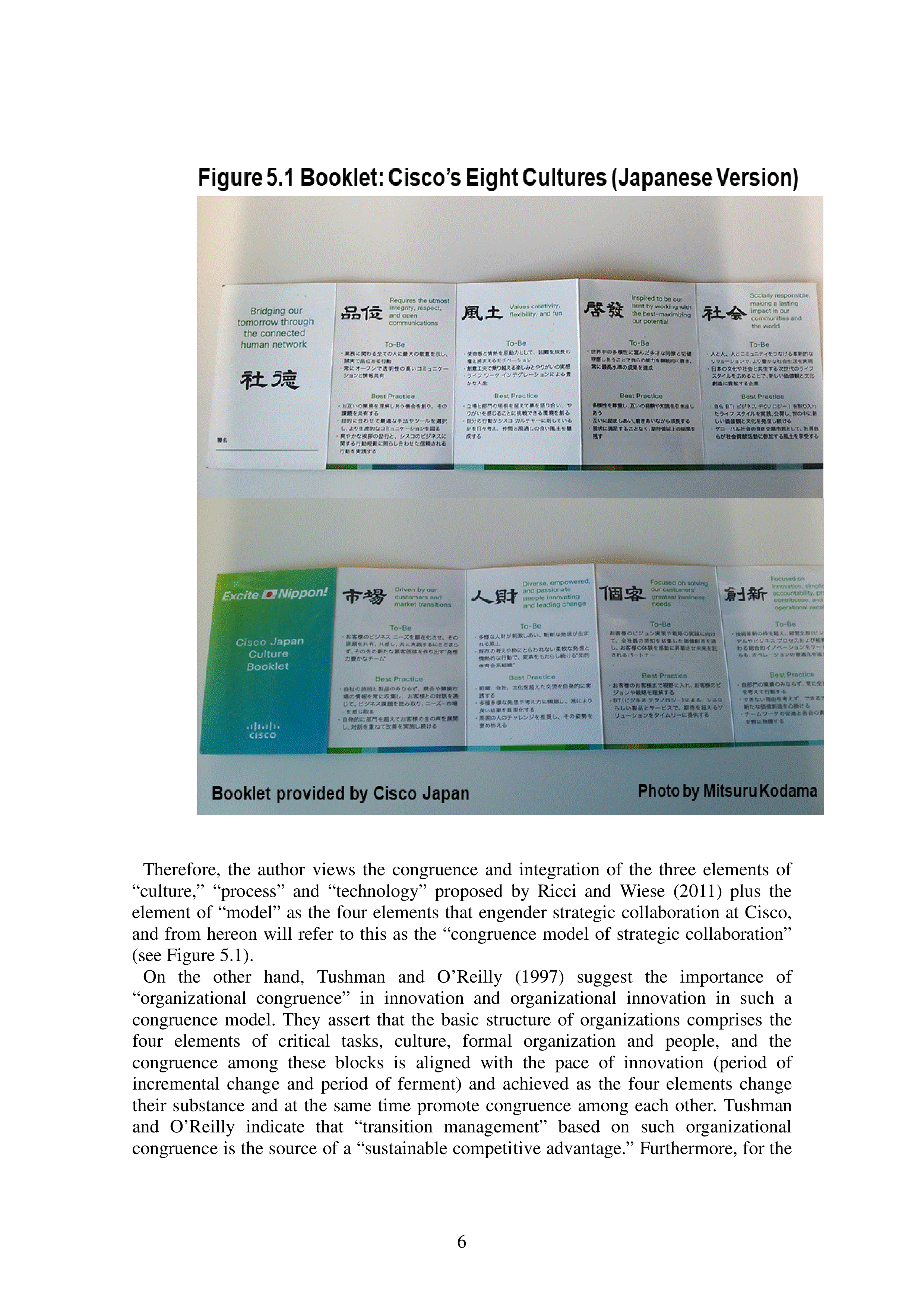
Japan employees always carry with them the compact company booklet (see Figure 5.1)
that stresses the “practice and creation of corporate integrity.” Based on a vision for
“bridging our tomorrow through the connected human network,” this booklet articulates
Cisco’s strong convictions and resolve to become a corporate entity and organization
where all employees join in concerted efforts to fulfill their mission and responsibility
to create significant value for people around the world and practice the corporate virtue
of returning integrity to society.
6
Therefore, the author views the congruence and integration of the three elements of
“culture,” “process” and “technology” proposed by Ricci and Wiese (2011) plus the
element of “model” as the four elements that engender strategic collaboration at Cisco,
and from hereon will refer to this as the “congruence model of strategic collaboration”
(see Figure 5.1).
On the other hand, Tushman and O’Reilly (1997) suggest the importance of
“organizational congruence” in innovation and organizational innovation in such a
congruence model. They assert that the basic structure of organizations comprises the
four elements of critical tasks, culture, formal organization and people, and the
congruence among these blocks is aligned with the pace of innovation (period of
incremental change and period of ferment) and achieved as the four elements change
their substance and at the same time promote congruence among each other. Tushman
and O’Reilly indicate that “transition management” based on such organizational
congruence is the source of a “sustainable competitive advantage.” Furthermore, for the
7
success of existing business and innovation they argue that the ambidextrous leadership
of senior executives and the executive team (O’Reilley and Tushman, 2004; Tushman,
et al., 2011) is vital in the ambidextrous organization’s promotion of collaboration in
individual organizations. Moreover, they posit that there is an extreme avoidance of
deep collaboration between different types of organizations (organizations promoting
existing business and organizations promoting new business), and the distribution of
resources by senior executives is crucial.
While the organizational congruence model of Tushman and O’Reilly is practically
important, in the case of the IT industry, which is Cisco’s sphere of operation, there is a
need for all departments to promote existing business while simultaneously planning
and executing innovation in response to rapid changes in the environment. Therefore,
the organizational congruence model and ambidextrous leadership by senior executives
(leadership of a form that evades collaboration between different types of organizations
as much as possible) indicated by Tushman and O’Reilly vary significantly from
Cisco’s congruence model of strategic collaboration.
On the other hand, in light of his research of Japanese firms that have succeeded in the
simultaneous pursuit of existing business and innovative business (the coexistence of
“exploration” and “exploitation” to be explained later), Kodama (2010) claims that in
addition to the organizational congruence model indicated by Tushman and O’Reilly, it
is also necessary to consider the congruence of diverse elements within the “corporate
system” such as strategies, technologies, operations and leadership. Moreover, Kodama
(2010) argues that efforts must be made to promote congruence while dynamically
linking changes in internal elements of the corporate system with changes in the
external environment. As in the case of Cisco, possessing “speed of thought” (Gates,
1999) to maintain a competitive advantage in the tides of an uncertain market, an
organization must face strategic uncertainty by enhancing its adaptive capability in line
with the pace of external changes in the environment. Kodama (2010) believes that the
adaptive capability of an organization is also the adaptive capability of a corporate
system aligned with changes in the external environment ((1) strategies, (2)
organizations, (3) technologies, (4) operations, and (5) leadership).
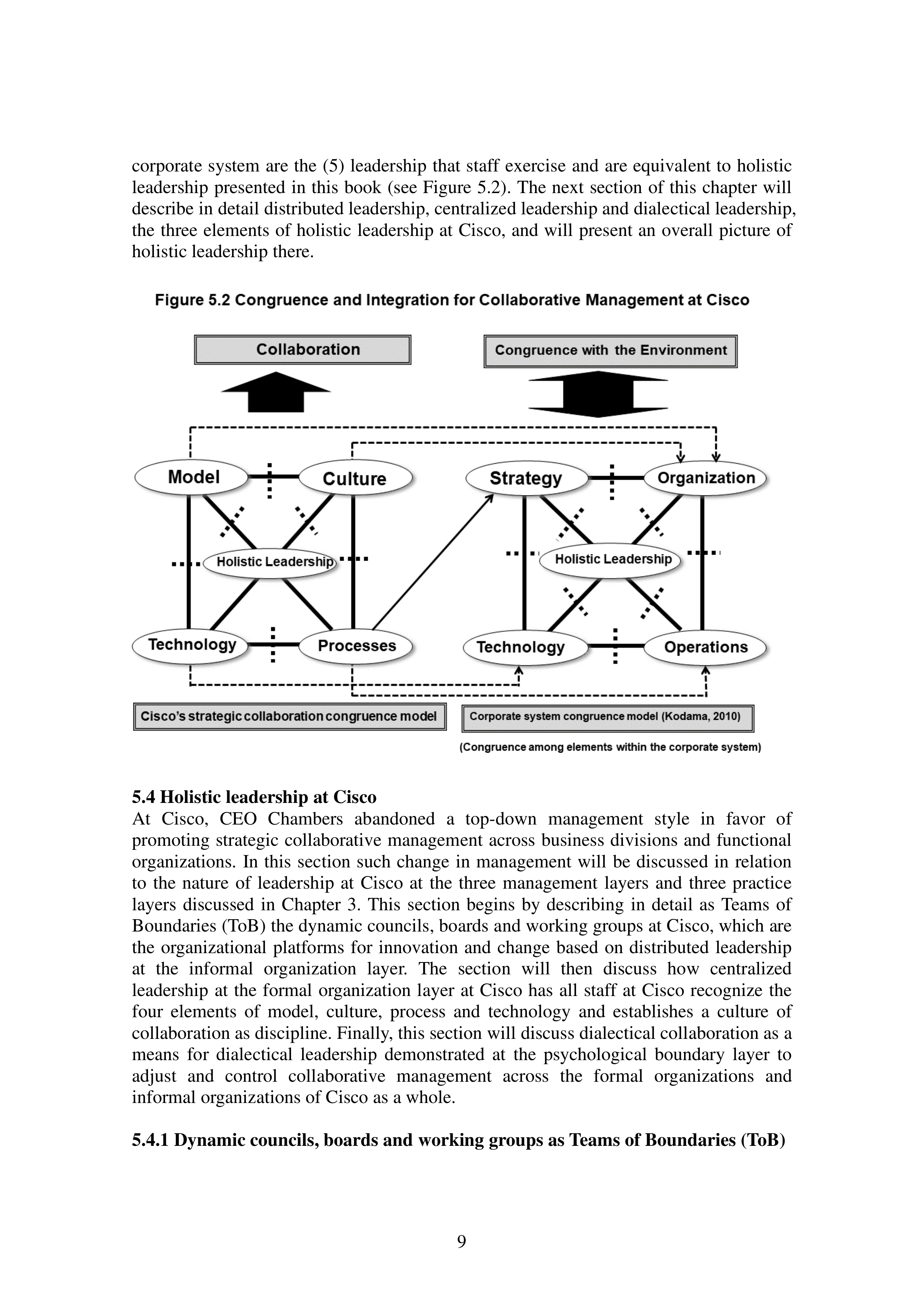
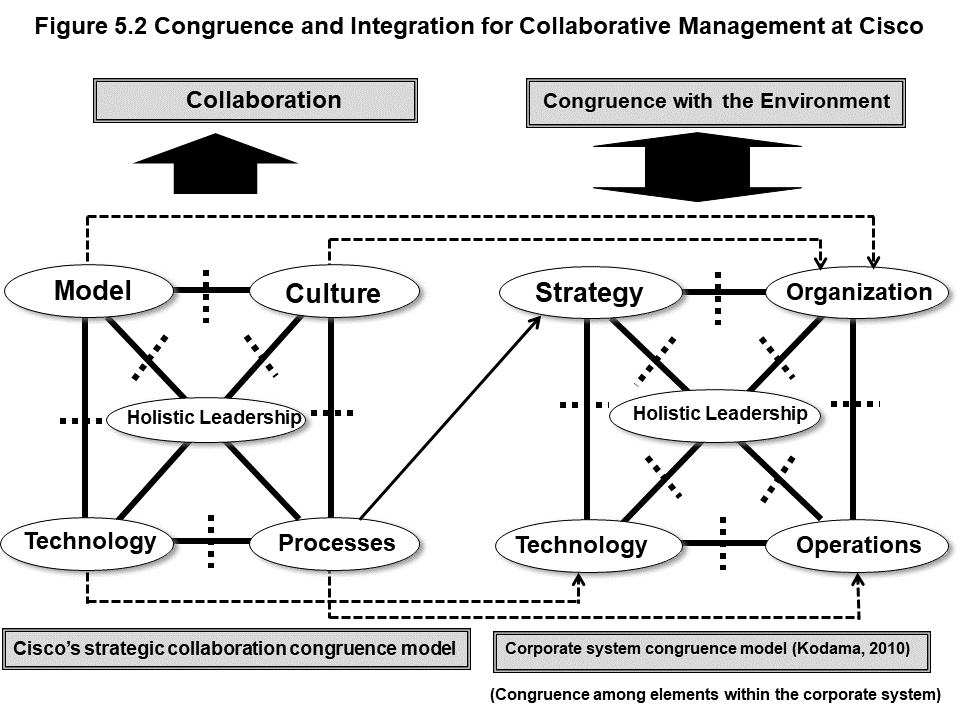
Cisco’s congruence model of strategic collaboration shown in Figure 5.2 is equivalent
to Kodama’s (2010) congruence model of corporate systems that takes into
consideration (1) strategies, (2) organizations, (3) technologies, and (4) operations. This
is because the processes Cisco mentions include the elements of (1) strategies and (4)
operations. For example, as a common language at Cisco, the establishment of “VSEM”
is achieving significant outcomes. VSEM
2
stands for “vision, strategy, execution, and
metrics” and these refer to the vision the team shares, the strategy for achieving the
vision, the implementation plan for promoting the strategy, and the standards for
evaluating results. By making the context of strategies and operations of these common
within the company, all departments and projects have a sound understanding of
decision-making processes and are able to execute their work according to those
processes.
The “model” and “culture” are also elements of “(2) organization” mentioned above.
The employee code of conduct establishes consistent views and rules regarding
employee, group and organizational behavior. “Culture” is the corporate culture itself
and, while cultivating a culture of sharing the company vision and goals, it promotes
Cisco as a group of “reliable communicators.” Cisco also emphasizes the importance of
8
ongoing leader initiatives that promote collaboration and has established the following
practices as norms of behavior within the company for this purpose: demonstration of
authentic leadership, refraining from attacking others, relentless pursuit of highly
transparent decision-making, and clarification of the relationship of decision rights,
accountability and rewards where various resources are deemed to be instruments for
initiating action. Moreover, in building trust, which is seen as the key to success in
collaboration, Cisco encourages employees to discover their own communication
“style”
3
and to build trustworthy relationships through “natural” communication.
For example, in “(3) technology,” the four keywords (1) mobile, (2) social, (3) virtual,
and (4) visual become important in IT management in terms of conventional PC-based
work systems. Mobile in (1) refers to enhancing mobility of work capability and
productivity from the perspective of management through the use of smartphones and
tablet PCs. Social in (2) indicates not only SNS but also that relationships with
customers are more important than financial value. Virtual in (3) refers to the viewpoint
that virtual cooperation among companies will become more and more important, and
visual in (4) indicates the need for “visibility” in communication.
Moreover, employees must adequately utilize their individual capabilities by engaging
in activities beyond the framework of conventional departments to participate in virtual
teams using ICT as the occasion demands. To do this, all employees must have an
understanding of the company’s goals, strategies, and priorities, and must be capable of
responding to rapid changes. For its part, the management team must encourage
autonomous employee activities by ensuring that the company strategy is known and
understood throughout the organization.
However, while technology provides the platform for collaboration, it is a
misunderstanding to believe that technology is capable of solving all problems.
Underpinned by a sound code of ethics as the “model,” the company must strive for the
congruence of “culture” and “process.” This means that it must not only adopt
technologies such as universal communications (UC) and video conferencing, etc., but
also simultaneously change its decision-making processes, systems for evaluating staff,
and methods for sharing the corporate vision and strategic goals.
Furthermore, as an important consideration in technology, it must also put together a
portfolio from which staff and teams make appropriate selections and appropriately
choose areas where results will be evident upon introduction (eight areas: optimization
of team performance, realization of mobile work, improvement in organizational
communication and cooperation, participation in new markets, improvement in
customer satisfaction, environmentally friendly business operations, expansion in
collaboration between companies, and innovative changes in industrial structure). In
addition, it is important to evaluate return on investment (ROI) from various
perspectives (operational ROI, productivity ROI, strategic ROI).
In this manner, it is important to eliminate ambiguity in each of the elements (four
elements) and among the elements. Moreover, clarification of matters such as who is the
decision-maker and who is in charge, by what methods were decisions made, in what
specific terms the company defines success, and processes and evaluations for these
purposes are the key to accelerating strategic collaboration within the company.
4
Moreover, model, culture, process, technology, and the elements which achieve
congruence and integration among these four elements and the four management
elements of (1) strategies, (2) organizations, (3) technologies and (4) operations in a
9
corporate system are the (5) leadership that staff exercise and are equivalent to holistic
leadership presented in this book (see Figure 5.2). The next section of this chapter will
describe in detail distributed leadership, centralized leadership and dialectical leadership,
the three elements of holistic leadership at Cisco, and will present an overall picture of
holistic leadership there.
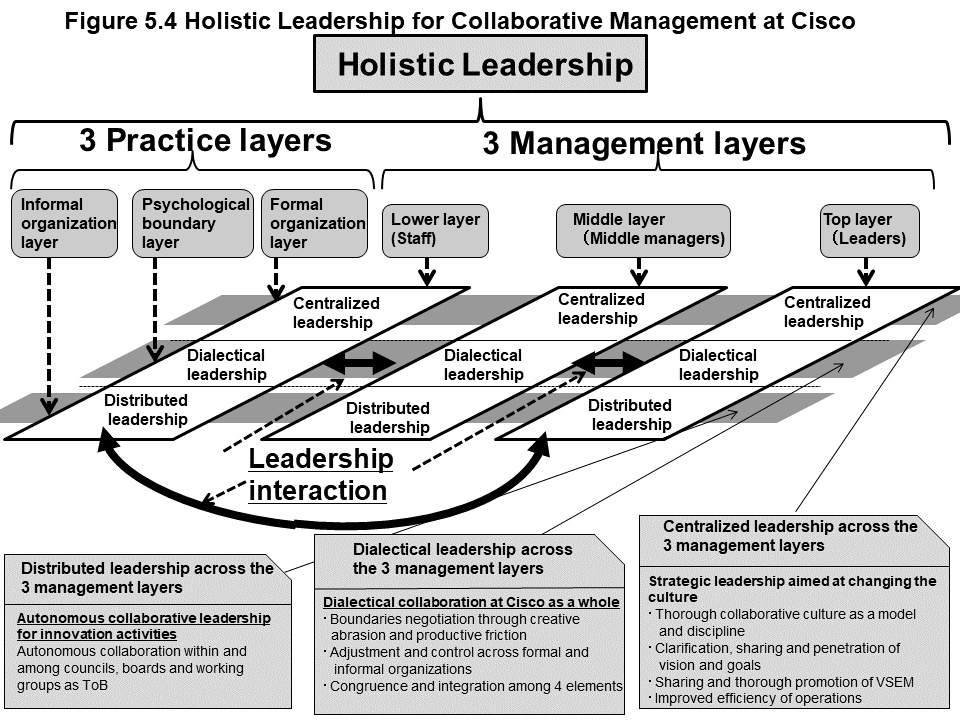
5.4 Holistic leadership at Cisco
At Cisco, CEO Chambers abandoned a top-down management style in favor of
promoting strategic collaborative management across business divisions and functional
organizations. In this section such change in management will be discussed in relation
to the nature of leadership at Cisco at the three management layers and three practice
layers discussed in Chapter 3. This section begins by describing in detail as Teams of
Boundaries (ToB) the dynamic councils, boards and working groups at Cisco, which are
the organizational platforms for innovation and change based on distributed leadership
at the informal organization layer. The section will then discuss how centralized
leadership at the formal organization layer at Cisco has all staff at Cisco recognize the
four elements of model, culture, process and technology and establishes a culture of
collaboration as discipline. Finally, this section will discuss dialectical collaboration as a
means for dialectical leadership demonstrated at the psychological boundary layer to
adjust and control collaborative management across the formal organizations and
informal organizations of Cisco as a whole.
5.4.1 Dynamic councils, boards and working groups as Teams of Boundaries (ToB)
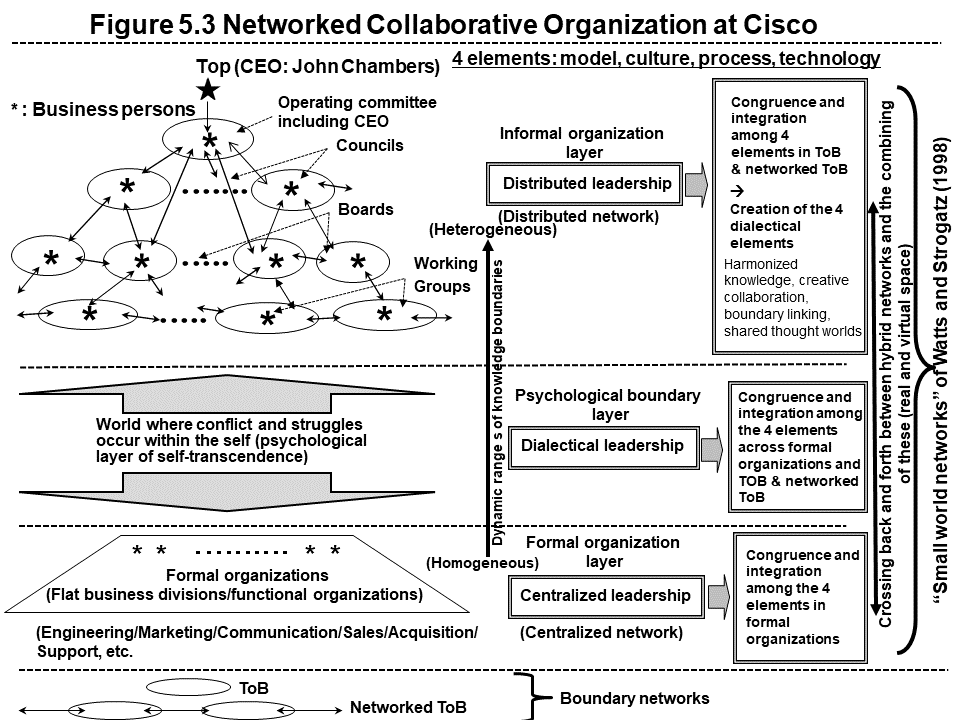
10
Even during the business slumps it experienced, Cisco always adeptly overcame
difficult periods not only by increasing its market share of products but also by
aggressively gaining new entry into adjacent markets. As a result of adapting to trends
in the market and changes in the environment with precision, Cisco succeeded in
securing a more advantageous strategic position than its rivals. This can be attributed to
Cisco’s promotion of a cross-departmental collaboration strategy. Even during difficult
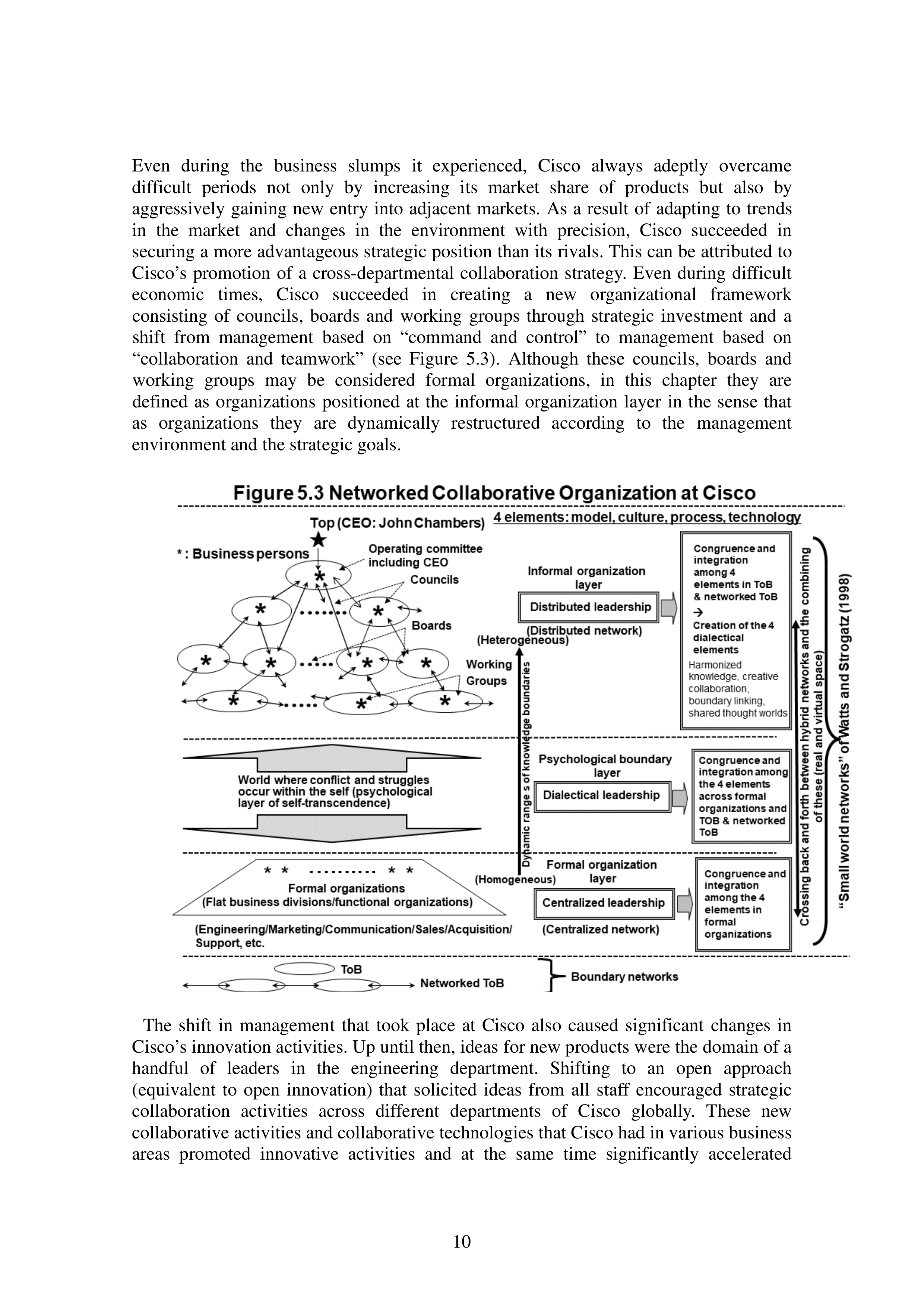
economic times, Cisco succeeded in creating a new organizational framework
consisting of councils, boards and working groups through strategic investment and a
shift from management based on “command and control” to management based on
“collaboration and teamwork” (see Figure 5.3). Although these councils, boards and
working groups may be considered formal organizations, in this chapter they are
defined as organizations positioned at the informal organization layer in the sense that
as organizations they are dynamically restructured according to the management
environment and the strategic goals.
The shift in management that took place at Cisco also caused significant changes in
Cisco’s innovation activities. Up until then, ideas for new products were the domain of a
handful of leaders in the engineering department. Shifting to an open approach
(equivalent to open innovation) that solicited ideas from all staff encouraged strategic
collaboration activities across different departments of Cisco globally. These new
collaborative activities and collaborative technologies that Cisco had in various business
areas promoted innovative activities and at the same time significantly accelerated
11
operational efficiency and productivity through the adoption of a collaboration strategy
in all business areas at Cisco including engineering, sales, acquisition, communications,
marketing and legal affairs.
Exploitation of not only the capabilities of a select number of leaders but also the
integrative capability of the company as a whole is critical in responding to new
environmental changes. At Cisco, this meant the capabilities of not only the
management team including the CEO but also the councils, boards and working groups,
which are the cross-functional collaborative organizations.
In one initiative, for example, the decision-making process was divided into three
stages where 16 councils were organized for profit-making opportunities of up to 10
billion dollars, approximately 50 boards were organized for profit-making opportunities
of up to one billion dollars, and working groups were organized for individual
initiatives of the boards. For example, the engineering department, which accounts for
one-third of all employees, is managed not by one leader but by a committee called the
Development Council comprised of nine senior vice presidents who are responsible for
supervising the engineering department. By introducing throughout the company a
model that entrusts leadership to the councils, the company was able to handle 22
important cross-functional projects in 2008.
Working groups have accountability to the boards, the boards to the councils, and the
councils to the operating committee comprised of 24 senior officers. In the councils,
boards and working groups, there are approximately 750 members who have the
authority to speak on behalf of their organizations as a whole in regard to strategic
decisions on matters such as acquisitions, entry into new markets, and new product
development. Moreover, they have the authority to be able to make decisions in real
time together with all stakeholders participating in their organizations.
What is unique about management arrangements is the two-person structure of
managers in sales and managers in technology as the persons responsible for the
councils and boards. The councils and boards propose to the operating committee
realistic initiatives based on a detailed business plan that answers in detail three
questions: What’s the vision? What’s your strategy for sustainable differentiation? How
are we going to execute the plan over the next 12 to 18 months? Furthermore, in
addition to identifying challenges and issues for planning goals and solutions, all
councils and boards are required to build a strategy framework consisting of a vision,
strategy, execution plan, and metrics. The councils and boards must also present a
strategy for becoming No. 1 or No. 2 in the target markets as well as a plan for
maintaining that position and achieving growth (Chambers, 2008).
The most significant objective in such reforms is not to respond to profit-making
opportunities in each department or function but to respond rapidly to profit-making
opportunities that extend across diverse departments of the company. In the past it was
customary for executives in their respective departments to compete with each other for
resources and authority. As a result of reforms, however, the councils and boards
cooperate with each other in efforts to share responsibility for the success of other
departments. However, the road to reform has not been a smooth one. One particularly
difficult challenge was changing the mindset of the management layers. Approximately
20% of Cisco’s top officers left the company during the transition, and it took four years
for a collaborative culture to take hold in management as a whole. Nevertheless, as a
result of the bold implementation of innovative changes over long months and years, the
12
company became capable of drafting within one week plans that previously took six
months. CEO Chambers says that this new type of leadership style where councils,
boards and working groups are dynamically restructured in response to the business
environment and strategic goals, and which provide a competitive advantage not only in
promoting existing business but also in the creation of new business will be a new
leadership style for the 21st century (Chambers, 2008).
Playing an important role in supporting these innovative changes in the organization is
the technology platform for collaboration across the company. Social and mobile
technology were also included in the four axes for connecting (staff directory and
schedulers, etc.), communicating (telephone, email, chats, video chats, etc.),
collaborating (TelePresence, Web conferences, Wiki, etc.), and learning (educational
platform). Using this technology platform, teams at work sites endeavor to increase
work efficiency, share the latest product and sales information and widely promote
autonomous use of it within the company. The service has now been extended to more
than 150,000 persons in the Cisco group worldwide.
The new Cisco organizational framework comprised of councils, boards and working
groups is operating with excellent efficiency at present. The teams are able to realign
resources according to circumstances not only to resolve problems but also to speed up,
extend, and make flexible and rapidly repeat business processes through a collaboration
model based on such a dynamic organizational framework. One example of such an
initiative is Cisco’s gaining entry to three adjacent markets (virtual healthcare, safety
and crisis management, and smart communities), which resulted in a total of 29 priority
challenges to be tackled across departments and adjacent markets.
These councils, boards and working groups equate with the organizational
morphology of Teams of Boundaries (ToB) described in relation to Apple in Chapter 4,
and the organic linking of these three types of ToB creates networked ToB, in other
words, boundaries networks. In addition to these councils, boards and working groups,
interdepartmental ToB and networked ToB are constantly being formed on a daily basis
even at the work site level and end level of the organization. Moreover, ToB and
networked ToB are dynamically restructured as necessary staff from various
departments of the formal organization join in participation in response to changes in
the environment and strategic goals. As dynamic changes take place in the formation of
these ToB and networked ToB, the organization adopts a sort of “soccer” style as it
moves in real time.
At Cisco, people required to execute work for each project assemble but the
composition of these members generally changes as the project progresses. As a result,
it is not uncommon for staff to participate in a number of projects at one time. In this
way, the morphology of the organization remains highly flexible and has the advantage
of being able to respond rapidly to change. On the other hand, however, this
arrangement is also fraught with the risk of the group’s losing its unifying force when a
single mistake is made.
However, the case of Cisco differs with that of Apple in that the structuring of the ToB
and networked ToB as well as the practice of the staff at Cisco are dynamically
undertaken in real space and virtual space using collaboration tools based on ICT. In
other words, there is movement to and from real and virtual space and the coexistence
of these among hybrid networks that integrate centralized networks, which are formal
organizations, and distributed networks, which are informal organizations (see Figure
13
5.3).
In these ToB and networked ToB at the informal organization layer, staff demonstrate
distributed leadership. As shown in Table 3.1 (Strategy View and Organization View in
the Formal Organization and Business Community) of Chapter 3, staff who practice in
ToB and networked ToB, which are also business communities of the informal
organization layer, demonstrate not only initiative and autonomy but also collaborative
leadership. Moreover, they also demonstrate distributed leadership within and among
ToB (in other words, in networked ToB) through the dynamic sharing of contexts and
the formation of new contexts.
In this way, at Cisco projects for numerous important matters progress as numerous
teams constantly work together in cooperation within their own teams and with other
teams across departments in formal organizations. Collaborative leadership, which
achieves close-knit collaborative activities at Cisco, in other words, distributed
leadership, is demonstrated at individual informal organization layers across the three
management layers. This consistent distributed leadership at Cisco is an element that
thoroughly enhances creativity among staff for new product development and
innovation in response to trends in the market and new changes in the environment (see
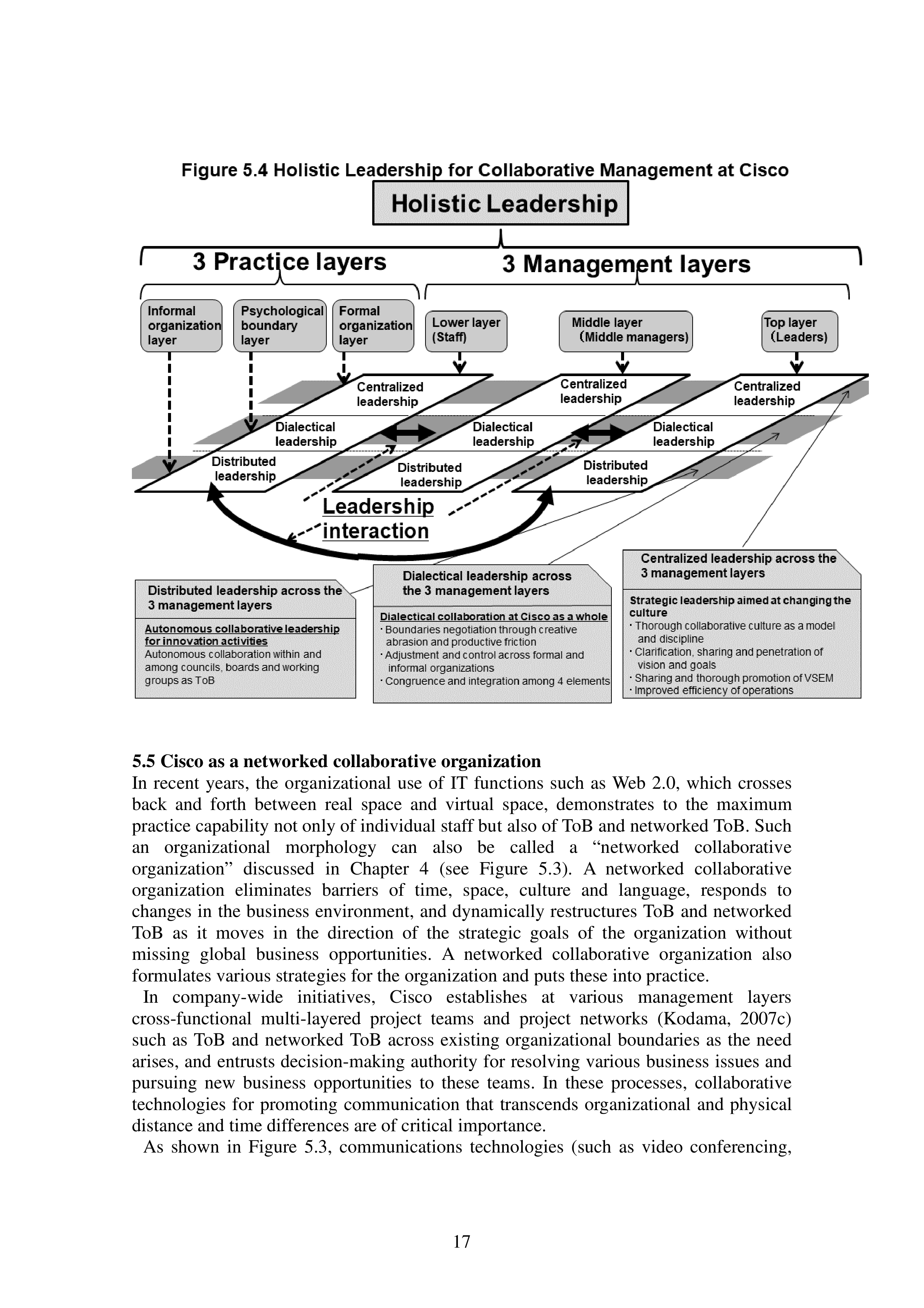
Figure 5.4).
Moreover, staff’s demonstration of distributed leadership realizes congruence and
integration of the four elements of model, culture, process, and technology at ToB and
networked ToB (see Figure 5.3). The congruence and integration of these four elements
promote strategic collaboration at ToB and networked ToB, and also lead to the creation
of the four dialectical process elements of harmonized knowledge, creative
collaboration, boundary linking, and shared thought worlds discussed in Column 4.2 of
Chapter 4.
5.4.2 Centralized leadership at the formal organization layer
At the formal organization, attention is focused on how the characteristics of discipline
and order will be defined within the company under an excellent model. Orders issued
by Chambers to “change the culture,” and the positioning of “culture” as discipline and
order for uniting all staff at Cisco to move forward toward a common goal became
critical triggers in promoting collaborative management. Those capable of changing the
“culture” and “process” are those at the executive level including the CEO. Only by
changing the behavior of executives is it possible to bring about change in culture and
process within the company.
Therefore, executives must clearly define what the common goals are and what
exactly success looks like, and accurately convey these to staff. It is vital to convey to
staff the corporate strategy for moving toward the vision and goals, and to clarify
whether it is a strategy for the company as a whole, or whether it is a strategy for each
of the departments (business divisions and functional organizations) of the formal
organization. It is also important to ensure that these strategies are universally known
throughout the company. This is largely the responsibility of the leaders and managers
of centralized leadership. In particular, the success or failure is determined by whether
those at the helm of the company actually make use of techniques and common
language used to define the vision and goals. This is because no matter how much
executives at the helm of the company indicate these techniques, collaborative activities
14
of the company as a whole will not make progress if those at the top fail to change their
behavior in terms of the common vision and goals.
Furthermore, it is also important to clarify who makes various business decisions in
the formal organizations on specific individual matters, who is responsible for those
decisions, and how those decisions are made. Efforts to ensure all staff at all times are
able to understand the company’s strategies and priorities are also essential. At Cisco,
all staff share detailed common specific goals that they are to achieve (key performance
indicators: KPI), and are required to make efforts to realize these.
At Cisco, establishing VSEM as a common language, as explained earlier, achieved
significant results. By sharing the vision the team shares, the strategy for achieving the
vision, the execution plan for promoting the strategy, and the standards for evaluating
the results, the projects and teams have a sound understanding of decision-making
procedures and execute their work according to those processes as the vision, strategy,
execution and metrics. In the execution, Cisco also creates team charters to promote
VSEM. At Cisco, the team objectives, the role of the team, the goals and the scope must
be included in the team charter.
In this way, centralized leadership that thoroughly promotes consistent discipline
through the sharing and universal understanding of the vision and goals at Cisco, the
execution of strategic leadership based on the VSEM philosophy, and the promotion of
strategic collaboration is demonstrated at the individual formal organization layers
across the three management layers. Through collaborative activities at the formal
organization, this coherent centralized leadership also becomes an element for
thoroughly enhancing the efficiency of daily operations involving existing business (see
Figure 5.4).
However, it is not possible to promote collaboration solely through technology. In
other words, the company achieves congruence and integration among the four elements
of model, culture, process, and technology by simultaneously changing culture and
process and incorporating optimal technology into the formal organization through the
demonstration of centralized leadership by leaders and managers based on a sound,
excellent model (see Figure 5.3).
5.4.3 Dialectical leadership demonstrated at the psychological boundary layer
Decision-making rules, strict discipline and routines for achieving congruence and
integration of the four elements of model, culture, process and technology at the formal
organization layer within the company engender efficient operations through strategic
collaborative activities of centralized leadership (strategic leadership) within the formal
organization.
On the other hand, ideas and business models for creativity as innovation are
implemented mainly by the councils, boards and working groups, which are the ToB
and networked ToB of the informal organization layer. Strategic collaboration of staff
through distributed leadership (collaborative leadership) achieves congruence and
integration among the four elements of model, culture, process and technology at ToB
and networked ToB, and inspires new product concepts and business plans.
To efficiently and effectively promote practices for creative output in these councils,
boards and working groups, however, strategic collaboration with formal organizations
(business divisions and functional organizations) within the company is essential.
Boundary negotiations, which are micro activities among staff, such as adjustment and
15
control between such informal and formal organizations, take place at the psychological
boundary layer.
In other words, the demonstration of dialectical leadership through creative dialogue
and dialectical dialogue of staff at the psychological boundary layer across the three
management layers is crucial for the simultaneous establishment of an organizational
morphology (ToB and networked ToB) for such creative activities and an organizational
morphology (business divisions and functional organizations) for efficient activities. As
illustrated in the case of Apple in Chapter 4, psychological pressure on staff who are
required to cope with a rapidly changing business environment by planning and
executing new challenging themes occurs at the individual psychological boundary
layers across the three management layers. The question, however, is what
characteristics does the dialectical leadership of staff at the psychological boundary
layer have.
A common vision and goals are adequately shared by staff who practice in councils,
boards and working groups, which are ToB and networked ToB of informal
organizations. This is the same in the business divisions and functional organizations,
which are the formal organizations. However, the sharing of the strategic goals at the
ToB and networked ToB of the informal organizations and the business divisions and
functional organizations of the formal organizations is affected by various business
contexts depending on the circumstances. Essentially, conditions where mutual sharing
of the organization’s strategic goals and the achievement of synergies of the company as
a whole are possible are vital as conditions that will enable smooth collaboration within
the company in the councils, boards and working groups.
In other words, thinking and behavior that simultaneously pursue not only “partial
optimization” of individual results in the formal organization and informal organization
but also “overall optimization” of results of the company as a whole become important
elements in dialectical leadership that staff must demonstrate at the psychological
boundary layer. Therefore, where thinking that simultaneously pursues overall
optimization and partial optimization is taken into consideration, the form of
collaboration between the formal organizations and informal organizations will differ in
individual characteristics within the individual organizations of the formal and informal
organizations. In other words, leaders and managers must collaborate in holistic
thinking and behaviors in terms of partial thinking for the individual organizations and
total thinking for the company as a whole. Therefore, in dialectical leadership, they
must consider the form of collaboration between the formal and informal organizations
and the kind of cooperative relationships the informal organizations establish with
formal organizations. Moreover, they must consider at what point and timing, in what
manner, and to what extent the informal organizations will collaborate with the formal
organizations in the execution of the strategy. The author will refer to this form of
collaboration based on such holistic thinking and behavior at the psychological
boundary layer as “dialectical collaboration.” In other words, it can be said that all
characteristics of collaboration depend on circumstances at the psychological boundary
layer.
At the same time, Hansen (2009) argues that collaboration across departments and
sections within a company proceeds favorably only when managers have established
“disciplined collaboration” (Hansen cites collaborative innovation at P&G as a typical
example of such collaboration). In disciplined collaboration, collaboration is a method
16
for producing positive results and, therefore, there are times when it is needed and times
when it is not. Hansen (2009) argues that it is important to introduce collaboration when
it makes good sense to leaders to do so, and that it is important to have the discipline to
say no when it is not needed. It can also be said that such disciplined collaboration is
one approach of an individual goal-oriented organization in pursuit of partial
optimization.
However, this raises the question as to whether a logical judgment on the
essence of collaboration as being whether or not to collaborate within the
parties’ work territory constitutes the entire process. It cannot be said that
every process that leads to a conclusion on the presence or absence of
collaboration based only on a logical judgment is correct. Ultimately, it is
important for leaders and managers holistically to make decisions on a
case-by-case basis in the course of their interaction in specific micro and
macro business contexts (dynamically changing business contexts: time, place
and relationships with people) on the kind of collaboration that is to take place
and to take action accordingly.
The dialectical collaboration discussed in this book also acts as an element that
engenders creative abrasion and productive friction through various forms of interaction
based on holistic thinking among staff, and promotes a collaborative culture (across
formal and informal organizations) for achieving goals without compromise.
Furthermore, dialectical leadership demonstrated at the psychological boundary layer
adjusts and controls collaborative management across the formal organizations and
informal organizations of Cisco as a whole (see Figure 5.4).
Such creative abrasion and productive friction occur at the three management layers,
but staff thinking and behavior in dialectical leadership simultaneously pursue creativity
and efficiency, and become a fountainhead for generating new products and business
models with competitive advantages. Moreover, dialectical collaboration through
dialectical leadership achieves congruence and integration among the four elements
across the formal organizations and ToB and networked ToB (see Figure 5.2).
Furthermore, adjustment and control by collaborative management at Cisco as a whole
take place as leadership interaction among the three leaderships across the three
management layers and three practice layers (see Chapter 9 for details).
As illustrated above, Cisco demonstrates holistic leadership that differentiates and
combines the three types of leadership - centralized leadership, distributed leadership
and dialectical leadership across the three management layers and three practice layers -
to promote company-wide collaborative management (see Figure 5.4).
17
5.5 Cisco as a networked collaborative organization
In recent years, the organizational use of IT functions such as Web 2.0, which crosses
back and forth between real space and virtual space, demonstrates to the maximum
practice capability not only of individual staff but also of ToB and networked ToB. Such
an organizational morphology can also be called a “networked collaborative
organization” discussed in Chapter 4 (see Figure 5.3). A networked collaborative
organization eliminates barriers of time, space, culture and language, responds to
changes in the business environment, and dynamically restructures ToB and networked
ToB as it moves in the direction of the strategic goals of the organization without
missing global business opportunities. A networked collaborative organization also
formulates various strategies for the organization and puts these into practice.
In company-wide initiatives, Cisco establishes at various management layers
cross-functional multi-layered project teams and project networks (Kodama, 2007c)
such as ToB and networked ToB across existing organizational boundaries as the need
arises, and entrusts decision-making authority for resolving various business issues and
pursuing new business opportunities to these teams. In these processes, collaborative
technologies for promoting communication that transcends organizational and physical
distance and time differences are of critical importance.
As shown in Figure 5.3, communications technologies (such as video conferencing,
18
UC, accommodating a diverse range of terminals such as PCs and smartphones, cloud
computing, virtual technology, and secure, open system access, etc.) for realizing a
networked collaborative organization allow staff to go back and forth between real
space and virtual space between hybrid networks of formal organizations (centralized
networks) and informal organizations (distributed networks), and to combine these.
These technologies also support and promote practice activities of staff and teams. In
addition, these networked collaborative organizations will function as small world
networks (see Figure 5.3).
An important aspect of networked collaborative organizations is they enable staff
within and outside the organization to participate effectively and efficiently in business,
simultaneously achieve creative activities in the form of innovation and efficient
operations in existing business, which at a glance appear to be in opposition to each
other. For example, networked collaborative organizations have agility that enables
them to take advantage of changes in the market that may offer new business
opportunities in innovation. At the same time, they realize efficiency in keeping
operating costs to a minimum.
Such networked collaborative organizations change the form of staff participation in
various businesses and enable the creation of new value through the simultaneous
creation of innovation and reinforcing existing business. Furthermore, in networked
collaborative organizations, staff within the company including partner companies and
customers have more contact points, participate in various teams and projects, and are
able to gain new competitive advantages through the formation of ToB and networked
ToB across companies both internally and externally.
5.6 Collaborative management in pursuit of both exploration (innovation) and
exploitation (existing business)
Ricci and Wiese, senior executives at Cisco who are also advocates of collaborative
management, state that collaboration is a new essential condition for an organization to
continue to create value, to adapt and to survive, and that collaboration is the sole
method for simultaneously achieving promotion of innovation, improvement in
corporate agility, enhancement of adaptability, and reduction in operating expenses
(Ricci and Wiese, 2011). In other words, the tasks of promoting innovation, improving
agility, and enhancing adaptability are equivalent to “exploration” activities while the
reduction in operating expenses equates with results of “exploitation” activities. It can
be said that the key to management at Cisco, which simultaneously pursues exploration
(innovation) and exploitation (existing business), is largely the execution of strategic
collaboration discussed in this chapter thus far.
The paradox of the different corporate activities of exploration and exploitation is an
important research theme in the area of strategic management. The implication that
maintaining an appropriate balance between exploration and exploitation (e.g.,
McCarthy and Gordon, 2011: Ahn, et al., 2006: Kodama, 2003: Gibson and Birkinshaw,
2004) and promoting interaction between exploration and exploitation (He and Wong,
2004) improves corporate performance is a conclusion of precedent research.
Prevalent propositions in exploration and exploitation in corporate strategies to date
have argued that the organization responsible for radical innovation (e.g., Leifer et al.,
2000) in a company should either be physically and culturally separate from the existing
organization (or line organization) (mainstream organization) or that radical innovation
19
should be executed through an independent venture company (e.g., Hill and Rothaermel,
2003; Benner and Tushman, 2003; Burgelman and Sayles, 1986; Kanter, 1985).
However, an appropriate interface with the existing organizations can play a
significant role (e.g., Heller, 1990; Kodama, 2003) in strategically accelerating
innovation business (in the development of new products and services, development of
a new business model, development of new business, etc.) in terms of strategy as well
as integration and allocation of resources. The question, then, is to what extent
innovation business should be integrated with existing business, or to what extent
should it be separated. Should it be completely separate or completely integrated? Or
should it be somewhere midway between the two? The argument of organizational
design (e.g., Christensen, 1997; Good and Cambell, 2002; Tushman and O’Reilley,
1997) is also an issue in innovative management.
The predominant discussions on innovative management in precedent research to date
have centered on consideration of two different archetypes based on the separation of
“exploration” and “exploitation” or “incremental” and “radical,” (e.g., Greenwood and
Hinings, 1993; Tushman and O’Reilley, 1997), and consideration of different
management processes and organizational structures such as the ambidextrous
organization, for example (e.g., O’Reilley and Tushman, 2004). At the same time,
however, there has been little detailed discussion of the interface and interaction
between management elements in these two archetypes such as their different strategies,
organizational structures, core competences, organizational cultures and leadership.
However, how a company accommodates the coexistence and simultaneous pursuit of
these two different archetypes within the same company, how it skillfully manages
strategic contradiction (Smith and Tushman, 2005), creative abrasion (Leonard-Barton,
1995) and productive friction (Hagel III and Brown, 2005), and how it is able to create
synergies are key elements for achieving success in innovation business in a company.
The role of top management (Smith and Tushman, 2005; Tushman and O’Reilley, 1997)
as well as the role of middle management and staff in general is considered important
(Nonaka, 1988; Kodama, 2003; Govindarajan et al., 2005) in balancing these
contradictions. Moreover, the promotion of strategic collaboration in a multi-layered
manner across different departments and at all management layers (including the staff
layer) at Cisco is an important element in the simultaneous pursuit of exploration
(innovation) and exploitation (existing business) in research to date.
Cisco firmly believes that only companies that incorporate the word “collaboration”
into their DNA will reap the rewards of success. Only companies that can tap into the
integrative capability of the collective practical knowledge of not just a select number of
leaders but all staff across the company will be able to overcome various contradictions
that exist within and outside the company, mediate sudden changes in the market, and
respond quickly. At Cisco, important problems are addressed not only by top
management but also by staff by establishing multi-layered cross-functional ToB and
networked TOB at various management layers within the company, holding discussions
within these dynamic network structures, and implementing the outcomes of these
discussions.
Creative dialogue, cooperation and understanding, and quick decision-making and
action are the sources of new problem resolution and innovation activities.
Company-wide collaboration enables not only business divisions and functional
organizations of the company but also single teams and projects across different
20
departments to consider various problems with the benefit of immediately incorporating
into the organization excellent opinions, and to take action. Company-wide activities
across such existing organizations (business divisions and functional organizations) and
dynamic informal organizations (ToB and networked ToB) promote collaborative
activities among staff, change staff behavior and the corporate culture, and promote
operational efficiency in existing business and innovation through collective
management at Cisco.
In this way, collective management for the management of every person’s individual
wisdom across different organizations becomes the driving force in establishing
dynamic ToB and networked ToB, allowing for various contradictions within and
outside the company and promoting innovation through company-wide collaborative
management. Moreover, staff deliberately internalize contradictions to respond to
diverse strategic activities within the company, and enable dynamic integration of
exploration and exploitation through company-wide construction of ToB and networked
ToB and the organic linking of existing organizations (business divisions and functional
organizations) using these contradictions. This new leadership model is “holistic
leadership.”
According to Arker (2011), companies that hope to succeed in marketing innovation
need to simultaneously consider the different views of (1) “dynamic strategic
commitment” as an “exploitation” activity that promotes incremental innovation, (2)
“selective opportunism” as an “exploration” activity that promotes radical innovation,
and (3) “centralized resource allocation” as resource allocation capability for
appropriately executing the above activities. Arker goes on to indicate the importance of
methods for developing supportive cultures, creative structures, flexible systems and
processes, and a broad set of “people assets” for demonstrating capability in the above
three elements.
Arker (2011) divides the innovation process into three categories: incremental
innovation of mainstay products, substantial innovation as a new category or
sub-category of mainstay products, and transformation innovation that renews existing
markets and creates new markets. He also suggests that for a company to
simultaneously manage the above three innovation processes, separate strategies,
organizations, human resources and funds are necessary. For these reasons, he argues,
an organization must be multidextrous with organization-wide resource allocation to
realize excellent marketing strategies. In this regard, Cisco can be considered a
representative organization model of a “networked collaborative organization.”
This essentially means that, like Cisco, the larger a company is, the wider the territory
of its mainstay business and the wider the reach of its tentacles to new business related
to this. The fact that a company is multidextrous means that numerous different
strategies and tactics, organizations with diverse functions and diverse human resources
as well as distributed allocation of funds are necessary. The networked collaborative
organization at Cisco is also an organizational concept that establishes ToB and
networked ToB as dynamic informal organizations by promoting collective management
through a collaborative culture and achieves multidextrous capability through
organization-wide resource allocation as described by Arker (2011).
Moreover, a networked collaborative organization is an organization that incorporates
a concept of a one-dimensional organization or integrated organization that has diverged
from the viewpoint of conventional dualism or contingency and has integrated diverse
21
contradictions within and outside the company and organizations through holistic
leadership. Moreover, a networked collaborative organization maintains a dynamic
balance between exploration and exploitation, and at the same time continuously creates
new knowledge.
On the other hand, from the viewpoint of congruence of corporate systems, the
following interpretation can be made regarding exploration and exploitation. As
illustrated in Figure 5.2, the strategic collaboration congruence model corresponds to
the corporate system congruence model ((1) strategies, (2) organizations, (3)
technologies, and (4) operations), and such a corporate system congruence model
simultaneously pursues existing business (exploitation) and new business innovation
(exploration). In other words, elements that promote strategic collaboration realize a
corporate system congruence model (or, conversely, a corporate system congruence
model promotes strategic collaboration). As a result, as noted by Ricci and Wiese,
collaboration that achieves a corporate system congruence model can be considered the
only method for simultaneously promoting innovation (exploration) and reducing
operating costs (exploitation).
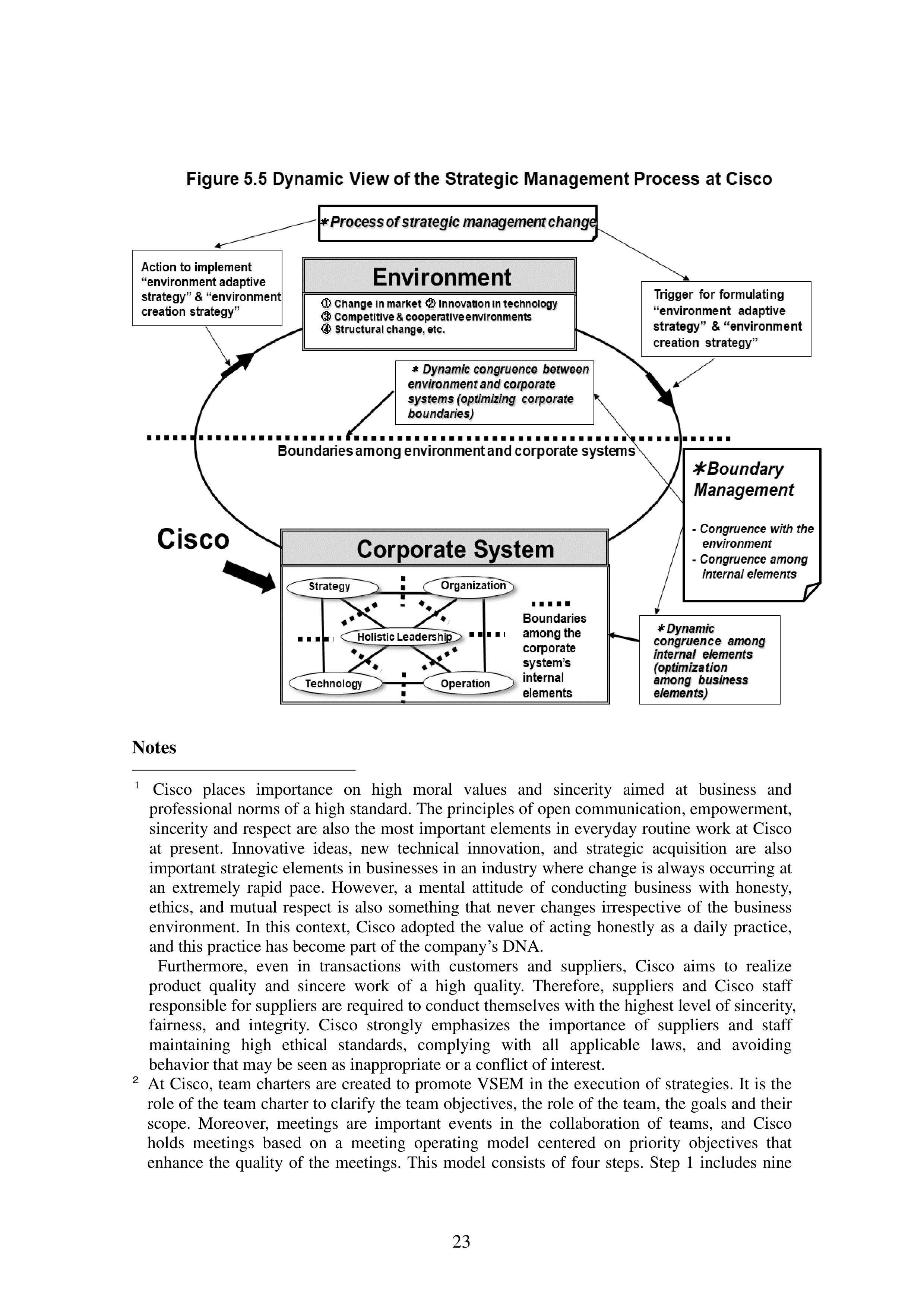
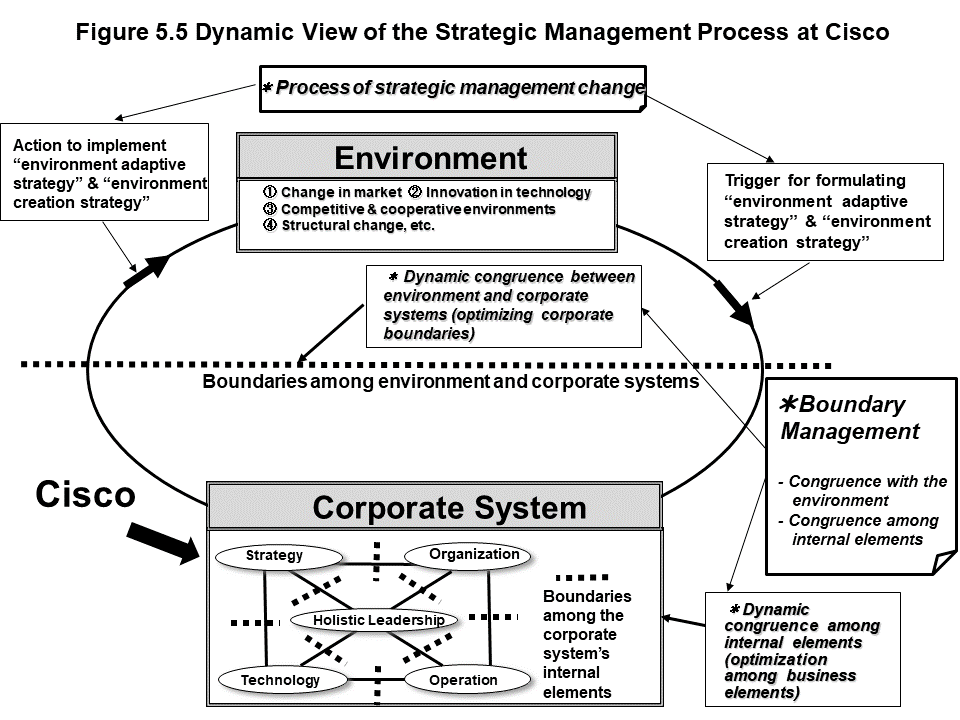
Moreover, as was the case at Cisco, consideration of the dynamic process of strategic
management is crucial for understanding the mechanism of the practice processes of
staff who simultaneously promote existing business (exploitation) and innovation
business (exploration) (see Figure 5.5). It is necessary to carefully investigate dynamic
changes in the corporate system (internal management elements such as strategy,
organization, technology, operations and holistic leadership) that are compatible with
dynamic changes in the environment (for example, markets, technologies, competition
and cooperation, and structures). The boundaries between the environment and
corporate system, in other words, the corporate boundaries, define the relationship with
the environment and the business model of the company. At the same time, changes in
the environment bring about changes in the corporate boundaries and also have an
impact on individual internal management elements of the corporate system. Conversely,
active (or passive) changes in individual management elements inside the corporate
system bring about changes in the corporate boundaries and also have an impact on the
environment.
In other words, for a company to adapt to changes in the environment (formulate and
implement an environment adaptive strategy), or to actively work toward an
environment and create a new environment (formulate and implement an environment
creation strategy), staff must deliberately change elements of management within the
company including strategies, organizations, technologies, operations, and holistic
leadership and promote congruence at the boundaries between these management
elements.
For example, staff must come to terms with various practical issues such as: How
should the organizations and operations within the company be in order to achieve the
target strategy? Are certain elemental technologies required to achieve the target
products and business model? How should corporate leaders and managers demonstrate
holistic leadership to achieve new strategies? What kind of changes in staff thinking are
necessary?
At the same time, however, the management elements of strategies, organizations,
operations and holistic leadership include different contexts, and staff have different
thought worlds (Dougherty, 1992) and different mental models based on different
22
contexts and experiential knowledge. Moreover, viewpoints that recognize individual
elements within the environment and the corporate system will differ among individual
staff. Therefore, knowledge boundaries (e.g., Kodama, 2007a) that act as constraints
among staff will inevitably exist as barriers to congruence among these elements. In
companies like Cisco where a collaborative culture is pervasive, however, staff who
promote innovation and change management do not view these knowledge boundaries
as constraints but instead are able to consider them as triggers for generating new
knowledge and competence (or have the tendency to view these knowledge boundaries
as opportunities).
An important consideration in dynamic strategy management systems is to determine
how staff perceive and recognize environmental and corporate system boundaries and
boundaries between individual management elements within the corporate system as
well as changes in these respective boundaries and how to promote the congruence of
boundaries in regard to the process of change in such environments and corporate
systems. In a rapidly changing environment like that at Cisco, to realize an environment
adaptive strategy and environment creation strategy as mentioned above, staff (at all
layers including top and middle management layers) must consider the congruence of
boundaries between the environment and the corporate system, the congruence of
boundaries in the corporate system, and the association of these elements in regard to
arrangements in corporate management for implementing the process of change in
corporate strategies. For a company to develop and grow in a sustainable manner in the
way Cisco has, it is crucial for staff to develop such a process of change (gradual and
radical) in strategic management at time axis and to create a new business model.
Therefore, a concept of “congruence of boundaries” and its implementation are crucial
(see Figure 5.5).
Practice processes based on the holistic leadership of staff become important in the
management of boundary congruence (referred to as “boundary management”). The
“practice processes” include not only specific activities of staff in the formal
organizations within and outside the organization but also the bridging process in
knowledge boundaries through the formation (in other words, formation of ToB and
networked ToB) of human networks (in real space and virtual space) that transcend
organizational boundaries and corporate boundaries. As stated earlier, the formation of
human networks creates collaborative organizations like those found at Cisco. Moreover,
the framing and execution of strategies through practice processes through the
formation of dynamic human networks by staff achieve congruence of boundaries. How
staff promote congruence and frame and implement strategies in relation to the
environment and management activities at various knowledge boundaries within and
outside the company in a dynamically changing environment is also the essence of
dynamic strategic management.
23
Notes
1
Cisco places importance on high moral values and sincerity aimed at business and
professional norms of a high standard. The principles of open communication, empowerment,
sincerity and respect are also the most important elements in everyday routine work at Cisco
at present. Innovative ideas, new technical innovation, and strategic acquisition are also
important strategic elements in businesses in an industry where change is always occurring at
an extremely rapid pace. However, a mental attitude of conducting business with honesty,
ethics, and mutual respect is also something that never changes irrespective of the business
environment. In this context, Cisco adopted the value of acting honestly as a daily practice,
and this practice has become part of the company’s DNA.
Furthermore, even in transactions with customers and suppliers, Cisco aims to realize
product quality and sincere work of a high quality. Therefore, suppliers and Cisco staff
responsible for suppliers are required to conduct themselves with the highest level of sincerity,
fairness, and integrity. Cisco strongly emphasizes the importance of suppliers and staff
maintaining high ethical standards, complying with all applicable laws, and avoiding
behavior that may be seen as inappropriate or a conflict of interest.
2
At Cisco, team charters are created to promote VSEM in the execution of strategies. It is the
role of the team charter to clarify the team objectives, the role of the team, the goals and their
scope. Moreover, meetings are important events in the collaboration of teams, and Cisco
holds meetings based on a meeting operating model centered on priority objectives that
enhance the quality of the meetings. This model consists of four steps. Step 1 includes nine
24
elements including strategic decision-making, key discussions, brainstorming, and course
correction that establish the objectives. Step 2 entails choosing the meeting format from
among the following: discussion, participation, communication of information. Step 3
involves the clear conveying of expectations, and Step 4 assumption of responsibility for the
meeting.
3
To facilitate discovery of style, Cisco divides style into four axes - the way of viewing things,
method of organizing information, stance in expression of opinion, and manner of speaking -
and further categorizes style into four types: leader (leader of the team), starter (initiator of
something new), planner (drafter of plans) and influencer (person who has an impact on
others). The objective here is to proceed with communication after first determining the type
of the other party on the basis of these categories.
4
For example, at Cisco these elements that clarify priorities as a company are divided into 29
key performance indicators (KPIs) across six categories. This is because it is understood that
momentum will be lost unless all staff are clear as to who the decision-makers are.
Furthermore, if the KPIs are unclear, individual staff will be unable to make decisions
regarding where they should assign priorities for the growth of the company. In short, as
Cisco asserts, “Ambiguity is the enemy of collaboration.”