IJORMSSE
|
p.15
The Paramount of Leadership Style on Employee and
Organizational Performance: The Ofce of the
Accountant General of Federation (OAGF) Perspective
1
2
3
Abalaka, J. N., Sulaiman T. H., & Ajiteru, S. A. R.
1&2
Crown University Intl Chartered Inc.
Faculty of Social Science, in USA, Ofcial Partners' Constituent Campuses at Government Regulated
Universities Worldwide and Online Operation
3
Department of Political Science & International Relations Achievers University,
Owo, P.M.B.1030 Owo Ondo State Nigeria
Article DOI:
10.48028/iiprds/ijormsse.v9.i1.02
A b s t r a c t
his study examines on the effect of changes in leadership styles on
T
organizational performance in a OAGF FCT Abuja of Nigeria. A total
of 385 participants were selected for the study using stratied random
sampling technique. Questionnaire and in-depth interview were used for
data collection. Quantitative data collected were analyzed using descriptive
and inferential statistics while the in-depth interview (qualitative data) was
analyzed using content analysis. The two hypotheses which guided the study
were tested using Chi-square test and Spearman correlation coefcient. The
result of empirical test revealed a signicant relationship between changes in
leadership style and organizational performance in the post-acquisition
context. Specically, the result also showed a signicant correlation between
transformational, transactional and democratic leadership styles and
organizational performance after the change of management. Restrictive
leadership style was the dominant approach before the change, which was
inhibitive of optimum performance, while supportive and collaborative
leadership modes which manifested and characterized the post-acquisition
era were more conducive to the creation of enhanced organizational
performance. The study concluded that leadership styles adopted by the
organization since the post-acquisition period allowed more involvement
and greater participation of the workforce resulting into maximal overall
performance in the organization.
Keywords
:
Leadership style, Organizational performance, OAGF goal, Management and Work
place
Corresponding Author:
Abalaka, J. N.
International Journal of Operational Research in Management, Social Sciences & Education
| IJORMSSE
p-ISSN: 2536-6521
|
e-ISSN: 2536-653X
Volume 9 Number 1 January, 2023
http://internationalpolicybrief.org/journals/international-scientic-research-consortium-journals/intl-jrnl-of-operational-research-in-mgmt-soc-sci-edu-vol9-no1-january-2023
IJORMSSE
|
p.16
Background to the Study
The study explored the inuence of changes in leadership styles on organizational
performance in a cement production rm Sulaiman (2018). The uniqueness of this study
lies in it focusing on organizational performance and exemplifying leadership style as an
important predictor of organizational performance. Based on the nding of this study, it
was concluded that management in organizations can hardly hold on to a single
leadership style in the bid to enhancing performance, but a realignment of combination
of styles. What management thus require is exibility to adopt the appropriate
leadership mode to vary behaviours according to the needs of the varying situations in
work-organizations. Relatedly, different leadership styles affect organizational
performance in different ways Abalaka, (2019). Organizational success in achieving goals
and objectives depends on the extent to which management has adopted for use the
appropriate leadership styles. This is because each manager's style of leadership has an
important bearing on how effectively the organization achieves its desired goals and
objectives. However, the analysis has shown transformational and transactional
leadership modes to be non-opposing and signicant predictors of organizational
performance unlike the laissez-faire and autocratic leadership styles which corrode
responsibility for optimum organizations.
The study recommends that shift in leadership styles orientation in business
organizations should continually emphasis pro-activeness, supportiveness and
occasional use of unilateral power to issue directive and obtain compliance in order to
ensure optimum organizational performance. The maintenance and sustenance of
collaborative and situational leadership styles should be seen as the prerequisite for
effect accomplishment of organizational goals and objectives. Management should also
endeavour to involve employees at all levels of organizational hierarchy in the planning
process of institutional goals as the best practice of achieving and actualizing synergy in
the organizational members. Adopting the appropriate leadership style increasingly
espouses employee empowerment in work-organizations and this should be intensied
for pushing responsibilities down the lower cadre in order to enhance corporate
performance. Organizations should also practice a more active and effective
communication net ow in such a way that employees are constantly carried along and
briefed in advance of impeding changes which may affect their relationship with
management and the discharge of their onerous responsibilities for the enhancement of
corporate performance Ajiteru, (2020).
However, given our current results, we are wary of making broad generalizations in this
study for two obvious reasons. First is the restrictive nature of this study to the cement
industry and a manufacturing private sector organization. The ndings may not be
applicable to organizations in the public sector or in sectors other than the manufacturing
sector in Nigeria Sulaiman (2018). Second is the size of our sample, which is not large
enough and also posed a threat to the generalizability of the study. Our nal thesis is that
organizational performance is a multi-dimensional construct and it will be almost
impossible to derive a single criterion which will lead to enhanced organizational
IJORMSSE
|
p.17
performance. Organizational performance is determinate exclusively on the
contingencies facing an organization, but the absence of appropriate leadership style
makes its accomplishment tenuous in any business establishment Abalaka, (2019).
Statement of the Research Problem
Ministry is renowned, worldwide, as embodying knowledge and are thus expected to
blaze the trail in application of such knowledge. Theories and policies abound that guide
leadership selection processes of universities and the policy directions accordingly
Ajiteru,(2020). However, a critical problem facing the Nigerian ministry system could be
linked to the inability of administrators to foster conducive, effective, harmonious and
productive working relationships in the institutions Abalaka, (2019). Specically, the
problem leading to this study may be subsumed as arising from the inappropriate
application of leadership styles been responsible for poor relational working ties
between employees and OAGF management Sulaiman (2018).
Research Question
The study sought to provide answers to a core question;
To what extent does leadership style affect the rate of ministry performance of OAGF?
Study Hypotheses
Based on the broad objective of the study and comprehensive review of the literature, the
two hypotheses formulated in null form and tested for the purpose of the study are stated
here-under:
Ho –
There is no signicant relationship between changes in leadership style and
1
organizational performance in post-acquisition context.
Ho –
There is no signicant relationship between different leadership styles
2
(Autocratic, Laizzez-faire, democratic, transactional and transformational) and
organizational performance in post-acquisition context.
Review of Related Literature
Conceptual Review
The ministry performance revolves across the cycle of activities that establish a ministry's
goals; monitor progress towards the goals; and make adjustments to achieve these goals
more effectively and efciently Ajiteru (2020). Those recurring activities are much of
what leaders and managers inherently do in their ministry. Some of them do it far better
than others. It is useful to think of organizational change in the context of OAGF
performance, rather than change for the sake of change Abalaka, (2019). When seeking to
improve the performance of an OAGF, it is very helpful to regularly conduct assessments
of the current performance of ministry. Assessment might be planned, systematic and
explicit (these often are the best kinds of assessments) or unplanned and implicit. Well-
done assessments typically use tools, such as comprehensive questionnaires or self-study
format SWOT analyses, and diagnostic models (We often use these models without
recognizing or referring to them as such), etc., along with comparison of results to various
“best practices” or industry standards.
IJORMSSE
|
p.18
Concept of Leadership
Leadership is a social inuence process that seeks to elicit cooperation and support of
individuals towards actualization of some set goals Ajiteru,(2020). The process of
leadership is a continuously evolving concept that changes with the context and era of its
essence Sulaiman (2018). From the core of human existence, family, leadership plays a
vital role in assuring stability and harmonious growth. Filtering into the wider scope of
human existence, the society thrives on effective leadership as a pilot for cohesiveness
among habitants Ajiteru, (2020). At the helm of leadership processes sits the leader; an
individual who inuences individuals to win their support and cooperation at achieving
some set goals. The quality and effectiveness of leadership processes rely heavily of the
systemic embodiment of
leadership
and the strategic t of the
leader.
To fully understand contemporary management thought on differences in leadership
styles, it is imperative to review, at least briey, the theories that have helped to shape our
thinking about leadership over the past century (Moran, 2017).
Concept of Performance in OAGF
The OAGF performance comprises the actual output or results of a ministry as measured
against its intended outputs (or goals and objectives). Specialists in many elds are
concerned with ministry performance including strategic planners, operators, nance,
legal and OAGF performance Ajiteru, (2020). Performance in different scopes is
measured adopting certain set parameters as benchmark to rate a subject (individual,
group or organization). Many studies conducted on ministry performance view it as a
process of establishing shared understanding about OAGF' outputs Abalaka, (2019).
Theoretical Framework
Leadership discourse currently operates as a decentralized body of literature with
multiple theories and styles being prevalent Sulaiman (2018). A centralized theoretical
construct coupled with a sound methodology for analogy encompasses all current
theories and styles (except the Great Man Theory) in an effort to optimize opportunities
for leadership success. Signicant amount of research, dialogue, writing and
communication needs to be conducted to get the parameters of the leadership theories
effectively Abalaka, (2019).
This study would focus on the Democratic Leadership Theory as basis of discourse
Ajiteru, (2020). These are behavioural leadership styles that thrive on the concept of social
equality such that the leader enlists the aid and support of group members, sharing
decision making powers thus promoting group involvement and participation. The style
is based on the notion that every member of the group
should
play a part in group decision
making processes, though guidance and control of the group by a specic leader isn't
compromised. Honesty, competence, inspiring, intelligence, humility,
broadmindedness, courageousness is some of the essential characteristics of democratic
leaders.
IJORMSSE
|
p.19
Empirical Review
Primarily, this research has its core in leadership styles as they impact performance in
ministry of OAGF. Leadership style, as a concept has been variously dened in earlier
sections of this presentation. It should be noted however, that leadership styles are as
many and diverse as there are denitions and concepts of leadership Abalaka, (2019).
The following are the four kinds of turnover tends to remain low. leaders' behavior:
leadership style provides teachers with specic of management techniques involves the
importation into guidelines, rules and regulations with regard to the school structures,
types of relationships and planning, organizing and performing activities Sulaiman
(2018). This processes of organizational control from the factory. The style is deemed to be
appropriate when the managerial head is chief executive of the school, subordinates'
ability is low and or the task to be normally surrounded by a Senior Management Team
performed is complex or ambiguous. Job (SMT). The vice chancellors relate to the staff
through satisfaction is increased when the leader gives more this team and through a
formal structure of meetings directives (Hoy andMiskel, 2021:408), and committees. Both
these responsibilities and Supportive leadership style is more of a relationship structures
will be supported and outlined by written oriented style. It requires the leader to be
documentation, which species terms of reference and approachable and friendly
Sulaiman (2018). He/she displays concern job descriptions (MoES, 2018). for the
wellbeing and personal needs of the Ball's (2017) research revealed several subordinates.
He/she creates an emotionally deciencies of a managerial leadership style, including a
supportive climate. This style is effective when sense of exclusion from decision-making
on the part of subordinates lack self-condence; work on those teachers who are not part
of the SMT, the creation dissatisfying or stressful tasks and when work does of a “them
and us” hierarchically-based division, and not provide job satisfaction (Hoy andMiskel,
teachers' derision for the management structure and its 2021:408), processes.
The adversarial leadership style is typied by c) Participative leadership style where the
leader who confrontational dialogue between the vice chancellors employs this style
consults with subordinates for and the teachers Abalaka, (2019). Here headship
emphasizes ideas and takes their ideas seriously when making persuasion and
commitment. Ball (2017:109) quotes decisions. This style is effective when subordinates'
teacher's response to this style of leadership during a are well motivated and competent
(Lussier and Achua, focus group discussion as follows. Some staff will be 2001:175).
unable or unwilling to participate in this form of d) Achievement-oriented style which
requires the organizational discourse Ajiteru, (2020). Some nd it unhelpful; others
leader to set challenging but achievable goals for are unwilling to devote the time and
energy necessary to the subordinates. He/she pushes work improvement get their points
of view across. Ball (1987) depicted sets high expectations for subordinates and
authoritarian leadership as being distinct from rewards them when the expectations are
met. That adversarial leadership by its focus on asserting rather is, the leader provides
both high directive (structure) than persuading as quoted here under Ajiteru, (2020).
Such a head and high supportive (consideration) behavior. This takes no chances by
IJORMSSE
|
p.20
recognizing the possibility of style works well with achievement-oriented competing
views and interests. Opposition is consultative and apply the leadership style that is
appropriate to the situation Abalaka, (2019).
Principal Activities to OAGF
The principal activities of the Group and Company to OAGF are manufacturing and
marketing of cement, concrete and aggregates products, including the provision of
building solutions.
Directors' Responsibilities in Relation to the Financial Statements
The Directors accept responsibility for the preparation of the annual nancial statements
set out on page 45 that give a true and fair view in accordance with the International
Financial Reporting Standards (IFRS) and in the manner required by the Companies and
Allied Matters Act (CAMA) 2020 and the Financial Reporting Council of Nigeria Act 2011
Sulaiman (2018).
The Directors further accept responsibility for maintaining accounting records as
required by the Companies and Allied Matters Act, 2020 and for such internal control as
the Directors determine is necessary to ensure adequate internal control procedures are
instituted to safeguard assets, prevent and detect frauds, errors and other irregularities
Abalaka, (2019). The Directors have made an assessment of the Company's ability to
continue as a going concern and have no reason to believe the Company will not remain a
going concern for at least twelve months from the date of this statement Ajiteru, (2020)
.
Health and Safety
In Lafarge Africa Plc, Health and Safety is our core value. In 2021, signicant progress
was made with the initiative, which started in 2016, to imbibe health and safety as a core
value for every employee, contractor and stakeholders that we interact with as a business
Sulaiman (2018).
Employment of Physically Challenged Persons
Lafarge Africa Plc is an equal opportunity employer and does not discriminate on any
grounds. Therefore, we provide employment opportunities to physically challenged
persons, bearing in mind the respective abilities of the applicants concerned. In the event
that an employee becomes physically challenged while in the employment of the
Company, every effort is made to ensure that their employment with the Company
continues and that appropriate training and support is given to them Abalaka, (2019).
Learning and Development
As the organization evolves, we continue to equip our employees with both technical and
management skills to hone their competencies, to prepare them to cope with challenging
environments and a sustainable future Ajiteru, (2020)
.
IJORMSSE
|
p.21
Methodology Research Design, Population and Sampling Procedure
The study adopted a descriptive research design. Participants were drawn from a
purposively selected OAGF in Nigeria, with a total population of 725 employees Ajiteru,
(2020). The choice of the organization was inuenced by its position, as the being cement
market and industry leader in Nigeria, and has also been involved in acquisition and
change of management which had brought together different corporate cultures and
leadership styles for over 5 years. Using an appropriate statistical formula for sample
selection, stratied random sampling technique was adopted to select 400 respondents.
The basic criteria for inclusion in the sample were employee cadre and organizational
tenure Sulaiman (2018).
Research Instruments
The research instruments employed for the study were questionnaire and in-depth
interview. A Multi–factor Leadership Questionnaire (MLQ) developed by Avolvo and
Bass (2016) was adapted for the survey. The MLQ was employed to seek information on
retrospective and prospective issues related to leadership styles and organizational
performance Abalaka, (2019). The questionnaire consisted of two sections A and B.
Section A dealt with the bio – graphical details of the respondents. Section B contained 40
questions – items relating to the study objectives. The independent variables are
autocratic, Laissez – Faire, democratic, transactional and transformational leadership
styles. The dependent variable, organizational performance was measured with
Macpherson and Pabari (2019) model of assessment of organizational performance using
organizational effectiveness, nancial viability, customer delight, employee
commitment and job satisfaction. A set of Likert scale was used to measure pertinent
constructs in the questionnaire. The in-depth interview was conducted using an
unstructured format to enable respondents give more informative answers Ajiteru,
(2020).
Validity and Reliability
Well validation of the questionnaire was ensured through Test Re-Test method with 40
employees of a related cement organization. Using Cronbach alpha at 0.05 level, the
reliability coefcient of the variables ranged from 0.793 to 0.875, reecting appropriate
adequacy and adjudging the questionnaire as valid and reliable Sulaiman (2018).
Data Sources
Quantitative data were sourced through the use of questionnaire. The researcher self-
administered 400 copies of questionnaire, out of which 385 were retrieved and useable for
analysis with a response rate of 96.25%. Qualitative data were collected using in-depth
interview, with key informants purposively selected from the research sample.
Data Analysis
Data collected through the questionnaire were analyzed using descriptive and inferential
statistics. Chi-square test, and Spearman Correlation Co-efcient were used to analyses
the link between leadership styles and organizational performance at 0.05 alpha level.
IJORMSSE
|
p.22
Content analysis was utilized in interpreting the outcome of the indepth interview
Abalaka, (2019).
Findings of the Study
Findings on the socio–demographic characteristics of the respondents show that their
mean age is 38.5 with a standard deviation of 7.2 years. This nding suggests that
majority of the respondents are relatively middle aged adults Ajiteru, (2020). The gender
distribution of respondents shows a disproportionate representation where male
constituted 81.5% of the sample population, while female accounted for only (18.5%) in
the research study. This presents a gender disparity of ratio of more than 4:1 across the
gender group skewed in favour of males. This nding is not unconnected with the culture
of work and Health and Safety (HS) policy in the organization. Cement industries
worldwide are classied among developmental projects with high hazardous effect on
women Sulaiman (2018).
On marital status, more than eight (8) out of ten (10) respondents, that is (88.6%) were
married, while 11.4% were either single, separated or divorced from their spouses. This is
somehow signicant, given the perception in the Nigerian society that being married
often confers leadership responsibilities on individuals, with implications on work –
related attitudes and behaviours in organizations Abalaka, (2019). A signicant
proportion, that is (72.2%) of the respondents possessed college diploma and above while
the remaining (27.8%) had low educational status. Their average organizational tenure is
10.3 years, with a standard deviation of 3.5years. This implies that almost two – thirds
that is (64.2%) of the respondents had been in the service of the selected cement rm for 10
years and above Ajiteru, (2020). The respondents had also been in their current positions
for an average of 5.5 years, with a standard deviation of 1.2years. The relative placement
of employee in the organizational hierarchy in terms of job rank was also enumerated.
Majority (83.1%) of the respondents were in the non- managerial, while the rest (16.9%)
were in the management cadre. This indicates that a bulk of the proportion of the
respondents was in the non-managerial cadre Abalaka, (2019).
As a prelude to the main focus of the study, the analysis rst ascertained the types of
leadership style that were adopted in the running of the organization in pre and post-
acquisition context. This was done as a precursor for establishing the effect of changes in
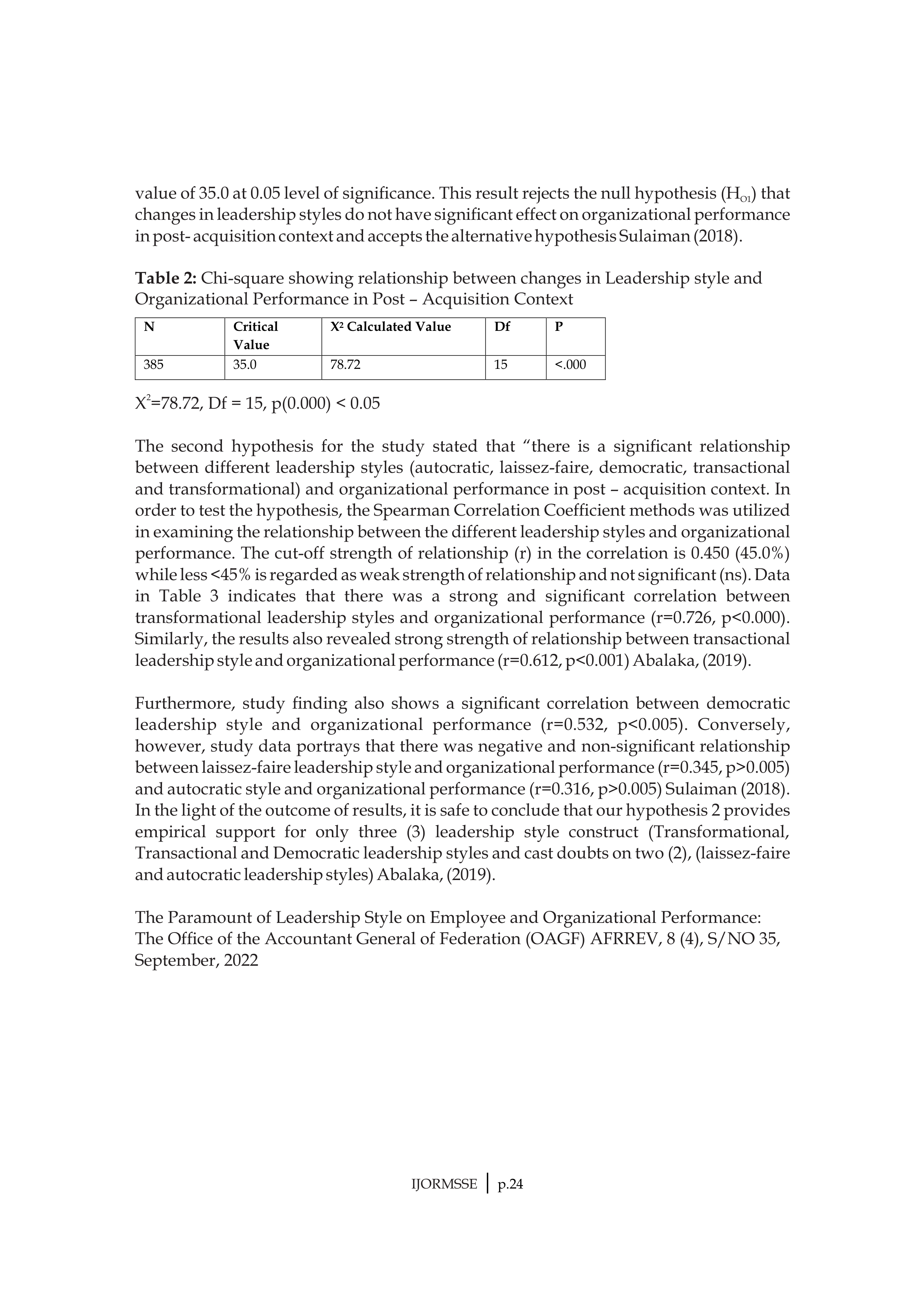
leadership styles on organizational performance. Data presented in Table 1 indicates that
a combination of leadership styles was in use in pre-acquisition period. The most
dominant type was autocratic leadership style (51.3%) and next to it was democratic
leadership style (22.3%). Worthy of note is that only negligible traces of Laissez-faire
leadership style were exhibited (10.6%). Also, barely used in the reacquisition period
were transactional leadership style (9.6%) and transformational leadership style (6.2%)
Abalaka, (2019).
However, a signicant nding in the post-acquisition era is that more than six (6) out of
ten (10) respondents, that (62.1%) of the respondents afrmed transformational
IJORMSSE
|
p.23
leadership style as the dominant leadership approach exhibited in the running of the
organization, followed by transactional leadership style (20.0%) and democratic
leadership (14.3%). The organization rarely adopted autocratic and laissez-faire
leadership which were (2.3% and 1.3%) respectively in the running of the organization in
the post-acquisition period Ajiteru, (2020).
Table 1:
Leadership Styles Adopted by the Organization in Pre and Post Acquisition
Context
Source:
Field survey, 2014
The responses abstracted from the series of interviews across the company lend credence
to the quantitative result. Some of the extracts are thus presented: Employee participation
was not widely encouraged in the organization before the change of management. All
policy-decisions emanated from the top. The company was more of being production
centered, than being employee and customer focused Sulaiman (2018). The style of
leadership in pre-acquisition period was too restrictive and affected our performance.
Male – Manager (Aged, 45)
“The present leadership style in the post-acquisition period has eliminated almost all
ambiguities in the former system Ajiteru, (2020). There is now greater involvement in the
discharge of task responsibilities. Support and recognition are also given to employees
and these enhance their job satisfaction and commitment to duty. Employees are
continuously involved in high performance programmers such as “project optima”,
“new dawn” and “deliver to the light”, which resulted in increased organizational
performance”. Female – Manager (Aged, 38)
The picture which emerged from these responses indicated that with the change in
leadership styles in post – acquisition period, employees were more enthusiastic, willing
to work above and beyond contract resulting in enhanced corporate performance
Abalaka, (2019).
Test of Hypothesis
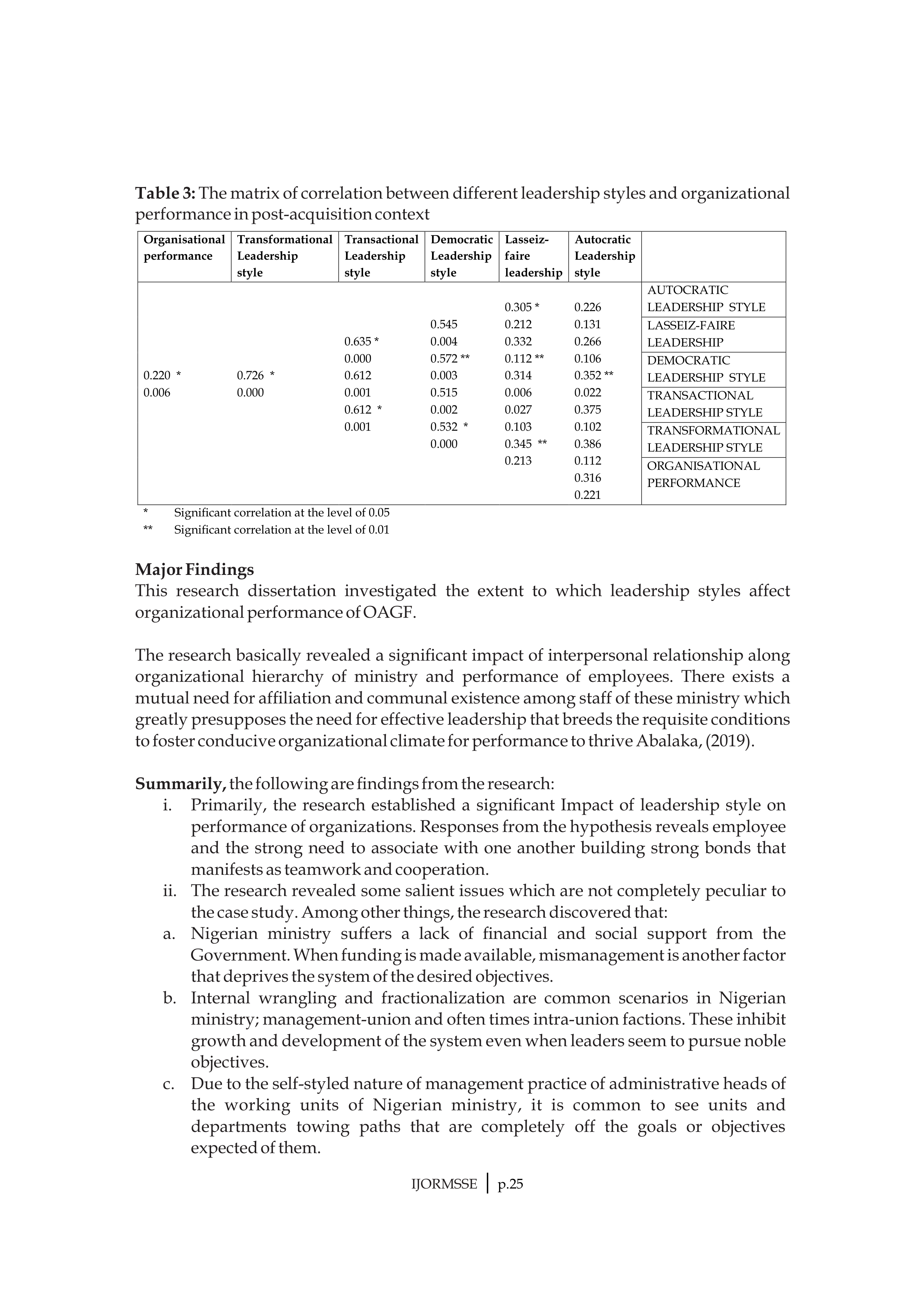
The rst hypothesis was subjected to non-parametric chi-square statistical test analysis.
2
2
Data presented in Table 2 shows that X calculated value of 78.72 is greater than X critical
Types of Leadership Style
N
= 385
Pre-Acquisition
Post –
Acquisition
Frequency
%
Frequency
%
Autocratic and
bureaucratic
197
51.3
9
2.3
Laissez –
Faire
41
10.6
5
1.3
Democratic
86
22.3
55
14.3
Transactional
37
9.6
77
20.0
Transformational
24
6.2
239
62.1
IJORMSSE
|
p.24
value of 35.0 at 0.05 level of signicance. This result rejects the null hypothesis (H
) that
O1
changes in leadership styles do not have signicant effect on organizational performance
in post- acquisition context and accepts the alternative hypothesis Sulaiman (2018).
Table 2:
Chi-square showing relationship between changes in Leadership style and
Organizational Performance in Post – Acquisition Context
2
X =78.72, Df = 15, p(0.000) < 0.05
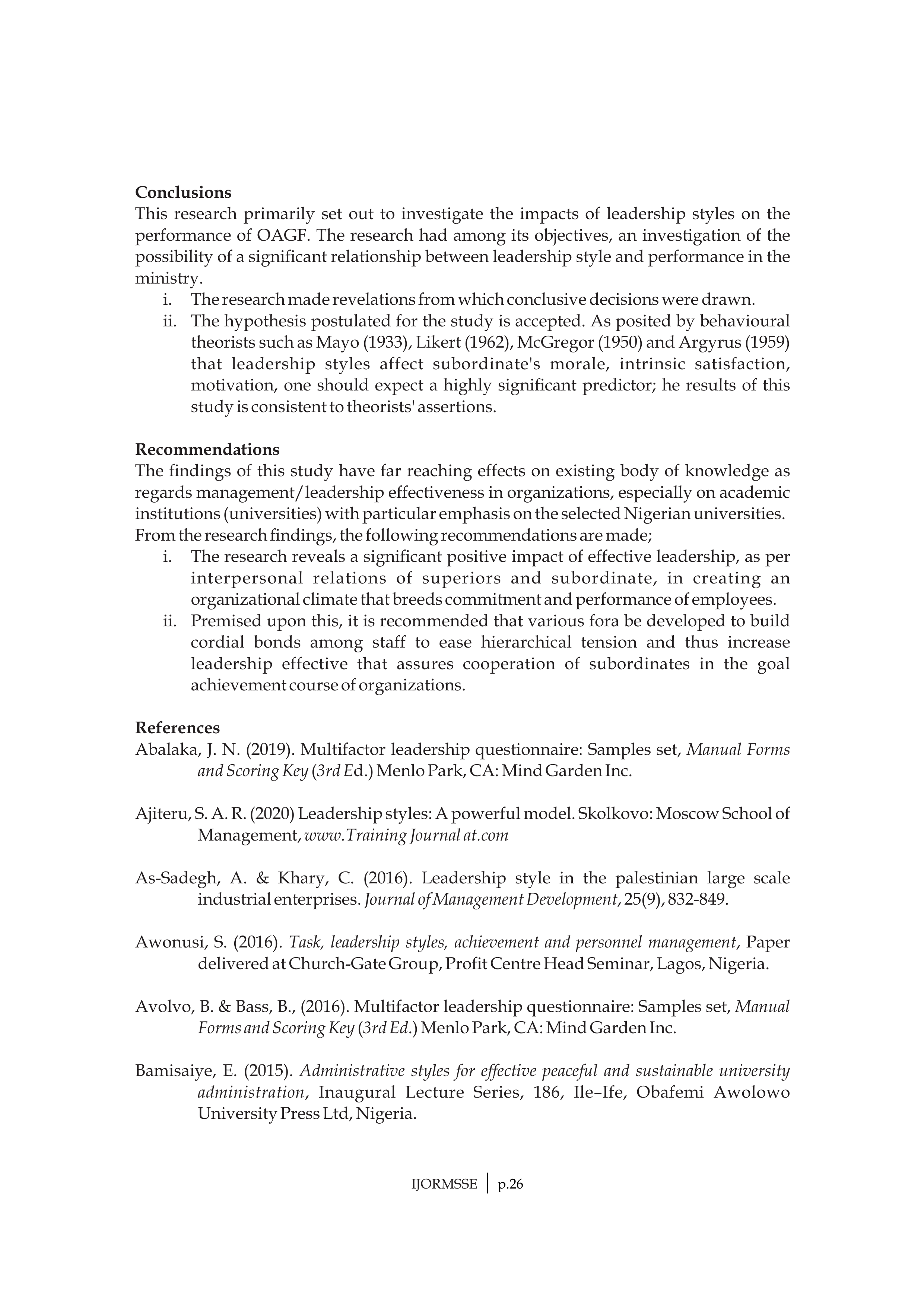
The second hypothesis for the study stated that “there is a signicant relationship
between different leadership styles (autocratic, laissez-faire, democratic, transactional
and transformational) and organizational performance in post – acquisition context. In
order to test the hypothesis, the Spearman Correlation Coefcient methods was utilized
in examining the relationship between the different leadership styles and organizational
performance. The cut-off strength of relationship (r) in the correlation is 0.450 (45.0%)
while less <45% is regarded as weak strength of relationship and not signicant (ns). Data
in Table 3 indicates that there was a strong and signicant correlation between
transformational leadership styles and organizational performance (r=0.726, p<0.000).
Similarly, the results also revealed strong strength of relationship between transactional
leadership style and organizational performance (r=0.612, p<0.001) Abalaka, (2019).
Furthermore, study nding also shows a signicant correlation between democratic
leadership style and organizational performance (r=0.532, p<0.005). Conversely,
however, study data portrays that there was negative and non-signicant relationship
between laissez-faire leadership style and organizational performance (r=0.345, p>0.005)
and autocratic style and organizational performance (r=0.316, p>0.005) Sulaiman (2018).
In the light of the outcome of results, it is safe to conclude that our hypothesis 2 provides
empirical support for only three (3) leadership style construct (Transformational,
Transactional and Democratic leadership styles and cast doubts on two (2), (laissez-faire
and autocratic leadership styles) Abalaka, (2019).
The Paramount of Leadership Style on Employee and Organizational Performance:
The Ofce of the Accountant General of Federation (OAGF) AFRREV, 8 (4), S/NO 35,
September, 2022
N
Critical
Value
X
2
Calculated Value
Df
P
385
35.0
78.72
15
<.000
IJORMSSE
|
p.25
Table 3:
The matrix of correlation between different leadership styles and organizational
performance in post-acquisition context
Major Findings
This research dissertation investigated the extent to which leadership styles affect
organizational performance of OAGF.
The research basically revealed a signicant impact of interpersonal relationship along
organizational hierarchy of ministry and performance of employees. There exists a
mutual need for afliation and communal existence among staff of these ministry which
greatly presupposes the need for effective leadership that breeds the requisite conditions
to foster conducive organizational climate for performance to thrive Abalaka, (2019).
Summarily,
the following are ndings from the research:
i.
Primarily, the research established a signicant Impact of leadership style on
performance of organizations. Responses from the hypothesis reveals employee
and the strong need to associate with one another building strong bonds that
manifests as teamwork and cooperation.
ii. The research revealed some salient issues which are not completely peculiar to
the case study. Among other things, the research discovered that:
a. Nigerian ministry suffers a lack of nancial and social support from the
Government. When funding is made available, mismanagement is another factor
that deprives the system of the desired objectives.
b. Internal wrangling and fractionalization are common scenarios in Nigerian
ministry; management-union and often times intra-union factions. These inhibit
growth and development of the system even when leaders seem to pursue noble
objectives.
c. Due to the self-styled nature of management practice of administrative heads of
the working units of Nigerian ministry, it is common to see units and
departments towing paths that are completely off the goals or objectives
expected of them.
Organisational
performance
Transformational
Leadership
style
Transactional
Leadership
style
Democratic
Leadership
style
Lasseiz-
faire
leadership
Autocratic
Leadership
style
0.220 *
0.006
0.726 *
0.000
0.635 *
0.000
0.612
0.001
0.612 *
0.001
0.545
0.004
0.572 **
0.003
0.515
0.002
0.532 *
0.000
0.305 *
0.212
0.332
0.112 **
0.314
0.006
0.027
0.103
0.345 **
0.213
0.226
0.131
0.266
0.106
0.352 **
0.022
0.375
0.102
0.386
0.112
0.316
0.221
AUTOCRATIC
LEADERSHIP STYLE
LASSEIZ-FAIRE
LEADERSHIP
DEMOCRATIC
LEADERSHIP STYLE
TRANSACTIONAL
LEADERSHIP STYLE
TRANSFORMATIONAL
LEADERSHIP STYLE
ORGANISATIONAL
PERFORMANCE
*
Signicant correlation at the level of 0.05
**
Signicant correlation at the level of 0.01
IJORMSSE
|
p.26
Conclusions
This research primarily set out to investigate the impacts of leadership styles on the
performance of OAGF. The research had among its objectives, an investigation of the
possibility of a signicant relationship between leadership style and performance in the
ministry.
i.
The research made revelations from which conclusive decisions were drawn.
ii. The hypothesis postulated for the study is accepted. As posited by behavioural
theorists such as Mayo (1933), Likert (1962), McGregor (1950) and Argyrus (1959)
that leadership styles affect subordinate's morale, intrinsic satisfaction,
motivation, one should expect a highly signicant predictor; he results of this
study is consistent to theorists' assertions.
Recommendations
The ndings of this study have far reaching effects on existing body of knowledge as
regards management/leadership effectiveness in organizations, especially on academic
institutions (universities) with particular emphasis on the selected Nigerian universities.
From the research ndings, the following recommendations are made;
i.
The research reveals a signicant positive impact of effective leadership, as per
interpersonal relations of superiors and subordinate, in creating an
organizational climate that breeds commitment and performance of employees.
ii. Premised upon this, it is recommended that various fora be developed to build
cordial bonds among staff to ease hierarchical tension and thus increase
leadership effective that assures cooperation of subordinates in the goal
achievement course of organizations.
References
Abalaka, J. N. (2019). Multifactor leadership questionnaire: Samples set,
Manual Forms
and Scoring Key
(
3rd E
d.) Menlo Park, CA: Mind Garden Inc.
Ajiteru, S. A. R. (2020) Leadership styles: A powerful model. Skolkovo: Moscow School of
Management,
www.Training Journal at.com
As-Sadegh, A. & Khary, C. (2016). Leadership style in the palestinian large scale
industrial enterprises.
Journal of Management Development
, 25(9), 832-849.
Awonusi, S. (2016).
Task, leadership styles, achievement and personnel management
, Paper
delivered at Church-Gate Group, Prot Centre Head Seminar, Lagos, Nigeria.
Avolvo, B. & Bass, B., (2016). Multifactor leadership questionnaire: Samples set,
Manual
Forms and Scoring Key
(
3rd Ed
.) Menlo Park, CA: Mind Garden Inc.
Bamisaiye, E. (2015).
Administrative styles for effective peaceful and sustainable university
administration
, Inaugural Lecture Series, 186, Ile–Ife, Obafemi Awolowo
University Press Ltd, Nigeria.
IJORMSSE
|
p.27
Boehlije & Bruce (2017).
Adapting your leadership styles as farm business structure changes:
Top Farmers Crop Workshop Newsletter-March
, 6-9, Department of Agricultural
Economics. Purdue University of Purdue.
Boehnke, K., Bontis, N., Distefano, J., & Distefano, A. (2013). Transformational
leadership. an examination of cross-national differences and similarities,
Leadership and Organization Development Journal
, 24(2), 5-17.
Casse, P. & Claudel, P. (2021). Leadership styles: A powerful model. Skolkovo: Moscow
School of management.
www.Training Journal at.com
Chen, H., Beck, S. & Amos, L. (2015). Leadership style and nursing faculty job satisfaction
in Taiwan,
Journal of Nursing Scholarship,
37(4), 374-380.
Elenkov, D. (2022). Effects of leadership style in organizational performance on Russia
companies,
Journal of Business Research
, 55, 467-480.
Gono, J. & Gallo, A. (2018). Model for leadership style evaluation,
Management
, 2, 18, 157-
168.
Hoyles, J., (2016).
Leadership Styles: Encyclopaedia of educational leadership and
administration, 595-598
, Sage London: Thousands Oaks Sage Publications.
Humphrey, J. & Einstein, W. (2018). Nothing new under the Sun: Transformational
leaderships from a historical perspective,
Management Decision
, 41(2), 8595.
Judge, T., & Picollo, R. (2004). Transformational and transactional leadership: A Meta-
Analytic Test review,
Journal of Applied Psychology.
89 (5),755-768.
Kur, A. (2019). Leadership styles: The managerial challenges in emerging Economies,
International Bulleting of Business Administration
, Issue 6, 73-81
Lewin, K., Lippit, R. & Whit, R. (2019). Pattern of aggressive behaviour in articial created
social climate.
Journal of Social Psychology
, 10, 271-299.
Liu, A., Fellow, R. & Fang, Z. (2018). The power of paradigm of project leadership,
Construction Management and Economics
, 21 (8), 819-829.
Mullins, L. (2017).
Management and organizational behavior
7th edition
, London: Pitman
Publishing.
Northhouse, P. (2020).
Leadership: Theory and practice. 5th edition
, California: Thousand
Oaks Sage Publications.
IJORMSSE
|
p.28
Ogundele, S. & Limsila, K. (2017). Performance and leadership outcome: correlates of
leadership styles and subordinates commitment,
Engineering Construction and
Architectural Management Journal,
15(20), 164-168.
Omolayo, B. (2017). Effects of leadership style on job-related tension and psychological
sense of community in work organizations: A case study of four organizations in
Lagos State, Nigeria.
Bangladesh E-Journal of Sociology
, 4(2), 30-37.
Richards, T., Chen, M. & Monger, S. (2021). Development of self-report instrument for
exploring team factor, leadership and performance relationship,
British Journal of
Management
, 12, 243-250.
Robbins, S. (2017).
Organizational behaviour: Concepts controversies and applications (10th
Ed.)
New Jersey, USA: Prentice Hall, Upper Saddle, River.
Tarabishy, A., Solomon. G., Fernald, L., & Sashkin, M., (2015). The entrepreneurial
leaders, impact on the organizational performance in dynamic market.
Journal of
Private Equity,
8(4), 20 – 29.
Suyi, (2021).
The changing leadership style of state organization enterprises in China
, School of
Management Zohongshan University.
Thamrin, H. (2017). The inuence of transformational leadership and organizational
commitment on job satisfaction and employee performance,
Journal of
Innovation, Management and Technology,
3(5), 556-565.
Uchewamgbe, B. (2018). Effects of leadership styles on organizational performance in
small and medium scale enterprises (SMEs) in Nigeria,
European Journal of
Business and Management
, 3(23), 53-73.
Worall (2014).
The business energy survey
,
16-21
. London: Chartered Institute of
Management.
Sulaiman, T. H, (2018). The entrepreneurial leaders, impact on the organizational
performance in dynamic market.
Journal of Private Equity,
8(4), 20 – 29.
Zhu, W., Chen, I., & Spangler, W. (2015). CEO transformational leadership and
organizational outcome: the mediating role of human capital enhancing human
resource management,
The Leadership Quarterly
, 16(1), 39-52.