

RESEARCH
A critical analysis of Elon Musk
’
s leadership in Tesla motors
Md. Rahat Khan
1
Received: 8 December 2019 /Accepted: 28 February 2021
#
The Author(s), under exclusive licence to Faculty of Entrepreneurship, University of Tehran 2021
Abstract
This present study applies qualitative research method to evaluate the entrepreneurial roles and leadership styles of Elon Musk in
Tesla motors. The study places its focus on the general review of Elon Musk
’
s leadership and attempts to match the leadership
traits
with
some
traditional
leadership
approaches
widely
recognized
in
leadership
theory.
The
study
employs
a
structured
observation
technique
assimilating
numerous
secondary
sources
with
a
view
to
analyzing
Musk
’
s
leadership
traits
in
Tesla
motor. The results unfold Musk
’
s leadership attributes and shows that they match more or less with all the traditional leadership
approaches but the servant leadership approach. Additionally, the outcomes also demonstrate a new character (entrepreneurial
leader)
in
Musk
’
s
leadership.
Finally,
the
study
offers
some
recommends
for
Elon
Musk
to
follow,
such
as
the
champion/
corporate
intrapreneur
and
the
servant
leadership
approaches
so
that
they
add
practical
values
in
his
leading
trait.
This
study
will be a guideline for the new entrepreneur and will provide some distinctive ways of improvement in existing entrepreneurship
as well as for management literature.
Keywords
Elon Musk
.
Tesla motors
.
Entrepreneur
.
Leadership
Introduction
In the twenty-first century, both the scholars and practitioners
have said, core tricks are crucial to impel organizational per-
formance
such
as
strategic
planning
and
leadership
(Bennett
&
Lemoine,
2014
).
Doheny
et
al.
(
2012
)
stated
that
trans-
versely many industries, an increasing wave of volatility, un-
certainty,
and
business
complexity
and
anxiety
are
cracking
markets
and
shifting
the
surroundings
of
competition.
Although
globalization
has
shaped
opportunities
with
one
hand,
on the
other
hand,
it
has
also
established
some
threats
as
well.
The
obstinate
global
recession
has
dulled
repeated
explode
of
confidence
for
the
return
to
a
way
of
affluence.
The
task
of
assimilating
technological
progress
that
hit
the
market,
along
with
the
effects
of
demographic
changes
in
the
workforce
has
created
some
uncertainty
that
the
leaders
might
face
some
major
challenges.
So,
leaders
require
im-
provement in the discipline based on the concurrent business
environment.
Leadership
is
nothing
but
the
ability
to
influence
others
(Robbins & Judge,
2013
). In the twenty-first century, leader-
ship is a challenge not only to lead an organization but also to
lead the environment as the business environment is changing
dynamically.
During
the
past
few
years,
organizations
have
become progressively more conscious of the serious need for
leaders. So, leaders have to make constant changes in people,
process, structure, and technology. This entails flexibility and
promptness
in
management
decision-making
(Horney
et
al.,
2010
). From the textbooks some traditional and basic leader-
ship
qualities
can
be
found
such
as
autocratic,
democratic,
laissez-faire
leadership
style
(Robbins
&
Judge,
2013
).
As
the
environment
has
changed;
so
the
concept
of
leadership
has also changed (Rost,
1993
; Goldring & Greenfield,
2002
).
The
current
study
is
narrowly
focusing
on
the
leadership
traits of Elon Musk in Tesla motors. The basic aim of the study
is to find out to what extent the patterns of leadership tactics
match with Musk
’
s leadership in Tesla motors. More specifi-
cally,
this
particular
study
will
try
to
observe
Elon
Musk
’
s
leadership practices in Tesla motors and try to unearth which
sorts of leadership attributes exist in Mask
’
s leadership. As a
consequence, the study will cover the following. The follow-
ing
part
of
the
study
will
discuss
some
leadership
attributes
under
the
shape
of
literature
review.
In the
third
section,
the
study will discuss the methodology of the research. After that,
the study will evaluate and narrate about Elon Musk and his
*
Md. Rahat Khan
rahatkhan.mrk14@gmail.com;
rahat.khan.dba@cityuniversity.edu.bd
1
Department of Business Administration, City University, Khagan,
Birulia, Savar, Dhaka 1216, Bangladesh
Journal of Global Entrepreneurship Research
https://doi.org/10.1007/s40497-021-00284-z
Tesla motors. Then, the study will analyze the leadership style
based
on
Elon
Musk
’
s
leadership.
Finally,
the
research
will
have a discussion on findings along with ending remarks.
Review of literature
Some contemporary leadership styles which have been prac-
ticed
in
organizations
for
reaching
the
organizational
goals
have been stated below.
Charismatic and transformational leadership style
Charismatic
leaders
habitually
try
to
build
the
status
quo
healthier,
whereas
transformational
leaders
spotlight
on
changing
organizations
into
the
leader
’
s
vision
(St.
Thomas
University,
2018
).
Transformational
leadership
(TL)
was
coined
in
1973,
in
the
sociological
research
named
“
Rebel
Leadership:
Commitment and
Charisma
in
the
revolutionary
process.
”
The study was conducted by Downton, J.V. (Simic,
1998
). Then, James MacGregor Burns applied the term
“
trans-
formational leadership
”
in the book titled
Leadership
(Burns,
1978
). According to Burns, TL is a process where leaders and
supporters
constantly
try
to
endorse
their
individual
psycho-
logical
capability
and
motivational
competence
to
higher
levels.
In
this
process,
the
reciprocal
and
rising
relationship
is
present
between
leaders
and
their
followers
(Krishnan,
2004
).
Participative/distributive leadership
In participative or teamwork leadership, more opportunities to
contribute in decision-making offer employees with superior
authentic
rewards
from
work
(Conger
&
Kanungo,
1988
;
Thomas
&
Velthouse,
1990
)
along
with
advanced
levels
of
psychological
empowerment
(Spreitzer,
1995
),
which
can
contribute
in
enhanced
performance
in
the
workplace.
The
participative
leadership
behavior
shows
that
the
leader
has
the confidence in, and contiguity and admiration for the sub-
ordinates
and
this
type
of
leadership
behavior
fosters
high
amount of trust towards the leader (Dirks & Ferrin,
2002
,
p.
614). For that consequence, the subordinates are liable to give
something
back to their leaders
along
with
the
organizations
by
serving
better
work
performance
(e.g.,
Cohen,
1992
;
Zellars & Tepper,
2003
).
Creative leadership
Creative leadership is a philosophy to act, expand and appre-
hend
innovative
ideas
through
mutual
ambition
of
civilizing
the world through formation of enterprise. Creative leadership
is employed to counterfeit an environment that supports inno-
vative
thoughts
and
mission-oriented
entrepreneurship
(Dijk
et al.,
2017
). Leaders can exercise creativity as a planned tool
to
direct
their
organizations
to
attain
adaptability.
Kabanoff
and Rossiter (
1994
) described applied creativity as a method
which works in a real-world to find or to solve complex prob-
lems;
by
having
an
authentic
behavioral
creative
plan
as
the
final answer.
Change leadership
Change
wants
to
craft
a
new
system,
which
always
needs
leadership
(Kotter,
1996
).
The
concept
basically
explains
why thriving, and sustainable organizational advances depend
on
the
successful
change
in
leaders
who
recognize
how
to
produce
and
publicize
a
vision,
overcome
battle
to
change
and handle conflict. Lewin
’
s (
1947
) theory of the change pro-
cess
has
three
stages
of
unfreezing
,
freezing
,
and
refreezing
.
Since then, both researchers and administrators have centered
on the significance of change in execution processes for shap-
ing employees
’
behaviors and attitudes towards changing en-
vironment. This prominence on change-process can be origi-
nated in the fields of justice (e.g., Shapiro & Kirkman,
1999
),
democratic
decision-making
(e.g.,
Schweiger
&
Denisi,
1991
), and organizational development (e.g., Quirke,
1996
),
Intelligence leadership
Intelligence leadership is found to steer the future by clasping
ambiguity
and
reorganizing
problems
as
opportunities
just
like a proactive attitude in enchanting their organizations into
the unexplored territory. According to Goleman (
1998
), emo-
tional intelligence (leadership) is the ability to recognize per-
sonal thoughts as well as of others, for managing emotion and
for motivating ourselves and to fit in us and in our interaction.
For
leaders,
emotional
intelligence
is
vital
for
team
success.
All
the
same,
who
is
more
likely
to
thrive?
—
a
leader
who
yells
at
his/her
team
when
s/he
is
under
anxiety,
or
a
leader
who settles in, controls his/her emotional rush and tranquilly
evaluates the situation.
Multicultural leadership style
A
multicultural
leader
is
able
to
apply
multicultural
lead-
ership
by
assessing
the
value
of
various
cultures.
A
good
multicultural leader expresses excellence
in talents includ-
ing
patience,
listening,
admiration,
and
helpfulness
while
remaining
polite.
A
multicultural
leader
will
demonstrate
admiration
for
and
make
accommodations
to
permit
indi-
viduals of diverse cultures to work together and contribute
snugly
with
those
of
other
beliefs
and
cultures
(Dave
Strathmann,
2016
).
J Glob Entrepr Res
Pedagogical leadership style
The concept of pedagogy is transferred by its Grecian sources
(Heikka & Waniganayake,
2011
). Pedagogical leader is a per-
son
who
by
his
acts,
speeches
or
else
promotes
pedagogical
action.
Pedagogical
leadership
demands
extraordinary
keen-
ness
and
aptitude
based
on
the
secret
attitudes
of
the
leader.
The
leader
’
s
responsibility
includes
the
sentiment
of
leader-
ship and influence, such as an educator or pedagogue, never-
theless the forms, methods, and techniques are different. The
idea
of
pedagogical
leadership
conveys
leadership
nearer
to
people
’
s
interface,
as
contrasting
to
the
earlier
hierarchical
leadership
style.
The
administration
of
pedagogy
is
nothing
but the management as a whole
–
how the worker can put his/
her
whole
hearted
effort
in
their
work
as
a
teacher
and
also
develop
and
learn
his/her
work.
But
on
the
other
hand,
Pedagogical leadership is the art of employees
’
learning, and
the execution is cleared by each leader
’
s own learning percep-
tion. (Lahtinen,
2017
).
Servant leadership style
Robert K. Greenleaf (1904
–
1990) commenced the concept of
servant
leadership among
contemporary organizational theo-
rists
(Spears,
1995
,
1996
). In Greenleaf
’
s
(
1977
)
view,
lead-
ership must mainly meet the demands of others. The spotlight
of servant leadership is on the others instead of on one
’
s own
and
on
understanding
the
task
of
the
leader
as
a
servant
(Greenleaf,
1977
). Egotism should not stimulate servant lead-
ership;
rather,
it
should
lead
to
a
higher
flat
of
motivation
(Greenleaf,
1977
; Pollard,
1996
).
Bridging leadership style
Bridging leadership focuses on creating and maintaining suc-
cessful
working
associations
among
stakeholders
and
key
partners.
“
Bridging
”
various perspectives and views often ini-
tiates
a
good
extent
of
diverse
stakeholders,
and
a
general
agenda
which can
embark on sharing
and
developing things
in order to discover resolutions to societal and economic trou-
bles.
The
“
bridging leadership
”
concept
was
developed
by a
worldwide
group
of
development
practitioners
and
re-
searchers assembled by Synergos (
2017
). Bridging leadership
assists nurturing synergy and emphasizing motivation and be-
havior
through
the
exercise
of
communication
to
construct
climate of trust and buoyancy.
Methodology
The study is qualitative type in nature which is based on struc-
tured
observation
research
method.
The
observational
ap-
proaches
are
usually
used
where
the
investigators
or
researchers attempt to examine the result of factors related to
the
risk,
investigative
action,
test,
or
some
other
associated
interference
without
upsetting
the
changes
which
are
or
are
not
unexposed
to
it
(Institute
for
Work
&
Health,
2015).
In
addition, observation includes an investigator to track all the
related phenomena without providing information beforehand
(Malhotra & Dash,
2016
). In case of structured observation, it
denotes an important process in which a research obtains data
without the direct participation of the respondents. It also en-
ables the investigator to gather information which could not be
obtained
utilizing
traditional
research
methodology,
such
as
survey questionnaires as well as interviews, either structurally
or non-structurally. Structured observation applies to a coding
system
for
the
purpose
of
processing
the
collected
data
and
information
(Mintzberg,
1970
).
Observational
study
collec-
tively
denotes
the
studies
of
case,
cohort,
along
with
cross
sectional
analysis
(Mann,
2003
).
Observation
method
refers
to an insight into an association between the groups as well as
dyads,
which
explains
the
overall
scenarios,
processes,
and
captures
situation
and
then
notifies
regarding
the
impact
of
physical environment (Mulhall,
2003
). The approach and ap-
plication of observational method normally diverge based on
the
research
philosophical
orientation
along
with
the
role
(from the perspective the researcher observes the situation or
participants) of that particular researcher (Walshe et al.,
2012
).
Observation
method
is
most
commonly
used
in
social
sci-
ences, more specifically in case of anthropological researches.
The
basic
aim
of
that
method
is
to
uncover
the
unconscious
events or annoyances which may have some potential interest
in emerging markets (Wimmer et al.,
2001
). The data has been
assembled from the secondary sources such as from different
newspapers, journals, blogs, websites of Tesla Inc. and some
other
related
secondary
sources
which
contain
information
regarding Elon Musk and his leadership attributes along with
Tesla Inc. Clandinin & Connelly,
2000
), in their study, have
recommended two types of tactics to clarify the data of qual-
itative
research.
Firstly,
to
identify
the
exact
research
ques-
tions,
which
are
the
best
fitting
for
that
particular
research
and then assemble the details and specific solutions or answers
of the
investigated
events?
Secondly,
to evaluate
the
partici-
pants
’
responses
under
thematic
design
as
well
as
to
restore
that thematic design towards a background that generates the
thoughtfulness and elucidates the stories
’
components.
Elon musk and Tesla motors
About Elon musk
Musk is a South African entrepreneur born in 1971. In 1989,
at the age of 17, he evaded his obligatory service in the South
African military and moved to Canada for attending Queen
’
s
University. In 1992, he studied in business and physics at the
University
of
Pennsylvania.
He
completed
both
of
his
J Glob Entrepr Res
undergraduate and graduate degrees in economics and contin-
ued
for
a
second bachelor
’
s
degree in physics. After
leaving
the University of Pennsylvania, Elon Musk started his journey
as a PhD student in energy physics at Stanford University in
California.
Elon Musk started his business career by launching X.com
in
1999
which
is
widely
known
as
PayPal
(Online
money
payment
system
across the
globe),
then
launched
SpaceX
in
2002, Tesla in 2003 (Biography.com,
2018
); Musk himself is
an entrepreneurial leader. He attacked the traditional environ-
ment
(Khan,
2019
)
where
people
were
scared
for
an
eco-
friendly
vehicle
along
with
good
speed
like
a
gasoline
car,
Mr.
Musk
and
his
Tesla
made
this
possible
for
the
world.
The electric vehicle is a wonder of the century in transporta-
tion industry which precisely means change leadership.
The Tesla motors
Tesla
was
originated
in
2003
by
a
cluster
of
engineers
who
dreamed
to
demonstrate
that
community
did
not
require
to
compromise
to
drive
slower
version
of
electric
vehicles
in
comparison to the gasoline vehicles. They can avail the faster,
better, adventurous, smooth driving through electric cars than
the
gasoline cars.
At present
days,
Tesla
builds considerably
scalable clean energy generation and storage products through
creating
all-electric
vehicles.
This
means,
green
vehicle,
which
shifts
towards
a
zero-emission
prospect.
In
2008,
Tesla
launched
Model
S
and
the
car
accelerates
from
0
to
60 miles per hour within 2.28 s. In 2015, Tesla added a new
model in its product line named Model X. The model was the
upgraded
version
of
Model
S,
which
holds
five-star
safety
ratings
from
all
categories.
The
certification
was
given
by
the National Highway Traffic Safety Administration.
In
2017,
the
company
came
up
with
another
new
model
named
Model
3
and
the
model
was
considered
the
CEO
’
s
(Elon
Musk)
“
Secret
Master
Plan
”
of
2016,
a
high-volume
electric
vehicle
with comparatively
low
price. Shortly,
Tesla
produced
the
most
comfortable
and
the
safest
truck
named
Tesla
Semi.
The truck
can
save a
great
number of fuel
costs
of its owners.
All the vehicles and majority of the vehicles components of
Tesla
are
produced
in
its
own
factory
located
in
Fremont,
California. Tesla is captivating a proactive approach to safety.
For
that
consequence,
the
company
entails
the
employees,
who
gets
engaged
in
the
production,
to
join
in
a
multi-day
program of training before the very first day of entering into
the factory floor; because, the company wants to achieve the
goal of having the safest factories across the globe. Tesla had a
total
amount
of
37,543
full-time
employees
until
December
31, 2017 (Annual Report, 2018).
To
construct
a
completely
sustainable
energy
ecosystem,
Tesla
also
invents
exclusive
set
of
power
energy
solutions
such as Solar Roof, Powerpack, and Powerwall. The solutions
facilitate businesses, dwellers, as well as utilities to deal with
storage,
renewable
energy
creation,
and
consumption.
The
Tesla considers all of the abovementioned efforts as just their
beginning. After that, Tesla attempts to introduce eco-friendly
and
most
reasonable
cars,
and
energy
production
(Tesla,
2019).
Financial performance and products of Tesla
At the very beginning of incorporation on June 29, 2010, the
IPO
(Initial
Public
Offering)
was
$17.00
per
share.
The
fol-
lowing Table
1
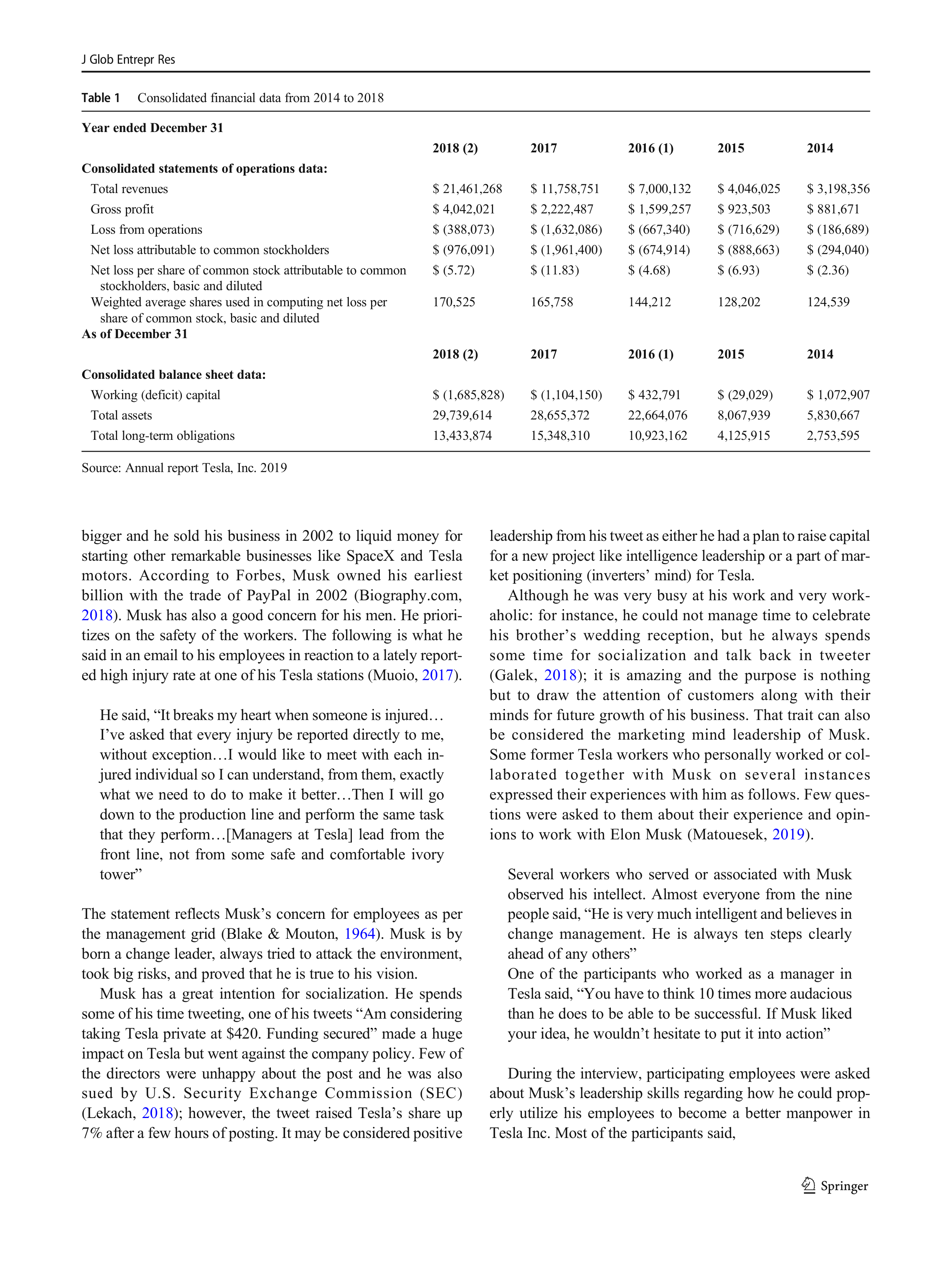
shows the latest scenario of share price.
Total revenues were generated on 31st December 2014 as
$3,198,356;
31st
December
2015
as
$
4,046,025;
31st
December
2016
as
$
7,000,132;
31st
December
2017
as
$
11,758,751; and 31st December 2018 as $21,461,268.
Until now, Tesla Inc. is offering the following products:
•
Model S
•
Model 3
•
Model X
•
Model Y
•
Cyber truck
•
Tesla Energy Service
•
Roadster
•
Tesla Semi
Critical analysis of Musk
’
s leadership (2003
–
2018)
Elon Musk, the other name for Tesla motors, is considered a
visionary leader who has the ability to see the future. Musk is a
mastermind and thus discerns that, it values him while he pays
attention
to
what
his
critics,
customers,
observers,
and
fol-
lowers
have
articulated.
And
he
utilizes
this
collected
infor-
mation to the best advantages (Galek,
2018
). Some
transfor-
mational characteristics have also been observed from Musk
’
s
leadership, He is constantly optimistic and tranquil even when
at the edge of bankruptcy. After a breakdown in 2008 of the
rocket launch, employees were tired and emotionally broken
down. Musk tackled the situation saying:
“
We
are
going
to
do
this.
It
is
going
to
be
ok.
Do
not
freak
out.
”
An
observer
named
Dolly
Singh
remem-
bered
“
It was like magic. Everyone chilled out immedi-
ately
and
started
to
focus
on
what
just
happened
and
figuring
out
how
to
fix
it.
”
(Gromov,
2017
;
Blazek,
2016
)
Mr. Musk has not directly affirmed that he applies any one
specific
theory
of
leadership,
rather
his
leadership
styles
run
across a diversity of circumstances. Musk employs supportive
as well as participative leadership (distributed leadership) stat-
ed by (Williams,
2018
) which supports the path-goal theory of
leadership (Snyder,
2018
).
Musk is a
genuine
risk-taker;
he started
his
business with
X.com
in 1999 and the business was flourishing on that time
and is popularly known as PayPal. However, the
dream was
J Glob Entrepr Res
bigger
and
he
sold
his
business
in
2002
to
liquid
money
for
starting
other
remarkable
businesses
like
SpaceX
and
Tesla
motors.
According
to
Forbes,
Musk
owned
his
earliest
billion
with
the
trade
of
PayPal
in
2002
(Biography.com,
2018
). Musk has also a good concern for his men. He priori-
tizes
on
the
safety
of
the
workers.
The
following
is
what
he
said in an email to his employees in reaction to a lately report-
ed high injury rate at one of his Tesla stations (Muoio,
2017
).
He said,
“
It breaks my heart when someone is injured
…
I
’
ve asked that every injury be reported directly to me,
without
exception
…
I
would
like to meet with each in-
jured individual so I can understand, from them, exactly
what
we
need
to
do
to
make
it
better
…
Then
I
will
go
down to the production line and perform the same task
that
they
perform
…
[Managers
at
Tesla]
lead
from
the
front
line,
not
from
some
safe
and
comfortable
ivory
tower
”
The
statement
reflects
Musk
’
s
concern
for
employees
as
per
the
management
grid
(Blake
&
Mouton,
1964
).
Musk
is
by
born a change leader, always tried to attack the environment,
took big risks, and proved that he is true to his vision.
Musk
has
a
great
intention
for
socialization.
He
spends
some of his time tweeting, one of his tweets
“
Am considering
taking Tesla private at $420. Funding secured
”
made a huge
impact on Tesla but went against the company policy. Few of
the
directors
were
unhappy
about
the
post
and
he
was
also
sued
by
U.S.
Security
Exchange
Commission
(SEC)
(Lekach,
2018
);
however,
the
tweet
raised
Tesla
’
s
share
up
7% after a few hours of posting. It may be considered positive
leadership from his tweet as either he had a plan to raise capital
for a new project like intelligence leadership or a part of mar-
ket positioning (inverters
’
mind) for Tesla.
Although
he
was
very
busy
at
his
work
and
very
work-
aholic: for instance, he could not manage time to celebrate
his
brother
’
s
wedding
reception,
but
he
always
spends
some
time
for
socialization
and
talk
back
in
tweeter
(Galek,
2018
);
it
is
amazing
and
the
purpose
is
nothing
but
to
draw
the
attention
of
customers
along
with
their
minds for future growth of his business. That trait can also
be
considered
the
marketing
mind
leadership
of
Musk.
Some former Tesla workers who personally worked or col-
laborated
together
with
Musk
on
several
instances
expressed their experiences with him as follows. Few ques-
tions
were
asked
to
them
about
their
experience
and
opin-
ions
to
work
with
Elon
Musk
(Matouesek,
2019
).
Several
workers
who
served
or
associated
with
Musk
observed
his
intellect.
Almost
everyone
from
the
nine
people said,
“
He is very much intelligent and believes in
change
management.
He
is
always
ten
steps
clearly
ahead of any others
”
One
of
the
participants
who
worked
as
a
manager
in
Tesla said,
“
You have to think 10 times more audacious
than he does to be able to be successful. If Musk liked
your idea, he wouldn
’
t hesitate to put it into action
”
During the interview, participating employees were asked
about Musk
’
s leadership skills regarding how he could prop-
erly
utilize
his
employees
to
become
a
better
manpower
in
Tesla Inc. Most of the participants said,
Table 1
Consolidated financial data from 2014 to 2018
Year ended December 31
2018 (2)
2017
2016 (1)
2015
2014
Consolidated statements of operations data:
Total revenues
$ 21,461,268
$ 11,758,751
$ 7,000,132
$ 4,046,025
$ 3,198,356
Gross profit
$ 4,042,021
$ 2,222,487
$ 1,599,257
$ 923,503
$ 881,671
Loss from operations
$ (388,073)
$ (1,632,086)
$ (667,340)
$ (716,629)
$ (186,689)
Net loss attributable to common stockholders
$ (976,091)
$ (1,961,400)
$ (674,914)
$ (888,663)
$ (294,040)
Net loss per share of common stock attributable to common
stockholders, basic and diluted
$ (5.72)
$ (11.83)
$ (4.68)
$ (6.93)
$ (2.36)
Weighted average shares used in computing net loss per
share of common stock, basic and diluted
170,525
165,758
144,212
128,202
124,539
As of December 31
2018 (2)
2017
2016 (1)
2015
2014
Consolidated balance sheet data:
Working (deficit) capital
$ (1,685,828)
$ (1,104,150)
$ 432,791
$ (29,029)
$ 1,072,907
Total assets
29,739,614
28,655,372
22,664,076
8,067,939
5,830,667
Total long-term obligations
13,433,874
15,348,310
10,923,162
4,125,915
2,753,595
Source: Annual report Tesla, Inc. 2019
J Glob Entrepr Res
No one is better than him to properly utilize employees
in
organization.
One
of
the
senior
executives
who
worked for
Tesla
motors shared his
opinions as,
“
90%
of the time I disagreed with Musk, I later realized Musk
was
right.
I
feel
like
I
’
m
10
times
smarter
now
than
when I first joined,
”
This statement proves Elon
’
s quality and ability to practice
the transformational leadership trait (Ivana Simic, 1998) to his
employees.
Two
of
the
senior
workers
who
worked
under
Musk claimed that,
“
he would not hesitate to adjust the team
’
s
goals if the social networking message of the consumer cap-
tured
his
attention.
”
He
also
added
that,
“
What
ultimately
triggers
him
to
act
and
make
a
decision
is
what
he
reads
on
social media,
”
Another one said regarding the issue as,
“
When you
’
re
in a business meeting with him, he will pivot the direc-
tion
of
the
organization
literally
overnight.
So
manufacturing
could
be
a
problem
today,
and
as
soon
as it stops being reported on social media, as soon as it
stops being reported in the news, he
’
ll move on to what-
ever the news is claiming the new problem is.
”
An engineer who worked in Tesla as a production engineer
has shared her opinion about the high level standard in Musk
’
s
leadership.
The
engineer
explained
that,
“
Musk
sometimes
took
that
impulse
too
far,
increasing
costs
and
re-
ducing
efficiency,
but
the
quality
of
Tesla
’
s
vehi-
cles
is
a
testament
to
Musk
’
s
perfectionism.
Tesla
is
an
engineer
’
s
paradise
where
the
pencil
is
liter-
ally
never
down.
”
During
the
interview,
a
former
manager
talked
about
the
goal-setting
abilities
and
techniques
generally
adapted
by
Musk
in
Tesla.
He
said,
Musk
occasionally
set
impracticable
enlarge
targets
instead
of
a
reasonable
goal
in
an
effort
to
accomplish
it.
That
means,
sometimes
Musk
believe
in
the
“
Think
Big
”
concept
of
goal
setting.
Through
this
concept,
the
employees
and
organization
may
set
highly
optimistic
stretch
targets
to
motivate
greater
levels
rather
than
a
typical
goal-setting
strategy
(Brown,
2009
).
The
manager also added,
“
He
thought
way outside
the
box. The first time he met Musk, the Tesla CEO asked
him and a group of his coworkers what they saw when
they
looked at
a
soda
can.
Musk
said they could
see
a
spaceship if they multiplied the soda can size. Musk said
that 85 hours of work per week is the optimum amount.
It is very much contagious
”
Nevertheless, some darker side of Musk
’
s leadership is also
obvious. Some fluctuations of his manners and preferences in
decision-making
may
downsize
his
leadership.
Mr.
Musk
is
suffering
from
an
age-old
problem.
He
endeavors
to
do
the
whole thing by himself. Unluckily, his choice to do so exhibits
a basic mix-up of what leadership means (Enderwick,
2018
).
The
physical
health
of
Musk
is
also
a
part
of
his
changing
behavior.
As he is a
workaholic he could
not
sleep
well and
suffered from insomnia that may affect his leading ability as
well. Two of his employees talked about him as,
Employee-1:
“
Elon
’
s worst trait by far, in my opinion, is
a complete lack of loyalty or human connection,
”
Employee-2:
“
Many of us worked tirelessly for him for
years
and
were
tossed
to
the
curb
like
a
piece
of
litter
without
a
second
thought.
Maybe
it
was
calculated
to
keep the rest of the workforce on their toes and scared;
maybe he was just able to detach from human connec-
tion to a remarkable degree. What was clear is that peo-
ple who worked for him were like ammunition: used for
a specific purpose until exhausted and discarded.
”
A retired manager who had been on numerous phone con-
versations with Musk has now said that he assumed Musk had
not
ever
learned
his
name
—
something
that
he
enjoyed,
be-
cause when somebody
’
s name did come up for the first time
throughout a phone conference, he would sometimes leave a
job shortly thereafter. Two retired senior employees said peo-
ple were afraid to say Musk that they argued with (Matouesek,
2019
).
One of them shared that,
“
Because of the pressure that
he puts on his entire executive
team,
his senior leader-
ship
team,
even
if
they
have
the
experience,
they
wouldn
’
t dare speak up against him,
”
The
above
comments
for
a
leader
from
his
subordinates
may undermine the leadership quality of Musk. A leader must
have the ability to understand his men and also some human
skills in all cases but Musk is falling apart from those types of
traits. So he has a lack of servant leadership style (Greenleaf,
1977
).
Nonetheless,
People
who
are
engaged
in
the
technology
industry
have
declared
that
Musk
’
s
impulse
and
the
extent
of
his
aspiration
match
that
of
both
Steve
Jobs
and
Bill
Gates.
Edward
Jung,
who
is
a
child
genius
and
worked
for
both Bill and Steve Jobs, said that,
Elon has that deep appreciation for technology, the no-
holds-barred attitude of a visionary, and that determina-
tion to go after long-term things that they both had, and
he has that consumer sensibility of Steve along with the
ability
to hire good
people
outside of
his
own
comfort
J Glob Entrepr Res
areas that are more like Bill. You almost wonder wheth-
er
Bill
and
Steve
had
created
a
genetically
engineered
love child and, who knows, maybe we should genotype
Elon to see if that
’
s what happened.
A venture capitalist named Steve Jurvetson, who is a share-
holder of Tesla, SpaceX, and SolarCity, and also worked un-
der
Jobs
’
leadership,
and
was
familiar
with
Gates
very
well,
also expressed:
“
Musk is an upgraded mix of the two. Like Jobs, Elon
does not tolerate C or D players,
”
But I
’
d say he
’
s nicer
than Jobs and a bit more refined than Bill Gates.
Result and discussion
The
CEO
and
co-founder of
Tesla,
Elon
Musk has
been
ad-
mired
globally for both of his leadership
and
entrepreneurial
skills.
Musk
is
an
effectual
sequential
entrepreneur
having
good
standing
as
a
creative
mastermind.
His
roles
as
CEO
and Product Engineer have been exemplary behind the rapid
growth
of
Tesla.
Musk
was
considered
a
successful
creative
thinking
leader
accredited
with
the
fruitful
launch
of
Tesla
Roadster in 2018, which was the first lithium-ion battery cell
electric car. Later, Musk supervised the launch of the Model S,
Model
X,
and
Model
3
eco-friendly
electric
vehicles
along
with the acquisition of SolarCity Corp (Dudovskiy,
2018
).
Nevertheless,
the
recent
leadership
and
role
of
Musk
in
Tesla have considerably made concern to investors and stake-
holders.
His
one
tweet
about
privatization
of
Tesla
and
funding
sent
the
company
into
a
big
turmoil.
The
company
has been constantly deteriorating its declared targets of num-
bers of vehicles to be produced by huge margin. In addition,
monthly billions of dollars are being spent without any profit
in view. In the very first quarter of the year 2018 alone, Tesla
annealed through a record amount of USD 710 million losses
(The Guardian, 2018). The above turmoil was blamed by the
stakeholders just for Musk
’
s exhausted physical health along
with 120 h of work per week and he stayed three/four days in
factory without departing outside (Steward et al.,
2018
).
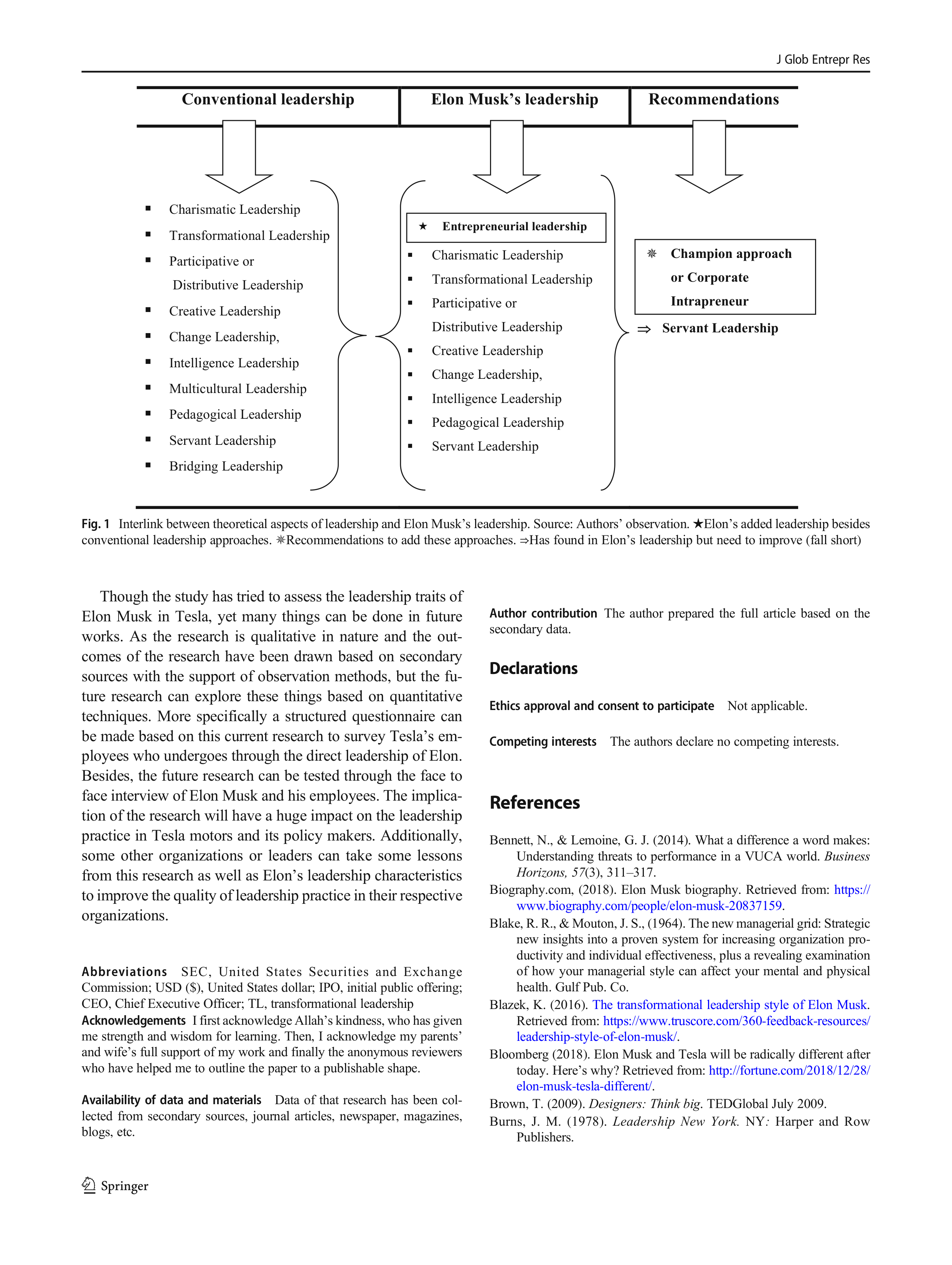
Figure
1
shows the overall outcomes and interlink between
theoretical aspects of leadership and Elon Musk
’
s leadership.
Few recommendations should obviously be made about Elon
Musk and his leadership. Firstly, Musk needs to set a standard
company culture of freedom and trust along with accountabil-
ity ascertained. Secondly, Musk should distribute some of his
work-load for his physical as well as mental health. Though it
will really be difficult to find a better replacement for Musk
’
s
workloads,
Musk
can
apply
the
champion
approach
or
Corporate
Intrapreneur
Approach
(Thompson
&
Strickland,
2003
) like
“
He is nowhere but everywhere.
”
Thirdly, he needs
to take care of his physical and mental health. He is suffering
from insomnia for his
workaholic attitudes, so he needs per-
fect sleep or good rest. Because, insomnia may be the reasons
for reduced judgmental ability, depressions of work, forgetful
behavior, accidents or many more (Peri,
2014
). Fourthly, lead-
ership is all about human skill where the leader has the ability
to
cope
up
with
people,
understanding
their
demands,
and
work
for
mutual
interests.
The
forgiveness
along
with
peda-
gogical
mentality
has
a
big
impact
on
leadership
style.
For
those
certain
criteria,
Musk
had
fallen
short
in
many
cases.
So,
Musk needs
to work
on his
human
skill
(Katz,
2009
)
as
well. Finally, the personality is also a huge issue in leadership.
Personality
in
talking,
in
decision-making,
in
behavior
is
al-
ways evaluated by people who are surrounded by true influ-
ential characteristics like Elon Musk. But, the tweeting, mock-
ingly referring SEC as
“
Shortseller Enrichment Commission
”
(Bloomberg,
2018
) is not coherent to the personality like Elon
Musk.
Musk
also
needs
to
work
on
his
public
speeches
ap-
proach as well.
Conclusion
The remarkable achievements of Tesla have caused the world
to become more interested in Musk
’
s leadership and how he
finds so many people, diagonally in numerous organizations,
and the public, to turn into more motivated and interested in
attaining
the
goals
he
is
situating.
He
was
also
listed
as
“
World
’
s
Greatest
Leaders
”
in
2017
among
the
top
fifty
of
Fortune
Magazine
’
s
(
Fortune.com
,
2018).
This
particular
research
basically
tries
to
understand
the
certain
leadership
characteristics
of
Elon
Musk
in
Tesla
motors.
In
the
literature
part,
the
study
points
out
some
conventional
leadership
traits,
such
as
charismatic,
transformational
leadership
style,
participative
or
distributive
leadership,
creative
leadership,
change
leadership,
intelligence
leadership,
multicultural
leadership,
pedagogical
leadership,
and
servant
leadership,
along
with
bridging
leadership
style.
In
analysis,
the
study
has
tried
to
match
those
leadership
characteristics
in
comparison
to
leadership
practices
which
are
implemented
by
Elon
Musk
in
his
Tesla
motors.
The
findings
and
discussion
show
that
Elon
Musk
has
incorporated
the
participative
or
distributive
leadership,
pedagogical
leadership
style,
creative
leadership,
change
leadership,
and
intelligence
leadership;
however,
he
has
some
shortcomings
in
servant
leadership
style.
While
some
other
leadership
style
like
multicultural
leadership
and
bridging
leadership
are
found
absent
in
his
leadership
trait.
In addition, Musk has followed entrepreneurial leadership in
his organization. However, few mistakes or leadership faults
of
Musk
have
caused
Tesla
to
suffer
huge
losses
in
recent
times.
J Glob Entrepr Res
Though the study has tried to assess the leadership traits of
Elon
Musk
in
Tesla,
yet
many
things
can
be
done
in
future
works.
As
the
research
is
qualitative
in
nature
and
the
out-
comes
of
the
research
have
been
drawn
based
on
secondary
sources with the support of observation methods, but the fu-
ture
research
can
explore
these
things
based
on
quantitative
techniques.
More
specifically
a
structured
questionnaire
can
be made based on this current research to survey Tesla
’
s em-
ployees who undergoes through the direct leadership of Elon.
Besides, the future research can be tested through the face to
face interview of Elon Musk and his employees. The implica-
tion of the research will have a huge impact on the leadership
practice in Tesla motors and its policy makers. Additionally,
some
other
organizations
or
leaders
can
take
some
lessons
from this research as well as Elon
’
s leadership characteristics
to improve the quality of leadership practice in their respective
organizations.
Abbreviations
SEC,
United
States
Securities
and
Exchange
Commission; USD ($), United States dollar; IPO, initial public offering;
CEO, Chief Executive Officer; TL, transformational leadership
Acknowledgements
I first acknowledge Allah
’
s kindness, who has given
me strength and wisdom for learning. Then, I acknowledge my parents
’
and wife
’
s full support of my work and finally the anonymous reviewers
who have helped me to outline the paper to a publishable shape.
Availability
of
data
and
materials
Data
of
that
research
has
been
col-
lected
from
secondary
sources,
journal
articles,
newspaper,
magazines,
blogs, etc.
Author
contribution
The
author
prepared
the
full
article
based
on
the
secondary data.
Declarations
Ethics approval and consent to participate
Not applicable.
Competing interests
The authors declare no competing interests.
References
Bennett, N., & Lemoine, G. J. (2014). What a difference a word makes:
Understanding threats to performance in a VUCA world.
Business
Horizons, 57
(3), 311
–
317.
Biography.com,
(2018).
Elon
Musk
biography.
Retrieved
from:
https://
www.biography.com/people/elon-musk-20837159
.
Blake, R. R., & Mouton, J. S., (1964). The new managerial grid: Strategic
new insights into a proven system for increasing organization pro-
ductivity and individual effectiveness, plus a revealing examination
of
how
your
managerial
style
can
affect
your
mental
and
physical
health. Gulf Pub. Co.
Blazek, K. (2016).
The transformational leadership style of Elon Musk
.
Retrieved from:
https://www.truscore.com/360-feedback-resources/
leadership-style-of-elon-musk/
.
Bloomberg (2018). Elon Musk and Tesla will be radically different after
today. Here
’
s why? Retrieved from:
http://fortune.com/2018/12/28/
elon-musk-tesla-different/
.
Brown, T. (2009).
Designers: Think big
. TEDGlobal July 2009.
Burns,
J.
M.
(1978).
Leadership
New
York.
NY
:
Harper
and
Row
Publishers.
Conventional leadership
Elon Musk’s leadership
Recommendations
Charismatic Leadership
Transformational Leadership
Participative or
Distributive Leadership
Creative Leadership
Change Leadership,
Intelligence Leadership
Multicultural Leadership
Pedagogical Leadership
Servant Leadership
Bridging Leadership
Charismatic Leadership
Transformational Leadership
Participative or
Distributive Leadership
Creative Leadership
Change Leadership,
Intelligence Leadership
Pedagogical Leadership
Servant Leadership
Servant Leadership
Entrepreneurial leadership
Champion approach
or Corporate
Intrapreneur
Fig. 1
Interlink between theoretical aspects of leadership and Elon Musk
’
s leadership. Source: Authors
’
observation.
★
Elon
’
s added leadership besides
conventional leadership approaches.
✵
Recommendations to add these approaches.
⇒
Has found in Elon
’
s leadership but need to improve (fall short)
J Glob Entrepr Res
Clandinin, D. J., & Connelly, F. M. (2000). Narrative inquiry: Experience
and story in qualitative research.
Cohen, A. (1992). Antecedents of organizational commitment across oc-
cupational
groups:
A
meta-analysis.
Journal
of
Organizational
Behavior, 13
(6), 539
–
558.
Conger,
J.
A.,
&
Kanungo,
R.
N.
(1988).
The
empowerment
process:
Integrating
theory
and
practice.
Academy
of
Management
Review,
13
(3), 471
–
482.
Dijk, V. M., Davidson, G. & Mecozzi, V. (2017). What is creative lead-
ership?
Retrieved
from:
https://www.thnk.org/insights/what-is-
creative-leadership/
.
Dirks, K.
T.,
&
Ferrin,
D.
L. (2002).
Trust
in leadership:
Meta-analytic
findings
and
implications
for
research
and
practice.
Journal
of
Applied Psychology, 87
(4), 611.
Doheny, M., Nagali, V., & Weig, F. (2012). Agile operations for volatile
times.
The McKinsey Quarterly, 3
, 126
–
131.
Dudovskiy,
J.
(2018).
Tesla
leadership:
Increasing
stakeholder
concern
with one-man show by Elon Musk. Retrieved from:
https://research-
methodology.net/tesla-leadership-increasing-stakeholder-concern-
with-one-man-show-by-elon-musk/
.
Enderwick, B. W. (2018). What Elon Musk gets wrong about leadership.
Retrieved
from:
https://medium.com/s/story/what-elon-musk-gets-
wrong-about-leadership-b97794a0e330
.
Galek, C. (2018). Elon Musk
’
s management style proves it pays to be a
leader, and not simply a boss. Retrieved from:
https://www.inc.com/
candice-galek/elon-musks-management-style-proves-it-pays-to-be-
a-leader-not-simply-a-boss.html
.
Goldring, E., & Greenfield, W. (2002). Understanding the evolving con-
cept of leadership to education: Roles, expectations, and dilemmas.
Yearbook of the National Society for the Study of Education, 101
(1),
1
–
19.
Goleman, D. (1998). Working with emotional intelligence and emotional
intelligence.
Greenleaf, R. K. (1977).
Servant leadership: A journey into the nature of
legitimate power and greatness
. New York, NY: Paulist Press.
Gromov, R. (2017). Elon behind Iron-man
’
s mask: Analysing leadership
style
of
Elon
Musk.
Retrieved
from:
https://www.linkedin.com/
pulse/elon-behind-iron-mans-mask-analysing-leadership-style-
roman-gromov/
.
Heikka, J., & Waniganayake, M. (2011). Pedagogical leadership from a
distributed perspective within the context of early childhood educa-
tion.
International Journal of Leadership in Education, 14
(4), 499
–
512.
Horney,
N.,
Pasmore,
B.,
&
O
’
Shea,
T.
(2010).
Leadership
agility:
A
business
imperative
for
a
VUCA
world.
Human
Resource
Planning, 33
(4), 34.
Kabanoff, B., & Rossiter, J. R. (1994). Recent developments in applied
creativity.
International
Review
of
Industrial
and
Organizational
Psychology, 9
, 283
–
283.
Katz, R. L. (2009).
Skills of an effective administrator
. Harvard Business
Review Press.
Khan, M. R. (2019). Samson H. Chowdhury: A true entrepreneurial lead-
er
for Square Group.
EuroMed Journal of Management, 3
(2), 80
–
88.
Kotter,
J.
P.
(1996).
Leading
change
Harvard
Business
School
Press.
Boston
,
MA.
Krishnan,
V.
R.
(2004).
Impact
of
transformational
leadership
on
fol-
lowers
’
influence
strategies.
Leadership
and
Organization
Development Journal, 25
(1), 58
–
72.
Lahtinen,
J.
(2017).
What
is
pedagogical
leadership?
Retrieved
from:
http://learningscoop.fi/what-is-pedagogical-leadership/
.
Lekach, S. (2018). Elon Musk sued by SEC for Tesla privatization tweet.
Retrieved
from:
https://mashable.com/article/elon-musk-sec-tweet-
lawsuit/#wi_OOwnTfiqT
.
Lewin, K. (1947). Group decision and social change.
Readings in social
psychology, 3
(1), 197
–
211.
Malhotra,
N.
K.
&
Dash,
S.
(2016).
Marketing
research:
An
applied
orientation. Pearson,.
Mann, C. J. (2003). Observational research methods. Research design II:
Cohort,
cross
sectional,
and
case-control
studies.
Emergency
Medicine Journal, 20
(1), 54
–
60.
Matouesek, M. (2019).
Former Tesla employees reveal what it
’
s like to
w o r k
w i t h
E l o n
M u s k
.
R e t r i e v e d
f r o m ,
h t t p s : / /
www.businessinsider.com/ex-tesla-employees-reveal-what-its-like-
work-elon-musk-2019-9
Mintzberg, H. (1970). Structured observation as a method to study man-
agerial work.
Journal of Management Studies, 7
(1), 87
–
104.
Mulhall, A. (2003).
In
the
field:
Notes on observation in
qualitative
re-
search.
Journal of Advanced Nursing, 41
(3), 306
–
313.
Muoio, D. (2017). ELON MUSK: Tesla factory injuries 'break my heart'.
Retrieved
from
https://www.businessinsider.com/elon-musk-tesla-
factory-injuries-email-2017-6
Peri, C. (2014). 10 things to hate about sleep loss. Retrieved from:
https://
www.webmd.com/sleep-disorders/features/10-results-sleep-loss#1
.
Pollard,
C.
W.
(1996).
The
soul
of
the
firm,
HarperBusiness
and
Zondervan Publishing House, Grand Rapids, MI.
Quirke, B. (1996). Communicating corporate change
.
London: McGraw
Hill.
Robbins, S. P. & Judge, T. A. (2013). Organizational behavior.
Rost,
J.
C.
(1993).
Leadership
development
in
the
new
millennium.
Journal of Leadership Studies, 1
(1), 91
–
110.
Schweiger,
D.
M.,
&
Denisi,
A.
S.
(1991).
Communication
with
em-
ployees
following
a
merger:
A
longitudinal
field
experiment.
Academy of Management Journal, 34
(1), 110
–
135.
Shapiro,
D.
L.,
&
Kirkman,
B.
L.
(1999).
Employees
’
reaction
to
the
change
to
work
teams:
The
influence
of
“
anticipatory
”
injustice.
Journal of Organizational Change Management, 12
(1), 51
–
67.
Simic, I. (1998). Transformational leadership - the key to successful man-
agement
of
transformational
organizational
changes.
Facta
Universitatis Series: Economics And Organization, 1
(6), 49
–
55.
Snyder, C. B. (2018). Elon Musk and path-goal theory, Retrieved from:
http://sites.psu.edu/leadership/2018/02/18/elon-musk-and-path-
goal-theory/
.
Spears,
L.
(1995).
Servant-leadership
and
the
Greenleaf
legacy.
In:
Spears,
L.
(Ed.),
Reflections
on
leadership:
how
Robert
K.
Greenleaf
’
s
theory
of
servant-leadership
influenced
today
’
s
top
management
thinkers
.
John
Wiley
&
Sons,
Inc.,
New
York,
NY,
pp. 1
–
14.
Spears, L. (1996). Reflections on Robert K. Greenleaf and servant-lead-
ership.
Leadership & organization development journal
.
Spreitzer, G. M. (1995). Psychological empowerment in the workplace:
Dimensions,
measurement,
and
validation.
Academy
of
Management Journal, 38
(5), 1442
–
1465.
St. Thomas University (2018). What is charismatic leadership? Leading
through personal conviction. Retrieved from:
https://online.stu.edu/
articles/education/what-is-charismatic-leadership.aspx
.
Steward,
J.
B.
(2018).
A
Question
for
Tesla
’
s
Board:
What
Was
Elon
Musk
’
s
Mental
State?
Retrieved
from
https://www.nytimes.com/
2018/08/15/business/elon-musk-tesla-board.html
.
Strathmann,
D.
(2016).
Multicultural
leadership
defined
by
leadership
development
experts.
Retieved
from:
http://crestcomleadership.
com/2016/10/06/multicultural-leadership-defined-by-leadership-
development-experts/
.
Synergos.,
(2017).
Bridging
leadership.
Retrieved
from:
https://www.
synergos.org/bridging-leadership
.
Thomas, K. W., & Velthouse, B. A. (1990). Cognitive elements of em-
powerment:
An
“
interpretive
”
model
of
intrinsic
task
motivation.
Academy of Management Review, 15
(4), 666
–
681.
Thompson,
A.
A.
&
Strickland,
A.
J.
(2003).
Strategic
management:
Concepts
and
cases.
The
Managerial
Process
of
Crafting
and
Executing Strategy
. tata Mc Graw. New Delhi. p34.
J Glob Entrepr Res
Walshe, C., Ewing, G., & Griffiths, J. (2012). Using observation as a data
collection method to help understand patient and professional roles
and
actions
in
palliative
care
settings.
Palliative
Medicine,
26
(8),
1048
–
1054.
Williams,
J.
(2018).
Lesson
6:
Contingency
and
path
theories.
Pennsylvania
State
University,
PSYCH
485:
Leadership
in
work
settings.
Retrieved
from:
https://psu.instructure.com/courses/
1923777/modules/items/23736221
.
Wimmer, K., Stiles, J., & Abrams, B. (2001). The observational research
handbook: Understanding how consumers live with your products.
Journal of Advertising Research, 41
(1), 91
–
91.
Zellars,
K.L.
&
Tepper,
B.J.
(2003).
Beyond
social
exchange:
New
di-
rections for organizational citizenship behavior theory and research.
In
Research
in
personnel
and
human
resources
management
(pp.
395
–
424). Emerald Group Publishing Limited.
Md. Rahat Khan
is a Ph.D. fellow at Jagannath University, Bangladesh,
and
working
as
an
Assistant
Professor
in
Management
under
the
Department
of
Business
Administration,
City
University,
Bangladesh.
Mr. Khan is a researcher and academician in business concentration; more
specifically
in
the
field
of
disruptive
innovation
in
business
along
with
psychological and behavioral issues in HRM, management, and market-
ing. Till now He has 3 books, 22 journal articles, and 5 conference papers
(one
of
those
having
the
best
paper
award).
He
is
also
professionally
serving
as
an
editorial
board
member
and
reviewer
for
27
international
indexed journals
of SAGE, Emerald, Springer, Inderscience publishing,
and so on. Amongst those, 13 journals are indexed and listed in SCOPUS,
ABDC, and/or WoS.
J Glob Entrepr Res