Information Management and Business Review (ISSN 2220-3796)
Vol. 13, No. 1, pp. 47-64, March 2021
47
The Effect of Leadership Styles on Employee’s Productivity in the Nigerian Oil and Gas Industry
Adegboyega Olayisade
1
& Olawumi D. Awolusi
2
1
University of Roehampton, London, UK
2
Department of Accounting and Finance, College of Economics and Management, Kampala International
University, Kampala, Uganda
adegboyega.olayisade@roehampton-online.ac.uk, awolusi.olawumi@kiu.ac.ug
Abstract:
The purpose of this study is to examine the effect of leadership style on employee productivity in
the Nigerian oil and gas industry using Chevron Nigeria Limited as a case study. The study used a five-point
Likert scale questionnaire consisting of forty questions covering autocratic, democratic, bureaucratic, laissez-
faire, transactional, charismatic leadership styles and employee productivity variables. The questionnaire
was deployed to one hundred and twenty-five respondents (125) and received ninety-three (93) valid
responses. Statistical Package for the Social Sciences (SPSS) was used to analyze respondent responses.
Demographic analysis, normality test, homoscedasticity, multicollinearity, reliability test (Cronbach’s Alpha)
were presented; results affirm the validity and reliability of research findings. The results of the descriptive
and regression analysis indicate that the autocratic leadership style is the most predominant leadership style
in the Nigerian Oil and Gas followed by laissez-faire, bureaucratic, transactional, democratic and charismatic
leadership styles. The study concludes that leadership styles significantly influence employee productivity
albeit different leadership styles have varying effects on employee productivity and varying leadership styles
can co-exist within the same organization. The study highlighted various policy implications and
recommendations. This study adds to the existing literature on leadership practice and is intended to be a
reference point to scholars and researchers for further studies on leadership practices in the oil and gas
industry.
Keywords:
Leadership style, employee productivity, regression analysis, Oil and Gas industry, Nigerian.
1. Introduction
Leaders and leadership practice have been in existence since the onset of mankind. Man is a complex social
being that can be simplistically categorized into two groups namely leaders and followers. The successes
recorded by most human endeavors can be attributed to leadership quality (Matira & Awolusi, 2020). Over
the years, various scholars have studied the concept of leadership with the aim of understanding and
improving the inherent benefits of effective leadership; these studies have given rise to several definitions of
leadership (Blazi & Awolusi, 2020; Matira & Awolusi, 2020; Mukonga & Awolusi, 2019; Olatunji & Awolusi,
2019). One of the most popular definitions of leadership states that “leadership is the art of getting things
done through people”. While there are several and sometimes conflicting theories on leadership, what is
immutable is that leaders inspire their followers and direct their actions towards the attainment of a set goal.
The practice of leadership has evolved considerably over time and the need for leaders and leadership has
witnessed a significant upswing over the years. Historically, leaders were simplistically selected based on
lineage, wealth or by exhibiting distinguishing acts of velour. It was believed at that time that such individuals
possessed innate talents and attributes that set them apart from others and conferred upon them the right to
be leaders. This natural leadership selection process was the premise of the Great man theory (Matira &
Awolusi, 2020).
The great man theory suggests that leaders and leadership potential are inborn and that leaders are born and
not made. Possession of certain innate characteristics identifies an individual for leadership positions while
the lack of such almost certainly guarantees the individual's exclusion from leadership roles. Great leaders
like Martin Luther King, Julius Caesar, Malcolm X, Muhammadu Buhari and others further contributed to the
belief that great leaders are born and not made. These leaders were perceived to differ from the populace in
that they possessed personal attributes that made them effective leaders. In earlier times, leadership was the
sole preserve of the male gender and this influenced the naming of this theory as the great man theory
however with the resurgence of several great female leaders this theory was later recognized as the great
person theory. The varying successes and failures of several leaders resulted in an increased interest in the
study of leadership practice, the common attributes that differentiate a successful leader from an
Information Management and Business Review (ISSN 2220-3796)
Vol. 13, No. 1, pp. 47-64, March 2021
48
unsuccessful leader and a deeper understanding of leadership and leadership practice. Further studies and
research resulted in a shift in paradigm from the great man/great person leadership theory to the trait
approach to leadership. Prompted by the great man theory of leadership, and the emerging interest in
understanding what leadership is, researchers focused on the leader.
Who is a leader? What are the distinguishing characteristics of great and effective leaders? This gave rise to
the early research efforts on the trait approach to leadership (Matira & Awolusi, 2020; Mukonga & Awolusi,
2019). The trait theory is premised on identifying and studying different personality traits and characteristics
exhibited by successful leaders in diverse situations to develop similar traits and characteristics in others. By
seeking to identify and understand traits and characteristics of successful leaders, the trait theory postulates
that certain innate traits are common to leaders and that these traits are consistent across different
situations; it assumes that people in leadership positions exhibit a higher degree of leadership traits than
their followers. Over the years, there has been considerable academic study and research into leadership and
leadership practice and behavior resulting in several other leadership theories and counter theories like the
behavioral theory, participative theory, situational theory, functional theory, contingency theory,
transactional leadership theory, authentic leadership theory and transformational leadership theory.
Leadership and the choice of leadership style utilized have been thought to influence employee outcomes.
This is evident in the amount of resources organizations commit to developing leadership potential and
employing personnel with requisite leadership potential in a bid to ensure competitive advantage is achieved
in the area of employee productivity. Leadership practice and style impacts employee’s performance by
promoting "a climate that would influence employees' attitudes, motivation, and behavior" (Aldoory & Toth,
2004 cited in Aunga & Masare, 2017); this, in turn, impacts organizational success. Chevron Nigeria Limited is
a company that attributes its success to its workforce and its commitment to get results the right way
(Chevron, 2018). According to the company’s 2017 corporate responsibility highlights, the company
recognizes “the value of leadership as a critical success factor in achieving operational excellence results”
(Chevron, 2018). A key facet of the company’s enterprise strategies is investing in its workforce to develop
and empower a highly competent workforce. The company’s commitment to personnel development and
leadership quality stems from its understanding of the importance of leadership. The company currently has
several processes such as training, workshops and a performance management process in place to ensure
persons in leadership positions exhibit leadership behaviors/styles that maximize employee productivity.
Activities in the Nigerian oil and gas industry are highly regulated due to the sector’s significant contribution
to the country. Employee and industrial issues are highly influenced by the actions of the two dominant trade
unions namely NUPENG (Nigeria Union of Petroleum and Natural Gas Workers) and PENGASSAN (Petroleum
and Natural Gas Senior Staff Association of Nigeria). These trade unions play a significant mediating role
during salary negotiations and review, appraisals, promotions and disciplinary actions. This has resulted in
the industry being one of the most attractive places to work due to its generous remuneration package which
has made it one of the highest paying industries in the country (Onuoha, 2017). The attractive remuneration
prevalent in the Nigerian oil and gas industry has enabled organizations within the sector to attract and
retain the best the Nigerian labor market has to offer and in fact, the industry attracts highly qualified
personnel from all over the world. While the presence of one of the most attractive salaries and remuneration
packages enables organizations to attract and recruit an optimal workforce it is not an effective tool to
sustain and motivate employee productivity outside the short term especially when career progression and
salary increments are mainly in the domain of the trade unions.
This observation is supported by the study of Kohn (1993) whose review of several studies over the last three
decades revealed that reward systems provide a temporary, short-lived incentive to motivate employee
productivity. Understanding and identifying the predominant leadership styles and how it influences
employee productivity is valuable to the development of existing and potential leaders charged with the
responsibility of utilizing organizational resources (especially its human capital) to achieve organizational
goals and objectives. There are several studies in existence that conclude that leadership and leadership
styles greatly influence employee morale (Rego et al., 2012, Singh 2015) however there is a gap in the existing
literature on how leadership styles affect employee productivity in the Nigerian oil and gas industry. In
response to this gap, this study investigates the effect various leadership styles have on employee
Information Management and Business Review (ISSN 2220-3796)
Vol. 13, No. 1, pp. 47-64, March 2021
49
productivity in the Nigerian oil and gas industry using Chevron Nigeria limited as a case study. The choice of
this research topic is influenced by the researcher's personal experience working in the Nigerian upstream oil
and gas industry and the industry's peculiar situation on wage, reward and employment termination being
influenced and determined by external parties (i.e. the trade unions) which have eroded the value of reward
and employment termination as (employee) incentive schemes.
Consequently, the primary objective of this study is to examine the effect of leadership styles on employee’s
productivity in the Nigerian oil and gas industry.
However, the specific objectives are as follows:
To examine the effect of autocratic leadership styles on employee’s productivity in the Nigerian oil
and gas industry.
To examine the effect of Participative Leadership styles on employee’s productivity in the Nigerian
oil and gas industry.
To examine the effect of Bureaucratic Leadership style on employee’s productivity in the Nigerian oil
and gas industry.
To examine the effect of Laissez-Faire Leadership style on employee’s productivity in the Nigerian oil
and gas industry.
To examine the effect of Transactional Leadership style on employee’s productivity in the Nigerian
oil and gas industry.
To examine the effect of Charismatic Leadership style on employee’s productivity in the Nigerian oil
and gas industry.
The creation and/or selection of research questions is a crucial aspect of research work as it influences the
researchers' choice of research methodology, data collection, analysis and presentation (Ajayi 2001:24).
Research questions guide and focus the research by asking questions that result in the development of a
credible research thesis. To achieve the objectives of this study, the following questions will guide this study:
What is the relationship between autocratic leadership styles and employee’s productivity in the
Nigerian oil and gas industry?
What is the relationship between participative Leadership styles and employee’s productivity in the
Nigerian oil and gas industry?
What is the relationship between bureaucratic Leadership style and employee’s productivity in the
Nigerian oil and gas industry?
What is the relationship between Laissez-Faire Leadership style and employee’s productivity in the
Nigerian oil and gas industry?
What is the relationship between transactional Leadership style and employee’s productivity in the
Nigerian oil and gas industry?
What is the relationship between the charismatic Leadership style and employee’s productivity in the
Nigerian oil and gas industry?
The present study aims to improve employee productivity through leadership practice. It also seeks to
examine the relationship between various leadership styles and employee productivity. Lessons learned from
this study can help organizations understand their leadership styles and make adjustments, where necessary
to maximize employee productivity; this is especially important to the Nigerian oil and gas industry in
improving employee productivity outside of the traditional use of wage increments. The researcher hopes
that the findings of this study will assist Chevron Nigeria Limited as well as other organizations in the oil and
gas industry to develop training programs that will improve the leadership qualities required to impact
employee productivity, recruit individuals with requisite leadership potential to ensure organizational
growth as we as to enable the organization's management to identify the most appropriate leadership to
optimize employee productivity. This study also seeks to contribute to the existing literature on leadership
practice and be a reference point to scholars and researchers for further studies on leadership practice and
other related subject matters.
2. Review of Related Literature
Conceptual Reviews:
In today's fast-paced, dynamic and complex business environment, leaders need to be
able to adapt and adopt a gamut of leadership styles required to effectively manage their followers based on
Information Management and Business Review (ISSN 2220-3796)
Vol. 13, No. 1, pp. 47-64, March 2021
50
the prevailing situation and organizational needs and objectives. There are several types of leadership styles
available within an organizational context. Each style has its pro and cons and no single leadership style is
better than the other. Leaders should be prepared to use more than one leadership style in their quest to
influence their followers to achieve an objective. This had been dubbed as the Hawthorne effect. The choice of
leadership style is influenced by several factors such as the prevailing situation, organizational culture, the
desired objective/goal, individual preference as well as team dynamics.
Autocratic Leadership:
Autocratic leadership is one of the oldest leadership styles in existence. This style is
task-centered and focuses on getting tasks done. Power is concentrated in the hands of the leader who makes
all the decisions, provides direction and assigns the task to subordinates (Kagwiria, 2016). Autocratic leaders
are charismatic and self-assured individuals who typically do not require validation from their followers.
"Autocratic leaders use their position to pursue aggressive and visionary goals and their power through
organization culture, press and media to praise their initial success" (Men & Stacks, 2013). The autocratic
leadership style is best suited to situations where the leader possesses expert knowledge (e.g. an experienced
surgeon leading medical interns) or where the leader is an authority figure whose authority is unalloyed (e.g.
a superior officer in the army). The main advantage of the autocratic leadership style is that tasks get
completed quickly and it ensures the supremacy of the leader. However, if improperly utilized followers may
become disgruntled and this may impact organizational results.
Participative Leadership:
This leadership style also known as the democratic leadership style is almost
directly opposite of the autocratic leadership style. The participative leadership style focuses on collaboration
between the leader and the followers; information is shared with the followers who participate in decision
making, however, the lender retains the prerogative on the use and adoption of inputs from followers.
Participative leadership encourages innovation and creativity by giving every member of the
organization/team the ability to provide input into decision making which results in easy adoption and
utilization of decisions taken (Dalluay & Jalagat, 2016; Ispas, 2012; Iqbal et al., 2015; Mulki et al., 2015). This
leadership style is most suited to organizations that thrive on innovation and creativity; these organizations
consist of teams comprising of members with unique perspectives and skillsets (e.g. construction project
team). While this leadership style encourages creativity, improved decision making and team cohesion, it is
not appropriate when working with large teams or where urgent decisions need to be made.
Bureaucratic Leadership:
This leadership style is premised on organizational structure and hierarchy. The
leader's authority and acceptability stem from the position held within the organization. This type of
leadership is based on formalized hierarchical leadership structures; leadership authority, scope and practice
are all founded within the organizational construct. This leadership style is best suited to organizations such
as banks, hospitals, professional services firms, etc. where a certain level of control, checks and balances is
required to moderate leadership actions and behavior to militate against tyrannical leadership and abuse of
power. This style is also effective where employees carry out routine jobs. The restrictive, static nature of the
bureaucratic leadership style is one of its major failures. Employees often get demotivated by the difficulty in
communicating their thoughts and suggestions up the chain of command. The lack of innovation and
leadership adaptation to situations oftentimes makes the leader redundant and leads to a demotivational
workforce (Gastil, 2012).
Laissez-Faire Leadership:
Laissez-faire is a French word that describes the policy of leaving things to take
their course, without interfering. This leadership style (also known as delegative leadership) is predominant
in organizations/teams consisting of highly experienced personnel and is characterized by minimal
leadership involvement. Laissez-faire leaders exercise minimal control over their employees; once employees
have been provided with the necessary tools and resources to complete assigned tasks they are left alone to
resolve issues on their own (Chowdhury, 2014). This leadership style is beneficial in creative environments
as it encourages employee innovation and creativity which leads to improved job satisfaction. Laissez-faire
leadership is not ideal in situations where group members lack the knowledge or experience they need to
complete tasks and make decisions to the lack of supervision, mentorship, feedback and organizational
structure often results in inefficient utilization of resources, failure to meet deadlines and failure to achieve
desired objectives (Egri, 2011 cited in Kagwiria, 2016).
Information Management and Business Review (ISSN 2220-3796)
Vol. 13, No. 1, pp. 47-64, March 2021
51
Transactional Leadership:
Transactional leadership style focuses on establishing roles and responsibilities
and using a system of reward and punishment to motivate followers. Transactional leaders are result-driven
and achieve their objectives through close monitoring of subordinates, interventions, rewarding desired
behaviors and outcomes while punishing undesirable behaviors (Chowdhury, 2014). Transactional
leadership is based on two main concepts namely contingent reward and management by exception.
Contingent reward occurs where the leader provides a reward to the follower for exhibiting (previously
agreed) behaviors and/or achieving a pre-agreed objective. The reward comes in various forms and could be
financial, psychological, or materialistic. Management by exception, on the other hand, refers to a leadership
style that is exception-based. The leader only intervenes when followers deviate from acceptable
performance/behaviors and introduce remedial action to ensure desired outcomes are achieved.
Charismatic Leadership:
This leadership style focuses on influencing followers through the leader's
personality traits and behavior. Charismatic leaders use their unique personality and communication style to
inspire and win the admiration of their followers; this results in a high level of commitment to the leader's
cause and improved follower productivity. Charismatic leaders possess a high level of emotional intelligence,
are very self-assured and have a high level of commitment to organizational objectives. They possess and use
their ability to project their enthusiasm and commitment to their followers to motivate them to achieve
desired objectives. The downside to charismatic leadership is that the success of the organization is linked to
the presence of the leader. If the leader decides to leave the organization, it may lead to demotivation among
the employees and this may require substantial efforts by the organization to remediate. This study seeks to
identify the various leadership styles prevalent in Chevron Nigeria Limited and determine the effect
leadership styles have on employee productivity.
Theoretical Reviews:
This study was guided by the following leadership theories; participative, path-goal,
situational and transformational leadership theory:
Participative Theory:
The participative leadership theory is premised on a leadership style that encourages
input, contributions and participation from employees and team members. The theory’s roots can be traced
back to the early 1930s when the results of an experiment conducted at the Hawthorne Works in Illinois, US,
were analyzed by Elton Mayo and others. The experiment was aimed at finding ways to improve factory
productivity, although the findings related more to motivation. The findings relating to participatory
leadership saw light in the 1950s when researcher Henry A. Landsberger examined the original experiments
led by Mayo. Landsberger found that workers' productivity increased during participation in the experiment
because they were being observed. This had been dubbed as the Hawthorne effect. According to Crane, the
experiments show that when employees feel supported through observation and participation, they are more
satisfied and therefore productivity increases. Participative leaders provide pertinent information to
subordinates and encourage feedback and contributions to facilitate decision-making. Participative
leadership results in increased stakeholder participation, collaboration and commitment; this oftentimes
results in improved decision making, easy adoption and implementation of decisions taken (Dalluay & Jalagat,
2016; Ispas, 2012; Iqbal et al., 2015; Mulki et al., 2015). Antagonists of this theory are quick to point out that
it utilizes more resources, requires more time to arrive at decisions and is susceptible to bias when the leader
is presented with a wide range of alternatives. Participative leadership thrives in organizations with low
power distance culture hence its popularity in the United States and other Western-influenced organizations.
Path-Goal Theory:
The Path-Goal leadership theory is based on the Vroom expectancy theory in which an
individual will act in a certain way based on the expectation that the act will be followed by a given outcome
and on the attractiveness of that outcome to the individual. The path-goal theory was developed by Martin
Evans in his 1970 paper, “The effects of Supervisory Behavior on the Path-Goal Relationship” and was refined
by Robert House in his 1971 paper, “A Path-Goal Theory of Leader Effectiveness”. According to House (1971)
& Malik (2013), “the theory is based on specifying a leader's style or behavior that best fits the employee and
work environment to achieve a goal". Simplistically, this theory can be explained as that leadership style
whereby a leader exhibits certain contextual behaviors that align the follower’s goals with the organization’s
goals and direct the followers to choose the best paths to achieve these goals (Malik, 2013). The goal of this
leadership style is the improvement of employee productivity by focusing on employee satisfaction and
motivation. “The Path-Goal theory posits that leaders may not only use varying behaviors with different
Information Management and Business Review (ISSN 2220-3796)
Vol. 13, No. 1, pp. 47-64, March 2021
52
subordinates but might use different behaviors with same subordinates in different situations” (Richard et al.,
2012 cited in Malik, 2013). The theory posits that leaders may use different behaviors with the subordinates
in a similar situation and/or employ varying behaviors with the same subordinate in different situations.
Path-goal theory suggests that depending upon subordinates, and situations, different leadership behaviors
will increase acceptance of leader by subordinates; level of satisfaction; and motivation to improved
performance.
Situational Theory:
Situational leadership theory is a contingency theory whereby leadership is fluid and
varied; the leader adopts a leadership style that best suits the existing situation or circumstance. Different
situations and employees may require different leadership styles e.g. a democratic leadership style is best
suited when employee input and participation is required (say for example a new leader might need the
inputs of his more experienced team in resolving a situation) while an autocratic leadership style might be
required in an organization or team with high power distance culture (e.g. a newly promoted general in the
army). Leadership effectiveness under the situational leadership theory is dependent on leadership behavior,
follower readiness and leader-follower match (Luo & Liu, 2014; Graham & Trendafilova, 2016).
Leadership Behavior:
Supportive (relationship) behavior and directive (task) behavior are the two main
leadership behaviors under situational leadership. Supportive behavior involves the leader taking more of a
support role by seeking subordinates’ ideas and contributions and ensuring subordinates feel included in the
decision-making process while directive behavior is more task-oriented and involves supervision, providing
direction, using one-way communication and walk-throughs to set and clarify how objectives should be
achieved.
Follower Readiness:
Follower readiness as the name implies is the measure of the responsiveness of a
subordinate to his leader. The major influencing factors of follower readiness are ability and willingness.
Ability is concerned with the competence of the subordinate to successfully execute assigned tasks while
willingness is the degree of readiness to perform assigned tasks (Graham & Trendafilova, 2016).
Leader-Follower Match:
Leader-follower match is the focal point of situational leadership theory and is
concerned with the leader’s adoption of a leadership style most appropriate for the prevailing situation after
taking into consideration the follower’s level of readiness (Luo & Liu, 2014). Situational leaders inspire trust
and motivate their followers to improved productivity by proactively altering their behaviors to suit existing
situations and help their followers maximize their potential.
Transformational Leadership Theory:
The transformational theory also known as relationship theory
focuses on the connections formed between leaders and followers. This theory is premised on a leadership
style that inspires followers to improved performance by focusing on the wants and needs of the organization
as well as the personal concerns of its members (Munir & Aboidullah, 2018). Leadership effectiveness under
this theory is dependent on individualized consideration, intellectual stimulation, inspirational motivation
and idealized influence (Bass, 2000 cited in Ewell, 2018 and Getachew & Erhua, 2018). According to several
researchers (Ewell, 2018; Getachew & Erhua, 2018), “Idealized influence refers when transformational
leaders act as a role model to their subordinates such that the followers identify themselves to a high level of
morale and enthusiasm to fulfill the demands of leader whom they respect, admire and trust (Bass, 2000).
Inspirational motivation highlights leaders' motivation and inspiration of followers by giving self-worth for
their contribution and setting challenges to their followers (Bass & Avolio, 2000). Intellectual stimulation is
encouraging followers to do tasks distinctly by being innovative and creative. Individualized consideration
refers to giving special attention to the needs of every individual follower for their achievement and personal
growth (Bass, 2000:34)”. Leaders using this approach can motivate others, "to want to change, to improve,
and to be led" (Hall, 2002 cited in Ewell, 2018) and possess high ethical and moral standards.
Empirical Reviews
Employee Productivity:
Productivity can be defined as the effectiveness of factors of production (i.e. inputs)
in generating desired outcomes efficiently. Successful organizations are characterized by a high level of
productivity; they are companies that have achieved a competitive advantage in the utilization of available
Information Management and Business Review (ISSN 2220-3796)
Vol. 13, No. 1, pp. 47-64, March 2021
53
resources to obtain desired outputs. One of the areas organizations seek to have a competitive advantage in
recent times is in their human resource. Human resource and human resource management are concerned
with the practice of recruiting, motivating and managing employees to maximize employee productivity and
achieve organizational objectives. Hassan (2016) & Singh (2015) affirm that employee productivity is directly
correlated to organizational success. Employees are the tools management uses to achieve their objectives
and their actions or inactions influence the profitability and viability of organizational success. Employee
productivity is an assessment of the effectiveness and efficiency of an organization.
Successful organizations understand the importance of productivity in the workplace; increased employee
productivity results in increased utilization of a firm’s human capital. Traditionally, organizations used
remuneration, bonuses, pay for performance and wage increments to motivate the employee and ensure
improved productivity. Mangale (2017) concludes that remuneration is insufficient to retain and motivate
employees; attractive remuneration might attract employees, but it is not guaranteed to ensure retention and
improved productivity as repeated use of remuneration might be perceived by employees to be an
entitlement and not a motivator. Furthermore, the studies confirmed that the relationship between top
management/leadership influences employee productivity. This assertion has been countered by the works
of researchers such as Ojeleye (2017), Mwangi (2014), Wilfred et al. (2014), who assert that remuneration
attracts, retains and motivates employees and for the "compensation of an organization to succeed, the goals
of the organization must be aligned with the goals of the employees whom the organization wishes to attract”
(Wilfred et al., 2014).
Influence of Leadership Style on Employee Productivity:
Successful organizations always seek to attract,
retain and develop leaders who can motivate their subordinates to meet and/or exceed performance
expectations and are flexible enough to respond to changes within and outside their environment. Rehman et
al. (2018)’s study of leadership styles organizational culture and employees’ productivity: Fresh Evidence
from Private Banks of Khyber-Pakhtunkhwa, Pakistan was undertaken with a primary objective of
investigating the impact of leadership styles and organizational culture on employees’ productivity. Both
qualitative and quantitative research method was used in arriving at the research finding that a significant
positive relationship exists between employees’ productivity and several leadership styles such as laissez-
fair, transactional and transformational leadership styles. The study also posits that neither autocratic nor a
democratic style of leadership has a significant positive association with employees' productivity. This study
has some obvious limitations including the use of a small sample size, poor questionnaire responses and
limitation of the research work to Pakistan and its inherent power distance culture. Ajibade et al. (2017)
examine leadership style and employees' performance in Nigerian Federal Polytechnic: a study of Federal
Polytechnic, Ilaro, Ogun State. The main objective of this study includes identifying the relationship between
leadership style and employee's performance using primary and secondary research data.
The study concludes that there is a significant relationship between leadership styles and employee's
performance in Nigerian Federal Polytechnics. The study further identifies that the success or failure of an
organization depends on its leaders and the leadership style adopted within the organization. Marcus et al.
(2017) studied the impact of leadership styles and employee performance in Nigerian higher institutions. The
study utilized primary and secondary data through the use of questionnaires and literature review
respectively. The study revealed that leadership style affects employee performance, needs and goals. Singh
(2015) reviewed leadership style and employee productivity: a case study of Indian banking organizations.
The study used a quantitative approach to achieve the research objective of understanding the relationship
between leadership styles and employee productivity with an emphasis on private and foreign banks in India.
Data were collected using self-administered questionnaires; a total of three hundred (300) questionnaires
were distributed with a response rate of 69%. The findings of the research indicated that although leader
leadership style improves employee productivity, the prevailing power distance culture in the organization
needs to be considered when choosing an appropriate leadership style e.g. in India where there is a high-
power distant culture, transactional leadership style is appropriate for improving employee productivity
while transformational leadership style is better suited for the (western-influenced) foreign banks.
Chodhury & Gopal (2014) explored how leadership styles influence employee motivation in India’s leading oil
company. Survey technique and review of existing literature were used to source primary and secondary
Information Management and Business Review (ISSN 2220-3796)
Vol. 13, No. 1, pp. 47-64, March 2021
54
research data respectively. The research concluded that transformational and transactional leadership styles
were the most dominant leadership styles and that different leadership styles impact employee motivation in
a variety of different ways. The findings of this research work are not holistic as it is limited to one company
from the Indian oil sector; additional research work will have to be done before the research finding can be
extended to a larger population. Obasan & Banjo (2014)’s study of the impact of leadership styles on
employee performance used the (Nigerian) Department of Petroleum Resources as a case study. The paper
focused on select leadership styles and how these styles impact employee performance and used primary
data generated by deploying one hundred questionnaires through a stratified random selection of
respondents. The study compared the effect of transactional, transformational, and laissez-faire leadership
styles have on employee performance and concluded that transformational leadership style is the most
effective leadership style and recommends that “managers should use more of transformational leadership to
bring about higher levels of organizational commitment, OCB and job satisfaction” (Obasan & Banjo, 2014).
Pradeep & Prabhu (2011) did research on the relationship between effective leadership and employee
performance.
The researchers obtained research data by deploying two hundred and fifteen (215) surveys across seven
companies in India’s private and public sector; 199 surveys were returned representing a response rate of
92.56%. The result showed that while leadership is positively linked with employee performance, there is no
universally acceptable conclusion as to what effective leadership is. Various factors such as cultural
differences, employee attitude and expectations, organizational policies and power distance all influence the
effectiveness of leadership practice. There exists a plethora of literature on leadership and employee
productivity and their results, findings and recommendations of these studies are somewhat varied; while
several researchers posit that several leadership styles e.g. transformational and transactional leadership
styles are significantly correlated to employee productivity and there is inconclusive evidence on the effect
other leadership styles e.g. laissez-faire (Marcus et al., 2017; Singh, 2015; Chodhury & Gopal, 2014; Obasan &
Banjo, 2014), several other studies refute this assertion claiming a counter assertion (Rehman et al., 2018;
Pradeep & Prabhu, 2011). This is indicative that there is no universally acceptable hypothesis on leadership
style and employee productivity. The existing literature on leadership behavior and employee productivity
while extensive is not exhaustive.
The existing literature reviewed in the previous section spans several countries and industries; ranging from
India to Pakistan and Nigeria and covering the banking, education, oil & gas and the Indian public and private
sectors. Of interest to this study is the paucity of information on (private) multi-national companies in the
Nigerian oil and gas industry. The findings and recommendations of the reviewed literature revealed that the
study of leadership behavior and its effect on employee productivity has immense potential for employees
and organizational performance however there is a need for additional research on the private sector aspect
of the Nigeria oil and gas industry. This study seeks to contribute to the existing body of knowledge from a
Nigerian multi-national oil and gas company perspective. Consequently, the following hypotheses were
construed:
H1.
Autocratic leadership style positively affects employee productivity in Chevron Nigeria Limited.
H2.
Democratic leadership style positively affects employee productivity in Chevron Nigeria Limited.
H3.
Bureaucratic leadership style negatively affects employee productivity in Chevron Nigeria Limited.
H4.
Laissez-faire leadership style negatively affects employee productivity in Chevron Nigeria Limited.
H5.
Transactional leadership style positively affects employee productivity in Chevron Nigeria Limited.
H6.
Charismatic leadership style positively affects employee productivity in Chevron Nigeria Limited.
3. Methodology
Research Design and Methodology:
The primary goal of a research design is to ensure that the data
obtained during the data collection phase is unambiguous and adequately sufficient to answer the research
question(s). The study adopted a case study design; Chevron Nigeria Limited was selected as a case study for
this research. According to Gaines (2018), the case study provides the researcher with a comprehensive
understanding of the phenomena being studied through the collation of participant responses and an in-
depth understanding of real-life experiences relevant to the research study. The choice of Chevron Nigeria
Limited as a case study is predicated on the fact that the company is one of the major oil and gas companies in
Information Management and Business Review (ISSN 2220-3796)
Vol. 13, No. 1, pp. 47-64, March 2021
55
Nigeria and a fair representation of the Nigerian oil and gas industry. The research population of this study is
individuals working in the Nigerian upstream oil and gas industry. Due to the large size of the population and
the impracticability of researching the entire population, the researcher has decided to restrict the research
population to employees in Chevron Nigeria Limited, an international oil company and one of the major
players in the Nigerian oil and gas industry. Chevron Nigeria Limited operates in five locations within Nigeria;
these locations are Lekki-Lagos, Abuja, Warri, Escravos and Agbami FPSO.
The research population covers employees in these locations. Due to the geographical dispersion of
employees, ease of deployment and storage, electronic questionnaires will be deployed to collect primary
data from respondents. The essence of sampling is to enable the researcher to infer from an analysis of the
sample a conclusion about the entire population. The research population of this study is individuals working
in the Nigerian upstream oil and gas industry. Due to the large size of the population and the impracticability
of researching the entire population, the researcher has decided to restrict the research sample to employees
in Chevron Nigeria Limited. To mitigate researcher bias and ensure a representative sample is selected,
respondents were selected via a simple random sampling selection method. According to Sharma (2017), the
random sampling technique ensures each member of the population has an equal chance of being selected as
a subject, is relatively easy to use, eliminates bias and when properly used ensures the sample selected is
representative of the population (Odunlami & Awolusi, 2015). The researcher used a sample of one hundred
and twenty-five (125) respondents drawn from the company’s five locations in Nigeria.
Data Collection and Ethical Considerations:
Primary data was collected by deploying online questionnaires
to the research sample. The online survey research method is quite advantageous as it leverages the internet
to provide access to respondents who would have been difficult, if not impossible to reach through other
channels (Wright, 2017). The questionnaires are self-administered via the use of a web link sent to
respondents via email. The questionnaire was in two parts. The first section of the questionnaire was
designed to obtain data about the respondents such as the age of respondents, gender, education levels, and
length of service in the organization. The data in this section helped the researcher to understand the
respondent's background. The second of the questionnaire was concerned with collecting data about the key
variables of this research. The key variables are divided into two namely independent variables which are the
prevalent leadership styles namely autocratic, bureaucratic, charismatic, laissez-faire, participative
(democratic) and transformational. The Multifactor Leadership Questionnaire developed by Avolio and Bass
was modified to enable the research to collect requisite data about the leadership behaviors prevalent in
Chevron Nigeria Limited while subsequent questions sought to determine the level of employee productivity.
Secondary data was collected via an extensive literature review of the existing body of knowledge.
To understand current literature on the research topic and the identification of research gaps. Ethics are the
moral principles that govern a person's behavior and/or the conducting of an activity. The researcher needs
to ensure all ethical issues are examined and reviewed throughout the research work as they are the
standards for conduct that distinguish between right and wrong, protect the interest of the research
respondents, eliminate bias and ensure the accuracy of research results (Easterby-Smith et al., 2012). Ethical
issues considered during the research work include informed consent, confidentiality and anonymity, respect
for privacy, objectivity and integrity. The researcher obtained a letter of consent from Chevron Nigeria
Limited permitting the research to be conducted on the organization and questionnaires distributed to its
employees. Measures implemented to ensure adherence to ethical standards include the collection of primary
data electronically via an online survey hosted on surveymonkey.com. Minimal personally identifiable will be
collected and respondents are under no compulsion to provide responses and have the option of submitting
their responses anonymously. The survey contains a consent acknowledgment section that articulates the
research study, the purpose of the research data collected and assurances of anonymity. Responses will be
stored electronically and password-protected to ensure privacy and respondents can choose to respond
anonymously.
Research Procedures:
The questionnaire was preceded by an introductory letter that articulates the
research study, the purpose of the research data collected, assurances of anonymity and confidentiality of
responses received. Respondents are under no compulsion to provide responses however the questionnaire
was designed to encourage respondent participation. The questionnaire was initially deployed to three
Information Management and Business Review (ISSN 2220-3796)
Vol. 13, No. 1, pp. 47-64, March 2021
56
respondents as a trial run; responses from this trial run were not included in the research sample. Feedback
and responses received from the trial run were used to modify and refine the questionnaires to ensure that
the questions and responses received were apt for the research study. The questionnaires were deployed via
the company’s email distribution list this ensured that everyone had an equal chance of being selected and
reduced sampling bias.
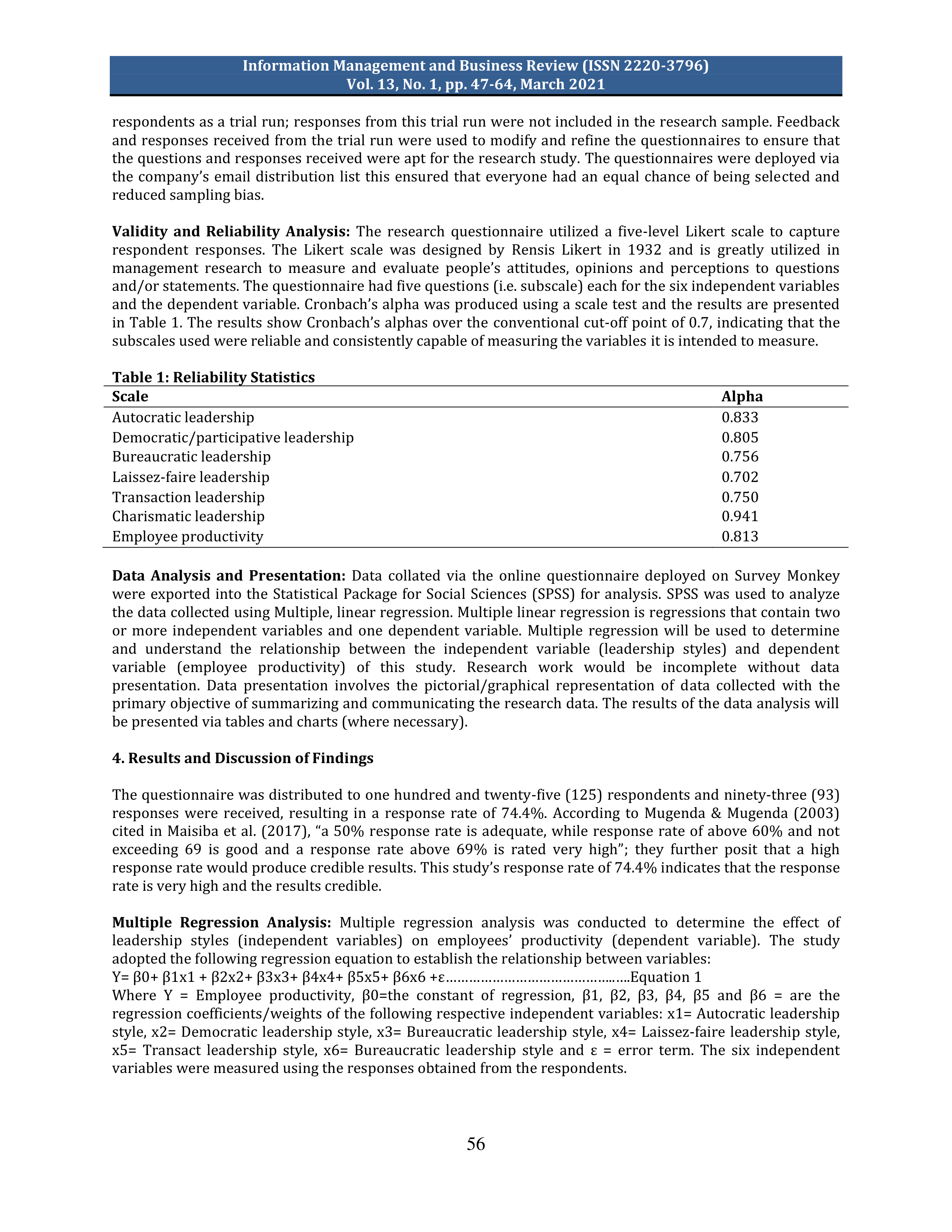
Validity and Reliability Analysis:
The research questionnaire utilized a five-level Likert scale to capture
respondent responses. The Likert scale was designed by Rensis Likert in 1932 and is greatly utilized in
management research to measure and evaluate people’s attitudes, opinions and perceptions to questions
and/or statements. The questionnaire had five questions (i.e. subscale) each for the six independent variables
and the dependent variable. Cronbach’s alpha was produced using a scale test and the results are presented
in Table 1. The results show Cronbach’s alphas over the conventional cut-off point of 0.7, indicating that the
subscales used were reliable and consistently capable of measuring the variables it is intended to measure.
Table 1: Reliability Statistics
Scale
Alpha
Autocratic leadership
0.833
Democratic/participative leadership
0.805
Bureaucratic leadership
0.756
Laissez-faire leadership
0.702
Transaction leadership
0.750
Charismatic leadership
0.941
Employee productivity
0.813
Data Analysis and Presentation:
Data collated via the online questionnaire deployed on Survey Monkey
were exported into the Statistical Package for Social Sciences (SPSS) for analysis. SPSS was used to analyze
the data collected using Multiple, linear regression. Multiple linear regression is regressions that contain two
or more independent variables and one dependent variable. Multiple regression will be used to determine
and understand the relationship between the independent variable (leadership styles) and dependent
variable (employee productivity) of this study. Research work would be incomplete without data
presentation. Data presentation involves the pictorial/graphical representation of data collected with the
primary objective of summarizing and communicating the research data. The results of the data analysis will
be presented via tables and charts (where necessary).
4. Results and Discussion of Findings
The questionnaire was distributed to one hundred and twenty-five (125) respondents and ninety-three (93)
responses were received, resulting in a response rate of 74.4%. According to Mugenda & Mugenda (2003)
cited in Maisiba et al. (2017), “a 50% response rate is adequate, while response rate of above 60% and not
exceeding 69 is good and a response rate above 69% is rated very high”; they further posit that a high
response rate would produce credible results. This study’s response rate of 74.4% indicates that the response
rate is very high and the results credible.
Multiple Regression Analysis:
Multiple regression analysis was conducted to determine the effect of
leadership styles (independent variables) on employees’ productivity (dependent variable). The study
adopted the following regression equation to establish the relationship between variables:
Y= β0+ β1x1 + β2x2+ β3x3+ β4x4+ β5x5+ β6x6 +ε……………………………………..….Equation 1
Where Y = Employee productivity, β0=the constant of regression, β1, β2, β3, β4, β5 and β6 = are the
regression coefficients/weights of the following respective independent variables: x1= Autocratic leadership
style, x2= Democratic leadership style, x3= Bureaucratic leadership style, x4= Laissez-faire leadership style,
x5= Transact leadership style, x6= Bureaucratic leadership style and ε = error term. The six independent
variables were measured using the responses obtained from the respondents.
Information Management and Business Review (ISSN 2220-3796)
Vol. 13, No. 1, pp. 47-64, March 2021
57
Demographic Analysis:
The analysis of responses revealed that 46% of the respondents were male and 52%
were female while 2% did not indicate their gender. The gender of respondents was relatively represented in
this study. Table 1 shows the gender distribution. Respondents were requested to indicate their age. The
analysis of responses revealed that 18.3% of the respondents were between the age of 20 to 30, 52.7% were
between the age of 31 to 40, 25.8% were between the age of 41 to 50, 1.1% were between the age of 51 to 60
while 2.1% did not indicate their age. The company’s mandatory retirement age is 60 hence there are no
respondents above the age of 60. Table 2 shows the age distribution. Respondents were requested to indicate
their level of education. The analysis of responses revealed that none of the respondents had an OND
(Ordinary National Diploma).
51.6% were either HND/B.Sc. (i.e. first degree) holders, 41.9% had a Master’s degree, 1.1% had a Ph.D. while
5.4% either did not fall into any of these categories or did not indicate their level of education. Table 4.3
shows the level of the education distribution. Respondents were requested to indicate their number of years
of service in their current organization; 32.3% of the respondents were between 0 to 5 years, 44.1% were
between 6 to 10 years, 18.3% were between 11 to 15 years, 1.1% were between 16 to 20 years, 2.1% were
above 20 years while 2.1% did not indicate their age. Table 2 shows the years of service distribution.
Respondents were requested to indicate their level of motivation at work; 3.2% of the respondents indicated
low, 9.7% indicated moderately low, 33.3% indicated medium, 41.9% indicated moderately high, 10.8%
indicated high while 1.1% did not indicate a response. Table 3 shows the level of motivation at work
distribution.
Results:
The effect of leadership styles on employee productivity.
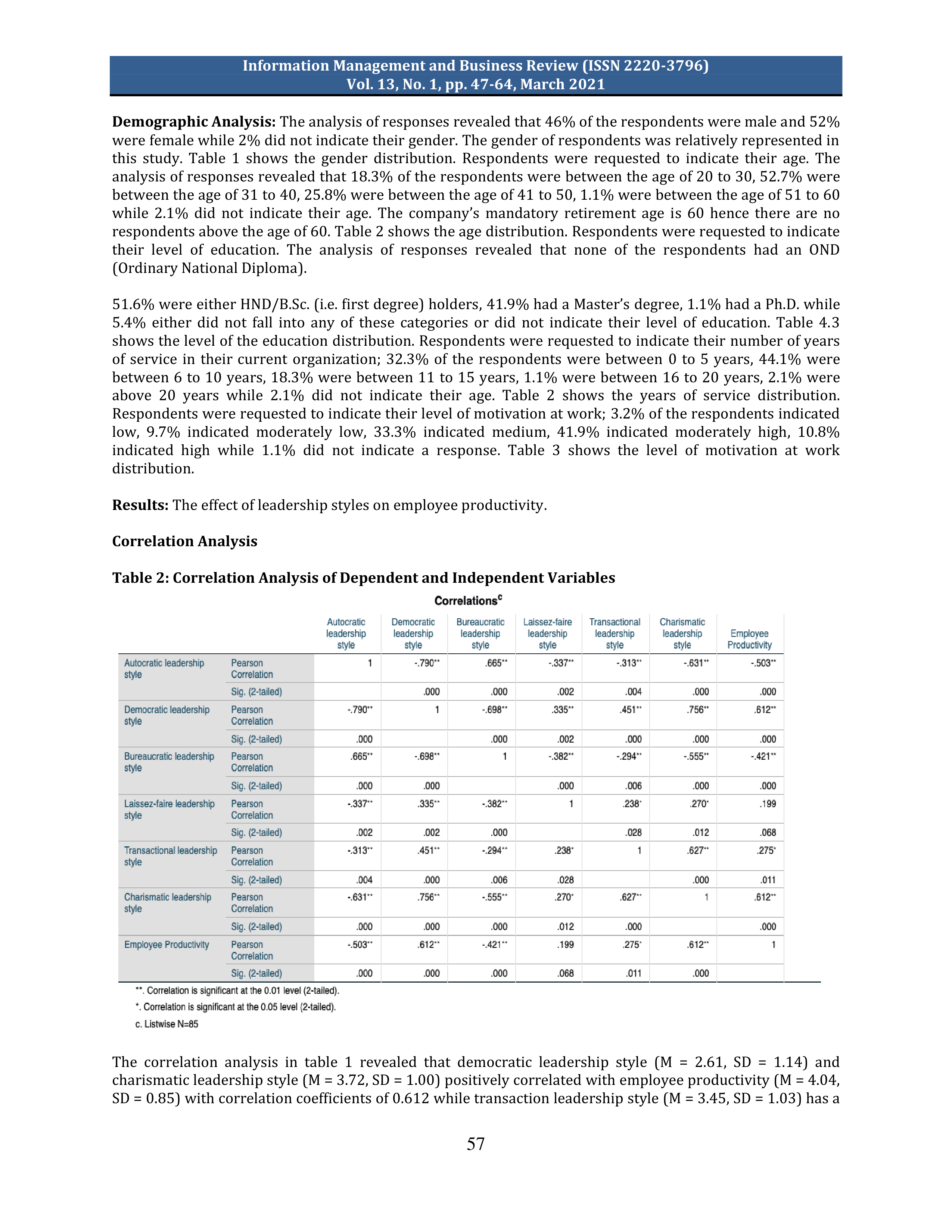
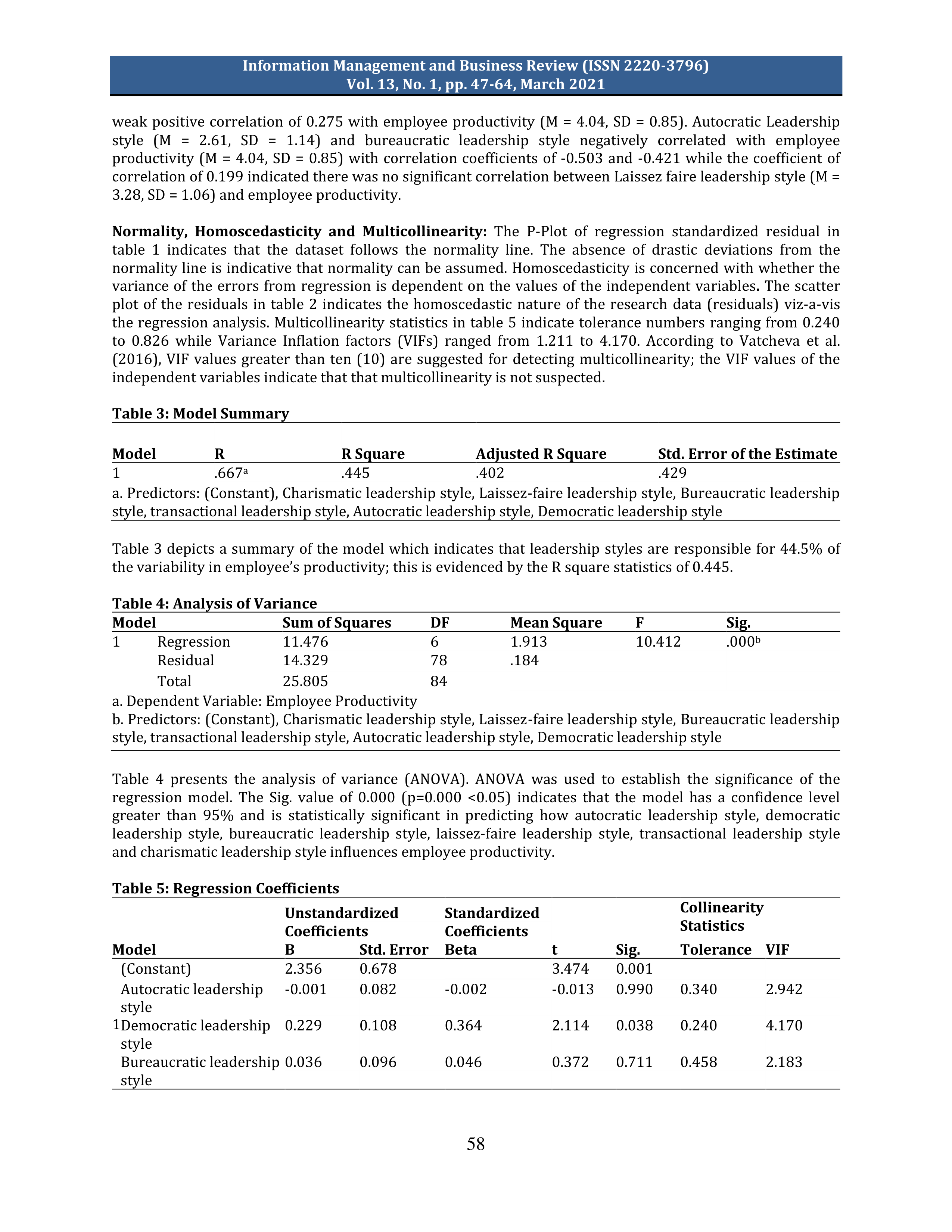
Correlation Analysis
Table 2: Correlation Analysis of Dependent and Independent Variables
The correlation analysis in table 1 revealed that democratic leadership style (M = 2.61, SD = 1.14) and
charismatic leadership style (M = 3.72, SD = 1.00) positively correlated with employee productivity (M = 4.04,
SD = 0.85) with correlation coefficients of 0.612 while transaction leadership style (M = 3.45, SD = 1.03) has a
Information Management and Business Review (ISSN 2220-3796)
Vol. 13, No. 1, pp. 47-64, March 2021
58
weak positive correlation of 0.275 with employee productivity (M = 4.04, SD = 0.85). Autocratic Leadership
style (M = 2.61, SD = 1.14) and bureaucratic leadership style negatively correlated with employee
productivity (M = 4.04, SD = 0.85) with correlation coefficients of -0.503 and -0.421 while the coefficient of
correlation of 0.199 indicated there was no significant correlation between Laissez faire leadership style (M =
3.28, SD = 1.06) and employee productivity.
Normality, Homoscedasticity and Multicollinearity:
The P-Plot of regression standardized residual in
table 1 indicates that the dataset follows the normality line. The absence of drastic deviations from the
normality line is indicative that normality can be assumed. Homoscedasticity is concerned with whether the
variance of the errors from regression is dependent on the values of the independent variables
.
The scatter
plot of the residuals in table 2 indicates the homoscedastic nature of the research data (residuals) viz-a-vis
the regression analysis. Multicollinearity statistics in table 5 indicate tolerance numbers ranging from 0.240
to 0.826 while Variance Inflation factors (VIFs) ranged from 1.211 to 4.170. According to Vatcheva et al.
(2016), VIF values greater than ten (10) are suggested for detecting multicollinearity; the VIF values of the
independent variables indicate that that multicollinearity is not suspected.
Table 3: Model Summary
Model
R
R Square
Adjusted R Square
Std. Error of the Estimate
1
.667
a
.445
.402
.429
a. Predictors: (Constant), Charismatic leadership style, Laissez-faire leadership style, Bureaucratic leadership
style, transactional leadership style, Autocratic leadership style, Democratic leadership style
Table 3 depicts a summary of the model which indicates that leadership styles are responsible for 44.5% of
the variability in employee’s productivity; this is evidenced by the R square statistics of 0.445.
Table 4: Analysis of Variance
Model
Sum of Squares
DF
Mean Square
F
Sig.
1
Regression
11.476
6
1.913
10.412
.000
b
Residual
14.329
78
.184
Total
25.805
84
a. Dependent Variable: Employee Productivity
b. Predictors: (Constant), Charismatic leadership style, Laissez-faire leadership style, Bureaucratic leadership
style, transactional leadership style, Autocratic leadership style, Democratic leadership style
Table 4 presents the analysis of variance (ANOVA). ANOVA was used to establish the significance of the
regression model. The Sig. value of 0.000 (p=0.000 <0.05) indicates that the model has a confidence level
greater than 95% and is statistically significant in predicting how autocratic leadership style, democratic
leadership style, bureaucratic leadership style, laissez-faire leadership style, transactional leadership style
and charismatic leadership style influences employee productivity.
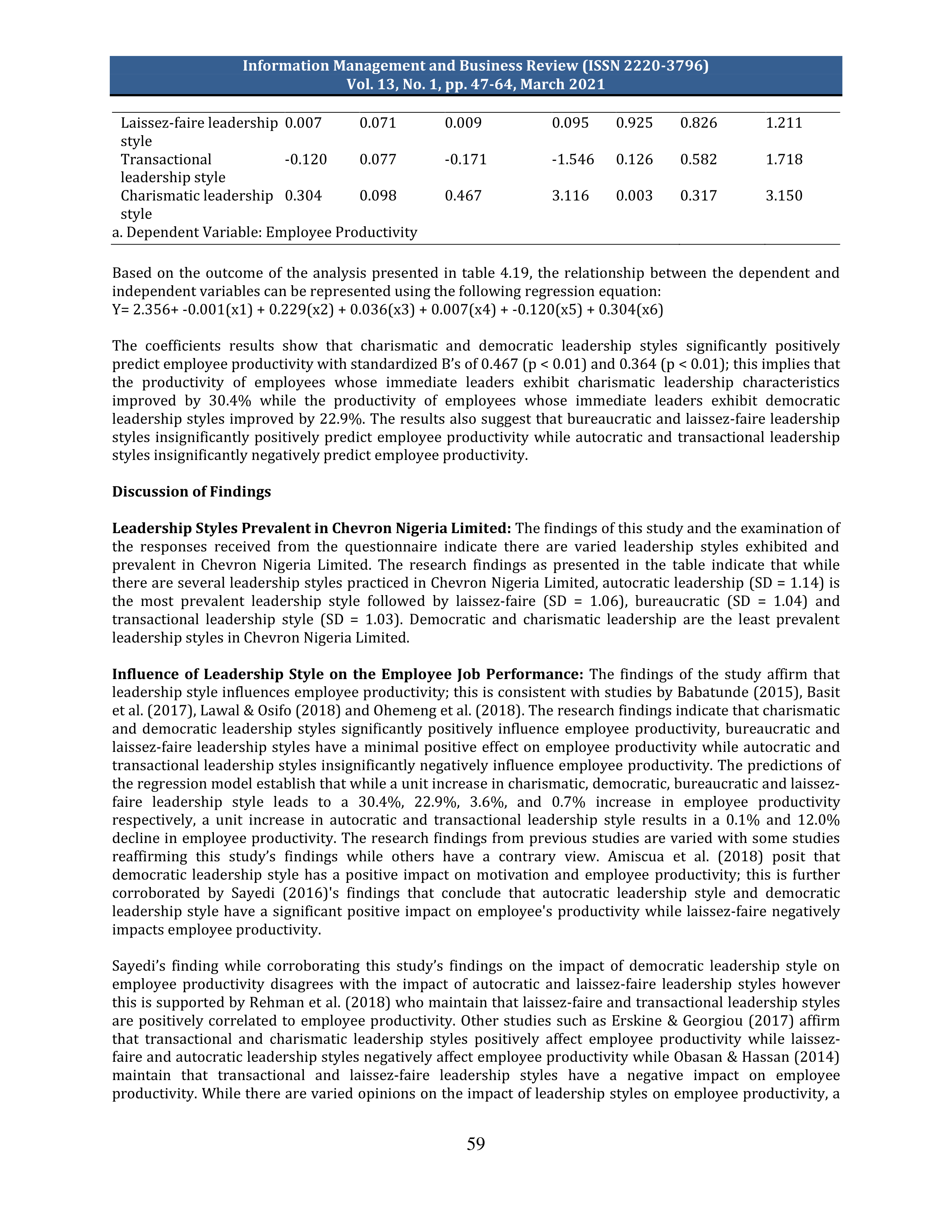
Table 5: Regression Coefficients
Model
Unstandardized
Coefficients
Standardized
Coefficients
t
Sig.
Collinearity
Statistics
B
Std. Error
Beta
Tolerance VIF
1
(Constant)
2.356
0.678
3.474
0.001
Autocratic leadership
style
-0.001
0.082
-0.002
-0.013
0.990
0.340
2.942
Democratic leadership
style
0.229
0.108
0.364
2.114
0.038
0.240
4.170
Bureaucratic leadership
style
0.036
0.096
0.046
0.372
0.711
0.458
2.183
Information Management and Business Review (ISSN 2220-3796)
Vol. 13, No. 1, pp. 47-64, March 2021
59
Laissez-faire leadership
style
0.007
0.071
0.009
0.095
0.925
0.826
1.211
Transactional
leadership style
-0.120
0.077
-0.171
-1.546
0.126
0.582
1.718
Charismatic leadership
style
0.304
0.098
0.467
3.116
0.003
0.317
3.150
a. Dependent Variable: Employee Productivity
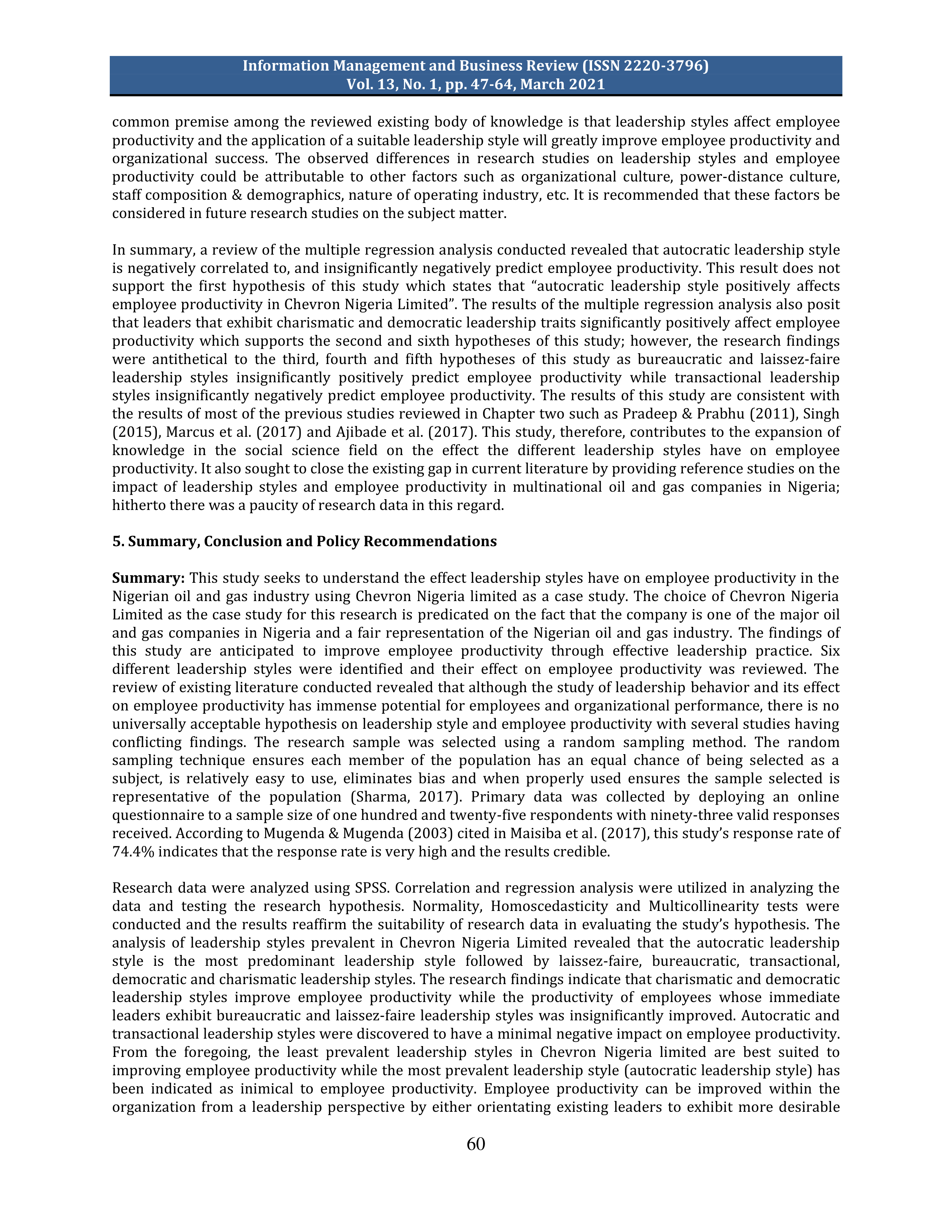
Based on the outcome of the analysis presented in table 4.19, the relationship between the dependent and
independent variables can be represented using the following regression equation:
Y= 2.356+ -0.001(x1) + 0.229(x2) + 0.036(x3) + 0.007(x4) + -0.120(x5) + 0.304(x6)
The coefficients results show that charismatic and democratic leadership styles significantly positively
predict employee productivity with standardized B’s of 0.467 (p < 0.01) and 0.364 (p < 0.01); this implies that
the productivity of employees whose immediate leaders exhibit charismatic leadership characteristics
improved by 30.4% while the productivity of employees whose immediate leaders exhibit democratic
leadership styles improved by 22.9%. The results also suggest that bureaucratic and laissez-faire leadership
styles insignificantly positively predict employee productivity while autocratic and transactional leadership
styles insignificantly negatively predict employee productivity.
Discussion of Findings
Leadership Styles Prevalent in Chevron Nigeria Limited:
The findings of this study and the examination of
the responses received from the questionnaire indicate there are varied leadership styles exhibited and
prevalent in Chevron Nigeria Limited. The research findings as presented in the table indicate that while
there are several leadership styles practiced in Chevron Nigeria Limited, autocratic leadership (SD = 1.14) is
the most prevalent leadership style followed by laissez-faire (SD = 1.06), bureaucratic (SD = 1.04) and
transactional leadership style (SD = 1.03). Democratic and charismatic leadership are the least prevalent
leadership styles in Chevron Nigeria Limited.
Influence of Leadership Style on the Employee Job Performance:
The findings of the study affirm that
leadership style influences employee productivity; this is consistent with studies by Babatunde (2015), Basit
et al. (2017), Lawal & Osifo (2018) and Ohemeng et al. (2018). The research findings indicate that charismatic
and democratic leadership styles significantly positively influence employee productivity, bureaucratic and
laissez-faire leadership styles have a minimal positive effect on employee productivity while autocratic and
transactional leadership styles insignificantly negatively influence employee productivity. The predictions of
the regression model establish that while a unit increase in charismatic, democratic, bureaucratic and laissez-
faire leadership style leads to a 30.4%, 22.9%, 3.6%, and 0.7% increase in employee productivity
respectively, a unit increase in autocratic and transactional leadership style results in a 0.1% and 12.0%
decline in employee productivity. The research findings from previous studies are varied with some studies
reaffirming this study’s findings while others have a contrary view. Amiscua et al. (2018) posit that
democratic leadership style has a positive impact on motivation and employee productivity; this is further
corroborated by Sayedi (2016)'s findings that conclude that autocratic leadership style and democratic
leadership style have a significant positive impact on employee's productivity while laissez-faire negatively
impacts employee productivity.
Sayedi’s finding while corroborating this study’s findings on the impact of democratic leadership style on
employee productivity disagrees with the impact of autocratic and laissez-faire leadership styles however
this is supported by Rehman et al. (2018) who maintain that laissez-faire and transactional leadership styles
are positively correlated to employee productivity. Other studies such as Erskine & Georgiou (2017) affirm
that transactional and charismatic leadership styles positively affect employee productivity while laissez-
faire and autocratic leadership styles negatively affect employee productivity while Obasan & Hassan (2014)
maintain that transactional and laissez-faire leadership styles have a negative impact on employee
productivity. While there are varied opinions on the impact of leadership styles on employee productivity, a
Information Management and Business Review (ISSN 2220-3796)
Vol. 13, No. 1, pp. 47-64, March 2021
60
common premise among the reviewed existing body of knowledge is that leadership styles affect employee
productivity and the application of a suitable leadership style will greatly improve employee productivity and
organizational success. The observed differences in research studies on leadership styles and employee
productivity could be attributable to other factors such as organizational culture, power-distance culture,
staff composition & demographics, nature of operating industry, etc. It is recommended that these factors be
considered in future research studies on the subject matter.
In summary, a review of the multiple regression analysis conducted revealed that autocratic leadership style
is negatively correlated to, and insignificantly negatively predict employee productivity. This result does not
support the first hypothesis of this study which states that “autocratic leadership style positively affects
employee productivity in Chevron Nigeria Limited”. The results of the multiple regression analysis also posit
that leaders that exhibit charismatic and democratic leadership traits significantly positively affect employee
productivity which supports the second and sixth hypotheses of this study; however, the research findings
were antithetical to the third, fourth and fifth hypotheses of this study as bureaucratic and laissez-faire
leadership styles insignificantly positively predict employee productivity while transactional leadership
styles insignificantly negatively predict employee productivity. The results of this study are consistent with
the results of most of the previous studies reviewed in Chapter two such as Pradeep & Prabhu (2011), Singh
(2015), Marcus et al. (2017) and Ajibade et al. (2017). This study, therefore, contributes to the expansion of
knowledge in the social science field on the effect the different leadership styles have on employee
productivity. It also sought to close the existing gap in current literature by providing reference studies on the
impact of leadership styles and employee productivity in multinational oil and gas companies in Nigeria;
hitherto there was a paucity of research data in this regard.
5. Summary, Conclusion and Policy Recommendations
Summary:
This study seeks to understand the effect leadership styles have on employee productivity in the
Nigerian oil and gas industry using Chevron Nigeria limited as a case study. The choice of Chevron Nigeria
Limited as the case study for this research is predicated on the fact that the company is one of the major oil
and gas companies in Nigeria and a fair representation of the Nigerian oil and gas industry. The findings of
this study are anticipated to improve employee productivity through effective leadership practice. Six
different leadership styles were identified and their effect on employee productivity was reviewed. The
review of existing literature conducted revealed that although the study of leadership behavior and its effect
on employee productivity has immense potential for employees and organizational performance, there is no
universally acceptable hypothesis on leadership style and employee productivity with several studies having
conflicting findings. The research sample was selected using a random sampling method. The random
sampling technique ensures each member of the population has an equal chance of being selected as a
subject, is relatively easy to use, eliminates bias and when properly used ensures the sample selected is
representative of the population (Sharma, 2017). Primary data was collected by deploying an online
questionnaire to a sample size of one hundred and twenty-five respondents with ninety-three valid responses
received. According to Mugenda & Mugenda (2003) cited in Maisiba et al. (2017), this study’s response rate of
74.4% indicates that the response rate is very high and the results credible.
Research data were analyzed using SPSS. Correlation and regression analysis were utilized in analyzing the
data and testing the research hypothesis. Normality, Homoscedasticity and Multicollinearity tests were
conducted and the results reaffirm the suitability of research data in evaluating the study’s hypothesis. The
analysis of leadership styles prevalent in Chevron Nigeria Limited revealed that the autocratic leadership
style is the most predominant leadership style followed by laissez-faire, bureaucratic, transactional,
democratic and charismatic leadership styles. The research findings indicate that charismatic and democratic
leadership styles improve employee productivity while the productivity of employees whose immediate
leaders exhibit bureaucratic and laissez-faire leadership styles was insignificantly improved. Autocratic and
transactional leadership styles were discovered to have a minimal negative impact on employee productivity.
From the foregoing, the least prevalent leadership styles in Chevron Nigeria limited are best suited to
improving employee productivity while the most prevalent leadership style (autocratic leadership style) has
been indicated as inimical to employee productivity. Employee productivity can be improved within the
organization from a leadership perspective by either orientating existing leaders to exhibit more desirable
Information Management and Business Review (ISSN 2220-3796)
Vol. 13, No. 1, pp. 47-64, March 2021
61
leadership styles or promoting/recruiting new leaders that exhibit leadership styles that motivate improved
productivity from their subordinates.
Conclusion:
Employee productivity is fundamental to the growth, profitability and continued existence of
any organization. In conclusion, the present study indicates that leadership style viz-a-vis the quality and
practice of leadership impacts employee productivity. Specifically, charismatic leadership styles and
democratic leadership styles are best suited to improving employee productivity, bureaucratic and laissez-
faire leadership styles exert a minimal positive effect on employee productivity while transactional and
autocratic leadership styles impede employee productivity. While the choice of leadership style impacts
employee productivity, the results of this study also indicate that other factors exist that influence employee
productivity and these factors should be identified and researched to enable researchers, leaders and
academia to have a well-rounded understanding of determinants of employee productivity.
Recommendation and Implications:
The primary goal of any organization is to maximize profits; one of the
ways organizations can maximize profitability is through improved employee productivity. The findings of
this study indicate that the prevalent leadership style in an organization is an important influencer of
employee productivity and ultimately profitability. The findings of this study are consistent with the finding
of other studies such as Obasan & Hassan (2014), Erskine & Georgiou (2017) and Rehman et al. (2018). It is
therefore recommended that organizations in the Nigerian oil and gas industry should constantly influence
leadership behavior to maximize employee productivity; this can be achieved through policy formulation,
recruitment, training and promotion as well as by enforcing the appropriate organizational behaviors. This
study’s findings indicate that the existing mix of leadership styles prevalent in Chevron Nigeria Limited does
not maximize the productivity of its employees as the primary leadership style of autocratic negatively
impacts employee productivity. It is recommended that the organization review its leadership training and
selection processes to maximize its leadership pool with the desirable goal of maximizing employee
productivity. Regular pulse checks should be conducted to ascertain that the current leadership style in the
organization and interventions implemented to ensure the desired leadership mix/style is maintained.
Future studies should examine the impact of other factors such as cultural differences, employee attitude and
expectations, organizational policies and power distance and how they inter-relate with leadership styles and
employee productivity. This study indicates that organizations should pay attention to the leadership styles
needs of their employees if they desire improved employee productivity. While some leadership styles
improve employee productivity, others impair productivity; the onus on the discerning organization is to
determine the prevalent leadership styles and required leadership styles to maximize employee productivity
and enact training and policies to bridge identified gaps. The study contributes to the existing literature on
leadership behavior and its effect on employee productivity and also validates the findings and relevance of
the body of knowledge reviewed in Chapter two. This study is also intended to be a reference point to
scholars and researchers for further studies on leadership practice and other related subject matters.
However, the first and possibly most important limitation of this study is that the research sought to
determine the effect of leadership styles on employee productivity by examining only one organization; this is
closely related to the next limitation which has to do with sampling. This research was conducted using
primary data generated from ninety-three (93) respondents.
The inherent limitations of sampling technique such as sampling bias, the possibility of lack of
representativeness of the population and respondent bias constitute the limitations of this study. This study
examined the effect of leadership styles on workers' performance by studying only one organization. It is
recommended that future studies increase the research scope to cover more than one organization and also
consider investigating other factors that influence employee productivity such as organizational structure,
gender, level of education, corporate culture, etc. with a view of determining if the interaction of leadership
styles with these other factors further enhance or impede employee productivity. Future researchers can also
use a larger sample size spanning several organizations in dissimilar industries to reduce the risks associated
with sampling and drawing inferences from a sample.
Information Management and Business Review (ISSN 2220-3796)
Vol. 13, No. 1, pp. 47-64, March 2021
62
References
Ajibade, E., Ajayi, O. & Shobowale, O. (2017). Leadership Styles and Employees’ Performance in Nigerian
Federal Polytechnics: A Study of Federal Polytechnic, Ilaro, Ogun State.
Journal of Public
Administration, Finance and Law,
11(1), 17-30.
Amiscua, M., Fernandez, M., Madanging, J. & Querido, J. (2018). The Impact of Leadership Styles on
Employees' Productivity: A Qualitative Study of Employees' Experiences of Motivation in the
Workplace. Available at: https://www.researchgate.net/requests/attachment/52212945 (Accessed
29/12/18)
Aunga, D. & Masare, O. (2017). Effect of Leadership Styles on Teacher’s Performance in Primary Schools of
Arusha District Tanzania.
International Journal of Educational Policy Research and Review,
14(4), 42–
52.
Babatunde, O. (2015). The impact of leadership style on employee’s performance in an organization,
Public
Policy and Administration Research
, 5(1), 195-206.
Basit, A., Sebastian, V. & Hassan, Z. (2017). Impact of Leadership Style on Employee Performance (A case
study on a private organization in Malaysia).
International Journal of Accounting & Business
Management
, 5(2), 112-130.
Bass, B. M. & Avolio, B. J. (2000). MLQ Multifactor Leadership Questionnaire. Redwood City: Mind Garden.
Blazi, C. & Awolusi, O. D. (2020). Employee Engagement in Multinational Diverse Organization in Difficult
Terrain: A Study of Non-Family Station Organization,
Information Management and Business Review
,
12(1), 45-62.
Chevron. (2018). 2017 Corporate Responsibility Report Highlights. Available at: https://www.chevron.com/-
/media/shared-media/documents/2017-corporate-responsibility-report.pdf (Accessed 11/09/18).
Chowdhury, R. G. (2014). A Study on the Impact of Leadership Styles on Employee Motivation and
Commitment: An Empirical Study of Selected Organizations in the Corporate Sector. Available at:
http://www.dypatil.edu/schools/management/wp-content/uploads/2015/11/A-study-of-the-
Impact-of-Leadership-Styles-on-Employee-Motivation-and-Commitment-An-empirical-study-of-
selected-organisations-in-Corporate-sector-Rima-Chowdhury.pdf (Accessed 22/09/18).
Chowdhury, R. & Gopal, R. (2014). Leadership Styles and Employee Motivation: An Empirical Investigation in
a Leading Oil Company in India.
International Journal of Research in Business Management
, 2(5), 1–10.
Dalluay, V. S. & Jalagat, R. C. (2016). Impacts of Leadership Style Effectiveness of Managers and Department
Heads to Employees' Job Satisfaction and Performance on Selected Small-Scale Businesses in Cavite,
Philippines.
International Journal of Recent Advances in Organizational Behavior & Decision Sciences
,
2(2), 734-751.
Easterby-Smith, M., Thorpe, R. & Jackson, P. (2012). Management Research. 4th ed. London: Sage Publications.
Erskine, J. & Georgiou, G. (2017). Leadership Styles: Employee Stress, Well-being, Productivity, Turnover and
Absenteeism.
Available
at:
https://www.researchgate.net/requests/attachment/52212988
(Accessed 01/01/19).
Ewell, J. (2018). Revitalizing a Student Organization by Applying Transformational Leadership.
Journal of
Leadership Education,
17(3), 208–218.
Gaines, T. M. (2018). Strategies for virtual sales leaders to increase the productivity of remote employees.
Available
at:
https://scholarworks.waldenu.edu/cgi/viewcontent.cgi?article=6287&context=dissertations
(Assessed 03/10/18).
Gastil, J. (2012). A meta-analytic review of the productivity and satisfaction of democratic and autocratic
leadership.
Small-Group Research,
25(3), 384-410.
Graham, J. & Trendafilova, S. (2016). Implementing Self-Managed Teams at Western University: A Human
Resource and Leadership Case Study.
Case Studies in Sport Management,
5(1), 64–72.
Getachew, D. S. & Erhua Z. (2018). The Influences of Transformational Leadership on Collective Efficacy: The
Moderating Role of Perceived Organizational Support.
International Journal of Organizational
Innovation,
10(4), 7–15.
Hassan, S. (2016). Impact of HRM Practices on Employee’s Performance.
International Journal of Academic
Research in Accounting, Finance and Management Sciences,
6(1), 15-22.
House, R. J. (1971). A Path-Goal Theory of Leader Effectiveness.
Journal of Administrative Science Quarterly,
16(1), 321-338.
Information Management and Business Review (ISSN 2220-3796)
Vol. 13, No. 1, pp. 47-64, March 2021
63
Iqbal, N., Anwar, S. & Haider, N. (2015). Effect of Leadership Style on Employee Performance.
Arabian Journal
of Business and Management Review
, 5(5), 1-6.
Ispas, A. (2012). The Perceived Leadership Style and Employee Performance in the Hotel Industry – a Dual
Approach.
Review of International Comparative Management / Revista De Management Comparat
International
, 13(2), 294-304.
Kagwiria, L. (2016). Influence of Leadership on Employee Productivity at KCB Bank Kenya Ltd, Nairobi
Region
Branches.
Available
at:
http://erepository.uonbi.ac.ke/bitstream/handle/11295/98559/LILIAN%20FINAL%20PROJECT.pd
f?sequence=1&isAllowed=y (Accessed 22/09/18).
Kohn, A. (1993). Why Incentive Plans Cannot Work.
HBR.
Available at: https://hbr.org/1993/09/why-
incentive-plans-cannot-work (Accessed 10/06/18).
Lawal, B. A. & Osifo S. J. (2018). Leadership Styles and Employee Performance: Empirical Evidence from
Selected
Banks
in
Edo
State.
Available
at:
https://www.researchgate.net/publication/329659647_Leadership_Styles_and_Employee_performa
nce_Empirical_Evidence_from_Selected_Banks_in_Edo_State (Accessed 24/12/18).
Luo, H. & Liu, S. (2014). Effect of Situational Leadership and Employee Readiness Match on Organizational
Citizenship Behavior in China.
Social Behavior & Personality: an international journal,
42(10), 1725–
1732.
Maisiba, N. L., Muturi, W. & Atambo, W. (2017). Effects of Working Capital Management on the profitability of
Retail Firms in Kisii County, Kenya.
International Journal of Social Sciences and Information
Technology,
3(2), 23-36.
Malik, S. H. (2013). Relationship between Leader Behaviors and Employees’ Job Satisfaction: A Path-Goal
Approach.
Pakistan Journal of Commerce & Social Sciences,
7(1), 209–222.
Mangale, M. N. (2017). The Effects of Compensation on Employee Productivity: A Case Study of Kenya
Literature Bureau, South C Nairobi. Available at: http://repository.mua.ac.ke/1570/1/Proposal.pdf
(Accessed 22/09/2018).
Marcus, G., Olowu, D., Solomon, A. & Akhimien, E. (2017). Leadership Styles and Employee Performance in
Nigerian Higher Educational Institutions.
American Journal of Environmental and Resource Economics,
12(1), 12-21.
Matira, K. M. & Awolusi, O. D. (2020). Leaders and Managers Styles towards Employee Centricity: A Study of
Hospitality Industry in the United Arab Emirates,
Information Management and Business Review
,
12(1), 1-21.
Men, L. R. & Stacks, D. W. (2013). The impact of leadership style and employee empowerment on perceived
organizational reputation.
Journal of Communication Management,
17(2), 171-192.
Mukonga, L. M. & Awolusi, O. D. (2019). Strategic Leadership in the Post-Conflict States: A Study of the
Democratic Republic of Congo (DRC),
Journal of Social and Development Sciences
, 10(4), 36-51.
Mulki, J. P., Caemmerer, B. & Heggde, G. S. (2015). Leadership style, salesperson's work effort and job
performance: the influence of power distance.
Journal of Personal Selling & Sales Management,
35(1),
3-22.
Munir, F. & Aboidullah M. (2018). Gender Differences in Transformational Leadership Behaviors of School
Principals and Teachers’ Academic Effectiveness.
Bulletin of Education & Research,
40(1), 99–113.
Mwangi, P. K. (2014). The Effect of Compensation on Employee Motivation: A Case study of Chloride Exide.
Available
at:
http://erepo.usiu.ac.ke/bitstream/handle/11732/161/Patrick%20Mwangi.pdf?sequence=1&isAllo
wed=y (Accessed 24/09/18).
Obasan, K. & Banjo, H. (2014). A Test of the Impact of Leadership Styles on Employee Performance: A Study of
Department
of
Petroleum
Resources.
Available
at:
https://www.researchgate.net/publication/311231059_A_Test_of_the_Impact_of_Leadership_Styles_
on_Employee_Performance_A_Study_of_Department_of_Petroleum_Resources (Accessed 24/09/15).
Odunlami, S. A. & Awolusi, O. D. (2015). Multinational Corporation and economic development in Nigeria,
American Journal of Environmental Policy and Management
, 1(2), 16-24.
Ohemeng, F., Amoaks-Asiedu, E. & Darko, T. (2018). The relationship between leadership style and employee
performance: An exploratory study of the Ghanaian public service.
International Journal of Public
Leadership
, 14(4), 274-296.
Information Management and Business Review (ISSN 2220-3796)
Vol. 13, No. 1, pp. 47-64, March 2021
64
Ojeleye, Y. C. (2017). The Impact of Remuneration on Employees' Performance: A Study of Abdul Gusau
Polytechnic, Talata-Mafara and State College of Education Maru, Zamfara State.
Arabian Journal of
Business and Management Review (Nigerian Chapter),
4(2), 34-43.
Olatunji, O. O. & Awolusi, O. D. (2019). Performance Evaluation and Improvement among Salesmen in the
Nigerian Fast Moving Consumer Goods Sector,
Journal of Social and Development Sciences
, 10(4), 12-
29.
Onuoha,
A.
(2017).
Top
50
Best
Paying
Companies
in
Nigeria.
iDONSABI.
Available
at:
https://idonsabi.com/top-50-best-paying-companies-in-nigeria/ (Accessed 08/06/18).
Pradeep, D. & Prabhu, V. (2011). The Relationship between Effective Leadership and Employee Performance.
2011 International Conference on Advancements in Information Technology. Available at:
https://pdfs.semanticscholar.org/2dc9/c1b1b36a7ac68a4b75b61d07a33860a28017.pdf (Accessed
23/09/18).
Rego, A., Sousa, F., Marques, C. & Cunha, M. (2012). Authentic leadership promoting employees' psychological
capital and creativity.
Journal of Business Research
, 65(1), 429-437.
Rehman, S., Rahman, H., Zahid, M. & Asif, M. (2018). Leadership Styles, Organizational Culture and Employees’
Productivity: Fresh Evidence from Private Banks of Khyber-Pakhtunkhwa, Pakistan.
Abasyn
University Journal of Social Sciences
, 1–15.
Sayedi, N. S. (2016). Impact of Leadership Style on Employees’ Motivation: A Case Study of Access Bank
Nigeria.
Available
at:
https://www.researchgate.net/publication/328803891_Impact_of_Leadership_Style_on_Employees
%27_Motivation_A_Case_Study_of_Access_Bank_Nigeria (Accessed 26/12/18).
Sharma, G. (2017). Pros and cons of different sampling techniques.
International Journal of Applied Research,
3(7), 749-752.
Singh, K. (2015). Leadership Style and Employee Productivity: A Case Study of Indian Banking Organizations.
Journal of Knowledge Globalization,
8(2), 39-67.
Vatcheva, K., Lee, M., McCormick, J. & Rahbar, M. (2016). Multicollinearity in Regression Analyses Conducted
in Epidemiologic Studies.
Epidemiol
, 6(2), 23-34.
Wilfred, N. O., Elijah, M. C. & Muturi, M. W. (2014). Effect of Remuneration on Employees Performance in the
Ministry of Internal Security: A Case of Kisii County.
International Journal of Human Resource Studies,
4(1), 223-231.
Wright, K. (2017). Researching Internet-Based Populations: Advantages and Disadvantages of Online Survey
Research, Online Questionnaire Authoring Software Packages, and Web Survey Services.
Journal of
Computer-Mediated Communication,
10(3), 23-35.