


Lúmina 26(1)
DOI: https://doi.org/10.30554/lumina.v26.n1.5259.2025
Rebuilding organizational
culture through transformational
leadership: success lessons from
Uber’s experience in startups
Reconstrucción de la cultura organizacional a
través del liderazgo transformacional: lecciones
de éxito de la experiencia de Uber en startups
Reconstruindo a cultura organizacional por
meio da liderança transformacional: lições de
sucesso da experiência da Uber em startups
Houda Feriel-Boughaba
1
Baci Ilhem
2
Abstract
This study explores how transformational leadership can drive the success of
startups by reshaping their organizational culture at a fundamental level. Using a
case study approach, the research examines Uber’s experience to demonstrate
the impact of this leadership style. Despite facing numerous crises and scandals
that threatened its organizational culture, Uber successfully overcame these
challenges by adopting transformational leadership practices. The study reveals
Recibido: 25 de octubre de 2024. Publicado: 4 de marzo del 2025.
Para citar este artículo:
Feriel-Boughaba H. y Ilhem B. (2025). Rebuilding Organizational Culture Through Transformational
Leadership: Success Lessons from Uber’s Experience in Startups. Lúmina 26(1).
DOI: https://doi.org/10.30554/lumina.v26.n1.5259.2025
Copyright:
© Esta revista provee acceso libre, gratuito e inmediato a su contenido bajo el principio de
hacer disponible la investigación al público. Esta obra está bajo una licencia Creative Commons Reconoci-
miento-NoComercial-Compartir Igual 4.0 Internacional (CC BY-NC-SA 4.0)
1
Orcid: https://orcid.org/0009-0004-8672-9069 Correo: ferielhouda23@gmail.com
h.boughaba@univ-soukahras.dz Afiliaciones: Universidad Mohamed Cherif Messaadia.
2
Orcid: https://orcid.org/0009-0008-8271-239X Correo: Ilhem.baci@univ-annaba.dz
Afiliaciones: Universidad Badji Mokhtar – Annaba-ALGERIA
2
Lúmina Vol. 26 - N° 1 - Enero - Junio, 2025
Feriel-Boughaba H. - Ilhem B.
that embracing a transformative and innovative leadership approach is essential
for enacting substantial cultural change within organizations. However, it also
emphasizes that such transformation requires a significant investment of time
and effort to achieve measurable and lasting results. This investigation highlights
the pivotal role of leadership in cultivating an adaptive and resilient organiza-
tional culture, which is critical for the success and sustainability of startups.
Keywords
: Startups, Organizational Culture, Transformational Leadership
Resumen
Este estudio explora cómo el liderazgo transformacional puede impulsar el
éxito de las startups al reformar su cultura organizacional de manera funda-
mental. Utilizando un enfoque de estudio de caso, la investigación examina la
experiencia de Uber para demostrar el impacto de este estilo de liderazgo. A
pesar de enfrentar numerosas crisis y escándalos que amenazaban su cultu-
ra organizacional, Uber superó con éxito estos desafíos al adoptar prácticas
de liderazgo transformacional. El estudio revela que adoptar un enfoque de
liderazgo transformador e innovador es esencial para implementar cambios
culturales significativos dentro de las organizaciones. Sin embargo, también
enfatiza que dicha transformación requiere una inversión considerable de
tiempo y esfuerzo para lograr resultados medibles y duraderos. Esta inves-
tigación destaca el papel fundamental del liderazgo en la creación de una
cultura organizacional adaptable y resiliente, que es crucial para el éxito y la
sostenibilidad de las startups.
Palabras clave
: Startups, Cultura Organizacional, Liderazgo Transforma-
cional.
Resumo
Este estudo explora como a liderança transformacional pode impulsionar o
sucesso de startups ao reformular sua cultura organizacional de maneira fun-
damental. Utilizando uma abordagem de estudo de caso, a pesquisa examina
a experiência da Uber para demonstrar o impacto desse estilo de liderança.
Apesar de enfrentar inúmeras crises e escândalos que ameaçaram sua cultura
organizacional, a Uber superou esses desafios adotando práticas de liderança
transformacional. O estudo revela que adotar uma abordagem de liderança
transformadora e inovadora é essencial para promover mudanças culturais
substanciais dentro das organizações. No entanto, também enfatiza que essa
transformação exige um investimento significativo de tempo e esforço para
alcançar resultados mensuráveis e duradouros. Esta investigação destaca o pa-
pel crucial da liderança na construção de uma cultura organizacional adaptativa
e resiliente, que é fundamental para o sucesso e sustentabilidade das startups.
Palavras-chave
: Startups, Cultura Organizacional, Liderança Transforma-
cional.
Lúmina Vol. 26 - N° 1 - Enero - Junio, 2025
3
Rebuilding organizational culture through transformational
leadership: success lessons from Uber’s experience in startups
JEL Classification: M13; M140; M540.
1. Introduction
Startups represent the forefront of the new economy, yet they op-
erate in environments rife with risks and constant changes. While
navigating these uncertainties, startups remain at the leading edge
of economic innovation (Szarek & Piecuch, 2018). These challeng-
ing circumstances pose significant obstacles, making it essential
for startups to build and maintain a strong reputation to survive in a
competitive landscape (Karrarslan & Soylu, 2023). This necessity is
often reflected in their corporate culture, which serves as a powerful
tool for shaping the company’s identity and attracting both talent and
customers (Schein, 2010).
Effective leadership plays a pivotal role in shaping and guiding or-
ganizational culture, ensuring its successful communication to a wide
range of stakeholders. Transformational leadership, in particular, is
widely recognized as an especially effective leadership philosophy for
driving cultural change within organizations (Goleman, 2010). A relevant
case study is Uber, one of the leading startup companies in the United
States and globally.
Uber faced substantial challenges due to its aggressive leadership
style and toxic organizational culture, leading to numerous scandals
and a subsequent decline in growth. This downturn critically affected
the company’s performance, bringing it to the verge of collapse (Conger,
2019). These challenges were evident in a series of notable incidents
that underscored the company’s internal dysfunction and controversial
public image. For instance, Susan Fowler a young engineer who joined
Uber in November 2015, exposed a toxic culture within the company,
particularly towards women. On her first day of work, she was subjected
to sexual harassment by her manager.
After filing a complaint with the (HR) department, she was surprised
to learn that the manager would not be dismissed because he was a
“high-performing employee” and she was given the option to transfer
to another team. Over time, Fowler discovered that her experience
was not isolated, as she encountered other women with similar stories.
She also revealed a performance evaluation system that excessively
prioritized growth, fostering a highly competitive and toxic environment.
4
Lúmina Vol. 26 - N° 1 - Enero - Junio, 2025
Feriel-Boughaba H. - Ilhem B.
One notable incident occurred when women were denied leather jackets
promised as a company gift, with the justification that their exclusion
was a form of equality. In February 2017, Fowler decided to leave Uber
and published a blog post titled “Reflecting on One Very Very Strange
Year at Uber” detailing her experiences. This revelation brought to light
the internal issues within the company, ultimately leading to significant
changes in its management.
However, the challenges were not limited to internal issues but
also extended to incidents that sparked widespread public criticism.
For example, Following President Trump’s announcement of the
travel ban targeting citizens of predominantly Muslim countries,
Uber suspended surge pricing for rides to JFK Airport during the
protests. However, this decision was interpreted as an attempt to
undermine the strike initiated by taxi drivers, leading to the launch of
the #deleteUber campaign. This backlash highlighted the perceived
insensitivity of Uber’s actions, as it appeared to prioritize business
interests over solidarity with the protesters and the broader social
justice movement (ISAAC, 2019). In response, Uber was forced to
reevaluate its organizational culture and adopt a new leadership
strategy to regain its market position.
The adoption of a transformational leadership approach was crucial
in Uber’s efforts to revitalize its organizational culture. This strategic
shift led to the replacement of former CEO Travis Kalanick with Dara
Khosrowshahi, under whose leadership the company has since worked
to restore its image and stabilize its operations (Bastos, 2017).
Based on the foregoing, a key issue arises regarding the extent
to which transformational leadership can reshape the organiza-
tional culture of startups facing deep structural crises. In the case
of Uber, the previous leadership style entrenched a toxic organi-
zational culture that negatively impacted internal performance and
the company’s market reputation. With the adoption of transfor-
mational leadership, the company aimed to drive a fundamental
shift in its values and institutional practices. However, the question
remains as to how effective this leadership approach is in achiev-
ing sustainable cultural change within organizations that have
experienced profound cultural deviations. In other words, the core
issue of the study is crystallized in the following central question:
How did Uber leverage transformational leadership to reshape its
corporate culture and regain control of its leadership?
Lúmina Vol. 26 - N° 1 - Enero - Junio, 2025
5
Rebuilding organizational culture through transformational
leadership: success lessons from Uber’s experience in startups
1.1 Study Importance
The importance of this study stems from its exploration of a critical topic
that has garnered significant attention from human resources scholars.
Additionally, the research examines a previously underexplored relation-
ship between transformational leadership and organizational culture in
emerging enterprises.
1.2 Study Significance
The significance of this study lies in its investigation of a key issue
that has attracted the interest of human resources researchers. By
connecting transformational leadership with organizational culture in
startups, the research offers fresh insights that could enrich both aca-
demic understanding and practical applications in this field.
1.3 Study Objective
The study aims to explore how transformational leadership can reshape
organizational culture to improve business success, drawing on Uber’s
experience in reclaiming its market position.
2. Literature Review
Modern management’s primary goal is to achieve change and transfor-
mation within organizations, with transformational leadership and orga-
nizational culture playing essential roles in this process. These elements
work in tandem to shape the internal environment by fostering shared
values, attitudes, and practices. Transformational leadership, as outlined
by (Bass, 1985), is a key driver in inspiring followers and encouraging
them to exceed expectations, thereby creating a motivating culture that
supports organizational success. In line with this, McGregor and Burns
emphasize that transformational leaders contribute significantly to or-
ganizational change by engaging in practices that promote innovation,
commitment, and long-term achievement (Reid & Dold, 2018).
Additionally, Schein (2010) highlights the importance of leadership in
shaping organizational culture through mechanisms such as resource
allocation, reward systems, and the management of critical incidents,
which collectively reinforce the values and assumptions that underpin
the organization’s identity. This literature review will address the inter-
relationship between transformational leadership and organizational
culture, and explore how these factors contribute to the creation of
6
Lúmina Vol. 26 - N° 1 - Enero - Junio, 2025
Feriel-Boughaba H. - Ilhem B.
environments that foster sustained organizational success in an ev-
er-changing business landscape.
2.1 Transformational Leadership
According to Bass, transformational leadership is defined by a pro-
cess in which leaders inspire their team members to transcend their
personal interests and align with the broader goals and mission of the
organization (Bernard , 1985, p. 25). This leadership style not only aims
to expand and elevate employees’ interests but also involves a moral
and psychological process that establishes an ethical and transparent
framework for organizational growth, free from coercive tactics (Moradi
& ShahbazI, p. 455). Transformational leadership integrates individual
aspirations into collective objectives, fostering a unified organizational
vision. Leaders using this approach prioritize aligning organizational
values, goals, and performance with a deep understanding of individual
motivations. By raising employees’ awareness of higher-order needs and
aligning their personal identities with the organization’s mission, trans-
formational leadership boosts both employee morale and performance
(Davis & Thilagaraj, 2022, p. 154).
Moreover, transformational leaders actively assess the strengths and
weaknesses of their team members, setting goals that align with both
individual aspirations and organizational performance objectives. They
also inspire and empower employees to take on greater responsibilities,
leading to higher engagement and productivity in the workplace (James
& Ogbonna, 2013, p. 356).
2.1.1 Transformational Leadership’s Components
The Four Key Elements of Transformational Leadership: Bass, a pio-
neer in the field, first identified the four components of transformational
leadership: idealized influence, inspirational motivation, intellectual
stimulation, and individualized consideration (Farnsworth, et al., 2002,
p. 02). This discussion will examine each element to help managers
effectively implement this leadership strategy in the workplace.
-
Idealized Influence
: A leader should serve as a respected and
trustworthy guide for staff members, someone they can rely on to
make the best decisions for the organization.
-
Inspirational Motivation
: Leaders who inspire team members to
embrace the company’s vision foster a sense of unity in pursuing
Lúmina Vol. 26 - N° 1 - Enero - Junio, 2025
7
Rebuilding organizational culture through transformational
leadership: success lessons from Uber’s experience in startups
key objectives, such as increasing market share and revenue
growth.
-
Intellectual Stimulation
: Leaders encourage innovation and
creativity by promoting critical thinking and challenging traditional
beliefs and perspectives to improve the organization.
-
Individualized Consideration
: Leaders pay close attention to the
individual needs of each team member, acting as a coach or men-
tor, listening to their concerns, showing compassion and support,
and maintaining open lines of communication.
2.2 Organizational Culture
Organizational culture comprises the set of shared core values that a
group develops through the challenges of maintaining internal cohesion
and external adaptability. These values become accepted truths, guiding
new members on how to perceive, think about, and manage various
issues. Organizational culture also refers to the shared behaviors, at-
titudes, beliefs, and symbols among the members of the organization,
both as a whole and within individual units or other social categories
within the organization. It is considered the most significant strategic
factor for competitive advantage and a valuable source of insights that
enhance performance. These common assumptions and values are
learned through experience and interaction (Sayyadi, 2021, p. 8).
Organizational cultures can be adaptable, bureaucratic, achieve-
ment-oriented, or clan-oriented. For example, they can foster creativity,
supportiveness, or bureaucratic processes. The most well-known typolo-
gy of organizational culture was developed by (Cameron & Quinn, 1999)
who proposed that four primary types of organizational culture—clan,
adhocracy, market-oriented, and hierarchical—can be used to assess
how culture influences an organization’s performance (Afiquah, 2022,
p. 48).
2.3 The Connection Between Organizational
Culture and Transformational Leadership
Organizational culture and leadership are critical components in devel-
oping and enhancing organizational effectiveness. There is an ongoing
debate about the relationship between transformational leadership and
organizational culture—whether culture arises as a result of leadership
or if leadership shapes culture. Transformational leaders have the ability
8
Lúmina Vol. 26 - N° 1 - Enero - Junio, 2025
Feriel-Boughaba H. - Ilhem B.
to motivate their followers and anticipate future challenges, proactively
preparing for them. When leadership and organizational culture are
aligned, followers’ expectations and confidence increase, leading to a
deeper understanding of the culture and smoother assimilation into the
organization. Leadership plays a crucial and influential role in shaping
and enhancing the organization’s culture (Abourida , 2019, pp. 12-13).
Transformational leadership impacts organizational culture in several
ways (Sayyadi, 2021, p. 3):
-
Enhancing Trust and Commitment
: Transformational leaders
build trust and commitment among subordinates.
-
Mobilizing Support for Change
: They rally support for the lead-
ership’s vision for change.
-
Fostering a Learning Culture
: Transformational leadership pro-
motes a culture of learning by encouraging followers to explore
new ideas and knowledge.
-
Creating a Trustful Learning Environment
: Leaders with strong
transformational leadership skills foster trust and create an envi-
ronment conducive to learning within the organization.
-
Influencing Key Cultural Dimensions
: Collaboration, trust, and
learning are crucial aspects of organizational culture that are
shaped by transformational leadership.
3. Methodology
The qualitative approach based on a case study is well-suited for this
research as it provides an in-depth understanding of the complex inter-
actions between leadership and organizational culture in the context of
startups. This study adopts a case study methodology to analyze Uber’s
leadership transformation and its impact on organizational culture. Uber
was selected as the analytical model due to its prominent leadership
challenges and its leading role in the technology and ride-sharing sec-
tor, making it an ideal case for understanding the relationship between
transformational leadership and cultural change in startups.
This methodology allows for a thorough examination of the internal
and external dynamics that influenced Uber’s transformation, offering
valuable insights applicable to other organizations seeking to restructure
their corporate culture. A comparative approach was also employed to
Lúmina Vol. 26 - N° 1 - Enero - Junio, 2025
9
Rebuilding organizational culture through transformational
leadership: success lessons from Uber’s experience in startups
examine differences between crisis and reform periods, assessing the ef-
fectiveness of transformational leadership in driving sustainable change.
3.1. Data Collection Methods
Data were collected from multiple sources to ensure a comprehensive
and accurate analysis:
1.
Primary Sources:
These included an extensive review of Uber’s
internal HR reports, providing deep insights into internal leadership
strategies and the evolution of organizational culture during periods
of crisis and transformation.
2.
Secondary Sources
: These comprised an analysis of financial
reports from both Uber and Lyft, allowing for a comparative assess-
ment of financial and organizational performance during phases
of crisis and recovery. Additionally, credible news sources were
reviewed to document public controversies and perceptions of
Uber during the leadership transition from Travis Kalanick to Dara
Khosrowshahi.
4. Explaining how transformational leadership
helped Uber change its organizational culture
Uber is one of the most well-known startups, but its organizational
culture and leadership nearly drove it to bankruptcy, making it an ideal
case for analysis.
4.1 Overview of the Company
Uber is a technology-driven platform that uses a GPS-enabled mobile
application to connect drivers with passengers within a specific geo-
graphic proximity. The company was founded in March 2009 in San
Francisco, United States. Since its inception, Uber has experienced rapid
growth, expanding its operations to over 70 countries and more than
10,500 cities worldwide, including many locations in the Middle East.
The Uber app is compatible with various modern smartphone operating
systems, including Windows, iOS, and Android, and operates within the
legal frameworks established by national regulatory authorities (Uber,
2023). In this section, we will examine Uber’s state under the leadership
of Travis Kalanick:
10
Lúmina Vol. 26 - N° 1 - Enero - Junio, 2025
Feriel-Boughaba H. - Ilhem B.
4.1.1 Cultural Characteristics of the Organization
Here are some of the key cultural traits of Uber in its earlier phase:
-
Mission
: To reimagine how the world moves for the better (Pereira,
2023).
-
Vision
: To provide everyone, everywhere, with access to reliable
and safe transportation (Robins School of business, 2020).
-
Values
: Uber declared fourteen core values. Below are some of
the most important ones, which have undergone improvement for
the better, highlighting the gap between the stated values and their
practical implementation:
Table 1 - Values: Espoused Vs Enacted
Espoused Values
Enacted Values
Let Builders Build
You can build as long as you toe the line
Meritocracy and toe-stepping
Leadership should not be challenged, and culture should go unquestioned
Optimistic Leaders
Hostile Leadership
Winning: Champion’s Mindset
Only external adversity is to be challenged, not internal
Make Big, Bold Bets
Make Big, Bold Bets, but not against the company
Source:
(Shreya et al., 2021)
It is evident that the values instilled by former CEO Travis Kalanick,
which prioritized commercial operations over public relations, contributed
to the development of a toxic workplace lacking in moral principles and
appropriate conduct.
4.1.2 Realistic Leadership
Travis Kalanick’s leadership lacked the inspirational qualities needed
to foster a healthy organizational culture, focusing instead on rapid
expansion at the expense of employee well-being. His leadership was
primarily driven by financial gain, often overlooking emerging internal
issues while prioritizing superficial aspects of operational performance.
Kalanick’s preference for individuals who mirrored his aggressive lead-
ership style contributed to a toxic organizational climate, exacerbated
by his narcissistic tendencies (Shreya et al., 2021, p. 6).
Aggression was a defining characteristic of Kalanick’s leadership
approach. He exerted extensive control over various facets of the
Lúmina Vol. 26 - N° 1 - Enero - Junio, 2025
11
Rebuilding organizational culture through transformational
leadership: success lessons from Uber’s experience in startups
company, stifling employees´ ability to engage in problem-solving
discussions. Leaders with a propensity for rapid decision-making, like
Kalanick, often prioritize eliminating obstacles without considering the
collateral effects. His self-characterization as a military general, exem-
plified by his statement to a competing CEO that he would “see him in
the trenches”, reveals his perception of leadership as combative and
high-stakes. This perspective turned professional interactions within the
company into a state of conflict, framing competition as a struggle with
existential implications.
Kalanick’s personal conduct also became a point of controversy, with
incidents such as derogatory remarks in public and private legal issues
significantly damaging the company’s public image and reputation (Ann,
2016). Known for his harsh demeanor, Kalanick pushed his employees
beyond their limits to achieve objectives, often encouraging them to
adopt “dirty tactics” against Lyft, their primary rival, to win over clients.
However, it is important to acknowledge his entrepreneurial mentality,
which promoted self-initiative and compelled staff members to think
creatively in order to generate new ideas (FINANCHILL, 2023).
4.1.3 Toxic Culture at Uber Under Travis Kalanick
Uber´s culture under Travis Kalanick closely resembled a market-driven
culture, where rapid growth was pursued at the expense of customer
well-being and employee satisfaction. Several defining characteristics
of this toxic culture include:
Uber´s environment was often compared to a mix of Thomas Hobbes’,
philosophy,
Animal House
, and
The Wolf of Wall Street
. This toxic cul-
ture spread under a youthful leader supported by an army of assistants,
empowered by virtually unlimited financial resources and no legal or
ethical checks and balances. The company was constantly engaged in
battles for control and dominance, both internally and externally, through
espionage, intellectual property theft, and lawsuits (Isaac, 2019, p. 14).
During Kalanick’s tenure, a “bro culture” was also prevalent. Uber be-
came known for its “work hard, play hard” mentality, with long work hours
expected but accompanied by a significant degree of business manage-
ment freedom. While this model might seem appropriate for a fast-grow-
ing multinational organization, Kalanick oversaw a rather homogenous
workforce primarily composed of young white men, as many hiring deci-
sions were made based on personal preferences. Employee evaluations
12
Lúmina Vol. 26 - N° 1 - Enero - Junio, 2025
Feriel-Boughaba H. - Ilhem B.
were often described as “arbitrarily problematic”, with little justification
provided for performance reviews. Employees could receive low grades
for “lacking hustle”, which was one of the organization´s core values.
The most alarming aspect was the pervasive atmosphere of aggressive
behavior, sexual harassment, and abuse in a racially hostile environment
that was further exacerbated by alcohol and drug abuse in Uber offices
around the world (Robins School of business, 2020).
4.1.4 Consequences of a Toxic Culture
and Ineffective Leadership
An investigation into Uber’s communication issues reveals that the
absence of a supportive organizational culture was the core problem.
Several incidents in recent years have shown that Uber promoted behav-
ior viewed by many as predatory and overly aggressive (Lynch , 2017).
As a result, the company now faces several significant issues, including:
a. Lawsuits
Uber has been subjected to multiple legal challenges, including a
federal investigation into potential criminal activities related to employee
sexual harassment and the circumvention of municipal transportation
regulations (Lassiter, 2017). In addition, Alphabet Inc., Google’s parent
company, sued Uber over allegations of intellectual property and trade
secret theft concerning self-driving car technology (Hook, 2017).
Moreover, Uber previously employed a system called “Greyball” that
allowed its drivers to evade “unruly passengers” and government inves-
tigators in regions where the company operated illegally. This practice
raised concerns about Uber’s disregard for passenger privacy, and it was
also used to circumvent local government regulations. These actions
led the Department of Justice to launch a criminal investigation into the
company’s misconduct (Cook et al., 2018).
b. Regulatory and Safety Challenges
Uber encountered legal and regulatory difficulties in numerous cities
and countries worldwide due to its failure to comply with safety and
transportation standards. The company’s treatment of its drivers has also
been a point of contention, with critics claiming that Uber fails to provide
adequate protections and rights for its workers. These challenges stem
from leadership decisions, particularly those of Travis Kalanick, whose
Lúmina Vol. 26 - N° 1 - Enero - Junio, 2025
13
Rebuilding organizational culture through transformational
leadership: success lessons from Uber’s experience in startups
actions created internal conflict and discord, ultimately undermining the
company’s stability and decision-making capacity (Ann, 2016).
c. Market Share Loss
Kalanick’s leadership and the company’s toxic culture contributed to
a significant drop in Uber’s market valuation, which declined by tens of
billions of dollars, allowing competitors like Lyft to gain market share.
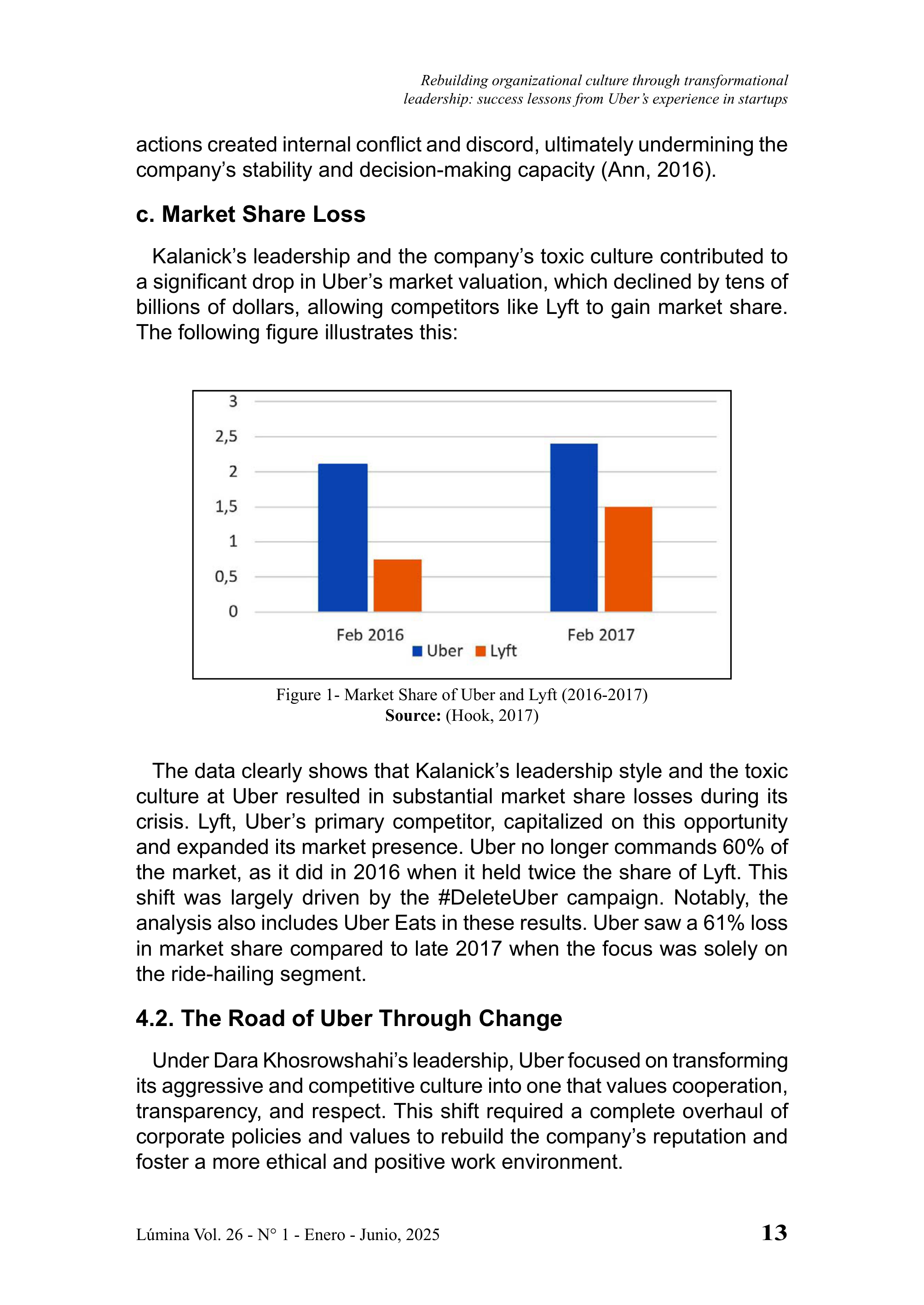
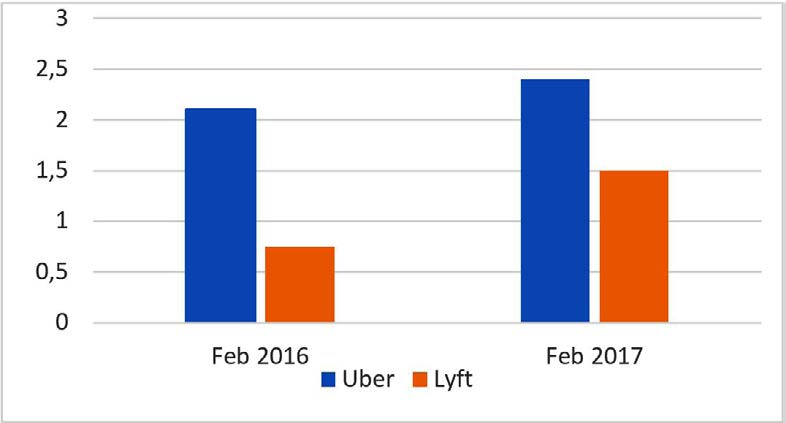
The following figure illustrates this:
Figure 1- Market Share of Uber and Lyft (2016-2017)
Source:
(Hook, 2017)
The data clearly shows that Kalanick’s leadership style and the toxic
culture at Uber resulted in substantial market share losses during its
crisis. Lyft, Uber’s primary competitor, capitalized on this opportunity
and expanded its market presence. Uber no longer commands 60% of
the market, as it did in 2016 when it held twice the share of Lyft. This
shift was largely driven by the #DeleteUber campaign. Notably, the
analysis also includes Uber Eats in these results. Uber saw a 61% loss
in market share compared to late 2017 when the focus was solely on
the ride-hailing segment.
4.2. The Road of Uber Through Change
Under Dara Khosrowshahi’s leadership, Uber focused on transforming
its aggressive and competitive culture into one that values cooperation,
transparency, and respect. This shift required a complete overhaul of
corporate policies and values to rebuild the company’s reputation and
foster a more ethical and positive work environment.
14
Lúmina Vol. 26 - N° 1 - Enero - Junio, 2025
Feriel-Boughaba H. - Ilhem B.
4.2.1 Planning: Uber’s Leadership Transformation Protocols
Following numerous controversies that severely damaged Uber’s
image and stunted its growth, the company hired an external audit
team to assess internal issues and recommend necessary changes.
The recommendations focused on four key areas: accountability, trust,
change, and tone at the top. Two of the most significant suggestions
included reviewing and redistributing Travis Kalanick’s responsibilities
and making changes to senior leadership.
a. Strengthening the Audit Committee
The board of directors took steps to expand the audit committee’s
size, role, and independence. By adding independent directors, Uber’s
audit committee improved. One of the audit committee’s key functions
is establishing a direct reporting line from the compliance department.
This structure ensures that compliance officers can report serious issues
related to harassment or regulatory compliance directly to the committee
without first going through management or the CEO.
b. Internal Controls as a Regulatory Force
Internal controls serve as early warning systems and safety measures.
While typically associated with financial and accounting responsibilities,
the most important controls related to culture and leadership include pol-
icies, monitoring procedures, and record-keeping. Developing a system
to track complaints within this framework, rather than relying on organi-
zational memory, will help identify repeat offenders (Belcher et al., 2018).
c. Reframing Cultural Values
Uber needed to realign its cultural principles to foster more positive
and inclusive behaviors. To achieve this, the company took several steps
(Holder , 2017, p. 4):
-
Clearly defining values in collaboration with a reputable organiza-
tion experienced in organizational change.
-
Embracing inclusive values that promote a collaborative environ-
ment, such as teamwork, mutual respect, diversity, and inclusion.
-
Reducing the total number of values and eliminating those that
justified negative behaviors, like “Let Builders Build” and “Always
Be Hustling.”
Lúmina Vol. 26 - N° 1 - Enero - Junio, 2025
15
Rebuilding organizational culture through transformational
leadership: success lessons from Uber’s experience in startups
-
Encouraging senior leaders to embody these values daily, promot-
ing a more collaborative and inclusive culture across Uber.
d. Focusing on Training to Manage
Behavioral and Cultural Shifts
Training was essential to help staff understand how to align their
decisions with the company’s new values. The training was targeted
at four key groups: interviewers, managers, HR, and senior leaders.
Senior leaders were given time and resources to be trained in (Belcher
et al., 2018, p. 9):
-
Modeling inclusive leadership and addressing implicit bias.
-
Creating a culture where employees feel heard and are free to
share ideas.
-
Developing essential management skills, including setting organi-
zational goals, leading teams effectively, implementing institutional
controls, and identifying and addressing problems with corporate
controls.
e. Modifications to Employee Policies and Practices
Uber revised its harassment and discrimination policies to make
clear that any behavior compromising the privacy or dignity of others
is unacceptable. Policies also required managers to notify HR imme-
diately of any known incidents of harassment or discrimination for fur-
ther investigation. These policies were designed to protect employees
from harassment by both coworkers and external parties. Additionally,
romantic or personal relationships between employees were prohib-
ited. The company also improved the performance review process to
ensure fairness, rebuild employee trust, and eliminate bias and abuse.
Flexible work arrangements were encouraged, allowing regular and
routine remote work to support employees with family or other outside
responsibilities (Holder , 2017, pp. 9-11).
f. Selecting and Retaining the Best
Employees to Strengthen Culture
Research indicates that companies with high-integrity cultures out-
perform those without. Hiring the right people is the first step, followed
by linking accountability and compensation at all organizational levels.
By tying the company’s values—such as diversity, inclusion, and ethical
16
Lúmina Vol. 26 - N° 1 - Enero - Junio, 2025
Feriel-Boughaba H. - Ilhem B.
business practices—to executive compensation, Uber ensured align-
ment with its new cultural goals (Belcher et al., 2018, p. 10).
4.3.1 Implementation: Transformational
Leadership of Dara Khosrowshahi
Dara Khosrowshahi was tasked with transforming Uber from a scan-
dal-ridden startup into a more conventional and ethical business, while
preserving the qualities that made it successful.
As a leader, he expressed empathy and emotion toward staff, offer-
ing them confidence that in times of fear or failure, he would be there
to support them—a crucial step in achieving great things. Unlike his
predecessor, Travis Kalanick, Khosrowshahi maintained a composed
demeanor and demonstrated respect for women. He remained focused,
took calculated risks, and consistently sought ways to simplify tasks
for employees, adhering to the KISS principle “(Keep It Simple, Stupid”
(Kumari & Sharma, 2019, pp. 12-13).
a. Cultural Modifications
Uber acknowledges that its values are intrinsically tied to its culture and
promotes these principles as part of its corporate identity (Huffington,
2017). Under Khosrowshahi, Uber replaced its old values with new ones
that rejected the previous toxic culture. The company’s current values
include (Uber Company, 2023):
-
Could You Get It
-
Trip Obsessed
-
Build with Heart
-
Stand for Safety
-
See the Forest and The Trees
-
One Uber
-
Great Minds Don’t Think Alike
-
Do the Right Thing
b. Organizational Structure
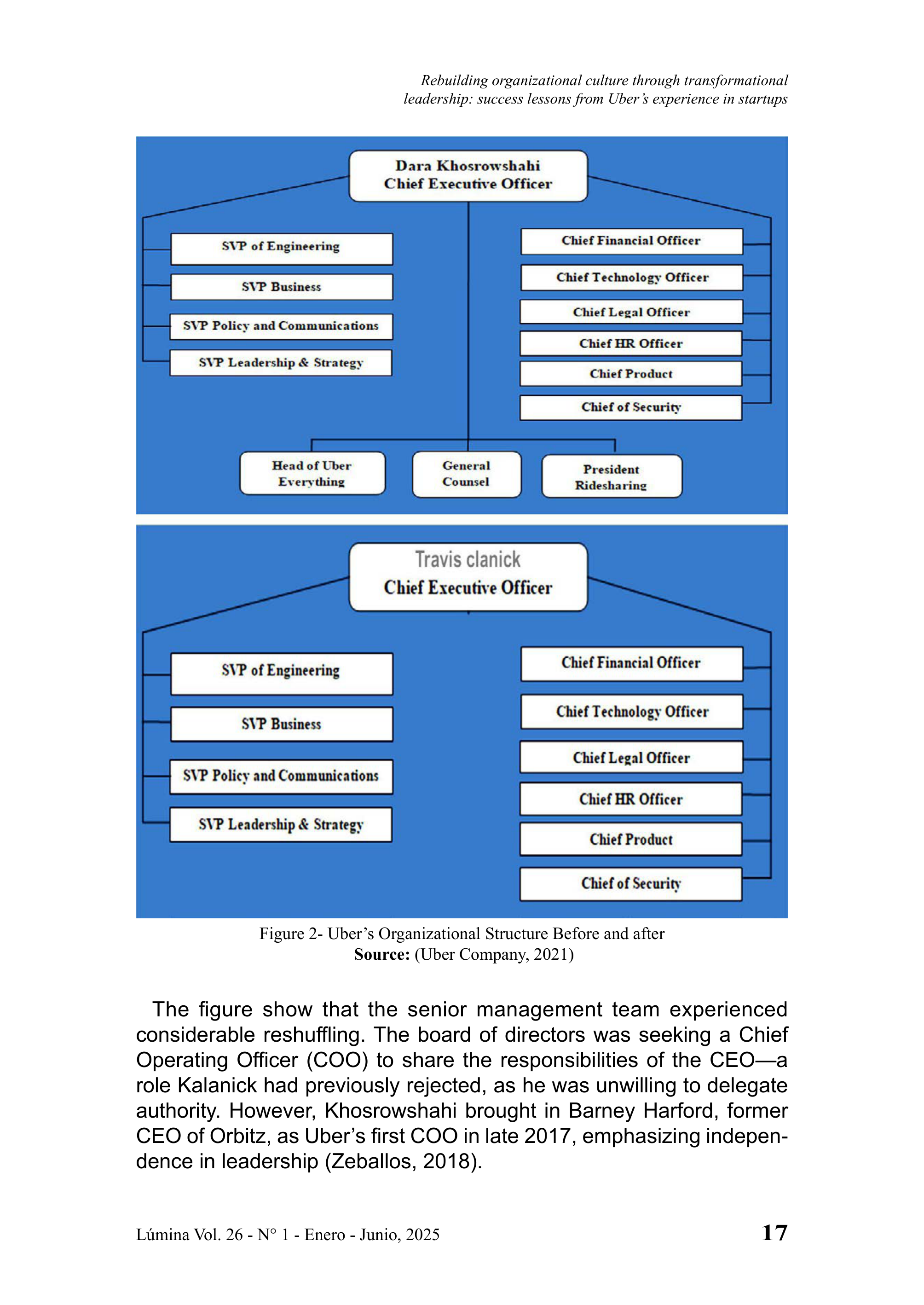
Significant changes to Uber’s organizational structure occurred after
Khosrowshahi became CEO.
Lúmina Vol. 26 - N° 1 - Enero - Junio, 2025
17
Rebuilding organizational culture through transformational
leadership: success lessons from Uber’s experience in startups
Figure 2- Uber’s Organizational Structure Before and after
Source:
(Uber Company, 2021)
The figure show that the senior management team experienced
considerable reshuffling. The board of directors was seeking a Chief
Operating Officer (COO) to share the responsibilities of the CEO—a
role Kalanick had previously rejected, as he was unwilling to delegate
authority. However, Khosrowshahi brought in Barney Harford, former
CEO of Orbitz, as Uber’s first COO in late 2017, emphasizing indepen-
dence in leadership (Zeballos, 2018).
18
Lúmina Vol. 26 - N° 1 - Enero - Junio, 2025
Feriel-Boughaba H. - Ilhem B.
c. Diversity and Inclusion
Khosrowshahi worked to improve female representation and promote
inclusion among employees from diverse national backgrounds.
•
Female Representation
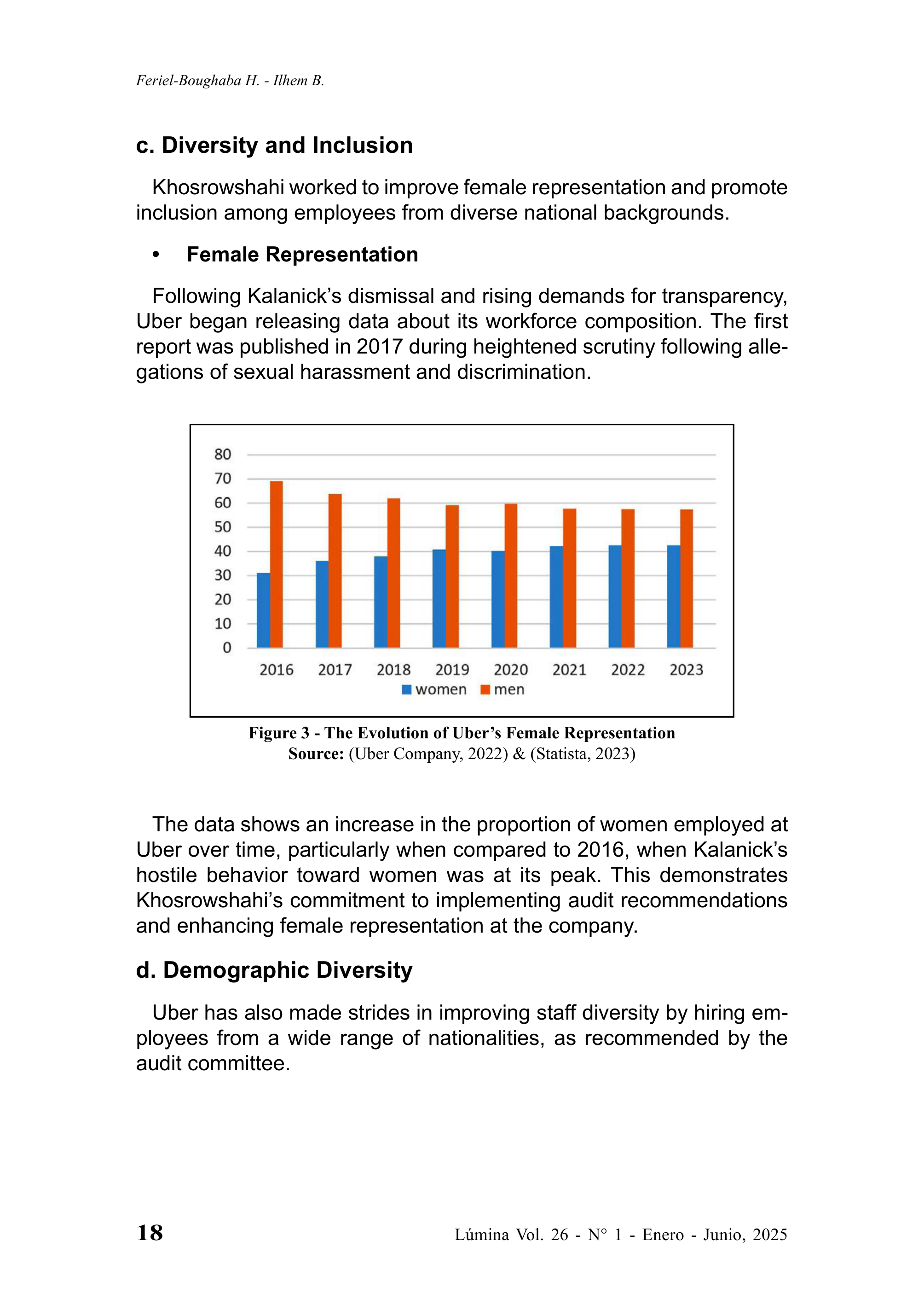
Following Kalanick’s dismissal and rising demands for transparency,
Uber began releasing data about its workforce composition. The first
report was published in 2017 during heightened scrutiny following alle-
gations of sexual harassment and discrimination.
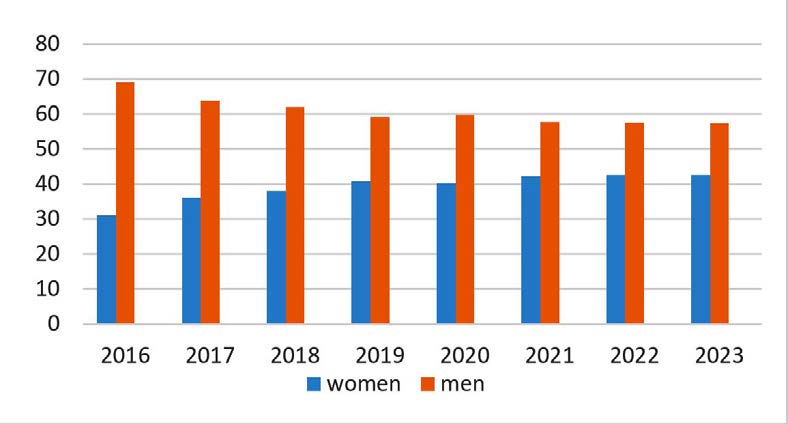
Figure 3 - The Evolution of Uber’s Female Representation
Source:
(Uber Company, 2022) & (Statista, 2023)
The data shows an increase in the proportion of women employed at
Uber over time, particularly when compared to 2016, when Kalanick’s
hostile behavior toward women was at its peak. This demonstrates
Khosrowshahi’s commitment to implementing audit recommendations
and enhancing female representation at the company.
d. Demographic Diversity
Uber has also made strides in improving staff diversity by hiring em-
ployees from a wide range of nationalities, as recommended by the
audit committee.
Lúmina Vol. 26 - N° 1 - Enero - Junio, 2025
19
Rebuilding organizational culture through transformational
leadership: success lessons from Uber’s experience in startups
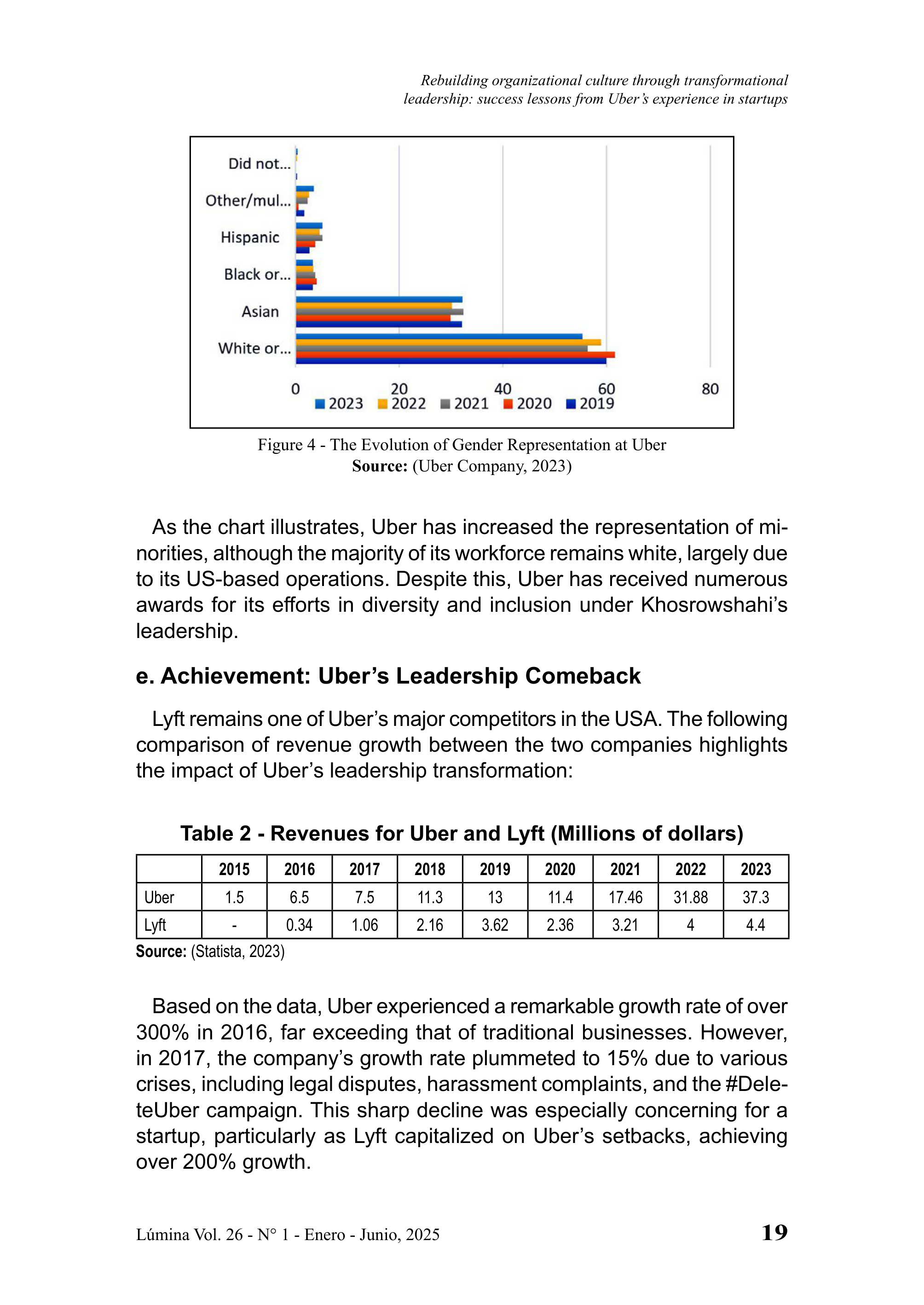
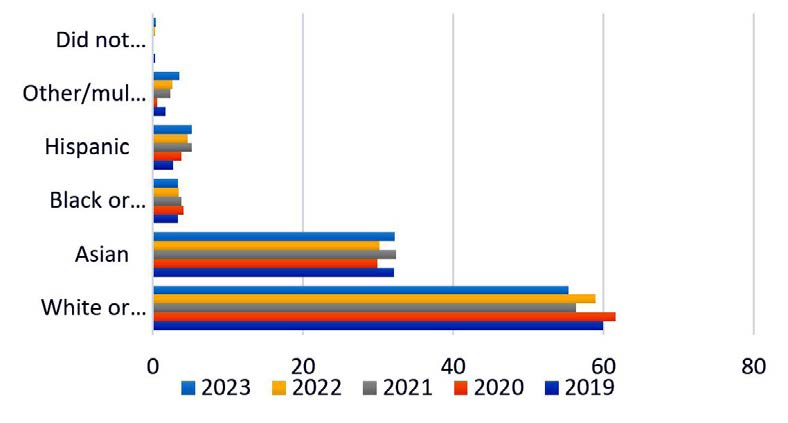
Figure 4 - The Evolution of Gender Representation at Uber
Source:
(Uber Company, 2023)
As the chart illustrates, Uber has increased the representation of mi-
norities, although the majority of its workforce remains white, largely due
to its US-based operations. Despite this, Uber has received numerous
awards for its efforts in diversity and inclusion under Khosrowshahi’s
leadership.
e. Achievement: Uber’s Leadership Comeback
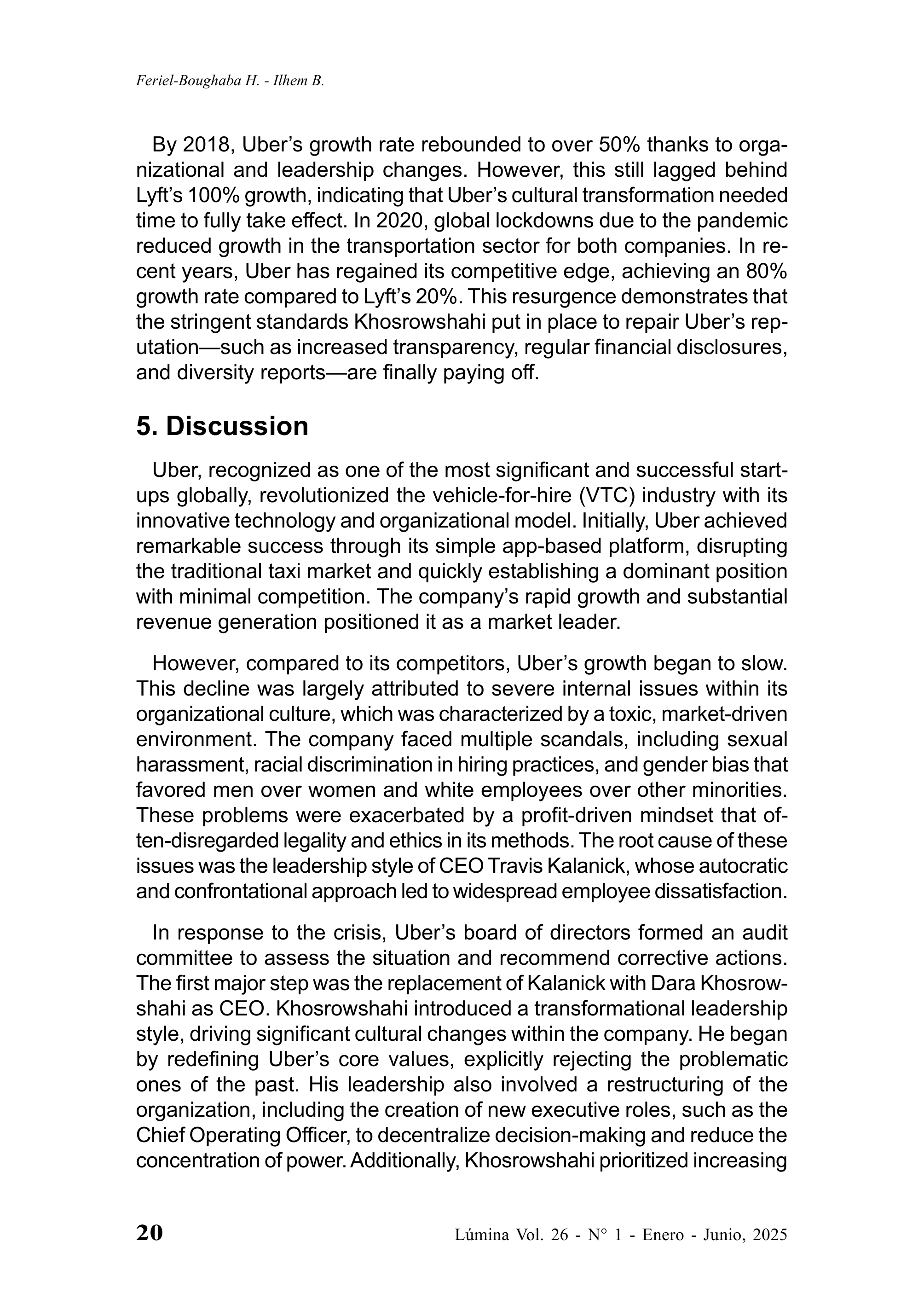
Lyft remains one of Uber’s major competitors in the USA. The following
comparison of revenue growth between the two companies highlights
the impact of Uber’s leadership transformation:
Table 2 - Revenues for Uber and Lyft (Millions of dollars)
2015
2016
2017
2018
2019
2020
2021
2022
2023
Uber
1.5
6.5
7.5
11.3
13
11.4
17.46
31.88
37.3
Lyft
-
0.34
1.06
2.16
3.62
2.36
3.21
4
4.4
Source:
(Statista, 2023)
Based on the data, Uber experienced a remarkable growth rate of over
300% in 2016, far exceeding that of traditional businesses. However,
in 2017, the company’s growth rate plummeted to 15% due to various
crises, including legal disputes, harassment complaints, and the #Dele-
teUber campaign. This sharp decline was especially concerning for a
startup, particularly as Lyft capitalized on Uber’s setbacks, achieving
over 200% growth.
20
Lúmina Vol. 26 - N° 1 - Enero - Junio, 2025
Feriel-Boughaba H. - Ilhem B.
By 2018, Uber’s growth rate rebounded to over 50% thanks to orga-
nizational and leadership changes. However, this still lagged behind
Lyft’s 100% growth, indicating that Uber’s cultural transformation needed
time to fully take effect. In 2020, global lockdowns due to the pandemic
reduced growth in the transportation sector for both companies. In re-
cent years, Uber has regained its competitive edge, achieving an 80%
growth rate compared to Lyft’s 20%. This resurgence demonstrates that
the stringent standards Khosrowshahi put in place to repair Uber’s rep-
utation—such as increased transparency, regular financial disclosures,
and diversity reports—are finally paying off.
5. Discussion
Uber, recognized as one of the most significant and successful start-
ups globally, revolutionized the vehicle-for-hire (VTC) industry with its
innovative technology and organizational model. Initially, Uber achieved
remarkable success through its simple app-based platform, disrupting
the traditional taxi market and quickly establishing a dominant position
with minimal competition. The company’s rapid growth and substantial
revenue generation positioned it as a market leader.
However, compared to its competitors, Uber’s growth began to slow.
This decline was largely attributed to severe internal issues within its
organizational culture, which was characterized by a toxic, market-driven
environment. The company faced multiple scandals, including sexual
harassment, racial discrimination in hiring practices, and gender bias that
favored men over women and white employees over other minorities.
These problems were exacerbated by a profit-driven mindset that of-
ten-disregarded legality and ethics in its methods. The root cause of these
issues was the leadership style of CEO Travis Kalanick, whose autocratic
and confrontational approach led to widespread employee dissatisfaction.
In response to the crisis, Uber’s board of directors formed an audit
committee to assess the situation and recommend corrective actions.
The first major step was the replacement of Kalanick with Dara Khosrow-
shahi as CEO. Khosrowshahi introduced a transformational leadership
style, driving significant cultural changes within the company. He began
by redefining Uber’s core values, explicitly rejecting the problematic
ones of the past. His leadership also involved a restructuring of the
organization, including the creation of new executive roles, such as the
Chief Operating Officer, to decentralize decision-making and reduce the
concentration of power. Additionally, Khosrowshahi prioritized increasing
Lúmina Vol. 26 - N° 1 - Enero - Junio, 2025
21
Rebuilding organizational culture through transformational
leadership: success lessons from Uber’s experience in startups
female representation and promoting demographic diversity, while also
emphasizing transparency through the publication of annual reports
detailing the company’s policies and financial performance.
Khosrowshahi’s leadership successfully restored Uber’s reputation
and reestablished its position in the market. The company’s recovery
highlights the crucial role that effective leadership and a positive orga-
nizational culture play in overcoming crises and achieving long-term
success. Transformational leadership, coupled with strategic cultural
reforms, proved essential for navigating challenges and regaining mar-
ket dominance.
Uber’s experience underscores the importance of addressing organi-
zational culture and leadership to ensure business success. Companies
must adapt their cultures to align with their missions, foster continuous
growth and education, and remain resilient in the face of change. By
learning from Uber’s journey, startups can improve their chances of
success and achieve sustainable growth.
9
Consequences of Autocratic Leadership: Travis Kalanick’s auto-
cratic leadership style significantly contributed to the creation of a
toxic organizational culture. This led to major scandals, including
instances of sexual harassment and racial discrimination, under-
mining both employee morale and the company’s reputation.
9
Cultural and Organizational Crisis: Uber encountered a profound
cultural and organizational crisis, stemming from a profit-driven
mentality that often overlooked legal and ethical standards. This
approach resulted in a damaging impact on the company’s brand
and overall performance.
9
The Critical Role of Transformational Leadership: Dara Khosrow-
shahi’s introduction of transformational leadership was pivotal in
reshaping Uber’s organizational culture. His leadership empha-
sized a redefinition of core values, greater inclusivity, and increased
transparency, all of which were instrumental in addressing the
company’s internal dysfunction.
9
Rebuilding Reputation and Trust: Through transformational leader-
ship, Uber was able to effectively restore its reputation and rebuild
trust among employees, customers, and investors. This shift not
only rejuvenated its public image but also solidified its position in
the competitive market.
22
Lúmina Vol. 26 - N° 1 - Enero - Junio, 2025
Feriel-Boughaba H. - Ilhem B.
9
Impact of Cultural Reforms on Organizational Success: The cul-
tural reforms implemented under Khosrowshahi’s leadership were
fundamental in transforming Uber’s internal environment. These
changes fostered a more positive workplace culture, contributing
to the company’s long-term sustainability and growth in a highly
competitive industry.
Based on the findings from the Uber study, here are some suggestions
that could help improve its cultural and organizational performance:
9
Startups should prioritize transparency in internal decision-making
and communication with stakeholders. This helps build trust and
provides employees and customers with a sense of security and
fairness.
9
Startups are encouraged to adopt a transformational leadership
style that focuses on changing organizational culture by motivating
employees toward creativity and innovation. This type of leader-
ship can improve team performance and create a healthy work
environment.
9
It is essential for companies to commit to promoting diversity and
inclusion within their teams. Improving the representation of women
and employees from different cultural backgrounds contributes to
better performance and reduces cultural biases.
9
Companies should focus on developing leadership skills among
their managers through training programs that aim to improve
leaders’ ability to adapt to cultural and administrative changes.
9
In the face of rapid changes in modern work environments, compa-
nies need the ability to adapt to cultural and structural challenges
continuously. This requires flexible strategies capable of managing
changes effectively.
9
Companies should ensure that their values and organizational
culture align with their strategic objectives. This will strengthen
the company’s reputation and promote long-term sustainability.
9
This includes creating an environment that allows employees to
freely express their opinions, offering emotional and professional
support, which helps increase employee satisfaction and produc-
tivity.
Lúmina Vol. 26 - N° 1 - Enero - Junio, 2025
23
Rebuilding organizational culture through transformational
leadership: success lessons from Uber’s experience in startups
During the process of writing the study on Uber, several limitations
were encountered Limited access to Uber’s internal reports and docu-
mentation made it challenging to gain a comprehensive understanding
of the company’s internal operations and decision-making processes.
The study relied heavily on publicly available data, such as financial
reports, news articles, and interviews, which may not provide a complete
picture. another limitation of the study was the reliance on documented
cases and reports to discuss issues such as toxic leadership and work-
place harassment, which may have been influenced by confidentiality
agreements or legal constraints, potentially excluding other significant
incidents.
6. Conclusion
Uber’s experience demonstrates that transformational leadership
is not merely a tool for managing change, but a foundation for re-
building organizational culture and fostering a healthy, sustainable
environment within companies. Through the leadership transformation
witnessed at Uber under Dara Khosrowshahi’s direction, it became
evident that the profound impact of leadership extends beyond rep-
utation recovery to include the promotion of transparency, inclusivity,
and equality within the workplace. The company proved that address-
ing cultural and organizational crises requires a strong commitment
to values and ethical principles that guide the organization toward
sustainable success.
From this experience, valuable lessons can be applied across many
other sectors, highlighting the importance of transformational leader-
ship as a key tool for driving innovation, enhancing sustainability, and
adapting to changes. Startups must understand that their growth is not
solely tied to revenue or market share but also to the strength of their
organizational culture, which can be the determining factor in overcoming
crises and achieving sustainable growth.
The future holds numerous challenges and opportunities in the field of
transformational leadership, especially with the rapid changes in modern
work environments. Companies should continue adopting strategies
that focus on developing a flexible organizational culture, while also
strengthening leadership training that aligns with contemporary values
and practices. Furthermore, learning from Uber’s journey can help start-
ups overcome their cultural and organizational obstacles, ensuring the
achievement of sustainable growth and a bright future.
24
Lúmina Vol. 26 - N° 1 - Enero - Junio, 2025
Feriel-Boughaba H. - Ilhem B.
This study opens up several future avenues that could contribute to a
deeper understanding of the role of transformational leadership in start-
ups and the business sector in general. Some of these avenues include:
9
The Effect of Transformational Leadership on Enhancing Diversity
and Inclusivity in Startups
9
Rebuilding Corporate Reputation After Cultural Crises: A Case
Study of Uber and the Impact of Transformational Leadership
9
The Role of Leadership in Shaping Work Culture and Developing
a Healthy Environment in Startups
9
Transformational Leadership in Addressing Organizational Chal-
lenges
9
Adaptive Leadership Strategies for Overcoming Organizational
Crises in Startups
9
The Impact of Transformational Leadership on Innovation
9
The Relationship Between Transformational Leadership and Em-
ployee Satisfaction
9
The Impact of Cultural Transformation on Sustainable Growth in
Tech Companies.
References
Abourida, M. A. (2019, 12). Organizational Culture and Leadership. Manchester,
Organizational Analysis DBA English, England: Organizational Analysis DBA
English.
Ann, C. (2016, 06 14). Industry Leaders Magazine. Retrieved from Uber Is In
Dire Need of Ethical Leadership:
https://www.industryleadersmagazine.com/uber-dire-need-ethical-leadership/
Huffington, A. (2017, 11 14). CNBC Make It. Retrieved from Uber’s new culture:
‘We do the right thing:
https://www.cnbc.com/2017/11/14/arianna-huffington-on-ubers-new-culture-
we-do-the-right-thing.html
Isaac, M. (2019). Super Pumped: The Battle for Uber. New York: W. W. Norton
& Company. Retrieved from
https://www.amazon.fr/Super-Pumped-Battle-Mike-Isaac/dp/0393652246
Kumari, A., & Sharma, S. (2019). Management Analysis of Uber. INDIA: Indian
Institute of Space Science and Technology.
https://doi.org/10.13140/RG.2.2.35129.93284
Lúmina Vol. 26 - N° 1 - Enero - Junio, 2025
25
Rebuilding organizational culture through transformational
leadership: success lessons from Uber’s experience in startups
Afiquah, A. (2022). Analysis of organizational culture in the public sector. the
journal of Management research and practice, 14(04).
Retrieved from https://www.researchgate.net/publication/366289001_Analysis_
of_Organizational_Culture_in_the_Public_Sector
Bass, B. (1985). Leadership And Performance Beyond Expectations. Free
Press. https://doi.org/10.1002/hrm.3930250310
Bastos, R. (2017, 08 14). Toxic Organizational Culture and lessons learned
from Uber. Retrieved from TARGET TEAL:
https://targetteal.com/en/blog/uber-organizational-culture/
Belcher, M., Edmond, K., & Yapchai, K. (2018). Lessons on Culture and
Leadership from Uber’s Ethics and Compliance Struggles. United States: ACC
DOCKET. Retrieved from https://www.coursehero.com/file/208265614/Lessons-
on-Culture-and-Leadership-from-Ubers-Ethics-and-Compliance-Strugglespdf/
Bernard, B. (1985). Leadership and Performance Beyond Expectations. New
York: Free Press. https://doi.org/10.1002/hrm.3930250310
Cameron, K., & Quinn, R. (1999). Diagnosing and changing organizational
culture: based on the competing values framework. The Jossey-Bass. Retrieved
from https://books.google.dz/books/about/Diagnosing_and_Changing_
Organizational_C.html?id=D6gWTf02RloC&redir_esc=y
Conger, K. (2019, 12 18). Uber Settles Federal Investigation Into Workplace
Culture. Retrieved from The New York Times:
https://www.nytimes.com/2019/12/18/technology/uber-settles-eeoc-
investigation-workplace-culture.html
Cook, j., O’Rourke, J., & Patel, R. (2018, 01). Uber Technologies, Inc.:
Accountability in Corporate Culture. Notre Dame, University of NOTRE DAME,
Mendoza College of Business, USA. https://doi.org/10.4135/9781526489067
Davis, J., & Thilagaraj, A. (2022). Transformational Leadership Theory – A
Critical Analysis with reference to Banking Sector. Webology journal, 19(02).
Retrieved from https://www.webology.org/data-cms/articles/20220129070707
pmID_19_2_15.pdf
Farnsworth, D., Clark, J., Hall, J., Johnson, S., Wysocki, A., & Kepner, K.
(2002). Transformational Leadership: The Transformation of Managers and
Associates. United States: ASKIFAS, University of Florida.
https://doi.org/10.32473/edis-hr020-2002
FINANCHILL. (2023, 07 19). Travis Kalanick Leadership Style. Retrieved from
FINANCHILL:
https://financhill.com/blog/investing/travis-kalanick-leadership-style
Goleman, D. (2010). Leadership That Gets Results. Retrieved from Harvard
Business Review: https://content.leadershipacademy.nhs.uk/aspce3/files/
Leadership_that_gets_results_goleman.pdf
26
Lúmina Vol. 26 - N° 1 - Enero - Junio, 2025
Feriel-Boughaba H. - Ilhem B.
Holder, E. (2017). Uber Report: Eric Holder’s Recommendations for Change.
California: Law firm Covington & Burling. Retrieved from
https://conferences.law.stanford.edu/vcs/wp-content/uploads/sites/11/2017/11/
Uber-Report.pdf
Hook, L. (2017, 03). Retrieved from Uber: the crisis inside the ‘cult of Travis’:
https://www.ft.com/content/9b65a59a-03e1-11e7-ace0-1ce02ef0def9
ISAAC, M. (2019). Super Pumped: The Battle For Uber. California: W.W.
Norton & Company. Retrieved from
https://www.amazon.com/Super-Pumped-Battle-Mike-Isaac/dp/0393652246
James, O., & Ogbonna, I. G. (2013). Transformational vs. Transactional
Leadership Theories: Evidence in Literature. International Review of
Management and Business Research, 02(02).
Retrieved from https://www.irmbrjournal.com/papers/1371451049.pdf
Karrarslan, M. H., & Soylu, N. (2023). Risk Factors in Start-Ups: An Evaluation.
research gate, 26(01). https://doi.org/10.29249/selcuksbmyd.1132338
Lassiter, B. (2017, 06 28). Lessons from Uber: Leadership Always Beats
Innovation. Retrieved from Performance-Excellence-Network:
https://performanceexcellencenetwork.org/pensights/lessons-uber-leadership-
always-beats-innovation/
Lynch, C. (2017, 04 02). William Paterson University. Retrieved from Uber
Case Analysis:
https://www.coursehero.com/file/58133837/346342814-case-study-uberdocx/
Moradi, K., & ShahbazI, H. (2006). An Analysis Of The Transformational
Leadership Theory. Journal of Fundamental and Applied Sciences, 08(03).
https://doi.org/10.4314/jfas.v8i3s.192
Pereira, D. (2023, 06 25). Companies Mission and Vision Statement. Retrieved
from The Business Model Analyst:
https://businessmodelanalyst.com/uber-mission-and-vision-statement/
Reid, M., & Dold, C. J. (2018). Burns, Senge, and the Study of Leadership.
Open Journal of Leadership, 07(01), 94-95.
https://doi.org/10.4236/ojl.2018.71006
Robins School of business. (2020, February). Robins School of business.
Retrieved from University of Ritchmond:
https://robins.richmond.edu/files/Robins-Case-Network/Uber.pdf
Sayyadi, M. G. (2021). transformational leadership: implementing a cultural
Approach in organisaions. The journal of Values-Based Leadership, 14(01).
https://doi.org/10.22543/0733.141.1340
Schein, E. (21010). Organizational Culture and Leadership, 4th Edition. Jossey-
Bass.

Lúmina Vol. 26 - N° 1 - Enero - Junio, 2025
27
Rebuilding organizational culture through transformational
leadership: success lessons from Uber’s experience in startups
Schein, E. H. (2010). Organizational Culture and Leadership. San Francisco:
Jossey-Bass. https://doi.org/978-0470190609
Shreya, M., Shereya, P., Shereya, S., & Goswami, Y. (2021). Uber:
#WhatDoYouDo? India: Indian Institute of Management Kozhikode. Retrieved
from https://www.coursehero.com/file/176295306/uber-case-studydocx/
Statista. (2023, 05 15). statista. Retrieved from Distribution of Uber’s employees
worldwide from 2017 to 2023, by gender:
https://www.statista.com/statistics/693807/uber-employee-gender-global/
Statista. (2023, 08 23). statista. Retrieved from Global net revenue of Uber
from 2013 to 2022:
https://www.statista.com/search/?q=Net+revenue+generated+by+Uber&Sear
ch=&p=1
Szarek, j., & Piecuch, j. (2018). The importance of startups for construction of
innovative economies. International Entrepreneurship, 04(02).
https://doi.org/10.15678/PM.2018.0402.05
Uber. (2023, 09 28). Uber.com. Retrieved from About Us:
https://www.uber.com/us/en/about/
Uber Company. (2021). Uber Technologies Inc. Report. usa: uber. Retrieved
from https://s23.q4cdn.com/407969754/files/doc_financials/2022/ar/2021-
Annual-Report.pdf
Uber Company. (2022). ESG Report 2022. USA: UBER.
Retrieved from https://www.responsibilityreports.com/HostedData/
ResponsibilityReportArchive/u/NYSE_UBER_2022.pdf
Uber Company. (2023, 09 27). Uber. Retrieved from Uber’s Cultural Norms:
https://www.uber.com/it/en/about/
Uber Company. (2023). Uber: Environmental, Social and Gouvernance
repport. USA: Uber. Retrieved from
https://s23.q4cdn.com/407969754/files/doc_downloads/2023/04/Uber-2023-
Environmental-Social-and-Governance-Report.pdf
Zeballos, D. (2018). UBER: fixing culture through transformation of the
oranizational structure. Germany: Berlin Professional School. Retrieved from
http://dx.doi.org/10.4135/9781526489067