


Poornaprajna International Journal of Teaching & Research Case
Studies (PIJTRCS),
ISSN: 3107-8494, Vol. 3, No. 1, January - June 2026
POORNAPRAJNA
PUBLICATION
Disha Devadiga, et al, (2026); www.poornaprajnapublication.com
PAGE 292
Architecting Intelligence: An Integrated
Framework Analysis of Jensen Huang's
Transformational Leadership at NVIDIA
Corporation
Disha Devadiga
1
& P. S. Aithal
2
1
MBA Scholar, Poornaprajna Institute of Management, Udupi - 576101, India,
ORCID iD: 0009-0004-5663-8457; Email:
disha.mbaa24@pim.ac.in
2
Professor, Poornaprajna Institute of Management, Udupi - 576101, India,
Orchid ID: 0000-0002-4691-8736; E-mail:
psaithal@gmail.com
Area/Section:
CEO Analysis.
Type of the Paper:
Qualitative
Exploratory Research.
Number of Peer Reviews:
Two.
Type of Review:
Peer Reviewed as per
|C|O|P|E|
guidance.
Indexed in:
OpenAIRE.
DOI:
https://doi.org/10.5281/zenodo.20390662
Google Scholar Citation:
PIJTRCS
Poornaprajna International Journal of Teaching & Research Case Studies (PIJTRCS)
A Refereed International Journal of Poornaprajna Publication, India.
ISSN: 3107-8494
Crossref DOI:
https://doi.org/10.64818/PIJTRCS.3107.8494.0047
Received on: 16/04/2026
Published on: 27/05/2026
© With Authors.
This work is licensed under a
Creative Commons Attribution-Non-Commercial 4.0
International License,
subject to proper citation to the publication source of the work.
Disclaimer:
The scholarly papers as reviewed and published by Poornaprajna Publication
(P.P.), India, are the views and opinions of their respective authors and are not the views or
opinions of the PP. The PP disclaims of any harm or loss caused due to the published content
to any party.
How to Cite this Paper:
Devadiga Disha. & Aithal, P. S. (2026).
Architecting Intelligence: An Integrated
Framework Analysis of Jensen Huang's Transformational Leadership at NVIDIA
Corporation.
Poornaprajna International Journal of Teaching & Research Case Studies
(PIJTRCS), 3
(1), 292-329. DOI:
https://doi.org/10.5281/zenodo.20390662


Poornaprajna International Journal of Teaching & Research Case
Studies (PIJTRCS),
ISSN: 3107-8494, Vol. 3, No. 1, January - June 2026
POORNAPRAJNA
PUBLICATION
Disha Devadiga, et al, (2026); www.poornaprajnapublication.com
PAGE 293
Architecting Intelligence: An Integrated Framework
Analysis of Jensen Huang's Transformational Leadership
at NVIDIA Corporation
Disha Devadiga
1
& P. S. Aithal
2
1
MBA Scholar, Poornaprajna Institute of Management, Udupi - 576101, India,
ORCID iD: 0009-0004-5663-8457; Email:
disha.mbaa24@pim.ac.in
2
Professor, Poornaprajna Institute of Management, Udupi - 576101, India,
Orchid ID: 0000-0002-4691-8736; E-mail:
psaithal@gmail.com
ABSTRACT
Purpose:
This research case study examines how Jensen Huang's leadership behavior,
strategic decision-making, and managerial orientation have shaped NVIDIA Corporation's
organizational performance and long-term technological sustainability. Structured analytical
frameworks including SWOC analysis, KPIs, ABCD analysis, and PESTLE analysis are
applied to evaluate the alignment between his executive vision and firm-level outcomes. The
study ultimately aims to generate evidence-informed strategic insights that advance scholarly
understanding of how founder-CEO transformational leadership drives sustained competitive
advantage in global technology corporations.
Methodology:
This study adopts an exploratory research design in which data gathered from
credible secondary sources including institutional websites, peer-reviewed literature accessed
through Google Scholar, and AI-assisted generative tools is systematically examined and
interpreted through a set of structured analytical frameworks selected in direct alignment with
the stated objectives of the paper.
Result/Analysis:
The research analysis confirms that Jensen Huang exemplifies the Super
Strategist quadrant of the CEO Matrix, demonstrating high leadership skills and financial
acumen across all ten CEO performance indicators. Structured analytical frameworks
including SWOC, ABCD, PESTLE, and KPI assessments collectively validate that his
transformational leadership and strategic vision are the primary drivers of NVIDIA's
extraordinary technological and financial growth. These findings affirm that Huang's
multidimensional executive effectiveness represents a compelling model of founder-CEO
leadership generating sustained competitive advantage.
Originality/Value:
This study offers original scholarly value by being among the first to apply
the newly developed CEO Matrix framework alongside SWOC, ABCD, PESTLE, and KPI
analytical tools in an integrated evaluation of Jensen Huang's executive leadership at NVIDIA
Corporation. The findings provide both academic and practitioner communities with a
structured, evidence-based understanding of how founder-CEO transformational leadership
drives sustained technological innovation and competitive dominance in global AI
infrastructure markets.
Type of Paper:
Qualitative Exploratory Case Study.
Keywords:
Jensen Huang, NVIDIA Corporation, CEO Analysis, Technology Leadership,
Artificial Intelligence, Digital Innovation, Organizational Performance, Strategic Management
1. INTRODUCTION :
1.1 About CEO Analysis:
In contemporary organizational research, the Chief Executive Officer (CEO) is widely acknowledged
as a critical determinant of firm strategy and performance. CEOs influence organizations through
strategic decision-making, leadership orientation, and the allocation of key resources, thereby shaping
long-term organizational outcomes. Empirical evidence demonstrates that CEOs account for a
significant proportion of variance in firm performance when compared to other top executives,


Poornaprajna International Journal of Teaching & Research Case
Studies (PIJTRCS),
ISSN: 3107-8494, Vol. 3, No. 1, January - June 2026
POORNAPRAJNA
PUBLICATION
Disha Devadiga, et al, (2026); www.poornaprajnapublication.com
PAGE 294
highlighting the distinct role of the CEO in organizational success (Bolinger et al. (2019). [1]). As firms
increasingly operate in complex and competitive environments, understanding the CEO’s role as a
strategic leader has become a central concern in management and governance research.
The contribution of a CEO extends beyond short-term financial results to include innovation, corporate
reputation, and sustainable growth. Research shows that CEO characteristics such as education,
ownership, and professional background significantly influence firm performance and strategic
orientation (Saidu (2019). [2]). Additionally, CEOs with proactive leadership traits are more likely to
foster innovation and improve organizational performance by anticipating environmental changes and
encouraging strategic flexibility (Kiss et al. (2022). [3]). These findings suggest that CEOs act not only
as decision-makers but also as catalysts who shape organizational capabilities and competitive
advantage through their personal attributes and leadership styles.
The impact of CEO leadership is also evident in non-financial outcomes, particularly in the areas of
corporate social responsibility (CSR) and innovation behaviour. Studies indicate that CEO influence
plays a decisive role in determining the extent and quality of CSR initiatives, as powerful CEOs can
align corporate objectives with broader social and ethical responsibilities (Gupta et al. (2020). [4]).
Moreover, psychological traits such as CEO overconfidence have been found to affect corporate
innovation outcomes, sometimes positively, by encouraging risk-taking and exploratory investments
(Li & Zhang (2022). [5]). These insights reinforce the view that CEO impact is multidimensional,
affecting both economic performance and societal engagement.
Theoretical explanations for CEO influence are commonly grounded in Upper Echelons Theory, which
posits that organizational outcomes reflect the values, experiences, and cognitive bases of top executives
(Hambrick & Mason (1984). [6]). From this perspective, observable CEO traits serve as proxies for
underlying cognitive processes that shape strategic decisions. Supporting this view, research has shown
that CEO personality traits influence top management team dynamics, which in turn affect firm
performance (Peterson et al. (2003). [7]). Furthermore, relational leadership exercised by CEOs has
been linked to improved innovation performance by fostering collaboration and strategic alignment
within leadership teams (Wang et al. (2022). [8]). These frameworks provide a strong theoretical basis
for analyzing CEOs as focal actors in organizational research.
Given the complexity and context-specific nature of CEO influence, this paper adopts an exploratory
research approach using a case study methodology to examine the contribution and impact of a CEO
within a single organizational setting. Exploratory research is particularly appropriate where existing
theory offers limited or fragmented explanations of leadership effects across different contexts (Agubata
(2024). [9]). Accordingly, this paper is structured as follows: the next section reviews relevant literature
on CEO characteristics and organizational outcomes; the methodology section outlines the case study
design and data sources; the findings section presents key insights from the analysis; (He, X., Si, Z., &
Xiao (2025). [10]) and the final section discusses theoretical and managerial implications while
identifying directions for future research. Through this structure, the study aims to contribute to the
growing body of scholarship on CEO leadership and firm performance.
1.2 About This Paper:
This paper presents a comprehensive CEO analysis of Jensen Huang, Founder and Chief Executive
Officer of NVIDIA Corporation, with the objective of understanding how executive leadership
influences technological innovation, organizational performance, and long-term strategic sustainability.
The study focuses on Huang’s role in steering NVIDIA’s evolution from a graphics hardware company
to a global leader in artificial intelligence, accelerated computing, and data-center solutions. By
applying structured analytical tools such as SWOC analysis, key performance indicators (KPIs), and
the ABCD framework, the paper evaluates the alignment between leadership vision and firm-level
outcomes. Prior leadership research emphasizes that strategic foresight and innovation-oriented
decision-making by CEOs are critical in technology-intensive industries characterized by rapid change
and uncertainty (Finkelstein et al. (2009). [11]; Ireland & Hitt (2005). [12]; Teece (2018). [13]).
The paper further examines Jensen Huang’s leadership style through established leadership and strategic
management theories, highlighting his emphasis on long-term research and development, ecosystem
creation, and platform-based innovation. NVIDIA’s sustained investments in GPU architecture, AI
software stacks, and developer communities are analyzed as outcomes of leadership-driven strategic
consistency. Empirical studies suggest that CEOs who prioritize innovation ecosystems and dynamic
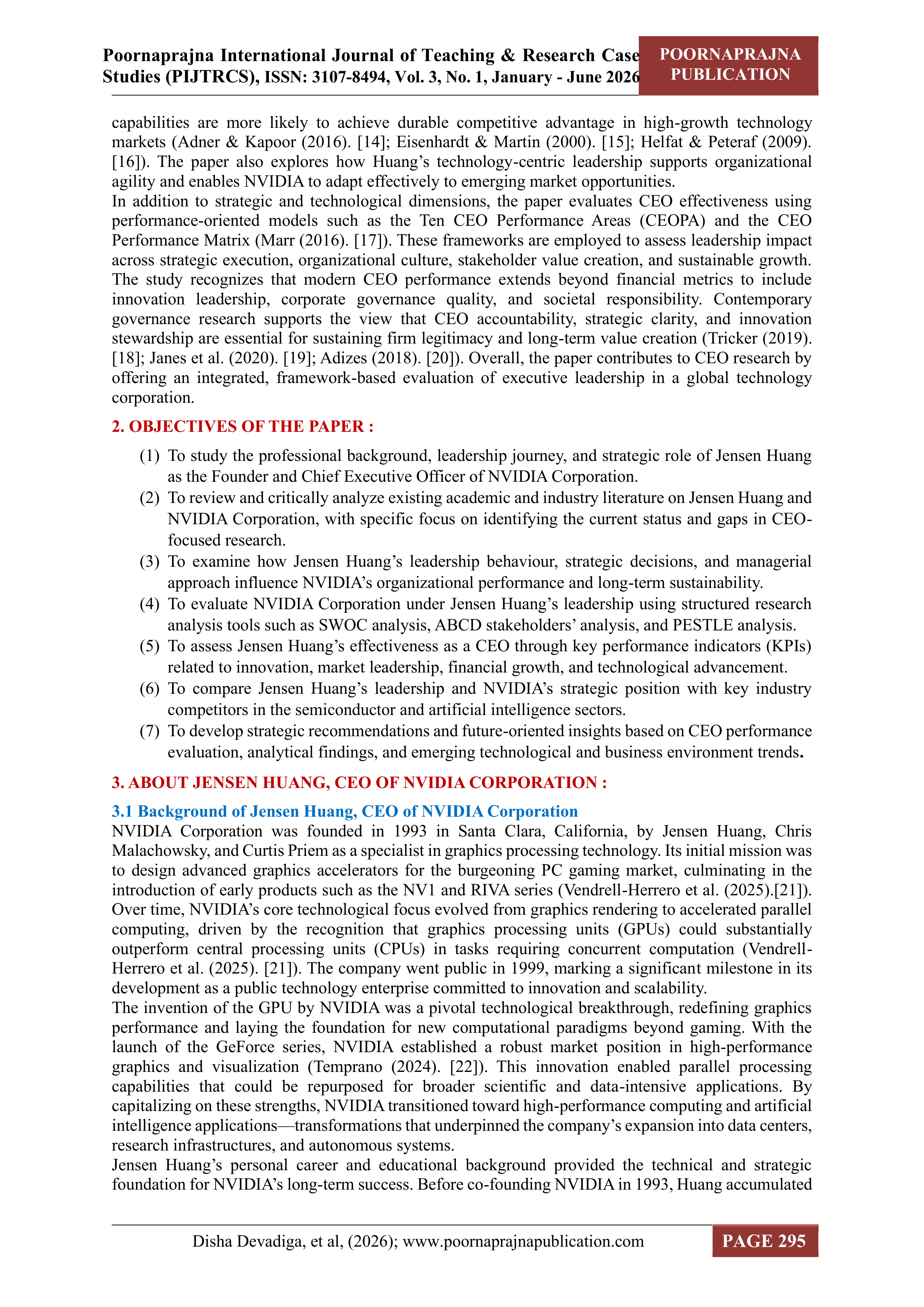


Poornaprajna International Journal of Teaching & Research Case
Studies (PIJTRCS),
ISSN: 3107-8494, Vol. 3, No. 1, January - June 2026
POORNAPRAJNA
PUBLICATION
Disha Devadiga, et al, (2026); www.poornaprajnapublication.com
PAGE 295
capabilities are more likely to achieve durable competitive advantage in high-growth technology
markets (Adner & Kapoor (2016). [14]; Eisenhardt & Martin (2000). [15]; Helfat & Peteraf (2009).
[16]). The paper also explores how Huang’s technology-centric leadership supports organizational
agility and enables NVIDIA to adapt effectively to emerging market opportunities.
In addition to strategic and technological dimensions, the paper evaluates CEO effectiveness using
performance-oriented models such as the Ten CEO Performance Areas (CEOPA) and the CEO
Performance Matrix (Marr (2016). [17]). These frameworks are employed to assess leadership impact
across strategic execution, organizational culture, stakeholder value creation, and sustainable growth.
The study recognizes that modern CEO performance extends beyond financial metrics to include
innovation leadership, corporate governance quality, and societal responsibility. Contemporary
governance research supports the view that CEO accountability, strategic clarity, and innovation
stewardship are essential for sustaining firm legitimacy and long-term value creation (Tricker (2019).
[18]; Janes et al. (2020). [19]; Adizes (2018). [20]). Overall, the paper contributes to CEO research by
offering an integrated, framework-based evaluation of executive leadership in a global technology
corporation.
2. OBJECTIVES OF THE PAPER :
(1)
To study the professional background, leadership journey, and strategic role of Jensen Huang
as the Founder and Chief Executive Officer of NVIDIA Corporation.
(2)
To review and critically analyze existing academic and industry literature on Jensen Huang and
NVIDIA Corporation, with specific focus on identifying the current status and gaps in CEO-
focused research.
(3)
To examine how Jensen Huang’s leadership behaviour, strategic decisions, and managerial
approach influence NVIDIA’s organizational performance and long-term sustainability.
(4)
To evaluate NVIDIA Corporation under Jensen Huang’s leadership using structured research
analysis tools such as SWOC analysis, ABCD stakeholders’ analysis, and PESTLE analysis.
(5)
To assess Jensen Huang’s effectiveness as a CEO through key performance indicators (KPIs)
related to innovation, market leadership, financial growth, and technological advancement.
(6)
To compare Jensen Huang’s leadership and NVIDIA’s strategic position with key industry
competitors in the semiconductor and artificial intelligence sectors.
(7)
To develop strategic recommendations and future-oriented insights based on CEO performance
evaluation, analytical findings, and emerging technological and business environment trends
.
3. ABOUT JENSEN HUANG, CEO OF NVIDIA CORPORATION :
3.1 Background of Jensen Huang, CEO of NVIDIA Corporation
NVIDIA Corporation was founded in 1993 in Santa Clara, California, by Jensen Huang, Chris
Malachowsky, and Curtis Priem as a specialist in graphics processing technology. Its initial mission was
to design advanced graphics accelerators for the burgeoning PC gaming market, culminating in the
introduction of early products such as the NV1 and RIVA series (Vendrell-Herrero et al. (2025).[21]).
Over time, NVIDIA’s core technological focus evolved from graphics rendering to accelerated parallel
computing, driven by the recognition that graphics processing units (GPUs) could substantially
outperform central processing units (CPUs) in tasks requiring concurrent computation (Vendrell-
Herrero et al. (2025). [21]). The company went public in 1999, marking a significant milestone in its
development as a public technology enterprise committed to innovation and scalability.
The invention of the GPU by NVIDIA was a pivotal technological breakthrough, redefining graphics
performance and laying the foundation for new computational paradigms beyond gaming. With the
launch of the GeForce series, NVIDIA established a robust market position in high-performance
graphics and visualization (Temprano (2024). [22]). This innovation enabled parallel processing
capabilities that could be repurposed for broader scientific and data-intensive applications. By
capitalizing on these strengths, NVIDIA transitioned toward high-performance computing and artificial
intelligence applications—transformations that underpinned the company’s expansion into data centers,
research infrastructures, and autonomous systems.
Jensen Huang’s personal career and educational background provided the technical and strategic
foundation for NVIDIA’s long-term success. Before co-founding NVIDIA in 1993, Huang accumulated
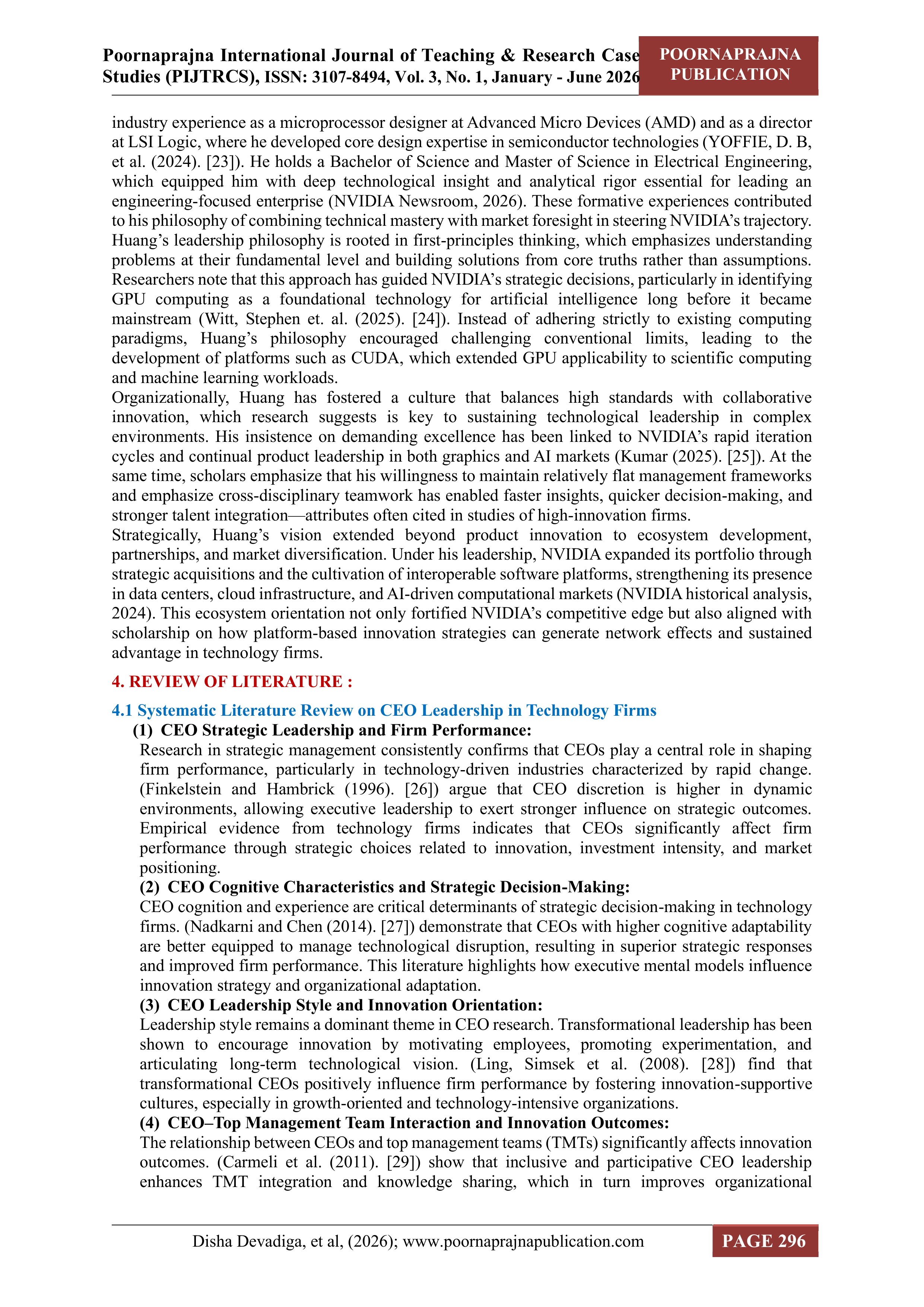


Poornaprajna International Journal of Teaching & Research Case
Studies (PIJTRCS),
ISSN: 3107-8494, Vol. 3, No. 1, January - June 2026
POORNAPRAJNA
PUBLICATION
Disha Devadiga, et al, (2026); www.poornaprajnapublication.com
PAGE 296
industry experience as a microprocessor designer at Advanced Micro Devices (AMD) and as a director
at LSI Logic, where he developed core design expertise in semiconductor technologies (YOFFIE, D. B,
et al. (2024). [23]). He holds a Bachelor of Science and Master of Science in Electrical Engineering,
which equipped him with deep technological insight and analytical rigor essential for leading an
engineering-focused enterprise (NVIDIA Newsroom, 2026). These formative experiences contributed
to his philosophy of combining technical mastery with market foresight in steering NVIDIA’s trajectory.
Huang’s leadership philosophy is rooted in first-principles thinking, which emphasizes understanding
problems at their fundamental level and building solutions from core truths rather than assumptions.
Researchers note that this approach has guided NVIDIA’s strategic decisions, particularly in identifying
GPU computing as a foundational technology for artificial intelligence long before it became
mainstream (Witt, Stephen et. al. (2025). [24]). Instead of adhering strictly to existing computing
paradigms, Huang’s philosophy encouraged challenging conventional limits, leading to the
development of platforms such as CUDA, which extended GPU applicability to scientific computing
and machine learning workloads.
Organizationally, Huang has fostered a culture that balances high standards with collaborative
innovation, which research suggests is key to sustaining technological leadership in complex
environments. His insistence on demanding excellence has been linked to NVIDIA’s rapid iteration
cycles and continual product leadership in both graphics and AI markets (Kumar (2025). [25]). At the
same time, scholars emphasize that his willingness to maintain relatively flat management frameworks
and emphasize cross-disciplinary teamwork has enabled faster insights, quicker decision-making, and
stronger talent integration—attributes often cited in studies of high-innovation firms.
Strategically, Huang’s vision extended beyond product innovation to ecosystem development,
partnerships, and market diversification. Under his leadership, NVIDIA expanded its portfolio through
strategic acquisitions and the cultivation of interoperable software platforms, strengthening its presence
in data centers, cloud infrastructure, and AI-driven computational markets (NVIDIA historical analysis,
2024). This ecosystem orientation not only fortified NVIDIA’s competitive edge but also aligned with
scholarship on how platform-based innovation strategies can generate network effects and sustained
advantage in technology firms.
4. REVIEW OF LITERATURE :
4.1 Systematic Literature Review on CEO Leadership in Technology Firms
(1)
CEO Strategic Leadership and Firm Performance:
Research in strategic management consistently confirms that CEOs play a central role in shaping
firm performance, particularly in technology-driven industries characterized by rapid change.
(Finkelstein and Hambrick (1996). [26]) argue that CEO discretion is higher in dynamic
environments, allowing executive leadership to exert stronger influence on strategic outcomes.
Empirical evidence from technology firms indicates that CEOs significantly affect firm
performance through strategic choices related to innovation, investment intensity, and market
positioning.
(2)
CEO Cognitive Characteristics and Strategic Decision-Making:
CEO cognition and experience are critical determinants of strategic decision-making in technology
firms. (Nadkarni and Chen (2014). [27]) demonstrate that CEOs with higher cognitive adaptability
are better equipped to manage technological disruption, resulting in superior strategic responses
and improved firm performance. This literature highlights how executive mental models influence
innovation strategy and organizational adaptation.
(3)
CEO Leadership Style and Innovation Orientation:
Leadership style remains a dominant theme in CEO research. Transformational leadership has been
shown to encourage innovation by motivating employees, promoting experimentation, and
articulating long-term technological vision. (Ling, Simsek et al. (2008). [28]) find that
transformational CEOs positively influence firm performance by fostering innovation-supportive
cultures, especially in growth-oriented and technology-intensive organizations.
(4)
CEO–Top Management Team Interaction and Innovation Outcomes:
The relationship between CEOs and top management teams (TMTs) significantly affects innovation
outcomes. (Carmeli et al. (2011). [29]) show that inclusive and participative CEO leadership
enhances TMT integration and knowledge sharing, which in turn improves organizational
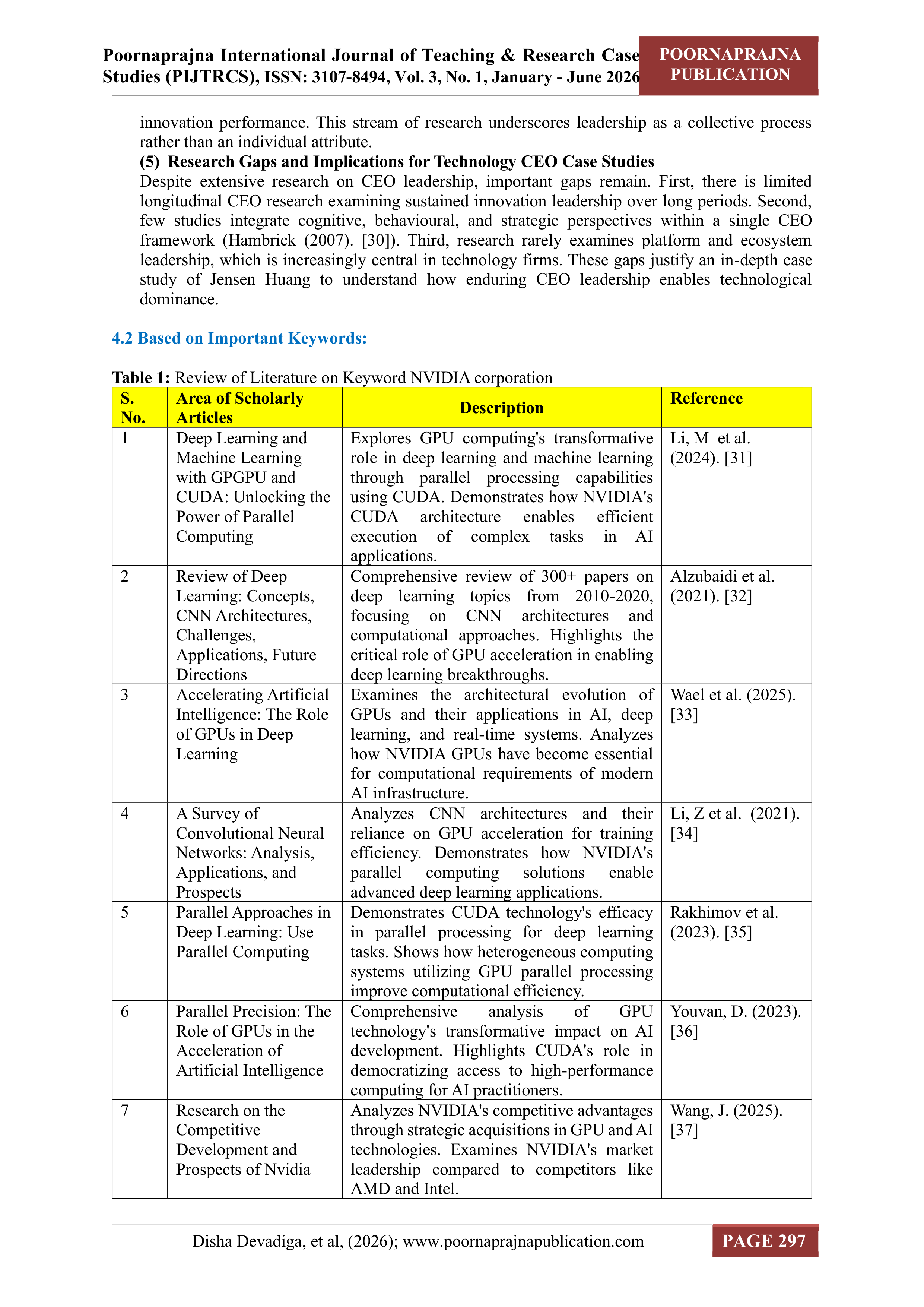


Poornaprajna International Journal of Teaching & Research Case
Studies (PIJTRCS),
ISSN: 3107-8494, Vol. 3, No. 1, January - June 2026
POORNAPRAJNA
PUBLICATION
Disha Devadiga, et al, (2026); www.poornaprajnapublication.com
PAGE 297
innovation performance. This stream of research underscores leadership as a collective process
rather than an individual attribute.
(5)
Research Gaps and Implications for Technology CEO Case Studies
Despite extensive research on CEO leadership, important gaps remain. First, there is limited
longitudinal CEO research examining sustained innovation leadership over long periods. Second,
few studies integrate cognitive, behavioural, and strategic perspectives within a single CEO
framework (Hambrick (2007). [30]). Third, research rarely examines platform and ecosystem
leadership, which is increasingly central in technology firms. These gaps justify an in-depth case
study of Jensen Huang to understand how enduring CEO leadership enables technological
dominance.
4.2 Based on Important Keywords:
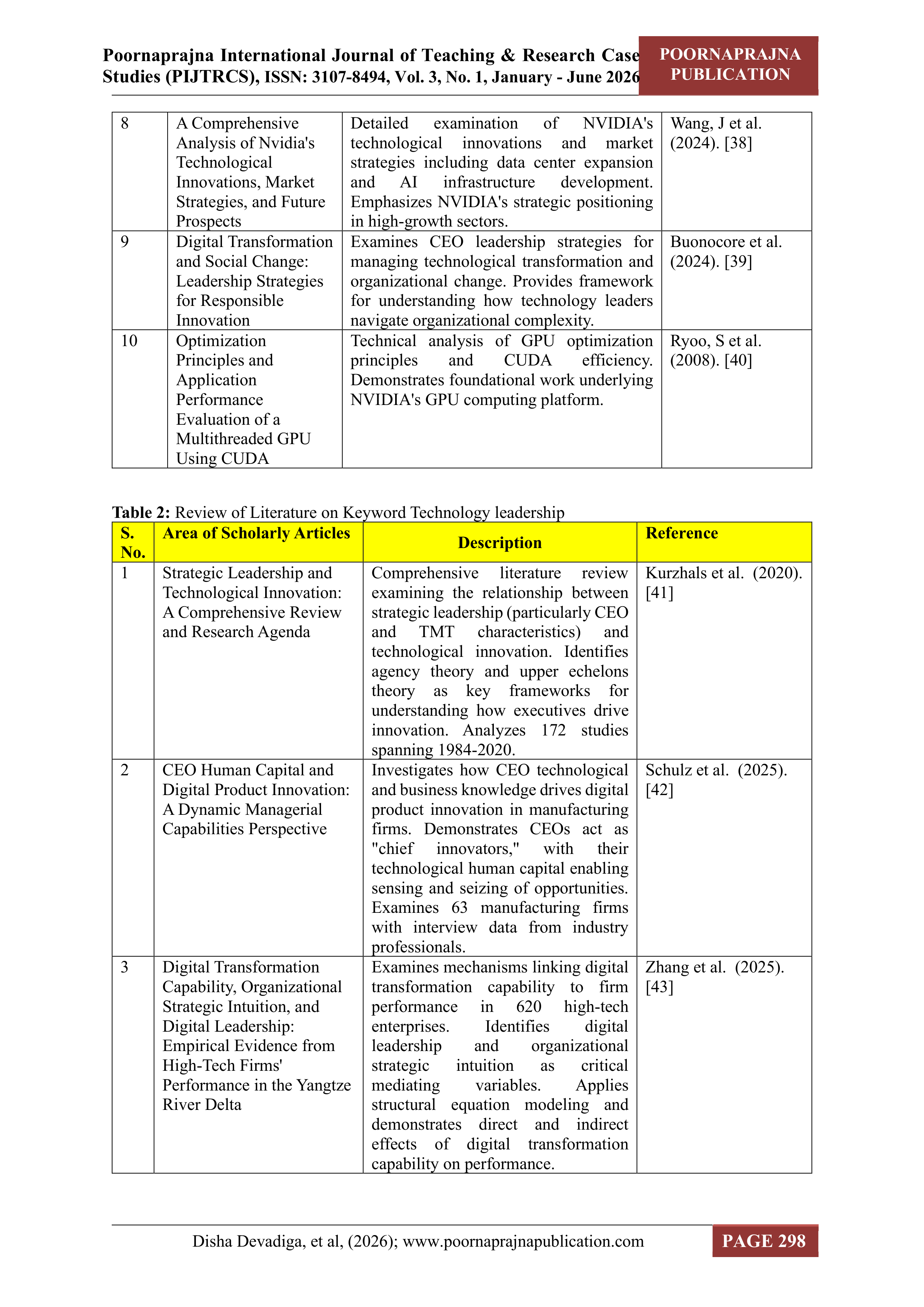
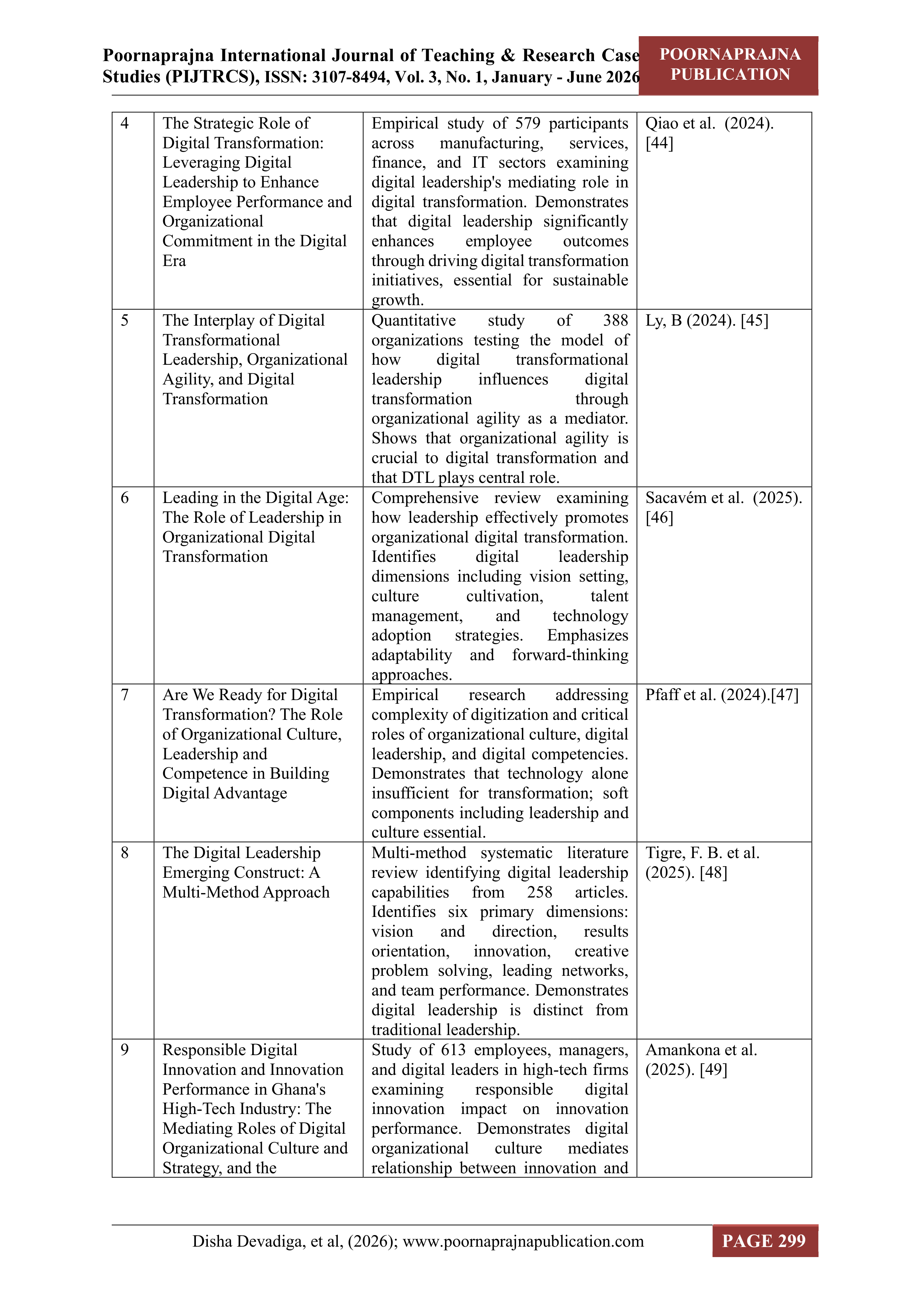
Table 1:
Review of Literature on Keyword NVIDIA corporation
S.
No.
Area of Scholarly
Articles
Description
Reference
1
Deep Learning and
Machine Learning
with GPGPU and
CUDA: Unlocking the
Power of Parallel
Computing
Explores GPU computing's transformative
role in deep learning and machine learning
through parallel processing capabilities
using CUDA. Demonstrates how NVIDIA's
CUDA
architecture
enables
efficient
execution
of
complex
tasks
in
AI
applications.
Li, M et al.
(2024). [31]
2
Review of Deep
Learning: Concepts,
CNN Architectures,
Challenges,
Applications, Future
Directions
Comprehensive review of 300+ papers on
deep learning topics from 2010-2020,
focusing
on
CNN
architectures
and
computational approaches. Highlights the
critical role of GPU acceleration in enabling
deep learning breakthroughs.
Alzubaidi et al.
(2021). [32]
3
Accelerating Artificial
Intelligence: The Role
of GPUs in Deep
Learning
Examines the architectural evolution of
GPUs and their applications in AI, deep
learning, and real-time systems. Analyzes
how NVIDIA GPUs have become essential
for computational requirements of modern
AI infrastructure.
Wael et al. (2025).
[33]
4
A Survey of
Convolutional Neural
Networks: Analysis,
Applications, and
Prospects
Analyzes CNN architectures and their
reliance on GPU acceleration for training
efficiency. Demonstrates how NVIDIA's
parallel
computing
solutions
enable
advanced deep learning applications.
Li, Z et al. (2021).
[34]
5
Parallel Approaches in
Deep Learning: Use
Parallel Computing
Demonstrates CUDA technology's efficacy
in parallel processing for deep learning
tasks. Shows how heterogeneous computing
systems utilizing GPU parallel processing
improve computational efficiency.
Rakhimov et al.
(2023). [35]
6
Parallel Precision: The
Role of GPUs in the
Acceleration of
Artificial Intelligence
Comprehensive
analysis
of
GPU
technology's transformative impact on AI
development. Highlights CUDA's role in
democratizing access to high-performance
computing for AI practitioners.
Youvan, D. (2023).
[36]
7
Research on the
Competitive
Development and
Prospects of Nvidia
Analyzes NVIDIA's competitive advantages
through strategic acquisitions in GPU and AI
technologies. Examines NVIDIA's market
leadership compared to competitors like
AMD and Intel.
Wang, J. (2025).
[37]


Poornaprajna International Journal of Teaching & Research Case
Studies (PIJTRCS),
ISSN: 3107-8494, Vol. 3, No. 1, January - June 2026
POORNAPRAJNA
PUBLICATION
Disha Devadiga, et al, (2026); www.poornaprajnapublication.com
PAGE 298
8
A Comprehensive
Analysis of Nvidia's
Technological
Innovations, Market
Strategies, and Future
Prospects
Detailed
examination
of
NVIDIA's
technological
innovations
and
market
strategies including data center expansion
and
AI
infrastructure
development.
Emphasizes NVIDIA's strategic positioning
in high-growth sectors.
Wang, J et al.
(2024). [38]
9
Digital Transformation
and Social Change:
Leadership Strategies
for Responsible
Innovation
Examines CEO leadership strategies for
managing technological transformation and
organizational change. Provides framework
for understanding how technology leaders
navigate organizational complexity.
Buonocore et al.
(2024). [39]
10
Optimization
Principles and
Application
Performance
Evaluation of a
Multithreaded GPU
Using CUDA
Technical analysis of GPU optimization
principles
and
CUDA
efficiency.
Demonstrates foundational work underlying
NVIDIA's GPU computing platform.
Ryoo, S et al.
(2008). [40]
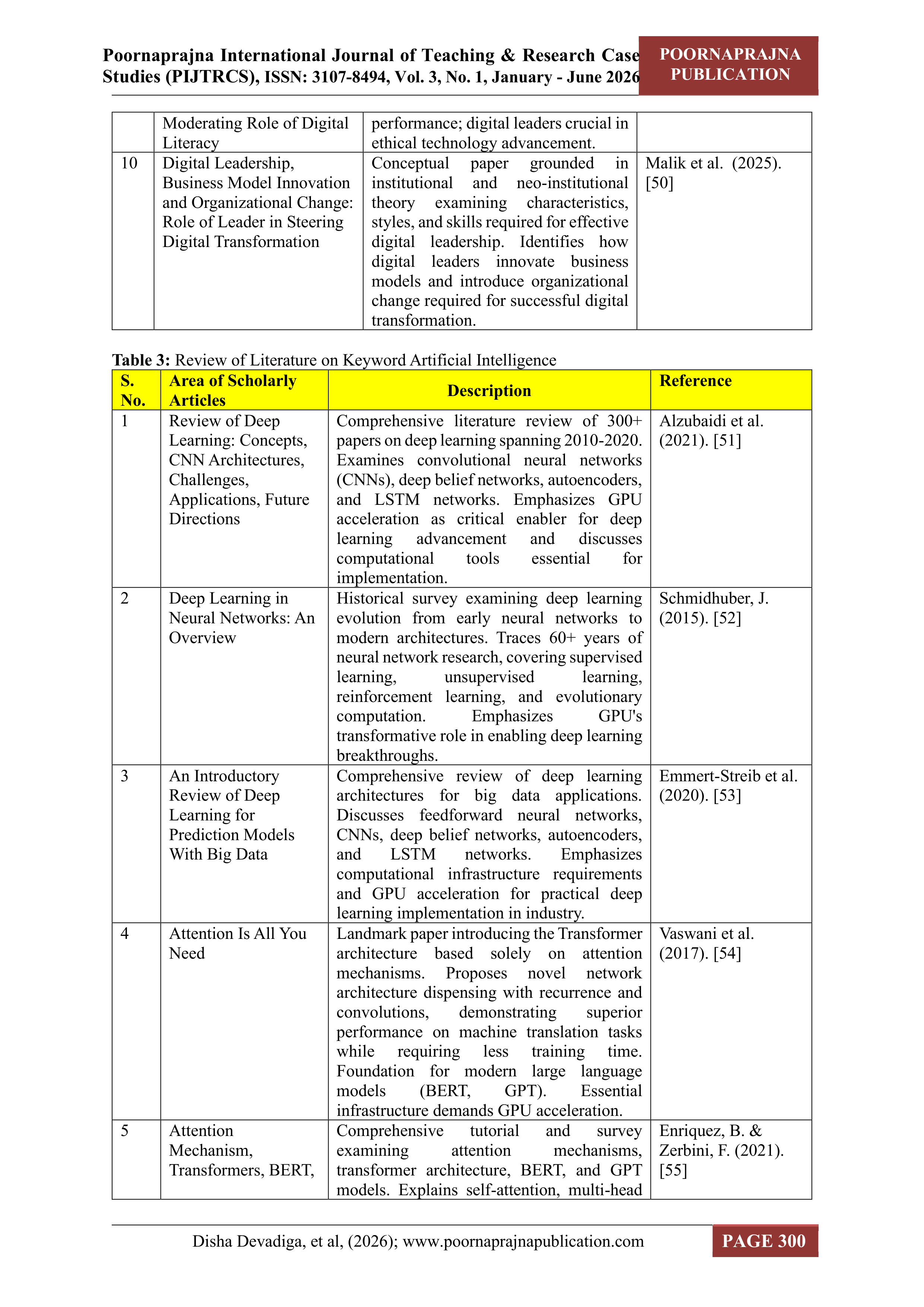
Table 2:
Review of Literature on Keyword Technology leadership
S.
No.
Area of Scholarly Articles
Description
Reference
1
Strategic Leadership and
Technological Innovation:
A Comprehensive Review
and Research Agenda
Comprehensive
literature
review
examining the relationship between
strategic leadership (particularly CEO
and
TMT
characteristics)
and
technological innovation. Identifies
agency theory and upper echelons
theory
as
key
frameworks
for
understanding how executives drive
innovation. Analyzes 172 studies
spanning 1984-2020.
Kurzhals et al. (2020).
[41]
2
CEO Human Capital and
Digital Product Innovation:
A Dynamic Managerial
Capabilities Perspective
Investigates how CEO technological
and business knowledge drives digital
product innovation in manufacturing
firms. Demonstrates CEOs act as
"chief
innovators,"
with
their
technological human capital enabling
sensing and seizing of opportunities.
Examines 63 manufacturing firms
with interview data from industry
professionals.
Schulz et al. (2025).
[42]
3
Digital Transformation
Capability, Organizational
Strategic Intuition, and
Digital Leadership:
Empirical Evidence from
High-Tech Firms'
Performance in the Yangtze
River Delta
Examines mechanisms linking digital
transformation capability to firm
performance
in
620
high-tech
enterprises.
Identifies
digital
leadership
and
organizational
strategic
intuition
as
critical
mediating
variables.
Applies
structural equation modeling and
demonstrates direct and indirect
effects of digital transformation
capability on performance.
Zhang et al. (2025).
[43]


Poornaprajna International Journal of Teaching & Research Case
Studies (PIJTRCS),
ISSN: 3107-8494, Vol. 3, No. 1, January - June 2026
POORNAPRAJNA
PUBLICATION
Disha Devadiga, et al, (2026); www.poornaprajnapublication.com
PAGE 299
4
The Strategic Role of
Digital Transformation:
Leveraging Digital
Leadership to Enhance
Employee Performance and
Organizational
Commitment in the Digital
Era
Empirical study of 579 participants
across
manufacturing,
services,
finance, and IT sectors examining
digital leadership's mediating role in
digital transformation. Demonstrates
that digital leadership significantly
enhances
employee
outcomes
through driving digital transformation
initiatives, essential for sustainable
growth.
Qiao et al. (2024).
[44]
5
The Interplay of Digital
Transformational
Leadership, Organizational
Agility, and Digital
Transformation
Quantitative
study
of
388
organizations testing the model of
how
digital
transformational
leadership
influences
digital
transformation
through
organizational agility as a mediator.
Shows that organizational agility is
crucial to digital transformation and
that DTL plays central role.
Ly, B (2024). [45]
6
Leading in the Digital Age:
The Role of Leadership in
Organizational Digital
Transformation
Comprehensive review examining
how leadership effectively promotes
organizational digital transformation.
Identifies
digital
leadership
dimensions including vision setting,
culture
cultivation,
talent
management,
and
technology
adoption
strategies.
Emphasizes
adaptability and forward-thinking
approaches.
Sacavém et al. (2025).
[46]
7
Are We Ready for Digital
Transformation? The Role
of Organizational Culture,
Leadership and
Competence in Building
Digital Advantage
Empirical
research
addressing
complexity of digitization and critical
roles of organizational culture, digital
leadership, and digital competencies.
Demonstrates that technology alone
insufficient for transformation; soft
components including leadership and
culture essential.
Pfaff et al. (2024).[47]
8
The Digital Leadership
Emerging Construct: A
Multi-Method Approach
Multi-method systematic literature
review identifying digital leadership
capabilities
from
258
articles.
Identifies six primary dimensions:
vision
and
direction,
results
orientation,
innovation,
creative
problem solving, leading networks,
and team performance. Demonstrates
digital leadership is distinct from
traditional leadership.
Tigre, F. B. et al.
(2025). [48]
9
Responsible Digital
Innovation and Innovation
Performance in Ghana's
High-Tech Industry: The
Mediating Roles of Digital
Organizational Culture and
Strategy, and the
Study of 613 employees, managers,
and digital leaders in high-tech firms
examining
responsible
digital
innovation impact on innovation
performance. Demonstrates digital
organizational
culture
mediates
relationship between innovation and
Amankona et al.
(2025). [49]


Poornaprajna International Journal of Teaching & Research Case
Studies (PIJTRCS),
ISSN: 3107-8494, Vol. 3, No. 1, January - June 2026
POORNAPRAJNA
PUBLICATION
Disha Devadiga, et al, (2026); www.poornaprajnapublication.com
PAGE 300
Moderating Role of Digital
Literacy
performance; digital leaders crucial in
ethical technology advancement.
10
Digital Leadership,
Business Model Innovation
and Organizational Change:
Role of Leader in Steering
Digital Transformation
Conceptual
paper
grounded
in
institutional
and
neo-institutional
theory
examining
characteristics,
styles, and skills required for effective
digital leadership. Identifies how
digital leaders innovate business
models and introduce organizational
change required for successful digital
transformation.
Malik et al. (2025).
[50]
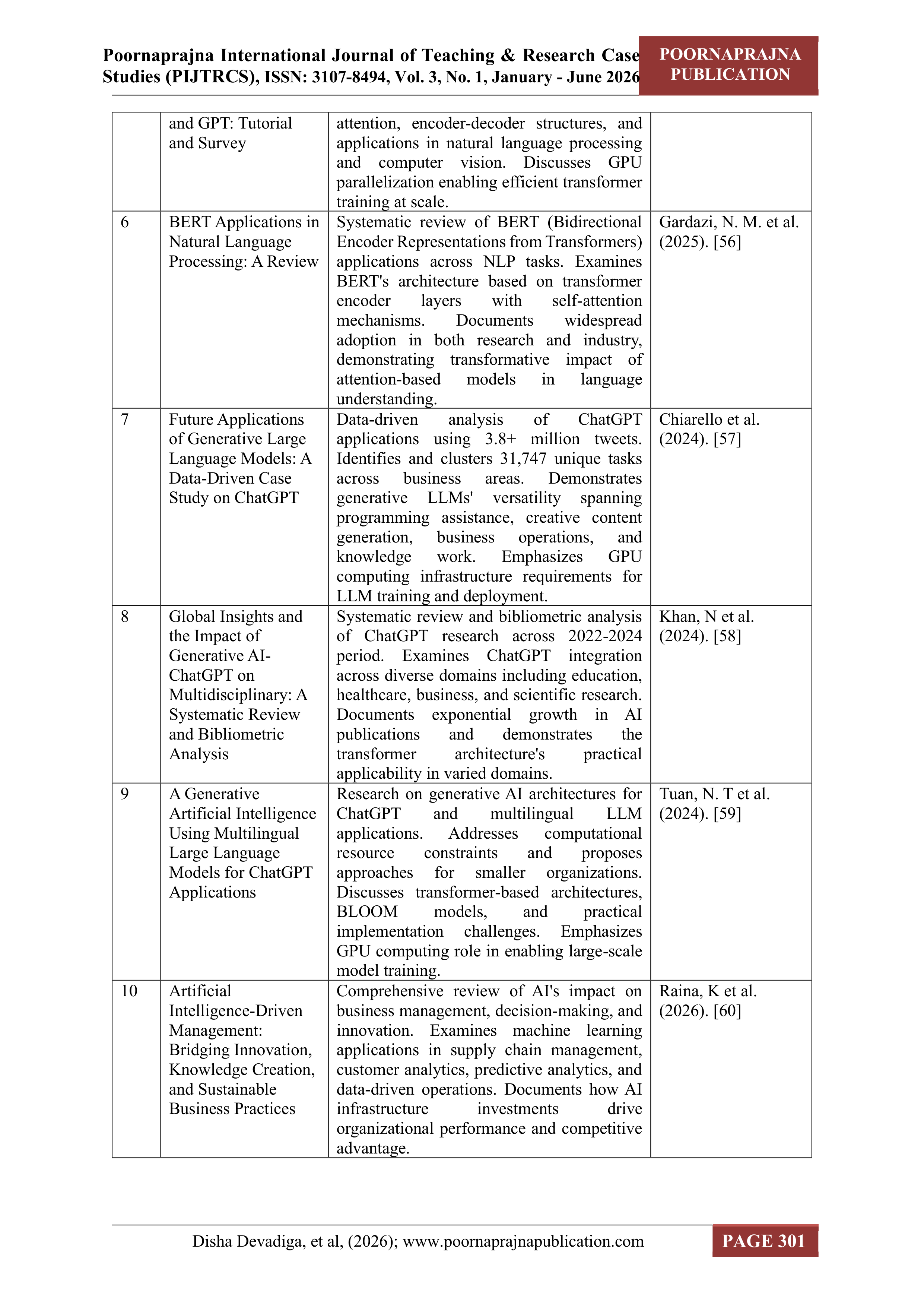
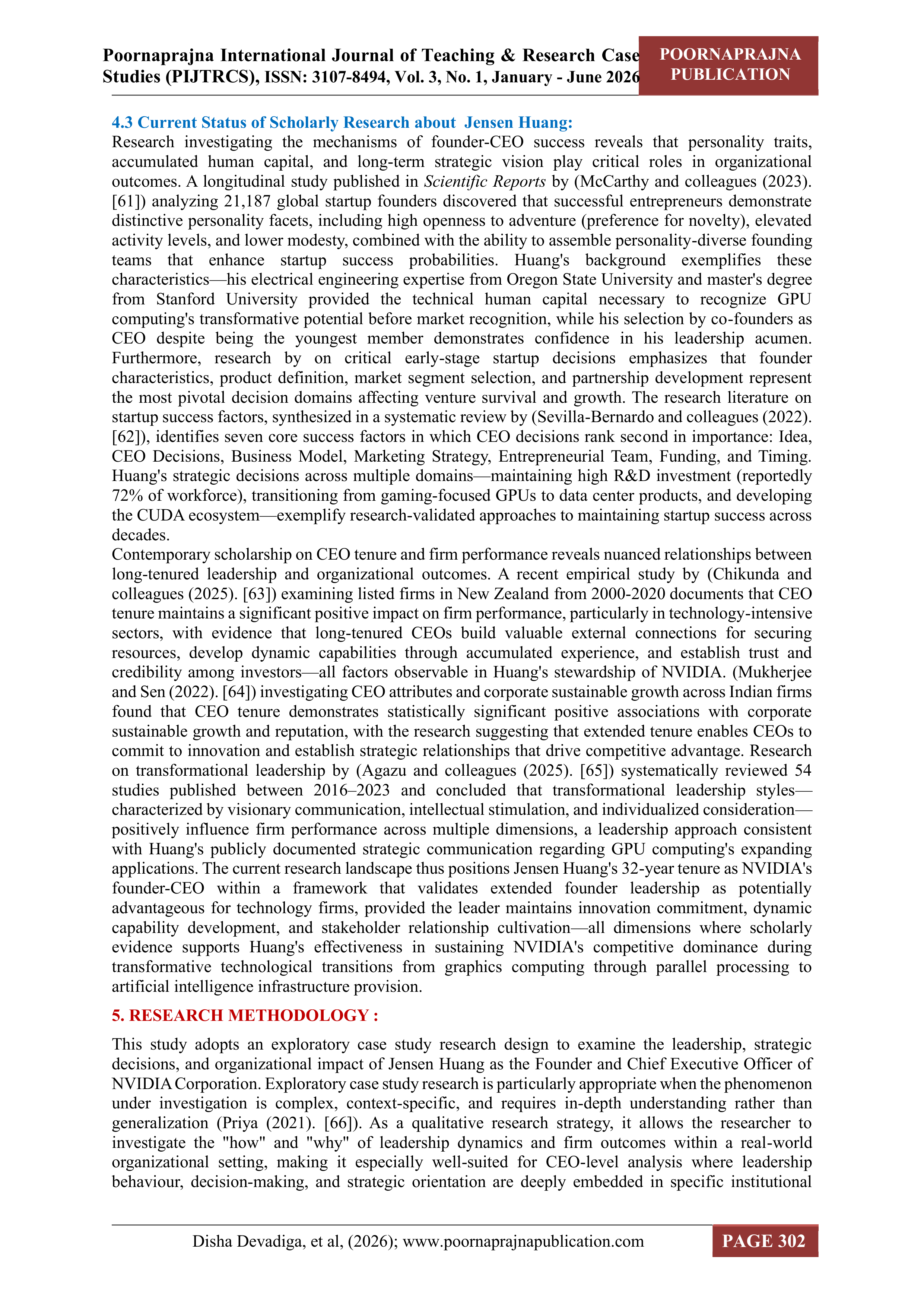
Table 3:
Review of Literature on Keyword Artificial Intelligence
S.
No.
Area of Scholarly
Articles
Description
Reference
1
Review of Deep
Learning: Concepts,
CNN Architectures,
Challenges,
Applications, Future
Directions
Comprehensive literature review of 300+
papers on deep learning spanning 2010-2020.
Examines convolutional neural networks
(CNNs), deep belief networks, autoencoders,
and LSTM networks. Emphasizes GPU
acceleration as critical enabler for deep
learning
advancement
and
discusses
computational
tools
essential
for
implementation.
Alzubaidi et al.
(2021). [51]
2
Deep Learning in
Neural Networks: An
Overview
Historical survey examining deep learning
evolution from early neural networks to
modern architectures. Traces 60+ years of
neural network research, covering supervised
learning,
unsupervised
learning,
reinforcement learning, and evolutionary
computation.
Emphasizes
GPU's
transformative role in enabling deep learning
breakthroughs.
Schmidhuber, J.
(2015). [52]
3
An Introductory
Review of Deep
Learning for
Prediction Models
With Big Data
Comprehensive review of deep learning
architectures for big data applications.
Discusses feedforward neural networks,
CNNs, deep belief networks, autoencoders,
and
LSTM
networks.
Emphasizes
computational infrastructure requirements
and GPU acceleration for practical deep
learning implementation in industry.
Emmert-Streib et al.
(2020). [53]
4
Attention Is All You
Need
Landmark paper introducing the Transformer
architecture based solely on attention
mechanisms.
Proposes
novel
network
architecture dispensing with recurrence and
convolutions,
demonstrating
superior
performance on machine translation tasks
while
requiring
less
training
time.
Foundation for modern large language
models
(BERT,
GPT).
Essential
infrastructure demands GPU acceleration.
Vaswani et al.
(2017). [54]
5
Attention
Mechanism,
Transformers, BERT,
Comprehensive
tutorial
and
survey
examining
attention
mechanisms,
transformer architecture, BERT, and GPT
models. Explains self-attention, multi-head
Enriquez, B. &
Zerbini, F. (2021).
[55]


Poornaprajna International Journal of Teaching & Research Case
Studies (PIJTRCS),
ISSN: 3107-8494, Vol. 3, No. 1, January - June 2026
POORNAPRAJNA
PUBLICATION
Disha Devadiga, et al, (2026); www.poornaprajnapublication.com
PAGE 301
and GPT: Tutorial
and Survey
attention, encoder-decoder structures, and
applications in natural language processing
and computer vision. Discusses GPU
parallelization enabling efficient transformer
training at scale.
6
BERT Applications in
Natural Language
Processing: A Review
Systematic review of BERT (Bidirectional
Encoder Representations from Transformers)
applications across NLP tasks. Examines
BERT's architecture based on transformer
encoder
layers
with
self-attention
mechanisms.
Documents
widespread
adoption in both research and industry,
demonstrating transformative impact of
attention-based
models
in
language
understanding.
Gardazi, N. M. et al.
(2025). [56]
7
Future Applications
of Generative Large
Language Models: A
Data-Driven Case
Study on ChatGPT
Data-driven
analysis
of
ChatGPT
applications using 3.8+ million tweets.
Identifies and clusters 31,747 unique tasks
across
business
areas.
Demonstrates
generative
LLMs'
versatility
spanning
programming assistance, creative content
generation,
business
operations,
and
knowledge
work.
Emphasizes
GPU
computing infrastructure requirements for
LLM training and deployment.
Chiarello et al.
(2024). [57]
8
Global Insights and
the Impact of
Generative AI-
ChatGPT on
Multidisciplinary: A
Systematic Review
and Bibliometric
Analysis
Systematic review and bibliometric analysis
of ChatGPT research across 2022-2024
period. Examines ChatGPT integration
across diverse domains including education,
healthcare, business, and scientific research.
Documents exponential growth in AI
publications
and
demonstrates
the
transformer
architecture's
practical
applicability in varied domains.
Khan, N et al.
(2024). [58]
9
A Generative
Artificial Intelligence
Using Multilingual
Large Language
Models for ChatGPT
Applications
Research on generative AI architectures for
ChatGPT
and
multilingual
LLM
applications.
Addresses
computational
resource
constraints
and
proposes
approaches
for
smaller
organizations.
Discusses transformer-based architectures,
BLOOM
models,
and
practical
implementation
challenges.
Emphasizes
GPU computing role in enabling large-scale
model training.
Tuan, N. T et al.
(2024). [59]
10
Artificial
Intelligence-Driven
Management:
Bridging Innovation,
Knowledge Creation,
and Sustainable
Business Practices
Comprehensive review of AI's impact on
business management, decision-making, and
innovation. Examines machine learning
applications in supply chain management,
customer analytics, predictive analytics, and
data-driven operations. Documents how AI
infrastructure
investments
drive
organizational performance and competitive
advantage.
Raina, K et al.
(2026). [60]


Poornaprajna International Journal of Teaching & Research Case
Studies (PIJTRCS),
ISSN: 3107-8494, Vol. 3, No. 1, January - June 2026
POORNAPRAJNA
PUBLICATION
Disha Devadiga, et al, (2026); www.poornaprajnapublication.com
PAGE 302
4.3 Current Status of Scholarly Research about Jensen Huang:
Research investigating the mechanisms of founder-CEO success reveals that personality traits,
accumulated human capital, and long-term strategic vision play critical roles in organizational
outcomes. A longitudinal study published in
Scientific Reports
by (McCarthy and colleagues (2023).
[61]) analyzing 21,187 global startup founders discovered that successful entrepreneurs demonstrate
distinctive personality facets, including high openness to adventure (preference for novelty), elevated
activity levels, and lower modesty, combined with the ability to assemble personality-diverse founding
teams that enhance startup success probabilities. Huang's background exemplifies these
characteristics—his electrical engineering expertise from Oregon State University and master's degree
from Stanford University provided the technical human capital necessary to recognize GPU
computing's transformative potential before market recognition, while his selection by co-founders as
CEO despite being the youngest member demonstrates confidence in his leadership acumen.
Furthermore, research by on critical early-stage startup decisions emphasizes that founder
characteristics, product definition, market segment selection, and partnership development represent
the most pivotal decision domains affecting venture survival and growth. The research literature on
startup success factors, synthesized in a systematic review by (Sevilla-Bernardo and colleagues (2022).
[62]), identifies seven core success factors in which CEO decisions rank second in importance: Idea,
CEO Decisions, Business Model, Marketing Strategy, Entrepreneurial Team, Funding, and Timing.
Huang's strategic decisions across multiple domains—maintaining high R&D investment (reportedly
72% of workforce), transitioning from gaming-focused GPUs to data center products, and developing
the CUDA ecosystem—exemplify research-validated approaches to maintaining startup success across
decades.
Contemporary scholarship on CEO tenure and firm performance reveals nuanced relationships between
long-tenured leadership and organizational outcomes. A recent empirical study by (Chikunda and
colleagues (2025). [63]) examining listed firms in New Zealand from 2000-2020 documents that CEO
tenure maintains a significant positive impact on firm performance, particularly in technology-intensive
sectors, with evidence that long-tenured CEOs build valuable external connections for securing
resources, develop dynamic capabilities through accumulated experience, and establish trust and
credibility among investors—all factors observable in Huang's stewardship of NVIDIA. (Mukherjee
and Sen (2022). [64]) investigating CEO attributes and corporate sustainable growth across Indian firms
found that CEO tenure demonstrates statistically significant positive associations with corporate
sustainable growth and reputation, with the research suggesting that extended tenure enables CEOs to
commit to innovation and establish strategic relationships that drive competitive advantage. Research
on transformational leadership by (Agazu and colleagues (2025). [65]) systematically reviewed 54
studies published between 2016–2023 and concluded that transformational leadership styles—
characterized by visionary communication, intellectual stimulation, and individualized consideration—
positively influence firm performance across multiple dimensions, a leadership approach consistent
with Huang's publicly documented strategic communication regarding GPU computing's expanding
applications. The current research landscape thus positions Jensen Huang's 32-year tenure as NVIDIA's
founder-CEO within a framework that validates extended founder leadership as potentially
advantageous for technology firms, provided the leader maintains innovation commitment, dynamic
capability development, and stakeholder relationship cultivation—all dimensions where scholarly
evidence supports Huang's effectiveness in sustaining NVIDIA's competitive dominance during
transformative technological transitions from graphics computing through parallel processing to
artificial intelligence infrastructure provision.
5. RESEARCH METHODOLOGY :
This study adopts an exploratory case study research design to examine the leadership, strategic
decisions, and organizational impact of Jensen Huang as the Founder and Chief Executive Officer of
NVIDIA Corporation. Exploratory case study research is particularly appropriate when the phenomenon
under investigation is complex, context-specific, and requires in-depth understanding rather than
generalization (Priya (2021). [66]). As a qualitative research strategy, it allows the researcher to
investigate the "how" and "why" of leadership dynamics and firm outcomes within a real-world
organizational setting, making it especially well-suited for CEO-level analysis where leadership
behaviour, decision-making, and strategic orientation are deeply embedded in specific institutional


Poornaprajna International Journal of Teaching & Research Case
Studies (PIJTRCS),
ISSN: 3107-8494, Vol. 3, No. 1, January - June 2026
POORNAPRAJNA
PUBLICATION
Disha Devadiga, et al, (2026); www.poornaprajnapublication.com
PAGE 303
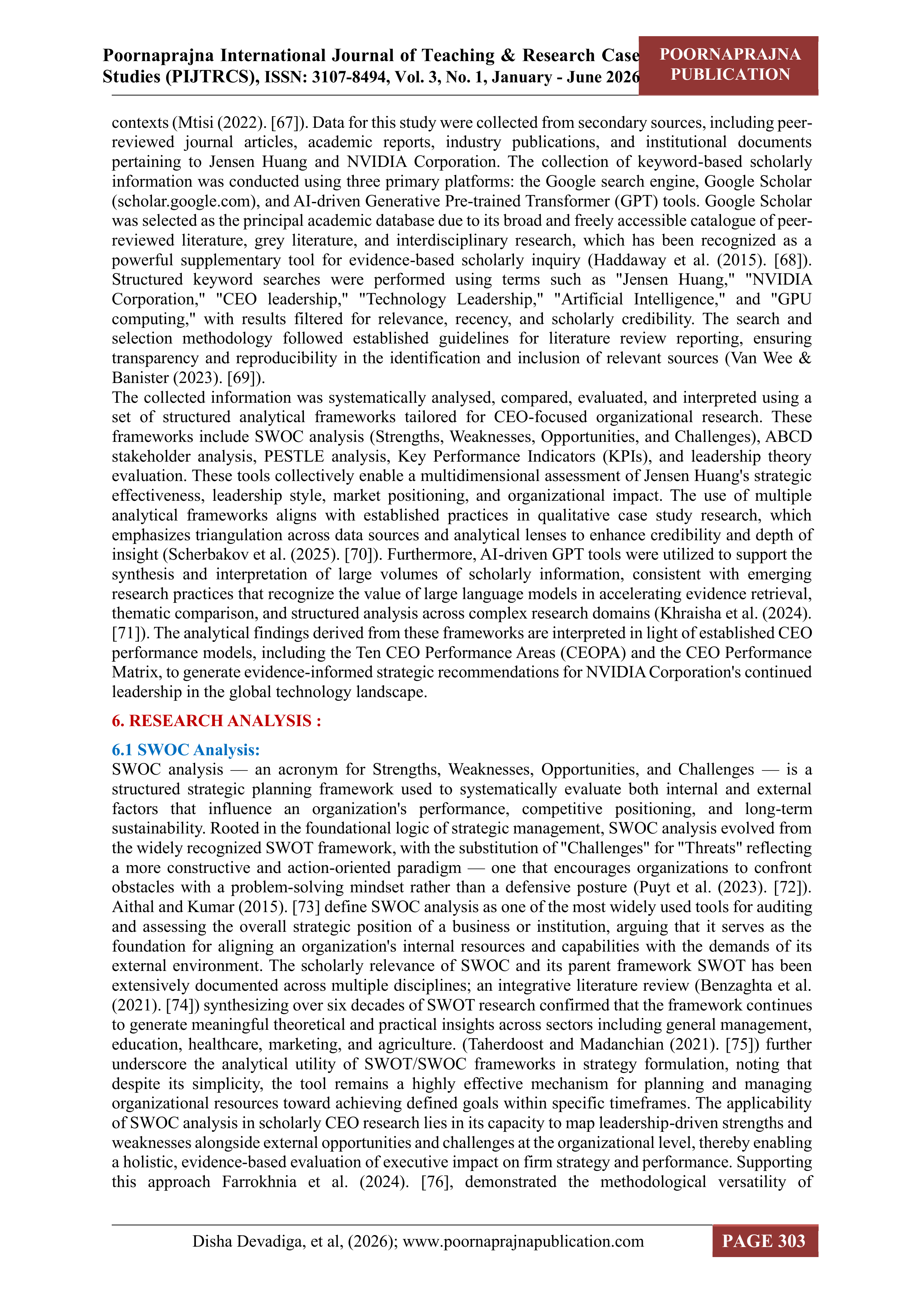
contexts (Mtisi (2022). [67]). Data for this study were collected from secondary sources, including peer-
reviewed journal articles, academic reports, industry publications, and institutional documents
pertaining to Jensen Huang and NVIDIA Corporation. The collection of keyword-based scholarly
information was conducted using three primary platforms: the Google search engine, Google Scholar
(scholar.google.com), and AI-driven Generative Pre-trained Transformer (GPT) tools. Google Scholar
was selected as the principal academic database due to its broad and freely accessible catalogue of peer-
reviewed literature, grey literature, and interdisciplinary research, which has been recognized as a
powerful supplementary tool for evidence-based scholarly inquiry (Haddaway et al. (2015). [68]).
Structured keyword searches were performed using terms such as "Jensen Huang," "NVIDIA
Corporation," "CEO leadership," "Technology Leadership," "Artificial Intelligence," and "GPU
computing," with results filtered for relevance, recency, and scholarly credibility. The search and
selection methodology followed established guidelines for literature review reporting, ensuring
transparency and reproducibility in the identification and inclusion of relevant sources (Van Wee &
Banister (2023). [69]).
The collected information was systematically analysed, compared, evaluated, and interpreted using a
set of structured analytical frameworks tailored for CEO-focused organizational research. These
frameworks include SWOC analysis (Strengths, Weaknesses, Opportunities, and Challenges), ABCD
stakeholder analysis, PESTLE analysis, Key Performance Indicators (KPIs), and leadership theory
evaluation. These tools collectively enable a multidimensional assessment of Jensen Huang's strategic
effectiveness, leadership style, market positioning, and organizational impact. The use of multiple
analytical frameworks aligns with established practices in qualitative case study research, which
emphasizes triangulation across data sources and analytical lenses to enhance credibility and depth of
insight (Scherbakov et al. (2025). [70]). Furthermore, AI-driven GPT tools were utilized to support the
synthesis and interpretation of large volumes of scholarly information, consistent with emerging
research practices that recognize the value of large language models in accelerating evidence retrieval,
thematic comparison, and structured analysis across complex research domains (Khraisha et al. (2024).
[71]). The analytical findings derived from these frameworks are interpreted in light of established CEO
performance models, including the Ten CEO Performance Areas (CEOPA) and the CEO Performance
Matrix, to generate evidence-informed strategic recommendations for NVIDIA Corporation's continued
leadership in the global technology landscape.
6. RESEARCH ANALYSIS :
6.1 SWOC Analysis:
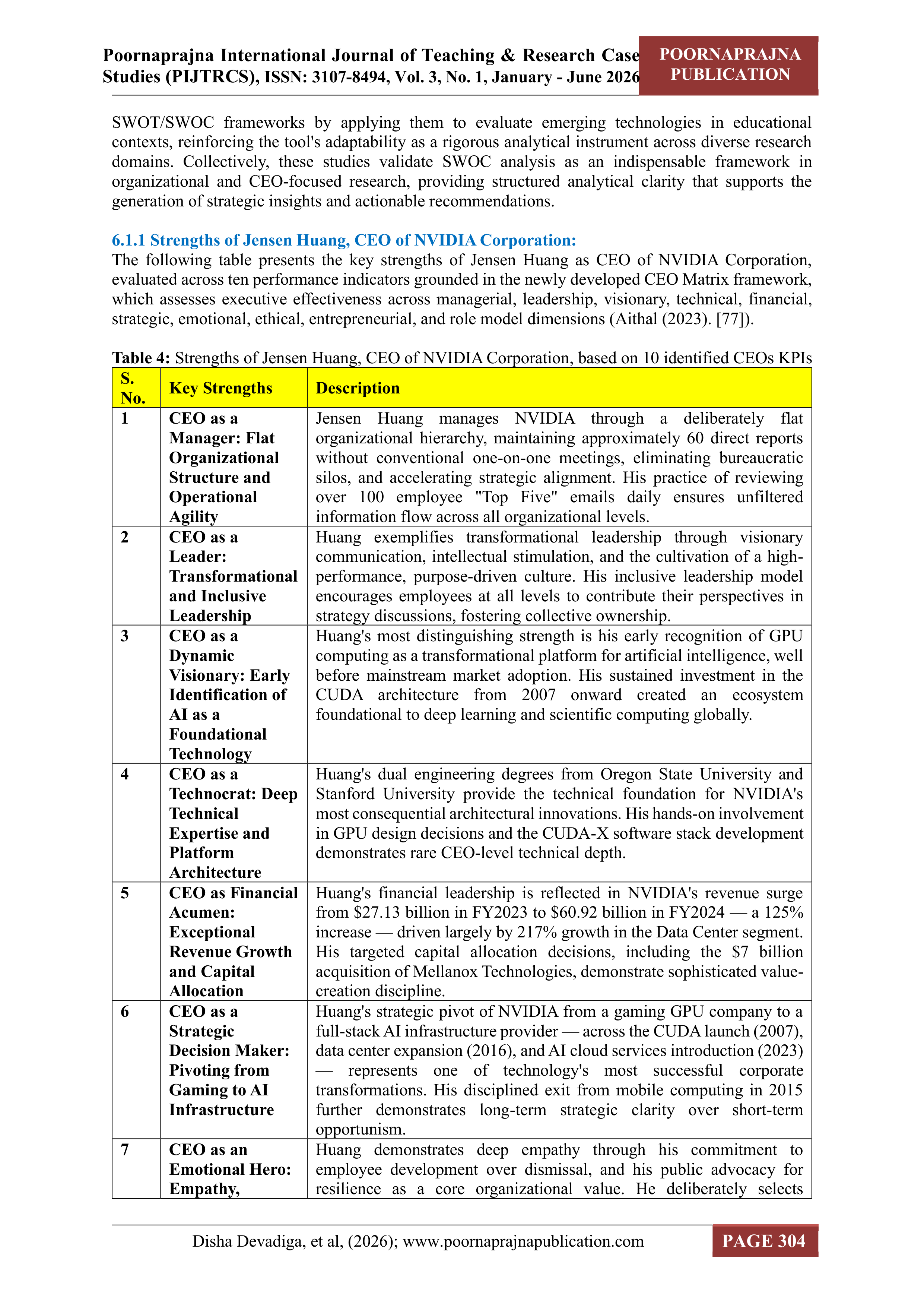
SWOC analysis — an acronym for Strengths, Weaknesses, Opportunities, and Challenges — is a
structured strategic planning framework used to systematically evaluate both internal and external
factors that influence an organization's performance, competitive positioning, and long-term
sustainability. Rooted in the foundational logic of strategic management, SWOC analysis evolved from
the widely recognized SWOT framework, with the substitution of "Challenges" for "Threats" reflecting
a more constructive and action-oriented paradigm — one that encourages organizations to confront
obstacles with a problem-solving mindset rather than a defensive posture (Puyt et al. (2023). [72]).
Aithal and Kumar (2015). [73] define SWOC analysis as one of the most widely used tools for auditing
and assessing the overall strategic position of a business or institution, arguing that it serves as the
foundation for aligning an organization's internal resources and capabilities with the demands of its
external environment. The scholarly relevance of SWOC and its parent framework SWOT has been
extensively documented across multiple disciplines; an integrative literature review (Benzaghta et al.
(2021). [74]) synthesizing over six decades of SWOT research confirmed that the framework continues
to generate meaningful theoretical and practical insights across sectors including general management,
education, healthcare, marketing, and agriculture. (Taherdoost and Madanchian (2021). [75]) further
underscore the analytical utility of SWOT/SWOC frameworks in strategy formulation, noting that
despite its simplicity, the tool remains a highly effective mechanism for planning and managing
organizational resources toward achieving defined goals within specific timeframes. The applicability
of SWOC analysis in scholarly CEO research lies in its capacity to map leadership-driven strengths and
weaknesses alongside external opportunities and challenges at the organizational level, thereby enabling
a holistic, evidence-based evaluation of executive impact on firm strategy and performance. Supporting
this approach Farrokhnia et al. (2024). [76], demonstrated the methodological versatility of


Poornaprajna International Journal of Teaching & Research Case
Studies (PIJTRCS),
ISSN: 3107-8494, Vol. 3, No. 1, January - June 2026
POORNAPRAJNA
PUBLICATION
Disha Devadiga, et al, (2026); www.poornaprajnapublication.com
PAGE 304
SWOT/SWOC frameworks by applying them to evaluate emerging technologies in educational
contexts, reinforcing the tool's adaptability as a rigorous analytical instrument across diverse research
domains. Collectively, these studies validate SWOC analysis as an indispensable framework in
organizational and CEO-focused research, providing structured analytical clarity that supports the
generation of strategic insights and actionable recommendations.
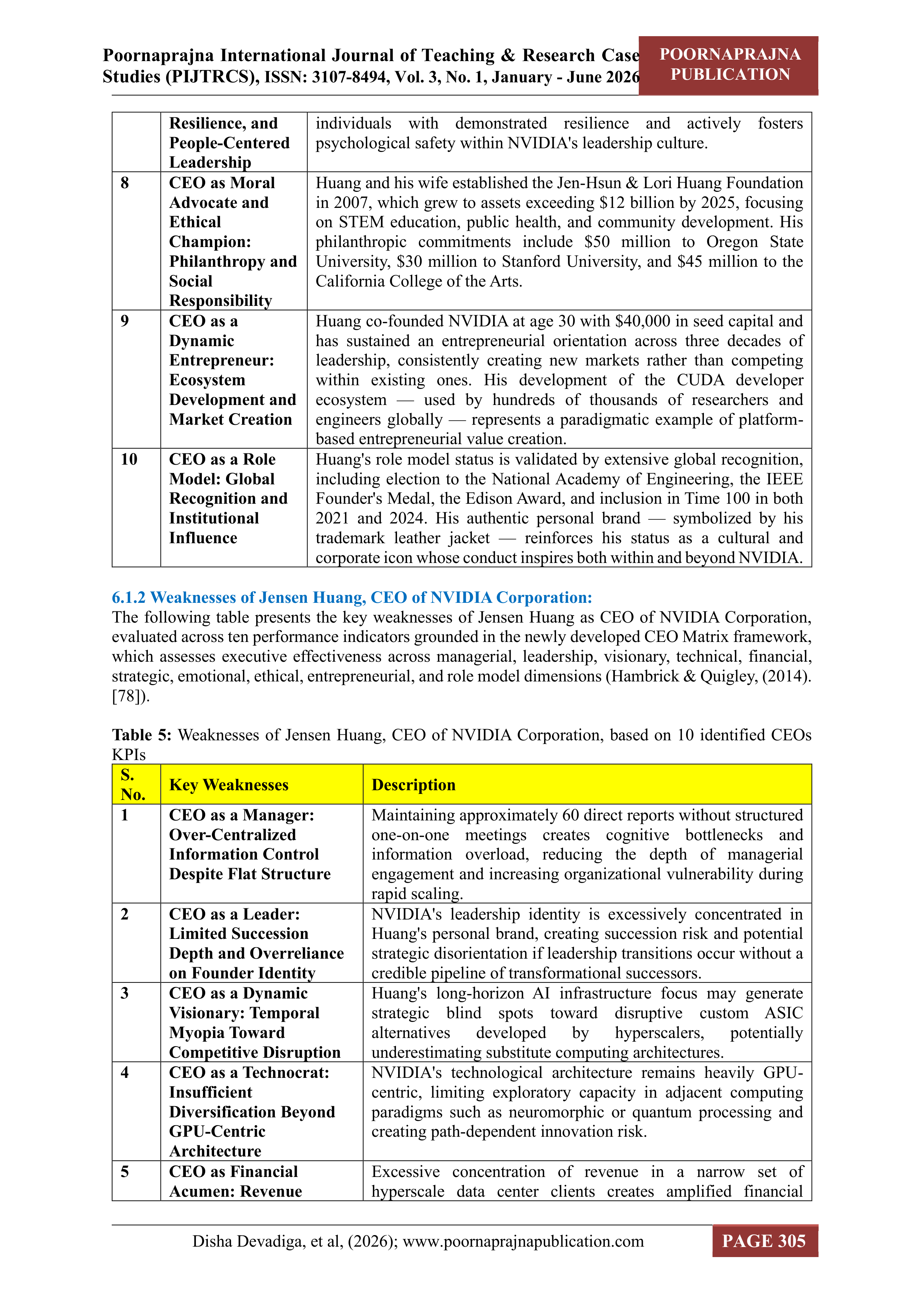
6.1.1 Strengths of Jensen Huang, CEO of NVIDIA Corporation:
The following table presents the key strengths of Jensen Huang as CEO of NVIDIA Corporation,
evaluated across ten performance indicators grounded in the newly developed CEO Matrix framework,
which assesses executive effectiveness across managerial, leadership, visionary, technical, financial,
strategic, emotional, ethical, entrepreneurial, and role model dimensions (Aithal (2023). [77]).
Table 4:
Strengths of Jensen Huang, CEO of NVIDIA Corporation, based on 10 identified CEOs KPIs
S.
No.
Key Strengths
Description
1
CEO as a
Manager: Flat
Organizational
Structure and
Operational
Agility
Jensen Huang manages NVIDIA through a deliberately flat
organizational hierarchy, maintaining approximately 60 direct reports
without conventional one-on-one meetings, eliminating bureaucratic
silos, and accelerating strategic alignment. His practice of reviewing
over 100 employee "Top Five" emails daily ensures unfiltered
information flow across all organizational levels.
2
CEO as a
Leader:
Transformational
and Inclusive
Leadership
Huang exemplifies transformational leadership through visionary
communication, intellectual stimulation, and the cultivation of a high-
performance, purpose-driven culture. His inclusive leadership model
encourages employees at all levels to contribute their perspectives in
strategy discussions, fostering collective ownership.
3
CEO as a
Dynamic
Visionary: Early
Identification of
AI as a
Foundational
Technology
Huang's most distinguishing strength is his early recognition of GPU
computing as a transformational platform for artificial intelligence, well
before mainstream market adoption. His sustained investment in the
CUDA architecture from 2007 onward created an ecosystem
foundational to deep learning and scientific computing globally.
4
CEO as a
Technocrat: Deep
Technical
Expertise and
Platform
Architecture
Huang's dual engineering degrees from Oregon State University and
Stanford University provide the technical foundation for NVIDIA's
most consequential architectural innovations. His hands-on involvement
in GPU design decisions and the CUDA-X software stack development
demonstrates rare CEO-level technical depth.
5
CEO as Financial
Acumen:
Exceptional
Revenue Growth
and Capital
Allocation
Huang's financial leadership is reflected in NVIDIA's revenue surge
from $27.13 billion in FY2023 to $60.92 billion in FY2024 — a 125%
increase — driven largely by 217% growth in the Data Center segment.
His targeted capital allocation decisions, including the $7 billion
acquisition of Mellanox Technologies, demonstrate sophisticated value-
creation discipline.
6
CEO as a
Strategic
Decision Maker:
Pivoting from
Gaming to AI
Infrastructure
Huang's strategic pivot of NVIDIA from a gaming GPU company to a
full-stack AI infrastructure provider — across the CUDA launch (2007),
data center expansion (2016), and AI cloud services introduction (2023)
— represents one of technology's most successful corporate
transformations. His disciplined exit from mobile computing in 2015
further demonstrates long-term strategic clarity over short-term
opportunism.
7
CEO as an
Emotional Hero:
Empathy,
Huang demonstrates deep empathy through his commitment to
employee development over dismissal, and his public advocacy for
resilience as a core organizational value. He deliberately selects


Poornaprajna International Journal of Teaching & Research Case
Studies (PIJTRCS),
ISSN: 3107-8494, Vol. 3, No. 1, January - June 2026
POORNAPRAJNA
PUBLICATION
Disha Devadiga, et al, (2026); www.poornaprajnapublication.com
PAGE 305
Resilience, and
People-Centered
Leadership
individuals with demonstrated resilience and actively fosters
psychological safety within NVIDIA's leadership culture.
8
CEO as Moral
Advocate and
Ethical
Champion:
Philanthropy and
Social
Responsibility
Huang and his wife established the Jen-Hsun & Lori Huang Foundation
in 2007, which grew to assets exceeding $12 billion by 2025, focusing
on STEM education, public health, and community development. His
philanthropic commitments include $50 million to Oregon State
University, $30 million to Stanford University, and $45 million to the
California College of the Arts.
9
CEO as a
Dynamic
Entrepreneur:
Ecosystem
Development and
Market Creation
Huang co-founded NVIDIA at age 30 with $40,000 in seed capital and
has sustained an entrepreneurial orientation across three decades of
leadership, consistently creating new markets rather than competing
within existing ones. His development of the CUDA developer
ecosystem — used by hundreds of thousands of researchers and
engineers globally — represents a paradigmatic example of platform-
based entrepreneurial value creation.
10
CEO as a Role
Model: Global
Recognition and
Institutional
Influence
Huang's role model status is validated by extensive global recognition,
including election to the National Academy of Engineering, the IEEE
Founder's Medal, the Edison Award, and inclusion in Time 100 in both
2021 and 2024. His authentic personal brand — symbolized by his
trademark leather jacket — reinforces his status as a cultural and
corporate icon whose conduct inspires both within and beyond NVIDIA.
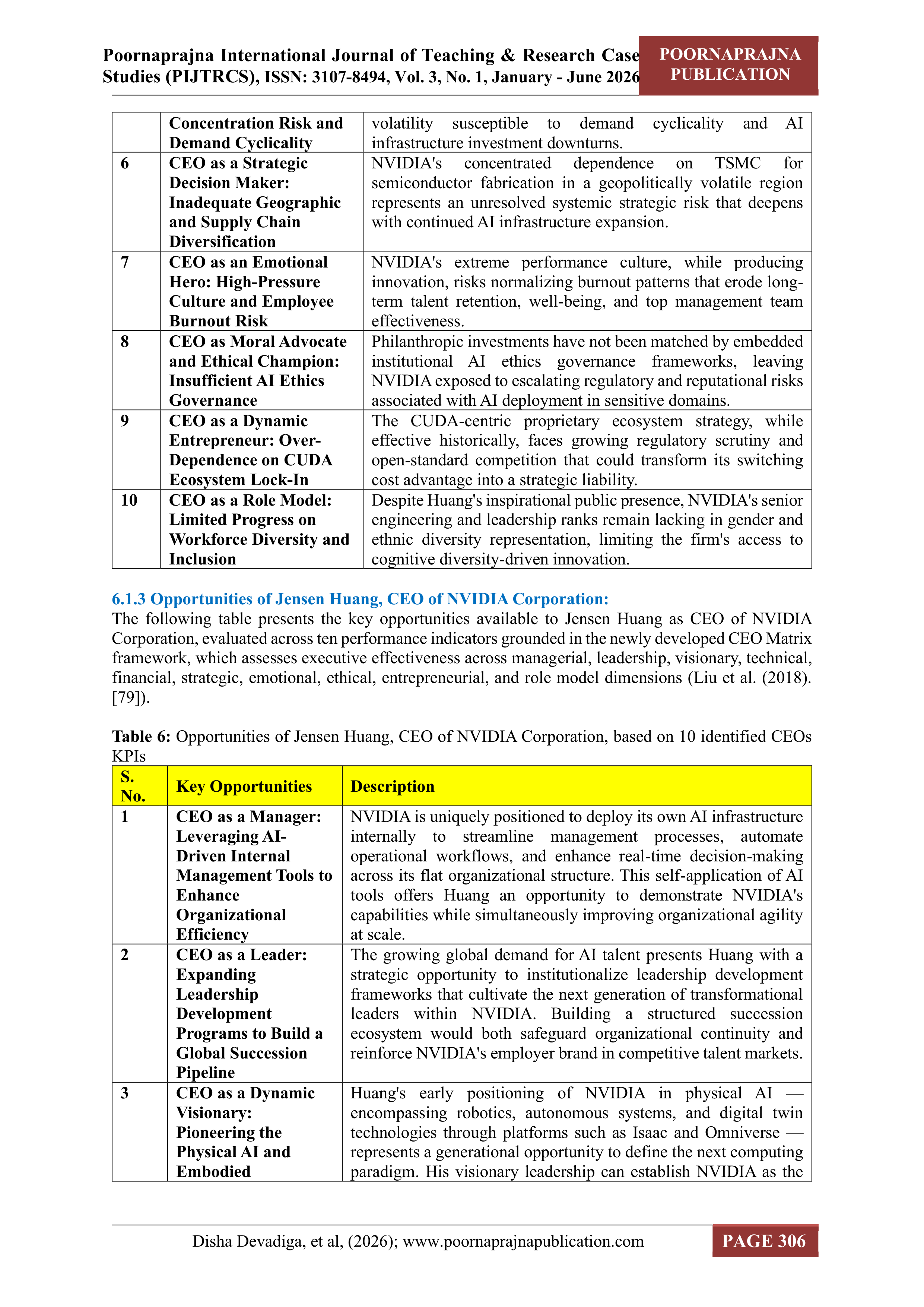
6.1.2 Weaknesses of Jensen Huang, CEO of NVIDIA Corporation:
The following table presents the key weaknesses of Jensen Huang as CEO of NVIDIA Corporation,
evaluated across ten performance indicators grounded in the newly developed CEO Matrix framework,
which assesses executive effectiveness across managerial, leadership, visionary, technical, financial,
strategic, emotional, ethical, entrepreneurial, and role model dimensions (Hambrick & Quigley, (2014).
[78]).
Table 5:
Weaknesses of Jensen Huang, CEO of NVIDIA Corporation, based on 10 identified CEOs
KPIs
S.
No.
Key Weaknesses
Description
1
CEO as a Manager:
Over-Centralized
Information Control
Despite Flat Structure
Maintaining approximately 60 direct reports without structured
one-on-one meetings creates cognitive bottlenecks and
information overload, reducing the depth of managerial
engagement and increasing organizational vulnerability during
rapid scaling.
2
CEO as a Leader:
Limited Succession
Depth and Overreliance
on Founder Identity
NVIDIA's leadership identity is excessively concentrated in
Huang's personal brand, creating succession risk and potential
strategic disorientation if leadership transitions occur without a
credible pipeline of transformational successors.
3
CEO as a Dynamic
Visionary: Temporal
Myopia Toward
Competitive Disruption
Huang's long-horizon AI infrastructure focus may generate
strategic blind spots toward disruptive custom ASIC
alternatives
developed
by
hyperscalers,
potentially
underestimating substitute computing architectures.
4
CEO as a Technocrat:
Insufficient
Diversification Beyond
GPU-Centric
Architecture
NVIDIA's technological architecture remains heavily GPU-
centric, limiting exploratory capacity in adjacent computing
paradigms such as neuromorphic or quantum processing and
creating path-dependent innovation risk.
5
CEO as Financial
Acumen: Revenue
Excessive concentration of revenue in a narrow set of
hyperscale data center clients creates amplified financial


Poornaprajna International Journal of Teaching & Research Case
Studies (PIJTRCS),
ISSN: 3107-8494, Vol. 3, No. 1, January - June 2026
POORNAPRAJNA
PUBLICATION
Disha Devadiga, et al, (2026); www.poornaprajnapublication.com
PAGE 306
Concentration Risk and
Demand Cyclicality
volatility
susceptible
to
demand
cyclicality
and AI
infrastructure investment downturns.
6
CEO as a Strategic
Decision Maker:
Inadequate Geographic
and Supply Chain
Diversification
NVIDIA's
concentrated
dependence
on
TSMC
for
semiconductor fabrication in a geopolitically volatile region
represents an unresolved systemic strategic risk that deepens
with continued AI infrastructure expansion.
7
CEO as an Emotional
Hero: High-Pressure
Culture and Employee
Burnout Risk
NVIDIA's extreme performance culture, while producing
innovation, risks normalizing burnout patterns that erode long-
term talent retention, well-being, and top management team
effectiveness.
8
CEO as Moral Advocate
and Ethical Champion:
Insufficient AI Ethics
Governance
Philanthropic investments have not been matched by embedded
institutional AI ethics governance frameworks, leaving
NVIDIA exposed to escalating regulatory and reputational risks
associated with AI deployment in sensitive domains.
9
CEO as a Dynamic
Entrepreneur: Over-
Dependence on CUDA
Ecosystem Lock-In
The CUDA-centric proprietary ecosystem strategy, while
effective historically, faces growing regulatory scrutiny and
open-standard competition that could transform its switching
cost advantage into a strategic liability.
10
CEO as a Role Model:
Limited Progress on
Workforce Diversity and
Inclusion
Despite Huang's inspirational public presence, NVIDIA's senior
engineering and leadership ranks remain lacking in gender and
ethnic diversity representation, limiting the firm's access to
cognitive diversity-driven innovation.
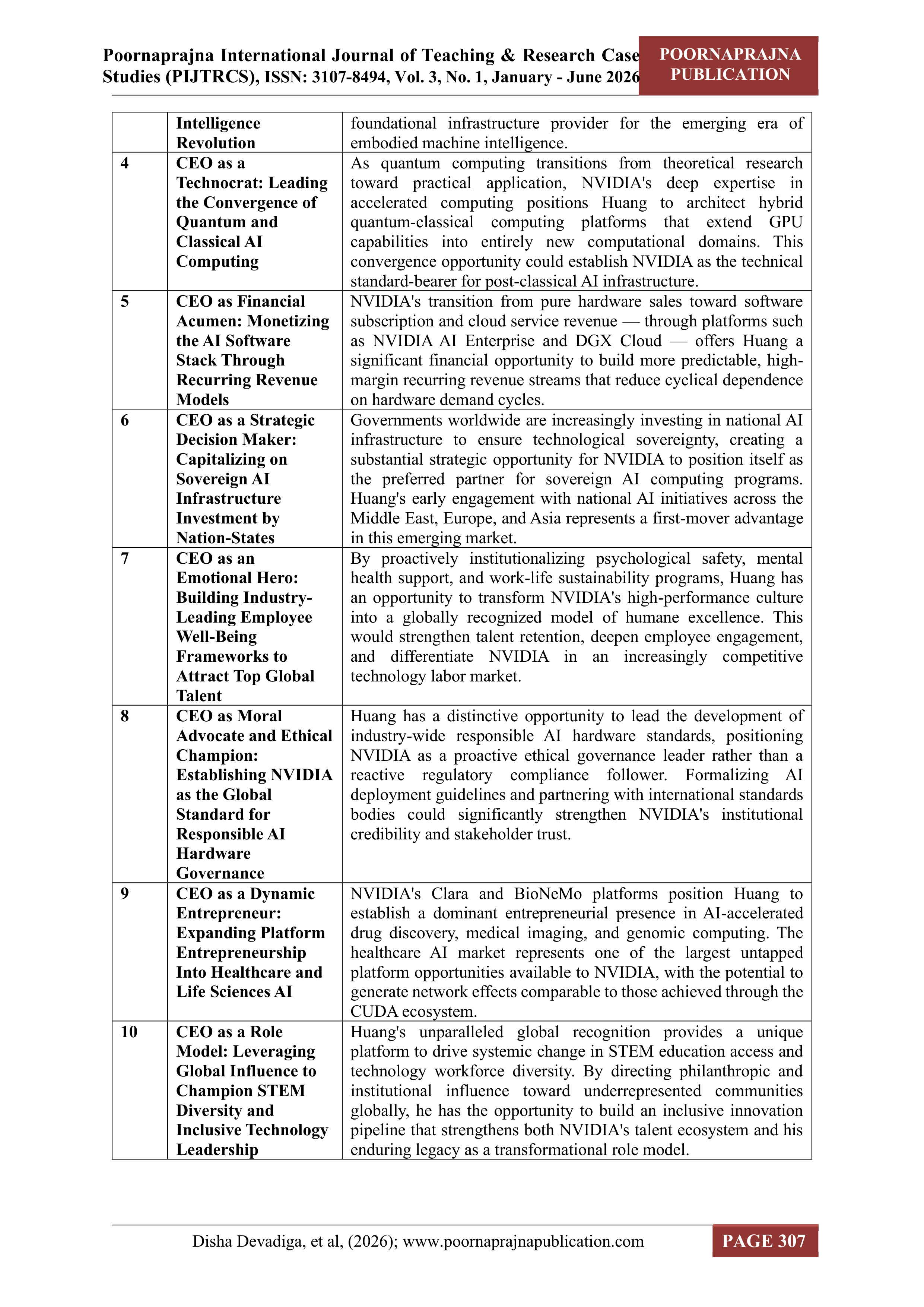
6.1.3 Opportunities of Jensen Huang, CEO of NVIDIA Corporation:
The following table presents the key opportunities available to Jensen Huang as CEO of NVIDIA
Corporation, evaluated across ten performance indicators grounded in the newly developed CEO Matrix
framework, which assesses executive effectiveness across managerial, leadership, visionary, technical,
financial, strategic, emotional, ethical, entrepreneurial, and role model dimensions (Liu et al. (2018).
[79]).
Table 6:
Opportunities of Jensen Huang, CEO of NVIDIA Corporation, based on 10 identified CEOs
KPIs
S.
No.
Key Opportunities
Description
1
CEO as a Manager:
Leveraging AI-
Driven Internal
Management Tools to
Enhance
Organizational
Efficiency
NVIDIA is uniquely positioned to deploy its own AI infrastructure
internally to streamline management processes, automate
operational workflows, and enhance real-time decision-making
across its flat organizational structure. This self-application of AI
tools offers Huang an opportunity to demonstrate NVIDIA's
capabilities while simultaneously improving organizational agility
at scale.
2
CEO as a Leader:
Expanding
Leadership
Development
Programs to Build a
Global Succession
Pipeline
The growing global demand for AI talent presents Huang with a
strategic opportunity to institutionalize leadership development
frameworks that cultivate the next generation of transformational
leaders within NVIDIA. Building a structured succession
ecosystem would both safeguard organizational continuity and
reinforce NVIDIA's employer brand in competitive talent markets.
3
CEO as a Dynamic
Visionary:
Pioneering the
Physical AI and
Embodied
Huang's early positioning of NVIDIA in physical AI —
encompassing robotics, autonomous systems, and digital twin
technologies through platforms such as Isaac and Omniverse —
represents a generational opportunity to define the next computing
paradigm. His visionary leadership can establish NVIDIA as the


Poornaprajna International Journal of Teaching & Research Case
Studies (PIJTRCS),
ISSN: 3107-8494, Vol. 3, No. 1, January - June 2026
POORNAPRAJNA
PUBLICATION
Disha Devadiga, et al, (2026); www.poornaprajnapublication.com
PAGE 307
Intelligence
Revolution
foundational infrastructure provider for the emerging era of
embodied machine intelligence.
4
CEO as a
Technocrat: Leading
the Convergence of
Quantum and
Classical AI
Computing
As quantum computing transitions from theoretical research
toward practical application, NVIDIA's deep expertise in
accelerated computing positions Huang to architect hybrid
quantum-classical computing platforms that extend GPU
capabilities into entirely new computational domains. This
convergence opportunity could establish NVIDIA as the technical
standard-bearer for post-classical AI infrastructure.
5
CEO as Financial
Acumen: Monetizing
the AI Software
Stack Through
Recurring Revenue
Models
NVIDIA's transition from pure hardware sales toward software
subscription and cloud service revenue — through platforms such
as NVIDIA AI Enterprise and DGX Cloud — offers Huang a
significant financial opportunity to build more predictable, high-
margin recurring revenue streams that reduce cyclical dependence
on hardware demand cycles.
6
CEO as a Strategic
Decision Maker:
Capitalizing on
Sovereign AI
Infrastructure
Investment by
Nation-States
Governments worldwide are increasingly investing in national AI
infrastructure to ensure technological sovereignty, creating a
substantial strategic opportunity for NVIDIA to position itself as
the preferred partner for sovereign AI computing programs.
Huang's early engagement with national AI initiatives across the
Middle East, Europe, and Asia represents a first-mover advantage
in this emerging market.
7
CEO as an
Emotional Hero:
Building Industry-
Leading Employee
Well-Being
Frameworks to
Attract Top Global
Talent
By proactively institutionalizing psychological safety, mental
health support, and work-life sustainability programs, Huang has
an opportunity to transform NVIDIA's high-performance culture
into a globally recognized model of humane excellence. This
would strengthen talent retention, deepen employee engagement,
and differentiate NVIDIA in an increasingly competitive
technology labor market.
8
CEO as Moral
Advocate and Ethical
Champion:
Establishing NVIDIA
as the Global
Standard for
Responsible AI
Hardware
Governance
Huang has a distinctive opportunity to lead the development of
industry-wide responsible AI hardware standards, positioning
NVIDIA as a proactive ethical governance leader rather than a
reactive regulatory compliance follower. Formalizing AI
deployment guidelines and partnering with international standards
bodies could significantly strengthen NVIDIA's institutional
credibility and stakeholder trust.
9
CEO as a Dynamic
Entrepreneur:
Expanding Platform
Entrepreneurship
Into Healthcare and
Life Sciences AI
NVIDIA's Clara and BioNeMo platforms position Huang to
establish a dominant entrepreneurial presence in AI-accelerated
drug discovery, medical imaging, and genomic computing. The
healthcare AI market represents one of the largest untapped
platform opportunities available to NVIDIA, with the potential to
generate network effects comparable to those achieved through the
CUDA ecosystem.
10
CEO as a Role
Model: Leveraging
Global Influence to
Champion STEM
Diversity and
Inclusive Technology
Leadership
Huang's unparalleled global recognition provides a unique
platform to drive systemic change in STEM education access and
technology workforce diversity. By directing philanthropic and
institutional influence toward underrepresented communities
globally, he has the opportunity to build an inclusive innovation
pipeline that strengthens both NVIDIA's talent ecosystem and his
enduring legacy as a transformational role model.


Poornaprajna International Journal of Teaching & Research Case
Studies (PIJTRCS),
ISSN: 3107-8494, Vol. 3, No. 1, January - June 2026
POORNAPRAJNA
PUBLICATION
Disha Devadiga, et al, (2026); www.poornaprajnapublication.com
PAGE 308
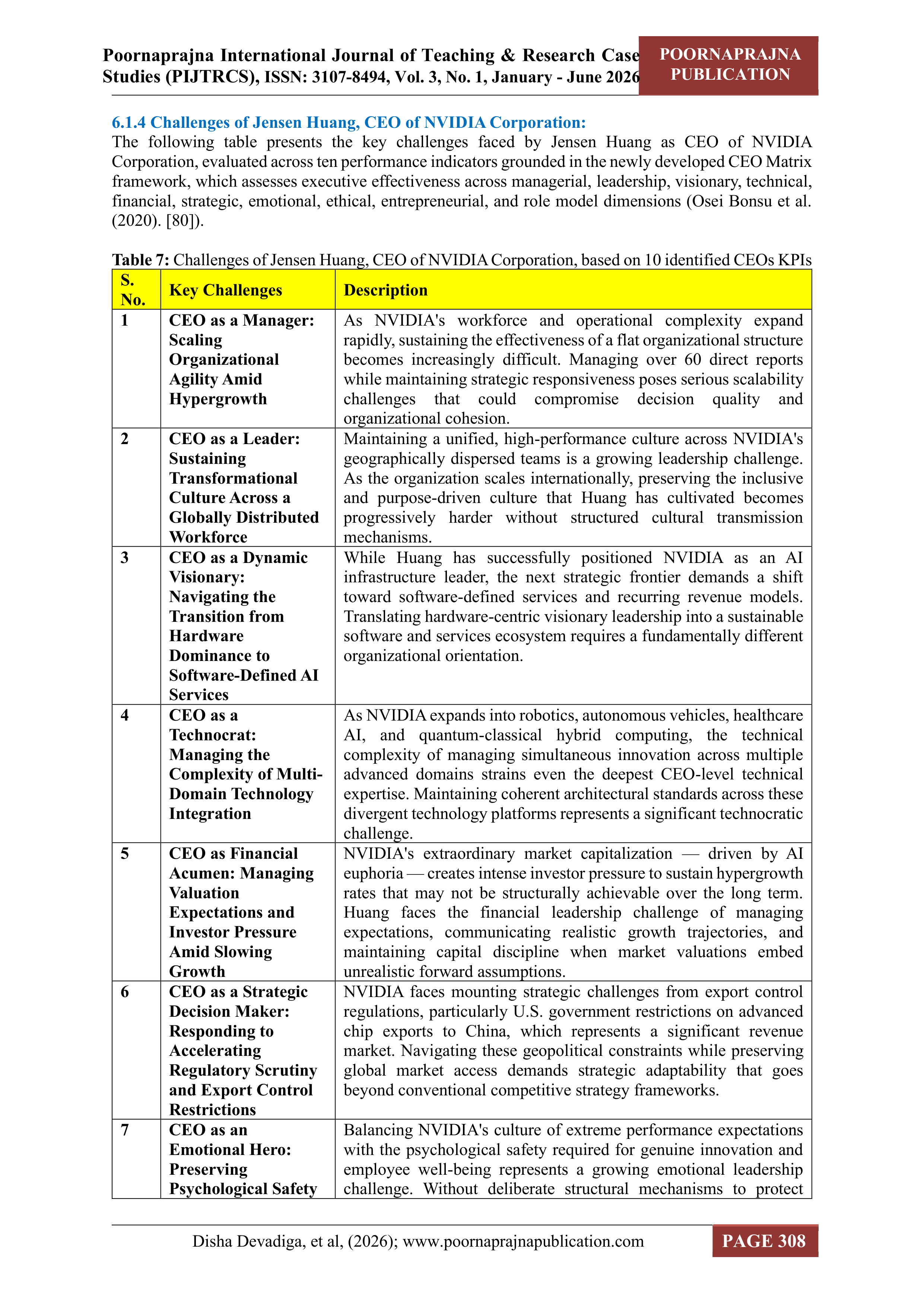
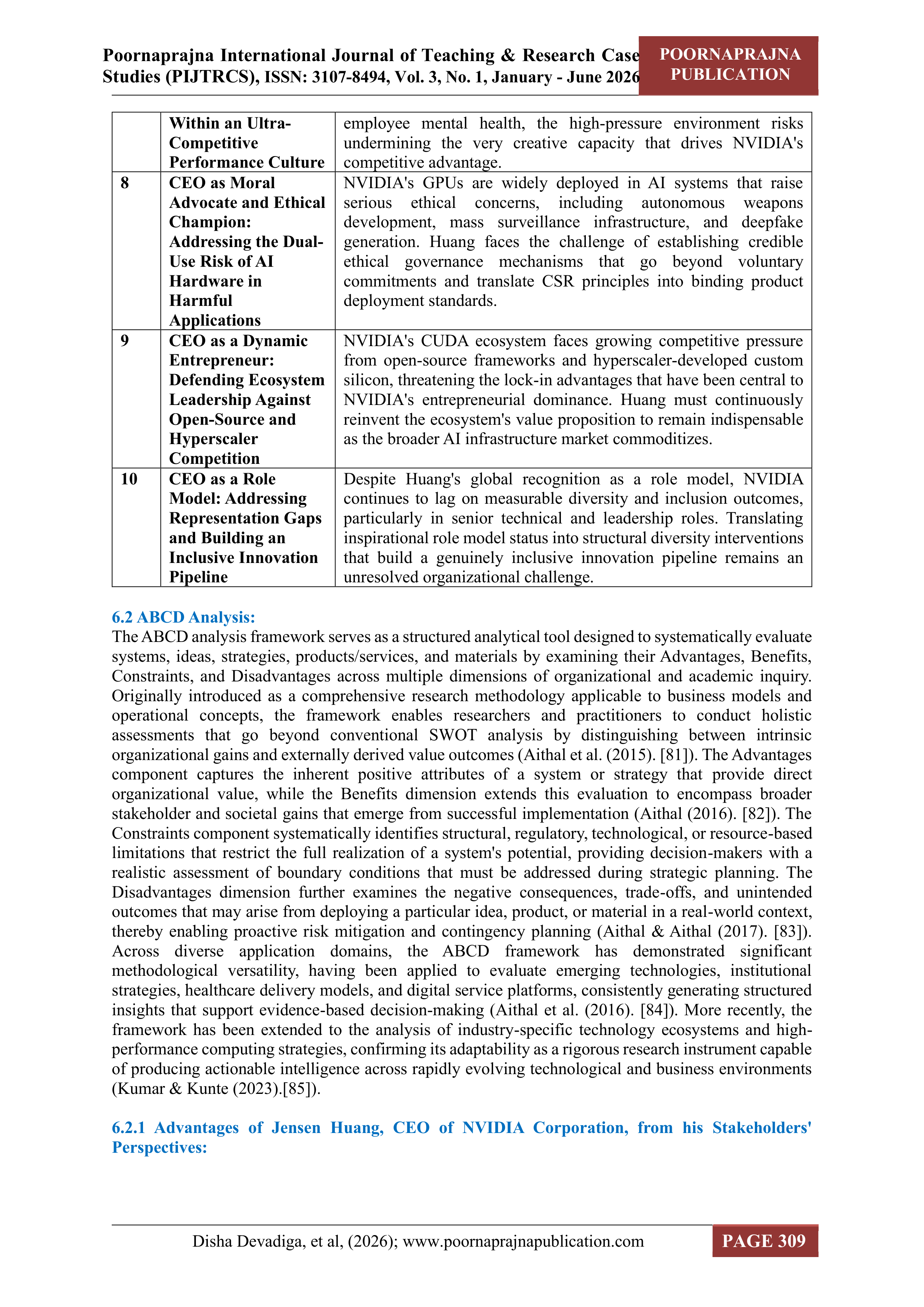
6.1.4 Challenges of Jensen Huang, CEO of NVIDIA Corporation:
The following table presents the key challenges faced by Jensen Huang as CEO of NVIDIA
Corporation, evaluated across ten performance indicators grounded in the newly developed CEO Matrix
framework, which assesses executive effectiveness across managerial, leadership, visionary, technical,
financial, strategic, emotional, ethical, entrepreneurial, and role model dimensions (Osei Bonsu et al.
(2020). [80]).
Table 7:
Challenges of Jensen Huang, CEO of NVIDIA Corporation, based on 10 identified CEOs KPIs
S.
No.
Key Challenges
Description
1
CEO as a Manager:
Scaling
Organizational
Agility Amid
Hypergrowth
As NVIDIA's workforce and operational complexity expand
rapidly, sustaining the effectiveness of a flat organizational structure
becomes increasingly difficult. Managing over 60 direct reports
while maintaining strategic responsiveness poses serious scalability
challenges
that
could
compromise
decision
quality
and
organizational cohesion.
2
CEO as a Leader:
Sustaining
Transformational
Culture Across a
Globally Distributed
Workforce
Maintaining a unified, high-performance culture across NVIDIA's
geographically dispersed teams is a growing leadership challenge.
As the organization scales internationally, preserving the inclusive
and purpose-driven culture that Huang has cultivated becomes
progressively harder without structured cultural transmission
mechanisms.
3
CEO as a Dynamic
Visionary:
Navigating the
Transition from
Hardware
Dominance to
Software-Defined AI
Services
While Huang has successfully positioned NVIDIA as an AI
infrastructure leader, the next strategic frontier demands a shift
toward software-defined services and recurring revenue models.
Translating hardware-centric visionary leadership into a sustainable
software and services ecosystem requires a fundamentally different
organizational orientation.
4
CEO as a
Technocrat:
Managing the
Complexity of Multi-
Domain Technology
Integration
As NVIDIA expands into robotics, autonomous vehicles, healthcare
AI, and quantum-classical hybrid computing, the technical
complexity of managing simultaneous innovation across multiple
advanced domains strains even the deepest CEO-level technical
expertise. Maintaining coherent architectural standards across these
divergent technology platforms represents a significant technocratic
challenge.
5
CEO as Financial
Acumen: Managing
Valuation
Expectations and
Investor Pressure
Amid Slowing
Growth
NVIDIA's extraordinary market capitalization — driven by AI
euphoria — creates intense investor pressure to sustain hypergrowth
rates that may not be structurally achievable over the long term.
Huang faces the financial leadership challenge of managing
expectations, communicating realistic growth trajectories, and
maintaining capital discipline when market valuations embed
unrealistic forward assumptions.
6
CEO as a Strategic
Decision Maker:
Responding to
Accelerating
Regulatory Scrutiny
and Export Control
Restrictions
NVIDIA faces mounting strategic challenges from export control
regulations, particularly U.S. government restrictions on advanced
chip exports to China, which represents a significant revenue
market. Navigating these geopolitical constraints while preserving
global market access demands strategic adaptability that goes
beyond conventional competitive strategy frameworks.
7
CEO as an
Emotional Hero:
Preserving
Psychological Safety
Balancing NVIDIA's culture of extreme performance expectations
with the psychological safety required for genuine innovation and
employee well-being represents a growing emotional leadership
challenge. Without deliberate structural mechanisms to protect


Poornaprajna International Journal of Teaching & Research Case
Studies (PIJTRCS),
ISSN: 3107-8494, Vol. 3, No. 1, January - June 2026
POORNAPRAJNA
PUBLICATION
Disha Devadiga, et al, (2026); www.poornaprajnapublication.com
PAGE 309
Within an Ultra-
Competitive
Performance Culture
employee mental health, the high-pressure environment risks
undermining the very creative capacity that drives NVIDIA's
competitive advantage.
8
CEO as Moral
Advocate and Ethical
Champion:
Addressing the Dual-
Use Risk of AI
Hardware in
Harmful
Applications
NVIDIA's GPUs are widely deployed in AI systems that raise
serious
ethical
concerns,
including
autonomous
weapons
development, mass surveillance infrastructure, and deepfake
generation. Huang faces the challenge of establishing credible
ethical governance mechanisms that go beyond voluntary
commitments and translate CSR principles into binding product
deployment standards.
9
CEO as a Dynamic
Entrepreneur:
Defending Ecosystem
Leadership Against
Open-Source and
Hyperscaler
Competition
NVIDIA's CUDA ecosystem faces growing competitive pressure
from open-source frameworks and hyperscaler-developed custom
silicon, threatening the lock-in advantages that have been central to
NVIDIA's entrepreneurial dominance. Huang must continuously
reinvent the ecosystem's value proposition to remain indispensable
as the broader AI infrastructure market commoditizes.
10
CEO as a Role
Model: Addressing
Representation Gaps
and Building an
Inclusive Innovation
Pipeline
Despite Huang's global recognition as a role model, NVIDIA
continues to lag on measurable diversity and inclusion outcomes,
particularly in senior technical and leadership roles. Translating
inspirational role model status into structural diversity interventions
that build a genuinely inclusive innovation pipeline remains an
unresolved organizational challenge.
6.2 ABCD Analysis:
The ABCD analysis framework serves as a structured analytical tool designed to systematically evaluate
systems, ideas, strategies, products/services, and materials by examining their Advantages, Benefits,
Constraints, and Disadvantages across multiple dimensions of organizational and academic inquiry.
Originally introduced as a comprehensive research methodology applicable to business models and
operational concepts, the framework enables researchers and practitioners to conduct holistic
assessments that go beyond conventional SWOT analysis by distinguishing between intrinsic
organizational gains and externally derived value outcomes (Aithal et al. (2015). [81]). The Advantages
component captures the inherent positive attributes of a system or strategy that provide direct
organizational value, while the Benefits dimension extends this evaluation to encompass broader
stakeholder and societal gains that emerge from successful implementation (Aithal (2016). [82]). The
Constraints component systematically identifies structural, regulatory, technological, or resource-based
limitations that restrict the full realization of a system's potential, providing decision-makers with a
realistic assessment of boundary conditions that must be addressed during strategic planning. The
Disadvantages dimension further examines the negative consequences, trade-offs, and unintended
outcomes that may arise from deploying a particular idea, product, or material in a real-world context,
thereby enabling proactive risk mitigation and contingency planning (Aithal & Aithal (2017). [83]).
Across diverse application domains, the ABCD framework has demonstrated significant
methodological versatility, having been applied to evaluate emerging technologies, institutional
strategies, healthcare delivery models, and digital service platforms, consistently generating structured
insights that support evidence-based decision-making (Aithal et al. (2016). [84]). More recently, the
framework has been extended to the analysis of industry-specific technology ecosystems and high-
performance computing strategies, confirming its adaptability as a rigorous research instrument capable
of producing actionable intelligence across rapidly evolving technological and business environments
(Kumar & Kunte (2023).[85]).
6.2.1 Advantages of Jensen Huang, CEO of NVIDIA Corporation, from his Stakeholders'
Perspectives:
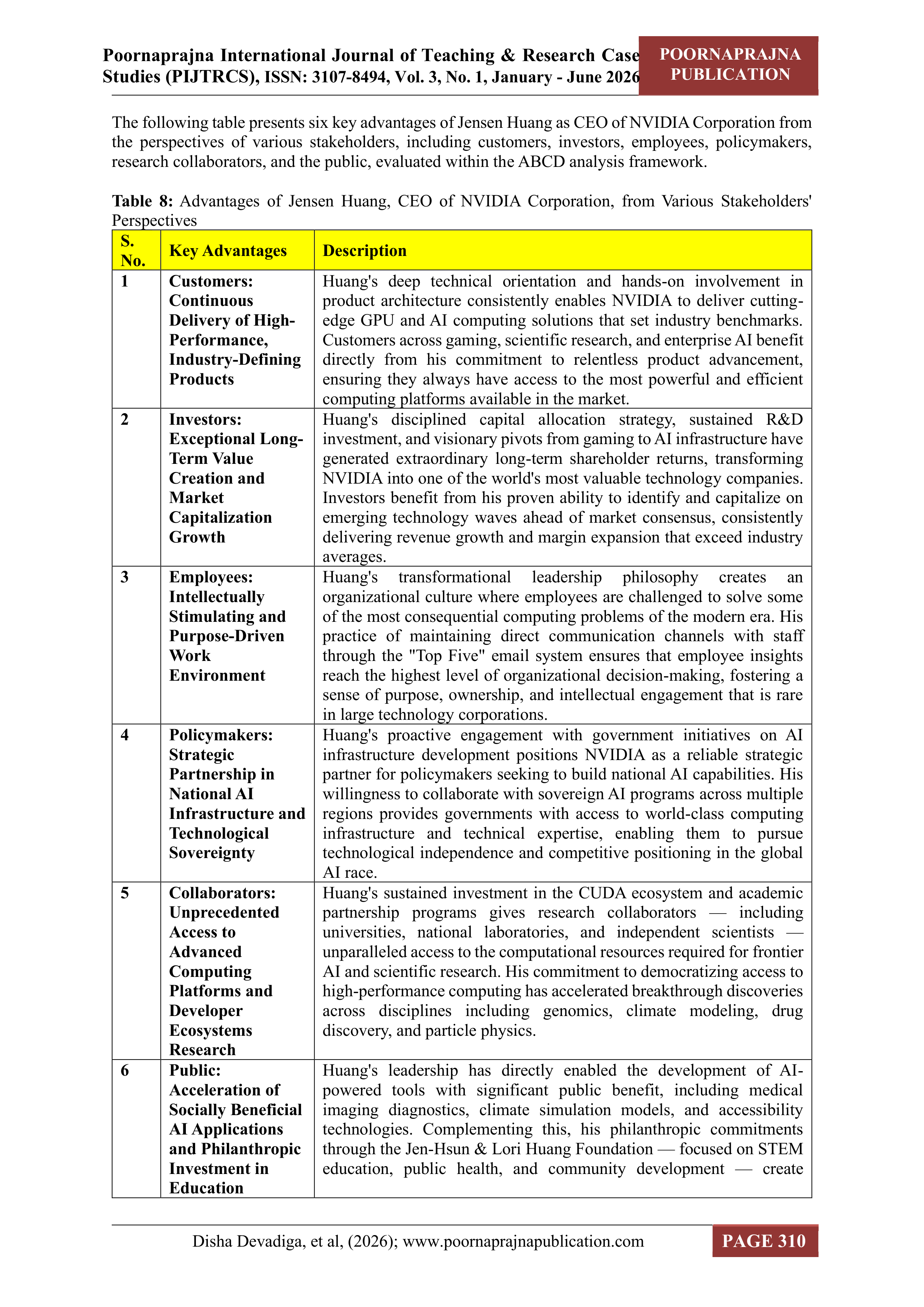


Poornaprajna International Journal of Teaching & Research Case
Studies (PIJTRCS),
ISSN: 3107-8494, Vol. 3, No. 1, January - June 2026
POORNAPRAJNA
PUBLICATION
Disha Devadiga, et al, (2026); www.poornaprajnapublication.com
PAGE 310
The following table presents six key advantages of Jensen Huang as CEO of NVIDIA Corporation from
the perspectives of various stakeholders, including customers, investors, employees, policymakers,
research collaborators, and the public, evaluated within the ABCD analysis framework.
Table 8:
Advantages of Jensen Huang, CEO of NVIDIA Corporation, from Various Stakeholders'
Perspectives
S.
No.
Key Advantages
Description
1
Customers:
Continuous
Delivery of High-
Performance,
Industry-Defining
Products
Huang's deep technical orientation and hands-on involvement in
product architecture consistently enables NVIDIA to deliver cutting-
edge GPU and AI computing solutions that set industry benchmarks.
Customers across gaming, scientific research, and enterprise AI benefit
directly from his commitment to relentless product advancement,
ensuring they always have access to the most powerful and efficient
computing platforms available in the market.
2
Investors:
Exceptional Long-
Term Value
Creation and
Market
Capitalization
Growth
Huang's disciplined capital allocation strategy, sustained R&D
investment, and visionary pivots from gaming to AI infrastructure have
generated extraordinary long-term shareholder returns, transforming
NVIDIA into one of the world's most valuable technology companies.
Investors benefit from his proven ability to identify and capitalize on
emerging technology waves ahead of market consensus, consistently
delivering revenue growth and margin expansion that exceed industry
averages.
3
Employees:
Intellectually
Stimulating and
Purpose-Driven
Work
Environment
Huang's
transformational
leadership
philosophy
creates
an
organizational culture where employees are challenged to solve some
of the most consequential computing problems of the modern era. His
practice of maintaining direct communication channels with staff
through the "Top Five" email system ensures that employee insights
reach the highest level of organizational decision-making, fostering a
sense of purpose, ownership, and intellectual engagement that is rare
in large technology corporations.
4
Policymakers:
Strategic
Partnership in
National AI
Infrastructure and
Technological
Sovereignty
Huang's proactive engagement with government initiatives on AI
infrastructure development positions NVIDIA as a reliable strategic
partner for policymakers seeking to build national AI capabilities. His
willingness to collaborate with sovereign AI programs across multiple
regions provides governments with access to world-class computing
infrastructure and technical expertise, enabling them to pursue
technological independence and competitive positioning in the global
AI race.
5
Collaborators:
Unprecedented
Access to
Advanced
Computing
Platforms and
Developer
Ecosystems
Research
Huang's sustained investment in the CUDA ecosystem and academic
partnership programs gives research collaborators — including
universities, national laboratories, and independent scientists —
unparalleled access to the computational resources required for frontier
AI and scientific research. His commitment to democratizing access to
high-performance computing has accelerated breakthrough discoveries
across disciplines including genomics, climate modeling, drug
discovery, and particle physics.
6
Public:
Acceleration of
Socially Beneficial
AI Applications
and Philanthropic
Investment in
Education
Huang's leadership has directly enabled the development of AI-
powered tools with significant public benefit, including medical
imaging diagnostics, climate simulation models, and accessibility
technologies. Complementing this, his philanthropic commitments
through the Jen-Hsun & Lori Huang Foundation — focused on STEM
education, public health, and community development — create
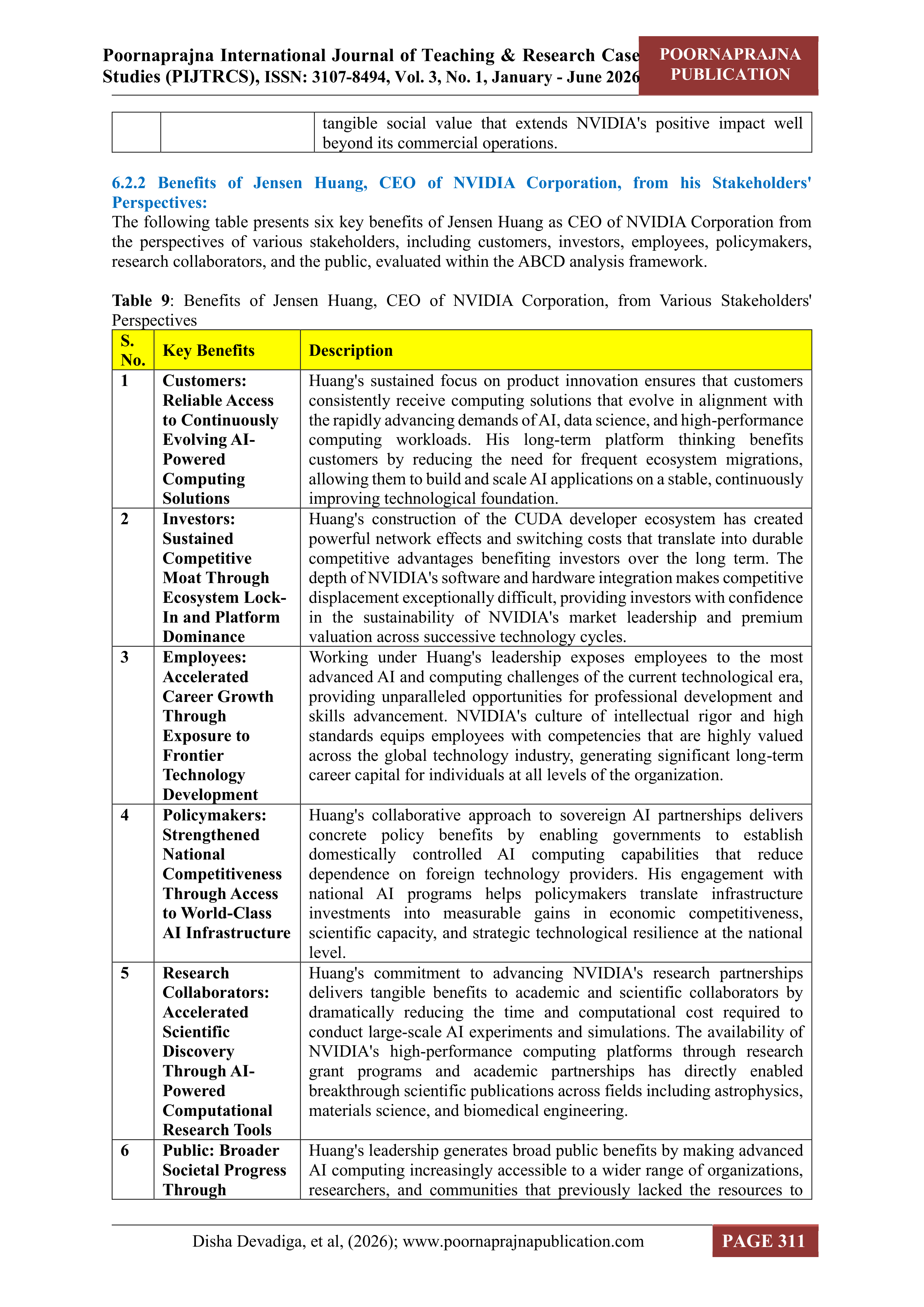


Poornaprajna International Journal of Teaching & Research Case
Studies (PIJTRCS),
ISSN: 3107-8494, Vol. 3, No. 1, January - June 2026
POORNAPRAJNA
PUBLICATION
Disha Devadiga, et al, (2026); www.poornaprajnapublication.com
PAGE 311
tangible social value that extends NVIDIA's positive impact well
beyond its commercial operations.
6.2.2 Benefits of Jensen Huang, CEO of NVIDIA Corporation, from his Stakeholders'
Perspectives:
The following table presents six key benefits of Jensen Huang as CEO of NVIDIA Corporation from
the perspectives of various stakeholders, including customers, investors, employees, policymakers,
research collaborators, and the public, evaluated within the ABCD analysis framework.
Table 9
: Benefits of Jensen Huang, CEO of NVIDIA Corporation, from Various Stakeholders'
Perspectives
S.
No.
Key Benefits
Description
1
Customers:
Reliable Access
to Continuously
Evolving AI-
Powered
Computing
Solutions
Huang's sustained focus on product innovation ensures that customers
consistently receive computing solutions that evolve in alignment with
the rapidly advancing demands of AI, data science, and high-performance
computing workloads. His long-term platform thinking benefits
customers by reducing the need for frequent ecosystem migrations,
allowing them to build and scale AI applications on a stable, continuously
improving technological foundation.
2
Investors:
Sustained
Competitive
Moat Through
Ecosystem Lock-
In and Platform
Dominance
Huang's construction of the CUDA developer ecosystem has created
powerful network effects and switching costs that translate into durable
competitive advantages benefiting investors over the long term. The
depth of NVIDIA's software and hardware integration makes competitive
displacement exceptionally difficult, providing investors with confidence
in the sustainability of NVIDIA's market leadership and premium
valuation across successive technology cycles.
3
Employees:
Accelerated
Career Growth
Through
Exposure to
Frontier
Technology
Development
Working under Huang's leadership exposes employees to the most
advanced AI and computing challenges of the current technological era,
providing unparalleled opportunities for professional development and
skills advancement. NVIDIA's culture of intellectual rigor and high
standards equips employees with competencies that are highly valued
across the global technology industry, generating significant long-term
career capital for individuals at all levels of the organization.
4
Policymakers:
Strengthened
National
Competitiveness
Through Access
to World-Class
AI Infrastructure
Huang's collaborative approach to sovereign AI partnerships delivers
concrete policy benefits by enabling governments to establish
domestically controlled AI computing capabilities that reduce
dependence on foreign technology providers. His engagement with
national AI programs helps policymakers translate infrastructure
investments into measurable gains in economic competitiveness,
scientific capacity, and strategic technological resilience at the national
level.
5
Research
Collaborators:
Accelerated
Scientific
Discovery
Through AI-
Powered
Computational
Research Tools
Huang's commitment to advancing NVIDIA's research partnerships
delivers tangible benefits to academic and scientific collaborators by
dramatically reducing the time and computational cost required to
conduct large-scale AI experiments and simulations. The availability of
NVIDIA's high-performance computing platforms through research
grant programs and academic partnerships has directly enabled
breakthrough scientific publications across fields including astrophysics,
materials science, and biomedical engineering.
6
Public: Broader
Societal Progress
Through
Huang's leadership generates broad public benefits by making advanced
AI computing increasingly accessible to a wider range of organizations,
researchers, and communities that previously lacked the resources to
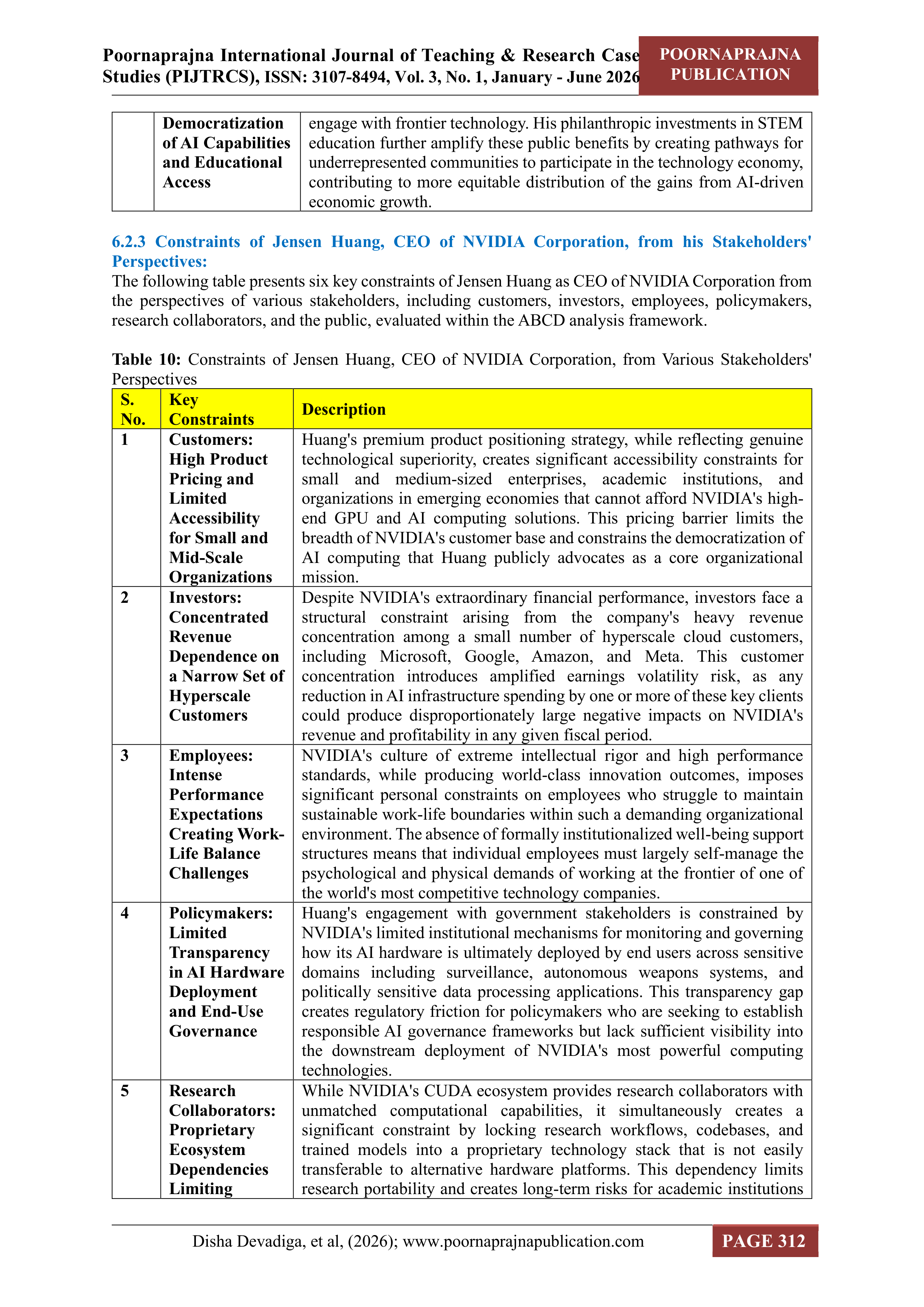


Poornaprajna International Journal of Teaching & Research Case
Studies (PIJTRCS),
ISSN: 3107-8494, Vol. 3, No. 1, January - June 2026
POORNAPRAJNA
PUBLICATION
Disha Devadiga, et al, (2026); www.poornaprajnapublication.com
PAGE 312
Democratization
of AI Capabilities
and Educational
Access
engage with frontier technology. His philanthropic investments in STEM
education further amplify these public benefits by creating pathways for
underrepresented communities to participate in the technology economy,
contributing to more equitable distribution of the gains from AI-driven
economic growth.
6.2.3 Constraints of Jensen Huang, CEO of NVIDIA Corporation, from his Stakeholders'
Perspectives:
The following table presents six key constraints of Jensen Huang as CEO of NVIDIA Corporation from
the perspectives of various stakeholders, including customers, investors, employees, policymakers,
research collaborators, and the public, evaluated within the ABCD analysis framework.
Table 10:
Constraints of Jensen Huang, CEO of NVIDIA Corporation, from Various Stakeholders'
Perspectives
S.
No.
Key
Constraints
Description
1
Customers:
High Product
Pricing and
Limited
Accessibility
for Small and
Mid-Scale
Organizations
Huang's premium product positioning strategy, while reflecting genuine
technological superiority, creates significant accessibility constraints for
small and medium-sized enterprises, academic institutions, and
organizations in emerging economies that cannot afford NVIDIA's high-
end GPU and AI computing solutions. This pricing barrier limits the
breadth of NVIDIA's customer base and constrains the democratization of
AI computing that Huang publicly advocates as a core organizational
mission.
2
Investors:
Concentrated
Revenue
Dependence on
a Narrow Set of
Hyperscale
Customers
Despite NVIDIA's extraordinary financial performance, investors face a
structural constraint arising from the company's heavy revenue
concentration among a small number of hyperscale cloud customers,
including Microsoft, Google, Amazon, and Meta. This customer
concentration introduces amplified earnings volatility risk, as any
reduction in AI infrastructure spending by one or more of these key clients
could produce disproportionately large negative impacts on NVIDIA's
revenue and profitability in any given fiscal period.
3
Employees:
Intense
Performance
Expectations
Creating Work-
Life Balance
Challenges
NVIDIA's culture of extreme intellectual rigor and high performance
standards, while producing world-class innovation outcomes, imposes
significant personal constraints on employees who struggle to maintain
sustainable work-life boundaries within such a demanding organizational
environment. The absence of formally institutionalized well-being support
structures means that individual employees must largely self-manage the
psychological and physical demands of working at the frontier of one of
the world's most competitive technology companies.
4
Policymakers:
Limited
Transparency
in AI Hardware
Deployment
and End-Use
Governance
Huang's engagement with government stakeholders is constrained by
NVIDIA's limited institutional mechanisms for monitoring and governing
how its AI hardware is ultimately deployed by end users across sensitive
domains including surveillance, autonomous weapons systems, and
politically sensitive data processing applications. This transparency gap
creates regulatory friction for policymakers who are seeking to establish
responsible AI governance frameworks but lack sufficient visibility into
the downstream deployment of NVIDIA's most powerful computing
technologies.
5
Research
Collaborators:
Proprietary
Ecosystem
Dependencies
Limiting
While NVIDIA's CUDA ecosystem provides research collaborators with
unmatched computational capabilities, it simultaneously creates a
significant constraint by locking research workflows, codebases, and
trained models into a proprietary technology stack that is not easily
transferable to alternative hardware platforms. This dependency limits
research portability and creates long-term risks for academic institutions
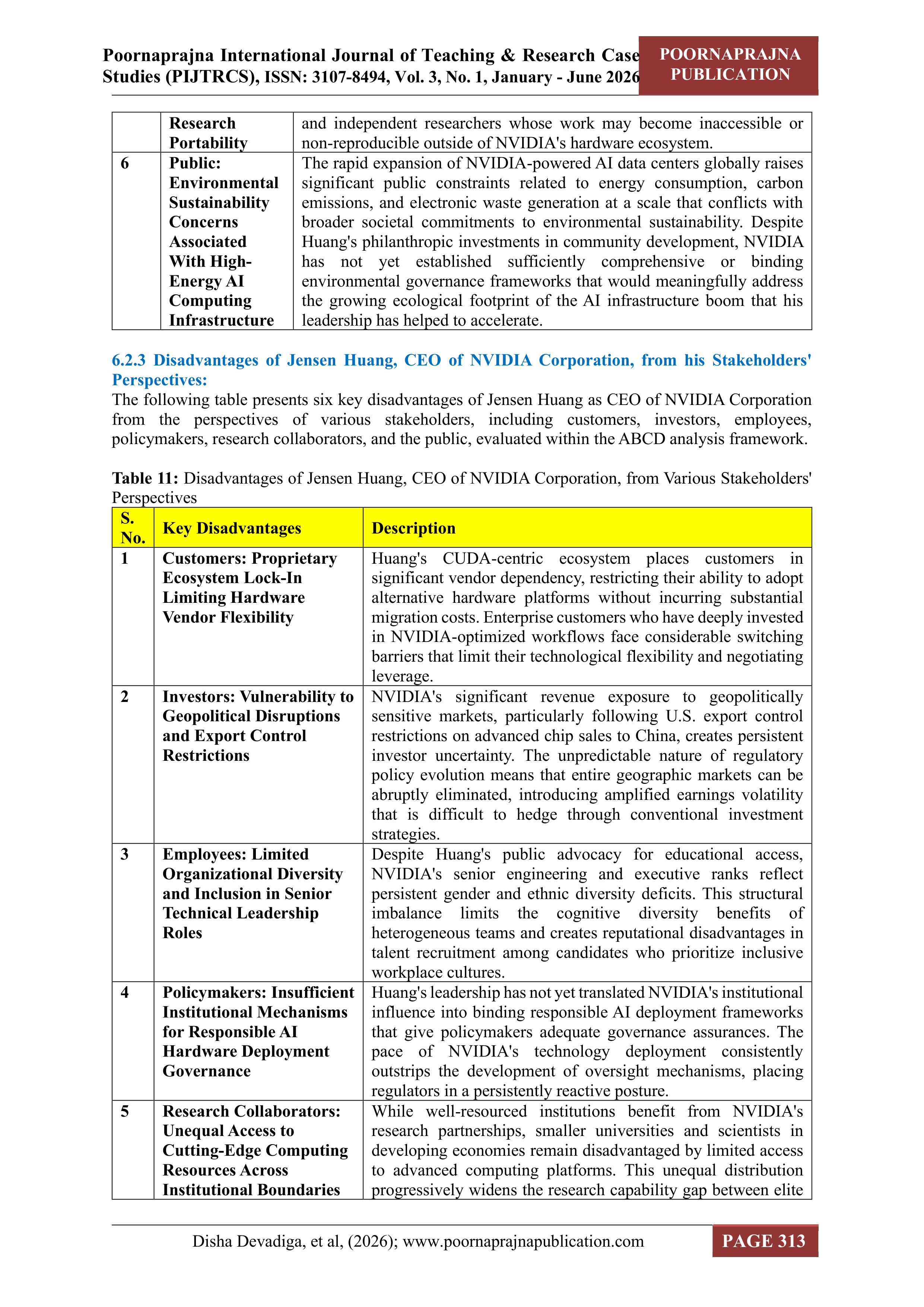


Poornaprajna International Journal of Teaching & Research Case
Studies (PIJTRCS),
ISSN: 3107-8494, Vol. 3, No. 1, January - June 2026
POORNAPRAJNA
PUBLICATION
Disha Devadiga, et al, (2026); www.poornaprajnapublication.com
PAGE 313
Research
Portability
and independent researchers whose work may become inaccessible or
non-reproducible outside of NVIDIA's hardware ecosystem.
6
Public:
Environmental
Sustainability
Concerns
Associated
With High-
Energy AI
Computing
Infrastructure
The rapid expansion of NVIDIA-powered AI data centers globally raises
significant public constraints related to energy consumption, carbon
emissions, and electronic waste generation at a scale that conflicts with
broader societal commitments to environmental sustainability. Despite
Huang's philanthropic investments in community development, NVIDIA
has not yet established sufficiently comprehensive or binding
environmental governance frameworks that would meaningfully address
the growing ecological footprint of the AI infrastructure boom that his
leadership has helped to accelerate.
6.2.3 Disadvantages of Jensen Huang, CEO of NVIDIA Corporation, from his Stakeholders'
Perspectives:
The following table presents six key disadvantages of Jensen Huang as CEO of NVIDIA Corporation
from the perspectives of various stakeholders, including customers, investors, employees,
policymakers, research collaborators, and the public, evaluated within the ABCD analysis framework.
Table 11:
Disadvantages of Jensen Huang, CEO of NVIDIA Corporation, from Various Stakeholders'
Perspectives
S.
No.
Key Disadvantages
Description
1
Customers: Proprietary
Ecosystem Lock-In
Limiting Hardware
Vendor Flexibility
Huang's CUDA-centric ecosystem places customers in
significant vendor dependency, restricting their ability to adopt
alternative hardware platforms without incurring substantial
migration costs. Enterprise customers who have deeply invested
in NVIDIA-optimized workflows face considerable switching
barriers that limit their technological flexibility and negotiating
leverage.
2
Investors: Vulnerability to
Geopolitical Disruptions
and Export Control
Restrictions
NVIDIA's significant revenue exposure to geopolitically
sensitive markets, particularly following U.S. export control
restrictions on advanced chip sales to China, creates persistent
investor uncertainty. The unpredictable nature of regulatory
policy evolution means that entire geographic markets can be
abruptly eliminated, introducing amplified earnings volatility
that is difficult to hedge through conventional investment
strategies.
3
Employees: Limited
Organizational Diversity
and Inclusion in Senior
Technical Leadership
Roles
Despite Huang's public advocacy for educational access,
NVIDIA's senior engineering and executive ranks reflect
persistent gender and ethnic diversity deficits. This structural
imbalance
limits
the
cognitive
diversity
benefits
of
heterogeneous teams and creates reputational disadvantages in
talent recruitment among candidates who prioritize inclusive
workplace cultures.
4
Policymakers: Insufficient
Institutional Mechanisms
for Responsible AI
Hardware Deployment
Governance
Huang's leadership has not yet translated NVIDIA's institutional
influence into binding responsible AI deployment frameworks
that give policymakers adequate governance assurances. The
pace of NVIDIA's technology deployment consistently
outstrips the development of oversight mechanisms, placing
regulators in a persistently reactive posture.
5
Research Collaborators:
Unequal Access to
Cutting-Edge Computing
Resources Across
Institutional Boundaries
While well-resourced institutions benefit from NVIDIA's
research partnerships, smaller universities and scientists in
developing economies remain disadvantaged by limited access
to advanced computing platforms. This unequal distribution
progressively widens the research capability gap between elite
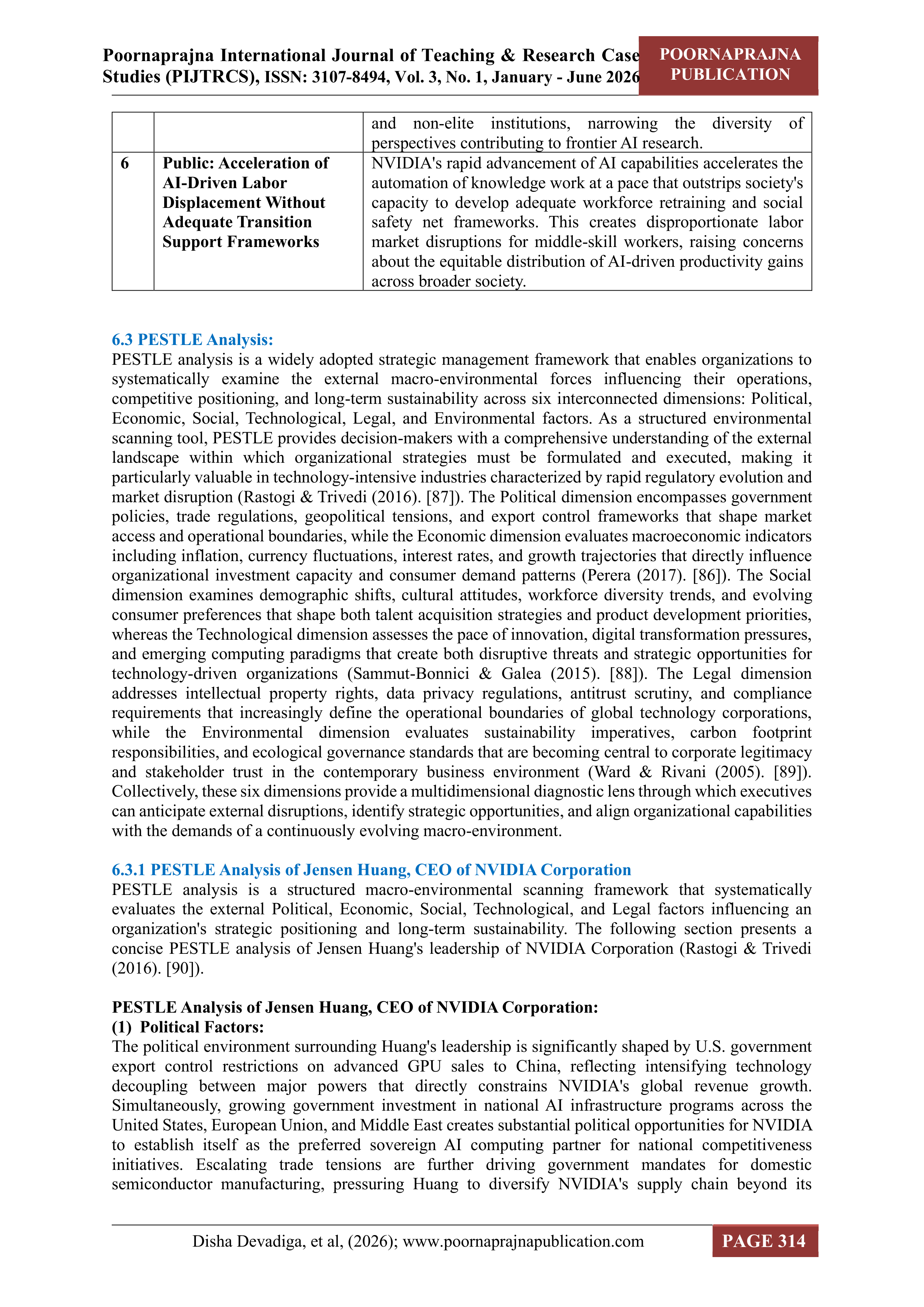


Poornaprajna International Journal of Teaching & Research Case
Studies (PIJTRCS),
ISSN: 3107-8494, Vol. 3, No. 1, January - June 2026
POORNAPRAJNA
PUBLICATION
Disha Devadiga, et al, (2026); www.poornaprajnapublication.com
PAGE 314
and non-elite institutions, narrowing the diversity of
perspectives contributing to frontier AI research.
6
Public: Acceleration of
AI-Driven Labor
Displacement Without
Adequate Transition
Support Frameworks
NVIDIA's rapid advancement of AI capabilities accelerates the
automation of knowledge work at a pace that outstrips society's
capacity to develop adequate workforce retraining and social
safety net frameworks. This creates disproportionate labor
market disruptions for middle-skill workers, raising concerns
about the equitable distribution of AI-driven productivity gains
across broader society.
6.3 PESTLE Analysis:
PESTLE analysis is a widely adopted strategic management framework that enables organizations to
systematically examine the external macro-environmental forces influencing their operations,
competitive positioning, and long-term sustainability across six interconnected dimensions: Political,
Economic, Social, Technological, Legal, and Environmental factors. As a structured environmental
scanning tool, PESTLE provides decision-makers with a comprehensive understanding of the external
landscape within which organizational strategies must be formulated and executed, making it
particularly valuable in technology-intensive industries characterized by rapid regulatory evolution and
market disruption (Rastogi & Trivedi (2016). [87]). The Political dimension encompasses government
policies, trade regulations, geopolitical tensions, and export control frameworks that shape market
access and operational boundaries, while the Economic dimension evaluates macroeconomic indicators
including inflation, currency fluctuations, interest rates, and growth trajectories that directly influence
organizational investment capacity and consumer demand patterns (Perera (2017). [86]). The Social
dimension examines demographic shifts, cultural attitudes, workforce diversity trends, and evolving
consumer preferences that shape both talent acquisition strategies and product development priorities,
whereas the Technological dimension assesses the pace of innovation, digital transformation pressures,
and emerging computing paradigms that create both disruptive threats and strategic opportunities for
technology-driven organizations (Sammut-Bonnici & Galea (2015). [88]). The Legal dimension
addresses intellectual property rights, data privacy regulations, antitrust scrutiny, and compliance
requirements that increasingly define the operational boundaries of global technology corporations,
while the Environmental dimension evaluates sustainability imperatives, carbon footprint
responsibilities, and ecological governance standards that are becoming central to corporate legitimacy
and stakeholder trust in the contemporary business environment (Ward & Rivani (2005). [89]).
Collectively, these six dimensions provide a multidimensional diagnostic lens through which executives
can anticipate external disruptions, identify strategic opportunities, and align organizational capabilities
with the demands of a continuously evolving macro-environment.
6.3.1 PESTLE Analysis of Jensen Huang, CEO of NVIDIA Corporation
PESTLE analysis is a structured macro-environmental scanning framework that systematically
evaluates the external Political, Economic, Social, Technological, and Legal factors influencing an
organization's strategic positioning and long-term sustainability. The following section presents a
concise PESTLE analysis of Jensen Huang's leadership of NVIDIA Corporation (Rastogi & Trivedi
(2016). [90]).
PESTLE Analysis of Jensen Huang, CEO of NVIDIA Corporation:
(1)
Political Factors:
The political environment surrounding Huang's leadership is significantly shaped by U.S. government
export control restrictions on advanced GPU sales to China, reflecting intensifying technology
decoupling between major powers that directly constrains NVIDIA's global revenue growth.
Simultaneously, growing government investment in national AI infrastructure programs across the
United States, European Union, and Middle East creates substantial political opportunities for NVIDIA
to establish itself as the preferred sovereign AI computing partner for national competitiveness
initiatives. Escalating trade tensions are further driving government mandates for domestic
semiconductor manufacturing, pressuring Huang to diversify NVIDIA's supply chain beyond its


Poornaprajna International Journal of Teaching & Research Case
Studies (PIJTRCS),
ISSN: 3107-8494, Vol. 3, No. 1, January - June 2026
POORNAPRAJNA
PUBLICATION
Disha Devadiga, et al, (2026); www.poornaprajnapublication.com
PAGE 315
concentrated dependence on TSMC's Taiwan-based fabrication facilities. Research confirms that firms
in politically sensitive technology sectors must develop dynamic political capabilities to manage
government relations as a core strategic competency (Holburn & Vanden Bergh (2008). [91]).
(2)
Economic Factors:
NVIDIA's extraordinary revenue growth from $27.13 billion in FY2023 to $60.92 billion in FY2024
reflects the exceptional economic tailwinds generated by hyperscale cloud providers' AI infrastructure
investments, yet this concentration of revenue in a single technology wave introduces significant
cyclical vulnerability. Inflationary pressures on semiconductor manufacturing costs, currency
fluctuation risks, and macroeconomic uncertainties further complicate Huang's financial leadership
responsibilities, requiring disciplined capital allocation strategies that balance short-term earnings
imperatives with long-term organizational sustainability. Huang's ongoing efforts to diversify
NVIDIA's revenue base through software subscriptions, cloud services, and enterprise AI platforms
reflect an economically informed strategic response to the structural risks of hardware-centric revenue
concentration. Research confirms that technology firms achieving hypergrowth through concentrated
demand cycles must proactively pursue revenue diversification to insulate financial performance from
macroeconomic volatility (Penman (2010). [92]).
(3)
Social Factors:
The social environment influencing Huang's leadership is defined by growing public anxiety regarding
AI-driven job displacement, algorithmic bias, and the concentration of AI capabilities within a small
number of powerful technology corporations, creating a complex societal landscape that requires both
strategic and ethical responsiveness. Increasing demands for diversity, equity, and inclusion within
technology organizations place additional pressure on Huang to demonstrate measurable workforce
representation progress, while evolving generational attitudes toward corporate purpose are reshaping
talent acquisition and retention dynamics at NVIDIA. Huang's philanthropic investments through the
Jen-Hsun & Lori Huang Foundation reflect a recognition of these social imperatives, though translating
philanthropic commitment into structural organizational change remains an ongoing challenge.
Research confirms that socially conscious leadership generates stronger organizational legitimacy,
enhanced talent attraction, and more sustainable stakeholder relationships over the long term (Aguinis
& Glavas (2012). [93]).
(4)
Technological Factors:
NVIDIA's technological leadership is grounded in Huang's sustained investment in the CUDA platform,
which transformed GPU hardware into the foundational computational substrate for modern deep
learning and generative AI, yet this dominance faces growing challenges from custom AI accelerators
developed by hyperscale cloud providers including Google, Amazon, and Meta. The rapid advancement
of neuromorphic computing, photonic processing, and quantum-classical hybrid architectures
introduces longer-term disruption risks that could render GPU-based computing suboptimal for certain
future AI workloads, requiring continuous architectural innovation across multiple layers of NVIDIA's
technology stack. The proliferation of open-source AI frameworks and hardware-agnostic software
stacks further threatens NVIDIA's proprietary ecosystem lock-in advantages, as developers increasingly
seek computational portability across diverse hardware platforms. Research confirms that platform
ecosystem leaders must continuously innovate at multiple architectural layers to sustain competitive
relevance as computing paradigms evolve (Cusumano et al. (2019). [94]).
(5)
Legal Factors:
The legal environment shaping Huang's leadership encompasses antitrust scrutiny, intellectual property
protection, data privacy mandates, and AI-specific regulatory frameworks that collectively impose
significant operational constraints on NVIDIA's global business activities. The collapse of NVIDIA's
proposed $40 billion acquisition of Arm Holdings following regulatory opposition across multiple
jurisdictions exemplifies the increasingly assertive role of competition authorities in constraining
technology platform consolidation strategies. Emerging AI legislation including the EU AI Act and
evolving data privacy frameworks introduces new compliance requirements that affect how NVIDIA's
platforms can be deployed globally, while growing AI liability legislation introduces novel legal
uncertainties regarding hardware providers' responsibilities for downstream AI harms. Research
confirms that technology firms must develop proactive legal capabilities that engage with regulatory
evolution ahead of compliance mandates, as legal strategy has become a significant source of
competitive advantage in technology-intensive industries (Blind et al. (2017). [95]).


Poornaprajna International Journal of Teaching & Research Case
Studies (PIJTRCS),
ISSN: 3107-8494, Vol. 3, No. 1, January - June 2026
POORNAPRAJNA
PUBLICATION
Disha Devadiga, et al, (2026); www.poornaprajnapublication.com
PAGE 316
7. KPI’S (KEY PERFORMANCE INDICATORS) OF JENSEN HUANG, CEO OF NVIDIA
CORPORATION :
Based on the
Newly Developed CEO Matrix and KPI framework
developed by P. S. Aithal (2023)
[77] and the organizational performance of NVIDIA during Jensen Huang’s leadership, the following
section evaluates the CEO’s performance through major Key Performance Indicators (KPIs). The CEO
Matrix classifies executives based on two key dimensions:
Leadership Skills and Financial Acumen
,
which together determine the strategic capability of a chief executive.
(1) Classification within the CEO Matrix:
According to the Newly Developed CEO Matrix,
Jensen Huang
can be classified as a
Super Strategist
(Quadrant 4)
. This quadrant represents CEOs who demonstrate
high leadership capability and
strong financial acumen
, enabling them to guide organizations toward long-term innovation and
sustainable financial performance.
•
Leadership Evidence:
Huang has demonstrated transformational leadership by building a
highly innovative corporate culture within NVIDIA, encouraging engineers and researchers to
pursue breakthrough computing technologies. His leadership helped transform the company
from a graphics-focused semiconductor firm into a global leader in artificial intelligence
computing infrastructure.
•
Financial Acumen Evidence:
Under his leadership, NVIDIA has experienced extraordinary
financial growth driven by demand for high-performance GPUs used in data centers, AI
research, gaming, and autonomous systems. Strategic investments in research and development
and the expansion into AI infrastructure significantly increased the company’s revenue and
global market valuation.
(2) Analysis of Key Performance Indicators (KPIs):
The CEO Matrix framework emphasizes that a CEO’s effectiveness depends on balancing multiple
attributes such as managerial capability, innovation leadership, strategic decision-making, and financial
performance. Jensen Huang’s effectiveness as CEO can be examined through the following KPIs.
A. Financial Growth and Market Value Creation:
One of the most important KPIs used to evaluate CEO performance is the ability to generate sustainable
financial growth and shareholder value.
•
Revenue Growth:
Under Huang’s leadership, NVIDIA experienced exceptional revenue
expansion, primarily driven by demand for AI computing hardware and high-performance
GPUs. The company’s data center business has become one of its most profitable segments.
•
Market Capitalization Growth:
NVIDIA evolved from a mid-size semiconductor company
into one of the world’s most valuable technology firms. The company’s rapid valuation increase
reflects investor confidence in Huang’s strategic vision for AI infrastructure.
•
Research and Development Investment:
Huang consistently allocates a significant portion of
revenue toward research and development, ensuring continuous technological advancement
and long-term competitive advantage.
•
These financial indicators demonstrate strong CEO performance in terms of wealth creation
and sustainable growth.
B. Strategic Innovation and Technological Leadership:
Another crucial KPI for evaluating technology-sector CEOs is their ability to drive innovation and
technological leadership.
•
GPU Computing Leadership:
Huang played a central role in expanding the use of graphics
processing units beyond gaming into general-purpose computing and artificial intelligence.
•
CUDA Ecosystem Development:
NVIDIA introduced the CUDA software platform, allowing
developers worldwide to build applications optimized for GPU computing. This ecosystem
strengthened the company’s technological dominance.
•
AI Infrastructure Expansion:
NVIDIA hardware has become the foundation for modern AI
development, powering data centers, machine learning research, and advanced computational
applications.
These innovation-driven achievements demonstrate Huang’s ability to position NVIDIA at the center
of global technological transformation.


Poornaprajna International Journal of Teaching & Research Case
Studies (PIJTRCS),
ISSN: 3107-8494, Vol. 3, No. 1, January - June 2026
POORNAPRAJNA
PUBLICATION
Disha Devadiga, et al, (2026); www.poornaprajnapublication.com
PAGE 317
C. Strategic Positioning and Industry Leadership:
Strategic decision-making represents another major KPI within the CEO evaluation framework.
•
Expansion into Data Centers:
Huang strategically repositioned NVIDIA from a gaming-
focused company to a major supplier of data-center computing hardware used in artificial
intelligence training and cloud computing.
•
Diversification of Applications:
NVIDIA technology is now used in autonomous vehicles,
robotics, scientific research, and digital simulation platforms.
•
Global Strategic Partnerships:
Collaborations with cloud computing providers, technology
companies, and research institutions have strengthened NVIDIA’s ecosystem and expanded its
global influence.
Through these strategic initiatives, Huang successfully ensured that NVIDIA remains a central player
in the rapidly evolving AI and semiconductor industries.
D. Organizational Leadership and Innovation Culture:
Leadership effectiveness is another KPI emphasized within the CEO Matrix framework.
•
Innovation-Driven Culture:
Huang promotes a corporate culture focused on experimentation,
creativity, and solving complex technological problems.
•
Direct Communication with Employees:
NVIDIA’s leadership culture encourages open
communication between engineers and top management, enabling faster decision-making and
innovation.
•
Talent Attraction:
NVIDIA attracts top engineers and AI researchers globally due to its
reputation as a leading technology innovator.
These leadership practices strengthen employee engagement and support long-term organizational
performance.
E. Ecosystem Development and Industry Influence:
A key KPI for modern technology CEOs is the ability to build and sustain a strong innovation
ecosystem.
•
Developer Ecosystem:
NVIDIA’s CUDA ecosystem supports thousands of developers,
research institutions, and enterprises working on advanced computing applications.
•
Research Collaboration:
Partnerships with universities and research labs accelerate scientific
discoveries in fields such as healthcare, climate modeling, and autonomous systems.
•
Platform Strategy:
NVIDIA has evolved into a technology platform provider rather than
simply a hardware manufacturer.
These ecosystem strategies significantly strengthen NVIDIA’s competitive advantage and reinforce
Huang’s leadership position in the global technology sector.
(3) Practical Interpretation of the CEO Matrix:
Applying the CEO Matrix framework to Jensen Huang’s leadership performance reveals several
insights:
•
Benefit:
His combination of visionary leadership and strong financial decision-making has
enabled NVIDIA to achieve technological leadership and exceptional financial growth.
•
Constraint:
The company’s heavy dependence on high-performance GPU architecture and
large hyperscale clients may create long-term strategic risks if competing technologies emerge
or market demand shifts.
Overall, the CEO Matrix framework indicates that Jensen Huang demonstrates the characteristics of a
“Super Strategist” CEO
, combining strong leadership capabilities with effective financial and
strategic decision-making to guide NVIDIA through rapid technological transformation and global
market expansion.
8. COMPARISON WITH COMPETITORS :
Based on recent industry performance data and the established CEO Matrix framework by
P. S. Aithal
,
[77] and others [96-106], the following is a detailed comparison of
Jensen Huang (NVIDIA)
with
leaders of major competing semiconductor and AI computing companies:
Lisa Su (AMD)
,
Pat
Gelsinger (Intel)
, and
C. C. Wei (TSMC)
.
(1) Strategic Positioning in the CEO Matrix:


Poornaprajna International Journal of Teaching & Research Case
Studies (PIJTRCS),
ISSN: 3107-8494, Vol. 3, No. 1, January - June 2026
POORNAPRAJNA
PUBLICATION
Disha Devadiga, et al, (2026); www.poornaprajnapublication.com
PAGE 318
Applying the
Aithal CEO Matrix framework
, these leaders can be categorized based on their
leadership capabilities and financial acumen.
Table 12:
Strategic Positioning in the CEO Matrix
CEO
Company
Matrix
Quadrant
Strategic Focus
Jensen
Huang
NVIDIA
Super
Strategist
Driving global leadership in AI computing through
GPU innovation, CUDA ecosystem development,
and data-center acceleration.
Lisa Su
AMD
Super
Strategist
Reviving AMD through high-performance CPU and
GPU architectures while aggressively expanding into
AI accelerator markets.
Pat
Gelsinger
Intel
Visionary
Leader
Rebuilding Intel’s technological competitiveness
through large-scale manufacturing investment and
advanced semiconductor fabrication.
C. C. Wei
TSMC
Financial
Strategist
Strengthening global semiconductor manufacturing
leadership through advanced chip fabrication
technologies and strategic partnerships.
(2) Performance Metrics Comparison:
The following table compares major industry performance indicators across the competing
companies.
Table 13:
Performance Metrics Comparison (Recent Industry Data)
Key Performance
Indicator
NVIDIA
(Jensen Huang)
AMD (Lisa Su)
Intel (Pat
Gelsinger)
TSMC (C. C.
Wei)
Market
Capitalization
Over $2 Trillion
~$300 Billion
~$200 Billion
~$600 Billion
Core Technology
Strength
AI GPUs and
accelerated
computing
CPUs, GPUs,
adaptive
computing
CPUs and
semiconductor
manufacturing
Advanced
semiconductor
fabrication
Major Growth
Segment
AI Data Centers
High-
performance
processors and AI
chips
Foundry services
and AI processors
Semiconductor
manufacturing
for global firms
R&D Investment
Very high (AI
and GPU
innovation)
High (processor
innovation)
Very high
(manufacturing
and design)
High (process
technology
development)
(3) Comparative Leadership Styles:
Jensen Huang (The “AI Visionary”)
•
Defining Trait:
Exceptional long-term technological foresight in GPU-based computing and
artificial intelligence infrastructure.
•
Key Achievement:
Successfully transformed NVIDIA from a gaming graphics company into
the dominant provider of AI computing hardware for data centers and research institutions.
•
Challenge:
Maintaining technological leadership amid increasing competition from other
semiconductor firms entering the AI accelerator market.
Lisa Su (The “Strategic Turnaround Leader”)
•
Defining Trait:
Strong technical leadership combined with effective corporate restructuring
abilities.
•
Key Achievement:
Revived AMD’s competitiveness through the development of Ryzen
processors and EPYC data-center chips.
•
Challenge:
Competing with NVIDIA’s dominant ecosystem in AI computing platforms.
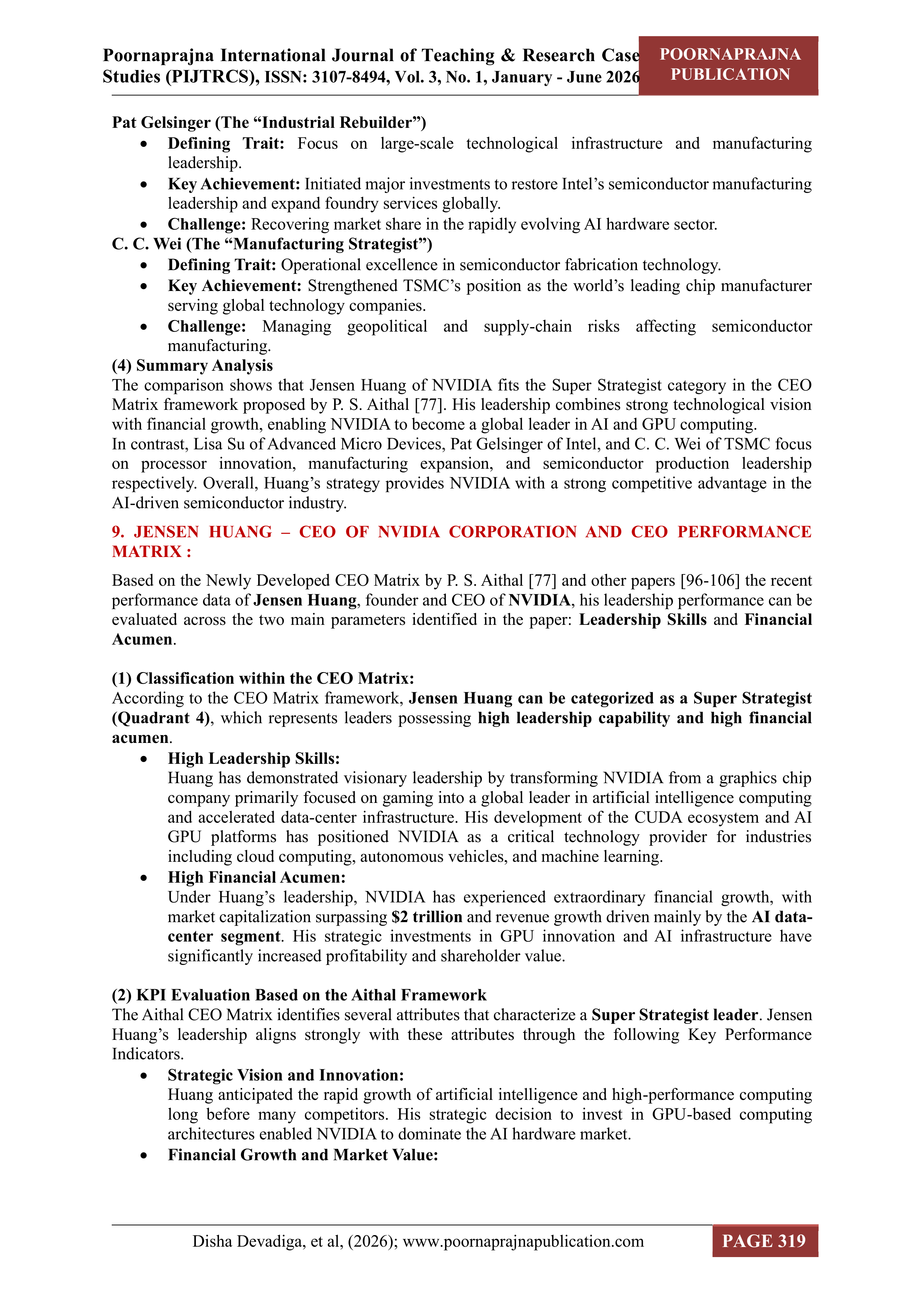


Poornaprajna International Journal of Teaching & Research Case
Studies (PIJTRCS),
ISSN: 3107-8494, Vol. 3, No. 1, January - June 2026
POORNAPRAJNA
PUBLICATION
Disha Devadiga, et al, (2026); www.poornaprajnapublication.com
PAGE 319
Pat Gelsinger (The “Industrial Rebuilder”)
•
Defining Trait:
Focus on large-scale technological infrastructure and manufacturing
leadership.
•
Key Achievement:
Initiated major investments to restore Intel’s semiconductor manufacturing
leadership and expand foundry services globally.
•
Challenge:
Recovering market share in the rapidly evolving AI hardware sector.
C. C. Wei (The “Manufacturing Strategist”)
•
Defining Trait:
Operational excellence in semiconductor fabrication technology.
•
Key Achievement:
Strengthened TSMC’s position as the world’s leading chip manufacturer
serving global technology companies.
•
Challenge:
Managing geopolitical and supply-chain risks affecting semiconductor
manufacturing.
(4) Summary Analysis
The comparison shows that Jensen Huang of NVIDIA fits the Super Strategist category in the CEO
Matrix framework proposed by P. S. Aithal [77]. His leadership combines strong technological vision
with financial growth, enabling NVIDIA to become a global leader in AI and GPU computing.
In contrast, Lisa Su of Advanced Micro Devices, Pat Gelsinger of Intel, and C. C. Wei of TSMC focus
on processor innovation, manufacturing expansion, and semiconductor production leadership
respectively. Overall, Huang’s strategy provides NVIDIA with a strong competitive advantage in the
AI-driven semiconductor industry.
9. JENSEN HUANG – CEO OF NVIDIA CORPORATION AND CEO PERFORMANCE
MATRIX :
Based on the Newly Developed CEO Matrix by P. S. Aithal [77] and other papers [96-106] the recent
performance data of
Jensen Huang
, founder and CEO of
NVIDIA
, his leadership performance can be
evaluated across the two main parameters identified in the paper:
Leadership Skills
and
Financial
Acumen
.
(1) Classification within the CEO Matrix:
According to the CEO Matrix framework,
Jensen Huang can be categorized as a Super Strategist
(Quadrant 4)
, which represents leaders possessing
high leadership capability and high financial
acumen
.
•
High Leadership Skills:
Huang has demonstrated visionary leadership by transforming NVIDIA from a graphics chip
company primarily focused on gaming into a global leader in artificial intelligence computing
and accelerated data-center infrastructure. His development of the CUDA ecosystem and AI
GPU platforms has positioned NVIDIA as a critical technology provider for industries
including cloud computing, autonomous vehicles, and machine learning.
•
High Financial Acumen:
Under Huang’s leadership, NVIDIA has experienced extraordinary financial growth, with
market capitalization surpassing
$2 trillion
and revenue growth driven mainly by the
AI data-
center segment
. His strategic investments in GPU innovation and AI infrastructure have
significantly increased profitability and shareholder value.
(2) KPI Evaluation Based on the Aithal Framework
The Aithal CEO Matrix identifies several attributes that characterize a
Super Strategist leader
. Jensen
Huang’s leadership aligns strongly with these attributes through the following Key Performance
Indicators.
•
Strategic Vision and Innovation:
Huang anticipated the rapid growth of artificial intelligence and high-performance computing
long before many competitors. His strategic decision to invest in GPU-based computing
architectures enabled NVIDIA to dominate the AI hardware market.
•
Financial Growth and Market Value:
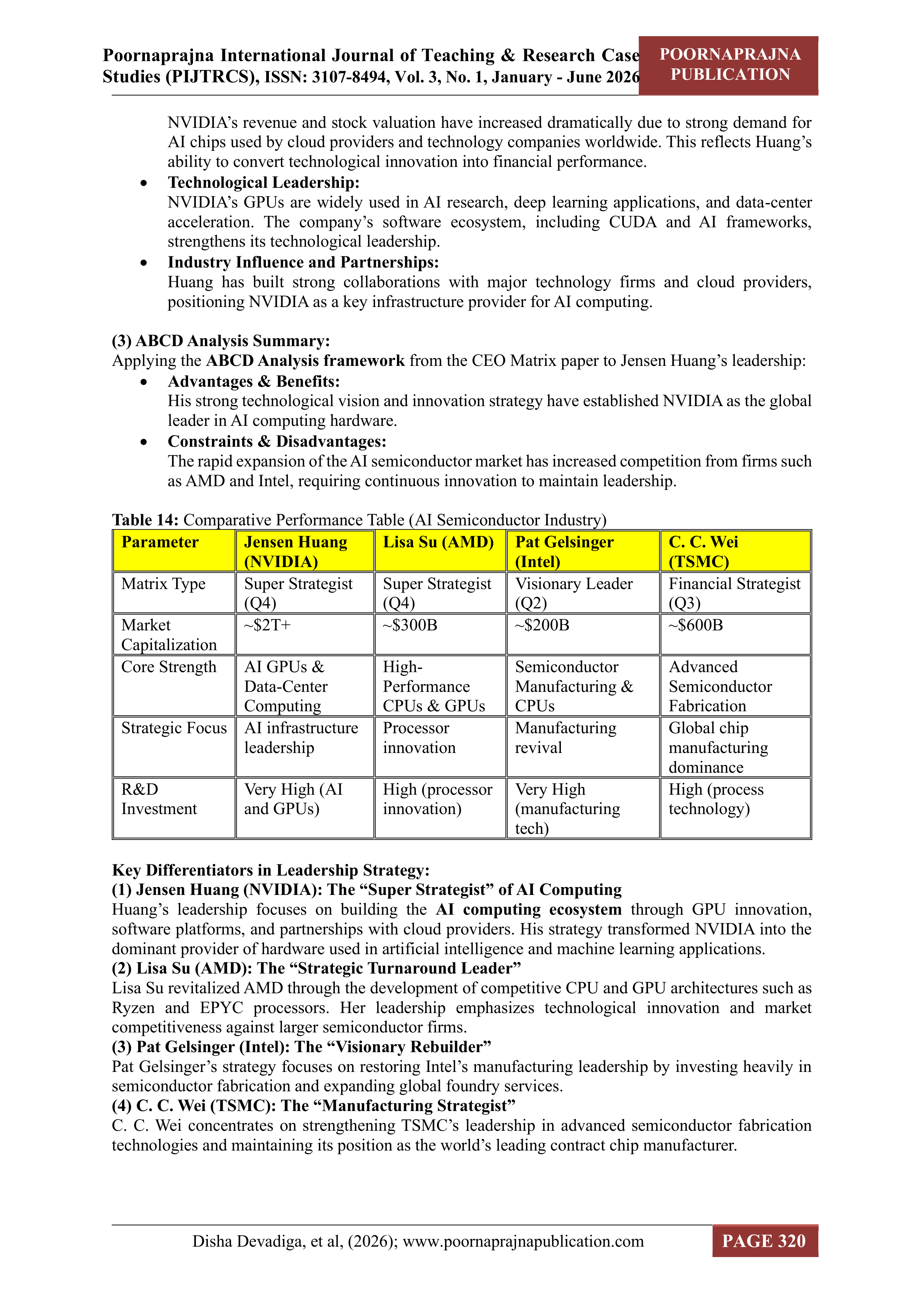


Poornaprajna International Journal of Teaching & Research Case
Studies (PIJTRCS),
ISSN: 3107-8494, Vol. 3, No. 1, January - June 2026
POORNAPRAJNA
PUBLICATION
Disha Devadiga, et al, (2026); www.poornaprajnapublication.com
PAGE 320
NVIDIA’s revenue and stock valuation have increased dramatically due to strong demand for
AI chips used by cloud providers and technology companies worldwide. This reflects Huang’s
ability to convert technological innovation into financial performance.
•
Technological Leadership:
NVIDIA’s GPUs are widely used in AI research, deep learning applications, and data-center
acceleration. The company’s software ecosystem, including CUDA and AI frameworks,
strengthens its technological leadership.
•
Industry Influence and Partnerships:
Huang has built strong collaborations with major technology firms and cloud providers,
positioning NVIDIA as a key infrastructure provider for AI computing.
(3) ABCD Analysis Summary:
Applying the
ABCD Analysis framework
from the CEO Matrix paper to Jensen Huang’s leadership:
•
Advantages & Benefits:
His strong technological vision and innovation strategy have established NVIDIA as the global
leader in AI computing hardware.
•
Constraints & Disadvantages:
The rapid expansion of the AI semiconductor market has increased competition from firms such
as AMD and Intel, requiring continuous innovation to maintain leadership.
Table 14:
Comparative Performance Table (AI Semiconductor Industry)
Parameter
Jensen Huang
(NVIDIA)
Lisa Su (AMD)
Pat Gelsinger
(Intel)
C. C. Wei
(TSMC)
Matrix Type
Super Strategist
(Q4)
Super Strategist
(Q4)
Visionary Leader
(Q2)
Financial Strategist
(Q3)
Market
Capitalization
~$2T+
~$300B
~$200B
~$600B
Core Strength
AI GPUs &
Data-Center
Computing
High-
Performance
CPUs & GPUs
Semiconductor
Manufacturing &
CPUs
Advanced
Semiconductor
Fabrication
Strategic Focus AI infrastructure
leadership
Processor
innovation
Manufacturing
revival
Global chip
manufacturing
dominance
R&D
Investment
Very High (AI
and GPUs)
High (processor
innovation)
Very High
(manufacturing
tech)
High (process
technology)
Key Differentiators in Leadership Strategy:
(1) Jensen Huang (NVIDIA): The “Super Strategist” of AI Computing
Huang’s leadership focuses on building the
AI computing ecosystem
through GPU innovation,
software platforms, and partnerships with cloud providers. His strategy transformed NVIDIA into the
dominant provider of hardware used in artificial intelligence and machine learning applications.
(2) Lisa Su (AMD): The “Strategic Turnaround Leader”
Lisa Su revitalized AMD through the development of competitive CPU and GPU architectures such as
Ryzen and EPYC processors. Her leadership emphasizes technological innovation and market
competitiveness against larger semiconductor firms.
(3) Pat Gelsinger (Intel): The “Visionary Rebuilder”
Pat Gelsinger’s strategy focuses on restoring Intel’s manufacturing leadership by investing heavily in
semiconductor fabrication and expanding global foundry services.
(4) C. C. Wei (TSMC): The “Manufacturing Strategist”
C. C. Wei concentrates on strengthening TSMC’s leadership in advanced semiconductor fabrication
technologies and maintaining its position as the world’s leading contract chip manufacturer.
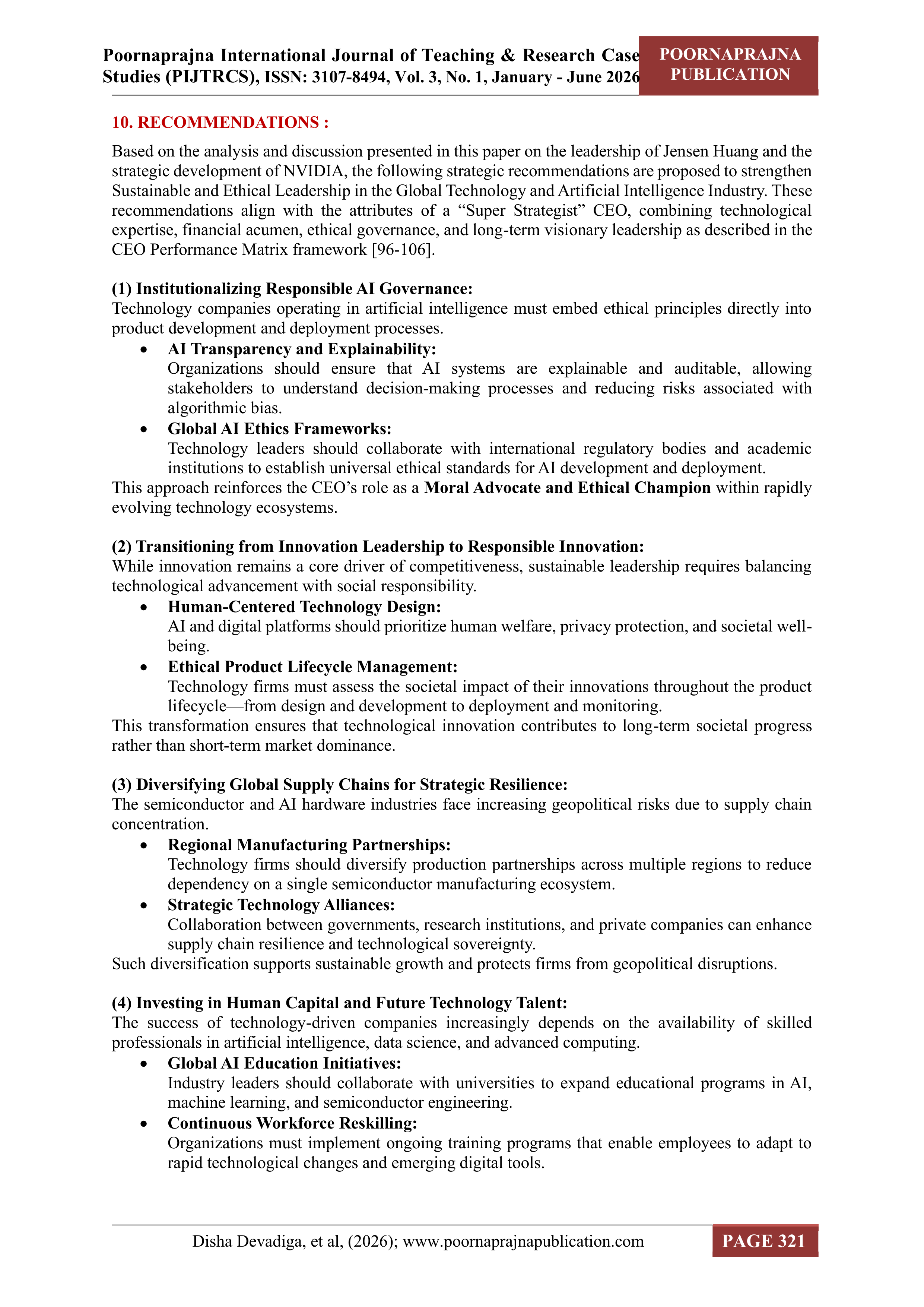


Poornaprajna International Journal of Teaching & Research Case
Studies (PIJTRCS),
ISSN: 3107-8494, Vol. 3, No. 1, January - June 2026
POORNAPRAJNA
PUBLICATION
Disha Devadiga, et al, (2026); www.poornaprajnapublication.com
PAGE 321
10. RECOMMENDATIONS :
Based on the analysis and discussion presented in this paper on the leadership of Jensen Huang and the
strategic development of NVIDIA, the following strategic recommendations are proposed to strengthen
Sustainable and Ethical Leadership in the Global Technology and Artificial Intelligence Industry. These
recommendations align with the attributes of a “Super Strategist” CEO, combining technological
expertise, financial acumen, ethical governance, and long-term visionary leadership as described in the
CEO Performance Matrix framework [96-106].
(1) Institutionalizing Responsible AI Governance:
Technology companies operating in artificial intelligence must embed ethical principles directly into
product development and deployment processes.
•
AI Transparency and Explainability:
Organizations should ensure that AI systems are explainable and auditable, allowing
stakeholders to understand decision-making processes and reducing risks associated with
algorithmic bias.
•
Global AI Ethics Frameworks:
Technology leaders should collaborate with international regulatory bodies and academic
institutions to establish universal ethical standards for AI development and deployment.
This approach reinforces the CEO’s role as a
Moral Advocate and Ethical Champion
within rapidly
evolving technology ecosystems.
(2) Transitioning from Innovation Leadership to Responsible Innovation:
While innovation remains a core driver of competitiveness, sustainable leadership requires balancing
technological advancement with social responsibility.
•
Human-Centered Technology Design:
AI and digital platforms should prioritize human welfare, privacy protection, and societal well-
being.
•
Ethical Product Lifecycle Management:
Technology firms must assess the societal impact of their innovations throughout the product
lifecycle—from design and development to deployment and monitoring.
This transformation ensures that technological innovation contributes to long-term societal progress
rather than short-term market dominance.
(3) Diversifying Global Supply Chains for Strategic Resilience:
The semiconductor and AI hardware industries face increasing geopolitical risks due to supply chain
concentration.
•
Regional Manufacturing Partnerships:
Technology firms should diversify production partnerships across multiple regions to reduce
dependency on a single semiconductor manufacturing ecosystem.
•
Strategic Technology Alliances:
Collaboration between governments, research institutions, and private companies can enhance
supply chain resilience and technological sovereignty.
Such diversification supports sustainable growth and protects firms from geopolitical disruptions.
(4) Investing in Human Capital and Future Technology Talent:
The success of technology-driven companies increasingly depends on the availability of skilled
professionals in artificial intelligence, data science, and advanced computing.
•
Global AI Education Initiatives:
Industry leaders should collaborate with universities to expand educational programs in AI,
machine learning, and semiconductor engineering.
•
Continuous Workforce Reskilling:
Organizations must implement ongoing training programs that enable employees to adapt to
rapid technological changes and emerging digital tools.
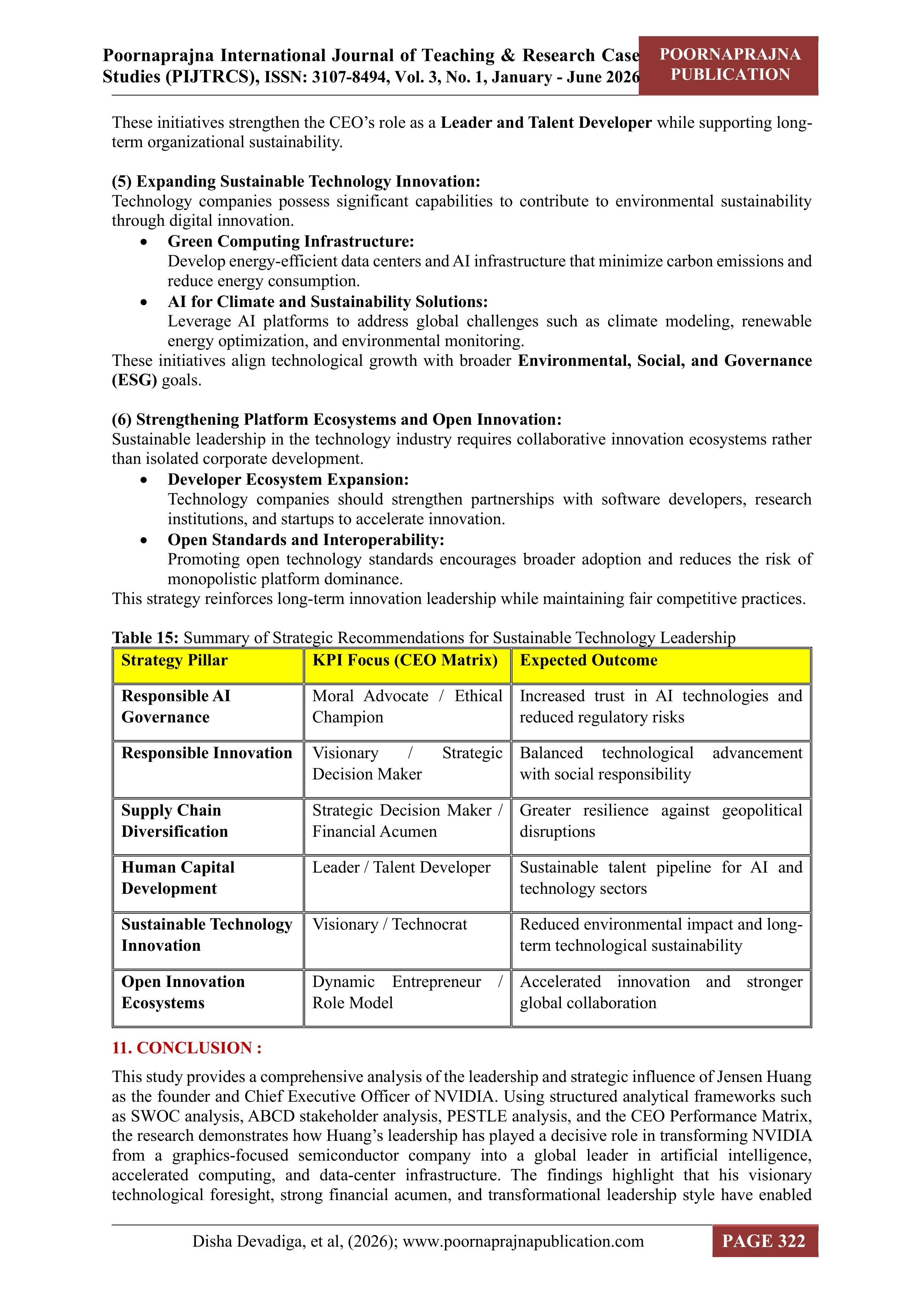


Poornaprajna International Journal of Teaching & Research Case
Studies (PIJTRCS),
ISSN: 3107-8494, Vol. 3, No. 1, January - June 2026
POORNAPRAJNA
PUBLICATION
Disha Devadiga, et al, (2026); www.poornaprajnapublication.com
PAGE 322
These initiatives strengthen the CEO’s role as a
Leader and Talent Developer
while supporting long-
term organizational sustainability.
(5) Expanding Sustainable Technology Innovation:
Technology companies possess significant capabilities to contribute to environmental sustainability
through digital innovation.
•
Green Computing Infrastructure:
Develop energy-efficient data centers and AI infrastructure that minimize carbon emissions and
reduce energy consumption.
•
AI for Climate and Sustainability Solutions:
Leverage AI platforms to address global challenges such as climate modeling, renewable
energy optimization, and environmental monitoring.
These initiatives align technological growth with broader
Environmental, Social, and Governance
(ESG)
goals.
(6) Strengthening Platform Ecosystems and Open Innovation:
Sustainable leadership in the technology industry requires collaborative innovation ecosystems rather
than isolated corporate development.
•
Developer Ecosystem Expansion:
Technology companies should strengthen partnerships with software developers, research
institutions, and startups to accelerate innovation.
•
Open Standards and Interoperability:
Promoting open technology standards encourages broader adoption and reduces the risk of
monopolistic platform dominance.
This strategy reinforces long-term innovation leadership while maintaining fair competitive practices.
Table 15:
Summary of Strategic Recommendations for Sustainable Technology Leadership
Strategy Pillar
KPI Focus (CEO Matrix)
Expected Outcome
Responsible AI
Governance
Moral Advocate / Ethical
Champion
Increased trust in AI technologies and
reduced regulatory risks
Responsible Innovation
Visionary
/
Strategic
Decision Maker
Balanced
technological
advancement
with social responsibility
Supply Chain
Diversification
Strategic Decision Maker /
Financial Acumen
Greater resilience against geopolitical
disruptions
Human Capital
Development
Leader / Talent Developer
Sustainable talent pipeline for AI and
technology sectors
Sustainable Technology
Innovation
Visionary / Technocrat
Reduced environmental impact and long-
term technological sustainability
Open Innovation
Ecosystems
Dynamic Entrepreneur /
Role Model
Accelerated innovation and stronger
global collaboration
11. CONCLUSION :
This study provides a comprehensive analysis of the leadership and strategic influence of Jensen Huang
as the founder and Chief Executive Officer of NVIDIA. Using structured analytical frameworks such
as SWOC analysis, ABCD stakeholder analysis, PESTLE analysis, and the CEO Performance Matrix,
the research demonstrates how Huang’s leadership has played a decisive role in transforming NVIDIA
from a graphics-focused semiconductor company into a global leader in artificial intelligence,
accelerated computing, and data-center infrastructure. The findings highlight that his visionary
technological foresight, strong financial acumen, and transformational leadership style have enabled


Poornaprajna International Journal of Teaching & Research Case
Studies (PIJTRCS),
ISSN: 3107-8494, Vol. 3, No. 1, January - June 2026
POORNAPRAJNA
PUBLICATION
Disha Devadiga, et al, (2026); www.poornaprajnapublication.com
PAGE 323
NVIDIA to achieve sustained innovation, rapid revenue growth, and a dominant position in the global
technology ecosystem. Through strategic investments in research and development and the creation of
the CUDA developer ecosystem, Huang has successfully positioned NVIDIA as a foundational platform
provider for AI-driven industries worldwide.
At the same time, the study also identifies several strategic challenges associated with NVIDIA’s
continued expansion in the rapidly evolving AI and semiconductor landscape. Issues such as
dependence on hyperscale cloud customers, environmental concerns related to high-energy AI
infrastructure, and growing regulatory scrutiny around AI governance highlight the need for responsible
and sustainable leadership in technology-intensive industries. Overall, the analysis suggests that Huang
exemplifies the characteristics of a “Super Strategist” CEO—balancing technological innovation with
financial performance and ecosystem development—while emphasizing that future leadership success
will depend on addressing ethical, environmental, and societal implications of advanced computing
technologies. Consequently, this case study contributes to the broader understanding of how visionary
CEO leadership can shape organizational performance, technological transformation, and long-term
competitive advantage in the global digital economy.
REFERENCES :
[1] Bolinger, A., Brookman, J., & Thistle, P. (2019). The relative importance of CEOs and non-CEOs
over firm performance.
Journal of Management & Organization, 29
(1), 1–13.
Google Scholar
[2] Saidu, S. (2019). CEO characteristics and firm performance: Focus on origin, education and
ownership.
Journal of Global Entrepreneurship Research, 9
, Article 29.
Google Scholar
[3] Kiss, A. N., Cortes, A. F., & Herrmann, P. (2022). CEO proactiveness, innovation, and firm
performance.
The Leadership Quarterly, 33
(3), 101545.
Google Scholar
[4] Gupta, A., Sen, S., & Narayanan, K. (2022). Impact of CEO attributes on corporate reputation,
financial performance, and corporate sustainable growth: Evidence from India.
Financial
Innovation, 8
, Article 40.
Google Scholar
[5] Li, Z., & Zhang, Y. (2022). CEO overconfidence and corporate innovation outcomes: Evidence from
China.
Frontiers in Psychology, 13
, 760102.
Google Scholar
[6] Hambrick, D. C., & Mason, P. A. (1984). Upper echelons: The organization as a reflection of its top
managers.
Academy of Management Review, 9
(2), 193–206
. Google Scholar
[7] Peterson, R. S., Smith, D. B., Martorana, P. V., & Owens, P. D. (2003). The impact of CEO
personality on top management team dynamics and firm performance.
Journal of Applied
Psychology, 88
(5), 795–808.
Google Scholar
[8] Wang, Y., Su, Q., & Sun, W. (2022). CEO relational leadership and product innovation performance:
The roles of top management team behaviour and characteristics.
Frontiers in Psychology, 13
,
874105.
Google Scholar
[9] Agubata, N. S. (2024). Effect of CEO Attributes on the Quality of Financial Reporting of Nigerian
Firms. IIARD International Journal of Economics and Business Management, 10(7), 114-128.
Google Scholar
[10] He, X., Si, Z., & Xiao, Y. (2025). The influential factors of CSR reporting in China: A systematic
literature review and future research agenda.
Accounting, Finance and Governance
Review
,
34
.
Google Scholar
[11] Finkelstein, S., Hambrick, D. C., & Cannella, A. A. (2009).
Strategic leadership: Theory and
research on executives, top management teams, and boards
. Oxford University Press.
Google
Scholar
[12] Ireland, R. D., & Hitt, M. A. (2005). Achieving and maintaining strategic competitiveness in the
21st century.
Academy of Management Executive, 19
(4), 63–77.
Google Scholar
[13] Teece, D. J. (2018). Business models and dynamic capabilities.
Long Range Planning, 51
(1), 40–
49.
Google Scholar


Poornaprajna International Journal of Teaching & Research Case
Studies (PIJTRCS),
ISSN: 3107-8494, Vol. 3, No. 1, January - June 2026
POORNAPRAJNA
PUBLICATION
Disha Devadiga, et al, (2026); www.poornaprajnapublication.com
PAGE 324
[14] Adner, R., & Kapoor, R. (2016). Innovation ecosystems and the pace of substitution: Re-examining
technology S-curves.
Strategic Management Journal, 37
(4), 625–648.
Google Scholar
[15] Eisenhardt, K. M., & Martin, J. A. (2000). Dynamic capabilities: What are they?
Strategic
Management Journal, 21
(10–11), 1105–1121.
Google Scholar
[16] Helfat, C. E., & Peteraf, M. A. (2009). Understanding dynamic capabilities: Progress along a
developmental path.
Strategic Organization, 7
(1), 91–102.
Google Scholar
[17] Marr, B. (2016).
Key performance indicators: The 75 measures every manager needs to know
.
Pearson Education.
Google Scholar
[18] Tricker, B. (2019).
Corporate governance: Principles, policies, and practices
(4th ed.). Oxford
University Press.
Google Scholar
[19] Janes, D. P., Carter, L. M., & Rourke, L. E. (2020). Mentoring as support for women in higher
education leadership. In
Women negotiating life in the academy: A Canadian perspective
(pp. 33-
49). Singapore: Springer Singapore.
Google Scholar
[20] Adizes, I. (2018).
Leading the leaders: How to enrich your style of management and handle people
whose style is different from yours
. Adizes Institute.
Google Scholar
[21] Vendrell-Herrero, F., Vaillant, Y., & Bustinza, O. F. (2025).
Scalability in incumbent firms: The
case of Nvidia
.
Long Range Planning
.
Google Scholar
[22] Temprano, D. (2024). Future Market Blueprints: Harnessing Artificial Intelligence in a World
Wired for Wonder.
Nw. J. Int'l L. & Bus.
,
44
, 531.
Google Scholar
[23] YOFFIE, D. B., & VON BARGEN, S. A. R. A. H. (2024). Nvidia, Inc. in 2024 and the Future of
AI.
Google Scholar
[24] Witt, Stephen.
The thinking machine: Jensen Huang, Nvidia, and the world's most coveted
microchip
. Penguin Group, 2025.
Google Scholar
[25] Kumar, R. (2025).
Winning the AI Arms Race: Defeating China and Russia, Re-establishing
American Superpower for Global Prosperity and the Greater Good with Artificial Intelligence
.
CRC Press.
Google Scholar
[26] Finkelstein, S. (1996). Strategic leadership: Top executives and their effects on
organizations.
South-Western Pub
.
Google Scholar
[27] Nadkarni, S., & Chen, J. (2014). Bridging yesterday, today, and tomorrow: CEO temporal focus,
environmental dynamism, and rate of new product introduction.
Academy of Management Journal,
57
(6), 1810–1833.
Google Scholar
[28] Ling, Y., Simsek, Z., Lubatkin, M. H., & Veiga, J. F. (2008). The impact of transformational CEOs
on the performance of small‐ to medium‐sized firms: Does organizational context matter?
Journal
of Applied Psychology, 93
(4), 923–934.
Google Scholar
[29] Carmeli, A., Schaubroeck, J., & Tishler, A. (2011). How CEO empowering leadership shapes top
management team processes: Implications for firm performance.
Leadership Quarterly, 22
(2),
399–411.
Google Scholar
[30] Hambrick, D. C. (2007). Upper echelons theory: An update.
Academy of Management Review,
32
(2), 334–343.
Google Scholar
[31] Li, M., Bi, Z., Wang, T., Wen, Y., Niu, Q., Song, X., ... & Liu, M. (2024). Deep learning and
machine learning with gpgpu and cuda: Unlocking the power of parallel computing.
arXiv preprint
arXiv:2410.05686
.
Google Scholar
[32] Alzubaidi, L., Zhang, J., Humaidi, A. J., Al-Dujaili, A., Duan, Y., Al-Shamma, O., ... & Farhan, L.
(2021). Review of deep learning: concepts, CNN architectures, challenges, applications, future
directions.
Journal of big Data
,
8
(1), 53.
Google Scholar


Poornaprajna International Journal of Teaching & Research Case
Studies (PIJTRCS),
ISSN: 3107-8494, Vol. 3, No. 1, January - June 2026
POORNAPRAJNA
PUBLICATION
Disha Devadiga, et al, (2026); www.poornaprajnapublication.com
PAGE 325
[33] Wael, A., & Madi, A. (2025). Accelerating Artificial Intelligence: The Role of GPUs in Deep
Learning and Computational Advancements.
East Journal of Engineering
,
1
(1), 31-46.
Google
Scholar
[34] Li, Z., Liu, F., Yang, W., Peng, S., & Zhou, J. (2021). A survey of convolutional neural networks:
analysis, applications, and prospects.
IEEE transactions on neural networks and learning
systems
,
33
(12), 6999-7019.
Google Scholar
[35] Rakhimov, M., Javliev, S., & Nasimov, R. (2023, December). Parallel Approaches in Deep
Learning: Use Parallel Computing. In
Proceedings of the 7th International Conference on Future
Networks and Distributed Systems
(pp. 192-201).
Google Scholar
[36] Youvan, D. (2023). Parallel precision: The role of gpus in the acceleration of artificial intelligence.
Google Scholar
[37] Wang, J. (2025). Research on the Competitive Development and Prospects of Nvidia.
Advances in
Economics, Management and Political Sciences
,
161
, 51-56.
Google Scholar
[38] Wang, J., Hsu, J., & Qin, Z. (2024). A Comprehensive Analysis of Nvidia's Technological
Innovations, Market Strategies, and Future Prospects.
International Journal of Information
Technologies and Systems Approach (IJITSA)
,
17
(1), 1-16.
Google Scholar
[39] Buonocore, F., Annosi, M. C., de Gennaro, D., & Riemma, F. (2024). Digital transformation and
social change: Leadership strategies for responsible innovation.
Journal of Engineering and
Technology Management
,
74
, 101843.
Google Scholar
[40] Ryoo, S., Rodrigues, C. I., Baghsorkhi, S. S., Stone, S. S., Kirk, D. B., & Hwu, W. (2008).
Optimization principles and application performance evaluation of a multithreaded GPU using
CUDA.
Proceedings of the 13th ACM SIGPLAN Symposium on Principles and Practice of Parallel
Programming
, 73–82.
Google Scholar
[41] Kurzhals, C., Graf‐Vlachy, L., & König, A. (2020). Strategic leadership and technological
innovation: A comprehensive review and research agenda.
Corporate Governance: An
International Review
,
28
(6), 437-464.
Google Scholar
[42] Schulz, C., Bendig, D., Kriebel, J., Haubner, K., & Fainshmidt, S. (2025). Ceo human capital and
digital product innovation: A dynamic managerial capabilities perspective.
Information Systems
Research
.
Google Scholar
[43] Zhang, Y., Swatdikun, T., Lakkanawanit, P., Huang, S. Z., & Chen, H. (2025). Digital
Transformation Capability, Organizational Strategic Intuition, and Digital Leadership: Empirical
Evidence from High-Tech Firms’ Performance in the Yangtze River Delta.
Journal of Risk and
Financial Management
,
18
(7), 405.
Google Scholar
[44] Qiao, G., Li, Y., & Hong, A. (2024). The strategic role of digital transformation: Leveraging digital
leadership to enhance employee performance and organizational commitment in the digital
era.
Systems
,
12
(11), 457.
Google Scholar
[45] Ly, B. (2024). The interplay of digital transformational leadership, organizational agility, and
digital transformation.
Journal of the Knowledge Economy
,
15
(1), 4408-4427.
Google Scholar
[46] Sacavém, A., de Bem Machado, A., dos Santos, J. R., Palma-Moreira, A., Belchior-Rocha, H., &
Au-Yong-Oliveira, M. (2025). Leading in the digital age: The role of leadership in organizational
digital transformation.
Administrative Sciences
,
15
(2), 43.
Google Scholar
[47] Pfaff, M., Żur, A., & Wyrwa, J. (2024). Are we ready for digital transformation? The role of
organizational culture, leadership and competence in building digital advantage.
Central European
Management Journal
, 33(2), 219-241.
Google Scholar
[48] Tigre, F. B., Henriques, P. L., & Curado, C. (2025). The digital leadership emerging construct: a
multi-method approach.
Management Review Quarterly
,
75
(1), 789-836.
Google Scholar
[49] Amankona, D., Yi, K., Tackie, E. A., Tweneboa Kodua, L., & Odai, L. A. (2025). Responsible
digital innovation and innovation performance in ghana’s high-tech industry: The mediating roles


Poornaprajna International Journal of Teaching & Research Case
Studies (PIJTRCS),
ISSN: 3107-8494, Vol. 3, No. 1, January - June 2026
POORNAPRAJNA
PUBLICATION
Disha Devadiga, et al, (2026); www.poornaprajnapublication.com
PAGE 326
of digital organizational culture and strategy, and the moderating role of digital literacy.
SAGE
Open
,
15
(2), 21582440251341256.
Google Scholar
[50] Malik, M., Raziq, M. M., Sarwar, N., & Tariq, A. (2025). Digital leadership, business model
innovation
and
organizational
change:
role
of
leader
in
steering
digital
transformation.
Benchmarking: An International Journal
,
32
(5), 1632-1662.
Google Scholar
[51] Alzubaidi, L., Zhang, J., Humaidi, A. J., Al-Dujaili, A., Duan, Y., Al-Shamma, O., ... & Farhan, L.
(2021). Review of deep learning: concepts, CNN architectures, challenges, applications, future
directions.
Journal of big Data
,
8
(1), 53.
Google Scholar
[52] Schmidhuber, J. (2015). Deep learning in neural networks: An overview.
Neural networks
,
61
, 85-
117.
Google Scholar
[53] Emmert-Streib, F., Yang, Z., Feng, H., Tripathi, S., & Dehmer, M. (2020). An introductory review
of deep learning for prediction models with big data.
Frontiers in artificial intelligence
,
3
, 4.
Google Scholar
[54] Vaswani, A., Shazeer, N., Parmar, N., Uszkoreit, J., Jones, L., Gomez, A. N., ... & Polosukhin, I.
(2017). Attention is all you need.
Advances in neural information processing systems
,
30
.
Google
Scholar
[55] Enriquez, B., & Zerbini, F. (2021). Construction of Maurer-Cartan elements over configuration
spaces of curves.
arXiv preprint arXiv:2110.09341
.
Google Scholar
[56] Gardazi, N. M., Daud, A., Malik, M. K., Bukhari, A., Alsahfi, T., & Alshemaimri, B. (2025). BERT
applications in natural language processing: a review.
Artificial Intelligence Review
,
58
(6), 1-49.
Google Scholar
[57] Chiarello, F., Giordano, V., Spada, I., Barandoni, S., & Fantoni, G. (2024). Future applications of
generative large language models: A data-driven case study on ChatGPT.
Technovation
,
133
,
103002.
Google Scholar
[58] Khan, N., Khan, Z., Koubaa, A., Khan, M. K., & Salleh, R. B. (2024). Global insights and the
impact of generative AI-ChatGPT on multidisciplinary: a systematic review and bibliometric
analysis.
Connection science
,
36
(1), 2353630.
Google Scholar
[59] Tuan, N. T., Moore, P., Thanh, D. H. V., & Pham, H. V. (2024). A generative artificial intelligence
using multilingual large language models for chatgpt applications.
Applied Sciences
,
14
(7), 3036.
Google Scholar
[60] Raina, K., Sharma, G. D., Taheri, B., Dev, D., & Chavriya, S. (2026). Artificial intelligence-driven
management:
Bridging
innovation,
knowledge
creation,
and
sustainable
business
practices.
Journal of Innovation & Knowledge
,
11
, 100860.
Google Scholar
[61] McCarthy, P. X., Gong, X., Braesemann, F., Stephany, F., Rizoiu, M.-A., & Kern, M. L. (2023).
The impact of founder personalities on startup success.
Scientific Reports
,
13
, Article 17200.
Google Scholar
[62] Sevilla-Bernardo, J., Sanchez-Robles, B., & Herrador-Alcaide, T. C. (2022). Success factors of
startups in research literature within the entrepreneurial ecosystem.
Administrative Sciences
,
12
(3),
Article 102.
Google Scholar
[63] Chikunda, P., Bhuiyan, M. B. U., Houqe, M. N., & Nguyen, L. T. M. (2025). Long-tenured CEOs
and firm performance: Too much of a good thing? Evidence from New Zealand.
Pacific Accounting
Review
. Advance online publication.
Google Scholar
[64] Mukherjee, T., & Sen, S. S. (2022). Impact of CEO attributes on corporate reputation, financial
performance, and corporate sustainable growth: Evidence from India.
Financial Innovation
,
8
(1),
Article 40.
Google Scholar
[65] Agazu, B. G., Kero, C. A., & Debela, K. L. (2025). Transformational leadership and firm
performance: A systematic literature review.
Journal of Innovation and Entrepreneurship
,
14
(1),
Article 29.
Google Scholar


Poornaprajna International Journal of Teaching & Research Case
Studies (PIJTRCS),
ISSN: 3107-8494, Vol. 3, No. 1, January - June 2026
POORNAPRAJNA
PUBLICATION
Disha Devadiga, et al, (2026); www.poornaprajnapublication.com
PAGE 327
[66] Priya, A. (2021). Case study methodology of qualitative research: Key attributes and navigating
the conundrums in its application.
Sociological Bulletin
,
70
(1), 94–110.
Google Scholar
[67] Mtisi, S. (2022). The qualitative case study research strategy as applied on a rural enterprise
development doctoral research project.
International Journal of Qualitative Methods
,
21
, 1–12.
Google Scholar
[68] Haddaway, N. R., Collins, A. M., Coughlin, D., & Kirk, S. (2015). The role of Google Scholar in
evidence reviews and its applicability to grey literature searching.
PLOS ONE
,
10
(9), e0138237.
Google Scholar
[69] Van Wee, B., & Banister, D. (2023). Literature review papers: The search and selection process.
Journal of Decision Systems
,
33
(4), 559–565.
Google Scholar
[70] Scherbakov, D., Hubig, N., Jansari, V., Bakumenko, A., & Lenert, L. A. (2025). The emergence of
large language models as tools in literature reviews: A large language model-assisted systematic
review.
Journal of the American Medical Informatics Association
,
32
(6), 1071–1086.
Google
Scholar
[71] Khraisha, Q., Put, S., Kappenberg, J., Warraich, A., Bosselmann, I., & Leeflang, M. (2024). Can
large language models replace humans in systematic reviews? Evaluating GPT-4's efficacy in
screening and extracting data from peer-reviewed and grey literature in multiple languages.
Research Synthesis Methods
,
15
(3), 616–628.
Google Scholar
[72] Puyt, R. W., Lie, F. B., & Wilderom, C. P. M. (2023). The origins of SWOT analysis.
Long Range
Planning
,
56
(3), Article 102304.
Google Scholar
[73] Aithal, P. S., & Kumar, P. M. (2015). Applying SWOC analysis to an institution of higher education.
International Journal of Management, IT and Engineering
,
5
(7), 231–247.
Google Scholar
[74] Benzaghta, M. A., Elwalda, A., Mousa, M. M., Erkan, I., & Rahman, M. (2021). SWOT analysis
applications: An integrative literature review.
Journal of Global Business Insights
,
6
(1), 55–73
.
Google Scholar
[75] Taherdoost, H., & Madanchian, M. (2021). Determination of business strategies using SWOT
analysis: Planning and managing the organizational resources to enhance growth and profitability.
Macro Management & Public Policies
,
3
(1), 19–22.
Google Scholar
[76] Farrokhnia, M., Banihashem, S. K., Noroozi, O., & Wals, A. (2024). A SWOT analysis of ChatGPT:
Implications for educational practice and research.
Innovations in Education and Teaching
International
,
61
(3), 460–474.
Google Scholar
[77] Aithal, P. S. (2023).
Anticipated attributes of chief executive officers based on newly developed
CEO matrix
. SSRN.
Google Scholar
[77]
[78] Hambrick, D. C., & Quigley, T. J. (2014). Toward more accurate contextualization of the CEO
effect on firm performance.
Strategic Management Journal
,
35
(4), 473–491.
Google Scholar
[79] Liu, D., Fisher, G., & Chen, G. (2018). CEO attributes and firm performance: A sequential
mediation process model.
Academy of Management Annals
,
12
(2), 789–816.
Google Scholar
[80] Osei Bonsu, C., Liu, C., & Yawson, A. (2024). The impact of CEO attributes on corporate decision-
making and outcomes: a review and an agenda for future research.
International Journal of
Managerial Finance
,
20
(2), 503-545.
Google Scholar
[81] Aithal, P. S., Shailashree, V., & Kumar, P. M. (2015). A new ABCD technique to analyze business
models & concepts.
International Journal of Management, IT and Engineering
,
5
(4), 409–423.
Google Scholar
[82] Aithal, P. S. (2016). Study on ABCD analysis technique for business models, business strategies,
operating concepts & business systems.
International Journal in Management and Social Science
,
4
(1), 95–115.
Google Scholar


Poornaprajna International Journal of Teaching & Research Case
Studies (PIJTRCS),
ISSN: 3107-8494, Vol. 3, No. 1, January - June 2026
POORNAPRAJNA
PUBLICATION
Disha Devadiga, et al, (2026); www.poornaprajnapublication.com
PAGE 328
[83] Aithal, P. S., & Aithal, S. (2017). ABCD analysis as research methodology in company case studies.
International Journal of Management, Technology, and Social Sciences (IJMTS)
,
2
(2), 40–54.
Google Scholar
[84] Aithal, P. S., Shailashree, V., & Kumar, P. M. (2016). The study of the new national institutional
ranking system using ABCD framework.
International Journal of Current Research and Modern
Education (IJCRME)
,
1
(1), 389–402.
Google Scholar
[85] Kumar, S., & Aithal, P. S. (2023). Tech-Business Analytics–a Review based New Model to Improve
the Performances of Various Industry Sectors.
International Journal of Applied Engineering and
Management Letters (IJAEML)
,
7
(1), 67-91.
Google Scholar
[86] Perera, R. (2017).
The PESTLE analysis
(Vol. 1). Avissawella, Sri Lanka: Nerdynaut.
Google
Scholar
[87] Rastogi, N., & Trivedi, M. K. (2016). PESTLE technique — A tool to identify external risks in
construction projects.
International Research Journal of Engineering and Technology (IRJET)
,
3
(1), 384–388.
Google Scholar
[88] Sammut-Bonnici, T., & Galea, D. (2015). PEST analysis.
Wiley Encyclopedia of Management
,
12
,
1–1.
Google Scholar
[89] Ward, S., & Rivani, E. (2005). An overview of strategy development models and the Ward-Rivani
model.
Economics Working Paper
, Essex Business School, University of Essex, 1–15.
Google
Scholar
[90] Rastogi, N., & Trivedi, M. K. (2016). PESTLE technique — A tool to identify external risks in
construction projects.
International Research Journal of Engineering and Technology (IRJET)
,
3
(1), 384–388.
Google Scholar
[91] Holburn, G. L. F., & Vanden Bergh, R. G. (2008). Making friends in hostile environments: Political
strategy in regulated industries.
Academy of Management Review
,
33
(2), 521–540.
Google
Scholar
[92] Penman, S. H. (2010).
Financial statement analysis and security valuation
(4th ed.). McGraw-Hill
Education, pp. 1–754.
Google Scholar
[93] Aguinis, H., & Glavas, A. (2012). What we know and don't know about corporate social
responsibility: A review and research agenda.
Journal of Management
,
38
(4), 932–968.
Google
Scholar
[94] Cusumano, M. A., Gawer, A., & Yoffie, D. B. (2019).
The business of platforms: Strategy in the
age of digital competition, innovation, and power
. Harper Business, pp. 1–309.
Google Scholar
[95] Blind, K., Cremers, K., & Mueller, E. (2017). The influence of strategic patenting on companies'
patent portfolios.
Research Policy
,
38
(2), 428–436.
Google Scholar
[96] Aithal, P. S. (2025). Publishing Company and CEO Analysis Papers as Part of a 'Dark-Blue Ocean
Strategy'in Professional Education to Grab Employment.
Poornaprajna International Journal of
Management, Education & Social Science (PIJMESS)
,
2
(1), 129-153.
Google Scholar
[97] Aithal, P. S., Bhandarkar, S. M., & Shetty, V. (2024). A Systematic CEO Analysis for Elon Musk
of Tesla Inc. EV Company.
Poornaprajna International Journal of Teaching & Research Case
Studies (PIJTRCS)
,
1
(1), 126-162.
Google Scholar
[98] Aithal, P. S. (2025). CEO Analysis of K. Krithivasan of Tata Consultancy Services.
Poornaprajna
International Journal of Teaching & Research Case Studies (PIJTRCS)
,
2
(1), 73-107.
Google
Scholar
[99] Aithal, P. S. (2026). CEO Analysis of Siddhartha Mohanty as an Insider-Reformer of Life Insurance
Corporation of India.
Poornaprajna International Journal of Teaching & Research Case Studies
(PIJTRCS)
,
3
(1), 103-137.
Google Scholar


Poornaprajna International Journal of Teaching & Research Case
Studies (PIJTRCS),
ISSN: 3107-8494, Vol. 3, No. 1, January - June 2026
POORNAPRAJNA
PUBLICATION
Disha Devadiga, et al, (2026); www.poornaprajnapublication.com
PAGE 329
[100] Aithal, P. S., & Naveen Kumar K. R, (2025). CEO Analysis of Demis Hassabis of DeepMind
Technologies Limited.
Poornaprajna International Journal of Teaching & Research Case
Studies (PIJTRCS)
,
2
(2), 225-258.
Google Scholar
[101] Diya Devadiga & Aithal P. S. (25/04/2026). Visionary Leadership and Strategic Innovation: A
CEO Analysis of Melanie Perkins at Canva Pty Ltd.
Poornaprajna International Journal of
Teaching & Research Case Studies (PIJTRCS), 3
(1), 138-165.
Google Scholar
[102] Diya Devadiga & Aithal P. S. (2026). Transformational Leadership and Digital Transformation:
A CEO Matrix and KPI-Based Case Study of Satya Nadella at Microsoft.
Poornaprajna
International Journal of Teaching & Research Case Studies (PIJTRCS), 3
(1), 166-189.
Google
Scholar
[103] Aithal, K. V., & Aithal, P. S. Leadership and Strategic Vision: A Scholarly Analysis of CEO Anders
Opedal’s Tenure at Equinor.
Poornaprajna International Journal of Teaching & Research Case
Studies (PIJTRCS), 2
(2), 433-469.
Google Scholar
[104] Isha Devadiga & Aithal P. S. (2026). The Super Strategist in the Semiconductor Industry: A Multi-
Framework CEO Analysis of Lisa Su at Advanced Micro Devices, Inc..
Poornaprajna
International Journal of Teaching & Research Case Studies (PIJTRCS), 3
(1), 190-219.
Google
Scholar
[105] Diya Devadiga & Aithal P. S. (2026). Transformational Leadership and Digital Transformation:
A CEO Matrix and KPI-Based Case Study of Satya Nadella at Microsoft.
Poornaprajna
International Journal of Teaching & Research Case Studies (PIJTRCS), 3
(1), 166-189.
Google
Scholar
[106] Subhash Poojary & Aithal P. S. (2026). Strategic Leadership and Vision: An In-Depth CEO
Analysis of Zerodha and Founder-CEO Nithin Kamath.
Poornaprajna International Journal
of
Teaching
&
Research
Case
Studies
(PIJTRCS),
3
(1),
220-244.
DOI:
https://doi.org/10.5281/zenodo.20080620
**********