
The Impact of Performance Management
and Empowering Leadership on Personal
Motivation
A Study Case of Salesforce Performance in Retail Market
Andre Omarhadi
(
B
)
, Hatane Semuel, and Serli Wijaya
Petra Christian University, Surabaya, Indonesia
D21210015@john.petra.ac.id
Abstract.
The Covid-19 pandemic has brought the world into a new era that has
demanded
changes
in
various
sectors,
including
the
management
of
salesforces
in
retail
stores.
Due
to
the
pandemic,
changes
in
consumers’
habits
have
raised
challenges for salesforce management to increase its salesforces’ personal moti-
vation to encourage optimal work behavior. This study aims to identify the impact
of performance management and empowering leadership on constructing the per-
sonal motivation of the salesforces in the retail market. The survey of this research
was conducted on 223 salesforces from various sectors, such as food & beverages,
personal care, home care, etc., in East Java, Indonesia. The data obtained in this
study were discussed in two parts, the first is a descriptive analysis, and the sec-
ond
is
an
analysis
of
the
relationship
between
concepts.
This
study
reveals
that
performance
management
and
empowering
leadership
directly
and
significantly
affect the personal motivation of the salesforces in the retail market.
Keywords:
Performance management
·
empowering leadership
·
personal
motivation
1
Introduction
In the increasingly fierce competition, a promotion strategy is one factor that determines
the success of business sustainability. One of the promotion strategies commonly imple-
mented in the business world is a personal selling strategy. The strategy mentioned above
is widely applied by various companies, one of which is the placement of salesforces in
many retail stores to increase the sales of the company’s products.
The
Covid-19
pandemic
is
one
of
the
factors
that
has
caused
many
companies
to
question
the
effectiveness
of
the
personal
selling
strategy
through
the
salesforce.
The
pandemic has been spreading since early March 2020 in Indonesia and has encouraged
people to live a stay at home’ lifestyle [
1
]. The emergence of this phenomenon has shifted
consumers
to
shop
online.
The
phenomenon
of
changing
the
way
of
shopping
indeed
can reduce the number of visitors who directly shop at retail stores. This phenomenon
also
can
increase
unemployment,
which
will
negatively
impact
the
national
economy.
© The Author(s) 2023
W. R. Murhadi et al. (Eds.): INSYMA 2022, AEBMR 660, pp. 789–795, 2023.
https://doi.org/10.2991/978-94-6463-008-4
_
99
790
A. Omarhadi et al.
To deal with this phenomenon, the company’s management needs to evaluate the imple-
mentation of its strategy. One strategy that can be implemented as a means for companies
to
build
direct
relationships
is
the
personal
selling
strategy.
This
dilemma
encourages
the company’s management to be agile learners. Increasing the company management’s
understanding of various factors that may improve the salesforces’ performance is very
important to provide the best solution in increasing the effectiveness of the salesforces
placed in retail stores. One of the theories related to efforts to improve employees’ per-
formance is the self-determination theory. Self-determination theory offers an evidence-
based
framework
to
company
management
on
how
to
motivate
employees
effectively
[
2
].
Based
on
this
theory,
humans
have
three
psychological
needs:
autonomy,
compe-
tence,
and
attachment,
which
needed
to
construct
motivation
that
encourages
optimal
work behavior [
3
]. Thus, studying to dive into the various factors that can increase the
salesforces’ work motivation is necessary.
In
an
effort
to
drive
an
increase
in
the
salesforces’
work
motivation,
there
are
two
dimensions
of
manageable
management
roles,
namely
performance
management
and
social support [
4
]. One of the types considered capable of providing social support for
its members is empowering leadership [
5
]. According to the various theories presented
above, this research then aims to analyze the impact of performance management and
empowering leadership on the construction of the personal motivation of the salesforces
in retail shops.
In
an
effort
to
create
an
organization’s
competitive
excellence,
it
is
necessary
to
fulfill the salesforces’ basic needs to encourage them to construct personal motivation
in
performing
their
work
responsibilities
[
6
].
Personal
motivation
refers
to
the
inner
strength that encourages individuals to expend effort in performing works [
7
]. Various
studies indicate that motivated employees can act as engines for marketers to acquire, use,
and share explicit knowledge about customers, products/services, and markets to meet
customers’
expectations.
Higher
motivation
would
encourage
employees’
willingness
to acquire
new
knowledge
and
learn in the workplace
[
8
]. More motivated
employees
could help companies to create organizational value [
9
].
One of the influencing factors in encouraging the construction of personal motivation
is the performance management applied by the company. Performance management can
be defined as an integrated human resource management process in setting goals, assess-
ing, reviewing, and encouraging employees to create a company’s competitive excellence
[
10
]. The company management needs to make decisions related to salesforce planning
through performance management, including determining goal setting, financial reward
structures, training, monitoring, and evaluation [
11
]. An example of sales performance
management implementations that are closely related to the construction of salesforces’
motivation
is
the
policy
on
financial
rewards
determination.
Each
different
financial
reward
policy
will
undoubtedly
have
a
different
impact
on
employee
motivation.
For
example,
implementing
an
achievement-based
reward
system
allows
employees
to
be
more motivated,
seek more opportunities, and work harder because they see that their
efforts lead to clear rewards [
12
]. Based on the relationship between sales performance
management and the salesforces’ personal motivation, the following research hypothesis
is generated:
The Impact of Performance Management and Empowering Leadership
791
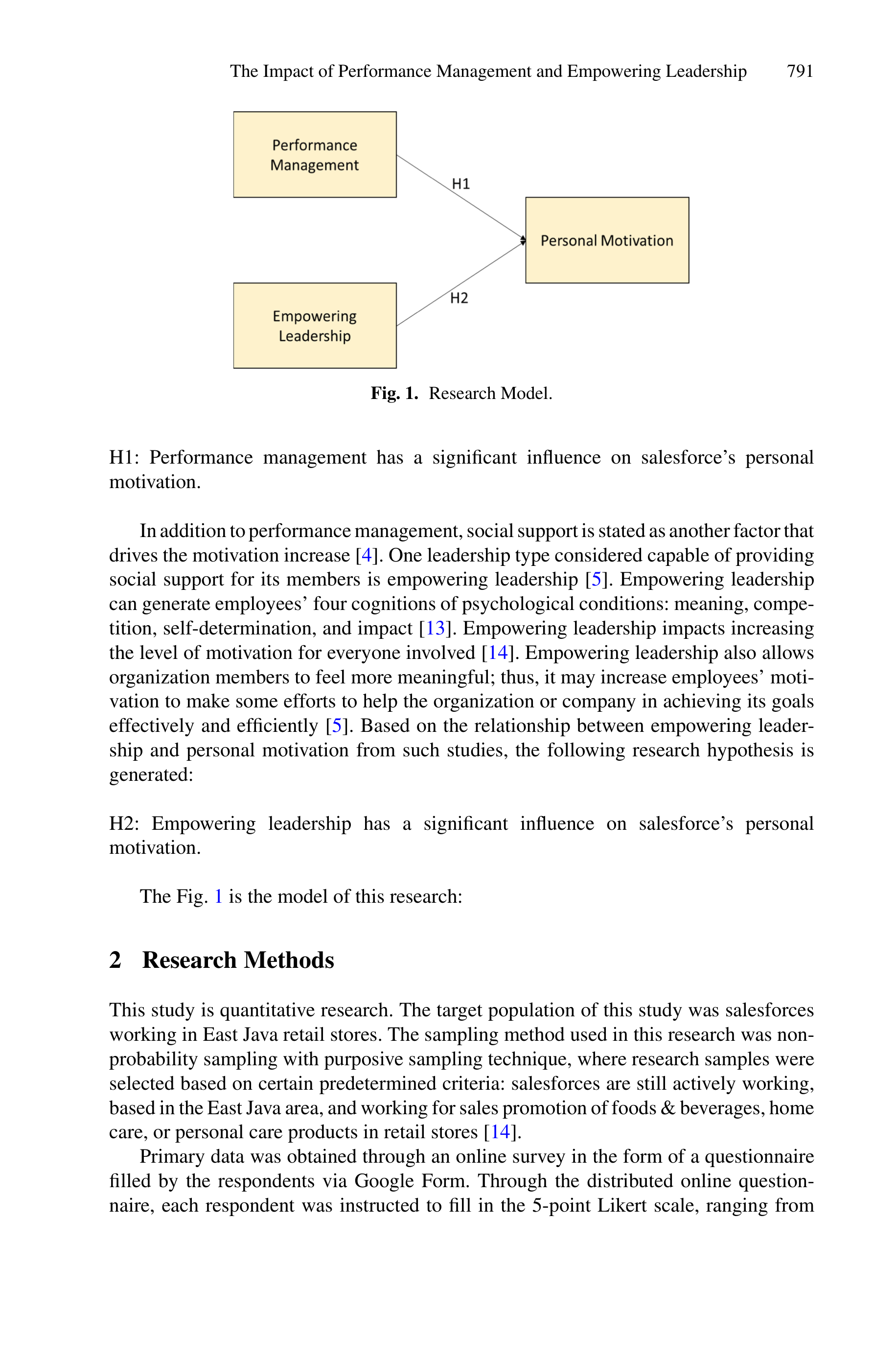
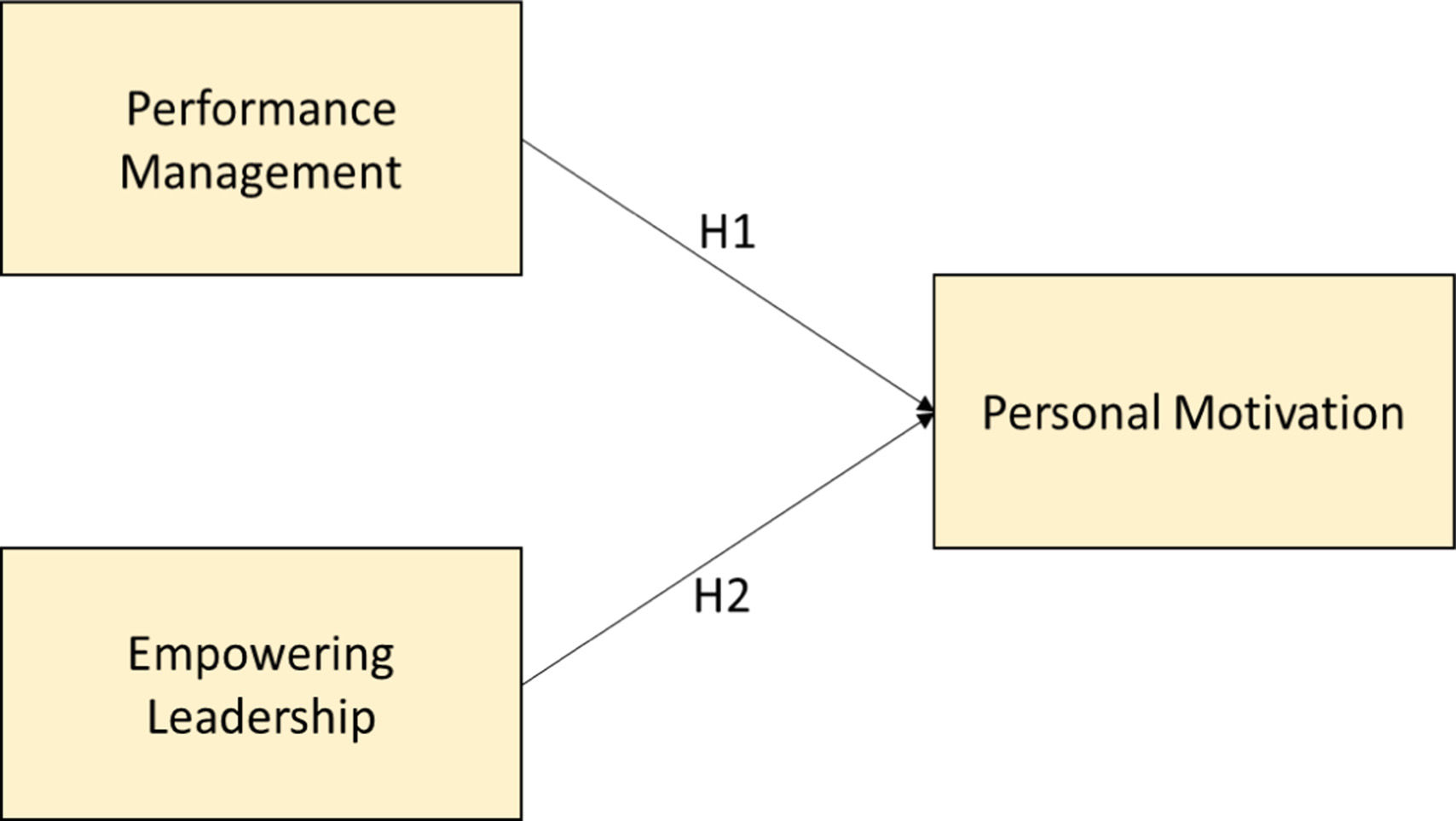
Fig. 1.
Research Model.
H1:
Performance
management
has
a
significant
influence
on
salesforce’s
personal
motivation.
In addition to performance management, social support is stated as another factor that
drives the motivation increase [
4
]. One leadership type considered capable of providing
social
support
for
its
members
is
empowering
leadership
[
5
].
Empowering
leadership
can generate employees’ four cognitions of psychological conditions: meaning, compe-
tition, self-determination, and impact [
13
]. Empowering leadership impacts increasing
the level of motivation for everyone involved [
14
]. Empowering leadership also allows
organization members to feel more meaningful; thus, it may increase employees’ moti-
vation to make some efforts to help the organization or company in achieving its goals
effectively
and
efficiently
[
5
].
Based
on
the
relationship
between
empowering
leader-
ship
and
personal
motivation
from
such
studies,
the
following
research
hypothesis
is
generated:
H2:
Empowering
leadership
has
a
significant
influence
on
salesforce’s
personal
motivation.
The Fig.
1
is the model of this research:
2
Research Methods
This study is quantitative research. The target population of this study was salesforces
working in East Java retail stores. The sampling method used in this research was non-
probability sampling with purposive sampling technique, where research samples were
selected based on certain predetermined criteria: salesforces are still actively working,
based in the East Java area, and working for sales promotion of foods & beverages, home
care, or personal care products in retail stores [
14
].
Primary data was obtained through an online survey in the form of a questionnaire
filled
by
the
respondents
via
Google
Form.
Through
the
distributed
online
question-
naire,
each
respondent
was
instructed
to
fill
in
the
5-point
Likert
scale,
ranging
from
792
A. Omarhadi et al.
1 (Strongly Disagree) to 5 (Strongly Agree) for the variables of performance manage-
ment, empowering leadership, and personal motivation. Furthermore, the primary data
collected was processed using Smart PLS software [
15
].
The performance management variable in this study is defined operationally as an
integrated
salesforce
management
process
in
setting
goals,
assessing,
reviewing,
and
motivating salesforces to create a company’s competitive excellence [
10
]. Furthermore,
the empirical indicators used in this performance management variable were as follows
[
11
]:
PM1. The company sets performance targets that are understandable for salesforces.
PM2.
The
company
establishes
a
benefit
structure
in
line
with
the
salesforces’
expectations.
PM3. The company provides valuable training for salesforces.
PM4. The company optimally conducts salesforces’ performance monitoring process.
PM5.
The
company
optimally
evaluates
the
salesforces’
performance.
The
empower-
ing
leadership
variable
in
this
study
is
defined
operationally
as
a
form
of
leadership
characterized by the division of authorization by the company management to encour-
age salesforces to have decision-making autonomy and participate in voicing opinions;
thus, salesforces can foster a sense of ownership over their roles and work results [
14
].
Besides, the empirical indicators used in this empowering leadership variable were four
cognitions of employee psychological conditions, including meaning, competence, self-
determination, and impact [
15
]. Empirical indicators of empowering leadership variables
used in this study were:
EL1. The leader encourages salesforces to feel meaningful in their work.
EL2. The leader encourages salesforces competency improvement as needed.
EL3. The leader provides autonomy or freedom for salesforces in performing their work
responsibilities.
EL4.
The
leader
supports
various
salesforces’
inputs
that
may
positively
impact
the
company.
Then,
the
personal
motivation
variable
in
this
study
is
defined
operationally
as
a
form
of
energy
strength
within
the
salesforces
and
is
influenced
by
the
work
environ-
ment, which encourages salesforces to expend efforts to improve their performance [
7
].
Furthermore, the empirical indicators used in this personal motivation variable were as
follows [
7
]:
PMTV1. The salesforce enjoys the work they do.
PMTV2. The salesforce feels that they are the company’s representatives.
PMTV3. The salesforce feels capable of fulfilling all their job responsibilities.
PMTV4.
The
salesforce
doesn’t
mind
performing
a
particular
task,
even
if
it
involves
extra effort to complete that task.
3
Results and Discussion
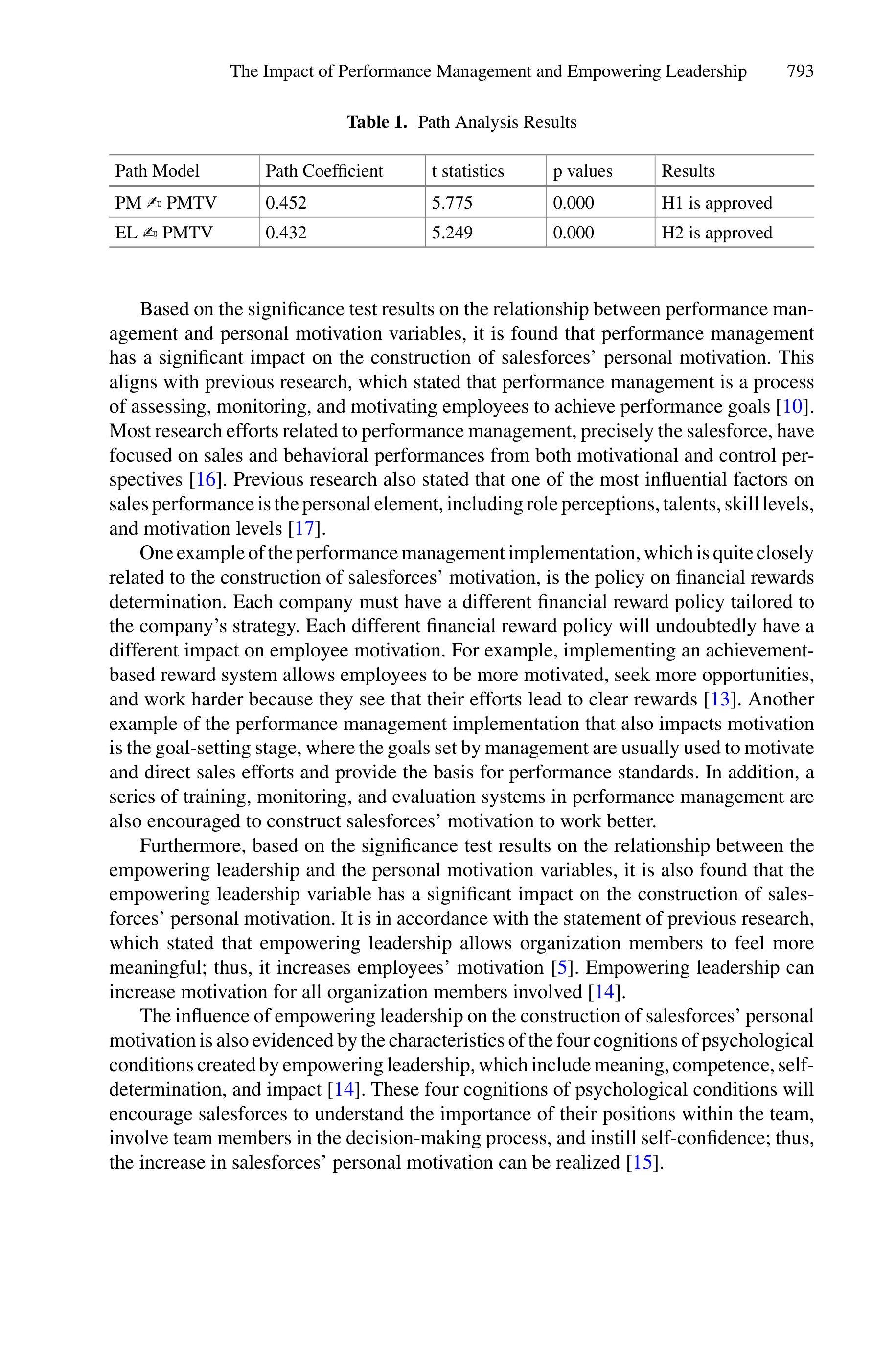
The results of the analysis of the relationship between concepts in this study are shown
in Table
1
.
The Impact of Performance Management and Empowering Leadership
793
Table 1.
Path Analysis Results
Path Model
Path Coefficient
t statistics
p values
Results
PM
✍
PMTV
0.452
5.775
0.000
H1 is approved
EL
✍
PMTV
0.432
5.249
0.000
H2 is approved
Based on the significance test results on the relationship between performance man-
agement
and
personal
motivation
variables,
it
is
found
that
performance
management
has
a
significant
impact
on
the
construction
of
salesforces’
personal
motivation.
This
aligns with previous research, which stated that performance management is a process
of assessing, monitoring, and motivating employees to achieve performance goals [
10
].
Most research efforts related to performance management, precisely the salesforce, have
focused on sales and behavioral performances from both motivational and control per-
spectives [
16
]. Previous research also stated that one of the most influential factors on
sales performance is the personal element, including role perceptions, talents, skill levels,
and motivation levels [
17
].
Oneexampleoftheperformancemanagementimplementation,whichisquiteclosely
related to the construction of salesforces’ motivation, is the policy on financial rewards
determination. Each company must have a different financial reward policy tailored to
the company’s strategy. Each different financial reward policy will undoubtedly have a
different impact on employee motivation. For example, implementing an achievement-
based reward system allows employees to be more motivated, seek more opportunities,
and work harder because they see that their efforts lead to clear rewards [
13
]. Another
example of the performance management implementation that also impacts motivation
is the goal-setting stage, where the goals set by management are usually used to motivate
and direct sales efforts and provide the basis for performance standards. In addition, a
series of training, monitoring, and evaluation systems in performance management are
also encouraged to construct salesforces’ motivation to work better.
Furthermore, based on the significance test results on the relationship between the
empowering leadership and the personal motivation variables, it is also found that the
empowering
leadership
variable
has
a
significant
impact
on
the
construction
of
sales-
forces’ personal motivation. It is in accordance with the statement of previous research,
which
stated
that
empowering
leadership
allows
organization
members
to
feel
more
meaningful;
thus,
it
increases
employees’
motivation
[
5
].
Empowering
leadership
can
increase motivation for all organization members involved [
14
].
The influence of empowering leadership on the construction of salesforces’ personal
motivation is also evidenced by the characteristics of the four cognitions of psychological
conditions created by empowering leadership, which include meaning, competence, self-
determination, and impact [
14
]. These four cognitions of psychological conditions will
encourage salesforces to understand the importance of their positions within the team,
involve team members in the decision-making process, and instill self-confidence; thus,
the increase in salesforces’ personal motivation can be realized [
15
].
794
A. Omarhadi et al.
4
Conclusion
This study concludes that performance management and empowering leadership are two
variables that directly and significantly affect the personal motivation of the salesforces
in the retail market. This study confirms the self-determination theory, which states that
humans have three psychological needs consisting of autonomy, competence, and attach-
ment, which are the matters needed to construct motivation [
3
]. There are two types of
motivation, namely autonomous and controlled motivation [
2
]. The empowering lead-
ership implementation will produce an autonomous type of motivation that encourages
specific behavior determined by each individual. Meanwhile, the performance manage-
ment implementation within a company will produce a controlled motivation that may
promote the determined contingent behavior. This study indicates that these two types
of motivation are equally needed; thus, they need to be harmonized for salesforces.
The results of this study provide managerial input that the company’s management
needs to encourage the involvement of salesforces in developing a performance manage-
ment system, so the system could assist in constructing salesforces’ personal motivation.
One
example
is
determining
the
employees’
wage
structure.
In
determining
the
wage
structure, the company’s management needs to benchmark companies operating in sim-
ilar industry categories to ensure that the set wage structure can construct salesforces’
motivation.
Moreover, companies also need to encourage the creation of empowering leadership
formsforeachleaderbydevelopinganopenandparticipatoryorganizationalculture,soit
can be an umbrella that unites all company members with the same values, assumptions,
habits,
and
beliefs.
In
an
effort
to
construct
salesforces’
personal
motivation,
leader-
ship
in
company
management
also
needs
to
encourage
the
interpersonal
relationships
between management and salesforces. One of the procedures to create interpersonal rela-
tionships is a mentoring program that is commonly conducted. Companies can prepare
this mentoring program to support salesforces to continue to grow.
References
1.
Nizar, N. I., & Sholeh, A. N. (2021). Peran Ekonomi Digital Terhadap Ketahanan dan Per-
tumbuhan Ekonomi Selama Pandemi COVID-19.
J. Madani Ilmu Pengetahuan, Teknol. Dan
Hum., 4
(1), 87–99.
2.
Ryan, R. M., & Deci, E. L. (2019). Brick by brick: The origins, development, and future of
self-determination theory.
Advances in Motivation Science, 6
, 111–156.
3.
Deci,
E.
L.,
Ryan,
R.
M.
(2014).
The
importance
of
universal
psychological
needs
for
understanding motivation in the workplace.
4.
Ghoshal, S., & Bartlett, C. A. (1994). Linking organizational context and managerial action:
The dimensions of quality of management.
Strategic Management Journal, 15
, (S2), 91–112.
5.
Zhang, X., & Bartol, K. M. (2010). Linking empowering
leadership and employee creativ-
ity: The influence of psychological empowerment, intrinsic motivation, and creative process
engagement.
Academy of Management Journal, 53
(1), 107–128.
6.
Vallerand, R. J. (2015).
Series in Positive Psychology: The psychology of passion: A dualistic
model
.
The Impact of Performance Management and Empowering Leadership
795
7.
Oren,
L.,
Tziner,
A.,
Nahshon,
Y.,
&
Sharoni,
G.
(2013).
Relations
between
OCBs,
orga-
nizational justice, work motivation and self-efficacy.
Amfiteatru Economic Journal, 15
(34),
505–517.
8.
Noe,
R.
A.,
Tews,
M.
J.,
&
McConnell
Dachner,
A.
(2010).
Learner
engagement:
A
new
perspective for enhancing our understanding of learner motivation and workplace learning.
The Academy of Management Annals, 4
(1), 279–315.
9.
Lee,
M.
T.,
Raschke,
R.
L.,
&
Louis,
R.
S.
(2016).
Exploiting
organizational
culture:
Con-
figurations for value through knowledge worker’s motivation.
Journal of Business Research,
69
(11), 5442–5447.
10.
Hall, P. (2000). Creative cities and economic development.
Urban Studies, 37
(4), 639–649.
11.
Sudhahar, J. C. (2016). Sales force management. In
Strategic marketing management in Asia
.
Emerald Group Publishing Limited.
12.
Grigoru¸t˘a, M. V. (2006). Change in Romanian organizations: a management culture approach.
Journal of Organizational Change Management, 1
(1), 28–54.
13.
Thomas,
K.
W.,
&
Velthouse,
B.
A.
(1990).
Cognitive
elements
of
empowerment:
An
‘interpretive’
model
of
intrinsic
task
motivation.
Academy
of
Management
Review,
15
(4),
666–681.
14.
Chen,
G.,
Sharma,
P.
N.,
Edinger,
S.
K.,
Shapiro,
D.
L.,
&
Farh,
J.-L.
(2011).
Motivat-
ing and demotivating forces in teams: cross-level influences of empowering leadership and
relationship conflict.
Journal of Applied Psychology, 96
(3), 541.
15.
Srivastava, A., Bartol, K. M., & Locke, E. A. (2006). Empowering leadership in management
teams:Effectsonknowledgesharing,efficacy,andperformance.
TheAcademyofManagement
Journal, 49
(6), 1239–1251.
16.
Fang, E., Evans, K. R., & Zou, S. (2005). The moderating effect of goal-setting characteristics
on
the
sales
control
systems–job
performance
relationship.
Journal
of
Business
Research,
58
(9), 1214–1222.
17.
Cheung, Y. H., & Florea, L. C. (2009). The application of performance management in the
salesforce: A Chinese and Romanian perspective.
Journal of Euromarketing, 18
(3), 139–156.
Open Access
This
chapter
is
licensed
under
the
terms
of
the
Creative
Commons
Attribution-
NonCommercial
4.0
International
License
(
http://creativecommons.org/licenses/by-nc/4.0/
),
which permits any noncommercial use, sharing, adaptation, distribution and reproduction in any
medium or format, as long as you give appropriate credit to the original author(s) and the source,
provide a link to the Creative Commons license and indicate if changes were made.
The images or other third party material in this chapter are included in the chapter’s Creative
Commons
license,
unless
indicated
otherwise
in
a
credit
line
to
the
material.
If
material
is
not
included
in
the
chapter’s
Creative
Commons
license
and
your
intended
use
is
not
permitted
by
statutory regulation or exceeds the permitted use, you will need to obtain permission directly from
the copyright holder.