The Journal of Community Informatics
ISSN: 1721-4441
104
Case Studies
The Digital Equity Leadership Lab (DELL): A case study of
community leadership development to promote digital
equity and justice
Colin Rhinesmith
,
Digital Equity Research Center, Metropolitan New York Library Council,
crhinesmith@metro.org
Malana Krongelb
,
School of Library and Information Science, Simmons University,
malana.krongelb@simmons.edu
Jie Jiang
,
School of Library and Information Science, Simmons University,
jie.jiang@simmons.edu
The Journal of Community Informatics
ISSN: 1721-4441
105
The Digital Equity Leadership Lab: A case study of
community leadership development to promote digital
equity and justice
Abstract
This paper presents the Digital Equity Leadership Lab in Baltimore, Maryland as a case study of
community leadership development to promote digital equity and justice. While several studies
of community leadership development exist, few are focused on its role in promoting digital equity
and justice. This case study attempts to address this gap in the scholarly literature through the
following research question: How might DELL serve as a community-based leadership training
model to develop the next wave of digital equity leaders? Through our analysis of interviews with
community leaders, outside experts, and community foundation staff, we discovered the
following three main findings: (1) bringing national policymakers and advocates together with
community leaders is powerful and transformative; (2) digital inequality is a social, not a
technological problem; and (3) community leaders need access to a shared platform and to each
other to create change. These findings suggest that community leaders can benefit from seeing
their work within a digital equity ecosystems framework, which calls attention to the importance
the interactions that exist among individuals, populations, communities, and their broader
sociotechnical environments that all shape the work to promote more equitable access to
technology and social and racial justice. This case study concludes with recommendations for
community leaders, including community foundations, working to uncover systemic
discrimination shaping digital inequality today to advance digital equity and justice.
Keywords: digital redlining; digital discrimination; digital equity; digital justice; community
leadership.
Introduction
Despite the fact that the internet is the most powerful technology of our lifetime, we have
been taught very little about how the internet, and its related technologies, work. As
advocates working to close the Digital Divide in Baltimore, it's critical that we understand
how the internet and internet regulation work so that we can imagine and build new
solutions for our communities. (Robert W. Deutsch Foundation, 2021)
In spring 2021, 25 community leaders from across Baltimore, Maryland came together with
national experts in areas related to network engineering, federal policymaking, community
broadband networking, and grassroots organizing for a five-week online program named the
“Digital Equity Leadership Lab” (DELL). The program was created by amalia deloney, Vice
President of the Robert W. Deutsch Foundation and staff at the Foundation. The program was
created for “city residents who want to increase their understanding of the internet and
The Journal of Community Informatics
ISSN: 1721-4441
106
strengthen their capacity to advocate for fast, affordable and reliable broadband for all of
Baltimore’s neighborhoods” (Robert W. Deutsch Foundation, 2021).
A May 2021 article described how DELL was created as a response to other digital
inclusion programs across the U.S. that have failed to consider the technical aspects of the
internet and social inequalities alongside broader internet policy and advocacy goals. As the
Deutsch Foundation’s website explains, “the five-week program covered topics including laws
governing the internet, core concepts about network engineering and the workings of
community internet networks, like mesh networks” (Kirby, 2021). Its programmatic focus on
bringing community leaders together with national experts, led by a community foundation,
represents an innovative and impactful community-centered approach for the digital equity field.
This paper presents findings from a study of the DELL program as a case of community
leadership development to promote digital equity and justice. While several studies of
community leadership development exist, few are focused on its role in promoting digital equity
and justice. This case study attempts to address this gap in the scholarly literature through the
following research question:
How might DELL serve as a community-based leadership training
model to develop the next wave of digital equity leaders?
Through our analysis of 21 interviews
with community leaders, outside experts, and staff from the Robert W. Deutsch Foundation, we
discovered the following three main findings: (1) bringing national policymakers and advocates
together with community leaders is powerful and transformative; (2) digital inequality is a social,
not a technological problem; and (3) community leaders need access to a shared platform and to
each other to create change.
The qualitative data from this case study indicated participants’ desire to use the
knowledge gained in the DELL program to promote what Wolfson, Crowell, Reyes, and Bach
(2017) refer to as “emancipatory broadband adoption.” This conceptualization of digital inclusion
programs as having emancipatory goals can help community leaders build community power.
These findings suggest that community leaders can benefit from seeing their work within a
“digital equity ecosystems” (Rhinesmith & Kennedy, 2020) framework, which calls attention to
the importance the interactions between individuals, populations, communities, and their
broader sociotechnical environments that all shape the work to promote more equitable access
to technology and social and racial justice. This case study concludes with recommendations for
community leaders, including community foundations, working to uncover systemic
discrimination shaping digital inequality today to advance digital equity and justice.
From the Digital Divide to Digital Justice
For decades, community leaders have played an essential role helping to ensure that local people
are not disadvantaged by the introduction of new technologies. For example, when cable
television became widespread in the early 1980s, community groups in the United States
organized people across the country “to create local content and local channels, in effect trying
to adapt it to the purposes of enhancing communication and local participation” (Strover,
Chapman, & Waters, 2004, p. 466). These early advocates argued that cable television should be
The Journal of Community Informatics
ISSN: 1721-4441
107
a democratic medium to promote public access to communication technology and media
diversity (Halleck, 2002; Howley, 2005). This approach to community-owned and community-led
media initiatives was rooted in community development efforts to advance self-determination
among underrepresented and historically marginalized populations (Rhinesmith, 2019).
Similar concerns emerged with the advent of the world wide web in the 1990s with some
worrying that the “digital divide,” or the gap in access between those with and those without
computers and the internet, would leave vulnerable groups behind. The current breadth of
scholarship in this area over the past decades offers multiple perspectives on the digital divide,
including: various conceptualizations of access (Clement & Shade, 2000); the shifts from access
to use to skills (DiMaggio & Hargittai, 2001; van Deursen & van Dijk, 2011; van Deursen, & van
Dijk, 2014) and their differentiated impacts (van Deursen et al., 2017; van Deursen & Helsper,
2018); effective use of the internet (Gurstein, 2003); internet infrastructure development in tribal
communities (Duarte, 2017); the ability to maintain mobile device and broadband access
(Gonzales; 2016; Whitacre & Rhinesmith; 2016); critical interrogations of the digital divide and
digital inclusion (Eubanks, 2011; Gangadharan, 2012; Greene; 2021); intersectional perspectives
(Noble, 2018); and the critical role that local social connections and community-based
organizations play in helping people to access, use, and adopt the internet in their everyday lives
(Helsper & Reisdorf, 2017; Jaeger et al., 2012; Katz & Gonzales, 2016; Kvasny, 2006; Pinkett, 2000;
Rhinesmith, 2016).
While much of the current literature on the digital divide has called attention to issues
related to gaps in technology access, skills, and use, fewer studies have focused on the role of
power, privilege, and oppression in shaping digital inequality and calls for social justice (Eubanks,
2011; Greene, 2021; Noble, 2018). For example, Bach, Wolfson, and Crowell (2018) argued that
the digital divide is not as simple as the binary “haves” vs. “have-nots.” Instead, the experience
an individual has with digital technologies, including the financial rewards they can receive from
applying these skills in the workforce, are deeply influenced by the structures of power in society.
The Detroit Digital Justice Coalition created a set of “Digital Justice Principles”, which are rooted
in access, participation, common ownership, and healthy communities. A key aspect of this
framework “prioritizes the participation of people who have been traditionally excluded from
and attacked by media and technology” (Detroit Digital Justice Coalition).
Community leadership development
The field of community development studies offers key insights that can be used to examine
community leadership development efforts to promote digital equity and social justice. An
important aspect of this literature has focused on the importance of building community
capacity. As Mayberry, Daniels, Willcock, and Yan (2020) described,
Community capacity is the development of the skills, knowledge, and infrastructure to
effectively promote health, prevent disease, improve the quality of life, and engage local
communities in self-determined activities for desired change to an undesirable social
condition. (p. 839)
The Journal of Community Informatics
ISSN: 1721-4441
108
One important component of this literature is the differentiation between asset-based and
deficit-based, or needs-based, approaches to building community capacity and community
leadership. As Nel (2018) described,
Community leadership, common to all community development projects, is the enabling
of the relational capacity of community members to initiate the creative and often hidden
potential of the community and turn it into initiatives driven by empowered community
members. (P. 839)
This “asset-based community development” approach, or ABCD, popularized by Kretzmann and
McKnight (1993) recognizes the strengths that exist in communities and works to further enable
these assets through their appreciation and cultivation.
Another important aspect of the appreciative leadership approach that Nel (2018)
described is its focus on relationship building. This approach stands in contrast with other
theories of leadership development, such as “contingency model” (Fiedler, 1967), which argues
that leaders develop their skills through a variety of activities contingent on their own lives and
community. Rather, appreciative leadership recognizes the relational aspects of leadership
development and its value in community contexts. As Nel argued, “Adopting this leadership
approach will become the key to ensure that community members are empowered, self-reliant
citizens, driving their own future.”
In working to develop community leadership capacity to mobilize local resources and
generate collective action, Mayberry, Daniels, Willcock, and Yan (2020) argued that one way to
achieve community engagement is to recruit informed local community residents, who may be
the employees of community-based organizations (CBOs), community clinics, academic
institutions, or other human services organizations, to build the community capacity from the
roots. The authors maintained that “informed and empowered community residents are the
catalyst for building a sustainable capacity” (p. 124) to reduce health disparities seen in
socioeconomically vulnerable communities. Seen in this way, the authors explained that local
leadership development through community engagement is an effective way to promote
community health and well-being.
The community development literature has identified certain qualities that community
leaders need to ensure that their leadership efforts are community-driven in ways that seek to
transfer power from the powerholders to community members. Even though leadership
structures are, in part, created and maintained by a community's own unique make-up and the
unique personalities of its leaders, specific components of leadership structure are potentially
generalizable to all communities. For example, Nel (2018) maintained that relationships and trust
are at the heart of such leadership efforts, coupled with qualities such as inspiration, vision,
humility, and flexibility. “Community leadership is also about providing support to each other,
learning together, and collaborating with others to create a future” (Nel, 2018, p. 841).
While several studies of community leadership exist across multiple scholarly fields, there
are currently no studies of community leadership development initiatives to promote digital
The Journal of Community Informatics
ISSN: 1721-4441
109
equity and justice. This case study attempts to address this gap in the scholarly literature and
contribute insights for community leaders across the US and around the world.
Connecting Digital Inequality in Baltimore to Systemic Oppression in the US
To understand the context for our case study of the Robert W. Deutsch Foundation’s Digital
Equity Leadership Lab (DELL) and its response to digital injustice in Baltimore, Maryland, it’s
necessary to begin with a brief history of the colonization, enslavement, structural racism, and
economic injustice against Black, Indigenous, and People of Color (BIPOC) that began over 400
years ago in the area that is currently known as the City of Baltimore.
Historical context
Baltimore, Maryland is located on the ancestral homeland of the Susquehannock, Nentego
(Nanticoke), and Piscataway people. After European settlers began colonizing the area starting
in the 1600s, many Native peoples were “decimated to low numbers, absorbed by larger villages
and tribes, and eventually forced to move west with large tribes beyond the Mississippi River
through Indian [removal] policies” (Begay, 2019). Baltimore was established in 1729 by a group
of wealthy Marylanders that “pushed through the State Legislature a town charter for Baltimore”
(City of Baltimore, n.d.). The State of Delaware recognized the Naticoke as a Native American
tribe in 1881, and it wasn’t until 2012 when the first recognized tribes of Piscataway heritage
were recognized in the State of Maryland. However, there are still no federally recognized tribes
in Maryland.
During the 1950s, the U.S. government pursued aggressive settler-colonial policies,
known as the “termination era” (University of Alaska Fairbanks, n.d.) when federal support for
tribes was withdrawn “in order to ‘free’ the Indians and assimilate them once and for all,” often
into urban areas (Dockry and Whyte, 2021, p. 96). The 1956 Lumbee Act prohibited the Lumbee
Tribe from pursuing federal recognition (McKie B.P., 2017). The homeland of the Lumbee Tribe
is located in southeastern North Carolina where the tribe takes their name from the “Lumbee
River that winds through tribal territory, which is mostly rural and otherwise characterized by
pines, farmland, and swamps” (Minner, 2019). Members of the Lumbee Tribe in North Carolina
moved to Baltimore “seeking jobs and a better quality of life” explained Ashley Minner, a Fellow
with the Robert W. Deutsch Foundation who has been working to build a digital archive of the
Lumbee community in Baltimore (Robert W. Deutsch Foundation, 2021).
Members of the Lumbee Tribe established the Baltimore American Indian Center (BAIC)
in 1968 to support the Native American community by providing “services that included
education, skills training, workforce development, childcare, afterschool arts, and seniors
programs, as well as health and healing services” (Baltimore American Indian Center, 2018). The
BAIC’s website explains that over time many members of the Native American community moved
out of Baltimore to seek more “affordable housing and sustainable job opportunities” (Baltimore
American Indian Center, 2018). During this same time, “Baltimore underwent a massive urban
renewal development project, and many Lumbee residences were destroyed.” BAIC has since
shifted its focus to “prioritize cultural heritage preservation and education programs, with health,
The Journal of Community Informatics
ISSN: 1721-4441
110
housing and employment-related services provided on an ad hoc basis” (Baltimore American
Indian Center, 2018).
Baltimore's founding depended not only on stolen land but on stolen people as well. The
forced labor of enslaved Africans built the City of Baltimore. Whitman (1997) described how
slavery spread in Baltimore between 1770 and 1815 with enslaved people working in “shipyards,
craft shops, and an early chemical factory” (p. 11). The historian explained that slavery expanded
much more “vigorously” in Baltimore than in any other part of Maryland during this time.
Slaveholding peaked around 1810, with “merchants, ship captains, public officials, and
professionals such as doctors, lawyers, and bankers'' making up the majority of urban
slaveholders, as well as craft workers and manufacturers (Whitman, 1997, p. 11).
In spite (or because) of the progress made through the Emancipation and Reconstruction,
white property owners and politicians continued to systemically deny freedom to African
Americans, including through Jim Crow laws (Baltimore’s Civil Rights Heritage, 2019). While
Baltimore’s mandate to segregate Black and white people in the city was shot down by the U.S.
Supreme Court, “those restrictions were soon replaced with equally efficient redlining and
blockbusting practices, as well as private racial housing covenants” (Cassie, 2020). In 1937, the
Federal Home Owners’ Loan Corporation (HOLC), which was part of the New-Deal-era Federal
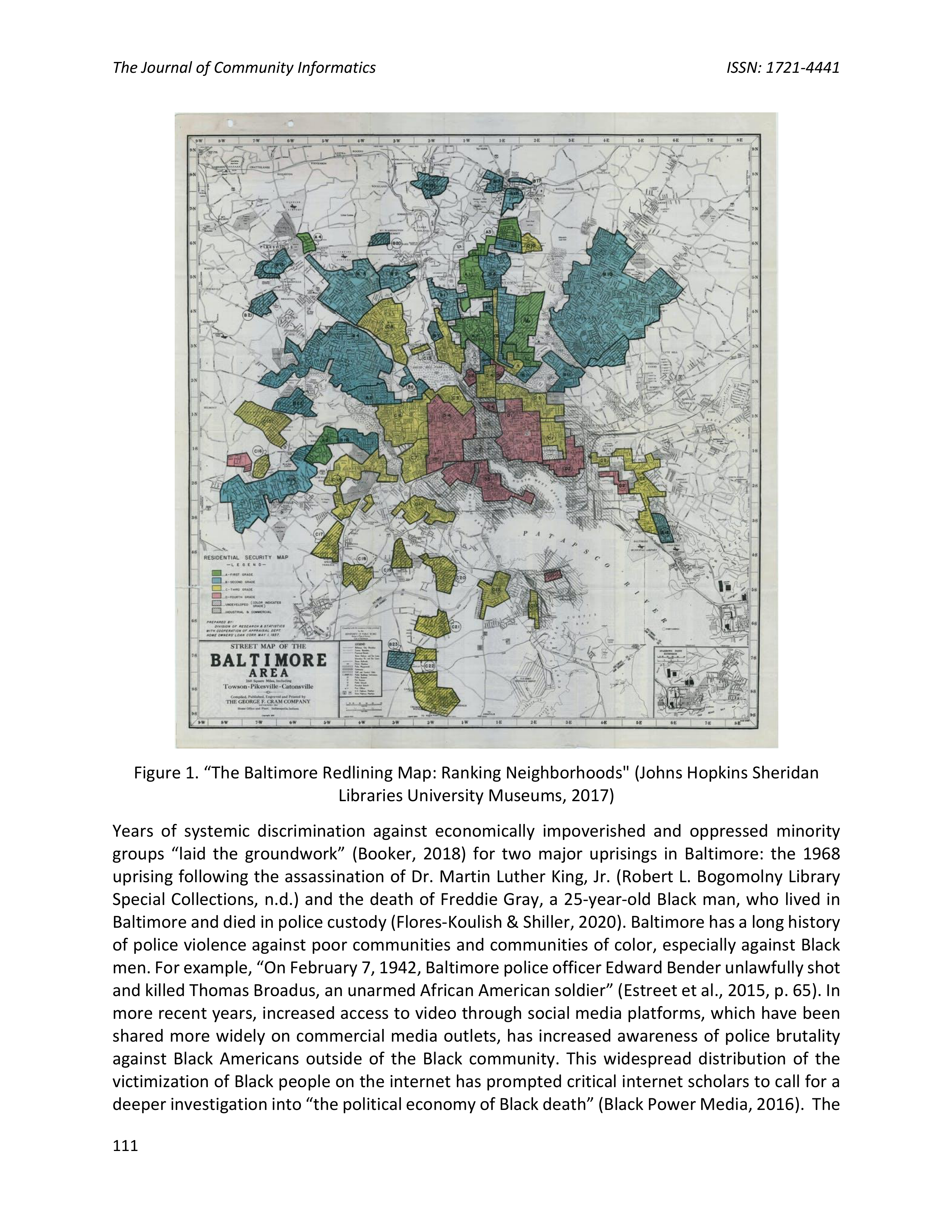
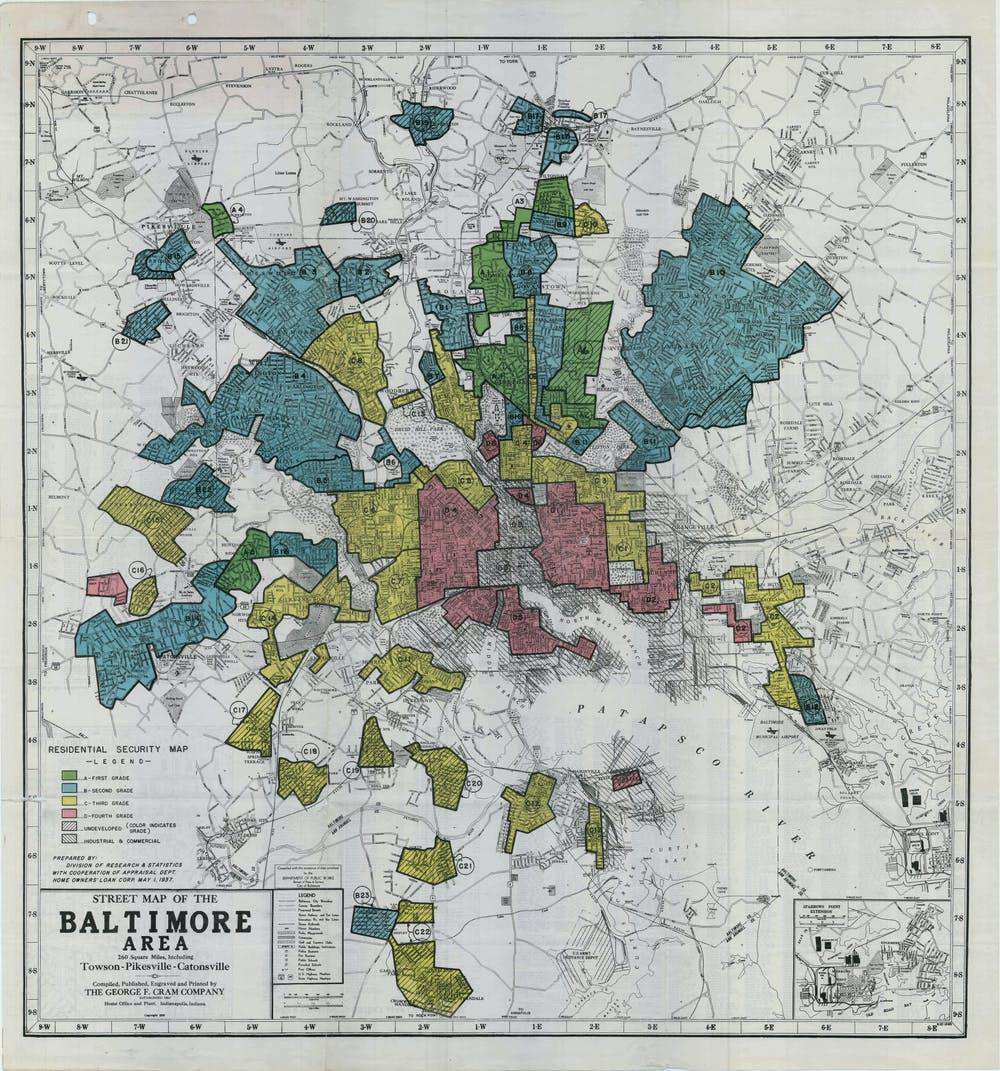
Housing Administration, created the “Residential Security Map of Baltimore Maryland.” As the
Johns Hopkins Sheridan Libraries and Museums website explains, “In drafting the map,
cartographers used the colors red, yellow, blue, and green to ‘grade’ Baltimore neighborhoods
based on potential risk factors for residential mortgage lenders” (Johns Hopkins Sheridan
Libraries University Museums). These “risk factors” represent a larger systemic issue of racist
housing policy in the U.S.
The map (Figure 1) below represents a visualization of the impact of this harmful policy,
which has become known as the practice of “redlining” in communities of color. Researchers and
journalists have shown how this discriminatory federal policy has had far-reaching impacts
beyond housing to other areas, such as policing (Badger, 2016). The effects of discriminatory
housing were compounded by the Great Migration, “the exodus of more than 6 million African
Americans from the rural South to cities in the North—or in Baltimore’s case, almost North—
Midwest, and West between 1910 and 1970, [which] was one of the largest internal movements
of people in U.S. history” (Cassie, 2020). The Black population in Baltimore tripled during this
time, “growing from less than 85,000, 15 percent of the city’s overall population, in 1910, to more
than 420,000 and a near majority by 1970” (Cassie, 2020). This period also coincided with a lack
of housing for Black workers and European immigrants, work that was segregated by race (King,
2014, p. 433).
The Journal of Community Informatics
ISSN: 1721-4441
111
Figure 1. “The Baltimore Redlining Map: Ranking Neighborhoods" (Johns Hopkins Sheridan
Libraries University Museums, 2017)
Years of systemic discrimination against economically impoverished and oppressed minority
groups “laid the groundwork” (Booker, 2018) for two major uprisings in Baltimore: the 1968
uprising following the assassination of Dr. Martin Luther King, Jr. (Robert L. Bogomolny Library
Special Collections, n.d.) and the death of Freddie Gray, a 25-year-old Black man, who lived in
Baltimore and died in police custody (Flores-Koulish & Shiller, 2020). Baltimore has a long history
of police violence against poor communities and communities of color, especially against Black
men. For example, “On February 7, 1942, Baltimore police officer Edward Bender unlawfully shot
and killed Thomas Broadus, an unarmed African American soldier” (Estreet et al., 2015, p. 65). In
more recent years, increased access to video through social media platforms, which have been
shared more widely on commercial media outlets, has increased awareness of police brutality
against Black Americans outside of the Black community. This widespread distribution of the
victimization of Black people on the internet has prompted critical internet scholars to call for a
deeper investigation into “the political economy of Black death” (Black Power Media, 2016). The
The Journal of Community Informatics
ISSN: 1721-4441
112
1968 uprising and the death of Freddie Gray deeply affected the Black community in Baltimore.
Both demonstrated the ongoing threat of police brutality and a lack of federal and municipal
investment in Black neighborhoods beyond over-policing.
Digital Injustice in Charm City
To understand the digital divide in Baltimore one must begin by acknowledging the history of
colonization, land theft, slavery, systemic racism, and white supremacy that has shaped the
United States, and more directly the digital injustices that exist in Baltimore. The HOLC’s map
above offers one strategy to investigate how a history of discriminatory federal housing policy
has impacted access to resources, participation in policymaking, common ownership of public
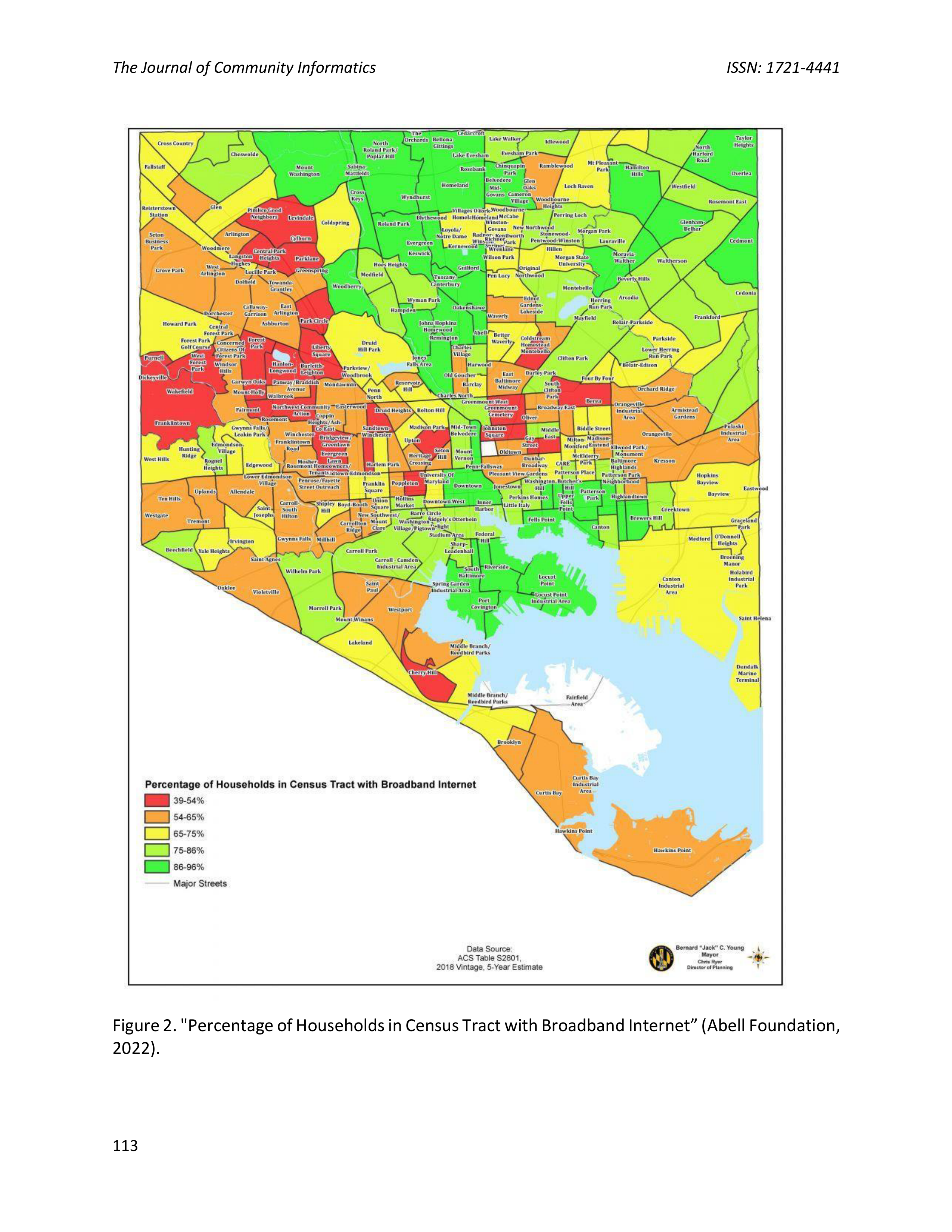
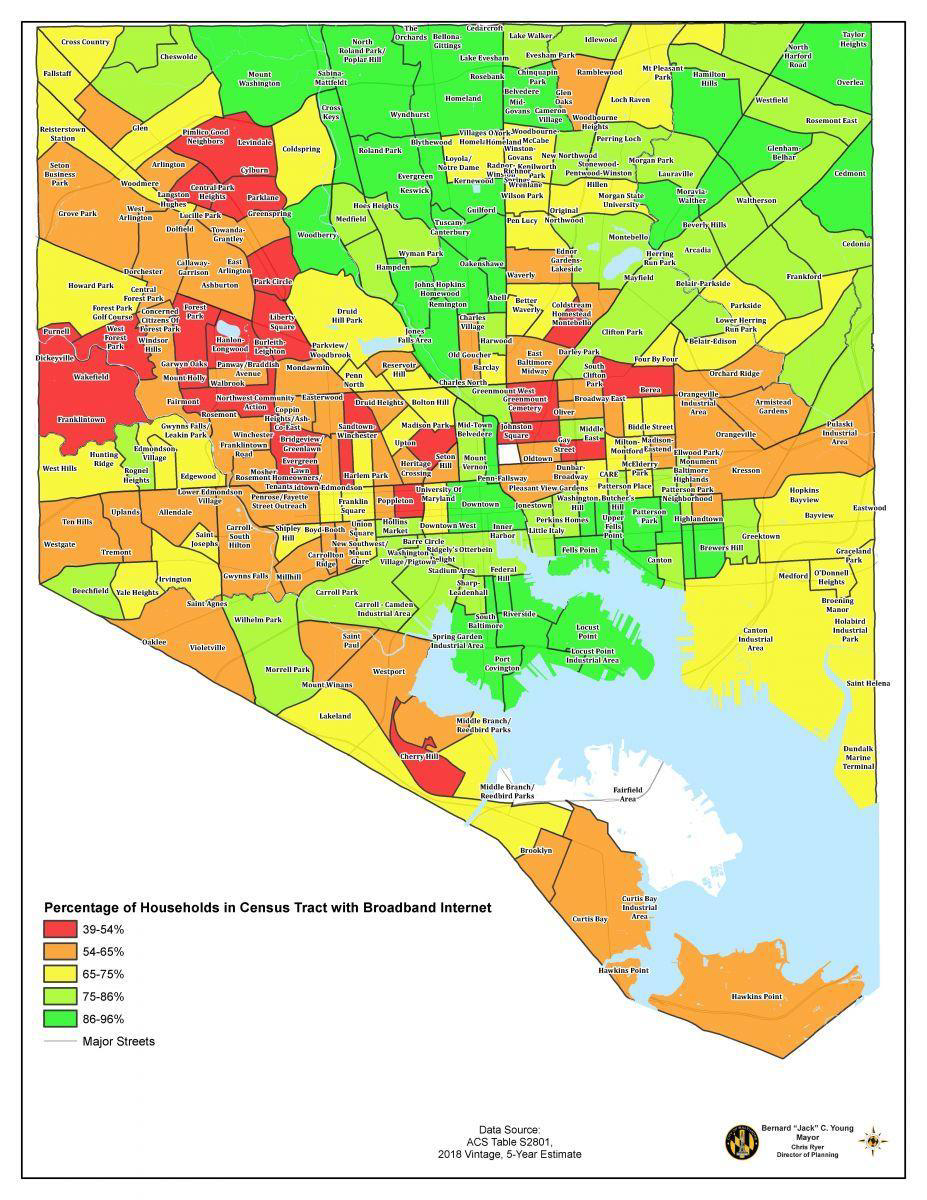
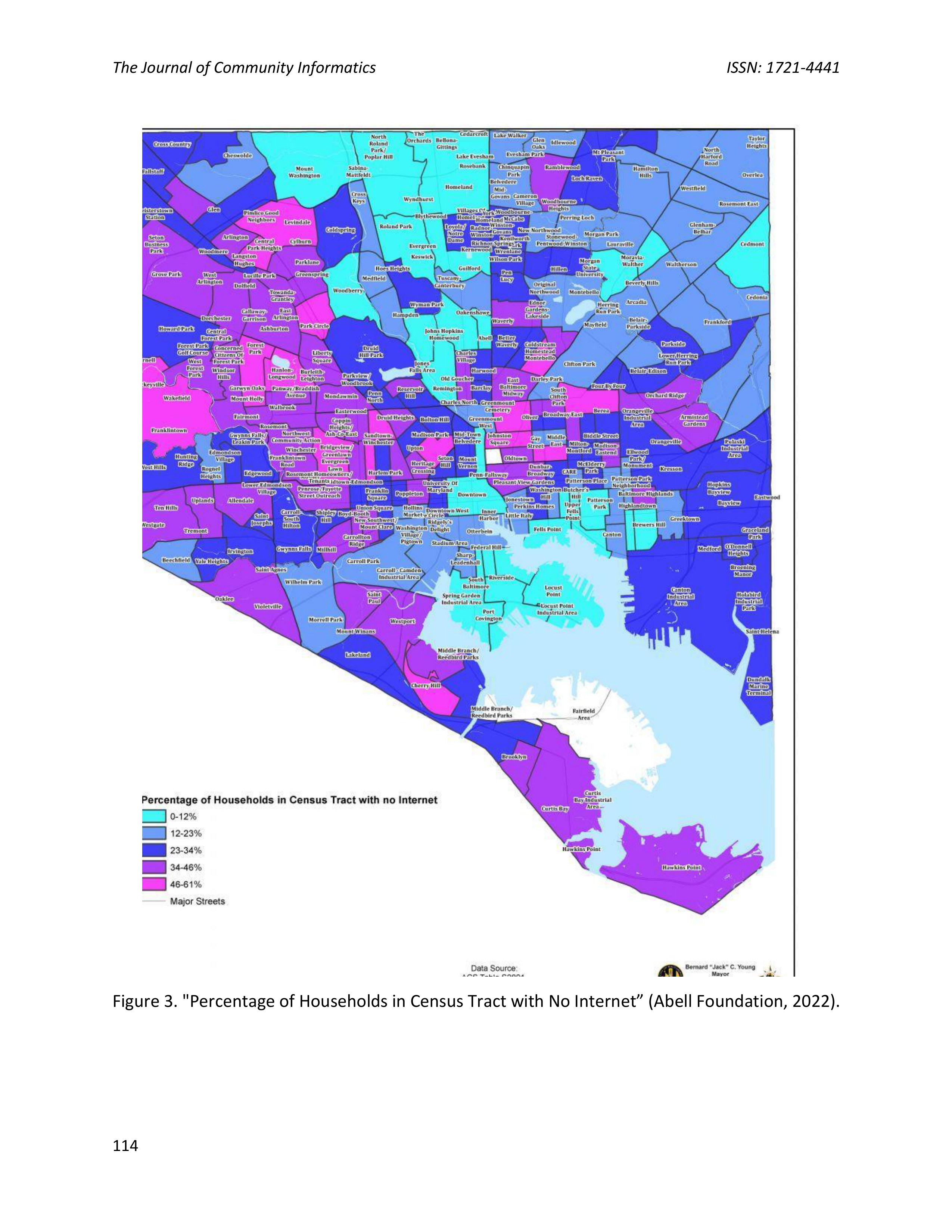
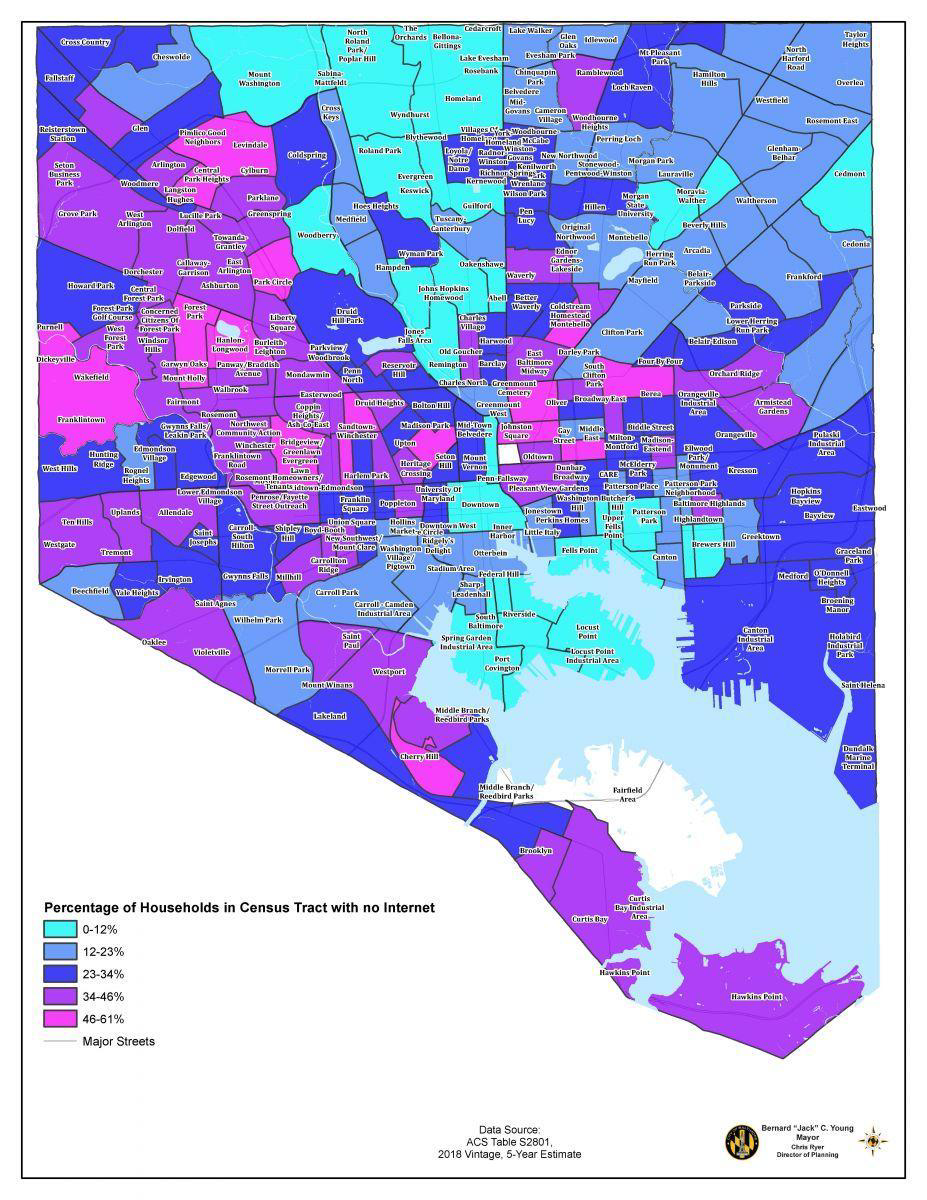
resources, and healthy communities for Black, Indigenous, and people of color. In 2020, the Abell
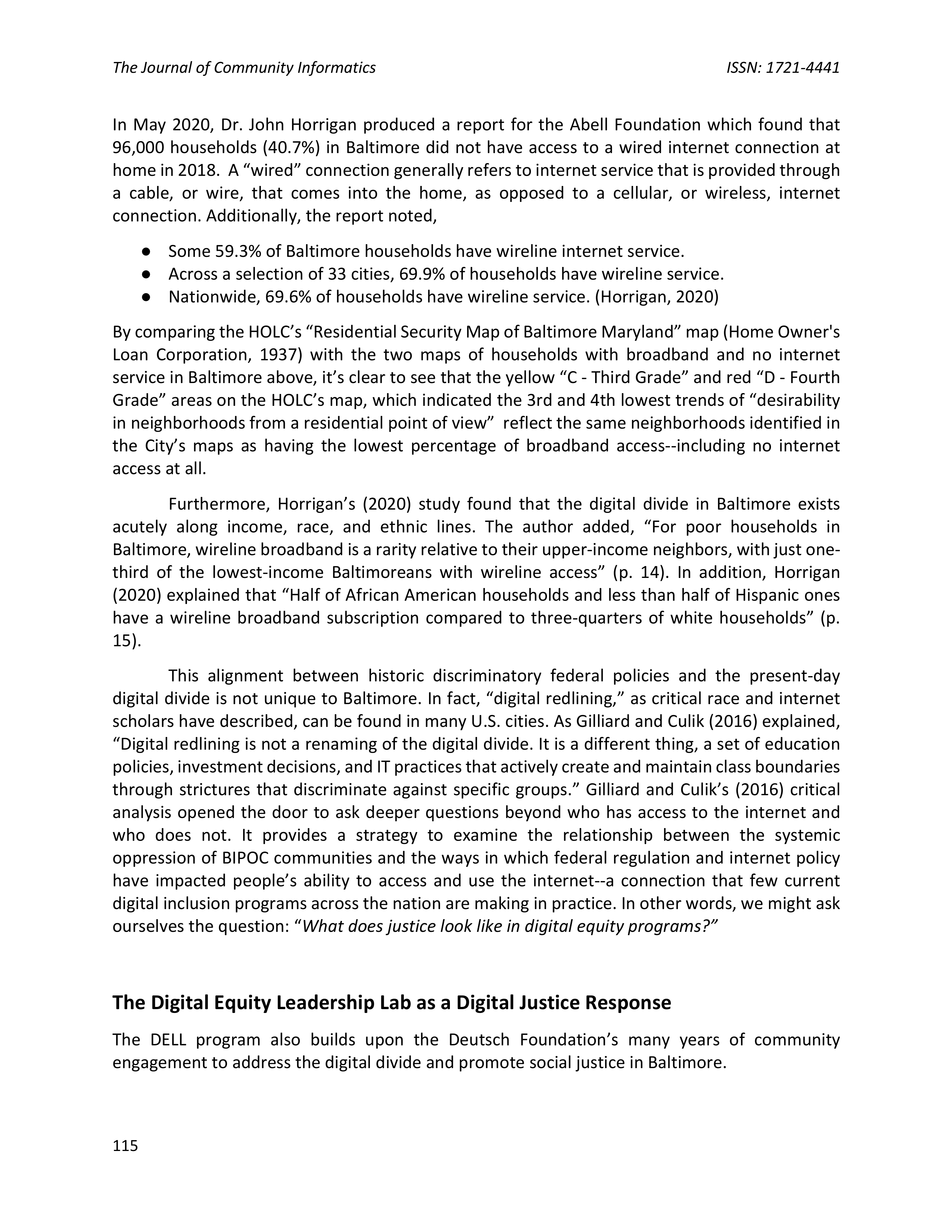
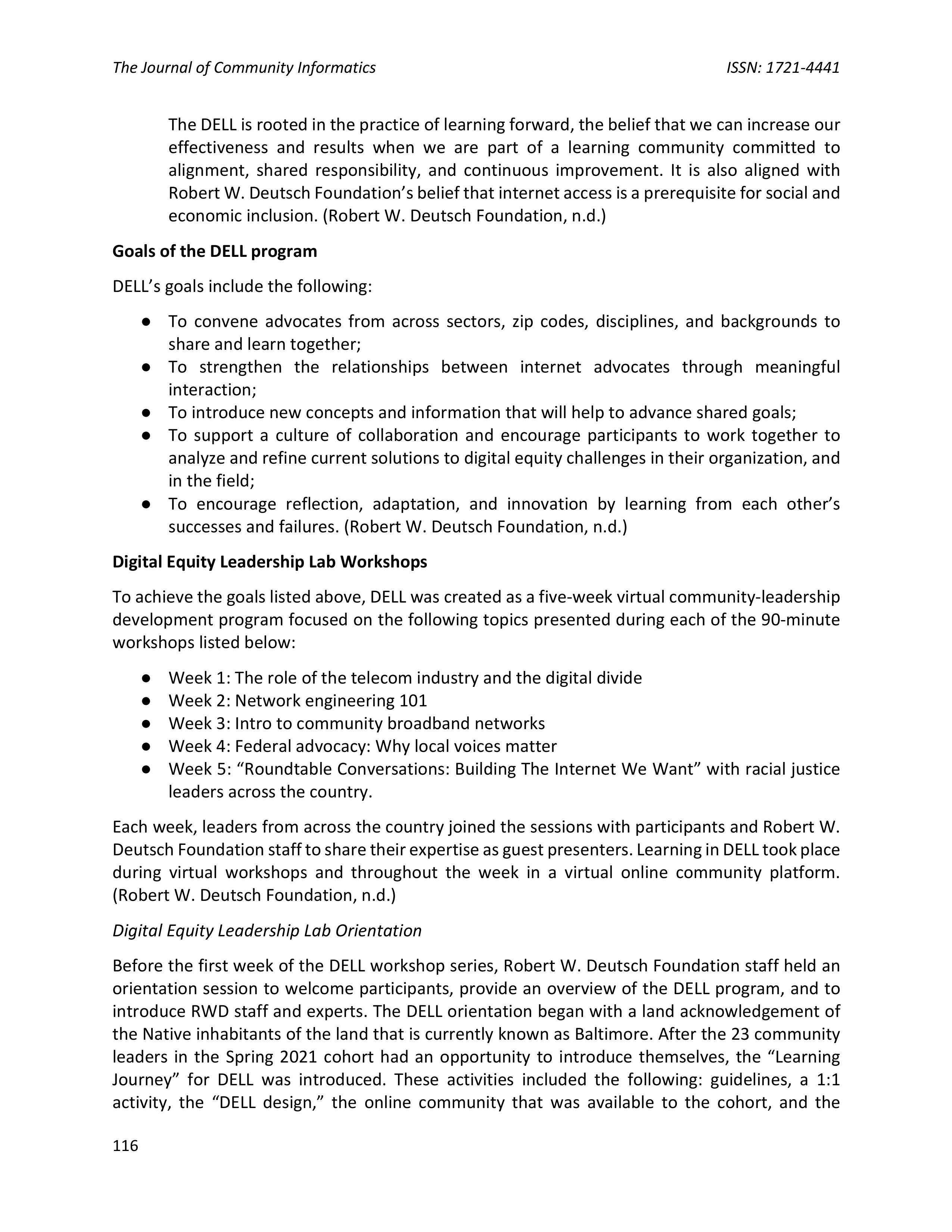
Foundation shared maps (Figures 2 & 3) created by Baltimore City's Department of Planning,
which used data from the American Community Survey to highlight Baltimore's digital divide
(Abell Foundation, 2022).
The Journal of Community Informatics
ISSN: 1721-4441
113
Figure 2. "Percentage of Households in Census Tract with Broadband Internet” (Abell Foundation,
2022).
The Journal of Community Informatics
ISSN: 1721-4441
114
Figure 3. "Percentage of Households in Census Tract with No Internet” (Abell Foundation, 2022).
The Journal of Community Informatics
ISSN: 1721-4441
115
In May 2020, Dr. John Horrigan produced a report for the Abell Foundation which found that
96,000 households (40.7%) in Baltimore did not have access to a wired internet connection at
home in 2018. A “wired” connection generally refers to internet service that is provided through
a cable, or wire, that comes into the home, as opposed to a cellular, or wireless, internet
connection. Additionally, the report noted,
●
Some 59.3% of Baltimore households have wireline internet service.
●
Across a selection of 33 cities, 69.9% of households have wireline service.
●
Nationwide, 69.6% of households have wireline service. (Horrigan, 2020)
By comparing the HOLC’s “Residential Security Map of Baltimore Maryland” map (Home Owner's
Loan Corporation, 1937) with the two maps of households with broadband and no internet
service in Baltimore above, it’s clear to see that the yellow “C - Third Grade” and red “D - Fourth
Grade” areas on the HOLC’s map, which indicated the 3rd and 4th lowest trends of “desirability
in neighborhoods from a residential point of view” reflect the same neighborhoods identified in
the City’s maps as having the lowest percentage of broadband access--including no internet
access at all.
Furthermore, Horrigan’s (2020) study found that the digital divide in Baltimore exists
acutely along income, race, and ethnic lines. The author added, “For poor households in
Baltimore, wireline broadband is a rarity relative to their upper-income neighbors, with just one-
third of the lowest-income Baltimoreans with wireline access” (p. 14). In addition, Horrigan
(2020) explained that “Half of African American households and less than half of Hispanic ones
have a wireline broadband subscription compared to three-quarters of white households” (p.
15).
This alignment between historic discriminatory federal policies and the present-day
digital divide is not unique to Baltimore. In fact, “digital redlining,” as critical race and internet
scholars have described, can be found in many U.S. cities. As Gilliard and Culik (2016) explained,
“Digital redlining is not a renaming of the digital divide. It is a different thing, a set of education
policies, investment decisions, and IT practices that actively create and maintain class boundaries
through strictures that discriminate against specific groups.” Gilliard and Culik’s (2016) critical
analysis opened the door to ask deeper questions beyond who has access to the internet and
who does not. It provides a strategy to examine the relationship between the systemic
oppression of BIPOC communities and the ways in which federal regulation and internet policy
have impacted people’s ability to access and use the internet--a connection that few current
digital inclusion programs across the nation are making in practice. In other words, we might ask
ourselves the question: “
What does justice look like in digital equity programs?”
The Digital Equity Leadership Lab as a Digital Justice Response
The DELL program also builds upon the Deutsch Foundation’s many years of community
engagement to address the digital divide and promote social justice in Baltimore.
The Journal of Community Informatics
ISSN: 1721-4441
116
The DELL is rooted in the practice of learning forward, the belief that we can increase our
effectiveness and results when we are part of a learning community committed to
alignment, shared responsibility, and continuous improvement. It is also aligned with
Robert W. Deutsch Foundation’s belief that internet access is a prerequisite for social and
economic inclusion. (Robert W. Deutsch Foundation, n.d.)
Goals of the DELL program
DELL’s goals include the following:
●
To convene advocates from across sectors, zip codes, disciplines, and backgrounds to
share and learn together;
●
To strengthen the relationships between internet advocates through meaningful
interaction;
●
To introduce new concepts and information that will help to advance shared goals;
●
To support a culture of collaboration and encourage participants to work together to
analyze and refine current solutions to digital equity challenges in their organization, and
in the field;
●
To encourage reflection, adaptation, and innovation by learning from each other’s
successes and failures. (Robert W. Deutsch Foundation, n.d.)
Digital Equity Leadership Lab Workshops
To achieve the goals listed above, DELL was created as a five-week virtual community-leadership
development program focused on the following topics presented during each of the 90-minute
workshops listed below:
●
Week 1: The role of the telecom industry and the digital divide
●
Week 2: Network engineering 101
●
Week 3: Intro to community broadband networks
●
Week 4: Federal advocacy: Why local voices matter
●
Week 5: “Roundtable Conversations: Building The Internet We Want” with racial justice
leaders across the country.
Each week, leaders from across the country joined the sessions with participants and Robert W.
Deutsch Foundation staff to share their expertise as guest presenters. Learning in DELL took place
during virtual workshops and throughout the week in a virtual online community platform.
(Robert W. Deutsch Foundation, n.d.)
Digital Equity Leadership Lab Orientation
Before the first week of the DELL workshop series, Robert W. Deutsch Foundation staff held an
orientation session to welcome participants, provide an overview of the DELL program, and to
introduce RWD staff and experts. The DELL orientation began with a land acknowledgement of
the Native inhabitants of the land that is currently known as Baltimore. After the 23 community
leaders in the Spring 2021 cohort had an opportunity to introduce themselves, the “Learning
Journey” for DELL was introduced. These activities included the following: guidelines, a 1:1
activity, the “DELL design,” the online community that was available to the cohort, and the
The Journal of Community Informatics
ISSN: 1721-4441
117
closing. These activities are briefly shared below to provide insights into the foundation for
community leadership development in the program.
Guidelines
The following community guidelines were then laid out during the orientation as a foundation
for developing and deepening relationships during the 5-week program.
●
Treat each other with respect
●
Be generative, use “yes, and”
●
Use “I” statements
●
Critique ideas, not people
●
Look for what’s possible, not what’s wrong
●
Be present
●
Bring a problem with a solution
●
Take care of yourself
●
Listen to understand
●
Ask questions
●
Limit jargon
●
One speaker at a time
1:1 Activity
After the guidelines were established, the orientation quickly moved to an “impromptu
networking” session to begin developing and establishing relationships between the participants.
The directions for the activity asked participants to work in pairs for three different rounds
spending 5 minutes each in their pair per round, switching pairs after each round. Before each
round, the participants were asked to introduce their names and affiliations (organization,
neighborhood, etc.) before answering the following prompts:
●
Round 1. Describe the first time you used the internet. How old were you? Where were
you? What were you doing? What other details can you remember? (Partner with
birthday closest to today goes first.)
●
Round 2. What is the most important impact the internet has had on your life: Personally/
Professionally. (Partner who is youngest goes first.)
●
Round 3. If you were the internet fairy, what would you wave your magic wand and
change right now? (Partner with biggest shoe size goes first.)
The design of the DELL program was then introduced with the following welcoming vision
statement: “Welcome to the Digital Equity Leadership Lab, a space to learn, share, create and
sustain the energy, focus and knowledge we need to reimagine the future of the internet for our
communities.” This vision for DELL participants was followed by this statement: “The internet is
the most important technology of our lifetime. Why? Because it’s a global infrastructure that has
the power to enrich lives, empower communities and be a force for good in society.”
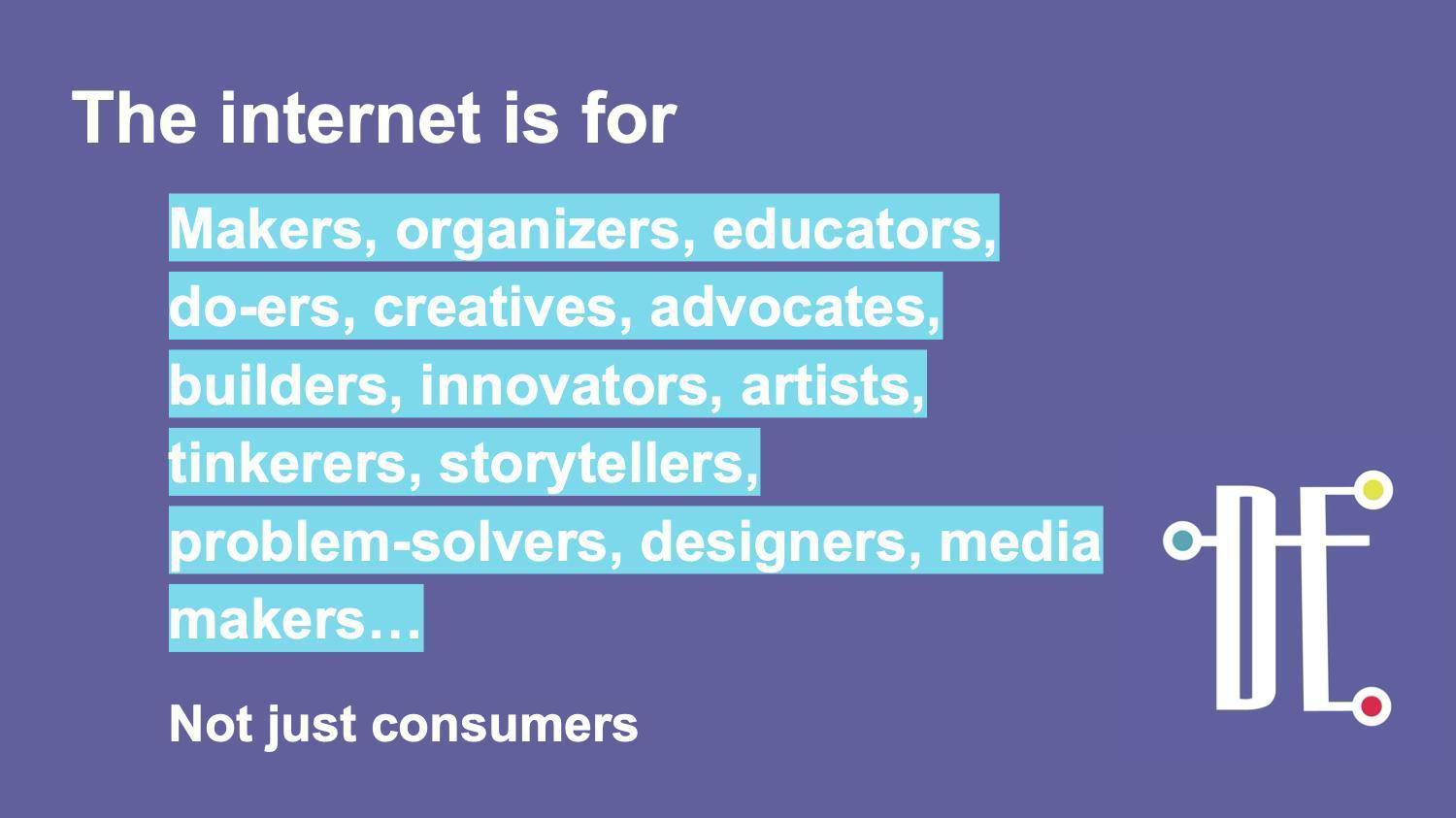
Who is the internet for?
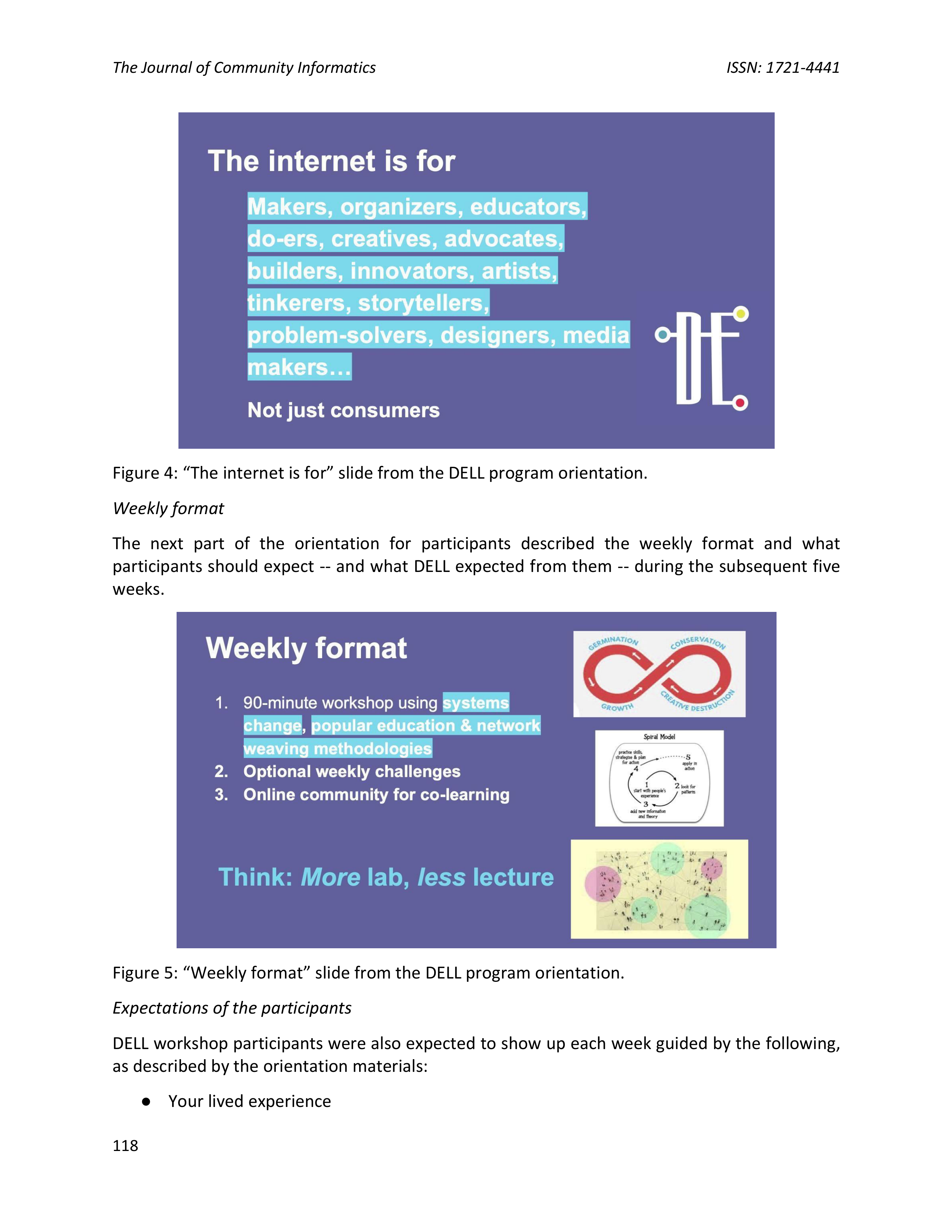
The next slide is perhaps the clearest statement of the values inherent in the DELL program.
The Journal of Community Informatics
ISSN: 1721-4441
118
Figure 4: “The internet is for” slide from the DELL program orientation.
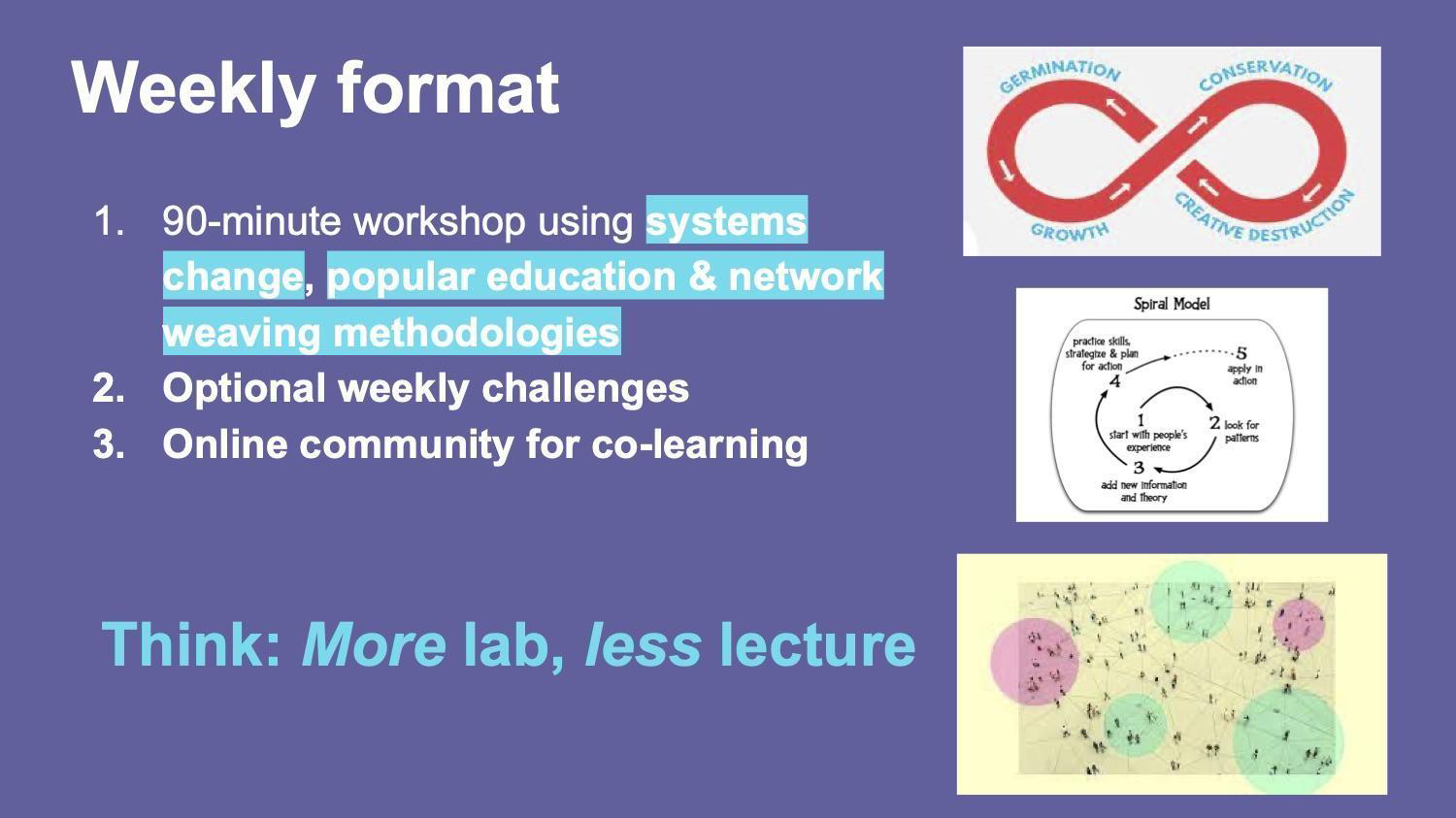
Weekly format
The next part of the orientation for participants described the weekly format and what
participants should expect -- and what DELL expected from them -- during the subsequent five
weeks.
Figure 5: “Weekly format” slide from the DELL program orientation.
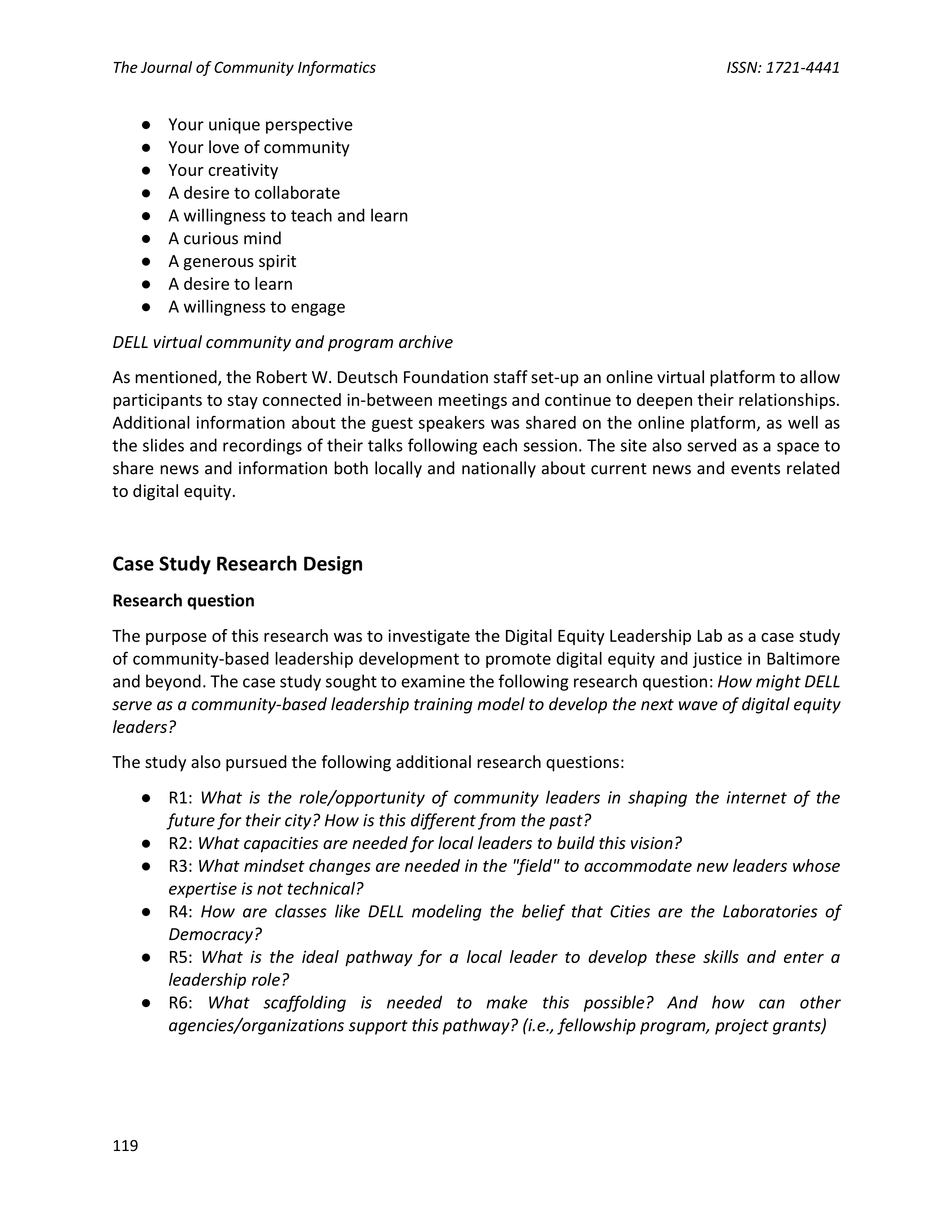
Expectations of the participants
DELL workshop participants were also expected to show up each week guided by the following,
as described by the orientation materials:
●
Your lived experience
The Journal of Community Informatics
ISSN: 1721-4441
119
●
Your unique perspective
●
Your love of community
●
Your creativity
●
A desire to collaborate
●
A willingness to teach and learn
●
A curious mind
●
A generous spirit
●
A desire to learn
●
A willingness to engage
DELL virtual community and program archive
As mentioned, the Robert W. Deutsch Foundation staff set-up an online virtual platform to allow
participants to stay connected in-between meetings and continue to deepen their relationships.
Additional information about the guest speakers was shared on the online platform, as well as
the slides and recordings of their talks following each session. The site also served as a space to
share news and information both locally and nationally about current news and events related
to digital equity.
Case Study Research Design
Research question
The purpose of this research was to investigate the Digital Equity Leadership Lab as a case study
of community-based leadership development to promote digital equity and justice in Baltimore
and beyond. The case study sought to examine the following research question:
How might DELL
serve as a community-based leadership training model to develop the next wave of digital equity
leaders?
The study also pursued the following additional research questions:
●
R1:
What is the role/opportunity of community leaders in shaping the internet of the
future for their city? How is this different from the past?
●
R2:
What capacities are needed for local leaders to build this vision?
●
R3:
What mindset changes are needed in the "field" to accommodate new leaders whose
expertise is not technical?
●
R4:
How are classes like DELL modeling the belief that Cities are the Laboratories of
Democracy?
●
R5:
What is the ideal pathway for a local leader to develop these skills and enter a
leadership role?
●
R6:
What scaffolding is needed to make this possible? And how can other
agencies/organizations support this pathway? (i.e., fellowship program, project grants)
The Journal of Community Informatics
ISSN: 1721-4441
120
Significance of study
The case study is significant because it addresses a lack of understanding in both the scholarly
literature and in practice about the role of community-based leadership development to
promote digital equity and justice. By providing qualitative data and analysis, the goal of the
research is to help explain how DELL’s model of community-based leadership can inform the next
wave of digital equity leaders across the country. Findings from the study should also be useful
for other grassroots organizers, philanthropic organizations, policymakers, and other key
stakeholders interested in promoting leadership in digital equity and justice initiatives
nationwide.
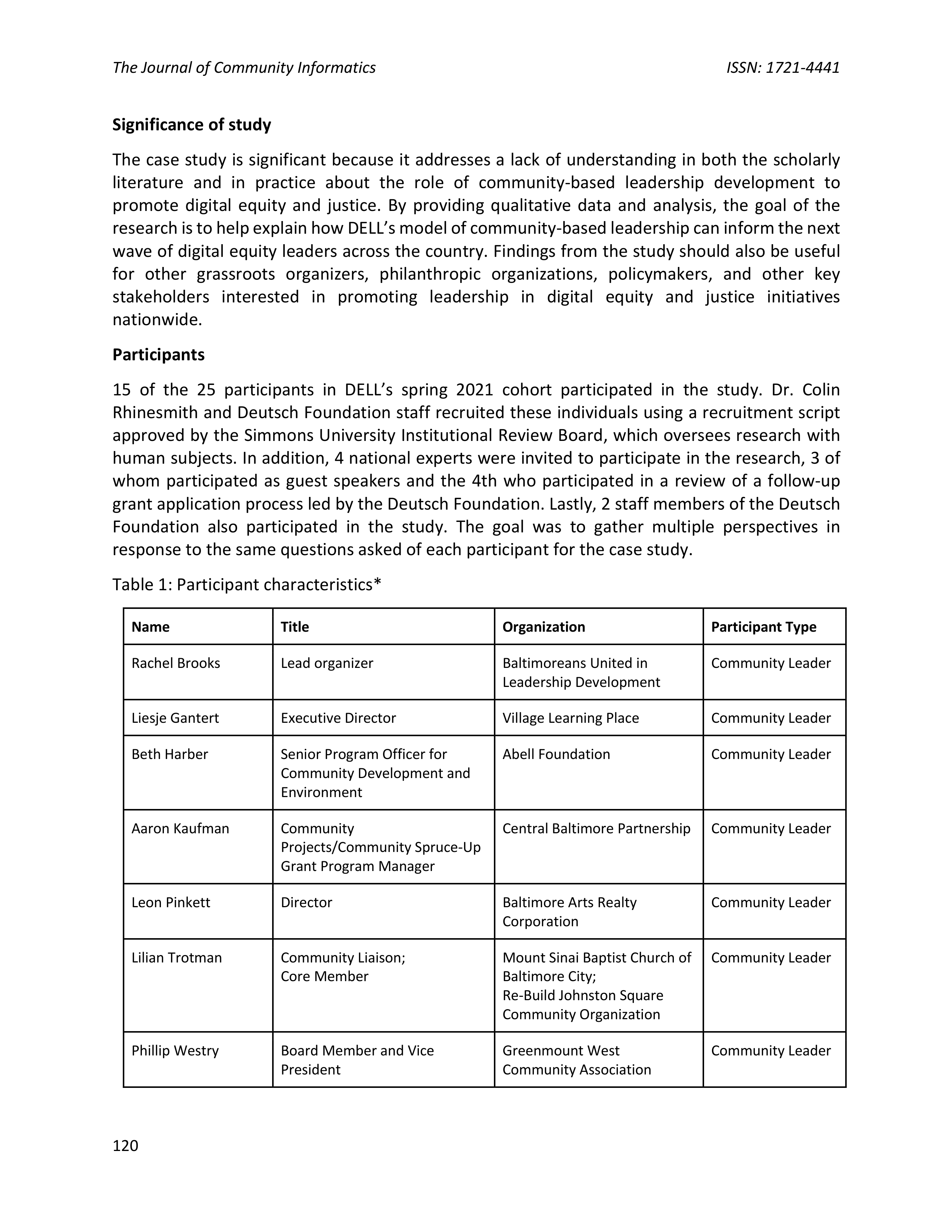
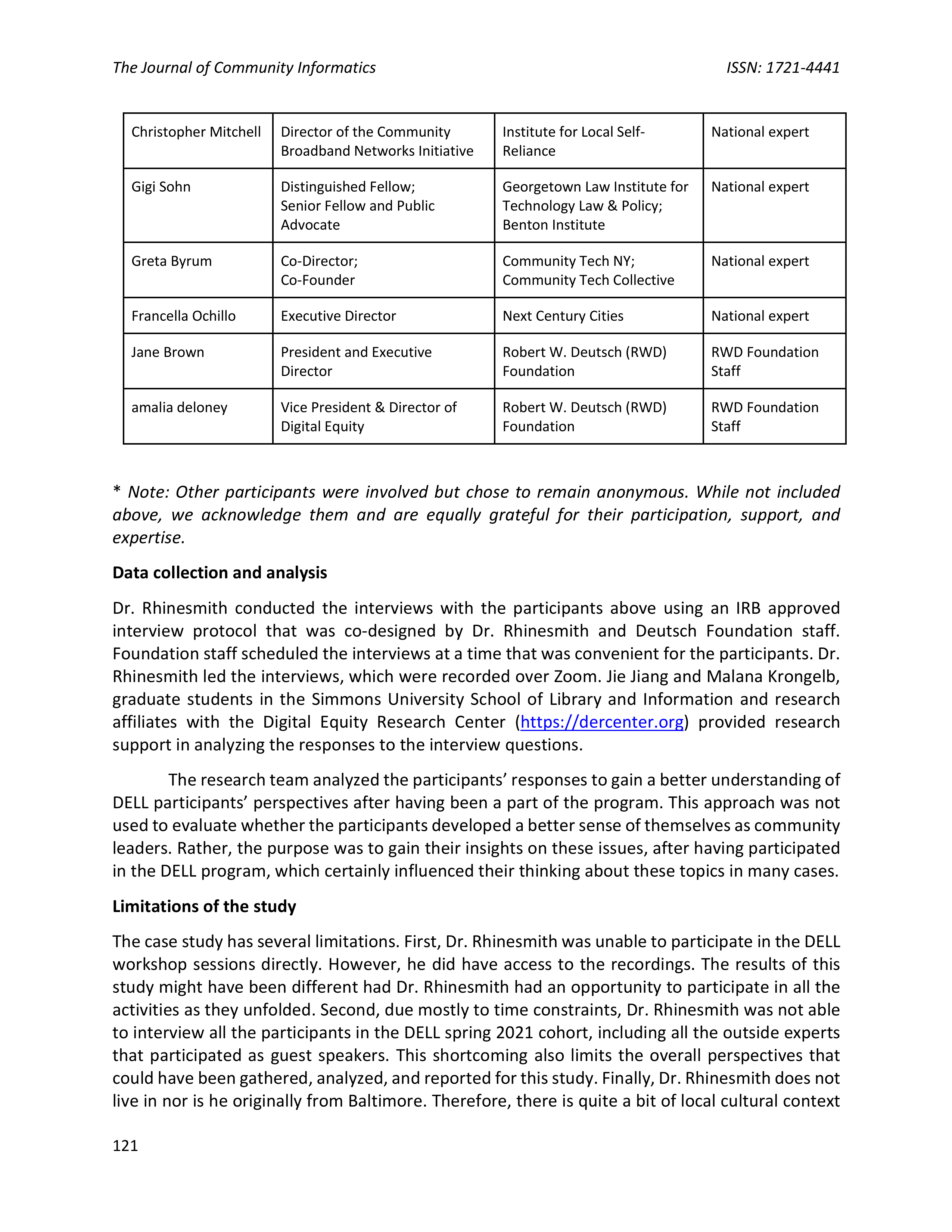
Participants
15 of the 25 participants in DELL’s spring 2021 cohort participated in the study. Dr. Colin
Rhinesmith and Deutsch Foundation staff recruited these individuals using a recruitment script
approved by the Simmons University Institutional Review Board, which oversees research with
human subjects. In addition, 4 national experts were invited to participate in the research, 3 of
whom participated as guest speakers and the 4th who participated in a review of a follow-up
grant application process led by the Deutsch Foundation. Lastly, 2 staff members of the Deutsch
Foundation also participated in the study. The goal was to gather multiple perspectives in
response to the same questions asked of each participant for the case study.
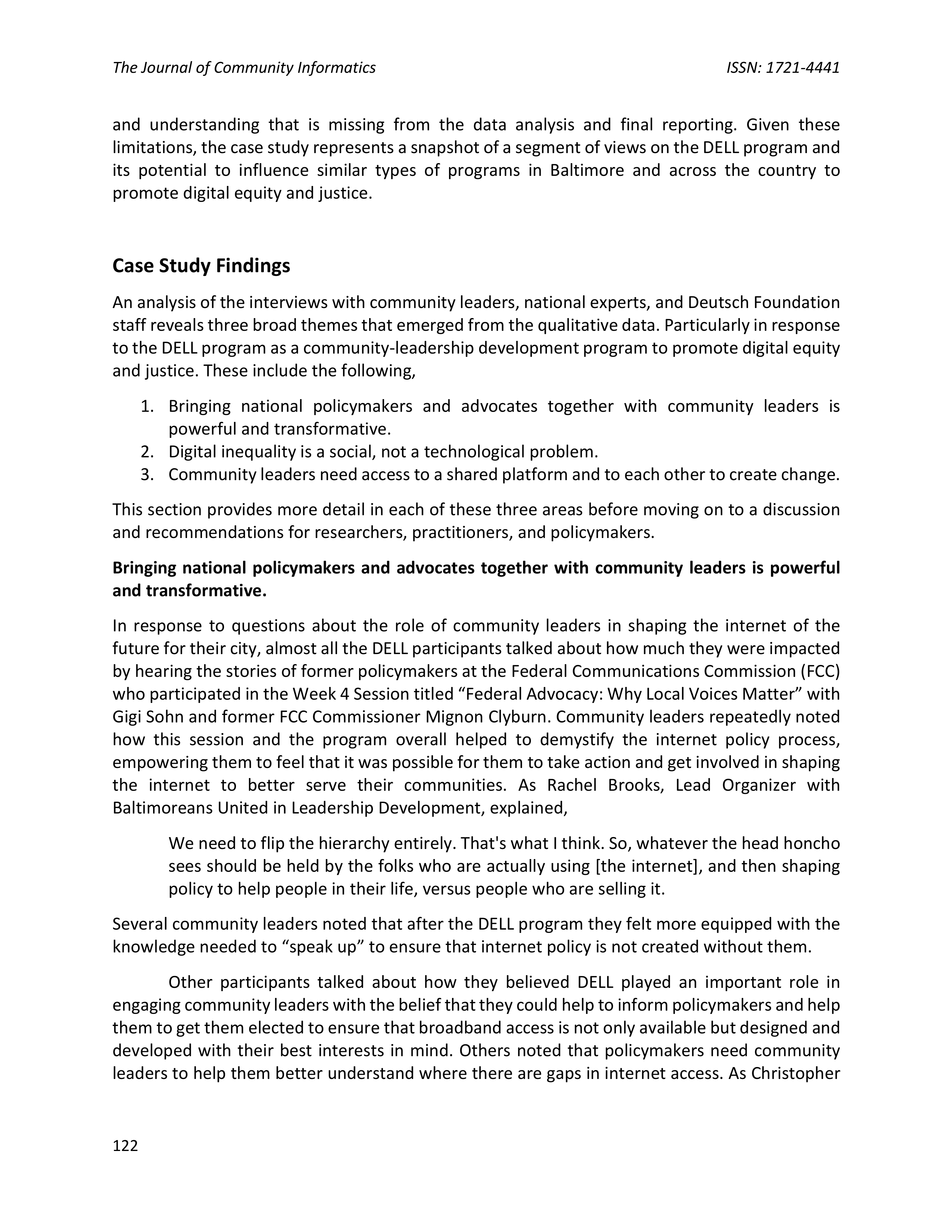
Table 1: Participant characteristics*
Name
Title
Organization
Participant Type
Rachel Brooks
Lead organizer
Baltimoreans United in
Leadership Development
Community Leader
Liesje Gantert
Executive Director
Village Learning Place
Community Leader
Beth Harber
Senior Program Officer for
Community Development and
Environment
Abell Foundation
Community Leader
Aaron Kaufman
Community
Projects/Community Spruce-Up
Grant Program Manager
Central Baltimore Partnership
Community Leader
Leon Pinkett
Director
Baltimore Arts Realty
Corporation
Community Leader
Lilian Trotman
Community Liaison;
Core Member
Mount Sinai Baptist Church of
Baltimore City;
Re-Build Johnston Square
Community Organization
Community Leader
Phillip Westry
Board Member and Vice
President
Greenmount West
Community Association
Community Leader
The Journal of Community Informatics
ISSN: 1721-4441
121
Christopher Mitchell
Director of the Community
Broadband Networks Initiative
Institute for Local Self-
Reliance
National expert
Gigi Sohn
Distinguished Fellow;
Senior Fellow and Public
Advocate
Georgetown Law Institute for
Technology Law & Policy;
Benton Institute
National expert
Greta Byrum
Co-Director;
Co-Founder
Community Tech NY;
Community Tech Collective
National expert
Francella Ochillo
Executive Director
Next Century Cities
National expert
Jane Brown
President and Executive
Director
Robert W. Deutsch (RWD)
Foundation
RWD Foundation
Staff
amalia deloney
Vice President & Director of
Digital Equity
Robert W. Deutsch (RWD)
Foundation
RWD Foundation
Staff
*
Note: Other participants were involved but chose to remain anonymous. While not included
above, we acknowledge them and are equally grateful for their participation, support, and
expertise.
Data collection and analysis
Dr. Rhinesmith conducted the interviews with the participants above using an IRB approved
interview protocol that was co-designed by Dr. Rhinesmith and Deutsch Foundation staff.
Foundation staff scheduled the interviews at a time that was convenient for the participants. Dr.
Rhinesmith led the interviews, which were recorded over Zoom. Jie Jiang and Malana Krongelb,
graduate students in the Simmons University School of Library and Information and research
affiliates with the Digital Equity Research Center (
https://dercenter.org
) provided research
support in analyzing the responses to the interview questions.
The research team analyzed the participants’ responses to gain a better understanding of
DELL participants’ perspectives after having been a part of the program. This approach was not
used to evaluate whether the participants developed a better sense of themselves as community
leaders. Rather, the purpose was to gain their insights on these issues, after having participated
in the DELL program, which certainly influenced their thinking about these topics in many cases.
Limitations of the study
The case study has several limitations. First, Dr. Rhinesmith was unable to participate in the DELL
workshop sessions directly. However, he did have access to the recordings. The results of this
study might have been different had Dr. Rhinesmith had an opportunity to participate in all the
activities as they unfolded. Second, due mostly to time constraints, Dr. Rhinesmith was not able
to interview all the participants in the DELL spring 2021 cohort, including all the outside experts
that participated as guest speakers. This shortcoming also limits the overall perspectives that
could have been gathered, analyzed, and reported for this study. Finally, Dr. Rhinesmith does not
live in nor is he originally from Baltimore. Therefore, there is quite a bit of local cultural context
The Journal of Community Informatics
ISSN: 1721-4441
122
and understanding that is missing from the data analysis and final reporting. Given these
limitations, the case study represents a snapshot of a segment of views on the DELL program and
its potential to influence similar types of programs in Baltimore and across the country to
promote digital equity and justice.
Case Study Findings
An analysis of the interviews with community leaders, national experts, and Deutsch Foundation
staff reveals three broad themes that emerged from the qualitative data. Particularly in response
to the DELL program as a community-leadership development program to promote digital equity
and justice. These include the following,
1.
Bringing national policymakers and advocates together with community leaders is
powerful and transformative.
2.
Digital inequality is a social, not a technological problem.
3.
Community leaders need access to a shared platform and to each other to create change.
This section provides more detail in each of these three areas before moving on to a discussion
and recommendations for researchers, practitioners, and policymakers.
Bringing national policymakers and advocates together with community leaders is powerful
and transformative.
In response to questions about the role of community leaders in shaping the internet of the
future for their city, almost all the DELL participants talked about how much they were impacted
by hearing the stories of former policymakers at the Federal Communications Commission (FCC)
who participated in the Week 4 Session titled “Federal Advocacy: Why Local Voices Matter” with
Gigi Sohn and former FCC Commissioner Mignon Clyburn. Community leaders repeatedly noted
how this session and the program overall helped to demystify the internet policy process,
empowering them to feel that it was possible for them to take action and get involved in shaping
the internet to better serve their communities. As Rachel Brooks, Lead Organizer with
Baltimoreans United in Leadership Development, explained,
We need to flip the hierarchy entirely. That's what I think. So, whatever the head honcho
sees should be held by the folks who are actually using [the internet], and then shaping
policy to help people in their life, versus people who are selling it.
Several community leaders noted that after the DELL program they felt more equipped with the
knowledge needed to “speak up” to ensure that internet policy is not created without them.
Other participants talked about how they believed DELL played an important role in
engaging community leaders with the belief that they could help to inform policymakers and help
them to get them elected to ensure that broadband access is not only available but designed and
developed with their best interests in mind. Others noted that policymakers need community
leaders to help them better understand where there are gaps in internet access. As Christopher
The Journal of Community Informatics
ISSN: 1721-4441
123
Mitchell, Director of the Community Broadband Networks Initiative with the Institute for Local
Self-Reliance, explained,
I think it's really important to have a local enthusiastic group of people that feel
empowered to speak about this, because I think the people who are often empowered to
speak about it are people who work in the area, often for profit companies, which I don't
think is necessarily a bad thing, but they shouldn't be the only ones that feel like they're
competent to speak about these issues and how to resolve them. And so I think programs
like DELL are essential to give people confidence to be able to engage in these discussions
and to prioritize them on an agenda that has many different challenging items to deal
with for any city.
The Deutsch Foundation staff who were interviewed for the study noticed that the DELL
participants' language changed over the course of the program. Through the sessions,
participants were better able to use vocabulary, identify the problems, and articulate
comprehensive solutions on their own. Jane Brown, President and Executive Director of the
Robert W. Deutsch Foundation noted that community leaders' power is “in their ability to inform
policymakers and elected officials,” and she noted that DELL helps show people they have that
agency to affect change and contact policy officials as empowered citizens.
Several community leaders noted the importance of being educated about internet policy
issues and having a greater awareness and understanding of how to advocate for and with their
communities. In other words, community leaders felt they became more empowered to take
action and to inspire others in their communities to join them after having heard the words of
encouragement and support from national advocates and former FCC officials.
Digital inequality is a social, not a technological problem
The DELL program empowered community leaders to better engage internet policy and
advocacy. The program also helped participants gain a deeper understanding of how the internet
works, which in turn has helped them to better engage others in their communities. Several DELL
participants mentioned that a critical part of internet advocacy is the ability to increase their
knowledge around the “technical stuff” and its relationship to digital equity. Aaron Kaufman,
Community Projects/Program Manager with the Central Baltimore Partnership, explained,
I think the fear of the Internet has to be something that we chip away because it's not
going anywhere. If you want to be able to have economic mobility or social mobility or,
to be able to access resources, to be able to apply for jobs, whatever it might be, the
Internet is the tool of the present in the future. We need to really reduce this fear of the
Internet, so that people can use it in a massive way.
Other participants mentioned that having the vocabulary and knowledge needed to
engage in internet policy and advocacy can help them better articulate the issues they encounter
both at the local level and with industry experts. Leon Pinkett, Director of the Baltimore Arts
Realty Corporation, mentioned that with this knowledge people will be able to better organize
others in their communities as well as inside companies to empower them to better advocate for
and influence those within their organizations to create change.
The Journal of Community Informatics
ISSN: 1721-4441
124
While some of the outside experts mentioned that connections between social
inequalities and digital inequalities are often invisible to the general public, Next Century Cities
Director Francella Ochillo added that the pandemic made digital (in)equity much more visible in
ways it had previously not been for many Americans. Regardless of race or ability, Ochillo added,
the digital divide is always associated with poverty. The uniquely American association of poverty
being shameful adds additional barriers in addressing the digital divide.
All these perspectives are important reminders that digital inequality will not be solved
by technology alone. Digital equity is a social issue that must acknowledge the historic oppression
and systemic discrimination against BIPOC and/or poor communities to achieve digital justice.
Community leaders need access to a shared platform and to each other to create change
Several participants recognized the critical role that amalia deloney and the Deutsch Foundation
played in bringing everyone together, providing the training and support for the DELL program,
and being a champion to promote community leadership for digital equity and justice in
Baltimore. As Leon Pinkett, explained, “It is such an asset to have a dynamo [like amalia] who has
a life of passion in this area to really push people to where they may never have been before.”
However, some participants also mentioned that they wished this platform that the DELL
program created could continue after the program with ongoing opportunities for community
education, leadership development, and support.
Several DELL participants from Baltimore mentioned they wished they had more
opportunities to spend time with each other in a social way outside of the DELL program,
particularly since the DELL workshops were offered online due to the pandemic. This observation
is not as much of a critique of the DELL program as it is a strong indicator of the need and desire
for community leaders in Baltimore to have more access to each other during and after the
program ends. In response to a related question about whether participants believed there is an
ideal pathway for local leaders to develop internet advocacy and leadership skills one participant
who wished to remain anonymous mentioned that are three things that are necessary to create
a shared infrastructure to promote digital equity in Baltimore: (1) a digital equity officer within
the city who can lead initiatives at the city level; (2) more local groups focusing on digital equity
would be helpful to begin acting as “tentacles throughout the city;” and (3) more fellowships to
support the work.
Lillian Trotman, a community liaison and core member of the Mount Sinai Baptist Church
of Baltimore City and the Re-Build Johnston Square Community Organization, mentioned that
beyond time, money, training, and awareness of the internet policy and advocacy issues, people
need access to a shared platform to get involved in digital equity work. As she explained,
In the community where I participate, we have, and I would call it a strong community
organization. Because of the work that is going on in our community, we have a ten-year
master plan, and people are starting to see the results. And, because they are seeing the
results, more and more are coming to the meetings. This last month we had just as many
people on Zoom as we had in the room. They are starting to see that we are serious about
The Journal of Community Informatics
ISSN: 1721-4441
125
what it is that we want. So I think when you are serious and people start seeing results,
they want to become a part of it.
Ms. Trotman also mentioned that everybody can contribute to digital equity work in some way.
Therefore, a shared platform where other people in the community see people working together
and achieving shared goals would encourage both individual and collective participation. This
identification of the need for a shared platform to continue the work also indicates that
participants in the DELL spring 2021 cohort expressed a desire to use the knowledge they
acquired through the program to take action to create real change in their communities.
Recommendations
Findings from this case study of the spring 2021 Digital Equity Leadership Lab program reveal
several key ideas and action steps to advance digital equity community leadership development.
Recommendation #1
●
Capacity building and train-the-trainer models are important for community leadership
development, but without access to policymakers and advocates on a national level,
community leaders may lack a holistic view and understanding of the problems and
community-developed solutions to these problems.
The qualitative data gathered from community leaders, outside experts, and Deutsch Foundation
staff emphasize the important role that community leaders play in leading digital equity and
justice work. However, without a broader understanding of how the internet works, as well as
how this knowledge can be used to advocate for policy changes, community leaders may not
have the necessary language, framing, tools, and capacity needed to push for change on a
national scale.
Recommendation #2
●
Community leadership development programs to promote digital equity and justice must
provide support systems for community leaders to come together through a shared
infrastructure, including both platforms to share ideas and spaces to convene, to continue
the work after the training is over.
Findings from the study support the idea that “digital equity ecosystems” (Rhinesmith &
Kennedy, 2020) matter for community leaders working to create change in their communities.
This is because digital equity ecosystems recognize the importance of “interactions between
individuals, populations, communities, and their larger sociotechnical environments that all play
a role in shaping the digital inclusion work in local communities to promote more equitable
access to technology and social and racial justice” (p. 1). These interactions, or relationships, need
to be cultivated and sustained over time. Identifying organizations, resources, and support within
these ecosystems is vital to the success of the work.
The Journal of Community Informatics
ISSN: 1721-4441
126
Recommendation #3
●
Digital inclusion work is vital to help those without access to computers and the internet.
However, this work must be rooted in an understanding of how power, privilege, and
oppression shape digital inequality, as well as how this knowledge can be used to address
systemic barriers to social and racial justice.
The qualitative data from this case study indicated participants’ desire to use the knowledge
gained in the DELL program to promote what Wolfson, Crowell, Reyes, & Bach (2017) refer to as
“emancipatory broadband adoption.” By this, the authors mean the following,
Programs aiming to bridge the digital divide must address some of the other reasons that
marginalized communities do not adopt broadband. To this end, we contend in this article
that a community’s relationship to communication technology—and their ability to see it
as a political and cultural tool that can be utilized not just instrumentally, but more
broadly as a way to fight oppression and build collective political power—is a substantial
factor leading to what we call emancipatory adoption.
This conceptualization of digital inclusion programs as having emancipatory goals can help
researchers, practitioners, and policymakers to understand the importance of rooting the work
within a justice framework. The idea of digital equity ecosystems offers a way to move from
digital equity to digital justice, which also builds upon the Detroit Digital Justice Coalition’s
principles of “access, participation, common ownership, and healthy communities.” (Detroit
Digital Justice Coalition, 2022).
Conclusion
In this paper, the Digital Equity Leadership Lab was presented as a case study of community
leadership development to promote digital equity and justice. Community leaders, outside
experts, and RWD Foundation staff provided their insights and expertise to help answer the
following overarching research question:
How might DELL serve as a community-based leadership
training model to develop the next wave of digital equity leaders?
The following findings
emerged: (1) bringing national policymakers and advocates together with community leaders is
powerful and transformative; (2) digital inequality is a social, not a technological problem; and
(3) community leaders need access to a shared platform and to each other to create change.
Recommendations were provided to help advance future work and research in digital
equity community leadership development. The case study showed how community leaders can
benefit from seeing their work within a digital equity ecosystems framework, which calls
attention to the importance of embracing the interactions and growing the relationships that
exist between and among individuals, populations, communities, and their broader
environments that help shape this work. Lastly, the case study recommends that community
leaders working to advance digital equity and justice must continue to uncover the systemic
discrimination of poor communities and communities of color that experience digital inequality
today.
The Journal of Community Informatics
ISSN: 1721-4441
127
Acknowledgements
The research reported in this case study was funded by a grant from the Robert W. Deutsch
Foundation, and an earlier and shortened version of this case study was published by the Robert
W. Deutsch Foundation in March 2022. The authors would like to thank Jane Brown and amalia
deloney of the Deutsch Foundation for their support with this case study research and Peter
Johnson for his editorial review and comments on the paper.
References
Abell Foundation. (2020). Internet access maps, Baltimore City. Abell.org. Retrieved March 20,
2022, from
https://abell.org/internet-access-maps-baltimore-city
Bach, A. J., Wolfson, T., & Crowell, J. K. (2018). Poverty, literacy, and social transformation: An
interdisciplinary exploration of the digital divide.
Journal of Media Literacy Education
10
(1), 22–41.
Badger, E. (2016, August 10). Baltimore shows how historic segregation shapes biased policing
today.
The
Washington
Post
.
https://www.washingtonpost.com/news/wonk/wp/2016/08/10/baltimore-shows-how-
historic-segregation-shapes-biased-policing-today/
Baltimore '68 events timeline
. Robert L. Bogomolny Library Special Collections. Retrieved March
20, 2022 from https://archives.ubalt.edu/bsr/timeline/timeline.html
Baltimore American Indian Center. (2021).
About us
. Retrieved March 20, 2022, from
https://baltimoreamericanindiancenter.org/about-us/
Baltimore’s Civil Rights Heritage. (2019).
1831-1884: Abolition and Emancipation
. Retrieved
March 20, 2022 from
https://baltimoreheritage.github.io/civil-rights-heritage/1831-
1884/
Begay, D. (2019).
Indigenous people of Baltimore, MD
. Retrieved March 20, 2022,
http://conference.rbms.info/2019/indigenous-tribes-of-baltimore-md/
Black Power Media. (2016, July 14).
Media coverage and the political economy of black death
.
YouTube.
https://www.youtube.com/watch?v=ymWhmz3KSvk
Booker, B. (2018, April 7). 50 years ago Baltimore burned. The same issues set it aflame in 2015.
National Public Radio
. https://www.npr.org/2018/04/07/600114134/50-years-ago-
baltimore-burned-the-same-issues-set-it-aflame-in-2015
The Journal of Community Informatics
ISSN: 1721-4441
128
Brown, R. B. & Nylander III, A. B. (1998). Community leadership structure: Differences between
rural community leaders' and residents' informational networks.
Community
Development
,
29
(1), 72.
Cassie,
R.
(2020).
The
great
migration.
Baltimore
Magazine
.
https://www.baltimoremagazine.com/section/historypolitics/the-great-migration/
City of Baltimore. (2021).
The history of Baltimore
. Retrieved March 20, 2022,
http://www.baltimorecity.gov/sites/default/files/5_History.pdf
Clement, A., & Shade, L. R. (2000). The access rainbow: Conceptualizing universal access to the
information/communications infrastructure. In M. Gurstein (Ed.),
Community
Informatics: Enabling Communities with Information and Communications Technologies
(pp. 32-51). IGI Global.
https://doi.org/10.4018/978-1-878289-69-8.ch002
Detroit Digital Justice Coalition. (n.d.)
Principles
. Retrieved from March 20, 2022, from
http://detroitdjc.org/principles/
DiMaggio, P., & Hargittai, E. (2001). From the ‘digital divide’ to ‘digital inequality’: Studying
Internet use as penetration increases (Working Paper No. 15).
Princeton: Center for Arts
and Cultural Policy Studies, Woodrow Wilson School
.
Dockry, M., & Whyte, K. (2021). Improving on nature: The legend lake development, Menominee
resistance, and the ecological dynamics of settler colonialism.
American Indian Quarterly
,
45
(2), 96.
Estreet, A. T., Wells, A. M., Tirmazi, M. T., Sinclair, M., & Nebbit, V. E. (2015). Race and Social
justice in Baltimore: The youth perspective.
Reflections: Narratives of Professional
Helping
,
21
(3), 65.
Gangadharan, S. P. (2012). Digital inclusion and data profiling.
First Monday
,
17
(5).
https://doi.org/10.5210/fm.v17i5.3821
Eubanks, V. (2011).
Digital dead end: Fighting for social justice in the information age
. The MIT
Press.
Fiedler, F. E. (1967).
A theory of leadership effectiveness
. McGraw-Hill.
Flores-Koulish, S. A., & Shiller, J. T. (2020). Critical classrooms matter: Baltimore teachers’
pedagogical response after the death of Freddie Gray.
Education and Urban Society
,
52
(6),
984–1007.
Gilliard, C. & Culik, H. (2016, May 24). Digital redlining, access, and privacy.
Common Sense Media
.
https://www.commonsense.org/education/articles/digital-redlining-access-and-privacy
Greene, G. (2021).
The promise of access: Technology, inequality, and the political economy of
hope
. The MIT Press.
Halleck, D. D. (2002).
Hand-held visions: The impossible possibilities of community media
.
Fordham University Press.
The Journal of Community Informatics
ISSN: 1721-4441
129
Helsper, E. J., & Reisdorf, B. C. (2017). The emergence of a “digital underclass” in Great Britain
and Sweden: Changing reasons for digital exclusion.
New Media & Society
,
19
(8), 1253–
1270.
Home Owner's Loan Corporation. (1937). Residential security map of Baltimore Md.
Johns
Hopkins Sheridan Libraries
.
https://jscholarship.library.jhu.edu/handle/1774.2/32621
Horrigan, J. B. (2020). Baltimore’s digital divide: Gaps in internet connectivity and the impact on
low-income city residents.
Abell Foundation
. https://abell.org/publications/baltimores-
digital-divide-gaps-internet-connectivity-and-impact-low-income-city
Howley, K. (2005).
Community media: People, places, and communication technologies
.
Cambridge University Press.
Jaeger, P., Bertot, J., Thompson, K., Katz, S., & DeCoster, E. (2012). The intersection of public
policy and public access: Digital divides, digital literacy, digital inclusion, and public
libraries.
Public Library Quarterly
,
31
(1), 1–20.
Johns Hopkins Sheridan Libraries University Museums. (2017).
The Baltimore ‘redlining map’:
ranking
neighborhoods
.
Retrieved
March
20,
2022,
from
https://blogs.library.jhu.edu/2017/09/the-baltimore-redlining-map-ranking-
neighborhoods/
Katz, V. S., & Gonzales, C. (2016). Toward meaningful connectivity: Using multilevel
communication research to reframe digital inequality.
Journal of Communication
,
66
,
236–249.
King, P. N. (2014). Preserving places, making spaces in Baltimore: Seeing the connections of
research, teaching, and service as justice.
Journal of Urban History
,
40
(3), 433.
Kirby, D. (2021, May 11). This Baltimore program aims to create the next wave of digital equity
leaders.
Technical.ly
.
https://technical.ly/baltimore/2021/05/11/digital-equity-leaders-
lab-deutsch-foundation/
Kretzmann, J. P. & McKnight, J. (1993).
Building communities from the inside out: A path toward
finding and mobilizing a community’s assets
. The Asset-Based Community Development
Institute, School of Education and Social Policy, Northwestern University.
Kvasny, L. (2006). Cultural (re)production of digital inequality in a US community technology
initiative.
Information, Communication & Society
,
9
(2), 160–181.
Mayberry, R. M., Daniels, P. V., Willock, R. J., & Yan, F. (2020). Empowered Community Leadership
for Chronic Disease Prevention: Context Matters.
American Journal of Health Studies
,
35
(2), 124–141.
McKie B.P., S. (2017). Interior department reverses interpretation of 1956 Lumbee Act.
Cherokee
One
Feather
.
https://theonefeather.com/2017/01/11/interior-department-reverses-
interpretation-of-1956-lumbee-act/
The Journal of Community Informatics
ISSN: 1721-4441
130
Minner, A. (2019). A quest to reconstruct Baltimore’s American Indian ‘reservation.’
The
Conversation
.
https://theconversation.com/a-quest-to-reconstruct-baltimores-
american-indian-reservation-110562
National Conference of State Legislators. (2022).
Federal and state recognized tribes
. Retrieved
March 20, 2022,
https://www.ncsl.org/legislators-staff/legislators/quad-caucus/list-of-
federal-and-state-recognized-tribes.aspx#State
Nel, H. (2018). Community leadership: A comparison between asset-based community-led
development (ABCD) and the traditional needs-based approach.
Development Southern
Africa
, 35(6), 839.
Noble, S. U. (2018).
Algorithms of oppression: How search engines reinforce racism
. New York
University Press.
Pinkett, R. D. (2000). Bridging the digital divide: Sociocultural constructionism and an asset-based
approach to community technology and community building.
Paper presented at the 81st
Annual Meeting of the American Educational Research Association (AERA)
, New Orleans,
LA, USA.
Reisdorf, B. C., & Rhinesmith, C. (2018). An asset-based approach to digital inclusion research in
the US context. In M. Ragnedda & B. Mutsvairo (Eds),
Digital inclusion: An international
comparative analysis
(pp. 39–54). Lexington Books.
Rhinesmith, C. (2016).
Digital inclusion and meaningful broadband adoption initiatives
. Benton
Foundation.
https://www.benton.org/sites/default/files/broadbandinclusion.pdf
Rhinesmith, C. (2019). Community media. In R. Hobbs & P. Mihailidis (Eds.),
International
Encyclopedia of Media Literacy
(pp. 1-6). Wiley-Blackwell.
Rhinesmith, C., & Kennedy, S. (2020, October). Growing healthy digital equity ecosystems during
COVID-19
and
beyond.
Benton
Institute
for
Broadband
&
Society
.
http://benton.org/digital-equity-ecosystems-report
Robert W. Deutsch Foundation (2021).
The Robert W. Deutsch Foundation announces Ashley
Minner
as
a
RWD
Fellow
.
Retrieved
March
20,
2022,
from
https://www.rwdfoundation.org/news/2021/5/28/the-robert-w-deutsch-foundation-
announces-ashley-minner-as-a-new-rwd-fellow-jtjme
Robert W. Deutsch Foundation. (2021). The Digital Equity Leadership Lab (DELL). Retrieved March
20, 2022, from
https://www.rwdfoundation.org/dell
Spiegel, I. (2020). A Native American community in Baltimore reclaims its history.
Smithsonian
Magazine
.
https://www.smithsonianmag.com/smithsonian-institution/native-american-
community-baltimore-reclaims-its-history-180975948/
Strover, S., Chapman, G., & Waters, J. (2004). Beyond community networking and CTCs: Access,
development, and public policy.
Telecommunications Policy
,
28
(7-8), 465-485.
The Journal of Community Informatics
ISSN: 1721-4441
131
University of Alaska Fairbanks. (n.d.)
Federal Indian Law for Alaska Tribes
. Retrieved March 20,
2022,
from
https://www.uaf.edu/tribal/112/unit_2/terminationerathe1950spubliclaw280.php
van Deursen, A. J., & van Dijk, J. A. (2011). Internet skills and the digital divide.
New Media &
Society
,
13
(6), 893–911
van Deursen, A. J., Helsper, E. J., Eynon, R., & van Dijk, J. A. (2017). The compoundness and
sequentiality of digital inequality.
International Journal of Communication
,
11
, 452–473.
van Deursen, A. J., & Helsper, E. J. (2018). Collateral benefits of Internet use: Explaining the
diverse outcomes of engaging with the Internet.
New Media & Society
,
20
(7), 2333–2351.
Whitman, T. S. (1997).
The price of freedom: Slavery and manumission in Baltimore and early
national Maryland
. The University Press of Kentucky.
Wolfson, T., Crowell, J., Reyes, C., & Bach, A. (2017). Emancipatory broadband adoption: Toward
a critical theory of digital inequality in the urban United States.
Communication, Culture
& Critique
,
10
(3), 441–459.