
People's Democratic Republic of Algeria
Ministry of Higher Education and Scientific Research
Abdelhamid Ibn Badis University Mostaganem
Faculty of Economics, Commerce and Management Sciences
In coordination with the Research Laboratory, the strategy for the transition to the green economy
To cite this paper
Ammam, R. (2024, November 4).
Forward-Looking Leadership: A Case Study of IBM
Transforming Intellectual Capital in Modern Business
. Paper presented at the National
Conference on Leadership Development and Competency Enhancement through Intellectual
Capital: Strategies and Challenges, Abdelhamid Ibn Badis University, Mostaganem, Algeria.
Abstract
In times of explosive technological developments and changing market dynamics, forward-thinking
leadership is called for so that intellectual capital be transformed into a strategic asset. This paper
discusses the fostering role innovative leadership plays in leveraging intellectual capital for
organizational success and competitive advantage. Drawing on an in-depth case study of IBM, this
paper considers how leaders at the company really mobilize intellectual resources toward the
creation of a culture of continuous learning, adaptability, and strategic foresight. The paper
pinpoints clear leadership strategies by which IBM has been able to effectively translate its
intellectual capital into a powerhouse for innovation and market leadership. These valuable lessons,
drawn with theoretical insight and practical examples from the research, help business leaders today
to appreciate the need for traversing complexities in modern business environments in a clear quest
for sustainable growth.
Keywords
: Leadership, Intellectual Capital, Innovation , Strategy,
IBM
ملخص
يف ظل التطورات التكنولوجية املتسارعة وتغري ديناميكيات السوق، تربز أمهية القيادة ذات التفكري املستقبلي يف حتويل رأس املال الفكري
إىل عنصر اسرتاتيجي حموري .
تناقش ىذه الورقة الدور احليوي للقيادة املبتكرة يف االستفادة من رأس املال الفكري لتعزيز النجاح التنظيمي
وحتقيق امليزة التنافسية .من خالل دراسة حالة لشركة
IBM
، تستعرض ىذه الورقة كيفية متكن قادة الشركة من توجيو املوارد الفكرية حنو
تعزيز ثقافة التعلم املستمر، والقدرة على التكيف، واالستشراف االسرتاتيجي .كما حتدد الورقة االسرتاتيجيات القيادية اليت مكّنت
IBM
من حتويل رأس ماهلا الفكري إىل قوة دافعة لالبتكار والتميز يف السوق .
ًتوفر ىذه الدراسة، اليت تستند إىل رؤى نظرية وأمثلة عملية، دروسا
قيمة لقادة األعمال احلاليني يف كيفية التنقل عرب تعقيدات بيئات األعمال احلديثة لتحقيق منو مستدام.
الكلمات املفتاحية:
، القيادة، رأس املال الفكري، االبتكار،اإلسرتاتيجية
IBM
Introduction
In the contemporary business environment,a company's deficiency in intellectual capital
significantly undermines much of its worth, particularly considering that intellectual capital should
be viewed increasingly as an intangible asset rather than just physical resources (Minovski and
Jancevska,2018). The evidence of this intangible asset, though impossible to measure precisely,
involves the collective knowledge, skills, and innovative potential that the company—and its
employees—possess Purnamawati et al.(2022). In markets characterized by stiff competition and
the constant replacement of old technology with new, the success of innovative leaders hinges on
their ability to leverage intellectual capital, which is fundamental to establishing a sustainable
competitive advantage.
The organization's intellectual capital consists of employee knowledge-based assets, which
can be classified as employee expertise, proprietary information, and customer relationships
(Rastegar and Arbabi,2023). This intellectual capital is the engine of the company's growth and the
source of its productivity in the modern economy. However, the mere existence of intellectual
capital does not guarantee success; it requires visionary leadership to fully utilize and direct these
assets toward organizational goals.
Visionary leaders understand that the ability to harness and develop intellectual capital is not
just beneficial—it is essential for both survival and prosperity in an era of constant change
(Gupta,2021). These forward-looking leaders do not rest on their laurels; instead, they are willing to
take risks and seize opportunities. They create environments that nurture creativity, serve as
platforms for continuous learning, and facilitate the sharing of knowledge across all levels of the
organization.( Edmondson,2012)
This paper explores the transformation of intellectual capital through effective leadership,
examining key strategies, real-world implementations, and the challenges associated with this
crucial endeavor. The purpose of this exploration is to equip executives with valuable insights that
underscore the necessity of intellectual capital for survival and growth in our knowledge- and
information-driven world. Additionally, this document provides a checklist for organizations
looking to adopt a knowledge-based approach, offering practical guidance for leveraging
intellectual capital effectively.
Research Question:
How might visionary leadership transform an organization's intellectual capital into a sustainable
competitive advantage?
The Importance of Studying
If an organization has to thrive in a changing and highly competitive business environment,
then it becomes critical to understand how the visionary leader may actualize his/her role in
harvesting and developing intellectual capital. The paper identifies intellectual capital as a major
driver of innovation, efficiency, and adaptability, and also emphasizes potential the requirement of
strategic leadership to untootentials. It provides leaders with insight into how to create an enabling
environment for creativity, continuous learning, and knowledge sharing in order to ensure the
perpetuation of organizations.
The Objectives of study
:
The research shall aim to identify the constituents of intellectual capital, along with their varied
roles in the growth and productivity enhancement of organizations.
Exploring ways visionary leaders tap into and develop intellectual capital.
The examination of real-life cases of organizations that have managed to leverage their
intellectual capital through visionary leadership.
The practical insight for this objective derives from case studies of firms that have successfully
harnessed intellectual capital to gain a competitive edge
Methodology
The paper will use an in-depth case study approach to study how innovative leadership at IBM
mobilizes intellectual capital to drive organizational success and competitive advantage. The basic
inquiry is how prescient leadership enables a culture of continuous learning, adaptability, and
strategic business acumen. Availing of these studies on IBM leadership strategies, the paper brings
out how these strategies make intellectual resources effectively translate into a driver of innovation
and market leadership.
I.
Literature Review
In the contemporary dynamic business environments, visionary leadership is particularly
needed to transform and put into play intellectual capital, a set of concepts coined by Edvinsson and
Malone in 1997 (Lönnqvist and Mettänen ,2002 ). It represents human capital—employee
knowledge, skill, and competence, structural capital—the firm's processes, systems, and intellectual
property, and relational capital—stakeholders' relationships, including customers, suppliers, and
partners (Lentjušenkova and Lapina,2016). As firms become increasingly reliant on such
knowledge-based assets, intellectual capital management and transformation have since become the
key to competitive advantage Martín-de Castro et al.(2019). Visionary leadership is a critically
important role in this transformation process Karwan et al.(2021). In 1994, Bass and Avolio
explicated the transformational leadership theory, illustrating how leaders could compel and inspire
their teams to love and accommodate change and innovation. Recent work has affirmed this
relationship by linking transformational leadership with the building of organizational knowledge
management capabilities (Kim and Park,2020). Other strategies toward the improvement of
intellectual capital include but are not limited to, the ability to work in a learning organization Li,et
al,(2019) . Senge (1990) has pointed out that such organizations have to be involved in continuous
learning and improvement. Leaders who foster a learning culture, experimentation, and the
enhancement of intellectual capital in their organization are relatively better placed. With the use of
strategic HR practices, like focused training purposes and the development of talent programs,
human capital can gain rigorously in quality and value for human capital Dabić et al.(2021).
Advanced technologies in the area of data analytics and artificial intelligence can help organizations
better capture, analyze, and leverage intellectual capital (Pinarbasi et al,2024 ; Anumba and Khallaf
,2022 ; Chondough and Chondough,2022 ). According to García-Granero et al.(2015), one of the
strategies to align with is encouraging creativity, giving time and resources for experimentation, and
tolerating calculated risks to develop innovation. Lastly, the enumerated another important strategy
of building strategic partnerships to build relational capital, as suggested by Kale et al.(2020) all
these can be in the arsenal of visionary leaders seeking to transform the intellectual capital base of
their organization.
II.
Challenges in Transforming Intellectual Capital
An organization desirous of leveraging its intellectual capital through transformation has to
surmount several key challenges (Sadq et al.2020; Yu et al,2022; Khalid et al.2021 ). Due to the
very intangible character of assets such as knowledge residing in the minds of employees, and
organizational processes, among others, the impact assessment itself is still a thorny issue at present
because of complexities in measurement and proper valuation of intellectual capital
(Kowalski,2018; Mačerinskienė and Survilaitė,2019). There is some resistance to change,
hampering the need to embrace new practices or technologies, whereas the short-term pressure from
finance and the long-term investment in intellectual capital gives rise to strategic conflicts (O’Reilly
and Tushman,2021; Sinkkilä,2017; Amarantouet al,2018 ). Advanced technologies in integrating
data analytics and artificial intelligence require huge resources and significant expertise;
maintaining talent and knowledge through effective recruitment and continuous learning is critical
for maximizing human capital (Pathak and Solanki,2021; Ganapathy,2019 ). These challenges could
be overcome only through strategic step-by-step management, with well-planned robust
measurement frameworks, effective change management, and a long-term investment in intellectual
capital.( Al-Ali,2003; Pasher and Ronen ,2011; Najar et al,2020 )
III.
Case Study of IBM
Many different case studies demonstrate how intellectual capital transformation can be
successfully driven by visionary leadership, including how strategic intangible asset management
can drive very significant organizational change and success. Probably the most prominent example
of intellectual capital transformation is IBM.
IBM transformed from mainly a hardware-oriented company into a service-based firm. This
visionary move reset the company on its feet and stood it at the forefront of technology services. It
simply reiterates that visionary leadership can provide directions for major strategic shifts and may
probably utilize intellectual capital to ensure long-term growth.
a.
Human Capital
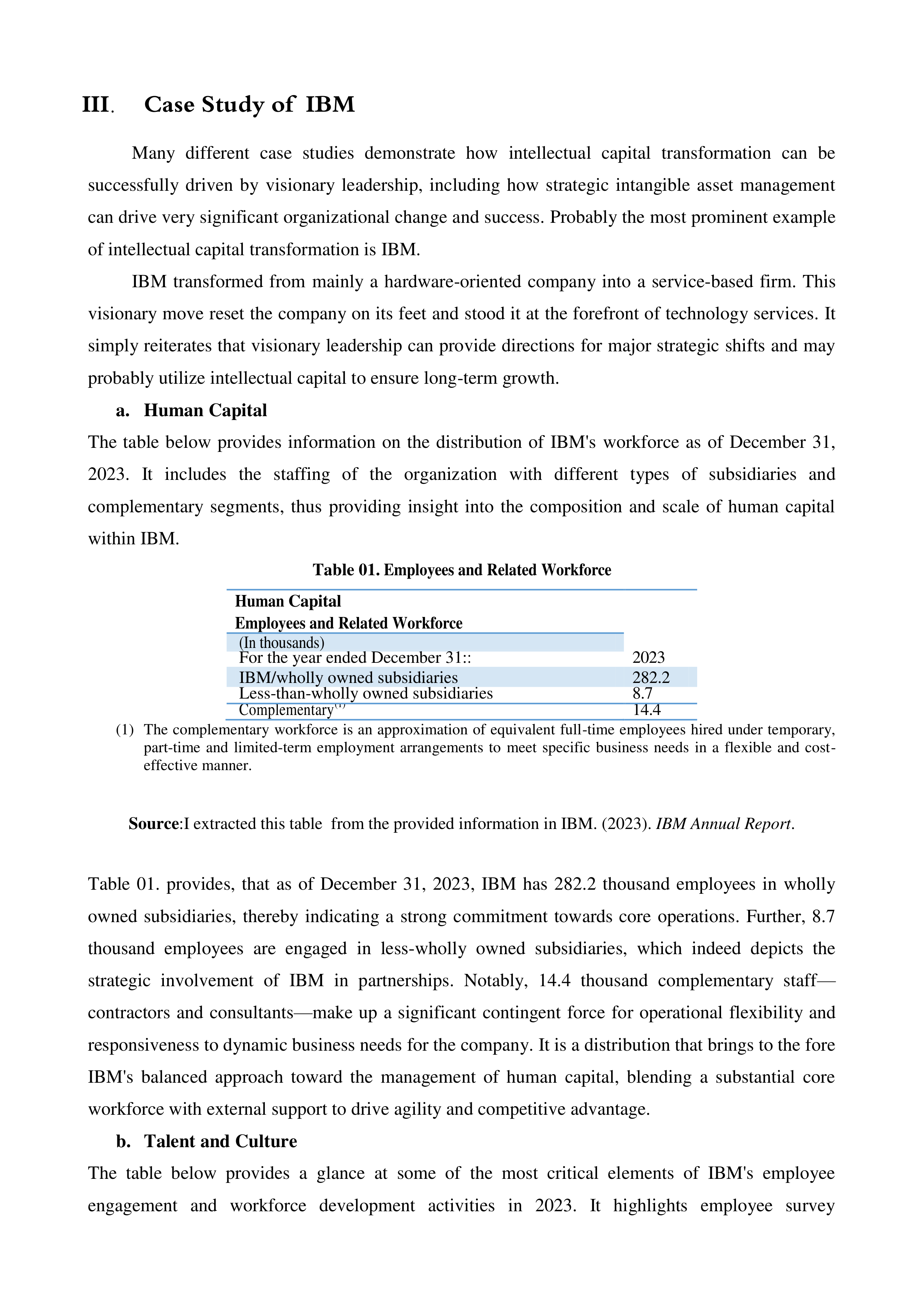
The table below provides information on the distribution of IBM's workforce as of December 31,
2023. It includes the staffing of the organization with different types of subsidiaries and
complementary segments, thus providing insight into the composition and scale of human capital
within IBM.
Table 01.
Employees and Related Workforce
Human
Capital
Employees and Related Workforce
(In
thousands)
For the year ended December 31:
:
2023
IBM/wholly owned subsidiaries
282.2
Less-than-wholly owned subsidiaries
8.7
Complementary
(1)
14.4
(1)
The complementary workforce is an approximation of equivalent full-time employees hired under temporary,
part-time and limited-term employment arrangements to meet specific business needs in a flexible and cost-
effective manner.
Source
:I extracted this table from the provided information in IBM. (2023).
IBM Annual Report
.
Table 01. provides, that as of December 31, 2023, IBM has 282.2 thousand employees in wholly
owned subsidiaries, thereby indicating a strong commitment towards core operations. Further, 8.7
thousand employees are engaged in less-wholly owned subsidiaries, which indeed depicts the
strategic involvement of IBM in partnerships. Notably, 14.4 thousand complementary staff—
contractors and consultants—make up a significant contingent force for operational flexibility and
responsiveness to dynamic business needs for the company. It is a distribution that brings to the fore
IBM's balanced approach toward the management of human capital, blending a substantial core
workforce with external support to drive agility and competitive advantage.
b.
Talent and Culture
The table below provides a glance at some of the most critical elements of IBM's employee
engagement and workforce development activities in 2023. It highlights employee survey
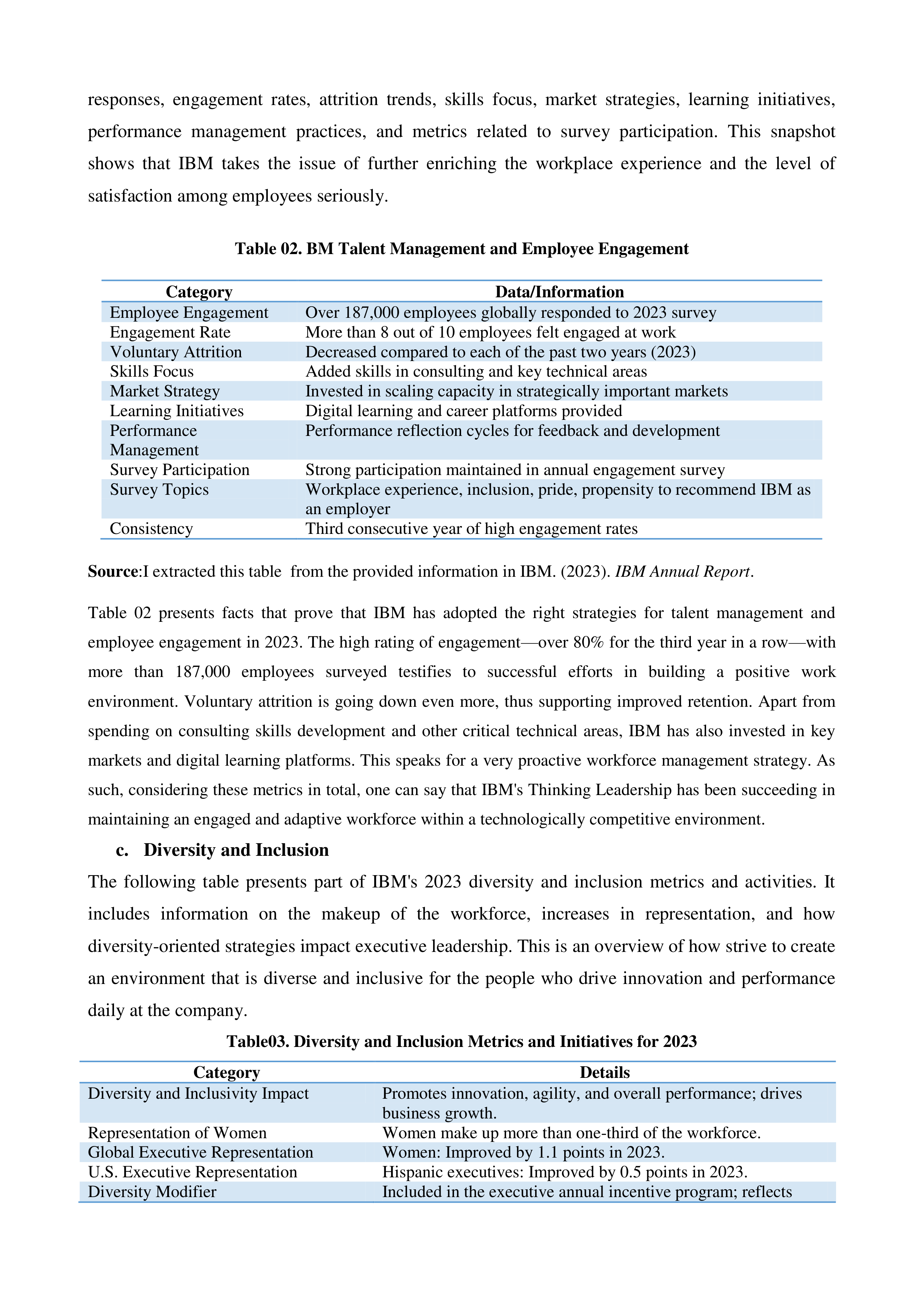
responses, engagement rates, attrition trends, skills focus, market strategies, learning initiatives,
performance management practices, and metrics related to survey participation. This snapshot
shows that IBM takes the issue of further enriching the workplace experience and the level of
satisfaction among employees seriously.
Table 02. BM Talent Management and Employee Engagement
Category
Data/Information
Employee Engagement
Over 187,000 employees globally responded to 2023 survey
Engagement Rate
More than 8 out of 10 employees felt engaged at work
Voluntary Attrition
Decreased compared to each of the past two years (2023)
Skills Focus
Added skills in consulting and key technical areas
Market Strategy
Invested in scaling capacity in strategically important markets
Learning Initiatives
Digital learning and career platforms provided
Performance
Management
Performance reflection cycles for feedback and development
Survey Participation
Strong participation maintained in annual engagement survey
Survey Topics
Workplace experience, inclusion, pride, propensity to recommend IBM as
an employer
Consistency
Third consecutive year of high engagement rates
Source
:I extracted this table from the provided information in IBM. (2023).
IBM Annual Report
.
Table 02 presents facts that prove that IBM has adopted the right strategies for talent management and
employee engagement in 2023. The high rating of engagement—over 80% for the third year in a row—with
more than 187,000 employees surveyed testifies to successful efforts in building a positive work
environment. Voluntary attrition is going down even more, thus supporting improved retention. Apart from
spending on consulting skills development and other critical technical areas, IBM has also invested in key
markets and digital learning platforms. This speaks for a very proactive workforce management strategy. As
such, considering these metrics in total, one can say that IBM's Thinking Leadership has been succeeding in
maintaining an engaged and adaptive workforce within a technologically competitive environment.
c.
Diversity and Inclusion
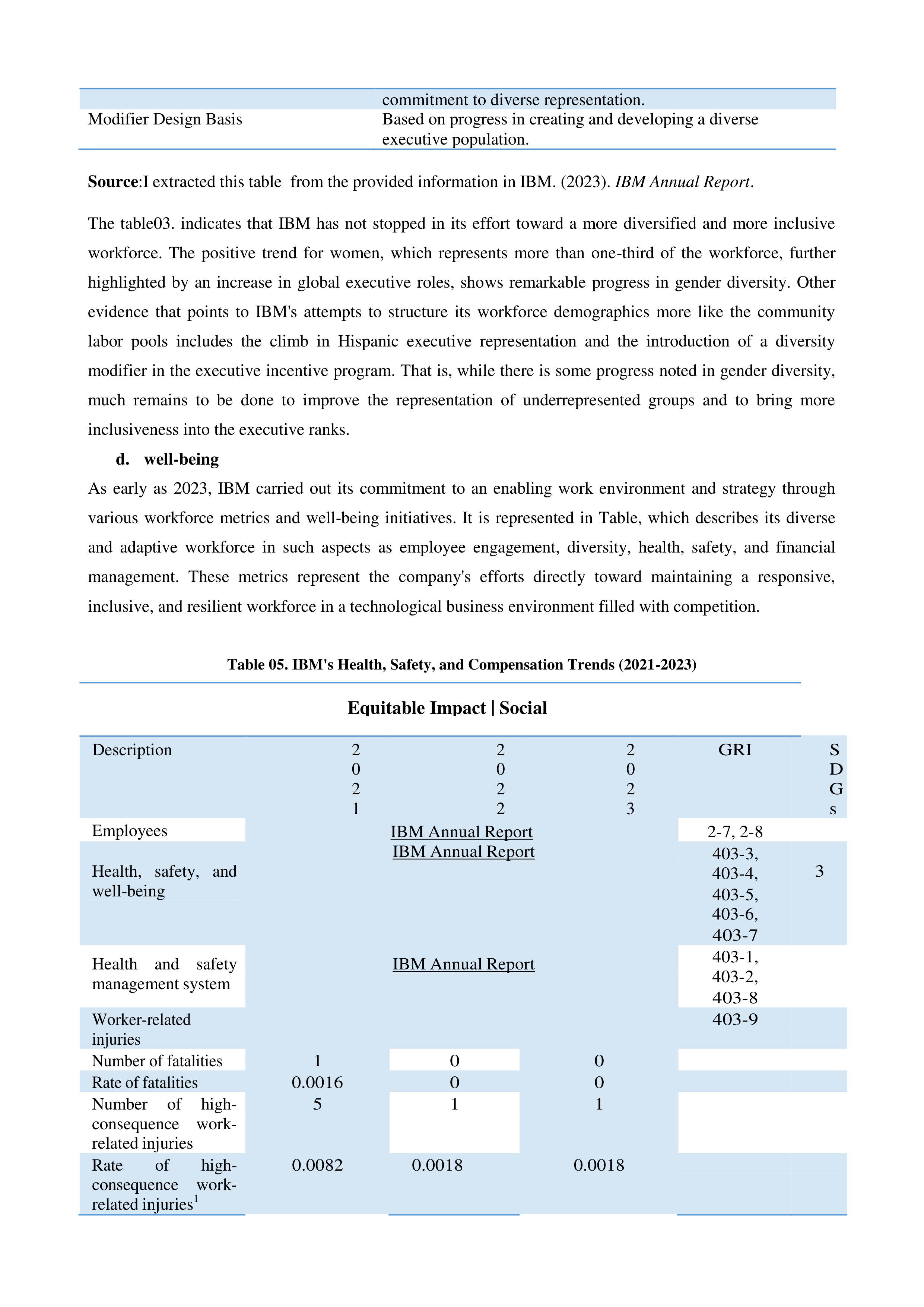
The following table presents part of IBM's 2023 diversity and inclusion metrics and activities. It
includes information on the makeup of the workforce, increases in representation, and how
diversity-oriented strategies impact executive leadership. This is an overview of how strive to create
an environment that is diverse and inclusive for the people who drive innovation and performance
daily at the company.
Table03.
Diversity and Inclusion Metrics and Initiatives for 2023
Category
Details
Diversity and Inclusivity Impact
Promotes innovation, agility, and overall performance; drives
business growth.
Representation of Women
Women make up more than one-third of the workforce.
Global Executive Representation
Women: Improved by 1.1 points in 2023.
U.S. Executive Representation
Hispanic executives: Improved by 0.5 points in 2023.
Diversity Modifier
Included in the executive annual incentive program; reflects
commitment to diverse representation.
Modifier Design Basis
Based on progress in creating and developing a diverse
executive population.
Source
:I extracted this table from the provided information in IBM. (2023).
IBM Annual Report
.
The table03. indicates that IBM has not stopped in its effort toward a more diversified and more inclusive
workforce. The positive trend for women, which represents more than one-third of the workforce, further
highlighted by an increase in global executive roles, shows remarkable progress in gender diversity. Other
evidence that points to IBM's attempts to structure its workforce demographics more like the community
labor pools includes the climb in Hispanic executive representation and the introduction of a diversity
modifier in the executive incentive program. That is, while there is some progress noted in gender diversity,
much remains to be done to improve the representation of underrepresented groups and to bring more
inclusiveness into the executive ranks.
d.
well-being
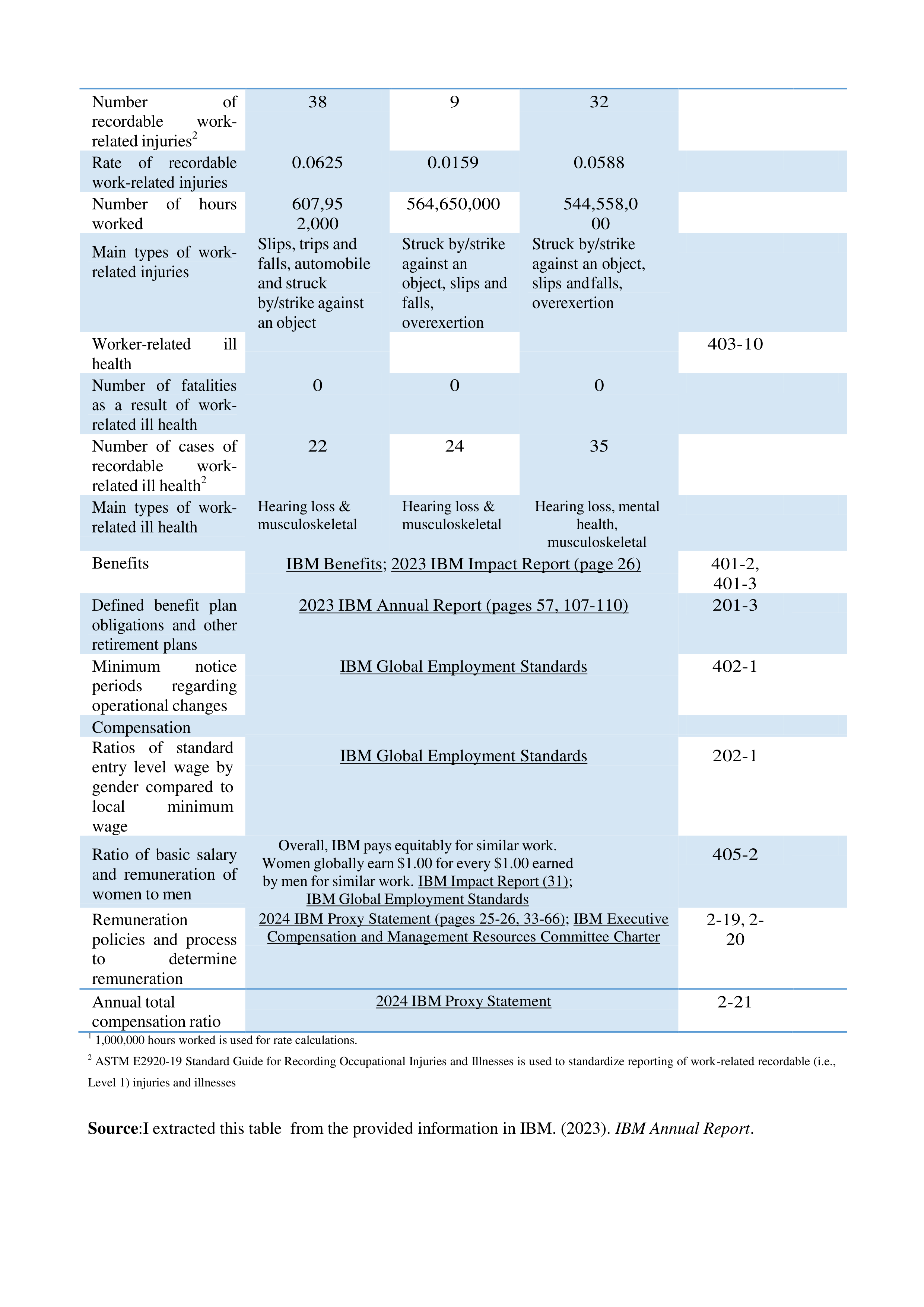
As early as 2023, IBM carried out its commitment to an enabling work environment and strategy through
various workforce metrics and well-being initiatives. It is represented in Table, which describes its diverse
and adaptive workforce in such aspects as employee engagement, diversity, health, safety, and financial
management. These metrics represent the company's efforts directly toward maintaining a responsive,
inclusive, and resilient workforce in a technological business environment filled with competition.
Table 05. IBM's Health, Safety, and Compensation Trends (2021-2023)
Description
2
0
2
1
2
0
2
2
2
0
2
3
GRI
S
D
G
s
Employees
IBM Annual Report
2-7, 2-8
Health, safety, and
well-being
IBM Annual Report
403-3,
403-4,
403-5,
403-6,
403-7
3
Health and safety
management system
IBM Annual Report
403-1,
403-2,
403-8
Worker-related
injuries
403-9
Number of fatalities
1
0
0
Rate of fatalities
0.0016
0
0
Number
of
high-
consequence work-
related injuries
5
1
1
Rate
of
high-
consequence work-
related injuries
1
0.0082
0.0018
0.0018
Equitable Impact | Social
Number
of
recordable
work-
related injuries
2
38
9
32
Rate of recordable
work-related injuries
0.0625
0.0159
0.0588
Number
of
hours
worked
607,95
2,000
564,650,000
544,558,0
00
Main types of work-
related injuries
Slips, trips and
falls, automobile
and struck
by/strike against
an object
Struck by/strike
against an
object, slips and
falls,
overexertion
Struck by/strike
against an object,
slips and falls,
overexertion
Worker-related
ill
health
403-10
Number of fatalities
as a result of work-
related ill health
0
0
0
Number of cases of
recordable
work-
related ill health
2
22
24
35
Main types of work-
related ill health
Hearing loss &
musculoskeletal
Hearing loss &
musculoskeletal
Hearing loss, mental
health,
musculoskeletal
Benefits
IBM Benefits; 2023 IBM Impact Report (page 26)
401-2,
401-3
Defined benefit plan
obligations and other
retirement plans
2023 IBM Annual Report (pages 57, 107-110)
201-3
Minimum
notice
periods
regarding
operational changes
IBM Global Employment Standards
402-1
Compensation
Ratios of standard
entry level wage by
gender compared to
local
minimum
wage
IBM Global Employment Standards
202-1
Ratio of basic salary
and remuneration of
women to men
Overall, IBM pays equitably for similar work.
Women globally earn $1.00 for every $1.00 earned
by men for similar work. IBM Impact Report (31);
IBM Global Employment Standards
405-2
Remuneration
policies and process
to
determine
remuneration
2024 IBM Proxy Statement (pages 25-26, 33-66); IBM Executive
Compensation and Management Resources Committee Charter
2-19, 2-
20
Annual total
compensation ratio
2024 IBM Proxy Statement
2-21
1
1,000,000 hours worked is used for rate calculations.
2
ASTM E2920-19 Standard Guide for Recording Occupational Injuries and Illnesses is used to standardize reporting of work-related recordable (i.e.,
Level 1) injuries and illnesses
Source
:I extracted this table from the provided information in IBM. (2023).
IBM Annual Report
.
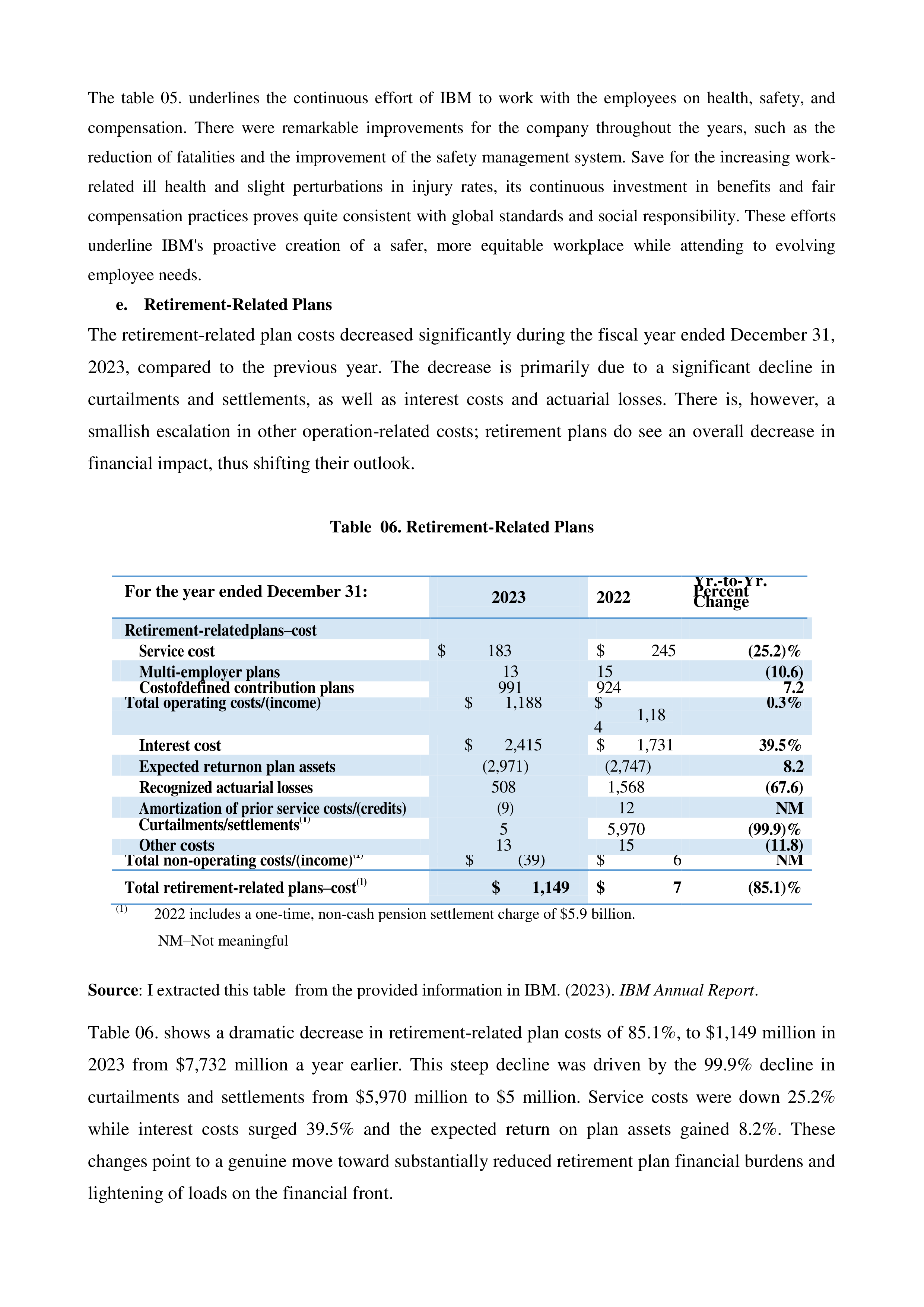
The table 05. underlines the continuous effort of IBM to work with the employees on health, safety, and
compensation. There were remarkable improvements for the company throughout the years, such as the
reduction of fatalities and the improvement of the safety management system. Save for the increasing work-
related ill health and slight perturbations in injury rates, its continuous investment in benefits and fair
compensation practices proves quite consistent with global standards and social responsibility. These efforts
underline IBM's proactive creation of a safer, more equitable workplace while attending to evolving
employee needs.
e.
Retirement-Related Plans
The retirement-related plan costs decreased significantly during the fiscal year ended December 31,
2023, compared to the previous year. The decrease is primarily due to a significant decline in
curtailments and settlements, as well as interest costs and actuarial losses. There is, however, a
smallish escalation in other operation-related costs; retirement plans do see an overall decrease in
financial impact, thus shifting their outlook.
Table 06. Retirement-Related Plans
For the year ended December 31:
2023
2022
Yr.-to-Yr.
Percent
Change
Retirement-relatedplans–cost
Service
cost
$
183
$
245
(25.2)%
Multi-employer plans
13
15
(10.6)
Costofdefined contribution plans
991
924
7.2
Total
operating
costs/(income)
$
1,188
$
1,18
4
0.3
%
Interest
cost
$
2,415
$
1,731
39.5
%
Expected returnon plan assets
(2,971)
(2,747)
8.2
Recognized actuarial losses
508
1,568
(67.6)
Amortization of prior service costs/(credits)
(9)
12
NM
Curtailments/settlements
(1)
5
5,970
(99.9)%
Other
costs
13
15
(11.8)
Total
non-operating
costs/(income)
(1)
$
(39)
$
6
NM
Total
retirement-related
plans–cost
(1)
$
1,149
$
7
(85.1)%
(1)
2022 includes a one-time, non-cash pension settlement charge of $5.9 billion.
NM–Not meaningful
Source
: I extracted this table from the provided information in IBM. (2023).
IBM Annual Report
.
Table 06. shows a dramatic decrease in retirement-related plan costs of 85.1%, to $1,149 million in
2023 from $7,732 million a year earlier. This steep decline was driven by the 99.9% decline in
curtailments and settlements from $5,970 million to $5 million. Service costs were down 25.2%
while interest costs surged 39.5% and the expected return on plan assets gained 8.2%. These
changes point to a genuine move toward substantially reduced retirement plan financial burdens and
lightening of loads on the financial front.
Discuss the Results
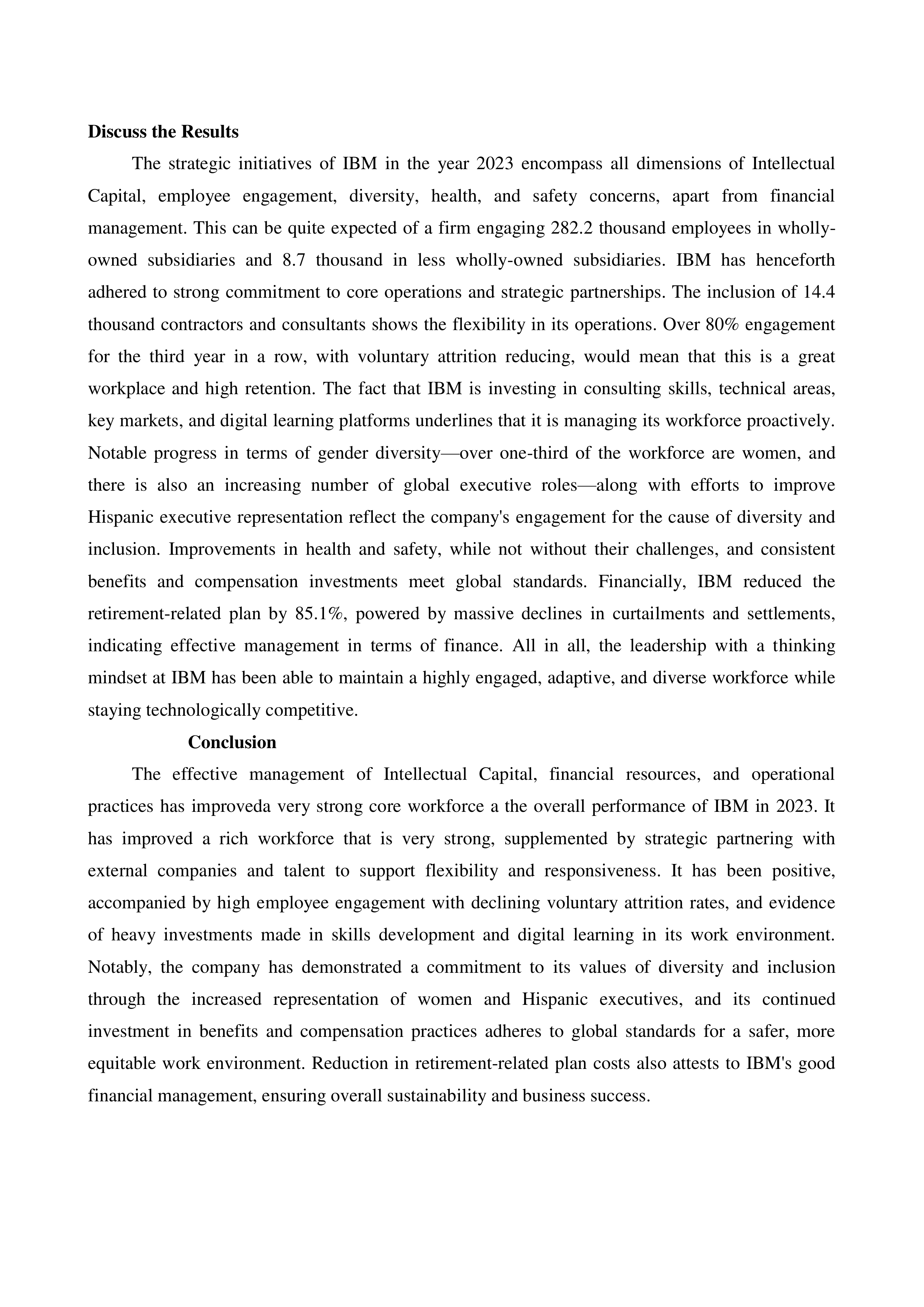
The strategic initiatives of IBM in the year 2023 encompass all dimensions of Intellectual
Capital, employee engagement, diversity, health, and safety concerns, apart from financial
management. This can be quite expected of a firm engaging 282.2 thousand employees in wholly-
owned subsidiaries and 8.7 thousand in less wholly-owned subsidiaries. IBM has henceforth
adhered to strong commitment to core operations and strategic partnerships. The inclusion of 14.4
thousand contractors and consultants shows the flexibility in its operations. Over 80% engagement
for the third year in a row, with voluntary attrition reducing, would mean that this is a great
workplace and high retention. The fact that IBM is investing in consulting skills, technical areas,
key markets, and digital learning platforms underlines that it is managing its workforce proactively.
Notable progress in terms of gender diversity—over one-third of the workforce are women, and
there is also an increasing number of global executive roles—along with efforts to improve
Hispanic executive representation reflect the company's engagement for the cause of diversity and
inclusion. Improvements in health and safety, while not without their challenges, and consistent
benefits and compensation investments meet global standards. Financially, IBM reduced the
retirement-related plan by 85.1%, powered by massive declines in curtailments and settlements,
indicating effective management in terms of finance. All in all, the leadership with a thinking
mindset at IBM has been able to maintain a highly engaged, adaptive, and diverse workforce while
staying technologically competitive.
Conclusion
The effective management of Intellectual Capital, financial resources, and operational
practices has improveda very strong core workforce a the overall performance of IBM in 2023. It
has improved a rich workforce that is very strong, supplemented by strategic partnering with
external companies and talent to support flexibility and responsiveness. It has been positive,
accompanied by high employee engagement with declining voluntary attrition rates, and evidence
of heavy investments made in skills development and digital learning in its work environment.
Notably, the company has demonstrated a commitment to its values of diversity and inclusion
through the increased representation of women and Hispanic executives, and its continued
investment in benefits and compensation practices adheres to global standards for a safer, more
equitable work environment. Reduction in retirement-related plan costs also attests to IBM's good
financial management, ensuring overall sustainability and business success.
Recommendation
Improve Health and Safety Measures: Take serious steps to address rising trends in work-
related ill-health and injury rates through better measures in health and safety, supported by
continuous monitoring.
Increase Employee Development: Invest more in upskilling and reskilling programs to
ensure that workers remain competitive and are in a better position to adapt to technological
change.
Encourage Work-Life Balance: Establish and encourage work-life balance policies to further
increase employee satisfaction and retention.
Engagement Through Technology: Leverage advanced analytics and AI to help derive more
insights about employee engagement and build custom strategies to ensure high
engagement.
Better Financial Planning: Continue improving the management of retirement plans in a
financially stable manner, reducing costs, and providing competitive benefits for employees.
References
Al-Ali, N. (2003).
Comprehensive intellectual capital management: Step-by-step
. John Wiley &
Sons.
Amarantou, V., Kazakopoulou, S., Chatzoudes, D., & Chatzoglou, P. (2018). Resistance to change:
an empirical investigation of its antecedents.
Journal of Organizational Change
Management
,
31
(2), 426-450.
Anumba, C., & Khallaf, R. (2022, November). Use of Artificial Intelligence to Improve Knowledge
Management in Construction. In
IOP Conference Series: Earth and Environmental Science
(Vol.
1101, No. 3, p. 032004). IOP Publishing.
Bass, B. M., & Avolio, B. J. (Eds.). (1994).
Improving organizational effectiveness through
transformational leadership
. sage.
Chondough, S. M., & Chondough, J. T. (2022). The Moderating Role of Intellectual Capital on The
Relationship Between Artificial Intelligence and Employee Performance of The Commercial Banks
in Nigeria.
Cross-Cultural Management Journal
,
24
(2), 115.
Dabić, M., Stojčić, N., Simić, M., Potocan, V., Slavković, M., & Nedelko, Z. (2021). Intellectual
agility and innovation in micro and small businesses: The mediating role of entrepreneurial
leadership.
Journal of business research
,
123
, 683-695.
Edmondson, A. C. (2012).
Teaming: How organizations learn, innovate, and compete in the
knowledge economy
. John Wiley & Sons.
Ganapathy, V. (2019). Strategic Management of Human Capital.
Journal of Chemical Information
and Modeling
,
17
, 1-15.
García-Granero, A., Llopis, Ó., Fernández-Mesa, A., & Alegre, J. (2015). Unraveling the link
between managerial risk-taking and innovation: The mediating role of a risk-taking climate.
Journal
of Business Research
,
68
(5), 1094-1104.
Gupta, U. (2021). Developing Culturally Versatile Leadership: Harnessing the Potential of an
Integrated World Through Global Managerial Talent.
Kale, P., Singh, H., & Perlmutter, H. (2000). Learning and protection of proprietary assets in
strategic alliances: Building relational capital.
Strategic management journal
,
21
(3), 217-237.
Karwan, D. H., Hariri, H., & Ridwan, R. (2021). Visionary leadership: what, why, and
how.
European Union Digital Library
.
Khalid, S. M., Ali, K. A. M., Makhbul, Z. K. M., Ali, M. H., & Wahid, S. D. M. (2021). Exploring
the effects of a modified higher education performance service quality model on organisational
sustainability: The case of Malaysian Polytechnics.
Sustainability
,
13
(14), 8105.
Kim, E. J., & Park, S. (2020). Transformational leadership, knowledge sharing, organizational
climate and learning: an empirical study.
Leadership & organization development journal
,
41
(6),
761-775.
Kowalski, S. P. (2018). Establishing Appropriate Best Practices in Intellectual Property
Management and Technology Transfer in the United Arab Emirates: Building Human Capital,
Global Networks and Institutional Infrastructure to Drive Sustainable Knowledge-Based,
Innovation-Driven Development.
Indian JL & Tech.
,
14
, 77.
Lentjušenkova, O., & Lapina, I. (2016). The transformation of the organization’s intellectual
capital: from resource to capital.
Journal of intellectual Capital
,
17
(4), 610-631.
Li, Y., Song, Y., Wang, J., & Li, C. (2019). Intellectual capital, knowledge sharing, and innovation
performance: Evidence from the Chinese construction industry.
Sustainability
,
11
(9), 2713.
Lönnqvist, A., & Mettänen, P. (2002, June). Criteria of sound intellectual capital measures.
In
Proceedings of the 2nd International Workshop on Performance Measurement, Hanover,
June
(pp. 6-7).
Mačerinskienė, I., & Survilaitė, S. (2019). Company's intellectual capital impact on market value of
Baltic countries listed enterprises.
Oeconomia Copernicana. Torun: Nicolaus Copernicus
university, 2019, vol. 10, no. 2.
Martín-de Castro, G., Díez-Vial, I., & Delgado-Verde, M. (2019). Intellectual capital and the firm:
evolution and research trends.
Journal of Intellectual Capital
,
20
(4), 555-580.
Minovski, Z., & Jancevska, I. (2018). The role of intellectual capital and its accounting recognition
and measurement.
Journal of Contemporary Economic and Business Issues
.
Najar, T., Dhaouadi, K., & Ben Zammel, I. (2020). Intellectual capital impact on open innovation:
The case of technology-based sectors in Tunisia.
Journal of Innovation Economics & Management
,
75-106.
O’Reilly III, C. A., & Tushman, M. L. (2021).
Lead and disrupt: How to solve the innovator's
dilemma
. Stanford University Press.
Pasher, E., & Ronen, T. (2011).
The complete guide to knowledge management: A strategic plan to
leverage your company's intellectual capital
. John Wiley & Sons.
Pathak, S., & Solanki, V. K. (2021). Impact of internet of things and artificial intelligence on human
resource development.
Further advances in internet of things in biomedical and cyber physical
systems
, 239-267.
Pinarbasi, F., Sonmez Cakir, F., Güner Gültekin, D., Yazici, M., & Adiguzel, Z. (2024).
Examination of the effects of value creation, intellectual property and organizational creativity on
artificial intelligence focused enterprises.
Business Process Management Journal
,
30
(1), 317-337.
Purnamawati, I., Jie, F., Hong, P. C., & Yuniarta, G. A. (2022). Analysis of maximization strategy
intangible assets through the speed of innovation on knowledge-driven business performance
improvement.
Economies
,
10
(6), 149.
Rastegar, M., & Arbabi, H. (2023). The impact of intellectual capital on the employee performance
of SMEs with the mediating role of organizational learning.
Kurdish Studies
,
11
(1), 504-512.
Sadq, Z. M., Ahmad, B. S., Saeed, V. S., Othman, B., & Mohammed, H. O. (2020). The
relationship between intellectual capital and organizational trust and its impact on achieving the
requirements of entrepreneurship strategy (The case of Korek Telecom Company,
Iraq).
International Journal of Advanced Science and Technology
,
29
(2), 2639-2653.
Senge, P. (1990). Peter Senge and the learning organization.
Dimension
,
14
.
Sinkkilä, H. (2017). Digitalisation driven strategic renewal in small and medium sized enterprises in
Finnish manufacturing.
Yu, Q., Aslam, S., Murad, M., Jiatong, W., & Syed, N. (2022). The impact of knowledge
management process and intellectual capital on entrepreneurial orientation and
innovation.
Frontiers in psychology
,
13
, 772668.